EP4131707A1 - Zellenausgleichsmodul - Google Patents
Zellenausgleichsmodul Download PDFInfo
- Publication number
- EP4131707A1 EP4131707A1 EP21776470.3A EP21776470A EP4131707A1 EP 4131707 A1 EP4131707 A1 EP 4131707A1 EP 21776470 A EP21776470 A EP 21776470A EP 4131707 A1 EP4131707 A1 EP 4131707A1
- Authority
- EP
- European Patent Office
- Prior art keywords
- cell balancing
- sub
- resistors
- substrate
- cell
- Prior art date
- Legal status (The legal status is an assumption and is not a legal conclusion. Google has not performed a legal analysis and makes no representation as to the accuracy of the status listed.)
- Granted
Links
Images


Classifications
-
- H—ELECTRICITY
- H05—ELECTRIC TECHNIQUES NOT OTHERWISE PROVIDED FOR
- H05K—PRINTED CIRCUITS; CASINGS OR CONSTRUCTIONAL DETAILS OF ELECTRIC APPARATUS; MANUFACTURE OF ASSEMBLAGES OF ELECTRICAL COMPONENTS
- H05K1/00—Printed circuits
- H05K1/02—Details
- H05K1/14—Structural association of two or more printed circuits
- H05K1/141—One or more single auxiliary printed circuits mounted on a main printed circuit, e.g. modules, adapters
-
- H—ELECTRICITY
- H02—GENERATION; CONVERSION OR DISTRIBUTION OF ELECTRIC POWER
- H02J—ELECTRIC POWER NETWORKS; CIRCUIT ARRANGEMENTS OR SYSTEMS FOR SUPPLYING OR DISTRIBUTING ELECTRIC POWER; SYSTEMS FOR STORING ELECTRIC ENERGY
- H02J7/00—Circuit arrangements for charging or discharging batteries or for supplying loads from batteries
- H02J7/50—Circuit arrangements for charging or discharging batteries or for supplying loads from batteries acting upon multiple batteries simultaneously or sequentially
- H02J7/52—Circuit arrangements for charging or discharging batteries or for supplying loads from batteries acting upon multiple batteries simultaneously or sequentially for charge balancing, e.g. equalisation of charge between batteries
- H02J7/54—Passive balancing, e.g. using resistors or parallel MOSFETs
-
- B—PERFORMING OPERATIONS; TRANSPORTING
- B60—VEHICLES IN GENERAL
- B60L—PROPULSION OF ELECTRICALLY-PROPELLED VEHICLES; SUPPLYING ELECTRIC POWER FOR AUXILIARY EQUIPMENT OF ELECTRICALLY-PROPELLED VEHICLES; ELECTRODYNAMIC BRAKE SYSTEMS FOR VEHICLES IN GENERAL; MAGNETIC SUSPENSION OR LEVITATION FOR VEHICLES; MONITORING OPERATING VARIABLES OF ELECTRICALLY-PROPELLED VEHICLES; ELECTRIC SAFETY DEVICES FOR ELECTRICALLY-PROPELLED VEHICLES
- B60L58/00—Methods or circuit arrangements for monitoring or controlling batteries or fuel cells, specially adapted for electric vehicles
- B60L58/10—Methods or circuit arrangements for monitoring or controlling batteries or fuel cells, specially adapted for electric vehicles for monitoring or controlling batteries
- B60L58/18—Methods or circuit arrangements for monitoring or controlling batteries or fuel cells, specially adapted for electric vehicles for monitoring or controlling batteries of two or more battery modules
- B60L58/22—Balancing the charge of battery modules
-
- H—ELECTRICITY
- H01—ELECTRIC ELEMENTS
- H01M—PROCESSES OR MEANS, e.g. BATTERIES, FOR THE DIRECT CONVERSION OF CHEMICAL ENERGY INTO ELECTRICAL ENERGY
- H01M10/00—Secondary cells; Manufacture thereof
- H01M10/42—Methods or arrangements for servicing or maintenance of secondary cells or secondary half-cells
-
- H—ELECTRICITY
- H01—ELECTRIC ELEMENTS
- H01M—PROCESSES OR MEANS, e.g. BATTERIES, FOR THE DIRECT CONVERSION OF CHEMICAL ENERGY INTO ELECTRICAL ENERGY
- H01M10/00—Secondary cells; Manufacture thereof
- H01M10/42—Methods or arrangements for servicing or maintenance of secondary cells or secondary half-cells
- H01M10/425—Structural combination with electronic components, e.g. electronic circuits integrated to the outside of the casing
-
- H—ELECTRICITY
- H01—ELECTRIC ELEMENTS
- H01M—PROCESSES OR MEANS, e.g. BATTERIES, FOR THE DIRECT CONVERSION OF CHEMICAL ENERGY INTO ELECTRICAL ENERGY
- H01M10/00—Secondary cells; Manufacture thereof
- H01M10/42—Methods or arrangements for servicing or maintenance of secondary cells or secondary half-cells
- H01M10/48—Accumulators combined with arrangements for measuring, testing or indicating the condition of cells, e.g. the level or density of the electrolyte
-
- H—ELECTRICITY
- H01—ELECTRIC ELEMENTS
- H01M—PROCESSES OR MEANS, e.g. BATTERIES, FOR THE DIRECT CONVERSION OF CHEMICAL ENERGY INTO ELECTRICAL ENERGY
- H01M50/00—Constructional details or processes of manufacture of the non-active parts of electrochemical cells other than fuel cells, e.g. hybrid cells
- H01M50/20—Mountings; Secondary casings or frames; Racks, modules or packs; Suspension devices; Shock absorbers; Transport or carrying devices; Holders
- H01M50/284—Mountings; Secondary casings or frames; Racks, modules or packs; Suspension devices; Shock absorbers; Transport or carrying devices; Holders with incorporated circuit boards, e.g. printed circuit boards [PCB]
-
- H—ELECTRICITY
- H02—GENERATION; CONVERSION OR DISTRIBUTION OF ELECTRIC POWER
- H02J—ELECTRIC POWER NETWORKS; CIRCUIT ARRANGEMENTS OR SYSTEMS FOR SUPPLYING OR DISTRIBUTING ELECTRIC POWER; SYSTEMS FOR STORING ELECTRIC ENERGY
- H02J7/00—Circuit arrangements for charging or discharging batteries or for supplying loads from batteries
- H02J7/50—Circuit arrangements for charging or discharging batteries or for supplying loads from batteries acting upon multiple batteries simultaneously or sequentially
- H02J7/52—Circuit arrangements for charging or discharging batteries or for supplying loads from batteries acting upon multiple batteries simultaneously or sequentially for charge balancing, e.g. equalisation of charge between batteries
-
- H—ELECTRICITY
- H05—ELECTRIC TECHNIQUES NOT OTHERWISE PROVIDED FOR
- H05K—PRINTED CIRCUITS; CASINGS OR CONSTRUCTIONAL DETAILS OF ELECTRIC APPARATUS; MANUFACTURE OF ASSEMBLAGES OF ELECTRICAL COMPONENTS
- H05K1/00—Printed circuits
- H05K1/02—Details
- H05K1/0201—Thermal arrangements, e.g. for cooling, heating or preventing overheating
- H05K1/0203—Cooling of mounted components
-
- H—ELECTRICITY
- H05—ELECTRIC TECHNIQUES NOT OTHERWISE PROVIDED FOR
- H05K—PRINTED CIRCUITS; CASINGS OR CONSTRUCTIONAL DETAILS OF ELECTRIC APPARATUS; MANUFACTURE OF ASSEMBLAGES OF ELECTRICAL COMPONENTS
- H05K1/00—Printed circuits
- H05K1/02—Details
- H05K1/0201—Thermal arrangements, e.g. for cooling, heating or preventing overheating
- H05K1/0203—Cooling of mounted components
- H05K1/0209—External configuration of printed circuit board adapted for heat dissipation, e.g. lay-out of conductors, coatings
-
- H—ELECTRICITY
- H01—ELECTRIC ELEMENTS
- H01M—PROCESSES OR MEANS, e.g. BATTERIES, FOR THE DIRECT CONVERSION OF CHEMICAL ENERGY INTO ELECTRICAL ENERGY
- H01M10/00—Secondary cells; Manufacture thereof
- H01M10/42—Methods or arrangements for servicing or maintenance of secondary cells or secondary half-cells
- H01M10/425—Structural combination with electronic components, e.g. electronic circuits integrated to the outside of the casing
- H01M2010/4271—Battery management systems including electronic circuits, e.g. control of current or voltage to keep battery in healthy state, cell balancing
-
- H—ELECTRICITY
- H05—ELECTRIC TECHNIQUES NOT OTHERWISE PROVIDED FOR
- H05K—PRINTED CIRCUITS; CASINGS OR CONSTRUCTIONAL DETAILS OF ELECTRIC APPARATUS; MANUFACTURE OF ASSEMBLAGES OF ELECTRICAL COMPONENTS
- H05K1/00—Printed circuits
- H05K1/02—Details
- H05K1/14—Structural association of two or more printed circuits
- H05K1/144—Stacked arrangements of planar printed circuit boards
-
- H—ELECTRICITY
- H05—ELECTRIC TECHNIQUES NOT OTHERWISE PROVIDED FOR
- H05K—PRINTED CIRCUITS; CASINGS OR CONSTRUCTIONAL DETAILS OF ELECTRIC APPARATUS; MANUFACTURE OF ASSEMBLAGES OF ELECTRICAL COMPONENTS
- H05K2201/00—Indexing scheme relating to printed circuits covered by H05K1/00
- H05K2201/04—Assemblies of printed circuits
- H05K2201/042—Stacked spaced PCBs; Planar parts of folded flexible circuits having mounted components in between or spaced from each other
-
- Y—GENERAL TAGGING OF NEW TECHNOLOGICAL DEVELOPMENTS; GENERAL TAGGING OF CROSS-SECTIONAL TECHNOLOGIES SPANNING OVER SEVERAL SECTIONS OF THE IPC; TECHNICAL SUBJECTS COVERED BY FORMER USPC CROSS-REFERENCE ART COLLECTIONS [XRACs] AND DIGESTS
- Y02—TECHNOLOGIES OR APPLICATIONS FOR MITIGATION OR ADAPTATION AGAINST CLIMATE CHANGE
- Y02E—REDUCTION OF GREENHOUSE GAS [GHG] EMISSIONS, RELATED TO ENERGY GENERATION, TRANSMISSION OR DISTRIBUTION
- Y02E60/00—Enabling technologies; Technologies with a potential or indirect contribution to GHG emissions mitigation
- Y02E60/10—Energy storage using batteries
-
- Y—GENERAL TAGGING OF NEW TECHNOLOGICAL DEVELOPMENTS; GENERAL TAGGING OF CROSS-SECTIONAL TECHNOLOGIES SPANNING OVER SEVERAL SECTIONS OF THE IPC; TECHNICAL SUBJECTS COVERED BY FORMER USPC CROSS-REFERENCE ART COLLECTIONS [XRACs] AND DIGESTS
- Y02—TECHNOLOGIES OR APPLICATIONS FOR MITIGATION OR ADAPTATION AGAINST CLIMATE CHANGE
- Y02T—CLIMATE CHANGE MITIGATION TECHNOLOGIES RELATED TO TRANSPORTATION
- Y02T10/00—Road transport of goods or passengers
- Y02T10/60—Other road transportation technologies with climate change mitigation effect
- Y02T10/70—Energy storage systems for electromobility, e.g. batteries
Definitions
- the present invention relates to a cell balancing module, and more particularly, to a cell balancing module in which a cell balancing resistor is mounted using a stack structure.
- a current is applied to a resistor connected to the cells of the battery pack to consume the voltage of each cell as heat, thereby performing balancing among the cells. While consuming the voltage of the cell in a limited space as heat, the resistor causes a rapid temperature rise, and to prevent this, the temperature is controlled by reducing the current, however, since this affects the cell balancing time, it is necessary to optimize the design by improving the position, arrangement, and driving method without reducing the current.
- the technical problem to be solved by the present invention is to provide a cell balancing module for mounting a cell balancing resistor using a stack structure and a method for manufacturing the cell balancing module.
- a cell balancing module comprises: a main board on which a plurality of cell balancing resistors are mounted; at least one sub-board on which a plurality of cell balancing resistors are mounted and which is formed above the main board while being spaced a predetermined distance apart therefrom; and at least one connector which supports the sub-board to be spaced apart from the main board and electrically connects the sub-board to the main board.
- the sub-board may have the plurality of cell balancing resistors being formed on a surface facing or opposite to the main substrate.
- the plurality of cell balancing resistors may consume a voltage of each battery cell by connecting two cell balancing resistors in series for each battery cell.
- the plurality of cell balancing resistors formed on the main substrate and the plurality of cell balancing resistors formed on the sub-board may be alternately disposed so that positions are not being overlapped with each other.
- the sub-board the sub-board has a heat dissipation unit being formed on a surface not being mounted with the plurality of cell balancing resistors thereon.
- control unit being mounted on the main substrate to control the connection of the plurality of cell balancing resistors.
- sub-boards may be plural, and connectors may be formed between the sub-boards adjacent to each other so that the adjacent sub-boards may be formed to be spaced apart from each other by a predetermined interval.
- the connector may connect the main board and the sub-board through a connection line patterned therein.
- At least one of an interval between cell balancing resistors, the number of cell balancing resistors, and the number of sub-boards may vary depending on heat density, balancing time, number of cells performing balancing, or space of cell balancing module.
- a method for manufacturing a cell balancing module comprising the steps of: mounting a cell balancing resistor on one or more sub-boards, and connecting a connector to form a resistor module; mounting a cell balancing resistor and a control unit controlling a cell balancing resistor on a main board; and stacking the resistor module on a cell balancing resistor of the main board.
- a larger number of resistors can be mounted using a stack structure, so that a plurality of cells can be balanced, and the time for cell balancing can be shortened.
- various resistors are available and the size of the cell balancing module can be reduced, thereby enabling compact and slim design.
- the heat density is reduced, which can reduce the temperature of the resistors and the module.
- the singular form may include the plural form unless specifically stated in the phrase, and when described as "at least one (or more than one) of A and B and C", it may include one or more of all combinations that can be combined with A, B, and C.
- first, second, A, B, (a), and (b) may be used. These terms are merely intended to distinguish the components from other components, and the terms do not limit the nature, order or sequence of the components.
- a component when a component is described as being 'connected', 'coupled' or 'interconnected' to another component, the component is not only directly connected, coupled or interconnected to the other component, but may also include cases of being 'connected', 'coupled', or 'interconnected' due that another component between that other components.
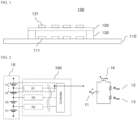
- FIG. 1 illustrates a cell balancing module according to an embodiment of the present invention.
- the cell balancing module 100 comprises a main board 110, a sub-board 120, and a connector 130, and may further includes a control unit 300 and a heat dissipation unit 140.
- the cell balancing module 100 may include resistors R1 to R3 that consume the voltage of the cell and a control unit 300 for controlling the voltage consumption of the cell using each resistor.
- a cell of the cell balancing module 100 may include resistors R1 to R3 that consume voltage and a control unit 300 for controlling voltage consumption of the cell by using each resistor.
- a resistor connected to the cell whose voltage is higher than the voltage of the other cell is connected to the cell to form a closed loop, so that current flows, and the voltage of the cell is consumed through the flowing current, thereby balancing the cells.
- This is called a passive balancing.
- two resistors 12 and 13 are connected to each cell 11, and the voltage of the cell is consumed through a current flowing therethrough.
- the cell balancing operation is controlled through the on/off of the switch 14 by the control of the control unit 300.
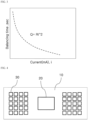
- FIG. 3 When cell balancing is performed, the relationship between the current flowing through the resistor and the balancing time is shown in FIG. 3 . As the current flowing through the resistor is increased, the voltage change in each cell has a very fast response speed. In addition, as shown in FIG. 4 , when the resistor 30 is mounted on the substrate 10 and cell balancing is performed by the control of the control units 300 and 20, as the number of resistors 30 increases, power consumption can be increased, and thus, the balancing time can be reduced.
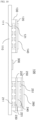
- the cell balancing module 100 includes a stack structure having one or more sub-boards 120 being formed and spaced apart from each other by a predetermined interval in an upper portion of the main substrate 110 on which a plurality of cell balancing resistors 111 are mounted.
- the sub-board 120 and the main board 110 are electrically connected to each other through one or more connectors 130, and the connector 130 supports the sub-board 120 so that the sub-board 120 can be spaced apart from the main board 110.
- the cell balancing resistors 111 and 121 mounted on the main board 110 and the sub-board 120 may have two cell balancing resistors connected in series for each battery cell so that a voltage flowing from each battery cell can be consumed.
- an on/off switch may be mounted to control the connection between the two cell balancing resistors and the cell. On/off of the corresponding switch may be controlled by the control unit 300.
- the connector 130 serves to support the stack structure of the sub-board 120 and to connect the sub-board 120 and the main board 110. At this time, the connector 130 may have a patterned connection line therein, and may connect the main board 110 and the sub-board 120 through the patterned connection line therein.
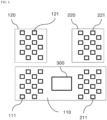
- the control unit 300 for controlling power consumption in the cell balancing resistors 111 and 121 may be mounted on the main board 110 as shown in FIG. 5 .
- the control unit 300 being mounted on the main board 110, may control not only the connection of the cell balancing resistor 121 mounted on the sub-board 120 but also the cell balancing resistor 111 mounted on the main board 110. That is, one control unit 300 may control the connection of all cell balancing resistors mounted on the cell balancing module 100. It is natural that multiple control units 300 may be used depending on the number of cell balancing resistors or the performance or control design of the control unit 300.
- the connector 130 includes a connection line being patterned such as a penetrating electrode therein, and may connect the electrode of the main board 110 and the electrode of the sub-board 120 through the connection line.
- a feed line and a ground line are formed in the connector 130 so that a closed loop including a resistor may be formed.
- the connector 130 formed with a connection line patterned therein and formed with terminals, at both ends thereof, where the main board 110 and the sub-board 120 are connected can be easily coupled by connecting the corresponding terminal to the main board 110 and the sub-board 120. Through this, the manufacturing process of the cell balancing module 100 becomes simplified, and the process speed can be increased.
- the cell balancing resistors 111 and 211 may be mounted on the main board 110 in both directions of the control unit 300, each of the sub-boards 120 and 220 are stacked on the main board 110 on which each cell balancing resistor is mounted, and cell balancing resistors 121 and 221 may be mounted on each of the sub-boards 120 and 220.
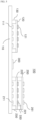
- the sub-board being stacked on the main board 110 may be in plural as 220 and 250, and a connector 330 is formed between the sub-boards 220 and 250 adjacent to each other so that the sub-boards 220 and 250 adjacent to each other may be formed to be spaced apart from each other by a predetermined interval.
- a connector 330 is formed between the sub-boards 220 and 250 adjacent to each other so that the sub-boards 220 and 250 adjacent to each other may be formed to be spaced apart from each other by a predetermined interval.
- various cell balancing resistor designs are possible by using a stack structure in which the sub-board 120 is stacked on an upper portion of the main board 110. At least one or more of an interval between cell balancing resistors, the number of cell balancing resistors, and the number of sub-boards may vary according to heat density, balancing time, the number of cells performing balancing, or the space of a cell balancing module.
- FIGS. 5 to 8 illustrate a cell balancing module according to various embodiments of the present invention
- the plurality of cell balancing resistors 121 and 231 being formed on the main substrate 110 and the plurality of cell balancing resistors 111 and 211 being formed on the sub-boards 120 and 220 may be disposed to cross each other so that positions are not overlapped with each other. Since there is no cell balancing resistor being overlapped in up and down direction, the heat density is reduced by half. When the heat density is reduced by half, the risk of heat generation can be lowered, and a large current can be used. Through this, the current can be increased four times compared to the existing one, and as shown in FIG. 3 , since the cell balancing time is inversely proportional to the square of the magnitude of the current, the cell balancing time can be reduced by 1/16.
- the number of cell balancing resistors mounted on the cell balancing module 100 may be doubled by stacking the sub-boards 120 and 220 on the main board 110.
- the heat density is the same, but the number of cells capable of balancing the existing cells can be doubled. That is, the number of cells capable of cell balancing can be increased with one cell balancing module 100.
- the number of cell balancing resistors being mounted on the main board 110 is reduced by half, but a space in which the cell balancing resistor is mounted may be formed in only one direction of the control unit 300 by laminating the sub-board 120.
- the heat generation density is the same as before, but the size of the substrate can be reduced. That is, since the overall size of the cell balancing module 100 can be reduced, miniaturization is possible.
- the spacing between cell balancing resistors, the number of cell balancing resistors, and the number of sub-boards are determined depending on the heat density, balancing time, the number of cells performing balancing, or the space of the cell balancing module, and accordingly, the cell balancing module 100 may be designed.
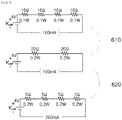
- the number of resistors may be increased using a stack structure, but different resistor values of the cell balancing resistor may be applied.
- the power consumed by all resistors is maintained the same, and the resistor value of each resistor can be reduced in half ( 610 ).
- the current flowing through the cell balancing circuit is the same, individual resistor values are reduced to reduce individual heat generation. That is, the heat density can be reduced.
- each resistor value may be reduced while maintaining the same power consumption ( 620 ).
- the current flowing through the cell balancing circuit is doubled, and thus, the cell balancing time can be shortened.
- the sub-board 120 is formed to be spaced apart from the main substrate 110, and a plurality of cell balancing resistors 121 may be mounted on a surface facing or opposite to the main substrate 110. As shown in FIG. 1 , the cell balancing resistor 121 is mounted on the opposite surface of the surface facing the main board 110, or as shown in FIG. 10 , the cell balancing resistor 121 may be mounted on a surface facing the main substrate 110.
- the heat dissipation unit 140 may be formed on a surface on which the plurality of cell balancing resistors 121 is not mounted.
- the heat dissipation unit 140 may be formed to face the outside.
- the heat dissipation unit 140 is formed outside, that is, in an upper direction of the main substrate 110, the cell balancing resistor 121 being mounted on the sub-board 120 may be mounted on a surface facing the main board 110.
- the cell balancing resistor 121 being mounted on the sub-board 120 may be mounted on a surface opposite to the surface facing the main board 110 so as to form a distance between the cell balancing resistors farther.
- sub-board 120 on which the heat dissipation unit 140 is formed may also be stacked in a plurality of layers 220 and 250 as shown in FIG. 10 .
- the cell balancing module 100 formed as described above may be manufactured through the following process.
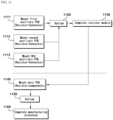
- a cell balancing resistor is mounted on one or more sub-boards, and a connector is connected to form a resistor module, and the cell balancing resistor and the control unit 300 for controlling the cell balancing resistor is mounted on the main board, and then the resistor module is stacked on the cell balancing resistor of the main board, and thereby the cell balancing module 100 may be manufactured.
- cell balancing resistors may be mounted on each sub-board stacked on the main board and connectors may be connected ( 1111, 1112, and 1113 ).
- a process of forming a heat sink such as a heat dissipation unit on the sub-board may be performed.
- the heat sink may be formed at an upper portion or a lower portion of the sub-board.
- the connector may be an interface connector in which a patterned connection line is formed, and may be connected to the sub-board through soldering.
- a resistor module may be formed ( 1130 ) through reflow soldering ( 1120 ) for the sub-boards.
- the reflow soldering is a process of supplying an appropriate amount of solder to a joint in advance, and then melting the solder by a heat source from the outside to perform soldering.
- the necessary parts such as the cell balancing resistor and the control unit 300 are mounted on the main board ( 1140 ), and the cell balancing module manufacturing process may be completed ( 1160 ) via reflow soldering of the resistor module on the main board ( 1150 ).
- the cell balancing module manufactured and formed by the sub-board being modularized into a resistor module and stacked, standardization is possible because the number of resistor modules being stacked can be freely designed according to the required number.
- a larger number of resistors can be mounted through the stack structure enabling cell balancing for a larger number of cells, and the cell balancing current can be increased depending on the design to shorten the cell balancing time.
- resistors of various sizes and capacities can be utilized. In terms of size, 3216 resistors can be mounted on the main board and 6432 resistors can be mounted on the sub-board, and resistors of various capacities such as 1 ohm or 2 ohms can be used.
- the degree of freedom of substrate specifications such as thickness, layer, and copper specifications of the substrate is increased.
- the sub-board can be manufactured in a process separate from the main board, and compact and slim design becomes possible.
- a connector that is easy to connect it is possible to free from the problem of short circuit in the joint and realize assembly automation such as reflow. Since it is possible to design various cell balancing resistors, it is possible to design to reduce heat density, and to control on/off alternated by layers, and thereby the temperature rise of the resistor and module can be reduced.
Landscapes
- Engineering & Computer Science (AREA)
- Microelectronics & Electronic Packaging (AREA)
- Power Engineering (AREA)
- General Chemical & Material Sciences (AREA)
- Electrochemistry (AREA)
- Chemical Kinetics & Catalysis (AREA)
- Chemical & Material Sciences (AREA)
- Manufacturing & Machinery (AREA)
- Mechanical Engineering (AREA)
- Transportation (AREA)
- Sustainable Energy (AREA)
- Sustainable Development (AREA)
- Life Sciences & Earth Sciences (AREA)
- Battery Mounting, Suspending (AREA)
- Combinations Of Printed Boards (AREA)
- Charge And Discharge Circuits For Batteries Or The Like (AREA)
- Coupling Device And Connection With Printed Circuit (AREA)
- Details Of Connecting Devices For Male And Female Coupling (AREA)
Applications Claiming Priority (2)
| Application Number | Priority Date | Filing Date | Title |
|---|---|---|---|
| KR1020200037701A KR102958859B1 (ko) | 2020-03-27 | 셀 밸런싱 모듈 | |
| PCT/KR2021/003792 WO2021194309A1 (ko) | 2020-03-27 | 2021-03-26 | 셀 밸런싱 모듈 |
Publications (3)
| Publication Number | Publication Date |
|---|---|
| EP4131707A1 true EP4131707A1 (de) | 2023-02-08 |
| EP4131707A4 EP4131707A4 (de) | 2024-05-01 |
| EP4131707B1 EP4131707B1 (de) | 2025-07-30 |
Family
ID=77892113
Family Applications (1)
| Application Number | Title | Priority Date | Filing Date |
|---|---|---|---|
| EP21776470.3A Active EP4131707B1 (de) | 2020-03-27 | 2021-03-26 | Zellenausgleichsmodul |
Country Status (5)
| Country | Link |
|---|---|
| US (1) | US12156332B2 (de) |
| EP (1) | EP4131707B1 (de) |
| JP (1) | JP7703563B2 (de) |
| CN (1) | CN115336134A (de) |
| WO (1) | WO2021194309A1 (de) |
Family Cites Families (20)
| Publication number | Priority date | Publication date | Assignee | Title |
|---|---|---|---|---|
| US7218489B2 (en) * | 2001-10-04 | 2007-05-15 | Ise Corporation | High-power ultracapacitor energy storage pack and method of use |
| US7085112B2 (en) * | 2001-10-04 | 2006-08-01 | Ise Corporation | High-power ultracapacitor energy storage pack and method of use |
| US20070002518A1 (en) * | 2001-10-04 | 2007-01-04 | Ise Corporation | High-Power Ultracapacitor Energy Storage Pack and Method of Use |
| US20080068801A1 (en) * | 2001-10-04 | 2008-03-20 | Ise Corporation | High-Power Ultracapacitor Energy Storage Cell Pack and Coupling Method |
| US20070224854A1 (en) * | 2006-03-27 | 2007-09-27 | Abdallah Bacha | Memory module, method of manufacturing a memory module and computer system |
| JP2012248467A (ja) * | 2011-05-30 | 2012-12-13 | Panasonic Corp | 電池パックおよびその製造方法 |
| WO2012164761A1 (ja) | 2011-05-31 | 2012-12-06 | 日立ビークルエナジー株式会社 | 電池システム監視装置 |
| KR101658025B1 (ko) | 2011-11-02 | 2016-09-21 | 삼성에스디아이 주식회사 | 이차전지 |
| CN103748735B (zh) * | 2012-06-15 | 2016-03-30 | 观致汽车有限公司 | 一种电池能量消耗系统和方法 |
| US10063071B2 (en) | 2013-03-15 | 2018-08-28 | Atieva, Inc. | Balance resistor and low pass filter |
| JP6618236B2 (ja) * | 2014-02-24 | 2019-12-11 | 住友重機械工業株式会社 | 蓄電装置 |
| US10826136B2 (en) * | 2014-07-24 | 2020-11-03 | The Boeing Company | Battery pack including stacked battery-board assemblies |
| WO2016190293A1 (ja) * | 2015-05-25 | 2016-12-01 | 日本電気株式会社 | 蓄電装置、セルバランス動作方法、及びプログラム |
| WO2018110232A1 (ja) * | 2016-12-16 | 2018-06-21 | 三洋電機株式会社 | 車両用の電装用バッテリ |
| KR102319239B1 (ko) * | 2016-12-21 | 2021-10-28 | 삼성에스디아이 주식회사 | 배터리 팩 |
| KR102349705B1 (ko) | 2017-06-22 | 2022-01-10 | 주식회사 엘지에너지솔루션 | 배터리 셀 밸런싱 회로와 이를 이용한 배터리 셀 밸런싱 장치 및 방법 |
| JP7127064B2 (ja) * | 2017-12-19 | 2022-08-29 | 三洋電機株式会社 | 管理装置、及び電源システム |
| KR102382161B1 (ko) | 2017-12-27 | 2022-04-01 | 주식회사 엘지에너지솔루션 | 이중 직병렬 패스를 이용한 셀 밸런싱 회로 |
| WO2019136090A1 (en) * | 2018-01-02 | 2019-07-11 | Scout Industries, Inc. | Variable-intensity led module, system and light fixture |
| KR102500362B1 (ko) * | 2018-10-19 | 2023-02-14 | 주식회사 엘지에너지솔루션 | 배터리 관리 장치 |
-
2021
- 2021-03-26 JP JP2022558328A patent/JP7703563B2/ja active Active
- 2021-03-26 WO PCT/KR2021/003792 patent/WO2021194309A1/ko not_active Ceased
- 2021-03-26 US US17/914,496 patent/US12156332B2/en active Active
- 2021-03-26 CN CN202180024350.XA patent/CN115336134A/zh active Pending
- 2021-03-26 EP EP21776470.3A patent/EP4131707B1/de active Active
Also Published As
| Publication number | Publication date |
|---|---|
| JP2023519358A (ja) | 2023-05-10 |
| CN115336134A (zh) | 2022-11-11 |
| EP4131707B1 (de) | 2025-07-30 |
| US20230129190A1 (en) | 2023-04-27 |
| JP7703563B2 (ja) | 2025-07-07 |
| EP4131707A4 (de) | 2024-05-01 |
| US12156332B2 (en) | 2024-11-26 |
| WO2021194309A1 (ko) | 2021-09-30 |
| KR20210120687A (ko) | 2021-10-07 |
Similar Documents
| Publication | Publication Date | Title |
|---|---|---|
| US10826136B2 (en) | Battery pack including stacked battery-board assemblies | |
| CN102255064B (zh) | 电池组 | |
| US20140212695A1 (en) | Flexible printed circuit as high voltage interconnect in battery modules | |
| US9184472B2 (en) | Battery pack and method of manufacturing battery pack with interconnected half contact pads | |
| KR20100013285A (ko) | 3차원 상호접속부를 갖는 전력 셀 장치 | |
| CN105745772A (zh) | 电源装置 | |
| EP3432409B1 (de) | Zellenüberwachungsschaltungsträger, batteriesystem und elektrofahrzeug | |
| EP2605322B1 (de) | Stromversorgungssystem und Stromversorgungselement davon | |
| EP1939962B1 (de) | Stromversorgungssystem | |
| CN113113734B (zh) | 电池系统及将柔性印刷电路连接到电池系统的方法及工具 | |
| KR101199080B1 (ko) | 배터리 팩 | |
| CN111313119B (zh) | 电池模块以及将单元监控电路载体组装到电池模块的方法 | |
| US12156332B2 (en) | Cell balancing module | |
| EP3849006A1 (de) | Batteriesystem mit flexibler leiterplatte | |
| US20200185681A1 (en) | Battery module | |
| KR20040071116A (ko) | 시스템 레벨 디바이스 및 집적 칩 구조체 | |
| KR102958859B1 (ko) | 셀 밸런싱 모듈 | |
| US20240072396A1 (en) | Battery module | |
| KR20160128162A (ko) | 배터리 모듈 | |
| CN119563258A (zh) | 电池模块和电池模块堆 | |
| CN221947287U (zh) | 电池组结构 | |
| KR20200090627A (ko) | 전지 시스템용 회로 캐리어 및 전지 시스템 | |
| EP4730925A2 (de) | Leiterplattenanordnung und wiederaufladbare batterie damit | |
| EP4641753A2 (de) | Batterieverwaltungsvorrichtung | |
| CN120072997A (zh) | 液流电池的多通道控制电路及控制装置 |
Legal Events
| Date | Code | Title | Description |
|---|---|---|---|
| STAA | Information on the status of an ep patent application or granted ep patent |
Free format text: STATUS: THE INTERNATIONAL PUBLICATION HAS BEEN MADE |
|
| PUAI | Public reference made under article 153(3) epc to a published international application that has entered the european phase |
Free format text: ORIGINAL CODE: 0009012 |
|
| STAA | Information on the status of an ep patent application or granted ep patent |
Free format text: STATUS: REQUEST FOR EXAMINATION WAS MADE |
|
| 17P | Request for examination filed |
Effective date: 20220927 |
|
| AK | Designated contracting states |
Kind code of ref document: A1 Designated state(s): AL AT BE BG CH CY CZ DE DK EE ES FI FR GB GR HR HU IE IS IT LI LT LU LV MC MK MT NL NO PL PT RO RS SE SI SK SM TR |
|
| DAV | Request for validation of the european patent (deleted) | ||
| DAX | Request for extension of the european patent (deleted) | ||
| REG | Reference to a national code |
Ref legal event code: R079 Ipc: B60L0058220000 Ref country code: DE Ref legal event code: R079 Ref document number: 602021035182 Country of ref document: DE Free format text: PREVIOUS MAIN CLASS: H02J0007000000 Ipc: B60L0058220000 |
|
| A4 | Supplementary search report drawn up and despatched |
Effective date: 20240328 |
|
| RIC1 | Information provided on ipc code assigned before grant |
Ipc: H05K 1/14 20060101ALI20240322BHEP Ipc: H05K 1/02 20060101ALI20240322BHEP Ipc: H01M 50/284 20210101ALI20240322BHEP Ipc: H01M 10/48 20060101ALI20240322BHEP Ipc: H01M 10/42 20060101ALI20240322BHEP Ipc: H02J 7/00 20060101ALI20240322BHEP Ipc: B60L 58/22 20190101AFI20240322BHEP |
|
| GRAP | Despatch of communication of intention to grant a patent |
Free format text: ORIGINAL CODE: EPIDOSNIGR1 |
|
| STAA | Information on the status of an ep patent application or granted ep patent |
Free format text: STATUS: GRANT OF PATENT IS INTENDED |
|
| RIC1 | Information provided on ipc code assigned before grant |
Ipc: H05K 1/14 20060101ALI20250124BHEP Ipc: H05K 1/02 20060101ALI20250124BHEP Ipc: H01M 50/284 20210101ALI20250124BHEP Ipc: H01M 10/48 20060101ALI20250124BHEP Ipc: H01M 10/42 20060101ALI20250124BHEP Ipc: H02J 7/00 20060101ALI20250124BHEP Ipc: B60L 58/22 20190101AFI20250124BHEP |
|
| INTG | Intention to grant announced |
Effective date: 20250227 |
|
| GRAS | Grant fee paid |
Free format text: ORIGINAL CODE: EPIDOSNIGR3 |
|
| GRAA | (expected) grant |
Free format text: ORIGINAL CODE: 0009210 |
|
| STAA | Information on the status of an ep patent application or granted ep patent |
Free format text: STATUS: THE PATENT HAS BEEN GRANTED |
|
| AK | Designated contracting states |
Kind code of ref document: B1 Designated state(s): AL AT BE BG CH CY CZ DE DK EE ES FI FR GB GR HR HU IE IS IT LI LT LU LV MC MK MT NL NO PL PT RO RS SE SI SK SM TR |
|
| REG | Reference to a national code |
Ref country code: GB Ref legal event code: FG4D |
|
| REG | Reference to a national code |
Ref country code: CH Ref legal event code: EP |
|
| REG | Reference to a national code |
Ref country code: DE Ref legal event code: R096 Ref document number: 602021035182 Country of ref document: DE |
|
| REG | Reference to a national code |
Ref country code: IE Ref legal event code: FG4D |
|
| REG | Reference to a national code |
Ref country code: NL Ref legal event code: FP |
|
| REG | Reference to a national code |
Ref country code: AT Ref legal event code: MK05 Ref document number: 1818594 Country of ref document: AT Kind code of ref document: T Effective date: 20250730 |
|
| PG25 | Lapsed in a contracting state [announced via postgrant information from national office to epo] |
Ref country code: PT Free format text: LAPSE BECAUSE OF FAILURE TO SUBMIT A TRANSLATION OF THE DESCRIPTION OR TO PAY THE FEE WITHIN THE PRESCRIBED TIME-LIMIT Effective date: 20251202 |
|
| PG25 | Lapsed in a contracting state [announced via postgrant information from national office to epo] |
Ref country code: IS Free format text: LAPSE BECAUSE OF FAILURE TO SUBMIT A TRANSLATION OF THE DESCRIPTION OR TO PAY THE FEE WITHIN THE PRESCRIBED TIME-LIMIT Effective date: 20251130 |
|
| PG25 | Lapsed in a contracting state [announced via postgrant information from national office to epo] |
Ref country code: NO Free format text: LAPSE BECAUSE OF FAILURE TO SUBMIT A TRANSLATION OF THE DESCRIPTION OR TO PAY THE FEE WITHIN THE PRESCRIBED TIME-LIMIT Effective date: 20251030 |
|
| REG | Reference to a national code |
Ref country code: LT Ref legal event code: MG9D |
|
| PG25 | Lapsed in a contracting state [announced via postgrant information from national office to epo] |
Ref country code: AT Free format text: LAPSE BECAUSE OF FAILURE TO SUBMIT A TRANSLATION OF THE DESCRIPTION OR TO PAY THE FEE WITHIN THE PRESCRIBED TIME-LIMIT Effective date: 20250730 |
|
| PG25 | Lapsed in a contracting state [announced via postgrant information from national office to epo] |
Ref country code: FI Free format text: LAPSE BECAUSE OF FAILURE TO SUBMIT A TRANSLATION OF THE DESCRIPTION OR TO PAY THE FEE WITHIN THE PRESCRIBED TIME-LIMIT Effective date: 20250730 |
|
| PG25 | Lapsed in a contracting state [announced via postgrant information from national office to epo] |
Ref country code: HR Free format text: LAPSE BECAUSE OF FAILURE TO SUBMIT A TRANSLATION OF THE DESCRIPTION OR TO PAY THE FEE WITHIN THE PRESCRIBED TIME-LIMIT Effective date: 20250730 |
|
| PG25 | Lapsed in a contracting state [announced via postgrant information from national office to epo] |
Ref country code: GR Free format text: LAPSE BECAUSE OF FAILURE TO SUBMIT A TRANSLATION OF THE DESCRIPTION OR TO PAY THE FEE WITHIN THE PRESCRIBED TIME-LIMIT Effective date: 20251031 |
|
| PG25 | Lapsed in a contracting state [announced via postgrant information from national office to epo] |
Ref country code: SE Free format text: LAPSE BECAUSE OF FAILURE TO SUBMIT A TRANSLATION OF THE DESCRIPTION OR TO PAY THE FEE WITHIN THE PRESCRIBED TIME-LIMIT Effective date: 20250730 |
|
| PG25 | Lapsed in a contracting state [announced via postgrant information from national office to epo] |
Ref country code: LV Free format text: LAPSE BECAUSE OF FAILURE TO SUBMIT A TRANSLATION OF THE DESCRIPTION OR TO PAY THE FEE WITHIN THE PRESCRIBED TIME-LIMIT Effective date: 20250730 |
|
| PG25 | Lapsed in a contracting state [announced via postgrant information from national office to epo] |
Ref country code: BG Free format text: LAPSE BECAUSE OF FAILURE TO SUBMIT A TRANSLATION OF THE DESCRIPTION OR TO PAY THE FEE WITHIN THE PRESCRIBED TIME-LIMIT Effective date: 20250730 Ref country code: PL Free format text: LAPSE BECAUSE OF FAILURE TO SUBMIT A TRANSLATION OF THE DESCRIPTION OR TO PAY THE FEE WITHIN THE PRESCRIBED TIME-LIMIT Effective date: 20250730 |
|
| PG25 | Lapsed in a contracting state [announced via postgrant information from national office to epo] |
Ref country code: RS Free format text: LAPSE BECAUSE OF FAILURE TO SUBMIT A TRANSLATION OF THE DESCRIPTION OR TO PAY THE FEE WITHIN THE PRESCRIBED TIME-LIMIT Effective date: 20251030 |
|
| PG25 | Lapsed in a contracting state [announced via postgrant information from national office to epo] |
Ref country code: ES Free format text: LAPSE BECAUSE OF FAILURE TO SUBMIT A TRANSLATION OF THE DESCRIPTION OR TO PAY THE FEE WITHIN THE PRESCRIBED TIME-LIMIT Effective date: 20250730 |
|
| PG25 | Lapsed in a contracting state [announced via postgrant information from national office to epo] |
Ref country code: SM Free format text: LAPSE BECAUSE OF FAILURE TO SUBMIT A TRANSLATION OF THE DESCRIPTION OR TO PAY THE FEE WITHIN THE PRESCRIBED TIME-LIMIT Effective date: 20250730 |
|
| PG25 | Lapsed in a contracting state [announced via postgrant information from national office to epo] |
Ref country code: DK Free format text: LAPSE BECAUSE OF FAILURE TO SUBMIT A TRANSLATION OF THE DESCRIPTION OR TO PAY THE FEE WITHIN THE PRESCRIBED TIME-LIMIT Effective date: 20250730 |
|
| PG25 | Lapsed in a contracting state [announced via postgrant information from national office to epo] |
Ref country code: IT Free format text: LAPSE BECAUSE OF FAILURE TO SUBMIT A TRANSLATION OF THE DESCRIPTION OR TO PAY THE FEE WITHIN THE PRESCRIBED TIME-LIMIT Effective date: 20250730 |