EP4131629A1 - Base material assembly for mechanical and electrical connection, and riveting method therefor - Google Patents
Base material assembly for mechanical and electrical connection, and riveting method therefor Download PDFInfo
- Publication number
- EP4131629A1 EP4131629A1 EP21849982.0A EP21849982A EP4131629A1 EP 4131629 A1 EP4131629 A1 EP 4131629A1 EP 21849982 A EP21849982 A EP 21849982A EP 4131629 A1 EP4131629 A1 EP 4131629A1
- Authority
- EP
- European Patent Office
- Prior art keywords
- base material
- emboss
- members
- riveting
- assembly
- Prior art date
- Legal status (The legal status is an assumption and is not a legal conclusion. Google has not performed a legal analysis and makes no representation as to the accuracy of the status listed.)
- Pending
Links
Images



Classifications
-
- H—ELECTRICITY
- H01—ELECTRIC ELEMENTS
- H01M—PROCESSES OR MEANS, e.g. BATTERIES, FOR THE DIRECT CONVERSION OF CHEMICAL ENERGY INTO ELECTRICAL ENERGY
- H01M50/00—Constructional details or processes of manufacture of the non-active parts of electrochemical cells other than fuel cells, e.g. hybrid cells
- H01M50/50—Current conducting connections for cells or batteries
- H01M50/502—Interconnectors for connecting terminals of adjacent batteries; Interconnectors for connecting cells outside a battery casing
-
- H—ELECTRICITY
- H01—ELECTRIC ELEMENTS
- H01M—PROCESSES OR MEANS, e.g. BATTERIES, FOR THE DIRECT CONVERSION OF CHEMICAL ENERGY INTO ELECTRICAL ENERGY
- H01M50/00—Constructional details or processes of manufacture of the non-active parts of electrochemical cells other than fuel cells, e.g. hybrid cells
- H01M50/10—Primary casings; Jackets or wrappings
- H01M50/116—Primary casings; Jackets or wrappings characterised by the material
- H01M50/124—Primary casings; Jackets or wrappings characterised by the material having a layered structure
-
- H—ELECTRICITY
- H01—ELECTRIC ELEMENTS
- H01M—PROCESSES OR MEANS, e.g. BATTERIES, FOR THE DIRECT CONVERSION OF CHEMICAL ENERGY INTO ELECTRICAL ENERGY
- H01M50/00—Constructional details or processes of manufacture of the non-active parts of electrochemical cells other than fuel cells, e.g. hybrid cells
- H01M50/50—Current conducting connections for cells or batteries
-
- H—ELECTRICITY
- H01—ELECTRIC ELEMENTS
- H01M—PROCESSES OR MEANS, e.g. BATTERIES, FOR THE DIRECT CONVERSION OF CHEMICAL ENERGY INTO ELECTRICAL ENERGY
- H01M50/00—Constructional details or processes of manufacture of the non-active parts of electrochemical cells other than fuel cells, e.g. hybrid cells
- H01M50/50—Current conducting connections for cells or batteries
- H01M50/543—Terminals
- H01M50/552—Terminals characterised by their shape
- H01M50/553—Terminals adapted for prismatic, pouch or rectangular cells
- H01M50/557—Plate-shaped terminals
-
- H—ELECTRICITY
- H01—ELECTRIC ELEMENTS
- H01M—PROCESSES OR MEANS, e.g. BATTERIES, FOR THE DIRECT CONVERSION OF CHEMICAL ENERGY INTO ELECTRICAL ENERGY
- H01M50/00—Constructional details or processes of manufacture of the non-active parts of electrochemical cells other than fuel cells, e.g. hybrid cells
- H01M50/50—Current conducting connections for cells or batteries
- H01M50/543—Terminals
- H01M50/562—Terminals characterised by the material
-
- H—ELECTRICITY
- H01—ELECTRIC ELEMENTS
- H01R—ELECTRICALLY-CONDUCTIVE CONNECTIONS; STRUCTURAL ASSOCIATIONS OF A PLURALITY OF MUTUALLY-INSULATED ELECTRICAL CONNECTING ELEMENTS; COUPLING DEVICES; CURRENT COLLECTORS
- H01R4/00—Electrically-conductive connections between two or more conductive members in direct contact, i.e. touching one another; Means for effecting or maintaining such contact; Electrically-conductive connections having two or more spaced connecting locations for conductors and using contact members penetrating insulation
- H01R4/06—Riveted connections
-
- H—ELECTRICITY
- H01—ELECTRIC ELEMENTS
- H01R—ELECTRICALLY-CONDUCTIVE CONNECTIONS; STRUCTURAL ASSOCIATIONS OF A PLURALITY OF MUTUALLY-INSULATED ELECTRICAL CONNECTING ELEMENTS; COUPLING DEVICES; CURRENT COLLECTORS
- H01R4/00—Electrically-conductive connections between two or more conductive members in direct contact, i.e. touching one another; Means for effecting or maintaining such contact; Electrically-conductive connections having two or more spaced connecting locations for conductors and using contact members penetrating insulation
- H01R4/26—Connections in which at least one of the connecting parts has projections which bite into or engage the other connecting part in order to improve the contact
-
- H—ELECTRICITY
- H01—ELECTRIC ELEMENTS
- H01M—PROCESSES OR MEANS, e.g. BATTERIES, FOR THE DIRECT CONVERSION OF CHEMICAL ENERGY INTO ELECTRICAL ENERGY
- H01M2220/00—Batteries for particular applications
- H01M2220/20—Batteries in motive systems, e.g. vehicle, ship, plane
-
- H—ELECTRICITY
- H01—ELECTRIC ELEMENTS
- H01M—PROCESSES OR MEANS, e.g. BATTERIES, FOR THE DIRECT CONVERSION OF CHEMICAL ENERGY INTO ELECTRICAL ENERGY
- H01M50/00—Constructional details or processes of manufacture of the non-active parts of electrochemical cells other than fuel cells, e.g. hybrid cells
- H01M50/50—Current conducting connections for cells or batteries
- H01M50/543—Terminals
- H01M50/564—Terminals characterised by their manufacturing process
- H01M50/567—Terminals characterised by their manufacturing process by fixing means, e.g. screws, rivets or bolts
-
- Y—GENERAL TAGGING OF NEW TECHNOLOGICAL DEVELOPMENTS; GENERAL TAGGING OF CROSS-SECTIONAL TECHNOLOGIES SPANNING OVER SEVERAL SECTIONS OF THE IPC; TECHNICAL SUBJECTS COVERED BY FORMER USPC CROSS-REFERENCE ART COLLECTIONS [XRACs] AND DIGESTS
- Y02—TECHNOLOGIES OR APPLICATIONS FOR MITIGATION OR ADAPTATION AGAINST CLIMATE CHANGE
- Y02E—REDUCTION OF GREENHOUSE GAS [GHG] EMISSIONS, RELATED TO ENERGY GENERATION, TRANSMISSION OR DISTRIBUTION
- Y02E60/00—Enabling technologies; Technologies with a potential or indirect contribution to GHG emissions mitigation
- Y02E60/10—Energy storage using batteries
Definitions
- the present disclosure relates to a base material assembly for a mechanical and electrical connection and a riveting method thereof, and more particularly, to a base material assembly capable of reducing a quality deviation when a plurality of base materials are mechanically and electrically connected and a riveting method thereof.
- the secondary battery has received attention as a power source of a medium and large-sized device such as an electric vehicle, a hybrid electric vehicle, and a plug-in hybrid electric vehicle.
- a battery pack type secondary battery in which a plurality of battery cells are arranged is used to satisfy the output and the capacity required in the medium and large-sized device.
- a riveting method is one of connection methods used in a mechanical and electrical connection between a medium and large-sized device and a battery pack mounted thereto, a mechanical and electrical connection between battery packs mounted to the medium and large-sized device, and a mechanical and electrical connection between battery cells in the battery pack.
- a contact area of a portion connected by the riveting method may be easily varied according to a working environment such as a position and a rivet direction of a riveting gun and a proficiency of a worker.
- the contact area of the connected portion relates to a resistance, and thus a resistance deviation of the connected portion, which is generated as the contact area of the connected portion is varied reaches about 10%.
- the contact area is required to be inspected to reduce a quality deviation of the connected portion after the mechanical and electrical connection by the riveting method is performed.
- the portion connected by the riveting method since the portion connected by the riveting method is in a surface-contact state, the portion may not be inspected with naked eyes.
- the present disclosure provides a base material assembly capable of reducing a quality deviation of a contact area and a resistance deviation related thereto when base materials are mechanically and electrically connected to each other and a riveting method thereof.
- a base material assembly includes: a first base material made of a conductive material; a second base material made of a conductive material, spaced apart from the first base material to face the first base material, and coupled with the first base material by riveting; a plurality of emboss members each protruding from an inside surface of the second base material to point-contact a plane of an inside surface of the first member.
- the first base material and the second base material are mechanically and electrically connected through the plurality of emboss members.
- the plurality of emboss members may be arranged along the inside surface of the first base material and spaced apart from each other in a transverse direction and a longitudinal direction.
- the plurality of emboss members may be spaced apart from each other to be symmetric with respect to a rivet member mounted to couple the first base material and the second base material.
- the plurality of emboss members may protrude by the same protruding height within an error range.
- Each of the plurality of emboss members may have a semi-spherical shaped surface contacting the second base material.
- the plurality of emboss members may be made of the same material as the first base material.
- the plurality of emboss members may be made of a conductive material different from that of the first base material.
- a riveting method of a base material assembly includes: preparing a first base material made of a conductive material; preparing a second base material made of a conductive material; forming a plurality of emboss members on the second base material; allowing the first base material to be spaced apart from the second base material so that one surface of the first base material faces the other surface of the second base material on which the plurality of emboss members are formed; allowing the first base material to approach the second base material so that the plurality of emboss members point-contact a plane of the one surface of the first base material; and coupling the first base material and the second base material by riveting.
- the coupling of the first base material and the second base material mechanically and electrically connects the first base material and the second base material through the plurality of emboss members.
- the preparing of the first base material made of the conductive material may include forming a first through-hole so that a rivet member pass through the first base material
- the preparing of the second base material made of the conductive material may include forming a second through-hole so that a rivet member pass through the first base material in correspondence to the first through-hole
- the forming of the plurality of emboss members may include forming the plurality of emboss members on the other surface of the second base material by allowing the plurality of emboss members to be spaced apart from the second through-hole in a transverse direction and a longitudinal direction and to protrude by the same height from the second base material.
- the riveting method may further include:, after the coupling of the first base material and the second base material, checking a contact state between the plurality of emboss members and the first base material through a spaced space between the first base material and the second base material; and determining whether a defect is generated in the riveting of the first base material and the second base material based on a result obtained by the checking.
- one pair of base materials are joined by the riveting method such that the emboss members are formed on the inside surface of one of the one pair of base materials to be mechanically and electrically connected, and the inside surface of the other is allowed to be the flat surface.
- the emboss members and the flat surface may contact in the point-to-surface manner unlike the typical method.
- the quality deviation of the contact area between the one pair of base materials which is affected by the difference between working environments, and the resistance deviation related thereto may be reduced in comparison with the typical method of contacting a flat surface and a flat surface in a surface-to-surface manner.
- the space between the one pair of base materials may be secured by using the emboss members after the base materials are joined, the contact state between the one pair of base materials may be easily determined by the naked eyes.
- FIG. 1 is a schematic view of a base material assembly in accordance with an exemplary embodiment.
- the base material assembly for the mechanical and electrical connection in accordance with an exemplary embodiment will be described in detail with reference to FIG. 1 .
- the base material assembly in accordance with an exemplary embodiment which is a base material assembly for a mechanical and electrical connection between a first object 1 and a second object (not shown), includes following components.
- a first base material 100 may be made of a conductive material. That is, the first base material 100 may be made of a metal material having a high electrical conductivity.
- the first base material 100 may be provided to the first object 1 or connected with the first object 1.
- the first object 1 may be a batter cell or a battery pack.
- the first base material 100 may be integrated with or connected with an electrode terminal of a battery cell or a bus bar of a battery pack.
- the kind of the first object 1 may be variously changed.
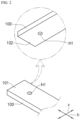
- FIG. 2 is a schematic view of the first base material in accordance with an exemplary embodiment.
- the first base material 100 may have a rectangular plate shape in which a length in a transverse direction h is greater than a length in a longitudinal direction v and which has a predetermined thickness in a vertical direction.
- one surface 101 of the first base material 100 which faces a second base material 200, may have a flat surface shape.
- the one surface 101 of the first base material 100 may be referred to as an inside surface or a top surface.
- the other surface 102 of the first base material 100 may have various shapes.
- the other surface 102 of the first base material 100 may have a flat surface shape.
- the other surface 102 of the first base material 100 may be referred to as an outside surface or a bottom surface.
- a first through-hole H1 may pass through the first base material 100 in a vertical direction.
- the vertical direction may be a direction crossing the longitudinal direction v and the transverse direction h.
- a rivet member 300 may be disposed in the first through-hole H1.
- a second base material 200 may be made of a conductive material. That is, the second base material 100 may be made of a metal material having a high electrical conductivity. Here, the second base material 200 may be made of the same material as the first base material 100. Alternatively, the second base material 200 may be made of a material that has an electrical conductivity but is different from that of the first base material 100.
- the second base material 200 may be provided to the second object (not shown) or connected with the second object.
- the second object may be a surrounding battery cell or a surrounding battery pack to be mechanically and electrically connected with the first object 1.
- the second object may be a circuit board of a power unit of a small-sized or medium and large sized device to be mechanically and electrically connected with the first object 1.
- the second base material 200 may be integrated with or connected with an electrode terminal of a surrounding battery cell, a bus bar of a surrounding battery pack, or a circuit board of a power unit.
- the kind of the second object may be variously changed.
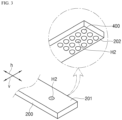
- FIG. 3 is a schematic view illustrating a second base material and an emboss member in accordance with an exemplary embodiment.
- the second base material 200 may have a rectangular plate shape in which a length in a transverse direction h is greater than a length in a longitudinal direction v and which has a predetermined thickness in the vertical direction.
- the other surface 202 of the second base material 200 which faces the first base material 100 in the vertical direction, may have a flat surface shape.
- the other surface 202 of the second base material 200 may be referred to as an inside surface or a bottom surface.
- one surface 201 of the second base material 200 may have various shapes.
- the one surface 201 of the second base material 200 may have a flat surface shape.
- the one surface 201 of the second base material 200 may be referred to as an outside surface or a top surface.
- the second base material 200 may be spaced apart from the first base material 100 to face the first base material 100 and coupled with the first base material 100 by riveting. That is, the other surface 202 of the second base material 200 and the one surface 101 of the first base material 100 may be spaced by a predetermined height in the vertical direction from each other by a plurality of emboss members 400.
- a second through-hole H2 may pass through the second base material 200 in the vertical direction.
- a rivet member 300 may be disposed in the second through-hole H2.
- the second through-hole H2 may correspond to the first through-hole H1.
- the feature of corresponding represents a feature of being mutually aligned while facing each other in the vertical direction.
- the second through-hole H2 may be disposed at a center of the plurality of emboss members 400 in the transverse direction h and the longitudinal direction v.
- a force of the rivet member 300 pressing the first base material 100 and the second base material 200 in the vertical direction may be evenly distributed to the plurality of emboss members 400.
- first base material 100 and the second base material 200 may be horizontally spaced apart from each other instead of being inclined to each other, and also the plurality of emboss members 400 may stably and uniformly contact the one surface 101 of the first base material 100.
- the rivet member 300 may pass through the first through-hole H1 and the second through-hole H2 and contact the other surface 102 of the first base material 100 and the one surface 201 of the second base material 200.
- the rivet member 300 may couple the first base material 100 and the second base material 200 such that a lower end of the rivet member 300 presses upward the other surface 102 of the first base material 100 around the first through-hole H1, and an upper end of the rivet member 300 presses downward the one surface 201 of the second member 200 around the second through-hole H2.
- the plurality of emboss members 400 may protrude from the inside surface 202 of the second base material 200 to point-contact a plane of the inside surface 101 of the first base material 100. Through the plurality of emboss members 400, the first base material 100 and the second base material 200 may be mechanically and electrically connected to each other.
- the plurality of emboss members 400 may be arranged along the inside surface of the second base material 200 and spaced apart from each other in the transverse direction h and the longitudinal direction v.
- the plurality of emboss members 400 may be spaced apart from each other to be symmetric in the transverse direction h and the longitudinal direction v with respect to the rivet member 300 mounted to couple the first base material 100 and the second base material 200.
- each of the plurality of emboss members 400 may protrude from the inside surface 202 of the second base material 200 in the vertical direction.
- protruding heights of the emboss members 400 in the vertical direction may be equal to each other within an error range.
- the error range is a variation degree of a protruding height when it is determined that a variation degree of a protruding height in the transverse direction h and the longitudinal direction v does not affect a variation of a contact area or a contact number between the first base material 100 and the plurality of emboss members 400, and since the error range may be obtained when a riveting operation is repeated, a numerical values of the error range will be omitted.
- Each of the plurality of emboss members 400 may have a curved shape in which a surface contacting the first base material 100 protrudes in a direction toward the first base material, e.g., in a downward direction.
- each of the emboss members 400 may have, e.g., a semi-spherical shape in which a bottom surface contacts the first base material 100.
- each of the plurality of emboss members 400 when the first base material 100 and the second base material 200 are riveted, the plurality of emboss members 400 may uniformly contact the first base material 100, and the first base material 100 and the second base material 200 may be spaced apart in parallel from each other. Thus, all of the plurality of emboss members 400 may evenly contact the one surface 101 of the first base material 100.
- the plurality of emboss members 400 may include the same material as the second base material 200. Alternatively, the plurality of emboss members 400 may include a conductive material different from that of the second base material 200.
- each of the plurality of emboss members 400 is made of the same material as the second base material 200, the second base material 200 and the plurality of emboss members 400 may be easily manufactured.
- each of the plurality of emboss members 400 and the second base material 200 are made of different kinds of materials
- each of the plurality of emboss members 400 may be made of a metal material having a resistance less or greater than that of the material of the second base material 200, and thus an overall resistance of the base material assembly may be easily adjusted into a preferred resistance.
- each of the plurality of emboss members 400 may be made of a material different from that of the first base material 100.
- a contact surface between the plurality of emboss members 400 and the first base material 100 may be adjusted in size such that a bottom surface of each of the plurality of emboss members 400 increases in the transverse direction h and the longitudinal direction v by adjusting a riveting strength, or the bottom surface of each of the plurality of emboss members 400 is inserted by a predetermined depth into the inside surface 101 of the first base material 100.
- FIG. 4 is a schematic view illustrating a state before the first base material and the second base material are riveted in accordance with an exemplary embodiment.
- FIG. 5 is a schematic view illustrating a state in which the first base material and the second base material are riveted in accordance with an exemplary embodiment.
- FIG. 6 is a schematic view illustrating a state in which the first base material and the second base material are completely riveted in accordance with an exemplary embodiment.
- a riveting method of a base material assembly will be described in detail with reference to FIGS. 2 to 6 . Here, when the riveting method of the base material assembly is described, a feature overlapping the above description of the base material assembly will be omitted or simply described.
- the riveting method of the base material assembly in accordance with an exemplary embodiment may include following processes.
- a process of preparing a first base material 100 made of a conductive material prepares the first base material 100 having a plate shape in which one surface 101 to be in contact with a plurality of emboss members 400 has a flat surface shape and form a first through-hole H1 in the first base material 100, through which a rivet member 300 pass through the first base material 100.
- the first through-hole H1 may be formed in the first base material 100 connected with a first object 1, or the first base material 100 may be connected with a second object (not shown) after the first through-hole H1 is formed in the first base material 100.
- a process of preparing a second base material 200 made of a conductive material prepares the second base material 200 having a plate shape in which the other surface 202 on which the plurality of emboss members 400 are formed has a flat surface shape and form a second through-hole H2 in the second base material 200, through which the rivet member 300 pass through the first base material 100, in correspondence to the first through-hole H1.
- the second through-hole H2 is formed in the second base material 200 connected with the second object (not shown), or the second base material 200 may be connected with the second object after the second through-hole H2 is formed in the second base material 200.
- a process of forming the plurality of emboss members 400 on the second base material 200 forms the plurality of emboss members 400 on the other surface 202 of the second base material 200.
- the plurality of emboss members 400 may be formed on the other surface 202 of the second base material 200.
- a method for forming the plurality of emboss members 400 may include a cutting method, a bonding method, a casting method, and a welding method. For example, a plate member having a first thickness may be prepared, and then the other surface of the plate may be cut to prepare the second base material 200 having a thickness less than the first thickness and the plurality of emboss members 400 integrated with the second base material 200.
- a process of allowing the first base material 100 and the second base material 200 to be spaced apart from each other so that the one surface 101 of the first base material 100 faces the other surface 202 of the second base material 200 allows the second base material 200 to be positioned above the one surface 101 of the first base material 100.
- first through-hole H1 and the second through-hole H2 may be aligned in the vertical direction.
- a process of allowing the first base material to approach the second base material so that the plurality of emboss members point-contact the one surface of the first base material allows the plurality of emboss members 400 to be seated on the one surface 101 of the first base material 100.
- the rivet member 300 may be positioned above the second through-hole H2.
- the rivet member 300 in a state before riveted may include a hollow rivet body 310 and a mandrel 320.
- the mandrel 320 may include a mandrel upper portion 321 disposed at an upper portion of the rivet body 310 and protruding upward from the rivet body 310, a mandrel lower portion 322 disposed at a lower portion of the rivet body 310, and a mandrel head 323 protruding downward from the rivet body 310.
- the rivet member 300 may have various configurations.
- the first base material 100 and the second base material 200 may be spaced vertically from each other by the plurality of emboss members 400, and a space may be formed therebetween.
- the space between the first base material 100 and the second base material 200 may be maintained in the riveting process and then used in a process of checking a contact state between the first base material 100 and the plurality of emboss members 400.
- a process of coupling the first base material 100 and the second base material 200 by riveting may include a process of arranging the rivet member 300 in the first and second through-holes H1 and H2 and a process of coupling the first base material 100 and the second base material 200 by pulling upward the mandrel of the rivet member 300 to deform the rivet body of the rivet member 300 and pressing upward the first base material 100 and pressing downward the second base material 200.
- the first base material 100 and the second base material 200 may be mechanically and electrically connected through the plurality of emboss members 400.
- a process of checking a contact state between the plurality of emboss members 400 and the first base material 100 may be performed after the process of coupling the first base material 100 and the second base material 200 by the riveting.
- the process of checking the contact state may be directly performed such that an operation measures the spaced space between the first base material 100 and the second base material 200 with eyes or performed by photographing an image the plurality of emboss members 400 and the one surface 101 of the first base material 100 between the spaced space between the first base material 100 and the second base material 200 by using an optical instruments (not shown) and analyzing the photographed image by using a computer.
- a process of determining whether a defect of the riveting is generated may check a contact area between the plurality of emboss members 400 and the one surface 101 of the first base material 100 or check the number of the plurality of emboss members 400 contacting the one surface 101 of the first base material 100 to determine that the riveting is satisfactory when the contact area is within a reference area or the contact number is within a reference number. Also, when the contact area is under the reference area or the contact number is short from the reference number, the riveting may be determined as a failure.
- the base material assembly and the riveting method thereof in accordance with an exemplary embodiment allow the emboss member to point-contact the base material, thereby reducing a quality deviation in case of contacting and allow the two base materials to be spaced apart from each other by the emboss member, thereby easily inspecting the contact state between the emboss member and the base material.
Landscapes
- Chemical & Material Sciences (AREA)
- Chemical Kinetics & Catalysis (AREA)
- Electrochemistry (AREA)
- General Chemical & Material Sciences (AREA)
- Insertion Pins And Rivets (AREA)
- Connections Effected By Soldering, Adhesion, Or Permanent Deformation (AREA)
- Connection Of Batteries Or Terminals (AREA)
- Connection Of Plates (AREA)
Abstract
Description
- The present disclosure relates to a base material assembly for a mechanical and electrical connection and a riveting method thereof, and more particularly, to a base material assembly capable of reducing a quality deviation when a plurality of base materials are mechanically and electrically connected and a riveting method thereof.
- As technical development and demands for a mobile device are increasing, demands for rechargeable secondary battery as an energy source are rapidly increasing. Thus, a lot of researches on the secondary battery capable of meeting various demands have been conducted. Also, the secondary battery has received attention as a power source of a medium and large-sized device such as an electric vehicle, a hybrid electric vehicle, and a plug-in hybrid electric vehicle.
- When the secondary battery is used for the medium and large-sized device that requires a large capacity, a battery pack type secondary battery in which a plurality of battery cells are arranged is used to satisfy the output and the capacity required in the medium and large-sized device.
- A riveting method is one of connection methods used in a mechanical and electrical connection between a medium and large-sized device and a battery pack mounted thereto, a mechanical and electrical connection between battery packs mounted to the medium and large-sized device, and a mechanical and electrical connection between battery cells in the battery pack.
- Here, a contact area of a portion connected by the riveting method may be easily varied according to a working environment such as a position and a rivet direction of a riveting gun and a proficiency of a worker. Here, the contact area of the connected portion relates to a resistance, and thus a resistance deviation of the connected portion, which is generated as the contact area of the connected portion is varied reaches about 10%.
- Thus, the contact area is required to be inspected to reduce a quality deviation of the connected portion after the mechanical and electrical connection by the riveting method is performed. However, since the portion connected by the riveting method is in a surface-contact state, the portion may not be inspected with naked eyes.
- The background technology of the present disclosure is disclosed in patent documents below.
- (Patent document 1)
KR10-2013-0080023 A - (Patent document 2)
KR10-1329250 B1 - The present disclosure provides a base material assembly capable of reducing a quality deviation of a contact area and a resistance deviation related thereto when base materials are mechanically and electrically connected to each other and a riveting method thereof.
- In accordance with an exemplary embodiment, a base material assembly includes: a first base material made of a conductive material; a second base material made of a conductive material, spaced apart from the first base material to face the first base material, and coupled with the first base material by riveting; a plurality of emboss members each protruding from an inside surface of the second base material to point-contact a plane of an inside surface of the first member. Here, the first base material and the second base material are mechanically and electrically connected through the plurality of emboss members.
- The plurality of emboss members may be arranged along the inside surface of the first base material and spaced apart from each other in a transverse direction and a longitudinal direction.
- The plurality of emboss members may be spaced apart from each other to be symmetric with respect to a rivet member mounted to couple the first base material and the second base material.
- The plurality of emboss members may protrude by the same protruding height within an error range.
- Each of the plurality of emboss members may have a semi-spherical shaped surface contacting the second base material.
- The plurality of emboss members may be made of the same material as the first base material.
- The plurality of emboss members may be made of a conductive material different from that of the first base material.
- In accordance with another exemplary embodiment, a riveting method of a base material assembly includes: preparing a first base material made of a conductive material; preparing a second base material made of a conductive material; forming a plurality of emboss members on the second base material; allowing the first base material to be spaced apart from the second base material so that one surface of the first base material faces the other surface of the second base material on which the plurality of emboss members are formed; allowing the first base material to approach the second base material so that the plurality of emboss members point-contact a plane of the one surface of the first base material; and coupling the first base material and the second base material by riveting. Here, the coupling of the first base material and the second base material mechanically and electrically connects the first base material and the second base material through the plurality of emboss members.
- The preparing of the first base material made of the conductive material may include forming a first through-hole so that a rivet member pass through the first base material, the preparing of the second base material made of the conductive material may include forming a second through-hole so that a rivet member pass through the first base material in correspondence to the first through-hole, and the forming of the plurality of emboss members may include forming the plurality of emboss members on the other surface of the second base material by allowing the plurality of emboss members to be spaced apart from the second through-hole in a transverse direction and a longitudinal direction and to protrude by the same height from the second base material.
- The riveting method may further include:, after the coupling of the first base material and the second base material, checking a contact state between the plurality of emboss members and the first base material through a spaced space between the first base material and the second base material; and determining whether a defect is generated in the riveting of the first base material and the second base material based on a result obtained by the checking.
- In accordance with the exemplary embodiment, one pair of base materials are joined by the riveting method such that the emboss members are formed on the inside surface of one of the one pair of base materials to be mechanically and electrically connected, and the inside surface of the other is allowed to be the flat surface. Thus, the emboss members and the flat surface may contact in the point-to-surface manner unlike the typical method. Thus, the quality deviation of the contact area between the one pair of base materials, which is affected by the difference between working environments, and the resistance deviation related thereto may be reduced in comparison with the typical method of contacting a flat surface and a flat surface in a surface-to-surface manner. Also, since the space between the one pair of base materials may be secured by using the emboss members after the base materials are joined, the contact state between the one pair of base materials may be easily determined by the naked eyes.
-
-
FIG. 1 is a schematic view of a base material assembly in accordance with an exemplary embodiment; -
FIG. 2 is a schematic view of a first base material in accordance with an exemplary embodiment; -
FIG. 3 is a schematic view of a second base material and an emboss member in accordance with an exemplary embodiment; -
FIG. 4 is a schematic view illustrating a state before the first base material and the second base material are riveted in accordance with an exemplary embodiment; -
FIG. 5 is a schematic view illustrating a state in which the first base material and the second base material are riveted in accordance with an exemplary embodiment; and -
FIG. 6 is a schematic view illustrating a state in which the first base material and the second base material are completely riveted in accordance with an exemplary embodiment. - Hereinafter, embodiments of the present invention will be described in detail with reference to the accompanying drawings. The present invention may, however, be embodied in different forms and should not be construed as limited to the embodiments set forth herein. Rather, these embodiments are provided so that this disclosure will be thorough and complete, and will fully convey the scope of the present invention to those skilled in the art. In the figures, the dimensions of layers and regions are exaggerated for clarity of illustration, and parts irrelevant to the description are omitted in order to clearly describe the present invention. Like reference numerals refer to like elements throughout.
- Hereinafter, embodiments of the inventive concept will be described with reference to the accompanying drawings.
-
FIG. 1 is a schematic view of a base material assembly in accordance with an exemplary embodiment. The base material assembly for the mechanical and electrical connection in accordance with an exemplary embodiment will be described in detail with reference toFIG. 1 . - The base material assembly in accordance with an exemplary embodiment, which is a base material assembly for a mechanical and electrical connection between a
first object 1 and a second object (not shown), includes following components. - A
first base material 100 may be made of a conductive material. That is, thefirst base material 100 may be made of a metal material having a high electrical conductivity. - The
first base material 100 may be provided to thefirst object 1 or connected with thefirst object 1. Thefirst object 1 may be a batter cell or a battery pack. For example, thefirst base material 100 may be integrated with or connected with an electrode terminal of a battery cell or a bus bar of a battery pack. Alternatively, the kind of thefirst object 1 may be variously changed. -
FIG. 2 is a schematic view of the first base material in accordance with an exemplary embodiment. - Referring to
FIG. 2 , thefirst base material 100 may have a rectangular plate shape in which a length in a transverse direction h is greater than a length in a longitudinal direction v and which has a predetermined thickness in a vertical direction. Also, onesurface 101 of thefirst base material 100, which faces asecond base material 200, may have a flat surface shape. The onesurface 101 of thefirst base material 100 may be referred to as an inside surface or a top surface. Also, theother surface 102 of thefirst base material 100 may have various shapes. For example, theother surface 102 of thefirst base material 100 may have a flat surface shape. Theother surface 102 of thefirst base material 100 may be referred to as an outside surface or a bottom surface. - A first through-hole H1 may pass through the
first base material 100 in a vertical direction. Here, the vertical direction may be a direction crossing the longitudinal direction v and the transverse direction h. Arivet member 300 may be disposed in the first through-hole H1. - A
second base material 200 may be made of a conductive material. That is, thesecond base material 100 may be made of a metal material having a high electrical conductivity. Here, thesecond base material 200 may be made of the same material as thefirst base material 100. Alternatively, thesecond base material 200 may be made of a material that has an electrical conductivity but is different from that of thefirst base material 100. - The
second base material 200 may be provided to the second object (not shown) or connected with the second object. Here, the second object may be a surrounding battery cell or a surrounding battery pack to be mechanically and electrically connected with thefirst object 1. Alternatively, the second object may be a circuit board of a power unit of a small-sized or medium and large sized device to be mechanically and electrically connected with thefirst object 1. Thesecond base material 200 may be integrated with or connected with an electrode terminal of a surrounding battery cell, a bus bar of a surrounding battery pack, or a circuit board of a power unit. Alternatively, the kind of the second object may be variously changed. -
FIG. 3 is a schematic view illustrating a second base material and an emboss member in accordance with an exemplary embodiment. - Referring to
FIG. 3 , thesecond base material 200 may have a rectangular plate shape in which a length in a transverse direction h is greater than a length in a longitudinal direction v and which has a predetermined thickness in the vertical direction. Also, theother surface 202 of thesecond base material 200, which faces thefirst base material 100 in the vertical direction, may have a flat surface shape. Theother surface 202 of thesecond base material 200 may be referred to as an inside surface or a bottom surface. Also, onesurface 201 of thesecond base material 200 may have various shapes. For example, the onesurface 201 of thesecond base material 200 may have a flat surface shape. The onesurface 201 of thesecond base material 200 may be referred to as an outside surface or a top surface. - The
second base material 200 may be spaced apart from thefirst base material 100 to face thefirst base material 100 and coupled with thefirst base material 100 by riveting. That is, theother surface 202 of thesecond base material 200 and the onesurface 101 of thefirst base material 100 may be spaced by a predetermined height in the vertical direction from each other by a plurality ofemboss members 400. - A second through-hole H2 may pass through the
second base material 200 in the vertical direction. Arivet member 300 may be disposed in the second through-hole H2. Here, the second through-hole H2 may correspond to the first through-hole H1. The feature of corresponding represents a feature of being mutually aligned while facing each other in the vertical direction. Also, the second through-hole H2 may be disposed at a center of the plurality ofemboss members 400 in the transverse direction h and the longitudinal direction v. - According to an arrangement relationship of the second through-hole H2 and the plurality of
emboss members 400, when thefirst base material 100 and thesecond base material 200 are riveted, a force of therivet member 300 pressing thefirst base material 100 and thesecond base material 200 in the vertical direction may be evenly distributed to the plurality ofemboss members 400. - Thus, the
first base material 100 and thesecond base material 200 may be horizontally spaced apart from each other instead of being inclined to each other, and also the plurality ofemboss members 400 may stably and uniformly contact the onesurface 101 of thefirst base material 100. - The
rivet member 300 may pass through the first through-hole H1 and the second through-hole H2 and contact theother surface 102 of thefirst base material 100 and the onesurface 201 of thesecond base material 200. Therivet member 300 may couple thefirst base material 100 and thesecond base material 200 such that a lower end of therivet member 300 presses upward theother surface 102 of thefirst base material 100 around the first through-hole H1, and an upper end of therivet member 300 presses downward the onesurface 201 of thesecond member 200 around the second through-hole H2. - The plurality of
emboss members 400 may protrude from theinside surface 202 of thesecond base material 200 to point-contact a plane of theinside surface 101 of thefirst base material 100. Through the plurality ofemboss members 400, thefirst base material 100 and thesecond base material 200 may be mechanically and electrically connected to each other. - Referring to
FIG. 3 , the plurality ofemboss members 400 may be arranged along the inside surface of thesecond base material 200 and spaced apart from each other in the transverse direction h and the longitudinal direction v. Here, the plurality ofemboss members 400 may be spaced apart from each other to be symmetric in the transverse direction h and the longitudinal direction v with respect to therivet member 300 mounted to couple thefirst base material 100 and thesecond base material 200. - Also, each of the plurality of
emboss members 400 may protrude from theinside surface 202 of thesecond base material 200 in the vertical direction. Here, protruding heights of theemboss members 400 in the vertical direction may be equal to each other within an error range. - The error range is a variation degree of a protruding height when it is determined that a variation degree of a protruding height in the transverse direction h and the longitudinal direction v does not affect a variation of a contact area or a contact number between the
first base material 100 and the plurality ofemboss members 400, and since the error range may be obtained when a riveting operation is repeated, a numerical values of the error range will be omitted. - Each of the plurality of
emboss members 400 may have a curved shape in which a surface contacting thefirst base material 100 protrudes in a direction toward the first base material, e.g., in a downward direction. Specifically, each of theemboss members 400 may have, e.g., a semi-spherical shape in which a bottom surface contacts thefirst base material 100. - According to the shape of each of the plurality of
emboss members 400, when thefirst base material 100 and thesecond base material 200 are riveted, the plurality ofemboss members 400 may uniformly contact thefirst base material 100, and thefirst base material 100 and thesecond base material 200 may be spaced apart in parallel from each other. Thus, all of the plurality ofemboss members 400 may evenly contact the onesurface 101 of thefirst base material 100. - The plurality of
emboss members 400 may include the same material as thesecond base material 200. Alternatively, the plurality ofemboss members 400 may include a conductive material different from that of thesecond base material 200. - That is, when each of the plurality of
emboss members 400 is made of the same material as thesecond base material 200, thesecond base material 200 and the plurality ofemboss members 400 may be easily manufactured. - Also, when each of the plurality of
emboss members 400 and thesecond base material 200 are made of different kinds of materials, each of the plurality ofemboss members 400 may be made of a metal material having a resistance less or greater than that of the material of thesecond base material 200, and thus an overall resistance of the base material assembly may be easily adjusted into a preferred resistance.. - Also, each of the plurality of
emboss members 400 may be made of a material different from that of thefirst base material 100. For example, as each of the plurality ofemboss members 400 is made of a material softer or stronger than that of thefirst base material 100, when thefirst base material 100 and thesecond base material 200 are riveted, a contact surface between the plurality ofemboss members 400 and thefirst base material 100 may be adjusted in size such that a bottom surface of each of the plurality ofemboss members 400 increases in the transverse direction h and the longitudinal direction v by adjusting a riveting strength, or the bottom surface of each of the plurality ofemboss members 400 is inserted by a predetermined depth into theinside surface 101 of thefirst base material 100. -
FIG. 4 is a schematic view illustrating a state before the first base material and the second base material are riveted in accordance with an exemplary embodiment.FIG. 5 is a schematic view illustrating a state in which the first base material and the second base material are riveted in accordance with an exemplary embodiment.FIG. 6 is a schematic view illustrating a state in which the first base material and the second base material are completely riveted in accordance with an exemplary embodiment. A riveting method of a base material assembly will be described in detail with reference toFIGS. 2 to 6 . Here, when the riveting method of the base material assembly is described, a feature overlapping the above description of the base material assembly will be omitted or simply described. - The riveting method of the base material assembly in accordance with an exemplary embodiment may include following processes.
- Referring to
FIG. 2 , a process of preparing afirst base material 100 made of a conductive material prepares thefirst base material 100 having a plate shape in which onesurface 101 to be in contact with a plurality ofemboss members 400 has a flat surface shape and form a first through-hole H1 in thefirst base material 100, through which arivet member 300 pass through thefirst base material 100. - Here, the first through-hole H1 may be formed in the
first base material 100 connected with afirst object 1, or thefirst base material 100 may be connected with a second object (not shown) after the first through-hole H1 is formed in thefirst base material 100. - Referring to
FIG. 3 , a process of preparing asecond base material 200 made of a conductive material prepares thesecond base material 200 having a plate shape in which theother surface 202 on which the plurality ofemboss members 400 are formed has a flat surface shape and form a second through-hole H2 in thesecond base material 200, through which therivet member 300 pass through thefirst base material 100, in correspondence to the first through-hole H1. - Here, the second through-hole H2 is formed in the
second base material 200 connected with the second object (not shown), or thesecond base material 200 may be connected with the second object after the second through-hole H2 is formed in thesecond base material 200. - Referring to
FIG. 3 , a process of forming the plurality ofemboss members 400 on thesecond base material 200 forms the plurality ofemboss members 400 on theother surface 202 of thesecond base material 200. - Here, as the plurality of
emboss members 400 are spaced apart from the second through-hole H2 in the transverse direction h and the longitudinal direction v and protrude by the same height from thesecond base material 200, the plurality ofemboss members 400 may be formed on theother surface 202 of thesecond base material 200. - A method for forming the plurality of
emboss members 400 may include a cutting method, a bonding method, a casting method, and a welding method. For example, a plate member having a first thickness may be prepared, and then the other surface of the plate may be cut to prepare thesecond base material 200 having a thickness less than the first thickness and the plurality ofemboss members 400 integrated with thesecond base material 200. - A process of allowing the
first base material 100 and thesecond base material 200 to be spaced apart from each other so that the onesurface 101 of thefirst base material 100 faces theother surface 202 of thesecond base material 200 allows thesecond base material 200 to be positioned above the onesurface 101 of thefirst base material 100. - Here, the first through-hole H1 and the second through-hole H2 may be aligned in the vertical direction.
- A process of allowing the first base material to approach the second base material so that the plurality of emboss members point-contact the one surface of the first base material allows the plurality of
emboss members 400 to be seated on the onesurface 101 of thefirst base material 100. - Here, referring to
FIG. 4 , therivet member 300 may be positioned above the second through-hole H2. For example, therivet member 300 in a state before riveted may include ahollow rivet body 310 and a mandrel 320. Here, the mandrel 320 may include a mandrelupper portion 321 disposed at an upper portion of therivet body 310 and protruding upward from therivet body 310, a mandrellower portion 322 disposed at a lower portion of therivet body 310, and amandrel head 323 protruding downward from therivet body 310. Alternatively, therivet member 300 may have various configurations. - In the process of allowing the
first base material 100 to approach thesecond base material 200, as the plurality ofemboss members 400 contact the onesurface 101 of thefirst base material 100, thefirst base material 100 and thesecond base material 200 may be spaced vertically from each other by the plurality ofemboss members 400, and a space may be formed therebetween. - Here, the space between the
first base material 100 and thesecond base material 200 may be maintained in the riveting process and then used in a process of checking a contact state between thefirst base material 100 and the plurality ofemboss members 400. - Referring to
FIGS. 5 and 6 , a process of coupling thefirst base material 100 and thesecond base material 200 by riveting may include a process of arranging therivet member 300 in the first and second through-holes H1 and H2 and a process of coupling thefirst base material 100 and thesecond base material 200 by pulling upward the mandrel of therivet member 300 to deform the rivet body of therivet member 300 and pressing upward thefirst base material 100 and pressing downward thesecond base material 200. - Here, referring to
FIG. 6 , thefirst base material 100 and thesecond base material 200 may be mechanically and electrically connected through the plurality ofemboss members 400. - A process of checking a contact state between the plurality of
emboss members 400 and thefirst base material 100 may be performed after the process of coupling thefirst base material 100 and thesecond base material 200 by the riveting. The process of checking the contact state may be directly performed such that an operation measures the spaced space between thefirst base material 100 and thesecond base material 200 with eyes or performed by photographing an image the plurality ofemboss members 400 and the onesurface 101 of thefirst base material 100 between the spaced space between thefirst base material 100 and thesecond base material 200 by using an optical instruments (not shown) and analyzing the photographed image by using a computer. - A process of determining whether a defect of the riveting is generated may check a contact area between the plurality of
emboss members 400 and the onesurface 101 of thefirst base material 100 or check the number of the plurality ofemboss members 400 contacting the onesurface 101 of thefirst base material 100 to determine that the riveting is satisfactory when the contact area is within a reference area or the contact number is within a reference number. Also, when the contact area is under the reference area or the contact number is short from the reference number, the riveting may be determined as a failure. - The base material assembly and the riveting method thereof in accordance with an exemplary embodiment allow the emboss member to point-contact the base material, thereby reducing a quality deviation in case of contacting and allow the two base materials to be spaced apart from each other by the emboss member, thereby easily inspecting the contact state between the emboss member and the base material.
- Although the base material assembly and the riveting method thereof have been described with reference to the specific embodiments, they are not limited thereto. Further, the above contents just illustrate and describe preferred embodiments of the present invention and the present invention may be used under various combinations, changes, and environments. Therefore, it will be readily understood by those skilled in the art that various modifications and changes can be made thereto without departing from the spirit and scope of the present invention defined by the appended claims.
-
- 100: First base material
- 200: Second base material
- 300: Rivet member
- 400: A plurality of emboss members
Claims (10)
- A base material assembly comprising:a first base material made of a conductive material;a second base material made of a conductive material, spaced apart from the first base material to face the first base material, and coupled with the first base material by riveting;a plurality of emboss members each protruding from an inside surface of the second base material to point-contact a plane of an inside surface of the first member,wherein the first base material and the second base material are spaced apart in parallel from each other and mechanically and electrically connected through the plurality of emboss members.
- The base material assembly of claim 1, wherein the plurality of emboss members are arranged along the inside surface of the second base material and spaced apart from each other in a transverse direction and a longitudinal direction.
- The base material assembly of claim 2, wherein the plurality of emboss members are spaced apart from each other to be symmetric with respect to a rivet member mounted to couple the first base material and the second base material.
- The base material assembly of claim 3, wherein the plurality of emboss members protrude by the same protruding height within an error range.
- The base material assembly of any one of claims 1 to 4, wherein each of the plurality of emboss members has a semi-spherical shaped surface contacting the first base material.
- The base material assembly of claim 1, wherein the plurality of emboss members are made of the same material as the second base material.
- The base material assembly of claim 1, wherein the plurality of emboss members are made of a conductive material different from that of the second base material.
- A riveting method of a base material assembly, comprising:preparing a first base material made of a conductive material;preparing a second base material made of a conductive material;forming a plurality of emboss members on the second base material;allowing the first base material to be spaced apart from the second base material so that one surface of the first base material faces the other surface of the second base material on which the plurality of emboss members are formed;allowing the first base material to approach the second base material so that the plurality of emboss members point-contact a plane of the one surface of the first base material; andcoupling the first base material and the second base material by riveting,wherein the coupling of the first base material and the second base material mechanically and electrically connects the first base material and the second base material through the plurality of emboss members.
- The riveting method of claim 8, wherein the preparing of the first base material made of the conductive material comprises forming a first through-hole so that a rivet member pass through the first base material,the preparing of the second base material made of the conductive material comprises forming a second through-hole so that a rivet member pass through the first base material in correspondence to the first through-hole, andthe forming of the plurality of emboss members comprises forming the plurality of emboss members on the other surface of the second base material by allowing the plurality of emboss members to be spaced apart from the second through-hole in a transverse direction and a longitudinal direction and to protrude by the same height from the second base material.
- The riveting method of claim 8, further comprising: after the coupling of the first base material and the second base material,checking a contact state between the plurality of emboss members and the first base material through a spaced space between the first base material and the second base material; anddetermining whether a defect is generated in the riveting of the first base material and the second base material based on a result obtained by the checking.
Applications Claiming Priority (2)
| Application Number | Priority Date | Filing Date | Title |
|---|---|---|---|
| KR1020200093609A KR102930129B1 (en) | 2020-07-28 | 2020-07-28 | Base metal assembly for mechanical and electrical connecting, and method for riveting the same |
| PCT/KR2021/009837 WO2022025645A1 (en) | 2020-07-28 | 2021-07-28 | Base material assembly for mechanical and electrical connection, and riveting method therefor |
Publications (2)
| Publication Number | Publication Date |
|---|---|
| EP4131629A1 true EP4131629A1 (en) | 2023-02-08 |
| EP4131629A4 EP4131629A4 (en) | 2024-02-28 |
Family
ID=80035874
Family Applications (1)
| Application Number | Title | Priority Date | Filing Date |
|---|---|---|---|
| EP21849982.0A Pending EP4131629A4 (en) | 2020-07-28 | 2021-07-28 | Base material assembly for mechanical and electrical connection, and riveting method therefor |
Country Status (6)
| Country | Link |
|---|---|
| US (1) | US20230198060A1 (en) |
| EP (1) | EP4131629A4 (en) |
| JP (1) | JP7655944B2 (en) |
| KR (1) | KR102930129B1 (en) |
| CN (1) | CN115552711A (en) |
| WO (1) | WO2022025645A1 (en) |
Family Cites Families (20)
| Publication number | Priority date | Publication date | Assignee | Title |
|---|---|---|---|---|
| JPS6183001U (en) * | 1984-11-05 | 1986-06-02 | ||
| DE19600417A1 (en) * | 1996-01-08 | 1997-07-17 | Sefag Ag | Contact element e.g. for storage battery pole |
| JP3681327B2 (en) | 2000-09-19 | 2005-08-10 | 福井鋲螺株式会社 | Method for conducting ultrathin laminate and sheet electrode |
| JP2004297021A (en) * | 2002-04-05 | 2004-10-21 | Nok Corp | Sealing plate and manufacturing method thereof |
| US6881072B2 (en) * | 2002-10-01 | 2005-04-19 | International Business Machines Corporation | Membrane probe with anchored elements |
| US7972185B2 (en) * | 2009-03-16 | 2011-07-05 | Sb Limotive Co., Ltd. | Battery module having connector for connecting terminals |
| KR101101046B1 (en) * | 2009-12-01 | 2011-12-29 | 삼성에스디아이 주식회사 | Electrode assembly and secondary battery having same |
| JP2012009411A (en) * | 2010-05-24 | 2012-01-12 | Japan Aviation Electronics Industry Ltd | Conductor connection washer, connection mechanism using it and method of manufacturing conductor connection washer |
| WO2013103244A1 (en) | 2012-01-03 | 2013-07-11 | 주식회사 엘지화학 | Battery pack and connecting bar applied to same |
| KR101329250B1 (en) | 2012-07-06 | 2013-11-13 | 한국단자공업 주식회사 | Cell busbar fastening structure for series connection apparatus of battery module |
| JP2014132547A (en) * | 2012-12-07 | 2014-07-17 | Yazaki Corp | Connection structure of conductors |
| US9653194B2 (en) * | 2013-08-12 | 2017-05-16 | Te Connectivity Corporation | Low resistance insert |
| KR20150091754A (en) * | 2014-02-04 | 2015-08-12 | 삼성에스디아이 주식회사 | Battery Module |
| KR20160016363A (en) * | 2014-08-05 | 2016-02-15 | 주식회사 메가테크 | Connecting member and battery module comprising the same |
| JP6452344B2 (en) | 2014-08-19 | 2019-01-16 | 古河電気工業株式会社 | Crimp terminal, connection structure, connector, wire harness, method for producing crimp terminal, and method for producing connection structure |
| CN204441381U (en) * | 2015-01-23 | 2015-07-01 | 深圳市中金岭南科技有限公司 | Secondary cell conductive connecting piece and multicomponent composition metal band |
| KR102473767B1 (en) * | 2015-10-08 | 2022-12-02 | 현대모비스 주식회사 | Submodule for high voltage battery |
| JP2017130287A (en) | 2016-01-18 | 2017-07-27 | カルソニックカンセイ株式会社 | Battery pack |
| JP6691083B2 (en) * | 2017-08-30 | 2020-04-28 | 矢崎総業株式会社 | Bus bar, bus bar module, and battery pack |
| KR102383415B1 (en) * | 2018-03-20 | 2022-04-06 | 삼성에스디아이 주식회사 | Battery pack |
-
2020
- 2020-07-28 KR KR1020200093609A patent/KR102930129B1/en active Active
-
2021
- 2021-07-28 US US17/925,524 patent/US20230198060A1/en active Pending
- 2021-07-28 EP EP21849982.0A patent/EP4131629A4/en active Pending
- 2021-07-28 CN CN202180034016.2A patent/CN115552711A/en active Pending
- 2021-07-28 WO PCT/KR2021/009837 patent/WO2022025645A1/en not_active Ceased
- 2021-07-28 JP JP2022568927A patent/JP7655944B2/en active Active
Also Published As
| Publication number | Publication date |
|---|---|
| JP2023525823A (en) | 2023-06-19 |
| KR102930129B1 (en) | 2026-02-25 |
| KR20220014041A (en) | 2022-02-04 |
| JP7655944B2 (en) | 2025-04-02 |
| WO2022025645A1 (en) | 2022-02-03 |
| US20230198060A1 (en) | 2023-06-22 |
| CN115552711A (en) | 2022-12-30 |
| EP4131629A4 (en) | 2024-02-28 |
Similar Documents
| Publication | Publication Date | Title |
|---|---|---|
| US12066503B2 (en) | Bus bar for battery cell connection, battery pack, and manufacturing method therefor | |
| JP6110336B2 (en) | Power storage module | |
| JP7570754B2 (en) | Electrode lead bending and welding device and electrode lead welding method using the same | |
| JP2002134176A (en) | Charge / discharge / inspection mechanism for lithium polymer batteries | |
| KR101418629B1 (en) | Jig for charging and discharging of secondarybattery | |
| US12015171B2 (en) | Battery module, battery pack, apparatus and failure treatment method | |
| US20120177969A1 (en) | Battery module | |
| EP4131629A1 (en) | Base material assembly for mechanical and electrical connection, and riveting method therefor | |
| KR20200016571A (en) | Test board and test apparatus for testing battery | |
| US20240204373A1 (en) | A cylindrical secondary cell with a terminal surface with different roughness | |
| KR20230130466A (en) | Pressing jig for battery cell | |
| US11777181B2 (en) | Metal plate for resistance welding and resistance welding method using the same | |
| CN219122360U (en) | Press-fit type battery pack voltage internal resistance testing mechanism | |
| KR20160075120A (en) | Apparatus for Inspection of Welding State of Clad to Battery Cell | |
| KR102295117B1 (en) | Bending apparatus and bending method using the same | |
| KR20240087135A (en) | Voltage polarity inspection jig of stack cell | |
| EP4609980A1 (en) | Welding rod fixing device and welding rod fixing method using same | |
| EP4664134A1 (en) | Connector inspection apparatus | |
| KR20260000859A (en) | Batery cell module assembly and welding quality inspection method | |
| CN119452491A (en) | Battery module manufacturing equipment and battery module manufacturing method | |
| KR20240149505A (en) | Battery cell | |
| KR20240117874A (en) | Bus bar assembly and method for manufacturing thereof | |
| KR20160064474A (en) | Battery Cell Having Connecting Member Connected to Electrode | |
| KR20230083478A (en) | stick for welding inspection |
Legal Events
| Date | Code | Title | Description |
|---|---|---|---|
| STAA | Information on the status of an ep patent application or granted ep patent |
Free format text: STATUS: THE INTERNATIONAL PUBLICATION HAS BEEN MADE |
|
| PUAI | Public reference made under article 153(3) epc to a published international application that has entered the european phase |
Free format text: ORIGINAL CODE: 0009012 |
|
| STAA | Information on the status of an ep patent application or granted ep patent |
Free format text: STATUS: REQUEST FOR EXAMINATION WAS MADE |
|
| 17P | Request for examination filed |
Effective date: 20221028 |
|
| AK | Designated contracting states |
Kind code of ref document: A1 Designated state(s): AL AT BE BG CH CY CZ DE DK EE ES FI FR GB GR HR HU IE IS IT LI LT LU LV MC MK MT NL NO PL PT RO RS SE SI SK SM TR |
|
| DAV | Request for validation of the european patent (deleted) | ||
| DAX | Request for extension of the european patent (deleted) | ||
| A4 | Supplementary search report drawn up and despatched |
Effective date: 20240130 |
|
| RIC1 | Information provided on ipc code assigned before grant |
Ipc: H01M 50/567 20210101ALI20240125BHEP Ipc: H01M 50/557 20210101ALI20240125BHEP Ipc: H01M 50/562 20210101ALI20240125BHEP Ipc: H01R 4/06 20060101ALI20240125BHEP Ipc: H01M 50/502 20210101AFI20240125BHEP |
|
| STAA | Information on the status of an ep patent application or granted ep patent |
Free format text: STATUS: EXAMINATION IS IN PROGRESS |
|
| 17Q | First examination report despatched |
Effective date: 20250729 |