EP4131248B1 - Kopfstück für blasinstrumente, mit mundstück und blattteil, und blasinstrument mit einem solchen kopfstück - Google Patents
Kopfstück für blasinstrumente, mit mundstück und blattteil, und blasinstrument mit einem solchen kopfstück Download PDFInfo
- Publication number
- EP4131248B1 EP4131248B1 EP21780140.6A EP21780140A EP4131248B1 EP 4131248 B1 EP4131248 B1 EP 4131248B1 EP 21780140 A EP21780140 A EP 21780140A EP 4131248 B1 EP4131248 B1 EP 4131248B1
- Authority
- EP
- European Patent Office
- Prior art keywords
- reed
- head joint
- wind instrument
- blow hole
- reed part
- Prior art date
- Legal status (The legal status is an assumption and is not a legal conclusion. Google has not performed a legal analysis and makes no representation as to the accuracy of the status listed.)
- Active
Links
Images




Classifications
-
- G—PHYSICS
- G10—MUSICAL INSTRUMENTS; ACOUSTICS
- G10D—STRINGED MUSICAL INSTRUMENTS; WIND MUSICAL INSTRUMENTS; ACCORDIONS OR CONCERTINAS; PERCUSSION MUSICAL INSTRUMENTS; AEOLIAN HARPS; SINGING-FLAME MUSICAL INSTRUMENTS; MUSICAL INSTRUMENTS NOT OTHERWISE PROVIDED FOR
- G10D7/00—General design of wind musical instruments
- G10D7/02—General design of wind musical instruments of the type wherein an air current is directed against a ramp edge
- G10D7/026—General design of wind musical instruments of the type wherein an air current is directed against a ramp edge with air currents blown into an opening arranged on the cylindrical surface of the tube, e.g. transverse flutes, piccolos or fifes
-
- G—PHYSICS
- G10—MUSICAL INSTRUMENTS; ACOUSTICS
- G10D—STRINGED MUSICAL INSTRUMENTS; WIND MUSICAL INSTRUMENTS; ACCORDIONS OR CONCERTINAS; PERCUSSION MUSICAL INSTRUMENTS; AEOLIAN HARPS; SINGING-FLAME MUSICAL INSTRUMENTS; MUSICAL INSTRUMENTS NOT OTHERWISE PROVIDED FOR
- G10D9/00—Details of, or accessories for, wind musical instruments
- G10D9/02—Mouthpieces; Reeds; Ligatures
-
- G—PHYSICS
- G10—MUSICAL INSTRUMENTS; ACOUSTICS
- G10D—STRINGED MUSICAL INSTRUMENTS; WIND MUSICAL INSTRUMENTS; ACCORDIONS OR CONCERTINAS; PERCUSSION MUSICAL INSTRUMENTS; AEOLIAN HARPS; SINGING-FLAME MUSICAL INSTRUMENTS; MUSICAL INSTRUMENTS NOT OTHERWISE PROVIDED FOR
- G10D9/00—Details of, or accessories for, wind musical instruments
- G10D9/02—Mouthpieces; Reeds; Ligatures
- G10D9/035—Reeds
Definitions
- the present disclosure relates to a head joint having a blow hole and a reed part for a wind instrument, and a wind instrument including the head j oint.
- the present disclosure relates to a head joint having a blow hole and a reed part for a wind instrument, the head joint expanding a musical range that is one octave lower than the musical range of a both side open-type wind instrument, that is, bass by adding the musical range of a one side open-type wind instrument, which is played through a reed part, to the musical range of a both side open-type wind instrument having only a blow hole, and a wind instrument including the head joint.
- Wind instruments may be classified into a both side open-type wind instrument and a one side open-type wind instrument.
- Vertical flutes such as a recorder or a Danso and transverse flutes such as a fife, a flute, a Sogeum, and a Daegeum are included in both side open-type wind instruments.
- the length of the tubes of such wind instruments is very larger than the diameter of the tubes, which is for making a structure of which the resonance frequency is usually determined by the length of the tubes and is not greatly influenced by the thickness of the tubes.
- the resonance frequency of wind instruments that is determined by the length of the tubes can be expressed as the following equation.
- FIG. 1 shows the magnitude of wavelengths in a both side open-type wind instrument, in which (a) shows the standing wave of a fundamental that is a first harmonic and (b) shows the standing wave of a second partial that is a second harmonic.
- the resonance frequency of both side open-type wind instruments is a multiple of a natural number such as one time, two times, three times, ... of the fundamental.
- both side open-type wind instruments generate tones of which the half wavelength of the fundamental is slightly larger than the length of the tubes, and the wavelength of the partials decreases to 1/2, 1/3, 1/4, etc. of the half wavelength of the fundamental, so tones having two-times, three-times, four-times frequencies are generated.
- transverse flutes can generate a fundamental that is a first octave tone and can generate a second partial that is a second octave tone, a fourth partial that is a third octave tone, etc. by appropriately adjusting the direction and speed of wind that is blown into the blow hole.
- FIG. 2 shows the magnitude of wavelengths in a one side open-type wind instrument, in which (a) shows the standing wave of a fundamental that is a first harmonic and (b) shows the standing wave of a third partial that is a second harmonic.
- the resonance frequency of both side open-type wind instruments is an odd multiple such as one time, three times, five times ... of the fundamental.
- one side open-type wind instruments generate tones of which the 1/4 wavelength of the fundamental is slightly larger than the length of the tubes, and the partials decrease to 1/3, 1/5, 1/7, etc. of the 1/4 wavelength of the fundamental, so tones having three-times, five-times, seven-times frequencies are generated.
- the fundamental of one side open-type wind instruments is one octave lower than the fundamental of both side open-type wind instruments.
- such wind instruments have a structure that generates a fundamental and partials, as described above, by adjusting the amount, intensity, direction, pressure, etc. of wind through a blow hole or a reed.
- both side open-type wind instruments that is played through a blow hole can implement two octave tones of a fundamental and a second partial when they have only finger holes that are supposed to be closed by fingers, and holes more than the number of fingers are additionally required to generate 3 or higher octave tones, so such both side open-type wind instruments are manufactured such that the holes can be closed or opened by keys that are structures made to be able to close or open additional holes and the holes using a pad, a spring, etc. rather than fingers.
- one side open-type wind instruments that is supposed to be played through a reed have only finger holes, they can implement only one octave tone that is a fundamental, and are manufactured to be able to implement two octaves using a partial by installing keys and forming additional holes and to be able to three or more octaves using partials by installing more complicated keys.
- both side open-type wind instruments can generate a first octave tone that is a fundamental and a second octave tone that is a second partial through almost the same fingering, and generate a third octave that is a fourth partial through slight different fingering.
- fingering for a second octave tone and a third octave tone using partials is generally different from fingering for a fundamental.
- a single reed is attached in use to a structure called a mouthpiece that is fitted to the size of the reed, and a double reed is folded half into a folded reed and inserted with the end portions tied in a corresponding tube in use.
- a free reed is used through a structure formed to fix the reed to a support plate having holes slightly larger than the size of the reeds and to be able to vibrate the reed between the holes.
- An objective of the present disclosure relates is to provide a head joint having a blow hole and a reed part for a wind instrument, the head joint expanding a musical range that is one octave lower than the musical range of a both side open-type wind instrument, that is, bass by adding the musical range of a one side open-type wind instrument, which is played through a reed part, to the musical range of a both side open-type wind instrument having only a blow hole, and a wind instrument including the head joint.
- a head joint having a blow hole and a reed part for a wind instrument of the present disclosure for achieving the objectives is a head joint formed in a tube shape with one closed end for a wind instrument, in which a blow hole and a reed part are spaced apart from each other at a predetermined distance from the closed end.
- a center of the blow hole and a center of the reed part may be positioned at the same distance from the closed end, and the blow hole and the reed part may be positioned to be spaced apart from each other in a circumferential direction of the head joint.
- the blow hole and the reed part are spaced apart from each other such that it is possible to close the reed part with a portion of a face between a lower lip and a jaw when playing through the blow hole and it is possible to close the blow hole with a portion between an upper lip and a nose when playing through the reed part.
- blow hole and the reed part may be spaced apart from each other in a longitudinal direction of the head joint.
- a cover that can longitudinally or circumferentially slide is disposed on an outer circumferential surface of the head joint, and according to the invention the cover is configured to block the reed part when playing through the blow hole and to block the blow hole when playing through the reed part.
- a through-hole is formed at the cover, and the blow hole or the reed part is opened through the through-hole.
- one or more protrusions are formed at the cover and a user can slide the cover with his/her face in contact with the protrusion.
- the reed part is a free reed and a width of a fixing part that is fixed of the free reed is larger than a width of the opposite end.
- the reed part is a free reed and a protector formed in an elliptical ring shape is installed on the free reed, and it is preferable that a hole of the ring-shaped protector is positioned to communicate with the reed part.
- a lower portion of the hole of the protector that comes in contact with the reed part is formed larger than the free reed and an upper portion is formed smaller than the free reed.
- a wind instrument of the present disclosure for achieving the objectives includes the head joint having a blow hole and a reed part for a wind instrument.
- both the blow hole 11 and the reed part are formed, so a wind instrument is operated as a both side open-type wind instrument by blocking the reed part when it is played through the blow hole, and the wind instrument is operated as a one side open-type wind instrument by blocking the blow hole when it is played through the reed part. Accordingly, the wind instrument generates low tones that are one octave lower than the musical range of both side open-type wind instruments that are played through the blow hole, whereby it is possible to implement a wind instrument having expanded low tones and generate a musical range expanded one octave from the existing both side open-type wind instruments.
- a component when a component is described as "exists in” and “is connected to” another component, the component may be directly connected with another component, may be installed in contact with another component, or may be installed with a predetermined gap.
- the component When the component is installed with a gap, there may be a third component or means for fixing and connecting the component to another component, and the third component or means may not be described.
- ⁇ part means a unit that can perform one or more functions or operations and may be implemented by hardware, software, or a combination of hardware and software.
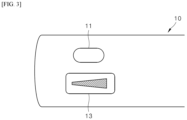
- FIG. 3 is a view showing a first embodiment of a head joint having a blow hole and a reed part for a wind instrument according to the present disclosure.
- a head joint 10 having a blow hole 11 and a reed part 13 for a wind instrument according to the present disclosure is formed in a tube shape with one closed end, in which the blow hole 11 and the reed part 13 are spaced apart from each other at predetermined distances from the closed end.
- the center of the blow hole 11 and the center of the reed part 13 are positioned at the same distance from the closed end, and the blow hole 11 and the reed part 13 are positioned to be spaced apart from each other in the circumferential direction of the head joint 10.
- a wind instrument including the head joint 10 has both the blow hole 11 and the reed part 13, so it is operated as a both side open-type wind instrument by blocking the reed part 13 when it is played through the blow hole 11, and it is operated as a one side open-type wind instrument by blocking the blow hole 11 when it is played through the reed part 13. Accordingly, the wind instrument generates low tones that are one octave lower than the musical range of both side open-type wind instruments that are played through the blow hole 11, whereby it is possible to implement a wind instrument having expanded low tones and generate a musical range expanded one octave from the existing musical range.
- both the blow hole 11 and the reed part 13 are formed, the reed part 13 is blocked when an instrument is played through the blow hole 11, and the blow hole 11 is blocked when the instrument is played through the reed part 13, whereby a fundamental and a partial of a both side open-type wind instrument are generated through the blow hole 11 and a fundamental of a one side open-type wind instrument that is one octave lower than the fundamental of a both side open-type wind instrument is implemented through the reed part 13. Accordingly, it is possible to implement a wind instrument having expanded low tones by implementing low tones that are one octave lower than instruments having only a blow hole in the related.
- tones slightly over three octaves are implemented from an instrument that having only finger holes without keys and implements only tones slight over two octaves, and when the head joint 10 to which the present disclosure is applied is connected and used instead of the head joint of a piccolo or a flute that implements tones over three octaves, tones are expanded one octave lower than fundamental tones, so a wind instrument that implements tones over four octaves is achieved.
- the reed part 13 is a free reed and it is preferable that the width of a fixing part that is fixed of the free reed is larger than the width of the opposite end.
- FIG. 4(a) is a view showing a region for blocking a reed part with diagonal solid lines
- FIG. 4(b) is a view showing a region for blocking a mouth with diagonal solid lines.
- the blow hole 11 and the reed part 13 are spaced apart from each other in the circumferential direction of the head joint 10 so that a user can close the reed part 13 with the portion of the face between the lower lip and the jaw when playing through the blow hole 11 and a user can close the blow hole 11 with the portion between the upper lip and the nose when playing through the reed part 13.
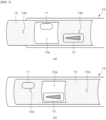
- FIG. 5 is a view showing a second embodiment of a head joint for a wind instrument having a mouth part and a reed part according to the present disclosure, in which (a) shows the state in which a reed part is covered with a cover and (b) shows the state in which a mouth is covered with a cover.
- the blow hole 11 and the reed part 13 may be spaced apart from each other in the longitudinal direction of the head joint 10.
- a cover 15 that can longitudinally slide is disposed on the outer circumferential surface of the head joint 10.
- the cover 15 is configured to block the reed part 13 when playing through the blow hole 11 and to block the blow hole 11 when playing through the reed part 13.
- the cover may be provided to be able to slide in the circumferential direction of the head joint.
- this configuration may be implemented by forming a sliding protrusion and a sliding groove.
- a through-hole 15a is formed at the cover 15, and the blow hole 11 or the reed part 13 is opened through the through-hole 15a.
- one or more protrusions 15b are formed at the cover 15, and it is preferable that protrusions are formed in a pair at both sides of the through-hole 15a.
- a user can open the blow hole 11 or the reed part 13 to the outside by sliding the cover 15 with his/her face in contact with the protrusion 15b such that the through-hole 15a is positioned over the blow hole 11 or the reed part 13.
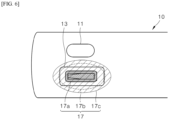
- FIG. 6 is a view showing a third embodiment of a head joint for a wind instrument having a mouth part and a reed part according to the present disclosure.
- the reed part 13 is a free reed and a protector 17 formed in an elliptical ring shape is installed on the free reed at the reed part 13 to protect the free reed and make playing easy.
- a hole of the ring-shaped protector 17 is positioned to communicate with the reed part 13.
- a lower portion (an inner edge line of the bottom 17b and an outer edge line of the bottom 17c) of the hole of the protector 17 that comes in contact with the reed part 13 is formed larger than the free reed and the upper portion 17a is formed smaller than the free reed.
- a hole larger or smaller than the length or width of a free reed is formed to be fitted to the size of the lips of a user by installing the protector 17 and adjusting the sizes of the upper and lower holes of the protector 17, whereby it is possible to easily play through the reed part 13 and easily block the reed part 13 when playing with the blow hole 11.
- the head joint 10 described above is manufactured to the tube thickness of a flute or a piccolo that are existing wind instruments and then connected to the wind instruments, it is possible to implement expanded tones that are one octave lower than the first octave tones in an existing musical range.
- FIG. 7 is a view showing a wind instrument including a head joint for a wind instrument having a blow hole and a reed part according to the present disclosure.
- a wind instrument 1 according to the present disclosure is characterized by including the head joint 10 having a blow hole 11 and a reed part 13 for a wind instrument described above.
- a both side open-type wind instrument was manufactured such that the tube length L was 31.1cm and the tube diameter D was about 18cm, and in this case, a musical range that could be easily made by playing the instrument through the blow hole was C5 (523Hz) ⁇ E7(2637Hz), which corresponds to two octaves and two tones, and C4 (262Hz) ⁇ B4(494Hz) was possible when playing through the reed part.
- the musical range of a soprano flute of which the acoustic tube length is about 60cm could by implemented as a wind instrument of which the acoustic tube length is about 30cm.
- the fundamental frequency of a reed is also important, and a free reed having a fundamental frequency higher than the frequency of the highest tone that is generated when a wind instrument is played through a reed part was used, the musical range of the wind instrument was generated well.
- a free reed is a reed that vibrates with a side fixed and the resonance frequency thereof is expressed as the following equation.
- f n ⁇ c ⁇ 8 L 2 1.194 2 , 2.988 2 , 5 2 , 7 2 , ...
- ⁇ is a number corresponding to a radius of gyration when a reed bends, the number in the parentheses are constants that are multiplied for a fundamental, a second harmonic, a third harmonic, ....
- the resonance frequency is inversely proportion to a square of the length of a reed.
- the reed length of the sample was about 14mm.
- a head joint having a mouth part and a reed part for a wind instrument according to the present disclosure and a wind instrument including the head j oint were described by exemplifying a wind instrument such as a transverse flute, but can be applied to wind instruments such as a vertical flute too.
Landscapes
- Physics & Mathematics (AREA)
- Engineering & Computer Science (AREA)
- Acoustics & Sound (AREA)
- Multimedia (AREA)
- Auxiliary Devices For Music (AREA)
Claims (10)
- Rohrförmiges Kopfstück (10) mit einem geschlossenen Ende für ein Blasinstrument aufweisend:ein Blasloch (11) und ein Rohrblattteil (13), die mit einem vorbestimmten Abstand gegenüber dem geschlossenen Ende voneinander beabstandet sind,dadurch gekennzeichnet, dass:eine Abdeckung (15), die längs oder umfänglich verschoben werden kann, an einer äußeren Umfangsfläche des Kopfstücks (10) angeordnet ist, unddie Abdeckung (15) eingerichtet ist, das Rohrblattteil (13) zu blockieren, wenn durch das Blasloch (11) gespielt wird, und das Blasloch (11) zu blockieren, wenn durch das Rohrblattteil (13) gespielt wird.
- Kopfstück (10) nach Anspruch 1, wobei eine Mitte des Blaslochs (11) und eine Mitte des Rohrblattteils (13) mit dem gleichen Abstand gegenüber dem geschlossenen Ende positioniert sind, und wobei das Blasloch (11) und das Rohrblattteil (13) positioniert sind, um in einer umfänglichen Richtung des Kopfstücks (10) voneinander beabstandet zu sein.
- Kopfstück (10) nach Anspruch 1, wobei das Blasloch (11) und das Rohrblattteil (13) in einer Längsrichtung des Kopfstücks (10) voneinander beabstandet sind.
- Kopfstück (10) nach Anspruch 1, wobei ein Durchgangsloch (15a) bei der Abdeckung (15) ausgebildet ist, und wobei das Blasloch (11) oder das Rohrblattteil (13) durch das Durchgangsloch (15) geöffnet ist.
- Kopfstück (10) nach Anspruch 4, wobei ein oder mehrere Vorsprünge (15b) bei der Abdeckung (15) ausgebildet sind und ein Nutzer die Abdeckung (15) mit seinem/ihrem Gesicht in Kontakt mit dem Vorsprung (15b) verschieben kann.
- Kopfstück (10) nach Anspruch 1, wobei das Rohrblattteil (13) ein freies Rohrblatt ist und eine Breite eines Fixierteils, das an dem freien Rohrblatt fixiert ist, größer als eine Breite des gegenüberliegenden Endes ist.
- Kopfstück (10) nach Anspruch 1, wobei, wenn eine Länge eines Rohrblatts des Rohrblattteils I beträgt und eine akustische Rohrlänge des Blasinstruments (1) L beträgt, 0,04 ≤ l2 / L < 0,11 erfüllt ist.
- Kopfstück (10) nach Anspruch 1, wobei das Rohrblattteil ein freies Rohrblatt ist und ein Protektor (17), der in einer elliptischen Ringform ausgebildet ist, an dem freien Rohrblatt installiert ist, und
wobei ein Loch des ringförmigen Protektors (17) positioniert ist, um mit dem Rohrblattteil zu kommunizieren. - Kopfstück (10) nach Anspruch 8, wobei ein unterer Abschnitt des Lochs des Protektors (17), der mit dem Rohrblattteil in Kontakt tritt, größer als das freie Rohrblatt ausgebildet ist und ein oberer Abschnitt kleiner als das freie Rohrblatt ausgebildet ist.
- Blasinstrument (1), das das Kopfstück (10), mit einem Blasloch (11) und mit einem Rohrblattteil (13), für ein Blasinstrument nach einem der Ansprüche 1 bis 9 umfasst.
Applications Claiming Priority (2)
| Application Number | Priority Date | Filing Date | Title |
|---|---|---|---|
| KR1020200040187A KR102313695B1 (ko) | 2020-04-02 | 2020-04-02 | 취구와 리드부가 형성된 관악기의 헤드 조인트 및 이를 포함하는 관악기 |
| PCT/KR2021/001253 WO2021201406A1 (ko) | 2020-04-02 | 2021-01-29 | 취구와 리드부가 형성된 관악기의 헤드 조인트 및 이를 포함하는 관악기 |
Publications (4)
| Publication Number | Publication Date |
|---|---|
| EP4131248A1 EP4131248A1 (de) | 2023-02-08 |
| EP4131248A4 EP4131248A4 (de) | 2023-08-30 |
| EP4131248C0 EP4131248C0 (de) | 2025-01-29 |
| EP4131248B1 true EP4131248B1 (de) | 2025-01-29 |
Family
ID=77930188
Family Applications (1)
| Application Number | Title | Priority Date | Filing Date |
|---|---|---|---|
| EP21780140.6A Active EP4131248B1 (de) | 2020-04-02 | 2021-01-29 | Kopfstück für blasinstrumente, mit mundstück und blattteil, und blasinstrument mit einem solchen kopfstück |
Country Status (5)
| Country | Link |
|---|---|
| US (1) | US12293744B2 (de) |
| EP (1) | EP4131248B1 (de) |
| JP (1) | JP7544847B2 (de) |
| KR (1) | KR102313695B1 (de) |
| WO (1) | WO2021201406A1 (de) |
Family Cites Families (16)
| Publication number | Priority date | Publication date | Assignee | Title |
|---|---|---|---|---|
| JPS5314924B2 (de) * | 1974-03-09 | 1978-05-20 | ||
| KR880002180Y1 (ko) * | 1985-05-30 | 1988-06-16 | 조영빈 | 대 금 (大琴) |
| US4970931A (en) * | 1988-08-31 | 1990-11-20 | Culbreath J Charles | Mouthpiece plates of flute-type wind instruments |
| US5027685A (en) * | 1989-12-04 | 1991-07-02 | Lenz Frederick C | Woodwind instrument |
| KR200349305Y1 (ko) * | 2004-02-16 | 2004-05-04 | 장규완 | 원형(圓形) 오카리나 |
| KR101169605B1 (ko) * | 2005-06-02 | 2012-08-03 | 양강석 | 피페 |
| JP4419966B2 (ja) * | 2006-01-19 | 2010-02-24 | ヤマハ株式会社 | 電子管楽器及びそのプログラム |
| CN201298344Y (zh) * | 2008-08-29 | 2009-08-26 | 钱尊法 | 响嘴巴乌 |
| KR100961435B1 (ko) | 2009-12-01 | 2010-06-09 | 오종수 | 관악기 |
| KR200452251Y1 (ko) * | 2010-08-31 | 2011-02-17 | 김다현 | 개량형 정악대금 |
| CN102760421B (zh) * | 2012-07-18 | 2014-05-07 | 陈志亮 | 一种宽音域巴乌 |
| KR101379898B1 (ko) * | 2012-07-24 | 2014-04-02 | 김복곤 | 한 단계 높은 옥타브 튜닝이 가능한 대금 |
| CN104851417B (zh) * | 2015-03-27 | 2019-02-22 | 徐建平 | 一种鸭嘴笛 |
| CN106251839A (zh) * | 2016-10-13 | 2016-12-21 | 李有良 | 一种内锥管式管乐器 |
| CN206516340U (zh) * | 2017-03-09 | 2017-09-22 | 钟小勇 | 一种改进的葫芦丝 |
| JP7598572B2 (ja) | 2023-02-24 | 2024-12-12 | 幸雄 大原 | 螺旋水車 |
-
2020
- 2020-04-02 KR KR1020200040187A patent/KR102313695B1/ko active Active
-
2021
- 2021-01-29 EP EP21780140.6A patent/EP4131248B1/de active Active
- 2021-01-29 JP JP2022560464A patent/JP7544847B2/ja active Active
- 2021-01-29 US US17/916,532 patent/US12293744B2/en active Active
- 2021-01-29 WO PCT/KR2021/001253 patent/WO2021201406A1/ko not_active Ceased
Also Published As
| Publication number | Publication date |
|---|---|
| EP4131248C0 (de) | 2025-01-29 |
| KR102313695B1 (ko) | 2021-10-18 |
| EP4131248A1 (de) | 2023-02-08 |
| KR20210123022A (ko) | 2021-10-13 |
| JP2023520553A (ja) | 2023-05-17 |
| EP4131248A4 (de) | 2023-08-30 |
| US20230154441A1 (en) | 2023-05-18 |
| JP7544847B2 (ja) | 2024-09-03 |
| WO2021201406A1 (ko) | 2021-10-07 |
| US12293744B2 (en) | 2025-05-06 |
Similar Documents
| Publication | Publication Date | Title |
|---|---|---|
| Pätynen et al. | Directivities of symphony orchestra instruments | |
| Scavone et al. | Measurement of vocal-tract influence during saxophone performance | |
| Benade | The physics of brasses | |
| Benade | On the mathematical theory of woodwind finger holes | |
| Chen et al. | Pitch bending and glissandi on the clarinet: roles of the vocal tract and partial tone hole closure | |
| Chen et al. | Saxophonists tune vocal tract resonances in advanced performance techniques | |
| Fritz et al. | How do clarinet players adjust the resonances of their vocal tracts for different playing effects? | |
| EP4131248B1 (de) | Kopfstück für blasinstrumente, mit mundstück und blattteil, und blasinstrument mit einem solchen kopfstück | |
| Chen et al. | Do trumpet players tune resonances of the vocal tract? | |
| US7470844B2 (en) | Mouthpiece for musical instruments | |
| Fabre et al. | Modeling of wind instruments | |
| US10079007B2 (en) | Woodwind mouthpiece with V-notch table and tone chamber insert | |
| Rucz et al. | Sound design of chimney pipes by optimization of their resonators | |
| Wilson | The measured upstream impedance for clarinet performance and its role in sound production | |
| Fritz et al. | Some aspects of the harmonic balance method applied to the clarinet | |
| Fletcher | The physiological demands of wind instrument performance | |
| Benade et al. | Vocal tract effects in wind instrument regeneration | |
| Strauss | A lip vibration model using mechanical properties of flesh | |
| Bucur | Resonant Air Column in Wind Instruments | |
| Fletcher | THE SOUND OF MUSIC: ORDER FROM COMPLEXITY. | |
| Chen et al. | How players use their vocal tracts in advanced clarinet and saxophone performance | |
| Fritz et al. | Experimental study of the influence of the clarinettist’s vocal tract | |
| US11127382B1 (en) | Tone-altering apparatus and method for musical wind instruments | |
| Braasch | Acoustics of the Saxophone | |
| Richards et al. | Second‐harmonic sound generation at woodwind tone holes |
Legal Events
| Date | Code | Title | Description |
|---|---|---|---|
| STAA | Information on the status of an ep patent application or granted ep patent |
Free format text: STATUS: THE INTERNATIONAL PUBLICATION HAS BEEN MADE |
|
| PUAI | Public reference made under article 153(3) epc to a published international application that has entered the european phase |
Free format text: ORIGINAL CODE: 0009012 |
|
| STAA | Information on the status of an ep patent application or granted ep patent |
Free format text: STATUS: REQUEST FOR EXAMINATION WAS MADE |
|
| 17P | Request for examination filed |
Effective date: 20221006 |
|
| AK | Designated contracting states |
Kind code of ref document: A1 Designated state(s): AL AT BE BG CH CY CZ DE DK EE ES FI FR GB GR HR HU IE IS IT LI LT LU LV MC MK MT NL NO PL PT RO RS SE SI SK SM TR |
|
| DAV | Request for validation of the european patent (deleted) | ||
| DAX | Request for extension of the european patent (deleted) | ||
| A4 | Supplementary search report drawn up and despatched |
Effective date: 20230802 |
|
| RIC1 | Information provided on ipc code assigned before grant |
Ipc: G10D 9/02 20200101ALI20230727BHEP Ipc: G10D 7/026 20200101ALI20230727BHEP Ipc: G10D 9/035 20200101AFI20230727BHEP |
|
| GRAP | Despatch of communication of intention to grant a patent |
Free format text: ORIGINAL CODE: EPIDOSNIGR1 |
|
| STAA | Information on the status of an ep patent application or granted ep patent |
Free format text: STATUS: GRANT OF PATENT IS INTENDED |
|
| INTG | Intention to grant announced |
Effective date: 20240822 |
|
| GRAS | Grant fee paid |
Free format text: ORIGINAL CODE: EPIDOSNIGR3 |
|
| GRAA | (expected) grant |
Free format text: ORIGINAL CODE: 0009210 |
|
| STAA | Information on the status of an ep patent application or granted ep patent |
Free format text: STATUS: THE PATENT HAS BEEN GRANTED |
|
| AK | Designated contracting states |
Kind code of ref document: B1 Designated state(s): AL AT BE BG CH CY CZ DE DK EE ES FI FR GB GR HR HU IE IS IT LI LT LU LV MC MK MT NL NO PL PT RO RS SE SI SK SM TR |
|
| REG | Reference to a national code |
Ref country code: GB Ref legal event code: FG4D |
|
| REG | Reference to a national code |
Ref country code: CH Ref legal event code: EP |
|
| REG | Reference to a national code |
Ref country code: DE Ref legal event code: R096 Ref document number: 602021025486 Country of ref document: DE |
|
| REG | Reference to a national code |
Ref country code: IE Ref legal event code: FG4D |
|
| U01 | Request for unitary effect filed |
Effective date: 20250217 |
|
| U07 | Unitary effect registered |
Designated state(s): AT BE BG DE DK EE FI FR IT LT LU LV MT NL PT RO SE SI Effective date: 20250221 |
|
| U20 | Renewal fee for the european patent with unitary effect paid |
Year of fee payment: 5 Effective date: 20250227 |
|
| PG25 | Lapsed in a contracting state [announced via postgrant information from national office to epo] |
Ref country code: RS Free format text: LAPSE BECAUSE OF FAILURE TO SUBMIT A TRANSLATION OF THE DESCRIPTION OR TO PAY THE FEE WITHIN THE PRESCRIBED TIME-LIMIT Effective date: 20250429 |
|
| PG25 | Lapsed in a contracting state [announced via postgrant information from national office to epo] |
Ref country code: PL Free format text: LAPSE BECAUSE OF FAILURE TO SUBMIT A TRANSLATION OF THE DESCRIPTION OR TO PAY THE FEE WITHIN THE PRESCRIBED TIME-LIMIT Effective date: 20250129 |
|
| PG25 | Lapsed in a contracting state [announced via postgrant information from national office to epo] |
Ref country code: ES Free format text: LAPSE BECAUSE OF FAILURE TO SUBMIT A TRANSLATION OF THE DESCRIPTION OR TO PAY THE FEE WITHIN THE PRESCRIBED TIME-LIMIT Effective date: 20250129 |
|
| PG25 | Lapsed in a contracting state [announced via postgrant information from national office to epo] |
Ref country code: IS Free format text: LAPSE BECAUSE OF FAILURE TO SUBMIT A TRANSLATION OF THE DESCRIPTION OR TO PAY THE FEE WITHIN THE PRESCRIBED TIME-LIMIT Effective date: 20250529 Ref country code: NO Free format text: LAPSE BECAUSE OF FAILURE TO SUBMIT A TRANSLATION OF THE DESCRIPTION OR TO PAY THE FEE WITHIN THE PRESCRIBED TIME-LIMIT Effective date: 20250429 |
|
| PG25 | Lapsed in a contracting state [announced via postgrant information from national office to epo] |
Ref country code: HR Free format text: LAPSE BECAUSE OF FAILURE TO SUBMIT A TRANSLATION OF THE DESCRIPTION OR TO PAY THE FEE WITHIN THE PRESCRIBED TIME-LIMIT Effective date: 20250129 |
|
| PG25 | Lapsed in a contracting state [announced via postgrant information from national office to epo] |
Ref country code: GR Free format text: LAPSE BECAUSE OF FAILURE TO SUBMIT A TRANSLATION OF THE DESCRIPTION OR TO PAY THE FEE WITHIN THE PRESCRIBED TIME-LIMIT Effective date: 20250430 |
|
| REG | Reference to a national code |
Ref country code: CH Ref legal event code: PL |
|
| PG25 | Lapsed in a contracting state [announced via postgrant information from national office to epo] |
Ref country code: SM Free format text: LAPSE BECAUSE OF FAILURE TO SUBMIT A TRANSLATION OF THE DESCRIPTION OR TO PAY THE FEE WITHIN THE PRESCRIBED TIME-LIMIT Effective date: 20250129 |
|
| PG25 | Lapsed in a contracting state [announced via postgrant information from national office to epo] |
Ref country code: MC Free format text: LAPSE BECAUSE OF FAILURE TO SUBMIT A TRANSLATION OF THE DESCRIPTION OR TO PAY THE FEE WITHIN THE PRESCRIBED TIME-LIMIT Effective date: 20250129 |
|
| PG25 | Lapsed in a contracting state [announced via postgrant information from national office to epo] |
Ref country code: CH Free format text: LAPSE BECAUSE OF NON-PAYMENT OF DUE FEES Effective date: 20250131 |
|
| PG25 | Lapsed in a contracting state [announced via postgrant information from national office to epo] |
Ref country code: CZ Free format text: LAPSE BECAUSE OF FAILURE TO SUBMIT A TRANSLATION OF THE DESCRIPTION OR TO PAY THE FEE WITHIN THE PRESCRIBED TIME-LIMIT Effective date: 20250129 |
|
| PG25 | Lapsed in a contracting state [announced via postgrant information from national office to epo] |
Ref country code: SK Free format text: LAPSE BECAUSE OF FAILURE TO SUBMIT A TRANSLATION OF THE DESCRIPTION OR TO PAY THE FEE WITHIN THE PRESCRIBED TIME-LIMIT Effective date: 20250129 |
|
| PLBE | No opposition filed within time limit |
Free format text: ORIGINAL CODE: 0009261 |
|
| STAA | Information on the status of an ep patent application or granted ep patent |
Free format text: STATUS: NO OPPOSITION FILED WITHIN TIME LIMIT |
|
| GBPC | Gb: european patent ceased through non-payment of renewal fee |
Effective date: 20250429 |
|
| 26N | No opposition filed |
Effective date: 20251030 |
|
| PG25 | Lapsed in a contracting state [announced via postgrant information from national office to epo] |
Ref country code: GB Free format text: LAPSE BECAUSE OF NON-PAYMENT OF DUE FEES Effective date: 20250429 |
|
| PG25 | Lapsed in a contracting state [announced via postgrant information from national office to epo] |
Ref country code: IE Free format text: LAPSE BECAUSE OF NON-PAYMENT OF DUE FEES Effective date: 20250129 |
|
| U20 | Renewal fee for the european patent with unitary effect paid |
Year of fee payment: 6 Effective date: 20260127 |