EP4131195A1 - Dangerous driving warning device, dangerous driving warning system, and dangerous driving warning method - Google Patents
Dangerous driving warning device, dangerous driving warning system, and dangerous driving warning method Download PDFInfo
- Publication number
- EP4131195A1 EP4131195A1 EP20927720.1A EP20927720A EP4131195A1 EP 4131195 A1 EP4131195 A1 EP 4131195A1 EP 20927720 A EP20927720 A EP 20927720A EP 4131195 A1 EP4131195 A1 EP 4131195A1
- Authority
- EP
- European Patent Office
- Prior art keywords
- vehicle
- host
- degree
- information
- agitating
- Prior art date
- Legal status (The legal status is an assumption and is not a legal conclusion. Google has not performed a legal analysis and makes no representation as to the accuracy of the status listed.)
- Granted
Links
Images


Classifications
-
- G—PHYSICS
- G08—SIGNALLING
- G08B—SIGNALLING SYSTEMS, e.g. PERSONAL CALLING SYSTEMS; ORDER TELEGRAPHS; ALARM SYSTEMS
- G08B21/00—Alarms responsive to a single specified undesired or abnormal condition and not otherwise provided for
- G08B21/02—Alarms for ensuring the safety of persons
- G08B21/06—Alarms for ensuring the safety of persons indicating a condition of sleep, e.g. anti-dozing alarms
-
- B—PERFORMING OPERATIONS; TRANSPORTING
- B60—VEHICLES IN GENERAL
- B60W—CONJOINT CONTROL OF VEHICLE SUB-UNITS OF DIFFERENT TYPE OR DIFFERENT FUNCTION; CONTROL SYSTEMS SPECIALLY ADAPTED FOR HYBRID VEHICLES; ROAD VEHICLE DRIVE CONTROL SYSTEMS FOR PURPOSES NOT RELATED TO THE CONTROL OF A PARTICULAR SUB-UNIT
- B60W40/00—Estimation or calculation of non-directly measurable driving parameters for road vehicle drive control systems not related to the control of a particular sub unit, e.g. by using mathematical models
- B60W40/08—Estimation or calculation of non-directly measurable driving parameters for road vehicle drive control systems not related to the control of a particular sub unit, e.g. by using mathematical models related to drivers or passengers
-
- B—PERFORMING OPERATIONS; TRANSPORTING
- B60—VEHICLES IN GENERAL
- B60W—CONJOINT CONTROL OF VEHICLE SUB-UNITS OF DIFFERENT TYPE OR DIFFERENT FUNCTION; CONTROL SYSTEMS SPECIALLY ADAPTED FOR HYBRID VEHICLES; ROAD VEHICLE DRIVE CONTROL SYSTEMS FOR PURPOSES NOT RELATED TO THE CONTROL OF A PARTICULAR SUB-UNIT
- B60W40/00—Estimation or calculation of non-directly measurable driving parameters for road vehicle drive control systems not related to the control of a particular sub unit, e.g. by using mathematical models
- B60W40/10—Estimation or calculation of non-directly measurable driving parameters for road vehicle drive control systems not related to the control of a particular sub unit, e.g. by using mathematical models related to vehicle motion
- B60W40/105—Speed
-
- B—PERFORMING OPERATIONS; TRANSPORTING
- B60—VEHICLES IN GENERAL
- B60W—CONJOINT CONTROL OF VEHICLE SUB-UNITS OF DIFFERENT TYPE OR DIFFERENT FUNCTION; CONTROL SYSTEMS SPECIALLY ADAPTED FOR HYBRID VEHICLES; ROAD VEHICLE DRIVE CONTROL SYSTEMS FOR PURPOSES NOT RELATED TO THE CONTROL OF A PARTICULAR SUB-UNIT
- B60W50/00—Details of control systems for road vehicle drive control not related to the control of a particular sub-unit, e.g. process diagnostic or vehicle driver interfaces
- B60W50/08—Interaction between the driver and the control system
- B60W50/14—Means for informing the driver, warning the driver or prompting a driver intervention
-
- G—PHYSICS
- G06—COMPUTING OR CALCULATING; COUNTING
- G06V—IMAGE OR VIDEO RECOGNITION OR UNDERSTANDING
- G06V20/00—Scenes; Scene-specific elements
- G06V20/50—Context or environment of the image
- G06V20/59—Context or environment of the image inside of a vehicle, e.g. relating to seat occupancy, driver state or inner lighting conditions
- G06V20/597—Recognising the driver's state or behaviour, e.g. attention or drowsiness
-
- G—PHYSICS
- G06—COMPUTING OR CALCULATING; COUNTING
- G06V—IMAGE OR VIDEO RECOGNITION OR UNDERSTANDING
- G06V40/00—Recognition of biometric, human-related or animal-related patterns in image or video data
- G06V40/10—Human or animal bodies, e.g. vehicle occupants or pedestrians; Body parts, e.g. hands
- G06V40/16—Human faces, e.g. facial parts, sketches or expressions
- G06V40/174—Facial expression recognition
-
- G—PHYSICS
- G08—SIGNALLING
- G08G—TRAFFIC CONTROL SYSTEMS
- G08G1/00—Traffic control systems for road vehicles
- G08G1/01—Detecting movement of traffic to be counted or controlled
- G08G1/0104—Measuring and analyzing of parameters relative to traffic conditions
- G08G1/0108—Measuring and analyzing of parameters relative to traffic conditions based on the source of data
- G08G1/0112—Measuring and analyzing of parameters relative to traffic conditions based on the source of data from the vehicle, e.g. floating car data [FCD]
-
- G—PHYSICS
- G08—SIGNALLING
- G08G—TRAFFIC CONTROL SYSTEMS
- G08G1/00—Traffic control systems for road vehicles
- G08G1/01—Detecting movement of traffic to be counted or controlled
- G08G1/0104—Measuring and analyzing of parameters relative to traffic conditions
- G08G1/0125—Traffic data processing
- G08G1/0129—Traffic data processing for creating historical data or processing based on historical data
-
- G—PHYSICS
- G08—SIGNALLING
- G08G—TRAFFIC CONTROL SYSTEMS
- G08G1/00—Traffic control systems for road vehicles
- G08G1/01—Detecting movement of traffic to be counted or controlled
- G08G1/0104—Measuring and analyzing of parameters relative to traffic conditions
- G08G1/0125—Traffic data processing
- G08G1/0133—Traffic data processing for classifying traffic situation
-
- G—PHYSICS
- G08—SIGNALLING
- G08G—TRAFFIC CONTROL SYSTEMS
- G08G1/00—Traffic control systems for road vehicles
- G08G1/01—Detecting movement of traffic to be counted or controlled
- G08G1/0104—Measuring and analyzing of parameters relative to traffic conditions
- G08G1/0137—Measuring and analyzing of parameters relative to traffic conditions for specific applications
- G08G1/0141—Measuring and analyzing of parameters relative to traffic conditions for specific applications for traffic information dissemination
-
- G—PHYSICS
- G08—SIGNALLING
- G08G—TRAFFIC CONTROL SYSTEMS
- G08G1/00—Traffic control systems for road vehicles
- G08G1/01—Detecting movement of traffic to be counted or controlled
- G08G1/015—Detecting movement of traffic to be counted or controlled with provision for distinguishing between two or more types of vehicles, e.g. between motor-cars and cycles
-
- G—PHYSICS
- G08—SIGNALLING
- G08G—TRAFFIC CONTROL SYSTEMS
- G08G1/00—Traffic control systems for road vehicles
- G08G1/09—Arrangements for giving variable traffic instructions
- G08G1/0962—Arrangements for giving variable traffic instructions having an indicator mounted inside the vehicle, e.g. giving voice messages
- G08G1/0967—Systems involving transmission of highway information, e.g. weather, speed limits
- G08G1/096708—Systems involving transmission of highway information, e.g. weather, speed limits where the received information might be used to generate an automatic action on the vehicle control
- G08G1/096716—Systems involving transmission of highway information, e.g. weather, speed limits where the received information might be used to generate an automatic action on the vehicle control where the received information does not generate an automatic action on the vehicle control
-
- G—PHYSICS
- G08—SIGNALLING
- G08G—TRAFFIC CONTROL SYSTEMS
- G08G1/00—Traffic control systems for road vehicles
- G08G1/09—Arrangements for giving variable traffic instructions
- G08G1/0962—Arrangements for giving variable traffic instructions having an indicator mounted inside the vehicle, e.g. giving voice messages
- G08G1/0967—Systems involving transmission of highway information, e.g. weather, speed limits
- G08G1/096733—Systems involving transmission of highway information, e.g. weather, speed limits where a selection of the information might take place
- G08G1/09675—Systems involving transmission of highway information, e.g. weather, speed limits where a selection of the information might take place where a selection from the received information takes place in the vehicle
-
- G—PHYSICS
- G08—SIGNALLING
- G08G—TRAFFIC CONTROL SYSTEMS
- G08G1/00—Traffic control systems for road vehicles
- G08G1/09—Arrangements for giving variable traffic instructions
- G08G1/0962—Arrangements for giving variable traffic instructions having an indicator mounted inside the vehicle, e.g. giving voice messages
- G08G1/0967—Systems involving transmission of highway information, e.g. weather, speed limits
- G08G1/096766—Systems involving transmission of highway information, e.g. weather, speed limits where the system is characterised by the origin of the information transmission
- G08G1/096775—Systems involving transmission of highway information, e.g. weather, speed limits where the system is characterised by the origin of the information transmission where the origin of the information is a central station
-
- G—PHYSICS
- G08—SIGNALLING
- G08G—TRAFFIC CONTROL SYSTEMS
- G08G1/00—Traffic control systems for road vehicles
- G08G1/09—Arrangements for giving variable traffic instructions
- G08G1/0962—Arrangements for giving variable traffic instructions having an indicator mounted inside the vehicle, e.g. giving voice messages
- G08G1/0967—Systems involving transmission of highway information, e.g. weather, speed limits
- G08G1/096766—Systems involving transmission of highway information, e.g. weather, speed limits where the system is characterised by the origin of the information transmission
- G08G1/096791—Systems involving transmission of highway information, e.g. weather, speed limits where the system is characterised by the origin of the information transmission where the origin of the information is another vehicle
-
- G—PHYSICS
- G08—SIGNALLING
- G08G—TRAFFIC CONTROL SYSTEMS
- G08G1/00—Traffic control systems for road vehicles
- G08G1/16—Anti-collision systems
- G08G1/161—Decentralised systems, e.g. inter-vehicle communication
- G08G1/162—Decentralised systems, e.g. inter-vehicle communication event-triggered
-
- G—PHYSICS
- G08—SIGNALLING
- G08G—TRAFFIC CONTROL SYSTEMS
- G08G1/00—Traffic control systems for road vehicles
- G08G1/16—Anti-collision systems
- G08G1/161—Decentralised systems, e.g. inter-vehicle communication
- G08G1/163—Decentralised systems, e.g. inter-vehicle communication involving continuous checking
-
- B—PERFORMING OPERATIONS; TRANSPORTING
- B60—VEHICLES IN GENERAL
- B60W—CONJOINT CONTROL OF VEHICLE SUB-UNITS OF DIFFERENT TYPE OR DIFFERENT FUNCTION; CONTROL SYSTEMS SPECIALLY ADAPTED FOR HYBRID VEHICLES; ROAD VEHICLE DRIVE CONTROL SYSTEMS FOR PURPOSES NOT RELATED TO THE CONTROL OF A PARTICULAR SUB-UNIT
- B60W50/00—Details of control systems for road vehicle drive control not related to the control of a particular sub-unit, e.g. process diagnostic or vehicle driver interfaces
- B60W50/08—Interaction between the driver and the control system
- B60W50/14—Means for informing the driver, warning the driver or prompting a driver intervention
- B60W2050/146—Display means
-
- B—PERFORMING OPERATIONS; TRANSPORTING
- B60—VEHICLES IN GENERAL
- B60W—CONJOINT CONTROL OF VEHICLE SUB-UNITS OF DIFFERENT TYPE OR DIFFERENT FUNCTION; CONTROL SYSTEMS SPECIALLY ADAPTED FOR HYBRID VEHICLES; ROAD VEHICLE DRIVE CONTROL SYSTEMS FOR PURPOSES NOT RELATED TO THE CONTROL OF A PARTICULAR SUB-UNIT
- B60W2540/00—Input parameters relating to occupants
- B60W2540/22—Psychological state; Stress level or workload
-
- G—PHYSICS
- G08—SIGNALLING
- G08G—TRAFFIC CONTROL SYSTEMS
- G08G1/00—Traffic control systems for road vehicles
- G08G1/16—Anti-collision systems
- G08G1/166—Anti-collision systems for active traffic, e.g. moving vehicles, pedestrians, bikes
Definitions
- the present disclosure relates to a dangerous driving warning device, a dangerous driving warning system, and a dangerous driving warning method.
- agitation action When a driver is driving a host-vehicle, other vehicles travelling in the vicinity of the host-vehicle performing a dangerous action (hereinafter referred to as an "agitation action") against the host-vehicle such as sudden cutting off, sudden deceleration, and abnormal approaches has become a social problem.
- an agitation action a dangerous action against the host-vehicle
- the driver of the host-vehicle may perform an agitation action against other vehicles unconsciously or due to a heightened emotion. Also in this kind of case, it is desirable to warn the driver of the host-vehicle that the host-vehicle is performing an agitation action.
- Patent Literature 1 discloses a technique for comprehensively judging the mental state of a driver and performing vehicle control based on the judgment result.
- the technique disclosed in Patent Literature 1 does not warn that a host-vehicle or another vehicle is performing an agitation action.
- Patent Literature 1 Japanese Unexamined Patent Application Publication No. 2008-70965
- Patent Literature 1 discloses that the mental state of the driver is comprehensively judged for the vehicle control to be performed, Patent Literature 1 does not disclose that a host-vehicle is warned of information that the host-vehicle or another vehicle is performing an agitation action.
- An object of an embodiment is to provide a dangerous driving warning device, a dangerous driving warning system, and a dangerous driving warning method capable of notifying that a host-vehicle is agitated by an other-vehicle, that a host-vehicle agitates an other-vehicle, or that both a host-vehicle and an other-vehicle agitate each other.
- a first embodiment provides a dangerous driving warning device that warns a host-vehicle that the host-vehicle is agitated by an other-vehicle
- the dangerous driving warning device including: a host-vehicle information acquisition unit configured to acquire host-vehicle information including at least one of travel information of the host-vehicle, biological information of a driver of the host-vehicle, and a facial expression of the driver of the host-vehicle; a communication unit configured to acquire an agitating degree indicating a degree to which the other-vehicle is agitating the host-vehicle by means of radio communication; an agitated degree calculation unit configured to calculate an agitated degree indicating a degree to which the host-vehicle is agitated by the other-vehicle based on the host-vehicle information; a danger degree determination unit configured to determine a danger degree including whether the host-vehicle is agitated by the other-vehicle based on the
- a dangerous driving warning device that warns a host-vehicle that the host-vehicle is agitated by an other-vehicle;
- the dangerous driving warning device including: a host-vehicle information acquisition unit configured to acquire host-vehicle information including at least one of travel information of the host-vehicle, biological information of a driver of the host-vehicle, and a facial expression of the driver of the host-vehicle; a communication unit configured to acquire other-vehicle information including at least one of travel information of the other-vehicle, biological information of a driver of the other-vehicle, and a facial expression of the driver of the other-vehicle by means of radio communication; an agitated degree calculation unit configured to calculate an agitated degree indicating a degree to which the host-vehicle is agitated by the other-vehicle based on the host-vehicle information; an agitating degree calculation unit configured to calculate an agitating degree indicating
- Another embodiment provides a dangerous driving warning system that warns a vehicle that a host-vehicle is agitated by an other-vehicle, the dangerous driving warning system including: a host-vehicle device mounted on the host-vehicle; an other-vehicle device mounted on the other-vehicle; and a server connected to the host-vehicle device and the other-vehicle device via a network, in which the host-vehicle device includes: a host-vehicle information acquisition unit configured to acquire host-vehicle information including at least one of travel information of the host-vehicle, biological information of a driver of the host-vehicle, and a facial expression of the driver of the host-vehicle; and a host-vehicle side communication unit configured to communicate with the server via the network, in which at least one of the host-vehicle device and the server includes: an agitated degree calculation unit configured to calculate an agitated degree indicating a degree to which the
- Another embodiment provides a dangerous driving warning method of warning a vehicle that a host-vehicle is agitated by an other-vehicle, the dangerous driving warning method including the steps of: acquiring host-vehicle information including at least one of travel information of the host-vehicle, biological information of a driver of the host-vehicle, and a facial expression of the driver of the host-vehicle; calculating an agitated degree indicating a degree to which the host-vehicle is agitated by the other-vehicle based on the host-vehicle information; acquiring other-vehicle information including at least one of travel information of the other-vehicle, biological information of a driver of the other-vehicle, and a facial expression of the driver of the other-vehicle; calculating an agitating degree indicating a degree to which the other-vehicle agitates the host-vehicle based on the other-vehicle information; determining a danger degree
- a dangerous driving warning device that warns a host-vehicle that the host-vehicle is agitating an other-vehicle
- the dangerous driving warning device including: a host-vehicle information acquisition unit configured to acquire host-vehicle information including at least one of travel information of the host-vehicle, biological information of a driver of the host-vehicle, and a facial expression of the driver of the host-vehicle; a communication unit configured to acquire an agitated degree indicating a degree to which the other-vehicle is agitated by the host-vehicle by means of radio communication; an agitating degree calculation unit configured to calculate an agitating degree indicating a degree to which the host-vehicle agitates the other-vehicle based on the host-vehicle information; a danger degree determination unit configured to determine a danger degree including whether the host-vehicle agitates the other-vehicle based on the agitated degree and the agit
- a dangerous driving warning device that warns a host-vehicle that the host-vehicle agitates an other-vehicle
- the dangerous driving warning device including: a host-vehicle information acquisition unit configured to acquire host-vehicle information including at least one of travel information of the host-vehicle, biological information of a driver of the host-vehicle, and a facial expression of the driver of the host-vehicle; a communication unit configured to acquire other-vehicle information including at least one of travel information of the other-vehicle, biological information of a driver of the other-vehicle, and a facial expression of the driver of the other-vehicle by means of radio communication; an agitating degree calculation unit configured to calculate an agitating degree indicating a degree to which the host-vehicle agitates the other-vehicle based on the host-vehicle information; an agitated degree calculation unit configured to calculate an agitated degree indicating a degree to which
- Another embodiment provides a dangerous driving warning system that warns a vehicle of information that a host-vehicle agitates an other-vehicle
- the dangerous driving warning system including: a host-vehicle device mounted on the host-vehicle; an other-vehicle device mounted on the other-vehicle; and a server connected to the host-vehicle device and the other-vehicle device via a network
- the host-vehicle device includes: a host-vehicle information acquisition unit configured to acquire host-vehicle information including at least one of travel information of the host-vehicle, biological information of a driver of the host-vehicle, and a facial expression of the driver of the host-vehicle; and a host-vehicle side communication unit configured to communicate with the server via the network, in which at least one of the host-vehicle device and the server includes: an agitating degree calculation unit configured to calculate an agitating degree indicating a degree to which the
- Another embodiment provides a dangerous driving warning method of warning a vehicle that a host-vehicle agitates an other-vehicle, the dangerous driving warning method including the steps of: acquiring, by means of the host-vehicle, host-vehicle information including at least one of travel information of the host-vehicle, biological information of a driver of the host-vehicle, and a facial expression of the driver of the host-vehicle; calculating an agitating degree indicating a degree to which the host-vehicle agitates the other-vehicle based on the host-vehicle information; acquiring other-vehicle information including at least one of travel information of the other-vehicle, biological information of a driver of the other-vehicle, and a facial expression of the driver of the other-vehicle; calculating an agitated degree indicating a degree to which the other-vehicle is agitated by the host-vehicle based on the other-veh
- a dangerous driving warning device that warns a host-vehicle that the host-vehicle agitates an other-vehicle
- the dangerous driving warning device including: a host-vehicle information acquisition unit configured to acquire host-vehicle information including at least one of travel information of the host-vehicle, biological information of a driver of the host-vehicle, and a facial expression of the driver of the host-vehicle; a first agitating degree calculation unit configured to calculate a first agitating degree indicating a degree to which the host-vehicle agitates the other-vehicle based on the host-vehicle information; a communication unit configured to acquire a second agitating degree indicating a degree to which the other-vehicle agitates the host-vehicle by means of radio communication; a danger degree determination unit configured to determine a danger degree including whether the host-vehicle agitates the other-vehicle based on the first agitating degree
- a dangerous driving warning device that warns a host-vehicle that the host-vehicle agitates an other-vehicle
- the dangerous driving warning device including: a host-vehicle information acquisition unit configured to acquire host-vehicle information including at least one of travel information of the host-vehicle, biological information of a driver of the host-vehicle, and a facial expression of the driver of the host-vehicle; a communication unit configured to acquire other-vehicle information including at least one of travel information of the other-vehicle, biological information of a driver of the other-vehicle, and a facial expression of the driver of the other-vehicle by means of radio communication; an agitating degree calculation unit configured to calculate a first agitating degree indicating a degree to which the host-vehicle agitates the other-vehicle based on the host-vehicle information and calculates a second agitating degree indicating a degree to which the other-ve
- Another embodiment provides a dangerous driving warning system that warns a vehicle of information that a host-vehicle and an other-vehicle agitate each other, the dangerous driving warning system including: a host-vehicle device mounted on the host-vehicle; an other-vehicle device mounted on the other-vehicle; and a server connected to the host-vehicle device and the other-vehicle device via a network, in which the host-vehicle device includes: a host-vehicle information acquisition unit configured to acquire host-vehicle information including at least one of travel information of the host-vehicle, biological information of a driver of the host-vehicle, and a facial expression of the driver of the host-vehicle; and a host-vehicle side communication unit configured to communicate with the server via the network, in which at least one of the host-vehicle device and the server includes: a first agitating degree calculation unit configured to calculate a first agitating degree
- Another embodiment provides a dangerous driving warning method of warning a vehicle that a host-vehicle and an other-vehicle agitate each other, the dangerous driving warning method including the steps of: acquiring host-vehicle information including at least one of travel information of the host-vehicle, biological information of a driver of the host-vehicle, and a facial expression of the driver of the host-vehicle; calculating a first agitating degree indicating a degree to which the host-vehicle agitates the other-vehicle based on the host-vehicle information; acquiring other-vehicle information including at least one of travel information of the other-vehicle, biological information of a driver of the other-vehicle, and a facial expression of the driver of the other-vehicle; calculating a second agitating degree indicating a degree to which the other-vehicle agitates the host-vehicle based on the other-vehicle information; determining
- a vehicle that a host-vehicle is agitated by an other-vehicle, that a host-vehicle agitates an other-vehicle, or that both a host-vehicle and an other-vehicle agitate each other.
- FIG. 1 is a block diagram showing a configuration of a dangerous driving warning system according to an embodiment.
- a dangerous driving warning system 101 according to an embodiment warns a vehicle that a driver of a travelling host-vehicle VA is agitated by other-vehicles VB or that drivers of the other-vehicles VB are agitated by the travelling host-vehicle VA as shown in FIG. 1 .
- the dangerous driving warning system 101 has a host-vehicle device 1A (a dangerous driving warning device) mounted on the host-vehicle VA, other-vehicle devices 1B mounted on one or a plurality of other-vehicles VB traveling around the front, rear, left and right sides of the host-vehicle VA, and a server 3 connected via a network 4 between the host-vehicle device 1A and the other-vehicle devices 1B.
- the host-vehicle device 1A and the other-vehicle devices 1B are connected by means of radio communication via the server 3.
- FIG. 2 is a block diagram showing a detailed configuration of the host-vehicle device 1A.
- the configuration of the host-vehicle device 1A will be described below with reference to FIG. 2 .
- the host-vehicle device 1A includes a controller 11A, a camera unit 12A, a biological information sensor 13A, a travel information sensor 14A, and laser radars 15A as shown in FIG. 2 .
- the camera unit 12A has vehicle exterior cameras 121A and an in-vehicle camera 122A.
- the vehicle exterior cameras 121A captures the surrounding image of the host-vehicle VA.
- the in-vehicle camera 122A captures the face image of the driver of the host-vehicle VA.
- the vehicle exterior cameras 121A are installed at the front, rear, and left and right side portions of the host-vehicle VA, and captures the surrounding image of the host-vehicle VA, for example.
- the vehicle exterior cameras 121A transmits the captured image data to the controller 11A.
- An optical camera, charge-coupled device (CCD), complementary metal-oxide semiconductor (CMOS), and the like can be used as the vehicle exterior cameras 121A. If the host-vehicle VA is an automatic driving vehicle, the vehicle exterior cameras 121A may also be used as a camera for capturing a surrounding image used for automatic driving.
- the in-vehicle camera 122A is installed at the upper part of the windshield of the host-vehicle VA or a position in the vicinity of the instrument panel, and captures the face image of the driver, for example.
- the in-vehicle camera 122A transmits the captured image data to the controller 11A.
- an optical camera, CCD, CMOS, or the like can be used as the in-vehicle camera 122A.
- the biological information sensor 13A detects various pieces of biological information of the driver of the host-vehicle.
- the biological information sensor 13A include a heart rate sensor for measuring the heart rate per unit time of the driver, a breathing rate sensor for measuring the breathing rate per unit time of the driver, and a blood pressure sensor for measuring the blood pressure of the driver.
- the pieces of information obtained by the measurement by the biological information sensor 13A that is, the pieces of information on the heart rate, breathing rate, and blood pressure are transmitted to the controller 11A.
- the heart rate, breathing rate, and blood pressure are measured and detected without contact with the driver's body by using sensors embedded in the host-vehicle seat, for example.
- the travel information sensor 14A is a speed sensor and an acceleration sensor mounted on the host-vehicle VA, and transmits information on the detected speed and acceleration to the controller 11A, for example.
- the travel information sensor 14A also acquires information on the travelling road and lane on which the host-vehicle VA travels from a GPS receiver mounted on the host-vehicle VA. Specifically, if the host-vehicle VA travels on a traveling road having two or more lanes, the sensor acquires information indicating whether the lane on which the host-vehicle VA travels is a traveling lane or a passing lane.
- the travel information sensor 14A transmits information on the lane on which the host-vehicle travels to the controller 11A.
- the vehicle exterior cameras 121A, the in-vehicle camera 122A, the biological information sensor 13A, the travel information sensor 14A, and the laser radars 15A are an example of a host-vehicle information acquisition unit that acquires host-vehicle information.
- the laser radars 15A are lidars (laser imaging detection and ranging) mounted on the front side and the rear side of the host-vehicle, for example.
- the laser radars 15A emit the lasers toward the front position and the rear positon of the host-vehicle VA.
- the laser radars 15A receive the lasers reflected by a front vehicle and a rear vehicle and measure the distance between the host-vehicle and a preceding vehicle and the distance between the host-vehicle and a following vehicle.
- the laser radars 15A transmit information on the detected inter-vehicle distance to the controller 11A.
- the controller 11A includes a calculation processing unit 31A, a communication unit 32A (a host-vehicle side communication unit), and a presentation unit 33A.
- the controller 11A can be configured as an integrated computer including a central processing unit (CPU) and storage means such as an RAM, an ROM, and a hard disk, for example.
- CPU central processing unit
- storage means such as an RAM, an ROM, and a hard disk, for example.
- the calculation processing unit 31A includes an image recognition unit 311A, a danger degree determination unit 312A, an agitated degree calculation unit 313A, an agitating degree calculation unit 314A, and a storage unit 315A.
- the image recognition unit 311A recognizes the operation of the other-vehicles VB presenting in the individual directions of the front side, rear side, right side, and left side of the host-vehicle VA based on the surrounding image of the host-vehicle VA captured by means of the vehicle exterior cameras 121A.
- the image recognition unit 311A also acquires a face image of the driver captured by means of the in-vehicle camera 122A, analyzes the acquired face image, and detects the expression of the driver of the host-vehicle VA. Specifically, the image recognition unit 311A classifies driver's facial expressions into categories of anger, surprise, fear, sadness, fatigue, enjoyment, and criticism. A known technique can be employed for the method of analyzing the face image.
- the storage unit 315A stores the above described expression of the driver, various kinds of pieces of biological information detected by means of the biological information sensor 13A, travel information (information on speed and acceleration) of a vehicle detected by means of the travel information sensor 14A, information on the traveling lane, and information on the inter-vehicle distance detected by mean of the laser radars 15A. Further, the storage unit 315A stores information on the vehicle type of the host-vehicle VA.
- vehicle type is a concept that includes the classification of passenger vehicles and light vehicles, the classification of engine displacement, the classification of domestic and foreign vehicles, specific names of vehicle types, and specific vehicle numbers.
- the storage unit 315A stores an agitated degree correspondence table Tb1 for quantifying the degree to which the host-vehicle VA is agitated by the other-vehicles VB traveling around the host-vehicle VA.
- the quantification is performed based on the expression of the driver of the host-vehicle VA, the biological information of the driver, the travel information of the host-vehicle VA, the information on the traveling lane, the information on the inter-vehicle distance, and the information on a type of the host-vehicle VA.
- the agitated degree correspondence table Tb1 is also used for quantifying the degree to which the other-vehicles VB are agitated by the host-vehicle VA.
- the quantification is performed based on the expressions of the drivers of the other-vehicles VB, the pieces of biological information of the drivers, the pieces of travel information on the other-vehicle VB, the pieces of information on the traveling lanes, the pieces of information on the inter-vehicle distances, and the pieces of information on types of the other-vehicles VB.
- the storage unit 315A stores an agitating degree correspondence table Tb2 for quantifying the degree to which the host-vehicle VA agitates the driver of the other-vehicle VB.
- the quantification is performed based on the expression of the driver of the host-vehicle VA, the biological information of the driver, the travel information of the host-vehicle VA, the information on the traveling lane, the information on the inter-vehicle distance, and the information on a type of the host-vehicle VA.
- the agitating degree correspondence table Tb2 is also used for quantifying the degree to which the other-vehicle VB agitates the driver of the host-vehicle VA.
- the quantification is performed based on the expressions of the drivers of the other-vehicles VB, the pieces of biological information of the drivers, the pieces of travel information on the other-vehicle VB, the pieces of information on the traveling lanes, the pieces of information on the inter-vehicle distances, and the pieces of information on types of the other-vehicles VB.
- the storage unit 315A also stores a first evaluation value table TB1 and a second evaluation value table TB2.
- the first evaluation value table TB1 the degree to which the driver of the host-vehicle VA is agitated by the other-vehicles VB traveling around the host-vehicle VA (hereinafter referred to as an "agitated degree") is classified into four stages, and an evaluation value is set to each stage.
- the second evaluation value table TB2 the degree to which the host-vehicle VA agitates the driver of the other-vehicle VB traveling around the host-vehicle VA (hereinafter referred to as an "agitating degree") is classified into four stages, and an evaluation value is set to each stage. Details of each of the evaluation value tables TB1 and TB2 will be described later with reference to FIGS. 7A and 7B .
- the agitated degree calculation unit 313A calculates an agitated degree that is the degree to which the driver of the host-vehicle VA is agitated by the other-vehicles VB by referring to the agitated degree correspondence table Tb1 based on various kinds of pieces of biological information detected by means of the biological information sensor 13A of the host-vehicle device 1A, various kinds of pieces of vehicle information detected by means of the travel information sensor 14A, information on the traveling lane, and the inter-vehicle distance detected by means of the laser radars 15A.
- the agitated degree calculation unit 313A also calculates an agitated degree that is the degree to which the drivers of the other-vehicles VB are agitated by the host-vehicle VA by referring to the agitated degree correspondence table Tb1 based on various kinds of pieces of biological information detected by means of biological information sensors 13B of other-vehicle devices 1B, various kinds of pieces of vehicle information detected by means of travel information sensors 14B, pieces of information on the traveling lanes, and the inter-vehicle distances detected by means of laser radars 15B.
- the agitating degree calculation unit 314A calculates an agitating degree that is the degree to which the host-vehicle VA agitates the driver of the other-vehicle VB based on the biological information of the driver of the host-vehicle VA, the information on the host-vehicle VA, the information on the traveling lane, and the information on the inter-vehicle distance.
- the agitating degree calculation unit 314A calculates an agitating degree that is the degree to which the other-vehicles VB agitate the driver of the host-vehicle VA based on these pieces of information.
- the agitated degree, the agitating degree, and the calculation methods of these will be described later.
- the danger degree determination unit 312A determines the degree to which the driver of the host-vehicle VA is agitated by the other-vehicle VB (a first evaluation value Xp described later) and the degree to which the host-vehicle VA agitates the driver of the other-vehicle VB (a second evaluation value Yp described later) based on the agitating degree and the agitated degree.
- the communication unit 32A communicates with a server 3 via a network 4. Specifically, the communication unit 32A transmits, to the server 3, information on the expression of the driver of the host-vehicle VA recognized by means of the image recognition unit 311A, various kinds of pieces of biological information detected by means of the biological information sensor 13A, travel information on the host-vehicle VA detected by means of the travel information sensor 14A, information on the inter-vehicle distance detected by means of the laser radars 15A, and information on the traveling lane.
- the communication unit 32A also receives data transmitted from a communication unit 22 (described later) of the server 3.
- the communication unit 32A acquires the agitating degree indicating the degree to which the other-vehicle VB agitates the driver of the host-vehicle VA via the server 3 and the network 4.
- the presentation unit 33A is a display mounted in a vehicle, for example.
- the danger degree determination unit 312A determines that the driver of the host-vehicle VA is agitated by the other-vehicles VB, that the host-vehicle VA agitates the driver of the other-vehicle VB, or that the driver of the host-vehicle VA and the drivers of the other-vehicles VB are mutually agitated.
- the presentation unit 33A displays an image indicating a warning.
- the presentation unit 33A can also notify a user of a warning by using voice, light, vibration, and the like.
- the presentation unit 33A warns the host-vehicle VA of the danger degree due to the agitation action received from the other-vehicles VB.
- a warning is given to the host-vehicle by presenting a dangerous situation by using voice or text, such as "An agitation action is being received from a vehicle behind".
- a warning can be given to the host-vehicle by classifying the danger degree into numerical values of ten stages and the presenting in which stage, a current danger degree is in.
- the host-vehicle is warned of the danger degree by continuously changing the display color between "blue" and "red”.
- FIG. 3 is a block diagram showing a detailed configuration of an other-vehicle device 1B.
- the other-vehicle device 1B includes a controller 11B, a camera unit 12B having a vehicle exterior camera 121B and an in-vehicle camera 122B, a biological information sensor 13B, a travel information sensor 14B, and laser radars 15B as shown in FIG. 3 .
- the controller 11B includes a calculation processing unit 31B, a communication unit 32B (other-vehicle side communication unit), and a presentation unit 33B.
- the vehicle exterior camera 121B, the in-vehicle camera 122B, the biological information sensor 13B, the travel information sensor 14B, and the laser radars 15B are an example of an other-vehicle information acquisition unit for acquiring other-vehicle information.
- the other-vehicle devices 1B has the same configuration as the host-vehicle device 1A described above. Therefore, the suffix "A" of each component of the host-vehicle device 1A is replaced with "B" for the description of the other-vehicle devices 1B, and a detailed description thereof is omitted.
- FIG. 4 is a block diagram showing the configuration of the server 3 shown in FIG. 1 .
- the server 3 includes a control unit 21, a communication unit 22, and a storage unit 23 as shown in FIG. 3 .
- the communication unit 22 is connected to the host-vehicle device 1A and at least one other-vehicle device 1B via the network 4.
- the communication unit 22 communicates with the host-vehicle device 1A and at least one other-vehicle device 1B via the network 4.
- the storage unit 23 stores various kinds of pieces of data transmitted from the communication unit 32A of the host-vehicle device 1A and the communication unit 32B of the other-vehicle device 1B. Specifically, the storage unit 23 stores the expression of the driver, various kinds of pieces of biological information, travel information of the host-vehicle VA, information on the inter-vehicle distance, information on a type of the host-vehicle VA, and the like which are transmitted from the host-vehicle device 1A.
- the storage unit 23 stores the expression of the driver, various kinds of pieces of biological information, travel information of the other-vehicle VB, information on the inter-vehicle distance, information on type of the other-vehicle VB, and the like which are transmitted from the other-vehicle device 1B.
- the control unit 21 receives various kinds of pieces of information transmitted from the host-vehicle device 1A and the other-vehicle device 1B. Further, the control unit 21 performs the control to transmit the received various kinds of pieces of information to the host-vehicle device 1A and the other-vehicle device 1B.
- the control unit 21 performs the same processes as those of the danger degree determination unit 312A, the agitated degree calculation unit 313A, and the agitating degree calculation unit 314A described above.
- the control unit 21 can be configured as an integrated computer including a central processing unit (CPU) and storage means such as an RAM, an ROM, and a hard disk, for example.
- CPU central processing unit
- storage means such as an RAM, an ROM, and a hard disk, for example.
- FIGS. 5A and 5B show the agitated degree correspondence table Tb1 used for quantifying the agitated degree that is the degree to which the driver of the host-vehicle VA (or the other-vehicle VB) is agitated by the other-vehicle VB (or the host-vehicle VA).
- FIG. 5A shows a biological information table in which numerical values based on the biological information of the driver are set.
- FIG. 5B shows a vehicle information table in which numerical values based on the information of the host-vehicle VA are set.
- a heart rate [times/minute], a breathing rate [times/minute], a blood pressure (upper side) [mmHg], and a confidence level [%] of a facial expression (anger, sadness, or fatigue), and a score and a coefficient of each numerical value are set. If the heart rate of the driver of the host-vehicle VA is in the range from 75 to 80 [times/minute], the score is "1" and the coefficient is "2", for example. If the breathing rate of the driver is 40 [times/minute] or more, the score is "5" and the coefficient is "1.5".
- a speed of a host-vehicle [km/h] the number of sudden accelerations per unit time (in this case, 10 seconds), the degree of sudden accelerations (in this case, the change amount in speed per second [%]), the frequency of inattentive driving (in this case, the percentage of time in 1 minute during which the line of sight deviates 30 degrees or more from the front direction to an up-down direction and a right-left direction [%]), the number of sudden steering movements(in this case, the number of times per minute [times/minute]), and a score and a coefficient of each numerical value are set.
- the speed is in the range from 40 to 60 [km/h]
- the driver of the host-vehicle is less likely to be agitated by other-vehicles VB, and therefore the score is "0", for example.
- the score is "4" because the host-vehicle travels at the low speed and is likely to be agitated by other-vehicles, and the coefficient is set to 1.5.
- the score is "5" because the driver of the host-vehicle is more likely to be agitated by other-vehicles and the coefficient is set to 1.5.
- the higher the number of sudden accelerations per unit time for example, 10 seconds
- the higher the frequency of inattentive driving the higher the score. The higher the number of sudden steering movements, the higher the score.
- multiplication coefficients relative to information on a type of the host-vehicle VA are set in the range from “1" to "1.5". Further, the multiplication coefficient relative to information on the lane on which the host-vehicle is to travel is set to either "1" or "2.25".
- the multiplication coefficients are " ⁇ " and " ⁇ ”, which will be described later, and are coefficients used for calculating the agitated degree. Therefore, the larger the multiplication coefficient, the larger the value of the agitated degree.
- the information on a type of the host-vehicle VA can be classified depending on the size of the engine displacement of the host-vehicle and depending on whether the host-vehicle is a domestic vehicle or a foreign vehicle as described above, for example. As an example, if the host-vehicle is a foreign vehicle and the engine displacement of the host-vehicle is 2000 [cc] or more, the category is "A". If the engine displacement is less than 2000 [cc], the category is "B".
- the category is "C”
- the category is "D”
- the category is "E”
- the category is "F”.
- the multiplication coefficient is set to be high.
- a foreign vehicle with a large engine displacement is less likely to be agitated, and therefore, the multiplication coefficient is set to be low.
- the lane information indicates whether the host-vehicle VA is traveling on the traveling lane or on the passing lane. If the host-vehicle VA is continuously traveling on the traveling lane, the multiplication coefficient is set to "1". If the host-vehicle VA is traveling on the passing lane for 30 seconds or longer between the current time and the time backward by 5 minutes from the current time, the multiplication coefficient is "2.25", for example. That is, if the host-vehicle VA is traveling on the passing lane, the possibility that the driver of the host-vehicle is agitated by the other-vehicles VB increases, and therefore the multiplication coefficient is set to be high. If the host-vehicle VA travels on a single-lane road on either side, the multiplication coefficient is "1".
- the scores, coefficients, and multiplication coefficients described above are used in an arithmetic expression (described later) for calculating the agitated degree and the agitating degree.
- the agitated degree correspondence table Tb1 stored in the storage unit 315A mounted on the host-vehicle device 1A has been described.
- the similar agitated degree correspondence table Tb1 is also stored in a storage unit 315B mounted on the other-vehicle device 1B.
- FIGS. 6A and 6B show an agitating degree correspondence table Tb2 used for quantifying an agitating degree that is the degree to which the host-vehicle VA (or other-vehicle VB) agitates the driver of the other-vehicle VB (or the host-vehicle VA).
- FIG. 6A shows a biological information table in which numerical values based on the biological information of the driver are set.
- FIG. 6B shows a vehicle information table in which numerical values based on the information on the host-vehicle are set.
- a heart rate [times/minute], a breathing rate [times/minute], a blood pressure (upper side) [mmHg], and a confidence level [%] of facial expression (anger), and a score and a coefficient of each numerical value are set. If the heart rate is in the range from 75 to 80 [times/minute], the score is "1" and the coefficient is "2", for example. Further, if the breathing rate is 40 [times/minute] or more, the score is "5" and the coefficient is "1.5".
- a speed of a host-vehicle [km/h] the number of sudden accelerations per unit time (in this case, 10 seconds), the degree of sudden accelerations (in this case, the change amount in speed per second [%]), the frequency of inattentive driving (in this case, the percentage of time in 1 minute during which the line of sight deviates 30 degrees or more from the front direction to an up-down direction and a right-left direction [%]), and the number of sudden steering movements(in this case, the number of times per minute [times/minute]), and a score and a coefficient of each numerical value are set.
- the score is "1" and the coefficient is "1.5", for example. If the number of sudden acceleration is 5 times or more times during 10 seconds, the score is set to "5" and the coefficient is set to "2".
- the multiplication coefficients relative to the vehicle type information and the vehicle body information of the host-vehicle VA are set in the range from "1" to "1.5” individually.
- the information on a type of the host-vehicle VA can be classified depending on the size of the engine displacement of the host-vehicle and depending on whether the host-vehicle is a domestic vehicle or a foreign vehicle.
- the category is "A”
- the category is "B”
- the category is "C”
- the category is "D”
- the category is "E”
- the engine displacement is 2000 [cc] or more
- a multiplication coefficient is set to be high.
- a domestic vehicle with a small engine displacement, such as a light vehicle is less likely to perform an agitation action, and therefore, a multiplication coefficient is set to be low.
- the vehicle body information is information on violation history and accident history in the past. If the number of past violations and accidents is zero, the category is "A", and as the number of past violations and accidents increases, the category is changed to "B", "C", “D”, "E”, and “F” in this order. That is, it is considered that a vehicle that caused a large number of violations and accidents in the past is likely to agitate other-vehicles. Therefore, the higher the number of violations and accidents, the higher the multiplication coefficient is set.
- the multiplication coefficient is set to be high for a vehicle type that caused a large number of violations and accidents in the past, for example. In addition, the multiplication coefficient is set to be high for a vehicle of a vehicle number that caused a large number of violations and accidents in the past.
- the lane information indicates whether the host-vehicle VA is traveling on the traveling lane or on the passing lane.
- the multiplication coefficient is set to "1" if the host-vehicle VA is continuously traveling on the traveling lane, for example.
- the multiplication coefficient is set to "1.5” if the host-vehicle VA is traveling on the passing lane for 30 seconds or longer between the current time and the time backward by 5 minutes from the current time. That is, if the host-vehicle VA is traveling on the passing lane, the possibility that the host-vehicle agitates the drivers of the other-vehicles VB increases, and therefore, the multiplication coefficient is set to be high. If the host-vehicle VA travels on a single-lane road on either side, the multiplication coefficient is "1". Further, the larger the number of other-vehicles travelling around the host-vehicle, the higher the multiplication coefficient may be set.
- the scores, coefficients, and multiplication coefficients described above are used in an arithmetic expression (described later) for calculating the agitated degree and the agitating degree.
- the agitating degree correspondence table Tb2 stored in the storage unit 315A mounted on the host-vehicle device 1A has been described.
- the similar agitating degree correspondence table Tb2 is also stored in the storage unit 315B mounted on the other-vehicle device 1B.
- the agitated degree correspondence table Tb1 shown in FIGS. 5A and 5B is used to calculate the agitated degree (this is referred to as "Q1") when the driver of the host-vehicle VA is agitated by the other-vehicle VB.
- the agitating degree correspondence table Tb2 shown in FIGS. 6A and 6B is used to calculate the agitating degree (this is referred to as "Q2") when the other-vehicle VB agitates the driver of the host-vehicle VA.
- an evaluation value of the danger degree due to the agitation action received by the host-vehicle VA from the other-vehicle VB is calculated and an evaluation value of the danger degree due to the agitation action performed by the other-vehicle VB against the host-vehicle VA is calculated.
- the warning in accordance with each evaluation value is presented to the driver of the host-vehicle VA. Details of the "evaluation value" will be described later.
- the agitated degree Q1 when the driver of the other-vehicle VB is agitated by the host-vehicle VA is calculated by using the agitated degree correspondence table Tb1.
- the agitating degree Q2 when the host-vehicle VA agitates the driver of the other-vehicle VB is calculated by using the agitating degree correspondence table Tb2.
- an evaluation value of the danger degree due to the agitation action received by the other-vehicle VB from the host-vehicle VA is calculated and an evaluation value of the danger degree due to the agitation action performed by the host-vehicle VA against the other-vehicle VB is calculated.
- the warning in accordance with each evaluation value is presented to the driver of the host-vehicle VA.
- the agitating degree correspondence table Tb2 is used to calculate the agitating degree Q2 (first agitating degree) when the host-vehicle VA agitates the driver of the other-vehicle VB and the agitating degree Q2' (second agitating degree) when the other-vehicle VB agitates the driver of the host-vehicle VA.
- an evaluation value of the danger degree due to the agitation action performed by the other-vehicle VB against the host-vehicle VA is calculated and an evaluation value of the danger degree due to the agitation action performed by the host-vehicle VA against the other-vehicle VB is calculated.
- the warning in accordance with each evaluation value is presented to the driver of the host-vehicle VA.
- an agitated degree calculation unit 313A refers to the agitated degree correspondence table Tb1 described to calculate the agitated degree Q1 when the driver of the host-vehicle VA is agitated by the other-vehicle VB.
- the agitated degree calculation unit 313A calculates a parameter q1 by using the following equation (1) based on a score and a coefficient of each item shown in FIGS. 5A and 5B .
- q 1 heart rate score * 2 + breathing rate score * 1.5 + blood pressure score * 2 + facial expression score * 1.5 + speed score * 1.5 + score of number of sudden acceleration * 2 + score of sudden acceleration degree * 1.5 + frequency of inattentive driving * 1.5 + number of sudden steering movements * 2
- the parameter q1 is multiplied by a multiplication coefficient in accordance with the information on a type of the host-vehicle VA (this is referred to as " ⁇ ") and a score in accordance with the lane information (this is referred to as " ⁇ ") in the following equation (2), and thus the agitated degree Q1 is calculated.
- the ⁇ is a numerical value in the range from 1 to 1.5 and the ⁇ is a numerical value of either one of 1 and 2.25.
- Q 1 ⁇ * ⁇ * q 1
- the agitated degree Q1 takes a numerical value in the range from 0 to 261.6.
- an agitating degree calculation unit 314A refers to the agitating degree correspondence table Tb2 shown in FIGS. 6A and 6B to calculate the agitating degree Q2 when the host-vehicle VA agitates the driver of the other-vehicle VB.
- the agitating degree calculation unit 314A calculates a parameter q2 by using the following equation (3) based on the scores and coefficients shown in FIGS. 6A and 6B .
- q 2 heart rate score * 2 + breathing rate score * 1.5 + blood pressure score * 2 + facial expression score * 1.5 + speed score * 1.5 + score of number of sudden accelerations * 2 + score of sudden acceleration degree * 1.5 + frequency of inattentive driving * 1.5 + number of sudden steering movements * 2
- the parameter q2 is multiplied by the score in accordance with the information on a type of the host-vehicle VA (this is referred to as " ⁇ "), the score in accordance with the vehicle body information (this is referred to as " ⁇ "), and the score in accordance with the lane information (this is referred to as " ⁇ ") in the following equation (4), and thus, the agitating degree Q2 is calculated.
- the ⁇ and ⁇ are numerical values in the range from 1 to 1.5 and ⁇ is a numerical value of either one of 1 and 1.5.
- Q 2 ⁇ * ⁇ * ⁇ * q 2
- the agitating degree Q2 is a numerical value in the range from 0 to 261.6.
- the storage unit 315A shown in FIG. 2 stores a first evaluation value table and a second evaluation value table.
- the agitated degree Q1 of an agitation action received by the host-vehicle VA from the other-vehicle VB is classified into four stages and an evaluation value is set for each stage.
- the agitating degree Q2 of an agitation action performed by the host-vehicle VA against the other-vehicle VB is classified into four stages and an evaluation value is set for each stage.
- FIG. 7A shows a first evaluation value table TB1.
- the relationship between the agitated degree Q1 which changes in the range from "0 to 202.5" and the evaluation value Xp is set.
- the agitated degree Q1 is classified into four stages, and as evaluation values Xp for the four stages, X0 to X3 are set. If the agitated degree Q1 is in the range from 0 to 50, the evaluation value Xp is X0, for example.
- FIG. 7B shows the second evaluation value table TB2.
- the relationship between the agitating degree Q2 which changes in the range from "0 to 202.5" and the evaluation value Yp is set.
- the agitating degree Q2 is classified into four stages, and as evaluation values Yp for the four stages, Y0 to Y3 are set. If the agitating degree Q2 is 150 or more, the evaluation value Yp is Y3, for example.
- the danger degree determination unit 312A determines an evaluation value Xp (this is defined as a first evaluation value Xp) by referring to the first evaluation value table TB1 based on the agitated degree Q1.
- the danger degree determination unit 312A determines an evaluation value Yp (this is defined as a second evaluation value Yp) by referring to the second evaluation value table TB2 based on the agitating degree Q2.
- the danger degree determination unit 312A determines the warning content given to the driver of the host-vehicle VA (see FIGS. 8A and 8B ) based on the determined first evaluation value Xp and second evaluation value Yp and outputs the content to the presentation unit 33A.
- FIG. 9 is a flowchart showing a processing procedure of the dangerous driving warning system 101 according to the first embodiment.
- the controller 11A acquires various pieces of information detected by means of the camera unit 12A, the biological information sensor 13A, the travel information sensor 14A, and the laser radars 15A mounted on the host-vehicle device 1A.
- step S12 the controller 11A stores various pieces of information acquired through the process of step S11 in the storage unit 315A.
- step S13 the agitated degree calculation unit 313A refers to the agitated degree correspondence table Tb1 and quantifies the above various pieces of information. As shown in FIG. 5B , if the traveling speed of the host-vehicle VA is in the range from 60 to 70 [km/h], the score is "1", for example.
- the agitated degree calculation unit 313A calculates the agitated degree Q1. Specifically, the agitated degree calculation unit 313A calculates the agitated degree Q1, which is the degree to which the driver of the host-vehicle VA is agitated by the other-vehicle VB by using the above described equation (2).
- the agitated degree Q1 can be calculated by using the numerical value at the determination time (instantaneous). Further, in addition to the above, it is possible to set a time zone that is backward by a predetermined time (for example, 10 seconds) from the determination time and to use representative values such as an average value, a peak value, and a median value of the agitated degree Q1 during the time zone, for example. Further, it is possible to hold the peak value during the time zone for a predetermined time (for example, 10 seconds) to obtain the agitated degree Q1.
- a predetermined time for example, 10 seconds
- step S15 the communication unit 32A acquires the data of the agitating degree Q2 calculated by means of the other-vehicle device 1B.
- the agitating degree calculation unit 314B of the other-vehicle device 1B calculates the agitating degree Q2 when the other-vehicle VB agitates the driver of the host-vehicle VA.
- the agitating degree Q2 is calculated by using the above described equation (4).
- the data of the agitating degree Q2 is transmitted to the server 3 via the network 4, and further transmitted to the host-vehicle device 1A.
- the communication unit 32A receives the data of the agitating degree Q2.
- the agitating degree Q2 can be calculated by using a numerical value at the determination time (instantaneous) in the same manner as the agitated degree Q1 described above.
- a time zone that is backward by a predetermined time (for example, 10 seconds) from the determination time and to use representative values such as an average value, a peak value, and a median value of the agitating degree Q2 during the time zone. It is also possible to hold the peak value during the time zone for a predetermined time (for example, 10 seconds) to obtain the agitating degree Q2.
- step S16 the danger degree determination unit 312A sets the first evaluation value Xp based on the agitated degree Q1 calculated in the process of step S14. Specifically, the danger degree determination unit 312A sets any one of X0 to X3 shown in FIG. 7A as the first evaluation value Xp.
- step S17 the danger degree determination unit 312A sets the second evaluation value Yp based on the agitating degree Q2 obtained in the process of step S15. Specifically, the danger degree determination unit 312A sets any one of Y0 to Y3 shown in FIG. 7B as the second evaluation value Yp.
- step S18 the danger degree determination unit 312A, based on the distance between the host-vehicle VA and the other-vehicle VB, determines whether the inter-vehicle distance is equal to or shorter than a preset threshold distance Lth. If the inter-vehicle distance is equal to or shorter than the threshold distance Lth (S18; YES), the process proceeds to step S21. Alternatively, if the inter-vehicle distance is longer than the threshold distance Lth, (S18); NO), the process proceeds to step S19.
- step S19 the danger degree determination unit 312A sets the warning content given to the driver of the host-vehicle VA based on the first evaluation value Xp and the second evaluation value Yp.
- the danger degree determination unit 312A determines the warning content in accordance with the first evaluation value Xp under the condition that the second evaluation value Yp is Y1 or above, for example.
- FIG. 8A shows the warning content when the driver of the host-vehicle VA is agitated by the other-vehicle VB.
- "No warning" is set as the content when the first evaluation value Xp is X0.
- the first evaluation value Xp is in the range from X1 to X3, warning content in accordance with each evaluation value is set.
- step S20 the danger degree determination unit 312A determines whether to warn the driver of the host-vehicle VA that the driver of the host-vehicle VA is agitated. If the second evaluation value Yp is Y0 or the first evaluation value Xp is X0, the danger degree determination unit 312A makes no warning to the driver (S20; NO), and therefore the process ends.
- the danger degree determination unit 312A presents the warning content in accordance with the first evaluation value Xp by using the presentation unit 33A.
- the presentation unit 33A is a display
- the presentation unit 33A displays the text such as "Please drive safely", for example.
- the presentation unit 33A displays the text such as "Please travel carefully”, for example.
- the presentation unit 33A displays the text such as "Dangerous driving has been detected. Please pay attention to surrounding vehicles", for example. That is, the higher the first evaluation value Xp is, the stronger the calling for attention is.
- the presentation unit 33A presents content such as "There is an abnormally close vehicle. Please be careful.” by using text or voice. That is, if the inter-vehicle distance is short and the other-vehicle VB is abnormally close to the host-vehicle VA, the warning is displayed regardless of the magnitude of the agitated degree Q1. Thereafter, the process ends.
- the dangerous driving warning system 101 according to the first embodiment can achieve the following effects.
- the control unit 21 of the server 3 shown in FIG. 4 is configured to include a danger degree determination unit similar to the danger degree determination unit 312A.
- the first modified example of the first embodiment differs from the first embodiment described above in that the storage unit 23 of the server 3 stores the agitated degree correspondence table Tb1, the agitating degree correspondence table Tb2, the first evaluation value table TB1, and the second evaluation value table TB2.
- various kinds of pieces of information detected by means of the host-vehicle device 1A are transmitted from the communication unit 32A to the server 3 via the network 4. Then, the control unit 21 of the server 3 calculates the agitated degree Q1. Further, various kinds of pieces of information detected by means of the other-vehicle device 1B are transmitted from the communication unit 32B to the server 3 via the network 4. Then, the control unit 21 of the server 3 calculates the agitating degree Q2.
- Other configurations other than the above are the same as those of the first embodiment described above.
- the agitated degree correspondence table Tb1 and the agitating degree correspondence table Tb2 are provided in the server 3.
- the agitated degree Q1 and the agitating degree Q2 are calculated in the server 3. Accordingly, it is possible to reduce the storage capacity and the calculation load of the storage units 315A and 315B mounted on the host-vehicle device 1A and the other-vehicle device 1B respectively.
- the agitating degree calculation unit 314B mounted on the other-vehicle VB is configured to calculate the agitating degree Q2 of an agitation action performed by the other-vehicle VB against the host-vehicle VA and transmit the calculated agitating degree Q2 to the host-vehicle VA via the network 4.
- various kinds of pieces of information detected by means of the other-vehicle device 1B are transmitted to the host-vehicle device 1A via the network 4.
- the difference between the second modified example of the first embodiment and the first embodiment resides in that the agitating degree calculation unit 314A mounted on the host-vehicle device 1A calculates the agitating degree Q2 of an agitation action performed by the other-vehicle VB.
- step S31 of FIG. 10 the controller 11A mounted on the host-vehicle device 1A acquires various pieces of information detected by means of the camera unit 12A, the biological information sensor 13A, the travel information sensor 14A, and the laser radars 15A.
- step S32 the controller 11A stores various pieces of information acquired in the process of step S31 in the storage unit 315A.
- step S33 the agitated degree calculation unit 313A refers to the agitated degree correspondence table Tb1 and quantifies the various pieces of information described above.
- step S34 the controller 11A of the host-vehicle device 1A acquires various pieces of information detected by means of the camera unit 12B, the biological information sensor 13B, the travel information sensor 14B, and the laser radars 15B mounted on the other-vehicle device 1B.
- the communication unit 32A of the host-vehicle device 1A receives various kinds of pieces of data transmitted from the communication unit 32B of the other-vehicle device 1B.
- step S35 the controller 11A stores the various pieces of information acquired in the process of step S34 in the storage unit 315A.
- step S36 the agitating degree calculation unit 314A refers to the agitating degree correspondence table Tb2 and quantifies the above described various pieces of information.
- the agitated degree calculation unit 313A calculates the agitated degree Q1. Specifically, the agitated degree calculation unit 313A calculates the agitated degree Q1, which is the degree to which the driver of the host-vehicle VA is agitated by the other-vehicle VB by using the above described equation (2).
- the agitated degree Q1 can be calculated by using the numerical value at the determination time (instantaneous). In addition to the above, it is possible to set a time zone that is backward by a predetermined time (for example, 10 seconds) from the determination time and to use representative values such as an average value, a peak value, and a median value of the agitated degree Q1 during the time zone. It is also possible to hold the peak value during the time zone for a predetermined time (for example, 10 seconds) to obtain the agitated degree Q1.
- a predetermined time for example, 10 seconds
- the agitating degree calculation unit 314A calculates the agitating degree Q2. Specifically, the agitating degree calculation unit 314A calculates the agitating degree Q2 when the other-vehicle VB agitates the driver of the host-vehicle VA by using the above described equation (4).
- the agitating degree Q2 can be calculated by using the numerical value at the determination time (instantaneous). In addition to the above, it is also possible to set a time zone that is backward by a predetermined time (for example, 10 seconds) from the determination time, and to use representative values such as an average value, a peak value, and a median value of the agitating degree Q2 during the time zone. It is also possible to hold the peak value during the time zone for a predetermined time (for example, 10 seconds) to obtain the agitating degree Q2.
- a predetermined time for example, 10 seconds
- step S39 the danger degree determination unit 312A sets the first evaluation value Xp based on the agitated degree Q1 calculated in the process of step S37. Specifically, the danger degree determination unit 312A sets an evaluation value of any one of X0 to X3 shown in FIG. 7A as the first evaluation value Xp.
- step S40 the danger degree determination unit 312A sets the second evaluation value Yp based on the agitating degree Q2 obtained in the process of step S38. Specifically, the danger degree determination unit 312A sets an evaluation value of any one of Y0 to Y3 shown in FIG. 7B as the second evaluation value Yp.
- steps S41 to S44 are the same as the processes of steps S18 to S21 shown in FIG. 9 , description thereof is omitted.
- the agitated degree calculation unit 313A of the host-vehicle device 1A calculates the agitated degree Q1 when the driver of the host-vehicle VA is agitated by the other-vehicle VB.
- the agitating degree calculation unit 314A acquires various kinds of pieces of information on the other-vehicle VB from the other-vehicle VB, and calculates the agitating degree Q2 when the other-vehicle VB agitates the driver of the host-vehicle VA by using the acquired pieces of information.
- the agitated degree Q1 and the agitating degree Q2 can be calculated by means of the host-vehicle device 1A, the calculation load in the other-vehicle VB can be reduced.
- a dangerous driving warning system 101 according to the second embodiment is the same as the dangerous driving warning system 101 shown in FIGS. 1 to 4 described above, a description of the configuration thereof is omitted.
- the driver of the host-vehicle VA is warned of the danger degree caused by the driver performing the agitation action.
- step S51 of FIG. 11 the controller 11A acquires various pieces of information detected by means of a camera unit 12A, a biological information sensor 13A, a travel information sensor 14A, and laser radars 15A mounted on a host-vehicle device 1A.
- step S52 the controller 11A stores the various pieces of information acquired in the process of step S51 in a storage unit 315A.
- step S53 the agitating degree calculation unit 314A refers to the agitating degree correspondence table Tb2 and quantifies the above described various pieces of information. As shown in FIG. 6B , if the number of accelerations of the host-vehicle VA is five times or more in 10 seconds, the score is "5", for example.
- the agitating degree calculation unit 314A calculates the agitating degree Q2. Specifically, the agitating degree calculation unit 314A calculates the agitating degree Q2 when the host-vehicle VA agitates the driver of the other-vehicle VB by using the above described equation (4).
- the agitating degree Q2 can be calculated by using the numerical value at the determination time (instantaneous). In addition to the above, it is also possible to set a time zone that is backward by a predetermined time (for example, 10 seconds) from the determination time, and to use representative values such as an average value, a peak value, and a median value of the agitating degree Q2 during the time zone. It is also possible to hold the peak value during the time zone for a predetermined time (for example, 10 seconds) to obtain the agitating degree Q2.
- a predetermined time for example, 10 seconds
- step S55 the communication unit 32A acquires data of the agitated degree Q1 calculated by means of the other-vehicle device 1B.
- the agitated degree calculation unit 313B of the other-vehicle device 1B calculates the agitated degree Q1 when the driver of the other-vehicle VB is agitated by the host-vehicle VA.
- the agitated degree Q1 is calculated by using the above described equation (2).
- the data of the agitated degree Q1 is transmitted to the server 3 via the network 4, and further transmitted to the host-vehicle device 1A.
- the communication unit 32A receives the data of the agitated degree Q1.
- the agitated degree Q1 can be calculated by using the numerical value at the determination time (instantaneous). In addition to the above, it is also possible to set a time zone that is backward by a predetermined time (for example, 10 seconds) from the determination time, and to use representative values such as an average value, a peak value, and a median value of the agitated degree Q1 during the time zone. It is also possible to hold the peak value during the time zone for a predetermined time (for example, 10 seconds) to obtain the agitated degree Q1.
- a predetermined time for example, 10 seconds
- step S56 the danger degree determination unit 312A sets the first evaluation value Xp based on the agitated degree Q1 acquired in the process of step S55. Specifically, the danger degree determination unit 312A sets an evaluation value of any one of X0 to X3 shown in FIG. 7A as the first evaluation value Xp.
- step S57 the danger degree determination unit 312A sets the second evaluation value Yp based on the agitating degree Q2 calculated in the process of step S54. Specifically, the danger degree determination unit 312A sets an evaluation value of any one of Y0 to Y3 shown in FIG. 7B as the second evaluation value Yp.
- step S58 the danger degree determination unit 312A determines, based on the distance between the host-vehicle VA and the other-vehicle VB, whether the inter-vehicle distance is equal to or shorter than a preset threshold distance Lth. If the inter-vehicle distance is equal to or shorter than the the threshold distance Lth (S58; YES), the process proceeds to step S61. If the inter-vehicle distance is longer than the threshold distance Lth (S58; NO), the process proceeds to step S59.
- step S59 the danger degree determination unit 312A sets the warning content given to the driver of the host-vehicle VA based on the first evaluation value Xp and the second evaluation value Yp.
- the danger degree determination unit 312A determines the warning content in accordance with the second evaluation value Yp under the condition that the first evaluation value Xp is X1 or above, for example.
- FIG. 8B shows the warning content when the host-vehicle VA agitates the driver of the other-vehicle VB.
- "No warning" is set as the content when the second evaluation value Yp is Y0. Further, when the second evaluation value Yp is in the range from Y1 to Y3, warning content in accordance with each evaluation value is set.
- step S60 the danger degree determination unit 312A determines whether to warn the driver of the host-vehicle VA that the host-vehicle VA is performing an agitation action. If the first evaluation value Xp is X0 or the second evaluation value Yp is Y0, no warning is made (S60; NO), and therefore the process ends.
- the danger degree determination unit 312A presents the warning in accordance with the second evaluation value Yp by using the presentation unit 33A.
- the presentation unit 33A is a display
- the display displays the text such as "Please drive safely”.
- the display displays the text such as "Please travel carefully”, for example.
- the display displays the text such as "Dangerous driving has been detected. Please adopt a safe inter-vehicle distance", for example.
- the inter-vehicle distance becomes equal to or shorter than the threshold distance Lth (S58; YES)
- content such as "We are abnormally close to a preceding vehicle. Please drive by adopting a sufficient distance with the preceding vehicle.” is presented by using text or voice, for example. That is, if the inter-vehicle distance is short and the host-vehicle VA is abnormally close to the other-vehicle VB, the warning is displayed regardless of the magnitude of the agitating degree Q2. Thereafter, the process ends.
- a control unit 21 of a server 3 shown in FIG. 4 is configured to include a danger degree determination unit.
- the first modified example of the second embodiment differs from the second embodiment in that, in the first modified example, a storage unit 23 of the server 3 stores an agitated degree correspondence table Tb1, an agitating degree correspondence table Tb2, a first evaluation value table TB1, and a second evaluation value table TB2.
- various kinds of pieces of information detected by means of the host-vehicle device 1A are transmitted from the communication unit 32A to the server 3 via the network 4. Then, the control unit 21 of the server 3 calculates the agitating degree Q2. Further, various kinds of pieces of information detected by means of the other-vehicle device 1B are transmitted from the communication unit 32B to the server 3 via the network 4. Then, the control unit 21 of the server 3 calculates the agitated degree Q1. Configurations other than the above are the same as those in the second embodiment described above.
- the agitated degree correspondence table Tb1 and the agitating degree correspondence table Tb2 are stored in the server 3, and the server 3 calculates the agitating degree Q2 and the agitated degree Q1. This can reduce the storage capacity and the calculation load of the storage units 315A and 315B mounted on the host-vehicle device 1A and the other-vehicle device 1B respectively.
- the agitated degree calculation unit 313B mounted on the other-vehicle VB calculates the agitated degree Q1 of an agitation action performed by the host-vehicle VA against the other-vehicle VB, and transmits the calculated agitated degree Q1 to the host-vehicle VA via the network 4.
- the second modified example of the second embodiment differs from the second embodiment in that, in the second modified example, various kinds of pieces of information detected by means of the other-vehicle device 1B are transmitted to the host-vehicle device 1A via the network 4, and then the calculation processing unit 31A mounted on the host-vehicle device 1A calculates the agitated degree Q1 of an agitation action performed against the other-vehicle VB.
- step S71 of FIG. 12 the controller 11A acquires various pieces of information detected by means of the camera unit 12A, the biological information sensor 13A, the travel information sensor 14A, and the laser radars 15A mounted on the host-vehicle device 1A.
- step S72 the controller 11A stores the various pieces of information acquired in the process of step S71 in the storage unit 315A.
- step S73 the agitated degree calculation unit 313A refers to the agitated degree correspondence table Tb1 and quantifies the above described various pieces of information.
- step S74 the controller 11A acquires various pieces of information detected by means of the camera unit 12B, the biological information sensor 13B, the travel information sensor 14B, and the laser radars 15B mounted on the other-vehicle device 1B.
- the communication unit 32A of the host-vehicle device 1A receives the various kinds of pieces of data transmitted from the communication unit 32B of the other-vehicle device 1B.
- step S75 the controller 11A stores the various pieces of information acquired in the process of step S74 in the storage unit 315A.
- step S76 the agitating degree calculation unit 314A refers to the agitating degree correspondence table Tb2 and quantifies the above described various pieces of information.
- the agitating degree calculation unit 314A calculates the agitating degree Q2. Specifically, the agitating degree calculation unit 314A calculates the agitating degree Q2 when the host-vehicle VA agitates the driver of the other-vehicle VB by using the above described equation (4).
- the agitating degree Q2 can be calculated by using the numerical value at the determination time (instantaneous). In addition to the above, it is also possible to set a time zone that is backward by a predetermined time (for example, 10 seconds) from the determination time, and to use representative values such as an average value, a peak value, and a median value of the agitating degree Q2 during the time zone. It is also possible to hold the peak value during the time zone for a predetermined time (for example, 10 seconds) to obtain the agitating degree Q2.
- a predetermined time for example, 10 seconds
- the agitated degree calculation unit 313A calculates the agitated degree Q1. Specifically, the agitated degree calculation unit 313A calculates the agitated degree Q1 when the driver of the other-vehicle VB is agitated by the host-vehicle VA by using the above described equation (2).
- the agitated degree Q1 can be calculated by using the numerical value at the determination time (instantaneous). In addition to the above, it is also possible to set a time zone that is backward by a predetermined time (for example, 10 seconds) from the determination time, and to use representative values such as an average value, a peak value, and a median value of the agitated degree Q1 during the time zone. It is also possible to hold the peak value during the time zone for a predetermined time (for example, 10 seconds) to obtain the agitated degree Q1.
- a predetermined time for example, 10 seconds
- step S79 the danger degree determination unit 312A sets the first evaluation value Xp based on the agitated degree Q1 acquired in the process of step S78. Specifically, the danger degree determination unit 312A sets an evaluation value of any one of X0 to X3 shown in FIG. 7A as the first evaluation value Xp.
- step S80 the danger degree determination unit 312A sets the second evaluation value Yp based on the agitating degree Q2 calculated in the process of step S77. Specifically, the danger degree determination unit 312A sets an evaluation value of any one of Y0 to Y3 shown in FIG. 7B as the second evaluation value Yp.
- steps S81 to S84 are the same as the processes in steps S58 to S61 shown in FIG. 11 , description thereof is omitted.
- the host-vehicle VA calculates the agitating degree Q2 when the host-vehicle VA agitates the driver of the other-vehicle VB. Further, the host-vehicle VA receives various kinds of pieces of information on the other-vehicle VB from the other-vehicle VB, and calculates the agitated degree Q1 when the driver of the other-vehicle VB is agitated by the host-vehicle VA by using the acquired information.
- the host-vehicle device 1A can calculate the agitating degree Q2 and the agitated degree Q1. This can reduce the calculation load of the other-vehicle device 1B.
- a dangerous driving warning system 101 according to the third embodiment is the same as the dangerous driving warning system 101 shown in FIGS. 1 to 4 described above, a configuration description thereof is omitted.
- the agitating degree calculation unit 314A shown in FIG. 2 is a first agitating degree calculation unit for calculating the agitating degree Q2 (a first agitating degree) indicating the degree to which the host-vehicle VA agitates the driver of the other-vehicle VB.
- the agitating degree calculation unit 314B shown in FIG. 3 is a second agitating degree calculation unit for calculating the agitating degree Q2' (a second agitating degree) indicating the degree to which the other-vehicle VB agitates the driver of the host-vehicle VA.
- the driver of the host-vehicle VA and the driver of the other-vehicle VB agitate each other, the driver of at least one of the host-vehicle VA and the other-vehicle VB is warned of the danger degree caused by performing the agitation action.
- the second embodiment shows countermeasures when the host-vehicle VA agitates the driver of the other-vehicle VB.
- the third embodiment when the driver of the host-vehicle VA and the driver of the other-vehicle VB agitate each other, processes are performed for warning the driver of at least one of the host-vehicle VA and the other-vehicle VB.
- step S91 of FIG. 13 the controller 11A acquires various pieces of information detected by means of the camera unit 12A, the biological information sensor 13A, the travel information sensor 14A, and the laser radars 15A mounted on the host-vehicle device 1A.
- step S92 the controller 11A stores the various pieces of information acquired in the process of step S91 in the storage unit 315A.
- step S93 the agitating degree calculation unit 314A (a first agitating degree calculation unit) refers to the agitating degree correspondence table Tb2 and quantifies the above described various pieces of information. As shown in FIG. 6B , if the number of accelerations of the host-vehicle VA is 5 times or more in 10 seconds, the score is "5", for example.
- the agitating degree calculation unit 314A calculates the agitating degree Q2 (a first agitating degree) . Specifically, the agitating degree calculation unit 314A calculates a first agitating degree Q2, which is the degree to which the host-vehicle VA agitates the driver of the other-vehicle VB by using the above described equation (4).
- the first agitating degree Q2 can be calculated by using the numerical value at the determination time (instantaneous).
- a time zone that is backward by a predetermined time (for example, 10 seconds) from the determination time, and to use representative values such as an average value, a peak value, and a median value of the first agitating degree Q2 during the time zone. It is also possible to hold the peak value during the time zone for a predetermined time (for example, 10 seconds) to obtain the first agitating degree Q2.
- step S95 the communication unit 32A acquires data of the agitating degree calculated by means of the agitating degree calculation unit 314B (a second agitating degree calculation unit) of the other-vehicle device 1B (a second agitating degree; this is denoted with "Q2'").
- the agitating degree calculation unit 314B of the other-vehicle device 1B calculates the second agitating degree Q2' when the other-vehicle VB agitates the driver of the host-vehicle VA.
- the second agitating degree Q2' is calculated by using the above described equation (4).
- the data of the second agitating degree Q2' is transmitted to the server 3 via the network 4, and further transmitted to the host-vehicle device 1A.
- the communication unit 32A receives the data of the second agitating degree Q2'.
- the second agitating degree Q2' can be calculated by using the numerical value at the determination time (instantaneous). In addition to the above, it is also possible to set a time zone that is backward by a predetermined time (for example, 10 seconds) from the determination time, and to use representative values such as an average value, a peak value, and a median value of the second agitating degree Q2' during the time zone. It is also possible to hold the peak value during the time zone for a predetermined time (for example, 10 seconds) to obtain the second agitating degree Q2'.
- a predetermined time for example, 10 seconds
- step S96 the danger degree determination unit 312A sets a second evaluation value (this is denoted with "Yp1") of the host-vehicle VA based on the first agitating degree Q2 calculated in the process of step S94. Specifically, the danger degree determination unit 312A sets an evaluation value of any one of Y0 to Y3 shown in FIG. 7B as the second evaluation value Yp1 of the host-vehicle VA.
- step S97 the danger degree determination unit 312A sets a second evaluation value (this is denoted with "Yp2") of the other-vehicle VB based on the second agitating degree Q2' acquired in the process of step S95. Specifically, the danger degree determination unit 312A sets an evaluation value of any one of Y0 to Y3 shown in FIG. 7B as the second evaluation value Yp2 of the other-vehicle VB.
- step S98 the danger degree determination unit 312A determines, based on the distance between the host-vehicle VA and the other-vehicle VB, whether the inter-vehicle distance is equal to or shorter than a preset threshold distance Lth. If the inter-vehicle distance is equal to or shorter than the threshold distance Lth (S98; YES), the process proceeds to step S101. If the inter-vehicle distance is longer than the threshold distance Lth (S98; NO), the process proceeds to step S99.
- the danger degree determination unit 312A sets the warning content given to the driver of the host-vehicle VA based on the second evaluation value Yp1 of the host-vehicle VA and the second evaluation value Yp2 of the other-vehicle VB.
- the danger degree determination unit 312A determines the warning content in accordance with the second evaluation value Yp1 of the host-vehicle VA under the condition that the second evaluation value Yp2 of the other-vehicle VB is Y1 or above, for example.
- step S100 the danger degree determination unit 312A determines whether to warn the driver of the host-vehicle VA that the host-vehicle is performing an agitation action. If the second evaluation value Yp2 of the other-vehicle VB is Y0 or if the second evaluation value Yp1 of the host-vehicle VA is Y0, no warning is made (S100; NO), and therefore the process ends.
- the danger degree determination unit 312A presents the warning in accordance with the second evaluation value Yp1 of the host-vehicle VA by using the presentation unit 33A.
- the presentation unit 33A is a display
- the display displays the text such as "Please drive safely”.
- the display displays the text such as "Please travel carefully”, for example.
- the display displays the text such as "Dangerous driving has been detected. Please adopt a safe inter-vehicle distance", for example.
- the inter-vehicle distance becomes equal to or shorter than the threshold distance Lth (S98; YES)
- the content such as "A preceding vehicle is abnormally close. Please drive by adopting a sufficient distance with the preceding vehicle" is presented by using text or voice, for example. Thereafter, the process ends.
- a control unit 21 of the server 3 shown in FIG. 4 is configured to include a danger degree determination unit.
- the first modified example of the third embodiment differs from the third embodiment described above in that, in the first modified example, a storage unit 23 of the server 3 stores an agitated degree correspondence table Tb1, an agitating degree correspondence table Tb2, a first evaluation value table TB1, and a second evaluation value table TB2.
- various kinds of pieces of information detected by means of the host-vehicle device 1A are transmitted from the communication unit 32A to the server 3 via the network 4. Then, the control unit 21 of the server 3 calculates a first agitating degree Q2 of an agitation action performed by the host-vehicle VA. Further, various kinds of pieces of information detected by means of the other-vehicle device 1B are transmitted from the communication unit 32B to the server 3 via the network 4. Then, the control unit 21 of the server 3 calculates a second agitating degree Q2' of an agitation action performed by the other-vehicle VB. Configurations other than the above are the same as those in the second embodiment.
- the agitated degree correspondence table Tb1 and the agitating degree correspondence table Tb2 are stored in the server 3. Further, the server 3 calculates the first agitating degree Q2 of an agitation action performed by the host-vehicle VA and the second agitating degree Q2' of an agitation action performed by the other-vehicle VB. This can reduce the storage capacity and the calculation load of the storage units 315A and 315B mounted on the host-vehicle device 1A and the other-vehicle device 1B respectively.
- the third embodiment described above is configured such that the agitating degree calculation unit 314B mounted on the other-vehicle VB calculates the second agitating degree Q2' of the agitation action performed by the other-vehicle VB against the host-vehicle VA, and the calculated second agitating degree Q2' is transmitted to the host-vehicle VA via the network 4.
- the second modified example of the third embodiment differs from the third embodiment in that, in the second modified example, various kinds of pieces of information detected by means of the other-vehicle device 1B are transmitted to the host-vehicle device 1A via the network 4, and the calculation processing unit 31A mounted on the host-vehicle device 1A calculates the second agitating degree Q2' of the agitation action performed by the other-vehicle VB against the host-vehicle VA.
- a controller 11A acquires various pieces of information detected by means of a camera unit 12A, a biological information sensor 13A, a travel information sensor 14A, and laser radars 15A mounted on a host-vehicle device 1A.
- step S112 the controller 11A stores the various pieces of information acquired in the process of step 5111 in a storage unit 315A.
- an agitating degree calculation unit 314A refers to an agitating degree correspondence table Tb2 and quantifies the above described various pieces of information.
- step S114 the host-vehicle acquires various pieces of information detected by means of a camera unit 12B, a biological information sensor 13B, a travel information sensor 14B, and laser radars 15B mounted on an other-vehicle device 1B.
- a communication unit 32A of the host-vehicle device 1A receives the various kinds of pieces of data transmitted from the communication unit 32B of the other-vehicle device 1B.
- step S115 the controller 11A stores the various pieces of information acquired in the process of step S114 in the storage unit 315A.
- step S116 the agitating degree calculation unit 314A refers to the agitating degree correspondence table Tb2 and quantifies the above described various pieces of information.
- the agitating degree calculation unit 314A calculates the first agitating degree Q2 of the host-vehicle VA. Specifically, the agitating degree calculation unit 314A calculates the first agitating degree Q2, which is the degree to which the host-vehicle VA agitates the driver of the other-vehicle VB by using the above described equation (4).
- the first agitating degree Q2 can be calculated by using the numerical value at the determination time (instantaneous).
- a time zone that is backward by a predetermined time (for example, 10 seconds) from the determination time, and to use representative values such as an average value, a peak value, and a median value of the first agitating degree Q2 during the time zone. It is also possible to hold the peak value during the time zone for a predetermined time (for example, 10 seconds) to obtain the first agitating degree Q2.
- step S118 the agitating degree calculation unit 314A calculates the second agitating degree Q2' of an agitation action performed by the other-vehicle VB. Specifically, the agitating degree calculation unit 314A calculates the second agitating degree Q2', which is the degree of an agitation action performed by the other-vehicle VB against the host-vehicle VA by using the above described equation (4).
- the second agitating degree Q2' can be calculated by using the numerical value at the determination time (instantaneous).
- a time zone that is backward by a predetermined time (for example, 10 seconds) from the determination time, and to use representative values such as an average value, a peak value, and a median value of the second agitating degree Q2' during the time zone. It is also possible to hold the peak value during the time zone for a predetermined time (for example, 10 seconds) to obtain the second agitating degree Q2'.
- a predetermined time for example, 10 seconds
- step S119 the danger degree determination unit 312A sets a second evaluation value Yp1 of the host-vehicle VA based on the first agitating degree Q2 calculated in the process of step S117. Specifically, the danger degree determination unit 312A sets an evaluation value of any one of Y0 to Y3 shown in FIG. 7A as the second evaluation value Yp1 of the host-vehicle VA.
- step S120 the danger degree determination unit 312A sets the second evaluation value Yp2 of the other-vehicle VB based on the second agitating degree Q2' of the other-vehicle VB calculated in the process of step S118. Specifically, the danger degree determination unit 312A sets an evaluation value of any one of Y0 to Y3 shown in FIG. 7B as the second evaluation value Yp2 of the other-vehicle VB.
- steps S121 to S124 are the same as the processes in steps S98 to S101 shown in FIG. 13 , and therefore a description thereof is omitted.
- the first agitating degree Q2 when the host-vehicle VA agitates the driver of the other-vehicle VB is calculated. Further, various kinds of pieces of information on the other-vehicle VB are acquired from the other-vehicle VB, and the second agitating degree Q2' when the other-vehicle VB agitates the driver of the host-vehicle VA is calculated by using the acquired pieces of information.
- both of the agitating degrees Q2 and Q2' can be calculated by means of the host-vehicle device 1A. This can reduce the calculation load of the other-vehicle device 1B.
Landscapes
- Engineering & Computer Science (AREA)
- Physics & Mathematics (AREA)
- General Physics & Mathematics (AREA)
- Automation & Control Theory (AREA)
- Chemical & Material Sciences (AREA)
- Atmospheric Sciences (AREA)
- Life Sciences & Earth Sciences (AREA)
- Analytical Chemistry (AREA)
- Mechanical Engineering (AREA)
- Transportation (AREA)
- Human Computer Interaction (AREA)
- Mathematical Physics (AREA)
- Multimedia (AREA)
- Theoretical Computer Science (AREA)
- Oral & Maxillofacial Surgery (AREA)
- General Health & Medical Sciences (AREA)
- Health & Medical Sciences (AREA)
- Business, Economics & Management (AREA)
- Emergency Management (AREA)
- Traffic Control Systems (AREA)
Abstract
Description
- The present disclosure relates to a dangerous driving warning device, a dangerous driving warning system, and a dangerous driving warning method.
- When a driver is driving a host-vehicle, other vehicles travelling in the vicinity of the host-vehicle performing a dangerous action (hereinafter referred to as an "agitation action") against the host-vehicle such as sudden cutting off, sudden deceleration, and abnormal approaches has become a social problem. In order to ensure safe driving of the host-vehicle, it is desirable to promptly notify the driver of the host-vehicle that such an agitation action is being performed against the host-vehicle. Meanwhile, the driver of the host-vehicle may perform an agitation action against other vehicles unconsciously or due to a heightened emotion. Also in this kind of case, it is desirable to warn the driver of the host-vehicle that the host-vehicle is performing an agitation action.
- As an invention related to such a technique,
Patent Literature 1 discloses a technique for comprehensively judging the mental state of a driver and performing vehicle control based on the judgment result. However, the technique disclosed inPatent Literature 1 does not warn that a host-vehicle or another vehicle is performing an agitation action. - Patent Literature 1:
Japanese Unexamined Patent Application Publication No. 2008-70965 - As described above, although
Patent Literature 1 discloses that the mental state of the driver is comprehensively judged for the vehicle control to be performed,Patent Literature 1 does not disclose that a host-vehicle is warned of information that the host-vehicle or another vehicle is performing an agitation action. - An object of an embodiment is to provide a dangerous driving warning device, a dangerous driving warning system, and a dangerous driving warning method capable of notifying that a host-vehicle is agitated by an other-vehicle, that a host-vehicle agitates an other-vehicle, or that both a host-vehicle and an other-vehicle agitate each other.
- A first embodiment provides a dangerous driving warning device that warns a host-vehicle that the host-vehicle is agitated by an other-vehicle, the dangerous driving warning device including: a host-vehicle information acquisition unit configured to acquire host-vehicle information including at least one of travel information of the host-vehicle, biological information of a driver of the host-vehicle, and a facial expression of the driver of the host-vehicle; a communication unit configured to acquire an agitating degree indicating a degree to which the other-vehicle is agitating the host-vehicle by means of radio communication; an agitated degree calculation unit configured to calculate an agitated degree indicating a degree to which the host-vehicle is agitated by the other-vehicle based on the host-vehicle information; a danger degree determination unit configured to determine a danger degree including whether the host-vehicle is agitated by the other-vehicle based on the agitated degree and the agitating degree; and a presentation unit configured to warn the host-vehicle of the danger degree if the danger degree determination unit determines that the host-vehicle is agitated.
- Another embodiment provides a dangerous driving warning device that warns a host-vehicle that the host-vehicle is agitated by an other-vehicle; the dangerous driving warning device including: a host-vehicle information acquisition unit configured to acquire host-vehicle information including at least one of travel information of the host-vehicle, biological information of a driver of the host-vehicle, and a facial expression of the driver of the host-vehicle; a communication unit configured to acquire other-vehicle information including at least one of travel information of the other-vehicle, biological information of a driver of the other-vehicle, and a facial expression of the driver of the other-vehicle by means of radio communication; an agitated degree calculation unit configured to calculate an agitated degree indicating a degree to which the host-vehicle is agitated by the other-vehicle based on the host-vehicle information; an agitating degree calculation unit configured to calculate an agitating degree indicating a degree to which the other-vehicle agitates the host-vehicle based on the other-vehicle information; a danger degree determination unit configured to determine a danger degree including whether the host-vehicle is agitated by the other-vehicle based on the agitated degree and the agitating degree; and a presentation unit configured to warn the host-vehicle of the danger degree if the danger degree determination unit determines that the host-vehicle is agitated.
- Another embodiment provides a dangerous driving warning system that warns a vehicle that a host-vehicle is agitated by an other-vehicle, the dangerous driving warning system including: a host-vehicle device mounted on the host-vehicle; an other-vehicle device mounted on the other-vehicle; and a server connected to the host-vehicle device and the other-vehicle device via a network, in which the host-vehicle device includes: a host-vehicle information acquisition unit configured to acquire host-vehicle information including at least one of travel information of the host-vehicle, biological information of a driver of the host-vehicle, and a facial expression of the driver of the host-vehicle; and a host-vehicle side communication unit configured to communicate with the server via the network, in which at least one of the host-vehicle device and the server includes: an agitated degree calculation unit configured to calculate an agitated degree indicating a degree to which the host-vehicle is agitated by the other-vehicle based on the host-vehicle information, in which the other-vehicle device includes: an other-vehicle information acquisition unit configured to acquire other-vehicle information including at least one of travel information of the other-vehicle, biological information of a driver of the other-vehicle, and a facial expression of the driver of the other-vehicle; and an other-vehicle side communication unit configured to communicate with the host-vehicle device via the network, in which at least one of the other-vehicle device and the server includes: an agitating degree calculation unit configured to calculate an agitating degree indicating a degree to which the other-vehicle agitates the host-vehicle based on the other-vehicle information, and in which the host-vehicle device further includes: a danger degree determination unit configured to determine a danger degree including whether the host-vehicle is agitated by the other-vehicle based on the agitated degree and the agitating degree; and a presentation unit configured to warn at least one of the host-vehicle and the other-vehicle of the danger degree if the danger degree determination unit determines that the host-vehicle is agitated.
- Another embodiment provides a dangerous driving warning method of warning a vehicle that a host-vehicle is agitated by an other-vehicle, the dangerous driving warning method including the steps of: acquiring host-vehicle information including at least one of travel information of the host-vehicle, biological information of a driver of the host-vehicle, and a facial expression of the driver of the host-vehicle; calculating an agitated degree indicating a degree to which the host-vehicle is agitated by the other-vehicle based on the host-vehicle information; acquiring other-vehicle information including at least one of travel information of the other-vehicle, biological information of a driver of the other-vehicle, and a facial expression of the driver of the other-vehicle; calculating an agitating degree indicating a degree to which the other-vehicle agitates the host-vehicle based on the other-vehicle information; determining a danger degree including whether the host-vehicle is agitated by the other-vehicle based on the agitated degree and the agitating degree; and warning at least one of the host-vehicle and the other-vehicle of the danger degree if it is determined that the host-vehicle is agitated by the other-vehicle.
- Another embodiment provides a dangerous driving warning device that warns a host-vehicle that the host-vehicle is agitating an other-vehicle, the dangerous driving warning device including: a host-vehicle information acquisition unit configured to acquire host-vehicle information including at least one of travel information of the host-vehicle, biological information of a driver of the host-vehicle, and a facial expression of the driver of the host-vehicle; a communication unit configured to acquire an agitated degree indicating a degree to which the other-vehicle is agitated by the host-vehicle by means of radio communication; an agitating degree calculation unit configured to calculate an agitating degree indicating a degree to which the host-vehicle agitates the other-vehicle based on the host-vehicle information; a danger degree determination unit configured to determine a danger degree including whether the host-vehicle agitates the other-vehicle based on the agitated degree and the agitating degree; and a presentation unit configured to warn the host-vehicle of the danger degree if the danger degree determination unit determines that the host-vehicle agitates the other-vehicle.
- Another embodiment provides a dangerous driving warning device that warns a host-vehicle that the host-vehicle agitates an other-vehicle, the dangerous driving warning device including: a host-vehicle information acquisition unit configured to acquire host-vehicle information including at least one of travel information of the host-vehicle, biological information of a driver of the host-vehicle, and a facial expression of the driver of the host-vehicle; a communication unit configured to acquire other-vehicle information including at least one of travel information of the other-vehicle, biological information of a driver of the other-vehicle, and a facial expression of the driver of the other-vehicle by means of radio communication; an agitating degree calculation unit configured to calculate an agitating degree indicating a degree to which the host-vehicle agitates the other-vehicle based on the host-vehicle information; an agitated degree calculation unit configured to calculate an agitated degree indicating a degree to which the other-vehicle is agitated by the host-vehicle based on the other-vehicle information; a danger degree determination unit configured to determine a danger degree including whether the host-vehicle agitates the other-vehicle based on the agitated degree and the agitating degree; and a presentation unit configured to warn the host-vehicle of the danger degree if the danger degree determination unit determines that the host-vehicle agitates the other-vehicle.
- Another embodiment provides a dangerous driving warning system that warns a vehicle of information that a host-vehicle agitates an other-vehicle, the dangerous driving warning system including: a host-vehicle device mounted on the host-vehicle; an other-vehicle device mounted on the other-vehicle; and a server connected to the host-vehicle device and the other-vehicle device via a network, in which the host-vehicle device includes: a host-vehicle information acquisition unit configured to acquire host-vehicle information including at least one of travel information of the host-vehicle, biological information of a driver of the host-vehicle, and a facial expression of the driver of the host-vehicle; and a host-vehicle side communication unit configured to communicate with the server via the network, in which at least one of the host-vehicle device and the server includes: an agitating degree calculation unit configured to calculate an agitating degree indicating a degree to which the host-vehicle agitates the other-vehicle based on the host-vehicle information, in which the other-vehicle device includes: an other-vehicle information acquisition unit configured to acquire other-vehicle information including at least one of travel information of the other-vehicle, biological information of a driver of the other-vehicle, and a facial expression of the driver of the other-vehicle; and an other-vehicle side communication unit configured to communicate with the host-vehicle device via the network, in which at least one of the other-vehicle device and the server includes: an agitated degree calculation unit configured to calculate an agitated degree indicating a degree to which the other-vehicle is agitated by the host-vehicle based on the other-vehicle information, and in which the host-vehicle device further includes: a danger degree determination unit configured to determine a danger degree including whether the host-vehicle agitates the other-vehicle based on the agitating degree and the agitated degree; and a presentation unit configured to warn at least one of the host-vehicle and the other-vehicle of the danger degree if the danger degree determination unit determines that the host-vehicle agitates the other-vehicle.
- Another embodiment provides a dangerous driving warning method of warning a vehicle that a host-vehicle agitates an other-vehicle, the dangerous driving warning method including the steps of: acquiring, by means of the host-vehicle, host-vehicle information including at least one of travel information of the host-vehicle, biological information of a driver of the host-vehicle, and a facial expression of the driver of the host-vehicle; calculating an agitating degree indicating a degree to which the host-vehicle agitates the other-vehicle based on the host-vehicle information; acquiring other-vehicle information including at least one of travel information of the other-vehicle, biological information of a driver of the other-vehicle, and a facial expression of the driver of the other-vehicle; calculating an agitated degree indicating a degree to which the other-vehicle is agitated by the host-vehicle based on the other-vehicle information; determining a danger degree including whether the host-vehicle agitates the other-vehicle based on the agitating degree and the agitated degree; and warning at least one of the host-vehicle and the other-vehicle of the danger degree if it is determined that the host-vehicle agitates the other-vehicle.
- Another embodiment provides a dangerous driving warning device that warns a host-vehicle that the host-vehicle agitates an other-vehicle, the dangerous driving warning device including: a host-vehicle information acquisition unit configured to acquire host-vehicle information including at least one of travel information of the host-vehicle, biological information of a driver of the host-vehicle, and a facial expression of the driver of the host-vehicle; a first agitating degree calculation unit configured to calculate a first agitating degree indicating a degree to which the host-vehicle agitates the other-vehicle based on the host-vehicle information; a communication unit configured to acquire a second agitating degree indicating a degree to which the other-vehicle agitates the host-vehicle by means of radio communication; a danger degree determination unit configured to determine a danger degree including whether the host-vehicle agitates the other-vehicle based on the first agitating degree and the second agitating degree; and a presentation unit configured to warn the host-vehicle of the danger degree if the danger degree determination unit determines that the host-vehicle agitates the other-vehicle.
- Another embodiment provides a dangerous driving warning device that warns a host-vehicle that the host-vehicle agitates an other-vehicle, the dangerous driving warning device including: a host-vehicle information acquisition unit configured to acquire host-vehicle information including at least one of travel information of the host-vehicle, biological information of a driver of the host-vehicle, and a facial expression of the driver of the host-vehicle; a communication unit configured to acquire other-vehicle information including at least one of travel information of the other-vehicle, biological information of a driver of the other-vehicle, and a facial expression of the driver of the other-vehicle by means of radio communication; an agitating degree calculation unit configured to calculate a first agitating degree indicating a degree to which the host-vehicle agitates the other-vehicle based on the host-vehicle information and calculates a second agitating degree indicating a degree to which the other-vehicle agitates the host-vehicle based on the other-vehicle information; a danger degree determination unit configured to determine a danger degree including whether the host-vehicle agitates the other-vehicle based on the first agitating degree and the second agitating degree; and a presentation unit configured to warn the host-vehicle of the danger degree if the danger degree determination unit determines that the host-vehicle agitates the other-vehicle.
- Another embodiment provides a dangerous driving warning system that warns a vehicle of information that a host-vehicle and an other-vehicle agitate each other, the dangerous driving warning system including: a host-vehicle device mounted on the host-vehicle; an other-vehicle device mounted on the other-vehicle; and a server connected to the host-vehicle device and the other-vehicle device via a network, in which the host-vehicle device includes: a host-vehicle information acquisition unit configured to acquire host-vehicle information including at least one of travel information of the host-vehicle, biological information of a driver of the host-vehicle, and a facial expression of the driver of the host-vehicle; and a host-vehicle side communication unit configured to communicate with the server via the network, in which at least one of the host-vehicle device and the server includes: a first agitating degree calculation unit configured to calculate a first agitating degree indicating a degree to which the host-vehicle agitates the other-vehicle based on the host-vehicle information, in which the other-vehicle device includes: an other-vehicle information acquisition unit configured to acquire other-vehicle information including at least one of travel information of the other-vehicle, biological information of a driver of the other-vehicle, and a facial expression of the driver of the other-vehicle; and an other-vehicle side communication unit configured to communicate with the host-vehicle device via the network, in which at least one of the other-vehicle device and the server includes: a second agitating degree calculation unit configured to calculate a second agitating degree indicating a degree to which the other-vehicle agitates the host-vehicle based on the other-vehicle information, and in which the host-vehicle device further includes: a danger degree determination unit configured to determine a danger degree including whether the host-vehicle and the other-vehicle agitate each other based on the first agitating degree and the second agitating degree; and a presentation unit configured to warn at least one of the host-vehicle and the other-vehicle of the danger degree if the danger degree determination unit determines that the host-vehicle and the other-vehicle agitate each other.
- Another embodiment provides a dangerous driving warning method of warning a vehicle that a host-vehicle and an other-vehicle agitate each other, the dangerous driving warning method including the steps of: acquiring host-vehicle information including at least one of travel information of the host-vehicle, biological information of a driver of the host-vehicle, and a facial expression of the driver of the host-vehicle; calculating a first agitating degree indicating a degree to which the host-vehicle agitates the other-vehicle based on the host-vehicle information; acquiring other-vehicle information including at least one of travel information of the other-vehicle, biological information of a driver of the other-vehicle, and a facial expression of the driver of the other-vehicle; calculating a second agitating degree indicating a degree to which the other-vehicle agitates the host-vehicle based on the other-vehicle information; determining a danger degree including whether the host-vehicle and the other-vehicle agitate each other based on the first agitating degree and the second agitating degree; and warning at least one of the host-vehicle and the other-vehicle of the danger degree if it is determined that the host-vehicle and the other-vehicle agitate each other.
- According to embodiments, it is possible to notify a vehicle that a host-vehicle is agitated by an other-vehicle, that a host-vehicle agitates an other-vehicle, or that both a host-vehicle and an other-vehicle agitate each other.
-
-
FIG. 1 is a block diagram illustrating a configuration of a dangerous driving warning system according to an embodiment. -
FIG. 2 is a block diagram illustrating a detailed configuration of a host-vehicle device mounted in a dangerous driving warning system according to an embodiment. -
FIG. 3 is a block diagram illustrating a detailed configuration of an other-vehicle device mounted in a dangerous driving warning system according to an embodiment. -
FIG. 4 is a block diagram illustrating a detailed configuration of a server installed in a dangerous driving warning system according to an embodiment. -
FIG. 5A is a diagram illustrating a biological information table set in an agitated degree correspondence table Tb1. -
FIG. 5B is a diagram illustrating a vehicle information table set in an agitated degree correspondence table Tb1. -
FIG. 6A is a diagram illustrating a biological information table set in an agitating degree correspondence table Tb2. -
FIG. 6B is a diagram illustrating a vehicle information table set in an agitating degree correspondence table Tb2. -
FIG. 7A is a diagram illustrating a first evaluation value table showing the relationship between agitated degrees and evaluation values. -
FIG. 7B is a diagram illustrating a second evaluation value table showing the relationship between agitating degrees and evaluation values. -
FIG. 8A is a diagram illustrating the correspondence relationship between the warning content given to a vehicle receiving an agitation action and evaluation values. -
FIG. 8B is a diagram illustrating the correspondence relationship between the warning content given to a vehicle performing an agitation action and evaluation values. -
FIG. 9 is a flowchart illustrating a processing procedure of a dangerous driving warning system according to a first embodiment. -
FIG 10 is a flowchart illustrating a processing procedure of a dangerous driving warning system according to a second modified example of the first embodiment. -
FIG 11 is a flowchart illustrating a processing procedure of a dangerous driving warning system according to a second embodiment. -
FIG 12 is a flowchart illustrating a processing procedure of a dangerous driving warning system according to a second modified example of the second embodiment. -
FIG 13 is a flowchart illustrating a processing procedure of a dangerous driving warning system according to a third embodiment. -
FIG 14 is a flowchart illustrating a processing procedure of a dangerous driving warning system according to a second modified example of a third embodiment. - Embodiments will be described below with reference to the drawings.
-
FIG. 1 is a block diagram showing a configuration of a dangerous driving warning system according to an embodiment. A dangerousdriving warning system 101 according to an embodiment warns a vehicle that a driver of a travelling host-vehicle VA is agitated by other-vehicles VB or that drivers of the other-vehicles VB are agitated by the travelling host-vehicle VA as shown inFIG. 1 . The dangerousdriving warning system 101 has a host-vehicle device 1A (a dangerous driving warning device) mounted on the host-vehicle VA, other-vehicle devices 1B mounted on one or a plurality of other-vehicles VB traveling around the front, rear, left and right sides of the host-vehicle VA, and aserver 3 connected via anetwork 4 between the host-vehicle device 1A and the other-vehicle devices 1B. The host-vehicle device 1A and the other-vehicle devices 1B are connected by means of radio communication via theserver 3. -
FIG. 2 is a block diagram showing a detailed configuration of the host-vehicle device 1A. The configuration of the host-vehicle device 1A will be described below with reference toFIG. 2 . The host-vehicle device 1A includes acontroller 11A, acamera unit 12A, abiological information sensor 13A, atravel information sensor 14A, andlaser radars 15A as shown inFIG. 2 . - The
camera unit 12A has vehicleexterior cameras 121A and an in-vehicle camera 122A. Thevehicle exterior cameras 121A captures the surrounding image of the host-vehicle VA. The in-vehicle camera 122A captures the face image of the driver of the host-vehicle VA. - The
vehicle exterior cameras 121A are installed at the front, rear, and left and right side portions of the host-vehicle VA, and captures the surrounding image of the host-vehicle VA, for example. Thevehicle exterior cameras 121A transmits the captured image data to thecontroller 11A. An optical camera, charge-coupled device (CCD), complementary metal-oxide semiconductor (CMOS), and the like can be used as thevehicle exterior cameras 121A. If the host-vehicle VA is an automatic driving vehicle, thevehicle exterior cameras 121A may also be used as a camera for capturing a surrounding image used for automatic driving. - The in-
vehicle camera 122A is installed at the upper part of the windshield of the host-vehicle VA or a position in the vicinity of the instrument panel, and captures the face image of the driver, for example. The in-vehicle camera 122A transmits the captured image data to thecontroller 11A. As the in-vehicle camera 122A, an optical camera, CCD, CMOS, or the like can be used. - The
biological information sensor 13A detects various pieces of biological information of the driver of the host-vehicle. Specific examples of thebiological information sensor 13A include a heart rate sensor for measuring the heart rate per unit time of the driver, a breathing rate sensor for measuring the breathing rate per unit time of the driver, and a blood pressure sensor for measuring the blood pressure of the driver. The pieces of information obtained by the measurement by thebiological information sensor 13A, that is, the pieces of information on the heart rate, breathing rate, and blood pressure are transmitted to thecontroller 11A. The heart rate, breathing rate, and blood pressure are measured and detected without contact with the driver's body by using sensors embedded in the host-vehicle seat, for example. - The
travel information sensor 14A is a speed sensor and an acceleration sensor mounted on the host-vehicle VA, and transmits information on the detected speed and acceleration to thecontroller 11A, for example. Thetravel information sensor 14A also acquires information on the travelling road and lane on which the host-vehicle VA travels from a GPS receiver mounted on the host-vehicle VA. Specifically, if the host-vehicle VA travels on a traveling road having two or more lanes, the sensor acquires information indicating whether the lane on which the host-vehicle VA travels is a traveling lane or a passing lane. Thetravel information sensor 14A transmits information on the lane on which the host-vehicle travels to thecontroller 11A. - The
vehicle exterior cameras 121A, the in-vehicle camera 122A, thebiological information sensor 13A, thetravel information sensor 14A, and thelaser radars 15A are an example of a host-vehicle information acquisition unit that acquires host-vehicle information. - The
laser radars 15A are lidars (laser imaging detection and ranging) mounted on the front side and the rear side of the host-vehicle, for example. Thelaser radars 15A emit the lasers toward the front position and the rear positon of the host-vehicle VA. Thelaser radars 15A receive the lasers reflected by a front vehicle and a rear vehicle and measure the distance between the host-vehicle and a preceding vehicle and the distance between the host-vehicle and a following vehicle. Thelaser radars 15A transmit information on the detected inter-vehicle distance to thecontroller 11A. - The
controller 11A includes acalculation processing unit 31A, acommunication unit 32A (a host-vehicle side communication unit), and apresentation unit 33A. Thecontroller 11A can be configured as an integrated computer including a central processing unit (CPU) and storage means such as an RAM, an ROM, and a hard disk, for example. - The
calculation processing unit 31A includes animage recognition unit 311A, a dangerdegree determination unit 312A, an agitateddegree calculation unit 313A, an agitatingdegree calculation unit 314A, and astorage unit 315A. - The
image recognition unit 311A recognizes the operation of the other-vehicles VB presenting in the individual directions of the front side, rear side, right side, and left side of the host-vehicle VA based on the surrounding image of the host-vehicle VA captured by means of thevehicle exterior cameras 121A. - The
image recognition unit 311A also acquires a face image of the driver captured by means of the in-vehicle camera 122A, analyzes the acquired face image, and detects the expression of the driver of the host-vehicle VA. Specifically, theimage recognition unit 311A classifies driver's facial expressions into categories of anger, surprise, fear, sadness, fatigue, enjoyment, and hatred. A known technique can be employed for the method of analyzing the face image. - The
storage unit 315A stores the above described expression of the driver, various kinds of pieces of biological information detected by means of thebiological information sensor 13A, travel information (information on speed and acceleration) of a vehicle detected by means of thetravel information sensor 14A, information on the traveling lane, and information on the inter-vehicle distance detected by mean of thelaser radars 15A. Further, thestorage unit 315A stores information on the vehicle type of the host-vehicle VA. The "vehicle type" is a concept that includes the classification of passenger vehicles and light vehicles, the classification of engine displacement, the classification of domestic and foreign vehicles, specific names of vehicle types, and specific vehicle numbers. - Further, the
storage unit 315A stores an agitated degree correspondence table Tb1 for quantifying the degree to which the host-vehicle VA is agitated by the other-vehicles VB traveling around the host-vehicle VA. The quantification is performed based on the expression of the driver of the host-vehicle VA, the biological information of the driver, the travel information of the host-vehicle VA, the information on the traveling lane, the information on the inter-vehicle distance, and the information on a type of the host-vehicle VA. - The agitated degree correspondence table Tb1 is also used for quantifying the degree to which the other-vehicles VB are agitated by the host-vehicle VA. The quantification is performed based on the expressions of the drivers of the other-vehicles VB, the pieces of biological information of the drivers, the pieces of travel information on the other-vehicle VB, the pieces of information on the traveling lanes, the pieces of information on the inter-vehicle distances, and the pieces of information on types of the other-vehicles VB.
- In addition, the
storage unit 315A stores an agitating degree correspondence table Tb2 for quantifying the degree to which the host-vehicle VA agitates the driver of the other-vehicle VB. The quantification is performed based on the expression of the driver of the host-vehicle VA, the biological information of the driver, the travel information of the host-vehicle VA, the information on the traveling lane, the information on the inter-vehicle distance, and the information on a type of the host-vehicle VA. - The agitating degree correspondence table Tb2 is also used for quantifying the degree to which the other-vehicle VB agitates the driver of the host-vehicle VA. The quantification is performed based on the expressions of the drivers of the other-vehicles VB, the pieces of biological information of the drivers, the pieces of travel information on the other-vehicle VB, the pieces of information on the traveling lanes, the pieces of information on the inter-vehicle distances, and the pieces of information on types of the other-vehicles VB.
- Details of the agitated degree correspondence table Tb1 and the agitating degree correspondence table Tb2 will be described later with reference to
FIGS. 5A ,5B ,6A , and6B . - The
storage unit 315A also stores a first evaluation value table TB1 and a second evaluation value table TB2. In the first evaluation value table TB1, the degree to which the driver of the host-vehicle VA is agitated by the other-vehicles VB traveling around the host-vehicle VA (hereinafter referred to as an "agitated degree") is classified into four stages, and an evaluation value is set to each stage. In the second evaluation value table TB2, the degree to which the host-vehicle VA agitates the driver of the other-vehicle VB traveling around the host-vehicle VA (hereinafter referred to as an "agitating degree") is classified into four stages, and an evaluation value is set to each stage. Details of each of the evaluation value tables TB1 and TB2 will be described later with reference toFIGS. 7A and 7B . - The agitated
degree calculation unit 313A calculates an agitated degree that is the degree to which the driver of the host-vehicle VA is agitated by the other-vehicles VB by referring to the agitated degree correspondence table Tb1 based on various kinds of pieces of biological information detected by means of thebiological information sensor 13A of the host-vehicle device 1A, various kinds of pieces of vehicle information detected by means of thetravel information sensor 14A, information on the traveling lane, and the inter-vehicle distance detected by means of thelaser radars 15A. - The agitated
degree calculation unit 313A also calculates an agitated degree that is the degree to which the drivers of the other-vehicles VB are agitated by the host-vehicle VA by referring to the agitated degree correspondence table Tb1 based on various kinds of pieces of biological information detected by means ofbiological information sensors 13B of other-vehicle devices 1B, various kinds of pieces of vehicle information detected by means oftravel information sensors 14B, pieces of information on the traveling lanes, and the inter-vehicle distances detected by means oflaser radars 15B. - The agitating
degree calculation unit 314A calculates an agitating degree that is the degree to which the host-vehicle VA agitates the driver of the other-vehicle VB based on the biological information of the driver of the host-vehicle VA, the information on the host-vehicle VA, the information on the traveling lane, and the information on the inter-vehicle distance. - Further, if the agitating
degree calculation unit 314A receives, from the other-vehicles VB, the pieces of biological information of the drivers of the other-vehicles VB, the pieces of information on the other-vehicles VB, the pieces of information on the traveling lanes, and the pieces of information on the inter-vehicle distances, the agitatingdegree calculation unit 314A calculates an agitating degree that is the degree to which the other-vehicles VB agitate the driver of the host-vehicle VA based on these pieces of information. The agitated degree, the agitating degree, and the calculation methods of these will be described later. - The danger
degree determination unit 312A determines the degree to which the driver of the host-vehicle VA is agitated by the other-vehicle VB (a first evaluation value Xp described later) and the degree to which the host-vehicle VA agitates the driver of the other-vehicle VB (a second evaluation value Yp described later) based on the agitating degree and the agitated degree. - The
communication unit 32A communicates with aserver 3 via anetwork 4. Specifically, thecommunication unit 32A transmits, to theserver 3, information on the expression of the driver of the host-vehicle VA recognized by means of theimage recognition unit 311A, various kinds of pieces of biological information detected by means of thebiological information sensor 13A, travel information on the host-vehicle VA detected by means of thetravel information sensor 14A, information on the inter-vehicle distance detected by means of thelaser radars 15A, and information on the traveling lane. Thecommunication unit 32A also receives data transmitted from a communication unit 22 (described later) of theserver 3. - Further, the
communication unit 32A acquires the agitating degree indicating the degree to which the other-vehicle VB agitates the driver of the host-vehicle VA via theserver 3 and thenetwork 4. - The
presentation unit 33A is a display mounted in a vehicle, for example. Suppose that the dangerdegree determination unit 312A determines that the driver of the host-vehicle VA is agitated by the other-vehicles VB, that the host-vehicle VA agitates the driver of the other-vehicle VB, or that the driver of the host-vehicle VA and the drivers of the other-vehicles VB are mutually agitated. In the above case, thepresentation unit 33A displays an image indicating a warning. In addition to displaying an image, thepresentation unit 33A can also notify a user of a warning by using voice, light, vibration, and the like. - That is, if the danger
degree determination unit 312A determines that the driver of the host-vehicle VA is agitated by the other-vehicles VB, thepresentation unit 33A warns the host-vehicle VA of the danger degree due to the agitation action received from the other-vehicles VB. Specifically, a warning is given to the host-vehicle by presenting a dangerous situation by using voice or text, such as "An agitation action is being received from a vehicle behind". Alternatively, a warning can be given to the host-vehicle by classifying the danger degree into numerical values of ten stages and the presenting in which stage, a current danger degree is in. Still alternatively, the host-vehicle is warned of the danger degree by continuously changing the display color between "blue" and "red". -
FIG. 3 is a block diagram showing a detailed configuration of an other-vehicle device 1B. The other-vehicle device 1B includes acontroller 11B, acamera unit 12B having avehicle exterior camera 121B and an in-vehicle camera 122B, abiological information sensor 13B, atravel information sensor 14B, andlaser radars 15B as shown inFIG. 3 . Thecontroller 11B includes acalculation processing unit 31B, acommunication unit 32B (other-vehicle side communication unit), and apresentation unit 33B. - The
vehicle exterior camera 121B, the in-vehicle camera 122B, thebiological information sensor 13B, thetravel information sensor 14B, and thelaser radars 15B are an example of an other-vehicle information acquisition unit for acquiring other-vehicle information. - The other-
vehicle devices 1B has the same configuration as the host-vehicle device 1A described above. Therefore, the suffix "A" of each component of the host-vehicle device 1A is replaced with "B" for the description of the other-vehicle devices 1B, and a detailed description thereof is omitted. -
FIG. 4 is a block diagram showing the configuration of theserver 3 shown inFIG. 1 . Theserver 3 includes acontrol unit 21, acommunication unit 22, and astorage unit 23 as shown inFIG. 3 . - The
communication unit 22 is connected to the host-vehicle device 1A and at least one other-vehicle device 1B via thenetwork 4. Thecommunication unit 22 communicates with the host-vehicle device 1A and at least one other-vehicle device 1B via thenetwork 4. - The
storage unit 23 stores various kinds of pieces of data transmitted from thecommunication unit 32A of the host-vehicle device 1A and thecommunication unit 32B of the other-vehicle device 1B. Specifically, thestorage unit 23 stores the expression of the driver, various kinds of pieces of biological information, travel information of the host-vehicle VA, information on the inter-vehicle distance, information on a type of the host-vehicle VA, and the like which are transmitted from the host-vehicle device 1A. Furthermore, thestorage unit 23 stores the expression of the driver, various kinds of pieces of biological information, travel information of the other-vehicle VB, information on the inter-vehicle distance, information on type of the other-vehicle VB, and the like which are transmitted from the other-vehicle device 1B. - The
control unit 21 receives various kinds of pieces of information transmitted from the host-vehicle device 1A and the other-vehicle device 1B. Further, thecontrol unit 21 performs the control to transmit the received various kinds of pieces of information to the host-vehicle device 1A and the other-vehicle device 1B. In the second modified example of the first embodiment, the second modified example of the second embodiment, and the second modified example of the third embodiment, which will be described later, thecontrol unit 21 performs the same processes as those of the dangerdegree determination unit 312A, the agitateddegree calculation unit 313A, and the agitatingdegree calculation unit 314A described above. - The
control unit 21 can be configured as an integrated computer including a central processing unit (CPU) and storage means such as an RAM, an ROM, and a hard disk, for example. - Next, with reference to
FIGS. 5A and5B , the agitated degree correspondence table Tb1 stored in thestorage unit 315A will be described. -
FIGS. 5A and5B show the agitated degree correspondence table Tb1 used for quantifying the agitated degree that is the degree to which the driver of the host-vehicle VA (or the other-vehicle VB) is agitated by the other-vehicle VB (or the host-vehicle VA).FIG. 5A shows a biological information table in which numerical values based on the biological information of the driver are set.FIG. 5B shows a vehicle information table in which numerical values based on the information of the host-vehicle VA are set. - As shown in
FIG. 5A , in the biological information table, a heart rate [times/minute], a breathing rate [times/minute], a blood pressure (upper side) [mmHg], and a confidence level [%] of a facial expression (anger, sadness, or fatigue), and a score and a coefficient of each numerical value are set. If the heart rate of the driver of the host-vehicle VA is in the range from 75 to 80 [times/minute], the score is "1" and the coefficient is "2", for example. If the breathing rate of the driver is 40 [times/minute] or more, the score is "5" and the coefficient is "1.5". - Meanwhile, as shown in
FIG. 5B(a) , in the vehicle information table, a speed of a host-vehicle [km/h], the number of sudden accelerations per unit time (in this case, 10 seconds), the degree of sudden accelerations (in this case, the change amount in speed per second [%]), the frequency of inattentive driving (in this case, the percentage of time in 1 minute during which the line of sight deviates 30 degrees or more from the front direction to an up-down direction and a right-left direction [%]), the number of sudden steering movements(in this case, the number of times per minute [times/minute]), and a score and a coefficient of each numerical value are set. If the speed is in the range from 40 to 60 [km/h], since the host-vehicle is considered to be traveling at a standard speed, the driver of the host-vehicle is less likely to be agitated by other-vehicles VB, and therefore the score is "0", for example. - When the speed is in the range from 30 to 40 [km/h], the score is "4" because the host-vehicle travels at the low speed and is likely to be agitated by other-vehicles, and the coefficient is set to 1.5. When the speed is 30 [km/h] or less, the score is "5" because the driver of the host-vehicle is more likely to be agitated by other-vehicles and the coefficient is set to 1.5.
- Further, the higher the number of sudden accelerations per unit time (for example, 10 seconds), the higher the score is set. If the number of sudden accelerations is 5 times or more during 10 seconds, the score is set to "5" and the coefficient is set to "2", for example. In addition, the higher the frequency of inattentive driving, the higher the score. The higher the number of sudden steering movements, the higher the score.
- As shown in
FIG. 5B(b) , in the vehicle information table, multiplication coefficients relative to information on a type of the host-vehicle VA are set in the range from "1" to "1.5". Further, the multiplication coefficient relative to information on the lane on which the host-vehicle is to travel is set to either "1" or "2.25". The multiplication coefficients are "α" and "γ", which will be described later, and are coefficients used for calculating the agitated degree. Therefore, the larger the multiplication coefficient, the larger the value of the agitated degree. - The information on a type of the host-vehicle VA can be classified depending on the size of the engine displacement of the host-vehicle and depending on whether the host-vehicle is a domestic vehicle or a foreign vehicle as described above, for example. As an example, if the host-vehicle is a foreign vehicle and the engine displacement of the host-vehicle is 2000 [cc] or more, the category is "A". If the engine displacement is less than 2000 [cc], the category is "B". If the host-vehicle is a domestic vehicle and the engine displacement is 3000 [cc] or more, the category is "C", if the engine displacement is in the rage from 2000 to 3000 [cc], the category is "D", if the engine displacement is in the range from 1000 to 2000 [cc], the category is "E", and if the engine displacement is 1000 [cc] or less, the category is "F".
- In other words, it is considered that a vehicle with a small engine displacement such as a light vehicle is likely to be agitated, and therefore the multiplication coefficient is set to be high. Alternatively, it is considered that a foreign vehicle with a large engine displacement is less likely to be agitated, and therefore, the multiplication coefficient is set to be low.
- The lane information indicates whether the host-vehicle VA is traveling on the traveling lane or on the passing lane. If the host-vehicle VA is continuously traveling on the traveling lane, the multiplication coefficient is set to "1". If the host-vehicle VA is traveling on the passing lane for 30 seconds or longer between the current time and the time backward by 5 minutes from the current time, the multiplication coefficient is "2.25", for example. That is, if the host-vehicle VA is traveling on the passing lane, the possibility that the driver of the host-vehicle is agitated by the other-vehicles VB increases, and therefore the multiplication coefficient is set to be high. If the host-vehicle VA travels on a single-lane road on either side, the multiplication coefficient is "1".
- The scores, coefficients, and multiplication coefficients described above are used in an arithmetic expression (described later) for calculating the agitated degree and the agitating degree.
- In the above description, the agitated degree correspondence table Tb1 stored in the
storage unit 315A mounted on the host-vehicle device 1A has been described. However, the similar agitated degree correspondence table Tb1 is also stored in astorage unit 315B mounted on the other-vehicle device 1B. - Next, the agitating degree correspondence table Tb2 stored in the
storage unit 315A will be described with reference toFIGS. 6A and6B . -
FIGS. 6A and6B show an agitating degree correspondence table Tb2 used for quantifying an agitating degree that is the degree to which the host-vehicle VA (or other-vehicle VB) agitates the driver of the other-vehicle VB (or the host-vehicle VA).FIG. 6A shows a biological information table in which numerical values based on the biological information of the driver are set.FIG. 6B shows a vehicle information table in which numerical values based on the information on the host-vehicle are set. - As shown in
FIG. 6A , in the biological information table, a heart rate [times/minute], a breathing rate [times/minute], a blood pressure (upper side) [mmHg], and a confidence level [%] of facial expression (anger), and a score and a coefficient of each numerical value are set. If the heart rate is in the range from 75 to 80 [times/minute], the score is "1" and the coefficient is "2", for example. Further, if the breathing rate is 40 [times/minute] or more, the score is "5" and the coefficient is "1.5". - Meanwhile, as shown in
FIG. 6B(a) , in the vehicle information table, a speed of a host-vehicle [km/h], the number of sudden accelerations per unit time (in this case, 10 seconds), the degree of sudden accelerations (in this case, the change amount in speed per second [%]), the frequency of inattentive driving (in this case, the percentage of time in 1 minute during which the line of sight deviates 30 degrees or more from the front direction to an up-down direction and a right-left direction [%]), and the number of sudden steering movements(in this case, the number of times per minute [times/minute]), and a score and a coefficient of each numerical value are set. If the speed is in the range from 60 to 70 [km/h], the score is "1" and the coefficient is "1.5", for example. If the number of sudden acceleration is 5 times or more times during 10 seconds, the score is set to "5" and the coefficient is set to "2". - Further, as shown in
FIG. 6B(b) , in the vehicle information table, the multiplication coefficients relative to the vehicle type information and the vehicle body information of the host-vehicle VA are set in the range from "1" to "1.5" individually. The information on a type of the host-vehicle VA can be classified depending on the size of the engine displacement of the host-vehicle and depending on whether the host-vehicle is a domestic vehicle or a foreign vehicle. As an example, if the host-vehicle is a domestic vehicle with the engine displacement of 1000 [cc] or less, the category is "A", if the engine displacement is in the range from 1000 to 2000 [cc], the category is "B", if the engine displacement is in the range from 2000 to 3000 [cc], the category is "C", and if the engine displacement is 3000 [cc] or more, the category is "D". Further, if the host-vehicle is a foreign vehicle with the engine displacement of 2000 [cc] or less, the category is "E", and if the engine displacement is 2000 [cc] or more, the category is "F". - That is, it is considered that a vehicle with a large engine displacement or a foreign vehicle is likely to perform an agitation action, and therefore, a multiplication coefficient is set to be high. Alternatively, it is considered that a domestic vehicle with a small engine displacement, such as a light vehicle is less likely to perform an agitation action, and therefore, a multiplication coefficient is set to be low.
- The vehicle body information is information on violation history and accident history in the past. If the number of past violations and accidents is zero, the category is "A", and as the number of past violations and accidents increases, the category is changed to "B", "C", "D", "E", and "F" in this order. That is, it is considered that a vehicle that caused a large number of violations and accidents in the past is likely to agitate other-vehicles. Therefore, the higher the number of violations and accidents, the higher the multiplication coefficient is set. The multiplication coefficient is set to be high for a vehicle type that caused a large number of violations and accidents in the past, for example. In addition, the multiplication coefficient is set to be high for a vehicle of a vehicle number that caused a large number of violations and accidents in the past.
- The lane information indicates whether the host-vehicle VA is traveling on the traveling lane or on the passing lane. The multiplication coefficient is set to "1" if the host-vehicle VA is continuously traveling on the traveling lane, for example. The multiplication coefficient is set to "1.5" if the host-vehicle VA is traveling on the passing lane for 30 seconds or longer between the current time and the time backward by 5 minutes from the current time. That is, if the host-vehicle VA is traveling on the passing lane, the possibility that the host-vehicle agitates the drivers of the other-vehicles VB increases, and therefore, the multiplication coefficient is set to be high. If the host-vehicle VA travels on a single-lane road on either side, the multiplication coefficient is "1". Further, the larger the number of other-vehicles travelling around the host-vehicle, the higher the multiplication coefficient may be set.
- The scores, coefficients, and multiplication coefficients described above are used in an arithmetic expression (described later) for calculating the agitated degree and the agitating degree.
- In the above description, the agitating degree correspondence table Tb2 stored in the
storage unit 315A mounted on the host-vehicle device 1A has been described. However, the similar agitating degree correspondence table Tb2 is also stored in thestorage unit 315B mounted on the other-vehicle device 1B. - In the first embodiment, the agitated degree correspondence table Tb1 shown in
FIGS. 5A and5B is used to calculate the agitated degree (this is referred to as "Q1") when the driver of the host-vehicle VA is agitated by the other-vehicle VB. Further, the agitating degree correspondence table Tb2 shown inFIGS. 6A and6B is used to calculate the agitating degree (this is referred to as "Q2") when the other-vehicle VB agitates the driver of the host-vehicle VA. Based on the calculated agitated degree Q1 and the agitating degree Q2, an evaluation value of the danger degree due to the agitation action received by the host-vehicle VA from the other-vehicle VB is calculated and an evaluation value of the danger degree due to the agitation action performed by the other-vehicle VB against the host-vehicle VA is calculated. The warning in accordance with each evaluation value is presented to the driver of the host-vehicle VA. Details of the "evaluation value" will be described later. - Further, in the second embodiment, the agitated degree Q1 when the driver of the other-vehicle VB is agitated by the host-vehicle VA is calculated by using the agitated degree correspondence table Tb1. Further, the agitating degree Q2 when the host-vehicle VA agitates the driver of the other-vehicle VB is calculated by using the agitating degree correspondence table Tb2. Based on the calculated agitated degree Q1 and the agitating degree Q2, an evaluation value of the danger degree due to the agitation action received by the other-vehicle VB from the host-vehicle VA is calculated and an evaluation value of the danger degree due to the agitation action performed by the host-vehicle VA against the other-vehicle VB is calculated. The warning in accordance with each evaluation value is presented to the driver of the host-vehicle VA.
- Further, in the third embodiment, the agitating degree correspondence table Tb2 is used to calculate the agitating degree Q2 (first agitating degree) when the host-vehicle VA agitates the driver of the other-vehicle VB and the agitating degree Q2' (second agitating degree) when the other-vehicle VB agitates the driver of the host-vehicle VA. Based on the calculated first agitating degree Q2 and second agitating degree Q2', an evaluation value of the danger degree due to the agitation action performed by the other-vehicle VB against the host-vehicle VA is calculated and an evaluation value of the danger degree due to the agitation action performed by the host-vehicle VA against the other-vehicle VB is calculated. The warning in accordance with each evaluation value is presented to the driver of the host-vehicle VA.
- Next, a method will be described in which an agitated
degree calculation unit 313A refers to the agitated degree correspondence table Tb1 described to calculate the agitated degree Q1 when the driver of the host-vehicle VA is agitated by the other-vehicle VB. - Based on various kinds of pieces of information detected by the host-
vehicle device 1A, the agitateddegree calculation unit 313A calculates a parameter q1 by using the following equation (1) based on a score and a coefficient of each item shown inFIGS. 5A and5B .

- In Equation (1), if scores are all "5", which is the maximum value, q1 = 77.5 holds.
- Further, the parameter q1 is multiplied by a multiplication coefficient in accordance with the information on a type of the host-vehicle VA (this is referred to as "α") and a score in accordance with the lane information (this is referred to as "γ") in the following equation (2), and thus the agitated degree Q1 is calculated. The α is a numerical value in the range from 1 to 1.5 and the γ is a numerical value of either one of 1 and 2.25.

- In the equation (2), the agitated degree Q1 takes a numerical value in the range from 0 to 261.6.
- Next, a description will be given of a method in which an agitating
degree calculation unit 314A refers to the agitating degree correspondence table Tb2 shown inFIGS. 6A and6B to calculate the agitating degree Q2 when the host-vehicle VA agitates the driver of the other-vehicle VB. - Based on the expression of the driver of the host-vehicle VA, the biological information of the driver, and the driving information of the host-vehicle VA, the agitating
degree calculation unit 314A calculates a parameter q2 by using the following equation (3) based on the scores and coefficients shown inFIGS. 6A and6B .
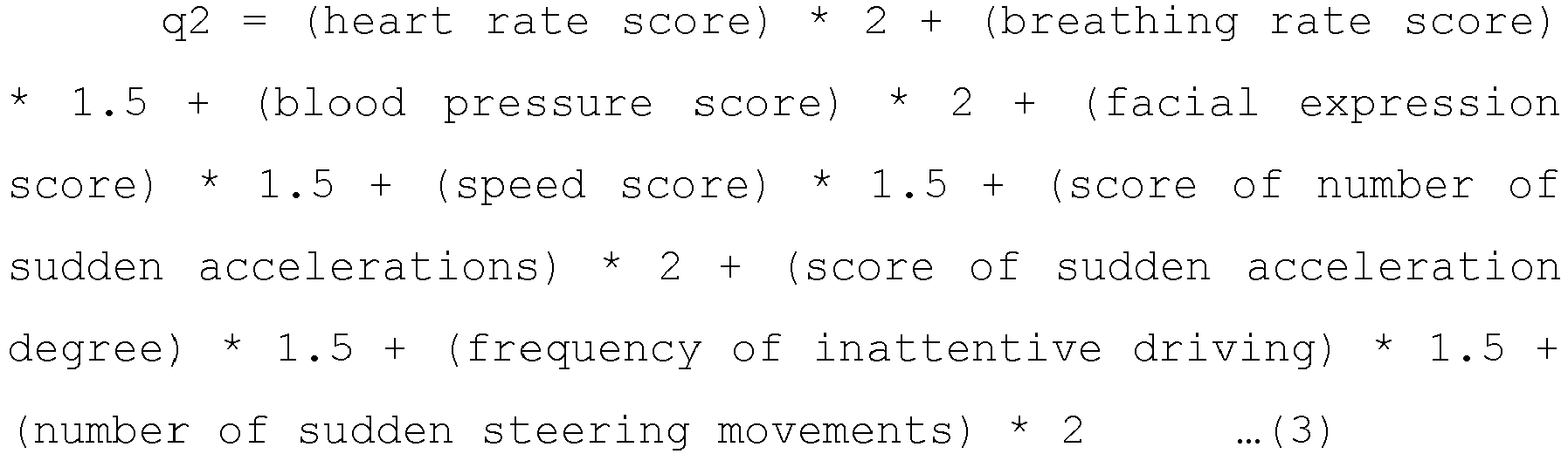
- In equation (3), if the scores are all "5", which is the maximum value, q2 = 77.5 holds.
- Further, the parameter q2 is multiplied by the score in accordance with the information on a type of the host-vehicle VA (this is referred to as "α"), the score in accordance with the vehicle body information (this is referred to as "β"), and the score in accordance with the lane information (this is referred to as "γ") in the following equation (4), and thus, the agitating degree Q2 is calculated. The α and β are numerical values in the range from 1 to 1.5 and γ is a numerical value of either one of 1 and 1.5.

- In equation (4), the agitating degree Q2 is a numerical value in the range from 0 to 261.6.
- Next, an evaluation value table will be described. The
storage unit 315A shown inFIG. 2 stores a first evaluation value table and a second evaluation value table. In the first evaluation value table, the agitated degree Q1 of an agitation action received by the host-vehicle VA from the other-vehicle VB is classified into four stages and an evaluation value is set for each stage. In the second evaluation value table, the agitating degree Q2 of an agitation action performed by the host-vehicle VA against the other-vehicle VB is classified into four stages and an evaluation value is set for each stage. -
FIG. 7A shows a first evaluation value table TB1. As shown inFIG. 7A , in the first evaluation value table TB1, the relationship between the agitated degree Q1 which changes in the range from "0 to 202.5" and the evaluation value Xp is set. Specifically, the agitated degree Q1 is classified into four stages, and as evaluation values Xp for the four stages, X0 to X3 are set. If the agitated degree Q1 is in the range from 0 to 50, the evaluation value Xp is X0, for example. -
FIG. 7B shows the second evaluation value table TB2. As shown inFIG. 7B , in the second evaluation value table TB2, the relationship between the agitating degree Q2 which changes in the range from "0 to 202.5" and the evaluation value Yp is set. Specifically, the agitating degree Q2 is classified into four stages, and as evaluation values Yp for the four stages, Y0 to Y3 are set. If the agitating degree Q2 is 150 or more, the evaluation value Yp is Y3, for example. - The danger
degree determination unit 312A determines an evaluation value Xp (this is defined as a first evaluation value Xp) by referring to the first evaluation value table TB1 based on the agitated degree Q1. The dangerdegree determination unit 312A determines an evaluation value Yp (this is defined as a second evaluation value Yp) by referring to the second evaluation value table TB2 based on the agitating degree Q2. - The danger
degree determination unit 312A determines the warning content given to the driver of the host-vehicle VA (seeFIGS. 8A and 8B ) based on the determined first evaluation value Xp and second evaluation value Yp and outputs the content to thepresentation unit 33A. - Next, the operation of the first embodiment will be described with reference to the flowchart shown in
FIG. 9. FIG. 9 is a flowchart showing a processing procedure of the dangerousdriving warning system 101 according to the first embodiment. First, in step S11 ofFIG. 9 , thecontroller 11A acquires various pieces of information detected by means of thecamera unit 12A, thebiological information sensor 13A, thetravel information sensor 14A, and thelaser radars 15A mounted on the host-vehicle device 1A. - In step S12, the
controller 11A stores various pieces of information acquired through the process of step S11 in thestorage unit 315A. - In step S13, the agitated
degree calculation unit 313A refers to the agitated degree correspondence table Tb1 and quantifies the above various pieces of information. As shown inFIG. 5B , if the traveling speed of the host-vehicle VA is in the range from 60 to 70 [km/h], the score is "1", for example. - In step S14, the agitated
degree calculation unit 313A calculates the agitated degree Q1. Specifically, the agitateddegree calculation unit 313A calculates the agitated degree Q1, which is the degree to which the driver of the host-vehicle VA is agitated by the other-vehicle VB by using the above described equation (2). The agitated degree Q1 can be calculated by using the numerical value at the determination time (instantaneous). Further, in addition to the above, it is possible to set a time zone that is backward by a predetermined time (for example, 10 seconds) from the determination time and to use representative values such as an average value, a peak value, and a median value of the agitated degree Q1 during the time zone, for example. Further, it is possible to hold the peak value during the time zone for a predetermined time (for example, 10 seconds) to obtain the agitated degree Q1. - In step S15, the
communication unit 32A acquires the data of the agitating degree Q2 calculated by means of the other-vehicle device 1B. As described above, the agitatingdegree calculation unit 314B of the other-vehicle device 1B calculates the agitating degree Q2 when the other-vehicle VB agitates the driver of the host-vehicle VA. Specifically, the agitating degree Q2 is calculated by using the above described equation (4). The data of the agitating degree Q2 is transmitted to theserver 3 via thenetwork 4, and further transmitted to the host-vehicle device 1A. Thecommunication unit 32A receives the data of the agitating degree Q2. The agitating degree Q2 can be calculated by using a numerical value at the determination time (instantaneous) in the same manner as the agitated degree Q1 described above. In addition to the above, it is also possible to set a time zone that is backward by a predetermined time (for example, 10 seconds) from the determination time and to use representative values such as an average value, a peak value, and a median value of the agitating degree Q2 during the time zone. It is also possible to hold the peak value during the time zone for a predetermined time (for example, 10 seconds) to obtain the agitating degree Q2. - In step S16, the danger
degree determination unit 312A sets the first evaluation value Xp based on the agitated degree Q1 calculated in the process of step S14. Specifically, the dangerdegree determination unit 312A sets any one of X0 to X3 shown inFIG. 7A as the first evaluation value Xp. - In step S17, the danger
degree determination unit 312A sets the second evaluation value Yp based on the agitating degree Q2 obtained in the process of step S15. Specifically, the dangerdegree determination unit 312A sets any one of Y0 to Y3 shown inFIG. 7B as the second evaluation value Yp. - In step S18, the danger
degree determination unit 312A, based on the distance between the host-vehicle VA and the other-vehicle VB, determines whether the inter-vehicle distance is equal to or shorter than a preset threshold distance Lth. If the inter-vehicle distance is equal to or shorter than the threshold distance Lth (S18; YES), the process proceeds to step S21. Alternatively, if the inter-vehicle distance is longer than the threshold distance Lth, (S18); NO), the process proceeds to step S19. - In step S19, the danger
degree determination unit 312A sets the warning content given to the driver of the host-vehicle VA based on the first evaluation value Xp and the second evaluation value Yp. The dangerdegree determination unit 312A determines the warning content in accordance with the first evaluation value Xp under the condition that the second evaluation value Yp is Y1 or above, for example. -
FIG. 8A shows the warning content when the driver of the host-vehicle VA is agitated by the other-vehicle VB. As shown inFIG. 8A , "No warning" is set as the content when the first evaluation value Xp is X0. When the first evaluation value Xp is in the range from X1 to X3, warning content in accordance with each evaluation value is set. - In step S20, the danger
degree determination unit 312A determines whether to warn the driver of the host-vehicle VA that the driver of the host-vehicle VA is agitated. If the second evaluation value Yp is Y0 or the first evaluation value Xp is X0, the dangerdegree determination unit 312A makes no warning to the driver (S20; NO), and therefore the process ends. - Meanwhile, if the second evaluation value Yp is Y1 or above and the first evaluation value Xp is X1 or above, in step S21, the danger
degree determination unit 312A presents the warning content in accordance with the first evaluation value Xp by using thepresentation unit 33A. - The case where the
presentation unit 33A is a display is taken as an example here. In the above case, if the first evaluation value Xp is X1, thepresentation unit 33A displays the text such as "Please drive safely", for example. If the first evaluation value Xp is X2, thepresentation unit 33A displays the text such as "Please travel carefully", for example. If the first evaluation value Xp is X3, thepresentation unit 33A displays the text such as "Dangerous driving has been detected. Please pay attention to surrounding vehicles", for example. That is, the higher the first evaluation value Xp is, the stronger the calling for attention is. - Further, suppose that the inter-vehicle distance is equal to or shorter than the threshold distance (S18; YES), for example. In the above case, the
presentation unit 33A presents content such as "There is an abnormally close vehicle. Please be careful." by using text or voice. That is, if the inter-vehicle distance is short and the other-vehicle VB is abnormally close to the host-vehicle VA, the warning is displayed regardless of the magnitude of the agitated degree Q1. Thereafter, the process ends. - In this way, it is possible to determine whether the driver of the host-vehicle VA is agitated by the other-vehicle VB based on various kinds of pieces of information on the host-vehicle VA and various kinds of pieces of information on the other-vehicle VB, and to present, to the driver of the host-vehicle VA, the warning content in accordance with the agitated degree Q1.
- In this way, the dangerous
driving warning system 101 according to the first embodiment can achieve the following effects. - (1) The agitated degree Q1 indicating the degree to which the driver of the host-vehicle VA is agitated by the other-vehicle VB is calculated. Further, the agitating degree Q2 indicating the degree to which the other-vehicle VB agitates the driver of the host-vehicle VA is calculated. The driver of the host-vehicle VA is warned that the host-vehicle is agitated based on the agitated degree Q1 and the agitating degree Q2. Accordingly, the driver of the host-vehicle VA can immediately recognize that the host-vehicle VA is agitated, and can quickly take measures to avoid danger.
- (2) The agitating degree Q2 when the other-vehicle VB agitates the driver of the host-vehicle VA is calculated by means of the agitating
degree calculation unit 314B of the other-vehicle VB. The host-vehicle device 1A acquires the agitating degree Q2 by means of communication via thenetwork 4. This can reduce the calculation load in the host-vehicle device 1A. - (3) Information on the host-vehicle VA includes information on a type of the host-vehicle and information on the lane on which the host-vehicle travels. If the host-vehicle VA is a light vehicle and the host-vehicle VA is traveling on the passing lane, it is determined that the driver of the host-vehicle is likely to be agitated, for example. Therefore, the multiplication coefficient used for calculating the agitated degree Q1 is set to a higher value. Therefore, the agitated degree Q1 can be calculated with higher accuracy.
- (4) Information on the other-vehicle VB includes vehicle type information, vehicle body information, and information on the lane on which the other-vehicle travels. If the other-vehicle VB is a large vehicle or is traveling on the passing lane, it is determined that that the other-vehicle VB is likely to perform an agitation action, for example. Therefore, the multiplication coefficient used for calculating the agitating degree Q2 is set to a higher numerical value. In addition, if the other-vehicle VB caused many accidents and violations in the past, it is determined that the other-vehicle VB is likely to perform the agitation action. Therefore, the multiplication coefficient used for calculating the agitating degree Q2 is set to a higher numerical value. Accordingly, the agitating degree Q2 can be calculated with higher accuracy.
- (5) The agitated degree Q1 and the agitating degree Q2 are calculated by using the traveling speed of a vehicle, the number of sudden accelerations, the acceleration degree, the frequency of inattentive driving, and the number of sudden steering movements as the vehicle information. Suppose that the traveling speed is high, the number of sudden accelerations is large, or the acceleration degree is high. In the above case, it is determined that the possibility of a driver of a vehicle being agitated or performing an agitation action is high. Therefore, the scores for calculating the agitated degree Q1 and the agitating degree Q2 are set to be high. Accordingly, the agitated degree Q1 and the agitating degree Q2 can be calculated with high accuracy.
- (6) The agitated degree Q1 and the agitating degree Q2 are calculated by using the heart rate, the breathing rate, and the blood pressure of the driver as the biological information. Suppose that the driver's heart rate is high, the breathing rate is high, or the blood pressure is high. In the above case, it is determined that the possibility of the driver being agitated or performing an agitation action is high. Therefore, the scores for calculating the agitated degree Q1 and the agitating degree Q2 are set to be high.
- Next, a first modified example of the first embodiment described above will be described. In the first modified example, the
control unit 21 of theserver 3 shown inFIG. 4 is configured to include a danger degree determination unit similar to the dangerdegree determination unit 312A. In addition, the first modified example of the first embodiment differs from the first embodiment described above in that thestorage unit 23 of theserver 3 stores the agitated degree correspondence table Tb1, the agitating degree correspondence table Tb2, the first evaluation value table TB1, and the second evaluation value table TB2. - In the first modified example, various kinds of pieces of information detected by means of the host-
vehicle device 1A (biological information, travel information, images, laser radar information, and the like) are transmitted from thecommunication unit 32A to theserver 3 via thenetwork 4. Then, thecontrol unit 21 of theserver 3 calculates the agitated degree Q1. Further, various kinds of pieces of information detected by means of the other-vehicle device 1B are transmitted from thecommunication unit 32B to theserver 3 via thenetwork 4. Then, thecontrol unit 21 of theserver 3 calculates the agitating degree Q2. Other configurations other than the above are the same as those of the first embodiment described above. - As described above, in the dangerous
driving warning system 101 according to the first modified example, the agitated degree correspondence table Tb1 and the agitating degree correspondence table Tb2 are provided in theserver 3. The agitated degree Q1 and the agitating degree Q2 are calculated in theserver 3. Accordingly, it is possible to reduce the storage capacity and the calculation load of thestorage units vehicle device 1A and the other-vehicle device 1B respectively. - Next, a second modified example of the first embodiment described above will be described. The configuration of the device is the same as that in
FIGS. 1 to 4 , and therefore the description of the configuration is omitted. - In the first embodiment described above, the agitating
degree calculation unit 314B mounted on the other-vehicle VB is configured to calculate the agitating degree Q2 of an agitation action performed by the other-vehicle VB against the host-vehicle VA and transmit the calculated agitating degree Q2 to the host-vehicle VA via thenetwork 4. Meanwhile, in the second modified example, various kinds of pieces of information detected by means of the other-vehicle device 1B are transmitted to the host-vehicle device 1A via thenetwork 4. The difference between the second modified example of the first embodiment and the first embodiment resides in that the agitatingdegree calculation unit 314A mounted on the host-vehicle device 1A calculates the agitating degree Q2 of an agitation action performed by the other-vehicle VB. - Hereinafter, the processing procedure of a dangerous
driving warning system 101 according to the second modified example will be described with reference to the flowchart shown inFIG. 10 . - First, in step S31 of
FIG. 10 , thecontroller 11A mounted on the host-vehicle device 1A acquires various pieces of information detected by means of thecamera unit 12A, thebiological information sensor 13A, thetravel information sensor 14A, and thelaser radars 15A. - In step S32, the
controller 11A stores various pieces of information acquired in the process of step S31 in thestorage unit 315A. - In step S33, the agitated
degree calculation unit 313A refers to the agitated degree correspondence table Tb1 and quantifies the various pieces of information described above. - In step S34, the
controller 11A of the host-vehicle device 1A acquires various pieces of information detected by means of thecamera unit 12B, thebiological information sensor 13B, thetravel information sensor 14B, and thelaser radars 15B mounted on the other-vehicle device 1B. Specifically, thecommunication unit 32A of the host-vehicle device 1A receives various kinds of pieces of data transmitted from thecommunication unit 32B of the other-vehicle device 1B. - In step S35, the
controller 11A stores the various pieces of information acquired in the process of step S34 in thestorage unit 315A. - In step S36, the agitating
degree calculation unit 314A refers to the agitating degree correspondence table Tb2 and quantifies the above described various pieces of information. - In step S37, the agitated
degree calculation unit 313A calculates the agitated degree Q1. Specifically, the agitateddegree calculation unit 313A calculates the agitated degree Q1, which is the degree to which the driver of the host-vehicle VA is agitated by the other-vehicle VB by using the above described equation (2). The agitated degree Q1 can be calculated by using the numerical value at the determination time (instantaneous). In addition to the above, it is possible to set a time zone that is backward by a predetermined time (for example, 10 seconds) from the determination time and to use representative values such as an average value, a peak value, and a median value of the agitated degree Q1 during the time zone. It is also possible to hold the peak value during the time zone for a predetermined time (for example, 10 seconds) to obtain the agitated degree Q1. - In step S38, the agitating
degree calculation unit 314A calculates the agitating degree Q2. Specifically, the agitatingdegree calculation unit 314A calculates the agitating degree Q2 when the other-vehicle VB agitates the driver of the host-vehicle VA by using the above described equation (4). The agitating degree Q2 can be calculated by using the numerical value at the determination time (instantaneous). In addition to the above, it is also possible to set a time zone that is backward by a predetermined time (for example, 10 seconds) from the determination time, and to use representative values such as an average value, a peak value, and a median value of the agitating degree Q2 during the time zone. It is also possible to hold the peak value during the time zone for a predetermined time (for example, 10 seconds) to obtain the agitating degree Q2. - In step S39, the danger
degree determination unit 312A sets the first evaluation value Xp based on the agitated degree Q1 calculated in the process of step S37. Specifically, the dangerdegree determination unit 312A sets an evaluation value of any one of X0 to X3 shown inFIG. 7A as the first evaluation value Xp. - In step S40, the danger
degree determination unit 312A sets the second evaluation value Yp based on the agitating degree Q2 obtained in the process of step S38. Specifically, the dangerdegree determination unit 312A sets an evaluation value of any one of Y0 to Y3 shown inFIG. 7B as the second evaluation value Yp. - Since the processes of steps S41 to S44 are the same as the processes of steps S18 to S21 shown in
FIG. 9 , description thereof is omitted. - In this way, in a dangerous
driving warning system 101 according to the second modified example of the first embodiment, the agitateddegree calculation unit 313A of the host-vehicle device 1A calculates the agitated degree Q1 when the driver of the host-vehicle VA is agitated by the other-vehicle VB. In addition, the agitatingdegree calculation unit 314A acquires various kinds of pieces of information on the other-vehicle VB from the other-vehicle VB, and calculates the agitating degree Q2 when the other-vehicle VB agitates the driver of the host-vehicle VA by using the acquired pieces of information. - Therefore, since the agitated degree Q1 and the agitating degree Q2 can be calculated by means of the host-
vehicle device 1A, the calculation load in the other-vehicle VB can be reduced. - Next, the second embodiment will be described. Since a dangerous
driving warning system 101 according to the second embodiment is the same as the dangerousdriving warning system 101 shown inFIGS. 1 to 4 described above, a description of the configuration thereof is omitted. In the second embodiment, if the host-vehicle VA agitates the driver of the other-vehicle VB, the driver of the host-vehicle VA is warned of the danger degree caused by the driver performing the agitation action. - The processing procedure of the dangerous
driving warning system 101 according to the second embodiment will be described below with reference to the flowchart shown inFIG. 11 . First, in step S51 ofFIG. 11 , thecontroller 11A acquires various pieces of information detected by means of acamera unit 12A, abiological information sensor 13A, atravel information sensor 14A, andlaser radars 15A mounted on a host-vehicle device 1A. - In step S52, the
controller 11A stores the various pieces of information acquired in the process of step S51 in astorage unit 315A. - In step S53, the agitating
degree calculation unit 314A refers to the agitating degree correspondence table Tb2 and quantifies the above described various pieces of information. As shown inFIG. 6B , if the number of accelerations of the host-vehicle VA is five times or more in 10 seconds, the score is "5", for example. - In step S54, the agitating
degree calculation unit 314A calculates the agitating degree Q2. Specifically, the agitatingdegree calculation unit 314A calculates the agitating degree Q2 when the host-vehicle VA agitates the driver of the other-vehicle VB by using the above described equation (4). The agitating degree Q2 can be calculated by using the numerical value at the determination time (instantaneous). In addition to the above, it is also possible to set a time zone that is backward by a predetermined time (for example, 10 seconds) from the determination time, and to use representative values such as an average value, a peak value, and a median value of the agitating degree Q2 during the time zone. It is also possible to hold the peak value during the time zone for a predetermined time (for example, 10 seconds) to obtain the agitating degree Q2. - In step S55, the
communication unit 32A acquires data of the agitated degree Q1 calculated by means of the other-vehicle device 1B. As described above, the agitateddegree calculation unit 313B of the other-vehicle device 1B calculates the agitated degree Q1 when the driver of the other-vehicle VB is agitated by the host-vehicle VA. Specifically, the agitated degree Q1 is calculated by using the above described equation (2). The data of the agitated degree Q1 is transmitted to theserver 3 via thenetwork 4, and further transmitted to the host-vehicle device 1A. Thecommunication unit 32A receives the data of the agitated degree Q1. The agitated degree Q1 can be calculated by using the numerical value at the determination time (instantaneous). In addition to the above, it is also possible to set a time zone that is backward by a predetermined time (for example, 10 seconds) from the determination time, and to use representative values such as an average value, a peak value, and a median value of the agitated degree Q1 during the time zone. It is also possible to hold the peak value during the time zone for a predetermined time (for example, 10 seconds) to obtain the agitated degree Q1. - In step S56, the danger
degree determination unit 312A sets the first evaluation value Xp based on the agitated degree Q1 acquired in the process of step S55. Specifically, the dangerdegree determination unit 312A sets an evaluation value of any one of X0 to X3 shown inFIG. 7A as the first evaluation value Xp. - In step S57, the danger
degree determination unit 312A sets the second evaluation value Yp based on the agitating degree Q2 calculated in the process of step S54. Specifically, the dangerdegree determination unit 312A sets an evaluation value of any one of Y0 to Y3 shown inFIG. 7B as the second evaluation value Yp. - In step S58, the danger
degree determination unit 312A determines, based on the distance between the host-vehicle VA and the other-vehicle VB, whether the inter-vehicle distance is equal to or shorter than a preset threshold distance Lth. If the inter-vehicle distance is equal to or shorter than the the threshold distance Lth (S58; YES), the process proceeds to step S61. If the inter-vehicle distance is longer than the threshold distance Lth (S58; NO), the process proceeds to step S59. - In step S59, the danger
degree determination unit 312A sets the warning content given to the driver of the host-vehicle VA based on the first evaluation value Xp and the second evaluation value Yp. The dangerdegree determination unit 312A determines the warning content in accordance with the second evaluation value Yp under the condition that the first evaluation value Xp is X1 or above, for example. -
FIG. 8B shows the warning content when the host-vehicle VA agitates the driver of the other-vehicle VB. As shown inFIG. 8B , "No warning" is set as the content when the second evaluation value Yp is Y0. Further, when the second evaluation value Yp is in the range from Y1 to Y3, warning content in accordance with each evaluation value is set. - In step S60, the danger
degree determination unit 312A determines whether to warn the driver of the host-vehicle VA that the host-vehicle VA is performing an agitation action. If the first evaluation value Xp is X0 or the second evaluation value Yp is Y0, no warning is made (S60; NO), and therefore the process ends. - Meanwhile, suppose that the first evaluation value Xp is X1 or above (that is, in a situation where the driver of other-vehicle VB recognizes that the driver is agitated,) and the second evaluation value Yp is Y1 or above. In the above case, in step S61, the danger
degree determination unit 312A presents the warning in accordance with the second evaluation value Yp by using thepresentation unit 33A. - The case where the
presentation unit 33A is a display is taken as an example. In the above case, as shown inFIG. 8B , when the second evaluation value Yp is Y1, the display displays the text such as "Please drive safely". When the second evaluation value Yp is Y2, the display displays the text such as "Please travel carefully", for example. When the second evaluation value Yp is Y3, the display displays the text such as "Dangerous driving has been detected. Please adopt a safe inter-vehicle distance", for example. - Further, if the inter-vehicle distance becomes equal to or shorter than the threshold distance Lth (S58; YES), content such as "We are abnormally close to a preceding vehicle. Please drive by adopting a sufficient distance with the preceding vehicle." is presented by using text or voice, for example. That is, if the inter-vehicle distance is short and the host-vehicle VA is abnormally close to the other-vehicle VB, the warning is displayed regardless of the magnitude of the agitating degree Q2. Thereafter, the process ends.
- In this way, it is possible to determine whether the host-vehicle VA agitates the driver of the other-vehicle VB based on various kinds of pieces of information on the host-vehicle VA and various kinds of pieces of information on the other-vehicle VB, and to present the warning content in accordance with the agitation action degree to the driver of the host-vehicle VA.
- In this way, in the dangerous
driving warning system 101 according to the second embodiment, the following effects can be achieved. - (1) The agitating degree Q2 indicating the degree to which the host-vehicle VA agitates the driver of the other-vehicle VB is calculated. Further, the agitated degree Q1 indicating the degree to which the driver of the other-vehicle VB is agitated by the host-vehicle VA is calculated. Then, the host-vehicle VA is warned that the host-vehicle VA is performing an agitation action based on the agitating degree Q2 and the agitated degree Q1. Therefore, if the driver of the host-vehicle VA unconsciously agitates the other-vehicle VB, the driver of the host-vehicle VA can immediately recognize that the driver is performing the agitation action, and can quickly take measures for safe driving.
- (2) The agitated degree Q1 when the driver of the other-vehicle VB is agitated by the host-vehicle VA is calculated by means of the agitated
degree calculation unit 313B of the other-vehicle VB and is acquired by the host-vehicle device 1A by means of communication via thenetwork 4. This can reduce the calculation load in the host-vehicle device 1A. - (3) Information on the host-vehicle VA includes information on a type of the host-vehicle, vehicle body information such as the number of violations and accidents, and information on the lane on which the host-vehicle travels. If the host-vehicle VA is a large vehicle or if the host-vehicle is traveling on a passing lane, it is determined that the host-vehicle is likely to perform an agitation action, for example. Therefore, the multiplication coefficient used for calculating the agitating degree Q2 is set to a higher numerical value. In addition, if the host-vehicle VA caused many accidents and violations in the past, it is determined that the host-vehicle is likely to perform an agitation action. Therefore, the multiplication coefficient used for calculating the agitating degree Q2 is set to a higher numerical value. Further, if the host-vehicle VA is traveling on the passing lane, it is determined that the host-vehicle is likely to agitate the driver of the other-vehicle VB. Therefore, the multiplication coefficient used for calculating the agitating degree Q2 is set to a high numerical value. Accordingly, the agitating degree Q2 can be calculated with higher accuracy.
- (4) Information on the other-vehicle VB includes information on the type of the other-vehicle VB and information on the lane on which the other-vehicle VB travels. If the other-vehicle VB is a light vehicle or is traveling on a passing lane, it is determined that the driver of the other-vehicle VB is likely to be agitated, for example. Therefore, the multiplication coefficient used for calculating the agitated degree Q1 is set to a higher numerical value. Accordingly, the agitated degree Q1 can be calculated with higher accuracy.
- (5) The agitating degree Q2 and the agitated degree Q1 are calculated by using, as vehicle information, a traveling speed, the number of sudden accelerations, the acceleration degree, the frequency of inattentive driving, and the number of sudden steering movements of a vehicle. If the traveling speed is high, the number of sudden accelerations is large, or the acceleration degree is high, it is determined that a vehicle is likely to perform an agitation action or is likely to be agitated. Therefore, the scores used for calculating the agitating degree Q2 and the agitated degree Q1 are set to be high. Accordingly, the agitating degree Q2 and the agitated degree Q1 can be calculated with high accuracy.
- (6)The agitating degree Q2 and the agitated degree Q1 are calculated by using, as biological information, the heart rate, breathing rate, and blood pressure of the driver. If the driver's heart rate is high, the driver's breathing rate is high, or the driver's blood pressure is high, it is determined that the driver is likely to perform an agitation action or is likely to be agitated. Therefore, the scores used for calculating the agitating degree Q2 and the agitated degree Q1 are set to be high. Accordingly, the agitating degree Q2 and the agitated degree Q1 can be calculated with high accuracy.
- Next, a first modified example of the second embodiment described above will be described. In a first modified example, a
control unit 21 of aserver 3 shown inFIG. 4 is configured to include a danger degree determination unit. In addition, the first modified example of the second embodiment differs from the second embodiment in that, in the first modified example, astorage unit 23 of theserver 3 stores an agitated degree correspondence table Tb1, an agitating degree correspondence table Tb2, a first evaluation value table TB1, and a second evaluation value table TB2. - In the first modified example, various kinds of pieces of information (biological information, travel information, images, laser radar information, and the like) detected by means of the host-
vehicle device 1A are transmitted from thecommunication unit 32A to theserver 3 via thenetwork 4. Then, thecontrol unit 21 of theserver 3 calculates the agitating degree Q2. Further, various kinds of pieces of information detected by means of the other-vehicle device 1B are transmitted from thecommunication unit 32B to theserver 3 via thenetwork 4. Then, thecontrol unit 21 of theserver 3 calculates the agitated degree Q1. Configurations other than the above are the same as those in the second embodiment described above. - As described above, in a dangerous
driving warning system 101 according to the first modified example, the agitated degree correspondence table Tb1 and the agitating degree correspondence table Tb2 are stored in theserver 3, and theserver 3 calculates the agitating degree Q2 and the agitated degree Q1. This can reduce the storage capacity and the calculation load of thestorage units vehicle device 1A and the other-vehicle device 1B respectively. - Next, a second modified example of the second embodiment described above will be described. The configuration of the device is the same as that in
FIGS. 1 to 4 described above, and therefore a description of the configuration is omitted. - In the second embodiment described above, it is configured that the agitated
degree calculation unit 313B mounted on the other-vehicle VB calculates the agitated degree Q1 of an agitation action performed by the host-vehicle VA against the other-vehicle VB, and transmits the calculated agitated degree Q1 to the host-vehicle VA via thenetwork 4. Meanwhile, the second modified example of the second embodiment differs from the second embodiment in that, in the second modified example, various kinds of pieces of information detected by means of the other-vehicle device 1B are transmitted to the host-vehicle device 1A via thenetwork 4, and then thecalculation processing unit 31A mounted on the host-vehicle device 1A calculates the agitated degree Q1 of an agitation action performed against the other-vehicle VB. - Hereinafter, the processing procedure of a dangerous
driving warning system 101 according to the second modified example will be described with reference to the flowchart shown inFIG. 12 . First, in step S71 ofFIG. 12 , thecontroller 11A acquires various pieces of information detected by means of thecamera unit 12A, thebiological information sensor 13A, thetravel information sensor 14A, and thelaser radars 15A mounted on the host-vehicle device 1A. - In step S72, the
controller 11A stores the various pieces of information acquired in the process of step S71 in thestorage unit 315A. - In step S73, the agitated
degree calculation unit 313A refers to the agitated degree correspondence table Tb1 and quantifies the above described various pieces of information. - In step S74, the
controller 11A acquires various pieces of information detected by means of thecamera unit 12B, thebiological information sensor 13B, thetravel information sensor 14B, and thelaser radars 15B mounted on the other-vehicle device 1B. Specifically, thecommunication unit 32A of the host-vehicle device 1A receives the various kinds of pieces of data transmitted from thecommunication unit 32B of the other-vehicle device 1B. - In step S75, the
controller 11A stores the various pieces of information acquired in the process of step S74 in thestorage unit 315A. - In step S76, the agitating
degree calculation unit 314A refers to the agitating degree correspondence table Tb2 and quantifies the above described various pieces of information. - In step S77, the agitating
degree calculation unit 314A calculates the agitating degree Q2. Specifically, the agitatingdegree calculation unit 314A calculates the agitating degree Q2 when the host-vehicle VA agitates the driver of the other-vehicle VB by using the above described equation (4). The agitating degree Q2 can be calculated by using the numerical value at the determination time (instantaneous). In addition to the above, it is also possible to set a time zone that is backward by a predetermined time (for example, 10 seconds) from the determination time, and to use representative values such as an average value, a peak value, and a median value of the agitating degree Q2 during the time zone. It is also possible to hold the peak value during the time zone for a predetermined time (for example, 10 seconds) to obtain the agitating degree Q2. - In step S78, the agitated
degree calculation unit 313A calculates the agitated degree Q1. Specifically, the agitateddegree calculation unit 313A calculates the agitated degree Q1 when the driver of the other-vehicle VB is agitated by the host-vehicle VA by using the above described equation (2). The agitated degree Q1 can be calculated by using the numerical value at the determination time (instantaneous). In addition to the above, it is also possible to set a time zone that is backward by a predetermined time (for example, 10 seconds) from the determination time, and to use representative values such as an average value, a peak value, and a median value of the agitated degree Q1 during the time zone. It is also possible to hold the peak value during the time zone for a predetermined time (for example, 10 seconds) to obtain the agitated degree Q1. - In step S79, the danger
degree determination unit 312A sets the first evaluation value Xp based on the agitated degree Q1 acquired in the process of step S78. Specifically, the dangerdegree determination unit 312A sets an evaluation value of any one of X0 to X3 shown inFIG. 7A as the first evaluation value Xp. - In step S80, the danger
degree determination unit 312A sets the second evaluation value Yp based on the agitating degree Q2 calculated in the process of step S77. Specifically, the dangerdegree determination unit 312A sets an evaluation value of any one of Y0 to Y3 shown inFIG. 7B as the second evaluation value Yp. - Since the processes in steps S81 to S84 are the same as the processes in steps S58 to S61 shown in
FIG. 11 , description thereof is omitted. - In this way, in the dangerous
driving warning system 101 according to the second modified example of the second embodiment, the host-vehicle VA calculates the agitating degree Q2 when the host-vehicle VA agitates the driver of the other-vehicle VB. Further, the host-vehicle VA receives various kinds of pieces of information on the other-vehicle VB from the other-vehicle VB, and calculates the agitated degree Q1 when the driver of the other-vehicle VB is agitated by the host-vehicle VA by using the acquired information. - As described above, the host-
vehicle device 1A can calculate the agitating degree Q2 and the agitated degree Q1. This can reduce the calculation load of the other-vehicle device 1B. - Next, the third embodiment will be described. Since a dangerous
driving warning system 101 according to the third embodiment is the same as the dangerousdriving warning system 101 shown inFIGS. 1 to 4 described above, a configuration description thereof is omitted. - However, the agitating
degree calculation unit 314A shown inFIG. 2 is a first agitating degree calculation unit for calculating the agitating degree Q2 (a first agitating degree) indicating the degree to which the host-vehicle VA agitates the driver of the other-vehicle VB. Further, the agitatingdegree calculation unit 314B shown inFIG. 3 is a second agitating degree calculation unit for calculating the agitating degree Q2' (a second agitating degree) indicating the degree to which the other-vehicle VB agitates the driver of the host-vehicle VA. In the third embodiment, when both the driver of the host-vehicle VA and the driver of the other-vehicle VB agitate each other, the driver of at least one of the host-vehicle VA and the other-vehicle VB is warned of the danger degree caused by performing the agitation action. - That is, while the first embodiment described above shows countermeasures when the driver of the host-vehicle VA is agitated by the other-vehicle VB, the second embodiment shows countermeasures when the host-vehicle VA agitates the driver of the other-vehicle VB. In contrast to the above, in the third embodiment, when the driver of the host-vehicle VA and the driver of the other-vehicle VB agitate each other, processes are performed for warning the driver of at least one of the host-vehicle VA and the other-vehicle VB.
- The processing procedure of a dangerous
driving warning system 101 according to the third embodiment will be described below with reference to the flowchart shown inFIG. 13 . First, in step S91 ofFIG. 13 , thecontroller 11A acquires various pieces of information detected by means of thecamera unit 12A, thebiological information sensor 13A, thetravel information sensor 14A, and thelaser radars 15A mounted on the host-vehicle device 1A. - In step S92, the
controller 11A stores the various pieces of information acquired in the process of step S91 in thestorage unit 315A. - In step S93, the agitating
degree calculation unit 314A (a first agitating degree calculation unit) refers to the agitating degree correspondence table Tb2 and quantifies the above described various pieces of information. As shown inFIG. 6B , if the number of accelerations of the host-vehicle VA is 5 times or more in 10 seconds, the score is "5", for example. - In step S94, the agitating
degree calculation unit 314A calculates the agitating degree Q2 (a first agitating degree) . Specifically, the agitatingdegree calculation unit 314A calculates a first agitating degree Q2, which is the degree to which the host-vehicle VA agitates the driver of the other-vehicle VB by using the above described equation (4). The first agitating degree Q2 can be calculated by using the numerical value at the determination time (instantaneous). In addition to the above, it is also possible to set a time zone that is backward by a predetermined time (for example, 10 seconds) from the determination time, and to use representative values such as an average value, a peak value, and a median value of the first agitating degree Q2 during the time zone. It is also possible to hold the peak value during the time zone for a predetermined time (for example, 10 seconds) to obtain the first agitating degree Q2. - In step S95, the
communication unit 32A acquires data of the agitating degree calculated by means of the agitatingdegree calculation unit 314B (a second agitating degree calculation unit) of the other-vehicle device 1B (a second agitating degree; this is denoted with "Q2'"). As described above, the agitatingdegree calculation unit 314B of the other-vehicle device 1B calculates the second agitating degree Q2' when the other-vehicle VB agitates the driver of the host-vehicle VA. Specifically, the second agitating degree Q2' is calculated by using the above described equation (4). The data of the second agitating degree Q2' is transmitted to theserver 3 via thenetwork 4, and further transmitted to the host-vehicle device 1A. Thecommunication unit 32A receives the data of the second agitating degree Q2'. The second agitating degree Q2' can be calculated by using the numerical value at the determination time (instantaneous). In addition to the above, it is also possible to set a time zone that is backward by a predetermined time (for example, 10 seconds) from the determination time, and to use representative values such as an average value, a peak value, and a median value of the second agitating degree Q2' during the time zone. It is also possible to hold the peak value during the time zone for a predetermined time (for example, 10 seconds) to obtain the second agitating degree Q2'. - In step S96, the danger
degree determination unit 312A sets a second evaluation value (this is denoted with "Yp1") of the host-vehicle VA based on the first agitating degree Q2 calculated in the process of step S94. Specifically, the dangerdegree determination unit 312A sets an evaluation value of any one of Y0 to Y3 shown inFIG. 7B as the second evaluation value Yp1 of the host-vehicle VA. - In step S97, the danger
degree determination unit 312A sets a second evaluation value (this is denoted with "Yp2") of the other-vehicle VB based on the second agitating degree Q2' acquired in the process of step S95. Specifically, the dangerdegree determination unit 312A sets an evaluation value of any one of Y0 to Y3 shown inFIG. 7B as the second evaluation value Yp2 of the other-vehicle VB. - In step S98, the danger
degree determination unit 312A determines, based on the distance between the host-vehicle VA and the other-vehicle VB, whether the inter-vehicle distance is equal to or shorter than a preset threshold distance Lth. If the inter-vehicle distance is equal to or shorter than the threshold distance Lth (S98; YES), the process proceeds to step S101. If the inter-vehicle distance is longer than the threshold distance Lth (S98; NO), the process proceeds to step S99. - In step S99, the danger
degree determination unit 312A sets the warning content given to the driver of the host-vehicle VA based on the second evaluation value Yp1 of the host-vehicle VA and the second evaluation value Yp2 of the other-vehicle VB. The dangerdegree determination unit 312A determines the warning content in accordance with the second evaluation value Yp1 of the host-vehicle VA under the condition that the second evaluation value Yp2 of the other-vehicle VB is Y1 or above, for example. - As shown in
FIG. 8B , when the second evaluation value Yp1 of the host-vehicle VA is Y0, "No warning" is set as the content. Further, when the second evaluation value Yp1 of the host-vehicle VA is in the range from Y1 to Y3, warning content in accordance with each evaluation value is set. - In step S100, the danger
degree determination unit 312A determines whether to warn the driver of the host-vehicle VA that the host-vehicle is performing an agitation action. If the second evaluation value Yp2 of the other-vehicle VB is Y0 or if the second evaluation value Yp1 of the host-vehicle VA is Y0, no warning is made (S100; NO), and therefore the process ends. - Meanwhile, suppose that the second evaluation value Yp2 of the other-vehicle VB is Y1 or above (that is, the driver of the other-vehicle VB is performing an agitation action) and the second evaluation value Yp1 of the host-vehicle VA is Y1 or above. In the above case, in step S101, the danger
degree determination unit 312A presents the warning in accordance with the second evaluation value Yp1 of the host-vehicle VA by using thepresentation unit 33A. - The case where the
presentation unit 33A is a display is taken as an example. As shown inFIG. 8B , when the second evaluation value Yp1 of the host-vehicle VA is Y1, the display displays the text such as "Please drive safely". When the second evaluation value Yp1 is Y2, the display displays the text such as "Please travel carefully", for example. When the second evaluation value Yp1 is Y3, the display displays the text such as "Dangerous driving has been detected. Please adopt a safe inter-vehicle distance", for example. - Further, if the inter-vehicle distance becomes equal to or shorter than the threshold distance Lth (S98; YES), the content such as "A preceding vehicle is abnormally close. Please drive by adopting a sufficient distance with the preceding vehicle" is presented by using text or voice, for example. Thereafter, the process ends.
- In this way, it is possible to determine whether the driver of the host-vehicle VA and the driver of the other-vehicle VB agitate each other based on various kinds of pieces of information on the host-vehicle VA and various kinds of pieces of information on the other-vehicle VB, and to present warning content in accordance with the agitation action degree to the driver of the host-vehicle VA.
- In this way, in the dangerous
driving warning system 101 according to the third embodiment, the following effects can be achieved. - (1) The first agitating degree Q2 indicating the degree to which the host-vehicle VA is agitating the driver of the other-vehicle VB is calculated. Further, the second agitating degree Q2' indicating the degree to which the other-vehicle VB is agitating the driver of the host-vehicle VA is calculated. Then, based on both of the agitating degrees Q2 and Q2', the driver of the host-vehicle is warned that the driver of the host-vehicle VA and the driver of the other-vehicle VB are agitating each other. Accordingly, the driver of the host-vehicle VA can immediately recognize that the driver of the host-vehicle VA and the driver of the other-vehicle VB are agitating each other, and can quickly take measures to avoid danger.
- (2)The second agitating degree Q2' when the other-vehicle VB agitates the driver of the host-vehicle VA is calculated by means of the agitating
degree calculation unit 314B of the other-vehicle VB and then acquired by the host-vehicle device 1A by means of communication. This can reduce the calculation load in the host-vehicle VA. - (3) Information on the host-vehicle VA and the other-vehicle VB includes vehicle type information, vehicle body information, and information on a lane on which the host-vehicle VA and the other-vehicle VB are to travel. Suppose that the host-vehicle VA or the other-vehicle VB is a large vehicle or is traveling on a passing lane, for example. In the above case, it is determined that the host-vehicle VA or the other-vehicle VB is likely to perform an agitation action. Therefore, the multiplication coefficient used for calculating the agitating degrees Q2 and Q2' is set to a higher numerical value. Further, suppose that the host-vehicle VA or the other-vehicle VB has caused many violations and accidents in the past. In the above case, it is determined that the host-vehicle VA or the other-vehicle VB is likely to perform an agitation action. Therefore, the multiplication coefficient used for calculating the agitating degrees Q2 and Q2' is set to a higher numerical value. Accordingly, the agitating degrees Q2 and Q2' can be calculated with higher accuracy.
- (4) Both of the agitating degrees Q2 and Q2' are calculated by using, as vehicle information, the travelling speed, the number of sudden accelerations, the acceleration degree, the frequency of inattentive driving, and the number of sudden steering movements of a vehicle. If the traveling speed is high, the number of sudden accelerations is large, or the acceleration degree is high, it is determined that a vehicle is likely to perform an agitation action. Therefore, the scores used for calculating both of the agitating degrees Q2 and Q2' are set to be high. Accordingly, both of the agitating degrees Q2 and Q2' can be calculated with high accuracy.
- (5) Both of the agitating degrees Q2 and Q2' are calculated by using, as biological information, the driver's heart rate, breathing rate, and blood pressure. If the driver's heart rate is high, the driver's breathing rate is high, and the driver's blood pressure is high, it is determined that the driver is likely to perform an agitation action. Therefore, the scores used for calculating both of the agitating degrees Q2 and Q2' are set to be high. Accordingly, both of the agitating degrees Q2 and Q2' can be calculated with high accuracy.
- Next, a first modified example of the third embodiment described above will be described. In the first modified example, a
control unit 21 of theserver 3 shown inFIG. 4 is configured to include a danger degree determination unit. Further, the first modified example of the third embodiment differs from the third embodiment described above in that, in the first modified example, astorage unit 23 of theserver 3 stores an agitated degree correspondence table Tb1, an agitating degree correspondence table Tb2, a first evaluation value table TB1, and a second evaluation value table TB2. - In the first modified example, various kinds of pieces of information (biological information, travel information, images, laser radar information, and the like) detected by means of the host-
vehicle device 1A are transmitted from thecommunication unit 32A to theserver 3 via thenetwork 4. Then, thecontrol unit 21 of theserver 3 calculates a first agitating degree Q2 of an agitation action performed by the host-vehicle VA. Further, various kinds of pieces of information detected by means of the other-vehicle device 1B are transmitted from thecommunication unit 32B to theserver 3 via thenetwork 4. Then, thecontrol unit 21 of theserver 3 calculates a second agitating degree Q2' of an agitation action performed by the other-vehicle VB. Configurations other than the above are the same as those in the second embodiment. - In this way, in a dangerous
driving warning system 101 according to the first modified example, the agitated degree correspondence table Tb1 and the agitating degree correspondence table Tb2 are stored in theserver 3. Further, theserver 3 calculates the first agitating degree Q2 of an agitation action performed by the host-vehicle VA and the second agitating degree Q2' of an agitation action performed by the other-vehicle VB. This can reduce the storage capacity and the calculation load of thestorage units vehicle device 1A and the other-vehicle device 1B respectively. - Next, a second modified example of the third embodiment described above will be described. The configuration of the device is the same as that in
FIGS. 1 to 4 described above, and therefore a description of the configuration is omitted. - The third embodiment described above is configured such that the agitating
degree calculation unit 314B mounted on the other-vehicle VB calculates the second agitating degree Q2' of the agitation action performed by the other-vehicle VB against the host-vehicle VA, and the calculated second agitating degree Q2' is transmitted to the host-vehicle VA via thenetwork 4. Meanwhile, the second modified example of the third embodiment differs from the third embodiment in that, in the second modified example, various kinds of pieces of information detected by means of the other-vehicle device 1B are transmitted to the host-vehicle device 1A via thenetwork 4, and thecalculation processing unit 31A mounted on the host-vehicle device 1A calculates the second agitating degree Q2' of the agitation action performed by the other-vehicle VB against the host-vehicle VA. - Hereinafter, the processing procedure of a dangerous
driving warning system 101 according to the second modified example will be described with reference to the flowchart shown inFIG. 14 . First, in step 5111 ofFIG. 14 , acontroller 11A acquires various pieces of information detected by means of acamera unit 12A, abiological information sensor 13A, atravel information sensor 14A, andlaser radars 15A mounted on a host-vehicle device 1A. - In step S112, the
controller 11A stores the various pieces of information acquired in the process of step 5111 in astorage unit 315A. - In step S113, an agitating
degree calculation unit 314A refers to an agitating degree correspondence table Tb2 and quantifies the above described various pieces of information. - In step S114, the host-vehicle acquires various pieces of information detected by means of a
camera unit 12B, abiological information sensor 13B, atravel information sensor 14B, andlaser radars 15B mounted on an other-vehicle device 1B. Specifically, acommunication unit 32A of the host-vehicle device 1A receives the various kinds of pieces of data transmitted from thecommunication unit 32B of the other-vehicle device 1B. - In step S115, the
controller 11A stores the various pieces of information acquired in the process of step S114 in thestorage unit 315A. - In step S116, the agitating
degree calculation unit 314A refers to the agitating degree correspondence table Tb2 and quantifies the above described various pieces of information. - In step S117, the agitating
degree calculation unit 314A calculates the first agitating degree Q2 of the host-vehicle VA. Specifically, the agitatingdegree calculation unit 314A calculates the first agitating degree Q2, which is the degree to which the host-vehicle VA agitates the driver of the other-vehicle VB by using the above described equation (4). The first agitating degree Q2 can be calculated by using the numerical value at the determination time (instantaneous). In addition to the above, it is also possible to set a time zone that is backward by a predetermined time (for example, 10 seconds) from the determination time, and to use representative values such as an average value, a peak value, and a median value of the first agitating degree Q2 during the time zone. It is also possible to hold the peak value during the time zone for a predetermined time (for example, 10 seconds) to obtain the first agitating degree Q2. - In step S118, the agitating
degree calculation unit 314A calculates the second agitating degree Q2' of an agitation action performed by the other-vehicle VB. Specifically, the agitatingdegree calculation unit 314A calculates the second agitating degree Q2', which is the degree of an agitation action performed by the other-vehicle VB against the host-vehicle VA by using the above described equation (4). The second agitating degree Q2' can be calculated by using the numerical value at the determination time (instantaneous). In addition to the above, it is also possible to set a time zone that is backward by a predetermined time (for example, 10 seconds) from the determination time, and to use representative values such as an average value, a peak value, and a median value of the second agitating degree Q2' during the time zone. It is also possible to hold the peak value during the time zone for a predetermined time (for example, 10 seconds) to obtain the second agitating degree Q2'. - In step S119, the danger
degree determination unit 312A sets a second evaluation value Yp1 of the host-vehicle VA based on the first agitating degree Q2 calculated in the process of step S117. Specifically, the dangerdegree determination unit 312A sets an evaluation value of any one of Y0 to Y3 shown inFIG. 7A as the second evaluation value Yp1 of the host-vehicle VA. - In step S120, the danger
degree determination unit 312A sets the second evaluation value Yp2 of the other-vehicle VB based on the second agitating degree Q2' of the other-vehicle VB calculated in the process of step S118. Specifically, the dangerdegree determination unit 312A sets an evaluation value of any one of Y0 to Y3 shown inFIG. 7B as the second evaluation value Yp2 of the other-vehicle VB. - The processes in steps S121 to S124 are the same as the processes in steps S98 to S101 shown in
FIG. 13 , and therefore a description thereof is omitted. - In this way, in a dangerous
driving warning system 101 according to the second modified example of the third embodiment, the first agitating degree Q2 when the host-vehicle VA agitates the driver of the other-vehicle VB is calculated. Further, various kinds of pieces of information on the other-vehicle VB are acquired from the other-vehicle VB, and the second agitating degree Q2' when the other-vehicle VB agitates the driver of the host-vehicle VA is calculated by using the acquired pieces of information. - Therefore, both of the agitating degrees Q2 and Q2' can be calculated by means of the host-
vehicle device 1A. This can reduce the calculation load of the other-vehicle device 1B. - Although the embodiments of the present invention have been described above, it should not be understood that the statements and drawings forming part of this disclosure are intended to limit the present invention. Various alternative embodiments, examples, and operational techniques will be apparent to those skilled in the art from this disclosure.
- This application claims priority under
Japanese Patent Application Nos. 2020-052863 2020-052864 2020-052866 filed with the Japan Patent Office on March 24, 2020
Claims (23)
- A dangerous driving warning device that warns a host-vehicle that the host-vehicle is agitated by an other-vehicle, the dangerous driving warning device comprising:a host-vehicle information acquisition unit configured to acquire host-vehicle information including at least one of travel information of the host-vehicle, biological information of a driver of the host-vehicle, and a facial expression of the driver of the host-vehicle;a communication unit configured to acquire an agitating degree indicating a degree to which the other-vehicle is agitating the host-vehicle, by means of radio communication;an agitated degree calculation unit configured to calculate an agitated degree indicating a degree to which the host-vehicle is agitated by the other-vehicle, based on the host-vehicle information;a danger degree determination unit configured to determine a danger degree including whether the host-vehicle is agitated by the other-vehicle, based on the agitated degree and the agitating degree; anda presentation unit configured to warn the host-vehicle of the danger degree if the danger degree determination unit determines that the host-vehicle is agitated.
- A dangerous driving warning device that warns a host-vehicle that the host-vehicle is agitated by an other-vehicle; the dangerous driving warning device comprising:a host-vehicle information acquisition unit configured to acquire host-vehicle information including at least one of travel information of the host-vehicle, biological information of a driver of the host-vehicle, and a facial expression of the driver of the host-vehicle;a communication unit configured to acquire other-vehicle information including at least one of travel information of the other-vehicle, biological information of a driver of the other-vehicle, and a facial expression of the driver of the other-vehicle, by means of radio communication;an agitated degree calculation unit configured to calculate an agitated degree indicating a degree to which the host-vehicle is agitated by the other-vehicle, based on the host-vehicle information;an agitating degree calculation unit configured to calculate an agitating degree indicating a degree to which the other-vehicle agitates the host-vehicle, based on the other-vehicle information;a danger degree determination unit configured to determine a danger degree including whether the host-vehicle is agitated by the other-vehicle, based on the agitated degree and the agitating degree; anda presentation unit configured to warn the host-vehicle of the danger degree if the danger degree determination unit determines that the host-vehicle is agitated.
- A dangerous driving warning device that warns a host-vehicle that the host-vehicle is agitating an other-vehicle, the dangerous driving warning device comprising:a host-vehicle information acquisition unit configured to acquire host-vehicle information including at least one of travel information of the host-vehicle, biological information of a driver of the host-vehicle, and a facial expression of the driver of the host-vehicle;a communication unit configured to acquire an agitated degree indicating a degree to which the other-vehicle is agitated by the host-vehicle, by means of radio communication;an agitating degree calculation unit configured to calculate an agitating degree indicating a degree to which the host-vehicle agitates the other-vehicle, based on the host-vehicle information;a danger degree determination unit configured to determine a danger degree including whether the host-vehicle agitates the other-vehicle, based on the agitated degree and the agitating degree; anda presentation unit configured to warn the host-vehicle of the danger degree if the danger degree determination unit determines that the host-vehicle agitates the other-vehicle.
- A dangerous driving warning device that warns a host-vehicle that the host-vehicle agitates an other-vehicle, the dangerous driving warning device comprising:a host-vehicle information acquisition unit configured to acquire host-vehicle information including at least one of travel information of the host-vehicle, biological information of a driver of the host-vehicle, and a facial expression of the driver of the host-vehicle;a communication unit configured to acquire other-vehicle information including at least one of travel information of the other-vehicle, biological information of a driver of the other-vehicle, and a facial expression of the driver of the other-vehicle, by means of radio communication;an agitating degree calculation unit configured to calculate an agitating degree indicating a degree to which the host-vehicle agitates the other-vehicle, based on the host-vehicle information;an agitated degree calculation unit configured to calculate an agitated degree indicating a degree to which the other-vehicle is agitated by the host-vehicle, based on the other-vehicle information;a danger degree determination unit configured to determine a danger degree including whether the host-vehicle agitates the other-vehicle, based on the agitated degree and the agitating degree; anda presentation unit configured to warn the host-vehicle of the danger degree if the danger degree determination unit determines that the host-vehicle agitates the other-vehicle.
- A dangerous driving warning device that warns a host-vehicle that the host-vehicle agitates an other-vehicle, the dangerous driving warning device comprising:a host-vehicle information acquisition unit configured to acquire host-vehicle information including at least one of travel information of the host-vehicle, biological information of a driver of the host-vehicle, and a facial expression of the driver of the host-vehicle;a first agitating degree calculation unit configured to calculate a first agitating degree indicating a degree to which the host-vehicle agitates the other-vehicle, based on the host-vehicle information;a communication unit configured to acquires a second agitating degree indicating a degree to which the other-vehicle agitates the host-vehicle, by means of radio communication;a danger degree determination unit that determine a danger degree including whether the host-vehicle agitates the other-vehicle, based on the first agitating degree and the second agitating degree; anda presentation unit configured to warn the host-vehicle of the danger degree if the danger degree determination unit determines that the host-vehicle agitates the other-vehicle.
- A dangerous driving warning device that warns a host-vehicle that the host-vehicle agitates an other-vehicle, the dangerous driving warning device comprising:a host-vehicle information acquisition unit configured to acquire host-vehicle information including at least one of travel information of the host-vehicle, biological information of a driver of the host-vehicle, and a facial expression of the driver of the host-vehicle;a communication unit configured to acquire other-vehicle information including at least one of travel information of the other-vehicle, biological information of a driver of the other-vehicle, and a facial expression of the driver of the other-vehicle by means of radio communication;an agitating degree calculation unit configured to calculate a first agitating degree indicating a degree to which the host-vehicle agitates the other-vehicle, based on the host-vehicle information, and calculates a second agitating degree indicating a degree to which the other-vehicle agitates the host-vehicle, based on the other-vehicle information;a danger degree determination unit configured to determine a danger degree including whether the host-vehicle agitates the other-vehicle, based on the first agitating degree and the second agitating degree; anda presentation unit configured to warn the host-vehicle of the danger degree if the danger degree determination unit determines that the host-vehicle agitates the other-vehicle.
- The dangerous driving warning device according to claim 1 or 2, wherein
the host-vehicle information further includes at least one of information on a type of the host-vehicle and information on a lane on which the host-vehicle is traveling. - The dangerous driving warning device according to any one of claims 3 to 6, wherein
the host-vehicle information further includes at least one of information on a type of the host-vehicle, information on a violation history of the host-vehicle, information on an accident history of the host-vehicle, and information on a lane on which the host-vehicle is traveling. - The dangerous driving warning device according to claim 2 or 6, wherein
the other-vehicle information further includes at least one of information on a type of the other-vehicle, information on a violation history of the other-vehicle, information on an accident history of the other-vehicle, and information on a lane on which the other-vehicle travels. - The dangerous driving warning device according to claim 4, wherein
the other-vehicle information further includes at least one of information on a type of the other-vehicle and information on a lane on which the other-vehicle travels. - The dangerous driving warning device according to any one of claims 1 to 10, wherein
the travel information includes at least one of a speed of the host-vehicle, a number of sudden accelerations per unit time of the host-vehicle, a sudden acceleration degree of the host-vehicle, a frequency of inattentive driving of the host-vehicle, and a number of sudden steering movements per unit time of the host-vehicle, and the biological information includes at least one of a heart rate of the driver, a breathing rate of the driver, and a blood pressure of the driver. - A dangerous driving warning system that warns a vehicle that a host-vehicle is agitated by an other-vehicle, the dangerous driving warning system comprising:a host-vehicle device mounted on the host-vehicle;an other-vehicle device mounted on the other-vehicle; anda server connected to the host-vehicle device and the other-vehicle device via a network, whereinthe host-vehicle device includes:a host-vehicle information acquisition unit configured to acquire host-vehicle information including at least one of travel information of the host-vehicle, biological information of a driver of the host-vehicle, and a facial expression of the driver of the host-vehicle; anda host-vehicle side communication unit configured to communicate with the server via the network, whereinat least one of the host-vehicle device and the server includes:
an agitated degree calculation unit configured to calculate an agitated degree indicating a degree to which the host-vehicle is agitated by the other-vehicle, based on the host-vehicle information, whereinthe other-vehicle device includes:an other-vehicle information acquisition unit configured to acquire other-vehicle information including at least one of travel information of the other-vehicle, biological information of a driver of the other-vehicle, and a facial expression of the driver of the other-vehicle; andan other-vehicle side communication unit configured to communicate with the host-vehicle device via the network, whereinat least one of the other-vehicle device and the server includes:
an agitating degree calculation unit configured to calculate an agitating degree indicating a degree to which the other-vehicle agitates the host-vehicle, based on the other-vehicle information, and whereinthe host-vehicle device further includes:a danger degree determination unit configured to determine a danger degree including whether the host-vehicle is agitated by the other-vehicle, based on the agitated degree and the agitating degree; anda presentation unit configured to warn at least one of the host-vehicle and the other-vehicle of the danger degree if the danger degree determination unit determines that the host-vehicle is agitated. - A dangerous driving warning system that warns a vehicle that a host-vehicle agitates an other-vehicle, the dangerous driving warning system comprising:a host-vehicle device mounted on the host-vehicle;an other-vehicle device mounted on the other-vehicle; anda server connected to the host-vehicle device and the other-vehicle device via a network, whereinthe host-vehicle device includes:a host-vehicle information acquisition unit configured to acquire host-vehicle information including at least one of travel information of the host-vehicle, biological information of a driver of the host-vehicle, and a facial expression of the driver of the host-vehicle; anda host-vehicle side communication unit configured to communicate with the server via the network, whereinat least one of the host-vehicle device and the server includes:
an agitating degree calculation unit configured to calculate an agitating degree indicating a degree to which the host-vehicle agitates the other-vehicle, based on the host-vehicle information, whereinthe other-vehicle device includes:an other-vehicle information acquisition unit configured to acquire other-vehicle information including at least one of travel information of the other-vehicle, biological information of a driver of the other-vehicle, and a facial expression of the driver of the other-vehicle; andan other-vehicle side communication unit configured to communicate with the host-vehicle device via the network, whereinat least one of the other-vehicle device and the server includes:
an agitated degree calculation unit configured to calculate an agitated degree indicating a degree to which the other-vehicle is agitated by the host-vehicle, based on the other-vehicle information, and whereinthe host-vehicle device further includes:a danger degree determination unit configured to determine a danger degree including whether the host-vehicle agitates the other-vehicle, based on the agitating degree and the agitated degree; anda presentation unit configured to warn at least one of the host-vehicle and the other-vehicle of the danger degree if the danger degree determination unit determines that the host-vehicle agitates the other-vehicle. - A dangerous driving warning system that warns a vehicle that a host-vehicle and an other-vehicle agitate each other, the dangerous driving warning system comprising:a host-vehicle device mounted on the host-vehicle;an other-vehicle device mounted on the other-vehicle; anda server connected to the host-vehicle device and the other-vehicle device via a network, whereinthe host-vehicle device includes:a host-vehicle information acquisition unit configured to acquire host-vehicle information including at least one of travel information of the host-vehicle, biological information of a driver of the host-vehicle, and a facial expression of the driver of the host-vehicle; anda host-vehicle side communication unit configured to communicate with the server via the network, whereinat least one of the host-vehicle device and the server includes:
a first agitating degree calculation unit configured to calculate a first agitating degree indicating a degree to which the host-vehicle agitates the other-vehicle, based on the host-vehicle information, whereinthe other-vehicle device includes:an other-vehicle information acquisition unit configured to acquire other-vehicle information including at least one of travel information of the other-vehicle, biological information of a driver of the other-vehicle, and a facial expression of the driver of the other-vehicle; andan other-vehicle side communication unit configured to communicate with the host-vehicle device via the network, whereinat least one of the other-vehicle device and the server includes:
a second agitating degree calculation unit configured to calculate a second agitating degree indicating a degree to which the other-vehicle agitates the host-vehicle, based on the other-vehicle information, and whereinthe host-vehicle device further includes:a danger degree determination unit configured to determine a danger degree including whether the host-vehicle and the other-vehicle agitate each other, based on the first agitating degree and the second agitating degree; anda presentation unit configured to warn at least one of the host-vehicle and the other-vehicle of the danger degree if the danger degree determination unit determines that the host-vehicle and the other-vehicle agitate each other. - The dangerous driving warning system according to claim 12, wherein
the host-vehicle information includes at least one of information on a type of the host-vehicle and information on a lane on which the host-vehicle travels. - The dangerous driving warning system according to claim 13, wherein
the host-vehicle information includes at least one of information on a type of the host-vehicle, information on a violation history of the host-vehicle, information on an accident history of the host-vehicle, and information on a lane on which the host-vehicle travels. - The dangerous driving warning system according to claim 14, wherein
the host-vehicle information includes at least one of information on a type of the host-vehicle, information on a violation history of the host-vehicle, information on an accident history of the host-vehicle, and information on a lane on which the host-vehicle travels. - The dangerous driving warning system according to any one of claims 12, 14, and 15, wherein
the other-vehicle information includes at least one of information on a type of the other-vehicle, information on a violation history of the other-vehicle, information on an accident history of the other-vehicle, and information on a lane on which the other-vehicle travels. - The dangerous driving warning system according to claim 13 or 16, wherein
the other-vehicle information includes at least one of information on a type of the other-vehicle and information on a lane on which the other-vehicle travels. - The dangerous driving warning system according to any one of claims 12 to 19, wherein
the travel information includes at least one of a speed of a vehicle, a number of sudden accelerations per unit time, a sudden acceleration degree, a frequency of inattentive driving, and a number of sudden steering movements per unit time, and the biological information includes at least one of a heart rate of a driver, a breathing rate of the driver, and a blood pressure of the driver. - A dangerous driving warning method of warning a vehicle that a host-vehicle is agitated by an other-vehicle, the dangerous driving warning method comprising the steps of:acquiring host-vehicle information including at least one of travel information of the host-vehicle, biological information of a driver of the host-vehicle, and a facial expression of the driver of the host-vehicle;calculating an agitated degree indicating a degree to which the host-vehicle is agitated by the other-vehicle, based on the host-vehicle information;acquiring other-vehicle information including at least one of travel information of the other-vehicle, biological information of a driver of the other-vehicle, and a facial expression of the driver of the other-vehicle;calculating an agitating degree indicating a degree to which the other-vehicle agitates the host-vehicle, based on the other-vehicle information;determining a danger degree including whether the host-vehicle is agitated by the other-vehicle, based on the agitated degree and the agitating degree; andwarning at least one of the host-vehicle and the other-vehicle of the danger degree if it is determined that the host-vehicle is agitated by the other-vehicle.
- A dangerous driving warning method of warning a vehicle that a host-vehicle agitates an other-vehicle, the dangerous driving warning method comprising the steps of:acquiring, by means of the host-vehicle, host-vehicle information including at least one of travel information of the host-vehicle, biological information of a driver of the host-vehicle, and a facial expression of the driver of the host-vehicle;calculating an agitating degree indicating a degree to which the host-vehicle agitates the other-vehicle, based on the host-vehicle information;acquiring other-vehicle information including at least one of travel information of the other-vehicle, biological information of a driver of the other-vehicle, and a facial expression of the driver of the other-vehicle;calculating an agitated degree indicating a degree to which the other-vehicle is agitated by the host-vehicle, based on the other-vehicle information;determining a danger degree including whether the host-vehicle agitates the other-vehicle, based on the agitating degree and the agitated degree; andwarning at least one of the host-vehicle and the other-vehicle of the danger degree if it is determined that the host-vehicle agitates the other-vehicle.
- A dangerous driving warning method of warning a vehicle that a host-vehicle and an other-vehicle agitate each other, the dangerous driving warning method comprising the steps of:acquiring host-vehicle information including at least one of travel information of the host-vehicle, biological information of a driver of the host-vehicle, and a facial expression of the driver of the host-vehicle;calculating a first agitating degree indicating a degree to which the host-vehicle agitates the other-vehicle, based on the host-vehicle information;acquiring other-vehicle information including at least one of travel information of the other-vehicle, biological information of a driver of the other-vehicle, and a facial expression of the driver of the other-vehicle;calculating a second agitating degree indicating a degree to which the other-vehicle agitates the host-vehicle, based on the other-vehicle information;determining a danger degree including whether the host-vehicle and the other-vehicle agitate each other, based on the first agitating degree and the second agitating degree; andwarning at least one of the host-vehicle and the other-vehicle of the danger degree if it is determined that the host-vehicle and the other-vehicle agitate each other.
Applications Claiming Priority (4)
| Application Number | Priority Date | Filing Date | Title |
|---|---|---|---|
| JP2020052866A JP7528492B2 (en) | 2020-03-24 | 2020-03-24 | Dangerous driving warning device, dangerous driving warning system, and dangerous driving warning method |
| JP2020052864A JP7528491B2 (en) | 2020-03-24 | 2020-03-24 | Dangerous driving warning device, dangerous driving warning system, and dangerous driving warning method |
| JP2020052863A JP7528490B2 (en) | 2020-03-24 | 2020-03-24 | Dangerous driving warning device, dangerous driving warning system, and dangerous driving warning method |
| PCT/JP2020/044274 WO2021192416A1 (en) | 2020-03-24 | 2020-11-27 | Dangerous driving warning device, dangerous driving warning system, and dangerous driving warning method |
Publications (3)
| Publication Number | Publication Date |
|---|---|
| EP4131195A1 true EP4131195A1 (en) | 2023-02-08 |
| EP4131195A4 EP4131195A4 (en) | 2023-08-23 |
| EP4131195B1 EP4131195B1 (en) | 2024-09-11 |
Family
ID=77891106
Family Applications (1)
| Application Number | Title | Priority Date | Filing Date |
|---|---|---|---|
| EP20927720.1A Active EP4131195B1 (en) | 2020-03-24 | 2020-11-27 | Dangerous driving warning device, dangerous driving warning system, and dangerous driving warning method |
Country Status (4)
| Country | Link |
|---|---|
| US (1) | US12296832B2 (en) |
| EP (1) | EP4131195B1 (en) |
| CN (1) | CN115335268B (en) |
| WO (1) | WO2021192416A1 (en) |
Families Citing this family (2)
| Publication number | Priority date | Publication date | Assignee | Title |
|---|---|---|---|---|
| JP7753110B2 (en) * | 2022-01-12 | 2025-10-14 | 株式会社デンソーテン | Information processing device and information processing method |
| CN118658271B (en) * | 2024-06-12 | 2025-10-17 | 重庆赛力斯凤凰智创科技有限公司 | Road anger disease monitoring and early warning method and device, electronic equipment and storage medium |
Family Cites Families (30)
| Publication number | Priority date | Publication date | Assignee | Title |
|---|---|---|---|---|
| JP2002279598A (en) * | 2001-03-22 | 2002-09-27 | Toshiba Corp | Vehicle driving support device |
| JP2006205773A (en) * | 2005-01-25 | 2006-08-10 | Fujitsu Ten Ltd | Driving supporting device |
| JP2008070965A (en) | 2006-09-12 | 2008-03-27 | Fujitsu Ten Ltd | Vehicle control apparatus and vehicle control method |
| US11587357B2 (en) * | 2010-06-07 | 2023-02-21 | Affectiva, Inc. | Vehicular cognitive data collection with multiple devices |
| SE536966C2 (en) * | 2011-01-04 | 2014-11-18 | Scania Cv Ab | Method and system for assessing driving behavior |
| US9823742B2 (en) * | 2012-05-18 | 2017-11-21 | Microsoft Technology Licensing, Llc | Interaction and management of devices using gaze detection |
| US9147353B1 (en) * | 2013-05-29 | 2015-09-29 | Allstate Insurance Company | Driving analysis using vehicle-to-vehicle communication |
| JP6441610B2 (en) * | 2013-10-30 | 2018-12-19 | 株式会社デンソー | Travel control device and server |
| JP6055865B2 (en) * | 2014-08-04 | 2016-12-27 | 富士重工業株式会社 | Driving environment risk determination device and driving environment risk notification device |
| WO2016070193A1 (en) * | 2014-10-31 | 2016-05-06 | Nodal Inc. | Systems, apparatus, and methods for improving safety related to movable/moving objects |
| US10414398B2 (en) * | 2014-11-27 | 2019-09-17 | Hitachi Automotive Systems, Ltd. | Vehicle travel control device that controls following of a vehicle |
| CN107004364B (en) * | 2014-12-26 | 2020-04-10 | 横滨橡胶株式会社 | Anti-collision system and anti-collision method |
| US20180144636A1 (en) * | 2016-06-30 | 2018-05-24 | Faraday&Future Inc. | Distracted driver detection, classification, warning, avoidance system |
| US10192171B2 (en) * | 2016-12-16 | 2019-01-29 | Autonomous Fusion, Inc. | Method and system using machine learning to determine an automotive driver's emotional state |
| JP2018195301A (en) * | 2017-05-15 | 2018-12-06 | キヤノン株式会社 | Control device and control method |
| KR102302917B1 (en) * | 2017-12-18 | 2021-09-15 | 현대모비스 주식회사 | Apparatus and method for supporting safe driving |
| US10745010B2 (en) * | 2017-12-21 | 2020-08-18 | International Business Machines Corporation | Detecting anomalous vehicle behavior through automatic voting |
| US10322728B1 (en) * | 2018-02-22 | 2019-06-18 | Futurewei Technologies, Inc. | Method for distress and road rage detection |
| JP2019199176A (en) * | 2018-05-16 | 2019-11-21 | 社会医療法人蘇西厚生会 まつなみリサーチパーク | Safe driving support system |
| JP7146516B2 (en) | 2018-08-07 | 2022-10-04 | 矢崎エナジーシステム株式会社 | Driving evaluation device and in-vehicle device |
| JP7155750B2 (en) * | 2018-08-23 | 2022-10-19 | トヨタ自動車株式会社 | Information systems and programs |
| JP2020052863A (en) | 2018-09-28 | 2020-04-02 | 株式会社デンソーテン | Vehicle monitoring device |
| JP2020052864A (en) | 2018-09-28 | 2020-04-02 | 株式会社東芝 | Network system, integrated monitoring server, monitoring control server, and monitoring method |
| JP7331341B2 (en) | 2018-09-28 | 2023-08-23 | いすゞ自動車株式会社 | Vehicle inspection management system |
| CN109448409A (en) * | 2018-10-30 | 2019-03-08 | 百度在线网络技术(北京)有限公司 | Method, apparatus, equipment and the computer storage medium of traffic information interaction |
| WO2020122175A1 (en) * | 2018-12-12 | 2020-06-18 | 日本電気株式会社 | Driving assistance device, driving assistance method, and storage medium in which program is stored |
| US11076274B1 (en) * | 2019-01-28 | 2021-07-27 | United Services Automobile Association (Usaa) | Monitoring of data to predict driving events |
| US11186241B2 (en) * | 2019-01-30 | 2021-11-30 | Cobalt Industries Inc. | Automated emotion detection and environmental response |
| US10981575B2 (en) * | 2019-02-27 | 2021-04-20 | Denso International America, Inc. | System and method for adaptive advanced driver assistance system with a stress driver status monitor with machine learning |
| US11176820B2 (en) * | 2019-12-02 | 2021-11-16 | Toyota Motor North America, Inc. | Host vehicle warning systems and methods |
-
2020
- 2020-11-27 CN CN202080098976.0A patent/CN115335268B/en active Active
- 2020-11-27 EP EP20927720.1A patent/EP4131195B1/en active Active
- 2020-11-27 WO PCT/JP2020/044274 patent/WO2021192416A1/en not_active Ceased
-
2022
- 2022-09-22 US US17/950,815 patent/US12296832B2/en active Active
Also Published As
| Publication number | Publication date |
|---|---|
| US12296832B2 (en) | 2025-05-13 |
| EP4131195A4 (en) | 2023-08-23 |
| EP4131195B1 (en) | 2024-09-11 |
| US20230014192A1 (en) | 2023-01-19 |
| CN115335268B (en) | 2026-02-24 |
| WO2021192416A1 (en) | 2021-09-30 |
| CN115335268A (en) | 2022-11-11 |
Similar Documents
| Publication | Publication Date | Title |
|---|---|---|
| US8085140B2 (en) | Travel information providing device | |
| JP7544502B2 (en) | Driving assistance device and data collection system | |
| US9707971B2 (en) | Driving characteristics diagnosis device, driving characteristics diagnosis system, driving characteristics diagnosis method, information output device, and information output method | |
| CN113386786B (en) | Information prompting method, device, equipment, medium, cloud control platform and vehicle | |
| KR101896790B1 (en) | Apparatus for determining concentration of driver, system having the same and method thereof | |
| KR102051142B1 (en) | System for managing dangerous driving index for vehicle and method therof | |
| JP3257310B2 (en) | Inattentive driving detection device | |
| US11878698B2 (en) | Display control device, display control method, and storage medium storing display control program | |
| US12296832B2 (en) | Dangerous driving warning device, dangerous driving warning system, and dangerous driving warning method | |
| EP2564776B1 (en) | Method, system and computer readable medium embodying a computer program product for determining a vehicle operator's expectation of a state of an object | |
| EP1723901A1 (en) | Vehicle operator monitoring system and method | |
| CN113593301A (en) | Method for pre-judging vehicle clogging, vehicle, and computer-readable storage medium | |
| JP2012048346A (en) | On-vehicle warning device | |
| WO2012143999A1 (en) | Driver condition assessment device | |
| JP2004145508A (en) | Awakening degree estimating apparatus and awakening degree estimating method for vehicle | |
| US20250316092A1 (en) | Driving assistance device, road-to-vehicle driving assistance system, and driving assistance method | |
| JP2019086983A (en) | Driving support device, driving status information acquisition system, driving support method and program | |
| JP7528492B2 (en) | Dangerous driving warning device, dangerous driving warning system, and dangerous driving warning method | |
| JP7528491B2 (en) | Dangerous driving warning device, dangerous driving warning system, and dangerous driving warning method | |
| JP7528490B2 (en) | Dangerous driving warning device, dangerous driving warning system, and dangerous driving warning method | |
| JPWO2020105094A1 (en) | Notification control device, notification device, notification system, and notification control method | |
| JP4534788B2 (en) | Vehicle driving support device | |
| JP7294483B2 (en) | Driving support device, driving support method and program | |
| JP2005004413A (en) | Vehicle driving support device | |
| KR20180067145A (en) | System for preventing vehicle collision |
Legal Events
| Date | Code | Title | Description |
|---|---|---|---|
| STAA | Information on the status of an ep patent application or granted ep patent |
Free format text: STATUS: THE INTERNATIONAL PUBLICATION HAS BEEN MADE |
|
| PUAI | Public reference made under article 153(3) epc to a published international application that has entered the european phase |
Free format text: ORIGINAL CODE: 0009012 |
|
| STAA | Information on the status of an ep patent application or granted ep patent |
Free format text: STATUS: REQUEST FOR EXAMINATION WAS MADE |
|
| 17P | Request for examination filed |
Effective date: 20220926 |
|
| AK | Designated contracting states |
Kind code of ref document: A1 Designated state(s): AL AT BE BG CH CY CZ DE DK EE ES FI FR GB GR HR HU IE IS IT LI LT LU LV MC MK MT NL NO PL PT RO RS SE SI SK SM TR |
|
| DAV | Request for validation of the european patent (deleted) | ||
| DAX | Request for extension of the european patent (deleted) | ||
| REG | Reference to a national code |
Ref country code: DE Ref legal event code: R079 Free format text: PREVIOUS MAIN CLASS: G08B0021000000 Ipc: G08B0021060000 Ref country code: DE Ref legal event code: R079 Ref document number: 602020037742 Country of ref document: DE Free format text: PREVIOUS MAIN CLASS: G08B0021000000 Ipc: G08B0021060000 |
|
| A4 | Supplementary search report drawn up and despatched |
Effective date: 20230724 |
|
| RIC1 | Information provided on ipc code assigned before grant |
Ipc: G06V 20/59 20220101ALI20230718BHEP Ipc: G08G 1/0967 20060101ALI20230718BHEP Ipc: B60W 40/08 20120101ALI20230718BHEP Ipc: G08G 1/16 20060101ALI20230718BHEP Ipc: G08G 1/01 20060101ALI20230718BHEP Ipc: G08B 21/06 20060101AFI20230718BHEP |
|
| GRAP | Despatch of communication of intention to grant a patent |
Free format text: ORIGINAL CODE: EPIDOSNIGR1 |
|
| STAA | Information on the status of an ep patent application or granted ep patent |
Free format text: STATUS: GRANT OF PATENT IS INTENDED |
|
| INTG | Intention to grant announced |
Effective date: 20240408 |
|
| GRAS | Grant fee paid |
Free format text: ORIGINAL CODE: EPIDOSNIGR3 |
|
| GRAA | (expected) grant |
Free format text: ORIGINAL CODE: 0009210 |
|
| STAA | Information on the status of an ep patent application or granted ep patent |
Free format text: STATUS: THE PATENT HAS BEEN GRANTED |
|
| AK | Designated contracting states |
Kind code of ref document: B1 Designated state(s): AL AT BE BG CH CY CZ DE DK EE ES FI FR GB GR HR HU IE IS IT LI LT LU LV MC MK MT NL NO PL PT RO RS SE SI SK SM TR |
|
| RAP3 | Party data changed (applicant data changed or rights of an application transferred) |
Owner name: JVCKENWOOD CORPORATION |
|
| REG | Reference to a national code |
Ref country code: GB Ref legal event code: FG4D |
|
| REG | Reference to a national code |
Ref country code: CH Ref legal event code: EP |
|
| REG | Reference to a national code |
Ref country code: DE Ref legal event code: R096 Ref document number: 602020037742 Country of ref document: DE |
|
| REG | Reference to a national code |
Ref country code: IE Ref legal event code: FG4D |
|
| REG | Reference to a national code |
Ref country code: LT Ref legal event code: MG9D |
|
| PG25 | Lapsed in a contracting state [announced via postgrant information from national office to epo] |
Ref country code: NO Free format text: LAPSE BECAUSE OF FAILURE TO SUBMIT A TRANSLATION OF THE DESCRIPTION OR TO PAY THE FEE WITHIN THE PRESCRIBED TIME-LIMIT Effective date: 20241211 |
|
| REG | Reference to a national code |
Ref country code: NL Ref legal event code: MP Effective date: 20240911 |
|
| PG25 | Lapsed in a contracting state [announced via postgrant information from national office to epo] |
Ref country code: GR Free format text: LAPSE BECAUSE OF FAILURE TO SUBMIT A TRANSLATION OF THE DESCRIPTION OR TO PAY THE FEE WITHIN THE PRESCRIBED TIME-LIMIT Effective date: 20241212 Ref country code: FI Free format text: LAPSE BECAUSE OF FAILURE TO SUBMIT A TRANSLATION OF THE DESCRIPTION OR TO PAY THE FEE WITHIN THE PRESCRIBED TIME-LIMIT Effective date: 20240911 |
|
| PG25 | Lapsed in a contracting state [announced via postgrant information from national office to epo] |
Ref country code: BG Free format text: LAPSE BECAUSE OF FAILURE TO SUBMIT A TRANSLATION OF THE DESCRIPTION OR TO PAY THE FEE WITHIN THE PRESCRIBED TIME-LIMIT Effective date: 20240911 |
|
| PG25 | Lapsed in a contracting state [announced via postgrant information from national office to epo] |
Ref country code: LV Free format text: LAPSE BECAUSE OF FAILURE TO SUBMIT A TRANSLATION OF THE DESCRIPTION OR TO PAY THE FEE WITHIN THE PRESCRIBED TIME-LIMIT Effective date: 20240911 |
|
| PG25 | Lapsed in a contracting state [announced via postgrant information from national office to epo] |
Ref country code: HR Free format text: LAPSE BECAUSE OF FAILURE TO SUBMIT A TRANSLATION OF THE DESCRIPTION OR TO PAY THE FEE WITHIN THE PRESCRIBED TIME-LIMIT Effective date: 20240911 |
|
| PG25 | Lapsed in a contracting state [announced via postgrant information from national office to epo] |
Ref country code: ES Free format text: LAPSE BECAUSE OF FAILURE TO SUBMIT A TRANSLATION OF THE DESCRIPTION OR TO PAY THE FEE WITHIN THE PRESCRIBED TIME-LIMIT Effective date: 20240911 Ref country code: RS Free format text: LAPSE BECAUSE OF FAILURE TO SUBMIT A TRANSLATION OF THE DESCRIPTION OR TO PAY THE FEE WITHIN THE PRESCRIBED TIME-LIMIT Effective date: 20241211 |
|
| PG25 | Lapsed in a contracting state [announced via postgrant information from national office to epo] |
Ref country code: RS Free format text: LAPSE BECAUSE OF FAILURE TO SUBMIT A TRANSLATION OF THE DESCRIPTION OR TO PAY THE FEE WITHIN THE PRESCRIBED TIME-LIMIT Effective date: 20241211 Ref country code: NO Free format text: LAPSE BECAUSE OF FAILURE TO SUBMIT A TRANSLATION OF THE DESCRIPTION OR TO PAY THE FEE WITHIN THE PRESCRIBED TIME-LIMIT Effective date: 20241211 Ref country code: LV Free format text: LAPSE BECAUSE OF FAILURE TO SUBMIT A TRANSLATION OF THE DESCRIPTION OR TO PAY THE FEE WITHIN THE PRESCRIBED TIME-LIMIT Effective date: 20240911 Ref country code: HR Free format text: LAPSE BECAUSE OF FAILURE TO SUBMIT A TRANSLATION OF THE DESCRIPTION OR TO PAY THE FEE WITHIN THE PRESCRIBED TIME-LIMIT Effective date: 20240911 Ref country code: GR Free format text: LAPSE BECAUSE OF FAILURE TO SUBMIT A TRANSLATION OF THE DESCRIPTION OR TO PAY THE FEE WITHIN THE PRESCRIBED TIME-LIMIT Effective date: 20241212 Ref country code: FI Free format text: LAPSE BECAUSE OF FAILURE TO SUBMIT A TRANSLATION OF THE DESCRIPTION OR TO PAY THE FEE WITHIN THE PRESCRIBED TIME-LIMIT Effective date: 20240911 Ref country code: ES Free format text: LAPSE BECAUSE OF FAILURE TO SUBMIT A TRANSLATION OF THE DESCRIPTION OR TO PAY THE FEE WITHIN THE PRESCRIBED TIME-LIMIT Effective date: 20240911 Ref country code: BG Free format text: LAPSE BECAUSE OF FAILURE TO SUBMIT A TRANSLATION OF THE DESCRIPTION OR TO PAY THE FEE WITHIN THE PRESCRIBED TIME-LIMIT Effective date: 20240911 |
|
| REG | Reference to a national code |
Ref country code: AT Ref legal event code: MK05 Ref document number: 1723397 Country of ref document: AT Kind code of ref document: T Effective date: 20240911 |
|
| PG25 | Lapsed in a contracting state [announced via postgrant information from national office to epo] |
Ref country code: NL Free format text: LAPSE BECAUSE OF FAILURE TO SUBMIT A TRANSLATION OF THE DESCRIPTION OR TO PAY THE FEE WITHIN THE PRESCRIBED TIME-LIMIT Effective date: 20240911 |
|
| PG25 | Lapsed in a contracting state [announced via postgrant information from national office to epo] |
Ref country code: IS Free format text: LAPSE BECAUSE OF FAILURE TO SUBMIT A TRANSLATION OF THE DESCRIPTION OR TO PAY THE FEE WITHIN THE PRESCRIBED TIME-LIMIT Effective date: 20250111 Ref country code: PT Free format text: LAPSE BECAUSE OF FAILURE TO SUBMIT A TRANSLATION OF THE DESCRIPTION OR TO PAY THE FEE WITHIN THE PRESCRIBED TIME-LIMIT Effective date: 20250113 |
|
| PG25 | Lapsed in a contracting state [announced via postgrant information from national office to epo] |
Ref country code: SM Free format text: LAPSE BECAUSE OF FAILURE TO SUBMIT A TRANSLATION OF THE DESCRIPTION OR TO PAY THE FEE WITHIN THE PRESCRIBED TIME-LIMIT Effective date: 20240911 Ref country code: RO Free format text: LAPSE BECAUSE OF FAILURE TO SUBMIT A TRANSLATION OF THE DESCRIPTION OR TO PAY THE FEE WITHIN THE PRESCRIBED TIME-LIMIT Effective date: 20240911 |
|
| PG25 | Lapsed in a contracting state [announced via postgrant information from national office to epo] |
Ref country code: EE Free format text: LAPSE BECAUSE OF FAILURE TO SUBMIT A TRANSLATION OF THE DESCRIPTION OR TO PAY THE FEE WITHIN THE PRESCRIBED TIME-LIMIT Effective date: 20240911 Ref country code: AT Free format text: LAPSE BECAUSE OF FAILURE TO SUBMIT A TRANSLATION OF THE DESCRIPTION OR TO PAY THE FEE WITHIN THE PRESCRIBED TIME-LIMIT Effective date: 20240911 |
|
| PG25 | Lapsed in a contracting state [announced via postgrant information from national office to epo] |
Ref country code: PL Free format text: LAPSE BECAUSE OF FAILURE TO SUBMIT A TRANSLATION OF THE DESCRIPTION OR TO PAY THE FEE WITHIN THE PRESCRIBED TIME-LIMIT Effective date: 20240911 Ref country code: CZ Free format text: LAPSE BECAUSE OF FAILURE TO SUBMIT A TRANSLATION OF THE DESCRIPTION OR TO PAY THE FEE WITHIN THE PRESCRIBED TIME-LIMIT Effective date: 20240911 |
|
| PG25 | Lapsed in a contracting state [announced via postgrant information from national office to epo] |
Ref country code: SK Free format text: LAPSE BECAUSE OF FAILURE TO SUBMIT A TRANSLATION OF THE DESCRIPTION OR TO PAY THE FEE WITHIN THE PRESCRIBED TIME-LIMIT Effective date: 20240911 Ref country code: IT Free format text: LAPSE BECAUSE OF FAILURE TO SUBMIT A TRANSLATION OF THE DESCRIPTION OR TO PAY THE FEE WITHIN THE PRESCRIBED TIME-LIMIT Effective date: 20240911 |
|
| REG | Reference to a national code |
Ref country code: DE Ref legal event code: R097 Ref document number: 602020037742 Country of ref document: DE |
|
| REG | Reference to a national code |
Ref country code: CH Ref legal event code: PL |
|
| PG25 | Lapsed in a contracting state [announced via postgrant information from national office to epo] |
Ref country code: MC Free format text: LAPSE BECAUSE OF FAILURE TO SUBMIT A TRANSLATION OF THE DESCRIPTION OR TO PAY THE FEE WITHIN THE PRESCRIBED TIME-LIMIT Effective date: 20240911 |
|
| PG25 | Lapsed in a contracting state [announced via postgrant information from national office to epo] |
Ref country code: DK Free format text: LAPSE BECAUSE OF FAILURE TO SUBMIT A TRANSLATION OF THE DESCRIPTION OR TO PAY THE FEE WITHIN THE PRESCRIBED TIME-LIMIT Effective date: 20240911 |
|
| PG25 | Lapsed in a contracting state [announced via postgrant information from national office to epo] |
Ref country code: LU Free format text: LAPSE BECAUSE OF NON-PAYMENT OF DUE FEES Effective date: 20241127 |
|
| REG | Reference to a national code |
Ref country code: CH Ref legal event code: PL |
|
| PLBE | No opposition filed within time limit |
Free format text: ORIGINAL CODE: 0009261 |
|
| STAA | Information on the status of an ep patent application or granted ep patent |
Free format text: STATUS: NO OPPOSITION FILED WITHIN TIME LIMIT |
|
| PG25 | Lapsed in a contracting state [announced via postgrant information from national office to epo] |
Ref country code: CH Free format text: LAPSE BECAUSE OF NON-PAYMENT OF DUE FEES Effective date: 20241130 |
|
| 26N | No opposition filed |
Effective date: 20250612 |
|
| GBPC | Gb: european patent ceased through non-payment of renewal fee |
Effective date: 20241211 |
|
| REG | Reference to a national code |
Ref country code: BE Ref legal event code: MM Effective date: 20241130 |
|
| PG25 | Lapsed in a contracting state [announced via postgrant information from national office to epo] |
Ref country code: SE Free format text: LAPSE BECAUSE OF FAILURE TO SUBMIT A TRANSLATION OF THE DESCRIPTION OR TO PAY THE FEE WITHIN THE PRESCRIBED TIME-LIMIT Effective date: 20240911 |
|
| PG25 | Lapsed in a contracting state [announced via postgrant information from national office to epo] |
Ref country code: GB Free format text: LAPSE BECAUSE OF NON-PAYMENT OF DUE FEES Effective date: 20241211 Ref country code: BE Free format text: LAPSE BECAUSE OF NON-PAYMENT OF DUE FEES Effective date: 20241130 |
|
| PG25 | Lapsed in a contracting state [announced via postgrant information from national office to epo] |
Ref country code: FR Free format text: LAPSE BECAUSE OF NON-PAYMENT OF DUE FEES Effective date: 20241130 |
|
| PG25 | Lapsed in a contracting state [announced via postgrant information from national office to epo] |
Ref country code: IE Free format text: LAPSE BECAUSE OF NON-PAYMENT OF DUE FEES Effective date: 20241127 |
|
| PGFP | Annual fee paid to national office [announced via postgrant information from national office to epo] |
Ref country code: DE Payment date: 20250930 Year of fee payment: 6 |
|
| PG25 | Lapsed in a contracting state [announced via postgrant information from national office to epo] |
Ref country code: HU Free format text: LAPSE BECAUSE OF FAILURE TO SUBMIT A TRANSLATION OF THE DESCRIPTION OR TO PAY THE FEE WITHIN THE PRESCRIBED TIME-LIMIT; INVALID AB INITIO Effective date: 20201127 |
|
| PG25 | Lapsed in a contracting state [announced via postgrant information from national office to epo] |
Ref country code: CY Free format text: LAPSE BECAUSE OF FAILURE TO SUBMIT A TRANSLATION OF THE DESCRIPTION OR TO PAY THE FEE WITHIN THE PRESCRIBED TIME-LIMIT; INVALID AB INITIO Effective date: 20201127 |