EP4130451B1 - Schneller motorneustart für ein mehrmotoriges system und verfahren - Google Patents
Schneller motorneustart für ein mehrmotoriges system und verfahren Download PDFInfo
- Publication number
- EP4130451B1 EP4130451B1 EP22186781.5A EP22186781A EP4130451B1 EP 4130451 B1 EP4130451 B1 EP 4130451B1 EP 22186781 A EP22186781 A EP 22186781A EP 4130451 B1 EP4130451 B1 EP 4130451B1
- Authority
- EP
- European Patent Office
- Prior art keywords
- engine
- compressed air
- pressure vessel
- engines
- aircraft
- Prior art date
- Legal status (The legal status is an assumption and is not a legal conclusion. Google has not performed a legal analysis and makes no representation as to the accuracy of the status listed.)
- Active
Links
Images



Classifications
-
- F—MECHANICAL ENGINEERING; LIGHTING; HEATING; WEAPONS; BLASTING
- F02—COMBUSTION ENGINES; HOT-GAS OR COMBUSTION-PRODUCT ENGINE PLANTS
- F02C—GAS-TURBINE PLANTS; AIR INTAKES FOR JET-PROPULSION PLANTS; CONTROLLING FUEL SUPPLY IN AIR-BREATHING JET-PROPULSION PLANTS
- F02C6/00—Plural gas-turbine plants; Combinations of gas-turbine plants with other apparatus; Adaptations of gas-turbine plants for special use
- F02C6/20—Adaptations of gas-turbine plants for driving vehicles
- F02C6/206—Adaptations of gas-turbine plants for driving vehicles the vehicles being airscrew driven
-
- F—MECHANICAL ENGINEERING; LIGHTING; HEATING; WEAPONS; BLASTING
- F02—COMBUSTION ENGINES; HOT-GAS OR COMBUSTION-PRODUCT ENGINE PLANTS
- F02C—GAS-TURBINE PLANTS; AIR INTAKES FOR JET-PROPULSION PLANTS; CONTROLLING FUEL SUPPLY IN AIR-BREATHING JET-PROPULSION PLANTS
- F02C6/00—Plural gas-turbine plants; Combinations of gas-turbine plants with other apparatus; Adaptations of gas-turbine plants for special use
- F02C6/20—Adaptations of gas-turbine plants for driving vehicles
-
- F—MECHANICAL ENGINEERING; LIGHTING; HEATING; WEAPONS; BLASTING
- F02—COMBUSTION ENGINES; HOT-GAS OR COMBUSTION-PRODUCT ENGINE PLANTS
- F02C—GAS-TURBINE PLANTS; AIR INTAKES FOR JET-PROPULSION PLANTS; CONTROLLING FUEL SUPPLY IN AIR-BREATHING JET-PROPULSION PLANTS
- F02C7/00—Features, components parts, details or accessories, not provided for in, or of interest apart form groups F02C1/00 - F02C6/00; Air intakes for jet-propulsion plants
- F02C7/26—Starting; Ignition
-
- F—MECHANICAL ENGINEERING; LIGHTING; HEATING; WEAPONS; BLASTING
- F02—COMBUSTION ENGINES; HOT-GAS OR COMBUSTION-PRODUCT ENGINE PLANTS
- F02C—GAS-TURBINE PLANTS; AIR INTAKES FOR JET-PROPULSION PLANTS; CONTROLLING FUEL SUPPLY IN AIR-BREATHING JET-PROPULSION PLANTS
- F02C9/00—Controlling gas-turbine plants; Controlling fuel supply in air- breathing jet-propulsion plants
-
- F—MECHANICAL ENGINEERING; LIGHTING; HEATING; WEAPONS; BLASTING
- F02—COMBUSTION ENGINES; HOT-GAS OR COMBUSTION-PRODUCT ENGINE PLANTS
- F02C—GAS-TURBINE PLANTS; AIR INTAKES FOR JET-PROPULSION PLANTS; CONTROLLING FUEL SUPPLY IN AIR-BREATHING JET-PROPULSION PLANTS
- F02C9/00—Controlling gas-turbine plants; Controlling fuel supply in air- breathing jet-propulsion plants
- F02C9/16—Control of working fluid flow
- F02C9/18—Control of working fluid flow by bleeding, bypassing or acting on variable working fluid interconnections between turbines or compressors or their stages
-
- F—MECHANICAL ENGINEERING; LIGHTING; HEATING; WEAPONS; BLASTING
- F05—INDEXING SCHEMES RELATING TO ENGINES OR PUMPS IN VARIOUS SUBCLASSES OF CLASSES F01-F04
- F05D—INDEXING SCHEME FOR ASPECTS RELATING TO NON-POSITIVE-DISPLACEMENT MACHINES OR ENGINES, GAS-TURBINES OR JET-PROPULSION PLANTS
- F05D2220/00—Application
- F05D2220/30—Application in turbines
- F05D2220/32—Application in turbines in gas turbines
- F05D2220/323—Application in turbines in gas turbines for aircraft propulsion, e.g. jet engines
-
- F—MECHANICAL ENGINEERING; LIGHTING; HEATING; WEAPONS; BLASTING
- F05—INDEXING SCHEMES RELATING TO ENGINES OR PUMPS IN VARIOUS SUBCLASSES OF CLASSES F01-F04
- F05D—INDEXING SCHEME FOR ASPECTS RELATING TO NON-POSITIVE-DISPLACEMENT MACHINES OR ENGINES, GAS-TURBINES OR JET-PROPULSION PLANTS
- F05D2220/00—Application
- F05D2220/70—Application in combination with
- F05D2220/74—Application in combination with a gas turbine
-
- F—MECHANICAL ENGINEERING; LIGHTING; HEATING; WEAPONS; BLASTING
- F05—INDEXING SCHEMES RELATING TO ENGINES OR PUMPS IN VARIOUS SUBCLASSES OF CLASSES F01-F04
- F05D—INDEXING SCHEME FOR ASPECTS RELATING TO NON-POSITIVE-DISPLACEMENT MACHINES OR ENGINES, GAS-TURBINES OR JET-PROPULSION PLANTS
- F05D2240/00—Components
- F05D2240/35—Combustors or associated equipment
-
- F—MECHANICAL ENGINEERING; LIGHTING; HEATING; WEAPONS; BLASTING
- F05—INDEXING SCHEMES RELATING TO ENGINES OR PUMPS IN VARIOUS SUBCLASSES OF CLASSES F01-F04
- F05D—INDEXING SCHEME FOR ASPECTS RELATING TO NON-POSITIVE-DISPLACEMENT MACHINES OR ENGINES, GAS-TURBINES OR JET-PROPULSION PLANTS
- F05D2260/00—Function
- F05D2260/85—Starting
-
- F—MECHANICAL ENGINEERING; LIGHTING; HEATING; WEAPONS; BLASTING
- F05—INDEXING SCHEMES RELATING TO ENGINES OR PUMPS IN VARIOUS SUBCLASSES OF CLASSES F01-F04
- F05D—INDEXING SCHEME FOR ASPECTS RELATING TO NON-POSITIVE-DISPLACEMENT MACHINES OR ENGINES, GAS-TURBINES OR JET-PROPULSION PLANTS
- F05D2270/00—Control
- F05D2270/01—Purpose of the control system
- F05D2270/09—Purpose of the control system to cope with emergencies
- F05D2270/093—Purpose of the control system to cope with emergencies of one engine in a multi-engine system
-
- F—MECHANICAL ENGINEERING; LIGHTING; HEATING; WEAPONS; BLASTING
- F05—INDEXING SCHEMES RELATING TO ENGINES OR PUMPS IN VARIOUS SUBCLASSES OF CLASSES F01-F04
- F05D—INDEXING SCHEME FOR ASPECTS RELATING TO NON-POSITIVE-DISPLACEMENT MACHINES OR ENGINES, GAS-TURBINES OR JET-PROPULSION PLANTS
- F05D2270/00—Control
- F05D2270/01—Purpose of the control system
- F05D2270/13—Purpose of the control system to control two or more engines simultaneously
Definitions
- the application relates to multi-engine systems for aircraft and methods of controlling such systems, engines and/or aircrafts.
- Multi-engine helicopters are often provided with two or more engines, typically gas turbine turboshaft engines, connected to a main rotor via a common gearbox.
- Each of the engines is sized to provide power greater than what is required for cruising using both/all engines.
- both engines typically operate at similar power output levels (e.g. each engine provides 50% of the total power output provided to the aircraft).
- a method of operating a multi-engine system of an aircraft having a first engine and a second engine comprising: accumulating compressed air in a pressure vessel external to the first and second engines; operating the first and second engines asymmetrically, by controlling the first engine to operate in an active operating condition providing sufficient power and/or rotor speed for demands of the aircraft, and controlling the second engine to operate in a standby operating condition wherein the second engine produces less power output than the first engine; and in response to a power demand request, accelerating the second engine by introducing the compressed air from the pressure vessel into the second engine at a location upstream of a combustor of the second engine.
- the method as defined above and described herein may further include one or more of the following steps/elements, in whole or in part, and in any combination.
- the method includes accumulating includes extracting bleed air from one or more of the first engine and the second engine, and feeding the bleed air into the pressure vessel.
- the method includes extracting the bleed air includes extracting the bleed air from one or more of a high pressure compressor of the first engine and a high pressure compressor of the second engine.
- the method includes extracting includes extracting the bleed air from the second engine prior to the second engine being controlled to produce less power output than the first engine.
- the method includes accumulating includes gradually extracting the bleed air from both the one or more of the first and second engines from a beginning of a flight mission, after the one or more of the first and second engines is started or after the aircraft has taken-off.
- the method includes accumulating includes using one or more valves to control the extracting of the bleed air.
- the method includes accumulating includes extracting additional bleed air from the first engine after the second engine has been controlled to produce less power output than the first engine.
- the method includes introducing the compressed air from the pressure vessel includes injecting the compressed air into the second engine upstream of a high pressure compressor of the second engine, to rapidly spin a high pressure spool of the second engine having the high pressure compressor.
- both extracting bleed air to accumulate the compressed air in the pressure vessel and introducing the compressed air into the second engine is carried out via one or more common ports in the second engine.
- the method includes controlling the second engine to operate in the standby operating condition includes operating the second engine to provide minimal or no propulsive power to the aircraft.
- second engine is shut down in the standby operating condition
- the accelerating the second engine includes accelerating the second engine from shut down to an active operating condition corresponding to that of the first engine.
- operating the second engine in the standby operating condition comprises, in flight, operating the second engine to produce substantially no motive power to the aircraft.
- the method includes, prior to the introducing of the compressed air from the pressure vessel into the second engine at said location upstream of the combustor, the method includes blocking a main gas path of the second engine upstream of said location to prevent back-flow of the compressed air through the main gas path.
- a multi-engine system for an aircraft comprising: a first engine and a second engine driving a common gearbox configured to drive a load, the first engine and the second engine respectively including a first compressor and a second compressor; a pressure vessel external to the first engine and the second engine, the pressure vessel in fluid flow communication with one or both of the first and second compressors via: an accumulation flow path along which compressed air produced by one or both of the first and second compressors flows to reach the pressure vessel; and an injection flow path along which compressed air accumulated within the pressure vessel flows to reach an injection port in at least the second engine; and a valve in fluid communication with the accumulation flow path and the injection flow path, the valve being operable to move between a closed position and an open position, wherein in the open position the compressed air is permitted to flow either along the accumulation flow path or along the injection flow path.
- the multi-engine system as defined above and described herein may further include one or more of the following steps/elements, in whole or in part, and in any combination.
- the system includes an engine controller configured to control the first engine to operate in an active operating condition and to control the second engine to operate in a standby operating condition, wherein in the active operating condition the first engine provides sufficient power and/or rotor speed for demands for the aircraft, and in the standby operating condition the second engine provides provide minimal or no propulsive power to the aircraft.
- the engine controller is in communication with the valve to control operation thereof, the engine controller operable to position the valve at one or more intermediate positions between the closed position and the open position, to control injection and extraction of compressed air through the accumulation flow path and the injection flow path.
- the pressure vessel is one of two or more pressure vessels, each of the two or more pressure vessels being in fluid flow communication with a respective one of the first and second engines.
- the pressure vessel is inflatable.
- the pressure vessel is thermally insulated, to retain heat of the compressed air accumulated within the pressure vessel.
- the pressure vessel is cooled to increase a storage capacity thereof.
- Fig. 1 depicts an exemplary multi-engine aircraft 1, which in this case is a helicopter.
- the aircraft 1 may however also be a fixed-wing aircraft.
- the aircraft 1 includes at least two aircraft engines 10 (or simply "engines"), labeled in Fig. 1 as “ENGINE 1" and "ENGINE 2".
- these two engines are turboshaft gas turbine engines.
- the two engines 10 may be interconnected by a common gearbox 46 (see Fig. 2 ), forming a multi-engine system 42 as shown in Fig. 2 and as will be described in further detail below.
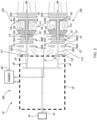
- Fig. 2 illustrates an exemplary multi-engine system 42 to be used as a power plant for the aircraft 1, which can include but is not limited to a rotorcraft such as the helicopter (H) of Fig. 1 .
- the multi-engine system 42 includes multiple engines 10, and in one embodiment includes two or more engines 10A, 10B.
- these engines 10A, 10B may be turboshaft gas turbine engines. They may alternatively be other types of gas turbine engines, or any suitable aircraft engines such as hybrid and/or electrically powered engines.
- Control of the multi-engine system 42 is effected by one or more controller(s) 29, which may be FADEC(s), electronic engine controller(s) (EEC(s)), or the like, that are programmed to manage, as described herein below, the operation of the engines 10A, 10B to reduce an overall fuel burn, particularly during sustained cruise operating regimes, wherein the aircraft is operated at a sustained (steady-state) cruising speed and altitude.
- the cruise operating regime is typically associated with the operation of prior art engines at equivalent part-power, such that each engine contributes approximately equally to the output power of the system 42.
- Other phases of a typical helicopter mission would include transient phases like take-off, climb, stationary flight (hovering), approach and landing. Cruise may occur at higher altitudes and higher speeds, or at lower altitudes and speeds, such as during a search phase of a search-and-rescue mission.
- the engines 10A, 10B of the system 42 may be operated asymmetrically, with one engine operated in a high-power "active" mode and the other engine operated in a lower-power "standby” mode. Doing so may provide fuel saving opportunities to the aircraft, however there may be other suitable reasons why the engines are desired to be operated asymmetrically.
- This operation management may therefore be alternately referred to herein as an "asymmetric mode", an “asymmetric operating regime” or an "idle cruise regime” (ICR), wherein one of the two engines is operated in a low-power "standby mode” while the other engine is operated in a high-power "active” mode.
- asymmetric operation which may be engaged during a cruise phase of flight (continuous, steady-state flight which is typically at a given commanded constant aircraft cruising speed and altitude).
- This operation management may therefore be referred to as a "asymmetric operation mode", or an "idle cruise regime" (ICR), wherein one of the two engines is operated in a low-power or “standby mode” (also referred to herein as a “standby operating condition") while the other engine is operated in a high-power or "active mode".
- ICR inner cruise regime
- an engine provides significantly less propulsive power to the aircraft than does the other engine operating in the higher-power, active mode.
- the engine operating in the standby mode may even provide no or almost no propulsive power to the aircraft.
- the multi-engine system 42 is used in an aircraft, such as but not limited to a helicopter, but also has applications in suitable marine and/or industrial applications or other ground operations, such applications not forming part of the claimed invention.
- the multi-engine system 42 includes a first engine 10A and a second engine 10B configured to drive a common load 44.
- the engines 10A, 10B are turboshaft gas turbine engines.
- the common load 44 may comprise a rotary wing of a rotary-wing aircraft.
- the common load 44 may be a main rotor of the helicopter.
- turboshaft engines 10A, 10B may be drivingly coupled to the common load 44 via a gearbox 46, which may be any suitable type, such as a speed-changing (e.g., reducing) type.
- the gearbox 46 may have a plurality of transmission shafts 48 to receive mechanical energy from respective output shafts 40A, 40B of respective turboshaft engines 10A, 10B to direct at least some of the combined mechanical energy from the plurality of the turboshaft engines 10A, 10B to a common output shaft 50 for driving the common load 44 at a suitable operating (e.g., rotational) speed.
- the multi-engine system 42 may include a transmission 52 driven by the output shaft 40B and driving the rotatable transmission shaft 48.
- the transmission 52 may be controlled to vary a ratio between the rotational speeds of the respective output shaft 40A / 40B and transmission shaft 48.
- the multi-engine system 42 may be configured, for example, to drive accessories of an associated aircraft in addition to the main rotor.
- the gearbox 46 may be configured to permit the common load 44 to be driven by either the first turboshaft engine 10A or the second turboshaft engine 10B, or, by a combination of both the first turboshaft engine 10A and the second turboshaft engine together 10B.
- a clutch 53 may be provided to permit each engine 10A, 10B to be engaged and disengaged with the transmission X, as desired. For example, an engine 10A, 10B running at low- or no-power conditions may be declutched from the transmission if desired. In some embodiments, a conventional clutch may be used.
- the multi-engine system 42 driving a helicopter (H) or other aircraft 1 may be operated in such an asymmetric manner, in which a first one of the engines (say, 10A) is operated at high power in an active mode and the second one of the engines, for instance the engine 10B in this example, is capable of being operated in a low-power standby mode.
- the first engine 10A may be controlled by the controller(s) 29 to run at full (or near-full) power conditions in the active mode, to supply substantially all or all of a required power and/or speed demand of the common load 44 and thus the aircraft.
- the second engine 10B may be controlled by the controller(s) 29 to operate at low-power or no-output-power conditions to supply one of substantially little, substantially none or none of a required power and/or speed demand of the common load 44.
- a clutch may be provided to declutch the low-power engine.
- Controller(s) 29 may control the engine's governing on power according to an appropriate schedule or control regime.
- the controller(s) 29 may comprise a first controller for controlling the first engine 10A and a second controller for controlling the second engine 10B.
- the first controller and the second controller may be in communication with each other in order to implement the operations described herein.
- a single controller 29 may be used for controlling the first engine 10A and the second engine 10B.
- controller as used herein includes any one of: a single controller controlling the engines, and any suitable combination of multiple controllers controlling the engines, including one or more controllers for each engine, so long as the functionality described in this document is provided.
- an asymmetric operating regime of the engines may be achieved through the one or more controller's 29 differential control of fuel flow to the engines, as described in US 2020/0049025 A1 .
- Low fuel flow may also include zero fuel flow in some examples.
- the controller(s) 29 may correspondingly control fuel flow rate to each engine 10A, 10B accordingly.
- a fuel flow (and/or a fuel flow rate) provided to the standby engine may in certain embodiments be controlled to be between 70% and 99.5% less than the fuel flow (and/or the fuel flow rate) provided to the active engine.
- the standby engine may be maintained between 70% and 99.5% less than the fuel flow to the active engine.
- the fuel flow rate difference between the active and standby engines may be controlled to be in a range of 70% and 90% of each other, with fuel flow to the standby engine being 70% to 90% less than the active engine.
- the fuel flow rate difference may be controlled to be in a range of 80% and 90%, with fuel flow to the standby engine being 80% to 90% less than the active engine.
- the standby engine may be completely shut down, such that no fuel flow is used by this engine when it is operating in the standby mode. In such a case, therefore, the fuel flow (which is zero) to the standby engine is thus 100% less than the fuel flow to the active engine.
- the term "standby" mode as used herein is intended to include, in certain embodiments, a complete shut-down state of the standby engine, whereby only one of the two engines (i.e. the active engine) is in operation.
- a complete shut down of the second engine placed into the standby mode may be particularly interesting given that it completely eliminates fuel consumption by that engine, thereby reducing fuel consumption and thus fuel costs, while also reducing the total flight hours of the engine, thereby reducing related maintenance and operating costs.
- the controller 29 may operate one engine of the multiengine system 42, for instance the engine 10B, in a standby mode at a power substantially lower than a rated cruise power level of the engine, and in some embodiments at zero output power and in other embodiments less than 10% output power relative to a reference power (provided at a reference fuel flow).
- the controller(s) 29 may control the standby engine to operate at a power in a range of 0% to 1% of a rated full-power of the standby engine (i.e. the power output of the second engine to the common gearbox remains between 0% to 1% of a rated full-power of the second engine when the second engine is operating in the standby mode).
- the multi-engine system 42 of Fig. 2 may be operated in an asymmetric operating regime by control of the relative speed of the engines using controller(s) 29, that is, the standby engine is controlled to a target low speed and the active engine is controlled to a target high speed.
- a low speed operation of the standby engine may include, for example, a rotational speed that is less than a typical ground idle speed of the engine (i.e. a "sub-idle" engine speed).
- Still other control regimes may be available for operating the engines in the asymmetric operating regime, such as control based on a target pressure ratio, or other suitable control parameters.
- the first turboshaft engine (say 10A) may operate in the active mode while the second turboshaft engine, such as the engine 10B, may operate in the standby mode, as described above.
- the examples described herein illustrate two engines, asymmetric mode is applicable to more than two engines, whereby at least one of the multiple engines is operated in a low-power standby mode while the remaining engines are operated in the active mode to supply all or substantially all of a required power and/or speed demand of a common load.
- the second turboshaft engine 10B may be required to provide more power relative to the low power conditions of the standby mode, and possibly rapidly to a high-power or full-power condition.
- the engine 10B operating previously in a low power condition must be able to quickly accelerate back up to cruise or full power output levels. This may be required, for example, in the event of an emergency or an urgent need for increased power (e.g. if the pilot requires additional power in order to perform a desired manoeuver).
- the multiengine system 42 of the present disclosure includes an air accumulation system 70 which is operable to assist an engine operating in a low power condition to quickly accelerate back up to cruise or full power output levels. As will be seen, this is accomplished by introducing external compressed air from outside the engines 10A, 10B into the engine to be accelerated, in order to assist its rapid acceleration back up to cruise or full power. More particularly, compressed air is extracted (e.g. bled off) from one or both engines 10A, 10B of the multi-engine system 42 and accumulated in a tank or pressure vessel 80 that is external to both engines 10A, 10B.
- compressed air is extracted (e.g. bled off) from one or both engines 10A, 10B of the multi-engine system 42 and accumulated in a tank or pressure vessel 80 that is external to both engines 10A, 10B.
- the compressed air that has been accumulated in the external pressure vessel 80 is introduced (or re-introduced, as the case may be) into the cold section of the engine in order to permit it to more rapidly accelerate to a higher power output.
- the cold section of the engine is understood to be located upstream of a combustor 16 of the engine, and more particularly is defined as extending from an air inlet of the engine 22 to, but not including, a combustion zone located within the combustion chamber liner of the combustor 16.
- each of the engines 10, 10A, 10B of the multi-engine system 42 will first be described in further detail, with reference to Figs. 2 and 3 .
- each aircraft engine 10A, 10B (identified simply as engine 10 in Fig. 3 ) of the multi-engine system 42 may, as in the depicted embodiment, be a turboshaft gas turbine engine generally comprising in serial flow communication a low pressure (LP) compressor section, which will be referred to herein as the LP compressor 12 and a high pressure (HP) compressor section, which will be referred below as the HP compressor 14 for pressurizing air received via an air inlet 22.
- LP low pressure
- HP high pressure
- the air compressed by the LP compressor 12 and by the HP compressor 14 is fed to a combustor 16 in which the compressed air is mixed with a fuel flow, delivered to the combustor 16 via fuel nozzles 17 from a suitable fuel system, and ignited for generating a stream of hot combustion gases.
- a high pressure turbine section which will referred to herein as the HP turbine 18, extracts energy from the combustion gases.
- a low pressure turbine section which will be referred to herein as the LP turbine 20 is located downstream of the HP turbine 18 for further extracting energy from the combustion gases and driving the LP compressor 12.
- the combustion gases are then exhausted by an exhaust outlet 24.
- the LP compressor 12 may include one or more compression stages
- the HP compressor 14 may include one or more compression stages.
- the turboshaft engine 10 includes a low-pressure spool, referred to below as LP spool 26, and a high-pressure spool, referred to below as a HP spool 28.
- the LP spool 26 includes a low-pressure shaft, referred to below as LP shaft 32.
- the HP spool 28 includes a high-pressure shaft, referred to below as HP shaft 34.
- the HP turbine 18 is drivingly engaged to the HP compressor 14 via the HP shaft 34.
- the LP turbine 20 is drivingly engaged to the LP compressor 12 via the LP shaft 32.
- the HP spool 28, and the components mounted thereon, are configured to rotate independently from the LP spool 26 and from the components mounted thereon.
- the HP shaft 34 and the LP shaft 32 may be concentric. In the embodiment shown, the HP shaft 34 extends around the LP shaft 32.
- the term "spool" is herein intended to broadly refer to drivingly connected turbine and compressor rotors, and need not mean the simple shaft arrangements depicted.
- gas turbine engine 10 as shown in Fig. 3 is a multi-spool engine, having separate LP spool 26 and HP spool 28, it is to be understood that in an alternate embodiment, one or more of the engines 10A, 10B of the multi-engine system 42 may have a single spool architecture, which is often the case for auxiliary power unit (APU) engines used in aircraft.
- APU auxiliary power unit
- the HP compressor 14 rotates at the same speed as the HP turbine 18.
- the LP compressor 12 rotates at the same speed as the LP turbine 20.
- transmission(s) are provided on the LP spool 26 and HP spool 28 to create speed ratios between the interconnected compressors and turbines. This may increase or decrease rotational speeds of the compressors relative to that of the turbines. Any suitable transmissions may be used for this purpose.
- the turboshaft engine 10 may include a transmission 38 driven by the low pressure shaft 32 and driving a rotatable output shaft 40.
- the transmission 38 may be provided to vary a ratio between rotational speeds of the low pressure shaft 32 and the output shaft 40.
- the LP compressor 12 and the HP compressor 14 are configured to deliver desired respective pressure ratios in use, as will be described further below.
- the LP compressor 12 of the engine 10 (and therefore of each of the engines 10A, 10B of Figs. 2 and 4 ) may have a bleed valve 13 (shown schematically) configured to selectively bleed air from the LP compressor 12, via an associated bleed port, according to a desired control regime of the engine 10, for example to assist in control of compressor stability.
- a bleed valve 13 shown schematically
- the HP compressor 14 is configured to independently rotate from the LP compressor 12 by virtue of their mounting on different engine spools.
- the HP compressor 14 may include one or more compression stages, such as a single stage, or two or more stages as shown in more detail in Fig. 2 . It is contemplated that the HP compressor 14 may include any suitable type and/or configuration of stages.
- the HP compressor 14 is configured to deliver a desired pressure ratio in use, as will be described further below.
- the HP compressor 14 may have a bleed valve 15 (shown schematically) which may be configured to selectively bleed air from the HP compressor 14, via an associated bleed port, according to a desired control regime of the engine 10, for example to assist in control of compressor stability.
- One or both of the bleed valve 13 located within the LP compressor 12 and the HP compressor 14 may also serve as accumulator injection/bleed ports 86A, 86B, as shown in Fig. 4 and described further below as part of the air accumulation system 70.
- the engine 10 (and thus the two engines 10A, 10B) may each include regular bleed valve 13 and/or 15, in addition to at least one accumulator injection/bleed ports 86A, 86B as described below.
- the accumulator injection/bleed ports 86A, 86B may be located within the HP compressor 14, for example just upstream of the combustor (at an engine station often referred to as "P3", where the static pressure of the compressed air produced by the compressor(s) of the engine is the highest).
- both the standard compressor bleed valves 13, 15 and the accumulator injection/bleed ports 86A, 86B are located within the "cold section" of the engine, that is upstream of the combustor 16 within the engine. Further details of the accumulator injection/bleed ports 86A, 86B will be provided below.
- upstream of the combustor as used herein, particularly with reference to the location at which compressed air from the pressure vessel 80 is introduced into the second engine, is therefore understood to mean anywhere within the cold section of the engine, between the air inlet 22 and the combustor 16 (and more precisely the combustion zone contained within the combustion chamber liner(s) of the combustor).
- suitable one or more controllers 29, such as one or more full authority digital controllers (FADEC) providing full authority digital control of the various relevant parts of the engine 10, controls operation of the engine 10.
- FADEC full authority digital controllers
- the FADEC(s) may be provided as for example conventional software and/or hardware, so long as the FADEC(s) is/are configured to perform the various control methods and sequences as described in this document.
- Each controller 29 may be used to control one or more engines 10 of an aircraft (H). Additionally, in some embodiments the controller(s) 29 may be configured for controlling operation of other elements of the aircraft (H), for instance the main rotor 44.
- the turboshaft engine 10 may also include variable guide vanes (VGVs) 36, 36A, 36B.
- VGVs variable guide vanes
- a first set of VGVs 36A is located upstream of the LP compressor 12
- a second set of VGVs 36B is located upstream of the HP compressor 14.
- the VGVs 36 may be independently controlled by suitable one or more controllers 29, as described above.
- the VGVs 36 may direct inlet air to the corresponding stage of the LP compressor 12 and of the HP compressor 14.
- the VGVs 36 may be operated to modulate the inlet air flow to the compressors in a manner which may allow for improved control of the output power of the turboshaft engine 10, as described in more detail below.
- the VGVs 36 may be provided with any suitable operating range.
- VGVs 36 may be configured to be positioned and/or modulated between about +80 degrees and about -25 degrees, with 0 degrees being defined as aligned with the inlet air flow.
- the VGVs 36 may rotate in a range from +78.5 degrees to -25 degrees, or from +75 degrees to -20 degrees, and more particularly still from 70 degrees to -20 degrees.
- the two set of VGVs 36 may be configured for a similar range of positions, or other suitable position range.
- the first set of VGVs 36A upstream of the LP compressor 12 may be mechanically decoupled from the second set of VGVs 36B upstream of the HP compressor 14 and downstream of the LP compressor 12, having no mechanical link between the two sets of VGVs to permit independent operation of the respective stages.
- the VGVs 36 may be operatively controlled by the controller(s) 29 described above, to be operated independently of each other. Indeed, the turboshaft engine 10 is also controlled using controller(s) 29 described above, to carry out the methods described in this document.
- the term "independently" in respects of the VGVs 36 means that the position of one set of the VGV vanes (e.g. 36A) may be set without effecting any change to a position of the other set of the VGV vanes (e.g. 36B), and vice versa.
- Independent control of the VGVs 36 may allow the spools 26, 28 to be operated to reduce or eliminate or reduce aerodynamic coupling between the spools 26, 28. This may permit the spools 26, 28 to be operated at a wider range of speeds than may otherwise be possible.
- the independent control of the VGVs 36 may allow the spools 26, 28 to be operated at constant speed over a wider operating range, such as from a "standby" speed to a "cruise" power speed, or a higher speed.
- independent control of the VGVs 36 may allow the spools 26, 28 to run at speeds close to maximum power.
- independent control of the VGVs 36 may also allow one of the spools 26, 28 to run at high speed while the other one run at low speed.
- the turboshaft engine 10 is operated by the controller(s) 29 described above to introduce a fuel flow via the nozzles 17 to the combustor 16. Combustion gases turn the HP turbine 18 and the LP turbine 20 which in turn drive the HP compressor 14 and the LP compressor 12.
- the controller(s) 29 control(s) the angular position of VGVs 36 in accordance with a desired control regime, as will be described further below.
- the speed of the engine 10 is controlled, at least in part, by the delivery of a desired fuel flow rate to the engine, with a lower fuel flow rate causing the turboshaft engine 10 to operate at a lower output speed than a higher fuel flow rate.
- the multi-engine system 42 also includes an air accumulation system 70 which includes an air tank or pressure vessel 80, which is external to both the first and second engines 10A, 10B, and serves to receive and retain therein compressed air that is bled off from one or both of the engines 10A, 10B.
- an air tank or pressure vessel 80 which is external to both the first and second engines 10A, 10B, and serves to receive and retain therein compressed air that is bled off from one or both of the engines 10A, 10B.
- the pressure vessel 80 is filled, either partially or fully, with compressed air, it is stored therein until such as time as it is needed for injection, or re-injection, into one of the two engines 10A, 10B that is operating in a standby mode as described above. Accordingly, in certain embodiments the standby engine can be completely shut down, once there is sufficient air pressure in the pressure vessel 80.
- the external pressure vessel 80 will have an internal volume that is sufficient to guarantee engine start when the compressed air stored in the pressure vessel is injected back into the standby engine when
- the pressure vessel 80 is external to both engines 10A, 10B, and may be physically located either within the overall multi-engine system package or may alternately be located elsewhere within the aircraft. While it will be appreciated that the pressure vessel 80 must be suitable to hold compressed air having a pressure corresponding to the air pressures generated by the engines, the exact construction of the pressure vessel 80 may be selected to be suitable for the purposes described herein.
- the pressure vessel 80 may be inflatable, such that it remains lightweight and when it is empty (and thus is deflated) it will take up relatively little space within the aircraft.
- the external pressure vessel 80 may also be thermally insulated, so as to help to retain the heat in the extracted air that was generated when it was compressed.
- the pressure vessel 80 may also be cooled, either passively or actively using a suitable heat-exchanger for example. This may be useful so as to increase the storage capacity, in terms of total mass of the compressed air accumulated therein at a given pressure, thereby allowing - when the accumulated air is injected back into the re-acerbating engine - more fuel flow into the combustion chamber before reaching the hot section temperature limit.
- each of the air conduits 82A, 82B may provide a first, accumulation, flow path used to transport compressed air from the cold section of the respective engines 10A, 10B (i.e. from the compressor(s), upstream of the combustors) to the pressure vessel 80, and a second, injection, flow path used to transport compressed air from the pressure vessel 80 to the cold section of the respective engines 10A, 10B.
- a single conduit 82A, 82B can be used to direct air to and from each respective engine 10A, 10B, such that air flows out of the engines and into the engines through the same passage, line or conduit.
- the depicted embodiment shows only a single pressure vessel 80, it is to be understood that two or more pressure vessels may also be used.
- each engine 10A, 10B may have its own dedicated pressure vessel 80, within which air is accumulated and stored for sub-sequent delivery to is respective engine.
- Each of the first and second engines 10A, 10B includes a respective accumulator injection/bleed port 86A, 86B located within the cold section of the engine.
- These ports 86A, 86B may also be simply referred to herein as "bleed ports” even if they may also serve to inject compressed air flow into the engine in addition to or in stead of being used to bleed compressed air off from the engine for filling the pressure vessel 80.
- the accumulator bleed ports 86A, 86B are located within the HP compressor 14A, 14B, just upstream of their respective combustors 16A, 16B.
- the air bled off via the accumulator bleed ports 86A, 86B, when one or more associated control valves 84A, 84B are opened, and subsequently stored in the pressure vessel 80, will have a high pressure.
- These control valves 84A, 84B may also be, or include, one-way valves such as to prevent flow of the compressed air in an unwanted direction.
- the control valves 84A, 84B are thus operable to control the flow of air to and from the pressure vessel 80, and thus to control the injection of the pressurized air contained within the pressure vessel 80 into one of the engines, when it becomes desirable to do so in the manner described herein.
- a first control valve 84A is disposed in flow communication with the first air conduit 82A and a second control valve 84B is disposed in flow communication with the second air conduit 82B, wherein the first and second control valves 84A, 84B can be used to either allow or prevent flow between the cold sections of the engines 10A, 10B and the pressure vessel 80.
- a single, multi-port, valve may be able to be used in place of the two separate control valves 84A, 84B, provided that independent flow within each of the first and second air conduits 82A, 82B can be separately controlled.
- compressed air can be drawn or bled off from only one or both of the engines 10A, 10B via one or both of the accumulator bleed ports 86A, 86B located within the cold section of the engines, as controlled by the one or both control valves 84A, 84B prior to the shut-down (or reduction of power output) of one of the two engines into a low-power standby mode.
- the air extracted in this manner is accordingly directed through the respective one(s) of the first and second air conduits 82A, 82B (depending of course on which port is opened to allow bleed flow therethrough) to the pressure vessel 80, where the compressed air is accumulated, and retained future use.
- This accumulated of the compressed air within the pressure vessel 80 may, in one particular embodiment, be done gradually, while the engine from which the air is extracted is operating at standard cruise or high power (e.g. a high pressure ratios).
- high pressure air is drawn off from the HP compressor 14B of the second engine 10B, via its accumulator bleed port 86B, right from the beginning of a normal flight mission, as the engine 10B starts, then idles, then gets to take-off power. Because the pressure at this location of the engine will increase over a sufficiently long time interval, and the volume of compressed air extracted via accumulator bleed port 86B and fed to the pressure vessel 80 remains relative small (i.e.
- a servo valve (controlled via the FADEC for instance) could be used. Such a servo valve may form part of the control valve or valves 84A, 84B, or may be an additional servo valve(s) in other instances.
- the external pressure vessel 80 has been "charged” (i.e. filled, either partially or fully, with the accumulated compressed air), and the second engine 10B has been shut down or placed into a low power operating condition
- the first engine 10A e.g. the active engine operating a regular cruise or full power
- the compressed air within the pressure vessel 80 can be "topped up” using air extracted from the active engine.
- This may help to keep the pressure within the external pressure vessel 80 at a desired level and/or may be used to replenish any lost or used accumulated compressed air, which may be particularly useful if there is a cooling mechanism in place that could cause the pressure within the pressure vessel 80 to drop.
- both the volume and pressure of the accumulated compressed air within the external pressure vessel can be maintained at desired levels, so as to ensure that if/when this accumulated air is needed it will be sufficient for injection into the standby engine for emergency start-up and/or rapid acceleration of the standby or shut-down engine.
- compressed air from one engine may have been slowly bled off and fed to the external pressure vessel 80 such that this external pressure vessel 80 is fully “charged” with compressed air.
- the second engine 10B can then be shut down or placed in very low power standby mode, as described above, once the aircraft has reached its flight cruise phase, with the accumulated compressed air stored in the external pressure vessel 80.
- the accumulated compressed air retained in the pressure vessel 80 is then fed back into the compressor of the shut-down engine 10B to enable a rapid re-start thereof.
- this injection of the accumulated compressed air is optimally done somewhere between the inlet 22A, 22B of the engine in question and the combustor 16A, 16B thereof (i.e. somewhere within the cold section of the engine.
- the precise location that this accumulated compressed air is injected into the cold section may vary, and is selected depending on the particular engine architecture (e.g. number of compressor stages, compressor inertia, etc.) and the available compressed air (volume, pressure) as well as the desirable engine power recovery time.
- the injection of the compressed air from the pressure vessel 80 into the standby engine, when it needs to be rapidly re-accelerated and/or started, may be done at or just upstream of the HP compressor 14A, 14B of the engine so as to rapidly spin-up the HP spool 28 (see Figs. 2 and 3 ).
- the injection of the accumulated compressed air stored in the external pressure vessel 80 may be done at a point upstream of the HP compressor 14, 14A, 14B (e.g. impeller), which will cause the HP impeller 14, 14A, 14B to rotate as the accumulated compressed air flows therethrough. This may help to facilitate the re-start.
- the accumulated compressed air from the pressure vessel 80 can be injected into the standby engine at a location that is just downstream end of the HP compressor 14, 14A, 14B and immediately upstream of the combustor 16, 16A, 16B. Additionally, in one particular embodiment, the air accumulated in the pressure vessel 80 can also be injected or re-injected back into the standby engine via the same accumulator bleed ports 86A, 86B described above, which may have been used to extract the compressed air in the first place.
- an active control system 90 may be provided to control this re-injection of the external compressed air from the pressure vessel 80.
- the actively controlled reinjection system 90 which is in communication with the engine controller 29 (also referred to herein simply as FADEC 29) (see Figs. 2-3 ) and is controlled thereby, may for example include at least one active valve (which may be, for example, one for each engine) and/or a pressure regulating valve which are collectively operable to control the injection of the compressed air.
- the actively controlled reinjection system 90 may be configured to permit a more constant flow of the compressed air being injected back into the standby engine, and thus may avoid having too much compressed air injected back into the engine too early, thus avoiding all of the accumulated compressed air being used up and consequently ensuring that there is sufficient compressed air for use in a later phase of the start and re-acceleration sequence of the engine as it starts back up.
- the actively controlled reinjection system 90 may also include, or alternately form part of, the control valve or valves 84A, 84B and/or servo valves, all controlled via the FADEC, used for the extraction of the accumulated compressed air in the first place.
- a single flow control system e.g. the system 90
- the FADEC may be used to control both compressed air extraction from one or both engines, and the injection of the accumulated compressed from the external pressure vessel 80 into the standby engine when required for a rapid re-acceleration thereof.
- the regular starter of the engine in question may still be used to re-start the engine.
- the flight conditions e.g. altitude, temperature, Mach number, etc. and the operating status of each of the engines (e.g. out of usage, shut-down, sub-idle, idle, low or high power) may permit the engine to be re-started without requiring the use of the regular starter.
- a suitable flow blocking system 88A, 88B may also be provided within each engine 10A, 10B to prevent the accumulated high pressure compressed air within the pressure vessel 80, when re-injected back into the shut-down engine, from flowing backwards through the engine (e.g. from the re-injection point within the cold section of the engine upstream through the main gas path of the engine core towards the air inlet of the engine, rather than downstream to the combustor).
- This may be achieved, for example, using one or more one-way valves or another backflow prevention system - e.g. valves or other devices to block the exits of HP compressor diffuser pipes, for example when the injection point is done past that component.
- other engine components such as variable guides vanes for instance, could also be used to block the compressor gas path when the compressor air is injected downstream that component and upstream to one or more compressor stage.
- a method of operating the multi-engine system 42 of an aircraft is shown at 500.
- a method 500 of operating a multi-engine system 42 of an aircraft such as helicopter H, having a first engine 10A and a second engine 10B.
- the method 500 includes: accumulating compressed air in a pressure vessel 80 that is external to the first and second engines 10A, 10B, at step 502; operating the first and second engines asymmetrically, by controlling the first engine 10A to operate in an active, or high power, operating condition wherein it provides sufficient power and/or rotor speed to meet the demands of the aircraft, and controlling the second engine 10B to operate in a standby operating condition wherein the second engine 10B produces less power output than the first engine 10A, at 504; and, in response to a power demand request, accelerating the second engine 10B by introducing the compressed air from the pressure vessel 80 into the second engine 10B at a location therein upstream of a combustor 16B of the second engine 10B, at 506. Because this location at which the compressed air is introduces is within the cold section of the engine, it is necessarily downstream of an air inlet 22B of the second engine.
- Step 502 of the method 500 may include extracting bleed air from one or more of the first engine 10A and the second engine 10B, and feeding the bleed air into the pressure vessel 80. Additionally, extracting the bleed air may include extracting the bleed air from one or more of a high pressure compressor 14A of the first engine 10A and a high pressure compressor 14B of the second engine 10B. Extracting the bleed air may also include extracting the bleed air from the second engine 10B prior to the second engine being controlled to produce less power output than the first engine 10A.
- Step 502 may also include gradually extracting the bleed air from both the one or more of the first and second engines from a beginning of a flight mission, after the one or more of first and second engines is started or after the aircraft has taken-off. Additionally, accumulating the compressed air may include using one or more valves, such as servo control valves operated by the engine controller or FADEC 29, to control the extracting of the bleed air. Accumulating the compressed air may also include extracting additional bleed air from the first engine 10A, after the second engine 10B has been controlled to produce less power output than the first engine.
- valves such as servo control valves operated by the engine controller or FADEC 29
- introducing the compressed air from the pressure vessel 80 may include injecting the compressed air into the second engine 10B upstream of the high pressure compressor 14B of the second engine 10B, such as to rapidly spin (e.g. to "spin-up") a high pressure spool 28 of the second engine 10B (the high pressure spool 28 including the high pressure compressor 14B mounted thereon).
- both extracting the bleed air to accumulate the compressed air in the pressure vessel and introducing the compressed air into the second engine may be carried out via one or more common ports in the second engine 10B, such as the port 86B for example.
- Step 504 may include operating the second engine 10B to provide minimal or no propulsive power to the aircraft.
- Step 506 may include accelerating the second engine 10B from the standby operating condition to an active operating condition corresponding to that of the first engine.
- Operating the first and second engines 10A, 10B asymmetrically, as in step 504, may be performed during a cruise flight segment of the aircraft.
- step 506 prior to the introducing of the compressed air from the pressure vessel 80 into the second engine 10B at said location upstream of the combustor 16B, there may also include blocking a main gas path of the second engine 10B upstream of said location to prevent back-flow of the compressed air through the main gas path of the second engine.
- the method 500 may be used for example to operate the multi-engine engine system 42 during, in one example, a cruise flight segment which may be described as a continuous, steady-state flight segment which is typically at a relatively constant cruising speed and altitude.
- a cruise flight segment which may be described as a continuous, steady-state flight segment which is typically at a relatively constant cruising speed and altitude.
- both engines provide -50% of the cruise power demand of the helicopter.
- This power level of each engine ( ⁇ 50% of total power required by the helicopter) may be referred to herein as a "cruise power level".
- Step 504 of the method 500 can include using the engine controller 29, such as a full authority digital control (FADEC) 29 to control the engines 10A, 10B to operate asymmetrically.
- the FADEC 29 may thus determine that the aircraft is in a suitable condition for entering asymmetric mode, for example during a cruise flight segment.
- the FADEC 29 may accelerate one engine (say 10A) of the multiengine system 42 from a cruise power level into an active engine mode, in which the first engine may provide a higher cruise power level and sufficient power to satisfy substantially all or all (e.g. 90% or higher) of a helicopter power or rotor speed demand.
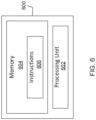
- the controller 29 may be implemented with one or more computing devices 600.
- the controller 29 can be implemented as part of a full-authority digital engine controls (FADEC) or other similar device, including electronic engine control (EEC), engine control unit (ECU), electronic propeller control, propeller control unit, and the like.
- FADEC full-authority digital engine controls
- EEC electronic engine control
- ECU engine control unit
- propeller control propeller control unit
- the controller 29 is implemented as a Flight Data Acquisition Storage and Transmission system, such as a FASTTM system.
- the controller 29 may be implemented in part in the FASTTM system and in part in the EEC. Other embodiments may also apply.
- the computing device 600 comprises a processing unit 602 and a memory 604 which has stored therein computer-executable instructions 606, which serve to control the engine system in the manner described herein. More particularly, the processing unit 602 may comprise any suitable devices configured to implement the method 500 such that instructions 606, when executed by the computing device 600 or other programmable apparatus, may cause the functions/acts/steps performed as part of the method 500 as described herein to be executed.
- the processing unit 602 may comprise, for example, any type of general-purpose microprocessor or microcontroller, a digital signal processing (DSP) processor, a central processing unit (CPU), an integrated circuit, a field programmable gate array (FPGA), a reconfigurable processor, other suitably programmed or programmable logic circuits, or any combination thereof.
- DSP digital signal processing
- CPU central processing unit
- FPGA field programmable gate array
- reconfigurable processor other suitably programmed or programmable logic circuits, or any combination thereof.
- the memory 604 may comprise any suitable known or other machine-readable storage medium.
- the memory 604 may comprise non-transitory computer readable storage medium, for example, but not limited to, an electronic, magnetic, optical, electromagnetic, infrared, or semiconductor system, apparatus, or device, or any suitable combination of the foregoing.
- the memory 604 may include a suitable combination of any type of computer memory that is located either internally or externally to device, for example random-access memory (RAM), read-only memory (ROM), compact disc read-only memory (CDROM), electro-optical memory, magnetooptical memory, erasable programmable read-only memory (EPROM), and electricallyerasable programmable read-only memory (EEPROM), Ferroelectric RAM (FRAM) or the like.
- Memory 604 may comprise any storage means (e.g., devices) suitable for retrievably storing machine-readable instructions 606 executable by processing unit 602.
- the methods and systems for operating the multi-engine system described herein may be implemented in a high level procedural or object oriented programming or scripting language, or a combination thereof, to communicate with or assist in the operation of a computer system, for example the computing device 600.
- the methods and systems for operating the multi-engine system may be implemented in assembly or machine language.
- the language may be a compiled or interpreted language.
- Program code for implementing the methods and systems for operating the multi-engine system may be stored on a storage media or a device, for example a ROM, a magnetic disk, an optical disc, a flash drive, or any other suitable storage media or device.
- the program code may be readable by a general or special-purpose programmable computer for configuring and operating the computer when the storage media or device is read by the computer to perform the procedures described herein.
- Embodiments of the methods and systems for operating the multi-engine system may also be considered to be implemented by way of a non-transitory computer-readable storage medium having a computer program stored thereon.
- the computer program may comprise computer-readable instructions which cause a computer, or more specifically the processing unit 602 of the computing device 600, to operate in a specific and predefined manner to perform the functions described herein, for example those described in the method 500.
- Computer-executable instructions may be in many forms, including program modules, executed by one or more computers or other devices.
- program modules include routines, programs, objects, components, data structures, etc., that perform particular tasks or implement particular abstract data types.
- functionality of the program modules may be combined or distributed as desired in various embodiments.
- the embodiments described herein are implemented by physical computer hardware, including computing devices, servers, receivers, transmitters, processors, memory, displays, and networks.
- the embodiments described herein provide useful physical machines and particularly configured computer hardware arrangements.
- the embodiments described herein are directed to electronic machines and methods implemented by electronic machines adapted for processing and transforming electromagnetic signals which represent various types of information.
- the embodiments described herein pervasively and integrally relate to machines, and their uses; and the embodiments described herein have no meaning or practical applicability outside their use with computer hardware, machines, and various hardware components. Substituting the physical hardware particularly configured to implement various acts for non-physical hardware, using mental steps for example, may substantially affect the way the embodiments work.
- connection or “coupled to” may include both direct coupling (in which two elements that are coupled to each other contact each other) and indirect coupling (in which at least one additional element is located between the two elements).
- the technical solution of embodiments may be in the form of a software product.
- the software product may be stored in a non-volatile or non-transitory storage medium, which can be a compact disk read-only memory (CD-ROM), a USB flash disk, or a removable hard disk.
- the software product includes a number of instructions that enable a computer device (personal computer, server, or network device) to execute the methods provided by the embodiments.
- the multi-engine system may have more than two engines, in which case any suitable number of the engines may operate in the active and standby modes, respectively.
- turboshaft engines have been generally described, the engines of the multiengine system can alternately be other types of gas turbine engines, and they can also be other types of suitable aircraft engines, including for example engines which include electrical components for motive power - provided of course that these engines can benefit from compressed air injection therein for the purposes of accelerating a standby engine back up to a motive power, in the manner described hereinabove.
- the engines of the multi-engine system need not all be of the same type, wherein for example one or more of the engines is a gas turbine engine and the other is a fully electric or hybrid engine, for example. While the present specification describes the multi-engine system used in a rotorcraft, such as helicopter H, it can applied to other types of multi-engine aircraft.
- the engine controller may be any suitable, and the methods of effecting engine control also do not form any part of this description other than as expressly provided. Still other modifications which fall within the scope of the present invention will be apparent to those skilled in the art, in light of a review of this disclosure.
Landscapes
- Engineering & Computer Science (AREA)
- Chemical & Material Sciences (AREA)
- Combustion & Propulsion (AREA)
- Mechanical Engineering (AREA)
- General Engineering & Computer Science (AREA)
- Physics & Mathematics (AREA)
- Fluid Mechanics (AREA)
- Control Of Turbines (AREA)
- Aviation & Aerospace Engineering (AREA)
Claims (15)
- Verfahren zum Betreiben eines mehrmotorigen Systems (42) eines Luftfahrzeugs (1), das einen ersten Motor (10A) und einen zweiten Motor (10B) aufweist, wobei das Verfahren Folgendes umfasst:Sammeln von Druckluft in einem Druckbehälter (80) außerhalb des ersten und des zweiten Motors (10A, 10B);asymmetrisches Betreiben des ersten und des zweiten Motors (10A, 10B), indem der erste Motor (10A) so gesteuert wird, dass er in einem aktiven Betriebszustand betrieben wird, der ausreichend Leistung und/oder Rotordrehzahl für den Bedarf des Luftfahrzeugs (1) bereitstellt, und indem der zweite Motor (10B) so gesteuert wird, dass er in einem Standby-Betriebszustand betrieben wird, in dem der zweite Motor (10B) weniger Leistungsabgabe erzeugt als der erste Motor (10A); undals Reaktion auf eine Leistungsbedarfsanforderung Beschleunigen des zweiten Motors (10B) durch Einleiten der Druckluft aus dem Druckbehälter (80) in den zweiten Motor (10B) an einer Stelle stromaufwärts einer Brennkammer (16B) des zweiten Motors (10B).
- Verfahren nach Anspruch 1, wobei das Sammeln das Absaugen von Zapfluft aus einem oder mehreren von dem ersten Motor (10A) und dem zweiten Motor (10B) und das Einspeisen der Zapfluft in den Druckbehälter (80) beinhaltet.
- Verfahren nach Anspruch 2, wobei das Absaugen der Zapfluft das Absaugen der Zapfluft aus Folgendem beinhaltet: einem oder mehreren von einem Hochdruckkompressor (14A) des ersten Motors (10A) und einem Hochdruckkompressor (14B) des zweiten Motors (10B); und/oder dem zweiten Motor (10B), bevor der zweite Motor (10B) so gesteuert wird, dass er eine geringere Leistungsabgabe als der erste Motor (10A) erzeugt.
- Verfahren nach Anspruch 2 oder 3, wobei das Sammeln das schrittweise Absaugen der Zapfluft aus dem einen oder den mehreren von dem ersten und dem zweiten Motor (10A, 10B) ab dem Beginn einer Flugmission, nach dem Starten des einen oder der mehreren von dem ersten und dem zweiten Motor (10A, 10B) oder nach dem Abheben des Luftfahrzeugs beinhaltet.
- Verfahren nach Anspruch 2, 3 oder 4, wobei das Sammeln das Absaugen zusätzlicher Zapfluft aus dem ersten Motor (10A), nachdem der zweite Motor (10B) so gesteuert wurde, dass er weniger Leistungsabgabe erzeugt als der erste Motor (10A), beinhaltet.
- Verfahren nach einem der Ansprüche 2 bis 5, wobei sowohl das Absaugen der Zapfluft zum Sammeln der Druckluft in dem Druckbehälter (80) als auch das Einleiten der Druckluft in den zweiten Motor (10B) über einen oder mehrere gemeinsame Anschlüsse (86B) in dem zweiten Motor (10B) erfolgen.
- Verfahren nach einem der vorhergehenden Ansprüche, wobei das Einleiten der Druckluft aus dem Druckbehälter (80) das Einspritzen der Druckluft in den zweiten Motor (10B) stromaufwärts eines oder des Hochdruckkompressors (14B) des zweiten Motors (10B) beinhaltet, um eine Hochdruckspule (28) des zweiten Motors (10B) mit dem Hochdruckkompressor (14B) schnell zu drehen.
- Verfahren nach einem der vorhergehenden Ansprüche, wobei das Steuern des zweiten Motors (10B) für den Betrieb im Standby-Betriebszustand das Betreiben des zweiten Motors (10B) während des Fluges beinhaltet, um dem Luftfahrzeug (1) nur minimale oder keine Vortriebsleistung bereitzustellen.
- Verfahren nach einem der vorhergehenden Ansprüche, das ferner vor dem Einleiten der Druckluft aus dem Druckbehälter (80) in den zweiten Motor (10B) an der Stelle stromaufwärts der Brennkammer (16B) das Blockieren eines Hauptgaswegs des zweiten Motors (10B) stromaufwärts dieser Stelle umfasst, um einen Rückfluss der Druckluft durch den Hauptgasweg zu verhindern.
- Mehrmotoriges System (42) für ein Luftfahrzeug (1), Folgendes umfassend:einen ersten Motor (10A) und einen zweiten Motor (10B), die ein gemeinsames Getriebe antreiben, das zum Antreiben einer Last (44) konfiguriert ist, wobei der erste Motor (10A) und der zweite Motor (10B) jeweils einen ersten Kompressor (12A, 12B) und einen zweiten Kompressor (14A, 14B) beinhalten;einen Druckbehälter (80) außerhalb des ersten Motors (10A) und des zweiten Motors (10B), wobei der Druckbehälter (80) in Fluidströmungskommunikation mit einem oder beiden von dem ersten und dem zweiten Kompressor (12A, 12B, 14A, 14B) steht, und zwar über: einen Sammelströmungsweg, entlang dessen durch einen oder beide von dem ersten und dem zweiten Kompressor (12A, 12B, 14A, 14B) erzeugte Druckluft strömt, um zu dem Druckbehälter (80) zu gelangen; und einen Einspritzströmungsweg, entlang dessen in dem Druckbehälter (80) gesammelte Druckluft strömt, um einen Einspritzanschluss (86B) in mindestens dem zweiten Motor (10B) zu erreichen; undein Ventil (84A, 84B) in Fluidkommunikation mit dem Sammelströmungsweg und dem Einspritzströmungsweg, wobei das Ventil (84A, 84B) so betreibbar ist, dass es zwischen einer geschlossenen Position und einer offenen Position bewegt werden kann, wobei in der offenen Position die Druckluft entweder entlang des Sammelströmungswegs oder entlang des Einspritzströmungswegs strömen kann.
- Mehrmotoriges System nach Anspruch 10, ferner eine Motorsteuerung (29) umfassend, die dazu konfiguriert ist, den ersten Motor (10A) so zu steuern, dass er in einem aktiven Betriebszustand betrieben wird, und den zweiten Motor (10B) so zu steuern, dass er in einem Standby-Betriebszustand betrieben wird, wobei der erste Motor (10A) in dem aktiven Betriebszustand ausreichend Leistung und/oder Rotordrehzahl für den Bedarf des Luftfahrzeugs (1) bereitstellt und der zweite Motor (10B) in dem Standby-Betriebszustand dem Luftfahrzeug (1) nur minimale oder keine Vortriebsleistung bereitstellt.
- Mehrmotoriges System nach Anspruch 11, wobei die Motorsteuerung (29) mit dem Ventil (84A, 84B) in Kommunikation steht, um dessen Betrieb zu steuern, wobei die Motorsteuerung (29) betreibbar ist, das Ventil (84A, 84B) in einer oder mehreren Zwischenpositionen zwischen der geschlossenen Position und der offenen Position zu positionieren, um das Einspritzen und Absaugen von Druckluft durch den Sammelströmungsweg und den Einspritzströmungsweg zu steuern.
- Mehrmotoriges System nach Anspruch 10, 11 oder 12, wobei der Druckbehälter (80) einer von zwei oder mehreren Druckbehältern (80) ist, wobei jeder der zwei oder mehreren Druckbehälter (80) in Fluidströmungskommunikation mit einem jeweiligen von dem ersten und dem zweiten Motor (10A, 10B) steht.
- Mehrmotoriges System nach einem der Ansprüche 10 bis 13, wobei der Druckbehälter (80) aufblasbar ist.
- Mehrmotoriges System nach einem der Ansprüche 10 bis 14, wobei der Druckbehälter (80) mindestens eines von Folgendem ist: thermisch isoliert, um die Wärme der in dem Druckbehälter (80) gesammelten Druckluft zu speichern; und gekühlt, um seine Speicherkapazität zu erhöhen.
Applications Claiming Priority (1)
| Application Number | Priority Date | Filing Date | Title |
|---|---|---|---|
| US17/388,308 US11859554B2 (en) | 2021-07-29 | 2021-07-29 | Fast engine re-start for multi-engine system and method |
Publications (2)
| Publication Number | Publication Date |
|---|---|
| EP4130451A1 EP4130451A1 (de) | 2023-02-08 |
| EP4130451B1 true EP4130451B1 (de) | 2024-10-30 |
Family
ID=82702958
Family Applications (1)
| Application Number | Title | Priority Date | Filing Date |
|---|---|---|---|
| EP22186781.5A Active EP4130451B1 (de) | 2021-07-29 | 2022-07-25 | Schneller motorneustart für ein mehrmotoriges system und verfahren |
Country Status (4)
| Country | Link |
|---|---|
| US (1) | US11859554B2 (de) |
| EP (1) | EP4130451B1 (de) |
| CA (1) | CA3167695A1 (de) |
| PL (1) | PL4130451T3 (de) |
Families Citing this family (1)
| Publication number | Priority date | Publication date | Assignee | Title |
|---|---|---|---|---|
| EP4417799A1 (de) | 2023-02-14 | 2024-08-21 | Pratt & Whitney Canada Corp. | Hybrider sub-leerlaufbetriebsmodus für hybrides elektrisches antriebssystem |
Family Cites Families (21)
| Publication number | Priority date | Publication date | Assignee | Title |
|---|---|---|---|---|
| US3868828A (en) * | 1970-11-05 | 1975-03-04 | Ovitron Res Corp | Method and means for preserving comestibles |
| US5553449A (en) * | 1993-12-21 | 1996-09-10 | United Technologies Corporation | Method of operating a gas turbine engine powerplant for an aircraft |
| US20100326085A1 (en) * | 2009-06-25 | 2010-12-30 | Veilleux Leo J | Lightweight start system for a gas turbine engine |
| US8245493B2 (en) * | 2011-08-25 | 2012-08-21 | General Electric Company | Power plant and control method |
| US9243804B2 (en) * | 2011-10-24 | 2016-01-26 | General Electric Company | System for turbine combustor fuel mixing |
| US9803548B2 (en) * | 2012-04-02 | 2017-10-31 | Powerphase Llc | Gas turbine efficiency and regulation speed improvements using supplementary air system continuous and storage systems and methods of using the same |
| US9915201B2 (en) * | 2013-03-04 | 2018-03-13 | Rolls-Royce Corporation | Aircraft power system |
| US20160273393A1 (en) * | 2015-03-19 | 2016-09-22 | General Electric Company | Power generation system having compressor creating excess air flow |
| WO2016168340A1 (en) * | 2015-04-15 | 2016-10-20 | Sikorsky Aircraft Corporation | Systems and methods for starting an engine |
| US9920695B2 (en) * | 2015-06-22 | 2018-03-20 | Exhaustless Inc. | Thrust recovery in airplanes |
| FR3050815B1 (fr) | 2016-04-28 | 2019-05-24 | Safran Helicopter Engines | Systeme d'allumage et dispositif d'entrainement mecanique associe |
| US10676199B2 (en) * | 2017-06-12 | 2020-06-09 | General Electric Company | Propulsion system for an aircraft |
| GB201720944D0 (en) | 2017-12-15 | 2018-01-31 | Rolls Royce Plc | Rotor bow management |
| US20190323426A1 (en) | 2018-04-19 | 2019-10-24 | The Boeing Company | Supercharging systems for aircraft engines |
| US10968825B2 (en) | 2018-04-19 | 2021-04-06 | The Boeing Company | Flow multiplier systems for aircraft |
| EP4339440A3 (de) * | 2018-08-08 | 2024-05-22 | Pratt & Whitney Canada Corp. | Mehrmotorsystem und verfahren |
| US20200102894A1 (en) | 2018-09-28 | 2020-04-02 | Rolls-Royce North American Technologies Inc. | Anti-surge and relight system |
| WO2020123941A1 (en) * | 2018-12-14 | 2020-06-18 | Go Team CCR LLC | Apparatus and method for generation of electricity with pressurized water and air flow media |
| US11274611B2 (en) | 2019-05-31 | 2022-03-15 | Pratt & Whitney Canada Corp. | Control logic for gas turbine engine fuel economy |
| US11859563B2 (en) | 2019-05-31 | 2024-01-02 | Pratt & Whitney Canada Corp. | Air system of multi-engine aircraft |
| US11454198B2 (en) * | 2020-09-28 | 2022-09-27 | Ford Global Technologies, Llc | Method and system for distribution of exhaust gas |
-
2021
- 2021-07-29 US US17/388,308 patent/US11859554B2/en active Active
-
2022
- 2022-07-14 CA CA3167695A patent/CA3167695A1/en active Pending
- 2022-07-25 PL PL22186781.5T patent/PL4130451T3/pl unknown
- 2022-07-25 EP EP22186781.5A patent/EP4130451B1/de active Active
Also Published As
| Publication number | Publication date |
|---|---|
| CA3167695A1 (en) | 2022-11-10 |
| EP4130451A1 (de) | 2023-02-08 |
| PL4130451T3 (pl) | 2025-03-31 |
| US11859554B2 (en) | 2024-01-02 |
| US20230036374A1 (en) | 2023-02-02 |
Similar Documents
| Publication | Publication Date | Title |
|---|---|---|
| US12098644B2 (en) | Turboshaft gas turbine engine | |
| US9328667B2 (en) | Systems and methods for changing a speed of a compressor boost stage in a gas turbine | |
| EP3744636B1 (de) | Luftsystem eines mehrmotorflugzeugs | |
| EP4130451B1 (de) | Schneller motorneustart für ein mehrmotoriges system und verfahren | |
| EP3978739B1 (de) | Verfahren und system zur steuerung eines motors bei niedriger leistung | |
| EP3789596B1 (de) | Verfahren zum betrieb eines gasturbinenmotors bei niedriger leistung | |
| EP3770406B1 (de) | Kraftstoffzuführsystem und -verfahren | |
| EP3770404B1 (de) | Kraftstoffzuführsystem und -verfahren | |
| EP4124574B1 (de) | Mehrmotorsystem und leistungsübertragung zwischen seinen motoren | |
| EP3770405B1 (de) | Kraftstoffzuführsystem und -verfahren | |
| EP3978741A1 (de) | Verfahren und system zum betrieb eines gasturbinentriebwerks zur vermeidung von eingeschränkten motorgeschwindigkeiten | |
| EP4123149A1 (de) | Gasturbinenmotor mit niederdruckverdichter-bypass |
Legal Events
| Date | Code | Title | Description |
|---|---|---|---|
| PUAI | Public reference made under article 153(3) epc to a published international application that has entered the european phase |
Free format text: ORIGINAL CODE: 0009012 |
|
| STAA | Information on the status of an ep patent application or granted ep patent |
Free format text: STATUS: THE APPLICATION HAS BEEN PUBLISHED |
|
| AK | Designated contracting states |
Kind code of ref document: A1 Designated state(s): AL AT BE BG CH CY CZ DE DK EE ES FI FR GB GR HR HU IE IS IT LI LT LU LV MC MK MT NL NO PL PT RO RS SE SI SK SM TR |
|
| STAA | Information on the status of an ep patent application or granted ep patent |
Free format text: STATUS: REQUEST FOR EXAMINATION WAS MADE |
|
| 17P | Request for examination filed |
Effective date: 20230726 |
|
| RBV | Designated contracting states (corrected) |
Designated state(s): AL AT BE BG CH CY CZ DE DK EE ES FI FR GB GR HR HU IE IS IT LI LT LU LV MC MK MT NL NO PL PT RO RS SE SI SK SM TR |
|
| GRAP | Despatch of communication of intention to grant a patent |
Free format text: ORIGINAL CODE: EPIDOSNIGR1 |
|
| STAA | Information on the status of an ep patent application or granted ep patent |
Free format text: STATUS: GRANT OF PATENT IS INTENDED |
|
| RIC1 | Information provided on ipc code assigned before grant |
Ipc: F02C 9/00 20060101ALI20231129BHEP Ipc: F02C 6/20 20060101AFI20231129BHEP |
|
| INTG | Intention to grant announced |
Effective date: 20231220 |
|
| GRAJ | Information related to disapproval of communication of intention to grant by the applicant or resumption of examination proceedings by the epo deleted |
Free format text: ORIGINAL CODE: EPIDOSDIGR1 |
|
| STAA | Information on the status of an ep patent application or granted ep patent |
Free format text: STATUS: REQUEST FOR EXAMINATION WAS MADE |
|
| GRAP | Despatch of communication of intention to grant a patent |
Free format text: ORIGINAL CODE: EPIDOSNIGR1 |
|
| STAA | Information on the status of an ep patent application or granted ep patent |
Free format text: STATUS: GRANT OF PATENT IS INTENDED |
|
| INTC | Intention to grant announced (deleted) | ||
| INTG | Intention to grant announced |
Effective date: 20240521 |
|
| GRAS | Grant fee paid |
Free format text: ORIGINAL CODE: EPIDOSNIGR3 |
|
| GRAA | (expected) grant |
Free format text: ORIGINAL CODE: 0009210 |
|
| STAA | Information on the status of an ep patent application or granted ep patent |
Free format text: STATUS: THE PATENT HAS BEEN GRANTED |
|
| AK | Designated contracting states |
Kind code of ref document: B1 Designated state(s): AL AT BE BG CH CY CZ DE DK EE ES FI FR GB GR HR HU IE IS IT LI LT LU LV MC MK MT NL NO PL PT RO RS SE SI SK SM TR |
|
| REG | Reference to a national code |
Ref country code: GB Ref legal event code: FG4D |
|
| REG | Reference to a national code |
Ref country code: CH Ref legal event code: EP |
|
| REG | Reference to a national code |
Ref country code: DE Ref legal event code: R096 Ref document number: 602022007185 Country of ref document: DE |
|
| REG | Reference to a national code |
Ref country code: IE Ref legal event code: FG4D |
|
| REG | Reference to a national code |
Ref country code: LT Ref legal event code: MG9D |
|
| REG | Reference to a national code |
Ref country code: NL Ref legal event code: MP Effective date: 20241030 |
|
| PG25 | Lapsed in a contracting state [announced via postgrant information from national office to epo] |
Ref country code: PT Free format text: LAPSE BECAUSE OF FAILURE TO SUBMIT A TRANSLATION OF THE DESCRIPTION OR TO PAY THE FEE WITHIN THE PRESCRIBED TIME-LIMIT Effective date: 20250228 Ref country code: IS Free format text: LAPSE BECAUSE OF FAILURE TO SUBMIT A TRANSLATION OF THE DESCRIPTION OR TO PAY THE FEE WITHIN THE PRESCRIBED TIME-LIMIT Effective date: 20250228 Ref country code: HR Free format text: LAPSE BECAUSE OF FAILURE TO SUBMIT A TRANSLATION OF THE DESCRIPTION OR TO PAY THE FEE WITHIN THE PRESCRIBED TIME-LIMIT Effective date: 20241030 |
|
| PG25 | Lapsed in a contracting state [announced via postgrant information from national office to epo] |
Ref country code: FI Free format text: LAPSE BECAUSE OF FAILURE TO SUBMIT A TRANSLATION OF THE DESCRIPTION OR TO PAY THE FEE WITHIN THE PRESCRIBED TIME-LIMIT Effective date: 20241030 Ref country code: NL Free format text: LAPSE BECAUSE OF FAILURE TO SUBMIT A TRANSLATION OF THE DESCRIPTION OR TO PAY THE FEE WITHIN THE PRESCRIBED TIME-LIMIT Effective date: 20241030 |
|
| REG | Reference to a national code |
Ref country code: AT Ref legal event code: MK05 Ref document number: 1737065 Country of ref document: AT Kind code of ref document: T Effective date: 20241030 |
|
| PG25 | Lapsed in a contracting state [announced via postgrant information from national office to epo] |
Ref country code: BG Free format text: LAPSE BECAUSE OF FAILURE TO SUBMIT A TRANSLATION OF THE DESCRIPTION OR TO PAY THE FEE WITHIN THE PRESCRIBED TIME-LIMIT Effective date: 20241030 |
|
| PG25 | Lapsed in a contracting state [announced via postgrant information from national office to epo] |
Ref country code: ES Free format text: LAPSE BECAUSE OF FAILURE TO SUBMIT A TRANSLATION OF THE DESCRIPTION OR TO PAY THE FEE WITHIN THE PRESCRIBED TIME-LIMIT Effective date: 20241030 |
|
| PG25 | Lapsed in a contracting state [announced via postgrant information from national office to epo] |
Ref country code: NO Free format text: LAPSE BECAUSE OF FAILURE TO SUBMIT A TRANSLATION OF THE DESCRIPTION OR TO PAY THE FEE WITHIN THE PRESCRIBED TIME-LIMIT Effective date: 20250130 |
|
| PG25 | Lapsed in a contracting state [announced via postgrant information from national office to epo] |
Ref country code: GR Free format text: LAPSE BECAUSE OF FAILURE TO SUBMIT A TRANSLATION OF THE DESCRIPTION OR TO PAY THE FEE WITHIN THE PRESCRIBED TIME-LIMIT Effective date: 20250131 Ref country code: AT Free format text: LAPSE BECAUSE OF FAILURE TO SUBMIT A TRANSLATION OF THE DESCRIPTION OR TO PAY THE FEE WITHIN THE PRESCRIBED TIME-LIMIT Effective date: 20241030 Ref country code: LV Free format text: LAPSE BECAUSE OF FAILURE TO SUBMIT A TRANSLATION OF THE DESCRIPTION OR TO PAY THE FEE WITHIN THE PRESCRIBED TIME-LIMIT Effective date: 20241030 |
|
| PG25 | Lapsed in a contracting state [announced via postgrant information from national office to epo] |
Ref country code: RS Free format text: LAPSE BECAUSE OF FAILURE TO SUBMIT A TRANSLATION OF THE DESCRIPTION OR TO PAY THE FEE WITHIN THE PRESCRIBED TIME-LIMIT Effective date: 20250130 |
|
| PG25 | Lapsed in a contracting state [announced via postgrant information from national office to epo] |
Ref country code: SM Free format text: LAPSE BECAUSE OF FAILURE TO SUBMIT A TRANSLATION OF THE DESCRIPTION OR TO PAY THE FEE WITHIN THE PRESCRIBED TIME-LIMIT Effective date: 20241030 |
|
| PG25 | Lapsed in a contracting state [announced via postgrant information from national office to epo] |
Ref country code: DK Free format text: LAPSE BECAUSE OF FAILURE TO SUBMIT A TRANSLATION OF THE DESCRIPTION OR TO PAY THE FEE WITHIN THE PRESCRIBED TIME-LIMIT Effective date: 20241030 |
|
| PG25 | Lapsed in a contracting state [announced via postgrant information from national office to epo] |
Ref country code: EE Free format text: LAPSE BECAUSE OF FAILURE TO SUBMIT A TRANSLATION OF THE DESCRIPTION OR TO PAY THE FEE WITHIN THE PRESCRIBED TIME-LIMIT Effective date: 20241030 |
|
| PGFP | Annual fee paid to national office [announced via postgrant information from national office to epo] |
Ref country code: FR Payment date: 20250620 Year of fee payment: 4 |
|
| PG25 | Lapsed in a contracting state [announced via postgrant information from national office to epo] |
Ref country code: RO Free format text: LAPSE BECAUSE OF FAILURE TO SUBMIT A TRANSLATION OF THE DESCRIPTION OR TO PAY THE FEE WITHIN THE PRESCRIBED TIME-LIMIT Effective date: 20241030 |
|
| PG25 | Lapsed in a contracting state [announced via postgrant information from national office to epo] |
Ref country code: SK Free format text: LAPSE BECAUSE OF FAILURE TO SUBMIT A TRANSLATION OF THE DESCRIPTION OR TO PAY THE FEE WITHIN THE PRESCRIBED TIME-LIMIT Effective date: 20241030 |
|
| PG25 | Lapsed in a contracting state [announced via postgrant information from national office to epo] |
Ref country code: IT Free format text: LAPSE BECAUSE OF FAILURE TO SUBMIT A TRANSLATION OF THE DESCRIPTION OR TO PAY THE FEE WITHIN THE PRESCRIBED TIME-LIMIT Effective date: 20241030 |
|
| REG | Reference to a national code |
Ref country code: DE Ref legal event code: R097 Ref document number: 602022007185 Country of ref document: DE |
|
| PLBE | No opposition filed within time limit |
Free format text: ORIGINAL CODE: 0009261 |
|
| STAA | Information on the status of an ep patent application or granted ep patent |
Free format text: STATUS: NO OPPOSITION FILED WITHIN TIME LIMIT |
|
| PG25 | Lapsed in a contracting state [announced via postgrant information from national office to epo] |
Ref country code: SE Free format text: LAPSE BECAUSE OF FAILURE TO SUBMIT A TRANSLATION OF THE DESCRIPTION OR TO PAY THE FEE WITHIN THE PRESCRIBED TIME-LIMIT Effective date: 20241030 |
|
| 26N | No opposition filed |
Effective date: 20250731 |
|
| PGFP | Annual fee paid to national office [announced via postgrant information from national office to epo] |
Ref country code: DE Payment date: 20250620 Year of fee payment: 4 |
|
| PGFP | Annual fee paid to national office [announced via postgrant information from national office to epo] |
Ref country code: PL Payment date: 20250701 Year of fee payment: 4 |
|
| PGFP | Annual fee paid to national office [announced via postgrant information from national office to epo] |
Ref country code: CZ Payment date: 20250701 Year of fee payment: 4 |