EP4130149A1 - Fire resistant thermoplastic-based resin for fiber-reinforced composites - Google Patents
Fire resistant thermoplastic-based resin for fiber-reinforced composites Download PDFInfo
- Publication number
- EP4130149A1 EP4130149A1 EP22186563.7A EP22186563A EP4130149A1 EP 4130149 A1 EP4130149 A1 EP 4130149A1 EP 22186563 A EP22186563 A EP 22186563A EP 4130149 A1 EP4130149 A1 EP 4130149A1
- Authority
- EP
- European Patent Office
- Prior art keywords
- composition
- fire
- thermoplastic resin
- resistant thermoplastic
- polymer
- Prior art date
- Legal status (The legal status is an assumption and is not a legal conclusion. Google has not performed a legal analysis and makes no representation as to the accuracy of the status listed.)
- Pending
Links
Images


Classifications
-
- C—CHEMISTRY; METALLURGY
- C08—ORGANIC MACROMOLECULAR COMPOUNDS; THEIR PREPARATION OR CHEMICAL WORKING-UP; COMPOSITIONS BASED THEREON
- C08J—WORKING-UP; GENERAL PROCESSES OF COMPOUNDING; AFTER-TREATMENT NOT COVERED BY SUBCLASSES C08B, C08C, C08F, C08G or C08H
- C08J5/00—Manufacture of articles or shaped materials containing macromolecular substances
- C08J5/24—Impregnating materials with prepolymers which can be polymerised in situ, e.g. manufacture of prepregs
- C08J5/245—Impregnating materials with prepolymers which can be polymerised in situ, e.g. manufacture of prepregs using natural fibres
-
- C—CHEMISTRY; METALLURGY
- C08—ORGANIC MACROMOLECULAR COMPOUNDS; THEIR PREPARATION OR CHEMICAL WORKING-UP; COMPOSITIONS BASED THEREON
- C08J—WORKING-UP; GENERAL PROCESSES OF COMPOUNDING; AFTER-TREATMENT NOT COVERED BY SUBCLASSES C08B, C08C, C08F, C08G or C08H
- C08J5/00—Manufacture of articles or shaped materials containing macromolecular substances
- C08J5/04—Reinforcing macromolecular compounds with loose or coherent fibrous material
- C08J5/0405—Reinforcing macromolecular compounds with loose or coherent fibrous material with inorganic fibres
- C08J5/042—Reinforcing macromolecular compounds with loose or coherent fibrous material with inorganic fibres with carbon fibres
-
- C—CHEMISTRY; METALLURGY
- C08—ORGANIC MACROMOLECULAR COMPOUNDS; THEIR PREPARATION OR CHEMICAL WORKING-UP; COMPOSITIONS BASED THEREON
- C08J—WORKING-UP; GENERAL PROCESSES OF COMPOUNDING; AFTER-TREATMENT NOT COVERED BY SUBCLASSES C08B, C08C, C08F, C08G or C08H
- C08J5/00—Manufacture of articles or shaped materials containing macromolecular substances
- C08J5/04—Reinforcing macromolecular compounds with loose or coherent fibrous material
- C08J5/0405—Reinforcing macromolecular compounds with loose or coherent fibrous material with inorganic fibres
- C08J5/043—Reinforcing macromolecular compounds with loose or coherent fibrous material with inorganic fibres with glass fibres
-
- C—CHEMISTRY; METALLURGY
- C08—ORGANIC MACROMOLECULAR COMPOUNDS; THEIR PREPARATION OR CHEMICAL WORKING-UP; COMPOSITIONS BASED THEREON
- C08J—WORKING-UP; GENERAL PROCESSES OF COMPOUNDING; AFTER-TREATMENT NOT COVERED BY SUBCLASSES C08B, C08C, C08F, C08G or C08H
- C08J5/00—Manufacture of articles or shaped materials containing macromolecular substances
- C08J5/04—Reinforcing macromolecular compounds with loose or coherent fibrous material
- C08J5/045—Reinforcing macromolecular compounds with loose or coherent fibrous material with vegetable or animal fibrous material
-
- C—CHEMISTRY; METALLURGY
- C08—ORGANIC MACROMOLECULAR COMPOUNDS; THEIR PREPARATION OR CHEMICAL WORKING-UP; COMPOSITIONS BASED THEREON
- C08J—WORKING-UP; GENERAL PROCESSES OF COMPOUNDING; AFTER-TREATMENT NOT COVERED BY SUBCLASSES C08B, C08C, C08F, C08G or C08H
- C08J5/00—Manufacture of articles or shaped materials containing macromolecular substances
- C08J5/24—Impregnating materials with prepolymers which can be polymerised in situ, e.g. manufacture of prepregs
- C08J5/241—Impregnating materials with prepolymers which can be polymerised in situ, e.g. manufacture of prepregs using inorganic fibres
- C08J5/243—Impregnating materials with prepolymers which can be polymerised in situ, e.g. manufacture of prepregs using inorganic fibres using carbon fibres
-
- C—CHEMISTRY; METALLURGY
- C08—ORGANIC MACROMOLECULAR COMPOUNDS; THEIR PREPARATION OR CHEMICAL WORKING-UP; COMPOSITIONS BASED THEREON
- C08J—WORKING-UP; GENERAL PROCESSES OF COMPOUNDING; AFTER-TREATMENT NOT COVERED BY SUBCLASSES C08B, C08C, C08F, C08G or C08H
- C08J5/00—Manufacture of articles or shaped materials containing macromolecular substances
- C08J5/24—Impregnating materials with prepolymers which can be polymerised in situ, e.g. manufacture of prepregs
- C08J5/241—Impregnating materials with prepolymers which can be polymerised in situ, e.g. manufacture of prepregs using inorganic fibres
- C08J5/244—Impregnating materials with prepolymers which can be polymerised in situ, e.g. manufacture of prepregs using inorganic fibres using glass fibres
-
- C—CHEMISTRY; METALLURGY
- C08—ORGANIC MACROMOLECULAR COMPOUNDS; THEIR PREPARATION OR CHEMICAL WORKING-UP; COMPOSITIONS BASED THEREON
- C08L—COMPOSITIONS OF MACROMOLECULAR COMPOUNDS
- C08L33/00—Compositions of homopolymers or copolymers of compounds having one or more unsaturated aliphatic radicals, each having only one carbon-to-carbon double bond, and only one being terminated by only one carboxyl radical, or of salts, anhydrides, esters, amides, imides or nitriles thereof; Compositions of derivatives of such polymers
- C08L33/04—Homopolymers or copolymers of esters
- C08L33/06—Homopolymers or copolymers of esters of esters containing only carbon, hydrogen and oxygen, which oxygen atoms are present only as part of the carboxyl radical
- C08L33/10—Homopolymers or copolymers of methacrylic acid esters
-
- C—CHEMISTRY; METALLURGY
- C08—ORGANIC MACROMOLECULAR COMPOUNDS; THEIR PREPARATION OR CHEMICAL WORKING-UP; COMPOSITIONS BASED THEREON
- C08L—COMPOSITIONS OF MACROMOLECULAR COMPOUNDS
- C08L33/00—Compositions of homopolymers or copolymers of compounds having one or more unsaturated aliphatic radicals, each having only one carbon-to-carbon double bond, and only one being terminated by only one carboxyl radical, or of salts, anhydrides, esters, amides, imides or nitriles thereof; Compositions of derivatives of such polymers
- C08L33/04—Homopolymers or copolymers of esters
- C08L33/06—Homopolymers or copolymers of esters of esters containing only carbon, hydrogen and oxygen, which oxygen atoms are present only as part of the carboxyl radical
- C08L33/10—Homopolymers or copolymers of methacrylic acid esters
- C08L33/12—Homopolymers or copolymers of methyl methacrylate
-
- C—CHEMISTRY; METALLURGY
- C08—ORGANIC MACROMOLECULAR COMPOUNDS; THEIR PREPARATION OR CHEMICAL WORKING-UP; COMPOSITIONS BASED THEREON
- C08J—WORKING-UP; GENERAL PROCESSES OF COMPOUNDING; AFTER-TREATMENT NOT COVERED BY SUBCLASSES C08B, C08C, C08F, C08G or C08H
- C08J2333/00—Characterised by the use of homopolymers or copolymers of compounds having one or more unsaturated aliphatic radicals, each having only one carbon-to-carbon double bond, and only one being terminated by only one carboxyl radical, or of salts, anhydrides, esters, amides, imides, or nitriles thereof; Derivatives of such polymers
- C08J2333/04—Characterised by the use of homopolymers or copolymers of compounds having one or more unsaturated aliphatic radicals, each having only one carbon-to-carbon double bond, and only one being terminated by only one carboxyl radical, or of salts, anhydrides, esters, amides, imides, or nitriles thereof; Derivatives of such polymers esters
- C08J2333/06—Characterised by the use of homopolymers or copolymers of compounds having one or more unsaturated aliphatic radicals, each having only one carbon-to-carbon double bond, and only one being terminated by only one carboxyl radical, or of salts, anhydrides, esters, amides, imides, or nitriles thereof; Derivatives of such polymers esters of esters containing only carbon, hydrogen, and oxygen, the oxygen atom being present only as part of the carboxyl radical
-
- C—CHEMISTRY; METALLURGY
- C08—ORGANIC MACROMOLECULAR COMPOUNDS; THEIR PREPARATION OR CHEMICAL WORKING-UP; COMPOSITIONS BASED THEREON
- C08J—WORKING-UP; GENERAL PROCESSES OF COMPOUNDING; AFTER-TREATMENT NOT COVERED BY SUBCLASSES C08B, C08C, C08F, C08G or C08H
- C08J2333/00—Characterised by the use of homopolymers or copolymers of compounds having one or more unsaturated aliphatic radicals, each having only one carbon-to-carbon double bond, and only one being terminated by only one carboxyl radical, or of salts, anhydrides, esters, amides, imides, or nitriles thereof; Derivatives of such polymers
- C08J2333/04—Characterised by the use of homopolymers or copolymers of compounds having one or more unsaturated aliphatic radicals, each having only one carbon-to-carbon double bond, and only one being terminated by only one carboxyl radical, or of salts, anhydrides, esters, amides, imides, or nitriles thereof; Derivatives of such polymers esters
- C08J2333/06—Characterised by the use of homopolymers or copolymers of compounds having one or more unsaturated aliphatic radicals, each having only one carbon-to-carbon double bond, and only one being terminated by only one carboxyl radical, or of salts, anhydrides, esters, amides, imides, or nitriles thereof; Derivatives of such polymers esters of esters containing only carbon, hydrogen, and oxygen, the oxygen atom being present only as part of the carboxyl radical
- C08J2333/10—Homopolymers or copolymers of methacrylic acid esters
-
- C—CHEMISTRY; METALLURGY
- C08—ORGANIC MACROMOLECULAR COMPOUNDS; THEIR PREPARATION OR CHEMICAL WORKING-UP; COMPOSITIONS BASED THEREON
- C08J—WORKING-UP; GENERAL PROCESSES OF COMPOUNDING; AFTER-TREATMENT NOT COVERED BY SUBCLASSES C08B, C08C, C08F, C08G or C08H
- C08J2333/00—Characterised by the use of homopolymers or copolymers of compounds having one or more unsaturated aliphatic radicals, each having only one carbon-to-carbon double bond, and only one being terminated by only one carboxyl radical, or of salts, anhydrides, esters, amides, imides, or nitriles thereof; Derivatives of such polymers
- C08J2333/04—Characterised by the use of homopolymers or copolymers of compounds having one or more unsaturated aliphatic radicals, each having only one carbon-to-carbon double bond, and only one being terminated by only one carboxyl radical, or of salts, anhydrides, esters, amides, imides, or nitriles thereof; Derivatives of such polymers esters
- C08J2333/06—Characterised by the use of homopolymers or copolymers of compounds having one or more unsaturated aliphatic radicals, each having only one carbon-to-carbon double bond, and only one being terminated by only one carboxyl radical, or of salts, anhydrides, esters, amides, imides, or nitriles thereof; Derivatives of such polymers esters of esters containing only carbon, hydrogen, and oxygen, the oxygen atom being present only as part of the carboxyl radical
- C08J2333/10—Homopolymers or copolymers of methacrylic acid esters
- C08J2333/12—Homopolymers or copolymers of methyl methacrylate
-
- C—CHEMISTRY; METALLURGY
- C08—ORGANIC MACROMOLECULAR COMPOUNDS; THEIR PREPARATION OR CHEMICAL WORKING-UP; COMPOSITIONS BASED THEREON
- C08J—WORKING-UP; GENERAL PROCESSES OF COMPOUNDING; AFTER-TREATMENT NOT COVERED BY SUBCLASSES C08B, C08C, C08F, C08G or C08H
- C08J2485/00—Characterised by the use of macromolecular compounds obtained by reactions forming in the main chain of the macromolecule a linkage containing atoms other than silicon, sulfur, nitrogen, oxygen, and carbon; Derivatives of such polymers
- C08J2485/02—Characterised by the use of macromolecular compounds obtained by reactions forming in the main chain of the macromolecule a linkage containing atoms other than silicon, sulfur, nitrogen, oxygen, and carbon; Derivatives of such polymers containing phosphorus
-
- C—CHEMISTRY; METALLURGY
- C08—ORGANIC MACROMOLECULAR COMPOUNDS; THEIR PREPARATION OR CHEMICAL WORKING-UP; COMPOSITIONS BASED THEREON
- C08K—Use of inorganic or non-macromolecular organic substances as compounding ingredients
- C08K5/00—Use of organic ingredients
- C08K5/0008—Organic ingredients according to more than one of the "one dot" groups of C08K5/01 - C08K5/59
- C08K5/0066—Flame-proofing or flame-retarding additives
-
- C—CHEMISTRY; METALLURGY
- C08—ORGANIC MACROMOLECULAR COMPOUNDS; THEIR PREPARATION OR CHEMICAL WORKING-UP; COMPOSITIONS BASED THEREON
- C08L—COMPOSITIONS OF MACROMOLECULAR COMPOUNDS
- C08L2201/00—Properties
- C08L2201/02—Flame or fire retardant/resistant
Definitions
- Thermoplastic resins include polymers that can be melted and recast into various shapes.
- the polymers are molten when heated and hardened upon cooling in a process commonly referred to as reaction injection molding (RIM) or reinforces reaction injection molding (RRIM) if reinforcement agents are used.
- RIM reaction injection molding
- RRIM reaction injection molding
- Thermoplastic resins can be added to layered, composite structures in a structural reaction injection molding (SRIM) process, in which upon curing and hardening, can reinforce the composite structure considerably, creating structures having strength characteristics similar to metal structures, but with considerably lower weight, making SRIM products ideal for aircraft components and other weight sensitive industries.
- SRIM structural reaction injection molding
- SRIM products When used in aircraft components such as passenger seats, SRIM products must adhere to strict fire-resistant standards, such as those imposed by the United States Federal Aviation Administration (FAA).
- FAA United States Federal Aviation Administration
- PBDE polybrominated diphenyl ether
- TBPA Tetrabromobisphenol A
- Thermoplastic resins that contain non-toxic fire-retardant compounds that are resistant to the RIM techniques and do not leach out of composite structures have not been well established. Accordingly, there is a need for a thermoplastic resin with a non-toxic fire-retardant compatible with SRIM techniques.
- a first composition is disclosed.
- the first composition includes a fire-resistant thermoplastic resin.
- the fire-resistant thermoplastic resin includes 1-20 wt% of an aryl phosphate.
- the fire-resistant thermoplastic resin includes 1-20 wt% of a phosphate polymer.
- the 60%-98% of a (meth)acrylic polymer including units resulting from at least one monomer.
- the monomer is chosen from methyl methacrylate, acrylic acid, methacrylic acid, acrylic acid esters, methacrylic acid esters, acrylonitrile and maleic anhydride.
- At least one of a fabric or a composite material is embedded with the fire-resistant thermoplastic resin.
- At least one of the fabric or the composite material comprises at least one of a carbon fiber, a glass fiber, or a natural fiber.
- the at least one of the fabric or the composite material is configured to pass flame requirements as 14 C.F.R. ⁇ 25.583 and corresponding Appendix F.
- the first composition further comprises an anti-drip agent.
- the fire-resistant thermoplastic resin further comprises a colorant.
- acyl phosphate is configured as resorcinol bis(diphenyl phosphate), triphenyl phosphate, or isopropylated triphenyl phosphate
- At least one of the fabric or the composite material is infused within the fire-resistant thermoplastic resin before at least one of the phosphonate polymer or the (meth)acrylic polymer is polymerized.
- the fire-resistant thermoplastic resin further comprises a polymerization initiator.
- initiator is configured as a peroxide.
- the polymerization of at least one of the phosphonate polymer or the (meth)acrylic polymer is performed between 10°C and 40°C.
- At least one of an effective heat of combustion, a peak heat release, or a flame time of the first composition is less than a second composition comprising only the aryl phosphate or the phosphonate polymer, wherein the total weight percentage of the aryl phosphate or the phosphonate polymer in the second composition is equivalent to the total weight percentage of the aryl phosphate and the phosphonate polymer in the first composition.
- the third composition includes a fire-resistant thermoplastic resin.
- the fire-resistant thermoplastic resin includes 1-25 wt% of an aryl phosphate or a phosphonate polymer.
- the fire-resistant thermoplastic resin further includes 75-98 wt% of a (meth)acrylic polymer, including units resulting from at least one monomer, wherein the monomer is chosen from methyl methacrylate, acrylic acid, methacrylic acid, acrylic acid esters, methacrylic acid esters, acrylonitrile and maleic anhydride.
- the third composition further includes at least one of a fabric or a composite material, wherein the at least one of the fabric or the composite material is embedded with the fire-resistant thermoplastic resin.
- the at least one of the fabric or the composite material comprises at least one of a carbon fiber, a glass fiber, or a natural fiber.
- At least one of the fabric or the composite material is configured to pass flame requirements as 14 C.F.R. ⁇ 25.583 and corresponding Appendix F.
- a letter following a reference numeral is intended to reference an embodiment of the feature or element that may be similar, but not necessarily identical, to a previously described element or feature bearing the same reference numeral (e.g., 1, 1a, 1b).
- reference numeral e.g. 1, 1a, 1b
- Such shorthand notations are used for purposes of convenience only and should not be construed to limit the disclosure in any way unless expressly stated to the contrary.
- any reference to “one embodiment” or “some embodiments” means that a particular element, feature, structure, or characteristic described in connection with the embodiment is included in at least one embodiment disclosed herein.
- the appearances of the phrase “in some embodiments” in various places in the specification are not necessarily all referring to the same embodiment, and embodiments may include one or more of the features expressly described or inherently present herein, or any combination of sub-combination of two or more such features, along with any other features which may not necessarily be expressly described or inherently present in the instant disclosure.
- the fire-resistant thermoplastic resin comprises an aryl phosphate and a phosphonate polymer (e.g., a first composition), or an aryl phosphate or a phosphonate polymer (e.g., a second composition and/or third composition), that when embedded in a fabric or composite material, renders the fabric or composite material flame resistant.
- the fire-resistant thermoplastic resin also stabilizes the formed structure of the compositions.
- the fire-resistant thermoplastic resin comprises a (methyl)acrylic polymer.
- the (meth)acrylic polymer may include poly alkyl methacrylates, poly alkylacrylates, or other species.
- the (methyl)acrylic polymer may be configured as poly methyl methacrylate (PMMA) formed from at least one monomer.
- PMMA poly methyl methacrylate
- the monomers forming the (meth)acrylic polymer, or units containing two or more polymerized monomers may include any chemically appropriate monomer including but not limited to methacrylate, acrylic acid, methacrylic acid, acrylic acid esters, methacrylic acid esters, acrylonitrile and maleic anhydride.
- the (meth)acrylic polymer and/or (meth)acrylic monomer may come from any source or vendor.
- the source of the (meth)acrylic polymer and (meth)acrylic monomer may be configured as the Elium ® (meth)acrylic monomer/polymer solutions vended by the Arkema company.
- the Elium ® solutions include 10-60 wt% (weight percentage) (meth)acrylic polymer dissolved in 40-90% wt% (meth)acrylic monomer.
- the overall percentage of (meth)acrylic polymer within the fire-resistant thermoplastic resin may fall within a range.
- the overall weight percentage of (meth)acrylic polymer in the fire-resistant thermoplastic resin may range from 20 wt% to 98 wt%, 50 wt% to 98 wt%, 60 wt% to 98 wt%, 60 wt% to 90 wt%, 65 wt% to 85 wt%, and 70 wt% to 80 wt%.
- the overall weight percentage of (meth)acrylic polymer in the fire-resistant thermoplastic resin may be approximately 60%.
- the overall percentage of (meth)acrylic polymer by weight percentage within the fire-resistant thermoplastic resin we are assuming that the polymerization process has converted the vast majority of (meth)acrylic monomers into a (meth)acrylic polymer form. Therefore, the overall percentage of (meth)acrylic polymer in the fire-resistant thermoplastic as stated above is a post-polymerization weight percentage.
- the (meth)acrylic polymer may be polymerized before or after addition of the (meth)acrylic polymer into the first composition.
- unpolymerized or partially polymerized (meth)acrylic polymer may be added to the first composition and allowed to cure.
- the unpolymerized or partially polymerized (meth)acrylic polymer may be allowed polymerize partially or fully before addition of the (meth)acrylic polymer into the first composition.
- Polymerization of the (meth)acrylic polymer may be initiated by an initiator.
- the initiator may include an organic peroxide.
- the initiator may include benzoyl peroxide.
- the type and concentration of initiator facilitates the temperature, or range of temperatures, at which polymerization (e.g., curing) of the (meth)acrylic monomer may occur.
- the polymerization of the (meth)acrylic monomer may occur in ranges including but not limited to 0°C to 100°C, 0°C to 50°C, 10°C to 40°C, and 20°C to 30°C.
- the polymerization of the (meth)acrylic monomer may occur at room temperature (e.g., approximately 25°C).
- the polymerizing temperature of the(meth)acrylic monomer in the fire-resistant thermoplastic resin is considerably lower than the traditional (meth)acrylic polymerizing solutions, allowing the fire-resistant thermoplastic resin to be embedded materials that are unstable at higher temperatures.
- the fire-resistant (e.g., flame resistant) thermoplastic resin comprises an aryl phosphate configured to act as a fire retardant.
- the fire-resistant thermoplastic resin may include any type of any fire-retardant aryl including but not limited to Triphenyl Phosphate (TPP), Isopropylated triphenyl phosphate (PrTPP), Isodecyl diphenyl phosphate (IDPP), Tricresyl Phosphate (TCP), 2-ethylhexyl diphenyl phosphate (EHDP), Isopropyl phenyl diphenyl phosphate, Tert-butylated triphenyl phosphate (BuTTP), and resorcinol bis (diphenyl phosphate) (RDP).
- the aryl phosphate may include RDP as included in the product AFLAMMIT ® PLF 280 vended by the Thor company.
- the overall percentage of aryl phosphate within the fire-resistant thermoplastic resin may fall within a range.
- the overall weight percentage of aryl phosphate in the fire-resistant thermoplastic resin may range from 1% to 25 wt%, 2 wt% to 20 wt%, 5 wt% to 15 wt%, and 8 wt% to 12 wt%, 65 wt% to 85 wt%, and 70 wt% to 80 wt%.
- the overall weight percentage of aryl phosphate in the fire-resistant thermoplastic resin may be approximately 10%.
- the overall weight percentage of aryl phosphate in the fire-resistant thermoplastic resin may be approximately 15%.
- the fire-resistant thermoplastic resin comprises a polyphosphate polymer (e.g., polyphosphonate) configured to act as a fire retardant.
- the fire-resistant thermoplastic resin may include any type of fire-retardant phosphonate polymer including but not limited to aryl polyphosphonates, aliphatic polyphosphonates, aromatic polyphosphonates, and those described in U.S. Pat. No. 8,975,367 , U.S. Pat. No. 6,861,499 and U.S. Pat. No. 7,816,486 .
- the phosphonate polymer may be characterized as exhibiting at least one, and preferably all of a broad molecular weight, and a T g of at least 100° C.
- the phosphonate polymer may have a T g of about 25° C. to about 140° C., about 50° C. to about 135° C., or about 75° C. to about 130° C.
- These phosphonate polymers may exhibit a weight average molecular weight (M w ) ranging from about 100 g/mole to about 200,000 g/mole 1,000 g/mole to about 200,000 g/mole, about 10,000 g/mole to about 200,000 g/mole, about 12,000 g/mole to about 150,000 g/mole, about 15,000 g/mole to about 140,000 g/mole, about 20,000 g/mole to about 100,000 g/mole or any value between theses ranges based on polystyrene standards.
- the phosphonate polymer may include the reactive, phenolic phosphonate polymer Nofia ® OL1001, and/or the homopolymer Nofia ® HM1100, both vended by the FRX Polymers company.
- the polyphosphate included in the fire-resistant thermoplastic resin may be halogen-free.
- the phosphonate polymer may be polymerized before or after addition of the phosphonate polymer into the first composition.
- unpolymerized or partially polymerized phosphonate polymer may be added to the first composition and allowed to cure.
- the unpolymerized or partially polymerized phosphonate polymer may be allowed polymerize partially or fully before addition of the phosphonate polymer into the first composition.
- the overall percentage of phosphonate polymer within the fire-resistant thermoplastic resin may fall within a range.
- the overall weight percentage of phosphonate polymer in the fire-resistant thermoplastic resin may range from 1% to 25 wt%, 2 wt% to 20 wt%, 5 wt% to 15 wt%, and 8 wt% to 12 wt%, 65 wt% to 85 wt%, and 70 wt% to 80 wt%.
- the overall weight percentage of phosphonate polymer in the fire-resistant thermoplastic resin may be approximately 10%.
- the overall weight percentage of phosphonate polymer in the fire-resistant thermoplastic resin may be approximately 15%.
- the first composition includes a fabric or a composite material embedded with the fire-resistant thermoplastic resin.
- the fabric or composite material may include any type of material than can be embedded with a resin including but not limited to synthetic fibers (e.g., carbon fiber, glass fiber, aramid fiber) or natural fibers (e.g., cotton, wool, and flax).
- the first composition may be configured as any type of structure.
- the first composition may be configured as an interior structure of an aircraft, train, or boat, or automobile (e.g., structures having fire-retardant requirements).
- the first composition may be configured as a frame component of a passenger seat.
- the first composition may be configured material covering a seatback of the passenger seat.
- the first composition and/or the fire-resistant thermoplastic resin meets and/or exceeds transportation guidelines and/or standards, such as aviation guidelines and/or standards, by being configured in accordance with aviation guidelines and/or standards put forth by, but not limited to, the Federal Aviation Administration (FAA), the European Aviation Safety Agency (EASA) or any other flight certification agency or organization; the American National Standards Institute (ANSI), Aeronautical Radio, Incorporated (ARINC), or any other standards setting organization or company; the Radio Technical Commission for Aeronautics (RTCA) or any other guidelines agency or organization; or the like.
- FAA Federal Aviation Administration
- EASA European Aviation Safety Agency
- ARINC Aeronautical Radio, Incorporated
- RTCA Radio Technical Commission for Aeronautics
- the fire-resistant thermoplastic resin and/or composition may be required to meet and/or exceed flame tests as set forth by the aviation guidelines and/or standards.
- the passenger seat components may be rated to pass flame requirement tests for aircraft cabin interior installations (e.g., structures or components) such as seat cushions as set forth by the aviation guidelines and/or standards under 14 C.F.R. Part 25 and its Appendixes (e.g., 14 C.F.R. ⁇ 25.853, also found in FAA Advisory Circular (AC) 25.853-1), or the like.
- the fire-resistant thermoplastic resin further includes an anti-drip component that prevents flame drips.
- the anti-drip component may include any known anti-drip additive including but not limited to polytetrafluoroethylene, perfluorocarbons, and acrylonitrile-butadiene-styrene copolymer.
- the fire-resistant thermoplastic resin may also include any synergists or blend partners to improve flammability and/or mechanical properties.
- the fire-resistant thermoplastic resin further includes a colorant. Any type of colorant known may be included within the fire-resistant thermoplastic resin including but not limited to carbon black.
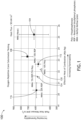
- FIG. 1 is a graph 100 illustrating the effect of the addition of the acyl phosphate RDP and/or phosphonate polymer (poly) on the peak heat release and effective heat combustion on a test coupon (e.g., a piece of material embedded with components of the fire-resistant thermoplastic resin, including methyl methacrylate (MMA)) via an oxygen-depletion cone calorimeter test, in accordance with one or more embodiments of the disclosure.
- a fire hazard in an aircraft cabin may be considered as a function of the effective heat of combustion of the cabin materials and as the rate at which this heat is released by the burning material in a fire. Therefore, the effective heat of combustion and/or the peak heat release may be used as an indicator of fire-resistance of a composition.
- the control test coupon 104 embedded only with the (meth)acrylic polymer, the control coupon exhibits an unpredictable peak heat release and a considerably high effective heat of combustion, suggesting the control coupon would not be effectively fire-resistant and may fail aviation guidelines or standards.
- RDP as the singular fire-retardant to the test coupon results in an approximately linear monotonic increasing improvement in reducing the effective heat of combustion.
- the addition of 5% RDP 108 to the test coupon reduced the effective heat of combustion from approximately 25 MJ/kg to approximately 23.3 MJ/kg.
- the addition of 10% RDP 112 to the test coupon further reduced the effective heat of combustion to approximately 22.8 MJ/kg.
- the addition of 20% RDP 116 to the test coupon further reduced the effective heat of combustion from to approximately 20.4 MJ/kg.
- the addition of phosphonate polymer (Poly) as the singular fire-retardant to the test coupon also reduced the effective heat of combustion.
- the addition of 10% phosphonate polymer (10% poly 120) to the test coupon reduced the effective heat of combustion to approximately 22.3 MJ/kg.
- a first composition containing a mixture of an aryl phosphate and a phosphonate polymer may have fire-resistant characteristics (e.g., lower effective heat of combustion, lower peak heat release, or a lower flame duration time) that surpass, or are synergistic to, the fire-resistant characteristics for a second composition containing either the aryl phosphate or the phosphonate polymer, wherein the total weight percentage of the aryl phosphate or the phosphonate polymer in the second composition is equivalent to the total weight percentage of the aryl phosphate and the phosphonate polymer in the first composition.
- fire-resistant characteristics e.g., lower effective heat of combustion, lower peak heat release, or a lower flame duration time
- FIG. 2A illustrates a table 200 containing vertical flammability test results for a carbon fiber fabric embedded with a fire-resistant thermoplastic resin containing 20% RDP, in accordance with one or more embodiments of the disclosure.
- a test specimen such as a test coupon
- a specified period of time e.g. twelve seconds.
- the flame source is removed. Measurements are made on the length of time that the specimen continues to flame (Flame Time), charring of the specimen (Burn Length), and the number and/or timing of drips (Drip Flame Time).
- Flame Time the length of time that the specimen continues to flame
- Burn Length charring of the specimen
- Drip Flame Time the number and/or timing of drips
- FIG. 2B illustrates a table 220 containing vertical flammability test results for a carbon fiber fabric embedded with a fire-resistant thermoplastic resin containing 15% RDP and 15% phosphonate polymer, in accordance with one or more embodiments of the disclosure. Similar to the results in FIG. 2A , the carbon fiber fabric embedded with a fire-resistant thermoplastic resin containing 15% RDP and 15% phosphonate polymer recorded no flame drips and a minimal burn length of 0.2 inches/ 5 mm. However, the carbon fiber fabric embedded with a fire-resistant thermoplastic resin containing 15% RDP and 15% phosphonate polymer presented a markedly improved flame time than the carbon fiber fabric embedded with the fire-resistant thermoplastic resin containing 20% RDP (0.0 second versus 0.8 seconds).
- FIG. 3 is a flow chart illustrating a method 300 for producing a fabric or a composite material embedded with the fire-resistant thermoplastic resin, in accordance with one or more embodiments of the disclosure.
- the method 300 includes a step 304 of providing a (meth)acrylic polymerization solution.
- the (meth)acrylic polymerization solution may contain any (meth)acrylic polymerization solution as described herein.
- the (meth)acrylic polymerization solution may include the Elium ® (meth)acrylic monomer/polymer solutions vended by the Arkema company.
- the method 300 includes a step 308 of adding aryl phosphate to the (meth)acrylic polymerization solution.
- the aryl phosphate may include any type of aryl phosphate as described herein.
- the aryl phosphate may include RDP.
- the method 300 includes a step 312 of adding phosphonate polymer to the (meth)acrylic polymerization solution.
- the phosphonate polymer may include any type of phosphonate polymer as described herein.
- the phosphonate polymer may include the phosphonate polymer Nofia ® OL1001 vended by the FRX Polymers company.
- the method 300 includes a step 316 of activating the polymerization of the (meth)acrylic polymerization solution.
- the polymerization of the (meth)acrylic polymerization solution may include adding an initiator, such as a peroxide, into the (meth)acrylic polymerization solution in order to polymerize the (meth)acrylic monomers.
- step 316 may also include the addition of initiators for the polymerization of phosphonate monomers.
- the polymerization of the (meth)acrylic monomer and the polymerization of the phosphate may occur simultaneously or at different times, or different steps within the method 300.
- the method 300 includes a step 320 of embedding at least one of a fabric or a composite material with the (meth)acrylic polymerization solution.
- the embedding of the fabric or composite material by the (meth)acrylic polymerization solution may be facilitated by any method known in the art including but not limited to RIM, RRIM, SRIM, or any other type of reaction injection molding, or injection molding process.
- the fabric or composite material may include any type of fabric or composite material as described herein.
- Polymerization of the (meth)acrylic monomer and/or the phosphonate monomer may be initiated before, during, or after step 320.
- Polymerization of the (meth)acrylic monomer and/or the phosphonate monomer may be terminated before, during, or after step 320.
- embodiments of the methods disclosed herein may include one or more of the steps described herein. Further, such steps may be carried out in any desired order and two or more of the steps may be carried out simultaneously with one another. Two or more of the steps disclosed herein may be combined in a single step, and in some embodiments, one or more of the steps may be carried out as two or more sub-steps. Further, other steps or sub-steps may be carried in addition to, or as substitutes to one or more of the steps disclosed herein.
Landscapes
- Chemical & Material Sciences (AREA)
- Engineering & Computer Science (AREA)
- Materials Engineering (AREA)
- Health & Medical Sciences (AREA)
- Chemical Kinetics & Catalysis (AREA)
- Medicinal Chemistry (AREA)
- Polymers & Plastics (AREA)
- Organic Chemistry (AREA)
- Manufacturing & Machinery (AREA)
- Inorganic Chemistry (AREA)
- Compositions Of Macromolecular Compounds (AREA)
- Reinforced Plastic Materials (AREA)
Abstract
Description
- Thermoplastic resins include polymers that can be melted and recast into various shapes. The polymers are molten when heated and hardened upon cooling in a process commonly referred to as reaction injection molding (RIM) or reinforces reaction injection molding (RRIM) if reinforcement agents are used. Thermoplastic resins can be added to layered, composite structures in a structural reaction injection molding (SRIM) process, in which upon curing and hardening, can reinforce the composite structure considerably, creating structures having strength characteristics similar to metal structures, but with considerably lower weight, making SRIM products ideal for aircraft components and other weight sensitive industries.
- When used in aircraft components such as passenger seats, SRIM products must adhere to strict fire-resistant standards, such as those imposed by the United States Federal Aviation Administration (FAA). Traditional fire retardants added to components used in aircraft, such as polybrominated diphenyl ether (PBDE) and Tetrabromobisphenol A (TBBPA) have, are currently being phased out due to environmental concerns. Thermoplastic resins that contain non-toxic fire-retardant compounds that are resistant to the RIM techniques and do not leach out of composite structures have not been well established. Accordingly, there is a need for a thermoplastic resin with a non-toxic fire-retardant compatible with SRIM techniques.
- A first composition is disclosed. In one or more embodiments, the first composition includes a fire-resistant thermoplastic resin. In one or more embodiments, the fire-resistant thermoplastic resin includes 1-20 wt% of an aryl phosphate. In one or more embodiments, the fire-resistant thermoplastic resin includes 1-20 wt% of a phosphate polymer. In one or more embodiments, the 60%-98% of a (meth)acrylic polymer, including units resulting from at least one monomer. In one or more embodiments, the monomer is chosen from methyl methacrylate, acrylic acid, methacrylic acid, acrylic acid esters, methacrylic acid esters, acrylonitrile and maleic anhydride.
- In some embodiments of the first composition, at least one of a fabric or a composite material is embedded with the fire-resistant thermoplastic resin.
- In some embodiments of the first composition, at least one of the fabric or the composite material comprises at least one of a carbon fiber, a glass fiber, or a natural fiber.
- In some embodiments of the first composition, the at least one of the fabric or the composite material is configured to pass flame requirements as 14 C.F.R. § 25.583 and corresponding Appendix F.
- In some embodiments of the first composition, the first composition further comprises an anti-drip agent.
- In some embodiments of the first composition, the fire-resistant thermoplastic resin further comprises a colorant.
- In some embodiments of the first composition, wherein the acyl phosphate is configured as resorcinol bis(diphenyl phosphate), triphenyl phosphate, or isopropylated triphenyl phosphate
- In some embodiments of the first composition, at least one of the fabric or the composite material is infused within the fire-resistant thermoplastic resin before at least one of the phosphonate polymer or the (meth)acrylic polymer is polymerized.
- In some embodiments of the first composition, the fire-resistant thermoplastic resin further comprises a polymerization initiator.
- In some embodiments of the first composition, initiator is configured as a peroxide.
- In some embodiments of the first composition, the polymerization of at least one of the phosphonate polymer or the (meth)acrylic polymer is performed between 10°C and 40°C.
- In some embodiments of the first composition, at least one of an effective heat of combustion, a peak heat release, or a flame time of the first composition is less than a second composition comprising only the aryl phosphate or the phosphonate polymer, wherein the total weight percentage of the aryl phosphate or the phosphonate polymer in the second composition is equivalent to the total weight percentage of the aryl phosphate and the phosphonate polymer in the first composition.
- A third composition is also disclosed. In one or more embodiments, the third composition includes a fire-resistant thermoplastic resin. In one or more embodiments, the fire-resistant thermoplastic resin includes 1-25 wt% of an aryl phosphate or a phosphonate polymer. In one or more embodiments, the fire-resistant thermoplastic resin further includes 75-98 wt% of a (meth)acrylic polymer, including units resulting from at least one monomer, wherein the monomer is chosen from methyl methacrylate, acrylic acid, methacrylic acid, acrylic acid esters, methacrylic acid esters, acrylonitrile and maleic anhydride.
- In some embodiments of the third composition, the third composition further includes at least one of a fabric or a composite material, wherein the at least one of the fabric or the composite material is embedded with the fire-resistant thermoplastic resin.
- In some embodiments of the third composition, the at least one of the fabric or the composite material comprises at least one of a carbon fiber, a glass fiber, or a natural fiber.
- In some embodiments of the third composition, at least one of the fabric or the composite material is configured to pass flame requirements as 14 C.F.R. § 25.583 and corresponding Appendix F.
- This Summary is provided solely as an introduction to subject matter that is fully described in the Detailed Description and Drawings. The Summary should not be considered to describe essential features nor be used to determine the scope of the Claims. Moreover, it is to be understood that both the foregoing Summary and the following Detailed Description are example and explanatory only and are not necessarily restrictive of the subject matter claimed.
- The detailed description is described with reference to the accompanying figures. The use of the same reference numbers in different instances in the description and the figures may indicate similar or identical items. Various embodiments or examples ("examples") of the present disclosure are disclosed in the following detailed description and the accompanying drawings. The drawings are not necessarily to scale. In general, operations of disclosed processes may be performed in an arbitrary order, unless otherwise provided in the claims. In the drawings:
-
FIG. 1 is a graph illustrating the effect of the addition of the acyl phosphate RDP and/or phosphonate polymer on the peak heat release and effective heat combustion on a test coupon via an oxygen-depletion cone calorimeter test, in accordance with one or more embodiments of the disclosure; -
FIG. 2A illustrates a table containing vertical flammability test results for a carbon fiber fabric embedded with a fire-resistant thermoplastic resin containing 20% RDP, in accordance with one or more embodiments of the disclosure; -
FIG. 2B illustrates a table containing vertical flammability test results for a carbon fiber fabric embedded with a fire-resistant thermoplastic resin containing 15% RDP and 15% phosphonate polymer, in accordance with one or more embodiments of the disclosure; and -
FIG. 3 is a flow chart illustrating a method for producing a fabric or a composite material embedded with the fire-resistant thermoplastic resin, in accordance with one or more embodiments of the disclosure. - Before explaining one or more embodiments of the disclosure in detail, it is to be understood that the embodiments are not limited in their application to the details of construction and the arrangement of the components or steps or methodologies set forth in the following description or illustrated in the drawings. In the following detailed description of embodiments, numerous specific details may be set forth in order to provide a more thorough understanding of the disclosure. However, it will be apparent to one of ordinary skill in the art having the benefit of the instant disclosure that the embodiments disclosed herein may be practiced without some of these specific details. In other instances, well-known features may not be described in detail to avoid unnecessarily complicating the instant disclosure.
- As used herein a letter following a reference numeral is intended to reference an embodiment of the feature or element that may be similar, but not necessarily identical, to a previously described element or feature bearing the same reference numeral (e.g., 1, 1a, 1b). Such shorthand notations are used for purposes of convenience only and should not be construed to limit the disclosure in any way unless expressly stated to the contrary.
- Further, unless expressly stated to the contrary, "or" refers to an inclusive or and not to an exclusive or. For example, a condition A or B is satisfied by anyone of the following: A is true (or present) and B is false (or not present), A is false (or not present) and B is true (or present), and both A and B are true (or present).
- In addition, use of "a" or "an" may be employed to describe elements and components of embodiments disclosed herein. This is done merely for convenience and "a" and "an" are intended to include "one" or "at least one," and the singular also includes the plural unless it is obvious that it is meant otherwise.
- Finally, as used herein any reference to "one embodiment" or "some embodiments" means that a particular element, feature, structure, or characteristic described in connection with the embodiment is included in at least one embodiment disclosed herein. The appearances of the phrase "in some embodiments" in various places in the specification are not necessarily all referring to the same embodiment, and embodiments may include one or more of the features expressly described or inherently present herein, or any combination of sub-combination of two or more such features, along with any other features which may not necessarily be expressly described or inherently present in the instant disclosure.
- Compositions comprising a fire-resistant thermoplastic resin are disclosed. The fire-resistant thermoplastic resin comprises an aryl phosphate and a phosphonate polymer (e.g., a first composition), or an aryl phosphate or a phosphonate polymer (e.g., a second composition and/or third composition), that when embedded in a fabric or composite material, renders the fabric or composite material flame resistant. The fire-resistant thermoplastic resin also stabilizes the formed structure of the compositions.
- In some embodiments, the fire-resistant thermoplastic resin comprises a (methyl)acrylic polymer. The (meth)acrylic polymer may include poly alkyl methacrylates, poly alkylacrylates, or other species. For example, the (methyl)acrylic polymer may be configured as poly methyl methacrylate (PMMA) formed from at least one monomer. The monomers forming the (meth)acrylic polymer, or units containing two or more polymerized monomers, may include any chemically appropriate monomer including but not limited to methacrylate, acrylic acid, methacrylic acid, acrylic acid esters, methacrylic acid esters, acrylonitrile and maleic anhydride. The (meth)acrylic polymer and/or (meth)acrylic monomer may come from any source or vendor. For example, the source of the (meth)acrylic polymer and (meth)acrylic monomer may be configured as the Elium® (meth)acrylic monomer/polymer solutions vended by the Arkema company. For instance, the Elium® solutions include 10-60 wt% (weight percentage) (meth)acrylic polymer dissolved in 40-90% wt% (meth)acrylic monomer.
- In some embodiments, the overall percentage of (meth)acrylic polymer within the fire-resistant thermoplastic resin may fall within a range. For example, the overall weight percentage of (meth)acrylic polymer in the fire-resistant thermoplastic resin may range from 20 wt% to 98 wt%, 50 wt% to 98 wt%, 60 wt% to 98 wt%, 60 wt% to 90 wt%, 65 wt% to 85 wt%, and 70 wt% to 80 wt%. For instance, the overall weight percentage of (meth)acrylic polymer in the fire-resistant thermoplastic resin may be approximately 60%. When considering the overall percentage of (meth)acrylic polymer by weight percentage within the fire-resistant thermoplastic resin, we are assuming that the polymerization process has converted the vast majority of (meth)acrylic monomers into a (meth)acrylic polymer form. Therefore, the overall percentage of (meth)acrylic polymer in the fire-resistant thermoplastic as stated above is a post-polymerization weight percentage.
- In some embodiments, the (meth)acrylic polymer may be polymerized before or after addition of the (meth)acrylic polymer into the first composition. For example, unpolymerized or partially polymerized (meth)acrylic polymer may be added to the first composition and allowed to cure. Alternatively, the unpolymerized or partially polymerized (meth)acrylic polymer may be allowed polymerize partially or fully before addition of the (meth)acrylic polymer into the first composition.
- Polymerization of the (meth)acrylic polymer may be initiated by an initiator. For example, the initiator may include an organic peroxide. For instance, the initiator may include benzoyl peroxide. The type and concentration of initiator facilitates the temperature, or range of temperatures, at which polymerization (e.g., curing) of the (meth)acrylic monomer may occur. For example, the polymerization of the (meth)acrylic monomer may occur in ranges including but not limited to 0°C to 100°C, 0°C to 50°C, 10°C to 40°C, and 20°C to 30°C. For example, the polymerization of the (meth)acrylic monomer may occur at room temperature (e.g., approximately 25°C). The polymerizing temperature of the(meth)acrylic monomer in the fire-resistant thermoplastic resin is considerably lower than the traditional (meth)acrylic polymerizing solutions, allowing the fire-resistant thermoplastic resin to be embedded materials that are unstable at higher temperatures.
- In some embodiments, the fire-resistant (e.g., flame resistant) thermoplastic resin comprises an aryl phosphate configured to act as a fire retardant. The fire-resistant thermoplastic resin may include any type of any fire-retardant aryl including but not limited to Triphenyl Phosphate (TPP), Isopropylated triphenyl phosphate (PrTPP), Isodecyl diphenyl phosphate (IDPP), Tricresyl Phosphate (TCP), 2-ethylhexyl diphenyl phosphate (EHDP), Isopropyl phenyl diphenyl phosphate, Tert-butylated triphenyl phosphate (BuTTP), and resorcinol bis (diphenyl phosphate) (RDP). For example, the aryl phosphate may include RDP as included in the product AFLAMMIT® PLF 280 vended by the Thor company. The aryl phosphate included in the fire-resistant thermoplastic resin may be halogen-free.
- In some embodiments, the overall percentage of aryl phosphate within the fire-resistant thermoplastic resin may fall within a range. For example, the overall weight percentage of aryl phosphate in the fire-resistant thermoplastic resin may range from 1% to 25 wt%, 2 wt% to 20 wt%, 5 wt% to 15 wt%, and 8 wt% to 12 wt%, 65 wt% to 85 wt%, and 70 wt% to 80 wt%. For instance, the overall weight percentage of aryl phosphate in the fire-resistant thermoplastic resin may be approximately 10%. In another instance, the overall weight percentage of aryl phosphate in the fire-resistant thermoplastic resin may be approximately 15%.
- In some embodiments, the fire-resistant thermoplastic resin comprises a polyphosphate polymer (e.g., polyphosphonate) configured to act as a fire retardant. The fire-resistant thermoplastic resin may include any type of fire-retardant phosphonate polymer including but not limited to aryl polyphosphonates, aliphatic polyphosphonates, aromatic polyphosphonates, and those described in
U.S. Pat. No. 8,975,367 ,U.S. Pat. No. 6,861,499 andU.S. Pat. No. 7,816,486 . In certain embodiments, the phosphonate polymer may be characterized as exhibiting at least one, and preferably all of a broad molecular weight, and a Tg of at least 100° C. In some embodiments, the phosphonate polymer may have a Tg of about 25° C. to about 140° C., about 50° C. to about 135° C., or about 75° C. to about 130° C. These phosphonate polymers may exhibit a weight average molecular weight (Mw) ranging from about 100 g/mole to about 200,000 g/mole 1,000 g/mole to about 200,000 g/mole, about 10,000 g/mole to about 200,000 g/mole, about 12,000 g/mole to about 150,000 g/mole, about 15,000 g/mole to about 140,000 g/mole, about 20,000 g/mole to about 100,000 g/mole or any value between theses ranges based on polystyrene standards. For example, the weight average molecular weight (Mw) of about 10,000 g/mole to about 100,000 g/mole. For instance, the phosphonate polymer may include the reactive, phenolic phosphonate polymer Nofia® OL1001, and/or the homopolymer Nofia® HM1100, both vended by the FRX Polymers company. The polyphosphate included in the fire-resistant thermoplastic resin may be halogen-free. - In some embodiments, the phosphonate polymer may be polymerized before or after addition of the phosphonate polymer into the first composition. For example, unpolymerized or partially polymerized phosphonate polymer may be added to the first composition and allowed to cure. Alternatively, the unpolymerized or partially polymerized phosphonate polymer may be allowed polymerize partially or fully before addition of the phosphonate polymer into the first composition.
- In some embodiments, the overall percentage of phosphonate polymer within the fire-resistant thermoplastic resin may fall within a range. For example, the overall weight percentage of phosphonate polymer in the fire-resistant thermoplastic resin may range from 1% to 25 wt%, 2 wt% to 20 wt%, 5 wt% to 15 wt%, and 8 wt% to 12 wt%, 65 wt% to 85 wt%, and 70 wt% to 80 wt%. For instance, the overall weight percentage of phosphonate polymer in the fire-resistant thermoplastic resin may be approximately 10%. For instance, the overall weight percentage of phosphonate polymer in the fire-resistant thermoplastic resin may be approximately 15%.
- In some embodiments, the first composition includes a fabric or a composite material embedded with the fire-resistant thermoplastic resin. The fabric or composite material may include any type of material than can be embedded with a resin including but not limited to synthetic fibers (e.g., carbon fiber, glass fiber, aramid fiber) or natural fibers (e.g., cotton, wool, and flax). The first composition may be configured as any type of structure. For example, the first composition may be configured as an interior structure of an aircraft, train, or boat, or automobile (e.g., structures having fire-retardant requirements). For instance, the first composition may be configured as a frame component of a passenger seat. In another instance, the first composition may be configured material covering a seatback of the passenger seat.
- In some embodiments, the first composition and/or the fire-resistant thermoplastic resin meets and/or exceeds transportation guidelines and/or standards, such as aviation guidelines and/or standards, by being configured in accordance with aviation guidelines and/or standards put forth by, but not limited to, the Federal Aviation Administration (FAA), the European Aviation Safety Agency (EASA) or any other flight certification agency or organization; the American National Standards Institute (ANSI), Aeronautical Radio, Incorporated (ARINC), or any other standards setting organization or company; the Radio Technical Commission for Aeronautics (RTCA) or any other guidelines agency or organization; or the like. For example, the fire-resistant thermoplastic resin and/or composition (e.g., chair frame section and/or seat back fabric) may be required to meet and/or exceed flame tests as set forth by the aviation guidelines and/or standards. For instance, the passenger seat components may be rated to pass flame requirement tests for aircraft cabin interior installations (e.g., structures or components) such as seat cushions as set forth by the aviation guidelines and/or standards under 14 C.F.R.
Part 25 and its Appendixes (e.g., 14 C.F.R. § 25.853, also found in FAA Advisory Circular (AC) 25.853-1), or the like. - The present application will be further illustrated with reference to the following examples of fire-resistant thermoplastic resin, which are not intended to limit the scope of the present application.
- In some embodiments, the fire-resistant thermoplastic resin further includes an anti-drip component that prevents flame drips. The anti-drip component may include any known anti-drip additive including but not limited to polytetrafluoroethylene, perfluorocarbons, and acrylonitrile-butadiene-styrene copolymer. The fire-resistant thermoplastic resin may also include any synergists or blend partners to improve flammability and/or mechanical properties. In some embodiments, the fire-resistant thermoplastic resin further includes a colorant. Any type of colorant known may be included within the fire-resistant thermoplastic resin including but not limited to carbon black.
-
FIG. 1 is agraph 100 illustrating the effect of the addition of the acyl phosphate RDP and/or phosphonate polymer (poly) on the peak heat release and effective heat combustion on a test coupon (e.g., a piece of material embedded with components of the fire-resistant thermoplastic resin, including methyl methacrylate (MMA)) via an oxygen-depletion cone calorimeter test, in accordance with one or more embodiments of the disclosure. A fire hazard in an aircraft cabin may be considered as a function of the effective heat of combustion of the cabin materials and as the rate at which this heat is released by the burning material in a fire. Therefore, the effective heat of combustion and/or the peak heat release may be used as an indicator of fire-resistance of a composition. For example, for thecontrol test coupon 104, embedded only with the (meth)acrylic polymer, the control coupon exhibits an unpredictable peak heat release and a considerably high effective heat of combustion, suggesting the control coupon would not be effectively fire-resistant and may fail aviation guidelines or standards. - The addition of RDP as the singular fire-retardant to the test coupon results in an approximately linear monotonic increasing improvement in reducing the effective heat of combustion. For example, the addition of 5
% RDP 108 to the test coupon reduced the effective heat of combustion from approximately 25 MJ/kg to approximately 23.3 MJ/kg. In another example, the addition of 10% RDP 112 to the test coupon further reduced the effective heat of combustion to approximately 22.8 MJ/kg. In another example, the addition of 20% RDP 116 to the test coupon further reduced the effective heat of combustion from to approximately 20.4 MJ/kg. The addition of phosphonate polymer (Poly) as the singular fire-retardant to the test coupon also reduced the effective heat of combustion. For example, the addition of 10% phosphonate polymer (10% poly 120) to the test coupon reduced the effective heat of combustion to approximately 22.3 MJ/kg. - The reduction of the effective heat of combustion by the aryl phosphate RDP and the polyphosphate is expected, as both PDP and polyphosphate are known fire-retardants. However, the addition of 5% RDP/ 5
% phosphonate polymer 124 to the test coupon decreased the effective heat of combustion further than either the 10% RDP % poly 120, suggesting a greater than expected synergistic relationship exist between the addition of the aryl phosphate and the phosphonate polymer in reducing the effective heat of combustion. This results also suggests that a first composition containing a mixture of an aryl phosphate and a phosphonate polymer may have fire-resistant characteristics (e.g., lower effective heat of combustion, lower peak heat release, or a lower flame duration time) that surpass, or are synergistic to, the fire-resistant characteristics for a second composition containing either the aryl phosphate or the phosphonate polymer, wherein the total weight percentage of the aryl phosphate or the phosphonate polymer in the second composition is equivalent to the total weight percentage of the aryl phosphate and the phosphonate polymer in the first composition. -
FIG. 2A illustrates a table 200 containing vertical flammability test results for a carbon fiber fabric embedded with a fire-resistant thermoplastic resin containing 20% RDP, in accordance with one or more embodiments of the disclosure. In the vertical flammability test, a test specimen, such as a test coupon, is positioned vertically above a controlled flame and exposed for a specified period of time (e.g., twelve seconds). Following exposure, the flame source is removed. Measurements are made on the length of time that the specimen continues to flame (Flame Time), charring of the specimen (Burn Length), and the number and/or timing of drips (Drip Flame Time). For the carbon fiber fabric embedded with the fire-resistant thermoplastic resin containing 20% RDP that was tested, no drips were evident, burn length was minimal (0.2 inches/5 mm), and a passing flame time of 0.8 seconds was determined after three runs. -
FIG. 2B illustrates a table 220 containing vertical flammability test results for a carbon fiber fabric embedded with a fire-resistant thermoplastic resin containing 15% RDP and 15% phosphonate polymer, in accordance with one or more embodiments of the disclosure. Similar to the results inFIG. 2A , the carbon fiber fabric embedded with a fire-resistant thermoplastic resin containing 15% RDP and 15% phosphonate polymer recorded no flame drips and a minimal burn length of 0.2 inches/ 5 mm. However, the carbon fiber fabric embedded with a fire-resistant thermoplastic resin containing 15% RDP and 15% phosphonate polymer presented a markedly improved flame time than the carbon fiber fabric embedded with the fire-resistant thermoplastic resin containing 20% RDP (0.0 second versus 0.8 seconds). These results provide further evidence that the mixture of an aryl phosphate and/or a phosphonate polymer within a thermoplastic resin provides considerable fire-resistance protection when embedded within a fabric or composite material, and that the aryl phosphate and/or phosphonate polymer may act synergistically when compared to fire-resistance thermoplastic resins containing only the aryl phosphate or the phosphonate polymer. -
FIG. 3 is a flow chart illustrating amethod 300 for producing a fabric or a composite material embedded with the fire-resistant thermoplastic resin, in accordance with one or more embodiments of the disclosure. In some embodiments, themethod 300 includes astep 304 of providing a (meth)acrylic polymerization solution. The (meth)acrylic polymerization solution may contain any (meth)acrylic polymerization solution as described herein. For example, the (meth)acrylic polymerization solution may include the Elium® (meth)acrylic monomer/polymer solutions vended by the Arkema company. - In some embodiments, the
method 300 includes astep 308 of adding aryl phosphate to the (meth)acrylic polymerization solution. The aryl phosphate may include any type of aryl phosphate as described herein. For example, the aryl phosphate may include RDP. - In some embodiments, the
method 300 includes astep 312 of adding phosphonate polymer to the (meth)acrylic polymerization solution. The phosphonate polymer may include any type of phosphonate polymer as described herein. For example, the phosphonate polymer may include the phosphonate polymer Nofia® OL1001 vended by the FRX Polymers company. - In some embodiments, the
method 300 includes astep 316 of activating the polymerization of the (meth)acrylic polymerization solution. For example, the polymerization of the (meth)acrylic polymerization solution may include adding an initiator, such as a peroxide, into the (meth)acrylic polymerization solution in order to polymerize the (meth)acrylic monomers. In some cases,step 316 may also include the addition of initiators for the polymerization of phosphonate monomers. The polymerization of the (meth)acrylic monomer and the polymerization of the phosphate may occur simultaneously or at different times, or different steps within themethod 300. - In some embodiments, the
method 300 includes astep 320 of embedding at least one of a fabric or a composite material with the (meth)acrylic polymerization solution. The embedding of the fabric or composite material by the (meth)acrylic polymerization solution may be facilitated by any method known in the art including but not limited to RIM, RRIM, SRIM, or any other type of reaction injection molding, or injection molding process. The fabric or composite material may include any type of fabric or composite material as described herein. Polymerization of the (meth)acrylic monomer and/or the phosphonate monomer may be initiated before, during, or afterstep 320. Polymerization of the (meth)acrylic monomer and/or the phosphonate monomer may be terminated before, during, or afterstep 320. - It is to be understood that embodiments of the methods disclosed herein may include one or more of the steps described herein. Further, such steps may be carried out in any desired order and two or more of the steps may be carried out simultaneously with one another. Two or more of the steps disclosed herein may be combined in a single step, and in some embodiments, one or more of the steps may be carried out as two or more sub-steps. Further, other steps or sub-steps may be carried in addition to, or as substitutes to one or more of the steps disclosed herein.
- Although inventive concepts have been described with reference to the embodiments illustrated in the attached drawing figures, equivalents may be employed and substitutions made herein without departing from the scope of the claims. Components illustrated and described herein are merely examples of a system/device and components that may be used to implement embodiments of the inventive concepts and may be replaced with other devices and components without departing from the scope of the claims. For example, it should be understood that one or more, or all components of the first composition may be included within the second composition and/or third composition, and vice versa. Furthermore, any dimensions, degrees, and/or numerical ranges provided herein are to be understood as non-limiting examples unless otherwise specified in the claims.
Claims (15)
- A first composition comprising:
a fire-resistant thermoplastic resin, comprising:1-20 wt% of an aryl phosphate;1-20 wt% of a phosphonate polymer; and60%-98% of a (meth)acrylic polymer, including units resulting from at least one monomer, wherein the monomer is chosen from methyl methacrylate, acrylic acid, methacrylic acid, acrylic acid esters, methacrylic acid esters, acrylonitrile and maleic anhydride. - The first composition of claim 1 further comprising at least one of a fabric or a composite material embedded with the fire-resistant thermoplastic resin.
- The first composition of claim 2, wherein the at least one of the fabric or the composite material comprises at least one of a carbon fiber, a glass fiber, or a natural fiber.
- The first composition of claim 2, wherein the at least one of the fabric or the composite material is configured to pass flame requirements as 14 C.F.R. § 25.583 and corresponding Appendix F.
- The first composition of any preceding claim, wherein the fire-resistant thermoplastic resin further comprises an anti-drip agent.
- The first composition of any preceding claim, wherein the fire-resistant thermoplastic resin further comprises a colorant.
- The first composition of any preceding claim, wherein the aryl phosphate is configured as resorcinol bis(diphenyl phosphate), triphenyl Phosphate, or isopropylated triphenyl phosphate.
- The first composition of claim 2, wherein the at least one of the fabric or the composite material is infused within the fire-resistant thermoplastic resin before at least one of the phosphonate polymer or the (meth)acrylic polymer is polymerized.
- The first composition of any preceding claim, wherein the fire-resistant thermoplastic resin further comprises a polymerization initiator.
- The first composition of any preceding claim, further comprising an initiator, wherein the initiator is configured as a peroxide.
- The first composition of claim 2, wherein a polymerization of at least one of the phosphonate polymer or the (meth)acrylic polymer is performed between 10°C and 40°C.
- The first composition of any preceding claim, wherein at least one of an effective heat of combustion, a peak heat release, or a flame time of the first composition is less than a second composition comprising only the aryl phosphate or the phosphonate polymer, wherein a total weight percentage of the aryl phosphate or the phosphonate polymer in the second composition is equivalent to the total weight percentage of the aryl phosphate and the phosphonate polymer in the first composition.
- A third composition comprising:
a fire-resistant thermoplastic resin, comprising:1-25 wt% of an aryl phosphate or a phosphonate polymer; and75-98 wt% of a (meth)acrylic polymer, including units resulting from at least one monomer, wherein the monomer is chosen from methyl methacrylate, acrylic acid, methacrylic acid, acrylic acid esters, methacrylic acid esters, acrylonitrile and maleic anhydride. - The third composition of claim 13 further comprising at least one of a fabric or a composite material, wherein the at least one of the fabric or the composite material is embedded with the fire-resistant thermoplastic resin.
- The third composition of claim 14, wherein the at least one of the fabric or the composite material comprises at least one of a carbon fiber, a glass fiber, or a natural fiber.
Applications Claiming Priority (1)
| Application Number | Priority Date | Filing Date | Title |
|---|---|---|---|
| US17/391,902 US11879042B2 (en) | 2021-08-02 | 2021-08-02 | Fire resistant thermoplastic-based resin for fiber-reinforced composites |
Publications (1)
| Publication Number | Publication Date |
|---|---|
| EP4130149A1 true EP4130149A1 (en) | 2023-02-08 |
Family
ID=82702805
Family Applications (1)
| Application Number | Title | Priority Date | Filing Date |
|---|---|---|---|
| EP22186563.7A Pending EP4130149A1 (en) | 2021-08-02 | 2022-07-22 | Fire resistant thermoplastic-based resin for fiber-reinforced composites |
Country Status (4)
| Country | Link |
|---|---|
| US (2) | US11879042B2 (en) |
| EP (1) | EP4130149A1 (en) |
| JP (1) | JP2023021942A (en) |
| CN (1) | CN115701444B (en) |
Families Citing this family (1)
| Publication number | Priority date | Publication date | Assignee | Title |
|---|---|---|---|---|
| US12291014B2 (en) | 2023-08-21 | 2025-05-06 | B/E Aerospace (Uk) Limited | Mineral additive modified basalt fibre based PMMA composites for ballistic applications |
Citations (7)
| Publication number | Priority date | Publication date | Assignee | Title |
|---|---|---|---|---|
| US3347818A (en) * | 1962-11-30 | 1967-10-17 | Du Pont | Methyl methacrylate compositions containing halogen substituted acid alkyl esters of orthophosphoric acid |
| US3920619A (en) * | 1972-07-27 | 1975-11-18 | Mitsubishi Rayon Co | Process for casting methacrylic acid polymer plate |
| EP0104479B1 (en) * | 1982-09-01 | 1987-11-11 | Mitsubishi Rayon Co., Ltd. | Flame resistant acrylic resin composition and process for its production |
| US6861499B2 (en) | 2003-02-24 | 2005-03-01 | Triton Systems, Inc. | Branched polyphosphonates that exhibit an advantageous combination of properties, and methods related thereto |
| US8975367B2 (en) | 2011-04-14 | 2015-03-10 | Frx Polymers, Inc. | Polyphosphonate and copolyphosphonate additive mixtures |
| EP3181602A1 (en) * | 2014-08-12 | 2017-06-21 | Kuraray Co., Ltd. | Copolymer and molded article |
| KR20210014323A (en) * | 2019-07-30 | 2021-02-09 | 롯데케미칼 주식회사 | Thermoplastic resin composition and article produced therefrom |
Family Cites Families (32)
| Publication number | Priority date | Publication date | Assignee | Title |
|---|---|---|---|---|
| US3450630A (en) | 1963-02-07 | 1969-06-17 | Yeda Res & Dev | Method of separating metal ions |
| US3450613A (en) * | 1964-03-09 | 1969-06-17 | Bausch & Lomb | Epoxy adhesive containing acrylic acid-epoxy reaction products and photosensitizers |
| US3666712A (en) | 1970-01-02 | 1972-05-30 | Stauffer Chemical Co | Flame retardant polymethyl methacrylate compositions |
| BE793200A (en) | 1971-12-27 | 1973-06-22 | Monsanto Co | FLAME RESISTANT COMPOSITIONS |
| GB1418540A (en) | 1973-01-17 | 1975-12-24 | Roehm Gmbh | Synthetic resin composition |
| IL47037A (en) | 1974-06-10 | 1977-12-30 | Stauffer Chemical Co | Fire retardant copolymers |
| JPS5158512A (en) * | 1974-11-13 | 1976-05-21 | Dainippon Ink & Chemicals | Nannenseisenino seizohoho |
| US4246169A (en) * | 1978-04-19 | 1981-01-20 | Fmc Corporation | Flammable plastics containing a flame retardant amount of polyarylphosphates and the polyarylphosphates |
| JPS5947248A (en) | 1982-09-13 | 1984-03-16 | Mitsubishi Rayon Co Ltd | Flame-retardant acrylic resin composition and production thereof |
| JPS5949253A (en) | 1982-09-14 | 1984-03-21 | Mitsubishi Rayon Co Ltd | Flame-retardant acrylic resin composition and manufacture of the same |
| JPS63117056A (en) | 1986-11-05 | 1988-05-21 | Mitsubishi Rayon Co Ltd | Flame-retardant acrylic resin composition and production thereof |
| JPS63152609A (en) | 1986-12-16 | 1988-06-25 | Mitsubishi Rayon Co Ltd | flame retardant resin |
| US5036126A (en) | 1990-05-30 | 1991-07-30 | General Electric Company | Flame retardant blends of polycarbonate, ABS and a terpolymer |
| KR960001029A (en) | 1994-06-30 | 1996-01-25 | 유현식 | Thermoplastic resin composition having flame retardancy |
| KR0144382B1 (en) | 1995-08-10 | 1998-07-15 | 유현식 | Inflammable thermoplastic resin composition |
| KR100560151B1 (en) | 2004-12-30 | 2006-03-10 | 제일모직주식회사 | Flame Retardant Polycarbonate Resin Composition |
| KR100767428B1 (en) | 2006-04-14 | 2007-10-17 | 제일모직주식회사 | Flame-retardant thermoplastic resin composition having scratch resistance |
| KR100817563B1 (en) * | 2006-11-13 | 2008-03-27 | 제일모직주식회사 | Scratch-resistant flame retardant thermoplastic resin composition |
| EP2154191A1 (en) * | 2008-08-08 | 2010-02-17 | Cytec Surface Specialties, S.A. | Flame retardant radiation curable compositions |
| KR101251330B1 (en) | 2009-12-31 | 2013-04-05 | 제일모직주식회사 | Polycarbonate Resin Composition Having Good Flame Retardancy |
| DE102010041388A1 (en) * | 2010-09-24 | 2012-03-29 | Bayer Materialscience Aktiengesellschaft | Polycarbonate-based flame-retardant impact-modified battery housings II |
| US9034949B2 (en) * | 2010-10-15 | 2015-05-19 | Styrolution Europe Gmbh | Method for producing flame-proofed thermoplastic molding compounds |
| JP5827862B2 (en) | 2011-10-11 | 2015-12-02 | 住友化学株式会社 | Method for producing flame retardant plate comprising methacrylic resin composition |
| JP6795981B2 (en) | 2014-04-07 | 2020-12-02 | ミツビシ ケミカル ヨーロッパ ゲーエムベーハー | Thermoplastic composition |
| TWI585144B (en) * | 2014-10-21 | 2017-06-01 | Mitsubishi Rayon Co | (Meth) acrylic resin composition and a resin molded product |
| CN104448679B (en) | 2014-11-27 | 2017-09-19 | 湖北华城科技有限责任公司 | A kind of crosslinking with radiation halogen-free flame retardant ABS/PC composites and preparation method thereof |
| KR20170120140A (en) * | 2015-02-20 | 2017-10-30 | 에프알엑스 폴리머스, 인코포레이티드 | Flame retardant thermosetting composition |
| JP6520256B2 (en) * | 2015-03-18 | 2019-05-29 | 三菱ケミカル株式会社 | Carbon fiber reinforced thermoplastic, housing for electric and electronic devices |
| CN105111659B (en) | 2015-09-25 | 2018-02-13 | 银禧工程塑料(东莞)有限公司 | A kind of transparent flame-retarding composite that infrared can be penetrated and preparation method thereof |
| JP2017128685A (en) | 2016-01-22 | 2017-07-27 | 三菱ケミカル株式会社 | Thermoplastic resin composition, molded article and vehicle |
| WO2018163341A1 (en) * | 2017-03-09 | 2018-09-13 | ポリマーアソシエイツ合同会社 | Elastomer flame retardant and thermoplastic resin composition including flame retardant |
| CN109021842A (en) | 2018-06-02 | 2018-12-18 | 枞阳县陶波雨具有限公司 | A kind of rain cape bonding shell fabric |
-
2021
- 2021-08-02 US US17/391,902 patent/US11879042B2/en active Active
-
2022
- 2022-07-22 EP EP22186563.7A patent/EP4130149A1/en active Pending
- 2022-07-27 JP JP2022119161A patent/JP2023021942A/en active Pending
- 2022-08-02 CN CN202210921174.6A patent/CN115701444B/en active Active
-
2023
- 2023-12-13 US US18/539,001 patent/US20240110028A1/en active Pending
Patent Citations (8)
| Publication number | Priority date | Publication date | Assignee | Title |
|---|---|---|---|---|
| US3347818A (en) * | 1962-11-30 | 1967-10-17 | Du Pont | Methyl methacrylate compositions containing halogen substituted acid alkyl esters of orthophosphoric acid |
| US3920619A (en) * | 1972-07-27 | 1975-11-18 | Mitsubishi Rayon Co | Process for casting methacrylic acid polymer plate |
| EP0104479B1 (en) * | 1982-09-01 | 1987-11-11 | Mitsubishi Rayon Co., Ltd. | Flame resistant acrylic resin composition and process for its production |
| US6861499B2 (en) | 2003-02-24 | 2005-03-01 | Triton Systems, Inc. | Branched polyphosphonates that exhibit an advantageous combination of properties, and methods related thereto |
| US7816486B2 (en) | 2003-02-24 | 2010-10-19 | Frx Polymers, Inc. | Branched polyphosphonates |
| US8975367B2 (en) | 2011-04-14 | 2015-03-10 | Frx Polymers, Inc. | Polyphosphonate and copolyphosphonate additive mixtures |
| EP3181602A1 (en) * | 2014-08-12 | 2017-06-21 | Kuraray Co., Ltd. | Copolymer and molded article |
| KR20210014323A (en) * | 2019-07-30 | 2021-02-09 | 롯데케미칼 주식회사 | Thermoplastic resin composition and article produced therefrom |
Also Published As
| Publication number | Publication date |
|---|---|
| JP2023021942A (en) | 2023-02-14 |
| US20240110028A1 (en) | 2024-04-04 |
| US11879042B2 (en) | 2024-01-23 |
| CN115701444B (en) | 2024-09-27 |
| US20230033321A1 (en) | 2023-02-02 |
| CN115701444A (en) | 2023-02-10 |
Similar Documents
| Publication | Publication Date | Title |
|---|---|---|
| JP2642943B2 (en) | Molding materials and their use as construction and repair materials | |
| Feih et al. | Modelling the tension and compression strengths of polymer laminates in fire | |
| Biswas et al. | The effect of chemically reactive type flame retardant additives on flammability of PES toughened epoxy resin and carbon fiber‐reinforced composites | |
| US20240110028A1 (en) | Fire resistant thermoplastic-based resin for fiber-reinforced composites | |
| Basnayake et al. | A flammability study of aluminium hydroxide (ATH) and ammonium polyphosphate (APP) used with hemp/epoxy composites | |
| US20160280871A1 (en) | Heat-curable resin composition, prepreg, and method for producing fiber-reinforced composite using each of same | |
| US20210323651A1 (en) | Sandwich-Composite Component for Aircraft Interiors | |
| RU2549877C1 (en) | Epoxyvinylether resin-based binding agent and based on it fire-proof polymer composite material | |
| Höhne et al. | Hexaphenoxycyclotriphosphazene as FR for CFR anionic PA6 via T‐RTM: a study of mechanical and thermal properties | |
| Horrocks et al. | Flammability and fire resistance of composites | |
| RU2561990C2 (en) | Composites based on cyanate ester resin with thermoplast-improved impact strength with low heat release characteristics | |
| EP3211034A1 (en) | (meth)acrylic resin composition and resin molded article | |
| EP1464483A1 (en) | A pigmented panel assembly | |
| WO2022209723A1 (en) | Laminate | |
| AU2015352117B2 (en) | Vinyl ester powder pre-preg | |
| JP7384795B2 (en) | Polyurethane or polyisocyanurate foam laminated with aluminum facing and brominated primer layer | |
| CN104558643A (en) | Preparation method of fire-resistant glass fiber reinforced plastic | |
| RU2573003C2 (en) | Epoxyvinylester resin and fireproof polymer composite material based thereon | |
| CA2288186A1 (en) | Composite material suitable for aircraft interiors | |
| KR101663942B1 (en) | Epoxy Resin Compositions for Prepreg Having Halogen Free and Flame Retardant | |
| EP3744743A1 (en) | Liquid composition comprising a phosphorus based additive, its use and material or composition obtained following polymerisation of compostion | |
| Agnihotri et al. | Comparative Analysis of Flame Retardant and Mechanical Properties of Different Resin‐Based Fiber‐Reinforced Composites | |
| Rusnák et al. | Flame resistance and mechanical properties of composites based on new advanced resin system fr4/12 | |
| Lal et al. | Flammability of Benzoxazine Resin Based Carbon Fibre Composite Samples. | |
| CN112210106B (en) | A kind of preparation method of hot-melt benzoxazine composition curable at medium temperature |
Legal Events
| Date | Code | Title | Description |
|---|---|---|---|
| PUAI | Public reference made under article 153(3) epc to a published international application that has entered the european phase |
Free format text: ORIGINAL CODE: 0009012 |
|
| STAA | Information on the status of an ep patent application or granted ep patent |
Free format text: STATUS: THE APPLICATION HAS BEEN PUBLISHED |
|
| AK | Designated contracting states |
Kind code of ref document: A1 Designated state(s): AL AT BE BG CH CY CZ DE DK EE ES FI FR GB GR HR HU IE IS IT LI LT LU LV MC MK MT NL NO PL PT RO RS SE SI SK SM TR |
|
| STAA | Information on the status of an ep patent application or granted ep patent |
Free format text: STATUS: REQUEST FOR EXAMINATION WAS MADE |
|
| 17P | Request for examination filed |
Effective date: 20230801 |
|
| RBV | Designated contracting states (corrected) |
Designated state(s): AL AT BE BG CH CY CZ DE DK EE ES FI FR GB GR HR HU IE IS IT LI LT LU LV MC MK MT NL NO PL PT RO RS SE SI SK SM TR |
|
| P01 | Opt-out of the competence of the unified patent court (upc) registered |
Effective date: 20230922 |
|
| STAA | Information on the status of an ep patent application or granted ep patent |
Free format text: STATUS: EXAMINATION IS IN PROGRESS |
|
| 17Q | First examination report despatched |
Effective date: 20240516 |