EP4130106A1 - Fiber-reinforced composite material and bonded body - Google Patents
Fiber-reinforced composite material and bonded body Download PDFInfo
- Publication number
- EP4130106A1 EP4130106A1 EP21774740.1A EP21774740A EP4130106A1 EP 4130106 A1 EP4130106 A1 EP 4130106A1 EP 21774740 A EP21774740 A EP 21774740A EP 4130106 A1 EP4130106 A1 EP 4130106A1
- Authority
- EP
- European Patent Office
- Prior art keywords
- fiber
- reinforced composite
- composite material
- resin
- bonded body
- Prior art date
- Legal status (The legal status is an assumption and is not a legal conclusion. Google has not performed a legal analysis and makes no representation as to the accuracy of the status listed.)
- Withdrawn
Links
- 239000003733 fiber-reinforced composite Substances 0.000 title claims abstract description 129
- 239000000463 material Substances 0.000 title claims abstract description 111
- 229920005989 resin Polymers 0.000 claims abstract description 129
- 239000011347 resin Substances 0.000 claims abstract description 129
- 150000002576 ketones Chemical class 0.000 claims abstract description 41
- XLYOFNOQVPJJNP-UHFFFAOYSA-N water Substances O XLYOFNOQVPJJNP-UHFFFAOYSA-N 0.000 claims abstract description 30
- 229910052757 nitrogen Inorganic materials 0.000 claims abstract description 22
- 239000012783 reinforcing fiber Substances 0.000 claims abstract description 22
- 239000011159 matrix material Substances 0.000 claims abstract description 21
- 125000004433 nitrogen atom Chemical group N* 0.000 claims abstract description 20
- 239000000853 adhesive Substances 0.000 claims description 78
- 230000001070 adhesive effect Effects 0.000 claims description 78
- 238000009832 plasma treatment Methods 0.000 claims description 35
- 238000000034 method Methods 0.000 claims description 27
- 239000004697 Polyetherimide Substances 0.000 claims description 25
- 229920001601 polyetherimide Polymers 0.000 claims description 25
- 239000004696 Poly ether ether ketone Substances 0.000 claims description 21
- 229920002530 polyetherether ketone Polymers 0.000 claims description 21
- 229920000049 Carbon (fiber) Polymers 0.000 claims description 17
- 239000004917 carbon fiber Substances 0.000 claims description 17
- 229920005992 thermoplastic resin Polymers 0.000 claims description 17
- 238000009864 tensile test Methods 0.000 claims description 14
- 239000004593 Epoxy Substances 0.000 claims description 9
- 239000002184 metal Substances 0.000 claims description 9
- 229910052751 metal Inorganic materials 0.000 claims description 9
- 238000004519 manufacturing process Methods 0.000 claims description 6
- JOYRKODLDBILNP-UHFFFAOYSA-N Ethyl urethane Chemical compound CCOC(N)=O JOYRKODLDBILNP-UHFFFAOYSA-N 0.000 claims description 4
- NIXOWILDQLNWCW-UHFFFAOYSA-N acrylic acid group Chemical group C(C=C)(=O)O NIXOWILDQLNWCW-UHFFFAOYSA-N 0.000 claims description 4
- 239000000835 fiber Substances 0.000 description 21
- 230000000052 comparative effect Effects 0.000 description 19
- 239000000758 substrate Substances 0.000 description 18
- 238000012360 testing method Methods 0.000 description 14
- 238000011282 treatment Methods 0.000 description 14
- JUPQTSLXMOCDHR-UHFFFAOYSA-N benzene-1,4-diol;bis(4-fluorophenyl)methanone Chemical compound OC1=CC=C(O)C=C1.C1=CC(F)=CC=C1C(=O)C1=CC=C(F)C=C1 JUPQTSLXMOCDHR-UHFFFAOYSA-N 0.000 description 11
- 238000005452 bending Methods 0.000 description 8
- 238000002156 mixing Methods 0.000 description 8
- 238000004381 surface treatment Methods 0.000 description 7
- RTZKZFJDLAIYFH-UHFFFAOYSA-N ether Substances CCOCC RTZKZFJDLAIYFH-UHFFFAOYSA-N 0.000 description 6
- 239000007769 metal material Substances 0.000 description 6
- 239000000126 substance Substances 0.000 description 6
- 239000000155 melt Substances 0.000 description 5
- NJPPVKZQTLUDBO-UHFFFAOYSA-N novaluron Chemical compound C1=C(Cl)C(OC(F)(F)C(OC(F)(F)F)F)=CC=C1NC(=O)NC(=O)C1=C(F)C=CC=C1F NJPPVKZQTLUDBO-UHFFFAOYSA-N 0.000 description 5
- 239000000047 product Substances 0.000 description 5
- 125000003545 alkoxy group Chemical group 0.000 description 4
- 125000000217 alkyl group Chemical group 0.000 description 4
- 230000000694 effects Effects 0.000 description 4
- 125000005843 halogen group Chemical group 0.000 description 4
- 238000002347 injection Methods 0.000 description 4
- 239000007924 injection Substances 0.000 description 4
- 238000010030 laminating Methods 0.000 description 4
- 238000000465 moulding Methods 0.000 description 4
- 229920002239 polyacrylonitrile Polymers 0.000 description 4
- 125000001424 substituent group Chemical group 0.000 description 4
- 239000000654 additive Substances 0.000 description 3
- 125000000732 arylene group Chemical group 0.000 description 3
- 230000009477 glass transition Effects 0.000 description 3
- 238000010438 heat treatment Methods 0.000 description 3
- 230000001771 impaired effect Effects 0.000 description 3
- 238000002844 melting Methods 0.000 description 3
- 230000008018 melting Effects 0.000 description 3
- 238000012986 modification Methods 0.000 description 3
- 230000004048 modification Effects 0.000 description 3
- 238000003860 storage Methods 0.000 description 3
- IJGRMHOSHXDMSA-UHFFFAOYSA-N Atomic nitrogen Chemical compound N#N IJGRMHOSHXDMSA-UHFFFAOYSA-N 0.000 description 2
- XEEYBQQBJWHFJM-UHFFFAOYSA-N Iron Chemical compound [Fe] XEEYBQQBJWHFJM-UHFFFAOYSA-N 0.000 description 2
- 229920004738 ULTEM® Polymers 0.000 description 2
- 229920004747 ULTEM® 1000 Polymers 0.000 description 2
- -1 and the like Substances 0.000 description 2
- 125000003118 aryl group Chemical group 0.000 description 2
- 238000003851 corona treatment Methods 0.000 description 2
- 238000005470 impregnation Methods 0.000 description 2
- 239000012784 inorganic fiber Substances 0.000 description 2
- 238000003475 lamination Methods 0.000 description 2
- 238000005259 measurement Methods 0.000 description 2
- 238000002715 modification method Methods 0.000 description 2
- 229920001721 polyimide Polymers 0.000 description 2
- 238000003825 pressing Methods 0.000 description 2
- 239000002994 raw material Substances 0.000 description 2
- 238000000926 separation method Methods 0.000 description 2
- 239000000243 solution Substances 0.000 description 2
- 238000010998 test method Methods 0.000 description 2
- ZOXJGFHDIHLPTG-UHFFFAOYSA-N Boron Chemical compound [B] ZOXJGFHDIHLPTG-UHFFFAOYSA-N 0.000 description 1
- WKBOTKDWSSQWDR-UHFFFAOYSA-N Bromine atom Chemical compound [Br] WKBOTKDWSSQWDR-UHFFFAOYSA-N 0.000 description 1
- OKTJSMMVPCPJKN-UHFFFAOYSA-N Carbon Chemical compound [C] OKTJSMMVPCPJKN-UHFFFAOYSA-N 0.000 description 1
- ZAMOUSCENKQFHK-UHFFFAOYSA-N Chlorine atom Chemical compound [Cl] ZAMOUSCENKQFHK-UHFFFAOYSA-N 0.000 description 1
- PXGOKWXKJXAPGV-UHFFFAOYSA-N Fluorine Chemical compound FF PXGOKWXKJXAPGV-UHFFFAOYSA-N 0.000 description 1
- 241001508691 Martes zibellina Species 0.000 description 1
- 229920000297 Rayon Polymers 0.000 description 1
- 239000003677 Sheet moulding compound Substances 0.000 description 1
- 229910000831 Steel Inorganic materials 0.000 description 1
- 229920004813 ULTEM® CRS5001 Polymers 0.000 description 1
- 229920004814 ULTEM® CRS5011 Polymers 0.000 description 1
- 239000006096 absorbing agent Substances 0.000 description 1
- 239000012790 adhesive layer Substances 0.000 description 1
- 125000001931 aliphatic group Chemical group 0.000 description 1
- PNEYBMLMFCGWSK-UHFFFAOYSA-N aluminium oxide Inorganic materials [O-2].[O-2].[O-2].[Al+3].[Al+3] PNEYBMLMFCGWSK-UHFFFAOYSA-N 0.000 description 1
- 239000007864 aqueous solution Substances 0.000 description 1
- 238000011074 autoclave method Methods 0.000 description 1
- 125000002529 biphenylenyl group Chemical group C1(=CC=CC=2C3=CC=CC=C3C12)* 0.000 description 1
- 229910052796 boron Inorganic materials 0.000 description 1
- GDTBXPJZTBHREO-UHFFFAOYSA-N bromine Substances BrBr GDTBXPJZTBHREO-UHFFFAOYSA-N 0.000 description 1
- 229910052794 bromium Inorganic materials 0.000 description 1
- 125000004106 butoxy group Chemical group [*]OC([H])([H])C([H])([H])C(C([H])([H])[H])([H])[H] 0.000 description 1
- 238000006243 chemical reaction Methods 0.000 description 1
- 239000007795 chemical reaction product Substances 0.000 description 1
- 229910052801 chlorine Inorganic materials 0.000 description 1
- 239000000460 chlorine Substances 0.000 description 1
- 239000011300 coal pitch Substances 0.000 description 1
- 239000003086 colorant Substances 0.000 description 1
- 239000002131 composite material Substances 0.000 description 1
- 238000000748 compression moulding Methods 0.000 description 1
- 238000001816 cooling Methods 0.000 description 1
- 238000005520 cutting process Methods 0.000 description 1
- 230000003247 decreasing effect Effects 0.000 description 1
- 230000008021 deposition Effects 0.000 description 1
- 238000013461 design Methods 0.000 description 1
- NZZFYRREKKOMAT-UHFFFAOYSA-N diiodomethane Chemical compound ICI NZZFYRREKKOMAT-UHFFFAOYSA-N 0.000 description 1
- 238000001035 drying Methods 0.000 description 1
- 125000001301 ethoxy group Chemical group [H]C([H])([H])C([H])([H])O* 0.000 description 1
- 125000001495 ethyl group Chemical group [H]C([H])([H])C([H])([H])* 0.000 description 1
- 238000011156 evaluation Methods 0.000 description 1
- 230000002349 favourable effect Effects 0.000 description 1
- 239000003063 flame retardant Substances 0.000 description 1
- 229910052731 fluorine Inorganic materials 0.000 description 1
- 239000011737 fluorine Substances 0.000 description 1
- 125000000524 functional group Chemical group 0.000 description 1
- 239000003365 glass fiber Substances 0.000 description 1
- 239000010439 graphite Substances 0.000 description 1
- 229910002804 graphite Inorganic materials 0.000 description 1
- 239000012760 heat stabilizer Substances 0.000 description 1
- 230000007062 hydrolysis Effects 0.000 description 1
- 238000006460 hydrolysis reaction Methods 0.000 description 1
- 125000002887 hydroxy group Chemical group [H]O* 0.000 description 1
- 238000009863 impact test Methods 0.000 description 1
- 239000011256 inorganic filler Substances 0.000 description 1
- 229910003475 inorganic filler Inorganic materials 0.000 description 1
- PNDPGZBMCMUPRI-UHFFFAOYSA-N iodine Chemical compound II PNDPGZBMCMUPRI-UHFFFAOYSA-N 0.000 description 1
- 229910052742 iron Inorganic materials 0.000 description 1
- 239000010410 layer Substances 0.000 description 1
- 239000004611 light stabiliser Substances 0.000 description 1
- 229920005610 lignin Polymers 0.000 description 1
- 239000007788 liquid Substances 0.000 description 1
- 239000007791 liquid phase Substances 0.000 description 1
- 239000000314 lubricant Substances 0.000 description 1
- VNWKTOKETHGBQD-UHFFFAOYSA-N methane Chemical compound C VNWKTOKETHGBQD-UHFFFAOYSA-N 0.000 description 1
- 125000000956 methoxy group Chemical group [H]C([H])([H])O* 0.000 description 1
- 125000002496 methyl group Chemical group [H]C([H])([H])* 0.000 description 1
- 239000000203 mixture Substances 0.000 description 1
- 125000004957 naphthylene group Chemical group 0.000 description 1
- 150000002831 nitrogen free-radicals Chemical class 0.000 description 1
- QJGQUHMNIGDVPM-UHFFFAOYSA-N nitrogen(.) Chemical compound [N] QJGQUHMNIGDVPM-UHFFFAOYSA-N 0.000 description 1
- 239000002667 nucleating agent Substances 0.000 description 1
- 229910052760 oxygen Inorganic materials 0.000 description 1
- 239000001301 oxygen Substances 0.000 description 1
- 239000011301 petroleum pitch Substances 0.000 description 1
- 125000000843 phenylene group Chemical group C1(=C(C=CC=C1)*)* 0.000 description 1
- 238000013001 point bending Methods 0.000 description 1
- 229920001643 poly(ether ketone) Polymers 0.000 description 1
- 229920001652 poly(etherketoneketone) Polymers 0.000 description 1
- 229920006122 polyamide resin Polymers 0.000 description 1
- 239000009719 polyimide resin Substances 0.000 description 1
- 229920005749 polyurethane resin Polymers 0.000 description 1
- 238000002360 preparation method Methods 0.000 description 1
- 238000012545 processing Methods 0.000 description 1
- 125000001436 propyl group Chemical group [H]C([*])([H])C([H])([H])C([H])([H])[H] 0.000 description 1
- 239000002964 rayon Substances 0.000 description 1
- 239000011342 resin composition Substances 0.000 description 1
- HBMJWWWQQXIZIP-UHFFFAOYSA-N silicon carbide Chemical compound [Si+]#[C-] HBMJWWWQQXIZIP-UHFFFAOYSA-N 0.000 description 1
- 229910010271 silicon carbide Inorganic materials 0.000 description 1
- 239000002904 solvent Substances 0.000 description 1
- 229910001220 stainless steel Inorganic materials 0.000 description 1
- 239000010935 stainless steel Substances 0.000 description 1
- 239000010959 steel Substances 0.000 description 1
- 238000005728 strengthening Methods 0.000 description 1
- 239000002344 surface layer Substances 0.000 description 1
- UONOETXJSWQNOL-UHFFFAOYSA-N tungsten carbide Chemical compound [W+]#[C-] UONOETXJSWQNOL-UHFFFAOYSA-N 0.000 description 1
Classifications
-
- C—CHEMISTRY; METALLURGY
- C08—ORGANIC MACROMOLECULAR COMPOUNDS; THEIR PREPARATION OR CHEMICAL WORKING-UP; COMPOSITIONS BASED THEREON
- C08J—WORKING-UP; GENERAL PROCESSES OF COMPOUNDING; AFTER-TREATMENT NOT COVERED BY SUBCLASSES C08B, C08C, C08F, C08G or C08H
- C08J5/00—Manufacture of articles or shaped materials containing macromolecular substances
- C08J5/12—Bonding of a preformed macromolecular material to the same or other solid material such as metal, glass, leather, e.g. using adhesives
-
- B—PERFORMING OPERATIONS; TRANSPORTING
- B29—WORKING OF PLASTICS; WORKING OF SUBSTANCES IN A PLASTIC STATE IN GENERAL
- B29C—SHAPING OR JOINING OF PLASTICS; SHAPING OF MATERIAL IN A PLASTIC STATE, NOT OTHERWISE PROVIDED FOR; AFTER-TREATMENT OF THE SHAPED PRODUCTS, e.g. REPAIRING
- B29C65/00—Joining or sealing of preformed parts, e.g. welding of plastics materials; Apparatus therefor
- B29C65/48—Joining or sealing of preformed parts, e.g. welding of plastics materials; Apparatus therefor using adhesives, i.e. using supplementary joining material; solvent bonding
- B29C65/4805—Joining or sealing of preformed parts, e.g. welding of plastics materials; Apparatus therefor using adhesives, i.e. using supplementary joining material; solvent bonding characterised by the type of adhesives
- B29C65/483—Reactive adhesives, e.g. chemically curing adhesives
- B29C65/4835—Heat curing adhesives
-
- B—PERFORMING OPERATIONS; TRANSPORTING
- B29—WORKING OF PLASTICS; WORKING OF SUBSTANCES IN A PLASTIC STATE IN GENERAL
- B29C—SHAPING OR JOINING OF PLASTICS; SHAPING OF MATERIAL IN A PLASTIC STATE, NOT OTHERWISE PROVIDED FOR; AFTER-TREATMENT OF THE SHAPED PRODUCTS, e.g. REPAIRING
- B29C65/00—Joining or sealing of preformed parts, e.g. welding of plastics materials; Apparatus therefor
- B29C65/82—Testing the joint
- B29C65/8207—Testing the joint by mechanical methods
- B29C65/8215—Tensile tests
-
- B—PERFORMING OPERATIONS; TRANSPORTING
- B29—WORKING OF PLASTICS; WORKING OF SUBSTANCES IN A PLASTIC STATE IN GENERAL
- B29C—SHAPING OR JOINING OF PLASTICS; SHAPING OF MATERIAL IN A PLASTIC STATE, NOT OTHERWISE PROVIDED FOR; AFTER-TREATMENT OF THE SHAPED PRODUCTS, e.g. REPAIRING
- B29C65/00—Joining or sealing of preformed parts, e.g. welding of plastics materials; Apparatus therefor
- B29C65/82—Testing the joint
- B29C65/8253—Testing the joint by the use of waves or particle radiation, e.g. visual examination, scanning electron microscopy, or X-rays
-
- B—PERFORMING OPERATIONS; TRANSPORTING
- B29—WORKING OF PLASTICS; WORKING OF SUBSTANCES IN A PLASTIC STATE IN GENERAL
- B29C—SHAPING OR JOINING OF PLASTICS; SHAPING OF MATERIAL IN A PLASTIC STATE, NOT OTHERWISE PROVIDED FOR; AFTER-TREATMENT OF THE SHAPED PRODUCTS, e.g. REPAIRING
- B29C66/00—General aspects of processes or apparatus for joining preformed parts
- B29C66/01—General aspects dealing with the joint area or with the area to be joined
- B29C66/02—Preparation of the material, in the area to be joined, prior to joining or welding
- B29C66/028—Non-mechanical surface pre-treatments, i.e. by flame treatment, electric discharge treatment, plasma treatment, wave energy or particle radiation
-
- B—PERFORMING OPERATIONS; TRANSPORTING
- B29—WORKING OF PLASTICS; WORKING OF SUBSTANCES IN A PLASTIC STATE IN GENERAL
- B29C—SHAPING OR JOINING OF PLASTICS; SHAPING OF MATERIAL IN A PLASTIC STATE, NOT OTHERWISE PROVIDED FOR; AFTER-TREATMENT OF THE SHAPED PRODUCTS, e.g. REPAIRING
- B29C66/00—General aspects of processes or apparatus for joining preformed parts
- B29C66/40—General aspects of joining substantially flat articles, e.g. plates, sheets or web-like materials; Making flat seams in tubular or hollow articles; Joining single elements to substantially flat surfaces
- B29C66/41—Joining substantially flat articles ; Making flat seams in tubular or hollow articles
- B29C66/43—Joining a relatively small portion of the surface of said articles
-
- B—PERFORMING OPERATIONS; TRANSPORTING
- B29—WORKING OF PLASTICS; WORKING OF SUBSTANCES IN A PLASTIC STATE IN GENERAL
- B29C—SHAPING OR JOINING OF PLASTICS; SHAPING OF MATERIAL IN A PLASTIC STATE, NOT OTHERWISE PROVIDED FOR; AFTER-TREATMENT OF THE SHAPED PRODUCTS, e.g. REPAIRING
- B29C66/00—General aspects of processes or apparatus for joining preformed parts
- B29C66/70—General aspects of processes or apparatus for joining preformed parts characterised by the composition, physical properties or the structure of the material of the parts to be joined; Joining with non-plastics material
- B29C66/71—General aspects of processes or apparatus for joining preformed parts characterised by the composition, physical properties or the structure of the material of the parts to be joined; Joining with non-plastics material characterised by the composition of the plastics material of the parts to be joined
-
- B—PERFORMING OPERATIONS; TRANSPORTING
- B29—WORKING OF PLASTICS; WORKING OF SUBSTANCES IN A PLASTIC STATE IN GENERAL
- B29C—SHAPING OR JOINING OF PLASTICS; SHAPING OF MATERIAL IN A PLASTIC STATE, NOT OTHERWISE PROVIDED FOR; AFTER-TREATMENT OF THE SHAPED PRODUCTS, e.g. REPAIRING
- B29C66/00—General aspects of processes or apparatus for joining preformed parts
- B29C66/70—General aspects of processes or apparatus for joining preformed parts characterised by the composition, physical properties or the structure of the material of the parts to be joined; Joining with non-plastics material
- B29C66/72—General aspects of processes or apparatus for joining preformed parts characterised by the composition, physical properties or the structure of the material of the parts to be joined; Joining with non-plastics material characterised by the structure of the material of the parts to be joined
- B29C66/721—Fibre-reinforced materials
- B29C66/7212—Fibre-reinforced materials characterised by the composition of the fibres
-
- B—PERFORMING OPERATIONS; TRANSPORTING
- B29—WORKING OF PLASTICS; WORKING OF SUBSTANCES IN A PLASTIC STATE IN GENERAL
- B29C—SHAPING OR JOINING OF PLASTICS; SHAPING OF MATERIAL IN A PLASTIC STATE, NOT OTHERWISE PROVIDED FOR; AFTER-TREATMENT OF THE SHAPED PRODUCTS, e.g. REPAIRING
- B29C66/00—General aspects of processes or apparatus for joining preformed parts
- B29C66/70—General aspects of processes or apparatus for joining preformed parts characterised by the composition, physical properties or the structure of the material of the parts to be joined; Joining with non-plastics material
- B29C66/73—General aspects of processes or apparatus for joining preformed parts characterised by the composition, physical properties or the structure of the material of the parts to be joined; Joining with non-plastics material characterised by the intensive physical properties of the material of the parts to be joined, by the optical properties of the material of the parts to be joined, by the extensive physical properties of the parts to be joined, by the state of the material of the parts to be joined or by the material of the parts to be joined being a thermoplastic or a thermoset
- B29C66/739—General aspects of processes or apparatus for joining preformed parts characterised by the composition, physical properties or the structure of the material of the parts to be joined; Joining with non-plastics material characterised by the intensive physical properties of the material of the parts to be joined, by the optical properties of the material of the parts to be joined, by the extensive physical properties of the parts to be joined, by the state of the material of the parts to be joined or by the material of the parts to be joined being a thermoplastic or a thermoset characterised by the material of the parts to be joined being a thermoplastic or a thermoset
- B29C66/7392—General aspects of processes or apparatus for joining preformed parts characterised by the composition, physical properties or the structure of the material of the parts to be joined; Joining with non-plastics material characterised by the intensive physical properties of the material of the parts to be joined, by the optical properties of the material of the parts to be joined, by the extensive physical properties of the parts to be joined, by the state of the material of the parts to be joined or by the material of the parts to be joined being a thermoplastic or a thermoset characterised by the material of the parts to be joined being a thermoplastic or a thermoset characterised by the material of at least one of the parts being a thermoplastic
-
- B—PERFORMING OPERATIONS; TRANSPORTING
- B29—WORKING OF PLASTICS; WORKING OF SUBSTANCES IN A PLASTIC STATE IN GENERAL
- B29C—SHAPING OR JOINING OF PLASTICS; SHAPING OF MATERIAL IN A PLASTIC STATE, NOT OTHERWISE PROVIDED FOR; AFTER-TREATMENT OF THE SHAPED PRODUCTS, e.g. REPAIRING
- B29C66/00—General aspects of processes or apparatus for joining preformed parts
- B29C66/70—General aspects of processes or apparatus for joining preformed parts characterised by the composition, physical properties or the structure of the material of the parts to be joined; Joining with non-plastics material
- B29C66/74—Joining plastics material to non-plastics material
- B29C66/742—Joining plastics material to non-plastics material to metals or their alloys
-
- B—PERFORMING OPERATIONS; TRANSPORTING
- B29—WORKING OF PLASTICS; WORKING OF SUBSTANCES IN A PLASTIC STATE IN GENERAL
- B29C—SHAPING OR JOINING OF PLASTICS; SHAPING OF MATERIAL IN A PLASTIC STATE, NOT OTHERWISE PROVIDED FOR; AFTER-TREATMENT OF THE SHAPED PRODUCTS, e.g. REPAIRING
- B29C70/00—Shaping composites, i.e. plastics material comprising reinforcements, fillers or preformed parts, e.g. inserts
- B29C70/003—Shaping composites, i.e. plastics material comprising reinforcements, fillers or preformed parts, e.g. inserts characterised by the matrix material, e.g. material composition or physical properties
-
- B—PERFORMING OPERATIONS; TRANSPORTING
- B29—WORKING OF PLASTICS; WORKING OF SUBSTANCES IN A PLASTIC STATE IN GENERAL
- B29C—SHAPING OR JOINING OF PLASTICS; SHAPING OF MATERIAL IN A PLASTIC STATE, NOT OTHERWISE PROVIDED FOR; AFTER-TREATMENT OF THE SHAPED PRODUCTS, e.g. REPAIRING
- B29C70/00—Shaping composites, i.e. plastics material comprising reinforcements, fillers or preformed parts, e.g. inserts
- B29C70/04—Shaping composites, i.e. plastics material comprising reinforcements, fillers or preformed parts, e.g. inserts comprising reinforcements only, e.g. self-reinforcing plastics
- B29C70/06—Fibrous reinforcements only
- B29C70/10—Fibrous reinforcements only characterised by the structure of fibrous reinforcements, e.g. hollow fibres
- B29C70/16—Fibrous reinforcements only characterised by the structure of fibrous reinforcements, e.g. hollow fibres using fibres of substantial or continuous length
- B29C70/20—Fibrous reinforcements only characterised by the structure of fibrous reinforcements, e.g. hollow fibres using fibres of substantial or continuous length oriented in a single direction, e.g. roofing or other parallel fibres
- B29C70/202—Fibrous reinforcements only characterised by the structure of fibrous reinforcements, e.g. hollow fibres using fibres of substantial or continuous length oriented in a single direction, e.g. roofing or other parallel fibres arranged in parallel planes or structures of fibres crossing at substantial angles, e.g. cross-moulding compound [XMC]
-
- C—CHEMISTRY; METALLURGY
- C08—ORGANIC MACROMOLECULAR COMPOUNDS; THEIR PREPARATION OR CHEMICAL WORKING-UP; COMPOSITIONS BASED THEREON
- C08J—WORKING-UP; GENERAL PROCESSES OF COMPOUNDING; AFTER-TREATMENT NOT COVERED BY SUBCLASSES C08B, C08C, C08F, C08G or C08H
- C08J5/00—Manufacture of articles or shaped materials containing macromolecular substances
- C08J5/04—Reinforcing macromolecular compounds with loose or coherent fibrous material
- C08J5/0405—Reinforcing macromolecular compounds with loose or coherent fibrous material with inorganic fibres
- C08J5/042—Reinforcing macromolecular compounds with loose or coherent fibrous material with inorganic fibres with carbon fibres
-
- C—CHEMISTRY; METALLURGY
- C08—ORGANIC MACROMOLECULAR COMPOUNDS; THEIR PREPARATION OR CHEMICAL WORKING-UP; COMPOSITIONS BASED THEREON
- C08J—WORKING-UP; GENERAL PROCESSES OF COMPOUNDING; AFTER-TREATMENT NOT COVERED BY SUBCLASSES C08B, C08C, C08F, C08G or C08H
- C08J5/00—Manufacture of articles or shaped materials containing macromolecular substances
- C08J5/12—Bonding of a preformed macromolecular material to the same or other solid material such as metal, glass, leather, e.g. using adhesives
- C08J5/124—Bonding of a preformed macromolecular material to the same or other solid material such as metal, glass, leather, e.g. using adhesives using adhesives based on a macromolecular component
-
- C—CHEMISTRY; METALLURGY
- C08—ORGANIC MACROMOLECULAR COMPOUNDS; THEIR PREPARATION OR CHEMICAL WORKING-UP; COMPOSITIONS BASED THEREON
- C08J—WORKING-UP; GENERAL PROCESSES OF COMPOUNDING; AFTER-TREATMENT NOT COVERED BY SUBCLASSES C08B, C08C, C08F, C08G or C08H
- C08J5/00—Manufacture of articles or shaped materials containing macromolecular substances
- C08J5/24—Impregnating materials with prepolymers which can be polymerised in situ, e.g. manufacture of prepregs
- C08J5/241—Impregnating materials with prepolymers which can be polymerised in situ, e.g. manufacture of prepregs using inorganic fibres
- C08J5/243—Impregnating materials with prepolymers which can be polymerised in situ, e.g. manufacture of prepregs using inorganic fibres using carbon fibres
-
- C—CHEMISTRY; METALLURGY
- C08—ORGANIC MACROMOLECULAR COMPOUNDS; THEIR PREPARATION OR CHEMICAL WORKING-UP; COMPOSITIONS BASED THEREON
- C08J—WORKING-UP; GENERAL PROCESSES OF COMPOUNDING; AFTER-TREATMENT NOT COVERED BY SUBCLASSES C08B, C08C, C08F, C08G or C08H
- C08J7/00—Chemical treatment or coating of shaped articles made of macromolecular substances
- C08J7/12—Chemical modification
- C08J7/123—Treatment by wave energy or particle radiation
-
- C—CHEMISTRY; METALLURGY
- C08—ORGANIC MACROMOLECULAR COMPOUNDS; THEIR PREPARATION OR CHEMICAL WORKING-UP; COMPOSITIONS BASED THEREON
- C08L—COMPOSITIONS OF MACROMOLECULAR COMPOUNDS
- C08L71/00—Compositions of polyethers obtained by reactions forming an ether link in the main chain; Compositions of derivatives of such polymers
- C08L71/08—Polyethers derived from hydroxy compounds or from their metallic derivatives
- C08L71/10—Polyethers derived from hydroxy compounds or from their metallic derivatives from phenols
-
- C—CHEMISTRY; METALLURGY
- C08—ORGANIC MACROMOLECULAR COMPOUNDS; THEIR PREPARATION OR CHEMICAL WORKING-UP; COMPOSITIONS BASED THEREON
- C08L—COMPOSITIONS OF MACROMOLECULAR COMPOUNDS
- C08L79/00—Compositions of macromolecular compounds obtained by reactions forming in the main chain of the macromolecule a linkage containing nitrogen with or without oxygen or carbon only, not provided for in groups C08L61/00 - C08L77/00
- C08L79/04—Polycondensates having nitrogen-containing heterocyclic rings in the main chain; Polyhydrazides; Polyamide acids or similar polyimide precursors
- C08L79/08—Polyimides; Polyester-imides; Polyamide-imides; Polyamide acids or similar polyimide precursors
-
- B—PERFORMING OPERATIONS; TRANSPORTING
- B29—WORKING OF PLASTICS; WORKING OF SUBSTANCES IN A PLASTIC STATE IN GENERAL
- B29C—SHAPING OR JOINING OF PLASTICS; SHAPING OF MATERIAL IN A PLASTIC STATE, NOT OTHERWISE PROVIDED FOR; AFTER-TREATMENT OF THE SHAPED PRODUCTS, e.g. REPAIRING
- B29C43/00—Compression moulding, i.e. applying external pressure to flow the moulding material; Apparatus therefor
- B29C43/02—Compression moulding, i.e. applying external pressure to flow the moulding material; Apparatus therefor of articles of definite length, i.e. discrete articles
- B29C43/18—Compression moulding, i.e. applying external pressure to flow the moulding material; Apparatus therefor of articles of definite length, i.e. discrete articles incorporating preformed parts or layers, e.g. compression moulding around inserts or for coating articles
- B29C2043/185—Compression moulding, i.e. applying external pressure to flow the moulding material; Apparatus therefor of articles of definite length, i.e. discrete articles incorporating preformed parts or layers, e.g. compression moulding around inserts or for coating articles using adhesives
-
- B—PERFORMING OPERATIONS; TRANSPORTING
- B29—WORKING OF PLASTICS; WORKING OF SUBSTANCES IN A PLASTIC STATE IN GENERAL
- B29C—SHAPING OR JOINING OF PLASTICS; SHAPING OF MATERIAL IN A PLASTIC STATE, NOT OTHERWISE PROVIDED FOR; AFTER-TREATMENT OF THE SHAPED PRODUCTS, e.g. REPAIRING
- B29C66/00—General aspects of processes or apparatus for joining preformed parts
- B29C66/70—General aspects of processes or apparatus for joining preformed parts characterised by the composition, physical properties or the structure of the material of the parts to be joined; Joining with non-plastics material
- B29C66/72—General aspects of processes or apparatus for joining preformed parts characterised by the composition, physical properties or the structure of the material of the parts to be joined; Joining with non-plastics material characterised by the structure of the material of the parts to be joined
- B29C66/721—Fibre-reinforced materials
- B29C66/7214—Fibre-reinforced materials characterised by the length of the fibres
- B29C66/72141—Fibres of continuous length
-
- B—PERFORMING OPERATIONS; TRANSPORTING
- B29—WORKING OF PLASTICS; WORKING OF SUBSTANCES IN A PLASTIC STATE IN GENERAL
- B29K—INDEXING SCHEME ASSOCIATED WITH SUBCLASSES B29B, B29C OR B29D, RELATING TO MOULDING MATERIALS OR TO MATERIALS FOR MOULDS, REINFORCEMENTS, FILLERS OR PREFORMED PARTS, e.g. INSERTS
- B29K2063/00—Use of EP, i.e. epoxy resins or derivatives thereof, as moulding material
-
- B—PERFORMING OPERATIONS; TRANSPORTING
- B29—WORKING OF PLASTICS; WORKING OF SUBSTANCES IN A PLASTIC STATE IN GENERAL
- B29K—INDEXING SCHEME ASSOCIATED WITH SUBCLASSES B29B, B29C OR B29D, RELATING TO MOULDING MATERIALS OR TO MATERIALS FOR MOULDS, REINFORCEMENTS, FILLERS OR PREFORMED PARTS, e.g. INSERTS
- B29K2071/00—Use of polyethers, e.g. PEEK, i.e. polyether-etherketone or PEK, i.e. polyetherketone or derivatives thereof, as moulding material
-
- B—PERFORMING OPERATIONS; TRANSPORTING
- B29—WORKING OF PLASTICS; WORKING OF SUBSTANCES IN A PLASTIC STATE IN GENERAL
- B29K—INDEXING SCHEME ASSOCIATED WITH SUBCLASSES B29B, B29C OR B29D, RELATING TO MOULDING MATERIALS OR TO MATERIALS FOR MOULDS, REINFORCEMENTS, FILLERS OR PREFORMED PARTS, e.g. INSERTS
- B29K2075/00—Use of PU, i.e. polyureas or polyurethanes or derivatives thereof, as moulding material
-
- B—PERFORMING OPERATIONS; TRANSPORTING
- B29—WORKING OF PLASTICS; WORKING OF SUBSTANCES IN A PLASTIC STATE IN GENERAL
- B29K—INDEXING SCHEME ASSOCIATED WITH SUBCLASSES B29B, B29C OR B29D, RELATING TO MOULDING MATERIALS OR TO MATERIALS FOR MOULDS, REINFORCEMENTS, FILLERS OR PREFORMED PARTS, e.g. INSERTS
- B29K2079/00—Use of polymers having nitrogen, with or without oxygen or carbon only, in the main chain, not provided for in groups B29K2061/00 - B29K2077/00, as moulding material
- B29K2079/08—PI, i.e. polyimides or derivatives thereof
- B29K2079/085—Thermoplastic polyimides, e.g. polyesterimides, PEI, i.e. polyetherimides, or polyamideimides; Derivatives thereof
-
- B—PERFORMING OPERATIONS; TRANSPORTING
- B29—WORKING OF PLASTICS; WORKING OF SUBSTANCES IN A PLASTIC STATE IN GENERAL
- B29K—INDEXING SCHEME ASSOCIATED WITH SUBCLASSES B29B, B29C OR B29D, RELATING TO MOULDING MATERIALS OR TO MATERIALS FOR MOULDS, REINFORCEMENTS, FILLERS OR PREFORMED PARTS, e.g. INSERTS
- B29K2101/00—Use of unspecified macromolecular compounds as moulding material
- B29K2101/12—Thermoplastic materials
-
- B—PERFORMING OPERATIONS; TRANSPORTING
- B29—WORKING OF PLASTICS; WORKING OF SUBSTANCES IN A PLASTIC STATE IN GENERAL
- B29K—INDEXING SCHEME ASSOCIATED WITH SUBCLASSES B29B, B29C OR B29D, RELATING TO MOULDING MATERIALS OR TO MATERIALS FOR MOULDS, REINFORCEMENTS, FILLERS OR PREFORMED PARTS, e.g. INSERTS
- B29K2307/00—Use of elements other than metals as reinforcement
- B29K2307/04—Carbon
-
- C—CHEMISTRY; METALLURGY
- C08—ORGANIC MACROMOLECULAR COMPOUNDS; THEIR PREPARATION OR CHEMICAL WORKING-UP; COMPOSITIONS BASED THEREON
- C08G—MACROMOLECULAR COMPOUNDS OBTAINED OTHERWISE THAN BY REACTIONS ONLY INVOLVING UNSATURATED CARBON-TO-CARBON BONDS
- C08G2650/00—Macromolecular compounds obtained by reactions forming an ether link in the main chain of the macromolecule
- C08G2650/28—Macromolecular compounds obtained by reactions forming an ether link in the main chain of the macromolecule characterised by the polymer type
- C08G2650/38—Macromolecular compounds obtained by reactions forming an ether link in the main chain of the macromolecule characterised by the polymer type containing oxygen in addition to the ether group
- C08G2650/40—Macromolecular compounds obtained by reactions forming an ether link in the main chain of the macromolecule characterised by the polymer type containing oxygen in addition to the ether group containing ketone groups, e.g. polyarylethylketones, PEEK or PEK
-
- C—CHEMISTRY; METALLURGY
- C08—ORGANIC MACROMOLECULAR COMPOUNDS; THEIR PREPARATION OR CHEMICAL WORKING-UP; COMPOSITIONS BASED THEREON
- C08J—WORKING-UP; GENERAL PROCESSES OF COMPOUNDING; AFTER-TREATMENT NOT COVERED BY SUBCLASSES C08B, C08C, C08F, C08G or C08H
- C08J2363/00—Characterised by the use of epoxy resins; Derivatives of epoxy resins
-
- C—CHEMISTRY; METALLURGY
- C08—ORGANIC MACROMOLECULAR COMPOUNDS; THEIR PREPARATION OR CHEMICAL WORKING-UP; COMPOSITIONS BASED THEREON
- C08J—WORKING-UP; GENERAL PROCESSES OF COMPOUNDING; AFTER-TREATMENT NOT COVERED BY SUBCLASSES C08B, C08C, C08F, C08G or C08H
- C08J2365/00—Characterised by the use of macromolecular compounds obtained by reactions forming a carbon-to-carbon link in the main chain; Derivatives of such polymers
-
- C—CHEMISTRY; METALLURGY
- C08—ORGANIC MACROMOLECULAR COMPOUNDS; THEIR PREPARATION OR CHEMICAL WORKING-UP; COMPOSITIONS BASED THEREON
- C08J—WORKING-UP; GENERAL PROCESSES OF COMPOUNDING; AFTER-TREATMENT NOT COVERED BY SUBCLASSES C08B, C08C, C08F, C08G or C08H
- C08J2371/00—Characterised by the use of polyethers obtained by reactions forming an ether link in the main chain; Derivatives of such polymers
-
- C—CHEMISTRY; METALLURGY
- C08—ORGANIC MACROMOLECULAR COMPOUNDS; THEIR PREPARATION OR CHEMICAL WORKING-UP; COMPOSITIONS BASED THEREON
- C08J—WORKING-UP; GENERAL PROCESSES OF COMPOUNDING; AFTER-TREATMENT NOT COVERED BY SUBCLASSES C08B, C08C, C08F, C08G or C08H
- C08J2375/00—Characterised by the use of polyureas or polyurethanes; Derivatives of such polymers
- C08J2375/04—Polyurethanes
-
- C—CHEMISTRY; METALLURGY
- C08—ORGANIC MACROMOLECULAR COMPOUNDS; THEIR PREPARATION OR CHEMICAL WORKING-UP; COMPOSITIONS BASED THEREON
- C08J—WORKING-UP; GENERAL PROCESSES OF COMPOUNDING; AFTER-TREATMENT NOT COVERED BY SUBCLASSES C08B, C08C, C08F, C08G or C08H
- C08J2471/00—Characterised by the use of polyethers obtained by reactions forming an ether link in the main chain; Derivatives of such polymers
-
- C—CHEMISTRY; METALLURGY
- C08—ORGANIC MACROMOLECULAR COMPOUNDS; THEIR PREPARATION OR CHEMICAL WORKING-UP; COMPOSITIONS BASED THEREON
- C08J—WORKING-UP; GENERAL PROCESSES OF COMPOUNDING; AFTER-TREATMENT NOT COVERED BY SUBCLASSES C08B, C08C, C08F, C08G or C08H
- C08J2479/00—Characterised by the use of macromolecular compounds obtained by reactions forming in the main chain of the macromolecule a linkage containing nitrogen with or without oxygen, or carbon only, not provided for in groups C08J2461/00 - C08J2477/00
- C08J2479/04—Polycondensates having nitrogen-containing heterocyclic rings in the main chain; Polyhydrazides; Polyamide acids or similar polyimide precursors
- C08J2479/08—Polyimides; Polyester-imides; Polyamide-imides; Polyamide acids or similar polyimide precursors
Definitions
- the present invention relates to a fiber-reinforced composite material.
- Polyaryl ketone resins as typified by polyether ether ketone resin have excellent heat resistance, flame retardance, hydrolysis resistance, chemical resistance, and the like and are thus widely used, in particular, in aircraft parts and electrical and electronic parts.
- PEEK polyether ether ketone resin
- the raw material prices of polyaryl ketone resins are very expensive and the glass transition temperature of the resin itself is comparatively low at approximately 140°C to 170°C, thus, various studies on improving the heat resistance thereof have been carried out.
- Patent Document 1 blending with polyetherimide resin has attracted attention as a technique that exhibits favorable compatibility with polyaryl ketone resins and a fiber-reinforced composite article has been proposed in which a matrix resin including polyaryl ketone resin and polyetherimide resin is used to improve interfacial adhesion between the reinforcing fibers and the matrix resin.
- Polyaryl ketone resins have excellent chemical resistance, but on the other hand, polyaryl ketone resins have a large contact angle with water and low affinity for various adhesives. Therefore, fiber-reinforced composite articles using a polyaryl ketone resin as a matrix resin are difficult to bond to adherends such as fiber-reinforced composite articles, resin materials, and metal materials and various bonding studies have been carried out.
- Patent Document 2 A method was proposed to reduce the contact angle and significantly improve the adhesive strength by carrying out a plasma treatment on bonded parts (Patent Document 2).
- bonding is achieved by increasing the temperature to a specific temperature and applying pressure between materials with a greatly reduced contact angle.
- the present invention was created in view of the circumstances described above and has an object of providing a fiber-reinforced composite material suitable for localized bonding.
- One aspect of the present invention is [1] to [41] below.
- a fiber-reinforced composite material with surface properties suitable for bonding.
- a fiber-reinforced composite material with excellent adhesion to adherends of a fiber-reinforced composite article, a resin material, and a metal material, as well as a strongly adhered bonded body.
- the fiber-reinforced composite material includes a matrix resin and reinforcing fibers and the matrix resin includes a polyaryl ketone resin and a resin having a nitrogen atom in a repeating structural unit.
- the fiber-reinforced composite material may be a prepreg or may be a molded article.
- the surface of the fiber-reinforced composite material includes a portion (A) with a contact angle with water of 60° or less.
- the portion (A) with a contact angle of 60° or less is a portion where, when water is dropped onto the fiber-reinforced composite material surface and the contact angle is measured by the ⁇ /2 method using a contact angle meter in accordance with JISR 3257, the contact angle is 60° or less, and which may be arranged at any position in the fiber-reinforced composite material.
- the portion (A) is preferably arranged at a portion adhered to the adherend.
- the portion (A) for example, by surface treatment of the fiber-reinforced composite material including a polyaryl ketone resin and a resin having a nitrogen atom in a repeating structural unit, using a plasma irradiation method, a corona discharge irradiation method, or the like.
- the portion (A) in the fiber-reinforced composite material it is considered that functional groups such as hydroxyl groups are present on the surface due to changes in the molecular structure of the matrix resin.
- the portion (A) preferably has a contact angle with respect to diiodomethane of 60° or less and more preferably 50° or less, since the bonding strength is improved when using adhesives.
- the CAI strength of the fiber-reinforced composite material is preferably 300 MPa or higher and more preferably 330 MPa or higher.
- the CAI may be800 MPa or less.
- the energy release rates G1c and G2c are each preferably 1.0 kJ/m 2 or more and more preferably 1.2 kJ/m 2 or more.
- G1c and G2c are each may be 3.0 kJ/m 2 or less. It is possible to measure G1c and G2c by the methods in accordance with ASTM D5528 and BMS 8-276, respectively.
- Tg is preferably 150°C or higher, and more preferably 160°C or higher. Tg may be 500°C or less.
- Examples of the form of reinforcing fibers used in the fiber-reinforced composite material include a form where fibers are aligned in one direction to form a reinforcing fiber substrate or the form of a woven fiber-reinforced substrate such as plain weave, twill weave, or satin weave. From the viewpoint of strength when made into a molded article, the fibers are preferably in the form of a reinforcing fiber substrate with fibers aligned in one direction. In addition, from the viewpoint of resin impregnation, the thickness of the reinforcing fiber substrate is preferably 0.04 to 0.70 mm and more preferably 0.07 to 0.40 mm.
- the volume content ratio of the reinforcing fibers (Vf) in the fiber-reinforced composite material is preferably 20% to 75% with respect to the volume of the fiber-reinforced composite material and more preferably 40% to 65%.
- inorganic fibers include carbon fibers, graphite fibers, silicon carbide fibers, alumina fibers, tungsten carbide fibers, boron fibers, glass fibers, and the like.
- metal fibers it is possible to use fibers of stainless steel, iron, and the like, as well as carbon fibers coated with metal, or the like.
- Carbon fibers are particularly preferable.
- Examples of carbon fibers include polyacrylonitrile (PAN)-based fibers, petroleum and coal pitch-based fibers, rayon-based fibers, lignin-based fibers, and the like.
- PAN polyacrylonitrile
- the matrix resin includes polyaryl ketone resin and a resin having a nitrogen atom in a repeating structural unit.
- a resin having a nitrogen atom in a repeating structural unit By mixing the polyaryl ketone resin with a resin having a nitrogen atom in a repeating structural unit, it is possible to reduce the contact angle while creating a plurality of types of chemical bonds between the matrix resin and the adhesive, thus, it is possible to develop surface properties suitable for bonding.
- the volume content ratio of the matrix resin (Vr) in the fiber-reinforced composite material is preferably 25% to 80% with respect to the volume of the fiber-reinforced composite material and more preferably 35% to 60%.
- the mixing ratio of the polyaryl ketone resin and the resin having a nitrogen atom in a repeating structural unit is preferably a mass ratio (polyaryl ketone resin/resin having a nitrogen atom in a repeating structural unit) of 3 or more and more preferably 4 or more. Since it is possible to improve the adhesion to the reinforcing fibers, a mass ratio (polyaryl ketone resin/polyetherimide resin) of 32 or less is preferable and 30 or less is more preferable.
- Polyaryl ketone resins are thermoplastic resins including aromatic rings, ketones, and ether bonds in the structural units thereof and examples thereof include polyether ketone, polyether ether ketone, polyether ketone ketone, and the like.
- the melt volume rate (MVR; set temperature: 380°C, load: 5 kg) measured in accordance with ISO 1133 is preferably 1 to 80 cm 3 /10 min, and, from the viewpoint of ease of impregnation, the melt volume rate (MVR; set temperature: 380°C, load: 5 kg) measured in accordance with ISO 1133 is preferably 10 to 50 cm 3 /10 min.
- substituents may be present to the extent that the effect of the present invention is not impaired.
- Polyether ether ketone having a structural unit represented by Formula (1) is preferable from the viewpoints of moldability, chemical resistance, and the like.
- R 1 to R 3 each independently represents a halogen atom, an alkyl group, or an alkoxy group, and m, n, and o each independently represents an integer of 0 to 4.
- R 1 to R 3 represent halogen atoms, alkyl groups of alkoxy groups, examples of halogen atoms include fluorine, chlorine, bromine, iodine, and the like, examples of alkyl groups include methyl groups, ethyl groups, propyl groups, and the like, and examples of alkoxy groups include methoxy groups, ethoxy groups, butoxy groups, and the like.
- m, n, and o are preferably 0.
- the ratio of structural units represented by Formula (1) in the polyether ether ketone resin (100% by mass) is preferably 70% by mass to 100% by mass, more preferably 80% by mass to 100% by mass, and even more preferably 90% by mass to 100% by mass.
- polyether ether ketone As the polyether ether ketone, for example, trade name "VESTAKEEP (registered trademark, the same applies below) 3300G", manufactured by Polyplastics-Evonik Corporation, "VESTAKEEP JZV7402", “VESTAKEEP 1000G”, and the like.
- VESTAKEEP registered trademark, the same applies below
- resins having a nitrogen atom in a repeating structural unit examples include polyamide resins, polyimide resins, polyurethane resins, and polyetherimide resins.
- Polyetherimide resins are preferable from the viewpoint of strength and heat resistance. Since the above are used in combination with polyaryl ketone resins, which are thermoplastic resins, the resins having a nitrogen atom in a repeating structural unit are preferably thermoplastic resins.
- Polyetherimide resins are thermoplastic resins including aliphatic chains or aromatic rings, ether bonds, and imide bonds.
- the melt volume rate (MVR; set temperature: 360°C, load: 5 kg) measured in accordance with ISO 1133 is preferably 5 to 50 cm 3 /10 min and, from the viewpoint of mechanical properties, 10 to 30 cm 3 /10 min is more preferable. Substituents may be present to the extent that the effect of the present invention is not impaired. It is preferable to have a repeating unit represented by Formula (2).
- Y represents a divalent group having an -O- or ether bond.
- Z represents an arylene group which may have a substituent.
- arylene groups include phenylene groups, naphthylene groups, biphenylene groups, and the like.
- divalent groups having ether bonds include the groups shown below.
- polyetherimide resins having a structural unit represented by Formula (3) or (4) below are preferably used.
- Examples of commercially available products thereof include trade names "Ultem 1000”, “Ultem CRS1010”, “Ultem CRS5011”, “Ultem CRS5001”, and the like, manufactured by SABIC.
- the matrix resin may be blended as appropriate with various additives other than other resins and inorganic fillers, such as heat stabilizers, UV absorbers, light stabilizers, nucleating agents, colorants, lubricants, and flame retardants.
- various additives other than other resins and inorganic fillers, such as heat stabilizers, UV absorbers, light stabilizers, nucleating agents, colorants, lubricants, and flame retardants.
- the mixing method of the various additives it is possible to use known methods.
- a prepreg is obtained by impregnating a reinforcing fiber substrate with a matrix resin and examples of the forms thereof include a UD prepreg, a cross prepreg, a sheet molding compound, and the like. It is possible to make a prepreg into a molded article by forming and molding a laminate laminated at various angles according to the application. Examples of laminate configurations include unidirectional materials, orthogonal lamination, and quasi-isotropic lamination. In order to mold complex shapes with high precision, it is possible to make the prepreg into a cut prepreg by carrying out a cutting process or into a random sheet with rectangular-shaped or parallelogram-shaped chopped strands in which the chopped strands are isotropically or anisotropically dispersed at random. It is possible to improve the adhesive strength of the bonding portion of the bonded body, for example, by adjusting the contact angle of the bonding portion in the combinations of prepreg and prepreg, prepreg and molded article, and molded article and molded article.
- the molding method is not particularly limited and it is possible to laminate one or a plurality of sheets of prepreg and carry out the molding using a metal mold press method, an autoclave method, a hot or cold press method, an automatic laminating method utilizing robots, or the like.
- Examples of surface modification methods using a surface treatment include wet treatments and dry treatments.
- a wet treatment is a modification method in which reaction products are deposited on the surface of the substrate by various chemical reactions in a liquid phase and examples thereof include treatments with an aqueous solution and the like.
- Examples of dry treatments include corona treatment, flame treatment, and plasma treatment.
- a corona treatment is a treatment that irradiates a corona discharge and enables high-speed treatment.
- a flame treatment uses a flame to enable treatment without tracing the unevenness of products with three-dimensional unevenness.
- a plasma treatment is a treatment of a region close to the surface of the material surface layer for which a drying step is not necessary and therefore there is less damage to the material and it is a method which enables treatment with compact equipment.
- a plasma treatment is a treatment which modifies the surface state by reacting oxygen radicals and nitrogen radicals generated by dry air entering a plasma state through discharge energy with the fiber-reinforced composite material surface. Due to this, it is possible to decrease the contact angle with water. Examples of plasma treatments include the method described below.
- the fiber-reinforced composite material which is the target to be surface-modified is fixed on a movable pedestal.
- a plasma irradiation nozzle is installed within the movable range of the pedestal and fixed at a position separated from the surface of fiber-reinforced composite material by 1 to 500 mm.
- the surface of the fiber-reinforced composite material is irradiated with the plasma discharged from the injection holes of the plasma irradiation nozzle while the movable pedestal on which the fiber-reinforced composite material is fixed is moved at a speed of 1 mm/sec to 500 mm/sec. It is possible to modify the surface by setting the temperature near the plasma irradiation nozzle injection holes to 100°C to 500°C and carrying out irradiation for 0.002 to 500 seconds. The closer the separation distance between the injection holes of the plasma irradiation nozzle and the fiber-reinforced composite material and the slower the movement speed of the pedestal, the stronger the surface modification. The farther the separation distance between the injection holes of the plasma irradiation nozzle and the fiber-reinforced composite material and the faster the movement speed of the pedestal, the weaker the surface modification effect.
- the adhesive is preferably at least one selected from epoxy-based adhesives, urethane-based adhesives, and acrylic-based adhesives and, epoxy-based adhesives are more preferable.
- the form of the adhesive to be used may be solution-based or film-based and film-based adhesives are preferable from the viewpoint that adhesion is possible with high positional accuracy.
- the thickness of the introduced adhesive layer is not particularly restricted, but is preferably 0.01 to 30 mm.
- the bonded body is preferably a bonded body between the part 1 formed of a fiber-reinforced composite article including carbon fibers and thermoplastic resin and the part 2, the bonded body including a bonding portion where the part 1 and the part 2 are bonded via an adhesive, in which at least a part of the fracture surface at the bonding portion after tensile testing of the bonded body is a cohesion failure of the adhesive.
- the fiber-reinforced composite article to be a material forming a fiber-reinforced composite material as described previously.
- Cohesion failure means a failure occurring inside the visible apparently layer.
- the part 1 to be the fiber-reinforced composite material described previously.
- cohesion failure of the adhesive occurs after tensile testing in a case of a bonded body where the part 1, which was surface modified by the plasma treatment described above, and the part 2, which may be identical to the part 1, are bonded via an adhesive.
- the material of the part 2 include a fiber-reinforced composite article, a resin material, or a metal material.
- Epoxy-based adhesives are preferably used when the part 2 is formed of metal material
- urethane-based adhesives are preferably used when part 2 is formed of a fiber-reinforced composite article
- acrylic-based adhesives are preferably used when the part 2 is formed of a resin material.
- a plasma treatment may be carried out on the part 2 before bonding to the part 1.
- a plasma treatment may be carried out on the part 2 before bonding to the part 1.
- the bonded body including a bonding portion where the part 1 and the part 2 are bonded via an epoxy-based adhesive, in which an adhesive strength at the bonding portion is 25 MPa or higher. It is possible to measure the adhesive strength by tensile testing. From the viewpoint of the strength of the entire bonded body, an adhesive strength of 28 MPa or higher is preferable. It is possible for the adhesive strength to be 100 MPa or less.
- the cohesion failure ratio of an adhesive after tensile testing in accordance with JISK 6850 is the ratio of failure within the adhesive with respect to the total adhesive area.
- a higher cohesion failure ratio means a greater ratio of the adhesive which fails within the adhesive, and it shows that the adhesive function of the adhesive is able to be expressed. Even when incorporated into a structural body such as a car or aircraft, it is possible to prevent the bonding portion from failing due to external impacts. It is possible to obtain the cohesion failure ratio by calculating the area ratio by observation with the naked eye or microscopic observation or by calculating the area ratio by image processing.
- the cohesion failure ratio in the adhesive which is calculated by photographing the fracture surface after tensile testing and binarizing the photographed image using image processing software, is preferably 10% or more, more preferably 50% or more, and even more preferably 70% or more.
- thermoplastic resin composition in which a PEEK resin, which is a polyaryl ketone resin, (trade name "VESTAKEEP (registered trademark) 3300G manufactured by Polyplastics-Evonik Corporation", MVR; set temperature: 380°C, load: 5 kg at 20 cm 3 /10 min, having a structure represented by Formula (1), in which m, n, and o are 0), and a polyetherimide resin (trade name "Ultem (registered trademark) CRS5011” manufactured by Sabic, MVR; set temperature: 360°C, load: 5 kg at 20 cm 3 /10 min, having a structure represented by Formula (3)) were mixed to have a predetermined mass ratio was heated, melted, and impregnated into a carbon fiber sheet in which carbon fibers (trade name "MR50R” manufactured by Mitsubishi Chemical Corporation, 570 tex, 12,000 strands) were oriented in one direction.
- PEEK resin which is a polyaryl ketone resin
- a laminate was produced such that a fiber-reinforced thermoplastic resin prepreg with a mass ratio of PEEK resin to polyetherimide resin of 90:10 was cut to a size of 178 mm ⁇ 328 mm and a suitable thickness and laminate configuration were set for each test item.
- the laminate was arranged in a metal mold made of steel, the metal mold including the laminate was preheated to 340°C in approximately 10 minutes in a pressing device set at 380°C in a heated and cooled two-stage press (50-ton press, manufactured by Shinto Metal Industries, Ltd.), then, compression molding was performed for 30 minutes under molding conditions of 5 MPa.
- the metal mold was transported to a press board adjusted to a temperature of 80°C and the temperature was lowered to 200°C in approximately 2 minutes to obtain a 180 mm ⁇ 330 mm molded plate formed of a fiber-reinforced composite article.
- the 90° bending strength was 138 MPa
- the CAI was 334 MPa
- G1c was 1.6 kJ/m 2
- G2c was 1.7 kJ/m 2
- Tg (DMA, E'-onset) was 166°C.
- the measurements were carried out as follows.
- Molded products obtained by laminating prepregs in one direction at 0° so as to have a thickness of approximately 2 mm were cut to dimensions of a length (orthogonal direction to the fibers) of 50 mm ⁇ a width (parallel direction to the fibers) of 12.7 mm to produce test pieces (2 mm thickness).
- a three-point bending test was performed by a method in accordance with ASTM D790 to measure the 90° bending strength.
- the prepregs were laminated [+45°/0°/-45°/90°] 3s and the obtained molded products were subjected to a test under impact conditions of an impact energy of 6.7 J/mm in accordance with SACMA SRM 2R using an instrumented falling weight impact tester.
- the compressive strength after the impact test (CAI strength) was measured.
- a molded plate of approximately 3 mm thickness was obtained by laminating the prepreg in one direction at 0° and partially inserting a polyimide film of approximately 10 ⁇ m thickness in the central portion of the thickness.
- a mode I interlaminar failure toughness value (G1c) was measured by a test method in accordance with ASTM D5528.
- a mode II interlaminar failure toughness value (G2c) was measured from the molded plates by a test method in accordance with BMS 8-276.
- Molded products obtained by laminating prepregs in one direction at 0° so as to have a thickness of approximately 2 mm were cut to dimensions of a length (parallel direction to the fibers) of 55 mm ⁇ a width (orthogonal direction to the fibers) of 12.7 mm to produce test pieces (2 mm thickness).
- the glass transition temperature, which indicates heat resistance, was measured by a method in accordance with ASTM D7028.
- Molded plates formed of the fiber-reinforced composite article described above were cut into test pieces with a size of 100 mm ⁇ 25 mm and subjected to a plasma treatment.
- a plasma generator "FG5001" manufactured by Plasmatreat GmbH
- RD1004 manufactured by Plasmatreat GmbH
- the test piece was arranged on a movable stage, the distance from the test piece to the plasma nozzle (irradiation height) was 5 mm, the movement speed of the stage on which the test piece was arranged (substrate movement speed) was 25 mm/sec, a treatment was performed on the surface of the test piece, and a surface-modified test piece was obtained.
- the contact angle with water was measured on the surface of the surface-modified test piece by dropping a water droplet of approximately 1.0 ⁇ L thereon and measuring the contact angle using the ⁇ /2 method after 0.01 seconds of liquid deposition.
- the contact angle with water was 27.3°.
- An epoxy-based adhesive FM-300-2 (manufactured by SOLVAY) was applied to the portion (A) of the two surface-modified test pieces with a contact angle of 60° or less, so as to be 25 mm wide and 12.5 mm long, and heat-cured in a curing oven at 120°C for 60 minutes to obtain a molded plate bonded body formed of a fiber-reinforced composite article.
- Cohesion failure ratio % cohesion failure area mm 2 / adhesive area mm 2
- the contact angle with water, the tensile shear force, and the cohesion failure ratio were measured in the same manner as in Example 1 except that the plasma treatment conditions were set to an irradiation height of 5 mm and a substrate movement speed of 5 mm/sec.
- the properties of the molded plate formed of the fiber-reinforced composite article before plasma treatment are the same as in Example 1.
- the contact angle with water, the tensile shear force, and the cohesion failure ratio were measured in the same manner as in Example 1 except that different plasma treatments were carried out with respect to two test pieces, with an irradiation height of 5 mm and a substrate movement speed of 25 mm/sec and with an irradiation height of 10 mm and a substrate movement speed of 100 mm/sec, respectively, and storage was carried out in air for one week before sticking the adhesive and carrying out heating and curing.
- the properties of the molded plate formed of the fiber-reinforced composite article before plasma treatment are the same as in Example 1.
- the contact angles with water immediately after plasma treatment were 18.7° at an irradiation height of 5 mm and a substrate movement speed of 25 mm/sec and 38.1° at an irradiation height of 10 mm and a substrate movement speed of 100 mm/sec and the contact angles after being stored for one week in air were 46.4° and 50.6°, respectively.
- the contact angle with water of the molded plate formed of a fiber-reinforced composite article was set to 48.5°, which was the average of the above.
- the contact angle with water, the tensile shear force, and the cohesion failure ratio were measured in the same manner as in Example 1 except that the blending ratio of the PEEK resin to the polyetherimide resin was changed to 80:20.
- the 90° bending strength of the molded plate formed of a fiber-reinforced composite article was 107 MPa, CAI was 329 MPa, G1c was 1.2 kJ/m 2 , G2c was 1.5 kJ/m 2 , and Tg (DMA, E'-onset) was 164°C.
- the contact angle with water, the tensile shear force, and the cohesion failure ratio were measured in the same manner as in Example 4 except that the plasma treatment conditions were set to an irradiation height of 10 mm and a substrate movement speed of 100 mm/sec and storage was carried out in air for one week before sticking the adhesive and carrying out heating and curing.
- the contact angle with water immediately after plasma treatment was 35.2° and the contact angles after one week of storage in air were 50.3° and 51.5°, respectively.
- the contact angle with water of the molded plate formed of fiber-reinforced composite article was 50.9°, which was the average of the above.
- the properties of the molded plate formed of the fiber-reinforced composite article before plasma treatment are the same as in Example 4.
- the contact angle with water, the tensile shear force, and the cohesion failure ratio were measured in the same manner as in Example 1 except that the blending ratio of the PEEK resin to the polyetherimide resin was changed to 94:6.
- the 90° bending strength of the molded plate formed of fiber-reinforced composite article was 168 MPa, CAI was 355 MPa, G1c was 1.4 kJ/m 2 , G2c was 1.8 kJ/m 2 , and Tg (DMA, E'-onset) was 164°C.
- the contact angle with water, the tensile shear force, and the cohesion failure ratio were measured in the same manner as in Example 1 except that the blending ratio of the PEEK resin to the polyetherimide resin was changed to 60:40.
- the 90° bending strength of the molded plate formed of a fiber-reinforced composite article was 105 MPa
- CAI was 310 MPa
- G1c was 1.3 kJ/m 2
- G2c was 1.1 kJ/m 2
- Tg (DMA, E'-onset) was 172°C.
- the contact angle with water, the tensile shear force, and the cohesion failure ratio were measured in the same manner as in Example 1 except that the PEEK resin was changed to PEEK resin ZV7402 (manufactured by Polyplastics-Evonik Corporation), no polyetherimide resin was mixed therein, and a plasma treatment was not performed.
- the 90° bending strength of the molded plate formed of a fiber-reinforced composite article was 87 MPa, CAI was 262 MPa, and Tg (DMA, E'-onset) was 145°C.
- the contact angle with water, the tensile shear force, and the cohesion failure ratio were measured in the same manner as in Comparative Example 1 except that the plasma treatment conditions were set to an irradiation height of 5 mm and a substrate movement speed of 5 mm/sec.
- the properties of the molded plate formed of the fiber-reinforced composite article before plasma treatment are the same as in Comparative Example 1.
- Example 1 The contact angle with water, the tensile shear force, and the cohesion failure ratio were measured in the same manner as in Example 1 except that a plasma treatment was not performed.
- the properties of the molded plate formed of the fiber-reinforced composite article before plasma treatment are the same as in Example 1.
- Example 4 The contact angle with water, the tensile shear force, and the cohesion failure ratio were measured in the same manner as in Example 4 except that a plasma treatment was not performed.
- the properties of the molded plate formed of the fiber-reinforced composite article before plasma treatment are the same as in Example 4.
- the contact angle with water, the tensile shear force, and the cohesion failure ratio were measured in the same manner as in Example 1 except that the PEI resin was changed to Ultem 1000 (manufactured by SABle), no PEEK resin was mixed therein, and a plasma treatment was not performed.
- the 90° bending strength of the molded plate formed of a fiber-reinforced composite article was 104 MPa, CAI was 296 MPa, G1c was 0.84 kJ/m 2 , G2c was 1.1 kJ/m 2 , and Tg (DMA, E'-onset) was 212°C.
- the contact angle with water, the tensile shear force, and the cohesion failure ratio were measured in the same manner as in Comparative Example 5 except that a plasma treatment was not performed.
- the properties of the molded plate formed of the fiber-reinforced composite article before plasma treatment are the same as in Comparative Example 5.
- Comparative Examples 1, 3, and 4 had an interface failure between the fiber-reinforced composite material and the adhesive. In addition, in Comparative Example 2, the contact angle was reduced by carrying out a plasma treatment, but there was an interface failure and no improvement in adhesive strength was seen.
- Example 1 Example 2
- Example 3 Example 4
- Example 5 Example 6
- Example 7 Substrate PEEK 90 90 90 80 80 94 60 PEI 10 10 10 20 20 6 40 Contact angle with water 27.3 9.6 48.5 42.8 50.9 11.9 21.1 Cohesion failure ratio [%] 75.8 100 82.2 82.2 73 97.5 100 Adhesive strength [MPa] 29.6 36.4 26.3 27 26.2 30 36.8
- Substrate PEEK 100 100 90 80 0 0 PEI 0 0 10 20 100 100 Contact angle with water 93.4 33.4 87.2 87.9 92.6 11.4 Cohesion failure ratio [%] 0 0 0
- hydrophilizing the fiber-reinforced composite material surface by a plasma treatment increases the affinity thereof with the adhesive. Increasing the affinity between the adherend and the adhesive makes it possible to develop stable adhesive strength and is thus a useful method for part design.
- By setting the surface of a fiber-reinforced composite material in which a specific combination of resins is blended to a specific contact angle it is possible to improve the adhesive strength and to manufacture a bonded body with superior adhesive strength even with materials including polyaryl ketone resins, which are difficult to adhere to other parts.
- a fiber-reinforced composite material with surface properties suitable for bonding.
- a fiber-reinforced composite material with excellent adhesion to adherends of a fiber-reinforced composite article, a resin material, and a metal material, as well as a strongly adhered bonded body.
Landscapes
- Chemical & Material Sciences (AREA)
- Engineering & Computer Science (AREA)
- Mechanical Engineering (AREA)
- Health & Medical Sciences (AREA)
- Chemical Kinetics & Catalysis (AREA)
- Polymers & Plastics (AREA)
- Organic Chemistry (AREA)
- Medicinal Chemistry (AREA)
- Materials Engineering (AREA)
- Manufacturing & Machinery (AREA)
- Inorganic Chemistry (AREA)
- Composite Materials (AREA)
- General Chemical & Material Sciences (AREA)
- Physics & Mathematics (AREA)
- Textile Engineering (AREA)
- Plasma & Fusion (AREA)
- Toxicology (AREA)
- Mathematical Physics (AREA)
- Reinforced Plastic Materials (AREA)
Abstract
Description
- The present invention relates to a fiber-reinforced composite material.
- Priority is claimed on
Japanese Patent Application No. 2020-052238, filed March 24, 2020 - Polyaryl ketone resins as typified by polyether ether ketone resin (also referred to below as "PEEK" resin) have excellent heat resistance, flame retardance, hydrolysis resistance, chemical resistance, and the like and are thus widely used, in particular, in aircraft parts and electrical and electronic parts. However, the raw material prices of polyaryl ketone resins are very expensive and the glass transition temperature of the resin itself is comparatively low at approximately 140°C to 170°C, thus, various studies on improving the heat resistance thereof have been carried out. Among the above, blending with polyetherimide resin has attracted attention as a technique that exhibits favorable compatibility with polyaryl ketone resins and a fiber-reinforced composite article has been proposed in which a matrix resin including polyaryl ketone resin and polyetherimide resin is used to improve interfacial adhesion between the reinforcing fibers and the matrix resin (Patent Document 1).
- Polyaryl ketone resins have excellent chemical resistance, but on the other hand, polyaryl ketone resins have a large contact angle with water and low affinity for various adhesives. Therefore, fiber-reinforced composite articles using a polyaryl ketone resin as a matrix resin are difficult to bond to adherends such as fiber-reinforced composite articles, resin materials, and metal materials and various bonding studies have been carried out.
- A method was proposed to reduce the contact angle and significantly improve the adhesive strength by carrying out a plasma treatment on bonded parts (Patent Document 2). In the technique described in Patent Document 2, bonding is achieved by increasing the temperature to a specific temperature and applying pressure between materials with a greatly reduced contact angle.
-
- [Patent Document 1]
PCT International Publication No. WO 2019/168009 - [Patent Document 2]
Japanese Unexamined Patent Application, First Publication No. 2019-188789 - In a case of bonding materials with increased temperatures, there were problems as described in (1) to (3) below.
- (1) When parts with significantly different melting points are bonded together, the melting of the part formed of a material with a higher melting point may be insufficient and the bonding strength may be decreased; (2) when parts formed of metal materials and parts formed of composite materials are bonded at high temperatures, the linear expansion coefficients are significantly different such that residual stress occurs inside the bonded body after heating and cooling; and (3) for large parts, it is necessary to heat all of the parts even when a local bond is desired. When parts formed of materials including polyaryl ketone resin were bonded to other parts using adhesives at low temperatures, it was difficult to increase the bonding strength.
- The present invention was created in view of the circumstances described above and has an object of providing a fiber-reinforced composite material suitable for localized bonding.
- One aspect of the present invention is [1] to [41] below.
- [1] A fiber-reinforced composite material including a matrix resin, and reinforcing fibers, in which the matrix resin includes a polyaryl ketone resin and a resin having a nitrogen atom in a repeating structural unit and a surface of the fiber-reinforced composite material includes a portion in which a contact angle with water measured in accordance with JISR 3257 is 60° or less.
- [2] The fiber-reinforced composite material according to [1], in which the resin having a nitrogen atom in a repeating structural unit comprises a polyetherimide resin.
- [3] The fiber-reinforced composite material according to [1] of [2], in which the polyaryl ketone resin comprises a polyether ether ketone resin.
- [4] The fiber-reinforced composite material according to any one of [1] to [3], in which the contact angle is 35° or less.
- [5] The fiber-reinforced composite material according to any one of [1] to [4], in which a ratio of the polyaryl ketone resin to the resin having a nitrogen atom in a repeating structural unit is 4 or more and 32 or less as a mass ratio (polyaryl ketone resin/resin having a nitrogen atom in a repeating structural unit).
- [6] The fiber-reinforced composite material according to any one of [1] to [5], in which a CAI strength of the fiber-reinforced composite material is 300 MPa or higher, G1c and G2c are each 1.0 kJ/m2 or more, and Tg is 150°C or higher.
- [7] The fiber-reinforced composite material according to any one of [1] to [6], in which the reinforcing fibers comprise carbon fibers.
- [8] The fiber-reinforced composite material according to any one of [1] to [7], in which the fiber-reinforced composite material is a molded article.
- [9] The fiber-reinforced composite material according to any one of [1] to [8], in which the contact angle is preferably 5° or more and 50° or less and more preferably 5° or more and 35° or less.
- [10] The fiber-reinforced composite material according to any one of [1] to [9], in which, in the portion, when yd is surface free energy of a non-polar component (after surface treatment), yd0 is surface free energy of an initial value of the non-polar component (before surface treatment), yp is surface free energy of a polar component (after surface treatment), and γp0 is surface free energy of an initial value of the polar component (before surface treatment), γd/γd0 = 0.5 to 2.0 and γp/γp0 = 0.8 to 50 are satisfied.
- [11] The fiber-reinforced composite material according to any one of [1] to [10], in which a CAI strength is preferably 300 MPa or higher and 800 MPa or less and more preferably 330 MPa or higher and 800 MPa or less.
- [12] The fiber-reinforced composite material according to any one of [1] to [11], in which G1c is preferably 1.0 kJ/m2 or more and 3.0 kJ/m2 or less and more preferably 1.2 kJ/m2 or more and 3.0 kJ/m2 or less and G2c is preferably 1.0 kJ/m2 or more and 3.0 kJ/m2 or less and more preferably 1.2 kJ/m2 or more and 3.0 kJ/m2 or less.
- [13] The fiber-reinforced composite material according to any one of [1] to [12], in which a glass transition temperature (Tg) is preferably 150°C or higher and 500°C or lower and more preferably 160°C or higher and 500°C or lower.
- [14] The fiber-reinforced composite material according to any one of [1] to [13], in which the reinforcing fibers are a reinforcing fiber substrate in which the fibers are aligned in one direction and a thickness of the reinforcing fiber substrate is preferably 0.04 to 0.70 mm and more preferably 0.07 to 0.40 mm.
- [15] The fiber-reinforced composite material according to any one of [1] to [14], in which a volume content ratio of the reinforcing fibers (Vf) is preferably 20% to 75% with respect to a volume of the fiber-reinforced composite material and more preferably 40% to 65%.
- [16] The fiber-reinforced composite material according to any one of [1] to [15], in which a volume content ratio of the matrix resin (Vr) is preferably 25% to 80% with respect to the volume of the fiber-reinforced composite material and more preferably 35% to 60%.
- [17] The fiber-reinforced composite material according to any one of [1] to [16], in which the mass ratio represented by [the polyaryl ketone resin/the resin having a nitrogen atom in a repeating structural unit] is preferably 4 or more and 32 or less and more preferably 4 or more and 30 or less.
- [18] The fiber-reinforced composite material according to any one of [1] to [17], in which a melt volume rate (MVR; set temperature: 380°C, load: 5 kg) of the polyaryl ketone resin measured in accordance with ISO 1133 is preferably 1 to 80 cm3/10 min and more preferably 10 to 50 cm3/10 min.
- [19] The fiber-reinforced composite material according to any one of [1] to [18], in which the polyaryl ketone resin comprises a polyether ether ketone having a structural unit represented by Formula (1).

- [20] The fiber-reinforced composite material according to [19], in which a ratio of the structural unit represented by Formula (1) in the polyether ether ketone resin (100% by mass) is preferably 70% by mass to 100% by mass, more preferably 80% by mass to 100% by mass, and even more preferably 90% by mass to 100% by mass.
- [21] The fiber-reinforced composite material according to any one of [1] to [20], in which the resin having a nitrogen atom in a repeating structural unit comprises a polyetherimide resin and a melt volume rate (MVR; set temperature: 360°C, load: 5 kg) of the polyetherimide resin measured in accordance with ISO 1133 is preferably 5 to 50 cm3/10 min.
- [22] The fiber-reinforced composite material according to [21], in which the polyetherimide resin has a repeating unit represented by Formula (2).

- [23] The fiber-reinforced composite material according to [22], in which the divalent group having an ether bond is selected from the groups represented below.


- [24] The fiber-reinforced composite material according to any one of [21] to [23], in which the polyetherimide resin has a structural unit represented by Formula (3) or (4).


- [25] A bonded body between a part 1 and a part 2, wherein the part 1 is formed of a fiber-reinforced composite article including carbon fibers and thermoplastic resin, the bonded body including a bonding portion where the part 1 and the part 2 are bonded via an adhesive, in which at least a part of a fracture surface at the bonding portion of the bonded body after tensile testing in accordance with JISK 6850 is a cohesion failure of the adhesive.
- [26] The bonded body according to [25], in which the part 2 is formed of metal.
- [27] The bonded body according to [26], in which the bonding portion includes an epoxy-based adhesive.
- [28] The bonded body according to [25], in which the part 2 is formed of a fiber-reinforced composite article.
- [29] The bonded body according to [28], in which the bonding portion includes a urethane-based adhesive.
- [30] The bonded body according to [25], in which the part 2 is formed of a resin material.
- [31] The bonded body according to [30], in which the bonding portion includes an acrylic-based adhesive.
- [32] The bonded body according to any one of [25] to [31], in which the thermoplastic resin includes a polyaryl ketone resin.
- [33] The bonded body according to [25], in which the part 1 formed of the fiber-reinforced composite article is the fiber-reinforced composite material according to any one of [1] to [24].
- [34] A method for manufacturing a fiber-reinforced composite material including a polyaryl ketone resin, a polyetherimide resin, and reinforcing fibers, the method including carrying out a plasma treatment on a surface of the fiber-reinforced composite material.
- [35] The method for manufacturing a fiber-reinforced composite material according to [34], in which, in the plasma treatment, at least a part of the surface of the fiber-reinforced composite material is irradiated with plasma such that a contact angle with water is 60° or less.
- [36] The method for manufacturing a fiber-reinforced composite material according to [34] or [35], in which the fiber-reinforced composite material is the fiber-reinforced composite material according to any one of [1] to [24].
- [37] A bonded body between a part 1 and a part 2, wherein the part 1 is formed of a fiber-reinforced composite article including carbon fibers and thermoplastic resin, the bonded body including a bonding portion where the part 1 and the part 2 are bonded via an epoxy-based adhesive, in which an adhesive strength at the bonding portion is 25 MPa or higher.
- [38] A bonded body between a part 1 and a part 2, wherein the part 1 is formed of a fiber-reinforced composite article including carbon fibers and thermoplastic resin, the bonded body including a bonding portion where the part 1 and the part 2 are bonded via an adhesive, in which a cohesion failure ratio of a fracture surface at the bonding portion of the bonded body after tensile testing in accordance with JISK 6850 is 70% or more.
- [39] The bonded body according to [37] or [38], in which the adhesive strength at the bonding portion is preferably 25 MPa or higher and 100 MPa or less and more preferably 28 MPa or higher and 100 MPa or less.
- [40] The bonded body according to any one of [37] to [39], in which a cohesion failure ratio of a fracture surface at the bonding portion of the bonded body after tensile testing in accordance with JISK 6850 is 70% or more and 100% or less.
- [41] The bonded body according to any one of [37] to [40], in which the part 1 formed of a fiber-reinforced composite article is the fiber-reinforced composite material according to any one of [1] to [24].
- According to an aspect of the present invention, it is possible to provide a fiber-reinforced composite material with surface properties suitable for bonding. In addition, in particular, it is possible to provide a fiber-reinforced composite material with excellent adhesion to adherends of a fiber-reinforced composite article, a resin material, and a metal material, as well as a strongly adhered bonded body.
- The fiber-reinforced composite material includes a matrix resin and reinforcing fibers and the matrix resin includes a polyaryl ketone resin and a resin having a nitrogen atom in a repeating structural unit. The fiber-reinforced composite material may be a prepreg or may be a molded article. The surface of the fiber-reinforced composite material includes a portion (A) with a contact angle with water of 60° or less. The portion (A) with a contact angle of 60° or less is a portion where, when water is dropped onto the fiber-reinforced composite material surface and the contact angle is measured by the θ/2 method using a contact angle meter in accordance with JISR 3257, the contact angle is 60° or less, and which may be arranged at any position in the fiber-reinforced composite material. The portion (A) is preferably arranged at a portion adhered to the adherend. It is possible to form the portion (A), for example, by surface treatment of the fiber-reinforced composite material including a polyaryl ketone resin and a resin having a nitrogen atom in a repeating structural unit, using a plasma irradiation method, a corona discharge irradiation method, or the like. In the portion (A) in the fiber-reinforced composite material, it is considered that functional groups such as hydroxyl groups are present on the surface due to changes in the molecular structure of the matrix resin. By blending the resin having a nitrogen atom in a repeating structural unit with the polyaryl ketone resin, nitrogen-derived bonds are present in the matrix resin, thus, when the adherend and portion (A) are adhered using an adhesive or the like, it is possible to carry out the adhesion strongly since more types of chemical bonds occur between the matrix resin and the adhesive than with the polyaryl ketone resin alone. From the viewpoint that it is possible to sufficiently attach the adhesive to the adherend to suppress interface failure between the adhesive and the adherend, a contact angle of 50° or less is preferable, 35° or less is more preferable, and 25° or less is even more preferable. From the viewpoint of strengthening the bond between the fiber-reinforced composite material and other parts, 5° or more is preferable. Regarding the surface free energy of the portion (A), when yd is a non-polar component, yd0 is the initial value of the non-polar component (untreated), yp is a polar component, and yp0 is the initial value of the polar component (untreated), from the viewpoint of bonding strength, γd/γd0 = 0.5 to 2.0 and γp/γp0 = 0.8 to 50 is preferable. The portion (A) preferably has a contact angle with respect to diiodomethane of 60° or less and more preferably 50° or less, since the bonding strength is improved when using adhesives. From the viewpoint of impact resistance when used in structural materials, the CAI strength of the fiber-reinforced composite material is preferably 300 MPa or higher and more preferably 330 MPa or higher. The CAI may be800 MPa or less. It is possible to measure the CAI strength by the method in accordance with SACMA SRM 2R. From the viewpoint of interlaminar toughness when used in structural materials, the energy release rates G1c and G2c are each preferably 1.0 kJ/m2 or more and more preferably 1.2 kJ/m2 or more. G1c and G2c are each may be 3.0 kJ/m2 or less. It is possible to measure G1c and G2c by the methods in accordance with ASTM D5528 and BMS 8-276, respectively. From the viewpoint of the heat resistance of the structural material, Tg is preferably 150°C or higher, and more preferably 160°C or higher. Tg may be 500°C or less.
- Examples of the form of reinforcing fibers used in the fiber-reinforced composite material include a form where fibers are aligned in one direction to form a reinforcing fiber substrate or the form of a woven fiber-reinforced substrate such as plain weave, twill weave, or satin weave. From the viewpoint of strength when made into a molded article, the fibers are preferably in the form of a reinforcing fiber substrate with fibers aligned in one direction. In addition, from the viewpoint of resin impregnation, the thickness of the reinforcing fiber substrate is preferably 0.04 to 0.70 mm and more preferably 0.07 to 0.40 mm. In order to achieve a high elastic modulus or high strength of the molded article, the volume content ratio of the reinforcing fibers (Vf) in the fiber-reinforced composite material is preferably 20% to 75% with respect to the volume of the fiber-reinforced composite material and more preferably 40% to 65%.
- As reinforcing fibers, it is possible to use fibers formed of inorganic fibers, metal fibers, or mixtures thereof. Examples of inorganic fibers include carbon fibers, graphite fibers, silicon carbide fibers, alumina fibers, tungsten carbide fibers, boron fibers, glass fibers, and the like. As metal fibers, it is possible to use fibers of stainless steel, iron, and the like, as well as carbon fibers coated with metal, or the like. Carbon fibers are particularly preferable. Examples of carbon fibers include polyacrylonitrile (PAN)-based fibers, petroleum and coal pitch-based fibers, rayon-based fibers, lignin-based fibers, and the like. In particular, in PAN-based carbon fibers in which PAN is the raw material, strands or tows of 12,000 to 60,000 filaments have excellent productivity and mechanical properties on an industrial scale, which is preferable.
- The matrix resin includes polyaryl ketone resin and a resin having a nitrogen atom in a repeating structural unit. By mixing the polyaryl ketone resin with a resin having a nitrogen atom in a repeating structural unit, it is possible to reduce the contact angle while creating a plurality of types of chemical bonds between the matrix resin and the adhesive, thus, it is possible to develop surface properties suitable for bonding. From the viewpoint of high elastic modulus or strength, the volume content ratio of the matrix resin (Vr) in the fiber-reinforced composite material is preferably 25% to 80% with respect to the volume of the fiber-reinforced composite material and more preferably 35% to 60%.
- To increase the stability with respect to solvents, the mixing ratio of the polyaryl ketone resin and the resin having a nitrogen atom in a repeating structural unit is preferably a mass ratio (polyaryl ketone resin/resin having a nitrogen atom in a repeating structural unit) of 3 or more and more preferably 4 or more. Since it is possible to improve the adhesion to the reinforcing fibers, a mass ratio (polyaryl ketone resin/polyetherimide resin) of 32 or less is preferable and 30 or less is more preferable.
- Polyaryl ketone resins are thermoplastic resins including aromatic rings, ketones, and ether bonds in the structural units thereof and examples thereof include polyether ketone, polyether ether ketone, polyether ketone ketone, and the like. As the viscosity of polyaryl ketones, from the viewpoint of improving strength, the melt volume rate (MVR; set temperature: 380°C, load: 5 kg) measured in accordance with ISO 1133 is preferably 1 to 80 cm3/10 min, and, from the viewpoint of ease of impregnation, the melt volume rate (MVR; set temperature: 380°C, load: 5 kg) measured in accordance with ISO 1133 is preferably 10 to 50 cm3/10 min. In addition, substituents may be present to the extent that the effect of the present invention is not impaired. Polyether ether ketone having a structural unit represented by Formula (1) is preferable from the viewpoints of moldability, chemical resistance, and the like.
- (In Formula (1), R1 to R3 each independently represents a halogen atom, an alkyl group, or an alkoxy group, and m, n, and o each independently represents an integer of 0 to 4.)
- R1 to R3 represent halogen atoms, alkyl groups of alkoxy groups, examples of halogen atoms include fluorine, chlorine, bromine, iodine, and the like, examples of alkyl groups include methyl groups, ethyl groups, propyl groups, and the like, and examples of alkoxy groups include methoxy groups, ethoxy groups, butoxy groups, and the like. m, n, and o are preferably 0. The ratio of structural units represented by Formula (1) in the polyether ether ketone resin (100% by mass) is preferably 70% by mass to 100% by mass, more preferably 80% by mass to 100% by mass, and even more preferably 90% by mass to 100% by mass. It is possible to use commercially available polyether ether ketone as the polyether ether ketone, for example, trade name "VESTAKEEP (registered trademark, the same applies below) 3300G", manufactured by Polyplastics-Evonik Corporation, "VESTAKEEP JZV7402", "VESTAKEEP 1000G", and the like.
- Examples of resins having a nitrogen atom in a repeating structural unit include polyamide resins, polyimide resins, polyurethane resins, and polyetherimide resins. Polyetherimide resins are preferable from the viewpoint of strength and heat resistance. Since the above are used in combination with polyaryl ketone resins, which are thermoplastic resins, the resins having a nitrogen atom in a repeating structural unit are preferably thermoplastic resins. Polyetherimide resins are thermoplastic resins including aliphatic chains or aromatic rings, ether bonds, and imide bonds. As the viscosity of the polyetherimide resin, the melt volume rate (MVR; set temperature: 360°C, load: 5 kg) measured in accordance with ISO 1133 is preferably 5 to 50 cm3/10 min and, from the viewpoint of mechanical properties, 10 to 30 cm3/10 min is more preferable. Substituents may be present to the extent that the effect of the present invention is not impaired. It is preferable to have a repeating unit represented by Formula (2).

- (In Formula (2), Y represents a divalent group having an -O- or ether bond. Z represents an arylene group which may have a substituent.)
- Examples of arylene groups include phenylene groups, naphthylene groups, biphenylene groups, and the like. Examples of divalent groups having ether bonds include the groups shown below.


- Due to being easier to mix with polyaryl ketone resins, polyetherimide resins having a structural unit represented by Formula (3) or (4) below are preferably used. Examples of commercially available products thereof include trade names "Ultem 1000", "Ultem CRS1010", "Ultem CRS5011", "Ultem CRS5001", and the like, manufactured by SABIC.
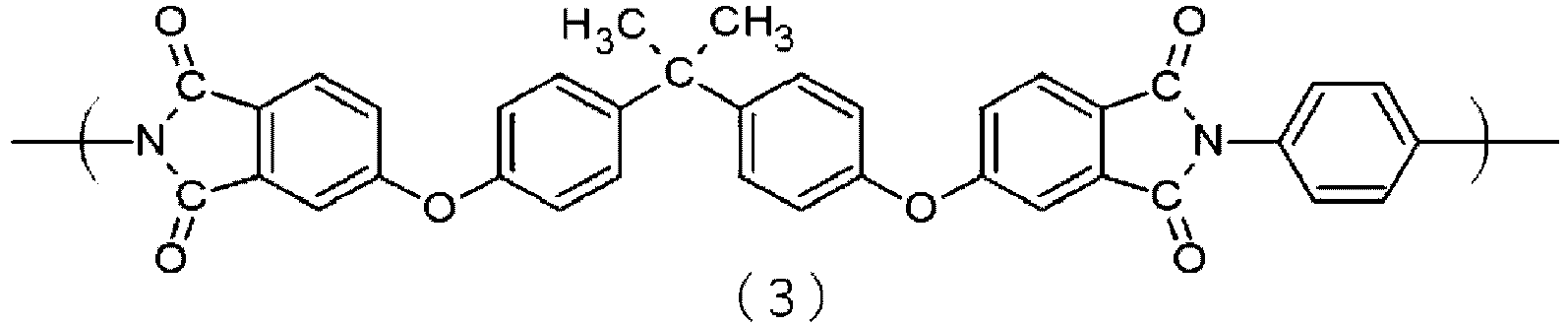
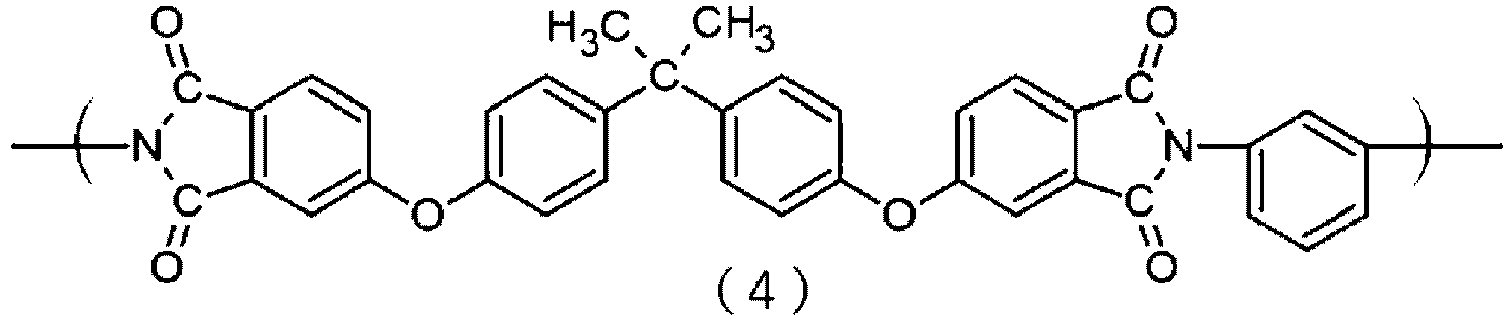
- To the extent that the properties thereof are not impaired, the matrix resin may be blended as appropriate with various additives other than other resins and inorganic fillers, such as heat stabilizers, UV absorbers, light stabilizers, nucleating agents, colorants, lubricants, and flame retardants. In addition, as the mixing method of the various additives, it is possible to use known methods.
- A prepreg is obtained by impregnating a reinforcing fiber substrate with a matrix resin and examples of the forms thereof include a UD prepreg, a cross prepreg, a sheet molding compound, and the like. It is possible to make a prepreg into a molded article by forming and molding a laminate laminated at various angles according to the application. Examples of laminate configurations include unidirectional materials, orthogonal lamination, and quasi-isotropic lamination. In order to mold complex shapes with high precision, it is possible to make the prepreg into a cut prepreg by carrying out a cutting process or into a random sheet with rectangular-shaped or parallelogram-shaped chopped strands in which the chopped strands are isotropically or anisotropically dispersed at random. It is possible to improve the adhesive strength of the bonding portion of the bonded body, for example, by adjusting the contact angle of the bonding portion in the combinations of prepreg and prepreg, prepreg and molded article, and molded article and molded article.
- The molding method is not particularly limited and it is possible to laminate one or a plurality of sheets of prepreg and carry out the molding using a metal mold press method, an autoclave method, a hot or cold press method, an automatic laminating method utilizing robots, or the like.
- Examples of surface modification methods using a surface treatment include wet treatments and dry treatments. A wet treatment is a modification method in which reaction products are deposited on the surface of the substrate by various chemical reactions in a liquid phase and examples thereof include treatments with an aqueous solution and the like. Examples of dry treatments include corona treatment, flame treatment, and plasma treatment. A corona treatment is a treatment that irradiates a corona discharge and enables high-speed treatment. A flame treatment uses a flame to enable treatment without tracing the unevenness of products with three-dimensional unevenness. A plasma treatment is a treatment of a region close to the surface of the material surface layer for which a drying step is not necessary and therefore there is less damage to the material and it is a method which enables treatment with compact equipment.
- A plasma treatment is a treatment which modifies the surface state by reacting oxygen radicals and nitrogen radicals generated by dry air entering a plasma state through discharge energy with the fiber-reinforced composite material surface. Due to this, it is possible to decrease the contact angle with water. Examples of plasma treatments include the method described below. The fiber-reinforced composite material which is the target to be surface-modified is fixed on a movable pedestal. A plasma irradiation nozzle is installed within the movable range of the pedestal and fixed at a position separated from the surface of fiber-reinforced composite material by 1 to 500 mm. By running the power to generate the plasma, the surface of the fiber-reinforced composite material is irradiated with the plasma discharged from the injection holes of the plasma irradiation nozzle while the movable pedestal on which the fiber-reinforced composite material is fixed is moved at a speed of 1 mm/sec to 500 mm/sec. It is possible to modify the surface by setting the temperature near the plasma irradiation nozzle injection holes to 100°C to 500°C and carrying out irradiation for 0.002 to 500 seconds. The closer the separation distance between the injection holes of the plasma irradiation nozzle and the fiber-reinforced composite material and the slower the movement speed of the pedestal, the stronger the surface modification. The farther the separation distance between the injection holes of the plasma irradiation nozzle and the fiber-reinforced composite material and the faster the movement speed of the pedestal, the weaker the surface modification effect.
- It is possible to use adhesives to bond fiber-reinforced composite materials to other parts. The adhesive is preferably at least one selected from epoxy-based adhesives, urethane-based adhesives, and acrylic-based adhesives and, epoxy-based adhesives are more preferable. In addition, the form of the adhesive to be used may be solution-based or film-based and film-based adhesives are preferable from the viewpoint that adhesion is possible with high positional accuracy. The thickness of the introduced adhesive layer is not particularly restricted, but is preferably 0.01 to 30 mm.
- The bonded body is preferably a bonded body between the part 1 formed of a fiber-reinforced composite article including carbon fibers and thermoplastic resin and the part 2, the bonded body including a bonding portion where the part 1 and the part 2 are bonded via an adhesive, in which at least a part of the fracture surface at the bonding portion after tensile testing of the bonded body is a cohesion failure of the adhesive. It is possible for the fiber-reinforced composite article to be a material forming a fiber-reinforced composite material as described previously. Cohesion failure means a failure occurring inside the visible apparently layer. It is possible for the part 1 to be the fiber-reinforced composite material described previously. For example, cohesion failure of the adhesive occurs after tensile testing in a case of a bonded body where the part 1, which was surface modified by the plasma treatment described above, and the part 2, which may be identical to the part 1, are bonded via an adhesive. Examples of the material of the part 2 include a fiber-reinforced composite article, a resin material, or a metal material. Epoxy-based adhesives are preferably used when the part 2 is formed of metal material, urethane-based adhesives are preferably used when part 2 is formed of a fiber-reinforced composite article, and acrylic-based adhesives are preferably used when the part 2 is formed of a resin material. From the viewpoint of further improving adhesion to the surface-modified part 1, a plasma treatment may be carried out on the part 2 before bonding to the part 1. As another form, it is possible to have a bonded body between the part 1 formed of a fiber-reinforced composite article including carbon fibers and thermoplastic resin and the part 2, the bonded body including a bonding portion where the part 1 and the part 2 are bonded via an epoxy-based adhesive, in which an adhesive strength at the bonding portion is 25 MPa or higher. It is possible to measure the adhesive strength by tensile testing. From the viewpoint of the strength of the entire bonded body, an adhesive strength of 28 MPa or higher is preferable. It is possible for the adhesive strength to be 100 MPa or less.
- The cohesion failure ratio of an adhesive after tensile testing in accordance with JISK 6850 is the ratio of failure within the adhesive with respect to the total adhesive area. A higher cohesion failure ratio means a greater ratio of the adhesive which fails within the adhesive, and it shows that the adhesive function of the adhesive is able to be expressed. Even when incorporated into a structural body such as a car or aircraft, it is possible to prevent the bonding portion from failing due to external impacts. It is possible to obtain the cohesion failure ratio by calculating the area ratio by observation with the naked eye or microscopic observation or by calculating the area ratio by image processing. The cohesion failure ratio in the adhesive, which is calculated by photographing the fracture surface after tensile testing and binarizing the photographed image using image processing software, is preferably 10% or more, more preferably 50% or more, and even more preferably 70% or more.
- Below, Examples will be illustrated and a more detailed description will be given of embodiments of the present invention, but the present invention is not limited by the following Examples.
- In the Present Example, a fiber-reinforced thermoplastic resin prepreg was used in which a thermoplastic resin composition in which a PEEK resin, which is a polyaryl ketone resin, (trade name "VESTAKEEP (registered trademark) 3300G manufactured by Polyplastics-Evonik Corporation", MVR; set temperature: 380°C, load: 5 kg at 20 cm3/10 min, having a structure represented by Formula (1), in which m, n, and o are 0), and a polyetherimide resin (trade name "Ultem (registered trademark) CRS5011" manufactured by Sabic, MVR; set temperature: 360°C, load: 5 kg at 20 cm3/10 min, having a structure represented by Formula (3)) were mixed to have a predetermined mass ratio was heated, melted, and impregnated into a carbon fiber sheet in which carbon fibers (trade name "MR50R" manufactured by Mitsubishi Chemical Corporation, 570 tex, 12,000 strands) were oriented in one direction.
- A laminate was produced such that a fiber-reinforced thermoplastic resin prepreg with a mass ratio of PEEK resin to polyetherimide resin of 90:10 was cut to a size of 178 mm × 328 mm and a suitable thickness and laminate configuration were set for each test item. The laminate was arranged in a metal mold made of steel, the metal mold including the laminate was preheated to 340°C in approximately 10 minutes in a pressing device set at 380°C in a heated and cooled two-stage press (50-ton press, manufactured by Shinto Metal Industries, Ltd.), then, compression molding was performed for 30 minutes under molding conditions of 5 MPa. Thereafter, the metal mold was transported to a press board adjusted to a temperature of 80°C and the temperature was lowered to 200°C in approximately 2 minutes to obtain a 180 mm × 330 mm molded plate formed of a fiber-reinforced composite article. The 90° bending strength was 138 MPa, the CAI was 334 MPa, G1c was 1.6 kJ/m2, G2c was 1.7 kJ/m2, and Tg (DMA, E'-onset) was 166°C. The measurements were carried out as follows.
- Molded products obtained by laminating prepregs in one direction at 0° so as to have a thickness of approximately 2 mm were cut to dimensions of a length (orthogonal direction to the fibers) of 50 mm × a width (parallel direction to the fibers) of 12.7 mm to produce test pieces (2 mm thickness).
- A three-point bending test was performed by a method in accordance with ASTM D790 to measure the 90° bending strength.
- The prepregs were laminated [+45°/0°/-45°/90°]3s and the obtained molded products were subjected to a test under impact conditions of an impact energy of 6.7 J/mm in accordance with SACMA SRM 2R using an instrumented falling weight impact tester. The compressive strength after the impact test (CAI strength) was measured.
- A molded plate of approximately 3 mm thickness was obtained by laminating the prepreg in one direction at 0° and partially inserting a polyimide film of approximately 10 µm thickness in the central portion of the thickness. A mode I interlaminar failure toughness value (G1c) was measured by a test method in accordance with ASTM D5528. A mode II interlaminar failure toughness value (G2c) was measured from the molded plates by a test method in accordance with BMS 8-276.
- Molded products obtained by laminating prepregs in one direction at 0° so as to have a thickness of approximately 2 mm were cut to dimensions of a length (parallel direction to the fibers) of 55 mm × a width (orthogonal direction to the fibers) of 12.7 mm to produce test pieces (2 mm thickness). The glass transition temperature, which indicates heat resistance, was measured by a method in accordance with ASTM D7028.
- Molded plates formed of the fiber-reinforced composite article described above were cut into test pieces with a size of 100 mm × 25 mm and subjected to a plasma treatment. As an atmospheric pressure plasma irradiation apparatus, a plasma generator "FG5001" (manufactured by Plasmatreat GmbH) and a plasma nozzle "RD1004" (manufactured by Plasmatreat GmbH) were used.
- The test piece was arranged on a movable stage, the distance from the test piece to the plasma nozzle (irradiation height) was 5 mm, the movement speed of the stage on which the test piece was arranged (substrate movement speed) was 25 mm/sec, a treatment was performed on the surface of the test piece, and a surface-modified test piece was obtained.
- Using a portable contact angle meter PCA-11 (manufactured by Kyowa Interface Science Co., Ltd.) in accordance with JISR3257, the contact angle with water was measured on the surface of the surface-modified test piece by dropping a water droplet of approximately 1.0 µL thereon and measuring the contact angle using the θ/2 method after 0.01 seconds of liquid deposition. The contact angle with water was 27.3°.
- An epoxy-based adhesive FM-300-2 (manufactured by SOLVAY) was applied to the portion (A) of the two surface-modified test pieces with a contact angle of 60° or less, so as to be 25 mm wide and 12.5 mm long, and heat-cured in a curing oven at 120°C for 60 minutes to obtain a molded plate bonded body formed of a fiber-reinforced composite article.
- In accordance with JISK 6850, the molded plate bonded body formed of the fiber-reinforced composite article was subjected to tensile testing under conditions of 5 mm/min using an Instron 4482 (manufactured by Instron Corporation) and the adhesive strength thereof was measured. The adhesive strength was 29.6 MPa. In addition, the following formula was used to calculate the adhesive strength. Adhesive strength [MPa] = load at bonded body fracture [N]/adhesive area [mm2]
- After the tensile testing, the fracture surface was photographed and the photographed image was binarized using Image J image processing software to calculate the cohesion failure ratio at the adhesive. The following formula was used to calculate the cohesion failure ratio.

- The contact angle with water, the tensile shear force, and the cohesion failure ratio were measured in the same manner as in Example 1 except that the plasma treatment conditions were set to an irradiation height of 5 mm and a substrate movement speed of 5 mm/sec. The properties of the molded plate formed of the fiber-reinforced composite article before plasma treatment are the same as in Example 1.
- The contact angle with water, the tensile shear force, and the cohesion failure ratio were measured in the same manner as in Example 1 except that different plasma treatments were carried out with respect to two test pieces, with an irradiation height of 5 mm and a substrate movement speed of 25 mm/sec and with an irradiation height of 10 mm and a substrate movement speed of 100 mm/sec, respectively, and storage was carried out in air for one week before sticking the adhesive and carrying out heating and curing. The properties of the molded plate formed of the fiber-reinforced composite article before plasma treatment are the same as in Example 1.
- The contact angles with water immediately after plasma treatment were 18.7° at an irradiation height of 5 mm and a substrate movement speed of 25 mm/sec and 38.1° at an irradiation height of 10 mm and a substrate movement speed of 100 mm/sec and the contact angles after being stored for one week in air were 46.4° and 50.6°, respectively. The contact angle with water of the molded plate formed of a fiber-reinforced composite article was set to 48.5°, which was the average of the above.
- The contact angle with water, the tensile shear force, and the cohesion failure ratio were measured in the same manner as in Example 1 except that the blending ratio of the PEEK resin to the polyetherimide resin was changed to 80:20. The 90° bending strength of the molded plate formed of a fiber-reinforced composite article was 107 MPa, CAI was 329 MPa, G1c was 1.2 kJ/m2, G2c was 1.5 kJ/m2, and Tg (DMA, E'-onset) was 164°C.
- The contact angle with water, the tensile shear force, and the cohesion failure ratio were measured in the same manner as in Example 4 except that the plasma treatment conditions were set to an irradiation height of 10 mm and a substrate movement speed of 100 mm/sec and storage was carried out in air for one week before sticking the adhesive and carrying out heating and curing. The contact angle with water immediately after plasma treatment was 35.2° and the contact angles after one week of storage in air were 50.3° and 51.5°, respectively. The contact angle with water of the molded plate formed of fiber-reinforced composite article was 50.9°, which was the average of the above. The properties of the molded plate formed of the fiber-reinforced composite article before plasma treatment are the same as in Example 4.
- The contact angle with water, the tensile shear force, and the cohesion failure ratio were measured in the same manner as in Example 1 except that the blending ratio of the PEEK resin to the polyetherimide resin was changed to 94:6. The 90° bending strength of the molded plate formed of fiber-reinforced composite article was 168 MPa, CAI was 355 MPa, G1c was 1.4 kJ/m2, G2c was 1.8 kJ/m2, and Tg (DMA, E'-onset) was 164°C.
- The contact angle with water, the tensile shear force, and the cohesion failure ratio were measured in the same manner as in Example 1 except that the blending ratio of the PEEK resin to the polyetherimide resin was changed to 60:40. The 90° bending strength of the molded plate formed of a fiber-reinforced composite article was 105 MPa, CAI was 310 MPa, G1c was 1.3 kJ/m2, G2c was 1.1 kJ/m2, and Tg (DMA, E'-onset) was 172°C.
- The contact angle with water, the tensile shear force, and the cohesion failure ratio were measured in the same manner as in Example 1 except that the PEEK resin was changed to PEEK resin ZV7402 (manufactured by Polyplastics-Evonik Corporation), no polyetherimide resin was mixed therein, and a plasma treatment was not performed. The 90° bending strength of the molded plate formed of a fiber-reinforced composite article was 87 MPa, CAI was 262 MPa, and Tg (DMA, E'-onset) was 145°C.
- The contact angle with water, the tensile shear force, and the cohesion failure ratio were measured in the same manner as in Comparative Example 1 except that the plasma treatment conditions were set to an irradiation height of 5 mm and a substrate movement speed of 5 mm/sec. The properties of the molded plate formed of the fiber-reinforced composite article before plasma treatment are the same as in Comparative Example 1.
- The contact angle with water, the tensile shear force, and the cohesion failure ratio were measured in the same manner as in Example 1 except that a plasma treatment was not performed. The properties of the molded plate formed of the fiber-reinforced composite article before plasma treatment are the same as in Example 1.
- The contact angle with water, the tensile shear force, and the cohesion failure ratio were measured in the same manner as in Example 4 except that a plasma treatment was not performed. The properties of the molded plate formed of the fiber-reinforced composite article before plasma treatment are the same as in Example 4.
- The contact angle with water, the tensile shear force, and the cohesion failure ratio were measured in the same manner as in Example 1 except that the PEI resin was changed to Ultem 1000 (manufactured by SABle), no PEEK resin was mixed therein, and a plasma treatment was not performed. The 90° bending strength of the molded plate formed of a fiber-reinforced composite article was 104 MPa, CAI was 296 MPa, G1c was 0.84 kJ/m2, G2c was 1.1 kJ/m2, and Tg (DMA, E'-onset) was 212°C.
- The contact angle with water, the tensile shear force, and the cohesion failure ratio were measured in the same manner as in Comparative Example 5 except that a plasma treatment was not performed. The properties of the molded plate formed of the fiber-reinforced composite article before plasma treatment are the same as in Comparative Example 5.
- The evaluation results of Examples 1 to 7 and Comparative Examples 1 to 6 are shown in Table 1 and Table 2.
- As shown in Tables 1 and 2, for the form of the Examples, by suitably carrying out a plasma treatment on the fiber-reinforced composite material, the contact angle was reduced and, in tensile testing, cohesion failure within the adhesive was confirmed.
- Comparative Examples 1, 3, and 4 had an interface failure between the fiber-reinforced composite material and the adhesive. In addition, in Comparative Example 2, the contact angle was reduced by carrying out a plasma treatment, but there was an interface failure and no improvement in adhesive strength was seen.
[Table 1] Example 1 Example 2 Example 3 Example 4 Example 5 Example 6 Example 7 Substrate PEEK 90 90 90 80 80 94 60 PEI 10 10 10 20 20 6 40 Contact angle with water 27.3 9.6 48.5 42.8 50.9 11.9 21.1 Cohesion failure ratio [%] 75.8 100 82.2 82.2 73 97.5 100 Adhesive strength [MPa] 29.6 36.4 26.3 27 26.2 30 36.8 [Table 2] Comparative Example 1 Comparative Example 2 Comparative Example 3 Comparative Example 4 Comparative Example 5 Comparative Example 6 Substrate PEEK 100 100 90 80 0 0 PEI 0 0 10 20 100 100 Contact angle with water 93.4 33.4 87.2 87.9 92.6 11.4 Cohesion failure ratio [%] 0 0 0 0 0 20 Adhesive strength [MPa] 1.3 9.1 6.3 11.3 3.9 16.5 - It is considered that hydrophilizing the fiber-reinforced composite material surface by a plasma treatment increases the affinity thereof with the adhesive. Increasing the affinity between the adherend and the adhesive makes it possible to develop stable adhesive strength and is thus a useful method for part design. By setting the surface of a fiber-reinforced composite material in which a specific combination of resins is blended to a specific contact angle, it is possible to improve the adhesive strength and to manufacture a bonded body with superior adhesive strength even with materials including polyaryl ketone resins, which are difficult to adhere to other parts.
- According to an aspect of the present invention, it is possible to provide a fiber-reinforced composite material with surface properties suitable for bonding. In addition, in particular, it is possible to provide a fiber-reinforced composite material with excellent adhesion to adherends of a fiber-reinforced composite article, a resin material, and a metal material, as well as a strongly adhered bonded body.
Claims (20)
- A fiber-reinforced composite material comprising:a matrix resin; andreinforcing fibers,wherein the matrix resin includes a polyaryl ketone resin and a resin having a nitrogen atom in a repeating structural unit, and a surface of the fiber-reinforced composite material includes a portion in which a contact angle with water measured in accordance with JISR 3257 is 60° or less.
- The fiber-reinforced composite material according to Claim 1,
wherein the resin having a nitrogen atom in a repeating structural unit comprises a polyetherimide resin. - The fiber-reinforced composite material according to Claim 1 or 2,
wherein the polyaryl ketone resin comprises a polyether ether ketone resin. - The fiber-reinforced composite material according to any one of Claims 1 to 3,
wherein the contact angle is 35° of less. - The fiber-reinforced composite material according to any one of Claims 1 to 4,
wherein a ratio of the polyaryl ketone resin to the resin having a nitrogen atom in a repeating structural unit is 4 or more and 32 or less as a mass ratio (polyaryl ketone resin/resin having a nitrogen atom in a repeating structural unit). - The fiber-reinforced composite material according to any one of Claims 1 to 5,
wherein a CAI strength of the fiber-reinforced composite material is 300 MPa or higher, G1c and G2c are each 1.0 kJ/m2 or more, and Tg is 150°C or higher. - The fiber-reinforced composite material according to any one of Claims 1 to 6,
wherein the reinforcing fibers comprise carbon fibers. - The fiber-reinforced composite material according to any one of Claims 1 to 7,
wherein the fiber-reinforced composite material is a molded article. - A bonded body between a part 1 and a part 2, wherein the part 1 is formed of a fiber-reinforced composite article including carbon fibers and thermoplastic resin, the bonded body comprising:a bonding portion where the part 1 and the part 2 are bonded via an adhesive,wherein at least a part of a fracture surface at the bonding portion of the bonded body after tensile testing in accordance with JISK 6850 is a cohesion failure of the adhesive.
- The bonded body according to Claim 9,
wherein the part 2 is formed of metal. - The bonded body according to Claim 10,
wherein the bonding portion includes an epoxy-based adhesive. - The bonded body according to Claim 9,
wherein the part 2 is formed of a fiber-reinforced composite article. - The bonded body according to Claim 12,
wherein the bonding portion includes a urethane-based adhesive. - The bonded body according to Claim 9,
wherein the part 2 is formed of a resin material. - The bonded body according to Claim 14,
wherein the bonding portion includes an acrylic-based adhesive. - The bonded body according to any one of Claims 9 to 15,
wherein the thermoplastic resin includes a polyaryl ketone resin. - A method for manufacturing a fiber-reinforced composite material including a polyaryl ketone resin, a polyetherimide resin, and reinforcing fibers, the method comprising:
carrying out a plasma treatment on a surface of the fiber-reinforced composite material. - The method for manufacturing a fiber-reinforced composite material according to Claim 17,
wherein, in the plasma treatment, at least a part of the surface of the fiber-reinforced composite material is irradiated with plasma such that a contact angle with water is 60° or less. - A bonded body between a part 1 and a part 2 formed of a fiber-reinforced composite article including carbon fibers and thermoplastic resin, the bonded body comprising:a bonding portion where the part 1 and the part 2 are bonded via an epoxy-based adhesive,wherein an adhesive strength at the bonding portion is 25 MPa or higher.
- A bonded body between a part 1 and a part 2 formed of a fiber-reinforced composite article including carbon fibers and thermoplastic resin, the bonded body comprising:a bonding portion where the part 1 and the part 2 are bonded via an adhesive,wherein a cohesion failure ratio of a fracture surface at the bonding portion of the bonded body after tensile testing in accordance with JISK 6850 is 70% or more.
Applications Claiming Priority (2)
| Application Number | Priority Date | Filing Date | Title |
|---|---|---|---|
| JP2020052238 | 2020-03-24 | ||
| PCT/JP2021/011938 WO2021193609A1 (en) | 2020-03-24 | 2021-03-23 | Fiber-reinforced composite material and bonded body |
Publications (2)
| Publication Number | Publication Date |
|---|---|
| EP4130106A1 true EP4130106A1 (en) | 2023-02-08 |
| EP4130106A4 EP4130106A4 (en) | 2023-12-13 |
Family
ID=77890420
Family Applications (1)
| Application Number | Title | Priority Date | Filing Date |
|---|---|---|---|
| EP21774740.1A Withdrawn EP4130106A4 (en) | 2020-03-24 | 2021-03-23 | FIBER REINFORCED COMPOSITE AND JOINED BODY |
Country Status (4)
| Country | Link |
|---|---|
| US (1) | US20230040679A1 (en) |
| EP (1) | EP4130106A4 (en) |
| JP (1) | JPWO2021193609A1 (en) |
| WO (1) | WO2021193609A1 (en) |
Families Citing this family (3)
| Publication number | Priority date | Publication date | Assignee | Title |
|---|---|---|---|---|
| US20250188219A1 (en) * | 2021-11-02 | 2025-06-12 | Idemitsu Kosan Co.,Ltd. | Aromatic polyether, composition, film, powder, pellets, composite material production method, and composite material |
| EP4428175A4 (en) * | 2021-11-02 | 2025-11-12 | Idemitsu Kosan Co | Aromatic polyester, composition, film, powder, pellets, process for producing a composite and composite |
| JPWO2024024870A1 (en) * | 2022-07-28 | 2024-02-01 |
Family Cites Families (17)
| Publication number | Priority date | Publication date | Assignee | Title |
|---|---|---|---|---|
| GB8617990D0 (en) * | 1986-07-23 | 1986-10-01 | Ici Plc | Coated conductor |
| JPH0642302A (en) * | 1992-07-23 | 1994-02-15 | Nissan Motor Co Ltd | Fiber reinforced resin-made impeller |
| JP3803241B2 (en) * | 2000-11-09 | 2006-08-02 | 三菱樹脂株式会社 | Method of joining heat-resistant resin molded body and metal body and joined body |
| JP4073631B2 (en) * | 2001-01-22 | 2008-04-09 | 三菱樹脂株式会社 | Polyarylketone resin film and metal laminate using the same |
| CN100415831C (en) * | 2002-08-07 | 2008-09-03 | 三菱树脂株式会社 | Thin films and their metal laminates |
| JP4701735B2 (en) * | 2004-07-09 | 2011-06-15 | 株式会社豊田自動織機 | Sliding member |
| MX381931B (en) * | 2012-10-18 | 2025-03-13 | Cytec Ind Inc | SURFACE ENGINEERING OF THERMOPLASTIC MATERIALS AND TOOLS. |
| CN105849199A (en) * | 2013-10-24 | 2016-08-10 | 索尔维特殊聚合物美国有限责任公司 | Articles resistant to friction and wear |
| JP6492997B2 (en) * | 2015-06-15 | 2019-04-03 | 日産自動車株式会社 | Adhesive structure |
| JP2017052127A (en) * | 2015-09-08 | 2017-03-16 | 三菱レイヨン株式会社 | Resin member and method for manufacturing the same, and joined body and method for manufacturing the same |
| JP6798109B2 (en) * | 2016-01-21 | 2020-12-09 | 横浜ゴム株式会社 | Method of surface treatment of members and method of manufacturing laminated members |
| WO2017186926A1 (en) * | 2016-04-29 | 2017-11-02 | Solvay Specialty Polymers Usa, Llc | Compatibilized polymer compositions |
| JP2018069658A (en) * | 2016-11-02 | 2018-05-10 | 日産自動車株式会社 | Adhesion structure and bonding method |
| JP6683993B2 (en) | 2017-05-08 | 2020-04-22 | 学校法人金沢工業大学 | Method for manufacturing bonded products |
| JP7173124B2 (en) * | 2018-02-27 | 2022-11-16 | 三菱ケミカル株式会社 | Fiber-reinforced thermoplastic resin prepreg and molding |
| JP2020006587A (en) * | 2018-07-09 | 2020-01-16 | トヨタ自動車株式会社 | Joint and its manufacturing method |
| JP2020052238A (en) | 2018-09-27 | 2020-04-02 | アルプスアルパイン株式会社 | Lens drive device, camera module, and method of manufacturing lens drive device |
-
2021
- 2021-03-23 JP JP2022510530A patent/JPWO2021193609A1/ja active Pending
- 2021-03-23 WO PCT/JP2021/011938 patent/WO2021193609A1/en not_active Ceased
- 2021-03-23 EP EP21774740.1A patent/EP4130106A4/en not_active Withdrawn
-
2022
- 2022-09-20 US US17/933,511 patent/US20230040679A1/en not_active Abandoned
Also Published As
| Publication number | Publication date |
|---|---|
| JPWO2021193609A1 (en) | 2021-09-30 |
| EP4130106A4 (en) | 2023-12-13 |
| US20230040679A1 (en) | 2023-02-09 |
| WO2021193609A1 (en) | 2021-09-30 |
Similar Documents
| Publication | Publication Date | Title |
|---|---|---|
| JP7566726B2 (en) | Resin composition, cured molded product, fiber-reinforced plastic molding material, fiber-reinforced plastic, fiber-reinforced plastic laminate molded product, and method for producing same | |
| US20230040679A1 (en) | Fiber-reinforced composite material and bonded body | |
| US5268223A (en) | Toughened fiber-reinforced composites | |
| Sheinbaum et al. | Toughening and enhancing mechanical and thermal properties of adhesives and glass-fiber reinforced epoxy composites by brominated epoxy | |
| CN102099402B (en) | Structural composites with improved toughness | |
| EP3760666B1 (en) | Fiber-reinforced thermoplastic resin prepreg and shaped article | |
| WO2014050896A1 (en) | Prepreg and method for producing same | |
| KR20170116251A (en) | Thermosetting resin composition, method for producing resin composition varnish, prepreg and laminate | |
| EP3341194B1 (en) | Composite material and resin composition containing metastable particles | |
| EP3321297B1 (en) | Resin composition, prepreg or resin sheet comprising the resin composition, and laminate and printed circuit board comprising them | |
| CN104974521B (en) | Prepreg, carbon fiber reinforced composite material and manipulator | |
| JP2008523171A (en) | Nanoparticulate silica filled benzoxazine composition | |
| EP3889207B1 (en) | Thermosetting resin composition, film adhesive, prepreg, and production method thereof | |
| EP3233960B1 (en) | Epoxy-based resin composition for composite materials | |
| JP2014114368A (en) | Thermosetting bismaleimide-based resin composition and prepreg, and method for producing the same | |
| JP7190258B2 (en) | Epoxy resin composition, prepreg, and fiber reinforced composite | |
| TW202033659A (en) | Resin composition, fiber-reinforced plastic molding material, and molded article | |
| EP3730552B1 (en) | Thermosetting resin composition | |
| JP4940680B2 (en) | Resin composition and prepreg and laminate using the same | |
| WO2017222339A1 (en) | Epoxy resin composition for fiber-reinforced composite material, and prepreg using same | |
| CA2044787A1 (en) | Fiber-reinforced composites toughened with porous resin particles | |
| JP7781259B2 (en) | Thermosetting prepreg and its manufacturing method | |
| EP3689947A1 (en) | Thermosetting resin composition for fiber-reinforced composite material, preform, fiber-reinforced composite material, and method for producing fiber-reinforced composite material | |
| JP4344662B2 (en) | Epoxy resin composition, prepreg and molded body, and method for producing epoxy resin composition | |
| KR20260045878A (en) | Epoxy resin composition, epoxy resin cured product, prepreg, fiber reinforced composite material, method for restoring an epoxy resin cured product, method for restoring a fiber reinforced composite material, method for reshaping an epoxy resin cured product, method for reshaping a fiber reinforced composite material, method for decomposing an epoxy resin cured product, and method for recovering reinforcing fibers of a fiber reinforced composite material |
Legal Events
| Date | Code | Title | Description |
|---|---|---|---|
| STAA | Information on the status of an ep patent application or granted ep patent |
Free format text: STATUS: THE INTERNATIONAL PUBLICATION HAS BEEN MADE |
|
| PUAI | Public reference made under article 153(3) epc to a published international application that has entered the european phase |
Free format text: ORIGINAL CODE: 0009012 |
|
| STAA | Information on the status of an ep patent application or granted ep patent |
Free format text: STATUS: REQUEST FOR EXAMINATION WAS MADE |
|
| 17P | Request for examination filed |
Effective date: 20220919 |
|
| AK | Designated contracting states |
Kind code of ref document: A1 Designated state(s): AL AT BE BG CH CY CZ DE DK EE ES FI FR GB GR HR HU IE IS IT LI LT LU LV MC MK MT NL NO PL PT RO RS SE SI SK SM TR |
|
| DAV | Request for validation of the european patent (deleted) | ||
| DAX | Request for extension of the european patent (deleted) | ||
| RIC1 | Information provided on ipc code assigned before grant |
Ipc: B29K 105/06 20060101ALI20230804BHEP Ipc: C08J 7/00 20060101ALI20230804BHEP Ipc: C08J 5/12 20060101ALI20230804BHEP Ipc: B29C 65/54 20060101ALI20230804BHEP Ipc: C08J 5/04 20060101AFI20230804BHEP |
|
| A4 | Supplementary search report drawn up and despatched |
Effective date: 20231114 |
|
| RIC1 | Information provided on ipc code assigned before grant |
Ipc: B29K 105/06 20060101ALI20231108BHEP Ipc: C08J 7/00 20060101ALI20231108BHEP Ipc: C08J 5/12 20060101ALI20231108BHEP Ipc: B29C 65/54 20060101ALI20231108BHEP Ipc: C08J 5/04 20060101AFI20231108BHEP |
|
| STAA | Information on the status of an ep patent application or granted ep patent |
Free format text: STATUS: THE APPLICATION IS DEEMED TO BE WITHDRAWN |
|
| 18D | Application deemed to be withdrawn |
Effective date: 20240604 |