EP4128403B1 - A solution of tempo-derivatives for use as electrolyte in redox-flow cells - Google Patents
A solution of tempo-derivatives for use as electrolyte in redox-flow cells Download PDFInfo
- Publication number
- EP4128403B1 EP4128403B1 EP21712195.3A EP21712195A EP4128403B1 EP 4128403 B1 EP4128403 B1 EP 4128403B1 EP 21712195 A EP21712195 A EP 21712195A EP 4128403 B1 EP4128403 B1 EP 4128403B1
- Authority
- EP
- European Patent Office
- Prior art keywords
- solution
- formula
- compound
- range
- redox
- Prior art date
- Legal status (The legal status is an assumption and is not a legal conclusion. Google has not performed a legal analysis and makes no representation as to the accuracy of the status listed.)
- Active
Links
Images

Classifications
-
- C—CHEMISTRY; METALLURGY
- C07—ORGANIC CHEMISTRY
- C07D—HETEROCYCLIC COMPOUNDS
- C07D211/00—Heterocyclic compounds containing hydrogenated pyridine rings, not condensed with other rings
- C07D211/04—Heterocyclic compounds containing hydrogenated pyridine rings, not condensed with other rings with only hydrogen or carbon atoms directly attached to the ring nitrogen atom
- C07D211/06—Heterocyclic compounds containing hydrogenated pyridine rings, not condensed with other rings with only hydrogen or carbon atoms directly attached to the ring nitrogen atom having no double bonds between ring members or between ring members and non-ring members
- C07D211/36—Heterocyclic compounds containing hydrogenated pyridine rings, not condensed with other rings with only hydrogen or carbon atoms directly attached to the ring nitrogen atom having no double bonds between ring members or between ring members and non-ring members with hetero atoms or with carbon atoms having three bonds to hetero atoms with at the most one bond to halogen, e.g. ester or nitrile radicals, directly attached to ring carbon atoms
- C07D211/56—Nitrogen atoms
- C07D211/58—Nitrogen atoms attached in position 4
-
- H—ELECTRICITY
- H01—ELECTRIC ELEMENTS
- H01M—PROCESSES OR MEANS, e.g. BATTERIES, FOR THE DIRECT CONVERSION OF CHEMICAL ENERGY INTO ELECTRICAL ENERGY
- H01M8/00—Fuel cells; Manufacture thereof
- H01M8/18—Regenerative fuel cells, e.g. redox flow batteries or secondary fuel cells
- H01M8/184—Regeneration by electrochemical means
- H01M8/188—Regeneration by electrochemical means by recharging of redox couples containing fluids; Redox flow type batteries
-
- C—CHEMISTRY; METALLURGY
- C07—ORGANIC CHEMISTRY
- C07D—HETEROCYCLIC COMPOUNDS
- C07D211/00—Heterocyclic compounds containing hydrogenated pyridine rings, not condensed with other rings
- C07D211/92—Heterocyclic compounds containing hydrogenated pyridine rings, not condensed with other rings with a hetero atom directly attached to the ring nitrogen atom
- C07D211/94—Oxygen atom, e.g. piperidine N-oxide
-
- H—ELECTRICITY
- H01—ELECTRIC ELEMENTS
- H01M—PROCESSES OR MEANS, e.g. BATTERIES, FOR THE DIRECT CONVERSION OF CHEMICAL ENERGY INTO ELECTRICAL ENERGY
- H01M8/00—Fuel cells; Manufacture thereof
- H01M8/08—Fuel cells with aqueous electrolytes
-
- H—ELECTRICITY
- H01—ELECTRIC ELEMENTS
- H01M—PROCESSES OR MEANS, e.g. BATTERIES, FOR THE DIRECT CONVERSION OF CHEMICAL ENERGY INTO ELECTRICAL ENERGY
- H01M2300/00—Electrolytes
- H01M2300/0002—Aqueous electrolytes
- H01M2300/0005—Acid electrolytes
-
- Y—GENERAL TAGGING OF NEW TECHNOLOGICAL DEVELOPMENTS; GENERAL TAGGING OF CROSS-SECTIONAL TECHNOLOGIES SPANNING OVER SEVERAL SECTIONS OF THE IPC; TECHNICAL SUBJECTS COVERED BY FORMER USPC CROSS-REFERENCE ART COLLECTIONS [XRACs] AND DIGESTS
- Y02—TECHNOLOGIES OR APPLICATIONS FOR MITIGATION OR ADAPTATION AGAINST CLIMATE CHANGE
- Y02E—REDUCTION OF GREENHOUSE GAS [GHG] EMISSIONS, RELATED TO ENERGY GENERATION, TRANSMISSION OR DISTRIBUTION
- Y02E60/00—Enabling technologies; Technologies with a potential or indirect contribution to GHG emissions mitigation
- Y02E60/30—Hydrogen technology
- Y02E60/50—Fuel cells
-
- Y—GENERAL TAGGING OF NEW TECHNOLOGICAL DEVELOPMENTS; GENERAL TAGGING OF CROSS-SECTIONAL TECHNOLOGIES SPANNING OVER SEVERAL SECTIONS OF THE IPC; TECHNICAL SUBJECTS COVERED BY FORMER USPC CROSS-REFERENCE ART COLLECTIONS [XRACs] AND DIGESTS
- Y02—TECHNOLOGIES OR APPLICATIONS FOR MITIGATION OR ADAPTATION AGAINST CLIMATE CHANGE
- Y02P—CLIMATE CHANGE MITIGATION TECHNOLOGIES IN THE PRODUCTION OR PROCESSING OF GOODS
- Y02P70/00—Climate change mitigation technologies in the production process for final industrial or consumer products
- Y02P70/50—Manufacturing or production processes characterised by the final manufactured product
Definitions
- the present invention relates to a solution comprising water and different 2,2,6,6-tetramethyl-piperidinyl-oxyl (TEMPO)-derivates, a process for the production of this solution, a process for making a redox-flow cell comprising the solution as electrolyte, the redox-flow cell comprising the solution as an electrolyte in one chamber of the cell and the use of the redox-flow cell for storing electrical energy.
- TEMPO 2,2,6,6-tetramethyl-piperidinyl-oxyl
- redox-flow cells with new organic compounds as redox couple comprising 2,2,6,6-tetramethylpiperidinyl-oxyl (TEMPO)-derivates with redox active potential separated from each other by using a membrane which selects the molecules by size might be an easy and inexpensive way to provide a long-living redox-flow cell which will not have a negative impact on the environment as it is described in WO 2014/26728 .
- TEMPO 2,2,6,6-tetramethylpiperidinyl-oxyl
- WO2018/028830 describes a process of the production of 4-ammonium-2,2,6,6-tetraalkylpiperidinyl salts as typical TEMPO-derivates which are such redox active compounds that are normally used in the cathode chamber of a redox-flow cell. It is disclosed that for the production of these compounds 3 different production ways are possible. Starting products are always solutions of either 4-oxo-alkylpiperidine, the corresponding imine or 4-amino-alkylpiperidine dissolved in different kinds of organic aprotic solvents like alcohols, ethers, nitriles, halogenated hydrocarbons, aromatic hydrocarbons, aliphatic hydrocarbons or mixtures of them.
- an aprotic organic solvent in the production process will require at least one solvent change because an aqueous solution is preferred as the electrolyte in the redox-flow cell.
- the aqueous solution is advantageous as water cannot be easily oxidized or reduced in the redox-flow cell, it is not flammable and therefore safer to handle than an organic solvent, it is not toxic and very inexpensive and easily available.
- Another object of the present invention is to provide a redox-flow cell comprising an aqueous solution of TEMPO-derivates that shows similar or identical properties for storing energy as the redox-flow cell comprising an aqueous solution of 2,2,6,6-tetramethyl-1-piperidinyloxy-4-trimethylammonium chloride described in the state of the art.
- the inventive solution will be advantageous if the alkali metal cation is Na.
- the inventive solution will be advantageous if the pH-value is in the range of 2 to 7.
- the inventive solution will be advantageous if the sum of the amounts of the compounds of formula (I), (II), (III) plus the amount of alkali metal cations in the solution is in the range of 20 to 50 wt.-% according to the total weight amount of the solution.
- the inventive solution will be advantageous if at least 90 mol% of the counterions are chloride ions.
- step i) of the process the compound of formula (IV) is reacted with methyl chloride and water at a temperature in the range of 0 to 60°C.
- step i) of the process the compound of formula (IV) is reacted with 0.7 to 1.2 equivalents of methyl chloride in the presence of water and the mass ratio between compound of formula (IV) in the feed mixture and water is in the range of 0.1 to 5.
- step ii) of the process the resulting mixture of step i) is reacted with an aqueous hydrogen peroxide solution in the presence of the catalyst at a temperature in the range of 20 to 80°C wherein the pH-value during the addition of the aqueous hydrogen peroxide solution is maintained between 7 and 10.
- step ii) of the process 1.5 to 5 mol of aqueous hydrogen peroxide having a concentration in the range of 25 to 70 wt.-% are used per mol of compound of formula (IV) in the feed mixture and the reaction is performed in the presence of 0.005 to 0.4 mol of the catalyst per mol of compound of formula (IV) in the feed mixture.
- step iii) starts when the concentration of hydrogen peroxide in the mixture of step ii) has decreased to less than 0.5 wt.-%.
- step iii) is hydrogen chloride.
- a further embodiment of the invention is a process for making a redox-flow cell wherein the inventive solution is used as electrolyte in one of the two chambers of the cell.
- a further embodiment of the invention is a redox-flow cell obtained by the inventive process for making a redox-flow cell.
- a further embodiment of the invention is the use of the inventive redox flow cell for storing electrical energy.
- the inventive solution comprising water, 20 to 55 wt.-% according to the total weight amount of the solution of compound 2,2,6,6-tetramethyl-4-(trimethylammonio)-1-piperidinyloxy of formula (I), 0.1 to 6 wt.-% according to the total weight amount of the solution of an alkali metal cation, 0.5 to 12.5 wt.-% according to the total weight amount of the solution of compound N,N,N,1,2,2,6,6-octamethyl-4-piperidinammonium-1-oxide of formula (II) and 0.1 to 20 wt.-% according to the total weight amount of the solution of compound 2,2,6,6-hexamethyl-4-(dimethylamino)-1-piperidinyloxy-N-oxide of formula (III).
- the compound of formula (I) is preferably the main compound according to all compounds of formula (I), (II), (III) and the alkali metal cation in the inventive solution.
- the amount of compound of formula (I) in the inventive solution is in the range of 20 to 55 wt.-%, particular in the range from 35 to 50 wt.-%, more preferably in the range of 40 to 45 wt.-% according to the total amount of the solution.
- the inventive solution also comprises alkali metal cations.
- these alkali metal cations are selected from the group of Na and K, more preferably is Na the alkali metal cation.
- the amount of the alkali metal cation in the inventive solution is preferably in the range of 0.1 to 6 wt.-%, particular in the range from 0.3 to 3.0 wt.-%, more preferably in the range of 0.5 to 1.7 wt.-% according to the total amount of the solution.
- the compound of formula (II) is one resulting from the oxidation of one of the two byproducts formed by methylation of the starting compound of formula (IV) in the inventive process.
- the amount of compound of formula (II) in the inventive solution is in the range from 0.5 to 12.5 wt.-%, particular in the range of 0.5 to 5.0 wt.-%, more preferably in the range of 2.0 to 3.0 wt.-% according to the total amount of the solution.
- the compound of formula (III) is the other or second resulting from the oxidation of one of the two byproducts formed by methylation of the starting compound of formula (IV) in the inventive process.
- the amount of compound of formula (III) in the inventive solution is in the range of 0.1 to 20 wt.-%, particularly in the range from 0.1 to 5.0 wt.-%, more preferably in the range of 0.1 to 1.5 wt.-% according to the total amount of the solution.
- the sum of all amounts of compounds of formula (I), (II), (III) and the alkali metal cation is preferably in range from 20 to 50 wt.-%, particular in the range from 30 to 50 wt.-%, more preferably in the range from 40 to 50 wt.-% according to the total amount of the solution.
- the amount of water in the inventive solution is preferably in the range from 35 to 75 wt.-% particularly in the range from 45 to 70 wt.-%, more preferably in the range from 50 to 60 wt.-% according to the total amount of the solution.
- the pH-value of the inventive solution is in the range of 2 to 7, particularly in the range of 3 to 5, more preferably in the range of 4 to 5.
- the anions present as counterions for the cationic species are selected from the group of chloride, fluoride, perchlorate, sulfate, alkylsulfonate, arylsulfonate, phosphate, alkylphosphonate, arylphosphonate and nitrate or mixtures thereof.
- the anions are selected from the group of chloride, nitrate, sulfate and perchlorate, more preferably the anion is chloride.
- the chloride anions are the most preferred ones, they should account for at least 90 mol% of the total anions, preferably at least 95 mol% of all the anions and more preferably more than 99 mol% of all the anions in the inventive solution.
- inventive solution is obtained by the inventive process.
- inventive process comprising the following steps:
- the compound of formula (IV) is dissolved in water.
- the mass ratio between the compound of formula (IV) in the feed mixture and water is in the range from 0.1 to 5, particularly in the range from 0.3 to 2, more preferably in the range from 0.7 to 1.2.
- the starting compound of formula (IV) dissolved in water is methylated with methyl chloride.
- the aqueous solution of compound of formula (IV) is methylated with 0.7 to 1.2 mol, particularly 0.9 to 1.2 mol, more preferably with 1.0 to 1.1 mol methyl chloride per mol of compound of formula (IV) in the feed mixture.
- the phrase "of compound of formula (IV) in the feed mixture” shall mean the amount of compound of formula (IV) that is dissolved in water in step i) at the beginning and not the amount of compound of formula (IV) that still remains in the solution after methylation in step i).
- the temperature of the reaction is preferably in the range of 0 to 60°C, particularly in the range from 0 to 40°C, more preferably between 15 to 25°C.
- the temperature can be controlled by external heating, cooling or by slowly adding the methyl chloride to the aqueous solution of compound of formula (IV) so that the temperature will not rise above 60°C.
- Preferred is the slow addition of methyl chloride and the use of external cooling so that the temperature does not rise above 60°C.
- the resulting mixture of step i) of the inventive process comprises water, the compounds of formula (V), (VI) and unreacted compound of formula (IV).
- This resulting aqueous mixture of step i) reacts with an aqueous hydrogen peroxide solution and an alkali metal catalyst selected from the group of alkali metal carbonate, alkali metal hydrogen carbonate, CO 2 and mixtures of those in step ii) of the inventive process.
- an alkali metal catalyst selected from the group of Na 2 CO 3 , K 2 CO 3 , NaHCOs, KHCOs, CO 2 and mixture of those, particularly the catalyst is selected from the group of Na 2 CO 3 and NaHCOs, more preferably NaHCOs is used as catalyst.
- the mixtures of the selected catalysts are selected from the group of Na 2 CO 3 with NaHCOs, K 2 CO 3 with KHCOs, Na 2 CO 3 with KHCOs, K 2 CO 3 with NaHCOs, Na 2 CO 3 with CO 2 , K 2 CO 3 with CO 2 , NaHCOs with CO 2 and KHCOs with CO 2 .
- a preferred mixture is selected from the group of NaHCOs and Na 2 CO 3 .
- the amount of catalyst used in step ii) of the inventive process is preferably in the range from 0.005 to 0.4 mol, particular in the range from 0.01 to 0.2 mol, more preferably in the range from 0.02 to 0.1 mol per mol of compound of formula (IV) in the feed mixture used in step i) of the inventive process.
- Step ii) of the inventive process is an oxidation step wherein the compounds of formula (IV), (V) and (VI) are oxidized to the compounds of formula (I), (II) and (III). Therefore, the resulting aqueous mixture of step i) reacts preferably with 1.5 to 5 mol, particular with 1.5 to 3 mol, more preferably with 1.7 to 2.3 mol of an aqueous hydrogen peroxide solution per mol of the compound of formula (IV) in the feed mixture used in step i) of the inventive process and in the presence of the catalyst.
- the concentration of the aqueous hydrogen peroxide solution used in step ii) of the inventive process is in the range from 25 to 70 wt.-%, particularly 30 to 70 wt.-%, more preferably 45 to 70 wt.-% of hydrogen peroxide.
- step ii) of the inventive process is preferably in the range from 20 to 80°C, particularly in the range from 40 to 60°C, more preferably in the range from 50 to 60°C.
- the pH-value of the reaction solution in step ii) of the inventive process is preferably in the range from 7 to 10, particularly in the range from 8 to 10, more preferably in the range from 8 to 9.
- the regulation of the pH-value during the oxidation in step ii) of the inventive step will be done by adding an acid or base.
- the acid for the regulation of the pH-value in step ii) of the inventive process is selected from the group of hydrogen chloride, perchloric acid, sulfuric acid, phosphoric acid, nitric acid, methanesulfonic acid, para-toluenesulfonic acid, methylphosphonic acid or phenylphosphonic acid.
- Preferred acids are hydrogen chloride, sulfuric acid, nitric acid and perchloric acid. More preferred is hydrogen chloride.
- Hydrogen chloride can be added as a gas or in form of an aqueous solution.
- an aqueous solution of hydrogen chloride commonly known as hydrochloric acid is used.
- the base for regulation of the pH-value in step ii) of the inventive process is selected from the group of NaOH, and KOH, more preferred is NaOH.
- a base preferably NaOH, to keep the pH-value in the range of 7 to 10 during oxidation, is preferred.
- step ii) of the inventive process After finishing the addition of the aqueous hydrogen peroxide solution the resulting mixture of step ii) of the inventive process will be stirred at the condition of step ii), which means around 60°C and a pH-value in the range von 7 to 10, until the concentration of hydrogen peroxide in this solution is less than 0.5 wt.-%.
- the amount of hydrogen peroxide remaining is determined by cerimetric titration of the solution before and after catalytic decomposition of hydrogen peroxide with manganese dioxide. The difference between the two titration values is used to calculate the residual amount of hydrogen peroxide.
- the pH-value of this solution will be adjusted in step iii) of the inventive process by adding an acid.
- the pH-value after the addition of acid is in the range from 2 to 7, particular in the range from 3 to 5, more preferably in the range from 4 to 5.
- the acid used for decreasing the pH-value is selected from the group of hydrogen chloride, perchloric acid, sulfuric acid, phosphoric acid, nitric acid and methanesulfonic acid.
- Preferred acids are hydrogen chloride, sulfuric acid, nitric acid and perchloric acid. More preferred is hydrogen chloride used as gas or in an aqueous solution known as hydrochloric acid.
- step iv) of the inventive process the amount of water is reduced in step iv) of the inventive process.
- the amount of water that is distilled off depends on the desired final concentration of compound of formula (I) in the final solution. Water must be distilled off until the resulting solution shows a content of compound of formula (I) in the range of 20 to 55 wt.-%, preferably in the range from 25 to 50 wt.-%, particular in the range from 35 to 50 wt.-%, more preferably in the range from 40 to 45 wt.-% according to the total weight amount of the solution.
- the distillation will be done at a pressure in the range of 0.02 to 1.0 bar and a temperature in the range of 20 to 100°C, particular at a pressure in the range of 0.05 to 0.3 bar and a temperature in the range of 30 to 70°C, more preferably at a pressure in the range of 0.08 to 0.2 bar and a temperature in the range of 58 to 62°C.
- the inventive solution obtained can be used without further treatment as an electrolyte in a redox-flow cell.
- the inventive solution is used as catholyte in such a redox-flow cell.
- the redox-flow cell is normally built up by using two chambers for catholyte and anolyte solution each connected via a pump to a storage tank for catholyte and anolyte solution respectively. Both chambers are separated by an ion-conducting membrane and equipped with electrodes.
- the inventive solution In the cathode chamber and the connected storage tank of the cathode the inventive solution is filled.
- the electrolyte for the anode is filled.
- the redox active compounds in the redox-flow cell change during charging and discharging between their different redox levels.
- For discharging the electrolyte has to be pumped from the storage tank to the electrode while for charging the inverse process is used. Therefore, the redox-flow cell comprising the inventive solution as electrolyte is an easy and multifunctional way to storage electrical energy for different applications.
- Cerimetric redox titration is used to determine the total content of hydrogen peroxide and N-oxyl species (compound of formula (I) and (III)) according to the following method: Content of N-oxyl species: 100 mg of manganese dioxide is added to _pprox.. 1 g of analyte. The mixture is stirred at 20 to 25 °C for 5 minutes or until 5 minutes after the end of gas evolution. Then the analyte is filtered. 250 ⁇ 2 mg of filtered analyte is placed in a beaker equipped with a magnetic stirring bar and is diluted with 45 mL purified water and 5 mL dilute sulfuric acid (10 wt.-% in water).
- the obtained solution is placed on an automated titration device (905 Titrando, Metrohm) equipped with a Pt-Titrode (Metrohm) and is stirred at 20 - 25 °C.
- Cerium (IV) sulfate solution (0.10 mol/L) is added via the titration device until a redox potential jump is detected (V C1 ).
- the concentration of the sum of compound of formula (I) + (III) in weight-%, W I+III can then be calculated from the consumption of cerium (IV) sulfate solution using the following equation:
- M H2O2 is 34.0 g/mol, the molar mass of hydrogen peroxide.
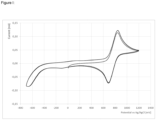
- IPS potentiostat
- the molar ratio of compound of formula (IV) : (V) : (VI) as determined by 1 H-NMR is 2.5 : 92.8 : 4.7, which corresponds to 1.0 wt.-% of compound of formula (IV), 46.5 wt.-% of compound of formula (V) chloride salt and 2.5 wt.-% of compound of formula (VI) chloride salt.
- example 1 contains 1.0 wt.-% of compound of formula (IV), 46.5 wt.-% of compound of formula (V) chloride salt and 2.5 wt.-% of compound of formula (VI) chloride salt in water) 37 wt.-% hydrochloric acid (1.67 g) is added, whereby the pH value of the solution decreases to 9.0. Then, solid sodium bicarbonate (2.79 g) is added and the mixture is heated to 60°C. When the temperature is reached a 50 wt.-% aqueous solution of hydrogen peroxide (32.7 g) is continuously added over a period of 4 hours.
- the molar ratio of compound of formula (I) : (II): (III) as determined by 1 H-NMR is 93.0 : 4.7 : 2.3, which corresponds to 45.0 wt.-% of compound of formula (I) chloride salt, 2.4 wt.-% of compound of formula (II) chloride salt and 1.0 wt.-% of compound of formula (III).
- example 1 contains 1.0 wt.-% of compound of formula (IV), 46.5 wt.-% of compound of formula (V) chloride salt and 2.5 wt.-% of compound of formula (VI) chloride salt in water) 37 wt.-% hydrochloric acid (5.83 g) is added, whereby the pH value of the solution decreases to 8.5. Then, solid sodium carbonate (1.17 g) is added and the mixture is heated to 40°C. When the temperature is reached, a 50 wt.-% aqueous solution of hydrogen peroxide (32.7 g) is continuously added over a period of 6 hours.
- the molar ratio of compound of formula (I) : (II): (III) as determined by 1 H-NMR is 93.1 : 4.8 : 2.1 which corresponds to 47.1 wt.-% of compound of formula (I) chloride salt, 2.6 wt.-% of compound of formula (II) chloride salt and 0.9 wt.-% of compound of formula (III).
- Example 5 (comparative): The oxidation was performed as described in the WO 2018/028830 , page 28, line 20 to page 29 line 22. In HRMS of the product obtained no signals for compound of formula (II) and (Illa) / (IIIb) are visible; in 1 H-NMR of the reduced samples only signals for compound of formula (la/lb) are visible.
Landscapes
- Chemical & Material Sciences (AREA)
- Organic Chemistry (AREA)
- Life Sciences & Earth Sciences (AREA)
- Engineering & Computer Science (AREA)
- Manufacturing & Machinery (AREA)
- Sustainable Development (AREA)
- Sustainable Energy (AREA)
- Chemical Kinetics & Catalysis (AREA)
- Electrochemistry (AREA)
- General Chemical & Material Sciences (AREA)
- Organic Low-Molecular-Weight Compounds And Preparation Thereof (AREA)
- Fuel Cell (AREA)
Applications Claiming Priority (2)
| Application Number | Priority Date | Filing Date | Title |
|---|---|---|---|
| EP20167458 | 2020-04-01 | ||
| PCT/EP2021/057182 WO2021197877A1 (en) | 2020-04-01 | 2021-03-22 | A solution of tempo-derivatives for use as electrolyte in redox-flow cells |
Publications (2)
| Publication Number | Publication Date |
|---|---|
| EP4128403A1 EP4128403A1 (en) | 2023-02-08 |
| EP4128403B1 true EP4128403B1 (en) | 2024-05-08 |
Family
ID=70154236
Family Applications (1)
| Application Number | Title | Priority Date | Filing Date |
|---|---|---|---|
| EP21712195.3A Active EP4128403B1 (en) | 2020-04-01 | 2021-03-22 | A solution of tempo-derivatives for use as electrolyte in redox-flow cells |
Country Status (8)
| Country | Link |
|---|---|
| US (1) | US20230150938A1 (pl) |
| EP (1) | EP4128403B1 (pl) |
| JP (1) | JP7766613B2 (pl) |
| KR (1) | KR20220160642A (pl) |
| CN (1) | CN115280561B (pl) |
| HU (1) | HUE067238T2 (pl) |
| PL (1) | PL4128403T3 (pl) |
| WO (1) | WO2021197877A1 (pl) |
Families Citing this family (2)
| Publication number | Priority date | Publication date | Assignee | Title |
|---|---|---|---|---|
| EP4320665A1 (en) | 2021-04-07 | 2024-02-14 | Basf Se | A solution of alkylated piperidinamine- and piperidinaminium-derivates for the production of a purified solution of tempo-derivates for the use as electrolyte in redox-flow cells |
| CN116190739A (zh) * | 2023-03-15 | 2023-05-30 | 宿迁时代储能科技有限公司 | 一种水系有机液流电池的正极电解液及其应用 |
Family Cites Families (15)
| Publication number | Priority date | Publication date | Assignee | Title |
|---|---|---|---|---|
| DE4219471A1 (de) * | 1992-06-13 | 1993-12-16 | Huels Chemische Werke Ag | N-Oxyl-Derivate des 2,2,6,6-Tetramethylpiperidins und deren Herstellung |
| US5654434A (en) * | 1995-11-09 | 1997-08-05 | Ciba-Geigy Corporation | Hydrogen peroxide oxidation of 4-hydroxy-2, 2, 6, 6-tetramethylpiperidine |
| JP4456730B2 (ja) * | 2000-06-06 | 2010-04-28 | 株式会社日本触媒 | (メタ)アクリル酸またはそのエステルの重合防止方法ならびにこれらの製造方法 |
| DE102009032548A1 (de) * | 2009-07-10 | 2011-02-10 | Icfs Gmbh | Verfahren zur Herstellung von Acetylendicarboxamidiniumsalzen(Bis-amidiniumsalzen der Acetylendicarbonsäure) |
| DE102012016317A1 (de) | 2012-08-14 | 2014-02-20 | Jenabatteries GmbH | Redox-Flow-Zelle zur Speicherung elektrischer Energie |
| CN103254121B (zh) * | 2013-04-08 | 2015-08-26 | 洛阳师范学院 | 一种合成(3r,4r)-n-pg-4-甲基-3-甲胺基哌啶的方法 |
| US9793566B2 (en) * | 2015-04-17 | 2017-10-17 | Battelle Memorial Institute | Aqueous electrolytes for redox flow battery systems |
| DE102015010083A1 (de) * | 2015-08-07 | 2017-02-09 | Friedrich-Schiller-Universität Jena | Redox-Flow-Zelle zur Speicherung elektrischer Energie und deren Verwendung |
| DE102015014828A1 (de) * | 2015-11-18 | 2017-05-18 | Friedrich-Schiller-Universität Jena | Hybrid-Flow-Zelle zur Speicherung elektrischer Energie und deren Verwendung |
| KR102050837B1 (ko) * | 2016-02-03 | 2019-12-03 | 주식회사 엘지화학 | 리튬-설퍼 전지용 전해액 및 이를 포함하는 리튬-설퍼 전지 |
| KR20170096641A (ko) * | 2016-02-16 | 2017-08-25 | 동국대학교 산학협력단 | 첨가제를 포함하는 바나듐 레독스 흐름 전지용 양극 전해질 제조방법 및 이를 포함하는 바나듐 레독스 흐름 전지 |
| DE102016005680A1 (de) * | 2016-05-06 | 2016-12-15 | Daimler Ag | Anolyt und Katholyt für einen Redox-Fluss-Energiespeicher |
| DE102016009904A1 (de) * | 2016-08-12 | 2018-02-15 | Friedrich-Schiller-Universität Jena | Verfahren zur Herstellung von 4-Ammonium-2,2,6,6-tetraalkylpiperidinylsalzen |
| CN109180564B (zh) * | 2018-09-20 | 2021-08-27 | 丽水绿氟科技有限公司 | 一种哌啶及其衍生物的制备方法 |
| CN110444787A (zh) * | 2019-08-22 | 2019-11-12 | 中盐金坛盐化有限责任公司 | 基于氨基蒽醌衍生物的液流电池系统 |
-
2021
- 2021-03-22 WO PCT/EP2021/057182 patent/WO2021197877A1/en not_active Ceased
- 2021-03-22 CN CN202180019590.0A patent/CN115280561B/zh active Active
- 2021-03-22 PL PL21712195.3T patent/PL4128403T3/pl unknown
- 2021-03-22 HU HUE21712195A patent/HUE067238T2/hu unknown
- 2021-03-22 JP JP2022559971A patent/JP7766613B2/ja active Active
- 2021-03-22 US US17/915,116 patent/US20230150938A1/en active Pending
- 2021-03-22 EP EP21712195.3A patent/EP4128403B1/en active Active
- 2021-03-22 KR KR1020227037568A patent/KR20220160642A/ko active Pending
Also Published As
| Publication number | Publication date |
|---|---|
| CN115280561A (zh) | 2022-11-01 |
| WO2021197877A1 (en) | 2021-10-07 |
| HUE067238T2 (hu) | 2024-10-28 |
| JP7766613B2 (ja) | 2025-11-10 |
| PL4128403T3 (pl) | 2024-09-16 |
| KR20220160642A (ko) | 2022-12-06 |
| EP4128403A1 (en) | 2023-02-08 |
| JP2023521636A (ja) | 2023-05-25 |
| US20230150938A1 (en) | 2023-05-18 |
| CN115280561B (zh) | 2024-12-10 |
Similar Documents
| Publication | Publication Date | Title |
|---|---|---|
| EP2144848B1 (en) | Use of an aqueous hydrogen peroxide solution | |
| EP4128403B1 (en) | A solution of tempo-derivatives for use as electrolyte in redox-flow cells | |
| AU2002365547C1 (en) | Electrochemical process for producing ionic liquids | |
| US4432902A (en) | Method for synthesizing HMX | |
| US4578161A (en) | Process for preparing quaternary ammonium hydroxides by electrolysis | |
| EP4128404B1 (en) | A solution of tempo-derivatives for use as electrolyte in redox-flow cells | |
| Raoult et al. | Use of ion exchange membranes in preparative organic electrochemistry. L Anodic methoxylation of some olefins | |
| US7713401B2 (en) | Methods for performing electrochemical nitration reactions | |
| US7052593B2 (en) | Process for the production of diaryl iodonium compounds | |
| JP6180718B2 (ja) | ヨウ化リチウム水溶液の製造方法及びその利用 | |
| JP2011016782A (ja) | グリコール酸の製造方法、及びグリコール酸含有組成物 | |
| JP2024513096A (ja) | レドックスフロー電池内の電解液として使用するためのtempo誘導体の精製溶液を製造するための、アルキル化ピペリジンアミン誘導体及びピペリジンアミニウム誘導体の溶液 | |
| EP4193004B1 (en) | Method for preparing 3-hydroxy-3-methylbutyric acid (hmb) or salts thereof | |
| Kimura et al. | Electrooxidative c s cleavages as a neutral deprotectioh for carboxylic acids | |
| WO2025027071A1 (en) | Manufacture of polyhydroxylamine via electrolysis of substrates | |
| JP2749919B2 (ja) | スクアリン酸の製法 |
Legal Events
| Date | Code | Title | Description |
|---|---|---|---|
| STAA | Information on the status of an ep patent application or granted ep patent |
Free format text: STATUS: UNKNOWN |
|
| STAA | Information on the status of an ep patent application or granted ep patent |
Free format text: STATUS: THE INTERNATIONAL PUBLICATION HAS BEEN MADE |
|
| PUAI | Public reference made under article 153(3) epc to a published international application that has entered the european phase |
Free format text: ORIGINAL CODE: 0009012 |
|
| STAA | Information on the status of an ep patent application or granted ep patent |
Free format text: STATUS: REQUEST FOR EXAMINATION WAS MADE |
|
| 17P | Request for examination filed |
Effective date: 20221102 |
|
| AK | Designated contracting states |
Kind code of ref document: A1 Designated state(s): AL AT BE BG CH CY CZ DE DK EE ES FI FR GB GR HR HU IE IS IT LI LT LU LV MC MK MT NL NO PL PT RO RS SE SI SK SM TR |
|
| DAV | Request for validation of the european patent (deleted) | ||
| DAX | Request for extension of the european patent (deleted) | ||
| GRAP | Despatch of communication of intention to grant a patent |
Free format text: ORIGINAL CODE: EPIDOSNIGR1 |
|
| STAA | Information on the status of an ep patent application or granted ep patent |
Free format text: STATUS: GRANT OF PATENT IS INTENDED |
|
| INTG | Intention to grant announced |
Effective date: 20231130 |
|
| GRAJ | Information related to disapproval of communication of intention to grant by the applicant or resumption of examination proceedings by the epo deleted |
Free format text: ORIGINAL CODE: EPIDOSDIGR1 |
|
| STAA | Information on the status of an ep patent application or granted ep patent |
Free format text: STATUS: REQUEST FOR EXAMINATION WAS MADE |
|
| GRAP | Despatch of communication of intention to grant a patent |
Free format text: ORIGINAL CODE: EPIDOSNIGR1 |
|
| STAA | Information on the status of an ep patent application or granted ep patent |
Free format text: STATUS: GRANT OF PATENT IS INTENDED |
|
| INTC | Intention to grant announced (deleted) | ||
| GRAS | Grant fee paid |
Free format text: ORIGINAL CODE: EPIDOSNIGR3 |
|
| INTG | Intention to grant announced |
Effective date: 20240212 |
|
| GRAA | (expected) grant |
Free format text: ORIGINAL CODE: 0009210 |
|
| STAA | Information on the status of an ep patent application or granted ep patent |
Free format text: STATUS: THE PATENT HAS BEEN GRANTED |
|
| AK | Designated contracting states |
Kind code of ref document: B1 Designated state(s): AL AT BE BG CH CY CZ DE DK EE ES FI FR GB GR HR HU IE IS IT LI LT LU LV MC MK MT NL NO PL PT RO RS SE SI SK SM TR |
|
| REG | Reference to a national code |
Ref country code: GB Ref legal event code: FG4D |
|
| REG | Reference to a national code |
Ref country code: CH Ref legal event code: EP |
|
| REG | Reference to a national code |
Ref country code: DE Ref legal event code: R096 Ref document number: 602021013045 Country of ref document: DE |
|
| REG | Reference to a national code |
Ref country code: IE Ref legal event code: FG4D |
|
| REG | Reference to a national code |
Ref country code: LT Ref legal event code: MG9D |
|
| REG | Reference to a national code |
Ref country code: NL Ref legal event code: MP Effective date: 20240508 |
|
| PG25 | Lapsed in a contracting state [announced via postgrant information from national office to epo] |
Ref country code: IS Free format text: LAPSE BECAUSE OF FAILURE TO SUBMIT A TRANSLATION OF THE DESCRIPTION OR TO PAY THE FEE WITHIN THE PRESCRIBED TIME-LIMIT Effective date: 20240908 |
|
| PG25 | Lapsed in a contracting state [announced via postgrant information from national office to epo] |
Ref country code: BG Free format text: LAPSE BECAUSE OF FAILURE TO SUBMIT A TRANSLATION OF THE DESCRIPTION OR TO PAY THE FEE WITHIN THE PRESCRIBED TIME-LIMIT Effective date: 20240508 |
|
| PG25 | Lapsed in a contracting state [announced via postgrant information from national office to epo] |
Ref country code: FI Free format text: LAPSE BECAUSE OF FAILURE TO SUBMIT A TRANSLATION OF THE DESCRIPTION OR TO PAY THE FEE WITHIN THE PRESCRIBED TIME-LIMIT Effective date: 20240508 Ref country code: HR Free format text: LAPSE BECAUSE OF FAILURE TO SUBMIT A TRANSLATION OF THE DESCRIPTION OR TO PAY THE FEE WITHIN THE PRESCRIBED TIME-LIMIT Effective date: 20240508 |
|
| PG25 | Lapsed in a contracting state [announced via postgrant information from national office to epo] |
Ref country code: GR Free format text: LAPSE BECAUSE OF FAILURE TO SUBMIT A TRANSLATION OF THE DESCRIPTION OR TO PAY THE FEE WITHIN THE PRESCRIBED TIME-LIMIT Effective date: 20240809 |
|
| PG25 | Lapsed in a contracting state [announced via postgrant information from national office to epo] |
Ref country code: PT Free format text: LAPSE BECAUSE OF FAILURE TO SUBMIT A TRANSLATION OF THE DESCRIPTION OR TO PAY THE FEE WITHIN THE PRESCRIBED TIME-LIMIT Effective date: 20240909 |
|
| REG | Reference to a national code |
Ref country code: AT Ref legal event code: MK05 Ref document number: 1685765 Country of ref document: AT Kind code of ref document: T Effective date: 20240508 |
|
| PG25 | Lapsed in a contracting state [announced via postgrant information from national office to epo] |
Ref country code: NL Free format text: LAPSE BECAUSE OF FAILURE TO SUBMIT A TRANSLATION OF THE DESCRIPTION OR TO PAY THE FEE WITHIN THE PRESCRIBED TIME-LIMIT Effective date: 20240508 |
|
| PG25 | Lapsed in a contracting state [announced via postgrant information from national office to epo] |
Ref country code: ES Free format text: LAPSE BECAUSE OF FAILURE TO SUBMIT A TRANSLATION OF THE DESCRIPTION OR TO PAY THE FEE WITHIN THE PRESCRIBED TIME-LIMIT Effective date: 20240508 |
|
| PG25 | Lapsed in a contracting state [announced via postgrant information from national office to epo] |
Ref country code: AT Free format text: LAPSE BECAUSE OF FAILURE TO SUBMIT A TRANSLATION OF THE DESCRIPTION OR TO PAY THE FEE WITHIN THE PRESCRIBED TIME-LIMIT Effective date: 20240508 |
|
| REG | Reference to a national code |
Ref country code: HU Ref legal event code: AG4A Ref document number: E067238 Country of ref document: HU |
|
| PG25 | Lapsed in a contracting state [announced via postgrant information from national office to epo] |
Ref country code: LV Free format text: LAPSE BECAUSE OF FAILURE TO SUBMIT A TRANSLATION OF THE DESCRIPTION OR TO PAY THE FEE WITHIN THE PRESCRIBED TIME-LIMIT Effective date: 20240508 |
|
| PG25 | Lapsed in a contracting state [announced via postgrant information from national office to epo] |
Ref country code: PT Free format text: LAPSE BECAUSE OF FAILURE TO SUBMIT A TRANSLATION OF THE DESCRIPTION OR TO PAY THE FEE WITHIN THE PRESCRIBED TIME-LIMIT Effective date: 20240909 Ref country code: NO Free format text: LAPSE BECAUSE OF FAILURE TO SUBMIT A TRANSLATION OF THE DESCRIPTION OR TO PAY THE FEE WITHIN THE PRESCRIBED TIME-LIMIT Effective date: 20240808 Ref country code: NL Free format text: LAPSE BECAUSE OF FAILURE TO SUBMIT A TRANSLATION OF THE DESCRIPTION OR TO PAY THE FEE WITHIN THE PRESCRIBED TIME-LIMIT Effective date: 20240508 Ref country code: LV Free format text: LAPSE BECAUSE OF FAILURE TO SUBMIT A TRANSLATION OF THE DESCRIPTION OR TO PAY THE FEE WITHIN THE PRESCRIBED TIME-LIMIT Effective date: 20240508 Ref country code: IS Free format text: LAPSE BECAUSE OF FAILURE TO SUBMIT A TRANSLATION OF THE DESCRIPTION OR TO PAY THE FEE WITHIN THE PRESCRIBED TIME-LIMIT Effective date: 20240908 Ref country code: HR Free format text: LAPSE BECAUSE OF FAILURE TO SUBMIT A TRANSLATION OF THE DESCRIPTION OR TO PAY THE FEE WITHIN THE PRESCRIBED TIME-LIMIT Effective date: 20240508 Ref country code: GR Free format text: LAPSE BECAUSE OF FAILURE TO SUBMIT A TRANSLATION OF THE DESCRIPTION OR TO PAY THE FEE WITHIN THE PRESCRIBED TIME-LIMIT Effective date: 20240809 Ref country code: FI Free format text: LAPSE BECAUSE OF FAILURE TO SUBMIT A TRANSLATION OF THE DESCRIPTION OR TO PAY THE FEE WITHIN THE PRESCRIBED TIME-LIMIT Effective date: 20240508 Ref country code: ES Free format text: LAPSE BECAUSE OF FAILURE TO SUBMIT A TRANSLATION OF THE DESCRIPTION OR TO PAY THE FEE WITHIN THE PRESCRIBED TIME-LIMIT Effective date: 20240508 Ref country code: BG Free format text: LAPSE BECAUSE OF FAILURE TO SUBMIT A TRANSLATION OF THE DESCRIPTION OR TO PAY THE FEE WITHIN THE PRESCRIBED TIME-LIMIT Effective date: 20240508 Ref country code: AT Free format text: LAPSE BECAUSE OF FAILURE TO SUBMIT A TRANSLATION OF THE DESCRIPTION OR TO PAY THE FEE WITHIN THE PRESCRIBED TIME-LIMIT Effective date: 20240508 Ref country code: RS Free format text: LAPSE BECAUSE OF FAILURE TO SUBMIT A TRANSLATION OF THE DESCRIPTION OR TO PAY THE FEE WITHIN THE PRESCRIBED TIME-LIMIT Effective date: 20240808 |
|
| PG25 | Lapsed in a contracting state [announced via postgrant information from national office to epo] |
Ref country code: DK Free format text: LAPSE BECAUSE OF FAILURE TO SUBMIT A TRANSLATION OF THE DESCRIPTION OR TO PAY THE FEE WITHIN THE PRESCRIBED TIME-LIMIT Effective date: 20240508 |
|
| PG25 | Lapsed in a contracting state [announced via postgrant information from national office to epo] |
Ref country code: EE Free format text: LAPSE BECAUSE OF FAILURE TO SUBMIT A TRANSLATION OF THE DESCRIPTION OR TO PAY THE FEE WITHIN THE PRESCRIBED TIME-LIMIT Effective date: 20240508 |
|
| PG25 | Lapsed in a contracting state [announced via postgrant information from national office to epo] |
Ref country code: CZ Free format text: LAPSE BECAUSE OF FAILURE TO SUBMIT A TRANSLATION OF THE DESCRIPTION OR TO PAY THE FEE WITHIN THE PRESCRIBED TIME-LIMIT Effective date: 20240508 |
|
| PG25 | Lapsed in a contracting state [announced via postgrant information from national office to epo] |
Ref country code: SK Free format text: LAPSE BECAUSE OF FAILURE TO SUBMIT A TRANSLATION OF THE DESCRIPTION OR TO PAY THE FEE WITHIN THE PRESCRIBED TIME-LIMIT Effective date: 20240508 Ref country code: RO Free format text: LAPSE BECAUSE OF FAILURE TO SUBMIT A TRANSLATION OF THE DESCRIPTION OR TO PAY THE FEE WITHIN THE PRESCRIBED TIME-LIMIT Effective date: 20240508 |
|
| PG25 | Lapsed in a contracting state [announced via postgrant information from national office to epo] |
Ref country code: SM Free format text: LAPSE BECAUSE OF FAILURE TO SUBMIT A TRANSLATION OF THE DESCRIPTION OR TO PAY THE FEE WITHIN THE PRESCRIBED TIME-LIMIT Effective date: 20240508 |
|
| PG25 | Lapsed in a contracting state [announced via postgrant information from national office to epo] |
Ref country code: SM Free format text: LAPSE BECAUSE OF FAILURE TO SUBMIT A TRANSLATION OF THE DESCRIPTION OR TO PAY THE FEE WITHIN THE PRESCRIBED TIME-LIMIT Effective date: 20240508 Ref country code: SK Free format text: LAPSE BECAUSE OF FAILURE TO SUBMIT A TRANSLATION OF THE DESCRIPTION OR TO PAY THE FEE WITHIN THE PRESCRIBED TIME-LIMIT Effective date: 20240508 Ref country code: RO Free format text: LAPSE BECAUSE OF FAILURE TO SUBMIT A TRANSLATION OF THE DESCRIPTION OR TO PAY THE FEE WITHIN THE PRESCRIBED TIME-LIMIT Effective date: 20240508 Ref country code: EE Free format text: LAPSE BECAUSE OF FAILURE TO SUBMIT A TRANSLATION OF THE DESCRIPTION OR TO PAY THE FEE WITHIN THE PRESCRIBED TIME-LIMIT Effective date: 20240508 Ref country code: DK Free format text: LAPSE BECAUSE OF FAILURE TO SUBMIT A TRANSLATION OF THE DESCRIPTION OR TO PAY THE FEE WITHIN THE PRESCRIBED TIME-LIMIT Effective date: 20240508 Ref country code: CZ Free format text: LAPSE BECAUSE OF FAILURE TO SUBMIT A TRANSLATION OF THE DESCRIPTION OR TO PAY THE FEE WITHIN THE PRESCRIBED TIME-LIMIT Effective date: 20240508 |
|
| PG25 | Lapsed in a contracting state [announced via postgrant information from national office to epo] |
Ref country code: IT Free format text: LAPSE BECAUSE OF FAILURE TO SUBMIT A TRANSLATION OF THE DESCRIPTION OR TO PAY THE FEE WITHIN THE PRESCRIBED TIME-LIMIT Effective date: 20240508 |
|
| REG | Reference to a national code |
Ref country code: DE Ref legal event code: R097 Ref document number: 602021013045 Country of ref document: DE |
|
| PLBE | No opposition filed within time limit |
Free format text: ORIGINAL CODE: 0009261 |
|
| STAA | Information on the status of an ep patent application or granted ep patent |
Free format text: STATUS: NO OPPOSITION FILED WITHIN TIME LIMIT |
|
| PGFP | Annual fee paid to national office [announced via postgrant information from national office to epo] |
Ref country code: DE Payment date: 20250327 Year of fee payment: 5 |
|
| 26N | No opposition filed |
Effective date: 20250211 |
|
| PGFP | Annual fee paid to national office [announced via postgrant information from national office to epo] |
Ref country code: HU Payment date: 20250317 Year of fee payment: 5 |
|
| PG25 | Lapsed in a contracting state [announced via postgrant information from national office to epo] |
Ref country code: SI Free format text: LAPSE BECAUSE OF FAILURE TO SUBMIT A TRANSLATION OF THE DESCRIPTION OR TO PAY THE FEE WITHIN THE PRESCRIBED TIME-LIMIT Effective date: 20240508 |
|
| PGFP | Annual fee paid to national office [announced via postgrant information from national office to epo] |
Ref country code: FR Payment date: 20250324 Year of fee payment: 5 Ref country code: PL Payment date: 20250228 Year of fee payment: 5 |
|
| PG25 | Lapsed in a contracting state [announced via postgrant information from national office to epo] |
Ref country code: SE Free format text: LAPSE BECAUSE OF FAILURE TO SUBMIT A TRANSLATION OF THE DESCRIPTION OR TO PAY THE FEE WITHIN THE PRESCRIBED TIME-LIMIT Effective date: 20240508 |
|
| PG25 | Lapsed in a contracting state [announced via postgrant information from national office to epo] |
Ref country code: MC Free format text: LAPSE BECAUSE OF FAILURE TO SUBMIT A TRANSLATION OF THE DESCRIPTION OR TO PAY THE FEE WITHIN THE PRESCRIBED TIME-LIMIT Effective date: 20240508 |
|
| REG | Reference to a national code |
Ref country code: CH Ref legal event code: H13 Free format text: ST27 STATUS EVENT CODE: U-0-0-H10-H13 (AS PROVIDED BY THE NATIONAL OFFICE) Effective date: 20251024 |
|
| PG25 | Lapsed in a contracting state [announced via postgrant information from national office to epo] |
Ref country code: LU Free format text: LAPSE BECAUSE OF NON-PAYMENT OF DUE FEES Effective date: 20250322 |
|
| GBPC | Gb: european patent ceased through non-payment of renewal fee |
Effective date: 20250322 |
|
| REG | Reference to a national code |
Ref country code: BE Ref legal event code: MM Effective date: 20250331 |
|
| PG25 | Lapsed in a contracting state [announced via postgrant information from national office to epo] |
Ref country code: GB Free format text: LAPSE BECAUSE OF NON-PAYMENT OF DUE FEES Effective date: 20250322 |
|
| PG25 | Lapsed in a contracting state [announced via postgrant information from national office to epo] |
Ref country code: BE Free format text: LAPSE BECAUSE OF NON-PAYMENT OF DUE FEES Effective date: 20250331 |
|
| PG25 | Lapsed in a contracting state [announced via postgrant information from national office to epo] |
Ref country code: CH Free format text: LAPSE BECAUSE OF NON-PAYMENT OF DUE FEES Effective date: 20250331 |
|
| PG25 | Lapsed in a contracting state [announced via postgrant information from national office to epo] |
Ref country code: IE Free format text: LAPSE BECAUSE OF NON-PAYMENT OF DUE FEES Effective date: 20250322 |