EP4125028B1 - Verfahren und system zur erzeugung von preisen zum laden von elektrischen fahrzeugen - Google Patents
Verfahren und system zur erzeugung von preisen zum laden von elektrischen fahrzeugen Download PDFInfo
- Publication number
- EP4125028B1 EP4125028B1 EP22181584.8A EP22181584A EP4125028B1 EP 4125028 B1 EP4125028 B1 EP 4125028B1 EP 22181584 A EP22181584 A EP 22181584A EP 4125028 B1 EP4125028 B1 EP 4125028B1
- Authority
- EP
- European Patent Office
- Prior art keywords
- charging
- agent
- pool
- demand
- aggregator
- Prior art date
- Legal status (The legal status is an assumption and is not a legal conclusion. Google has not performed a legal analysis and makes no representation as to the accuracy of the status listed.)
- Active
Links
Images


Classifications
-
- G—PHYSICS
- G06—COMPUTING OR CALCULATING; COUNTING
- G06Q—INFORMATION AND COMMUNICATION TECHNOLOGY [ICT] SPECIALLY ADAPTED FOR ADMINISTRATIVE, COMMERCIAL, FINANCIAL, MANAGERIAL OR SUPERVISORY PURPOSES; SYSTEMS OR METHODS SPECIALLY ADAPTED FOR ADMINISTRATIVE, COMMERCIAL, FINANCIAL, MANAGERIAL OR SUPERVISORY PURPOSES, NOT OTHERWISE PROVIDED FOR
- G06Q50/00—Information and communication technology [ICT] specially adapted for implementation of business processes of specific business sectors, e.g. utilities or tourism
- G06Q50/40—Business processes related to the transportation industry
-
- G—PHYSICS
- G06—COMPUTING OR CALCULATING; COUNTING
- G06Q—INFORMATION AND COMMUNICATION TECHNOLOGY [ICT] SPECIALLY ADAPTED FOR ADMINISTRATIVE, COMMERCIAL, FINANCIAL, MANAGERIAL OR SUPERVISORY PURPOSES; SYSTEMS OR METHODS SPECIALLY ADAPTED FOR ADMINISTRATIVE, COMMERCIAL, FINANCIAL, MANAGERIAL OR SUPERVISORY PURPOSES, NOT OTHERWISE PROVIDED FOR
- G06Q10/00—Administration; Management
- G06Q10/06—Resources, workflows, human or project management; Enterprise or organisation planning; Enterprise or organisation modelling
- G06Q10/063—Operations research, analysis or management
-
- G—PHYSICS
- G06—COMPUTING OR CALCULATING; COUNTING
- G06Q—INFORMATION AND COMMUNICATION TECHNOLOGY [ICT] SPECIALLY ADAPTED FOR ADMINISTRATIVE, COMMERCIAL, FINANCIAL, MANAGERIAL OR SUPERVISORY PURPOSES; SYSTEMS OR METHODS SPECIALLY ADAPTED FOR ADMINISTRATIVE, COMMERCIAL, FINANCIAL, MANAGERIAL OR SUPERVISORY PURPOSES, NOT OTHERWISE PROVIDED FOR
- G06Q30/00—Commerce
- G06Q30/02—Marketing; Price estimation or determination; Fundraising
- G06Q30/0201—Market modelling; Market analysis; Collecting market data
- G06Q30/0206—Price or cost determination based on market factors
-
- G—PHYSICS
- G06—COMPUTING OR CALCULATING; COUNTING
- G06Q—INFORMATION AND COMMUNICATION TECHNOLOGY [ICT] SPECIALLY ADAPTED FOR ADMINISTRATIVE, COMMERCIAL, FINANCIAL, MANAGERIAL OR SUPERVISORY PURPOSES; SYSTEMS OR METHODS SPECIALLY ADAPTED FOR ADMINISTRATIVE, COMMERCIAL, FINANCIAL, MANAGERIAL OR SUPERVISORY PURPOSES, NOT OTHERWISE PROVIDED FOR
- G06Q50/00—Information and communication technology [ICT] specially adapted for implementation of business processes of specific business sectors, e.g. utilities or tourism
- G06Q50/06—Energy or water supply
-
- Y—GENERAL TAGGING OF NEW TECHNOLOGICAL DEVELOPMENTS; GENERAL TAGGING OF CROSS-SECTIONAL TECHNOLOGIES SPANNING OVER SEVERAL SECTIONS OF THE IPC; TECHNICAL SUBJECTS COVERED BY FORMER USPC CROSS-REFERENCE ART COLLECTIONS [XRACs] AND DIGESTS
- Y02—TECHNOLOGIES OR APPLICATIONS FOR MITIGATION OR ADAPTATION AGAINST CLIMATE CHANGE
- Y02T—CLIMATE CHANGE MITIGATION TECHNOLOGIES RELATED TO TRANSPORTATION
- Y02T10/00—Road transport of goods or passengers
- Y02T10/60—Other road transportation technologies with climate change mitigation effect
- Y02T10/70—Energy storage systems for electromobility, e.g. batteries
-
- Y—GENERAL TAGGING OF NEW TECHNOLOGICAL DEVELOPMENTS; GENERAL TAGGING OF CROSS-SECTIONAL TECHNOLOGIES SPANNING OVER SEVERAL SECTIONS OF THE IPC; TECHNICAL SUBJECTS COVERED BY FORMER USPC CROSS-REFERENCE ART COLLECTIONS [XRACs] AND DIGESTS
- Y02—TECHNOLOGIES OR APPLICATIONS FOR MITIGATION OR ADAPTATION AGAINST CLIMATE CHANGE
- Y02T—CLIMATE CHANGE MITIGATION TECHNOLOGIES RELATED TO TRANSPORTATION
- Y02T10/00—Road transport of goods or passengers
- Y02T10/60—Other road transportation technologies with climate change mitigation effect
- Y02T10/7072—Electromobility specific charging systems or methods for batteries, ultracapacitors, supercapacitors or double-layer capacitors
-
- Y—GENERAL TAGGING OF NEW TECHNOLOGICAL DEVELOPMENTS; GENERAL TAGGING OF CROSS-SECTIONAL TECHNOLOGIES SPANNING OVER SEVERAL SECTIONS OF THE IPC; TECHNICAL SUBJECTS COVERED BY FORMER USPC CROSS-REFERENCE ART COLLECTIONS [XRACs] AND DIGESTS
- Y02—TECHNOLOGIES OR APPLICATIONS FOR MITIGATION OR ADAPTATION AGAINST CLIMATE CHANGE
- Y02T—CLIMATE CHANGE MITIGATION TECHNOLOGIES RELATED TO TRANSPORTATION
- Y02T90/00—Enabling technologies or technologies with a potential or indirect contribution to GHG emissions mitigation
- Y02T90/10—Technologies relating to charging of electric vehicles
- Y02T90/12—Electric charging stations
Definitions
- the disclosure herein generally relates to electric vehicles, and, more particularly, to method and system to generate pricing for charging electric vehicles.
- Electric vehicle charging stations connect electric vehicles (e.g., electric battery powered vehicles, plug in hybrid electric vehicles, etc.) to the electric power supply network for the purpose of charging batteries (or other electrical storage devices) of electric vehicles (EV).
- MURB Multi-unit residential building
- MURB residents are the upcoming segment of electric vehicle owners and potential buyers in several countries. Such MURB residents mostly rely on public chargers, which currently handle only 5% of the EV charging needs.
- Early adopters of EV typically had private charging infrastructure and with increase in EV owners residing in MURB access to public EV supply equipment (EVSE) which is fast becoming important.
- EVSE public EV supply equipment
- access to charging through EVSE is the most essential condition for EV adoption in wide network.
- EVSE deployment has a feedback bootstrapping dependency with EV adoption and either may lead or lag the other.
- efficient management of existing public EVSE is critically important.
- public chargers may not be able to match such operations scaled without extensive deployments.
- this may not only lead to a demand-supply mismatch in the short-term but impacts the growth of EV adoption in long term.
- dynamic pricing is a widely used control tool, but often lacks in making informed pricing decisions to maximize aggregator revenue for business growth.
- DM demand management
- DIMITROV STOYAN ET AL "Reinforcement Learning Based Algorithm for the Maximization of EV Charging Station Revenue" presents an online reinforcement learning based application which increases the revenue of one particular electric vehicles (EV) station, connected to a renewable source of energy. Moreover, the proposed application adapts to changes in the trends of the station's average number of customers and their types. Most of the parameters in the model are simulated stochastically and the algorithm used is a Q-learning algorithm.
- KR20190133567 discloses according to one embodiment of the present invention, provided is a charging system, which comprises: a learning control module obtaining a status parameter regarding a charging station environment, updating a compensation value based on the obtained status parameter, and determining a service area based on the updated compensation value; and a communication system broadcasting service information based on the determined service area (Abstract).
- a learning control module obtaining a status parameter regarding a charging station environment, updating a compensation value based on the obtained status parameter, and determining a service area based on the updated compensation value; and a communication system broadcasting service information based on the determined service area (Abstract).
- ABDULLAH HEBA M ETAL "Reinforcement Learning Based EV Charging Management Systems-A Review " To mitigate global warming and energy shortage, integration of renewable energy generation sources, energy storage systems, and plug-in electric vehicles (PEVs) have been introduced in recent years.
- PEVs plug-in electric vehicles
- the application of electric vehicles (EV) in the smart grid has shown a significant option to reduce carbon emission.
- EV electric vehicles
- the EV battery charging management system plays a main role in coordinating the charging and discharging mechanism to efficiently realize a secure, efficient, and reliable power system. More recently, there has been an increasing interest in data-driven approaches in EV charging modeling. Consequently, researchers are looking to deploy model-free approaches for solving the EV charging management with uncertainties.
- Embodiments of the present disclosure present technological improvements as solutions to one or more of the above-mentioned technical problems recognized by the inventors in conventional systems.
- a system for generating pricing for charging electric vehicles is set out in the appended claim 7
- a non-transitory computer readable medium provides one or more non-transitory machine-readable information storage mediums comprising one or more instructions, which when executed by one or more hardware processors perform actions includes an I/O interface and a memory coupled to the processor is capable of executing programmed instructions stored in the processor in the memory to receiving by an electric vehicle (EV) charging aggregator having an RL agent, a user request comprising an EV charging demand request and a time of day to generate an EV charging price to maximize revenue of the EV charging aggregator is set out in the appended claim 11. Further, model using a state generator, a state of the RL agent for processing the user request and assigning a reward to the RL agent for the performed action.
- EV electric vehicle
- the EV charging price for the user request to maximize revenue of the EV charging aggregator by, computing (i) an actual demand pool ( P 1 ) based on a next time step of actual demand pool size ( N t + 1 P 1 ), (ii) a service pool (S) based on a next time step of service pool size ( N t S ), (iii) a total number of currently available EV chargers ( K t ), and (iv) a time of day ( t d ) of the user request.
- Embodiments herein provide a method and system to generate pricing for charging electric vehicles (EV).
- the method disclosed enables generation of dynamic pricing policies to maximize aggregator revenue based on a stochastic model constraints and user behavioral models.
- the system includes an EV charging aggregator having a reinforcement learning (RL) agent which processes user request.
- Each user request comprises an EV charging demand request to charge EVs from electric vehicle supplier equipment (EVSE).
- EVSE electric vehicle supplier equipment
- the state of the RL agent is spatially tagged with the EV demand request and the availability of EVSE.
- the RL agent learns to map actions of the user request to maximize aggregator revenue for which a reward is assigned to the RL agent based on the performed action.
- EV charging pricing policy dynamically adapts to user behaviors at a demand side and a supply side.
- Realistic management of EVSE spatio temporal variations for the user request demands to the driving patterns for accurate estimation and adapting the demand elasticity of EV charging.
- the reward is assigned dynamically to the RL agent for price management.
- the RL agent is well trained and implemented using a Deep Q-Network (DQN).
- DQN Deep Q-Network
- the present disclosure utilizes the RL agent to overcome these challenges of dynamic pricing for EV charging acting as the service aggregator.
- the method of the present disclosure is evaluated on real-world traffic patterns for the city of example (Luxembourg) by augmenting the Luxembourg SUMO (Simulation of Urban Mobility) traffic scenario (LuST) simulator with EV charging demand models.
- the method matches the performance of popular price-based control approaches, without making any explicit assumptions.
- SoC based charging completion policy represent the present disclosure obtains 35% more revenue than other compared baselines.
- FIG. 1 through FIG. 5F where similar reference characters denote corresponding features consistently throughout the figures, there are shown preferred embodiments and these embodiments are described in the context of the following exemplary system and/or method.
- FIG. 1 illustrates an exemplary block diagram of a system (alternatively referred as EV charging management system), in accordance with some embodiments of the present disclosure.
- the EV charging management system 100 includes processor (s) 104, communication interface (s), alternatively referred as or input/output (I/O) interface(s) 106, and one or more data storage devices or memory 102 operatively coupled to the processor (s) 104.
- the system 100, with the processor(s) is configured to execute functions of one or more functional blocks of the system 100.
- the processor (s) 104 can be one or more hardware processors 104.
- the one or more hardware processors 104 can be implemented as one or more microprocessors, microcomputers, microcontrollers, digital signal processors, central processing units, state machines, logic circuitries, and/or any devices that manipulate signals based on operational instructions.
- the processor(s) 104 is configured to fetch and execute computer-readable instructions stored in the memory.
- the system 100 can be implemented in a variety of computing systems, such as laptop computers, notebooks, 10 hand-held devices, workstations, mainframe computers, servers, a network cloud, and the like.
- the I/O interface(s) 106 can include a variety of software and hardware interfaces, for example, a web interface, a graphical user interface, and the like and can facilitate multiple communications within a wide variety of networks N/W and protocol types, including wired networks, for example, LAN, cable, etc., and wireless networks, such as WLAN, cellular, or satellite.
- the I/O interface (s) 106 can include one or more ports for connecting a number of devices (nodes) of the system 100 to one another or to another server.
- the memory 102 may include any computer-readable medium known in the art including, for example, volatile memory, such as static random-access memory (SRAM) and dynamic random-access memory (DRAM), and/or non-volatile memory, such as read only memory (ROM), erasable programmable ROM, flash memories, hard disks, optical disks, and magnetic tapes.
- volatile memory such as static random-access memory (SRAM) and dynamic random-access memory (DRAM)
- non-volatile memory such as read only memory (ROM), erasable programmable ROM, flash memories, hard disks, optical disks, and magnetic tapes.
- the modules 108 can be an Integrated Circuit (IC) (not shown), external to the memory 102, implemented using a Field-Programmable Gate Array (FPGA) or an Application-Specific Integrated Circuit (ASIC).
- FPGA Field-Programmable Gate Array
- ASIC Application-Specific Integrated Circuit
- FIG.2A illustrates a public EV supply equipment for the demand EV profiles in discrete time steps using the system of FIG. 1 , in accordance with some embodiments of the present disclosure.
- FIG.2A describes the challenge of pricing EV charging from a different perspective that drives any technology adoption in practice user behavior. EV users prefer to align their charging with convenient points in their driving patterns unless they are forced to charge immediately due to a critically low stochastic model constraints.
- a complementary aspect was considered in augmenting the supply-side of EVSE by incentivizing private garage owners to allow public charging. The key insight was that the behavior of private garage owners to charge at night; could be leveraged to augment supply during peak demand for EVSE charging during the day.
- the present disclosure dynamically generates EV charging pricing policy that can adapt to user behaviors at the demand-side and potentially the supply- side without any a priori knowledge. Pricing of EV charging for dynamic management is nontrivial for several reasons. Firstly, the demand for EV charging varies in space and time. If private garages participate in public charging, the supply-side also varies in space and time. Second, explicit, and accurate modeling of user behavior to price is challenging. Specifically, some users might prefer the nearest EVSE at any price; while others might be more sensitive to price and willing to drive around; and so on. Third, state of charge (SoC) in EVs may not be known to the EVSE operators till the start of charging. In other words, the propensity of the user to charge due to critically low SoC is not known when setting the price. Finally, the EVSE operator may also need to consider any time-of-day variations in pricing when procuring electricity in bulk from the utility company.
- SoC state of charge
- FIG. 2B illustrates a functional architecture to generate pricing for charging EV using the system of FIG. 1 , in accordance with some embodiments of the present disclosure.
- the system includes an EV charging aggregator having an RL agent, a tentative demand pool, an actual demand pool, and a service pool.
- the system involves three primary stake holders comprising firstly a demand side having EV users requesting efficient charging at lowest possible price, secondly a supply side which includes a public or private EVSE operators, and thirdly an EV charging aggregator which acts as intermediator between the demand side and the supply side.
- the RL agent acts as an EV aggregator to a set of EVSEs spread across a city.
- the RL agent addresses the problem of dynamic pricing for EV charging by observing the state and decides a control action.
- the system implements the action and provides the reward to the RL agent.
- the RL agent learns to map actions to the observed state maximizes the rewards earned over the training period which complements several existing approaches that use assumptions or models about user behaviors.
- the action taken by the RL is to decide the price to be offered to users. Users are assigned to the nearest available EVSE separately outside the system.
- the reward to the RL agent would be the total revenue obtained in that timestep of the control action.
- the action taken by the RL agent is to decide the price to be offered to user request. Further, the reward to the RL agent would be the total revenue obtained in the timestep of the control action.
- a low price may be accepted by many users, but the revenue would be limited by the number of EVSEs.
- a high price may be rejected by many users, and the revenue and utilization would substantially fall.
- the RL agent learns to price appropriately to maximize revenue based on the demand elasticity of the user population.
- FIG. 3 illustrates a flow diagram illustrating the method for maximizing EV aggregator revenue by generating pricing for EV charging using the system of FIG. 1 , in accordance with some embodiments of the present disclosure.
- the system 100 comprises one or more data storage devices or the memory 102 operatively coupled to the processor(s) 104 and is configured to store instructions for execution of steps of the method 300 by the processor(s) or one or more hardware processors 104.
- the steps of the method 300 of the present disclosure will now be explained with reference to the components or blocks of the system 100 as depicted in FIG. 1 and the steps of flow diagram as depicted in FIG.3 .
- the one or more hardware processors 104 receive, via an electric vehicle (EV) charging aggregator having an RL agent, a user request comprising an EV charging demand request and a time of day to generate an EV charging price to maximize revenue of the EV charging aggregator.
- EV electric vehicle
- the RL agent responds with a price. The EV users can decide either accept the offered price and proceed to charging or reject the price and try again later in the day.
- the model for users accepting the offered model is parametrized, stochastic, and hidden from the EV charging aggregator.
- the EV charging demand requests would be GPS location stamped; and the EV charging aggregator obtains the current availability status of all participating EVSEs.
- the one or more hardware processors 104 models, by using a state generator, a state of the RL agent for processing the user request and assigning a reward to the RL agent for the performed action.
- a state generator a state of the RL agent for processing the user request and assigning a reward to the RL agent for the performed action.
- the system state includes the details about the actual demand pool and the service pool.
- the state of the RL agent includes (i) the actual demand pool size ( N t P 1 ), (ii) the service pool size ( N t S ), (iii) the total number of currently available EV chargers ( K t ) at current time step, and (iv) the user request time of day ( t d ).
- EVs user requests fall into one of three demand queues: (1) a tentative demand pool ( P 2 ), (2) an actual demand pool ( P 1 ), and (3) a service pool S.
- S t N t P 1 N t S K t t d
- the one or more hardware processors 104 dynamically generate, via the RL agent, the EV charging price for the user request to maximize revenue of the EV charging aggregator by, computing (i) an actual demand pool ( P 1 ) based on a next time step of actual demand pool size ( N t + 1 P 1 ), (ii) a service pool (S) based on a next time step of service pool size ( N t S ), (iii) a total number of currently available EV chargers ( K t ), and (iv) a time of day ( t d ) of the user request.
- P 1 an actual demand pool
- S service pool
- K t based on a next time step of service pool size
- K t a total number of currently available EV chargers
- t d a time of day
- FIG.4A and FIG.4B illustrate a behavior model of EV users and private EVSE suppliers using the system of FIG. 1 , in accordance with some embodiments of the present disclosure.
- all EV users whose stochastic model constraints is less than 70% can raise a charging request.
- Such users are referred to as the tentative demand pool.
- Users who request charging are added to the actual demand pool; and offered a price ( p t ).
- the user either accepts ( p t ) and moves to the service pool; or rejects ( p t ) and goes back to the tentative demand pool.
- the acceptance or rejection is a probabilistic event that is modeled as shown in FIG.4A .
- the X-axis is the offered price (between 0.25-0.5 EUR/kWh); and the Y-axis shows the probability of acceptance. If the SoC is not in critical state (i.e., SoC > 10%), the probability of acceptance at a lower price ( p t ) is higher. As the SoC depletes and goes below a critical level (i.e., SoC ⁇ 10%), users would accept an arbitrarily high offered price.
- FIG.4B shows a similar probability of supply for private garages where the acceptance to join the system is higher when the price is above an expected threshold (i.e., 30% more than the minimum charging cost at public chargers).
- the transport simulator acts as an integrator for the EV model for Tesla Model-S (85 kWh RWD) and the system model is integrated with SUMO (Simulation of Urban Mobility).
- LuST Lombourg SUMO traffic scenario
- the LuST scenario inserts roughly 176, 000 cars into the simulation over its 24 hours duration.
- the method randomly chooses 4% of cars as EVs, in order to maintain the population of simulated EVs consistent with the statistics reported for Luxembourg city. Out of this pool, the randomly marked 42% as garage-orphaned electric cars, which charge on-the-go using public chargers.
- the RL agent is implemented using the TensorFlow framework.
- the details about the neural network architecture and the hyperparameters used in the learning and testing are as follows: (i) DQN (Deep Q-Network) architecture:(4,64,64,50); (ii) optimizer: Adam; (iii) learning rate: 0.001; (iv) discount factor: 0.8; (v) mini batch size: 64; (vi) replay buffer size: 10% of training epochs; (vii) exploration factor: 0.95 to 0.05 (decay in steps of 0.05); (viii) training epochs per episode: 288. The training consisted of 40 episodes and testing 10 episodes, where 1 episode is the same as 1 day.
- FIG.4C and FIG.4D illustrate graphical representation of system load vs predicted price maximizing EV aggregator revenue using the system of FIG.1 , in accordance with some embodiments of the present disclosure.
- FIG.4C shows a basic test of the price predicted by the RL agent against the charging load experienced by the system. From the FIG.5C it is observed that the price varies with the load; except for
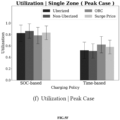
- FIG.5A to FIG.5F illustrates performance of the RL agent with various (business) metrics compared during peak hours and on average for generating pricing for EV charging aggregators for maximizing revenue using the system of FIG.1 , in accordance with some embodiments of the present disclosure.
- FIG.5A to FIG.5F shows the performance of the RL agent in terms of business metrics.
- FIG.5A to FIG.5C plot the total revenue, revenue per charger, and utilization, respectively, for the average case, while the same metrics are shown in FIG.5D to FIG.5F for the peak case.
- For the SOC-based charging policy on average, it is observed that the RL agent gets 35% more revenue than all other baselines. Since the utilization of the chargers is almost similar across all cases ( FIG.
- the revenue increase is not only due to a greater number of chargers in the system, but also from a higher average revenue per charger ( FIG. 5B ). However, this does not hold good in the peak case, where the higher revenue of the RL agent is primarily from using a larger pool of available chargers.
- the system For the time-based charging policy where every EV can charge for a predefined short time-period, the system is able to service charging requests at a faster rate. Therefore, for the same demand profile, it brings down the load on the system by making chargers more available. In this case, compared to other baselines, the RL agent gets an additional revenue of 3-10%.
- the embodiments of present disclosure herein address unresolved problem of charging electric vehicles.
- the embodiments thus provide method and system to generate pricing for charging electric vehicles.
- the embodiments herein further provide dynamically generates pricing policies to maximize aggregator revenue based on stochastic model constraints and user behavioral models.
- the EV charging aggregator having an RL agent receives user requests to generate pricing based on a tentative demand pool, an actual demand pool, and a service pool.
- the method learns the pricing policies that maximize the aggregate revenue but without making any assumptions about the stochastic dynamics of the system, or data availability, or user behavioral models.
- Such computer-readable storage means contain program-code means for implementation of one or more steps of the method, when the program runs on a server or mobile device or any suitable programmable device.
- the hardware device can be any kind of device which can be programmed including e.g., any kind of computer like a server or a personal computer, or the like, or any combination thereof.
- the device may also include means which could be e.g., hardware means like e.g., an application-specific integrated circuit (ASIC), a field-programmable gate array (FPGA), or a combination of hardware and software means, e.g., an ASIC and an FPGA, or at least one microprocessor and at least one memory with software processing components located therein.
- the means can include both hardware means, and software means.
- the method embodiments described herein could be implemented in hardware and software.
- the device may also include software means. Alternatively, the embodiments may be implemented on different hardware devices, e.g., using a plurality of CPUs.
- the embodiments herein can comprise hardware and software elements.
- the embodiments that are implemented in software include but are not limited to, firmware, resident software, microcode, etc.
- the functions performed by various components described herein may be implemented in other components or combinations of other components.
- a computer-usable or computer readable medium can be any apparatus that can comprise, store, communicate, propagate, or transport the program for use by or in connection with the instruction execution system, apparatus, or device.
- a computer-readable storage medium refers to any type of physical memory on which information or data readable by a processor may be stored.
- a computer-readable storage medium may store instructions for execution by one or more processors, including instructions for causing the processor(s) to perform steps or stages consistent with the embodiments described herein.
- the term "computer-readable medium” should be understood to include tangible items and exclude carrier waves and transient signals, i.e., be non-transitory. Examples include random access memory (RAM), read-only memory (ROM), volatile memory, nonvolatile memory, hard drives, CD ROMs, DVDs, flash drives, disks, and any other known physical storage media.
Landscapes
- Business, Economics & Management (AREA)
- Engineering & Computer Science (AREA)
- Strategic Management (AREA)
- Development Economics (AREA)
- Economics (AREA)
- Finance (AREA)
- Accounting & Taxation (AREA)
- Entrepreneurship & Innovation (AREA)
- Physics & Mathematics (AREA)
- Marketing (AREA)
- General Business, Economics & Management (AREA)
- General Physics & Mathematics (AREA)
- Theoretical Computer Science (AREA)
- Human Resources & Organizations (AREA)
- Game Theory and Decision Science (AREA)
- Tourism & Hospitality (AREA)
- Health & Medical Sciences (AREA)
- Data Mining & Analysis (AREA)
- General Health & Medical Sciences (AREA)
- Primary Health Care (AREA)
- Educational Administration (AREA)
- Quality & Reliability (AREA)
- Public Health (AREA)
- Operations Research (AREA)
- Water Supply & Treatment (AREA)
- Charge And Discharge Circuits For Batteries Or The Like (AREA)
Claims (12)
- Prozessorimplementiertes Verfahren zum Erzeugen von Preisen zum Laden von Elektrofahrzeugen, dadurch gekennzeichnet, dass:Empfangen durch einen Elektrofahrzeug-, EV-, Ladeaggregator mit einem Verstärkungslern-, RL-, Agenten über einen oder mehrere Hardwareprozessoren (104) einer Benutzeranforderung, die eine EV-Ladebedarfsanforderung und eine Tageszeit umfasst, um einen EV-Ladepreis zu erzeugen, um die Einnahmen des EV-Ladeaggregators zu maximieren;Modellieren unter Verwendung eines Zustandsgenerators über den einen oder die mehreren Hardwareprozessoren (104) eines Zustands des RL-Agenten zum Verarbeiten der Benutzeranforderung und Zuweisen einer Belohnung an den RL-Agenten für die durchgeführte Aktion, wobei der Zustand des RL-Agenten i. die tatsächliche Bedarfspoolgröße

 dynamisches Erzeugen durch den RL-Agenten über den einen oder die mehreren Hardwareprozessoren (104) des EV-Ladepreises für die Benutzeranforderung ohne A-priori-Wissen, um die Einnahmen des EV-Ladeaggregators zu maximieren, durch Berechnen i. eines tatsächlichen Bedarfspools P 1 basierend auf einem nächsten Zeitschritt der tatsächlichen Bedarfspoolgröße

- Prozessorimplementiertes Verfahren nach Anspruch 1, wobei das Berechnen der tatsächlichen Bedarfspoolgröße für den nächsten Zeitschritt (


- Prozessorimplementiertes Verfahren nach Anspruch 1, wobei das Berechnen der vorläufigen Bedarfspoolgröße für den nächsten Zeitschritt


- Prozessorimplementiertes Verfahren nach Anspruch 1, wobei das Berechnen des Dienstpools für den nächsten Zeitschritt (


- Prozessorimplementiertes Verfahren nach Anspruch 1, wobei das Vorhersagen der Gesamtanzahl der Ladegeräte für den nächsten Zeitschritt K t+1 die Gesamtanzahl der verfügbaren Ladegeräte als aktuelle Benutzer, die mit dem EV-Laden beginnen


- Prozessorimplementiertes Verfahren nach Anspruch 1, wobei das Maximieren der Einnahmen des EV-Ladeaggregators das Produkt der Gesamteinnahmen, die über alle Benutzeranforderungen gezählt werden, und der Benutzer, die die Preisangebote akzeptieren, ist.
- System (100) zum Erzeugen von Preisen zum Laden von Elektrofahrzeugen, umfassend:einen Speicher (102), der Anweisungen speichert;eine oder mehrere Kommunikationsschnittstellen (106); undeinen oder mehrere Hardwareprozessoren (104), die über die eine oder die mehreren Kommunikationsschnittstellen (106) mit dem Speicher (102) gekoppelt sind, wobei der eine oder die mehreren Hardwareprozessoren (104) durch die Anweisungen konfiguriert sind, dadurch gekennzeichnet, dass:Empfangen über einen Elektrofahrzeug-, EV-, Ladeaggregator mit einem Verstärkungslern-, RL-, Agenten einer Benutzeranforderung, die eine EV-Ladebedarfsanforderung und eine Tageszeit umfasst, um einen EV-Ladepreis zu erzeugen, um die Einnahmen des EV-Ladeaggregators zu maximieren;Modellieren unter Verwendung eines Zustandsgenerators eines Zustands des RL-Agenten zum Verarbeiten der Benutzeranforderung und Zuweisen einer Belohnung an den RL-Agenten für die durchgeführte Aktion, wobei der Zustand des RL-Agenten i. die tatsächliche Bedarfspoolgröße

 dynamisches Erzeugen durch den RL-Agenten des EV-Ladepreises für die Benutzeranforderung ohne A-priori-Wissen, um die Einnahmen des EV-Ladeaggregators zu maximieren, durch Berechnen i. eines tatsächlichen Bedarfspools P 1 basierend auf einem nächsten Zeitschritt der tatsächlichen Bedarfspoolgröße

- System (100) nach Anspruch 7, wobei das Berechnen der tatsächlichen Bedarfspoolgröße für den nächsten Zeitschritt (


- System (100) nach Anspruch 7, wobei das Berechnen der vorläufigen Bedarfspoolgröße für den nächsten Zeitschritt


- System (100) nach Anspruch 7, wobei das Berechnen des Dienstpools für den nächsten Zeitschritt (


- Ein oder mehrere nichtflüchtige maschinenlesbare Informationsspeichermedien, die eine oder mehrere Anweisungen umfassen, die, wenn sie durch einen oder mehrere Hardwareprozessoren (104) ausgeführt werden, Aktionen durchführen, dadurch gekennzeichnet, dass:Empfangen über einen Elektrofahrzeug-, EV-, Ladeaggregator mit einem Verstärkungslern-, RL-, Agenten, einer Benutzeranforderung, die eine EV-Ladebedarfsanforderung und eine Tageszeit umfasst, um einen EV-Ladepreis zu erzeugen, um die Einnahmen des EV-Ladeaggregators zu maximieren;Modellieren unter Verwendung eines Zustandsgenerators eines Zustands des RL-Agenten zum Verarbeiten der Benutzeranforderung und Zuweisen einer Belohnung an den RL-Agenten für die durchgeführte Aktion, wobei der Zustand des RL-Agenten i. die tatsächliche Bedarfspoolgröße
 dynamisches Erzeugen durch den RL-Agenten des EV-Ladepreises für die Benutzeranforderung ohne A-priori-Wissen, um die Einnahmen des EV-Ladeaggregators zu maximieren, durch Berechnen i. eines tatsächlichen Bedarfspools P 1 basierend auf einem nächsten Zeitschritt der tatsächlichen Bedarfspoolgröße (

- Ein oder mehrere nichtflüchtige maschinenlesbare Informationsspeichermedien nach Anspruch 11, wobei das Berechnen der tatsächlichen Bedarfspoolgröße für den nächsten Zeitschritt (


Applications Claiming Priority (1)
| Application Number | Priority Date | Filing Date | Title |
|---|---|---|---|
| IN202121033775 | 2021-07-27 |
Publications (3)
| Publication Number | Publication Date |
|---|---|
| EP4125028A1 EP4125028A1 (de) | 2023-02-01 |
| EP4125028B1 true EP4125028B1 (de) | 2024-11-13 |
| EP4125028C0 EP4125028C0 (de) | 2024-11-13 |
Family
ID=82403689
Family Applications (1)
| Application Number | Title | Priority Date | Filing Date |
|---|---|---|---|
| EP22181584.8A Active EP4125028B1 (de) | 2021-07-27 | 2022-06-28 | Verfahren und system zur erzeugung von preisen zum laden von elektrischen fahrzeugen |
Country Status (2)
| Country | Link |
|---|---|
| US (1) | US20230063075A1 (de) |
| EP (1) | EP4125028B1 (de) |
Families Citing this family (3)
| Publication number | Priority date | Publication date | Assignee | Title |
|---|---|---|---|---|
| JP7729279B2 (ja) * | 2022-08-01 | 2025-08-26 | トヨタ自動車株式会社 | サーバおよび電力調整システム |
| US12115874B2 (en) * | 2022-08-16 | 2024-10-15 | GM Global Technology Operations LLC | Dynamic multiple bi-directional supply and demand matching for EV charging |
| CN118037334A (zh) * | 2024-04-11 | 2024-05-14 | 国网江苏省电力有限公司电力科学研究院 | 一种电动汽车充电动态定价方法及相关装置 |
Family Cites Families (8)
| Publication number | Priority date | Publication date | Assignee | Title |
|---|---|---|---|---|
| US20120296794A1 (en) * | 2011-05-18 | 2012-11-22 | General Electric Company | Systems and Methods for Auctioning Charging Times for Electric Vehicles |
| CN104981958B (zh) * | 2012-07-23 | 2018-01-19 | 康奈尔大学 | 电动车辆系统的大规模充电 |
| WO2016183014A1 (en) * | 2015-05-08 | 2016-11-17 | Faa, Llc | Battery charging stations and associated methods of use |
| KR102052637B1 (ko) * | 2018-05-23 | 2020-01-08 | 광주과학기술원 | 전기자동차 충전소 최적 운영 시스템 |
| CN110549896B (zh) * | 2019-08-28 | 2022-08-02 | 哈尔滨工程大学 | 一种基于强化学习的充电站选择方法 |
| CN110414750B (zh) * | 2019-08-28 | 2022-04-05 | 哈尔滨工程大学 | 一种基于深度增强学习的电动汽车实时充电站选择方法 |
| CN112419064B (zh) * | 2020-12-07 | 2022-02-08 | 中山大学 | 基于深度强化学习和联盟链的能量交易方法、装置及设备 |
| WO2022266146A1 (en) * | 2021-06-14 | 2022-12-22 | Volta Charging, Llc | Machine learning for optimization of power distribution to electric vehicle charging ports |
-
2022
- 2022-06-28 EP EP22181584.8A patent/EP4125028B1/de active Active
- 2022-07-01 US US17/810,456 patent/US20230063075A1/en not_active Abandoned
Also Published As
| Publication number | Publication date |
|---|---|
| US20230063075A1 (en) | 2023-03-02 |
| EP4125028A1 (de) | 2023-02-01 |
| EP4125028C0 (de) | 2024-11-13 |
Similar Documents
| Publication | Publication Date | Title |
|---|---|---|
| EP4125028B1 (de) | Verfahren und system zur erzeugung von preisen zum laden von elektrischen fahrzeugen | |
| Fotouhi et al. | A general model for EV drivers’ charging behavior | |
| Shalaby et al. | A dynamic optimal battery swapping mechanism for electric vehicles using an LSTM-based rolling horizon approach | |
| US12115874B2 (en) | Dynamic multiple bi-directional supply and demand matching for EV charging | |
| US11623527B2 (en) | Electric vehicle based micro grid identification for on-demand power supply | |
| Elmehdi et al. | Genetic algorithm for optimal charge scheduling of electric vehicle fleet | |
| CN109800917A (zh) | 一种电动汽车停车场的规划方法、装置和计算设备 | |
| Guzel et al. | Plug-in electric vehicle load modeling for charging scheduling strategies in microgrids | |
| Sun et al. | A graphical game approach to electrical vehicle charging scheduling: Correlated equilibrium and latency minimization | |
| CN116894549A (zh) | 一种共享充电宝的调度方法、装置和电子设备 | |
| Donadee et al. | Optimal autonomous charging of electric vehicles with stochastic driver behavior | |
| CN109978241B (zh) | 一种电动汽车充电负荷的确定方法及装置 | |
| EP4300387A1 (de) | Optimale intratagesplanung aggregierter verteilter energieressourcen (ders) | |
| Donadee | Optimal operation of energy storage for arbitrage and ancillary service capacity: The infinite horizon approach | |
| Alharbi et al. | Data-driven EV charging infrastructure with uncertainty based on a spatial–temporal flow-driven (STFD) models considering batteries | |
| Li et al. | Reducing car-sharing relocation cost through non-parametric density estimation and stochastic programming | |
| Walraven et al. | Planning Under Uncertainty for Aggregated Electric Vehicle Charging with Renewable Energy Supply. | |
| Mudgal et al. | Residential parking lot pricing strategy considering scheduling of electric vehicles | |
| EP4293585B1 (de) | Systeme und verfahren zur erzeugung optimaler intratagesangebote und betriebspläne für verteilte energieressourcen | |
| Yusuf et al. | Analyses and Applications of Plug-in Electric Vehicle Charging Stations' User Behavior in a Large University Campus Community | |
| Godec et al. | Effect of maintenance and failure on electrical vehicles charging scheduling at an airport | |
| Gowda | Electric vehicle integration for grid services using ai, optimization, and blockchain | |
| Feng et al. | Electric-vehicle aggregators as cyber-physical energy systems: Optimal operation strategy for frequency regulation and energy arbitrage | |
| EP4610597A1 (de) | Verfahren und system zur optimierung der leistungsbeschaffung für unternehmen mit ladelast einer elektrofahrzeugflotte | |
| Sharma et al. | Efficient Energy Management and Cost Optimization Using Grey Wolf Optimization for EV Charging and Discharging in Microgrid |
Legal Events
| Date | Code | Title | Description |
|---|---|---|---|
| PUAI | Public reference made under article 153(3) epc to a published international application that has entered the european phase |
Free format text: ORIGINAL CODE: 0009012 |
|
| STAA | Information on the status of an ep patent application or granted ep patent |
Free format text: STATUS: THE APPLICATION HAS BEEN PUBLISHED |
|
| AK | Designated contracting states |
Kind code of ref document: A1 Designated state(s): AL AT BE BG CH CY CZ DE DK EE ES FI FR GB GR HR HU IE IS IT LI LT LU LV MC MK MT NL NO PL PT RO RS SE SI SK SM TR |
|
| STAA | Information on the status of an ep patent application or granted ep patent |
Free format text: STATUS: REQUEST FOR EXAMINATION WAS MADE |
|
| 17P | Request for examination filed |
Effective date: 20230413 |
|
| RBV | Designated contracting states (corrected) |
Designated state(s): AL AT BE BG CH CY CZ DE DK EE ES FI FR GB GR HR HU IE IS IT LI LT LU LV MC MK MT NL NO PL PT RO RS SE SI SK SM TR |
|
| REG | Reference to a national code |
Ref country code: DE Ref legal event code: R079 Free format text: PREVIOUS MAIN CLASS: G06Q0050300000 Ref country code: DE Ref legal event code: R079 Ref document number: 602022007632 Country of ref document: DE Free format text: PREVIOUS MAIN CLASS: G06Q0050300000 Ipc: G06Q0010063000 |
|
| GRAP | Despatch of communication of intention to grant a patent |
Free format text: ORIGINAL CODE: EPIDOSNIGR1 |
|
| STAA | Information on the status of an ep patent application or granted ep patent |
Free format text: STATUS: GRANT OF PATENT IS INTENDED |
|
| GRAS | Grant fee paid |
Free format text: ORIGINAL CODE: EPIDOSNIGR3 |
|
| GRAA | (expected) grant |
Free format text: ORIGINAL CODE: 0009210 |
|
| STAA | Information on the status of an ep patent application or granted ep patent |
Free format text: STATUS: THE PATENT HAS BEEN GRANTED |
|
| RIC1 | Information provided on ipc code assigned before grant |
Ipc: G06Q 50/40 20240101ALI20240916BHEP Ipc: G06Q 50/06 20120101ALI20240916BHEP Ipc: G06Q 30/0201 20230101ALI20240916BHEP Ipc: G06Q 10/063 20230101AFI20240916BHEP |
|
| INTG | Intention to grant announced |
Effective date: 20240930 |
|
| AK | Designated contracting states |
Kind code of ref document: B1 Designated state(s): AL AT BE BG CH CY CZ DE DK EE ES FI FR GB GR HR HU IE IS IT LI LT LU LV MC MK MT NL NO PL PT RO RS SE SI SK SM TR |
|
| REG | Reference to a national code |
Ref country code: GB Ref legal event code: FG4D |
|
| REG | Reference to a national code |
Ref country code: CH Ref legal event code: EP |
|
| REG | Reference to a national code |
Ref country code: IE Ref legal event code: FG4D |
|
| REG | Reference to a national code |
Ref country code: DE Ref legal event code: R096 Ref document number: 602022007632 Country of ref document: DE |
|
| U01 | Request for unitary effect filed |
Effective date: 20241113 |
|
| U07 | Unitary effect registered |
Designated state(s): AT BE BG DE DK EE FI FR IT LT LU LV MT NL PT RO SE SI Effective date: 20241119 |
|
| PG25 | Lapsed in a contracting state [announced via postgrant information from national office to epo] |
Ref country code: HR Free format text: LAPSE BECAUSE OF FAILURE TO SUBMIT A TRANSLATION OF THE DESCRIPTION OR TO PAY THE FEE WITHIN THE PRESCRIBED TIME-LIMIT Effective date: 20241113 Ref country code: IS Free format text: LAPSE BECAUSE OF FAILURE TO SUBMIT A TRANSLATION OF THE DESCRIPTION OR TO PAY THE FEE WITHIN THE PRESCRIBED TIME-LIMIT Effective date: 20250313 |
|
| PG25 | Lapsed in a contracting state [announced via postgrant information from national office to epo] |
Ref country code: ES Free format text: LAPSE BECAUSE OF FAILURE TO SUBMIT A TRANSLATION OF THE DESCRIPTION OR TO PAY THE FEE WITHIN THE PRESCRIBED TIME-LIMIT Effective date: 20241113 |
|
| PG25 | Lapsed in a contracting state [announced via postgrant information from national office to epo] |
Ref country code: NO Free format text: LAPSE BECAUSE OF FAILURE TO SUBMIT A TRANSLATION OF THE DESCRIPTION OR TO PAY THE FEE WITHIN THE PRESCRIBED TIME-LIMIT Effective date: 20250213 |
|
| PG25 | Lapsed in a contracting state [announced via postgrant information from national office to epo] |
Ref country code: GR Free format text: LAPSE BECAUSE OF FAILURE TO SUBMIT A TRANSLATION OF THE DESCRIPTION OR TO PAY THE FEE WITHIN THE PRESCRIBED TIME-LIMIT Effective date: 20250214 |
|
| PG25 | Lapsed in a contracting state [announced via postgrant information from national office to epo] |
Ref country code: PL Free format text: LAPSE BECAUSE OF FAILURE TO SUBMIT A TRANSLATION OF THE DESCRIPTION OR TO PAY THE FEE WITHIN THE PRESCRIBED TIME-LIMIT Effective date: 20241113 |
|
| PG25 | Lapsed in a contracting state [announced via postgrant information from national office to epo] |
Ref country code: RS Free format text: LAPSE BECAUSE OF FAILURE TO SUBMIT A TRANSLATION OF THE DESCRIPTION OR TO PAY THE FEE WITHIN THE PRESCRIBED TIME-LIMIT Effective date: 20250213 |
|
| PG25 | Lapsed in a contracting state [announced via postgrant information from national office to epo] |
Ref country code: SM Free format text: LAPSE BECAUSE OF FAILURE TO SUBMIT A TRANSLATION OF THE DESCRIPTION OR TO PAY THE FEE WITHIN THE PRESCRIBED TIME-LIMIT Effective date: 20241113 |
|
| PG25 | Lapsed in a contracting state [announced via postgrant information from national office to epo] |
Ref country code: SK Free format text: LAPSE BECAUSE OF FAILURE TO SUBMIT A TRANSLATION OF THE DESCRIPTION OR TO PAY THE FEE WITHIN THE PRESCRIBED TIME-LIMIT Effective date: 20241113 |
|
| PG25 | Lapsed in a contracting state [announced via postgrant information from national office to epo] |
Ref country code: CZ Free format text: LAPSE BECAUSE OF FAILURE TO SUBMIT A TRANSLATION OF THE DESCRIPTION OR TO PAY THE FEE WITHIN THE PRESCRIBED TIME-LIMIT Effective date: 20241113 |
|
| U20 | Renewal fee for the european patent with unitary effect paid |
Year of fee payment: 4 Effective date: 20250624 |
|
| PLBE | No opposition filed within time limit |
Free format text: ORIGINAL CODE: 0009261 |
|
| STAA | Information on the status of an ep patent application or granted ep patent |
Free format text: STATUS: NO OPPOSITION FILED WITHIN TIME LIMIT |
|
| PGFP | Annual fee paid to national office [announced via postgrant information from national office to epo] |
Ref country code: CH Payment date: 20250701 Year of fee payment: 4 |
|
| 26N | No opposition filed |
Effective date: 20250814 |
|
| PG25 | Lapsed in a contracting state [announced via postgrant information from national office to epo] |
Ref country code: MC Free format text: LAPSE BECAUSE OF FAILURE TO SUBMIT A TRANSLATION OF THE DESCRIPTION OR TO PAY THE FEE WITHIN THE PRESCRIBED TIME-LIMIT Effective date: 20241113 |