EP4293585B1 - Systeme und verfahren zur erzeugung optimaler intratagesangebote und betriebspläne für verteilte energieressourcen - Google Patents
Systeme und verfahren zur erzeugung optimaler intratagesangebote und betriebspläne für verteilte energieressourcen Download PDFInfo
- Publication number
- EP4293585B1 EP4293585B1 EP23174346.9A EP23174346A EP4293585B1 EP 4293585 B1 EP4293585 B1 EP 4293585B1 EP 23174346 A EP23174346 A EP 23174346A EP 4293585 B1 EP4293585 B1 EP 4293585B1
- Authority
- EP
- European Patent Office
- Prior art keywords
- intraday
- ders
- market
- optimal
- delivery
- Prior art date
- Legal status (The legal status is an assumption and is not a legal conclusion. Google has not performed a legal analysis and makes no representation as to the accuracy of the status listed.)
- Active
Links
Images




Classifications
-
- G—PHYSICS
- G06—COMPUTING OR CALCULATING; COUNTING
- G06Q—INFORMATION AND COMMUNICATION TECHNOLOGY [ICT] SPECIALLY ADAPTED FOR ADMINISTRATIVE, COMMERCIAL, FINANCIAL, MANAGERIAL OR SUPERVISORY PURPOSES; SYSTEMS OR METHODS SPECIALLY ADAPTED FOR ADMINISTRATIVE, COMMERCIAL, FINANCIAL, MANAGERIAL OR SUPERVISORY PURPOSES, NOT OTHERWISE PROVIDED FOR
- G06Q10/00—Administration; Management
- G06Q10/04—Forecasting or optimisation specially adapted for administrative or management purposes, e.g. linear programming or "cutting stock problem"
-
- G—PHYSICS
- G06—COMPUTING OR CALCULATING; COUNTING
- G06Q—INFORMATION AND COMMUNICATION TECHNOLOGY [ICT] SPECIALLY ADAPTED FOR ADMINISTRATIVE, COMMERCIAL, FINANCIAL, MANAGERIAL OR SUPERVISORY PURPOSES; SYSTEMS OR METHODS SPECIALLY ADAPTED FOR ADMINISTRATIVE, COMMERCIAL, FINANCIAL, MANAGERIAL OR SUPERVISORY PURPOSES, NOT OTHERWISE PROVIDED FOR
- G06Q10/00—Administration; Management
- G06Q10/06—Resources, workflows, human or project management; Enterprise or organisation planning; Enterprise or organisation modelling
- G06Q10/063—Operations research, analysis or management
-
- G—PHYSICS
- G06—COMPUTING OR CALCULATING; COUNTING
- G06Q—INFORMATION AND COMMUNICATION TECHNOLOGY [ICT] SPECIALLY ADAPTED FOR ADMINISTRATIVE, COMMERCIAL, FINANCIAL, MANAGERIAL OR SUPERVISORY PURPOSES; SYSTEMS OR METHODS SPECIALLY ADAPTED FOR ADMINISTRATIVE, COMMERCIAL, FINANCIAL, MANAGERIAL OR SUPERVISORY PURPOSES, NOT OTHERWISE PROVIDED FOR
- G06Q30/00—Commerce
- G06Q30/02—Marketing; Price estimation or determination; Fundraising
- G06Q30/0201—Market modelling; Market analysis; Collecting market data
- G06Q30/0202—Market predictions or forecasting for commercial activities
-
- G—PHYSICS
- G06—COMPUTING OR CALCULATING; COUNTING
- G06Q—INFORMATION AND COMMUNICATION TECHNOLOGY [ICT] SPECIALLY ADAPTED FOR ADMINISTRATIVE, COMMERCIAL, FINANCIAL, MANAGERIAL OR SUPERVISORY PURPOSES; SYSTEMS OR METHODS SPECIALLY ADAPTED FOR ADMINISTRATIVE, COMMERCIAL, FINANCIAL, MANAGERIAL OR SUPERVISORY PURPOSES, NOT OTHERWISE PROVIDED FOR
- G06Q40/00—Finance; Insurance; Tax strategies; Processing of corporate or income taxes
- G06Q40/04—Trading; Exchange, e.g. stocks, commodities, derivatives or currency exchange
-
- G—PHYSICS
- G06—COMPUTING OR CALCULATING; COUNTING
- G06Q—INFORMATION AND COMMUNICATION TECHNOLOGY [ICT] SPECIALLY ADAPTED FOR ADMINISTRATIVE, COMMERCIAL, FINANCIAL, MANAGERIAL OR SUPERVISORY PURPOSES; SYSTEMS OR METHODS SPECIALLY ADAPTED FOR ADMINISTRATIVE, COMMERCIAL, FINANCIAL, MANAGERIAL OR SUPERVISORY PURPOSES, NOT OTHERWISE PROVIDED FOR
- G06Q50/00—Information and communication technology [ICT] specially adapted for implementation of business processes of specific business sectors, e.g. utilities or tourism
- G06Q50/06—Energy or water supply
Definitions
- the disclosure herein generally relates to distributed energy resources, and, more particularly, to systems and methods for generating optimal intraday bids and operating schedules for distributed energy resources.
- DERs Distributed Energy Resources
- the trading horizon of these markets is shorter than day-ahead markets but longer than flex/regulation markets.
- Very few of the existing works on DER trading in intraday markets satisfactorily model the different aspects of this problem.
- Customers at the distribution side are investing in DER assets like storage systems, solar PV and becoming more flexible with their load requirements.
- Such DER assets are a need of time as they can provide various kinds of services to the grid and help in relieving the stress on power system. Also, they create revenue potential for the owner in return for their services. This is possible only if they are operated in a coordinated manner and utilized to their maximum potential.
- YANG CHANGHAI ET AL "Optimal Scheduling Strategy of Demand Response Aggregators Considering Customers' Complicated Response Characteristic ”
- OLIVARES DANIEL E ET AL "A Centralized Energy Management System for Isolated Microgrids ”
- DERs Distributed Energy Resources
- These DERs are usually owned by end users connected to low and medium voltage distribution networks. Unlike traditional centralized generators, these DERs have smaller capacities. However, due to their large numbers and flexible nature, these DERs can inject clean energy and provide valuable services to the grid. Nevertheless, an uncontrolled and a disorderly inclusion of DERs can make it harder for system operators to keep the grid running.
- aggregators are emerging as new players in the power system.
- An aggregator's goal is to coordinate the DERs and provide services to the power system through appropriate markets while earning revenue.
- aggregators are expected to provide the necessary technology to communicate and control the DERs.
- Aggregators improve the economic efficiency of the power system by enhancing the existing grid's robustness with little investment. Simultaneously, they also create private value by allowing their subscribers to earn revenue through market participation. It is economically inefficient for DERs to participate individually in markets by themselves due to the high transaction costs and low individual capacities.
- intraday markets support continuous trades (similar to stock markets) and follow pay-as-you-bid market clearing. Also, these markets allow for a bid (buy or sell) to be partially cleared in a single transaction. The uncleared volume may get cleared in subsequent transactions. Consequently, the clearing prices in intraday markets exhibit more volatility - for the same delivery slot, the market clearing price could change depending on when the trade happens. This increases the complexity of doing trades optimally in intraday markets.
- Vaya et. al. (e.g., refer " Marina González Vayá and Göran Andersson. 2014. Optimal bidding strategy of a plug-in electric vehicle aggregator in day-ahead electricity markets under uncertainty. IEEE transactions on power systems 30, 5 (2014), 2375-2385 .") discuss a model for aggregator of electric vehicles (EVs) participating as a buyer in a day ahead electricity market.
- the aggregator is considered as a price maker and the problem is formulated as a bilevel optimization problem.
- Iria et.al. (e.g., refer “ Jose Iria, Filipe Soares, and Manuel Matos. 2019.
- Applied Energy 238 (2019), 1361-1372 .) proposed a stochastic optimization model for an aggregator optimizing prosumers' flexibility and minimizing the net cost of buy and sell in day-ahead and real time market.
- Valsomatzis et. al. (e.g., refer " Emmanouil Valsomatzis, Torben Bach Pedersen, and Alberto Abello. 2018. Day-Ahead Trading of Aggregated Energy Flexibility.
- Bouskas et. al. (e.g., refer "Institutnis Boukas, Damien Ernst, Thibaut Théate, Adrien Bolland, Alexandre Huynen, Martin Buchwald, Christelle Wynants, and Bertrand Cornélusse. 2021.
- Machine Learning (2021), 1-53 .) discussed a strategy for a grid connected storage to trade in intraday markets using a deep reinforcement learning framework. They model the trading problem as a Markov Decision Process and present an asynchronous distributed version of the fitted Q iteration algorithm.
- Ayon et.al. (e.g., refer " Xiaolin Ayon, Maria Angeles Moreno, and Julio Usaola. 2017. Aggregators' Optimal Bidding Strategy in Sequential Day-Ahead and Intraday Electricity Spot Markets. Energys 10, 4 (2017 ).”) proposed a probabilistic optimization method that produces optimal bidding curves to be submitted by an aggregator to the day-ahead electricity market and the intraday market in a sequential manner. Their formulation entails different linear optimization problems that follow the natural temporal sequence of day-ahead and intraday markets.
- the overall trade optimization is performed in three steps: First, the optimal bidding curves are produced and submitted to the day-ahead market; Second, after the day-ahead market clearing, temporal constraints related to the flexible consumption are fulfilled through a rescheduling process; and finally, new optimal bidding curves are produced and submitted to the intraday market, trying to take advantage of the lower lead time and the knowledge gained on the marginal prices through the day-ahead market clearing. While this work models heterogeneous DERs, they do not take into consideration the constraints that may be placed by the network. Further, they also assume that different price scenarios to be equiprobable which may not be true.
- system and method described herein determine an optimal intraday operating schedule and intraday bids for aggregators managing a set of DERs (e.g., (both energy resources that are homogeneous and heterogeneous in nature).
- system and method of the present disclosure model a joint price-volume dynamics present in intraday markets, wherein such modeling of the joint price-volume dynamics allows for the trades/bids placed earlier to be corrected based on the revised forecasts of demand and generation while allowing for energy exchanges within the DER pool.
- the system and method of the present disclosure (i) model the price volume behavior in intraday markets as a two-dimensional (2D) distribution which is obtained using at least historical market logs, wherein the forecasted (2D) distribution is used to optimize the intraday bids placed by the aggregator in the intraday energy market(s), and (ii) model the optimal bidding problem of aggregators in an intraday market as a (potentially non-convex) MINLP and a relaxation wherein the integer variables from the formulation are removed and the MINLP problem is converted to an NLP problem.
- 2D two-dimensional
- Present disclosure provides systems and methods to determine/generating an optimal strategy (e.g., optimal intraday operating schedule and intraday bid) for aggregators managing DERs (both energy resources that are homogeneous and heterogeneous in nature) to trade in intraday markets.
- the system and method of the present disclosure model the joint price-volume dynamics present in such markets through a two-dimensional (2D) distribution (e.g., histograms, and the like) and use it in decision making.
- 2D two-dimensional
- the above method of the present disclosure also allows for the trades/bids placed earlier to be corrected based on the revised forecasts of demand and generation in the DER pool.
- the system and method of the present disclosure model the optimal bidding problem of aggregators in an intraday market as a mixed-integer non-linear programming (MINLP) problem. More specifically, the present disclosure presents a reformulation of the problem which leverage different aspects of the problem's structure. The relaxation converts the MINLP to an NLP problem. Furthermore, the system and method test the performance against commonly used approaches. In this regard, the system and method of the present disclosure have used real world intraday market logs from a specific region/country in the experiments. The results indicated that the relaxation mentioned above improves the revenue performance of the aggregator by 19% relative to the commonly followed trading practices. Also, the performance gap between the baseline and the method implemented by the present disclosure remains robust to changes in subscriber generation volumes. Further, it is also observed by the present disclosure that enabling pool interactions within the DER set is helpful. Based on the observations, such enabling improves the revenue performance of aggregator by 2.5%.
- MINLP mixed-integer non-linear programming
- FIG. 1 through 9C where similar reference characters denote corresponding features consistently throughout the figures, there are shown preferred embodiments and these embodiments are described in the context of the following exemplary system and/or method.
- FIG. 1 depicts an exemplary system 100 for generating optimal intraday bids and operating schedules for distributed energy resources, in accordance with an embodiment of the present disclosure.
- the system 100 includes one or more hardware processors 104, communication interface device(s) or input/output (I/O) interface(s) 106 (also referred as interface(s)), and one or more data storage devices or memory 102 operatively coupled to the one or more hardware processors 104.
- the one or more processors 104 may be one or more software processing components and/or hardware processors.
- the hardware processors can be implemented as one or more microprocessors, microcomputers, microcontrollers, digital signal processors, central processing units, state machines, logic circuitries, and/or any devices that manipulate signals based on operational instructions.
- the processor(s) is/are configured to fetch and execute computer-readable instructions stored in the memory.
- the system 100 can be implemented in a variety of computing systems, such as laptop computers, notebooks, hand-held devices (e.g., smartphones, tablet phones, mobile communication devices, and the like), workstations, mainframe computers, servers, a network cloud, and the like.
- the I/O interface device(s) 106 can include a variety of software and hardware interfaces, for example, a web interface, a graphical user interface, and the like and can facilitate multiple communications within a wide variety of networks N/W and protocol types, including wired networks, for example, LAN, cable, etc., and wireless networks, such as WLAN, cellular, or satellite.
- the I/O interface device(s) can include one or more ports for connecting a number of devices to one another or to another server.
- the memory 102 may include any computer-readable medium known in the art including, for example, volatile memory, such as static random-access memory (SRAM) and dynamic-random access memory (DRAM), and/or non-volatile memory, such as read only memory (ROM), erasable programmable ROM, flash memories, hard disks, optical disks, and magnetic tapes.
- volatile memory such as static random-access memory (SRAM) and dynamic-random access memory (DRAM)
- DRAM dynamic-random access memory
- non-volatile memory such as read only memory (ROM), erasable programmable ROM, flash memories, hard disks, optical disks, and magnetic tapes.
- a database 108 is comprised in the memory 102, wherein the database 108 comprises (i) historical data pertaining to generation and demand of energy by a plurality of distributed energy resources (DERs) connected to a network specific to an aggregator, (ii) historical intraday market data, (iii) a specification of the plurality of distributed energy resources (DERs) connected to the network specific to the aggregator, (iv) a preference of one or more subscribers, and (v) information associated with the network specific to the aggregator.
- the database 108 further comprises various models, such as optimization model(s), intraday market clearing model(s), and the like.
- the memory 102 further comprises (or may further comprise) information pertaining to input(s)/output(s) of each step performed by the systems and methods of the present disclosure.
- input(s) fed at each step and output(s) generated at each step are comprised in the memory 102 and can be utilized in further processing and analysis.
- FIG. 2 depicts an exemplary flow chart illustrating a method for generating optimal intraday bids and operating schedules for distributed energy resources, using the system 100 of FIG. 1 , in accordance with an embodiment of the present disclosure.
- the system(s) 100 comprises one or more data storage devices or the memory 102 operatively coupled to the one or more hardware processors 104 and is configured to store instructions for execution of steps of the method by the one or more processors 104.
- the steps of the method of the present disclosure will now be explained with reference to components of the system 100 of FIG. 1 , and the flow diagram as depicted in FIG. 2 .
- the system and method of the present disclosure consider a centralized set-up wherein an aggregator orchestrates the operations of a set of DERs.
- the system 100 assumes that the aggregator has the knowledge of the characteristics (size, ratings, constraints, and preferences) of the participating DERs.
- a subscriber s can have a generation source (e.g., solar PV), demand, energy storage systems (e.g., battery) or any combination of these.
- the aggregator has the ability to forecast the renewable generation and overall demand of its subscribers using historical logs and other pertinent information.
- a subscriber s has two kinds of demands: fixed demand, d t , s fix , and flexible demand, d t , s flex .
- fixed demand is that part of the customer load that remains fixed and must be supplied at the specified time t .
- Flexible demand is that part of the customer load where there is flexibility in terms of the time(s) at which this demand can be satisfied.
- the quantum of flexible demand is decided by the customer, its schedule is decided by the aggregator.
- the aggregator can split a customer's overall demand into flexible and fixed components by leveraging information about customer's appliance set and operational preferences (which can be periodically collected).
- an aggregator participates in an intraday market. Market participation is for both procuring and selling power. Aggregator places the bids in a such a way that the revenue obtained through market participation is maximized. The aggregator also schedules the operations of the individual DERs based on the cleared market commitments.
- Intraday markets for electricity are also referred as continuous markets as the trading happens in continuous time slots until the trade window closure. Trading in these markets typically starts after the day-ahead market clearing.
- the bids for a given delivery time can be placed anywhere from the previous afternoon to few minutes before the delivery.
- the exact gate opening and closing times varies across geographies. Different exchanges offer varying products that range from simple products (which are limited to one time slot) to block products (which span multiple continuous time slots).
- the system and method assume that the aggregator is interested in simple one slot energy product.
- Intraday markets typically follow pay-as-bid pricing for bid clearing and the system and method further assume the same clearing model.
- this clearing model the market operator matches an incoming bid order with the best opposite order as soon as it is submitted. If there is no suitable match, the incoming order stays in the order book until its expiry condition.
- the best opposite order is defined as the highest priced buy order or lowest priced sell order. If the best opposite order matches with the price condition of an incoming order, a transaction happens. An order can get fulfilled either completely or partially. If an order is cleared partially, the remaining quantity stays in the order book.
- the one or more hardware processors 104 obtain an input comprising (i) historical data pertaining to generation and demand of energy by a plurality of distributed energy resources (DERs) connected to a network specific to an aggregator, (ii) historical intraday market data, (iii) a specification of the plurality of distributed energy resources (DERs), (iv) a preference of one or more subscribers, and (v) information associated with the network specific to the aggregator.
- DERs distributed energy resources
- the plurality of DERs connected to the network of the aggregator may be identical in nature (e.g., homogeneous DERs or networks of a single DER type, say only batteries, only solar photovoltaic cells, only flexible load(s) and the like) or similar.
- the plurality of DERs connected to the network of the aggregator may be different from each other or heterogeneous in nature.
- the DERs in the network of the aggregator may include, but are not limited to, batteries, solar photovoltaic cells, flexible load(s), fixed loads, and the like.
- Table 1 and Table 2 illustrate exemplary historical data pertaining to generation and demand of energy by a DER (e.g., say on an hourly basis) respectively.
- Table 3 illustrates historical intraday market data consisting of price-volume pairs bid at different transaction hours for each delivery hour.
- Table 3 Date Transaction time Delivery Hours Volume (MW) Price (EUR) 1/1/2020 9:05 14:00 10 33.2 1/1/2020 10:22 14:00 30 34.99 1/1/2020 12:35 15:00 5 30.1
- Table 4 illustrates various examples of DERs connected to the network of the aggregator.
- Table 4 Type Description of DER Number of DERs Average Size (KW) I Fixed and flexible demand 6 300; 50 II Fixed + flexible demand with Solar 4 400; 350; 2300 III Fixed + flexible demand with Storage 7 400; 400; 2650 IV Solar with Storage 5 1690 and 2480 V Fixed/flexible demand with Solar & Storage 4 600, 330; 2000; 3300
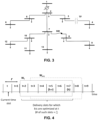
- FIG. 3 illustrates an exemplary IEEE 13 bus radial distribution network as implemented by the system 100 of FIG. 1 , in accordance with an embodiment of the present disclosure.
- the network information includes, but is not limited to, maximum and minimum import power limits of each node in the network.
- Table 5 illustrates information pertaining to the network: Table 5 Node Import Limit (MW) Export Limit (MW) 1 1250 1250 2 251 251 ... ... ... 13 543 470
- the one or more hardware processors 104 forecast a generation and demand of energy by the plurality of DERs for a plurality of delivery slots in an initialized optimization window, based on the input.
- the system and method consider time to be slotted. Given a delivery slot of h, let the aggregator's trading window be the sequence of ⁇ consecutive slots from h - ⁇ - r till h - r, where r is the minimum lead time allowed by the market operator.
- the aim of the optimal trading strategy is to answer the following questions: (1) Given a delivery time slot h and a trading slot t ⁇ [ h - ⁇ - r,h - r ], determine the volume of the buy or sell bids the aggregator has to place in the market at t for h. (2) Determine the price for the buy or sell bids the aggregator has to be place in the market at t for h. (3) The volumes and prices have to be determined such that the revenue earned by the aggregator is maximized and the demand requirements of the DERs in the aggregator's subscriber pool are met.
- Moving window optimization Notations used in the present disclosure are summarized in below Table 6.
- Table 6 Symbol Description h Time slot at which power/energy should be delivered t Current time slot r Minimum lead time for trading allowed by market operator ⁇ Window of time slots over which the aggregator trades for h s Subscriber index N Set of nodes in a distribution network S n Set of DERs connected at bus n S Set of all subscribers of the aggregator W t
- the window of optimization - the range of h values for which the aggregator optimizes the bids at t ; given by [ t + r,t + r + ⁇ ] d h , s fix Fixed demand of subscriber s for h as forecasted at t G h,s Generation of subscriber s for delivery slot h as forecasted at t Lim n Import/export limit at node n for the aggregator that has been determined by the network operator.
- the operator communicates this limit to the aggregator at least ⁇ slots before h .
- R s chg . and R s dsg . Function that specifies the maximum charge/discharge rate of battery available with subscriber s as per the SOC.
- P h L and P h H Lower and Higher limit of market price for delivery slot h M and k Large positive numbers x h,n Net energy at node n during h that is traded in the market pool x h , n pool Net energy at node n during h that is traded within the pool x h tot Total aggregated volume which has to be traded with market b h , s chg , b h , s dsg Charging and Discharging volume of subscriber s's battery during h . d h , s flex Subscriber s's flexible demand scheduled during h .
- S be the set of DERs who have subscribed to the services of an aggregator. Let these DERs be connected to the distribution network across N different buses with S n denoting the set of DERs connected at bus n . Let the current (trading) time be t .
- the range of delivery slots for which the aggregator can optimize the bids at t is given by [ t + r, t + r + ⁇ ]. The system and method refer to this range of h values as the optimization window W t . As t advances, so does W t .
- the system and method implement a forecasting model (not shown in FIGS. - but comprised in the memory 102 and executed to perform steps described herein) for generation and demand of each DER.
- the forecasting model(s) is/are trained using the corresponding historical input data.
- the trained model(s) is/are used to forecast the generation and demand of all delivery hours in the initialized optimization window.
- the system and method implemented as a stacked LSTM network" model which served as the forecasting model.
- the various timelines involved in the bidding process are shown in FIG. 4.
- FIG. 4 depicts various bidding timelines in intraday markets, in accordance with an embodiment of the present disclosure.
- the one or more hardware processors 104 estimate a two-dimensional (2D) distribution of price-volume for the plurality of delivery slots in the initialized optimization window based on the forecasted generation and demand of the energy by the plurality of DERs.
- the historical intraday market data is used to estimate the 2D distribution of price-volume for all the delivery slots/hours in the optimization window. This estimation is done by closest fitting of the non-linear 2D function. 2D distributions for some of delivery hours at different trading hours are shown in FIGS. 5A through 5D. FIGS. 5A through 5D , with reference to FIGS.
- the one or more hardware processors 104 execute, an optimization model, using the estimated two-dimensional (2D) distribution of price-volume for the plurality of delivery slots in the initialized optimization window to obtain at least one of (i) an optimal intraday operating schedule for one or more DERs from the plurality of DERs, and (ii) an intraday bid associated with the plurality of DERs for the plurality of delivery slots to be traded in an intraday market.
- the optimal intraday operating schedule for the one or more DERs is extracted values of the variables such as G h,s , d h , s flex , d h , s fix , and r h,s obtained after completing the execution of the NLP problem.
- the intraday bids include, but are not limited to, extracted values of the variables such as but ps h , qs h , pb h , and qb h obtained after completing the execution of the NLP problem.
- FIG. 6 depicts an exemplary flow chart illustrating a method for executing the optimization model (or a non-linear programming problem), using the systems of FIG. 1 , in accordance with an embodiment of the present disclosure.
- the one or more hardware processors 104 formulate a mixed integer non-linear programming (MINLP) problem based on the input and the estimated two-dimensional (2D) distribution of price-volume for the plurality of delivery slots in the initialized optimization window.
- MINLP mixed integer non-linear programming
- 2D estimated two-dimensional
- the one or more hardware processors 104 execute (or solve) the NLP problem to obtain the at least one of (i) the optimal intraday operating schedule for one or more DERs from the plurality of DERs, and (ii) the intraday bid associated with the plurality of DERs for the plurality of delivery slots to be traded in an intraday market.
- the NLP problem is obtained by relaxing at least one (i) a first integer variable, and (ii) a second integer variable comprised in the MINLP.
- the first integer variable is based on a decision of a type of the intraday bid (e.g., either to sell generated energy/power or buy energy (or demand).
- the second integer variable is based on a constraint specific to a DER type (e.g., charging and discharging rates and levels of batteries).
- the intraday bid comprises a decision to place a buy bid or a sell bid and a corresponding price-volume pair for each delivery slot pertaining to one or more DERs. For instance, for each hour delivery slot, the aggregator must decide to place a buy or sell bid based on the aggregate power ( x h tot ) in that slot. If x h tot > 0 , it means the aggregator has surplus generation and it needs to place a sell bid. If x h tot ⁇ 0 , it indicates that the aggregator has excess demand, and it needs to place a buy bid.
- Table 7 illustrates intraday bid obtained as an output from the execution of the optimization model.
- the optimal intraday operating schedule for a first DER type comprises at least one of (i) whether to charge or discharge in each delivery slot of the initialized optimization window, (ii) a charging level or a discharging level in each delivery slot of the initialized optimization window; and (iii) a state of charge (SOC) value of a DER of the first DER type at an end of each delivery slot.
- the first DER type is a battery.
- the constraints e.g., equations (1), (4), (5), (6), and (7) for MINLP problem and equations (1), (5), (19), (20) for NLP problem
- battery is a bi-directional in nature, it can export as well as import.
- a sample optimal schedule of one battery for the initialized optimization window is shown in below Table 8. Table 8 Delivery hour r SOC 6:00 -15 15 7:00 10 25 8:00 8 33 9:00 2 35
- a positive value of r indicates battery charging whereas negative value of r indicates battery discharging.
- the absolute value of r is charging/discharging level.
- the optimal intraday operating schedule for a second DER type comprises quantity of energy required to be provided to a power grid in each delivery slot.
- the second DER type is a solar PV.
- the optimal schedule for this DER type is a net power that is exported to the power grid.
- a sample operating schedule of a solar PV is shown in below Table 9. Table 9 Delivery hour Solar export (kW) 6:00 11 7:00 40 8:00 83 9:00 101
- the optimal intraday operating schedule for a third DER type comprises information pertaining to scheduling of an operation of an electrical load (e.g., such as flexible load or flexible demand) at one or more delivery slots.
- the third DER type is the flexible load.
- the aggregator knows the total flexible load, but the aggregator has to decide in which delivery hours to schedule the flexible load such that its operating cost is minimum.
- the constraints e.g., equations (1), (8), and (9) govern the schedule of this DER type.
- a sample schedule of a flexible load DER is shown in below Table 10. Table 10 Delivery hour Flexible load (KW) 6:00 12 7:00 13 8:00 0 9:00 0
- fixed and flexible load(s) examples include, but are not limited to residential (or commercial) air conditioners, water heaters, refrigerators, commercial HVAC (Heating, ventilation, and air conditioning) systems, pumps for irrigation, pool cleaning or heating, appliances to be scheduled for operation in office buildings, houses, and the like.
- the generation available with the aggregator at a node n is equal to the sum of the battery discharge volumes ( b h , s dsg ) and local generation ( G h,s ) of subscribers under that node. This is represented as the first term in right hand side of equation (1).
- the demand of the aggregator at node n is equal to the sum of battery charging volume ( b h , s chg ), fixed loads of customers attached to n d h , s fix , and flexible loads of customers attached to n that are being scheduled ( d h , s flex ) as reflected in the second term in the right hand side of equation (1) below.
- x h , n + x h , n pool ⁇ s ⁇ S n G h , s + b h , s dsg ⁇ d t , s fix + d h , s flex + b h , s chg ⁇ n ⁇ N , ⁇ h ⁇ W t
- the net amount of energy exchanged at a node is split between market ( x h,n ) and pool ( x h , n pool ) components as in equation (1).
- Positive values of x h,n and x h , n pool indicate that excess power is either exported to the markets or used to meet the demands of its own subscriber pool across nodes.
- negative values x h,n and x h , n pool indicate that the demand is met either through market imports or from the generation of other subscribers in the pool.
- Market exports increase the revenue earned by the aggregator while pool exports decrease the revenue outflow. The converse holds for market and pool imports.
- Equation 2 balances the power exchange occurring within the pool i.e., the total power exported onto the pool should always be equal to the power imported into the pool.
- ⁇ x ⁇ N x h , n pool 0 , ⁇ h
- Equations (4), and (5) enforce the relationship between the state of charge (SOC) and charge/discharge volumes of batteries available with subscribers.
- SOC h , s SOC h ⁇ 1 , s + b h , s chg ⁇ b h , s dsg , ⁇ h ⁇ W t , ⁇ s ⁇ S SOC s min ⁇ SOC h , s ⁇ SOC s max , ⁇ h ⁇ W t , ⁇ s ⁇ S
- Equation (6) and (7) limit the charging/discharging rates of batteries as determined by the battery characteristics. Also, the binary variable z h,s ensures that the battery is either charging or discharging (but not both) in each h .
- Li-ion batteries (found in electric vehicles and home electricity storage products) must be charged carefully so as to not trigger any thermal effects that can affect the battery life. Finding optimal strategies to quickly charge Li-ion cells under high efficiency without damaging them is an active area of research.
- Several methods exist for charging Li-ion batteries such as constant current - constant voltage, multi-step charging, and pulse charging, to name a few.
- the time taken to charge from 10% to 20% state of charge (SoC) may not be same as that of charging from 70% to 80% SoC. So, for a given battery size, the maximum (dis)charging rate - R s chg and R s dsg , may depend on the SoC level and could be non-linear.
- equation (10) also allows for revisions to be made in the trade volume based on the latest forecasts available at t about generations and demands in W t .
- This provision to adjust for the trade volume also supports spill over trades from day-ahead markets.
- the initial values of Qb h clear and Qs h clear can be set to the volumes cleared in the day-ahead market.
- x h tot can be either positive or negative depending on the states and requirements of the DERs at h. If x h tot is positive, it implies that the aggregator has surplus generation and needs to place sell offers in market. If x h tot is negative, it means that the aggregator has excess demand and needs to place buy bids in market. This decision is made by the binary variable ⁇ h in equation (11). ⁇ M 1 ⁇ ⁇ h ⁇ x h tot ⁇ M ⁇ h , ⁇ h ⁇ W t
- Constraint A is linearized through equations (12) and (13).
- constraint B is linearized through equations (14), (15), and (16).
- Equation (17) constrains the buy/sell prices to be within their maximum and minimum limits obtained from the historical data.
- the aggregator at time t has to decide the amount of energy to buy (or sell) in the market during h . It should also determine the prices of the buy bids and sell offers. The values of these decision variables have to be determined so that the revenue earned by the aggregator through trading is maximized. This is defined by the objective function in equation (18).
- f t,h ( p, q) be the relative fraction of bids with price p and volume q that are found in the historical logs. It is noted that here that f t,h ( p, q) captures the market's bid clearing dynamics as a function of bid price and volume. It is clear that f t,h ( p, q) does not represent the probability of a ⁇ p , q > bid getting cleared in the intraday market at t for delivery at h . This is because f t,h ( p, q) is obtained from the cleared market transactions. Rather, this term is the conditional probability of finding a ⁇ p , q > transaction in the bids cleared at t for delivery at h.
- the probability of the market fully clearing a sell bid with quantity q 1 and price p 1 at transaction slot t for delivery at h increases with f t,h ( p 1 , q 1 ) + f t,h (p 2 , q 1 ) ... + f t,h (p n , q 1 ) where p 1 ⁇ p 2 ⁇ ⁇ p n are the historically found bid prices in the cleared logs for ( t , h).
- the optimizer may pick low bid prices. This unfortunately, also reduces the likelihood of such buy bids getting cleared in the market which is needed to meet the shortfalls in generation.
- the system and method of the present disclosure weigh the purchase cost with 1 ⁇ F buy t , h p q to encourage the optimizer (or the optimization model) to not recommend buy bids with very low prices.
- the above objective function in equation (18) is maximized subject to the constraints defined in equations (1) through (17).
- the above optimal trading problem for aggregators in intraday markets is a mixed integer non-linear programming (MINLP) problem.
- the integer variables get introduced due to the either-or-constraints in the operation of batteries present in the DER pool and the overall buy versus sell decision to be made by the aggregator for delivery slot h .
- Non-linearity gets introduced due to the presence of F buy t , h .,. , and F sell t , h .,. , multiplication of bi-linear terms with F buy t , h .,. , and F sell t , h .,. , as well as the battery charging/discharging constraints. Any infeasibility arising due to network constraints can be handled by introducing slack variables for fixed, flexible demand and generation DERs and penalizing them in the objective function appropriately.
- the optimal trading problem as described herein is an MINLP problem with non-linearities in both the objective function ( F sell t , h .,. , and F sell t , h .,. ) as well as the constraint terms ( R s chg . And R s dsg . ).
- the relaxation approximates the integer variables and converts the MINLP to an NLP.
- Integer relaxation to convert to an NLP The integer variables get introduced in the formulation at two places. The first occurrence is due to the constraint that battery can either charge or discharge (but not both) during any given time slot - this is enforced by the binary variable z h,s in equations (6) and (7). The second occurrence is due to the constraint that the aggregator can either buy or sell at a given delivery slot but not both - this is enforced by the binary variable ⁇ h in equations (11), (A), and (B).
- the system and method relax the above constraints as follows.
- z h,s be a continuous variable that refers to the charging rate of battery with subscriber s during delivery slot h. A positive value for r h,s indicates that the battery is charging while a negative value indicates that it is discharging.
- the number of z h , s instances in the problem increases linearly in the number of batteries in the aggregator's subscriber pool while the number of ⁇ h instances equal ⁇ , - the size of the optimization window W t . Given these, the number of integer decision variables in the original problem is given by O ( ⁇ + ⁇
- the one or more hardware processors 104 are further configured by the instructions to execute an intraday market clearing model based on the intraday bid associated with the plurality of DERs for the plurality of delivery slots to be traded in the intraday market, to obtain an intraday market output, wherein the intraday market output comprises information pertaining to at least one of (i) number of cleared buy bids, and (ii) number of cleared sell bids; and generate a final optimal intraday operating schedule for the plurality of DERs based on the intraday market output.
- the intraday market clearing model matches the aggregator's buy/sell bids against the existing bids in the intraday log to get the clearing status.
- An example of the clearing bids obtained from the intraday market clearing model are indicated in bold text in below Table 7.
- the final optimal intraday operating schedule for the one or more DERs is extracted values of the variables such as G h,s , d h , s flex , d h , s fix , and r h,s obtained after completing the execution of the NLP problem.
- the one or more hardware processors 104 are further configured by the instruction to repeat the steps of forecasting, estimating, and executing the optimization model based on the final optimal intraday operating schedule generated for the plurality of DERs to obtain (i) a subsequent optimal intraday operating schedule for one or more DERs from the plurality of DERs, and (ii) a subsequent intraday bid associated with the plurality of DERs for the plurality of delivery slots to be traded in the intraday market for a subsequent optimization window.
- the initialization of optimization window for each simulation run (each trading hour) and the concept of moving window optimization applies for the steps being carried out again for obtaining the subsequent optimal intraday operating schedule and the subsequent intraday bid for the subsequent optimization window based on the final optimal intraday operating schedule.
- the present disclosure tested the performance of the system and method on the IEEE 13 bus (node) radial distribution network shown in FIG. 3 .
- the connectivity, voltage levels, line parameters, and background loads are all defined as given in the network specifications.
- the nodal injection/withdrawal limits for DERs were obtained as follows.
- the power injection/withdrawal by DERs in all the nodes is uniformly increased until the network operational constraints (such as thermal limits of the lines and voltage levels at the buses) are violated during network operations.
- the values at which the violations take place were taken as the network limits at the respective nodes.
- the system and method introduced a set of 26 DERs whose operations is managed by a single aggregator.
- the DERs are assumed to be installed in a specific region/country (e.g., France, in this case) and for simplicity, the charging/discharging rates of the batteries were taken to be independent of the SOC. Information regarding the set of DERs introduced in the network is given in Table 2.
- the method of the present disclosure needs forecasts of the two-dimensional histogram ( f t,h ( p, q )) , customer demands, and solar generation for the time slots in the optimization window W t .
- the histograms for the slots in W t were obtained using a persistence model - i.e., the histogram obtained over a window of previous 21 days was assumed to remain the same over the next day.
- the system and method used a stacked Long short-term memory (LSTM) network.
- LSTM stacked Long short-term memory
- NLP This refers to the integer relaxation described earlier that converts the MINLP problem to the NLP problem.
- the system and method of the present disclosure attempted to solve the MINLP in its entirety in commercial solvers such as CPLEX Optimizer as known in the art technique. It was noted here that before feeding the MINLP problem to CPLEX Optimizer, to make it easier for the solver, the system and method linearized constraints such as equations (4), (6), and (7) as described in the in the present disclosure. However, CPLEX Optimizer could not solve the problem due to a non-quadratic non-linear objective function present along with integer decision variables. The two relaxations were solved using open-source solvers such as GLPK (e.g., refer " GLPK. 2021. GNU Linear Programming Kit.
- GLPK open-source solvers
- Metrics used for comparison The performance of the various techniques has been compared based on the net revenue earned by them over a period of 16 trading days. Net revenue refers to the difference between the revenue inflow through sell trades and revenue outflow through buy trades. It is to be noted that there is no guarantee that the sell/buy bids placed by the aforesaid three techniques get cleared in the market in their entirety. Any volume of demand that is unmet from the intraday market trades is assumed to be bought in the balancing market at a rate that equals the 90 th percentile of the intraday market prices for that slot.
- the present disclosure studied the accuracy of the intraday market clearing model as implemented by the system 100.
- the buy/sell orders historically found in the intraday market order book were cleared.
- the ID3 price obtained through the clearing model was then compared with the actual values published by EPEX.
- FIG. 7 gives the ID3 prices obtained through real world market clearing and the intraday market clearing model of the system 100 of FIG. 1 for seven days. It was found that the ID3 price obtained from the intraday market clearing model closely follows that of EPEX. In certain time slots, however, it was observed by the system and method of the present disclosure that there was notable difference - this can be attributed to the presence of a higher fraction of complex bids during those slots in the actual market which was not modeled in the simulation by the present disclosure.
- the system 100 found the MAPE value of the ID3 prices obtained through intraday market clearing model implemented by the system 100 to be 9.76%. This shows that for simple bids, the intraday market clearing model can be an acceptable proxy for real world market clearing.
- FIG. 7 depicts a graphical representation illustrating a comparison of revenue earned by a baseline trading technique (ID3) and the method of the present disclosure trading techniques across individual days, in accordance with an embodiment of the present disclosure. Revenue inflow is considered positive while outflow is negative. From FIG. 7 , the following can be deduced: The daily revenue earned by aggregator under the techniques across a majority of the days is negative. In other words, the aggregator has to spend money to buy electricity from the market. This is because of two reasons: (i) the set of DERs considered include demands as well which necessitates that power be purchased from the market. (ii) the amount of generation from solar PV is not enough to over-weigh the demand on all days owing to the smaller panel sizes and/or the weather conditions (November).
- the revenue inflow/outflow under the techniques is better than or very close to the baseline technique of ID3 based trading.
- the baseline results in a revenue outflow of €8862 whereas, the technique NLP of the present disclosure resulted in an outflow of €7191.
- NLP improves the performance of the baseline by 19%.
- the baseline uses an optimization formulation similar to the technique of the present disclosure to determine the optimal quantities to trade.
- FIGS. 8A and 8B depict a heatmap of buy bids placed by the baseline and the method of the present disclosure trading techniques respectively over a sample day (day 3), in accordance with an embodiment of the present disclosure. More specifically, FIG. 8A depicts a heatmap of buy bids placed by the baseline trading technique (ID3) over a sample day (day 3), in accordance with an embodiment of the present disclosure.
- FIG. 8A depicts a heatmap of buy bids placed by the baseline trading technique (ID3) over a sample day (day 3), in accordance with an embodiment of the present disclosure.
- ID3 baseline trading technique
- FIG. 9A depicts a graphical representation of a performance of the baseline trading technique (ID3) and the method of the present disclosure under a higher generation (twice the solar panel sizes with all other parameters remaining the same), in accordance with an embodiment of the present disclosure.
- ID3 baseline trading technique
- FIGS. 1 through 8B depict a graphical representation of a performance of the baseline trading technique (ID3) and the method of the present disclosure under a higher generation (twice the solar panel sizes with all other parameters remaining the same), in accordance with an embodiment of the present disclosure.
- ID3 baseline trading technique
- the revenue outflow from the aggregator decreases across all the techniques under increased generation. More importantly, it was observed that even under this higher generation, relative performance of the method of the present disclosure and the baseline does not change with respect to one other.
- an aggregator's subscriber base can be categorized into two types: type (i): those who generate electricity (solar, battery discharge) and type (ii): those who consume electricity (loads, battery charging).
- the generation available with the aggregator during h can either be: (a) exported to the intraday market through sell bids or (b) utilized to meet the demands of its own subscribers falling under type (ii).
- Option (a) increases the revenue generated by the aggregator while option (b) reduces the cost incurred by the aggregator.
- Option (b) is referred to as "pool" trading.
- the set of constraints that include variables x h , n pool in their specifications are those that model the pool transactions.
- FIG. 9B depicts a graphical representation of a performance of the method along with the baseline trading technique for a period June 2020, in accordance with an embodiment of the present disclosure.
- the method performs better than the baseline during summer as well.
- the system 100 also tested the performance of the method under different problem sizes (i.e., varying number of DERs).
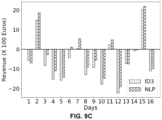
- FIG. 9C with reference to FIGS.
- FIG. 1 through 9B depicts a graphical representation of a performance of the method along with the baseline trading technique (ID3 - conventional approach) on a set of 250 DERs, in accordance with an embodiment of the present disclosure. It was found that the method of the present disclosure outperforms the baseline even under a large DER set. Further, Table 8 summarizes the key scalability parameters of the original problem and the two relaxations for different problem sizes.
- Present disclosure provides system and method that formulate and solve an optimal bidding problem of aggregators managing heterogeneous DERs and participating in intraday electricity markets.
- the system and method modeled the joint price-volume dynamics present in these markets through two dimensional histograms and used it in the decision making.
- the optimal bidding problem turned out to be an MINLP problem. Since this problem could not be solved using commercial solvers, the system and method presented a relaxation of the problem which leverage different aspects of the problem's structure wherein the relaxation converted the MINLP to an NLP.
- the performance was tested against baseline approaches (ID3 price-based trading strategies) using real world market data. It was found that the relaxation improved the revenue performance of the aggregator by 19% relative to the ID3 price-based trading. Also, the performance gap between the baseline and method of the present disclosure remained robust to changes in subscriber generation limits.
- Such computer-readable storage means contain program-code means for implementation of one or more steps of the method, when the program runs on a server or mobile device or any suitable programmable device.
- the hardware device can be any kind of device which can be programmed including e.g., any kind of computer like a server or a personal computer, or the like, or any combination thereof.
- the device may also include means which could be e.g., hardware means like e.g., an application-specific integrated circuit (ASIC), a field-programmable gate array (FPGA), or a combination of hardware and software means, e.g., an ASIC and an FPGA, or at least one microprocessor and at least one memory with software processing components located therein.
- the means can include both hardware means and software means.
- the method embodiments described herein could be implemented in hardware and software.
- the device may also include software means. Alternatively, the embodiments may be implemented on different hardware devices, e.g., using a plurality of CPUs.
- the embodiments herein can comprise hardware and software elements.
- the embodiments that are implemented in software include but are not limited to, firmware, resident software, microcode, etc.
- the functions performed by various components described herein may be implemented in other components or combinations of other components.
- a computer-usable or computer readable medium can be any apparatus that can comprise, store, communicate, propagate, or transport the program for use by or in connection with the instruction execution system, apparatus, or device.
- a computer-readable storage medium refers to any type of physical memory on which information or data readable by a processor may be stored.
- a computer-readable storage medium may store instructions for execution by one or more processors, including instructions for causing the processor(s) to perform steps or stages consistent with the embodiments described herein.
- the term "computer-readable medium” should be understood to include tangible items and exclude carrier waves and transient signals, i.e., be non-transitory. Examples include random access memory (RAM), read-only memory (ROM), volatile memory, nonvolatile memory, hard drives, CD ROMs, DVDs, flash drives, disks, and any other known physical storage media.
Landscapes
- Business, Economics & Management (AREA)
- Engineering & Computer Science (AREA)
- Economics (AREA)
- Strategic Management (AREA)
- Theoretical Computer Science (AREA)
- Accounting & Taxation (AREA)
- Marketing (AREA)
- General Business, Economics & Management (AREA)
- Finance (AREA)
- General Physics & Mathematics (AREA)
- Physics & Mathematics (AREA)
- Development Economics (AREA)
- Human Resources & Organizations (AREA)
- Entrepreneurship & Innovation (AREA)
- Health & Medical Sciences (AREA)
- Tourism & Hospitality (AREA)
- Game Theory and Decision Science (AREA)
- Primary Health Care (AREA)
- General Health & Medical Sciences (AREA)
- Water Supply & Treatment (AREA)
- Public Health (AREA)
- Technology Law (AREA)
- Operations Research (AREA)
- Quality & Reliability (AREA)
- Educational Administration (AREA)
- Data Mining & Analysis (AREA)
- Management, Administration, Business Operations System, And Electronic Commerce (AREA)
Claims (15)
- Prozessorimplementiertes Verfahren, ferner umfassend:Erhalten, über einen oder mehrere Hardwareprozessoren (104), einer Eingabe, umfassend i) historische Daten, die sich auf die Erzeugung und den Bedarf an Energie beziehen, ii) historische Intraday-Marktdaten, iii) eine Spezifikation einer Mehrzahl von verteilten Energieressourcen, DERs, die mit einem Netzwerk verbunden sind, das für einen Aggregator spezifisch ist, iv) eine Präferenz eines oder mehrerer Teilnehmer und v) Informationen, die mit dem Netzwerk assoziiert sind, das für den Aggregator (202) spezifisch ist;Vorhersagen, über den einen oder die mehreren Hardwareprozessoren (104), einer Erzeugung und eines Bedarfs an Energie durch die Mehrzahl von DERs für eine Mehrzahl von Lieferslots in einem initialisierten Optimierungsfenster, basierend auf der Eingabe (204);Schätzen, über den einen oder die mehreren Hardwareprozessoren (104), einer zweidimensionalen 2D-Verteilung des Preisvolumens für die Mehrzahl von Lieferslots in dem initialisierten Optimierungsfenster basierend auf der vorhergesagten Erzeugung und dem vorhergesagten Bedarf an Energie durch die Mehrzahl von DERs (206); undAusführen eines Optimierungsmodells über den einen oder die mehreren Hardwareprozessoren (104) unter Verwendung der geschätzten zweidimensionalen 2D-Verteilung des Preisvolumens für die Mehrzahl von Lieferslots in dem initialisierten Optimierungsfenster, um i) einen optimalen Intraday-Betriebsplan für einen oder mehrere DERs aus der Mehrzahl von DERs und optional ii) ein Intraday-Gebot, das mit der Mehrzahl von DERs assoziiert ist, für die Mehrzahl von Lieferslots, die in einem Intraday-Markt (208) gehandelt werden sollen, zu erhalten, wobei der Schritt des Ausführens des Optimierungsmodells umfasst:Formulieren eines gemischten ganzzahligen nichtlinearen Programmierproblems, MINLP-Problems, basierend auf der Eingabe und der geschätzten zweidimensionalen 2D-Verteilung des Preisvolumens für die Mehrzahl von Lieferslots in dem initialisierten Optimierungsfenster (208a);Umwandeln des formulierten MINLP-Problems in ein NLP-Problem (208b); undAusführen des NLP-Problems, um i) den optimalen Intraday-Betriebsplan für einen oder mehrere DERs aus der Mehrzahl von DERs und optional ii) das Intraday-Gebot, das mit der Mehrzahl von DERs assoziiert ist, für die Mehrzahl von Lieferslots, die in einem Intraday-Markt (208c) gehandelt werden sollen, zu erhalten.
- Prozessorimplementiertes Verfahren nach Anspruch 1, ferner umfassend:Ausführen eines Intraday-Markt-Clearing-Modells über den einen oder die mehreren Hardwareprozessoren (104), basierend auf dem Intraday-Gebot, das mit der Mehrzahl von DERs assoziiert ist, für die Mehrzahl von Lieferslots, die in dem Intraday-Markt gehandelt werden sollen, um eine Intraday-Marktausgabe zu erhalten, wobei die Intraday-Marktausgabe Informationen umfasst, die mindestens eines von i) Anzahl von Cleared-Kauf-Geboten und ii) Anzahl von Cleared-Verkauf-Geboten betreffen; undErzeugen eines endgültigen optimalen Intraday-Betriebsplans für die Mehrzahl von DERs basierend auf der Intraday-Marktausgabe.
- Prozessorimplementiertes Verfahren nach Anspruch 2, ferner umfassend Wiederholen der Schritte des Vorhersagens, Schätzens und Ausführens des Optimierungsmodells basierend auf dem endgültigen optimalen Intraday-Betriebsplan, der für die Mehrzahl von DERs erzeugt wird, um i) einen nachfolgenden optimalen Intraday-Betriebsplan für einen oder mehrere DERs aus der Mehrzahl von DERs und ii) ein nachfolgendes Intraday-Gebot, das mit der Mehrzahl von DERs assoziiert ist, für die Mehrzahl von Lieferslots, die in dem Intraday-Markt gehandelt werden sollen, für ein nachfolgendes Optimierungsfenster zu erhalten.
- Prozessorimplementiertes Verfahren nach Anspruch 1, wobei der optimale Intraday-Betriebsplan für einen ersten DER-Typ mindestens eines von i) ob in jedem Lieferslot des initialisierten Optimierungsfensters geladen oder entladen werden soll, ii) einem Ladepegel oder einem Entladepegel in jedem Lieferslot des initialisierten Optimierungsfensters und iii) einem Ladezustands-SOC-Wert eines DER des ersten DER-Typs an einem Ende jedes Lieferslots umfasst.
- Prozessorimplementiertes Verfahren nach Anspruch 1, wobei der optimale Intraday-Betriebsplan für einen zweiten DER-Typ eine Menge an Energie umfasst, die erforderlich ist, um einem Stromnetz in jedem Lieferslot bereitgestellt zu werden, wobei der optimale Intraday-Betriebsplan für einen dritten DER-Typ Informationen umfasst, die die Planung eines Betriebs einer flexiblen Last an einem oder mehreren Lieferslots betreffen, wobei der optimale Intraday-Betriebsplan für einen dritten DER-Typ Informationen umfasst, die die Planung eines Betriebs einer flexiblen Last an einem oder mehreren Lieferslots betreffen, und wobei das NLP-Problem durch Entspannen mindestens eines von i) einer ersten ganzzahligen Variablen und ii) einer zweiten ganzzahligen Variablen, die in dem MINLP enthalten ist, erhalten wird, wobei die erste ganzzahlige Variable auf einer Entscheidung eines Typs des Intraday-Gebots basiert und wobei die zweite ganzzahlige Variable auf einer für einen DER-Typ spezifischen Beschränkung basiert.
- System (100), umfassend:einen Speicher (102), der Anweisungen speichert;eine oder mehrere Kommunikationsschnittstellen (106); undeinen oder mehrere Hardwareprozessoren (104), die über die eine oder die mehreren Kommunikationsschnittstellen (106) mit dem Speicher (102) gekoppelt sind, wobei der eine oder die mehreren Hardwareprozessoren (104) durch die Anweisungen konfiguriert sind zum:Erhalten einer Eingabe, umfassend i) historische Daten, die sich auf die Erzeugung und den Bedarf an Energie beziehen, ii) historische Intraday-Marktdaten, iii) eine Spezifikation einer Mehrzahl von verteilten Energieressourcen, DERs, die mit einem Netzwerk verbunden sind, das für einen Aggregator spezifisch ist, iv) eine Präferenz eines oder mehrerer Teilnehmer und v) Informationen, die mit dem Netzwerk assoziiert sind, das für den Aggregator spezifisch ist;Vorhersagen einer Erzeugung und eines Bedarfs an Energie durch die Mehrzahl von DERs für eine Mehrzahl von Lieferslots in einem initialisierten Optimierungsfenster, basierend auf der Eingabe;Schätzen einer zweidimensionalen 2D-Verteilung des Preisvolumens für die Mehrzahl von Lieferslots in dem initialisierten Optimierungsfenster basierend auf der vorhergesagten Erzeugung und dem vorhergesagten Bedarf an Energie durch die Mehrzahl von DERs; undAusführen eines Optimierungsmodells unter Verwendung der geschätzten zweidimensionalen 2D-Verteilung des Preisvolumens für die Mehrzahl von Lieferslots in dem initialisierten Optimierungsfenster, um i) einen optimalen Intraday-Betriebsplan für einen oder mehrere DERs aus der Mehrzahl von DERs und optional ii) ein Intraday-Gebot, das mit der Mehrzahl von DERs assoziiert ist, für die Mehrzahl von Lieferslots, die in einem Intraday-Markt gehandelt werden sollen, zu erhalten, wobei der Schritt des Ausführens des Optimierungsmodells umfasst:Formulieren eines gemischten ganzzahligen nichtlinearen Programmierproblems, MINLP-Problems, basierend auf der Eingabe und der geschätzten zweidimensionalen 2D-Verteilung des Preisvolumens für die Mehrzahl von Lieferslots in dem initialisierten Optimierungsfenster;Umwandeln des formulierten MINLP-Problems in ein NLP-Problem; undAusführen des NLP-Problems, um i) den optimalen Intraday-Betriebsplan für einen oder mehrere DERs aus der Mehrzahl von DERs und optional ii) das Intraday-Gebot, das mit der Mehrzahl von DERs assoziiert ist, für die Mehrzahl von Lieferslots, die in einem Intraday-Markt gehandelt werden sollen, zu erhalten.
- System nach Anspruch 6, wobei der eine oder die mehreren Hardwareprozessoren (104) ferner durch die Anweisungen konfiguriert sind zum:Ausführen eines Intraday-Markt-Clearing-Modells, basierend auf dem Intraday-Gebot, das mit der Mehrzahl von DERs assoziiert ist, für die Mehrzahl von Lieferslots, die in dem Intraday-Markt gehandelt werden sollen, um eine Intraday-Marktausgabe zu erhalten, wobei die Intraday-Marktausgabe Informationen umfasst, die mindestens eines von i) Anzahl von Cleared-Kauf-Geboten und ii) Anzahl von Cleared-Verkauf-Geboten betreffen; undErzeugen eines endgültigen optimalen Intraday-Betriebsplans für die Mehrzahl von DERs basierend auf der Intraday-Marktausgabe.
- System nach Anspruch 7, wobei der eine oder die mehreren Hardwareprozessoren (104) ferner durch die Anweisungen konfiguriert sind zum Wiederholen der Schritte des Vorhersagens, Schätzens und Ausführens des Optimierungsmodells basierend auf dem endgültigen optimalen Intraday-Betriebsplan, der für die Mehrzahl von DERs erzeugt wird, um i) einen nachfolgenden optimalen Intraday-Betriebsplan für einen oder mehrere DERs aus der Mehrzahl von DERs und ii) ein nachfolgendes Intraday-Gebot, das mit der Mehrzahl von DERs assoziiert ist, für die Mehrzahl von Lieferslots, die in dem Intraday-Markt gehandelt werden sollen, für ein nachfolgendes Optimierungsfenster zu erhalten.
- System nach Anspruch 6, wobei der optimale Intraday-Betriebsplan für einen ersten DER-Typ mindestens eines von i) ob in jedem Lieferslot des initialisierten Optimierungsfensters geladen oder entladen werden soll, ii) einem Ladepegel oder einem Entladepegel in jedem Lieferslot des initialisierten Optimierungsfensters und iii) einem Ladezustands-SOC-Wert eines DER des ersten DER-Typs an einem Ende jedes Lieferslots umfasst.
- System nach Anspruch 6, wobei der optimale Intraday-Betriebsplan für einen zweiten DER-Typ eine Menge an Energie umfasst, die erforderlich ist, um einem Stromnetz in jedem Lieferslot bereitgestellt zu werden, wobei der optimale Intraday-Betriebsplan für einen dritten DER-Typ Informationen umfasst, die die Planung eines Betriebs einer flexiblen Last an einem oder mehreren Lieferslots betreffen, wobei der optimale Intraday-Betriebsplan für einen dritten DER-Typ Informationen umfasst, die die Planung eines Betriebs einer flexiblen Last an einem oder mehreren Lieferslots betreffen, und wobei das NLP-Problem durch Entspannen mindestens eines von i) einer ersten ganzzahligen Variablen und ii) einer zweiten ganzzahligen Variablen, die in dem MINLP enthalten ist, erhalten wird, wobei die erste ganzzahlige Variable auf einer Entscheidung eines Typs des Intraday-Gebots basiert und wobei die zweite ganzzahlige Variable auf einer für einen DER-Typ spezifischen Beschränkung basiert.
- Ein oder mehrere nichtflüchtige maschinenlesbare Informationsspeichermedien, die eine oder mehrere Anweisungen umfassen, die, wenn sie von einem oder mehreren Hardwareprozessoren (104) ausgeführt werden, bewirken:Erhalten einer Eingabe, umfassend i) historische Daten, die sich auf die Erzeugung und den Bedarf an Energie beziehen, ii) historische Intraday-Marktdaten, iii) eine Spezifikation einer Mehrzahl von verteilten Energieressourcen, DERs, die mit einem Netzwerk verbunden sind, das für einen Aggregator spezifisch ist, iv) eine Präferenz eines oder mehrerer Teilnehmer und v) Informationen, die mit dem Netzwerk assoziiert sind, das für den Aggregator spezifisch ist;Vorhersagen einer Erzeugung und eines Bedarfs an Energie durch die Mehrzahl von DERs für eine Mehrzahl von Lieferslots in einem initialisierten Optimierungsfenster, basierend auf der Eingabe;Schätzen einer zweidimensionalen Verteilung des Preisvolumens für die Mehrzahl von Lieferslots in dem initialisierten Optimierungsfenster basierend auf der vorhergesagten Erzeugung und dem vorhergesagten Bedarf an Energie durch die Mehrzahl von DERs; undAusführen eines Optimierungsmodells unter Verwendung der geschätzten zweidimensionalen Verteilung des Preisvolumens für die Mehrzahl von Lieferslots in dem initialisierten Optimierungsfenster, um i) einen optimalen Intraday-Betriebsplan für einen oder mehrere DERs aus der Mehrzahl von DERs und optional ii) ein Intraday-Gebot, das mit der Mehrzahl von DERs assoziiert ist, für die Mehrzahl von Lieferslots, die in einem Intraday-Markt gehandelt werden sollen, zu erhalten, wobei der Schritt des Ausführens des Optimierungsmodells umfasst:Formulieren eines gemischten ganzzahligen nichtlinearen Programmierproblems, MINLP-Problems, basierend auf der Eingabe und der geschätzten zweidimensionalen Verteilung des Preisvolumens für die Mehrzahl von Lieferslots in dem initialisierten Optimierungsfenster;Umwandeln des formulierten MINLP-Problems in ein NLP-Problem; undAusführen des NLP-Problems, um i) den optimalen Intraday-Betriebsplan für einen oder mehrere DERs aus der Mehrzahl von DERs und optional ii) das Intraday-Gebot, das mit der Mehrzahl von DERs assoziiert ist, für die Mehrzahl von Lieferslots, die in einem Intraday-Markt gehandelt werden sollen, zu erhalten.
- Ein oder mehrere nichtflüchtige maschinenlesbare Informationsspeichermedien nach Anspruch 11, wobei die eine oder die mehreren Anweisungen, die, wenn sie von dem einen oder den mehreren Hardwareprozessoren (104) ausgeführt werden, ferner bewirken:Ausführen eines Intraday-Markt-Clearing-Modells, basierend auf dem Intraday-Gebot, das mit der Mehrzahl von DERs assoziiert ist, für die Mehrzahl von Lieferslots, die in dem Intraday-Markt gehandelt werden sollen, um eine Intraday-Marktausgabe zu erhalten, wobei die Intraday-Marktausgabe Informationen umfasst, die mindestens eines von i) Anzahl von Cleared-Kauf-Geboten und ii) Anzahl von Cleared-Verkauf-Geboten betreffen; undErzeugen eines endgültigen optimalen Intraday-Betriebsplans für die Mehrzahl von DERs basierend auf der Intraday-Marktausgabe.
- Ein oder mehrere nichtflüchtige maschinenlesbare Informationsspeichermedien nach Anspruch 12, wobei die eine oder die mehreren Anweisungen, die, wenn sie von dem einen oder den mehreren Hardwareprozessoren (104) ausgeführt werden, ferner bewirken, dass die Schritte des Vorhersagens, Schätzens und Ausführens des Optimierungsmodells basierend auf dem endgültigen optimalen Intraday-Betriebsplan, der für die Mehrzahl von DERs erzeugt wird, wiederholt werden, um i) einen nachfolgenden optimalen Intraday-Betriebsplan für einen oder mehrere DERs aus der Mehrzahl von DERs und ii) ein nachfolgendes Intraday-Gebot, das mit der Mehrzahl von DERs assoziiert ist, für die Mehrzahl von Lieferslots, die in dem Intraday-Markt gehandelt werden sollen, für ein nachfolgendes Optimierungsfenster zu erhalten.
- Ein oder mehrere nichtflüchtige maschinenlesbare Informationsspeichermedien nach Anspruch 11, wobei der optimale Intraday-Betriebsplan für einen ersten DER-Typ mindestens eines von i) ob in jedem Lieferslot des initialisierten Optimierungsfensters geladen oder entladen werden soll, ii) einem Ladepegel oder einem Entladepegel in jedem Lieferslot des initialisierten Optimierungsfensters und iii) einem Ladezustands-SOC-Wert eines DER des ersten DER-Typs an einem Ende jedes Lieferslots umfasst.
- Ein oder mehrere nichtflüchtige maschinenlesbare Informationsspeichermedien nach Anspruch 11, wobei der optimale Intraday-Betriebsplan für einen zweiten DER-Typ eine Menge an Energie umfasst, die erforderlich ist, um einem Stromnetz in jedem Lieferslot bereitgestellt zu werden, wobei der optimale Intraday-Betriebsplan für einen dritten DER-Typ Informationen umfasst, die die Planung eines Betriebs einer flexiblen Last an einem oder mehreren Lieferslot betreffen, wobei der optimale Intraday-Betriebsplan für einen dritten DER-Typ Informationen umfasst, die die Planung eines Betriebs einer flexiblen Last an einem oder mehreren Lieferslots betreffen, und wobei das NLP-Problem durch Entspannen mindestens eines von i) einer ersten ganzzahligen Variablen und ii) einer zweiten ganzzahligen Variablen, die in dem MINLP enthalten ist, erhalten wird, wobei die erste ganzzahlige Variable auf einer Entscheidung eines Typs des Intraday-Gebots basiert und wobei die zweite ganzzahlige Variable auf einer für einen DER-Typ spezifischen Beschränkung basiert.
Applications Claiming Priority (1)
| Application Number | Priority Date | Filing Date | Title |
|---|---|---|---|
| IN202221034619 | 2022-06-16 |
Publications (3)
| Publication Number | Publication Date |
|---|---|
| EP4293585A1 EP4293585A1 (de) | 2023-12-20 |
| EP4293585C0 EP4293585C0 (de) | 2024-08-21 |
| EP4293585B1 true EP4293585B1 (de) | 2024-08-21 |
Family
ID=86497693
Family Applications (1)
| Application Number | Title | Priority Date | Filing Date |
|---|---|---|---|
| EP23174346.9A Active EP4293585B1 (de) | 2022-06-16 | 2023-05-19 | Systeme und verfahren zur erzeugung optimaler intratagesangebote und betriebspläne für verteilte energieressourcen |
Country Status (2)
| Country | Link |
|---|---|
| US (1) | US20230410201A1 (de) |
| EP (1) | EP4293585B1 (de) |
Families Citing this family (1)
| Publication number | Priority date | Publication date | Assignee | Title |
|---|---|---|---|---|
| CN118761799A (zh) * | 2024-09-05 | 2024-10-11 | 电子科技大学(深圳)高等研究院 | 一种连续日内电力市场交易建模方法及计算机程序产品 |
Family Cites Families (8)
| Publication number | Priority date | Publication date | Assignee | Title |
|---|---|---|---|---|
| US20010032029A1 (en) * | 1999-07-01 | 2001-10-18 | Stuart Kauffman | System and method for infrastructure design |
| US9946285B2 (en) * | 2011-12-23 | 2018-04-17 | International Business Machines Corporation | Energy allocation system for balancing energy consumption |
| US8762189B2 (en) * | 2012-02-24 | 2014-06-24 | Nec Laboratories America, Inc. | Systems and methods for stochastically using electric vehicles as mobile energy storage |
| US20140081704A1 (en) * | 2012-09-15 | 2014-03-20 | Honeywell International Inc. | Decision support system based on energy markets |
| CA2951306A1 (en) * | 2015-12-10 | 2017-06-10 | Open Access Technology International, Inc. | Systems to electronically catalog and generate documentation for retail-level power |
| CN117411090A (zh) * | 2016-06-06 | 2024-01-16 | 艾帕瑞尔实验室有限责任公司 | 用于电网分布式能源管理的智能电网操作系统 |
| US11159044B2 (en) * | 2017-07-14 | 2021-10-26 | Battelle Memorial Institute | Hierarchal framework for integrating distributed energy resources into distribution systems |
| WO2019108891A1 (en) * | 2017-12-01 | 2019-06-06 | Massachusetts Institute Of Technology | Methods and systems for secure scheduling and dispatching synthetic regulation reserve from distributed energy resources |
-
2023
- 2023-05-19 EP EP23174346.9A patent/EP4293585B1/de active Active
- 2023-05-24 US US18/323,182 patent/US20230410201A1/en active Pending
Also Published As
| Publication number | Publication date |
|---|---|
| US20230410201A1 (en) | 2023-12-21 |
| EP4293585A1 (de) | 2023-12-20 |
| EP4293585C0 (de) | 2024-08-21 |
Similar Documents
| Publication | Publication Date | Title |
|---|---|---|
| Qiu et al. | Multi-Agent Reinforcement Learning for Automated Peer-to-Peer Energy Trading in Double-Side Auction Market. | |
| Chen et al. | Local energy trading behavior modeling with deep reinforcement learning | |
| Liu et al. | Energy-sharing provider for PV prosumer clusters: A hybrid approach using stochastic programming and stackelberg game | |
| Guerrero et al. | A study of energy trading in a low-voltage network: Centralised and distributed approaches | |
| Chakraborty et al. | Real-time energy exchange strategy of optimally cooperative microgrids for scale-flexible distribution system | |
| Jia et al. | Renewables and storage in distribution systems: Centralized vs. decentralized integration | |
| US20170236222A1 (en) | Critical peak pricing demand response participant assessment | |
| Meng et al. | A bilevel optimization approach to demand response management for the smart grid | |
| Vakili et al. | Interconnected microgrids: Optimal energy scheduling based on a game‐theoretic approach | |
| EP4300387A1 (de) | Optimale intratagesplanung aggregierter verteilter energieressourcen (ders) | |
| EP4293585B1 (de) | Systeme und verfahren zur erzeugung optimaler intratagesangebote und betriebspläne für verteilte energieressourcen | |
| Chapman et al. | Cooperative game theory for non-linear pricing of load-side distribution network support | |
| Azad‐Farsani et al. | Stochastic locational marginal price calculation in distribution systems using game theory and point estimate method | |
| Hossein Abbasi et al. | Risk‐constrained offering strategies for a large‐scale price‐maker electric vehicle demand aggregator | |
| Khandelwal et al. | Virtual Power Plant (VPP) scheduling with uncertain multiple Locational Marginal Prices | |
| Zhao et al. | A peer-to-peer energy trading system considering participants’ social relationships and multi-class preferences | |
| CN115936877A (zh) | 基于区块链的电力交易方法、装置、设备及存储介质 | |
| Chen et al. | Stochastic battery operations using deep neural networks | |
| Walraven et al. | Planning Under Uncertainty for Aggregated Electric Vehicle Charging with Renewable Energy Supply. | |
| Liu et al. | A customer-centric distributed data-driven stochastic coordination method for residential PV and BESS | |
| Lokhande et al. | CIMTrade: continuous intraday market trading model for a DER aggregator | |
| Wang et al. | Two‐stage optimal scheduling for aggregators of batteries owned by commercial consumers | |
| Yao et al. | Risk-averse forward contract for electric vehicle frequency regulation service | |
| ALsalloum et al. | Prioritizing prosumers in the energy trading mechanism: A game theoretic approach | |
| Mediwaththe et al. | Game-theoretic demand-side management robust to non-ideal consumer behavior in smart grid |
Legal Events
| Date | Code | Title | Description |
|---|---|---|---|
| PUAI | Public reference made under article 153(3) epc to a published international application that has entered the european phase |
Free format text: ORIGINAL CODE: 0009012 |
|
| STAA | Information on the status of an ep patent application or granted ep patent |
Free format text: STATUS: THE APPLICATION HAS BEEN PUBLISHED |
|
| AK | Designated contracting states |
Kind code of ref document: A1 Designated state(s): AL AT BE BG CH CY CZ DE DK EE ES FI FR GB GR HR HU IE IS IT LI LT LU LV MC ME MK MT NL NO PL PT RO RS SE SI SK SM TR |
|
| STAA | Information on the status of an ep patent application or granted ep patent |
Free format text: STATUS: REQUEST FOR EXAMINATION WAS MADE |
|
| 17P | Request for examination filed |
Effective date: 20240426 |
|
| RBV | Designated contracting states (corrected) |
Designated state(s): AL AT BE BG CH CY CZ DE DK EE ES FI FR GB GR HR HU IE IS IT LI LT LU LV MC ME MK MT NL NO PL PT RO RS SE SI SK SM TR |
|
| GRAP | Despatch of communication of intention to grant a patent |
Free format text: ORIGINAL CODE: EPIDOSNIGR1 |
|
| STAA | Information on the status of an ep patent application or granted ep patent |
Free format text: STATUS: GRANT OF PATENT IS INTENDED |
|
| GRAS | Grant fee paid |
Free format text: ORIGINAL CODE: EPIDOSNIGR3 |
|
| RIC1 | Information provided on ipc code assigned before grant |
Ipc: G06Q 10/063 20230101ALI20240612BHEP Ipc: G06Q 50/06 20120101ALI20240612BHEP Ipc: G06Q 40/04 20120101ALI20240612BHEP Ipc: G06Q 30/0202 20230101ALI20240612BHEP Ipc: G06Q 10/04 20230101AFI20240612BHEP |
|
| GRAA | (expected) grant |
Free format text: ORIGINAL CODE: 0009210 |
|
| STAA | Information on the status of an ep patent application or granted ep patent |
Free format text: STATUS: THE PATENT HAS BEEN GRANTED |
|
| INTG | Intention to grant announced |
Effective date: 20240625 |
|
| AK | Designated contracting states |
Kind code of ref document: B1 Designated state(s): AL AT BE BG CH CY CZ DE DK EE ES FI FR GB GR HR HU IE IS IT LI LT LU LV MC ME MK MT NL NO PL PT RO RS SE SI SK SM TR |
|
| REG | Reference to a national code |
Ref country code: GB Ref legal event code: FG4D |
|
| REG | Reference to a national code |
Ref country code: CH Ref legal event code: EP |
|
| REG | Reference to a national code |
Ref country code: DE Ref legal event code: R096 Ref document number: 602023000424 Country of ref document: DE |
|
| REG | Reference to a national code |
Ref country code: IE Ref legal event code: FG4D |
|
| U01 | Request for unitary effect filed |
Effective date: 20240821 |
|
| U07 | Unitary effect registered |
Designated state(s): AT BE BG DE DK EE FI FR IT LT LU LV MT NL PT SE SI Effective date: 20240827 |
|
| PG25 | Lapsed in a contracting state [announced via postgrant information from national office to epo] |
Ref country code: NO Free format text: LAPSE BECAUSE OF FAILURE TO SUBMIT A TRANSLATION OF THE DESCRIPTION OR TO PAY THE FEE WITHIN THE PRESCRIBED TIME-LIMIT Effective date: 20241121 |
|
| PG25 | Lapsed in a contracting state [announced via postgrant information from national office to epo] |
Ref country code: PL Free format text: LAPSE BECAUSE OF FAILURE TO SUBMIT A TRANSLATION OF THE DESCRIPTION OR TO PAY THE FEE WITHIN THE PRESCRIBED TIME-LIMIT Effective date: 20240821 Ref country code: GR Free format text: LAPSE BECAUSE OF FAILURE TO SUBMIT A TRANSLATION OF THE DESCRIPTION OR TO PAY THE FEE WITHIN THE PRESCRIBED TIME-LIMIT Effective date: 20241122 |
|
| PG25 | Lapsed in a contracting state [announced via postgrant information from national office to epo] |
Ref country code: IS Free format text: LAPSE BECAUSE OF FAILURE TO SUBMIT A TRANSLATION OF THE DESCRIPTION OR TO PAY THE FEE WITHIN THE PRESCRIBED TIME-LIMIT Effective date: 20241221 |
|
| PG25 | Lapsed in a contracting state [announced via postgrant information from national office to epo] |
Ref country code: HR Free format text: LAPSE BECAUSE OF FAILURE TO SUBMIT A TRANSLATION OF THE DESCRIPTION OR TO PAY THE FEE WITHIN THE PRESCRIBED TIME-LIMIT Effective date: 20240821 |
|
| PG25 | Lapsed in a contracting state [announced via postgrant information from national office to epo] |
Ref country code: ES Free format text: LAPSE BECAUSE OF FAILURE TO SUBMIT A TRANSLATION OF THE DESCRIPTION OR TO PAY THE FEE WITHIN THE PRESCRIBED TIME-LIMIT Effective date: 20240821 Ref country code: RS Free format text: LAPSE BECAUSE OF FAILURE TO SUBMIT A TRANSLATION OF THE DESCRIPTION OR TO PAY THE FEE WITHIN THE PRESCRIBED TIME-LIMIT Effective date: 20241121 |
|
| PG25 | Lapsed in a contracting state [announced via postgrant information from national office to epo] |
Ref country code: RS Free format text: LAPSE BECAUSE OF FAILURE TO SUBMIT A TRANSLATION OF THE DESCRIPTION OR TO PAY THE FEE WITHIN THE PRESCRIBED TIME-LIMIT Effective date: 20241121 Ref country code: PL Free format text: LAPSE BECAUSE OF FAILURE TO SUBMIT A TRANSLATION OF THE DESCRIPTION OR TO PAY THE FEE WITHIN THE PRESCRIBED TIME-LIMIT Effective date: 20240821 Ref country code: NO Free format text: LAPSE BECAUSE OF FAILURE TO SUBMIT A TRANSLATION OF THE DESCRIPTION OR TO PAY THE FEE WITHIN THE PRESCRIBED TIME-LIMIT Effective date: 20241121 Ref country code: IS Free format text: LAPSE BECAUSE OF FAILURE TO SUBMIT A TRANSLATION OF THE DESCRIPTION OR TO PAY THE FEE WITHIN THE PRESCRIBED TIME-LIMIT Effective date: 20241221 Ref country code: HR Free format text: LAPSE BECAUSE OF FAILURE TO SUBMIT A TRANSLATION OF THE DESCRIPTION OR TO PAY THE FEE WITHIN THE PRESCRIBED TIME-LIMIT Effective date: 20240821 Ref country code: GR Free format text: LAPSE BECAUSE OF FAILURE TO SUBMIT A TRANSLATION OF THE DESCRIPTION OR TO PAY THE FEE WITHIN THE PRESCRIBED TIME-LIMIT Effective date: 20241122 Ref country code: ES Free format text: LAPSE BECAUSE OF FAILURE TO SUBMIT A TRANSLATION OF THE DESCRIPTION OR TO PAY THE FEE WITHIN THE PRESCRIBED TIME-LIMIT Effective date: 20240821 |
|
| RAP4 | Party data changed (patent owner data changed or rights of a patent transferred) |
Owner name: TATA CONSULTANCY SERVICES LIMITED |
|
| U1H | Name or address of the proprietor changed after the registration of the unitary effect |
Owner name: TATA CONSULTANCY SERVICES LIMITED; IN |
|
| PG25 | Lapsed in a contracting state [announced via postgrant information from national office to epo] |
Ref country code: SM Free format text: LAPSE BECAUSE OF FAILURE TO SUBMIT A TRANSLATION OF THE DESCRIPTION OR TO PAY THE FEE WITHIN THE PRESCRIBED TIME-LIMIT Effective date: 20240821 |
|
| PG25 | Lapsed in a contracting state [announced via postgrant information from national office to epo] |
Ref country code: CZ Free format text: LAPSE BECAUSE OF FAILURE TO SUBMIT A TRANSLATION OF THE DESCRIPTION OR TO PAY THE FEE WITHIN THE PRESCRIBED TIME-LIMIT Effective date: 20240821 |
|
| PG25 | Lapsed in a contracting state [announced via postgrant information from national office to epo] |
Ref country code: SK Free format text: LAPSE BECAUSE OF FAILURE TO SUBMIT A TRANSLATION OF THE DESCRIPTION OR TO PAY THE FEE WITHIN THE PRESCRIBED TIME-LIMIT Effective date: 20240821 |
|
| PLBE | No opposition filed within time limit |
Free format text: ORIGINAL CODE: 0009261 |
|
| STAA | Information on the status of an ep patent application or granted ep patent |
Free format text: STATUS: NO OPPOSITION FILED WITHIN TIME LIMIT |
|
| U20 | Renewal fee for the european patent with unitary effect paid |
Year of fee payment: 3 Effective date: 20250526 |
|
| 26N | No opposition filed |
Effective date: 20250522 |
|
| PG25 | Lapsed in a contracting state [announced via postgrant information from national office to epo] |
Ref country code: MC Free format text: LAPSE BECAUSE OF FAILURE TO SUBMIT A TRANSLATION OF THE DESCRIPTION OR TO PAY THE FEE WITHIN THE PRESCRIBED TIME-LIMIT Effective date: 20240821 |