EP4124523A1 - Hydraulische fahrradbremsanlage und zugehörige komponenten und verfahren - Google Patents
Hydraulische fahrradbremsanlage und zugehörige komponenten und verfahren Download PDFInfo
- Publication number
- EP4124523A1 EP4124523A1 EP22186692.4A EP22186692A EP4124523A1 EP 4124523 A1 EP4124523 A1 EP 4124523A1 EP 22186692 A EP22186692 A EP 22186692A EP 4124523 A1 EP4124523 A1 EP 4124523A1
- Authority
- EP
- European Patent Office
- Prior art keywords
- membrane
- tank
- control device
- hydraulic
- output
- Prior art date
- Legal status (The legal status is an assumption and is not a legal conclusion. Google has not performed a legal analysis and makes no representation as to the accuracy of the status listed.)
- Granted
Links
Images




Classifications
-
- B—PERFORMING OPERATIONS; TRANSPORTING
- B62—LAND VEHICLES FOR TRAVELLING OTHERWISE THAN ON RAILS
- B62L—BRAKES SPECIALLY ADAPTED FOR CYCLES
- B62L3/00—Brake-actuating mechanisms; Arrangements thereof
- B62L3/02—Brake-actuating mechanisms; Arrangements thereof for control by a hand lever
- B62L3/023—Brake-actuating mechanisms; Arrangements thereof for control by a hand lever acting on fluid pressure systems
-
- B—PERFORMING OPERATIONS; TRANSPORTING
- B62—LAND VEHICLES FOR TRAVELLING OTHERWISE THAN ON RAILS
- B62K—CYCLES; CYCLE FRAMES; CYCLE STEERING DEVICES; RIDER-OPERATED TERMINAL CONTROLS SPECIALLY ADAPTED FOR CYCLES; CYCLE AXLE SUSPENSIONS; CYCLE SIDE-CARS, FORECARS, OR THE LIKE
- B62K23/00—Rider-operated controls specially adapted for cycles, i.e. means for initiating control operations, e.g. levers, grips
- B62K23/02—Rider-operated controls specially adapted for cycles, i.e. means for initiating control operations, e.g. levers, grips hand actuated
- B62K23/06—Levers
-
- B—PERFORMING OPERATIONS; TRANSPORTING
- B60—VEHICLES IN GENERAL
- B60T—VEHICLE BRAKE CONTROL SYSTEMS OR PARTS THEREOF; BRAKE CONTROL SYSTEMS OR PARTS THEREOF, IN GENERAL; ARRANGEMENT OF BRAKING ELEMENTS ON VEHICLES IN GENERAL; PORTABLE DEVICES FOR PREVENTING UNWANTED MOVEMENT OF VEHICLES; VEHICLE MODIFICATIONS TO FACILITATE COOLING OF BRAKES
- B60T11/00—Transmitting braking action from initiating means to ultimate brake actuator without power assistance or drive or where such assistance or drive is irrelevant
- B60T11/10—Transmitting braking action from initiating means to ultimate brake actuator without power assistance or drive or where such assistance or drive is irrelevant transmitting by fluid means, e.g. hydraulic
- B60T11/16—Master control, e.g. master cylinders
-
- B—PERFORMING OPERATIONS; TRANSPORTING
- B60—VEHICLES IN GENERAL
- B60T—VEHICLE BRAKE CONTROL SYSTEMS OR PARTS THEREOF; BRAKE CONTROL SYSTEMS OR PARTS THEREOF, IN GENERAL; ARRANGEMENT OF BRAKING ELEMENTS ON VEHICLES IN GENERAL; PORTABLE DEVICES FOR PREVENTING UNWANTED MOVEMENT OF VEHICLES; VEHICLE MODIFICATIONS TO FACILITATE COOLING OF BRAKES
- B60T11/00—Transmitting braking action from initiating means to ultimate brake actuator without power assistance or drive or where such assistance or drive is irrelevant
- B60T11/10—Transmitting braking action from initiating means to ultimate brake actuator without power assistance or drive or where such assistance or drive is irrelevant transmitting by fluid means, e.g. hydraulic
- B60T11/16—Master control, e.g. master cylinders
- B60T11/22—Master control, e.g. master cylinders characterised by being integral with reservoir
-
- B—PERFORMING OPERATIONS; TRANSPORTING
- B60—VEHICLES IN GENERAL
- B60T—VEHICLE BRAKE CONTROL SYSTEMS OR PARTS THEREOF; BRAKE CONTROL SYSTEMS OR PARTS THEREOF, IN GENERAL; ARRANGEMENT OF BRAKING ELEMENTS ON VEHICLES IN GENERAL; PORTABLE DEVICES FOR PREVENTING UNWANTED MOVEMENT OF VEHICLES; VEHICLE MODIFICATIONS TO FACILITATE COOLING OF BRAKES
- B60T11/00—Transmitting braking action from initiating means to ultimate brake actuator without power assistance or drive or where such assistance or drive is irrelevant
- B60T11/10—Transmitting braking action from initiating means to ultimate brake actuator without power assistance or drive or where such assistance or drive is irrelevant transmitting by fluid means, e.g. hydraulic
- B60T11/26—Reservoirs
-
- B—PERFORMING OPERATIONS; TRANSPORTING
- B60—VEHICLES IN GENERAL
- B60T—VEHICLE BRAKE CONTROL SYSTEMS OR PARTS THEREOF; BRAKE CONTROL SYSTEMS OR PARTS THEREOF, IN GENERAL; ARRANGEMENT OF BRAKING ELEMENTS ON VEHICLES IN GENERAL; PORTABLE DEVICES FOR PREVENTING UNWANTED MOVEMENT OF VEHICLES; VEHICLE MODIFICATIONS TO FACILITATE COOLING OF BRAKES
- B60T17/00—Component parts, details, or accessories of power brake systems not covered by groups B60T8/00, B60T13/00 or B60T15/00, or presenting other characteristic features
- B60T17/06—Applications or arrangements of reservoirs
-
- B—PERFORMING OPERATIONS; TRANSPORTING
- B60—VEHICLES IN GENERAL
- B60T—VEHICLE BRAKE CONTROL SYSTEMS OR PARTS THEREOF; BRAKE CONTROL SYSTEMS OR PARTS THEREOF, IN GENERAL; ARRANGEMENT OF BRAKING ELEMENTS ON VEHICLES IN GENERAL; PORTABLE DEVICES FOR PREVENTING UNWANTED MOVEMENT OF VEHICLES; VEHICLE MODIFICATIONS TO FACILITATE COOLING OF BRAKES
- B60T17/00—Component parts, details, or accessories of power brake systems not covered by groups B60T8/00, B60T13/00 or B60T15/00, or presenting other characteristic features
- B60T17/18—Safety devices; Monitoring
- B60T17/22—Devices for monitoring or checking brake systems; Signal devices
- B60T17/225—Devices for monitoring or checking brake systems; Signal devices brake fluid level indicators
-
- B—PERFORMING OPERATIONS; TRANSPORTING
- B60—VEHICLES IN GENERAL
- B60T—VEHICLE BRAKE CONTROL SYSTEMS OR PARTS THEREOF; BRAKE CONTROL SYSTEMS OR PARTS THEREOF, IN GENERAL; ARRANGEMENT OF BRAKING ELEMENTS ON VEHICLES IN GENERAL; PORTABLE DEVICES FOR PREVENTING UNWANTED MOVEMENT OF VEHICLES; VEHICLE MODIFICATIONS TO FACILITATE COOLING OF BRAKES
- B60T7/00—Brake-action initiating means
- B60T7/02—Brake-action initiating means for personal initiation
- B60T7/08—Brake-action initiating means for personal initiation hand actuated
- B60T7/10—Disposition of hand control
- B60T7/102—Disposition of hand control by means of a tilting lever
-
- B—PERFORMING OPERATIONS; TRANSPORTING
- B62—LAND VEHICLES FOR TRAVELLING OTHERWISE THAN ON RAILS
- B62J—CYCLE SADDLES OR SEATS; AUXILIARY DEVICES OR ACCESSORIES SPECIALLY ADAPTED TO CYCLES AND NOT OTHERWISE PROVIDED FOR, e.g. ARTICLE CARRIERS OR CYCLE PROTECTORS
- B62J45/00—Electrical equipment arrangements specially adapted for use as accessories on cycles, not otherwise provided for
- B62J45/20—Cycle computers as cycle accessories
-
- B—PERFORMING OPERATIONS; TRANSPORTING
- B62—LAND VEHICLES FOR TRAVELLING OTHERWISE THAN ON RAILS
- B62J—CYCLE SADDLES OR SEATS; AUXILIARY DEVICES OR ACCESSORIES SPECIALLY ADAPTED TO CYCLES AND NOT OTHERWISE PROVIDED FOR, e.g. ARTICLE CARRIERS OR CYCLE PROTECTORS
- B62J45/00—Electrical equipment arrangements specially adapted for use as accessories on cycles, not otherwise provided for
- B62J45/40—Sensor arrangements; Mounting thereof
- B62J45/41—Sensor arrangements; Mounting thereof characterised by the type of sensor
-
- B—PERFORMING OPERATIONS; TRANSPORTING
- B62—LAND VEHICLES FOR TRAVELLING OTHERWISE THAN ON RAILS
- B62K—CYCLES; CYCLE FRAMES; CYCLE STEERING DEVICES; RIDER-OPERATED TERMINAL CONTROLS SPECIALLY ADAPTED FOR CYCLES; CYCLE AXLE SUSPENSIONS; CYCLE SIDE-CARS, FORECARS, OR THE LIKE
- B62K23/00—Rider-operated controls specially adapted for cycles, i.e. means for initiating control operations, e.g. levers, grips
- B62K23/02—Rider-operated controls specially adapted for cycles, i.e. means for initiating control operations, e.g. levers, grips hand actuated
-
- F—MECHANICAL ENGINEERING; LIGHTING; HEATING; WEAPONS; BLASTING
- F16—ENGINEERING ELEMENTS AND UNITS; GENERAL MEASURES FOR PRODUCING AND MAINTAINING EFFECTIVE FUNCTIONING OF MACHINES OR INSTALLATIONS; THERMAL INSULATION IN GENERAL
- F16D—COUPLINGS FOR TRANSMITTING ROTATION; CLUTCHES; BRAKES
- F16D66/00—Arrangements for monitoring working conditions, e.g. wear, temperature
-
- F—MECHANICAL ENGINEERING; LIGHTING; HEATING; WEAPONS; BLASTING
- F16—ENGINEERING ELEMENTS AND UNITS; GENERAL MEASURES FOR PRODUCING AND MAINTAINING EFFECTIVE FUNCTIONING OF MACHINES OR INSTALLATIONS; THERMAL INSULATION IN GENERAL
- F16D—COUPLINGS FOR TRANSMITTING ROTATION; CLUTCHES; BRAKES
- F16D66/00—Arrangements for monitoring working conditions, e.g. wear, temperature
- F16D66/02—Apparatus for indicating wear
- F16D66/021—Apparatus for indicating wear using electrical detection or indication means
- F16D66/028—Apparatus for indicating wear using electrical detection or indication means with non-electrical sensors or signal transmission, e.g. magnetic, optical
-
- B—PERFORMING OPERATIONS; TRANSPORTING
- B62—LAND VEHICLES FOR TRAVELLING OTHERWISE THAN ON RAILS
- B62J—CYCLE SADDLES OR SEATS; AUXILIARY DEVICES OR ACCESSORIES SPECIALLY ADAPTED TO CYCLES AND NOT OTHERWISE PROVIDED FOR, e.g. ARTICLE CARRIERS OR CYCLE PROTECTORS
- B62J3/00—Acoustic signal devices; Arrangement of such devices on cycles
- B62J3/10—Electrical devices
- B62J3/14—Electrical devices indicating functioning of other devices, e.g. acoustic warnings indicating that lights are switched on
-
- B—PERFORMING OPERATIONS; TRANSPORTING
- B62—LAND VEHICLES FOR TRAVELLING OTHERWISE THAN ON RAILS
- B62J—CYCLE SADDLES OR SEATS; AUXILIARY DEVICES OR ACCESSORIES SPECIALLY ADAPTED TO CYCLES AND NOT OTHERWISE PROVIDED FOR, e.g. ARTICLE CARRIERS OR CYCLE PROTECTORS
- B62J50/00—Arrangements specially adapted for use on cycles not provided for in main groups B62J1/00 - B62J45/00
- B62J50/20—Information-providing devices
- B62J50/21—Information-providing devices intended to provide information to rider or passenger
- B62J50/22—Information-providing devices intended to provide information to rider or passenger electronic, e.g. displays
-
- B—PERFORMING OPERATIONS; TRANSPORTING
- B62—LAND VEHICLES FOR TRAVELLING OTHERWISE THAN ON RAILS
- B62J—CYCLE SADDLES OR SEATS; AUXILIARY DEVICES OR ACCESSORIES SPECIALLY ADAPTED TO CYCLES AND NOT OTHERWISE PROVIDED FOR, e.g. ARTICLE CARRIERS OR CYCLE PROTECTORS
- B62J6/00—Arrangement of optical signalling or lighting devices on cycles; Mounting or supporting thereof; Circuits therefor
- B62J6/22—Warning or information lights
- B62J6/24—Warning or information lights warning or informing the rider, e.g. low fuel warning lights
-
- B—PERFORMING OPERATIONS; TRANSPORTING
- B62—LAND VEHICLES FOR TRAVELLING OTHERWISE THAN ON RAILS
- B62L—BRAKES SPECIALLY ADAPTED FOR CYCLES
- B62L1/00—Brakes; Arrangements thereof
- B62L1/02—Brakes; Arrangements thereof in which cycle wheels are engaged by brake elements
-
- F—MECHANICAL ENGINEERING; LIGHTING; HEATING; WEAPONS; BLASTING
- F16—ENGINEERING ELEMENTS AND UNITS; GENERAL MEASURES FOR PRODUCING AND MAINTAINING EFFECTIVE FUNCTIONING OF MACHINES OR INSTALLATIONS; THERMAL INSULATION IN GENERAL
- F16D—COUPLINGS FOR TRANSMITTING ROTATION; CLUTCHES; BRAKES
- F16D66/00—Arrangements for monitoring working conditions, e.g. wear, temperature
- F16D2066/006—Arrangements for monitoring working conditions, e.g. wear, temperature without direct measurement of the quantity monitored, e.g. wear or temperature calculated form force and duration of braking
Definitions
- the invention relates in general to the field of bicycle hydraulic braking systems of the disc type.
- the invention relates in particular to a manual control device for such a hydraulic braking system, as well as to a bicycle hydraulic braking system of the disc type and a bicycle equipment.
- the invention also relates to a method for controlling a bicycle hydraulic braking system.
- a bicycle braking system of the disc type generally comprises a braking device, also called brake caliper, at either or each wheel, wherein friction elements, also called pads, at least one of which is movable, are hydraulically brought into engagement with a disc integrally rotating with the hub of the bicycle wheel, in order to brake it by friction.
- the friction elements are subject to wear, besides the risk of sudden detachment from the brake caliper.
- the friction elements are heavily worn out or absent, the operation of the braking system is compromised, resulting in a serious risk of the cyclist falling and of road accidents.
- Bicycle disc braking systems may be of a hydraulic type.
- brake fluid also called brake fluid
- a leak or breaking of the sealed circuit can cause the leakage of the hydraulic fluid and damage of the braking system or other parts of the bicycle, for example due to corrosion, besides being a source of potential danger due to the slipperiness of certain hydraulic fluids.
- the hydraulic fluid circuit comprises a circuit active part and a tank in fluid communication with the circuit active part, to compensate for changes in the amount of hydraulic fluid in the active part of the circuit. Said amount changes may be due to several factors, including the operating temperature, the displacement of moving members, and the wear of the friction elements.
- the hydraulic fluid tank may be subject to emptying, the emptying also potentially corresponding to a dangerous situation, as in the just mentioned case of pads that are too worn out or even fallen, and therefore of no longer effective braking system.
- EP3835191A1 discloses a hydraulic tank for a bicycle comprising: a first wall; a second wall opposite to the first wall and configured to place the tank in liquid communication with a hydraulic cylinder; a side wall that extends between the first wall and the second wall; an elastically deformable membrane operating between the first wall and the second wall and defining inside the tank a compensation chamber having a volume variable between a maximum volume defined in a condition of maximum expansion of the compensation chamber and a minimum volume defined in a condition of minimum expansion of the compensation chamber; wherein the membrane comprises a perimeter fixing portion which is fixed to the tank, a thrusting portion configured to act on the brake liquid provided in the tank and a perimeter inlet portion inside the tank arranged between the perimeter fixing portion and the thrusting portion, wherein in the condition of minimum expansion of the compensation chamber the thrusting portion is completely arranged between the perimeter inlet portion of the membrane and the second wall of the tank.
- US10,082,158B2 discloses a master mounting for a hydraulic actuation member which can be used for hydraulic brakes or clutch actuations, comprising, inter alia: a piston; a housing defining a compensating chamber having an interior; a cylinder having a cylinder wall, the piston being guided in the cylinder, a communication channel having an opening in the cylinder wall and connecting the cylinder and the compensating chamber in at least one position of the piston, and at least one overflow channel disposed at least at the opening of the communication channel in the cylinder wall; a gasket having an outer surface and being disposed between the piston and the cylinder; a cover; and a bellows within the compensating chamber and closed therein by the cover.
- the bellows may be of a transparent or translucent material or of an opaque material.
- the cover may have an observation window which enables a user a view into the compensating chamber, so as to monitor the liquid level of the hydraulic fluid in the compensating chamber based on the presence or absence or position of the bellows.
- the cover may be fully transparent.
- the Applicant observes that the monitoring of the hydraulic fluid level through the visual observation of the position of the bellows is rather coarse and affected by remarkable errors. Furthermore, it requires pro-active control by the user, while the bicycle is not in use.
- the technical problem at the basis of the invention is to allow automatic and effective monitoring of the integrity of the hydraulic system.
- the invention relates to a manual control device for a bicycle hydraulic braking system of the disc type, comprising:
- the membrane detector device may embody a transducer device of the volume of the filled chamber.
- the membrane detector device may embody a transducer device of the volume of the brake fluid present in the braking system.
- an evaluation device of the wear and/or the presence of a friction element(s) of the braking system may be embodied.
- a device for evaluating the correct sealing of hydraulic fluid of the braking system may be embodied.
- a device for evaluating the correct operativeness of the master cylinder assembly may be embodied.
- the master cylinder assembly may comprise a gasket arranged at a piston head.
- the tank may comprise a lateral wall extending between the ceiling and the bottom.
- the membrane detector device may comprise one or more sensors arranged at the tank ceiling and/or one or more sensors arranged at a lateral wall of the tank extending between the ceiling and the bottom, and possibly one or more detectable members borne by the membrane.
- Said at least one predetermined position may comprise a membrane threshold position corresponding to a predetermined level of the hydraulic fluid in the tank, in particular at at least one minimum tolerable level.
- the membrane may have a peripheral region intended to be fixed to the tank, in particular at its lateral wall, and a deformable central region, which in general adopts a curved configuration, having a variable radius of curvature.
- Said one or more sensors may be located on the ceiling of the tank, facing a region of the membrane as central as possible, namely as far as possible from its peripheral region fixed to the tank.
- Said one or more sensors may comprise at least one optical sensor, comprising a light source, preferably an LED, and photodiode or phototransistor located to receive the light emitted by the light source and reflected by the membrane when it is in the field of view of the optical sensor.
- a light source preferably an LED
- photodiode or phototransistor located to receive the light emitted by the light source and reflected by the membrane when it is in the field of view of the optical sensor.
- the detectable member borne by the membrane may be an insert of more reflective material than the material forming the membrane.
- the optical sensor may be located on the inner surface of the ceiling of the tank, or it may be located on its outer surface in case the ceiling is transparent.
- said one or more sensors comprise at least one magnetic sensor, preferably selected from the group consisting of a Reed sensor, a 3D Hall sensor, an AMR sensor, a GMR sensor and a TMR sensor.
- the detectable member borne by the membrane may be a magnet.
- a pocket may be formed, configured to house the detectable member borne by the membrane.
- the pocket may comprise a region wherein two layers of the membrane overlap each other and a cut in one of said overlapping layers.
- the membrane detector device may provide at least one output selected from the group consisting of:
- the membrane detector device may provide an instantaneous output and/or an output processed based on two or more detections over time.
- the membrane detector device may be selectively actuatable by the cyclist.
- the membrane detector device may be only periodically actuated under the control of a controller.
- the membrane detector device may have a stand-by mode and the control device may be provided with a waking system.
- the membrane detector device may comprise or be associated with at least one output device, preferably selected from the group consisting of:
- Said at least one sensor and said at least one luminous indicator may be housed on opposite faces of one and a same printed circuit board.
- the manual actuation member may be configured to apply, directly or indirectly, a force when subject to a predetermined manual action, and the master cylinder assembly may be configured to convert the force into pressure of a hydraulic fluid.
- the invention relates to a bicycle hydraulic braking system of the disc type, comprising:
- control device and the braking device are fluidically connected through a conduit to form a brake fluid circuit and, in a condition of use, a brake fluid is sealed and under vacuum in the brake fluid circuit.
- the braking device may comprise at least one slave cylinder assembly.
- the slave cylinder assembly may comprise a cylinder, a piston movable by reciprocating motion inside the cylinder and a friction element moved by the piston.
- the invention relates to a bicycle equipment comprising:
- the data processing system may be configured to:
- the data processing system may also be configured to evaluate a displacement amplitude of the membrane based on said at least one output of the membrane detector device in at least two successive time instants.
- Said data processing system may comprise a micro-controller.
- said data processing system may comprise electric components and/or discrete electronic components.
- the invention relates to a method for controlling a bicycle hydraulic braking system of the disc type, the method comprising the steps of:
- Evaluating the wear may comprise establishing that the wear is higher than a predetermined maximum wear threshold when the distance of the membrane from the ceiling of the tank is larger than a predetermined maximum distance threshold.
- Evaluating the wear may further comprise establishing that the wear is higher than a predetermined alert wear threshold when the distance of the membrane from the ceiling of the tank is less than the predetermined maximum distance threshold and higher than a predetermined alert distance threshold.
- Evaluating the correct sealing of the hydraulic fluid may comprise checking that the displacement speed over time of the membrane from the ceiling of the tank is less than a predetermined speed threshold.
- the method may further comprise issuing an alarm signal when the wear of the at least one friction element is higher than the maximum wear threshold and/or the at least one friction element is absent and/or the sealing of the hydraulic fluid is not correct.
- FIG. 1 shows, in a totally schematic manner, a bicycle hydraulic braking system 1 of the disc type according to an embodiment of the invention.
- the braking system 1 shown comprises a manual control device 2 and a braking device 3 of a wheel, also called brake caliper, fluidically connected through a conduit 4 to form brake fluid circuit, as well as, in a condition of use, a hydraulic fluid 5, also called brake fluid 5, sealed and under vacuum within the brake fluid circuit.
- brake fluid 5 is schematized by an oblique fill, in either direction.
- the bicycle braking system comprises a pair of braking devices 3, respectively associated with the front wheel and the rear wheel of the bicycle, as well as a pair of control devices 2, one associated with the braking device 3 of the front wheel and typically mounted at the left grip of the handlebars, and the other one associated with the braking device 3 of the rear wheel and typically mounted at the right grip of the handlebars - although other mounting positions of the control devices 2 are generally possible.
- the control device 2 comprises a manual actuation member 6 configured to apply, directly or indirectly, a force when subject to a predetermined manual action, and an actuator or master cylinder assembly 7, for converting the force into pressure of the brake fluid 5.
- the master cylinder assembly 7 comprises a cylinder 8 and a piston 9 movable by reciprocating motion inside the cylinder 8, against the action of a return spring 10.
- Gaskets 11, 12 may be arranged at the head 13 and at the thrust end 14 of the piston 9, respectively.
- the gaskets 11, 12, only schematically shown in FIG. 1 are preferably of the so-called "lip seal ring" type.
- the master cylinder assembly 7 further comprises a tank 20 fluidically connected to the cylinder 8, configured to contain a supply of brake fluid 5.
- the tank 20 and the cylinder 8 are typically fluidically connected through a main passage 21 and a lubrication passage 21a.
- the tank comprises a "ceiling" 22 and a bottom 23.
- the tank 20 is represented as if it were a straight rectangular prism, further comprising a lateral wall 24, but in practice it may have a different shape.
- the manual actuation member 6 is typically of the lever type, as shown in a totally schematic manner.
- a suitable kinematics (not shown in FIG. 1 , but cf. for example the kinematics 131 of FIG. 25 ) may be interposed between the manual actuation member 6 and the master cylinder assembly 7, in particular between the manual actuation member 6 and the piston 9.
- the pull of the lever or in general the manual action on the manual actuation member 6 determines the thrust of the piston 9 of the master cylinder assembly 7 in a direction compressing the brake fluid 5 and the return spring 10.
- the return spring 10 decompresses, determining the thrust of the piston 9 in the opposed direction.
- the tank 20 allows the amount of brake fluid 5 contained downstream of the head 13 of the piston 9 to change, as better discussed hereinbelow. Because the circuit of the brake fluid 5 has to remain under vacuum, a membrane 25 is provided in the tank 20, dividing the tank 20 in a variable volume filled chamber 26 and a complementarily variable volume empty chamber 27. The membrane 25 remains in contact with the free surface of the brake fluid 5.
- a vent hole 28 is made in the tank 20 above the membrane 25, for example in the ceiling 22 thereof, in order to ensure that the pressure on the membrane 25 from the side of the empty chamber 27 is the atmospheric one.
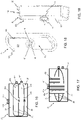
- the membrane 25 is schematically represented by a straight line in different positions, but in practice the membrane 25 may be for example fixed in position within the tank 20 at a peripheral region thereof, and have a deformable central region, which in general adopts a curved configuration, having a variable radius of curvature. See, again by way of an example only, FIG. 18-19 subsequently described.
- the braking device 3 comprises one or more actuators or slave cylinder assemblies 30, fluidically connected to conduit 4, and a respective friction element 31, or pad 31, mobile, through the respective slave cylinder assembly 30, into engagement and out of engagement with a disc W integrally rotating with the hub (not shown) of the bicycle wheel to which the braking device 3 is associated.
- the braking device 3 shown merely by way of an example in Fig. 1 comprises a pair of slave cylinders 30 supported in a fixed mutual position, and having substantially parallel and converging compression directions, and a pair of pads 31 which can be shifted from a rest position wherein they are at a certain distance from each other, forming a space or gap 35 wherein the disc W is free to rotate, and a close position wherein they are in contact with and thrusting on the disc W in order to brake it by friction.
- the friction element 31 or pad might be fixed.
- the or each slave cylinder assembly comprises a cylinder 32 and a piston 33 movable by reciprocating motion inside the cylinder 32 for a stroke, variable as better discussed hereinbelow.
- a gasket 34 typically with square cross-section (“quad ring” or Q-ring”), is interposed between the piston 33 and the cylinder 32.
- the piston 9 In a rest or non-braking condition ( FIG. 2 ), in the control device 2 and in particular in the master cylinder assembly 7, the piston 9 is completely rearward in the cylinder 8 and its head 13 - which as said may be provided with the annular sealing gasket 11 (cfr. FIG. 1 ) against the wall of the cylinder 8 -, is positioned between the lubrication passage 21a and the main communication passage 21 between the cylinder 8 and the tank 20.
- the return spring 10 is only slightly biased to ensure the complete return of the piston 9, the tank 20 is almost full.
- the brake fluid 5 in the tank 20 is at a high level, at the maximum allowed under the above assumption, and the membrane 25 is in close proximity to the ceiling 22 of the tank 20.
- the brake fluid 5 also forms a veil (exaggerated in the Figures) about the piston 9 in order to provide a suitable lubrication.
- the piston 33 In the braking device 3 or in the brake caliper, the piston 33 is completely rearward and the pad 31 is out of engagement with the disc W.
- the gap 35 is completely open, at the maximum allowed extent in the above-mentioned condition of undamaged pads 31.
- the gasket 34 (exaggeratedly shown in FIGs. 2-15 for the sake of clarity) is not stressed.
- the membrane 25 is shown at the "ceiling" 22 of the tank 20
- the filled chamber 26 has a maximum volume substantially corresponding to that of the tank 20
- the empty chamber 27 has a substantially null minimum volume.
- the membrane 25 (or at least a central region thereof) has a configuration of maximum curvature, with the concavity facing the main passage 21. In the braking device 3 no changes occur.
- FIG. 4 represents an arbitrary position of the piston 33 in this condition.
- the gasket 34 progressively recovers the elastic deformation suffered (recovery also called “roll back"), returning to its initial condition, what corresponds to said predetermined stroke of the piston 33.
- the cylinder 32 is progressively emptied and the piston 33 and the pad 31 are returned to the rearward position, of non-contact with the disc W, thus setting the rotation of the bicycle wheel free.
- the return action of the return spring 10 in the control device 2 entails the return of the brake fluid 5 from the braking device 3 back in the cylinder 8 of the master cylinder assembly 7 and, after the head 13 of the piston 9 reaches the main passage 21, the return of the brake fluid 5 from the tank 20 to the cylinder 8, with a small emptying of the tank 20 itself.
- the membrane 25 returns to the initial position and the pressures between tank 20 and cylinder 32 of the braking device 3 are re-balanced.
- the lubrication passage 21a allows passage of a small amount of brake fluid 5 between the cylinder 8 of the master cylinder assembly 7 and the tank 20 in order to lubricate the piston 9 and the inner wall of the cylinder 8.
- the approach of the membrane 25 to the ceiling 22 is thus temporary and occurs during (at least) a length of the stroke of the piston 9 compressing spring 10 and/or of its return stroke.
- the temporary approach starts and ends at the crossing of the main passage 21 by the head 13 of the piston 9 in the cylinder 8 of the master cylinder assembly 7.
- the pads 31 wear out, namely as the friction material (lining or "compound") wears out due to the friction generated during braking, still assuming that the braking system 1 is undamaged and the amount of brake fluid 5 is correct, at the maximum allowed under the above assumption, the operation of the braking system 1 is the same, however an increasing compression stroke of the piston 33 of the slave cylinder assembly 30 is necessary for the pad or friction element 31 to arrive in contact with and thrusting on the disc W.
- the gasket 34 indeed allows, in its deformed condition, sliding of the piston 33 in the compression direction toward the disc W, while it does not allow sliding of the piston 33 in the opposed direction.
- FIGs. 6-9 schematically show the positions corresponding to those of FIGs. 2-5 , for heavily worn out pads.
- the stroke of the piston 33 during a braking has the same extent both with new pads 31 and with worn out pads 31, and is dictated by the maximum elastic deformation of the gasket 34 and by its recovery or "roll back".
- the piston 33 protrudes more (also in the rest position) from the cylinder 32 with respect to when the pads 31 are new, by an extent corresponding to the wear of the respective pad 31.
- the cylinder 32 of the slave cylinder assembly 30 there is a correspondingly larger amount of brake fluid 5
- in the tank 20 of the master cylinder assembly 7 there is a comparatively smaller amount of brake fluid 5.
- the membrane 25 is in close proximity to the bottom 23 of the tank 20, the filled chamber 26 has a comparatively small volume, that becomes minimum and substantially null when the pads 31 are completely worn out, and the empty chamber 27 has a comparatively large volume, that becomes maximum and substantially equal to that of the tank 20 when the pads 31 are completely worn out.
- the membrane 25 - if held at its peripheral region - has a configuration of maximum curvature in the direction opposed to that mentioned above with reference to FIG. 3 , namely with the convexity facing toward the main passage 21.
- the membrane 25 is at a larger distance from the ceiling 22 of the tank 20 with respect to when the pads 31 are not worn out.
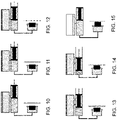
- FIGs. 10-15 schematically show the positions corresponding to those of FIGs. 2-5 , for new pads; in FIG. 13 in particular the gasket 34 is at maximum deformation.
- the piston 33 of the slave cylinder assembly 30 continues to advance, and the piston 9 of the master cylinder assembly 7 in the control device 2 continues to advance, further compressing the spring 10, until when, in the condition shown in FIG. 14 , the piston 33 of the slave cylinder assembly 30 enters into contact with the disc W, and the spring 10 is in the condition of maximum compression.
- the manual actuation member 6 is released, the piston 33 moves backward only during the above-mentioned roll-back, the gasket 34 straightens up, the spring thrusts the piston 9 of the master cylinder assembly 7 to end of stroke.
- An additional amount of brake fluid 5 is drawn from the tank 20, equal to the volume of the slidingly displacement of the piston 33 of the slave cylinder assembly 30.
- the level in the tank 20 does not return to the initial level of FIG. 10 , rather it lowers further, as shown in FIG. 15 which represents the final condition after the braking.
- the distance of the membrane 25 from the ceiling is great, similar to the case of heavily worn out pad 31.
- the overall displacement of the membrane between the position of FIG. 11 and the position of FIG. 15 is large and comparatively quick with respect to the case of normal wear of the pads 31.
- the control device 2 of the braking system 1 has a membrane detector device 40, configured to detect the presence of the membrane 25 in at least one predetermined position in the tank 20 and/or the distance of the membrane 25 from the ceiling 22 of the tank 20.
- the device 40 may therefore, in some embodiments thereof, also be called meter device 40 of the distance of the membrane 25 from the ceiling 22 of the tank 20.
- the Applicant believes that not only the position of the membrane 25 inside of the tank 20, and in particular its distance from the ceiling 22, are indicative of the volume of the filled chamber 26 (or of the relative volume between filled chamber 26 and empty chamber 27) and therefore of the amount of brake fluid 5 contained in the tank 20 as well as of the presence and wear of the pads 31 and in general of the integrity of the hydraulic plant 1 (no leakage of brake fluid 5), but also that its displacements over time are an indication of the correct assembly thereof, in particular of the correct assembly and therefore of the correct operativeness of the master cylinder assembly 7, in particular of the fact that the main passage 21 is not clogged and the gasket 11 of the head 13 of the piston 9, if present, is undamaged and correctly positioned.
- a clogging of the main passage 21 entails the lack of temporary raising of the level of the brake fluid 5 in the tank 20 (cf. FIGs. 2- 3 or 6-7 , for example) and the lack of temporary approach of the membrane 25 to the ceiling 22 when the head 13 of the piston 9 is at the main passage 21.
- the temporary displacement of the membrane 25 is therefore null or in any case less than a predetermined threshold.
- the thrust of the piston 9 through the manual actuation member 6 entails the thrust of further brake fluid 5 into the tank 20.
- the level of brake fluid 5 in the tank 20 therefore raises more than in conditions of correct operativeness of the master cylinder assembly 7.
- the displacement of the membrane 25, in particular its approach to the ceiling 22 of the tank 20, is therefore larger than a predetermined threshold.
- the membrane detector device 40 may thus embody a transducer device of the volume of the filled chamber 26 and/or a transducer device of the volume of brake fluid 5 present in the hydraulic braking system 1.
- an evaluation device of the wear and/or of the presence of a friction element/s or pad 31 of the hydraulic braking system 1, and/or an evaluation device of the correct sealing of hydraulic fluid of the hydraulic braking system 1, and/or an evaluation device of the correct operativeness of the master cylinder assembly 7 may be embodied.
- the membrane detector device 40 may comprise one or more sensors 41 arranged at the ceiling 22 of the tank 20 and/or one or more sensors 42 arranged at the lateral wall 24 of the tank 20, if present, as well as possibly one or more detectable members 45 borne by the membrane 25.
- the detectable members 45 are configured to interact with one or more of the sensors 41, 42 of the membrane detector device 40.
- each sensor 41, 42 When for example the or each sensor 41, 42 is - or embodies with the detectable element(s) 45 borne by the membrane - a proximity sensor, it detects the presence or respectively the absence of the membrane 25 in its "field of view", and therefore in a predetermined position in the tank 20.
- membrane threshold position 25 corresponding to a predetermined level, for example a minimum tolerable level, of brake fluid 5 inside the tank 20, and to provide a single proximity sensor which field of view 46 comprises said membrane threshold position 25, or a region thereof.
- a predetermined level for example a minimum tolerable level
- the membrane 25 crosses said threshold position triggering the proximity sensor 41, 42, 43.
- the or each sensor 41, 42 may be itself - or embody with the detectable element(s) 45 borne by the membrane - a distance meter, configured to measure the distance between the ceiling 22 of the tank 20 and the membrane 25.
- the or each proximity sensor 41 In order to detect the presence in a predetermined position (threshold position) or to measure the distance, it is preferred for the or each proximity sensor 41 to be arranged, preferably on the ceiling 22 of the tank 20 (sensor 41), facing an as central as possible region of the membrane 25, namely as far as possible from its peripheral region fixed to the tank 20, because in such a central region there is the maximum relative displacement of the membrane 25 as the volume of the filled chamber 26, respectively of the empty chamber 27, changes.
- a placement on the lateral wall 24 (sensor 42) may be effective.
- a suitable proximity sensor 41 may be a magnetic sensor, cooperating with a magnet as a detectable member 45 fixed to and mobile with the membrane 25.
- a suitable magnetic sensor is a Reed sensor.
- the field of view of the proximity sensor 41 is therefore typically a range of positions including a null distance from the Reed sensor (cf. the fields of view 46e, 46f associated with the sensors 41e, 41f exemplified in FIG. 17 ).
- the field of view of the Reed sensor depends on its sensitivity.
- a plurality of Reed sensors 41 having different sensitivity it is thus possible to implement different threshold positions of the membrane 25: as long as the magnet 45 is detected by all of the sensors 41, the distance of the membrane 25 is considered to be above the safety threshold, indicative of a sufficiently full tank 20; when the Reed sensor having the lowest sensitivity does not detect the magnet 45 anymore, the distance of the membrane 25 is considered to be below a first threshold (tank 20 in condition of "reserve"); and when not even the Reed sensor having the greatest sensitivity detects the magnet 41 anymore, the distance of the membrane 25 is considered to be below the minimum safety threshold (too empty tank 20). If the sensors are more than two, intermediate positions of the membrane 25 may be detected. The operation might be the reverse in case of Reed sensors that are open or closed in a dual manner with respect to what has been described.
- Adjustment of the sensitivity of a Reed sensor may also be provided for, by mounting it through a precision screw support, as better described hereinbelow with reference to FIG. 22 . In this manner, the final user or an installer of the bicycle braking system 1 is allowed to choose the or each level threshold, corresponding for example to a desired wear degree of the pads.
- the level in the tank may quickly change, the membrane 25 being for example first detected by all of the Reed sensors, and immediately thereafter only by the one having the greatest sensitivity.
- a Hall sensor may be used, in particular a 3D Hall sensor, or a magneto resistive sensor, such as for example an AMR ("Anisotropic magneto resistive") sensor, a GMR ("Giant magneto resistive”) sensor or a TMR (“Tunnel magneto resistive”) sensor.
- AMR Anagonal magneto resistive
- GMR GMR
- TMR Tunnelnel magneto resistive
- All the above-mentioned sensors detect magnetic fields and output signals relating to the position, angle, force and/or direction of the detected magnetic field, thus also allowing the meter device 40 to be configured; in the case of the 3D sensors, the movement in space of a magnetic field may be detected.
- these sensors are capable of performing high-precision measurements of the magnetic field still having an extremely compact footprint and low energy consumption.
- magnetized rubber may be used for the membrane 25.
- a pocket 47 is formed, comprising two overlapping layers and a cut 48, for example straight or circular, in one of the layers, preferably in that on the side of the empty chamber 27 of the tank 20.
- the pocket 47 may be made for example by providing a "mushroom-like" protrusion in a mold of the membrane 25.
- the magnet 45 is forced in the pocket 47 through the cut 48, and, thanks to the elasticity of the membrane 25, the latter closes onto the magnet 45, keeping it in the pocket 47. According to the mutual thickness of the overlapping layers, it is possible to make the magnet 45 protrude more or less on either side of the membrane 25 and thus to cause its volume to be detracted from the volume of the filled chamber 26 (as in the exemplifying case of FIG. 19 ) or from the volume of the empty chamber 27. Alternatively, the magnet 45 may be glued or otherwise fixed to the membrane 25, on either side.
- a suitable proximity sensor 41 42 may also be an optical sensor.
- An optical sensor comprises in general a light source, preferably an LED, and a photodiode or phototransistor located to receive the light emitted by the light source and reflected by the membrane 25 (or by a detectable member 45 borne by the membrane) when it is in the field of view of the optical sensor.
- the characteristics of the optical sensor and/or of a polarizing circuit thereof may be chosen so that the intensity of the light reflected by the membrane 25 and received by the photodiode or phototransistor, and thus the response of the optical sensor, changes as the position of the membrane 25 within the field of view, which may have an extent even comparable to a maximum size of the tank 20, Changes.
- a single optical sensor may thus configure a distance meter 40.
- a reflective insert or in any case made of more reflecting material than the material forming the membrane 25, as a detectable member 45 on the membrane 25.
- a (comparatively) reflective insert may be glued on the membrane 25 or be inserted in a pocket 47 analogously to what has been disclosed with reference to the magnet.
- a colored membrane may be used.
- a red membrane has turned out to be preferable.
- the response of the optical sensor may also depend on other characteristics of the membrane 25, such as the material, the color, the local curvature, but all these factors may be suitably taken into account, possibly providing for a suitable processing of the output signal of the optical sensor.
- the optical sensor may be located on the inner surface of the ceiling 22 of the tank 20, or on its outer surface in case the ceiling 22 is transparent.
- a plurality of sensors of a different type may be provided for.
- a distance meter having a field of view corresponding to a large distance range from the ceiling 22 of the tank and a proximity sensor having a field of view corresponding to a short distance range may be provided for, or vice versa.
- the membrane detector device 40 may provide a two-level output, corresponding to an amount of brake fluid 5 in the tank 20 larger or smaller than a predetermined threshold, an output having a number of discrete levels, corresponding to an amount of brake fluid 5 smaller than a given number of predetermined thresholds, or an output, having several discrete levels or analogue, indicative of the amount of brake fluid 5 present in the tank 20.
- the membrane detector device 40 may provide an instantaneous output and/or an output processed based on two or more detections over time.
- the level of brake fluid 5 in the tank 20 never rises to the maximum foreseen level - corresponding as explained above to the instant when the head 13 of the piston 9 is at the main passage 21 -, namely the filled chamber 26 is never at the maximum foreseen volume, or the membrane 25 is never at the minimum, substantially null distance from the ceiling 22 of the tank 20.
- the volume of the filled chamber 26 decreases - more or less quickly according to the extent of the leakage - even down to zero, and the membrane 25 reaches the bottom 23 of the tank 20, namely the maximum distance from the ceiling 22 of the tank 20.
- the membrane 25 moves closer the ceiling 22 than in case of correct operativeness of the master cylinder assembly 7.
- the membrane 25 does not temporarily move close to the ceiling 22 during the length of the stroke of the piston 9 after the head 13 of the piston 8 passes by the main passage 21.
- the output signal of the membrane detector device 40 and/or its change over time and/or its rate of change may advantageously be used for the diagnosis of the braking system 1 and in particular of its master cylinder assembly 7, upon leaving the factory (as quality control) or after replacement of the pads 31 or after a bleeding operation, possibly temporarily replacing the pads 31 with a spacer of the pistons 33 of the braking device 3, as well as during the use of the hydraulic system 1 in order to check for intervened leaks and/or the wear of the pads 31 and/or their accidental fall and/or the other possible drawbacks mentioned above.
- the membrane detector device 40 may also comprise or be associated with memory means 50, embodied by discrete components, for one or more historical detected values.
- the membrane detector device 40 may also comprise or be associated with a data processing system 51 for processing its instantaneous and/or historical output.
- the data processing system may comprise electric components and/or discrete electronic components and/or a micro-controller, which may also embody the memory means 50.
- the processing may comprise, for example, the evaluation of a current detected value and/or the comparison of at least one historical detected value with at least one current detected value and/or the computation of a rate of change of the detected value.
- the data processing system may be configured to:
- Evaluating the wear may comprise for example establishing that the wear is higher than a predetermined wear threshold when the distance of the membrane 25 from the ceiling 22 of the tank 20 is larger than a predetermined maximum distance threshold and/or may further comprise establishing that the wear is greater than a predetermined alert wear threshold when the distance of the membrane 25 from the ceiling 22 of the tank 20 is less than the predetermined maximum distance threshold and greater than a predetermined alert distance threshold.
- Evaluating the correct sealing of the hydraulic fluid may comprise for example verifying that the displacement speed over time of the membrane 25 from the ceiling 22 of the tank 20 is less than a predetermined speed threshold.
- the data processing system 51 may be configured to:
- the data processing system 51 embodies a diagnosis of the bicycle hydraulic braking system 1 of the disc type, in particular of its master cylinder assembly 7, wherein under term “diagnosis”, the examination aimed at formulating a judgment on the conditions and the operation of the various parts is meant to be indicated, including testing.
- the data processing system 51 may be part of the control device 2 as shown, or may be part of a different component of the hydraulic braking system 1.
- the control device 2 may also be part of a bicycle equipment comprising, besides the hydraulic braking system, also a speed gear shifting system (not shown).
- the control device 2 may also comprise at least one second manual actuation member configured to issue a gear ratio change command (cf. for example the gearshift levers 70, 71 in FIG. 23 subsequently described).
- the data processing system 51 may be part of a component of the speed gear shifting system, for example may be part of a gearshift assembly thereof, associated with the hub of the rear wheel.
- the membrane detector device 40 may also comprise or be associated with one or more output devices 52.
- the data processing system 51 may be configured to issue an alarm signal when the wear of the friction element 31 is higher than a maximum wear threshold and/or the at least one friction element is absent and/or the sealing of the hydraulic fluid 5 is not correct and/or the master cylinder assembly 7 is not correctly operative.
- FIG. 1 there are shown, in a totally schematic manner, a luminous indicator 53, an audible indicator 54, and a communication device 56 in communication with a second communication device (not shown), none of which is strictly necessary.
- the membrane detector device 40 may also comprise or be associated with a power supply source 57 which provides for power supplying the above components.
- output devices 52 or some of them may be part of the control device 2 as shown, or part of a different component of the hydraulic braking system 1, or part of a component of the speed gear shifting system, for example of the gearshift assembly associated with the hub of the rear wheel.
- the output device 52 may use a luminous and/or audible indicator also intended for issuing signals relating to the gearshift or other bicycle equipment, for example with a suitable control by the micro-controller 51, and/or the power supply source 57 may be intended also for powering other components of the control device 1.
- the communication device 56 may be for example a communication module, preferably a short range and low consumption one, for example according to the Bluetooth, Bluetooth Low Energy, or ANT+ protocol.
- the luminous indicator 53 may comprise one or more LEDs or other luminous sources.
- a single luminous indicator may for example light up as soon as the level of brake fluid 5 in the tank 20 lowers below a predetermined threshold level.
- a polychromatic LED or another polychromatic source or there are plural LEDs or other sources of different color, or there is an LED array, it is possible to provide a multiple visual indication, for example by turning on an orange light or a flashing light when the level of brake fluid 5 lowers below a first threshold and a red light or a steady light when the level of fluid 5 lowers below a second threshold less than the first threshold; or to provide a visual indication of the amount of brake fluid 5 contained in the tank 20, by turning off the LEDs at the top or right end of the array of LEDs as the tank 20 empties.
- the audible indicator 54 may be for example a small buzzer and may emit one or more sounds for providing a more or less accurate communication relative to the level of the brake fluid 5 in the tank 20.
- the battery power supply source 57 may be dedicated to the membrane detector device 40 or may be intended also for powering other electric or electronic devices housed in the control device 2, possibly including the above-mentioned data processing system 51, memory means 50 and/or output devices 52.
- the battery power supply source 57 may advantageously be that of a cycle computer or of a smartphone, a tablet or other computer connected in a fixed or removable manner to the control device 2.
- the communication may occur through a micro-USB connector.
- the membrane detector device 40 may be activated only periodically, under the control of said data processing system 51, for example at predetermined time intervals or implementing a braking counter, for example counting pulses generated by a micro-switch activated upon pressure of the manual actuation member 6, once a day or once a week or once a month, etc.
- the membrane detector device 40 or in general the control device 2 may have a stand-by mode and the tank 20 or in general the control device 2 may be provided with a waking system, for example based on an accelerometer.
- the membrane detector device 40 may also be provided for the membrane detector device 40 to be selectively actuatable by the cyclist.
- the control device 2 may also comprise, alternatively or additionally to the battery power supply source 57, an "energy harvesting" system, which exploits for example solar energy, kinetic energy or something else.
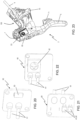
- one or more of the sensors 41, 42 and one or more of the output devices 52 are housed on opposite faces of a single printed circuit board or PCB 60, as shown by way of an example in FIGs. 20-21 .
- Powering connectors 61 leading_to the power supply source 55 are also shown.
- FIG. 22 shows, by way of an example, a PCB 60 carrying a precision screw support 62 for mounting a sensor of the membrane detector device 40 in order to accomplish the sensitivity adjustment.
- FIGs. 23-27 show, by way of an example, a practical embodiment of the main components of a braking system 1 as described above. Analogous component are indicated with the same reference number.
- a body 130 may be recognized, configured for fixing to the bicycle handlebar, possibly grippable, wherein the master cylinder assembly 7 is formed or fixed, and on which the manual actuation member 6 or brake lever is articulated. Also the above mentioned gearshift levers 70, 71 are visible, as an example of manual actuation members of a speed gear shifting system.
- the PCB 60 is preferably fixed, as shown by way of an example in FIGs. 23-24 , in a suitable position which is adjacent to the ceiling 22 or to the lateral wall 24 of the tank 20 and adjacent to the outer surface of the control device 2.
- control device 2 is covered by a protection sheath (not shown), the latter may be provided with a suitable aperture at the or each output device 52, and with possible protection windows, for example a transparent window for protecting the one or more luminous indicators 53.
- the PCB 60 is adjacent to the outer surface of the control device 2 in a proximal position to the cyclist in the condition of use of the bicycle and in particular visible by the cyclist, for example on the proximal face of a control device for a curved handlebar, of the so-called "drop-bar" type, as shown.
- a kinematics 131 may also be seen, interposed between the manual actuation member 6 or brake lever and the cylinder 8 of the master cylinder assembly 7, more evident in FIG. 25 .
- a cap 132 configured to hold the gasket 11 (if provided for) on the head 13 of the piston 9 and to support the return spring 10.
- the cap 132 is not strictly necessary.
- the tank 20 is formed in part by a region 133 one piece with the body 130 and in part by a cover 134, although this is not strictly necessary.
- the peripheral region 135 of the membrane 25 is watertight-sealing clamped between the cover 134 and the region 133 one piece with the body 50 of the control device 2.
- the example membrane 25 has a substantially tub-like shape, and has a central region 136 having a substantially flat zone 137 intended to conform with the ceiling 22 in the condition of filled tank 20 and respectively with the bottom 23 in the condition of empty tank 20, said peripheral region 135 intended to be fixed to the tank 20, and an annular region 138 interposed therebetween, which according to the amount of brake fluid 5 present is intended to conform with and adhere to a variable region of the lateral wall 24 of the tank 20.
- the peripheral region 135 and the substantially flat zone 137 of the central region 136 extend in planes that remain substantially parallel, while the annular region 138 extends substantially orthogonally to said planes, in a non-stressed condition of the membrane 25.
- the region 133 one piece with the body 130 defines the bottom 23 of the tank 20 and, preferably, a first part of its lateral wall 24.
- the cover 134 defines the ceiling 22 of the tank 20 and, preferably, the remaining part of its lateral wall 24.
- the region 133 one piece with the body 130 and the cover 134 are thus both concave, and have the concavities facing towards each other.
- the region 133 one piece with the body 130 and the cover 134 have approximately the same depth - or height of the respective part of lateral wall 24 of the tank 20 - so that the membrane 25 adopts a curvature substantially the mirror image in its two extreme positions at the ceiling 22 and at the bottom 23 of the tank 20.
- the tank 20 might also have a spheric or almost spheric shape, wherein the membrane 25 is peripherally fixed to a diametric plane of the sphere and adopts a convex configuration when the tank is filled and a concave configuration when the tank is empty, a lateral wall being absent or substantially absent.
- FIGs. 26-27 An example braking device 3 or brake caliper is represented in FIGs. 26-27 .
- the brake caliper 3 is shown upside down for the sake of convenience; in FIG. 26 the pad 31 is omitted, visible instead in FIG. 27 .
- the brake caliper 3 has a body 141 configured for fixing to the bicycle frame or on the fork in proximity to the hub of a wheel with which the disc W ( FIG. 1 ) integrally rotates. In the body 141, the gap 35 in which the above-mentioned disc W is inserted, as well as ( FIG. 27 ) one of the two pistons 33 of the slave cylinder assembly 30, housed in the respective cylinder 32, may be seen.
Landscapes
- Engineering & Computer Science (AREA)
- Mechanical Engineering (AREA)
- Transportation (AREA)
- General Engineering & Computer Science (AREA)
- Physics & Mathematics (AREA)
- Fluid Mechanics (AREA)
- Braking Arrangements (AREA)
- Valves And Accessory Devices For Braking Systems (AREA)
Applications Claiming Priority (1)
| Application Number | Priority Date | Filing Date | Title |
|---|---|---|---|
| IT102021000020558A IT202100020558A1 (it) | 2021-07-30 | 2021-07-30 | Impianto frenante idraulico di bicicletta del tipo a disco e componenti e metodi correlati |
Publications (3)
| Publication Number | Publication Date |
|---|---|
| EP4124523A1 true EP4124523A1 (de) | 2023-02-01 |
| EP4124523B1 EP4124523B1 (de) | 2024-09-11 |
| EP4124523B8 EP4124523B8 (de) | 2024-10-23 |
Family
ID=78049708
Family Applications (1)
| Application Number | Title | Priority Date | Filing Date |
|---|---|---|---|
| EP22186692.4A Active EP4124523B8 (de) | 2021-07-30 | 2022-07-25 | Hydraulische fahrradbremsanlage des scheibenbremsentyps und zugehörige komponenten und verfahren |
Country Status (5)
| Country | Link |
|---|---|
| US (1) | US12545358B2 (de) |
| EP (1) | EP4124523B8 (de) |
| CN (1) | CN115675713A (de) |
| IT (1) | IT202100020558A1 (de) |
| TW (1) | TW202306814A (de) |
Families Citing this family (2)
| Publication number | Priority date | Publication date | Assignee | Title |
|---|---|---|---|---|
| IT202100020564A1 (it) | 2021-07-30 | 2023-01-30 | Campagnolo Srl | Sistema e metodo di diagnosi di un impianto frenante idraulico di bicicletta del tipo a disco |
| CN116447252B (zh) * | 2023-05-15 | 2024-03-08 | 温州力邦企业有限公司 | 一种摩托车用液压盘式制动器 |
Citations (4)
| Publication number | Priority date | Publication date | Assignee | Title |
|---|---|---|---|---|
| US3697942A (en) * | 1971-08-19 | 1972-10-10 | Loren P Hocking | Early warning brake fault device and system |
| JPS5925429U (ja) * | 1982-08-06 | 1984-02-17 | ワタナベエンジニアリング株式会社 | ブレーキ液用リザーバの液量検出装置 |
| US10082158B2 (en) | 2013-08-27 | 2018-09-25 | Gustav Magenwirth Gmbh & Co. Kg | Master cylinder fitting |
| EP3835191A1 (de) | 2019-12-13 | 2021-06-16 | Campagnolo S.r.l. | Hydrauliktank für ein fahrrad |
Family Cites Families (29)
| Publication number | Priority date | Publication date | Assignee | Title |
|---|---|---|---|---|
| US2661847A (en) | 1950-09-23 | 1953-12-08 | Buettner Arthur J Collins | Brake system filter and indicator |
| US3179919A (en) | 1962-08-14 | 1965-04-20 | Rizzuto Joseph | Hydraulic brake auxiliary reservoir and signal device |
| US3450853A (en) | 1967-04-26 | 1969-06-17 | Chrysler Corp | Magnetically operated signal switch for hydraulic brake system |
| US3560918A (en) | 1967-12-08 | 1971-02-02 | Bendix Corp | Indicator means for fluid pressure and fluid supply |
| US3541282A (en) | 1968-01-26 | 1970-11-17 | Bendix Corp | Switch for master cylinder |
| US3603926A (en) | 1968-06-20 | 1971-09-07 | Bendix Corp | Master cylinder fluid level indicator |
| US3603925A (en) | 1968-10-21 | 1971-09-07 | Bendix Corp | Master cylinder reservoir level indicator |
| US3577121A (en) | 1969-11-10 | 1971-05-04 | Gen Motors Corp | Brake fluid level switch |
| US3678232A (en) | 1970-01-10 | 1972-07-18 | Girling Ltd | Liquid reservoirs |
| US3691522A (en) * | 1971-06-07 | 1972-09-12 | Colman Benjamin W | Early warning brake fault system |
| US3798401A (en) | 1972-08-30 | 1974-03-19 | C Hire | Liquid level responsive switch assembly |
| US3896281A (en) | 1973-11-07 | 1975-07-22 | Evgeny Ilich Feoktistov | Magnetically actuated liquid level signalling device |
| JPS5317505B2 (de) | 1973-12-20 | 1978-06-08 | ||
| JPS5125669A (de) | 1974-08-28 | 1976-03-02 | Toyota Motor Co Ltd | |
| US4168613A (en) | 1975-03-15 | 1979-09-25 | Nisshin Kogyo Kabushiki Kaisha | Oil reservoir device with oil level detector means for a tandem type master cylinder |
| US3985985A (en) | 1975-04-21 | 1976-10-12 | General Motors Corporation | Brake fluid level sensing system |
| US4058694A (en) | 1975-12-04 | 1977-11-15 | Wagner Electric Corporation | Master cylinder reservoir with vacuum relief diaphragm and guarded fluid level sensor |
| US4082930A (en) | 1976-02-23 | 1978-04-04 | General Motors Corporation | Liquid level sensor |
| US4170386A (en) * | 1977-09-12 | 1979-10-09 | The Bendix Corporation | Control for a two stage master cylinder |
| US4583071A (en) | 1984-05-02 | 1986-04-15 | Adam Sebalos | Brake adjustment monitoring device for automotive vehicles |
| US5022713A (en) * | 1989-05-08 | 1991-06-11 | General Motors Corporation | Venting master cylinder reservoir diaphragm |
| US5066940A (en) | 1990-10-10 | 1991-11-19 | Ford Motor Company | Brake pedal travel warning system |
| US20040182658A1 (en) * | 2003-02-27 | 2004-09-23 | Dimsey James J | Pressure relief arrangement for a disc brake system |
| DE102006040328A1 (de) | 2006-08-29 | 2008-03-06 | Gustav Magenwirth Gmbh & Co. Kg | Bremssystem mit einer hydraulischen Bremsanlage |
| US20080155982A1 (en) | 2006-12-28 | 2008-07-03 | Jones Christopher S | Hydraulic Brake Master Cylinder |
| US9096288B2 (en) * | 2012-01-05 | 2015-08-04 | Shimano, Inc. | Dual hydraulic controller for bicycle components |
| JP2014091382A (ja) * | 2012-11-01 | 2014-05-19 | Shimano Inc | 自転車用ケーブルおよびその製造方法 |
| US11951961B2 (en) | 2019-08-19 | 2024-04-09 | ZF Active Safety US Inc. | Method for the functional testing of a fluid level warning indicator |
| IT202100020564A1 (it) | 2021-07-30 | 2023-01-30 | Campagnolo Srl | Sistema e metodo di diagnosi di un impianto frenante idraulico di bicicletta del tipo a disco |
-
2021
- 2021-07-30 IT IT102021000020558A patent/IT202100020558A1/it unknown
-
2022
- 2022-07-05 TW TW111125109A patent/TW202306814A/zh unknown
- 2022-07-25 EP EP22186692.4A patent/EP4124523B8/de active Active
- 2022-07-26 CN CN202210885396.7A patent/CN115675713A/zh active Pending
- 2022-07-28 US US17/875,619 patent/US12545358B2/en active Active
Patent Citations (4)
| Publication number | Priority date | Publication date | Assignee | Title |
|---|---|---|---|---|
| US3697942A (en) * | 1971-08-19 | 1972-10-10 | Loren P Hocking | Early warning brake fault device and system |
| JPS5925429U (ja) * | 1982-08-06 | 1984-02-17 | ワタナベエンジニアリング株式会社 | ブレーキ液用リザーバの液量検出装置 |
| US10082158B2 (en) | 2013-08-27 | 2018-09-25 | Gustav Magenwirth Gmbh & Co. Kg | Master cylinder fitting |
| EP3835191A1 (de) | 2019-12-13 | 2021-06-16 | Campagnolo S.r.l. | Hydrauliktank für ein fahrrad |
Also Published As
| Publication number | Publication date |
|---|---|
| US12545358B2 (en) | 2026-02-10 |
| CN115675713A (zh) | 2023-02-03 |
| EP4124523B1 (de) | 2024-09-11 |
| TW202306814A (zh) | 2023-02-16 |
| US20230037259A1 (en) | 2023-02-02 |
| EP4124523B8 (de) | 2024-10-23 |
| IT202100020558A1 (it) | 2023-01-30 |
Similar Documents
| Publication | Publication Date | Title |
|---|---|---|
| EP4124526B1 (de) | Diagnosesystem und -verfahren für ein hydraulisches fahrradbremssystem vom scheibentyp | |
| EP4124523B1 (de) | Hydraulische fahrradbremsanlage und zugehörige komponenten und verfahren | |
| JP2012508857A (ja) | 故障様式および健全状態の徴候としてバルブの可動コアのストローク、速度および/または加速度を決定するためのセンサを有するソレノイドバルブ | |
| CN102947611A (zh) | 用于气压盘式制动器的电子行程传感器 | |
| EP2998583B1 (de) | Druckanzeiger für luftkompressor | |
| CA2250070A1 (en) | Device for detecting abrasion of brake for vehicle | |
| JP5251568B2 (ja) | 液面低下判定装置およびブレーキ制御装置 | |
| CA2725889C (en) | Fault-tolerant bleed valve assembly | |
| US5693926A (en) | Differential pressure indicators | |
| CN210510488U (zh) | 一种阀座行程指示系统 | |
| US20110179990A1 (en) | Monitoring unit for a measuring instrument | |
| US9032805B2 (en) | High pressure visual indicator | |
| EP1522774B1 (de) | Durchflussregelventil | |
| US6895130B1 (en) | True position sensor for diaphragm valves using reflected light property variation | |
| US3450162A (en) | Pressure vessel with control device | |
| CN212297347U (zh) | 机轮刹车系统 | |
| CN211121756U (zh) | 一种平膜压力变送器 | |
| US6311804B1 (en) | System for electrically detecting piston positions in a hydraulic system | |
| CN215865574U (zh) | 一种具有声光报警功能的压力表 | |
| CN204553424U (zh) | 一种污染指示器 | |
| CN111853103B (zh) | 机轮刹车系统 | |
| EP2696122B1 (de) | Vorrichtung zur Positionserkennung des Steuerschiebers eines pneumatischen Wegeventils | |
| EP3132240B1 (de) | Vorrichtung zur signalisierung der anwesenheit von druck in einer anlage, in einer leitung oder einem raum im allgemeinen | |
| WO2007030608A3 (en) | Filter change indicator | |
| CN220770204U (zh) | 具有位置检测功能的电液换向阀 |
Legal Events
| Date | Code | Title | Description |
|---|---|---|---|
| PUAI | Public reference made under article 153(3) epc to a published international application that has entered the european phase |
Free format text: ORIGINAL CODE: 0009012 |
|
| STAA | Information on the status of an ep patent application or granted ep patent |
Free format text: STATUS: THE APPLICATION HAS BEEN PUBLISHED |
|
| AK | Designated contracting states |
Kind code of ref document: A1 Designated state(s): AL AT BE BG CH CY CZ DE DK EE ES FI FR GB GR HR HU IE IS IT LI LT LU LV MC MK MT NL NO PL PT RO RS SE SI SK SM TR |
|
| STAA | Information on the status of an ep patent application or granted ep patent |
Free format text: STATUS: REQUEST FOR EXAMINATION WAS MADE |
|
| 17P | Request for examination filed |
Effective date: 20230328 |
|
| RBV | Designated contracting states (corrected) |
Designated state(s): AL AT BE BG CH CY CZ DE DK EE ES FI FR GB GR HR HU IE IS IT LI LT LU LV MC MK MT NL NO PL PT RO RS SE SI SK SM TR |
|
| P01 | Opt-out of the competence of the unified patent court (upc) registered |
Effective date: 20230516 |
|
| GRAP | Despatch of communication of intention to grant a patent |
Free format text: ORIGINAL CODE: EPIDOSNIGR1 |
|
| STAA | Information on the status of an ep patent application or granted ep patent |
Free format text: STATUS: GRANT OF PATENT IS INTENDED |
|
| INTG | Intention to grant announced |
Effective date: 20240425 |
|
| GRAS | Grant fee paid |
Free format text: ORIGINAL CODE: EPIDOSNIGR3 |
|
| GRAA | (expected) grant |
Free format text: ORIGINAL CODE: 0009210 |
|
| STAA | Information on the status of an ep patent application or granted ep patent |
Free format text: STATUS: THE PATENT HAS BEEN GRANTED |
|
| AK | Designated contracting states |
Kind code of ref document: B1 Designated state(s): AL AT BE BG CH CY CZ DE DK EE ES FI FR GB GR HR HU IE IS IT LI LT LU LV MC MK MT NL NO PL PT RO RS SE SI SK SM TR |
|
| REG | Reference to a national code |
Ref country code: GB Ref legal event code: FG4D |
|
| REG | Reference to a national code |
Ref country code: CH Ref legal event code: EP |
|
| REG | Reference to a national code |
Ref country code: DE Ref legal event code: R096 Ref document number: 602022006002 Country of ref document: DE |
|
| REG | Reference to a national code |
Ref country code: CH Ref legal event code: PK Free format text: BERICHTIGUNG B8 |
|
| REG | Reference to a national code |
Ref country code: IE Ref legal event code: FG4D |
|
| REG | Reference to a national code |
Ref country code: LT Ref legal event code: MG9D |
|
| PG25 | Lapsed in a contracting state [announced via postgrant information from national office to epo] |
Ref country code: NO Free format text: LAPSE BECAUSE OF FAILURE TO SUBMIT A TRANSLATION OF THE DESCRIPTION OR TO PAY THE FEE WITHIN THE PRESCRIBED TIME-LIMIT Effective date: 20241211 |
|
| REG | Reference to a national code |
Ref country code: NL Ref legal event code: MP Effective date: 20240911 |
|
| PG25 | Lapsed in a contracting state [announced via postgrant information from national office to epo] |
Ref country code: GR Free format text: LAPSE BECAUSE OF FAILURE TO SUBMIT A TRANSLATION OF THE DESCRIPTION OR TO PAY THE FEE WITHIN THE PRESCRIBED TIME-LIMIT Effective date: 20241212 Ref country code: FI Free format text: LAPSE BECAUSE OF FAILURE TO SUBMIT A TRANSLATION OF THE DESCRIPTION OR TO PAY THE FEE WITHIN THE PRESCRIBED TIME-LIMIT Effective date: 20240911 |
|
| PG25 | Lapsed in a contracting state [announced via postgrant information from national office to epo] |
Ref country code: BG Free format text: LAPSE BECAUSE OF FAILURE TO SUBMIT A TRANSLATION OF THE DESCRIPTION OR TO PAY THE FEE WITHIN THE PRESCRIBED TIME-LIMIT Effective date: 20240911 |
|
| PG25 | Lapsed in a contracting state [announced via postgrant information from national office to epo] |
Ref country code: LV Free format text: LAPSE BECAUSE OF FAILURE TO SUBMIT A TRANSLATION OF THE DESCRIPTION OR TO PAY THE FEE WITHIN THE PRESCRIBED TIME-LIMIT Effective date: 20240911 |
|
| PG25 | Lapsed in a contracting state [announced via postgrant information from national office to epo] |
Ref country code: HR Free format text: LAPSE BECAUSE OF FAILURE TO SUBMIT A TRANSLATION OF THE DESCRIPTION OR TO PAY THE FEE WITHIN THE PRESCRIBED TIME-LIMIT Effective date: 20240911 |
|
| PG25 | Lapsed in a contracting state [announced via postgrant information from national office to epo] |
Ref country code: RS Free format text: LAPSE BECAUSE OF FAILURE TO SUBMIT A TRANSLATION OF THE DESCRIPTION OR TO PAY THE FEE WITHIN THE PRESCRIBED TIME-LIMIT Effective date: 20241211 Ref country code: ES Free format text: LAPSE BECAUSE OF FAILURE TO SUBMIT A TRANSLATION OF THE DESCRIPTION OR TO PAY THE FEE WITHIN THE PRESCRIBED TIME-LIMIT Effective date: 20240911 |
|
| PG25 | Lapsed in a contracting state [announced via postgrant information from national office to epo] |
Ref country code: RS Free format text: LAPSE BECAUSE OF FAILURE TO SUBMIT A TRANSLATION OF THE DESCRIPTION OR TO PAY THE FEE WITHIN THE PRESCRIBED TIME-LIMIT Effective date: 20241211 Ref country code: NO Free format text: LAPSE BECAUSE OF FAILURE TO SUBMIT A TRANSLATION OF THE DESCRIPTION OR TO PAY THE FEE WITHIN THE PRESCRIBED TIME-LIMIT Effective date: 20241211 Ref country code: LV Free format text: LAPSE BECAUSE OF FAILURE TO SUBMIT A TRANSLATION OF THE DESCRIPTION OR TO PAY THE FEE WITHIN THE PRESCRIBED TIME-LIMIT Effective date: 20240911 Ref country code: HR Free format text: LAPSE BECAUSE OF FAILURE TO SUBMIT A TRANSLATION OF THE DESCRIPTION OR TO PAY THE FEE WITHIN THE PRESCRIBED TIME-LIMIT Effective date: 20240911 Ref country code: GR Free format text: LAPSE BECAUSE OF FAILURE TO SUBMIT A TRANSLATION OF THE DESCRIPTION OR TO PAY THE FEE WITHIN THE PRESCRIBED TIME-LIMIT Effective date: 20241212 Ref country code: FI Free format text: LAPSE BECAUSE OF FAILURE TO SUBMIT A TRANSLATION OF THE DESCRIPTION OR TO PAY THE FEE WITHIN THE PRESCRIBED TIME-LIMIT Effective date: 20240911 Ref country code: ES Free format text: LAPSE BECAUSE OF FAILURE TO SUBMIT A TRANSLATION OF THE DESCRIPTION OR TO PAY THE FEE WITHIN THE PRESCRIBED TIME-LIMIT Effective date: 20240911 Ref country code: BG Free format text: LAPSE BECAUSE OF FAILURE TO SUBMIT A TRANSLATION OF THE DESCRIPTION OR TO PAY THE FEE WITHIN THE PRESCRIBED TIME-LIMIT Effective date: 20240911 |
|
| REG | Reference to a national code |
Ref country code: AT Ref legal event code: MK05 Ref document number: 1722434 Country of ref document: AT Kind code of ref document: T Effective date: 20240911 |
|
| PG25 | Lapsed in a contracting state [announced via postgrant information from national office to epo] |
Ref country code: NL Free format text: LAPSE BECAUSE OF FAILURE TO SUBMIT A TRANSLATION OF THE DESCRIPTION OR TO PAY THE FEE WITHIN THE PRESCRIBED TIME-LIMIT Effective date: 20240911 |
|
| PG25 | Lapsed in a contracting state [announced via postgrant information from national office to epo] |
Ref country code: IS Free format text: LAPSE BECAUSE OF FAILURE TO SUBMIT A TRANSLATION OF THE DESCRIPTION OR TO PAY THE FEE WITHIN THE PRESCRIBED TIME-LIMIT Effective date: 20250111 Ref country code: PT Free format text: LAPSE BECAUSE OF FAILURE TO SUBMIT A TRANSLATION OF THE DESCRIPTION OR TO PAY THE FEE WITHIN THE PRESCRIBED TIME-LIMIT Effective date: 20250113 |
|
| PG25 | Lapsed in a contracting state [announced via postgrant information from national office to epo] |
Ref country code: SM Free format text: LAPSE BECAUSE OF FAILURE TO SUBMIT A TRANSLATION OF THE DESCRIPTION OR TO PAY THE FEE WITHIN THE PRESCRIBED TIME-LIMIT Effective date: 20240911 |
|
| PG25 | Lapsed in a contracting state [announced via postgrant information from national office to epo] |
Ref country code: AT Free format text: LAPSE BECAUSE OF FAILURE TO SUBMIT A TRANSLATION OF THE DESCRIPTION OR TO PAY THE FEE WITHIN THE PRESCRIBED TIME-LIMIT Effective date: 20240911 |
|
| PG25 | Lapsed in a contracting state [announced via postgrant information from national office to epo] |
Ref country code: CZ Free format text: LAPSE BECAUSE OF FAILURE TO SUBMIT A TRANSLATION OF THE DESCRIPTION OR TO PAY THE FEE WITHIN THE PRESCRIBED TIME-LIMIT Effective date: 20240911 Ref country code: PL Free format text: LAPSE BECAUSE OF FAILURE TO SUBMIT A TRANSLATION OF THE DESCRIPTION OR TO PAY THE FEE WITHIN THE PRESCRIBED TIME-LIMIT Effective date: 20240911 |
|
| PG25 | Lapsed in a contracting state [announced via postgrant information from national office to epo] |
Ref country code: SK Free format text: LAPSE BECAUSE OF FAILURE TO SUBMIT A TRANSLATION OF THE DESCRIPTION OR TO PAY THE FEE WITHIN THE PRESCRIBED TIME-LIMIT Effective date: 20240911 |
|
| REG | Reference to a national code |
Ref country code: DE Ref legal event code: R097 Ref document number: 602022006002 Country of ref document: DE |
|
| PG25 | Lapsed in a contracting state [announced via postgrant information from national office to epo] |
Ref country code: DK Free format text: LAPSE BECAUSE OF FAILURE TO SUBMIT A TRANSLATION OF THE DESCRIPTION OR TO PAY THE FEE WITHIN THE PRESCRIBED TIME-LIMIT Effective date: 20240911 |
|
| PLBE | No opposition filed within time limit |
Free format text: ORIGINAL CODE: 0009261 |
|
| STAA | Information on the status of an ep patent application or granted ep patent |
Free format text: STATUS: NO OPPOSITION FILED WITHIN TIME LIMIT |
|
| 26N | No opposition filed |
Effective date: 20250612 |
|
| PG25 | Lapsed in a contracting state [announced via postgrant information from national office to epo] |
Ref country code: SE Free format text: LAPSE BECAUSE OF FAILURE TO SUBMIT A TRANSLATION OF THE DESCRIPTION OR TO PAY THE FEE WITHIN THE PRESCRIBED TIME-LIMIT Effective date: 20240911 |
|
| PGFP | Annual fee paid to national office [announced via postgrant information from national office to epo] |
Ref country code: DE Payment date: 20250729 Year of fee payment: 4 |
|
| PGFP | Annual fee paid to national office [announced via postgrant information from national office to epo] |
Ref country code: IT Payment date: 20250731 Year of fee payment: 4 |
|
| PGFP | Annual fee paid to national office [announced via postgrant information from national office to epo] |
Ref country code: FR Payment date: 20250725 Year of fee payment: 4 |