EP4124521B1 - Dispositif de connexion entre balai d' essuyage et bras d' entraînement - Google Patents
Dispositif de connexion entre balai d' essuyage et bras d' entraînement Download PDFInfo
- Publication number
- EP4124521B1 EP4124521B1 EP22187095.9A EP22187095A EP4124521B1 EP 4124521 B1 EP4124521 B1 EP 4124521B1 EP 22187095 A EP22187095 A EP 22187095A EP 4124521 B1 EP4124521 B1 EP 4124521B1
- Authority
- EP
- European Patent Office
- Prior art keywords
- adapter
- connection device
- base
- drive arm
- base adapter
- Prior art date
- Legal status (The legal status is an assumption and is not a legal conclusion. Google has not performed a legal analysis and makes no representation as to the accuracy of the status listed.)
- Active
Links
Images



Classifications
-
- B—PERFORMING OPERATIONS; TRANSPORTING
- B60—VEHICLES IN GENERAL
- B60S—SERVICING, CLEANING, REPAIRING, SUPPORTING, LIFTING, OR MANOEUVRING OF VEHICLES, NOT OTHERWISE PROVIDED FOR
- B60S1/00—Cleaning of vehicles
- B60S1/02—Cleaning windscreens, windows or optical devices
- B60S1/04—Wipers or the like, e.g. scrapers
- B60S1/32—Wipers or the like, e.g. scrapers characterised by constructional features of wiper blade arms or blades
- B60S1/40—Connections between blades and arms
- B60S1/4003—Multi-purpose connections for two or more kinds of arm ends
-
- B—PERFORMING OPERATIONS; TRANSPORTING
- B60—VEHICLES IN GENERAL
- B60S—SERVICING, CLEANING, REPAIRING, SUPPORTING, LIFTING, OR MANOEUVRING OF VEHICLES, NOT OTHERWISE PROVIDED FOR
- B60S1/00—Cleaning of vehicles
- B60S1/02—Cleaning windscreens, windows or optical devices
- B60S1/04—Wipers or the like, e.g. scrapers
- B60S1/32—Wipers or the like, e.g. scrapers characterised by constructional features of wiper blade arms or blades
- B60S1/40—Connections between blades and arms
- B60S1/4038—Connections between blades and arms for arms provided with a channel-shaped end
-
- B—PERFORMING OPERATIONS; TRANSPORTING
- B60—VEHICLES IN GENERAL
- B60S—SERVICING, CLEANING, REPAIRING, SUPPORTING, LIFTING, OR MANOEUVRING OF VEHICLES, NOT OTHERWISE PROVIDED FOR
- B60S1/00—Cleaning of vehicles
- B60S1/02—Cleaning windscreens, windows or optical devices
- B60S1/04—Wipers or the like, e.g. scrapers
- B60S1/32—Wipers or the like, e.g. scrapers characterised by constructional features of wiper blade arms or blades
- B60S1/40—Connections between blades and arms
- B60S1/4038—Connections between blades and arms for arms provided with a channel-shaped end
- B60S1/4045—Connections between blades and arms for arms provided with a channel-shaped end comprising a detachable intermediate element mounted on the channel-shaped end
- B60S1/4048—Connections between blades and arms for arms provided with a channel-shaped end comprising a detachable intermediate element mounted on the channel-shaped end the element being provided with retention means co-operating with the channel-shaped end of the arm
-
- B—PERFORMING OPERATIONS; TRANSPORTING
- B60—VEHICLES IN GENERAL
- B60S—SERVICING, CLEANING, REPAIRING, SUPPORTING, LIFTING, OR MANOEUVRING OF VEHICLES, NOT OTHERWISE PROVIDED FOR
- B60S1/00—Cleaning of vehicles
- B60S1/02—Cleaning windscreens, windows or optical devices
- B60S1/04—Wipers or the like, e.g. scrapers
- B60S1/32—Wipers or the like, e.g. scrapers characterised by constructional features of wiper blade arms or blades
- B60S1/40—Connections between blades and arms
- B60S1/4038—Connections between blades and arms for arms provided with a channel-shaped end
- B60S1/4045—Connections between blades and arms for arms provided with a channel-shaped end comprising a detachable intermediate element mounted on the channel-shaped end
- B60S1/4048—Connections between blades and arms for arms provided with a channel-shaped end comprising a detachable intermediate element mounted on the channel-shaped end the element being provided with retention means co-operating with the channel-shaped end of the arm
- B60S2001/4051—Connections between blades and arms for arms provided with a channel-shaped end comprising a detachable intermediate element mounted on the channel-shaped end the element being provided with retention means co-operating with the channel-shaped end of the arm the intermediate element engaging the side walls of the arm
-
- B—PERFORMING OPERATIONS; TRANSPORTING
- B60—VEHICLES IN GENERAL
- B60S—SERVICING, CLEANING, REPAIRING, SUPPORTING, LIFTING, OR MANOEUVRING OF VEHICLES, NOT OTHERWISE PROVIDED FOR
- B60S1/00—Cleaning of vehicles
- B60S1/02—Cleaning windscreens, windows or optical devices
- B60S1/04—Wipers or the like, e.g. scrapers
- B60S1/32—Wipers or the like, e.g. scrapers characterised by constructional features of wiper blade arms or blades
- B60S1/40—Connections between blades and arms
- B60S1/4038—Connections between blades and arms for arms provided with a channel-shaped end
- B60S1/4045—Connections between blades and arms for arms provided with a channel-shaped end comprising a detachable intermediate element mounted on the channel-shaped end
- B60S1/4048—Connections between blades and arms for arms provided with a channel-shaped end comprising a detachable intermediate element mounted on the channel-shaped end the element being provided with retention means co-operating with the channel-shaped end of the arm
- B60S2001/4054—Connections between blades and arms for arms provided with a channel-shaped end comprising a detachable intermediate element mounted on the channel-shaped end the element being provided with retention means co-operating with the channel-shaped end of the arm the intermediate element engaging the back part of the arm
Definitions
- the present invention relates to the field of vehicle windshield wipers, and more particularly to connection devices for connecting a wiper blade to a drive arm.
- Vehicle wiping systems are designed to remove, by sweeping, liquids and dirt that could impair a driver's vision.
- These wiping systems generally include a drive arm, which performs an angular back-and-forth movement, and elongated wiper blades equipped with scraper blades made of a resilient material. The scraper blade rubs against the windshield and removes these liquids and dirt by sweeping them out of the driver's field of vision.
- the wiper blade is attached to the drive arm by a connecting device that includes a connector and an adapter.
- the connector is a part that is secured to the wiper blade and is generally secured to the scraper blade.
- the adapter is a part that is interposed between the drive arm and the connector, being shaped to engage in a yoke of the drive arm. The connector and adapter then cooperate to allow the articulated connection and the fixing of the wiper blade on the drive arm, thus forming the device for connecting the wiper blade to the drive arm.
- the articulated connection between the connector and the adapter comprises at least one transverse pivot axis of the connector relative to the adapter, which is also a pivot axis of the wiper blade relative to the drive arm.
- One of the members for example the connector, generally comprises a substantially cylindrical shape which forms a pivot and which is received in a housing of complementary shape of the other member, here the adapter.
- An adapter allows a wiper blade to be fitted to a particular type of screed or drive arm and there are several varieties of screeds. These Varieties are similar in appearance but differ from each other in their dimensions, particularly in their widths or lateral dimensions. They also vary in the positions of the holes intended to cooperate with a locking push button on the adapter.
- connection device which limits the play between the combination of adapters and the drive arm, thanks to a clearance of material present on a side wall of one of these adapters.
- a connection device according to the invention allows improved holding of the wiper blade, thus limiting untimely oscillations.
- the present invention has advantages related to the packaging and use of the adapters.
- the shapes of these adapters result in a reduction of the plastic material necessary for their manufacture, the size and weight of these adapters are therefore reduced.
- An object of the present invention thus relates to a connection device between a wiper blade and a drive arm for a vehicle, comprising a base adapter and at least one first adapter, this base adapter being equipped with at least one pivot member intended to connect it to a connector, the base adapter being configured to connect this connector to a first type of drive arm, the base adapter and the first adapter each having a U-shaped section formed by two side walls joined by a top wall.
- at least one side wall of the base adapter comprises at least one clearance which receives a side wall of the first adapter.
- connection device therefore comprises a basic adapter and at least one adapter complementary to this basic adapter, here a first adapter.
- the adapters help connect a connector to a particular type of drive arm.
- the adapters can connect the connector to the particular type of drive arm directly or they can involve other components, such as a second, complementary adapter, in this connection.
- the adapters have U-shaped sections, facilitating their combination.
- This U-shaped section is formed by a top wall, which provides a connection between two side walls. It is these side walls of the base adapter that have the clearance according to the invention, which receives the side wall of the first adapter. This clearance makes it possible in particular to limit the play previously existing between the connection device and the drive arm.
- the base adapter comprises a pivoting member connecting it to the connector, the latter ensuring the connection of the connection device to the wiper blade.
- the pivoting member constitutes an articulation which ensures the rotation of the connector relative to the base adapter.
- connection device comprises two clearances, these clearances being respectively arranged on each side wall of the base adapter.
- the clearance is open to an external environment of the base adapter.
- This external environment of the base adapter is opposite its internal housing, which corresponds to the volume defined between its upper wall and its side walls.
- each side wall of the base adapter and the first adapter comprises support zones, these support zones being rectangular strips projecting from the external faces of the side walls.
- Each side wall comprises an internal face and an external face, the internal face being the one which delimits the internal housing of the adapter and the external face being the face opposite the internal face, i.e. the one which faces the external environment of the adapter.
- the external faces comprise support zones projecting from these external faces.
- the clearance is delimited longitudinally by the support zones of the base adapter. It is thus understood that in a longitudinal direction of the base adapter, which corresponds to its direction of elongation, the support zones participate in the delimitation of the clearance. This clearance is therefore between two support zones.
- the support zones of the first adapter are arranged longitudinally at its ends. These support zones are thus in the vicinity of the longitudinal ends of the first adapter.
- connection device comprises a second adapter, a combination of the base adapter, the first adapter and this second adapter being capable of being associated with a third type of drive arm, structurally different from the first type and the second type of drive arm.
- This third type of drive arm is a type of drive arm structurally different from both the first type of drive arm and the second type of drive arm.
- the second adapter corresponds to a second adapter complementary to the base adapter. This second adapter is distinguished from the first adapter at least in that it comprises a curved tab which is housed inside a head of the base adapter.
- At least two adapters fit into each other.
- Such a fit means that the adapters, which are substantially U-shaped parts, can fit into each other.
- a U-shaped adapter can thus cover another U-shaped adapter, which can itself cover yet another U-shaped adapter, in particular the base adapter.
- the base adapter is covered by at least one complementary adapter, in particular by the first adapter which itself can be covered by the second adapter.
- the adapters have locking members that help secure the nesting of the adapters within each other.
- Such locking members may, for example, be stops or teeth, which have the particular objective of retaining the first adapter relative to the base adapter, or the second adapter relative to this base adapter.
- connection device in particular one and/or the other of the adapters, comprises at least one stop and one locking member intended to secure the adapter relative to the drive arm with which it is intended to be associated.
- the adapter and the drive arm are thus secured to each other, the stop and the locking member preventing the translation of the drive arm relative to the adapter.
- the locking device can be, for example, a push button, a tab or even legs of the adapter.
- the locking member is arranged on an upper wall of the adapter.
- the locking member can thus be arranged on the upper wall of the base adapter or on the upper wall of the complementary adapter.
- the locking member is arranged on the upper wall in particular by projecting therefrom.
- the invention further relates to a wiper blade comprising a connection device as described herein.
- the invention finally relates to a wiping system comprising a drive arm carrying a wiper blade comprising a connection device, the wiper blade being connected to the drive arm via the connection device described above.
- the base adapter and the first adapter are then intended to come into contact with a yoke of the drive arm with which they are intended to be associated.
- a longitudinal direction corresponds to a main direction of elongation of the wiper blade to which the connection device is made integral, this longitudinal direction being parallel to a longitudinal axis L of a reference L, V, T illustrated in the figures.
- a transverse direction corresponds to a direction in which the axis of rotation of the pivoting member between the base adapter and the connector of the connection device is inscribed, this transverse direction being parallel to a transverse axis T of the reference L, V, T and this transverse axis T being perpendicular to the longitudinal axis L.
- a vertical direction corresponds to a direction parallel to a vertical axis V of the reference L, V, T, this vertical axis V being perpendicular to the longitudinal axis L and to the transverse axis T.
- the terms “lower” and “upper” relating to the elements of the connection device are understood to refer to the distance of these elements from the wiper blade, a lower end of such elements corresponding to the end arranged in the vicinity of this wiper blade while an upper end corresponds to the end arranged at a distance from the wiper blade.
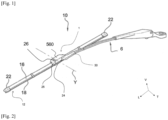
- FIG. 1 schematically illustrates a wiping system 10 according to the invention, comprising a wiper blade 12 and a drive arm 6 for the wiper blade 12.
- the wiper blade 12 comprises a longitudinal body 16, a wiping blade 18, generally made of rubber, and at least one vertebra, not visible, which stiffens the wiping blade 18 and promotes its application to a vehicle windshield.
- the wiper blade 12 schematically represented further comprises end pieces or clips 22 for attaching the wiper blade 18 and the vertebra to the longitudinal body 16, these end pieces 22 being located at each of the longitudinal ends of the longitudinal body 16.
- the base adapter 25 and the first adapter 26 participate in connecting a connector 24 to a particular type of drive arm, here a second type of drive arm 6.
- the base adapter 25 and the first adapter 26 are mounted on the connector 24 so as to maintain a degree of freedom in pivoting about a hinge axis Y which is a transverse axis substantially perpendicular to the longitudinal axis of the wiper blade 12. This degree of freedom allows the wiper blade 12 to pivot relative to the drive arm 6 and thus allows the wiper blade 12 to follow the curvature of the windshield during its movements.
- the base adapter 25 and the first adapter 26 can be detached from the drive arm 6, for example by pressing an actuation button, such as a push button carried by the base adapter 25.
- the drive arm 6 is driven by a motor, not shown, to follow a back-and-forth angular movement allowing water and possibly other unwanted elements covering the windshield to be evacuated.
- the base adapter 25 and the first adapter 26 ensure the connection of the wiper blade 12 to the drive arm 6. More particularly, they participate in the connection of a yoke 560 of the drive arm 6, which can be formed in one piece with the drive arm 6 or even be attached and fixed on a rod thereof.
- the yoke 560 has an elongated shape in a general direction substantially parallel to the longitudinal direction of the wiper blade 12.
- the yoke 560 extends at one of its longitudinal ends by a connecting part 30 to the rod of the drive arm 6.
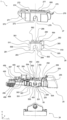
- FIG. 2 corresponds to an exploded representation of a side view of a connection device 1 according to the invention, here with a base adapter 25, a first adapter 26 and a second adapter 27, this connection device 1 being intended to be associated with the connector 24.
- This first adapter 26 and this second adapter 27 are complementary adapters, intended to be combined with the base adapter 25.
- the base adapter 25 When used alone, i.e. without an additional adapter, the base adapter 25 can be associated with a first type of drive arm, not shown. When combined with the first adapter 26 to form a connection device 1 according to the invention, the combination between these two adapters 25 and 26 can be associated with a second type of drive arm 6, shown in figures 1 And 5 , which is structurally different from the first type of drive arm. Finally, when the base adapter 25 is associated with both a first adapter 26 and a second adapter 27, the combination between these three adapters 25, 26, 27 can be associated with a third type of drive arm 7, shown in Figure 7 , this third type of drive arm being structurally distinguished from the first type and the second type of drive arm 6.
- the base adapter 25 extends mainly in the longitudinal direction.
- This base adapter 25 has a body 254 which comprises a first side wall 251 and a second side wall 252 substantially parallel to each other, at a distance from each other. These walls 251, 252 are connected to each other by an upper wall 250 which is substantially perpendicular to them.
- the base adapter 25 thus has a U-shaped section.
- the walls 250, 251, 252 of this base adapter 25 have an elongated shape in the longitudinal direction, and they define between them an internal housing 253 intended to accommodate the connector 24.
- Each of the side walls 251 and 252 respectively comprises an external face 551 and 552 as well as an internal face 553 and 554. These internal faces 553 and 554 are those which face the internal housing 523, while the external faces 551 and 552 are oriented towards an environment external to the base adapter 25.
- At least one side wall 251, 252 comprises at least one clearance 501, 502.
- each of the side walls 251 and 252 respectively comprises a clearance 501 and 502.
- This clearance is a recess in the side walls 251 and 252.
- Such a clearance 501, 502 faces the environment outside the base adapter 25; it is thus understood that this clearance 501, 502 is arranged on the external faces 551 and 552 of the side walls 251 and 252, and more particularly that it is hollowed out in them.
- the side walls 251 and 252 each further comprise two support zones, only the support zones 503 and 504 of the side wall 251 being visible on the Figure 2
- These support zones 503 and 504 are rectangular strips projecting from the external faces 551 and 552 of these side walls 251 and 252.
- Such support zones 503 and 504 can come into contact with the second adapter 27 when the connection device 1 is associated with such a complementary adapter, or with the yoke 650 a drive arm 6 when the connection device 1 does not include the second adapter 27.
- the body 254 of the base adapter 25 is connected to a head 255, the vertical and transverse dimensions of which are greater than those of the body 254 of the base adapter 25. It is thus understood that the head 255 extends beyond a longitudinal and transverse plane in which the upper wall 250 extends, and beyond a longitudinal and vertical plane in which the side walls 251 and 252 extend.
- the head 255 plays in particular the role of a locking member. Indeed, when the wiper blade 12 is assembled on the drive arm 6 by means of the connection device 1 as illustrated in the Figure 1 , this head 255 forms a stop for the yoke 560, thus preventing the translation of the latter beyond the body 254 of the base adapter 25.
- the upper wall 250 of the base adapter 25 tapers to form a tip 257, which is cantilevered relative to the body 255.
- the body 254 of the base adapter 25 and more particularly the side walls 251, 252 are each continued by an elastically deformable leg 256.
- These legs 256 can thus be brought closer to each other by elastic deformation.
- the legs 256 are substantially symmetrical along a plane of symmetry extending in longitudinal and vertical directions, located equidistant from the first side wall 251 and the second side wall 252.
- Each leg 256 further has a locking portion 426, shaped to cooperate with notches arranged on the yoke 560 in order to lock the assembly of the base adapter 25 with the latter, thus constituting another locking means adapted to the specific type of drive brush of the base adapter 25.
- the upper wall 250 is pierced with three openings, with a first opening 259, a second opening 359 and a third opening 459, aligned in the longitudinal direction and providing access to the internal housing 253.
- the first opening 259 allows the engagement of a tab which can equip the yoke with a drive arm.
- the third opening 459 which is in the vicinity of the legs 256, is partly occupied by a tab 458.
- This tab 458 extends mainly in the longitudinal direction and has a fixed end 457 at a distance from the legs 256, which is connected to the side wall 251 and to the side wall 252 by a bridge, and a free end 456 being movable in the vicinity of the legs 256.
- the tab 458 is elastically deformable and its free end 456 carries a push button 455. At rest, that is to say without constraint, the tab 458 is arranged in such a way that the push button 455 is located above the plane in which the upper wall 250 extends.
- the push button 455 engages by elastic snap-fastening in a corresponding opening of the 560 yoke in order to lock the base adapter 25 with respect to the latter.
- the side walls 251 and 252 of the base adapter 25 are also respectively equipped with a through orifice 451 and 452, open onto the internal housing 253, which extends from the external faces 551 and 552 to the internal faces 553 and 554 of these side walls 251 and 252.
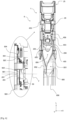
- the orifice 451 is visible in Figure 2 , while the orifice 52 is illustrated on the Figure 4 .
- the orifices 451 and 452 define a Y axis of pivoting of the base adapter 25 relative to the connector 24, and by extension of the wiper blade 12 connected to the base adapter 25 relative to the drive arm connected to the connector 24.
- the base adapter 25 comprises at least one pivoting member 50 mechanically connecting it to the connector 24, at its orifices 451 and 452.
- This pivoting member 50 constitutes an articulation which ensures the rotation of the connector 24 relative to the base adapter 25.
- this wiper blade 12 can pivot relative to the base adapter 25 and to the drive arm to which this base adapter 25 is connected.
- the wiper blade 12 can, during its movements, perfectly follow the curved surface of the windshield of the vehicle with which it is fitted.
- the first adapter 26 is a part whose cross-section is substantially U-shaped, comprising an upper wall 260 as well as a first side wall 261 and a second side wall 262. These walls 260, 261 and 262 define an internal housing 263, this internal housing 263 being in particular capable of receiving another adapter, for example the base adapter 25.
- the upper wall 260 extends mainly in a transverse-longitudinal plane, while the side walls 261 and 262 extend in parallel and distinct longitudinal-vertical planes. The side walls 261 and 262 are thus parallel to each other and perpendicular to the upper wall 260.
- the first adapter 26 is substantially symmetrical along a plane of symmetry extending in longitudinal and vertical directions, located equidistant from the first side wall 261 and the second side wall 262.
- the upper wall 260 does not extend over the entire length of the side walls 261 and 262; in other words, the upper wall 260 does not extend from one longitudinal end 510 to the other longitudinal end 511 of the first adapter 26.
- this first adapter 26 has depressions on the upper wall 260, in the vicinity of each longitudinal end 510 and 511 of the first adapter 26. In top view, the first adapter 26 therefore has an H shape.
- the side walls 261 and 262 have internal faces 563 and 564, which are those which are opposite the internal housing 263. These internal faces 563 and 564, which are therefore opposite one another, carry stops 265, which project from the internal faces 563 and 564 and extend into the internal housing 263.
- These stops 265 are locking members which participate in particular in holding the first adapter 26 in place when the latter is assembled to another adapter, for example the base adapter 25, thus securing the assembly of several parts.
- the stops 265 come into contact with the grooves 507 and 508 hollowed out in the external faces 551 and 552 of the side walls 251 and 252 of the base adapter 25, preventing the vertical translation of the first adapter 26 relative to the base adapter 25.
- Each of the side walls 261 and 262 also comprises an external face 561 and 562. These external faces 561 and 562 are oriented towards an environment external to the first adapter 26.
- the side walls 261 and 262 further comprise support zones 505 and 506, these support zones 505 and 506 being rectangular strips projecting from the external faces 561 and 562 of these side walls 261 and 262. These support zones 505 and 506 therefore extend towards the external environment of the first adapter 26.
- the support zones 505 and 506 of the first adapter 26 are respectively arranged in the vicinity of its longitudinal ends 510 and 511. These support zones are intended to come into contact with the second adapter 27 when the connection device 1 comprises such a complementary adapter, or failing that, into contact with the yoke 650 of the second type of drive arm 6 when the connection device 1 does not include a second adapter 27.
- the upper wall 260 has two square-shaped cavities 266, arranged in the vicinity of the side walls 261 and 262. These cavities 266 are recesses in the upper wall 260, which extend from an upper face thereof towards the internal housing 263.
- Each of the side walls 261 and 262 has an embrasure 269, which extends from a free edge of this side wall towards the upper wall of the first adapter 26.
- the embrasure 269 of the side wall 261 is symmetrical to the embrasure 269 of the side wall 262 according to the plane of symmetry.
- These embrasures 269 the shape of which is that of an arc of a circle, are capable of receiving a shaft of a drive arm.
- the second adapter 27 is also a part whose cross-section is substantially U-shaped.
- the second adapter 27 comprises an upper wall 270 as well as a first side wall 271 and a second side wall 272.
- the upper wall 270 extends mainly in a transverse-longitudinal plane, while the side walls 271 and 272 extend mainly in parallel and distinct longitudinal-vertical planes.
- the side walls 271 and 272 are thus parallel to each other and perpendicular to the upper wall 270.
- These walls 270, 271 and 272 define an internal housing 273, this internal housing being in particular capable of receiving another adapter, in this case the first adapter 26 described above.
- the faces of the side walls 271 and 272 which delimit this internal housing 273 correspond to the internal faces 573 and 574.
- the upper wall 270 has a recess 600 in its center, such that this upper wall 270 constitutes only a frame. At this central recess 600 of the upper wall 270, the internal housing 273 communicates with the environment outside the adapter concerned.
- the upper wall 270 also comprises a curved tab 276, which extends from one of the longitudinal ends of the second adapter 27 and at a distance therefrom. This curved tab 276 participates in the assembly of the second adapter 27 with other parts, and in particular with other adapters. This curved tab 276 can for example be received by a curved internal portion of the head 255 of the base adapter 25, such a curved internal portion not being visible on the Figure 2 .
- the internal faces 573 and 574 which are those which are opposite the internal housing 273, are opposite one another and carry stops, not visible, which project from the internal faces 573 and 574 and extend into the internal housing 273. These stops make it possible in particular to secure the second adapter 27 to another adapter, for example the base adapter 25, preventing the translation of this second adapter 27 in a vertical direction.
- Each of the side walls 271 and 272 has a recess 279, which extends from the lower end of the second adapter 27 towards its upper end.
- the recess 279 of the side wall 271 is symmetrical to the recess 279 of the side wall 272 along the plane of symmetry.
- These recesses 279 are capable of receiving a shaft of a drive arm.
- One of the side walls 271 or 272 carries at least one protrusion 277, for example square in shape, which projects from this side wall 271 or 272, in the plane of the upper wall of the second adapter.
- This protrusion 277 is constituted by an extension of material in the direction of the other side wall 271 or 272, in other words, in the direction of the side wall 271 or 272 from which it does not project.
- the protrusion 277 therefore causes an asymmetry of the second adapter 27 along a plane extending in longitudinal and vertical directions, located equidistant from the first side wall 271 and the second side wall 272.
- At least two of these different adapters 25, 26 and 27 fit into each other.
- Such a fit results in the fact that the base adapter 25, the first adapter 26 and the second adapter 27, which are substantially U-shaped parts, can fit into each other.
- a U-shaped adapter can thus cover another U-adapter, which can itself cover yet another U-adapter and so on.
- the first adapter 26 partially covers the base adapter 25 such that its side walls 261 and 262 are placed opposite the side walls 251 and 252 of the base adapter 25.
- the clearances 501 and 502, visible in Figure 2 which are carried by the external faces 551 and 552 of these side walls 251 and 252 of the base adapter 25, receive the side walls 261 and 262 of the first adapter 26, and more particularly the internal faces 563 and 564 thereof.
- the support zones 503 and 504 of the base adapter 25 are set back relative to the support zones 505 and 506 of the first adapter 26; it is thus understood that there is a clearance J between the side walls 251 and 252 of the base adapter 25 and the side walls 261 and 262 of the first adapter 26, and more particularly between the external faces 551 and 552 of the side walls 251 and 252 of the base adapter 25 and the internal faces 563 and 564 of the side walls 261 and 262 of the first adapter 26.
- the upper wall 260 of the first adapter 26 covers the upper wall 250 of the base adapter 25, this first adapter 26 resting on the body 254 of the base adapter 25. Such an arrangement of the first adapter 26 leaves the tab 458 and the push button 455 of the base adapter 25 accessible.
- connection device 1 When this base adapter 25 and this first adapter 26 are assembled, the connection device 1 thus formed can be associated with a second type of drive arm 6. Such an association is shown in Figure 5 .
- the drive arm 6 comprises a yoke 650 formed in the end portion 658 of the second type of drive arm 6.
- This yoke 650 is composed in particular of a longitudinal wall 651, extending along the longitudinal direction of the drive arm 6, this longitudinal wall 651 being bordered by two lateral flanks 652 which are perpendicular to it.
- the yoke 650 is provided with folded edges 653 arranged at the free end of each of the lateral flanks 652, these folded edges 653 comprising a pair of short folded edges and a pair of long folded edges. These folded edges 653 are retention members of the connection device 1 within the second type of drive arm 6, preventing a vertical translation of the base adapter 25 and the first adapter 26.
- connection device 1 When associating the connection device 1 comprising this base adapter 25 and this first adapter 26 with the second type of drive arm 6, the connection device 1 is inserted by longitudinal sliding within a receiving cavity 654 delimited in the yoke 650 by the longitudinal wall 651, the lateral flanks 652 and the folded edges 653.
- the legs 256 of the base adapter 25 are elastically deformed in order to be brought together to be able to be housed in the receiving cavity 654.
- the tab 458 and the push button 455 of the base adapter 25 retract, and are thus pushed towards the internal housing 253 of the base adapter 25.
- connection device 1 The longitudinal translation of the connection device 1 is blocked when the push button 455 enters an orifice 655, pierced in the wall longitudinal 651 of the yoke 650, this orifice being able to receive it.
- a clearance between the connection device 1 and the yoke 650 is thus limited, since the base adapter 25 can come into abutment against the yoke 650 even when this base adapter 25 is associated with the first adapter 26.
- the base adapter 25 and the first adapter 26 can thus both be in contact with the yoke 650, thus preventing clearance between the connection device 1 and the second type of drive arm 6.
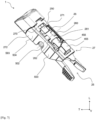
- the first adapter 26 and the second adapter 27 are associated within the connection device 1, as is the case on the figures 6 And 7 , the first adapter 26 is housed in the internal housing 273 of the second adapter 27.
- the side walls 261 and 262 of the first adapter 26 are thus opposite the side walls 271 and 272 of the second adapter 27, and more particularly the external faces 561, 562 side walls 261, 262 of the first adapter 26 are opposite the internal faces 573 and 574 of the side walls 271 and 272 of the second adapter 27.
- the upper wall 260 of the first adapter 26 is housed in the central recess 600 formed in the upper wall 270 of the second adapter 27, such that the upper wall 260 is only covered by the upper wall 270 at the location of one of the two cavities 266.
- the complementary adapters that are the first adapter 26 and the second adapter 27 can be associated with the base adapter 25.
- the internal faces 573 and 574 of the side walls 271 and 272 of the second adapter 27 are pressed against the external faces 561 and 562 of the side walls 261 and 262 of the first adapter 26.
- the side walls 271 and 272 of the second adapter 27 also have gadroons 278, visible in Figure 7 , which rest on the base adapter 25 in order to secure the connection device 1.
- connection device 1 can then be associated with the third type of drive arm 7.
- This drive arm 7 comprises a yoke 560, formed in the end portion 568 of the third type of drive arm 7.
- This yoke 560 is composed in particular of a longitudinal wall 561, extending in the longitudinal direction of the drive arm 7, this longitudinal wall 561 being bordered by two lateral flanks 562 which are perpendicular to it.
- the yoke 560 is provided with a folded edge 563, arranged at the free end of each of the lateral flanks 652.
- This folded edge 563 is a member for retaining the connection device 1 within the third type of drive arm 7, preventing a vertical translation of the base adapter 25, the first adapter 26 and the second adapter 27.
- connection device 1 When associating the connection device 1 comprising this base adapter 25, this first adapter 26 and this second adapter 27 to the third type of drive arm 7, the connection device 1 is inserted into a receiving cavity 564 delimited in the yoke 560 by the longitudinal wall 561, the lateral flanks 562 and the folded edge 563.
- the legs 256 of the base adapter 25 are elastically deformed in order to be brought together to be able to be housed in the receiving cavity 564.
- the tab 458 and the push button 455 of the base adapter 25 are pressed towards the internal housing 253 of the base adapter 25.
- the longitudinal translation of the connection device 1 is blocked when the push button 455 opens into an orifice, not visible, drilled in the longitudinal wall 561, this orifice being able to receive it.
- the present invention thus provides a connection device between a wiper blade and a drive arm, limits the play between a combination of adapters and the drive arm thanks to a clearance of material arranged on a side wall of one of these adapters.
- a connection device allows in particular improved maintenance of the wiper blade.
Landscapes
- Engineering & Computer Science (AREA)
- Mechanical Engineering (AREA)
- Pivots And Pivotal Connections (AREA)
Description
- La présente invention concerne le domaine des essuie-glaces pour véhicule, et plus particulièrement les dispositifs de connexion permettant de connecter un balai d'essuyage à un bras d'entraînement.
- Les systèmes d'essuyage pour véhicule sont conçus pour retirer, par balayage, les liquides et salissures qui pourraient perturber la vision d'un conducteur. Ces systèmes d'essuyage comprennent en général un bras d'entraînement, qui effectue un mouvement de va-et-vient angulaire, et des balais d'essuyage allongés équipés de lames racleuses réalisées en une matière élastique. La lame racleuse frotte contre le pare-brise et évacue ces liquides et salissures en les balayant en dehors du champ de vision du conducteur.
- Le balai d'essuyage est rattaché au bras d'entraînement par un dispositif de connexion qui comprend un connecteur et un adaptateur. Le connecteur est une pièce qui est solidarisée au balai d'essuyage et qui est en général solidaire de la lame racleuse. L'adaptateur est une pièce qui est interposée entre le bras d'entraînement et le connecteur, en étant conformé pour s'engager dans une chape du bras d'entraînement. Connecteur et adaptateur coopèrent ensuite pour permettre la liaison articulée et la fixation du balai d'essuyage sur le bras d'entraînement, formant ainsi le dispositif de connexion du balai d'essuyage au bras d'entraînement.
- La liaison articulée entre le connecteur et l'adaptateur comprend au moins un axe transversal de pivotement du connecteur vis-à-vis de l'adaptateur, qui est également un axe de pivotement du balai d'essuyage vis-à-vis du bras d'entraînement. L'un des organes, par exemple le connecteur, comprend en général une forme sensiblement cylindrique qui forme un pivot et qui est reçu dans un logement de forme complémentaire de l'autre organe, ici l'adaptateur.
- Un adaptateur permet d'associer un balai d'essuyage à un type particulier de chape ou de bras d'entraînement et il existe plusieurs variétés de chapes. Ces variétés sont proches en apparence mais diffèrent les unes des autres par leurs dimensions, en particulier par leurs largeurs ou dimensions latérales. Elles varient également par les positions des orifices destinés à coopérer avec un bouton poussoir de verrouillage de l'adaptateur.
- Il existe ainsi différents adaptateurs, de façon à pouvoir associer un balai d'essuyage donné à plusieurs chapes et par extension à plusieurs bras d'entraînement. Le document
US 2015/0089764 A1 montre un dispositif de connexion tel que connu dans l'état de la technique. - Une combinaison de plusieurs adaptateurs peut cependant entraîner des complications lors de l'utilisation d'un système d'essuyage intégrant cette combinaison. En effet, une telle combinaison des différents adaptateurs nécessite un jeu pour leur imbrication, ce jeu pouvant être retrouvé lors du montage des adaptateurs dans la chape du bras d'entraînement. En raison d'un tel jeu le balai d'essuyage peut alors, lorsqu'il est associé à la combinaison d'adaptateurs et au bras d'entraînement, osciller de façon préjudiciable et ainsi entraver le fonctionnement du système d'essuyage.
- Par ailleurs, la combinaison de différents adaptateurs induit un surplus de matière, qui entraîne une augmentation non négligeable du poids total du système d'essuyage.
- La présente invention résout ces problèmes techniques en proposant un dispositif de connexion qui limite le jeu entre la combinaison d'adaptateurs et le bras d'entraînement, grâce à un dégagement de matière présent sur une paroi latérale de l'un de ces adaptateurs. Un dispositif de connexion selon l'invention permet une tenue améliorée du balai d'essuyage, limitant ainsi les oscillations intempestives.
- En outre, la présente invention présente des avantages liés au conditionnement et à l'utilisation des adaptateurs. Les formes de ces adaptateurs entraînant une réduction de la matière plastique nécessaire à leur fabrication, l'encombrement ainsi que le poids de ces adaptateurs sont donc réduits.
- Un objet de la présente invention concerne ainsi un dispositif de connexion entre un balai d'essuyage et un bras d'entraînement pour véhicule, comprenant un adaptateur de base et au moins un premier adaptateur, cet adaptateur de base étant équipé d'au moins un organe de pivotement destiné à le relier à un connecteur, l'adaptateur de base étant configuré pour relier ce connecteur à un premier type de bras d'entraînement, l'adaptateur de base et le premier adaptateur ayant chacun une section en U formée de deux parois latérales jointes par une paroi supérieure. Selon l'invention, au moins une paroi latérale de l'adaptateur de base comprend au moins un dégagement qui reçoit une paroi latérale du premier adaptateur.
- Le dispositif de connexion comprend donc un adaptateur de base et au moins un adaptateur complémentaire de cet adaptateur de base, ici un premier adaptateur.
- Ces adaptateurs participent à relier un connecteur à un type particulier de bras d'entraînement. Les adaptateurs peuvent relier le connecteur au type particulier de bras d'entraînement directement ou bien faire intervenir dans cette liaison d'autres composants, par exemple un deuxième adaptateur complémentaire.
- Les adaptateurs présentent des sections en forme de U, facilitant leur combinaison. Cette section en U est formée par une paroi supérieure, qui assure une liaison entre deux parois latérales. Ce sont ces parois latérales de l'adaptateur de base qui présentent le dégagement selon l'invention, qui reçoit la paroi latérale du premier adaptateur. Ce dégagement permet notamment de limiter le jeu existant auparavant entre le dispositif de connexion et le bras d'entraînement.
- L'adaptateur de base comprend un organe de pivotement le reliant au connecteur, ce dernier assurant la liaison du dispositif de connexion au balai d'essuyage. L'organe de pivotement constitue une articulation qui assure la rotation du connecteur par rapport à l'adaptateur de base. Lorsque le connecteur est solidaire d'un balai d'essuyage, ce balai d'essuyage peut ainsi pivoter par rapport à l'adaptateur et au bras d'entraînement auquel cet adaptateur est relié. De ce fait, le balai d'essuyage peut épouser la surface du pare-brise du véhicule qu'il équipe, afin de le balayer d'une façon satisfaisante.
- Avantageusement, le dispositif de connexion comprend deux dégagements, ces dégagements étant respectivement disposés sur chaque paroi latérale de l'adaptateur de base.
- Selon une caractéristique de l'invention, le dégagement est ouvert sur un environnement extérieur de l'adaptateur de base. Cet environnement extérieur de l'adaptateur de base est opposé à son logement interne, qui correspond au volume défini entre sa paroi supérieure et ses parois latérales.
- Selon l'invention, chaque paroi latérale de l'adaptateur de base et du premier adaptateur comprend des zones d'appui, ces zones d'appui étant des bandes rectangulaires faisant saillie des faces externes des parois latérales. Chaque paroi latérale comprend une face interne et une face externe, la face interne étant celle qui délimite le logement interne de l'adaptateur et la face externe étant la face opposée à la face interne, c'est-à-dire celle qui fait face à l'environnement extérieur de l'adaptateur. Les faces externes comportent des zones d'appui faisant saillie depuis ces faces externes.
- Selon une autre caractéristique, le dégagement est délimité longitudinalement par les zones d'appui de l'adaptateur de base. On comprend ainsi que selon une direction longitudinale de l'adaptateur de base, qui correspond à sa direction d'allongement, les zones d'appui participent à la délimitation du dégagement. Ce dégagement est donc compris entre deux zones d'appui.
- Selon une caractéristique de l'invention, les zones d'appui du premier adaptateur, sont disposées longitudinalement à ses extrémités. Ces zones d'appui sont ainsi au voisinage des extrémités longitudinales du premier adaptateur.
- Selon une caractéristique, une combinaison entre l'adaptateur de base et le premier adaptateur est apte à être associée à un deuxième type de bras d'entraînement, structurellement différent du premier type de bras d'entraînement. Le deuxième type de bras d'entraînement est un type de bras d'entraînement qui est structurellement différent du premier type de bras d'entraînement auquel est associé l'adaptateur de base.
- Selon une caractéristique, le dispositif de connexion comprend un deuxième adaptateur, une combinaison entre l'adaptateur de base, le premier adaptateur et ce deuxième adaptateur étant apte à être associée à un troisième type de bras d'entraînement, structurellement différent du premier type et du deuxième type de bras d'entraînement. Ce troisième type de bras d'entraînement est un type de bras d'entraînement structurellement différent à la fois du premier type de bras d'entraînement et du deuxième type de bras d'entraînement. Le deuxième adaptateur correspond à un deuxième adaptateur complémentaire de l'adaptateur de base. Ce deuxième adaptateur se distingue du premier adaptateur au moins en ce qu'il comprend une patte courbée qui se loge à l'intérieur d'une tête de l'adaptateur de base.
- Selon un aspect de l'invention, au moins deux adaptateurs s'imbriquent l'un dans l'autre. Une telle imbrication se traduit par le fait que les adaptateurs, qui sont des pièces sensiblement en forme de U, peuvent s'emboîter les uns dans les autres. Un adaptateur en U peut ainsi recouvrir un autre adaptateur en U, qui peut lui-même recouvrir encore un autre adaptateur en U, notamment l'adaptateur de base. Dans un mode de réalisation, l'adaptateur de base est couvert par au moins un adaptateur complémentaire, notamment par le premier adaptateur qui lui-même peut être couvert par le deuxième adaptateur.
- Avantageusement, les adaptateurs présentent des organes de verrouillage participant à sécuriser l'imbrication des adaptateurs l'un dans l'autre. De tels organes de verrouillage peuvent par exemple être des butées ou des dents, qui ont notamment pour objectif de retenir le premier adaptateur par rapport à l'adaptateur de base, ou encore le deuxième adaptateur par rapport à cet adaptateur de base
- Selon une caractéristique de l'invention, le dispositif de connexion, notamment l'un et/ou l'autre des adaptateurs, comprend au moins une butée et un organe de verrouillage destinés à solidariser l'adaptateur par rapport au bras d'entraînement auquel il est destiné à s'associer. L'adaptateur et le bras d'entraînement sont ainsi solidarisés l'un à l'autre, la butée et l'organe de verrouillage empêchant la translation du bras d'entraînement par rapport à l'adaptateur. L'organe de verrouillage peut par exemple être un bouton poussoir, une languette ou encore des jambes de l'adaptateur.
- Selon une caractéristique de l'invention, l'organe de verrouillage est disposé sur une paroi supérieure de l'adaptateur. L'organe de verrouillage peut ainsi être disposé sur la paroi supérieure de l'adaptateur de base ou sur la paroi supérieure de l'adaptateur complémentaire. L'organe de verrouillage est disposé sur la paroi supérieure notamment en faisant saillie de celle-ci.
- L'invention concerne en outre un balai d'essuyage comprenant un dispositif de connexion tel que décrit dans le présent document.
- L'invention porte enfin sur un système d'essuyage comprenant un bras d'entraînement porteur d'un balai d'essuyage comprenant un dispositif de connexion, le balai d'essuyage étant relié au bras d'entraînement par l'intermédiaire du dispositif de connexion décrit ci-dessus. L'adaptateur de base et le premier adaptateur sont alors destinés à venir au contact d'une chape du bras d'entraînement auquel ils sont destinés à s'associer.
- D'autres caractéristiques, détails et avantages de l'invention ressortiront plus clairement à la lecture de la description qui suit d'une part, et d'un exemple de réalisation donné à titre indicatif et non limitatif en référence aux dessins annexés d'autre part, sur lesquels :
- [
Fig. 1 ] présente, schématiquement, une vue en perspective d'un système d'essuyage dans lequel un dispositif de connexion selon l'invention relie un balai d'essuyage à un bras d'entraînement ; - [
Fig. 2 ] illustre une partie d'un dispositif de connexion selon une vue de côté en éclaté, avec un adaptateur de base, un premier adaptateur, un deuxième adaptateur et un connecteur ; - [
Fig. 3 ] est une vue en perspective du dispositif de connexion de lafigure 1 , selon une vue de dessus ; - [
Fig. 4 ] est une autre vue en perspective du dispositif de connexion de lafigure 1 , selon une vue de côté ; - [
Fig. 5 ] est une vue en perspective de dessous du dispositif de connexion de lafigure 1 associé à un bras d'entraînement ; - [
Fig. 6 ] est une vue en perspective d'un dispositif de connexion comprenant l'adaptateur de base, le premier adaptateur et le deuxième adaptateur ; - [
Fig. 7 ] est une vue en perspective de dessous du dispositif de connexion de lafigure 6 associé à un bras d'entraînement. - Sur les figures, les éléments communs à plusieurs figures conservent la même référence.
- Dans la description détaillée qui va suivre, les dénominations « longitudinale », « transversale » et « verticale » se réfèrent à l'orientation du dispositif de connexion selon l'invention. Une direction longitudinale correspond à une direction principale d'allongement du balai d'essuyage duquel le dispositif de connexion est rendu solidaire, cette direction longitudinale étant parallèle à un axe longitudinal L d'un repère L, V, T illustré sur les figures. Une direction transversale correspond à une direction dans laquelle s'inscrit l'axe de rotation de l'organe de pivotement entre l'adaptateur de base et le connecteur du dispositif de connexion, cette direction transversale étant parallèle à un axe transversal T du repère L, V, T et cet axe transversal T étant perpendiculaire à l'axe longitudinal L. Enfin, une direction verticale correspond à une direction parallèle à un axe vertical V du repère L, V, T, cet axe vertical V étant perpendiculaire à l'axe longitudinal L et à l'axe transversal T.
- En outre, les dénominations « inférieure » et « supérieure » concernant les éléments du dispositif de connexion s'entendent relativement à l'éloignement de ces éléments du balai d'essuyage, une extrémité inférieure de tels éléments correspondant à l'extrémité disposée au voisinage de ce balai d'essuyage tandis qu'une extrémité supérieure correspond à l'extrémité disposée à distance du balai d'essuyage.
- La
figure 1 illustre schématiquement un système d'essuyage 10 selon l'invention, comportant un balai d'essuyage 12 et un bras d'entraînement 6 du balai d'essuyage 12. Le balai d'essuyage 12 comprend un corps longitudinal 16, une lame d'essuyage 18, en général en caoutchouc, et au moins une vertèbre, non visible, qui rigidifie la lame d'essuyage 18 et favorise son application sur un pare-brise de véhicule. - Le balai d'essuyage 12 schématiquement représenté comprend en outre des embouts d'extrémité ou agrafes d'accrochage 22 de la lame d'essuyage 18 et de la vertèbre sur le corps longitudinal 16, ces embouts d'extrémité 22 étant situés à chacune des extrémités longitudinales du corps longitudinal 16.
- Le balai d'essuyage 12 porte sensiblement en son milieu un dispositif de connexion 1 selon l'invention. Ce dispositif de connexion 1 comprend au moins deux adaptateurs. Ces adaptateurs sont ici un adaptateur de base 25 et un adaptateur complémentaire, ici un premier adaptateur 26.
- L'adaptateur de base 25 et le premier adaptateur 26 participent à relier un connecteur 24 à un type particulier de bras d'entraînement, ici un deuxième type de bras d'entraînement 6. L'adaptateur de base 25 et le premier adaptateur 26 sont montés sur le connecteur 24 de façon à garder un degré de liberté en pivotement autour d'un axe d'articulation Y qui est un axe transversal sensiblement perpendiculaire à l'axe longitudinal du balai d'essuyage 12. Ce degré de liberté autorise un pivotement du balai d'essuyage 12 vis-à-vis du bras d'entraînement 6 et permet ainsi au balai d'essuyage 12 de suivre la courbure du pare-brise lors de ses déplacements. L'adaptateur de base 25 et le premier adaptateur 26 peuvent être désolidarisés du bras d'entraînement 6, par exemple par appui sur un bouton d'actionnement, tel qu'un bouton poussoir porté par l'adaptateur de base 25.
- Le bras d'entraînement 6 est entraîné par un moteur, non représenté, pour suivre un mouvement angulaire de va-et-vient permettant d'évacuer l'eau, et éventuellement d'autres éléments indésirables recouvrant le pare-brise. L'adaptateur de base 25 et le premier adaptateur 26 assurent la liaison du balai d'essuyage 12 au bras d'entraînement 6. Plus particulièrement, ils participent à la liaison d'une chape 560 du bras d'entraînement 6, qui peut être formée d'un seul tenant avec le bras d'entraînement 6 ou encore être rapportée et fixé sur une tige de celui-ci.
- La chape 560 a une forme allongée selon une direction générale sensiblement parallèle à la direction longitudinale du balai d'essuyage 12. La chape 560 se prolonge à l'une de ses extrémités longitudinales par une partie de liaison 30 à la tige du bras d'entraînement 6.
- La
figure 2 correspond à une représentation en éclaté d'une vue de côté d'un dispositif de connexion 1 selon l'invention, avec ici un adaptateur de base 25, un premier adaptateur 26 et un deuxième adaptateur 27, ce dispositif de connexion 1 étant destiné à s'associer au connecteur 24. Ce premier adaptateur 26 et ce deuxième adaptateur 27 sont des adaptateurs complémentaires, destinés à être combinés avec l'adaptateur de base 25. - Lorsqu'il est utilisé seul, c'est-à-dire sans adaptateur complémentaire, l'adaptateur de base 25 peut s'associer à un premier type de bras d'entraînement, non représenté. Lorsqu'il est combiné au premier adaptateur 26 pour former un dispositif de connexion 1 selon l'invention, la combinaison entre ces deux adaptateurs 25 et 26 peut s'associer à un deuxième type de bras d'entraînement 6, représenté aux
figures 1 et5 , qui est structurellement différent du premier type de bras d'entraînement. Enfin, lorsque l'adaptateur de base 25 est associé à la fois à un premier adaptateur 26 et à un deuxième adaptateur 27, la combinaison entre ces trois adaptateurs 25, 26, 27 peut s'associer à un troisième type de bras d'entraînement 7, représenté enfigure 7 , ce troisième type de bras d'entraînement se distinguant structurellement du premier type et du deuxième type de bras d'entraînement 6. - L'adaptateur de base 25 s'étend principalement selon la direction longitudinale. Cet adaptateur de base 25 présente un corps 254 qui comprend une première paroi latérale 251 et une deuxième paroi latérale 252 sensiblement parallèles entre elles, à distance l'une de l'autre. Ces parois 251, 252 sont reliées entre elles par une paroi supérieure 250 qui leur est sensiblement perpendiculaire. L'adaptateur de base 25 présente ainsi une section en forme de U. Les parois 250, 251, 252 de cet adaptateur de base 25 présentent une forme allongée selon la direction longitudinale, et elles définissent entre elles un logement interne 253 destiné à accueillir le connecteur 24. Chacune des parois latérales 251 et 252 comporte respectivement une face externe 551 et 552 ainsi qu'une face interne 553 et 554. Ces faces internes 553 et 554 sont celles qui font face au logement interne 523, tandis que les faces externes 551 et 552 sont orientées vers un environnement extérieur à l'adaptateur de base 25.
- Selon l'invention, au moins une paroi latérale 251, 252 comprend au moins un dégagement 501, 502. Selon le mode de réalisation représenté ici, chacune des parois latérales 251 et 252 comprend respectivement un dégagement 501 et 502. Ce dégagement est un renfoncement dans les parois latérales 251 et 252. Un tel dégagement 501, 502 est tourné vers l'environnement extérieur à l'adaptateur de base 25 ; on comprend ainsi que ce dégagement 501, 502 est disposé sur les faces externes 551 et 552 des parois latérales 251 et 252, et plus particulièrement qu'il est creusé dans celles-ci.
- Les parois latérales 251 et 252 comprennent en outre chacune deux zones d'appui, seules les zones d'appui 503 et 504 de la paroi latérale 251 étant visibles sur la
figure 2 . Ces zones d'appui 503 et 504 sont des bandes rectangulaires faisant saillie des faces externes 551 et 552 de ces parois latérales 251 et 252. Ces zones d'appui 503 et 504, qui s'étendent donc en direction de l'environnement externe de l'adaptateur de base 25, permettent notamment de délimiter longitudinalement les dégagements 501 et 502. De telles zones d'appui 503 et 504 peuvent entrer en contact avec le deuxième adaptateur 27 lorsque le dispositif de connexion 1 est associé à un tel adaptateur complémentaire, ou avec la chape 650 un bras d'entraînement 6 lorsque le dispositif de connexion 1 ne comprend pas le deuxième adaptateur 27. - À une de ses extrémités longitudinales, le corps 254 de l'adaptateur de base 25 est relié à une tête 255, dont les dimensions verticales et transversales sont supérieures à celles du corps 254 de l'adaptateur de base 25. On comprend ainsi que la tête 255 s'étend au-delà d'un plan longitudinal et transversal dans lequel s'étend la paroi supérieure 250, et au-delà d'un plan longitudinal et vertical dans lequel s'étendent les parois latérales 251 et 252. La tête 255 joue notamment le rôle d'organe de verrouillage. En effet, lorsque le balai d'essuyage 12 est assemblé sur le bras d'entraînement 6 par l'intermédiaire du dispositif de connexion 1 comme illustré sur la
figure 1 , cette tête 255 forme une butée pour la chape 560, empêchant ainsi la translation de celle-ci au-delà du corps 254 de l'adaptateur de base 25. - À une autre de ses extrémités longitudinales, la paroi supérieure 250 de l'adaptateur de base 25 se rétrécit de façon à former une pointe 257, qui est en porte-à-faux par rapport au corps 255.
- Au niveau de cette autre extrémité longitudinale, le corps 254 de l'adaptateur de base 25 et plus particulièrement les parois latérales 251, 252 se poursuivent chacune par une jambe 256 déformable élastiquement. Ces jambes 256 peuvent ainsi être rapprochées l'une de l'autre par déformation élastique. Les jambes 256 sont sensiblement symétriques selon un plan de symétrie s'étendant dans des directions longitudinale et verticale, situé à équidistance de la première paroi latérale 251 et de la deuxième paroi latérale 252. Chaque jambe 256 présente en outre une portion de verrouillage 426, conformée pour coopérer avec des encoches disposées sur la chape 560 afin de verrouiller l'assemblage de l'adaptateur de base 25 avec cette dernière, constituant ainsi un autre moyen de verrouillage adapté au type de balai d'entraînement spécifique de l'adaptateur de base 25.
- La paroi supérieure 250 est percée de trois ouvertures, avec une première ouverture 259, une deuxième ouverture 359 et une troisième ouverture 459, alignées selon la direction longitudinale et donnant accès au logement interne 253. La première ouverture 259 permet l'engagement d'une patte pouvant équiper la chape d'un bras d'entraînement. La troisième ouverture 459, qui est au voisinage des jambes 256, est en partie occupée par une languette 458. Cette languette 458 s'étend principalement selon la direction longitudinale et présente une extrémité fixe 457 à distance des jambes 256, qui est reliée à la paroi latérale 251 et à la paroi latérale 252 par un pontet, et une extrémité libre 456 étant mobile au voisinage des jambes 256. La languette 458 est déformable élastiquement et son extrémité libre 456 porte un bouton poussoir 455. Au repos, c'est-à-dire sans contrainte, la languette 458 est disposée d'une façon telle que le bouton poussoir 455 se situe au-dessus du plan dans lequel s'étend la paroi supérieure 250. Lors du montage de l'adaptateur de base 25 dans la chape 560, le bouton poussoir 455 s'engage par encliquetage élastique dans une ouverture correspondante de la chape 560 afin de verrouiller l'adaptateur de base 25 vis-à-vis de cette dernière.
- Les parois latérales 251 et 252 de l'adaptateur de base 25 sont par ailleurs équipées respectivement d'un orifice traversant 451 et 452, ouvert sur le logement interne 253, qui s'étend depuis les faces externes 551 et 552 jusqu'aux faces internes 553 et 554 de ces parois latérales 251 et 252. L'orifice 451 est visible en
figure 2 , tandis que l'orifice 52 est illustré sur lafigure 4 . Les orifices 451 et 452 définissent un axe Y de pivotement de l'adaptateur de base 25 relativement au connecteur 24, et par extension du balai d'essuyage 12 relié à l'adaptateur de base 25 relativement au bras d'entraînement relié au connecteur 24. L'adaptateur de base 25 comprend au moins un organe de pivotement 50 le reliant mécaniquement au connecteur 24, au niveau de ses orifices 451 et 452. Cet organe de pivotement 50 constitue une articulation qui assure la rotation du connecteur 24 par rapport à l'adaptateur de base 25. Ainsi, lorsque le connecteur 24 est solidaire d'un balai d'essuyage 12 comme c'est le cas sur lafigure 1 , par exemple par sertissage, ce balai d'essuyage 12 peut pivoter par rapport à l'adaptateur de base 25 et au bras d'entraînement auquel cet adaptateur de base 25 est relié. De ce fait, le balai d'essuyage 12 peut lors de ses déplacements suivre parfaitement la surface courbée du pare-brise du véhicule qu'il équipe. - Le premier adaptateur 26 est une pièce dont une section transversale est sensiblement en forme de U, comprenant une paroi supérieure 260 ainsi qu'une première paroi latérale 261 et une deuxième paroi latérale 262. Ces parois 260, 261 et 262 définissent un logement interne 263, ce logement interne 263 étant notamment apte à recevoir un autre adaptateur, par exemple l'adaptateur de base 25. La paroi supérieure 260 s'étend principalement dans un plan transversal-longitudinal, tandis que les parois latérales 261 et 262 s'étendent dans des plans longitudinaux-verticaux parallèles et distincts. Les parois latérales 261 et 262 sont ainsi parallèles entre elles et perpendiculaires à la paroi supérieure 260. Par ailleurs, le premier adaptateur 26 est sensiblement symétrique selon un plan de symétrie s'étendant dans des directions longitudinale et verticale, situé à équidistance de la première paroi latérale 261 et de la deuxième paroi latérale 262.
- La paroi supérieure 260 ne s'étend pas sur toute la longueur des parois latérales 261 et 262 ; autrement dit, la paroi supérieure 260 ne s'étend pas d'une extrémité longitudinale 510 à l'autre extrémité longitudinale 511 du premier adaptateur 26. En effet, ce premier adaptateur 26 présente des dépressions sur la paroi supérieure 260, au voisinage de chaque extrémité longitudinale 510 et 511 du premier adaptateur 26. En vue de dessus, le premier adaptateur 26 présente donc une forme de H.
- Les parois latérales 261 et 262 présentent des faces internes 563 et 564, qui sont celles qui sont en regard du logement interne 263. Ces faces internes 563 et 564, qui sont donc opposées l'une à l'autre, portent des butées 265, qui font saillie depuis les faces internes 563 et 564 et s'étendent dans le logement interne 263. Ces butées 265 sont des organes de verrouillage qui participent notamment à maintenir en place le premier adaptateur 26 lorsque celui-ci est assemblé à un autre adaptateur, par exemple l'adaptateur de base 25, sécurisant ainsi l'assemblage de plusieurs pièces. À cet effet, les butées 265 viennent au contact des gorges 507 et 508 creusées dans les faces externes 551 et 552 des parois latérales 251 et 252 de l'adaptateur de base 25, empêchant la translation verticale du premier adaptateur 26 par rapport à l'adaptateur de base 25.
- Chacune des parois latérales 261 et 262 comporte également une face externe 561 et 562. Ces faces externes 561 et 562 sont orientées vers un environnement extérieur au premier adaptateur 26.
- Les parois latérales 261 et 262 comprennent en outre des zones d'appui 505 et 506, ces zones d'appui 505 et 506 étant des bandes rectangulaires faisant saillie des faces externes 561 et 562 de ces parois latérales 261 et 262. Ces zones d'appui 505 et 506 s'étendent donc en direction de l'environnement externe du premier adaptateur 26. Les zones d'appui 505 et 506 du premier adaptateur 26 sont respectivement disposées au voisinage de ses extrémités longitudinales 510 et 511. Ces zones d'appui sont destinées à venir au contact du deuxième adaptateur 27 lorsque le dispositif de connexion 1 comprend un tel adaptateur complémentaire, ou à défaut au contact de la chape 650 du deuxième type de bras d'entraînement 6 lorsque le dispositif de connexion 1 ne comprend pas de deuxième adaptateur 27.
- La paroi supérieure 260 présente deux cavités 266 de formes carrées, disposées au voisinage des parois latérales 261 et 262. Ces cavités 266 sont des renfoncements dans la paroi supérieure 260, qui s'étendent depuis une face supérieure de celle-ci vers le logement interne 263.
- Chacune des parois latérales 261 et 262 présente une embrasure 269, qui s'étend depuis un bord libre de cette paroi latérale en direction de la paroi supérieure du premier adaptateur 26. L'embrasure 269 de la paroi latérale 261 est symétrique à l'embrasure 269 de la paroi latérale 262 selon le plan de symétrie. Ces embrasures 269, dont la forme est celle d'un arc de cercle, sont aptes à recevoir un arbre d'un bras d'entraînement.
- Le deuxième adaptateur 27 est également une pièce dont une section transversale est sensiblement en forme de U. Le deuxième adaptateur 27 comporte une paroi supérieure 270 ainsi qu'une première paroi latérale 271 et une deuxième paroi latérale 272. La paroi supérieure 270 s'étend principalement dans un plan transversal-longitudinal, tandis que les parois latérales 271 et 272 s'étendent principalement dans des plans longitudinaux-verticaux parallèles et distincts. Les parois latérales 271 et 272 sont ainsi parallèles entre elles et perpendiculaires à la paroi supérieure 270. Ces parois 270, 271 et 272 définissent un logement interne 273, ce logement interne étant notamment apte à recevoir un autre adaptateur, dans le cas présent le premier adaptateur 26 décrit ci-dessus. Les faces des parois latérales 271 et 272 qui délimitent ce logement interne 273 correspondent aux faces internes 573 et 574.
- La paroi supérieure 270 présente un évidement 600 en son centre, de telle sorte que cette paroi supérieure 270 ne constitue qu'un cadre. Au niveau de cet évidement central 600 de la paroi supérieure 270, le logement interne 273 communique avec l'environnement extérieur à l'adaptateur concerné. La paroi supérieure 270 comporte par ailleurs une patte courbée 276, qui s'étend depuis l'une des extrémités longitudinales du deuxième adaptateur 27 et à distance de celle-ci. Cette patte courbée 276 participe à l'assemblage du deuxième adaptateur 27 avec d'autres pièces, et notamment avec d'autres adaptateurs. Cette patte courbée 276 peut par exemple être reçue par une portion interne courbée de la tête 255 de l'adaptateur de base 25, une telle portion interne courbée n'étant pas visible sur la
figure 2 . - Les faces internes 573 et 574, qui sont celles qui sont en regard du logement interne 273, sont opposées l'une à l'autre et portent des butées, non visibles, qui font saillie des faces internes 573 et 574 et s'étendent dans le logement interne 273. Ces butées permettent notamment de solidariser le deuxième adaptateur 27 à un autre adaptateur, par exemple l'adaptateur de base 25, empêchant la translation de ce deuxième adaptateur 27 selon une direction verticale.
- Chacune des parois latérales 271 et 272 présente une embrasure 279, qui s'étend depuis l'extrémité inférieure du deuxième adaptateur 27 en direction de son extrémité supérieure. L'embrasure 279 de la paroi latérale 271 est symétrique à l'embrasure 279 de la paroi latérale 272 selon le plan de symétrie. Ces embrasures 279, dont la forme est celle d'un arc de cercle, sont aptes à recevoir un arbre d'un bras d'entraînement.
- L'une des parois latérales 271 ou 272 porte au moins une excroissance 277, par exemple de forme carrée, qui fait saillie de cette paroi latérale 271 ou 272, dans le plan de la paroi supérieure du deuxième adaptateur. Cette excroissance 277 est constituée par un prolongement de matière en direction de l'autre paroi latérale 271 ou 272, autrement dit, en direction de la paroi latérale 271 ou 272 à partir de laquelle elle ne fait pas saillie. L'excroissance 277 entraîne donc une asymétrie du deuxième adaptateur 27 selon un plan s'étendant dans des directions longitudinale et verticale, situé à équidistance de la première paroi latérale 271 et de la deuxième paroi latérale 272.
- Selon un aspect de l'invention, au moins deux de ces différents adaptateurs 25, 26 et 27 s'imbriquent l'un dans l'autre. Une telle imbrication se traduit par le fait que l'adaptateur de base 25, le premier adaptateur 26 et le deuxième adaptateur 27, qui sont des pièces sensiblement en forme de U, peuvent s'emboîter les uns dans les autres. Un adaptateur en U peut ainsi recouvrir un autre adaptateur en U, qui peut lui-même recouvrir encore un autre adaptateur en U et ainsi de suite.
- Lorsque l'adaptateur de base 25 et le premier adaptateur 26 sont associés pour former le dispositif de connexion 1 selon l'invention, tel que visible en
figures 4 et5 , le premier adaptateur 26 recouvre partiellement l'adaptateur de base 25 de telle sorte que ses parois latérales 261 et 262 sont placées en regard des parois latérales 251 et 252 de l'adaptateur de base 25. Selon l'invention, les dégagements 501 et 502, visibles enfigure 2 , qui sont portés par les faces externes 551 et 552 de ces parois latérales 251 et 252 de l'adaptateur de base 25, reçoivent les parois latérales 261 et 262 du premier adaptateur 26, et plus particulièrement les faces internes 563 et 564 de celles-ci. - Les zones d'appui 503 et 504 de l'adaptateur de base 25 sont en retrait par rapport aux zones d'appui 505 et 506 du premier adaptateur 26 ; on comprend ainsi qu'il existe un jeu J entre les parois latérales 251 et 252 de l'adaptateur de base 25 et les parois latérales 261 et 262 du premier adaptateur 26, et plus particulièrement entre les faces externes 551 et 552 des parois latérales 251 et 252 de l'adaptateur de base 25 et les faces internes 563 et 564 des parois latérales 261 et 262 du premier adaptateur 26.
- La paroi supérieure 260 du premier adaptateur 26 recouvre la paroi supérieure 250 de l'adaptateur de base 25, ce premier adaptateur 26 reposant sur le corps 254 de l'adaptateur de base 25. Une telle disposition du premier adaptateur 26 laisse accessibles la languette 458 et le bouton poussoir 455 de l'adaptateur de base 25.
- Lorsque cet adaptateur de base 25 et ce premier adaptateur 26 sont assemblés, le dispositif de connexion 1 ainsi formé peut être associé à un deuxième type de bras d'entraînement 6. Une telle association est représentée en
figure 5 . - Le bras d'entraînement 6 comprend une chape 650 formée dans la partie terminale 658 du deuxième type de bras d'entraînement 6. Cette chape 650 se compose notamment d'une paroi longitudinale 651, s'étendant selon la direction longitudinale du bras d'entraînement 6, cette paroi longitudinale 651 étant bordée de deux flancs latéraux 652 qui lui sont perpendiculaires. La chape 650 est pourvue de bords pliés 653 ménagés à l'extrémité libre de chacun des flancs latéraux 652, ces bords pliés 653 comprenant une paire de bords pliés courts et une paire de bords pliés longs. Ces bords pliés 653 sont des organes de rétention du dispositif de connexion 1 au sein du deuxième type de bras d'entraînement 6, empêchant une translation verticale de l'adaptateur de base 25 et du premier adaptateur 26.
- Lors de l'association du dispositif de connexion 1 comprenant cet adaptateur de base 25 et ce premier adaptateur 26 au deuxième type de bras d'entraînement 6, le dispositif de connexion 1 est inséré par coulissement longitudinal au sein d'une cavité de réception 654 délimitée dans la chape 650 par la paroi longitudinale 651, les flancs latéraux 652 et les bords pliés 653. À cet effet, les jambes 256 de l'adaptateur de base 25 sont déformées élastiquement afin d'être rapprochées pour pouvoir se loger dans la cavité de réception 654. De la même façon, la languette 458 et le bouton poussoir 455 de l'adaptateur de base 25 s'escamotent, et sont ainsi enfoncés vers le logement interne 253 de l'adaptateur de base 25. La translation longitudinale du dispositif de connexion 1 est bloquée lorsque le bouton poussoir 455 entre dans un orifice 655, percé dans la paroi longitudinale 651 de la chape 650, cet orifice étant apte à le recevoir. Un jeu entre le dispositif de connexion 1 et la chape 650 est ainsi limité, puisque l'adaptateur de base 25 peut venir en butée contre la chape 650 même lorsque cet adaptateur de base 25 est associé au premier adaptateur 26. L'adaptateur de base 25 et le premier adaptateur 26 peuvent ainsi tous deux être au contact de la chape 650, empêchant ainsi le jeu entre le dispositif de connexion 1 et le deuxième type de bras d'entraînement 6.
- Lorsque le premier adaptateur 26 et le deuxième adaptateur 27 sont associés au sein du dispositif de connexion 1, comme c'est le cas sur les
figures 6 et7 , le premier adaptateur 26 vient se loger dans le logement interne 273 du deuxième adaptateur 27. Les parois latérales 261 et 262 du premier adaptateur 26 sont ainsi en regard des parois latérales 271 et 272 du deuxième adaptateur 27, et plus particulièrement les faces externes 561, 562 des parois latérales 261, 262 du premier adaptateur 26 sont en regard des faces internes 573 et 574 des parois latérales 271 et 272 du deuxième adaptateur 27. La paroi supérieure 260 du premier adaptateur 26 vient se loger dans l'évidement central 600 formé dans la paroi supérieure 270 du deuxième adaptateur 27, de telle sorte que la paroi supérieure 260 n'est recouverte par la paroi supérieure 270 qu'à l'endroit de l'une des deux cavités 266. - Les adaptateurs complémentaires que sont le premier adaptateur 26 et le deuxième adaptateur 27 peuvent être associés à l'adaptateur de base 25. Lorsque ces trois adaptateurs 25, 26 et 27 sont réunis, les faces internes 573 et 574 des parois latérales 271 et 272 du deuxième adaptateur 27 sont plaquées contre les faces externes 561 et 562 des parois latérales 261 et 262 du premier adaptateur 26. Les parois latérales 271 et 272 du deuxième adaptateur 27 présentent en outre des godrons 278, visibles en
figure 7 , qui viennent en appui sur l'adaptateur de base 25 afin de sécuriser le dispositif de connexion 1. - Lorsque cet adaptateur de base 25, ce premier adaptateur 26 et ce deuxième adaptateur 27 sont imbriqués, le dispositif de connexion 1 peut alors être associé au troisième type de bras d'entraînement 7.
- Ce bras d'entraînement 7 comprend une chape 560, formée dans la partie terminale 568 du troisième type de bras d'entraînement 7. Cette chape 560 se compose notamment d'une paroi longitudinale 561, s'étendant selon la direction longitudinale du bras d'entraînement 7, cette paroi longitudinale 561 étant bordée de deux flancs latéraux 562 qui lui sont perpendiculaires. À distance de la paroi longitudinale selon une direction verticale, la chape 560 est pourvue d'un bord plié 563, ménagé à l'extrémité libre de chacun des flancs latéraux 652. Ce bord plié 563 est un organe de rétention du dispositif de connexion 1 au sein du troisième type de bras d'entraînement 7, empêchant une translation verticale de l'adaptateur de base 25, du premier adaptateur 26 et du deuxième adaptateur 27.
- Lors de l'association du dispositif de connexion 1 comprenant cet adaptateur de base 25, ce premier adaptateur 26 et ce deuxième adaptateur 27 au troisième type de bras d'entraînement 7, le dispositif de connexion 1 est inséré au sein d'une cavité de réception 564 délimitée dans la chape 560 par la paroi longitudinale 561, les flancs latéraux 562 et le bord plié 563. À cet effet, les jambes 256 de l'adaptateur de base 25 sont déformées élastiquement afin d'être rapprochées pour pouvoir se loger dans la cavité de réception 564. De la même façon, la languette 458 et le bouton poussoir 455 de l'adaptateur de base 25 sont enfoncés vers le logement interne 253 de l'adaptateur de base 25. La translation longitudinale du dispositif de connexion 1 est bloquée lorsque le bouton poussoir 455 débouche dans un orifice, non visible, percé dans la paroi longitudinale 561, cet orifice étant apte à le recevoir.
- La présente invention propose ainsi un dispositif de connexion entre un balai d'essuyage et un bras d'entraînement, limite le jeu entre une combinaison d'adaptateurs et le bras d'entraînement grâce à un dégagement de matière disposé sur une paroi latérale de l'un de ces adaptateurs. Un tel dispositif de connexion permet notamment un maintien amélioré du balai d'essuyage.
Claims (11)
- Dispositif de connexion (1) entre un balai d'essuyage (12) et un bras d'entraînement (6, 7) pour véhicule, comprenant un adaptateur de base (25) et au moins un premier adaptateur (26), cet adaptateur de base (25) étant équipé d'au moins un organe de pivotement (50) destiné à le relier à un connecteur (24), l'adaptateur de base (25) étant configuré pour relier ce connecteur (24) à un premier type de bras d'entraînement, l'adaptateur de base (25) et le premier adaptateur (26) ayant chacun une section en U formée de deux parois latérales (251, 252, 261, 262) jointes par une paroi supérieure (250, 260), au moins une paroi latérale (251, 252) de l'adaptateur de base (25) comprenant au moins un dégagement (501, 502) qui reçoit une paroi latérale (261, 262) du premier adaptateur (26), ce dispositif étant caractérisé en ce que chaque paroi latérale de l'adaptateur de base et du premier adaptateur (251, 252, 261, 262) comprend des zones d'appui (503, 504, 505, 506), ces zones d'appui étant des bandes rectangulaires faisant saillie des faces externes (551, 552, 561, 562) des parois latérales (251, 252, 261, 262).
- Dispositif de connexion (1) selon la revendication précédente, comprenant deux dégagements (501, 502), ces dégagements (501, 502) étant respectivement disposés sur chaque paroi latérale (251, 252) de l'adaptateur de base (25).
- Dispositif de connexion (1) selon l'une quelconque des revendications précédentes, dans lequel le dégagement (501, 502) est ouvert sur un environnement extérieur de l'adaptateur de base (25).
- Dispositif de connexion (1) selon l'une quelconque des revendications précédentes, dans lequel le dégagement (501, 502) est délimité longitudinalement par les zones d'appui (503, 504) de l'adaptateur de base (25).
- Dispositif de connexion (1) selon l'une quelconque des revendications précédentes, dans lequel les zones d'appui (505, 506) du premier adaptateur (26), sont disposées longitudinalement à ses extrémités (510, 511).
- Dispositif de connexion (1) selon l'une quelconque des revendications précédentes, dans lequel une combinaison entre l'adaptateur de base (25) et le premier adaptateur (26) est apte à être associée à un deuxième type de bras d'entraînement (6), structurellement différent du premier type de bras d'entraînement.
- Dispositif de connexion (1) selon l'une quelconque des revendications précédentes comprenant un deuxième adaptateur (27), une combinaison entre l'adaptateur de base (25), le premier adaptateur (26) et ce deuxième adaptateur (27) étant apte à être associée à un troisième type de bras d'entraînement (7), structurellement différent du premier type et du deuxième type de bras d'entraînement (6).
- Dispositif de connexion (1) selon l'une quelconque des revendications précédentes en combinaison avec la revendication 7, dans lequel au moins deux adaptateurs (25, 26, 27) s'imbriquent l'un dans l'autre.
- Dispositif de connexion (1) selon la revendication précédente, dans lequel les adaptateurs (25, 26, 27) présentent des organes de verrouillage (265) participant à sécuriser l'imbrication des adaptateurs (25, 26, 27) l'un dans l'autre.
- Balai d'essuyage (12) comprenant un dispositif de connexion (1) selon l'une quelconque des revendications précédentes.
- Système d'essuyage comprenant un bras d'entraînement (6, 7) porteur d'un balai d'essuyage (12) selon la revendication précédente, le balai d'essuyage (12) étant relié au bras d'entraînement (6, 7) par l'intermédiaire du dispositif de connexion (1).
Applications Claiming Priority (1)
| Application Number | Priority Date | Filing Date | Title |
|---|---|---|---|
| FR2108310A FR3125780B1 (fr) | 2021-07-30 | 2021-07-30 | Dispositif de connexion entre balai d’essuyage et bras d’entraînement |
Publications (2)
| Publication Number | Publication Date |
|---|---|
| EP4124521A1 EP4124521A1 (fr) | 2023-02-01 |
| EP4124521B1 true EP4124521B1 (fr) | 2025-03-19 |
Family
ID=77519394
Family Applications (1)
| Application Number | Title | Priority Date | Filing Date |
|---|---|---|---|
| EP22187095.9A Active EP4124521B1 (fr) | 2021-07-30 | 2022-07-26 | Dispositif de connexion entre balai d' essuyage et bras d' entraînement |
Country Status (5)
| Country | Link |
|---|---|
| US (1) | US12179714B2 (fr) |
| EP (1) | EP4124521B1 (fr) |
| JP (1) | JP2023021097A (fr) |
| CN (1) | CN115675370A (fr) |
| FR (1) | FR3125780B1 (fr) |
Family Cites Families (7)
| Publication number | Priority date | Publication date | Assignee | Title |
|---|---|---|---|---|
| DE102009000483A1 (de) * | 2008-09-13 | 2010-04-15 | Robert Bosch Gmbh | Anschlussvorrichtung zum gelenkigen Verbinden eines Wischblatts mit einem Wischarm |
| DE102009029469A1 (de) | 2009-09-15 | 2011-03-24 | Robert Bosch Gmbh | Wischblatt mit einer Adaptereinheit zur Anlenkung an einem Wischerarm |
| DE102010030880A1 (de) * | 2010-07-02 | 2012-01-05 | Robert Bosch Gmbh | Anschlussvorrichtung zum gelenkigen Verbinden eines Wischarms mit einem Wischblatt |
| PL2460700T3 (pl) * | 2010-12-02 | 2014-05-30 | Valeo Systemes Dessuyage | Hydrauliczny łącznik dla pióra wycieraczki przedniej szyby |
| CN203005370U (zh) * | 2012-12-26 | 2013-06-19 | 美途汽配实业(厦门)有限公司 | 雨刷连接装置 |
| US9365190B2 (en) * | 2013-10-01 | 2016-06-14 | Xiamen Meto Auto Parts Industry Co., Ltd. | Connecting device of windshield wiper |
| KR102338807B1 (ko) * | 2019-12-02 | 2021-12-15 | 주식회사 캐프 | 와이퍼 블레이드 조립용 어댑터, 와이퍼 블레이드 조립체 및 와이퍼 장치 |
-
2021
- 2021-07-30 FR FR2108310A patent/FR3125780B1/fr active Active
-
2022
- 2022-07-26 EP EP22187095.9A patent/EP4124521B1/fr active Active
- 2022-07-28 US US17/815,748 patent/US12179714B2/en active Active
- 2022-07-29 CN CN202210907435.9A patent/CN115675370A/zh active Pending
- 2022-07-29 JP JP2022122204A patent/JP2023021097A/ja active Pending
Also Published As
| Publication number | Publication date |
|---|---|
| CN115675370A (zh) | 2023-02-03 |
| EP4124521A1 (fr) | 2023-02-01 |
| JP2023021097A (ja) | 2023-02-09 |
| US12179714B2 (en) | 2024-12-31 |
| US20230034932A1 (en) | 2023-02-02 |
| FR3125780A1 (fr) | 2023-02-03 |
| FR3125780B1 (fr) | 2024-05-24 |
Similar Documents
| Publication | Publication Date | Title |
|---|---|---|
| WO2004045931A1 (fr) | Essuie-glace de véhicule comportant un bras et un connecteur d'articulation | |
| EP3168092B1 (fr) | Organe pour un système de connexion d'un balai d'essuie-glace à un bras d'entraînement | |
| EP3118070B1 (fr) | Organe pour un système de connexion d'un balai d'essuie-glace | |
| EP2755874B1 (fr) | Ensemble de connexion pour systeme d'essuyage d'un vehicule automobile | |
| EP3112223B1 (fr) | Organe pour un système de connexion d'un balai d'essuie-glace à de multiples bras d'essuie-glace | |
| WO2016005103A1 (fr) | Adaptateur de liaison d'un balai d'essuie-glace à un bras d'entraînement de ce balai | |
| EP3112224A1 (fr) | Adaptateur pour relier un balai d'essuyage à un bras d'entraînement | |
| FR3051750A1 (fr) | Adaptateur de raccordement de l’extremite libre d’un bras d’essuie-glace, ensemble comportant un tel adaptateur et un bras d’essuie-glace | |
| EP4124521B1 (fr) | Dispositif de connexion entre balai d' essuyage et bras d' entraînement | |
| EP3251904A1 (fr) | Adaptateur de raccordement de l'extrémité libre d'un bras d'essuie-glace, ensemble comportant un tel adaptateur et un bras d'essuie-glace | |
| EP4279342A1 (fr) | Dispositif de connexion d'un balai d' essuyage | |
| EP3375674A1 (fr) | Dispositif de connexion d'un balai d'essuie-glace à un bras d'entraînement | |
| EP4124520B1 (fr) | Dispositif de connexion entre balai d' essuyage et bras d' entraînement | |
| FR3043043A1 (fr) | Adaptateur pour balai d’essuyage de vitre, et dispositif de raccordement correspondant entre un balai et un bras d’entrainement | |
| EP4124518A1 (fr) | Dispositif de connexion entre balai d' essuyage et bras d' entraînement | |
| EP3112228B1 (fr) | Organe pour un système de connexion d'un balai d'essuyage à un bras d'essuie-glace | |
| EP4188757B1 (fr) | Connecteur d'un balai d'essuyage | |
| FR3135679A1 (fr) | Dispositif de connexion d’un balai d’essuyage. | |
| FR2786449A1 (fr) | Connecteur d'essuie-glace de vehicule automobile | |
| EP3192712B1 (fr) | Adaptateur pour relier un balai d'essuie-glace à un bras d'entraînement | |
| EP4124519A1 (fr) | Adaptateur pour balai d essuyage de véhicule | |
| EP3112226A1 (fr) | Organe pour un système de connexion d'un balai d'essuyage à un bras d'essuie-glace | |
| WO2023222838A1 (fr) | Module de connexion d'un système d'essuyage. | |
| FR3030410A1 (fr) | Capot pour un bras d'essuie-glace | |
| EP3335946A1 (fr) | Organe pour un système de connexion d'un balai à un bras d'essuie-glace |
Legal Events
| Date | Code | Title | Description |
|---|---|---|---|
| PUAI | Public reference made under article 153(3) epc to a published international application that has entered the european phase |
Free format text: ORIGINAL CODE: 0009012 |
|
| STAA | Information on the status of an ep patent application or granted ep patent |
Free format text: STATUS: THE APPLICATION HAS BEEN PUBLISHED |
|
| AK | Designated contracting states |
Kind code of ref document: A1 Designated state(s): AL AT BE BG CH CY CZ DE DK EE ES FI FR GB GR HR HU IE IS IT LI LT LU LV MC MK MT NL NO PL PT RO RS SE SI SK SM TR |
|
| STAA | Information on the status of an ep patent application or granted ep patent |
Free format text: STATUS: REQUEST FOR EXAMINATION WAS MADE |
|
| 17P | Request for examination filed |
Effective date: 20230801 |
|
| RBV | Designated contracting states (corrected) |
Designated state(s): AL AT BE BG CH CY CZ DE DK EE ES FI FR GB GR HR HU IE IS IT LI LT LU LV MC MK MT NL NO PL PT RO RS SE SI SK SM TR |
|
| GRAP | Despatch of communication of intention to grant a patent |
Free format text: ORIGINAL CODE: EPIDOSNIGR1 |
|
| STAA | Information on the status of an ep patent application or granted ep patent |
Free format text: STATUS: GRANT OF PATENT IS INTENDED |
|
| INTG | Intention to grant announced |
Effective date: 20240610 |
|
| GRAJ | Information related to disapproval of communication of intention to grant by the applicant or resumption of examination proceedings by the epo deleted |
Free format text: ORIGINAL CODE: EPIDOSDIGR1 |
|
| STAA | Information on the status of an ep patent application or granted ep patent |
Free format text: STATUS: REQUEST FOR EXAMINATION WAS MADE |
|
| GRAP | Despatch of communication of intention to grant a patent |
Free format text: ORIGINAL CODE: EPIDOSNIGR1 |
|
| INTC | Intention to grant announced (deleted) | ||
| STAA | Information on the status of an ep patent application or granted ep patent |
Free format text: STATUS: GRANT OF PATENT IS INTENDED |
|
| INTG | Intention to grant announced |
Effective date: 20241121 |
|
| GRAS | Grant fee paid |
Free format text: ORIGINAL CODE: EPIDOSNIGR3 |
|
| GRAA | (expected) grant |
Free format text: ORIGINAL CODE: 0009210 |
|
| STAA | Information on the status of an ep patent application or granted ep patent |
Free format text: STATUS: THE PATENT HAS BEEN GRANTED |
|
| AK | Designated contracting states |
Kind code of ref document: B1 Designated state(s): AL AT BE BG CH CY CZ DE DK EE ES FI FR GB GR HR HU IE IS IT LI LT LU LV MC MK MT NL NO PL PT RO RS SE SI SK SM TR |
|
| REG | Reference to a national code |
Ref country code: GB Ref legal event code: FG4D Free format text: NOT ENGLISH |
|
| REG | Reference to a national code |
Ref country code: CH Ref legal event code: EP |
|
| REG | Reference to a national code |
Ref country code: IE Ref legal event code: FG4D Free format text: LANGUAGE OF EP DOCUMENT: FRENCH |
|
| REG | Reference to a national code |
Ref country code: DE Ref legal event code: R096 Ref document number: 602022011888 Country of ref document: DE |
|
| PG25 | Lapsed in a contracting state [announced via postgrant information from national office to epo] |
Ref country code: RS Free format text: LAPSE BECAUSE OF FAILURE TO SUBMIT A TRANSLATION OF THE DESCRIPTION OR TO PAY THE FEE WITHIN THE PRESCRIBED TIME-LIMIT Effective date: 20250619 |
|
| PG25 | Lapsed in a contracting state [announced via postgrant information from national office to epo] |
Ref country code: FI Free format text: LAPSE BECAUSE OF FAILURE TO SUBMIT A TRANSLATION OF THE DESCRIPTION OR TO PAY THE FEE WITHIN THE PRESCRIBED TIME-LIMIT Effective date: 20250319 |
|
| REG | Reference to a national code |
Ref country code: LT Ref legal event code: MG9D |
|
| PG25 | Lapsed in a contracting state [announced via postgrant information from national office to epo] |
Ref country code: NO Free format text: LAPSE BECAUSE OF FAILURE TO SUBMIT A TRANSLATION OF THE DESCRIPTION OR TO PAY THE FEE WITHIN THE PRESCRIBED TIME-LIMIT Effective date: 20250619 |
|
| PG25 | Lapsed in a contracting state [announced via postgrant information from national office to epo] |
Ref country code: HR Free format text: LAPSE BECAUSE OF FAILURE TO SUBMIT A TRANSLATION OF THE DESCRIPTION OR TO PAY THE FEE WITHIN THE PRESCRIBED TIME-LIMIT Effective date: 20250319 |
|
| PG25 | Lapsed in a contracting state [announced via postgrant information from national office to epo] |
Ref country code: LV Free format text: LAPSE BECAUSE OF FAILURE TO SUBMIT A TRANSLATION OF THE DESCRIPTION OR TO PAY THE FEE WITHIN THE PRESCRIBED TIME-LIMIT Effective date: 20250319 |
|
| PG25 | Lapsed in a contracting state [announced via postgrant information from national office to epo] |
Ref country code: GR Free format text: LAPSE BECAUSE OF FAILURE TO SUBMIT A TRANSLATION OF THE DESCRIPTION OR TO PAY THE FEE WITHIN THE PRESCRIBED TIME-LIMIT Effective date: 20250620 Ref country code: BG Free format text: LAPSE BECAUSE OF FAILURE TO SUBMIT A TRANSLATION OF THE DESCRIPTION OR TO PAY THE FEE WITHIN THE PRESCRIBED TIME-LIMIT Effective date: 20250319 |
|
| REG | Reference to a national code |
Ref country code: NL Ref legal event code: MP Effective date: 20250319 |
|
| REG | Reference to a national code |
Ref country code: AT Ref legal event code: MK05 Ref document number: 1776729 Country of ref document: AT Kind code of ref document: T Effective date: 20250319 |
|
| PG25 | Lapsed in a contracting state [announced via postgrant information from national office to epo] |
Ref country code: NL Free format text: LAPSE BECAUSE OF FAILURE TO SUBMIT A TRANSLATION OF THE DESCRIPTION OR TO PAY THE FEE WITHIN THE PRESCRIBED TIME-LIMIT Effective date: 20250319 |
|
| PG25 | Lapsed in a contracting state [announced via postgrant information from national office to epo] |
Ref country code: SE Free format text: LAPSE BECAUSE OF FAILURE TO SUBMIT A TRANSLATION OF THE DESCRIPTION OR TO PAY THE FEE WITHIN THE PRESCRIBED TIME-LIMIT Effective date: 20250319 |
|
| PG25 | Lapsed in a contracting state [announced via postgrant information from national office to epo] |
Ref country code: SM Free format text: LAPSE BECAUSE OF FAILURE TO SUBMIT A TRANSLATION OF THE DESCRIPTION OR TO PAY THE FEE WITHIN THE PRESCRIBED TIME-LIMIT Effective date: 20250319 |
|
| PG25 | Lapsed in a contracting state [announced via postgrant information from national office to epo] |
Ref country code: ES Free format text: LAPSE BECAUSE OF FAILURE TO SUBMIT A TRANSLATION OF THE DESCRIPTION OR TO PAY THE FEE WITHIN THE PRESCRIBED TIME-LIMIT Effective date: 20250319 Ref country code: PT Free format text: LAPSE BECAUSE OF FAILURE TO SUBMIT A TRANSLATION OF THE DESCRIPTION OR TO PAY THE FEE WITHIN THE PRESCRIBED TIME-LIMIT Effective date: 20250721 |
|
| PGFP | Annual fee paid to national office [announced via postgrant information from national office to epo] |
Ref country code: DE Payment date: 20250711 Year of fee payment: 4 |
|
| PG25 | Lapsed in a contracting state [announced via postgrant information from national office to epo] |
Ref country code: PL Free format text: LAPSE BECAUSE OF FAILURE TO SUBMIT A TRANSLATION OF THE DESCRIPTION OR TO PAY THE FEE WITHIN THE PRESCRIBED TIME-LIMIT Effective date: 20250319 Ref country code: IT Free format text: LAPSE BECAUSE OF FAILURE TO SUBMIT A TRANSLATION OF THE DESCRIPTION OR TO PAY THE FEE WITHIN THE PRESCRIBED TIME-LIMIT Effective date: 20250319 |
|
| PG25 | Lapsed in a contracting state [announced via postgrant information from national office to epo] |
Ref country code: AT Free format text: LAPSE BECAUSE OF FAILURE TO SUBMIT A TRANSLATION OF THE DESCRIPTION OR TO PAY THE FEE WITHIN THE PRESCRIBED TIME-LIMIT Effective date: 20250319 |
|
| PGFP | Annual fee paid to national office [announced via postgrant information from national office to epo] |
Ref country code: FR Payment date: 20250730 Year of fee payment: 4 |
|
| PG25 | Lapsed in a contracting state [announced via postgrant information from national office to epo] |
Ref country code: EE Free format text: LAPSE BECAUSE OF FAILURE TO SUBMIT A TRANSLATION OF THE DESCRIPTION OR TO PAY THE FEE WITHIN THE PRESCRIBED TIME-LIMIT Effective date: 20250319 Ref country code: CZ Free format text: LAPSE BECAUSE OF FAILURE TO SUBMIT A TRANSLATION OF THE DESCRIPTION OR TO PAY THE FEE WITHIN THE PRESCRIBED TIME-LIMIT Effective date: 20250319 |
|
| PG25 | Lapsed in a contracting state [announced via postgrant information from national office to epo] |
Ref country code: RO Free format text: LAPSE BECAUSE OF FAILURE TO SUBMIT A TRANSLATION OF THE DESCRIPTION OR TO PAY THE FEE WITHIN THE PRESCRIBED TIME-LIMIT Effective date: 20250319 |
|
| PG25 | Lapsed in a contracting state [announced via postgrant information from national office to epo] |
Ref country code: SK Free format text: LAPSE BECAUSE OF FAILURE TO SUBMIT A TRANSLATION OF THE DESCRIPTION OR TO PAY THE FEE WITHIN THE PRESCRIBED TIME-LIMIT Effective date: 20250319 |
|
| PG25 | Lapsed in a contracting state [announced via postgrant information from national office to epo] |
Ref country code: IS Free format text: LAPSE BECAUSE OF FAILURE TO SUBMIT A TRANSLATION OF THE DESCRIPTION OR TO PAY THE FEE WITHIN THE PRESCRIBED TIME-LIMIT Effective date: 20250719 |
|
| REG | Reference to a national code |
Ref country code: DE Ref legal event code: R097 Ref document number: 602022011888 Country of ref document: DE |
|
| PG25 | Lapsed in a contracting state [announced via postgrant information from national office to epo] |
Ref country code: DK Free format text: LAPSE BECAUSE OF FAILURE TO SUBMIT A TRANSLATION OF THE DESCRIPTION OR TO PAY THE FEE WITHIN THE PRESCRIBED TIME-LIMIT Effective date: 20250319 |
|
| PLBE | No opposition filed within time limit |
Free format text: ORIGINAL CODE: 0009261 |
|
| STAA | Information on the status of an ep patent application or granted ep patent |
Free format text: STATUS: NO OPPOSITION FILED WITHIN TIME LIMIT |
|
| REG | Reference to a national code |
Ref country code: CH Ref legal event code: L10 Free format text: ST27 STATUS EVENT CODE: U-0-0-L10-L00 (AS PROVIDED BY THE NATIONAL OFFICE) Effective date: 20260128 |
|
| REG | Reference to a national code |
Ref country code: CH Ref legal event code: H13 Free format text: ST27 STATUS EVENT CODE: U-0-0-H10-H13 (AS PROVIDED BY THE NATIONAL OFFICE) Effective date: 20260224 |
|
| 26N | No opposition filed |
Effective date: 20251222 |
|
| PG25 | Lapsed in a contracting state [announced via postgrant information from national office to epo] |
Ref country code: LU Free format text: LAPSE BECAUSE OF NON-PAYMENT OF DUE FEES Effective date: 20250726 |
|
| REG | Reference to a national code |
Ref country code: BE Ref legal event code: MM Effective date: 20250731 |
|
| PG25 | Lapsed in a contracting state [announced via postgrant information from national office to epo] |
Ref country code: BE Free format text: LAPSE BECAUSE OF NON-PAYMENT OF DUE FEES Effective date: 20250731 |
|
| PG25 | Lapsed in a contracting state [announced via postgrant information from national office to epo] |
Ref country code: CH Free format text: LAPSE BECAUSE OF NON-PAYMENT OF DUE FEES Effective date: 20250731 |