EP4124154A1 - Kommunikationsvorrichtung, steuerungsverfahren und programm - Google Patents
Kommunikationsvorrichtung, steuerungsverfahren und programm Download PDFInfo
- Publication number
- EP4124154A1 EP4124154A1 EP21771205.8A EP21771205A EP4124154A1 EP 4124154 A1 EP4124154 A1 EP 4124154A1 EP 21771205 A EP21771205 A EP 21771205A EP 4124154 A1 EP4124154 A1 EP 4124154A1
- Authority
- EP
- European Patent Office
- Prior art keywords
- communication device
- management frame
- frequency band
- pmf
- rsne
- Prior art date
- Legal status (The legal status is an assumption and is not a legal conclusion. Google has not performed a legal analysis and makes no representation as to the accuracy of the status listed.)
- Pending
Links
- 238000004891 communication Methods 0.000 title claims abstract description 352
- 238000000034 method Methods 0.000 title claims description 62
- 230000004044 response Effects 0.000 claims description 18
- 230000005540 biological transmission Effects 0.000 claims description 17
- 239000000523 sample Substances 0.000 claims description 8
- 230000009471 action Effects 0.000 claims description 2
- 230000006870 function Effects 0.000 description 14
- 230000008859 change Effects 0.000 description 8
- 238000004590 computer program Methods 0.000 description 4
- 238000010586 diagram Methods 0.000 description 4
- 230000006872 improvement Effects 0.000 description 4
- 230000015654 memory Effects 0.000 description 4
- 230000011664 signaling Effects 0.000 description 3
- 230000001052 transient effect Effects 0.000 description 3
- MKMCJLMBVKHUMS-UHFFFAOYSA-N Coixol Chemical compound COC1=CC=C2NC(=O)OC2=C1 MKMCJLMBVKHUMS-UHFFFAOYSA-N 0.000 description 2
- 230000002123 temporal effect Effects 0.000 description 2
- 101100217298 Mus musculus Aspm gene Proteins 0.000 description 1
- 230000008901 benefit Effects 0.000 description 1
- 238000009795 derivation Methods 0.000 description 1
- 230000000694 effects Effects 0.000 description 1
- 238000012986 modification Methods 0.000 description 1
- 230000004048 modification Effects 0.000 description 1
- 230000003287 optical effect Effects 0.000 description 1
Images


Classifications
-
- H—ELECTRICITY
- H04—ELECTRIC COMMUNICATION TECHNIQUE
- H04W—WIRELESS COMMUNICATION NETWORKS
- H04W36/00—Hand-off or reselection arrangements
- H04W36/06—Reselecting a communication resource in the serving access point
-
- H—ELECTRICITY
- H04—ELECTRIC COMMUNICATION TECHNIQUE
- H04W—WIRELESS COMMUNICATION NETWORKS
- H04W76/00—Connection management
- H04W76/10—Connection setup
-
- H—ELECTRICITY
- H04—ELECTRIC COMMUNICATION TECHNIQUE
- H04W—WIRELESS COMMUNICATION NETWORKS
- H04W12/00—Security arrangements; Authentication; Protecting privacy or anonymity
- H04W12/08—Access security
-
- H—ELECTRICITY
- H04—ELECTRIC COMMUNICATION TECHNIQUE
- H04L—TRANSMISSION OF DIGITAL INFORMATION, e.g. TELEGRAPHIC COMMUNICATION
- H04L5/00—Arrangements affording multiple use of the transmission path
- H04L5/0091—Signalling for the administration of the divided path, e.g. signalling of configuration information
- H04L5/0096—Indication of changes in allocation
-
- H—ELECTRICITY
- H04—ELECTRIC COMMUNICATION TECHNIQUE
- H04W—WIRELESS COMMUNICATION NETWORKS
- H04W12/00—Security arrangements; Authentication; Protecting privacy or anonymity
- H04W12/03—Protecting confidentiality, e.g. by encryption
- H04W12/037—Protecting confidentiality, e.g. by encryption of the control plane, e.g. signalling traffic
-
- H—ELECTRICITY
- H04—ELECTRIC COMMUNICATION TECHNIQUE
- H04W—WIRELESS COMMUNICATION NETWORKS
- H04W72/00—Local resource management
- H04W72/04—Wireless resource allocation
- H04W72/044—Wireless resource allocation based on the type of the allocated resource
- H04W72/0453—Resources in frequency domain, e.g. a carrier in FDMA
-
- H—ELECTRICITY
- H04—ELECTRIC COMMUNICATION TECHNIQUE
- H04W—WIRELESS COMMUNICATION NETWORKS
- H04W76/00—Connection management
- H04W76/10—Connection setup
- H04W76/19—Connection re-establishment
-
- H—ELECTRICITY
- H04—ELECTRIC COMMUNICATION TECHNIQUE
- H04W—WIRELESS COMMUNICATION NETWORKS
- H04W84/00—Network topologies
- H04W84/02—Hierarchically pre-organised networks, e.g. paging networks, cellular networks, WLAN [Wireless Local Area Network] or WLL [Wireless Local Loop]
- H04W84/10—Small scale networks; Flat hierarchical networks
- H04W84/12—WLAN [Wireless Local Area Networks]
-
- H—ELECTRICITY
- H04—ELECTRIC COMMUNICATION TECHNIQUE
- H04L—TRANSMISSION OF DIGITAL INFORMATION, e.g. TELEGRAPHIC COMMUNICATION
- H04L41/00—Arrangements for maintenance, administration or management of data switching networks, e.g. of packet switching networks
- H04L41/02—Standardisation; Integration
- H04L41/0213—Standardised network management protocols, e.g. simple network management protocol [SNMP]
-
- H—ELECTRICITY
- H04—ELECTRIC COMMUNICATION TECHNIQUE
- H04L—TRANSMISSION OF DIGITAL INFORMATION, e.g. TELEGRAPHIC COMMUNICATION
- H04L41/00—Arrangements for maintenance, administration or management of data switching networks, e.g. of packet switching networks
- H04L41/02—Standardisation; Integration
- H04L41/0246—Exchanging or transporting network management information using the Internet; Embedding network management web servers in network elements; Web-services-based protocols
-
- H—ELECTRICITY
- H04—ELECTRIC COMMUNICATION TECHNIQUE
- H04L—TRANSMISSION OF DIGITAL INFORMATION, e.g. TELEGRAPHIC COMMUNICATION
- H04L41/00—Arrangements for maintenance, administration or management of data switching networks, e.g. of packet switching networks
- H04L41/04—Network management architectures or arrangements
-
- H—ELECTRICITY
- H04—ELECTRIC COMMUNICATION TECHNIQUE
- H04L—TRANSMISSION OF DIGITAL INFORMATION, e.g. TELEGRAPHIC COMMUNICATION
- H04L67/00—Network arrangements or protocols for supporting network services or applications
- H04L67/34—Network arrangements or protocols for supporting network services or applications involving the movement of software or configuration parameters
-
- H—ELECTRICITY
- H04—ELECTRIC COMMUNICATION TECHNIQUE
- H04W—WIRELESS COMMUNICATION NETWORKS
- H04W36/00—Hand-off or reselection arrangements
- H04W36/24—Reselection being triggered by specific parameters
-
- H—ELECTRICITY
- H04—ELECTRIC COMMUNICATION TECHNIQUE
- H04W—WIRELESS COMMUNICATION NETWORKS
- H04W48/00—Access restriction; Network selection; Access point selection
- H04W48/18—Selecting a network or a communication service
Definitions
- the present invention relates to protection of frames by a communication device.
- PMF Protected Management Frame
- IEEE 802.11 series standards are wireless communication standards discussed in the IEEE and include at least one of IEEE 802.11a/b/g/n/ac/ax/be standards. In a case of using a 2.4 GHz band and a 5 GHz band as frequency bands, the use of PMF is optional.
- 6 GHz band has been discussed in addition to the 2.4 GHz band and the 5 GHz band, which have heretofore been used, as frequency bands in Wi-Fi ® 6 developed by Wi-Fi ® Alliance as an authentication program complying with the IEEE 802.11ax standard. Communication in the 6 GHz band that requires PMF has also been discussed.
- PTL-1 discusses a technique for making a setting for security when wireless communication is established.
- the use of PMF is optional in the 2.4 GHz band and the 5 GHz band. Accordingly, if the frequency band to be used is switched from the 2.4 GHz band to the 5 GHz band, or from the 5 GHz band to the 2.4 GHz band, there is no need to change the PMF setting. However, in a case of switching the frequency band to be used from the 6 GHz band that requires PMF to another frequency band, it is necessary to appropriately make the PMF setting to establish a connection with another communication device that does not use PMF. This may lead to a decrease in interconnectivity.
- the present invention is directed to improving the interconnectivity between communication devices when the frequency band is switched from the 6 GHz band to another frequency band.
- a communication device includes establishment means for establishing a wireless network in a predetermined frequency band, generation means for generating a management frame complying with Institute of Electrical and Electronics Engineers (IEEE) 802.11 series standards including Robust Security Network Element (RSNE) including a value "1" in a Management Frame Protection Capable (MFPC) field and a value "0" in a Management Frame Protection Required (MFPR) field, in a case where the frequency band of the wireless network established by the establishment means is switched from a 6 GHz band to another frequency band, and transmission means for transmitting the management frame generated by the generation means.
- IEEE Institute of Electrical and Electronics Engineers
- RSNE Robust Security Network Element
- MFPC Management Frame Protection Capable
- MFPR Management Frame Protection Required
- the present invention it is possible to improve interconnectivity by transmitting a management frame in which information about encryption of the management frame is appropriately set in a case of switching a frequency band from a 6 GHz band to another frequency band.
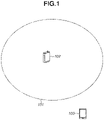
- Fig. 1 illustrates a configuration of a network in which a communication device 102 according to an exemplary embodiment participates.
- the communication device 102 is an access point (AP) having a function for establishing a network 101.
- the network 101 is a wireless network.
- a communication device 103 is a station (STA) having a function of participating in the network 101.
- Each communication device is complying with Institute of Electrical and Electronics Engineers (IEEE) 802.11ax standard and can execute wireless communication complying with the IEEE 802.11ax standard via the network 101.
- IEEE Institute of Electrical and Electronics Engineers
- Each communication device can establish communication in frequency bands of a 2.4 GHz band, a 5 GHz band, and a 6 GHz band.
- a frequency band to be used by each communication device is not limited to these frequency bands. For example, any other frequency band, such as a 60 GHz band, may also be used.
- the present exemplary embodiment illustrates an example where the communication devices 102 and 103 establish wireless communication complying with the IEEE 802.11ax standard.
- the communication devices 102 and 103 may establish wireless communication complying with the IEEE 802.11be standard that is a standard succeeding the IEEE 802.11ax standard.
- the IEEE 802.11be standard communication can be established in the frequency bands of the 2.4 GHz band, the 5 GHz band, and the 6 GHz band, like in the IEEE 802.11ax standard.
- the communication devices 102 and 103 may also be complying with at least one of the legacy standards that are standards prior to the IEEE 802. 1 1ax standard.
- the legacy standards are IEEE 802.11a/b/g/n/ac standards.
- Each communication device may also be complying not only with the legacy standards, but also with a standard succeeding the IEEE 802.11ax standard.
- the standard succeeding the IEEE 802.11ax standard is the IEEE 802.11be standard.
- each communication device may be complying with a standard succeeding the IEEE 802.11be standard and subsequent standards.
- the IEEE 802.11 series standards At least one of the IEEE 802.11a/b/g/n/ac/ax/be standards is called the IEEE 802.11 series standards.
- the communication devices 102 and 103 may be complying not only with the IEEE 802.11 series standards, but also with other communication standards such as Bluetooth ® , Near Field Communication (NFC), Ultra Wide Band (UWB), Zigbee, and Multi-Band Orthogonal Frequency Division Multiplexing (OFDM) Alliance (MBOA).
- Samples of UWB include a wireless universal serial bus (USB), wireless 1394, and WiNET.
- Each communication device may also be compatible with communication standards for wired communication such as a wired local area network (LAN).
- LAN local area network
- the communication device 102 supports Protected Management Frame (PMF).
- PMF is a function of establishing communication by encrypting a management frame using Pairwise Transient Key (PTK).
- PTK Pairwise Transient Key
- Specific examples of the management frame to be encrypted include a deauthentication frame, a disassociation frame, and an action frame. Each of these management frames is called Robust Management Frame.
- PTK is key information used for unicast communication.
- the communication device 102 executes PMF to encrypt Robust Management Frame, thereby preventing disconnection due to a disassociation transmitted from, for example, another communication device by spoofing.
- the communication device 102 transmits a management frame including information indicating a PMF mode set in the communication device 102, thereby making it possible to provide a notification about the PMF mode set in the communication device 102 to another communication device.
- the management frame including information indicating the PMF mode include a Beacon frame, a Probe Response frame, and an Association Response frame.
- a frame format used for the communication device 102 to provide information indicating the PMF mode will be described below with reference to Figs. 5 and 6 .
- the communication device 102 can set three modes as the PMF mode.
- a first mode is a PMF Required mode for establishing a connection only to a communication device capable of executing PMF.
- a second mode is a PMF Enabled mode for establishing a connection with both types of communication devices, i.e., a communication device capable of executing PMF and a communication device incapable of executing PMF.
- a third mode is a PMF Disabled mode in which the PMF function of the communication device 102 is disabled. Examples of the communication device incapable of executing PMF may include a communication device that does not support PMF and a communication device that supports PMF but has a configuration in which the PMF function is disabled.
- Fig. 7 illustrates a correspondence table indicating PMF modes and information indicating whether a connection can be established.
- the AP in which PMF Disabled is set cannot be connected to the STA in which PMF Required meaning PMF is required is set.
- the AP in which PMF Enabled is set can be connected to any one of the STA in which PMF Disabled is set, the STA in which PMF Enabled is set, and the STA in which PMF Required is set.
- Robust Management Frame is encrypted and communicated.
- the STA to which the AP can be connected varies depending on the PMF mode set in the AP.
- PMF may be executed or may not be executed. Accordingly, even if the frequency band to be used when the communication device 102 establishes the network 101 is switched from the 2.4 GHz band to the 5 GHz band, or from the 5 GHz band to the 2.4 GHz band, there is no need to change the PMF setting. In contrast, in the case of establishing communication in the 6 GHz band, the AP and the STA need to execute PMF.
- the communication device 102 cannot establish communication with another communication device unless the PMF setting to PMF Required is performed.
- the communication device 102 may be connected to another communication device in which PMF Disabled is set unless the PMF setting is changed to PMF Required.
- the communication device 102 In a case where the frequency band to be used by the communication device 102 is switched from the 6 GHz band to the 2.4 GHz band or the 5 GHz band, the communication device 102 cannot be connected to another communication device in which PMF Disabled is set unless the PMF setting is enabled. This may thus lead to a decrease in connectivity. As described above, in the case where the frequency band to be used by the communication device 102 is switched between the 6 GHz band and the 2.4 GHz band or the 5 GHz band, an inappropriate PMF setting may cause inconvenience for a user.
- the communication device 102 needs to set an authentication method to be used.
- the authentication method include Open, Wi-Fi ® Protected Access (WPA), WPA2, and WPA3.
- Open is an authentication method defined as Open System Authentication in the IEEE 802.11 series standards.
- WPA Wi-Fi ® Alliance
- WPA2 is a standard succeeding WPA and supports a new encryption method that is not supported in WPA, which leads to improvement of security as compared with WPA.
- WPA3 is a standard succeeding WPA2. In WPA3, security is further improved.
- Wi-Fi ® 6 that is an authentication program complying with the IEEE 802.11ax standard
- WPA3 is required as an authentication method to be used for communication in the 6 GHz band
- the communication device 102 needs to appropriately set the authentication method, as well as PMF. For example, when the frequency band to be used by the communication device 102 is switched from the 6 GHz band to the 2.4 GHz band or the 5 GHz band, if only WPA3 is continuously used as the authentication method, a connection with the STA that supports only up to WPA2 cannot be established, which may cause inconvenience for the user.
- Specific examples of the communication device 102 include a wireless LAN router, and a personal computer (PC). However, the communication device 102 is not limited to these examples. Any communication device can be used as the communication device 102, as long as the communication device can execute wireless communication complying with the IEEE 802.11ax standard with another communication device.
- Specific examples of the communication device 103 include a camera, a tablet, a smartphone, a PC, a mobile phone, and a video camera. However, the communication device 103 is not limited to these examples. Any communication device can be used as the communication device 103, as long as the communication device can execute wireless communication complying with the IEEE 802.11ax standard with another communication device.
- the network illustrated in Fig. 1 is a network composed of one AP and one STA. However, the number of APs and the number of STAs are not limited to one.
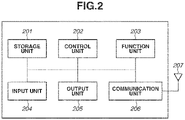
- Fig. 2 illustrates a hardware configuration of the communication device 102 according to the present exemplary embodiment.
- the communication device 102 includes a storage unit 201, a control unit 202, a function unit 203, an input unit 204, an output unit 205, a communication unit 206, and an antenna 207.
- the storage unit 201 is composed of one or more memories, such as a read-only memory (ROM) and a random access memory (RAM), and stores programs for performing various operations to be described below and various information, such as communication parameters for wireless communication.
- ROM read-only memory
- RAM random access memory
- the storage unit 201 not only memories such as a ROM and a RAM, but also storage media, such as a flexible disk, a hard disk, an optical disk, a magneto-optical disk, a compact disc (CD)-ROM, a CD-Recordable (R), a magnetic tape, a non-volatile memory card, and a digital versatile disk (DVD) may be used.
- the storage unit 201 may include a plurality of memories.
- the control unit 202 is composed of one or more processors, such as central processing units (CPUs) or micro processing units (MPUs), and executes programs stored in the storage unit 201 to thereby control the entire communication device 102.
- the control unit 202 may control the entire communication device 102 in cooperation with computer programs and an operating system (OS) stored in the storage unit 201.
- the control unit 202 also generates data and signals (wireless frames) to be transmitted in communication with another communication device.
- the control unit 202 may include a plurality of processors, such as multi-cores, and the entire communication device 102 may be controlled by the plurality of processors.
- the control unit 202 controls the function unit 203 to execute predetermined processing.
- the function unit 203 is hardware for the communication device 102 to execute predetermined processing. Data to be processed by the function unit 203 may be data stored in the storage unit 201, or may be data to be communicated with another communication device via the communication unit 206 to be described below.
- the input unit 204 receives various operations from the user.
- the output unit 205 performs various output operations on the user through a monitor screen or a speaker.
- the output unit 205 may operate as a display unit that displays a screen, or as a notification unit that provides various notifications to the user.
- examples of the output from the output unit 205 may include a display on a monitor screen, an audio output through a speaker, and a vibration output.
- the input unit 204 and the output unit 205 may be implemented as one module, like a touch panel.
- the input unit 204 and the output unit 205 may be integrated with the communication device 102, or may be separated from the communication device 102.
- the input unit 204 and the output unit 205 may be devices connected via a wireless connection or a wired connection with the communication device 102.
- the output unit 205 may operate as a display control unit that causes a display unit of another communication device, which communicates with the communication device 102 via wireless communication or wired communication, to execute a screen display.
- the output unit 205 may operate as an output control unit that causes an output unit, such as a speaker, of the other communication device to execute an audio output, in addition to or in place of the screen display.
- the input unit 204 may receive information input by the user via another communication device that communicates with the communication device 102 via wireless communication or wired communication.
- the communication unit 206 controls wireless communication complying with the IEEE 802.11ax standard.
- the communication unit 206 may also control wireless communication complying not only with the IEEE 802.11ax standard, but also with the other IEEE 802.11 series standards, and may control wired communication via a wired LAN or the like.
- the communication unit 206 controls the antenna 207 to transmit and receive signals for wireless communication generated by the control unit 202. If the communication device 102 is complying not only with the IEEE 802.11ax standard, but also with the NFC standard, the Bluetooth ® standard, and the like, the wireless communication complying with these communication standards may be controlled.
- the communication device 102 can execute wireless communication complying with a plurality of communication standards, communication units and antennas that are complying with the plurality of communication standards may be separately provided.
- the communication device 102 communicates data, such as image data, document data, and video data, with the communication device 103 via the communication unit 206.
- the antenna 207 may be provided separately from the communication unit 206, or may be integrated with the communication unit 206 as one module.
- the antenna 207 is an antenna capable of establishing communication in the 2.4 GHz band, the 5 GHz band, and the 6 GHz band.
- the communication device 102 includes one antenna, but instead may include different antennas for each frequency band. If the communication device 102 includes a plurality of antennas, the communication device 102 may include communication units 206 corresponding to each antenna.
- the communication device 103 has a hardware configuration similar to that of the communication device 102.
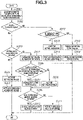
- Fig. 3 is a flowchart illustrating processing to be executed when the communication device 102 reads out computer programs stored in the storage unit 201 into the control unit 202 and executes the computer programs in the case of switching the frequency band to be used.
- the communication device 102 starts the processing in this flowchart based on issuance of an instruction to switch the frequency band to be used from the user when the frequency band that is already used is set.
- the user may directly issue the instruction using the input unit 204 of the communication device 102.
- the user may issue the instruction with another device connected to the communication device 102 wirelessly or with a wire.
- Another device connected to the communication device 102 wirelessly or with a wire may issue an instruction to display a setting screen by inputting an Internet Protocol (IP) address of the communication device 102 to an address bar on a browser.
- IP Internet Protocol
- the communication device 102 may start the processing in this flowchart based on a frequency band switching instruction from an application running on the communication device 102.
- the communication device 102 may start the processing in this flowchart based on change in an operation mode of the communication device 102. More alternatively, the communication device 102 may start the processing in this flowchart based on start-up of a predetermined application.
- the communication device 102 acquires a parameter for a wireless network to be established in a frequency band to be switched (step S301).
- the parameter acquired in this step is at least one of a Service Set Identifier (SSID), an authentication method, an encryption method, key information (e.g., Pairwise Master Key (PMK), PTK, and passphrase), information about the PMF setting, and information about the frequency band.
- SSID represents an identifier for identifying the AP (communication device 102).
- the encryption method is a method for encrypting communication between the AP (communication device 102) and the STA.
- PMK represents a master key on which various keys to be used in WPA are based.
- PTK is generated based on PMK.
- a passphrase is information used to encrypt communication between the AP (communication device 102) and the STA. Only the STA that has learned the passphrase set in the AP can communicate with the AP.
- Information about the PMF setting is information indicating which one of PMF Required, PMF Disabled, and PMF Enabled is set in the communication device 102.
- Information about the frequency band is information indicating which one of the 2.4 GHz band, the 5 GHz band, and the 6 GHz band is set as the frequency band in which the communication device 102 establishes a wireless network. In this step, the communication device 102 acquires information about at least the frequency band to be switched.
- the communication device 102 acquires the parameter.
- the communication device 102 may acquire the parameter from the storage unit 201 in the communication device 102.
- the communication device 102 may acquire the parameter from another device via wired communication or wireless communication.
- the communication device 102 determines whether the 6 GHz band is currently used as the frequency band (step S302). If the 6 GHz band is not currently used as the frequency band, or if the 2.4 GHz band or 5 GHz is currently used, the communication device 102 determines "No” in this step and then performs processing of step S312. In contrast, if the 6 GHz band is currently used as the frequency band, the communication device 102 determines "Yes" in this step and then performs processing of step S303.
- the communication device 102 determines whether the frequency band is switched to the 6 GHz band (step S303). If the 6 GHz band is set as the frequency band in the parameters for the network to be switched that is acquired in step S301, the communication device 102 determines "Yes” in this step and then performs processing of step S304. In contrast, if the 2.4 GHz band or the 5 GHz band is set as the frequency band in the parameters for the network to be switched that is acquired in step S301, the communication device 102 determines "No" in this step and then performs processing of step S317.
- the communication device 102 keeps the PMF setting unchanged (step S304). Since the 6 GHz band is set as the frequency band to be switched and as the currently used frequency band, the communication device 102 maintains the setting of PMF Required. In this case, the communication device 102 transmits Beacon, Probe Response, and Association Response together with information indicating PMF Required. The communication device 102 can provide a notification about PMF information using frame formats illustrated in Figs. 5 and 6 .
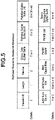
- Fig. 5 illustrates a frame format for Robust Security Network Element (RSNE).
- RSNE is information included in a media access control (MAC) frame body of at least one of Beacon, Probe Response, and Association Response transmitted by the communication device 102.
- MAC media access control
- RSNE includes fields of Element ID, Length, Version, Group Data Cipher Suite, and Pairwise Cipher Suite Count. RSNE further includes fields of Pairwise Cipher Suite List, AKM Suite Count, AKM Suite List, RSN Capabilities, and PMKID Count. RSNE further includes fields of PMKID List and Group Management Cipher Suite.
- the communication device 102 communicates the fields included in RSNE in order from Element ID to Group Management Cipher Suite at the end. At least one of the fields of RSNE may be omitted, or the order of some fields to be communicated may be changed.
- Element ID represents an identifier for identifying an information element.
- Element ID includes identification information indicating RSNE.
- Length is a field indicating an element data length.
- Length includes information indicating the data length of RSNE.
- Version is a field indicating version information about a Robust Security Network (RSN) protocol.
- Version includes information indicating Version 1.
- Group Data Cipher Suite is a field including a cipher selector used in a wireless network to protect a group address frame.
- the cipher selector is represented by a combination of Organizationally Unique Identifier (OUI) indicating a cipher and type information (Suite Type).
- OUI Organizationally Unique Identifier
- uite Type type information
- Pairwise Cipher Suite Count is a field indicating the number of Pairwise Cipher Suite selectors included in Pairwise Cipher Suite List to be described below.
- Pairwise Cipher Suite List is a field including one or more Pairwise Cipher Suite selectors.
- AKM Suite Count is a field indicating the number of AKM Suite selectors included in AKM Suite List to be described below.
- AKM Suite List is a field including one or more AKM Suite selectors. Each AKM Suite selector indicates a combination of OUI indicating AKM Suite and type information. AKM Suite is represented by a combination of an authentication method, a key management type, and a key derivation type.
- RSN Capabilities will be described with reference to Fig. 6 to be described below.
- RSN Capabilities include information indicating the PMF setting for the communication device 102.
- PMKID Count is a field including information indicating the number of PMKIDs included in PMKID List to be described below.
- PMKID List is a field including information indicating one or more PMKIDs that are held as valid information between the communication device that has transmitted RSNE and the destination communication device.
- PMKID represents an identifier for identifying PMK
- Group Management Cipher Suite is a field including a cipher selector used in a wireless network to protect Robust Management Frame including a group address.
- Fig. 6 illustrates a frame format for RSN Capabilities.
- RSN Capabilities include fields of Preauthentication, No Pairwise, PTKSA Replay Counter, and GTKSA Replay Counter. RSN Capabilities further include fields of Management Frame Protection Required (MFPR) and Management Frame Protection Capable (MFPC). RSN Capabilities further include fields of Joint Multi-Band RSNA, PeerKey Enabled, SPP A-MSDU Capable, and SPP A-MSDU Required. RSN Capabilities further include fields of PBAC and Extended Key ID for Individually Addressed Frames (EKIIAF).
- the communication device 102 communicates the fields included in the RSN Capabilities in order from Preauthentication to EKIIAF. At least one of the fields of RSN Capabilities may be omitted, and the order of some fields to be communicated may be changed.
- Preauthentication is a field indicating whether the device that has transmitted RSNE supports the preauthentication function.
- the use of Preauthentication enables the STA to execute RSNA authentication with the AP before executing (Re)Association.
- No Pairwise is a field indicating whether to support a Wired Equivalent Privacy (WEP) default key "0", as well as a pairwise key.
- WEP Wired Equivalent Privacy
- PTKSA Replay Counter is a field indicating a replay counter per PTKSA.
- PTKSA stands for Pairwise Transient Key Security Association, and indicates a context generated from the result of a 4-way handshake.
- a value "0" included in PTKSA Replay Counter indicates a replay counter "1" per PTKSA.
- a value "1" included in PTKSA Replay Counter indicates a replay counter "2" per PTKSA.
- GTKSA Replay Counter is a field indicating a replay counter per GTKSA.
- GTKSA stands for Group Temporal Key Security Association, and indicates a context generated due to success in replacement of GTK in one of a group key handshake or a 4-way handshake.
- GTK stands for Group Temporal Key.
- PTKSA Replay Counter the value "0" included in GTKSA Replay Counter indicates a replay counter "1" per GTKSA.
- MFPR is a field indicating whether an RSN Capabilities transmission device (communication device 102) is required to protect Robust Management Frame.
- the value "1" included in MFPR indicates that the RSN Capabilities transmission device is required to protect Robust Management Frame. In the other cases, MFPR includes the value "0".
- MFPC is a field indicating whether the RSN Capabilities transmission device (communication device 102) can execute protection of Robust Management Frame. If the RSN Capabilities transmission device can execute protection of Robust Management Frame, the value "1" is included in MFPC. In the other cases, the value "0" is included in MFPC.
- Joint Multi-Band RSNA is a field indicating whether the RSN Capabilities transmission device (communication device 102) supports Joint Multi-Band RSNA.
- PeerKey Enabled is a field indicating whether the RSN Capabilities transmission device (communication device 102) supports PeerKey handshake.
- SPP A-MSDU Capable provides a notification indicating whether the RSN Capabilities transmission device (communication device 102) supports signaling and payload protected A-MSDUs.
- SPP stands for Signaling and Payload Protected.
- A-MSDU stands for Aggregate MAC Service Data Unit.
- SPP A-MSDU Required is a field indicating whether the RSN Capabilities transmission device (communication device 102) requires signaling and payload protected A-MSDUs.
- PBAC Protected Block Ack Agreement Capable, and is a field indicating whether PBAC is set.
- EKIIAF is a field indicating whether the RSN Capabilities transmission device (communication device 102) supports values in the range from "0" to "1" as key IDs for PTKSA and STKSA.
- STKSA stands for Station-To-Station Link (STSL) Transient Key Security Association.
- the communication device 102 can use a specific field in RSN Capabilities included in RSNE to indicate the PMF setting for the communication device 102.
- the communication device 102 keeps the PMF setting for the communication device 102 unchanged in step S304.
- PMF Required is maintained as the PMF setting for the communication device 102.
- the communication device 102 may continuously transmit Probe Response or Association Response including similar RSNE, in addition to or in place of Beacon.
- the communication device 102 determines to keep the authentication method unchanged (step S305). Since the 6 GHz band is set as the frequency band to be switched and as the currently used frequency band, the communication device 102 maintains the setting of the authentication method. In this case, WPA3 is maintained as the authentication method used by the communication device 102.
- the communication device 102 may continuously transmit Probe Response or Association Response including similar RSNE, in addition to or in place of Beacon.
- the communication device 102 executes processing of step S305, and then terminates the processing in this flowchart.
- the communication device 102 need not change the PMF setting and the setting of the authentication method. Thus, these settings are not changed.
- the communication device 102 may start transmission of Probe Response or Association Response including similar RSNE, in addition to or in place of Beacon.
- the communication device 102 changes the PMF setting to PMF Enabled, thereby improving the interconnectivity. In other words, the communication device 102 changes the setting with which another communication device in which PMF Disabled is set cannot be connected, thereby making it possible to establish a connection with another communication device in which PMF Disabled is set. This leads to improvement of interconnectivity.
- the communication device 102 changes the setting of the authentication method to the setting for enabling both of WPA3 and WPA2. This leads to improvement of interconnectivity. In other words, the communication device 102 changes the setting with which another communication device that supports only WPA2 cannot be connected, thereby making it possible to establish a connection with another communication device that supports only WPA2. This leads to improvement of interconnectivity.
- the communication device 102 determines whether information indicating PMF Required is received from a counterpart device (step S306). Specifically, the communication device 102 determines whether RSNE included in Association Request received from the STA (communication device 103) includes RSN Capabilities indicating PMF Required. If Association Request including RSNE indicating PMF Required is received, the communication device 102 determines "Yes" in this step and then performs processing of step S307. In contrast, if Association Request including RSNE indicating PMF Enabled of PMF Disabled is received, the communication device 102 determines "No" in this step and then performs the processing of step S308.
- the communication device 102 changes the PMF setting for the communication device 102 to PMF Required (step S307).
- the security can be improved if the STA can execute PMF.
- step S306 determines whether the communication device 102 has the PMF setting for the communication device 102.
- the communication device 102 maintains PMF Enabled as the PMF setting for the communication device 102.
- the communication device 102 determines whether the authentication method of WPA3 is received from the counterpart device (step S309). Specifically, the communication device 102 determines whether RSNE included in Association Request received from the STA (communication device 103) includes RSN Capabilities including information indicating WPA3. If Association Request including information indicating WPA3 is received, the communication device 102 determines "Yes" in this step and then performs processing of step S310. In contrast, if Association Request that does not include information indicating WPA3, or includes only information indicating, for example, WPA2, the communication device 102 determines "No" in this step and then performs processing of step S311.
- the communication device 102 changes the setting of the authentication method for the communication device 102 to the setting for enabling only WPA3 (step S310).
- the security can be further improved if the STA can execute WPA3.
- the communication device 102 terminates the processing in this flowchart.
- step S309 determines whether the communication device 102 has the setting of the authentication method for the communication device 102 has the setting of the authentication method for the communication device 102. In this case, the communication device 102 maintains WPA3/WPA2 as the setting of the authentication method for the communication device 102. After executing the processing of step S311, the communication device 102 terminates the processing in this flowchart.
- the communication device 102 may skip the processing of steps S306 to S311.
- the communication device 102 can execute the PMF function.
- PTK derived using a secure hash algorithm SHA1 is used as PTK for encrypting Robust Management Frame.
- PTK is derived using a secure hash algorithm SHA256.
- the present exemplary embodiment illustrates an example where the communication device 102 changes the PMF setting and the setting of the authentication method based on switching of the frequency band from the 6 GHz band to another frequency band.
- the present exemplary embodiment is not limited to this example.
- the communication device 102 may keep the PMF setting unchanged even when the frequency band is switched from the 6 GHz band to another frequency band.
- the communication device 102 may also keep the setting of the authentication method unchanged, in addition to or in place of the PMF setting.
- the security prioritized mode is enabled and the PMF setting is kept unchanged, the communication device 102 may output a warning about interconnectivity to the user using the output unit 205. In this case, if the security prioritized mode is disabled, the communication device 102 executes processing of step S317 in Fig. 3 .
- the communication device 102 determines whether information indicating WPA3 as the authentication method is received from the counterpart device. If Association Request that includes information indicating WPA2 and does not include information indicating WPA3 is received from the communication device 103, the communication device 102 changes the setting of the authentication method for the communication device 102 to WPA3/WPA2. In contrast, if Association Request including information indicating WPA3 is received from the communication device 103, the communication device 102 maintains WPA3 as the setting of the authentication method for the communication device 102. Thus, even when the frequency band is switched, the communication device 102 changes the PMF setting and the like depending on the setting in the counterpart device, thereby maintaining the setting with high security if the setting is supported by the counterpart device.
- the communication device 102 may output a warning about interconnectivity to the user using the output unit 205.
- step S312 determines whether the 6 GHz band is set as the frequency band to be switched (step S312). The processing of this step is similar to step S303. If the determination result in this step indicates "Yes”, the communication device 102 performs processing of step S313. If the determination result in this step indicates "No”, the communication device 102 performs processing of step S315.
- the communication device 102 keeps the PMF setting for the communication device 102 unchanged (step S313). Specifically, the communication device 102 maintains PMF Enabled as the PMF setting for the communication device 102, and does not change the PMF setting. Consequently, the communication device 102 can maintain the interconnectivity of the communication device 102.
- the communication device 102 keeps the setting of the authentication method for the communication device 102 unchanged (step S314). Specifically, the communication device 102 maintains WPA3/WPA2 as the setting of the authentication method for the communication device 102, and does not change the setting of the authentication method. Consequently, the communication device 102 can maintain the interconnectivity of the communication device 102. After executing the processing of step S314, the communication device 102 terminates the processing in this flowchart.
- the communication device 102 changes the PMF setting for the communication device 102 (step S315). Specifically, the communication device 102 changes the PMF setting for the communication device 102 from PMF Enabled to PMF Required. This is because execution of the PMF function is required in the 6 GHz band.
- the communication device 102 changes the setting of the authentication method for the communication device 102 (step S316). Specifically, the communication device 102 changes the setting of the authentication method for the communication device 102 from WPA3/WPA2 to WPA3 alone. This is because the use of WPA3 as the authentication method is required in the 6 GHz band. After executing the processing of step S316, the communication device 102 terminates the processing in this flowchart.
- the communication device 102 changes the PMF setting from PMF Required to PMF Enabled, thereby improving the interconnectivity. Similarly, the communication device 102 changes the setting of the authentication method from the setting for enabling execution of only WPA3 to the setting for enabling execution of both of WPA3 and WPA2, thereby improving the interconnectivity.
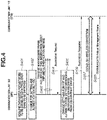
- Fig. 4 is a sequence diagram illustrating an example of processing to be executed when the communication device 102 switches the network from a network using the 6 GHz band to a network using the 2.4 GHz band or the 5 GHz band.
- the communication device 102 starts the processing in this sequence diagram when the network is switched from the network that is already established and using the 6 GHz band to a network using the 2.4 GHz band or the 5 GHz band.
- the communication device 102 acquires a parameter for a network to be switched (step S401). This processing is similar to step S301 in Fig. 3 . In this case, the communication device 102 acquires information indicating that the 2.4 GHz band or the 5 GHz band is set as the frequency band of the network to be switched.
- the communication device 102 Since the 6 GHz band is set as the currently used frequency band and the 2.4 GHz band or the 5 GHz band is set as the frequency band to be switched, the communication device 102 changes the PMF setting and the setting of the authentication method for the communication device 102 (step S402). This processing is similar to step S317 in Fig. 3 .
- the communication device 102 changes the PMF setting from PMF Required to PMF Enabled and changes the authentication method from WPA3 alone to WPA3/WPA2.
- the RSNE transmitted in this case includes AKM Suite List including both of the selector indicating WPA3 and the selector indicating WPA2.
- the communication device 102 transmits the management frame including setting information about the PMF and the authentication method using a frequency channel for the network to be switched in step S403. After executing the processing of step S401, the communication device 102 establishes the network to be switched prior to execution of processing of step S403.
- the communication device 102 receives Association Request from the communication device 103 serving as the STA (step S404).
- Association Request includes RSNE including setting information about the PMF and the authentication method for the communication device 103.
- the communication device 102 changes the PMF setting and the setting of the authentication method for the communication device 102 based on the received setting information about the PMF and the authentication method for the communication device 103 (step S405). This processing corresponds to the processing of steps S306 to S311 in Fig. 3 .
- the communication device 102 may skip the processing of step S405.
- the communication device 102 transmits Association Response to the communication device 103 (step S406).
- Association Response includes RSNE including information indicating the PMF setting and the setting of the authentication method for the communication device 102. If at least one of the PMF setting and the setting of the authentication method for the communication device 102 is changed in step S405, Association Response includes information indicating the changed setting.
- the communication devices 102 and 103 establish a wireless connection (step S407).
- the communication devices 102 and 103 communicate Robust Management Frame, based on the PMF setting (step S408). If the PMF setting for one of the communication devices 102 and 103 is PMF Enabled and the PMF setting for the other of the communication devices 102 and 103 is PMF Disabled, Robust Management Frame is communicated without being encrypted. If the PMF setting for one of the communication devices 102 and 103 is PMF Enabled and the PMF setting for the other of the communication devices 102 and 103 is PMF Required, Robust Management Frame is encrypted and communicated.
- Fig. 4 illustrates an example of processing to be executed when the communication device 102 switches the frequency band to be used from the 6 GHz band to the 2.4 GHz band or the 5 GHz band.
- the communication device 102 appropriately changes the PMF setting and the setting of the authentication method based on switching of the frequency band, thereby improving the interconnectivity.
- the present exemplary embodiment illustrates an example where, in the case of switching the frequency band, the communication device 102 changes both of the PMF setting and the setting of the authentication method.
- the present exemplary embodiment is not limited to this example. Only the PMF setting may be changed.
- the communication device 102 establishes a new network and then transmits a management frame including setting information about the PMF and the authentication method set based on the frequency band of the network to be switched.
- the communication device 102 may generate the management frame including setting information about the PMF and the authentication method set based on the frequency band of the network to be switched, after or before establishing a new network.
- At least a part or the whole of the flowchart for the communication device 102 illustrated in Fig. 3 may be implemented by hardware.
- a dedicated circuit may be generated, for example, on a field programmable gate array (FPGA) based on computer programs for implementing steps using a predetermined compiler, and the generated dedicated circuit may be used.
- FPGA field programmable gate array
- a gate array circuit may be formed and implemented as hardware, like the FPGA.
- the flowchart may be implemented by an application specific integrated circuit (ASIC).
- ASIC application specific integrated circuit
- the present invention can also be implemented by processing in which a program for implementing one or more functions according to the above-described exemplary embodiments is supplied to a system or an apparatus via a network or a storage medium, and one or more processors in a computer of the system or the apparatus read out and execute the program.
- the present invention can also be implemented by a circuit (e.g., an ASIC) for implementing one or more functions.
Landscapes
- Engineering & Computer Science (AREA)
- Signal Processing (AREA)
- Computer Networks & Wireless Communication (AREA)
- Computer Security & Cryptography (AREA)
- Mobile Radio Communication Systems (AREA)
Applications Claiming Priority (2)
| Application Number | Priority Date | Filing Date | Title |
|---|---|---|---|
| JP2020046695A JP7566477B2 (ja) | 2020-03-17 | 2020-03-17 | 通信装置、制御方法、およびプログラム |
| PCT/JP2021/006723 WO2021187020A1 (ja) | 2020-03-17 | 2021-02-24 | 通信装置、制御方法、およびプログラム |
Publications (2)
| Publication Number | Publication Date |
|---|---|
| EP4124154A1 true EP4124154A1 (de) | 2023-01-25 |
| EP4124154A4 EP4124154A4 (de) | 2024-04-03 |
Family
ID=77771983
Family Applications (1)
| Application Number | Title | Priority Date | Filing Date |
|---|---|---|---|
| EP21771205.8A Pending EP4124154A4 (de) | 2020-03-17 | 2021-02-24 | Kommunikationsvorrichtung, steuerungsverfahren und programm |
Country Status (7)
| Country | Link |
|---|---|
| US (2) | US12250603B2 (de) |
| EP (1) | EP4124154A4 (de) |
| JP (1) | JP7566477B2 (de) |
| KR (1) | KR102685310B1 (de) |
| CN (2) | CN119996145A (de) |
| BR (1) | BR112022016851A2 (de) |
| WO (1) | WO2021187020A1 (de) |
Cited By (1)
| Publication number | Priority date | Publication date | Assignee | Title |
|---|---|---|---|---|
| EP4354924A4 (de) * | 2021-06-09 | 2025-06-04 | Canon Kabushiki Kaisha | Kommunikationsvorrichtung, kommunikationsverfahren und programm |
Families Citing this family (3)
| Publication number | Priority date | Publication date | Assignee | Title |
|---|---|---|---|---|
| JP7718092B2 (ja) * | 2021-04-16 | 2025-08-05 | ブラザー工業株式会社 | 通信装置及び通信装置のためのコンピュータプログラム |
| CN117956466A (zh) * | 2022-10-20 | 2024-04-30 | 艾锐势企业有限责任公司 | 用于抵抗降级攻击的设备、方法和计算机可读介质 |
| WO2025048468A1 (ko) * | 2023-08-29 | 2025-03-06 | 엘지전자 주식회사 | 무선랜 시스템에서 제어 프레임에 대한 보호를 지원하는 방법 및 장치 |
Family Cites Families (19)
| Publication number | Priority date | Publication date | Assignee | Title |
|---|---|---|---|---|
| JP5472027B2 (ja) | 2010-10-15 | 2014-04-16 | セイコーエプソン株式会社 | 無線通信装置およびそれを有する周辺装置 |
| KR20130079105A (ko) * | 2011-12-22 | 2013-07-10 | 한국전자통신연구원 | 무선 랜을 위한 효율적인 스캐닝 방법 |
| US9307484B2 (en) * | 2011-12-22 | 2016-04-05 | Electronics And Telecommunications Research Institute | Method and apparatus of scanning in wireless local area network system |
| EP2870800B1 (de) * | 2012-07-03 | 2018-09-05 | Interdigital Patent Holdings, Inc. | Rahmen zur entdeckung von schnellem anfänglichen verbindungsaufbau |
| JP2015104085A (ja) * | 2013-11-27 | 2015-06-04 | キヤノン株式会社 | 通信装置およびその制御方法 |
| US10129878B2 (en) * | 2015-02-02 | 2018-11-13 | Qualcomm Incorporated | Systems and methods for dynamic band switching |
| KR102329493B1 (ko) * | 2015-11-27 | 2021-11-22 | 삼성전자 주식회사 | 무선 침입 방지 시스템에서의 접속 차단 방법 및 장치 |
| WO2017149526A2 (en) | 2016-03-04 | 2017-09-08 | May Patents Ltd. | A method and apparatus for cooperative usage of multiple distance meters |
| JP7089519B2 (ja) | 2016-12-21 | 2022-06-22 | インテル コーポレイション | 無線通信技術、装置及び方法 |
| WO2019045438A1 (ko) * | 2017-08-29 | 2019-03-07 | 엘지전자 주식회사 | 무선랜 시스템에서 fst을 수행하는 방법, fst를 지원하는 방법 및 이를 위한 장치 |
| US11452098B2 (en) | 2018-04-20 | 2022-09-20 | Qualcomm Incorporated | Dual band channel bonding and puncturing |
| US11985588B2 (en) | 2018-08-23 | 2024-05-14 | Lg Electronics Inc. | Method and device for obtaining information about communication entity operating in new band in wireless LAN system |
| JP7190296B2 (ja) | 2018-09-14 | 2022-12-15 | キヤノンメディカルシステムズ株式会社 | 演算装置および医用情報処理システム |
| US12477528B2 (en) * | 2018-09-19 | 2025-11-18 | Lg Electronics Inc. | Method and device for receiving data in wireless LAN system |
| US11991676B2 (en) * | 2018-09-19 | 2024-05-21 | Lg Electronics Inc. | Method and device for transmitting data in wireless LAN system |
| US20210185607A1 (en) * | 2020-07-29 | 2021-06-17 | Laurent Cariou | Multi-link parameters and capability indication |
| US12284520B2 (en) * | 2021-05-19 | 2025-04-22 | Cisco Technology, Inc. | Access point verification using crowd-sourcing |
| US20240236639A1 (en) * | 2023-01-10 | 2024-07-11 | Nxp Usa, Inc. | Roaming using distributed access point multi-link device groups |
| US20240305409A1 (en) * | 2023-03-10 | 2024-09-12 | Apple Inc. | Access point (ap)-assisted ap transition |
-
2020
- 2020-03-17 JP JP2020046695A patent/JP7566477B2/ja active Active
-
2021
- 2021-02-24 CN CN202510227359.0A patent/CN119996145A/zh active Pending
- 2021-02-24 KR KR1020227034539A patent/KR102685310B1/ko active Active
- 2021-02-24 WO PCT/JP2021/006723 patent/WO2021187020A1/ja not_active Ceased
- 2021-02-24 EP EP21771205.8A patent/EP4124154A4/de active Pending
- 2021-02-24 BR BR112022016851A patent/BR112022016851A2/pt unknown
- 2021-02-24 CN CN202180019348.3A patent/CN115316038B/zh active Active
-
2022
- 2022-09-15 US US17/932,402 patent/US12250603B2/en active Active
-
2025
- 2025-01-31 US US19/043,230 patent/US20250184840A1/en active Pending
Cited By (1)
| Publication number | Priority date | Publication date | Assignee | Title |
|---|---|---|---|---|
| EP4354924A4 (de) * | 2021-06-09 | 2025-06-04 | Canon Kabushiki Kaisha | Kommunikationsvorrichtung, kommunikationsverfahren und programm |
Also Published As
| Publication number | Publication date |
|---|---|
| JP2021150722A (ja) | 2021-09-27 |
| US20250184840A1 (en) | 2025-06-05 |
| JP7566477B2 (ja) | 2024-10-15 |
| BR112022016851A2 (pt) | 2022-10-11 |
| CN119996145A (zh) | 2025-05-13 |
| CN115316038A (zh) | 2022-11-08 |
| EP4124154A4 (de) | 2024-04-03 |
| WO2021187020A1 (ja) | 2021-09-23 |
| CN115316038B (zh) | 2025-03-18 |
| KR102685310B1 (ko) | 2024-07-17 |
| US20230011936A1 (en) | 2023-01-12 |
| US12250603B2 (en) | 2025-03-11 |
| KR20220150936A (ko) | 2022-11-11 |
Similar Documents
| Publication | Publication Date | Title |
|---|---|---|
| US12250603B2 (en) | Communication device, control method, and storage medium for generating management frames | |
| US10701050B2 (en) | Base station, control method, and storage medium | |
| KR102822266B1 (ko) | 통신 장치, 통신 방법 및 프로그램 | |
| KR20090115292A (ko) | 버튼 방식의 무선 랜 설정 방법 및 장치 | |
| US12126996B2 (en) | Communication apparatus using device provisioning protocol to send or receive a communication parameter for executing 802.11r fast transition connection processing, and communication method and storage medium thereof | |
| US20240107306A1 (en) | Communication apparatus, communication method, and storage medium | |
| JP7719238B2 (ja) | 通信装置、制御方法、およびプログラム | |
| JP7688751B2 (ja) | 通信装置、制御方法、およびプログラム | |
| JP2012100171A (ja) | 通信装置、その制御方法及びプログラム | |
| JP2007142958A (ja) | 通信装置及び通信方法 | |
| WO2022259856A1 (ja) | 通信装置、通信方法、およびプログラム | |
| EP4167667A1 (de) | Kommunikationsvorrichtung, kommunikationsverfahren und programm | |
| JP2017112551A (ja) | 通信装置、制御方法、および、プログラム | |
| JP2022188745A (ja) | 通信装置、通信方法、およびプログラム | |
| CN117441364A (zh) | 通信装置、通信方法及程序 | |
| JP2022054900A (ja) | 通信装置、制御方法、およびプログラム |
Legal Events
| Date | Code | Title | Description |
|---|---|---|---|
| STAA | Information on the status of an ep patent application or granted ep patent |
Free format text: STATUS: THE INTERNATIONAL PUBLICATION HAS BEEN MADE |
|
| PUAI | Public reference made under article 153(3) epc to a published international application that has entered the european phase |
Free format text: ORIGINAL CODE: 0009012 |
|
| STAA | Information on the status of an ep patent application or granted ep patent |
Free format text: STATUS: REQUEST FOR EXAMINATION WAS MADE |
|
| 17P | Request for examination filed |
Effective date: 20221017 |
|
| AK | Designated contracting states |
Kind code of ref document: A1 Designated state(s): AL AT BE BG CH CY CZ DE DK EE ES FI FR GB GR HR HU IE IS IT LI LT LU LV MC MK MT NL NO PL PT RO RS SE SI SK SM TR |
|
| DAV | Request for validation of the european patent (deleted) | ||
| DAX | Request for extension of the european patent (deleted) | ||
| A4 | Supplementary search report drawn up and despatched |
Effective date: 20240301 |
|
| RIC1 | Information provided on ipc code assigned before grant |
Ipc: H04W 84/12 20090101ALN20240226BHEP Ipc: H04W 48/18 20090101ALN20240226BHEP Ipc: H04L 5/00 20060101ALN20240226BHEP Ipc: H04W 76/10 20180101AFI20240226BHEP |