EP4124151B1 - System and method for random access backoffs - Google Patents
System and method for random access backoffs Download PDFInfo
- Publication number
- EP4124151B1 EP4124151B1 EP22194064.6A EP22194064A EP4124151B1 EP 4124151 B1 EP4124151 B1 EP 4124151B1 EP 22194064 A EP22194064 A EP 22194064A EP 4124151 B1 EP4124151 B1 EP 4124151B1
- Authority
- EP
- European Patent Office
- Prior art keywords
- random access
- preamble
- prach
- backoff
- access preamble
- Prior art date
- Legal status (The legal status is an assumption and is not a legal conclusion. Google has not performed a legal analysis and makes no representation as to the accuracy of the status listed.)
- Active
Links
Images






Classifications
-
- H—ELECTRICITY
- H04—ELECTRIC COMMUNICATION TECHNIQUE
- H04W—WIRELESS COMMUNICATION NETWORKS
- H04W74/00—Wireless channel access
- H04W74/08—Non-scheduled access, e.g. ALOHA
- H04W74/0833—Random access procedures, e.g. with 4-step access
-
- H—ELECTRICITY
- H04—ELECTRIC COMMUNICATION TECHNIQUE
- H04W—WIRELESS COMMUNICATION NETWORKS
- H04W72/00—Local resource management
- H04W72/20—Control channels or signalling for resource management
- H04W72/21—Control channels or signalling for resource management in the uplink direction of a wireless link, i.e. towards the network
-
- H—ELECTRICITY
- H04—ELECTRIC COMMUNICATION TECHNIQUE
- H04W—WIRELESS COMMUNICATION NETWORKS
- H04W74/00—Wireless channel access
- H04W74/08—Non-scheduled access, e.g. ALOHA
- H04W74/0833—Random access procedures, e.g. with 4-step access
- H04W74/0841—Random access procedures, e.g. with 4-step access with collision treatment
Definitions
- the present invention relates generally to a system and method for digital communications, and, in particular embodiments, to a system and method for random access backoffs.
- a user equipment When a user equipment (UE) initially attaches to a network or participates in a handover between cells, a random access procedure is performed by the UE and the entity (such as an evolved NodeB (eNB), low power node (LPN), and so on) to which it is attaching in order to setup a connection with the entity.
- the entity such as an evolved NodeB (eNB), low power node (LPN), and so on
- ERICSSON "Remaining issues on random access for Rel-13 low complexity and enhanced coverage UEs", 3GPP DRAFT; R2-156774- REMAINING ISSUES ON RANDOM ACCESS FOR REL-13 LOW COMPLEXITY AND ENHANCED COVERAGEUES, 3RD GENERATION PARTNERSHIP PROJECT (8GPP), MOBILE COMPETENCE CENTRE; 650, ROUTE DES LUCI, vol. RAN WG2, no. Anaheim, USA; 20151116 - 20151120 16 November 2015 a random access procedure for use by a UE to operate coverage enhancements.
- the UE selects a preamble within a PRACH preamble group and transmits the preamble in configured PRACH resources.
- US 2008/043671 A1 discloses a method for transmitting a preamble over a Random Access CHannel (RACH) in a wireless communication system.
- the method includes generating a preamble having a length longer than a basic transmission unit, and dividing the preamble into preambles having a length less than the basic transmission unit; and sequentially transmitting the divided preambles over the RACH using different antennas.
- RACH Random Access CHannel
- U S2007/206531 A1 discloses a random access procedure for use by a UE wireless communication terminal in communicating with a base station (or Node-B or eNB) of a radio access network, and in particular a E-UTRA network.
- a random access preamble is sent by the UE via RACH separate and prior to a random access message burst, which is sent on SCH but not until the UE receives one or more messages indicating an acknowledgment of the preamble and providing an allocation on SCH for use in transmitting the message burst, and also providing a preamble identifier, which the radio access network can then use to request retransmission of the message burst if necessary.
- a method for transmitting a random access preamble according to claim 1 includes generating, by a UE, the random access preamble, and when a number of physical random access channel (PRACH) repetitions per attempt is larger than a threshold, segmenting, by the UE, the random access preamble into a plurality of blocks, and separately transmitting, by the UE, each of the plurality of blocks.
- PRACH physical random access channel
- Separately transmitting each of the plurality of blocks includes interleaving at least some of the plurality of blocks with an uplink data channel.
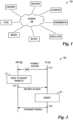
- FIG. 1 illustrates a high-level diagram of an Internet of Things (IoT) communications system 100.
- IoT communications system 100 includes a network 105 that is connected to a wide variety of IoT devices, including electrical devices, physical objects, and other items, that are consumer, industrial, automotive, environment, agricultural, military, medical, and retail in nature.
- Network 105 allows the IoT devices to be connected, as well as controlled.
- Network 105 may be any existing communications infrastructure, such as the Internet, a private or public data network, and so on.
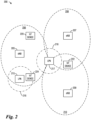
- FIG. 2 illustrates an example IoT communications system 200 implemented using a heterogeneous network (HetNet).
- the HetNet includes a planned network infrastructure, such as a 3GPP LTE compliant communications network, or any other standards or non-standards compliant communications network wherein communications take place through entities that are deployed in a structured fashion.
- the planned network infrastructure includes a plurality of evolved NodeBs (eNBs), including eNB 205 with coverage area 206, eNB 207 with coverage area 208, and eNB 209 with coverage area 210.
- eNBs evolved NodeBs
- the HetNet also includes an unplanned network infrastructure.
- the HetNet serves IoT devices, such as IoT device 220, IoT device 222, and IoT device 224, that are either mobile or immobile.
- the capabilities of the IoT devices may vary widely. As an example, if the IoT device is a smart device, such as a smart telephone, the IoT device may be capable of simultaneously communicating with multiple services, display multimedia, create multimedia, participate in an interactive session, serve data, and so on. As another example, if the IoT device is a sensor, such as a security sensor or a weather temperature, the IoT device may be limited to periodically report its sensory reading to a data aggregator. Regardless of the capabilities of the IoT devices, the IoT devices need to be able to establish a connection with the communications infrastructure (e.g., the HetNet in Figure 2 ).
- the communications infrastructure e.g., the HetNet in Figure 2 .
- eNBs are also commonly referred to as NodeBs, base stations, communications controllers, access points, and so on, depending on the type of the planned network infrastructure.
- IoT devices are also commonly referred to as user equipments (UEs), mobile stations, mobiles, terminals, users, subscribers, stations, devices, smart devices, and so on, depending on the type of the IoT devices.
- UEs user equipments
- HetNets may employ multiple eNBs capable of communicating with a number of IoT devices, only three eNBs, two LPNs, and three IoT devices are illustrated for simplicity.
- a random access procedure is performed by a UE when it initially attaches to a communications system or when it participates in a handover between cells.
- the UE participates in the random access procedure with an entity (e.g., an eNB, a LPN, and so on) of the communications system or cell.
- an entity e.g., an eNB, a LPN, and so on
- a random access procedure typically entails the UE selecting and transmitting one out of a plurality of random access preambles to the eNB (an example of an entity of the communications system as described above) and the eNB assigns network resources to the UE to allow the UE to make a connection request.
- the UE must wait a certain amount of time before the UE can try again. The amount of time that the UE waits is referred to as a backoff (BO).
- BO backoff
- FIG. 3 illustrates an example random access procedure 300.
- Random access procedure 300 involves processing performed by and transmissions made by an eNB 305 and a UE 310.
- Part of random access procedure 300 includes UE 310 selecting a random access preamble and transmitting the random access preamble to eNB 305.
- UE 310 selects a random access preamble and transmitting the random access preamble to eNB 305.
- event 315 determines a backoff (BO) parameter (block 317) and transmits a random access response (RAR) with the backoff parameter to UE 310 (event 319).
- UE 310 performs a backoff in accordance with the BO parameter provided by eNB 305 (block 321). Once the backoff completes, UE 310 transmits the random access preamble (event 323).
- BO backoff
- RAR random access response
- the RACH backoff mechanism used in 3GPP LTE is introduced in 3GPP LTE Release-13 and is based on media access control (MAC) backoff indication (BI). Limited changes to the backoff mechanism, such as a reduction in MAC BI size from 4 bits to another value and corresponding changes to backoff range can be considered if needed and time permits.
- the UE randomly and uniformly chooses the backoff time from interval [o, backoff parameter value].
- the interval [0, backoff parameter value] is also referred to as the backoff window.
- the backoff parameter value is signaled in the form of an index into a table of backoff parameter values.
- Table 1 shows Table 7.2-1, backoff parameter values from 3GPP TS 36.321 and Table 2 shows 3GPP LTE Physical Random Access Channel (PRACH) preamble durations.
- Table 1 3GPP TS 36.321Table 7.2-1 backoff parameter values.
- Index Backoff Parameter value (ms) 0 0 1 10 2 20 3 30 4 40 5 60 6 80 7 120 8 160 9 240 10 320 11 480 12 960 13 Reserved 14 Reserved 15 Reserved
- Table 2 3GPP LTE PRACH preamble durations.
- Preamble format Duration ms
- CP duration us
- Guard time duration 0 1 103.3 96.88 1 2 684.38 515.63 2 2 203.13 196.88 3 3 684.38 715.63
- NB-IoT PRACH preamble duration is even longer than some of the backoff parameter in Table 1, hence some small values make no sense compared with longer preamble duration.
- the backoff parameter value with 10ms is no use for preambles with more than one repetition.
- FIG. 4 illustrates a time-frequency diagram 400 of a NB-PRACH transmission with 2 repetitions.
- each NB-PRACH transmission consists of 4 groups with each group comprising 1 CP and a symbol group with 5 symbols.
- a first NB-PRACH transmission 405 includes 4 groups 410-416.
- a second NB-PRACH transmission 420 also includes 4 groups (420-426) with each group comprising 1 CP and a symbol group with 5 symbols.
- pseudorandom frequency hopping is implemented between NB-PRACH transmissions, which is shown in Figure 4 as frequency difference 430 between first NB-PRACH transmission 405 and second NB-PRACH transmission 420.
- the frequency resource usage within each NB-PRACH transmission remains consistent between repetitions.
- the NB-PRACH preamble duration can be much longer, especially in situations when a large number of repetitions are transmitted for the purpose of coverage enhancement. Furthermore, there is also a much wider variation in NB-PRACH length. In some circumstances, e.g., with larger repetition values, the NB-PRACH preamble duration is even longer than some of the backoff parameter values currently used in 3GPP LTE. Hence, some of the smaller backoff parameter values do not make practical sense when compared with larger NB-PRACH preamble durations. As an illustrative example, a backoff parameter value of 10 ms is not useful for NB-PRACH preambles with more than 1 repetition.
- Figure 5A illustrates a time-frequency diagram 500 illustrating a collision arising from an insufficiently small backoff parameter value. Collisions among RA preamble transmissions may happen due to the mismatched backoff time and preamble durations.
- the situation illustrated in Figure 5A involves NB-PRACH preamble durations of 25.6 ms and a backoff parameter value of 10ms.
- a first UE (UE1) and a second UE (UE2) transmit NB-PRACH preambles (preamble 508 for UE1 and preamble 509 for UE2) at the same network resource, resulting in a preamble collision.
- Both UEs randomly select backoff times of 4 ms (for UE1) and 7 ms (for UE2), respectively. Therefore, after a backoff of 4 ms, UE1 retransmits its NB-PRACH preamble (preamble 513) (event 510) and after a backoff of 7 ms, UE2 retransmits its NB-PRACH preamble (preamble 514) (event 515).
- the NB-PRACH preambles are 25.6 ms long, UE1 is unable to complete the transmission of its NB-PRACH preamble 513 before UE2 transmits its NB-PRACH preamble 514 and another preamble collision takes place.
- the collision probability for long preamble durations and short preamble durations differ greatly due to the wide range of preamble lengths.
- the backoff parameter value is set to 960 ms
- UEs using short preamble durations e.g., 12.8 ms
- UEs using long preamble durations e.g., 819.2 ms
- long preamble durations may block and cause extra delay in NB PUSCH (NB-PUSCH) transmission.
- the allocation of network resources may need to be changed to reduce the blocking issue.
- NB-PRACH preamble duration becomes much longer than some of the backoff parameter value defined for LTE, especially with large number of repetitions; the NB-PRACH preamble lengths vary widely and the collision probabilities may be different for different preamble lengths in some cases.
- the backoff parameter values are defined as multiples of random access preamble durations (random access preamble units) to align the backoff time with preamble duration.
- random access preamble units random access preamble units
- the defining of the backoff parameter values as multiple of random access preamble units allows the access opportunities and collision probability to remain substantially constant with different random access preamble durations.
- Example embodiments include:
- an eNB determines the backoff parameter values according to the load on corresponding random access channels.
- a technical standard or an operator of the communications system may define possible backoff parameter values, such as a table of possible backoff parameter values.
- an eNB selects the actual backoff parameter value(s) to signal to the UEs based on the load on the random access channels.
- network resource allocation is performed semi-statically to allocate the network resources for NB-PRACH based on random access load.
- Different numbers of network resources may be allocated for different NB-PRACH channels, with each random access channel being related to one NB-PRACH preamble format (e.g., duration, repetition, and so on).
- long random access preambles may be split into multiple parts.
- the backoff window may be used in a manner same to the backoff window in 3GPP LTE compliant communications systems, the UE randomly selects a time from within the backoff window and the UE waits until the time expires before retransmitting its NB-PRACH preamble.
- the backoff window may be used in a manner similar to the backoff window in 3GPP LTE compliant communications systems, the UE randomly selects a number from within the backoff window and the UE waits the number times the random access preamble unit before retransmitting its NB-PRACH preamble.
- Figure 6 illustrates an example backoff window 600 that is 2 times the random access preamble unit in duration. Table 6 shows example backoff times for two UEs with different random access preamble units. Table 6: Example backoff times for two UEs with different random access preamble units. Preamble duration (without GT) Backoff value selected by UE Backoff time UE1: 12.8ms 2 25.6ms UE2: 25.6ms 3 76.8ms
- backoff parameter values are specified as multiples of random access preamble units and different sets of backoff parameter values are used for different random access preamble repetitions.
- the use of different sets of backoff preamble values for different random access preamble repetitions enable the adjustment of different backoff window sizes for different random access preamble durations.
- long random access preamble durations are assigned a set of backoff parameter values with small values, while short random access preamble durations are assigned a set of backoff parameter values with large values.
- Figure 7 illustrates a table 700 of example backoff parameter values with different sets of backoff parameter values assigned to different random access preamble durations.
- backoff parameter values are specified as multiples of random access preamble units and a combination of backoff window size and frequency hopping based on the number of random access preamble repetitions is used.
- a non-zero backoff window size and frequency hopping are used in situations with small numbers of random access preamble repetitions.
- backoff windows are not used but frequency hopping is used in situations with large numbers of random access preamble repetitions.
- Figure 8C illustrates a time-frequency graph 840 highlighting third example NB-PRACH operation in accordance with example embodiment 3.
- the backoff window is of duration zero (i.e., there is no backoff) and the frequency hopping occurs within the same frequency NB-PRACH band or PRB.
- Figure 8D illustrates a time-frequency graph 860 highlighting fourth example NB-PRACH operation in accordance with example embodiment 3.
- the backoff window is of duration zero and the frequency hopping occurs in a different frequency NB-PRACH band or PRB.
- the examples shown in Figures 8C and 8D may be preferably used in situations with large numbers of random access preamble repetitions.
- backoff parameter values are specified as multiples of random access preamble units and a multi-step backoff is performed.
- a two-step backoff includes: in a first step, backoff is performed in steps of a predefined period (the period and steps of the period are determined by the eNB or UE ); and in a second step, a random offset within the period is selected (the random offset is determined by the UE). Frequency hopping can also be utilized.
- UE1 is assigned an NB-PRACH backoff with one period meaning that UE1 can retransmit a NB-PRACH preamble on a UE selected time-frequency resource in the next period
- UE2 is assigned an NB-PRACH backoff with two periods meaning that UE2 can retransmit an NB-PRACH preamble on a UE selected time-frequency resource in the second period following the first transmission.
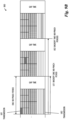
- Figure 9A when the random access preamble is shorter, there are more transmission opportunities, therefore the UEs can randomly select an access opportunity for random access preamble transmission, while for longer random access preambles, there are fewer opportunities.
- NB-PRACH with 1 milli-second subframe boundary of LTE.
- different gap time can be inserted in the end of NB-PRACH.
- Table 7 lists example gap times that may be inserted at the end of a NB-PRACH preamble. The gap times listed in Table 7 are for illustrative purposes. The actual gap time could be different and depends on the intended cell coverage and/or the preamble duration.
- the gap time for NB-PRACH with 128 repetitions may be 0.8ms for 266.7us CP and 0.2ms for 66.7us CP, respectively.
- the gap time may be used for alignment purposes, such as a 1 ms subframe boundary, for example.
- Table 7 Example gap times.
- multiple NB-PRACH resources can be multiplexed in TDM.
- Each resource is dedicated to one type of NB-PRACH with the same preamble duration.
- Multiple allocated NB-PRACH durations are aggregated in time to align the whole PRACH resource to 1ms subframe boundary. In this case, there is no gap time after PRACH. For example, 5 preambles with duration 6.4ms can align with 1ms subframe boundary.
- an eNB allocates the time-frequency resources for NB-PRACH based on the random access load.
- the eNB may make use of the system information block (SIB) to signal the allocations.
- SIB system information block
- the eNB may allocate different numbers of time-frequency resources for different random access channels, with each random access channel being related to a random access preamble format.
- the random access channels (i.e., the allocated time-frequency resources) may be time division multiplexed (TDM) and/or frequency division multiplexed (FDM) within one NB-PRACH band or PRB.
- the random access channels may be allocated in different NB-PRACH bands or PRBs.
- the load may be distributed on a random access channel basis rather than cell basis. When the load is high, more time-frequency resources may be allocated.
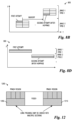
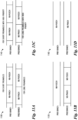
- Figures 10A and 10B illustrate example allocations of time-frequency resources to random access channels.
- Figure 10A illustrates an example allocation 1000 of time-frequency resources to random access channels in a FDM manner.
- Figure 10B illustrates an example allocation 1010 of time-frequency resources to random access channels in a TDM manner.
- the time-frequency resources allocated for random access channels are multiplexed with time-frequency resources allocated for NB-PUSCH.
- the multiplexing of the NB-PUSCH and the random access channels may help to reduce the latency of the NB-PUSCH caused by long NB-PRACH preambles.
- multiple bands or PRBs are used in multiplexing the NB-PRACH and the NB-PUSCH.
- Figure 11A illustrates a diagram 1100 of two bands or PRBs used for multiplexing channels of the same coverage level. In a situation where the NB-PUSCH and the NB-PRACH are of the same coverage level (i.e., they have the same preamble duration), the channels are multiplexed into the same band or PRB, using TDM, for example.
- Figure 11B illustrates a diagram 1120 of two bands or PRBs when at least one of the bands or PRBs has unused resources. In a situation where there are unused resources in one or more bands or PRBs, the NB-PUSCH can be allocated the unused resources.
- Figure 11C illustrates a diagram 1140 of two bands or PRBs highlighting priority based allocation.
- the allocation of the resources may be made in accordance with the priority of the preambles. As an example, long preambles have higher priority than short preambles.
- Figure 11D illustrates a diagram 1160 of two bands or PRBs with separate band or PRB allocation.
- the NB-PUSCH and the NB-PRACH may be allocated to separate bands or PRBs. If more than 2 bands or PRBs are available, each of the NB-PUSCH or the NB-PRACH may be allocated more than 1 band or PRB.
- long random access preambles are split into multiple parts. Each part may be separately scheduled and transmitted. Reducing the duration of the random access preambles reduces the latency on the NB-PUSCH since the network resources are not allocated for extended amounts of time. Each of the shorter parts may utilize the backoff parameter values assigned to a whole random access preamble of the same duration as the shorter part.
- Figure 12 illustrates a time-frequency diagram 1200 highlighting the splitting of a long random access preamble into shorter parts. As shown in diagram 1200, a long random access preamble is split into 2 parts and is transmitted in resource 1205 and resource 1210. It is noted that in order to align the boundaries (e.g., 2 ms slot or 4 ms subframe boundary), gap time may be inserted after a random access preamble.
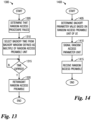
- Figure 13 illustrates a flow diagram of example operations 1300 occurring in a UE participating in a random access procedure.
- Operations 1300 may be indicative of operations occurring in a UE as the UE participates in a random access procedure.
- Operations 1300 begin with the UE determining that the random access procedure has failed (block 1305).
- the random access procedure has failed if the eNB does not send a random access response to a random access preamble sent by the UE, for example.
- the random access procedure has failed if the UE receives a random access response from the eNB, but the random access response is not for the UE but another UE that sent the same random access preamble.
- the UE selects a backoff time from a backoff window ranging from [0, random access parameter value * random access preamble unit] (block 1310).
- the random access parameter value is signaled by the eNB.
- the eNB signals an indicator of which random access parameter value to use out of a table of random access parameter values specified by a technical standard or an operator of the communications system.
- the UE waits until the backoff time expires (block 1315).
- the UE retransmits the random access preamble (block 1320).
- the random access preamble is segmented into a plurality of blocks and the UE transmits each of the plurality of blocks.
- the UE interleaves a PUSCH with at least some of the blocks.
- the random access preamble is initially transmitted on one of a first carrier or a first band, and the random access preamble is retransmitted on one of a second carrier or a second band.
- the present application provides a system and method for transmitting a random access procedure.
- the method includes generating, by a UE, the random access preamble, and when a number of physical random access channel (PRACH) repetitions per attempt is larger than a threshold, segmenting, by the UE, the random access preamble into a plurality of blocks, and separately transmitting, by the UE, each of the plurality of blocks.
- PRACH physical random access channel
- Figure 14 illustrates a flow diagram of example operations 1400 occurring in an eNB participating in a random access procedure.
- Operations 1400 may be indicative of operations occurring in an eNB as the eNB participates in a random access procedure.
- Operations 1400 begin with the eNB determining a backoff parameter value (block 1405).
- the backoff parameter value is specified as a multiple of a random access preamble unit (e.g., a random access preamble duration) of the UE.
- a random access preamble unit e.g., a random access preamble duration
- the same set of backoff parameter values is used for all random access preamble units.
- different sets of backoff parameter values are used for different random access preamble durations.
- frequency hopping is also used.
- a multi-step backoff is used, where a period for backoff is specified and an offset within the period is either specified or is selectable by the UE.
- the eNB signals the backoff parameter value or an indicator thereof to the UE (block 1410).
- the eNB receives a random access preamble in accordance with the backoff parameter value (block 1415).
- the backoff parameter value specifies a multiple of the random access preamble unit.
- the specified multiple is selected from one of the plurality of sets of specified multiples in accordance with a duration of the random access preamble.
- the method also includes selecting a step of a predefined period, and signaling an indicator of the step of the predefined period.
- the random access preamble is segmented into a plurality of blocks, and receiving the random access preamble includes separately receiving each of the plurality of blocks.
- the method also includes receiving an uplink data channel interleaved with at least some of the plurality of blocks.
- the backoff time is defined as multiple times of basic time units, where the unit may equal to a preamble duration.
- the preamble duration (without considering GT) is not aligned with the subframe boundary of 1ms subframe for 15kHz subcarrier spacing and 4ms subframe for 3.75kHz subcarrier spacing, which may increase the scheduling complexity.
- one solution is to insert gap time. Following are two examples:
- Proposal 1 Consider above solutions to align the PRACH channel with NB-IoT subframe boundaries. To deal with the possible unbalanced collision probability for different PRACH preamble formats, semi-statically resource allocation for PRACH may be adopted. Firstly, a random access channel load indicator can be defined instead of current cell load. This is to say, the load is per random access channel basis. Each random access channel is related to one preamble format. When load is heavy, more resources may be allocated. Consequently, eNB can allocate different number of resources for different random access channels based on random access channel load, in which the resource allocation information may be carried via SIB.
- a random access channel load indicator can be defined instead of current cell load. This is to say, the load is per random access channel basis. Each random access channel is related to one preamble format. When load is heavy, more resources may be allocated. Consequently, eNB can allocate different number of resources for different random access channels based on random access channel load, in which the resource allocation information may be carried via SIB.
- Proposal 2 Consider semi-static resource allocation based on random access channel load to balance the collision probabilities in different random access channels for different preamble formats.
- Figure 17 illustrates a block diagram of a non-claimed embodiment processing system 1700 for performing methods described herein, which may be installed in a host device.
- the processing system 1700 includes a processor 1704, a memory 1706, and interfaces 1710-1714, which may (or may not) be arranged as shown in Figure 17 .
- the processor 1704 may be any component or collection of components adapted to perform computations and/or other processing related tasks
- the memory 1706 may be any component or collection of components adapted to store programming and/or instructions for execution by the processor 1704.
- the memory 1706 includes a non-transitory computer readable medium.
- the processing system 1700 is included in a network device that is accessing, or part otherwise of, a telecommunications network.
- the processing system 1700 is in a network-side device in a wireless or wireline telecommunications network, such as a base station, a relay station, a scheduler, a controller, a gateway, a router, an applications server, or any other device in the telecommunications network.
- the processing system 1700 is in a user-side device accessing a wireless or wireline telecommunications network, such as a mobile station, a user equipment (UE), a personal computer (PC), a tablet, a wearable communications device (e.g., a smartwatch, etc.), or any other device adapted to access a telecommunications network.
- a wireless or wireline telecommunications network such as a mobile station, a user equipment (UE), a personal computer (PC), a tablet, a wearable communications device (e.g., a smartwatch, etc.), or any other device adapted to access a telecommunications network.
- one or more of the interfaces 1710, 1712, 1714 connects the processing system 1700 to a transceiver adapted to transmit and receive signaling over the telecommunications network.
- Figure 18 illustrates a block diagram of a transceiver 1800 adapted to transmit and receive signaling over a telecommunications network.
- the transceiver 1800 may be installed in a host device. As shown, the transceiver 1800 comprises a network-side interface 1802, a coupler 1804, a transmitter 1806, a receiver 1808, a signal processor 1810, and a device-side interface 1812.
- the network-side interface 1802 may include any component or collection of components adapted to transmit or receive signaling over a wireless or wireline telecommunications network.
- the coupler 1804 may include any component or collection of components adapted to facilitate bi-directional communication over the network-side interface 1802.
- the transmitter 1806 may include any component or collection of components (e.g., up-converter, power amplifier, etc.) adapted to convert a baseband signal into a modulated carrier signal suitable for transmission over the network-side interface 1802.
- the receiver 1808 may include any component or collection of components (e.g., down-converter, low noise amplifier, etc.) adapted to convert a carrier signal received over the network-side interface 1802 into a baseband signal.
- the signal processor 1810 may include any component or collection of components adapted to convert a baseband signal into a data signal suitable for communication over the device-side interface(s) 1812, or vice-versa.
- the device-side interface(s) 1812 may include any component or collection of components adapted to communicate data-signals between the signal processor 1810 and components within the host device (e.g., the processing system 1700, local area network (LAN) ports
- the transceiver 1800 may transmit and receive signaling over any type of communications medium.
- the transceiver 1800 transmits and receives signaling over a wireless medium.
- the transceiver 1800 may be a wireless transceiver adapted to communicate in accordance with a wireless telecommunications protocol, such as a cellular protocol (e.g., long-term evolution (LTE), etc.), a wireless local area network (WLAN) protocol (e.g., Wi-Fi, etc.), or any other type of wireless protocol (e.g., Bluetooth, near field communication (NFC), etc.).
- the network-side interface 1802 comprises one or more antenna/radiating elements.
- the network-side interface 1802 may include a single antenna, multiple separate antennas, or a multi-antenna array configured for multi-layer communication, e.g., single input multiple output (SIMO), multiple input single output (MISO), multiple input multiple output (MIMO), etc.
- the transceiver 1600 transmits and receives signaling over a wireline medium, e.g., twisted-pair cable, coaxial cable, optical fiber, etc.
- Specific processing systems and/or transceivers may utilize all of the components shown, or only a subset of the components, and levels of integration may vary from device to device.
- a signal may be transmitted by a transmitting unit or a transmitting module.
- a signal may be received by a receiving unit or a receiving module.
- a signal may be processed by a processing unit or a processing module.
- Other steps may be performed by a selecting unit/module, a waiting unit/module, a determining unit/module, and/or a signaling unit/module.
- the respective units/modules may be hardware, software, or a combination thereof.
- one or more of the units/modules may be an integrated circuit, such as field programmable gate arrays (FPGAs) or application-specific integrated circuits (ASICs).
- FPGAs field programmable gate arrays
- ASICs application-specific integrated circuits
Landscapes
- Engineering & Computer Science (AREA)
- Computer Networks & Wireless Communication (AREA)
- Signal Processing (AREA)
- Mobile Radio Communication Systems (AREA)
Description
- The present invention relates generally to a system and method for digital communications, and, in particular embodiments, to a system and method for random access backoffs.
- When a user equipment (UE) initially attaches to a network or participates in a handover between cells, a random access procedure is performed by the UE and the entity (such as an evolved NodeB (eNB), low power node (LPN), and so on) to which it is attaching in order to setup a connection with the entity. ERICSSON: "Remaining issues on random access for Rel-13 low complexity and enhanced coverage UEs", 3GPP DRAFT; R2-156774- REMAINING ISSUES ON RANDOM ACCESS FOR REL-13 LOW COMPLEXITY AND ENHANCED COVERAGEUES, 3RD GENERATION PARTNERSHIP PROJECT (8GPP), MOBILE COMPETENCE CENTRE; 650, ROUTE DES LUCI, vol. RAN WG2, no. Anaheim, USA; 20151116 - 20151120 16 November 2015 a random access procedure for use by a UE to operate coverage enhancements. The UE selects a preamble within a PRACH preamble group and transmits the preamble in configured PRACH resources. If the UE does not receive RAR within a response window, it will retry preamble transmission until the maximum tries for that coverage level.
US 2008/043671 A1 discloses a method for transmitting a preamble over a Random Access CHannel (RACH) in a wireless communication system. The method includes generating a preamble having a length longer than a basic transmission unit, and dividing the preamble into preambles having a length less than the basic transmission unit; and sequentially transmitting the divided preambles over the RACH using different antennas.
U S2007/206531 A1 discloses a random access procedure for use by a UE wireless communication terminal in communicating with a base station (or Node-B or eNB) of a radio access network, and in particular a E-UTRA network. A random access preamble is sent by the UE via RACH separate and prior to a random access message burst, which is sent on SCH but not until the UE receives one or more messages indicating an acknowledgment of the preamble and providing an allocation on SCH for use in transmitting the message burst, and also providing a preamble identifier, which the radio access network can then use to request retransmission of the message burst if necessary. - In accordance with an example embodiment, a method for transmitting a random access preamble according to
claim 1 is provided. The method includes generating, by a UE, the random access preamble, and when a number of physical random access channel (PRACH) repetitions per attempt is larger than a threshold, segmenting, by the UE, the random access preamble into a plurality of blocks, and separately transmitting, by the UE, each of the plurality of blocks. - Separately transmitting each of the plurality of blocks includes interleaving at least some of the plurality of blocks with an uplink data channel.
- In accordance with an example embodiment, a non-transitory computer-readable medium storing programming for execution by at least one processor is provided. The programming including instructions to implement the method according to any one of
claims 1 to 3. - Practice of the foregoing embodiments enables the adaptation of the backoff window used in contention resolution to meet the extended preamble durations of narrow band communications systems. Fixed backoff windows cannot effectively deal with channel contention without sacrificing overall efficiency.
- For a more complete understanding of the present disclosure, and the advantages thereof, reference is now made to the following descriptions taken in conjunction with the accompanying drawings, in which:
-
Figure 1 illustrates a high-level diagram of an Internet of Things (IoT) communications system; -
Figure 2 illustrates an example IoT communications system implemented using a heterogeneous network (HetNet); -
Figure 3 illustrates an example random access procedure; -
Figure 4 illustrates a time-frequency diagram of a NB-PRACH transmission with 2 repetitions; -
Figure 5A illustrates a time-frequency diagram illustrating a collision arising from an insufficiently small backoff parameter value; -
Figure 5B illustrates a diagram of network resources highlighting different collision probabilities; -
Figure 6 illustrates an example backoff window that is 2 times the random access preamble unit in duration according to example embodiments disclosed herein; -
Figure 7 illustrates a table of example backoff parameter values with different sets of backoff parameter values assigned to different random access preamble durations according to non-claimed embodiments disclosed herein; -
Figure 8A illustrates a time-frequency graph highlighting first example NB-PRACH operation in accordance withexample embodiment 3; -
Figure 8B illustrates a time-frequency graph highlighting second example NB-PRACH operation in accordance withexample embodiment 3; -
Figure 8C illustrates a time-frequency graph highlighting third example NB-PRACH operation in accordance withexample embodiment 3; -
Figure 8D illustrates a time-frequency graph highlighting fourth example NB-PRACH operation in accordance withexample embodiment 3; -
Figure 9A illustrates a first time-frequency graph highlighting a multi-step backoff in accordance withexample embodiment 4; -
Figure 9B illustrates a second time-frequency graph highlighting a multi-step backoff in accordance withexample embodiment 4; -
Figures 10A and 10B illustrate example allocations of time-frequency resources to random access channels according to non-claimed embodiments disclosed herein; -
Figure 11A illustrates a diagram of two bands or PRBs used for multiplexing channels of the same coverage level according to non-claimed embodiments disclosed herein; -
Figure 11B illustrates a diagram of two bands or PRBs when at least one of the bands or PRBs has unused resources according to non-claimed embodiments disclosed herein; -
Figure 11C illustrates a diagram of two bands or PRBs highlighting priority based allocation according to non-claimed embodiments disclosed herein; -
Figure 11D illustrates a diagram of two bands or PRBs with separate band or PRB allocation according to non-claimed embodiments disclosed herein; -
Figure 12 illustrates a time-frequency diagram highlighting the splitting of a long random access preamble into shorter parts according to example embodiments disclosed herein; -
Figure 13 illustrates a flow diagram of example operations occurring in a UE participating in a random access procedure according to non-claimed embodiments disclosed herein; -
Figure 14 illustrates a flow diagram of example operations occurring in an eNB participating in a random access procedure according to example embodiments disclosed herein; -
Figure 15 illustrates a diagram of network resources highlighting the use of a predefined gap time to align a random access preamble transmission with a 1ms subframe boundary according to non-claimed embodiments disclosed herein; -
Figure 16A illustrates a first diagram of network resources highlighting a continuous allocation of network resources according to example embodiments disclosed herein; -
Figure 16B illustrates a second diagram of network resources highlighting a mixed allocation of network resources according to non-claimed embodiments disclosed herein; -
Figure 17 illustrates a block diagram of a non-claimed embodiment processing system for performing methods described herein; and -
Figure 18 illustrates a block diagram of a transceiver adapted to transmit and receive signaling over a telecommunications network. - The making and using of the presently example embodiments are discussed in detail below. It should be appreciated, however, that the present disclosure provides many applicable inventive concepts that can be embodied in a wide variety of specific contexts. The specific embodiments discussed are merely illustrative of specific ways to make and use the embodiments, and do not limit the scope of the disclosure.
-
Figure 1 illustrates a high-level diagram of an Internet of Things (IoT)communications system 100. IoTcommunications system 100 includes anetwork 105 that is connected to a wide variety of IoT devices, including electrical devices, physical objects, and other items, that are consumer, industrial, automotive, environment, agricultural, military, medical, and retail in nature. Network 105 allows the IoT devices to be connected, as well as controlled. Network 105 may be any existing communications infrastructure, such as the Internet, a private or public data network, and so on. -
Figure 2 illustrates an exampleIoT communications system 200 implemented using a heterogeneous network (HetNet). The HetNet includes a planned network infrastructure, such as a 3GPP LTE compliant communications network, or any other standards or non-standards compliant communications network wherein communications take place through entities that are deployed in a structured fashion. As shown inFigure 2 , the planned network infrastructure includes a plurality of evolved NodeBs (eNBs), including eNB 205 withcoverage area 206, eNB 207 withcoverage area 208, and eNB 209 withcoverage area 210. The HetNet also includes an unplanned network infrastructure. The unplanned network infrastructure may include low powered nodes (LPNs) that are deployed by an operator of the HetNet or by users of the HetNet to help improve coverage and/or overall communications system performance. The unplanned network infrastructure shown inFigure 2 includes a plurality of LPNs, includingLPN 215 withcoverage area 216 and LPN 217 withcoverage area 218. As their name implies, the LPNs usually transmit at a lower power level than the eNBs of the planned network infrastructure. eNBs and LPNs may be referred to as cells or transmission points. - The HetNet serves IoT devices, such as
IoT device 220,IoT device 222, andIoT device 224, that are either mobile or immobile. The capabilities of the IoT devices may vary widely. As an example, if the IoT device is a smart device, such as a smart telephone, the IoT device may be capable of simultaneously communicating with multiple services, display multimedia, create multimedia, participate in an interactive session, serve data, and so on. As another example, if the IoT device is a sensor, such as a security sensor or a weather temperature, the IoT device may be limited to periodically report its sensory reading to a data aggregator. Regardless of the capabilities of the IoT devices, the IoT devices need to be able to establish a connection with the communications infrastructure (e.g., the HetNet inFigure 2 ). - eNBs are also commonly referred to as NodeBs, base stations, communications controllers, access points, and so on, depending on the type of the planned network infrastructure. IoT devices are also commonly referred to as user equipments (UEs), mobile stations, mobiles, terminals, users, subscribers, stations, devices, smart devices, and so on, depending on the type of the IoT devices.
- While it is understood that HetNets may employ multiple eNBs capable of communicating with a number of IoT devices, only three eNBs, two LPNs, and three IoT devices are illustrated for simplicity.
- As discussed previously, a random access procedure is performed by a UE when it initially attaches to a communications system or when it participates in a handover between cells. The UE participates in the random access procedure with an entity (e.g., an eNB, a LPN, and so on) of the communications system or cell. In a Third Generation Partnership Project (3GPP) Long Term Evolution (LTE) compliant communications system, a random access procedure typically entails the UE selecting and transmitting one out of a plurality of random access preambles to the eNB (an example of an entity of the communications system as described above) and the eNB assigns network resources to the UE to allow the UE to make a connection request. If the random access procedure fails, the UE must wait a certain amount of time before the UE can try again. The amount of time that the UE waits is referred to as a backoff (BO).
-
Figure 3 illustrates an examplerandom access procedure 300.Random access procedure 300 involves processing performed by and transmissions made by aneNB 305 and aUE 310. Part ofrandom access procedure 300 includesUE 310 selecting a random access preamble and transmitting the random access preamble toeNB 305. However, in situations when more than one UE is participating in a random access procedure, there is a non-zero probability that another UE will select the same random access preamble. When multiple UEs transmit the same random access preamble, a preamble collision occurs (event 315).eNB 305 determines a backoff (BO) parameter (block 317) and transmits a random access response (RAR) with the backoff parameter to UE 310 (event 319).UE 310 performs a backoff in accordance with the BO parameter provided by eNB 305 (block 321). Once the backoff completes,UE 310 transmits the random access preamble (event 323). - The RACH backoff mechanism used in 3GPP LTE is introduced in 3GPP LTE Release-13 and is based on media access control (MAC) backoff indication (BI). Limited changes to the backoff mechanism, such as a reduction in MAC BI size from 4 bits to another value and corresponding changes to backoff range can be considered if needed and time permits. The UE randomly and uniformly chooses the backoff time from interval [o, backoff parameter value]. The interval [0, backoff parameter value] is also referred to as the backoff window. The backoff parameter value is signaled in the form of an index into a table of backoff parameter values. Table 1 shows Table 7.2-1, backoff parameter values from 3GPP TS 36.321 and Table 2 shows 3GPP LTE Physical Random Access Channel (PRACH) preamble durations.
Table 1: 3GPP TS 36.321Table 7.2-1 backoff parameter values. Index Backoff Parameter value (ms) 0 0 1 10 2 20 3 30 4 40 5 60 6 80 7 120 8 160 9 240 10 320 11 480 12 960 13 Reserved 14 Reserved 15 Reserved Table 2: 3GPP LTE PRACH preamble durations. Preamble format Duration (ms) CP duration (us) Guard time duration (us) 0 1 103.3 96.88 1 2 684.38 515.63 2 2 203.13 196.88 3 3 684.38 715.63 - In a narrow-band IoT (NB-IoT) ad hoc meeting and a RAN1#84 meeting, the following items were agreed upon:
- An NB-PRACH scheme based on single-tone transmissions with 3.75 kHz subcarrier spacing is to be used in NB-IoT;
- Each transmission consists of 4 groups with each group comprising 1 cyclic prefix (CP) and 5 symbols in a symbol group; and
- 1, 2, 4, 8, 16, 32, 64, and 128 NB-PRACH repetitions are provided, with an eNB being able to configure up to 3 NB-PRACH repetitions from the 8 provided repetitions. Table 3 shows possible preamble durations based on the 8 provided repetitions.Table 3: Possible preamble durations. Number of repetitions 1 2 4 8 16 32 64 128 Preamble length with 266.7us CP (ms) 6.4=1.6*4 12.8 25.6 51.2 102.4 204.8 409.6 819.2 Preamble length with 66.7us CP (ms) 5.6=1.4*4 11.2 22.4 44.8 89.6 179.2 358.4 716.8 - However, these backoff parameter values and backoff time are not matched with NB-IoT preamble durations anymore. It can be seen that with repetitions, NB-IoT PRACH preamble duration is even longer than some of the backoff parameter in Table 1, hence some small values make no sense compared with longer preamble duration. For example, the backoff parameter value with 10ms is no use for preambles with more than one repetition.
-
Figure 4 illustrates a time-frequency diagram 400 of a NB-PRACH transmission with 2 repetitions. As discussed previously, each NB-PRACH transmission consists of 4 groups with each group comprising 1 CP and a symbol group with 5 symbols. As an illustrative example, a first NB-PRACH transmission 405 includes 4 groups 410-416. As shown inFigure 4 , a second NB-PRACH transmission 420 also includes 4 groups (420-426) with each group comprising 1 CP and a symbol group with 5 symbols. Additionally, pseudorandom frequency hopping is implemented between NB-PRACH transmissions, which is shown inFigure 4 as frequency difference 430 between first NB-PRACH transmission 405 and second NB-PRACH transmission 420. However, the frequency resource usage within each NB-PRACH transmission remains consistent between repetitions. - It is noted that compared to the 3GPP LTE PRACH preamble, the NB-PRACH preamble duration can be much longer, especially in situations when a large number of repetitions are transmitted for the purpose of coverage enhancement. Furthermore, there is also a much wider variation in NB-PRACH length. In some circumstances, e.g., with larger repetition values, the NB-PRACH preamble duration is even longer than some of the backoff parameter values currently used in 3GPP LTE. Hence, some of the smaller backoff parameter values do not make practical sense when compared with larger NB-PRACH preamble durations. As an illustrative example, a backoff parameter value of 10 ms is not useful for NB-PRACH preambles with more than 1 repetition. The randomly selected backoff time does not match current NB-PRACH preamble durations. As another illustrative example, according to the 3GPP LTE backoff parameter values, if a cell load is not heavy and a backoff parameter value is selected as 10 ms, but a random access preamble has a duration of 25.6 ms (without gap time (GT)), the random access preamble will cause interference. As used herein a gap time means a time duration when no signals are transmitted. In a situation when inserted between a Physical Uplink Shared Channel (PUSCH) and a PRACH in the time domain, a gap time is the same as a guard time.
-
Figure 5A illustrates a time-frequency diagram 500 illustrating a collision arising from an insufficiently small backoff parameter value. Collisions among RA preamble transmissions may happen due to the mismatched backoff time and preamble durations. For discussion purposes, the situation illustrated inFigure 5A involves NB-PRACH preamble durations of 25.6 ms and a backoff parameter value of 10ms. Atevent 505, a first UE (UE1) and a second UE (UE2) transmit NB-PRACH preambles (preamble 508 for UE1 andpreamble 509 for UE2) at the same network resource, resulting in a preamble collision. Both UEs randomly select backoff times of 4 ms (for UE1) and 7 ms (for UE2), respectively. Therefore, after a backoff of 4 ms, UE1 retransmits its NB-PRACH preamble (preamble 513) (event 510) and after a backoff of 7 ms, UE2 retransmits its NB-PRACH preamble (preamble 514) (event 515). However, because the NB-PRACH preambles are 25.6 ms long, UE1 is unable to complete the transmission of its NB-PRACH preamble 513 before UE2 transmits its NB-PRACH preamble 514 and another preamble collision takes place. - Using the current backoff mechanism, the collision probability for long preamble durations and short preamble durations differ greatly due to the wide range of preamble lengths. As an illustrative example, under the same cell load conditions and if the backoff parameter value is set to 960 ms, UEs using short preamble durations (e.g., 12.8 ms) will have many more opportunities for access with low collision probability, but UEs using long preamble durations (e.g., 819.2 ms) will have less opportunities for access with high collision probability. Additionally, due to the narrow band nature of NB-IoT, long preamble durations may block and cause extra delay in NB PUSCH (NB-PUSCH) transmission. The allocation of network resources may need to be changed to reduce the blocking issue.
-
Figure 5B illustrates a diagram 550 of network resources highlighting different collision probabilities. Due to wide range of preamble length, given same resource unit, the collision probabilities for long preamble duration and short preamble duration differ significantly. Diagram 550 displays three kinds of random access preamble durations, where each has been allocated resources of the same size. With the legacy mechanism, for the same cell load, if the backoff window is fixed as a large one like 960ms, for UEs with short preamble duration like 12.8ms preamble duration, they have more opportunities to access hence they may have low collision probability; while for UEs with long preamble duration like 819.2ms preamble duration, they have less opportunities and high collision probability. It is noted that collision and interference may still happen after backing off, since NB-PRACH preamble duration becomes much longer than some of the backoff parameter value defined for LTE, especially with large number of repetitions; the NB-PRACH preamble lengths vary widely and the collision probabilities may be different for different preamble lengths in some cases. - According to an example embodiment, the backoff parameter values are defined as multiples of random access preamble durations (random access preamble units) to align the backoff time with preamble duration. Instead of defining the backoff parameter values in time values, which results in widely varying access opportunities and collision probability with different random access preamble durations, the defining of the backoff parameter values as multiple of random access preamble units allows the access opportunities and collision probability to remain substantially constant with different random access preamble durations. Example embodiments include:
- Example embodiment 1: The same set of backoff parameter values is used for different random access preamble durations;
- Example embodiment 2: Different sets of backoff parameter values are used for different random access preamble durations or repetitions;
- Example embodiment 3: Backoff parameter values and frequency hopping are combined to increase access opportunities and decrease collision probabilities. It is noted that frequency hopping may be performed within the same NB-PRACH band or physical resource block (PRB) or in different NB-PRACH bands or PRBs; and
- Example embodiment 4: A multi-step backoff is performed,
- Step 1 - Backoff in number of a period, and
- Step 2 - Random offset within a period.
- Example embodiment 4: A multi-step backoff is performed,
- Detailed discussion of these example embodiments are provided below.
- According to an example embodiment, an eNB determines the backoff parameter values according to the load on corresponding random access channels. A technical standard or an operator of the communications system may define possible backoff parameter values, such as a table of possible backoff parameter values. However, an eNB selects the actual backoff parameter value(s) to signal to the UEs based on the load on the random access channels.
- According to an example embodiment, network resource allocation is performed semi-statically to allocate the network resources for NB-PRACH based on random access load. Different numbers of network resources may be allocated for different NB-PRACH channels, with each random access channel being related to one NB-PRACH preamble format (e.g., duration, repetition, and so on). In order to reduce latency to the NB-PUSCH, long random access preambles may be split into multiple parts.
- According to
example embodiment 1, the backoff parameter values are specified as multiples of random access preamble units and the same backoff parameter values are used for different random access parameter durations. The backoff window of a UE is defined as the product of the backoff parameter value and the random access preamble unit, where the random access preamble unit is equal to the random access preamble duration for the UE. Therefore, the random access window differs for different UEs with different random access preamble durations. The use of the same backoff parameter values for different random access preamble durations is very simple with unified parameters. However, in situations with heavy loads, the latency for long random access preamble durations may be very large. The backoff parameter values may be defined by a technical standard or by an operator of the communications system. Table 4 shows an example backoff parameter value table. Table 5 shows example backoff parameter values in ms and multiples of preamble durations.Table 4: Example backoff parameter values. Index Backoff parameter values (number of preamble durations) 0 0 1 4 2 8 3 12 ... ... N 4N Table 5: Example backoff parameter values in ms and multiples of preamble durations. Index Backoff parameter value (ms) Backoff parameter value (multiples of preamble durations) 0 0 0 1 256 40 2 512 80 3 1024 160 4 2048 320 5 4096 640 6 8192 1280 7 16384 2560 8 32768 5120 9 65536 10240 10 131072 20480 11 262144 40960 12 524288 81920 13 Reserved Reserved 14 Reserved Reserved 15 Reserved Reserved - The backoff window may be used in a manner same to the backoff window in 3GPP LTE compliant communications systems, the UE randomly selects a time from within the backoff window and the UE waits until the time expires before retransmitting its NB-PRACH preamble.
- The backoff window may be used in a manner similar to the backoff window in 3GPP LTE compliant communications systems, the UE randomly selects a number from within the backoff window and the UE waits the number times the random access preamble unit before retransmitting its NB-PRACH preamble.
Figure 6 illustrates anexample backoff window 600 that is 2 times the random access preamble unit in duration. Table 6 shows example backoff times for two UEs with different random access preamble units.Table 6: Example backoff times for two UEs with different random access preamble units. Preamble duration (without GT) Backoff value selected by UE Backoff time UE1: 12.8 ms 2 25.6ms UE2: 25.6 ms 3 76.8ms - According to
example embodiment 2, backoff parameter values are specified as multiples of random access preamble units and different sets of backoff parameter values are used for different random access preamble repetitions. The use of different sets of backoff preamble values for different random access preamble repetitions enable the adjustment of different backoff window sizes for different random access preamble durations. As an example, long random access preamble durations are assigned a set of backoff parameter values with small values, while short random access preamble durations are assigned a set of backoff parameter values with large values.Figure 7 illustrates a table 700 of example backoff parameter values with different sets of backoff parameter values assigned to different random access preamble durations. As shown inFigure 7 , a first backoff parameter set 705 comprising smaller backoff parameter values are assigned to high random access preamble repetitions, a second backoff parameter set 710 comprising medium backoff parameter values are assigned to medium random access preamble repetitions, and a third backoff parameter set 715 comprising a wide range of backoff parameter values are assigned to low random access preamble repetitions. - According to
example embodiment 3, backoff parameter values are specified as multiples of random access preamble units and a combination of backoff window size and frequency hopping based on the number of random access preamble repetitions is used. As an illustrative example, a non-zero backoff window size and frequency hopping are used in situations with small numbers of random access preamble repetitions. As another illustrative example, backoff windows are not used but frequency hopping is used in situations with large numbers of random access preamble repetitions. -
Figure 8A illustrates a time-frequency graph 800 highlighting first example NB-PRACH operation in accordance withexample embodiment 3. As shown inFigure 8A , the backoff window is a multiple of the random access preamble duration and the frequency hopping occurs within the same frequency NB-PRACH band or PRB. In NB-IoT, a PRB may contain multiple NB-PRACH bands.Figure 8B illustrates a time-frequency graph 820 highlighting second example NB-PRACH operation in accordance withexample embodiment 3. As shown inFigure 8B , the backoff window is a multiple of the random access preamble duration and the frequency hopping occurs in a different frequency NB-PRACH band or PRB. The examples shown inFigures 8A and8B may be preferably used in situations with small numbers of random access preamble repetitions. -
Figure 8C illustrates a time-frequency graph 840 highlighting third example NB-PRACH operation in accordance withexample embodiment 3. As shown inFigure 8C , the backoff window is of duration zero (i.e., there is no backoff) and the frequency hopping occurs within the same frequency NB-PRACH band or PRB.Figure 8D illustrates a time-frequency graph 860 highlighting fourth example NB-PRACH operation in accordance withexample embodiment 3. As shown inFigure 8D , the backoff window is of duration zero and the frequency hopping occurs in a different frequency NB-PRACH band or PRB. The examples shown inFigures 8C and8D may be preferably used in situations with large numbers of random access preamble repetitions. - According to example 4, backoff parameter values are specified as multiples of random access preamble units and a multi-step backoff is performed. As an illustrative example, in a situation wherein NB-PRACH resources are periodically allocated with each period including a number of time-frequency resources allocated for random access preamble transmission, a two-step backoff includes: in a first step, backoff is performed in steps of a predefined period (the period and steps of the period are determined by the eNB or UE ); and in a second step, a random offset within the period is selected (the random offset is determined by the UE). Frequency hopping can also be utilized.
-
Figure 9A illustrates a first time-frequency graph 900 highlighting a multi-step backoff in accordance withexample embodiment 4. As shown inFigure 9A , some time-frequency resources are allocated for random access preamble transmission, while others are allocated for PUSCH transmission, gap time, and so on. Different UEs are assigned in different NB-PRACH periods. As an example, UE1 is assigned an NB-PRACH backoff with one period meaning that UE1 can retransmit a NB-PRACH preamble on a UE selected time-frequency resource in the next period, while UE2 is assigned an NB-PRACH backoff with two periods meaning that UE2 can retransmit an NB-PRACH preamble on a UE selected time-frequency resource in the second period following the first transmission. As shown inFigure 9A , when the random access preamble is shorter, there are more transmission opportunities, therefore the UEs can randomly select an access opportunity for random access preamble transmission, while for longer random access preambles, there are fewer opportunities.Figure 9B illustrates a second time-frequency graph 950 highlighting a multi-step backoff in accordance withexample embodiment 4. As shown inFigure 9B , no resources are allocated for PUSCH transmission, while others are allocated for random access preamble transmission, gap time, and so on. - In another non-claimed embodiment, it is beneficial to align NB-PRACH with 1 milli-second subframe boundary of LTE. In one alternative, different gap time can be inserted in the end of NB-PRACH. Table 7 lists example gap times that may be inserted at the end of a NB-PRACH preamble. The gap times listed in Table 7 are for illustrative purposes. The actual gap time could be different and depends on the intended cell coverage and/or the preamble duration. For example, the gap time for NB-PRACH with 128 repetitions may be 0.8ms for 266.7us CP and 0.2ms for 66.7us CP, respectively. The gap time may be used for alignment purposes, such as a 1 ms subframe boundary, for example.
Table 7: Example gap times. Number of repetitions 1 2 4 8 16 32 64 128 Preamble length with 266.7us CP (ms) 6.4=1.6*4 12.8 25.6 51.2 102.4 204.8 409.6 819.2 Gap time (ms) 0.6 0.2 0.4 0.8 0.6 0.2 0.4 0.8 Preamble length with 66.7us CP (ms) 5.6=1.4*4 11.2 22.4 44.8 89.6 179.2 358.4 716.8 Gap time (ms) 0.4 0.8 0.6 0.2 0.4 0.8 0.6 0.2 - In another alternative non-claimed embodiment, multiple NB-PRACH resources can be multiplexed in TDM. Each resource is dedicated to one type of NB-PRACH with the same preamble duration. Multiple allocated NB-PRACH durations are aggregated in time and followed by a gap time to align the whole PRACH resource to 1ms subframe boundary.
- In another alternative non-claimed embodiment, multiple NB-PRACH resources can be multiplexed in TDM. Each resource is dedicated to one type of NB-PRACH with the same preamble duration. Multiple allocated NB-PRACH durations are aggregated in time to align the whole PRACH resource to 1ms subframe boundary. In this case, there is no gap time after PRACH. For example, 5 preambles with duration 6.4ms can align with 1ms subframe boundary.
- According to a non-claimed embodiment, an eNB allocates the time-frequency resources for NB-PRACH based on the random access load. The eNB may make use of the system information block (SIB) to signal the allocations. As an illustrative example, the eNB may allocate different numbers of time-frequency resources for different random access channels, with each random access channel being related to a random access preamble format. The random access channels (i.e., the allocated time-frequency resources) may be time division multiplexed (TDM) and/or frequency division multiplexed (FDM) within one NB-PRACH band or PRB. Alternatively, the random access channels may be allocated in different NB-PRACH bands or PRBs. The load may be distributed on a random access channel basis rather than cell basis. When the load is high, more time-frequency resources may be allocated.
-
Figures 10A and 10B illustrate example allocations of time-frequency resources to random access channels.Figure 10A illustrates anexample allocation 1000 of time-frequency resources to random access channels in a FDM manner.Figure 10B illustrates anexample allocation 1010 of time-frequency resources to random access channels in a TDM manner. - According to a non-claimed embodiment, the time-frequency resources allocated for random access channels are multiplexed with time-frequency resources allocated for NB-PUSCH. The multiplexing of the NB-PUSCH and the random access channels may help to reduce the latency of the NB-PUSCH caused by long NB-PRACH preambles.
- According to a non-claimed embodiment, multiple bands or PRBs are used in multiplexing the NB-PRACH and the NB-PUSCH.
Figure 11A illustrates a diagram 1100 of two bands or PRBs used for multiplexing channels of the same coverage level. In a situation where the NB-PUSCH and the NB-PRACH are of the same coverage level (i.e., they have the same preamble duration), the channels are multiplexed into the same band or PRB, using TDM, for example.Figure 11B illustrates a diagram 1120 of two bands or PRBs when at least one of the bands or PRBs has unused resources. In a situation where there are unused resources in one or more bands or PRBs, the NB-PUSCH can be allocated the unused resources.Figure 11C illustrates a diagram 1140 of two bands or PRBs highlighting priority based allocation. In a situation with mixed multiplexing, the allocation of the resources may be made in accordance with the priority of the preambles. As an example, long preambles have higher priority than short preambles.Figure 11D illustrates a diagram 1160 of two bands or PRBs with separate band or PRB allocation. The NB-PUSCH and the NB-PRACH may be allocated to separate bands or PRBs. If more than 2 bands or PRBs are available, each of the NB-PUSCH or the NB-PRACH may be allocated more than 1 band or PRB. - According to a claimed embodiment, long random access preambles (preambles with long durations) are split into multiple parts. Each part may be separately scheduled and transmitted. Reducing the duration of the random access preambles reduces the latency on the NB-PUSCH since the network resources are not allocated for extended amounts of time. Each of the shorter parts may utilize the backoff parameter values assigned to a whole random access preamble of the same duration as the shorter part.
Figure 12 illustrates a time-frequency diagram 1200 highlighting the splitting of a long random access preamble into shorter parts. As shown in diagram 1200, a long random access preamble is split into 2 parts and is transmitted inresource 1205 andresource 1210. It is noted that in order to align the boundaries (e.g., 2 ms slot or 4 ms subframe boundary), gap time may be inserted after a random access preamble. -
Figure 13 illustrates a flow diagram ofexample operations 1300 occurring in a UE participating in a random access procedure.Operations 1300 may be indicative of operations occurring in a UE as the UE participates in a random access procedure. -
Operations 1300 begin with the UE determining that the random access procedure has failed (block 1305). The random access procedure has failed if the eNB does not send a random access response to a random access preamble sent by the UE, for example. Alternatively, the random access procedure has failed if the UE receives a random access response from the eNB, but the random access response is not for the UE but another UE that sent the same random access preamble. The UE selects a backoff time from a backoff window ranging from [0, random access parameter value * random access preamble unit] (block 1310). The random access parameter value is signaled by the eNB. As an illustrative example, the eNB signals an indicator of which random access parameter value to use out of a table of random access parameter values specified by a technical standard or an operator of the communications system. The UE waits until the backoff time expires (block 1315). When the backoff time expires, the UE retransmits the random access preamble (block 1320). In some example embodiments, the random access preamble is segmented into a plurality of blocks and the UE transmits each of the plurality of blocks. In some example embodiments, the UE interleaves a PUSCH with at least some of the blocks. - In a first non-claimed aspect, the present application provides a system and method for performing a random access procedure. The method includes randomly selecting, by a UE, a backoff time from within a backoff window ranging from 0 to a specified multiple of a random access preamble unit, waiting, by the UE, until a time initialized with the backoff time expires, and retransmitting, by the UE, a random access preamble.
- According to a first embodiment of the method according to the first aspect, the specified multiple is one of a plurality of specified multiples, and different specified multiples are selected for random access preambles with different durations. According to a second embodiment of the method according to any preceding embodiment of the first aspect or the first aspect as such, there is a plurality of sets of specified multiples, and the specified multiple is selected from one of the plurality of sets of specified multiples in accordance with a duration of the random access preamble. According to a third embodiment of the method according to any preceding embodiment of the first aspect or the first aspect as such, the random access preamble is initially transmitted on one of a first carrier or a first band, and the random access preamble is retransmitted on one of a second carrier or a second band.
- According to a fourth embodiment of the method according to any preceding embodiment of the first aspect or the first aspect as such, randomly selecting the backoff time includes selecting an initial backoff time within a step of a predefined period, and selecting the backoff time within the initial backoff time. According to a fifth embodiment of the method according to any preceding embodiment of the first aspect or the first aspect as such, the method also includes segmenting the random access preamble into a plurality of blocks, where retransmitting the random access preamble includes separately transmitting each of the plurality of blocks. According to a sixth embodiment of the method according to any preceding embodiment of the first aspect or the first aspect as such, separately transmitting each of the plurality of blocks includes interleaving at least some of the plurality of blocks with an uplink data channel. According to a seventh embodiment of the method according to any preceding embodiment of the first aspect or the first aspect as such, the random access preamble is transmitted in a network resource, and the network resource also includes a gap inserted after the network resource so that a duration of the network resource and a gap time associated with the gap is equal to an integer multiple of a subframe duration.
- In a second claimed aspect, the present application provides a system and method for transmitting a random access procedure. The method includes generating, by a UE, the random access preamble, and when a number of physical random access channel (PRACH) repetitions per attempt is larger than a threshold, segmenting, by the UE, the random access preamble into a plurality of blocks, and separately transmitting, by the UE, each of the plurality of blocks.
- According to a first embodiment of the method according to the second aspect, separately transmitting each of the plurality of blocks includes interleaving at least some of the plurality of blocks with an uplink data channel.
-
Figure 14 illustrates a flow diagram ofexample operations 1400 occurring in an eNB participating in a random access procedure.Operations 1400 may be indicative of operations occurring in an eNB as the eNB participates in a random access procedure. -
Operations 1400 begin with the eNB determining a backoff parameter value (block 1405). The backoff parameter value is specified as a multiple of a random access preamble unit (e.g., a random access preamble duration) of the UE. As an illustrative example, the same set of backoff parameter values is used for all random access preamble units. As another illustrative example, different sets of backoff parameter values are used for different random access preamble durations. As yet another illustrative example, in addition to backoff parameter values based on random access parameter units, frequency hopping is also used. As yet another illustrative example, a multi-step backoff is used, where a period for backoff is specified and an offset within the period is either specified or is selectable by the UE. The eNB signals the backoff parameter value or an indicator thereof to the UE (block 1410). The eNB receives a random access preamble in accordance with the backoff parameter value (block 1415). - In a third non-claimed aspect, the present application provides a system and method for performing a random access procedure. The method includes determining, by an eNB, a backoff parameter value in accordance with a random access preamble unit associated with a UE participating in the random access procedure, signaling, by the eNB, an indicator of the backoff parameter value, and receiving, by the eNB, a random access preamble in accordance with the backoff parameter value.
- According to a first embodiment of the method according to the third aspect, the backoff parameter value specifies a multiple of the random access preamble unit. According to a second embodiment of the method according to any preceding embodiment of the third aspect or the third aspect as such, there is a plurality of sets of specified multiples, and the specified multiple is selected from one of the plurality of sets of specified multiples in accordance with a duration of the random access preamble. According to a third embodiment of the method according to any preceding embodiment of the third aspect or the third aspect as such, the method also includes selecting a step of a predefined period, and signaling an indicator of the step of the predefined period.
- According to a fourth embodiment of the method according to any preceding embodiment of the third aspect or the third aspect as such, the random access preamble is segmented into a plurality of blocks, and receiving the random access preamble includes separately receiving each of the plurality of blocks. According to a fifth embodiment of the method according to any preceding embodiment of the third aspect or the third aspect as such, the method also includes receiving an uplink data channel interleaved with at least some of the plurality of blocks.
- In order to deal with the possible collision problem caused by mismatched backoff parameter values, it is to define the backoff time as multiple times of basic time units, where the unit may equal to a preamble duration. From the RAN1 aspect, a problem is that the preamble duration (without considering GT) is not aligned with the subframe boundary of 1ms subframe for 15kHz subcarrier spacing and 4ms subframe for 3.75kHz subcarrier spacing, which may increase the scheduling complexity. According to an example embodiment, one solution is to insert gap time. Following are two examples:
- Example A: Append a variable length of gap time after the random access preamble to align each random access preamble transmission resource with subframe boundary. As shown above in Table 3, the gaps between random access preamble durations and subframe boundary are different. There may be four kinds of gap time, e.g., {0.2ms, 0.4ms, 0.6ms, 0.8ms}, which can be used to align the random access preamble with 1ms subframe boundary. However, some of them will result in unnecessary overhead.
- Example B: Append a predefined length of gap time after a bundle of random access preamble transmission resources to align a bundle of random access preamble transmission resources with subframe boundary. This approach is to multiplex the resources for different preamble durations by TDM; a predefined gap time (e.g., 0.2ms) can be appended after a bundle of random access preamble transmission resources. Hence the accumulated time can be aligned with 1ms subframe boundary.
Figure 15 illustrates a diagram 1500 of network resources highlighting the use of a predefined gap time to align a random access preamble transmission with a 1ms subframe boundary. - According to another non-claimed embodiment, one solution is to bundle a plurality of random access preamble transmissions without a gap time and use a resource pattern to schedule the random access preamble transmissions. In this solution, it is assumed that there is a dedicated band for random access transmissions, and eNB won't schedule NB-PUSCH in this band. Hence there is no need for GT. Multiple random access preamble transmission resources corresponding to different preamble durations are multiplexed by TDM.
Figure 16A illustrates a first diagram 1600 of network resources highlighting a continuous allocation of network resources.Figure 16B illustrates a second diagram 1650 of network resources highlighting a mixed allocation of network resources. - Proposal 1: Consider above solutions to align the PRACH channel with NB-IoT subframe boundaries. To deal with the possible unbalanced collision probability for different PRACH preamble formats, semi-statically resource allocation for PRACH may be adopted. Firstly, a random access channel load indicator can be defined instead of current cell load. This is to say, the load is per random access channel basis. Each random access channel is related to one preamble format. When load is heavy, more resources may be allocated. Consequently, eNB can allocate different number of resources for different random access channels based on random access channel load, in which the resource allocation information may be carried via SIB.
- Proposal 2: Consider semi-static resource allocation based on random access channel load to balance the collision probabilities in different random access channels for different preamble formats.
-
Figure 17 illustrates a block diagram of a non-claimedembodiment processing system 1700 for performing methods described herein, which may be installed in a host device. As shown, theprocessing system 1700 includes aprocessor 1704, amemory 1706, and interfaces 1710-1714, which may (or may not) be arranged as shown inFigure 17 . Theprocessor 1704 may be any component or collection of components adapted to perform computations and/or other processing related tasks, and thememory 1706 may be any component or collection of components adapted to store programming and/or instructions for execution by theprocessor 1704. In an embodiment, thememory 1706 includes a non-transitory computer readable medium. Theinterfaces processing system 1700 to communicate with other devices/components and/or a user. For example, one or more of theinterfaces processor 1704 to applications installed on the host device and/or a remote device. As another example, one or more of theinterfaces processing system 1700. Theprocessing system 1700 may include additional components not depicted inFigure 17 , such as long term storage (e.g., non-volatile memory, etc.). - In some embodiments, the
processing system 1700 is included in a network device that is accessing, or part otherwise of, a telecommunications network. In one example, theprocessing system 1700 is in a network-side device in a wireless or wireline telecommunications network, such as a base station, a relay station, a scheduler, a controller, a gateway, a router, an applications server, or any other device in the telecommunications network. In other embodiments, theprocessing system 1700 is in a user-side device accessing a wireless or wireline telecommunications network, such as a mobile station, a user equipment (UE), a personal computer (PC), a tablet, a wearable communications device (e.g., a smartwatch, etc.), or any other device adapted to access a telecommunications network. - In some embodiments, one or more of the
interfaces processing system 1700 to a transceiver adapted to transmit and receive signaling over the telecommunications network.Figure 18 illustrates a block diagram of atransceiver 1800 adapted to transmit and receive signaling over a telecommunications network. Thetransceiver 1800 may be installed in a host device. As shown, thetransceiver 1800 comprises a network-side interface 1802, acoupler 1804, atransmitter 1806, areceiver 1808, asignal processor 1810, and a device-side interface 1812. The network-side interface 1802 may include any component or collection of components adapted to transmit or receive signaling over a wireless or wireline telecommunications network. Thecoupler 1804 may include any component or collection of components adapted to facilitate bi-directional communication over the network-side interface 1802. Thetransmitter 1806 may include any component or collection of components (e.g., up-converter, power amplifier, etc.) adapted to convert a baseband signal into a modulated carrier signal suitable for transmission over the network-side interface 1802. Thereceiver 1808 may include any component or collection of components (e.g., down-converter, low noise amplifier, etc.) adapted to convert a carrier signal received over the network-side interface 1802 into a baseband signal. Thesignal processor 1810 may include any component or collection of components adapted to convert a baseband signal into a data signal suitable for communication over the device-side interface(s) 1812, or vice-versa. The device-side interface(s) 1812 may include any component or collection of components adapted to communicate data-signals between thesignal processor 1810 and components within the host device (e.g., theprocessing system 1700, local area network (LAN) ports, etc.). - The
transceiver 1800 may transmit and receive signaling over any type of communications medium. In some embodiments, thetransceiver 1800 transmits and receives signaling over a wireless medium. For example, thetransceiver 1800 may be a wireless transceiver adapted to communicate in accordance with a wireless telecommunications protocol, such as a cellular protocol (e.g., long-term evolution (LTE), etc.), a wireless local area network (WLAN) protocol (e.g., Wi-Fi, etc.), or any other type of wireless protocol (e.g., Bluetooth, near field communication (NFC), etc.). In such embodiments, the network-side interface 1802 comprises one or more antenna/radiating elements. For example, the network-side interface 1802 may include a single antenna, multiple separate antennas, or a multi-antenna array configured for multi-layer communication, e.g., single input multiple output (SIMO), multiple input single output (MISO), multiple input multiple output (MIMO), etc. In other embodiments, thetransceiver 1600 transmits and receives signaling over a wireline medium, e.g., twisted-pair cable, coaxial cable, optical fiber, etc. Specific processing systems and/or transceivers may utilize all of the components shown, or only a subset of the components, and levels of integration may vary from device to device. - It should be appreciated that one or more steps of the embodiment methods provided herein may be performed by corresponding units or modules. For example, a signal may be transmitted by a transmitting unit or a transmitting module. A signal may be received by a receiving unit or a receiving module. A signal may be processed by a processing unit or a processing module. Other steps may be performed by a selecting unit/module, a waiting unit/module, a determining unit/module, and/or a signaling unit/module. The respective units/modules may be hardware, software, or a combination thereof. For instance, one or more of the units/modules may be an integrated circuit, such as field programmable gate arrays (FPGAs) or application-specific integrated circuits (ASICs).
- Although the present disclosure and its advantages have been described in detail, it should be understood that various changes, substitutions and alterations can be made herein without departing from the scope of the disclosure as defined by the appended claims.
Claims (6)
- A method for transmitting a random access preamble, the method comprising:
generating, by a user equipment, UE, the random access preamble; and characterized in that:
when a number of physical random access channel, PRACH, repetitions per attempt is larger than a threshold,splitting, by the UE, the random access preamble into a plurality of parts in discontinuous time resources, andseparately transmitting, by the UE, each of the plurality of parts;wherein the random access preamble comprises the PRACH repetitions, each PRACH repetition of the PRACH repetitions comprises 4 symbol groups (420, 422, 424, 426). - The method of claim 1, wherein each symbol group (420, 422, 424, 426) of the 4 symbol groups comprises 1 cyclic prefix and 5 symbols.
- The method of claim 1, wherein separately transmitting each of the plurality of parts in discontinuous time resources comprises interleaving at least some of the plurality of parts with an uplink data channel.
- A non-transitory computer-readable medium, configured to store a computer program for implementing the method according to any one of claims 1 to 3.
- A user equipment (1700, 1800), configured to implement the method according to any one of claims 1 to 3.
- A computer program product, characterized by comprising computer instructions to instruct a computing device to implement the method according to any one of claims 1 to 3.
Applications Claiming Priority (4)
| Application Number | Priority Date | Filing Date | Title |
|---|---|---|---|
| US201662308021P | 2016-03-14 | 2016-03-14 | |
| US15/451,983 US20170265230A1 (en) | 2016-03-14 | 2017-03-07 | System and Method for Random Access Backoffs |
| EP17765810.1A EP3420777B1 (en) | 2016-03-14 | 2017-03-13 | Method for random access |
| PCT/CN2017/076509 WO2017157268A1 (en) | 2016-03-14 | 2017-03-13 | System and method for random access backoffs |
Related Parent Applications (2)
| Application Number | Title | Priority Date | Filing Date |
|---|---|---|---|
| EP17765810.1A Division EP3420777B1 (en) | 2016-03-14 | 2017-03-13 | Method for random access |
| EP17765810.1A Division-Into EP3420777B1 (en) | 2016-03-14 | 2017-03-13 | Method for random access |
Publications (3)
| Publication Number | Publication Date |
|---|---|
| EP4124151A1 EP4124151A1 (en) | 2023-01-25 |
| EP4124151B1 true EP4124151B1 (en) | 2025-03-05 |
| EP4124151C0 EP4124151C0 (en) | 2025-03-05 |
Family
ID=59787476
Family Applications (2)
| Application Number | Title | Priority Date | Filing Date |
|---|---|---|---|
| EP22194064.6A Active EP4124151B1 (en) | 2016-03-14 | 2017-03-13 | System and method for random access backoffs |
| EP17765810.1A Active EP3420777B1 (en) | 2016-03-14 | 2017-03-13 | Method for random access |
Family Applications After (1)
| Application Number | Title | Priority Date | Filing Date |
|---|---|---|---|
| EP17765810.1A Active EP3420777B1 (en) | 2016-03-14 | 2017-03-13 | Method for random access |
Country Status (5)
| Country | Link |
|---|---|
| US (6) | US20170265230A1 (en) |
| EP (2) | EP4124151B1 (en) |
| JP (2) | JP6803921B2 (en) |
| CN (2) | CN113301661B (en) |
| WO (1) | WO2017157268A1 (en) |
Families Citing this family (32)
| Publication number | Priority date | Publication date | Assignee | Title |
|---|---|---|---|---|
| US20170265230A1 (en) | 2016-03-14 | 2017-09-14 | Futurewei Technologies, Inc. | System and Method for Random Access Backoffs |
| US10009929B1 (en) * | 2016-03-24 | 2018-06-26 | Sprint Spectrum L.P. | Contention-based random access |
| US10148461B2 (en) * | 2016-05-06 | 2018-12-04 | Telefonaktiebolaget L M Ericsson (Publ) | Preamble detection and time-of-arrival estimation for a single-tone frequency hopping random access preamble |
| KR102378210B1 (en) * | 2016-09-26 | 2022-03-24 | 프라운호퍼 게젤샤프트 쭈르 푀르데룽 데어 안겐반텐 포르슝 에. 베. | Physically separate channels for narrowband, low complexity receivers |
| US10390372B2 (en) * | 2016-09-28 | 2019-08-20 | Lg Electronics Inc. | Carrier reselection under backoff mechanism of random access procedure |
| CN108307413B (en) * | 2016-09-30 | 2023-06-30 | 华为技术有限公司 | Access method, terminal equipment and base station |
| CN117062227A (en) * | 2016-11-04 | 2023-11-14 | 中兴通讯股份有限公司 | Wireless communication method, device, node and computer-readable program storage medium |
| AU2017394213A1 (en) * | 2017-01-23 | 2019-08-15 | Guangdong Oppo Mobile Telecommunications Corp., Ltd. | Method for random access, and terminal device and network device |
| EP3603299B1 (en) * | 2017-03-24 | 2021-08-11 | Convida Wireless, LLC | Setting of back-off time |
| CN109561514B (en) * | 2017-09-26 | 2021-07-20 | 维沃移动通信有限公司 | A processing method, terminal and base station for random access process |
| US11324014B2 (en) * | 2017-12-22 | 2022-05-03 | Qualcomm Incorporated | Exposure detection in millimeter wave systems |
| CN111527775B (en) * | 2017-12-26 | 2025-03-28 | Oppo广东移动通信有限公司 | Method for controlling random access power of UE, UE and computer storage medium |
| EP3698595B1 (en) * | 2018-01-11 | 2025-03-19 | Samsung Electronics Co., Ltd. | Method of determining frequency-domain offset parameter, user equipment (ue), method for configuring random access information and corresponding device. |
| CN110062472B (en) * | 2018-01-19 | 2022-11-04 | 北京三星通信技术研究有限公司 | Frequency domain offset parameter determination method, user equipment and computer readable medium |
| KR102572238B1 (en) | 2018-01-25 | 2023-08-30 | 엘지전자 주식회사 | Method of transmitting nprach preambles in wireless communication system supporting tdd and device for same |
| EP3681238B1 (en) * | 2018-05-10 | 2021-12-08 | LG Electronics Inc. | Method for transmitting/receiving random access preamble in wireless communication system, and apparatus therefor |
| CN110474757B (en) * | 2018-05-10 | 2022-08-12 | 中兴通讯股份有限公司 | Signal transmission method and device, storage medium, and electronic device |
| EP3794899B1 (en) | 2018-06-19 | 2025-10-29 | Samsung Electronics Co., Ltd. | Method and apparatus for performing random access backoff in wireless communication system |
| WO2020025023A1 (en) * | 2018-08-01 | 2020-02-06 | Oppo广东移动通信有限公司 | Random access method, terminal device and network device |
| CN115226242B (en) | 2019-01-11 | 2024-12-13 | 上海朗帛通信技术有限公司 | A method and device in a communication node for wireless communication |
| CN114375032B (en) | 2019-01-30 | 2024-05-10 | 维沃移动通信有限公司 | Data processing method and user equipment |
| CN112970320B (en) * | 2019-03-29 | 2023-01-31 | Oppo广东移动通信有限公司 | A random access method, base station, terminal and channel structure |
| CN111867125B (en) * | 2019-04-29 | 2022-12-06 | 华为技术有限公司 | A random access method and device |
| KR102876205B1 (en) * | 2019-06-24 | 2025-10-24 | 삼성전자 주식회사 | Method and appartus of performing backoff during 2-step random access procedure in mobile communication system |
| CN112770404B (en) * | 2019-11-05 | 2022-04-29 | 华为技术有限公司 | Random access method, device and device |
| WO2022067519A1 (en) * | 2020-09-29 | 2022-04-07 | Oppo广东移动通信有限公司 | Random access methods and terminals |
| CN113329445A (en) * | 2021-05-28 | 2021-08-31 | 江苏集萃深度感知技术研究所有限公司 | NB-IoT-based street lamp control access method |
| CN114245477B (en) * | 2022-01-27 | 2023-08-18 | 新拓尼克科技(成都)有限公司 | Quick processing method after competition random access failure |
| US12132740B2 (en) | 2022-03-16 | 2024-10-29 | Pure Storage, Inc. | Adaptive distributed backoff scheme |
| CN117833957A (en) * | 2022-09-30 | 2024-04-05 | 华为技术有限公司 | A method, device, storage medium and program product for communication |
| TR2023018829A1 (en) * | 2023-12-27 | 2025-06-23 | Ulak Haberlesme Anonim Sirketi | RANDOM ACCESS METHOD FOR NB-IOT DEVICES |
| WO2025174002A1 (en) * | 2024-02-16 | 2025-08-21 | 엘지전자 주식회사 | Method and device for collision control in wireless communication system |
Family Cites Families (82)
| Publication number | Priority date | Publication date | Assignee | Title |
|---|---|---|---|---|
| US7492741B2 (en) * | 2004-04-12 | 2009-02-17 | Alcatel-Lucent Usa Inc. | Space-time multipath searcher |
| US20070064665A1 (en) | 2005-08-23 | 2007-03-22 | Interdigital Technology Corporation | Method and apparatus for accessing an uplink random access channel in a single carrier frequency division multiple access system |
| RU2407155C2 (en) * | 2006-01-20 | 2010-12-20 | Нокиа Корпорейшн | Arbitrary access procedure with extended coverage |
| KR101226819B1 (en) | 2006-08-21 | 2013-01-25 | 삼성전자주식회사 | Method and apparatus for transmitting/receiving preamble of random access channel in broadband wireless communication system |
| ES2874178T3 (en) * | 2006-10-03 | 2021-11-04 | Qualcomm Inc | Method and apparatus for random access to a system in wireless communication |
| KR101149389B1 (en) * | 2007-03-20 | 2012-06-04 | 알카텔-루센트 유에스에이 인코포레이티드 | A configurable random access channel structure for range extension in a wireless communication system |
| JP4777286B2 (en) * | 2007-03-27 | 2011-09-21 | パナソニック株式会社 | COMMUNICATION DEVICE, COMMUNICATION SYSTEM, AND COMMUNICATION CONTROL METHOD |
| KR101366332B1 (en) * | 2007-04-19 | 2014-02-21 | 엘지전자 주식회사 | A method of automatic repeat request(ARQ) in communication system |
| EP2145493B1 (en) * | 2007-06-19 | 2015-08-12 | LG Electronics Inc. | Enhancement of lte random access procedure |
| KR101430462B1 (en) * | 2007-08-09 | 2014-08-19 | 엘지전자 주식회사 | RACH preamble configuration method and transmission method |
| JP2009153048A (en) * | 2007-12-21 | 2009-07-09 | Sharp Corp | Mobile station apparatus, base station apparatus, radio communication system, and random access preamble retransmission method |
| EP2086276B1 (en) * | 2008-01-31 | 2016-11-02 | LG Electronics Inc. | Method for signaling back-off information in random access |
| US8682318B2 (en) * | 2008-02-04 | 2014-03-25 | Lg Electronics Inc. | Method of performing random access after applying back-off |
| US8619684B2 (en) * | 2008-05-01 | 2013-12-31 | Qualcomm Incorporated | Method and apparatus for downlink data arrival |
| GB2461158B (en) * | 2008-06-18 | 2011-03-02 | Lg Electronics Inc | Method for performing random access procedures and terminal therof |
| GB2461780B (en) * | 2008-06-18 | 2011-01-05 | Lg Electronics Inc | Method for detecting failures of random access procedures |
| CN101646251B (en) * | 2008-08-07 | 2012-07-18 | 中兴通讯股份有限公司 | Method for processing conflict of random access process and measurement clearance |
| US8625486B2 (en) * | 2008-08-08 | 2014-01-07 | Interdigital Patent Holdings, Inc. | MAC reset and reconfiguration |
| KR100949972B1 (en) * | 2009-01-02 | 2010-03-29 | 엘지전자 주식회사 | Random access scheme for user equipment |
| KR101122095B1 (en) * | 2009-01-05 | 2012-03-19 | 엘지전자 주식회사 | Random Access Scheme Preventing from Unnecessary Retransmission, and User Equipment For the Same |
| JP5020269B2 (en) | 2009-02-09 | 2012-09-05 | 株式会社エヌ・ティ・ティ・ドコモ | Radio base station and mobile communication method |
| TW201108827A (en) * | 2009-03-16 | 2011-03-01 | Htc Corp | Method of handling random access procedure and related communication device |
| WO2010110522A1 (en) * | 2009-03-22 | 2010-09-30 | Lg Electronics Inc. | Random access response processing |
| CN104968055B (en) * | 2009-04-23 | 2018-12-04 | 交互数字专利控股公司 | The method and WTRU of random access are executed by wireless transmitter/receiver unit (WTRU) |
| EP2427005B1 (en) * | 2009-04-27 | 2017-11-15 | Huawei Technologies Co., Ltd. | Judging method, device and system of random access contention resolution |
| EP2442470B1 (en) * | 2009-06-07 | 2016-10-05 | LG Electronics Inc. | Method in which user equipment performs random access in a carrier aggregation mobile communication system |
| CN102056322B (en) * | 2009-10-30 | 2015-08-12 | 中兴通讯股份有限公司 | Access processing method and subscriber equipment |
| CN102132621B (en) * | 2009-11-10 | 2015-08-26 | 高通股份有限公司 | For the method and apparatus that the subscriber's installation facilitated during Stochastic accessing code is kept out of the way |
| JP4728434B1 (en) * | 2010-02-15 | 2011-07-20 | 株式会社エヌ・ティ・ティ・ドコモ | Mobile station and radio base station |
| KR101407091B1 (en) * | 2010-04-28 | 2014-06-27 | 엘지전자 주식회사 | Method and apparatus for performing random access procedures in a wireless communication system |
| CN102291836B (en) * | 2010-06-21 | 2016-01-20 | 中兴通讯股份有限公司 | A kind of random access control method and system |
| CN102291846B (en) * | 2010-06-21 | 2016-01-20 | 中兴通讯股份有限公司 | A kind of accidental access method and realize the system of Stochastic accessing |
| CN103081553A (en) * | 2010-09-27 | 2013-05-01 | 富士通株式会社 | Method and user equipment for processing carrier state in carrier aggregation system |
| US9113433B2 (en) * | 2010-11-25 | 2015-08-18 | Lg Electronics Inc. | Method and apparatus for distributing random access in a wireless access system |
| US9241348B2 (en) * | 2010-12-13 | 2016-01-19 | Telefonaktiebolaget L M Ericsson (Publ) | Radio network node user equipment and methods therein |
| JP5565475B2 (en) * | 2011-02-10 | 2014-08-06 | 富士通株式会社 | Wireless communication system, receiving apparatus, transmitting apparatus, and wireless communication method |
| KR101550126B1 (en) * | 2011-06-15 | 2015-09-11 | 엘지전자 주식회사 | Method and apparatus for performing random access |
| US9585083B2 (en) * | 2011-06-17 | 2017-02-28 | Samsung Electronics Co., Ltd. | Apparatus and method for supporting network entry in a millimeter-wave mobile broadband communication system |
| US20140112254A1 (en) * | 2011-06-17 | 2014-04-24 | Telefonaktiebolaget L M Ericsson (Publ) | Methods and nodes for random access |
| US9143226B2 (en) * | 2011-06-30 | 2015-09-22 | Lg Electronics Inc. | Method and apparatus for ranging transmission by mobile station in wireless communication system |
| KR101565718B1 (en) * | 2011-08-12 | 2015-11-03 | 엘지전자 주식회사 | Method and apparatus for reporting statistic information associated with random access in a wireless communication system |
| JP2013055461A (en) * | 2011-09-02 | 2013-03-21 | Sony Corp | Communication device, communication method, communication system, and base station |
| KR101556487B1 (en) * | 2011-10-26 | 2015-10-01 | 엘지전자 주식회사 | Method and apparatus for updating extended access barring information |
| US9078257B2 (en) * | 2011-11-11 | 2015-07-07 | Intel Coproration | Random backoff for extended access barring |
| US8917640B2 (en) * | 2011-11-23 | 2014-12-23 | Lg Electronics Inc. | Method and apparatus for handling signals used for delay tolerant access in a wireless communication system |
| CN103167624B (en) * | 2011-12-14 | 2015-09-30 | 电信科学技术研究院 | Accidental access method in a kind of cognitive radio system and equipment |
| JP6324319B2 (en) * | 2012-01-09 | 2018-05-16 | サムスン エレクトロニクス カンパニー リミテッド | Logging method and apparatus |
| US9237537B2 (en) * | 2012-01-25 | 2016-01-12 | Ofinno Technologies, Llc | Random access process in a multicarrier base station and wireless device |
| US8964780B2 (en) * | 2012-01-25 | 2015-02-24 | Ofinno Technologies, Llc | Sounding in multicarrier wireless communications |
| IN2012DE00421A (en) * | 2012-02-15 | 2015-06-05 | Alcatel Lucent | |
| US9380582B2 (en) * | 2012-04-16 | 2016-06-28 | Samsung Electronics Co., Ltd. | Methods and apparatus for flexible beam communications in random access in system with large number of antennas |
| US20150173074A1 (en) * | 2012-06-15 | 2015-06-18 | Telefonaktiebolaget L M Ericsson (Publ) | Random access in a communications network |
| WO2014065593A1 (en) * | 2012-10-23 | 2014-05-01 | Lg Electronics Inc. | Method and apparatus for performing backoff in wireless communication system |
| CN103067880A (en) * | 2013-01-09 | 2013-04-24 | 中兴通讯股份有限公司 | Method of sending clustering messages, network side equipment and terminal equipment |
| US9794959B2 (en) | 2013-01-17 | 2017-10-17 | Telefonaktiebolaget Lm Ericsson (Publ) | Dynamic random access resource size configuration and selection |
| CN103974446B (en) * | 2013-01-30 | 2018-07-31 | 华为技术有限公司 | A kind of accidental access method and user equipment |
| JP6195467B2 (en) * | 2013-05-08 | 2017-09-13 | 株式会社Nttドコモ | Wireless communication system and terminal device |
| US9609499B2 (en) * | 2013-05-22 | 2017-03-28 | Avago Technologies General Ip (Singapore) Pte. Ltd. | Apparatus and method to prioritize a random access procedure for emergency access |
| US10051665B2 (en) * | 2013-07-16 | 2018-08-14 | Lg Electronics Inc. | Method and apparatus for performing random access procedure in wireless communication system |
| US20150043489A1 (en) * | 2013-08-09 | 2015-02-12 | Innovative Sonic Corporation | Method and apparatus for small cell enhancement in a wireless communication system |
| TWI628930B (en) * | 2013-09-20 | 2018-07-01 | 新力股份有限公司 | Communications device and method |
| CN103763784B (en) * | 2014-01-22 | 2017-07-18 | 东南大学 | The up-link access method of User Priority lead code distribution is distinguished for TD LTE/TD LTE A systems |
| EP3675566B1 (en) * | 2014-01-29 | 2022-07-06 | InterDigital Patent Holdings, Inc. | Method and apparatus of access and link adaptation for coverage enhanced wireless transmissions |
| WO2015191347A1 (en) * | 2014-06-13 | 2015-12-17 | Apple Inc. | Enhanced prach scheme for power savings, range improvement and improved detection |
| KR102419760B1 (en) * | 2014-08-15 | 2022-07-13 | 인터디지탈 패튼 홀딩스, 인크 | Supporting random access and paging procedures for reduced capability wtrus in an lte system |
| CN106664700A (en) * | 2014-09-25 | 2017-05-10 | 夏普株式会社 | Latency reduction for mode switching in secondary link communication |
| CN105451360A (en) * | 2014-09-26 | 2016-03-30 | 夏普株式会社 | Method for configuring random access response window, base station and user device |
| WO2016106496A1 (en) * | 2014-12-29 | 2016-07-07 | Telefonaktiebolaget Lm Ericsson (Publ) | Methods and devices for generating and detecting random access preambles |
| US9918344B2 (en) * | 2015-04-09 | 2018-03-13 | Intel IP Corporation | Random access procedure for enhanced coverage support |
| KR102056683B1 (en) * | 2015-08-14 | 2019-12-17 | 텔레폰악티에볼라겟엘엠에릭슨(펍) | Random Access Procedure for MTC Operation |
| EP4645782A3 (en) * | 2015-08-26 | 2025-11-19 | Panasonic Intellectual Property Corporation of America | Improved random access procedure for unlicensed cells |
| US20170215209A1 (en) * | 2016-01-26 | 2017-07-27 | Futurewei Technologies, Inc. | Emergency call prioritization |
| KR102370099B1 (en) * | 2016-02-08 | 2022-03-04 | 소니 모바일 커뮤니케이션즈 인크. | Terminal device, network node and method for random access in coverage enhancement operation |
| US20170265230A1 (en) * | 2016-03-14 | 2017-09-14 | Futurewei Technologies, Inc. | System and Method for Random Access Backoffs |
| US10630410B2 (en) * | 2016-05-13 | 2020-04-21 | Telefonaktiebolaget Lm Ericsson (Publ) | Network architecture, methods, and devices for a wireless communications network |
| US10396881B2 (en) * | 2016-06-10 | 2019-08-27 | Qualcomm Incorporated | RACH design for beamformed communications |
| US10397958B2 (en) * | 2017-03-17 | 2019-08-27 | Asustek Computer Inc. | Method and apparatus for backoff mechanism applied for random access procedure in a wireless communication system |
| EP3474624B1 (en) * | 2017-03-20 | 2020-08-26 | ASUSTek Computer Inc. | Method and apparatus for random access procedure for system information request in a wireless communication system |
| US11057935B2 (en) * | 2017-03-22 | 2021-07-06 | Comcast Cable Communications, Llc | Random access process in new radio |
| US11647543B2 (en) * | 2017-03-23 | 2023-05-09 | Comcast Cable Communications, Llc | Power control for random access |
| SG11201908681TA (en) * | 2017-03-29 | 2019-10-30 | Sharp Kk | Random access procedure(s) for radio system |
| US10785804B2 (en) * | 2018-02-17 | 2020-09-22 | Ofinno, Llc | Bandwidth part configuration information |
-
2017
- 2017-03-07 US US15/451,983 patent/US20170265230A1/en not_active Abandoned
- 2017-03-13 WO PCT/CN2017/076509 patent/WO2017157268A1/en not_active Ceased
- 2017-03-13 EP EP22194064.6A patent/EP4124151B1/en active Active
- 2017-03-13 CN CN202110373077.3A patent/CN113301661B/en active Active
- 2017-03-13 JP JP2018548421A patent/JP6803921B2/en active Active
- 2017-03-13 CN CN201780016939.9A patent/CN108781470B/en active Active
- 2017-03-13 EP EP17765810.1A patent/EP3420777B1/en active Active
- 2017-07-26 US US15/659,909 patent/US10149325B2/en active Active
-
2018
- 2018-10-15 US US16/160,776 patent/US10687367B2/en active Active
-
2020
- 2020-01-06 JP JP2020000307A patent/JP6980044B2/en active Active
- 2020-06-05 US US16/894,297 patent/US11153917B2/en active Active
-
2021
- 2021-08-23 US US17/408,628 patent/US11678381B2/en active Active
-
2023
- 2023-04-28 US US18/309,030 patent/US12041664B2/en active Active
Also Published As
| Publication number | Publication date |
|---|---|
| US20170325268A1 (en) | 2017-11-09 |
| CN113301661A (en) | 2021-08-24 |
| US10149325B2 (en) | 2018-12-04 |
| JP6980044B2 (en) | 2021-12-15 |
| US12041664B2 (en) | 2024-07-16 |
| EP4124151C0 (en) | 2025-03-05 |
| EP3420777A4 (en) | 2019-06-26 |
| CN113301661B (en) | 2023-03-03 |
| US11153917B2 (en) | 2021-10-19 |
| US11678381B2 (en) | 2023-06-13 |
| EP3420777A1 (en) | 2019-01-02 |
| CN108781470A (en) | 2018-11-09 |
| US20190053289A1 (en) | 2019-02-14 |
| CN108781470B (en) | 2021-04-20 |
| JP2020074546A (en) | 2020-05-14 |
| EP3420777B1 (en) | 2022-10-26 |
| JP6803921B2 (en) | 2020-12-23 |
| US10687367B2 (en) | 2020-06-16 |
| JP2019512955A (en) | 2019-05-16 |
| US20170265230A1 (en) | 2017-09-14 |
| US20230337290A1 (en) | 2023-10-19 |
| US20200396771A1 (en) | 2020-12-17 |
| WO2017157268A1 (en) | 2017-09-21 |
| US20210385872A1 (en) | 2021-12-09 |
| EP4124151A1 (en) | 2023-01-25 |
Similar Documents
| Publication | Publication Date | Title |
|---|---|---|
| US12041664B2 (en) | System and method for random access backoffs | |
| US20230199788A1 (en) | Method and apparatus for transmitting sounding reference signal in wireless communication system of unlicensed band and method and apparatus for triggering sounding reference signal transmission | |
| EP3994945B1 (en) | Method and apparatus for wideband prach configuration for nr unlicensed | |
| US12101806B2 (en) | NR-U wideband enhancements | |
| EP3691168B1 (en) | Method for transmitting and receiving srs and communication device therefor | |
| EP3592023B1 (en) | Method for performing a v2x communication, and v2x ue | |
| CN104125610B (en) | Data transmission method for uplink and equipment in D2D communications | |
| CN110710129A (en) | Conflict handling mechanism for dynamic TDD systems | |
| KR20190132228A (en) | Method and apparatus for transmitting harq feedback information in unlicensed band | |
| KR20170091038A (en) | Method and apparatus for transmitting signal in unlicensed band communication system, method and apparatus for uplink scheduling, and method and apparatus for transmitting information about channel status measurement period | |
| WO2015122739A1 (en) | Method and apparatus for transmitting scheduling request using contention-based resources in wireless communication system | |
| KR102614176B1 (en) | Transmission Method of Uplink Data with Considering Hidden Node Problem and Channel Occupation of User Equipments | |
| CN113508634A (en) | Method and apparatus for random access preamble group selection in wireless communication system | |
| EP2947838B1 (en) | Uplink data transmission method and apparatus | |
| EP3813457A1 (en) | Data transmission method, network device, communication device and storage medium | |
| EP4362596A1 (en) | Random access method and communication apparatus | |
| CN117858236A (en) | Communication method and communication device | |
| EP4513812A1 (en) | Method for receiving demodulation reference signal in wireless communication system, and apparatus therefor |
Legal Events
| Date | Code | Title | Description |
|---|---|---|---|
| PUAI | Public reference made under article 153(3) epc to a published international application that has entered the european phase |
Free format text: ORIGINAL CODE: 0009012 |
|
| STAA | Information on the status of an ep patent application or granted ep patent |
Free format text: STATUS: THE APPLICATION HAS BEEN PUBLISHED |
|
| AC | Divisional application: reference to earlier application |
Ref document number: 3420777 Country of ref document: EP Kind code of ref document: P |
|
| AK | Designated contracting states |
Kind code of ref document: A1 Designated state(s): AL AT BE BG CH CY CZ DE DK EE ES FI FR GB GR HR HU IE IS IT LI LT LU LV MC MK MT NL NO PL PT RO RS SE SI SK SM TR |
|
| STAA | Information on the status of an ep patent application or granted ep patent |
Free format text: STATUS: REQUEST FOR EXAMINATION WAS MADE |
|
| 17P | Request for examination filed |
Effective date: 20230703 |
|
| RAP3 | Party data changed (applicant data changed or rights of an application transferred) |
Owner name: HUAWEI TECHNOLOGIES CO., LTD. |
|
| RBV | Designated contracting states (corrected) |
Designated state(s): AL AT BE BG CH CY CZ DE DK EE ES FI FR GB GR HR HU IE IS IT LI LT LU LV MC MK MT NL NO PL PT RO RS SE SI SK SM TR |
|
| GRAP | Despatch of communication of intention to grant a patent |
Free format text: ORIGINAL CODE: EPIDOSNIGR1 |
|
| STAA | Information on the status of an ep patent application or granted ep patent |
Free format text: STATUS: GRANT OF PATENT IS INTENDED |
|
| RIC1 | Information provided on ipc code assigned before grant |
Ipc: H04W 74/0833 20240101ALI20240927BHEP Ipc: H04W 74/08 20090101AFI20240927BHEP |
|
| INTG | Intention to grant announced |
Effective date: 20241014 |
|
| GRAS | Grant fee paid |
Free format text: ORIGINAL CODE: EPIDOSNIGR3 |
|
| GRAA | (expected) grant |
Free format text: ORIGINAL CODE: 0009210 |
|
| STAA | Information on the status of an ep patent application or granted ep patent |
Free format text: STATUS: THE PATENT HAS BEEN GRANTED |
|
| AC | Divisional application: reference to earlier application |
Ref document number: 3420777 Country of ref document: EP Kind code of ref document: P |
|
| AK | Designated contracting states |
Kind code of ref document: B1 Designated state(s): AL AT BE BG CH CY CZ DE DK EE ES FI FR GB GR HR HU IE IS IT LI LT LU LV MC MK MT NL NO PL PT RO RS SE SI SK SM TR |
|
| REG | Reference to a national code |
Ref country code: GB Ref legal event code: FG4D |
|
| REG | Reference to a national code |
Ref country code: CH Ref legal event code: EP |
|
| REG | Reference to a national code |
Ref country code: IE Ref legal event code: FG4D |
|
| REG | Reference to a national code |
Ref country code: DE Ref legal event code: R096 Ref document number: 602017088255 Country of ref document: DE |
|
| U01 | Request for unitary effect filed |
Effective date: 20250307 |
|
| U07 | Unitary effect registered |
Designated state(s): AT BE BG DE DK EE FI FR IT LT LU LV MT NL PT RO SE SI Effective date: 20250314 |
|
| PGFP | Annual fee paid to national office [announced via postgrant information from national office to epo] |
Ref country code: GB Payment date: 20250306 Year of fee payment: 9 |
|
| PG25 | Lapsed in a contracting state [announced via postgrant information from national office to epo] |
Ref country code: RS Free format text: LAPSE BECAUSE OF FAILURE TO SUBMIT A TRANSLATION OF THE DESCRIPTION OR TO PAY THE FEE WITHIN THE PRESCRIBED TIME-LIMIT Effective date: 20250605 |
|
| PG25 | Lapsed in a contracting state [announced via postgrant information from national office to epo] |
Ref country code: ES Free format text: LAPSE BECAUSE OF FAILURE TO SUBMIT A TRANSLATION OF THE DESCRIPTION OR TO PAY THE FEE WITHIN THE PRESCRIBED TIME-LIMIT Effective date: 20250305 |
|
| PG25 | Lapsed in a contracting state [announced via postgrant information from national office to epo] |
Ref country code: NO Free format text: LAPSE BECAUSE OF FAILURE TO SUBMIT A TRANSLATION OF THE DESCRIPTION OR TO PAY THE FEE WITHIN THE PRESCRIBED TIME-LIMIT Effective date: 20250605 |
|
| PG25 | Lapsed in a contracting state [announced via postgrant information from national office to epo] |
Ref country code: HR Free format text: LAPSE BECAUSE OF FAILURE TO SUBMIT A TRANSLATION OF THE DESCRIPTION OR TO PAY THE FEE WITHIN THE PRESCRIBED TIME-LIMIT Effective date: 20250305 |
|
| PG25 | Lapsed in a contracting state [announced via postgrant information from national office to epo] |
Ref country code: GR Free format text: LAPSE BECAUSE OF FAILURE TO SUBMIT A TRANSLATION OF THE DESCRIPTION OR TO PAY THE FEE WITHIN THE PRESCRIBED TIME-LIMIT Effective date: 20250606 |
|
| U20 | Renewal fee for the european patent with unitary effect paid |
Year of fee payment: 9 Effective date: 20250616 |
|
| PG25 | Lapsed in a contracting state [announced via postgrant information from national office to epo] |
Ref country code: SM Free format text: LAPSE BECAUSE OF FAILURE TO SUBMIT A TRANSLATION OF THE DESCRIPTION OR TO PAY THE FEE WITHIN THE PRESCRIBED TIME-LIMIT Effective date: 20250305 |
|
| PG25 | Lapsed in a contracting state [announced via postgrant information from national office to epo] |
Ref country code: PL Free format text: LAPSE BECAUSE OF FAILURE TO SUBMIT A TRANSLATION OF THE DESCRIPTION OR TO PAY THE FEE WITHIN THE PRESCRIBED TIME-LIMIT Effective date: 20250305 |
|
| PG25 | Lapsed in a contracting state [announced via postgrant information from national office to epo] |
Ref country code: CZ Free format text: LAPSE BECAUSE OF FAILURE TO SUBMIT A TRANSLATION OF THE DESCRIPTION OR TO PAY THE FEE WITHIN THE PRESCRIBED TIME-LIMIT Effective date: 20250305 |
|
| REG | Reference to a national code |
Ref country code: CH Ref legal event code: H13 Free format text: ST27 STATUS EVENT CODE: U-0-0-H10-H13 (AS PROVIDED BY THE NATIONAL OFFICE) Effective date: 20251023 |
|
| PG25 | Lapsed in a contracting state [announced via postgrant information from national office to epo] |
Ref country code: SK Free format text: LAPSE BECAUSE OF FAILURE TO SUBMIT A TRANSLATION OF THE DESCRIPTION OR TO PAY THE FEE WITHIN THE PRESCRIBED TIME-LIMIT Effective date: 20250305 |
|
| PG25 | Lapsed in a contracting state [announced via postgrant information from national office to epo] |
Ref country code: IS Free format text: LAPSE BECAUSE OF FAILURE TO SUBMIT A TRANSLATION OF THE DESCRIPTION OR TO PAY THE FEE WITHIN THE PRESCRIBED TIME-LIMIT Effective date: 20250705 |
|
| PG25 | Lapsed in a contracting state [announced via postgrant information from national office to epo] |
Ref country code: MC Free format text: LAPSE BECAUSE OF FAILURE TO SUBMIT A TRANSLATION OF THE DESCRIPTION OR TO PAY THE FEE WITHIN THE PRESCRIBED TIME-LIMIT Effective date: 20250305 |
|
| PLBE | No opposition filed within time limit |
Free format text: ORIGINAL CODE: 0009261 |
|
| STAA | Information on the status of an ep patent application or granted ep patent |
Free format text: STATUS: NO OPPOSITION FILED WITHIN TIME LIMIT |
|
| REG | Reference to a national code |
Ref country code: CH Ref legal event code: L10 Free format text: ST27 STATUS EVENT CODE: U-0-0-L10-L00 (AS PROVIDED BY THE NATIONAL OFFICE) Effective date: 20260114 |
|
| PG25 | Lapsed in a contracting state [announced via postgrant information from national office to epo] |
Ref country code: CH Free format text: LAPSE BECAUSE OF NON-PAYMENT OF DUE FEES Effective date: 20250331 |
|
| PG25 | Lapsed in a contracting state [announced via postgrant information from national office to epo] |
Ref country code: IE Free format text: LAPSE BECAUSE OF NON-PAYMENT OF DUE FEES Effective date: 20250313 |
|
| 26N | No opposition filed |
Effective date: 20251208 |