EP4124121A1 - Verfahren und vorrichtung zum anzeigen von steuerinformationen in einem drahtlosen rahmen - Google Patents
Verfahren und vorrichtung zum anzeigen von steuerinformationen in einem drahtlosen rahmen Download PDFInfo
- Publication number
- EP4124121A1 EP4124121A1 EP22194082.8A EP22194082A EP4124121A1 EP 4124121 A1 EP4124121 A1 EP 4124121A1 EP 22194082 A EP22194082 A EP 22194082A EP 4124121 A1 EP4124121 A1 EP 4124121A1
- Authority
- EP
- European Patent Office
- Prior art keywords
- field
- ghz
- bit
- scrambler
- ppdu
- Prior art date
- Legal status (The legal status is an assumption and is not a legal conclusion. Google has not performed a legal analysis and makes no representation as to the accuracy of the status listed.)
- Pending
Links
Images











Classifications
-
- H—ELECTRICITY
- H04—ELECTRIC COMMUNICATION TECHNIQUE
- H04L—TRANSMISSION OF DIGITAL INFORMATION, e.g. TELEGRAPHIC COMMUNICATION
- H04L69/00—Network arrangements, protocols or services independent of the application payload and not provided for in the other groups of this subclass
- H04L69/22—Parsing or analysis of headers
-
- H—ELECTRICITY
- H04—ELECTRIC COMMUNICATION TECHNIQUE
- H04W—WIRELESS COMMUNICATION NETWORKS
- H04W28/00—Network traffic management; Network resource management
- H04W28/02—Traffic management, e.g. flow control or congestion control
- H04W28/06—Optimizing the usage of the radio link, e.g. header compression, information sizing, discarding information
-
- H—ELECTRICITY
- H04—ELECTRIC COMMUNICATION TECHNIQUE
- H04W—WIRELESS COMMUNICATION NETWORKS
- H04W80/00—Wireless network protocols or protocol adaptations to wireless operation
- H04W80/02—Data link layer protocols
-
- H—ELECTRICITY
- H04—ELECTRIC COMMUNICATION TECHNIQUE
- H04W—WIRELESS COMMUNICATION NETWORKS
- H04W84/00—Network topologies
- H04W84/02—Hierarchically pre-organised networks, e.g. paging networks, cellular networks, WLAN [Wireless Local Area Network] or WLL [Wireless Local Loop]
- H04W84/10—Small scale networks; Flat hierarchical networks
- H04W84/12—WLAN [Wireless Local Area Networks]
Definitions
- the present disclosure relates to an apparatus, system, and method for communicating between Wireless LAN wireless stations (STAs).
- STAs Wireless LAN wireless stations
- the present disclosure relates to an apparatus, system, and method for indicating enhanced directional multi-Gigabit (EDMG) features in a Wireless LAN frame.
- EDMG enhanced directional multi-Gigabit
- Wireless LAN radio/modems that allow for larger bandwidth communications, such as in EDMG communications
- additional communication channel features that allow for a range of channels to be established between STAs.
- additional communication channel features is a need to exchange corresponding additional control information in order to coordinate, among other options, selection of a primary channel, static/dynamic channel bandwidth, multiple-input multiple-output (MIMO) configuration type, and/or transmit diversity setting in order to establish the channel for the communication exchange.
- MIMO multiple-input multiple-output
- One option for exchanging the additional control information is to add new control bits to a header that corresponds to the additional communication channel features.
- a problem with this option is that it may require a longer Control header with an increase in complexity of both transmitter and receiver because the additional control bits may require additional coding to error-protect those bits, and may cause problems when interoperating with legacy STAs.
- Another option for exchanging additional control information is to append the information in a Control trailer (See, for instance the IEEE document numbered IEEE 802.11-16/0105r0, and entitled "Adding control trailer to control mode PPDUs," January 17, 2016, by C. Cordeiro and A. Kasher, referred to herein as IEEE 802.11-16/0105r0.
- a difficulty with using such a Control trailers is that it can inefficiently add additional redundant bits to the frame).
- a difficulty with using Control trailers is, as currently contemplated, they would inefficiently add additional redundant bits to the frame. Accordingly, there is a need for a system and apparatus that allows for efficiently exchanging the additional control information, while still presenting a backward compatible Control frame. In an aspect there is a need for a backward compatible Control frame that conveys additional control information without relying upon a Control trailer to carry that information.
- an apparatus, system, and method for communicating between Wireless LAN wireless stations STAs.
- embodiments of the present disclosure relates to an apparatus, system, and method for an EDMG STA to transmit Control frames and EDMG single carrier (SC) and EDMG orthogonal frequency division multiplexing (OFDM) frames that include information to indicate related EDMG features using the legacy portions of a frame structure that is backward compatible for legacy stations (STAs).
- SC single carrier
- OFDM orthogonal frequency division multiplexing
- the present disclosure relates to an apparatus, system, and method for an EDMG STA to transmit and exchange data frames in a manner that includes additional signaling to support the EDMG features the legacy portions of a frame while remaining backward compatibility to allow a legacy STA to decode the frames.
- a transmitter for transmitting a physical layer protocol data unit (PPDU) having a header, the header having a Scrambler Initialization Field.
- the transmitter includes at least a scrambler initializer and a scrambler.
- the scrambler initializer is configured to overload at least one bit of the Scrambler Initialization Field to carry control information.
- the scrambler is configured to scramble content in the header following the Scrambler Initialization Field and an associated MAC frame or a portion of the MAC frame based on a scrambler initialization value conveyed via the Scrambler Initialization Field.
- control information may indicate at least one of: a primary channel to be used by the transmitter; a channel bandwidth to be used by the transmitter; and a MIMO type to be used by the transmitter.
- the scrambler initializer may overload all or fewer than all bits of the Scrambler Initialization Field to carry the control information.
- a receiver for receiving a physical layer protocol data unit (PPDU) having a header, the header having a Scrambler Initialization Field.
- the receiver includes at least a decoder and a descrambler.
- the scrambling data extractor is configured to interpret at least one bit of the Scrambler Initialization Field as control information.
- the descrambler is configured to descramble the PPDU or a portion of the PPDU based on contents of the Scrambler Initialization Field.
- the control information may indicate at least one of: a primary channel to be used by the transmitter; a channel bandwidth to be used by the transmitter; and a MIMO type to be used by the transmitter.
- a method for transmitting a physical layer protocol data unit (PPDU) having a header, the header having a Scrambler Initialization Field includes, by a transmitter station having a scrambler initializer and a scrambler: overloading, using the scrambler initializer, at least one bit of the Scrambler Initialization Field to carry control information.
- the method further includes scrambling, using the scrambler, the PPDU or a portion of the PPDU based on a scrambler initialization value conveyed via the Scrambler Initialization Field.
- the control information may indicate at least one of: a primary channel to be used by the transmitter; a channel bandwidth to be used by the transmitter; and a MIMO type to be used by the transmitter.
- a method for receiving a PPDU having a header, the header having a Scrambler Initialization Field includes, by a receiver having a scrambling data extractor and a descrambler: interpreting, using the scrambling data extractor, at least one bit of the Scrambler Initialization Field as control information; and descrambling, using the descrambler, the PPDU or a portion of the PPDU based on contents of the Scrambler Initialization Field.
- the control information may indicate at least one of: a primary channel to be used by the transmitter; a channel bandwidth to be used by the transmitter; and a MIMO type to be used by the transmitter.
- a signal such as used in IEEE 802.11 conveys a sequence of bits which are set by a transmitter station and interpreted by a receiver station.
- Setting a bit can refer to configuration, by a transmitting station, of a signal to be transmitted so that the bit will (more likely than not and subject to noise) be interpreted by a receiving station as a particular binary value.
- a bit can be set to either a '0' or a '1'.
- Interpreting a bit by a receiving station refers to processing the signal in an attempt to determine the intended value of the bit as set by the transmitting station.
- Encoding, modulating, demodulating and decoding of a signal in order to convey a sequence of bits can be performed in a variety of ways as would be readily understood by a worker skilled in the art.
- the term "overloading" refers to the configuration and usage of the same data (e.g. specified bits conveyed via a signal) for at least two different purposes.
- a wireless signal which is interpreted as an IEEE 802.11 frame can include a portion which is interpreted and/or used in two different ways.
- Embodiments of the present disclosure relate to overloading of portions of an IEEE 802.11 frame, such as bits of the frame header, so that the values conveyed by these overloaded portions are concurrently used for initialization of a scrambling operation as well as another purpose, such as to convey other control information. More particularly, embodiments of the present disclosure relate to overloading of bits of the Scrambler Initialization Field of a Physical Layer Protocol Data Unit (PPDU) carrying an IEEE 802.11 frame (e.g. an IEEE 802.11ay control frame or data frame).
- the frame can refer to a MAC layer frame.
- some of these bits are overloaded in a given PPDU, while other ones of these bits are assigned values in a random or pseudo-random manner. As such, random or pseudo-random properties of values carried in the Scrambler Initialization Field can be at least partially retained. In other embodiments, all of these bits are overloaded in a given PPDU.
- the bits are overloaded to the same degree in all applicable PPDUs.
- the number of overloaded bits can vary from PPDU to PPDU, for example on an as-needed basis or according to a schedule.
- the Scrambler Initialization Field can refer to a collection of contiguous or non-contiguous bits, conveyed via a PPDU, which are used both for scrambler initialization purposes and another purpose.
- the Scrambler Initialization Field does not necessarily have to carry this particular name when referred to in a document describing operation of the transmitter and receiver.
- SISO is considered to be a special case of MIMO or transmit diversity in which one transmitting antenna and one receiving antenna are employed.
- some or all bits of the Scrambler Initialization Field are used (set by the transmitting STA and interpreted by the receiving STA) to convey control information as specified above, while also being used for scrambling and descrambling operations for example as specified in existing, proposed versions of the IEEE 802.11 standard, as well as potentially being specified in future versions of the standard, or as specified or used in comparable standardized or non-standardized (existing or future) communication protocols.
- Scrambler Initialization Field is designed to operate with an arbitrary (e.g. random or pseudo-random) value, using this field to convey data which is meaningful for another purpose (i.e. overloading some or all bits of the field in some or all applicable PPDUs) is expected to have limited impact on communication operations and backward compatibility.
- At least some desirable "random" properties of the Scrambler Initialization Field can be retained, at least on average. Furthermore, if the overloaded data is sufficiently random or pseudo-random, at least some of the "random" properties of the Scrambler Initialization Field can be considered to be inherently retained, at least by some measures. The potential desirability of random or pseudo-random values conveyed by the Scrambler Initialization Field will be readily understood by a worker skilled in the art.
- Embodiments of the present disclosure can be applied to various frames which are used to communicate a scrambler initialization value.
- Examples of such (e.g. MAC layer) frames include control frames (Request to Send (RTS), Clear to Send (CTS), Acknowledgement (ACK) frames, etc.) and data frames.
- a transmitting wireless station 110 such as an access point (AP) or non-access point (non-AP) wireless station.
- the transmitting wireless station 110 includes at least a scrambler initializer 112 and a scrambler 114.
- the station 110 further includes a wireless transmitter 115.
- the station 110 may also include an error correction encoder 116, which can operate for example on the scrambled data.
- the station can further include components such as but not necessarily limited to a processor 120 and computer memory 122, or equivalent hardware.
- the scrambler 114 is used to scramble the header information and the data frame.
- the scrambler initializer 112 is configured to embed the control information 140 into the Scrambler Initialization Field 134 carried by a header 132.
- the control information 140 may be embedded into a portion 136 of the Scrambler Initialization Field 134, or the control information 140 may be embedded into the entire Scrambler Initialization Field 134.
- the header 132 is part of a PHY protocol data unit (PPDU) 130 to be prepared and wirelessly transmitted by the station 110.
- the scrambler initializer 112 is also configured to deliver a scrambler initialization value (SIV) 142 into the Scrambler Initialization Field 134.
- SIV scrambler initialization value
- the Scrambler Initialization Field 134 is overloaded to convey the scrambler initialization value 142 which carries the control information 140 as well.
- the scrambler initialization value 142 can contain the control information 140.
- scrambling and descrambling operations are symmetric in the sense that they operate based on the same scrambler initialization value in order to scramble and then descramble a header and a frame portion.
- the scrambler initializer 112 and the scrambler 114 can share information so that the scrambler 114 will perform scrambling based on the same scrambler initialization value as is included into the header 132.
- the scrambler initializer 112 can determine the scrambler initialization value 142 and pass it to the scrambler 114.
- a receiving wireless station in receipt of the PPDU 130, and hence in receipt of the scrambler initialization value (as included into the header 132 ) can then descramble the frame portion based on this value.
- a receiving wireless station 150 such as an AP or non-AP wireless station.
- the receiving wireless station 150 includes a scrambling data extractor 155, a descrambler 160, a wireless receiver 165, and potentially other components such as but not necessarily limited to an error correction decoder 152, a processor 170 and computer memory 172, or equivalent hardware.
- the receiving station 150 receives (via the wireless receiver 165 ) the transmitted PPDU 130.
- the scrambling data extractor 155 is configured to interpret the portion 136 of the Scrambler Initialization Field 134 in the received header 132 as the control information 140.
- the scrambling data extractor 155 may operate on the received header data, for example following error correction decoding by error correction decoder 152.
- the portion 136 corresponds to at least one bit of a Scrambler Initialization Field 134, and can correspond to part or all of the Scrambler Initialization Field 134.
- the scrambling data extractor 155 is further configured to interpret the (entire) contents of the Scrambler Initialization Field 134 as the scrambler initialization value 142.
- the contents of the PPDU 130 as seen by the receiving station 150 can differ from the contents of the PPDU as provided by the transmitting station 110.
- the control information conveyed through Scrambler Initialize Field is protected through error correction coding to mitigate the impact of interference and noise.
- Components such as the scrambler initializer, the scrambler, the scrambling data extractor, the descrambler, as well as other components such as error correction encoders and decoders, can include circuitry such as integrated circuits configured to receive data, process the data, and provide the processed data in a predetermined manner, as would be readily understood by a worker skilled in the art.
- the components can be high-speed digital circuits such as application specific integrated circuits (ASICs).
- ASICs application specific integrated circuits
- the components can be implemented by a processor executing computer program instructions.
- the transmitter and receiver include radiofrequency components as would be readily understood by a person skilled in the art.
- FIGs. 2A , 2B and 2C illustrate methods for frame / PPDU transmission, according to potentially overlapping embodiments of the present disclosure.
- FIG. 2A illustrates a method 200 for transmitting a frame / PPDU by a transmitting wireless station, according to an embodiment of the present disclosure.
- the method 200 includes receiving 205 control information to be conveyed in the Scrambler Initialization Field of a header of the PPDU.
- the method further includes generating 210 a scrambler initialization value (SIV) which includes the control information, and which may also include one or more random or pseudo-random bits. As such, one or more predetermined bit positions of the SIV are overloaded with bits which are indicative of control information.
- SIV scrambler initialization value
- the method further includes embedding 215 the SIV into the Scrambler Initialization Field located in the PPDU header.
- the embedding can be performed as part of the generation of the PPDU, i.e. providing a designated type of information to be transmitted by the PPDU.
- Generating and embedding of the SIV can be done by a scrambler initializer.
- the method further includes scrambling 220, using a scrambler, a portion of a PPDU associated with the frame, based on the SIV. Embedding 215 and scrambling 220 do not necessarily occur sequentially in the illustrated order.
- the frame (and PPDU) is subsequently transmitted 225 by the transmitting wireless station.
- the transmission can include various steps such as channel coding, modulation, etc.
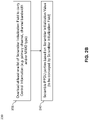
- FIG. 2B illustrates a method 230 for transmitting a PPDU by a transmitting wireless station, according to another embodiment of the present disclosure.
- the PPDU includes a header having a Scrambler Initialization Field.
- the method includes overloading 235, using a scrambler initializer, at least one bit of the Scrambler Initialization Field to carry control information.
- the method further includes scrambling 240, using a scrambler, a PPDU or a portion of the PPDU based on a scrambler initialization value to be conveyed by the Scrambler Initialization Field.
- the control information indicates at least one of: a primary channel to be used by the transmitter; a channel width (i.e. bandwidth) to be used by the transmitter; and a MIMO type to be used by the transmitter.
- FIG. 2C illustrates a method 260 for indicating control features in an EDMG PPDU for wireless local area network (LAN) communications, according to another embodiment of the present disclosure.
- the method is implemented for example by a transmitting wireless station.
- the method optionally includes selecting 265 at least one transmission control setting for the wireless LAN communications.
- the transmission control setting can be, for example, control information such as: a primary channel to be used by the transmitter; a channel width to be used by the transmitter; and/or a MIMO type to be used for the wireless LAN communications.
- the method includes embedding 270 at least one selected or predetermined transmission control setting into at least one bit of a Scrambler Initialization Field of a physical layer (PHY) header.
- PHY physical layer
- the method further includes scrambling 275 the PHY header and accompanying data based on contents of the Scrambler Initialization Field, for example by initialising a scrambler bit shift register using the at least one bit of the Scrambler Initialization Field.
- the method further includes error-control encoding and transmitting 280 the scrambled PHY header and accompanying data toward an intended recipient device.
- the detecting 307 and the interpreting 310 can be performed by a scrambling data extractor.
- the method further includes descrambling 315, using a descrambler, a portion of the received PPDU based on the SIV.
- the interpreting 310 and descrambling 315 are not necessarily performed sequentially in the illustrated order.
- FIG. 3B illustrates a method 330 for receiving a frame / PPDU by a receiving wireless station, according to another embodiment of the present disclosure.
- the frame includes a header having a Scrambler Initialization Field.
- the method includes detecting 335 at least one bit of the Scrambler Initialization Field, and interpreting the at least one bit as control information.
- the method further includes descrambling 340 at least a portion of the PPDU based on contents of the Scrambler Initialization Field (i.e. based on the scrambler initialization value contained therein).
- the control information indicates at least one of: a primary channel to be used by the transmitter; a channel width (bandwidth) to be used by the transmitter; and a MIMO type to be used by the transmitter.
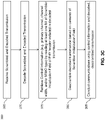
- FIG. 3C illustrates a method 360 for indicating control features in an EDMG frame for wireless LAN communications, according to another embodiment of the present disclosure.
- the method is implemented for example by a receiving wireless station, such as an intended recipient of an EMDG frame.
- the method includes receiving 365 a scrambled and encoded (e.g. channel encoded) transmission.
- the method further includes decoding 370 the scrambled and encoded transmission.
- the method further includes retrieving 375 control information by reading at least one bit of a Scrambler Initialization Field of a PHY header included in the decoded transmission.
- the retrieved control information may correspond to at least one control feature in an EDMG wireless LAN communication.
- the received control information may be a primary channel; a channel width; and/or a MIMO type.
- the method further includes descrambling 380 the decoded transmission based on contents of the Scrambler Initialization Field, for example by initialising a descrambler bit shift register using at least one bit of the Scrambler Initialization Field.
- the method further includes conducting 385 the wireless LAN communications using the control information and the decoded, descrambled transmission.
- the present disclosure relates to an apparatus, system, and method for communicating between wireless stations (STAs), including AP and Non-AP Stations.
- STAs wireless stations
- FIG. 4 an example prior art frame format is presented.
- the example prior art frame format is the format used in 802.11ad, for example as described in Section 21 of the IEEE Computer Society document entitled "IEEE Standard for Information technology- Telecommunication and information exchange between systems; Local and metropolitan area networks- Specific requirements, Part 11: Wireless LAN medium Access Control (MAC) and Physical Layer (PHY) Specifications, Amendment 3: Enhancements for Very High Throughput in the 60 GHz Band," IEEE Std. 802.11ad-2012, December 28, 2012 (referred to herein as 802.11ad).
- 802.11ad IEEE Standard for Information technology- Telecommunication and information exchange between systems; Local and metropolitan area networks- Specific requirements, Part 11: Wireless LAN medium Access Control (MAC) and Physical Layer (PHY) Specifications, Amendment 3: Enhancements for Very High Throughput in the 60 GHz Band," IEEE Std. 802.11
- a PPDU 10 consists of five fields: a Short Training Field (STF) 12, a Channel Estimation (CE) Field 14, a Header Field 16, a Data Field 18, and Automatic Gain Control (AGC) and Receive/Transmit Training (TRN-R/T) Fields 20.
- STF Short Training Field
- CE Channel Estimation
- AGC Automatic Gain Control
- TRN-R/T Receive/Transmit Training
- the frames and fields illustrated in the Figures of this disclosure have been formatted for clarity and are not to scale indicative of a size of each field. In some cases, the fields are sized based upon a length of the reference text, and accordingly are not representative of the number of bits contained within each field.
- the STF 12, CE Field 14, and Header Field 16 may be pre-fixed with a capital "L” to indicate that these are "Legacy" defined fields (e.g. L-Header). For simplicity and clarity the applicant has not adopted this nomenclature in this disclosure.
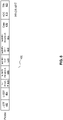
- Header Field 16 The actual makeup of the Header Field 16 varies depending upon the specific transmission modality. For instance, three examples of Header Fields 16 are those used for Control PHY, OFDM PHY, and SC PHY. Header Fields for Control PHY, OFDM PHY, and SC PHY refer, respectively, to the fields which include information used during transmission in order for the receiver to conduct correct reception of a Control PHY PPDU, OFDM PHY PPDU, and SC PHY PPDU. Referring to FIG. 5A , a Header Field 16a for Control PHY is illustrated. Further related details can be found for example in Section 21.4 of 802.11ad.
- Control PHY Header Field 16a includes a 1 bit Reserved Field 32, a 4 bit Scrambler Initialization Field 34, a 10 bit Length Field 36, a 1 bit Packet Type Field 38, a 5 bit Training Length Field 40, a 1 bit Turnaround Field 42, a 2 bit Reserved Field 44, and a 16 bit Header Check Sequence (HCS) Field 46.
- HCS Header Check Sequence
- the OFDM PHY Header Field 16b includes a 7 bit Scrambler Initialization Field 50, a 5 bit Modulation and Coding Scheme (MCS) Field 52, an 18 bit Length Field 54, a 1 bit Additional PPDU field 56, a 1 bit Packet Type Field 58, a 5 bit Training Length Field 60, a 1 bit Aggregation Field 62, a 1 bit Beam Tracking Request Field 64, a 1 bit Tone Pairing Type Field 66, a 1 bit Dynamic Tone Pairing (DTP) Indicator Field 68, a 4 bit Last Received Signal Strength Indicator (RSSI) Field 70, a 1 bit Turnaround Field 72, a 2 bit Reserved Field 74, and a 16 bit Header Check Sequence (HCS) Field 76.
- MCS Modulation and Coding Scheme
- HCS Last Received Signal Strength Indicator
- the Single Carrier PHY Header Field 16c includes a 7 bit Scrambler Initialization Field 80, a 5 bit Modulation and Coding Scheme (MCS) Field 82, an 18 bit Length Field 84, a 1 bit Additional PPDU field 86, a 1 bit Packet Type Field 88, a 5 bit Training Length Field 90, a 1 bit Aggregation Field 92, a 1 bit Beam Tracking Request Field 94, a 4 bit Last Received Signal Strength Indicator (RSSI) Field 100, a 1 bit Turnaround Field 102, a 4 bit Reserved Field 104, and a 16 bit Header Check Sequence (HCS) Field 106.
- MCS Modulation and Coding Scheme
- HCS Last Received Signal Strength Indicator
- the transmitting device performs a scrambling operation on all of the bits in the PPDU following the Scrambler Initialization Field in the header except for those in AGC and TRN-R/T fields 20, using a scrambler initialization value obtained from the Scrambler Initialization Field.
- the scrambling operation reorders the bits or updates the bit patterns of the header and data fields to whiten the data stream, that is to make it appear random from the transmitter's perspective. Referring to FIG. 5A , all bits after bit B4 would be scrambled based upon scrambler initialization bits, i.e.
- all bits after bit B6 would be scrambled based upon the values contained in the Scrambler Initialization Field 50, 80 bits B0 to B6, i.e. bits B0 to B6 of the Header Field 16b or 16c. Header Field bits are numbered for reference, beginning with "BO" and proceeding sequentially.
- bit B7 is placed first.
- bit B5 is placed first.
- the octets of the PSDU and the padding bits are placed into a bit stream with bit 0 (the least significant bit (LSB)) of each octet being placed first and bit 7 of each octet (the most significant bit (MSB)) being placed last.
- bit 0 the least significant bit (LSB)
- MSB most significant bit
- the transmitter selects a nonzero seed value for the scrambler (bits x 1 through x 4 for the Control PHY case illustrated in FIG. 5A ; bits x 1 through x 7 for the SC PHY and OFDM PHY cases illustrated in FIGs. 5B and 5C ).
- the 802.1 lad standard proposes that the seed value is selected in a pseudo random fashion.
- the seed value is entered in the Scrambler Initialization Field 34, 50, and 80 of the PLCP header 16a, 16b, and 16c respectively.
- Each data bit in the Data Field 18 of the PPDU is then XORed with the scrambler output ( x 4 XOR x 7 ) and the scrambler content is shifted once.
- the operation is diagrammatically illustrated in FIG. 6 , for an embodiment in which a shift register is used for implementation.
- the scrambling operation is defined based upon the 4 bit Scrambler Initialization Field 34.
- the scrambler shift register 300 is initialised by inserting bit values from bits B1, B2, B3, and B4 of the 4 bit Scrambler Initialization Field 34 (and also of the PLCP header 16a ) into bits x 1 , x 2 , x 3 , and x 4 of the scrambler shift register 300 illustrated in FIG. 6 , and by setting bits x 5 , x 6 , and x 7 to '1'.
- the scrambling operation can then proceed by inputting header bits starting from bit B5, and continuing for the remainder of the header 16a and after the last bit B39 has been input, continuing by bits from the Data Field 18 until all bits have been processed, or another appropriate stopping condition has been reached.
- the scrambling operation is defined based upon the 7 bit Scrambler Initialization Field 50, 80.
- the scrambler shift register 300 is initialised by inserting bit values from bits B0, B1, B2, B3, B4, B5, and B6 of the 7 bit Scrambler Initialization Field 50, 80 (and also of the PLCP header field 16b or 16c ) into bits x 1 , x 2 , x 3 , x 4 , x 5 , x 6 , and x 7 of the scrambler shift register 300 illustrated in FIG. 6 .
- the scrambling operation can then proceed by inputting header bits starting from bit B7, and continuing for the remainder of the header 16a and after the last bit B63 has been input, continuing by bits from the Data Field 18 until all bits have been processed, or another appropriate stopping condition has been reached.
- the proposed IEEE 802.11ay standard (in its current form) includes the feature that an EDMG STA is able to determine the primary channel and occupied bandwidth of any EDMG PPDU that it receives.
- the Header of each EDMG PPDU can be decoded by a legacy STA to detect the length and MCS in the Header.
- the EDMG STA frame may also need to include the additional signaling required to support EDMG features (e.g. channel bonding, & MIMO). This introduces limitations in that there are not enough reserved bits in the Control header to accommodate this additional signaling, and there are not enough reserved bits in Request to Send (RTS), DMG Clear to Send (CTS) for bandwidth signaling.
- RTS Request to Send
- CTS DMG Clear to Send
- FIGs. 7a and 7b the prior art channelization used by EDMG STAs is illustrated (IEEE 802.11 / 15-1358-09-00ay-specification-framework-for-tgay ).
- the ability of a particular device to use a channel also depends upon local regulatory rules, and any additional rules prescribed by the 802.11 ay standard.
- the channelization illustrated in FIG. 7b will be referred to below in the following examples.
- the EDMG PLCP (Physical Layer Convergence Protocol) protocol data unit (PPDU) 400 currently proposed in 802.11ay is illustrated for reference.
- the L-Header 406 is the equivalent of the Header Field 16.
- the scrambling operation is used within the context of the Data field.
- the Service field in DATA field is composed of 16 bits including 7 Scrambler Initialization bits and 9 Reserved SERVICE bits all of which are set to '0's.
- the scrambler initial state is set with pseudo random non-zero value.
- the scrambler is initialized with Scrambling Sequence B0 through B6. If the channel bandwidth in non-HT equals CBW20, bits B0 through B4 will be set to a nonzero pseudo random value, while bits B5, B6 indicate the channel bandwidth. Bits B0 through B3 will be set to 4-bit pseudorandom nonzero integer if the channel bandwidth in non-HT equals CBW20 and the dynamic bandwidth in non-HT equals Static, and will be a 4-bit pseudorandom integer otherwise.
- the currently proposed method for the IEEE 802.11ay standard includes a fixed 18-byte information length Control Trailer Field included before the Data Field 18 (see, for instance IEEE 802.11-16/0105r0, "Adding control trailer to control mode PPDUs").
- a reserved bit in the Header Field 16 may be allocated to indicate the presence of the Control Trailer. Due to the overhead cost though, it is desirable to avoid use of the Control Trailer when control information is indicated by few bits.
- bit values and control information can be varied. Mappings between bit values and control information are known a priori to both transmitting and receiving stations, so that control information can be signaled between the two stations.
- an example Control PHY may be constructed to indicate each of the primary channel and the channel bandwidth by overloading the Scrambler Initialization Field 34 in the Header Field 16a for a Control PHY PPDU.
- Example 1 we assume there are five options for the primary channel: i) the channel transmitting the PPDU; ii) channel #1; iii) channel #2; iv) channel #3; and, v) channel #4.
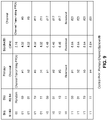
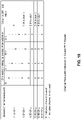
- Bits B1, B2, B3, and B4 of the Scrambler Initialization Field 34 are overloaded to include the values listed in the table illustrated in FIG. 9 that correspond to the primary channel, the channel bandwidth and the channel number corresponding to FIG. 7A selected for that PPDU. That is, bits B1 to B4 of the Scrambler Initialization Field 34 are set to the value which corresponds, according to the table illustrated in FIG. 9 , to the desired channel and bandwidth selections.
- bits B1, B2, B3, and B4 are entered into bits x 1 , x 2 , x 3 , and x 4 of the scrambler shift register 300 in place of pseudorandom digits, and bits x 5 , x 6 , and x 7 are each set to '1' as was the previous case, i.e. as described with respect to FIG. 6 .
- the right-most column in FIG. 9 indicates a channel number as defined in FIG. 7A .
- the channel bandwidth can expand to include available channels. For instance, if two 2.16 GHz channels are free, then one can transmit over 4.32 GHz; if three 2.16 GHz channels are free, then one can transmit over 6.48 GHz, and if four 2.16 GHz channels are free, one can transmit over 8.64 GHz.
- the bandwidth can automatically vary between 2.16 GHz and a specified maximum channel bandwidth, inclusive. The bandwidth is restricted to multiples of 2.16 GHz.
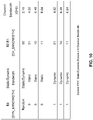
- the maximum channel bandwidth is set by bits B1 and B2, according to the rightmost two columns in FIG. 10 .
- the bandwidth may be set to one of 4.32 GHz, 6.48 GHz, or 8.64 GHz. If a secondary 2.16 GHz channel within the wideband channel is not available, then the transmitter can restart the transmit procedure over the primary channel. In the static channel bandwidth setting, the bandwidth is fixed at the specified value and does not vary with availability.
- the channel bandwidth may be indicated by selecting one of the available bandwidths (e.g. for this case 2.16 GHz, 4.32 GHz, 6.48 GHz, or 8.64 GHz).
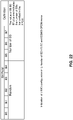
- Bits B1, B2, and B3 of the Scrambler Initialization Field 34 are overloaded to include the values listed in the table illustrated in FIG. 10 that correspond to the static/dynamic channel bandwidth setting and the channel bandwidth selected for that PPDU.
- bits B1, B2, and B3 are entered into bits x 1 , x 2 , and x 3 of the scrambler shift register 300 in place of pseudorandom digits
- bit B4 is selected pseudorandomly and entered into bit x 4 of the scrambler shift register 300
- scrambler bits x 5 , x 6 , and x 7 are each set to '1' as was the previous case.
- bits B1 and B2 of the Scrambler Initialization Field are set and/or interpreted according to the table illustrated in FIG. 10 to convey that the channel bandwidth is a multiple of 2.16 GHz lying between 2.16 GHz and 8.64 GHz, inclusive.
- the issue of whether channel bandwidth is static or dynamic is not relevant because both settings result in identical behavior.
- bit B3 can be set to '1' or '0' arbitrarily, for example randomly or pseudo-randomly.
- Such random or pseudo-random setting of B3 can improve the "whiteness" of scrambling, because B3 is also part of the Scrambler Initialization Field.
- an example SC PHY and OFDM PHY format may be constructed to indicate each of the primary channel and the channel bandwidth by overloading the Scrambler Initialization Field 50, 80 in the Header Field 16b, 16c for a SC PHY/OFDM PHY EDMG PPDU.
- Example 3 we assume there are four options for the primary channel: i) channel #1; ii) channel #2; iii) channel #3; and, iv) channel #4.
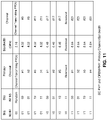
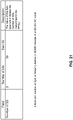
- Bits B0, B1, B2, and B3 of the Scrambler Initialization Field 50, 80 are overloaded to include the values listed in the table illustrated in FIG. 11 , which correspond to the primary channel and channel bandwidth selected for that PPDU. That is, bits B0 to B3 of the Scrambler Initialization Field 50, 80 are set to the value which corresponds, according to the table illustrated in FIG. 11 , to the desired channel and bandwidth selections.
- bits B0, B1, B2, and B3 are entered into bits x 1 , x 2 , x 3 , and x 4 of the scrambler shift register 300 in place of pseudorandom digits, and scrambler bits x 5 , x 6 , and x 7 may each be set pseudorandomly as was the previous case, i.e. as described with respect to FIG. 6 .
- the right-most column in FIG. 11 indicates a channel number as defined in FIG. 7A .
- example SC PHY and OFDM PHY formats may be constructed to indicate each of the static/dynamic channel bandwidth setting and the channel bandwidth by overloading the Scrambler Initialization Field 50 in the Header Field 16b for an OFDM PHY EDMG PPDU and the Scrambler Initialization Field 80 in the Header Field 16c for an SC PHY EDMG PPDU.
- bit B2 is used to indicate whether the channel bandwidth setting is static or dynamic.
- Bits B0 and B1 are used to indicate the selected channel bandwidth, based on the assumption that there are 4 available bandwidth options: a) 2.16 GHz; b) 4.32 GHz; c) 6.48 GHz; and, d) 8.64 GHz.
- the bandwidth may be set to one of 4.32 GHz, 6.48 GHz, or 8.64 GHz. If a secondary 2.16 GHz channel within the wideband channel is not available, then the transmitter can restart the transmit procedure over the primary channel. In the static channel bandwidth setting, the bandwidth is fixed at the specified value and does not vary with availability.
- the mass storage 2304 may comprise any type of non-transitory storage device configured to store data, programs, and other information and to make the data, programs, and other information accessible via the bus 2320.
- the mass storage 2304 may comprise, for example, one or more of a solid state drive, hard disk drive, a magnetic disk drive, or an optical disk drive.
- the video adapter 2310 and the I/O interface 2312 provide optional interfaces to couple external input and output devices to the processing unit 102.
- input and output devices include a display 2318 coupled to the video adapter 2310 and an I/O device 2316 such as a touch-screen coupled to the I/O interface 2312.
- I/O device 2316 such as a touch-screen coupled to the I/O interface 2312.
- Other devices may be coupled to the processing unit 2302 , and additional or fewer interfaces may be utilized.
- a serial interface such as Universal Serial Bus (USB) (not shown) may be used to provide an interface for an external device.
- USB Universal Serial Bus
- the processing unit 2302 may also include one or more network interfaces 2306 , which may comprise wired links, such as an Ethernet cable, and/or wireless links to access one or more networks 2322 .
- the network interfaces 2306 allow the processing unit 2302 to communicate with remote entities via the networks 2322 .
- the network interfaces 2306 may provide wireless communication via one or more transmitters/transmit antennas and one or more receivers/receive antennas.
- the processing unit 2302 is coupled to a local-area network or a wide-area network for data processing and communications with remote devices, such as other processing units, the Internet, or remote storage facilities.
- Embodiment 5 The transmitter of embodiment 1, wherein the scrambler initializer overloads all bits of the Scrambler Initialization Field to carry the control information.
- Embodiment 8 The receiver of embodiment 7, wherein the control information indicates at least one of: a primary channel to be used by the transmitter; a channel bandwidth to be used by the transmitter; and a MIMO type to be used by the transmitter.
- Embodiment 9 The receiver of embodiment 7, wherein fewer than all bits of the Scrambler Initialization Field are interpreted as carrying the control information.
- Embodiment 10 The receiver of embodiment 7, wherein all bits of the Scrambler Initialization Field are interpreted as carrying the control information.
- Embodiment 13 The method of embodiment 12, wherein the control information indicates at least one of: a primary channel to be used by the transmitter; a channel bandwidth to be used by the transmitter; and a MIMO type to be used by the transmitter.
- Embodiment 15 The method of embodiment 12, wherein the fewer than all bits of the Scrambler Initialization Field are overloaded to carry the control information.
- Embodiment 17 The method of embodiment 12, wherein the control information further indicates at least one of: control information used to support EDMG features; an indication of whether static or dynamic bandwidth allocation is to be employed; a set of one or more channels to be used by the transmitter; a transmit diversity configuration to be used in communication; a transmit diversity configuration to be used in communication; and a number of spatial streams being transmitted.
- Embodiment 18 A method for receiving a PPDU having a header, the header having a Scrambler Initialization Field, the method comprising, by a receiver having a decoder and a descrambler:
- Embodiment 19 The method of embodiment 18, wherein the control information indicates at least one of: a primary channel to be used by the transmitter; a channel bandwidth to be used by the transmitter; and a MIMO type to be used by the transmitter.
- Embodiment 20 The method of embodiment 18, wherein fewer than all bits of the Scrambler Initialization Field are interpreted as carrying the control information.
Landscapes
- Engineering & Computer Science (AREA)
- Computer Networks & Wireless Communication (AREA)
- Signal Processing (AREA)
- Computer Security & Cryptography (AREA)
- Mobile Radio Communication Systems (AREA)
- Radio Transmission System (AREA)
- Selective Calling Equipment (AREA)
Applications Claiming Priority (6)
| Application Number | Priority Date | Filing Date | Title |
|---|---|---|---|
| US201662334749P | 2016-05-11 | 2016-05-11 | |
| US201762444055P | 2017-01-09 | 2017-01-09 | |
| US15/480,044 US11330465B2 (en) | 2016-05-11 | 2017-04-05 | Method and apparatus for indicating control information in a wireless frame |
| EP20192658.1A EP3761709B1 (de) | 2016-05-11 | 2017-04-20 | Verfahren und vorrichtung zum anzeigen von steuerinformationen in einem drahtlosen rahmen |
| EP17795405.4A EP3446514B1 (de) | 2016-05-11 | 2017-04-20 | Verfahren und vorrichtung zum anzeigen von steuerinformationen in einem drahtlosen rahmen |
| PCT/CN2017/081229 WO2017193787A1 (en) | 2016-05-11 | 2017-04-20 | Method and apparatus for indicating control information in a wireless frame |
Related Parent Applications (3)
| Application Number | Title | Priority Date | Filing Date |
|---|---|---|---|
| EP17795405.4A Division EP3446514B1 (de) | 2016-05-11 | 2017-04-20 | Verfahren und vorrichtung zum anzeigen von steuerinformationen in einem drahtlosen rahmen |
| EP20192658.1A Division EP3761709B1 (de) | 2016-05-11 | 2017-04-20 | Verfahren und vorrichtung zum anzeigen von steuerinformationen in einem drahtlosen rahmen |
| EP20192658.1A Division-Into EP3761709B1 (de) | 2016-05-11 | 2017-04-20 | Verfahren und vorrichtung zum anzeigen von steuerinformationen in einem drahtlosen rahmen |
Publications (1)
| Publication Number | Publication Date |
|---|---|
| EP4124121A1 true EP4124121A1 (de) | 2023-01-25 |
Family
ID=60266970
Family Applications (3)
| Application Number | Title | Priority Date | Filing Date |
|---|---|---|---|
| EP17795405.4A Active EP3446514B1 (de) | 2016-05-11 | 2017-04-20 | Verfahren und vorrichtung zum anzeigen von steuerinformationen in einem drahtlosen rahmen |
| EP22194082.8A Pending EP4124121A1 (de) | 2016-05-11 | 2017-04-20 | Verfahren und vorrichtung zum anzeigen von steuerinformationen in einem drahtlosen rahmen |
| EP20192658.1A Active EP3761709B1 (de) | 2016-05-11 | 2017-04-20 | Verfahren und vorrichtung zum anzeigen von steuerinformationen in einem drahtlosen rahmen |
Family Applications Before (1)
| Application Number | Title | Priority Date | Filing Date |
|---|---|---|---|
| EP17795405.4A Active EP3446514B1 (de) | 2016-05-11 | 2017-04-20 | Verfahren und vorrichtung zum anzeigen von steuerinformationen in einem drahtlosen rahmen |
Family Applications After (1)
| Application Number | Title | Priority Date | Filing Date |
|---|---|---|---|
| EP20192658.1A Active EP3761709B1 (de) | 2016-05-11 | 2017-04-20 | Verfahren und vorrichtung zum anzeigen von steuerinformationen in einem drahtlosen rahmen |
Country Status (8)
| Country | Link |
|---|---|
| US (3) | US11330465B2 (de) |
| EP (3) | EP3446514B1 (de) |
| JP (1) | JP6710293B2 (de) |
| KR (1) | KR102127316B1 (de) |
| CN (1) | CN108702676B (de) |
| ES (1) | ES2950913T3 (de) |
| RU (1) | RU2707725C1 (de) |
| WO (1) | WO2017193787A1 (de) |
Families Citing this family (21)
| Publication number | Priority date | Publication date | Assignee | Title |
|---|---|---|---|---|
| US9992741B2 (en) * | 2016-01-11 | 2018-06-05 | Intel IP Corporation | Device and method of providing grant frame for bandwidth scheduling |
| US20170367099A1 (en) * | 2016-06-15 | 2017-12-21 | Laurent Cariou | Bandwidth and primary channel indication |
| US20180013480A1 (en) * | 2016-07-11 | 2018-01-11 | Intel Corporation | Header encoding and modulation for single carrier physical layer |
| US20180062903A1 (en) * | 2016-08-31 | 2018-03-01 | Qualcomm Incorporated | Frame format with multiple guard interval lengths |
| US10652368B2 (en) * | 2017-04-01 | 2020-05-12 | Intel IP Corporation | Parameter encoding techniques for wireless communication networks |
| EP3599747B1 (de) * | 2017-04-20 | 2021-05-05 | LG Electronics Inc. | Verfahren zum senden oder empfangen eines signals in einem drahtlosen lan-system und vorrichtung für besagtes verfahren |
| EP3606271B1 (de) * | 2017-07-06 | 2021-01-27 | LG Electronics Inc. -1- | Verfahren zur übertragung eines rahmens auf basis mehrerer kanalisierter kanäle in einem drahtlosen lan-system und drahtloses endgerät mit verwendung davon |
| EP3567821B1 (de) * | 2017-07-12 | 2021-06-23 | LG Electronics Inc. | Verfahren zum senden oder empfangen eines signals in einem wlan-system und vorrichtung dafür |
| WO2019125433A1 (en) * | 2017-12-20 | 2019-06-27 | Laurent Cariou | Resource unit notching for 6ghz |
| CN110621043B (zh) * | 2018-06-20 | 2022-12-27 | 华为技术有限公司 | 一种带宽模式指示方法、信道指示方法及装置 |
| CN111049558B (zh) * | 2018-10-15 | 2023-01-06 | 华为技术有限公司 | 通信方法和通信装置 |
| WO2020246636A1 (ko) * | 2019-06-05 | 2020-12-10 | 엘지전자 주식회사 | 무선 av 시스템에서 데이터의 전송 장치 및 수신 장치 |
| US11206667B2 (en) * | 2019-06-07 | 2021-12-21 | Intel Corporation | Data scrambler in extreme high throughput |
| CN112702787B (zh) * | 2019-10-22 | 2022-12-16 | 海能达通信股份有限公司 | 一种基于扰频的通信方法、装置及存储介质 |
| US11509508B2 (en) * | 2020-02-25 | 2022-11-22 | Qualcomm Incorporated | Scrambling sequences and signaling indications thereof |
| CN113453355B (zh) | 2020-03-27 | 2024-09-06 | 华为技术有限公司 | 无线局域网感知方法、网络设备及芯片 |
| US12171024B2 (en) * | 2020-06-28 | 2024-12-17 | Qualcomm Incorporated | Scrambling sequences for request-to-send (RTS) and clear-to-send (CTS) frames |
| US11997541B2 (en) | 2020-08-11 | 2024-05-28 | Qualcomm Incorporated | Enhanced bandwidth negotiation |
| CN115087045B (zh) * | 2021-03-12 | 2026-03-20 | 华为技术有限公司 | 确定带宽的方法、设备、存储介质和程序产品 |
| CN119698774A (zh) * | 2022-08-23 | 2025-03-25 | Oppo广东移动通信有限公司 | 一种信息指示方法及装置、通信设备 |
| US20250080275A1 (en) * | 2023-08-30 | 2025-03-06 | Qualcomm Incorporated | Enhancements to request to send and clear to send exchanges |
Citations (2)
| Publication number | Priority date | Publication date | Assignee | Title |
|---|---|---|---|---|
| US20140003415A1 (en) * | 2012-07-02 | 2014-01-02 | Qualcomm Incorporated | Systems and methods for enhanced wireless communication frames |
| WO2015180465A1 (zh) * | 2014-05-30 | 2015-12-03 | 江苏中兴微通信息科技有限公司 | 一种无线mimo通信系统的信令字段及其通信方法 |
Family Cites Families (35)
| Publication number | Priority date | Publication date | Assignee | Title |
|---|---|---|---|---|
| JP2000031980A (ja) | 1998-07-10 | 2000-01-28 | Kokusai Electric Co Ltd | 無線lanシステムとその暗号化方法 |
| JP4254201B2 (ja) | 2002-10-31 | 2009-04-15 | ソニー株式会社 | スクランブラ、送信装置および受信装置 |
| WO2006044980A1 (en) * | 2004-10-19 | 2006-04-27 | Matsushita Electric Industrial Co, Ltd | Enhanced transmission systems for use in wireless personal area networks |
| ATE472212T1 (de) | 2005-11-08 | 2010-07-15 | Irdeto Access Bv | Verfahren zur verschlüsselung und entschlüsselung von dateneinheiten |
| CN102474481B (zh) | 2009-07-10 | 2014-09-24 | 日本电气株式会社 | 加扰方法和通信装置 |
| KR20110027533A (ko) | 2009-09-09 | 2011-03-16 | 엘지전자 주식회사 | 다중 안테나 시스템에서 제어정보 전송 방법 및 장치 |
| WO2011130309A1 (en) | 2010-04-12 | 2011-10-20 | Qualcomm Atheros, Inc. | Channel estimation for low-overhead communication in a network |
| WO2011156201A2 (en) * | 2010-06-11 | 2011-12-15 | Marvell World Trade Ltd. | Method and apparatus for determining channel bandwidth |
| US8699442B2 (en) | 2010-06-29 | 2014-04-15 | Lg Electronics Inc. | Method and apparatus for transmitting data frame in WLAN system |
| US8824441B2 (en) | 2011-05-12 | 2014-09-02 | Electronics And Telecommunications Research Institute | Method for transmitting data frame in wireless local area network and apparatus for the same |
| CN103891233B (zh) | 2011-08-15 | 2017-12-26 | 马维尔国际贸易有限公司 | 用于在无线通信网络中传输数据单元的方法和通信设备 |
| US20130142094A1 (en) | 2011-12-02 | 2013-06-06 | Qualcomm Incorporated | Systems and methods for frame filtering and for enabling frame filtering |
| US9363707B2 (en) | 2011-12-29 | 2016-06-07 | Qualcomm Incorporated | Systems and methods for generating and decoding short control frames in wireless communications |
| CN104871620B (zh) * | 2012-07-19 | 2019-04-16 | 日本电信电话株式会社 | 无线通信系统以及无线通信方法 |
| JP2014184366A (ja) | 2013-03-22 | 2014-10-02 | Sumitomo Electric Ind Ltd | 濾過装置および濾過モジュールの洗浄方法 |
| US9386585B2 (en) * | 2013-07-15 | 2016-07-05 | Qualcomm Incorporated | Systems and methods for a data scrambling procedure |
| WO2015094257A1 (en) | 2013-12-19 | 2015-06-25 | Intel Corporation | Apparatus, system and method of communicating scrambled transmissions according to a retransmission scheme |
| US20150201433A1 (en) * | 2014-01-13 | 2015-07-16 | Qualcomm Incorporated | Signaling between phy and mac layers |
| US9444655B2 (en) * | 2014-03-25 | 2016-09-13 | Intel IP Corporation | Apparatus, method and system of scrambling a wireless transmission |
| US9681335B2 (en) * | 2014-06-19 | 2017-06-13 | Samsung Electronics Co., Ltd. | Methods for bandwidth efficient operations in wireless local area networks |
| US10085258B2 (en) * | 2014-07-04 | 2018-09-25 | Newracom, Inc. | Frame transmitting method and frame receiving method |
| US9641654B2 (en) * | 2014-09-29 | 2017-05-02 | Apple Inc. | Robust decoding of wireless LAN response packets |
| EP4258807A3 (de) * | 2014-11-19 | 2023-11-29 | Atlas Global Technologies LLC | Verfahren und vorrichtung zur verarbeitung von ppdu auf basis von bbs-identifikationsinformationen in hocheffizientem drahtlosem lan |
| US9504038B2 (en) * | 2014-12-25 | 2016-11-22 | Intel Corporation | Apparatus, method and system of communicating a wide-bandwidth data frame |
| BR112017014869B1 (pt) * | 2015-02-13 | 2023-11-21 | Panasonic intellectual property Management co., Ltd | Dispositivo de comunicação sem fio e método de comunicação sem fio |
| US20160286011A1 (en) * | 2015-03-26 | 2016-09-29 | Assaf Kasher | Techniques for communicating an end of packet indicator |
| US10425917B2 (en) * | 2015-04-21 | 2019-09-24 | Qualcomm Incorporated | Legacy compatible signaling for channel bonding |
| US9655112B2 (en) * | 2015-04-30 | 2017-05-16 | Intel IP Corporation | Apparatus, system and method of communicating a wireless communication frame with a header |
| US10419249B2 (en) * | 2015-05-22 | 2019-09-17 | Telefonaktiebolaget Lm Ericsson (Publ) | Scrambling for downlink signaling in wireless communication network |
| US20160353357A1 (en) * | 2015-05-27 | 2016-12-01 | Qualcomm Incorporated | Methods and systems for multiplexed communication in dense wireless environments |
| MX395276B (es) * | 2015-06-03 | 2025-03-11 | Apple Inc | Tecnologías para unida de datos de protocolo de capa física agregada. |
| US20170099119A1 (en) * | 2015-10-02 | 2017-04-06 | Samsung Electronics Co., Ltd. | Signalling of checksum for 802.11 mac headers |
| CN113014367B (zh) * | 2015-10-12 | 2024-05-31 | 纽瑞科姆有限公司 | 用于无线传输的保护方法 |
| US10187497B1 (en) * | 2015-12-15 | 2019-01-22 | Marvell International Ltd. | Systems and methods for performing data frame configuration on the physical layer for high-data rate wireless local area networks (WLANS) |
| AU2017227195B2 (en) * | 2016-02-29 | 2021-08-05 | Panasonic Intellectual Property Corporation Of America | Transmitting device, transmission method, receiving device, and reception method |
-
2017
- 2017-04-05 US US15/480,044 patent/US11330465B2/en active Active
- 2017-04-20 JP JP2018559201A patent/JP6710293B2/ja active Active
- 2017-04-20 RU RU2018143634A patent/RU2707725C1/ru active
- 2017-04-20 EP EP17795405.4A patent/EP3446514B1/de active Active
- 2017-04-20 CN CN201780009099.3A patent/CN108702676B/zh active Active
- 2017-04-20 WO PCT/CN2017/081229 patent/WO2017193787A1/en not_active Ceased
- 2017-04-20 ES ES20192658T patent/ES2950913T3/es active Active
- 2017-04-20 KR KR1020187035579A patent/KR102127316B1/ko active Active
- 2017-04-20 EP EP22194082.8A patent/EP4124121A1/de active Pending
- 2017-04-20 EP EP20192658.1A patent/EP3761709B1/de active Active
-
2022
- 2022-04-27 US US17/730,679 patent/US11743766B2/en active Active
-
2023
- 2023-07-13 US US18/221,631 patent/US12101665B2/en active Active
Patent Citations (3)
| Publication number | Priority date | Publication date | Assignee | Title |
|---|---|---|---|---|
| US20140003415A1 (en) * | 2012-07-02 | 2014-01-02 | Qualcomm Incorporated | Systems and methods for enhanced wireless communication frames |
| WO2015180465A1 (zh) * | 2014-05-30 | 2015-12-03 | 江苏中兴微通信息科技有限公司 | 一种无线mimo通信系统的信令字段及其通信方法 |
| EP3151497A1 (de) * | 2014-05-30 | 2017-04-05 | ZTE Wavetone Science And Technology Ltd. | Signalisierungsfeld eines drahtlosen mimo-kommunikationssystems und kommunikationsverfahren dafür |
Non-Patent Citations (1)
| Title |
|---|
| BY C. CORDEIROA. KASHER, ADDING CONTROL TRAILER TO CONTROL MODE PPDUS, 17 January 2016 (2016-01-17) |
Also Published As
| Publication number | Publication date |
|---|---|
| JP2019516326A (ja) | 2019-06-13 |
| KR20190002692A (ko) | 2019-01-08 |
| EP3446514A1 (de) | 2019-02-27 |
| US11743766B2 (en) | 2023-08-29 |
| US20220256400A1 (en) | 2022-08-11 |
| EP3761709C0 (de) | 2023-06-07 |
| CN108702676B (zh) | 2021-04-20 |
| US20240049049A1 (en) | 2024-02-08 |
| KR102127316B1 (ko) | 2020-06-26 |
| WO2017193787A1 (en) | 2017-11-16 |
| EP3446514B1 (de) | 2020-10-28 |
| EP3761709A1 (de) | 2021-01-06 |
| EP3446514A4 (de) | 2019-04-10 |
| ES2950913T3 (es) | 2023-10-16 |
| RU2707725C1 (ru) | 2019-11-28 |
| US12101665B2 (en) | 2024-09-24 |
| US11330465B2 (en) | 2022-05-10 |
| US20170332277A1 (en) | 2017-11-16 |
| JP6710293B2 (ja) | 2020-06-17 |
| EP3761709B1 (de) | 2023-06-07 |
| CN108702676A (zh) | 2018-10-23 |
Similar Documents
| Publication | Publication Date | Title |
|---|---|---|
| US12101665B2 (en) | Method and apparatus for indicating control information in a wireless frame | |
| US11671121B2 (en) | Wireless communication device and wireless communication method | |
| JP6664124B2 (ja) | 集約物理層プロトコルデータユニットの伝送装置および伝送方法 | |
| US9736724B2 (en) | Physical layer frame format for long range WLAN | |
| US20230021206A1 (en) | Error protection of data unit service field in wireless local area network transmissions |
Legal Events
| Date | Code | Title | Description |
|---|---|---|---|
| PUAI | Public reference made under article 153(3) epc to a published international application that has entered the european phase |
Free format text: ORIGINAL CODE: 0009012 |
|
| STAA | Information on the status of an ep patent application or granted ep patent |
Free format text: STATUS: REQUEST FOR EXAMINATION WAS MADE |
|
| 17P | Request for examination filed |
Effective date: 20220906 |
|
| AC | Divisional application: reference to earlier application |
Ref document number: 3446514 Country of ref document: EP Kind code of ref document: P Ref document number: 3761709 Country of ref document: EP Kind code of ref document: P |
|
| AK | Designated contracting states |
Kind code of ref document: A1 Designated state(s): AL AT BE BG CH CY CZ DE DK EE ES FI FR GB GR HR HU IE IS IT LI LT LU LV MC MK MT NL NO PL PT RO RS SE SI SK SM TR |
|
| STAA | Information on the status of an ep patent application or granted ep patent |
Free format text: STATUS: EXAMINATION IS IN PROGRESS |
|
| 17Q | First examination report despatched |
Effective date: 20250317 |