EP4122926B1 - Triazine derivatives having virus replication inhibitory activity and pharmaceutical composition comprising the same - Google Patents
Triazine derivatives having virus replication inhibitory activity and pharmaceutical composition comprising the same Download PDFInfo
- Publication number
- EP4122926B1 EP4122926B1 EP22733282.2A EP22733282A EP4122926B1 EP 4122926 B1 EP4122926 B1 EP 4122926B1 EP 22733282 A EP22733282 A EP 22733282A EP 4122926 B1 EP4122926 B1 EP 4122926B1
- Authority
- EP
- European Patent Office
- Prior art keywords
- substituted
- aromatic
- substituent group
- compound
- formula
- Prior art date
- Legal status (The legal status is an assumption and is not a legal conclusion. Google has not performed a legal analysis and makes no representation as to the accuracy of the status listed.)
- Active
Links
Images






Classifications
-
- A—HUMAN NECESSITIES
- A61—MEDICAL OR VETERINARY SCIENCE; HYGIENE
- A61K—PREPARATIONS FOR MEDICAL, DENTAL OR TOILETRY PURPOSES
- A61K31/00—Medicinal preparations containing organic active ingredients
- A61K31/33—Heterocyclic compounds
- A61K31/395—Heterocyclic compounds having nitrogen as a ring hetero atom, e.g. guanethidine or rifamycins
- A61K31/53—Heterocyclic compounds having nitrogen as a ring hetero atom, e.g. guanethidine or rifamycins having six-membered rings with three nitrogens as the only ring hetero atoms, e.g. chlorazanil, melamine
-
- A—HUMAN NECESSITIES
- A61—MEDICAL OR VETERINARY SCIENCE; HYGIENE
- A61K—PREPARATIONS FOR MEDICAL, DENTAL OR TOILETRY PURPOSES
- A61K47/00—Medicinal preparations characterised by the non-active ingredients used, e.g. carriers or inert additives; Targeting or modifying agents chemically bound to the active ingredient
- A61K47/50—Medicinal preparations characterised by the non-active ingredients used, e.g. carriers or inert additives; Targeting or modifying agents chemically bound to the active ingredient the non-active ingredient being chemically bound to the active ingredient, e.g. polymer-drug conjugates
- A61K47/51—Medicinal preparations characterised by the non-active ingredients used, e.g. carriers or inert additives; Targeting or modifying agents chemically bound to the active ingredient the non-active ingredient being chemically bound to the active ingredient, e.g. polymer-drug conjugates the non-active ingredient being a modifying agent
- A61K47/54—Medicinal preparations characterised by the non-active ingredients used, e.g. carriers or inert additives; Targeting or modifying agents chemically bound to the active ingredient the non-active ingredient being chemically bound to the active ingredient, e.g. polymer-drug conjugates the non-active ingredient being a modifying agent the modifying agent being an organic compound
- A61K47/542—Carboxylic acids, e.g. a fatty acid or an amino acid
-
- A—HUMAN NECESSITIES
- A61—MEDICAL OR VETERINARY SCIENCE; HYGIENE
- A61K—PREPARATIONS FOR MEDICAL, DENTAL OR TOILETRY PURPOSES
- A61K9/00—Medicinal preparations characterised by special physical form
- A61K9/0012—Galenical forms characterised by the site of application
- A61K9/0019—Injectable compositions; Intramuscular, intravenous, arterial, subcutaneous administration; Compositions to be administered through the skin in an invasive manner
-
- A—HUMAN NECESSITIES
- A61—MEDICAL OR VETERINARY SCIENCE; HYGIENE
- A61K—PREPARATIONS FOR MEDICAL, DENTAL OR TOILETRY PURPOSES
- A61K9/00—Medicinal preparations characterised by special physical form
- A61K9/0012—Galenical forms characterised by the site of application
- A61K9/0053—Mouth and digestive tract, i.e. intraoral and peroral administration
-
- A—HUMAN NECESSITIES
- A61—MEDICAL OR VETERINARY SCIENCE; HYGIENE
- A61P—SPECIFIC THERAPEUTIC ACTIVITY OF CHEMICAL COMPOUNDS OR MEDICINAL PREPARATIONS
- A61P31/00—Antiinfectives, i.e. antibiotics, antiseptics, chemotherapeutics
- A61P31/12—Antivirals
- A61P31/14—Antivirals for RNA viruses
-
- A—HUMAN NECESSITIES
- A61—MEDICAL OR VETERINARY SCIENCE; HYGIENE
- A61P—SPECIFIC THERAPEUTIC ACTIVITY OF CHEMICAL COMPOUNDS OR MEDICINAL PREPARATIONS
- A61P43/00—Drugs for specific purposes, not provided for in groups A61P1/00-A61P41/00
-
- C—CHEMISTRY; METALLURGY
- C07—ORGANIC CHEMISTRY
- C07D—HETEROCYCLIC COMPOUNDS
- C07D401/00—Heterocyclic compounds containing two or more hetero rings, having nitrogen atoms as the only ring hetero atoms, at least one ring being a six-membered ring with only one nitrogen atom
- C07D401/02—Heterocyclic compounds containing two or more hetero rings, having nitrogen atoms as the only ring hetero atoms, at least one ring being a six-membered ring with only one nitrogen atom containing two hetero rings
- C07D401/04—Heterocyclic compounds containing two or more hetero rings, having nitrogen atoms as the only ring hetero atoms, at least one ring being a six-membered ring with only one nitrogen atom containing two hetero rings directly linked by a ring-member-to-ring-member bond
-
- C—CHEMISTRY; METALLURGY
- C07—ORGANIC CHEMISTRY
- C07D—HETEROCYCLIC COMPOUNDS
- C07D401/00—Heterocyclic compounds containing two or more hetero rings, having nitrogen atoms as the only ring hetero atoms, at least one ring being a six-membered ring with only one nitrogen atom
- C07D401/02—Heterocyclic compounds containing two or more hetero rings, having nitrogen atoms as the only ring hetero atoms, at least one ring being a six-membered ring with only one nitrogen atom containing two hetero rings
- C07D401/06—Heterocyclic compounds containing two or more hetero rings, having nitrogen atoms as the only ring hetero atoms, at least one ring being a six-membered ring with only one nitrogen atom containing two hetero rings linked by a carbon chain containing only aliphatic carbon atoms
-
- C—CHEMISTRY; METALLURGY
- C07—ORGANIC CHEMISTRY
- C07D—HETEROCYCLIC COMPOUNDS
- C07D401/00—Heterocyclic compounds containing two or more hetero rings, having nitrogen atoms as the only ring hetero atoms, at least one ring being a six-membered ring with only one nitrogen atom
- C07D401/14—Heterocyclic compounds containing two or more hetero rings, having nitrogen atoms as the only ring hetero atoms, at least one ring being a six-membered ring with only one nitrogen atom containing three or more hetero rings
-
- C—CHEMISTRY; METALLURGY
- C07—ORGANIC CHEMISTRY
- C07D—HETEROCYCLIC COMPOUNDS
- C07D403/00—Heterocyclic compounds containing two or more hetero rings, having nitrogen atoms as the only ring hetero atoms, not provided for by group C07D401/00
- C07D403/02—Heterocyclic compounds containing two or more hetero rings, having nitrogen atoms as the only ring hetero atoms, not provided for by group C07D401/00 containing two hetero rings
- C07D403/06—Heterocyclic compounds containing two or more hetero rings, having nitrogen atoms as the only ring hetero atoms, not provided for by group C07D401/00 containing two hetero rings linked by a carbon chain containing only aliphatic carbon atoms
-
- C—CHEMISTRY; METALLURGY
- C07—ORGANIC CHEMISTRY
- C07D—HETEROCYCLIC COMPOUNDS
- C07D403/00—Heterocyclic compounds containing two or more hetero rings, having nitrogen atoms as the only ring hetero atoms, not provided for by group C07D401/00
- C07D403/14—Heterocyclic compounds containing two or more hetero rings, having nitrogen atoms as the only ring hetero atoms, not provided for by group C07D401/00 containing three or more hetero rings
-
- C—CHEMISTRY; METALLURGY
- C07—ORGANIC CHEMISTRY
- C07D—HETEROCYCLIC COMPOUNDS
- C07D405/00—Heterocyclic compounds containing both one or more hetero rings having oxygen atoms as the only ring hetero atoms, and one or more rings having nitrogen as the only ring hetero atom
- C07D405/14—Heterocyclic compounds containing both one or more hetero rings having oxygen atoms as the only ring hetero atoms, and one or more rings having nitrogen as the only ring hetero atom containing three or more hetero rings
-
- C—CHEMISTRY; METALLURGY
- C07—ORGANIC CHEMISTRY
- C07D—HETEROCYCLIC COMPOUNDS
- C07D409/00—Heterocyclic compounds containing two or more hetero rings, at least one ring having sulfur atoms as the only ring hetero atoms
- C07D409/14—Heterocyclic compounds containing two or more hetero rings, at least one ring having sulfur atoms as the only ring hetero atoms containing three or more hetero rings
-
- C—CHEMISTRY; METALLURGY
- C07—ORGANIC CHEMISTRY
- C07D—HETEROCYCLIC COMPOUNDS
- C07D413/00—Heterocyclic compounds containing two or more hetero rings, at least one ring having nitrogen and oxygen atoms as the only ring hetero atoms
- C07D413/14—Heterocyclic compounds containing two or more hetero rings, at least one ring having nitrogen and oxygen atoms as the only ring hetero atoms containing three or more hetero rings
-
- C—CHEMISTRY; METALLURGY
- C07—ORGANIC CHEMISTRY
- C07D—HETEROCYCLIC COMPOUNDS
- C07D417/00—Heterocyclic compounds containing two or more hetero rings, at least one ring having nitrogen and sulfur atoms as the only ring hetero atoms, not provided for by group C07D415/00
- C07D417/02—Heterocyclic compounds containing two or more hetero rings, at least one ring having nitrogen and sulfur atoms as the only ring hetero atoms, not provided for by group C07D415/00 containing two hetero rings
- C07D417/06—Heterocyclic compounds containing two or more hetero rings, at least one ring having nitrogen and sulfur atoms as the only ring hetero atoms, not provided for by group C07D415/00 containing two hetero rings linked by a carbon chain containing only aliphatic carbon atoms
-
- C—CHEMISTRY; METALLURGY
- C07—ORGANIC CHEMISTRY
- C07D—HETEROCYCLIC COMPOUNDS
- C07D417/00—Heterocyclic compounds containing two or more hetero rings, at least one ring having nitrogen and sulfur atoms as the only ring hetero atoms, not provided for by group C07D415/00
- C07D417/14—Heterocyclic compounds containing two or more hetero rings, at least one ring having nitrogen and sulfur atoms as the only ring hetero atoms, not provided for by group C07D415/00 containing three or more hetero rings
-
- C—CHEMISTRY; METALLURGY
- C07—ORGANIC CHEMISTRY
- C07D—HETEROCYCLIC COMPOUNDS
- C07D471/00—Heterocyclic compounds containing nitrogen atoms as the only ring hetero atoms in the condensed system, at least one ring being a six-membered ring with one nitrogen atom, not provided for by groups C07D451/00 - C07D463/00
- C07D471/02—Heterocyclic compounds containing nitrogen atoms as the only ring hetero atoms in the condensed system, at least one ring being a six-membered ring with one nitrogen atom, not provided for by groups C07D451/00 - C07D463/00 in which the condensed system contains two hetero rings
- C07D471/04—Ortho-condensed systems
-
- C—CHEMISTRY; METALLURGY
- C07—ORGANIC CHEMISTRY
- C07D—HETEROCYCLIC COMPOUNDS
- C07D487/00—Heterocyclic compounds containing nitrogen atoms as the only ring hetero atoms in the condensed system, not provided for by groups C07D451/00 - C07D477/00
- C07D487/02—Heterocyclic compounds containing nitrogen atoms as the only ring hetero atoms in the condensed system, not provided for by groups C07D451/00 - C07D477/00 in which the condensed system contains two hetero rings
- C07D487/04—Ortho-condensed systems
-
- C—CHEMISTRY; METALLURGY
- C07—ORGANIC CHEMISTRY
- C07D—HETEROCYCLIC COMPOUNDS
- C07D495/00—Heterocyclic compounds containing in the condensed system at least one hetero ring having sulfur atoms as the only ring hetero atoms
- C07D495/02—Heterocyclic compounds containing in the condensed system at least one hetero ring having sulfur atoms as the only ring hetero atoms in which the condensed system contains two hetero rings
- C07D495/04—Ortho-condensed systems
-
- C—CHEMISTRY; METALLURGY
- C07—ORGANIC CHEMISTRY
- C07D—HETEROCYCLIC COMPOUNDS
- C07D498/00—Heterocyclic compounds containing in the condensed system at least one hetero ring having nitrogen and oxygen atoms as the only ring hetero atoms
- C07D498/02—Heterocyclic compounds containing in the condensed system at least one hetero ring having nitrogen and oxygen atoms as the only ring hetero atoms in which the condensed system contains two hetero rings
- C07D498/04—Ortho-condensed systems
-
- C—CHEMISTRY; METALLURGY
- C07—ORGANIC CHEMISTRY
- C07B—GENERAL METHODS OF ORGANIC CHEMISTRY; APPARATUS THEREFOR
- C07B2200/00—Indexing scheme relating to specific properties of organic compounds
- C07B2200/13—Crystalline forms, e.g. polymorphs
-
- Y—GENERAL TAGGING OF NEW TECHNOLOGICAL DEVELOPMENTS; GENERAL TAGGING OF CROSS-SECTIONAL TECHNOLOGIES SPANNING OVER SEVERAL SECTIONS OF THE IPC; TECHNICAL SUBJECTS COVERED BY FORMER USPC CROSS-REFERENCE ART COLLECTIONS [XRACs] AND DIGESTS
- Y02—TECHNOLOGIES OR APPLICATIONS FOR MITIGATION OR ADAPTATION AGAINST CLIMATE CHANGE
- Y02A—TECHNOLOGIES FOR ADAPTATION TO CLIMATE CHANGE
- Y02A50/00—TECHNOLOGIES FOR ADAPTATION TO CLIMATE CHANGE in human health protection, e.g. against extreme weather
- Y02A50/30—Against vector-borne diseases, e.g. mosquito-borne, fly-borne, tick-borne or waterborne diseases whose impact is exacerbated by climate change
Definitions
- the present invention relates to a compound exhibiting coronavirus 3CL protease inhibitory activity and a pharmaceutical composition comprising a compound exhibiting coronavirus 3CL protease inhibitory activity. Furthermore, the present invention relates to a crystal and a cocrystal of a compound or a pharmaceutically acceptable salt thereof, exhibiting 3CL protease inhibitory activity or a pharmaceutical composition comprising the same.
- Coronaviruses which belong to the order Nidovirales, family Coronaviridae, and the subfamily Coronavirinae, are positive-sense single-stranded RNA viruses that have a genome size of about 30 kilobases and are the largest among the known RNA viruses.
- Coronaviruses are classified into four genera, namely, the genus Alphacoronavirus, the genus Betacoronavirus, Gammacoronavirus, and Deltacoronavirus, and a total of seven types of coronaviruses, including two kinds in the genus Alphacoronavirus (HCoV-229E and HCoV-NL63) and five kinds in the genus Betacoronavirus (HCoV-HKU1, HCoV-OC43, SARS-CoV, MERS-CoV, and SARS-CoV-2), are known as coronaviruses that infect humans.
- HARS-229E four kinds (HCoV-229E, HCoV-NL63, HCoV-HKU1, and HCoV-OC43) are pathogens of common cold, while the other three kinds are severe acute respiratory syndrome (SARS) coronavirus (SARS-CoV), Middle East respiratory syndrome (MERS) coronavirus (MERS-CoV), and a novel coronavirus (SARS-CoV-2), all of which cause severe pneumonia.
- SARS severe acute respiratory syndrome
- MERS Middle East respiratory syndrome
- SARS-CoV-2 novel coronavirus
- Non-patent Document 1 Novel coronavirus infections (COVID-19) that occurred in Wuhan, China, in December 2019, rapidly spread to the international community, and the pandemic was announced by the WHO on March 11, 2020.
- Droplet infection, contact infection, and aerosol infection have been reported as main routes of infection of SARS-CoV-2, and it has been confirmed that SARS-CoV-2 continues to drift in air together with aerosols and maintains infectivity for about 3 hours (Non-patent Document 2).
- Non-patent Document 3 Non-patent Document 3
- respiratory failure due to acute respiratory distress syndrome, acute lung injury, interstitial pneumonia, and the like occurs.
- multiple organ failure such as renal failure and hepatic failure has also been reported.
- coronaviruses Upon infection of cells, coronaviruses synthesize two polyproteins. In these two polyproteins, structural proteins for producing new viral particles, replication complexes producing viral genomes, and two proteases are included. Proteases play an indispensable role for cleaving the polyproteins synthesized by viruses and causing each of the proteins to function. Between these two proteases, 3CL protease (main protease) bears most of the cleavage of the polyproteins (Non-patent Document 4).
- Non-patent Documents 5 to 8 Compounds having 3CL protease inhibitory activity are disclosed in Non-patent Documents 5 to 8; however, the compounds related to the present invention are neither described nor suggested in any of the documents.
- Triazine derivatives and uracil derivatives having P2X 3 and/or P2X 2/3 receptor antagonistic activity have been disclosed in Patent Documents 1 to 4 and 8 to 12; however, the 3CL protease inhibitory activity and the antiviral effect are neither described nor suggested in any of the documents.
- Triazine derivatives having antitumor effects have been disclosed in Non-patent Documents 9 to 11; however, the coronavirus 3CL protease inhibitory activity and the antiviral effects are described in none of the documents, and the compounds related to the present invention are neither described nor suggested in any of the documents.
- Triazine derivatives having galanin receptor-regulating effects have been disclosed in Patent Document 5; however, the coronavirus 3CL protease inhibitory activity and the antiviral effects are not described in the document, and the compounds related to the present invention are neither described nor suggested in the documents.
- Patent Document 13 relates to a dosage and an administration of crystals of a compound of Formula (I-B) as an active ingredient
- Patent Document 14 relates to a formulation containing crystals of a compound of Formula (I-B) as an active ingredient
- Patent Document 15 relates to a pharmaceutical composition containing Compound 1-0112, Compound 1-0115, etc.
- Non-patent Documents 15 and 16 are references providing with technological background regarding 3CL protease, which is a COVID-19 therapeutic agent, which neither disclose nor suggest the invention as claimed.
- An object of the present invention is to provide a compound having coronavirus 3CL protease inhibitory activity.
- the present invention provides a compound having an antiviral activity, particularly a coronavirus replication inhibitory activity, and a medicament comprising the compound.
- another object of the present invention is to provide a crystalline form and a cocrystal of a compound or a pharmaceutically acceptable salt thereof, exhibiting 3CL protease inhibitory activity and a medicament containing the same.
- the compound of the present invention has inhibitory activity against coronavirus 3CL proteases and is useful as a therapeutic(treating) agent and/or prophylactic(preventing) agent for coronavirus infections.
- Compound (I-0113) or Compound (I-0115) are useful as active pharmaceutical ingredients.
- a pharmaceutical composition comprising a crystalline form of p-toluenesulfonate of Compound (I-0113) or a fumaric acid cocrystal of Compound (I-0115) is highly useful as a therapeutic agent for novel coronavirus infections (COVID-19).
- Halogen includes a fluorine atom, a chlorine atom, a bromine atom, and an iodine atom. Particularly, a fluorine atom and a chlorine atom are preferred.
- Alkyl includes linear or branched hydrocarbon groups each having 1 to 15 carbon atoms, preferably 1 to 10 carbon atoms, more preferably 1 to 6 carbon atoms, and even more preferably 1 to 4 carbon atoms. Examples include methyl, ethyl, n-propyl, isopropyl, n-butyl, isobutyl, sec-butyl, tert-butyl, n-pentyl, isopentyl, neopentyl, n-hexyl, isohexyl, n-heptyl, isoheptyl, n-octyl, isooctyl, n-nonyl, and n-decyl.
- alkyl examples include methyl, ethyl, n-propyl, isopropyl, n-butyl, isobutyl, sec-butyl, tert-butyl, and n-pentyl. More preferred embodiments include methyl, ethyl, n-propyl, isopropyl, and tert-butyl.
- Alkenyl includes linear or branched hydrocarbon groups each having one or more double bonds at any position and having 2 to 15 carbon atoms, preferably 2 to 10 carbon atoms, more preferably 2 to 6 carbon atoms, and even more preferably 2 to 4 carbon atoms.
- Examples include vinyl, allyl, propenyl, isopropenyl, butenyl, isobutenyl, prenyl, butadienyl, pentenyl, isopentenyl, pentadienyl, hexenyl, isohexenyl, hexadienyl, heptenyl, octenyl, nonenyl, decenyl, undecenyl, dodecenyl, tridecenyl, tetradecenyl, and pentadecenyl.
- alkenyl examples include vinyl, allyl, propenyl, isopropenyl, and butenyl. More preferred embodiments include ethenyl and n-propenyl.
- Alkynyl includes linear or branched hydrocarbon groups each having one or more triple bonds at any position and having 2 to 10 carbon atoms, preferably 2 to 8 carbon atoms, more preferably 2 to 6 carbon atoms, and even more preferably 2 to 4 carbon atoms. Alkynyl may further have a double bond at any position. Examples include ethynyl, propynyl, butynyl, pentynyl, hexynyl, heptynyl, octynyl, nonynyl, and decynyl.
- alkynyl examples include ethynyl, propynyl, butynyl, and pentynyl. More preferred embodiments include ethynyl and propynyl.
- Aromatic carbocyclyl means a cyclic aromatic hydrocarbon group having a single ring or two or more rings. Examples include phenyl, naphthyl, anthryl, and phenanthryl. Examples of 6-membered aromatic carbocyclyl include phenyl. Examples of 10-membered aromatic carbocyclyl include naphthyl. Examples of 14-membered aromatic carbocyclyl include anthryl and phenanthryl.
- Preferred embodiments of the "aromatic carbocyclyl” include phenyl.
- Aromatic carbocycle means a ring derived from the above-described "aromatic carbocyclyl”.
- Non-aromatic carbocyclyl means a cyclic saturated hydrocarbon group or a cyclic non-aromatic unsaturated hydrocarbon group, both having a single ring or two or more rings.
- the "non-aromatic carbocyclyl” having two or more rings also includes a non-aromatic carbocyclyl having a single ring or two or more rings, to which the ring in the "aromatic carbocyclyl" is fused.
- non-aromatic carbocyclyl also includes a bridged group or a group forming a spiro ring, such as follows.
- a non-aromatic carbocyclyl having a single ring preferably has 3 to 16 carbon atoms, more preferably 3 to 12 carbon atoms, and even more preferably 4 to 8 carbon atoms.
- Examples include cyclopropyl, cyclobutyl, cyclopentyl, cyclohexyl, cycloheptyl, cyclooctyl, cyclononyl, cyclodecyl, cyclopropenyl, cyclobutenyl, cyclopentenyl, cyclohexenyl, cycloheptenyl, and cyclohexadienyl.
- Examples of 5-membered non-aromatic carbocyclyl include cyclopentyl and cyclopentenyl.
- Examples of 6-membered non-aromatic carbocyclyl include cyclohexyl, cyclohexenyl, and cyclohexadienyl.
- a non-aromatic carbocyclyl having two or more rings preferably has 4 to 20 carbon atoms, and more preferably 8 to 16 carbon atoms.
- Examples include indanyl, indenyl, acenaphthyl, tetrahydronaphthyl, and fluorenyl.
- Examples of 4-membered non-aromatic carbocyclyl include bicyclo[1.1.1]pentyl.
- Examples of 9-membered non-aromatic carbocyclyl include indanyl and indenyl.
- Examples of 10-membered non-aromatic carbocyclyl include dihydronaphthyl and tetrahydronaphthyl.
- Non-aromatic carbocycle means a ring derived from the above-described “non-aromatic carbocyclyl”.
- Aromatic heterocyclyl means an aromatic cyclyl having a single ring or two or more rings, which has one or more identical or different heteroatoms optionally selected from O, S, and N in the ring(s).
- An aromatic heterocyclyl having two or more rings also includes an aromatic heterocyclyl having a single ring or two or more rings, to which a ring in the "aromatic carbocyclyl" is fused, and the linking bond may be carried by any of the rings.
- the aromatic heterocyclyl having a single ring is preferably a 5- to 8-membered ring, and more preferably a 5-membered or 6-membered ring.
- 5-membered aromatic heterocyclyl include pyrrolyl, imidazolyl, pyrazolyl, triazolyl, tetrazolyl, furyl, thienyl, isoxazolyl, oxazolyl, oxadiazolyl, isothiazolyl, thiazolyl, and thiadiazolyl.
- 6-membered aromatic heterocyclyl include pyridyl, pyridazinyl, pyrimidinyl, pyrazinyl, and triazinyl.
- the aromatic heterocyclyl having two rings is preferably an 8- to 10-membered ring, and more preferably a 9-membered or 10-membered ring.
- Examples include indolyl, isoindolyl, indazolyl, indolizinyl, quinolinyl, isoquinolinyl, cinnolinyl, phthalazinyl, quinazolinyl, naphthyridinyl, quinoxalinyl, purinyl, pteridinyl, benzimidazolyl, benzisoxazolyl, benzoxazolyl, benzoxadiazolyl, benzisothiazolyl, benzothiazolyl, benzothiadiazolyl, benzofuryl, isobenzofuryl, benzothienyl, benzotriazolyl, imidazopyridyl, triazolopyridyl, imidazothiazolyl, pyrazinopyri
- 9-membered aromatic heterocyclyl examples include indolyl, isoindolyl, indazolyl, indolizinyl, purinyl, benzimidazolyl, benzisoxazolyl, benzoxazolyl, benzoxadiazolyl, benzisothiazolyl, benzothiazolyl, benzothiadiazolyl, benzotriazolyl, benzofuranyl, imidazopyridyl, triazolopyridyl, oxazolopyridyl, and thiazolopyridyl.
- 10-membered aromatic heterocyclyl examples include quinolinyl, isoquinolinyl, cinnolinyl, phthalazinyl, quinazolinyl, naphthyridinyl, quinoxalinyl, pteridinyl, and pyrazinopyridazinyl.
- An aromatic heterocyclyl having three or more rings is preferably a 13- to 15-membered group.
- Examples include carbazolyl, acridinyl, xanthenyl, phenothiazinyl, phenoxathiinyl, phenoxazinyl, and dibenzofuryl.
- Aromatic heterocycle means a ring derived from the above-described "aromatic heterocyclyl”.
- Non-aromatic heterocyclyl means a non-aromatic cyclyl having a single ring or two or more rings, which has one or more identical or different heteroatoms optionally selected from O, S, and N in the ring(s).
- a non-aromatic heterocyclyl having two or more rings also includes a non-aromatic heterocyclyl having a single ring or two or more rings, to which a ring in each of the "aromatic carbocyclyl", “non-aromatic carbocyclyl", and/or "aromatic heterocyclyl” is fused, as well as a non-aromatic carbocyclyl having a single ring or two or more rings, to which a ring in the "aromatic heterocyclyl" is fused, and the linking bond may be carried by any of the rings.
- non-aromatic heterocyclyl also includes a bridged group or a group forming a spiro ring, such as follows.
- the non-aromatic heterocyclyl having a single ring is preferably a 3- to 8-membered ring, and more preferably a 5-membered or 6-membered ring.
- 3-membered non-aromatic heterocyclyl examples include thiiranyl, oxiranyl, and aziridinyl.
- 4-membered non-aromatic heterocyclyl examples include oxetanyl and azetidinyl.
- Examples of 5-membered non-aromatic heterocyclyl include oxathiolanyl, thiazolidinyl, pyrrolidinyl, pyrrolinyl, imidazolidinyl, imidazolinyl, pyrazolidinyl, pyrazolinyl, tetrahydrofuryl, dihydrothiazolyl, tetrahydroisothiazolyl, dioxolanyl, dioxolyl, and thiolanyl.
- 6-membered non-aromatic heterocyclyl examples include dioxanyl, thianyl, piperidyl, piperazinyl, morpholinyl, morpholino, thiomorpholinyl, thiomorpholino, dihydropyridyl, tetrahydropyridyl, tetrahydropyranyl, dihydroxazinyl, tetrahydropyridazinyl, hexahydropyrimidinyl, dioxazinyl, thiinyl, and thiazinyl.
- Examples of 7-membered non-aromatic heterocyclyl include hexahydroazepinyl, tetrahydrodiazepinyl, and oxepanyl.
- the non-aromatic heterocyclyl having two or more rings is preferably an 8- to 20-membered ring, more preferably an 8- to 13-membered ring, and even more preferably an 8- to 10-membered ring.
- Examples include indolinyl, isoindolinyl, chromanyl, and isochromanyl.
- Examples of 9-membered non-aromatic heterocyclyl include indolinyl and isoindolinyl.
- Examples of 10-membered non-aromatic heterocyclyl include chromanyl and isochromanyl.
- Non-aromatic heterocycle means a ring derived from the above-described “non-aromatic heterocyclyl”.
- Trialkylsilyl means a group in which three moieties of the above-described "alkyl” are bonded to a silicon atom.
- the three alkyl groups may be identical or different. Examples include trimethylsilyl, triethylsilyl, and tert-butyldimethylsilyl.
- Cyclylsulfoxyiminyl means a group in which two carbon atoms which bind to sulfur atom of sulfoxyiminyl group, together with the sulfur atom to which two carbon atoms are bonded, form non-aromatic heterocycle. Examples include the following group.
- Substituent group A halogen, hydroxy, carboxy, formyl, formyloxy, sulfanyl, sulfino, sulfo, thioformyl, thiocarboxy, dithiocarboxy, thiocarbamoyl, cyano, nitro, nitroso, azido, hydrazino, ureido, amidino, guanidino, pentafluorothio, trialkylsilyl,
- Substituent group ⁇ halogen, hydroxy, carboxy, alkyloxy, haloalkyloxy, alkenyloxy, alkynyloxy, sulfanyl, and cyano.
- Substituent group ⁇ halogen, hydroxy, carboxy, cyano, alkyl which may be substituted with substituent group ⁇ , alkenyl which may be substituted with substituent group ⁇ , alkynyl which may be substituted with substituent group ⁇ , alkylcarbonyl which may be substituted with substituent group ⁇ , alkenylcarbonyl which may be substituted with substituent group ⁇ , alkynylcarbonyl which may be substituted with substituent group ⁇ , alkylsulfanyl which may be substituted with substituent group ⁇ , alkenylsulfanyl which may be substituted with substituent group ⁇ , alkynylsulfanyl which may be substituted with substituent group ⁇ , alkylsulfinyl which may be substituted with substituent group ⁇ , alkenylsulfinyl which may be substituted with substituent group ⁇ , alkynylsulfinyl which may be substituted with substituent group
- Substituent group ⁇ substituent group ⁇ , alkyl, haloalkyl, hydroxyalkyl, alkenyl, alkynyl, alkylcarbonyl, haloalkylcarbonyl, alkenylcarbonyl, and alkynylcarbonyl.
- Substituent group y' substituent group ⁇ and oxo.
- Substituent group B halogen, hydroxy, carboxy, formyl, formyloxy, sulfanyl, sulfino, sulfo, thioformyl, thiocarboxy, dithiocarboxy, thiocarbamoyl, cyano, nitro, nitroso, azido, hydrazino, ureido, amidino, guanidino, pentafluorothio, trialkylsilyl,
- Substituent group C substituent group B and oxo.
- substituents for "substituted amino”, “substituted imino”, “substituted carbamoyl”, and “substituted sulfamoyl” include the following substituent group D. These moieties may be substituted with one or two group(s) selected from substituent group D.
- Substituent group D halogen, hydroxy, carboxy, cyano, alkyl which may be substituted with substituent group ⁇ , alkenyl which may be substituted with substituent group ⁇ , alkynyl which may be substituted with substituent group ⁇ , alkylcarbonyl which may be substituted with substituent group ⁇ , alkenylcarbonyl which may be substituted with substituent group ⁇ , alkynylcarbonyl which may be substituted with substituent group ⁇ , alkylsulfanyl which may be substituted with substituent group ⁇ , alkenylsulfanyl which may be substituted with substituent group ⁇ , alkynylsulfanyl which may be substituted with substituent group ⁇ , alkylsulfinyl which may be substituted with substituent group ⁇ , alkenylsulfinyl which may be substituted with substituent group ⁇ , alkynylsulfinyl which may be substituted with substituent group ⁇
- substituents of the "substituted or unsubstituted aromatic heterocyclyl" in R 1 include:
- substituents of the "substituted or unsubstituted aromatic heterocyclyl" in R 1 include:
- substituents of the "substituted or unsubstituted aromatic carbocyclyl" in R 2 include:
- substituents of the "substituted or unsubstituted aromatic carbocyclyl" in R 2 include:
- substituents of the "substituted or unsubstituted aromatic heterocyclyl" in R 3 include:
- substituents of the "substituted or unsubstituted aromatic heterocyclyl" in R 3 include:
- substituents of the "substituted or unsubstituted aromatic heterocyclyl" in R 1 include:
- substituents of the "substituted or unsubstituted aromatic heterocyclyl" in R 1 include:
- examples of the substituents of the "substituted or unsubstituted aromatic heterocyclyl" in R 1 include:
- examples of the substituents of the "substituted or unsubstituted aromatic heterocyclyl" in R 1 include: halogen, unsubstituted alkyl, unsubstituted alkenyl, unsubstituted alkynyl, haloalkyl and unsubstituted alkyloxy. It may be substituted with one or more group(s) selected from these.
- substituents of the "substituted or unsubstituted aromatic carbocyclyl" in R 2 include:
- substituents of the "substituted or unsubstituted aromatic carbocyclyl" in R 2 include:
- examples of the substituents of the "substituted or unsubstituted aromatic carbocyclyl" in R 2 include:
- examples of the substituents of the "substituted or unsubstituted aromatic carbocyclyl" in R 2 include:
- substituents of the "substituted or unsubstituted aromatic heterocyclyl" in R 3 include:
- substituents of the "substituted or unsubstituted aromatic heterocyclyl" in R 3 include:
- examples of the substituents of the "substituted or unsubstituted aromatic heterocyclyl" in R 3 include:
- examples of the substituents of the "substituted or unsubstituted aromatic heterocyclyl" in R 3 include:
- Y may be N (hereinafter, referred to as AA-2).
- R 1 may be substituted or unsubstituted aromatic heterocyclyl (hereinafter, referred to as A-5).
- Substituent group ⁇ 1 halogen, cyano, nitro, hydroxy, carboxy, carbamoyl which may be substituted with substituent group ⁇ ', alkyl which may be substituted with substituent group ⁇ ', alkenyl which may be substituted with substituent group ⁇ ', alkynyl which may be substituted with substituent group ⁇ ', alkyloxy which may be substituted with substituent group ⁇ ', alkenyloxy which may be substituted with substituent group ⁇ ', alkynyloxy which may be substituted with substituent group ⁇ ', alkylcarbonyl which may be substituted with substituent group ⁇ ', alkenylcarbonyl which may be substituted with substituent group ⁇ ', alkynylcarbonyl which may be substituted with substituent group ⁇ ', alkyloxycarbonyl which may be substituted with substituent group ⁇ ', alkenyloxycarbonyl which may be substituted with substituent group ⁇ ', alkyny
- R 1 may be 5-membered aromatic heterocyclyl which may be substituted with substituent group B, 6-membered aromatic heterocyclyl which may be substituted with substituent group B, (hereinafter, referred to as A-13).
- R 1 may be 5-membered aromatic heterocyclyl which may be substituted with substituent group ⁇ 1, 6-membered aromatic heterocyclyl which may be substituted with substituent group ⁇ 1, (hereinafter, referred to as A-14).
- R 1 may be substituted or unsubstituted triazolyl (hereinafter, referred to as A-21).
- R 1 may be triazolyl substituted with one or more substituent(s) selected from substituent group ⁇ 1 (hereinafter, referred to as A-22).
- R 1 may be triazolyl substituted with alkyl (hereinafter, referred to as A-23).
- R 1 may be unsubstituted triazolyl (hereinafter, referred to as A-24).
- R 1 may be substituted or unsubstituted pyridinyl (hereinafter, referred to as A-25).
- R 1 may be pyridinyl substituted with one or more substituent(s) selected from substituent group ⁇ 1 (hereinafter, referred to as A-26).
- R 1 may be pyridinyl substituted with one or more substituent(s) selected from substituent group ⁇ 4 (hereinafter, referred to as A-27).
- Substituent group ⁇ 4 halogen, alkyl, alkenyl, alkynyl, haloalkyl, and alkyloxy.
- R 1 may be unsubstituted pyridinyl (hereinafter, referred to as A-28).
- R 1 may be a group represented by Formula: wherein R 1d is substituted or unsubstituted alkyl (hereinafter, referred to as A-36).
- R 1 may be a group represented by Formula: wherein R 1d is unsubstituted alkyl (hereinafter, referred to as A-37).
- R 1 may be a group represented by Formula: wherein R 1e is halogen, cyano, alkyl, alkenyl, alkynyl, haloalkyl, alkyloxy, amino, or alkylamino (hereinafter, referred to as A-38).
- R 1 may be a group represented by Formula: wherein R 1e is halogen or unsubstituted alkyl (hereinafter, referred to as A-39).
- R 2 may be 6-membered aromatic carbocyclyl which is substituted with one halogen or one cyano and is further substituted with 1, 2, 3, or 4 substituents selected from substituent group G (hereinafter, referred to as B-6).
- R 2 may be 6-membered aromatic carbocyclyl which is substituted with one halogen or one cyano and is further substituted with 1, 2, 3, or 4 substituents selected from substituent group G' (hereinafter, referred to as B-7).
- Substituent group G' halogen and cyano.
- R 2 may be 6-membered aromatic carbocyclyl which is substituted with one halogen or one cyano and is further substituted 1 or 2 substituents selected from substituent group G (hereinafter, referred to as B-8).
- R 2 may be 6-membered aromatic carbocyclyl which is substituted with one halogen or one cyano and is further substituted 1 or 2 substituents selected from substituent group G' (hereinafter, referred to as B-9).
- R 2 may be phenyl which is substituted with one halogen or one cyano and is further substituted with 1, 2, 3, or 4 substituents selected from substituent group G (hereinafter, referred to as B-10).
- R 2 may be phenyl which is substituted with one halogen or one cyano and is further substituted with 1, 2, 3, or 4 substituents selected from substituent group G' (hereinafter, referred to as B-11).
- R 2 may be phenyl which is substituted with one halogen or one cyano and is further substituted with 1 or 2 substituents selected from substituent group G (hereinafter, referred to as B-12).
- R 2 may be phenyl which is substituted with one halogen or one cyano and is further substituted with 1 or 2 substituents selected from substituent group G' (hereinafter, referred to as B-13).
- R 2 may be phenyl substituted with 3 halogens (hereinafter, referred to as B-14).
- R 3 may be 9- or 10-membered aromatic heterocyclyl which may be substituted with substituent group B, (hereinafter, referred to as C-9).
- Substituent group ⁇ 3 halogen, cyano, hydroxy, carboxy, substituted alkyl (as the substituent, halogen), unsubstituted alkyl, substituted alkyloxy (as the substituent, halogen, hydroxy, carboxy, alkyloxy, alkyloxycarbonyl, carbamoyl, alkylcarbamoyl, alkylamino, and aromatic carbocyclyl), unsubstituted alkyloxy, substituted alkylcarbonyl (as the substituent, amino), unsubstituted alkyloxycarbonyl, unsubstituted alkylsulfanyl, unsubstituted alkylsulfinyl, unsubstituted alkylsulfonyl, substituted amino (as the substituent, alkylcarbonyl, alkylcarbamoyl, and alkylsulfonyl), substituted carbamoyl (as the substitu
- R 3 may be indazolyl which may be substituted with substituent group C (hereinafter, referred to as C-16).
- R 3 may be indazolyl substituted with halogen and alkyl (hereinafter, referred to as C-17).
- Substituent group ⁇ 5 halogen, alkyl, haloalkyl, cycloalkyl, hydroxyalkyl, alkylcarbonylalkyl, alkylamino, and alkyloxycarbonylamino.
- R 3 may be aromatic heterocyclyl substituted with one or more substituent(s) selected from substituent group d (substituent group d: substituted or unsubstituted alkyl; substituted or unsubstituted amino; and halogen), or unsubstituted aromatic heterocyclyl (hereinafter, referred to as C-21).
- substituent group d substituted or unsubstituted alkyl; substituted or unsubstituted amino; and halogen
- C-21 unsubstituted aromatic heterocyclyl
- R 3 may be aromatic heterocyclyl substituted with one or more substituent(s) selected from substituent group d' (substituent group d': substituted alkyl (substituent: halogen, non-aromatic carbocyclyl) or unsubstituted alkyl; substituted amino (substituent: alkyl) or unsubstituted amino; and halogen), or unsubstituted aromatic heterocyclyl (hereinafter referred to as C-22).
- substituent group d' substituted alkyl (substituent: halogen, non-aromatic carbocyclyl) or unsubstituted alkyl
- substituted amino substituted amino
- alkyl unsubstituted amino
- halogen unsubstituted aromatic heterocyclyl
- R 3 may be aromatic heterocyclyl substituted with alkyl and halogen, or unsubstituted aromatic heterocyclyl (hereinafter, referred to as C-23).
- R 3 may be aromatic heterocyclyl substituted with alkyl and halogen (hereinafter, referred to as C-24).
- R 3 may be aromatic heterocyclyl substituted with unsubstituted alkyl and halogen, or unsubstituted aromatic heterocyclyl (hereinafter, referred to as C-25).
- R 3 may be aromatic heterocyclyl substituted with unsubstituted alkyl and halogen (hereinafter, referred to as C-26).
- R 3 may be 9-membered aromatic heterocyclyl substituted with unsubstituted alkyl and halogen, or unsubstituted 9-membered aromatic heterocyclyl (hereinafter, referred to as C-27).
- R 3 may be 9-membered aromatic heterocyclyl substituted with unsubstituted alkyl and halogen (hereinafter, referred to as C-28).
- R 3 may be indazolyl substituted with unsubstituted alkyl and halogen (hereinafter, referred to as C-29).
- R 3 may be a group represented by Formula: wherein
- R 3 may be a group represented by Formula: wherein
- R 3 may be a group represented by Formula: wherein
- -X- may be -NH- (hereinafter, referred to as D-3).
- m may be 0 or 1 (hereinafter, referred to as F-2).
- m may be 0 (hereinafter, referred to as F-3).
- n may be 1 (hereinafter, referred to as F-4).
- R 5a may be each independently a hydrogen atom (hereinafter, referred to as G-2).
- R 5b may be each independently a hydrogen atom (hereinafter, referred to as G'-2).
- n may be 0 or 1 (hereinafter, referred to as H-2).
- n may be 1 (hereinafter, referred to as H-4).
- R 4a may be each independently a hydrogen atom (hereinafter, referred to as J-3).
- R 4b may be each independently a hydrogen atom (hereinafter, referred to as J'-2).
- Y is preferably AA-2.
- R 1 is preferably A-5, A-6, A-7, A-9, A-10, A-13, A-14, A-15, A-16, A-21, A-22, A-23, A-25, A-26, A-27, A-28, A-36, A-37, A-38, or A-39.
- R 2 is preferably B-4, B-5, B-6, B-7, B-8, B-9, B-10, B-11, B-12, B-13, or B-14.
- R 3 is preferably C-6, C-9, C-16, C-17, C-19, C-20, C-21, C-22, C-23, C-24, C-25, C-26, C-27, C-28, C-29, C-30, C-31, or C-32.
- X is preferably D-3.
- m is preferably F-2, F-3, or F-4.
- R 5a is preferably G-2.
- R 5b is preferably G'-2.
- n is preferably H-4.
- R 4a is preferably J-3.
- R 4b is preferably J'-2.
- the compounds represented by Formulas (I), Formula (I') and Formula (I") are not limited to specific isomers, but include all possible isomers (eg, keto-enol isomer, imine- enamin isomers, diastereoisomers, optical isomers, rotational isomers, etc.), racemates or mixtures thereof.
- the compound in Formula (I) wherein Y is N and X is NH includes the following tautomers.
- Compound (I-0113) includes the following tautomers.
- Compound (I-0115) includes the following tautomers.
- One or more hydrogen, carbon, and/or other atom(s) of the compounds represented by Formula (I), Formula (I'), and Formula (I") may be substituted by isotope(s) of hydrogen, carbon, and/or other atom(s), respectively.
- isotopes include hydrogen, carbon, nitrogen, oxygen, phosphorus, sulfur, fluorine, iodine, and chlorine, as in the cases of 2 H, 3 H, 11 C, 13 C, 14 C, 15 N, 13 O, 17 O, 31 P, 32 P, 35 S, 18 F, 123 I, and 36 Cl, respectively.
- the compounds represented by Formula (I), Formula (I'), and Formula (I") also include compounds substituted with such isotopes.
- the compounds substituted with the isotopes are also useful as pharmaceutical products and include all radiolabeled forms of the compounds represented by Formula (I), Formula (I'), and Formula (I"). Furthermore, a “radiolabeling method” for producing the “radiolabeled forms” is also included in the present invention, and the “radiolabeled forms” are useful as tools for metabolic pharmacokinetics studies, studies on binding assay, and/or diagnostics.
- the crystalline form of the present invention may also be a deuterated form.
- the crystalline form of the present invention may also be labeled with radioisotopes (for example, 3 H, 14 C, 35 S, and 125 I).
- Radiolabeled forms of the compounds represented by Formula (I), Formula (I'), and Formula (I") can be prepared by methods well known in the pertinent art.
- a tritium-labeled compound represented by Formula (I), Formula (I'), and Formula (I") can be prepared by introducing tritium into a specific compound represented by Formula (I), Formula (I'), and Formula (I"), by a catalytic dehalogenation reaction using tritium.
- This method includes causing precursors obtained by appropriately substituting compounds represented by Formula (I), Formula (I'), and Formula (I") with halogen, to react with tritium gas in the presence of an appropriate catalyst, for example, Pd/C and in the presence or absence of a base.
- a 14 C-labeled compound can be prepared by using a raw material having 14 C carbon.
- Examples of pharmaceutically acceptable salts of the compounds represented by Formula (I), Formula (I'), and Formula (I") include salts of compounds represented by Formula (I), Formula (I'), and Formula (I") with alkali metals (for example, lithium, sodium, and potassium), alkaline earth metals (for example, calcium and barium), magnesium, transition metals (for example, zinc and iron), ammonia, organic bases (for example, trimethylamine, triethylamine, dicyclohexylamine, ethanolamine, diethanolamine, triethanolamine, meglumine, ethylenediamine, pyridine, picoline, and quinoline), and amino acids, or salts with inorganic acids (for example, hydrochloric acid, sulfuric acid, nitric acid, carbonic acid, hydrobromic acid, phosphoric acid, and hydroiodic acid) and organic acids (for example, formic acid, acetic acid, propionic acid, trifluoroacetic acid, citric acid, lactic acid, tartaric acid, o
- a pharmaceutically acceptable salt of a compound represented by Formula (I-A) is composed of, for example, a compound represented by Formula (I-A) and a counter molecule or a counterion and may include any number of counter molecules or counterions.
- a pharmaceutically acceptable salt of a compound represented by Formula (I-A) implies involving ionic bonding by transferring protons between the compound and a counter molecule or a counter atom.
- the compounds represented by Formula (I), Formula (I'), and Formula (I") or pharmaceutically acceptable salts thereof may form solvates (for example, hydrates), cocrystals, and/or crystalline polymorphs, and the present invention also includes such various solvates, cocrystals, and crystalline polymorphs.
- the "solvates” may have the compounds represented by Formula (I), Formula (I'), and Formula (I") coordinated with any number of solvent molecules (for example, water molecules).
- crystalline polymorphs may be formed by recrystallizing the compounds represented by Formula (I), Formula (I'), and Formula (I") or pharmaceutically acceptable salts thereof.
- Crystal as used in the present specification means a solid in which constituent atoms, ions, molecules, and the like are three-dimensionally arranged with regularity, and is distinguished from an amorphous solid that does not have such a regular internal structure.
- the crystal of the present invention may be a single crystal, a twin crystal, a polycrystal, or the like.
- crystal may include “crystalline polymorphs” that have the same composition but different arrangements in the crystal, and crystals including those crystalline polymorphs are referred to as "crystalline forms”.
- the compounds represented by Formula (I), Formula (I'), and Formula (I") may be converted to pharmaceutically acceptable salts thereof or pharmaceutically acceptable solvates of these compounds and salts.
- the crystal of the present invention may be any of these salts, hydrates, solvates, and crystalline polymorphs, and even mixtures of two or more are intended to be included in the scope of the invention.
- the crystalline form and the crystallinity can be measured by numerous technologies including, for example, powder X-ray diffraction measurement, Raman spectroscopy, infrared absorption spectrometry, water absorption and desorption measurement, differential scanning calorimetry, and dissolution characteristics.
- Cocrystal as used in the present specification means that, for example, a compound represented by Formula (I-B) and a counter molecule are regularly arranged in the same crystal lattice, and may include any number of counter molecules. Furthermore, cocrystal implies that an intermolecular interaction between a compound and a counter molecule involves non-covalent and non-ionic chemical interaction such as hydrogen bonding and van der Waals force. A cocrystal is distinguished from a salt from the viewpoint that the compound is essentially uncharged or neutral. The cocrystal is distinguished from hydrate or solvate from the viewpoint that the counter molecule is neither water nor a solvent.
- a complex comprising the compound represented by Formula (I-B) of the present invention includes, in a broad sense, a salt, a co-crystal and a clathrate compound, or a solvate thereof.
- solvate as used in the present specification means that, for example, with regard to the compounds represented by Formula (I), Formula (I'), Formula (I"), Formula (I-A), and Formula (I-B), the compounds and any number of solvent molecules are arranged with regularity.
- solvent molecules examples include acetonitrile, chlorobenzene, chloroform, cyclohexane, 1,2-dichloroethene, dichloromethane, 1,2-dimethoxyethane, N,N-dimethylacetamide, N,N-dimethylformamide, 1,4-dioxane, 2-ethoxyethanol, ethylene glycol, formamide, hexane, methanol, 2-methoxyethanol, methyl butyl ketone, methylcyclohexane, N-methylpyrrolidone, nitromethane, pyridine, sulfolane, tetralin, toluene, 1,1,2-trichloroethene, xylene, acetic acid, anisole, 1-butanol, 2-butanol, n-butyl acetate, t-butyl methyl ether, cumene, dimethyl sulfoxide, ethyl acetate, die
- the compounds represented by Formula (I), Formula (I'), and Formula (I"), or pharmaceutically acceptable salts, cocrystals, and complexes of the compounds absorb moisture by being left to stand in atmosphere and may have water of adsorption attached thereto or may form hydrates.
- a prodrug is a derivative of a compound of the present invention having a group that can be chemically or metabolically degraded, and is a compound which becomes a pharmaceutically active compound of the present invention in vivo as a result of solvolysis or under physiological conditions.
- Prodrugs include compounds that are subjected to enzymatic oxidation, reduction, hydrolysis, and the like under physiological conditions in the living body and are converted to the compounds represented by Formula (I), Formula (I'), and Formula (I”); compounds that are hydrolyzed by gastric acid or the like and are converted to the compounds represented by Formula (I), Formula (I'), and Formula (I”); and the like.
- Methods for selecting and producing an appropriate prodrug derivative are described in, for example, " Design of Prodrugs, Elsevier, Amsterdam, 1985 ".
- a prodrug may have activity per se.
- prodrugs such as an acyloxy derivative and a sulfonyloxy derivative produced by reacting a compound having a hydroxyl group with an appropriate acyl halide, an appropriate acid anhydride, an appropriate sulfonyl chloride, an appropriate sulfonyl anhydride, and mixed anhydrides, or reacting the compounds using a condensing agent, may be mentioned.
- Examples include CH 3 COO-, C 2 H 5 COO-, tert-BuCOO-, C 15 H 31 COO-, PhCOO-, (m-NaOOCPh)COO-, NaOOCCH 2 CH 2 COO-, CH 3 CH(NH 2 )COO-, CH 2 N(CH 3 ) 2 COO-, CH 3 SO 3 -, CH 3 CH 2 SO 3 -, CF 3 SO 3 -, CH 2 FSO 3 -, CF 3 CH 2 SO 3 -, p-CH 3 O-PhSO 3 -, PhSO 3 -, and p-CH 3 PhSO 3 -.
- Powder X-ray diffraction is one of the most highly sensitive analysis methods for measuring the crystalline form and crystallinity of a solid.
- XRPD Powder X-ray diffraction
- the rays are reflected at crystal lattice planes, interfere with each other, and show well-ordered diffraction lines corresponding to the period of the structure.
- a diffraction phenomenon does not occur because an amorphous solid usually does not have a well-ordered repetitive period in the structure, and an uncharacterized broad XRPD pattern (also called halo pattern) is exhibited.
- the crystalline forms of compounds represented by Formula (I-A) and Formula (I-B) are discernable by powder X-ray diffraction patterns and characteristic diffraction peaks.
- the crystalline forms of the compounds represented by Formula (I-A) and Formula (I-B) can be distinguished from other crystalline forms by the presence of characteristic diffraction peaks.
- Characteristic diffraction peaks used in the present specification are peaks selected from an observed diffraction pattern. Characteristic diffraction peaks are preferably selected from about 10 peaks, more preferably about 5 peaks, and even more preferably about 3 peaks, in a diffraction pattern.
- a peak that is identified in the relevant crystal and is not identified in other crystals becomes a characteristic peak preferable for characterizing the crystal, rather than the intensity of a peak. With such characteristic peaks, even one or two peaks can characterize the crystal. When the charts obtained by measurement are compared and these characteristic peaks are found to coincide, it can be said that the powder X-ray diffraction patterns substantially coincide.
- the diffraction angle (20) in powder X-ray diffraction may cause an error within the range of ⁇ 0.2°
- a value of the diffraction angle of powder X-ray diffraction also includes numerical values within the range of about ⁇ 0.2°. Therefore, not only crystals in which the diffraction angles of peaks in powder X-ray diffraction perfectly coincide, but also crystals in which the diffraction angles of peaks coincide with an error of about ⁇ 0.2°, are included in the present invention.
- the intensity of a peak indicated in the following tables and drawings may fluctuate due to many factors, for example, the effect of selective orientation of crystals with respect to an X-ray beam, the influence of coarse particles, the purity of the substance to be analyzed, or the crystallinity of a sample.
- the peak position can also be shifted based on the fluctuation of the sample height.
- crystallographic parameters for the relevant crystal as well as the atomic coordinates (values indicating the spatial positional relationship of each atom) and a three-dimensional structural model can be obtained.
- Guidance on X-ray Structural Analysis written by Toshio Sakurai, published by Shokabo Co., Ltd. (1983 ); X-Ray Structure Determination: A Practical Guide, written by Stout & Jensen, Macmillan Co, New York (1968 ); and the like.
- Raman spectroscopy shows the characteristics of the oscillation of a molecular or composite system. Its origin lies in the inelastic collision between molecules and photons, which are particles of light including light rays. Collision between molecules and photons results in the exchange of energy, which results in a change in energy, and thereby the wavelength of the photons changes. That is, since the Raman spectrum is a spectral line of very narrow wavelengths, which is emitted when photons are incident on a molecule of interest, lasers and the like are used as light sources. The wavelength of each Raman line is indicated by the wavenumber shift from incident light, and this is the difference between the Raman line and the reciprocal of the wavelength of incident light. Raman spectroscopy is to measure the state of oscillation of molecules, and this is determined by the molecular structure thereof.
- Raman spectral peaks (cm -1 ) can cause errors within the range of ⁇ 2cm -1 , it should be understood that the values of the above-described Raman spectral peaks also include numerical values within the range of about ⁇ 2cm -1 . Therefore, not only the crystals whose Raman spectral peaks in the Raman spectra perfectly coincide, but also the crystals whose Raman spectral peaks coincide with errors of about ⁇ 2cm -1 , are included in the present invention.
- DSC is one of important measurement methods for thermal analysis and is a method of measuring the thermal properties of a substance as an aggregate of atoms and molecules.
- a differential scanning calorimetric curve is obtained by measuring the temperature-related or time-related change in the calorific value of a pharmaceutically active ingredient by DSC and plotting the obtained data with respect to temperature or time. From the differential scanning calorimetric curve, information on the onset temperature at the time of melting of the pharmaceutically active ingredient, the maximum value of the endothermic peak curve associated with melting, and the enthalpy can be obtained.
- the temperature to be observed may depend on the rate of temperature change as well as the sample preparation technique and the particular apparatus used. Therefore, the "melting point" in DSC refers to the onset temperature that is not likely to be affected by the sample preparation technique.
- the error range for the onset temperature obtainable from the differential scanning calorimetry curve is approximately ⁇ 2°C.
- the melting point not only the melting point but also the overall pattern are important, and there may be some variation depending on the measurement conditions and the measuring equipment.
- TG/DTA is one of important measurement methods for thermal analysis and is a method of measuring the weight and thermal properties of a substance as an aggregate of atoms and molecules.
- TG/DTA is a method of measuring the temperature-related or time-related changes in weight and calorific value of a pharmaceutically active ingredient, and a TG (thermogravimetric) and DTA (differential thermal) curve is obtained by plotting obtained data with respect to temperature or time. From the TG/DTA curve, information on the changes in weight and calorific value in relation to degradation, dehydration, oxidation, reduction, sublimation, and evaporation of a pharmaceutically active ingredient can be obtained.
- TG/DTA it is known that the temperature to be observed and the weight change may depend on the rate of temperature change as well as the sample preparation technique and the particular apparatus used. Therefore, the "melting point" in TG/DTA refers to the onset temperature that is not likely to be affected by the sample preparation technique. For the recognition of identity of crystals, not only the melting point but also the overall pattern are important, and there may be some variation depending on the measurement conditions and the measuring equipment.
- the compound according to the present invention has coronavirus 3CL protease inhibitory activity, the compound is useful as a therapeutic and/or prophylactic agent for a disease associated with coronavirus 3CL proteases.
- a therapeutic agent and/or prophylactic agent when used in the present invention, this also includes a symptom ameliorating agent.
- the disease associated with coronavirus 3CL proteases may be viral infections, and preferably coronavirus infections.
- the coronavirus may be a coronavirus that infects human beings.
- the coronavirus that infects human beings may be HCoV-229E, HCoV-NL63, HCoV-HKU1, HCoV-OC43, SARS-CoV, MERS-CoV, and/or SARS-CoV-2.
- the coronavirus may be alphacoronavirus and/or betacoronavirus, and more preferably betacoronavirus.
- the alphacoronavirus may be HCoV-229E and HCoV-NL63.
- the alphacoronavirus may be particularly preferably HCoV-229E.
- the betacoronavirus may be HCoV-HKU1, HCoV-OC43, SARS-CoV, MERS-CoV, and/or SARS-CoV-2.
- the betacoronavirus may be HCoV-OC43 or SARS-CoV-2, and particularly preferably SARS-CoV-2.
- the betacoronavirus may be betacoronavirus lineage A ( ⁇ -coronavirus lineage A), betacoronavirus lineage B ( ⁇ -coronavirus lineage B), and betacoronavirus lineage C ( ⁇ -coronavirus lineage C).
- the betacoronavirus may be more preferably betacoronavirus lineage A ( ⁇ -coronavirus lineage A) and betacoronavirus lineage B ( ⁇ -coronavirus lineage B) and particularly preferably betacoronavirus lineage B ( ⁇ -coronavirus lineage B).
- the betacoronavirus may be a betacoronavirus of the subgenus Sarbecovirus.
- betacoronavirus lineage A examples include HCoV-HKU1 and HCoV-OC43, and preferably HCoV-OC43.
- betacoronavirus lineage B examples include SARS-CoV and SARS-CoV-2, and preferably SARS-CoV-2.
- the betacoronavirus lineage C (B-coronavirus lineage C) may be MERS-CoV.
- the coronavirus may be HCoV-229E, HCoV-OC43, and/or SARS-CoV-2, and particularly preferably SARS-CoV-2.
- the coronavirus infections may be infections caused by HCoV-229E, HCoV-NL63, HCoV-OC43, HCoV-HKU1, SARS-CoV, MERS-CoV, and/or SARS-CoV-2.
- the coronavirus infections may be infections caused by HCoV-229E, HCoV-OC43, and/or SARS-CoV-2, and particularly preferably infection caused by SARS-CoV-2.
- the coronavirus infections may be particularly preferably novel coronavirus infections (COVID-19).
- the compounds represented by Formula (I), Formula (I'), and Formula (I") can be produced by, for example, the general synthesis method described below. Regarding extraction, purification, and the like, the treatments carried out in ordinary experiments of organic chemistry may be carried out.
- the compounds of the present invention can be produced with reference to techniques known in the art.
- the compounds can be produced with reference to WO2010092966 , WO2012020749 , WO2013089212 , WO2014200078 , WO2012020742 , and WO2013118855 .
- Alk is C1-C3 alkyl
- Lg 1 is a leaving group
- Compound (a-1), or hydrochloride or bromate thereof is reacted with isocyanate (a-2) or 1-carbamoylimidazole (a-2') in a solvent such as N,N-dimethylformamide, N,N-dimethylacetamide, N,N'-dimethylimidazolidinone, dimethyl sulfoxide, or THF, in the presence of a base such as DBU, triethylamine, N,N-diisopropylethylamine, or pyridine (preferably, DBU), at -20°C to 50°C, and preferably -10°C to a condition under ice cooling.
- a base such as DBU, triethylamine, N,N-diisopropylethylamine, or pyridine (preferably, DBU), at -20°C to 50°C, and preferably -10°C to a condition under ice cooling.
- Compound (a-3) can be produced by reacting the reaction mixture with a carbonylating agent such as 1,1'-carbonyldiimidazole, phosgene, or triphosgene, and a base such as DBU, triethylamine, N,N-diisopropylethylamine, or pyridine (preferably, DBU), at -20°C to 50°C, and preferably -10°C to a condition under ice cooling.
- a carbonylating agent such as 1,1'-carbonyldiimidazole, phosgene, or triphosgene
- a base such as DBU, triethylamine, N,N-diisopropylethylamine, or pyridine (preferably, DBU)
- Compound (a-5) can be produced by reacting Compound (a-3) with Compound (a-4) in a solvent such as acetonitrile, acetone, DMF, or DMSO, in the presence of a base such as potassium carbonate, sodium carbonate, or N,N-diisopropylethylamine, at 50°C to a condition of heating under reflux, and preferably under a condition of heating under reflux.
- a solvent such as acetonitrile, acetone, DMF, or DMSO
- a base such as potassium carbonate, sodium carbonate, or N,N-diisopropylethylamine
- Examples of the leaving group include halogen and -OSO 2 (C t F 2t+1 ) (wherein t is an integer of 1 to 4).
- the halogen is preferably chlorine, iodine, and bromine
- the -OSO 2 (C t F 2t+1 ) group is preferably an -OTf group (trifluoromethanesulfonic acid ester).
- a compound represented by Compound (I-a) can be produced by reacting Compound (a-5) with Compound (a-6) or Compound (a-6') in a solvent such as NMP, DMF, DMA, DMSO, tert-butanol, or 2-methyl-2-butanol, in the presence or absence of an acid such as acetic acid, at 60°C to 150°C, and preferably 80°C to 120°C.
- a solvent such as NMP, DMF, DMA, DMSO, tert-butanol, or 2-methyl-2-butanol
- a compound represented by optically active Compound (I-a) can be produced by using optically active isocyanate (a-2).
- Compound (d-2) can be produced from Compound (d-1) in the same manner as in the second step of the above-described method A.
- Compound (d-3) can be produced by treating Compound (d-2) with a strong acid such as TFA, in the presence or absence of an organic solvent, at -20°C to room temperature, and preferably room temperature.
- a strong acid such as TFA
- Compound (d-4) can be produced from Compound (d-3) in the same manner as in the third step of the above-described method A.
- Compound (I-D) can be produced by a Goldberg amination reaction using Compound (d-4) and Compound (d-5).
- the leaving group may be the leaving group described in Step 1 of the above-described method A.
- the catalyst for example, commercially available copper catalysts such as copper iodide, copper cyanide, and copper bromide, can be used.
- potassium carbonate potassium phosphate, and the like can be used.
- NMP NMP, dioxane, DMSO, and the like can be used.
- the reaction may be carried out at from room temperature to a temperature at which the solvent refluxes, and preferably, the reaction may be carried out by heating under reflux.
- Alk is C1 to C3 alkyl
- Lg 3 is a leaving group
- Compound (e-2) can be produced in the same manner as in the second step of the above-described method A.
- the leaving group may be the leaving group described in Step 1 of the above-described method A.
- a compound represented by Compound (I-E) can be produced in the same manner as in the third step of the above-described method A.
- the compound of the present invention has coronavirus 3CL protease inhibitory activity, the compound is useful as a therapeutic and/or prophylactic agent for coronavirus infections.
- the compound of the present invention has utility as a medicine, and preferably, the compound of the present invention has any one or a plurality of the following excellent features.
- coronavirus replication inhibitor for example, an aspect in which in the CPE effect (SARS-CoV-2) that will be described below, for example, EC 50 is 10 ⁇ M or less, preferably 1 pM or less, and more preferably 100 nM or less, may be mentioned.
- a salt, a crystalline form, a composite, and a cocrystal of the compound according to the present invention have utility as medicines, and preferably, they have any one or a plurality of the following excellent features.
- the pharmaceutical composition of the present invention can be administered by either an oral method or a parenteral method.
- parenteral administration method include percutaneous, subcutaneous, intravenous, intraarterial, intramuscular, intraperitoneal, transmucosal, inhalation, transnasal, ocular instillation, ear instillation, and intravaginal administration.
- the pharmaceutical composition may be prepared into any dosage form that is commonly used, such as a solid preparation for internal use (for example, a tablet, a powder preparation, a granular preparation, a capsule, a pill, or a film preparation), or a liquid preparation for internal use (for example, a suspension, an emulsion, an elixir, a syrup, a limonade, a spirit preparation, an aromatic water preparation, an extraction, a decoction, or a tincture) and administered.
- a solid preparation for internal use for example, a tablet, a powder preparation, a granular preparation, a capsule, a pill, or a film preparation
- a liquid preparation for internal use for example, a suspension, an emulsion, an elixir, a syrup, a limonade, a spirit preparation, an aromatic water preparation, an extraction, a decoction, or a tincture
- the tablet may be a dragee, a film-coated tablet, an enteric-coated tablet, a sustained release tablet, a troche, a sublingual tablet, a buccal tablet, a chewable tablet, or an orally disintegrating tablet; the powder preparation and granular preparation may be dry syrups; and the capsule may be a soft capsule, a microcapsule, or a sustained release capsule.
- the pharmaceutical composition can be suitably administered in any dosage form that is commonly used, such as an injectable preparation, an infusion, or a preparation for external use (for example, an eye drop, a nasal drop, an ear drop, an aerosol, an inhalant, a lotion, an impregnating agent, a liniment, a gargling agent, an enema, an ointment, a plaster, a jelly, a cream, a patch, a poultice, a powder preparation for external use, or a suppository).
- the injectable preparation may be an O/W, W/O, O/W/O, or W/O/W type emulsion, or the like.
- a pharmaceutical composition can be obtained by mixing an effective amount of the compound of the present invention with various pharmaceutical additives appropriate for the dosage form, such as an excipient, a binder, a disintegrating agent, and a lubricating agent, as necessary. Furthermore, the pharmaceutical composition can be prepared into a pharmaceutical composition for use for a child, an elderly, a patient with a serious case, or a surgical operation, by appropriately changing the effective amount of the compound of the present invention, the dosage form, and/or various pharmaceutical additives.
- various pharmaceutical additives appropriate for the dosage form such as an excipient, a binder, a disintegrating agent, and a lubricating agent, as necessary.
- the pharmaceutical composition can be prepared into a pharmaceutical composition for use for a child, an elderly, a patient with a serious case, or a surgical operation, by appropriately changing the effective amount of the compound of the present invention, the dosage form, and/or various pharmaceutical additives.
- a pharmaceutical composition for use for a child may be administered to a neonate (less than 4 weeks after birth), an infant (from 4 weeks after birth to less than 1 year), a preschool child (from 1 year to less than 7 years), a child (from 7 years to less than 15 years), or a patient 15 year to 18 years of age.
- a pharmaceutical composition for an elderly may be administered to a patient 65 years of age or older.
- the amount of administration of the pharmaceutical composition of the present invention for example, a pharmaceutical composition comprising a crystalline form of p-toluenesulfonate Form I of a compound represented by Formula (I-A), or a pharmaceutical composition comprising a fumaric acid cocrystal Form I of a compound represented by Formula (I-B)
- the amount of administration is usually 0.05 to 200 mg/kg/day and is preferably in the range of 0.1 to 100 mg/kg/day.
- the amount of administration may vary greatly depending on the route of administration; however, the amount of administration is usually 0.005 to 200 mg/kg/day and is preferably in the range of 0.01 to 100 mg/kg/day. This may be administered once a day or several times a day.
- the compound of the present invention may be used in combination with, for example, another therapeutic agent for novel coronavirus infections (COVID-19) (the therapeutic agent includes an approved drug and a drug that is under development or to be developed in the future) (hereinafter, referred to as concomitant drug), for the purpose of enhancing the action of the compound, reducing the amount of administration of the compound, or the like.
- the timing of administration for the compound of the present invention and the concomitant drug is not limited, and these may be administered simultaneously to the target of administration or may be administered with a time difference.
- the compound of the present invention and the concomitant drug may be administered as two or more kinds of preparations each including active ingredients, or may be administered as a single preparation including those active ingredients.
- the amount of administration of the concomitant drug can be appropriately selected based on the clinically used dosage. Furthermore, the blending ratio of the compound of the present invention and the concomitant drug can be appropriately selected according to the target of administration, the route of administration, the target disease, symptoms, combination, and the like. For example, when the target of administration is a human being, 0.01 to 100 parts by weight of the concomitant drug may be used with respect to 1 part by weight of the compound of the present invention.
- RT in the specification indicates retention time in an LC/MS: liquid chromatography / mass analysis, and the retention time was measured under the following conditions.
- MS(m/z) indicates a value observed by mass analysis.
- Powder X-ray diffraction measurement of crystals obtained in each Example was performed according to the powder X-ray diffraction measurement method described in the General Testing Methods of the Japanese Pharmacopoeia. Measurement conditions are shown below.
- Phase determination was performed using a direct method program, ShelXT (Sheldrick, G.M., 2015), and regarding refinement, a full-matrix least squares method was carried out using ShelXL (Sheldrick, G.M., 2015).
- the temperature factors of non-hydrogen atoms were all subjected to refinement with anisotropy.
- Hydrogen atoms were computationally introduced using the default parameters of ShelXL and were treated as riding atoms. All the hydrogen atoms were subjected to refinement with isotropic parameters.
- the solvent was distilled off, the residue was diluted with methanol, and a 1 mol/L aqueous solution of sodium hydroxide (7.45 mL, 7.45 mmol) was added thereto.
- the reaction solution was stirred for 30 minutes at room temperature, and a 2 mol/L aqueous solution of hydrochloric acid was added thereto.
- the aqueous layer was extracted with ethyl acetate, and the organic layer was washed with a saturated aqueous solution of sodium hydrogen carbonate and brine.
- the organic layer was dried over sodium sulfate, the solvent was distilled off under reduced pressure, and then a crude product of Compound 14 (8.3 g) was obtained. This crude product was used in the next step as a yield of 100% without further purification.
- a crude product of Compound 14 (8.3 g), DMF (85 mL), and methyl iodide (4.84 mL, 77 mmol) were mixed, and the reaction solution was stirred for 40 minutes at 50°C. Water was added to the reaction solution, and the mixture was extracted with ethyl acetate and washed with water. A 2 mol/L aqueous solution of sodium hydroxide was added to the aqueous layer, and the aqueous layer was extracted with ethyl acetate. The organic layer was washed with water and brine and was dried over sodium sulfate.
- 6-Chloro-2-methyl-2H-indazole-5-amine (55.3 mg, 0.304 mmol), Compound 17 (100 mg, 0.254 mmol), and THF (1 mL) were mixed.
- the reaction solution was cooled in an ice bath, and LHMDS (0.761 mL, 0.761 mmol) was added thereto.
- the reaction solution was stirred in an ice bath for 40 minutes, and a saturated aqueous solution of ammonium chloride was added thereto.
- the organic layer was extracted with ethyl acetate and was concentrated under reduced pressure. The residue was purified by silica gel column chromatography (chloroform/methanol), and Compound (I-0113) (80 mg, 0.145 mmol, yield 57.4%) was obtained.
- the residue was suspended in a mixed solvent of isopropyl ether, hexane, ethyl acetate and chloroform and collected by filtration.
- the residue, DMF (1.8mL), potassium carbonate (261mg, 1.89mmol) and 3-(chloromethyl)-1-methyl-1H-1,2,4-triazole hydrochloride (159mg, 0.946mmol) were mixed.
- the reaction solution was stirred at 60 °C for 6 hours, and a saturated aqueous ammonium chloride solution was added.
- the aqueous layer was extracted with ethyl acetate and the organic layer was washed with brine.
- the organic layer was dried over magnesium sulfate, filtered and concentrated.
- the compound described by the amino structure: in the table, in which Y is N and X is NH in Formula (I), may have an imino structure: and the compound represented by the imino structure also may have the amino structure.
- the salt or the complex may have an amino structure or an imino structure. Even with the same counter molecule of the salt or the complex, they may have an amino structure or an imino structure depending on crystallization conditions and the like. It may also be the mixture of a compound having an imino structure, its salt or a complex thereof, and a compound having an amino structure, its salt or a complex thereof.
- Volume means the unit lattice volume
- Z means the number of molecules in a unit lattice.
- Table 190 the atomic coordinates of hydrogen atoms are shown in Table 190.
- U(iso) means the isotropic temperature factor.
- the numbers of hydrogen atoms in Table 190 are assigned in relation to the numbers of non-hydrogen atoms that are bonded.
- the bond length of N3-C9 was about 1.27 ⁇
- the bond length of N4-C9 was about 1.37 ⁇ .
- the peaks at the diffraction angles (2 ⁇ ): 9.1 ⁇ 0.2°, 15.2 ⁇ 0.2°, 18.8 ⁇ 0.2°, 23.6 ⁇ 0.2°, and 24.9 ⁇ 0.2° are particularly characteristic as the crystalline form of p-toluenesulfonate Form I of the compound represented by Formula (I-A).
- R1 (I> 2.00s (I)) was 0.0470, and it was confirmed from the final difference Fourier that there was no lack of electron density or misplacement.
- Volume indicates the unit lattice volume
- Z indicates chemical unit number per unit cell.
- Table 195 the atomic coordinates of the hydrogen atom are shown in Table 195.
- U(iso) means an isotropic temperature factor.
- the numbers of hydrogen atoms in Table 195 are assigned in relation to the numbers of non-hydrogen atoms that are bonded.
- the bond length of N10-C9 was about 1.26 ⁇ , and the bond length of N16-C9 was about 1.37 ⁇ .
- the peaks of the diffraction angle (2 ⁇ ): 9.5 ⁇ 0.2°, 10.9 ⁇ 0.2°, 18.6 ⁇ 0.2°, 23.5 ⁇ 0.2° and 24.6 ⁇ 0.2 are particularly characteristic as the fumaric acid cocrystal Form I of the compound represented by Formula (I-B).
- the fumaric acid cocrystal Form I of the compound represented by Formula (I-B) has a Raman spectrum peaks at 676.3cm -1 ⁇ 2cm -1 , 748.0cm -1 ⁇ 2cm -1 , 1029.3cm -1 ⁇ 2cm -1 , 1374.4cm -1 ⁇ 2cm -1 , 1515.5cm -1 ⁇ 2cm -1 , 1665.7cm -1 ⁇ 2cm -1 , 1715.7cm -1 ⁇ 2cm -1 and 1739.1cm -1 ⁇ 2cm -1 .
- the fumaric acid cocrystal Form I of the compound represented by Formula (I-B) has a Raman spectrum peak at 676.3cm -1 ⁇ 2cm -1 .
- the fumaric acid cocrystal Form I of the compound represented by Formula (I-B) has a Raman spectrum peak at 748.0cm -1 ⁇ 2cm -1 .
- the fumaric acid cocrystal Form I of the compound represented by Formula (I-B) has a Raman spectrum peak at 1029.3cm -1 ⁇ 2cm -1 .
- the fumaric acid cocrystal Form I of the compound represented by Formula (I-B) has a Raman spectrum peak at 1374.4cm -1 ⁇ 2cm -1 .
- the fumaric acid cocrystal Form I of the compound represented by Formula (I-B) has a Raman spectrum peak at 1515.5cm -1 ⁇ 2cm -1 .
- the fumaric acid cocrystal Form I of the compound represented by Formula (I-B) has a Raman spectrum peak at 1665.7cm -1 ⁇ 2cm -1 .
- the fumaric acid cocrystal Form I of the compound represented by Formula (I-B) has a Raman spectrum peak at 1715.7cm -1 ⁇ 2cm -1 .
- the fumaric acid cocrystal Form I of the compound represented by Formula (I-B) has a Raman spectrum peak at 1739.1cm -1 ⁇ 2cm -1 .
- the fumaric acid cocrystal Form I of the compound represented by Formula (I-B) has one or more Raman spectrum peak(s) selected from the group consisting of : Raman spectral peak of 676.3cm -1 ⁇ 2cm -1 , Raman spectral peak of 748.0cm -1 ⁇ 2cm -1 , Raman spectral peak of 1029.3cm -1 ⁇ 2cm -1 , Raman spectral peak of 1374.4cm -1 ⁇ 2cm -1 , Raman spectral peak of 1515.5cm -1 ⁇ 2cm -1 , Raman spectral peak of 1665.7cm -1 ⁇ 2cm -1 , Raman spectral peak of 1715.7cm -1 ⁇ 2cm -1 and Raman spectral peak of 1739.1cm -1 ⁇ 2cm -1 .
- the DSC analysis result of the fumaric acid cocrystal Form I of the compound represented by Formula (I-B) is shown in Fig 6 .
- the onset temperature (endothermic peak) was about 272°C.
- the peaks at the diffraction angles (2 ⁇ ): 8.1 ⁇ 0.2°, 16.7 ⁇ 0.2°, 20.7 ⁇ 0.2°, 22.0 ⁇ 0.2°, 25.3 ⁇ 0.2° are particularly characteristic as the crystalline form of potassium salt Form I of the compound represented by Formula (I-B).
- the crystalline form of potassium salt Form I of the compound represented by Formula (I-B) has Raman spectrum peaks at 749.1cm -1 ⁇ 2cm -1 , 1008.7cm -1 ⁇ 2cm -1 , 1863.1cm -1 ⁇ 2cm -1 , 1506.4cm -1 ⁇ 2cm -1 , 1577.4cm -1 ⁇ 2cm -1 , and 1624.1cm -1 ⁇ 2cm -1 .
- succinic acid cocrystal Form I of the compound represented by Formula (I-B) was not identified.
- the peaks at the diffraction angles (2 ⁇ ): 10.9 ⁇ 0.2°, 18.7 ⁇ 0.2°, 22.6 ⁇ 0.2°, 23.4 ⁇ 0.2°, and 24.4 ⁇ 0.2° are particularly characteristic as the succinic acid cocrystal Form I of the compound represented by Formula (I-B).
- the succinic acid cocrystal Form I of the compound represented by Formula (I-B) has Raman spectrum peaks at 676.4cm -1 ⁇ 2cm -1 , 748.1cm -1 ⁇ 2cm -1 , 1025.2cm -1 ⁇ 2cm -1 , 1374.6cm -1 ⁇ 2cm -1 , 1515.7cm -1 ⁇ 2cm -1 , and 1665.0cm -1 ⁇ 2cm -1 .
- the peaks at the diffraction angles (2 ⁇ ): 6.6 ⁇ 0.2°, 9.6 ⁇ 0.2°, 13.2 ⁇ 0.2°, 17.5 ⁇ 0.2°, and 19.8 ⁇ 0.2° are particularly characteristic as anhydride Form I of the compound represented by Formula (I-B).
- the crystal of anhydride Form I of the compound represented by Formula (I-B) has Raman spectrum peaks at 630.4cm -1 ⁇ 2cm -1 , 744.6cm -1 ⁇ 2cm -1 , 997.8cm -1 ⁇ 2cm -1 , 1362.0cm -1 ⁇ 2cm -1 , 1461.0cm -1 ⁇ 2cm -1 , 1505.4cm -1 ⁇ 2cm -1 , and 1755.7cm -1 ⁇ 2cm -1 .
- the peaks at the diffraction angles (2 ⁇ ): 8.1 ⁇ 0.2°, 10.9 ⁇ 0.2°, 13.2 ⁇ 0.2°, 23.4 ⁇ 0.2°, and 26.6 ⁇ 0.2° are particularly characteristic as the crystal of sodium salt Form I of the compound represented by Formula (I-B).
- the crystal of sodium salt Form I of the compound represented by Formula (I-B) has Raman spectrum peaks at 746.8cm' 1 ⁇ 2cm -1 , 1013.0cm -1 ⁇ 2cm -1 , 1367.2cm -1 ⁇ 2cm -1 , 1504.4cm -1 ⁇ 2cm -1 , 1526.5cm -1 ⁇ 2cm -1 , and 1581.3cm -1 ⁇ 2cm -1 .
- the crystal of sodium salt Form I of the compound represented by Formula (I-B) is a crystal including 2.5 to 3 water equivalents of water.
- the compounds represented by Formula (I), Formula (I'), and Formula (I") are compounds having coronavirus 3CL protease inhibitory activity and inhibiting coronavirus 3CL proteases.
- the IC 50 is preferably 50 ⁇ M or less, more preferably 1 ⁇ M or less, and even more preferably 100 nM or less.
- the sample to be tested is diluted in advance to an appropriate concentration with DMSO, and a 2- to 5-fold series of serial dilutions is prepared and then dispensed into a 384-well plate.
- VeroE6/TMPRSS2 cells JCRB1819, 5 ⁇ 10 3 cells/well
- SARS-CoV-2 100-300 TCID 50 /well
- MEM 2% FBS, penicillin-streptomycin
- the plate that has been cultured for 3 days is returned to room temperature, subsequently CellTiter-Glo (registered trademark) 2.0 is dispensed into each well, and the plate is mixed using a plate mixer. The plate is left to stand for a certain time, and then the luminescence signals (Lum) is measured with a plate reader.
- CellTiter-Glo registered trademark
- Patent Document 1 Compounds I-0679, 1-0683, I-0685 and 1-1603 of WO2012/020749A (Patent Document 1), and Compounds 1-575 and I-580 of WO2013/089212A (Patent Document 2), and Compound I-066 of WO2010/099266A (Patent Document 3) were tested essentially as described in Test Example 1. The results are shown in the tables below.
- Patent Document 3 Compound I-066 Patent Document 1 Compound I-1603 Patent Document 1 Compound I-0683 Patent Document 1 Compound I-0685 Structure EC50 [ ⁇ M] >50.0 >50.0 >50.0 >50.0 [Table 204] Patent Document 1 Compound I-0679 Patent Document 2 Compound I-580 Patent Document 2 Compound I-575 Structure EC50 [ ⁇ M] >50.0 >50.0 >50.0
- Patent Document 1 Compounds I-0679, 1-0683, 1-0685 and I-1603 of WO2012/020749A (Patent Document 1), and Compounds I-575 and 1-580 of WO2013/089212A (Patent Document 2), and Compound 1-066 of WO2010/099266A (Patent Document 3) did not show coronavirus replication inhibitory activity at concentrations up to 50 ⁇ M.
- Test Example 2 Inhibitory activity test against SARS-CoV-2 3CL proteases
- Dabcyl-Lys-Thr-Ser-Ala-Val-Leu(13C6,15N)-Gln can be synthesized with reference to documents ( Atherton, E.; Sheppard, R. C., "In Solid Phase Peptide Synthesis, A Practical Approach", IRL Press at Oxford University Pres, 1989 .; Bioorg. Med. Chem., Vol. 5, No. 9, 1997, pp. 1888-1891 ; and the like). An example will be shown below.
- an assay buffer composed of 20 mM Tris-HCl, 100 mM sodium chloride, 1 mM EDTA, 10 mM DTT, and 0.01% BSA is used.
- an assay buffer composed of 20 mM Tris-HCl, 1 mM EDTA, 10 mM DTT, and 0.01% BSA is used.
- the sample to be tested is diluted in advance to an appropriate concentration with DMSO, and a 2- to 5-fold series of serial dilutions is prepared and then dispensed into a 384-well plate.
- reaction stopping solution 0.067 ⁇ M Internal Standard, 0.1% formic acid, and 10% or 25% acetonitrile
- the plate in which the reaction has been completed is measured using RapidFire System 360 and a mass analyzer (Agilent, 6550 iFunnel Q-TOF), or RapidFire System 365 and a mass analyzer (Agilent, 6495C Triple Quadrupole).
- Solution A (75% isopropanol, 15% acetonitrile, 5 mM ammonium formate) and solution B (0.01% trifluoroacetic acid, 0.09% formic acid) are used as a mobile phase at the measurement.
- the reaction product detected by the mass analyzer is calculated using RapidFire Integrator or an equivalent program capable of analysis and is taken as Product area value. Furthermore, the Internal Standard that has been detected at the same time is also calculated and is designated as Internal Standard area value.
- the compound of the present invention can be administered as a pharmaceutical composition by any conventional route, particularly enterally, for example, orally, for example, in the form of a tablet or a capsule; parenterally, for example, in the form of an injectable preparation or a suspension; and topically, for example, in the form of a lotion, a gel, an ointment or a cream, or as a pharmaceutical composition in a transnasal form or a suppository form.
- a pharmaceutical composition comprising the compound of the present invention in a free form or in the form of a pharmaceutically acceptable salt together with at least one pharmaceutically acceptable carrier or diluent can be produced by a mixing, granulating, or coating method in a conventional manner.
- the oral composition can be a tablet, a granular preparation, or a capsule, each containing an excipient, a disintegrating agent, a binder, a lubricating agent, and the like, as well as an active ingredient and the like.
- the composition for injection can be prepared as a solution or a suspension, may be sterilized, and may contain a preservative, a stabilizer, a buffering agent, and the like.
- the compound according to the present invention has coronavirus 3CL protease inhibitory activity, and it is considered that the compound is useful as a therapeutic agent and/or a prophylactic agent for a disease or a condition associated with coronavirus 3CL proteases.
Landscapes
- Chemical & Material Sciences (AREA)
- Organic Chemistry (AREA)
- Health & Medical Sciences (AREA)
- Life Sciences & Earth Sciences (AREA)
- Medicinal Chemistry (AREA)
- Pharmacology & Pharmacy (AREA)
- Animal Behavior & Ethology (AREA)
- General Health & Medical Sciences (AREA)
- Public Health (AREA)
- Veterinary Medicine (AREA)
- Virology (AREA)
- Chemical Kinetics & Catalysis (AREA)
- Nuclear Medicine, Radiotherapy & Molecular Imaging (AREA)
- General Chemical & Material Sciences (AREA)
- Epidemiology (AREA)
- Communicable Diseases (AREA)
- Oncology (AREA)
- Molecular Biology (AREA)
- Bioinformatics & Cheminformatics (AREA)
- Engineering & Computer Science (AREA)
- Physiology (AREA)
- Nutrition Science (AREA)
- Dermatology (AREA)
- Pharmaceuticals Containing Other Organic And Inorganic Compounds (AREA)
- Plural Heterocyclic Compounds (AREA)
- Nitrogen Condensed Heterocyclic Rings (AREA)
- Peptides Or Proteins (AREA)
- Heterocyclic Carbon Compounds Containing A Hetero Ring Having Oxygen Or Sulfur (AREA)
- Nitrogen And Oxygen Or Sulfur-Condensed Heterocyclic Ring Systems (AREA)
Description
- The present invention relates to a compound exhibiting coronavirus 3CL protease inhibitory activity and a pharmaceutical composition comprising a compound exhibiting coronavirus 3CL protease inhibitory activity. Furthermore, the present invention relates to a crystal and a cocrystal of a compound or a pharmaceutically acceptable salt thereof, exhibiting 3CL protease inhibitory activity or a pharmaceutical composition comprising the same.
- Coronaviruses, which belong to the order Nidovirales, family Coronaviridae, and the subfamily Coronavirinae, are positive-sense single-stranded RNA viruses that have a genome size of about 30 kilobases and are the largest among the known RNA viruses. Coronaviruses are classified into four genera, namely, the genus Alphacoronavirus, the genus Betacoronavirus, Gammacoronavirus, and Deltacoronavirus, and a total of seven types of coronaviruses, including two kinds in the genus Alphacoronavirus (HCoV-229E and HCoV-NL63) and five kinds in the genus Betacoronavirus (HCoV-HKU1, HCoV-OC43, SARS-CoV, MERS-CoV, and SARS-CoV-2), are known as coronaviruses that infect humans. Among these, four kinds (HCoV-229E, HCoV-NL63, HCoV-HKU1, and HCoV-OC43) are pathogens of common cold, while the other three kinds are severe acute respiratory syndrome (SARS) coronavirus (SARS-CoV), Middle East respiratory syndrome (MERS) coronavirus (MERS-CoV), and a novel coronavirus (SARS-CoV-2), all of which cause severe pneumonia.
- Novel coronavirus infections (COVID-19) that occurred in Wuhan, China, in December 2019, rapidly spread to the international community, and the pandemic was announced by the WHO on March 11, 2020. The number of infected people confirmed as of January 28, 2022, was more than 360 million, and the number of deaths reached more than 5.63 million (Non-patent Document 1). Droplet infection, contact infection, and aerosol infection have been reported as main routes of infection of SARS-CoV-2, and it has been confirmed that SARS-CoV-2 continues to drift in air together with aerosols and maintains infectivity for about 3 hours (Non-patent Document 2). The incubation period is about 2 to 14 days, and cold-like symptoms such as fever (87.9%), dry cough (67.7%), malaise (38.1%), and phlegm (33.4%) are typical (Non-patent Document 3). In severe cases, respiratory failure due to acute respiratory distress syndrome, acute lung injury, interstitial pneumonia, and the like occurs. Furthermore, multiple organ failure such as renal failure and hepatic failure has also been reported.
- In Japan, as a result of drug repositioning of existing drugs, remdesivir, which is an antiviral drug, dexamethasone, which is an anti-inflammatory drug, and baricitinib, which is an antirheumatic drug, have been approved as therapeutic agents against COVID-19, and in January 2022, tocilizumab, which is an anti-IL-6 receptor antibody, have been received additional approval. Furthermore, in July 2021, ronapreve(casirivimab/imdevimab), which is an antibody cocktail therapy, was approved as special case approval, in September 2021, sotrovimab was approved as special case approval, and in December 2021, molnupiravir was approved as special case approval. Sufficient evidence has not been obtained on the efficacy and safety of these drugs. Accordingly, it is imperative to create therapeutic agents against COVID-19.
- Upon infection of cells, coronaviruses synthesize two polyproteins. In these two polyproteins, structural proteins for producing new viral particles, replication complexes producing viral genomes, and two proteases are included. Proteases play an indispensable role for cleaving the polyproteins synthesized by viruses and causing each of the proteins to function. Between these two proteases, 3CL protease (main protease) bears most of the cleavage of the polyproteins (Non-patent Document 4).
- Regarding COVID-19 therapeutic agents targeting 3CL proteases, it was published in ClinicalTrials.gov that Phase 1b trials for Lufotrelvir(PF-07304814), which is a prodrug of PF-00835231, have completed by Pfizer Inc (NCT04535167). Furthermore, in March 2021, Pfizer Inc. announced that
Phase 1 trials for PF-07321332, a therapeutic agent against novel coronavirus infections, will be initiated. The structural formulae of PF-00835231, Lufotrelvir and PF-07321332 are as shown below, and these agents are different from the compound of the present invention in chemical structure (Non-patent Documents 5, 12 and 13 andPatent Documents 6 and 7). -

-

-


- Furthermore, in July 2021, it was published in ClinicalTrials.gov that
Phase 2/3 trials for a combination of PF-07321332 and ritonavir targeting COVID-19 patients with high-risk factors will be initiated (NCT04960202). Moreover, in November 2021, it was reported on the Pfizer website, PAXLOVID (TM) (PF-07321332; ritonavir) reduced the risk of hospitalization or death by 89% in high-risk adult patients compared to placebo (Non-Patent Document 14). Furthermore, in December 2021, PAXLOVID (TM) was approved for emergency use in the United States, and on February 10, 2022, the Paxlovid®PACK was approved as special case approval in Japan. - Compounds having 3CL protease inhibitory activity are disclosed in
Non-patent Documents 5 to 8; however, the compounds related to the present invention are neither described nor suggested in any of the documents. - Triazine derivatives and uracil derivatives having P2X3 and/or P2X2/3 receptor antagonistic activity have been disclosed in
Patent Documents 1 to 4 and 8 to 12; however, the 3CL protease inhibitory activity and the antiviral effect are neither described nor suggested in any of the documents. - Triazine derivatives having antitumor effects have been disclosed in Non-patent Documents 9 to 11; however, the coronavirus 3CL protease inhibitory activity and the antiviral effects are described in none of the documents, and the compounds related to the present invention are neither described nor suggested in any of the documents.
- Triazine derivatives having galanin receptor-regulating effects have been disclosed in
Patent Document 5; however, the coronavirus 3CL protease inhibitory activity and the antiviral effects are not described in the document, and the compounds related to the present invention are neither described nor suggested in the documents. - Patent Document 13 relates to a dosage and an administration of crystals of a compound of Formula (I-B) as an active ingredient; Patent Document 14 relates to a formulation containing crystals of a compound of Formula (I-B) as an active ingredient;
Patent Document 15 relates to a pharmaceutical composition containing Compound 1-0112, Compound 1-0115, etc. However, these compounds were disclosed firstly in the priority applications of the present application. Meanwhile,Non-patent Documents 15 and 16 are references providing with technological background regarding 3CL protease, which is a COVID-19 therapeutic agent, which neither disclose nor suggest the invention as claimed. -
- [Patent Document 1] International Publication
WO 2012/020749A - [Patent Document 2] International Publication
WO 2013/089212A - [Patent Document 3] International Publication
WO 2010/092966A - [Patent Document 4] International Publication
WO 2014/200078A - [Patent Document 5] International Publication
WO 2012/009258A - [Patent Document 6] International Publication
WO 2021/206298A - (Patent Document 7] International Publication
WO 2021/250648A - [Patent Document 8] China Patent Application Publication
CN 113620888A - [Patent Document 9] China Patent Application Publication
CN 113666914A - [Patent Document 10] China Patent Application Publication
CN 113735838A - [Patent Document 11] Chinese Patent Application Publication
CN 113773300A - [Patent Document 12] Chinese Patent Application Publication
CN 113801097A [Non·patent Document] - [Patent Document 13]
WO 2023/054732 - [Patent Document 14]
WO 2023/027198 - [Patent Document 15]
WO 2023/054292 -
- [Non-patent Document 1] "COVID-19 Dashboard by the Center for Systems Science and Engineering at Johns Hopkins University", [online], Johns Hopkins University, [retrieved on January 28, 2022], Internet <URL: https://coronavirus.jhu.edu/map.html>.
- [Non-patent Document 2] The NEW ENGLAND JOURNAL of MEDICINE (2020), Vol. 382, pp. 1564-1567.
- [Non-patent Document 3] "Report of the WHO-China Joint Mission on Coronavirus Disease 2019 (COVID-19)", [online], February 28, 2020, WHO, [retrieved on February 8, 2021], Internet <URL: https://www.who.int/docs/default-source/coronaviruse/who-china-joint-mission-on-covid-19-final-report.pdf>.
- [Non-patent Document 4] Science (2003), Vol. 300, pp. 1763-1767.
- [Non-patent Document 5] "A comparative analysis of SARS-CoV-2 antivirals characterizes 3CLpro inhibitor PF-00835231 as a potential new treatment for COVID-19", Journal of Virology, April 26, 2021, [retrieved on February 15, 2022], Internet <URL: https://journals.asm.org/doi/10.1128/JVI.01819-20><doi: 10.1128/JVI.01819-20>.
- [Non-patent Document 6] Cell Research (2020), Vol. 30, pp. 678-692.
- [Non-patent Document 7] Science (2020), Vol. 368, pp. 409-412.
- [Non-patent Document 8] ACS Central Science (2021), Vol. 7, No. 3, pp.467-475..
- [Non-patent Document 9]Cancer Treatment Reviews (1984), Vol. 11, .
- [Non-patent Document 10] Contributions to Oncology (1984), Vol. 18, pp. 221-234.
- [Non-patent Document 11] Arzneimittel-Forschung (1984), Vol. 11, No. 6, pp. 663-668.
- [Non-patent Document 12] 261st Am Chem Soc (ACS) Natl Meet · 2021-04-05 / 2021-04-16 · Virtual, N/A · Abst 243
- [Non-patent Document 13] Science (2021), Vol. 374, pp. 1586-1593.
- [Non-patent Document 14] "Pfizer's Novel COVID-19 Oral Antiviral Treatment Candidate Reduced Risk Of Hospitalization Or Death By 89% In Interim Analysis Of
- [Non-patent Document 15] Molecules, vol. 25, no. 17, 27 August 2020, page 3920.
- [Non-patent Document 16] European Journal of Medicinal Chemistry, vol. 206, 6 August 2020, pages 1-18.
- An object of the present invention is to provide a compound having coronavirus 3CL protease inhibitory activity. Preferably, the present invention provides a compound having an antiviral activity, particularly a coronavirus replication inhibitory activity, and a medicament comprising the compound. Furthermore, another object of the present invention is to provide a crystalline form and a cocrystal of a compound or a pharmaceutically acceptable salt thereof, exhibiting 3CL protease inhibitory activity and a medicament containing the same.
- The present invention is as defined in the appended claims.
-
- (15") A compound, wherein
Formula (I) is Formula (I'):
- R1' is a group represented by Formula:

- R2' is a group represented by Formula:

- R3' is a group represented by Formula:

- or a pharmaceutically acceptable salt thereof.
- R1' is a group represented by Formula:
- (16") A compound, wherein
Formula (I) is Formula (I'):
- R1' is a group represented by Formula:
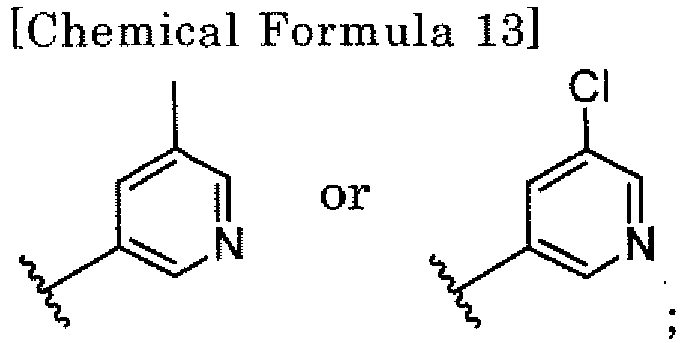
- R2' is a group represented by Formula:

- R3' is a group represented by Formula:


- or a pharmaceutically acceptable salt thereof.
- R1' is a group represented by Formula:
- (17") A compound, wherein
- the compound is selected from the group consisting of:
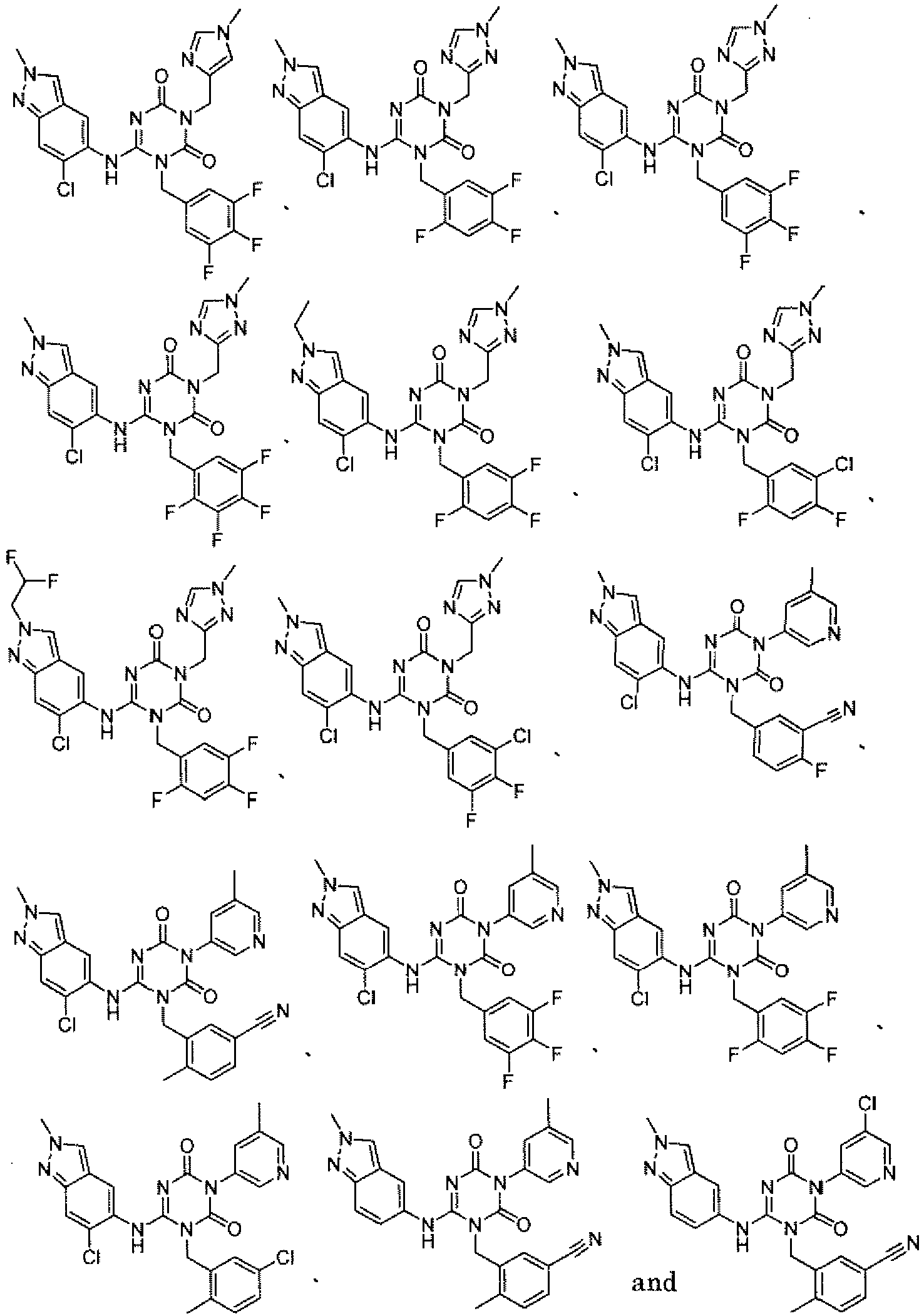
- or a pharmaceutically acceptable salt thereof.
- the compound is selected from the group consisting of:
- (18") A pharmaceutical composition comprising the compound according to any one of the above items(15") to (17"), or a pharmaceutically acceptable salt thereof.
- (19") A coronavirus 3CL protease inhibitor comprising the compound according to any one of the above items(15") to (17"), or a pharmaceutically acceptable salt thereof.
- (20") A coronavirus replication inhibitor comprising the compound according to any one of the above items (15") to (17"), or a pharmaceutically acceptable salt thereof.
- (21") The coronavirus replication inhibitor according to the above item (20"), wherein the coronavirus is an alpha coronavirus and/or beta coronavirus.
- (22") The coronavirus replication inhibitor according to the above item (20"), wherein the coronavirus is SARS-CoV-2.
- (24") The compound according to any one of the above items (15") to (17"),
or a pharmaceutically acceptable salt thereof for use in treating and/or preventing a disease associated with coronavirus 3CL proteases. -
- (15') A compound, wherein
Formula (I) is Formula (I'):
- R1' is a group represented by Formula:

- R2' is a group represented by Formula:


- R3' is a group represented by Formula:

- or a pharmaceutically acceptable salt thereof.
- R1' is a group represented by Formula:
- (16') A compound, wherein
Formula (I) is Formula (I'):
- R1' is a group represented by Formula:

- R2' is a group represented by Formula:


- R3' is a group represented by Formula:

- or a pharmaceutically acceptable salt thereof.
- R1' is a group represented by Formula:
- (17') A compound, wherein
- the compound is selected from the group consisting of:


- or a pharmaceutically acceptable salt thereof.
- the compound is selected from the group consisting of:
- (15) A pharmaceutical composition comprising the compound according to any one of the above items (15') to (17'),
or a pharmaceutically acceptable salt thereof. - (16) A coronavirus 3CL protease inhibitor comprising the compound according to any one of the above items (15') to (17'), or a pharmaceutically acceptable salt thereof.
- (17) A coronavirus replication inhibitor comprising the compound according to any one of the above items (15') to (17'), or a pharmaceutically acceptable salt thereof.
- (18) The coronavirus replication inhibitor according to the above item (17), wherein the coronavirus is an alphacoronavirus and/or betacoronavirus.
- (19) The coronavirus replication inhibitor according to the above item (17), wherein the coronavirus is SARS-CoV-2.
- (20) A pharmaceutical composition for preventing and/or treating coronavirus infections, the pharmaceutical composition comprising the compound according to any one of the above items (15') to (17'),
or a pharmaceutically acceptable salt thereof. - (21) The pharmaceutical composition according to the above item (20), for preventing and/or treating novel coronavirus infections (COVID-19).
- (22) The pharmaceutical composition according to the above item (20), for preventing and/or treating infections caused by SARS-CoV-2.
- (29) Use of the compound according to any one of the above items (15') to (17'), or a pharmaceutically acceptable salt thereof, for producing a therapeutic and/or prophylactic agent for a disease associated with coronavirus 3CL proteases.
- (30) Use of the compound according to any one of the above items (15') to (17'), or a pharmaceutically acceptable salt thereof, for producing a replication inhibitor for coronavirus.
- (31) The use according to the above item (30), wherein the coronavirus is an alphacoronavirus and/or betacoronavirus.
- (32) The use according to the above item (30), wherein the coronavirus is SARS-CoV-2.
- (33) Use of the compound according to any one of the above items (15') to (17'), or a pharmaceutically acceptable salt thereof, for producing a therapeutic and/or prophylactic agent for coronavirus infections.
- (34) The use according to the above item (33), wherein the coronavirus infections are novel coronavirus infections (COVID-19).
- (35) The use according to the above item (33), wherein the coronavirus infections are infections caused by SARS-CoV-2.
- (36) The compound according to any one of the above items (15') to (17'), or a pharmaceutically acceptable salt thereof, for use in the treatment and/or prevention of a disease associated with coronavirus 3CL proteases.
- (37) The compound according to any one of the above items (15') to (17'), or a pharmaceutically acceptable salt thereof, for use in the inhibition of replication of coronavirus.
- (37-1) The compound according to the above item (37), or a pharmaceutically acceptable salt thereof, wherein the coronavirus is an alphacoronavirus and/or betacoronavirus.
- (37-2) The compound according to the above item (37), or a pharmaceutically acceptable salt thereof, wherein the coronavirus is SARS-CoV-2.
- (38) The compound according to any one of the above items (15') to (17'), or a pharmaceutically acceptable salt thereof, for use in treating and/or preventing coronavirus infections.
- (39) The compound according to the above item (38), or a pharmaceutically acceptable salt thereof, wherein the coronavirus infections are novel coronavirus infections (COVID-19).
- (40) The compound according to the above item (38), or a pharmaceutically acceptable salt thereof, wherein the coronavirus infections are infections caused by SARS-CoV-2.
-
- (AA1) A compound represented by Formula:

- (AA1') A compound represented by Formula:

- (AA2) A pharmaceutical composition comprising the compound according to the above items (AA1) or (AA1'), or a pharmaceutically acceptable salt thereof.
- (AA3) A coronavirus 3CL protease inhibitor comprising the compound according to the above items (AA1) or (AA1'), or a pharmaceutically acceptable salt thereof.
- (AA4) A coronavirus replication inhibitor comprising the compound according to the above items (AA1) or (AA1'), or a pharmaceutically acceptable salt thereof.
- (AA5) The coronavirus replication inhibitor according to the above item (AA4), wherein the coronavirus is an alpha coronavirus and/or beta coronavirus.
- (AA6) The coronavirus replication inhibitor according to the above item (AA4), wherein the coronavirus is SARS-CoV-2.
- (AA8) The compound according to the above items (AA1) or (AA1'), or a pharmaceutically acceptable salt thereof for use in treating and/or preventing a disease associated with coronavirus 3CL proteases.
-
- (1A) A p-toluenesulfonate salt of a compound represented by Formula (I-A):

- (2A) A crystalline form of p-toluenesulfonate salt of a compound represented by Formula (I-A):

- (3A) The crystalline form of p-toluenesulfonate Form I according to the above item (2A), which exhibits a powder X-ray diffraction pattern having peaks at diffraction angles (20): 9.1 ± 0.2°, 15.2 ± 0.2°, 18.8 ± 0.2°, 23.6 ± 0.2° and 24.9 ± 0.2°.
- (4A) The crystalline form of p-toluenesulfonate Form I according to the above item (2A), which exhibits a powder X-ray diffraction pattern having peaks at diffraction angles (2θ): 9.1 ± 0.2°, 11.5 ± 0.2°, 14.6 ± 0.2°, 15.2 ± 0.2°, 18.8 ± 0.2°, 20.2 ± 0.2°, 23.6 ± 0.2°, 24.2 ± 0.2°, 24.9 ± 0.2° and 26.9 ± 0.2°.
- (5A) A pharmaceutical composition comprising the crystalline form according to any one of the above items (2A) to (4A).
- (6A) The crystalline form of p-toluenesulfonate Form I according to the above item (2A), whose crystallographic data when measured at 298 K is characterized by the following crystallographic data:
Space group: P-1




- (7A) The crystalline form of p-toluenesulfonate Form I according to the above item (2A), whose crystallographic data when measured at 298 K is substantially in accordance with the following crystallographic data:
Space group: P-1- a = 8.7844Å
- b = 10.2991Å
- c = 18.0182Å
- α = 103.727°
- β = 97.411°
- Y = 100.358°
- (8A) The crystalline form of p-toluenesulfonate Form I according to the above item (2A), characterized by a powder X-ray diffraction pattern substantially identical to that shown in
Fig. 1 . - (9A) A pharmaceutical composition compising the crystalline form according to any one of the above items (6A) to (8A).
-
- (1B) A complex comprising a compound represented by Formula (I-B):

- (2B) The complex according to the above item (1B), wherein the compound represented by Formula (I-B):

- (3B) A fumaric acid cocrystal according to the above item (1B) or (2B).
- (4B) The fumaric acid cocrystal Form I according to the above item (3B), which exhibits a powder X-ray diffraction pattern having peaks at diffraction angles (2θ): 9.5±0.2°, 10.9±0.2°, 18.6±0.2°, 23.5±0.2°, and 24.6±0.2°.
- (5B) The fumaric acid cocrystal Form I according to the above item (3B), which exhibits a powder X-ray diffraction pattern having peaks at diffraction angles (2θ): 7.8±0.2°, 9.5±0.2°, 10.1±0.2°, 10.9±0.2°, 13.8+0.2°, 14.7±0.2°, 18.6±0.2°, 22.6±0.2°, 23.5±0.2°, and 24.6±0.2°.
- (6B') The fumaric acid cocrystal Form I according to the above item (3B), which exhibits a Raman spectrum having Raman spectral peaks at 676.3cm-1±2cm-1, 748.0cm-1±2cm-1, 1029.3cm-1±2cm-1, 1374.4cm-1±2cm-1, 1515.5cm-1±2cm-1, 1665.7cm-1±2cm-1, 1715.7cmo-1±2cm-1, and 1739.1cm-1±2cm-1.
- (6B) A pharmaceutical composition comprising the cocrystal according to any one of the above items (3B) to (5B) and (6B').
- (7B) The fumaric acid cocrystal Form I according to the above item (3B), whose crystallographic data when measured at 298 K is characterized by the following crystallographic data:
Space group: P-1- a = 8.4ű0.5Å
- b = 11.7ű0.5Å
- c = 15.2ű0.5Å
- α = 83.8°±0.5°
- β = 78.9°±0.5°
- Y = 77.1°±0.5°
- (8B) The fumaric acid cocrystal Form I according to the above item (3B), whose crystallographic data when measured at 298 K is substantially in accordance with the following crystallographic data:
Space group: P-1- a = 8.4374Å
- b = 11.6780Å
- c = 15.1612Å
- α = 83.827°
- β = 78.868°
- Y = 77.147°
- (9B) The fumaric acid cocrystal Form I according to the above item (3B), characterized by spectrum(spectra) and/or a curve selected from the following (a) to (c):
- (a) a X ray powder diffraction spectrum substantially corresponding to
Figure 3 ; - (b) a Raman spectrum substantially corresponding to
Figure 5 ; - (c) a differential scanning calorimetry curve substantially corresponding to
Figure 6 .
- (a) a X ray powder diffraction spectrum substantially corresponding to
- (10B) A pharmaceutical composition comprising the cocrystal according to any one of the above items (7B) to (9B).
- The compound of the present invention has inhibitory activity against coronavirus 3CL proteases and is useful as a therapeutic(treating) agent and/or prophylactic(preventing) agent for coronavirus infections.
- Furthermore, among the compounds according to the present invention, Compound (I-0113) or Compound (I-0115) are useful as active pharmaceutical ingredients.
- In addition, a pharmaceutical composition comprising a crystalline form of p-toluenesulfonate of Compound (I-0113) or a fumaric acid cocrystal of Compound (I-0115) is highly useful as a therapeutic agent for novel coronavirus infections (COVID-19).
-
-
Fig. 1 shows a powder X-ray diffraction pattern of a crystalline form of p-toluenesulfonate Form I (Form I) of a compound represented by Formula (1-A). The axis of abscissa represents 2θ(°), and the axis of ordinate represents the intensity (Count). -
Fig. 2 shows a molecular structure in an asymmetric unit of the crystalline form of p-toluenesulfonate Form I of the compound represented by Formula (I-A). -
Fig. 3 shows a powder X-ray diffraction pattern of a fumaric acid cocrystal Form I (Form I) of the compound represented by Formula (I-B). The axis of abscissa represents 2θ(°), and the axis of ordinate represents the intensity (Count). -
Fig. 4 shows a molecular structure in an asymmetric unit of the fumaric acid cocrystal Form I (Form I) of the compound represented by Formula (I-B). -
Fig. 5 shows the Raman spectrum of the fumaric acid cocrystal Form I (Form I) of the compound represented by Formula (I-B). The axis of abscissa represents Raman shift (cm-1), and the axis of ordinate represents the peak intensity. -
Fig. 6 shows results of a DSC analysis of the fumaric acid cocrystal Form I (Form I) of the compound represented by Formula (I-B). The axis of abscissa represents temperature (°C), and the axis of ordinate represents the normalized heat flow (W/g). -
Fig. 7 shows a powder X-ray diffraction pattern of a crystalline form of potassium salt Form I (Form I) of the compound represented by Formula (I-B). The axis of abscissa represents 2θ(°), and the axis of ordinate represents the intensity (Count). -
Fig. 8 shows the Raman spectrum of the crystalline form of potassium salt Form I (Form I) of the compound represented by Formula (I-B). The axis of abscissa represents Raman shift (cm-1), and the axis of ordinate represents the peak intensity. -
Fig. 9 shows a powder X-ray diffraction pattern of a succinic acid cocrystal Form I (Form I) of the compound represented by Formula (I-B). The axis of abscissa represents 2θ(°), and the axis of ordinate represents the intensity (Count). -
Fig. 10 shows the Raman spectrum of the succinic acid cocrystal Form I (Form I) of the compound represented by Formula (I-B). The axis of abscissa represents Raman shift (cm-1), and the axis of ordinate represents the peak intensity. -
Fig. 11 shows a powder X-ray diffraction pattern of a crystalline form of anhydride Form I (Form I) of the compound represented by Formula (I-B). The axis of abscissa represents 2θ(°), and the axis of ordinate represents the intensity (Count). -
Fig. 12 shows the Raman spectrum of the crystalline form of anhydride Form I (Form I) of the compound represented by Formula (I-B). The axis of abscissa represents Raman shift (cm-1), and the axis of ordinate represents the peak intensity. -
Fig. 13 shows a powder X-ray diffraction pattern of a crystalline form of sodium salt Form I (Form I) of the compound represented by Formula (I-B). The axis of abscissa represents 2θ(°), and the axis of ordinate represents the intensity (Count). -
Fig. 14 shows the Raman spectrum of the crystalline form of sodium salt Form I (Form I) of the compound represented by Formula (I-B). The axis of abscissa represents Raman shift (cm-1), and the axis of ordinate represents the peak intensity. -
Fig. 15 shows results of a TG/DTA analysis of a crystalline form of sodium salt Form I (Form I) of the compound represented by Formula (I-B). The axis of ordinate represents the heat flow (µV) or the change in weight (%), and the axis of abscissa represents temperature (°C). Cel in the diagram means degree Celsius (°C). - Hereinafter, the meaning of each term used in the present specification will be described. Unless particularly stated otherwise, each term is used in the same sense, either alone or in combination with other terms.
- The term "consist of" means having only the constituent elements.
- The term "comprise" means that elements are not limited to the constituent elements, and elements that are not described are not excluded.
- Hereinafter, the present invention will be described while showing exemplary embodiments. Throughout the present specification, it should be understood that, unless particularly stated otherwise, an expression of a singular form also includes the concept of a plural form thereof. Therefore, it should be understood that, unless particularly stated otherwise, an article for a singular form (for example, in the case of English, "the", or the like) also includes the concept of a plural form thereof.
- Furthermore, it should be understood that, unless particularly stated otherwise, the terms used in the present specification are used in the meanings normally used in the above-described art. Accordingly, unless otherwise defined, all terminologies and scientific and technical terms used in the present specification have the same meanings as commonly understood by those having ordinary skill in the art to which the present invention belongs. In a case of contradiction, priority is given to the present specification (including definitions).
- "Halogen" includes a fluorine atom, a chlorine atom, a bromine atom, and an iodine atom. Particularly, a fluorine atom and a chlorine atom are preferred.
- "Alkyl" includes linear or branched hydrocarbon groups each having 1 to 15 carbon atoms, preferably 1 to 10 carbon atoms, more preferably 1 to 6 carbon atoms, and even more preferably 1 to 4 carbon atoms. Examples include methyl, ethyl, n-propyl, isopropyl, n-butyl, isobutyl, sec-butyl, tert-butyl, n-pentyl, isopentyl, neopentyl, n-hexyl, isohexyl, n-heptyl, isoheptyl, n-octyl, isooctyl, n-nonyl, and n-decyl.
- Preferred embodiments of "alkyl" include methyl, ethyl, n-propyl, isopropyl, n-butyl, isobutyl, sec-butyl, tert-butyl, and n-pentyl. More preferred embodiments include methyl, ethyl, n-propyl, isopropyl, and tert-butyl.
- "Alkenyl" includes linear or branched hydrocarbon groups each having one or more double bonds at any position and having 2 to 15 carbon atoms, preferably 2 to 10 carbon atoms, more preferably 2 to 6 carbon atoms, and even more preferably 2 to 4 carbon atoms. Examples include vinyl, allyl, propenyl, isopropenyl, butenyl, isobutenyl, prenyl, butadienyl, pentenyl, isopentenyl, pentadienyl, hexenyl, isohexenyl, hexadienyl, heptenyl, octenyl, nonenyl, decenyl, undecenyl, dodecenyl, tridecenyl, tetradecenyl, and pentadecenyl.
- Preferred embodiments of "alkenyl" include vinyl, allyl, propenyl, isopropenyl, and butenyl. More preferred embodiments include ethenyl and n-propenyl.
- "Alkynyl" includes linear or branched hydrocarbon groups each having one or more triple bonds at any position and having 2 to 10 carbon atoms, preferably 2 to 8 carbon atoms, more preferably 2 to 6 carbon atoms, and even more preferably 2 to 4 carbon atoms. Alkynyl may further have a double bond at any position. Examples include ethynyl, propynyl, butynyl, pentynyl, hexynyl, heptynyl, octynyl, nonynyl, and decynyl.
- Preferred embodiments of "alkynyl" include ethynyl, propynyl, butynyl, and pentynyl. More preferred embodiments include ethynyl and propynyl.
- "Aromatic carbocyclyl" means a cyclic aromatic hydrocarbon group having a single ring or two or more rings. Examples include phenyl, naphthyl, anthryl, and phenanthryl. Examples of 6-membered aromatic carbocyclyl include phenyl. Examples of 10-membered aromatic carbocyclyl include naphthyl. Examples of 14-membered aromatic carbocyclyl include anthryl and phenanthryl.
- Preferred embodiments of the "aromatic carbocyclyl" include phenyl.
- "Aromatic carbocycle" means a ring derived from the above-described "aromatic carbocyclyl".
- "Non-aromatic carbocyclyl" means a cyclic saturated hydrocarbon group or a cyclic non-aromatic unsaturated hydrocarbon group, both having a single ring or two or more rings. The "non-aromatic carbocyclyl" having two or more rings also includes a non-aromatic carbocyclyl having a single ring or two or more rings, to which the ring in the "aromatic carbocyclyl" is fused.
- Furthermore, the "non-aromatic carbocyclyl" also includes a bridged group or a group forming a spiro ring, such as follows.

- A non-aromatic carbocyclyl having a single ring preferably has 3 to 16 carbon atoms, more preferably 3 to 12 carbon atoms, and even more preferably 4 to 8 carbon atoms. Examples include cyclopropyl, cyclobutyl, cyclopentyl, cyclohexyl, cycloheptyl, cyclooctyl, cyclononyl, cyclodecyl, cyclopropenyl, cyclobutenyl, cyclopentenyl, cyclohexenyl, cycloheptenyl, and cyclohexadienyl. Examples of 5-membered non-aromatic carbocyclyl include cyclopentyl and cyclopentenyl. Examples of 6-membered non-aromatic carbocyclyl include cyclohexyl, cyclohexenyl, and cyclohexadienyl.
- A non-aromatic carbocyclyl having two or more rings preferably has 4 to 20 carbon atoms, and more preferably 8 to 16 carbon atoms. Examples include indanyl, indenyl, acenaphthyl, tetrahydronaphthyl, and fluorenyl. Examples of 4-membered non-aromatic carbocyclyl include bicyclo[1.1.1]pentyl. Examples of 9-membered non-aromatic carbocyclyl include indanyl and indenyl. Examples of 10-membered non-aromatic carbocyclyl include dihydronaphthyl and tetrahydronaphthyl.
- "Non-aromatic carbocycle" means a ring derived from the above-described "non-aromatic carbocyclyl".
- "Aromatic heterocyclyl" means an aromatic cyclyl having a single ring or two or more rings, which has one or more identical or different heteroatoms optionally selected from O, S, and N in the ring(s).
- An aromatic heterocyclyl having two or more rings also includes an aromatic heterocyclyl having a single ring or two or more rings, to which a ring in the "aromatic carbocyclyl" is fused, and the linking bond may be carried by any of the rings.
- The aromatic heterocyclyl having a single ring is preferably a 5- to 8-membered ring, and more preferably a 5-membered or 6-membered ring. Examples of 5-membered aromatic heterocyclyl include pyrrolyl, imidazolyl, pyrazolyl, triazolyl, tetrazolyl, furyl, thienyl, isoxazolyl, oxazolyl, oxadiazolyl, isothiazolyl, thiazolyl, and thiadiazolyl. Examples of 6-membered aromatic heterocyclyl include pyridyl, pyridazinyl, pyrimidinyl, pyrazinyl, and triazinyl.
- The aromatic heterocyclyl having two rings is preferably an 8- to 10-membered ring, and more preferably a 9-membered or 10-membered ring. Examples include indolyl, isoindolyl, indazolyl, indolizinyl, quinolinyl, isoquinolinyl, cinnolinyl, phthalazinyl, quinazolinyl, naphthyridinyl, quinoxalinyl, purinyl, pteridinyl, benzimidazolyl, benzisoxazolyl, benzoxazolyl, benzoxadiazolyl, benzisothiazolyl, benzothiazolyl, benzothiadiazolyl, benzofuryl, isobenzofuryl, benzothienyl, benzotriazolyl, imidazopyridyl, triazolopyridyl, imidazothiazolyl, pyrazinopyridazinyl, oxazolopyridyl, and thiazolopyridyl. Examples of 9-membered aromatic heterocyclyl include indolyl, isoindolyl, indazolyl, indolizinyl, purinyl, benzimidazolyl, benzisoxazolyl, benzoxazolyl, benzoxadiazolyl, benzisothiazolyl, benzothiazolyl, benzothiadiazolyl, benzotriazolyl, benzofuranyl, imidazopyridyl, triazolopyridyl, oxazolopyridyl, and thiazolopyridyl. Examples of 10-membered aromatic heterocyclyl include quinolinyl, isoquinolinyl, cinnolinyl, phthalazinyl, quinazolinyl, naphthyridinyl, quinoxalinyl, pteridinyl, and pyrazinopyridazinyl.
- An aromatic heterocyclyl having three or more rings is preferably a 13- to 15-membered group. Examples include carbazolyl, acridinyl, xanthenyl, phenothiazinyl, phenoxathiinyl, phenoxazinyl, and dibenzofuryl.
- "Aromatic heterocycle" means a ring derived from the above-described "aromatic heterocyclyl".
- "Non-aromatic heterocyclyl" means a non-aromatic cyclyl having a single ring or two or more rings, which has one or more identical or different heteroatoms optionally selected from O, S, and N in the ring(s). A non-aromatic heterocyclyl having two or more rings also includes a non-aromatic heterocyclyl having a single ring or two or more rings, to which a ring in each of the "aromatic carbocyclyl", "non-aromatic carbocyclyl", and/or "aromatic heterocyclyl" is fused, as well as a non-aromatic carbocyclyl having a single ring or two or more rings, to which a ring in the "aromatic heterocyclyl" is fused, and the linking bond may be carried by any of the rings.
- Furthermore, the "non-aromatic heterocyclyl" also includes a bridged group or a group forming a spiro ring, such as follows.

- The non-aromatic heterocyclyl having a single ring is preferably a 3- to 8-membered ring, and more preferably a 5-membered or 6-membered ring.
- Examples of 3-membered non-aromatic heterocyclyl include thiiranyl, oxiranyl, and aziridinyl. Examples of 4-membered non-aromatic heterocyclyl include oxetanyl and azetidinyl. Examples of 5-membered non-aromatic heterocyclyl include oxathiolanyl, thiazolidinyl, pyrrolidinyl, pyrrolinyl, imidazolidinyl, imidazolinyl, pyrazolidinyl, pyrazolinyl, tetrahydrofuryl, dihydrothiazolyl, tetrahydroisothiazolyl, dioxolanyl, dioxolyl, and thiolanyl. Examples of 6-membered non-aromatic heterocyclyl include dioxanyl, thianyl, piperidyl, piperazinyl, morpholinyl, morpholino, thiomorpholinyl, thiomorpholino, dihydropyridyl, tetrahydropyridyl, tetrahydropyranyl, dihydroxazinyl, tetrahydropyridazinyl, hexahydropyrimidinyl, dioxazinyl, thiinyl, and thiazinyl. Examples of 7-membered non-aromatic heterocyclyl include hexahydroazepinyl, tetrahydrodiazepinyl, and oxepanyl.
- The non-aromatic heterocyclyl having two or more rings is preferably an 8- to 20-membered ring, more preferably an 8- to 13-membered ring, and even more preferably an 8- to 10-membered ring. Examples include indolinyl, isoindolinyl, chromanyl, and isochromanyl. Examples of 9-membered non-aromatic heterocyclyl include indolinyl and isoindolinyl. Examples of 10-membered non-aromatic heterocyclyl include chromanyl and isochromanyl.
- "Non-aromatic heterocycle" means a ring derived from the above-described "non-aromatic heterocyclyl".
- "Trialkylsilyl" means a group in which three moieties of the above-described "alkyl" are bonded to a silicon atom. The three alkyl groups may be identical or different. Examples include trimethylsilyl, triethylsilyl, and tert-butyldimethylsilyl.
- "Cyclylsulfoxyiminyl" means a group in which two carbon atoms which bind to sulfur atom of sulfoxyiminyl group, together with the sulfur atom to which two carbon atoms are bonded, form non-aromatic heterocycle. Examples include the following group.

- In the present specification, the phrase "may be substituted with substituent group α" means that "may be substituted with one or more group(s) selected from substituent group α". The same also applies to substituent groups β, γ, and γ'.
- Substituents for "substituted alkyl", "substituted alkenyl", "substituted alkynyl", "substituted alkyloxy", "substituted alkenyloxy", "substituted alkynyloxy", "substituted alkylcarbonyloxy", "substituted alkenylcarbonyloxy", "substituted alkynylcarbonyloxy", "substituted alkylcarbonyl", "substituted alkenylcarbonyl", "substituted alkynylcarbonyl", "substituted alkyloxycarbonyl", "substituted alkenyloxycarbonyl", "substituted alkynyloxycarbonyl", "substituted alkylsulfanyl", "substituted alkenylsulfanyl", "substituted alkynylsulfanyl", "substituted alkylsulfinyl", "substituted alkenylsulfinyl", "substituted alkynylsulfinyl", "substituted alkylsulfonyl", "substituted alkenylsulfonyl", "substituted alkynylsulfonyl", "substituted dialkylsulfoxyimino", and the like include the following substituent group A. A carbon atom at any position may be bonded to one or more group(s) selected from the following substituent group A.
- Substituent group A: halogen, hydroxy, carboxy, formyl, formyloxy, sulfanyl, sulfino, sulfo, thioformyl, thiocarboxy, dithiocarboxy, thiocarbamoyl, cyano, nitro, nitroso, azido, hydrazino, ureido, amidino, guanidino, pentafluorothio, trialkylsilyl,
- alkyloxy which may be substituted with substituent group α, alkenyloxy which may be substituted with substituent group α, alkynyloxy which may be substituted with substituent group α, alkylcarbonyloxy which may be substituted with substituent group α, alkenylcarbonyloxy which may be substituted with substituent group α, alkynylcarbonyloxy which may be substituted with substituent group α, alkylcarbonyl which may be substituted with substituent group α, alkenylcarbonyl which may be substituted with substituent group α, alkynylcarbonyl which may be substituted with substituent group α, alkyloxycarbonyl which may be substituted with substituent group α, alkenyloxycarbonyl which may be substituted with substituent group α, alkynyloxycarbonyl which may be substituted with substituent group α, alkylsulfanyl which may be substituted with substituent group α, alkenylsulfanyl which may be substituted with substituent group α, alkynylsulfanyl which may be substituted with substituent group α, alkylsulfinyl which may be substituted with substituent group α, alkenylsulfinyl which may be substituted with substituent group α, alkynylsulfinyl which may be substituted with substituent group α, alkylsulfonyl which may be substituted with substituent group α, alkenylsulfonyl which may be substituted with substituent group α, alkynylsulfonyl which may be substituted with substituent group α,
- amino which may be substituted with substituent group β, imino which may be substituted with substituent group β, carbamoyl which may be substituted with substituent group β, sulfamoyl which may be substituted with substituent group β,
- aromatic carbocyclyl which may be substituted with substituent group γ, non-aromatic carbocyclyl which may be substituted with substituent group γ', aromatic heterocyclyl which may be substituted with substituent group γ, non-aromatic heterocyclyl which may be substituted with substituent group y', aromatic carbocyclyloxy which may be substituted with substituent group γ, non-aromatic carbocyclyloxy which may be substituted with substituent group γ', aromatic heterocyclyloxy which may be substituted with substituent group γ, non-aromatic heterocyclyloxy which may be substituted with substituent group γ', aromatic carbocyclylcarbonyloxy which may be substituted with substituent group γ, non-aromatic carbocyclylcarbonyloxy which may be substituted with substituent group γ', aromatic heterocyclylcarbonyloxy which may be substituted with substituent group γ, non-aromatic heterocyclylcarbonyloxy which may be substituted with substituent group γ', aromatic carbocyclylcarbonyl which may be substituted with substituent group γ, non-aromatic carbocyclylcarbonyl which may be substituted with substituent group γ', aromatic heterocyclylcarbonyl which may be substituted with substituent group γ, non-aromatic heterocyclylcarbonyl which may be substituted with substituent group γ', aromatic carbocyclyloxycarbonyl which may be substituted with substituent group γ, non-aromatic carbocyclyloxycarbonyl which may be substituted with substituent group γ', aromatic heterocyclyloxycarbonyl which may be substituted with substituent group γ, non-aromatic heterocyclyloxycarbonyl which may be substituted with substituent group y', aromatic carbocyclylalkyloxy which may be substituted with substituent group γ, non-aromatic carbocyclylalkyloxy which may be substituted with substituent group y', aromatic heterocyclylalkyloxy which may be substituted with substituent group γ, non-aromatic heterocyclylalkyloxy which may be substituted with substituent group y', aromatic carbocyclylalkyloxycarbonyl which may be substituted with substituent group γ, non-aromatic carbocyclylalkyloxycarbonyl which may be substituted with substituent group y', aromatic heterocyclylalkyloxycarbonyl which may be substituted with substituent group γ, non-aromatic heterocyclylalkyloxycarbonyl which may be substituted with substituent group y', aromatic carbocyclylsulfanyl which may be substituted with substituent group γ, non-aromatic carbocyclylsulfanyl which may be substituted with substituent group y', aromatic heterocyclylsulfanyl which may be substituted with substituent group γ, non-aromatic heterocyclylsulfanyl which may be substituted with substituent group y', aromatic carbocyclylsulfinyl which may be substituted with substituent group γ, non-aromatic carbocyclylsulfinyl which may be substituted with substituent group γ', aromatic heterocyclylsulfinyl which may be substituted with substituent group γ, non-aromatic heterocyclylsulfinyl which may be substituted with substituent group y', aromatic carbocyclylsulfonyl which may be substituted with substituent group γ, non-aromatic carbocyclylsulfonyl which may be substituted with substituent group y', aromatic heterocyclylsulfonyl which may be substituted with substituent group γ, and non-aromatic heterocyclylsulfonyl which may be substituted with substituent group y'.
- Substituent group α: halogen, hydroxy, carboxy, alkyloxy, haloalkyloxy, alkenyloxy, alkynyloxy, sulfanyl, and cyano.
- Substituent group β: halogen, hydroxy, carboxy, cyano, alkyl which may be substituted with substituent group α, alkenyl which may be substituted with substituent group α, alkynyl which may be substituted with substituent group α, alkylcarbonyl which may be substituted with substituent group α, alkenylcarbonyl which may be substituted with substituent group α, alkynylcarbonyl which may be substituted with substituent group α, alkylsulfanyl which may be substituted with substituent group α, alkenylsulfanyl which may be substituted with substituent group α, alkynylsulfanyl which may be substituted with substituent group α, alkylsulfinyl which may be substituted with substituent group α, alkenylsulfinyl which may be substituted with substituent group α, alkynylsulfinyl which may be substituted with substituent group α, alkylsulfonyl which may be substituted with substituent group α, alkenylsulfonyl which may be substituted with substituent group α, alkynylsulfonyl which may be substituted with substituent group α,
aromatic carbocyclyl which may be substituted with substituent group γ, non-aromatic carbocyclyl which may be substituted with substituent group y', aromatic heterocyclyl which may be substituted with substituent group γ, non-aromatic heterocyclyl which may be substituted with substituent group γ', aromatic carbocyclylalkyl which may be substituted with substituent group γ, non-aromatic carbocyclylalkyl which may be substituted with substituent group y', aromatic heterocyclylalkyl which may be substituted with substituent group γ, non-aromatic heterocyclylalkyl which may be substituted with substituent group y', aromatic carbocyclylcarbonyl which may be substituted with substituent group γ, non-aromatic carbocyclylcarbonyl which may be substituted with substituent group y', aromatic heterocyclylcarbonyl which may be substituted with substituent group γ, non-aromatic heterocyclylcarbonyl which may be substituted with substituent group y', aromatic carbocyclyloxycarbonyl which may be substituted with substituent group γ, non-aromatic carbocyclyloxycarbonyl which may be substituted with substituent group y', aromatic heterocyclyloxycarbonyl which may be substituted with substituent group γ, non-aromatic heterocyclyloxycarbonyl which may be substituted with substituent group γ', aromatic carbocyclylsulfanyl which may be substituted with substituent group γ, non-aromatic carbocyclylsulfanyl which may be substituted with substituent group y', aromatic heterocyclylsulfanyl which may be substituted with substituent group γ, non-aromatic heterocyclylsulfanyl which may be substituted with substituent group y', aromatic carbocyclylsulfinyl which may be substituted with substituent group γ, non-aromatic carbocyclylsulfinyl which may be substituted with substituent group y', aromatic heterocyclylsulfinyl which may be substituted with substituent group γ, non-aromatic heterocyclylsulfinyl which may be substituted with substituent group γ', aromatic carbocyclylsulfonyl which may be substituted with substituent group γ, non-aromatic carbocyclylsulfonyl which may be substituted with substituent group γ', aromatic heterocyclylsulfonyl which may be substituted with substituent group γ, and non-aromatic heterocyclylsulfonyl which may be substituted with substituent group γ'. - Substituent group γ: substituent group α, alkyl, haloalkyl, hydroxyalkyl, alkenyl, alkynyl, alkylcarbonyl, haloalkylcarbonyl, alkenylcarbonyl, and alkynylcarbonyl.
- Substituent group y': substituent group γ and oxo.
- The substituents on the rings of "aromatic carbocycle" and "aromatic heterocycle", such as "substituted aromatic carbocyclyl", "substituted aromatic heterocyclyl", "substituted aromatic carbocyclyloxy", "substituted aromatic heterocyclyloxy", "substituted aromatic carbocyclylcarbonyloxy", "substituted aromatic heterocyclylcarbonyloxy", "substituted aromatic carbocyclylcarbonyl", "substituted aromatic heterocyclylcarbonyl", "substituted aromatic carbocyclyloxycarbonyl", "substituted aromatic heterocyclyloxycarbonyl", "substituted aromatic carbocyclylsulfanyl", "substituted aromatic heterocyclylsulfanyl", "substituted aromatic carbocyclylsulfinyl", "substituted aromatic heterocyclylsulfinyl", "substituted aromatic carbocyclylsulfonyl", and "substituted aromatic heterocyclylsulfonyl" include the following substituent group B. An atom at any position on the ring may be bonded to one or more group(s) selected from the following substituent group B.
- Substituent group B: halogen, hydroxy, carboxy, formyl, formyloxy, sulfanyl, sulfino, sulfo, thioformyl, thiocarboxy, dithiocarboxy, thiocarbamoyl, cyano, nitro, nitroso, azido, hydrazino, ureido, amidino, guanidino, pentafluorothio, trialkylsilyl,
- alkyl which may be substituted with substituent group α, alkenyl which may be substituted with substituent group α, alkynyl which may be substituted with substituent group α, alkyloxy which may be substituted with substituent group α, alkenyloxy which may be substituted with substituent group α, alkynyloxy which may be substituted with substituent group α, alkylcarbonyloxy which may be substituted with substituent group α, alkenylcarbonyloxy which may be substituted with substituent group α, alkynylcarbonyloxy which may be substituted with substituent group α, alkylcarbonyl which may be substituted with substituent group α, alkenylcarbonyl which may be substituted with substituent group α, alkynylcarbonyl which may be substituted with substituent group α, alkyloxycarbonyl which may be substituted with substituent group α, alkenyloxycarbonyl which may be substituted with substituent group α, alkynyloxycarbonyl which may be substituted with substituent group α, alkylsulfanyl which may be substituted with substituent group α, alkenylsulfanyl which may be substituted with substituent group α, alkynylsulfanyl which may be substituted with substituent group α, alkylsulfinyl which may be substituted with substituent group α, alkenylsulfinyl which may be substituted with substituent group α, alkynylsulfinyl which may be substituted with substituent group α, alkylsulfonyl which may be substituted with substituent group α, alkenylsulfonyl which may be substituted with substituent group α, alkynylsulfonyl which may be substituted with substituent group α,
- amino which may be substituted with substituent group β, imino which may be substituted with substituent group β, carbamoyl which may be substituted with substituent group β, sulfamoyl which may be substituted with substituent group β,
- aromatic carbocyclyl which may be substituted with substituent group γ', non-aromatic carbocyclyl which may be substituted with substituent group γ', aromatic heterocyclyl which may be substituted with substituent group γ, non-aromatic heterocyclyl which may be substituted with substituent group γ', aromatic carbocyclyloxy which may be substituted with substituent group γ, non-aromatic carbocyclyloxy which may be substituted with substituent group γ', aromatic heterocyclyloxy which may be substituted with substituent group γ, non-aromatic heterocyclyloxy which may be substituted with substituent group γ', aromatic carbocyclylcarbonyloxy which may be substituted with substituent group γ, non-aromatic carbocyclylcarbonyloxy which may be substituted with substituent group γ', aromatic heterocyclylcarbonyloxy which may be substituted with substituent group γ, and non-aromatic heterocyclylcarbonyloxy which may be substituted with substituent group y', aromatic carbocyclylcarbonyl which may be substituted with substituent group γ, non-aromatic carbocyclylcarbonyl which may be substituted with substituent group y', aromatic heterocyclylcarbonyl which may be substituted with substituent group γ, non-aromatic heterocyclylcarbonyl which may be substituted with substituent group y', aromatic carbocyclyloxycarbonyl which may be substituted with substituent group γ, non-aromatic carbocyclyloxycarbonyl which may be substituted with substituent group y', aromatic heterocyclyloxycarbonyl which may be substituted with substituent group γ, non-aromatic heterocyclyloxycarbonyl which may be substituted with substituent group y', aromatic carbocyclylalkyl which may be substituted with substituent group γ, non-aromatic carbocyclylalkyl which may be substituted with substituent group y', aromatic heterocyclylalkyl which may be substituted with substituent group γ, non-aromatic heterocyclylalkyl which may be substituted with substituent group y', aromatic carbocyclylalkyloxy which may be substituted with substituent group γ, non-aromatic carbocyclylalkyloxy which may be substituted with substituent group y', aromatic heterocyclylalkyloxy which may be substituted with substituent group γ, non-aromatic heterocyclylalkyloxy which may be substituted with substituent group γ', aromatic carbocyclylalkyloxycarbonyl which may be substituted with substituent group γ, non-aromatic carbocyclylalkyloxycarbonyl which may be substituted with substituent group γ', aromatic heterocyclylalkyloxycarbonyl which may be substituted with substituent group γ, non-aromatic heterocyclylalkyloxycarbonyl which may be substituted with substituent group y', aromatic carbocyclylalkyloxyalkyl which may be substituted with substituent group γ, non-aromatic carbocyclylalkyloxyalkyl which may be substituted with substituent group y', aromatic heterocyclylalkyloxyalkyl which may be substituted with substituent group γ, non-aromatic heterocyclylalkyloxyalkyl which may be substituted with substituent group y', aromatic carbocyclylsulfanyl which may be substituted with substituent group γ, non-aromatic carbocyclylsulfanyl which may be substituted with substituent group y', aromatic heterocyclylsulfanyl which may be substituted with substituent group γ, non-aromatic heterocyclylsulfanyl which may be substituted with substituent group y', aromatic carbocyclylsulfinyl which may be substituted with substituent group γ, non-aromatic carbocyclylsulfinyl which may be substituted with substituent group y', aromatic heterocyclylsulfinyl which may be substituted with substituent group γ, non-aromatic heterocyclylsulfinyl which may be substituted with substituent group y', aromatic carbocyclylsulfonyl which may be substituted with substituent group γ, non-aromatic carbocyclylsulfonyl which may be substituted with substituent group y', aromatic heterocyclylsulfonyl which may be substituted with substituent group γ, and non-aromatic heterocyclylsulfonyl which may be substituted with substituent group y'.
- The substituents on the ring of "non-aromatic carbocycle" and "non-aromatic heterocycle" of "substituted non-aromatic carbocyclyl", "substituted non-aromatic heterocyclyl", "substituted non-aromatic carbocyclyloxy", "substituted non-aromatic heterocyclyloxy", "substituted non-aromatic carbocyclylcarbonyloxy", "substituted non-aromatic heterocyclylcarbonyloxy", "substituted non-aromatic carbocyclylcarbonyl", "substituted non-aromatic heterocyclylcarbonyl", "substituted non-aromatic carbocyclyloxycarbonyl", "substituted non-aromatic heterocyclyloxycarbonyl", "substituted non-aromatic carbocyclylsulfanyl", "substituted non-aromatic heterocyclylsulfanyl", "substituted non-aromatic carbocyclylsulfinyl", "substituted non-aromatic heterocyclylsulfinyl", "substituted non-aromatic carbocyclylsulfonyl", "substituted non-aromatic heterocyclylsulfonyl", "substituted or unsubstituted non-aromatic carbocycle formed by R4a and R4b together", and "substituted or unsubstituted non-aromatic heterocycle formed by R4a and R4b together" include the following substituent group C. An atom at any position on the ring may be bonded to one or more group(s) selected from the following substituent group C.
- Substituent group C: substituent group B and oxo.
- When the "non-aromatic carbocycle" and the "non-aromatic heterocycle" are substituted with "oxo", this means a ring in which two hydrogen atoms on a carbon atom are substituted as follows.

- The substituents for "substituted amino", "substituted imino", "substituted carbamoyl", and "substituted sulfamoyl" include the following substituent group D. These moieties may be substituted with one or two group(s) selected from substituent group D.
- Substituent group D: halogen, hydroxy, carboxy, cyano, alkyl which may be substituted with substituent group α, alkenyl which may be substituted with substituent group α, alkynyl which may be substituted with substituent group α, alkylcarbonyl which may be substituted with substituent group α, alkenylcarbonyl which may be substituted with substituent group α, alkynylcarbonyl which may be substituted with substituent group α, alkylsulfanyl which may be substituted with substituent group α, alkenylsulfanyl which may be substituted with substituent group α, alkynylsulfanyl which may be substituted with substituent group α, alkylsulfinyl which may be substituted with substituent group α, alkenylsulfinyl which may be substituted with substituent group α, alkynylsulfinyl which may be substituted with substituent group α, alkylsulfonyl which may be substituted with substituent group α, alkenylsulfonyl which may be substituted with substituent group α, alkynylsulfonyl which may be substituted with substituent group α,
- amino which may be substituted with substituent group β, imino which may be substituted with substituent group β, carbamoyl which may be substituted with substituent group β, sulfamoyl which may be substituted with substituent group β,
- aromatic carbocyclyl which may be substituted with substituent group γ, non-aromatic carbocyclyl which may be substituted with substituent group γ', aromatic heterocyclyl which may be substituted with substituent group γ, non-aromatic heterocyclyl which may be substituted with substituent group γ', aromatic carbocyclylalkyl which may be substituted with substituent group γ, non-aromatic carbocyclylalkyl which may be substituted with substituent group γ', aromatic heterocyclylalkyl which may be substituted with substituent group γ, non-aromatic heterocyclylalkyl which may be substituted with substituent group γ', aromatic carbocyclylcarbonyl which may be substituted with substituent group γ, non-aromatic carbocyclylcarbonyl which may be substituted with substituent group γ', aromatic heterocyclylcarbonyl which may be substituted with substituent group γ, non-aromatic heterocyclylcarbonyl which may be substituted with substituent group γ', aromatic carbocyclyloxycarbonyl which may be substituted with substituent group γ, non-aromatic carbocyclyloxycarbonyl which may be substituted with substituent group γ', aromatic heterocyclyloxycarbonyl which may be substituted with substituent group γ, non-aromatic heterocyclyloxycarbonyl which may be substituted with substituent group γ', aromatic carbocyclylsulfanyl which may be substituted with substituent group γ, non-aromatic carbocyclylsulfanyl which may be substituted with substituent group γ', aromatic heterocyclylsulfanyl which may be substituted with substituent group γ, non-aromatic heterocyclylsulfanyl which may be substituted with substituent group γ', aromatic carbocyclylsulfinyl which may be substituted with substituent group γ, non-aromatic carbocyclylsulfinyl which may be substituted with substituent group γ', aromatic heterocyclylsulfinyl which may be substituted with substituent group γ, non-aromatic heterocyclylsulfinyl which may be substituted with substituent group γ', aromatic carbocyclylsulfonyl which may be substituted with substituent group γ, non-aromatic carbocyclylsulfonyl which may be substituted with substituent group γ', aromatic heterocyclylsulfonyl which may be substituted with substituent group γ, and non-aromatic heterocyclylsulfonyl which may be substituted with substituent group γ'.
- Examples of the substituents of the "substituted or unsubstituted aromatic heterocyclyl" in R1 include:
- halogen; cyano; hydroxy;
- substituted or unsubstituted alkyl;
- substituted or unsubstituted alkyloxy;
- substituted or unsubstituted alkyloxycarbonyl;
- substituted or unsubstituted aromatic carbocyclyl. It may be substituted with one or more group(s) selected from these.
- Examples of the substituents of the "substituted or unsubstituted aromatic heterocyclyl" in R1 include:
- halogen; cyano; hydroxy;
- substituted alkyl (Examples of the substituents include halogen, hydroxy, carbamoyl,
- aromatic carbocyclyl, non-aromatic carbocyclyl); unsubstituted alkyl;
- unsubstituted alkyloxy;
- unsubstituted alkyloxycarbonyl;
- unsubstituted aromatic carbocyclyl. It may be substituted with one or more group(s) selected from these.
- Examples of the substituents of the "substituted or unsubstituted aromatic carbocyclyl" in R2 include:
- halogen; cyano;
- substituted or unsubstituted alkyl; substituted or unsubstituted alkyloxy. It may be substituted with one or more group(s) selected from these.
- Examples of the substituents of the "substituted or unsubstituted aromatic carbocyclyl" in R2 include:
- halogen; cyano;
- substituted alkyl (Examples of the substituents include halogen); unsubstituted alkyl;
- substituted alkyloxy (Examples of the substituents include halogen, aromatic carbocyclyl); unsubstituted alkyloxy. It may be substituted with one or more group(s) selected from these.
- Examples of the substituents of the "substituted or unsubstituted aromatic heterocyclyl" in R3 include:
- halogen; hydroxy;
- substituted or unsubstituted alkyl;
- substituted or unsubstituted alkyloxy;
- substituted or unsubstituted amino;
- substituted or unsubstituted non-aromatic carbocyclyl;
- substituted or unsubstituted non-aromatic heterocyclyl. It may be substituted with one or more group(s) selected from these.
- Examples of the substituents of the "substituted or unsubstituted aromatic heterocyclyl" in R3 include:
- halogen; hydroxy;
- substituted alkyl (Examples of the substituents include halogen, hydroxy, alkyloxy, haloalkyloxy, alkylamino, alkylcarbonylamino, alkylcarbamoyl, alkylsulfonyl, non-aromatic carbocyclyl, non-aromatic heterocyclyl); unsubstituted alkyl;
- unsubstituted alkyloxy;
- substituted amino (Examples of the substituents include alkyl, alkylcarbonyl, alkyloxycarbonyl); unsubstituted amino;
- substituted non-aromatic carbocyclyl (Examples of the substituents include halogen, hydroxy); unsubstituted non-aromatic carbocyclyl;
- substituted non-aromatic heterocyclyl (Examples of the substituents include alkylcarbonyl); unsubstituted non-aromatic heterocyclyl. It may be substituted with one or more group(s) selected from these.
- Examples of the substituents of the "substituted or unsubstituted aromatic heterocyclyl" in R1 include:
- halogen;
- cyano;
- hydroxy;
- substituted or unsubstituted alkyl;
- substituted or unsubstituted alkynyl;
- substituted or unsubstituted alkyloxy;
- substituted or unsubstituted amino;
- substituted or unsubstituted alkyloxycarbonyl;
- substituted or unsubstituted aromatic carbocyclyl;
- substituted or unsubstituted non-aromatic carbocyclyl;
- substituted or unsubstituted aromatic heterocyclyl. It may be substituted with one or more group(s) selected from these.
- Examples of the substituents of the "substituted or unsubstituted aromatic heterocyclyl" in R1 include:
- halogen;
- cyano;
- hydroxy;
- substituted alkyl (Examples of the substituents include halogen, hydroxy, alkyloxy, alkyloxycarbonyl, carbamoyl; optionally substituted with one or more group(s) selected from these); unsubstituted alkyl;
- unsubstituted alkynyl;
- unsubstituted alkyloxy;
- substituted amino (Examples of the substituents include alkyl); unsubstituted amino; unsubstituted alkyloxycarbonyl;
- unsubstituted aromatic carbocyclyl;
- unsubstituted non-aromatic carbocyclyl;
- substituent aromatic heterocyclyl (Examples of the substituents include alkyl); It may be substituted with one or more group(s) selected from these.
- In one embodiment, examples of the substituents of the "substituted or unsubstituted aromatic heterocyclyl" in R1 include:
- halogen;
- substituted alkyl (Examples of the substituents include halogen, hydroxy, alkyloxy, alkyloxycarbonyl, carbamoyl; optionally substituted with one or more group(s) selected from these); unsubstituted alkyl. It may be substituted with one or more group(s) selected from these.
- In one embodiment, examples of the substituents of the "substituted or unsubstituted aromatic heterocyclyl" in R1 include:
halogen, unsubstituted alkyl, unsubstituted alkenyl, unsubstituted alkynyl, haloalkyl and unsubstituted alkyloxy. It may be substituted with one or more group(s) selected from these. - Examples of the substituents of the "substituted or unsubstituted aromatic carbocyclyl" in R2 include:
- halogen;
- cyano;
- nitro;
- hydroxy;
- substituted or unsubstituted alkyl;
- substituted or unsubstituted alkenyl;
- substituted or unsubstituted alkynyl;
- substituted or unsubstituted alkyloxy;
- substituted or unsubstituted alkyloxycarbonyl;
- substituted or unsubstituted amino;
- substituted or unsubstituted non-aromatic carbocyclyl. It may be substituted with one or more group(s) selected from these.
- Examples of the substituents of the "substituted or unsubstituted aromatic carbocyclyl" in R2 include:
- halogen;
- cyano;
- nitro;
- hydroxy;
- substituted alkyl (Examples of the substituents include halogen, hydroxy, aromatic carbocyclyl, halogenated-aromatic carbocyclyl, hydroxyalkyl-aromatic carbocyclyl, alkyl-aromatic heterocyclyl. optionally substituted with one or more group(s) selected from these); unsubstituted alkyl;
- unsubstituted alkenyl;
- unsubstituted alkynyl;
- substituted alkyloxy (Examples of the substituents include halogen, hydroxy, halogenated-aromatic carbocyclyl, non-aromatic carbocyclyl; optionally substituted with one or more group(s) selected from these); unsubstituted alkyloxy; unsubstituted alkyloxycarbonyl;
- substituted amino (Examples of the substituents include alkylcarbonyl); unsubstituted amino;
- unsubstituted non-aromatic carbocyclyl; It may be substituted with one or more group(s) selected from these.
- In one embodiment, examples of the substituents of the "substituted or unsubstituted aromatic carbocyclyl" in R2 include:
- halogen;
- cyano;
- substituted alkyl (Examples of the substituents include halogen, hydroxy, aromatic carbocyclyl, halogenated-aromatic carbocyclyl, hydroxyalkyl-aromatic carbocyclyl, alkyl-aromatic heterocyclyl; optionally substituted with one or more group(s) selected from these); unsubstituted alkyl. It may be substituted with one or more group(s) selected from these.
- In one embodiment, examples of the substituents of the "substituted or unsubstituted aromatic carbocyclyl" in R2 include:
- halogen;
- cyano;
- substituted alkyl (Examples of the substituents include halogen); unsubstituted alkyl. It may be substituted with one or more group(s) selected from these.
- Examples of the substituents of the "substituted or unsubstituted aromatic heterocyclyl" in R3 include:
- halogen;
- cyano;
- substituted or unsubstituted alkyl;
- substituted or unsubstituted alkyloxy;
- substituted or unsubstituted amino;
- substituted or unsubstituted non-aromatic carbocyclyl;
- substituted or unsubstituted aromatic heterocyclyl;
- substituted or unsubstituted non-aromatic heterocyclyl. It may be substituted with one or more group(s) selected from these.
- Examples of the substituents of the "substituted or unsubstituted aromatic heterocyclyl" in R3 include:
- halogen;
- cyano;
- substituted alkyl (Examples of the substituents include halogen, hydroxy, cyano, carboxy, alkyloxy, haloalkyloxy, alkyloxycarbonyl, amino, alkylamino, alkylcarbamoyl, substituted carbamoyl (substituents: alkyloxyalkyl and alkyl), substituted carbamoyl (substituents: non-aromatic carbocyclyl and alkyl), alkylsulfonyl, non-aromatic carbocyclyl, cyano-non-aromatic carbocyclyl, hydroxy-non-aromatic carbocyclyl, amino-non-aromatic carbocyclyl, alkyloxycarbamoyl-non-aromatic carbocyclyl, alkyl-aromatic heterocyclyl, aromatic heterocyclyl, non-aromatic heterocyclyl, alkyl-non-aromatic heterocyclyl, hydroxyalkyl-non-aromatic heterocyclyl, non-aromatic carbocyclylcarbamoyl, non-aromatic heterocyclylcarbonyl, halogenated non-aromatic heterocyclylcarbonyl; optionally substituted with one or more group(s) selected from these); unsubstituted alkyl;
- substituted alkyloxy (Examples of the substituents include halogen); unsubstituted alkyloxy;
- substituent amino (Examples of the substituents include alkyl, haloalkyl, non-aromatic carbocyclylalkyl, alkylcarbonyl, alkyloxycarbonyl, alkylsulfonyl, non-aromatic carbocyclyl; optionally substituted with one or more group(s) selected from these.); unsubstituted amino;
- substitutable non-aromatic carbocyclyl (Examples of the substituents include halogen, hydroxy, amino; optionally substituted with one or more group(s) selected from these); unsubstituted non-aromatic carbocyclyl;
- unsubstituted aromatic heterocyclyl;
- substituted non-aromatic heterocyclyl (Examples of the substituents include oxo, alkyl, alkylcarbonyl; optionally substituted with one or more group(s) selected from these); unsubstituted non-aromatic heterocyclyl. It may be substituted with one or more group(s) selected from these.
- In one embodiment, examples of the substituents of the "substituted or unsubstituted aromatic heterocyclyl" in R3 include:
- halogen;
- substituted alkyl (Examples of the substituents include halogen, hydroxy, cyano, carboxy, alkyloxy, haloalkyloxy, alkyloxycarbonyl, amino, alkylamino, alkylcarbamoyl, substituted carbamoyl (substituents: alkyloxyalkyl and alkyl), substituted carbamoyl (substituents: non-aromatic carbocyclyl and alkyl, alkylsulfonyl, non-aromatic carbocyclyl, hydroxy-non-aromatic carbocyclyl, alkyl-non-aromatic heterocyclyl, non-aromatic carbocyclylcarbamoyl; optionally substituted with one or more group(s) selected from these); unsubstituted alkyl;
- substituted amino (Examples of the substituents include alkyl, haloalkyl, non-aromatic carbocyclylalkyl, alkylcarbonyl, alkyloxycarbonyl, alkylsulfonyl, non-aromatic carbocyclyl; optionally substituted with one or more group(s) selected from these); unsubstituted amino;
- substituted non-aromatic carbocyclyl (Examples of the substituents include halogen, hydroxy, amino; optionally substituted with one or more group(s) selected from these); unsubstituted non-aromatic carbocyclyl;
- unsubstituted aromatic heterocyclyl;
- substituted non-aromatic heterocyclyl (Examples of the substituents include oxo, alkyl, alkylcarbonyl; optionally substituted with one or more group(s) selected from these); unsubstituted non-aromatic heterocyclyl. It may be substituted with one or more group(s) selected from these.
- In one embodiment, examples of the substituents of the "substituted or unsubstituted aromatic heterocyclyl" in R3 include:
- halogen;
- substituted alkyl (Examples of the substituents include halogen, non-aromatic carbocyclyl; optionally substituted with one or more group(s) selected from these); unsubstituted alkyl;
- substituted amino (Examples of the substituents include alkyl); unsubstituted amino. It may be substituted with one or more group(s) selected from these.
- With regard to a compound represented by Formula (I):

- In the present specification, the phrase "may be substituted with substituent group ω" means that "may be substituted with one or more group(s) selected from substituent group ω". The same also applies to substituent groups ω1, ω2, ω3, ω4, ω5 and ω)'.
- Y may be N (hereinafter, referred to as AA-2).
- R1 may be substituted or unsubstituted aromatic heterocyclyl (hereinafter, referred to as A-5).
- Substituent group ω1: halogen, cyano, nitro, hydroxy, carboxy, carbamoyl which may be substituted with substituent group ω', alkyl which may be substituted with substituent group ω', alkenyl which may be substituted with substituent group ω', alkynyl which may be substituted with substituent group ω', alkyloxy which may be substituted with substituent group ω', alkenyloxy which may be substituted with substituent group ω', alkynyloxy which may be substituted with substituent group ω', alkylcarbonyl which may be substituted with substituent group ω', alkenylcarbonyl which may be substituted with substituent group ω', alkynylcarbonyl which may be substituted with substituent group ω', alkyloxycarbonyl which may be substituted with substituent group ω', alkenyloxycarbonyl which may be substituted with substituent group ω', alkynyloxycarbonyl which may be substituted with substituent group ω', alkylsulfanyl which may be substituted with substituent group ω', alkenylsulfanyl which may be substituted with substituent group ω', alkynylsulfanyl which may be substituted with substituent group ω', amino which may be substituted with substituent group ω', aromatic carbocyclyl which may be substituted with substituent group ω', aromatic heterocyclyl which may be substituted with substituent group ω', non-aromatic carbocyclyl which may be substituted with substituent group ω', non-aromatic heterocyclyl which may be substituted with substituent group ω', and non-aromatic heterocyclylcarbonyl which may be substituted with substituent group ω';
- substituent group ω2: substituent group ω1, oxo, and thioxo;
- substituent group ω': halogen, hydroxy, alkyl, hydroxyalkyl, alkylaminoalkyl, alkylcarbonyl, carbamoyl, aromatic carbocyclyl, and non-aromatic carbocyclyl.
- R1 may be 5-membered aromatic heterocyclyl which may be substituted with substituent group B, 6-membered aromatic heterocyclyl which may be substituted with substituent group B, (hereinafter, referred to as A-13).
- R1 may be 5-membered aromatic heterocyclyl which may be substituted with substituent group ω1, 6-membered aromatic heterocyclyl which may be substituted with substituent group ω1, (hereinafter, referred to as A-14).
- R1 may be substituted or unsubstituted triazolyl (hereinafter, referred to as A-21).
- R1 may be triazolyl substituted with one or more substituent(s) selected from substituent group ω1 (hereinafter, referred to as A-22).
- R1 may be triazolyl substituted with alkyl (hereinafter, referred to as A-23).
- R1 may be unsubstituted triazolyl (hereinafter, referred to as A-24).
- R1 may be substituted or unsubstituted pyridinyl (hereinafter, referred to as A-25).
- R1 may be pyridinyl substituted with one or more substituent(s) selected from substituent group ω1 (hereinafter, referred to as A-26).
- R1 may be pyridinyl substituted with one or more substituent(s) selected from substituent group ω4 (hereinafter, referred to as A-27).
- Substituent group ω4: halogen, alkyl, alkenyl, alkynyl, haloalkyl, and alkyloxy.
- R1 may be unsubstituted pyridinyl (hereinafter, referred to as A-28).
- R1 may be a group represented by Formula:

R1d is substituted or unsubstituted alkyl (hereinafter, referred to as A-36). - R1 may be a group represented by Formula:

R1d is unsubstituted alkyl (hereinafter, referred to as A-37). - R1 may be a group represented by Formula:

R1e is halogen, cyano, alkyl, alkenyl, alkynyl, haloalkyl, alkyloxy, amino, or alkylamino (hereinafter, referred to as A-38). - R1 may be a group represented by Formula:

- R2 may be 6-membered aromatic carbocyclyl which is substituted with one halogen or one cyano and is further substituted with 1, 2, 3, or 4 substituents selected from substituent group G (hereinafter, referred to as B-6).
- R2 may be 6-membered aromatic carbocyclyl which is substituted with one halogen or one cyano and is further substituted with 1, 2, 3, or 4 substituents selected from substituent group G' (hereinafter, referred to as B-7).
- Substituent group G': halogen and cyano.
- R2 may be 6-membered aromatic carbocyclyl which is substituted with one halogen or one cyano and is further substituted 1 or 2 substituents selected from substituent group G (hereinafter, referred to as B-8).
- R2 may be 6-membered aromatic carbocyclyl which is substituted with one halogen or one cyano and is further substituted 1 or 2 substituents selected from substituent group G' (hereinafter, referred to as B-9).
- R2 may be phenyl which is substituted with one halogen or one cyano and is further substituted with 1, 2, 3, or 4 substituents selected from substituent group G (hereinafter, referred to as B-10).
- R2 may be phenyl which is substituted with one halogen or one cyano and is further substituted with 1, 2, 3, or 4 substituents selected from substituent group G' (hereinafter, referred to as B-11).
- R2 may be phenyl which is substituted with one halogen or one cyano and is further substituted with 1 or 2 substituents selected from substituent group G (hereinafter, referred to as B-12).
- R2 may be phenyl which is substituted with one halogen or one cyano and is further substituted with 1 or 2 substituents selected from substituent group G' (hereinafter, referred to as B-13).
- R2 may be phenyl substituted with 3 halogens (hereinafter, referred to as B-14).
- R3 may be 9- or 10-membered aromatic heterocyclyl which may be substituted with substituent group B, (hereinafter, referred to as C-9).
- Substituent group ω3: halogen, cyano, hydroxy, carboxy, substituted alkyl (as the substituent, halogen), unsubstituted alkyl, substituted alkyloxy (as the substituent, halogen, hydroxy, carboxy, alkyloxy, alkyloxycarbonyl, carbamoyl, alkylcarbamoyl, alkylamino, and aromatic carbocyclyl), unsubstituted alkyloxy, substituted alkylcarbonyl (as the substituent, amino), unsubstituted alkyloxycarbonyl, unsubstituted alkylsulfanyl, unsubstituted alkylsulfinyl, unsubstituted alkylsulfonyl, substituted amino (as the substituent, alkylcarbonyl, alkylcarbamoyl, and alkylsulfonyl), substituted carbamoyl (as the substituent, alkyl), unsubstituted carbamoyl, unsubstituted dialkylsulfoxyimino, unsubstituted non-aromatic carbocyclyl, substituted aromatic heterocyclyl (as the substituent, alkyl), unsubstituted aromatic heterocyclyl, substituted non-aromatic heterocyclyl (as the substituent, oxo), and unsubstituted non-aromatic carbocyclyloxy.
- R3 may be indazolyl which may be substituted with substituent group C (hereinafter, referred to as C-16).
- R3 may be indazolyl substituted with halogen and alkyl (hereinafter, referred to as C-17).
- Substituent group ω5: halogen, alkyl, haloalkyl, cycloalkyl, hydroxyalkyl, alkylcarbonylalkyl, alkylamino, and alkyloxycarbonylamino.
- R3 may be aromatic heterocyclyl substituted with one or more substituent(s) selected from substituent group d (substituent group d: substituted or unsubstituted alkyl; substituted or unsubstituted amino; and halogen), or unsubstituted aromatic heterocyclyl (hereinafter, referred to as C-21).
- R3 may be aromatic heterocyclyl substituted with one or more substituent(s) selected from substituent group d' (substituent group d': substituted alkyl (substituent: halogen, non-aromatic carbocyclyl) or unsubstituted alkyl; substituted amino (substituent: alkyl) or unsubstituted amino; and halogen), or unsubstituted aromatic heterocyclyl (hereinafter referred to as C-22).
- R3 may be aromatic heterocyclyl substituted with alkyl and halogen, or unsubstituted aromatic heterocyclyl (hereinafter, referred to as C-23).
- R3 may be aromatic heterocyclyl substituted with alkyl and halogen (hereinafter, referred to as C-24).
- R3 may be aromatic heterocyclyl substituted with unsubstituted alkyl and halogen, or unsubstituted aromatic heterocyclyl (hereinafter, referred to as C-25).
- R3 may be aromatic heterocyclyl substituted with unsubstituted alkyl and halogen (hereinafter, referred to as C-26).
- R3 may be 9-membered aromatic heterocyclyl substituted with unsubstituted alkyl and halogen, or unsubstituted 9-membered aromatic heterocyclyl (hereinafter, referred to as C-27).
- R3 may be 9-membered aromatic heterocyclyl substituted with unsubstituted alkyl and halogen (hereinafter, referred to as C-28).
- R3 may be indazolyl substituted with unsubstituted alkyl and halogen (hereinafter, referred to as C-29).
- R3 may be a group represented by Formula:

- R3a is a hydrogen atom or halogen; and
- R3b is substituted or unsubstituted alkyl (hereinafter, referred to as C-30).
- R3 may be a group represented by Formula:

- R3a is halogen; and
- R3b is substituted alkyl (substituent: halogen or non-aromatic carbocyclyl), or unsubstituted alkyl (hereinafter, referred to as C-31).
- R3 may be a group represented by Formula:

- R3a is halogen; and
- R3b is alkyl substituted with halogen, or unsubstituted alkyl (hereinafter, referred to as C-32).
- -X- may be -NH- (hereinafter, referred to as D-3).
- m may be 0 or 1 (hereinafter, referred to as F-2).
- m may be 0 (hereinafter, referred to as F-3).
- m may be 1 (hereinafter, referred to as F-4).
- R5a may be each independently a hydrogen atom (hereinafter, referred to as G-2).
- R5b may be each independently a hydrogen atom (hereinafter, referred to as G'-2).
- n may be 0 or 1 (hereinafter, referred to as H-2).
- n may be 1 (hereinafter, referred to as H-4).
- R4a may be each independently a hydrogen atom (hereinafter, referred to as J-3).
- R4b may be each independently a hydrogen atom (hereinafter, referred to as J'-2).
- Examples of the compound represented by Formula (I):

- Y is preferably AA-2.
- R1 is preferably A-5, A-6, A-7, A-9, A-10, A-13, A-14, A-15, A-16, A-21, A-22, A-23, A-25, A-26, A-27, A-28, A-36, A-37, A-38, or A-39.
- R2 is preferably B-4, B-5, B-6, B-7, B-8, B-9, B-10, B-11, B-12, B-13, or B-14.
- R3 is preferably C-6, C-9, C-16, C-17, C-19, C-20, C-21, C-22, C-23, C-24, C-25, C-26, C-27, C-28, C-29, C-30, C-31, or C-32.
- X is preferably D-3.
- m is preferably F-2, F-3, or F-4.
- R5a is preferably G-2.
- R5b is preferably G'-2.
- n is preferably H-4.
- R4a is preferably J-3.
- R4b is preferably J'-2.
- Exemplary embodiments of a compound represented by Formula (I"):

Y is AA-2; X is D-3; R5a is G-2; R5b is G'-2; n is H-4; R4a is J-3; and R4b is J'-2, include the following combinations. - (a1)
- R1 is A-36, A-37, A-38, or A-39;
- R2 is B-12, B-13, or B-14;
- R3 is C-30, C-31, or C-32; and
- m is F-2, F-3, or F-4.
- (a2)
- R1 is A-37;
- R2 is B-14;
- R3 is C-32; and
- m is F-4.
- (a3)
- R1 is A-39;
- R2 is B-12;
- R3 is C-30 or C-32; and
- m is F-3.
- The compounds represented by Formulas (I), Formula (I') and Formula (I") are not limited to specific isomers, but include all possible isomers (eg, keto-enol isomer, imine- enamin isomers, diastereoisomers, optical isomers, rotational isomers, etc.), racemates or mixtures thereof. For example, the compound in Formula (I) wherein Y is N and X is NH includes the following tautomers.

- For example, Compound (I-0113) includes the following tautomers.

- For example, Compound (I-0115) includes the following tautomers.


- One or more hydrogen, carbon, and/or other atom(s) of the compounds represented by Formula (I), Formula (I'), and Formula (I") may be substituted by isotope(s) of hydrogen, carbon, and/or other atom(s), respectively. Examples of such isotopes include hydrogen, carbon, nitrogen, oxygen, phosphorus, sulfur, fluorine, iodine, and chlorine, as in the cases of 2H, 3H, 11C, 13C, 14C, 15N, 13O, 17O, 31P, 32P, 35S, 18F, 123I, and 36Cl, respectively. The compounds represented by Formula (I), Formula (I'), and Formula (I") also include compounds substituted with such isotopes. The compounds substituted with the isotopes are also useful as pharmaceutical products and include all radiolabeled forms of the compounds represented by Formula (I), Formula (I'), and Formula (I"). Furthermore, a "radiolabeling method" for producing the "radiolabeled forms" is also included in the present invention, and the "radiolabeled forms" are useful as tools for metabolic pharmacokinetics studies, studies on binding assay, and/or diagnostics.
- Furthermore, the crystalline form of the present invention may also be a deuterated form. The crystalline form of the present invention may also be labeled with radioisotopes (for example, 3H,14C,35S, and 125I).
- Radiolabeled forms of the compounds represented by Formula (I), Formula (I'), and Formula (I") can be prepared by methods well known in the pertinent art. For example, a tritium-labeled compound represented by Formula (I), Formula (I'), and Formula (I") can be prepared by introducing tritium into a specific compound represented by Formula (I), Formula (I'), and Formula (I"), by a catalytic dehalogenation reaction using tritium. This method includes causing precursors obtained by appropriately substituting compounds represented by Formula (I), Formula (I'), and Formula (I") with halogen, to react with tritium gas in the presence of an appropriate catalyst, for example, Pd/C and in the presence or absence of a base. Regarding other appropriate methods for preparing tritium-labeled compounds, "Isotopes in the Physical and Biomedical Sciences, Vol. 1, Labeled Compounds (Part A), Chapter 6 (1987)" can be referred to. A 14C-labeled compound can be prepared by using a raw material having 14C carbon.
- Examples of pharmaceutically acceptable salts of the compounds represented by Formula (I), Formula (I'), and Formula (I") include salts of compounds represented by Formula (I), Formula (I'), and Formula (I") with alkali metals (for example, lithium, sodium, and potassium), alkaline earth metals (for example, calcium and barium), magnesium, transition metals (for example, zinc and iron), ammonia, organic bases (for example, trimethylamine, triethylamine, dicyclohexylamine, ethanolamine, diethanolamine, triethanolamine, meglumine, ethylenediamine, pyridine, picoline, and quinoline), and amino acids, or salts with inorganic acids (for example, hydrochloric acid, sulfuric acid, nitric acid, carbonic acid, hydrobromic acid, phosphoric acid, and hydroiodic acid) and organic acids (for example, formic acid, acetic acid, propionic acid, trifluoroacetic acid, citric acid, lactic acid, tartaric acid, oxalic acid, maleic acid, fumaric acid, succinic acid, mandelic acid, glutaric acid, malic acid, benzoic acid, phthalic acid, ascorbic acid, benzenesulfonic acid, p-toluenesulfonic acid, methanesulfonic acid, ethanesulfonic acid, and trifluoroacetic acid). These salts can be formed according to methods that are conventionally carried out.
- A pharmaceutically acceptable salt of a compound represented by Formula (I-A) is composed of, for example, a compound represented by Formula (I-A) and a counter molecule or a counterion and may include any number of counter molecules or counterions. A pharmaceutically acceptable salt of a compound represented by Formula (I-A) implies involving ionic bonding by transferring protons between the compound and a counter molecule or a counter atom.
- The compounds represented by Formula (I), Formula (I'), and Formula (I") or pharmaceutically acceptable salts thereof may form solvates (for example, hydrates), cocrystals, and/or crystalline polymorphs, and the present invention also includes such various solvates, cocrystals, and crystalline polymorphs. The "solvates" may have the compounds represented by Formula (I), Formula (I'), and Formula (I") coordinated with any number of solvent molecules (for example, water molecules). Furthermore, crystalline polymorphs may be formed by recrystallizing the compounds represented by Formula (I), Formula (I'), and Formula (I") or pharmaceutically acceptable salts thereof.
- "Crystal" as used in the present specification means a solid in which constituent atoms, ions, molecules, and the like are three-dimensionally arranged with regularity, and is distinguished from an amorphous solid that does not have such a regular internal structure. The crystal of the present invention may be a single crystal, a twin crystal, a polycrystal, or the like.
- Furthermore, the "crystal" may include "crystalline polymorphs" that have the same composition but different arrangements in the crystal, and crystals including those crystalline polymorphs are referred to as "crystalline forms".
- In addition, the compounds represented by Formula (I), Formula (I'), and Formula (I") may be converted to pharmaceutically acceptable salts thereof or pharmaceutically acceptable solvates of these compounds and salts. The crystal of the present invention may be any of these salts, hydrates, solvates, and crystalline polymorphs, and even mixtures of two or more are intended to be included in the scope of the invention.
- The crystalline form and the crystallinity can be measured by numerous technologies including, for example, powder X-ray diffraction measurement, Raman spectroscopy, infrared absorption spectrometry, water absorption and desorption measurement, differential scanning calorimetry, and dissolution characteristics.
- "Cocrystal" as used in the present specification means that, for example, a compound represented by Formula (I-B) and a counter molecule are regularly arranged in the same crystal lattice, and may include any number of counter molecules. Furthermore, cocrystal implies that an intermolecular interaction between a compound and a counter molecule involves non-covalent and non-ionic chemical interaction such as hydrogen bonding and van der Waals force. A cocrystal is distinguished from a salt from the viewpoint that the compound is essentially uncharged or neutral. The cocrystal is distinguished from hydrate or solvate from the viewpoint that the counter molecule is neither water nor a solvent.
- A complex comprising the compound represented by Formula (I-B) of the present invention includes, in a broad sense, a salt, a co-crystal and a clathrate compound, or a solvate thereof.
- The "solvate" as used in the present specification means that, for example, with regard to the compounds represented by Formula (I), Formula (I'), Formula (I"), Formula (I-A), and Formula (I-B), the compounds and any number of solvent molecules are arranged with regularity.
- Examples of the solvent molecules include acetonitrile, chlorobenzene, chloroform, cyclohexane, 1,2-dichloroethene, dichloromethane, 1,2-dimethoxyethane, N,N-dimethylacetamide, N,N-dimethylformamide, 1,4-dioxane, 2-ethoxyethanol, ethylene glycol, formamide, hexane, methanol, 2-methoxyethanol, methyl butyl ketone, methylcyclohexane, N-methylpyrrolidone, nitromethane, pyridine, sulfolane, tetralin, toluene, 1,1,2-trichloroethene, xylene, acetic acid, anisole, 1-butanol, 2-butanol, n-butyl acetate, t-butyl methyl ether, cumene, dimethyl sulfoxide, ethyl acetate, diethyl ether, ethyl formate, formic acid, heptane, isobutyl acetate, isopropyl acetate, methyl acetate, 3-methyl-1-butanol, methyl ethyl ketone, methyl isobutyl ketone, 2-methyl-1-propanol, pentane, 1-pentanol, 1-propanol, 2-propanol, propyl acetate, tetrahydrofuran, water (that is, hydrate), ethanol, acetone, 1,1-diethoxypropane, 1,1-dimethoxymethane, 2,2-dimethoxypropane, isooctane, isopropyl ether, methyl isopropyl ketone, methyltetrahydrofuran, petroleum ether, trichloroacetic acid, and trifluoroacetic acid; preferably acetic acid, anisole, 1-butanol, 2-butanol, n-butyl acetate, t-butyl methyl ether, cumene, dimethyl sulfoxide, ethyl acetate, diethyl ether, ethyl formate, formic acid, heptane, isobutyl acetate, isopropyl acetate, methyl acetate, 3-methyl-1-butanol, methyl ethyl ketone, methyl isobutyl ketone, 2-methyl-1-propanol, pentane, 1-pentanol, 1-propanol, 2-propanol, propyl acetate, tetrahydrofuran, water (that is, hydrate), ethanol, acetone, 1,1-diethoxypropane, 1,1-dimethoxymethane, 2,2-dimethoxypropane, isooctane, isopropyl ether, methyl isopropyl ketone, methyltetrahydrofuran, petroleum ether, trichloroacetic acid, and trifluoroacetic acid; and more preferably water (that is, hydrate), ethanol, acetone, 1,1-diethoxypropane, 1,1-dimethoxymethane, 2,2-dimethoxypropane, isooctane, isopropyl ether, methyl isopropyl ketone, methyltetrahydrofuran, petroleum ether, trichloroacetic acid, and trifluoroacetic acid.
- Furthermore, the compounds represented by Formula (I), Formula (I'), and Formula (I"), or pharmaceutically acceptable salts, cocrystals, and complexes of the compounds absorb moisture by being left to stand in atmosphere and may have water of adsorption attached thereto or may form hydrates.
- The compounds represented by Formula (I), Formula (I'), and Formula (I") or pharmaceutically acceptable salts thereof may form prodrugs, and the present invention also includes such various prodrugs. A prodrug is a derivative of a compound of the present invention having a group that can be chemically or metabolically degraded, and is a compound which becomes a pharmaceutically active compound of the present invention in vivo as a result of solvolysis or under physiological conditions. Prodrugs include compounds that are subjected to enzymatic oxidation, reduction, hydrolysis, and the like under physiological conditions in the living body and are converted to the compounds represented by Formula (I), Formula (I'), and Formula (I"); compounds that are hydrolyzed by gastric acid or the like and are converted to the compounds represented by Formula (I), Formula (I'), and Formula (I"); and the like. Methods for selecting and producing an appropriate prodrug derivative are described in, for example, "Design of Prodrugs, Elsevier, Amsterdam, 1985". A prodrug may have activity per se.
- When the compounds represented by Formula (I), Formula (I'), and Formula (I") or pharmaceutically acceptable salts thereof have a hydroxyl group, for example, prodrugs such as an acyloxy derivative and a sulfonyloxy derivative produced by reacting a compound having a hydroxyl group with an appropriate acyl halide, an appropriate acid anhydride, an appropriate sulfonyl chloride, an appropriate sulfonyl anhydride, and mixed anhydrides, or reacting the compounds using a condensing agent, may be mentioned. Examples include CH3COO-, C2H5COO-, tert-BuCOO-, C15H31COO-, PhCOO-, (m-NaOOCPh)COO-, NaOOCCH2CH2COO-, CH3CH(NH2)COO-, CH2N(CH3)2COO-, CH3SO3-, CH3CH2SO3-, CF3SO3-, CH2FSO3-, CF3CH2SO3-, p-CH3O-PhSO3-, PhSO3-, and p-CH3PhSO3-.
- Powder X-ray diffraction (XRPD) is one of the most highly sensitive analysis methods for measuring the crystalline form and crystallinity of a solid. When X-rays are irradiated on a crystal, the rays are reflected at crystal lattice planes, interfere with each other, and show well-ordered diffraction lines corresponding to the period of the structure. On the other hand, in an amorphous solid, a diffraction phenomenon does not occur because an amorphous solid usually does not have a well-ordered repetitive period in the structure, and an uncharacterized broad XRPD pattern (also called halo pattern) is exhibited.
- The crystalline forms of compounds represented by Formula (I-A) and Formula (I-B) are discernable by powder X-ray diffraction patterns and characteristic diffraction peaks. The crystalline forms of the compounds represented by Formula (I-A) and Formula (I-B) can be distinguished from other crystalline forms by the presence of characteristic diffraction peaks.
- Characteristic diffraction peaks used in the present specification are peaks selected from an observed diffraction pattern. Characteristic diffraction peaks are preferably selected from about 10 peaks, more preferably about 5 peaks, and even more preferably about 3 peaks, in a diffraction pattern.
- When distinguishing a plurality of crystals, a peak that is identified in the relevant crystal and is not identified in other crystals becomes a characteristic peak preferable for characterizing the crystal, rather than the intensity of a peak. With such characteristic peaks, even one or two peaks can characterize the crystal. When the charts obtained by measurement are compared and these characteristic peaks are found to coincide, it can be said that the powder X-ray diffraction patterns substantially coincide.
- Generally, since the diffraction angle (20) in powder X-ray diffraction may cause an error within the range of ±0.2°, it should be understood that a value of the diffraction angle of powder X-ray diffraction also includes numerical values within the range of about ±0.2°. Therefore, not only crystals in which the diffraction angles of peaks in powder X-ray diffraction perfectly coincide, but also crystals in which the diffraction angles of peaks coincide with an error of about ±0.2°, are included in the present invention.
- It is known that generally, the intensity of a peak indicated in the following tables and drawings may fluctuate due to many factors, for example, the effect of selective orientation of crystals with respect to an X-ray beam, the influence of coarse particles, the purity of the substance to be analyzed, or the crystallinity of a sample. Furthermore, the peak position can also be shifted based on the fluctuation of the sample height. In addition, when the peak position is measured using different wavelengths, different shifts can be obtained according to Bragg equation (nλ=2dsinθ); however, other XRPD patterns obtainable by using such other wavelengths are also included in the scope of the present invention.
- In one of the methods for characterizing a crystal, crystallographic parameters for the relevant crystal, as well as the atomic coordinates (values indicating the spatial positional relationship of each atom) and a three-dimensional structural model can be obtained. See "Guidance on X-ray Structural Analysis", written by Toshio Sakurai, published by Shokabo Co., Ltd. (1983); X-Ray Structure Determination: A Practical Guide, written by Stout & Jensen, Macmillan Co, New York (1968); and the like. When the crystal structures of a complex, a salt, an optical isomer, a tautomer, and a geometrical isomer such as the present invention are identified, single crystal structure analysis is useful.
- Raman spectroscopy shows the characteristics of the oscillation of a molecular or composite system. Its origin lies in the inelastic collision between molecules and photons, which are particles of light including light rays. Collision between molecules and photons results in the exchange of energy, which results in a change in energy, and thereby the wavelength of the photons changes. That is, since the Raman spectrum is a spectral line of very narrow wavelengths, which is emitted when photons are incident on a molecule of interest, lasers and the like are used as light sources. The wavelength of each Raman line is indicated by the wavenumber shift from incident light, and this is the difference between the Raman line and the reciprocal of the wavelength of incident light. Raman spectroscopy is to measure the state of oscillation of molecules, and this is determined by the molecular structure thereof.
- Generally, since Raman spectral peaks (cm-1) can cause errors within the range of ±2cm-1, it should be understood that the values of the above-described Raman spectral peaks also include numerical values within the range of about ±2cm-1. Therefore, not only the crystals whose Raman spectral peaks in the Raman spectra perfectly coincide, but also the crystals whose Raman spectral peaks coincide with errors of about ±2cm-1, are included in the present invention.
- DSC is one of important measurement methods for thermal analysis and is a method of measuring the thermal properties of a substance as an aggregate of atoms and molecules.
- A differential scanning calorimetric curve is obtained by measuring the temperature-related or time-related change in the calorific value of a pharmaceutically active ingredient by DSC and plotting the obtained data with respect to temperature or time. From the differential scanning calorimetric curve, information on the onset temperature at the time of melting of the pharmaceutically active ingredient, the maximum value of the endothermic peak curve associated with melting, and the enthalpy can be obtained.
- With regard to DSC, it is known that the temperature to be observed may depend on the rate of temperature change as well as the sample preparation technique and the particular apparatus used. Therefore, the "melting point" in DSC refers to the onset temperature that is not likely to be affected by the sample preparation technique. The error range for the onset temperature obtainable from the differential scanning calorimetry curve is approximately ±2°C. For the recognition of identity of crystals, not only the melting point but also the overall pattern are important, and there may be some variation depending on the measurement conditions and the measuring equipment.
- (Simultaneous differential thermal analysis and thermogravimetric analysis (TG/DTA))
- TG/DTA is one of important measurement methods for thermal analysis and is a method of measuring the weight and thermal properties of a substance as an aggregate of atoms and molecules.
- TG/DTA is a method of measuring the temperature-related or time-related changes in weight and calorific value of a pharmaceutically active ingredient, and a TG (thermogravimetric) and DTA (differential thermal) curve is obtained by plotting obtained data with respect to temperature or time. From the TG/DTA curve, information on the changes in weight and calorific value in relation to degradation, dehydration, oxidation, reduction, sublimation, and evaporation of a pharmaceutically active ingredient can be obtained.
- With regard to TG/DTA, it is known that the temperature to be observed and the weight change may depend on the rate of temperature change as well as the sample preparation technique and the particular apparatus used. Therefore, the "melting point" in TG/DTA refers to the onset temperature that is not likely to be affected by the sample preparation technique. For the recognition of identity of crystals, not only the melting point but also the overall pattern are important, and there may be some variation depending on the measurement conditions and the measuring equipment.
- Since the compound according to the present invention has coronavirus 3CL protease inhibitory activity, the compound is useful as a therapeutic and/or prophylactic agent for a disease associated with coronavirus 3CL proteases. When the term "therapeutic agent and/or prophylactic agent" is used in the present invention, this also includes a symptom ameliorating agent. The disease associated with coronavirus 3CL proteases may be viral infections, and preferably coronavirus infections.
- According to an aspect, the coronavirus may be a coronavirus that infects human beings. The coronavirus that infects human beings may be HCoV-229E, HCoV-NL63, HCoV-HKU1, HCoV-OC43, SARS-CoV, MERS-CoV, and/or SARS-CoV-2.
- According to an aspect, the coronavirus may be alphacoronavirus and/or betacoronavirus, and more preferably betacoronavirus.
- According to an aspect, the alphacoronavirus may be HCoV-229E and HCoV-NL63. The alphacoronavirus may be particularly preferably HCoV-229E.
- According to an aspect, the betacoronavirus may be HCoV-HKU1, HCoV-OC43, SARS-CoV, MERS-CoV, and/or SARS-CoV-2. The betacoronavirus may be HCoV-OC43 or SARS-CoV-2, and particularly preferably SARS-CoV-2.
- According to an aspect, the betacoronavirus may be betacoronavirus lineage A (β-coronavirus lineage A), betacoronavirus lineage B (β-coronavirus lineage B), and betacoronavirus lineage C (β-coronavirus lineage C). The betacoronavirus may be more preferably betacoronavirus lineage A (β-coronavirus lineage A) and betacoronavirus lineage B (β-coronavirus lineage B) and particularly preferably betacoronavirus lineage B (β-coronavirus lineage B).
- According to an aspect, the betacoronavirus may be a betacoronavirus of the subgenus Sarbecovirus.
- Examples of the betacoronavirus lineage A (β-coronavirus lineage A) include HCoV-HKU1 and HCoV-OC43, and preferably HCoV-OC43. Examples of the betacoronavirus lineage B (β-coronavirus lineage B) include SARS-CoV and SARS-CoV-2, and preferably SARS-CoV-2. The betacoronavirus lineage C (B-coronavirus lineage C) may be MERS-CoV.
- According to an aspect, the coronavirus may be HCoV-229E, HCoV-OC43, and/or SARS-CoV-2, and particularly preferably SARS-CoV-2.
- The coronavirus infections may be infections caused by HCoV-229E, HCoV-NL63, HCoV-OC43, HCoV-HKU1, SARS-CoV, MERS-CoV, and/or SARS-CoV-2. Preferably, the coronavirus infections may be infections caused by HCoV-229E, HCoV-OC43, and/or SARS-CoV-2, and particularly preferably infection caused by SARS-CoV-2.
- The coronavirus infections may be particularly preferably novel coronavirus infections (COVID-19).
- The compounds represented by Formula (I), Formula (I'), and Formula (I") can be produced by, for example, the general synthesis method described below. Regarding extraction, purification, and the like, the treatments carried out in ordinary experiments of organic chemistry may be carried out.
- The compounds of the present invention can be produced with reference to techniques known in the art. For example, the compounds can be produced with reference to
WO2010092966 ,WO2012020749 ,WO2013089212 ,WO2014200078 ,WO2012020742 , andWO2013118855 . -


- Compound (a-1), or hydrochloride or bromate thereof is reacted with isocyanate (a-2) or 1-carbamoylimidazole (a-2') in a solvent such as N,N-dimethylformamide, N,N-dimethylacetamide, N,N'-dimethylimidazolidinone, dimethyl sulfoxide, or THF, in the presence of a base such as DBU, triethylamine, N,N-diisopropylethylamine, or pyridine (preferably, DBU), at -20°C to 50°C, and preferably -10°C to a condition under ice cooling. Subsequently, Compound (a-3) can be produced by reacting the reaction mixture with a carbonylating agent such as 1,1'-carbonyldiimidazole, phosgene, or triphosgene, and a base such as DBU, triethylamine, N,N-diisopropylethylamine, or pyridine (preferably, DBU), at -20°C to 50°C, and preferably -10°C to a condition under ice cooling.
- Compound (a-5) can be produced by reacting Compound (a-3) with Compound (a-4) in a solvent such as acetonitrile, acetone, DMF, or DMSO, in the presence of a base such as potassium carbonate, sodium carbonate, or N,N-diisopropylethylamine, at 50°C to a condition of heating under reflux, and preferably under a condition of heating under reflux.
- Examples of the leaving group include halogen and -OSO2(CtF2t+1) (wherein t is an integer of 1 to 4). The halogen is preferably chlorine, iodine, and bromine, and the -OSO2(CtF2t+1) group is preferably an -OTf group (trifluoromethanesulfonic acid ester).
- A compound represented by Compound (I-a) can be produced by reacting Compound (a-5) with Compound (a-6) or Compound (a-6') in a solvent such as NMP, DMF, DMA, DMSO, tert-butanol, or 2-methyl-2-butanol, in the presence or absence of an acid such as acetic acid, at 60°C to 150°C, and preferably 80°C to 120°C.
- A compound represented by optically active Compound (I-a) can be produced by using optically active isocyanate (a-2).
-

- Compound (d-2) can be produced from Compound (d-1) in the same manner as in the second step of the above-described method A.
- Compound (d-3) can be produced by treating Compound (d-2) with a strong acid such as TFA, in the presence or absence of an organic solvent, at -20°C to room temperature, and preferably room temperature.
- Compound (d-4) can be produced from Compound (d-3) in the same manner as in the third step of the above-described method A.
- Compound (I-D) can be produced by a Goldberg amination reaction using Compound (d-4) and Compound (d-5).
- The leaving group may be the leaving group described in
Step 1 of the above-described method A. - Regarding the catalyst, for example, commercially available copper catalysts such as copper iodide, copper cyanide, and copper bromide, can be used.
- Regarding the ligand, 1,2-dimethylethylenediamine, trans-N,N'-dimethylcyclohexane-1,2-diamine, and the like can be used.
- Regarding the base, potassium carbonate, potassium phosphate, and the like can be used.
- Regarding the solvent, NMP, dioxane, DMSO, and the like can be used.
- Regarding the reaction temperature, the reaction may be carried out at from room temperature to a temperature at which the solvent refluxes, and preferably, the reaction may be carried out by heating under reflux.
-

- Compound (e-2) can be produced in the same manner as in the second step of the above-described method A.
- The leaving group may be the leaving group described in
Step 1 of the above-described method A. - A compound represented by Compound (I-E) can be produced in the same manner as in the third step of the above-described method A.
- Since the compound of the present invention has coronavirus 3CL protease inhibitory activity, the compound is useful as a therapeutic and/or prophylactic agent for coronavirus infections.
- Furthermore, the compound of the present invention has utility as a medicine, and preferably, the compound of the present invention has any one or a plurality of the following excellent features.
- a) Inhibitory activity against CYP enzymes (for example, CYP1A2, CYP2C9, CYP2C19, CYP2D6, and CYP3A4) is weak.
- b) Satisfactory pharmacokinetics such as high bioavailability and adequate clearance are exhibited.
- c) Metabolic stability is high.
- d) Irreversible inhibitory activity is not exhibited against CYP enzymes (for example, CYP3A4) within the concentration range of the measurement conditions described in the present specification.
- e) Mutagenicity is not exhibited.
- f) The cardiovascular risk is low.
- g) High solubility is exhibited.
- h) The protein unbinding rate (fu value) is high.
- i) High coronavirus 3CL protease selectivity is exhibited.
- j) High coronavirus replication inhibitory activity is exhibited. For example, high coronavirus replication inhibitory activity is exhibited when human blood serum (HS) or human serum albumin (HSA) is added.
- Regarding the coronavirus replication inhibitor, for example, an aspect in which in the CPE effect (SARS-CoV-2) that will be described below, for example, EC50 is 10 µM or less, preferably 1 pM or less, and more preferably 100 nM or less, may be mentioned.
- Furthermore, a salt, a crystalline form, a composite, and a cocrystal of the compound according to the present invention have utility as medicines, and preferably, they have any one or a plurality of the following excellent features.
- bb) Satisfactory pharmacokinetics such as high bioavailability, adequate clearance, high AUC, and high maximum blood concentration are exhibited.
- gg) High solubility, high chemical stability, and low hygroscopic properties are exhibited.
- The pharmaceutical composition of the present invention can be administered by either an oral method or a parenteral method. Examples of a parenteral administration method include percutaneous, subcutaneous, intravenous, intraarterial, intramuscular, intraperitoneal, transmucosal, inhalation, transnasal, ocular instillation, ear instillation, and intravaginal administration.
- In the case of oral administration, the pharmaceutical composition may be prepared into any dosage form that is commonly used, such as a solid preparation for internal use (for example, a tablet, a powder preparation, a granular preparation, a capsule, a pill, or a film preparation), or a liquid preparation for internal use (for example, a suspension, an emulsion, an elixir, a syrup, a limonade, a spirit preparation, an aromatic water preparation, an extraction, a decoction, or a tincture) and administered. The tablet may be a dragee, a film-coated tablet, an enteric-coated tablet, a sustained release tablet, a troche, a sublingual tablet, a buccal tablet, a chewable tablet, or an orally disintegrating tablet; the powder preparation and granular preparation may be dry syrups; and the capsule may be a soft capsule, a microcapsule, or a sustained release capsule.
- In the case of parenteral administration, the pharmaceutical composition can be suitably administered in any dosage form that is commonly used, such as an injectable preparation, an infusion, or a preparation for external use (for example, an eye drop, a nasal drop, an ear drop, an aerosol, an inhalant, a lotion, an impregnating agent, a liniment, a gargling agent, an enema, an ointment, a plaster, a jelly, a cream, a patch, a poultice, a powder preparation for external use, or a suppository). The injectable preparation may be an O/W, W/O, O/W/O, or W/O/W type emulsion, or the like.
- A pharmaceutical composition can be obtained by mixing an effective amount of the compound of the present invention with various pharmaceutical additives appropriate for the dosage form, such as an excipient, a binder, a disintegrating agent, and a lubricating agent, as necessary. Furthermore, the pharmaceutical composition can be prepared into a pharmaceutical composition for use for a child, an elderly, a patient with a serious case, or a surgical operation, by appropriately changing the effective amount of the compound of the present invention, the dosage form, and/or various pharmaceutical additives. For example, a pharmaceutical composition for use for a child may be administered to a neonate (less than 4 weeks after birth), an infant (from 4 weeks after birth to less than 1 year), a preschool child (from 1 year to less than 7 years), a child (from 7 years to less than 15 years), or a patient 15 year to 18 years of age. For example, a pharmaceutical composition for an elderly may be administered to a patient 65 years of age or older.
- It is desirable to set the amount of administration of the pharmaceutical composition of the present invention (for example, a pharmaceutical composition comprising a crystalline form of p-toluenesulfonate Form I of a compound represented by Formula (I-A), or a pharmaceutical composition comprising a fumaric acid cocrystal Form I of a compound represented by Formula (I-B)), after considering the age and body weight of the patient, the type and degree of the disease, the route of administration, and the like; however, in the case of oral administration, the amount of administration is usually 0.05 to 200 mg/kg/day and is preferably in the range of 0.1 to 100 mg/kg/day. In the case of parenteral administration, the amount of administration may vary greatly depending on the route of administration; however, the amount of administration is usually 0.005 to 200 mg/kg/day and is preferably in the range of 0.01 to 100 mg/kg/day. This may be administered once a day or several times a day.
- The compound of the present invention may be used in combination with, for example, another therapeutic agent for novel coronavirus infections (COVID-19) (the therapeutic agent includes an approved drug and a drug that is under development or to be developed in the future) (hereinafter, referred to as concomitant drug), for the purpose of enhancing the action of the compound, reducing the amount of administration of the compound, or the like. At this time, the timing of administration for the compound of the present invention and the concomitant drug is not limited, and these may be administered simultaneously to the target of administration or may be administered with a time difference. Furthermore, the compound of the present invention and the concomitant drug may be administered as two or more kinds of preparations each including active ingredients, or may be administered as a single preparation including those active ingredients.
- The amount of administration of the concomitant drug can be appropriately selected based on the clinically used dosage. Furthermore, the blending ratio of the compound of the present invention and the concomitant drug can be appropriately selected according to the target of administration, the route of administration, the target disease, symptoms, combination, and the like. For example, when the target of administration is a human being, 0.01 to 100 parts by weight of the concomitant drug may be used with respect to 1 part by weight of the compound of the present invention.
- Hereinafter, the present invention will be described in more detail by way of Examples, Reference Examples, and Test Examples; however, the present invention is not intended to be limited by these.
- Furthermore, abbreviations used in the present specification denote the following meanings.
- Boc: tert-butoxycarbonyl
- CDI: Carbonyldiimidazole
- DBU: 1,8-Diazabicyclo[5.4.0]-7-undecene
- DIEA: N,N-diisopropylethylamine
- DMA: N,N-dimethylacetamide
- DMF: N,N-dimethylformamide
- DMSO: Dimethyl sulfoxide
- DTT: Dithiothreitol
- EDC: 1-Ethyl-3-(3-dimethylaminopropyl)carbodiimide
- EDT: 1,2-Ethanedithiol
- EDTA: Ethylenediaminetetraacetic acid
- FBS: Fetal bovine serum
- HOBT: 1-Hydroxybenzotriazole
- LHMDS: Lithium bis(trimethylsilyl)amide
- MEM: Eagle's Minimum Essential Medium
- NMP: N-methylpyrrolidone
- Pd(OAc)2: Palladium acetate
- TFA: Trifluoroacetic acid
- THF: Tetrahydrofuran
- TMSCl: Chlorotrimethylsilane
- Xantphos: 4,5'-Bis(diphenylphosphine)-9,9'-dimethylxanthene
- mM: mmol/L
- µM: µmol/L
- nM: nmol/L
- The NMR analysis obtained in each Example was performed at 400 MHz, and measurement was made using DMSO-ds, CDCl3 and MeOH-d4. Furthermore, when NMR data are shown, there are occasions in which all the measured peaks are not described.
- The term RT in the specification indicates retention time in an LC/MS: liquid chromatography / mass analysis, and the retention time was measured under the following conditions.
-
- Column: ACQUITY UPLC (registered trademark) BEH C18 (1.7 µm i.d. 2.1 × 50 mm) (Waters)
- Flow rate: 0.8 mL/min
- UV detection wavelength: 254 nm
- Mobile phase: [A] was 0.1% formic acid-containing aqueous solution, and [B] was 0.1% formic acid-containing acetonitrile solution.
- Gradient: A linear gradient of 5% to 100% solvent [B] was carried out for 3.5 minutes, and then 100% solvent [B] was maintained for 0.5 minutes.
-
- Column: ACQUITY UPLC (registered trademark) BEH C18 (1.7 µm i.d. 2.1 × 50 mm) (Waters)
- Flow rate: 0.55 mL/min
- UV detection wavelength: 254 nm
- Mobile phase: [A] was 0.1% formic acid-containing aqueous solution, and [B] was 0.1% formic acid-containing acetonitrile solution.
- Gradient: A linear gradient of 5% to 100% solvent [B] was carried out for 3 minutes, and then 100% solvent [B] was maintained for 0.5 minutes.
-
- Column: Shim-pack XR-ODS (2.2 µm, i.d. 3.0 × 50 mm) (Shimadzu)
- Flow rate: 1.6 mL/min
- UV detection wavelength: 254 nm
- Mobile phase: [A] was 0.1% formic acid-containing aqueous solution, and [B] was 0.1% formic acid-containing acetonitrile solution.
- Gradient: A linear gradient of 10% to 100% solvent [B] was carried out for 3 minutes, and then 100% solvent [B] was maintained for 0.5 minutes.
-
- Column: ACQUITY UPLC (registered trademark) BEH C18 (1.7 µm i.d. 2.1 × 50 mm) (Waters)
- Flow rate: 0.8 mL/min
- UV detection wavelength: 254 nm
- Mobile phase: [A] was 10 mmol/L ammonium carbonate-containing aqueous solution, and [B] was acetonitrile.
- Gradient: A linear gradient of 5% to 100% solvent [B] was carried out for 3.5 minutes, and then 100% solvent [B] was maintained for 0.5 minutes.
-
- Column: Shim-pack XR-ODS (2.2 pm, i.d. 3.0 × 50 mm) (Shimadzu)
- Flow rate: 1.6 mL/min
- UV detection wavelength: 254 nm
- Mobile phase: [A] was 0.1% formic acid-containing aqueous solution, and [B] was 0.1% formic acid-containing acetonitrile solution.
- Gradient: A linear gradient of 10% to 100% solvent [B] was carried out for 8 minutes, and then 100% solvent [B] was maintained for 0.5 minutes.
- Incidentally, in the specification, the description of MS(m/z) indicates a value observed by mass analysis.
- Powder X-ray diffraction measurement of crystals obtained in each Example was performed according to the powder X-ray diffraction measurement method described in the General Testing Methods of the Japanese Pharmacopoeia. Measurement conditions are shown below.
-
- SmartLab manufactured by Rigaku Corporation
- (Operation method)
- Measurement method: Reflection method
- Wavelength used: CuKα radiation
- Tube current: 200 mA
- Tube voltage: 45 kV
- Sample plate: Aluminum
- Incident angle of X-rays: 2.5°
- Sampling width: 0.02°
- Detector: HyPix-3000 (two-dimensional detection mode)
- The measurement conditions and analysis method for single crystal structure analysis will be described below.
- XtaLAB P200 MM007 manufactured by Rigaku Corporation
-
- Measurement temperature: 25°C
- Wavelength used: CuKα radiation (λ = 1.5418Å)
- Software: CrysAlisPro 1.171.39.46e (Rigaku Oxford Diffraction, 2018)
- Software: CrysAlisPro 1.171.39.46e (Rigaku Oxford Diffraction, 2018)
The data were subjected to Lorentz and polarization correction and absorption correction. - Phase determination was performed using a direct method program, ShelXT (Sheldrick, G.M., 2015), and regarding refinement, a full-matrix least squares method was carried out using ShelXL (Sheldrick, G.M., 2015). The temperature factors of non-hydrogen atoms were all subjected to refinement with anisotropy. Hydrogen atoms were computationally introduced using the default parameters of ShelXL and were treated as riding atoms. All the hydrogen atoms were subjected to refinement with isotropic parameters.
- For the construction of
Fig. 2 andFig. 4 , PLUTON (Spek, 1991)/ORTEP (Johnson, 1976) was used. - Measurement of the Raman spectrum of crystals obtained in each Example was performed. Measurement conditions are shown below.
- Measuring instrument: RAMANTouch Vis2-NIR-SNU (manufactured by Nanophoton Corporation)
- Measurement method: Microscopic laser Raman spectrometry
- Laser wavelength: 671 nm
- Diffraction grating: 600 grooves/mm
- Detector: CCD detector
- Object lens: 50 × (NA 0.80)
- Cumulative number: 3 to 10 times
- Exposure time: 1 to 10 seconds
- About 3 mg of a sample obtained in each Example was weighed into an aluminum crimped pan, and DSC measurement was performed. Measurement conditions are shown below. Incidentally, in the measurement made by differential scanning calorimetry (DSC), an error can occur in the range of ±2°C.
- Apparatus: TA Instrument Q1000/TA Instrument
- Measurement temperature range: 0°C to 295°C
- Rate of temperature increase: 10°C/min
- Atmosphere:
N 2 50 mL/min - About 3 mg of the crystals obtained in each Example were weighed and packed into an aluminum pan, and measurement was performed in an open system. Measurement conditions are as follows.
-
- Apparatus: Hitachi High-Technologies TG/DTA STA7200RV
- Measurement temperature range: Room temperature to 400°C
- Rate of temperature increase: 10°C/min
-


- 3,4,5-Trifluorobenzylamine (3.34 g, 20.7 mmol) was dissolved in dichloromethane (33.4 mL), and the solution was cooled in a water bath. Benzoyl isothiocyanate (2.93 mL, 21.8 mmol) was added to the reaction solution, and the mixture was stirred for 30 minutes at room temperature.
- The solvent was distilled off, the residue was diluted with methanol, and a 1 mol/L aqueous solution of sodium hydroxide (7.45 mL, 7.45 mmol) was added thereto. The reaction solution was stirred for 30 minutes at room temperature, and a 2 mol/L aqueous solution of hydrochloric acid was added thereto. The aqueous layer was extracted with ethyl acetate, and the organic layer was washed with a saturated aqueous solution of sodium hydrogen carbonate and brine. The organic layer was dried over sodium sulfate, the solvent was distilled off under reduced pressure, and then a crude product of Compound 14 (8.3 g) was obtained. This crude product was used in the next step as a yield of 100% without further purification.
- LC/MS (ESI): m/z = 221, RT = 1.45 min, LC/MS measurement conditions 3
- A crude product of Compound 14 (8.3 g), DMF (85 mL), and methyl iodide (4.84 mL, 77 mmol) were mixed, and the reaction solution was stirred for 40 minutes at 50°C. Water was added to the reaction solution, and the mixture was extracted with ethyl acetate and washed with water. A 2 mol/L aqueous solution of sodium hydroxide was added to the aqueous layer, and the aqueous layer was extracted with ethyl acetate. The organic layer was washed with water and brine and was dried over sodium sulfate. The solvent was distilled off under reduced pressure, and a crude product of Compound 15 (3.86 g, 16.5 mmol, yield 80%) was obtained.
LC/MS (ESI): m/z = 235, RT = 0.84 min, LC/MS measurement conditions 3 - Triphosgene (0.507 g, 1.71 mmol) and THF (6 mL) were mixed, and the reaction solution was cooled in an ice bath. 3-Amino-5-methylpyridine (0.462 g, 4.27 mmol) and triethylamine (1.48 mL, 10.7 mmol) were mixed in THF (6 mL), and the solution thus obtained was added dropwise to the reaction solution. The reaction solution was stirred for 40 minutes at room temperature and then was cooled in an ice bath. Compound 15 (1 g, 4.27 mmol) was added to the reaction solution, and the mixture was stirred for 55 minutes at room temperature. Water was added thereto, the aqueous layer was extracted with ethyl acetate, and the organic layer was washed with water. The organic layer was dried over magnesium sulfate, the solvent was distilled off under reduced pressure, and a crude product of Compound 16 (1.57 g, 4.26 mmol, yield: quantitative) was obtained.
LC/MS (ESI): m/z = 369, RT = 1.52 min, LC/MS measurement conditions 1 - CDI (2.78 g, 17.2 mmol), Compound 16 (1.58 g, 4.29 mmol), and DMF (12.6 mL) were mixed. Diisopropylethylamine (3.00 mL, 17.2 mmol) was added to the reaction solution, and the mixture was irradiated with microwaves for 30 minutes while being stirred at 110°C. The reaction solution was poured into ice, and a precipitate thus produced was separated by filtration and washed with water. The residue thus obtained was dried under reduced pressure, and a crude product of Compound 17 (649 mg, 1.51 mmol, yield 35%) was obtained.
LC/MS (ESI): m/z = 395, RT = 1.74 min, LC/MS measurement conditions 1 - 6-Chloro-2-methyl-2H-indazole-5-amine (55.3 mg, 0.304 mmol), Compound 17 (100 mg, 0.254 mmol), and THF (1 mL) were mixed. The reaction solution was cooled in an ice bath, and LHMDS (0.761 mL, 0.761 mmol) was added thereto. The reaction solution was stirred in an ice bath for 40 minutes, and a saturated aqueous solution of ammonium chloride was added thereto. The organic layer was extracted with ethyl acetate and was concentrated under reduced pressure. The residue was purified by silica gel column chromatography (chloroform/methanol), and Compound (I-0113) (80 mg, 0.145 mmol, yield 57.4%) was obtained.
- 1H-NMR (Methanol-d4) δ: 8.43 (d, J = 1.0 Hz, 1H), 8.36 (d, J = 2.0 Hz, 1H), 8.18 (s, 1H), 7.74 (s, 1H), 7.72 (br s, 1H), 7.48-7.35 (m, 3H), 5.32 (s, 2H), 4.20 (s, 3H), 2.42 (s, 3H).
LC/MS (ESI): m/z = 528, RT = 1.93 min, LC/MS measurement conditions 1 -


- Compound 4 (926mg, 4.04mmol), acetonitrile (7.41mL), potassium carbonate (726mg, 5.25mmol) and 2,4,5-trifluorobenzyl bromide (1000mg, 4.44mmol) were mixed. The reaction solution was stirred at 80 °C for 40 minutes, allowed to cool, and then diluted with ethyl acetate. After filtration of the insoluble material, the filtrate was concentrated to give the crude product of Compound 18 (1.51g, 4.04mmol, yield : quant.)
LC/MS (ESI):m/z=374, RT=2.54min, LC/MS measuredcondition 1 - Compound 18 (1.51g, 4.04mmol) and TFA (3.02mL) were mixed. The reaction solution was stirred at room temperature for 4 hours and allowed to stand overnight. TFA was distilled off under reduced pressure, and then toluene was added to the residue and azeotroped. Isopropyl Ether was added to the residue, suspended, and collected by filtration to give Compound 19 (1.22g, 3.84mmol, yield : 95%)
LC/MS (ESI):m/z=318, RT=1.68min, LC/MS measuredcondition 1 - Compound 19 (200mg, 0.63mmol), DMF (1.8mL), Potassium Carbonate (261mg, 1.89mmol) and 3-(chloromethyl)-1-methyl-1H-1,2,4-triazole hydrochloride (159mg, 0.946mmol) were mixed. The reaction solution was stirred for 2 hours at 60 ° C., and a saturated aqueous ammonium chloride solution was added. The aqueous layer was extracted with ethyl acetate and the organic layer was washed with brine. The organic layer was dried over magnesium sulfate, filtered and concentrated. The residue was suspended in a mixed solvent of isopropyl ether, hexane, ethyl acetate and chloroform and collected by filtration. The residue, DMF (1.8mL), potassium carbonate (261mg, 1.89mmol) and 3-(chloromethyl)-1-methyl-1H-1,2,4-triazole hydrochloride (159mg, 0.946mmol) were mixed. The reaction solution was stirred at 60 °C for 6 hours, and a saturated aqueous ammonium chloride solution was added. The aqueous layer was extracted with ethyl acetate and the organic layer was washed with brine. The organic layer was dried over magnesium sulfate, filtered and concentrated. The residue was suspended in a mixed solvent of isopropyl ether, hexane, ethyl acetate and chloroform and collected by filtration to give Compound 20 (116mg, 0.281mmol, 45% yield)
LC/MS (ESI):m/z=413, RT=1.84min, LC/MS measured condition: 1 - Compound 20 (115mg, 0.279mmol), THF (2.30mL) and 6-chloro-2-methyl-2H-indazole-5-amine (60.8mg, 0.335mmol) were mixed. The reaction mixture was added dropwise LHMDS (558µM, 0.558mmol) at 0°C. The reaction mixture was stirred at 0°C for 2.5 hours and stirred at room temperature for 40 minutes, then saturated ammonium chloride solution was added to the reaction mixture. The reaction mixture was extracted with chloroform and the organic layer was concentrated. The residue was purified by silicagel column chromatography (chloroform/methanol) to give Compound (I-0115) (61.8mg, 0.116mmol, Yield 42%).
- 1H-NMR(CDCl3)δ:7.96 (s, 1H), 7.82 (d, J = 2.5Hz, 2H), 7.48 (br s, 1H), 7.45-7.37 (m, 1H), 7.08 (s, 1H), 6.97-6.88 (m, 1H), 5.35 (s, 2H), 5.17 (s, 2H), 4.21 (s, 3H), 3.89 (s, 3H).
LC/MS(ESI):m/z=532, RT=1.70 min, LC/MS measurement method 1 - The following compounds were synthesized according to the above general synthesis method and the method described in Examples. The structure and physical properties (LC / MS and NMR data) are shown in the table below.
- The compound described by the amino structure:


- That is, even with the same compound, there are cases where it has an imino structure or an amino structure, depending on crystallization conditions and the like. Even with forming its salt or complex, the salt or the complex may have an amino structure or an imino structure. Even with the same counter molecule of the salt or the complex, they may have an amino structure or an imino structure depending on crystallization conditions and the like. It may also be the mixture of a compound having an imino structure, its salt or a complex thereof, and a compound having an amino structure, its salt or a complex thereof.
- Incidentally, in the structural formula, "wedge form" and "broken line" indicate the configuration. Particularly, with regard to compounds whose configurations are described, a compound described as "a" in the item of "Configuration" indicates that configuration is determined as shown in the chemical structure.
- Furthermore, with regard to compounds in which a bond forming an asymmetric carbon is described as a solid line, a compound described as "b" in the item of "Configuration" is a racemic compound.
[Table 12] Compound No. Structure LC/MS Measured condition Retention time (min) m/z Con-figration I-0113 
1 1.93 528 I-0115 
1 1.70 532 [Table 31] Compound No. Structure LC/MS Measured condition Retention time (min) m/z Con-figration I-0355 
1 1.68 533 [Table 32] Compound No. Structure LC/MS Measured condition Retention time (min) m/z Con-figration I-0361 
1 1.85 528 [Table 36] Compound No. Structure LC/MS Measured condition Retention time (min) m/z Con-figration I-0383 
3 1.64 517 [Table 40] Compound No. Structure LC/MS Measured condition Retention time (min) m/z Con-figration I-0421 
3 1.80 532 [Table 43] Compound No. Structure LC/MS Measured condition Retention time (min) m/z Con-figration I-0433 
3 1.98 582 [Table 52] Compound No. Structure LC/MS Measured condition Retention time (min) m/z Con-figration I-0483 
1 1.93 550 II-0001 
1 1.83 567.2 [Table 54] Compound No. Structure LC/MS Measured condition Retention time (min) m/z Con-figration II-0010 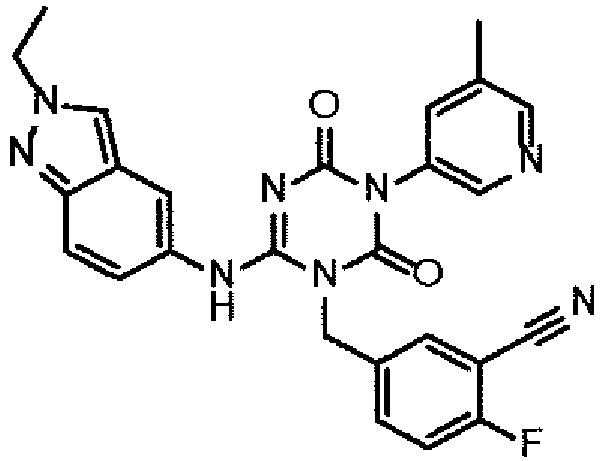
1 1.62 497.2 [Table 55] Compound No. Structure LC/MS Measured condition Retention time (min) m/z Con-figration II-0015 
1 1.82 531 [Table 58] Compound No. Structure LC/MS Measured condition Retention time (min) m/z Con-figration II-0034 
1 1.82 513 [Table 59] Compound No. Structure LC/MS Measured condition Retention time (min) m/z Con-figration II-0036 
1 1.90 533 [Table 60] Compound No. Structure LC/MS Measured condition Retention time (min) m/z Con-figration II-0043 
1 2.12 540 11-0045 
1 2.01 548 [Table 62] Compound No. Structure LC/MS Measured condition Retention time (min) m/z Con-figration II-0055 
1 1.69 551.4 [Table 69] Compound No. Structure LC/MS Measured condition Retention time (min) m/z Con-figration II-0087 
1 2.02 551.1 II-0088 
1 2.02 566 II-0080 
1 2.22 577 [Table 73] Compound No. Structure LC/MS Measured condition Retention time (min) m/z Con-figration 11-0109 
1 2.03 530.1 [Table 74] Compound No. Structure LC/MS Measured condition Retention time (min) m/z Con-figration II-0111 
1 1.65 494.2 [Table 75] Compound No. Structure LC/MS Measured condition Retention time (min) m/z Con-figration II-0118 
1 1.86 531.2 II-0119 
1 2.02 544.1 II-0120 
1 1.98 537.1 [Table 76] Compound No. Structure LC/MS Measured condition Retention time (min) m/z Con-figration II-0125 
3 1.36 479.1 [Table 77] Compound No. Structure LC/MS Measured condition Retention time (min) m/z Con-figration II-0130 
1 1.98 535 [Table 85] Compound No. Structure LC/MS Measured condition Retention time (min) m/z Con-figration II-0163 
1 2.04 582 II-0164 
1 2.09 546 [Table 87] Compound No. Structure LC/MS Measured condition Retention time (min) m/z Con-figration II-0173 
1 1.57 483 [Table 99] Compound No. Structure LC/MS Measured condition Retention time (min) m/z Con-figration II-0233 
3 1.79 545 [Table 108] Compound No. Structure LC/MS Measured condition Retention time (min) m/z Con-figration II-0278 
1 1.64 546.5 [Table 109] Compound No. Structure LC/MS Measured condition Retention time (min) m/z Con-figration II-0282 
1 1.82 537.3 II-0284 
1 1.77 521.3 II-0285 
1 1.88 560.4 [Table 110] Compound No. Structure LC/MS Measured condition Retention time (min) m/z Con-figration II-0288 
1 1.77 514.3 II-0290 
1 1.46 497.4 [Table 112] Compound No. Structure LC/MS Measured condition Retention time (min) m/z Con-figration II-0299 
2 1.81 547.2 [Table 113] Compound No. Structure LC/MS Measured condition Retention time (min) m/z Con-figration II-0304 
2 2.00 567.2 [Table 119] Compound No. Structure LC/MS Measured condition Retention time (min) m/z Con-figration 11-0332 
3 2.04 522 II-0335 
1 1.66 511 [Table 122] Compound No. Structure LC/MS Measured condition Retention time (min) m/z Con-figration II-0347 
1 1.62 499.3 [Table 128] Compound No. Structure LC/MS Measured condition Retention time (min) m/z Con-figration II-0377 
1 1.89 544 [Table 134] Compound No. Structure LC/MS Measured condition Retention time (min) m/z Con-figration II-0410 
1 1.84 548 [Table 135] Compound No. Structure LC/MS Measured condition Retention time (min) m/z Con-figration II-0415 
1 1.94 553 [Table 137] Compound No. Structure LC/MS Measured condition Retention time (min) m/z Con-figration II-0422 
3 1.45 499 [Table 151] Compound No. Structure LC/MS Measured condition Retention time (min) m/z Con-figration II-0493 
3 1.60 527 [Table 156] Compound No. Structure LC/MS Measured condition Retention time (min) m/z Con-figration II-0521 
3 1.52 529 [Table 157] Compound No. Structure LC/MS Measured condition Retention time (min) m/z Con-figration II-0523 
3 1.69 519 [Table 161] Compound No. Structure LC/MS Measured condition Retention time (min) m/z Con-figration II-0543 
1 1.92 533 [Table 162] Compound No. Structure LC/MS Measured condition Retention time (min) m/z Con-figration II-0548 
1 1.86 546 [Table 164] Compound No. Structure LC/MS Measured condition Retention time (min) m/z Con-figration II-0559 
1 1.80 531 [Table 165] Compound No. Structure LC/MS Measured condition Retention time (min) m/z Con-figration II-0566 
1 1.73 517 [Table 166] Compound No. Structure LC/MS Measured condition Retention time (min) m/z Con-figration II-0567 
1 1.68 551 II-0568 
1 2.05 585 II-0569 
3 1.89 598 II-0570 
1 1.74 549 II-0571 
1 1.83 517 [Table 167] Compound No. Structure LC/MS Measured condition Retention time (min) m/z Con-figration II-0572 
1 2.07 598 II-0573 
1 1.64 501 II-0574 
3 1.95 578 II-0576 
1 1.96 530 [Table 168] Compound No. Structure LC/MS Measured condition Retention time (min) m/z Con-figration II-0577 
3 1.76 563 II-0579 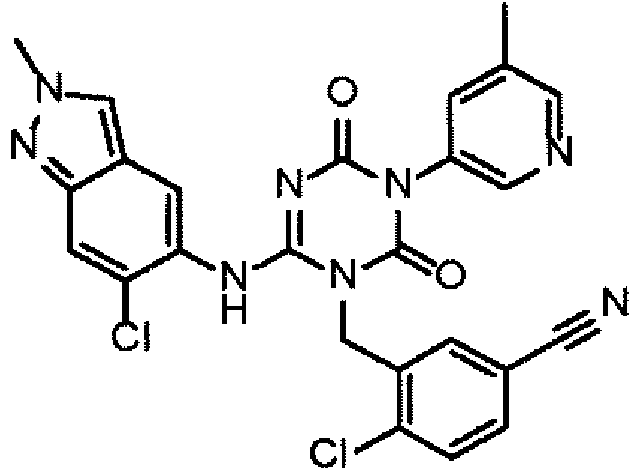
1 1.91 533 [Table 169] Compound No. Structure LC/MS Measured condition Retention time (min) m/z Con-figration II-0584 
1 2.07 564 [Table 171] Compound No. Structure LC/MS Measured condition Retention time (min) m/z Con-figration II-0596 
1 1.78 513.1 [Table 175] Compound No. Structure LC/MS Mesured condition Retention time (min) m/z Con-figration II-0608 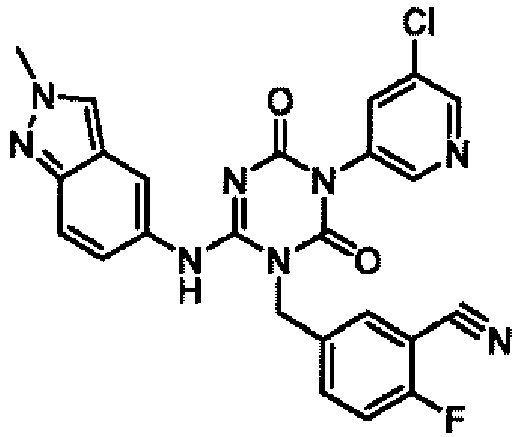
3 1.65 503 II-0609 
1 1.84 514.3 [Table 183] Compound No. NMR I-0385 1H NMR (400 MHz, CDCl3)δ 2.41 (3H, s), 4.77 (2H, td, J = 13.2, 4.3 Hz), 5.30 (2H, s), 6.26 (1H, tt, J = 55.3, 4.3 Hz), 6.90 (1H, dd, J = 9.2, 1.9 Hz), 7.09 (1H, d, J=1.9 Hz), 7.22 (1H, dd, J = 8.5, 8.6 Hz), 7.42-7.43 (1H, m), 7.71 (1H, br s), 7.79 (1H, d, J = 9.2 Hz), 7.91 (1H, ddd, J = 8.6, 5.3, 2.3 Hz), 7.97-7.98 (2H, m), 8.36 (1H, d, J = 2.1 Hz), 8.51 (1H, d, J = 1.1 Hz). I-0361 1H-NMR (400 MHz, CDCl3) δ: 2.40 (3H, s), 4.22 (3H, s), 5.38 (2H, s), 6.96 (1H, td, J = 9.6, 6.6 Hz), 7.13 (1H, s), 7.46-7.54 (2H, m), 7.84 (2H, d, J = 6.5 Hz), 8.38 (1H, d, J = 2.0 Hz), 8.49 (1H, d, J = 1.0 Hz). I-0383 1H-NMR (CDCl3) δ: 2.41 (3H, s), 3.49 (1H, s), 4.23 (3H, s), 5.33 (2H, s), 7.14 (1H, s), 7.20 (1H, t, J = 8.4 Hz), 7.45 (1H, s), 7.87 (2H, d, J = 12.0 Hz), 7.92-7.99 (1H, m), 8.04-8.09 (1H, m), 8.37 (1H, s), 8.50 (1H, s). I-0421 1H NMR (400 MHz, CDCl3) δ 3.89 (3H, s), 4.22 (3H, s), 5.14 (2H, s), 5.23 (2H, s), 7.08 (1H, s), 7.27-7.32 (2H, m), 7.83 (2H, d, J = 9.8 Hz), 7.96 (1H, s). I-0433 1H-NMR (400MHz, CDCl3) δ: 3.89 (3H, s), 4.74 (2H, td, J = 13.1, 4.1 Hz), 5.15 (2H, s), 5.23 (2H, s), 6.24 (1H, tt, J = 55.3, 4.1 Hz), 7.11 (1H, s), 7.26-7.31 (2H, m), 7.86 (1H, s), 7.95 (2H, J = 9.9 Hz) I-0483 1H-NMR (400 MHz, CDCl3) δ: 3.88 (3H, s), 4.21 (3H, s), 5.16 (2H, s), 5.37 (2H, s), 7.08 (1H, s), 7.18-7.28 (1H, m), 7.53 (1H, s), 7.82 (2H, s), 7.95 (1H, s). II-0001 1H-NMR (400 MHz, CDCl3) δ: 2.40 (3H, s), 5.01 (2H, q, J = 8.2 Hz), 5.46 (2H, s), 6.84 (1H, dd, J = 9.0, 1.8 Hz), 7.05 (1H, s), 7.48 (1H, s), 7.52-7.58 (2H, m), 7.66 (1H, s), 7.77 (1H, d, J = 9.0 Hz), 7.98-8.00 (2H, br m), 8.39 (1H, d, J = 2.3 Hz), 8.48 (1H, d, J = 1.0 Hz). II-0010 1H NMR (CDCl3) δ: 1.13 (3H, t, J = 6.1 Hz), 2.40 (3H, s), 4.50 (2H, q, J = 7.3 Hz), 5.30 (2H, s), 6.86 (1H, dd, J = 9.0, 1.9 Hz), 7.08 (1H, s), 7.21 (1H, t, J = 8.7 Hz), 7.43 (1H, s), 7.79 (1H, d, J = 9.0 Hz), 7.92 (2H, dt, J = 9.5, 3.4 Hz), 7.98 (1H, dd, J = 6.0, 1.8 Hz), 8.35 (1H, d, J = 2.1 Hz), 8.48 (1H, d, J = 1.0 Hz). II-0015 1H-NMR (400 MHz, CDCl3) δ: 2.40 (3H, s), 2.54 (3H, s), 4.21 (3H, s), 5.32 (2H, s), 7.04 (1H, d, J = 9.4 Hz), 7.12 (1H, s), 7.49 (1H, s), 7.77-7.88 (3H, m), 8.38 (1H, s), 8.48 (1H, s). II-0034 1H-NMR (400 MHz, CDCl3) δ:1.65 (3H, t, J = 7.3 Hz), 2.53 (3H, s), 4.49 (2H, q, J = 7.3 Hz), 5.34 (2H, s), 6.80 (1H, dd, J = 9.0, 1.8 Hz), 7.05 (1H, d, J = 1.0 Hz), 7.30 (1H, d, J = 7.8 Hz), 7.52 (1H, dd, J = 7.8, 1.0 Hz), 7.66 (1H, s), 7.71 (1H, t, J = 2.0 Hz), 7.76 (1H, d, J = 9.0 Hz), 7.85-7.88 (2H, m), 8.48 (1H, d, J = 2.3 Hz), 8.63 (1H, d, J = 2.0 Hz). II-0036 1H-NMR (400 MHz, CDCl3) δ: 1.65 (3H, t, J = 7.3 Hz), 4.49 (2H, q, J = 7.3 Hz), 5.47 (2H, s), 6.79 (1H, dd, J = 9.0, 2.0 Hz), 7.04 (1H, br s), 7.54-7.57 (2H, m), 7.67 (1H, s), 7.71 (1H, t, J = 2.1 Hz), 7.76 (1H, d, J = 9.0 Hz), 7.89 (2H, s), 8.49 (1H, d, J = 2.3 Hz), 8.63 (1H, d, J = 2.0 Hz). II-0043 1H NMR (400 MHz, CDCl3) δ 2.41 (3H, s), 2.43 (3H, s), 4.23 (3H, s), 5.30 (2H, s), 6.95-6.97 (1H, m), 7.13 (1H, s), 7.60-7.62 (1H, m), 7.59 (1H, d, J = 7.2 Hz), 7.66 (1H, s), 7.86 (2H, d, J = 10.8 Hz), 8.02 (1H, s), 8.41 (1H, s), 8.51 (1H, s). II-0045 1H-NMR (400 MHz, CDCl3) δ: 3.88 (3H, s), 4.22 (3H, s), 5.13 (2H, s), 5.22 (2H, s), 7.08 (1H, s), 7.39-7.45 (1H, m), 7.50-7.54 (1H, m), 7.82 (1H, s), 7.84 (1H, s), 7.94 (1H, s) II-0055 1H-NMR (DMSO-D6) δ: 2.55 (3H, s), 4.97 (2H, td, J = 15.0, 3.6 Hz), 5.45 (2H, s), 6.52 (1H, t, J = 54.7 Hz), 7.18 (1H, d, J = 8.0 Hz), 7.62 (1H, s), 7.64 (1H, d, J = 9.0 Hz), 7.96 (1H, s), 8.06 (1H, t, J = 8.7 Hz), 8.47 (2H, s), 8.87 (1H, s), 8.88 (1H, s). II-0087 1H-NMR (CDCl3) δ: 2.41 (3H, s), 4.23 (3H, s), 5.46 (2H, s), 7.12 (1H, s), 7.32 (1H, d, J = 8.4 Hz), 7.50 (1H, s), 7.83-7.88 (3H, m), 8.41 (1H, d, J = 2.3 Hz), 8.52 (1H, s). II-0089 1H-NMR (400MHz, CDCl3) δ: 2.41 (3H, s), 4.76 (2H, td, J = 13.3, 4.2 Hz), 5.33 (2H, s), 6.25 (1H, tt, J = 56.3, 4.2 Hz), 7.16 (1H, s), 7.20 (1H, t, J = 8.7 Hz), 7.45 (1H, s), 7.63 (1H, br s), 7.91 (1H, s), 7.92-7.95 (1H, m), 7.97 (1H, s), 8.06 (1H, dd, J = 6.1, 2.2 Hz), 8.37 (1H, d, J = 2.3 Hz), 8.51 (1H, s). [Table 184] II-0090 1H-NMR (400MHz, CDCl3) δ: 2.41 (3H, s), 4.76 (2H, td, J = 13.3, 4.2 Hz), 5.27 (2H, s), 6.24 (1H, tt, J = 55.2, 4.2 Hz), 7.16 (1H, s), 7.33-7.39 (2H, m), 7.45 (1H, s), 7.65 (1H, s), 7.89 (1H, d, J = 5.4 Hz), 7.96 (1H, s), 8.37 (1H, d, J = 2.1 Hz), 8.50 (1H, s), II-0109 1H NMR (400 MHz, DMSO-d6) δ 4.16 (3H, s), 5.30 (2H, s), 7.15 (1H, d, J = 9.5 Hz), 7.61 (4H, m), 8.05 (1H, m), 8.36 (1H, s), 8.54 (1H, s), 8.67 (1H, s), 9.51 (1H, s) II-0111 1H NMR (400 MHz, DMSO-d6) δ 2.34 (3H, s), 4.17 (3H, s), 5.26 (2H, s), 7.22 (1H, d, J = 8.9 Hz), 7.60 (4H, m), 7.79 (1H, dd, J = 18.1 Hz, 8.7 Hz), 8.30 (1H, s), 8.36(1H, s), 8.40 (1H, s), 9.60 (1H, s) II-0118 1H NMR (400 MHz, DMSO-d6) δ: 1.49 (3H, t, J = 7.2 Hz), 2.34 (3H, s), 4.40-4.48 (2H, m), 5.23 (1.2H, s), 5.34 (0.8H, s), 7.15-7.95 (5H, m), 8.13-8.15 (1H, m), 8.32-8.51 (3H, m), 9.58 (0.4H, s), 11.16 (0.6H, s). II-0119 1H NMR (400 MHz, CDCl3) δ: 2.40 (3H, s), 4.23 (3H, s), 5.27 (2H, s), 7.14 (1H, s), 7.45-7.51 (2H, m), 7.58-7.61 (1H, m), 7.85 (1H, s), 7.88 (1H, s), 8.37 (1H, d, J = 2.3 Hz), 8.50 (1H, d, J = 1.0 Hz). II-0120 1H NMR (400 MHz, DMSO-d6) δ: 4.14 (1.8H, s), 4.19 (1.2H, s), 5.24 (1.2H, s), 5.35 (0.8H, s), 7.13-8.74 (9H, m), 9.64 (0.4H, s), 11.29 (0.6H, s). II-0125 1H NMR (400 MHz, CDCl3) δ 2.41 (3H, s), 2.53 (3H, s), 4.24 (3H, s), 5.33 (2H, s), 6.79-6.82 (1H, m), 7.05-7.05 (1H, m), 7.30 (1H, d, J = 7.9 Hz), 7.47-7.49 (1H, m), 7.51 (1H, dd, J = 8.2, 1.3 Hz), 7.64-7.66 (1H, m), 7.74 (1H, d, J = 9.0 Hz), 7.78-7.81 (1H, m), 7.85 (1H, s), 8.39 (1H, d, J = 2.4 Hz), 8.49-8.52 (1H, m). II-0130 1H-NMR (400 MHz, CDCl3) δ: 2.41 (3H, s), 4.24 (3H, s), 5.31 (2H, s), 7.15 (1H, s), 7.45 (1H, s), 7.69 (1H, brs), 7.81-7.91 (4H, m), 8.37 (1H, d, J = 2.3 Hz), 8.51 (1H, s). II-0163 1H-NMR (400 MHz, CDCl3) δ: 3.88 (3H, s), 4.73 (1H, td, J = 13.2, 4.2 Hz), 6.13 (2H, s), 5.34 (2H, s), 6.23 (1H, tt, J = 55.3, 4.2 Hz), 6.92 (1H, td, J = 8.6, 6.6 Hz), 7.09 (1H, s), 7.36-7.44 (1H, m), 7.66 (1H, brs), 7.81 (1H, s), 7.92 (1H, s), 7.94 (1H, s). II-0164 1H-NMR (400 MHz, DMSO-d6) δ: 2.09 (3H, s), 3.57 (3H, s), 4.16 (2H, s), 5.90 (1H, s), 7.74 (1H, s), 7.96 (1H, s), 8.07 (1H, s), 8.35 (1H, s), 8.46 (1H, s), 8.89 (1H, s), 9.12 (1H, s). II-0173 1H-NMR (400 MHz, DMSO-d6) δ: 2.34 (3H, s), 4.15 (3H, s), 5.30 (2H, s), 7.10 (1H, brs), 7.44-7.61 (4H, m), 7.85-7.91 (1H, m), 8.04-8.09 (1H, m), 8.29 (1H, brs), 8.32 (1H, s), 8.40 (1H, s). II-0233 1H NMR (400 MHz, CDCl3) δ 1.65 (3H, t, J = 7.3 Hz), 2.41 (3H, s), 2.54 (3H, s), 4.48 (2H, q, J = 7.3 Hz), 5.32 (2H, s), 7.04 (1H, d, J = 9.5 Hz), 7.12 (1H, s), 7.50 (1H, br s), 7.66 (1H, br s), 7.82 (1H, d, J = 6.5 Hz), 7.88-7.90 (2H, m), 8.40 (1H, d, J = 2.3 Hz), 8.51 (1H, s). II-0278 1H-NMR (400 MHz, CDCl3) δ: 2.41 (3H, s), 2.55 (3H, s), 4.77 (2H, td, J = 13.3, 4.4 Hz), 5.29 (2H, s), 6.26 (1H, tt, J = 55.2, 13.3 Hz), 6.85 (1H, d, J = 10.8 Hz), 7.07 (2H, s), 7.47 (1H, s), 7.69 (1H, d, J = 6.3 Hz), 7.76 (1H, d, J = 9.3 Hz), 7.97 (1H, s), 8.38 (1H, d, J = 1.5 Hz), 8.51 (1H, s). II-0282 1 H-NMR (400 MHz, CDCl3) δ: 4.24 (3H, s), 5.43 (2H, s), 6.80 (1H, d, J = 9.0 Hz), 7.04 (1H, brs), 7.35 (1H, d, J = 8.3 Hz), 7.68-7.72 (2H, m), 7.76 (1H, d, J = 9.0 Hz), 7.87 (1H, s), 8.48 (1H, d, J = 2.0 Hz), 8.65 (1H, d, J = 2.0 Hz). II-0284 1H-NMR(400 MHz, CDCl3) δ: 4.18 (3H, s), 5.22 (2H, s), 6.79 (1H, dd, J = 9.0, 1.8 Hz), 7.00 (1H, s), 7.69 (1H, t, J = 2.1 Hz), 7.65-7.69 (1H, m), 7.70-7.77 (3H, m), 7.81 (1H, s), 8.38 (1H, d, J = 2.0 Hz), 8.58 (1H, d, J = 2.0 Hz). II-0285 1H-NMR (400 MHz, CDCl3) δ: 1.58 (6H, d, J = 6.5 Hz), 3.81 (3H, s), 4.71 (1H, sext, J = 6.5 Hz), 5.09 (2H, s), 5.28 (2H, s), 6.85 (1H, td, J = 9.6, 6.4 Hz), 7.01 (1H, s), 7.31-7.39 (1H, m), 7.46 (1H, brs), 7.78 (1H, d, J = 9.0 Hz), 7.88 (1H, s). [Table 185] II-0288 1H-NMR (400 MHz, CDCl3) δ: 4.24 (3H, s), 5.35 (2H, s), 6.80 (1H, dd, J = 9.0, 2.0 Hz), 6.93-7.01 (1H, m), 7.06 (1H, s), 7.38-7.46 (1H, m), 7.66 (1H, t, J = 2.1 Hz), 7.76 (1H, d, J = 8.8 Hz), 7.80 (1H, brs), 7.86 (1H, s), 8.46 (1H, d, J = 2.3 Hz), 8.63 (1H, d, J = 2.3 Hz). II-0290 1H-NMR (400MHz, CDCl3) δ: 2.41 (3H, s), 2.55 (3H, s), 4.24 (3H, s), 5.29 (2H, s), 6.81 (1H, dd, J = 8.9, 1.7 Hz), 7.05 (1H, s), 7.06 (1H, d, J = 7.5 Hz), 7.47 (1H, s), 7.69 (1H, d, J = 6.5 Hz), 7.75 (1H, d, J = 9.1 Hz), 7.85 (1H, s), 8.38 (1H, s), 8.50 (1H, s). II-0299 1H-NMR (CDCl3) δ: 2.41 (s, 3H), 2.53 (s, 3H), 6.01 (q, 2H, J = 8.2 Hz), 5.33 (s, 2H), 6.85 (dd, 1H, J = 9.2, 1.9 Hz), 7.06 (m, 1H), 7.30 (d, 1H, J = 7.9 Hz), 7.48 (m, 1H), 7.51 (dd, 1H, J = 7.8, 1.6 Hz), 7.65 (s, 1H), 7.78 (d, 1H, J = 9.2 Hz), 7.84 (s, 1H), 7.99 (s, 1H), 8.39 (d, 1 H, J = 2.3 Hz), 8.49 (d, 1H, J = 1.1 Hz). II-0304 1H-NMR (CDCl3) δ: 2.53 (s, 3H), 5.02 (q, 2H, J = 8.2 Hz), 5.33 (s, 2H), 6.85 (dd, 1H, J = 9.1, 1.9 Hz), 7.05 (d, 1H, J = 1.1 Hz), 7.31 (d, 1H, J = 7.9 Hz), 7.52 (dd, 1H, J = 7.9, 1.5 Hz), 7.65 (s, 1H), 7.71 (t, 1H, J = 2.1 Hz), 7.74-7.92 (m, 2H), 8.00 (s, 1H), 8.48 (d, 1H, J = 2.0 Hz), 8.63 (d, 1H, J = 2.1 Hz). II-0332 1H-NMR (CDCl3) δ: 2.40 (s, 3H), 2.41 (s, 3H), 4.22 (s, 3H), 5.33 (s, 2H), 7.09-7.18 (m, 3H), 7.46-7.49 (m, 2H), 7.85 (d, 2H, J = 8.8 Hz), 7.64 (s, 1H), 8.40 (d, 1H, J = 2.0 Hz), 8.50 (s, 1H) II-0335 1H-NMR (400 MHz, CDCl3) δ: 1.66 (3H, t, J = 7.3 Hz), 2.41 (3H, s), 2.55 (3H, s), 4.49 (2H, q, J = 7.4 Hz), 5.29 (2H, s), 6.81 (1H, dd, J = 9.0, 2.0 Hz), 7.06 (2H, dd, J = 5.4, 4.1 Hz), 7.47 (1H, s), 7.69 (1H, d, J = 6.5 Hz), 7.77 (2H, d, J = 9.0 Hz), 7.89 (1H, s), 8.38 (1H, d, J = 2.3 Hz), 8.51 (1H, d, J = 1.3 Hz). II-0341 1H-NMR (400 MHz, CDCl3) δ: 2.63 (3H, s), 4.24 (3H, s), 6.34 (2H, s), 6.80 (1H, dd, J = 9.0, 2.0 Hz), 7.04 (1H, d, J = 1.3 Hz), 7.30 (1H, d, J = 7.8 Hz), 7.52 (1H, dd, J = 7.9, 1.4 Hz), 7.65 (1H, s), 7.71 (1H, t, J = 2.3 Hz), 7.75 (1H, d, J = 8.8 Hz), 7.85 (2H, s), 8.49 (1H, d, J = 2.0 Hz), 8.64 (1H, d, J = 2.3 Hz). II-0377 1H-NMR (CDCl3) δ: 2.40 (3H, s), 4.23 (3H, s), 5.38 (2H, s), 6.93 (1H, t, J = 9.0 Hz), 7.13 (1H, s), 7.47 (1H, m), 7.66 (1H, s), 7.77 (1H, t, J = 7.7 Hz), 7.85 (1H, s), 7.87 (1H, s), 8.38 (1H, d, J = 2.3 Hz), 8.50 (1H, s). II-0410 1H-NMR (CDCl3) δ: 3.88 (3H, s), 4.21 (3H, s), 5.14 (2H, s), 5.34 (2H, s), 6.91 (1H, t, J = 9.0 Hz), 7.08 (1H, s), 7.60 (1H, s), 7.64 (1H, t, J = 7.8 Hz), 7.81 (1H, s), 7.95 (1H, s). II-0415 1H-NMR (CDCl3) δ: 4.77 (2H, dd, J = 13.3, 4.2 Hz), 5.30 (2H, s), 6.25 (1H, tt, J = 55.2, 4.24 Hz), 6.90 (1H, dd, J = 9.0, 2.0 Hz), 7.09 (1H, s),7.23 (1H, t, J = 8.8 Hz), 7.66 (1H, t, J = 2.0 Hz),7.78 (1H, d, J = 9.0 Hz) 7.90 (1H, m), 7.96 (1H, m), 7.97 (1H, s), 8.44 (1H, d, J = 2.0 Hz), 8.63 (1H, d, J = 2.0 Hz). II-0422 1H-NMR (CDCl3) δ: 2.40 (3H, s), 4.23 (3H, s), 5.46 (2H, s), 6.80 (1H, dd, J = 9.0, 1.8 Hz), 7.04 (1H, s, J = 1.3 Hz), 7.48 (1H, s), 7.51-7.58, 2H, m), 7.66 (1H, s), 7.73 (1H, d, J = 9.0 Hz), 7.84 (1H, s), 7.94 (1H, s), 8.39 (1H, d, J = 2.3 Hz), 8.49 (1H, s). II-0493 1H-NMR (CDCl3) δ: 1.64 (3H, t, J = 7.3 Hz), 2.41 (3H, s), 2.52 (3H, s), 4.48 (2H, q, J = 7.3 Hz), 5.37 (2H, s), 7.12 (1H, s), 7.28 (1H, d, J = 8.0 Hz), 7.50 (2H, d, J = 8.3 Hz), 7.77 (1H, s), 7.87 (2H, d, J = 1.8 Hz), 8.41 (1H, d, J = 2.0 Hz), 8.50 (1H, s). II-0521 1H-NMR (DMSO-D6) δ: 2.34 (3H, s), 2.42 (3H, s), 4.97 (2H, td, J = 14.8, 3.1 Hz), 5.19 (2H, s), 6.53 (1H, tt, J = 54.8, 3.4 Hz), 7.24 (1H, d, J = 9.4 Hz), 7.46 (1H, d, J = 7.9 Hz), 7.62-7.71 (4H, m), 7.95 (1H, s), 8.34 (1H, s), 8.40 (1H, s), 8.47 (1H, s), 9.49 (1H, s). II-0523 1H-NMR (DMSO-D6) δ: 4.16 (3H, s), 5.26 (2H, s), 7-21 (1H, d, J = 8.5 Hz), 7.62 (2H, d, J = 8.4 Hz), 7.78 (1H, d, J = 8.0 Hz), 7.87 (1H, d, J = 8.0 Hz), 8.00 (1H, s), 8.17 (1H, s), 8.36 (1H, s), 8.63 (1H, s), 8.67 (1H, s), 9.72 (1H, s). II-0543 1H-NMR (CDCl3) δ: 2.52(3H, s), 4.22 (3H, s), 5.37 (2H, s), 7.10 (1H, s), 7.29 (1H, d, J = 8.0 Hz), 7.50 (1H, d, J = 6.8 Hz), 7.74 (1H, m), 7.77 (1H, brs), 7.81-7.86 (2H, m), 8.50 (1H, d, J = 2.0 Hz), 8.63 (1H, d, J = 2.0 Hz) [Table 186] II-0648 1H-NMR (CDCl3) δ: 1.64 (3H, t, J = 7.2 Hz), 2.92 (3H, s), 4.46 (2H, q, 7.2 Hz), 5.15 (2H, s), 5.35 (2H, s), 6.92 (1H, m), 7.08 (1H, s), 7.41 (1H, m), 7.63 (1H, s), 7.82 (1H, s), 7.84 (1H, s), 7.94 (1H, s) II-0559 1H NMR (DMSO-d6) δ ppm 1.50 (3 H, t, J=7.28 Hz) 2.43 - 2.47 (3 H, m) 4.45 (2 H, q, J=7.19 Hz) 5.16 (2 H, br s) 7.15 (1 H, br d, J=9.29 Hz) 7.46 - 7.55 (1 H, m) 7.58 (1 H, br s) 7.61 (1 H, br s) 7.94 - 7.97 (1 H, m) 7.97 - 8.05 (2 H, m) 8.41 (1 H, br s) 8.54 (1 H, s) 8.67 (1 H, s) 9.53 (1 H, br s) II-0566 1H NMR (DMSO-d6) δ ppm 1.50 (3 H, t, J=7.28 Hz) 4.44 (2 H, q, J=7.03 Hz) 5.33 (2 H, br s) 7.13 (1 H, br s) 7.59 (3 H, br d, J=8.66 Hz) 7.87 - 7.92 (1 H, m) 8.02 - 8.08 (2 H, m) 8.39 (1 H, br s) 8.54 (1 H, s) 8.67 (1 H, d, J=1.76 Hz) 9.55 (1 H, br s) II-0567 1H NMR (DMSO-d6) δ ppm 2.22 - 2.42 (3 H, m) 6.05 - 6.70 (4 H, m) 6.56 - 7.38 (1 H, m) 7.62 (4 H, br s) 7.82 - 8.19 (2 H, m) 8.42 (3 H, br s) 9.24 -9.76 (1 H, m) II-0568 1H-NMR (CDCl3) δ: 2.41 (3H, s), 4.72-4.80 (2H, m), 5.31 (2H, s), 6.10-6.40 (1H, m), 7.17 (1H, s), 7.45 (1H, s), 7.73 (1H, s), 7.82-7.91 (3H, m), 7.97 (1H, s), 8.37 (1H, d, J = 2.3 Hz), 8.51 (1H, d, J = 0.8 Hz). II-0569 1H-NMR (CDCl3) δ: 3.89 (3H, s), 4.70-4.78 (2H, m), 5.15 (2H, s), 5.34 (2H, s), 6.08-6.37 (1H, m), 6.91 (1H, t, J = 9.0 Hz), 7.11 (1H, s), 7.55 (1H, s), 7.63 (1H, t, J = 7.8 Hz), 7.83 (1H, s), 7.93 (1H, s), 7.96 (1H, s). II-0570 1H-NMR (CDCl3) δ: 2.40 (3H, s), 4.72-4.80 (2H, m), 5.47 (2H, s), 6.10-6.39 (1H, m), 6.83 (1H, dd, J = 9.2, 1.9 Hz), 7.06 (1H, d, J = 1.3 Hz), 7.48 (1H, s), 7.52-7.58 (2H, m), 7.66 (1H, s), 7.75 (1H, d, J = 9.0 Hz), 7.82 (1H, s), 7.95 (1H, s), 8.40 (1H, d, J = 2.0 Hz), 8.50 (1H, s). II-0571 1H-NMR (CDCl3) δ: 2.55 (3H, s), 4.24 (3H, s), 5.29 (2H, s), 6.81 (1H, dd, J = 9.0, 1.9 Hz), 7.04-7.08 (2H, m), 7.69-7.70 (2H, m), 7.75 (1H, d, J = 8.9 Hz), 7.85 (2H, s), 8.47 (1H, d, J = 2.1 Hz), 8.63 (1H, d, J = 2.0 Hz). II-0572 1H-NMR (CDCl3) δ: 3.97 (3H, s), 4.71-4.78 (2H, m), 5.14 (2H, s), 5.23 (2H, s), 6.10-6.38 (1H, m), 7.11 (1H, s), 7.39-7.52 (3H, m), 7.86 (1H, s), 7.94 (1H, s), 7.96 (1H, s). II-0573 1H-NMR (CDCl3) δ: 2.41 (3H, s), 4.25 (3H, s), 5.28 (2H, s), 6.85-6.88 (1H, m), 7.08 (1H, s), 7.43 (1H, s), 7.74-7.87 (5H, m), 8.36 (1H, br-s), 8.51 (1H, br-s). II-0574 1H-NMR (CDCl3) δ: 2.40 (3H, s), 4.72-4.79 (2H, m), 5.38 (2H, s), 6.10-6.38 (1H, m), 6.92-6.98 (1H, m), 7.15 (1H, s), 7.46-7.63 (2H, m), 7.88 (1H, s), 7.96 (1H, s), 8.38 (1H, d, J = 2.3 Hz), 8.50 (1H, br-s). II-0516 1H-NMR (CDCl3) δ: 4.24 (3H, s), 5.35 (2H, s), 6.83-6.85 (1H, m), 6.96 (1H, t, J = 9.0 Hz), 7.06 (1H, s), 7.63-7.85 (5H,m), 8.45 (1H, d, J = 2.0 Hz), 8.62 (1H, d, J = 2.0 Hz). II-0577 1H-NMR (CDCl3) δ: 2.41 (3H, s), 2.52 (3H, s), 4.71-4.79 (2H, m), 5.36 (2H, s), 6.09-6.31 (1H, m), 7.14 (1H, s), 7.28 (1H, d, J = 8.0 Hz), 7.49-7.51 (2H, m), 7.76 (1H, s), 7.86 (1H, s), 7.95 (1H, s), 8.41 (1H, d, J = 2.3 Hz), 8.51 (1H, s). II-0579 1H-NMR (CDCl3) δ: 2.41 (3H, s), 4.22 (3H, s), 5.50 (2H, s), 7.11 (1H, s), 7.48-7.57 (3H, m), 7.70 (1H, s), 7.78 (1H, s), 7.82-7.86 (2H, m), 8.41 (1H, s), 8.51 (1H, s). II-0684 1H-NMR (CDCl3) δ: 3.88 (3H, s), 4.22 (3H, s), 5.13 (2H, s), 5.22 (2H, s), 7.09 (1H, s), 7.56 (1H, s), 7.65 (2H, d, J = 6.3 Hz), 7.82 (1H, s), 7.85 (1H, s), 7.95 (1H, s). II-0596 1H-NMR(CDCl3) δ: 2.41 (3H, s), 2.52 (3H, s), 4.22 (3H, s), 5.37 (2H, s), 7.11 (1H, s), 7.24-7.31 (1H, m), 7.47-7.53 (2H, m), 7.69 (1H, s), 7.76 (1H, s), 7.81-7.87 (2H, m), 8.40 (1H, s), 8.50 (1H, s). II-0608 1H NMR (400 MHz, CDCl3)δ 4.25 (3H, s), 5.31 (2H, s), 6.86 (1H, dd, J = 9.0, 1.6 Hz), 7.07 (1H, s), 7.22 (1H, dd, J = 8.6, 8.3 Hz), 7.66 (1H, dd, J = 1.9, 1.9 Hz), 7.78 (2H, d, J = 9.0 Hz), 7.87 (1H, s), 7.91 (1H, ddd, J = 8.3, 5.9, 2.0 Hz), 7.98 (1H, dd, J = 5.9, 2.0 Hz), 8.45 (1H, d, J = 1.9 Hz), 8.64 (1H, d, J = 1.9 Hz). II-0609 1H-NMR (400 MHz, CDCl3) δ: 4.25 (3H, s), 5.24 (2H, s), 6.87 (1H, dd, J = 9.0, 1.8 Hz), 7.08 (1H, d, J = 1.3 Hz), 7.30 (2H, t, J = 7.3 Hz), 7.66 (1H, t, J = 2.1 Hz), 7.78 (1H, d, J = 9.0 Hz), 7.81 (1H, brs), 7.87 (1H, s), 8.45 (1H, d, J = 2.3 Hz), 8.64 (1H, d, J = 2.0 Hz). - To 1400 mg of Compound (I-0113), 7 mL of ethyl acetate and 557 µL (1.05 eq) of a 5 mol/L aqueous solution of p-toluenesulfonic acid was added. The mixture was stirred at 60°C for 15 minutes and then was stirred at 25°C for 2 hours. Solids were collected by filtration and dried to give a crystalline form of p-toluenesulfonate Form I of a compound represented by Formula (I-A) (1289.6 mg, 69%).
- The results of single crystal structure analysis of the crystalline form of p-toluenesulfonate Form I of the compound represented by Formula (I-A) are shown below.
- R1 (I > 2.00 s (I)) was 0.0444, and it was confirmed from the final difference Fourier that there was neither inadequacy nor misplacement of electron density.
- Crystallographic data are shown in Table 187.
[Table 187] Space Group P-1 a (Å) 8.7844(2) b (Å) 10.2991(2) c (Å) 18.0182(3) α (°) 103.727(2) β (°) 97.411(2) γ (°) 100.358(2) Volume (Å3) 1532.43(6) Z 2 Density (calculated value) (g/cm3) 1.517 Measured temperature(K) 298 - Here, Volume means the unit lattice volume, and Z means the number of molecules in a unit lattice.
- Furthermore, the atomic coordinates of non-hydrogen atoms are indicated in Table 188 to Table 189. Here, U(eq) means the equivalent isotropic temperature factor.
[Table 188] Atom x y z U(eq) S1 5557.0(7) 5570.9(7) 3382.5(3) 58.54(18) Cl1 9613.3(8) 973.2(6) 9196.1(4) 65.77(19) O0AA 9535.3(19) 4701.0(16) 6926.8(8) 53.6(4) 02 6849(2) 439.0(17) 5545.6(8) 60.9(4) N6 8276(2) 2541.7(17) 6223.6(9) 40.7(4) N5 7041.4(19) 1025.1(16) 6857.9(9) 39.7(4) F2 -141.7(19) -251.9(19) 7226.8(11) 92.1(6) N2 8829(2) 5271.5(19) 11119.0(9) 48.5(4) N3 7195(2) 1663.4(19) 8176.4(9) 48.2(4) N4 8541(2) 3184.9(17) 7562.2(9) 42.4(4) F3 887(2) 430(2) 5999.5(12) 97.1(6) N1 7812(2) 6077.8(19) 11018(1) 50.4(4) 04 4537(2) 6507(2) 3385.2(11) 77.0(5) N7 7564(2) 3712.1(19) 4481.8(10) 51.8(5) F1 1789(2) -1005(2) 8247.6(11) 106.2(7) O3 5276(3) 4797(2) 3958.3(11) 84.0(6) O5 7190(2) 6153(3) 3452.2(12) 88.9(7) C9 7583(2) 1982(2) 7574.6(11) 40.1(4) C11 7341(2) 1270(2) 6163.6(11) 42.9(5) C7 7658(2) 2633(2) 8912.6(11) 43.2(5) C10 8834(2) 3579(2) 6910.2(11) 40.9(4) C13 4424(2) -281(2) 6933.5(11) 41.9(4) C4 8567(2) 4339(2) 10420.3(11) 42.0(4) C3 7411(2) 4585(2) 9881.8(11) 43.7(5) C19 8494(2) 2887(2) 5509.3(11) 41.9(4) C12 6089(2) -316(2) 6838.6(12) 43.8(5) C6 8796(3) 2385(2) 9477.2(12) 45.7(5) C8 6978(3) 3725(2) 9112.3(12) 46.5(5) C23 9844(3) 2769(2) 5216.8(11) 45.0(5) C21 8868(3) 3604(2) 4179.9(12) 50.6(5) C22 10048(3) 3130(2) 4531.1(12) 48.5(5) C5 9266(3) 3215(2) 10214.4(11) 46.2(5) C20 7340(3) 3359(2) 5136.1(12) 48.6(5) C25 5003(3) 4321(2) 2476.2(13) 50.7(5) C2 6957(3) 5725(2) 10300.8(13) 51.0(5) C18 3415(3) 91(2) 6402.6(14) 54.5(6) [Table 189] Atom x y z U(eq) C14 3868(3) -662 (2) 7553.5(13) 53.7(5) C16 1347(3) -281(3) 7124.4(16) 60.7(6) C17 1900(3) 94(2) 6512.6(16) 61.2(6) C30 6119(3) 3983(3) 2035.5(14) 55.9(6) C26 3439(3) 3640(3) 2211.0(15) 61.5(6) C15 2335(3) -663(3) 7636.1(15) 62.9(6) C29 5673(3) 3002(3) 1334.5(15) 61.3(6) C28 14124(3) 2306(3) 1062.3(15) 60.2(6) C1 7696(3) 7183(3) 11670.0(15) 66.2(7) C27 3021(3) 2642(3) 1519.6(17) 66.8(7) C24 11523(3) 3005(3) 4204.0(16) 68.8(7) C31 3666(4) 1199(3) 313.7(19) 86.6(9) - Next, the atomic coordinates of hydrogen atoms are shown in Table 190. Here, U(iso) means the isotropic temperature factor. Furthermore, the numbers of hydrogen atoms in Table 190 are assigned in relation to the numbers of non-hydrogen atoms that are bonded.
[Table 190] Atom x y z U(iso) H4 8997.31 3740.96 8003.33 51 H7 6846.9 4018.17 4247.85 62 H12A 6580 -646.73 7249.93 53 H12B 6080.56 -961-06 6347.82 53 H8 6243.08 3903.21 8750.78 56 H23 10622.43 2448.15 5474.97 54 H21 8972.67 3855.23 3723.18 61 H5 10022.27 3041.45 10567.4 55 H20 6421.35 3433.73 5331-94 58 H2 6205.25 6159.69 10118.28 61 H18 3760.99 335.18 5978 65 H14 4530.93 -915.45 7912.92 64 H30 7172.24 4418.9 2212.04 67 H26 2676.66 3860.81 2502.17 74 H29 6431.77 2800.81 1036.17 74 H1A 7407.56 6810.87 12085.34 99 H1B 6911.8 7647.04 11507.76 99 H1C 8694.25 7819.65 11846.48 99 H27 1975.25 2179.81 1353.37 80 H24A 12424.61 3497.89 4594.3 103 H24B 11517.08 3380.23 3764.48 103 H24C 11568.94 2056.87 4044.69 103 H31A 4413.51 1353.07 -17.7 130 H31B 2638.62 1210.23 61.36 130 H31C 3652.49 325.83 417.97 130 - In addition, the interatomic bond length (unit: angstrom) is shown in Table 191.
[Table 191] Atom Atom Length/Å Atom Atom Length/Å S1 O4 1.4286(19) C7 C6 1.432(3) S1 O3 1.4694(19) C7 C8 1.363(3) S1 O5 1.429(2) C13 C12 1.500(3) S1 C25 1.770(2) C13 C18 1.388(3) Cl1 C6 1.734(2) C13 C14 1.386(3) O0AA C10 1.200(2) C4 C3 1.412(3) O2 C11 1.204(2) C4 C5 1.402(3) N6 C11 1.388(3) C3 C8 1.418(3) N6 C10 1.393(2) C3 C2 1.390(3) N6 C19 1.441(2) C19 C23 1.372(3) N5 C9 1.391(2) C19 C20 1.368 (3) N5 C11 1.381(2) C6 C5 1.363(3) N5 C12 1.471(3) C23 C22 1.396(3) F2 C16 1.349(3) C21 C22 1.368(3) N2 N1 1.348(3) C22 C24 1.505(3) N2 C4 1.354(3) C25 C30 1.381(3) N3 C9 1.274(2) C25 C26 1.390(3) N3 C7 1.417(3) C18 C17 1.371(4) N4 C9 1.373(3) C14 C15 1.373(3) N4 C10 1.370(2) C16 C17 1.368(4) F3 C17 1.348(3) C16 C15 1.359(4) N1 C2 1.339(3) C30 C29 1.376(4) N1 C1 1.457(3) C26 C27 1.372(4) N7 C21 1.341(3) C29 C28 1.385(4) N7 C20 1.341(3) C28 C27 1.388(4) F1 C15 1.352(3) C28 C31 1.498(4) - In the crystalline form of p-toluenesulfonate Form I of a compound represented by Formula (I-A), one molecule of the compound represented by Formula (I-A) exists in an asymmetric unit. The structure of the compound represented by Formula (I-A) in the asymmetric unit is shown in
Fig. 2 . - The numbers of non-hydrogen atoms in Table 188 to Table 189 and Table 191 correspond to the numbers shown in
Fig. 2 , respectively. - As shown in Table 191, the bond length of N3-C9 was about 1.27 Å, and the bond length of N4-C9 was about 1.37 Å.
- Since the bond length of N3-C9 (about 1.27 Å) was shorter than the bond length of N4-C9 (about 1.37 Å), the compound represented by Formula (I-A) in the crystalline form of p-toluenesulfonate Form I was identified to have an imino structure:


- Furthermore, the results of powder X-ray diffraction of the crystalline form of p-toluenesulfonate Form I of the compound represented by Formula (I-A) is shown.
- In the powder X-ray diffraction pattern, peaks were observed at the diffraction angles (2θ): 9.1±0.2°, 11.5±0.2°, 14.6+0.2°, 15.2±0.2°, 18.8±0.2°, 20.2±0.2°, 23.6±0.2°, 24.2±0.2°, 24.9±0.2°, and 26.9±0.2°.
- Regarding the powder X-ray diffraction peaks, the peaks at the diffraction angles (2θ): 9.1±0.2°, 15.2±0.2°, 18.8±0.2°, 23.6±0.2°, and 24.9±0.2° are particularly characteristic as the crystalline form of p-toluenesulfonate Form I of the compound represented by Formula (I-A).
- To Compound (1-0115, 1170mg) were added fumaric acid (278mg, 1.1 eq) and ethyl acetate(5.85mL). The mixture was stirred at room temperature for 45 minutes. The resulting solids were collected by filtration and dried to give fumaric acid cocrystal Form I of the compound represented by Formula (I-B) (1369.4mg, 94.6%).
- The results of the single crystal structure analysis of the fumaric acid cocrystal Form I of the compound represented by the Formula (I-B) are shown below.
- R1 (I> 2.00s (I)) was 0.0470, and it was confirmed from the final difference Fourier that there was no lack of electron density or misplacement.
- Crystallographic data are shown in Table 192.
[Table 192] Space Group P-1 a (Å) 8.4374(2) b (Å) 11.6780(3) c (Å) 15.1612(4) a (°) 83.827(2) β (°) 78.868(2) Y (°) 77.147(2) Volume (Å3) 1425.77(6) Z 2 Density(calculated value) (g/cm3) 1.509 Measured temperature (K) 298 - Wherein Volume indicates the unit lattice volume, Z indicates chemical unit number per unit cell.
- In addition, the atomic coordinates of non-hydrogen atoms are indicated in Table 193 to 194. Here, U(eq) means an equivalent isotropic temperature factor.
[Table 193] Atom x y z U(eq) Cl36 8115.3(9) 8341.6(8) 5010.7(5) 79.9(3) F32 8958.5(19) 7981.3(17) 307.5(9) 78.5 (5) O35 7267(2) 5961.4(16) 1399.9(10) 56.3(5) O34 5322(3) 4254.8(16) 4098.2(11) 63.3(5) O38 3536(2) 9367.5(19) 8936.3(12) 64.2(5) N12 6506 (2) 7056.8(18) 2611.0(12) 44.2(5) F33 13870(2) 7642(2) 1402.1(13) 100.3(7) N16 5475(2) 6174.4(18) 3988.1(12) 48.2(5) N14 6120(3) 5115.3(18) 2713.0(12) 47.3(5) N9 2815(3) 8924(2) 7397.8(13) 55.4(6) N10 5772(3) 8146(2) 3856.1(13) 55.1(6) N1 1276(3) 8864(2) 7324.6(14) 60.2(6) F31 12197(3) 7751(3) 3084.6(13) 124.9(9) N23 3644(3) 4434(2) 1818.7(15) 64.5(6) N20 3122(3) 4249(2) 1061.4(15) 64.9(6) C11 6673(3) 6043(2) 2193.8(15) 44.7(6) C9 5879(3) 7178(2) 3527.6(15) 44.2(6) C10 5619(3) 5119(2) 3639.3(15) 48.4(6) N22 5784(3) 3621(2) 814.1(15) 67.8(7) O39 6151(3) 8893(3) 8285.8(15) 109.2(10) C12 6985(3) 8068(2) 2049.4(15) 47.2(6) C20 5248(3) 4044(2) 1633.9(16) 50.7(6) C7 5022(3) 8298(2) 4770.9(15) 50.8(6) C4 3693(3) 8762(2) 6554.3(16) 49.4(6) C13 8823(3) 7976(2) 1872.6(16) 48.8(6) C5 5385(3) 8700(2) 6267.8(17) 56.4(7) C19 6380(3) 4009(2) 2279.5(17) 54.5(7) C14 9741(3) 7934(2) 1013.2(16) 54.7(7) C3 2685(3) 8593(2) 5965.2 (17) 54.4(7) C6 6015(3) 8469(2) 5392.0(16) 54.3(7) C23 5121(4) 9287(3) 8898.3(18) 62.1(7) O41 1842(3) 4874(3) 3529.1(18) 119.8(10) C8 3370(3) 8376(2) 5054.8(17) 57.4(7) C24 5542(3) 9730(3) 9679.7(17) 61.9(7) C18 9684(4) 7917(3) 2570.7(18) 67.1(8) C15 11431(3) 7827(3) 831.3(19) 67.8(8) C16 12217(3) 7760(3) 1541(2) 67.9(8) C2 1134(4) 8667(3) 6497.1(18) 67.4(8) [Table 194] Atom x y z U(eq) C17 11360(4) 7806(3) 2405(2) 75.0(9) C21 4400(4) 3767(3) 485.7(19) 70.6(8) O43 -464(4) 4618(4) 3203.2(19) 154.2(15) C1 9(4) 8943(3) 8139(2) 81.7(10) C26 307(4) 4766(4) 3745(2) 93.6(12) C25 -384(4) 4909(4) 4700(2) 92.1(11) C22 1397(4) 4562(4) 963(3) 102.7(13) - Next, the atomic coordinates of the hydrogen atom are shown in Table 195. Here, U(iso) means an isotropic temperature factor. In addition, the numbers of hydrogen atoms in Table 195 are assigned in relation to the numbers of non-hydrogen atoms that are bonded.
[Table 195] Atom x y z U(iso) H38 3370.9 9206.88 8452.86 96 H16 5092.25 6215.55 4554.71 58 H12A 6452.59 8783.45 2347.49 57 H12B 6603.63 8119.01 1479.7 57 H5 6053.99 8811.71 6658.45 68 H19A 6229.72 3381.57 2741.61 65 H19B 7509.94 3824.57 1962.58 65 H41 2202.36 4700.41 3007.94 180 H8 2702.01 8287.11 4656.27 69 H24 6652.83 9619.42 9719.44 74 H18 9115.24 7953.15 3160.4 81 H15 12010.7 7800.84 243.55 81 H2 176.44 8593.16 6310.6 81 H21 4344.44 3553.57 -79.51 85 H1A 260.69 8258.79 8539.89 122 H1B -1049.48 8985.26 7978.29 122 H1C -14.15 9635.57 8433.78 122 H25 -1486.76 4863.66 4886.06 110 H22A 719.4 4375.73 1521.91 154 H22B 1225.91 4127.33 499 154 H22C 1105.77 5390.24 801.98 154 - Furthermore, the interatomic bond length (unit: angstrom) is shown in Table 196.
[Table 196] Atom Atom Length/Å Atom Atom Length/Å Cl36 C6 1.733(3) N22 C20 1.345(3) F32 C14 1.352(3) N22 C21 1.326(4) O35 C11 1.216(3) O39 C23 1.196(3) O34 C10 1.208 (3) C12 C13 1.503(3) O38 C23 1.310(3) C20 C19 1.485(4) N12 C11 1.369(3) C7 C6 1.431(4) N12 C9 1.398(3) C7 C8 1.362(4) N12 C12 1.465(3) C4 C5 1.398(4) F33 C16 1.347(3) C4 C3 1.402(3) N16 C9 1.373 (3) C13 C14 1.381(3) N16 C10 1.365 (3) C13 C18 1.383(4) N14 C11 1.382(3) C5 C6 1.364(3) N14 C10 1.386(3) C14 C15 1.379(4) N14 C19 1.466(3) C3 C8 1.416(3) N9 N1 1.342 (3) C3 C2 1.388(4) N9 C4 1.358(3) C23 C24 1.475(4) N10 C9 1.262(3) O41 C26 1.304(4) N10 C7 1.421(3) C24 C241 1.307(5) N1 C2 1.332 (3) C18 C17 1.367(4) N1 C1 1.466(3) C15 C16 1.355(4) F31 C17 1.345(3) C16 C17 1.370(4) N23 N20 1.360(3) O43 C26 1.189(4) N23 C20 1.313(3) C26 C25 1.466(5) N20 C21 1.309(4) C25 C252 1.273(7) N20 C22 1.453(4) - In the fumaric acid cocrystal Form I of the compound represented by Formula (I-B), one molecule of the compound represented by Formula (I-B) was present in the asymmetric unit. The structure of the fumaric acid cocrystal Form I of the compound represented by Formula (I-B) in the asymmetric unit is shown in
Fig 4 . - The numbers of non-hydrogen atoms in Tables 193 to 194 and 196 correspond to the numbers shown in
Fig. 4 , respectively. - As shown in Table 196, the bond length of N10-C9 was about 1.26 Å, and the bond length of N16-C9 was about 1.37 Å.
- Since the bond length of N10-C9 (about 1.26 Å) is shorter than that of N16-C9 (about 1.37 Å), the fumaric acid cocrystal Form I of the compound represented by Formula (I-B) was identified as imino structure:


- Further, the result of the powder X-ray diffraction of the fumaric acid cocrystal Form I of the compound represented by Formula (I-B) is shown.
- In the powder X-ray diffraction pattern, peaks were observed at the diffraction angle (2θ): 7.8±0.2°, 9.5±0.2°, 10.1±0.2°, 10.9±0.2°, 13.8±0.2°, 14.7±0.2°, 18.6±0.2°, 22.6±0.2°, 23.5±0.2° and 24.6±0.2°.
- In the powder X-ray diffraction pattern, the peaks of the diffraction angle (2θ): 9.5±0.2°, 10.9±0.2°, 18.6±0.2°, 23.5±0.2° and 24.6±0.2 are particularly characteristic as the fumaric acid cocrystal Form I of the compound represented by Formula (I-B).
- The result of the Raman spectrum of fumaric acid cocrystal Form I of the compound represented by Formula (I-B) is shown in
Fig 5 . - A major Raman spectrum peaks were observed at 637.3cm-1±2cm-1, 676.3cm-1±2cm-1, 688.8cm-1±2cm-1, 748.0cm-1±2cm-1, 758.1cm-1±2cm-1, 1029.3cm-1±2cm-1, 1114.4cm-1±2cm-1, 1281.3cm-1±2cm-1, 1332.1cm-1±2cm-1, 1374.4cm-1±2cm-1, 1456.0cm-1±2cm-1, 1515.5cm-1±2cm-1, 1636.0cm-1±2cm-1, 1665.7cm-1±2cm-1, 1715.7cm-1±2cm-1, 1739.1cm-1±2cm-1, 2951.2cm-1±2cm-1, 3068.3cm-1±2cm-1 and 3126.2cm-1±2cm-1.
- In one embodiment, the fumaric acid cocrystal Form I of the compound represented by Formula (I-B) has a Raman spectrum peaks at 676.3cm-1±2cm-1, 748.0cm-1±2cm-1, 1029.3cm-1±2cm-1, 1374.4cm-1±2cm-1, 1515.5cm-1±2cm-1, 1665.7cm-1±2cm-1, 1715.7cm-1±2cm-1 and 1739.1cm-1±2cm-1.
- In one embodiment, the fumaric acid cocrystal Form I of the compound represented by Formula (I-B) has a Raman spectrum peak at 676.3cm-1±2cm-1.
- In one embodiment, the fumaric acid cocrystal Form I of the compound represented by Formula (I-B) has a Raman spectrum peak at 748.0cm-1±2cm-1.
- In one embodiment, the fumaric acid cocrystal Form I of the compound represented by Formula (I-B) has a Raman spectrum peak at 1029.3cm-1±2cm-1.
- In one embodiment, the fumaric acid cocrystal Form I of the compound represented by Formula (I-B) has a Raman spectrum peak at 1374.4cm-1±2cm-1.
- In one embodiment, the fumaric acid cocrystal Form I of the compound represented by Formula (I-B) has a Raman spectrum peak at 1515.5cm-1±2cm-1.
- In one embodiment, the fumaric acid cocrystal Form I of the compound represented by Formula (I-B) has a Raman spectrum peak at 1665.7cm-1±2cm-1.
- In one embodiment, the fumaric acid cocrystal Form I of the compound represented by Formula (I-B) has a Raman spectrum peak at 1715.7cm-1±2cm-1.
- In one embodiment, the fumaric acid cocrystal Form I of the compound represented by Formula (I-B) has a Raman spectrum peak at 1739.1cm-1±2cm-1.
- In one embodiment, the fumaric acid cocrystal Form I of the compound represented by Formula (I-B) has one or more Raman spectrum peak(s) selected from the group consisting of : Raman spectral peak of 676.3cm-1±2cm-1, Raman spectral peak of 748.0cm-1±2cm-1, Raman spectral peak of 1029.3cm-1±2cm-1, Raman spectral peak of 1374.4cm-1±2cm-1, Raman spectral peak of 1515.5cm-1±2cm-1, Raman spectral peak of 1665.7cm-1±2cm-1, Raman spectral peak of 1715.7cm-1±2cm-1 and Raman spectral peak of 1739.1cm-1±2cm-1.
- The DSC analysis result of the fumaric acid cocrystal Form I of the compound represented by Formula (I-B) is shown in
Fig 6 . The onset temperature (endothermic peak) was about 272°C. - To 200 mg of Compound (1-0115), 395 µL (1.05 eq) of a 1 mol/L aqueous solution of potassium hydroxide and 2 mL of acetonitrile were added, and the solvent was evaporated to dryness. 1 mL of ethyl acetate was added thereto, and the mixture was stirred at 60°C for 10 minutes and then stirred overnight at 25°C. Solids were collected by filtration and dried to obtain a crystalline form of potassium salt Form I of the compound represented by Formula (I-B). With regard to the crystalline form of potassium salt Form I of the compound represented by Formula (I-B), the molecular structure (amino form / imino form) was not identified.
- The results of powder X-ray diffraction of the crystalline form of potassium salt Form I of the compound represented by Formula (I-B) are shown in
Fig. 7 . - In the powder X-ray diffraction pattern, peaks were observed at the diffraction angles (2θ): 7.7±0.2°, 8.1±0.2°, 12.6±0.2°, 16.7±0.2°, 18.5±0.2°, 19.4±0.2°, 20.7±0.2°, 22.0±0.2°, 23.7±0.2°, and 25.3±0.2°.
- Regarding the powder X-ray diffraction peaks, the peaks at the diffraction angles (2θ): 8.1±0.2°, 16.7±0.2°, 20.7±0.2°, 22.0±0.2°, 25.3±0.2° are particularly characteristic as the crystalline form of potassium salt Form I of the compound represented by Formula (I-B).
- The results of Raman spectroscopy of the crystal of potassium salt Form I of the compound represented by Formula (I-B) are shown in
Fig. 8 . - Major Raman spectrum peaks were observed at 638.4cm-1±2cm-1, 676.3cm-1±2cm-1, 724.1cm-1±2cm-1, 749.1cm-1±2cm-1, 876.9cm-1±2cm-1, 1008.7cm-1±2cm-1, 1105.9cm-1±2cm-1, 1294.8cm-1±2cm-1, 1363.1cm-1±2cm-1, 1409.2cm-1±2cm-1, 1457.0cm-1±2cm-1, 1506.4cm-1±2cm-1, 1526.5cm-1±2cm-1, 1577.4cm-1±2cm-1, 1624.1cm-1±2cm-1, 1688.3cm-1±2cm-1, 2952.0cm-1±2cm-1, 2980.5cm-1±2cm-1, 3073.7cm-1±2cm-1, and 3121.6cm-1±2cm-1.
- According to one embodiment, the crystalline form of potassium salt Form I of the compound represented by Formula (I-B) has Raman spectrum peaks at 749.1cm-1±2cm-1, 1008.7cm-1±2cm-1, 1863.1cm-1±2cm-1, 1506.4cm-1±2cm-1, 1577.4cm-1±2cm-1, and 1624.1cm-1±2cm-1.
- To 190 mg of Compound (I-0115), 46.4 mg (1.1 eq) of succinic acid and 3.8 mL of acetonitrile were added, and the mixture was stirred at room temperature for 1 hour. Solids were collected by filtration and dried to obtain succinic acid cocrystal Form I of the compound represented by Formula (I-B). With regard to the succinic acid cocrystal Form I of the compound represented by Formula (I-B), the molecular structure (amino form / imino form) was not identified.
- The results of powder X-ray diffraction of the succinic acid cocrystal Form I of the compound represented by Formula (I-B) are shown in
Fig. 9 . - In the powder X-ray diffraction pattern, peaks were observed at the diffraction angles (2θ): 9.5±0.2°, 10.9±0.2°, 11.3±0.2°, 13.4±0.2°, 14.4±0.2°, 18.7±0.2°, 19.4±0.2°, 22.6±0.2°, 23.4±0.2°, and 24.4±0.2°.
- Regarding the powder X-ray diffraction peaks, the peaks at the diffraction angles (2θ): 10.9±0.2°, 18.7±0.2°, 22.6±0.2°, 23.4±0.2°, and 24.4±0.2° are particularly characteristic as the succinic acid cocrystal Form I of the compound represented by Formula (I-B).
- The results of Raman spectroscopy of succinic acid cocrystal Form I of the compound represented by Formula (I-B) is shown in
Fig. 10 . - Major Raman spectrum peaks were observed at 631.6cm-1±2cm-1, 676.4cm-1±2cm-1, 748.1cm-1±2cm-1, 812.3cm-1±2cm-1, 1025.2cm-1±2cm-1, 1114.6cm-1±2cm-1, 1229.2cm-1±2cm-1, 1331.3cm-1±2cm-1, 1374.6cm-1±2cm-1, 1515.7cm-1±2cm-1, 1636.3cm-1±2cm-1, 1665.0cm-1±2cm-1, 1712.1cm-1±2cm-1, 1737.5cm-1±2cm-1, 2953.3cm-1±2cm-1, 2982.6cm-1±2cm-1, 3069.5cm-1±2cm-1, and 3127.5cm-1±2cm-1.
- According to one exemplary embodiment, the succinic acid cocrystal Form I of the compound represented by Formula (I-B) has Raman spectrum peaks at 676.4cm-1±2cm-1, 748.1cm-1±2cm-1, 1025.2cm-1±2cm-1, 1374.6cm-1±2cm-1, 1515.7cm-1±2cm-1, and 1665.0cm-1±2cm-1.
- 750 µL of ethyl acetate was added to 150 mg of Compound (1-0115), and the mixture was stirred overnight at 60°C. Solids were collected by filtration and dried to obtain a crystalline form of anhydride Form I of the compound represented by Formula (I-B). With regard to the crystalline form of anhydride Form I of the compound represented by Formula (I-B), the molecular structure (amino form / imino form) was not identified.
- The results of powder X-ray diffraction of the crystalline form of anhydride Form I of the compound represented by Formula (I-B) are shown in
Fig. 11 . - In the powder X-ray diffraction pattern, peaks were observed at the diffraction angles (2θ): 6.6±0.2°, 9.6±0.2°, 12.2±0.2°, 13.2±0.2°, 16.2±0.2°, 17.5±0.2°, 19.8±0.2°, 23.3±0.2°, 24.5±0.2°, and 26.1±0.2°.
- Regarding the powder X-ray diffraction peaks, the peaks at the diffraction angles (2θ): 6.6±0.2°, 9.6±0.2°, 13.2±0.2°, 17.5±0.2°, and 19.8±0.2° are particularly characteristic as anhydride Form I of the compound represented by Formula (I-B).
- The results of Raman spectroscopy of the crystal of anhydride Form I of the compound represented by Formula (I-B) are shown in
Fig. 12 . - Major Raman spectrum peaks were observed at 630.4cm-1±2cm-1, 672.8cm-1±2cm-1, 744.6cm-1±2cm-1, 805.4cm-1±2cm-1, 997.8cm-1±2cm-1, 1020.7cm-1±2cm-1, 1297.9cm-1±2cm-1, 1335.2cm-1±2cm-1, 1362.0cm-1±2cm-1, 1461.0cm-1±2cm-1, 1505.4cm-1±2cm-1, 1527.5cm-1±2cm-1, 1629.1cm-1±2cm-1, 1645.9cm-1±2cm-1, 1755.7cm-1±2cm-1, 2943.3cm-1±2cm-1, 2982.1cm-1±2cm-1, 3060.5cm-1±2cm-1, 3104.7cm-1±2cm-1, and 3123.2cm-1±2cm-1.
- According to an exemplary embodiment, the crystal of anhydride Form I of the compound represented by Formula (I-B) has Raman spectrum peaks at 630.4cm-1±2cm-1, 744.6cm-1±2cm-1, 997.8cm-1±2cm-1, 1362.0cm-1±2cm-1, 1461.0cm-1±2cm-1, 1505.4cm-1±2cm-1, and 1755.7cm-1±2cm-1.
- To 95 mg of Compound (I-0115), 187 µL (1.05 eq) of a 1 mol/L aqueous solution of sodium hydroxide and 1 mL of acetonitrile were added, and the solvent was evaporated to dryness. 100 µL of acetonitrile was added to 5 mg of the obtained solids, and the mixture was stirred overnight at 25°C. Solids were collected by filtration and dried to obtain a crystal of sodium salt Form I of the compound represented by Formula (I-B). With regard to the crystal of sodium salt Form I of the compound represented by Formula (I-B), the molecular structure (amino form / imino form) was not identified.
- The results of powder X-ray diffraction of the crystal of sodium salt Form I of the compound represented by Formula (I-B) are shown in
Fig. 13 . - In the powder X-ray diffraction pattern, peaks were observed at the diffraction angles (2θ): 6.6±0.2°, 8.1±0.2°, 10.9±0.2°, 11.6±0.2°, 13.2±0.2°, 16.0±0.2°, 22.1±0.2°, 23.4±0.2°, 26.6±0.2°, and 28.9±0.2°.
- Regarding the powder X-ray diffraction peaks, the peaks at the diffraction angles (2θ): 8.1±0.2°, 10.9±0.2°, 13.2±0.2°, 23.4±0.2°, and 26.6±0.2° are particularly characteristic as the crystal of sodium salt Form I of the compound represented by Formula (I-B).
- The results of Raman spectroscopy of the crystal of sodium salt Form I of the compound represented by Formula (I-B) are shown in
Fig. 14 . - Major Raman spectrum peaks were observed at 638.4cm-1±2cm-1, 675.1cm-1±2cm-1, 746.8cm-1±2cm-1, 1013.0cm-1±2cm-1, 1106.9cm-1±2cm-1, 1126.2cm-1±2cm-1, 1299.0cm-1±2cm-1, 1367.2cm-1±2cm-1, 1407.1cm-1±2cm-1, 1457.0cm-1±2cm-1, 1504.4cm-1±2cm-1, 1526.5cm-1±2cm-1, 1581.3cm-1±2cm-1, 1629.1cm-1±2cm-1, 1711.8cm-1±2cm-1, 2959.1cm-1±2cm-1, 3062.0cm-1±2cm-1, and 3125.5cm-1±2cm-1.
- According to one exemplary embodiment, the crystal of sodium salt Form I of the compound represented by Formula (I-B) has Raman spectrum peaks at 746.8cm' 1±2cm-1, 1013.0cm-1±2cm-1, 1367.2cm-1±2cm-1, 1504.4cm-1±2cm-1, 1526.5cm-1±2cm-1, and 1581.3cm-1±2cm-1.
- The results of simultaneous differential thermal analysis and thermogravimetric analysis (TG/DTA) of the crystal of sodium salt Form I of the compound represented by Formula (I-B) are shown in
Fig. 15 . As a result, a weight loss of 8.1% accompanied by an endothermic peak was confirmed from about 72°C to about 105°C. - From the above-described measurement results, it is expected that the crystal of sodium salt Form I of the compound represented by Formula (I-B) is a crystal including 2.5 to 3 water equivalents of water.
- Biological Test Examples for the compounds of the present invention will be described below.
- It is desirable that the compounds represented by Formula (I), Formula (I'), and Formula (I") are compounds having coronavirus 3CL protease inhibitory activity and inhibiting coronavirus 3CL proteases.
- Specifically, in the evaluation method described below, the IC50 is preferably 50 µM or less, more preferably 1 µM or less, and even more preferably 100 nM or less.
- The sample to be tested is diluted in advance to an appropriate concentration with DMSO, and a 2- to 5-fold series of serial dilutions is prepared and then dispensed into a 384-well plate.
- VeroE6/TMPRSS2 cells (JCRB1819, 5×10³ cells/well) and SARS-CoV-2 (100-300 TCID50/well) are mixed in a medium (MEM, 2% FBS, penicillin-streptomycin), the mixture is dispensed into the wells in which the sample to be tested has been introduced, and then the cells are cultured for 3 days in a CO2 incubator.
- The plate that has been cultured for 3 days is returned to room temperature, subsequently CellTiter-Glo (registered trademark) 2.0 is dispensed into each well, and the plate is mixed using a plate mixer. The plate is left to stand for a certain time, and then the luminescence signals (Lum) is measured with a plate reader.
- When x denotes the logarithmic value of the compound concentration and y denotes %Efficacy, the inhibition curve is approximated by the following Logistic regression equation, and the value of x when y = 50 (%) is inputted is calculated as EC50.


- cell control: the average of Lum of cell control wells
- virus control: the average of Lum of virus control wells
- min: lower limit value of y-axis, max: upper limit value of y-axis, X50: x-coordinates of inflection point, Hill: slope of curve at midpoint between min and max
- The compounds of the present invention were tested essentially as described above. The results are shown in the following tables.
- Meanwhile, regarding the EC50 value, a value of less than 1 µM is denoted by "A", and a value of 1 µM or more and less than 10 µM is denoted by "B".
[Table 197] Compound No. EC50 [µM] Compound No. EC50 [µM] I-0113 0.177 II-0288 2.40 I-0115 0.328 II-0290 0.210 I-0355 0.339 II-0299 0.202 I-0361 0.131 II-0304 0.213 I-0383 0.0960 II-0332 0.0540 I-0421 0.450 II-0335 0.241 I-0433 0.720 II-0347 0.190 I-0483 0.395 II-0377 0.0490 II-0001 0.466 II-0410 0.201 II-0010 0.940 II-0415 0.870 II-0015 0.0350 II-0422 0.290 II-0034 0.234 II-0493 0.0680 II-0036 0.355 II-0521 0.220 II-0043 0.232 II-0523 0.240 II-0045 0.218 II-0543 0.0870 II-0055 0.180 II-0548 0,533 II-0087 0.0690 II-0559 0.246 II-0089 0.182 II-0566 0.898 II-0090 0.355 II-0567 0.650 II-0109 0.798 II-0568 0.132 II-0111 1.91 II-0569 0.419 II-0118 0.121 II-0570 0.600 II-0119 0.183 II-0571 0.190 II-0120 0.127 II-0572 0.925 II-0125 0.220 II-0573 0.340 II-0130 0.0950 II-0574 0.200 II-0163 0.342 II-0576 0.530 II-0164 0.195 II-0577 0.0850 II-0173 0.272 II-0579 0.0670 II-0233 0.0650 II-0584 0.750 II-0278 0.170 II-0596 0.0620 II-0282 0.260 II-0608 0.487 II-0284 0.184 II-0609 2.04 [Table 200] Compound No. EC50 II-0285 A - Compounds I-0679, 1-0683, I-0685 and 1-1603 of
WO2012/020749A (Patent Document 1), and Compounds 1-575 and I-580 ofWO2013/089212A (Patent Document 2), and Compound I-066 ofWO2010/099266A (Patent Document 3) were tested essentially as described in Test Example 1. The results are shown in the tables below.[Table 203] Patent Document 3 Compound I-066 Patent Document 1 Compound I-1603Patent Document 1 Compound I-0683Patent Document 1 Compound I-0685Structure 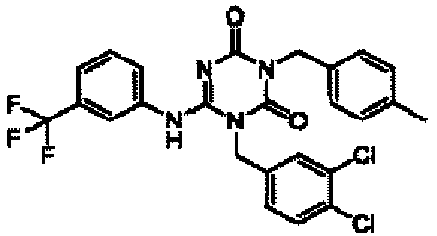


EC50 [µM] >50.0 >50.0 >50.0 >50.0 [Table 204] Patent Document 1 Compound I-0679Patent Document 2 Compound I-580Patent Document 2 Compound I-575Structure 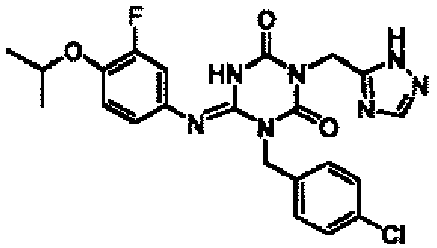
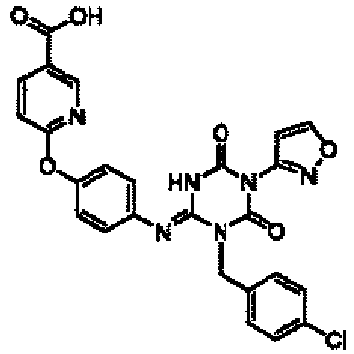

EC50 [µM] >50.0 >50.0 >50.0 - Compounds I-0679, 1-0683, 1-0685 and I-1603 of
WO2012/020749A (Patent Document 1), and Compounds I-575 and 1-580 ofWO2013/089212A (Patent Document 2), and Compound 1-066 ofWO2010/099266A (Patent Document 3) did not show coronavirus replication inhibitory activity at concentrations up to 50 µM. -
- · Commercially available Recombinant SARS-CoV-2 3CL Protease
- · Commercially available substrate peptide
Dabceyl-Lys-Thr-Ser-Ala-Val-Leu-Gln-Ser-Gly-Phe-Arg-Lys-Met-Glu(Edans)-NH2 (SEQ ID NO: 1) - · Internal Standard peptide
Dabcyl- Lys-Thr-Ser-Ala -Val- Leu(13C6, 15N)-Gln (SEQ ID NO: 2) - Dabcyl-Lys-Thr-Ser-Ala-Val-Leu(13C6,15N)-Gln can be synthesized with reference to documents (Atherton, E.; Sheppard, R. C., "In Solid Phase Peptide Synthesis, A Practical Approach", IRL Press at Oxford University Pres, 1989.; Bioorg. Med. Chem., Vol. 5, No. 9, 1997, pp. 1888-1891; and the like). An example will be shown below.
- H-Lys-Thr-Ser-Ala-Val-Leu(13C6,15N)-Glu(resin)-OaOtBu (the Lys-side chain is Boc-protected, the Thr-side chain is protected with a tert-butyl group, the Ser-side chain is protected with a tert-butyl group, the C-terminal OH of Glu is protected with a tert-butyl group, and the carboxylic acid of the Glu-side chain is condensed into the resin) is synthesized by Fmoc solid-phase synthesis using a Rink amide resin. Regarding the modification of the N-terminal Dabcyl group, 4-dimethylaminoazobenzene-4'-carboxylic acid (Dabcyl-OH) is condensed on the resin using EDC/HOBT. Final deprotection and cleavage from the resin are carried out by treatment with TFA/EDT = 95 : 5. Thereafter, purification is performed by reverse phase HPLC.
- In the present test, an assay buffer composed of 20 mM Tris-HCl, 100 mM sodium chloride, 1 mM EDTA, 10 mM DTT, and 0.01% BSA is used. For a compound with an IC50 of 10 nM or less, an assay buffer composed of 20 mM Tris-HCl, 1 mM EDTA, 10 mM DTT, and 0.01% BSA is used.
- The sample to be tested is diluted in advance to an appropriate concentration with DMSO, and a 2- to 5-fold series of serial dilutions is prepared and then dispensed into a 384-well plate.
- To a prepared compound plate, 8 µM substrate, and a 6 or 0.6 nM enzyme solution are added, and incubation is carried out for 3 to 5 hours at room temperature. Thereafter, a reaction stopping solution (0.067 µM Internal Standard, 0.1% formic acid, and 10% or 25% acetonitrile) is added to stop the enzymatic reaction.
- The plate in which the reaction has been completed is measured using RapidFire System 360 and a mass analyzer (Agilent, 6550 iFunnel Q-TOF), or RapidFire System 365 and a mass analyzer (Agilent, 6495C Triple Quadrupole). Solution A (75% isopropanol, 15% acetonitrile, 5 mM ammonium formate) and solution B (0.01% trifluoroacetic acid, 0.09% formic acid) are used as a mobile phase at the measurement.
- The reaction product detected by the mass analyzer is calculated using RapidFire Integrator or an equivalent program capable of analysis and is taken as Product area value. Furthermore, the Internal Standard that has been detected at the same time is also calculated and is designated as Internal Standard area value.
- The area values obtained in the previous items are calculated by the following formula, and P/IS is calculated.

- When x denotes the logarithmic value of the compound concentration and y denotes %Inhibition, the inhibition curve is approximated by the following Logistic regression equation, and the value of x obtainable when y = 50 (%) is inputted is calculated as IC50.


- Control(-):the average of P/IS of enzyme inhibited condition wells
- Control(+):the average of P/IS of DMSO control wells
- min: lower limit value of y-axis, max: upper limit value of y-axis, X50: x-coordinates of inflection point, Hill: slope of curve at midpoint between min and max
- The compounds of the present invention were tested essentially as described above. The results are shown in the following tables.
- Incidentally, regarding the IC50 value, a value of less than 0.1 µM is denoted by "A", a value of 0.1 µM or more and less than 1 µM is denoted by "B", and a value of 1 µM or more and less than 10 µM is denoted by "C".
[Table 205] Compound No. IC50 [µM] Compound No. IC50 [µM] I-0113 0.014 II-0288 0.099 I-0115 0.010 II-0290 0.0035 I-0355 0.0087 II-0299 0.0033 I-0361 0.0091 II-0304 0.0045 I-0383 0.0034 II-0332 0.0020 I-0421 0.010 II-0335 0.0032 I-0433 0.010 II-0347 0.0070 I-0483 0.0098 II-0377 0.0030 II-0001 0.0034 II-0410 0.0047 II-0010 0.019 II-0415 0.015 II-0015 0.0015 II-0422 0.0064 II-0034 0.0073 II-0493 0.0013 II-0036 0.0083 II-0521 0.0034 II-0043 0.0058 II-0523 0.011 II-0045 0.0047 II-0543 0.0028 II-0055 0.0045 II-0548 0.014 II-0087 0.0025 II-0559 0.0064 II-0089 0.0036 II-0566 0.027 II-0090 0.016 II-0567 0.0088 II-0109 0.040 II-0568 0.0021 II-0111 0.078 II-0569 0.0042 II-0118 0.0045 II-0570 0.0044 II-0119 0.0089 II-0571 0.0054 II-0120 0.0090 II-0572 0.0056 II-0125 0.0048 II-0573 0.0061 II-0130 0.0019 II-0574 0.0092 II-0163 0.0088 II-0576 0.017 II-0164 0.0090 II-0577 0.0011 II-0173 0.015 II-0579 0.0021 II-0233 0.0015 II-0584 0.0048 II-0278 0.0031 II-0596 0.0016 II-0282 0.0088 II-0608 0.019 II-0284 0.0092 II-0609 0.12 [Table 210] Compound No. IC50 II-0285 A - The preparation examples shown below are only for illustrative purposes and are by no means intended to limit the scope of the invention.
- The compound of the present invention can be administered as a pharmaceutical composition by any conventional route, particularly enterally, for example, orally, for example, in the form of a tablet or a capsule; parenterally, for example, in the form of an injectable preparation or a suspension; and topically, for example, in the form of a lotion, a gel, an ointment or a cream, or as a pharmaceutical composition in a transnasal form or a suppository form. A pharmaceutical composition comprising the compound of the present invention in a free form or in the form of a pharmaceutically acceptable salt together with at least one pharmaceutically acceptable carrier or diluent can be produced by a mixing, granulating, or coating method in a conventional manner. For example, the oral composition can be a tablet, a granular preparation, or a capsule, each containing an excipient, a disintegrating agent, a binder, a lubricating agent, and the like, as well as an active ingredient and the like. Furthermore, the composition for injection can be prepared as a solution or a suspension, may be sterilized, and may contain a preservative, a stabilizer, a buffering agent, and the like.
- The compound according to the present invention has coronavirus 3CL protease inhibitory activity, and it is considered that the compound is useful as a therapeutic agent and/or a prophylactic agent for a disease or a condition associated with coronavirus 3CL proteases.
Claims (19)
- A compound of Formula (3):
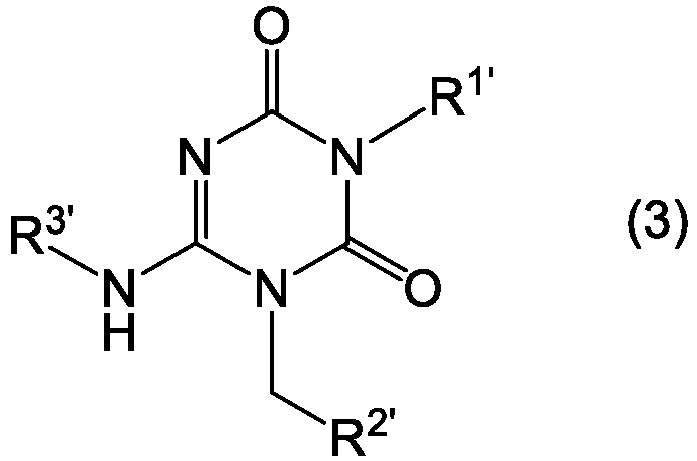 R1' is a group represented by Formula:
 R2' is a group represented by Formula:
 R3' is a group represented by Formula:
 or a pharmaceutically acceptable salt thereof.
 - A compound of Formula (7):
 R1' is a group represented by Formula:
 R2' is a group represented by Formula:
 R3' is a group represented by Formula:
 or a pharmaceutically acceptable salt thereof.
 - The compound according to claim 1, the compound is selected from the group consisting of:

- The compound according to claim 1, which compound is

- The compound according to claim 2, the compound is selected from the group consisting of:


- A compound:

- A pharmaceutical composition comprising the compound according to any one of claims 1 to 6, or a pharmaceutically acceptable salt thereof.
- A p-toluenesulfonate salt of a compound according to claim 2 of the formula:


- A crystalline form of p-toluenesulfonate salt of a compound according to claim 8 of the formula:

- The crystalline form of p-toluenesulfonate Form I according to claim 9, which exhibits a powder X-ray diffraction pattern having peaks at diffraction angles (2θ): 9.1 ± 0.2°, 15.2 ± 0.2°, 18.8 ± 0.2°, 23.6 ± 0.2° and 24.9 ± 0.2°.
- The crystalline form of p-toluenesulfonate Form I according to claim 9, which exhibits a powder X-ray diffraction pattern having peaks at diffraction angles (2θ): 9.1 ± 0.2°, 11.5 ± 0.2°, 14.6 ± 0.2°, 15.2 ± 0.2°, 18.8 ± 0.2°, 20.2 ± 0.2°, 23.6 ± 0.2°, 24.2 ± 0.2°, 24.9 ± 0.2° and 26.9 ± 0.2°.
- A pharmaceutical composition comprising the crystal according to any one of claims 9 to 11.
- A complex comprising a compound according to claim 1 of the formula:


- The complex according to claim 13, wherein the compound according to claim 1 of the formula:

- A fumaric acid cocrystal according to claim 13 or 14.
- The fumaric acid cocrystal Form I according to claim 15, which exhibits a powder X-ray diffraction pattern having peaks at diffraction angles (2θ): 9.5 ± 0.2°, 10.9 ± 0.2°, 18.6 ± 0.2°, 23.5 ± 0.2° and 24.6 ± 0.2°.
- The fumaric acid cocrystal Form I according to claim 15, which exhibits a powder X-ray diffraction pattern having peaks at diffraction angles (2θ): 7.8 ± 0.2°, 9.5 ± 0.2°, 10.1 ± 0.2°, 10.9 ± 0.2°, 13.8 ± 0.2°, 14.7 ± 0.2°, 18.6 ± 0.2°, 22.6 ± 0.2°, 23.5 ± 0.2° and 24.6 ± 0.2°.
- The fumaric acid cocrystal Form I according to claim 15, which exhibits a Raman spectrum having Raman spectral peaks: 676.3cm-1±2cm-1, 748.0cm-1±2cm-1, 1029.3cm-1±2cm-1, 1374.4cm-1±2cm-1, 1515.5cm-1±2cm-1, 1665.7cm-1±2cm-1, 1715.7cm-1±2cm-1 and 1739.1cm-1±2cm-1.
- A pharmaceutical composition comprising the cocrystal according to any one of claims 15 to 18.
Priority Applications (5)
| Application Number | Priority Date | Filing Date | Title |
|---|---|---|---|
| SM20250268T SMT202500268T1 (en) | 2021-04-14 | 2022-02-17 | Triazine derivatives having virus replication inhibitory activity and pharmaceutical composition comprising the same |
| EP24168486.9A EP4400502A3 (en) | 2021-04-14 | 2022-02-17 | Triazine derivatives having virus replication inhibitory activity and pharmaceutical composition comprising the same |
| SI202230156T SI4122926T1 (en) | 2021-04-14 | 2022-02-17 | Triazine derivatives having virus replication inhibitory activity and pharmaceutical composition comprising the same |
| HRP20250770TT HRP20250770T1 (en) | 2021-04-14 | 2022-02-17 | TRIAZINE DERIVATIVES WHICH HAVE AN INHIBITING EFFECT ON VIRUS REPLICATION AND THE PHARMACEUTICAL PREPARATION CONTAINING THEM |
| RS20250670A RS66997B1 (en) | 2021-04-14 | 2022-02-17 | Triazine derivatives having virus replication inhibitory activity and pharmaceutical composition comprising the same |
Applications Claiming Priority (4)
| Application Number | Priority Date | Filing Date | Title |
|---|---|---|---|
| JP2021068672 | 2021-04-14 | ||
| JP2021105802 | 2021-06-25 | ||
| JP2021153819 | 2021-09-22 | ||
| PCT/JP2022/006495 WO2022138987A1 (en) | 2021-04-14 | 2022-02-17 | Triazine derivative having virus propagation inhibitory effect, and pharmaceutical composition containing same |
Related Child Applications (2)
| Application Number | Title | Priority Date | Filing Date |
|---|---|---|---|
| EP24168486.9A Division EP4400502A3 (en) | 2021-04-14 | 2022-02-17 | Triazine derivatives having virus replication inhibitory activity and pharmaceutical composition comprising the same |
| EP24168486.9A Division-Into EP4400502A3 (en) | 2021-04-14 | 2022-02-17 | Triazine derivatives having virus replication inhibitory activity and pharmaceutical composition comprising the same |
Publications (3)
| Publication Number | Publication Date |
|---|---|
| EP4122926A1 EP4122926A1 (en) | 2023-01-25 |
| EP4122926A4 EP4122926A4 (en) | 2023-08-30 |
| EP4122926B1 true EP4122926B1 (en) | 2025-06-04 |
Family
ID=82159864
Family Applications (2)
| Application Number | Title | Priority Date | Filing Date |
|---|---|---|---|
| EP24168486.9A Pending EP4400502A3 (en) | 2021-04-14 | 2022-02-17 | Triazine derivatives having virus replication inhibitory activity and pharmaceutical composition comprising the same |
| EP22733282.2A Active EP4122926B1 (en) | 2021-04-14 | 2022-02-17 | Triazine derivatives having virus replication inhibitory activity and pharmaceutical composition comprising the same |
Family Applications Before (1)
| Application Number | Title | Priority Date | Filing Date |
|---|---|---|---|
| EP24168486.9A Pending EP4400502A3 (en) | 2021-04-14 | 2022-02-17 | Triazine derivatives having virus replication inhibitory activity and pharmaceutical composition comprising the same |
Country Status (26)
| Country | Link |
|---|---|
| US (3) | US12559474B2 (en) |
| EP (2) | EP4400502A3 (en) |
| JP (3) | JP7105430B1 (en) |
| KR (2) | KR102494188B1 (en) |
| CN (6) | CN118359592A (en) |
| AU (1) | AU2022204775B2 (en) |
| CA (1) | CA3195272C (en) |
| CL (1) | CL2023003041A1 (en) |
| CO (1) | CO2022016323A2 (en) |
| DK (1) | DK4122926T3 (en) |
| ES (1) | ES3038833T3 (en) |
| FI (1) | FI4122926T3 (en) |
| HR (1) | HRP20250770T1 (en) |
| HU (1) | HUE072435T2 (en) |
| IL (1) | IL298794B2 (en) |
| LT (1) | LT4122926T (en) |
| MX (1) | MX2022014458A (en) |
| PH (1) | PH12022553603A1 (en) |
| PL (1) | PL4122926T3 (en) |
| PT (1) | PT4122926T (en) |
| RS (1) | RS66997B1 (en) |
| SI (1) | SI4122926T1 (en) |
| SM (1) | SMT202500268T1 (en) |
| TW (1) | TWI815396B (en) |
| WO (2) | WO2022138987A1 (en) |
| ZA (1) | ZA202212526B (en) |
Families Citing this family (41)
| Publication number | Priority date | Publication date | Assignee | Title |
|---|---|---|---|---|
| DK4122926T3 (en) * | 2021-04-14 | 2025-06-30 | Shionogi & Co | TRIAZINE DERIVATIVES WITH VIRUS REPLICATION INHIBITOR ACTIVITY AND PHARMACEUTICAL COMPOSITION COMPRISING THESE |
| JP2024178473A (en) * | 2021-09-03 | 2024-12-25 | 塩野義製薬株式会社 | Bicyclic nitrogen-containing heterocyclic derivatives having virus proliferation inhibitory activity and pharmaceutical compositions containing the same |
| CA3233206A1 (en) * | 2021-09-28 | 2023-04-06 | Yuki Tachibana | Pharmaceutical composition containing triazine derivative |
| TW202320793A (en) * | 2021-09-28 | 2023-06-01 | 日商塩野義製藥股份有限公司 | Pharmaceutical composition comprising triazine derivative |
| CN116782904A (en) * | 2021-09-28 | 2023-09-19 | 盐野义制药株式会社 | Pharmaceutical compositions containing triazine derivatives |
| CN116514734A (en) * | 2021-11-24 | 2023-08-01 | 盐野义制药株式会社 | Process for producing triazine derivative and orally administered preparation containing triazine derivative |
| EP4289432A4 (en) * | 2021-11-24 | 2025-01-15 | Shionogi & Co., Ltd | Preparation for oral administration containing triazine derivative |
| JP7261529B1 (en) | 2021-11-24 | 2023-04-20 | 塩野義製薬株式会社 | Method for producing triazine derivative having virus growth inhibitory action |
| US20250025459A1 (en) * | 2021-11-26 | 2025-01-23 | Shionogi & Co., Ltd. | Covid-19 treatment medicine characterized by combining 3cl protease inhibitor and covid-19 treatment drug |
| WO2023054732A2 (en) * | 2022-01-19 | 2023-04-06 | 塩野義製薬株式会社 | Pharmaceutical for treating novel coronavirus infection |
| WO2023165459A1 (en) * | 2022-03-01 | 2023-09-07 | Fochon Biosciences , Ltd. | Compounds as sars-cov-2 inhibitors |
| US11655240B1 (en) * | 2022-05-10 | 2023-05-23 | Beijing Grand Johamu Pharmaceutical Company, Ltd. | Crystal form of compound and fumaric acid, pharmaceutical composition and method for treating coronavirus-induced diseases |
| US20230302005A1 (en) * | 2022-03-25 | 2023-09-28 | Beijing Grand Johamu Pharmaceutical Company, Ltd. | Active pharmaceutical ingredient, preparation method thereof, and pharmaceutical composition including the same |
| CN117510472B (en) | 2022-04-08 | 2026-03-13 | 盐野义制药株式会社 | Uracil derivatives with viral replication inhibitory activity and pharmaceutical compositions containing them |
| CN114805314B (en) * | 2022-04-20 | 2023-12-15 | 杭州国瑞生物科技有限公司 | Synthesis method of Entecavir |
| CN117126141A (en) * | 2022-05-25 | 2023-11-28 | 成都施贝康生物医药科技有限公司 | Dihydropyrimidine compounds and their preparation and application |
| WO2023226679A1 (en) * | 2022-05-27 | 2023-11-30 | 广州国家实验室 | 3c-like protease inhibitor |
| CN119698410A (en) * | 2022-05-27 | 2025-03-25 | 广州国家实验室 | 3C-like protease inhibitor |
| CN119255987A (en) * | 2022-05-27 | 2025-01-03 | 广州国家实验室 | 3C-like protease inhibitor |
| CN117122601A (en) * | 2022-05-27 | 2023-11-28 | 北京远大九和药业有限公司 | Pharmaceutical compositions containing crystalline forms of compounds and fumaric acid and methods for their preparation and use |
| CN117159555A (en) * | 2022-05-27 | 2023-12-05 | 北京远大九和药业有限公司 | Pharmaceutical composition, preparation method and application thereof |
| CN117186077A (en) * | 2022-06-01 | 2023-12-08 | 陕西盘龙药业集团股份有限公司 | 3-triazolylmethyl-1, 3, 5-triazine-2, 4-dione compound and preparation method and application thereof |
| WO2024009120A1 (en) * | 2022-07-08 | 2024-01-11 | Ascletis Bioscience Co., Ltd. | Triazine derivatives and methods of use thereof |
| CN116496266A (en) * | 2022-07-08 | 2023-07-28 | 歌礼生物科技(杭州)有限公司 | Triazine derivatives |
| CN117402185A (en) * | 2022-07-14 | 2024-01-16 | 广东东阳光药业股份有限公司 | Triazines and their applications in medicines |
| CN117402144B (en) * | 2022-07-14 | 2026-03-06 | 广东东阳光药业股份有限公司 | A method for preparing a 3CL protease inhibitor |
| CN114989048B (en) * | 2022-07-19 | 2023-05-23 | 郑州大学 | Cyclobut-1-enamine compound, preparation method thereof and application thereof in anti-II-type dengue virus drugs |
| CN114933594A (en) * | 2022-07-20 | 2022-08-23 | 北京科翔中升医药科技有限公司 | Fluotriazines compound, pharmaceutical composition and application |
| CN117466873A (en) * | 2022-07-29 | 2024-01-30 | 广东东阳光药业股份有限公司 | Pyrimidine compounds and their applications in medicine |
| CN115260167B (en) * | 2022-08-01 | 2025-01-21 | 陕西盘龙药业集团股份有限公司 | A 3-tetrazolylmethyl-1,3,5-triazine-2,4-dione compound and its preparation method and application |
| CN115109042B (en) * | 2022-08-30 | 2023-05-26 | 北京科翔中升医药科技有限公司 | Triazine compound or pharmaceutically acceptable salt thereof, pharmaceutical composition and application |
| CN116514783A (en) * | 2022-11-21 | 2023-08-01 | 歌礼生物科技(杭州)有限公司 | Triazine derivatives |
| CN115819407A (en) * | 2022-12-13 | 2023-03-21 | 浙江乐普药业股份有限公司 | A kind of Ensitrelvir analogue and its preparation method and anti-coronavirus use |
| CN115785080B (en) * | 2022-12-16 | 2024-10-11 | 陕西盘龙药业集团股份有限公司 | Uracil parent nucleus compound and preparation method and application thereof |
| KR20250127754A (en) | 2022-12-23 | 2025-08-26 | 메이지 세이카 파루마 가부시키가이샤 | evermectin derivatives |
| CN115991700B (en) * | 2023-01-20 | 2025-07-18 | 厦门蔚扬药业有限公司 | Selenium-containing triazine derivative and preparation method and application thereof |
| CN116621817B (en) * | 2023-07-20 | 2023-09-29 | 爱斯特(成都)生物制药股份有限公司 | Entecavir fumarate crystal form, preparation method, pharmaceutical composition and application thereof |
| WO2025058977A1 (en) * | 2023-09-11 | 2025-03-20 | Vir Biotechnology, Inc. | Modulators of coronavirus 3c-like protease and uses thereof |
| AU2024309726A1 (en) * | 2023-10-05 | 2026-04-16 | Shionogi & Co., Ltd. | Preparation containing uracil derivative |
| JP7674711B1 (en) * | 2023-10-05 | 2025-05-12 | 塩野義製薬株式会社 | Pharmaceutical compositions containing uracil derivatives |
| WO2025125695A2 (en) | 2024-12-17 | 2025-06-19 | Medchemica Consultancy Ltd | Chemical compoundsid50000167790940 p. doc 2025-05-07 filing no.:19 |
Family Cites Families (52)
| Publication number | Priority date | Publication date | Assignee | Title |
|---|---|---|---|---|
| FR2631625B1 (en) * | 1988-05-17 | 1992-10-16 | Synthelabo | PHENYL-6 DERIVATIVES PIPERAZINYLALKYL-3 1H, 3H-PYRIMIDINEDIONE-2,4, THEIR PREPARATION AND THEIR THERAPEUTIC APPLICATION |
| JP3032844B2 (en) * | 1990-02-15 | 2000-04-17 | 武田薬品工業株式会社 | Pyrimidinedione derivative |
| US5162326A (en) | 1990-02-15 | 1992-11-10 | Takeda Chemical Industries, Ltd. | Pyrimidinedione derivatives, their production and use |
| CA2398018C (en) * | 2000-01-25 | 2011-10-18 | Neurocrine Biosciences, Inc. | Gonadotropin-releasing hormone receptor antagonists and methods relating thereto |
| CN1890241A (en) | 2003-10-31 | 2007-01-03 | Cv医药有限公司 | A2b adenosine receptor antagonists |
| US7462594B2 (en) * | 2003-12-31 | 2008-12-09 | Taigen Biotechnology Co., Ltd. | Peptide-like compounds that inhibit coronaviral 3CL and flaviviridae viral proteases |
| EA013427B1 (en) * | 2004-03-15 | 2010-04-30 | Такеда Фармасьютикал Компани Лимитед | DIPEPTIDYLPEPTIDASE INHIBITORS |
| ZA200607252B (en) * | 2004-03-15 | 2008-05-28 | Takeda Pharmaceutical | Dipeptidyl peptidase inhibitors |
| CN101326168A (en) | 2005-03-24 | 2008-12-17 | 詹森药业有限公司 | Kininogen 1 receptor antagonist |
| WO2007007161A2 (en) * | 2005-07-08 | 2007-01-18 | Orchid Research Laboratories Limited | Novel bio-active derivatives |
| CA2622642C (en) * | 2005-09-16 | 2013-12-31 | Takeda Pharmaceutical Company Limited | Dipeptidyl peptidase inhibitors |
| CN100502868C (en) * | 2005-11-18 | 2009-06-24 | 北京大学 | 3CL protease inhibitor of non-peptide SARS coronavirus and use thereof |
| EP1973886B1 (en) * | 2005-12-29 | 2013-02-27 | Janssen Pharmaceutica N.V. | Prokineticin 1 receptor antagonists |
| US20100029941A1 (en) * | 2006-03-28 | 2010-02-04 | Takeda Pharmaceutical Company Limited | Preparation of (r)-3-aminopiperidine dihydrochloride |
| RU2479580C2 (en) * | 2007-06-27 | 2013-04-20 | Астразенека Аб | Pyrazinone derivatives and use thereof in treatment of lung diseases |
| JP2011502154A (en) | 2007-10-30 | 2011-01-20 | ジヤンセン・フアーマシユーチカ・ナームローゼ・フエンノートシヤツプ | The research and development of the present invention described under the statement on federal-sponsored research or development of prokineticin 1 receptor antagonists containing aminoheteroaryls is not with federal support. |
| CN102395571B (en) | 2009-02-13 | 2015-12-16 | 盐野义制药株式会社 | Pyrrolotriazine derivatives and the pharmaceutical composition containing this pyrrolotriazine derivatives |
| EP2585069A1 (en) | 2010-06-28 | 2013-05-01 | Janssen Pharmaceutica, N.V. | Prokineticin 1 receptor antagonists for the treatment of pain |
| CA2803539A1 (en) * | 2010-06-28 | 2012-01-12 | Janssen Pharmaceutica Nv | Prokineticin 1 receptor antagonists for the treatment of pain |
| WO2012009258A2 (en) | 2010-07-13 | 2012-01-19 | Edward Roberts | Peptidomimetic galanin receptor modulators |
| US9212130B2 (en) | 2010-08-10 | 2015-12-15 | Shionogi & Co., Ltd. | Heterocyclic derivative and pharmaceutical composition comprising the same |
| PL2604595T3 (en) * | 2010-08-10 | 2016-09-30 | Triazine derivative and pharmaceutical compound that contains same and exhibits analgesic activity | |
| CN102807568B (en) | 2011-05-31 | 2015-11-25 | 正大天晴药业集团股份有限公司 | Thiadiazoles derivative class DPP-IV inhibitor |
| CN103159665B (en) * | 2011-12-09 | 2017-01-25 | 天津市国际生物医药联合研究院 | Isatin-5-amide inhibiting agent with inhibition effect against SARS coronavirus main protease |
| TW201331188A (en) * | 2011-12-15 | 2013-08-01 | Shionogi & Co | Substituted triazine derivative and pharmaceutical composition comprising the same |
| US9550763B2 (en) | 2012-02-09 | 2017-01-24 | Shionogi & Co., Ltd. | Heterocyclic ring and carbocyclic derivative |
| TWI637949B (en) | 2013-06-14 | 2018-10-11 | 塩野義製藥股份有限公司 | Aminotriazine derivative and pharmaceutical composition comprising the same |
| CN104936945B (en) | 2013-10-25 | 2017-11-03 | 上海恒瑞医药有限公司 | Pyridinone derivatives, its preparation method and its in application pharmaceutically |
| CN104109147B (en) * | 2014-06-21 | 2016-10-05 | 安徽省逸欣铭医药科技有限公司 | Hydroxyl amidino groups benzene analog derivative and preparation method thereof and medical usage |
| US10183949B2 (en) * | 2014-08-29 | 2019-01-22 | The University Of Tokyo | Pyrimidinone derivative having autotaxin-inhibitory activity |
| JP2016079168A (en) * | 2014-10-17 | 2016-05-16 | 塩野義製薬株式会社 | 9 membered condensed-ring derivative |
| EP3305789A4 (en) * | 2015-05-29 | 2018-11-21 | Shionogi & Co., Ltd. | Nitrogen-containing tricyclic derivative having hiv replication inhibitory activity |
| TW201817714A (en) * | 2016-08-30 | 2018-05-16 | 英商葛蘭素史密斯克藍智慧財產權有限公司 | Compounds that inhibit 3C and 3CL proteases and methods of use thereof |
| JP7116356B2 (en) * | 2017-11-28 | 2022-08-10 | 日産化学株式会社 | Triazine-2,4-dione derivative and method for producing the same |
| AU2021253796B2 (en) | 2020-04-05 | 2023-06-01 | Pfizer Inc. | Compounds and methods for the treatment of COVID-19 |
| CN112516122A (en) * | 2020-04-21 | 2021-03-19 | 洪楠方 | Application of suramin in preparation of drugs for preventing or treating coronavirus related diseases |
| WO2022035911A2 (en) * | 2020-08-11 | 2022-02-17 | Tutela Pharmaceuticals, Inc. | Methods of treating coronavirus infections by co-administering an fkbp ligand and an antiviral agent |
| US11351149B2 (en) | 2020-09-03 | 2022-06-07 | Pfizer Inc. | Nitrile-containing antiviral compounds |
| WO2022158528A1 (en) * | 2021-01-20 | 2022-07-28 | 国立大学法人北海道大学 | Anti-viral agent |
| TW202304496A (en) * | 2021-03-29 | 2023-02-01 | 穆斯塔法 巴爾札尼 | Willow extract and its use in treating a viral infection, allergic reaction, and other medical conditions |
| DK4122926T3 (en) | 2021-04-14 | 2025-06-30 | Shionogi & Co | TRIAZINE DERIVATIVES WITH VIRUS REPLICATION INHIBITOR ACTIVITY AND PHARMACEUTICAL COMPOSITION COMPRISING THESE |
| CN113666914B (en) | 2021-09-27 | 2022-06-07 | 成都施贝康生物医药科技有限公司 | Dihydropyrimidine compound and preparation method and application thereof |
| CN113773300B (en) | 2021-09-27 | 2022-10-11 | 成都施贝康生物医药科技有限公司 | Sulfonamide compound, preparation method and application thereof |
| CN113735838B (en) | 2021-09-27 | 2022-07-08 | 成都施贝康生物医药科技有限公司 | Dihydropyrimidine compound, preparation method and application thereof |
| CN113801097B (en) | 2021-09-27 | 2022-11-22 | 成都施贝康生物医药科技有限公司 | Dihydropyrimidine compound, preparation method and application thereof |
| CN113620888B (en) | 2021-09-27 | 2023-06-06 | 成都施贝康生物医药科技有限公司 | Dihydropyrimidine compound and preparation method and application thereof |
| CN116782904A (en) * | 2021-09-28 | 2023-09-19 | 盐野义制药株式会社 | Pharmaceutical compositions containing triazine derivatives |
| TW202320793A (en) | 2021-09-28 | 2023-06-01 | 日商塩野義製藥股份有限公司 | Pharmaceutical composition comprising triazine derivative |
| CA3233206A1 (en) * | 2021-09-28 | 2023-04-06 | Yuki Tachibana | Pharmaceutical composition containing triazine derivative |
| EP4289432A4 (en) | 2021-11-24 | 2025-01-15 | Shionogi & Co., Ltd | Preparation for oral administration containing triazine derivative |
| WO2023054732A2 (en) * | 2022-01-19 | 2023-04-06 | 塩野義製薬株式会社 | Pharmaceutical for treating novel coronavirus infection |
| CN114591304B (en) * | 2022-05-10 | 2022-07-12 | 北京远大九和药业有限公司 | Crystal form of compound, preparation method and application thereof |
-
2022
- 2022-02-17 DK DK22733282.2T patent/DK4122926T3/en active
- 2022-02-17 HU HUE22733282A patent/HUE072435T2/en unknown
- 2022-02-17 WO PCT/JP2022/006495 patent/WO2022138987A1/en not_active Ceased
- 2022-02-17 JP JP2022525557A patent/JP7105430B1/en active Active
- 2022-02-17 ES ES22733282T patent/ES3038833T3/en active Active
- 2022-02-17 KR KR1020227018680A patent/KR102494188B1/en active Active
- 2022-02-17 IL IL298794A patent/IL298794B2/en unknown
- 2022-02-17 SI SI202230156T patent/SI4122926T1/en unknown
- 2022-02-17 LT LTEPPCT/JP2022/006495T patent/LT4122926T/en unknown
- 2022-02-17 RS RS20250670A patent/RS66997B1/en unknown
- 2022-02-17 PT PT227332822T patent/PT4122926T/en unknown
- 2022-02-17 CA CA3195272A patent/CA3195272C/en active Active
- 2022-02-17 PL PL22733282.2T patent/PL4122926T3/en unknown
- 2022-02-17 KR KR1020237002784A patent/KR20230159812A/en active Pending
- 2022-02-17 SM SM20250268T patent/SMT202500268T1/en unknown
- 2022-02-17 JP JP2022571730A patent/JP7530596B2/en active Active
- 2022-02-17 CN CN202410458057.XA patent/CN118359592A/en active Pending
- 2022-02-17 EP EP24168486.9A patent/EP4400502A3/en active Pending
- 2022-02-17 MX MX2022014458A patent/MX2022014458A/en unknown
- 2022-02-17 CN CN202310437344.8A patent/CN116650498B/en active Active
- 2022-02-17 EP EP22733282.2A patent/EP4122926B1/en active Active
- 2022-02-17 CN CN202280000918.9A patent/CN115038696A/en active Pending
- 2022-02-17 HR HRP20250770TT patent/HRP20250770T1/en unknown
- 2022-02-17 CN CN202311797713.0A patent/CN117820248A/en active Pending
- 2022-02-17 US US17/790,358 patent/US12559474B2/en active Active
- 2022-02-17 PH PH1/2022/553603A patent/PH12022553603A1/en unknown
- 2022-02-17 CN CN202210983564.6A patent/CN115850249B/en active Active
- 2022-02-17 WO PCT/JP2022/006496 patent/WO2022138988A1/en not_active Ceased
- 2022-02-17 CN CN202210742186.2A patent/CN115073431B/en active Active
- 2022-02-17 FI FIEP22733282.2T patent/FI4122926T3/en active
- 2022-02-17 AU AU2022204775A patent/AU2022204775B2/en active Active
- 2022-04-13 TW TW111113943A patent/TWI815396B/en active
- 2022-04-29 US US17/733,366 patent/US11814368B2/en active Active
- 2022-11-15 CO CONC2022/0016323A patent/CO2022016323A2/en unknown
- 2022-11-16 ZA ZA2022/12526A patent/ZA202212526B/en unknown
-
2023
- 2023-10-11 CL CL2023003041A patent/CL2023003041A1/en unknown
-
2024
- 2024-07-17 JP JP2024113814A patent/JP7738869B2/en active Active
-
2026
- 2026-01-07 US US19/442,200 patent/US20260125365A1/en active Pending
Also Published As
Similar Documents
| Publication | Publication Date | Title |
|---|---|---|
| EP4122926A1 (en) | Triazine derivative having virus propagation inhibitory effect, and pharmaceutical composition containing same | |
| JP7236065B1 (en) | Pharmaceutical composition containing triazine derivative | |
| EP4032884A1 (en) | Crystal of 1,3,5-triazine derivative or solvate thereof and method for producing same | |
| WO2023095860A1 (en) | Covid-19 treatment medicine characterized by combining 3cl protease inhibitor and covid-19 treatment drug | |
| JP7261529B1 (en) | Method for producing triazine derivative having virus growth inhibitory action | |
| RU2806042C1 (en) | Triazine derivatives having inhibitory activity against virus replication, and pharmaceutical composition containing them | |
| HK40081541A (en) | Triazine derivative having virus propagation inhibitory effect, and pharmaceutical composition containing same | |
| BR112022023272B1 (en) | TRIAZINE DERIVATIVES HAVING AN INHIBITING EFFECT ON VIRUS PROPAGATION AND COCRYSTAL OF THE SAME WITH FUMARIC ACID | |
| HK40081541B (en) | Triazine derivative having virus propagation inhibitory effect, and pharmaceutical composition containing same | |
| BR122023002208B1 (en) | PHARMACEUTICAL COMPOSITIONS COMPRISING TRIAZINE DERIVATIVES FOR THE TREATMENT AND/OR PREVENTION OF COVID-19 | |
| BR122023002208A2 (en) | PHARMACEUTICAL COMPOSITIONS COMPRISING TRIAZINE DERIVATIVES HAVING AN EFFECT INHIBITING THE SPREAD OF VIRUS, INHIBITORS AND USES | |
| HK40114521A (en) | Pharmaceutical composition containing triazine derivative | |
| CN119894899A (en) | Carbonyl fused heterocyclic derivatives as ubiquitin-specific protease inhibitors |
Legal Events
| Date | Code | Title | Description |
|---|---|---|---|
| REG | Reference to a national code |
Ref country code: HR Ref legal event code: TUEP Ref document number: P20250770T Country of ref document: HR |
|
| STAA | Information on the status of an ep patent application or granted ep patent |
Free format text: STATUS: THE INTERNATIONAL PUBLICATION HAS BEEN MADE |
|
| PUAI | Public reference made under article 153(3) epc to a published international application that has entered the european phase |
Free format text: ORIGINAL CODE: 0009012 |
|
| STAA | Information on the status of an ep patent application or granted ep patent |
Free format text: STATUS: REQUEST FOR EXAMINATION WAS MADE |
|
| 17P | Request for examination filed |
Effective date: 20221019 |
|
| AK | Designated contracting states |
Kind code of ref document: A1 Designated state(s): AL AT BE BG CH CY CZ DE DK EE ES FI FR GB GR HR HU IE IS IT LI LT LU LV MC MK MT NL NO PL PT RO RS SE SI SK SM TR |
|
| A4 | Supplementary search report drawn up and despatched |
Effective date: 20230731 |
|
| STAA | Information on the status of an ep patent application or granted ep patent |
Free format text: STATUS: EXAMINATION IS IN PROGRESS |
|
| 17Q | First examination report despatched |
Effective date: 20240313 |
|
| DAV | Request for validation of the european patent (deleted) | ||
| DAX | Request for extension of the european patent (deleted) | ||
| GRAP | Despatch of communication of intention to grant a patent |
Free format text: ORIGINAL CODE: EPIDOSNIGR1 |
|
| STAA | Information on the status of an ep patent application or granted ep patent |
Free format text: STATUS: GRANT OF PATENT IS INTENDED |
|
| RIC1 | Information provided on ipc code assigned before grant |
Ipc: C07D 471/04 20060101ALI20240718BHEP Ipc: C07D 417/14 20060101ALI20240718BHEP Ipc: C07D 417/06 20060101ALI20240718BHEP Ipc: C07D 413/14 20060101ALI20240718BHEP Ipc: C07D 409/14 20060101ALI20240718BHEP Ipc: C07D 405/14 20060101ALI20240718BHEP Ipc: C07D 403/14 20060101ALI20240718BHEP Ipc: C07D 403/06 20060101ALI20240718BHEP Ipc: C07D 401/14 20060101ALI20240718BHEP Ipc: C07D 401/04 20060101ALI20240718BHEP Ipc: C07D 251/46 20060101ALI20240718BHEP Ipc: A61P 43/00 20060101ALI20240718BHEP Ipc: A61P 31/14 20060101ALI20240718BHEP Ipc: A61K 31/55 20060101ALI20240718BHEP Ipc: A61K 31/5383 20060101ALI20240718BHEP Ipc: A61K 31/5377 20060101ALI20240718BHEP Ipc: A61K 31/53 20060101ALI20240718BHEP Ipc: A61K 31/506 20060101ALI20240718BHEP Ipc: C07D 401/06 20060101AFI20240718BHEP |
|
| INTG | Intention to grant announced |
Effective date: 20240802 |
|
| GRAJ | Information related to disapproval of communication of intention to grant by the applicant or resumption of examination proceedings by the epo deleted |
Free format text: ORIGINAL CODE: EPIDOSDIGR1 |
|
| STAA | Information on the status of an ep patent application or granted ep patent |
Free format text: STATUS: EXAMINATION IS IN PROGRESS |
|
| INTC | Intention to grant announced (deleted) | ||
| GRAP | Despatch of communication of intention to grant a patent |
Free format text: ORIGINAL CODE: EPIDOSNIGR1 |
|
| STAA | Information on the status of an ep patent application or granted ep patent |
Free format text: STATUS: GRANT OF PATENT IS INTENDED |
|
| INTG | Intention to grant announced |
Effective date: 20250120 |
|
| GRAS | Grant fee paid |
Free format text: ORIGINAL CODE: EPIDOSNIGR3 |
|
| GRAA | (expected) grant |
Free format text: ORIGINAL CODE: 0009210 |
|
| STAA | Information on the status of an ep patent application or granted ep patent |
Free format text: STATUS: THE PATENT HAS BEEN GRANTED |
|
| AK | Designated contracting states |
Kind code of ref document: B1 Designated state(s): AL AT BE BG CH CY CZ DE DK EE ES FI FR GB GR HR HU IE IS IT LI LT LU LV MC MK MT NL NO PL PT RO RS SE SI SK SM TR |
|
| P01 | Opt-out of the competence of the unified patent court (upc) registered |
Free format text: CASE NUMBER: APP_20529/2025 Effective date: 20250430 |
|
| RAP3 | Party data changed (applicant data changed or rights of an application transferred) |
Owner name: NATIONAL UNIVERSITY CORPORATIONHOKKAIDO UNIVERSITY Owner name: SHIONOGI & CO., LTD. |
|
| REG | Reference to a national code |
Ref country code: GB Ref legal event code: FG4D |
|
| REG | Reference to a national code |
Ref country code: CH Ref legal event code: EP |
|
| REG | Reference to a national code |
Ref country code: DE Ref legal event code: R096 Ref document number: 602022015561 Country of ref document: DE |
|
| REG | Reference to a national code |
Ref country code: DK Ref legal event code: T3 Effective date: 20250626 |
|
| REG | Reference to a national code |
Ref country code: IE Ref legal event code: FG4D |
|
| REG | Reference to a national code |
Ref country code: SE Ref legal event code: TRGR |
|
| REG | Reference to a national code |
Ref country code: FI Ref legal event code: FGE |
|
| REG | Reference to a national code |
Ref country code: NL Ref legal event code: FP |
|
| REG | Reference to a national code |
Ref country code: PT Ref legal event code: SC4A Ref document number: 4122926 Country of ref document: PT Date of ref document: 20250729 Kind code of ref document: T Free format text: AVAILABILITY OF NATIONAL TRANSLATION Effective date: 20250723 |
|
| REG | Reference to a national code |
Ref country code: GR Ref legal event code: EP Ref document number: 20250401408 Country of ref document: GR Effective date: 20250808 |
|
| REG | Reference to a national code |
Ref country code: HR Ref legal event code: T1PR Ref document number: P20250770 Country of ref document: HR |
|
| REG | Reference to a national code |
Ref country code: ES Ref legal event code: FG2A Ref document number: 3038833 Country of ref document: ES Kind code of ref document: T3 Effective date: 20251015 Ref country code: EE Ref legal event code: FG4A Ref document number: E025250 Country of ref document: EE Effective date: 20250708 Ref country code: SK Ref legal event code: T3 Ref document number: E 46907 Country of ref document: SK |
|
| REG | Reference to a national code |
Ref country code: HU Ref legal event code: AG4A Ref document number: E072435 Country of ref document: HU |
|
| PGFP | Annual fee paid to national office [announced via postgrant information from national office to epo] |
Ref country code: FR Payment date: 20251231 Year of fee payment: 5 |
|
| PGFP | Annual fee paid to national office [announced via postgrant information from national office to epo] |
Ref country code: NL Payment date: 20260106 Year of fee payment: 5 |
|
| REG | Reference to a national code |
Ref country code: HR Ref legal event code: ODRP Ref document number: P20250770 Country of ref document: HR Payment date: 20260109 Year of fee payment: 5 |
|
| REG | Reference to a national code |
Ref country code: CH Ref legal event code: U11 Free format text: ST27 STATUS EVENT CODE: U-0-0-U10-U11 (AS PROVIDED BY THE NATIONAL OFFICE) Effective date: 20260301 |
|
| REG | Reference to a national code |
Ref country code: DE Ref legal event code: R097 Ref document number: 602022015561 Country of ref document: DE |
|
| PGFP | Annual fee paid to national office [announced via postgrant information from national office to epo] |
Ref country code: LU Payment date: 20260216 Year of fee payment: 5 |
|
| PGFP | Annual fee paid to national office [announced via postgrant information from national office to epo] |
Ref country code: HU Payment date: 20260130 Year of fee payment: 5 |
|
| PGFP | Annual fee paid to national office [announced via postgrant information from national office to epo] |
Ref country code: SM Payment date: 20260129 Year of fee payment: 5 |
|
| PGFP | Annual fee paid to national office [announced via postgrant information from national office to epo] |
Ref country code: SE Payment date: 20251230 Year of fee payment: 5 |
|
| PGFP | Annual fee paid to national office [announced via postgrant information from national office to epo] |
Ref country code: LT Payment date: 20260115 Year of fee payment: 5 Ref country code: GB Payment date: 20260106 Year of fee payment: 5 |
|
| PGFP | Annual fee paid to national office [announced via postgrant information from national office to epo] |
Ref country code: ES Payment date: 20260304 Year of fee payment: 5 Ref country code: MC Payment date: 20260129 Year of fee payment: 5 |
|
| PLBE | No opposition filed within time limit |
Free format text: ORIGINAL CODE: 0009261 |
|
| STAA | Information on the status of an ep patent application or granted ep patent |
Free format text: STATUS: NO OPPOSITION FILED WITHIN TIME LIMIT |
|
| PGFP | Annual fee paid to national office [announced via postgrant information from national office to epo] |
Ref country code: NO Payment date: 20260211 Year of fee payment: 5 Ref country code: DK Payment date: 20260213 Year of fee payment: 5 Ref country code: IE Payment date: 20260102 Year of fee payment: 5 Ref country code: DE Payment date: 20251230 Year of fee payment: 5 |
|
| PGFP | Annual fee paid to national office [announced via postgrant information from national office to epo] |
Ref country code: HR Payment date: 20260109 Year of fee payment: 5 Ref country code: AT Payment date: 20260301 Year of fee payment: 5 |
|
| PGFP | Annual fee paid to national office [announced via postgrant information from national office to epo] |
Ref country code: RO Payment date: 20260127 Year of fee payment: 5 Ref country code: IT Payment date: 20260122 Year of fee payment: 5 Ref country code: BE Payment date: 20260105 Year of fee payment: 5 Ref country code: FI Payment date: 20260213 Year of fee payment: 5 |
|
| REG | Reference to a national code |
Ref country code: CH Ref legal event code: L10 Free format text: ST27 STATUS EVENT CODE: U-0-0-L10-L00 (AS PROVIDED BY THE NATIONAL OFFICE) Effective date: 20260416 |
|
| PGFP | Annual fee paid to national office [announced via postgrant information from national office to epo] |
Ref country code: RS Payment date: 20260116 Year of fee payment: 5 |
|
| PGFP | Annual fee paid to national office [announced via postgrant information from national office to epo] |
Ref country code: IS Payment date: 20260213 Year of fee payment: 5 |
|
| PGFP | Annual fee paid to national office [announced via postgrant information from national office to epo] |
Ref country code: TR Payment date: 20260212 Year of fee payment: 5 |
|
| PGFP | Annual fee paid to national office [announced via postgrant information from national office to epo] |
Ref country code: PT Payment date: 20260216 Year of fee payment: 5 Ref country code: CH Payment date: 20260301 Year of fee payment: 5 Ref country code: CZ Payment date: 20260130 Year of fee payment: 5 |
|
| PGFP | Annual fee paid to national office [announced via postgrant information from national office to epo] |
Ref country code: GR Payment date: 20260114 Year of fee payment: 5 Ref country code: PL Payment date: 20260107 Year of fee payment: 5 Ref country code: CY Payment date: 20260107 Year of fee payment: 5 Ref country code: MT Payment date: 20260219 Year of fee payment: 5 |
|
| PGFP | Annual fee paid to national office [announced via postgrant information from national office to epo] |
Ref country code: LV Payment date: 20260105 Year of fee payment: 5 Ref country code: EE Payment date: 20260105 Year of fee payment: 5 Ref country code: SK Payment date: 20260113 Year of fee payment: 5 |
|
| PGFP | Annual fee paid to national office [announced via postgrant information from national office to epo] |
Ref country code: SI Payment date: 20260114 Year of fee payment: 5 |
|
| PGFP | Annual fee paid to national office [announced via postgrant information from national office to epo] |
Ref country code: BG Payment date: 20260122 Year of fee payment: 5 |
|
| PGFP | Annual fee paid to national office [announced via postgrant information from national office to epo] |
Ref country code: MK Payment date: 20260115 Year of fee payment: 5 |
|
| 26N | No opposition filed |
Effective date: 20260305 |