EP4122347B1 - Schale für gleitschuh, gleitschuh diese umfassend und manschette - Google Patents
Schale für gleitschuh, gleitschuh diese umfassend und manschette Download PDFInfo
- Publication number
- EP4122347B1 EP4122347B1 EP21425034.2A EP21425034A EP4122347B1 EP 4122347 B1 EP4122347 B1 EP 4122347B1 EP 21425034 A EP21425034 A EP 21425034A EP 4122347 B1 EP4122347 B1 EP 4122347B1
- Authority
- EP
- European Patent Office
- Prior art keywords
- collar
- tongue
- enveloping part
- boot
- lower shell
- Prior art date
- Legal status (The legal status is an assumption and is not a legal conclusion. Google has not performed a legal analysis and makes no representation as to the accuracy of the status listed.)
- Active
Links
Images


Classifications
-
- A—HUMAN NECESSITIES
- A43—FOOTWEAR
- A43B—CHARACTERISTIC FEATURES OF FOOTWEAR; PARTS OF FOOTWEAR
- A43B5/00—Footwear for sporting purposes
- A43B5/04—Ski or like boots
- A43B5/0427—Ski or like boots characterised by type or construction details
- A43B5/0435—Adjustment of the boot to the foot
- A43B5/0439—Adjustment of the boot to the foot to the heel; Heel clamping devices; Heel supports
-
- A—HUMAN NECESSITIES
- A43—FOOTWEAR
- A43B—CHARACTERISTIC FEATURES OF FOOTWEAR; PARTS OF FOOTWEAR
- A43B5/00—Footwear for sporting purposes
- A43B5/04—Ski or like boots
- A43B5/0427—Ski or like boots characterised by type or construction details
- A43B5/0452—Adjustment of the forward inclination of the boot leg
- A43B5/0454—Adjustment of the forward inclination of the boot leg including flex control; Dampening means
- A43B5/0456—Adjustment of the forward inclination of the boot leg including flex control; Dampening means with the actuator being disposed at the rear side of the boot
-
- A—HUMAN NECESSITIES
- A43—FOOTWEAR
- A43B—CHARACTERISTIC FEATURES OF FOOTWEAR; PARTS OF FOOTWEAR
- A43B5/00—Footwear for sporting purposes
- A43B5/04—Ski or like boots
- A43B5/0427—Ski or like boots characterised by type or construction details
- A43B5/047—Ski or like boots characterised by type or construction details provided with means to improve walking with the skiboot
- A43B5/0474—Ski or like boots characterised by type or construction details provided with means to improve walking with the skiboot having a walk/ski position
-
- A—HUMAN NECESSITIES
- A43—FOOTWEAR
- A43B—CHARACTERISTIC FEATURES OF FOOTWEAR; PARTS OF FOOTWEAR
- A43B5/00—Footwear for sporting purposes
- A43B5/04—Ski or like boots
- A43B5/0427—Ski or like boots characterised by type or construction details
- A43B5/048—Rear-entry skiboots
Definitions
- the invention relates to a shell bottom for a sliding boot.
- the invention also relates to a sliding boot, in particular a ski boot comprising such a shell bottom and a collar articulated around the shell bottom.
- Board sports are sports in which a user guides one or more boards attached to their feet. When practicing these sports, variations in the terrain are felt at the feet and lower legs via board shoes.
- Board shoes typically include a lower shell surrounding the user's foot and a collar surrounding the lower leg. The collar is pivoted around the lower shell along an axis of rotation substantially aligned with an axis passing through the user's ankles. Board shoes play a key role in the user's perception of the terrain and in the impulses they transmit to the board(s).
- alpine skiing is a sport in which a user guides a pair of skis attached to their feet on snowy terrain.
- a skier makes turns, they alternate between flexion and extension phases of the legs.
- the cuff pivots forward relative to the bottom of the shell and during extension phases, it pivots backward.
- the support characteristics but also elasticity, cushioning and rebound of the Ski boots are designed to provide dynamic, precise and effortless ski guidance.
- sliding shoes must also remain simple to use and manufacture.
- the sliding shoes known from the state of the art do not allow all of these requirements to be met at once.
- the shoes known from the state of the art do not allow one or more sliding boards to be guided in a sufficiently dynamic, efficient, and precise manner.
- WO 2014/064657 A1 discloses a bottom shell for a sliding shoe comprising a wrap-around portion and a tongue.
- the aim of the invention is to provide a sliding shoe which overcomes the above drawbacks and improves the sliding shoes known from the prior art.
- an object of the invention is a sliding shoe that is simple to manufacture and offers optimal rebound characteristics for guiding one or more sliding boards.
- the invention relates to a shell bottom for a sliding shoe comprising an enveloping part intended to receive a user's foot and a one-piece tongue with the enveloping part extending substantially from a rear wall of the enveloping part and upwards, the tongue being intended to cooperate with a collar articulated in rotation around the enveloping part.
- the wrap-around portion may extend above a user's malleoli, and the tab may be connected to the wrap-around portion substantially at malleoli height.
- the tongue may comprise at least one stiffening rib whose thickness decreases as one moves from bottom to top of the tongue.
- the tab may extend above the wrap-around portion.
- the bottom of the hull can be obtained by plastic injection, in particular by polyurethane injection.
- the tab may comprise a generally rectangular shape, a height of the tab being between 5 cm and 20 cm, and/or a width of the tab being between 5 mm and 30 mm.
- the bottom of the hull may include a defined space between the rear wall of the enveloping part and the tongue, a dimension of this space being between 2mm and 15mm.
- the tongue can be generally inclined forward at an angle of between 5° and 20° relative to a vertical axis.
- the tab can be configured to flex as the collar pivots forward around the wrap-around portion.
- the invention also relates to a sliding shoe comprising a bottom as defined above, the collar being articulated in rotation around the enveloping part, the tongue being linked to the collar.
- the collar may include a back wall covered by the tab.
- the collar may include an opening into which an upper end of the tab is inserted.
- the tab can be fixed to the collar, in particular by means of at least one fixing screw.
- the tab may include an upper portion covered by a wall of the collar and a lower portion not covered by the collar.
- the invention also relates to a collar for a sliding shoe, the collar comprising a wrap-around portion intended to receive a lower leg of a user and a one-piece tongue with the wrap-around portion extending substantially from a rear wall of the wrap-around portion and downwards, the tongue being intended to cooperate with a shell bottom hinged in rotation around the wrap-around portion.
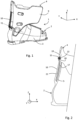
- FIG. 1 schematically illustrates a sliding boot 1 according to one embodiment of the invention.
- the sliding boot is a ski boot, in particular an alpine ski boot.
- the boot could be any boot intended for use in any other sliding sport, i.e. a sport where a user guides one or more sliding boards with his feet, by performing flexion and extension movements of the legs.
- the sliding boot may be any other snow sliding boot, such as a snowboard boot, a ski touring boot, or a cross-country ski boot.
- a longitudinal axis X is defined as an axis parallel to the axis in which the user's foot extends from the heel (at the back) to the toes (at the front).
- the transverse axis Y denotes an axis perpendicular to the longitudinal axis X and passing through the user's two malleoli.
- the X and Y axes are horizontal.
- the vertical axis Z is an axis perpendicular to the X and Y axes.
- Front and back are defined in relation to the longitudinal axis X: front denotes an area more towards the toes while back denotes an area more towards the heel.
- Top and bottom are defined in relation to the vertical axis Z.
- a higher zone denotes an area more towards the top and a lower zone denotes an area more towards the bottom.
- the sliding shoe 1 comprises a shell bottom 2 comprising an enveloping part 3 intended to accommodate, or in other words to envelop, the user's foot.
- the sliding shoe 1 also comprises a collar 4 intended to envelop the user's lower leg.
- the collar is articulated in rotation around the shell bottom, and in particular around the enveloping part 3, along an axis Y1 substantially parallel to the transverse axis Y and passing through the user's two malleoli.
- the enveloping part 3 comprises a general shape which fits the shape of the foot. It notably comprises a rear wall 5 which fits the shape of the heel and the Achilles tendon. It also comprises curved side walls which fit the shape of the malleoli.
- the rear wall extends vertically over the entire height of the bottom of the shell and laterally substantially up to the level of the malleoli. As can be seen on the Figure 6 , this rear wall 5 may comprise a portion generally inclined towards the front, in order to promote the user's tibia resting on an opposite surface of the shoe, that is to say on a front surface of the shoe, in particular a front surface of the collar.
- the bottom of the shell 2 may also comprise fixing interfaces intended to cooperate with a device for fixing a sliding board.
- the sliding shoe being a ski boot, it comprises a front sidewalk 6A and a rear sidewalk 6B intended to cooperate with the jaws of a binding device.
- the sidewalks form at least part of the sole of the boot.
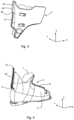
- the enveloping part 3 which is also clearly visible on the figures 4 And 6 , extends upwards to above the malleoli. It comprises an upper opening 7 allowing the insertion of the foot inside the bottom of the shell. This upper opening 7 is extended on the top of the foot by a longitudinal opening 8 which can be closed by means of closing devices (not shown), such as for example one or more tightening buckles. Two lateral flaps, positioned on either side of the longitudinal opening 8 can thus overlap on the top of the foot, in particular in order to guarantee the watertightness of the sliding shoe.
- Necklace 4 clearly visible on the Figure 3 , has a generally tubular shape. It comprises two lateral flaps 9 intended to overlap at the front of the lower leg, substantially at the level of the tibia.
- the collar 4 may also comprise closing means capable of locking the two lateral flaps 9 to enclose the lower leg, for example one or more tightening buckles.
- the collar 4 extends downwards substantially to the height of the malleoli, and it extends upwards substantially to mid-height of the tibia or up to a third of the height of the tibia.
- the rotational connection between the collar and the bottom of the shell may be achieved by means of axes extending parallel to the axis Y1. These axes are capable of cooperating with openings made in walls of the bottom of the shell 2 and of the collar 4, at the level of each of the user's malleoli.
- the collar and the bottom of the shell can preferably be made of plastic, in particular injected plastic.
- they can be made of polyurethane.
- the collar and the bottom of the shell can be made from the same plastic material.
- the plastic material and the thickness of the walls forming the collar and the bottom of the shell are chosen so as to protect the foot and so as to give the sliding boot a rigidity adapted to the practice of the sliding sport concerned.
- any other material can be considered to form the bottom of the shell and/or the collar.
- the plastic material can be filled, in particular with glass or carbon fibers. It is also possible for the collar and/or the bottom of the shell to be formed by an assembly of several materials, obtained for example by over-injection, bi-injection or co-injection.
- the material constituting the collar and the bottom of the shell is not a foam (i.e. a material filled with air or gas bubbles).
- the plastic material has a flexural modulus of between 100 and 500 Mpa, preferably between 100 and 300 Mpa.
- the sliding shoe may further include a comfort liner (not shown) inserted inside the bottom of the shell and the collar.
- the comfort liner prevents direct contact between the user's foot or lower leg on the one hand and the bottom of the shell and the collar on the other hand.
- the bottom of the hull 2 comprises a tongue 10 that is a single piece with the enveloping part 3.
- single piece we mean that the tongue 10 and the enveloping part 3 form a single piece.
- the tongue 10 and the enveloping part therefore form a monolithic assembly, as opposed to an assembly formed by the assembly of two separate pieces.
- the tongue 10 is connected to the rear wall 5 of the enveloping part 3 via a lower end 11 of the tongue 10.
- the tongue therefore extends substantially to the rear of the bottom of the shell 2.
- the connection between the tongue and the bottom of the shell is positioned substantially at mid-height of the enveloping part 3.
- the tongue is connected to the enveloping part substantially at the height of the malleoli, in particular at the height of the axis of articulation between the bottom of the shell and the collar.
- the connection between the tongue 10 and the enveloping part 3 is positioned substantially in the center of the rear wall 5, equidistant from the two malleoli.
- the connection between the tongue 10 and the enveloping part 3 is positioned substantially opposite the user's Achilles tendon.
- the tongue is arranged outside the enveloping part 3 and is thus not intended to come into contact with the user's foot or with a slipper inserted in the enveloping part. As we will see later, the tongue is intended to cooperate with the collar 4, in particular via its upper end 12.
- the tab 10 extends upwards above the enveloping part 3 in order to cooperate with the collar 4.
- the upper end 12 of the tab is therefore positioned above the upper opening 7 of the enveloping part 3.
- the tab comprises a generally rectangular shape.
- a height H of the tab, measured along its main direction of extension, may be between 5 cm and 20 cm.
- a width L of the tab, measured along the transverse axis Y, may be between 5 mm and 30 mm.
- the rear tab could be of generally trapezoidal shape, in particular wider at its lower end 11 than at its upper end 12.
- the tongue 10 is intended to cooperate with the collar to produce a return force of the collar relative to the enveloping part 3.
- the tongue thus makes it possible to modify the rebound characteristics of the shoe. More precisely, the tongue is linked to the collar so as to flex when the collar pivots forward relative to the enveloping part.
- the tongue comprises mechanical characteristics such that it generates a return force on the collar, tending to return the collar to a vertical position, as opposed to a more inclined position towards the front.
- the tongue 10 thus makes it possible to improve the rebound characteristics of the shoe. It is therefore understood that the tongue is an elastic tongue. It is capable of withstanding a flexion whose amplitude is determined by the amplitude of flexion of the collar around the bottom of the shell, without breaking or without undergoing permanent deformation.
- the tongue 10 comprises a stiffening rib 14 which can extend over the entire height of the tongue.
- the rib 14 is arranged vertically in the center of the tongue and projects rearwardly.
- the rib comprises a decreasing thickness as it runs from bottom to top along the tongue.
- Such a rib shape gives the tongue bending properties leading to achieve excellent rebound from the shoe.
- the rebound characteristics of the shoe can be modified by adapting the dimensions of the tongue, in particular its length, and/or its thickness and/or the dimensions of the stiffening rib, and/or its anchor point on a wall of the lower shell.
- the decreasing profile of the stiffening rib can also be modified in order to modify the behavior of the shoe.
- the tab is fixed to the collar 4.
- the fixing of the tab to the collar is carried out by means of a fixing screw 15 passing through a hole provided at the upper end 12 of the tab, and a hole 16 provided at the rear of the collar.
- the fixing screw 15 cooperates with a connecting piece 22, such as a nut, positioned from the inside of the collar.
- the connecting piece 22 may comprise a tubular part positioned through the holes provided in the tab and in the collar as well as a thread capable of cooperating with the fixing screw 15.
- the tubular part makes it possible to avoid direct contact between the thread of the fixing screw and the edges of the holes provided in the tab and in the collar.
- the fixing screw extends substantially parallel to the longitudinal axis X.
- the collar further comprises a rear wall 17 covered by the tongue 10.
- This rear wall 17 has a substantially planar shape and is positioned inside the space 13 defined between the rear wall 5 of the enveloping part 3 and the tongue 10.
- the rear wall 17 of the collar therefore covers the rear wall 5 of the enveloping part, which forms a baffle making it possible to prevent snow from entering the shoe.
- the collar also comprises an opening 18 into which the upper end 12 of the tongue 10 is inserted.
- the opening 18 is positioned above the rear wall 17 and below the hole 16.
- An upper portion 20 of the tongue is thus covered by a second rear wall 19 of the collar surmounting the first rear wall 17.
- the space between the two walls 17 and 19 forms a housing for receiving the upper end 12 of the tongue.
- a lower shell comprising the enveloping part and the tongue can be manufactured, on the one hand, by plastic injection, in a single piece.
- the collar can also be manufactured by plastic injection. The lower shell and the collar are then assembled together: the end of the tongue is inserted into the opening 18, then the rotational joint of the collar is installed around the lower shell and the tongue is secured to the collar via the hole 16.
- the user When using the boot, for example for downhill skiing, the user alternates between flexion and extension movements of the legs.
- the cuff tilts forward relative to the enveloping part by pivoting around the Y1 axis. This pivoting causes the tongue 10 to flex.
- the elasticity of the tongue produces a force that tends to oppose the forward pivoting of the cuff.
- the cuff returns backward, into a more vertical position.
- the force produced by the tongue facilitates this return to position and relieves the user.
- the user's muscles are less stressed during the leg extension phase, which allows for better preparation for the following flexion phase.
- the return force produced by the tongue allows tibial support to be maintained on the collar throughout the flexion and extension movement of the leg, necessary for the proper guidance of the ski boards.
- the user thus benefits from an improved rebound effect compared to the use of conventional ski boots.
- the boot thus allows for dynamic, precise and effortless ski guidance.
- the rebound of a shoe can be characterized by a laboratory test in which the shoe is blocked by its bottom shell, positioned flat on the ground, then the collar is pulled forward. Then, the collar is released and naturally returns to its initial position.
- An accelerometer is installed so as to measure the acceleration of the backward movement of the collar. The rebound can then be quantified based on the measured acceleration. Tests carried out on a shoe according to the invention show that the rebound can be improved by approximately 40% compared to an identical shoe without a tongue.
- the tab is not necessarily connected to the collar by a recess-type connection.
- tab could be connected to the collar by a sliding connection. It can for example be simply inserted into the opening 18 and free to slide inside this opening parallel to the direction in which the tab extends.
- the tab comes into contact with the rear wall 19 of the collar.
- the wall 19 of the collar on the tab By reaction of the wall 19 of the collar on the tab, the latter produces a return force towards the rear tending to straighten the collar.
- the tab can be fixed in different ways to the collar; for example by means of a single screw as described or by means of several screws.
- the tab can comprise several holes capable of cooperating with one or more screws to define a more or less pronounced inclination of the collar relative to the bottom of the hull.
- the fixing screw 15 can be replaced by any equivalent fixing means, in particular a rivet, a pin or a clip.
- the tab 10 could also be welded or glued to the collar.
- the fastening means for attaching the tongue to the collar can be arranged so as to be invisible from the outside of the shoe.
- the hole 16 is arranged in the rear wall 17 of the collar and is extended by a blind hole in the second rear wall 19 of the collar.
- the hole 16 is therefore not opening onto the external face of the collar.
- the fixing means comprises a lug 23 passing through the hole 16 and the hole made in the tongue, as well as a head 24 arranged on the side of the rear wall 17 of the collar.
- a counterbore may be provided on the internal face of the wall 17 to accommodate the head 24 so as not to generate a protuberance on the surface of the wall 17.
- the fixing means may be fixed to the rear wall 17 of the collar for example by screwing.
- the lug 23, passing through the hole in the tongue 10, retains this tongue 10 so as to block it when the shoe bends forward.
- the bottom of the shell may be made entirely of injected plastic material. Alternatively, it may also include inserts, in particular metal inserts intended to stiffen certain parts of the bottom of the shell. A metal insert may, for example, be provided inside the tongue to increase its rigidity.
- the bottom of the shell may also be made by combining different plastic materials, for example using co-injection, over-injection or dual plastic injection processes.
- the shoe may further comprise, in addition, flex adjustment means, i.e. means for adjusting the resistance to forward bending of the shoe.
- flex adjustment means i.e. means for adjusting the resistance to forward bending of the shoe.
- the previously described shoe comprises a single tongue extending from the rear of the shoe.
- it could comprise several similar tongues.
- the shoe could comprise, for example, two tongues positioned on either side of a longitudinal median plane of the shoe, each of these tongues being connected to the collar.
- the tab(s) extend generally upwards so as to connect the enveloping part to the collar above it.
- upwards we mean that the tab can be oriented in any direction to ensure the connection between the enveloping part and the collar.
- the tab(s) can be more or less less inclined relative to the vertical axis.
- the tab(s) may be inclined up to an angle of about 30° relative to the vertical axis, or even up to an angle of about 45° relative to the vertical axis.
- the tab is integral with the surrounding portion of the collar.
- the tab extends primarily downward from the collar and would cooperate with the bottom of the shell to flex following a forward rotation of the collar.
- the tab will then be optionally attached to the bottom of the shell and/or inserted via its lower end into an opening provided in the bottom of the shell.
Landscapes
- Health & Medical Sciences (AREA)
- General Health & Medical Sciences (AREA)
- Physical Education & Sports Medicine (AREA)
- Footwear And Its Accessory, Manufacturing Method And Apparatuses (AREA)
Claims (15)
- Unterschale (2) für einen Gleitstiefel (1), bestehend aus einem umhüllenden Teil (3), das dazu bestimmt ist, den Fuß eines Benutzers aufzunehmen, dadurch gekennzeichnet, dass es eine Zunge (10) umfasst, die einteilig mit dem umhüllenden Teil ist und sich im Wesentlichen von einer Rückwand (5) des umhüllenden Teils nach oben erstreckt, wobei die Zunge dazu bestimmt ist, mit einem Kragen (4) zu kooperieren, der um das umhüllende Teil drehbar gelagert ist.
- Unterschale (2) nach dem vorhergehenden Anspruch, dadurch gekennzeichnet, dass sich das umhüllende Teil (3) über die Knöchel des Benutzers hinaus erstreckt und dass die Zunge (10) im Wesentlichen auf Höhe der Knöchel mit dem umhüllenden Teil verbunden ist.
- Unterschale (2) nach einem der vorhergehenden Ansprüche, dadurch gekennzeichnet, dass die Zunge (10) mindestens eine Versteifungsrippe (14) umfasst, deren Dicke von unten nach oben abnimmt.
- Unterschale (2) nach einem der vorhergehenden Ansprüche, dadurch gekennzeichnet, dass sich die Zunge (10) über das umhüllende Teil (3) hinaus erstreckt.
- Unterschale (2) nach einem der vorhergehenden Ansprüche, dadurch gekennzeichnet, dass sie durch Kunststoffspritzguss, insbesondere durch Polyurethanspritzguss, hergestellt wird.
- Unterschale (2) nach einem der vorhergehenden Ansprüche, dadurch gekennzeichnet, dass die Zunge (10) eine im Allgemeinen rechteckige Form aufweist, wobei die Höhe (H) der Zunge zwischen 5 cm und 20 cm liegt und/oder die Breite (L) der Zunge zwischen 5 mm und 30 mm liegt.
- Unterschale (2) nach einem der vorhergehenden Ansprüche, dadurch gekennzeichnet, dass sie einen Raum (13) umfasst, der zwischen der Rückwand (5) des umhüllenden Teils (3) und der Zunge (10) definiert ist, wobei die Dimension dieses Raums zwischen 2 mm und 15 mm liegt.
- Unterschale (2) nach einem der vorhergehenden Ansprüche, dadurch gekennzeichnet, dass die Zunge im Allgemeinen nach vorne geneigt ist, wobei der Neigungswinkel (A1) zwischen 5° und 20° in Bezug auf eine vertikale Achse (Z) liegt.
- Unterschale (2) nach einem der vorhergehenden Ansprüche, dadurch gekennzeichnet, dass die Zunge (10) so konfiguriert ist, dass sie sich biegt, wenn der Kragen (4) sich nach vorne um das umhüllende Teil (3) dreht.
- Gleitstiefel (1), dadurch gekennzeichnet, dass er eine Unterschale (2) nach einem der vorhergehenden Ansprüche und einen Kragen (4) umfasst, wobei der Kragen um das umhüllende Teil drehbar gelagert ist und die Zunge (10) mit dem Kragen verbunden ist.
- Gleitstiefel (1) nach dem vorhergehenden Anspruch, dadurch gekennzeichnet, dass der Kragen (4) eine Rückwand (17) umfasst, die von der Zunge bedeckt ist.
- Gleitstiefel (1) nach einem der Ansprüche 10 und 11, dadurch gekennzeichnet, dass der Kragen (4) eine Öffnung (18) umfasst, in die ein oberes Ende (12) der Zunge eingeführt ist.
- Gleitstiefel (1) nach einem der Ansprüche 10 bis 12, dadurch gekennzeichnet, dass die Zunge (10) am Kragen befestigt ist, insbesondere mittels mindestens einer Befestigungsschraube (15).
- Gleitstiefel (1) nach einem der Ansprüche 10 bis 13, dadurch gekennzeichnet, dass die Zunge (10) einen oberen Abschnitt (20) umfasst, der von einer Wand (19) des Kragens bedeckt ist, und einen unteren Abschnitt (21), der nicht vom Kragen bedeckt ist.
- Kragen (4) für einen Gleitstiefel, wobei der Kragen ein umhüllendes Teil umfasst, das dazu bestimmt ist, den Unterschenkel eines Benutzers aufzunehmen, dadurch gekennzeichnet, dass er eine Zunge (10) umfasst, die einteilig mit dem umhüllenden Teil des Kragens ist und sich im Wesentlichen von einer Rückwand des umhüllenden Teils nach unten erstreckt, wobei die Zunge dazu bestimmt ist, mit einer Unterschale (2) zu kooperieren, die um das umhüllende Teil drehbar gelagert ist.
Priority Applications (3)
| Application Number | Priority Date | Filing Date | Title |
|---|---|---|---|
| EP21425034.2A EP4122347B1 (de) | 2021-07-21 | 2021-07-21 | Schale für gleitschuh, gleitschuh diese umfassend und manschette |
| FR2200801A FR3125394B1 (fr) | 2021-07-21 | 2022-01-31 | Bas de coque pour chaussure de glisse |
| US17/869,259 US12108839B2 (en) | 2021-07-21 | 2022-07-20 | Lower shell for a gliding boot |
Applications Claiming Priority (1)
| Application Number | Priority Date | Filing Date | Title |
|---|---|---|---|
| EP21425034.2A EP4122347B1 (de) | 2021-07-21 | 2021-07-21 | Schale für gleitschuh, gleitschuh diese umfassend und manschette |
Publications (2)
| Publication Number | Publication Date |
|---|---|
| EP4122347A1 EP4122347A1 (de) | 2023-01-25 |
| EP4122347B1 true EP4122347B1 (de) | 2025-03-19 |
Family
ID=77951648
Family Applications (1)
| Application Number | Title | Priority Date | Filing Date |
|---|---|---|---|
| EP21425034.2A Active EP4122347B1 (de) | 2021-07-21 | 2021-07-21 | Schale für gleitschuh, gleitschuh diese umfassend und manschette |
Country Status (2)
| Country | Link |
|---|---|
| EP (1) | EP4122347B1 (de) |
| FR (1) | FR3125394B1 (de) |
Family Cites Families (6)
| Publication number | Priority date | Publication date | Assignee | Title |
|---|---|---|---|---|
| US6026594A (en) | 1998-06-19 | 2000-02-22 | Fougere; Raymond | Ski boot with improved closure strap |
| ITVR20090068A1 (it) * | 2009-05-15 | 2010-11-16 | Sportiva S P A | Scarpone, particolarmente ma non esclusivamente per scialpinismo o telemark |
| ITTV20110084A1 (it) * | 2011-06-14 | 2012-12-15 | Scarpa Calzaturificio Spa | Scarpone da sci |
| HK1198686A1 (en) * | 2011-09-15 | 2015-05-29 | Dahu Sports Company Sa | Sports boot |
| ITPD20110331A1 (it) * | 2011-10-20 | 2013-04-21 | Garmont S R L | Scarpone da sci con meccanismo migliorato della selezione sciata-camminata |
| ITTV20120203A1 (it) * | 2012-10-26 | 2014-04-27 | Scarpa Calzaturificio Spa | Scarpone da sci |
-
2021
- 2021-07-21 EP EP21425034.2A patent/EP4122347B1/de active Active
-
2022
- 2022-01-31 FR FR2200801A patent/FR3125394B1/fr active Active
Also Published As
| Publication number | Publication date |
|---|---|
| EP4122347A1 (de) | 2023-01-25 |
| FR3125394A1 (fr) | 2023-01-27 |
| FR3125394B1 (fr) | 2025-05-23 |
Similar Documents
| Publication | Publication Date | Title |
|---|---|---|
| EP1166668B1 (de) | Sportschuh mit einer an einer flexiblen Fersenkappe befestigten steifen Fersenkappe | |
| EP1162898B1 (de) | Schuh mit einer kippgestängelasche zur versteifung von der vorderseite des schuhs, insbesondere eines snowboardstiefels | |
| FR2814918A1 (fr) | Dispositif de serrage interne pour article chaussant | |
| EP0704174A1 (de) | Gleitsportschuh | |
| FR2816177A1 (fr) | Element de renfort de tige | |
| FR2583272A1 (fr) | Chaussure de ski alpin | |
| EP0774218B1 (de) | Rollschuh | |
| EP0699399A1 (de) | Schischuh | |
| EP0753267B1 (de) | Schneegleitbrett mit einer Innenschale und einem schwenkbaren steifen Hinterteil | |
| EP4122347B1 (de) | Schale für gleitschuh, gleitschuh diese umfassend und manschette | |
| EP1501383B1 (de) | Rollschuh | |
| EP0972462B1 (de) | Sportschuh | |
| FR2644680A1 (fr) | Chaussure de ski | |
| FR2751238A1 (fr) | Dispositif de liaison d'une chaussure sur une planche de glisse | |
| EP0941676B1 (de) | Schuh für Gleitsporten | |
| EP0436444B1 (de) | Skischuh aus Kunststoff | |
| FR2764485A1 (fr) | Chaussure de ski | |
| FR2769799A1 (fr) | Chaussure pour sport de glisse, en particulier chaussure de ski | |
| EP2898788B1 (de) | Sportschuh | |
| CH686483A5 (fr) | Chaussure de ski. | |
| CH641684A5 (fr) | Dispositif de fixation d'une chaussure sur une semelle, notamment pour fixation de ski. | |
| EP3817831B1 (de) | Skibindung, insbesonder telemark skibindung, und ski mit solch einer bindung | |
| FR3099346A1 (fr) | Chaussure de sport apte à coopérer avec un dispositif de fixation fixé à une planche de glisse | |
| FR3131509A1 (fr) | Chaussure de ski avec pièce levier arrière | |
| FR3141042A1 (fr) | Chaussure de sport équipée d’une sangle de serrage |
Legal Events
| Date | Code | Title | Description |
|---|---|---|---|
| PUAI | Public reference made under article 153(3) epc to a published international application that has entered the european phase |
Free format text: ORIGINAL CODE: 0009012 |
|
| STAA | Information on the status of an ep patent application or granted ep patent |
Free format text: STATUS: THE APPLICATION HAS BEEN PUBLISHED |
|
| AK | Designated contracting states |
Kind code of ref document: A1 Designated state(s): AL AT BE BG CH CY CZ DE DK EE ES FI FR GB GR HR HU IE IS IT LI LT LU LV MC MK MT NL NO PL PT RO RS SE SI SK SM TR |
|
| STAA | Information on the status of an ep patent application or granted ep patent |
Free format text: STATUS: REQUEST FOR EXAMINATION WAS MADE |
|
| 17P | Request for examination filed |
Effective date: 20230711 |
|
| RBV | Designated contracting states (corrected) |
Designated state(s): AL AT BE BG CH CY CZ DE DK EE ES FI FR GB GR HR HU IE IS IT LI LT LU LV MC MK MT NL NO PL PT RO RS SE SI SK SM TR |
|
| GRAP | Despatch of communication of intention to grant a patent |
Free format text: ORIGINAL CODE: EPIDOSNIGR1 |
|
| STAA | Information on the status of an ep patent application or granted ep patent |
Free format text: STATUS: GRANT OF PATENT IS INTENDED |
|
| INTG | Intention to grant announced |
Effective date: 20241024 |
|
| GRAS | Grant fee paid |
Free format text: ORIGINAL CODE: EPIDOSNIGR3 |
|
| GRAA | (expected) grant |
Free format text: ORIGINAL CODE: 0009210 |
|
| STAA | Information on the status of an ep patent application or granted ep patent |
Free format text: STATUS: THE PATENT HAS BEEN GRANTED |
|
| AK | Designated contracting states |
Kind code of ref document: B1 Designated state(s): AL AT BE BG CH CY CZ DE DK EE ES FI FR GB GR HR HU IE IS IT LI LT LU LV MC MK MT NL NO PL PT RO RS SE SI SK SM TR |
|
| REG | Reference to a national code |
Ref country code: GB Ref legal event code: FG4D Free format text: NOT ENGLISH |
|
| REG | Reference to a national code |
Ref country code: CH Ref legal event code: EP |
|
| REG | Reference to a national code |
Ref country code: DE Ref legal event code: R096 Ref document number: 602021027773 Country of ref document: DE |
|
| REG | Reference to a national code |
Ref country code: IE Ref legal event code: FG4D Free format text: LANGUAGE OF EP DOCUMENT: FRENCH |
|
| PG25 | Lapsed in a contracting state [announced via postgrant information from national office to epo] |
Ref country code: RS Free format text: LAPSE BECAUSE OF FAILURE TO SUBMIT A TRANSLATION OF THE DESCRIPTION OR TO PAY THE FEE WITHIN THE PRESCRIBED TIME-LIMIT Effective date: 20250619 |
|
| PG25 | Lapsed in a contracting state [announced via postgrant information from national office to epo] |
Ref country code: FI Free format text: LAPSE BECAUSE OF FAILURE TO SUBMIT A TRANSLATION OF THE DESCRIPTION OR TO PAY THE FEE WITHIN THE PRESCRIBED TIME-LIMIT Effective date: 20250319 |
|
| REG | Reference to a national code |
Ref country code: LT Ref legal event code: MG9D |
|
| PG25 | Lapsed in a contracting state [announced via postgrant information from national office to epo] |
Ref country code: NO Free format text: LAPSE BECAUSE OF FAILURE TO SUBMIT A TRANSLATION OF THE DESCRIPTION OR TO PAY THE FEE WITHIN THE PRESCRIBED TIME-LIMIT Effective date: 20250619 |
|
| PG25 | Lapsed in a contracting state [announced via postgrant information from national office to epo] |
Ref country code: HR Free format text: LAPSE BECAUSE OF FAILURE TO SUBMIT A TRANSLATION OF THE DESCRIPTION OR TO PAY THE FEE WITHIN THE PRESCRIBED TIME-LIMIT Effective date: 20250319 |
|
| PG25 | Lapsed in a contracting state [announced via postgrant information from national office to epo] |
Ref country code: LV Free format text: LAPSE BECAUSE OF FAILURE TO SUBMIT A TRANSLATION OF THE DESCRIPTION OR TO PAY THE FEE WITHIN THE PRESCRIBED TIME-LIMIT Effective date: 20250319 |
|
| PG25 | Lapsed in a contracting state [announced via postgrant information from national office to epo] |
Ref country code: GR Free format text: LAPSE BECAUSE OF FAILURE TO SUBMIT A TRANSLATION OF THE DESCRIPTION OR TO PAY THE FEE WITHIN THE PRESCRIBED TIME-LIMIT Effective date: 20250620 Ref country code: BG Free format text: LAPSE BECAUSE OF FAILURE TO SUBMIT A TRANSLATION OF THE DESCRIPTION OR TO PAY THE FEE WITHIN THE PRESCRIBED TIME-LIMIT Effective date: 20250319 |
|
| REG | Reference to a national code |
Ref country code: NL Ref legal event code: MP Effective date: 20250319 |
|
| REG | Reference to a national code |
Ref country code: AT Ref legal event code: MK05 Ref document number: 1776176 Country of ref document: AT Kind code of ref document: T Effective date: 20250319 |
|
| PG25 | Lapsed in a contracting state [announced via postgrant information from national office to epo] |
Ref country code: NL Free format text: LAPSE BECAUSE OF FAILURE TO SUBMIT A TRANSLATION OF THE DESCRIPTION OR TO PAY THE FEE WITHIN THE PRESCRIBED TIME-LIMIT Effective date: 20250319 |
|
| PG25 | Lapsed in a contracting state [announced via postgrant information from national office to epo] |
Ref country code: SE Free format text: LAPSE BECAUSE OF FAILURE TO SUBMIT A TRANSLATION OF THE DESCRIPTION OR TO PAY THE FEE WITHIN THE PRESCRIBED TIME-LIMIT Effective date: 20250319 |
|
| PG25 | Lapsed in a contracting state [announced via postgrant information from national office to epo] |
Ref country code: SM Free format text: LAPSE BECAUSE OF FAILURE TO SUBMIT A TRANSLATION OF THE DESCRIPTION OR TO PAY THE FEE WITHIN THE PRESCRIBED TIME-LIMIT Effective date: 20250319 |
|
| PG25 | Lapsed in a contracting state [announced via postgrant information from national office to epo] |
Ref country code: ES Free format text: LAPSE BECAUSE OF FAILURE TO SUBMIT A TRANSLATION OF THE DESCRIPTION OR TO PAY THE FEE WITHIN THE PRESCRIBED TIME-LIMIT Effective date: 20250319 Ref country code: PT Free format text: LAPSE BECAUSE OF FAILURE TO SUBMIT A TRANSLATION OF THE DESCRIPTION OR TO PAY THE FEE WITHIN THE PRESCRIBED TIME-LIMIT Effective date: 20250721 |
|
| PGFP | Annual fee paid to national office [announced via postgrant information from national office to epo] |
Ref country code: DE Payment date: 20250711 Year of fee payment: 5 |
|
| PG25 | Lapsed in a contracting state [announced via postgrant information from national office to epo] |
Ref country code: PL Free format text: LAPSE BECAUSE OF FAILURE TO SUBMIT A TRANSLATION OF THE DESCRIPTION OR TO PAY THE FEE WITHIN THE PRESCRIBED TIME-LIMIT Effective date: 20250319 |
|
| PGFP | Annual fee paid to national office [announced via postgrant information from national office to epo] |
Ref country code: IT Payment date: 20250708 Year of fee payment: 5 |
|
| PG25 | Lapsed in a contracting state [announced via postgrant information from national office to epo] |
Ref country code: AT Free format text: LAPSE BECAUSE OF FAILURE TO SUBMIT A TRANSLATION OF THE DESCRIPTION OR TO PAY THE FEE WITHIN THE PRESCRIBED TIME-LIMIT Effective date: 20250319 |
|
| PGFP | Annual fee paid to national office [announced via postgrant information from national office to epo] |
Ref country code: FR Payment date: 20250730 Year of fee payment: 5 |
|
| PG25 | Lapsed in a contracting state [announced via postgrant information from national office to epo] |
Ref country code: CZ Free format text: LAPSE BECAUSE OF FAILURE TO SUBMIT A TRANSLATION OF THE DESCRIPTION OR TO PAY THE FEE WITHIN THE PRESCRIBED TIME-LIMIT Effective date: 20250319 Ref country code: EE Free format text: LAPSE BECAUSE OF FAILURE TO SUBMIT A TRANSLATION OF THE DESCRIPTION OR TO PAY THE FEE WITHIN THE PRESCRIBED TIME-LIMIT Effective date: 20250319 |
|
| PG25 | Lapsed in a contracting state [announced via postgrant information from national office to epo] |
Ref country code: RO Free format text: LAPSE BECAUSE OF FAILURE TO SUBMIT A TRANSLATION OF THE DESCRIPTION OR TO PAY THE FEE WITHIN THE PRESCRIBED TIME-LIMIT Effective date: 20250319 |
|
| PG25 | Lapsed in a contracting state [announced via postgrant information from national office to epo] |
Ref country code: SK Free format text: LAPSE BECAUSE OF FAILURE TO SUBMIT A TRANSLATION OF THE DESCRIPTION OR TO PAY THE FEE WITHIN THE PRESCRIBED TIME-LIMIT Effective date: 20250319 |
|
| PG25 | Lapsed in a contracting state [announced via postgrant information from national office to epo] |
Ref country code: IS Free format text: LAPSE BECAUSE OF FAILURE TO SUBMIT A TRANSLATION OF THE DESCRIPTION OR TO PAY THE FEE WITHIN THE PRESCRIBED TIME-LIMIT Effective date: 20250719 |