EP4120988B1 - Probenhalter für pcr-tests - Google Patents
Probenhalter für pcr-tests Download PDFInfo
- Publication number
- EP4120988B1 EP4120988B1 EP21772378.2A EP21772378A EP4120988B1 EP 4120988 B1 EP4120988 B1 EP 4120988B1 EP 21772378 A EP21772378 A EP 21772378A EP 4120988 B1 EP4120988 B1 EP 4120988B1
- Authority
- EP
- European Patent Office
- Prior art keywords
- sample holder
- inlet
- pcr
- channel
- outlet
- Prior art date
- Legal status (The legal status is an assumption and is not a legal conclusion. Google has not performed a legal analysis and makes no representation as to the accuracy of the status listed.)
- Active
Links
Images



Classifications
-
- B—PERFORMING OPERATIONS; TRANSPORTING
- B01—PHYSICAL OR CHEMICAL PROCESSES OR APPARATUS IN GENERAL
- B01L—CHEMICAL OR PHYSICAL LABORATORY APPARATUS FOR GENERAL USE
- B01L3/00—Containers or dishes for laboratory use, e.g. laboratory glassware; Droppers
- B01L3/50—Containers for the purpose of retaining a material to be analysed, e.g. test tubes
- B01L3/502—Containers for the purpose of retaining a material to be analysed, e.g. test tubes with fluid transport, e.g. in multi-compartment structures
- B01L3/5027—Containers for the purpose of retaining a material to be analysed, e.g. test tubes with fluid transport, e.g. in multi-compartment structures by integrated microfluidic structures, i.e. dimensions of channels and chambers are such that surface tension forces are important, e.g. lab-on-a-chip
- B01L3/502715—Containers for the purpose of retaining a material to be analysed, e.g. test tubes with fluid transport, e.g. in multi-compartment structures by integrated microfluidic structures, i.e. dimensions of channels and chambers are such that surface tension forces are important, e.g. lab-on-a-chip characterised by interfacing components, e.g. fluidic, electrical, optical or mechanical interfaces
-
- B—PERFORMING OPERATIONS; TRANSPORTING
- B01—PHYSICAL OR CHEMICAL PROCESSES OR APPARATUS IN GENERAL
- B01L—CHEMICAL OR PHYSICAL LABORATORY APPARATUS FOR GENERAL USE
- B01L3/00—Containers or dishes for laboratory use, e.g. laboratory glassware; Droppers
- B01L3/56—Labware specially adapted for transferring fluids
- B01L3/565—Seals
-
- B—PERFORMING OPERATIONS; TRANSPORTING
- B01—PHYSICAL OR CHEMICAL PROCESSES OR APPARATUS IN GENERAL
- B01L—CHEMICAL OR PHYSICAL LABORATORY APPARATUS FOR GENERAL USE
- B01L7/00—Heating or cooling apparatus; Heat insulating devices
- B01L7/52—Heating or cooling apparatus; Heat insulating devices with provision for submitting samples to a predetermined sequence of different temperatures, e.g. for treating nucleic acid samples
-
- B—PERFORMING OPERATIONS; TRANSPORTING
- B01—PHYSICAL OR CHEMICAL PROCESSES OR APPARATUS IN GENERAL
- B01L—CHEMICAL OR PHYSICAL LABORATORY APPARATUS FOR GENERAL USE
- B01L9/00—Supporting devices; Holding devices
- B01L9/50—Clamping means, e.g. tongs
-
- G—PHYSICS
- G01—MEASURING; TESTING
- G01N—INVESTIGATING OR ANALYSING MATERIALS BY DETERMINING THEIR CHEMICAL OR PHYSICAL PROPERTIES
- G01N33/00—Investigating or analysing materials by specific methods not covered by groups G01N1/00 - G01N31/00
- G01N33/48—Biological material, e.g. blood, urine; Haemocytometers
- G01N33/483—Physical analysis of biological material
- G01N33/487—Physical analysis of biological material of liquid biological material
-
- B—PERFORMING OPERATIONS; TRANSPORTING
- B01—PHYSICAL OR CHEMICAL PROCESSES OR APPARATUS IN GENERAL
- B01L—CHEMICAL OR PHYSICAL LABORATORY APPARATUS FOR GENERAL USE
- B01L2200/00—Solutions for specific problems relating to chemical or physical laboratory apparatus
- B01L2200/06—Fluid handling related problems
- B01L2200/0689—Sealing
-
- B—PERFORMING OPERATIONS; TRANSPORTING
- B01—PHYSICAL OR CHEMICAL PROCESSES OR APPARATUS IN GENERAL
- B01L—CHEMICAL OR PHYSICAL LABORATORY APPARATUS FOR GENERAL USE
- B01L2200/00—Solutions for specific problems relating to chemical or physical laboratory apparatus
- B01L2200/12—Specific details about manufacturing devices
-
- B—PERFORMING OPERATIONS; TRANSPORTING
- B01—PHYSICAL OR CHEMICAL PROCESSES OR APPARATUS IN GENERAL
- B01L—CHEMICAL OR PHYSICAL LABORATORY APPARATUS FOR GENERAL USE
- B01L2200/00—Solutions for specific problems relating to chemical or physical laboratory apparatus
- B01L2200/14—Process control and prevention of errors
- B01L2200/143—Quality control, feedback systems
- B01L2200/147—Employing temperature sensors
-
- B—PERFORMING OPERATIONS; TRANSPORTING
- B01—PHYSICAL OR CHEMICAL PROCESSES OR APPARATUS IN GENERAL
- B01L—CHEMICAL OR PHYSICAL LABORATORY APPARATUS FOR GENERAL USE
- B01L2300/00—Additional constructional details
- B01L2300/12—Specific details about materials
-
- C—CHEMISTRY; METALLURGY
- C12—BIOCHEMISTRY; BEER; SPIRITS; WINE; VINEGAR; MICROBIOLOGY; ENZYMOLOGY; MUTATION OR GENETIC ENGINEERING
- C12Q—MEASURING OR TESTING PROCESSES INVOLVING ENZYMES, NUCLEIC ACIDS OR MICROORGANISMS; COMPOSITIONS OR TEST PAPERS THEREFOR; PROCESSES OF PREPARING SUCH COMPOSITIONS; CONDITION-RESPONSIVE CONTROL IN MICROBIOLOGICAL OR ENZYMOLOGICAL PROCESSES
- C12Q1/00—Measuring or testing processes involving enzymes, nucleic acids or microorganisms; Compositions therefor; Processes of preparing such compositions
- C12Q1/68—Measuring or testing processes involving enzymes, nucleic acids or microorganisms; Compositions therefor; Processes of preparing such compositions involving nucleic acids
- C12Q1/6844—Nucleic acid amplification reactions
- C12Q1/686—Polymerase chain reaction [PCR]
Definitions
- the present disclosure relates to a sample holder used in automated polymerase chain reaction (PCR) testing of DNA or RNA templates extracted from a biological sample.
- PCR polymerase chain reaction
- Testing within diagnostic laboratories may involve extracting and quantifying one or more constituents in a biological sample obtained from a patient, such as from blood serum or blood plasma.
- PCR testing is a technique used to amplify a targeted DNA or RNA sequence from a few extracted DNA or RNA fragments (hereinafter the "DNA/RNA template") that have been extracted from the biological sample to billions of copies within a short period of time.
- DNA/RNA template a DNA or RNA fragments that have been extracted from the biological sample to billions of copies within a short period of time.
- PCR testing can be used for identification of DNA/RNA sequences involved in cancer or genetic disorders, such as cystic fibrosis, or for the identification and diagnosis of diseases caused by fungi, bacteria, and viruses.
- PCR processing cycles of heating and cooling are repeated many times on a PCR solution containing the extracted DNA/RNA templates, a master mix, possibly and reagent, and possibly water, leading to a large number of (e.g., more than one billion in some cases) exact copies of the originally-extracted DNA/RNA templates.
- an optical technique such as fluorescence staining may be used to determine the amount of replicated DNA/RNA that is present and/or analyze sequences thereof.
- US 4 902 624 A discloses a cuvette comprising a liquid-confining chamber.
- the chamber is defined by two opposing walls and spaced apart a distance t 1 .
- the shape of side walls is a gradual concavity, so that they diverge at end 42 at an angle alpha of about 90°, and at a point halfway between ends 42 and 44, start to reconverge again at an angle of about 90°.
- the distance t 1 is selected to minimize the quantity of liquid that is retained in the cuvette upon removal of liquid.
- US 2010/003683 A1 discloses a disposable sample holding and processing device dimensioned for being operated in a nucleic acid amplification apparatus.
- the device comprises a rigid body and at least one channel, the binding chamber and the amplification chamber.
- the binding chamber and the amplification chamber are situated on side-surfaces of the body.
- the body has typically an outer volume between 0.5 ml and 50 ml.
- the volume of the sample preparation chamber is much larger than the volume of the amplification chamber.
- a sample holder includes a body having a top surface and a bottom surface, the body further comprising: an inlet groove formed into the bottom surface; an outlet groove formed into the bottom surface alongside the inlet groove; a detection recess formed into the bottom surface and connected to the inlet groove and the outlet groove; a fill port interconnected to both the inlet groove and the outlet groove; and a cover connected to the bottom surface wherein the cover interfaces with the body to form an inlet channel interconnected to the fill port, a detection region interconnected to the inlet channel, and an outlet channel interconnected to the detection region and the fill port.
- the present disclosure is directed at sample holders for use in, for example, PCR testing.
- the sample holders can provide a low-cost design that can be used with automated PCR processing for both the amplification phase and detection phases of PCR processing.
- the sample holder can be intended for a single use, and disposed thereafter.
- the sample holder may be washed and reused.
- the sample holder is miniaturized in that the sample holder can perform detection (e.g., fluorescence or other detection) on very small volumes of the PCR solution including the extracted DNA/RNA templates, master mix, and possibly a reagent, such as less than or equal to 20 ⁇ L, or even from 5 ⁇ L to 20 ⁇ L in the detection region.
- detection e.g., fluorescence or other detection
- a reagent such as less than or equal to 20 ⁇ L, or even from 5 ⁇ L to 20 ⁇ L in the detection region.
- the PCR station assembly is provided that is configured to hold the sample holder in a defined position for the amplification and detection phases of PCR. During the amplification phase, the PCR solution is subjected to multiple heating and cooling cycles to replicate the DNA/RNA templates. Thereafter, the PCR station assembly holds the sample holder containing the replicated DNA/RNA templates for interrogation by an optical interrogation apparatus, such as a fluorescence detection apparatus.
- an optical interrogation apparatus such as a fluorescence detection apparatus.
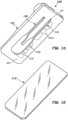
- the sample holder 100 comprises a body 102 having a top surface 104 and a bottom surface 106.
- the bottom surface 106 may be a planar surface.
- the body 102 may be manufactured from an optically transparent or translucent material such as glass or plastic. Molded plastics may include transparent (e.g., thermoplastic materials) or translucent materials (e.g., white or frosted) plastics that are compatible with the particular PCR master mix and possibly a reagent being used.
- Example materials may include elastomers and olefins, polyvinyl chloride (PVC), polycarbonate, polyethylene terephthalate glycol (PETG), styrene, polyethylene, polystyrene, acrylonitrile butadiene styrene (ABS), and polypropylene or combinations.
- PVC polyvinyl chloride
- PETG polyethylene terephthalate glycol
- styrene polyethylene
- polystyrene acrylonitrile butadiene styrene
- ABS acrylonitrile butadiene styrene
- Polypropylene or combinations Polycarbonate and polypropylene are excellent choices for inert and transparent/translucent properties for PCR. White and frosted may be used for qPCR.
- the body 102 can be injection molded, compression molded, or the like.
- the body 102 further comprises an inlet groove 108 formed into the bottom surface 106 and an outlet groove 110 also formed into the bottom surface 106.
- the outlet groove 110 is positioned alongside the inlet groove 108.
- the groves 108, 110 may run in parallel and may be formed by molding.
- the inlet and outlet grooves 108, 100 can have groove depths of from 0.4 mm to 0.7 mm in depth. Grooves 108, 110 can have a variable groove width such as from 0.3 mm to 1.5 mm, for example.
- the body 102 further comprises a detection recess 112 formed into the bottom surface 106.
- the detection recess 112 is sufficiently large for the particular optical interrogation system (e.g., optical interrogation system 340) to be able to measure light emission readings (e.g., fluorescence emission readings) therefrom, for example.
- the detection recess 112 may have a semi-circle of diameter between about 2 mm to 5 mm, for example.
- the detection area may be greater than 3.14 mm 2 .
- the inlet groove 108 leads to and is connected to the detection recess 112 and the outlet groove 110 is connected to and leads away from the detection recess 112.
- the groves 108, 110, and the detection recess 112 may be of the same depth from the bottom surface 106.
- a fill port 114 can be interconnected to both the inlet groove 108 and the outlet groove 110 and provides both a fill and overflow function.
- the top surface 114S of the fill port 114 may be a planar surface and can be located above the top surface 104 and thus can be sealed with any suitable sealing membrane once the PCR solution 124 is received therein. Sealing may occur prior to insertion of the sample holder 100 in the PCR station assembly 225 ( FIG. 2A ) or after insertion therein.
- the cover 116 can be opaque, such as a black plastic.
- the cover 116 interfaces with the body 102 to close the bottoms of the inlet groove 108, detection recess 112, and outlet groove 110 and thus form interconnected inlet channel 118, reservoir 119, and outlet channel 122.
- sealing of a PCR solution 124 in the reservoir 119 can involve at least one sealing member comprising heat sealing or deformation sealing along the lengths of one or more of the inlet channel 118 and outlet channel 122, or providing a sealing member such as a sealing film 233 sealing the top of the fill port 114, for example.
- Other sealing means may be used prior to PCR processing, such as deformation of the ports 123, 126, sealing of the ports 123, 126 by adhesive, or sealing with heavy oil (e.g., a mineral oil) in ports 126, 126 or channels 118, 122. If heat sealed, the thermal formed seals can be at two discreet locations along the lengths of the channels 118, 122 at locations that can minimize displacement of the plastic volume and maintain acceptable flatness.
- the inlet and outlet ports 123, 126 may be located approximately equidistant from the detection area 120 along the length of the body 102 so that they can be easily sealed and both are uninterrupted and uncovered by any part of the PCR station 225 ( FIG. 2 ).
- FIG. 1G shows the flow path for the PCR solution 124 in isolation for illustration purposes.
- the PCR solution 124 flows from the inlet port 123 through the inlet channel 118 and then into and fills the reservoir 119 and the detection region 120 therein.
- the PCR solution 124 then exits through the outlet channel 122, which connects to the outlet port 126, which can be co-located in the fill port 114 with the inlet port 123.
- Outlet port 126 acts as a vent.
- the inlet port 123 may be approximately the size of the pipette tip and air 127 may be inserted to move the PCR solution 124 further into the inlet channel 118, so as to further minimize the amount of the PCR solution 124 needed for replication and detection.
- the volume of the inlet channel 118, reservoir 119, and outlet channel 122 together can be less than 30 ⁇ L, and from 3 ⁇ L to 30 ⁇ L in some embodiments.
- the volume of the PCR liquid in the reservoir during detection phase can be ⁇ 20 ⁇ L, or even from 3 ⁇ L to 20 ⁇ L in other embodiments.
- the fill port 114 can include a volume sufficient to reduce any splashing and ensure proper fill. If the inlet channel 118 and outlet channel 122 are sealed by heat sealing, the heat sealing should be close to the liquid-air interface, such as 1 mm to 2 mm therefrom to minimize any trapped air.
- the outlet channel 122 comprises an outlet first channel portion 122A and an outlet second channel portion 122B that is wider than the outlet first channel portion 122A, and thus of a larger cross-sectional area.
- the outlet channel 122 can further comprise an outlet transition portion 122T that allows the transition from the larger outlet second channel portion 122B to the smaller outlet first channel portion 122A.
- the transition portion 122T allows the PCR solution 124 to contract from the larger area outlet second channel portion 122B to minimize the amount of PCR solution 124 in the sample holder 100.
- the detection region 120 is a region that contains a volume of the PCR solution within the reservoir 119 that is adapted to contain the PCR solution 124 and replicated DNA/RNA templates after the amplification phase and that viewable by the optical interrogation apparatus 340, as shown in FIG. 3 .
- the PCR station 225 can also include one or more heat sinks 236 coupled thermally to the base 230 and/or possibly to the temperature-controlling element 234.
- the one or more heat sinks 236 may be coupled to one or more sides or top of the base 230 and/or to the sides and/or bottom of the temperature-controlling element 234. Any suitable construction of the one or more heat sinks 236 may be used.
- the one or more heat sink may be aluminum or other conductive metal and may include a plurality of fins.
- FIGs. 2C-2F illustrates the clamp member 232, base 230, and temperature-controlling element 234 in more detail.
- the clamp member 232 includes a viewing aperture 237 formed there through, which defines a viewing window for the optical interrogation apparatus 340.
- the aperture 237 may include angled side walls 237S, which may be angled at from 30 degrees to 60 degrees to a central axis of the aperture 237, for example.
- the viewing aperture 237 may be slightly smaller than the dimensions of the reservoir 119 and is the window through which fluorescence readings can be taken.
- the clamp member 232 can further include a bore 239 formed therein and adapted to receive the clamp initiator 235 (e.g., screw, actuator or the like).
- Spring beams 232B can flex and allow the holding portion 232H of the clamp member 232 located outboard from the beams 232B to secure the sample holder 100 in the pocket 230P ( FIG. 2E ) of the base 230. This the clamp member 232 acts as a spring clip to ensure good thermal contact between the sample holder 100 and the base 230.
- Pocket 230P may include a stop 230S configured to limit the extent of insertion of the sample holder 100 in the pocket 230P.
- the pocket 230P can include lateral sidewalls 230W that aid in positioning the reservoir 119 of the sample holder 100 relative to the viewing aperture 237.
- the holding portion 232H can register against lateral sidewalls 230W.
- Base 230 further can include extenders 230E that extend to the width and length of the temperature-controlling element 234 to maximize thermal contact therewith.
- the base 230 may include a temperature sensor 244 in thermal contact with the base 230, such as by being mounted therein or thereon, such as in a hole formed therein proximate the detection region 120.
- the temperature sensor 244 may provide feedback information to estimate the temperature of the PCR solution 124 in the detection region 120.
- the temperature sensor 244 may be a thermocouple or a thermistor, for example, and may be used by the controller 342 to maintain the upper and lower temperatures of the heating and cooling cycles.
- FIG. 2F illustrates a temperature-controlling element 234, such as a Peltier device that is configured to provide rapid heating and cooling cycles to the base 230 and thus to the PCR solution 124 contained in the reservoir 119 and at the detection region 120 of the sample bolder 100 mounted therein.
- a temperature-controlling element 234 such as a Peltier device that is configured to provide rapid heating and cooling cycles to the base 230 and thus to the PCR solution 124 contained in the reservoir 119 and at the detection region 120 of the sample bolder 100 mounted therein.
- the PCR testing system 300 includes the PCR assembly 200 of the PCR station 225 and sample holder 100 and the optical interrogation apparatus 340.
- Optical interrogation apparatus 340 is configured to measure the optical emissions from tagged fluorescence (fluorophores) of the PCR solution 124 at one or more wavelengths after replication of the DNA/RNA templates.
- the optical interrogation apparatus 340 is an optical system including light source 344 such as a white light LED that projects light through collimating optics (e.g., one or more lenses), through a suitable color filter 345 that cuts out multiple spectra and allows one spectra to pass (e.g., blue light).
- This blue light spectrum is reflected off from a suitable dichroic mirror 346 and is focused by focusing optics (e.g., one or more appropriate lenses) onto the PCR solution 124 in the detection region 120 within the reservoir 119.
- This fluorescent emission is then collimated and passed through the dichroic mirror 346, further filtered with filter 348 to remove any stray excitation light and then focused onto a light detector 350 with focusing optics (e.g., one or more suitable lenses).
- the relative intensity of the fluorescent emission measured by the detector 350 can render a relative amount of the tagged DNA sequence that is present.
- At least the filter 345 and dichroic mirror 346 can be changed out to enable discrimination at one or more other wavelengths, and to allow analysis of sequences.
- the method 400 includes, in 402, providing a PCR station (e.g., PCR station 225) comprising a base (e.g., base 230), a clamp member (e.g., clamp member 232), and a temperature-controlling element (e.g., temperature-controlling element 234) thermally coupled to the base.
- a PCR station e.g., PCR station 225
- a base e.g., base 230
- a clamp member e.g., clamp member 232
- a temperature-controlling element e.g., temperature-controlling element 234
- the method 400 includes, in 404, securing a sample holder (e.g., 100) between the base and clamp member, the sample holder including an inlet channel (e.g., inlet channel 118) interconnected to a fill port (e.g., fill port 114), a detection region (e.g., detection region 120) interconnected to the inlet channel, and an outlet channel (e.g., outlet channel 122) interconnected to the detection region and the fill port.
- Securing may be by way of a clamp initiator 235 or other suitable clamping or securement means.
- the method 400 includes, in 406, inserting a volume of PCR solution (e.g., PCR solution 124) into the fill port thus filling the detection region. Insertion of the volume may be before or after the insertion of the sample holder 100 in the PCR station assembly 225. Thereafter, the channels 118, 122, ports 123, 126, and/or fill port 114 may be sealed as described herein.
- a volume of PCR solution e.g., PCR solution 124
- Insertion of the volume may be before or after the insertion of the sample holder 100 in the PCR station assembly 225.
- the channels 118, 122, ports 123, 126, and/or fill port 114 may be sealed as described herein.
- the PCR solution 124 is subjected to heating and cooling by subjecting the base 230 to cycles of heating and cooling with the temperature-controlling element 234 to replicate the tagged DNA/RNA templates and to produce tagged replicated DNA/RNA.
- the tagged replicated DNA/RNA are replicates of the tagged DNA/RNA templates extracted by the previously conducted PCR sample processing via known methods.
- fluorescent emissions are detected and measured from the detecting region with an optical interrogation apparatus (e.g., interrogation apparatus 340) by exciting the tagged replicated DNA/RNA with a particular wavelength of light.
- an optical interrogation apparatus e.g., interrogation apparatus 340
- This can be used to monitor the progress of the PCR process.
- Other wavelengths of light may be used to excite other fluorescent dyes tagged to the tagged replicated DNA along with associated changes to the respective filter 345 (and possibly filter 348) and dichroic mirror 346 in the optical interrogation apparatus 340 for analysis at other wavelengths as are known to those of ordinary skill in the art.
- Fast PCR processing can be achieved using the sample holder 100, PCR station assembly 225, and PCR testing system 300 described herein. Further, only a small volume of the PCR solution 124 are needed to carry out the replication and testing. Sealing of the sample holder 100 prior to replication can act as a means of reducing cross contamination.
Landscapes
- Health & Medical Sciences (AREA)
- Chemical & Material Sciences (AREA)
- Clinical Laboratory Science (AREA)
- Chemical Kinetics & Catalysis (AREA)
- Life Sciences & Earth Sciences (AREA)
- General Health & Medical Sciences (AREA)
- Engineering & Computer Science (AREA)
- Hematology (AREA)
- Analytical Chemistry (AREA)
- Molecular Biology (AREA)
- Biochemistry (AREA)
- Biomedical Technology (AREA)
- Dispersion Chemistry (AREA)
- Physics & Mathematics (AREA)
- Food Science & Technology (AREA)
- Medicinal Chemistry (AREA)
- Biophysics (AREA)
- General Physics & Mathematics (AREA)
- Immunology (AREA)
- Pathology (AREA)
- Urology & Nephrology (AREA)
- Investigating, Analyzing Materials By Fluorescence Or Luminescence (AREA)
- Apparatus Associated With Microorganisms And Enzymes (AREA)
- Measuring Or Testing Involving Enzymes Or Micro-Organisms (AREA)
Claims (9)
- Probenhalter (100) umfassend:
einen Körper (102) mit einer oberen Oberfläche (104) und einer unteren Oberfläche (106), wobei der Körper (102) ferner umfasst:eine Einlassnut (108), die in der unteren Oberfläche (106) gebildet ist;eine Auslassnut (110), die in der unteren Oberfläche neben der Einlassnut (108) gebildet ist;eine Erfassungsvertiefung (112), die in der unteren Oberfläche (106) gebildet und mit der Einlassnut (108) und der Auslassnut (110) verbunden ist;eine Einfüllöffnung (114), die mit sowohl der Einlassnut (108) als auch der Auslassnut (110) verbunden ist; undeine Abdeckung (116), die mit der unteren Oberfläche (106) verbunden ist, wobei die Abdeckung (116) mit dem Körper (102) verbunden ist, um einen Einlasskanal (118), der mit der Einfüllöffnung (114) verbunden ist, einen Erfassungsbereich (120), der mit dem Einlasskanal (118) verbunden ist, und einen Auslasskanal (122), der mit einer Auslassöffnung (126) verbunden ist und mit dem Erfassungsbereich (120) und der Einfüllöffnung (114) verbunden ist, zu bilden,wobei der Auslasskanal (122) einen ersten Auslasskanalteil (122A) und einen zweiten Auslasskanalteil (122B), der breiter als der erste Auslasskanalteil ist, umfasst. - Probenhalter nach Anspruch 1, wobei der Einlasskanal (118) einen ersten Einlasskanalteil (118A) und einen zweiten Einlasskanalteil (118), der breiter als der erste Einlasskanalteil ist, umfasst.
- Probenhalter nach Anspruch 1, dafür gestaltet, ein Volumen einer in dem Probenhalter enthaltenen PCR-Lösung zu halten, wenn sie einer Erfassung unterzogen wird, von 3 µl bis 20 µl.
- Probenhalter nach Anspruch 1, wobei die Abdeckung (116), die mit der unteren Oberfläche (106) verbunden ist, einen Film aus einem Kunststoff- oder Metallmaterial umfasst.
- Probenhalter nach Anspruch 1, wobei der Körper (102) aus einem transparenten oder lichtdurchlässigen Material gebildet ist.
- Probenhalter nach Anspruch 1, umfassend Bereitstellen wenigstens eines Dichtungselements zum Abdichten einer PCR-Lösung in einem Reservoir (119).
- Probenhalter nach Anspruch 6, wobei das wenigstens eine Dichtungselement einen heißgesiegelten Bereich oder einen verformten Bereich entlang der Länge von einem oder mehr von dem Einlasskanal (118) und dem Auslasskanal (122) umfasst.
- Probenhalter nach Anspruch 6, wobei das wenigstens eine Dichtungselement ein Dichtungsfilm (233) ist, der an eine Oberseite der Füllöffnung (114) gesiegelt ist.
- Probenhalter nach Anspruch 6, wobei das wenigstens eine Dichtungselement zwei abgedichtete Bereiche entlang von wenigstens einem von dem ersten Kanal und dem zweiten Kanal oder beiden umfasst.
Applications Claiming Priority (2)
| Application Number | Priority Date | Filing Date | Title |
|---|---|---|---|
| US202062989948P | 2020-03-16 | 2020-03-16 | |
| PCT/US2021/070132 WO2021189064A1 (en) | 2020-03-16 | 2021-02-08 | Sample holders, pcr station assemblies, and methods of operating pcr testing systems |
Publications (3)
| Publication Number | Publication Date |
|---|---|
| EP4120988A1 EP4120988A1 (de) | 2023-01-25 |
| EP4120988A4 EP4120988A4 (de) | 2023-10-25 |
| EP4120988B1 true EP4120988B1 (de) | 2025-04-02 |
Family
ID=77771678
Family Applications (1)
| Application Number | Title | Priority Date | Filing Date |
|---|---|---|---|
| EP21772378.2A Active EP4120988B1 (de) | 2020-03-16 | 2021-02-08 | Probenhalter für pcr-tests |
Country Status (4)
| Country | Link |
|---|---|
| US (1) | US12589391B2 (de) |
| EP (1) | EP4120988B1 (de) |
| CN (1) | CN115209856A (de) |
| WO (1) | WO2021189064A1 (de) |
Family Cites Families (17)
| Publication number | Priority date | Publication date | Assignee | Title |
|---|---|---|---|---|
| US4902624A (en) * | 1987-11-23 | 1990-02-20 | Eastman Kodak Company | Temperature cycling cuvette |
| US8231845B2 (en) * | 2000-10-25 | 2012-07-31 | Steag Microparts | Structures for uniform capillary flow |
| EP1384022A4 (de) * | 2001-04-06 | 2004-08-04 | California Inst Of Techn | Nukleinsäure-amplifikation verwendende mikrofluidvorrichtungen |
| US7740804B2 (en) * | 2005-04-12 | 2010-06-22 | Chromedx Inc. | Spectroscopic sample holder |
| EP1878802A1 (de) | 2006-07-14 | 2008-01-16 | Roche Diagnostics GmbH | Einwegvorrichtung zur Analyse einer Nukleinsäure enthaltenden Probe mit einem Amplifikation-Apparatus |
| US8951781B2 (en) | 2011-01-10 | 2015-02-10 | Illumina, Inc. | Systems, methods, and apparatuses to image a sample for biological or chemical analysis |
| CA2879729A1 (en) | 2012-08-07 | 2014-02-13 | California Institute Of Technology | Ultrafast thermal cycler |
| JP2015535087A (ja) | 2012-11-19 | 2015-12-07 | ザ ジェネラル ホスピタル コーポレイション | 統合多重化測光モジュールのためのシステムおよび方法 |
| WO2015164542A1 (en) | 2014-04-22 | 2015-10-29 | Nanoscopia (Cayman), Inc. | Sample holder and system for using |
| ES2898103T3 (es) * | 2014-12-31 | 2022-03-03 | Visby Medical Inc | Dispositivos para pruebas de diagnóstico molecular |
| EP3278083A4 (de) | 2015-04-03 | 2018-12-26 | Captl LLC | Teilchennachweis mit reflektierender oberfläche |
| US9222935B1 (en) | 2015-05-28 | 2015-12-29 | Pixcell Medical Technologies Ltd | Fluid sample analysis system |
| KR102456030B1 (ko) | 2016-04-07 | 2022-10-19 | 가부시키가이샤 메타보스크린 | 서모 사이클링 검사 장치 및 칩 홀더 |
| CN106929408B (zh) | 2017-01-26 | 2018-07-20 | 深圳市尚维高科有限公司 | 便携式微流控pcr仪及基因样品荧光定量检测方法 |
| WO2019116209A1 (en) | 2017-12-12 | 2019-06-20 | National Cheng Kung University | Microfluidic chip and microscopic image system |
| US20190225958A1 (en) | 2018-01-23 | 2019-07-25 | JBS Science Inc. | Method for enrichment and purification of cell-free dna from body fluid for high-throughput processing |
| CN110616138A (zh) * | 2019-10-09 | 2019-12-27 | 山东百骏生物科技有限公司 | 一种分腔室多指标核酸扩增微流控芯片 |
-
2021
- 2021-02-08 EP EP21772378.2A patent/EP4120988B1/de active Active
- 2021-02-08 US US17/759,378 patent/US12589391B2/en active Active
- 2021-02-08 WO PCT/US2021/070132 patent/WO2021189064A1/en not_active Ceased
- 2021-02-08 CN CN202180021898.9A patent/CN115209856A/zh active Pending
Also Published As
| Publication number | Publication date |
|---|---|
| US20230053732A1 (en) | 2023-02-23 |
| EP4120988A4 (de) | 2023-10-25 |
| WO2021189064A1 (en) | 2021-09-23 |
| CN115209856A (zh) | 2022-10-18 |
| US12589391B2 (en) | 2026-03-31 |
| EP4120988A1 (de) | 2023-01-25 |
Similar Documents
| Publication | Publication Date | Title |
|---|---|---|
| US20250163493A1 (en) | Fluidic cartridge with valve mechanism | |
| US20260016494A1 (en) | Cartridges and instruments for sample analysis | |
| US7462323B1 (en) | Apparatus for performing heat-exchanging chemical reactions | |
| US7101509B2 (en) | Reaction vessel and temperature control system | |
| US20140038193A1 (en) | Microfluidic pcr device | |
| ES2798099T3 (es) | Biochip unitario que proporciona un procesamiento desde la inserción de muestras hasta la obtención de resultados y métodos de fabricación | |
| EP2188056B1 (de) | Wärmeregelungsvorrichtung für chemische und biochemische reaktionen | |
| US12099032B2 (en) | Systems and methods for sample preparation, processing and analysis | |
| US6372484B1 (en) | Apparatus for integrated polymerase chain reaction and capillary electrophoresis | |
| CN107923871A (zh) | 装有阀的盒和系统 | |
| JP2003512604A (ja) | 基板を液体サンプルで充填するためのシステムおよび方法 | |
| US10385383B2 (en) | Systems and methods for biological analysis | |
| US20070003443A1 (en) | Thermal-cycling pipette tip | |
| EP3463668B1 (de) | Schnelle thermische wechselbeanspruchung zur analyse und verarbeitung von proben | |
| JP2010139491A (ja) | 反応液温度測定方法、反応液温度測定装置、反応液温度調整装置及び遺伝子の増幅反応処理を行うための装置 | |
| US12589391B2 (en) | Sample holders, PCR station assemblies, and methods of operating PCR testing system | |
| WO2021189065A1 (en) | Multi-site sample holders, pcr station assemblies, and methods of operating pcr testing systems | |
| US20240307868A1 (en) | Single-lane amplification cartridge | |
| RU2758719C1 (ru) | Одноразовый чип-картридж для проведения амплификации нуклеиновых кислот | |
| US20100055770A1 (en) | High-density multiwell-plate | |
| WO2023173130A1 (en) | Portable electrophoresis system with integrated thermocycler |
Legal Events
| Date | Code | Title | Description |
|---|---|---|---|
| STAA | Information on the status of an ep patent application or granted ep patent |
Free format text: STATUS: THE INTERNATIONAL PUBLICATION HAS BEEN MADE |
|
| PUAI | Public reference made under article 153(3) epc to a published international application that has entered the european phase |
Free format text: ORIGINAL CODE: 0009012 |
|
| STAA | Information on the status of an ep patent application or granted ep patent |
Free format text: STATUS: REQUEST FOR EXAMINATION WAS MADE |
|
| 17P | Request for examination filed |
Effective date: 20221013 |
|
| AK | Designated contracting states |
Kind code of ref document: A1 Designated state(s): AL AT BE BG CH CY CZ DE DK EE ES FI FR GB GR HR HU IE IS IT LI LT LU LV MC MK MT NL NO PL PT RO RS SE SI SK SM TR |
|
| DAV | Request for validation of the european patent (deleted) | ||
| DAX | Request for extension of the european patent (deleted) | ||
| RIC1 | Information provided on ipc code assigned before grant |
Ipc: B01L 9/00 20060101ALI20230616BHEP Ipc: B01L 7/00 20060101ALI20230616BHEP Ipc: B01L 3/00 20060101ALI20230616BHEP Ipc: G01N 33/487 20060101ALI20230616BHEP Ipc: C12Q 1/686 20180101ALI20230616BHEP Ipc: A61J 1/05 20060101AFI20230616BHEP |
|
| A4 | Supplementary search report drawn up and despatched |
Effective date: 20230926 |
|
| RIC1 | Information provided on ipc code assigned before grant |
Ipc: B01L 9/00 20060101ALI20230920BHEP Ipc: B01L 7/00 20060101ALI20230920BHEP Ipc: B01L 3/00 20060101ALI20230920BHEP Ipc: G01N 33/487 20060101ALI20230920BHEP Ipc: C12Q 1/686 20180101ALI20230920BHEP Ipc: A61J 1/05 20060101AFI20230920BHEP |
|
| STAA | Information on the status of an ep patent application or granted ep patent |
Free format text: STATUS: EXAMINATION IS IN PROGRESS |
|
| 17Q | First examination report despatched |
Effective date: 20240814 |
|
| GRAP | Despatch of communication of intention to grant a patent |
Free format text: ORIGINAL CODE: EPIDOSNIGR1 |
|
| STAA | Information on the status of an ep patent application or granted ep patent |
Free format text: STATUS: GRANT OF PATENT IS INTENDED |
|
| INTG | Intention to grant announced |
Effective date: 20241028 |
|
| GRAS | Grant fee paid |
Free format text: ORIGINAL CODE: EPIDOSNIGR3 |
|
| GRAA | (expected) grant |
Free format text: ORIGINAL CODE: 0009210 |
|
| STAA | Information on the status of an ep patent application or granted ep patent |
Free format text: STATUS: THE PATENT HAS BEEN GRANTED |
|
| AK | Designated contracting states |
Kind code of ref document: B1 Designated state(s): AL AT BE BG CH CY CZ DE DK EE ES FI FR GB GR HR HU IE IS IT LI LT LU LV MC MK MT NL NO PL PT RO RS SE SI SK SM TR |
|
| REG | Reference to a national code |
Ref country code: GB Ref legal event code: FG4D |
|
| REG | Reference to a national code |
Ref country code: CH Ref legal event code: EP |
|
| REG | Reference to a national code |
Ref country code: IE Ref legal event code: FG4D |
|
| REG | Reference to a national code |
Ref country code: DE Ref legal event code: R096 Ref document number: 602021028606 Country of ref document: DE |
|
| REG | Reference to a national code |
Ref country code: NL Ref legal event code: MP Effective date: 20250402 |
|
| PG25 | Lapsed in a contracting state [announced via postgrant information from national office to epo] |
Ref country code: NL Free format text: LAPSE BECAUSE OF FAILURE TO SUBMIT A TRANSLATION OF THE DESCRIPTION OR TO PAY THE FEE WITHIN THE PRESCRIBED TIME-LIMIT Effective date: 20250402 |
|
| REG | Reference to a national code |
Ref country code: AT Ref legal event code: MK05 Ref document number: 1780598 Country of ref document: AT Kind code of ref document: T Effective date: 20250402 |
|
| PG25 | Lapsed in a contracting state [announced via postgrant information from national office to epo] |
Ref country code: FI Free format text: LAPSE BECAUSE OF FAILURE TO SUBMIT A TRANSLATION OF THE DESCRIPTION OR TO PAY THE FEE WITHIN THE PRESCRIBED TIME-LIMIT Effective date: 20250402 Ref country code: PT Free format text: LAPSE BECAUSE OF FAILURE TO SUBMIT A TRANSLATION OF THE DESCRIPTION OR TO PAY THE FEE WITHIN THE PRESCRIBED TIME-LIMIT Effective date: 20250804 Ref country code: ES Free format text: LAPSE BECAUSE OF FAILURE TO SUBMIT A TRANSLATION OF THE DESCRIPTION OR TO PAY THE FEE WITHIN THE PRESCRIBED TIME-LIMIT Effective date: 20250402 |
|
| REG | Reference to a national code |
Ref country code: LT Ref legal event code: MG9D |
|
| PG25 | Lapsed in a contracting state [announced via postgrant information from national office to epo] |
Ref country code: GR Free format text: LAPSE BECAUSE OF FAILURE TO SUBMIT A TRANSLATION OF THE DESCRIPTION OR TO PAY THE FEE WITHIN THE PRESCRIBED TIME-LIMIT Effective date: 20250703 Ref country code: NO Free format text: LAPSE BECAUSE OF FAILURE TO SUBMIT A TRANSLATION OF THE DESCRIPTION OR TO PAY THE FEE WITHIN THE PRESCRIBED TIME-LIMIT Effective date: 20250702 |
|
| PG25 | Lapsed in a contracting state [announced via postgrant information from national office to epo] |
Ref country code: PL Free format text: LAPSE BECAUSE OF FAILURE TO SUBMIT A TRANSLATION OF THE DESCRIPTION OR TO PAY THE FEE WITHIN THE PRESCRIBED TIME-LIMIT Effective date: 20250402 |
|
| PG25 | Lapsed in a contracting state [announced via postgrant information from national office to epo] |
Ref country code: BG Free format text: LAPSE BECAUSE OF FAILURE TO SUBMIT A TRANSLATION OF THE DESCRIPTION OR TO PAY THE FEE WITHIN THE PRESCRIBED TIME-LIMIT Effective date: 20250402 |
|
| PG25 | Lapsed in a contracting state [announced via postgrant information from national office to epo] |
Ref country code: HR Free format text: LAPSE BECAUSE OF FAILURE TO SUBMIT A TRANSLATION OF THE DESCRIPTION OR TO PAY THE FEE WITHIN THE PRESCRIBED TIME-LIMIT Effective date: 20250402 |
|
| PG25 | Lapsed in a contracting state [announced via postgrant information from national office to epo] |
Ref country code: AT Free format text: LAPSE BECAUSE OF FAILURE TO SUBMIT A TRANSLATION OF THE DESCRIPTION OR TO PAY THE FEE WITHIN THE PRESCRIBED TIME-LIMIT Effective date: 20250402 |
|
| PG25 | Lapsed in a contracting state [announced via postgrant information from national office to epo] |
Ref country code: RS Free format text: LAPSE BECAUSE OF FAILURE TO SUBMIT A TRANSLATION OF THE DESCRIPTION OR TO PAY THE FEE WITHIN THE PRESCRIBED TIME-LIMIT Effective date: 20250702 |
|
| PG25 | Lapsed in a contracting state [announced via postgrant information from national office to epo] |
Ref country code: IS Free format text: LAPSE BECAUSE OF FAILURE TO SUBMIT A TRANSLATION OF THE DESCRIPTION OR TO PAY THE FEE WITHIN THE PRESCRIBED TIME-LIMIT Effective date: 20250802 |
|
| PG25 | Lapsed in a contracting state [announced via postgrant information from national office to epo] |
Ref country code: LV Free format text: LAPSE BECAUSE OF FAILURE TO SUBMIT A TRANSLATION OF THE DESCRIPTION OR TO PAY THE FEE WITHIN THE PRESCRIBED TIME-LIMIT Effective date: 20250402 |
|
| REG | Reference to a national code |
Ref country code: DE Ref legal event code: R097 Ref document number: 602021028606 Country of ref document: DE |
|
| PG25 | Lapsed in a contracting state [announced via postgrant information from national office to epo] |
Ref country code: SM Free format text: LAPSE BECAUSE OF FAILURE TO SUBMIT A TRANSLATION OF THE DESCRIPTION OR TO PAY THE FEE WITHIN THE PRESCRIBED TIME-LIMIT Effective date: 20250402 Ref country code: DK Free format text: LAPSE BECAUSE OF FAILURE TO SUBMIT A TRANSLATION OF THE DESCRIPTION OR TO PAY THE FEE WITHIN THE PRESCRIBED TIME-LIMIT Effective date: 20250402 |
|
| PG25 | Lapsed in a contracting state [announced via postgrant information from national office to epo] |
Ref country code: CZ Free format text: LAPSE BECAUSE OF FAILURE TO SUBMIT A TRANSLATION OF THE DESCRIPTION OR TO PAY THE FEE WITHIN THE PRESCRIBED TIME-LIMIT Effective date: 20250402 |
|
| PG25 | Lapsed in a contracting state [announced via postgrant information from national office to epo] |
Ref country code: EE Free format text: LAPSE BECAUSE OF FAILURE TO SUBMIT A TRANSLATION OF THE DESCRIPTION OR TO PAY THE FEE WITHIN THE PRESCRIBED TIME-LIMIT Effective date: 20250402 |
|
| PG25 | Lapsed in a contracting state [announced via postgrant information from national office to epo] |
Ref country code: SK Free format text: LAPSE BECAUSE OF FAILURE TO SUBMIT A TRANSLATION OF THE DESCRIPTION OR TO PAY THE FEE WITHIN THE PRESCRIBED TIME-LIMIT Effective date: 20250402 |
|
| PG25 | Lapsed in a contracting state [announced via postgrant information from national office to epo] |
Ref country code: IT Free format text: LAPSE BECAUSE OF FAILURE TO SUBMIT A TRANSLATION OF THE DESCRIPTION OR TO PAY THE FEE WITHIN THE PRESCRIBED TIME-LIMIT Effective date: 20250402 |
|
| PLBE | No opposition filed within time limit |
Free format text: ORIGINAL CODE: 0009261 |
|
| STAA | Information on the status of an ep patent application or granted ep patent |
Free format text: STATUS: NO OPPOSITION FILED WITHIN TIME LIMIT |
|
| REG | Reference to a national code |
Ref country code: CH Ref legal event code: L10 Free format text: ST27 STATUS EVENT CODE: U-0-0-L10-L00 (AS PROVIDED BY THE NATIONAL OFFICE) Effective date: 20260211 |
|
| 26N | No opposition filed |
Effective date: 20260105 |
|
| PGFP | Annual fee paid to national office [announced via postgrant information from national office to epo] |
Ref country code: GB Payment date: 20260310 Year of fee payment: 6 |