EP4120147A1 - Datenschätzvorrichtung, -verfahren und -programm - Google Patents
Datenschätzvorrichtung, -verfahren und -programm Download PDFInfo
- Publication number
- EP4120147A1 EP4120147A1 EP20940082.9A EP20940082A EP4120147A1 EP 4120147 A1 EP4120147 A1 EP 4120147A1 EP 20940082 A EP20940082 A EP 20940082A EP 4120147 A1 EP4120147 A1 EP 4120147A1
- Authority
- EP
- European Patent Office
- Prior art keywords
- variable
- objective
- explanatory
- variables
- machine learning
- Prior art date
- Legal status (The legal status is an assumption and is not a legal conclusion. Google has not performed a legal analysis and makes no representation as to the accuracy of the status listed.)
- Granted
Links
Images




Classifications
-
- G—PHYSICS
- G06—COMPUTING OR CALCULATING; COUNTING
- G06F—ELECTRIC DIGITAL DATA PROCESSING
- G06F18/00—Pattern recognition
- G06F18/20—Analysing
- G06F18/21—Design or setup of recognition systems or techniques; Extraction of features in feature space; Blind source separation
- G06F18/211—Selection of the most significant subset of features
- G06F18/2115—Selection of the most significant subset of features by evaluating different subsets according to an optimisation criterion, e.g. class separability, forward selection or backward elimination
-
- G—PHYSICS
- G06—COMPUTING OR CALCULATING; COUNTING
- G06F—ELECTRIC DIGITAL DATA PROCESSING
- G06F17/00—Digital computing or data processing equipment or methods, specially adapted for specific functions
- G06F17/10—Complex mathematical operations
- G06F17/18—Complex mathematical operations for evaluating statistical data, e.g. average values, frequency distributions, probability functions, regression analysis
-
- G—PHYSICS
- G06—COMPUTING OR CALCULATING; COUNTING
- G06F—ELECTRIC DIGITAL DATA PROCESSING
- G06F18/00—Pattern recognition
- G06F18/20—Analysing
- G06F18/27—Regression, e.g. linear or logistic regression
-
- G—PHYSICS
- G06—COMPUTING OR CALCULATING; COUNTING
- G06N—COMPUTING ARRANGEMENTS BASED ON SPECIFIC COMPUTATIONAL MODELS
- G06N20/00—Machine learning
-
- G—PHYSICS
- G06—COMPUTING OR CALCULATING; COUNTING
- G06N—COMPUTING ARRANGEMENTS BASED ON SPECIFIC COMPUTATIONAL MODELS
- G06N3/00—Computing arrangements based on biological models
- G06N3/02—Neural networks
- G06N3/04—Architecture, e.g. interconnection topology
- G06N3/045—Combinations of networks
-
- G—PHYSICS
- G06—COMPUTING OR CALCULATING; COUNTING
- G06N—COMPUTING ARRANGEMENTS BASED ON SPECIFIC COMPUTATIONAL MODELS
- G06N3/00—Computing arrangements based on biological models
- G06N3/02—Neural networks
- G06N3/08—Learning methods
- G06N3/088—Non-supervised learning, e.g. competitive learning
-
- G—PHYSICS
- G06—COMPUTING OR CALCULATING; COUNTING
- G06N—COMPUTING ARRANGEMENTS BASED ON SPECIFIC COMPUTATIONAL MODELS
- G06N7/00—Computing arrangements based on specific mathematical models
- G06N7/01—Probabilistic graphical models, e.g. probabilistic networks
-
- A—HUMAN NECESSITIES
- A63—SPORTS; GAMES; AMUSEMENTS
- A63B—APPARATUS FOR PHYSICAL TRAINING, GYMNASTICS, SWIMMING, CLIMBING, OR FENCING; BALL GAMES; TRAINING EQUIPMENT
- A63B24/00—Electric or electronic controls for exercising apparatus of preceding groups; Controlling or monitoring of exercises, sportive games, training or athletic performances
- A63B24/0062—Monitoring athletic performances, e.g. for determining the work of a user on an exercise apparatus, the completed jogging or cycling distance
-
- G—PHYSICS
- G06—COMPUTING OR CALCULATING; COUNTING
- G06N—COMPUTING ARRANGEMENTS BASED ON SPECIFIC COMPUTATIONAL MODELS
- G06N5/00—Computing arrangements using knowledge-based models
- G06N5/04—Inference or reasoning models
- G06N5/045—Explanation of inference; Explainable artificial intelligence [XAI]; Interpretable artificial intelligence
Definitions
- the present invention relates to a data estimation technique for estimating an objective variable from an explanatory variable.
- decision tree learning for creating a classifier having a tree structure from training data including an explanatory variable and an objective variable is used.
- a classification result can be predicted for unknown input data using a learned decision tree.
- random forest in which a plurality of decision trees are learned with training data randomly changed, and a prediction is made by taking a majority decision to enhancing generalization ability is used.
- the learning device disclosed in Patent Literature 1 creates a plurality of decision trees, using pieces of training data each including an explanatory variable and an objective variable, which are configured by a combination of the explanatory variables and each estimate the objective variable on the basis of true or false of the explanatory variables.
- the learning device creates a linear model that is equivalent to the plurality of decision trees and lists all terms configured by a combination of the explanatory variables without omission to output a stable prediction result by using the linear model from input data.
- Machine learning for predicting an objective variable from an explanatory variable has a problem that accuracy in objective variable estimation reaches a plateau.
- the present invention has been made in view of such a problem, and it is therefore an object of the present invention to provide a data estimation technique capable of improving accuracy in estimation of an objective variable from an explanatory variable.
- a data estimation device includes a learning unit that creates, using training data including an explanatory variable and an objective variable, a machine learning model that estimates an objective variable from an explanatory variable.
- the method includes a learning process of creating, using training data including an explanatory variable and an objective variable, a machine learning model that estimates an objective variable from an explanatory variable.
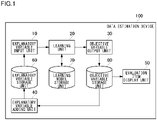
- Fig. 1 is a configuration diagram of a data estimation device 100 according to the present embodiment.
- the data estimation device 100 includes an explanatory variable input unit 10, a learning unit 20, an objective variable output unit 30, an explanatory variable adding unit 40, an evaluation item display unit 50, an explanatory variable storage unit 60, a learning model storage unit 70, and an objective variable storage unit 80.
- This drawing illustrates a block diagram focused on functions, and such functional blocks may be implemented in various forms such as hardware, software, or a combination of hardware and software.
- the data estimation device 100 creates, using training data including explanatory variables and objective variables, a machine learning model that estimates an objective variable from an explanatory variable.
- a prediction phase the data estimation device 100 inputs an unknown explanatory variable to the created machine learning model to predict an objective variable.
- a value of an explanatory variable and a value of an objective variable are given to the learning unit 20 as training data.
- the learning unit 20 creates, using the given training data, a machine learning model that estimates an objective variable from an explanatory variable, and stores the machine learning model into the learning model storage unit 70.
- a regression model, a decision tree, a random forest, Bayesian estimation, a neural network, or the like may be used.
- the objective variable output unit 30 outputs the value of the objective variable estimated from the value of the explanatory variable on the basis of the learned machine learning model, and stores the value of the objective variable into the objective variable storage unit 80.
- the explanatory variable adding unit 40 newly adds the objective variable estimated on the basis of the machine learning model to the explanatory variable and stores the explanatory variable into the explanatory variable storage unit 60.
- the explanatory variable input unit 10 reads the newly set explanatory variable from the explanatory variable storage unit 60 and supplies the newly set explanatory variable to the learning unit 20.
- the learning unit 20 creates a machine learning model that estimates an objective variable from the newly set explanatory variable, and stores the machine learning model into the learning model storage unit 70. Subsequently, a machine learning model is repeatedly created with the estimated objective variable newly added to the explanatory variable.
- the learning unit 20 functions as a prediction unit.
- the explanatory variable input unit 10 reads the value of the explanatory variable stored in the explanatory variable storage unit 60 as unknown data, and gives the explanatory variable to the learning unit 20.
- the learning unit 20 reads the machine learning model stored in the learning model storage unit 70 and estimates an objective variable from the explanatory variable on the basis of the machine learning model.
- the objective variable output unit 30 stores the estimated value of the objective variable into the objective variable storage unit 80.
- the explanatory variable adding unit 40 newly adds the objective variable estimated on the basis of the machine learning model to the explanatory variable and stores the explanatory variable into the explanatory variable storage unit 60.
- the explanatory variable input unit 10 reads the newly set explanatory variable from the explanatory variable storage unit 60 and supplies the newly set explanatory variable to the learning unit 20.
- the learning unit 20 estimates an objective variable from the newly set explanatory variable on the basis of the machine learning model stored in the learning model storage unit 70. Subsequently, an objective variable is repeatedly estimated using the machine learning model with the estimated objective variable newly added to the explanatory variable.
- the evaluation item display unit 50 calculates and displays a value of each evaluation item on the basis of the estimated value of the objective variable.
- the evaluation item display unit 50 may calculate the value of each evaluation item on the basis of the value of the explanatory variable and the estimated value of the objective variable.
- Fig. 2 is a flowchart for describing a procedure of creating a machine learning model by the data estimation device 100.
- the explanatory variable input unit 10 sets the one or more explanatory variables to an explanatory variable group E 1 (S10).
- the learning unit 20 sets a variable i to 1 (S20) .
- the learning unit 20 creates a learning model M i that estimates an objective variable O i from an explanatory variable group E i , and the objective variable output unit 30 outputs the estimated objective variable O i to the objective variable storage unit 80 (S30).
- the explanatory variable adding unit 40 adds the objective variable O i estimated by the learning model M i to the explanatory variable group E i to set a new explanatory variable group E i + 1 , and stores the explanatory variable group E i + 1 into the explanatory variable storage unit 60 (S40) .
- the learning unit 20 increments the variable i by 1 (S50). In a case where the variable i is greater than n (Y in S60), the processing of creating a machine learning model is brought to an end. In a case where the variable i is less than or equal to n (N in S60), the processing returns to step S30, and the subsequent procedure is repeated.
- the primary data on running that is measurable using a sensor attached to shoes of the runner includes a running pace, a stride, a pitch, a grounding time, and a hang time.
- the physical characteristic data on the runner includes height and weight. Such measurable primary data and physical characteristic data serve as an explanatory variable.
- the secondary data on running performance to be estimated includes a second peak value (denoted as "Fz 2nd max") of a z component of a ground reaction force (denoted as "Fz”), a propulsion force product, a braking force product, and a rising rate of the z component of the ground reaction force (denoted as "Fz Loading Rate”).
- Fz 2nd max a second peak value of a z component of a ground reaction force
- Fz a propulsion force product
- a braking force product a rising rate of the z component of the ground reaction force
- Fig. 3 is a diagram for describing the secondary data on running performance.
- the horizontal axis of the graph represents a time
- the vertical axis represents a ground reaction force.
- the ground reaction force has a component in a vertical direction (z direction) and a component in a front-back direction (y direction), a solid line represents the z component Fz of the ground reaction force, and a dashed line represents a y component Fy of the ground reaction force.
- a second peak value of the z component Fz of the ground reaction force is Fz 2nd max, and a slope of the rise of the z component Fz of the ground reaction force is Fz Loading Rate.
- An area of a region where the y component of the ground reaction force has a positive value is the propulsion force product, and an area of a region where the y component of the ground reaction force has a negative value is the braking force product.
- Fz 2nd max is referred to as secondary data A
- the propulsion force product is referred to as secondary data B
- the braking force product is referred to as secondary data C
- Fz Loading Rate is referred to as secondary data D.
- Such pieces of secondary data A to D are also referred to as objective variables A to D.
- the pieces of secondary data A, B, C, D that are objective variables are estimated in this order from the primary data and the physical characteristic data that are explanatory variables using the machine learning model, and the estimated pieces of secondary data A, B, C, D are added to the explanatory variables in this order.
- the order in which the objective variables are estimated in other words, the order in which the estimated objective variables are input to the explanatory variables, may be different from the above-described order, and how to determine an input order that makes the accuracy in objective variable estimation higher will be described later.
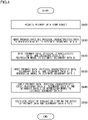
- Fig. 4 is a flowchart for describing a data estimation procedure in the example.
- the primary data on running is acquired from the sensor attached to the shoes of the runner and is stored into the explanatory variable storage unit 60 together with the physical characteristic data on the runner (S100).
- the learning unit 20 inputs, to a regression model, the primary data and the physical characteristic data as explanatory variables to estimate the secondary data A on running performance as an objective variable (S110).
- the explanatory variable adding unit 40 newly adds the estimated secondary data A to the explanatory variables, and the learning unit 20 inputs, to the regression model, the primary data, the physical characteristic data, and the secondary data A as explanatory variables to estimate the secondary data B as an objective variable (S120).
- the explanatory variable adding unit 40 newly adds the estimated secondary data B to the explanatory variables, and the learning unit 20 inputs, to the regression model, the primary data, the physical characteristic data, the secondary data A, and the secondary data B as explanatory variables to estimate the secondary data C as an objective variable (S130).
- the explanatory variable adding unit 40 newly adds the estimated secondary data C to the explanatory variables, and the learning unit 20 inputs, to the regression model, the primary data, the physical characteristic data, the secondary data A, the secondary data B, and the secondary data C as explanatory variables to estimate the secondary data D as an objective variable (S140).
- the evaluation item display unit 50 calculates and displays the value of each evaluation item on the basis of the primary data and the secondary data A to D (S150).
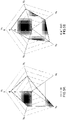
- Figs. 5(a) and 5(b) are diagrams illustrating display examples of the evaluation items output by the evaluation item display unit 50.
- Evaluation items V 1 to V M such as a kicking force of a left foot, a kicking force of a right foot, a degree of reduction in impact load, a braking effect, and a kicking efficiency are displayed on, for example, a scale of 0 to 5 on the basis of the secondary data A to D estimated as the primary data.
- a display mode may be a radar chart as illustrated in Figs. 5(a) and 5(b) , or may be a bar graph.
- Fig. 6 is a diagram for describing the accuracy in objective variable estimation in the example.
- the primary data and the physical characteristic data in the above-described example were input to the regression model as explanatory variables, and coefficients of determination when the pieces of secondary data A to D were estimated as objective variables were obtained.
- Fig. 6 shows coefficients of determination when the objective variables A to D were estimated only with the explanatory variables under a known method, and coefficients of determination when the objective variables estimated in the order of the secondary data A to D were added to the explanatory variables and estimated under the present method.
- the coefficient of determination is also referred to as a contribution ratio, and the closer to 1, the higher the accuracy in objective variable estimation.
- the coefficient of determination of the objective variable A is 0.84 in a case where a prediction is made only with the explanatory variables, which is the first objective variable estimation, so that the coefficient of determination of the objective variable A is also 0.84 under the present technique.
- the coefficient of determination of the objective variable B is 0.67 in a case where a prediction is made only with the explanatory variables, and is improved to 0.69 in a case where a prediction is made with the estimated objective variable A added to the explanatory variables.
- the coefficient of determination of the objective variable C is 0.36 in a case where a prediction is made only with the explanatory variables, and is improved to 0.52 in a case where a prediction is made with the estimated objective variable B further added to the explanatory variables.
- the coefficient of determination of the objective variable D is 0.69 in a case where a prediction is made only with the explanatory variables, and is improved to 0.74 in a case where a prediction is made with the estimated objective variable C further added to the explanatory variables.
- a machine learning model is created in each input order to calculate accuracy in prediction about the n objective variables, and an input order in which the mean value of the accuracy in prediction about the n objective variables becomes the largest or the standard deviation of the accuracy in prediction about the n objective variables becomes the smallest is finally selected as an optimum input order.
- the accuracy in prediction about the four objective variables A to D was evaluated for all 24 input orders of the four objective variables A to D.
- the coefficients of determination of the objective variables A, B, C, D were 0.84, 0.70, 0.55, and 0.71, respectively
- the mean value of the coefficients of determination of the four objective variables A to D was 0.7000
- the standard deviation of the coefficients of determination of the four objective variables A to D was 0.1186.
- the mean value of the coefficients of determination of the four objective variables A to D was the largest, and the standard deviation was the smallest.
- the input order of A, D, B, C is selected as an optimum input order.
- the optimum input order of the objective variables can be derived on the basis of correlation coefficients between the objective variables without testing all the input orders. Next, a method for determining the optimum input order of the objective variables will be described.
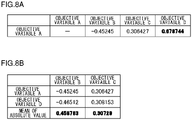
- Fig. 7 is a diagram illustrating correlation coefficients between the four objective variables A to D. With reference to the correlation coefficients, the optimum input order of the objective variables is determined by the following procedure. Figs. 8(a) and 8(b) are obtained by extracting correlation coefficients between a selected objective variable and the remaining objective variables from Fig. 7 , and the following procedure will be described with reference to Figs. 8(a) and 8(b) .
- Step 1 Select an objective variable that is the highest in prediction accuracy when a regression model is built only with explanatory variables, and build a regression model with the objective variable added to the explanatory variables.
- the objective variable A is the highest in prediction accuracy, so that the objective variable A is first added to the explanatory variables, and the regression model is built.
- Step 2 Obtain correlation coefficients between the selected objective variable and all the remaining objective variables, select an objective variable having the largest absolute value of the correlation coefficient, and build the regression model with the objective variable newly added to the explanatory variables.
- the mean of the absolute values of the correlation coefficients is obtained.
- the objective variable D having the largest absolute value of the correlation coefficient with the selected objective variable A is newly added to the explanatory variables, and the regression model is built.
- Step 3 Repeat step 2.
- the objective variable B having the largest mean of the absolute values of the correlation coefficients with the selected objective variables A, B is newly added to the explanatory variables, and the regression model is built.
- Step 4 Repeat step 2 in a case where an objective variable still remains.
- the regression model is built with the last objective variable C newly added to the explanatory variables.
- the data estimation device 100 of the present embodiment can improve the accuracy in objective variable estimation by first building, in a case where there are a plurality of objective variables to be predicted from explanatory variables, a machine learning model capable of estimating any objective variable using the explanatory variables, and then repeatedly building, with an estimated objective variable added to the explanatory variables, a machine learning model capable of estimating the next objective variable.
- the present invention is applicable to not only an example where an objective variable is added to explanatory variables on a one-by-one basis but also an example where a plurality of objective variables are added to the explanatory variables.
- the present invention is applicable to any example as long as an objective variable is estimated from an explanatory variable.
- the present invention is applicable to a data estimation technique.
Landscapes
- Engineering & Computer Science (AREA)
- Theoretical Computer Science (AREA)
- Physics & Mathematics (AREA)
- Data Mining & Analysis (AREA)
- General Physics & Mathematics (AREA)
- Software Systems (AREA)
- General Engineering & Computer Science (AREA)
- Mathematical Physics (AREA)
- Artificial Intelligence (AREA)
- Evolutionary Computation (AREA)
- Computing Systems (AREA)
- Life Sciences & Earth Sciences (AREA)
- Computer Vision & Pattern Recognition (AREA)
- Bioinformatics & Computational Biology (AREA)
- Bioinformatics & Cheminformatics (AREA)
- Pure & Applied Mathematics (AREA)
- Computational Mathematics (AREA)
- Mathematical Analysis (AREA)
- Mathematical Optimization (AREA)
- Evolutionary Biology (AREA)
- Medical Informatics (AREA)
- Biomedical Technology (AREA)
- Probability & Statistics with Applications (AREA)
- Algebra (AREA)
- Health & Medical Sciences (AREA)
- Biophysics (AREA)
- Computational Linguistics (AREA)
- General Health & Medical Sciences (AREA)
- Molecular Biology (AREA)
- Databases & Information Systems (AREA)
- Operations Research (AREA)
- Management, Administration, Business Operations System, And Electronic Commerce (AREA)
Applications Claiming Priority (1)
| Application Number | Priority Date | Filing Date | Title |
|---|---|---|---|
| PCT/JP2020/023286 WO2021250902A1 (ja) | 2020-06-12 | 2020-06-12 | データ推定装置、方法及びプログラム |
Publications (3)
| Publication Number | Publication Date |
|---|---|
| EP4120147A1 true EP4120147A1 (de) | 2023-01-18 |
| EP4120147A4 EP4120147A4 (de) | 2023-04-26 |
| EP4120147B1 EP4120147B1 (de) | 2024-06-26 |
Family
ID=78847159
Family Applications (1)
| Application Number | Title | Priority Date | Filing Date |
|---|---|---|---|
| EP20940082.9A Active EP4120147B1 (de) | 2020-06-12 | 2020-06-12 | Datenschätzvorrichtung, -verfahren und -programm |
Country Status (5)
| Country | Link |
|---|---|
| US (1) | US20230177392A1 (de) |
| EP (1) | EP4120147B1 (de) |
| JP (1) | JP7427785B2 (de) |
| CN (1) | CN115668233B (de) |
| WO (1) | WO2021250902A1 (de) |
Families Citing this family (1)
| Publication number | Priority date | Publication date | Assignee | Title |
|---|---|---|---|---|
| US20230033480A1 (en) * | 2021-07-05 | 2023-02-02 | Shimadzu Corporation | Data processing apparatus and inference method |
Family Cites Families (9)
| Publication number | Priority date | Publication date | Assignee | Title |
|---|---|---|---|---|
| US8055469B2 (en) * | 2006-03-03 | 2011-11-08 | Garmin Switzerland Gmbh | Method and apparatus for determining the attachment position of a motion sensing apparatus |
| EP2313607B1 (de) * | 2008-06-16 | 2018-03-07 | BP Exploration Operating Company Limited | Verfahren und vorrichtung zur konfiguration von öl und/oder gasbeförderungsystem |
| JP6059122B2 (ja) * | 2013-10-11 | 2017-01-11 | カルチュア・コンビニエンス・クラブ株式会社 | 顧客データ解析システム |
| JP6216294B2 (ja) * | 2014-07-30 | 2017-10-18 | 日本電信電話株式会社 | 重回帰分析装置および重回帰分析方法 |
| JP2018077547A (ja) * | 2015-03-16 | 2018-05-17 | 国立大学法人東京農工大学 | 並列処理装置、並列処理方法、および、並列化処理用プログラム |
| JP6863926B2 (ja) * | 2018-04-24 | 2021-04-21 | 株式会社日立ソリューションズ | データ分析システム及びデータ分析方法 |
| JP7119820B2 (ja) | 2018-09-18 | 2022-08-17 | 富士通株式会社 | 予測プログラム、予測方法および学習装置 |
| US11858651B2 (en) * | 2018-10-25 | 2024-01-02 | The Boeing Company | Machine learning model development with interactive feature construction and selection |
| JP2020109598A (ja) * | 2019-01-07 | 2020-07-16 | AI inside株式会社 | 取引モデル構築装置、取引モデル構築方法及び取引モデル構築プログラム |
-
2020
- 2020-06-12 JP JP2022529998A patent/JP7427785B2/ja active Active
- 2020-06-12 WO PCT/JP2020/023286 patent/WO2021250902A1/ja not_active Ceased
- 2020-06-12 CN CN202080100678.0A patent/CN115668233B/zh active Active
- 2020-06-12 US US17/923,150 patent/US20230177392A1/en active Pending
- 2020-06-12 EP EP20940082.9A patent/EP4120147B1/de active Active
Also Published As
| Publication number | Publication date |
|---|---|
| CN115668233A (zh) | 2023-01-31 |
| US20230177392A1 (en) | 2023-06-08 |
| CN115668233B (zh) | 2025-10-24 |
| WO2021250902A1 (ja) | 2021-12-16 |
| EP4120147B1 (de) | 2024-06-26 |
| JPWO2021250902A1 (de) | 2021-12-16 |
| EP4120147A4 (de) | 2023-04-26 |
| JP7427785B2 (ja) | 2024-02-05 |
Similar Documents
| Publication | Publication Date | Title |
|---|---|---|
| US11250308B2 (en) | Apparatus and method for generating prediction model based on artificial neural network | |
| JP7003753B2 (ja) | 探索点決定プログラム、探索点決定方法および探索点決定装置 | |
| JP2023541193A5 (de) | ||
| Zhang et al. | CPU load predictions on the computational grid | |
| JP2007080267A (ja) | パラメータを最適化する方法 | |
| EP4120147A1 (de) | Datenschätzvorrichtung, -verfahren und -programm | |
| JP7455773B2 (ja) | 求解装置およびプログラム | |
| Risvik | Principal component analysis (PCA) & NIPALS algorithm | |
| JP7196933B2 (ja) | 学習装置および学習方法 | |
| WO2021090518A1 (ja) | 学習装置、情報統合システム、学習方法、及び、記録媒体 | |
| CN113112414A (zh) | 噪声估计方法、噪声估计程序以及噪声估计设备 | |
| US20250307674A1 (en) | Parameter estimation device and parameter estimation method | |
| JP2021099241A (ja) | ノイズ除去方法 | |
| US7738982B2 (en) | Information processing apparatus, information processing method and program | |
| JP7589592B2 (ja) | 設計支援方法、設計支援プログラム、および該設計支援プログラムを記憶したコンピュータ読取可能な記憶媒体 | |
| KR102418239B1 (ko) | 기술의 지속 가능성을 탐색하기 위한 특허 분석 장치 | |
| Werk et al. | Performance analysis of shooting algorithms in chance-constrained optimization | |
| CN112801980B (zh) | 一种图像的角点检测方法及装置 | |
| CN114930345A (zh) | 在神经网络中确定任务兼容性的方法和系统 | |
| EP4488894A1 (de) | Berechnungsverfahren, berechnungsprogramm und informationsverarbeitungsvorrichtung | |
| Boyarkin et al. | Prediction of the power shortage in the electric power system by means of regression analysis by machine learning methods | |
| EP4354342A1 (de) | Neuronales netzwerksystem | |
| US20250322239A1 (en) | Rapid deployment of deep neural networks (dnns) for edge computing via structured pruning at initialization | |
| US20250265499A1 (en) | Method and Apparatus for Feature Extraction of Time Series and Generation of Synthetic Time Series Based on the Extracted Features | |
| CN109409591A (zh) | 一种文物位移预测方法及装置 |
Legal Events
| Date | Code | Title | Description |
|---|---|---|---|
| STAA | Information on the status of an ep patent application or granted ep patent |
Free format text: STATUS: THE INTERNATIONAL PUBLICATION HAS BEEN MADE |
|
| PUAI | Public reference made under article 153(3) epc to a published international application that has entered the european phase |
Free format text: ORIGINAL CODE: 0009012 |
|
| STAA | Information on the status of an ep patent application or granted ep patent |
Free format text: STATUS: REQUEST FOR EXAMINATION WAS MADE |
|
| 17P | Request for examination filed |
Effective date: 20221013 |
|
| AK | Designated contracting states |
Kind code of ref document: A1 Designated state(s): AL AT BE BG CH CY CZ DE DK EE ES FI FR GB GR HR HU IE IS IT LI LT LU LV MC MK MT NL NO PL PT RO RS SE SI SK SM TR |
|
| A4 | Supplementary search report drawn up and despatched |
Effective date: 20230323 |
|
| RIC1 | Information provided on ipc code assigned before grant |
Ipc: A63B 69/00 20060101ALI20230317BHEP Ipc: G06N 20/00 20190101AFI20230317BHEP |
|
| DAV | Request for validation of the european patent (deleted) | ||
| DAX | Request for extension of the european patent (deleted) | ||
| GRAP | Despatch of communication of intention to grant a patent |
Free format text: ORIGINAL CODE: EPIDOSNIGR1 |
|
| STAA | Information on the status of an ep patent application or granted ep patent |
Free format text: STATUS: GRANT OF PATENT IS INTENDED |
|
| RIC1 | Information provided on ipc code assigned before grant |
Ipc: G06N 5/045 20230101ALN20231220BHEP Ipc: G06N 20/00 20190101AFI20231220BHEP |
|
| INTG | Intention to grant announced |
Effective date: 20240115 |
|
| GRAS | Grant fee paid |
Free format text: ORIGINAL CODE: EPIDOSNIGR3 |
|
| GRAA | (expected) grant |
Free format text: ORIGINAL CODE: 0009210 |
|
| STAA | Information on the status of an ep patent application or granted ep patent |
Free format text: STATUS: THE PATENT HAS BEEN GRANTED |
|
| AK | Designated contracting states |
Kind code of ref document: B1 Designated state(s): AL AT BE BG CH CY CZ DE DK EE ES FI FR GB GR HR HU IE IS IT LI LT LU LV MC MK MT NL NO PL PT RO RS SE SI SK SM TR |
|
| REG | Reference to a national code |
Ref country code: GB Ref legal event code: FG4D |
|
| REG | Reference to a national code |
Ref country code: CH Ref legal event code: EP |
|
| REG | Reference to a national code |
Ref country code: DE Ref legal event code: R096 Ref document number: 602020033152 Country of ref document: DE |
|
| PG25 | Lapsed in a contracting state [announced via postgrant information from national office to epo] |
Ref country code: BG Free format text: LAPSE BECAUSE OF FAILURE TO SUBMIT A TRANSLATION OF THE DESCRIPTION OR TO PAY THE FEE WITHIN THE PRESCRIBED TIME-LIMIT Effective date: 20240626 |
|
| PG25 | Lapsed in a contracting state [announced via postgrant information from national office to epo] |
Ref country code: HR Free format text: LAPSE BECAUSE OF FAILURE TO SUBMIT A TRANSLATION OF THE DESCRIPTION OR TO PAY THE FEE WITHIN THE PRESCRIBED TIME-LIMIT Effective date: 20240626 Ref country code: FI Free format text: LAPSE BECAUSE OF FAILURE TO SUBMIT A TRANSLATION OF THE DESCRIPTION OR TO PAY THE FEE WITHIN THE PRESCRIBED TIME-LIMIT Effective date: 20240626 |
|
| REG | Reference to a national code |
Ref country code: LT Ref legal event code: MG9D |
|
| PG25 | Lapsed in a contracting state [announced via postgrant information from national office to epo] |
Ref country code: GR Free format text: LAPSE BECAUSE OF FAILURE TO SUBMIT A TRANSLATION OF THE DESCRIPTION OR TO PAY THE FEE WITHIN THE PRESCRIBED TIME-LIMIT Effective date: 20240927 |
|
| PG25 | Lapsed in a contracting state [announced via postgrant information from national office to epo] |
Ref country code: LV Free format text: LAPSE BECAUSE OF FAILURE TO SUBMIT A TRANSLATION OF THE DESCRIPTION OR TO PAY THE FEE WITHIN THE PRESCRIBED TIME-LIMIT Effective date: 20240626 |
|
| REG | Reference to a national code |
Ref country code: NL Ref legal event code: MP Effective date: 20240626 |
|
| PG25 | Lapsed in a contracting state [announced via postgrant information from national office to epo] |
Ref country code: NO Free format text: LAPSE BECAUSE OF FAILURE TO SUBMIT A TRANSLATION OF THE DESCRIPTION OR TO PAY THE FEE WITHIN THE PRESCRIBED TIME-LIMIT Effective date: 20240926 Ref country code: LV Free format text: LAPSE BECAUSE OF FAILURE TO SUBMIT A TRANSLATION OF THE DESCRIPTION OR TO PAY THE FEE WITHIN THE PRESCRIBED TIME-LIMIT Effective date: 20240626 Ref country code: HR Free format text: LAPSE BECAUSE OF FAILURE TO SUBMIT A TRANSLATION OF THE DESCRIPTION OR TO PAY THE FEE WITHIN THE PRESCRIBED TIME-LIMIT Effective date: 20240626 Ref country code: GR Free format text: LAPSE BECAUSE OF FAILURE TO SUBMIT A TRANSLATION OF THE DESCRIPTION OR TO PAY THE FEE WITHIN THE PRESCRIBED TIME-LIMIT Effective date: 20240927 Ref country code: FI Free format text: LAPSE BECAUSE OF FAILURE TO SUBMIT A TRANSLATION OF THE DESCRIPTION OR TO PAY THE FEE WITHIN THE PRESCRIBED TIME-LIMIT Effective date: 20240626 Ref country code: BG Free format text: LAPSE BECAUSE OF FAILURE TO SUBMIT A TRANSLATION OF THE DESCRIPTION OR TO PAY THE FEE WITHIN THE PRESCRIBED TIME-LIMIT Effective date: 20240626 Ref country code: RS Free format text: LAPSE BECAUSE OF FAILURE TO SUBMIT A TRANSLATION OF THE DESCRIPTION OR TO PAY THE FEE WITHIN THE PRESCRIBED TIME-LIMIT Effective date: 20240926 |
|
| PG25 | Lapsed in a contracting state [announced via postgrant information from national office to epo] |
Ref country code: NL Free format text: LAPSE BECAUSE OF FAILURE TO SUBMIT A TRANSLATION OF THE DESCRIPTION OR TO PAY THE FEE WITHIN THE PRESCRIBED TIME-LIMIT Effective date: 20240626 |
|
| REG | Reference to a national code |
Ref country code: AT Ref legal event code: MK05 Ref document number: 1698343 Country of ref document: AT Kind code of ref document: T Effective date: 20240626 |
|
| PG25 | Lapsed in a contracting state [announced via postgrant information from national office to epo] |
Ref country code: NL Free format text: LAPSE BECAUSE OF FAILURE TO SUBMIT A TRANSLATION OF THE DESCRIPTION OR TO PAY THE FEE WITHIN THE PRESCRIBED TIME-LIMIT Effective date: 20240626 |
|
| PG25 | Lapsed in a contracting state [announced via postgrant information from national office to epo] |
Ref country code: PT Free format text: LAPSE BECAUSE OF FAILURE TO SUBMIT A TRANSLATION OF THE DESCRIPTION OR TO PAY THE FEE WITHIN THE PRESCRIBED TIME-LIMIT Effective date: 20241028 |
|
| PG25 | Lapsed in a contracting state [announced via postgrant information from national office to epo] |
Ref country code: PT Free format text: LAPSE BECAUSE OF FAILURE TO SUBMIT A TRANSLATION OF THE DESCRIPTION OR TO PAY THE FEE WITHIN THE PRESCRIBED TIME-LIMIT Effective date: 20241028 |
|
| PG25 | Lapsed in a contracting state [announced via postgrant information from national office to epo] |
Ref country code: PL Free format text: LAPSE BECAUSE OF FAILURE TO SUBMIT A TRANSLATION OF THE DESCRIPTION OR TO PAY THE FEE WITHIN THE PRESCRIBED TIME-LIMIT Effective date: 20240626 |
|
| PG25 | Lapsed in a contracting state [announced via postgrant information from national office to epo] |
Ref country code: EE Free format text: LAPSE BECAUSE OF FAILURE TO SUBMIT A TRANSLATION OF THE DESCRIPTION OR TO PAY THE FEE WITHIN THE PRESCRIBED TIME-LIMIT Effective date: 20240626 |
|
| PG25 | Lapsed in a contracting state [announced via postgrant information from national office to epo] |
Ref country code: IS Free format text: LAPSE BECAUSE OF FAILURE TO SUBMIT A TRANSLATION OF THE DESCRIPTION OR TO PAY THE FEE WITHIN THE PRESCRIBED TIME-LIMIT Effective date: 20241026 Ref country code: AT Free format text: LAPSE BECAUSE OF FAILURE TO SUBMIT A TRANSLATION OF THE DESCRIPTION OR TO PAY THE FEE WITHIN THE PRESCRIBED TIME-LIMIT Effective date: 20240626 |
|
| PG25 | Lapsed in a contracting state [announced via postgrant information from national office to epo] |
Ref country code: CZ Free format text: LAPSE BECAUSE OF FAILURE TO SUBMIT A TRANSLATION OF THE DESCRIPTION OR TO PAY THE FEE WITHIN THE PRESCRIBED TIME-LIMIT Effective date: 20240626 |
|
| PG25 | Lapsed in a contracting state [announced via postgrant information from national office to epo] |
Ref country code: RO Free format text: LAPSE BECAUSE OF FAILURE TO SUBMIT A TRANSLATION OF THE DESCRIPTION OR TO PAY THE FEE WITHIN THE PRESCRIBED TIME-LIMIT Effective date: 20240626 Ref country code: SK Free format text: LAPSE BECAUSE OF FAILURE TO SUBMIT A TRANSLATION OF THE DESCRIPTION OR TO PAY THE FEE WITHIN THE PRESCRIBED TIME-LIMIT Effective date: 20240626 |
|
| PG25 | Lapsed in a contracting state [announced via postgrant information from national office to epo] |
Ref country code: ES Free format text: LAPSE BECAUSE OF FAILURE TO SUBMIT A TRANSLATION OF THE DESCRIPTION OR TO PAY THE FEE WITHIN THE PRESCRIBED TIME-LIMIT Effective date: 20240626 Ref country code: SM Free format text: LAPSE BECAUSE OF FAILURE TO SUBMIT A TRANSLATION OF THE DESCRIPTION OR TO PAY THE FEE WITHIN THE PRESCRIBED TIME-LIMIT Effective date: 20240626 |
|
| PG25 | Lapsed in a contracting state [announced via postgrant information from national office to epo] |
Ref country code: SM Free format text: LAPSE BECAUSE OF FAILURE TO SUBMIT A TRANSLATION OF THE DESCRIPTION OR TO PAY THE FEE WITHIN THE PRESCRIBED TIME-LIMIT Effective date: 20240626 Ref country code: SK Free format text: LAPSE BECAUSE OF FAILURE TO SUBMIT A TRANSLATION OF THE DESCRIPTION OR TO PAY THE FEE WITHIN THE PRESCRIBED TIME-LIMIT Effective date: 20240626 Ref country code: RO Free format text: LAPSE BECAUSE OF FAILURE TO SUBMIT A TRANSLATION OF THE DESCRIPTION OR TO PAY THE FEE WITHIN THE PRESCRIBED TIME-LIMIT Effective date: 20240626 Ref country code: PL Free format text: LAPSE BECAUSE OF FAILURE TO SUBMIT A TRANSLATION OF THE DESCRIPTION OR TO PAY THE FEE WITHIN THE PRESCRIBED TIME-LIMIT Effective date: 20240626 Ref country code: IS Free format text: LAPSE BECAUSE OF FAILURE TO SUBMIT A TRANSLATION OF THE DESCRIPTION OR TO PAY THE FEE WITHIN THE PRESCRIBED TIME-LIMIT Effective date: 20241026 Ref country code: ES Free format text: LAPSE BECAUSE OF FAILURE TO SUBMIT A TRANSLATION OF THE DESCRIPTION OR TO PAY THE FEE WITHIN THE PRESCRIBED TIME-LIMIT Effective date: 20240626 Ref country code: EE Free format text: LAPSE BECAUSE OF FAILURE TO SUBMIT A TRANSLATION OF THE DESCRIPTION OR TO PAY THE FEE WITHIN THE PRESCRIBED TIME-LIMIT Effective date: 20240626 Ref country code: CZ Free format text: LAPSE BECAUSE OF FAILURE TO SUBMIT A TRANSLATION OF THE DESCRIPTION OR TO PAY THE FEE WITHIN THE PRESCRIBED TIME-LIMIT Effective date: 20240626 Ref country code: AT Free format text: LAPSE BECAUSE OF FAILURE TO SUBMIT A TRANSLATION OF THE DESCRIPTION OR TO PAY THE FEE WITHIN THE PRESCRIBED TIME-LIMIT Effective date: 20240626 |
|
| PG25 | Lapsed in a contracting state [announced via postgrant information from national office to epo] |
Ref country code: IT Free format text: LAPSE BECAUSE OF FAILURE TO SUBMIT A TRANSLATION OF THE DESCRIPTION OR TO PAY THE FEE WITHIN THE PRESCRIBED TIME-LIMIT Effective date: 20240626 |
|
| REG | Reference to a national code |
Ref country code: DE Ref legal event code: R097 Ref document number: 602020033152 Country of ref document: DE |
|
| PG25 | Lapsed in a contracting state [announced via postgrant information from national office to epo] |
Ref country code: DK Free format text: LAPSE BECAUSE OF FAILURE TO SUBMIT A TRANSLATION OF THE DESCRIPTION OR TO PAY THE FEE WITHIN THE PRESCRIBED TIME-LIMIT Effective date: 20240626 |
|
| PLBE | No opposition filed within time limit |
Free format text: ORIGINAL CODE: 0009261 |
|
| STAA | Information on the status of an ep patent application or granted ep patent |
Free format text: STATUS: NO OPPOSITION FILED WITHIN TIME LIMIT |
|
| 26N | No opposition filed |
Effective date: 20250327 |
|
| PGFP | Annual fee paid to national office [announced via postgrant information from national office to epo] |
Ref country code: DE Payment date: 20250429 Year of fee payment: 6 |
|
| PG25 | Lapsed in a contracting state [announced via postgrant information from national office to epo] |
Ref country code: SE Free format text: LAPSE BECAUSE OF FAILURE TO SUBMIT A TRANSLATION OF THE DESCRIPTION OR TO PAY THE FEE WITHIN THE PRESCRIBED TIME-LIMIT Effective date: 20240626 |
|
| REG | Reference to a national code |
Ref country code: CH Ref legal event code: H13 Free format text: ST27 STATUS EVENT CODE: U-0-0-H10-H13 (AS PROVIDED BY THE NATIONAL OFFICE) Effective date: 20260127 |
|
| PG25 | Lapsed in a contracting state [announced via postgrant information from national office to epo] |
Ref country code: MC Free format text: LAPSE BECAUSE OF FAILURE TO SUBMIT A TRANSLATION OF THE DESCRIPTION OR TO PAY THE FEE WITHIN THE PRESCRIBED TIME-LIMIT Effective date: 20240626 |
|
| PG25 | Lapsed in a contracting state [announced via postgrant information from national office to epo] |
Ref country code: LU Free format text: LAPSE BECAUSE OF NON-PAYMENT OF DUE FEES Effective date: 20250612 |
|
| GBPC | Gb: european patent ceased through non-payment of renewal fee |
Effective date: 20250612 |
|
| REG | Reference to a national code |
Ref country code: BE Ref legal event code: MM Effective date: 20250630 |
|
| PG25 | Lapsed in a contracting state [announced via postgrant information from national office to epo] |
Ref country code: GB Free format text: LAPSE BECAUSE OF NON-PAYMENT OF DUE FEES Effective date: 20250612 |
|
| PG25 | Lapsed in a contracting state [announced via postgrant information from national office to epo] |
Ref country code: IE Free format text: LAPSE BECAUSE OF NON-PAYMENT OF DUE FEES Effective date: 20250612 |
|
| PG25 | Lapsed in a contracting state [announced via postgrant information from national office to epo] |
Ref country code: BE Free format text: LAPSE BECAUSE OF NON-PAYMENT OF DUE FEES Effective date: 20250630 |
|
| PG25 | Lapsed in a contracting state [announced via postgrant information from national office to epo] |
Ref country code: FR Free format text: LAPSE BECAUSE OF NON-PAYMENT OF DUE FEES Effective date: 20250630 |
|
| PG25 | Lapsed in a contracting state [announced via postgrant information from national office to epo] |
Ref country code: CH Free format text: LAPSE BECAUSE OF NON-PAYMENT OF DUE FEES Effective date: 20250630 |