EP4119385A1 - Battery system, range of electric vehicles and use of a battery system - Google Patents
Battery system, range of electric vehicles and use of a battery system Download PDFInfo
- Publication number
- EP4119385A1 EP4119385A1 EP21185136.5A EP21185136A EP4119385A1 EP 4119385 A1 EP4119385 A1 EP 4119385A1 EP 21185136 A EP21185136 A EP 21185136A EP 4119385 A1 EP4119385 A1 EP 4119385A1
- Authority
- EP
- European Patent Office
- Prior art keywords
- configuration
- electric
- elementary
- requirement
- string
- Prior art date
- Legal status (The legal status is an assumption and is not a legal conclusion. Google has not performed a legal analysis and makes no representation as to the accuracy of the status listed.)
- Withdrawn
Links
Images

Classifications
-
- B—PERFORMING OPERATIONS; TRANSPORTING
- B60—VEHICLES IN GENERAL
- B60L—PROPULSION OF ELECTRICALLY-PROPELLED VEHICLES; SUPPLYING ELECTRIC POWER FOR AUXILIARY EQUIPMENT OF ELECTRICALLY-PROPELLED VEHICLES; ELECTRODYNAMIC BRAKE SYSTEMS FOR VEHICLES IN GENERAL; MAGNETIC SUSPENSION OR LEVITATION FOR VEHICLES; MONITORING OPERATING VARIABLES OF ELECTRICALLY-PROPELLED VEHICLES; ELECTRIC SAFETY DEVICES FOR ELECTRICALLY-PROPELLED VEHICLES
- B60L58/00—Methods or circuit arrangements for monitoring or controlling batteries or fuel cells, specially adapted for electric vehicles
- B60L58/10—Methods or circuit arrangements for monitoring or controlling batteries or fuel cells, specially adapted for electric vehicles for monitoring or controlling batteries
- B60L58/18—Methods or circuit arrangements for monitoring or controlling batteries or fuel cells, specially adapted for electric vehicles for monitoring or controlling batteries of two or more battery modules
- B60L58/22—Balancing the charge of battery modules
-
- B—PERFORMING OPERATIONS; TRANSPORTING
- B60—VEHICLES IN GENERAL
- B60L—PROPULSION OF ELECTRICALLY-PROPELLED VEHICLES; SUPPLYING ELECTRIC POWER FOR AUXILIARY EQUIPMENT OF ELECTRICALLY-PROPELLED VEHICLES; ELECTRODYNAMIC BRAKE SYSTEMS FOR VEHICLES IN GENERAL; MAGNETIC SUSPENSION OR LEVITATION FOR VEHICLES; MONITORING OPERATING VARIABLES OF ELECTRICALLY-PROPELLED VEHICLES; ELECTRIC SAFETY DEVICES FOR ELECTRICALLY-PROPELLED VEHICLES
- B60L50/00—Electric propulsion with power supplied within the vehicle
- B60L50/50—Electric propulsion with power supplied within the vehicle using propulsion power supplied by batteries or fuel cells
- B60L50/60—Electric propulsion with power supplied within the vehicle using propulsion power supplied by batteries or fuel cells using power supplied by batteries
- B60L50/64—Constructional details of batteries specially adapted for electric vehicles
-
- B—PERFORMING OPERATIONS; TRANSPORTING
- B60—VEHICLES IN GENERAL
- B60L—PROPULSION OF ELECTRICALLY-PROPELLED VEHICLES; SUPPLYING ELECTRIC POWER FOR AUXILIARY EQUIPMENT OF ELECTRICALLY-PROPELLED VEHICLES; ELECTRODYNAMIC BRAKE SYSTEMS FOR VEHICLES IN GENERAL; MAGNETIC SUSPENSION OR LEVITATION FOR VEHICLES; MONITORING OPERATING VARIABLES OF ELECTRICALLY-PROPELLED VEHICLES; ELECTRIC SAFETY DEVICES FOR ELECTRICALLY-PROPELLED VEHICLES
- B60L58/00—Methods or circuit arrangements for monitoring or controlling batteries or fuel cells, specially adapted for electric vehicles
- B60L58/10—Methods or circuit arrangements for monitoring or controlling batteries or fuel cells, specially adapted for electric vehicles for monitoring or controlling batteries
- B60L58/18—Methods or circuit arrangements for monitoring or controlling batteries or fuel cells, specially adapted for electric vehicles for monitoring or controlling batteries of two or more battery modules
- B60L58/19—Switching between serial connection and parallel connection of battery modules
-
- B—PERFORMING OPERATIONS; TRANSPORTING
- B60—VEHICLES IN GENERAL
- B60L—PROPULSION OF ELECTRICALLY-PROPELLED VEHICLES; SUPPLYING ELECTRIC POWER FOR AUXILIARY EQUIPMENT OF ELECTRICALLY-PROPELLED VEHICLES; ELECTRODYNAMIC BRAKE SYSTEMS FOR VEHICLES IN GENERAL; MAGNETIC SUSPENSION OR LEVITATION FOR VEHICLES; MONITORING OPERATING VARIABLES OF ELECTRICALLY-PROPELLED VEHICLES; ELECTRIC SAFETY DEVICES FOR ELECTRICALLY-PROPELLED VEHICLES
- B60L58/00—Methods or circuit arrangements for monitoring or controlling batteries or fuel cells, specially adapted for electric vehicles
- B60L58/10—Methods or circuit arrangements for monitoring or controlling batteries or fuel cells, specially adapted for electric vehicles for monitoring or controlling batteries
- B60L58/18—Methods or circuit arrangements for monitoring or controlling batteries or fuel cells, specially adapted for electric vehicles for monitoring or controlling batteries of two or more battery modules
- B60L58/21—Methods or circuit arrangements for monitoring or controlling batteries or fuel cells, specially adapted for electric vehicles for monitoring or controlling batteries of two or more battery modules having the same nominal voltage
-
- H—ELECTRICITY
- H02—GENERATION; CONVERSION OR DISTRIBUTION OF ELECTRIC POWER
- H02J—ELECTRIC POWER NETWORKS; CIRCUIT ARRANGEMENTS OR SYSTEMS FOR SUPPLYING OR DISTRIBUTING ELECTRIC POWER; SYSTEMS FOR STORING ELECTRIC ENERGY
- H02J7/00—Circuit arrangements for charging or discharging batteries or for supplying loads from batteries
- H02J7/50—Circuit arrangements for charging or discharging batteries or for supplying loads from batteries acting upon multiple batteries simultaneously or sequentially
- H02J7/52—Circuit arrangements for charging or discharging batteries or for supplying loads from batteries acting upon multiple batteries simultaneously or sequentially for charge balancing, e.g. equalisation of charge between batteries
-
- B—PERFORMING OPERATIONS; TRANSPORTING
- B60—VEHICLES IN GENERAL
- B60L—PROPULSION OF ELECTRICALLY-PROPELLED VEHICLES; SUPPLYING ELECTRIC POWER FOR AUXILIARY EQUIPMENT OF ELECTRICALLY-PROPELLED VEHICLES; ELECTRODYNAMIC BRAKE SYSTEMS FOR VEHICLES IN GENERAL; MAGNETIC SUSPENSION OR LEVITATION FOR VEHICLES; MONITORING OPERATING VARIABLES OF ELECTRICALLY-PROPELLED VEHICLES; ELECTRIC SAFETY DEVICES FOR ELECTRICALLY-PROPELLED VEHICLES
- B60L2240/00—Control parameters of input or output; Target parameters
- B60L2240/40—Drive Train control parameters
- B60L2240/54—Drive Train control parameters related to batteries
- B60L2240/547—Voltage
-
- Y—GENERAL TAGGING OF NEW TECHNOLOGICAL DEVELOPMENTS; GENERAL TAGGING OF CROSS-SECTIONAL TECHNOLOGIES SPANNING OVER SEVERAL SECTIONS OF THE IPC; TECHNICAL SUBJECTS COVERED BY FORMER USPC CROSS-REFERENCE ART COLLECTIONS [XRACs] AND DIGESTS
- Y02—TECHNOLOGIES OR APPLICATIONS FOR MITIGATION OR ADAPTATION AGAINST CLIMATE CHANGE
- Y02T—CLIMATE CHANGE MITIGATION TECHNOLOGIES RELATED TO TRANSPORTATION
- Y02T10/00—Road transport of goods or passengers
- Y02T10/60—Other road transportation technologies with climate change mitigation effect
- Y02T10/70—Energy storage systems for electromobility, e.g. batteries
Definitions
- This disclosure pertains to the field of electro-mobility.
- This disclosure specifically relates to a battery system, a range of electric vehicles comprising such battery system and a use of such battery system.
- Electro-mobility including electrification of vehicles, plays an important role on the way towards a carbon neutral society.
- Electro-mobility is changing vehicles not only in the automotive and commercial industries but also in construction industry. In this respect, the applicant intends to launch an electric range of compact wheel loaders and compact excavators in replacement of at least a part of diesel engine ones.
- the battery system includes one or several battery modules, generally of lithium ion type.
- a battery module with voltage of 48 V is largely adopted to mild hybrid vehicle for low voltage implementations, usually defined in the automotive or commercial industries as applications requiring voltages lower than 30 V AC or lower than 60 V DC.
- low voltage implementations usually defined in the automotive or commercial industries as applications requiring voltages between 60 V DC and 1500 V DC or between 30 V AC rms and 1000 V AC rms
- battery modules with voltage of 400 V are implemented for hybrid technology of passenger vehicles while battery modules with voltage like 600 V and 850 V are implemented for commercial vehicles, such as buses or trucks. These voltages lie within the voltage class B.
- the battery modules are configured, both in shape and energy capacities, based on the automotive or commercial applications. This becomes a problem when it has to be dealt with various models of construction machines like compact wheel loaders and compact excavators which have each their own construction and electric requirements that differ from each other and from that of the automotive and commercial industries. Mechanical integration and electric requirements do not necessarily match with the standard 400V or 600V battery module solution.
- This disclosure improves the situation.
- the invention proposes a modular architecture of the battery system relying on a single kind of elementary battery module used as a base in a scalable elementary battery module solution.
- the invention consists in packing the identical elementary battery modules in series in each string to reach a targeted voltage, and strings in parallel to reach a targeted energy capacity.
- configuration voltages and configuration energy capacities can easily be chosen to be compatible with operating voltages of different systems involved in the field of electric vehicles, such as DC-DC inverter or onboard charger of the electric vehicle, or charging stations for charging the battery system.
- the elementary battery module is chosen to present small dimensions, making it easier to integrate the battery system in any available space of the vehicle, possibly at separate locations.
- the battery system of the invention offers an enhanced adaptability enabling to meet not only the different electric requirements of the range of electric vehicles but also the different available spaces of this range of electric vehicle.
- a range of electric vehicles comprising a battery system as defined previously, wherein each electric vehicle has an electric requirement chosen at least between a voltage requirement and an energy requirement, wherein the battery system presents a plurality of configurations each matching with at least one of the electric requirements of the range of electric vehicles.
- the electric vehicles may be construction machines, such as excavators and wheel loaders, the voltage requirements of said construction machines being chosen between 500 V and 750 V and the energy requirements of said construction machines being chosen between 30 kWh and 150 kWh.
- a battery system as defined previously to power up a range of electric vehicles each having an electric requirement chosen at least between a voltage requirement and an energy requirement, comprising:
- the use may further comprises:
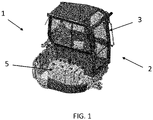
- Figure 1 represents a portion of an electric vehicle according to an embodiment of the invention.
- the electric vehicle belongs to a range of electric vehicles having each an electric requirement chosen at least between a voltage requirement and an energy requirement.
- the electric vehicle is a construction machine 1 of the construction industry. More specifically, figure 1 illustrates an upper portion 2, including a cabin 3, of a compact wheel loader or compact excavator.
- the electric vehicle could however be any other electric vehicle belonging to a range of electric vehicles, possibly of the automotive or commercial industries, such as a passenger car, a truck, a bus or other.
- Such range of construction machines 1 has voltage requirements ranging from 500 V to 750 V, and energy requirements ranging from 30 kWh to 150 kWh. To meet such voltage and/or energy requirements, a battery system 5 as shown in figure 2 is implemented.
- the battery system 5 comprises several elementary battery modules 6.
- the elementary battery modules 6 are identical and hence have same dimensions and same number of battery cells providing a same nominal voltage Ve and a same nominal energy capacity Ee.
- the elementary battery modules 6 are arranged in one of a plurality of configurations in which the elementary battery modules 6 are connected in series in respective strings 7, which strings 7 are connected in parallel to each other.
- Each configuration comprises an arrangement of elementary battery modules 6 to have a configuration voltage Vc and a configuration energy capacity Ec which match at least one of the electric requirement chosen between voltage and energy requirements of at least one of the construction machine of the range of construction machines.
- Each string 7 further includes a first electronic control unit (ECU) included in a main power box 8 for balancing a state of charge of each elementary battery module 6 within this string 7.
- ECU electronice control unit
- the configuration is completed with one or several second electronic control units for balancing a state of charge of the strings 7 relative to each other. Balancing the state of charge within each string 7 or between the strings 7 can be done actively, the elementary battery modules 6 being connected and under charge, or passively, the elementary battery modules 6 being disconnected.
- the second electronic control unit operates is part of a control box 9 made with a master battery management unit that drives all the elementary battery modules 6 acting as "slaves" with respect to elementary battery modules 6 balancing, connection and disconnection.
- the control box 9 may also include a pre-charge function for the whole battery system 5 in addition to contactors and related fuses.
- the control box 9 acts as a main interface between the strings 7 of elementary battery modules 6 and the construction machine 1.
- the control box 9 may also have a safety function as a high voltage interlock loop.
- the electric requirement of at least one of the construction machines 1 is determined.
- the electric requirement may be the voltage requirement and/or the energy requirement or any other requirement in relation with the electric operation of the construction machine 1.
- the steps previously disclosed can be implemented with elementary battery modules 6 having each a nominal voltage Ve of 48 V and a nominal energy capacity Ee of 5 kWh. Then according to the targeted energy capacity, the elementary battery modules 6 are packed:
- the module number Nm of elementary battery modules 6 per string 7 and the string number of strings 7 may also depend on the control box 9 ability to manage the number of elementary battery modules 6.
- the module number Nm may be up to 15, totalizing up to 75 kWh for the energy capacity of each string and 720 V for the voltage of each string, and the string number Ns may be up to 10 totalizing up to 750Kwh for the configuration energy capacity and 720V for the configuration voltage.
- the available space within the construction machine 1 can be determined and the elementary battery modules 6 can be arranged according to the available space, being possibly dispatched at separate locations and connected to each other by wires.
Landscapes
- Engineering & Computer Science (AREA)
- Power Engineering (AREA)
- Life Sciences & Earth Sciences (AREA)
- Sustainable Development (AREA)
- Sustainable Energy (AREA)
- Transportation (AREA)
- Mechanical Engineering (AREA)
- Charge And Discharge Circuits For Batteries Or The Like (AREA)
- Electric Propulsion And Braking For Vehicles (AREA)
- Secondary Cells (AREA)
Abstract
Description
- This disclosure pertains to the field of electro-mobility.
- This disclosure specifically relates to a battery system, a range of electric vehicles comprising such battery system and a use of such battery system.
- Electro-mobility, including electrification of vehicles, plays an important role on the way towards a carbon neutral society.
- Electro-mobility is changing vehicles not only in the automotive and commercial industries but also in construction industry. In this respect, the applicant intends to launch an electric range of compact wheel loaders and compact excavators in replacement of at least a part of diesel engine ones.
- In electro-mobility, a battery system as energy source is a key technology. The battery system includes one or several battery modules, generally of lithium ion type.
- A battery module with voltage of 48 V is largely adopted to mild hybrid vehicle for low voltage implementations, usually defined in the automotive or commercial industries as applications requiring voltages lower than 30 V AC or lower than 60 V DC. For high voltage implementations, usually defined in the automotive or commercial industries as applications requiring voltages between 60 V DC and 1500 V DC or between 30 V AC rms and 1000 V AC rms, battery modules with voltage of 400 V are implemented for hybrid technology of passenger vehicles while battery modules with voltage like 600 V and 850 V are implemented for commercial vehicles, such as buses or trucks. These voltages lie within the voltage class B.
- Since construction machines of the construction industry are now shifting to electric, a known strategy consists in reusing existing technologies of energy source from automotive or commercial industries. This would imply using a battery module with a low voltage of 48 V for low voltage implementations with a high voltage of 400 V and 600 V would be used for high voltage implementations, such as off road implementations.
- However this strategy presents some limits. Indeed, the battery modules are configured, both in shape and energy capacities, based on the automotive or commercial applications. This becomes a problem when it has to be dealt with various models of construction machines like compact wheel loaders and compact excavators which have each their own construction and electric requirements that differ from each other and from that of the automotive and commercial industries. Mechanical integration and electric requirements do not necessarily match with the standard 400V or 600V battery module solution.
- This disclosure improves the situation.
- It is proposed a battery system to power up a range of electric vehicles each having an electric requirement chosen at least between a voltage requirement and an energy requirement, the battery system comprising a plurality of elementary battery modules, each elementary battery module comprising a plurality of battery cells, wherein each elementary battery module has a nominal voltage Ve and a nominal energy capacity Ee, wherein the battery system presents a plurality of configurations in which the elementary battery modules are arranged respectively in different configurations with different voltages and energy capacities, each configuration matching with at least one of the electric requirements of the range of electric vehicles, each configuration comprising a number Mc of elementary battery modules, the elementary battery modules of each configuration being arranged in a string number Ns of strings connected in parallel to each other, each string comprising a module number Nm of elementary battery modules, the string number Ns and the module number Nm being such that Ns ≥ 2, Nm ≥ 2 and Ns × Nm = Mc, the configuration having a configuration voltage Vc such that Vc = Nm × Ve and a configuration energy capacity Ec such that Ec = Mc × Ee,
wherein each string further includes a first electronic control unit for balancing a state of charge of each elementary battery module within said string, and
wherein the battery system further includes at least one second electronic control unit for balancing a state of charge of the strings relative to each other. - The invention proposes a modular architecture of the battery system relying on a single kind of elementary battery module used as a base in a scalable elementary battery module solution. The invention consists in packing the identical elementary battery modules in series in each string to reach a targeted voltage, and strings in parallel to reach a targeted energy capacity.
- Thanks to the adaptability of the battery system, a large number of different configurations can be obtained without requiring substantial developments and the associated time and costs. Wide ranges of configuration voltages and configuration energy capacities at low cost can be rapidly obtained. In addition, within such wide ranges, configuration voltages and configuration energy capacities can easily be chosen to be compatible with operating voltages of different systems involved in the field of electric vehicles, such as DC-DC inverter or onboard charger of the electric vehicle, or charging stations for charging the battery system.
- The elementary battery module is chosen to present small dimensions, making it easier to integrate the battery system in any available space of the vehicle, possibly at separate locations. The battery system of the invention offers an enhanced adaptability enabling to meet not only the different electric requirements of the range of electric vehicles but also the different available spaces of this range of electric vehicle.
- In another aspect, it is proposed a range of electric vehicles comprising a battery system as defined previously, wherein each electric vehicle has an electric requirement chosen at least between a voltage requirement and an energy requirement, wherein the battery system presents a plurality of configurations each matching with at least one of the electric requirements of the range of electric vehicles.
- The electric vehicles may be construction machines, such as excavators and wheel loaders, the voltage requirements of said construction machines being chosen between 500 V and 750 V and the energy requirements of said construction machines being chosen between 30 kWh and 150 kWh.
- In another aspect, it is proposed a use of a battery system as defined previously to power up a range of electric vehicles each having an electric requirement chosen at least between a voltage requirement and an energy requirement, comprising:
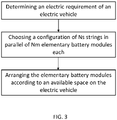
- determining the electric requirement of at least one of the electric vehicles,
- choosing one of the plurality of configurations matching with the electric requirement of said electric vehicle, said configuration comprising a configuration number Mc of elementary battery modules, the elementary battery modules of said configuration being arranged in a string number Ns of strings connected in parallel to each other, each string comprising a module number Nm of elementary battery modules, the string number Ns and the module number Nm being such that Ns ≥ 2, Nm ≥ 2 and Ns × Nm = Mc, the configuration having a configuration voltage Vc such that Vc = Nm × Ve and a configuration energy capacity Ec such that Ec = Mc × Ee.
- The use may further comprises:
- determining available space within the electric vehicle,
- arranging the elementary battery modules according to the available space.
- Other features, details and advantages will be shown in the following detailed description and on the figures, on which:
-
figure 1 is a partial representation in perspective of an electric vehicle implementing a battery system according to an embodiment of the invention, the electric vehicle being a construction machine of the construction industry belonging to a range of electric vehicles having each an electric requirement chosen at least between a voltage requirement and an energy requirement, -
figure 2 is a schematic representation of the battery system of the electric vehicle offigure 1 , the battery system having a configuration of identical elementary battery modules matching with the electric requirements of the electric vehicle, the configuration comprising Ns strings connected in parallel to each other, each string comprising Nm elementary battery modules connected in series with a first electronic control unit, the first electronic control unit being connected to a second electronic control unit, -
figure 3 is a flowchart illustrating a use of use of the battery system offigure 2 . -
Figure 1 represents a portion of an electric vehicle according to an embodiment of the invention. The electric vehicle belongs to a range of electric vehicles having each an electric requirement chosen at least between a voltage requirement and an energy requirement. - In the represented embodiment, the electric vehicle is a
construction machine 1 of the construction industry. More specifically,figure 1 illustrates anupper portion 2, including acabin 3, of a compact wheel loader or compact excavator. The electric vehicle could however be any other electric vehicle belonging to a range of electric vehicles, possibly of the automotive or commercial industries, such as a passenger car, a truck, a bus or other. - Such range of
construction machines 1 has voltage requirements ranging from 500 V to 750 V, and energy requirements ranging from 30 kWh to 150 kWh. To meet such voltage and/or energy requirements, abattery system 5 as shown infigure 2 is implemented. - The
battery system 5 comprises severalelementary battery modules 6. Theelementary battery modules 6 are identical and hence have same dimensions and same number of battery cells providing a same nominal voltage Ve and a same nominal energy capacity Ee. - As represented on
figure 2 , theelementary battery modules 6 are arranged in one of a plurality of configurations in which theelementary battery modules 6 are connected in series inrespective strings 7, whichstrings 7 are connected in parallel to each other. - Each configuration comprises an arrangement of
elementary battery modules 6 to have a configuration voltage Vc and a configuration energy capacity Ec which match at least one of the electric requirement chosen between voltage and energy requirements of at least one of the construction machine of the range of construction machines. In particular, each configuration comprises a number Mc ofelementary battery modules 6, a string number Ns ofstrings 7 connected in parallel to each other and a module number Nm ofelementary battery modules 6 perstring 7, such that Ns ≥ 2, Nm ≥ 2 and Ns × Nm = Mc. Hence, the configuration voltage is Vc = Nm × Ve and the configuration energy capacity is Ec = Mc × Ee. - Each
string 7 further includes a first electronic control unit (ECU) included in a main power box 8 for balancing a state of charge of eachelementary battery module 6 within thisstring 7. The configuration is completed with one or several second electronic control units for balancing a state of charge of thestrings 7 relative to each other. Balancing the state of charge within eachstring 7 or between thestrings 7 can be done actively, theelementary battery modules 6 being connected and under charge, or passively, theelementary battery modules 6 being disconnected. The second electronic control unit operates is part of acontrol box 9 made with a master battery management unit that drives all theelementary battery modules 6 acting as "slaves" with respect toelementary battery modules 6 balancing, connection and disconnection. Thecontrol box 9 may also include a pre-charge function for thewhole battery system 5 in addition to contactors and related fuses. Thecontrol box 9 acts as a main interface between thestrings 7 ofelementary battery modules 6 and theconstruction machine 1. When overall configuration voltage is above 60 V, thecontrol box 9 may also have a safety function as a high voltage interlock loop. - In relation with
figure 3 , a use of thebattery system 5 is now disclosed. The following description made in relation with thebattery system 5 used to power up the range ofconstruction machines 1 as discussed previously. This description is however transposable to any range of electric vehicles of other kind, especially to any range of electric vehicles of the automotive or commercial industries. - At first, the electric requirement of at least one of the
construction machines 1 is determined. The electric requirement may be the voltage requirement and/or the energy requirement or any other requirement in relation with the electric operation of theconstruction machine 1. - Then, for each
construction machine 1 of the range, one of the plurality of configurations matching with the electric requirement of the construction machine is chosen. In particular, the number Mc as well as the module number Nm and the string number Ns are chosen to reach the configuration voltage Vc = Nm × Ve and the configuration energy capacity Ec = Mc × Ee matching the corresponding electric requirement of theconstruction machine 1. - In an example provided for a purely illustrative and non-limitative purpose, the steps previously disclosed can be implemented with
elementary battery modules 6 having each a nominal voltage Ve of 48 V and a nominal energy capacity Ee of 5 kWh. Then according to the targeted energy capacity, theelementary battery modules 6 are packed: - in series which will lead to the strings of a certain voltage: for example, 10
elementary battery modules 6 in series will result in astring 7 having a voltage of 480 V and an energy capacity of 50 kWh, and - in parallel to extend the energy capacity and meet the targeted energy capacity: for example, 2
strings 7 of 10elementary battery modules 6 will result in a configuration voltage of 480 V and a configuration energy capacity of 100 kWh. - The module number Nm of
elementary battery modules 6 perstring 7 and the string number ofstrings 7 may also depend on thecontrol box 9 ability to manage the number ofelementary battery modules 6. For example, with theelementary battery module 6 having the nominal voltage Ve of 48 V and the nominal energy capacity Ee of 5 kWh, the module number Nm may be up to 15, totalizing up to 75 kWh for the energy capacity of each string and 720 V for the voltage of each string, and the string number Ns may be up to 10 totalizing up to 750Kwh for the configuration energy capacity and 720V for the configuration voltage. - Still for a purely illustrative and non-limitative purpose, in the table below, the configurations with
elementary battery modules 6 having each the nominal voltage Ve of 48 V and the nominal energy capacity Ee of 5 kWh are provided for fourconstruction machines 1 having different voltage and energy requirements.Table Construction machine 1 2 3 4 Energy capacity required for 4h autonomy (kWh) 64.6 90.8 86.0 110,0 Configuration (s= modules in series, p= strings in parallel, MB = main power box including the first ECU) [8s2p] + 2 MB 65,6 kWh, 408 V[11s2p] + 2 MB 90 kWh, 562 V [11s2p] + 2 MB 90 kWh, 562 V [13s2p] + 2 MB 106,6 kWh, 664 V - As shown in
figure 1 , once the configuration has been set, the available space within theconstruction machine 1 can be determined and theelementary battery modules 6 can be arranged according to the available space, being possibly dispatched at separate locations and connected to each other by wires.
Claims (5)
- Battery system (5) to power up a range of electric vehicles each having an electric requirement chosen at least between a voltage requirement and an energy requirement, the battery system (5) comprising a plurality of elementary battery modules (6), each elementary battery module (6) comprising a plurality of battery cells, wherein each elementary battery module (6) has a nominal voltage Ve and a nominal energy capacity Ee, wherein the battery system (5) presents a plurality of configurations in which the elementary battery modules (6) are arranged respectively in different configurations with different voltages and energy capacities, each configuration matching with at least one of the electric requirements of the range of electric vehicles, each configuration comprising a number Mc of elementary battery modules (6), the elementary battery modules (6) of each configuration being arranged in a string number Ns of strings (7) connected in parallel to each other, each string (7) comprising a module number Nm of elementary battery modules (6), the string number Ns and the module number Nm being such that Ns ≥ 2, Nm ≥ 2 and Ns × Nm = Mc, the configuration having a configuration voltage Vc such that Vc = Nm × Ve and a configuration energy capacity Ec such that Ec = Mc × Ee,
wherein each string (7) further includes a first electronic control unit for balancing a state of charge of each elementary battery module (6) within said string (7), and
wherein the battery system (5) further includes at least one second electronic control unit for balancing a state of charge of the strings (7) relative to each other. - Range of electric vehicles comprising a battery system (5) according to claim 1, wherein each electric vehicle has an electric requirement chosen at least between a voltage requirement and an energy requirement, wherein the battery system (5) presents a plurality of configurations each matching with at least one of the electric requirements of the range of electric vehicles.
- Range of electric vehicles according to claim 2, wherein the electric vehicles are construction machines (1), such as excavators and wheel loaders, the voltage requirements of said construction machines (1) being chosen between 500 V and 750 V and the energy requirements of said construction machines (1) being chosen between 30 kWh and 150 kWh.
- Use of a battery system (5) according to claim 1 to power up a range of electric vehicles each having an electric requirement chosen at least between a voltage requirement and an energy requirement, comprising:- determining the electric requirement of at least one of the electric vehicles,- choosing one of the plurality of configurations matching with the electric requirement of said electric vehicle, said configuration comprising a configuration number Mc of elementary battery modules (6), the elementary battery modules (6) of said configuration being arranged in a string number Ns of strings (7) connected in parallel to each other, each string (7) comprising a module number Nm of elementary battery modules (6), the string number Ns and the module number Nm being such that Ns ≥ 2, Nm ≥ 2 and Ns × Nm = Mc, the configuration having a configuration voltage Vc such that Vc = Nm × Ve and a configuration energy capacity Ec such that Ec = Mc × Ee.
- Use of a battery system (5) according to claim 4, further comprising:- determining available space within the electric vehicle,- arranging the elementary battery modules (6) according to the available space.
Priority Applications (1)
| Application Number | Priority Date | Filing Date | Title |
|---|---|---|---|
| EP21185136.5A EP4119385A1 (en) | 2021-07-12 | 2021-07-12 | Battery system, range of electric vehicles and use of a battery system |
Applications Claiming Priority (1)
| Application Number | Priority Date | Filing Date | Title |
|---|---|---|---|
| EP21185136.5A EP4119385A1 (en) | 2021-07-12 | 2021-07-12 | Battery system, range of electric vehicles and use of a battery system |
Publications (1)
| Publication Number | Publication Date |
|---|---|
| EP4119385A1 true EP4119385A1 (en) | 2023-01-18 |
Family
ID=76890927
Family Applications (1)
| Application Number | Title | Priority Date | Filing Date |
|---|---|---|---|
| EP21185136.5A Withdrawn EP4119385A1 (en) | 2021-07-12 | 2021-07-12 | Battery system, range of electric vehicles and use of a battery system |
Country Status (1)
| Country | Link |
|---|---|
| EP (1) | EP4119385A1 (en) |
Citations (4)
| Publication number | Priority date | Publication date | Assignee | Title |
|---|---|---|---|---|
| DE102014215035A1 (en) * | 2014-07-31 | 2016-02-04 | Bayerische Motoren Werke Aktiengesellschaft | Battery system and electrically powered two-wheeler with a battery system |
| WO2017173420A1 (en) * | 2016-04-01 | 2017-10-05 | Faraday & Future Inc. | Electric vehicle battery management |
| WO2019150836A1 (en) * | 2018-01-30 | 2019-08-08 | パナソニックIpマネジメント株式会社 | Vehicular power supply system, and management device |
| WO2021001045A1 (en) * | 2019-07-04 | 2021-01-07 | Volvo Construction Equipment Ab | Method that consists to give a second life to used electric vehicle battery packs by reusing them as a power source for a battery charger |
-
2021
- 2021-07-12 EP EP21185136.5A patent/EP4119385A1/en not_active Withdrawn
Patent Citations (4)
| Publication number | Priority date | Publication date | Assignee | Title |
|---|---|---|---|---|
| DE102014215035A1 (en) * | 2014-07-31 | 2016-02-04 | Bayerische Motoren Werke Aktiengesellschaft | Battery system and electrically powered two-wheeler with a battery system |
| WO2017173420A1 (en) * | 2016-04-01 | 2017-10-05 | Faraday & Future Inc. | Electric vehicle battery management |
| WO2019150836A1 (en) * | 2018-01-30 | 2019-08-08 | パナソニックIpマネジメント株式会社 | Vehicular power supply system, and management device |
| WO2021001045A1 (en) * | 2019-07-04 | 2021-01-07 | Volvo Construction Equipment Ab | Method that consists to give a second life to used electric vehicle battery packs by reusing them as a power source for a battery charger |
Similar Documents
| Publication | Publication Date | Title |
|---|---|---|
| US9783037B2 (en) | Vehicle | |
| EP3180208B1 (en) | Electric or hybrid electric vehicle having multiple drive units arranged in separate parts of the vehicle | |
| CN109080466B (en) | System and method for controlling charging of vehicle battery | |
| US11325454B2 (en) | Method of designing machine | |
| US20060102398A1 (en) | Fuel cell equipped vehicle | |
| US20190312313A1 (en) | Battery apparatus for vehicle | |
| US20120139338A1 (en) | High voltage system of electric vehicles | |
| CN103818265B (en) | Cell managing device on powered vehicle | |
| CN105459802A (en) | Distributed hybrid power system of heavy vehicle and vehicle | |
| CN102267396A (en) | Vehicular electrical systems | |
| EP1547845A1 (en) | Motor vehicle mounted with fuel cell | |
| EP1586487A2 (en) | Power supply apparatus for vehicle | |
| CN113352952A (en) | Power control integration method and system for hydrogen-electricity hybrid electric vehicle | |
| KR101751236B1 (en) | Battery charging system for electric vehicle using separated multi-layer and method thereof | |
| CN110271530A (en) | It is operable as the automatic cut-off of the vehicle of generator | |
| KR20120069859A (en) | Mobile charge system | |
| US20050139402A1 (en) | Fuel cell vehicle | |
| JP2018085790A (en) | Battery controller of electric vehicle and battery control method of electric vehicle | |
| CN113002455A (en) | Direct current and high frequency alternating current hybrid electric system for unmanned vehicle | |
| US11996534B2 (en) | Electric power module system | |
| CN119547286A (en) | High voltage battery pack | |
| EP4119385A1 (en) | Battery system, range of electric vehicles and use of a battery system | |
| CN114851849A (en) | Electric moving system for vehicle | |
| EP4378743A1 (en) | Battery system, range of electric vehicles and use of a battery system | |
| US12355277B2 (en) | System and method for disengaging battery strings |
Legal Events
| Date | Code | Title | Description |
|---|---|---|---|
| PUAI | Public reference made under article 153(3) epc to a published international application that has entered the european phase |
Free format text: ORIGINAL CODE: 0009012 |
|
| STAA | Information on the status of an ep patent application or granted ep patent |
Free format text: STATUS: THE APPLICATION HAS BEEN PUBLISHED |
|
| AK | Designated contracting states |
Kind code of ref document: A1 Designated state(s): AL AT BE BG CH CY CZ DE DK EE ES FI FR GB GR HR HU IE IS IT LI LT LU LV MC MK MT NL NO PL PT RO RS SE SI SK SM TR |
|
| STAA | Information on the status of an ep patent application or granted ep patent |
Free format text: STATUS: REQUEST FOR EXAMINATION WAS MADE |
|
| 17P | Request for examination filed |
Effective date: 20230124 |
|
| RBV | Designated contracting states (corrected) |
Designated state(s): AL AT BE BG CH CY CZ DE DK EE ES FI FR GB GR HR HU IE IS IT LI LT LU LV MC MK MT NL NO PL PT RO RS SE SI SK SM TR |
|
| STAA | Information on the status of an ep patent application or granted ep patent |
Free format text: STATUS: EXAMINATION IS IN PROGRESS |
|
| STAA | Information on the status of an ep patent application or granted ep patent |
Free format text: STATUS: THE APPLICATION HAS BEEN WITHDRAWN |
|
| 17Q | First examination report despatched |
Effective date: 20230913 |
|
| 18W | Application withdrawn |
Effective date: 20230925 |