EP4119114A1 - Movement supporting device, movement supporting method, and program - Google Patents
Movement supporting device, movement supporting method, and program Download PDFInfo
- Publication number
- EP4119114A1 EP4119114A1 EP21768482.8A EP21768482A EP4119114A1 EP 4119114 A1 EP4119114 A1 EP 4119114A1 EP 21768482 A EP21768482 A EP 21768482A EP 4119114 A1 EP4119114 A1 EP 4119114A1
- Authority
- EP
- European Patent Office
- Prior art keywords
- user
- safety degree
- controller
- action candidate
- necessary
- Prior art date
- Legal status (The legal status is an assumption and is not a legal conclusion. Google has not performed a legal analysis and makes no representation as to the accuracy of the status listed.)
- Pending
Links
Images


Classifications
-
- A—HUMAN NECESSITIES
- A61—MEDICAL OR VETERINARY SCIENCE; HYGIENE
- A61H—PHYSICAL THERAPY APPARATUS, e.g. DEVICES FOR LOCATING OR STIMULATING REFLEX POINTS IN THE BODY; ARTIFICIAL RESPIRATION; MASSAGE; BATHING DEVICES FOR SPECIAL THERAPEUTIC OR HYGIENIC PURPOSES OR SPECIFIC PARTS OF THE BODY
- A61H3/00—Appliances for aiding patients or disabled persons to walk about
- A61H3/06—Walking aids for blind persons
- A61H3/061—Walking aids for blind persons with electronic detecting or guiding means
-
- G—PHYSICS
- G08—SIGNALLING
- G08G—TRAFFIC CONTROL SYSTEMS
- G08G1/00—Traffic control systems for road vehicles
- G08G1/005—Traffic control systems for road vehicles including pedestrian guidance indicator
-
- G—PHYSICS
- G01—MEASURING; TESTING
- G01C—MEASURING DISTANCES, LEVELS OR BEARINGS; SURVEYING; NAVIGATION; GYROSCOPIC INSTRUMENTS; PHOTOGRAMMETRY OR VIDEOGRAMMETRY
- G01C21/00—Navigation; Navigational instruments not provided for in groups G01C1/00 - G01C19/00
- G01C21/20—Instruments for performing navigational calculations
-
- G—PHYSICS
- G06—COMPUTING OR CALCULATING; COUNTING
- G06T—IMAGE DATA PROCESSING OR GENERATION, IN GENERAL
- G06T7/00—Image analysis
- G06T7/0002—Inspection of images, e.g. flaw detection
-
- G—PHYSICS
- G08—SIGNALLING
- G08G—TRAFFIC CONTROL SYSTEMS
- G08G1/00—Traffic control systems for road vehicles
- G08G1/16—Anti-collision systems
- G08G1/166—Anti-collision systems for active traffic, e.g. moving vehicles, pedestrians, bikes
-
- G—PHYSICS
- G09—EDUCATION; CRYPTOGRAPHY; DISPLAY; ADVERTISING; SEALS
- G09B—EDUCATIONAL OR DEMONSTRATION APPLIANCES; APPLIANCES FOR TEACHING, OR COMMUNICATING WITH, THE BLIND, DEAF OR MUTE; MODELS; PLANETARIA; GLOBES; MAPS; DIAGRAMS
- G09B21/00—Teaching, or communicating with, the blind, deaf or mute
- G09B21/001—Teaching or communicating with blind persons
- G09B21/006—Teaching or communicating with blind persons using audible presentation of the information
-
- G—PHYSICS
- G09—EDUCATION; CRYPTOGRAPHY; DISPLAY; ADVERTISING; SEALS
- G09B—EDUCATIONAL OR DEMONSTRATION APPLIANCES; APPLIANCES FOR TEACHING, OR COMMUNICATING WITH, THE BLIND, DEAF OR MUTE; MODELS; PLANETARIA; GLOBES; MAPS; DIAGRAMS
- G09B21/00—Teaching, or communicating with, the blind, deaf or mute
- G09B21/001—Teaching or communicating with blind persons
- G09B21/008—Teaching or communicating with blind persons using visual presentation of the information for the partially sighted
-
- A—HUMAN NECESSITIES
- A61—MEDICAL OR VETERINARY SCIENCE; HYGIENE
- A61H—PHYSICAL THERAPY APPARATUS, e.g. DEVICES FOR LOCATING OR STIMULATING REFLEX POINTS IN THE BODY; ARTIFICIAL RESPIRATION; MASSAGE; BATHING DEVICES FOR SPECIAL THERAPEUTIC OR HYGIENIC PURPOSES OR SPECIFIC PARTS OF THE BODY
- A61H2201/00—Characteristics of apparatus not provided for in the preceding codes
- A61H2201/01—Constructive details
- A61H2201/0157—Constructive details portable
-
- A—HUMAN NECESSITIES
- A61—MEDICAL OR VETERINARY SCIENCE; HYGIENE
- A61H—PHYSICAL THERAPY APPARATUS, e.g. DEVICES FOR LOCATING OR STIMULATING REFLEX POINTS IN THE BODY; ARTIFICIAL RESPIRATION; MASSAGE; BATHING DEVICES FOR SPECIAL THERAPEUTIC OR HYGIENIC PURPOSES OR SPECIFIC PARTS OF THE BODY
- A61H2201/00—Characteristics of apparatus not provided for in the preceding codes
- A61H2201/01—Constructive details
- A61H2201/0173—Means for preventing injuries
-
- A—HUMAN NECESSITIES
- A61—MEDICAL OR VETERINARY SCIENCE; HYGIENE
- A61H—PHYSICAL THERAPY APPARATUS, e.g. DEVICES FOR LOCATING OR STIMULATING REFLEX POINTS IN THE BODY; ARTIFICIAL RESPIRATION; MASSAGE; BATHING DEVICES FOR SPECIAL THERAPEUTIC OR HYGIENIC PURPOSES OR SPECIFIC PARTS OF THE BODY
- A61H2201/00—Characteristics of apparatus not provided for in the preceding codes
- A61H2201/12—Driving means
- A61H2201/1207—Driving means with electric or magnetic drive
-
- A—HUMAN NECESSITIES
- A61—MEDICAL OR VETERINARY SCIENCE; HYGIENE
- A61H—PHYSICAL THERAPY APPARATUS, e.g. DEVICES FOR LOCATING OR STIMULATING REFLEX POINTS IN THE BODY; ARTIFICIAL RESPIRATION; MASSAGE; BATHING DEVICES FOR SPECIAL THERAPEUTIC OR HYGIENIC PURPOSES OR SPECIFIC PARTS OF THE BODY
- A61H2201/00—Characteristics of apparatus not provided for in the preceding codes
- A61H2201/12—Driving means
- A61H2201/1253—Driving means driven by a human being, e.g. hand driven
-
- A—HUMAN NECESSITIES
- A61—MEDICAL OR VETERINARY SCIENCE; HYGIENE
- A61H—PHYSICAL THERAPY APPARATUS, e.g. DEVICES FOR LOCATING OR STIMULATING REFLEX POINTS IN THE BODY; ARTIFICIAL RESPIRATION; MASSAGE; BATHING DEVICES FOR SPECIAL THERAPEUTIC OR HYGIENIC PURPOSES OR SPECIFIC PARTS OF THE BODY
- A61H2201/00—Characteristics of apparatus not provided for in the preceding codes
- A61H2201/16—Physical interface with patient
- A61H2201/1657—Movement of interface, i.e. force application means
- A61H2201/1659—Free spatial automatic movement of interface within a working area, e.g. Robot
-
- A—HUMAN NECESSITIES
- A61—MEDICAL OR VETERINARY SCIENCE; HYGIENE
- A61H—PHYSICAL THERAPY APPARATUS, e.g. DEVICES FOR LOCATING OR STIMULATING REFLEX POINTS IN THE BODY; ARTIFICIAL RESPIRATION; MASSAGE; BATHING DEVICES FOR SPECIAL THERAPEUTIC OR HYGIENIC PURPOSES OR SPECIFIC PARTS OF THE BODY
- A61H2201/00—Characteristics of apparatus not provided for in the preceding codes
- A61H2201/50—Control means thereof
- A61H2201/5007—Control means thereof computer controlled
-
- A—HUMAN NECESSITIES
- A61—MEDICAL OR VETERINARY SCIENCE; HYGIENE
- A61H—PHYSICAL THERAPY APPARATUS, e.g. DEVICES FOR LOCATING OR STIMULATING REFLEX POINTS IN THE BODY; ARTIFICIAL RESPIRATION; MASSAGE; BATHING DEVICES FOR SPECIAL THERAPEUTIC OR HYGIENIC PURPOSES OR SPECIFIC PARTS OF THE BODY
- A61H2201/00—Characteristics of apparatus not provided for in the preceding codes
- A61H2201/50—Control means thereof
- A61H2201/5023—Interfaces to the user
- A61H2201/5025—Activation means
- A61H2201/503—Inertia activation, i.e. activated by movement
-
- A—HUMAN NECESSITIES
- A61—MEDICAL OR VETERINARY SCIENCE; HYGIENE
- A61H—PHYSICAL THERAPY APPARATUS, e.g. DEVICES FOR LOCATING OR STIMULATING REFLEX POINTS IN THE BODY; ARTIFICIAL RESPIRATION; MASSAGE; BATHING DEVICES FOR SPECIAL THERAPEUTIC OR HYGIENIC PURPOSES OR SPECIFIC PARTS OF THE BODY
- A61H2201/00—Characteristics of apparatus not provided for in the preceding codes
- A61H2201/50—Control means thereof
- A61H2201/5023—Interfaces to the user
- A61H2201/5048—Audio interfaces, e.g. voice or music controlled
-
- A—HUMAN NECESSITIES
- A61—MEDICAL OR VETERINARY SCIENCE; HYGIENE
- A61H—PHYSICAL THERAPY APPARATUS, e.g. DEVICES FOR LOCATING OR STIMULATING REFLEX POINTS IN THE BODY; ARTIFICIAL RESPIRATION; MASSAGE; BATHING DEVICES FOR SPECIAL THERAPEUTIC OR HYGIENIC PURPOSES OR SPECIFIC PARTS OF THE BODY
- A61H2201/00—Characteristics of apparatus not provided for in the preceding codes
- A61H2201/50—Control means thereof
- A61H2201/5058—Sensors or detectors
- A61H2201/5092—Optical sensor
-
- G—PHYSICS
- G06—COMPUTING OR CALCULATING; COUNTING
- G06T—IMAGE DATA PROCESSING OR GENERATION, IN GENERAL
- G06T2200/00—Indexing scheme for image data processing or generation, in general
- G06T2200/24—Indexing scheme for image data processing or generation, in general involving graphical user interfaces [GUIs]
Definitions
- the present disclosure relates to a movement support device that supports movement of a user.
- Patent Document 1 discloses a walking supporting system for a visually impaired person.
- the system extracts information regarding presence of an obstacle and its position from a stereo image, and an information transmission device emits the information by voice information or tactile information. This enables a visually impaired person or the like who is a user to more specifically grasp information regarding navigation such as the presence of an obstacle, its position, and distance.
- Patent Document 1 JP 2001-318594 A
- Patent Document 1 does not receive input of an action desired by the user, and performs only navigation.
- the invention disclosed in Patent Document 1 does not calculate a safety degree indicating the level of safety regarding the user based on an image.
- a movement support device is a movement support device that supports movement of a user, the movement support device including:
- the movement support device can secure the safety of a user and support the user in achieving an action desired by the user depending on the safety degree.
- FIG. 1 is a schematic diagram illustrating an application example of a movement support device 100 according to the present embodiment.
- the movement support device 100 By leading to, in a self-propelled manner, a place where a user 90 wants to go, the movement support device 100 performs a navigation operation of supporting movement of the user 90, for example.
- the navigation includes not only guiding the user 90 to a destination but also guiding the user 90 to a safe place.
- the movement support device 100 includes, for example, a controller 4 such as a CPU, an input unit 1 such as a button, a camera 2, and an audio output unit 32 such as a headphone.
- the camera 2 is an example of the imaging device of the present disclosure.
- the controller 4 is mounted on a robot 91 driven to be self-propelled, for example.
- the robot 91 may have a suitcase shape as illustrated.
- the input unit 1, the camera 2, and the audio output unit 32 are connected to the controller 4 in a wired or wireless manner.
- the user 90 may have various action requests in motion as well as getting to the destination.
- the user 90 may desire communication such as talking with an acquaintance. If the robot 91 always executes only heading toward the destination, it is not possible to achieve an action request of the user 90 that is, for example, to stop on the way to talk with an acquaintance. In order to achieve such an action request, for example, in a case of coming across an acquaintance or the like in motion, the movement support device 100 is required to automatically stop or guide the user 90 to near the acquaintance. On the other hand, if priority is always given to achieving the action request of the user 90 even in a dangerous situation such as a case where the user 90 is at a pedestrian crossing, the safety of the body of the user 90 is not secured.
- the movement support device 100 receives an action request of the user 90 via the input unit 1.
- the user 90 operates the input unit 1 to select an action of "talking with an acquaintance" from among predetermined action candidates.
- the controller 4 may select an action according to the input information from a table stored in the storage.
- the controller 4 of the movement support device 100 calculates a safety degree S indicating the level of safety regarding the user 90 based on an image captured by the camera 2.
- the controller 4 does not support achievement of "talking with an acquaintance" and continues navigation as it is, for example.
- the safety degree S is the necessary safety degree T or more
- the controller 4 may support achievement of "talking with an acquaintance” by automatically stopping or guiding the user 90 to near the acquaintance. In this manner, the movement support device 100 achieves an action request of the user 90 while securing the safety of the user 90.
- the present disclosure is applicable to the movement support device 100 that supports movement of the user 90 who is a visually impaired person, for example.
- the movement support device 100 finds an acquaintance registered in advance based on a captured image by the camera 2, and makes a notification to the user 90 of the presence of the acquaintance via the audio output unit 32.
- the user 90 operates the input unit 1 to input, to the controller 4, action request information indicating that the user wants to have a conversation with the acquaintance.
- the controller 4 does not support achievement of the action request in a case where the safety degree S is less than the necessary safety degree T necessary for conversation with an acquaintance on the spot.
- the controller 4 may support achievement of "talking with an acquaintance" when the safety degree S is the necessary safety degree T or more. In this manner, the movement support device 100 achieves social activities of the user 90 such as communication while ensuring the safety of the user 90.
- the user 90 may be an autonomously movable robot.
- the components of the movement support device 100 such as the camera 2, the controller 4, and the audio output unit 32 may be incorporated in the robot.
- the robot is basically self-propelled to the destination, but may select an action candidate to actually execute from among predetermined action candidates according to the captured image of the camera 2 and the safety degree S. This enables the robot to smoothly communicate with the human when the human and the robot coexist in society while ensuring the safety of the robot.
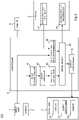
- FIG. 2 is a block diagram illustrating a configuration example of the movement support device 100 according to the present embodiment.
- the movement support device 100 includes the input unit 1, the camera 2, an output unit 3, the controller 4, a storage 5, and a communication interface (I/F) 6.
- I/F communication interface
- the input unit 1 is an input device such as, for example, a keyboard, a touch pad, a touchscreen, a button, a switch, or a voice input device. For example, by operating the input unit 1, the user 90 can input action request information described later.
- the camera 2 is an imaging device that captures an image of an environment around the user 90 to form a captured image.
- the camera 2 forms a captured image by a solid-state imaging element such as a complementary MOS (CMOS) or a charge coupled device (CCD).
- CMOS complementary MOS
- CCD charge coupled device
- the camera 2 is, for example, a wearable camera that can be worn by the user 90.
- the camera 2 may be mounted on the robot 91 and baggage of the user 90 such as a backpack.
- the output unit 3 is an output device that performs output in accordance with control by the controller 4.
- the output unit 3 includes, for example, a display 31, the audio output unit 32, and a driver 33.
- the display 31 is a display device such as, for example, a liquid crystal display, an organic EL display, and a projector.
- the audio output unit 32 includes, for example, audio device such as a speaker, an earphone, and a headphone.
- the driver 33 includes a drive device such as a motor, wheels, and a steering for moving the movement support device 100, for example.
- the controller 4 is an information processing device that includes a central processing unit (CPU), a random access memory (RAM), and read only memory (ROM), and performs control of each component of the movement support device 100 in response to information processing.
- the controller 4 includes, for example, an image acquisition unit 41, an image analyzer 42, a safety degree calculator 43, a necessary safety degree determinator 44, a decision unit 45, and an output controller 46.
- the image acquisition unit 41, the image analyzer 42, the safety degree calculator 43, the necessary safety degree determinator 44, the decision unit 45, and the output controller 46 may execute processing of which each component is in charge.
- Such a program may be stored in the storage 5.
- the controller 4 expands, in the RAM, the target program stored in the storage 5.
- the controller 4 interprets and executes, by the CPU, the program expanded in the RAM to control each component. An operation example of each component will be described later.
- the storage 5 is a medium that accumulates information on the program and the like by an electrical, magnetic, optical, mechanical, or chemical action so that a computer, another device, a machine, or the like can read the information on the recorded program or the like.
- the storage 5 is, for example, an auxiliary storage device such as a hard disk drive or a solid state drive.
- the storage 5 stores, for example, a necessary safety degree table 51, a decided result information 52, a program executed by the controller 4, and the like.
- the storage 5 may store map data used for movement supporting to a destination.
- the storage 5 may include a main storage device such as the RAM.
- the communication interface 6 includes an interface circuit for enabling communication connection between the movement support device 100 and external equipment.
- the communication interface 6 performs communication in conformity to a standard such as IEEE 802.3, IEEE 802.11, Wi-Fi (registered trademark), LTE, 3G, 4G, and 5G, for example.
- the communication interface 6 may be an interface circuit that performs communication in conformity to a standard such as Universal Serial Bus (USB), HDMI (registered trademark), IEEE 1394, and Bluetooth (registered trademark).
- USB Universal Serial Bus
- HDMI registered trademark
- IEEE 1394 registered trademark
- Bluetooth registered trademark
- the movement support device 100 is mounted on, for example, a suitcase, a self-propelled robot, and the like.
- the movement support device 100 may be a wearable device worn by the user 90 on his/her back or the like.
- the movement support device 100 may be attached to a bag such as a backpack.
- the controller 4 may include various semiconductor integrated circuits such as a CPU, an MPU, a GPU, a microcomputer, a DSP, an FPGA, and an ASIC.
- the movement support device 100 operates in a normal mode for supporting movement of the user 90 by guiding the way or the like.
- the normal mode can also be called “navigation mode”.
- the movement support device 100 operates by switching between the normal mode and the request execution mode in response to the safety degree S, input of action request information from the user 90, and the like.
- operation in each mode and mode switching will be described with reference to FIGS. 3 and 4 .
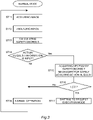
- FIG. 3 is a flowchart presenting an operation example of the movement support device 100 in the normal mode. Each processing presented in FIG. 3 is executed by the controller 4, for example.
- the image acquisition unit 41 acquires an image captured by the camera 2 (ST11).
- the camera 2 captures an image of a periphery of the user 90 at a predetermined frame rate, for example, and sequentially generates image data.
- the controller 4 executes the processing presented in the flowchart of FIG. 3 for each frame.
- the image analyzer 42 analyzes the image acquired in step (ST) 11 and detects an object in the image such as an obstacle, a target, or a person (ST12) .
- the image analyzer 42 may analyze a position, a state, and the like of the detected object. For example, the image analyzer 42 detects a travel direction of a moving body such as an automobile, an orientation of an eye line of a person, and the like.
- the safety degree calculator 43 calculates the safety degree S based on the image (ST13). Specifically, the safety degree calculator 43 calculates the safety degree S based on the result of the image analysis in ST12. For example, the safety degree calculator 43 calculates the safety degree S by comprehensively considering first to fifth indices S1 to S5.
- the first to fifth indices S1 to S5 can take values from 0 to 1, for example, and are decided by the safety degree calculator 43 in the following manner.
- the first index S1 is decided based on the weather, brightness, or the like of the environment around the user 90.
- the safety degree calculator 43 sets the first index S1 to 0 when the weather is snow and the surroundings are dark, and sets the first index S1 to 1 when the weather is sunny and the surroundings are bright.
- the first index S1 is not limited to one that takes a higher value as the surroundings are brighter.
- the safety degree calculator 43 may set the first index S1 to a low level value, for example, 0.1.
- the second index S2 is calculated based on the state of the ground where the user 90 is.
- the safety degree calculator 43 sets the second index S2 to a small value when the user 90 is on a wet ground or a staircase, and sets the second index S2 to a large value when the user 90 is on a dry, flat ground.
- the third index S3 is calculated based on the presence or absence of an obstacle in the environment around the user 90 and the nature of the obstacle. For example, the safety degree calculator 43 sets the third index S3 to 1 when there is no obstacle in the environment around the user 90. On the other hand, when there is a dangerous obstacle such as heavy machinery in the environment around the user 90, the safety degree calculator 43 sets the third index S3 to a small value.
- the fourth index S4 is calculated based on the presence or absence, nature, moving speed, moving direction, and the like of a moving body in the environment around the user 90.
- the safety degree calculator 43 sets the fourth index S4 to 1 when there is no moving body in the environment around the user 90.
- the safety degree calculator 43 sets the fourth index S4 to a small value when there is a moving body such as an automobile moving in the environment around the user 90, and sets the fourth index S4 to a smaller value when such a moving body is moving toward the user 90 at a high speed.
- the fifth index S5 is calculated based on the presence or absence, the moving speed, and the moving direction of people around the user 90.
- the safety degree calculator 43 sets the fifth index S5 to a small value when the user 90 is on a crowded road or in an intersection.
- the safety degree calculator 43 calculates the safety degree S based on the first to fifth indices S1 to S5 as described above. For example, the safety degree calculator 43 may set the total sum of the first to fifth indices S1 to S5 as the safety degree S.
- the safety degree S may be normalized to take a value of 0 to 1.
- the safety degree calculator 43 may set, as the safety degree S, a value normalized by multiplying the total sum of the first to fifth indices S1 to S5 by 1/5.
- the safety degree calculator 43 may perform different weighting on each of the first to fifth indices S1 to S5, and set the total sum of the weighted indices as the safety degree S.
- the safety degree calculator 43 does not necessarily have to calculate the safety degree S using all of the first to fifth indices S1 to S5, and may calculate the safety degree S using one or more of these indices.
- the safety degree calculator 43 may calculate the safety degree S using more than five indices.
- the necessary safety degree determinator 44 acquires, from the necessary safety degree table 51, the necessary safety degree T necessary for safely achieving the action request indicated by the action request information (ST15).
- the necessary safety degree T is an index indicating the level of safety necessary for the user 90 to safely perform an action indicated by the action request information.
- the case where there has been input of action request information includes a case where there has been input of a selection operation by the user 90 for selecting an action desired by the user 90 from among predetermined action candidates as actions that can be executed by the user 90.
- the case where there is input of action request information includes a case where the user 90 has performed processing of selecting one or a plurality of action candidates from among predetermined action candidates as actions that can be executed.
- Acquiring (ST15) the necessary safety degree T necessary for safely achieving the action request indicated by the action request information from the necessary safety degree table 51 includes acquiring the necessary safety degree T corresponding to the action candidate selected by the input of the selection operation from the necessary safety degree table 51.
- the action request information is input to the controller 4 via the input unit 1 by the user 90.
- the user 90 operates the input unit 1 such as, for example, a keyboard, a touch pad, a touchscreen, a button, a switch, or a voice input device to input action request information indicating a desired action.
- user 90 operates input unit 1 to select an action corresponding to a desired action from among predetermined action candidates as actions that can be executed by the user 90.
- the action request information or the predetermined action candidate includes information such as "I want to stop to talk with an acquaintance”, “I want to take a break”, “I want to sit on a bench”, “I want to go to the toilet”, “I want to confirm the current location”, “I want to look for an acquaintance”, and “I want to catch a bus”.
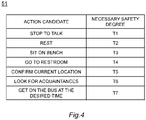
- FIG. 4 is a diagram illustrating an example of the necessary safety degree table 51.
- the necessary safety degree table 51 stores, in association with each other, a predetermined action candidate and a necessary safety degree indicating the level of safety necessary for the user 90 to safely perform the action indicated by the predetermined action candidate.
- the necessary safety degree table 51 exemplified in FIG. 4 stores predetermined action candidates such as "stop to talk”, “take a break”, “sit on a bench”, “go to the toilet”, “confirm the current location”, “find an acquaintance”, and “get on a bus at a desired time”.
- Necessary safety degrees T1 to T7 are associated with each action candidate.
- the necessary safety degrees T1 to T7 are determined in advance based on, for example, the level of difficulty for the user 90 to safely execute a corresponding action candidate and/or an index similar to the index in which the safety degree S is calculated in ST13. For example, in order to achieve confirming the current location, it is only sufficient to provide information to the user 90 using the audio output unit 32, and the level of difficulty in safe execution is small, so that the necessary safety degree T5 necessary for confirming the current location is set to a low level value. For example, in order to achieve getting on a bus at a desired time that is about to depart, it is necessary for the user 90 to move at a high speed, and the level of difficulty in safe execution is large.
- the necessary safety degree T7 necessary for getting on a bus at a desired time that is about to depart is set to a high level value.
- the necessary safety degree T1 necessary for stopping to talk may be set as a threshold value only for the fourth index S4 calculated based on the presence or absence, nature, moving speed, moving direction, and the like of the moving body in the environment around the user 90 described above.
- the threshold values for the five indices as described above included in the necessary safety degree T may be weighted in different aspects.
- the decision unit 45 decides whether or not the safety degree S calculated by the safety degree calculator 43 in ST13 is the necessary safety degree T acquired in ST15 or more (ST16).
- the operation mode of the controller 4 shifts from the current normal mode to a request execution mode for supporting the user 90 to achieve the action candidate selected in ST14 (ST17).
- the request execution mode performs operation of supporting the user 90 to achieve the action corresponding to the action request information input in ST14.
- the safety degree S is less than the necessary safety degree T (No in ST16)
- the operation mode of the controller 4 does not change from the current normal mode, and the controller 4 performs normal operation of supporting movement of the user 90 by guiding the way or the like (ST18).
- the normal operation is controlled by, for example, the output controller 46.
- the output controller 46 controls the display 31 of the output unit 3 to display a destination and a route to the destination in a map displayed on the display 31 such as a display. This enables the user 90 to confirm the destination and the route.
- the output controller 46 may control the audio output unit 32 of the output unit 3 to guide the way by voice.
- the output controller 46 may control the driver 33 of the output unit 3 such as the motor, the wheel, and the steering to move the movement support device 100 toward the destination.
- the controller 4 when the safety degree S is less than the necessary safety degree T (No in ST16), the controller 4 does not support the user 90 in achieving the action candidate selected in ST14. In other words, when the safety degree S is less than the necessary safety degree T (No in ST16), the movement support device 100 does not execute output in response to the request of the user 90. When the output in response to the request of the user 90 is executed in such a case, there is a possibility that the safety of the user 90 is not secured. The movement support device 100 can ensure the safety of the user 90 by not executing the output in response to the request of the user 90.
- the controller 4 After executing ST18, the controller 4 returns to ST11 and repeats the flow presented in FIG. 3 . That is, the flow presented in FIG. 3 is repeated at a constant period unless the process proceeds to ST17 and shifts to the request execution mode. In this manner, an image acquisition step of ST11 is repeated at a predetermined frame rate.
- Input of the action request information determined in ST14 may be performed by operation of the user 90 during navigation by the movement support device 100, but the present disclosure is not limited to this.
- input of the action request information may be performed before the navigation operation.
- the user 90 may input, to the movement support device 100 in advance, action request information indicating that "I want to be notified when coming across a friend".
- the input action request information is stored in the storage 5, for example.
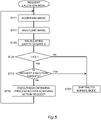
- FIG. 5 is a flowchart presenting an operation example of the movement support device 100 in the request execution mode. Each processing presented in FIG. 5 is executed by the controller 4, for example.
- ST21 to 23 in FIG. 5 are similar to ST11 to 13 in FIG. 4 . That is, the image acquisition unit 41 acquires an image captured by the camera 2 (ST21). The image analyzer 42 analyzes the image acquired in ST21 and detects an object in the image such as an obstacle, a target, or a person (ST22). The safety degree calculator 43 calculates the safety degree S based on the image (ST23). Specifically, the safety degree calculator 43 calculates the safety degree S based on the result of the image analysis in ST12.
- the decision unit 45 decides whether or not the safety degree S calculated by the safety degree calculator 43 in ST23 is the necessary safety degree T or more necessary for safely achieving the action candidate selected in ST14 of FIG. 4 (ST24).
- the necessary safety degree T is acquired in ST15 of the normal mode in FIG. 4 , for example.
- the controller 4 shifts the operation mode from the current request execution mode to the normal mode (ST27).
- the safety degree S is the necessary safety degree T or more (Yes in ST24)
- the process proceeds to next ST25.
- the controller 4 determines whether or not execution of the action candidate selected in ST14 of FIG. 4 has been completed (ST25). In this manner, the controller 4 decides whether or not the currently executed action request has been completed.
- the controller 4 shifts the operation mode from the current request execution mode to the normal mode (ST27). The operation mode may be manually changed by the user 90 operating the input unit 1.
- the controller 4 executes processing for achieving the action request or continues the processing that is currently executed (ST26).
- the controller 4 After executing ST26, the controller 4 returns to ST21 and repeats the flow presented in FIG. 3 . That is, the flow presented in FIG. 3 is repeated at a constant period unless the process proceeds to ST27 and shifts to the request execution mode. In this manner, the image acquisition step of ST21 is repeated at a predetermined frame rate.
- the controller 4 may execute state, in parallel, transition processing such as a state machine that controls shift between the normal mode and the request execution mode, meanwhile always executing, in a predetermined period, the image acquisition step, the image analysis step, and the calculation step of the safety degree S.
- the movement support device 100 that supports movement of the user 90 is provided.
- the movement support device 100 includes the camera 2, the controller 4, the storage 5, the input unit 1, and the output unit 3.
- the camera 2 captures an image of an environment around the user 90 to acquire a captured image (ST11).
- the controller 4 calculates the safety degree S indicating the level of safety regarding the user 90 based on the captured image (ST13).
- the storage 5 stores the necessary safety degree table 51.
- a predetermined action candidate as an action that can be executed by the user 90 and the necessary safety degree T indicating the level of safety necessary for the user 90 to safely perform an action indicated by the predetermined action candidate are stored in association with each other.
- the input unit 1 receives input of a selection operation by the user 90.
- the user 90 selects an action candidate desired by the user 90 from among predetermined action candidates.
- the controller 4 acquires the necessary safety degree T corresponding to a selected action candidate from the necessary safety degree table 51 (ST15).
- the safety degree S having been calculated is less than the necessary safety degree T corresponding to the selected action candidate (No in ST14)
- the controller 4 does not support the user 90 in achieving the selected action candidate.
- the safety degree S having been calculated is the necessary safety degree T or more corresponding to the selected action candidate (Yes in ST14)
- the controller 4 controls the output unit 3 to support the user 90 in achieving the selected action candidate.
- the movement support device 100 When the user 90 achieves the action candidate selected when the safety degree S is less than the necessary safety degree T, there is a possibility that the safety of the user is not ensured.
- the safety degree S when the safety degree S is less than the necessary safety degree T, the movement support device 100 does not support the user 90 in achieving the selected action candidate, and can ensure the safety of the user 90.
- the safety degree S is the necessary safety degree T or more, the movement support device 100 supports the user 90 in achieving the selected action candidate. In this manner, the movement support device 100 achieves a request of the user 90 while securing the safety of the user 90.
- the controller 4 may operate to be switchable between the normal mode in which the output unit 3 is controlled to support movement of the user 90 and a request execution mode in which the output unit 3 is controlled to support the user 90 in achieving the selected action candidate.
- the controller 4 does not need to switch the operation to the request execution mode.
- the controller 4 may switch the operation to the request execution mode.
- the controller 4 may switch the operation to the normal mode.
- the movement support device 100 can achieve a request of the user 90 while securing the safety of the user 90.
- the controller 4 may calculate the safety degree S based on at least one of the weather or brightness of the environment around the user 90, the condition of the ground where the user 90 is on, the presence or absence of an obstacle in the environment around the user 90, the nature of the obstacle, the presence or absence of a moving body in the environment around the user 90, and the nature of the moving body in the surrounding environment.
- FIG. 6 is a flowchart presenting a modification of the operation of the movement support device 100 in the normal mode.
- the flowchart of FIG. 6 further includes ST31 to 33 as compared with the flowchart of FIG. 3 .
- the controller 4 decides whether or not predetermined information has been detected from the captured image (ST31).
- the predetermined information includes various types of information such as, for example, the face of an acquaintance, a mark of a destination, a traffic light, and a road sign. Such information is stored in advance in the storage 5, for example.
- the controller 4 determines whether or not the safety degree S is sufficiently high (ST32). For example, the controller 4 determines whether or not the safety degree S is a predetermined threshold value or more. When the safety degree S is sufficiently high (Yes in ST32), the controller 4 controls the output unit 3 to make a notification to the user 90 that the predetermined information has been detected and the content of the information (ST33). After the notification, the process proceeds to ST14.
- the controller 4 may control the output unit 3 to make a notification to the user 90 (ST33).
- the predetermined information is stored in the storage 5, for example.
- the process proceeds to ST14 without making a notification.
- the controller 4 prioritizes movement and the like to a safe place so that, for example, the safety degree S becomes high.
- a notification made when the safety degree S is not sufficiently high sometimes causes the user 90 to distract consciousness of danger, and the possibility of harm to the user 90 increases. In order to prevent such risk, the controller 4 does not make a notification to the user 90 unless the safety degree S is sufficiently high.
- the decision unit 45 of the controller 4 may store the decided result information 52 into the storage 5.
- the decided result information 52 may include an element used for decision by the decision unit 45 and information indicating a decided result.
- the decided result information 52 is a decided result table that stores the situation of the surrounding environment, the action request information of the user 90 in the situation, the safety degree S, and the necessary safety degree T in association with one another.
- the situation of the surrounding environment is information included in, for example, a captured image acquired by the image acquisition unit 41 and an analysis result by the image analyzer 42.
- the decision of ST16 in FIG. 3 or ST24 in FIG. 5 by the controller 4 is sometimes different from that performed by a human.
- the decision unit 45 sometimes decides that the safety degree S is less than the necessary safety degree T in ST16 of FIG. 3 or ST24 of FIG. 5 (decides as No).
- the controller 4 may perform machine learning using the information in the decided result table and the decision by the accompanying person of the user 90 to generate a learned model.
- the decision by the accompanying person of the user 90 is input to the controller 4 using the input unit 1, for example.
- Such a learned model is generated, for example, by the controller 4 performing machine learning on a model (learning algorithm) such as a convolutional neural network (CNN).
- a model such as a convolutional neural network (CNN).
- CNN convolutional neural network
- An example of the machine learning is supervised learning in which, with the decision by the accompanying person of the user 90 used as training data, a relationship between the captured image acquired by the image acquisition unit 41 and the safety degree S is learned.
- Supervised learning of a model such as CNN is performed by the controller 4 using backpropagation, for example.
- the safety degree S becomes appropriately calculated, and the decided result by the decision unit 45 becomes accurate. For example, when it is obviously safe to achieve the request of the user 90, the decision unit 45 no longer decides that the safety degree S is less than the necessary safety degree T in ST16 of FIG. 3 or ST24 of FIG. 5 .
- the controller 4 may learn a relationship between the situation of the surrounding environment and the action request information input in ST14. This makes it possible to optimize the movement support device 100 to suit the preference of the user 90, and continuous use can reduce the number of times of input of the request by the user 90. For example, it is assumed that the user 90 continues to request every morning to get on a bus departing at a specific time. In this case, as a result of learning, when the user 90 leaves his/her house at a time within a specific range in the morning, the controller 4 performs navigation so that the user 90 is in time for the bus.
- the generation result by machine learning of the learned model or the like is stored in the storage 5, for example.
- a movement support device 100 supports movement of a user 90, the movement support device 100 comprising:
- the movement support device 100 according to Aspect 1 is provided, wherein
- the movement support device 100 according to Aspect 1 or 2 is provided, wherein the controller 4 calculates the safety degree S based on at least one of weather or brightness of an environment around the user 90, a condition of a ground of the user 90, presence or absence of an obstacle in an environment around the user 90, a nature of the obstacle, presence or absence of a moving body in an environment around the user 90, and a nature of the moving body.
- the movement support device 100 according to any one of Aspects 1 to 3 is provided, wherein the controller 4 controls the output unit 3 to make a notification to the user 90 when predetermined information has been detected from the captured image and the safety degree S having been calculated is a predetermined threshold value or more.
- a movement supporting method for supporting movement of a user 90 comprises the steps of:
Landscapes
- Engineering & Computer Science (AREA)
- General Physics & Mathematics (AREA)
- Physics & Mathematics (AREA)
- Health & Medical Sciences (AREA)
- General Health & Medical Sciences (AREA)
- Theoretical Computer Science (AREA)
- Remote Sensing (AREA)
- Radar, Positioning & Navigation (AREA)
- Educational Administration (AREA)
- Audiology, Speech & Language Pathology (AREA)
- Educational Technology (AREA)
- Business, Economics & Management (AREA)
- Rehabilitation Therapy (AREA)
- Animal Behavior & Ethology (AREA)
- Physical Education & Sports Medicine (AREA)
- Life Sciences & Earth Sciences (AREA)
- Veterinary Medicine (AREA)
- Pain & Pain Management (AREA)
- Public Health (AREA)
- Epidemiology (AREA)
- Quality & Reliability (AREA)
- Computer Vision & Pattern Recognition (AREA)
- Automation & Control Theory (AREA)
- Traffic Control Systems (AREA)
- Navigation (AREA)
Abstract
Description
- The present disclosure relates to a movement support device that supports movement of a user.
-
Patent Document 1 discloses a walking supporting system for a visually impaired person. The system extracts information regarding presence of an obstacle and its position from a stereo image, and an information transmission device emits the information by voice information or tactile information. This enables a visually impaired person or the like who is a user to more specifically grasp information regarding navigation such as the presence of an obstacle, its position, and distance. - Patent Document 1:
JP 2001-318594 A - However, the invention disclosed in
Patent Document 1 does not receive input of an action desired by the user, and performs only navigation. The invention disclosed inPatent Document 1 does not calculate a safety degree indicating the level of safety regarding the user based on an image. - A movement support device according to an aspect of the present disclosure is
a movement support device that supports movement of a user, the movement support device including: - an imaging device that captures an image of an environment around the user to acquire a captured image;
- a controller that calculates a safety degree indicating a level of safety regarding the user based on the captured image;
- a storage that stores a necessary safety degree table in which a predetermined action candidate as an action that can be executed by the user and a necessary safety degree indicating a safety degree necessary for the user to safely perform an action indicated by the predetermined action candidate are stored in association with each other;
- an input unit that receives input of a selection operation by the user to select an action candidate desired by the user from among the predetermined action candidates; and
- an output unit, in which
- the controller
- acquires a necessary safety degree corresponding to a selected action candidate from the necessary safety degree table when there has been input of the selection operation,
- does not support the user in achieving the selected action candidate when the safety degree having been calculated is less than a necessary safety degree corresponding to the selected action candidate, and
- controls the output unit to support the user in achieving the selected action candidate when the safety degree having been calculated is a necessary safety degree or more corresponding to the selected action candidate.
- The movement support device according to an aspect of the present disclosure can secure the safety of a user and support the user in achieving an action desired by the user depending on the safety degree.
-
-
FIG. 1 is a schematic diagram illustrating an application example of a movement support device according to an embodiment of the present disclosure. -
FIG. 2 is a block diagram illustrating a configuration example of a movement support device according to the present embodiment. -
FIG. 3 is a flowchart presenting an operation example of the movement support device in a normal mode. -
FIG. 4 is a diagram illustrating an example of the necessary safety degree table. -
FIG. 5 is a flowchart presenting an operation example of the movement support device in a request execution mode. -
FIG. 6 is a flowchart presenting a modification of the operation of the movement support device in the normal mode. - An embodiment of a movement support device according to the present disclosure will be described below with reference to the accompanying drawings. Note that in the following embodiment, similar components are given identical reference numerals.
-
FIG. 1 is a schematic diagram illustrating an application example of amovement support device 100 according to the present embodiment. By leading to, in a self-propelled manner, a place where auser 90 wants to go, themovement support device 100 performs a navigation operation of supporting movement of theuser 90, for example. The navigation includes not only guiding theuser 90 to a destination but also guiding theuser 90 to a safe place. - The
movement support device 100 includes, for example, acontroller 4 such as a CPU, aninput unit 1 such as a button, acamera 2, and anaudio output unit 32 such as a headphone. Thecamera 2 is an example of the imaging device of the present disclosure. Thecontroller 4 is mounted on arobot 91 driven to be self-propelled, for example. Therobot 91 may have a suitcase shape as illustrated. Theinput unit 1, thecamera 2, and theaudio output unit 32 are connected to thecontroller 4 in a wired or wireless manner. - The
user 90 may have various action requests in motion as well as getting to the destination. For example, theuser 90 may desire communication such as talking with an acquaintance. If therobot 91 always executes only heading toward the destination, it is not possible to achieve an action request of theuser 90 that is, for example, to stop on the way to talk with an acquaintance. In order to achieve such an action request, for example, in a case of coming across an acquaintance or the like in motion, themovement support device 100 is required to automatically stop or guide theuser 90 to near the acquaintance. On the other hand, if priority is always given to achieving the action request of theuser 90 even in a dangerous situation such as a case where theuser 90 is at a pedestrian crossing, the safety of the body of theuser 90 is not secured. - Therefore, the
movement support device 100 receives an action request of theuser 90 via theinput unit 1. For example, theuser 90 operates theinput unit 1 to select an action of "talking with an acquaintance" from among predetermined action candidates. Alternatively, in a case where theuser 90 inputs that "I want to talk with an acquaintance" using theinput unit 1, thecontroller 4 may select an action according to the input information from a table stored in the storage. Thecontroller 4 of themovement support device 100 calculates a safety degree S indicating the level of safety regarding theuser 90 based on an image captured by thecamera 2. In a case where the calculated safety degree S is less than a necessary safety degree T indicating the safety degree necessary for theuser 90 to safely achieve "talking with an acquaintance", thecontroller 4 does not support achievement of "talking with an acquaintance" and continues navigation as it is, for example. When the safety degree S is the necessary safety degree T or more, thecontroller 4 may support achievement of "talking with an acquaintance" by automatically stopping or guiding theuser 90 to near the acquaintance. In this manner, themovement support device 100 achieves an action request of theuser 90 while securing the safety of theuser 90. - The present disclosure is applicable to the
movement support device 100 that supports movement of theuser 90 who is a visually impaired person, for example. For example, themovement support device 100 finds an acquaintance registered in advance based on a captured image by thecamera 2, and makes a notification to theuser 90 of the presence of the acquaintance via theaudio output unit 32. Theuser 90 operates theinput unit 1 to input, to thecontroller 4, action request information indicating that the user wants to have a conversation with the acquaintance. Thecontroller 4 does not support achievement of the action request in a case where the safety degree S is less than the necessary safety degree T necessary for conversation with an acquaintance on the spot. Thecontroller 4 may support achievement of "talking with an acquaintance" when the safety degree S is the necessary safety degree T or more. In this manner, themovement support device 100 achieves social activities of theuser 90 such as communication while ensuring the safety of theuser 90. - The
user 90 may be an autonomously movable robot. In this case, the components of themovement support device 100 such as thecamera 2, thecontroller 4, and theaudio output unit 32 may be incorporated in the robot. In this case, the robot is basically self-propelled to the destination, but may select an action candidate to actually execute from among predetermined action candidates according to the captured image of thecamera 2 and the safety degree S. This enables the robot to smoothly communicate with the human when the human and the robot coexist in society while ensuring the safety of the robot. -
FIG. 2 is a block diagram illustrating a configuration example of themovement support device 100 according to the present embodiment. Themovement support device 100 includes theinput unit 1, thecamera 2, anoutput unit 3, thecontroller 4, astorage 5, and a communication interface (I/F) 6. - The
input unit 1 is an input device such as, for example, a keyboard, a touch pad, a touchscreen, a button, a switch, or a voice input device. For example, by operating theinput unit 1, theuser 90 can input action request information described later. - The
camera 2 is an imaging device that captures an image of an environment around theuser 90 to form a captured image. For example, thecamera 2 forms a captured image by a solid-state imaging element such as a complementary MOS (CMOS) or a charge coupled device (CCD). Thecamera 2 is, for example, a wearable camera that can be worn by theuser 90. Thecamera 2 may be mounted on therobot 91 and baggage of theuser 90 such as a backpack. - The
output unit 3 is an output device that performs output in accordance with control by thecontroller 4. Theoutput unit 3 includes, for example, adisplay 31, theaudio output unit 32, and adriver 33. Thedisplay 31 is a display device such as, for example, a liquid crystal display, an organic EL display, and a projector. Theaudio output unit 32 includes, for example, audio device such as a speaker, an earphone, and a headphone. Thedriver 33 includes a drive device such as a motor, wheels, and a steering for moving themovement support device 100, for example. - The
controller 4 is an information processing device that includes a central processing unit (CPU), a random access memory (RAM), and read only memory (ROM), and performs control of each component of themovement support device 100 in response to information processing. Thecontroller 4 includes, for example, animage acquisition unit 41, animage analyzer 42, asafety degree calculator 43, a necessarysafety degree determinator 44, adecision unit 45, and anoutput controller 46. By thecontroller 4 executing a necessary program, theimage acquisition unit 41, theimage analyzer 42, thesafety degree calculator 43, the necessarysafety degree determinator 44, thedecision unit 45, and theoutput controller 46 may execute processing of which each component is in charge. Such a program may be stored in thestorage 5. When executing a necessary program, thecontroller 4 expands, in the RAM, the target program stored in thestorage 5. Thecontroller 4 interprets and executes, by the CPU, the program expanded in the RAM to control each component. An operation example of each component will be described later. - The
storage 5 is a medium that accumulates information on the program and the like by an electrical, magnetic, optical, mechanical, or chemical action so that a computer, another device, a machine, or the like can read the information on the recorded program or the like. Thestorage 5 is, for example, an auxiliary storage device such as a hard disk drive or a solid state drive. Thestorage 5 stores, for example, a necessary safety degree table 51, a decidedresult information 52, a program executed by thecontroller 4, and the like. Thestorage 5 may store map data used for movement supporting to a destination. Thestorage 5 may include a main storage device such as the RAM. - The
communication interface 6 includes an interface circuit for enabling communication connection between themovement support device 100 and external equipment. Thecommunication interface 6 performs communication in conformity to a standard such as IEEE 802.3, IEEE 802.11, Wi-Fi (registered trademark), LTE, 3G, 4G, and 5G, for example. Thecommunication interface 6 may be an interface circuit that performs communication in conformity to a standard such as Universal Serial Bus (USB), HDMI (registered trademark), IEEE 1394, and Bluetooth (registered trademark). For example, thecontroller 4 can acquire map data from an external server via thecommunication interface 6 and a network. - The
movement support device 100 is mounted on, for example, a suitcase, a self-propelled robot, and the like. Themovement support device 100 may be a wearable device worn by theuser 90 on his/her back or the like. Themovement support device 100 may be attached to a bag such as a backpack. - In the present embodiment, an example in which each function of the
controller 4 is implemented by the CPU will be described. However, some or all of the above functions may be implemented by one or a plurality of dedicated processors. Regarding components of thecontroller 4, omission, replacement, and addition of functions may be performed as appropriate depending on an embodiment. Thecontroller 4 may include various semiconductor integrated circuits such as a CPU, an MPU, a GPU, a microcomputer, a DSP, an FPGA, and an ASIC. - In principle, the
movement support device 100 operates in a normal mode for supporting movement of theuser 90 by guiding the way or the like. The normal mode can also be called "navigation mode". Themovement support device 100 operates by switching between the normal mode and the request execution mode in response to the safety degree S, input of action request information from theuser 90, and the like. Hereinafter, operation in each mode and mode switching will be described with reference toFIGS. 3 and4 . -
FIG. 3 is a flowchart presenting an operation example of themovement support device 100 in the normal mode. Each processing presented inFIG. 3 is executed by thecontroller 4, for example. - First, the
image acquisition unit 41 acquires an image captured by the camera 2 (ST11). Thecamera 2 captures an image of a periphery of theuser 90 at a predetermined frame rate, for example, and sequentially generates image data. For example, thecontroller 4 executes the processing presented in the flowchart ofFIG. 3 for each frame. - Next, the
image analyzer 42 analyzes the image acquired in step (ST) 11 and detects an object in the image such as an obstacle, a target, or a person (ST12) . Theimage analyzer 42 may analyze a position, a state, and the like of the detected object. For example, theimage analyzer 42 detects a travel direction of a moving body such as an automobile, an orientation of an eye line of a person, and the like. - Next, the
safety degree calculator 43 calculates the safety degree S based on the image (ST13). Specifically, thesafety degree calculator 43 calculates the safety degree S based on the result of the image analysis in ST12. For example, thesafety degree calculator 43 calculates the safety degree S by comprehensively considering first to fifth indices S1 to S5. Here, the first to fifth indices S1 to S5 can take values from 0 to 1, for example, and are decided by thesafety degree calculator 43 in the following manner. - For example, the first index S1 is decided based on the weather, brightness, or the like of the environment around the
user 90. For example, thesafety degree calculator 43 sets the first index S1 to 0 when the weather is snow and the surroundings are dark, and sets the first index S1 to 1 when the weather is sunny and the surroundings are bright. The first index S1 is not limited to one that takes a higher value as the surroundings are brighter. For example, when it is assumed that the surrounding environment is so bright that theuser 90 feels dazzled, thesafety degree calculator 43 may set the first index S1 to a low level value, for example, 0.1. - For example, the second index S2 is calculated based on the state of the ground where the
user 90 is. For example, thesafety degree calculator 43 sets the second index S2 to a small value when theuser 90 is on a wet ground or a staircase, and sets the second index S2 to a large value when theuser 90 is on a dry, flat ground. - For example, the third index S3 is calculated based on the presence or absence of an obstacle in the environment around the
user 90 and the nature of the obstacle. For example, thesafety degree calculator 43 sets the third index S3 to 1 when there is no obstacle in the environment around theuser 90. On the other hand, when there is a dangerous obstacle such as heavy machinery in the environment around theuser 90, thesafety degree calculator 43 sets the third index S3 to a small value. - For example, the fourth index S4 is calculated based on the presence or absence, nature, moving speed, moving direction, and the like of a moving body in the environment around the
user 90. For example, thesafety degree calculator 43 sets the fourth index S4 to 1 when there is no moving body in the environment around theuser 90. On the other hand, thesafety degree calculator 43 sets the fourth index S4 to a small value when there is a moving body such as an automobile moving in the environment around theuser 90, and sets the fourth index S4 to a smaller value when such a moving body is moving toward theuser 90 at a high speed. - For example, the fifth index S5 is calculated based on the presence or absence, the moving speed, and the moving direction of people around the
user 90. For example, thesafety degree calculator 43 sets the fifth index S5 to a small value when theuser 90 is on a crowded road or in an intersection. - The
safety degree calculator 43 calculates the safety degree S based on the first to fifth indices S1 to S5 as described above. For example, thesafety degree calculator 43 may set the total sum of the first to fifth indices S1 to S5 as the safety degree S. The safety degree S may be normalized to take a value of 0 to 1. For example, thesafety degree calculator 43 may set, as the safety degree S, a value normalized by multiplying the total sum of the first to fifth indices S1 to S5 by 1/5. Alternatively, thesafety degree calculator 43 may perform different weighting on each of the first to fifth indices S1 to S5, and set the total sum of the weighted indices as the safety degree S. Note that thesafety degree calculator 43 does not necessarily have to calculate the safety degree S using all of the first to fifth indices S1 to S5, and may calculate the safety degree S using one or more of these indices. Thesafety degree calculator 43 may calculate the safety degree S using more than five indices. - Next to ST13, when there has been input of the action request information (Yes in ST14), the necessary
safety degree determinator 44 acquires, from the necessary safety degree table 51, the necessary safety degree T necessary for safely achieving the action request indicated by the action request information (ST15). - Here, the necessary safety degree T is an index indicating the level of safety necessary for the
user 90 to safely perform an action indicated by the action request information. The case where there has been input of action request information (in the case of Yes in ST14) includes a case where there has been input of a selection operation by theuser 90 for selecting an action desired by theuser 90 from among predetermined action candidates as actions that can be executed by theuser 90. When theuser 90 is an autonomously movable robot, the case where there is input of action request information (in the case of Yes in ST14) includes a case where theuser 90 has performed processing of selecting one or a plurality of action candidates from among predetermined action candidates as actions that can be executed. Acquiring (ST15) the necessary safety degree T necessary for safely achieving the action request indicated by the action request information from the necessary safety degree table 51 includes acquiring the necessary safety degree T corresponding to the action candidate selected by the input of the selection operation from the necessary safety degree table 51. - The action request information is input to the
controller 4 via theinput unit 1 by theuser 90. Theuser 90 operates theinput unit 1 such as, for example, a keyboard, a touch pad, a touchscreen, a button, a switch, or a voice input device to input action request information indicating a desired action. Alternatively,user 90 operatesinput unit 1 to select an action corresponding to a desired action from among predetermined action candidates as actions that can be executed by theuser 90. For example, the action request information or the predetermined action candidate includes information such as "I want to stop to talk with an acquaintance", "I want to take a break", "I want to sit on a bench", "I want to go to the toilet", "I want to confirm the current location", "I want to look for an acquaintance", and "I want to catch a bus". -
FIG. 4 is a diagram illustrating an example of the necessary safety degree table 51. The necessary safety degree table 51 stores, in association with each other, a predetermined action candidate and a necessary safety degree indicating the level of safety necessary for theuser 90 to safely perform the action indicated by the predetermined action candidate. The necessary safety degree table 51 exemplified inFIG. 4 stores predetermined action candidates such as "stop to talk", "take a break", "sit on a bench", "go to the toilet", "confirm the current location", "find an acquaintance", and "get on a bus at a desired time". Necessary safety degrees T1 to T7 are associated with each action candidate. - The necessary safety degrees T1 to T7 are determined in advance based on, for example, the level of difficulty for the
user 90 to safely execute a corresponding action candidate and/or an index similar to the index in which the safety degree S is calculated in ST13. For example, in order to achieve confirming the current location, it is only sufficient to provide information to theuser 90 using theaudio output unit 32, and the level of difficulty in safe execution is small, so that the necessary safety degree T5 necessary for confirming the current location is set to a low level value. For example, in order to achieve getting on a bus at a desired time that is about to depart, it is necessary for theuser 90 to move at a high speed, and the level of difficulty in safe execution is large. Therefore, the necessary safety degree T7 necessary for getting on a bus at a desired time that is about to depart is set to a high level value. For example, it is considered that stopping to talk can be safely executed unless there is a moving body such as an automobile or a bicycle around. Therefore, the necessary safety degree T1 necessary for stopping to talk may be set as a threshold value only for the fourth index S4 calculated based on the presence or absence, nature, moving speed, moving direction, and the like of the moving body in the environment around theuser 90 described above. Thus, depending on the nature of the action candidate, the threshold values for the five indices as described above included in the necessary safety degree T may be weighted in different aspects. - After ST15, the
decision unit 45 decides whether or not the safety degree S calculated by thesafety degree calculator 43 in ST13 is the necessary safety degree T acquired in ST15 or more (ST16). When the safety degree S is the necessary safety degree T or more (Yes in ST16), the operation mode of thecontroller 4 shifts from the current normal mode to a request execution mode for supporting theuser 90 to achieve the action candidate selected in ST14 (ST17). The request execution mode performs operation of supporting theuser 90 to achieve the action corresponding to the action request information input in ST14. When the safety degree S is less than the necessary safety degree T (No in ST16), the operation mode of thecontroller 4 does not change from the current normal mode, and thecontroller 4 performs normal operation of supporting movement of theuser 90 by guiding the way or the like (ST18). - The normal operation is controlled by, for example, the
output controller 46. For example, theoutput controller 46 controls thedisplay 31 of theoutput unit 3 to display a destination and a route to the destination in a map displayed on thedisplay 31 such as a display. This enables theuser 90 to confirm the destination and the route. Theoutput controller 46 may control theaudio output unit 32 of theoutput unit 3 to guide the way by voice. Theoutput controller 46 may control thedriver 33 of theoutput unit 3 such as the motor, the wheel, and the steering to move themovement support device 100 toward the destination. - As described above, when the safety degree S is less than the necessary safety degree T (No in ST16), the
controller 4 does not support theuser 90 in achieving the action candidate selected in ST14. In other words, when the safety degree S is less than the necessary safety degree T (No in ST16), themovement support device 100 does not execute output in response to the request of theuser 90. When the output in response to the request of theuser 90 is executed in such a case, there is a possibility that the safety of theuser 90 is not secured. Themovement support device 100 can ensure the safety of theuser 90 by not executing the output in response to the request of theuser 90. - After executing ST18, the
controller 4 returns to ST11 and repeats the flow presented inFIG. 3 . That is, the flow presented inFIG. 3 is repeated at a constant period unless the process proceeds to ST17 and shifts to the request execution mode. In this manner, an image acquisition step of ST11 is repeated at a predetermined frame rate. - Input of the action request information determined in ST14 may be performed by operation of the
user 90 during navigation by themovement support device 100, but the present disclosure is not limited to this. For example, input of the action request information may be performed before the navigation operation. For example, at home, theuser 90 may input, to themovement support device 100 in advance, action request information indicating that "I want to be notified when coming across a friend". The input action request information is stored in thestorage 5, for example. -
FIG. 5 is a flowchart presenting an operation example of themovement support device 100 in the request execution mode. Each processing presented inFIG. 5 is executed by thecontroller 4, for example. - ST21 to 23 in
FIG. 5 are similar to ST11 to 13 inFIG. 4 . That is, theimage acquisition unit 41 acquires an image captured by the camera 2 (ST21). Theimage analyzer 42 analyzes the image acquired in ST21 and detects an object in the image such as an obstacle, a target, or a person (ST22). Thesafety degree calculator 43 calculates the safety degree S based on the image (ST23). Specifically, thesafety degree calculator 43 calculates the safety degree S based on the result of the image analysis in ST12. - Next, the
decision unit 45 decides whether or not the safety degree S calculated by thesafety degree calculator 43 in ST23 is the necessary safety degree T or more necessary for safely achieving the action candidate selected in ST14 ofFIG. 4 (ST24). The necessary safety degree T is acquired in ST15 of the normal mode inFIG. 4 , for example. When the safety degree S is less than the necessary safety degree T (No in ST24), thecontroller 4 shifts the operation mode from the current request execution mode to the normal mode (ST27). When the safety degree S is the necessary safety degree T or more (Yes in ST24), the process proceeds to next ST25. - In ST25, the
controller 4 determines whether or not execution of the action candidate selected in ST14 ofFIG. 4 has been completed (ST25). In this manner, thecontroller 4 decides whether or not the currently executed action request has been completed. When determining that the execution of the action request has been completed (Yes in ST25), thecontroller 4 shifts the operation mode from the current request execution mode to the normal mode (ST27). The operation mode may be manually changed by theuser 90 operating theinput unit 1. - When it is decided in ST25 that the execution of the action request has not been completed (No in ST25), the
controller 4 executes processing for achieving the action request or continues the processing that is currently executed (ST26). - After executing ST26, the
controller 4 returns to ST21 and repeats the flow presented inFIG. 3 . That is, the flow presented inFIG. 3 is repeated at a constant period unless the process proceeds to ST27 and shifts to the request execution mode. In this manner, the image acquisition step of ST21 is repeated at a predetermined frame rate. - In the above description, an example of performing the image acquisition step, an image analysis step, and a calculation step of the safety degree S are performed in both the normal mode of
FIG. 4 and the request execution mode ofFIG. 5 has been described. However, the present disclosure is not limited to this. For example, thecontroller 4 may execute state, in parallel, transition processing such as a state machine that controls shift between the normal mode and the request execution mode, meanwhile always executing, in a predetermined period, the image acquisition step, the image analysis step, and the calculation step of the safety degree S. - As described above, in the present embodiment, the
movement support device 100 that supports movement of theuser 90 is provided. Themovement support device 100 includes thecamera 2, thecontroller 4, thestorage 5, theinput unit 1, and theoutput unit 3. Thecamera 2 captures an image of an environment around theuser 90 to acquire a captured image (ST11). Thecontroller 4 calculates the safety degree S indicating the level of safety regarding theuser 90 based on the captured image (ST13). Thestorage 5 stores the necessary safety degree table 51. In the necessary safety degree table 51, a predetermined action candidate as an action that can be executed by theuser 90 and the necessary safety degree T indicating the level of safety necessary for theuser 90 to safely perform an action indicated by the predetermined action candidate are stored in association with each other. Theinput unit 1 receives input of a selection operation by theuser 90. By the selection operation, theuser 90 selects an action candidate desired by theuser 90 from among predetermined action candidates. When there has been input of the selection operation (Yes in ST14), thecontroller 4 acquires the necessary safety degree T corresponding to a selected action candidate from the necessary safety degree table 51 (ST15). When the safety degree S having been calculated is less than the necessary safety degree T corresponding to the selected action candidate (No in ST14), thecontroller 4 does not support theuser 90 in achieving the selected action candidate. When the safety degree S having been calculated is the necessary safety degree T or more corresponding to the selected action candidate (Yes in ST14), thecontroller 4 controls theoutput unit 3 to support theuser 90 in achieving the selected action candidate. - When the
user 90 achieves the action candidate selected when the safety degree S is less than the necessary safety degree T, there is a possibility that the safety of the user is not ensured. With the above configuration, when the safety degree S is less than the necessary safety degree T, themovement support device 100 does not support theuser 90 in achieving the selected action candidate, and can ensure the safety of theuser 90. On the other hand, when the safety degree S is the necessary safety degree T or more, themovement support device 100 supports theuser 90 in achieving the selected action candidate. In this manner, themovement support device 100 achieves a request of theuser 90 while securing the safety of theuser 90. - The
controller 4 may operate to be switchable between the normal mode in which theoutput unit 3 is controlled to support movement of theuser 90 and a request execution mode in which theoutput unit 3 is controlled to support theuser 90 in achieving the selected action candidate. When the calculated safety degree S is less than the necessary safety degree T corresponding to the selected action candidate in a case of operating in the normal mode, thecontroller 4 does not need to switch the operation to the request execution mode. On the other hand, when the calculated safety degree S is the necessary safety degree T or more corresponding to the selected action candidate, thecontroller 4 may switch the operation to the request execution mode. When the calculated safety degree S is less than the necessary safety degree T corresponding to the selected action candidate in a case of operating in the request execution mode, thecontroller 4 may switch the operation to the normal mode. - By switching the mode to operate in this way, the
movement support device 100 can achieve a request of theuser 90 while securing the safety of theuser 90. - The
controller 4 may calculate the safety degree S based on at least one of the weather or brightness of the environment around theuser 90, the condition of the ground where theuser 90 is on, the presence or absence of an obstacle in the environment around theuser 90, the nature of the obstacle, the presence or absence of a moving body in the environment around theuser 90, and the nature of the moving body in the surrounding environment. - By calculating the safety degree S in line with a specific situation of the environment around the
user 90 in this manner, it is possible to appropriately secure the safety of theuser 90 depending on the specific situation. In a case where the safety degree S is high and appropriate, it is possible to achieve a request of theuser 90. - While the embodiment of the present disclosure has been described in detail above, the above description is merely an example of the present disclosure in all respects. Various improvements and modifications can be made without departing from the scope of the present disclosure. For example, the following changes can be made. In the following, the same reference numerals will be used for the same components as those of the above embodiment, and the description of the same points as those of the above embodiment will be omitted as appropriate.
-
FIG. 6 is a flowchart presenting a modification of the operation of themovement support device 100 in the normal mode. The flowchart ofFIG. 6 further includes ST31 to 33 as compared with the flowchart ofFIG. 3 . InFIG. 6 , after ST13, thecontroller 4 decides whether or not predetermined information has been detected from the captured image (ST31). The predetermined information includes various types of information such as, for example, the face of an acquaintance, a mark of a destination, a traffic light, and a road sign. Such information is stored in advance in thestorage 5, for example. - When the predetermined information has been detected (Yes in ST31), the
controller 4 determines whether or not the safety degree S is sufficiently high (ST32). For example, thecontroller 4 determines whether or not the safety degree S is a predetermined threshold value or more. When the safety degree S is sufficiently high (Yes in ST32), thecontroller 4 controls theoutput unit 3 to make a notification to theuser 90 that the predetermined information has been detected and the content of the information (ST33). After the notification, the process proceeds to ST14. - As described above, when the predetermined information has been detected from the captured image (Yes in ST31) and the calculated safety degree S is the predetermined threshold value or more (Yes in ST32), the
controller 4 may control theoutput unit 3 to make a notification to the user 90 (ST33). The predetermined information is stored in thestorage 5, for example. - This allows the
user 90 to know predetermined information by notification, and can select an action candidate desired by theuser 90 from among the predetermined action candidates by a selection operation based on the information. - When the predetermined information has not been detected in ST31 (No in ST31), the process proceeds to ST14.
- When the safety degree S is not determined to be sufficiently high in ST32 (No in ST32), the process proceeds to ST14 without making a notification. In such a case, the
controller 4 prioritizes movement and the like to a safe place so that, for example, the safety degree S becomes high. A notification made when the safety degree S is not sufficiently high sometimes causes theuser 90 to distract consciousness of danger, and the possibility of harm to theuser 90 increases. In order to prevent such risk, thecontroller 4 does not make a notification to theuser 90 unless the safety degree S is sufficiently high. - As illustrated in
FIG. 2 , thedecision unit 45 of thecontroller 4 may store the decidedresult information 52 into thestorage 5. The decided resultinformation 52 may include an element used for decision by thedecision unit 45 and information indicating a decided result. For example, the decidedresult information 52 is a decided result table that stores the situation of the surrounding environment, the action request information of theuser 90 in the situation, the safety degree S, and the necessary safety degree T in association with one another. The situation of the surrounding environment is information included in, for example, a captured image acquired by theimage acquisition unit 41 and an analysis result by theimage analyzer 42. - The decision of ST16 in
FIG. 3 or ST24 inFIG. 5 by thecontroller 4 is sometimes different from that performed by a human. For example, even though it is obviously safe to achieve the request of theuser 90 from the viewpoint of an accompanying person of theuser 90, thedecision unit 45 sometimes decides that the safety degree S is less than the necessary safety degree T in ST16 ofFIG. 3 or ST24 ofFIG. 5 (decides as No). In such a case, thecontroller 4 may perform machine learning using the information in the decided result table and the decision by the accompanying person of theuser 90 to generate a learned model. The decision by the accompanying person of theuser 90 is input to thecontroller 4 using theinput unit 1, for example. - Such a learned model is generated, for example, by the
controller 4 performing machine learning on a model (learning algorithm) such as a convolutional neural network (CNN). An example of the machine learning is supervised learning in which, with the decision by the accompanying person of theuser 90 used as training data, a relationship between the captured image acquired by theimage acquisition unit 41 and the safety degree S is learned. Supervised learning of a model such as CNN is performed by thecontroller 4 using backpropagation, for example. - In this manner, by performing machine learning, the safety degree S becomes appropriately calculated, and the decided result by the
decision unit 45 becomes accurate. For example, when it is obviously safe to achieve the request of theuser 90, thedecision unit 45 no longer decides that the safety degree S is less than the necessary safety degree T in ST16 ofFIG. 3 or ST24 ofFIG. 5 . - As another example of machine learning, the
controller 4 may learn a relationship between the situation of the surrounding environment and the action request information input in ST14. This makes it possible to optimize themovement support device 100 to suit the preference of theuser 90, and continuous use can reduce the number of times of input of the request by theuser 90. For example, it is assumed that theuser 90 continues to request every morning to get on a bus departing at a specific time. In this case, as a result of learning, when theuser 90 leaves his/her house at a time within a specific range in the morning, thecontroller 4 performs navigation so that theuser 90 is in time for the bus. - The generation result by machine learning of the learned model or the like is stored in the
storage 5, for example. - Hereinafter, various aspects according to the present disclosure will be described. It should be noted, however, that the references numerals described below are used for illustrative purposes only.
- A
movement support device 100 according toAspect 1 of the present disclosure supports movement of auser 90, themovement support device 100 comprising: - an
imaging device 2 that captures an image of an environment around theuser 90 to acquire a captured image; - a
controller 4 that calculates a safety degree S indicating a level of safety regarding theuser 90 based on the captured image; - a
storage 5 that stores a necessary safety degree table in which a predetermined action candidate as an action that can be executed by theuser 90 and a necessary safety degree T indicating a safety degree S necessary for theuser 90 to safely perform an action indicated by the predetermined action candidate are stored in association with each other; - an
input unit 1 that receives input of a selection operation by theuser 90 to select an action candidate desired by theuser 90 from among the predetermined action candidates; and - an
output unit 3, wherein - the
controller 4- acquires a necessary safety degree T corresponding to a selected action candidate from the necessary safety degree table when there has been input of the selection operation,
- does not support the
user 90 in achieving the selected action candidate when the safety degree S having been calculated is less than a necessary safety degree T corresponding to the selected action candidate, and - controls the
output unit 3 to support theuser 90 in achieving the selected action candidate when the safety degree S having been calculated is a necessary safety degree T or more corresponding to the selected action candidate.
- In accordance with
Aspect 2 of the present disclosure, themovement support device 100 according toAspect 1 is provided, wherein - the
controller 4 operates to be switchable between a normal mode in which theoutput unit 3 is controlled to support movement of theuser 90 and a request execution mode in which theoutput unit 3 is controlled to support theuser 90 in achieving the selected action candidate, - the
controller 4 does not switch operation to the request execution mode when the safety degree S having been calculated is less than a necessary safety degree T corresponding to the selected action candidate in a case of operating in the normal mode, and meanwhile switches operation to the request execution mode when the safety degree S having been calculated is a necessary safety degree T or more corresponding to the selected action candidate, and - the
controller 4 switches operation to the normal mode when the safety degree S having been calculated is less than a necessary safety degree T corresponding to the selected action candidate in a case of operating in the request execution mode. - In accordance with
Aspect 3 of the present disclosure, themovement support device 100 according toAspect controller 4 calculates the safety degree S based on at least one of weather or brightness of an environment around theuser 90, a condition of a ground of theuser 90, presence or absence of an obstacle in an environment around theuser 90, a nature of the obstacle, presence or absence of a moving body in an environment around theuser 90, and a nature of the moving body. - In accordance with
Aspect 4 of the present disclosure, themovement support device 100 according to any one ofAspects 1 to 3 is provided, wherein thecontroller 4 controls theoutput unit 3 to make a notification to theuser 90 when predetermined information has been detected from the captured image and the safety degree S having been calculated is a predetermined threshold value or more. - In accordance with
Aspect 4 of the present disclosure, a movement supporting method for supporting movement of auser 90 is provided. The movement supporting method comprises the steps of: - acquiring (ST11), by a
controller 4, a captured image obtained by capturing an image of a surrounding environment of theuser 90; - calculating (ST13), by the
controller 4, a safety degree S indicating a level of safety regarding theuser 90 based on the captured image; - receiving, by the
controller 4, input of a selection operation by theuser 90 to select an action candidate desired by theuser 90 from among the predetermined action candidates; and - acquiring (ST15), by the
controller 4, a necessary safety degree T corresponding to a selected action candidate from a necessary safety degree table in which a predetermined action candidate as an action that can be executed by theuser 90 and a necessary safety degree T indicating a safety degree S necessary for theuser 90 to safely perform an action indicated by the predetermined action candidate are stored in association with each other when there has been input of the selection operation, wherein - the
controller 4- does not support the
user 90 in achieving the selected action candidate when the safety degree S having been calculated is less than a necessary safety degree T corresponding to the selected action candidate, and - performs output to support the
user 90 in achieving the selected action candidate when the safety degree S having been calculated is a necessary safety degree T or more corresponding to the selected action candidate.
- does not support the
- In accordance with
Aspect 6 of the present disclosure, a program for causing a computer to execute the movement supporting method according toAspect 5 is provided. -
- 1
- input unit
- 2
- camera (imaging device)
- 3
- output unit
- 4
- controller
- 5
- storage
- 6
- communication interface
- 31
- display
- 32
- audio output unit
- 33
- driver
- 41
- image acquisition unit
- 42
- image analyzer
- 43
- safety degree calculator
- 44
- necessary safety degree determinator
- 45
- decision unit
- 46
- output controller
- 51
- necessary safety degree table
- 52
- decided result information
- 90
- user
- 91
- robot
- 100
- movement support device
Claims (6)
- A movement support device that supports movement of a user, the movement support device comprising:an imaging device that captures an image of an environment around the user to acquire a captured image;a controller that calculates a safety degree indicating a level of safety regarding the user based on the captured image;a storage that stores a necessary safety degree table in which a predetermined action candidate as an action that can be executed by the user and a necessary safety degree indicating a safety degree necessary for the user to safely perform an action indicated by the predetermined action candidate are stored in association with each other;an input unit that receives input of a selection operation by the user to select an action candidate desired by the user from among the predetermined action candidates; andan output unit, whereinthe controlleracquires a necessary safety degree corresponding to a selected action candidate from the necessary safety degree table when there has been input of the selection operation,does not support the user in achieving the selected action candidate when the safety degree having been calculated is less than a necessary safety degree corresponding to the selected action candidate, andcontrols the output unit to support the user in achieving the selected action candidate when the safety degree having been calculated is a necessary safety degree or more corresponding to the selected action candidate.
- The movement support device according to claim 1, whereinthe controller operates to be switchable between a normal mode in which the output unit is controlled to support movement of the user and a request execution mode in which the output unit is controlled to support the user in achieving the selected action candidate,the controller does not switch operation to the request execution mode when the safety degree having been calculated is less than a necessary safety degree corresponding to the selected action candidate in a case of operating in the normal mode, and meanwhile switches operation to the request execution mode when the safety degree having been calculated is a necessary safety degree or more corresponding to the selected action candidate, andthe controller switches operation to the normal mode when the safety degree having been calculated is less than a necessary safety degree corresponding to the selected action candidate in a case of operating in the request execution mode.
- The movement support device according to claim 1 or 2, wherein the controller calculates the safety degree based on at least one of weather or brightness of an environment around the user, a condition of a ground of the user, presence or absence of an obstacle in an environment around the user, a nature of the obstacle, presence or absence of a moving body in an environment around the user, and a nature of the moving body.
- The movement support device according to any one of claims 1 to 3, wherein the controller controls the output unit to make a notification to the user when predetermined information has been detected from the captured image and the safety degree having been calculated is a predetermined threshold value or more.
- A movement supporting method for supporting movement of a user, the movement supporting method comprising the steps of:acquiring, by a controller, a captured image obtained by capturing an image of a surrounding environment of the user;calculating, by the controller, a safety degree indicating a level of safety regarding the user based on the captured image;receiving, by the controller, input of a selection operation by the user to select an action candidate desired by the user from among the predetermined action candidates; andacquiring, by the controller, a necessary safety degree corresponding to a selected action candidate from a necessary safety degree table in which a predetermined action candidate as an action that can be executed by the user and a necessary safety degree indicating a safety degree necessary for the user to safely perform an action indicated by the predetermined action candidate are stored in association with each other when there has been input of the selection operation, whereinthe controllerdoes not support the user in achieving the selected action candidate when the safety degree having been calculated is less than a necessary safety degree corresponding to the selected action candidate, andperforms output to support the user in achieving the selected action candidate when the safety degree having been calculated is a necessary safety degree or more corresponding to the selected action candidate.
- A program for causing a computer to execute the movement supporting method according to claim 5.
Applications Claiming Priority (2)
| Application Number | Priority Date | Filing Date | Title |
|---|---|---|---|
| JP2020043948A JP7456211B2 (en) | 2020-03-13 | 2020-03-13 | Mobility support device, mobility support method, and program |
| PCT/JP2021/004984 WO2021181992A1 (en) | 2020-03-13 | 2021-02-10 | Movement supporting device, movement supporting method, and program |
Publications (2)
| Publication Number | Publication Date |
|---|---|
| EP4119114A1 true EP4119114A1 (en) | 2023-01-18 |
| EP4119114A4 EP4119114A4 (en) | 2024-04-03 |
Family
ID=77671419
Family Applications (1)
| Application Number | Title | Priority Date | Filing Date |
|---|---|---|---|
| EP21768482.8A Pending EP4119114A4 (en) | 2020-03-13 | 2021-02-10 | MOTION SUPPORT DEVICE, MOTION SUPPORT METHOD AND PROGRAM |
Country Status (5)
| Country | Link |
|---|---|
| US (1) | US20230338223A1 (en) |
| EP (1) | EP4119114A4 (en) |
| JP (1) | JP7456211B2 (en) |
| CN (1) | CN115551456A (en) |
| WO (1) | WO2021181992A1 (en) |
Families Citing this family (2)
| Publication number | Priority date | Publication date | Assignee | Title |
|---|---|---|---|---|
| JP7567824B2 (en) * | 2022-02-09 | 2024-10-16 | トヨタ自動車株式会社 | Mobility Assistance Devices |
| JP7806680B2 (en) * | 2022-12-22 | 2026-01-27 | トヨタ自動車株式会社 | Information processing device, information processing method, and program |
Family Cites Families (20)
| Publication number | Priority date | Publication date | Assignee | Title |
|---|---|---|---|---|
| JPH11221259A (en) * | 1998-02-09 | 1999-08-17 | Mitsubishi Electric Corp | Guide device |
| JP4375879B2 (en) | 2000-05-11 | 2009-12-02 | 財団法人くまもとテクノ産業財団 | Walking support system and information recording medium for the visually impaired |
| JP3741674B2 (en) * | 2002-08-09 | 2006-02-01 | 三井住友海上火災保険株式会社 | Risk notification server, risk notification system, and route guidance device |
| JP4830438B2 (en) * | 2005-10-04 | 2011-12-07 | トヨタ自動車株式会社 | Autonomous mobile device |
| JP4924208B2 (en) * | 2007-05-29 | 2012-04-25 | トヨタ自動車株式会社 | Vehicle travel support device |
| US20090210142A1 (en) * | 2008-02-19 | 2009-08-20 | Microsoft Corporation | Safe route configuration |
| JP5578603B2 (en) * | 2009-12-04 | 2014-08-27 | 国立大学法人佐賀大学 | Gaze control device, gaze control method, and program thereof |
| WO2013069110A1 (en) * | 2011-11-09 | 2013-05-16 | 三菱電機株式会社 | Navigation device and operation restriction method |
| MX2015011653A (en) * | 2013-03-14 | 2015-12-16 | Ekso Bionics Inc | Powered orthotic system for cooperative overground rehabilitation. |
| JP5409946B1 (en) * | 2013-04-26 | 2014-02-05 | 三菱電機株式会社 | Terminal device, remote control system, remote control method, and program |
| US10315067B2 (en) * | 2013-12-13 | 2019-06-11 | ALT Innovations LLC | Natural assist simulated gait adjustment therapy system |
| JP6301862B2 (en) * | 2015-03-04 | 2018-03-28 | 上銀科技股▲分▼有限公司 | Lower leg exercise device and control method thereof |
| JP6620326B2 (en) * | 2015-07-02 | 2019-12-18 | Rt.ワークス株式会社 | Wheelbarrow |
| WO2017175559A1 (en) * | 2016-04-08 | 2017-10-12 | Groove X株式会社 | Autonomous robot exhibiting shyness |
| US10488220B2 (en) * | 2016-09-12 | 2019-11-26 | Telenav, Inc. | Navigation system with device operation mechanism and method of operation thereof |
| JP6815891B2 (en) * | 2017-02-23 | 2021-01-20 | パナソニック株式会社 | Walking support robot and walking support system |
| JP6406371B2 (en) * | 2017-03-02 | 2018-10-17 | オムロン株式会社 | Watch support system and control method thereof |
| JP6717235B2 (en) * | 2017-03-02 | 2020-07-01 | オムロン株式会社 | Monitoring support system and control method thereof |
| US10710237B2 (en) * | 2017-03-22 | 2020-07-14 | Jtekt Corporation | Assist device |
| CN110503947B (en) * | 2018-05-17 | 2024-06-18 | 现代自动车株式会社 | Dialogue system, vehicle including the same, and dialogue processing method |
-
2020
- 2020-03-13 JP JP2020043948A patent/JP7456211B2/en active Active
-
2021
- 2021-02-10 WO PCT/JP2021/004984 patent/WO2021181992A1/en not_active Ceased
- 2021-02-10 US US17/908,403 patent/US20230338223A1/en active Pending
- 2021-02-10 CN CN202180017507.6A patent/CN115551456A/en active Pending
- 2021-02-10 EP EP21768482.8A patent/EP4119114A4/en active Pending
Also Published As
| Publication number | Publication date |
|---|---|
| WO2021181992A1 (en) | 2021-09-16 |
| JP7456211B2 (en) | 2024-03-27 |
| JP2021142211A (en) | 2021-09-24 |
| EP4119114A4 (en) | 2024-04-03 |
| US20230338223A1 (en) | 2023-10-26 |
| CN115551456A (en) | 2022-12-30 |
Similar Documents
| Publication | Publication Date | Title |
|---|---|---|
| JP6798106B2 (en) | Information processing equipment, information processing methods, and programs | |
| EP2668553B1 (en) | Information processing device, alarm method, and program | |
| EP4119114A1 (en) | Movement supporting device, movement supporting method, and program | |
| WO2018230654A1 (en) | Interaction device, interaction method, and program | |
| Aziz et al. | Smart wheelchairs: A review on Control Methods | |
| JP2026033716A (en) | system | |
| JP2026073554A (en) | system | |
| JP2026070261A (en) | system | |
| JP2025044157A (en) | system | |
| JP2026044695A (en) | system | |
| JP2026033268A (en) | system | |
| JP2026033724A (en) | system | |
| JP2026036130A (en) | system | |
| JP2026029760A (en) | system | |
| JP2026022512A (en) | system | |
| JP2026073243A (en) | system | |
| JP2026038877A (en) | system | |
| JP2026039232A (en) | system | |
| JP2026074898A (en) | system | |
| JP2026071724A (en) | system | |
| JP2026032967A (en) | system | |
| JP2026071686A (en) | system | |
| JP2026045457A (en) | system | |
| JP2026044670A (en) | system | |
| JP2025054363A (en) | system |
Legal Events
| Date | Code | Title | Description |
|---|---|---|---|
| STAA | Information on the status of an ep patent application or granted ep patent |
Free format text: STATUS: THE INTERNATIONAL PUBLICATION HAS BEEN MADE |
|
| PUAI | Public reference made under article 153(3) epc to a published international application that has entered the european phase |
Free format text: ORIGINAL CODE: 0009012 |
|
| STAA | Information on the status of an ep patent application or granted ep patent |
Free format text: STATUS: REQUEST FOR EXAMINATION WAS MADE |
|
| 17P | Request for examination filed |
Effective date: 20220819 |
|
| AK | Designated contracting states |
Kind code of ref document: A1 Designated state(s): AL AT BE BG CH CY CZ DE DK EE ES FI FR GB GR HR HU IE IS IT LI LT LU LV MC MK MT NL NO PL PT RO RS SE SI SK SM TR |
|
| DAV | Request for validation of the european patent (deleted) | ||
| DAX | Request for extension of the european patent (deleted) | ||
| A4 | Supplementary search report drawn up and despatched |
Effective date: 20240306 |
|
| RIC1 | Information provided on ipc code assigned before grant |
Ipc: G08G 1/16 20060101ALI20240229BHEP Ipc: G01C 21/20 20060101ALI20240229BHEP Ipc: A61F 9/08 20060101ALI20240229BHEP Ipc: G01C 21/26 20060101ALI20240229BHEP Ipc: G08G 1/005 20060101ALI20240229BHEP Ipc: G09B 21/00 20060101ALI20240229BHEP Ipc: A61H 3/06 20060101AFI20240229BHEP |
|
| STAA | Information on the status of an ep patent application or granted ep patent |
Free format text: STATUS: EXAMINATION IS IN PROGRESS |
|
| 17Q | First examination report despatched |
Effective date: 20250415 |