EP4117384B1 - Kommunikationssystem, kommunikationsvorrichtung, kommunikationsverfahren und kommunikationsprogramm - Google Patents
Kommunikationssystem, kommunikationsvorrichtung, kommunikationsverfahren und kommunikationsprogramm Download PDFInfo
- Publication number
- EP4117384B1 EP4117384B1 EP22183139.9A EP22183139A EP4117384B1 EP 4117384 B1 EP4117384 B1 EP 4117384B1 EP 22183139 A EP22183139 A EP 22183139A EP 4117384 B1 EP4117384 B1 EP 4117384B1
- Authority
- EP
- European Patent Office
- Prior art keywords
- terminal
- information
- identification information
- communication
- peripheral
- Prior art date
- Legal status (The legal status is an assumption and is not a legal conclusion. Google has not performed a legal analysis and makes no representation as to the accuracy of the status listed.)
- Active
Links
Images








Classifications
-
- H—ELECTRICITY
- H04—ELECTRIC COMMUNICATION TECHNIQUE
- H04W—WIRELESS COMMUNICATION NETWORKS
- H04W76/00—Connection management
- H04W76/10—Connection setup
-
- H—ELECTRICITY
- H04—ELECTRIC COMMUNICATION TECHNIQUE
- H04W—WIRELESS COMMUNICATION NETWORKS
- H04W76/00—Connection management
- H04W76/10—Connection setup
- H04W76/11—Allocation or use of connection identifiers
-
- H—ELECTRICITY
- H04—ELECTRIC COMMUNICATION TECHNIQUE
- H04W—WIRELESS COMMUNICATION NETWORKS
- H04W76/00—Connection management
- H04W76/10—Connection setup
- H04W76/14—Direct-mode setup
-
- H—ELECTRICITY
- H04—ELECTRIC COMMUNICATION TECHNIQUE
- H04W—WIRELESS COMMUNICATION NETWORKS
- H04W8/00—Network data management
- H04W8/005—Discovery of network devices, e.g. terminals
-
- H—ELECTRICITY
- H04—ELECTRIC COMMUNICATION TECHNIQUE
- H04L—TRANSMISSION OF DIGITAL INFORMATION, e.g. TELEGRAPHIC COMMUNICATION
- H04L67/00—Network arrangements or protocols for supporting network services or applications
- H04L67/01—Protocols
- H04L67/12—Protocols specially adapted for proprietary or special-purpose networking environments, e.g. medical networks, sensor networks, networks in vehicles or remote metering networks
Definitions
- the present technology relates to a communication system, a communication apparatus, a communication method, and a communication program.
- Japanese Patent Laying-Open No. 2017-34655 discloses a communication system including two portable terminals and two BLE terminals.
- the portable terminals and the BLE terminals are connected, with the portable terminals being defined as centrals and with the BLE terminals being defined as peripherals.
- a peripheral terminal may be used by an application executed in a central terminal.
- a certain peripheral terminal may be used by a plurality of types of applications.
- a plurality of applications that use the peripheral terminal are not necessarily executed in the same central terminal.
- the present technology provides a scheme that allows suitable use of a peripheral terminal in each application in an environment in which a peripheral terminal can be used by a plurality of applications and the plurality of applications can be executed in different central terminals.
- a communication system includes a first terminal that executes one or more applications and a second terminal that communicates data with the first terminal through wireless communication.
- the second terminal includes a storage in which first information brought in correspondence for each application executed in the first terminal is stored as pair information and a transmission unit that transmits, in response to a request from an application executed in the first terminal, second information based on the first information stored in the storage and brought in correspondence with the application executed in the first terminal.
- the first terminal includes a determination unit that determines processing involved with data communication with the second terminal based on a result of comparison between third information brought in correspondence with a running application on the first terminal and the second information received from the second terminal.
- the first terminal may include an apparatus that accepts an operation by a user and a management server. According to this configuration, a resource (a storage capacity and a processor resource) necessary for the first terminal can appropriately be designed.
- the first terminal may further include a generator that generates the first information to be used as the pair information. According to this configuration, when the first terminal and the second terminal are connected to each other, the first information necessary for the pair information can be provided from the first terminal to the second terminal.
- the generator may be provided in the management server. According to this configuration, generation of the first information necessary for the pair information can centrally be processed in the management server.
- the plurality of types of advertisements may include a constantly transmitted advertisement.
- any application configured to refer to the constantly transmitted advertisement among the applications executed in the first terminal may be configured to stop transmission of the constantly transmitted advertisement.
- the user can stop a constantly transmitted advertisement from any application configured to refer to the constantly transmitted advertisement.
- peripheral terminal 200 is used in execution of applications 150A, 150B, and 150C.
- Applications 150A, 150B, and 150C are not necessarily executed in the same central terminal 100.
- pairing information 270 of peripheral terminal 200 may include an address A of central terminal 100A and an address B of central terminal 100B.
- central terminal 100A and peripheral terminal 200 should be connected to each other.
- application 150C is executed in central terminal 100B, on the other hand, central terminal 100B and peripheral terminal 200 should be connected to each other.
- peripheral terminal 200 when peripheral terminal 200 is used by applications 150A, 150B, and 150C, applications 150A, 150B, and 150C are not necessarily executed in the same central terminal 100.
- applications 150A, 150B, and 150C are not necessarily executed in the same central terminal 100.
- a scene of use in which the plurality of applications are installed in different central terminals 100 is assumed.
- pair information 260 that defines connection relation between central terminal 100 and peripheral terminal 200 for each application is used.
- Pair information 260 held in peripheral terminal 200 includes identification information for each application.
- each application 150 can suitably use peripheral terminal 200.
- pair information 260 of peripheral terminal 200 includes identification information 264 brought in correspondence with each application 150.
- pair information 260 includes (1) a set of application type information 262A (indicating application 150A) and corresponding identification information 264A, (2) a set of application type information 262B (indicating application 150B) and corresponding identification information 264B, and (3) a set of application type information 262C (indicating application 150C) and corresponding identification information 264C.
- Each of applications 150A, 150B, and 150C includes as pair information 160, identification information 164 identical in value to identification information 264 included in pair information 260. More specifically, application 150A of central terminal 100A includes as pair information 160A, identification information 164A identical in value to identification information 264A in pair information 260. Application 150B of central terminal 100A includes as pair information 160B, identification information 164B identical in value to identification information 264B in pair information 260. Application 150C of central terminal 100B includes as pair information 160C, identification information 164C identical in value to identification information 264C in pair information 260.
- connection can be managed for each application 150 by checking pair information 160 of central terminal 100 and pair information 260 of peripheral terminal 200 against each other. At this time, application 150 may be executed in any central terminal 100.
- central terminal 100 represents an exemplary computer and includes a processor 102, a memory 104, a storage 106, a display 114, an operation unit 116, an audio output unit 118, and a wireless communication unit 120. These components are connected to one another to communicate data through a bus 112.
- Processor 102 is a processing entity (processing means) that performs processing provided by central terminal 100.
- Processor 102 reads a system program 108 and application 150 stored in storage 106, develops them on memory 104, and performs various types of information processing as will be described later.
- System program 108 includes an instruction code for performing various types of processing including communication processing which will be described later.
- system program 108 includes a communication program according to the present embodiment.
- Memory 104 is any storage device (storage medium) that can be accessed by processor 102, and implemented, for example, by a volatile storage device such as a dynamic random access memory (DRAM) or a static random access memory (SRAM).
- DRAM dynamic random access memory
- SRAM static random access memory
- Storage 106 is implemented, for example, by a non-volatile storage medium such as a hard disk or a flash memory.
- Storage 106 may be implemented, for example, by a storage medium attachable to and removable from central terminal 100 such as an optical disc and a cartridge. In this case, a combination of central terminal 100 and any storage medium may implement a communication apparatus.
- Pair information 160 may be stored as an individual file for each application 150.
- Display 114 shows an image generated as a result of information processing performed by processor 102. An image received from another apparatus may also be shown on display 114. A plurality of displays 114 may be provided. Alternatively, central terminal 100 may be configured to use one or more external displays.
- Operation unit 116 accepts an operation from a user of central terminal 100.
- Operation unit 116 includes, for example, a push button, a control lever, a touch panel, a mouse, and the like.
- Operation unit 116 may be a game controller that is separate from central terminal 100 and connected through a wire or wirelessly.
- Audio output unit 118 provides voice and sound from central terminal 100 to a user.
- Wireless communication unit 120 transmits and receives data to and from peripheral terminal 200 through a wireless signal.
- Wireless communication unit 120 implements wireless communication in conformity with Bluetooth ® by way of example.
- Connection information 170 can be stored in wireless communication unit 120.
- wireless communication unit 120 includes a storage in which, when connection to peripheral terminal 200 is established, an address of connected peripheral terminal 200 (connection information 170) is stored.
- Processor 102 may perform the entirety or a part of processing by wireless communication unit 120.
- FIG. 3 shows central terminal 100 as an integrated apparatus
- the central terminal may be implemented as an assembly of a plurality of apparatuses.
- central terminal 100 may be implemented by combination of a plurality of independent apparatuses.
- a configuration composed of a main body including hardware corresponding to processor 102, memory 104, and storage 106 and a terminal including hardware corresponding to display 114, operation unit 116, and audio output unit 118 may be adopted.
- At least a part of information processing performed in central terminal 100 may be performed discretely by another apparatus or a plurality of other apparatuses arranged as being distributed over a network (a wide area network and/or a local network).
- a network a wide area network and/or a local network.
- peripheral terminal 200 represents an exemplary computer and includes a wireless communication unit 220.
- Peripheral terminal 200 may include an input unit 202 and an output unit 204.
- Wireless communication unit 220 transmits and receives data to and from central terminal 100 through a wireless signal. More specifically, wireless communication unit 220 transmits input information from input unit 202 or the like to central terminal 100 and gives a command from central terminal 100 to output unit 204 or the like. Wireless communication unit 220 implements wireless communication in conformity with Bluetooth ® by way of example.
- Wireless communication unit 220 includes a storage in which identification information 264 brought in correspondence for each application 150 executed in central terminal 100 is stored as pair information 260.
- "First information" herein includes identification information 264, and includes, for example, identification information 264 alone and a set of application type information 262 and identification information 264.
- Output unit 204 provides various types of information to a user.
- Output unit 204 includes, for example, a device that provides visual information, such as a display or a light emitting diode (LED), a device that provides auditory information, such as a speaker or a buzzer, and a device that provides tactile information, such as a vibrator or an electrothermal element.
- a device that provides visual information such as a display or a light emitting diode (LED)
- a device that provides auditory information such as a speaker or a buzzer
- tactile information such as a vibrator or an electrothermal element.
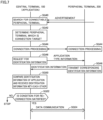
- Fig. 6 shows a processing procedure in establishing connection for the first time between central terminal 100 that is executing any application and peripheral terminal 200. It is assumed that central terminal 100 is executing application 150 in the processing procedure shown in Fig. 6 .
- central terminal 100 searches for connectable peripheral terminal 200 (sequence SQ10). Search for connectable peripheral terminal 200 may be started in response to an operation by a user in application 150 that is being executed, or may automatically be started at prescribed timing. Typically, central terminal 100 scans advertisements from peripheral terminals 200 present therearound to find connectable peripheral terminal 200. When a plurality of peripheral terminals 200 are present around central terminal 100, central terminal 100 receives an advertisement from each of peripheral terminals 200. In principle, the advertisement itself does not include pair information 260 (or identification information 264 (first information)).
- Central terminal 100 starts processing for connection to designated peripheral terminal 200 among connectable peripheral terminals 200 in response to an operation by the user (sequence SQ12).
- central terminal 100 requests connected peripheral terminal 200 to give identification information 264 held therein (sequence SQ14).
- application type information indicating the type of application 150 that is being executed is transmitted from central terminal 100 to peripheral terminal 200.
- Peripheral terminal 200 transmits identification information 264 corresponding to application type information 262 the same as the designated application type information, by referring to pair information 260 thereof (sequence SQ16).
- pair information 260 thereof (sequence SQ16).
- corresponding identification information 264 has not been registered in pair information 260, and therefore an invalid value is transmitted as identification information 264.
- peripheral terminal 200 in response to a request from application 150 executed in central terminal 100, peripheral terminal 200 transmits second information (for example, identification information 264) based on the first information (for example, identification information 264) brought in correspondence with running application 150 on central terminal 100.
- second information for example, identification information 264
- the "second information" herein includes information including identification information 264 or information generated based on identification information 264.
- the information including identification information 264 includes, for example, identification information 264 alone and a set of application type information 262 and identification information 264. Therefore, for example, not only identification information 264 but also a set of application type information 262 and identification information 264 may be transmitted as the "second information" to central terminal 100. This processing is also similar for sequence SQ48 ( Figs. 7 , 10 , and 13 ) which will be described later.
- Central terminal 100 determines whether or not identification information 264 from peripheral terminal 200 has an invalid value (sequence SQ18).
- pair information 260 registered in peripheral terminal 200 is updated.
- various types of data stored in peripheral terminal 200 such as information on the user or records of use of peripheral terminal 200 may be erased.
- central terminal 100 determines a value for identification information 264 to be registered in peripheral terminal 200 (sequence SQ20). The value for identification information 264 may randomly be determined. Then, central terminal 100 requests connected peripheral terminal 200 to register determined identification information 264 as pair information 260 (sequence SQ22). At this time, application type information 262 and identification information 264 are transmitted from central terminal 100 to peripheral terminal 200.
- peripheral terminal 200 In response to a request for registration of identification information 264, peripheral terminal 200 registers designated type information 262 and identification information 264 as pair information 260 (sequence SQ24). Identification information 264 brought in correspondence for each application executed in central terminal 100 is thus stored in peripheral terminal 200 as pair information 260.
- central terminal 100 registers an address (for example, a Bluetooth ® device address) of connected peripheral terminal 200 in connection information (sequence SQ26).
- Central terminal 100 registers as pair information 160, identification information 164 identical in value to determined identification information 264, as pair information 260 of the application that is being executed (sequence SQ28).
- Fig. 7 shows a processing procedure in establishing connection between central terminal 100 that is executing any application and peripheral terminal 200 for the second time or later. It is assumed that central terminal 100 is executing application 150 in the processing procedure shown in Fig. 7 .
- connection processing is stopped.
- the result of comparison satisfies the condition for re-connection (YES in sequence SQ52)
- data communication between central terminal 100 and peripheral terminal 200 is started (sequence SQ54).
- central terminal 100 determines processing involved with data communication with peripheral terminal 200 based on a result of comparison between third information (for example, identification information 164) brought in correspondence with running application 150 and the second information received from peripheral terminal 200.
- third information for example, identification information 164
- central terminal 100 performs processing involved with management of pair information
- the entirety or a part of necessary processing may be performed by using a computing resource (typically, a computing resource on the cloud) separate from central terminal 100.
- a computing resource typically, a computing resource on the cloud
- communication system 1 includes management servers 300A, 300B, 300C, ... (which may also collectively be referred to as “management server 300" below) in addition to central terminal 100 and peripheral terminal 200.
- central terminal 100 functions as an apparatus that accepts an operation by a user
- central terminal 100 and management server 300 can be regarded as an integrated processing entity (a first terminal) (which is similar in first to third modifications below).
- Management server 300 is provided for each application. For example, management servers 300A, 300B, and 300C are provided in correspondence with applications 150A, 150B, and 150C, respectively. Management server 300 in place of central terminal 100 manages pair information 160.
- Pair information 160 managed by management server 300 includes one or more sets of user identification information 166 and identification information 164. More specifically, management server 300A manages pair information 160A relating to application 150A. Pair information 160A includes one or more sets of user identification information 166A and identification information 164A. Similarly, management server 300B manages pair information 160B relating to application 150B, and management server 300C manages pair information 160C relating to application 150C. Information included in pair information 160B and pair information 160C is also similar to that of pair information 160A.
- management server 300 creates, changes, or deletes pair information 160 in accordance with a notification from central terminal 100 and performs processing such as authentication of identification information from peripheral terminal 200.
- User identification information 166 is any information that allows management server 300 to uniquely distinguish a user. For example, a user account, a randomly determined value (a random number), identification information of central terminal 100, or identification information of an application to be executed which is different for each central terminal 100 can be employed as user identification information 166. User identification information 166 does not have to identify the user himself/herself.
- Management server 300 is typically implemented by one or more general-purpose computers. Therefore, description of an exemplary hardware configuration of management server 300 will not be repeated.
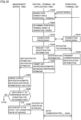
- a processing procedure shown in Fig. 9 is similar to the processing procedure shown in Fig. 6 , only differences will be described. More specifically, processing in sequences SQ34 to SQ38 is performed instead of the processing in sequence SQ20 shown in Fig. 6 . Sequence SQ28 is eliminated.
- central terminal 100 transmits user identification information 166 to management server 300 (sequence SQ32).
- management server 300 When management server 300 receives user identification information 166 from peripheral terminal 200, it determines a value for identification information 164 corresponding to received user identification information 166 (sequence SQ34) and registers a set of user identification information 166 and identification information 164 as pair information 160 (sequence SQ36). When identification information 164 brought in correspondence with the same user identification information 166 has already been registered, management server 300 updates the already registered information with a presently determined value. At this time, various types of data stored in peripheral terminal 200 such as information on the user or records of use of peripheral terminal 200 may be erased.
- identification information generator 140 (see Fig. 5 ) that generates identification information 164 and identification information 264 used as pair information 160 and pair information 260, respectively, is provided in management server 300.
- Management server 300 extracts identification information 164 corresponding to user identification information 166 received from central terminal 100 by referring to registered pair information 160, and compares extracted identification information 164 and received identification information 264 with each other (sequence SQ58). Then, management server 300 determines whether or not a result of comparison satisfies a predetermined condition for re-connection (sequence SQ60). For example, the condition for re-connection includes matching of extracted identification information 164 with received identification information 264.
- connection processing is stopped.
- management server 300 notifies central terminal 100 that connection can be established (sequence SQ62). Data communication between central terminal 100 and peripheral terminal 200 is thus started (sequence SQ54).
- management server 300 may notify central terminal 100 that connection cannot be established. Instead of or in addition to the notification that connection cannot be established, switching to processing for connection for the first time may be made. At this time, various types of data stored in peripheral terminal 200 such as information on the user or records of use of peripheral terminal 200 may be erased. Alternatively, unless central terminal 100 receives the notification from management server 300 within a prescribed time period (timeout), central terminal 100 may stop processing.
- pair information 160 managed by management server 300 includes one or more sets of user identification information 166 and identification information 164.
- a peripheral terminal address 168 may further be brought in correspondence with each set included in such pair information 160.
- pair information 160 managed by management server 300 includes one or more sets of peripheral terminal address 168, user identification information 166, and identification information 164. More specifically, management server 300A manages pair information 160A relating to application 150A. Pair information 160A includes one or more sets of a peripheral terminal address 168A, user identification information 166A, and identification information 164A. Similarly, management server 300B manages pair information 160B relating to application 150B, and management server 300C manages pair information 160C relating to application 150C. Information included in pair information 160B and pair information 160C is also similar to that in pair information 160A.
- Peripheral terminal address 168 indicates an address of peripheral terminal 200 to which central terminal 100 which is a connection target is further connected. Peripheral terminal address 168 may include only a part of the address of peripheral terminal 200 or may be an address of peripheral terminal 200 to which any information has been added. Peripheral terminal address 168 may be a specific value calculated from the address of peripheral terminal 200.
- a processing procedure shown in Fig. 12 is similar to the processing procedure shown in Fig. 9 , only differences will be described. More specifically, processing in sequences SQ33 and SQ37 is performed instead of the processing in sequences SQ32 and SQ36 shown in Fig. 9 .
- central terminal 100 transmits user identification information 166 and the address of peripheral terminal 200 (peripheral terminal address) to management server 300 (sequence SQ33). Central terminal 100 has already obtained the address of peripheral terminal 200 in the processing for connection to peripheral terminal 200 (sequence SQ12).
- management server 300 When management server 300 receives user identification information 166 and the peripheral terminal address from peripheral terminal 200, it determines a value for identification information 164 corresponding to user identification information 166 (sequence SQ34) and registers a set of peripheral terminal address 168, user identification information 166, and identification information 164 as pair information 160 (sequence SQ37). When identification information 164 brought in correspondence with the same peripheral terminal address 168 has already been registered, management server 300 updates the already registered information with a presently determined value. At this time, various types of data stored in peripheral terminal 200 such as information on the user or records of use of peripheral terminal 200 may be erased.
- a processing procedure shown in Fig. 13 is similar to the processing procedure shown in Fig. 10 , only differences will be described. More specifically, processing in sequences SQ57 and SQ59 is performed instead of the processing in sequences SQ56 and SQ58 shown in Fig. 10 .
- Management server 300 extracts, by referring to registered pair information 160, the set of user identification information 166 and identification information 164 corresponding to the peripheral terminal address received from central terminal 100 and compares the extracted set of user identification information 166 and identification information 164 with the received set of user identification information 166 and identification information 264 (sequence SQ59). Then, management server 300 determines whether or not a result of comparison satisfies a predetermined condition for re-connection (sequence SQ60). For example, the condition for re-connection includes matching of the extracted set of user identification information 166 and identification information 164 with the received set of user identification information 166 and identification information 264.
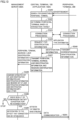
- a processing procedure shown in Fig. 14 is addition of processing in sequences SQ17 and SQ39 to the processing procedure shown in Fig. 12 and replacement of the processing in sequence SQ33 with sequence SQ33A.
- Peripheral terminal 200 transmits identification information 264 (sequence SQ16), and thereafter transmits an electronic signature 280 generated from the address thereof to central terminal 100 (sequence SQ17).
- Electronic signature 280 may be, for example, a hash value calculated by input of the address of the peripheral terminal into a prescribed hash function.
- a processing procedure shown in Fig. 15 is addition of processing in sequences SQ49 and SQ63 to the processing procedure shown in Fig. 13 and replacement of the processing in sequences SQ57 and SQ59 with sequences SQ57A and SQ59A.
- Electronic signature 280 may be transmitted from peripheral terminal 200 automatically after transmission of identification information 264 or in response to an explicit request from central terminal 100.
- central terminal 100 transmits also electronic signature 280 to management server 300 in addition to user identification information 166 and the address of peripheral terminal 200 (peripheral terminal address).
- Management server 300 determines whether or not there is an error in the received peripheral terminal address based on electronic signature 280 from central terminal 100 (sequence SQ63).
- a user interface screen 180 shown in Fig. 16A is provided in accordance with a result of search for connectable peripheral terminal 200 by central terminal 100 at the time of connection for the first time between central terminal 100 and peripheral terminal 200 (see sequence SQ10 or the like in Figs. 6 and 9 ). More specifically, user interface screen 180 includes a candidate list 182 of found peripheral terminals 200. The user selects peripheral terminal 200 connection to which is desired, from among peripheral terminals 200 shown in candidate list 182. Then, processing for connection between central terminal 100 and selected peripheral terminal 200 is started (see sequence SQ12 or the like in Figs. 6 and 9 ).
- a user interface screen 184 shown in Fig. 16B is provided in re-connection between central terminal 100 and peripheral terminal 200. More specifically, when central terminal 100 is connected to peripheral terminal 200 that satisfies the condition for re-connection (see sequence SQ52 in Fig. 7 and sequence SQ60 in Fig. 10 ), user interface screen 184 presents connected peripheral terminal 200 to the user.
- central terminal 100 When connection to peripheral terminal 200 is required while central terminal 100 is executing any application, central terminal 100 provides a user interface screen 186 as shown in Fig. 17A .
- User interface screen 186 includes a message that invites a user to press the button in peripheral terminal 200 connection to which is desired.
- peripheral terminal 200 When the user presses the button in peripheral terminal 200 and central terminal 100 finds peripheral terminal 200 as connectable peripheral terminal 200, a user interface screen 188 as shown in Fig. 17B is provided.
- User interface screen 188 includes an OK button 192 that accepts an instruction for connection, in addition to specifying information 190 indicating connectable peripheral terminal 200.
- the user checks specifying information 190 shown on user interface screen 188 and then presses OK button 192. Then, processing for connection between central terminal 100 and peripheral terminal 200 is started.
- An application executed in central terminal 100 may automatically be connected to peripheral terminal 200 nearby without showing the user interface screen as shown in Figs. 16A, 16B , 17A, and 17B and start data communication.
- processing for connection to peripheral terminal 200 by an application executed in central terminal 100 can be various.
- an advertisement to be used in processing for searching for peripheral terminal 200 to be connected may be selected as appropriate depending on a type of the application or a scene.
- connectable peripheral terminal 200 may be searched for with the use of advertisement 212 transmitted at the time when button 2021 is pressed (see sequence SQ10 or the like in Figs. 6 and 9 ). In other words, only peripheral terminal 200 for which the user has explicitly pressed button 2021 is searched for as a connection target.
- Each of applications 150 executed in central terminal 100 may thus be configured to refer to one or more advertisements 211 and 212 specific to application 150 among a plurality of types of advertisements 211 and 212.
- the type of advertisement transmitted from central terminal 100 is not limited to two types, and more types of advertisements may be transmitted.
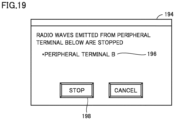
- Central terminal 100 may thus instruct peripheral terminal 200 to stop transmission of advertisement 211.
- any application executed in central terminal 100 may issue an instruction to stop transmission of advertisement 211 to peripheral terminal 200.
- any application 150 configured to refer to constantly transmitted advertisement 211 among applications 150 executed in central terminal 100 may be able to stop transmission of advertisement 211.
- Fig. 19 shows an example in which a notification to stop transmission of advertisement 211 is given by explicit pressing of OK button 198 by the user. Without being limited to such an operation by the user, notification to stop transmission of advertisement 211 may automatically be given when a predetermined condition is satisfied.
- Figs. 6 and 7 described above show a form in which central terminal 100 manages pair information
- Figs. 9 and 10 show a form in which management server 300 manages pair information.
- Such forms of processing may be combined as appropriate without being fixed to one of such processing forms.
- management server 300 determines that pair information 260 of peripheral terminal 200 satisfies the condition for re-connection and when central terminal 100 thereafter obtains identical pair information 260 from identical peripheral terminal 200, central terminal 100 may determine that the condition for re-connection is satisfied without making an inquiry to management server 300.
- the pair information held in central terminal 100 and peripheral terminal 200 may be updated under any condition or at any timing. For example, information on which definition of an expiration date can be based may be added to the pair information, and central terminal 100 may determine as appropriate whether or not the pair information has expired.
- the expiration date may be stored in at least one of central terminal 100, peripheral terminal 200, and management server 300.
- central terminal 100 may generate new identification information and update the pair information.
- central terminal 100 executes application 150
- a computing resource on the network may be responsible for execution per se of application 150.
- central terminal 100 shows a result of execution of application 150 executed in the computing resource, which, however, is equivalent to execution of application 150 in central terminal 100 from a point of the user.
- execution of application 150 by central terminal 100 herein may encompass, in addition to execution of application 150 by central terminal 100 itself, all of execution of application 150 in cooperation by central terminal 100 and any computing resource, and execution of application 150 by any computing resource and representation of a result thereof on central terminal 100.
- management server 300 in common to a plurality of applications may be arranged.
- application type information may be brought in correspondence with pair information 160 managed by management server 300.
Landscapes
- Engineering & Computer Science (AREA)
- Computer Networks & Wireless Communication (AREA)
- Signal Processing (AREA)
- Databases & Information Systems (AREA)
- Mobile Radio Communication Systems (AREA)
Claims (14)
- Kommunikationssystem, umfassend:ein erstes Terminal (100, 100A, 100B), das konfiguriert ist, um eine oder mehrere Anwendungen (150, 150A, 150B, 150C) auszuführen; undein zweites Terminal (200; 300, 300A, 300B, 300C), das konfiguriert ist, um Daten mit dem ersten Terminal durch drahtlose Kommunikation zu kommunizieren, wobeidas zweite Terminal umfassteinen Speicher (220), in dem erste Informationen, die Identifikationsinformationen (264; 262) sind, die jeder in dem ersten Terminal ausgeführten Anwendung entsprechen, als Paarungsinformationen (260) gespeichert sind, die eine Verbindungsbeziehung zwischen jeder in dem ersten Terminal ausgeführten Anwendung und dem zweiten Terminal definieren, undeine Übertragungseinheit (220), die konfiguriert ist, um als Reaktion auf eine Anforderung von einer in dem ersten Terminal ausgeführten Anwendung zweite Informationen (264; 262) zu übertragen, die die ersten Informationen oder Informationen sind, die basierend auf den ersten Informationen erzeugt werden, unddas erste Terminal eine Bestimmungseinheit (134) umfasst, die konfiguriert ist, um eine Verarbeitung in Bezug auf eine Datenkommunikation mit dem zweiten Terminal basierend auf einem Ergebnis eines Vergleichs zwischen dritten Informationen (164), die Identifikationsinformationen oder Informationen sind, die basierend auf Identifikationsinformationen erzeugt werden, die einer laufenden Anwendung auf dem ersten Terminal entsprechen, und den von dem zweiten Terminal empfangenen zweiten Informationen zu bestimmen.
- Kommunikationssystem nach Anspruch 1, wobei
das erste Terminal eine Vorrichtung (200) umfasst, die konfiguriert ist, um eine Operation durch einen Benutzer und einen Verwaltungsserver (300A, 300B, 300C) zu akzeptieren. - Kommunikationssystem nach Anspruch 2, wobei
das erste Terminal ferner einen Generator (140) umfasst, der konfiguriert ist, um die ersten Informationen zu generieren, die als die Paarungsinformationen zu verwenden sind. - Kommunikationssystem nach Anspruch 3, wobei
der Generator in dem Verwaltungsserver bereitgestellt ist. - Kommunikationssystem nach Anspruch 3 oder 4, wobei
der Verwaltungsserver konfiguriert ist, um die dritten Informationen und die zweiten Informationen miteinander zu vergleichen. - Kommunikationssystem nach einem der Ansprüche 1 bis 5, wobei
das erste Terminal ferner einen zweiten Speicher (120) umfasst, in dem, wenn das erste Terminal mit dem zweiten Terminal verbunden ist, eine Adresse des verbundenen zweiten Terminals gespeichert ist. - Kommunikationssystem nach einem der Ansprüche 1 bis 6, wobei
das erste Terminal ferner eine Sucheinheit (130) umfasst, die konfiguriert ist, um eine von dem zweiten Terminal übertragene Werbung zu empfangen und nach dem zu verbindenden zweiten Terminal zu suchen. - Kommunikationssystem nach Anspruch 7, wobei
wenn eine Adresse des zweiten Terminals, die ein Absender der empfangenen Werbung ist, in Adressen enthalten ist, die in einem zweiten Speicher gespeichert sind, das erste Terminal eine Verarbeitung für eine Verbindung mit dem zweiten Terminal, das der Absender ist, startet, und nachdem die Verbindung hergestellt ist, das erste Terminal die Anforderung an das zweite Terminal überträgt. - Kommunikationssystem nach einem der Ansprüche 1 bis 8, wobeidas zweite Terminal konfiguriert ist, um eine Vielzahl von Arten von Werbungen zu übertragen, undjede der Anwendungen, die in dem ersten Terminal ausgeführt werden, konfiguriert ist, um sich auf eine oder mehrere Werbungen zu beziehen, die für die Anwendung unter der Vielzahl von Arten von Werbungen spezifisch sind.
- Kommunikationssystem nach Anspruch 9, wobeidie Vielzahl von Arten von Werbungen eine ständig übertragene Werbung (211) enthalten, undjede Anwendung, die konfiguriert ist, um sich auf die ständig übertragene Werbung unter den Anwendungen zu beziehen, die in dem ersten Terminal ausgeführt werden, konfiguriert ist, um die Übertragung der ständig übertragenen Werbung zu stoppen.
- Kommunikationsvorrichtung (100, 100A, 100B), umfassend:eine Ausführungseinheit (132), die konfiguriert ist, um eine oder mehrere Anwendungen (150, 150A, 150B, 150C) auszuführen;eine Kommunikationseinheit (120), die konfiguriert ist, um Daten mit einem peripheren Terminal (200; 300, 300A, 300B, 300C) durch drahtlose Kommunikation zu kommunizieren, wobei in dem peripheren Terminal erste Informationen, die Identifikationsinformationen (264; 262) sind, die jeder durch die Ausführungseinheit ausgeführten Anwendung entsprechen, als Paarungsinformationen (260) gespeichert sind, die eine Verbindungsbeziehung zwischen jeder in der Kommunikationsvorrichtung ausgeführten Anwendung und dem peripheren Terminal definieren; undeine Bestimmungseinheit (134), die konfiguriert ist, um eine Verarbeitung in Bezug auf eine Datenkommunikation mit dem peripheren Terminal basierend auf einem Ergebnis eines Vergleichs zwischen zweiten Informationen (264; 262), die die Identifikationsinformationen oder Informationen sind, die basierend auf den von dem peripheren Terminal erhaltenen ersten Informationen erzeugt werden, und dritten Informationen (164), die Identifikationsinformationen oder Informationen sind, die basierend auf Identifikationsinformationen erzeugt werden, die einer laufenden Anwendung entsprechen, zu bestimmen.
- Kommunikationsvorrichtung (200; 300, 300A, 300B, 300C), umfassend:eine Kommunikationseinheit (220), die konfiguriert ist, um Daten durch drahtlose Kommunikation mit einem zentralen Terminal (100, 100A, 100B) zu kommunizieren, das konfiguriert ist, um eine oder mehrere Anwendungen (150, 150A, 150B, 150C) auszuführen;einen Speicher (220), in dem erste Informationen, die Identifikationsinformationen (264; 262) sind, die jeder in dem zentralen Terminal ausgeführten Anwendung entsprechen, als Paarungsinformationen (260) gespeichert sind, die eine Verbindungsbeziehung zwischen der Kommunikationsvorrichtung und jeder in dem zentralen Terminal ausgeführten Anwendung definieren; undeine Übertragungseinheit (220), die konfiguriert ist, um als Reaktion auf eine Anforderung von einer in dem zentralen Terminal ausgeführten Anwendung zweite Informationen (264; 262) basierend auf ersten Informationen zu übertragen, die in dem Speicher gespeichert sind und der in dem zentralen Terminal ausgeführten Anwendung entsprechen.
- Kommunikationsverfahren, das von einem ersten Terminal (100, 100A, 100B) und einem zweiten Terminal (200; 300, 300A, 300B, 300C) durchgeführt wird, die konfiguriert sind, um Daten miteinander durch drahtlose Kommunikation zu kommunizieren, wobei das Kommunikationsverfahren umfasst:Ausführen (132), durch das erste Terminal, einer oder mehrerer Anwendungen (150, 150A, 150B, 150C);Speichern (220), in dem zweiten Terminal, erster Informationen, die Identifikationsinformationen (264; 262) sind, die jeder in dem ersten Terminal ausgeführten Anwendung entsprechen, als Paarungsinformationen (260), die eine Verbindungsbeziehung zwischen jeder in dem ersten Terminal ausgeführten Anwendung und dem zweiten Terminal definieren;als Reaktion auf eine Anforderung von einer in dem ersten Terminal ausgeführten Anwendung, Übertragen (SQ16), durch das zweite Terminal, von zweiten Paarungsinformationen basierend auf den ersten Informationen, die der in dem ersten Terminal ausgeführten Anwendung entsprechen, durch Bezugnahme auf die Paarungsinformationen; undBestimmen (SQ18), durch das erste Terminal, einer Verarbeitung in Bezug auf eine Datenkommunikation mit dem zweiten Terminal basierend auf einem Ergebnis eines Vergleichs zwischen dritten Informationen (164), die Identifikationsinformationen oder Informationen sind, die basierend auf Identifikationsinformationen erzeugt werden, die einer laufenden Anwendung auf dem ersten Terminal entsprechen, und zweiten Informationen, die von dem zweiten Terminal empfangen werden.
- Kommunikationsprogramm (108), das in einer Kommunikationsvorrichtung (100, 100A, 100B) ausgeführt wird, die konfiguriert ist, um eine oder mehrere Anwendungen (150, 150A, 150B, 150C) auszuführen, wobei das Kommunikationsprogramm die Kommunikationsvorrichtung veranlasst, Folgendes durchzuführen:Kommunizieren (SQ30; SQ54) von Daten mit einem peripheren Terminal (200; 300, 300A, 300B, 300C) durch drahtlose Kommunikation, wobei in dem peripheren Terminal erste Informationen, die Identifikationsinformationen (264; 262) sind, die konfiguriert sind, um jeder in der Kommunikationsvorrichtung ausgeführten Anwendung zu entsprechen, als Paarungsinformationen (260) gespeichert sind, die eine Verbindungsbeziehung zwischen jeder in der Kommunikationsvorrichtung ausgeführten Anwendung und dem peripheren Terminal definieren; undBestimmen (SQ18) einer Verarbeitung in Bezug auf eine Datenkommunikation mit dem peripheren Terminal basierend auf einem Ergebnis eines Vergleichs zwischen zweiten Informationen (264; 262), die von dem peripheren Terminal erhalten werden, und dritten Informationen, die Identifikationsinformationen oder Informationen sind, die basierend auf Identifikationsinformationen (164) erzeugt werden, die konfiguriert sind, um einer laufenden Anwendung zu entsprechen.
Priority Applications (1)
| Application Number | Priority Date | Filing Date | Title |
|---|---|---|---|
| EP25163055.4A EP4546832A3 (de) | 2021-07-06 | 2022-07-05 | Kommunikationssystem, kommunikationsvorrichtung, kommunikationsverfahren und kommunikationsprogramm |
Applications Claiming Priority (1)
| Application Number | Priority Date | Filing Date | Title |
|---|---|---|---|
| JP2021112255A JP7718875B2 (ja) | 2021-07-06 | 2021-07-06 | 通信システム、通信装置、通信方法、および通信プログラム |
Related Child Applications (2)
| Application Number | Title | Priority Date | Filing Date |
|---|---|---|---|
| EP25163055.4A Division-Into EP4546832A3 (de) | 2021-07-06 | 2022-07-05 | Kommunikationssystem, kommunikationsvorrichtung, kommunikationsverfahren und kommunikationsprogramm |
| EP25163055.4A Division EP4546832A3 (de) | 2021-07-06 | 2022-07-05 | Kommunikationssystem, kommunikationsvorrichtung, kommunikationsverfahren und kommunikationsprogramm |
Publications (2)
| Publication Number | Publication Date |
|---|---|
| EP4117384A1 EP4117384A1 (de) | 2023-01-11 |
| EP4117384B1 true EP4117384B1 (de) | 2025-04-16 |
Family
ID=83228787
Family Applications (2)
| Application Number | Title | Priority Date | Filing Date |
|---|---|---|---|
| EP25163055.4A Pending EP4546832A3 (de) | 2021-07-06 | 2022-07-05 | Kommunikationssystem, kommunikationsvorrichtung, kommunikationsverfahren und kommunikationsprogramm |
| EP22183139.9A Active EP4117384B1 (de) | 2021-07-06 | 2022-07-05 | Kommunikationssystem, kommunikationsvorrichtung, kommunikationsverfahren und kommunikationsprogramm |
Family Applications Before (1)
| Application Number | Title | Priority Date | Filing Date |
|---|---|---|---|
| EP25163055.4A Pending EP4546832A3 (de) | 2021-07-06 | 2022-07-05 | Kommunikationssystem, kommunikationsvorrichtung, kommunikationsverfahren und kommunikationsprogramm |
Country Status (3)
| Country | Link |
|---|---|
| US (1) | US12349211B2 (de) |
| EP (2) | EP4546832A3 (de) |
| JP (2) | JP7718875B2 (de) |
Family Cites Families (10)
| Publication number | Priority date | Publication date | Assignee | Title |
|---|---|---|---|---|
| JP6142520B2 (ja) * | 2012-12-18 | 2017-06-07 | 富士通株式会社 | 表示制御装置、表示制御方法及び表示制御プログラム |
| JP6358063B2 (ja) | 2014-12-02 | 2018-07-18 | 富士通株式会社 | 要求送信方法、情報処理装置、及びプログラム |
| US10397868B2 (en) | 2015-07-31 | 2019-08-27 | Nintendo Co., Ltd. | Wireless system, wireless device, non-transitory computer-readable storage medium having stored therein communication program, and communication method |
| JP6625887B2 (ja) | 2015-07-31 | 2019-12-25 | 任天堂株式会社 | 無線システム、無線機器、通信プログラム、および通信方法 |
| JP6272381B2 (ja) * | 2016-03-31 | 2018-01-31 | キヤノン株式会社 | プログラム、情報処理方法、および情報処理装置 |
| JP6264406B2 (ja) * | 2016-07-22 | 2018-01-24 | ソニー株式会社 | 通信装置、情報処理方法、およびプログラム |
| KR20180072389A (ko) | 2016-12-21 | 2018-06-29 | 삼성전자주식회사 | 액세서리에 대응하는 콘텐트를 제공하기 위한 방법 및 그 전자 장치 |
| JP6861187B2 (ja) * | 2018-06-20 | 2021-04-21 | Vivita株式会社 | 情報処理装置 |
| JP2020028056A (ja) * | 2018-08-14 | 2020-02-20 | 東芝テック株式会社 | 通信装置、周辺装置及び通信システム |
| CN114902799B (zh) * | 2019-12-27 | 2024-12-17 | 三菱电机株式会社 | 终端装置、通信方法以及通信系统 |
-
2021
- 2021-07-06 JP JP2021112255A patent/JP7718875B2/ja active Active
-
2022
- 2022-07-05 US US17/857,372 patent/US12349211B2/en active Active
- 2022-07-05 EP EP25163055.4A patent/EP4546832A3/de active Pending
- 2022-07-05 EP EP22183139.9A patent/EP4117384B1/de active Active
-
2025
- 2025-07-23 JP JP2025123040A patent/JP2025137722A/ja active Pending
Also Published As
| Publication number | Publication date |
|---|---|
| EP4546832A2 (de) | 2025-04-30 |
| JP2025137722A (ja) | 2025-09-19 |
| EP4117384A1 (de) | 2023-01-11 |
| US12349211B2 (en) | 2025-07-01 |
| JP2023008581A (ja) | 2023-01-19 |
| US20230011478A1 (en) | 2023-01-12 |
| EP4546832A3 (de) | 2025-07-23 |
| JP7718875B2 (ja) | 2025-08-05 |
Similar Documents
| Publication | Publication Date | Title |
|---|---|---|
| US10484347B2 (en) | Method and apparatus for supporting secure chat | |
| EP3005080B1 (de) | Synchronisierungsvorrichtung zur zuordnung von daten zwischen datenverarbeitungsvorrichtungen | |
| EP3340574B1 (de) | Verfahren zur bereitstellung von inhalt im zusammenhang mit zubehör und elektronische vorrichtung dafür | |
| JP5753947B2 (ja) | アプリケーション情報を共有するための方法、システム、及び装置 | |
| CN110637449A (zh) | 一种访问设备标识符的方法及装置 | |
| US11597351B2 (en) | Electronic device for managing application relating to key of external electronic device, and operating method of electronic device | |
| US11298613B2 (en) | Information processing device, data acquisition method, and program | |
| US20200146081A1 (en) | Method for wireless connection and electronic device therefor | |
| US8930532B2 (en) | Session management in a thin client system for effective use of the client environment | |
| CN112988913B (zh) | 一种数据处理方法和相关装置 | |
| EP4117384A1 (de) | Kommunikationssystem, kommunikationsvorrichtung, kommunikationsverfahren und kommunikationsprogramm | |
| CN113039517A (zh) | 一种音频资源调用的方法、装置及电子设备 | |
| US20170262838A1 (en) | Method of processing card operating information and electronic device supporting the same | |
| CN112732548B (zh) | 一种接口测试方法以及装置 | |
| CN110321251B (zh) | 基于网络块设备的数据备份方法、装置、设备和存储介质 | |
| JP5702134B2 (ja) | デバイス制御装置、情報管理装置、及びその制御方法、デバイス制御システム | |
| CN115048428B (zh) | 一种设备码的确定方法、装置、电子设备及存储介质 | |
| CN118264524A (zh) | 一种业务服务的配置方法及相关装置、设备、存储介质 | |
| CN111625288A (zh) | 应用程序的启动控制方法、装置、计算机设备和存储介质 | |
| CN115080313B (zh) | 数据回滚方法以及相关设备 | |
| JP2012137864A (ja) | デバイス制御装置、デバイス制御方法、およびデバイス制御システム | |
| CN116578546A (zh) | 一种基于数据库的数据处理方法、系统、装置及存储介质 | |
| JP5901810B2 (ja) | デバイス制御装置、情報管理装置、及びその制御方法、デバイス制御システム | |
| CN116894063A (zh) | 一种接口数据查询方法和系统 | |
| CN116450598A (zh) | 一种资源数据处理方法、装置、电子设备及存储介质 |
Legal Events
| Date | Code | Title | Description |
|---|---|---|---|
| PUAI | Public reference made under article 153(3) epc to a published international application that has entered the european phase |
Free format text: ORIGINAL CODE: 0009012 |
|
| STAA | Information on the status of an ep patent application or granted ep patent |
Free format text: STATUS: THE APPLICATION HAS BEEN PUBLISHED |
|
| AK | Designated contracting states |
Kind code of ref document: A1 Designated state(s): AL AT BE BG CH CY CZ DE DK EE ES FI FR GB GR HR HU IE IS IT LI LT LU LV MC MK MT NL NO PL PT RO RS SE SI SK SM TR |
|
| STAA | Information on the status of an ep patent application or granted ep patent |
Free format text: STATUS: REQUEST FOR EXAMINATION WAS MADE |
|
| 17P | Request for examination filed |
Effective date: 20230412 |
|
| RBV | Designated contracting states (corrected) |
Designated state(s): AL AT BE BG CH CY CZ DE DK EE ES FI FR GB GR HR HU IE IS IT LI LT LU LV MC MK MT NL NO PL PT RO RS SE SI SK SM TR |
|
| GRAP | Despatch of communication of intention to grant a patent |
Free format text: ORIGINAL CODE: EPIDOSNIGR1 |
|
| STAA | Information on the status of an ep patent application or granted ep patent |
Free format text: STATUS: GRANT OF PATENT IS INTENDED |
|
| INTG | Intention to grant announced |
Effective date: 20241118 |
|
| GRAS | Grant fee paid |
Free format text: ORIGINAL CODE: EPIDOSNIGR3 |
|
| GRAA | (expected) grant |
Free format text: ORIGINAL CODE: 0009210 |
|
| STAA | Information on the status of an ep patent application or granted ep patent |
Free format text: STATUS: THE PATENT HAS BEEN GRANTED |
|
| AK | Designated contracting states |
Kind code of ref document: B1 Designated state(s): AL AT BE BG CH CY CZ DE DK EE ES FI FR GB GR HR HU IE IS IT LI LT LU LV MC MK MT NL NO PL PT RO RS SE SI SK SM TR |
|
| P01 | Opt-out of the competence of the unified patent court (upc) registered |
Free format text: CASE NUMBER: APP_11947/2025 Effective date: 20250311 |
|
| REG | Reference to a national code |
Ref country code: GB Ref legal event code: FG4D |
|
| REG | Reference to a national code |
Ref country code: CH Ref legal event code: EP |
|
| REG | Reference to a national code |
Ref country code: IE Ref legal event code: FG4D |
|
| REG | Reference to a national code |
Ref country code: DE Ref legal event code: R096 Ref document number: 602022013142 Country of ref document: DE |
|
| PGFP | Annual fee paid to national office [announced via postgrant information from national office to epo] |
Ref country code: FR Payment date: 20250610 Year of fee payment: 4 |
|
| REG | Reference to a national code |
Ref country code: NL Ref legal event code: MP Effective date: 20250416 |
|
| PG25 | Lapsed in a contracting state [announced via postgrant information from national office to epo] |
Ref country code: NL Free format text: LAPSE BECAUSE OF FAILURE TO SUBMIT A TRANSLATION OF THE DESCRIPTION OR TO PAY THE FEE WITHIN THE PRESCRIBED TIME-LIMIT Effective date: 20250416 |
|
| REG | Reference to a national code |
Ref country code: AT Ref legal event code: MK05 Ref document number: 1786757 Country of ref document: AT Kind code of ref document: T Effective date: 20250416 |
|
| PG25 | Lapsed in a contracting state [announced via postgrant information from national office to epo] |
Ref country code: FI Free format text: LAPSE BECAUSE OF FAILURE TO SUBMIT A TRANSLATION OF THE DESCRIPTION OR TO PAY THE FEE WITHIN THE PRESCRIBED TIME-LIMIT Effective date: 20250416 Ref country code: ES Free format text: LAPSE BECAUSE OF FAILURE TO SUBMIT A TRANSLATION OF THE DESCRIPTION OR TO PAY THE FEE WITHIN THE PRESCRIBED TIME-LIMIT Effective date: 20250416 Ref country code: PT Free format text: LAPSE BECAUSE OF FAILURE TO SUBMIT A TRANSLATION OF THE DESCRIPTION OR TO PAY THE FEE WITHIN THE PRESCRIBED TIME-LIMIT Effective date: 20250818 |
|
| PGFP | Annual fee paid to national office [announced via postgrant information from national office to epo] |
Ref country code: DE Payment date: 20250611 Year of fee payment: 4 |
|
| REG | Reference to a national code |
Ref country code: LT Ref legal event code: MG9D |
|
| PG25 | Lapsed in a contracting state [announced via postgrant information from national office to epo] |
Ref country code: NO Free format text: LAPSE BECAUSE OF FAILURE TO SUBMIT A TRANSLATION OF THE DESCRIPTION OR TO PAY THE FEE WITHIN THE PRESCRIBED TIME-LIMIT Effective date: 20250716 Ref country code: GR Free format text: LAPSE BECAUSE OF FAILURE TO SUBMIT A TRANSLATION OF THE DESCRIPTION OR TO PAY THE FEE WITHIN THE PRESCRIBED TIME-LIMIT Effective date: 20250717 |
|
| PG25 | Lapsed in a contracting state [announced via postgrant information from national office to epo] |
Ref country code: PL Free format text: LAPSE BECAUSE OF FAILURE TO SUBMIT A TRANSLATION OF THE DESCRIPTION OR TO PAY THE FEE WITHIN THE PRESCRIBED TIME-LIMIT Effective date: 20250416 |
|
| PG25 | Lapsed in a contracting state [announced via postgrant information from national office to epo] |
Ref country code: BG Free format text: LAPSE BECAUSE OF FAILURE TO SUBMIT A TRANSLATION OF THE DESCRIPTION OR TO PAY THE FEE WITHIN THE PRESCRIBED TIME-LIMIT Effective date: 20250416 |
|
| PG25 | Lapsed in a contracting state [announced via postgrant information from national office to epo] |
Ref country code: HR Free format text: LAPSE BECAUSE OF FAILURE TO SUBMIT A TRANSLATION OF THE DESCRIPTION OR TO PAY THE FEE WITHIN THE PRESCRIBED TIME-LIMIT Effective date: 20250416 |
|
| PG25 | Lapsed in a contracting state [announced via postgrant information from national office to epo] |
Ref country code: AT Free format text: LAPSE BECAUSE OF FAILURE TO SUBMIT A TRANSLATION OF THE DESCRIPTION OR TO PAY THE FEE WITHIN THE PRESCRIBED TIME-LIMIT Effective date: 20250416 |
|
| PG25 | Lapsed in a contracting state [announced via postgrant information from national office to epo] |
Ref country code: RS Free format text: LAPSE BECAUSE OF FAILURE TO SUBMIT A TRANSLATION OF THE DESCRIPTION OR TO PAY THE FEE WITHIN THE PRESCRIBED TIME-LIMIT Effective date: 20250716 |
|
| PG25 | Lapsed in a contracting state [announced via postgrant information from national office to epo] |
Ref country code: IS Free format text: LAPSE BECAUSE OF FAILURE TO SUBMIT A TRANSLATION OF THE DESCRIPTION OR TO PAY THE FEE WITHIN THE PRESCRIBED TIME-LIMIT Effective date: 20250816 |
|
| PG25 | Lapsed in a contracting state [announced via postgrant information from national office to epo] |
Ref country code: LV Free format text: LAPSE BECAUSE OF FAILURE TO SUBMIT A TRANSLATION OF THE DESCRIPTION OR TO PAY THE FEE WITHIN THE PRESCRIBED TIME-LIMIT Effective date: 20250416 |
|
| PG25 | Lapsed in a contracting state [announced via postgrant information from national office to epo] |
Ref country code: SM Free format text: LAPSE BECAUSE OF FAILURE TO SUBMIT A TRANSLATION OF THE DESCRIPTION OR TO PAY THE FEE WITHIN THE PRESCRIBED TIME-LIMIT Effective date: 20250416 Ref country code: DK Free format text: LAPSE BECAUSE OF FAILURE TO SUBMIT A TRANSLATION OF THE DESCRIPTION OR TO PAY THE FEE WITHIN THE PRESCRIBED TIME-LIMIT Effective date: 20250416 |
|
| REG | Reference to a national code |
Ref country code: DE Ref legal event code: R097 Ref document number: 602022013142 Country of ref document: DE |
|
| PG25 | Lapsed in a contracting state [announced via postgrant information from national office to epo] |
Ref country code: CZ Free format text: LAPSE BECAUSE OF FAILURE TO SUBMIT A TRANSLATION OF THE DESCRIPTION OR TO PAY THE FEE WITHIN THE PRESCRIBED TIME-LIMIT Effective date: 20250416 |
|
| PG25 | Lapsed in a contracting state [announced via postgrant information from national office to epo] |
Ref country code: EE Free format text: LAPSE BECAUSE OF FAILURE TO SUBMIT A TRANSLATION OF THE DESCRIPTION OR TO PAY THE FEE WITHIN THE PRESCRIBED TIME-LIMIT Effective date: 20250416 |
|
| PG25 | Lapsed in a contracting state [announced via postgrant information from national office to epo] |
Ref country code: SK Free format text: LAPSE BECAUSE OF FAILURE TO SUBMIT A TRANSLATION OF THE DESCRIPTION OR TO PAY THE FEE WITHIN THE PRESCRIBED TIME-LIMIT Effective date: 20250416 |
|
| PG25 | Lapsed in a contracting state [announced via postgrant information from national office to epo] |
Ref country code: IT Free format text: LAPSE BECAUSE OF FAILURE TO SUBMIT A TRANSLATION OF THE DESCRIPTION OR TO PAY THE FEE WITHIN THE PRESCRIBED TIME-LIMIT Effective date: 20250416 |
|
| PG25 | Lapsed in a contracting state [announced via postgrant information from national office to epo] |
Ref country code: RO Free format text: LAPSE BECAUSE OF FAILURE TO SUBMIT A TRANSLATION OF THE DESCRIPTION OR TO PAY THE FEE WITHIN THE PRESCRIBED TIME-LIMIT Effective date: 20250416 |
|
| PLBE | No opposition filed within time limit |
Free format text: ORIGINAL CODE: 0009261 |
|
| STAA | Information on the status of an ep patent application or granted ep patent |
Free format text: STATUS: NO OPPOSITION FILED WITHIN TIME LIMIT |
|
| REG | Reference to a national code |
Ref country code: CH Ref legal event code: H13 Free format text: ST27 STATUS EVENT CODE: U-0-0-H10-H13 (AS PROVIDED BY THE NATIONAL OFFICE) Effective date: 20260224 |
|
| REG | Reference to a national code |
Ref country code: CH Ref legal event code: L10 Free format text: ST27 STATUS EVENT CODE: U-0-0-L10-L00 (AS PROVIDED BY THE NATIONAL OFFICE) Effective date: 20260225 |
|
| PG25 | Lapsed in a contracting state [announced via postgrant information from national office to epo] |
Ref country code: LU Free format text: LAPSE BECAUSE OF NON-PAYMENT OF DUE FEES Effective date: 20250705 |
|
| 26N | No opposition filed |
Effective date: 20260119 |
|
| REG | Reference to a national code |
Ref country code: BE Ref legal event code: MM Effective date: 20250731 |
|
| PG25 | Lapsed in a contracting state [announced via postgrant information from national office to epo] |
Ref country code: BE Free format text: LAPSE BECAUSE OF NON-PAYMENT OF DUE FEES Effective date: 20250731 |
|
| PG25 | Lapsed in a contracting state [announced via postgrant information from national office to epo] |
Ref country code: CH Free format text: LAPSE BECAUSE OF NON-PAYMENT OF DUE FEES Effective date: 20250731 |