EP4116329A1 - Anti-her2 glycoantibodies and uses thereof - Google Patents
Anti-her2 glycoantibodies and uses thereof Download PDFInfo
- Publication number
- EP4116329A1 EP4116329A1 EP22180212.7A EP22180212A EP4116329A1 EP 4116329 A1 EP4116329 A1 EP 4116329A1 EP 22180212 A EP22180212 A EP 22180212A EP 4116329 A1 EP4116329 A1 EP 4116329A1
- Authority
- EP
- European Patent Office
- Prior art keywords
- glcnac
- man
- her2
- sia
- gal
- Prior art date
- Legal status (The legal status is an assumption and is not a legal conclusion. Google has not performed a legal analysis and makes no representation as to the accuracy of the status listed.)
- Pending
Links
Images



Classifications
-
- C—CHEMISTRY; METALLURGY
- C07—ORGANIC CHEMISTRY
- C07K—PEPTIDES
- C07K16/00—Immunoglobulins [IG], e.g. monoclonal or polyclonal antibodies
- C07K16/18—Immunoglobulins [IG], e.g. monoclonal or polyclonal antibodies against material from animals or humans
- C07K16/32—Immunoglobulins [IG], e.g. monoclonal or polyclonal antibodies against material from animals or humans against translation products of oncogenes
-
- C—CHEMISTRY; METALLURGY
- C07—ORGANIC CHEMISTRY
- C07K—PEPTIDES
- C07K16/00—Immunoglobulins [IG], e.g. monoclonal or polyclonal antibodies
- C07K16/40—Immunoglobulins [IG], e.g. monoclonal or polyclonal antibodies against enzymes
-
- A—HUMAN NECESSITIES
- A61—MEDICAL OR VETERINARY SCIENCE; HYGIENE
- A61K—PREPARATIONS FOR MEDICAL, DENTAL OR TOILETRY PURPOSES
- A61K31/00—Medicinal preparations containing organic active ingredients
- A61K31/33—Heterocyclic compounds
- A61K31/395—Heterocyclic compounds having nitrogen as a ring hetero atom, e.g. guanethidine or rifamycins
- A61K31/495—Heterocyclic compounds having nitrogen as a ring hetero atom, e.g. guanethidine or rifamycins having six-membered rings with two or more nitrogen atoms as the only ring heteroatoms, e.g. piperazine or tetrazines
- A61K31/505—Pyrimidines; Hydrogenated pyrimidines, e.g. trimethoprim
- A61K31/517—Pyrimidines; Hydrogenated pyrimidines, e.g. trimethoprim ortho- or peri-condensed with carbocyclic ring systems, e.g. quinazoline, perimidine
-
- A—HUMAN NECESSITIES
- A61—MEDICAL OR VETERINARY SCIENCE; HYGIENE
- A61K—PREPARATIONS FOR MEDICAL, DENTAL OR TOILETRY PURPOSES
- A61K39/00—Medicinal preparations containing antigens or antibodies
- A61K39/395—Antibodies; Immunoglobulins; Immune serum, e.g. antilymphocytic serum
- A61K39/39533—Antibodies; Immunoglobulins; Immune serum, e.g. antilymphocytic serum against materials from animals
- A61K39/3955—Antibodies; Immunoglobulins; Immune serum, e.g. antilymphocytic serum against materials from animals against proteinaceous materials, e.g. enzymes, hormones, lymphokines
-
- A—HUMAN NECESSITIES
- A61—MEDICAL OR VETERINARY SCIENCE; HYGIENE
- A61P—SPECIFIC THERAPEUTIC ACTIVITY OF CHEMICAL COMPOUNDS OR MEDICINAL PREPARATIONS
- A61P35/00—Antineoplastic agents
-
- A—HUMAN NECESSITIES
- A61—MEDICAL OR VETERINARY SCIENCE; HYGIENE
- A61P—SPECIFIC THERAPEUTIC ACTIVITY OF CHEMICAL COMPOUNDS OR MEDICINAL PREPARATIONS
- A61P43/00—Drugs for specific purposes, not provided for in groups A61P1/00-A61P41/00
-
- C—CHEMISTRY; METALLURGY
- C07—ORGANIC CHEMISTRY
- C07K—PEPTIDES
- C07K16/00—Immunoglobulins [IG], e.g. monoclonal or polyclonal antibodies
- C07K16/18—Immunoglobulins [IG], e.g. monoclonal or polyclonal antibodies against material from animals or humans
- C07K16/28—Immunoglobulins [IG], e.g. monoclonal or polyclonal antibodies against material from animals or humans against receptors, cell surface antigens or cell surface determinants
- C07K16/2803—Immunoglobulins [IG], e.g. monoclonal or polyclonal antibodies against material from animals or humans against receptors, cell surface antigens or cell surface determinants against the immunoglobulin superfamily
- C07K16/283—Immunoglobulins [IG], e.g. monoclonal or polyclonal antibodies against material from animals or humans against receptors, cell surface antigens or cell surface determinants against the immunoglobulin superfamily against Fc-receptors, e.g. CD16, CD32, CD64
-
- C—CHEMISTRY; METALLURGY
- C12—BIOCHEMISTRY; BEER; SPIRITS; WINE; VINEGAR; MICROBIOLOGY; ENZYMOLOGY; MUTATION OR GENETIC ENGINEERING
- C12P—FERMENTATION OR ENZYME-USING PROCESSES TO SYNTHESISE A DESIRED CHEMICAL COMPOUND OR COMPOSITION OR TO SEPARATE OPTICAL ISOMERS FROM A RACEMIC MIXTURE
- C12P21/00—Preparation of peptides or proteins
- C12P21/005—Glycopeptides, glycoproteins
-
- C—CHEMISTRY; METALLURGY
- C12—BIOCHEMISTRY; BEER; SPIRITS; WINE; VINEGAR; MICROBIOLOGY; ENZYMOLOGY; MUTATION OR GENETIC ENGINEERING
- C12Y—ENZYMES
- C12Y302/00—Hydrolases acting on glycosyl compounds, i.e. glycosylases (3.2)
- C12Y302/01—Glycosidases, i.e. enzymes hydrolysing O- and S-glycosyl compounds (3.2.1)
-
- C—CHEMISTRY; METALLURGY
- C12—BIOCHEMISTRY; BEER; SPIRITS; WINE; VINEGAR; MICROBIOLOGY; ENZYMOLOGY; MUTATION OR GENETIC ENGINEERING
- C12Y—ENZYMES
- C12Y302/00—Hydrolases acting on glycosyl compounds, i.e. glycosylases (3.2)
- C12Y302/01—Glycosidases, i.e. enzymes hydrolysing O- and S-glycosyl compounds (3.2.1)
- C12Y302/01051—Alpha-L-fucosidase (3.2.1.51)
-
- A—HUMAN NECESSITIES
- A61—MEDICAL OR VETERINARY SCIENCE; HYGIENE
- A61K—PREPARATIONS FOR MEDICAL, DENTAL OR TOILETRY PURPOSES
- A61K39/00—Medicinal preparations containing antigens or antibodies
- A61K2039/505—Medicinal preparations containing antigens or antibodies comprising antibodies
-
- A—HUMAN NECESSITIES
- A61—MEDICAL OR VETERINARY SCIENCE; HYGIENE
- A61K—PREPARATIONS FOR MEDICAL, DENTAL OR TOILETRY PURPOSES
- A61K39/00—Medicinal preparations containing antigens or antibodies
- A61K2039/505—Medicinal preparations containing antigens or antibodies comprising antibodies
- A61K2039/507—Comprising a combination of two or more separate antibodies
-
- C—CHEMISTRY; METALLURGY
- C07—ORGANIC CHEMISTRY
- C07K—PEPTIDES
- C07K2317/00—Immunoglobulins specific features
- C07K2317/10—Immunoglobulins specific features characterized by their source of isolation or production
- C07K2317/14—Specific host cells or culture conditions, e.g. components, pH or temperature
-
- C—CHEMISTRY; METALLURGY
- C07—ORGANIC CHEMISTRY
- C07K—PEPTIDES
- C07K2317/00—Immunoglobulins specific features
- C07K2317/20—Immunoglobulins specific features characterized by taxonomic origin
- C07K2317/21—Immunoglobulins specific features characterized by taxonomic origin from primates, e.g. man
-
- C—CHEMISTRY; METALLURGY
- C07—ORGANIC CHEMISTRY
- C07K—PEPTIDES
- C07K2317/00—Immunoglobulins specific features
- C07K2317/20—Immunoglobulins specific features characterized by taxonomic origin
- C07K2317/24—Immunoglobulins specific features characterized by taxonomic origin containing regions, domains or residues from different species, e.g. chimeric, humanized or veneered
-
- C—CHEMISTRY; METALLURGY
- C07—ORGANIC CHEMISTRY
- C07K—PEPTIDES
- C07K2317/00—Immunoglobulins specific features
- C07K2317/30—Immunoglobulins specific features characterized by aspects of specificity or valency
- C07K2317/31—Immunoglobulins specific features characterized by aspects of specificity or valency multispecific
-
- C—CHEMISTRY; METALLURGY
- C07—ORGANIC CHEMISTRY
- C07K—PEPTIDES
- C07K2317/00—Immunoglobulins specific features
- C07K2317/40—Immunoglobulins specific features characterized by post-translational modification
-
- C—CHEMISTRY; METALLURGY
- C07—ORGANIC CHEMISTRY
- C07K—PEPTIDES
- C07K2317/00—Immunoglobulins specific features
- C07K2317/40—Immunoglobulins specific features characterized by post-translational modification
- C07K2317/41—Glycosylation, sialylation, or fucosylation
-
- C—CHEMISTRY; METALLURGY
- C07—ORGANIC CHEMISTRY
- C07K—PEPTIDES
- C07K2317/00—Immunoglobulins specific features
- C07K2317/70—Immunoglobulins specific features characterized by effect upon binding to a cell or to an antigen
- C07K2317/72—Increased effector function due to an Fc-modification
-
- C—CHEMISTRY; METALLURGY
- C07—ORGANIC CHEMISTRY
- C07K—PEPTIDES
- C07K2317/00—Immunoglobulins specific features
- C07K2317/70—Immunoglobulins specific features characterized by effect upon binding to a cell or to an antigen
- C07K2317/73—Inducing cell death, e.g. apoptosis, necrosis or inhibition of cell proliferation
-
- C—CHEMISTRY; METALLURGY
- C07—ORGANIC CHEMISTRY
- C07K—PEPTIDES
- C07K2317/00—Immunoglobulins specific features
- C07K2317/70—Immunoglobulins specific features characterized by effect upon binding to a cell or to an antigen
- C07K2317/73—Inducing cell death, e.g. apoptosis, necrosis or inhibition of cell proliferation
- C07K2317/732—Antibody-dependent cellular cytotoxicity [ADCC]
-
- C—CHEMISTRY; METALLURGY
- C07—ORGANIC CHEMISTRY
- C07K—PEPTIDES
- C07K2317/00—Immunoglobulins specific features
- C07K2317/90—Immunoglobulins specific features characterized by (pharmaco)kinetic aspects or by stability of the immunoglobulin
- C07K2317/92—Affinity (KD), association rate (Ka), dissociation rate (Kd) or EC50 value
Definitions
- Fc glycosylation has been an important subject in the field of therapeutic monoclonal antibodies. Fc glycosylation can significantly modify Fc effector functions such as Fc receptor binding and complement activation, and thus affect the in vivo safety and efficacy profiles of therapeutic antibodies.
- Non-human mammalian expression systems such as CHO or NSO cells have the machinery required to add complex, human-type glycans.
- glycans produced in these systems can differ from glycans produced in humans.
- Their glycosylation machinery often adds undesired carbohydrate determinants which may alter protein folding, induce immunogenicity, and reduce circulatory life span of the drug.
- sialic acid as N-acetylneuraminic acid is not efficiently added in most mammalian cells and the 6-linkage is missing in these cells.
- mammalian cell culture delivers a heterogeneous mixture of glycosylation patterns which do not all have the same properties. Properties like safety, efficacy and the serum half-life of therapeutic proteins can be affected by these glycosylation patterns.
- trastuzumab (Herceptin ® ), approved in 1998 for the treatment of patients with HER2-overexpressing metastatic breast cancers ( Baselga et al, (1996) J. Clin. Oncol. 14:737-744 ), is a humanized anti-HER2 IgG antibody that binds to the extracellular component of the Her2/neu receptor. Overexpression of HER2 is observed in approximately 20% of human breast cancers (hereinafter referred to as HER2 -positive breast cancer) and is implicated in the aggressive growth and poor clinical outcomes associated with these tumors ( Slamon et al (1987) Science 235: 177-182 ).
- Trastuzumab functions with a variety of different of mechanisms, but the main action is to bind to the extracellular membrane portion of the Human Epidermal growth factor Receptor 2 (HER-2) on the surface of cancer cells, preventing the activation of its intra cellular tyrosine kinase.
- Herceptin acts on the immune system mediating Antibody Dependent Cellular Cytotoxicity (ADCC) and can fix complement, but is considered unable to mediate Complement Dependent Cell Cytotoxicity (CDC).
- ADCC Antibody Dependent Cellular Cytotoxicity
- CDC Complement Dependent Cell Cytotoxicity
- Trastuzumab is produced in Chinese hamster ovary (CHO) cells and is highly heterogeneous in glycosylation patterns in the Fc domain. Each of anti-HER2 IgG molecules in the heterogeneous mixture may not all have the same property, and certain N-linked oligosaccharides bound to therapeutic proteins may trigger undesired effects in patients thus deeming them a safety concern. Response rates to the antibody Trastuzumab given as a single agent (monotherapy) have ranged from about 15-26%.
- one aspect of the present disclosure relates to a composition of anti-HER2 glycoantibodies comprising a homogeneous population of anti-HER2 IgG molecules having the same N-glycan on each of Fc.
- the anti-HER2 glycoantibodies of the invention can be produced from anti-HER2 monoclonal antibodies by Fc glycoengineering.
- the anti-HER2 glycoantibodies have improved therapeutic values with increased ADCC activity or increased Fc receptor binding affinity compared to the corresponding monoclonal antibodies that have not been glycoengineered.
- anti-HER2 glycoantibodies refers to a homogeneous population of anti-HER2 IgG molecules having the same glycoform on Fc.
- anti-HER2 glycoantibody (“anti-HER2 GAb”) refers to an individual IgG molecule in the anti-HER2 glycoantibodies.
- the N-glycan is attached to the Asn-297 of the Fc region.
- the anti-HER2 glycoantibody described herein comprises a heavy chain having the amino acid sequence set forth in SEQ ID NO: 1, and a light chain having the amino acid sequence set forth in SEQ ID NO: 2.
- the glycoantibody comprises a light chain sequence and a heavy chain sequence of Trastuzumab (Herceptin ® ).
- anti-HER2 glycoantibodies constructed by Fc glycoengineering from Trastuzumab.
- anti-HER2 glycoantibodies with optimized glycoforms exhibit improved ADCC activities as compared to Trastuzumab. This is the first report that shows homogeneously Fc-glycosylated anti-HER2 antibodies with improved ADCC activity have been successfully generated.
- the anti-HER2 glycoantibodies described herein are characterized in that the glycoantibodies exhibit enhanced binding to Fc ⁇ RIIIA as compared to Trastuzumab.
- the N-glycan described herein has a biantennary structure. In some embodiments, the N-glycan comprises a bisecting GlcNAc.
- the N-glycan described herein comprises at least one ⁇ 2-6 terminal sialic acid. In certain embodiments, the N-glycan comprises one ⁇ 2-6 terminal sialic acid. In a preferred embodiment, the N-glycan comprises two ⁇ 2-6 terminal sialic acids.
- the N-glycan described herein comprises at least one ⁇ 2-3 terminal sialic acid. In certain embodiments, the N-glycan comprises one ⁇ 2-3 terminal sialic acid. In a preferred embodiment, the N-glycan comprises two ⁇ 2-3 terminal sialic acids.
- the N-glycan described herein comprises at least one galactose. In certain embodiments, the N-glycan comprises one galactose. In a preferred embodiment, the N-glycan comprises two galactoses.
- the N-glycan according to the disclosure is free of core fucose.
- the N-glycan described herein has the sequence selected from the group consisting of Sia 2 ( ⁇ 2-6)Gal 2 GlcNAc 2 Man 3 GlcNAc 2 , Sia 2 ( ⁇ 2-6)Gal 2 GlcNAc 3 Man 3 GlcNAc 2 , Sia 2 ( ⁇ 2-3)Gal 2 GlcNAc 2 Man 3 GlcNAc 2 , Sia 2 ( ⁇ 2-3)Gal 2 GlcNAc 3 Man 3 GlcNAc 2 , Sia 2 ( ⁇ 2-3/ ⁇ 2-6)Gal 2 GlcNAc 2 Man 3 GlcNAc 2 , Sia 2 ( ⁇ 2-6/ ⁇ 2-3)Gal 2 GlcNAc 2 Man 3 GlcNAc 2 , Sia 2 ( ⁇ 2-3/ ⁇ 2-6)Gal 2 GlcNAc 3 Man 3 GlcNAc 2 , Sia 2 ( ⁇ 2-3/ ⁇ 2-6)Gal 2 GlcNAc 3 Man 3 GlcNAc 2 , Sia 2 ( ⁇ 2-3/ ⁇ 2-6)Gal 2 G
- the N-glycan described herein has the sequence selected from the group consisting of Sia 2 ( ⁇ 2-6)Gal 2 GlcNAc 2 Man 3 GlcNAc 2 , Sia 2 ( ⁇ 2-6)Gal 2 GlcNAc 3 Man 3 GlcNAc 2 , Sia 2 ( ⁇ 2-3)Gal 2 GlcNAc 2 Man 3 GlcNAc 2 , Sia 2 ( ⁇ 2-3)Gal 2 GlcNAc 3 Man 3 GlcNAc 2 , Sia 2 ( ⁇ 2-3/ ⁇ 2-6)Gal 2 GlcNAc 2 Man 3 GlcNAc 2 , Sia 2 ( ⁇ 2-6/ ⁇ 2-3)Gal 2 GlcNAc 2 Man 3 GlcNAc 2 ,Sia 2 ( ⁇ 2-3/ ⁇ 2-6)Gal 2 GlcNAc 3 Man 3 GlcNAc 2 , Sia 2 ( ⁇ 2-6/ ⁇ 2-3)Gal 2 GlcNAc 2 , Sia 2 ( ⁇ 2-3/ ⁇ 2-6)Gal 2 GlcNAc 3 Man
- Another aspect of the present disclosure features a pharmaceutical formulation comprising a composition of anti-HER2 glycoantibodies or antigen binding fragments thereof described herein and a pharmaceutically acceptable carrier.
- Anti-HER2 GAb molecules of the present invention are useful for treating and diagnosing human diseases related to HER2.
- anti-HER2 GAb molecules are administered to a patient with breast cancer or other HER2-related tumors or other diseases.
- Disclosed herein include methods for treating HER2-expressing cancer in a patient, the method comprising administering to the patient an effective amount of a pharmaceutical composition described herein.
- the HER2-expressing cancer is breast cancer.
- Anti-HER2 GAb molecules of the present invention may be administered in combination with other anticancer therapies including but not limited to chemo- and radio-therapies, and in combination with some cytokines, such as G-CSF in certain other cases.
- other anticancer therapies including but not limited to chemo- and radio-therapies, and in combination with some cytokines, such as G-CSF in certain other cases.
- compositions suitable for monotherapy or combination therapy that comprises substantially homogeneous glycoantibodies described herein and other antibodies and/or other therapeutic agents.
- the pharmaceutical composition can be administered as coformulation or used in co-administration therapeutic regimen.
- the anti-HER2 glycoantibodies described herein may be generated from anti-HER2 monoclonal antibodies approved by FDA or in development.
- the anti-HER2 monoclonal antibodies may be humanized, human or chimeric.
- the anti-HER2 glycoantibodies described herein may be produced in vitro.
- the anti-HER2 glycoantibodies may be generated by Fc glycoengineering.
- the anti-HER2 glycoantibodies are enzymatically or chemoenzymatically engineered from the anti-HER2 monoclonal antibodies obtained by mammalian cell culturing.
- the present disclosure relates to a method of making an anti-HER2 glycoantibody, the method comprising: (a) contacting an anti-HER2 monoclonal antibody with an alpha-fucosidase and at least one endoglycosidase, thereby an anti-HER2 monoclonal antibody bearing a defucosylated monosaccharide GlcNAc on the Fc is produced, and (b) adding an carbohydrate moiety to GlcNAc under suitable conditions.
- the anti-HER2 monoclonal antibody used for making an anti-HER2 glycoantibody is Trastuzumab (Herceptin ® ).
- the carbohydrate moiety is selected from the group consisting of Sia 2 ( ⁇ 2-6)Gal 2 GlcNAc 2 Man 3 GlcNAc, Sia 2 ( ⁇ 2-6)Gal 2 GlcNAc 3 Man 3 GlcNAc, Sia 2 ( ⁇ 2-3)Gal 2 GlcNAc 2 Man 3 GlcNAc, Sia 2 ( ⁇ 2-3)Gal 2 GlcNAc 3 Man 3 GlcNAc, Sia 2 ( ⁇ 2-3/ ⁇ 2-6)Gal 2 GlcNAc 2 Man 3 GlcNAc, Sia 2 ( ⁇ 2-6/ ⁇ 2-3)Gal 2 GlcNAc 2 Man 3 GlcNAc, Sia 2 ( ⁇ 2-3/ ⁇ 2-6)Gal 2 GlcNAc 3 Man 3 GlcNAc, Sia 2 ( ⁇ 2-3/ ⁇ 2-6)Gal 2 GlcNAc 3 Man 3 GlcNAc, Sia 2 ( ⁇ 2-6/ ⁇ 2-3)Gal 2 GlcNAc 3 Man 3 GlcNAc, Sia( ⁇ 2-6)G
- the carbohydrate moiety is selected from the group consisting of Sia 2 ( ⁇ 2-6)Gal 2 GlcNAc 2 Man 3 GlcNAc, Sia 2 ( ⁇ 2-6)Gal 2 GlcNAc 3 Man 3 GlcNAc, Sia 2 ( ⁇ 2-3)Gal 2 GlcNAc 2 Man 3 GlcNAc, Sia 2 ( ⁇ 2-3)Gal 2 GlcNAc 3 Man 3 GlcNAc, Sia 2 ( ⁇ 2-3/ ⁇ 2-6)Gal 2 GlcNAc 2 Man 3 GlcNAc, Sia 2 ( ⁇ 2-6/ ⁇ 2-3)Gal 2 GlcNAc 2 Man 3 GlcNAc, Sia 2 ( ⁇ 2-3/ ⁇ 2-6)Gal 2 GlcNAc 3 Man 3 GlcNAc, Sia 2 ( ⁇ 2-3/ ⁇ 2-6)Gal 2 GlcNAc 3 Man 3 GlcNAc, Sia 2 ( ⁇ 2-6/ ⁇ 2-3)Gal 2 GlcNAc 3 Man 3 GlcNAc, Sia( ⁇ 2-6)G
- the adding in step (b) can be performed by a transglycosylase.
- Transglycosylase includes, but are not limited to, EndoS, EndoH, EndoA and EndoM.
- Endoglycosidases useful for the method of the invention include, but are not limited to, EndoS, EndoH, EndoA, EndoM and Endo-F3.
- the alpha-fucosidase comprises a polypeptide having an amino acid sequence at least about 90%, 91%, 92%, 93%, 94%, 95%, 96%, 97%, 98%, 99% identical to SEQ ID NO: 5.
- the alpha-fucosidase is a recombinant Bacteroides alpha-L-fucosidase.
- glycoantibodies The present disclosure relates to the development of a novel class of monoclonal antibodies, named "glycoantibodies".
- the term "glycoantibodies” was coined by the inventor, Dr. Chi-Huey Wong, to refer to a homogeneous population of monoclonal antibodies (preferably, therapeutic monoclonal antibodies) having a single, uniform glycoform on Fc.
- the individual glycoantibodies comprising the homogeneous population are identical, bind to the same epitope, and contain the same Fc glycan with a well-defined glycan structure and sequence.
- glycan refers to a polysaccharide, oligosaccharide or monosaccharide. Glycans can be monomers or polymers of sugar residues and can be linear or branched. A glycan may include natural sugar residues (e.g., glucose, N-acetylglucosamine, N-acetyl neuraminic acid, galactose, mannose, fucose, hexose, arabinose, ribose, xylose, etc.) and/or modified sugars (e.g., 2'-fluororibose, 2'-deoxyribose, phosphomannose, 6' sulfo N-acetylglucosamine, etc).
- natural sugar residues e.g., glucose, N-acetylglucosamine, N-acetyl neuraminic acid, galactose, mannose, fucose, hexose, arabinose,
- Glycan is also used herein to refer to the carbohydrate portion of a glycoconjugate, such as a glycoprotein, glycolipid, glycopeptide, glycoproteome, peptidoglycan, lipopolysaccharide or a proteoglycan.
- Glycans usually consist solely of O-glycosidic linkages between monosaccharides.
- cellulose is a glycan (or more specifically a glucan) composed of ⁇ -1,4-linked D-glucose
- chitin is a glycan composed of ⁇ -1,4-linked N-acetyl-D-glucosamine.
- Glycans can be homo or heteropolymers of monosaccharide residues, and can be linear or branched. Glycans can be found attached to proteins as in glycoproteins and proteoglycans. They are generally found on the exterior surface of cells. O- and N-linked glycans are very common in eukaryotes but may also be found, although less commonly, in prokaryotes. N-Linked glycans are found attached to the R-group nitrogen (N) of asparagine in the sequon. The sequon is a Asn-X-Ser or Asn-X-Thr sequence, where X is any amino acid except praline.
- fucose As used herein, the terms “fucose”, “core fucose” and “core fucose residue” are used interchangeably and refer to a fucose in ⁇ 1,6-position linked to the N-acetylglucosamine .
- fucose refers to the presence of a core fucose in the N-glycan of Fc
- defucosylated refers to the absence of a core fucose in the N-glycan of Fc.
- N-glycan As used herein, the terms "N-glycan”, “N-linked glycan”, “N-linked glycosylation”, “Fc glycan” and “Fc glycosylation” are used interchangeably and refer to an N-linked oligosaccharide attached by an N-acetylglucosamine (GlcNAc) linked to the amide nitrogen of an asparagine residue in a Fc-containing polypeptide.
- GlcNAc N-acetylglucosamine
- Fc-containing polypeptide refers to a polypeptide, such as an antibody, which comprises an Fc region.
- glycosylation pattern and “glycosylation profile” are used interchangeably and refer to the characteristic “fingerprint” of the N-glycan species that have been released from a glycoprotein or antibody, either enzymatically or chemically, and then analyzed for their carbohydrate structure, for example, using LC-HPLC, or MALDI-TOF MS, and the like. See, for example, the review in Current Analytical Chemistry, Vol. 1, No. 1 (2005), pp. 28-57 ; herein incorporated by reference in its entirety.
- glycoengineered Fc when used herein refers to N-glycan on the Fc region has been altered or engineered either enzymatically or chemically.
- Fc glycoengineering refers to the enzymatic or chemical process used to make the glycoengineered Fc. Exemplary methods of engineering are described in, for example, Wong et al USSN12/959,351 , the contents of which is hereby incorporated by reference.
- effector function refers to a biochemical event that results from the interaction of an antibody Fc region with an Fc receptor or ligand.
- exemplary "effector functions” include complement dependent cytotoxicity; Fc receptor binding; antibody-dependent cell-mediated cytotoxicity (ADCC); phagocytosis; down regulation of cell surface receptors (e.g. B cell receptor; BCR), etc.
- ADCC antibody-dependent cell-mediated cytotoxicity
- phagocytosis e.g. B cell receptor; BCR
- ADCC antibody-dependent cell-mediated cytotoxicity
- FcRs Fc receptors
- cytotoxic cells e.g. Natural Killer (NK) cells, neutrophils, and macrophages
- NK cells Natural Killer cells
- neutrophils neutrophils
- macrophages cytotoxic cells
- the antibodies “arm” the cytotoxic cells and are absolutely required for such killing.
- the primary cells for mediating ADCC, NK cells express Fc ⁇ RIII only, whereas monocytes express FcyRI, FcyRII and Fc ⁇ RIII.
- ADCC activity of a molecule of interest is summarized in Table 3 on page 464 of Ravetch and Kinet, Annu. Rev. Immunol 9:457-92 (1991 ).
- an in vitro ADCC assay such as that described in U.S. Pat. No. 5,500,362 or U.S. Pat. No. 5,821,337 may be performed.
- Useful effector cells for such assays include peripheral blood mononuclear cells (PBMC) and Natural Killer (NK) cells.
- PBMC peripheral blood mononuclear cells
- NK Natural Killer
- ADCC activity of the molecule of interest may be assessed in vivo, e.g., in an animal model such as that disclosed in Clynes et al. PNAS (USA) 95:652-656 (1998 ).
- CDC complement dependent cytotoxicity
- C1q first component of the complement system
- antibodies of the appropriate subclass
- a CDC assay e.g. as described in Gazzano-Santoro et al., J. Immunol. Methods 202:163 (1996 ), may be performed.
- An antibody that "induces apoptosis" is one which induces programmed cell death as determined by binding of annexin V, fragmentation of DNA, cell shrinkage, dilation of endoplasmic reticulum, cell fragmentation, and/or formation of membrane vesicles (called apoptotic bodies).
- the cell is an infected cell.
- phosphatidyl serine (PS) translocation can be measured by annexin binding; DNA fragmentation can be evaluated through DNA laddering; and nuclear/chromatin condensation along with DNA fragmentation can be evaluated by any increase in hypodiploid cells.
- PS phosphatidyl serine
- the antibody that induces apoptosis is one that results in about 2 to 50 fold, preferably about 5 to 50 fold, and most preferably about 10 to 50 fold, induction of annexin binding relative to untreated cell in an annexin binding assay.
- “Chimeric” antibodies have a portion of the heavy and/or light chain identical with or homologous to corresponding sequences in antibodies derived from a particular species or belonging to a particular antibody class or subclass, while the remainder of the chain(s) is identical with or homologous to corresponding sequences in antibodies derived from another species or belonging to another antibody class or subclass, as well as fragments of such antibodies, so long as they exhibit the desired biological activity ( U.S. Pat. No. 4,816,567 ; and Morrison et al., Proc. Natl. Acad. Sci. USA 81:6851-6855 (1984 )). Humanized antibody as used herein is a subset of chimeric antibodies.
- Humanized forms of non-human (e.g., murine) antibodies are chimeric antibodies which contain minimal sequence derived from non-human immunoglobulin.
- humanized antibodies are human immunoglobulins (recipient or acceptor antibody) in which hypervariable region residues of the recipient are replaced by hypervariable region residues from a non-human species (donor antibody) such as mouse, rat, rabbit or nonhuman primate having the desired specificity, affinity, and capacity.
- donor antibody such as mouse, rat, rabbit or nonhuman primate having the desired specificity, affinity, and capacity.
- Fv framework region (FR) residues of the human immunoglobulin are replaced by corresponding non-human residues.
- humanized antibodies may comprise residues which are not found in the recipient antibody or in the donor antibody. These modifications are made to further refine antibody performance such as binding affinity.
- the humanized antibody will comprise substantially all of at least one, and typically two, variable domains, in which all or substantially all of the hypervariable loops correspond to those of a non-human immunoglobulin and all or substantially all of the FR regions are those of a human immunoglobulin sequence although the FR regions may include one or more amino acid substitutions that improve binding affinity.
- the number of these amino acid substitutions in the FR is typically no more than 6 in the H chain, and in the L chain, no more than 3.
- the humanized antibody optionally also will comprise at least a portion of an immunoglobulin constant region (Fc), typically that of a human immunoglobulin.
- Fc immunoglobulin constant region
- Treating” or “treatment” or “alleviation” refers to both therapeutic treatment and prophylactic or preventative measures; wherein the object is to prevent or slow down (lessen) the targeted pathologic condition or disorder.
- Those in need of treatment include those already with the disorder as well as those prone to have the disorder or those in whom the disorder is to be prevented.
- a subject or mammal is successfully "treated" for an infection if, after receiving a therapeutic amount of an antibody according to the methods of the present invention, the patient shows observable and/or measurable reduction in or absence of one or more of the following: reduction in the number of infected cells or absence of the infected cells; reduction in the percent of total cells that are infected; and/or relief to some extent, one or more of the symptoms associated with the specific infection; reduced morbidity and mortality, and improvement in quality of life issues.
- the above parameters for assessing successful treatment and improvement in the disease are readily measurable by routine procedures familiar to a physician.
- Administration "in combination with” one or more further therapeutic agents includes simultaneous (concurrent) and consecutive administration in any order.
- Carriers as used herein include pharmaceutically acceptable carriers, excipients, or stabilizers that are nontoxic to the cell or mammal being exposed thereto at the dosages and concentrations employed. Often the physiologically acceptable carrier is an aqueous pH buffered solution.
- physiologically acceptable carriers include buffers such as phosphate, citrate, and other organic acids; antioxidants including ascorbic acid; low molecular weight (less than about 10 residues) polypeptide; proteins, such as serum albumin, gelatin, or immunoglobulins; hydrophilic polymers such as polyvinylpyrrolidone; amino acids such as glycine, glutamine, asparagine, arginine or lysine; monosaccharides, disaccharides, and other carbohydrates including glucose, mannose, or dextrins; chelating agents such as EDTA; sugar alcohols such as mannitol or sorbitol; salt-forming counterions such as sodium; and/or nonionic surfactants such as TWEEN TM polyethylene glycol (PEG), and PLURONICS TM
- buffers such as phosphate, citrate, and other organic acids
- antioxidants including ascorbic acid
- proteins such as serum albumin,
- glycoantibodies was coined by the inventor, Dr. Chi-Huey Wong, to refer to a homogeneous population of monoclonal antibodies (preferably, therapeutic monoclonal antibodies) having a single, uniformed glycoform bound to the Fc region.
- the individual glycoantibodies comprising the essentially homogeneous population are identical, bind to the same epitope, and contain the same Fc glycan with a well-defined glycan structure and sequence.
- homogeneous in the context of a glycosylation profile of Fc region are used interchangeably and are intended to mean a single glycosylation pattern represented by one desired N-glycan species, with little or no trace amount of precursor N-glycan.
- the trace amount of the precursor N-glycan is less than about 2%.
- Essentially pure protein means a composition comprising at least about 90% by weight of the protein, based on total weight of the composition, including, for example, at least about 91%, at least about 92%, at least about 93%, at least about 94%, at least about 95%, at least about 96%, at least about 97%, at least about 98%, or at least about 99% by weight.
- Essentially homogeneous protein means a composition comprising at least about 98% by weight of protein, including for example, at least about 98.5 %, at least about 99% based on total weight of the composition.
- the protein is an antibody, structural variants, and/or antigen binding fragment thereof.
- IgG immunoglobulin
- IgG molecule monoclonal antibody
- immunoglobulin immunoglobulin molecule
- molecule can also include antigen binding fragments.
- Fc receptor or “FcR” describes a receptor that binds to the Fc region of an antibody.
- the preferred FcR is a native sequence human FcR.
- a preferred FcR is one which binds an IgG antibody (a gamma receptor) and includes receptors of the FcyRI (CD64), FcyRII (CD32), and Fc ⁇ RIII (CD16) subclasses, including allelic variants and alternatively spliced forms of these receptors.
- FcyRII receptors include Fc ⁇ RIIA (an “activating receptor”) and FcyRIIB (an “inhibiting receptor”), which have similar amino acid sequences that differ primarily in the cytoplasmic domains thereof.
- Activating receptor Fc ⁇ RIIA contains an immunoreceptor tyrosine-based activation motif (ITAM) in its cytoplasmic domain.
- Inhibiting receptor Fc ⁇ RIIB contains an immunoreceptor tyrosine-based inhibition motif (ITIM) in its cytoplasmic domain.
- ITAM immunoreceptor tyrosine-based activation motif
- ITIM immunoreceptor tyrosine-based inhibition motif
- FcR neonatal receptor
- the term "antigen” is defined as any substance capable of eliciting an immune response.
- the term “antigen specific” refers to a property of a cell population such that supply of a particular antigen, or a fragment of the antigen, results in specific cell proliferation.
- immunogenicity refers to the ability of an immunogen, antigen, or vaccine to stimulate an immune response.
- epitope is defined as the parts of an antigen molecule which contact the antigen binding site of an antibody or a T cell receptor.
- specifically binding refers to the interaction between binding pairs (e.g., an antibody and an antigen). In various instances, specifically binding can be embodied by an affinity constant of about 10-6 moles/liter, about 10-7 moles/liter, or about 10-8 moles/liter, or less.
- an “isolated” antibody is one which has been identified and separated and/or recovered from a component of its natural environment. Contaminant components of its natural environment are materials which would interfere with research, diagnostic or therapeutic uses for the antibody, and may include enzymes, hormones, and other proteinaceous or nonproteinaceous solutes.
- substantially similar denotes a sufficiently high degree of similarity between two numeric values (for example, one associated with a molecule and the other associated with a reference/comparator molecule) such that one of skill in the art would consider the difference between the two values to be of little or no biological and/or statistical significance within the context of the biological characteristic measured by said values (e.g., Kd values, anti-viral effects, etc.).
- the difference between said two values is, for example, less than about 50%, less than about 40%, less than about 30%, less than about 20%, and/or less than about 10% as a function of the value for the reference/comparator molecule.
- substantially reduced denotes a sufficiently high degree of difference between two numeric values (generally one associated with a molecule and the other associated with a reference/comparator molecule) such that one of skill in the art would consider the difference between the two values to be of statistical significance within the context of the biological characteristic measured by said values (e.g., Kd values).
- the difference between said two values is, for example, greater than about 10%, greater than about 20%, greater than about 30%, greater than about 40%, and/or greater than about 50% as a function of the value for the reference/comparator molecule.
- Binding affinity generally refers to the strength of the sum total of noncovalent interactions between a single binding site of a (e.g., an antibody) and its binding partner (e.g., an antigen). Unless indicated otherwise, as used herein, "binding affinity” refers to intrinsic binding affinity which reflects a 1:1 interaction between members of a binding pair (e.g., antibody and antigen).
- the affinity of a molecule X for its partner Y can generally be represented by the dissociation constant (Kd). Affinity can be measured by common methods known in the art, including those described herein. Low-affinity antibodies generally bind antigen slowly and tend to dissociate readily, whereas high-affinity antibodies generally bind antigen faster and tend to remain bound longer. A variety of methods of measuring binding affinity are known in the art, any of which can be used for purposes of the present invention. Specific illustrative embodiments are described in the following.
- variable region or “variable domain” of an antibody refers to the amino-terminal domains of heavy or light chain of the antibody. These domains are generally the most variable parts of an antibody and contain the antigen-binding sites.
- variable refers to the fact that certain portions of the variable domains differ extensively in sequence among antibodies and are used in the binding and specificity of each particular antibody for its particular antigen. However, the variability is not evenly distributed throughout the variable domains of antibodies. It is concentrated in three segments called complementarity-determining regions (CDRs) or hypervariable regions both in the light-chain and the heavy-chain variable domains. The more highly conserved portions of variable domains are called the framework (FR).
- CDRs complementarity-determining regions
- FR framework
- the variable domains of native heavy and light chains each comprise four FR regions, largely adopting a beta-sheet configuration, connected by three CDRs, which form loops connecting, and in some cases forming part of, the beta-sheet structure.
- the CDRs in each chain are held together in close proximity by the FR regions and, with the CDRs from the other chain, contribute to the formation of the antigen-binding site of antibodies (see Kabat et al., Sequences of Proteins of Immunological Interest, Fifth Edition, National Institute of Health, Bethesda, Md. (1991 )).
- the constant domains are not involved directly in binding an antibody to an antigen, but exhibit various effector functions, such as participation of the antibody in antibody-dependent cellular toxicity.
- Papain digestion of antibodies produces two identical antigen-binding fragments, called “Fab” fragments, each with a single antigen-binding site, and a residual "Fc” fragment, whose name reflects its ability to crystallize readily. Pepsin treatment yields an F(ab')2 fragment that has two antigen-combining sites and is still capable of cross-linking antigen.
- Fv is the minimum antibody fragment which contains a complete antigen-recognition and -binding site.
- this region consists of a dimer of one heavy- and one light-chain variable domain in tight, non-covalent association.
- one heavy- and one light-chain variable domain can be covalently linked by a flexible peptide linker such that the light and heavy chains can associate in a "dimeric" structure analogous to that in a two-chain Fv species. It is in this configuration that the three CDRs of each variable domain interact to define an antigen-binding site on the surface of the VH-VL dimer.
- the six CDRs confer antigen-binding specificity to the antibody.
- the Fab fragment also contains the constant domain of the light chain and the first constant domain (CH1) of the heavy chain.
- Fab' fragments differ from Fab fragments by the addition of a few residues at the carboxy terminus of the heavy chain CHI domain including one or more cysteines from the antibody hinge region.
- Fab'-SH is the designation herein for Fab' in which the cysteine residue(s) of the constant domains bear a free thiol group.
- F(ab')2 antibody fragments originally were produced as pairs of Fab' fragments which have hinge cysteines between them. Other chemical couplings of antibody fragments are also known.
- the "light chains" of antibodies (immunoglobulins) from any vertebrate species can be assigned to one of two clearly distinct types, called kappa ( ⁇ ) and lambda ( ⁇ ), based on the amino acid sequences of their constant domains.
- antibodies can be assigned to different classes.
- immunoglobulins There are five major classes of immunoglobulins: IgA, IgD, IgE, IgG and IgM, and several of these may be further divided into subclasses (isotypes), e.g., IgG1, IgG2, IgG3, IgG4, IgA1, and IgA2.
- the heavy chain constant domains that correspond to the different classes of immunoglobulins are called ⁇ , ⁇ , ⁇ , ⁇ , and ⁇ , respectively.
- An antibody may be part of a larger fusion molecule, formed by covalent or non-covalent association of the antibody with one or more other proteins or peptides.
- full length antibody “intact antibody” and “whole antibody” are used herein interchangeably, to refer to an antibody in its substantially intact form, not antibody fragments as defined below.
- Antibody fragments comprise only a portion of an intact antibody, wherein the portion retains at least one, and as many as most or all, of the functions normally associated with that portion when present in an intact antibody.
- an antibody fragment comprises an antigen binding site of the intact antibody and thus retains the ability to bind antigen.
- an antibody fragment for example one that comprises the Fc region, retains at least one of the biological functions normally associated with the Fc region when present in an intact antibody, such as FcRn binding, antibody half life modulation, ADCC function and complement binding.
- an antibody fragment is a monovalent antibody that has an in vivo half life substantially similar to an intact antibody.
- such an antibody fragment may comprise an antigen binding arm linked to an Fc sequence capable of conferring in vivo stability to the fragment.
- monoclonal antibody refers to an antibody obtained from a population of substantially homogeneous antibodies, i.e., the individual antibodies comprising the population are identical except for possible naturally occurring mutations that may be present in minor amounts. Thus, the modifier “monoclonal” indicates the character of the antibody as not being a mixture of discrete antibodies.
- Such monoclonal antibody typically includes an antibody comprising a polypeptide sequence that binds a target, wherein the target-binding polypeptide sequence was obtained by a process that includes the selection of a single target binding polypeptide sequence from a plurality of polypeptide sequences.
- the selection process can be the selection of a unique clone from a plurality of clones, such as a pool of hybridoma clones, phage clones or recombinant DNA clones.
- the selected target binding sequence can be further altered, for example, to improve affinity for the target, to humanize the target binding sequence, to improve its production in cell culture, to reduce its immunogenicity in vivo, to create a multispecific antibody, etc., and that an antibody comprising the altered target binding sequence is also a monoclonal antibody of this invention.
- each monoclonal antibody of a monoclonal antibody preparation is directed against a single determinant on an antigen.
- the monoclonal antibody preparations are advantageous in that they are typically uncontaminated by other immunoglobulins.
- the modifier "monoclonal" indicates the character of the antibody as being obtained from a substantially homogeneous population of antibodies, and is not to be construed as requiring production of the antibody by any particular method.
- the monoclonal antibodies to be used in accordance with the present invention may be made by a variety of techniques, including, for example, the hybridoma method (e.g., Kohler et al., Nature, 256: 495 (1975 ); Harlow et al., Antibodies: A Laboratory Manual, (Cold Spring Harbor Laboratory Press, 2nd ed. 1988 ); Hammerling et al., in: Monoclonal Antibodies and T-Cell hybridomas 563-681 (Elsevier, N.Y., 1981 )), recombinant DNA methods (see, e.g., U.S. Pat. No.
- phage display technologies See, e.g., Clackson et al., Nature, 352: 624-628 (1991 ); Marks et al., J. Mol. Biol. 222: 581-597 (1992 ); Sidhu et al., J. Mol. Biol. 338(2): 299-310 (2004 ); Lee et al., J. Mol. Biol. 340(5): 1073-1093 (2004 ); Fellouse, Proc. Natl. Acad. Sci. USA 101(34): 12467-12472 (2004 ); and Lee et al., J. Immunol.
- Methods 284(1-2): 119-132 (2004 ), and technologies for producing human or human-like antibodies in animals that have parts or all of the human immunoglobulin loci or genes encoding human immunoglobulin sequences see, e.g., WO98/24893 ; WO96/34096 ; WO96/33735 ; WO91/10741 ; Jakobovits et al., Proc. Natl. Acad. Sci. USA 90: 2551 (1993 ); Jakobovits et al., Nature 362: 255-258 (1993 ); Bruggemann et al., Year in Immunol. 7:33 (1993 ); U.S. Pat. Nos.
- the monoclonal antibodies herein specifically include "chimeric" antibodies in which a portion of the heavy and/or light chain is identical with or homologous to corresponding sequences in antibodies derived from a particular species or belonging to a particular antibody class or subclass, while the remainder of the chain(s) is identical with or homologous to corresponding sequences in antibodies derived from another species or belonging to another antibody class or subclass, as well as fragments of such antibodies, so long as they exhibit the desired biological activity ( U.S. Pat. No. 4,816,567 ; and Morrison et al., Proc. Natl. Acad. Sci. USA 81:6851-6855 (1984 )).
- hypervariable region when used herein refers to the regions of an antibody variable domain which are hypervariable in sequence and/or form structurally defined loops.
- antibodies comprise six hypervariable regions; three in the VH (HI, H2, H3), and three in the VL (L1, L2, L3).
- a number of hypervariable region delineations are in use and are encompassed herein.
- the Kabat Complementarity Determining Regions are based on sequence variability and are the most commonly used ( Kabat et al., Sequences of Proteins of Immunological Interest, 5th Ed. Public Health Service, National Institutes of Health, Bethesda, Md. (1991 )).
- Chothia refers instead to the location of the structural loops ( Chothia and Lesk J. Mol. Biol. 196:901-917 (1987 )).
- the AbM hypervariable regions represent a compromise between the Kabat CDRs and Chothia structural loops, and are used by Oxford Molecular's AbM antibody modeling software.
- the "contact" hypervariable regions are based on an analysis of the available complex crystal structures. The residues from each of these hypervariable regions are noted below.
- Hypervariable regions may comprise "extended hypervariable regions” as follows: 24-36 or 24-34 (L1), 46-56 or 50-56 or 49-56 (L2) and 89-97 or 89-96 (L3) in the VL and 26-35 (HI), 50-65 or 49-65 (H2) and 93-102, 94-102, or 95-102 (H3) in the VH.
- the variable domain residues are numbered according to Kabat et al., supra, for each of these definitions.
- Framework or "FR” residues are those variable domain residues other than the hypervariable region residues as herein defined.
- variable domain residue numbering as in Kabat or "amino acid position numbering as in Kabat,” and variations thereof, refers to the numbering system used for heavy chain variable domains or light chain variable domains of the compilation of antibodies in Kabat et al., Sequences of Proteins of Immunological Interest, 5th Ed. Public Health Service, National Institutes of Health, Bethesda, Md. (1991 ). Using this numbering system, the actual linear amino acid sequence may contain fewer or additional amino acids corresponding to a shortening of, or insertion into, a FR or HVR of the variable domain.
- a heavy chain variable domain may include a single amino acid insert (residue 52a according to Kabat) after residue 52 of H2 and inserted residues (e.g. residues 82a, 82b, and 82c, etc. according to Kabat) after heavy chain FR residue 82.
- the Kabat numbering of residues may be determined for a given antibody by alignment at regions of homology of the sequence of the antibody with a "standard" Kabat numbered sequence.
- Single-chain Fv or “scFv” antibody fragments comprise the VH and VL domains of antibody, wherein these domains are present in a single polypeptide chain.
- the scFv polypeptide further comprises a polypeptide linker between the VH and VL domains which enables the scFv to form the desired structure for antigen binding.
- diabodies refers to small antibody fragments with two antigen-binding sites, which fragments comprise a heavy-chain variable domain (VH) connected to a light-chain variable domain (VL) in the same polypeptide chain (VH-VL).
- VH heavy-chain variable domain
- VL light-chain variable domain
- VH-VL polypeptide chain
- a "human antibody” is one which possesses an amino acid sequence which corresponds to that of an antibody produced by a human and/or has been made using any of the techniques for making human antibodies as disclosed herein. This definition of a human antibody specifically excludes a humanized antibody comprising non-human antigen-binding residues.
- an “affinity matured” antibody is one with one or more alterations in one or more HVRs thereof which result in an improvement in the affinity of the antibody for antigen, compared to a parent antibody which does not possess those alteration(s).
- an affinity matured antibody has nanomolar or even picomolar affinities for the target antigen.
- Affinity matured antibodies are produced by procedures known in the art. Marks et al. Bio/Technology 10:779-783 (1992 ) describes affinity maturation by VH and VL domain shuffling. Random mutagenesis of CDR and/or framework residues is described by: Barbas et al. Proc Nat. Acad. Sci. USA 91:3809-3813 (1994 ); Schier et al.
- blocking antibody or an “antagonist” antibody is one which inhibits or reduces biological activity of the antigen it binds. Certain blocking antibodies or antagonist antibodies substantially or completely inhibit the biological activity of the antigen.
- an "agonist antibody”, as used herein, is an antibody which mimics at least one of the functional activities of a polypeptide of interest.
- a “disorder” is any condition that would benefit from treatment with an antibody of the invention. This includes chronic and acute disorders or diseases including those pathological conditions which predispose the mammal to the disorder in question.
- disorders to be treated herein include cancer.
- cell proliferative disorder and “proliferative disorder” refer to disorders that are associated with some degree of abnormal cell proliferation.
- the cell proliferative disorder is cancer.
- Tumor refers to all neoplastic cell growth and proliferation, whether malignant or benign, and all pre-cancerous and cancerous cells and tissues.
- cancer refers to all neoplastic cell growth and proliferation, whether malignant or benign, and all pre-cancerous and cancerous cells and tissues.
- cancer refers to all neoplastic cell growth and proliferation, whether malignant or benign, and all pre-cancerous and cancerous cells and tissues.
- cancer cancer
- cancer cancer
- cancer cancer
- cancer cancer
- cancer cancer
- cancer cancer
- cancer and “cancerous” generally refer to or describe the physiological condition in mammals that is typically characterized by unregulated cell growth/proliferation.
- examples of cancer include, but are not limited to, carcinoma, lymphoma (e.g., Hodgkin's and non-Hodgkin's lymphoma), blastoma, sarcoma, and leukemia.
- cancers include squamous cell cancer, small-cell lung cancer, non-small cell lung cancer, adenocarcinoma of the lung, squamous carcinoma of the lung, cancer of the peritoneum, hepatocellular cancer, gastrointestinal cancer, pancreatic cancer, glioblastoma, cervical cancer, ovarian cancer, liver cancer, bladder cancer, hepatoma, breast cancer, colon cancer, colorectal cancer, endometrial or uterine carcinoma, salivary gland carcinoma, kidney cancer, liver cancer, prostate cancer, vulval cancer, thyroid cancer, hepatic carcinoma, leukemia and other lymphoproliferative disorders, and various types of head and neck cancer.
- the term "antigen" is defined as any substance capable of eliciting an immune response.
- the term "antigen specific” refers to a property of a cell population such that supply of a particular antigen, or a fragment of the antigen, results in specific cell proliferation.
- treatment refers to clinical intervention in an attempt to alter the natural course of the individual or cell being treated, and can be performed either for prophylaxis or during the course of clinical pathology. Desirable effects of treatment include preventing occurrence or recurrence of disease, alleviation of symptoms, diminishment of any direct or indirect pathological consequences of the disease, preventing or decreasing inflammation and/or tissue/organ damage, decreasing the rate of disease progression, amelioration or palliation of the disease state, and remission or improved prognosis.
- antibodies of the invention are used to delay development of a disease or disorder.
- an “individual” or a “subject” is a vertebrate.
- the vertebrate is a mammal. Mammals include, but are not limited to, farm animals (such as cows), sport animals, pets (such as cats, dogs, and horses), primates, mice and rats.
- the vertebrate is a human.
- mammal for purposes of treatment refers to any animal classified as a mammal, including humans, domestic and farm animals, and zoo, sports, or pet animals, such as dogs, horses, cats, cows, etc. In certain embodiments, the mammal is human.
- an “effective amount” refers to an amount effective, at dosages and for periods of time necessary, to achieve the desired therapeutic or prophylactic result.
- a “therapeutically effective amount” of a substance/molecule of the invention may vary according to factors such as the disease state, age, sex, and weight of the individual, and the ability of the substance/molecule, to elicit a desired response in the individual.
- a therapeutically effective amount is also one in which any toxic or detrimental effects of the substance/molecule are outweighed by the therapeutically beneficial effects.
- a “prophylactically effective amount” refers to an amount effective, at dosages and for periods of time necessary, to achieve the desired prophylactic result. Typically but not necessarily, since a prophylactic dose is used in subjects prior to or at an earlier stage of disease, the prophylactically effective amount would be less than the therapeutically effective amount.
- cytotoxic agent refers to a substance that inhibits or prevents the function of cells and/or causes destruction of cells.
- the term is intended to include radioactive isotopes (e.g., At211, 1131, 1125, Y90, Re186, Re188, Sm153, Bi212, P32, Pb212 and radioactive isotopes of Lu), chemotherapeutic agents (e.g., methotrexate, adriamicin, vinca alkaloids (vincristine, vinblastine, etoposide), doxorubicin, melphalan, mitomycin C, chlorambucil, daunorubicin or other intercalating agents, enzymes and fragments thereof such as nucleolyticenzymes, antibiotics, and toxins such as small molecule toxins or enzymatically active toxins of bacterial, fungal, plant or animal origin, including fragments and/or variants thereof, and the various antitumor or anticancer agents disclosed below
- chemotherapeutic agent is a chemical compound useful in the treatment of cancer.
- examples of chemotherapeutic agents include alkylating agents such as thiotepa and CYTOXAN ® cyclosphosphamide; alkyl sulfonates such as busulfan, improsulfan and piposulfan; aziridines such as benzodopa, carboquone, meturedopa, and uredopa; ethylenimines and methylamelamines including altretamine, triethylenemelamine, trietylenephosphoramide, triethiylenethiophosphoramide and trimethylolomelamine; acetogenins (especially bullatacin and bullatacinone); delta-9-tetrahydrocannabinol (dronabinol, MARINOL ® ); beta-lapachone; lapachol; colchicines; betulinic acid; a camptothecin (including the synthetic analogue
- dynemicin including dynemicin A; an esperamicin; as well as neocarzinostatin chromophore and related chromoprotein enediyne antiobiotic chromophores), aclacinomysins, actinomycin, authramycin, azaserine, bleomycins, cactinomycin, carabicin, caminomycin, carzinophilin, chromomycinis, dactinomycin, daunorubicin, detorubicin, 6-diazo-5-oxo-L-norleucine, ADRIAMYCIN ® doxorubicin (including morpholino-doxorubicin, cyanomorpholino-doxorubicin, 2-pyrrolino-doxorubicin and deoxydoxorubicin), epirubicin, esorubicin
- treatment refers to clinical intervention in an attempt to alter the natural course of the individual or cell being treated, and can be performed either for prophylaxis or during the course of clinical pathology. Desirable effects of treatment include preventing occurrence or recurrence of disease, alleviation of symptoms, diminishment of any direct or indirect pathological consequences of the disease, preventing or decreasing inflammation and/or tissue/organ damage, decreasing the rate of disease progression, amelioration or palliation of the disease state, and remission or improved prognosis.
- antibodies of the invention are used to delay development of a disease or disorder.
- an “individual” or a “subject” is a vertebrate.
- the vertebrate is a mammal. Mammals include, but are not limited to, farm animals (such as cows), sport animals, pets (such as cats, dogs, and horses), primates, mice and rats.
- the vertebrate is a human.
- mammal for purposes of treatment refers to any animal classified as a mammal, including humans, domestic and farm animals, and zoo, sports, or pet animals, such as dogs, horses, cats, cows, etc. In certain embodiments, the mammal is human.
- an “effective amount” refers to an amount effective, at dosages and for periods of time necessary, to achieve the desired therapeutic or prophylactic result.
- a “therapeutically effective amount” of a substance/molecule of the invention may vary according to factors such as the disease state, age, sex, and weight of the individual, and the ability of the substance/molecule, to elicit a desired response in the individual.
- a therapeutically effective amount is also one in which any toxic or detrimental effects of the substance/molecule are outweighed by the therapeutically beneficial effects.
- a “prophylactically effective amount” refers to an amount effective, at dosages and for periods of time necessary, to achieve the desired prophylactic result. Typically but not necessarily, since a prophylactic dose is used in subjects prior to or at an earlier stage of disease, the prophylactically effective amount would be less than the therapeutically effective amount.
- cytotoxic agent refers to a substance that inhibits or prevents the function of cells and/or causes destruction of cells.
- the term is intended to include radioactive isotopes (e.g., At211, 1131, 1125, Y90, Re186, Re188, Sm153, Bi212, P32, Pb212 and radioactive isotopes of Lu), chemotherapeutic agents (e.g., methotrexate, adriamicin, vinca alkaloids (vincristine, vinblastine, etoposide), doxorubicin, melphalan, mitomycin C, chlorambucil, daunorubicin or other intercalating agents, enzymes and fragments thereof such as nucleolyticenzymes, antibiotics, and toxins such as small molecule toxins or enzymatically active toxins of bacterial, fungal, plant or animal origin, including fragments and/or variants thereof, and the various antitumor or anticancer agents disclosed below
- Administration "in combination with” one or more further therapeutic agents includes simultaneous (concurrent) and consecutive administration in any order.
- glycosylation of recombinant proteins produced from mammalian cells in culture is an important process in ensuring the effective use of therapeutic antibodies (Goochee et al., 1991; Jenkins and Curling, 1994).
- Mammalian cell culture delivers a heterogeneous mixture of glycosylation patterns which do not all have the same properties. Properties like safety, efficacy and the serum half-life of therapeutic proteins can be affected by these glycosylation patterns.
- glycoform heterogeneity problem by the development of a novel class of monoclonal antibodies, named "glycoantibodies”.
- glycoantibodies was coined by the inventor, Dr. Chi-Huey Wong, to refer to a homogeneous population of monoclonal antibodies (preferably, therapeutic monoclonal antibodies) having a single, uniformed glycoform on Fc.
- the individual glycoantibodies comprising the homogeneous population are identical, bind to the same epitope, and contain the same Fc glycan with a well-defined glycan structure and sequence.
- Glycoantibodies may be generated from monoclonal antibodies (preferably, therapeutic monoclonal antibodies) commercially available or in the development.
- Monoclonal antibodies for therapeutic use can be humanized, human or chimeric.
- approved monoclonal antibodies for therapeutic use include, but not limited to, Muromomab, Abciximab, Rituximab, Daclizumab, Basiliximab, Palivizumab, Infliximab,Trastuzumab, Etanercept, Gemtuzumab, Alemtuzumab, Ibritomomab, Adalimumab, Alefacept, Omalizumab, Efalizumab, Cetuximab, Bevacizumab, Natalizumab, Ranibizumab, Panitumumab, Eculizumab and Certolizumab.
- glycoantibodies with optimized glycoforms exhibit more potent biological activities compared to the therapeutic monoclonal antibodies. It is contemplated that the glycoantibodies with optimized glycoforms may provide an alternative for therapeutic use.
- Anti-HER2 Glycoantibody Anti-HER2 GAb
- the HER2 gene is overexpressed or amplified in approximately 30% of breast cancers.
- Breast cancer patients with HER2 overexpression or amplification have shortened disease-free and overall survivals.
- the HER2 protein is thought to be a unique and useful target for antibody therapy of cancers overexpressing the HER2 gene.
- a monoclonal antibody anti-HER2, Trastuzumab (Herceptin ® ), has been successfully used in therapy for malignant cancers relating to this target, which was approved by FDA in 1998 for the treatment of HER2 overexpressing breast cancer.
- a need remains for improved therapeutic antibodies against HER2 which are more effective in preventing and/or treating a range of diseases involving cells expressing HER2, including but not limited breast cancer.
- anti-HER2 glycoantibodies termed "anti-HER2 GAb”
- anti-HER2 glycoantibodies can be generated from anti-HER2 monoclonal antibodies by Fc glycoengineering.
- the individual anti-HER2 glycoantibodies comprising the homogeneous population are identical and contain the same Fc glycan with a well-defined glycan structure and sequence.
- the anti-HER2 GAb according to the present invention specifically binds to the same epitope of a human HER2 antigen as its patent antibody.
- parental antibody refers to the anti-HER2 monoclonal antibody used to produce an anti-HER2 glycoantibody.
- the parental antibodies can be obtained by cell culturing such as mammalian cell culture, Pichia pastoris or insect cell lines. Preferrably, the parental antibodies are produced in mammalian cell culture.
- the parental antibodies may be FDA approved or in development.
- FDA approved anti-HER2 therapeutic antibodies include Trastuzumab (Herceptin), Lapatinib (Tykerb), Pertuzumab (Perjeta), Ado-trastuzumab emtansine (Kadcyla, Genentech).
- the anti-HER2 GAb described herein comprise a heavy chain having the amino acid sequence set forth in SEQ ID NO: 1, and a light chain having the amino acid sequence set forth in SEQ ID NO: 2.
- the anti-HER2 GAb comprises a light chain sequence and a heavy chain sequence of Trastuzumab.
- Table 1 below shows the heavy chain and the light chain sequences of Trastuzumab. Table 1.
- Table 1 Trastuzumab Accession Number: DB00072 Source: http://www.drugbank.ca/drugs/DB00072 >Amino acid sequence for Trastuzumab light chain >Amino acid sequence for Trastuzumab heavy chain
- the N-glycan is attached to the Asn-297 of the Fc region.
- the N-glycans according to the invention have a common pentasaccharide core of Man 3 GlcNAc 2 which is also referred to as "trimannose core” or "pentasaccharide core", wherein “Man” refers to mannose, “Glc” refers to glucose, “NAc” refers to N-acetyl, and GlcNAc refers to N-acetylglucosamine.
- the N-glycan has a biantennary structure.
- the N-glycan described herein may have intrachain substitutions comprising "bisecting" GlcNAc.
- a glycan comprises a bisecting GlcNAc on the trimannose core
- the structure is represented as Man 3 GlcNAc 3
- a glycan comprises a core fucose attached to the trimannose core
- the structure is represented as Man 3 GlcNAc 2 (F).
- the N-glycan may comprise one or more termial sialic acids (e.g. N-acetylneuraminic acid).
- the structure represented as "Sia" refers to a termial sialic acid. Sialylation may occur on either the ⁇ 1-3 or ⁇ 1-6 arm of the biantennary structures.
- the N-glycan described herein comprises at least one ⁇ 2-6 terminal sialic acid. In certain embodiments, the N-glycan comprises one ⁇ 2-6 terminal sialic acid. In a preferred embodiment, the N-glycan comprises two ⁇ 2-6 terminal sialic acids.
- the N-glycan described herein comprises at least one ⁇ 2-3 terminal sialic acid. In certain embodiments, the N-glycan comprises one ⁇ 2-3 terminal sialic acid. In a preferred embodiment, the N-glycan comprises two ⁇ 2-3 terminal sialic acids.
- the N-glycan described herein comprises at least one galactose. In certain embodiments, the N-glycan comprises one galactose. In a preferred embodiment, the N-glycan comprises two galactoses.
- the N-glycan according to the disclosure is free of core fucose.
- Table 2 lists exemplary N-glycans of anti-HER2 glycoantibodies. Embodiments of the present disclosure may include or exclude any of the N-glycans listed herein. Table 2.
- GAb Glycan structure Glycan sequence 101 Sia 2 ( ⁇ 2-6)Gal 2 GlcNAc 2 Man 3 GlcNAc 2 102 Sia( ⁇ 2-6)Gal 2 GlcNAc 2 Man 3 GlcNAc 2 103 Sia( ⁇ 2-6)GalGlcNAc 2 Man 3 GlcNAc 2 104 Gal 2 GlcNAc 2 Man 3 GlcNAc 2 105 GalGlcNAc 2 Man 3 GlcNAc 2 106 GalGlcNAcMan 3 GlcNAc 2 107 GlcNAc 3 Man 3 GlcNAc 2 108 GlcNAc 2 Man 3 GlcNAc 2 109 GlcNAcMan 3 GlcNAc 2 110 GlcNAcMan 3 GlcNAc 2 111 Man 3 GlcNA
- ADCC enhancement is a key strategy for improving therapeutic antibody drug efficacy. It has the potential of lowering effective drug dosage for benefits of lower drug cost.
- the anti-HER2 glycoantibodies described herein can be characterized by functional properties.
- the anti-HER2 GAb has cell growth inhibitory activities including apoptosis against human HER2 expressing cells. In some embodiments, the anti-HER2 GAb exhibits more potent cell growth inhibitory activities as compared to its patent antibody.
- the ADCC activity of the glycoantibody according to the invention is at least 3 fold increased, preferably at least 9 fold, more preferably at least 10 fold increased ADCC activity, preferably at least 12 fold increased ADCC activity, preferably at least 20 fold increased ADCC activity, most preferred at least 30 fold increased ADCC activity compared to the ADCC activity of the parental antibody.
- the ADCC lysis activity of the inventive glycoantibody can be measured in comparison to the parental antibody using target cancer cell lines such as SKBR5, SKBR3, LoVo, MCF7, OVCAR3 and/or Kato III.
- Table 3 lists exemplary enhanced ADCC activities of anti-HER2 GAbs as compared to Trastuzumab. Exemplary assays are described in the examples. Table 3. Anti-HER2 Trastuzumab GAb101 GAb 104 GAb 105 GAb 107 GAb108 GAb111 ADCC (fold) 1 >30 >30 20 ⁇ 30 >10 5 ⁇ 10 1 ⁇ 5
- the glycoantibody described herein is surprisingly able to provide improved ADCC without affecting CDC.
- Exemplary CDC assays are described in the examples.
- ADCC of the glycoantibody is increased but other immunoglobulin-type effector functions such as complement-dependent cytoxicity (CDC) remain similar or are not significantly affected.
- CDC complement-dependent cytoxicity
- Table 4 lists exemplary Fc ⁇ RIIIA binding of anti-HER2 GAbs and Herceptin. Table 4.
- Fc ⁇ RIIIA binding may be measured using assays known in the art. Exemplary assays are described in the examples.
- the Fc receptor binding may be determined as the relative ratio of anti-HER2 GAb vs Trastuzumab.
- Fc receptor binding in exemplary embodiments is increased by at least 2.5-fold, 3-fold, 4-fold, 5-fold, 6-fold, 7-fold, 8-fold, 9-fold, 10-fold, 11-fold or 20-fold, 30-fold, 40-fold, 50-fold or higher.
- the binding data showed that the anti-HER2 GAbs, in particular GAb101 and GAb104, exhibit stronger binding affinity for the target molecule HER2.
- anti-HER2 GAbs in particular GAb101, and GAb104, exhibit enhanced ADCC activity and stronger Fc ⁇ RIIIA binding affinity as compared to Trastuzumab.
- the glycoantibodies of the invention may provide a superior clinical response either alone or, preferably, in a composition comprising two or more such antibodies, and optionally in combination with other treatments such as chemotherapy.
- the ADCC-enhanced anti-HER2 glycoantibody may provide an alternative therapeutic for HER2-positive diseases.
- glycoantibodies of the present invention advantageously can be used to alter current routes of administration and current therapeutic regimens, as their increased effector function means they can be dosed at lower concentrations and with less frequency, thereby reducing the potential for antibody toxicity and/or development of antibody tolerance. Furthermore, their improved effector function yields new approaches to treating clinical indications that have previously been resistant or refractory to treatment with the corresponding anti-HER2 monoclonal antibody produced in recombinant host systems.
- the anti-HER2 glycoantibodies of the invention can be produced by Fc glycoengineering from anti-HER2 monoclonal antibodies ("parental antibodies") commercially available or in the preclinical or clinical development.
- the monoclonal antibodies are therapeutic monoclonal antibodies.
- Fc glycoengineering may be performed enzymatically or chemoenzymatically.
- the parental antibody is Trastuzumab.
- the N-glycans in the glycoantibodies of the invention are preferrably defucosylated.
- Defucosylation of N-glycans is a process to remove core fucoses in N-glycans of the Fc domains. Defucosylation can be employed enzymatically. Since N-glycans are embedded between two Fc domains, the enzymatic defucosylation efficiency is much lower due to steric hindrance, i.e., access of fucosidase to fucose residues is blocked by potions of the Fc domains.
- ⁇ -fucosidases are known in the art. Examples include ⁇ -fucosidases from Turbo cornutus, Charonia lampas, Bacillus fulminans, Aspergillus niger, Clostridium perfringens, Bovine kidney (Glyko), chicken liver ( Tyagarajan et al., 1996, Glycobiology 6:83-93 ) and ⁇ -fucosidase II from Xanthomonas manihotis (Glyko, PROzyme).
- fucosidase Many varieties of fucosidase are also commercially available (Glyko, Novato, Calif.; PROzyme, San Leandro, Calif.; Calbiochem-Novabiochem Corp., San Diego, Calif.; among others). However, none of a-fucosidases are known to efficiently remove the core fucose from N-linked glycans.
- WO 2013/12066 disclosed the defucosylation of (Fuc ⁇ l, 6)GlcNAc-Rituximab by an ⁇ -fucosidase from bovine kidney. As described in WO 2013/12066 , a reaction mixture of (Fuc ⁇ l, 6)GlcNAc-Rituximab was incubated with ⁇ -fucosidase from bovine kidney (commercially available from Prozyme) at 37°C for 20 days to completely remove the fucose in (Fuc ⁇ l , 6)GlcNAc-Rituximab.
- the present invention provides a compostion of the ⁇ -fucosidase, and an improved method for removing core fucoses of N-glycans using the ⁇ -fucosidase.
- the ⁇ -fucosidase comprises a polypeptide having an amino acid sequence having at least 80%, 85% 90%, 95%, 98% or 99% identity to the sequences of SEQ ID NO: 5 or variants thereof.
- the improved method of defucosylation comprises contacting an antibody with an ⁇ -fucosidase, and in which the ⁇ -fucosidase comprises a polypeptide having an amino acid sequence having at least 80%, 85%, 90%, 95%, 98% or 99% identity to the sequences of SEQ ID NO: 5, a variant or a fragment thereof.
- Described herein includes an improved method for making an anti-HER2 glycoantibody, the method comprising the steps of (a) contacting an anti-HER2 monoclonal antibody with an ⁇ -fucosidase and at least one endoglycosidase, thereby yielding a defucosylated antibody having a single N-acetylglucosamine (GlcNAc), and (b) adding a carbohydrate moiety to GlcNAc under suitable conditions.
- the anti-HER2 monoclonal antibody is Trastuzumab.
- Endoglycosidase is used to trim off the variable portions of an oligosaccharide in N-glycan.
- Examples of endoglycosidases used herein include, but not limited to, EndoA, EndoF, EndoF 1, EndoF2, EndoH, EndoM, EndoS, and variants thereof.
- the ⁇ -fucosidase according to the method of the invention comprises a polypeptide having an amino acid sequence having at least 85% identity to the sequences of SEQ ID NO: 5, a functional variant thereof.
- the ⁇ -fucosidase comprises a polypeptide having an amino acid sequence having at least 90%, 91%, 92%, 93%, 94 %, 95%, 96%, 97%, 98%, 99% identity to the sequences of SEQ ID NO: 5, a variant or a fragment thereof.
- the ⁇ -fucosidase is a recombinant Bacteroides ⁇ -fucosidase.
- Step (a) in the method of the invention leads to a defucosylated antibody having a single N-acetylglucosamine (GlcNAc).
- GlcNAc N-acetylglucosamine
- Subsequent enzyme-mediated glycosylation using a transglycosylase is performed to add a designated carbohydrate moiety to GlcNAc and extend the sugar chain.
- a homogenous population of glycoantibodies can therefore be produced.
- transglycosylases as described herein include, but not limited to, EndoA, EndoF, EndoF 1, EndoF2, EndoH, EndoM, EndoS, and variants thereof.
- the carbohydrate moiety according to the method the invention is slected from the group consisting of Sia 2 ( ⁇ 2-6)Gal 2 GlcNAc 2 Man 3 GlcNAc, Sia 2 ( ⁇ 2-6)Gal 2 GlcNAc 3 Man 3 GlcNAc, Sia 2 ( ⁇ 2-3)Gal 2 GlcNAc 2 Man 3 GlcNAc, Sia 2 ( ⁇ 2-3)Gal 2 GlcNAc 3 Man 3 GlcNAc, Sia 2 ( ⁇ 2-3/ ⁇ 2-6)Gal 2 GlcNAc 2 Man 3 GlcNAc, Sia 2 ( ⁇ 2-6/ ⁇ 2-3)Gal 2 GlcNAc 2 Man 3 GlcNAc, Sia 2 ( ⁇ 2-3/ ⁇ 2-6)Gal 2 GlcNAc 3 Man 3 GlcNAc, Sia 2 ( ⁇ 2-3/ ⁇ 2-6)Gal 2 GlcNAc 3 Man 3 GlcNAc, Sia 2 ( ⁇ 2-3/ ⁇ 2-6)Gal 2 GlcNAc 3 Man 3 GlcNAc
- the carbohydrate moiety is selected from the group consisting of Sia 2 ( ⁇ 2-6)Gal 2 GlcNAc 2 Man 3 GlcNAc, Sia 2 ( ⁇ 2-6)Gal 2 GlcNAc 3 Man 3 GlcNAc, Sia 2 ( ⁇ 2-3)Gal 2 GlcNAc 2 Man 3 GlcNAc, Sia 2 ( ⁇ 2-3)Gal 2 GlcNAc 3 Man 3 GlcNAc, Sia 2 ( ⁇ 2-3/ ⁇ 2-6)Gal 2 GlcNAc 2 Man 3 GlcNAc, Sia 2 ( ⁇ 2-6/ ⁇ 2-3)Gal 2 GlcNAc 2 Man 3 GlcNAc, Sia 2 ( ⁇ 2-3/ ⁇ 2-6)Gal 2 GlcNAc 3 Man 3 GlcNAc, Sia 2 ( ⁇ 2-3/ ⁇ 2-6)Gal 2 GlcNAc 3 Man 3 GlcNAc, Sia 2 ( ⁇ 2-6/ ⁇ 2-3)Gal 2 GlcNAc 3 Man 3 GlcNAc, Sia( ⁇ 2-6)G
- Step (b) in the method of the invention leads to sugar chain extension.
- One method for sugar chain extension is through an enzyme-catalyzed glycosylation reaction. It is well known in the art that glycosylation using a sugar oxazoline as the sugar donor among the enzyme-catalyzed glycosylation reactions is useful for synthesizing oligosaccharides because the glycosylation reaction is an addition reaction and advances without any accompanying elimination of acid, water, or the like. ( Fujita, et al., Biochim. Biophys. Acta 2001, 1528, 9-14 )
- the carbohydrate moiety is a sugar oxazoline.
- Suitable conditions also include incubation of the reaction mixture for at least 20 minutes, 30 minutes, 40 minutes, 50 minutes, 60 minutes, 70 minutes, 80 minutes, 90 minutes or 100 minutes, preferably less than 60 minutes. Incubation preferably takes place at room temperature, more preferably at approximately 20°C, 25 °C, 30°C, 35 °C, 40°C or 45 °C, and most preferably at approximately 37°C.
- the polypeptide of the ⁇ -fucosidase of the invention may be derivatized or modified to assist with their isolation or purification.
- the polypeptide for use in the invention is derivatized or modified by addition of a ligand which is capable of binding directly and specifically to a separation means.
- the polypeptide is derivatized or modified by addition of one member of a binding pair and the separation means comprises a reagent that is derivatized or modified by addition of the other member of a binding pair. Any suitable binding pair can be used.
- the polypeptide for use in the invention is derivatized or modified by addition of one member of a binding pair
- the polypeptide is preferably histidine-tagged or biotin-tagged.
- the amino acid coding sequence of the histidine or biotin tag is included at the gene level and the proteins are expressed recombinantly in E. coli.
- the histidine or biotin tag is typically present at one end of the polypeptide, either at the N-terminus or at the C-terminus.
- the histidine tag typically consists of six histidine residues, although it can be longer than this, typically up to 7, 8, 9, 10 or 20 amino acids or shorter, for example 5, 4, 3, 2 or 1 amino acids.
- the histidine tag may contain one or more amino acid substitutions, preferably conservative substitutions as defined above.
- Variant polypeptide as described herein are those for which the amino acid sequence varies from that in SEQ ID NO: 5, but exhibit the same or similar function of the enzyme comprising the polypeptide having an amino acid sequence of SEQ ID NO: 5.
- percent (%) sequence identity with respect to a sequence is defined as the percentage of amino acid residues in a candidate polypeptide sequence that are identical with the amino acid residues in the reference polypeptide sequence, after aligning the sequences and introducing gaps, if necessary, to achieve the maximum percent sequence identity. Alignment for purposes of determining percent sequence identity can be achieved in various ways that are within the skill in the art, for instance, using publicly available computer software such as BLAST, ALIGN or Megalign (DNASTAR) software. Those skilled in the art can determine appropriate parameters for measuring alignment, including any algorithms needed to achieve maximal alignment over the full length of the sequences being compared.
- a "pre-lyophilized formulation” can be produced.
- the anti-HER2 GAb for preparing the formulation is preferably essentially pure and desirably essentially homogeneous (i.e. free from contaminating proteins etc).
- "Essentially pure” protein means a composition comprising at least about 90% by weight of the protein, based on total weight of the composition, preferably at least about 95% by weight.
- "Essentially homogeneous” protein means a composition comprising at least about 99% by weight of protein, based on total weight of the composition.
- the protein is an antibody.
- the amount of anti-HER2 GAb in the pre-lyophilized formulation is determined taking into account the desired dose volumes, mode(s) of administration etc.
- the protein of choice is an intact antibody (a full-length antibody)
- from about 2 mg/mL to about 50 mg/mL, preferably from about 5 mg/mL to about 40 mg/mL and most preferably from about 20-30 mg/mL is an exemplary starting protein concentration.
- the protein is generally present in solution.
- the protein may be present in a pH-buffered solution at a pH from about 4-8, and preferably from about 5-7.
- Exemplary buffers include histidine, phosphate, Tris, citrate, succinate and other organic acids.
- the buffer concentration can be from about 1 mM to about 20 mM, or from about 3 mM to about 15 mM, depending, for example, on the buffer and the desired isotonicity of the formulation (e.g. of the reconstituted formulation).
- the preferred buffer is histidine in that, as demonstrated below, this can have lyoprotective properties. Succinate was shown to be another useful buffer.
- the lyoprotectant is added to the pre-lyophilized formulation.
- the lyoprotectant is a non-reducing sugar such as sucrose or trehalose.
- the amount of lyoprotectant in the pre-lyophilized formulation is generally such that, upon reconstitution, the resulting formulation will be isotonic. However, hypertonic reconstituted formulations may also be suitable. In addition, the amount of lyoprotectant must not be too low such that an unacceptable amount of degradation/aggregation of the protein occurs upon lyophilization.
- lyoprotectant concentrations in the pre-lyophilized formulation are from about 10 mM to about 400 mM, and preferably from about 30 mM to about 300 mM, and most preferably from about 50 mM to about 100 mM.
- the ratio of protein to lyoprotectant is selected for each protein and lyoprotectant combination.
- the molar ratio of lyoprotectant to antibody may be from about 100 to about 1500 moles lyoprotectant to 1 mole antibody, and preferably from about 200 to about 1000 moles of lyoprotectant to 1 mole antibody, for example from about 200 to about 600 moles of lyoprotectant to 1 mole antibody.
- a surfactant to the pre-lyophilized formulation.
- the surfactant may be added to the lyophilized formulation and/or the reconstituted formulation.
- exemplary surfactants include nonionic surfactants such as polysorbates (e.g. polysorbates 20 or 80); poloxamers (e.g.
- poloxamer 188 Triton; sodium dodecyl sulfate (SDS); sodium laurel sulfate; sodium octyl glycoside; lauryl-, myristyl-, linoleyl-, or stearyl-sulfobetaine; lauryl-, myristyl-, linoleyl- or stearyl-sarcosine; linoleyl-, myristyl-, or cetyl-betaine; lauroamidopropyl-, cocamidopropyl-, linoleamidopropyl-, myristamidopropyl-, palnidopropyl-, or isostearamidopropyl-betaine (e.g lauroamidopropyl); myristamidopropyl-, palmidopropyl-, or isostearamidopropyl-dimethylamine; sodium methyl cocoy
- the amount of surfactant added is such that it reduces aggregation of the reconstituted protein and minimizes the formation of particulates after reconstitution.
- the surfactant may be present in the pre-lyophilized formulation in an amount from about 0.001-0.5%, and preferably from about 0.005-0.05%.
- a mixture of the lyoprotectant such as sucrose or trehalose
- a bulking agent e.g. mannitol or glycine
- the bulking agent may allow for the production of a uniform lyophilized cake without excessive pockets therein etc.
- compositions such as those described in Remington's Pharmaceutical Sciences 16th edition, Osol, A. Ed. (1980 ) may be included in the pre-lyophilized formulation (and/or the lyophilized formulation and/or the reconstituted formulation) provided that they do not adversely affect the desired characteristics of the formulation.
- Acceptable carriers, excipients or stabilizers are nontoxic to recipients at the dosages and concentrations employed and include; additional buffering agents; preservatives; co-solvents; antioxidants including ascorbic acid and methionine; chelating agents such as EDTA; metal complexes (e.g. Zn-protein complexes); biodegradable polymers such as polyesters; and/or salt-forming counterions such as sodium.
- compositions and formulations described herein are preferably stable.
- a “stable" formulation/composition is one in which the antibody therein essentially retains its physical and chemical stability and integrity upon storage.
- Various analytical techniques for measuring protein stability are available in the art and are reviewed in Peptide and Protein Drug Delivery, 247-301, Vincent Lee Ed., Marcel Dekker, Inc., New York, N.Y., Pubs. (1991 ) and Jones, A. Adv. Drug Delivery Rev. 10: 29-90 (1993 ). Stability can be measured at a selected temperature for a selected time period.
- the formulations to be used for in vivo administration must be sterile. This is readily accomplished by filtration through sterile filtration membranes, prior to, or following, lyophilization and reconstitution. Alternatively, sterility of the entire mixture may be accomplished by autoclaving the ingredients, except for protein, at about 120° C. for about 30 minutes, for example.
- the formulation is lyophilized.
- freeze-dryers are available for this purpose such as Hull50 ® (Hull, USA) or GT20 ® (Leybold-Heraeus, Germany) freeze-dryers. Freeze-drying is accomplished by freezing the formulation and subsequently subliming ice from the frozen content at a temperature suitable for primary drying. Under this condition, the product temperature is below the eutectic point or the collapse temperature of the formulation.
- the shelf temperature for the primary drying will range from about -30 to 25° C. (provided the product remains frozen during primary drying) at a suitable pressure, ranging typically from about 50 to 250 mTorr.
- the formulation, size and type of the container holding the sample (e.g., glass vial) and the volume of liquid will mainly dictate the time required for drying, which can range from a few hours to several days (e.g. 40-60hrs).
- a secondary drying stage may be carried out at about 0-40° C., depending primarily on the type and size of container and the type of protein employed. However, it was found herein that a secondary drying step may not be necessary.
- the shelf temperature throughout the entire water removal phase of lyophilization may be from about 15-30° C. (e.g., about 20° C.).
- the time and pressure required for secondary drying will be that which produces a suitable lyophilized cake, dependent, e.g., on the temperature and other parameters.
- the secondary drying time is dictated by the desired residual moisture level in the product and typically takes at least about 5 hours (e.g. 10-15 hours).
- the pressure may be the same as that employed during the primary drying step. Freeze-drying conditions can be varied depending on the formulation and vial size.
- the container in this instance may, for example, be a 3, 5, 10, 20, 50 or 100 cc vial.
- lyophilization will result in a lyophilized formulation in which the moisture content thereof is less than about 5%, and preferably less than about 3%.
- the lyophilized formulation may be reconstituted with a diluent such that the protein concentration in the reconstituted formulation is at least 50 mg/mL, for example from about 50 mg/mL to about 400 mg/mL, more preferably from about 80 mg/mL to about 300 mg/mL, and most preferably from about 90 mg/mL to about 150 mg/mL.
- a diluent such that the protein concentration in the reconstituted formulation is at least 50 mg/mL, for example from about 50 mg/mL to about 400 mg/mL, more preferably from about 80 mg/mL to about 300 mg/mL, and most preferably from about 90 mg/mL to about 150 mg/mL.
- Such high protein concentrations in the reconstituted formulation are considered to be particularly useful where subcutaneous delivery of the reconstituted formulation is intended.
- the protein concentration in the reconstituted formulation is significantly higher than that in the pre-lyophilized formulation.
- the protein concentration in the reconstituted formulation may be about 2-40 times, preferably 3-10 times and most preferably 3-6 times (e.g. at least three fold or at least four fold) that of the pre-lyophilized formulation.
- Reconstitution generally takes place at a temperature of about 25° C. to ensure complete hydration, although other temperatures may be employed as desired.
- the time required for reconstitution will depend, e.g., on the type of diluent, amount of excipient(s) and protein.
- Exemplary diluents include sterile water, bacteriostatic water for injection (BWFI), a pH buffered solution (e.g. phosphate-buffered saline), sterile saline solution, Ringer's solution or dextrose solution.
- BWFI bacteriostatic water for injection
- pH buffered solution e.g. phosphate-buffered saline
- sterile saline solution e.g. phosphate-buffered saline
- Ringer's solution or dextrose solution e.g. sterile saline
- the diluent optionally contains a preservative. Exemplary preservatives have been
- the amount of preservative employed is determined by assessing different preservative concentrations for compatibility with the protein and preservative efficacy testing.
- the preservative is an aromatic alcohol (such as benzyl alcohol)
- it can be present in an amount from about 0.1-2.0% and preferably from about 0.5-1.5%, but most preferably about 1.0-1.2%.
- the reconstituted formulation has less than 6000 particles per vial which are > 10 ⁇ m m size.
- the invention provides immunoconjugates, or antibody-drug conjugates (ADC), comprising an antibody conjugated to a cytotoxic agent such as a chemotherapeutic agent, a drug, a growth inhibitory agent, a toxin (e.g., an enzymatically active toxin of bacterial, fungal, plant, or animal origin, or fragments thereof), or a radioactive isotope (i.e., a radioconjugate).
- a cytotoxic agent such as a chemotherapeutic agent, a drug, a growth inhibitory agent, a toxin (e.g., an enzymatically active toxin of bacterial, fungal, plant, or animal origin, or fragments thereof), or a radioactive isotope (i.e., a radioconjugate).
- Toxins used in antibody-toxin conjugates include bacterial toxins such as diphtheria toxin, plant toxins such as ricin, small molecule toxins such as geldanamycin ( Mandler et al (2000) Jour. of the Nat. Cancer Inst. 92(19): 1573-1581 ; Mandler et al (2000) Bioorganic & Med. Chem. Letters 10:1025-1028 ; Mandler et al (2002) Bioconjugate Chem. 13:786-791 ), maytansinoids ( EP 1391213 ; Liu et al., (1996) Proc. Natl. Acad. Sci.
- cytotoxic and cytostatic effects may affect their cytotoxic and cytostatic effects by mechanisms including tubutin binding, DNA binding, or topoisomerase inhibition. Some cytotoxic drugs tend to be inactive or less active when conjugated to large antibodies or protein receptor ligands.
- Antibodies of the invention can be further modified to contain additional nonproteinaceous moieties that are known in the art and readily available.
- the moieties suitable for derivatization of the antibody are water soluble polymers.
- water soluble polymers include, but are not limited to, polyethylene glycol (PEG), copolymers of ethylene glycol/propylene glycol, carboxymethylcellulose, dextran, polyvinyl alcohol, polyvinyl pyrrolidone, poly-1,3-dioxolane, poly-1,3,6-trioxane, ethylene/maleic anhydride copolymer, polyaminoacids (either homopolymers or random copolymers), and dextran or poly(n-vinyl pyrrolidone)polyethylene glycol, propropylene glycol homopolymers, prolypropylene oxide/ethylene oxide co-polymers, polyoxyethylated polyols (e.g., glycerol), poly
- Polyethylene glycol propionaldehyde may have advantages in manufacturing due to its stability in water.
- the polymer may be of any molecular weight, and may be branched or unbranched.
- the number of polymers attached to the antibody may vary, and if more than one polymer is attached, the polymers can be the same or different molecules. In general, the number and/or type of polymers used for derivatization can be determined based on considerations including, but not limited to, the particular properties or functions of the antibody to be improved, whether the antibody derivative will be used in a therapy under defined conditions, etc.
- conjugates of an antibody and nonproteinaceous moiety that may be selectively heated by exposure to radiation are provided.
- the nonproteinaceous moiety is a carbon nanotube ( Kam et al., Proc. Natl. Acad. Sci. 102: 11600-11605 (2005 )).
- the radiation may be of any wavelength, and includes, but is not limited to, wavelengths that do not harm ordinary cells, but which heat the nonproteinaceous moiety to a temperature at which cells proximal to the antibody-nonproteinaceous moiety are killed.
- trastuzumab (Herceptin ® ) is widely used and known in the art for the treatment of patients with early as well as metastatic breast cancer whose tumors overexpress HER2 protein or have HER 2 gene amplification.
- the treatment of breast cancer patients with Herceptin/Trastuzumab is, for example, recommended and routine for patients having HER2-positive disease.
- HER2-positive disease in breast cancer is present if a high HER2 (protein) expression level detected by immunohistochemical methods (e.g. HER2 (+++) or HER2 gene amplification (e.g. a HER2 gene copy number higher than 4 copies of the HER2 gene per tumor cell) or both is found in samples obtained from the patients such as breast tissue biopsies or breast tissue resections or in tissue derived from metastatic sites.
- ADCC-enhanced anti-HER2 glycoantibodies provides an alternative therapeutic for treating HER2-expressing tumors.
- the glycoantibodies of the present invention advantageously can be used to alter current routes of administration and current therapeutic regimens, as their increased effector function means they can be dosed at lower concentrations and with less frequency, thereby reducing the potential for antibody toxicity and/or development of antibody tolerance.
- their improved effector function yields new approaches to treating clinical indications that have previously been resistant or refractory to treatment with the corresponding anti-HER2 monoclonal antibody produced in recombinant host systems.
- the present disclosure relates to a method for treating a patient having a HER2-expressing tumor comprising administering to the patient an effective amount of the glycoantibody described herein.
- the present disclosure provides a method for treating breast cancer.
- composition described above can be a pharmaceutical composition, which can further comprise a pharmaceutically acceptable carrier.
- the composition can be delivered by administering the composition to a subject in need thereof (e.g., a human patient having or suspected of having cancer).
- the anti-cancer agent is delivered to a subject in an amount effective in treating cancer.
- a detectable label preferably an agent suitable for cancer imaging, is delivered to a subject (e.g., a human patient having or suspected of having a solid tumor) in an amount effective in detecting cancer cells and/or cancerous tissues.
- An antibody that "induces apoptosis" is one which induces programmed cell death as determined by binding of annexin V, fragmentation of DNA, cell shrinkage, dilation of endoplasmic reticulum, cell fragmentation, and/or formation of membrane vesicles (called apoptotic bodies).
- the cell is an infected cell.
- phosphatidyl serine (PS) translocation can be measured by annexin binding; DNA fragmentation can be evaluated through DNA laddering; and nuclear/chromatin condensation along with DNA fragmentation can be evaluated by any increase in hypodiploid cells.
- PS phosphatidyl serine
- the antibody that induces apoptosis is one that results in about 2 to 50 fold, preferably about 5 to 50 fold, and most preferably about 10 to 50 fold, induction of annexin binding relative to untreated cell in an annexin binding assay.
- Antibody effector functions refer to those biological activities attributable to the Fc region (a native sequence Fc region or amino acid sequence variant Fc region) of an antibody, and vary with the antibody isotype. Examples of antibody effector functions include: C1q binding and complement dependent cytotoxicity; Fc receptor binding; antibody-dependent cell-mediated cytotoxicity (ADCC); phagocytosis; down regulation of cell surface receptors (e.g., B cell receptor); and B cell activation.
- ADCC antibody-dependent cell-mediated cytotoxicity
- FcRs Fc receptors
- cytotoxic cells e.g., Natural Killer (NK) cells, neutrophils, and macrophages
- NK cells Natural Killer cells
- neutrophils neutrophils
- macrophages cytotoxic cells
- the antibodies “arm” the cytotoxic cells and are required for such killing.
- the primary cells for mediating ADCC, NK cells express Fc ⁇ RIII only, whereas monocytes express FcyRI, Fc ⁇ RII and Fc ⁇ RIII.
- ADCC activity of a molecule of interest is summarized in Table 3 on page 464 of Ravetch and Kinet, Annu. Rev. Immunol 9:457-92 (1991 ).
- an in vitro ADCC assay such as that described in U.S. Pat. No. 5,500,362 or U.S. Pat. No. 5,821,337 may be performed.
- Useful effector cells for such assays include peripheral blood mononuclear cells (PBMC) and Natural Killer (NK) cells.
- PBMC peripheral blood mononuclear cells
- NK Natural Killer
- ADCC activity of the molecule of interest may be assessed in vivo, e.g., in a animal model such as that disclosed in Clynes et al., Proc. Natl. Acad. Sci. (USA) 95:652-656 (1998 ).
- Fc receptor or “FcR” describes a receptor that binds to the Fc region of an antibody.
- the FcR is a native sequence human FcR.
- a preferred FcR is one that binds an IgG antibody (a gamma receptor) and includes receptors of the FcyRI, FcyRII, and Fc ⁇ RIII subclasses, including allelic variants and alternatively spliced forms of these receptors.
- Fc ⁇ RII receptors include Fc ⁇ RIIA (an “activating receptor”) and Fc ⁇ RIIB (an “inhibiting receptor”), which have similar amino acid sequences that differ primarily in the cytoplasmic domains thereof.
- Activating receptor Fc ⁇ RIIA contains an immunoreceptor tyrosine-based activation motif (ITAM) in its cytoplasmic domain.
- Inhibiting receptor FcyRIIB contains an immunoreceptor tyrosine-based inhibition motif (ITIM) in its cytoplasmic domain.
- ITAM immunoreceptor tyrosine-based activation motif
- ITIM immunoreceptor tyrosine-based inhibition motif
- FcR FcR
- FcRn neonatal receptor
- Human effector cells are leukocytes that express one or more FcRs and perform effector functions. Preferably, the cells express at least Fc ⁇ RIII and perform ADCC effector function. Examples of human leukocytes that mediate ADCC include PBMC, NK cells, monocytes, cytotoxic T cells and neutrophils; with PBMCs and NK cells being preferred.
- the effector cells may be isolated from a native source, e.g., from blood.
- “Complement dependent cytotoxicity” or “CDC” refers to the lysis of a target cell in the presence of complement. Activation of the classical complement pathway is initiated by the binding of the first component of the complement system (C1q) to antibodies (of the appropriate subclass) that are bound to their cognate antigen.
- C1q first component of the complement system
- a CDC assay e.g., as described in Gazzano-Santoro et al., J. Immunol. Methods 202:163 (1996 ), may be performed.
- Treating” or “treatment” or “alleviation” refers to both therapeutic treatment and prophylactic or preventative measures; wherein the object is to prevent or slow down (lessen) the targeted pathologic condition or disorder.
- Those in need of treatment include those already with the disorder as well as those prone to have the disorder or those in whom the disorder is to be prevented.
- a subject or mammal is successfully "treated" for an infection if, after receiving a therapeutic amount of an antibody according to the methods of the present invention, the patient shows observable and/or measurable reduction in or absence of one or more of the following: reduction in the number of infected cells or absence of the infected cells; reduction in the percent of total cells that are infected; and/or relief to some extent, one or more of the symptoms associated with the specific infection; reduced morbidity and mortality, and improvement in quality of life issues.
- the above parameters for assessing successful treatment and improvement in the disease are readily measurable by routine procedures familiar to a physician.
- terapéuticaally effective amount refers to an amount of an antibody or a drug effective to "treat" a disease or disorder in a subject or mammal See preceding definition of "treating.”
- Administration "in combination with” one or more further therapeutic agents includes simultaneous (concurrent) and consecutive administration in any order.
- Carriers as used herein include pharmaceutically acceptable carriers, excipients, or stabilizers that are nontoxic to the cell or mammal being exposed thereto at the dosages and concentrations employed. Often the physiologically acceptable carrier is an aqueous pH buffered solution.
- physiologically acceptable carriers include buffers such as phosphate, citrate, and other organic acids; antioxidants including ascorbic acid; low molecular weight (less than about 10 residues) polypeptide; proteins, such as serum albumin, gelatin, or immunoglobulins; hydrophilic polymers such as polyvinylpyrrolidone; amino acids such as glycine, glutamine, asparagine, arginine or lysine; monosaccharides, disaccharides, and other carbohydrates including glucose, mannose, or dextrins; chelating agents such as EDTA; sugar alcohols such as mannitol or sorbitol; salt-forming counterions such as sodium; and/or nonionic surfactants such as TWEEN TM polyethylene glycol (PEG), and PLURONICS TM .
- buffers such as phosphate, citrate, and other organic acids
- antioxidants including ascorbic acid
- proteins such as serum album
- N -iodosuccinimide (NIS, 1.7 ⁇ 2.2 eq.) and trimethylsilyl trifluoromethanesulfonate (TMSOTf, 0.1 eq.) were added to the solution on -78°C, and then the solution was stirred at -20 °C. Reaction was monitored by thin-layer chromatography (TLC) analysis, which was carried out on glass-backed silica gel plates (Merck DC Kieselgel 60F 254 ) and visualized by UV light (254 nm) and acidic ceric ammonium molybdate. After the acceptor was consumed completely, the reaction was quenched with sat.
- TLC thin-layer chromatography
- p-Toluenesulfonic acid pTSA, 1.5 eq.
- pTSA p-Toluenesulfonic acid
- ACN/MeOH (2/1) ACN/MeOH (2/1). Reaction was stirred at room temperature and monitored by thin-layer chromatography (TLC) analysis. After the benzylidene group was removed completely, the reaction was quenched by trimethylamine and then concentrated. The crude was purified by silica gel column chromatography (hexanes/ethyl acetate as elution system) to give product (the yield was shown on the scheme).
- N-linked glycan at Asn 297 from Fc region of Trastuzumab (Herceptin) is achieved by means of PNGase F, and evaluated with 4-12% Bis-Tris NeuPAGE and LC-MS/MS analysis of tryptic glycopeptides from modified and unmodified IgG.
- the molecular weights of tryptic glycopeptides helps to determine the potential site of N-linked glycosylation at each asparagine and to elucidate the species of predominant glycans.
- a glycoantibody derived from conventional Trastuzumab (Herceptin) bearing a glycan structure of GlcNAc-Fuc in the Fc region was treated with one or more endoglycosidases (Endo S and/or Endo F1, Endo F2, Endo F3), and then treated with an alpha-fucosidase to cleave the core fucose with a high cleavage efficiency and lead to a glycoantibody with a monosaccharide GlcNAc in the Fc region.
- Endo S and/or Endo F1, Endo F2, Endo F3 endoglycosidases
- Endo S(10 ⁇ g), Endo F1/ Endo F2/ Endo F3(10 ⁇ g), Fucosidase(2 mg) and Trastuzumab (2 mg) in 50 mM sodium phosphate buffer (pH 7) were shaking at 37 °C for 24 hr.
- the reaction mixture was subjected to protein A affinity column for purification.
- the fraction of anti-HER2 GAb201 was collected (yield: 96.6%).
- the collected fraction was trypsinized.
- the trypsinized glycopeptides, TKPREEQYNSTYR and EEQYNSTYR were analyzed using nanospray LC/MS to confirm the glycosylation pattern of anti-HER2 GAb201.
- Ethanol was added into 100 mL of chicken egg yolk and mixed thoroughly. After centrifugation, the supernatant was discarded and the pellet was collected. The pellet was washed twice with ethanol. Water was added into the pellet and mixed thoroughly. The mixture was centrifuged. After centrifugation, the supernatant was discarded and the pellet was collected. The pellet was mixed with ethanol. A supernatant was collected and lyophilized to obtain 1.5 g white de-fat powder. The powder was dissolved in phosphate buffer and treated with 1 mg endo- ⁇ -N-acetylglucosaminidase for enzymatic digestion. The reaction mixture was mixed with water-soluble organic solvent thoroughly and centrifuged to collect the supernatant. The supernatant was purified by ion exchange column. 18 mg of glcan-101 (Sia 2 Gal 2 GlcNAc 2 Man 3 GlcNAc) was obtained.
- glycan-101 Sia 2 ( ⁇ 2-6)Gal 2 GlcNAc 2 Man 3 GlcNAc
- DMC 2-chloro-1,3-dimethylimidazolinium chloride
- Et 3 N 89 ⁇ L
- the reaction mixture was subjected to gel filtration chromatography on a Sephadex G-25 column eluted by 0.05% aqueous Et 3 N to collect the glycan oxazoline-101.
- Glycan oxazoline-101 was added to a mixture of endoglycosidase and anti-HER2 GAb201 in 50 mM Tris buffer (pH 7.8) and incubated for an hour at room temperature.
- the reaction mixture was purified with protein A affinity column, followed by amanion exchange column capto Q to collect the desired product, anti-HER2 GAb101.
- the product was trypsinized, and the glycopeptides, TKPREEQYNSTYR and EEQYNSTYR, were analyzed using nanospray LC/MS to confirm the glycosylation pattern of anti-HER2 GAb101.
- Glycan oxazoline-102 was added to a mixture of endoglycosidase and anti-HER2 GAb201 in 50 mM Tris buffer (pH 7.8) and incubated for an hour at room temperature.
- the reaction mixture was purified with protein A affinity column, followed by amanion exchange column capto Q to collect the desired product, anti-HER2 GAb102.
- the product was trypsinized, and the glycopeptides, TKPREEQYNSTYR and EEQYNSTYR, were analyzed using nanospray LC/MS to confirm the glycosylation pattern of anti-HER2 GAb102.
- Glycan oxazoline-103 was added to a mixture of endoglycosidase and anti-HER2 GAb 201 in 50 mM Tris buffer (pH 7.8) and incubated for an hour at room temperature.
- the reaction mixture was purified with protein A affinity column, followed by amanion exchange column capto Q to collect the desired product, anti-HER2 GAb103.
- the product was trypsinized, and the glycopeptides, TKPREEQYNSTYR and EEQYNSTYR, were analyzed using nanospray LC/MS to confirm the glycosylation pattern of anti-HER2 GAb103.
- Glycan oxazoline-104 was added to a mixture of endoglycosidase and anti-HER2 GAb 201 in 50 mM Tris buffer (pH 7.8) and incubated for an hour at room temperature.
- the reaction mixture was purified with protein A affinity column, followed by amanion exchange column capto Q to collect the desired product, anti-HER2 GAb 104.
- the product was trypsinized, and the glycopeptides, TKPREEQYNSTYR and EEQYNSTYR, were analyzed using nanospray LC/MS to confirm the glycosylation pattern of anti-HER2 GAb 104.
- Glycan oxazoline-105 was added to a mixture of endoglycosidase and anti-HER2 GAb 201 in 50 mM Tris buffer (pH 7.8) and incubated for an hour at room temperature.
- the reaction mixture was purified with protein A affinity column, followed by amanion exchange column capto Q to collect the desired product, anti-HER2 GAb105.
- the product was trypsinized, and the glycopeptides, TKPREEQYNSTYR and EEQYNSTYR, were analyzed using nanospray LC/MS to confirm the glycosylation pattern of anti-HER2 GAb 105.
- Glycan oxazoline-106 was added to a mixture of endoglycosidase and anti-HER2 GAb 201 in 50 mM Tris buffer (pH 7.8) and incubated for an hour at room temperature.
- the reaction mixture was purified with protein A affinity column, followed by amanion exchange column capto Q to collect the desired product, anti-HER2 GAb106.
- the product was trypsinized, and the glycopeptides, TKPREEQYNSTYR and EEQYNSTYR, were analyzed using nanospray LC/MS to confirm the glycosylation pattern of anti-HER2 GAb106.
- Glycan oxazoline-107 was added to a mixture of endoglycosidase and anti-HER2 GAb 201 in 50 mM Tris buffer (pH 7.8) and incubated for an hour at room temperature.
- the reaction mixture was purified with protein A affinity column, followed by amanion exchange column capto Q to collect the desired product, anti-HER2 GAb107.
- the product was trypsinized, and the glycopeptides, TKPREEQYNSTYR and EEQYNSTYR, were analyzed using nanospray LC/MS to confirm the glycosylation pattern of anti-HER2 GAb 107.
- Glycan oxazoline-108 was added to a mixture of endoglycosidase and anti-HER2 GAb 201 in 50 mM Tris buffer (pH 7.8) and incubated for an hour at room temperature.
- the reaction mixture was purified with protein A affinity column, followed by amanion exchange column capto Q to collect the desired product, anti-HER2 GAb108.
- the product was trypsinized, and the glycopeptides, TKPREEQYNSTYR and EEQYNSTYR, were analyzed using nanospray LC/MS to confirm the glycosylation pattern of anti-HER2 GAb108.
- Glycan oxazoline-109 was added to a mixture of endoglycosidase and anti-HER2 GAb 201 in 50 mM Tris buffer (pH 7.8) and incubated for an hour at room temperature.
- the reaction mixture was purified with protein A affinity column, followed by amanion exchange column capto Q to collect the desired product, anti-HER2 GAb109.
- the product was trypsinized, and the glycopeptides, TKPREEQYNSTYR and EEQYNSTYR, were analyzed using nanospray LC/MS to confirm the glycosylation pattern of anti-HER2 GAb109.
- Glycan oxazoline-110 was added to a mixture of endoglycosidase and anti-HER2 GAb 201 in 50 mM Tris buffer (pH 7.8) and incubated for an hour at room temperature.
- the reaction mixture was purified with protein A affinity column, followed by amanion exchange column capto Q to collect the desired product, anti-HER2 GAb110.
- the product was trypsinized, and the glycopeptides, TKPREEQYNSTYR and EEQYNSTYR, were analyzed using nanospray LC/MS to confirm the glycosylation pattern of anti-HER2 GAb110.
- Glycan oxazoline-111 was added to a mixture of endoglycosidase and anti-HER2 GAb 201 in 50 mM Tris buffer (pH 7.8) and incubated for an hour at room temperature.
- the reaction mixture was purified with protein A affinity column, followed by amanion exchange column capto Q to collect the desired product, anti-HER2 GAb 111.
- the product was trypsinized, and the glycopeptides, TKPREEQYNSTYR and EEQYNSTYR, were analyzed using nanospray LC/MS to confirm the glycosylation pattern of anti-HER2 GAb111.
- LC-MS/MS experiments were done on a LTQFT Ultra (Linear quadrupole ion trap Fourier transform ion cyclotron resonance) mass spectrometer (Thermo Electron, san Jose, CA) equipped with a nanoelectrospry ion source (New Objective, Inc.), an Agilent 1100 Series binary high-performance liquid chromatography pump (Agilent Technologies, Palo Alto,CA), and a Famos autosampler (LC Packings, San Francisco, CA).
- the disgestion solution was injected (6 ⁇ l) at 10 ⁇ l/min flow rate on to a self packed precolumn (150 ⁇ m I.D.
- MRM Multiple Reaction Monitoring
- Trastuzumab was dissolved in 25 ⁇ L of 2M Guanidine-HCl, and dithiothreitol (DTT) were added to a final concentration of 5 mM. After 10 minutes incubation in 110 °C, reduced cysteine residues were alkylated in 10 mM Iodoacetamide (IAA) at 37 °C for 1 hour. Add 5 mM DTT to quench excess IAA at RT for 10 minutes. The product was diluted 15 times in 50 mM ammonium bicarbonate before microcentrifugation with spin column (10kDa protein MW cut-off). The trypsin digestion was performed for 4 hours at 37 °C using an enzyme: protein ratio of 1: 25 (w/w). Sample was frozen at -20 °C for LC-MS/MS analysis.
- DTT dithiothreitol
- glycopeptide quantification by m/z 204 oxonium ion (HexNAc) monitoring was performed using a 4000 QTrap triple quadrupole mass spectrometer (AB Sciex) with Aglient 1200 HPLC system.
- the acquired raw data was processed with Analyst 1.5 (AB Sciex).
- the mass chromatogram of each transition was integrated and quantified by peak area.
- the percentage composition of each component was calculated with respect to the sum of all components combined.
- Glycan oxazoline-101 was added to mixture of EndoS and anti-HER2 GAb201 in 50 mM Tris buffer (pH7.8) and incubated for 0.5-1 hr at r.t. or 30 °C. After the reaction is completed, anti-HER2 GAb101 was purified with protein A affinity column and loaded to an anion exchange column capto Q for further purification. The purified anti-HER2 GAb101 was confirmed by SDS-PAGE, and the molecular weight of the IgG molecule of anti-HER2 GAb101 was confirmed by MS (Table 6, Figures 3 and 4 for anti-HER2 GAbs 101 and 104).
- N-glycan profiling was performed by trypsin digestion, and analyzed by nanospray LC/MS based on the cleavaged glycopeptide TKPREEQYNSTYR Anti-HER2 GAbs 102, 104, 105, 106, 107, 108, 110 and 111 were synthesized in the same manner, and analyzed by the same procedures as described herein. Results of N-glycan profiling for anti-HER2 GAbs 101,102, 104, 105, 106, 107, 108, 110 and 111 are shown in Table 7. Figures 5 and 6 show the MS of the cleavaged glycopeptide TKPREEQYNSTYR after trypsin digestion of anti-HER2 GAbs 101 and 104.
- Recombinant human HER2 protein (purchased from Sino Biological Inc.) (1 ⁇ g/mL) in 100 ⁇ L carbonate coating buffer (pH 10) was coated onto 96 well high binding plates at 4 °C for overnight.
- 2% of bovine serum albumin in PBST was then added to block plates at r.t. for 1hr and subsequently a series dilution of anti-HER2 GAbs 101, 102, 104, 105, 106, 107, 108, 110 and 111 were added to plates and incubated for one hour.
- HRP conjugated anti-human IgG was added to the reaction mixture and incubated for one hour.
- An aliquot of OPD substrate was added, and the absorbance at 450nm was recorded.
- EXAMPLE 4 ADCC reporter bioassay of anti-HER2 GAbs in SK-BR-3 cells
- ADCC assay was performed with Promega reporter bioassay kit.
- Target cell SK-BR-3 cancer cell line was obtained from ATCC and maintained in McCoy's 5A (modified) medium (Gibco) supplemented with 10% heat-inactivated fetal bovine serum and 1% Antibiotic-Antimycotic(Gibco).
- McCoy's 5A modified
- Gibco modified medium
- Antibiotic-Antimycotic Gibco
- SK-BR-3 cells were harvested and plated in 384 well microplates for 2 days. Then, series tritration of Herceptin with different glycan forms were added and followed by incubation with NFAT engineered Jurkat cells expressing Fc ⁇ IIIa receptor with V158 variant for 6 hrs at 37 °C.
- SPR Surface Plasmon Resonance
- Fc ⁇ RIIIA was transfected into HEK-293 cell line to express recombinant protein.
- the secreted Fc ⁇ RIIIA recombinant protein was purified and then diluted to serial concentration in HBS-EP buffer (200 nM,100 nM, 50 nM, 25 nM, and 12.5 nM).
- HBS-EP buffer 200 nM,100 nM, 50 nM, 25 nM, and 12.5 nM.
- Each of anti-HER2 GAb101, GAb102, GAb103, GAb104, GAb105, GAb106, GAb107, GAb108, GAb109, GAb110 and GAb111 was diluted in HBS-EP buffer to the concentration of 10 mg/ml, and then captured to the CM5 chip in which anti-human Fab domain antibodies were pre-immobilized.
- composition of anti-HER2 glycoantibodies or antigen binding fragments comprising a homogeneous population of anti-HER2 IgG molecules having the same N-glycan on the Fc region of each anti-HER2 IgG molecule.
- composition of numberered embodiment 1, wherein the anti-HER2 IgG molecule comprises a heavy chain having the amino acid sequence set forth in SEQ ID NO: 1, and a light chain having the amino acid sequence set forth in SEQ ID NO: 2.
- composition of numberered embodiment 1, wherein the anti-HER2 IgG molecule comprises a light chain sequence and a heavy chain sequence of Trastuzumab (Herceptin).
- composition of numberered embodiment 1 characterized in that the anti-HER2 glycoantibodies improved binding to Fc ⁇ RIIIA over Trastuzumab.
- composition of numberered embodiment 1, wherein the N-glycan is free of fucose.
- composition of numberered embodiment 1, wherein the N-glycan comprises at least one ⁇ 2-6 terminal sialic acid.
- composition of numberered embodiment 1, wherein the N-glycan comprises two ⁇ 2-6 terminal sialic acids.
- a pharmaceutical formulation comprising a composition of anti-HER2 glycoantibodies or antigen binding fragments according to any one of numberered embodiment 1-11 and a pharmaceutically acceptable carrier.
- a method of treating HER2-expressing tumor in a patient in need thereof comprising administering to the patient an effective amount of a pharmaceutical formulation according to numberered embodiment 12.
- the method of numberered embodiment 16, wherein the anti-HER2 therapeutic agent is Lapatinib, Trastuzumab or Pertuzumab.
- the method of numberered embodiment 19 the anti-HER2 glycoantibody is produced in vitro.
- the anti-HER2 glycoantibody is enzymatically engineered from an antibody obtained by cell culturing.
- the method of numberered embodiment 19, wherein the coupling glycan is selected from the group consisting of Sia 2 ( ⁇ 2-6)Gal 2 GlcNAc 2 Man 3 GlcNAc 2 , Sia 2 ( ⁇ 2-6)Gal 2 GlcNAc 3 Man 3 GlcNAc 2 , Sia 2 ( ⁇ 2-3)Gal 2 GlcNAc 2 Man 3 GlcNAc 2 , Sia 2 ( ⁇ 2-3)Gal 2 GlcNAc 3 Man 3 GlcNAc 2 , Sia 2 ( ⁇ 2-3/ ⁇ 2-6)Gal 2 GlcNAc 2 Man 3 GlcNAc 2 , Sia 2 ( ⁇ 2-6/ ⁇ 2-3)Gal 2 GlcNAc 2 Man 3 GlcNAc 2 , Sia 2 ( ⁇ 2-3/ ⁇ 2-6)Gal 2 GlcNAc 3 Man 3 GlcNAc 2 , Sia 2 ( ⁇ 2-3/ ⁇ 2-6)Gal 2 GlcNAc 3 Man 3 GlcNAc 2 , Sia 2 ( ⁇ 2-3/ ⁇ 2-
- the method of numberered embodiment 24, wherein the coupling glycan is selected from the group consisting of Sia 2 ( ⁇ 2-6)Gal 2 GlcNAc 2 Man 3 GlcNAc, Sia 2 ( ⁇ 2-6)Gal 2 GlcNAc 3 Man 3 GlcNAc, Sia 2 ( ⁇ 2-3)Gal 2 GlcNAc 2 Man 3 GlcNAc, Sia 2 ( ⁇ 2-3)Gal 2 GlcNAc 3 Man 3 GlcNAc, Sia 2 ( ⁇ 2-3/ ⁇ 2-6)Gal 2 GlcNAc 2 Man 3 GlcNAc, Sia 2 ( ⁇ 2-6/ ⁇ 2-3)Gal 2 GlcNAc 2 Man 3 GlcNAc, Sia 2 ( ⁇ 2-3/ ⁇ 2-6)Gal 2 GlcNAc 3 Man 3 GlcNAc, Sia 2 ( ⁇ 2-3/ ⁇ 2-6)Gal 2 GlcNAc 3 Man 3 GlcNAc, Sia 2 ( ⁇ 2-3/ ⁇ 2-6)Gal 2 GlcNAc 3 Man 3 GlcNA
- step (b) is performed by a transglycosylase.
- ⁇ -fucosidase comprises a polypeptide having an amino acid sequence at least 90% identical to SEQ ID NO: 5.
Landscapes
- Health & Medical Sciences (AREA)
- Chemical & Material Sciences (AREA)
- Organic Chemistry (AREA)
- Life Sciences & Earth Sciences (AREA)
- General Health & Medical Sciences (AREA)
- Medicinal Chemistry (AREA)
- Genetics & Genomics (AREA)
- Biochemistry (AREA)
- Engineering & Computer Science (AREA)
- Immunology (AREA)
- Bioinformatics & Cheminformatics (AREA)
- Wood Science & Technology (AREA)
- Zoology (AREA)
- Molecular Biology (AREA)
- General Engineering & Computer Science (AREA)
- Pharmacology & Pharmacy (AREA)
- Animal Behavior & Ethology (AREA)
- Public Health (AREA)
- Veterinary Medicine (AREA)
- Proteomics, Peptides & Aminoacids (AREA)
- Biophysics (AREA)
- Microbiology (AREA)
- Epidemiology (AREA)
- Chemical Kinetics & Catalysis (AREA)
- General Chemical & Material Sciences (AREA)
- Biotechnology (AREA)
- Oncology (AREA)
- Endocrinology (AREA)
- Mycology (AREA)
- Nuclear Medicine, Radiotherapy & Molecular Imaging (AREA)
- Medicines Containing Antibodies Or Antigens For Use As Internal Diagnostic Agents (AREA)
- Peptides Or Proteins (AREA)
- Preparation Of Compounds By Using Micro-Organisms (AREA)
- Medicines That Contain Protein Lipid Enzymes And Other Medicines (AREA)
Abstract
Description
- This application claims the benefit of priority to U.S. provisional applications United States Serial Number ("
USSN") 62/003,104, filed May 27, 2014 USSN 62/020,199, filed July 2, 2014 USSN 62/110,338, filed January 30, 2015 - Fc glycosylation has been an important subject in the field of therapeutic monoclonal antibodies. Fc glycosylation can significantly modify Fc effector functions such as Fc receptor binding and complement activation, and thus affect the in vivo safety and efficacy profiles of therapeutic antibodies.
- Several expression systems based on genetically engineering have been reported to produce therapeutic monoclonal antibodies. These include yeasts such as Pichia pastoris, insect cell lines, and even bacteria. However, these expression systems suffer from a number of drawbacks that can negatively affect the effector function of therapeutic antibodies.
- The majority of approved biopharmaceuticals are produced in mammalian cell culture systems to deliver proteins with desired glycosylation patterns and thus ensure reduced immunogenicity and higher in vivo efficacy and stability. Non-human mammalian expression systems such as CHO or NSO cells have the machinery required to add complex, human-type glycans. However, glycans produced in these systems can differ from glycans produced in humans. Their glycosylation machinery often adds undesired carbohydrate determinants which may alter protein folding, induce immunogenicity, and reduce circulatory life span of the drug. Notably, sialic acid as N-acetylneuraminic acid is not efficiently added in most mammalian cells and the 6-linkage is missing in these cells. Engineering cells with the various enzymatic activities required for sialic acid transfer has not yet succeeded in providing a human-like pattern of glycoforms to protein drugs. To date, there is a need for engineering animal cells or glycoproteins to highly sialylated products that resemble as closely as possible to human proteins.
- Furthermore, mammalian cell culture delivers a heterogeneous mixture of glycosylation patterns which do not all have the same properties. Properties like safety, efficacy and the serum half-life of therapeutic proteins can be affected by these glycosylation patterns.
- Trastuzumab (Herceptin®), approved in 1998 for the treatment of patients with HER2-overexpressing metastatic breast cancers (Baselga et al, (1996) J. Clin. Oncol. 14:737-744), is a humanized anti-HER2 IgG antibody that binds to the extracellular component of the Her2/neu receptor. Overexpression of HER2 is observed in approximately 20% of human breast cancers (hereinafter referred to as HER2 -positive breast cancer) and is implicated in the aggressive growth and poor clinical outcomes associated with these tumors (Slamon et al (1987) Science 235: 177-182). Trastuzumab functions with a variety of different of mechanisms, but the main action is to bind to the extracellular membrane portion of the Human Epidermal growth factor Receptor 2 (HER-2) on the surface of cancer cells, preventing the activation of its intra cellular tyrosine kinase. Herceptin acts on the immune system mediating Antibody Dependent Cellular Cytotoxicity (ADCC) and can fix complement, but is considered unable to mediate Complement Dependent Cell Cytotoxicity (CDC).
- Trastuzumab is produced in Chinese hamster ovary (CHO) cells and is highly heterogeneous in glycosylation patterns in the Fc domain. Each of anti-HER2 IgG molecules in the heterogeneous mixture may not all have the same property, and certain N-linked oligosaccharides bound to therapeutic proteins may trigger undesired effects in patients thus deeming them a safety concern. Response rates to the antibody Trastuzumab given as a single agent (monotherapy) have ranged from about 15-26%.
- Accordingly, one aspect of the present disclosure relates to a composition of anti-HER2 glycoantibodies comprising a homogeneous population of anti-HER2 IgG molecules having the same N-glycan on each of Fc. The anti-HER2 glycoantibodies of the invention can be produced from anti-HER2 monoclonal antibodies by Fc glycoengineering. Importantly, the anti-HER2 glycoantibodies have improved therapeutic values with increased ADCC activity or increased Fc receptor binding affinity compared to the corresponding monoclonal antibodies that have not been glycoengineered.
- As used herein, the term "anti-HER2 glycoantibodies" ("anti-HER2 GAbs") refers to a homogeneous population of anti-HER2 IgG molecules having the same glycoform on Fc. The term "anti-HER2 glycoantibody" ("anti-HER2 GAb") refers to an individual IgG molecule in the anti-HER2 glycoantibodies.
- In preferred embodiments, the N-glycan is attached to the Asn-297 of the Fc region.
- In some embodiments, the anti-HER2 glycoantibody described herein comprises a heavy chain having the amino acid sequence set forth in SEQ ID NO: 1, and a light chain having the amino acid sequence set forth in SEQ ID NO: 2. In a preferred embodiment, the glycoantibody comprises a light chain sequence and a heavy chain sequence of Trastuzumab (Herceptin®).
- Disclosed herein are a number of functionally active anti-HER2 glycoantibodies constructed by Fc glycoengineering from Trastuzumab. Importantly, anti-HER2 glycoantibodies with optimized glycoforms exhibit improved ADCC activities as compared to Trastuzumab. This is the first report that shows homogeneously Fc-glycosylated anti-HER2 antibodies with improved ADCC activity have been successfully generated.
- In some embodiments, the anti-HER2 glycoantibodies described herein are characterized in that the glycoantibodies exhibit enhanced binding to FcγRIIIA as compared to Trastuzumab.
- In some embodiments, the N-glycan described herein has a biantennary structure. In some embodiments, the N-glycan comprises a bisecting GlcNAc.
- In some embodiments, the N-glycan described herein comprises at least one α2-6 terminal sialic acid. In certain embodiments, the N-glycan comprises one α2-6 terminal sialic acid. In a preferred embodiment, the N-glycan comprises two α2-6 terminal sialic acids.
- In some embodiments, the N-glycan described herein comprises at least one α2-3 terminal sialic acid. In certain embodiments, the N-glycan comprises one α2-3 terminal sialic acid. In a preferred embodiment, the N-glycan comprises two α2-3 terminal sialic acids.
- In some embodiments, the N-glycan described herein comprises at least one galactose. In certain embodiments, the N-glycan comprises one galactose. In a preferred embodiment, the N-glycan comprises two galactoses.
- Preferrably, the N-glycan according to the disclosure is free of core fucose.
- In some embodiments, the N-glycan described herein has the sequence selected from the group consisting of Sia2(α2-6)Gal2GlcNAc2Man3GlcNAc2, Sia2(α2-6)Gal2GlcNAc3Man3GlcNAc2, Sia2(α2-3)Gal2GlcNAc2Man3GlcNAc2, Sia2(α2-3)Gal2GlcNAc3Man3GlcNAc2, Sia2(α2-3/α2-6)Gal2GlcNAc2Man3GlcNAc2, Sia2(α2-6/α2-3)Gal2GlcNAc2Man3GlcNAc2, Sia2(α2-3/α2-6)Gal2GlcNAc3Man3GlcNAc2, Sia2(α2-6/α2-3)Gal2GlcNAc3Man3GlcNAc2, Sia(α2-6)Gal2GlcNAc2Man3GlcNAc2, Sia(α2-3)Gal2GlcNAc2Man3GlcNAc2, Sia(α2-6)Gal2GlcNAc3Man3GlcNAc2, Sia(α2-3)Gal2GlcNAc3Man3GlcNAc2, Sia(α2-6)GalGlcNAc2Man3GlcNAc2, Sia(α2-3)GalGlcNAc2Man3GlcNAc2, Sia(α2-6)GalGlcNAc3Man3GlcNAc2, Sia(α2-3)GalGlcNAc3Man3GlcNAc2, Gal2GlcNAc2Man3GlcNAc2, Gal2GlcNAc3Man3GlcNAc2, GalGlcNAc2Man3GlcNAc2, GalGlcNAc3Man3GlcNAc2, GlcNAc3Man3GlcNAc2, GlcNAc2Man3GlcNAc2, GlcNAcMan3GlcNAc2 and Man3GlcNAc2.
- In preferred embodiments, the N-glycan described herein has the sequence selected from the group consisting of Sia2(α2-6)Gal2GlcNAc2Man3GlcNAc2, Sia2(α2-6)Gal2GlcNAc3Man3GlcNAc2, Sia2(α2-3)Gal2GlcNAc2Man3GlcNAc2, Sia2(α2-3)Gal2GlcNAc3Man3GlcNAc2, Sia2(α2-3/α2-6)Gal2GlcNAc2Man3GlcNAc2, Sia2(α2-6/α2-3)Gal2GlcNAc2Man3GlcNAc2,Sia2(α2-3/α2-6)Gal2GlcNAc3Man3GlcNAc2, Sia2(α2-6/α2-3)Gal2GlcNAc3Man3GlcNAc2, Sia(α2-6)Gal2GlcNAc2Man3GlcNAc2, Sia(α2-3)Gal2GlcNAc2Man3GlcNAc2, Sia(α2-6)Gal2GlcNAc3Man3GlcNAc2, Sia(α2-3)Gal2GlcNAc3Man3GlcNAc2, Sia(α2-6)GalGlcNAc2Man3GlcNAc2, Sia(α2-3)GalGlcNAc2Man3GlcNAc2, Sia(α2-6)GalGlcNAc3Man3GlcNAc2, Sia(α2-3)GalGlcNAc3Man3GlcNAc2, Gal2GlcNAc2Man3GlcNAc2 and Gal2GlcNAc3Man3GlcNAc2.
- Another aspect of the present disclosure features a pharmaceutical formulation comprising a composition of anti-HER2 glycoantibodies or antigen binding fragments thereof described herein and a pharmaceutically acceptable carrier.
- The pharmaceutical formulation according to the disclosure may be used in therapeutics. Anti-HER2 GAb molecules of the present invention are useful for treating and diagnosing human diseases related to HER2. In preferred embodiments, anti-HER2 GAb molecules are administered to a patient with breast cancer or other HER2-related tumors or other diseases.
- Disclosed herein include methods for treating HER2-expressing cancer in a patient, the method comprising administering to the patient an effective amount of a pharmaceutical composition described herein.
- In some embodiments, the HER2-expressing cancer is breast cancer.
- Anti-HER2 GAb molecules of the present invention may be administered in combination with other anticancer therapies including but not limited to chemo- and radio-therapies, and in combination with some cytokines, such as G-CSF in certain other cases.
- In addition, the disclosure also provides combination pharmaceutical compositions suitable for monotherapy or combination therapy that comprises substantially homogeneous glycoantibodies described herein and other antibodies and/or other therapeutic agents. The pharmaceutical composition can be administered as coformulation or used in co-administration therapeutic regimen.
- The anti-HER2 glycoantibodies described herein may be generated from anti-HER2 monoclonal antibodies approved by FDA or in development. The anti-HER2 monoclonal antibodies may be humanized, human or chimeric.
- The anti-HER2 glycoantibodies described herein may be produced in vitro. The anti-HER2 glycoantibodies may be generated by Fc glycoengineering. In certain embodiments, the anti-HER2 glycoantibodies are enzymatically or chemoenzymatically engineered from the anti-HER2 monoclonal antibodies obtained by mammalian cell culturing.
- In yet another aspect, the present disclosure relates to a method of making an anti-HER2 glycoantibody, the method comprising: (a) contacting an anti-HER2 monoclonal antibody with an alpha-fucosidase and at least one endoglycosidase, thereby an anti-HER2 monoclonal antibody bearing a defucosylated monosaccharide GlcNAc on the Fc is produced, and (b) adding an carbohydrate moiety to GlcNAc under suitable conditions.
- In some embodiments, the anti-HER2 monoclonal antibody used for making an anti-HER2 glycoantibody is Trastuzumab (Herceptin®).
- In some embodiments, the carbohydrate moiety is selected from the group consisting of Sia2(α2-6)Gal2GlcNAc2Man3GlcNAc, Sia2(α2-6)Gal2GlcNAc3Man3GlcNAc, Sia2(α2-3)Gal2GlcNAc2Man3GlcNAc, Sia2(α2-3)Gal2GlcNAc3Man3GlcNAc, Sia2(α2-3/α2-6)Gal2GlcNAc2Man3GlcNAc, Sia2(α2-6/α2-3)Gal2GlcNAc2Man3GlcNAc, Sia2(α2-3/α2-6)Gal2GlcNAc3Man3GlcNAc, Sia2(α2-6/α2-3)Gal2GlcNAc3Man3GlcNAc, Sia(α2-6)Gal2GlcNAc2Man3GlcNAc, Sia(α2-3)Gal2GlcNAc2Man3GlcNAc, Sia(α2-6)Gal2GlcNAc3Man3GlcNAc, Sia(α2-3)Gal2GlcNAc3Man3GlcNAc, Sia(α2-6)GalGlcNAc2Man3GlcNAc, Sia(α2-3)GalGlcNAc2Man3GlcNAc, Sia(α2-6)GalGlcNAc3Man3GlcNAc, Sia(α2-3)GalGlcNAc3Man3GlcNAc, Gal2GlcNAc2Man3GlcNAc2, Gal2GlcNAc3Man3GlcNAc, GalGlcNAc2Man3GlcNAc, GalGlcNAc3Man3GlcNAc, GlcNAc3Man3GlcNAc, GlcNAc2Man3GlcNAc, GlcNAcMan3GlcNAc and Man3GlcNAc.
- In preferred embodiments, the carbohydrate moiety is selected from the group consisting of Sia2(α2-6)Gal2GlcNAc2Man3GlcNAc, Sia2(α2-6)Gal2GlcNAc3Man3GlcNAc, Sia2(α2-3)Gal2GlcNAc2Man3GlcNAc, Sia2(α2-3)Gal2GlcNAc3Man3GlcNAc, Sia2(α2-3/α2-6)Gal2GlcNAc2Man3GlcNAc, Sia2(α2-6/α2-3)Gal2GlcNAc2Man3GlcNAc, Sia2(α2-3/α2-6)Gal2GlcNAc3Man3GlcNAc, Sia2(α2-6/α2-3)Gal2GlcNAc3Man3GlcNAc, Sia(α2-6)Gal2GlcNAc2Man3GlcNAc, Sia(α2-3)Gal2GlcNAc2Man3GlcNAc, Sia(α2-6)Gal2GlcNAc3Man3GlcNAc, Sia(α2-3)Gal2GlcNAc3Man3GlcNAc, Sia(α2-6)GalGlcNAc2Man3GlcNAc, Sia(α2-3)GalGlcNAc2Man3GlcNAc, Sia(α2-6)GalGlcNAc3Man3GlcNAc, Sia(α2-3)GalGlcNAc3Man3GlcNAc, Gal2GlcNAc2Man3GlcNAc and Gal2GlcNAc3Man3GlcNAc.
- The adding in step (b) can be performed by a transglycosylase. Transglycosylase includes, but are not limited to, EndoS, EndoH, EndoA and EndoM.
- Endoglycosidases useful for the method of the invention include, but are not limited to, EndoS, EndoH, EndoA, EndoM and Endo-F3.
- In some embodiments, the alpha-fucosidase comprises a polypeptide having an amino acid sequence at least about 90%, 91%, 92%, 93%, 94%, 95%, 96%, 97%, 98%, 99% identical to SEQ ID NO: 5.
- In certain embodiments, the alpha-fucosidase is a recombinant Bacteroides alpha-L-fucosidase.
- The details of one or more embodiments of the invention are set forth in the description below. Other features or advantages of the present invention will be apparent from the following drawings and detailed description of several embodiments, and also from the appending claims.
-
-
Figure 1 shows a schematic representation of Fc glycoengineering of monoclonal antibodies. Route (A) shows the methods known in the art that lead to a mixture of fucosylated and nonfucosylated antibodies. Route (B) shows the method of the present invention that leads to a homogeneous glycoantibodies. -
Figure 2 shows SDS-PAGE analyses ofanti-HER2 GAbs -
Figure 3 shows the intact molecular weight of anti-HER2 GAb101 by ESI/MS. -
Figure 4 shows the intact molecular weight of anti-HER2 GAb104 by ESI/MS. -
Figure 5 shows the MS spectrum of the cleavaged glycopeptide TKPREEQYNSTYR after trypsin digestion of anti-HER2 GAbs 101. -
Figure 6 shows MS spectrum of the cleavaged glycopeptide TKPREEQYNSTYR after trypsin digestion of anti-HER2 GAbs 104. -
Figure 7 shows ADCC activities ofanti-HER2 GAbs - Accordingly, a need remains for improving monoclonal antibody therapy with improved anti- HER2 antibodies. A few specific glycoforms in the heterogeneous mixtures of glycosylation patterns are known to confer desired biological functions. Thus, it is of great interest to generate therapeutic antibodies contain a well-defined glycan structure and sequence as desired glycoforms for therapeutic purposes.
- The present disclosure relates to the development of a novel class of monoclonal antibodies, named "glycoantibodies". The term "glycoantibodies" was coined by the inventor, Dr. Chi-Huey Wong, to refer to a homogeneous population of monoclonal antibodies (preferably, therapeutic monoclonal antibodies) having a single, uniform glycoform on Fc. The individual glycoantibodies comprising the homogeneous population are identical, bind to the same epitope, and contain the same Fc glycan with a well-defined glycan structure and sequence.
- The practice of the present invention will employ, unless otherwise indicated, conventional techniques of molecular biology, microbiology, recombinant DNA, and immunology, which are within the skill of the art. Such techniques are explained fully in the literature. See, for example, Molecular Cloning A Laboratory Manual, 2nd Ed., ed. by Sambrook, Fritsch and Maniatis (Cold Spring Harbor Laboratory Press, 1989); DNA Cloning, Volumes I and II (D. N. Glover ed., 1985); Culture Of Animal Cells (R. I. Freshney, Alan R. Liss, Inc., 1987); Immobilized Cells And Enzymes (IRL Press, 1986); B. Perbal, A Practical Guide To Molecular Cloning (1984); the treatise, Methods In Enzymology (Academic Press, Inc., N.Y.); Gene Transfer Vectors For Mammalian Cells (J. H. Miller and M. P. Calos eds., 1987, Cold Spring Harbor Laboratory); Methods In Enzymology, Vols. 154 and 155 (Wu et al. eds.), Immunochemical Methods In Cell And Molecular Biology (Mayer and Walker, eds., Academic Press, London, 1987); Antibodies: A Laboratory Manual, by Harlow and Lane s (Cold Spring Harbor Laboratory Press, 1988); and Handbook Of Experimental Immunology, Volumes I-IV (D. M. Weir and C. C. Blackwell, eds., 1986).
- As used herein, the term "glycan" refers to a polysaccharide, oligosaccharide or monosaccharide. Glycans can be monomers or polymers of sugar residues and can be linear or branched. A glycan may include natural sugar residues (e.g., glucose, N-acetylglucosamine, N-acetyl neuraminic acid, galactose, mannose, fucose, hexose, arabinose, ribose, xylose, etc.) and/or modified sugars (e.g., 2'-fluororibose, 2'-deoxyribose, phosphomannose, 6' sulfo N-acetylglucosamine, etc). Glycan is also used herein to refer to the carbohydrate portion of a glycoconjugate, such as a glycoprotein, glycolipid, glycopeptide, glycoproteome, peptidoglycan, lipopolysaccharide or a proteoglycan. Glycans usually consist solely of O-glycosidic linkages between monosaccharides. For example, cellulose is a glycan (or more specifically a glucan) composed of β-1,4-linked D-glucose, and chitin is a glycan composed of β-1,4-linked N-acetyl-D-glucosamine. Glycans can be homo or heteropolymers of monosaccharide residues, and can be linear or branched. Glycans can be found attached to proteins as in glycoproteins and proteoglycans. They are generally found on the exterior surface of cells. O- and N-linked glycans are very common in eukaryotes but may also be found, although less commonly, in prokaryotes. N-Linked glycans are found attached to the R-group nitrogen (N) of asparagine in the sequon. The sequon is a Asn-X-Ser or Asn-X-Thr sequence, where X is any amino acid except praline.
- As used herein, the terms "fucose", "core fucose" and " core fucose residue" are used interchangeably and refer to a fucose in α1,6-position linked to the N-acetylglucosamine .
- As used herein, the term "fucosylated" refers to the presence of a core fucose in the N-glycan of Fc, whereas the term "defucosylated" refers to the absence of a core fucose in the N-glycan of Fc.
- As used herein, the terms "N-glycan", "N-linked glycan", "N-linked glycosylation", "Fc glycan" and "Fc glycosylation" are used interchangeably and refer to an N-linked oligosaccharide attached by an N-acetylglucosamine (GlcNAc) linked to the amide nitrogen of an asparagine residue in a Fc-containing polypeptide. The term "Fc-containing polypeptide" refers to a polypeptide, such as an antibody, which comprises an Fc region.
- As used herein, the term "glycosylation pattern" and "glycosylation profile" are used interchangeably and refer to the characteristic "fingerprint" of the N-glycan species that have been released from a glycoprotein or antibody, either enzymatically or chemically, and then analyzed for their carbohydrate structure, for example, using LC-HPLC, or MALDI-TOF MS, and the like. See, for example, the review in Current Analytical Chemistry, Vol. 1, No. 1 (2005), pp. 28-57; herein incorporated by reference in its entirety.
- As used herein, the term "glycoengineered Fc" when used herein refers to N-glycan on the Fc region has been altered or engineered either enzymatically or chemically. The term "Fc glycoengineering" as used herein refers to the enzymatic or chemical process used to make the glycoengineered Fc. Exemplary methods of engineering are described in, for example, Wong et al
USSN12/959,351 , the contents of which is hereby incorporated by reference. - The term "effector function" as used herein refers to a biochemical event that results from the interaction of an antibody Fc region with an Fc receptor or ligand. Exemplary "effector functions" include complement dependent cytotoxicity; Fc receptor binding; antibody-dependent cell-mediated cytotoxicity (ADCC); phagocytosis; down regulation of cell surface receptors (e.g. B cell receptor; BCR), etc. Such effector functions can be assessed using various assays known in the art.
- As used herein, the term "Antibody-dependent cell-mediated cytotoxicity" or "ADCC" refers to a form of cytotoxicity in which secreted Ig bound onto Fc receptors (FcRs) present on certain cytotoxic cells (e.g. Natural Killer (NK) cells, neutrophils, and macrophages) enable these cytotoxic effector cells to bind specifically to an antigen-bearing target cell and subsequently kill the target cell with cytotoxins. The antibodies "arm" the cytotoxic cells and are absolutely required for such killing. The primary cells for mediating ADCC, NK cells, express FcγRIII only, whereas monocytes express FcyRI, FcyRII and FcγRIII. FcR expression on hematopoietic cells is summarized in Table 3 on page 464 of Ravetch and Kinet, Annu. Rev. Immunol 9:457-92 (1991). To assess ADCC activity of a molecule of interest, an in vitro ADCC assay, such as that described in
U.S. Pat. No. 5,500,362 orU.S. Pat. No. 5,821,337 may be performed. Useful effector cells for such assays include peripheral blood mononuclear cells (PBMC) and Natural Killer (NK) cells. Alternatively, or additionally, ADCC activity of the molecule of interest may be assessed in vivo, e.g., in an animal model such as that disclosed in Clynes et al. PNAS (USA) 95:652-656 (1998). - The term "Complement dependent cytotoxicity" or "CDC" as used herein refers to the lysis of a target cell in the presence of complement. Activation of the classical complement pathway is initiated by the binding of the first component of the complement system (C1q) to antibodies (of the appropriate subclass) which are bound to their cognate antigen. To assess complement activation, a CDC assay, e.g. as described in Gazzano-Santoro et al., J. Immunol. Methods 202:163 (1996), may be performed.
- An antibody that "induces apoptosis" is one which induces programmed cell death as determined by binding of annexin V, fragmentation of DNA, cell shrinkage, dilation of endoplasmic reticulum, cell fragmentation, and/or formation of membrane vesicles (called apoptotic bodies). Preferably the cell is an infected cell. Various methods are available for evaluating the cellular events associated with apoptosis. For example, phosphatidyl serine (PS) translocation can be measured by annexin binding; DNA fragmentation can be evaluated through DNA laddering; and nuclear/chromatin condensation along with DNA fragmentation can be evaluated by any increase in hypodiploid cells. Preferably, the antibody that induces apoptosis is one that results in about 2 to 50 fold, preferably about 5 to 50 fold, and most preferably about 10 to 50 fold, induction of annexin binding relative to untreated cell in an annexin binding assay.
- "Chimeric" antibodies (immunoglobulins) have a portion of the heavy and/or light chain identical with or homologous to corresponding sequences in antibodies derived from a particular species or belonging to a particular antibody class or subclass, while the remainder of the chain(s) is identical with or homologous to corresponding sequences in antibodies derived from another species or belonging to another antibody class or subclass, as well as fragments of such antibodies, so long as they exhibit the desired biological activity (
U.S. Pat. No. 4,816,567 ; and Morrison et al., Proc. Natl. Acad. Sci. USA 81:6851-6855 (1984)). Humanized antibody as used herein is a subset of chimeric antibodies. - "Humanized" forms of non-human (e.g., murine) antibodies are chimeric antibodies which contain minimal sequence derived from non-human immunoglobulin. For the most part, humanized antibodies are human immunoglobulins (recipient or acceptor antibody) in which hypervariable region residues of the recipient are replaced by hypervariable region residues from a non-human species (donor antibody) such as mouse, rat, rabbit or nonhuman primate having the desired specificity, affinity, and capacity. In some instances, Fv framework region (FR) residues of the human immunoglobulin are replaced by corresponding non-human residues. Furthermore, humanized antibodies may comprise residues which are not found in the recipient antibody or in the donor antibody. These modifications are made to further refine antibody performance such as binding affinity. Generally, the humanized antibody will comprise substantially all of at least one, and typically two, variable domains, in which all or substantially all of the hypervariable loops correspond to those of a non-human immunoglobulin and all or substantially all of the FR regions are those of a human immunoglobulin sequence although the FR regions may include one or more amino acid substitutions that improve binding affinity. The number of these amino acid substitutions in the FR is typically no more than 6 in the H chain, and in the L chain, no more than 3. The humanized antibody optionally also will comprise at least a portion of an immunoglobulin constant region (Fc), typically that of a human immunoglobulin. For further details, see Jones et al., Nature 321:522-525 (1986); Reichmann et al., Nature 332:323-329 (1988); and Presta, Curr. Op. Struct. Biol. 2:593-596 (1992).
- "Treating" or "treatment" or "alleviation" refers to both therapeutic treatment and prophylactic or preventative measures; wherein the object is to prevent or slow down (lessen) the targeted pathologic condition or disorder. Those in need of treatment include those already with the disorder as well as those prone to have the disorder or those in whom the disorder is to be prevented. A subject or mammal is successfully "treated" for an infection if, after receiving a therapeutic amount of an antibody according to the methods of the present invention, the patient shows observable and/or measurable reduction in or absence of one or more of the following: reduction in the number of infected cells or absence of the infected cells; reduction in the percent of total cells that are infected; and/or relief to some extent, one or more of the symptoms associated with the specific infection; reduced morbidity and mortality, and improvement in quality of life issues. The above parameters for assessing successful treatment and improvement in the disease are readily measurable by routine procedures familiar to a physician.
- Administration "in combination with" one or more further therapeutic agents includes simultaneous (concurrent) and consecutive administration in any order.
- "Carriers" as used herein include pharmaceutically acceptable carriers, excipients, or stabilizers that are nontoxic to the cell or mammal being exposed thereto at the dosages and concentrations employed. Often the physiologically acceptable carrier is an aqueous pH buffered solution. Examples of physiologically acceptable carriers include buffers such as phosphate, citrate, and other organic acids; antioxidants including ascorbic acid; low molecular weight (less than about 10 residues) polypeptide; proteins, such as serum albumin, gelatin, or immunoglobulins; hydrophilic polymers such as polyvinylpyrrolidone; amino acids such as glycine, glutamine, asparagine, arginine or lysine; monosaccharides, disaccharides, and other carbohydrates including glucose, mannose, or dextrins; chelating agents such as EDTA; sugar alcohols such as mannitol or sorbitol; salt-forming counterions such as sodium; and/or nonionic surfactants such as TWEEN™ polyethylene glycol (PEG), and PLURONICS™
- The term "glycoantibodies" was coined by the inventor, Dr. Chi-Huey Wong, to refer to a homogeneous population of monoclonal antibodies (preferably, therapeutic monoclonal antibodies) having a single, uniformed glycoform bound to the Fc region. The individual glycoantibodies comprising the essentially homogeneous population are identical, bind to the same epitope, and contain the same Fc glycan with a well-defined glycan structure and sequence.
- The terms "homogeneous", "uniform", "uniformly" and "homogeneity" in the context of a glycosylation profile of Fc region are used interchangeably and are intended to mean a single glycosylation pattern represented by one desired N-glycan species, with little or no trace amount of precursor N-glycan. In certain embodiments, the trace amount of the precursor N-glycan is less than about 2%.
- "Essentially pure" protein means a composition comprising at least about 90% by weight of the protein, based on total weight of the composition, including, for example, at least about 91%, at least about 92%, at least about 93%, at least about 94%, at least about 95%, at least about 96%, at least about 97%, at least about 98%, or at least about 99% by weight.
- "Essentially homogeneous" protein means a composition comprising at least about 98% by weight of protein, including for example, at least about 98.5 %, at least about 99% based on total weight of the composition. In certain embodiments, the protein is an antibody, structural variants, and/or antigen binding fragment thereof.
- As used herein, the terms " IgG", "IgG molecule", "monoclonal antibody", "immunoglobulin", and "immunoglobulin molecule" are used interchangeably. As used herein, "molecule" can also include antigen binding fragments.
- As used herein, the term "Fc receptor" or "FcR" describes a receptor that binds to the Fc region of an antibody. The preferred FcR is a native sequence human FcR. Moreover, a preferred FcR is one which binds an IgG antibody (a gamma receptor) and includes receptors of the FcyRI (CD64), FcyRII (CD32), and FcγRIII (CD16) subclasses, including allelic variants and alternatively spliced forms of these receptors. FcyRII receptors include FcγRIIA (an "activating receptor") and FcyRIIB (an "inhibiting receptor"), which have similar amino acid sequences that differ primarily in the cytoplasmic domains thereof. Activating receptor FcγRIIA contains an immunoreceptor tyrosine-based activation motif (ITAM) in its cytoplasmic domain. Inhibiting receptor FcγRIIB contains an immunoreceptor tyrosine-based inhibition motif (ITIM) in its cytoplasmic domain. (see review M. in Daëron, Annu. Rev. Immunol. 15:203-234 (1997)). FcRs are reviewed in Ravetch and Kinet, Annu. Rev. Immunol 9:457-92 (1991); Capel et al., Immunomethods 4:25-34 (1994); and de Haas et al., J. Lab. Clin. Med. 126:330-41 (1995). Other FcRs, including those to be identified in the future, are encompassed by the term "FcR" herein. The term also includes the neonatal receptor, FcRn, which is responsible for the transfer of maternal IgGs to the fetus (Guyer et al., J. Immunol. 117:587 (1976) and Kim et al., J. Immunol. 24:249 (1994)).
- As used herein, the term "antigen" is defined as any substance capable of eliciting an immune response. As used herein, the term "antigen specific" refers to a property of a cell population such that supply of a particular antigen, or a fragment of the antigen, results in specific cell proliferation.
- As used herein, the term "immunogenicity" refers to the ability of an immunogen, antigen, or vaccine to stimulate an immune response.
- As used herein, the term "epitope" is defined as the parts of an antigen molecule which contact the antigen binding site of an antibody or a T cell receptor.
- As used herein, the term "specifically binding," refers to the interaction between binding pairs (e.g., an antibody and an antigen). In various instances, specifically binding can be embodied by an affinity constant of about 10-6 moles/liter, about 10-7 moles/liter, or about 10-8 moles/liter, or less.
- An "isolated" antibody is one which has been identified and separated and/or recovered from a component of its natural environment. Contaminant components of its natural environment are materials which would interfere with research, diagnostic or therapeutic uses for the antibody, and may include enzymes, hormones, and other proteinaceous or nonproteinaceous solutes.
- The phrase "substantially similar," "substantially the same", "equivalent", or "substantially equivalent", as used herein, denotes a sufficiently high degree of similarity between two numeric values (for example, one associated with a molecule and the other associated with a reference/comparator molecule) such that one of skill in the art would consider the difference between the two values to be of little or no biological and/or statistical significance within the context of the biological characteristic measured by said values (e.g., Kd values, anti-viral effects, etc.). The difference between said two values is, for example, less than about 50%, less than about 40%, less than about 30%, less than about 20%, and/or less than about 10% as a function of the value for the reference/comparator molecule.
- The phrase "substantially reduced," or "substantially different", as used herein, denotes a sufficiently high degree of difference between two numeric values (generally one associated with a molecule and the other associated with a reference/comparator molecule) such that one of skill in the art would consider the difference between the two values to be of statistical significance within the context of the biological characteristic measured by said values (e.g., Kd values). The difference between said two values is, for example, greater than about 10%, greater than about 20%, greater than about 30%, greater than about 40%, and/or greater than about 50% as a function of the value for the reference/comparator molecule.
- "Binding affinity" generally refers to the strength of the sum total of noncovalent interactions between a single binding site of a (e.g., an antibody) and its binding partner (e.g., an antigen). Unless indicated otherwise, as used herein, "binding affinity" refers to intrinsic binding affinity which reflects a 1:1 interaction between members of a binding pair (e.g., antibody and antigen). The affinity of a molecule X for its partner Y can generally be represented by the dissociation constant (Kd). Affinity can be measured by common methods known in the art, including those described herein. Low-affinity antibodies generally bind antigen slowly and tend to dissociate readily, whereas high-affinity antibodies generally bind antigen faster and tend to remain bound longer. A variety of methods of measuring binding affinity are known in the art, any of which can be used for purposes of the present invention. Specific illustrative embodiments are described in the following.
- The "variable region" or "variable domain" of an antibody refers to the amino-terminal domains of heavy or light chain of the antibody. These domains are generally the most variable parts of an antibody and contain the antigen-binding sites.
- The term "variable" refers to the fact that certain portions of the variable domains differ extensively in sequence among antibodies and are used in the binding and specificity of each particular antibody for its particular antigen. However, the variability is not evenly distributed throughout the variable domains of antibodies. It is concentrated in three segments called complementarity-determining regions (CDRs) or hypervariable regions both in the light-chain and the heavy-chain variable domains. The more highly conserved portions of variable domains are called the framework (FR). The variable domains of native heavy and light chains each comprise four FR regions, largely adopting a beta-sheet configuration, connected by three CDRs, which form loops connecting, and in some cases forming part of, the beta-sheet structure. The CDRs in each chain are held together in close proximity by the FR regions and, with the CDRs from the other chain, contribute to the formation of the antigen-binding site of antibodies (see Kabat et al., Sequences of Proteins of Immunological Interest, Fifth Edition, National Institute of Health, Bethesda, Md. (1991)). The constant domains are not involved directly in binding an antibody to an antigen, but exhibit various effector functions, such as participation of the antibody in antibody-dependent cellular toxicity.
- Papain digestion of antibodies produces two identical antigen-binding fragments, called "Fab" fragments, each with a single antigen-binding site, and a residual "Fc" fragment, whose name reflects its ability to crystallize readily. Pepsin treatment yields an F(ab')2 fragment that has two antigen-combining sites and is still capable of cross-linking antigen.
- "Fv" is the minimum antibody fragment which contains a complete antigen-recognition and -binding site. In a two-chain Fv species, this region consists of a dimer of one heavy- and one light-chain variable domain in tight, non-covalent association. In a single-chain Fv species, one heavy- and one light-chain variable domain can be covalently linked by a flexible peptide linker such that the light and heavy chains can associate in a "dimeric" structure analogous to that in a two-chain Fv species. It is in this configuration that the three CDRs of each variable domain interact to define an antigen-binding site on the surface of the VH-VL dimer. Collectively, the six CDRs confer antigen-binding specificity to the antibody. However, even a single variable domain (or half of an Fv comprising only three CDRs specific for an antigen) has the ability to recognize and bind antigen, although at a lower affinity than the entire binding site.
- The Fab fragment also contains the constant domain of the light chain and the first constant domain (CH1) of the heavy chain. Fab' fragments differ from Fab fragments by the addition of a few residues at the carboxy terminus of the heavy chain CHI domain including one or more cysteines from the antibody hinge region. Fab'-SH is the designation herein for Fab' in which the cysteine residue(s) of the constant domains bear a free thiol group. F(ab')2 antibody fragments originally were produced as pairs of Fab' fragments which have hinge cysteines between them. Other chemical couplings of antibody fragments are also known.
- The "light chains" of antibodies (immunoglobulins) from any vertebrate species can be assigned to one of two clearly distinct types, called kappa (κ) and lambda (λ), based on the amino acid sequences of their constant domains.
- Depending on the amino acid sequences of the constant domains of their heavy chains, antibodies (immunoglobulins) can be assigned to different classes. There are five major classes of immunoglobulins: IgA, IgD, IgE, IgG and IgM, and several of these may be further divided into subclasses (isotypes), e.g., IgG1, IgG2, IgG3, IgG4, IgA1, and IgA2. The heavy chain constant domains that correspond to the different classes of immunoglobulins are called α, δ, ε, γ, and µ, respectively. The subunit structures and three-dimensional configurations of different classes of immunoglobulins are well known and described generally in, for example, Abbas et al. Cellular and Mol. Immunology, 4th ed. (2000). An antibody may be part of a larger fusion molecule, formed by covalent or non-covalent association of the antibody with one or more other proteins or peptides.
- The terms "full length antibody," "intact antibody" and "whole antibody" are used herein interchangeably, to refer to an antibody in its substantially intact form, not antibody fragments as defined below. The terms particularly refer to an antibody with heavy chains that contain the Fc region.
- "Antibody fragments" comprise only a portion of an intact antibody, wherein the portion retains at least one, and as many as most or all, of the functions normally associated with that portion when present in an intact antibody. In one embodiment, an antibody fragment comprises an antigen binding site of the intact antibody and thus retains the ability to bind antigen. In another embodiment, an antibody fragment, for example one that comprises the Fc region, retains at least one of the biological functions normally associated with the Fc region when present in an intact antibody, such as FcRn binding, antibody half life modulation, ADCC function and complement binding. In one embodiment, an antibody fragment is a monovalent antibody that has an in vivo half life substantially similar to an intact antibody. For example, such an antibody fragment may comprise an antigen binding arm linked to an Fc sequence capable of conferring in vivo stability to the fragment.
- The term "monoclonal antibody" as used herein refers to an antibody obtained from a population of substantially homogeneous antibodies, i.e., the individual antibodies comprising the population are identical except for possible naturally occurring mutations that may be present in minor amounts. Thus, the modifier "monoclonal" indicates the character of the antibody as not being a mixture of discrete antibodies. Such monoclonal antibody typically includes an antibody comprising a polypeptide sequence that binds a target, wherein the target-binding polypeptide sequence was obtained by a process that includes the selection of a single target binding polypeptide sequence from a plurality of polypeptide sequences. For example, the selection process can be the selection of a unique clone from a plurality of clones, such as a pool of hybridoma clones, phage clones or recombinant DNA clones. It should be understood that the selected target binding sequence can be further altered, for example, to improve affinity for the target, to humanize the target binding sequence, to improve its production in cell culture, to reduce its immunogenicity in vivo, to create a multispecific antibody, etc., and that an antibody comprising the altered target binding sequence is also a monoclonal antibody of this invention. In contrast to polyclonal antibody preparations which typically include different antibodies directed against different determinants (epitopes), each monoclonal antibody of a monoclonal antibody preparation is directed against a single determinant on an antigen. In addition to their specificity, the monoclonal antibody preparations are advantageous in that they are typically uncontaminated by other immunoglobulins. The modifier "monoclonal" indicates the character of the antibody as being obtained from a substantially homogeneous population of antibodies, and is not to be construed as requiring production of the antibody by any particular method. For example, the monoclonal antibodies to be used in accordance with the present invention may be made by a variety of techniques, including, for example, the hybridoma method (e.g., Kohler et al., Nature, 256: 495 (1975); Harlow et al., Antibodies: A Laboratory Manual, (Cold Spring Harbor Laboratory Press, 2nd ed. 1988); Hammerling et al., in: Monoclonal Antibodies and T-Cell hybridomas 563-681 (Elsevier, N.Y., 1981)), recombinant DNA methods (see, e.g.,
U.S. Pat. No. 4,816,567 ), phage display technologies (See, e.g., Clackson et al., Nature, 352: 624-628 (1991); Marks et al., J. Mol. Biol. 222: 581-597 (1992); Sidhu et al., J. Mol. Biol. 338(2): 299-310 (2004); Lee et al., J. Mol. Biol. 340(5): 1073-1093 (2004); Fellouse, Proc. Natl. Acad. Sci. USA 101(34): 12467-12472 (2004); and Lee et al., J. Immunol. Methods 284(1-2): 119-132 (2004), and technologies for producing human or human-like antibodies in animals that have parts or all of the human immunoglobulin loci or genes encoding human immunoglobulin sequences (see, e.g.,WO98/24893 WO96/34096 WO96/33735 WO91/10741 U.S. Pat. Nos. 5,545,807 ;5,545,806 ;5,569,825 ;5,625,126 ;5,633,425 ;5,661,016 ; Marks et al., Bio. Technology 10: 779-783 (1992); Lonberg et al., Nature 368: 856-859 (1994); Morrison, Nature 368: 812-813 (1994); Fishwild et al., Nature Biotechnol. 14: 845-851 (1996); Neuberger, Nature Biotechnol. 14: 826 (1996) and Lonberg and Huszar, Intern. Rev. Immunol. 13: 65-93 (1995). - The monoclonal antibodies herein specifically include "chimeric" antibodies in which a portion of the heavy and/or light chain is identical with or homologous to corresponding sequences in antibodies derived from a particular species or belonging to a particular antibody class or subclass, while the remainder of the chain(s) is identical with or homologous to corresponding sequences in antibodies derived from another species or belonging to another antibody class or subclass, as well as fragments of such antibodies, so long as they exhibit the desired biological activity (
U.S. Pat. No. 4,816,567 ; and Morrison et al., Proc. Natl. Acad. Sci. USA 81:6851-6855 (1984)). - See also the following review articles and references cited therein: Vaswani and Hamilton, Ann. Allergy, Asthma & Immunol. 1:105-115 (1998); Harris, Biochem. Soc. Transactions 23:1035-1038 (1995); Hurle and Gross, Curr. Op. Biotech. 5:428-433 (1994).
- The term "hypervariable region", "HVR", or "HV", when used herein refers to the regions of an antibody variable domain which are hypervariable in sequence and/or form structurally defined loops. Generally, antibodies comprise six hypervariable regions; three in the VH (HI, H2, H3), and three in the VL (L1, L2, L3). A number of hypervariable region delineations are in use and are encompassed herein. The Kabat Complementarity Determining Regions (CDRs) are based on sequence variability and are the most commonly used (Kabat et al., Sequences of Proteins of Immunological Interest, 5th Ed. Public Health Service, National Institutes of Health, Bethesda, Md. (1991)). Chothia refers instead to the location of the structural loops (Chothia and Lesk J. Mol. Biol. 196:901-917 (1987)). The AbM hypervariable regions represent a compromise between the Kabat CDRs and Chothia structural loops, and are used by Oxford Molecular's AbM antibody modeling software. The "contact" hypervariable regions are based on an analysis of the available complex crystal structures. The residues from each of these hypervariable regions are noted below.
- Loop Kabat AbM Chothia Contact
- L1 L24-L34 L24-L34 L26-L32 L30-L36
- L2 L50-L56 L50-L56 L50-L52 L46-L55
- L3 L89-L97 L89-L97 L91-L96 L89-L96
- H1 H31-H35B H26-H35B H26-H32 H30-H35B
- (Kabat Numbering)
H1 H31-H35 H26-H35 H26-H32 H30-H35 - (Chothia Numbering)
- H2 H50-H65 H50-H58 H53-H55 H47-H58
- H3 H95-H102 H95-H102 H96-H101 H93-H101
- Hypervariable regions may comprise "extended hypervariable regions" as follows: 24-36 or 24-34 (L1), 46-56 or 50-56 or 49-56 (L2) and 89-97 or 89-96 (L3) in the VL and 26-35 (HI), 50-65 or 49-65 (H2) and 93-102, 94-102, or 95-102 (H3) in the VH. The variable domain residues are numbered according to Kabat et al., supra, for each of these definitions.
- "Framework" or "FR" residues are those variable domain residues other than the hypervariable region residues as herein defined.
- The term "variable domain residue numbering as in Kabat" or "amino acid position numbering as in Kabat," and variations thereof, refers to the numbering system used for heavy chain variable domains or light chain variable domains of the compilation of antibodies in Kabat et al., Sequences of Proteins of Immunological Interest, 5th Ed. Public Health Service, National Institutes of Health, Bethesda, Md. (1991). Using this numbering system, the actual linear amino acid sequence may contain fewer or additional amino acids corresponding to a shortening of, or insertion into, a FR or HVR of the variable domain. For example, a heavy chain variable domain may include a single amino acid insert (residue 52a according to Kabat) after residue 52 of H2 and inserted residues (e.g. residues 82a, 82b, and 82c, etc. according to Kabat) after heavy chain FR residue 82. The Kabat numbering of residues may be determined for a given antibody by alignment at regions of homology of the sequence of the antibody with a "standard" Kabat numbered sequence.
- "Single-chain Fv" or "scFv" antibody fragments comprise the VH and VL domains of antibody, wherein these domains are present in a single polypeptide chain. Generally, the scFv polypeptide further comprises a polypeptide linker between the VH and VL domains which enables the scFv to form the desired structure for antigen binding. For a review of scFv see Pluckthun, in The Pharmacology of Monoclonal Antibodies, vol. 113, Rosenburg and Moore eds., Springer-Verlag, New York, pp. 269-315 (1994).
- The term "diabodies" refers to small antibody fragments with two antigen-binding sites, which fragments comprise a heavy-chain variable domain (VH) connected to a light-chain variable domain (VL) in the same polypeptide chain (VH-VL). By using a linker that is too short to allow pairing between the two domains on the same chain, the domains are forced to pair with the complementary domains of another chain and create two antigen-binding sites. Diabodies are described more fully in, for example,
EP 404,097 WO93/1161 - A "human antibody" is one which possesses an amino acid sequence which corresponds to that of an antibody produced by a human and/or has been made using any of the techniques for making human antibodies as disclosed herein. This definition of a human antibody specifically excludes a humanized antibody comprising non-human antigen-binding residues.
- An "affinity matured" antibody is one with one or more alterations in one or more HVRs thereof which result in an improvement in the affinity of the antibody for antigen, compared to a parent antibody which does not possess those alteration(s). In one embodiment, an affinity matured antibody has nanomolar or even picomolar affinities for the target antigen. Affinity matured antibodies are produced by procedures known in the art. Marks et al. Bio/Technology 10:779-783 (1992) describes affinity maturation by VH and VL domain shuffling. Random mutagenesis of CDR and/or framework residues is described by: Barbas et al. Proc Nat. Acad. Sci. USA 91:3809-3813 (1994); Schier et al. Gene 169:147-155 (1995); Yelton et al. J. Immunol. 155:1994-2004 (1995); Jackson et al., J. Immunol. 154(7):3310-9 (1995); and Hawkins et al, J. Mol. Biol. 226:889-896 (1992).
- A "blocking" antibody or an "antagonist" antibody is one which inhibits or reduces biological activity of the antigen it binds. Certain blocking antibodies or antagonist antibodies substantially or completely inhibit the biological activity of the antigen.
- An "agonist antibody", as used herein, is an antibody which mimics at least one of the functional activities of a polypeptide of interest.
- A "disorder" is any condition that would benefit from treatment with an antibody of the invention. This includes chronic and acute disorders or diseases including those pathological conditions which predispose the mammal to the disorder in question. Non-limiting examples of disorders to be treated herein include cancer.
- The terms "cell proliferative disorder" and "proliferative disorder" refer to disorders that are associated with some degree of abnormal cell proliferation. In one embodiment, the cell proliferative disorder is cancer.
- "Tumor," as used herein, refers to all neoplastic cell growth and proliferation, whether malignant or benign, and all pre-cancerous and cancerous cells and tissues. The terms "cancer," "cancerous," "cell proliferative disorder," "proliferative disorder" and "tumor" are not mutually exclusive as referred to herein.
- The terms "cancer" and "cancerous" generally refer to or describe the physiological condition in mammals that is typically characterized by unregulated cell growth/proliferation. Examples of cancer include, but are not limited to, carcinoma, lymphoma (e.g., Hodgkin's and non-Hodgkin's lymphoma), blastoma, sarcoma, and leukemia. More particular examples of such cancers include squamous cell cancer, small-cell lung cancer, non-small cell lung cancer, adenocarcinoma of the lung, squamous carcinoma of the lung, cancer of the peritoneum, hepatocellular cancer, gastrointestinal cancer, pancreatic cancer, glioblastoma, cervical cancer, ovarian cancer, liver cancer, bladder cancer, hepatoma, breast cancer, colon cancer, colorectal cancer, endometrial or uterine carcinoma, salivary gland carcinoma, kidney cancer, liver cancer, prostate cancer, vulval cancer, thyroid cancer, hepatic carcinoma, leukemia and other lymphoproliferative disorders, and various types of head and neck cancer.
- As used herein, the term "antigen" is defined as any substance capable of eliciting an immune response.
- As used herein, the term "antigen specific" refers to a property of a cell population such that supply of a particular antigen, or a fragment of the antigen, results in specific cell proliferation.
- As used herein, "treatment" refers to clinical intervention in an attempt to alter the natural course of the individual or cell being treated, and can be performed either for prophylaxis or during the course of clinical pathology. Desirable effects of treatment include preventing occurrence or recurrence of disease, alleviation of symptoms, diminishment of any direct or indirect pathological consequences of the disease, preventing or decreasing inflammation and/or tissue/organ damage, decreasing the rate of disease progression, amelioration or palliation of the disease state, and remission or improved prognosis. In some embodiments, antibodies of the invention are used to delay development of a disease or disorder.
- An "individual" or a "subject" is a vertebrate. In certain embodiments, the vertebrate is a mammal. Mammals include, but are not limited to, farm animals (such as cows), sport animals, pets (such as cats, dogs, and horses), primates, mice and rats. In certain embodiments, the vertebrate is a human.
- "Mammal" for purposes of treatment refers to any animal classified as a mammal, including humans, domestic and farm animals, and zoo, sports, or pet animals, such as dogs, horses, cats, cows, etc. In certain embodiments, the mammal is human.
- An "effective amount" refers to an amount effective, at dosages and for periods of time necessary, to achieve the desired therapeutic or prophylactic result.
- A "therapeutically effective amount" of a substance/molecule of the invention may vary according to factors such as the disease state, age, sex, and weight of the individual, and the ability of the substance/molecule, to elicit a desired response in the individual. A therapeutically effective amount is also one in which any toxic or detrimental effects of the substance/molecule are outweighed by the therapeutically beneficial effects. A "prophylactically effective amount" refers to an amount effective, at dosages and for periods of time necessary, to achieve the desired prophylactic result. Typically but not necessarily, since a prophylactic dose is used in subjects prior to or at an earlier stage of disease, the prophylactically effective amount would be less than the therapeutically effective amount.
- The term "cytotoxic agent" as used herein refers to a substance that inhibits or prevents the function of cells and/or causes destruction of cells. The term is intended to include radioactive isotopes (e.g., At211, 1131, 1125, Y90, Re186, Re188, Sm153, Bi212, P32, Pb212 and radioactive isotopes of Lu), chemotherapeutic agents (e.g., methotrexate, adriamicin, vinca alkaloids (vincristine, vinblastine, etoposide), doxorubicin, melphalan, mitomycin C, chlorambucil, daunorubicin or other intercalating agents, enzymes and fragments thereof such as nucleolyticenzymes, antibiotics, and toxins such as small molecule toxins or enzymatically active toxins of bacterial, fungal, plant or animal origin, including fragments and/or variants thereof, and the various antitumor or anticancer agents disclosed below. Other cytotoxic agents are described below. A tumoricidal agent causes destruction of tumor cells.
- A "chemotherapeutic agent" is a chemical compound useful in the treatment of cancer. Examples of chemotherapeutic agents include alkylating agents such as thiotepa and CYTOXAN® cyclosphosphamide; alkyl sulfonates such as busulfan, improsulfan and piposulfan; aziridines such as benzodopa, carboquone, meturedopa, and uredopa; ethylenimines and methylamelamines including altretamine, triethylenemelamine, trietylenephosphoramide, triethiylenethiophosphoramide and trimethylolomelamine; acetogenins (especially bullatacin and bullatacinone); delta-9-tetrahydrocannabinol (dronabinol, MARINOL®); beta-lapachone; lapachol; colchicines; betulinic acid; a camptothecin (including the synthetic analogue topotecan (HYCAMTIN®), CPT-11 (irinotecan, CAMPTOSAR®), acetylcamptothecin, scopolectin, and 9-aminocamptothecin); bryostatin; callystatin; CC-1065 (including its adozelesin, carzelesin and bizelesin synthetic analogues); podophyllotoxin; podophyllinic acid; teniposide; cryptophycins (particularly cryptophycin 1 and cryptophycin 8); dolastatin; duocarmycin (including the synthetic analogues, KW-2189 and CB1-TM1); eleutherobin; pancratistatin; a sarcodictyin; spongistatin; nitrogen mustards such as chlorambucil, chlomaphazine, cholophosphamide, estramustine, ifosfamide, mechlorethamine, mechlorethamine oxide hydrochloride, melphalan, novembichin, phenesterine, prednimustine, trofosfamide, uracil mustard; nitrosureas such as carmustine, chlorozotocin, fotemustine, lomustine, nimustine, and ranimnustine; antibiotics such as the enediyne antibiotics (e.g., calicheamicin, especially calicheamicin gamma1I and calicheamicin omegaI1 (see, e.g., Agnew, Chem. Intl. Ed. Engl., 33: 183-186 (1994)); dynemicin, including dynemicin A; an esperamicin; as well as neocarzinostatin chromophore and related chromoprotein enediyne antiobiotic chromophores), aclacinomysins, actinomycin, authramycin, azaserine, bleomycins, cactinomycin, carabicin, caminomycin, carzinophilin, chromomycinis, dactinomycin, daunorubicin, detorubicin, 6-diazo-5-oxo-L-norleucine, ADRIAMYCIN® doxorubicin (including morpholino-doxorubicin, cyanomorpholino-doxorubicin, 2-pyrrolino-doxorubicin and deoxydoxorubicin), epirubicin, esorubicin, idarubicin, marcellomycin, mitomycins such as mitomycin C, mycophenolic acid, nogalamycin, olivomycins, peplomycin, potfiromycin, puromycin, quelamycin, rodorubicin, streptonigrin, streptozocin, tubercidin, ubenimex, zinostatin, zorubicin; anti-metabolites such as methotrexate and 5-fluorouracil (5-FU); folic acid analogues such as denopterin, methotrexate, pteropterin, trimetrexate; purine analogs such as fludarabine, 6-mercaptopurine, thiamiprine, thioguanine; pyrimidine analogs such as ancitabine, azacitidine, 6-azauridine, carmofur, cytarabine, dideoxyuridine, doxifluridine, enocitabine, floxuridine; androgens such as calusterone, dromostanolone propionate, epitiostanol, mepitiostane, testolactone; anti-adrenals such as aminoglutethimide, mitotane, trilostane; folic acid replenisher such as frolinic acid; aceglatone; aldophosphamide glycoside; aminolevulinic acid; eniluracil; amsacrine; bestrabucil; bisantrene; edatraxate; defofamine; demecolcine; diaziquone; elformithine; elliptinium acetate; an epothilone; etoglucid; gallium nitrate; hydroxyurea; lentinan; lonidainine; maytansinoids such as maytansine and ansamitocins; mitoguazone; mitoxantrone; mopidanmol; nitraerine; pentostatin; phenamet; pirarubicin; losoxantrone; 2-ethylhydrazide; procarbazine; PSK® polysaccharide complex (JHS Natural Products, Eugene, Oreg.); razoxane; rhizoxin; sizofuran; spirogermanium; tenuazonic acid; triaziquone; 2,2',2"-trichlorotriethylamine; trichothecenes (especially T-2 toxin, verracurin A, roridin A and anguidine); urethan; vindesine (ELDISINE®, FILDESIN®); dacarbazine; mannomustine; mitobronitol; mitolactol; pipobroman; gacytosine; arabinoside ("Ara-C"); thiotepa; taxoids, e.g., TAXOL® paclitaxel (Bristol-Myers Squibb Oncology, Princeton, N.J.), ABRAXANE™ Cremophor-free, albumin-engineered nanoparticle formulation of paclitaxel (American Pharmaceutical Partners, Schaumberg, Ill.), and TAXOTERE® doxetaxel (Rhône-Poulenc Rorer, Antony, France); chloranbucil; gemcitabine (GEMZAR®); 6-thioguanine; mercaptopurine; methotrexate; platinum analogs such as cisplatin and carboplatin; vinblastine (VELBAN®); platinum; etoposide (VP-16); ifosfamide; mitoxantrone; vincristine (ONCOVIN®); oxaliplatin; leucovovin; vinorelbine (NAVELBINE®); novantrone; edatrexate; daunomycin; aminopterin; ibandronate; topoisomerase inhibitor RFS 2000; difluoromethylornithine (DMFO); retinoids such as retinoic acid; capecitabine (XELODA®); pharmaceutically acceptable salts, acids or derivatives of any of the above; as well as combinations of two or more of the above such as CHOP, an abbreviation for a combined therapy of cyclophosphamide, doxorubicin, vincristine, and prednisolone, and FOLFOX, an abbreviation for a treatment regimen with oxaliplatin (ELOXATIN™) combined with 5-FU and leucovovin.
- As used herein, "treatment" refers to clinical intervention in an attempt to alter the natural course of the individual or cell being treated, and can be performed either for prophylaxis or during the course of clinical pathology. Desirable effects of treatment include preventing occurrence or recurrence of disease, alleviation of symptoms, diminishment of any direct or indirect pathological consequences of the disease, preventing or decreasing inflammation and/or tissue/organ damage, decreasing the rate of disease progression, amelioration or palliation of the disease state, and remission or improved prognosis. In some embodiments, antibodies of the invention are used to delay development of a disease or disorder.
- An "individual" or a "subject" is a vertebrate. In certain embodiments, the vertebrate is a mammal. Mammals include, but are not limited to, farm animals (such as cows), sport animals, pets (such as cats, dogs, and horses), primates, mice and rats. In certain embodiments, the vertebrate is a human.
- "Mammal" for purposes of treatment refers to any animal classified as a mammal, including humans, domestic and farm animals, and zoo, sports, or pet animals, such as dogs, horses, cats, cows, etc. In certain embodiments, the mammal is human.
- An "effective amount" refers to an amount effective, at dosages and for periods of time necessary, to achieve the desired therapeutic or prophylactic result.
- A "therapeutically effective amount" of a substance/molecule of the invention may vary according to factors such as the disease state, age, sex, and weight of the individual, and the ability of the substance/molecule, to elicit a desired response in the individual. A therapeutically effective amount is also one in which any toxic or detrimental effects of the substance/molecule are outweighed by the therapeutically beneficial effects. A "prophylactically effective amount" refers to an amount effective, at dosages and for periods of time necessary, to achieve the desired prophylactic result. Typically but not necessarily, since a prophylactic dose is used in subjects prior to or at an earlier stage of disease, the prophylactically effective amount would be less than the therapeutically effective amount.
- The term "cytotoxic agent" as used herein refers to a substance that inhibits or prevents the function of cells and/or causes destruction of cells. The term is intended to include radioactive isotopes (e.g., At211, 1131, 1125, Y90, Re186, Re188, Sm153, Bi212, P32, Pb212 and radioactive isotopes of Lu), chemotherapeutic agents (e.g., methotrexate, adriamicin, vinca alkaloids (vincristine, vinblastine, etoposide), doxorubicin, melphalan, mitomycin C, chlorambucil, daunorubicin or other intercalating agents, enzymes and fragments thereof such as nucleolyticenzymes, antibiotics, and toxins such as small molecule toxins or enzymatically active toxins of bacterial, fungal, plant or animal origin, including fragments and/or variants thereof, and the various antitumor or anticancer agents disclosed below. Other cytotoxic agents are described below. A tumoricidal agent causes destruction of tumor cells.
- Administration "in combination with" one or more further therapeutic agents includes simultaneous (concurrent) and consecutive administration in any order.
- The glycosylation of recombinant proteins produced from mammalian cells in culture is an important process in ensuring the effective use of therapeutic antibodies (Goochee et al., 1991; Jenkins and Curling, 1994). Mammalian cell culture delivers a heterogeneous mixture of glycosylation patterns which do not all have the same properties. Properties like safety, efficacy and the serum half-life of therapeutic proteins can be affected by these glycosylation patterns. We have successfully addressed the glycoform heterogeneity problem by the development of a novel class of monoclonal antibodies, named "glycoantibodies".
- The term "glycoantibodies" was coined by the inventor, Dr. Chi-Huey Wong, to refer to a homogeneous population of monoclonal antibodies (preferably, therapeutic monoclonal antibodies) having a single, uniformed glycoform on Fc. The individual glycoantibodies comprising the homogeneous population are identical, bind to the same epitope, and contain the same Fc glycan with a well-defined glycan structure and sequence.
- Glycoantibodies may be generated from monoclonal antibodies (preferably, therapeutic monoclonal antibodies) commercially available or in the development. Monoclonal antibodies for therapeutic use can be humanized, human or chimeric. Examples of approved monoclonal antibodies for therapeutic use include, but not limited to, Muromomab, Abciximab, Rituximab, Daclizumab, Basiliximab, Palivizumab, Infliximab,Trastuzumab, Etanercept, Gemtuzumab, Alemtuzumab, Ibritomomab, Adalimumab, Alefacept, Omalizumab, Efalizumab, Cetuximab, Bevacizumab, Natalizumab, Ranibizumab, Panitumumab, Eculizumab and Certolizumab.
- Described herein are the functionally active glycoantibodies derived from therapeutic monoclonal antibodies by Fc glycoengineering. The glycoantibodies with optimized glycoforms exhibit more potent biological activities compared to the therapeutic monoclonal antibodies. It is contemplated that the glycoantibodies with optimized glycoforms may provide an alternative for therapeutic use.
- The HER2 gene is overexpressed or amplified in approximately 30% of breast cancers. Breast cancer patients with HER2 overexpression or amplification have shortened disease-free and overall survivals. The HER2 protein is thought to be a unique and useful target for antibody therapy of cancers overexpressing the HER2 gene. A monoclonal antibody anti-HER2, Trastuzumab (Herceptin®), has been successfully used in therapy for malignant cancers relating to this target, which was approved by FDA in 1998 for the treatment of HER2 overexpressing breast cancer. A need remains for improved therapeutic antibodies against HER2 which are more effective in preventing and/or treating a range of diseases involving cells expressing HER2, including but not limited breast cancer.
- The present disclosure features a novel class of anti-HER2 antibodies, termed " anti-HER2 glycoantibodies" ("anti-HER2 GAb"). The anti-HER2 glycoantibodies can be generated from anti-HER2 monoclonal antibodies by Fc glycoengineering. The individual anti-HER2 glycoantibodies comprising the homogeneous population are identical and contain the same Fc glycan with a well-defined glycan structure and sequence. The anti-HER2 GAb according to the present invention specifically binds to the same epitope of a human HER2 antigen as its patent antibody.
- The term "parental antibody" as used herein refers to the anti-HER2 monoclonal antibody used to produce an anti-HER2 glycoantibody.
- The parental antibodies can be obtained by cell culturing such as mammalian cell culture, Pichia pastoris or insect cell lines. Preferrably, the parental antibodies are produced in mammalian cell culture. The parental antibodies may be FDA approved or in development. FDA approved anti-HER2 therapeutic antibodies include Trastuzumab (Herceptin), Lapatinib (Tykerb), Pertuzumab (Perjeta), Ado-trastuzumab emtansine (Kadcyla, Genentech).
- In some embodiments, the anti-HER2 GAb described herein comprise a heavy chain having the amino acid sequence set forth in SEQ ID NO: 1, and a light chain having the amino acid sequence set forth in SEQ ID NO: 2. In a preferred embodiment, the anti-HER2 GAb comprises a light chain sequence and a heavy chain sequence of Trastuzumab.
- Table 1 below shows the heavy chain and the light chain sequences of Trastuzumab. Table 1.
Table 1 Trastuzumab Accession Number: DB00072 Source: http://www.drugbank.ca/drugs/DB00072 >Amino acid sequence for Trastuzumab light chain 
>Amino acid sequence for Trastuzumab heavy chain 
- In some embodiments, the N-glycan is attached to the Asn-297 of the Fc region.
- The N-glycans according to the invention have a common pentasaccharide core of Man3GlcNAc2 which is also referred to as "trimannose core" or "pentasaccharide core", wherein "Man" refers to mannose, "Glc" refers to glucose, "NAc" refers to N-acetyl, and GlcNAc refers to N-acetylglucosamine.
- In some embodiments, the N-glycan has a biantennary structure.
- The N-glycan described herein may have intrachain substitutions comprising "bisecting" GlcNAc. When a glycan comprises a bisecting GlcNAc on the trimannose core, the structure is represented as Man3GlcNAc3. When a glycan comprises a core fucose attached to the trimannose core, the structure is represented as Man3GlcNAc2(F). The N-glycan may comprise one or more termial sialic acids (e.g. N-acetylneuraminic acid). The structure represented as "Sia" refers to a termial sialic acid. Sialylation may occur on either the α1-3 or α1-6 arm of the biantennary structures.
- In some embodiments, the N-glycan described herein comprises at least one α2-6 terminal sialic acid. In certain embodiments, the N-glycan comprises one α2-6 terminal sialic acid. In a preferred embodiment, the N-glycan comprises two α2-6 terminal sialic acids.
- In some embodiments, the N-glycan described herein comprises at least one α2-3 terminal sialic acid. In certain embodiments, the N-glycan comprises one α2-3 terminal sialic acid. In a preferred embodiment, the N-glycan comprises two α2-3 terminal sialic acids.
- In some embodiments, the N-glycan described herein comprises at least one galactose. In certain embodiments, the N-glycan comprises one galactose. In a preferred embodiment, the N-glycan comprises two galactoses.
- Preferrably, the N-glycan according to the disclosure is free of core fucose.
- Table 2 lists exemplary N-glycans of anti-HER2 glycoantibodies. Embodiments of the present disclosure may include or exclude any of the N-glycans listed herein.
Table 2. GAb Glycan structure Glycan sequence 101 
Sia2(α2-6)Gal2GlcNAc2Man3GlcNAc2 102 
Sia(α2-6)Gal2GlcNAc2Man3GlcNAc2 103 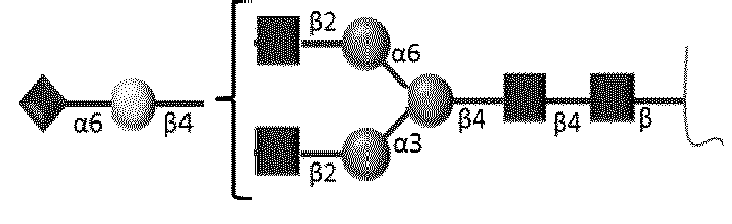
Sia(α2-6)GalGlcNAc2Man3GlcNAc2 104 
Gal2GlcNAc2Man3GlcNAc2 105 
GalGlcNAc2Man3GlcNAc2 106 
GalGlcNAcMan3GlcNAc2 107 
GlcNAc3Man3GlcNAc2 108 
GlcNAc2Man3GlcNAc2 109 
GlcNAcMan3GlcNAc2 110 
GlcNAcMan3GlcNAc2 111 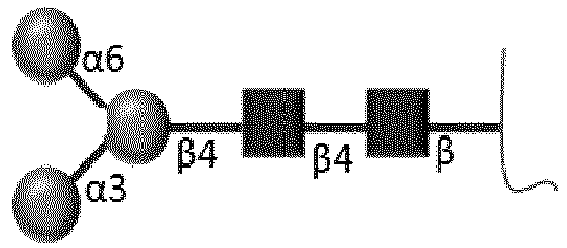
Man3GlcNAc2 112 
Sia2(α2-6)Gal2GlcNAc3Man3GlcNAc2 113 
Sia(α2-6)Gal2GlcNAc3Man3GlcNAc2 114 
Sia(α2-6)GalGlcNAc3Man3GlcNAc2 115 
Gal2GlcNAc3Man3GlcNAc2 116 
GalGlcNAc3Man3GlcNAc2 117 
Sia2(α2-3)Gal2GlcNAc2Man3GlcNAc2 118 
Sia(α2-3)Gal2GlcNAc2Man3GlcNAc2 119 
Sia2(α2-3)Gal2GlcNAc3Man3GlcNAc2 120 
Sia(α2-3)Gal2GlcNAc3Man3GlcNAc2 121 
Sia2(α2-3/α2-6)Gal2GlcNAc3Man3GlcNAc2 122 
Sia2(α2-6/α2-3)Gal2GlcNAc2Man3GlcNAc2 123 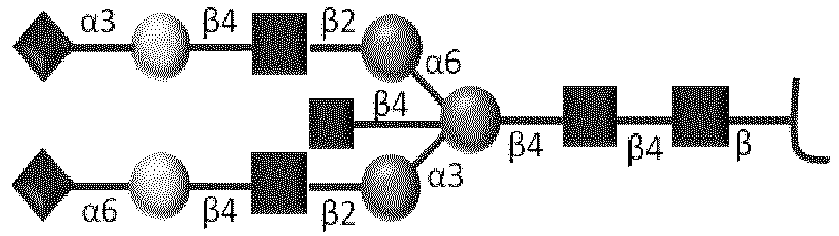
Sia2(α2-3/α2-6)Gal2GlcNAc3Man3GlcNAc2 124 
Sia2(α2-6/α2-3)Gal2GlcNAc3Man3GlcNAc2 125 
Sia(α2-3)GalGlcNAc2Man3GlcNAc2 126 
Sia(α2-3)GalGlcNAc3Man3GlcNAc2 - Glycosylation on Fc can affect a variety of immunoglobulin effector-mediated functions, including ADCC, CDC and circulating half-life. ADCC enhancement is a key strategy for improving therapeutic antibody drug efficacy. It has the potential of lowering effective drug dosage for benefits of lower drug cost. The anti-HER2 glycoantibodies described herein can be characterized by functional properties. The anti-HER2 GAb has cell growth inhibitory activities including apoptosis against human HER2 expressing cells. In some embodiments, the anti-HER2 GAb exhibits more potent cell growth inhibitory activities as compared to its patent antibody.
- The ADCC activity of the glycoantibody according to the invention is at least 3 fold increased, preferably at least 9 fold, more preferably at least 10 fold increased ADCC activity, preferably at least 12 fold increased ADCC activity, preferably at least 20 fold increased ADCC activity, most preferred at least 30 fold increased ADCC activity compared to the ADCC activity of the parental antibody.
- The ADCC lysis activity of the inventive glycoantibody can be measured in comparison to the parental antibody using target cancer cell lines such as SKBR5, SKBR3, LoVo, MCF7, OVCAR3 and/or Kato III.
- Table 3 lists exemplary enhanced ADCC activities of anti-HER2 GAbs as compared to Trastuzumab. Exemplary assays are described in the examples.
Table 3. Anti-HER2 Trastuzumab GAb101 GAb 104 GAb 105 GAb 107GAb108 GAb111 ADCC (fold) 1 >30 >30 20~30 >10 5~10 1~5 - A number of anti-HER2 GAbs described herein, in particular GAb101, and GAb 104, exhibit enhanced ADCC activity compared to it parental antibody, Trastuzumab. It is contemplated that the glycoantibodies of the invention may exhibit superior effect as therapeutic agents for HER2-positive diseases, and an object of the present invention is to use the anti-HER2 GAb in development of therapeutic agents.
- The glycoantibody described herein is surprisingly able to provide improved ADCC without affecting CDC. Exemplary CDC assays are described in the examples. In exemplary embodiments, ADCC of the glycoantibody is increased but other immunoglobulin-type effector functions such as complement-dependent cytoxicity (CDC) remain similar or are not significantly affected.
- Table 4 lists exemplary FcγRIIIA binding of anti-HER2 GAbs and Herceptin.
Table 4. Sample KD (M) Rmax (RU) Fold Herceptin 80~200 30.01 1-fold 101 1~25 44.98 >10X 104 1~25 55.68 >10X 111 35~100 41.54 1~ 5X 10⁸ 25~100 53.98 1~ 5X 10⁷ 20~90 39.88 3~10X 109 25~80 48.19 2~10X 110 70~150 18.15 1~5X 10⁶ 25~80 52.82 1~10X 103 15~70 59.89 4~10X 117 1~50 26.95 1~5X - FcγRIIIA binding may be measured using assays known in the art. Exemplary assays are described in the examples. The Fc receptor binding may be determined as the relative ratio of anti-HER2 GAb vs Trastuzumab. Fc receptor binding in exemplary embodiments is increased by at least 2.5-fold, 3-fold, 4-fold, 5-fold, 6-fold, 7-fold, 8-fold, 9-fold, 10-fold, 11-fold or 20-fold, 30-fold, 40-fold, 50-fold or higher.
- As compared to Trastuzumab, the binding data showed that the anti-HER2 GAbs, in particular GAb101 and GAb104, exhibit stronger binding affinity for the target molecule HER2.
- Taken together, anti-HER2 GAbs, in particular GAb101, and GAb104, exhibit enhanced ADCC activity and stronger FcγRIIIA binding affinity as compared to Trastuzumab. It is contemplated that the glycoantibodies of the invention may provide a superior clinical response either alone or, preferably, in a composition comprising two or more such antibodies, and optionally in combination with other treatments such as chemotherapy. It is contemplated that the ADCC-enhanced anti-HER2 glycoantibody may provide an alternative therapeutic for HER2-positive diseases. The glycoantibodies of the present invention advantageously can be used to alter current routes of administration and current therapeutic regimens, as their increased effector function means they can be dosed at lower concentrations and with less frequency, thereby reducing the potential for antibody toxicity and/or development of antibody tolerance. Furthermore, their improved effector function yields new approaches to treating clinical indications that have previously been resistant or refractory to treatment with the corresponding anti-HER2 monoclonal antibody produced in recombinant host systems.
- The anti-HER2 glycoantibodies of the invention can be produced by Fc glycoengineering from anti-HER2 monoclonal antibodies ("parental antibodies") commercially available or in the preclinical or clinical development. Preferrably, the monoclonal antibodies are therapeutic monoclonal antibodies. Fc glycoengineering may be performed enzymatically or chemoenzymatically. In a preferred embodiment, the parental antibody is Trastuzumab.
- The N-glycans in the glycoantibodies of the invention are preferrably defucosylated.
- Defucosylation of N-glycans is a process to remove core fucoses in N-glycans of the Fc domains. Defucosylation can be employed enzymatically. Since N-glycans are embedded between two Fc domains, the enzymatic defucosylation efficiency is much lower due to steric hindrance, i.e., access of fucosidase to fucose residues is blocked by potions of the Fc domains.
- Many α-fucosidases are known in the art. Examples include α-fucosidases from Turbo cornutus, Charonia lampas, Bacillus fulminans, Aspergillus niger, Clostridium perfringens, Bovine kidney (Glyko), chicken liver (Tyagarajan et al., 1996, Glycobiology 6:83-93) and α-fucosidase II from Xanthomonas manihotis (Glyko, PROzyme). Many varieties of fucosidase are also commercially available (Glyko, Novato, Calif.; PROzyme, San Leandro, Calif.; Calbiochem-Novabiochem Corp., San Diego, Calif.; among others). However, none of a-fucosidases are known to efficiently remove the core fucose from N-linked glycans.
-
WO 2013/12066 WO 2013/12066 - Thermal instability of immunoglobulin is known in the art (Vermeer et al., Biophys J. Jan 78: 394-404 (2000)). The Fab fragment is most sensitive to heat treatment, whereas the Fc fragment is most sensitive to decreasing pH. To examine the thermal stability and functional activity of the antibody, we performed the same experiment as described in
WO 2013/12066 WO 2013/12066 - In our attempts to synthesize the glycoantibodies with improved therapeutic values, we unexpectedly discovered a Bacteroides fragilis α-fucosidase (GenBank accession no. YP_212855.1) that is capable of efficiently removing fucose residues from N-linked glycans. Efficient defucosylation has been successfully achieved using the specific enzyme. Importantly, the efficiency of making the glycoantibodies of the invention has been valuably improved by the use of the specific α-fucosidase that yields a facile defucosylation of N-glycans, as illustrated in
Figure 1 . - Accordingly, the present invention provides a compostion of the α-fucosidase, and an improved method for removing core fucoses of N-glycans using the α-fucosidase. The α-fucosidase comprises a polypeptide having an amino acid sequence having at least 80%, 85% 90%, 95%, 98% or 99% identity to the sequences of SEQ ID NO: 5 or variants thereof. The improved method of defucosylation comprises contacting an antibody with an α-fucosidase, and in which the α-fucosidase comprises a polypeptide having an amino acid sequence having at least 80%, 85%, 90%, 95%, 98% or 99% identity to the sequences of SEQ ID NO: 5, a variant or a fragment thereof.
- Described herein includes an improved method for making an anti-HER2 glycoantibody, the method comprising the steps of (a) contacting an anti-HER2 monoclonal antibody with an α-fucosidase and at least one endoglycosidase, thereby yielding a defucosylated antibody having a single N-acetylglucosamine (GlcNAc), and (b) adding a carbohydrate moiety to GlcNAc under suitable conditions.
- In some embodiments, the anti-HER2 monoclonal antibody is Trastuzumab.
- Endoglycosidase is used to trim off the variable portions of an oligosaccharide in N-glycan. Examples of endoglycosidases used herein include, but not limited to, EndoA, EndoF,
EndoF 1, EndoF2, EndoH, EndoM, EndoS, and variants thereof. - The α-fucosidase according to the method of the invention comprises a polypeptide having an amino acid sequence having at least 85% identity to the sequences of SEQ ID NO: 5, a functional variant thereof.
- In some embodiments, the α-fucosidase comprises a polypeptide having an amino acid sequence having at least 90%, 91%, 92%, 93%, 94 %, 95%, 96%, 97%, 98%, 99% identity to the sequences of SEQ ID NO: 5, a variant or a fragment thereof.
- In certain embodiments, the α-fucosidase is a recombinant Bacteroides α-fucosidase.
TABLE 5 
- Step (a) in the method of the invention leads to a defucosylated antibody having a single N-acetylglucosamine (GlcNAc). Subsequent enzyme-mediated glycosylation using a transglycosylase is performed to add a designated carbohydrate moiety to GlcNAc and extend the sugar chain. A homogenous population of glycoantibodies can therefore be produced. Examples of transglycosylases as described herein include, but not limited to, EndoA, EndoF,
EndoF 1, EndoF2, EndoH, EndoM, EndoS, and variants thereof. - In some embodiments, the carbohydrate moiety according to the method the invention is slected from the group consisting of Sia2(α2-6)Gal2GlcNAc2Man3GlcNAc, Sia2(α2-6)Gal2GlcNAc3Man3GlcNAc, Sia2(α2-3)Gal2GlcNAc2Man3GlcNAc, Sia2(α2-3)Gal2GlcNAc3Man3GlcNAc, Sia2(α2-3/α2-6)Gal2GlcNAc2Man3GlcNAc, Sia2(α2-6/α2-3)Gal2GlcNAc2Man3GlcNAc, Sia2(α2-3/α2-6)Gal2GlcNAc3Man3GlcNAc, Sia2(α2-6/α2-3)Gal2GlcNAc3Man3GlcNAc, Sia(α2-6)Gal2GlcNAc2Man3GlcNAc, Sia(α2-3)Gal2GlcNAc2Man3GlcNAc, Sia(α2-6)Gal2GlcNAc3Man3GlcNAc, Sia(α2-3)Gal2GlcNAc3Man3GlcNAc, Sia(α2-6)GalGlcNAc2Man3GlcNAc, Sia(α2-3)GalGlcNAc2Man3GlcNAc, Sia(α2-6)GalGlcNAc3Man3GlcNAc, Sia(α2-3)GalGlcNAc3Man3GlcNAc, Gal2GlcNAc2Man3GlcNAc, Gal2GlcNAc3Man3GlcNAc, GalGlcNAc2Man3GlcNAc, GalGlcNAc3Man3GlcNAc, GlcNAc3Man3GlcNAc, GlcNAc2Man3GlcNAc, GlcNAcMan3GlcNAc and Man3GlcNAc.
- In preferred embodiments, the carbohydrate moiety is selected from the group consisting of Sia2(α2-6)Gal2GlcNAc2Man3GlcNAc, Sia2(α2-6)Gal2GlcNAc3Man3GlcNAc, Sia2(α2-3)Gal2GlcNAc2Man3GlcNAc, Sia2(α2-3)Gal2GlcNAc3Man3GlcNAc, Sia2(α2-3/α2-6)Gal2GlcNAc2Man3GlcNAc, Sia2(α2-6/α2-3)Gal2GlcNAc2Man3GlcNAc, Sia2(α2-3/α2-6)Gal2GlcNAc3Man3GlcNAc, Sia2(α2-6/α2-3)Gal2GlcNAc3Man3GlcNAc, Sia(α2-6)Gal2GlcNAc2Man3GlcNAc, Sia(α2-3)Gal2GlcNAc2Man3GlcNAc, Sia(α2-6)Gal2GlcNAc3Man3GlcNAc, Sia(α2-3)Gal2GlcNAc3Man3GlcNAc, Sia(α2-6)GalGlcNAc2Man3GlcNAc, Sia(α2-3)GalGlcNAc2Man3GlcNAc, Sia(α2-6)GalGlcNAc3Man3GlcNAc, Sia(α2-3)GalGlcNAc3Man3GlcNAc, Gal2GlcNAc2Man3GlcNAc and Gal2GlcNAc3Man3GlcNAc.
- Step (b) in the method of the invention leads to sugar chain extension. One method for sugar chain extension is through an enzyme-catalyzed glycosylation reaction. It is well known in the art that glycosylation using a sugar oxazoline as the sugar donor among the enzyme-catalyzed glycosylation reactions is useful for synthesizing oligosaccharides because the glycosylation reaction is an addition reaction and advances without any accompanying elimination of acid, water, or the like. (Fujita, et al., Biochim. Biophys. Acta 2001, 1528, 9-14)
- In some embodiments, the carbohydrate moiety is a sugar oxazoline.
- Suitable conditions also include incubation of the reaction mixture for at least 20 minutes, 30 minutes, 40 minutes, 50 minutes, 60 minutes, 70 minutes, 80 minutes, 90 minutes or 100 minutes, preferably less than 60 minutes. Incubation preferably takes place at room temperature, more preferably at approximately 20°C, 25 °C, 30°C, 35 °C, 40°C or 45 °C, and most preferably at approximately 37°C.
- It will be understood that the polypeptide of the α-fucosidase of the invention may be derivatized or modified to assist with their isolation or purification. Thus, in one embodiment of the invention, the polypeptide for use in the invention is derivatized or modified by addition of a ligand which is capable of binding directly and specifically to a separation means. Alternatively, the polypeptide is derivatized or modified by addition of one member of a binding pair and the separation means comprises a reagent that is derivatized or modified by addition of the other member of a binding pair. Any suitable binding pair can be used. In a preferred embodiment where the polypeptide for use in the invention is derivatized or modified by addition of one member of a binding pair, the polypeptide is preferably histidine-tagged or biotin-tagged. Typically the amino acid coding sequence of the histidine or biotin tag is included at the gene level and the proteins are expressed recombinantly in E. coli. The histidine or biotin tag is typically present at one end of the polypeptide, either at the N-terminus or at the C-terminus. The histidine tag typically consists of six histidine residues, although it can be longer than this, typically up to 7, 8, 9, 10 or 20 amino acids or shorter, for example 5, 4, 3, 2 or 1 amino acids. Furthermore, the histidine tag may contain one or more amino acid substitutions, preferably conservative substitutions as defined above.
- Variant polypeptide as described herein are those for which the amino acid sequence varies from that in SEQ ID NO: 5, but exhibit the same or similar function of the enzyme comprising the polypeptide having an amino acid sequence of SEQ ID NO: 5.
- As used herein percent (%) sequence identity with respect to a sequence is defined as the percentage of amino acid residues in a candidate polypeptide sequence that are identical with the amino acid residues in the reference polypeptide sequence, after aligning the sequences and introducing gaps, if necessary, to achieve the maximum percent sequence identity. Alignment for purposes of determining percent sequence identity can be achieved in various ways that are within the skill in the art, for instance, using publicly available computer software such as BLAST, ALIGN or Megalign (DNASTAR) software. Those skilled in the art can determine appropriate parameters for measuring alignment, including any algorithms needed to achieve maximal alignment over the full length of the sequences being compared.
- Some preferred embodiments of the invention are demonstrated in the examples.
- After preparation of the anti-HER2 GAb as described herein, a "pre-lyophilized formulation" can be produced. The anti-HER2 GAb for preparing the formulation is preferably essentially pure and desirably essentially homogeneous (i.e. free from contaminating proteins etc). "Essentially pure" protein means a composition comprising at least about 90% by weight of the protein, based on total weight of the composition, preferably at least about 95% by weight. "Essentially homogeneous" protein means a composition comprising at least about 99% by weight of protein, based on total weight of the composition. In certain embodiments, the protein is an antibody.
- The amount of anti-HER2 GAb in the pre-lyophilized formulation is determined taking into account the desired dose volumes, mode(s) of administration etc. Where the protein of choice is an intact antibody (a full-length antibody), from about 2 mg/mL to about 50 mg/mL, preferably from about 5 mg/mL to about 40 mg/mL and most preferably from about 20-30 mg/mL is an exemplary starting protein concentration. The protein is generally present in solution. For example, the protein may be present in a pH-buffered solution at a pH from about 4-8, and preferably from about 5-7. Exemplary buffers include histidine, phosphate, Tris, citrate, succinate and other organic acids. The buffer concentration can be from about 1 mM to about 20 mM, or from about 3 mM to about 15 mM, depending, for example, on the buffer and the desired isotonicity of the formulation (e.g. of the reconstituted formulation). The preferred buffer is histidine in that, as demonstrated below, this can have lyoprotective properties. Succinate was shown to be another useful buffer.
- The lyoprotectant is added to the pre-lyophilized formulation. In preferred embodiments, the lyoprotectant is a non-reducing sugar such as sucrose or trehalose. The amount of lyoprotectant in the pre-lyophilized formulation is generally such that, upon reconstitution, the resulting formulation will be isotonic. However, hypertonic reconstituted formulations may also be suitable. In addition, the amount of lyoprotectant must not be too low such that an unacceptable amount of degradation/aggregation of the protein occurs upon lyophilization. Where the lyoprotectant is a sugar (such as sucrose or trehalose) and the protein is an antibody, exemplary lyoprotectant concentrations in the pre-lyophilized formulation are from about 10 mM to about 400 mM, and preferably from about 30 mM to about 300 mM, and most preferably from about 50 mM to about 100 mM.
- The ratio of protein to lyoprotectant is selected for each protein and lyoprotectant combination. In the case of an antibody as the protein of choice and a sugar (e.g., sucrose or trehalose) as the lyoprotectant for generating an isotonic reconstituted formulation with a high protein concentration, the molar ratio of lyoprotectant to antibody may be from about 100 to about 1500 moles lyoprotectant to 1 mole antibody, and preferably from about 200 to about 1000 moles of lyoprotectant to 1 mole antibody, for example from about 200 to about 600 moles of lyoprotectant to 1 mole antibody.
- In preferred embodiments of the invention, it has been found to be desirable to add a surfactant to the pre-lyophilized formulation. Alternatively, or in addition, the surfactant may be added to the lyophilized formulation and/or the reconstituted formulation. Exemplary surfactants include nonionic surfactants such as polysorbates (e.g. polysorbates 20 or 80); poloxamers (e.g. poloxamer 188); Triton; sodium dodecyl sulfate (SDS); sodium laurel sulfate; sodium octyl glycoside; lauryl-, myristyl-, linoleyl-, or stearyl-sulfobetaine; lauryl-, myristyl-, linoleyl- or stearyl-sarcosine; linoleyl-, myristyl-, or cetyl-betaine; lauroamidopropyl-, cocamidopropyl-, linoleamidopropyl-, myristamidopropyl-, palnidopropyl-, or isostearamidopropyl-betaine (e.g lauroamidopropyl); myristamidopropyl-, palmidopropyl-, or isostearamidopropyl-dimethylamine; sodium methyl cocoyl-, or disodium methyl oleyl-taurate; and the MONAQUATTM series (Mona Industries, Inc., Paterson, N.J.), polyethyl glycol, polypropyl glycol, and copolymers of ethylene and propylene glycol (e.g. Pluronics, PF68 etc). The amount of surfactant added is such that it reduces aggregation of the reconstituted protein and minimizes the formation of particulates after reconstitution. For example, the surfactant may be present in the pre-lyophilized formulation in an amount from about 0.001-0.5%, and preferably from about 0.005-0.05%.
- In certain embodiments of the invention, a mixture of the lyoprotectant (such as sucrose or trehalose) and a bulking agent (e.g. mannitol or glycine) is used in the preparation of the pre-lyophilization formulation. The bulking agent may allow for the production of a uniform lyophilized cake without excessive pockets therein etc.
- Other pharmaceutically acceptable carriers, excipients or stabilizers such as those described in Remington's Pharmaceutical Sciences 16th edition, Osol, A. Ed. (1980) may be included in the pre-lyophilized formulation (and/or the lyophilized formulation and/or the reconstituted formulation) provided that they do not adversely affect the desired characteristics of the formulation. Acceptable carriers, excipients or stabilizers are nontoxic to recipients at the dosages and concentrations employed and include; additional buffering agents; preservatives; co-solvents; antioxidants including ascorbic acid and methionine; chelating agents such as EDTA; metal complexes (e.g. Zn-protein complexes); biodegradable polymers such as polyesters; and/or salt-forming counterions such as sodium.
- The pharmaceutical compositions and formulations described herein are preferably stable. A "stable" formulation/composition is one in which the antibody therein essentially retains its physical and chemical stability and integrity upon storage. Various analytical techniques for measuring protein stability are available in the art and are reviewed in Peptide and Protein Drug Delivery, 247-301, Vincent Lee Ed., Marcel Dekker, Inc., New York, N.Y., Pubs. (1991) and Jones, A. Adv. Drug Delivery Rev. 10: 29-90 (1993). Stability can be measured at a selected temperature for a selected time period.
- The formulations to be used for in vivo administration must be sterile. This is readily accomplished by filtration through sterile filtration membranes, prior to, or following, lyophilization and reconstitution. Alternatively, sterility of the entire mixture may be accomplished by autoclaving the ingredients, except for protein, at about 120° C. for about 30 minutes, for example.
- After the protein, lyoprotectant and other optional components are mixed together, the formulation is lyophilized. Many different freeze-dryers are available for this purpose such as Hull50® (Hull, USA) or GT20® (Leybold-Heraeus, Germany) freeze-dryers. Freeze-drying is accomplished by freezing the formulation and subsequently subliming ice from the frozen content at a temperature suitable for primary drying. Under this condition, the product temperature is below the eutectic point or the collapse temperature of the formulation. Typically, the shelf temperature for the primary drying will range from about -30 to 25° C. (provided the product remains frozen during primary drying) at a suitable pressure, ranging typically from about 50 to 250 mTorr. The formulation, size and type of the container holding the sample (e.g., glass vial) and the volume of liquid will mainly dictate the time required for drying, which can range from a few hours to several days (e.g. 40-60hrs). A secondary drying stage may be carried out at about 0-40° C., depending primarily on the type and size of container and the type of protein employed. However, it was found herein that a secondary drying step may not be necessary. For example, the shelf temperature throughout the entire water removal phase of lyophilization may be from about 15-30° C. (e.g., about 20° C.). The time and pressure required for secondary drying will be that which produces a suitable lyophilized cake, dependent, e.g., on the temperature and other parameters. The secondary drying time is dictated by the desired residual moisture level in the product and typically takes at least about 5 hours (e.g. 10-15 hours). The pressure may be the same as that employed during the primary drying step. Freeze-drying conditions can be varied depending on the formulation and vial size.
- In some instances, it may be desirable to lyophilize the protein formulation in the container in which reconstitution of the protein is to be carried out in order to avoid a transfer step. The container in this instance may, for example, be a 3, 5, 10, 20, 50 or 100 cc vial. As a general proposition, lyophilization will result in a lyophilized formulation in which the moisture content thereof is less than about 5%, and preferably less than about 3%.
- At the desired stage, typically when it is time to administer the protein to the patient, the lyophilized formulation may be reconstituted with a diluent such that the protein concentration in the reconstituted formulation is at least 50 mg/mL, for example from about 50 mg/mL to about 400 mg/mL, more preferably from about 80 mg/mL to about 300 mg/mL, and most preferably from about 90 mg/mL to about 150 mg/mL. Such high protein concentrations in the reconstituted formulation are considered to be particularly useful where subcutaneous delivery of the reconstituted formulation is intended. However, for other routes of administration, such as intravenous administration, lower concentrations of the protein in the reconstituted formulation may be desired (for example from about 5-50 mg/mL, or from about 10-40 mg/mL protein in the reconstituted formulation). In certain embodiments, the protein concentration in the reconstituted formulation is significantly higher than that in the pre-lyophilized formulation. For example, the protein concentration in the reconstituted formulation may be about 2-40 times, preferably 3-10 times and most preferably 3-6 times (e.g. at least three fold or at least four fold) that of the pre-lyophilized formulation.
- Reconstitution generally takes place at a temperature of about 25° C. to ensure complete hydration, although other temperatures may be employed as desired. The time required for reconstitution will depend, e.g., on the type of diluent, amount of excipient(s) and protein. Exemplary diluents include sterile water, bacteriostatic water for injection (BWFI), a pH buffered solution (e.g. phosphate-buffered saline), sterile saline solution, Ringer's solution or dextrose solution. The diluent optionally contains a preservative. Exemplary preservatives have been described above, with aromatic alcohols such as benzyl or phenol alcohol being the preferred preservatives. The amount of preservative employed is determined by assessing different preservative concentrations for compatibility with the protein and preservative efficacy testing. For example, if the preservative is an aromatic alcohol (such as benzyl alcohol), it can be present in an amount from about 0.1-2.0% and preferably from about 0.5-1.5%, but most preferably about 1.0-1.2%. Preferably, the reconstituted formulation has less than 6000 particles per vial which are > 10 µm m size.
- In another aspect, the invention provides immunoconjugates, or antibody-drug conjugates (ADC), comprising an antibody conjugated to a cytotoxic agent such as a chemotherapeutic agent, a drug, a growth inhibitory agent, a toxin (e.g., an enzymatically active toxin of bacterial, fungal, plant, or animal origin, or fragments thereof), or a radioactive isotope (i.e., a radioconjugate).
- The use of antibody-drug conjugates for the local delivery of cytotoxic or cytostatic agents, i.e. drugs to kill or inhibit tumor cells in the treatment of cancer (Syrigos and Epenetos (1999) Anticancer Research 19:605-614; Niculescu-Duvaz and Springer (1997) Adv. Drg Del. Rev. 26:151-172;
U.S. Pat. No. 4,975,278 ) allows targeted delivery of the drug moiety to tumors, and intracellular accumulation therein, where systemic administration of these unconjugated drug agents may result in unacceptable levels of toxicity to normal cells as well as the tumor cells sought to be eliminated (Baldwin et al., (1986) Lancet pp. (Mar. 15, 1986):603-05; Thorpe, (1985) "Antibody Carriers Of Cytotoxic Agents In Cancer Therapy: A Review," in Monoclonal Antibodies '84: Biological And Clinical Applications, A. Pinchera et al. (ed.s), pp. 475-506). Maximal efficacy with minimal toxicity is sought thereby. Both polyclonal antibodies and monoclonal antibodies have been reported as useful in these strategies (Rowland et al., (1986) Cancer Immunol. Immunother., 21:183-87). Drugs used in these methods include daunomycin, doxorubicin, methotrexate, and vindesine (Rowland et al., (1986) supra). Toxins used in antibody-toxin conjugates include bacterial toxins such as diphtheria toxin, plant toxins such as ricin, small molecule toxins such as geldanamycin (Mandler et al (2000) Jour. of the Nat. Cancer Inst. 92(19): 1573-1581; Mandler et al (2000) Bioorganic & Med. Chem. Letters 10:1025-1028; Mandler et al (2002) Bioconjugate Chem. 13:786-791), maytansinoids (EP 1391213 ; Liu et al., (1996) Proc. Natl. Acad. Sci. USA 93:8618-8623), and calicheamicin (Lode et al (1998) Cancer Res. 58:2928; Hinman et al (1993) Cancer Res. 53:3336-3342). The toxins may affect their cytotoxic and cytostatic effects by mechanisms including tubutin binding, DNA binding, or topoisomerase inhibition. Some cytotoxic drugs tend to be inactive or less active when conjugated to large antibodies or protein receptor ligands. - Antibodies of the invention can be further modified to contain additional nonproteinaceous moieties that are known in the art and readily available. In one embodiment, the moieties suitable for derivatization of the antibody are water soluble polymers. Non-limiting examples of water soluble polymers include, but are not limited to, polyethylene glycol (PEG), copolymers of ethylene glycol/propylene glycol, carboxymethylcellulose, dextran, polyvinyl alcohol, polyvinyl pyrrolidone, poly-1,3-dioxolane, poly-1,3,6-trioxane, ethylene/maleic anhydride copolymer, polyaminoacids (either homopolymers or random copolymers), and dextran or poly(n-vinyl pyrrolidone)polyethylene glycol, propropylene glycol homopolymers, prolypropylene oxide/ethylene oxide co-polymers, polyoxyethylated polyols (e.g., glycerol), polyvinyl alcohol, and mixtures thereof. Polyethylene glycol propionaldehyde may have advantages in manufacturing due to its stability in water. The polymer may be of any molecular weight, and may be branched or unbranched. The number of polymers attached to the antibody may vary, and if more than one polymer is attached, the polymers can be the same or different molecules. In general, the number and/or type of polymers used for derivatization can be determined based on considerations including, but not limited to, the particular properties or functions of the antibody to be improved, whether the antibody derivative will be used in a therapy under defined conditions, etc.
- In another embodiment, conjugates of an antibody and nonproteinaceous moiety that may be selectively heated by exposure to radiation are provided. In one embodiment, the nonproteinaceous moiety is a carbon nanotube (Kam et al., Proc. Natl. Acad. Sci. 102: 11600-11605 (2005)). The radiation may be of any wavelength, and includes, but is not limited to, wavelengths that do not harm ordinary cells, but which heat the nonproteinaceous moiety to a temperature at which cells proximal to the antibody-nonproteinaceous moiety are killed.
- Trastuzumab (Herceptin®) is widely used and known in the art for the treatment of patients with early as well as metastatic breast cancer whose tumors overexpress HER2 protein or have HER 2 gene amplification. In the art, the treatment of breast cancer patients with Herceptin/Trastuzumab is, for example, recommended and routine for patients having HER2-positive disease. HER2-positive disease in breast cancer is present if a high HER2 (protein) expression level detected by immunohistochemical methods (e.g. HER2 (+++) or HER2 gene amplification (e.g. a HER2 gene copy number higher than 4 copies of the HER2 gene per tumor cell) or both is found in samples obtained from the patients such as breast tissue biopsies or breast tissue resections or in tissue derived from metastatic sites.
- ADCC-enhanced anti-HER2 glycoantibodies provides an alternative therapeutic for treating HER2-expressing tumors. The glycoantibodies of the present invention advantageously can be used to alter current routes of administration and current therapeutic regimens, as their increased effector function means they can be dosed at lower concentrations and with less frequency, thereby reducing the potential for antibody toxicity and/or development of antibody tolerance. Furthermore, their improved effector function yields new approaches to treating clinical indications that have previously been resistant or refractory to treatment with the corresponding anti-HER2 monoclonal antibody produced in recombinant host systems.
- Accordingly, the present disclosure relates to a method for treating a patient having a HER2-expressing tumor comprising administering to the patient an effective amount of the glycoantibody described herein. In a preferred aspect, the present disclosure provides a method for treating breast cancer.
- The composition described above can be a pharmaceutical composition, which can further comprise a pharmaceutically acceptable carrier.
- The composition can be delivered by administering the composition to a subject in need thereof (e.g., a human patient having or suspected of having cancer). In some embodiments, the anti-cancer agent is delivered to a subject in an amount effective in treating cancer. In other embodiments, a detectable label, preferably an agent suitable for cancer imaging, is delivered to a subject (e.g., a human patient having or suspected of having a solid tumor) in an amount effective in detecting cancer cells and/or cancerous tissues.
- An antibody that "induces apoptosis" is one which induces programmed cell death as determined by binding of annexin V, fragmentation of DNA, cell shrinkage, dilation of endoplasmic reticulum, cell fragmentation, and/or formation of membrane vesicles (called apoptotic bodies). Preferably the cell is an infected cell. Various methods are available for evaluating the cellular events associated with apoptosis. For example, phosphatidyl serine (PS) translocation can be measured by annexin binding; DNA fragmentation can be evaluated through DNA laddering; and nuclear/chromatin condensation along with DNA fragmentation can be evaluated by any increase in hypodiploid cells. Preferably, the antibody that induces apoptosis is one that results in about 2 to 50 fold, preferably about 5 to 50 fold, and most preferably about 10 to 50 fold, induction of annexin binding relative to untreated cell in an annexin binding assay.
- Antibody "effector functions" refer to those biological activities attributable to the Fc region (a native sequence Fc region or amino acid sequence variant Fc region) of an antibody, and vary with the antibody isotype. Examples of antibody effector functions include: C1q binding and complement dependent cytotoxicity; Fc receptor binding; antibody-dependent cell-mediated cytotoxicity (ADCC); phagocytosis; down regulation of cell surface receptors (e.g., B cell receptor); and B cell activation.
- "Antibody-dependent cell-mediated cytotoxicity" or "ADCC" refers to a form of cytotoxicity in which secreted Ig bound to Fc receptors (FcRs) present on certain cytotoxic cells (e.g., Natural Killer (NK) cells, neutrophils, and macrophages) enable these cytotoxic effector cells to bind specifically to an antigen-bearing target cell and subsequently kill the target cell with cytotoxins. The antibodies "arm" the cytotoxic cells and are required for such killing. The primary cells for mediating ADCC, NK cells, express FcγRIII only, whereas monocytes express FcyRI, FcγRII and FcγRIII. FcR expression on hematopoietic cells is summarized in Table 3 on page 464 of Ravetch and Kinet, Annu. Rev. Immunol 9:457-92 (1991). To assess ADCC activity of a molecule of interest, an in vitro ADCC assay, such as that described in
U.S. Pat. No. 5,500,362 orU.S. Pat. No. 5,821,337 may be performed. Useful effector cells for such assays include peripheral blood mononuclear cells (PBMC) and Natural Killer (NK) cells. Alternatively, or additionally, ADCC activity of the molecule of interest may be assessed in vivo, e.g., in a animal model such as that disclosed in Clynes et al., Proc. Natl. Acad. Sci. (USA) 95:652-656 (1998). - "Fc receptor" or "FcR" describes a receptor that binds to the Fc region of an antibody. In certain embodiments, the FcR is a native sequence human FcR. Moreover, a preferred FcR is one that binds an IgG antibody (a gamma receptor) and includes receptors of the FcyRI, FcyRII, and FcγRIII subclasses, including allelic variants and alternatively spliced forms of these receptors. FcγRII receptors include FcγRIIA (an "activating receptor") and FcγRIIB (an "inhibiting receptor"), which have similar amino acid sequences that differ primarily in the cytoplasmic domains thereof. Activating receptor FcγRIIA contains an immunoreceptor tyrosine-based activation motif (ITAM) in its cytoplasmic domain. Inhibiting receptor FcyRIIB contains an immunoreceptor tyrosine-based inhibition motif (ITIM) in its cytoplasmic domain. (reviewed by M. Daeron, Annu. Rev. Immunol. 15:203-234 (1997)). FcRs are reviewed in Ravetch and Kinet, Annu. Rev. Immunol 9:457-92 (1991); Capel et al., Immunomethods 4:25-34 (1994); and de Haas et al., J. Lab. Clin. Med. 126:330-41 (1995). Other FcRs, including those to be identified in the future, are encompassed by the term "FcR" herein. The term also includes the neonatal receptor, FcRn, which is responsible for the transfer of maternal IgGs to the fetus (Guyer et al., J. Immunol. 117:587 (1976) and Kim et al., J. Immunol. 24:249 (1994)).
- "Human effector cells" are leukocytes that express one or more FcRs and perform effector functions. Preferably, the cells express at least FcγRIII and perform ADCC effector function. Examples of human leukocytes that mediate ADCC include PBMC, NK cells, monocytes, cytotoxic T cells and neutrophils; with PBMCs and NK cells being preferred. The effector cells may be isolated from a native source, e.g., from blood.
- "Complement dependent cytotoxicity" or "CDC" refers to the lysis of a target cell in the presence of complement. Activation of the classical complement pathway is initiated by the binding of the first component of the complement system (C1q) to antibodies (of the appropriate subclass) that are bound to their cognate antigen. To assess complement activation, a CDC assay, e.g., as described in Gazzano-Santoro et al., J. Immunol. Methods 202:163 (1996), may be performed.
- "Treating" or "treatment" or "alleviation" refers to both therapeutic treatment and prophylactic or preventative measures; wherein the object is to prevent or slow down (lessen) the targeted pathologic condition or disorder. Those in need of treatment include those already with the disorder as well as those prone to have the disorder or those in whom the disorder is to be prevented. A subject or mammal is successfully "treated" for an infection if, after receiving a therapeutic amount of an antibody according to the methods of the present invention, the patient shows observable and/or measurable reduction in or absence of one or more of the following: reduction in the number of infected cells or absence of the infected cells; reduction in the percent of total cells that are infected; and/or relief to some extent, one or more of the symptoms associated with the specific infection; reduced morbidity and mortality, and improvement in quality of life issues. The above parameters for assessing successful treatment and improvement in the disease are readily measurable by routine procedures familiar to a physician.
- The term "therapeutically effective amount" refers to an amount of an antibody or a drug effective to "treat" a disease or disorder in a subject or mammal See preceding definition of "treating."
- Administration "in combination with" one or more further therapeutic agents includes simultaneous (concurrent) and consecutive administration in any order.
- "Carriers" as used herein include pharmaceutically acceptable carriers, excipients, or stabilizers that are nontoxic to the cell or mammal being exposed thereto at the dosages and concentrations employed. Often the physiologically acceptable carrier is an aqueous pH buffered solution. Examples of physiologically acceptable carriers include buffers such as phosphate, citrate, and other organic acids; antioxidants including ascorbic acid; low molecular weight (less than about 10 residues) polypeptide; proteins, such as serum albumin, gelatin, or immunoglobulins; hydrophilic polymers such as polyvinylpyrrolidone; amino acids such as glycine, glutamine, asparagine, arginine or lysine; monosaccharides, disaccharides, and other carbohydrates including glucose, mannose, or dextrins; chelating agents such as EDTA; sugar alcohols such as mannitol or sorbitol; salt-forming counterions such as sodium; and/or nonionic surfactants such as TWEEN™ polyethylene glycol (PEG), and PLURONICS™.
- The details of one or more embodiments of the invention are set forth in the description below. Other features or advantages of the present invention will be apparent from the following drawings and detailed description of several embodiments, and also from the appending claims.
- The following examples are included to demonstrate preferred embodiments of the invention. It should be appreciated by those of skill in the art that the techniques disclosed in the examples which follow represent techniques discovered by the inventor to function well in the practice of the invention, and thus can be considered to constitute preferred modes for its practice. However, those of skill in the art should, in light of the present disclosure, appreciate that many changes can be made in the specific embodiments which are disclosed and still obtain a like or similar result without departing from the spirit and scope of the invention.
- To activate molecular sieves MS-4Å for glycosylation, it was connected to vacuum system and heated for 1 hour. After the activated molecular sieves was cooled to room temperature, it was added to a flask containing Donor (1.5~2.0 eq. for one position glycosylation) and Acceptor (1.0 eq.). Dichloromethane was added to the mixture, and then the solution was stirred at room temperature for 3 h. N-iodosuccinimide (NIS, 1.7~2.2 eq.) and trimethylsilyl trifluoromethanesulfonate (TMSOTf, 0.1 eq.) were added to the solution on -78°C, and then the solution was stirred at -20 °C. Reaction was monitored by thin-layer chromatography (TLC) analysis, which was carried out on glass-backed silica gel plates (Merck DC Kieselgel 60F254) and visualized by UV light (254 nm) and acidic ceric ammonium molybdate. After the acceptor was consumed completely, the reaction was quenched with sat. NaHCO3(aq), and 20% Na2S2O3, and then the mixture was filtered through a pad of celite. After the aqueous layer was extracted with two portions of dichloromethane, the combined organic layers were washed with brine, dried over MgSO4, and concentrated. The crude was purified by silica gel column chromatography (toluene/ethyl acetate as elution system) to give product (the yield was shown on the scheme).
- A mixture of silver triflate (5 eq.), bis (cyclopentadienyl) hafnium dichloride (3.5 eq.) and 4Å activated molecular sieves in dry toluene was stirred at room temperature for 1 h. The reaction mixture was then cooled to -50°C, a solution of acceptor (1.0 eq.) and donor (1.2~1.5 eq.) in toluene was added. The mixture was stirred at -10° C for 2-8 h. After TLC indicated complete consumption of acceptor, the reaction was quenched with Et3N, diluted with EtOAc and filtered through Celite. The filtrate was washed with aqueous NaHCO3, and a brine solution. The organic layers was dried over Na2SO4 and concentrated in vacuo. The crude was purified by silica gel column chromatography (toluene/ethyl acetate as elution system) to give product (the yield was shown on the scheme).
- NaOMe (0.25 eq.) was added to solution of starting material (1.0 eq.) in THF/Methanol (2/3). Reaction was stirred at room temperature and monitored by TLC analysis. After the acetyl group was de-protected completely, the solution was neutralized by IR-120, filtered, and concentrated. The crude was purified by silica gel column chromatography (hexanes/ethyl acetate as elution system) to give product (the yield was shown on the scheme).
- Zn powder (20 eq.) and acetic acid (0.2 eq.) were added to solution of starting material (1.0 eq.) in THF. Reaction was stirred at room temperature and monitored by thin-layer chromatography (TLC) analysis. After the Troc group was de-protected completely, the solution was filtered, and concentrated. The crude was purified by silica gel column chromatography (hexanes/ethyl acetate as elution system) to give product (the yield was shown on the scheme).
- p-Toluenesulfonic acid (pTSA, 1.5 eq.) was added to solution of starting material (1.0 eq.) in ACN/MeOH (2/1). Reaction was stirred at room temperature and monitored by thin-layer chromatography (TLC) analysis. After the benzylidene group was removed completely, the reaction was quenched by trimethylamine and then concentrated. The crude was purified by silica gel column chromatography (hexanes/ethyl acetate as elution system) to give product (the yield was shown on the scheme).
- A mixture of protected oligosaccharides (50 mmol) and 10 mL of ethylene diamine: nBuOH (1/4) were stirred at 90 °C overnight. Volatiles were evaporated, and crude was reacted with 10 mL Ac2O/pyridine (1/2) overnight. The solvents were removed using high vacuum, and the product was purified by flash column chromatography (acetone/toluene as elute system). The products were de-acetylated using sodium methoxide in MeOH (10 mL) overnight. Reactions were neutralized by using IR-120, then, filtered and concentrated in vacuum. The residues were purified by flash column chromatography (acetone/toluene as elute system). The products were dissolved in 10 mL MeOH : H2O: HCOOH (6/3/1), Pd(OH)2 (50% by weight) was added, and the reactions were hydrogenated overnight. The reaction mixtures were filtered through celite and concentrated in vacuo. The residues were purified by G-15 gel column chromatography using water as eluent. The products were lypholysed to get white color powders (the yield was shown on the scheme).
- Starting materials (5 µmol), CTP (1 µmol), Neu5Ac (9.5 µmol), PEP (10 µmol), □-2,6 sialyltransferase (200 µL, estimated concentration of 2 mg/L), CMK (80 units), PK (40 units), and PPA (40 units) were dissolved in 50 µmol sodium cacodylate (pH 7.4) containing 1% BSA (130 µL). The reactions were incubated at 37 °C with gentle agitation for 2d. The products were purified by using G-15 gel chromatography (eluent H2O) to afford the desired products as white solid after lyophilization.
-

-

-

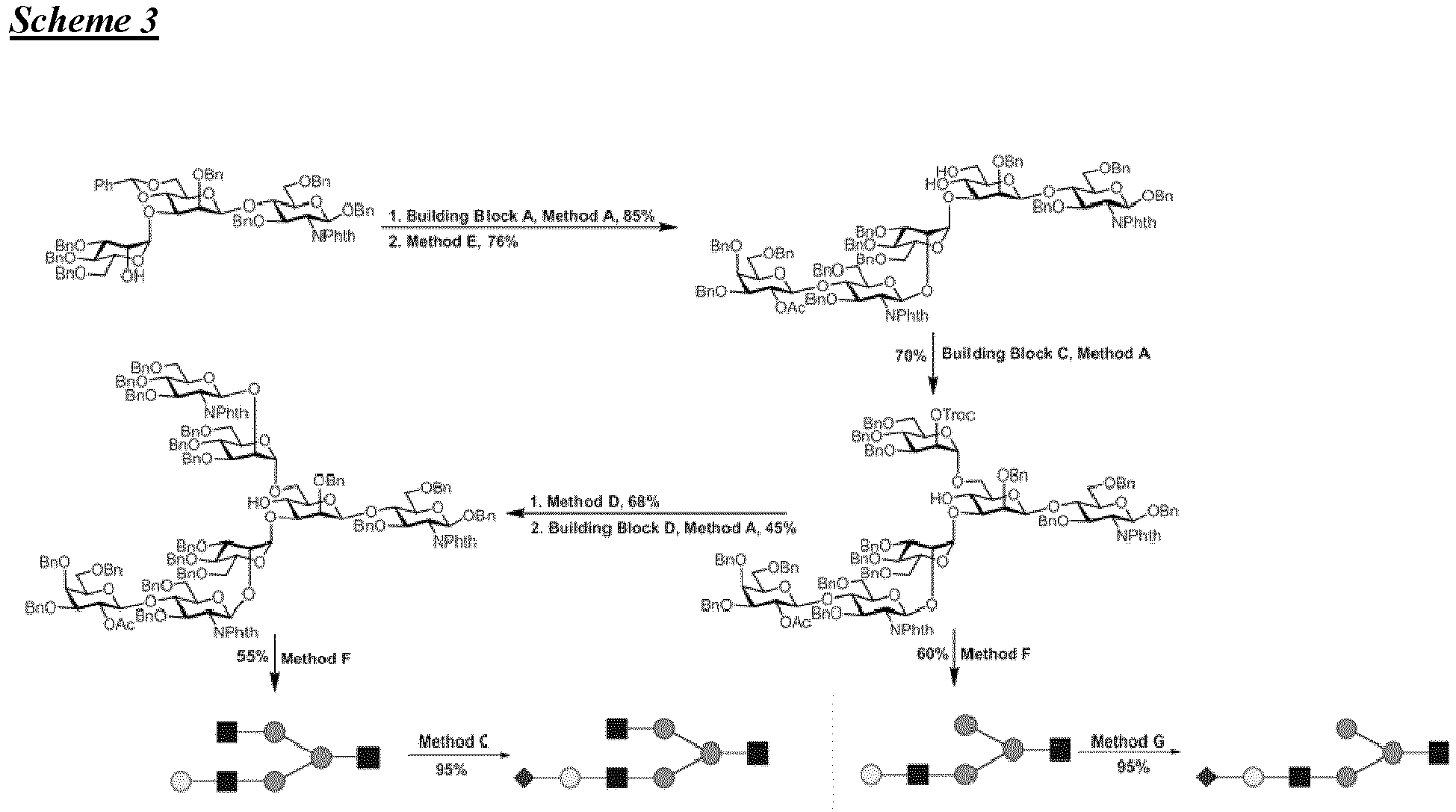
-

- The complete removal of N-linked glycan at Asn297 from Fc region of Trastuzumab (Herceptin) is achieved by means of PNGase F, and evaluated with 4-12% Bis-Tris NeuPAGE and LC-MS/MS analysis of tryptic glycopeptides from modified and unmodified IgG. The molecular weights of tryptic glycopeptides helps to determine the potential site of N-linked glycosylation at each asparagine and to elucidate the species of predominant glycans.
- A glycoantibody derived from conventional Trastuzumab (Herceptin) bearing a glycan structure of GlcNAc-Fuc in the Fc region was treated with one or more endoglycosidases (Endo S and/or Endo F1, Endo F2, Endo F3), and then treated with an alpha-fucosidase to cleave the core fucose with a high cleavage efficiency and lead to a glycoantibody with a monosaccharide GlcNAc in the Fc region.
- Mixtures of Endo S(10 µg), Endo F1/ Endo F2/ Endo F3(10 µg), Fucosidase(2 mg) and Trastuzumab (2 mg) in 50 mM sodium phosphate buffer (pH 7) were shaking at 37 °C for 24 hr. The reaction mixture was subjected to protein A affinity column for purification. The fraction of anti-HER2 GAb201 was collected (yield: 96.6%). The collected fraction was trypsinized. The trypsinized glycopeptides, TKPREEQYNSTYR and EEQYNSTYR, were analyzed using nanospray LC/MS to confirm the glycosylation pattern of anti-HER2 GAb201.
- Ethanol was added into 100 mL of chicken egg yolk and mixed thoroughly. After centrifugation, the supernatant was discarded and the pellet was collected. The pellet was washed twice with ethanol. Water was added into the pellet and mixed thoroughly. The mixture was centrifuged. After centrifugation, the supernatant was discarded and the pellet was collected. The pellet was mixed with ethanol. A supernatant was collected and lyophilized to obtain 1.5 g white de-fat powder. The powder was dissolved in phosphate buffer and treated with 1 mg endo-β-N-acetylglucosaminidase for enzymatic digestion. The reaction mixture was mixed with water-soluble organic solvent thoroughly and centrifuged to collect the supernatant. The supernatant was purified by ion exchange column. 18 mg of glcan-101 (Sia2Gal2GlcNAc2Man3GlcNAc) was obtained.
- A solution of glycan-101 (Sia2(α2-6)Gal2GlcNAc2Man3GlcNAc) (30 mg), 2-chloro-1,3-dimethylimidazolinium chloride (DMC) (62.7 mg) and Et3N (89 µL) in water was stirred at 4°C for 1 h. The reaction mixture was subjected to gel filtration chromatography on a Sephadex G-25 column eluted by 0.05% aqueous Et3N to collect the glycan oxazoline-101.
- Glycan oxazoline-101 was added to a mixture of endoglycosidase and anti-HER2 GAb201 in 50 mM Tris buffer (pH 7.8) and incubated for an hour at room temperature. The reaction mixture was purified with protein A affinity column, followed by amanion exchange column capto Q to collect the desired product, anti-HER2 GAb101. The product was trypsinized, and the glycopeptides, TKPREEQYNSTYR and EEQYNSTYR, were analyzed using nanospray LC/MS to confirm the glycosylation pattern of anti-HER2 GAb101.
- A solution of glycan-102 (Sia (α2-6)Gal2GlcNAc2Man3GlcNAc) (30 mg), 2-chloro-1,3-dimethylimidazolinium chloride (DMC) (62.7 mg) and Et3N (89 µL) in water was stirred at 4°C for 1 h. The reaction mixture was subjected to gel filtration chromatography on a Sephadex G-25 column and eluted by 0.05% aqueous Et3N. The fractions containing the product (glycan oxazoline-102) were combined and lyophilized to give a white powder.
- Glycan oxazoline-102 was added to a mixture of endoglycosidase and anti-HER2 GAb201 in 50 mM Tris buffer (pH 7.8) and incubated for an hour at room temperature. The reaction mixture was purified with protein A affinity column, followed by amanion exchange column capto Q to collect the desired product, anti-HER2 GAb102. The product was trypsinized, and the glycopeptides, TKPREEQYNSTYR and EEQYNSTYR, were analyzed using nanospray LC/MS to confirm the glycosylation pattern of anti-HER2 GAb102.
- A solution of glycan-103 (Sia(α2-6)GalGlcNAc2Man3GlcNAc) (30 mg), 2-chloro-1,3-dimethylimidazolinium chloride (DMC) (62.7 mg) and Et3N (89 µL) in water (593 µL) was stirred at 4 °C for 1 h. The reaction mixture was subjected to gel filtration chromatography on a Sephadex G-25 column and eluted by 0.05% aqueous Et3N. The fractions containing the product (glycan oxazoline-103) were combined and lyophilized to give a white powder.
- Glycan oxazoline-103 was added to a mixture of endoglycosidase and anti-HER2 GAb 201 in 50 mM Tris buffer (pH 7.8) and incubated for an hour at room temperature. The reaction mixture was purified with protein A affinity column, followed by amanion exchange column capto Q to collect the desired product, anti-HER2 GAb103. The product was trypsinized, and the glycopeptides, TKPREEQYNSTYR and EEQYNSTYR, were analyzed using nanospray LC/MS to confirm the glycosylation pattern of anti-HER2 GAb103.
- A solution of glycan-104 (Gal2GlcNAc2Man3GlcNAc) (30 mg), 2-chloro-1,3-dimethylimidazolinium chloride (DMC) (62.7 mg) and Et3N (89 µL) in water was stirred at 4 °C for 1 h. The reaction mixture was subjected to gel filtration chromatography on a Sephadex G-25 column and eluted by 0.05% aqueous Et3N. The fractions containing the product (glycan oxazoline-104) were combined and lyophilized to give a white powder.
- Glycan oxazoline-104 was added to a mixture of endoglycosidase and anti-HER2 GAb 201 in 50 mM Tris buffer (pH 7.8) and incubated for an hour at room temperature. The reaction mixture was purified with protein A affinity column, followed by amanion exchange column capto Q to collect the desired product, anti-HER2 GAb 104. The product was trypsinized, and the glycopeptides, TKPREEQYNSTYR and EEQYNSTYR, were analyzed using nanospray LC/MS to confirm the glycosylation pattern of anti-HER2 GAb 104.
- A solution of glycan-105 (GalGlcNAc2Man3GlcNAc) (30 mg), 2-chloro-1,3-dimethylimidazolinium chloride (DMC) (62.7 mg) and Et3N (89 µL) in water was stirred at 4°C for 1 h. The reaction mixture was subjected to gel filtration chromatography on a Sephadex G-25 column and eluted by 0.05% aqueous Et3N. The fractions containing the product (glycan oxazoline-105) were combined and lyophilized to give a white powder.
- Glycan oxazoline-105 was added to a mixture of endoglycosidase and anti-HER2 GAb 201 in 50 mM Tris buffer (pH 7.8) and incubated for an hour at room temperature. The reaction mixture was purified with protein A affinity column, followed by amanion exchange column capto Q to collect the desired product, anti-HER2 GAb105. The product was trypsinized, and the glycopeptides, TKPREEQYNSTYR and EEQYNSTYR, were analyzed using nanospray LC/MS to confirm the glycosylation pattern of anti-HER2 GAb 105.
- A solution of glycan-106 (GalGlcNAcMan3GlcNAc) (30 mg), 2-chloro-1,3-dimethylimidazolinium chloride (DMC) (62.7 mg) and Et3N (89 µL) in water (593 µL) was stirred at 4°C for 1 h. The reaction mixture was subjected to gel filtration chromatography on a Sephadex G-25 column and eluted by 0.05% aqueous Et3N. The fractions containing the product (glycan oxazoline-106) were combined and lyophilized to give a white powder.
- Glycan oxazoline-106 was added to a mixture of endoglycosidase and anti-HER2 GAb 201 in 50 mM Tris buffer (pH 7.8) and incubated for an hour at room temperature. The reaction mixture was purified with protein A affinity column, followed by amanion exchange column capto Q to collect the desired product, anti-HER2 GAb106. The product was trypsinized, and the glycopeptides, TKPREEQYNSTYR and EEQYNSTYR, were analyzed using nanospray LC/MS to confirm the glycosylation pattern of anti-HER2 GAb106.
- A solution of glycan-107 (GlcNAc3Man3GlcNAc) (30 mg), 2-chloro-1,3-dimethylimidazolinium chloride (DMC) (62.7 mg) and Et3N (89 µL) in water was stirred at 4 °C for 1 h. The reaction mixture was subjected to gel filtration chromatography on a Sephadex G-25 column and eluted by 0.05% aqueous Et3N. The fractions containing the product (glycan oxazoline-107) were combined and lyophilized to give a white powder.
- Glycan oxazoline-107 was added to a mixture of endoglycosidase and anti-HER2 GAb 201 in 50 mM Tris buffer (pH 7.8) and incubated for an hour at room temperature. The reaction mixture was purified with protein A affinity column, followed by amanion exchange column capto Q to collect the desired product, anti-HER2 GAb107. The product was trypsinized, and the glycopeptides, TKPREEQYNSTYR and EEQYNSTYR, were analyzed using nanospray LC/MS to confirm the glycosylation pattern of
anti-HER2 GAb 107. - A solution of glycan-108 (GlcNAc2Man3GlcNAc) (30 mg), 2-chloro-1,3-dimethylimidazolinium chloride (DMC) (62.7 mg) and Et3N (89 µL) in water was stirred at 4°C for 1 h. The reaction mixture was subjected to gel filtration chromatography on a Sephadex G-25 column and eluted by 0.05% aqueous Et3N. The fractions containing the product (glycan oxazoline-108) were combined and lyophilized to give a white powder.
- Glycan oxazoline-108 was added to a mixture of endoglycosidase and anti-HER2 GAb 201 in 50 mM Tris buffer (pH 7.8) and incubated for an hour at room temperature. The reaction mixture was purified with protein A affinity column, followed by amanion exchange column capto Q to collect the desired product, anti-HER2 GAb108. The product was trypsinized, and the glycopeptides, TKPREEQYNSTYR and EEQYNSTYR, were analyzed using nanospray LC/MS to confirm the glycosylation pattern of anti-HER2 GAb108.
- A solution of glycan-109 (GlcNAcMan3GlcNAc) (30 mg), 2-chloro-1,3-dimethylimidazolinium chloride (DMC) (62.7 mg) and Et3N (89 µL) in water was stirred at 4°C for 1 h. The reaction mixture was subjected to gel filtration chromatography on a Sephadex G-25 column and eluted by 0.05% aqueous Et3N. The fractions containing the product (glycan oxazoline-109) were combined and lyophilized to give a white powder.
- Glycan oxazoline-109 was added to a mixture of endoglycosidase and anti-HER2 GAb 201 in 50 mM Tris buffer (pH 7.8) and incubated for an hour at room temperature. The reaction mixture was purified with protein A affinity column, followed by amanion exchange column capto Q to collect the desired product, anti-HER2 GAb109. The product was trypsinized, and the glycopeptides, TKPREEQYNSTYR and EEQYNSTYR, were analyzed using nanospray LC/MS to confirm the glycosylation pattern of anti-HER2 GAb109.
- A solution of glycan-110 (GlcNAcMan3GlcNAc) (30 mg), 2-chloro-1,3-dimethylimidazolinium chloride (DMC) (62.7 mg) and Et3N (89 µL) in water was stirred at 4°C for 1 h. The reaction mixture was subjected to gel filtration chromatography on a Sephadex G-25 column and eluted by 0.05% aqueous Et3N. The fractions containing the product (glycan oxazoline-110) were combined and lyophilized to give a white powder.
- Glycan oxazoline-110 was added to a mixture of endoglycosidase and anti-HER2 GAb 201 in 50 mM Tris buffer (pH 7.8) and incubated for an hour at room temperature. The reaction mixture was purified with protein A affinity column, followed by amanion exchange column capto Q to collect the desired product, anti-HER2 GAb110. The product was trypsinized, and the glycopeptides, TKPREEQYNSTYR and EEQYNSTYR, were analyzed using nanospray LC/MS to confirm the glycosylation pattern of anti-HER2 GAb110.
- A solution of glycan-111 (Man3GlcNAc) (30 mg), 2-chloro-1,3-dimethylimidazolinium chloride (DMC) (62.7 mg) and Et3N (89 µL) in water was stirred at 4 °C for 1 h. The reaction mixture was subjected to gel filtration chromatography on a Sephadex G-25 column and eluted by 0.05% aqueous Et3N. The fractions containing the product (glycan oxazoline-111) were combined and lyophilized to give a white powder.
- Glycan oxazoline-111 was added to a mixture of endoglycosidase and anti-HER2 GAb 201 in 50 mM Tris buffer (pH 7.8) and incubated for an hour at room temperature. The reaction mixture was purified with protein A affinity column, followed by amanion exchange column capto Q to collect the desired product, anti-HER2 GAb 111. The product was trypsinized, and the glycopeptides, TKPREEQYNSTYR and EEQYNSTYR, were analyzed using nanospray LC/MS to confirm the glycosylation pattern of anti-HER2 GAb111.
- MS spectrometry analysis of of glycoengineered mAb. Intact molecular weights of glycoengineered antibodies were detected by LC-ESI-MS on a LTQ Orbitrap XL ETD mass spectrometer (Thermo Fisher Scientific, San Jose, CA) equipped with ACQUITY UPLC (Waters, Milford, MA), using a BEH C4 column (1.0
mm X 150 mm,1.7 □m, Waters, Milford, MA). Briefly, the gradient employed was 1% buffer B at 3 min to 40% buffer B at 20 min with a flow rate of 50 uL/min, where buffer A was 0.1% formic acid in H2O and buffer B was 0.1% formic acid in 80% acetonitrile. Full-scan MS condition: mass range m/z 800-4000 with Iontrap. Electrospray voltage was maintained at 4.0 kV and capillary temperature was set at 275 °C. - For the analysis of trypsinized glycopeptides, high resolution and high mass accuracy nanoflow LC-MS/MS experiments were done on a LTQFT Ultra (Linear quadrupole ion trap Fourier transform ion cyclotron resonance) mass spectrometer (Thermo Electron, san Jose, CA) equipped with a nanoelectrospry ion source (New Objective, Inc.), an Agilent 1100 Series binary high-performance liquid chromatography pump (Agilent Technologies, Palo Alto,CA), and a Famos autosampler (LC Packings, San Francisco, CA). The disgestion solution was injected (6µl) at 10 µl/min flow rate on to a self packed precolumn (150 µm I.D. x 20 mm, 5 µm, 100 Å). Chromatographic separation was performed on a self packed reversed phase C18 nanocolumn (75 µm I.D. x 300 mm, 5 µm, 100 Å) using 0.1% formic acid in water as mobile phase A and 0.1% formic acid in 80% acetonitrile as mobile phase B operated at 300 nl/min flow rate. Survey full-scan MS condition: mass range m/z 320-2000, resolution 100,000 at m/z 400.The ten most intense ions were sequentially isolated for MS2 by LTQ. Electrospray voltage was maintained at 1.8 kV and capillary temperature was set at 200 °C.
- We developed a mass spectrometric method to monitor the yield of oligosaccharidederived fragment ions (oxonium ions) over a collision induced dissociation (CID) energy applied to a glycopeptides precursor. Multiple Reaction Monitoring (MRM) of oxonium ions method could fulfill the regulatory requirement on the routine quality control analysis of forthcoming biosimilar therapeutics.
- 5 µg of Trastuzumab was dissolved in 25 µL of 2M Guanidine-HCl, and dithiothreitol (DTT) were added to a final concentration of 5 mM. After 10 minutes incubation in 110 °C, reduced cysteine residues were alkylated in 10 mM Iodoacetamide (IAA) at 37 °C for 1 hour. Add 5 mM DTT to quench excess IAA at RT for 10 minutes. The product was diluted 15 times in 50 mM ammonium bicarbonate before microcentrifugation with spin column (10kDa protein MW cut-off). The trypsin digestion was performed for 4 hours at 37 °C using an enzyme: protein ratio of 1: 25 (w/w). Sample was frozen at -20 °C for LC-MS/MS analysis.
- The glycopeptide quantification by m/z 204 oxonium ion (HexNAc) monitoring was performed using a 4000 QTrap triple quadrupole mass spectrometer (AB Sciex) with Aglient 1200 HPLC system. For relative quantification of glycopeptide microheterogeneity, precursor ion m/z was derived in-silico, covering all possible glycan compositions, and a single quantitative transition was monitored for each precursor ion (Q3 m/z= 204).
- The acquired raw data was processed with Analyst 1.5 (AB Sciex). The mass chromatogram of each transition was integrated and quantified by peak area. The percentage composition of each component was calculated with respect to the sum of all components combined.
- Glycan oxazoline-101 was added to mixture of EndoS and anti-HER2 GAb201 in 50 mM Tris buffer (pH7.8) and incubated for 0.5-1 hr at r.t. or 30 °C. After the reaction is completed, anti-HER2 GAb101 was purified with protein A affinity column and loaded to an anion exchange column capto Q for further purification. The purified anti-HER2 GAb101was confirmed by SDS-PAGE, and the molecular weight of the IgG molecule of anti-HER2 GAb101 was confirmed by MS (Table 6,
Figures 3 and4 for anti-HER2 GAbs 101 and 104). The N-glycan profiling was performed by trypsin digestion, and analyzed by nanospray LC/MS based on the cleavaged glycopeptideTKPREEQYNSTYR Anti-HER2 GAbs Figures 5 and6 show the MS of the cleavaged glycopeptide TKPREEQYNSTYR after trypsin digestion of anti-HER2 GAbs 101 and 104. - Table 6. ESI/MS analysis: Intact molecular weight of anti-HER2 Gabs

- Table 7. N-glycan profiling of anti-HER2 Gabs
Table 7 Anti-HER2 Glycan oxazoline Convergent yield by LC/MS analysis of TKPREEQYNSTYR Yield GAb110 
100% 59.1% GAb 105 
100% 63.3% GAb 106 
100% 52.0% GAb111 
96% 77.4 % GAb102 
100% 77.1 % GAb108 
100% 80.6 % GAb107 
100% 52.1 % GAb104 
100% 35.4 % GAb101 
100% 56.2% - SDS-PAGE detection of glycoengineered Herceptin antibodies. All the SDS -PAGE analysis was performed with NuPAGE® Novex® 4-12% Bis-Tris gel (Invitrogen) ether with or without DTT addition.
- Recombinant human HER2 protein (purchased from Sino Biological Inc.) (1µg/mL) in 100 µL carbonate coating buffer (pH 10) was coated onto 96 well high binding plates at 4 °C for overnight. 2% of bovine serum albumin in PBST was then added to block plates at r.t. for 1hr and subsequently a series dilution of
anti-HER2 GAbs Table 8. ELISA Binding Anti-Her2 binding assay Herceptin GAb108 GAb107 GAb104 GAb106 GAb102 Herceptin-GlcNac Rituximab One site - Specific binding Best-fit values Bmax 2.132 2.112 2.115 2.157 2.178 2.184 2.207 0.06371 Kd(nM) 0.07866 0.1211 0.1253 0.1314 0.1133 0.1166 0.1136 7.649e-006 Std. Error Bmax 0.01943 0.03244 0.02712 0.02649 0.03114 0.03384 0.03343 0.01146 Kd 0.003587 0.008818 0.007584 0.007571 0.007750 0.008611 0.008225 0.0007792 95% Confidence Intervals Bmax 2.090 to 2.174 2.043 to 2.182 2.057 to 2.173 2.100 to 2.214 2.102 to 2.254 2.101 to 2.266 2.125 to 2.289 0.03566 to 0.09176 Kd 0.07096 to 0.08635 0.1022 to 0.1400 0.1091 to 0.1416 0.1152 to 0.1477 0.09437 to 0.1323 0.09554 to 0.1377 0.09346 to 0.1337 -0.001899 to 0.001914 Goodness of Fit Degrees of Freedom 14 14 14 14 6 6 6 6 R2 0.9981 0.9954 0.9968 0.9971 0.9982 0.9980 0.9980 -101.1 Absolute Sum of Squares 0.02061 0.04883 0.03363 0.03146 0.009902 0.01156 0.01140 0.004201 Sy.x 0.03837 0.05906 0.04901 0.04741 0.04062 0.04389 0.04358 0.02646 Number of points Analyzed 16 16 16 16 8 8 8 8 - ADCC assay was performed with Promega reporter bioassay kit. Target cell, SK-BR-3 cancer cell line was obtained from ATCC and maintained in McCoy's 5A (modified) medium (Gibco) supplemented with 10% heat-inactivated fetal bovine serum and 1% Antibiotic-Antimycotic(Gibco). When ready for ADCC asssy, SK-BR-3 cells were harvested and plated in 384 well microplates for 2 days. Then, series tritration of Herceptin with different glycan forms were added and followed by incubation with NFAT engineered Jurkat cells expressing FcγIIIa receptor with V158 variant for 6 hrs at 37 °C. The readout was done through adding Bio-Glow luciferase substrate to plates and recorded with victor3 luminescence plate reader. The ratio of effector cell to target cell is 12.5. Results are shown in
Figure 7 and Table 9.Table 9 lists ADCC activities of anti-HER2 GAbs and Trastuzumab. Anti-HER2 Trastuzumab GAb101 GAb104 GAb105 GAb107 GAb108 GAb111 ADCC (fold) 1 30 14.3 9.5 10 6.5 3 - Surface Plasmon Resonance (SPR) Analysis. All the SPR experiments were performed with BIACORE T200 at 25 °C using HBS-EP (10mM HEPES pH7.4, 0.15M NaCl, 3mMEDTA, 0.005% surfactant P20) as running buffer. The (Fab')2 fragment of goat anti-human (Fab')2 (Jackson Immuno Research Inc.) was utilized to capture antibody samples after immobilized onto both the reference and active channels of CM5 sensor chip. Interactions between glycoengineered antibodies and complex-type glycosylated FcγRIIIA (expressed from HEK293 cells) were recorded through single cycle kinetic methods using five different concentrations of FcγRIIIA at 30ul/min for association with 240 seconds followed by dissociation time of 420 seconds. Data was processed with double-referencing for background subtraction and fitted to 1:1 Langmuir binding model in BiaEvaluation software (GE Healthcare) to get kinetic/affinity constants.
- FcγRIIIA was transfected into HEK-293 cell line to express recombinant protein. The secreted FcγRIIIA recombinant protein was purified and then diluted to serial concentration in HBS-EP buffer (200 nM,100 nM, 50 nM, 25 nM, and 12.5 nM). Each of anti-HER2 GAb101, GAb102, GAb103, GAb104, GAb105, GAb106, GAb107, GAb108, GAb109, GAb110 and GAb111 was diluted in HBS-EP buffer to the concentration of 10 mg/ml, and then captured to the CM5 chip in which anti-human Fab domain antibodies were pre-immobilized. A serial titration of FcγRIIIA was injected and bound at the flow rate of 30 ml/min. Single cycle kinetics data was fitted into 1:1 binding model using Biacore T200 evaluation software to measure the equilibrium constant (Ka/Kd). The results were shown in Table 4.
- A composition of anti-HER2 glycoantibodies or antigen binding fragments comprising a homogeneous population of anti-HER2 IgG molecules having the same N-glycan on the Fc region of each anti-HER2 IgG molecule.
- The composition of
numberered embodiment 1, wherein the anti-HER2 IgG molecule comprises a heavy chain having the amino acid sequence set forth in SEQ ID NO: 1, and a light chain having the amino acid sequence set forth in SEQ ID NO: 2. - The composition of
numberered embodiment 1, wherein the anti-HER2 IgG molecule comprises a light chain sequence and a heavy chain sequence of Trastuzumab (Herceptin). - The composition of
numberered embodiment 1, characterized in that the anti-HER2 glycoantibodies have improved ADCC over Trastuzumab. - The composition of
numberered embodiment 1, characterized in that the anti-HER2 glycoantibodies improved binding to FcγRIIIA over Trastuzumab. - The composition of
numberered embodiment 1, wherein the N-glycan is attached to the Asn-297 of the Fc region. - The composition of
numberered embodiment 1, wherein the N-glycan is free of fucose. - The composition of
numberered embodiment 1, wherein the N-glycan comprises at least one α2-6 terminal sialic acid. - The composition of
numberered embodiment 1, wherein the N-glycan comprises two α2-6 terminal sialic acids. - The composition of
numberered embodiment 1, wherein the N-glycan is slected from the group consisting of Sia2(α2-6)Gal2GlcNAc2Man3GlcNAc2, Sia2(α2-6)Gal2GlcNAc3Man3GlcNAc2, Sia2(α2-3)Gal2GlcNAc2Man3GlcNAc2, Sia2(α2-3)Gal2GlcNAc3Man3GlcNAc2, Sia2(α2-3/α2-6)Gal2GlcNAc2Man3GlcNAc2, Sia2(α2-6/α2-3)Gal2GlcNAc2Man3GlcNAc2, Sia2(α2-3/α2-6)Gal2GlcNAc3Man3GlcNAc2, Sia2(α2-6/α2-3)Gal2GlcNAc3Man3GlcNAc2, Sia(α2-6)Gal2GlcNAc2Man3GlcNAc2, Sia(α2-3)Gal2GlcNAc2Man3GlcNAc2, Sia(α2-6)Gal2GlcNAc3Man3GlcNAc2, Sia(α2-3)Gal2GlcNAc3Man3GlcNAc2, Sia(α2-6)GalGlcNAc2Man3GlcNAc2, Sia(α2-3)GalGlcNAc2Man3GlcNAc2, Sia(α2-6)GalGlcNAc3Man3GlcNAc2, Sia(α2-3)GalGlcNAc3Man3GlcNAc2, Gal2GlcNAc2Man3GlcNAc2, Gal2GlcNAc3Man3GlcNAc2, GalGlcNAc2Man3GlcNAc2, GalGlcNAc3Man3GlcNAc2, GlcNAc3Man3GlcNAc2, GlcNAc2Man3GlcNAc2, GlcNAcMan3GlcNAc2 and Man3GlcNAc2. - The composition of
numberered embodiment 10, wherein the N-glycan is slected from the group consisting of Sia2(α2-6)Gal2GlcNAc2Man3GlcNAc2, Sia2(α2-6)Gal2GlcNAc3Man3GlcNAc2, Sia2(α2-3)Gal2GlcNAc2Man3GlcNAc2, Sia2(α2-3)Gal2GlcNAc3Man3GlcNAc2, Sia2(α2-3/α2-6)Gal2GlcNAc2Man3GlcNAc2, Sia2(α2-6/α2-3))Gal2GlcNAc2Man3GlcNAc2, Sia2(α2-3/α2-6)Gal2GlcNAc3Man3GlcNAc2, Sia2(α2-6/α2-3))Gal2GlcNAc3Man3GlcNAc2, Sia(α2-6)Gal2GlcNAc2Man3GlcNAc2, Sia(α2-3)Gal2GlcNAc2Man3GlcNAc2, Sia(α2-6)Gal2GlcNAc3Man3GlcNAc2, Sia(α2-3)Gal2GlcNAc3Man3GlcNAc2, Sia(α2-6)GalGlcNAc2Man3GlcNAc2, Sia(α2-3)GalGlcNAc2Man3GlcNAc2, Sia(α2-6)GalGlcNAc3Man3GlcNAc2, Sia(α2-3)GalGlcNAc3Man3GlcNAc2, Gal2GlcNAc2Man3GlcNAc2 and Gal2GlcNAc3Man3GlcNAc2. - A pharmaceutical formulation comprising a composition of anti-HER2 glycoantibodies or antigen binding fragments according to any one of numberered embodiment 1-11 and a pharmaceutically acceptable carrier.
- A method of treating HER2-expressing tumor in a patient in need thereof, the method comprising administering to the patient an effective amount of a pharmaceutical formulation according to numberered embodiment 12.
- The method of numberered embodiment 13, wherein the tumor is a HER2-overexpressing tumor.
- The method of numberered embodiment 14, wherein said HER2-overexpressing tumor is breast cancer.
- The method of numberered embodiment 13, further comprising administering to the patient an anti-HER2 therapeutic agent.
- The method of numberered embodiment 16, wherein the anti-HER2 therapeutic agent is Lapatinib, Trastuzumab or Pertuzumab.
- The method of numberered embodiment 13, further comprising administering to the patient a second therapeutic agent as co-administration or as co-formulation.
- A method of making an anti-HER2 glycoantibody of
numberered embodiment 1, the method comprising: - (a) contacting an anti- HER2 monoclonal antibody with an α-fucosidase and at least one endoglycosidase, thereby yielding a defucosylated antibody having a single N-acetylglucosamine (GlcNAc), and
- (b) adding a carbohydrate moiety to GlcNAc under suitable conditions.
- The method of numberered embodiment 23, wherein the anti-HER2 monoclonal antibody is Trastuzumab.
- The method of numberered embodiment 19, the anti-HER2 glycoantibody is produced in vitro.
- The method of numberered embodiment 19, the anti-HER2 glycoantibody is enzymatically engineered from an antibody obtained by cell culturing.
- The method of numberered embodiment 22, wherein the method comprises fed batch culturing of Chinese hamster ovary (CHO) cell line.
- The method of numberered embodiment 19, wherein the coupling glycan is selected from the group consisting of Sia2(α2-6)Gal2GlcNAc2Man3GlcNAc2, Sia2(α2-6)Gal2GlcNAc3Man3GlcNAc2, Sia2(α2-3)Gal2GlcNAc2Man3GlcNAc2, Sia2(α2-3)Gal2GlcNAc3Man3GlcNAc2, Sia2(α2-3/α2-6)Gal2GlcNAc2Man3GlcNAc2, Sia2(α2-6/α2-3)Gal2GlcNAc2Man3GlcNAc2, Sia2(α2-3/α2-6)Gal2GlcNAc3Man3GlcNAc2, Sia2(α2-6/α2-3)Gal2GlcNAc3Man3GlcNAc2, Sia(α2-6)Gal2GlcNAc2Man3GlcNAc2, Sia(α2-3)Gal2GlcNAc2Man3GlcNAc2, Sia(α2-6)Gal2GlcNAc3Man3GlcNAc2, Sia(α2-3)Gal2GlcNAc3Man3GlcNAc2, Sia(α2-6)GalGlcNAc2Man3GlcNAc2, Sia(α2-3)GalGlcNAc2Man3GlcNAc2, Sia(α2-6)GalGlcNAc3Man3GlcNAc2, Sia(α2-3)GalGlcNAc3Man3GlcNAc2, Gal2GlcNAc2Man3GlcNAc2, Gal2GlcNAc3Man3GlcNAc2, GalGlcNAc2Man3GlcNAc2, GalGlcNAc3Man3GlcNAc2, GlcNAc3Man3GlcNAc2, GlcNAc2Man3GlcNAc2, GlcNAcMan3GlcNAc2 and Man3GlcNAc2.
- The method of numberered embodiment 24, wherein the coupling glycan is selected from the group consisting of Sia2(α2-6)Gal2GlcNAc2Man3GlcNAc, Sia2(α2-6)Gal2GlcNAc3Man3GlcNAc, Sia2(α2-3)Gal2GlcNAc2Man3GlcNAc, Sia2(α2-3)Gal2GlcNAc3Man3GlcNAc, Sia2(α2-3/α2-6)Gal2GlcNAc2Man3GlcNAc, Sia2(α2-6/α2-3)Gal2GlcNAc2Man3GlcNAc, Sia2(α2-3/α2-6)Gal2GlcNAc3Man3GlcNAc, Sia2(α2-6/α2-3)Gal2GlcNAc3Man3GlcNAc, Sia(α2-6)Gal2GlcNAc2Man3GlcNAc, Sia(α2-3)Gal2GlcNAc2Man3GlcNAc, Sia(α2-6)Gal2GlcNAc3Man3GlcNAc, Sia(α2-3)Gal2GlcNAc3Man3GlcNAc, Sia(α2-6)GalGlcNAc2Man3GlcNAc, Sia(α2-3)GalGlcNAc2Man3GlcNAc, Sia(α2-6)GalGlcNAc3Man3GlcNAc, Sia(α2-3)GalGlcNAc3Man3GlcNAc, Gal2GlcNAc2Man3GlcNAc and Gal2GlcNAc3Man3GlcNAc.
- The method of numberered embodiment 19, wherein the adding in step (b) is performed by a transglycosylase.
- The method of numberered embodiment 19, wherein the endoglycosidase is EndoS, EndoS2, EndoH, EndoA, EndoM, EndoF, EndoF2, EndoF3.
- The method of numberered embodiment 19, wherein the α-fucosidase comprises a polypeptide having an amino acid sequence at least 90% identical to SEQ ID NO: 5.
- The method of numberered embodiment 19, wherein the α-fucosidase is a recombinant Bacteroides
Claims (9)
- A composition comprising anti-HER2 glycoantibodies, wherein the anti-HER2 glycoantibodies are a homogeneous population of Herceptin comprising a single, uniform N-glycan on the Fc region and wherein the N-glycan is free of core fucose and has the structure of Sia2(α2-6)Gal2GlcNAc2Man3GlcNAc2, for use in treating cancer in a patient that is resistant or refractory to treatment with Herceptin.
- The composition for use according to claim 1, wherein the anti-HER2 glycoantibodies have increased ADCC activity at least 3-fold greater than that of Herceptin, and/or increased binding to FcγRIIIA at least 2.5-fold greater than that of Herceptin.
- The composition for use according to claim 1, wherein the N-glycan is attached to the Asn-297 of the Fc region.
- The composition for use according to claim 1 wherein the composition is a pharmaceutical formulation which further comprises a pharmaceutically acceptable carrier.
- The composition for use according to claim 4, wherein the pharmaceutical formulation is for administration to the patient in an effective amount.
- The composition for use according to claim 4, wherein the cancer is a HER2-overexpressing tumor.
- The composition for use according to claim 6, wherein the HER2-overexpressing tumor is breast cancer.
- The composition for use according to claim 4, further comprising an anti-HER2 therapeutic agent for administration to the patient, wherein the anti-HER2 therapeutic agent is Lapatinib or Pertuzumab.
- The composition for use according to claim 4, further comprising a second therapeutic agent for administration to the patient as a co-administration or as a co-formulation.
Applications Claiming Priority (5)
| Application Number | Priority Date | Filing Date | Title |
|---|---|---|---|
| US201462003104P | 2014-05-27 | 2014-05-27 | |
| US201462020199P | 2014-07-02 | 2014-07-02 | |
| US201562110338P | 2015-01-30 | 2015-01-30 | |
| PCT/US2015/032738 WO2015184002A1 (en) | 2014-05-27 | 2015-05-27 | Anti-her2 glycoantibodies and uses thereof |
| EP15800387.1A EP3149037A4 (en) | 2014-05-27 | 2015-05-27 | Anti-her2 glycoantibodies and uses thereof |
Related Parent Applications (1)
| Application Number | Title | Priority Date | Filing Date |
|---|---|---|---|
| EP15800387.1A Division EP3149037A4 (en) | 2014-05-27 | 2015-05-27 | Anti-her2 glycoantibodies and uses thereof |
Publications (1)
| Publication Number | Publication Date |
|---|---|
| EP4116329A1 true EP4116329A1 (en) | 2023-01-11 |
Family
ID=54699736
Family Applications (2)
| Application Number | Title | Priority Date | Filing Date |
|---|---|---|---|
| EP15800387.1A Ceased EP3149037A4 (en) | 2014-05-27 | 2015-05-27 | Anti-her2 glycoantibodies and uses thereof |
| EP22180212.7A Pending EP4116329A1 (en) | 2014-05-27 | 2015-05-27 | Anti-her2 glycoantibodies and uses thereof |
Family Applications Before (1)
| Application Number | Title | Priority Date | Filing Date |
|---|---|---|---|
| EP15800387.1A Ceased EP3149037A4 (en) | 2014-05-27 | 2015-05-27 | Anti-her2 glycoantibodies and uses thereof |
Country Status (10)
| Country | Link |
|---|---|
| US (2) | US10005847B2 (en) |
| EP (2) | EP3149037A4 (en) |
| JP (2) | JP7062361B2 (en) |
| KR (1) | KR102512592B1 (en) |
| CN (1) | CN106661099A (en) |
| AU (1) | AU2015267045B2 (en) |
| CA (1) | CA2950440A1 (en) |
| IL (1) | IL249188B2 (en) |
| TW (1) | TWI679020B (en) |
| WO (1) | WO2015184002A1 (en) |
Families Citing this family (30)
| Publication number | Priority date | Publication date | Assignee | Title |
|---|---|---|---|---|
| US7960139B2 (en) | 2007-03-23 | 2011-06-14 | Academia Sinica | Alkynyl sugar analogs for the labeling and visualization of glycoconjugates in cells |
| JP5986745B2 (en) | 2008-07-15 | 2016-09-06 | アカデミア シニカAcademia Sinica | Glycan arrays on PTFE-like aluminum-coated glass slides and related methods |
| US10087236B2 (en) | 2009-12-02 | 2018-10-02 | Academia Sinica | Methods for modifying human antibodies by glycan engineering |
| US11377485B2 (en) * | 2009-12-02 | 2022-07-05 | Academia Sinica | Methods for modifying human antibodies by glycan engineering |
| WO2011130332A1 (en) | 2010-04-12 | 2011-10-20 | Academia Sinica | Glycan arrays for high throughput screening of viruses |
| US10130714B2 (en) | 2012-04-14 | 2018-11-20 | Academia Sinica | Enhanced anti-influenza agents conjugated with anti-inflammatory activity |
| WO2014031498A1 (en) | 2012-08-18 | 2014-02-27 | Academia Sinica | Cell-permeable probes for identification and imaging of sialidases |
| US10086054B2 (en) | 2013-06-26 | 2018-10-02 | Academia Sinica | RM2 antigens and use thereof |
| WO2014210564A1 (en) | 2013-06-27 | 2014-12-31 | Academia Sinica | Glycan conjugates and use thereof |
| JP6486368B2 (en) | 2013-09-06 | 2019-03-20 | アカデミア シニカAcademia Sinica | Activation of human iNKT cells using glycolipids containing modified glycosyl groups |
| EP3094639A4 (en) * | 2014-01-13 | 2017-08-30 | Magdalena Leszcyniecka | Method for optimizing post-translational modifications on recombinant proteins |
| US10150818B2 (en) | 2014-01-16 | 2018-12-11 | Academia Sinica | Compositions and methods for treatment and detection of cancers |
| TW201620939A (en) | 2014-01-16 | 2016-06-16 | 中央研究院 | Composition and method for treating and detecting cancer |
| EP3129767B1 (en) | 2014-03-27 | 2021-09-01 | Academia Sinica | Reactive labelling compounds and uses thereof |
| KR20170003720A (en) * | 2014-05-27 | 2017-01-09 | 아카데미아 시니카 | Anti-cd20 glycoantibodies and uses thereof |
| US10118969B2 (en) | 2014-05-27 | 2018-11-06 | Academia Sinica | Compositions and methods relating to universal glycoforms for enhanced antibody efficacy |
| DK3149045T3 (en) * | 2014-05-27 | 2023-03-06 | Academia Sinica | COMPOSITIONS AND METHODS OF UNIVERSAL GLYCOFORMS FOR ENHANCED ANTIBODIST EFFECT |
| AU2015267045B2 (en) | 2014-05-27 | 2021-02-25 | Academia Sinica | Anti-HER2 glycoantibodies and uses thereof |
| JP7063538B2 (en) | 2014-05-28 | 2022-05-09 | アカデミア シニカ | Anti-TNFα sugar-manipulated antibody group and its use |
| AU2015293949B2 (en) | 2014-07-21 | 2019-07-25 | Teknologian Tutkimuskeskus Vtt Oy | Production of glycoproteins with mammalian-like N-glycans in filamentous fungi |
| EP3191500A4 (en) | 2014-09-08 | 2018-04-11 | Academia Sinica | HUMAN iNKT CELL ACTIVATION USING GLYCOLIPIDS |
| US9975965B2 (en) | 2015-01-16 | 2018-05-22 | Academia Sinica | Compositions and methods for treatment and detection of cancers |
| US10495645B2 (en) | 2015-01-16 | 2019-12-03 | Academia Sinica | Cancer markers and methods of use thereof |
| US10342858B2 (en) | 2015-01-24 | 2019-07-09 | Academia Sinica | Glycan conjugates and methods of use thereof |
| AU2017231749A1 (en) | 2016-03-08 | 2018-09-20 | Academia Sinica | Methods for modular synthesis of N-glycans and arrays thereof |
| AU2017316663B2 (en) | 2016-08-22 | 2024-02-22 | CHO Pharma Inc. | Antibodies, binding fragments, and methods of use |
| TWI807423B (en) * | 2016-11-14 | 2023-07-01 | 醣基生醫股份有限公司 | Antibody-drug conjugates |
| SG10201801219VA (en) | 2018-02-13 | 2019-09-27 | Agency Science Tech & Res | Anti-HER2 Antibodies |
| AU2021385606B2 (en) | 2020-11-30 | 2026-02-05 | Cho Pharma, Inc. | Antibody for enrichment of cells |
| US20240182586A1 (en) * | 2021-05-11 | 2024-06-06 | Northeastern University | Site-Specific Modification of Glycoproteins Through Transglutaminase-Mediated Conjugation |
Citations (20)
| Publication number | Priority date | Publication date | Assignee | Title |
|---|---|---|---|---|
| US4816567A (en) | 1983-04-08 | 1989-03-28 | Genentech, Inc. | Recombinant immunoglobin preparations |
| US4975278A (en) | 1988-02-26 | 1990-12-04 | Bristol-Myers Company | Antibody-enzyme conjugates in combination with prodrugs for the delivery of cytotoxic agents to tumor cells |
| EP0404097A2 (en) | 1989-06-22 | 1990-12-27 | BEHRINGWERKE Aktiengesellschaft | Bispecific and oligospecific, mono- and oligovalent receptors, production and applications thereof |
| WO1991010741A1 (en) | 1990-01-12 | 1991-07-25 | Cell Genesys, Inc. | Generation of xenogeneic antibodies |
| WO1993001161A1 (en) | 1991-07-11 | 1993-01-21 | Pfizer Limited | Process for preparing sertraline intermediates |
| US5500362A (en) | 1987-01-08 | 1996-03-19 | Xoma Corporation | Chimeric antibody with specificity to human B cell surface antigen |
| US5545806A (en) | 1990-08-29 | 1996-08-13 | Genpharm International, Inc. | Ransgenic non-human animals for producing heterologous antibodies |
| US5545807A (en) | 1988-10-12 | 1996-08-13 | The Babraham Institute | Production of antibodies from transgenic animals |
| US5569825A (en) | 1990-08-29 | 1996-10-29 | Genpharm International | Transgenic non-human animals capable of producing heterologous antibodies of various isotypes |
| WO1996034096A1 (en) | 1995-04-28 | 1996-10-31 | Abgenix, Inc. | Human antibodies derived from immunized xenomice |
| WO1996033735A1 (en) | 1995-04-27 | 1996-10-31 | Abgenix, Inc. | Human antibodies derived from immunized xenomice |
| US5625126A (en) | 1990-08-29 | 1997-04-29 | Genpharm International, Inc. | Transgenic non-human animals for producing heterologous antibodies |
| US5633425A (en) | 1990-08-29 | 1997-05-27 | Genpharm International, Inc. | Transgenic non-human animals capable of producing heterologous antibodies |
| US5661016A (en) | 1990-08-29 | 1997-08-26 | Genpharm International Inc. | Transgenic non-human animals capable of producing heterologous antibodies of various isotypes |
| WO1998024893A2 (en) | 1996-12-03 | 1998-06-11 | Abgenix, Inc. | TRANSGENIC MAMMALS HAVING HUMAN IG LOCI INCLUDING PLURAL VH AND Vλ REGIONS AND ANTIBODIES PRODUCED THEREFROM |
| US5821337A (en) | 1991-06-14 | 1998-10-13 | Genentech, Inc. | Immunoglobulin variants |
| EP1391213A1 (en) | 2002-08-21 | 2004-02-25 | Boehringer Ingelheim International GmbH | Compositions and methods for treating cancer using maytansinoid CD44 antibody immunoconjugates and chemotherapeutic agents |
| US20110263828A1 (en) * | 2009-12-02 | 2011-10-27 | Academia Sinica | Methods for modifying human antibodies by glycan engineering |
| WO2013012066A1 (en) | 2011-07-21 | 2013-01-24 | 京セラ株式会社 | Lighting device, image sensor head and reading device provided with same |
| WO2013120066A1 (en) * | 2012-02-10 | 2013-08-15 | University Of Maryland, Baltimore | Chemoenzymatic glycoengineering of antibodies and fc fragments thereof |
Family Cites Families (360)
| Publication number | Priority date | Publication date | Assignee | Title |
|---|---|---|---|---|
| US3773919A (en) | 1969-10-23 | 1973-11-20 | Du Pont | Polylactide-drug mixtures |
| US3896111A (en) | 1973-02-20 | 1975-07-22 | Research Corp | Ansa macrolides |
| US4151042A (en) | 1977-03-31 | 1979-04-24 | Takeda Chemical Industries, Ltd. | Method for producing maytansinol and its derivatives |
| US4137230A (en) | 1977-11-14 | 1979-01-30 | Takeda Chemical Industries, Ltd. | Method for the production of maytansinoids |
| USRE30985E (en) | 1978-01-01 | 1982-06-29 | Serum-free cell culture media | |
| US4307016A (en) | 1978-03-24 | 1981-12-22 | Takeda Chemical Industries, Ltd. | Demethyl maytansinoids |
| US4265814A (en) | 1978-03-24 | 1981-05-05 | Takeda Chemical Industries | Matansinol 3-n-hexadecanoate |
| JPS5562090A (en) | 1978-10-27 | 1980-05-10 | Takeda Chem Ind Ltd | Novel maytansinoid compound and its preparation |
| JPS55164687A (en) | 1979-06-11 | 1980-12-22 | Takeda Chem Ind Ltd | Novel maytansinoid compound and its preparation |
| US4256746A (en) | 1978-11-14 | 1981-03-17 | Takeda Chemical Industries | Dechloromaytansinoids, their pharmaceutical compositions and method of use |
| JPS5566585A (en) | 1978-11-14 | 1980-05-20 | Takeda Chem Ind Ltd | Novel maytansinoid compound and its preparation |
| JPS55102583A (en) | 1979-01-31 | 1980-08-05 | Takeda Chem Ind Ltd | 20-acyloxy-20-demethylmaytansinoid compound |
| JPS55162791A (en) | 1979-06-05 | 1980-12-18 | Takeda Chem Ind Ltd | Antibiotic c-15003pnd and its preparation |
| JPS55164685A (en) | 1979-06-08 | 1980-12-22 | Takeda Chem Ind Ltd | Novel maytansinoid compound and its preparation |
| JPS55164686A (en) | 1979-06-11 | 1980-12-22 | Takeda Chem Ind Ltd | Novel maytansinoid compound and its preparation |
| US4309428A (en) | 1979-07-30 | 1982-01-05 | Takeda Chemical Industries, Ltd. | Maytansinoids |
| JPS5645483A (en) | 1979-09-19 | 1981-04-25 | Takeda Chem Ind Ltd | C-15003phm and its preparation |
| EP0028683A1 (en) | 1979-09-21 | 1981-05-20 | Takeda Chemical Industries, Ltd. | Antibiotic C-15003 PHO and production thereof |
| JPS5645485A (en) | 1979-09-21 | 1981-04-25 | Takeda Chem Ind Ltd | Production of c-15003pnd |
| US4270537A (en) | 1979-11-19 | 1981-06-02 | Romaine Richard A | Automatic hypodermic syringe |
| US4376110A (en) | 1980-08-04 | 1983-03-08 | Hybritech, Incorporated | Immunometric assays using monoclonal antibodies |
| WO1982001188A1 (en) | 1980-10-08 | 1982-04-15 | Takeda Chemical Industries Ltd | 4,5-deoxymaytansinoide compounds and process for preparing same |
| US4450254A (en) | 1980-11-03 | 1984-05-22 | Standard Oil Company | Impact improvement of high nitrile resins |
| US4419446A (en) | 1980-12-31 | 1983-12-06 | The United States Of America As Represented By The Department Of Health And Human Services | Recombinant DNA process utilizing a papilloma virus DNA as a vector |
| US4315929A (en) | 1981-01-27 | 1982-02-16 | The United States Of America As Represented By The Secretary Of Agriculture | Method of controlling the European corn borer with trewiasine |
| US4313946A (en) | 1981-01-27 | 1982-02-02 | The United States Of America As Represented By The Secretary Of Agriculture | Chemotherapeutically active maytansinoids from Trewia nudiflora |
| JPS57192389A (en) | 1981-05-20 | 1982-11-26 | Takeda Chem Ind Ltd | Novel maytansinoid |
| US4596792A (en) | 1981-09-04 | 1986-06-24 | The Regents Of The University Of California | Safe vaccine for hepatitis containing polymerized serum albumin |
| US4741900A (en) | 1982-11-16 | 1988-05-03 | Cytogen Corporation | Antibody-metal ion complexes |
| US4601978A (en) | 1982-11-24 | 1986-07-22 | The Regents Of The University Of California | Mammalian metallothionein promoter system |
| US4560655A (en) | 1982-12-16 | 1985-12-24 | Immunex Corporation | Serum-free cell culture medium and process for making same |
| US4657866A (en) | 1982-12-21 | 1987-04-14 | Sudhir Kumar | Serum-free, synthetic, completely chemically defined tissue culture media |
| US4767704A (en) | 1983-10-07 | 1988-08-30 | Columbia University In The City Of New York | Protein-free culture medium |
| US4599230A (en) | 1984-03-09 | 1986-07-08 | Scripps Clinic And Research Foundation | Synthetic hepatitis B virus vaccine including both T cell and B cell determinants |
| US4599231A (en) | 1984-03-09 | 1986-07-08 | Scripps Clinic And Research Foundation | Synthetic hepatitis B virus vaccine including both T cell and B cell determinants |
| US4965199A (en) | 1984-04-20 | 1990-10-23 | Genentech, Inc. | Preparation of functional human factor VIII in mammalian cells using methotrexate based selection |
| US4970198A (en) | 1985-10-17 | 1990-11-13 | American Cyanamid Company | Antitumor antibiotics (LL-E33288 complex) |
| US4596556A (en) | 1985-03-25 | 1986-06-24 | Bioject, Inc. | Hypodermic injection apparatus |
| US4601903A (en) | 1985-05-01 | 1986-07-22 | The United States Of America As Represented By The Department Of Health And Human Services | Vaccine against Neisseria meningitidis Group B serotype 2 invasive disease |
| GB8516415D0 (en) | 1985-06-28 | 1985-07-31 | Celltech Ltd | Culture of animal cells |
| US4676980A (en) | 1985-09-23 | 1987-06-30 | The United States Of America As Represented By The Secretary Of The Department Of Health And Human Services | Target specific cross-linked heteroantibodies |
| US4927762A (en) | 1986-04-01 | 1990-05-22 | Cell Enterprises, Inc. | Cell culture medium with antioxidant |
| US5567610A (en) | 1986-09-04 | 1996-10-22 | Bioinvent International Ab | Method of producing human monoclonal antibodies and kit therefor |
| US5075109A (en) | 1986-10-24 | 1991-12-24 | Southern Research Institute | Method of potentiating an immune response |
| US5811128A (en) | 1986-10-24 | 1998-09-22 | Southern Research Institute | Method for oral or rectal delivery of microencapsulated vaccines and compositions therefor |
| US4886499A (en) | 1986-12-18 | 1989-12-12 | Hoffmann-La Roche Inc. | Portable injection appliance |
| US5079233A (en) | 1987-01-30 | 1992-01-07 | American Cyanamid Company | N-acyl derivatives of the LL-E33288 antitumor antibiotics, composition and methods for using the same |
| GB8704027D0 (en) | 1987-02-20 | 1987-03-25 | Owen Mumford Ltd | Syringe needle combination |
| EP0307434B2 (en) | 1987-03-18 | 1998-07-29 | Scotgen Biopharmaceuticals, Inc. | Altered antibodies |
| US4849222A (en) | 1987-03-24 | 1989-07-18 | The Procter & Gamble Company | Mixtures for treating hypercholesterolemia |
| US4941880A (en) | 1987-06-19 | 1990-07-17 | Bioject, Inc. | Pre-filled ampule and non-invasive hypodermic injection device assembly |
| US4940460A (en) | 1987-06-19 | 1990-07-10 | Bioject, Inc. | Patient-fillable and non-invasive hypodermic injection device assembly |
| US4790824A (en) | 1987-06-19 | 1988-12-13 | Bioject, Inc. | Non-invasive hypodermic injection device |
| US5004697A (en) | 1987-08-17 | 1991-04-02 | Univ. Of Ca | Cationized antibodies for delivery through the blood-brain barrier |
| US5770701A (en) | 1987-10-30 | 1998-06-23 | American Cyanamid Company | Process for preparing targeted forms of methyltrithio antitumor agents |
| US5606040A (en) | 1987-10-30 | 1997-02-25 | American Cyanamid Company | Antitumor and antibacterial substituted disulfide derivatives prepared from compounds possessing a methyl-trithio group |
| US5053394A (en) | 1988-09-21 | 1991-10-01 | American Cyanamid Company | Targeted forms of methyltrithio antitumor agents |
| JP2670680B2 (en) | 1988-02-24 | 1997-10-29 | 株式会社ビーエムジー | Polylactic acid microspheres containing physiologically active substance and method for producing the same |
| US5339163A (en) | 1988-03-16 | 1994-08-16 | Canon Kabushiki Kaisha | Automatic exposure control device using plural image plane detection areas |
| JPH01287029A (en) | 1988-05-13 | 1989-11-17 | Mect Corp | Novel antiviral agent |
| DE68925971T2 (en) | 1988-09-23 | 1996-09-05 | Cetus Oncology Corp | CELL GROWING MEDIUM FOR INCREASED CELL GROWTH, FOR INCREASING LONGEVITY AND EXPRESSION OF PRODUCTS |
| FR2638359A1 (en) | 1988-11-03 | 1990-05-04 | Tino Dalto | SYRINGE GUIDE WITH ADJUSTMENT OF DEPTH DEPTH OF NEEDLE IN SKIN |
| US5175384A (en) | 1988-12-05 | 1992-12-29 | Genpharm International | Transgenic mice depleted in mature t-cells and methods for making transgenic mice |
| US5530101A (en) | 1988-12-28 | 1996-06-25 | Protein Design Labs, Inc. | Humanized immunoglobulins |
| EP0479909B1 (en) | 1989-06-29 | 1996-10-30 | Medarex, Inc. | Bispecific reagents for aids therapy |
| US5690938A (en) | 1989-07-07 | 1997-11-25 | Oravax, Inc. | Oral immunization with multiple particulate antigen delivery system |
| US5518725A (en) | 1989-09-25 | 1996-05-21 | University Of Utah Research Foundation | Vaccine compositions and method for induction of mucosal immune response via systemic vaccination |
| US5208020A (en) | 1989-10-25 | 1993-05-04 | Immunogen Inc. | Cytotoxic agents comprising maytansinoids and their therapeutic use |
| CA2026147C (en) | 1989-10-25 | 2006-02-07 | Ravi J. Chari | Cytotoxic agents comprising maytansinoids and their therapeutic use |
| US5238843A (en) | 1989-10-27 | 1993-08-24 | Genencor International, Inc. | Method for cleaning a surface on which is bound a glycoside-containing substance |
| US5064413A (en) | 1989-11-09 | 1991-11-12 | Bioject, Inc. | Needleless hypodermic injection device |
| US5312335A (en) | 1989-11-09 | 1994-05-17 | Bioject Inc. | Needleless hypodermic injection device |
| US5061620A (en) | 1990-03-30 | 1991-10-29 | Systemix, Inc. | Human hematopoietic stem cell |
| US5112596A (en) | 1990-04-23 | 1992-05-12 | Alkermes, Inc. | Method for increasing blood-brain barrier permeability by administering a bradykinin agonist of blood-brain barrier permeability |
| US5268164A (en) | 1990-04-23 | 1993-12-07 | Alkermes, Inc. | Increasing blood-brain barrier permeability with permeabilizer peptides |
| US5643577A (en) | 1990-04-24 | 1997-07-01 | The University Of Newcastle Research Associates Limited | Oral vaccine comprising antigen surface-associated with red blood cells |
| CZ288492B6 (en) | 1990-04-24 | 2001-06-13 | Biota Scient Management | Derivatives of alpha-D-neuraminic acid, process of their preparation, their use and pharmaceutical preparations based thereon |
| US5229275A (en) | 1990-04-26 | 1993-07-20 | Akzo N.V. | In-vitro method for producing antigen-specific human monoclonal antibodies |
| US5427908A (en) | 1990-05-01 | 1995-06-27 | Affymax Technologies N.V. | Recombinant library screening methods |
| ATE204902T1 (en) | 1990-06-29 | 2001-09-15 | Large Scale Biology Corp | MELANIN PRODUCTION BY TRANSFORMED MICROORGANISMS |
| US5190521A (en) | 1990-08-22 | 1993-03-02 | Tecnol Medical Products, Inc. | Apparatus and method for raising a skin wheal and anesthetizing skin |
| US5714374A (en) | 1990-09-12 | 1998-02-03 | Rutgers University | Chimeric rhinoviruses |
| US5122469A (en) | 1990-10-03 | 1992-06-16 | Genentech, Inc. | Method for culturing Chinese hamster ovary cells to improve production of recombinant proteins |
| WO1992006691A1 (en) | 1990-10-19 | 1992-04-30 | Biota Scientific Management Pty. Ltd. | Anti-viral compounds that bind the active site of influenza neuramidase and display in vivo activity against orthomyxovirus and paramyxovirus |
| US5264365A (en) | 1990-11-09 | 1993-11-23 | Board Of Regents, The University Of Texas System | Protease-deficient bacterial strains for production of proteolytically sensitive polypeptides |
| US5508192A (en) | 1990-11-09 | 1996-04-16 | Board Of Regents, The University Of Texas System | Bacterial host strains for producing proteolytically sensitive polypeptides |
| ES2113940T3 (en) | 1990-12-03 | 1998-05-16 | Genentech Inc | ENRICHMENT METHOD FOR PROTEIN VARIANTS WITH ALTERED UNION PROPERTIES. |
| US5527288A (en) | 1990-12-13 | 1996-06-18 | Elan Medical Technologies Limited | Intradermal drug delivery device and method for intradermal delivery of drugs |
| US5571894A (en) | 1991-02-05 | 1996-11-05 | Ciba-Geigy Corporation | Recombinant antibodies specific for a growth factor receptor |
| EP0586515B1 (en) | 1991-04-30 | 1997-09-17 | Eukarion, Inc. | Cationized antibodies against intracellular proteins |
| GB9118204D0 (en) | 1991-08-23 | 1991-10-09 | Weston Terence E | Needle-less injector |
| SE9102652D0 (en) | 1991-09-13 | 1991-09-13 | Kabi Pharmacia Ab | INJECTION NEEDLE ARRANGEMENT |
| CA2116774C (en) | 1991-09-19 | 2003-11-11 | Paul J. Carter | Expression in e. coli antibody fragments having at least a cysteine present as a free thiol. use for the production of bifunctional f(ab') 2 antibodies |
| EP0605522B1 (en) | 1991-09-23 | 1999-06-23 | Medical Research Council | Methods for the production of humanized antibodies |
| US5565332A (en) | 1991-09-23 | 1996-10-15 | Medical Research Council | Production of chimeric antibodies - a combinatorial approach |
| US5362852A (en) | 1991-09-27 | 1994-11-08 | Pfizer Inc. | Modified peptide derivatives conjugated at 2-hydroxyethylamine moieties |
| FI941572L (en) | 1991-10-07 | 1994-05-27 | Oncologix Inc | Combination and method of use of anti-erbB-2 monoclonal antibodies |
| US5288502A (en) | 1991-10-16 | 1994-02-22 | The University Of Texas System | Preparation and uses of multi-phase microspheres |
| WO1993008829A1 (en) | 1991-11-04 | 1993-05-13 | The Regents Of The University Of California | Compositions that mediate killing of hiv-infected cells |
| DE69229880T2 (en) | 1991-11-19 | 2000-05-04 | The University Of Virginia Patent Foundation, Charlottesville | COMBINED VIRUSTATIC ANTIMEDIATOR TREATMENT (COVAM) OF ORDINARY COOLS |
| JPH0826057B2 (en) | 1992-01-16 | 1996-03-13 | 株式会社ディ・ディ・エス研究所 | Sialic acid oligosaccharide derivative and fine particle carrier |
| US5667988A (en) | 1992-01-27 | 1997-09-16 | The Scripps Research Institute | Methods for producing antibody libraries using universal or randomized immunoglobulin light chains |
| WO1993016185A2 (en) | 1992-02-06 | 1993-08-19 | Creative Biomolecules, Inc. | Biosynthetic binding protein for cancer marker |
| US5328483A (en) | 1992-02-27 | 1994-07-12 | Jacoby Richard M | Intradermal injection device with medication and needle guard |
| US5733743A (en) | 1992-03-24 | 1998-03-31 | Cambridge Antibody Technology Limited | Methods for producing members of specific binding pairs |
| US5326856A (en) | 1992-04-09 | 1994-07-05 | Cytogen Corporation | Bifunctional isothiocyanate derived thiocarbonyls as ligands for metal binding |
| ZA932522B (en) | 1992-04-10 | 1993-12-20 | Res Dev Foundation | Immunotoxins directed against c-erbB-2(HER/neu) related surface antigens |
| JP2904647B2 (en) | 1992-06-12 | 1999-06-14 | 株式会社蛋白工学研究所 | Method for producing 5-bromo-4-chloroindo-3-yl-2-sialic acid |
| AU687010B2 (en) | 1992-07-17 | 1998-02-19 | Dana-Farber Cancer Institute | Method of intracellular binding of target molecules |
| US5383851A (en) | 1992-07-24 | 1995-01-24 | Bioject Inc. | Needleless hypodermic injection device |
| EP0652775B1 (en) | 1992-07-27 | 2000-04-19 | THE GOVERNMENT OF THE UNITED STATES OF AMERICA as represented by the SECRETARY OF THE DEPARTMENT OF HEALTH AND HUMAN SERVICES | Targeting of liposomes to the blood-brain barrier |
| EP0656064B1 (en) | 1992-08-17 | 1997-03-05 | Genentech, Inc. | Bispecific immunoadhesins |
| US5569189A (en) | 1992-09-28 | 1996-10-29 | Equidyne Systems, Inc. | hypodermic jet injector |
| KR100281264B1 (en) | 1992-10-22 | 2001-02-01 | 마나배 게이사꾸 | New Spinosaccharide Lipids and Their Uses |
| US5334144A (en) | 1992-10-30 | 1994-08-02 | Becton, Dickinson And Company | Single use disposable needleless injector |
| US5807722A (en) | 1992-10-30 | 1998-09-15 | Bioengineering Resources, Inc. | Biological production of acetic acid from waste gases with Clostridium ljungdahlii |
| DE69303494T2 (en) | 1992-11-13 | 1997-01-16 | Idec Pharma Corp | THERAPEUTIC USE OF CHIMERIC AND LABELED ANTIBODIES AGAINST HUMAN B LYMPHOCYTIC LIMITED DIFFERENTIATION ANTIQUES FOR THE TREATMENT OF B CELL LYMPHOMA |
| US5736137A (en) | 1992-11-13 | 1998-04-07 | Idec Pharmaceuticals Corporation | Therapeutic application of chimeric and radiolabeled antibodies to human B lymphocyte restricted differentiation antigen for treatment of B cell lymphoma |
| US5635483A (en) | 1992-12-03 | 1997-06-03 | Arizona Board Of Regents Acting On Behalf Of Arizona State University | Tumor inhibiting tetrapeptide bearing modified phenethyl amides |
| JP3523285B2 (en) | 1993-01-22 | 2004-04-26 | 雪印乳業株式会社 | Production method for glycolytic enzymes |
| US5780588A (en) | 1993-01-26 | 1998-07-14 | Arizona Board Of Regents | Elucidation and synthesis of selected pentapeptides |
| US5374541A (en) | 1993-05-04 | 1994-12-20 | The Scripps Research Institute | Combined use of β-galactosidase and sialyltransferase coupled with in situ regeneration of CMP-sialic acid for one pot synthesis of oligosaccharides |
| US20020037517A1 (en) | 1993-05-28 | 2002-03-28 | Hutchens T. William | Methods for sequencing biopolymers |
| JPH08511420A (en) | 1993-06-16 | 1996-12-03 | セルテック・セラピューテイクス・リミテッド | Body |
| EP0724432B1 (en) | 1993-10-22 | 2002-09-18 | Genentech, Inc. | Methods and compositions for microencapsulation of antigens for use as vaccines |
| US5369017A (en) | 1994-02-04 | 1994-11-29 | The Scripps Research Institute | Process for solid phase glycopeptide synthesis |
| JPH09509664A (en) | 1994-02-25 | 1997-09-30 | イー・アイ・デユポン・ドウ・ヌムール・アンド・カンパニー | 4-N-substituted sialic acids and their sialosides |
| WO1995024176A1 (en) | 1994-03-07 | 1995-09-14 | Bioject, Inc. | Ampule filling device |
| US5466220A (en) | 1994-03-08 | 1995-11-14 | Bioject, Inc. | Drug vial mixing and transfer device |
| US5773001A (en) | 1994-06-03 | 1998-06-30 | American Cyanamid Company | Conjugates of methyltrithio antitumor agents and intermediates for their synthesis |
| US5622701A (en) | 1994-06-14 | 1997-04-22 | Protein Design Labs, Inc. | Cross-reacting monoclonal antibodies specific for E- and P-selectin |
| AU3272695A (en) | 1994-08-12 | 1996-03-07 | Immunomedics Inc. | Immunoconjugates and humanized antibodies specific for b-cell lymphoma and leukemia cells |
| US5639635A (en) | 1994-11-03 | 1997-06-17 | Genentech, Inc. | Process for bacterial production of polypeptides |
| CA2207869A1 (en) | 1994-12-02 | 1996-06-06 | Chiron Corporation | Method of promoting an immune response with a bispecific antibody |
| US5663149A (en) | 1994-12-13 | 1997-09-02 | Arizona Board Of Regents Acting On Behalf Of Arizona State University | Human cancer inhibitory pentapeptide heterocyclic and halophenyl amides |
| US5599302A (en) | 1995-01-09 | 1997-02-04 | Medi-Ject Corporation | Medical injection system and method, gas spring thereof and launching device using gas spring |
| US5731168A (en) | 1995-03-01 | 1998-03-24 | Genentech, Inc. | Method for making heteromultimeric polypeptides |
| US5840523A (en) | 1995-03-01 | 1998-11-24 | Genetech, Inc. | Methods and compositions for secretion of heterologous polypeptides |
| US6673533B1 (en) | 1995-03-10 | 2004-01-06 | Meso Scale Technologies, Llc. | Multi-array multi-specific electrochemiluminescence testing |
| US5641870A (en) | 1995-04-20 | 1997-06-24 | Genentech, Inc. | Low pH hydrophobic interaction chromatography for antibody purification |
| US5869046A (en) | 1995-04-14 | 1999-02-09 | Genentech, Inc. | Altered polypeptides with increased half-life |
| KR19990008052A (en) | 1995-04-25 | 1999-01-25 | 마이클 피 노바 | Remotely programmable matrix with storage device and uses thereof |
| US5730723A (en) | 1995-10-10 | 1998-03-24 | Visionary Medical Products Corporation, Inc. | Gas pressured needle-less injection device and method |
| US6265150B1 (en) | 1995-06-07 | 2001-07-24 | Becton Dickinson & Company | Phage antibodies |
| US5714586A (en) | 1995-06-07 | 1998-02-03 | American Cyanamid Company | Methods for the preparation of monomeric calicheamicin derivative/carrier conjugates |
| US5712374A (en) | 1995-06-07 | 1998-01-27 | American Cyanamid Company | Method for the preparation of substantiallly monomeric calicheamicin derivative/carrier conjugates |
| US5837234A (en) | 1995-06-07 | 1998-11-17 | Cytotherapeutics, Inc. | Bioartificial organ containing cells encapsulated in a permselective polyether suflfone membrane |
| AU6505796A (en) | 1995-07-26 | 1997-02-26 | Maxim Pharmaceuticals | Mucosal delivery of polynucleotides |
| DE19544393A1 (en) | 1995-11-15 | 1997-05-22 | Hoechst Schering Agrevo Gmbh | Synergistic herbicidal mixtures |
| US5893397A (en) | 1996-01-12 | 1999-04-13 | Bioject Inc. | Medication vial/syringe liquid-transfer apparatus |
| IL125662A0 (en) | 1996-03-01 | 1999-04-11 | Biota Scient Management | Method of detecting influenza virus and compounds for use therein |
| AU2660397A (en) | 1996-04-05 | 1997-10-29 | Board Of Regents, The University Of Texas System | Methods for producing soluble, biologically-active disulfide bond-containing eukaryotic proteins in bacterial cells |
| GB9607549D0 (en) | 1996-04-11 | 1996-06-12 | Weston Medical Ltd | Spring-powered dispensing device |
| US5922845A (en) | 1996-07-11 | 1999-07-13 | Medarex, Inc. | Therapeutic multispecific compounds comprised of anti-Fcα receptor antibodies |
| US6340702B1 (en) | 1996-07-22 | 2002-01-22 | Sankyo Company, Limited | Neuraminic acid derivatives, their preparation and their medical use |
| US6506564B1 (en) | 1996-07-29 | 2003-01-14 | Nanosphere, Inc. | Nanoparticles having oligonucleotides attached thereto and uses therefor |
| AU732916C (en) | 1996-11-14 | 2002-06-06 | Biota Scientific Management Pty Ltd | Method and novel compounds for use therein |
| TW555562B (en) | 1996-12-27 | 2003-10-01 | Kirin Brewery | Method for activation of human antigen-presenting cells, activated human antigen-presenting cells and use thereof |
| US6399071B1 (en) | 1997-04-18 | 2002-06-04 | Novartis Ag | Neoglycoproteins |
| US5993412A (en) | 1997-05-19 | 1999-11-30 | Bioject, Inc. | Injection apparatus |
| US6083715A (en) | 1997-06-09 | 2000-07-04 | Board Of Regents, The University Of Texas System | Methods for producing heterologous disulfide bond-containing polypeptides in bacterial cells |
| CA2293829C (en) * | 1997-06-24 | 2011-06-14 | Genentech, Inc. | Methods and compositions for galactosylated glycoproteins |
| JPH1135593A (en) | 1997-07-18 | 1999-02-09 | Daikin Ind Ltd | 2-Fluorofucosyl-N-aroylglucosamine derivatives and intermediates thereof, and methods for producing them |
| TW477783B (en) | 1997-12-12 | 2002-03-01 | Gilead Sciences Inc | Novel compounds useful as neuraminidase inhibitors and pharmaceutical compositions containing same |
| IT1298087B1 (en) | 1998-01-08 | 1999-12-20 | Fiderm S R L | DEVICE FOR CHECKING THE PENETRATION DEPTH OF A NEEDLE, IN PARTICULAR APPLICABLE TO A SYRINGE FOR INJECTIONS |
| AU765703B2 (en) | 1998-03-27 | 2003-09-25 | Bruce J. Bryan | Luciferases, fluorescent proteins, nucleic acids encoding the luciferases and fluorescent proteins and the use thereof in diagnostics, high throughput screening and novelty items |
| IL138608A0 (en) | 1998-04-02 | 2001-10-31 | Genentech Inc | Antibody variants and fragments thereof |
| AU3657899A (en) | 1998-04-20 | 1999-11-08 | James E. Bailey | Glycosylation engineering of antibodies for improving antibody-dependent cellular cytotoxicity |
| US6455571B1 (en) | 1998-04-23 | 2002-09-24 | Abbott Laboratories | Inhibitors of neuraminidases |
| BRPI9910332B8 (en) | 1998-05-06 | 2021-05-25 | Genentech Inc | method for purifying a polypeptide from a composition |
| JP3773153B2 (en) | 1998-05-29 | 2006-05-10 | 独立行政法人理化学研究所 | Sialic acid derivatives |
| US6528286B1 (en) * | 1998-05-29 | 2003-03-04 | Genentech, Inc. | Mammalian cell culture process for producing glycoproteins |
| EP2306195A3 (en) | 1998-09-18 | 2012-04-25 | Massachusetts Institute of Technology | Biological applications of semiconductor nanocrystals |
| FR2783523B1 (en) | 1998-09-21 | 2006-01-20 | Goemar Lab Sa | FUCO-OLIGOSACCHARIDES, ENZYME FOR THEIR PREPARATION FROM FUCANES, ENZYME-PRODUCING BACTERIA AND APPLICATIONS OF FUCO-OLIGOSACCHARIDES FOR PLANT PROTECTION |
| US6696304B1 (en) | 1999-02-24 | 2004-02-24 | Luminex Corporation | Particulate solid phase immobilized protein quantitation |
| AUPP913999A0 (en) | 1999-03-12 | 1999-04-01 | Biota Scientific Management Pty Ltd | Novel chemical compounds and their use |
| US7090973B1 (en) | 1999-04-09 | 2006-08-15 | Oscient Pharmaceuticals Corporation | Nucleic acid sequences relating to Bacteroides fragilis for diagnostics and therapeutics |
| US7854934B2 (en) | 1999-08-20 | 2010-12-21 | Sloan-Kettering Institute For Cancer Research | Glycoconjugates, glycoamino acids, intermediates thereto, and uses thereof |
| US6824780B1 (en) | 1999-10-29 | 2004-11-30 | Genentech, Inc. | Anti-tumor antibody compositions and methods of use |
| AUPQ422399A0 (en) | 1999-11-24 | 1999-12-16 | University Of New South Wales, The | Method of screening transformed or transfected cells |
| US6727356B1 (en) | 1999-12-08 | 2004-04-27 | Epoch Pharmaceuticals, Inc. | Fluorescent quenching detection reagents and methods |
| US20020098513A1 (en) | 2000-02-17 | 2002-07-25 | Glycominds Ltd. | Combinatorial complex carbohydrate libraries and methods for the manufacture and uses thereof |
| US7019129B1 (en) | 2000-05-09 | 2006-03-28 | Biosearch Technologies, Inc. | Dark quenchers for donor-acceptor energy transfer |
| US7863020B2 (en) | 2000-06-28 | 2011-01-04 | Glycofi, Inc. | Production of sialylated N-glycans in lower eukaryotes |
| US6514221B2 (en) | 2000-07-27 | 2003-02-04 | Brigham And Women's Hospital, Inc. | Blood-brain barrier opening |
| WO2002017930A2 (en) | 2000-08-30 | 2002-03-07 | The Board Of Trustees Of The Leland Stanford Junior University | Glucocorticoid blocking agents for increasing blood-brain barrier permeability |
| AUPR001000A0 (en) | 2000-09-08 | 2000-10-05 | Biota Scientific Management Pty Ltd | Novel chemical compounds and their use |
| US7034036B2 (en) | 2000-10-30 | 2006-04-25 | Pain Therapeutics, Inc. | Inhibitors of ABC drug transporters at the blood-brain barrier |
| US20030083299A1 (en) | 2000-11-04 | 2003-05-01 | Ferguson Ian A. | Non-invasive delivery of polypeptides through the blood-brain barrier |
| JP2002153272A (en) | 2000-11-24 | 2002-05-28 | Inst Of Physical & Chemical Res | Biomolecular microarray |
| US7754208B2 (en) | 2001-01-17 | 2010-07-13 | Trubion Pharmaceuticals, Inc. | Binding domain-immunoglobulin fusion proteins |
| US20030104402A1 (en) | 2001-01-23 | 2003-06-05 | University Of Rochester | Methods of producing or identifying intrabodies in eukaryotic cells |
| US6884869B2 (en) | 2001-04-30 | 2005-04-26 | Seattle Genetics, Inc. | Pentapeptide compounds and uses related thereto |
| DE10121982B4 (en) | 2001-05-05 | 2008-01-24 | Lts Lohmann Therapie-Systeme Ag | Nanoparticles of protein with coupled apolipoprotein E to overcome the blood-brain barrier and process for their preparation |
| JP2002371087A (en) | 2001-06-15 | 2002-12-26 | Mitsubishi Chemicals Corp | Organic phosphonic acid |
| AU2002322720B2 (en) | 2001-07-25 | 2008-11-13 | Raptor Pharmaceutical Inc. | Compositions and methods for modulating blood-brain barrier transport |
| AU2002324556A1 (en) | 2001-07-25 | 2003-02-17 | Protein Design Labs, Inc. | Stable lyophilized pharmaceutical formulation of igg antibodies |
| JP2005500336A (en) | 2001-07-25 | 2005-01-06 | ニューヨーク・ユニバーシティ | Use of glycosylceramide as an adjuvant for vaccines against infection and cancer |
| NZ581474A (en) | 2001-08-03 | 2011-04-29 | Glycart Biotechnology Ag | Antibody glycosylation variants having increased antibody-dependent cellular cytotoxicity |
| EP2042196B1 (en) | 2001-10-10 | 2016-07-13 | ratiopharm GmbH | Remodelling and glycoconjugation of Granulocyte Colony Stimulating Factor (G-CSF) |
| EP1444055A4 (en) | 2001-10-19 | 2007-04-18 | Superior Micropowders Llc | BAND-CONSTRUCTED COMPOSITIONS FOR DEPOSITING ELECTRONIC STRUCTURES |
| AUPR879601A0 (en) | 2001-11-09 | 2001-12-06 | Biota Scientific Management Pty Ltd | Novel chemical compounds and their use |
| US20040019430A1 (en) | 2001-11-21 | 2004-01-29 | Patrick Hurban | Methods and systems for analyzing complex biological systems |
| RU2004127458A (en) | 2002-02-14 | 2005-10-27 | Иммуномедикс, Инк. (Us) | ANTI-CD20 ANTIBODIES, THEIR HYBRID PROTEINS AND WAYS OF THEIR USE |
| US20030162695A1 (en) | 2002-02-27 | 2003-08-28 | Schatzberg Alan F. | Glucocorticoid blocking agents for increasing blood-brain barrier permeability |
| US7317091B2 (en) | 2002-03-01 | 2008-01-08 | Xencor, Inc. | Optimized Fc variants |
| WO2003077945A1 (en) | 2002-03-14 | 2003-09-25 | Medical Research Council | Intracellular antibodies |
| DE60328481D1 (en) | 2002-05-14 | 2009-09-03 | Novartis Vaccines & Diagnostic | SLEEP-CAPACITIVE VACCINE CONTAINING THE ADJUVANZ CHITOSAN AND MENIGOKOKKENANTIGENE |
| EP1551865B1 (en) | 2002-07-08 | 2009-04-22 | GlaxoSmithKline istrazivacki centar Zagreb d.o.o. | Hybrid molecules of macrolides with steroidal/non-steroidal anti-inflammatory molecules |
| US20080070324A1 (en) | 2002-07-15 | 2008-03-20 | Floyd Alton D | Quantity control device for microscope slide staining assays |
| US20040062682A1 (en) | 2002-09-30 | 2004-04-01 | Rakow Neal Anthony | Colorimetric sensor |
| KR20110017020A (en) | 2002-10-17 | 2011-02-18 | 젠맵 에이/에스 | Human monoclonal antibodies against CD20 |
| AU2003302676A1 (en) | 2002-12-03 | 2004-06-23 | Blanchette Rockefeller Neurosciences Institute | Artificial low-density lipoprotein carriers for transport of substances across the blood-brain barrier |
| EP1944320A1 (en) | 2002-12-16 | 2008-07-16 | Genentech, Inc. | Immunoglobulin variants and uses thereof |
| EP2368578A1 (en) | 2003-01-09 | 2011-09-28 | Macrogenics, Inc. | Identification and engineering of antibodies with variant Fc regions and methods of using same |
| US8088387B2 (en) | 2003-10-10 | 2012-01-03 | Immunogen Inc. | Method of targeting specific cell populations using cell-binding agent maytansinoid conjugates linked via a non-cleavable linker, said conjugates, and methods of making said conjugates |
| AR044388A1 (en) | 2003-05-20 | 2005-09-07 | Applied Molecular Evolution | CD20 UNION MOLECULES |
| US20040259142A1 (en) | 2003-06-04 | 2004-12-23 | Imperial College Innovations Limited | Products and methods |
| CA2528669A1 (en) | 2003-06-09 | 2005-01-20 | The Regents Of The University Of Michigan | Compositions and methods for treating and diagnosing cancer |
| JP4148844B2 (en) | 2003-06-11 | 2008-09-10 | ソニー・エリクソン・モバイルコミュニケーションズ株式会社 | Information terminal device and output method of image file with sound |
| EP1663239A4 (en) | 2003-09-10 | 2008-07-23 | Cedars Sinai Medical Center | ASSISTED ADMINISTRATION BY POTASSIUM CHANNELS OF AGENTS THROUGH THE HEMATO-ENCEPHALIC BARRIER |
| US20060286140A1 (en) | 2003-09-15 | 2006-12-21 | Eric Wickstrom | Implants with attached silylated therapeutic agents |
| EP1689439A2 (en) | 2003-09-22 | 2006-08-16 | Acidophil LLC | Small molecule compositions and methods for increasing drug efficiency using compositions thereof |
| WO2005033663A2 (en) | 2003-09-30 | 2005-04-14 | Sequenom, Inc. | Methods of making substrates for mass spectrometry analysis and related devices |
| US20050221337A1 (en) | 2003-10-02 | 2005-10-06 | Massachusetts Institute Of Technology | Microarrays and microspheres comprising oligosaccharides, complex carbohydrates or glycoproteins |
| PT1692182E (en) | 2003-11-05 | 2010-05-13 | Roche Glycart Ag | Cd20 antibodies with increased fc receptor binding affinity and effector function |
| EP3434275A1 (en) | 2003-11-06 | 2019-01-30 | Seattle Genetics, Inc. | Assay for cancer cells based on the use of auristatin conjugates with antibodies |
| WO2005050224A2 (en) | 2003-11-13 | 2005-06-02 | Epitome Biosystems Inc. | Small molecule and peptide arrays and uses thereof |
| WO2005088310A2 (en) | 2004-03-05 | 2005-09-22 | The Scripps Research Institute | High throughput glycan microarrays |
| US20050221397A1 (en) | 2004-03-30 | 2005-10-06 | Northern Advancement Center For Science & Technology | RM2 antigen (beta1,4-GalNAc-disialyl-Lc4) as prostate cancer-associated antigen |
| WO2005103081A2 (en) | 2004-04-20 | 2005-11-03 | Genmab A/S | Human monoclonal antibodies against cd20 |
| ITMI20040928A1 (en) | 2004-05-07 | 2004-08-07 | Uni Di Bologna Dipartiment O D | PROCEDURE FOR THE PREPARATION OF DOXORUBICIN CONJUGATES WITH LACTOSAMINATED HUMAN ALBUMIN |
| AU2005258281A1 (en) | 2004-06-24 | 2006-01-05 | The Scripps Research Institute | Arrays with cleavable linkers |
| HRP20141111T1 (en) * | 2004-07-22 | 2015-01-02 | Genentech, Inc. | Her2 antibody composition |
| US8022043B2 (en) | 2004-08-27 | 2011-09-20 | Albert Einstein College Of Medicine Of Yeshiva University | Ceramide derivatives as modulators of immunity and autoimmunity |
| WO2006055925A2 (en) | 2004-11-19 | 2006-05-26 | Swiss Federal Institute Of Technology | Microarrays for analyte detection |
| WO2006064983A1 (en) | 2004-12-14 | 2006-06-22 | Korea Research Institute Of Bioscience And Biotechnology | Monoclonal antibody specific human embryonic stem cell |
| US7923013B2 (en) | 2004-12-28 | 2011-04-12 | The Rockefeller University | Glycolipids and analogues thereof as antigens for NKT cells |
| EP1833489A4 (en) | 2004-12-28 | 2011-08-03 | Univ Rockefeller | GLYCOLIPIDS AND RELATED ANALOGUES AS ANTIGENS OF NKT LYMPHOCYTES |
| JP5154949B2 (en) | 2005-01-06 | 2013-02-27 | ノヴォ ノルディスク アー/エス | Compositions and methods for treating viral infections |
| US7837990B2 (en) | 2005-03-28 | 2010-11-23 | The Rockefeller University | In vivo expanded NKT cells and methods of use thereof |
| RU2415871C2 (en) | 2005-03-31 | 2011-04-10 | Байомедикс Инк. | Monoclonal anti-cd20-antibody |
| KR20080039844A (en) | 2005-05-24 | 2008-05-07 | 아베스타 겐그레인 테크놀로지스 피브이티 리미티드 | VII-Method of producing monoclonal antibody against CD20 for the treatment of cell lymphoma |
| KR20080031001A (en) | 2005-06-02 | 2008-04-07 | 아스트라제네카 아베 | Antibodies to CD20 and Their Uses |
| US7723112B2 (en) | 2005-10-31 | 2010-05-25 | The Regents Of The University Of Michigan | Compositions and methods for treating and diagnosing cancer |
| MY149159A (en) | 2005-11-15 | 2013-07-31 | Hoffmann La Roche | Method for treating joint damage |
| US7781203B2 (en) | 2005-12-29 | 2010-08-24 | Corning Incorporated | Supports for assaying analytes and methods of making and using thereof |
| US20090060921A1 (en) | 2006-01-17 | 2009-03-05 | Biolex Therapeutics, Inc. | Glycan-optimized anti-cd20 antibodies |
| CA2647632C (en) | 2006-03-27 | 2017-06-27 | University Of Maryland Biotechnology Institute | Glycoprotein synthesis and remodeling by enzymatic transglycosylation |
| KR20090031362A (en) | 2006-05-18 | 2009-03-25 | 페터리내르메디찌니쉐 우니버지태트 빈 | Detection method of influenza virus |
| EP2035034A4 (en) | 2006-06-09 | 2009-11-18 | Univ Maryland | THERAPY USING GLYCOSYLATION-MODIFIED ANTIBODIES |
| JP5215298B2 (en) | 2006-07-12 | 2013-06-19 | メルク パテント ゲゼルシャフト ミット ベシュレンクテル ハフツング | Solid phase detection of terminal monosaccharides cleaved from glycosylated substrates |
| JP2008025989A (en) | 2006-07-15 | 2008-02-07 | Keio Gijuku | Method for analyzing ligand by localized surface plasmon resonance method and mass spectrometry and sensor element therefor |
| BRPI0715763A2 (en) | 2006-08-18 | 2013-09-24 | Oncotherapy Science Inc | treating or preventing cancers by overexpressing reg4 or kiaa0101 |
| JP5391073B2 (en) | 2006-11-27 | 2014-01-15 | ディアデクサス インコーポレーテッド | Ovr110 antibody compositions and methods of use |
| US8765390B2 (en) | 2006-12-08 | 2014-07-01 | The Board Of Trustees Of The Leland Stanford Junior University | Identification and isolation of squamous carcinoma stem cells |
| US9239329B2 (en) | 2006-12-18 | 2016-01-19 | Japan Science And Technology Agency | Method of measuring interaction between biomaterial and sugar chain, method of evaluating biomaterial in sugar chain selectivity, method of screening biomaterial, method of patterning biomaterials, and kits for performing these methods |
| AU2008206887B9 (en) | 2007-01-18 | 2011-07-07 | Glykos Finland Oy | Novel specific cell binders |
| CA2676323A1 (en) | 2007-01-18 | 2008-07-24 | Suomen Punainen Risti, Veripalvelu | Novel methods and reagents directed to production of cells |
| EP2109668A4 (en) | 2007-01-22 | 2011-10-05 | Macrogenics West Inc | Human cancer stem cells |
| JP5286251B2 (en) | 2007-03-07 | 2013-09-11 | 第一三共株式会社 | Influenza treatment |
| WO2008153615A2 (en) | 2007-03-07 | 2008-12-18 | Ada Technologies, Inc. | Preparing carbohydrate microarrays and conjugated nanoparticles |
| SI2308514T1 (en) | 2007-03-23 | 2013-09-30 | To-Bbb Holding B.V. | Conjugates for targeted drug delivery across the blood-brain barrier |
| US7943330B2 (en) | 2007-03-23 | 2011-05-17 | Academia Sinica | Tailored glycoproteomic methods for the sequencing, mapping and identification of cellular glycoproteins |
| US7960139B2 (en) | 2007-03-23 | 2011-06-14 | Academia Sinica | Alkynyl sugar analogs for the labeling and visualization of glycoconjugates in cells |
| TW200911274A (en) | 2007-04-13 | 2009-03-16 | Academia Sinica | Alpha-galatosyl ceramide analogs and their use as immunotherapies |
| WO2008133857A1 (en) | 2007-04-23 | 2008-11-06 | Schering Corporation | Anti-mdl-1 antibodies |
| US7919313B2 (en) | 2007-07-12 | 2011-04-05 | Sangamo Biosciences, Inc. | Methods and compositions for inactivating alpha 1,6 fucosyltransferase (FUT8) gene expression |
| EP2022848A1 (en) | 2007-08-10 | 2009-02-11 | Hubrecht Institut | A method for identifying, expanding, and removing adult stem cells and cancer stem cells |
| CA2697508A1 (en) | 2007-08-24 | 2009-03-05 | Tokyo Institute Of Technology | Method for detecting gynecologic cancer |
| KR101535691B1 (en) | 2007-08-31 | 2015-07-09 | 아카데미아 시니카 | Synthesis of oseltamivir containing phosphonate congeners with anti-influenza activity |
| FR2921387B1 (en) | 2007-09-26 | 2012-04-20 | Sanofi Pasteur | PROCESS FOR PRODUCING INFLUENZA VIRUS |
| US8647626B2 (en) | 2007-10-02 | 2014-02-11 | Avaxia Biologics, Incorporated | Compositions comprising TNF-specific antibodies for oral delivery |
| US20090123439A1 (en) | 2007-11-09 | 2009-05-14 | The Jackson Laboratory | Diagnostic and prognosis methods for cancer stem cells |
| EP2799450A1 (en) | 2007-12-31 | 2014-11-05 | Bayer Intellectual Property GmbH | Antibodies to TNFalpha |
| WO2009117689A1 (en) | 2008-03-21 | 2009-09-24 | Danisco Us Inc., Genencor Division | Hemicellulase enriched compositions for enhancing hydrolysis of biomass |
| JP5561700B2 (en) | 2008-03-25 | 2014-07-30 | 独立行政法人理化学研究所 | Novel glycolipids and their uses |
| CA2721064C (en) | 2008-04-09 | 2016-11-01 | Kristin Weidemaier | Sensitive immunoassays using coated nanoparticles |
| US8383554B2 (en) | 2008-04-14 | 2013-02-26 | Academia Sinica | Quantitative microarray of intact glycolipid CD1d interaction and correlation with cell-based cytokine production |
| US8906832B2 (en) | 2008-04-30 | 2014-12-09 | Academia Sinica | Quantitative analysis of carbohydrate-protein interactions using glycan microarrays: determination of surface and solution dissociation constants |
| CN105363034A (en) | 2008-05-23 | 2016-03-02 | 香港大学 | Combination Therapies for Influenza |
| WO2009154964A2 (en) | 2008-05-30 | 2009-12-23 | Glycome Technologies Inc. | Methods for structural analysis of glycans |
| CA2728574C (en) | 2008-06-16 | 2020-10-20 | Academia Sinica | Cancer diagnosis based on levels of antibodies against globo h and its fragments |
| JP2011524375A (en) | 2008-06-16 | 2011-09-01 | アカデミア シニカ | Compositions that induce immune responses specific to GloboH and SSEA3 and their use in cancer therapy |
| JP2010014691A (en) | 2008-06-20 | 2010-01-21 | Igaku Seibutsugaku Kenkyusho:Kk | Methods, kits, reagents, and devices for detecting mesothelin and/or megakaryocyte enhancer in ascites |
| US20100003674A1 (en) | 2008-07-03 | 2010-01-07 | Cope Frederick O | Adult stem cells, molecular signatures, and applications in the evaluation, diagnosis, and therapy of mammalian conditions |
| US7928077B2 (en) | 2008-07-11 | 2011-04-19 | Academia Sinica | Alpha-galactosyl ceramide analogs and their use as immunotherapies |
| JP5986745B2 (en) | 2008-07-15 | 2016-09-06 | アカデミア シニカAcademia Sinica | Glycan arrays on PTFE-like aluminum-coated glass slides and related methods |
| US20100022916A1 (en) | 2008-07-24 | 2010-01-28 | Javanbakhsh Esfandiari | Method and Apparatus for Collecting and Preparing Biological Samples for Testing |
| GB0816679D0 (en) | 2008-09-11 | 2008-10-22 | Univ Bath | Compounds for treating viral infections |
| CN102216452B (en) | 2008-09-26 | 2013-08-21 | 尤里卡治疗公司 | Cell lines and proteins with variant glycosylation pattern |
| JP5960946B2 (en) | 2008-10-27 | 2016-08-02 | 北海道公立大学法人 札幌医科大学 | Cancer stem cell molecular marker |
| EP2411528B1 (en) | 2009-03-27 | 2015-09-02 | Academia Sinica | Alpha-selective sialyl phosphate donors for preparation of sialosides and sialoside arrays for influenza virus detection |
| WO2011005756A1 (en) | 2009-07-06 | 2011-01-13 | Puretech Ventures, Llc | Delivery of agents targeted to microbiota niches |
| CN102471361B (en) | 2009-07-15 | 2016-06-01 | 不列颠哥伦比亚大学 | 2,3-Fluoroglycosides as neuraminidase inhibitors and their use as antiviral agents |
| CA2768494A1 (en) * | 2009-07-22 | 2011-01-27 | Enzon Pharmaceuticals, Inc. | Methods of treating her2 positive cancer with her2 receptor antagonist in combination with multi-arm polymeric conjugates of 7-ethyl-10-hydroxycamptothecin |
| WO2011031236A1 (en) | 2009-09-14 | 2011-03-17 | Thailand Excellence Center For Tissue Engineering | Phytochemical compositions including xanthones for anti-inflammatory, anti-cytokine storm, and other uses |
| JPWO2011074621A1 (en) | 2009-12-18 | 2013-04-25 | 株式会社医学生物学研究所 | Antibody to mesothelin (MSLN) and use thereof |
| EP2347769A1 (en) | 2010-01-20 | 2011-07-27 | Glycotope GmbH | Cancer stem cell markers and uses thereof |
| BR112012020101A2 (en) | 2010-02-11 | 2018-09-25 | Alexion Pharma Inc | diagnostic and therapeutic methods using anti-cd200 antibodies. |
| KR101930961B1 (en) * | 2010-02-24 | 2018-12-19 | 머크 샤프 앤드 돔 코포레이션 | Method for increasing n-glycosylation site occupancy on therapeutic glycoproteins produced in pichia pastoris |
| MX338932B (en) | 2010-03-12 | 2016-05-06 | Immunogen Inc | Cd37-binding molecules and immunoconjugates thereof. |
| WO2011130332A1 (en) | 2010-04-12 | 2011-10-20 | Academia Sinica | Glycan arrays for high throughput screening of viruses |
| EP3072961A1 (en) | 2010-04-16 | 2016-09-28 | Children's Medical Center Corporation | Sustained polypeptide expression from synthetic, modified rnas and uses thereof |
| EP2568976B1 (en) | 2010-05-10 | 2015-09-30 | Academia Sinica | Zanamivir phosphonate congeners with anti-influenza activity and determining oseltamivir susceptibility of influenza viruses |
| WO2011145957A1 (en) | 2010-05-20 | 2011-11-24 | Auckland Uniservices Limited | Agents and methods for detection and/or imaging of hypoxia |
| RU2604811C2 (en) | 2010-05-27 | 2016-12-10 | Мерк Шарп Энд Домэ Корп. | Method for preparing antibodies having improved properties |
| GB201015569D0 (en) | 2010-09-16 | 2010-10-27 | Medical Res Council | Blood assay for prions |
| WO2012082635A1 (en) | 2010-12-13 | 2012-06-21 | Ancora Pharmaceuticals, Inc. | Synthetic oligosaccharide group a streptococcus |
| BR112013017382B1 (en) | 2011-01-05 | 2021-03-16 | National Taiwan University | method of preparing a compound of formula (5) |
| JP2014509323A (en) | 2011-02-28 | 2014-04-17 | マックマスター ユニヴァーシティ | Treatment of cancer with dopamine receptor blockers |
| US10851174B2 (en) | 2011-03-03 | 2020-12-01 | University Of Maryland, Baltimore | Core fucosylated glycopeptides and glycoproteins: chemoenzymatic synthesis and uses thereof |
| JP2014517846A (en) | 2011-05-25 | 2014-07-24 | メルク・シャープ・アンド・ドーム・コーポレーション | Process for producing Fc-containing polypeptides having improved properties |
| EP3418300B1 (en) | 2011-07-18 | 2020-10-28 | Institute for Research in Biomedicine | Neutralizing anti-influenza a virus antibodies and uses thereof |
| BR112014002472A2 (en) | 2011-08-12 | 2017-04-11 | Nissan Chemical Ind Ltd | "tricyclic heterocyclic compounds, their use, therapeutic agent for joint rheumatism and drug" |
| US20140286946A1 (en) | 2011-10-31 | 2014-09-25 | Merck Sharp & Dohme Corp. | Method for preparing antibodies having improved properties |
| EP2780463A4 (en) | 2011-11-18 | 2015-07-01 | Merck Sharp & Dohme | FC-CONTAINING POLYPEPTIDES HAVING ENHANCED ANTI-INFLAMMATORY PROPERTIES AND ENHANCED FCRN BINDING |
| EP2604281B1 (en) | 2011-12-14 | 2014-07-30 | Centre National de la Recherche Scientifique (CNRS) | Clicked somatostatin conjugated analogs for biological applications |
| CN107954963A (en) | 2012-01-19 | 2018-04-24 | 不列颠哥伦比亚大学 | Neuraminidase inhibitor compounds, composition and its method as antivirotic of 3 ' calm fluorine substitutions |
| GB201201314D0 (en) | 2012-01-26 | 2012-03-07 | Isis Innovation | Composition |
| US9846160B2 (en) | 2012-02-27 | 2017-12-19 | Board Of Regents, The University Of Texas Systems | Ganglioside GD2 as a marker and target on cancer stem cells |
| EP2833915A1 (en) | 2012-04-02 | 2015-02-11 | Merrimack Pharmaceuticals, Inc. | Dosage and administration of monospecific and bispecific anti-igf-1r and anti-erbb3 antibodies |
| WO2013151649A1 (en) | 2012-04-04 | 2013-10-10 | Sialix Inc | Glycan-interacting compounds |
| US10130714B2 (en) | 2012-04-14 | 2018-11-20 | Academia Sinica | Enhanced anti-influenza agents conjugated with anti-inflammatory activity |
| US20150158943A1 (en) | 2012-06-01 | 2015-06-11 | Momenta Pharmaceuticals, Inc. | Methods related to adalimumab |
| WO2014031498A1 (en) | 2012-08-18 | 2014-02-27 | Academia Sinica | Cell-permeable probes for identification and imaging of sialidases |
| TWI563092B (en) | 2012-08-20 | 2016-12-21 | Academia Sinica | Large scale enzymatic synthesis of oligosaccharides |
| AU2013305827A1 (en) | 2012-08-21 | 2015-03-05 | Academia Sinica | Benzocyclooctyne compounds and uses thereof |
| WO2014070957A1 (en) | 2012-10-30 | 2014-05-08 | Esperance Pharmaceuticals, Inc. | Antibody/drug conjugates and methods of use |
| WO2014078373A1 (en) | 2012-11-13 | 2014-05-22 | Iogenetics, Llc | Antimicrobial compositions |
| GB201305986D0 (en) | 2013-04-03 | 2013-05-15 | Asociaci N Ct De Investigaci N Cooperativa En Biomateriales | Synthesis and use of isotopically-labelled glycans |
| AU2014253040A1 (en) | 2013-04-13 | 2015-11-05 | Universidade De Coimbra | Platform for targeted delivery to stem cells and tumor cells and uses thereof |
| CN104225616A (en) | 2013-06-08 | 2014-12-24 | 中南大学 | Anti-tumor biological preparation targeting to ovarian cancer stem cells |
| US10086054B2 (en) | 2013-06-26 | 2018-10-02 | Academia Sinica | RM2 antigens and use thereof |
| WO2014210564A1 (en) | 2013-06-27 | 2014-12-31 | Academia Sinica | Glycan conjugates and use thereof |
| TWI599370B (en) | 2013-07-26 | 2017-09-21 | 中央研究院 | Antibody-mediated anti-tumor activity induced by reishi mushroom polysaccharides |
| JP6486368B2 (en) | 2013-09-06 | 2019-03-20 | アカデミア シニカAcademia Sinica | Activation of human iNKT cells using glycolipids containing modified glycosyl groups |
| WO2015038963A1 (en) | 2013-09-12 | 2015-03-19 | Teva Pharmaceutical Industries, Ltd. | Gene expression biomarkers of laquinimod responsiveness |
| CN103436627B (en) | 2013-09-13 | 2016-02-03 | 四川大学华西医院 | A screening kit for malignant breast cancer stem cells |
| WO2015054039A1 (en) | 2013-10-08 | 2015-04-16 | Merck Sharp & Dohme Corp. | Fc CONTAINING POLYPEPTIDES HAVING INCREASED BINDING TO FcGammaRIIB |
| TW201620939A (en) * | 2014-01-16 | 2016-06-16 | 中央研究院 | Composition and method for treating and detecting cancer |
| US10150818B2 (en) | 2014-01-16 | 2018-12-11 | Academia Sinica | Compositions and methods for treatment and detection of cancers |
| EP3129767B1 (en) | 2014-03-27 | 2021-09-01 | Academia Sinica | Reactive labelling compounds and uses thereof |
| KR20170003720A (en) | 2014-05-27 | 2017-01-09 | 아카데미아 시니카 | Anti-cd20 glycoantibodies and uses thereof |
| US10118969B2 (en) | 2014-05-27 | 2018-11-06 | Academia Sinica | Compositions and methods relating to universal glycoforms for enhanced antibody efficacy |
| DK3149045T3 (en) * | 2014-05-27 | 2023-03-06 | Academia Sinica | COMPOSITIONS AND METHODS OF UNIVERSAL GLYCOFORMS FOR ENHANCED ANTIBODIST EFFECT |
| AU2015267045B2 (en) | 2014-05-27 | 2021-02-25 | Academia Sinica | Anti-HER2 glycoantibodies and uses thereof |
| JP7063538B2 (en) | 2014-05-28 | 2022-05-09 | アカデミア シニカ | Anti-TNFα sugar-manipulated antibody group and its use |
| CA2959030C (en) | 2014-08-22 | 2018-12-18 | Chi-Huey Wong | Novel glycan conjugates and use thereof |
| EP3191500A4 (en) | 2014-09-08 | 2018-04-11 | Academia Sinica | HUMAN iNKT CELL ACTIVATION USING GLYCOLIPIDS |
| KR102559731B1 (en) * | 2014-09-12 | 2023-07-25 | 더 리젠츠 오브 더 유니버시티 오브 캘리포니아 | Macropinocytosing human anti-cd46 antibodies and targeted cancer therapeutics |
| US9975965B2 (en) | 2015-01-16 | 2018-05-22 | Academia Sinica | Compositions and methods for treatment and detection of cancers |
| US10495645B2 (en) | 2015-01-16 | 2019-12-03 | Academia Sinica | Cancer markers and methods of use thereof |
| WO2016118090A1 (en) | 2015-01-23 | 2016-07-28 | Agency For Science, Technology And Research | Cancer specific antigen-binding proteins |
| US10342858B2 (en) | 2015-01-24 | 2019-07-09 | Academia Sinica | Glycan conjugates and methods of use thereof |
| US20170283878A1 (en) | 2015-12-11 | 2017-10-05 | Academia Sinica | Modulation of globoseries glycosphingolipid synthesis and cancer biomarkers |
| AU2017231749A1 (en) | 2016-03-08 | 2018-09-20 | Academia Sinica | Methods for modular synthesis of N-glycans and arrays thereof |
| US11041017B2 (en) | 2016-03-29 | 2021-06-22 | Obi Pharma, Inc. | Antibodies, pharmaceutical compositions and methods |
| AU2017316663B2 (en) | 2016-08-22 | 2024-02-22 | CHO Pharma Inc. | Antibodies, binding fragments, and methods of use |
| JP2019535731A (en) | 2016-11-21 | 2019-12-12 | オービーアイ ファーマ,インコーポレイテッド | Conjugated biological molecules, pharmaceutical compositions and methods |
-
2015
- 2015-05-27 AU AU2015267045A patent/AU2015267045B2/en active Active
- 2015-05-27 EP EP15800387.1A patent/EP3149037A4/en not_active Ceased
- 2015-05-27 CA CA2950440A patent/CA2950440A1/en active Pending
- 2015-05-27 TW TW104117114A patent/TWI679020B/en active
- 2015-05-27 EP EP22180212.7A patent/EP4116329A1/en active Pending
- 2015-05-27 US US14/723,181 patent/US10005847B2/en active Active
- 2015-05-27 CN CN201580027983.0A patent/CN106661099A/en active Pending
- 2015-05-27 KR KR1020167036523A patent/KR102512592B1/en active Active
- 2015-05-27 IL IL249188A patent/IL249188B2/en unknown
- 2015-05-27 WO PCT/US2015/032738 patent/WO2015184002A1/en not_active Ceased
- 2015-05-27 JP JP2016569745A patent/JP7062361B2/en active Active
-
2018
- 2018-06-21 US US16/014,255 patent/US10618973B2/en active Active
-
2020
- 2020-08-03 JP JP2020131843A patent/JP2020176143A/en not_active Withdrawn
Patent Citations (20)
| Publication number | Priority date | Publication date | Assignee | Title |
|---|---|---|---|---|
| US4816567A (en) | 1983-04-08 | 1989-03-28 | Genentech, Inc. | Recombinant immunoglobin preparations |
| US5500362A (en) | 1987-01-08 | 1996-03-19 | Xoma Corporation | Chimeric antibody with specificity to human B cell surface antigen |
| US4975278A (en) | 1988-02-26 | 1990-12-04 | Bristol-Myers Company | Antibody-enzyme conjugates in combination with prodrugs for the delivery of cytotoxic agents to tumor cells |
| US5545807A (en) | 1988-10-12 | 1996-08-13 | The Babraham Institute | Production of antibodies from transgenic animals |
| EP0404097A2 (en) | 1989-06-22 | 1990-12-27 | BEHRINGWERKE Aktiengesellschaft | Bispecific and oligospecific, mono- and oligovalent receptors, production and applications thereof |
| WO1991010741A1 (en) | 1990-01-12 | 1991-07-25 | Cell Genesys, Inc. | Generation of xenogeneic antibodies |
| US5625126A (en) | 1990-08-29 | 1997-04-29 | Genpharm International, Inc. | Transgenic non-human animals for producing heterologous antibodies |
| US5545806A (en) | 1990-08-29 | 1996-08-13 | Genpharm International, Inc. | Ransgenic non-human animals for producing heterologous antibodies |
| US5569825A (en) | 1990-08-29 | 1996-10-29 | Genpharm International | Transgenic non-human animals capable of producing heterologous antibodies of various isotypes |
| US5661016A (en) | 1990-08-29 | 1997-08-26 | Genpharm International Inc. | Transgenic non-human animals capable of producing heterologous antibodies of various isotypes |
| US5633425A (en) | 1990-08-29 | 1997-05-27 | Genpharm International, Inc. | Transgenic non-human animals capable of producing heterologous antibodies |
| US5821337A (en) | 1991-06-14 | 1998-10-13 | Genentech, Inc. | Immunoglobulin variants |
| WO1993001161A1 (en) | 1991-07-11 | 1993-01-21 | Pfizer Limited | Process for preparing sertraline intermediates |
| WO1996033735A1 (en) | 1995-04-27 | 1996-10-31 | Abgenix, Inc. | Human antibodies derived from immunized xenomice |
| WO1996034096A1 (en) | 1995-04-28 | 1996-10-31 | Abgenix, Inc. | Human antibodies derived from immunized xenomice |
| WO1998024893A2 (en) | 1996-12-03 | 1998-06-11 | Abgenix, Inc. | TRANSGENIC MAMMALS HAVING HUMAN IG LOCI INCLUDING PLURAL VH AND Vλ REGIONS AND ANTIBODIES PRODUCED THEREFROM |
| EP1391213A1 (en) | 2002-08-21 | 2004-02-25 | Boehringer Ingelheim International GmbH | Compositions and methods for treating cancer using maytansinoid CD44 antibody immunoconjugates and chemotherapeutic agents |
| US20110263828A1 (en) * | 2009-12-02 | 2011-10-27 | Academia Sinica | Methods for modifying human antibodies by glycan engineering |
| WO2013012066A1 (en) | 2011-07-21 | 2013-01-24 | 京セラ株式会社 | Lighting device, image sensor head and reading device provided with same |
| WO2013120066A1 (en) * | 2012-02-10 | 2013-08-15 | University Of Maryland, Baltimore | Chemoenzymatic glycoengineering of antibodies and fc fragments thereof |
Non-Patent Citations (72)
| Title |
|---|
| "Bacteroides fragilis NCTC 9343, complete genome", ENA,, 3 March 2005 (2005-03-03), XP002775523 * |
| "Molecular Cloning A Laboratory Manual", 1989, COLD SPRING HARBOR LABORATORY PRESS |
| ABBAS ET AL., CELLULAR AND MOL. IMMUNOLOGY, 2000 |
| AGNEW, CHEM. INTL. ED. ENGL., vol. 33, 1994, pages 183 - 186 |
| B. PERBAL, A PRACTICAL GUIDE TO MOLECULAR CLONING, 1984 |
| BALDWIN ET AL., LANCET, 1986, pages 603 - 05 |
| BARBAS ET AL., PROC NAT. ACAD. SCI. USA, vol. 113, 1994, pages 3809 - 3813 |
| BASELGA ET AL., J. CLIN. ONCOL., vol. 14, 1996, pages 737 - 744 |
| BIOLOGICAL AND CLINICAL APPLICATIONS, pages 475 - 506 |
| BRUGGEMANN ET AL., YEAR IN IMMUNOL., vol. 7, 1993, pages 33 |
| CAPEL ET AL., IMMUNOMETHODS, vol. 4, 1994, pages 25 - 34 |
| CHIN-WEI LIN ET AL: "A common glycan structure on immunoglobulin G for enhancement of effector functions", PROCEEDINGS OF THE NATIONAL ACADEMY OF SCIENCES, vol. 112, no. 34, 7 August 2015 (2015-08-07), pages 10611 - 10616, XP055425565, ISSN: 0027-8424, DOI: 10.1073/pnas.1513456112 * |
| CHOTHIALESK, J. MOL. BIOL., vol. 196, 1987, pages 901 - 917 |
| CLYNES ET AL., PNAS (USA, vol. 95, 1998, pages 652 - 656 |
| CLYNES ET AL., PROC. NATL. ACAD. SCI. (USA, vol. 95, 1998, pages 652 - 656 |
| CURRENT ANALYTICAL CHEMISTRY, vol. 1, no. 1, 2005, pages 28 - 57 |
| DE HAAS ET AL., J. LAB. CLIN. MED., vol. 126, 1995, pages 330 - 41 |
| FELLOUSE, PROC. NATL. ACAD. SCI. USA, vol. 101, no. 34, 2004, pages 12467 - 12472 |
| FISHWILD ET AL., NATURE BIOTECHNOL., vol. 14, 1996, pages 826 - 851 |
| FUJITA ET AL., BIOCHIM. BIOPHYS. ACTA, vol. 1528, 2001, pages 9 - 14 |
| GAZZANO-SANTORO ET AL., J. IMMUNOL. METHODS, vol. 202, 1996, pages 163 |
| GUYER ET AL., J. IMMUNOL., vol. 117, 1976, pages 587 |
| HAMMERLING ET AL.: "Monoclonal Antibodies and T-Cell hybridomas", 1981, ELSEVIER, pages: 563 - 681 |
| HARLOW ET AL.: "Antibodies: A Laboratory Manual", 1988, COLD SPRING HARBOR LABORATORY PRESS |
| HARRIS, BIOCHEM. SOC. TRANSACTIONS, vol. 23, 1995, pages 1035 - 1038 |
| HAWKINS ET AL., J. MOL. BIOL., vol. 226, 1992, pages 889 - 896 |
| HINMAN ET AL., CANCER RES., vol. 53, 1993, pages 3336 - 3342 |
| HIROFUMI OCHIAI ET AL: "Expeditious Chemoenzymatic Synthesis of Homogeneous N-Glycoproteins Carrying Defined Oligosaccharide Ligands", JOURNAL OF THE AMERICAN CHEMICAL SOCIETY, vol. 130, no. 41, 15 October 2008 (2008-10-15), pages 13790 - 13803, XP055360074, ISSN: 0002-7863, DOI: 10.1021/ja805044x * |
| HURLEGROSS, CURR. OP. BIOTECH., vol. 5, 1994, pages 428 - 433 |
| JACKSON ET AL., J. IMMUNOL., vol. 154, no. 7, 1995, pages 3310 - 2004 |
| JAKOBOVITS ET AL., NATURE, vol. 362, 1993, pages 255 - 258 |
| JAKOBOVITS ET AL., PROC. NATL. ACAD. SCI. USA, vol. 90, 1993, pages 6444 - 6448 |
| JAKUB JEZ ET AL: "Significant Impact of Single N -Glycan Residues on the Biological Activity of Fc-based Antibody-like Fragments", JOURNAL OF BIOLOGICAL CHEMISTRY, vol. 287, no. 29, 13 July 2012 (2012-07-13), US, pages 24313 - 24319, XP055425550, ISSN: 0021-9258, DOI: 10.1074/jbc.M112.360701 * |
| JONES ET AL., NATURE, vol. 321, 1986, pages 522 - 525 |
| JONES, A., ADV. DRUG DELIVERY REV., vol. 10, 1993, pages 29 - 90 |
| KABAT ET AL.: "Sequences of Proteins of Immunological Interest", 1991, PUBLIC HEALTH SERVICE, NATIONAL INSTITUTES OF HEALTH, pages: 247 - 301 |
| KAM ET AL., PROC. NATL. ACAD. SCI., vol. 102, 2005, pages 11600 - 11605 |
| KIM ET AL., J. IMMUNOL., vol. 24, 1994, pages 249 |
| KOHLER ET AL., NATURE, vol. 256, 1975, pages 495 |
| LEE ET AL., J. IMMUNOL. METHODS, vol. 284, no. 1-2, pages 119 - 132 |
| LIU ET AL., PROC. NATL. ACAD. SCI. USA, vol. 93, 1996, pages 8618 - 8623 |
| LODE ET AL., CANCER RES., vol. 58, 1998, pages 2928 |
| LONBERG ET AL., NATURE, vol. 368, 1994, pages 812 - 813 |
| LONBERGHUSZAR, INTERN. REV. IMMUNOL., vol. 13, 1995, pages 65 - 93 |
| M. DAERON, ANNU. REV. IMMUNOL., vol. 15, 1997, pages 203 - 234 |
| MANDLER ET AL., BIOCONJUGATE CHEM., vol. 13, 2002, pages 786 - 791 |
| MANDLER ET AL., BIOORGANIC & MED. CHEM. LETTERS, vol. 10, 2000, pages 1025 - 1028 |
| MANDLER ET AL., JOUR. OF THE NAT. CANCER INST., vol. 92, no. 19, 2000, pages 1573 - 1581 |
| MARKS ET AL., BIO. TECHNOLOGY, vol. 10, 1992, pages 779 - 783 |
| MARKS ET AL., BIO/TECHNOLOGY, vol. 10, 1992, pages 779 - 783 |
| METHODS IN ENZYMOLOGY |
| MORRISON ET AL., PROC. NATL. ACAD. SCI. USA, vol. 81, 1984, pages 6851 - 6855 |
| NICULESCU-DUVAZSPRINGER, ADV. DRG DEL. REV., vol. 26, 1997, pages 151 - 172 |
| NINGYAN ZHANG ET AL: "Glycoengineered Pichia produced anti-HER2 is comparable to trastuzumab in preclinical study", vol. 3, no. 3, 1 May 2011 (2011-05-01), pages 289 - 298, XP002688278, Retrieved from the Internet <URL:http://www.landesbioscience.com/journals/mabs/ZhangMABS3-3.pdf> DOI: 10.4161/MABS.3.3.15532 * |
| PRESTA, CURR. OP. STRUCT. BIOL., vol. 2, 1992, pages 593 - 596 |
| RAVETCHKINET, ANNU. REV. IMMUNOL, vol. 9, 1991, pages 457 - 92 |
| REICHMANN ET AL., NATURE, vol. 332, 1988, pages 323 - 329 |
| REMINGTON'S PHARMACEUTICAL SCIENCES, 1980 |
| ROWLAND ET AL., CANCER IMMUNOL. IMMUNOTHER., vol. 21, 1986, pages 183 - 87 |
| S. HERTER ET AL: "Glycoengineering of Therapeutic Antibodies Enhances Monocyte/Macrophage-Mediated Phagocytosis and Cytotoxicity", THE JOURNAL OF IMMUNOLOGY, vol. 192, no. 5, 31 January 2014 (2014-01-31), US, pages 2252 - 2260, XP055425417, ISSN: 0022-1767, DOI: 10.4049/jimmunol.1301249 * |
| SCHIER ET AL., GENE, vol. 169, 1995, pages 147 - 155 |
| SHIH-FEN LIAO ET AL: "Immunization of fucose-containing polysaccharides from Reishi mushroom induces antibodies to tumor-associated Globo H-series epitopes", PROCEEDINGS OF THE NATIONAL ACADEMY OF SCIENCES, vol. 110, no. 34, 1 August 2013 (2013-08-01), pages 13809 - 13814, XP055423499, ISSN: 0027-8424, DOI: 10.1073/pnas.1312457110 * |
| SIDHU ET AL., J. MOL. BIOL., vol. 340, no. 5, 2004, pages 1073 - 1093 |
| SLAMON ET AL., SCIENCE, vol. 235, 1987, pages 177 - 182 |
| SYRIGOSEPENETOS, ANTICANCER RESEARCH, vol. 19, 1999, pages 605 - 614 |
| T. T. JUNTTILA ET AL: "Superior In vivo Efficacy of Afucosylated Trastuzumab in the Treatment of HER2-Amplified Breast Cancer", CANCER RESEARCH, vol. 70, no. 11, 1 June 2010 (2010-06-01), pages 4481 - 4489, XP055053914, ISSN: 0008-5472, DOI: 10.1158/0008-5472.CAN-09-3704 * |
| TATIANA V. KOMAROVA ET AL: "Plant-Made Trastuzumab (Herceptin) Inhibits HER2/Neu+ Cell Proliferation and Retards Tumor Growth", PLOS ONE, vol. 6, no. 3, 3 March 2011 (2011-03-03), pages e17541, XP055425442, DOI: 10.1371/journal.pone.0017541 * |
| THORPE: "Antibody Carriers Of Cytotoxic Agents In Cancer Therapy: A Review", MONOCLONAL ANTIBODIES, vol. 84, 1985 |
| TYAGARAJAN ET AL., GLYCOBIOLOGY, vol. 6, 1996, pages 83 - 93 |
| VASWANIHAMILTON, ANN. ALLERGY, ASTHMA & IMMUNOL., vol. 1, 1998, pages 105 - 115 |
| VERMEER ET AL., BIOPHYS J., vol. 78, 2000, pages 394 - 404 |
| WEI HUANG ET AL: "Chemoenzymatic Glycoengineering of Intact IgG Antibodies for Gain of Functions", JOURNAL OF THE AMERICAN CHEMICAL SOCIETY, vol. 134, no. 29, 25 July 2012 (2012-07-25), pages 12308 - 12318, XP055035929, ISSN: 0002-7863, DOI: 10.1021/ja3051266 * |
Also Published As
| Publication number | Publication date |
|---|---|
| JP2020176143A (en) | 2020-10-29 |
| EP3149037A1 (en) | 2017-04-05 |
| US20180362662A1 (en) | 2018-12-20 |
| IL249188B1 (en) | 2023-11-01 |
| CN106661099A (en) | 2017-05-10 |
| CA2950440A1 (en) | 2015-12-03 |
| IL249188B2 (en) | 2024-03-01 |
| IL249188A0 (en) | 2017-01-31 |
| EP3149037A4 (en) | 2018-01-10 |
| AU2015267045A1 (en) | 2017-01-05 |
| WO2015184002A1 (en) | 2015-12-03 |
| US10005847B2 (en) | 2018-06-26 |
| TWI679020B (en) | 2019-12-11 |
| TW201609137A (en) | 2016-03-16 |
| AU2015267045B2 (en) | 2021-02-25 |
| KR20170004024A (en) | 2017-01-10 |
| US10618973B2 (en) | 2020-04-14 |
| JP7062361B2 (en) | 2022-05-06 |
| KR102512592B1 (en) | 2023-03-21 |
| US20150344587A1 (en) | 2015-12-03 |
| JP2017523131A (en) | 2017-08-17 |
Similar Documents
| Publication | Publication Date | Title |
|---|---|---|
| US10618973B2 (en) | Anti-HER2 glycoantibodies and uses thereof | |
| US11884739B2 (en) | Anti-CD20 glycoantibodies and uses thereof | |
| EP3149045B1 (en) | Compositions and methods relating to universal glycoforms for enhanced antibody efficacy | |
| US11332523B2 (en) | Anti-TNF-alpha glycoantibodies and uses thereof | |
| US20180265590A1 (en) | Compositions and methods relating to universal glycoforms for enhanced antibody efficacy | |
| CA2950433C (en) | Anti-tnf-alpha glycoantibodies and uses thereof |
Legal Events
| Date | Code | Title | Description |
|---|---|---|---|
| PUAI | Public reference made under article 153(3) epc to a published international application that has entered the european phase |
Free format text: ORIGINAL CODE: 0009012 |
|
| STAA | Information on the status of an ep patent application or granted ep patent |
Free format text: STATUS: THE APPLICATION HAS BEEN PUBLISHED |
|
| AC | Divisional application: reference to earlier application |
Ref document number: 3149037 Country of ref document: EP Kind code of ref document: P |
|
| AK | Designated contracting states |
Kind code of ref document: A1 Designated state(s): AL AT BE BG CH CY CZ DE DK EE ES FI FR GB GR HR HU IE IS IT LI LT LU LV MC MK MT NL NO PL PT RO RS SE SI SK SM TR |
|
| STAA | Information on the status of an ep patent application or granted ep patent |
Free format text: STATUS: REQUEST FOR EXAMINATION WAS MADE |
|
| 17P | Request for examination filed |
Effective date: 20230711 |
|
| RBV | Designated contracting states (corrected) |
Designated state(s): AL AT BE BG CH CY CZ DE DK EE ES FI FR GB GR HR HU IE IS IT LI LT LU LV MC MK MT NL NO PL PT RO RS SE SI SK SM TR |
|
| STAA | Information on the status of an ep patent application or granted ep patent |
Free format text: STATUS: EXAMINATION IS IN PROGRESS |
|
| 17Q | First examination report despatched |
Effective date: 20260120 |