EP4116096A1 - Material of paper container for liquid, and paper container for liquid - Google Patents
Material of paper container for liquid, and paper container for liquid Download PDFInfo
- Publication number
- EP4116096A1 EP4116096A1 EP21763963.2A EP21763963A EP4116096A1 EP 4116096 A1 EP4116096 A1 EP 4116096A1 EP 21763963 A EP21763963 A EP 21763963A EP 4116096 A1 EP4116096 A1 EP 4116096A1
- Authority
- EP
- European Patent Office
- Prior art keywords
- layer
- liquid
- thermoplastic resin
- resin
- packaging carton
- Prior art date
- Legal status (The legal status is an assumption and is not a legal conclusion. Google has not performed a legal analysis and makes no representation as to the accuracy of the status listed.)
- Pending
Links
Images
Classifications
-
- B—PERFORMING OPERATIONS; TRANSPORTING
- B65—CONVEYING; PACKING; STORING; HANDLING THIN OR FILAMENTARY MATERIAL
- B65D—CONTAINERS FOR STORAGE OR TRANSPORT OF ARTICLES OR MATERIALS, e.g. BAGS, BARRELS, BOTTLES, BOXES, CANS, CARTONS, CRATES, DRUMS, JARS, TANKS, HOPPERS, FORWARDING CONTAINERS; ACCESSORIES, CLOSURES, OR FITTINGS THEREFOR; PACKAGING ELEMENTS; PACKAGES
- B65D65/00—Wrappers or flexible covers; Packaging materials of special type or form
- B65D65/38—Packaging materials of special type or form
- B65D65/40—Applications of laminates for particular packaging purposes
-
- B—PERFORMING OPERATIONS; TRANSPORTING
- B32—LAYERED PRODUCTS
- B32B—LAYERED PRODUCTS, i.e. PRODUCTS BUILT-UP OF STRATA OF FLAT OR NON-FLAT, e.g. CELLULAR OR HONEYCOMB, FORM
- B32B15/00—Layered products comprising a layer of metal
- B32B15/04—Layered products comprising a layer of metal comprising metal as the main or only constituent of a layer, which is next to another layer of the same or of a different material
- B32B15/08—Layered products comprising a layer of metal comprising metal as the main or only constituent of a layer, which is next to another layer of the same or of a different material of synthetic resin
- B32B15/085—Layered products comprising a layer of metal comprising metal as the main or only constituent of a layer, which is next to another layer of the same or of a different material of synthetic resin comprising polyolefins
-
- B—PERFORMING OPERATIONS; TRANSPORTING
- B32—LAYERED PRODUCTS
- B32B—LAYERED PRODUCTS, i.e. PRODUCTS BUILT-UP OF STRATA OF FLAT OR NON-FLAT, e.g. CELLULAR OR HONEYCOMB, FORM
- B32B15/00—Layered products comprising a layer of metal
- B32B15/20—Layered products comprising a layer of metal comprising aluminium or copper
-
- B—PERFORMING OPERATIONS; TRANSPORTING
- B32—LAYERED PRODUCTS
- B32B—LAYERED PRODUCTS, i.e. PRODUCTS BUILT-UP OF STRATA OF FLAT OR NON-FLAT, e.g. CELLULAR OR HONEYCOMB, FORM
- B32B27/00—Layered products comprising a layer of synthetic resin
- B32B27/06—Layered products comprising a layer of synthetic resin as the main or only constituent of a layer, which is next to another layer of the same or of a different material
- B32B27/08—Layered products comprising a layer of synthetic resin as the main or only constituent of a layer, which is next to another layer of the same or of a different material of synthetic resin
-
- B—PERFORMING OPERATIONS; TRANSPORTING
- B32—LAYERED PRODUCTS
- B32B—LAYERED PRODUCTS, i.e. PRODUCTS BUILT-UP OF STRATA OF FLAT OR NON-FLAT, e.g. CELLULAR OR HONEYCOMB, FORM
- B32B27/00—Layered products comprising a layer of synthetic resin
- B32B27/06—Layered products comprising a layer of synthetic resin as the main or only constituent of a layer, which is next to another layer of the same or of a different material
- B32B27/10—Layered products comprising a layer of synthetic resin as the main or only constituent of a layer, which is next to another layer of the same or of a different material of paper or cardboard
-
- B—PERFORMING OPERATIONS; TRANSPORTING
- B32—LAYERED PRODUCTS
- B32B—LAYERED PRODUCTS, i.e. PRODUCTS BUILT-UP OF STRATA OF FLAT OR NON-FLAT, e.g. CELLULAR OR HONEYCOMB, FORM
- B32B27/00—Layered products comprising a layer of synthetic resin
- B32B27/30—Layered products comprising a layer of synthetic resin comprising vinyl (co)polymers; comprising acrylic (co)polymers
- B32B27/304—Layered products comprising a layer of synthetic resin comprising vinyl (co)polymers; comprising acrylic (co)polymers comprising vinyl halide (co)polymers, e.g. PVC, PVDC, PVF, PVDF
-
- B—PERFORMING OPERATIONS; TRANSPORTING
- B32—LAYERED PRODUCTS
- B32B—LAYERED PRODUCTS, i.e. PRODUCTS BUILT-UP OF STRATA OF FLAT OR NON-FLAT, e.g. CELLULAR OR HONEYCOMB, FORM
- B32B27/00—Layered products comprising a layer of synthetic resin
- B32B27/30—Layered products comprising a layer of synthetic resin comprising vinyl (co)polymers; comprising acrylic (co)polymers
- B32B27/306—Layered products comprising a layer of synthetic resin comprising vinyl (co)polymers; comprising acrylic (co)polymers comprising vinyl acetate or vinyl alcohol (co)polymers
-
- B—PERFORMING OPERATIONS; TRANSPORTING
- B32—LAYERED PRODUCTS
- B32B—LAYERED PRODUCTS, i.e. PRODUCTS BUILT-UP OF STRATA OF FLAT OR NON-FLAT, e.g. CELLULAR OR HONEYCOMB, FORM
- B32B27/00—Layered products comprising a layer of synthetic resin
- B32B27/30—Layered products comprising a layer of synthetic resin comprising vinyl (co)polymers; comprising acrylic (co)polymers
- B32B27/308—Layered products comprising a layer of synthetic resin comprising vinyl (co)polymers; comprising acrylic (co)polymers comprising acrylic (co)polymers
-
- B—PERFORMING OPERATIONS; TRANSPORTING
- B32—LAYERED PRODUCTS
- B32B—LAYERED PRODUCTS, i.e. PRODUCTS BUILT-UP OF STRATA OF FLAT OR NON-FLAT, e.g. CELLULAR OR HONEYCOMB, FORM
- B32B27/00—Layered products comprising a layer of synthetic resin
- B32B27/32—Layered products comprising a layer of synthetic resin comprising polyolefins
-
- B—PERFORMING OPERATIONS; TRANSPORTING
- B32—LAYERED PRODUCTS
- B32B—LAYERED PRODUCTS, i.e. PRODUCTS BUILT-UP OF STRATA OF FLAT OR NON-FLAT, e.g. CELLULAR OR HONEYCOMB, FORM
- B32B27/00—Layered products comprising a layer of synthetic resin
- B32B27/34—Layered products comprising a layer of synthetic resin comprising polyamides
-
- B—PERFORMING OPERATIONS; TRANSPORTING
- B32—LAYERED PRODUCTS
- B32B—LAYERED PRODUCTS, i.e. PRODUCTS BUILT-UP OF STRATA OF FLAT OR NON-FLAT, e.g. CELLULAR OR HONEYCOMB, FORM
- B32B29/00—Layered products comprising a layer of paper or cardboard
- B32B29/002—Layered products comprising a layer of paper or cardboard as the main or only constituent of a layer, which is next to another layer of the same or of a different material
-
- B—PERFORMING OPERATIONS; TRANSPORTING
- B32—LAYERED PRODUCTS
- B32B—LAYERED PRODUCTS, i.e. PRODUCTS BUILT-UP OF STRATA OF FLAT OR NON-FLAT, e.g. CELLULAR OR HONEYCOMB, FORM
- B32B7/00—Layered products characterised by the relation between layers; Layered products characterised by the relative orientation of features between layers, or by the relative values of a measurable parameter between layers, i.e. products comprising layers having different physical, chemical or physicochemical properties; Layered products characterised by the interconnection of layers
- B32B7/02—Physical, chemical or physicochemical properties
-
- B—PERFORMING OPERATIONS; TRANSPORTING
- B32—LAYERED PRODUCTS
- B32B—LAYERED PRODUCTS, i.e. PRODUCTS BUILT-UP OF STRATA OF FLAT OR NON-FLAT, e.g. CELLULAR OR HONEYCOMB, FORM
- B32B7/00—Layered products characterised by the relation between layers; Layered products characterised by the relative orientation of features between layers, or by the relative values of a measurable parameter between layers, i.e. products comprising layers having different physical, chemical or physicochemical properties; Layered products characterised by the interconnection of layers
- B32B7/02—Physical, chemical or physicochemical properties
- B32B7/027—Thermal properties
-
- B—PERFORMING OPERATIONS; TRANSPORTING
- B32—LAYERED PRODUCTS
- B32B—LAYERED PRODUCTS, i.e. PRODUCTS BUILT-UP OF STRATA OF FLAT OR NON-FLAT, e.g. CELLULAR OR HONEYCOMB, FORM
- B32B7/00—Layered products characterised by the relation between layers; Layered products characterised by the relative orientation of features between layers, or by the relative values of a measurable parameter between layers, i.e. products comprising layers having different physical, chemical or physicochemical properties; Layered products characterised by the interconnection of layers
- B32B7/04—Interconnection of layers
- B32B7/12—Interconnection of layers using interposed adhesives or interposed materials with bonding properties
-
- B—PERFORMING OPERATIONS; TRANSPORTING
- B32—LAYERED PRODUCTS
- B32B—LAYERED PRODUCTS, i.e. PRODUCTS BUILT-UP OF STRATA OF FLAT OR NON-FLAT, e.g. CELLULAR OR HONEYCOMB, FORM
- B32B2270/00—Resin or rubber layer containing a blend of at least two different polymers
-
- B—PERFORMING OPERATIONS; TRANSPORTING
- B32—LAYERED PRODUCTS
- B32B—LAYERED PRODUCTS, i.e. PRODUCTS BUILT-UP OF STRATA OF FLAT OR NON-FLAT, e.g. CELLULAR OR HONEYCOMB, FORM
- B32B2307/00—Properties of the layers or laminate
- B32B2307/30—Properties of the layers or laminate having particular thermal properties
-
- B—PERFORMING OPERATIONS; TRANSPORTING
- B32—LAYERED PRODUCTS
- B32B—LAYERED PRODUCTS, i.e. PRODUCTS BUILT-UP OF STRATA OF FLAT OR NON-FLAT, e.g. CELLULAR OR HONEYCOMB, FORM
- B32B2307/00—Properties of the layers or laminate
- B32B2307/30—Properties of the layers or laminate having particular thermal properties
- B32B2307/31—Heat sealable
-
- B—PERFORMING OPERATIONS; TRANSPORTING
- B32—LAYERED PRODUCTS
- B32B—LAYERED PRODUCTS, i.e. PRODUCTS BUILT-UP OF STRATA OF FLAT OR NON-FLAT, e.g. CELLULAR OR HONEYCOMB, FORM
- B32B2307/00—Properties of the layers or laminate
- B32B2307/70—Other properties
- B32B2307/724—Permeability to gases, adsorption
- B32B2307/7242—Non-permeable
- B32B2307/7244—Oxygen barrier
-
- B—PERFORMING OPERATIONS; TRANSPORTING
- B32—LAYERED PRODUCTS
- B32B—LAYERED PRODUCTS, i.e. PRODUCTS BUILT-UP OF STRATA OF FLAT OR NON-FLAT, e.g. CELLULAR OR HONEYCOMB, FORM
- B32B2439/00—Containers; Receptacles
- B32B2439/40—Closed containers
- B32B2439/62—Boxes, cartons, cases
-
- B—PERFORMING OPERATIONS; TRANSPORTING
- B32—LAYERED PRODUCTS
- B32B—LAYERED PRODUCTS, i.e. PRODUCTS BUILT-UP OF STRATA OF FLAT OR NON-FLAT, e.g. CELLULAR OR HONEYCOMB, FORM
- B32B2553/00—Packaging equipment or accessories not otherwise provided for
Definitions
- the present invention relates to a liquid-packaging carton material and a liquid-packaging carton for packaging a liquid beverage by an aseptic filling packaging system.
- liquid-packaging carton material to be used for, for example, a gable top-type liquid-packaging carton or a brick-type liquid-packaging carton for packaging milk, a fruit juice beverage, green tea, an alcoholic beverage, and other various liquid beverages by an aseptic filling packaging system
- a liquid-packaging carton material obtained by laminating a thermoplastic resin layer containing a polyethylene resin as a main component serving as an outermost layer on a front surface of a paper base material layer, and laminating at least a thermoplastic resin layer containing a polyethylene resin as a main component, a barrier layer, an adhesive resin layer, and a thermoplastic resin layer containing a polyethylene resin as a main component serving as an innermost layer on a back surface of the paper base material layer in the stated order from a back surface side (see, for example, Patent Literatures 1 and 2).
- the thermoplastic resin layer containing a polyethylene resin as a main component serving as an innermost layer serves as a sealant layer for the sealing.
- a high-frequency induction sealing system which uses a metal as a medium, cannot be used when the barrier layer is not aluminum because heating cannot be performed.
- the hot air sealing system cannot be used in some usage environments. Accordingly, the ultrasonic vibration sealing system, which can be used even when the barrier layer is not aluminum, and which has no restriction on usage environments, is widely adopted.
- the inventors of the present invention have made extensive test studies in order to solve the above-mentioned problem, and as a result, with attention focused on meltability of the thermoplastic resin layer containing a polyethylene resin as a main component serving as an innermost layer, have completed the present invention.
- An object of the present invention is to provide a liquid-packaging carton material and a liquid-packaging carton each suitable for sealing of a joint portion particularly by an ultrasonic vibration sealing system.
- a liquid-packaging carton material including: a paper base material layer (layer A); a thermoplastic resin layer containing a polyethylene resin as a main component (layer B) serving as an outermost layer, which is laminated on a front surface of the paper base material layer (layer A); and at least: a thermoplastic resin layer containing a polyethylene resin as a main component (layer C); a barrier layer (layer D); an adhesive resin layer (layer E); and a thermoplastic resin layer containing a polyethylene resin as a main component (layer F) serving as an innermost layer, which are laminated on a back surface of the paper base material layer (layer A) in the stated order from a back surface side, wherein a thermoplastic resin for forming the thermoplastic resin layer (layer F) has a melt mass-flow rate higher than a melt mass-flow rate of an adhesive resin for forming the adhesive resin layer (layer E).
- the adhesive resin for forming the adhesive resin layer (layer E) has a melt mass-flow rate of from 6 g/10 min to 9 g/10 min
- the thermoplastic resin for forming the thermoplastic resin layer (layer F) has a melt mass-flow rate of 12 g/10 min or more.
- the adhesive resin of the adhesive resin layer (layer E) contains an ethylene-methacrylic acid copolymer resin as a main component.
- the adhesive resin of the adhesive resin layer (layer E) contains a polyethylene resin as a main component.
- liquid-packaging carton which is obtained by using the liquid-packaging carton material of any one of claims 1 to 4.
- the liquid-packaging carton material including: the paper base material layer (layer A); the thermoplastic resin layer containing a polyethylene resin as a main component (layer B) serving as an outermost layer, which is laminated on the front surface of the paper base material layer (layer A); and at least: the thermoplastic resin layer containing a polyethylene resin as a main component (layer C); the barrier layer (layer D); the adhesive resin layer (layer E); and the thermoplastic resin layer containing a polyethylene resin as a main component (layer F) serving as an innermost layer, which are laminated on the back surface of the paper base material layer (layer A) in the stated order from the back surface side, can be provided.
- thermoplastic resin for forming the thermoplastic resin layer (layer F) has a melt mass-flow rate higher than the melt mass-flow rate of the adhesive resin for forming the adhesive resin layer (layer E), and hence the thermoplastic resin layer (layer F) can be more easily melted than the adhesive resin layer (layer E) .
- thermoplastic resin layer (layer F) can be melted so as to become sufficiently flowable before the adhesive resin layer (layer E) is melted.
- the step can be securely filled, and hence stable sealing in which the joint portion is sealed without a pin hole can be secured.
- the adhesive resin for forming the adhesive resin layer (layer E) has a melt mass-flow rate of from 6 g/10 min to 9 g/10 min
- the thermoplastic resin for forming the thermoplastic resin layer (layer F) has a melt mass-flow rate of 12 g/10 min or more. Accordingly, in the sealing of the joint portion, the thermoplastic resin layer (layer F) is sufficiently melted to flow before the adhesive resin layer (layer E) is melted to flow, and hence stable sealing in which the joint portion is sealed without a pin hole can be secured without hindering bonding between the adhesive resin layer (layer E) and the barrier layer (layer D).
- the adhesive resin of the adhesive resin layer (layer E) contains the ethylene-methacrylic acid copolymer resin as a main component, and hence is suitable when the barrier layer (layer D) is metal foil such as aluminum foil because the ethylene-methacrylic acid copolymer resin is excellent in adhesiveness with a metal.
- the adhesive resin of the adhesive resin layer (layer E) contains the polyethylene resin as a main component, and hence is suitable when the barrier layer (layer D) is not the metal foil and a ceramic deposited film or a resin, such as an ethylene vinyl alcohol copolymer (EVOH), polyvinylidene chloride (PVDC), or nylon, is used as the layer.
- EVOH ethylene vinyl alcohol copolymer
- PVDC polyvinylidene chloride
- nylon nylon
- the liquid-packaging carton is formed by using the liquid-packaging carton material of any one of claims 1 to 4. Accordingly, even when the sealing of the joint portion is performed by the ultrasonic vibration sealing system, the liquid-packaging carton in which the joint portion is securely sealed without a pin hole can be obtained.
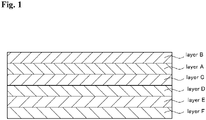
- FIG. 1 is an explanatory view for illustrating an example of a laminate structure of a liquid-packaging carton material according to the present invention.
- FIG. 1 is an explanatory view for illustrating an example of a laminate structure of the liquid-packaging carton material according to the present invention.
- the liquid-packaging carton material in this example has a layer structure in which a thermoplastic resin layer containing a polyethylene resin as a main component (layer B) serving as an outermost layer is laminated on a front surface of a paper base material layer (layer A), and at least a thermoplastic resin layer containing a polyethylene resin as a main component (layer C), a barrier layer (layer D), an adhesive resin layer (layer E), and a thermoplastic resin layer containing a polyethylene resin as a main component (layer F) serving as an innermost layer are laminated on a back surface of the paper base material layer (layer A) in the stated order from the back surface side.
- the polyethylene resin used for each of the thermoplastic resin layer containing a polyethylene resin as a main component (layer B) to be laminated on the front surface of the paper base material layer (layer A) and the thermoplastic resin layer containing a polyethylene resin as a main component (layer C) to be laminated on the back surface of the paper base material layer (layer A) is not particularly limited, and polyethylene(s) selected from, for example, low-density polyethylene, linear low-density polyethylene, medium-density polyethylene, and high-density polyethylene are used.
- thermoplastic resin layer containing a polyethylene resin as a main component (layer B) and the thermoplastic resin layer containing a polyethylene resin as a main component (layer C) may each be formed only of a polyethylene resin, and any other thermoplastic resin that may be subjected to heat sealing may be mixed therewith.
- thermoplastic resin to be mixed may include polypropylene and a modified polyester.
- thermoplastic resin for forming the thermoplastic resin layer (layer F)
- a thermoplastic resin having a melt mass-flow rate higher than a melt mass-flow rate of an adhesive resin for forming the adhesive resin layer (layer E) is used.
- the melt mass-flow rate of the adhesive resin for forming the adhesive resin layer (layer E) is preferably from 6 g/10 min to 9 g/10 min, and the melt mass-flow rate of the thermoplastic resin for forming the thermoplastic resin layer (layer F) is preferably 12 g/10 min or more.
- an adhesive resin having a melt mass-flow rate of 8 g/10 min is used as the adhesive resin for forming the adhesive resin layer (layer E), and a thermoplastic resin having a melt mass-flow rate of 15 g/10 min is used as the thermoplastic resin for forming the thermoplastic resin layer (layer F).
- the melt mass-flow rate is measured in conformity with JIS K 7210, and the measurement temperature is 190°C.
- the adhesive resin for forming the adhesive resin layer (layer E) bonds the barrier layer (layer D) and the thermoplastic resin layer (layer F) to each other, and a thermoplastic resin which is melted by heat to exhibit adhesiveness is used.
- the adhesive resin include low-density polyethylene, an ethylene-acrylic acid copolymer resin (EAA), an ethylene-methacrylic acid copolymer resin (EMAA), an ionomer, an ethylene-methyl acrylate copolymer resin (EMA), an ethylene-methyl methacrylate copolymer resin (EMMA), and a type of polyethylene subjected to graft polymerization with maleic anhydride (specifically, ADMER manufactured by Mitsui Chemicals, Inc.).
- an ethylene-methacrylic acid copolymer resin or a thermoplastic resin containing an ethylene-methacrylic acid copolymer resin as a main component is suitable for the adhesive resin to be used for the adhesive resin layer (layer E) particularly when the barrier layer (layer D) is metal foil such as aluminum foil because the resin is excellent in adhesiveness with a metal.
- thermoplastic resin containing a polyethylene resin as a main component is suitable for the adhesive resin to be used for the adhesive resin layer (layer E) when the barrier layer (layer D) is not the metal foil and a ceramic deposited film or a resin, such as an ethylene vinyl alcohol copolymer (EVOH), polyvinylidene chloride (PVDC), or nylon, is used as the layer.
- EVOH ethylene vinyl alcohol copolymer
- PVDC polyvinylidene chloride
- nylon nylon
- the barrier layer (layer D) only needs to have an oxygen barrier property to prevent permeation of oxygen, and is not particularly limited, and there is used, for example, aluminum foil, a ceramic deposited film, or an ethylene vinyl alcohol copolymer (EVOH).
- aluminum foil is used as the barrier layer (layer D).
- thermoplastic resin having a melt mass-flow rate higher than the melt mass-flow rate of the adhesive resin for forming the adhesive resin layer (layer E) is used as the thermoplastic resin for forming the thermoplastic resin layer (layer F), and hence the thermoplastic resin layer (layer F) is more easily melted than the adhesive resin layer (layer E).
- thermoplastic resin layer (layer F) can be melted so as to become sufficiently flowable before the adhesive resin layer (layer E) is melted.
- the step can be securely filled, and hence stable sealing in which the joint portion is sealed without a pin hole can be secured.
- the melt mass-flow rate of the adhesive resin for forming the adhesive resin layer (layer E) is preferably from 6 g/10 min to 9 g/10 min
- the melt mass-flow rate of the thermoplastic resin for forming the thermoplastic resin layer (layer F) is preferably 12 g/10 min or more.
- barrier layer D aluminum foil is used as the barrier layer (layer D).
- the barrier layer (layer D) is not a metal and a ceramic deposited film or a resin, such as an ethylene vinyl alcohol copolymer (EVOH), polyvinylidene chloride (PVDC), or nylon, is used as the layer, in the sealing of a joint portion of the liquid-packaging carton performed in a process for forming of a liquid-packaging carton, the sealing may be performed not only by the ultrasonic vibration sealing system but also by a high-frequency induction sealing system or a hot air sealing system.
- EVOH ethylene vinyl alcohol copolymer
- PVDC polyvinylidene chloride
- the liquid-packaging carton according to the present invention is formed by using the liquid-packaging carton material, and is formed in accordance with a forming step of an aseptic filling packaging system of the related-art.
- a shape of the liquid-packaging carton to be formed is not particularly limited, and there are given, for example, gable top-type and brick-type liquid-packaging cartons.
- the liquid-packaging carton formed by using the liquid-packaging carton material the liquid-packaging carton in which the joint portion is securely sealed without a pin hole can be obtained even when the sealing of the joint portion of the liquid-packaging carton is performed by the ultrasonic vibration sealing system.
Landscapes
- Engineering & Computer Science (AREA)
- Mechanical Engineering (AREA)
- Physics & Mathematics (AREA)
- Thermal Sciences (AREA)
- Cartons (AREA)
- Laminated Bodies (AREA)
Abstract
Description
- The present invention relates to a liquid-packaging carton material and a liquid-packaging carton for packaging a liquid beverage by an aseptic filling packaging system.
- As a liquid-packaging carton material to be used for, for example, a gable top-type liquid-packaging carton or a brick-type liquid-packaging carton for packaging milk, a fruit juice beverage, green tea, an alcoholic beverage, and other various liquid beverages by an aseptic filling packaging system, there is known a liquid-packaging carton material obtained by laminating a thermoplastic resin layer containing a polyethylene resin as a main component serving as an outermost layer on a front surface of a paper base material layer, and laminating at least a thermoplastic resin layer containing a polyethylene resin as a main component, a barrier layer, an adhesive resin layer, and a thermoplastic resin layer containing a polyethylene resin as a main component serving as an innermost layer on a back surface of the paper base material layer in the stated order from a back surface side (see, for example, Patent Literatures 1 and 2).
- In sealing of a joint portion performed in forming of a liquid-packaging carton using the liquid-packaging carton material, the thermoplastic resin layer containing a polyethylene resin as a main component serving as an innermost layer serves as a sealant layer for the sealing. As a system of sealing through melting of the thermoplastic resin layer which is the innermost layer serving as the sealant layer, there are known a high-frequency induction sealing system, a hot air sealing system, and an ultrasonic vibration sealing system. The high-frequency induction sealing system, which uses a metal as a medium, cannot be used when the barrier layer is not aluminum because heating cannot be performed. In addition, the hot air sealing system cannot be used in some usage environments. Accordingly, the ultrasonic vibration sealing system, which can be used even when the barrier layer is not aluminum, and which has no restriction on usage environments, is widely adopted.
-
- [PTL 1]
JP 2001-322624 A - [PTL 2]
JP 2007-269037 A - However, in the sealing by the ultrasonic vibration sealing system, vibration is applied from outside to melt the innermost layer with frictional heat. Accordingly, when the melting is not sufficient owing to, for example, restriction on melting time, in the case where the joint portion has a step, the step cannot be filled, and hence a pin hole is liable to be generated by an air gap, and sealing performance may be impaired. In order to prevent such situation, when an energy and a pressure of the ultrasonic vibration are increased, the adhesive resin layer bonded to the barrier layer may be melted to flow owing to excessive heat generation, with the result that the bonding may be hindered.
- Accordingly, in the sealing by the ultrasonic vibration sealing system, there has been a problem in that it is difficult to secure stable sealing conditions so that sealing can be performed without a pin hole.
- The inventors of the present invention have made extensive test studies in order to solve the above-mentioned problem, and as a result, with attention focused on meltability of the thermoplastic resin layer containing a polyethylene resin as a main component serving as an innermost layer, have completed the present invention.
- An object of the present invention is to provide a liquid-packaging carton material and a liquid-packaging carton each suitable for sealing of a joint portion particularly by an ultrasonic vibration sealing system.
- In order to achieve the above-mentioned object, according to the invention as described in claim 1, there is provided a liquid-packaging carton material, including: a paper base material layer (layer A); a thermoplastic resin layer containing a polyethylene resin as a main component (layer B) serving as an outermost layer, which is laminated on a front surface of the paper base material layer (layer A); and at least: a thermoplastic resin layer containing a polyethylene resin as a main component (layer C); a barrier layer (layer D); an adhesive resin layer (layer E); and a thermoplastic resin layer containing a polyethylene resin as a main component (layer F) serving as an innermost layer, which are laminated on a back surface of the paper base material layer (layer A) in the stated order from a back surface side, wherein a thermoplastic resin for forming the thermoplastic resin layer (layer F) has a melt mass-flow rate higher than a melt mass-flow rate of an adhesive resin for forming the adhesive resin layer (layer E).
- According to the invention as described in claim 2, in the invention as described in claim 1, the adhesive resin for forming the adhesive resin layer (layer E) has a melt mass-flow rate of from 6 g/10 min to 9 g/10 min, and the thermoplastic resin for forming the thermoplastic resin layer (layer F) has a melt mass-flow rate of 12 g/10 min or more.
- According to the invention as described in claim 3, in the invention as described in claim 1 or 2, the adhesive resin of the adhesive resin layer (layer E) contains an ethylene-methacrylic acid copolymer resin as a main component.
- According to the invention as described in claim 4, in the invention as described in claim 1 or 2, the adhesive resin of the adhesive resin layer (layer E) contains a polyethylene resin as a main component.
- According to the invention as described in claim 5, there is provided a liquid-packaging carton, which is obtained by using the liquid-packaging carton material of any one of claims 1 to 4.
- According to the invention as described in claim 1, the liquid-packaging carton material, including: the paper base material layer (layer A); the thermoplastic resin layer containing a polyethylene resin as a main component (layer B) serving as an outermost layer, which is laminated on the front surface of the paper base material layer (layer A); and at least: the thermoplastic resin layer containing a polyethylene resin as a main component (layer C); the barrier layer (layer D); the adhesive resin layer (layer E); and the thermoplastic resin layer containing a polyethylene resin as a main component (layer F) serving as an innermost layer, which are laminated on the back surface of the paper base material layer (layer A) in the stated order from the back surface side, can be provided. The thermoplastic resin for forming the thermoplastic resin layer (layer F) has a melt mass-flow rate higher than the melt mass-flow rate of the adhesive resin for forming the adhesive resin layer (layer E), and hence the thermoplastic resin layer (layer F) can be more easily melted than the adhesive resin layer (layer E) .
- With this configuration, even when sealing of a joint portion of the liquid-packaging carton performed in a process for forming of the liquid-packaging carton is performed by an ultrasonic vibration sealing system, the thermoplastic resin layer (layer F) can be melted so as to become sufficiently flowable before the adhesive resin layer (layer E) is melted. With this configuration, even when the joint portion has a step, the step can be securely filled, and hence stable sealing in which the joint portion is sealed without a pin hole can be secured.
- According to the invention as described in claim 2, in the invention as described in claim 1, the adhesive resin for forming the adhesive resin layer (layer E) has a melt mass-flow rate of from 6 g/10 min to 9 g/10 min, and the thermoplastic resin for forming the thermoplastic resin layer (layer F) has a melt mass-flow rate of 12 g/10 min or more. Accordingly, in the sealing of the joint portion, the thermoplastic resin layer (layer F) is sufficiently melted to flow before the adhesive resin layer (layer E) is melted to flow, and hence stable sealing in which the joint portion is sealed without a pin hole can be secured without hindering bonding between the adhesive resin layer (layer E) and the barrier layer (layer D).
- According to the invention as described in claim 3, in the invention as described in claim 1 or 2, the adhesive resin of the adhesive resin layer (layer E) contains the ethylene-methacrylic acid copolymer resin as a main component, and hence is suitable when the barrier layer (layer D) is metal foil such as aluminum foil because the ethylene-methacrylic acid copolymer resin is excellent in adhesiveness with a metal.
- According to the invention as described in claim 4, in the invention as described in claim 1 or 2, the adhesive resin of the adhesive resin layer (layer E) contains the polyethylene resin as a main component, and hence is suitable when the barrier layer (layer D) is not the metal foil and a ceramic deposited film or a resin, such as an ethylene vinyl alcohol copolymer (EVOH), polyvinylidene chloride (PVDC), or nylon, is used as the layer.
- According to the invention as described in claim 5, the liquid-packaging carton is formed by using the liquid-packaging carton material of any one of claims 1 to 4. Accordingly, even when the sealing of the joint portion is performed by the ultrasonic vibration sealing system, the liquid-packaging carton in which the joint portion is securely sealed without a pin hole can be obtained.
-
FIG. 1 is an explanatory view for illustrating an example of a laminate structure of a liquid-packaging carton material according to the present invention. - Now, examples of embodiments of a liquid-packaging carton material and a liquid-packaging carton using the liquid-packaging carton material according to the present invention are described in detail with reference to the drawing.
- First, an example of an embodiment of the liquid-packaging carton material according to the present invention is described.
-
FIG. 1 is an explanatory view for illustrating an example of a laminate structure of the liquid-packaging carton material according to the present invention. - The liquid-packaging carton material in this example has a layer structure in which a thermoplastic resin layer containing a polyethylene resin as a main component (layer B) serving as an outermost layer is laminated on a front surface of a paper base material layer (layer A), and at least a thermoplastic resin layer containing a polyethylene resin as a main component (layer C), a barrier layer (layer D), an adhesive resin layer (layer E), and a thermoplastic resin layer containing a polyethylene resin as a main component (layer F) serving as an innermost layer are laminated on a back surface of the paper base material layer (layer A) in the stated order from the back surface side.
- The polyethylene resin used for each of the thermoplastic resin layer containing a polyethylene resin as a main component (layer B) to be laminated on the front surface of the paper base material layer (layer A) and the thermoplastic resin layer containing a polyethylene resin as a main component (layer C) to be laminated on the back surface of the paper base material layer (layer A) is not particularly limited, and polyethylene(s) selected from, for example, low-density polyethylene, linear low-density polyethylene, medium-density polyethylene, and high-density polyethylene are used.
- In addition, the thermoplastic resin layer containing a polyethylene resin as a main component (layer B) and the thermoplastic resin layer containing a polyethylene resin as a main component (layer C) may each be formed only of a polyethylene resin, and any other thermoplastic resin that may be subjected to heat sealing may be mixed therewith. Examples of the thermoplastic resin to be mixed may include polypropylene and a modified polyester.
- As the thermoplastic resin for forming the thermoplastic resin layer (layer F), a thermoplastic resin having a melt mass-flow rate higher than a melt mass-flow rate of an adhesive resin for forming the adhesive resin layer (layer E) is used.
- The melt mass-flow rate of the adhesive resin for forming the adhesive resin layer (layer E) is preferably from 6 g/10 min to 9 g/10 min, and the melt mass-flow rate of the thermoplastic resin for forming the thermoplastic resin layer (layer F) is preferably 12 g/10 min or more.
- In this example, an adhesive resin having a melt mass-flow rate of 8 g/10 min is used as the adhesive resin for forming the adhesive resin layer (layer E), and a thermoplastic resin having a melt mass-flow rate of 15 g/10 min is used as the thermoplastic resin for forming the thermoplastic resin layer (layer F).
- The melt mass-flow rate is measured in conformity with JIS K 7210, and the measurement temperature is 190°C.
- The adhesive resin for forming the adhesive resin layer (layer E) bonds the barrier layer (layer D) and the thermoplastic resin layer (layer F) to each other, and a thermoplastic resin which is melted by heat to exhibit adhesiveness is used. Examples of the adhesive resin include low-density polyethylene, an ethylene-acrylic acid copolymer resin (EAA), an ethylene-methacrylic acid copolymer resin (EMAA), an ionomer, an ethylene-methyl acrylate copolymer resin (EMA), an ethylene-methyl methacrylate copolymer resin (EMMA), and a type of polyethylene subjected to graft polymerization with maleic anhydride (specifically, ADMER manufactured by Mitsui Chemicals, Inc.). Of those adhesive resins, an ethylene-methacrylic acid copolymer resin or a thermoplastic resin containing an ethylene-methacrylic acid copolymer resin as a main component is suitable for the adhesive resin to be used for the adhesive resin layer (layer E) particularly when the barrier layer (layer D) is metal foil such as aluminum foil because the resin is excellent in adhesiveness with a metal. In addition, the thermoplastic resin containing a polyethylene resin as a main component is suitable for the adhesive resin to be used for the adhesive resin layer (layer E) when the barrier layer (layer D) is not the metal foil and a ceramic deposited film or a resin, such as an ethylene vinyl alcohol copolymer (EVOH), polyvinylidene chloride (PVDC), or nylon, is used as the layer.
- The barrier layer (layer D) only needs to have an oxygen barrier property to prevent permeation of oxygen, and is not particularly limited, and there is used, for example, aluminum foil, a ceramic deposited film, or an ethylene vinyl alcohol copolymer (EVOH). In this example, aluminum foil is used as the barrier layer (layer D).
- According to the liquid-packaging carton material formed as described above, the thermoplastic resin having a melt mass-flow rate higher than the melt mass-flow rate of the adhesive resin for forming the adhesive resin layer (layer E) is used as the thermoplastic resin for forming the thermoplastic resin layer (layer F), and hence the thermoplastic resin layer (layer F) is more easily melted than the adhesive resin layer (layer E).
- With this configuration, even when a joint portion of a liquid-packaging carton is sealed by an ultrasonic vibration sealing system in a process for forming of the liquid-packaging carton, the thermoplastic resin layer (layer F) can be melted so as to become sufficiently flowable before the adhesive resin layer (layer E) is melted. With this configuration, even when the joint portion of the liquid-packaging carton has a step, the step can be securely filled, and hence stable sealing in which the joint portion is sealed without a pin hole can be secured.
- In addition, the melt mass-flow rate of the adhesive resin for forming the adhesive resin layer (layer E) is preferably from 6 g/10 min to 9 g/10 min, and the melt mass-flow rate of the thermoplastic resin for forming the thermoplastic resin layer (layer F) is preferably 12 g/10 min or more. With such configuration, in the sealing of the joint portion of the liquid-packaging carton, the thermoplastic resin layer (layer F) is sufficiently melted to flow before the adhesive resin layer (layer E) is melted to flow, and hence stable sealing in which the joint portion is sealed without a pin hole can be secured without hindering bonding between the adhesive resin layer (layer E) and the barrier layer (layer D).
- In this example, aluminum foil is used as the barrier layer (layer D). However, when the barrier layer (layer D) is not a metal and a ceramic deposited film or a resin, such as an ethylene vinyl alcohol copolymer (EVOH), polyvinylidene chloride (PVDC), or nylon, is used as the layer, in the sealing of a joint portion of the liquid-packaging carton performed in a process for forming of a liquid-packaging carton, the sealing may be performed not only by the ultrasonic vibration sealing system but also by a high-frequency induction sealing system or a hot air sealing system.
- Next, an example of an embodiment of a liquid-packaging carton using the liquid-packaging carton material is described.
- The liquid-packaging carton according to the present invention is formed by using the liquid-packaging carton material, and is formed in accordance with a forming step of an aseptic filling packaging system of the related-art. A shape of the liquid-packaging carton to be formed is not particularly limited, and there are given, for example, gable top-type and brick-type liquid-packaging cartons.
- According to the liquid-packaging carton formed by using the liquid-packaging carton material, the liquid-packaging carton in which the joint portion is securely sealed without a pin hole can be obtained even when the sealing of the joint portion of the liquid-packaging carton is performed by the ultrasonic vibration sealing system.
Claims (5)
- A liquid-packaging carton material, comprising:a paper base material layer (layer A);a thermoplastic resin layer containing a polyethylene resin as a main component (layer B) serving as an outermost layer,which is laminated on a front surface of the paper base material layer (layer A); andat least:a thermoplastic resin layer containing a polyethylene resin as a main component (layer C);a barrier layer (layer D);an adhesive resin layer (layer E); anda thermoplastic resin layer containing a polyethylene resin as a main component (layer F) serving as an innermost layer,which are laminated on a back surface of the paper base material layer (layer A) in the stated order from a back surface side,wherein a thermoplastic resin for forming the thermoplastic resin layer (layer F) has a melt mass-flow rate higher than a melt mass-flow rate of an adhesive resin for forming the adhesive resin layer (layer E).
- The liquid-packaging carton material according to claim 1,wherein the adhesive resin for forming the adhesive resin layer (layer E) has a melt mass-flow rate of from 6 g/10 min to 9 g/10 min, andwherein the thermoplastic resin for forming the thermoplastic resin layer (layer F) has a melt mass-flow rate of 12 g/10 min or more.
- The liquid-packaging carton material according to claim 1 or 2, wherein the adhesive resin of the adhesive resin layer (layer E) contains an ethylene-methacrylic acid copolymer resin as a main component.
- The liquid-packaging carton material according to claim 1 or 2, wherein the adhesive resin of the adhesive resin layer (layer E) contains a polyethylene resin as a main component.
- A liquid-packaging carton, which is obtained by using the liquid-packaging carton material of any one of claims 1 to 4.
Applications Claiming Priority (2)
| Application Number | Priority Date | Filing Date | Title |
|---|---|---|---|
| JP2020039414 | 2020-03-06 | ||
| PCT/JP2021/008017 WO2021177323A1 (en) | 2020-03-06 | 2021-03-02 | Material of paper container for liquid, and paper container for liquid |
Publications (2)
| Publication Number | Publication Date |
|---|---|
| EP4116096A1 true EP4116096A1 (en) | 2023-01-11 |
| EP4116096A4 EP4116096A4 (en) | 2024-03-20 |
Family
ID=77613389
Family Applications (1)
| Application Number | Title | Priority Date | Filing Date |
|---|---|---|---|
| EP21763963.2A Pending EP4116096A4 (en) | 2020-03-06 | 2021-03-02 | Material of paper container for liquid, and paper container for liquid |
Country Status (5)
| Country | Link |
|---|---|
| US (1) | US20230095919A1 (en) |
| EP (1) | EP4116096A4 (en) |
| JP (1) | JP7682849B2 (en) |
| TW (1) | TW202146239A (en) |
| WO (1) | WO2021177323A1 (en) |
Family Cites Families (12)
| Publication number | Priority date | Publication date | Assignee | Title |
|---|---|---|---|---|
| JPS57156247A (en) * | 1981-03-20 | 1982-09-27 | Dainippon Printing Co Ltd | Carton material for liquid vessel |
| JPH0648458A (en) * | 1992-07-24 | 1994-02-22 | Mitsui Toatsu Chem Inc | Twist wrapping film and manufacture thereof |
| JPH0776336A (en) * | 1993-09-10 | 1995-03-20 | Goyo Paper Working Co Ltd | Base material for food containers |
| JP3025434B2 (en) * | 1995-05-18 | 2000-03-27 | 日本製紙株式会社 | Easy-open paper containers |
| JP4103891B2 (en) * | 2002-05-29 | 2008-06-18 | 凸版印刷株式会社 | Tube container and manufacturing method thereof |
| JP3828861B2 (en) * | 2002-12-03 | 2006-10-04 | 東京製紙株式会社 | Laminated body and paper container and package using the same |
| JP2005219380A (en) * | 2004-02-06 | 2005-08-18 | Tosoh Corp | Laminated body |
| JP5286850B2 (en) * | 2008-03-14 | 2013-09-11 | 大日本印刷株式会社 | Packaging material for liquid paper container and liquid paper container manufactured from the packaging material |
| WO2014024913A1 (en) * | 2012-08-10 | 2014-02-13 | 日本製紙株式会社 | Multilayered paper container |
| JP2018002196A (en) * | 2016-06-29 | 2018-01-11 | 日本製紙株式会社 | Paper container for liquid |
| JP6187649B2 (en) * | 2016-08-05 | 2017-08-30 | 凸版印刷株式会社 | Laminate for liquid paper container and liquid paper container |
| ES2774148T3 (en) * | 2017-05-31 | 2020-07-17 | Tetra Laval Holdings & Finance | Laminated packaging material, packaging containers made from it, and a method for manufacturing the laminated material |
-
2021
- 2021-03-02 US US17/909,117 patent/US20230095919A1/en active Pending
- 2021-03-02 EP EP21763963.2A patent/EP4116096A4/en active Pending
- 2021-03-02 JP JP2022504410A patent/JP7682849B2/en active Active
- 2021-03-02 WO PCT/JP2021/008017 patent/WO2021177323A1/en not_active Ceased
- 2021-03-05 TW TW110107849A patent/TW202146239A/en unknown
Also Published As
| Publication number | Publication date |
|---|---|
| US20230095919A1 (en) | 2023-03-30 |
| JPWO2021177323A1 (en) | 2021-09-10 |
| WO2021177323A1 (en) | 2021-09-10 |
| TW202146239A (en) | 2021-12-16 |
| EP4116096A4 (en) | 2024-03-20 |
| JP7682849B2 (en) | 2025-05-26 |
Similar Documents
| Publication | Publication Date | Title |
|---|---|---|
| CN104334459B (en) | Multi-ply paper container | |
| JP2020044713A (en) | Packaging material | |
| CN214649652U (en) | Cup-shaped container | |
| JP2013133147A (en) | Lid material and sealed container using the lid material | |
| US20230095919A1 (en) | Material of paper container for liquid, and paper container for liquid | |
| JP5741084B2 (en) | Paper tray container | |
| JP5983241B2 (en) | Lid material | |
| JP4840721B2 (en) | Retort pouch | |
| JP7696026B2 (en) | Container lid material and packaging material | |
| JP2021095216A (en) | Cup-like container | |
| JP6398353B2 (en) | Packaging materials for paper containers | |
| JP2010018283A (en) | Strip for packaging container and paper packaging container | |
| JP2004042565A (en) | Easy-open sealant film, packaging material and container using the same | |
| JPH11147294A (en) | Paper container made of chemical resistant laminated film and its laminate | |
| JP5750882B2 (en) | Sealed container and manufacturing method thereof | |
| JPH09327888A (en) | Laminate for forming paper container and liquid paper container using the same | |
| JP7573435B2 (en) | Cup-shaped container | |
| JPS6023144A (en) | Easy-open heat seal cover | |
| JP7743295B2 (en) | Pouch | |
| JP2014223923A (en) | Paper container for liquid and method for manufacturing the same | |
| JP3122774B2 (en) | Heat sealing material for hermetically sealed containers | |
| JP2013154607A (en) | Lid material | |
| JP4620193B2 (en) | Liquid paper container | |
| JP5965817B2 (en) | Container, packaging container, container manufacturing method, and packaging container manufacturing method | |
| JPH10338279A (en) | Container having spout for liquid food and its manufacture |
Legal Events
| Date | Code | Title | Description |
|---|---|---|---|
| STAA | Information on the status of an ep patent application or granted ep patent |
Free format text: STATUS: THE INTERNATIONAL PUBLICATION HAS BEEN MADE |
|
| PUAI | Public reference made under article 153(3) epc to a published international application that has entered the european phase |
Free format text: ORIGINAL CODE: 0009012 |
|
| STAA | Information on the status of an ep patent application or granted ep patent |
Free format text: STATUS: REQUEST FOR EXAMINATION WAS MADE |
|
| 17P | Request for examination filed |
Effective date: 20220930 |
|
| AK | Designated contracting states |
Kind code of ref document: A1 Designated state(s): AL AT BE BG CH CY CZ DE DK EE ES FI FR GB GR HR HU IE IS IT LI LT LU LV MC MK MT NL NO PL PT RO RS SE SI SK SM TR |
|
| DAV | Request for validation of the european patent (deleted) | ||
| DAX | Request for extension of the european patent (deleted) | ||
| A4 | Supplementary search report drawn up and despatched |
Effective date: 20240219 |
|
| RIC1 | Information provided on ipc code assigned before grant |
Ipc: B32B 29/00 20060101ALI20240213BHEP Ipc: B32B 27/34 20060101ALI20240213BHEP Ipc: B32B 27/30 20060101ALI20240213BHEP Ipc: B32B 7/02 20190101ALI20240213BHEP Ipc: B65D 65/40 20060101ALI20240213BHEP Ipc: B32B 27/10 20060101ALI20240213BHEP Ipc: B32B 27/00 20060101ALI20240213BHEP Ipc: B32B 27/32 20060101AFI20240213BHEP |