EP4114510B1 - Medical treatment device for stimulating neurons of a patient to suppress a pathologically synchronous activity thereof - Google Patents
Medical treatment device for stimulating neurons of a patient to suppress a pathologically synchronous activity thereof Download PDFInfo
- Publication number
- EP4114510B1 EP4114510B1 EP21709953.0A EP21709953A EP4114510B1 EP 4114510 B1 EP4114510 B1 EP 4114510B1 EP 21709953 A EP21709953 A EP 21709953A EP 4114510 B1 EP4114510 B1 EP 4114510B1
- Authority
- EP
- European Patent Office
- Prior art keywords
- patient
- stimulating
- treatment device
- medical treatment
- acoustic
- Prior art date
- Legal status (The legal status is an assumption and is not a legal conclusion. Google has not performed a legal analysis and makes no representation as to the accuracy of the status listed.)
- Active
Links
Images
Classifications
-
- A—HUMAN NECESSITIES
- A61—MEDICAL OR VETERINARY SCIENCE; HYGIENE
- A61N—ELECTROTHERAPY; MAGNETOTHERAPY; RADIATION THERAPY; ULTRASOUND THERAPY
- A61N1/00—Electrotherapy; Circuits therefor
- A61N1/18—Applying electric currents by contact electrodes
- A61N1/32—Applying electric currents by contact electrodes alternating or intermittent currents
- A61N1/36—Applying electric currents by contact electrodes alternating or intermittent currents for stimulation
- A61N1/36014—External stimulators, e.g. with patch electrodes
- A61N1/36025—External stimulators, e.g. with patch electrodes for treating a mental or cerebral condition
-
- A—HUMAN NECESSITIES
- A61—MEDICAL OR VETERINARY SCIENCE; HYGIENE
- A61H—PHYSICAL THERAPY APPARATUS, e.g. DEVICES FOR LOCATING OR STIMULATING REFLEX POINTS IN THE BODY; ARTIFICIAL RESPIRATION; MASSAGE; BATHING DEVICES FOR SPECIAL THERAPEUTIC OR HYGIENIC PURPOSES OR SPECIFIC PARTS OF THE BODY
- A61H23/00—Percussion or vibration massage, e.g. using supersonic vibration; Suction-vibration massage; Massage with moving diaphragms
- A61H23/008—Percussion or vibration massage, e.g. using supersonic vibration; Suction-vibration massage; Massage with moving diaphragms using shock waves
-
- A—HUMAN NECESSITIES
- A61—MEDICAL OR VETERINARY SCIENCE; HYGIENE
- A61H—PHYSICAL THERAPY APPARATUS, e.g. DEVICES FOR LOCATING OR STIMULATING REFLEX POINTS IN THE BODY; ARTIFICIAL RESPIRATION; MASSAGE; BATHING DEVICES FOR SPECIAL THERAPEUTIC OR HYGIENIC PURPOSES OR SPECIFIC PARTS OF THE BODY
- A61H23/00—Percussion or vibration massage, e.g. using supersonic vibration; Suction-vibration massage; Massage with moving diaphragms
- A61H23/02—Percussion or vibration massage, e.g. using supersonic vibration; Suction-vibration massage; Massage with moving diaphragms with electric or magnetic drive
- A61H23/0245—Percussion or vibration massage, e.g. using supersonic vibration; Suction-vibration massage; Massage with moving diaphragms with electric or magnetic drive with ultrasonic transducers, e.g. piezoelectric
-
- A—HUMAN NECESSITIES
- A61—MEDICAL OR VETERINARY SCIENCE; HYGIENE
- A61M—DEVICES FOR INTRODUCING MEDIA INTO, OR ONTO, THE BODY; DEVICES FOR TRANSDUCING BODY MEDIA OR FOR TAKING MEDIA FROM THE BODY; DEVICES FOR PRODUCING OR ENDING SLEEP OR STUPOR
- A61M21/00—Other devices or methods to cause a change in the state of consciousness; Devices for producing or ending sleep by mechanical, optical, or acoustical means, e.g. for hypnosis
-
- A—HUMAN NECESSITIES
- A61—MEDICAL OR VETERINARY SCIENCE; HYGIENE
- A61H—PHYSICAL THERAPY APPARATUS, e.g. DEVICES FOR LOCATING OR STIMULATING REFLEX POINTS IN THE BODY; ARTIFICIAL RESPIRATION; MASSAGE; BATHING DEVICES FOR SPECIAL THERAPEUTIC OR HYGIENIC PURPOSES OR SPECIFIC PARTS OF THE BODY
- A61H2201/00—Characteristics of apparatus not provided for in the preceding codes
- A61H2201/01—Constructive details
- A61H2201/0157—Constructive details portable
-
- A—HUMAN NECESSITIES
- A61—MEDICAL OR VETERINARY SCIENCE; HYGIENE
- A61H—PHYSICAL THERAPY APPARATUS, e.g. DEVICES FOR LOCATING OR STIMULATING REFLEX POINTS IN THE BODY; ARTIFICIAL RESPIRATION; MASSAGE; BATHING DEVICES FOR SPECIAL THERAPEUTIC OR HYGIENIC PURPOSES OR SPECIFIC PARTS OF THE BODY
- A61H2201/00—Characteristics of apparatus not provided for in the preceding codes
- A61H2201/12—Driving means
- A61H2201/1207—Driving means with electric or magnetic drive
-
- A—HUMAN NECESSITIES
- A61—MEDICAL OR VETERINARY SCIENCE; HYGIENE
- A61H—PHYSICAL THERAPY APPARATUS, e.g. DEVICES FOR LOCATING OR STIMULATING REFLEX POINTS IN THE BODY; ARTIFICIAL RESPIRATION; MASSAGE; BATHING DEVICES FOR SPECIAL THERAPEUTIC OR HYGIENIC PURPOSES OR SPECIFIC PARTS OF THE BODY
- A61H2201/00—Characteristics of apparatus not provided for in the preceding codes
- A61H2201/16—Physical interface with patient
- A61H2201/1602—Physical interface with patient kind of interface, e.g. head rest, knee support or lumbar support
- A61H2201/1604—Head
- A61H2201/1607—Holding means therefor
-
- A—HUMAN NECESSITIES
- A61—MEDICAL OR VETERINARY SCIENCE; HYGIENE
- A61H—PHYSICAL THERAPY APPARATUS, e.g. DEVICES FOR LOCATING OR STIMULATING REFLEX POINTS IN THE BODY; ARTIFICIAL RESPIRATION; MASSAGE; BATHING DEVICES FOR SPECIAL THERAPEUTIC OR HYGIENIC PURPOSES OR SPECIFIC PARTS OF THE BODY
- A61H2205/00—Devices for specific parts of the body
- A61H2205/02—Head
-
- A—HUMAN NECESSITIES
- A61—MEDICAL OR VETERINARY SCIENCE; HYGIENE
- A61M—DEVICES FOR INTRODUCING MEDIA INTO, OR ONTO, THE BODY; DEVICES FOR TRANSDUCING BODY MEDIA OR FOR TAKING MEDIA FROM THE BODY; DEVICES FOR PRODUCING OR ENDING SLEEP OR STUPOR
- A61M21/00—Other devices or methods to cause a change in the state of consciousness; Devices for producing or ending sleep by mechanical, optical, or acoustical means, e.g. for hypnosis
- A61M2021/0005—Other devices or methods to cause a change in the state of consciousness; Devices for producing or ending sleep by mechanical, optical, or acoustical means, e.g. for hypnosis by the use of a particular sense, or stimulus
- A61M2021/0022—Other devices or methods to cause a change in the state of consciousness; Devices for producing or ending sleep by mechanical, optical, or acoustical means, e.g. for hypnosis by the use of a particular sense, or stimulus by the tactile sense, e.g. vibrations
-
- A—HUMAN NECESSITIES
- A61—MEDICAL OR VETERINARY SCIENCE; HYGIENE
- A61M—DEVICES FOR INTRODUCING MEDIA INTO, OR ONTO, THE BODY; DEVICES FOR TRANSDUCING BODY MEDIA OR FOR TAKING MEDIA FROM THE BODY; DEVICES FOR PRODUCING OR ENDING SLEEP OR STUPOR
- A61M21/00—Other devices or methods to cause a change in the state of consciousness; Devices for producing or ending sleep by mechanical, optical, or acoustical means, e.g. for hypnosis
- A61M2021/0005—Other devices or methods to cause a change in the state of consciousness; Devices for producing or ending sleep by mechanical, optical, or acoustical means, e.g. for hypnosis by the use of a particular sense, or stimulus
- A61M2021/0027—Other devices or methods to cause a change in the state of consciousness; Devices for producing or ending sleep by mechanical, optical, or acoustical means, e.g. for hypnosis by the use of a particular sense, or stimulus by the hearing sense
-
- A—HUMAN NECESSITIES
- A61—MEDICAL OR VETERINARY SCIENCE; HYGIENE
- A61M—DEVICES FOR INTRODUCING MEDIA INTO, OR ONTO, THE BODY; DEVICES FOR TRANSDUCING BODY MEDIA OR FOR TAKING MEDIA FROM THE BODY; DEVICES FOR PRODUCING OR ENDING SLEEP OR STUPOR
- A61M21/00—Other devices or methods to cause a change in the state of consciousness; Devices for producing or ending sleep by mechanical, optical, or acoustical means, e.g. for hypnosis
- A61M2021/0005—Other devices or methods to cause a change in the state of consciousness; Devices for producing or ending sleep by mechanical, optical, or acoustical means, e.g. for hypnosis by the use of a particular sense, or stimulus
- A61M2021/0044—Other devices or methods to cause a change in the state of consciousness; Devices for producing or ending sleep by mechanical, optical, or acoustical means, e.g. for hypnosis by the use of a particular sense, or stimulus by the sight sense
-
- A—HUMAN NECESSITIES
- A61—MEDICAL OR VETERINARY SCIENCE; HYGIENE
- A61M—DEVICES FOR INTRODUCING MEDIA INTO, OR ONTO, THE BODY; DEVICES FOR TRANSDUCING BODY MEDIA OR FOR TAKING MEDIA FROM THE BODY; DEVICES FOR PRODUCING OR ENDING SLEEP OR STUPOR
- A61M21/00—Other devices or methods to cause a change in the state of consciousness; Devices for producing or ending sleep by mechanical, optical, or acoustical means, e.g. for hypnosis
- A61M2021/0005—Other devices or methods to cause a change in the state of consciousness; Devices for producing or ending sleep by mechanical, optical, or acoustical means, e.g. for hypnosis by the use of a particular sense, or stimulus
- A61M2021/0066—Other devices or methods to cause a change in the state of consciousness; Devices for producing or ending sleep by mechanical, optical, or acoustical means, e.g. for hypnosis by the use of a particular sense, or stimulus with heating or cooling
-
- A—HUMAN NECESSITIES
- A61—MEDICAL OR VETERINARY SCIENCE; HYGIENE
- A61M—DEVICES FOR INTRODUCING MEDIA INTO, OR ONTO, THE BODY; DEVICES FOR TRANSDUCING BODY MEDIA OR FOR TAKING MEDIA FROM THE BODY; DEVICES FOR PRODUCING OR ENDING SLEEP OR STUPOR
- A61M21/00—Other devices or methods to cause a change in the state of consciousness; Devices for producing or ending sleep by mechanical, optical, or acoustical means, e.g. for hypnosis
- A61M2021/0005—Other devices or methods to cause a change in the state of consciousness; Devices for producing or ending sleep by mechanical, optical, or acoustical means, e.g. for hypnosis by the use of a particular sense, or stimulus
- A61M2021/0072—Other devices or methods to cause a change in the state of consciousness; Devices for producing or ending sleep by mechanical, optical, or acoustical means, e.g. for hypnosis by the use of a particular sense, or stimulus with application of electrical currents
-
- A—HUMAN NECESSITIES
- A61—MEDICAL OR VETERINARY SCIENCE; HYGIENE
- A61M—DEVICES FOR INTRODUCING MEDIA INTO, OR ONTO, THE BODY; DEVICES FOR TRANSDUCING BODY MEDIA OR FOR TAKING MEDIA FROM THE BODY; DEVICES FOR PRODUCING OR ENDING SLEEP OR STUPOR
- A61M2209/00—Ancillary equipment
- A61M2209/08—Supports for equipment
- A61M2209/088—Supports for equipment on the body
Definitions
- DBS Deep Brain Stimulation
- DBS requires surgical procedures associated with a significant risk. For instance, depth electrode implantation in dedicated target areas in the brain may cause bleedings. Furthermore, standard continuous high-frequency DBS may cause side effects.
- acoustic stimuli are perceived by the patient. This is caused by sound waves generated upon actuation of the stimulation elements which are conducted to the patient's inner ear through air and bone conduction.
- these acoustic stimuli constitute undesired side effects which are usually experienced as annoying and unpleasant by the patient, thereby reducing compliance. This particularly applies when the treatment is employed frequently, e.g. for long hours every day during weeks or months.
- WO 2011/127918 A1 refers to a device with a non-invasive first stimulation unit for generating first stimuli which, when administered to a patient, suppress a pathologically synchronous activity of neurons in the brain and/or spinal cord of the patient, with a non-invasive second stimulation unit for generating optical and/or acoustic and/or tactile and/or vibratory and/or thermal second stimuli, and with a control unit for controlling the first and second stimulation units, wherein the generation of the first and second stimuli takes place optionally in a first or a second operating mode, and the control unit controls the first and second stimulation units in such a way that, in the first operating mode, the generation of at least 60% of the second stimuli is coupled in time to the generation of the first stimuli and, in the second operating mode, the generation of at least 60% of the second stimuli takes place without the generation of the first stimuli.
- the aforementioned diseases can be caused by a disorder of the bioelectric communication of groups of neuronal cells which are connected to one another in specific circuits.
- a neuron population generates a continuous pathological neuronal activity and a pathological connectivity (network structure) possibly associated therewith.
- a large number of neurons form synchronous action potentials.
- the concerned neurons fire or burst excessively synchronously.
- the pathological neuron population has an oscillating neuronal activity, this means that the neurons fire or burst rhythmically.
- the mean frequency of the pathological rhythmic activity of the concerned groups of neurons approximately may be in the range of 1 Hz to 30 Hz, but may, however, also be outside of this range.
- the neurons of healthy people fire or burst qualitatively differently, for example, in an uncorrelated manner.
- each of the aforementioned diseases may be characterized by at least one neuronal population in the brain or spinal cord of the patient which has a pathological synchronous neuronal activity.
- the medical treatment device 10 is configured to stimulate the affected neuronal population so as to cause the affected neural population to fire or burst in an uncorrelated manner, i.e. non-synchronously.
- Such treatment techniques are also referred to as coordinated reset stimulation.
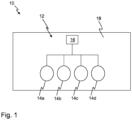
- the device 10 For acting onto the patient's body and thus for providing stimulation of the patient's neurons, the device 10 comprises a non-invasive stimulation unit 12 which is configured to provide different stimuli to the patient's body.
- non-invasive means that the medical treatment device 10, i.e. the stimulation unit 12, deploys a non-invasive procedure to achieve intended therapeutic effects.
- the suggested medical treatment device 10 does not require implantation of components into the patient's body, i.e. which would be associated with an intervention procedure.
- the medical treatment device 10 may be provided such that, in the fastened state of the medical treatment device 10, the plurality of stimulating elements 14a-d are arranged in at least one array so as to position the stimulating elements 14a-d to predefined regions onto the surface of the patient's body, respectively, so as to achieve the desired therapeutic effect.
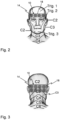
- the medical treatment device 10 comprises four stimulating elements 14 arranged in a linear array which, in a state in which the medical treatment device 10 is fastened to the patient's forehead, are arranged in the region of the patient's trigeminal skin segment so as to stimulate the ophthalmic or trigeminal nerve, in particular the first branch of the trigeminal nerve denoted by "Trig. 1" in Fig. 2 .
- the stimulation unit 12 is configured to provide the acoustic stimuli to the patient's inner ear and the non-acoustic stimuli to a patient's skin in the region of the first branch of the trigeminal nerve Trig.1.
- the shown medical treatment device 10 may comprise two arrays of stimulating elements 14, e.g. each of which comprises four stimulating elements 14 arranged in a line.
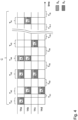
- the stimulating elements 14 are arranged so as to stimulate the C2 and C3 dermatome as depicted in Fig. 3 .
- the stimulation unit 12 is configured to provide the acoustic stimuli to the patient's inner ear and the non-acoustic stimuli to a patient's skin in the region of the C2 and C3 dermatome.
- the C4 to C6 dermatomes are illustrated.
- the medical treatment device 10 may be provided in the form of a headband which combines the above embodiments depicted in Fig. 2 and 3 . Accordingly, in this configuration, the medical treatment device 10 is configured to stimulate the patient's forehead and occiput and may comprise at least two or four stimulating elements for stimulating the patient's forehead and at least two or four stimulating elements for stimulating the patient's occiput.
- the stimulation unit 12 comprises the plurality of stimulating elements 14a-d which is configured to generate the acoustic and non-acoustic stimuli.
- the terms "stimulus” or “stimuli” refer to excitations capable of being sensed by the patient's body, i.e. by respective receptors, e.g. in the eyes, the ears and/or the skin of the patient depending of the stimuli's modality, from whom they are guided to a patient's nerve system causing an actuation of neurons in the patient's brain or spinal cord. In the context of the present disclosure, it is differentiated between two modalities of stimuli, i.e. between acoustic and non-acoustic stimuli.
- acoustic stimuli refer to excitations to be sensed by receptors provided in the ear, in particular the inner ear, of the patient. Typically, these excitations are provided to the inner ear in the form of sound waves through air and bone conduction.
- non-acoustic stimuli refer to any stimuli which do not constitute acoustic stimuli.
- non-acoustic stimuli may refer to any one of mechanical stimuli, in particular tactile or vibratory stimuli, optical stimuli, electric stimuli and thermal stimuli. These stimuli may be sensed by corresponding receptors, for example, in the patient's skin or eyes.
- the stimulation unit 12 is configured and designed for simultaneously administering at least one acoustic stimulus and at least one non-acoustic stimulus to a patient's body, wherein each one of the at least one acoustic stimulus and non-acoustic stimulus is configured to suppress the pathologically synchronous activity when being administered to the patient's body.
- each one of the acoustic and non-acoustic stimulus are configured to perform coordinated reset stimulation.
- the non-acoustic stimuli may be configured to suppress the pathologically synchronous activity when being administered to the patient's body, while the acoustic stimuli may not be configured to suppress the pathologically synchronous activity when being administered to the patient's body.
- the stimulating unit 12 is provided such that the at least one acoustic stimulus is configured to suppress a pathologically synchronous activity of a first neuronal sub-population when being administered to the patient's body. Further, the stimulating unit 12 is provided such that at least one non-acoustic stimulus is configured to suppress a pathologically synchronous activity of a second neuronal sub-population which is different or delimited from the first neuronal population when being administered to the patient's body.
- each one of the acoustic and non-acoustic stimuli is provided so as to at least partially cause actuation of the affected neuronal population upon being sensed by corresponding receptors in the patient's body and guided to its nerve system.
- the modality and characteristic of the generated stimuli as well as the intended location at which they are to be induced into the patient's body are respectively set as described in the following in more detail.
- the stimulation unit 12 is configured to generate tactile or vibratory stimuli, also referred to vibrotactile stimuli, to be administrated to corresponding receptors in the patient's skin, in particular in the head region of the patient.
- the human skin comprises different types of mechanoreceptive afferent units capable of sensing tactile or vibratory stimuli.
- the distribution and density of the different types of mechanoreceptors differs in dependence on the position on the human skin.
- the stimulation unit 12 comprises a plurality of vibrotactile stimulating elements 14a-d configured for generating the non-acoustic stimuli in the form of vibrotactile stimuli.
- each one of the vibrotactile stimulating elements 14a-d is configured to oscillatingly or periodically act onto the surface of the patient's body so as to administer the non-acoustic stimuli to the patient's body.
- the non-acoustic stimulus to be administered to the patient's body constitute periodic or oscillating stimulus, i.e. which amplitude or stimulation intensity periodically varies over time.
- the vibrotactile stimulating elements 14a-d comprise a rod or any other component configured for mechanically acting upon the patient's skin.
- the stimulating elements 14a-d include an electro-mechanical actuator for converting electrical energy into a movement of the rod.
- the electro-mechanical actuator may be an equal current motor, a voice coil, a piezo-electric transducer or a transformer built up of electro-active polymers which change their shape on the application of an electric current.
- the stimulation unit 12 may comprise or be connected to an energy source, in particular provided in the form of a battery.
- the stimulation unit 12 further comprises respective acoustic stimulating elements 14 which are configured to generate the acoustic stimuli to be administered to the patient's inner ear.
- the acoustic stimulating elements 14 are configured to generate sound waves which are provided to the patient's inner ear through air and/or bone conduction so as to administer the acoustic stimuli.
- the acoustic stimulating elements 14 are constituted by the vibrotactile stimulating elements 14a-d.
- each one of the stimulating elements 14a-d is configured to generate both the acoustic and the non-acoustic stimuli.
- the stimulation unit 12 is configured to simultaneously generate the acoustic stimulus and the non-acoustic stimulus upon oscillatingly or periodically actuating the respective stimulating elements 14a-d.
- the stimulation unit 12 is configured to generate the acoustic stimulus upon generating the non-acoustic stimulus.
- each one of the stimulating elements 14a-d is configured to, upon actuation, provide a set of stimuli constituted by a non-acoustic stimulus and an associated acoustic stimulus. Accordingly, each acoustic stimulus is associated to one non-acoustic stimulus, wherein the stimulation unit 12, i.e. each one of the stimulating elements 14a-d, is configured to generate one non-acoustic stimulus together with the associated acoustic stimulus.
- the stimulation unit 12 is provided such that each one of the plurality of stimulating elements 14a-d is actuated at an actuation frequency v in the range of human hearing, i.e. in the range between 20 Hz to 20 kHz.
- the stimulating elements 14 are actuated at an actuation frequency v in the range of 20 Hz to 250 Hz.
- the stimulating elements 14a-d may be actuated in frequency ranges associated with low-frequency tones, i.e. between 200 Hz to 600 Hz or between 330 Hz to 600 Hz, which may be perceived to be relaxing and pleasant by the patient.
- the stimulating elements 14a-d are configured such that they can be selectively and variedly actuated at different actuation frequencies among the indicated frequency ranges.
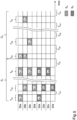
- the control unit 16 is configured to selectively and intermittently actuate the different stimulating elements 14a-d. Specifically, the control unit 16 is configured for actuating the stimulating elements 14a-d in a sequence C of successive actuating periods T A1-Ai , wherein character "i" refers to a total number of actuating periods within a sequence C.
- Figure 4 shows the sequence C of successive actuating periods T A1-Ai which forms a control sequence or control pattern illustrating the actuation of the respective actuating elements 14a-d over time. Specifically, in Fig. 4 , the actuation of the respective stimulating elements 14a-d is illustrated by means of dashed fields positioned within the actuating periods T A .
- the sequence C comprises the number i of time shifted, non-overlapping actuating periods T A1-Ai during which at least one of the stimulating elements 14a-d is actuated to generate both the acoustic stimuli S A and the non-acoustic, vibrotactile stimuli S V .
- acoustic and non-acoustic stimuli SA SV to be generated by the respective stimulating elements 14a-d, different pattern of the dashed fields, i.e. as regards their orientation and line thickness, are selected as indicated by the legend in Fig. 4 .
- the duration of the actuating periods T A1-Ai corresponds to a length of the corresponding stimuli S A , S V generated by the stimulation elements 14a-d.
- the actuating periods may have a duration between 25 ms to 3 s, in particular 100 ms or 125 ms.
- resting periods T R1-Ri are scheduled, during which the patient's body is not subjected to stimuli generated by the stimulation unit 12.
- the length of the resting periods T R1-Ri may vary or be constant during the sequence C. Further, the length of the resting period T R may be 0 s such that two successive actuating periods directly follow one after the other. In an alternative configuration, the actuating periods within the sequence may at least partially overlap.
- the control unit 16 may be configured to actuate exclusively one of the stimulating elements 14a-d or to simultaneously actuate more than one stimulating elements 14a-d.
- the control unit 16 is configured to variedly determine for each actuating period T A a number of n stimulating elements 14a-d to be simultaneously actuated during the respective actuating periods T A .
- the term "variedly" means that the values for the number n diversely, in particular non-periodically, varies across the sequence C.
- the parameter n is an integer greater than 1. If n equals 1, this means that during the respective actuating period T A exclusively one of the stimulating elements 14a-d is actuated. If n is greater than 1, this means that more than one, i.e. n, stimulating elements 14a-d are actuated simultaneously during the respective actuating period T A .
- control unit 16 may employ at least one of a deterministic, a stochastic, a chaotic and a (pseudo-)random algorithm method for variedly determining the number n of different stimulating elements 14a-d to be simultaneously actuated during the respective actuating periods T A and for determining the length of the actuating periods T A and the corresponding resting periods T R .
- each stimulating element 14a-d simultaneously generates acoustic and vibrotactile stimuli S A , S V when being actuated at a predefined frequency v 1-4 .
- the stimulation unit 12, i.e. its control unit 16, is configured to operate the different stimulating elements 14a-d at different actuating frequencies v 1-4 .
- the actuation frequency at which the respective stimulating elements 14a-d are to be actuated differs among the set of different stimulating elements 14a-d.
- Each stimulating element 14a-d is actuated at a substantially constant and the same actuation frequency v 1-4 during the sequence C. Specifically, when being actuated by the control unit 16, a first stimulating element 14a is operated at a first actuation frequency v 1 , a second stimulating element 14 is operated at the second actuation frequency v 2 , a third stimulating element 14c is operated at a third actuation frequency v 3 and a fourth stimulating element 14d is operated at a fourth actuation frequency v 4 .
- the stimulation unit 12 is configured such that the actuating frequencies v 1-4 , at which the stimulating elements 14a-d are to be actuated, in particular simultaneously actuated, are adjusted to a music scale.
- the stimulation unit 12 may be provided with a predetermined set of actuation frequencies v 1-4 , at which the individual stimulating elements 14a-d can be actuated, wherein the actuation frequencies v 1-4 , i.e. the individual members of the set of actuation frequencies, constitute, in particular substantially constitute, at least a part of a music scale. In this way, effectivity of the treatment as well as acceptability of the patient to the treatment may be improved.
- the actuation frequencies are adjusted to consonant frequencies of a music scale.
- the stimulation unit 12 may be configured such that the actuating frequencies v 1-4 , i.e. the individual members of the set of actuation frequencies, are adjusted to a pentatonic scale. In this way, particularly acceptable, smooth and/or relaxing acoustic stimulus sequences may be provided. Further, pentatonic frequencies may provide the advantageous effect that they can be smoothly combined.
- the stimulation unit 12 may be provided with a set of different actuation frequencies v 1-5 which constitute at least a part of the pentatonic scale.
- the other frequencies to be included into the set of actuating frequencies may be determined or calculated based on at least one of the following equations (1) to (4):
- v 2 v 1 ⁇ 9 / 8
- v 3 v 1 ⁇ 5 / 4
- v 4 v 1 ⁇ 3 / 2
- v 5 v 1 ⁇ 5 / 3
- v 1 may have a value of, for example, 200 Hz or 220 Hz or any other value, in particular in the range of 200 Hz to 600 Hz.
- v 1 may be a piano key frequency or any other musical instrument frequency.
- the stimulation unit 12 may be configured to adjust a vibration amplitude of each one of the different stimulating elements 14a-d. Specifically, the stimulation unit 12 may be configured to adjust the vibration amplitude of each one of the different stimulating elements 14a-d in dependence on a patient's perception in view of the acoustic or non-acoustic stimuli S A , S V . For doing so, the stimulation unit 12 may be configured to adjust the vibration amplitude of each one of the different stimulating elements 14a-d in dependence on at least one of an equal proprioceptive perception, an equal loudness perception or any other parameters being indicative of the patient's perception in view of the acoustic and non-acoustic stimuli S A , S V .
- the stimulation unit 12 is configured such that the actuation frequency of each one of the stimulating elements 14a-d remains constant or unchanged during operation, i.e. during the sequence C of actuating periods T A .
- the stimulation unit 12 may be configured to actuate at least one stimulating element 14a-d at different stimulating frequencies v.
- the stimulating unit 12 may be configured such that an actuation frequency of at least one stimulating element 14a-d is varied over time.
- the stimulating unit 12 may be configured such that the actuation frequency of at least one stimulating element 14a-d is varied during an actuating period T A .
- the stimulating unit 12 may be configured such that the actuation frequency of at least one stimulating element 14a-d remains constant during an actuating period T A , but is varied among the sequence C, i.e. among successive actuating periods T A .
- the first stimulating element 14a may be operated at the first actuation frequency v 1 during a first actuating period T A1 and may be operated at a different actuation frequency, e.g. the second, third or fourth actuation frequency v 2-4 or any other actuating frequency, in another actuating period T A .
- the actuation frequency of respective stimulating elements 14a-d may be varied such that it is successively increased or decreased, in particular by being successively adjusted to increasing or decreasing frequencies included in the predefined set of actuating frequencies.
- the control unit 16 is configured to operate the first and the second stimulating elements 20a-d, 22a-d such that the acoustic stimuli S A are generated decoupled from the generation of the non-acoustic stimuli S V .
- the patient is not subjected to the non-acoustic stimuli S V in the second operating mode, i.e. within the second sequence C2.
- all actuation frequencies i.e. at which the different stimulating element 14; 20a-d, 22a-d are operated, correlate in a predefined manner to one another, in particular so as to be adjusted to a pentatonic scale.
- a basic actuating frequency v 0 of a one of the stimulating elements, in particular of one of the second stimulating elements 22a-d, may be determined or provided based on which all other actuating frequencies of the residual stimulating elements are adjusted.
- a medical treatment device for stimulating neurons of a patient to suppress a pathologically synchronous activity of the neurons comprises a non-invasive stimulation unit configured for simultaneously administering at least one acoustic stimulus and at least one non-acoustic stimulus to a patient's body, each of which is configured to suppress the pathologically synchronous activity when being administered to the patient's body.
- the stimulation unit is provided such that the acoustic stimulus is configured to suppress a pathologically synchronous activity of a first neuronal population, in particular in at least one of a patient's brain or spinal cord, when being administered to the patient's body.
- the non-acoustic stimulus may be configured to suppress a pathologically synchronous activity of a second neuronal population, in particular in at least one of a patient's brain or spinal cord, which is different or delimited from the first neuronal population when being administered to the patient's body.
- each one of the at least one acoustic stimulus may be associated to one non-acoustic stimulus.
- the stimulation unit may be configured to simultaneously generate one non-acoustic stimulus together with its associated acoustic stimulus.
- the stimulating unit comprises at least one vibrotactile stimulating element which is configured to oscillatingly or periodically act onto a surface of the patient's body so as to administer the non-acoustic stimulus to the patient's body.
- the vibrotactile stimulating element and the acoustic stimulating element may be actuated at an actuation frequency in the range of 20 Hz to 20 kHz, in particular from 20 Hz to 250 Hz or from 200 Hz to 600 Hz.
- the stimulation unit may comprise at least two vibrotactile stimulating elements or any other stimulating elements for generating the non-acoustic and/or acoustic stimuli.
- Each one of the at least two stimulating elements may be configured to generate one of at least two non-acoustic stimuli, and wherein the stimulation unit is configured to operate the at least two stimulating elements at different actuation or vibration frequencies.
- the actuation or vibration frequencies, at which the stimulating elements are to be actuated may be adjusted to a music scale, in particular a pentatonic scale.
- the stimulation unit may be provided with a set of different actuation frequencies.
- This set of actuating frequencies may include actuating frequencies, in particular predefined actuating frequencies, at which the at least one stimulating element can be actuated.
- the stimulating elements may be configured to be actuated at the actuating frequencies comprised in the set of actuating frequencies. Accordingly, the stimulating elements may be not allowed to be operated at actuation frequencies which are not comprised in the set of actuating frequencies.
- the set of actuation frequencies may comprise a first actuating frequency and at least one further actuating frequency which is determined in dependence on or correlates to the first actuating frequency. In this way, upon determining the first actuating frequency, also the at least one further actuating frequency may be determined.
- the stimulation unit may comprise a control unit for controlling operation of the stimulation unit, in particular its stimulating elements.
- the control unit may be configured to operate the stimulation unit in a first operating mode in which the generation of the acoustic stimuli is linked or paired to the generation of the non-acoustic stimuli, and in a second operating mode in which the generation of the acoustic stimulate is decoupled from the generation of the non-acoustic stimuli.
Landscapes
- Health & Medical Sciences (AREA)
- Life Sciences & Earth Sciences (AREA)
- Veterinary Medicine (AREA)
- Animal Behavior & Ethology (AREA)
- General Health & Medical Sciences (AREA)
- Public Health (AREA)
- Physical Education & Sports Medicine (AREA)
- Rehabilitation Therapy (AREA)
- Pain & Pain Management (AREA)
- Biomedical Technology (AREA)
- Epidemiology (AREA)
- Heart & Thoracic Surgery (AREA)
- Psychology (AREA)
- Engineering & Computer Science (AREA)
- Neurology (AREA)
- Biophysics (AREA)
- Radiology & Medical Imaging (AREA)
- Nuclear Medicine, Radiotherapy & Molecular Imaging (AREA)
- Child & Adolescent Psychology (AREA)
- Developmental Disabilities (AREA)
- Hospice & Palliative Care (AREA)
- Social Psychology (AREA)
- Psychiatry (AREA)
- Physics & Mathematics (AREA)
- Anesthesiology (AREA)
- Hematology (AREA)
- Acoustics & Sound (AREA)
- Percussion Or Vibration Massage (AREA)
- Electrotherapy Devices (AREA)
- Finger-Pressure Massage (AREA)
Applications Claiming Priority (2)
| Application Number | Priority Date | Filing Date | Title |
|---|---|---|---|
| US202062984454P | 2020-03-03 | 2020-03-03 | |
| PCT/EP2021/055278 WO2021175898A1 (en) | 2020-03-03 | 2021-03-03 | Medical treatment device and method for stimulating neurons of a patient to suppress a pathologically synchronous activity thereof |
Publications (2)
| Publication Number | Publication Date |
|---|---|
| EP4114510A1 EP4114510A1 (en) | 2023-01-11 |
| EP4114510B1 true EP4114510B1 (en) | 2025-06-25 |
Family
ID=74858432
Family Applications (1)
| Application Number | Title | Priority Date | Filing Date |
|---|---|---|---|
| EP21709953.0A Active EP4114510B1 (en) | 2020-03-03 | 2021-03-03 | Medical treatment device for stimulating neurons of a patient to suppress a pathologically synchronous activity thereof |
Country Status (5)
| Country | Link |
|---|---|
| EP (1) | EP4114510B1 (enExample) |
| JP (1) | JP7522481B2 (enExample) |
| CN (1) | CN115335114A (enExample) |
| ES (1) | ES3039258T3 (enExample) |
| WO (1) | WO2021175898A1 (enExample) |
Families Citing this family (1)
| Publication number | Priority date | Publication date | Assignee | Title |
|---|---|---|---|---|
| GB2630139A (en) * | 2023-05-19 | 2024-11-20 | Charco Neurotech Ltd | Strap arrangement for use with wearable devices for mitigating symptoms of neurological conditions of users |
Family Cites Families (8)
| Publication number | Priority date | Publication date | Assignee | Title |
|---|---|---|---|---|
| DE102010016404A1 (de) * | 2010-04-12 | 2012-12-27 | Forschungszentrum Jülich GmbH | Vorrichtung und Verfahren zur konditionierten desynchronisierenden nicht-invasiven Stimulation |
| DE102012002436B4 (de) * | 2012-02-08 | 2014-08-21 | Forschungszentrum Jülich GmbH | Vorrichtung zur Eichung einer nicht-invasiven desynchronisierenden Neurostimulation |
| US10265527B2 (en) * | 2012-04-17 | 2019-04-23 | Regents Of The University Of Minnesota | Multi-modal synchronization therapy |
| DE202013006065U1 (de) * | 2013-07-05 | 2013-09-12 | Anm Adaptive Neuromodulation Gmbh | Vorrichtung zur akustischen Stimulation mit einer adaptiven dynamischen Stimulationssignalkonditionierung |
| DE102014115994B4 (de) * | 2014-11-03 | 2016-12-22 | Forschungszentrum Jülich GmbH | Vorrichtung zur effektiven invasiven desynchronisierenden Neurostimulation |
| PL3865102T3 (pl) * | 2015-11-17 | 2024-12-16 | Neuromod Devices Limited | Urządzenie i sposób leczenia zaburzeń neurologicznych układu słuchowego |
| US11478603B2 (en) * | 2017-12-31 | 2022-10-25 | Neuroenhancement Lab, LLC | Method and apparatus for neuroenhancement to enhance emotional response |
| WO2019243634A1 (en) | 2018-06-22 | 2019-12-26 | Gretap Ag | Medical treatment device and method for stimulating neurons of a patient to suppress a pathologically synchronous activity thereof |
-
2021
- 2021-03-03 EP EP21709953.0A patent/EP4114510B1/en active Active
- 2021-03-03 ES ES21709953T patent/ES3039258T3/es active Active
- 2021-03-03 JP JP2022552460A patent/JP7522481B2/ja active Active
- 2021-03-03 WO PCT/EP2021/055278 patent/WO2021175898A1/en not_active Ceased
- 2021-03-03 CN CN202180018982.5A patent/CN115335114A/zh active Pending
Also Published As
| Publication number | Publication date |
|---|---|
| CN115335114A (zh) | 2022-11-11 |
| JP7522481B2 (ja) | 2024-07-25 |
| JP2023516050A (ja) | 2023-04-17 |
| WO2021175898A9 (en) | 2022-02-03 |
| EP4114510A1 (en) | 2023-01-11 |
| WO2021175898A1 (en) | 2021-09-10 |
| ES3039258T3 (en) | 2025-10-20 |
| US20230264018A1 (en) | 2023-08-24 |
Similar Documents
| Publication | Publication Date | Title |
|---|---|---|
| US9884164B2 (en) | Apparatus and method for the conditioned desynchronized non-invasive stimulation | |
| US12465718B2 (en) | Methods and devices for modulation of integrated neural networks to influence composite sensory processes | |
| US10328263B1 (en) | Non-invasive neuromodulation (NINM) for rehabilitation of brain function | |
| JP6113760B2 (ja) | 非侵襲性非同期神経刺激を較正するための装置 | |
| US10350410B2 (en) | Device and method for effective non-invasive neurostimulation by means of varying stimulus sequences | |
| ES2758365T3 (es) | Dispositivo para la neuroestimulación no invasiva por medio de ráfagas multicanal | |
| US10722678B2 (en) | Device and method for effective non-invasive two-stage neurostimulation | |
| CN102186536A (zh) | 用于经调节的去同步化的刺激的装置和方法 | |
| US12478783B2 (en) | Medical treatment device and method for stimulating neurons of a patient to suppress a pathologically synchronous activity thereof | |
| US20210316110A1 (en) | Medical Treatment Device and Method for Stimulating Neurons of a Patient to Suppress a Pathologically Synchronous Activity of the Neurons | |
| EP4114510B1 (en) | Medical treatment device for stimulating neurons of a patient to suppress a pathologically synchronous activity thereof | |
| US12616833B2 (en) | Medical treatment device and method for stimulating neurons of a patent to suppress a pathologically synchronous activity thereof | |
| US20240277968A1 (en) | Medical device for stimulating neurons of a patient which prevents blank window stimulation | |
| KR20230078120A (ko) | 복합 자극의 제어 방법 및 복합 자극 장치 | |
| JP2023516050A5 (enExample) | ||
| EP4256807A1 (en) | Medical device for stimulating neurons of a patient to suppress a pathologically synchronous neuronal activity |
Legal Events
| Date | Code | Title | Description |
|---|---|---|---|
| STAA | Information on the status of an ep patent application or granted ep patent |
Free format text: STATUS: UNKNOWN |
|
| STAA | Information on the status of an ep patent application or granted ep patent |
Free format text: STATUS: THE INTERNATIONAL PUBLICATION HAS BEEN MADE |
|
| PUAI | Public reference made under article 153(3) epc to a published international application that has entered the european phase |
Free format text: ORIGINAL CODE: 0009012 |
|
| STAA | Information on the status of an ep patent application or granted ep patent |
Free format text: STATUS: REQUEST FOR EXAMINATION WAS MADE |
|
| 17P | Request for examination filed |
Effective date: 20221004 |
|
| AK | Designated contracting states |
Kind code of ref document: A1 Designated state(s): AL AT BE BG CH CY CZ DE DK EE ES FI FR GB GR HR HU IE IS IT LI LT LU LV MC MK MT NL NO PL PT RO RS SE SI SK SM TR |
|
| DAV | Request for validation of the european patent (deleted) | ||
| DAX | Request for extension of the european patent (deleted) | ||
| GRAP | Despatch of communication of intention to grant a patent |
Free format text: ORIGINAL CODE: EPIDOSNIGR1 |
|
| STAA | Information on the status of an ep patent application or granted ep patent |
Free format text: STATUS: GRANT OF PATENT IS INTENDED |
|
| INTG | Intention to grant announced |
Effective date: 20250116 |
|
| GRAS | Grant fee paid |
Free format text: ORIGINAL CODE: EPIDOSNIGR3 |
|
| GRAA | (expected) grant |
Free format text: ORIGINAL CODE: 0009210 |
|
| STAA | Information on the status of an ep patent application or granted ep patent |
Free format text: STATUS: THE PATENT HAS BEEN GRANTED |
|
| AK | Designated contracting states |
Kind code of ref document: B1 Designated state(s): AL AT BE BG CH CY CZ DE DK EE ES FI FR GB GR HR HU IE IS IT LI LT LU LV MC MK MT NL NO PL PT RO RS SE SI SK SM TR |
|
| REG | Reference to a national code |
Ref country code: GB Ref legal event code: FG4D |
|
| REG | Reference to a national code |
Ref country code: CH Ref legal event code: EP |
|
| REG | Reference to a national code |
Ref country code: DE Ref legal event code: R096 Ref document number: 602021032804 Country of ref document: DE |
|
| REG | Reference to a national code |
Ref country code: CH Ref legal event code: EP |
|
| REG | Reference to a national code |
Ref country code: IE Ref legal event code: FG4D |
|
| PG25 | Lapsed in a contracting state [announced via postgrant information from national office to epo] |
Ref country code: FI Free format text: LAPSE BECAUSE OF FAILURE TO SUBMIT A TRANSLATION OF THE DESCRIPTION OR TO PAY THE FEE WITHIN THE PRESCRIBED TIME-LIMIT Effective date: 20250625 |
|
| REG | Reference to a national code |
Ref country code: LT Ref legal event code: MG9D |
|
| PG25 | Lapsed in a contracting state [announced via postgrant information from national office to epo] |
Ref country code: NO Free format text: LAPSE BECAUSE OF FAILURE TO SUBMIT A TRANSLATION OF THE DESCRIPTION OR TO PAY THE FEE WITHIN THE PRESCRIBED TIME-LIMIT Effective date: 20250925 Ref country code: GR Free format text: LAPSE BECAUSE OF FAILURE TO SUBMIT A TRANSLATION OF THE DESCRIPTION OR TO PAY THE FEE WITHIN THE PRESCRIBED TIME-LIMIT Effective date: 20250926 |
|
| PG25 | Lapsed in a contracting state [announced via postgrant information from national office to epo] |
Ref country code: BG Free format text: LAPSE BECAUSE OF FAILURE TO SUBMIT A TRANSLATION OF THE DESCRIPTION OR TO PAY THE FEE WITHIN THE PRESCRIBED TIME-LIMIT Effective date: 20250625 |
|
| PG25 | Lapsed in a contracting state [announced via postgrant information from national office to epo] |
Ref country code: HR Free format text: LAPSE BECAUSE OF FAILURE TO SUBMIT A TRANSLATION OF THE DESCRIPTION OR TO PAY THE FEE WITHIN THE PRESCRIBED TIME-LIMIT Effective date: 20250625 |
|
| REG | Reference to a national code |
Ref country code: ES Ref legal event code: FG2A Ref document number: 3039258 Country of ref document: ES Kind code of ref document: T3 Effective date: 20251020 |
|
| PG25 | Lapsed in a contracting state [announced via postgrant information from national office to epo] |
Ref country code: RS Free format text: LAPSE BECAUSE OF FAILURE TO SUBMIT A TRANSLATION OF THE DESCRIPTION OR TO PAY THE FEE WITHIN THE PRESCRIBED TIME-LIMIT Effective date: 20250925 |
|
| PG25 | Lapsed in a contracting state [announced via postgrant information from national office to epo] |
Ref country code: LV Free format text: LAPSE BECAUSE OF FAILURE TO SUBMIT A TRANSLATION OF THE DESCRIPTION OR TO PAY THE FEE WITHIN THE PRESCRIBED TIME-LIMIT Effective date: 20250625 |
|
| REG | Reference to a national code |
Ref country code: NL Ref legal event code: MP Effective date: 20250625 |
|
| PG25 | Lapsed in a contracting state [announced via postgrant information from national office to epo] |
Ref country code: NL Free format text: LAPSE BECAUSE OF FAILURE TO SUBMIT A TRANSLATION OF THE DESCRIPTION OR TO PAY THE FEE WITHIN THE PRESCRIBED TIME-LIMIT Effective date: 20250625 |
|
| PG25 | Lapsed in a contracting state [announced via postgrant information from national office to epo] |
Ref country code: PT Free format text: LAPSE BECAUSE OF FAILURE TO SUBMIT A TRANSLATION OF THE DESCRIPTION OR TO PAY THE FEE WITHIN THE PRESCRIBED TIME-LIMIT Effective date: 20251027 |
|
| REG | Reference to a national code |
Ref country code: AT Ref legal event code: MK05 Ref document number: 1805862 Country of ref document: AT Kind code of ref document: T Effective date: 20250625 |
|
| PG25 | Lapsed in a contracting state [announced via postgrant information from national office to epo] |
Ref country code: IS Free format text: LAPSE BECAUSE OF FAILURE TO SUBMIT A TRANSLATION OF THE DESCRIPTION OR TO PAY THE FEE WITHIN THE PRESCRIBED TIME-LIMIT Effective date: 20251025 |
|
| PG25 | Lapsed in a contracting state [announced via postgrant information from national office to epo] |
Ref country code: AT Free format text: LAPSE BECAUSE OF FAILURE TO SUBMIT A TRANSLATION OF THE DESCRIPTION OR TO PAY THE FEE WITHIN THE PRESCRIBED TIME-LIMIT Effective date: 20250625 Ref country code: SM Free format text: LAPSE BECAUSE OF FAILURE TO SUBMIT A TRANSLATION OF THE DESCRIPTION OR TO PAY THE FEE WITHIN THE PRESCRIBED TIME-LIMIT Effective date: 20250625 |
|
| PG25 | Lapsed in a contracting state [announced via postgrant information from national office to epo] |
Ref country code: CZ Free format text: LAPSE BECAUSE OF FAILURE TO SUBMIT A TRANSLATION OF THE DESCRIPTION OR TO PAY THE FEE WITHIN THE PRESCRIBED TIME-LIMIT Effective date: 20250625 |
|
| PG25 | Lapsed in a contracting state [announced via postgrant information from national office to epo] |
Ref country code: PL Free format text: LAPSE BECAUSE OF FAILURE TO SUBMIT A TRANSLATION OF THE DESCRIPTION OR TO PAY THE FEE WITHIN THE PRESCRIBED TIME-LIMIT Effective date: 20250625 |
|
| PG25 | Lapsed in a contracting state [announced via postgrant information from national office to epo] |
Ref country code: EE Free format text: LAPSE BECAUSE OF FAILURE TO SUBMIT A TRANSLATION OF THE DESCRIPTION OR TO PAY THE FEE WITHIN THE PRESCRIBED TIME-LIMIT Effective date: 20250625 |
|
| PG25 | Lapsed in a contracting state [announced via postgrant information from national office to epo] |
Ref country code: SK Free format text: LAPSE BECAUSE OF FAILURE TO SUBMIT A TRANSLATION OF THE DESCRIPTION OR TO PAY THE FEE WITHIN THE PRESCRIBED TIME-LIMIT Effective date: 20250625 |
|
| REG | Reference to a national code |
Ref country code: CH Ref legal event code: U11 Free format text: ST27 STATUS EVENT CODE: U-0-0-U10-U11 (AS PROVIDED BY THE NATIONAL OFFICE) Effective date: 20260401 |
|
| PGFP | Annual fee paid to national office [announced via postgrant information from national office to epo] |
Ref country code: GB Payment date: 20260324 Year of fee payment: 6 |
|
| PG25 | Lapsed in a contracting state [announced via postgrant information from national office to epo] |
Ref country code: DK Free format text: LAPSE BECAUSE OF FAILURE TO SUBMIT A TRANSLATION OF THE DESCRIPTION OR TO PAY THE FEE WITHIN THE PRESCRIBED TIME-LIMIT Effective date: 20250625 |
|
| PGFP | Annual fee paid to national office [announced via postgrant information from national office to epo] |
Ref country code: DE Payment date: 20260320 Year of fee payment: 6 |
|
| PG25 | Lapsed in a contracting state [announced via postgrant information from national office to epo] |
Ref country code: IT Free format text: LAPSE BECAUSE OF FAILURE TO SUBMIT A TRANSLATION OF THE DESCRIPTION OR TO PAY THE FEE WITHIN THE PRESCRIBED TIME-LIMIT Effective date: 20250625 |
|
| PGFP | Annual fee paid to national office [announced via postgrant information from national office to epo] |
Ref country code: FR Payment date: 20260325 Year of fee payment: 6 |
|
| PLBE | No opposition filed within time limit |
Free format text: ORIGINAL CODE: 0009261 |
|
| STAA | Information on the status of an ep patent application or granted ep patent |
Free format text: STATUS: NO OPPOSITION FILED WITHIN TIME LIMIT |