EP4112808A1 - System and method of processing recycled textile material - Google Patents
System and method of processing recycled textile material Download PDFInfo
- Publication number
- EP4112808A1 EP4112808A1 EP22180294.5A EP22180294A EP4112808A1 EP 4112808 A1 EP4112808 A1 EP 4112808A1 EP 22180294 A EP22180294 A EP 22180294A EP 4112808 A1 EP4112808 A1 EP 4112808A1
- Authority
- EP
- European Patent Office
- Prior art keywords
- dispersing
- stage
- fibers
- section
- textile material
- Prior art date
- Legal status (The legal status is an assumption and is not a legal conclusion. Google has not performed a legal analysis and makes no representation as to the accuracy of the status listed.)
- Pending
Links
Images

Classifications
-
- B—PERFORMING OPERATIONS; TRANSPORTING
- B02—CRUSHING, PULVERISING, OR DISINTEGRATING; PREPARATORY TREATMENT OF GRAIN FOR MILLING
- B02C—CRUSHING, PULVERISING, OR DISINTEGRATING IN GENERAL; MILLING GRAIN
- B02C2/00—Crushing or disintegrating by gyratory or cone crushers
-
- D—TEXTILES; PAPER
- D21—PAPER-MAKING; PRODUCTION OF CELLULOSE
- D21B—FIBROUS RAW MATERIALS OR THEIR MECHANICAL TREATMENT
- D21B1/00—Fibrous raw materials or their mechanical treatment
- D21B1/04—Fibrous raw materials or their mechanical treatment by dividing raw materials into small particles, e.g. fibres
- D21B1/06—Fibrous raw materials or their mechanical treatment by dividing raw materials into small particles, e.g. fibres by dry methods
- D21B1/08—Fibrous raw materials or their mechanical treatment by dividing raw materials into small particles, e.g. fibres by dry methods the raw material being waste paper; the raw material being rags
-
- B—PERFORMING OPERATIONS; TRANSPORTING
- B02—CRUSHING, PULVERISING, OR DISINTEGRATING; PREPARATORY TREATMENT OF GRAIN FOR MILLING
- B02C—CRUSHING, PULVERISING, OR DISINTEGRATING IN GENERAL; MILLING GRAIN
- B02C7/00—Crushing or disintegrating by disc mills
-
- Y—GENERAL TAGGING OF NEW TECHNOLOGICAL DEVELOPMENTS; GENERAL TAGGING OF CROSS-SECTIONAL TECHNOLOGIES SPANNING OVER SEVERAL SECTIONS OF THE IPC; TECHNICAL SUBJECTS COVERED BY FORMER USPC CROSS-REFERENCE ART COLLECTIONS [XRACs] AND DIGESTS
- Y02—TECHNOLOGIES OR APPLICATIONS FOR MITIGATION OR ADAPTATION AGAINST CLIMATE CHANGE
- Y02W—CLIMATE CHANGE MITIGATION TECHNOLOGIES RELATED TO WASTEWATER TREATMENT OR WASTE MANAGEMENT
- Y02W30/00—Technologies for solid waste management
- Y02W30/50—Reuse, recycling or recovery technologies
- Y02W30/66—Disintegrating fibre-containing textile articles to obtain fibres for re-use
Definitions
- present invention relates to processing of recycled textile material. More especially the present invention relates to a system of processing recycled textile material according to preamble part of the independent system claim and to a method of processing recycled textile material according to preamble part of the independent method claim.
- An object of the invention is to create a system and method of processing recycled textile material, in which the disadvantages and problems of prior art are eliminated or at least minimized.
- An object of the invention is to create an improved system and method of processing recycled textile material, in which new, alternative ways of processing recycled textile material are provided.
- a particular, non-binding, object of the invention is to create a system and method of processing recycled textile material, in which especially the disadvantages and problems relating to tearing the recycled textile material to fibers and/or small fiber flocks are eliminated or at least minimized.
- the system of processing recycled textile material according to the invention is mainly characterized by the features of the characterizing clause of the independent system claim and the method of processing recycled textile material according to the invention is in turn mainly characterized by the features of the characterizing clause of the independent method claim.
- Advantageous embodiments and features are disclosed in the dependent claims.
- system further comprises after the dispersing section located refining section comprising at least one refiner and configured to perform a refining stage to refine in low consistency of 3-6 % the fibers and/or the fiber flocks received from the dispersing section.
- system further comprises after the dispersing section located refining section comprising at least one refiner and configured to perform a refining stage to refine in high consistency of 25-50 % the fibers and/or the fiber flocks received from the dispersing section.
- the refining section has more than one refiner and the refiners are connected in series or parallel.
- the method of processing recycled textile fibers recycled textile material comprising synthetic fibers and non-synthetic fibers, in particular cotton fibers is processed, which method is performed in a system comprising feeding means and a dispersing section, which method comprises a feeding stage, in which pieces of the recycled textile material is fed and/or shredded by the feeding means, and a dispersing stage, in which the pieces of the recycled material are torn to fibers and/or fiber flocks of the recycled textile material in the dispersing section, wherein the dispersing stage to tear pieces of recycled textile into fibers and/or fiber flocks is performed in high consistency of 15-90%, more advantageously 20-60%, most advantageously 25-45% by at least one dispergator with fillings formed of bars with bar width of 1,5 mm - 20 mm and grooves with groove depth of 1 mm - 50 mm and groove width of 1 mm - 20 mm or at least one HC-refiner with fillings formed of bars with bar width of 1,5 mm - 20
- the method further comprises a refining stage performed after the dispersing stage in at least one refiner of a refining section of the system and in the refining stage the fibers and/or the fiber flocks received from the dispersing stage are refined in low consistency of 3-6 %.
- the method further comprises a refining stage performed after the dispersing stage in at least one refiner of a refining section of the system and in the refining stage the fibers and/or the fiber flocks received from the dispersing stage are refined in high consistency of 25-50 %.
- the refining stage is performed in more than one refiners and the refined recycled textile material is recirculated back to an inlet of a previous refiner one or more times to achieve desired properties of the refined recycled textile material.
- feeding of textile pieces of the recycled textile material to fiber treatment of the system will take place at low moisture content, up to 10 %, which saves energy and also simplifies the process and enables that textile material pieces can be fed directly to the system.
- the system comprises a dispersing section with at least one disperger or at least one high consistency (HC-refiner) refiner, to tear the recycled textile material to the separate fibers and/or fibers flocks at the high consistency, advantageously of 15-90%, more advantageously 20-60%, most advantageously 25-45%, to ensure that the further processing e.g., refining can be done efficiently.
- HC-refiner high consistency
- the system comprises a refining section comprising at least one refiner for final fiber treatment (e.g. fiber cutting), in which the refining is conducted either at low consistency (LC) in a low consistency refiner (LC-refiner) or at high consistency (HC) in a high consistency refiner (HC-refiner).
- LC low consistency
- HC high consistency refiner
- textile material pieces with area typically less than 300 cm 2 are fed to at least one disperger, typically to at least one conical or disc type disperger, or to at least one HC-refiner of the dispersing section at the high consistency of 15-90%, more advantageously 20-60%, most advantageously 25-45%.
- the textile pieces are torn to the separate fibers and/or the small fiber flocks in the disperger or in the HC-refiner.
- the system comprises feeding means to feed the recycled textile material pieces to the dispersing section.
- the feeding means is advantageously a separate feeding screw with its own motor or an integrated feeding screw, which is fixed to a disperger shaft of the disperger.
- the feeding means may comprise a connection to a dilution water source to adjust the dispersing consistency to range of 15-90%, more advantageously 20-60%, most advantageously 25-45%.
- the disperger/-s / HC-refiner/-s of the dispersing section comprise/-s fillings formed of bars with bar width of 1,5 mm - 20 mm and grooves with groove depth of 1 mm - 50 mm and groove width of 1 mm - 20 mm.
- the LC-refiner of the refining section comprises fillings formed of bars with bar width of 1-10 mm and grooves with groove depth of 1-20mm and groove width of 1-20 mm.
- the HC-refiner of the refining section comprises fillings formed or bars with bar width of 1,5-20 mm and grooves with groove depth of 1-50 and groove width of 1-20 mm.
- typical specific energy consumption in the dispersing section is at the range of 30-500 kWh/t.
- dispersing energy consumption is typically 30-150 kWh/t
- HC-refining energy consumption is typically 200-350 kWh/t
- LC-refining energy consumption is typically 70-200 kWh/t.
- discharge from the disperger is at high consistency, advantageously 20-60 %, or at middle consistency, advantageously 6-20 %, or at low consistency, advantageously 3-6 %.
- dilution water from the dilution water source is introduced in the disperger in the discharge side.
- the recycled textile material pieces is fed at low moisture content, up to 10 %, to the feed screw to the disperger.
- the recycled textile material pieces are diluted to dispergation consistency of 15-90%, more advantageously 20-60%, most advantageously 25-45%.
- the recycled textile material is diluted to consistency of about 6 % for refining in low consistency and the refining is provided in at least one stage or in series of stages in the low consistency of 3-6 %.
- the recycled textile material is not diluted at the outlet side of the disperger but instead fed directly from the dispergator to high consistency refining in consistency of 20-40%.
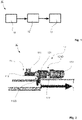
- FIG 1 is shown schematically an example of a system 10 of processing recycled textile fibers.
- the system 10 comprises feeding means 11, a dispersing section 12 and a refining section 13.
- the feeding means 11 are configured to feed and advantageously shred pieces of recycled textile material at low moisture content, up to 10 %, to the dispersing section 12.
- the pieces of the recycled textile material are configured to be torn to separate fibers and/or fiber flocks at high consistency of 15-90%, more advantageously 20-60%, most advantageously 25-45%.
- the separate fibers and/or fiber flocks of the recycled textile material are fed to the refining section 13, which is configured to refine the separate fibers and/or the fiber flocks either at low consistency of 3-6 % or at high consistency of 20-60 %.
- the system 10 comprises feeding means 11 comprising a feed pipe 111 and a feeding screw 112, a dispersing section 12 comprising at least one disperger 121 comprising a shaft 122 and a motor 123 with dilution water feed from a dilution water source at discharge side 12D of the disperger 12.
- the dispersing section 12 may comprise a HC-refiner.
- the recycled textile material pieces with area typically less than 300 cm2 are fed at low moisture content, up to 10 %, via the feed pipe 111 and the feeding screw 112 to the disperger 121, which is a conical or a disc type disperger.
- the recycled textile material pieces are torn to the separate fibers and/or the fiber flocks in the disperger 121 at high consistency of 15-90%, more advantageously 20-60%, most advantageously 25-45%.
- the feeding screw 112 in this example is integrated i.e., fixed to the shaft 122 of the disperger 121 and thus to the motor 123 of the disperger 122.
- dilution water from a dilution water source 112D can be used to adjust the dispersing consistency.
- the disperger 121 the disperger/-s / HC-refiner/-s of the dispersing section comprise/-s fillings formed of bars with bar width of 1,5 mm - 20 mm and grooves with groove depth of 1 mm - 50 mm and groove width of 1 mm - 20 mm.
- Typical specific energy consumption in the dispersing is at the range of 30-500 kWh/t. In dispersing energy consumption is typically 30-150 kWh/t, in HC-refining energy consumption is typically 200-350 kWh/t and in LC-refining energy consumption is typically 70-200 kWh/t.
- discharge from disperger 121 can be done at high consistency of 20-50 % or at middle consistency of 6-20 % or at low consistency of 3-6 %. If the discharge will take place in the middle or low consistency, dilution water from a dilution water source 121D is introduced in the disperger 121 at the discharge side.
- the system comprises the feeding means 11 for a feeding stage of feeding pieces of recycled textile material at low moisture content, up to 10%, with optional dilution during the feeding stage.
- the system also comprises a dispersing section 12 of a dispersing stage for dispersing the pieces of the recycled textile material to fibers and/or fiber flocks of the recycled textile material in consistency of 15-90%, more advantageously 20-60%, most advantageously 25-45%.
- the discharge consistency to a LC-refining section 13LCof the system for refining stage of refining the fibers and/or the fiber flocks in this example is low, 3-6 % consistency and in the refining stage of this example the consistency is 3-6%.
- the system comprises the feeding means 11 for a feeding stage of feeding pieces of recycled textile material at low moisture content, up to 10%, with optional dilution during the feeding stage.
- the system also comprises a dispersing section of a dispersing stage for dispersing the pieces of the recycled textile material to fibers and/or fiber flocks of the recycled textile material in consistency of 15-90%, more advantageously 20-60%, most advantageously 25-45%.
- the discharge consistency to a HC-refining section 13HC of the system for refining stage of refining the fibers and/or the fiber flocks in this example is high, 25-50 % consistency and in the refining stage of this example the consistency is 25-50 %.
- the system comprises a dispersing section for a dispersing stage.
- the dispersing section 12 comprises a dispergator to which pieces of recycled textile material is fed low moisture content, up to 10%.
- the pieces of the recycled textile material are torn to fibers and/or fiber flocs of the recycled textile material.
- an optional dilution stage may follow, in which the fibers and/or fiber flocs of the recycled textile material are diluted by dilution water from a dilution water source.
- the fibers and/or fiber flocs of the recycled textile material is refined in at least one refining stage in a refining section 13.
- the refining section 13 comprises at least one refiner 131; 132.
- the refining section 13 comprises two refiners 131, 132.
- the refiners 131, 132 are connected in series or parallel.
- the refined recycled textile material can be recirculated back to an inlet of a previous refiner one or more times to achieve desired properties of the refined recycled textile material.
Landscapes
- Engineering & Computer Science (AREA)
- Mechanical Engineering (AREA)
- Food Science & Technology (AREA)
- Life Sciences & Earth Sciences (AREA)
- Wood Science & Technology (AREA)
- Paper (AREA)
Abstract
Description
- In general, present invention relates to processing of recycled textile material. More especially the present invention relates to a system of processing recycled textile material according to preamble part of the independent system claim and to a method of processing recycled textile material according to preamble part of the independent method claim.
- It is known from prior art to use different kinds of pulper configurations for pulping the recycled textile material in low consistency, typically at about 4-5 % consistency. When the recycled textile material is to be fiberized fully by pulping, long dwell time and huge amount of energy is needed, but there still may remain some pieces not fiberized recycled material left after the pulping. Thus, there exists a need to process the recycled textile material such, that the recycled textile material is torn to fibers and/or small fiber flocks with minimal energy at the beginning of textile recycling process.
- An object of the invention is to create a system and method of processing recycled textile material, in which the disadvantages and problems of prior art are eliminated or at least minimized.
- An object of the invention is to create an improved system and method of processing recycled textile material, in which new, alternative ways of processing recycled textile material are provided.
- A particular, non-binding, object of the invention is to create a system and method of processing recycled textile material, in which especially the disadvantages and problems relating to tearing the recycled textile material to fibers and/or small fiber flocks are eliminated or at least minimized.
- In order to achieve the above mentioned objects, the system of processing recycled textile material according to the invention is mainly characterized by the features of the characterizing clause of the independent system claim and the method of processing recycled textile material according to the invention is in turn mainly characterized by the features of the characterizing clause of the independent method claim. Advantageous embodiments and features are disclosed in the dependent claims.
- According to the invention the system of processing recycled textile material comprising synthetic fibers and non-synthetic fibers comprises feeding means and a dispersing section, wherein the dispersing section is configured to perform a dispersing stage to tear pieces of recycled textile into fibers and/or fiber flocks in high consistency of 15-90%, more advantageously 20-60%, most advantageously 25-45% and the dispersing section comprises at least one dispergator with fillings formed of bars with bar width of 1,5 mm - 20 mm and grooves with groove depth of 1 mm - 50 mm and groove width of 1 mm - 20 mm or at least one HC-refiner with fillings formed of bars with bar width of 1,5 mm - 20 mm and grooves with groove depth of 1 mm - 50 mm and groove width of 1 mm - 20 mm and specific energy consumption in the dispersing section is 30-500 kWh/t.
- According to an advantageous feature the system further comprises after the dispersing section located refining section comprising at least one refiner and configured to perform a refining stage to refine in low consistency of 3-6 % the fibers and/or the fiber flocks received from the dispersing section.
- According to an advantageous feature the system further comprises after the dispersing section located refining section comprising at least one refiner and configured to perform a refining stage to refine in high consistency of 25-50 % the fibers and/or the fiber flocks received from the dispersing section.
- According to an advantageous feature the refining section has more than one refiner and the refiners are connected in series or parallel.
- According to the invention in the method of processing recycled textile fibers recycled textile material comprising synthetic fibers and non-synthetic fibers, in particular cotton fibers, is processed, which method is performed in a system comprising feeding means and a dispersing section, which method comprises a feeding stage, in which pieces of the recycled textile material is fed and/or shredded by the feeding means, and a dispersing stage, in which the pieces of the recycled material are torn to fibers and/or fiber flocks of the recycled textile material in the dispersing section, wherein the dispersing stage to tear pieces of recycled textile into fibers and/or fiber flocks is performed in high consistency of 15-90%, more advantageously 20-60%, most advantageously 25-45% by at least one dispergator with fillings formed of bars with bar width of 1,5 mm - 20 mm and grooves with groove depth of 1 mm - 50 mm and groove width of 1 mm - 20 mm or at least one HC-refiner with fillings formed of bars with bar width of 1,5 mm - 20 mm and grooves with groove depth of 1 mm - 50 mm and groove width of 1 mm - 20 mm and specific energy consumption in the dispersing stage is 30-150 kWh/t.
- According to an advantageous feature the method further comprises a refining stage performed after the dispersing stage in at least one refiner of a refining section of the system and in the refining stage the fibers and/or the fiber flocks received from the dispersing stage are refined in low consistency of 3-6 %.
- According to an advantageous feature the method further comprises a refining stage performed after the dispersing stage in at least one refiner of a refining section of the system and in the refining stage the fibers and/or the fiber flocks received from the dispersing stage are refined in high consistency of 25-50 %.
- According to an advantageous feature the refining stage is performed in more than one refiners and the refined recycled textile material is recirculated back to an inlet of a previous refiner one or more times to achieve desired properties of the refined recycled textile material.
- According to an advantageous aspect feeding of textile pieces of the recycled textile material to fiber treatment of the system will take place at low moisture content, up to 10 %, which saves energy and also simplifies the process and enables that textile material pieces can be fed directly to the system.
- According to an advantageous aspect the system comprises a dispersing section with at least one disperger or at least one high consistency (HC-refiner) refiner, to tear the recycled textile material to the separate fibers and/or fibers flocks at the high consistency, advantageously of 15-90%, more advantageously 20-60%, most advantageously 25-45%, to ensure that the further processing e.g., refining can be done efficiently.
- According to an advantageous aspect the system comprises a refining section comprising at least one refiner for final fiber treatment (e.g. fiber cutting), in which the refining is conducted either at low consistency (LC) in a low consistency refiner (LC-refiner) or at high consistency (HC) in a high consistency refiner (HC-refiner).
- According to an advantageous aspect in the system textile material pieces with area typically less than 300 cm2, are fed to at least one disperger, typically to at least one conical or disc type disperger, or to at least one HC-refiner of the dispersing section at the high consistency of 15-90%, more advantageously 20-60%, most advantageously 25-45%. The textile pieces are torn to the separate fibers and/or the small fiber flocks in the disperger or in the HC-refiner.
- According to an advantageous aspect the system comprises feeding means to feed the recycled textile material pieces to the dispersing section. The feeding means is advantageously a separate feeding screw with its own motor or an integrated feeding screw, which is fixed to a disperger shaft of the disperger. The feeding means may comprise a connection to a dilution water source to adjust the dispersing consistency to range of 15-90%, more advantageously 20-60%, most advantageously 25-45%.
- According to an advantageous aspect the disperger/-s / HC-refiner/-s of the dispersing section comprise/-s fillings formed of bars with bar width of 1,5 mm - 20 mm and grooves with groove depth of 1 mm - 50 mm and groove width of 1 mm - 20 mm.
- According to an advantageous aspect the LC-refiner of the refining section comprises fillings formed of bars with bar width of 1-10 mm and grooves with groove depth of 1-20mm and groove width of 1-20 mm.
- According to an advantageous aspect the HC-refiner of the refining section comprises fillings formed or bars with bar width of 1,5-20 mm and grooves with groove depth of 1-50 and groove width of 1-20 mm.
- According to an advantageous aspect typical specific energy consumption in the dispersing section is at the range of 30-500 kWh/t. In dispersing energy consumption is typically 30-150 kWh/t, in HC-refining energy consumption is typically 200-350 kWh/t and in LC-refining energy consumption is typically 70-200 kWh/t.
- According to an advantageous aspect depending on type of next section of the system, discharge from the disperger is at high consistency, advantageously 20-60 %, or at middle consistency, advantageously 6-20 %, or at low consistency, advantageously 3-6 %. Advantageously in cases, where the discharge will take place in the middle or low consistency, dilution water from the dilution water source is introduced in the disperger in the discharge side.
- According to an advantageous aspect the recycled textile material pieces is fed at low moisture content, up to 10 %, to the feed screw to the disperger. During feeding by the feed screw the recycled textile material pieces are diluted to dispergation consistency of 15-90%, more advantageously 20-60%, most advantageously 25-45%. Advantageously, at the outlet side of the disperger the recycled textile material is diluted to consistency of about 6 % for refining in low consistency and the refining is provided in at least one stage or in series of stages in the low consistency of 3-6 %. Alternatively advantageously, the recycled textile material is not diluted at the outlet side of the disperger but instead fed directly from the dispergator to high consistency refining in consistency of 20-40%.
- In the following the invention is explained in detail with reference to the accompanying drawing to which the invention is not to be narrowly limited.
- In
figure 1 is shown schematically an advantageous example of a system of processing recycled textile fibers. - In
figure 2 is shown schematically another advantageous example of a system of processing recycled textile fibers. - In
figures 3A-3B is shown schematically yet advantageous examples of the system of processing recycled textile fibers. - During the course of the following description like numbers and signs will be used to identify like elements according to the different views which illustrate the invention and its advantageous examples. In the figure some repetitive reference signs have been omitted for clarity reasons.
- In
figure 1 is shown schematically an example of asystem 10 of processing recycled textile fibers. Thesystem 10 comprises feeding means 11, adispersing section 12 and arefining section 13. The feeding means 11 are configured to feed and advantageously shred pieces of recycled textile material at low moisture content, up to 10 %, to the dispersingsection 12. In the dispersingsection 12 the pieces of the recycled textile material are configured to be torn to separate fibers and/or fiber flocks at high consistency of 15-90%, more advantageously 20-60%, most advantageously 25-45%. From the dispersing section the separate fibers and/or fiber flocks of the recycled textile material are fed to therefining section 13, which is configured to refine the separate fibers and/or the fiber flocks either at low consistency of 3-6 % or at high consistency of 20-60 %. - According to the example of the
figure 2 thesystem 10 comprisesfeeding means 11 comprising afeed pipe 111 and afeeding screw 112, adispersing section 12 comprising at least onedisperger 121 comprising ashaft 122 and amotor 123 with dilution water feed from a dilution water source at discharge side 12D of thedisperger 12. Instead of or in addition to the at least one disperger 121 the dispersingsection 12 may comprise a HC-refiner. The recycled textile material pieces with area typically less than 300 cm2 are fed at low moisture content, up to 10 %, via thefeed pipe 111 and thefeeding screw 112 to thedisperger 121, which is a conical or a disc type disperger. The recycled textile material pieces are torn to the separate fibers and/or the fiber flocks in thedisperger 121 at high consistency of 15-90%, more advantageously 20-60%, most advantageously 25-45%. Thefeeding screw 112 in this example is integrated i.e., fixed to theshaft 122 of thedisperger 121 and thus to themotor 123 of thedisperger 122. In thefeeding screw 112 dilution water from adilution water source 112D can be used to adjust the dispersing consistency. Thedisperger 121 the disperger/-s / HC-refiner/-s of the dispersing section comprise/-s fillings formed of bars with bar width of 1,5 mm - 20 mm and grooves with groove depth of 1 mm - 50 mm and groove width of 1 mm - 20 mm. Typical specific energy consumption in the dispersing is at the range of 30-500 kWh/t. In dispersing energy consumption is typically 30-150 kWh/t, in HC-refining energy consumption is typically 200-350 kWh/t and in LC-refining energy consumption is typically 70-200 kWh/t. Depending on the next subprocess, discharge fromdisperger 121 can be done at high consistency of 20-50 % or at middle consistency of 6-20 % or at low consistency of 3-6 %. If the discharge will take place in the middle or low consistency, dilution water from adilution water source 121D is introduced in thedisperger 121 at the discharge side. - In
figure 3A shown example the system comprises the feeding means 11 for a feeding stage of feeding pieces of recycled textile material at low moisture content, up to 10%, with optional dilution during the feeding stage. The system also comprises a dispersingsection 12 of a dispersing stage for dispersing the pieces of the recycled textile material to fibers and/or fiber flocks of the recycled textile material in consistency of 15-90%, more advantageously 20-60%, most advantageously 25-45%. The discharge consistency to a LC-refining section 13LCof the system for refining stage of refining the fibers and/or the fiber flocks in this example is low, 3-6 % consistency and in the refining stage of this example the consistency is 3-6%. - In
figure 3B shown example the system comprises the feeding means 11 for a feeding stage of feeding pieces of recycled textile material at low moisture content, up to 10%, with optional dilution during the feeding stage. The system also comprises a dispersing section of a dispersing stage for dispersing the pieces of the recycled textile material to fibers and/or fiber flocks of the recycled textile material in consistency of 15-90%, more advantageously 20-60%, most advantageously 25-45%. The discharge consistency to a HC-refining section 13HC of the system for refining stage of refining the fibers and/or the fiber flocks in this example is high, 25-50 % consistency and in the refining stage of this example the consistency is 25-50 %. - In
figure 4 is shown an example, in which the system comprises a dispersing section for a dispersing stage. The dispersingsection 12 comprises a dispergator to which pieces of recycled textile material is fed low moisture content, up to 10%. During the dispersing stage in the dispersing section the pieces of the recycled textile material are torn to fibers and/or fiber flocs of the recycled textile material. After the dispersing stage an optional dilution stage may follow, in which the fibers and/or fiber flocs of the recycled textile material are diluted by dilution water from a dilution water source. After the dispersing stage in the dispersing section (and the optional dilution stage) the the fibers and/or fiber flocs of the recycled textile material is refined in at least one refining stage in arefining section 13. Therefining section 13 comprises at least onerefiner 131; 132. In the example therefining section 13 comprises tworefiners refiners - In the description in the foregoing, although some functions have been described with reference to certain features and examples, those functions may be performable by other features and examples whether described or not. Although features have been described with reference to the certain examples, those features may also be present in other examples whether described or not.
- Above only some advantageous examples of the inventions have been described to which examples the invention is not to be narrowly limited and many modifications and alterations are possible within the invention.
- Reference sings used in the drawing:
- 10 system
- 11 feeding means
- 111 feed pipe
- 112 feeding screw
- 112D dilution water source
- 12 dispersing section
- 121 disperger
- 121D dilution water source
- 122 disperger shaft
- 123 motor
- 13 refining section
- 13LC LC-refining section
- 13HC HC-refining section
- 131, 132 refiner
Claims (8)
- System of processing recycled textile material, which system (10) comprises feeding means (11) and a dispersing section (12), which dispersing section (12) is configured to perform a dispersing stage to tear pieces of recycled textile into fibers and/or fiber flocks in high consistency of 15-90%, more advantageously 20-60%, most advantageously 25-45%, characterized in that the recycled textile material comprises synthetic fibers and non-synthetic fibers, that the dispersing section (12) comprises at least one dispergator (121) with fillings formed of bars with bar width of 1,5 mm - 20 mm and grooves with groove depth of 1 mm - 50 mm and groove width of 1 mm - 20 mm or at least one HC-refiner with fillings formed of bars with bar width of 1,5 mm - 20 mm and grooves with groove depth of 1 mm - 50 mm and groove width of 1 mm - 20 mm and that specific energy consumption in the dispersing section is 30-500 kWh/t.
- System according to claim 1, characterized in that the system (10) further comprises after the dispersing section (12) located refining section (13) comprising at least one refiner (131; 132) and configured to perform a refining stage to refine in low consistency of 3-6 % the fibers and/or the fiber flocks received from the dispersing section (12).
- System according to claim 1, characterized in that the system (10) further comprises after the dispersing section (12) located refining section (13) comprising at least one refiner (131; 132) and configured to perform a refining stage to refine in high consistency of 25-50 % the fibers and/or the fiber flocks received from the dispersing section (12).
- System according to claim 2 or 3, characterized in that the refining section (13) has more than one refiner (131, 132) and that the refiners (131, 132) are connected in series or parallel.
- Method of processing recycled textile fibers, in which method recycled textile material, in particular cotton fibers, is processed, which method is performed in a system (10) comprising feeding means (11) and a dispersing section (12), which method comprises a feeding stage, in which pieces of the recycled textile material is fed and/or shredded by the feeding means (11), and a dispersing stage, in which the pieces of the recycled textile material are torn to fibers and/or fiber flocks of the recycled textile material in high consistency of 15-90%, more advantageously 20-60%, most advantageously 25-45% in the dispersing section (12), characterized in that in the method recycled textile material comprising synthetic fibers and non-synthetic fibers is processed, that the dispersing stage to tear pieces of recycled textile into fibers and/or fiber flocks is performed by at least one dispergator (121) with fillings formed of bars with bar width of 1,5 mm - 20 mm and grooves with groove depth of 1 mm - 50 mm and groove width of 1 mm - 20 mm or at least one HC-refiner with fillings formed of bars with bar width of 1,5 mm - 20 mm and grooves with groove depth of 1 mm - 50 mm and groove width of 1 mm - 20 mm and specific energy consumption in the dispersing stage is 30-150 kWh/t.
- Method according to claim 5, characterized in that the method further comprises a refining stage performed after the dispersing stage in at least one refiner (131; 132) of a refining section (13) of the system (10) and that in the refining stage the fibers and/or the fiber flocks received from the dispersing stage are refined in low consistency of 3-6 %.
- Method according to claim 5, characterized in that the method further comprises a refining stage performed after the dispersing stage in at least one refiner (131; 132) of a refining section (13) of the system (10) and that in the refining stage the fibers and/or the fiber flocks received from the dispersing stage are refined in high consistency of 25-50 %.
- Method according to any of claims 5-7, characterized in that the refining stage is performed in more than one refiners (131; 132) and that the refined recycled textile material is recirculated back to an inlet of a previous refiner one or more times to achieve desired properties of the refined recycled textile material.
Applications Claiming Priority (1)
| Application Number | Priority Date | Filing Date | Title |
|---|---|---|---|
| FI20215746A FI20215746A1 (en) | 2021-06-24 | 2021-06-24 | System and method of processing recycled textile material |
Publications (1)
| Publication Number | Publication Date |
|---|---|
| EP4112808A1 true EP4112808A1 (en) | 2023-01-04 |
Family
ID=82308299
Family Applications (1)
| Application Number | Title | Priority Date | Filing Date |
|---|---|---|---|
| EP22180294.5A Pending EP4112808A1 (en) | 2021-06-24 | 2022-06-22 | System and method of processing recycled textile material |
Country Status (2)
| Country | Link |
|---|---|
| EP (1) | EP4112808A1 (en) |
| FI (1) | FI20215746A1 (en) |
Citations (3)
| Publication number | Priority date | Publication date | Assignee | Title |
|---|---|---|---|---|
| JP3200740U (en) * | 2014-05-26 | 2015-11-05 | バルメット テクノロジーズ インコーポレイテッド | Disc refiner blade piece |
| WO2018049522A1 (en) * | 2016-09-14 | 2018-03-22 | Fpinnovations | Method of transforming high consistency pulp fibers into pre-dispersed semi-dry and dry fibrous materials |
| US10683612B2 (en) * | 2016-09-14 | 2020-06-16 | Fpinnovations | Method for producing cellulose filaments with less refining energy |
-
2021
- 2021-06-24 FI FI20215746A patent/FI20215746A1/en unknown
-
2022
- 2022-06-22 EP EP22180294.5A patent/EP4112808A1/en active Pending
Patent Citations (3)
| Publication number | Priority date | Publication date | Assignee | Title |
|---|---|---|---|---|
| JP3200740U (en) * | 2014-05-26 | 2015-11-05 | バルメット テクノロジーズ インコーポレイテッド | Disc refiner blade piece |
| WO2018049522A1 (en) * | 2016-09-14 | 2018-03-22 | Fpinnovations | Method of transforming high consistency pulp fibers into pre-dispersed semi-dry and dry fibrous materials |
| US10683612B2 (en) * | 2016-09-14 | 2020-06-16 | Fpinnovations | Method for producing cellulose filaments with less refining energy |
Also Published As
| Publication number | Publication date |
|---|---|
| FI20215746A1 (en) | 2022-12-25 |
Similar Documents
| Publication | Publication Date | Title |
|---|---|---|
| EP0775232B2 (en) | Low-resident, high-temperature, high-speed chip refining | |
| DE60316712T2 (en) | METHOD FOR PRODUCING WOOD AND THE SOIL PRODUCED THEREOF | |
| US7758721B2 (en) | Pulping process with high defiberization chip pretreatment | |
| FI105112B (en) | Method and apparatus for defibrating fibrous material | |
| US7300540B2 (en) | Energy efficient TMP refining of destructured chips | |
| EP1002154B1 (en) | Method of pretreating lignocellulose fiber-containing material for the pulp making process | |
| EP2788544B2 (en) | Method for treating waste paper | |
| EP2692945B1 (en) | Method for producing pulp and paper | |
| DE60208034T2 (en) | METHOD FOR PRODUCING A BLEACHED TMP OR CTMP PULP | |
| EP4112808A1 (en) | System and method of processing recycled textile material | |
| EP1028809A1 (en) | Method and device for treatment of fibrous material | |
| US6187135B1 (en) | Process for making recycled paper having improving strength properties | |
| EP4202114A1 (en) | System and method of producing micro fibrillated cellulose (mfc) | |
| JP2002506147A (en) | Method and apparatus for treating mineral-containing fiber suspensions, such as coated broke, in papermaking | |
| DE68909231T2 (en) | METHOD FOR PRODUCING THE MECHANICAL OR CHEMI-MECHANICAL PAPER PULP. | |
| FI81642B (en) | MATARSYSTEM FOER EN FORMER VID EN TORRPAPPERSMASKIN. | |
| EP0591475B1 (en) | A method of and an apparatus for treating waste paper | |
| Tunell | A single approach for a multifaceted result when processing recycled fibre | |
| Huhtanen et al. | Mill Experience with a New Low Consistency Refining Concept |
Legal Events
| Date | Code | Title | Description |
|---|---|---|---|
| PUAI | Public reference made under article 153(3) epc to a published international application that has entered the european phase |
Free format text: ORIGINAL CODE: 0009012 |
|
| STAA | Information on the status of an ep patent application or granted ep patent |
Free format text: STATUS: THE APPLICATION HAS BEEN PUBLISHED |
|
| AK | Designated contracting states |
Kind code of ref document: A1 Designated state(s): AL AT BE BG CH CY CZ DE DK EE ES FI FR GB GR HR HU IE IS IT LI LT LU LV MC MK MT NL NO PL PT RO RS SE SI SK SM TR |
|
| STAA | Information on the status of an ep patent application or granted ep patent |
Free format text: STATUS: REQUEST FOR EXAMINATION WAS MADE |
|
| 17P | Request for examination filed |
Effective date: 20230607 |
|
| RBV | Designated contracting states (corrected) |
Designated state(s): AL AT BE BG CH CY CZ DE DK EE ES FI FR GB GR HR HU IE IS IT LI LT LU LV MC MK MT NL NO PL PT RO RS SE SI SK SM TR |
|
| STAA | Information on the status of an ep patent application or granted ep patent |
Free format text: STATUS: EXAMINATION IS IN PROGRESS |