EP4112756A1 - Method for producing sintered ore - Google Patents
Method for producing sintered ore Download PDFInfo
- Publication number
- EP4112756A1 EP4112756A1 EP21761195.3A EP21761195A EP4112756A1 EP 4112756 A1 EP4112756 A1 EP 4112756A1 EP 21761195 A EP21761195 A EP 21761195A EP 4112756 A1 EP4112756 A1 EP 4112756A1
- Authority
- EP
- European Patent Office
- Prior art keywords
- raw material
- oxygen enrichment
- layer
- sintering
- oxygen
- Prior art date
- Legal status (The legal status is an assumption and is not a legal conclusion. Google has not performed a legal analysis and makes no representation as to the accuracy of the status listed.)
- Pending
Links
- 238000004519 manufacturing process Methods 0.000 title claims abstract description 23
- QVGXLLKOCUKJST-UHFFFAOYSA-N atomic oxygen Chemical compound [O] QVGXLLKOCUKJST-UHFFFAOYSA-N 0.000 claims abstract description 117
- 239000001301 oxygen Substances 0.000 claims abstract description 117
- 229910052760 oxygen Inorganic materials 0.000 claims abstract description 117
- 239000002994 raw material Substances 0.000 claims abstract description 78
- 238000005245 sintering Methods 0.000 claims abstract description 68
- 238000007599 discharging Methods 0.000 claims abstract description 9
- 239000003575 carbonaceous material Substances 0.000 claims abstract description 7
- 238000000034 method Methods 0.000 claims description 37
- 239000007789 gas Substances 0.000 claims description 25
- XEEYBQQBJWHFJM-UHFFFAOYSA-N Iron Chemical compound [Fe] XEEYBQQBJWHFJM-UHFFFAOYSA-N 0.000 claims description 18
- 229910052742 iron Inorganic materials 0.000 claims description 9
- 239000000463 material Substances 0.000 claims description 8
- 239000000446 fuel Substances 0.000 abstract description 8
- 238000002485 combustion reaction Methods 0.000 description 13
- 230000000694 effects Effects 0.000 description 12
- 238000006243 chemical reaction Methods 0.000 description 9
- 239000000047 product Substances 0.000 description 8
- VYPSYNLAJGMNEJ-UHFFFAOYSA-N Silicium dioxide Chemical compound O=[Si]=O VYPSYNLAJGMNEJ-UHFFFAOYSA-N 0.000 description 7
- 230000000052 comparative effect Effects 0.000 description 6
- 238000007664 blowing Methods 0.000 description 5
- 239000000843 powder Substances 0.000 description 5
- 239000000571 coke Substances 0.000 description 3
- 238000007796 conventional method Methods 0.000 description 3
- 230000035699 permeability Effects 0.000 description 3
- 239000000377 silicon dioxide Substances 0.000 description 3
- ODINCKMPIJJUCX-UHFFFAOYSA-N Calcium oxide Chemical compound [Ca]=O ODINCKMPIJJUCX-UHFFFAOYSA-N 0.000 description 2
- 229910052681 coesite Inorganic materials 0.000 description 2
- 229910052906 cristobalite Inorganic materials 0.000 description 2
- 230000003247 decreasing effect Effects 0.000 description 2
- 238000002844 melting Methods 0.000 description 2
- 230000008018 melting Effects 0.000 description 2
- 229910052682 stishovite Inorganic materials 0.000 description 2
- 229910052905 tridymite Inorganic materials 0.000 description 2
- XLYOFNOQVPJJNP-UHFFFAOYSA-N water Substances O XLYOFNOQVPJJNP-UHFFFAOYSA-N 0.000 description 2
- 235000019738 Limestone Nutrition 0.000 description 1
- 230000002159 abnormal effect Effects 0.000 description 1
- 239000000292 calcium oxide Substances 0.000 description 1
- 235000012255 calcium oxide Nutrition 0.000 description 1
- 238000010586 diagram Methods 0.000 description 1
- 230000007613 environmental effect Effects 0.000 description 1
- 239000008187 granular material Substances 0.000 description 1
- 238000000227 grinding Methods 0.000 description 1
- 239000006028 limestone Substances 0.000 description 1
- 239000007788 liquid Substances 0.000 description 1
- 238000013021 overheating Methods 0.000 description 1
- 238000010298 pulverizing process Methods 0.000 description 1
- 239000004576 sand Substances 0.000 description 1
- 239000013589 supplement Substances 0.000 description 1
Images
Classifications
-
- C—CHEMISTRY; METALLURGY
- C22—METALLURGY; FERROUS OR NON-FERROUS ALLOYS; TREATMENT OF ALLOYS OR NON-FERROUS METALS
- C22B—PRODUCTION AND REFINING OF METALS; PRETREATMENT OF RAW MATERIALS
- C22B1/00—Preliminary treatment of ores or scrap
- C22B1/14—Agglomerating; Briquetting; Binding; Granulating
- C22B1/16—Sintering; Agglomerating
- C22B1/18—Sintering; Agglomerating in sinter pots
-
- C—CHEMISTRY; METALLURGY
- C21—METALLURGY OF IRON
- C21B—MANUFACTURE OF IRON OR STEEL
- C21B13/00—Making spongy iron or liquid steel, by direct processes
- C21B13/0046—Making spongy iron or liquid steel, by direct processes making metallised agglomerates or iron oxide
-
- C—CHEMISTRY; METALLURGY
- C22—METALLURGY; FERROUS OR NON-FERROUS ALLOYS; TREATMENT OF ALLOYS OR NON-FERROUS METALS
- C22B—PRODUCTION AND REFINING OF METALS; PRETREATMENT OF RAW MATERIALS
- C22B1/00—Preliminary treatment of ores or scrap
- C22B1/14—Agglomerating; Briquetting; Binding; Granulating
- C22B1/16—Sintering; Agglomerating
- C22B1/20—Sintering; Agglomerating in sintering machines with movable grates
- C22B1/205—Sintering; Agglomerating in sintering machines with movable grates regulation of the sintering process
-
- C—CHEMISTRY; METALLURGY
- C21—METALLURGY OF IRON
- C21B—MANUFACTURE OF IRON OR STEEL
- C21B13/00—Making spongy iron or liquid steel, by direct processes
- C21B13/0006—Making spongy iron or liquid steel, by direct processes obtaining iron or steel in a molten state
- C21B13/0013—Making spongy iron or liquid steel, by direct processes obtaining iron or steel in a molten state introduction of iron oxide into a bath of molten iron containing a carbon reductant
- C21B13/002—Reduction of iron ores by passing through a heated column of carbon
-
- C—CHEMISTRY; METALLURGY
- C21—METALLURGY OF IRON
- C21B—MANUFACTURE OF IRON OR STEEL
- C21B13/00—Making spongy iron or liquid steel, by direct processes
- C21B13/004—Making spongy iron or liquid steel, by direct processes in a continuous way by reduction from ores
-
- C—CHEMISTRY; METALLURGY
- C21—METALLURGY OF IRON
- C21B—MANUFACTURE OF IRON OR STEEL
- C21B13/00—Making spongy iron or liquid steel, by direct processes
- C21B13/0046—Making spongy iron or liquid steel, by direct processes making metallised agglomerates or iron oxide
- C21B13/0053—On a massing grate
-
- C—CHEMISTRY; METALLURGY
- C21—METALLURGY OF IRON
- C21B—MANUFACTURE OF IRON OR STEEL
- C21B13/00—Making spongy iron or liquid steel, by direct processes
- C21B13/0086—Conditioning, transformation of reduced iron ores
-
- C—CHEMISTRY; METALLURGY
- C22—METALLURGY; FERROUS OR NON-FERROUS ALLOYS; TREATMENT OF ALLOYS OR NON-FERROUS METALS
- C22B—PRODUCTION AND REFINING OF METALS; PRETREATMENT OF RAW MATERIALS
- C22B1/00—Preliminary treatment of ores or scrap
- C22B1/14—Agglomerating; Briquetting; Binding; Granulating
- C22B1/16—Sintering; Agglomerating
- C22B1/20—Sintering; Agglomerating in sintering machines with movable grates
-
- F—MECHANICAL ENGINEERING; LIGHTING; HEATING; WEAPONS; BLASTING
- F27—FURNACES; KILNS; OVENS; RETORTS
- F27B—FURNACES, KILNS, OVENS OR RETORTS IN GENERAL; OPEN SINTERING OR LIKE APPARATUS
- F27B21/00—Open or uncovered sintering apparatus; Other heat-treatment apparatus of like construction
Definitions
- the present invention relates to a method for producing sintered ore by operating oxygen enrichment in a downdraft-type Dwight-Lloyd (DL) sintering machine.
- DL downdraft-type Dwight-Lloyd
- a blast furnace is a facility for producing molten iron by charging an iron source such as lump ore or sintered ore from the upper part of the furnace while blowing reducing gas from the lower part of the furnace to thus reduce and melt the iron source.
- the inside of the blast furnace needs to secure sufficient flow of the reducing gas to promote the reaction of the reducing gas and the iron source. To this end, it is effective to increase the air permeability in the blast furnace, resulting in a higher production rate and lower costs of molten iron.
- it is necessary to suppress the powder ratio of the iron source material, for which the use of a material with high strength is effective.
- various methods for increasing the strength of sintered ore as iron source material to be charged into the blast furnace are proposed.
- Patent Literature 1 proposes a method for improving the yield by blowing oxygen toward the raw material charged layer on the pallet of a DL sintering machine to thus promote combustion.
- the method disclosed in the Patent Literature 1 involves oxygen enrichment to the upper layer part of the material charged layer on the pallet for the purpose of improving productivity, increasing yield, or reducing the powder generation rate during the breakage of sinter cake.
- the position for oxygen enrichment is limited to the ignition position to the raw material charged layer, and the subsequent oxygen enrichment has no effect.
- the method has no description regarding the specific properties of the raw material, and dose not refer to the strength of product sintered ore, especially a method for reducing the powder generated during transport and storage until it reaches the inside of the blast furnace.
- Patent Literature 2 proposes a method of producing sintered ore by feeding gaseous fuel to the raw material charged layer on the pallet of a DL sintering machine. This method allows more expanded combustion area (combustion zone) in the raw material charged layer during sintering and heat compensation in areas with low strength during production, thereby improving the strength of a product.
- Patent Literature 3 proposes a method of producing high-strength sintered ore by simultaneously blowing gaseous fuel along with oxygen during sintering to thus create temperature conditions suitable for sintering in the raw material charged layer.
- Patent Literatures 2, 3, and 4 all involve using gaseous fuel together, causing problems in costs. In the methods, the area where combustion and liquid melting are caused is expanded, resulting in poor air permeability and low productivity.
- Patent Literature 5 proposes a method of performing oxygen enrichment to the middle layer part of the raw material charged layer, as part of an exhaust gas recirculation process in a sintering machine. That is, the method proposes sucking the oxygen-enriched air and circulating exhaust gas into the middle layer part of the raw material charged layer, further sucking the exhaust gas resulting from the reaction of the above gases into the lower layer part of the raw material charged layer. In this method, however, since the oxygen concentration of the circulating exhaust gas is low to cause stagnation of the combustion reaction in the lower layer part, low-concentration oxygen enrichment is performed on the middle layer part in advance. Thus, this method is not designed to promote the sintering reaction in the middle layer part.
- the exhaust gas recirculation process is intended to reduce the environmental load caused by the exhaust gas from the sintering machine, and the ratio of the area where oxygen-enriched air and circulating exhaust gas are sucked in should be designed according to the raw materials, sintering machine, and exhaust gas treatment facility conditions.
- oxygen enrichment to the sintering raw material layer should not be used in combination with the exhaust gas recirculation process.
- the object of the present invention is to propose a method for producing a high-strength sintered ore at a high production rate without using gaseous fuel in the operation of a sintering machine and by performing proper oxygen enrichment at a position closer to an ore discharging section than the ignition position.
- the inventors suspended the supply of the gaseous fuel from above the sinter bed (raw material charged layer) in the sintering machine while continuing the oxygen enrichment to thus study the influence of the positions (timing) and time of the oxygen enrichment upon the strength and productivity of sintered ore.
- the method disclosed in Patent Literature 1 that is, the oxygen enrichment performed at the timing of combustion of the upper layer part of the sinter bed (raw material charged layer) increases yield but hardly increases the strength of a finished product (sintered ore).
- the inventors performed oxygen enrichment using oxygen-enriched air at the timing of combustion not only in the upper layer part of the raw material charged layer but also in the middle and lower layer parts thereof. As a result, they found that the oxygen enrichment in the middle and lower layer parts of the raw material charged layer can dramatically increase the overall strength of a finished product, with a low pulverization rate during crushing and a certain degree of strength expected and without reducing the production rate while decreasing the yield.
- oxygen enrichment for at least the middle layer part of the raw material charged layer has a greater effect on increasing the overall strength of a finish product, and that, on the premise of oxygen enrichment for the middle layer part, it is effective to perform, if necessary, further oxygen enrichment for at least one of the upper layer part and lower layer part of the raw material charged layer.
- the present invention is a method for producing sintered ore including
- the method according to the present invention having the above configuration can, firstly, increase the effect of oxygen enrichment and improve the strength of sintered ore.
- the oxygen enrichment based on the conventional methods assists the combustion of coke to the upper part of the sinter bed (sintering raw material layer) at an early stage (immediately after ignition) or supplements circulating exhaust gas, and is effective in improving yield, but not so much in improving strength.
- the method of the present invention is to apply oxygen enrichment to the middle and lower layer parts of the sinter bed (raw material charging layer), allowing a dramatic increase in the strength of a whole finished product (sintered ore) without causing a decrease in yield (production rate).
- the method of the present invention can mitigate excessive heat supply, avoiding such a phenomenon that the strength is conversely reduced.
- the method of the present invention allows effective oxygen enrichment of the middle layer part of the raw material charged layer, which is highly effective in improving the strength.
- the oxygen enrichment to the upper layer part and/or lower layer part of the raw material charged layer does not interfere with the effect of oxygen enrichment of the middle layer part, so that it may be conducted in conjunction with oxygen enrichment to the middle layer part.
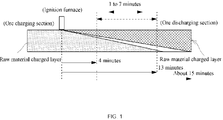
- FIG. 1 is a schematic diagram showing the state of the cross-section of a raw material charged layer between an ore charging section and an ore discharge section thereof on the DL sintering machine pallet.
- the present invention proposes a method for producing sintered ore by operating oxygen enrichment with a downward suction Dwight-Lloyd (DL) sintering machine, in which, basically, the effect of the oxygen enrichment appears at least when the middle layer part of a raw material charged layer is combusted.
- the upper surface of the raw material charged layer is first ignited, and after a certain period of time has elapsed, the blowing of oxygen-enriched gas, i.e., the oxygen enrichment to the middle layer part is started.
- the oxygen enrichment is started after the raw material charged layer on the pallet moves toward the ore discharging section for a certain period of time after ignition and completed after being conducted for a predetermined period of time.
- the present invention is a method including oxygen enrichment by blowing oxygen-enriched gas from above the raw material charged layer on the pallet of the sintering machine after a lapse of a prescribed time after ignition. That is, the present invention is characterized by performing oxygen enrichment by feeding oxygen-enriched gas to a position closer to the ore discharging section than the position where 4 minutes have passed at the normal sintering machine pallet speed (1.5 to 3.5 m/min) since the upper surface of the charging layer was ignited, and continuing the feeding for a certain time toward the ore discharging side.
- the time when the upper surface of the material charging layer is ignited can be determined by measuring with a thermometer or the like, but for simplicity, the time when the upper surface passes through the outlet of the ignition furnace can be considered as the ignition time.
- the oxygen concentration of the oxygen-enriched air to be introduced should be not less than 21 vol.% but not more than 50 vol.%. This is because, when the oxygen concentration after oxygen enrichment exceeds 50 vol.%, the coke combustion becomes faster to thus increase the moving speed of the combustion zone, so that the time for holding a high temperature at which the combustion zone remains in each layer is reduced, failing in sufficient sintering reaction. That is also because when the oxygen concentration after oxygen enrichment is less than 21 vol.%, the oxygen concentration is lower than that of normal air and lower rather than when the air outside is directly sucked, decreasing the sinterability.
- the oxygen concentration is not less than 23 vol.% but not more than 50, more preferably not less than 25 vol.% but not more than 50 vol.%.
- oxygen enrichment is performed in such a manner that a sinter bed (raw material charged layer) was divided into three equal parts (upper, middle, and lower layers) in the direction of height and oxygen-enriched air was introduced into each location.
- a sintering test (Comparative Example 1) without oxygen enrichment was conducted as the base case to determine the base (standard) sintering time (15.5 minutes). The oxygen enrichment time was determined by subtracting the time required for the ignition operation (1 minute) from the sintering time and dividing it into three equal parts was determined (formula below).
- Oxygen enrichment time base sintering time ⁇ 1 / 3
- Table 2 shows the result.
- the base sintering time is 15.5 minutes, which means that the oxygen enrichment time for each position is 4.8 minutes.
- the oxygen enrichment of 4.8 minutes was performed in the upper layer (Comparative Example 2), middle layer (Inventive Example 1), and lower layer (Inventive Example 2) of the sintering raw material layer.
- the result shows that the strength of the sintered ore (TI strength) could be improved the most when the oxygen enrichment was applied to the middle layer. This means that it is the most preferable to perform oxygen enrichment for 5.8 minutes after the ignition was started, that is, for the next 4.8 minutes after 4.8 minutes have elapsed since the ignition was completed.
- oxygen enrichment when oxygen enrichment is performed on the lower layer part, it should be limited to within 2.5 minutes (4.8 minutes ⁇ 53%) from 10.6 minutes after the start of ignition (9.6 minutes after completion of ignition), i.e., the oxygen enrichment should be performed within 13 minutes (10.6 minutes + 2.5 minutes) after the ignition is started on the upper surface of the raw material charged layer.
- the examples described below examined the influence of the oxygen enrichment time in the middle layer part of the sintered raw material layer.
- a mixed raw material for sintering adjusted to have SiO 2 : 4.9 mass% and a basicity: 2.0 (Table 1) was used.
- the mixed raw material for sintering was granulated in a drum mixer while adding water to bring the moisture content to 7.5 mass%, and the resulting granulated raw material for sintering was subjected to a sintering test in a sintering pot, where the air pressure is constant (6 kPa) and the oxygen concentration of the granulated raw material for sintering was adjusted to 30 vol.%.
- the sintering time of the base case without oxygen enrichment (Comparative Example 1) was 15.5 minutes. In this test, the timing of the oxygen enrichment was within the period of 5.8 to 10.6 minutes after the ignition (in the middle layer part), and the duration of the oxygen enrichment was changed to 0.3 to 4.8 min.
- the result shows that oxygen enrichment time to the middle layer of not shorter than 1.0 minutes caused, at least, a significant improvement in the production rate and sintered ore strength (TI strength).
- TI strength sintered ore strength
- Example 3 Comparative Example 1 Example 1 Example 2 Example 3 Oxygen enrichment time (min) 0 0.3 1 4.8 Yield (%) 70.4 69.7 69.7 68.8 Sintering time (min) 15.5 15.3 15.1 14.7 Production rate (t/h/m 2 ) 1.43 1.46 1.46 1.48 TI strength (%) 61.6 62.0 63.7 65.2
- the example described below verified the influence of oxygen concentration during oxygen enrichment treatment on the middle layer part of the sintered raw material layer.
- a mixed raw material for sintering adjusted to have SiO 2 : 4.9 mass% and a basicity: 2.0 (Table 1) was used.
- the mixed raw material for sintering was granulated in a drum mixer while adding water to bring the moisture content to 7.5 mass%.
- the resulting granulated raw material for sintering was subjected to a sintering test in a sintering pot by using oxygen-enriched air adjusted to have a constant air pressure (6 kPa) and the oxygen concentration of the granulated raw material for sintering of 30 vol.%.
- Example 3 oxygen enrichment was conducted for 5.8 minutes after the ignition was started, that is, for the next 4.8 minutes after 4.8 minutes have elapsed since the ignition was completed.
- the oxygen concentration during the oxygen enrichment was changed within the range of 30 to 40 vol.%. As shown in FIG. 4, the result shows that the strength continues increasing until the concentration of the oxygen-enriched air reaches 40 vol.%.
- Table 4 Example 3
- Example 6 Oxygen enrichment time (min) 4.8 4.8 4.8 Yield (%) 68.8 71.7 72.1 Sintering time (min) 14.7 14.6 13.9 Production rate (t/h/m 2 ) 1.48 1.56 1.64 Oxygen concentration of oxygen-enriched air (vol.%) 30 35 40 TI strength (%) 65.2 66.9 67.4
- the invention has been described based primarily on the operation of sintering machines that do not use gaseous fuels, but the invention can also be applied to the operation of sintering machines that use gaseous fuels in combination.
Landscapes
- Engineering & Computer Science (AREA)
- Chemical & Material Sciences (AREA)
- Metallurgy (AREA)
- Manufacturing & Machinery (AREA)
- Materials Engineering (AREA)
- Organic Chemistry (AREA)
- Life Sciences & Earth Sciences (AREA)
- Environmental & Geological Engineering (AREA)
- General Life Sciences & Earth Sciences (AREA)
- Geochemistry & Mineralogy (AREA)
- Geology (AREA)
- Mechanical Engineering (AREA)
- General Engineering & Computer Science (AREA)
- Manufacture And Refinement Of Metals (AREA)
Abstract
Description
- The present invention relates to a method for producing sintered ore by operating oxygen enrichment in a downdraft-type Dwight-Lloyd (DL) sintering machine.
- A blast furnace is a facility for producing molten iron by charging an iron source such as lump ore or sintered ore from the upper part of the furnace while blowing reducing gas from the lower part of the furnace to thus reduce and melt the iron source. In general, the inside of the blast furnace needs to secure sufficient flow of the reducing gas to promote the reaction of the reducing gas and the iron source. To this end, it is effective to increase the air permeability in the blast furnace, resulting in a higher production rate and lower costs of molten iron. In order to increase the air permeability in the blast furnace, it is necessary to suppress the powder ratio of the iron source material, for which the use of a material with high strength is effective. Thus, there have been proposed various methods for increasing the strength of sintered ore as iron source material to be charged into the blast furnace.
- For example,
Patent Literature 1 proposes a method for improving the yield by blowing oxygen toward the raw material charged layer on the pallet of a DL sintering machine to thus promote combustion. The method disclosed in thePatent Literature 1 involves oxygen enrichment to the upper layer part of the material charged layer on the pallet for the purpose of improving productivity, increasing yield, or reducing the powder generation rate during the breakage of sinter cake. In this known method, however, the position for oxygen enrichment is limited to the ignition position to the raw material charged layer, and the subsequent oxygen enrichment has no effect. The method has no description regarding the specific properties of the raw material, and dose not refer to the strength of product sintered ore, especially a method for reducing the powder generated during transport and storage until it reaches the inside of the blast furnace. - Patent Literature 2 proposes a method of producing sintered ore by feeding gaseous fuel to the raw material charged layer on the pallet of a DL sintering machine. This method allows more expanded combustion area (combustion zone) in the raw material charged layer during sintering and heat compensation in areas with low strength during production, thereby improving the strength of a product.
- Patent Literature 3 proposes a method of producing high-strength sintered ore by simultaneously blowing gaseous fuel along with oxygen during sintering to thus create temperature conditions suitable for sintering in the raw material charged layer.
-
- Patent Literature 1:
JP-H02-073924A - Patent Literature 2:
JP-2008-95170A - Patent Literature 3:
JP-2014-31580A - Patent Literature 4:
JP-2010-126773A - Patent Literature 5:
JP-H09-229758A - The above conventional methods, especially the method described in
Patent Literature 1, performs oxygen enrichment to the upper layer part of the raw material charged layer only immediately after ignition to compensate for the combustion melting reaction (sintering reaction) in the upper layer part of the raw material charged layer having a little heat input. Although this method reduces the powder generation ratio during sinter cake breakage, it has no significant effect on reducing the strength of the whole finished product sintered ore after breakage, i.e., reducing the powder generated during transportation to and storage in the blast furnace. - The methods disclosed in
Patent Literatures 2, 3, and 4 all involve using gaseous fuel together, causing problems in costs. In the methods, the area where combustion and liquid melting are caused is expanded, resulting in poor air permeability and low productivity. - Patent Literature 5 proposes a method of performing oxygen enrichment to the middle layer part of the raw material charged layer, as part of an exhaust gas recirculation process in a sintering machine. That is, the method proposes sucking the oxygen-enriched air and circulating exhaust gas into the middle layer part of the raw material charged layer, further sucking the exhaust gas resulting from the reaction of the above gases into the lower layer part of the raw material charged layer. In this method, however, since the oxygen concentration of the circulating exhaust gas is low to cause stagnation of the combustion reaction in the lower layer part, low-concentration oxygen enrichment is performed on the middle layer part in advance. Thus, this method is not designed to promote the sintering reaction in the middle layer part. Moreover, in this method, the exhaust gas recirculation process is intended to reduce the environmental load caused by the exhaust gas from the sintering machine, and the ratio of the area where oxygen-enriched air and circulating exhaust gas are sucked in should be designed according to the raw materials, sintering machine, and exhaust gas treatment facility conditions. Thus, it is not expected to have a sintering reaction effect purely due to the oxygen enrichment. Therefore, in the first place, oxygen enrichment to the sintering raw material layer should not be used in combination with the exhaust gas recirculation process.
- The object of the present invention is to propose a method for producing a high-strength sintered ore at a high production rate without using gaseous fuel in the operation of a sintering machine and by performing proper oxygen enrichment at a position closer to an ore discharging section than the ignition position.
- In order to solve the problems and achieve the object described above, the inventors suspended the supply of the gaseous fuel from above the sinter bed (raw material charged layer) in the sintering machine while continuing the oxygen enrichment to thus study the influence of the positions (timing) and time of the oxygen enrichment upon the strength and productivity of sintered ore. As a result, they found that the method disclosed in
Patent Literature 1, that is, the oxygen enrichment performed at the timing of combustion of the upper layer part of the sinter bed (raw material charged layer) increases yield but hardly increases the strength of a finished product (sintered ore). This seems because, under the conventional method described above, the strength of the upper layer part of the raw material charged layer is low due to insufficient sintering reaction, and it increases, by oxygen enrichment, to the extent that powdering is not caused but not as high as that of the middle and lower parts of the material charged layer, failing to improve the overall strength of the finished product. - Therefore, the inventors performed oxygen enrichment using oxygen-enriched air at the timing of combustion not only in the upper layer part of the raw material charged layer but also in the middle and lower layer parts thereof. As a result, they found that the oxygen enrichment in the middle and lower layer parts of the raw material charged layer can dramatically increase the overall strength of a finished product, with a low pulverization rate during crushing and a certain degree of strength expected and without reducing the production rate while decreasing the yield.
- In particular, the inventors found that oxygen enrichment for at least the middle layer part of the raw material charged layer has a greater effect on increasing the overall strength of a finish product, and that, on the premise of oxygen enrichment for the middle layer part, it is effective to perform, if necessary, further oxygen enrichment for at least one of the upper layer part and lower layer part of the raw material charged layer.
- That is, the present invention is a method for producing sintered ore including
- charging mixed raw material for sintering containing iron ore and carbonaceous material into a raw material ore charging section on a pallet that circulates in a sintering machine to thus form a raw material charged layer,
- igniting the carbonaceous material on the upper surface (upper layer part) of the raw material charged layer by an ignition furnace disposed downstream of the raw material ore charging section while sucking gas above the raw material charged layer through a wind box disposed below the pallet,
- introducing the gas into the raw material charged layer to sequentially ignite the carbonaceous material in the raw material charged layer and thus sinter the mixed material, in which, in performing oxygen enrichment from above the raw material charging layer on the sintering machine, the oxygen enrichment is started at a position closer to an ore discharging section than the position where 4 minutes have passed since the upper surface of the charging layer was ignited.
- (1) In the method according to the present invention, it is preferable that the oxygen enrichment is completed within 13 minutes after the raw material charging layer is ignited.
- (2) In the method according to the present invention, it is preferable that the time of the oxygen enrichment to the raw material charged layer is from 1 to 7 minutes as the passage time of the mixed raw material for sintering.
- (3) In the method according to the present invention, it is preferable that the oxygen enrichment is not performed until 4 minutes have elapsed after the upper surface of the charging layer is ignited.
- (4) In the method according to the present invention, it is preferable that the method is not used in combination with an exhaust gas recirculation process.
- (5) In the method according to the present invention, it is preferable that the oxygen concentration of the oxygen-enriched air to be introduced onto the raw material charged layer is more than 25 vol.%.
- The method according to the present invention having the above configuration can, firstly, increase the effect of oxygen enrichment and improve the strength of sintered ore. The oxygen enrichment based on the conventional methods assists the combustion of coke to the upper part of the sinter bed (sintering raw material layer) at an early stage (immediately after ignition) or supplements circulating exhaust gas, and is effective in improving yield, but not so much in improving strength. Whereas, the method of the present invention is to apply oxygen enrichment to the middle and lower layer parts of the sinter bed (raw material charging layer), allowing a dramatic increase in the strength of a whole finished product (sintered ore) without causing a decrease in yield (production rate). In particular, as being a proper oxygen enrichment treatment to the middle layer part of the raw material charged layer, the method of the present invention can mitigate excessive heat supply, avoiding such a phenomenon that the strength is conversely reduced. In other words, the method of the present invention allows effective oxygen enrichment of the middle layer part of the raw material charged layer, which is highly effective in improving the strength.
- Although being less effective in improving strength as compared with oxygen enrichment of the middle layer part, the oxygen enrichment to the upper layer part and/or lower layer part of the raw material charged layer does not interfere with the effect of oxygen enrichment of the middle layer part, so that it may be conducted in conjunction with oxygen enrichment to the middle layer part.
-
FIG. 1 is a schematic diagram showing the state of the cross-section of a raw material charged layer between an ore charging section and an ore discharge section thereof on the DL sintering machine pallet. - The present invention proposes a method for producing sintered ore by operating oxygen enrichment with a downward suction Dwight-Lloyd (DL) sintering machine, in which, basically, the effect of the oxygen enrichment appears at least when the middle layer part of a raw material charged layer is combusted. In the present invention, therefore, the upper surface of the raw material charged layer is first ignited, and after a certain period of time has elapsed, the blowing of oxygen-enriched gas, i.e., the oxygen enrichment to the middle layer part is started. In other words, the oxygen enrichment is started after the raw material charged layer on the pallet moves toward the ore discharging section for a certain period of time after ignition and completed after being conducted for a predetermined period of time.
- As described above, the present invention is a method including oxygen enrichment by blowing oxygen-enriched gas from above the raw material charged layer on the pallet of the sintering machine after a lapse of a prescribed time after ignition. That is, the present invention is characterized by performing oxygen enrichment by feeding oxygen-enriched gas to a position closer to the ore discharging section than the position where 4 minutes have passed at the normal sintering machine pallet speed (1.5 to 3.5 m/min) since the upper surface of the charging layer was ignited, and continuing the feeding for a certain time toward the ore discharging side.
- The time when the upper surface of the material charging layer is ignited can be determined by measuring with a thermometer or the like, but for simplicity, the time when the upper surface passes through the outlet of the ignition furnace can be considered as the ignition time.
- When performing the oxygen enrichment to the middle layer part of the raw material charged layer by introducing oxygen-enriched gas at the above-described position, in both cases of using oxygen-enriched air that is obtained by enriching the air directly sucked from the outside air with oxygen of a specified concentration and of circulating the exhaust gas from the sintering machine, it is preferable to use a hood-shaped cover and feed oxygen into the cover for the purpose of preventing abnormal combustion in an unintended position due to leakage of oxygen for the enrichment and achieving reliable oxygen enrichment in a designated position.
- In the present invention, in order to secure the prescribed sintering time and to proceed with the sintering reaction sufficiently, the oxygen concentration of the oxygen-enriched air to be introduced should be not less than 21 vol.% but not more than 50 vol.%. This is because, when the oxygen concentration after oxygen enrichment exceeds 50 vol.%, the coke combustion becomes faster to thus increase the moving speed of the combustion zone, so that the time for holding a high temperature at which the combustion zone remains in each layer is reduced, failing in sufficient sintering reaction. That is also because when the oxygen concentration after oxygen enrichment is less than 21 vol.%, the oxygen concentration is lower than that of normal air and lower rather than when the air outside is directly sucked, decreasing the sinterability. Preferably, the oxygen concentration is not less than 23 vol.% but not more than 50, more preferably not less than 25 vol.% but not more than 50 vol.%.
- There is conducted a test on a preferable method of oxygen enrichment to the middle layer part conforming to the present invention, the result of which is described in the following.
- In this test, oxygen enrichment is performed in such a manner that a sinter bed (raw material charged layer) was divided into three equal parts (upper, middle, and lower layers) in the direction of height and oxygen-enriched air was introduced into each location. First, a sintering test (Comparative Example 1) without oxygen enrichment was conducted as the base case to determine the base (standard) sintering time (15.5 minutes). The oxygen enrichment time was determined by subtracting the time required for the ignition operation (1 minute) from the sintering time and dividing it into three equal parts was determined (formula below).

- In this test, mixed raw material for sintering as shown in Table 1 was used as the sintering raw material, which was adjusted to have a basicity (B2) of 2.0. The mixed raw material for sintering was granulated in a drum mixer while adding moisture to bring the moisture content to 7.5 mass%, and the resulting granulated material was sintered using a sintering pot. In this sintering test, the air pressure was kept constant (6 kPa) and the oxygen concentration of the oxygen-enriched air was kept at 30 vol.%.
Table 1 (mass%) Australian ore A 33.9 Brazilian ore A 23.8 Brazilian ore B 10.2 Return ore 20.0 Silica sand 0.1 Limestone 11.0 Quicklime 1.0 Total 100 Coke breeze 4.5 - Table 2 shows the result. In this test, the base sintering time is 15.5 minutes, which means that the oxygen enrichment time for each position is 4.8 minutes. Thus, the oxygen enrichment of 4.8 minutes was performed in the upper layer (Comparative Example 2), middle layer (Inventive Example 1), and lower layer (Inventive Example 2) of the sintering raw material layer. The result shows that the strength of the sintered ore (TI strength) could be improved the most when the oxygen enrichment was applied to the middle layer. This means that it is the most preferable to perform oxygen enrichment for 5.8 minutes after the ignition was started, that is, for the next 4.8 minutes after 4.8 minutes have elapsed since the ignition was completed. In consideration of the oxygen enrichment effect on the upper layer part (Comparison Example 2) and the lower layer part (Invention Example 2), it is effective to perform oxygen enrichment to the sinter bed (sintering raw material layer) at a position closer to the ore discharging section than the position where 4 minutes has passed after the ignition.
- The result shown in Table 2 indicates that the oxygen enrichment to the lower layer part following the middle layer part also improves the strength, although not as much as to the middle layers. This means that oxygen enrichment when conducted during the 4.8-minute period after 10.6 minutes from the start of ignition (after 9.6 minutes from the completion of ignition), does not reduce the effect of oxygen enrichment. In other words, the effect of increasing the strength by the oxygen enrichment to the lower layer part of the sintering raw material layer (63.5% - 61.6% = 1.9) was equivalent to 53% of the effect of increasing the strength by the oxygen enrichment to the middle layer part (65.2% - 6.1.6% = 3.6).
- This is considered to result from excessive heat in the lower layer part, especially in the bottom part thereof, where the increase in strength due to the progress of sintering and the decrease in strength due to overheating cancel each other out. Therefore, when oxygen enrichment is performed on the lower layer part, it should be limited to within 2.5 minutes (4.8 minutes × 53%) from 10.6 minutes after the start of ignition (9.6 minutes after completion of ignition), i.e., the oxygen enrichment should be performed within 13 minutes (10.6 minutes + 2.5 minutes) after the ignition is started on the upper surface of the raw material charged layer.
Table 2 Comparative Example 1 Comparative Example 2 Inventive Example 1 Inventive Example 2 Position of oxygen enrichment - Upper layer part Middle layer part Lower layer part Yield (%) 70.4 72.0 68.8 66.7 Sintering time (min) 15.5 15.2 14.7 14.6 Production rate (t/h/m2) 1.43 1.49 1.48 1.44 TI strength (%) 61.6 62.0 65.2 63.5 - The examples described below examined the influence of the oxygen enrichment time in the middle layer part of the sintered raw material layer. A mixed raw material for sintering adjusted to have SiO2: 4.9 mass% and a basicity: 2.0 (Table 1) was used. The mixed raw material for sintering was granulated in a drum mixer while adding water to bring the moisture content to 7.5 mass%, and the resulting granulated raw material for sintering was subjected to a sintering test in a sintering pot, where the air pressure is constant (6 kPa) and the oxygen concentration of the granulated raw material for sintering was adjusted to 30 vol.%. The sintering time of the base case without oxygen enrichment (Comparative Example 1) was 15.5 minutes. In this test, the timing of the oxygen enrichment was within the period of 5.8 to 10.6 minutes after the ignition (in the middle layer part), and the duration of the oxygen enrichment was changed to 0.3 to 4.8 min.
- As shown in Table 3, the result shows that oxygen enrichment time to the middle layer of not shorter than 1.0 minutes caused, at least, a significant improvement in the production rate and sintered ore strength (TI strength). Although the oxygen enrichment time is not specified, as described above, 7 minutes, which corresponds to the total of 4.8 minutes for oxygen enrichment to the middle layer part and 2.5 minutes to be 53% of 4.8 minutes to the lower layer part, is thought to be effective.
Table 3 Comparative Example 1 Example 1 Example 2 Example 3 Oxygen enrichment time (min) 0 0.3 1 4.8 Yield (%) 70.4 69.7 69.7 68.8 Sintering time (min) 15.5 15.3 15.1 14.7 Production rate (t/h/m2) 1.43 1.46 1.46 1.48 TI strength (%) 61.6 62.0 63.7 65.2 - The example described below verified the influence of oxygen concentration during oxygen enrichment treatment on the middle layer part of the sintered raw material layer. A mixed raw material for sintering adjusted to have SiO2: 4.9 mass% and a basicity: 2.0 (Table 1) was used. The mixed raw material for sintering was granulated in a drum mixer while adding water to bring the moisture content to 7.5 mass%. The resulting granulated raw material for sintering was subjected to a sintering test in a sintering pot by using oxygen-enriched air adjusted to have a constant air pressure (6 kPa) and the oxygen concentration of the granulated raw material for sintering of 30 vol.%. As in Example 3, oxygen enrichment was conducted for 5.8 minutes after the ignition was started, that is, for the next 4.8 minutes after 4.8 minutes have elapsed since the ignition was completed. The oxygen concentration during the oxygen enrichment was changed within the range of 30 to 40 vol.%. As shown in FIG. 4, the result shows that the strength continues increasing until the concentration of the oxygen-enriched air reaches 40 vol.%.
Table 4 Example 3 Example 6 Example 7 Oxygen enrichment time (min) 4.8 4.8 4.8 Yield (%) 68.8 71.7 72.1 Sintering time (min) 14.7 14.6 13.9 Production rate (t/h/m2) 1.48 1.56 1.64 Oxygen concentration of oxygen-enriched air (vol.%) 30 35 40 TI strength (%) 65.2 66.9 67.4 - The invention has been described based primarily on the operation of sintering machines that do not use gaseous fuels, but the invention can also be applied to the operation of sintering machines that use gaseous fuels in combination.
Claims (6)
- A method for producing sintered ore comprisingcharging mixed raw material for sintering containing iron ore and carbonaceous material into a raw material ore charging section on a pallet that circulates in a sintering machine to thus form a raw material charged layer,igniting the carbonaceous material on an upper surface (upper layer part) of the raw material charged layer by an ignition furnace disposed downstream of the raw material ore charging section while sucking gas above the raw material charged layer through a wind box disposed below the pallet,introducing the gas into the raw material charged layer to sequentially ignite the carbonaceous material in the raw material charged layer and thus sinter the mixed material, characterized in thatin performing oxygen enrichment from above the raw material charging layer on the sintering machine, the oxygen enrichment is performed at a position closer to an ore discharging section than the position where 4 minutes have passed since the upper surface of the charging layer was ignited.
- The method for producing sintered ore according to claim 1, wherein
the oxygen enrichment is completed within 13 minutes after the raw material charging layer is ignited. - The method for producing sintered ore according to claim 1 or 2, wherein
the time of the oxygen enrichment to the raw material charged layer is from 1 to 7 minutes as a passage time of the mixed raw material for sintering. - The method for producing sintered ore according to any one of claims 1 to 3, wherein
the oxygen enrichment is not performed until 4 minutes have elapsed after the upper surface of the charging layer is ignited. - The method for producing sintered ore according to any one of claims 1 to 4, wherein
the method is not used in combination with an exhaust gas recirculation process. - The method for producing sintered ore according to any one of claims 1 to 5, wherein
the oxygen concentration of the oxygen-enriched air to be introduced onto the raw material charged layer is more than 25 vol.%.
Applications Claiming Priority (2)
| Application Number | Priority Date | Filing Date | Title |
|---|---|---|---|
| JP2020031953 | 2020-02-27 | ||
| PCT/JP2021/006552 WO2021172254A1 (en) | 2020-02-27 | 2021-02-22 | Method for producing sintered ore |
Publications (2)
| Publication Number | Publication Date |
|---|---|
| EP4112756A1 true EP4112756A1 (en) | 2023-01-04 |
| EP4112756A4 EP4112756A4 (en) | 2023-01-11 |
Family
ID=77489975
Family Applications (1)
| Application Number | Title | Priority Date | Filing Date |
|---|---|---|---|
| EP21761195.3A Pending EP4112756A4 (en) | 2020-02-27 | 2021-02-22 | Method for producing sintered ore |
Country Status (7)
| Country | Link |
|---|---|
| US (1) | US12404566B2 (en) |
| EP (1) | EP4112756A4 (en) |
| JP (1) | JP7384268B2 (en) |
| KR (1) | KR102763051B1 (en) |
| CN (1) | CN115135781B (en) |
| BR (1) | BR112022015475A2 (en) |
| WO (1) | WO2021172254A1 (en) |
Families Citing this family (1)
| Publication number | Priority date | Publication date | Assignee | Title |
|---|---|---|---|---|
| TWI842462B (en) * | 2023-03-31 | 2024-05-11 | 日商日本製鐵股份有限公司 | Sintered ore production method |
Family Cites Families (16)
| Publication number | Priority date | Publication date | Assignee | Title |
|---|---|---|---|---|
| JPH0273924A (en) | 1988-09-09 | 1990-03-13 | Nippon Steel Corp | Oxygen-enriching operation in sintering machine |
| JP3473246B2 (en) | 1996-02-22 | 2003-12-02 | いすゞ自動車株式会社 | Sound pressure prediction method |
| JP3395505B2 (en) | 1996-02-26 | 2003-04-14 | 日本鋼管株式会社 | Operating method of endless mobile sintering machine |
| JP3930570B2 (en) | 1996-08-16 | 2007-06-13 | 新日本製鐵株式会社 | Method for producing sintered ore and sintering machine therefor |
| JP4605142B2 (en) | 2005-10-31 | 2011-01-05 | Jfeスチール株式会社 | Method for producing sintered ore and sintering machine |
| JP4995169B2 (en) | 2008-09-29 | 2012-08-08 | 三菱重工業株式会社 | Gas turbine control method and apparatus |
| JP6005897B2 (en) | 2008-11-28 | 2016-10-12 | Jfeスチール株式会社 | Method for producing sintered ore |
| JP4911163B2 (en) * | 2008-12-01 | 2012-04-04 | Jfeスチール株式会社 | Method for producing sintered ore |
| JP5585503B2 (en) * | 2010-03-24 | 2014-09-10 | Jfeスチール株式会社 | Method for producing sintered ore |
| JP5930213B2 (en) | 2012-07-12 | 2016-06-08 | Jfeスチール株式会社 | Oxygen-gas fuel supply device for sintering machine |
| KR101458355B1 (en) | 2012-09-05 | 2014-11-05 | 주식회사 에이디알에프코리아 | method to reduce uplink noise |
| JP6213734B2 (en) * | 2014-02-24 | 2017-10-18 | Jfeスチール株式会社 | Method for producing sintered ore |
| JP2015157980A (en) | 2014-02-24 | 2015-09-03 | Jfeスチール株式会社 | Method for producing sintered ore |
| JP6160838B2 (en) | 2014-09-09 | 2017-07-12 | Jfeスチール株式会社 | Oxygen enrichment method and oxygen enrichment apparatus for a thermal insulation furnace of a sintering machine |
| JP6406169B2 (en) | 2015-08-21 | 2018-10-17 | Jfeスチール株式会社 | Method for producing sintered ore |
| JP6730684B2 (en) | 2017-09-26 | 2020-07-29 | Jfeスチール株式会社 | Sintered ore manufacturing method |
-
2021
- 2021-02-22 US US17/801,141 patent/US12404566B2/en active Active
- 2021-02-22 BR BR112022015475A patent/BR112022015475A2/en not_active Application Discontinuation
- 2021-02-22 KR KR1020227027742A patent/KR102763051B1/en active Active
- 2021-02-22 CN CN202180014681.5A patent/CN115135781B/en active Active
- 2021-02-22 WO PCT/JP2021/006552 patent/WO2021172254A1/en not_active Ceased
- 2021-02-22 EP EP21761195.3A patent/EP4112756A4/en active Pending
- 2021-02-22 JP JP2022503593A patent/JP7384268B2/en active Active
Also Published As
| Publication number | Publication date |
|---|---|
| WO2021172254A1 (en) | 2021-09-02 |
| JP7384268B2 (en) | 2023-11-21 |
| CN115135781B (en) | 2024-12-06 |
| CN115135781A (en) | 2022-09-30 |
| EP4112756A4 (en) | 2023-01-11 |
| US20230085232A1 (en) | 2023-03-16 |
| BR112022015475A2 (en) | 2022-09-27 |
| JPWO2021172254A1 (en) | 2021-09-02 |
| KR20220126755A (en) | 2022-09-16 |
| US12404566B2 (en) | 2025-09-02 |
| KR102763051B1 (en) | 2025-02-05 |
Similar Documents
| Publication | Publication Date | Title |
|---|---|---|
| CN102232120B (en) | Process for producing sintered ore | |
| KR101475130B1 (en) | Method for producing sintered ore | |
| JP6005897B2 (en) | Method for producing sintered ore | |
| EP4112756A1 (en) | Method for producing sintered ore | |
| KR101442920B1 (en) | Manufacturing method and apparatus for reduced iron | |
| JP5815196B2 (en) | Method for producing sintered ore | |
| TWI470086B (en) | Method of producing sintered ore | |
| JP7464844B2 (en) | Sinter manufacturing method | |
| CN114993053A (en) | Sintering shutdown operation method | |
| EP2862949A1 (en) | Method for manufacturing sintered ore | |
| JPH09279261A (en) | Two-stage ignition type sintering method | |
| JP7043994B2 (en) | Sintered ore manufacturing method | |
| TWI842462B (en) | Sintered ore production method | |
| JP2015157979A (en) | Method for producing sintered ore | |
| KR101553450B1 (en) | Method for producing sintered ore and apparatus thereof | |
| KR100376513B1 (en) | method for controlling heat level in melter gasifier | |
| JPH06330190A (en) | Two step ignition type production method of sintered ore | |
| JPH0567686B2 (en) | ||
| JP2889088B2 (en) | Blast furnace operation method | |
| EP4692382A1 (en) | Sintered ore production method | |
| JPH0379730A (en) | Manufacture of sintered ore having excellent property to be reduced and resistance to powering during reduction | |
| WO2025191951A1 (en) | Method of manufacturing sintered ore and sintered ore for hydrogen gas injection blast furnace | |
| JPH03211239A (en) | Two-stage ignition type sintering method | |
| JP2697549B2 (en) | Two-stage ignition ore manufacturing method | |
| JPH06287646A (en) | Two-step ignition type production of sintered ore |
Legal Events
| Date | Code | Title | Description |
|---|---|---|---|
| STAA | Information on the status of an ep patent application or granted ep patent |
Free format text: STATUS: THE INTERNATIONAL PUBLICATION HAS BEEN MADE |
|
| PUAI | Public reference made under article 153(3) epc to a published international application that has entered the european phase |
Free format text: ORIGINAL CODE: 0009012 |
|
| STAA | Information on the status of an ep patent application or granted ep patent |
Free format text: STATUS: REQUEST FOR EXAMINATION WAS MADE |
|
| 17P | Request for examination filed |
Effective date: 20220809 |
|
| AK | Designated contracting states |
Kind code of ref document: A1 Designated state(s): AL AT BE BG CH CY CZ DE DK EE ES FI FR GB GR HR HU IE IS IT LI LT LU LV MC MK MT NL NO PL PT RO RS SE SI SK SM TR |
|
| A4 | Supplementary search report drawn up and despatched |
Effective date: 20221208 |
|
| RIC1 | Information provided on ipc code assigned before grant |
Ipc: C21B 13/00 20060101ALI20221202BHEP Ipc: C22B 1/20 20060101AFI20221202BHEP |
|
| DAV | Request for validation of the european patent (deleted) | ||
| DAX | Request for extension of the european patent (deleted) |