EP4112593B1 - Manufacturing method for hydrofluoroolefin or fluoroolefin - Google Patents
Manufacturing method for hydrofluoroolefin or fluoroolefin Download PDFInfo
- Publication number
- EP4112593B1 EP4112593B1 EP21761593.9A EP21761593A EP4112593B1 EP 4112593 B1 EP4112593 B1 EP 4112593B1 EP 21761593 A EP21761593 A EP 21761593A EP 4112593 B1 EP4112593 B1 EP 4112593B1
- Authority
- EP
- European Patent Office
- Prior art keywords
- hfo
- starting material
- hfc
- compound
- ionizing radiation
- Prior art date
- Legal status (The legal status is an assumption and is not a legal conclusion. Google has not performed a legal analysis and makes no representation as to the accuracy of the status listed.)
- Active
Links
Classifications
-
- C—CHEMISTRY; METALLURGY
- C07—ORGANIC CHEMISTRY
- C07C—ACYCLIC OR CARBOCYCLIC COMPOUNDS
- C07C17/00—Preparation of halogenated hydrocarbons
- C07C17/26—Preparation of halogenated hydrocarbons by reactions involving an increase in the number of carbon atoms in the skeleton
- C07C17/272—Preparation of halogenated hydrocarbons by reactions involving an increase in the number of carbon atoms in the skeleton by addition reactions
- C07C17/278—Preparation of halogenated hydrocarbons by reactions involving an increase in the number of carbon atoms in the skeleton by addition reactions of only halogenated hydrocarbons
-
- C—CHEMISTRY; METALLURGY
- C07—ORGANIC CHEMISTRY
- C07C—ACYCLIC OR CARBOCYCLIC COMPOUNDS
- C07C17/00—Preparation of halogenated hydrocarbons
- C07C17/26—Preparation of halogenated hydrocarbons by reactions involving an increase in the number of carbon atoms in the skeleton
- C07C17/263—Preparation of halogenated hydrocarbons by reactions involving an increase in the number of carbon atoms in the skeleton by condensation reactions
- C07C17/269—Preparation of halogenated hydrocarbons by reactions involving an increase in the number of carbon atoms in the skeleton by condensation reactions of only halogenated hydrocarbons
-
- C—CHEMISTRY; METALLURGY
- C07—ORGANIC CHEMISTRY
- C07C—ACYCLIC OR CARBOCYCLIC COMPOUNDS
- C07C17/00—Preparation of halogenated hydrocarbons
- C07C17/361—Preparation of halogenated hydrocarbons by reactions involving a decrease in the number of carbon atoms
-
- C—CHEMISTRY; METALLURGY
- C07—ORGANIC CHEMISTRY
- C07C—ACYCLIC OR CARBOCYCLIC COMPOUNDS
- C07C21/00—Acyclic unsaturated compounds containing halogen atoms
- C07C21/02—Acyclic unsaturated compounds containing halogen atoms containing carbon-to-carbon double bonds
- C07C21/18—Acyclic unsaturated compounds containing halogen atoms containing carbon-to-carbon double bonds containing fluorine
Definitions
- the present disclosure relates to a method for producing a hydrofluoroolefin or fluoroolefin.
- Hydrofluoroolefins are useful compounds as various functional materials, solvents, refrigerants, foaming agents, monomers for functional polymers, or starting materials of such monomers, and they offer promising prospects as refrigerants with low global warming potential (GWP).
- Fluoroolefins (FOs) are also useful compounds as monomers for functional polymers.
- JP-A-2013-241348 discloses a method for producing 1,2-difluoroethylene by a synthetic reaction involving thermal decomposition from a (hydrofluorocarbon: HFC) compound of the formula CH 2 FX (1) wherein X is halogen.
- US 3,046,304 relates to the preparation of unsaturated halogenated alkenes by coupling hydrocarbon compounds having a terminal Br or I by raising the energy level of the compound to cause fission of the C-Br of C-I bond by heating or irradiation of light or electron beam.
- an object of the present disclosure is to solve such a unique problem.
- the present invention provides a method (“the present method") for producing a hydrofluoroolefin or fluoroolefin having 2, 3 or 4 carbon atoms, comprising irradiating at least one starting material compound selected from C 1-2 -hydrofluorocarbons and C 2-3 -hydrofluoroolefins A with ionizing radiation and/or UV-light having a wavelength of ⁇ 300 nm, with the proviso that when the at least one starting material compound is the hydrofluoroolefin A, the resulting hydrofluoroolefin is different from the hydrofluoroolefin A.
- the present method can provide a method for producing an HFO or FO, which is a target compound, with high selectivity.
- the present inventors conducted extensive research to solve the above problems, and found that the problems can be solved by a production method comprising irradiating a specific starting material compound with ionizing radiation and/or an ultraviolet ray having a wavelength of ⁇ 300 nm.
- the present invention was accomplished as a result of further research based on the above finding.
- a hydrofluoroolefin or fluoroolefin having two, three, or four carbon atoms can be obtained by irradiating at least one starting material compound selected from hydrofluorocarbons having one or two carbon atoms and hydrofluoroolefin As having two or three carbon atoms with ionizing radiation and/or an ultraviolet ray having a wavelength of ⁇ 300 nm (with the proviso that when the starting material compound is the hydrofluoroolefin A, the resulting hydrofluoroolefin is different from the hydrofluoroolefin A.)
- hydrofluorocarbon hydrofluoroolefin
- hydrofluoroolefin A hydrofluoroolefin A
- fluoroolefin fluoroolefin
- the HFC having one carbon atom is not limited.
- Examples include a fluoromethane compound of formula (1): wherein X 1 -X 4 are each individually H or F, and at least one H and at least one F are contained.
- FC-14 tetrafluoromethane in which X 1 -X 4 are all F can be used.
- FC-14 tetrafluoromethane
- the HFC having two carbon atoms is not limited.
- Examples include a fluoroethane compound of formula (2): wherein Y 1 -Y 6 are each individually H or F, and at least one H and at least one F are contained.
- Specific examples include 1,1,2,2-tetrafluoroethane (HFC-134), 1,1,2-trifluoroethane (HFC-143), 1,1,1,2-tetrafluoroethane (HFC-134a), 1,1,1-trifluoroethane (HFC-143a), pentafluoroethane (HFC-125), 1,1-difluoroethane (HFC-152a), 1,2-difluoroethane (HFC-152), monofluoroethane (HFC-161), and tetrafluoroethane (HFC-116).
- hexafluoroethane (FC-116) in which Y 1 -Y 6 are all F can be
- the HFOA having two carbon atoms is not limited, and examples include at least one fluoroethylene compound of formula (3): wherein L 1 -L 4 are each individually H or F, and at least one H and at least one F are contained. Specific examples include cis-1,2-difluoroethylene (HFO-1132(Z)), trans-1,2-difluoroethylene (HFO-1132(E)), and trifluoroethylene (HFO-1123).
- tetrafluoroethylene TFE, FO-1114 in which L 1 -L 4 are all F can be used.
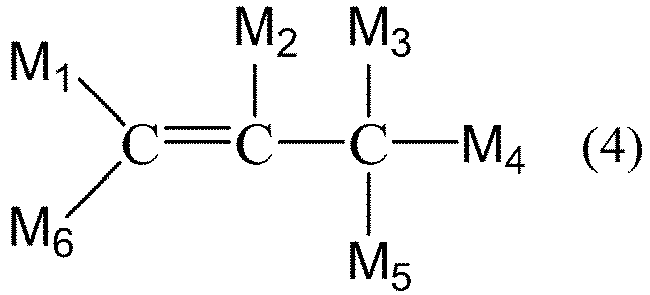
- the HFOA having three carbon atoms is not particularly limited, and examples include at least one fluoropropene compound of formula (4): wherein M 1 -M 6 are each individually a H or F, and at least one H and at least one F are contained.
- Aspecific example is 2,3,3,3-tetrafluoropropene (HFO-1234yf).
- HFO-1234yf 2,3,3,3-tetrafluoropropene
- hexafluoropropene in which M 1 -M 6 are all F can be used.
- At least one member selected from fluoromethane (HFC-41), difluoromethane (HFC-32), trifluoromethane (HFC-23), 1,1,2,2-tetrafluoroethane (HFC-134), 2,3,3,3-tetrafluoropropene (HFO-1234yf), and 1,1,2-trifluoroethane (HFC-143) is preferred because the HFO or FO, which is a target compound, can be obtained with high selectivity.
- the HFO or FO which is a target compound
- the HFO or FO can be obtained by irradiating these starting material compounds with ionizing radiation and/or an ultraviolet ray having a wavelength of ⁇ 300 nm.
- the ionizing radiation is not limited as long as irradiation to the starting material compound can selectively break the bond in the starting material compound to produce a radical in which fluorine is eliminated by elimination of at least a fluorine atom, thus finally enabling the obtainment of a target compound HFO or FO.
- the ionizing radiation include an electron beam ( ⁇ -ray), X-ray, ⁇ -ray, neutron beam, and ion beam. Similarly, plasma with ionization can also be used.
- a ⁇ -ray is particularly preferred because it can transmit a metal container, and thus, ⁇ -ray irradiation can be performed on a simple metal container (e.g., stainless steel (SUS) tube) filled with a starting material compound.
- energy rays can be used alone or in a combination of two or more as ionizing radiation.
- Ultraviolet rays having a wavelength of ⁇ 300 nm, as described below, can also be used alone or in a combination of two or more ultraviolet rays having a wavelength within the above range.
- the ionizing radiation can be not only monochromatic. Energy rays having different wavelengths or types can be used in combination, and the ionizing radiation or the like can be white.
- irradiation of the starting material compound with an ultraviolet ray having a wavelength of ⁇ 300 nm can selectively break the bond in the starting material compound to produce a radical in which fluorine is eliminated by elimination of at least a fluorine atom. Since such an effect cannot be attained by an ordinary ultraviolet ray, an ultraviolet ray particularly having a wavelength of ⁇ 300 nm among ultraviolet rays can be used.
- the starting material compound When the starting material compound is irradiated with e.g. ionizing radiation, the starting material compound is introduced into a stainless steel (SUS) tube, and ionizing radiation can be emitted from the outside of the SUS tube.
- SUS stainless steel
- Co 60 can be used for ⁇ -ray irradiation.
- the SUS tube may be filled with one type of starting material compound, or a mixture of two or more types of starting material compounds in any proportion, depending on the type of target compound.
- the charge pressure (gauge pressure) at which the starting material compound is introduced into the SUS tube is not limited, and it can be set, for example, to -0.01 to 1.5 MPaG.
- the lower limit is preferably 0 MPaG, more preferably 0.1 MPaG, and even more preferably 0.2 MPaG.
- the upper limit is preferably 1.2 MPaG, and more preferably 1.0 MPaG.
- the charge pressure (gauge pressure) can be, for example, set to 0-0.3 MPa, and preferably 0.1-0.2 MPa. Since there is no need to dilute the starting material compound with e.g. inert gas as in conventional methods using a catalytic reaction, e.g. post-treatment for separating the inert gas after obtaining the target compound is not required.
- the irradiation dose of e.g. ionizing radiation to the starting material compound is not limited as long as a target compound HFO or FO can be obtained. It is preferably set to 1 Gy to 1 MGy. Of these, the lower limit of the irradiation dose is preferably 10 Gy, more preferably 100 Gy, and even more preferably 1 kGy. The upper limit is 500 kGy, more preferably 300 kGy, and even more preferably 100 kGy. The irradiation dose can be set to 1-5 kGy, or 2-4 kGy, and further 3-4 kGy.
- the absorbed dose and irradiation dose can be converted using the following conversion formula (A).
- D T ⁇ Eexp ⁇ T wherein D is an absorbed dose, E is an irradiation dose, ⁇ is a linear absorption coefficient, and T is an irradiation distance, wherein ⁇ is a substance-specific value determined by the irradiation wavelength (which can be searched for from NIST Standard Reference Database 66 (X-Ray Form Factor, Attenuation, and Scattering Tables)), and T is a distance between an irradiation source and a sample (which can be randomly set).
- NIST Standard Reference Database 66 X-Ray Form Factor, Attenuation, and Scattering Tables
- ionizing radiation and/or an ultraviolet ray having a wavelength of ⁇ 300 nm can be irradiated; however, when the starting material compound is an HFC having one carbon atom or an HFC having two carbon atoms, irradiation of ionizing radiation (particularly a ⁇ -ray) is preferred; when the starting material compound is an HFOA, irradiation of ionizing radiation (particularly ⁇ -ray) and/or an ultraviolet ray having a wavelength of ⁇ 300 nm is preferred.
- the irradiation time of e.g. ionizing radiation is not limited, and can be suitably adjusted according to the starting material compound and the type and irradiation dose of e.g. ionizing radiation.
- the irradiation time can be set to 1 sec to 50 h. In this range, the irradiation time is preferably 1-30 h, and more preferably 5-20 h.
- the irradiation time can be set to 6-16 h, and further 7.5-15 h.
- the starting material compound is irradiated with ionizing radiation or the like at a wide range of temperature, such as -196°C to 600°C.
- the present disclosure has a significant advantage over conventional thermal decomposition methods particularly in that the reaction can proceed at a temperature condition of 10-50°C.
- the reaction can be performed at 1-30°C (preferably 15-25°C).
- the present method can be performed in either batch mode or continuous mode, and each of the conditions described above can be suitably adjusted by selecting batch mode or continuous mode.
- the present method has a remarkable effect that the selectivity of the target compound is remarkably high as compared to a conventional thermal decomposition method or a method using a catalyst.
- the selectivity of the target compound HFO or FO in a preferable embodiment is ⁇ 95.0 mol%, more preferably ⁇ 97.0 mol%, and even more preferably ⁇ 99.0 mol%.
- the conversion rate of the starting material compound can be suitably set by adjusting irradiation conditions such as e.g. ionizing radiation to ⁇ 0.1 mol%. In a preferred embodiment, the conversion rate can be increased to about 25 mol%.
- HFOs or FOs which have an unsaturated bond
- Some of the by-products have a boiling point close to that of the target compound HFO or FO, which results in a complicated problem of post treatment, such as a separation treatment.
- the present method has a significant advantage over conventional methods because a novel configuration in which a starting material compound is irradiated with ionizing radiation or the like attains a selectivity of the target compound HFO or FO of ⁇ 95 mol% in a preferable embodiment.
- the present method f is a simple and clean method in this respect as well.
- the bond in the starting material compound can be selectively broken by irradiating the starting material compound with e.g. ionizing radiation to produce a radical in which fluorine is eliminated by elimination of at least a fluorine atom, thus finally obtaining a target compound HFO or FO.
- the present method is significantly advantageous over conventional methods in that it does not require a high temperature, a catalyst, or dilution with an inert gas in the step of obtaining a target compound.
- the HFO or FO which is a target compound, produced by the present method is not limited.
- Examples include trifluoroethylene (HFO-1123), 1,2-difluoroethylene (HFO-1132(E)/(Z)), 1-fluoroethylene (HFO-1141), 1,1,1,4,4,4-hexafluoro-2-butene (HFO-1336mzz(E)/(Z)), 1,2,3,3-tetrafluoropropene (HFO-1234ye(E)/(Z)), 1,3,3,3-tetrafluoropropene (HFO-1234ze(E)/(Z)), 2,3,3,3-tetrafluoropropene (HFO-1234yf), tetrafluoroethylene (FO-1114), and 1,1-difluoroethylene (HFO-1132a).
- the mechanism of the present method is described below with reference to an example. However, the following mechanism is an example of a presumed mechanism obtained when starting material compounds (fluoromethane (HFC-41), difluoromethane (HFC-32), and trifluoromethane (HFC-23)) are irradiated with ionizing radiation (particularly a ⁇ -ray), and is not limited thereto.
- starting material compounds fluoromethane (HFC-41), difluoromethane (HFC-32), and trifluoromethane (HFC-23)
- ionizing radiation particularly a ⁇ -ray
- 1-fluoroethylene (HFO-1141) is produced from fluoromethane (HFC-41), trifluoroethylene (HFO-1123) and 1,2-difluoroethylene (HFO-1132(E)/(Z)) are produced from difluoromethane (HFC-32), and 1-fluoroethylene (HFO-1141) and trifluoroethylene (HFO-1123) are produced from trifluoromethane (HFC-23).
- a composition in which the selectivity of a target compound HFO or FO in a reaction product after separation of the starting material compound is ⁇ 95.0 mol%, and particularly ⁇ 99.0 mol%, can be obtained.
- Such an HFO- or FO-containing composition is, for example, a composition comprising trifluoroethylene (HFO-1123), 1,2-difluoroethylene (HFO-1132(E)/(Z)), tetrafluoroethylene (FO-1114), or 1,1-difluoroethylene (HFO-1132a) in an amount of ⁇ 99.0 mol%; and further comprising at least one member selected from fluoroacetylene, trifluoromethane (HFC-23), 1,1,2,2-tetrafluoroethane (HFC-134), and 1,1,2-trifluoroethane (HFC-143).
- the content of the aromatic compound in the by-product is suppressed to a remarkably low level.
- the extremely low content of the aromatic compound in which the coking with carbon is a concern is advantageous as compared to conventional methods.
- Such an HFO- or FO-containing composition is a composition containing trifluoroethylene (HFO-1123), 1,2-difluoroethylene (HFO-1132(E)/(Z)), tetrafluoroethylene (FO-1114), or 1,1-difluoroethylene (HFO-1132a) in an amount of ⁇ 99.0 mol%, wherein the content of the aromatic compound of formula (5) : wherein Z 1 -Z 6 are each individually a H or F, is ⁇ 0.1 ppm.
- the content of the aromatic compound is based on measurements using an instrument such as a column chromatograph (model number: GC7890A) produced by Agilent Technology Inc. or a column chromatograph mass spectrometer (model number: GCMS-QP2020) produced by Shimadzu Corporation.
- the HFO or FO-containing compositions can be used as various functional materials, solvents, refrigerants, foaming agents, monomers for functional polymers, or starting materials of such monomers, and can be applied as refrigerants with low global warming potential (GWP) in refrigerant applications.
- GWP global warming potential
- Each of the starting material compounds was introduced into a SUS tube at a charge pressure as shown in Tables 1 and 2.
- the starting material compound introduced into the SUS tube was irradiated with a ⁇ -ray using Co 60 at room temperature.
- the ⁇ -ray irradiation conditions irradiation dose, irradiation time, and integrated irradiation dose are as shown in Tables 1 and 2.
- compositions of reaction products were as follows. Table 1 ⁇ ray irradiation experiment Example 1 Example 2 Experimental conditions Starting material compound HFC-32 HFC-32 Pressure (MPaG) 0.2 0.1 Irradiation dose (kGy/h) 3.5 3.5 Irradiation time (h) 15 7.5 Integrated irradiation dose (kGy) 52.5 26.25 Measurement results GC area of sample after irradiation (%) HFC-32 75.03% 96.77% HFO-1123 24.76% 3.12% HFO-1132 (E) 0.05% 0.03% HFO-1132(Z) 0.00% 0.00% HFC-134 0.00% 0.00% HFC-143 0.03% 0.01% Fluorobenzen compound 0.00% 0.00% Other component(s) 0.13% 0.07% Conversion rate of HFC-32 24.99% 3.23% Conversion rate of HFO-1123 99.15% 96.63%
- Example 4 As is clear from the results in Table 2, in Example 3, the selectivity of target HFO (HFO-1123) in the reaction product after the separation of the starting material was ⁇ 95.0 mol%. In Example 4, due to the low conversion rate of the starting material compound in Example 4, the selectivity of the target HFO (HFO-1123) in the reaction product after the separation of the starting material is ⁇ 95.0 mol%; however, Example 4 has a significant advantage over the conventional thermal decomposition methods in that the selectivity exceeds 80.0 mol%.
- Trifluoroethylene (HFO-1123), which was the target compound, was synthesized by a thermal decomposition method from HFC-32, which had been introduced into the SUS tube.
- the gas in the SUS tube after the thermal decomposition was sampled with a gas-tight syringe and analyzed using an instrument such as a column chromatograph (model number: GC7890A) produced by Agilent Technologies Inc. or a column chromatograph mass spectrometer (model number: GCMS-QP2020) produced by Shimadzu Corporation.
- a column chromatograph model number: GC7890A
- a column chromatograph mass spectrometer model number: GCMS-QP2020
- the composition of the reaction product was as follows. Table 3 Thermal decomposition reaction experiment Comparative Example 1 Experimental conditions Starting material compound HFC-32 Reaction temperature (°C) 900 Residence time (s) 0.4 Measurement results GC area of sample after reaction (%) HFC-32 93.97% HFO-1123 0.28% HFO-1132 (E) 0.59% HFO-1132 (Z) 0.91% HFC-134 0.85% HFC-143 1.000 Fluorobenzene compound 0.10% Other component(s) 2.31% Conversion rate of HFC-32 6.04% Selectivity of HFO-1123 4.62% Selectivity of HFO-1132 (E) 10.46% Selectivity of HFO-1132 (Z) 15.10%
Landscapes
- Chemical & Material Sciences (AREA)
- Organic Chemistry (AREA)
- Chemical Kinetics & Catalysis (AREA)
- Organic Low-Molecular-Weight Compounds And Preparation Thereof (AREA)
Description
- The present disclosure relates to a method for producing a hydrofluoroolefin or fluoroolefin.
- Hydrofluoroolefins (HFOs) are useful compounds as various functional materials, solvents, refrigerants, foaming agents, monomers for functional polymers, or starting materials of such monomers, and they offer promising prospects as refrigerants with low global warming potential (GWP). Fluoroolefins (FOs) are also useful compounds as monomers for functional polymers.
- As prior art relating to the present disclosure,
JP-A-2013-241348 - In addition to the above thermal decomposition method of HFC, a method using a catalytic reaction is also known.
-
US 3,046,304 relates to the preparation of unsaturated halogenated alkenes by coupling hydrocarbon compounds having a terminal Br or I by raising the energy level of the compound to cause fission of the C-Br of C-I bond by heating or irradiation of light or electron beam. -
WO 2016/163522 discloses a method for producing hydrofluoroolefins CR1R2=CR3R4 (2) by converting hydrofluorocarbons CR1R2X1CR3R4X2 (1), wherein R1-R3 are H or F, R4is H, F, CH3, CH2F, CHF2 or CF3, with both H and F being present, and one of X1 and X2 is H and the other is F, in the presence of CO2. - The present inventors, through their own investigation, have come to the conclusion that conventional technologies have not yet developed a method for producing an HFO or FO, which is a target compound, with high selectivity, without requiring a high temperature and a catalyst in a synthesis process of the target compound. Accordingly, an object of the present disclosure is to solve such a unique problem.
- The present invention provides a method ("the present method") for producing a hydrofluoroolefin or fluoroolefin having 2, 3 or 4 carbon atoms, comprising irradiating at least one starting material compound selected from C1-2-hydrofluorocarbons and C2-3-hydrofluoroolefins A with ionizing radiation and/or UV-light having a wavelength of ≤ 300 nm, with the proviso that when the at least one starting material compound is the hydrofluoroolefin A, the resulting hydrofluoroolefin is different from the hydrofluoroolefin A.
- Preferred embodiments of the invention are as defined in the appended dependent claims and/or in the following detailed description.
- The present method can provide a method for producing an HFO or FO, which is a target compound, with high selectivity.
- The present inventors conducted extensive research to solve the above problems, and found that the problems can be solved by a production method comprising irradiating a specific starting material compound with ionizing radiation and/or an ultraviolet ray having a wavelength of ≤ 300 nm.
- The present invention was accomplished as a result of further research based on the above finding.
- In the present method for producing a hydrofluoroolefin (HFO) or fluoroolefin (FO), a hydrofluoroolefin or fluoroolefin having two, three, or four carbon atoms can be obtained by irradiating at least one starting material compound selected from hydrofluorocarbons having one or two carbon atoms and hydrofluoroolefin As having two or three carbon atoms with ionizing radiation and/or an ultraviolet ray having a wavelength of ≤ 300 nm (with the proviso that when the starting material compound is the hydrofluoroolefin A, the resulting hydrofluoroolefin is different from the hydrofluoroolefin A.)
- In the present specification, hydrofluorocarbon, hydrofluoroolefin, hydrofluoroolefin A, and fluoroolefin are respectively referred to below as a "HFC," "HFO," "HFOA," and "perfluoroolefin, FO."
- At least one starting material compound selected from hydrofluorocarbons having one or two carbon atoms and hydrofluoroolefin As having two or three carbon atoms is not limited as long as an HFO or FO having two, three, or four carbon atoms (with the proviso that when the starting material compound is an HFOA, the HFO is different from the HFOA) can be obtained by irradiating at least one starting material compound with ionizing radiation and/or an ultraviolet ray having a wavelength of ≤ 300 nm (collectively referred to below as "ionizing radiation").
- The HFC having one carbon atom is not limited. Examples include a fluoromethane compound of formula (1):

- Specific examples include fluoromethane (HFC-41), difluoromethane (HFC-32), and trifluoromethane (HFC-23). In the present disclosure, in addition to the fluoromethane compound of formula (1), tetrafluoromethane (FC-14) in which X1-X4 are all F can be used. The use of FC-14 is expected to improve the selectivity of HFO or FO having a high fluorine content.
- The HFC having two carbon atoms is not limited. Examples include a fluoroethane compound of formula (2):

- The HFOA having two carbon atoms is not limited, and examples include at least one fluoroethylene compound of formula (3):

- The HFOA having three carbon atoms is not particularly limited, and examples include at least one fluoropropene compound of formula (4):
- Of these starting material compounds, at least one member selected from fluoromethane (HFC-41), difluoromethane (HFC-32), trifluoromethane (HFC-23), 1,1,2,2-tetrafluoroethane (HFC-134), 2,3,3,3-tetrafluoropropene (HFO-1234yf), and 1,1,2-trifluoroethane (HFC-143) is preferred because the HFO or FO, which is a target compound, can be obtained with high selectivity.
- The HFO or FO, which is a target compound, can be obtained by irradiating these starting material compounds with ionizing radiation and/or an ultraviolet ray having a wavelength of ≤ 300 nm. The ionizing radiation is not limited as long as irradiation to the starting material compound can selectively break the bond in the starting material compound to produce a radical in which fluorine is eliminated by elimination of at least a fluorine atom, thus finally enabling the obtainment of a target compound HFO or FO. Examples of the ionizing radiation include an electron beam (β-ray), X-ray, γ-ray, neutron beam, and ion beam. Similarly, plasma with ionization can also be used.
- Among the ionizing radiation, a γ-ray is particularly preferred because it can transmit a metal container, and thus, γ-ray irradiation can be performed on a simple metal container (e.g., stainless steel (SUS) tube) filled with a starting material compound. In the present disclosure, energy rays can be used alone or in a combination of two or more as ionizing radiation. Ultraviolet rays having a wavelength of ≤ 300 nm, as described below, can also be used alone or in a combination of two or more ultraviolet rays having a wavelength within the above range. Specifically, the ionizing radiation can be not only monochromatic. Energy rays having different wavelengths or types can be used in combination, and the ionizing radiation or the like can be white.
- As with ionizing radiation, irradiation of the starting material compound with an ultraviolet ray having a wavelength of ≤ 300 nm can selectively break the bond in the starting material compound to produce a radical in which fluorine is eliminated by elimination of at least a fluorine atom. Since such an effect cannot be attained by an ordinary ultraviolet ray, an ultraviolet ray particularly having a wavelength of ≤ 300 nm among ultraviolet rays can be used.
- When the starting material compound is irradiated with e.g. ionizing radiation, the starting material compound is introduced into a stainless steel (SUS) tube, and ionizing radiation can be emitted from the outside of the SUS tube. Specifically, in the case of γ-ray irradiation, Co 60 can be used for γ-ray irradiation.
- The SUS tube may be filled with one type of starting material compound, or a mixture of two or more types of starting material compounds in any proportion, depending on the type of target compound. The charge pressure (gauge pressure) at which the starting material compound is introduced into the SUS tube is not limited, and it can be set, for example, to -0.01 to 1.5 MPaG. The lower limit is preferably 0 MPaG, more preferably 0.1 MPaG, and even more preferably 0.2 MPaG. The upper limit is preferably 1.2 MPaG, and more preferably 1.0 MPaG. The charge pressure (gauge pressure) can be, for example, set to 0-0.3 MPa, and preferably 0.1-0.2 MPa. Since there is no need to dilute the starting material compound with e.g. inert gas as in conventional methods using a catalytic reaction, e.g. post-treatment for separating the inert gas after obtaining the target compound is not required.
- The irradiation dose of e.g. ionizing radiation to the starting material compound is not limited as long as a target compound HFO or FO can be obtained. It is preferably set to 1 Gy to 1 MGy. Of these, the lower limit of the irradiation dose is preferably 10 Gy, more preferably 100 Gy, and even more preferably 1 kGy. The upper limit is 500 kGy, more preferably 300 kGy, and even more preferably 100 kGy. The irradiation dose can be set to 1-5 kGy, or 2-4 kGy, and further 3-4 kGy.
- The absorbed dose and irradiation dose can be converted using the following conversion formula (A).

- For example, the irradiation dose [E(J/cm2)] obtained when the energy ray having a specific wavelength is applied to a sample (HFC-32) from a specific distance [T] is measured, and the linear absorption coefficient of HFC-32 in a given wavelength range is checked in the NIST database above (the gas density according to pressure being separately calculated or measured) to determine the absorbed dose from the conversion formula.
- Regardless of the type of the starting material compound, ionizing radiation and/or an ultraviolet ray having a wavelength of ≤ 300 nm can be irradiated; however, when the starting material compound is an HFC having one carbon atom or an HFC having two carbon atoms, irradiation of ionizing radiation (particularly a γ-ray) is preferred; when the starting material compound is an HFOA, irradiation of ionizing radiation (particularly γ-ray) and/or an ultraviolet ray having a wavelength of ≤ 300 nm is preferred.
- The irradiation time of e.g. ionizing radiation is not limited, and can be suitably adjusted according to the starting material compound and the type and irradiation dose of e.g. ionizing radiation. For example, the irradiation time can be set to 1 sec to 50 h. In this range, the irradiation time is preferably 1-30 h, and more preferably 5-20 h. The irradiation time can be set to 6-16 h, and further 7.5-15 h.
- The starting material compound is irradiated with ionizing radiation or the like at a wide range of temperature, such as -196°C to 600°C. The present disclosure has a significant advantage over conventional thermal decomposition methods particularly in that the reaction can proceed at a temperature condition of 10-50°C. For example, the reaction can be performed at 1-30°C (preferably 15-25°C).
- The present method can be performed in either batch mode or continuous mode, and each of the conditions described above can be suitably adjusted by selecting batch mode or continuous mode. The present method has a remarkable effect that the selectivity of the target compound is remarkably high as compared to a conventional thermal decomposition method or a method using a catalyst. Specifically, the selectivity of the target compound HFO or FO in a preferable embodiment is ≥ 95.0 mol%, more preferably ≥ 97.0 mol%, and even more preferably ≥ 99.0 mol%. On the other hand, the conversion rate of the starting material compound can be suitably set by adjusting irradiation conditions such as e.g. ionizing radiation to ≥ 0.1 mol%. In a preferred embodiment, the conversion rate can be increased to about 25 mol%.
- HFOs or FOs, which have an unsaturated bond, generate many by-products in a conventional thermal decomposition method. Some of the by-products have a boiling point close to that of the target compound HFO or FO, which results in a complicated problem of post treatment, such as a separation treatment. In contrast, the present method has a significant advantage over conventional methods because a novel configuration in which a starting material compound is irradiated with ionizing radiation or the like attains a selectivity of the target compound HFO or FO of ≥ 95 mol% in a preferable embodiment. In addition, as compared to conventional methods using a catalytic reaction, dilution with e.g. an inert gas is not required, and the present method f is a simple and clean method in this respect as well. In the present method, the bond in the starting material compound can be selectively broken by irradiating the starting material compound with e.g. ionizing radiation to produce a radical in which fluorine is eliminated by elimination of at least a fluorine atom, thus finally obtaining a target compound HFO or FO. Accordingly, the present method is significantly advantageous over conventional methods in that it does not require a high temperature, a catalyst, or dilution with an inert gas in the step of obtaining a target compound.
- The HFO or FO, which is a target compound, produced by the present method is not limited. Examples include trifluoroethylene (HFO-1123), 1,2-difluoroethylene (HFO-1132(E)/(Z)), 1-fluoroethylene (HFO-1141), 1,1,1,4,4,4-hexafluoro-2-butene (HFO-1336mzz(E)/(Z)), 1,2,3,3-tetrafluoropropene (HFO-1234ye(E)/(Z)), 1,3,3,3-tetrafluoropropene (HFO-1234ze(E)/(Z)), 2,3,3,3-tetrafluoropropene (HFO-1234yf), tetrafluoroethylene (FO-1114), and 1,1-difluoroethylene (HFO-1132a).
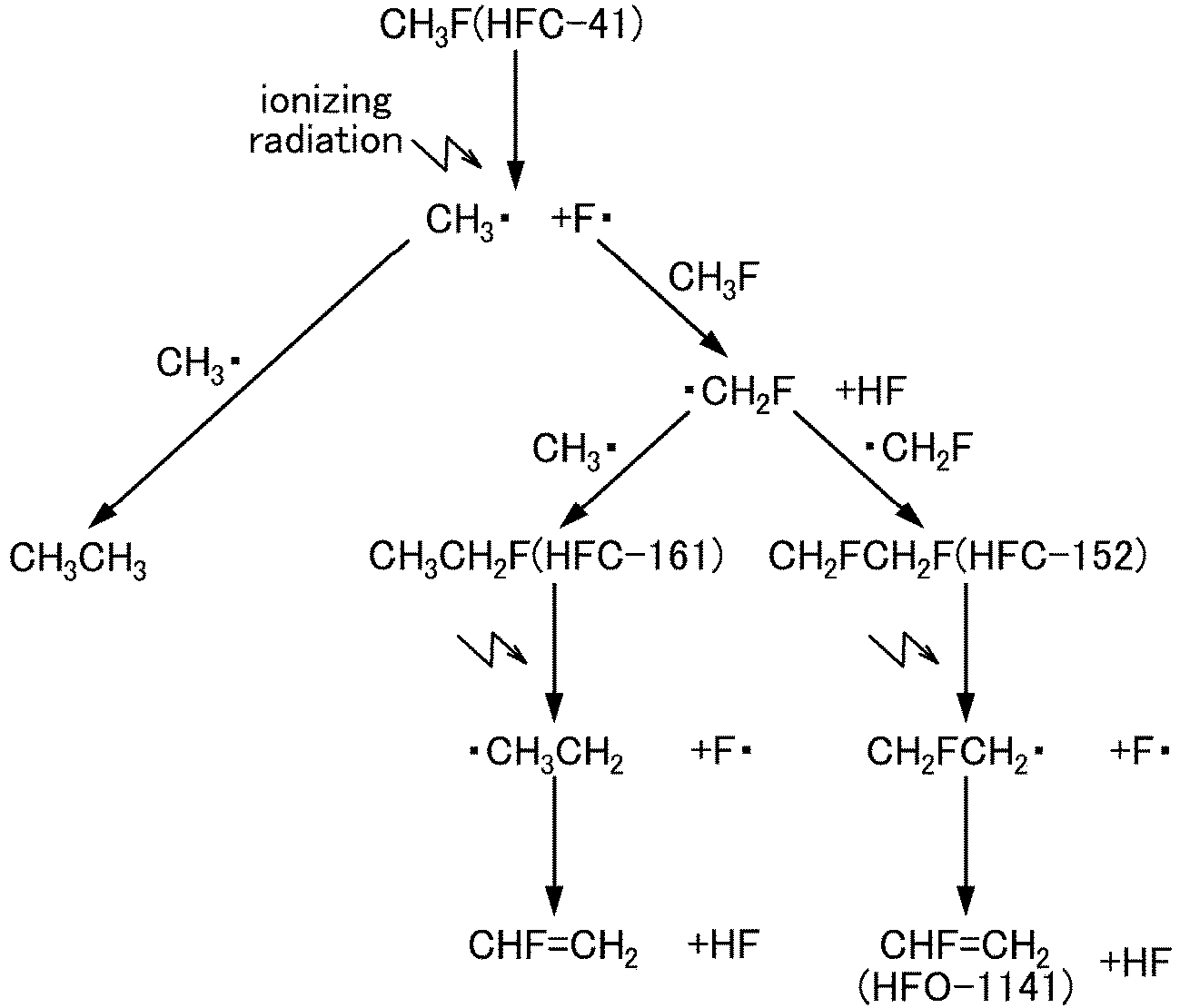
- The mechanism of the present method is described below with reference to an example. However, the following mechanism is an example of a presumed mechanism obtained when starting material compounds (fluoromethane (HFC-41), difluoromethane (HFC-32), and trifluoromethane (HFC-23)) are irradiated with ionizing radiation (particularly a γ-ray), and is not limited thereto.
- All of these starting material compounds are HFCs having one carbon atom, and reaction steps are generalized and explained below.
- Step 1: By irradiating the starting material compound with a γ-ray, the bond in the starting material compound is selectively broken to eliminate a fluorine atom (fluorine radical), thus producing a radical in which fluorine is eliminated.
- Step 2: The fluorine radical allows the elimination of a hydrogen atom in the starting material compound to form a hydrogen fluoride (HF) and a radical in which hydrogen is eliminated.
- Step 3: By the reaction between radicals in which fluorine is eliminated, reaction between radicals in which hydrogen is eliminated, and reaction between a radical in which fluorine is eliminated and a radical in which hydrogen is eliminated, an HFC having two carbon atoms is produced.
- Step 4: By irradiating the HFC having two carbon atoms with a γ-ray, a fluorine atom (fluorine radical) is eliminated from the HFC having two carbon atoms, thus producing an HFC radical having two carbon atoms in which fluorine is eliminated.
- Step 5: The fluorine radical allows the elimination of a hydrogen atom in the HFC having two carbon atoms to produce a hydrogen fluoride (HF) and an HFO having two carbon atoms (target compound).
- Thereby, 1-fluoroethylene (HFO-1141) is produced from fluoromethane (HFC-41), trifluoroethylene (HFO-1123) and 1,2-difluoroethylene (HFO-1132(E)/(Z)) are produced from difluoromethane (HFC-32), and 1-fluoroethylene (HFO-1141) and trifluoroethylene (HFO-1123) are produced from trifluoromethane (HFC-23).
- When difluoromethane (HFC-32) is used as a starting material compound, if the tetrafluoromethane (FC-14) is additionally used as a starting material compound, it is presumed that irradiation of ionizing radiation produces a radical (CF3·) in which hydrogen is eliminated from FC-14, and that if a radical ( · CH2F) from HFC-32 is present together with (CF3 · ), CF3-CH2F (HFC-134a) is produced, thus finally producing HFO-1123 by irradiation of ionizing radiation. Accordingly, the additional use of FC-14 is expected to improve the selectivity of HFO or FO having a high fluorine content.


- According to the present method, in a preferable embodiment, a composition in which the selectivity of a target compound HFO or FO in a reaction product after separation of the starting material compound is ≥ 95.0 mol%, and particularly ≥ 99.0 mol%, can be obtained.
- Such an HFO- or FO-containing composition is, for example, a composition comprising trifluoroethylene (HFO-1123), 1,2-difluoroethylene (HFO-1132(E)/(Z)), tetrafluoroethylene (FO-1114), or 1,1-difluoroethylene (HFO-1132a) in an amount of ≥ 99.0 mol%; and further comprising at least one member selected from fluoroacetylene, trifluoromethane (HFC-23), 1,1,2,2-tetrafluoroethane (HFC-134), and 1,1,2-trifluoroethane (HFC-143).
- In addition, according to the present method, unlike conventional thermal decomposition methods (which generally have a "coking problem"), the content of the aromatic compound in the by-product is suppressed to a remarkably low level. The extremely low content of the aromatic compound in which the coking with carbon is a concern is advantageous as compared to conventional methods. Such an HFO- or FO-containing composition is a composition containing trifluoroethylene (HFO-1123), 1,2-difluoroethylene (HFO-1132(E)/(Z)), tetrafluoroethylene (FO-1114), or 1,1-difluoroethylene (HFO-1132a) in an amount of ≥ 99.0 mol%, wherein the content of the aromatic compound of formula (5) :

- The HFO or FO-containing compositions can be used as various functional materials, solvents, refrigerants, foaming agents, monomers for functional polymers, or starting materials of such monomers, and can be applied as refrigerants with low global warming potential (GWP) in refrigerant applications.
- The present invention is explained with reference to Examples and Comparative Examples.
- Starting material compounds were prepared as described in Tables 1 and 2.
- Each of the starting material compounds was introduced into a SUS tube at a charge pressure as shown in Tables 1 and 2.
- Subsequently, the starting material compound introduced into the SUS tube was irradiated with a γ-ray using Co 60 at room temperature. The γ-ray irradiation conditions (irradiation dose, irradiation time, and integrated irradiation dose) are as shown in Tables 1 and 2.
- Gas in the SUS tube after irradiation was then sampled with a gas-tight syringe and analyzed using an instrument such as a column chromatograph (model number: GC7890A) produced by Agilent Technologies Inc. or a column chromatograph mass spectrometer (model number: GCMS-QP2020) produced by Shimadzu Corporation.
- The compositions of reaction products (unit: mol%) were as follows.
Table 1 γ ray irradiation experiment Example 1 Example 2 Experimental conditions Starting material compound HFC-32 HFC-32 Pressure (MPaG) 0.2 0.1 Irradiation dose (kGy/h) 3.5 3.5 Irradiation time (h) 15 7.5 Integrated irradiation dose (kGy) 52.5 26.25 Measurement results GC area of sample after irradiation (%) HFC-32 75.03% 96.77% HFO-1123 24.76% 3.12% HFO-1132 (E) 0.05% 0.03% HFO-1132(Z) 0.00% 0.00% HFC-134 0.00% 0.00% HFC-143 0.03% 0.01% Fluorobenzen compound 0.00% 0.00% Other component(s) 0.13% 0.07% Conversion rate of HFC-32 24.99% 3.23% Conversion rate of HFO-1123 99.15% 96.63% - As is clear from the results in Table 1, the selectivity of target HFO (HFO-1123) in the reaction product after the separation of the starting material was ≥ 95.0 mol% in both Examples 1 and 2.
Table 2 γ ray irradiation experiment Example 3 Example 4 Experimental conditions Starting material compound HFO1234yf HFO1234yf Pressure (MPaG) 0.2 0.1 Irradiation dose(kGy/h) 3.5 3.5 Irradiation time(h) 15 7.5 Integrated irradiation dose (kGy) 52.5 26.25 Measurement results GC area of sample after irradiation (%) HFO-1234yf 89.56% 99.00% HFO-1123 10.23% 0.83% HFO-1132 (E) 0.01% 0.00% HFO-1132(Z) 0.00% 0.00% HFC-134 0.00% 0.02% HFC-143 0.00% 0.00% Fluorobenzen compound 0.00% 0.00% Other component(s) 0.20% 0.15% Conversion rate of HFO1234yf 10.45% 1.00% Conversion rate of HFO-1123 97.99% 83.03% - As is clear from the results in Table 2, in Example 3, the selectivity of target HFO (HFO-1123) in the reaction product after the separation of the starting material was ≥ 95.0 mol%. In Example 4, due to the low conversion rate of the starting material compound in Example 4, the selectivity of the target HFO (HFO-1123) in the reaction product after the separation of the starting material is < 95.0 mol%; however, Example 4 has a significant advantage over the conventional thermal decomposition methods in that the selectivity exceeds 80.0 mol%.
- Difluoromethane (HFC-32) was prepared as a starting material compound.
- Trifluoroethylene (HFO-1123), which was the target compound, was synthesized by a thermal decomposition method from HFC-32, which had been introduced into the SUS tube.
- Thermal decomposition conditions are as shown in Table 3.
- Subsequently, the gas in the SUS tube after the thermal decomposition was sampled with a gas-tight syringe and analyzed using an instrument such as a column chromatograph (model number: GC7890A) produced by Agilent Technologies Inc. or a column chromatograph mass spectrometer (model number: GCMS-QP2020) produced by Shimadzu Corporation.
- The composition of the reaction product (unit: mol%) was as follows.
Table 3 Thermal decomposition reaction experiment Comparative Example 1 Experimental conditions Starting material compound HFC-32 Reaction temperature (°C) 900 Residence time (s) 0.4 Measurement results GC area of sample after reaction (%) HFC-32 93.97% HFO-1123 0.28% HFO-1132 (E) 0.59% HFO-1132 (Z) 0.91% HFC-134 0.85% HFC-143 1.000 Fluorobenzene compound 0.10% Other component(s) 2.31% Conversion rate of HFC-32 6.04% Selectivity of HFO-1123 4.62% Selectivity of HFO-1132 (E) 10.46% Selectivity of HFO-1132 (Z) 15.10% - As is clear from Table 3, it was found that, in Comparative Example 1, multiple HFOs having similar boiling points were formed in the reaction product after the separation of the starting material, and the selectivity of each HFO was significantly lower than those of Examples 1-4.
Claims (7)
- A method for producing a hydrofluoroolefin or fluoroolefin having 2, 3 or 4 carbon atoms, comprising irradiating at least one starting material compound selected from C1-2-hydrofluorocarbons and C2-3-hydrofluoroolefins A with ionizing radiation and/or UV-light having a wavelength of ≤ 300 nm, with the proviso that when the at least one starting material compound is the hydrofluoroolefin A, the resulting hydrofluoroolefin is different from the hydrofluoroolefin A.
- The method of claim 1, wherein the ionizing radiation is a γ ray.
- The method of claim 1 or 2, wherein the absorbed dose of the ionizing radiation and/or UV-light having a wavelength of ≤ 300 nm is 1 Gy to 1 MGy.
- The method of any of claims 1-3, wherein the starting material compound is at least one fluoromethane compound of formula (1):


- The method of any of claims 1-3, wherein the starting material compound is at least one fluoroethylene compound of formula (3):


- The method of any of claims 1-5, wherein the starting material compound is irradiated with the ionizing radiation and/or ultraviolet ray at -196°C to 600°C.
- The method of any of claims 1-6, wherein the reaction is performed in batch mode or continuous mode.
Applications Claiming Priority (2)
| Application Number | Priority Date | Filing Date | Title |
|---|---|---|---|
| JP2020033376A JP7011268B2 (en) | 2020-02-28 | 2020-02-28 | Method for producing hydrofluoroolefin or fluoroolefin |
| PCT/JP2021/006729 WO2021172305A1 (en) | 2020-02-28 | 2021-02-24 | Manufacturing method for hydrofluoroolefin or fluoroolefin |
Publications (3)
| Publication Number | Publication Date |
|---|---|
| EP4112593A1 EP4112593A1 (en) | 2023-01-04 |
| EP4112593A4 EP4112593A4 (en) | 2024-03-27 |
| EP4112593B1 true EP4112593B1 (en) | 2025-02-12 |
Family
ID=77490507
Family Applications (1)
| Application Number | Title | Priority Date | Filing Date |
|---|---|---|---|
| EP21761593.9A Active EP4112593B1 (en) | 2020-02-28 | 2021-02-24 | Manufacturing method for hydrofluoroolefin or fluoroolefin |
Country Status (7)
| Country | Link |
|---|---|
| US (1) | US12435020B2 (en) |
| EP (1) | EP4112593B1 (en) |
| JP (2) | JP7011268B2 (en) |
| KR (1) | KR102845146B1 (en) |
| CN (1) | CN115151521B (en) |
| TW (1) | TWI873300B (en) |
| WO (1) | WO2021172305A1 (en) |
Families Citing this family (1)
| Publication number | Priority date | Publication date | Assignee | Title |
|---|---|---|---|---|
| EP4491604A4 (en) * | 2023-01-18 | 2025-09-24 | Daikin Ind Ltd | COMPOSITION CONTAINING 1,2-DIFLUOROETHYLENE |
Citations (2)
| Publication number | Priority date | Publication date | Assignee | Title |
|---|---|---|---|---|
| US3046304A (en) | 1956-09-06 | 1962-07-24 | Haszeldine Robert Neville | Coupling of halogenated organic compounds |
| US20180037524A1 (en) | 2015-04-09 | 2018-02-08 | Asahi Glass Company, Limited | Manufacturing method of hydrofluoroolefin |
Family Cites Families (20)
| Publication number | Priority date | Publication date | Assignee | Title |
|---|---|---|---|---|
| JPS61172836A (en) * | 1985-01-29 | 1986-08-04 | Agency Of Ind Science & Technol | Production of halogenated unsaturated alkylbenzene |
| US20020032356A1 (en) | 2000-07-14 | 2002-03-14 | Gelblum Peter Gideon | Synthesis of perfluoroolefins |
| GB0021618D0 (en) * | 2000-09-02 | 2000-10-18 | Ici Plc | Production of hydrofluoroalkanes |
| KR100575552B1 (en) * | 2001-07-06 | 2006-05-03 | 쇼와 덴코 가부시키가이샤 | Process for producing hydrofluorocarbons |
| JP4484572B2 (en) * | 2003-08-21 | 2010-06-16 | 昭和電工株式会社 | Method for producing hexafluoroethane and use thereof |
| US8766020B2 (en) * | 2008-07-31 | 2014-07-01 | Honeywell International Inc. | Process for producing 2,3,3,3-tetrafluoropropene |
| WO2009013198A1 (en) * | 2007-07-20 | 2009-01-29 | Solvay Fluor Gmbh | Process for obtaining a purified hydrofluoroalkane |
| US8975454B2 (en) * | 2008-07-31 | 2015-03-10 | Honeywell International Inc. | Process for producing 2,3,3,3-tetrafluoropropene |
| CN101979364B (en) * | 2010-09-30 | 2013-01-09 | 浙江环新氟材料股份有限公司 | Method for preparing 2,3,3,3-tetrafluoropropylene |
| JP2013241348A (en) * | 2012-05-18 | 2013-12-05 | Asahi Glass Co Ltd | Method for producing 1,2-difluoroethylene |
| CN105358511A (en) * | 2013-07-16 | 2016-02-24 | 旭硝子株式会社 | Preservation method of trifluoroethylene and storage container of trifluoroethylene |
| JP2015120670A (en) * | 2013-12-24 | 2015-07-02 | 旭硝子株式会社 | Process for producing 1-chloro-1,2-difluoroethylene |
| EP3109225B1 (en) | 2014-02-20 | 2022-06-08 | AGC Inc. | Method for purifying fluid that includes trifluoroethylene, and method for producing trifluoroethylene |
| JP2015155391A (en) * | 2014-02-20 | 2015-08-27 | 旭硝子株式会社 | Method for storing trifluoroethylene |
| CN105753634B (en) * | 2015-01-07 | 2018-01-12 | 旭硝子株式会社 | The manufacture method of Azeotrope-like compositions and purified fluorochemical |
| CN108430959B (en) * | 2015-12-16 | 2021-11-26 | Agc株式会社 | Process for producing hydrofluoroolefin |
| CN106565409B (en) * | 2016-10-26 | 2019-03-22 | 北京理工大学 | Method for preparing fluorine-containing compound CH2F-R (R=H or -CF3) by pyrolysis of difluoromethane |
| JP6753434B2 (en) | 2018-06-13 | 2020-09-09 | ダイキン工業株式会社 | Method for producing difluoroethylene |
| JP7108212B2 (en) | 2018-07-17 | 2022-07-28 | ダイキン工業株式会社 | Composition containing refrigerant, heat transfer medium and heat cycle system |
| JP6958596B2 (en) * | 2019-07-01 | 2021-11-02 | ダイキン工業株式会社 | Alkane manufacturing method |
-
2020
- 2020-02-28 JP JP2020033376A patent/JP7011268B2/en active Active
-
2021
- 2021-02-24 EP EP21761593.9A patent/EP4112593B1/en active Active
- 2021-02-24 KR KR1020227033156A patent/KR102845146B1/en active Active
- 2021-02-24 CN CN202180016618.5A patent/CN115151521B/en active Active
- 2021-02-24 WO PCT/JP2021/006729 patent/WO2021172305A1/en not_active Ceased
- 2021-02-26 TW TW110106999A patent/TWI873300B/en active
- 2021-10-06 JP JP2021164992A patent/JP2022000476A/en active Pending
-
2022
- 2022-08-25 US US17/895,529 patent/US12435020B2/en active Active
Patent Citations (2)
| Publication number | Priority date | Publication date | Assignee | Title |
|---|---|---|---|---|
| US3046304A (en) | 1956-09-06 | 1962-07-24 | Haszeldine Robert Neville | Coupling of halogenated organic compounds |
| US20180037524A1 (en) | 2015-04-09 | 2018-02-08 | Asahi Glass Company, Limited | Manufacturing method of hydrofluoroolefin |
Non-Patent Citations (4)
| Title |
|---|
| CARMICHAEL HALBERT, LAU YAN K.: "Radiolysis of 1,1-difluoroethane", THE JOURNAL OF PHYSICAL CHEMISTRY, AMERICAN CHEMICAL SOCIETY, vol. 78, no. 22, 1 October 1974 (1974-10-01), pages 2183 - 2186, XP093337690, ISSN: 0022-3654, DOI: 10.1021/j100615a001 |
| CHAN S. C, INEL Y, TSCHUIKOW-ROUX E: "Primary Processes in the Vacuum Ultraviolet Photolysis of Ethyl Fluoride at 147 nm", CANADIAN JOURNAL OF CHEMISTRY, NRC RESEARCH PRESS, CANADA, vol. 50, no. 10, 15 May 1972 (1972-05-15), Canada, pages 1443 - 1447, XP009565295, ISSN: 0008-4042, DOI: 10.1139/v72-229 |
| DACEY J. R., LITTLER J. G. F.: "Direct photolysis of tetrafluoroethylene at 1849âà ", CANADIAN JOURNAL OF CHEMISTRY, vol. 47, no. 20, 15 October 1969 (1969-10-15), pages 3871 - 3875, XP093337687, ISSN: 0008-4042, DOI: 10.1139/v69-644 |
| DALBY F. W.: "Flash Photolysis Measurement of the Kinetics of CF2 Reactions", THE JOURNAL OF CHEMICAL PHYSICS, AMERICAN INSTITUTE OF PHYSICS, UNITED STATES, vol. 41, no. 8, 15 October 1964 (1964-10-15), United States, pages 2297 - 2303, XP093337689, ISSN: 0021-9606, DOI: 10.1063/1.1726263 |
Also Published As
| Publication number | Publication date |
|---|---|
| KR102845146B1 (en) | 2025-08-12 |
| CN115151521B (en) | 2024-09-24 |
| US20230014347A1 (en) | 2023-01-19 |
| EP4112593A1 (en) | 2023-01-04 |
| TWI873300B (en) | 2025-02-21 |
| CN115151521A (en) | 2022-10-04 |
| JP2022000476A (en) | 2022-01-04 |
| US12435020B2 (en) | 2025-10-07 |
| WO2021172305A1 (en) | 2021-09-02 |
| TW202146364A (en) | 2021-12-16 |
| EP4112593A4 (en) | 2024-03-27 |
| JP7011268B2 (en) | 2022-01-26 |
| KR20220145883A (en) | 2022-10-31 |
| JP2021134190A (en) | 2021-09-13 |
Similar Documents
| Publication | Publication Date | Title |
|---|---|---|
| JP6885447B2 (en) | A method for purifying a fluid containing trifluoroethylene and a method for producing trifluoroethylene. | |
| EP2170788B1 (en) | Preparation of halogen and hydrogen containing alkenes over metal fluoride catalysts | |
| EP3040326B1 (en) | Haloolefin-based composition | |
| RU2474569C2 (en) | Method of separating 1,3,3,3,-tetrafluopropene from hydrogen fluoride by azeotropic distillation | |
| EP2993213B1 (en) | Composition containing trifluoroethylene | |
| EP2066606B1 (en) | Catalytic isomerization processes of 1,3,3,3-tetrafluoropropene for making 2,3,3,3-tetrafluoropropene | |
| US7943015B2 (en) | Use of copolymers of perfluoro(alkyl vinyl ether) for photochemical reactions | |
| EP2837613B1 (en) | Azeotropic or azeotrope like composition, and method for producing 2,3,3,3-tetrafluoropropene or chloromethane | |
| EP3015526A1 (en) | Halo-olefin composition and use therefor | |
| JP2008526688A (en) | End-functionalized perfluoro (alkyl vinyl ether) reactor wall functionalized copolymers for photochemical reactions, methods for increasing fluorine content in hydrocarbons and halohydrocarbons, and methods for producing olefins | |
| KR20080066857A (en) | Direct conversion of HFC 225Ca / CV mixture to HFC 245CV and HFC 1234yf | |
| US12435020B2 (en) | Manufacturing method for hydrofluoroolefin or fluoroolefin | |
| FR3046164A1 (en) | PROCESS FOR THE PRODUCTION AND PURIFICATION OF 2,3,3,3-TETRAFLUOROPROPENE | |
| EP3548457B1 (en) | An improved process for the preparation of 2,3,3,3-tetrafluoropropene | |
| CN108430959A (en) | Process for producing hydrofluoroolefins | |
| US8314273B2 (en) | Production processes for making 1,1,1,2,2,3-hexafluoropropane | |
| TW202513512A (en) | Process for purifying co-produced hfo-e/z-1132 and compositions thereof | |
| Larkin | Determination of Rate Constants for the Decomposition of Dichloropropane | |
| AU2024295977A1 (en) | Process of making hfo-1252zc from pyrolysis of chlorodifluoromethane | |
| TW202535814A (en) | Process of producing fluoroolefin compositions by catalytic hydrodechlorination of hydrochlorofluorocarbons and compositions thereof | |
| Nefedov et al. | MAIN TRENDS IN INDUSTRIAL FLUOROCOMPOUNDS DEVELOPMENT | |
| WO2014208452A1 (en) | Method for producing trifluoroethylene |
Legal Events
| Date | Code | Title | Description |
|---|---|---|---|
| STAA | Information on the status of an ep patent application or granted ep patent |
Free format text: STATUS: THE INTERNATIONAL PUBLICATION HAS BEEN MADE |
|
| PUAI | Public reference made under article 153(3) epc to a published international application that has entered the european phase |
Free format text: ORIGINAL CODE: 0009012 |
|
| STAA | Information on the status of an ep patent application or granted ep patent |
Free format text: STATUS: REQUEST FOR EXAMINATION WAS MADE |
|
| 17P | Request for examination filed |
Effective date: 20220822 |
|
| AK | Designated contracting states |
Kind code of ref document: A1 Designated state(s): AL AT BE BG CH CY CZ DE DK EE ES FI FR GB GR HR HU IE IS IT LI LT LU LV MC MK MT NL NO PL PT RO RS SE SI SK SM TR |
|
| RAP3 | Party data changed (applicant data changed or rights of an application transferred) |
Owner name: OSAKA UNIVERSITY Owner name: DAIKIN INDUSTRIES, LTD. |
|
| DAV | Request for validation of the european patent (deleted) | ||
| DAX | Request for extension of the european patent (deleted) | ||
| P01 | Opt-out of the competence of the unified patent court (upc) registered |
Effective date: 20230525 |
|
| A4 | Supplementary search report drawn up and despatched |
Effective date: 20240228 |
|
| RIC1 | Information provided on ipc code assigned before grant |
Ipc: C07C 17/361 20060101ALI20240222BHEP Ipc: C07C 17/269 20060101ALI20240222BHEP Ipc: C07C 21/18 20060101AFI20240222BHEP |
|
| GRAP | Despatch of communication of intention to grant a patent |
Free format text: ORIGINAL CODE: EPIDOSNIGR1 |
|
| STAA | Information on the status of an ep patent application or granted ep patent |
Free format text: STATUS: GRANT OF PATENT IS INTENDED |
|
| INTG | Intention to grant announced |
Effective date: 20241009 |
|
| GRAS | Grant fee paid |
Free format text: ORIGINAL CODE: EPIDOSNIGR3 |
|
| GRAA | (expected) grant |
Free format text: ORIGINAL CODE: 0009210 |
|
| STAA | Information on the status of an ep patent application or granted ep patent |
Free format text: STATUS: THE PATENT HAS BEEN GRANTED |
|
| AK | Designated contracting states |
Kind code of ref document: B1 Designated state(s): AL AT BE BG CH CY CZ DE DK EE ES FI FR GB GR HR HU IE IS IT LI LT LU LV MC MK MT NL NO PL PT RO RS SE SI SK SM TR |
|
| REG | Reference to a national code |
Ref country code: GB Ref legal event code: FG4D |
|
| RIN1 | Information on inventor provided before grant (corrected) |
Inventor name: OSHIMA, AKIHIRO Inventor name: YAMANOI, KOHEI Inventor name: SATOU, KAZUYUKI Inventor name: NOUMI, MASAO Inventor name: NAKAYA, HIDEKI Inventor name: YAMAMOTO, OSAMU Inventor name: TAKAKUWA, TATSUYA Inventor name: HASUMOTO, YUUTA |
|
| REG | Reference to a national code |
Ref country code: CH Ref legal event code: EP |
|
| REG | Reference to a national code |
Ref country code: DE Ref legal event code: R096 Ref document number: 602021026042 Country of ref document: DE |
|
| REG | Reference to a national code |
Ref country code: IE Ref legal event code: FG4D |
|
| PGFP | Annual fee paid to national office [announced via postgrant information from national office to epo] |
Ref country code: AT Payment date: 20250417 Year of fee payment: 5 |
|
| REG | Reference to a national code |
Ref country code: NL Ref legal event code: MP Effective date: 20250212 |
|
| PG25 | Lapsed in a contracting state [announced via postgrant information from national office to epo] |
Ref country code: RS Free format text: LAPSE BECAUSE OF FAILURE TO SUBMIT A TRANSLATION OF THE DESCRIPTION OR TO PAY THE FEE WITHIN THE PRESCRIBED TIME-LIMIT Effective date: 20250512 |
|
| PG25 | Lapsed in a contracting state [announced via postgrant information from national office to epo] |
Ref country code: FI Free format text: LAPSE BECAUSE OF FAILURE TO SUBMIT A TRANSLATION OF THE DESCRIPTION OR TO PAY THE FEE WITHIN THE PRESCRIBED TIME-LIMIT Effective date: 20250212 |
|
| PG25 | Lapsed in a contracting state [announced via postgrant information from national office to epo] |
Ref country code: PL Free format text: LAPSE BECAUSE OF FAILURE TO SUBMIT A TRANSLATION OF THE DESCRIPTION OR TO PAY THE FEE WITHIN THE PRESCRIBED TIME-LIMIT Effective date: 20250212 |
|
| PG25 | Lapsed in a contracting state [announced via postgrant information from national office to epo] |
Ref country code: ES Free format text: LAPSE BECAUSE OF FAILURE TO SUBMIT A TRANSLATION OF THE DESCRIPTION OR TO PAY THE FEE WITHIN THE PRESCRIBED TIME-LIMIT Effective date: 20250212 |
|
| REG | Reference to a national code |
Ref country code: LT Ref legal event code: MG9D |
|
| PG25 | Lapsed in a contracting state [announced via postgrant information from national office to epo] |
Ref country code: IS Free format text: LAPSE BECAUSE OF FAILURE TO SUBMIT A TRANSLATION OF THE DESCRIPTION OR TO PAY THE FEE WITHIN THE PRESCRIBED TIME-LIMIT Effective date: 20250612 Ref country code: NO Free format text: LAPSE BECAUSE OF FAILURE TO SUBMIT A TRANSLATION OF THE DESCRIPTION OR TO PAY THE FEE WITHIN THE PRESCRIBED TIME-LIMIT Effective date: 20250512 |
|
| PG25 | Lapsed in a contracting state [announced via postgrant information from national office to epo] |
Ref country code: NL Free format text: LAPSE BECAUSE OF FAILURE TO SUBMIT A TRANSLATION OF THE DESCRIPTION OR TO PAY THE FEE WITHIN THE PRESCRIBED TIME-LIMIT Effective date: 20250212 |
|
| PG25 | Lapsed in a contracting state [announced via postgrant information from national office to epo] |
Ref country code: HR Free format text: LAPSE BECAUSE OF FAILURE TO SUBMIT A TRANSLATION OF THE DESCRIPTION OR TO PAY THE FEE WITHIN THE PRESCRIBED TIME-LIMIT Effective date: 20250212 |
|
| PG25 | Lapsed in a contracting state [announced via postgrant information from national office to epo] |
Ref country code: LV Free format text: LAPSE BECAUSE OF FAILURE TO SUBMIT A TRANSLATION OF THE DESCRIPTION OR TO PAY THE FEE WITHIN THE PRESCRIBED TIME-LIMIT Effective date: 20250212 Ref country code: PT Free format text: LAPSE BECAUSE OF FAILURE TO SUBMIT A TRANSLATION OF THE DESCRIPTION OR TO PAY THE FEE WITHIN THE PRESCRIBED TIME-LIMIT Effective date: 20250612 |
|
| PG25 | Lapsed in a contracting state [announced via postgrant information from national office to epo] |
Ref country code: BG Free format text: LAPSE BECAUSE OF FAILURE TO SUBMIT A TRANSLATION OF THE DESCRIPTION OR TO PAY THE FEE WITHIN THE PRESCRIBED TIME-LIMIT Effective date: 20250212 Ref country code: GR Free format text: LAPSE BECAUSE OF FAILURE TO SUBMIT A TRANSLATION OF THE DESCRIPTION OR TO PAY THE FEE WITHIN THE PRESCRIBED TIME-LIMIT Effective date: 20250513 |
|
| REG | Reference to a national code |
Ref country code: AT Ref legal event code: MK05 Ref document number: 1765960 Country of ref document: AT Kind code of ref document: T Effective date: 20250212 |
|
| PG25 | Lapsed in a contracting state [announced via postgrant information from national office to epo] |
Ref country code: SE Free format text: LAPSE BECAUSE OF FAILURE TO SUBMIT A TRANSLATION OF THE DESCRIPTION OR TO PAY THE FEE WITHIN THE PRESCRIBED TIME-LIMIT Effective date: 20250212 |
|
| REG | Reference to a national code |
Ref country code: CH Ref legal event code: PL |
|
| PG25 | Lapsed in a contracting state [announced via postgrant information from national office to epo] |
Ref country code: SM Free format text: LAPSE BECAUSE OF FAILURE TO SUBMIT A TRANSLATION OF THE DESCRIPTION OR TO PAY THE FEE WITHIN THE PRESCRIBED TIME-LIMIT Effective date: 20250212 |
|
| PG25 | Lapsed in a contracting state [announced via postgrant information from national office to epo] |
Ref country code: DK Free format text: LAPSE BECAUSE OF FAILURE TO SUBMIT A TRANSLATION OF THE DESCRIPTION OR TO PAY THE FEE WITHIN THE PRESCRIBED TIME-LIMIT Effective date: 20250212 |
|
| PG25 | Lapsed in a contracting state [announced via postgrant information from national office to epo] |
Ref country code: LU Free format text: LAPSE BECAUSE OF NON-PAYMENT OF DUE FEES Effective date: 20250224 |
|
| PG25 | Lapsed in a contracting state [announced via postgrant information from national office to epo] |
Ref country code: AT Free format text: LAPSE BECAUSE OF FAILURE TO SUBMIT A TRANSLATION OF THE DESCRIPTION OR TO PAY THE FEE WITHIN THE PRESCRIBED TIME-LIMIT Effective date: 20250212 |
|
| PG25 | Lapsed in a contracting state [announced via postgrant information from national office to epo] |
Ref country code: CH Free format text: LAPSE BECAUSE OF NON-PAYMENT OF DUE FEES Effective date: 20250228 |
|
| PG25 | Lapsed in a contracting state [announced via postgrant information from national office to epo] |
Ref country code: CZ Free format text: LAPSE BECAUSE OF FAILURE TO SUBMIT A TRANSLATION OF THE DESCRIPTION OR TO PAY THE FEE WITHIN THE PRESCRIBED TIME-LIMIT Effective date: 20250212 Ref country code: EE Free format text: LAPSE BECAUSE OF FAILURE TO SUBMIT A TRANSLATION OF THE DESCRIPTION OR TO PAY THE FEE WITHIN THE PRESCRIBED TIME-LIMIT Effective date: 20250212 |
|
| PG25 | Lapsed in a contracting state [announced via postgrant information from national office to epo] |
Ref country code: RO Free format text: LAPSE BECAUSE OF FAILURE TO SUBMIT A TRANSLATION OF THE DESCRIPTION OR TO PAY THE FEE WITHIN THE PRESCRIBED TIME-LIMIT Effective date: 20250212 |
|
| PG25 | Lapsed in a contracting state [announced via postgrant information from national office to epo] |
Ref country code: SK Free format text: LAPSE BECAUSE OF FAILURE TO SUBMIT A TRANSLATION OF THE DESCRIPTION OR TO PAY THE FEE WITHIN THE PRESCRIBED TIME-LIMIT Effective date: 20250212 |
|
| REG | Reference to a national code |
Ref country code: DE Ref legal event code: R026 Ref document number: 602021026042 Country of ref document: DE |
|
| PLBI | Opposition filed |
Free format text: ORIGINAL CODE: 0009260 |
|
| PLAX | Notice of opposition and request to file observation + time limit sent |
Free format text: ORIGINAL CODE: EPIDOSNOBS2 |
|
| REG | Reference to a national code |
Ref country code: BE Ref legal event code: MM Effective date: 20250228 |
|
| 26 | Opposition filed |
Opponent name: ARKEMA FRANCE Effective date: 20251112 |
|
| PG25 | Lapsed in a contracting state [announced via postgrant information from national office to epo] |
Ref country code: MC Free format text: LAPSE BECAUSE OF FAILURE TO SUBMIT A TRANSLATION OF THE DESCRIPTION OR TO PAY THE FEE WITHIN THE PRESCRIBED TIME-LIMIT Effective date: 20250212 |
|
| PG25 | Lapsed in a contracting state [announced via postgrant information from national office to epo] |
Ref country code: BE Free format text: LAPSE BECAUSE OF NON-PAYMENT OF DUE FEES Effective date: 20250228 |
|
| PG25 | Lapsed in a contracting state [announced via postgrant information from national office to epo] |
Ref country code: IE Free format text: LAPSE BECAUSE OF NON-PAYMENT OF DUE FEES Effective date: 20250224 |
|
| PLBB | Reply of patent proprietor to notice(s) of opposition received |
Free format text: ORIGINAL CODE: EPIDOSNOBS3 |
|
| PGFP | Annual fee paid to national office [announced via postgrant information from national office to epo] |
Ref country code: GB Payment date: 20260220 Year of fee payment: 6 |
|
| PGFP | Annual fee paid to national office [announced via postgrant information from national office to epo] |
Ref country code: DE Payment date: 20260218 Year of fee payment: 6 |
|
| PGFP | Annual fee paid to national office [announced via postgrant information from national office to epo] |
Ref country code: IT Payment date: 20260224 Year of fee payment: 6 |
|
| PGFP | Annual fee paid to national office [announced via postgrant information from national office to epo] |
Ref country code: FR Payment date: 20260219 Year of fee payment: 6 |