EP4112524A1 - Retrofit contact to contactless elevator buttons - Google Patents
Retrofit contact to contactless elevator buttons Download PDFInfo
- Publication number
- EP4112524A1 EP4112524A1 EP21020338.6A EP21020338A EP4112524A1 EP 4112524 A1 EP4112524 A1 EP 4112524A1 EP 21020338 A EP21020338 A EP 21020338A EP 4112524 A1 EP4112524 A1 EP 4112524A1
- Authority
- EP
- European Patent Office
- Prior art keywords
- elevator
- cop
- invention according
- lop
- application
- Prior art date
- Legal status (The legal status is an assumption and is not a legal conclusion. Google has not performed a legal analysis and makes no representation as to the accuracy of the status listed.)
- Pending
Links
- 238000000034 method Methods 0.000 claims abstract description 11
- 230000003287 optical effect Effects 0.000 claims description 4
- 230000001131 transforming effect Effects 0.000 abstract description 4
- 230000003203 everyday effect Effects 0.000 abstract description 3
- 244000005700 microbiome Species 0.000 abstract description 3
- 206010011224 Cough Diseases 0.000 abstract description 2
- 241000700605 Viruses Species 0.000 abstract description 2
- 206010041232 sneezing Diseases 0.000 abstract description 2
- 208000015181 infectious disease Diseases 0.000 description 1
- 238000009434 installation Methods 0.000 description 1
- 230000005855 radiation Effects 0.000 description 1
- 238000009418 renovation Methods 0.000 description 1
Images


Classifications
-
- B—PERFORMING OPERATIONS; TRANSPORTING
- B66—HOISTING; LIFTING; HAULING
- B66B—ELEVATORS; ESCALATORS OR MOVING WALKWAYS
- B66B1/00—Control systems of elevators in general
- B66B1/34—Details, e.g. call counting devices, data transmission from car to control system, devices giving information to the control system
- B66B1/46—Adaptations of switches or switchgear
- B66B1/461—Adaptations of switches or switchgear characterised by their shape or profile
-
- B—PERFORMING OPERATIONS; TRANSPORTING
- B66—HOISTING; LIFTING; HAULING
- B66B—ELEVATORS; ESCALATORS OR MOVING WALKWAYS
- B66B1/00—Control systems of elevators in general
- B66B1/34—Details, e.g. call counting devices, data transmission from car to control system, devices giving information to the control system
- B66B1/46—Adaptations of switches or switchgear
Definitions
- Present invention refers to a method of transforming the usually touchable elevator buttons to contactless. Following are described further details about the invention and are presented figures that illustrate it better.
- an elevator is equipped with the Landing Operating Panel (LOP) which gives the command of landing calls and the Cabin Operating Panel (COP) which is the control panel inside the elevator that houses the floor buttons, the light switch, the alarm button, the emergency stop switch and optional key lock.
- LOP Landing Operating Panel
- COP Cabin Operating Panel
- the presented invention is the solution to the abovementioned issue.
- the invention refers to a method of renovating an old elevator cabin, which has conventional COP and LOP with push buttons, by transforming them to contactless.
- the invention is not limited to renovations, but is also applicable in case of a new elevator installation.
- Following figures presents the example of a COP, but the invention is not restricted to this and the procedure is exactly the same for the case of any LOP. Any installer or worker could easily follow the instructions and transform a normal COP or LOP to touchless/contactless.
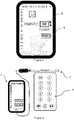
- the first step is downloading the corresponding application to a smart phone or a tablet (1).
- the interface of the application is presented in Figure 1 .
- the worker has to place the device in front of the COP (2) or the LOP and target it. They should be as stable as is possible in order to be steady the horizontal and vertical rulers (3).
- the next step is selecting the first button (4), as is shown in Figure 2 .
- the worker only has to touch the screen. Then it has to be registered as is presented in Figure 3 .
- the corresponding floor is declared in box (5) and finally press the enter button (6).
- the coordinates of the COP (or LOP) button relative to a reference point, are recorded, and the actual floor number is assigned. The procedure is repeated for the next button and continues until all the buttons are registered.
- the sensor is an optical device, as an active infrared (IR) sensor, that both emits and detects infrared radiation.
- Active IR sensors have two parts: a light emitting diode (LED) and a receiver. When an object -as a finger- comes in the path of IR light (8) the sensor detects intensity shifts in the received light. This information is used to track the position of the object.
- the sensor is connected to the elevator controller.
- the final state is a COP or LOP with an optical sensor on top or side of that, which transforms the exact position of user's finger to coordinates and coordinates to a registered floor number, which is transmitted to the controller.
- the controller with its conventional operation sends the elevator cabin to the requested floor.
- the installer/worker downloads the corresponding application to a smart device, as tablet or mobile phone. Then using the camera of the abovementioned device scans the COP or the LOP of the elevator and enters one-by-one the numbers of each floor in the application environment. After that the data are transferred to an optical sensor which is connected to the elevator controller. Finally, the user is able just by approaching his or her finger close to the position of the desirable floor number on the panel, and not by pushing the button, to send the elevator cabin to the corresponding floor.
Landscapes
- Engineering & Computer Science (AREA)
- Automation & Control Theory (AREA)
- Computer Networks & Wireless Communication (AREA)
- Elevator Control (AREA)
Abstract
Description
- Present invention refers to a method of transforming the usually touchable elevator buttons to contactless. Following are described further details about the invention and are presented figures that illustrate it better.
- According to the state of the art, an elevator is equipped with the Landing Operating Panel (LOP) which gives the command of landing calls and the Cabin Operating Panel (COP) which is the control panel inside the elevator that houses the floor buttons, the light switch, the alarm button, the emergency stop switch and optional key lock. There are various designs of Elevator LOPs and COPs, but the majority of them consist of buttons that have to be pressed by the user.
- The growth and spread of resistant strains of harmful microorganisms over every day use products, that may cause several infections that threat the human health, causes considerable concern. For example, several viruses are spread by coughing and sneezing or are transmitted by the oral route, passed by hand-to-mouth contact. For this reason, it is imperative to reduce the exposure on these microorganisms, even more on everyday used products as elevators, where a plethora of people enter in and touch several surfaces in the elevator cabin.
- The presented invention is the solution to the abovementioned issue. The invention refers to a method of renovating an old elevator cabin, which has conventional COP and LOP with push buttons, by transforming them to contactless. The invention is not limited to renovations, but is also applicable in case of a new elevator installation. Following figures presents the example of a COP, but the invention is not restricted to this and the procedure is exactly the same for the case of any LOP. Any installer or worker could easily follow the instructions and transform a normal COP or LOP to touchless/contactless.
- The first step is downloading the corresponding application to a smart phone or a tablet (1). The interface of the application is presented in
Figure 1 . The worker has to place the device in front of the COP (2) or the LOP and target it. They should be as stable as is possible in order to be steady the horizontal and vertical rulers (3). - The next step is selecting the first button (4), as is shown in
Figure 2 . The worker only has to touch the screen. Then it has to be registered as is presented inFigure 3 . The corresponding floor is declared in box (5) and finally press the enter button (6). By this way, with the help of the vertical and the horizontal rulers, the coordinates of the COP (or LOP) button, relative to a reference point, are recorded, and the actual floor number is assigned. The procedure is repeated for the next button and continues until all the buttons are registered. Except for the floor numbers the same procedure is used for other symbols, as the symbols for "up" and "down" on a LOP or the symbols for "opening" and "closing" doors on a COP or any other symbol than may be present on a COP or a LOP. - Afterwards, the registered data have to uploaded to the sensor (7). The sensor is an optical device, as an active infrared (IR) sensor, that both emits and detects infrared radiation. Active IR sensors have two parts: a light emitting diode (LED) and a receiver. When an object -as a finger- comes in the path of IR light (8) the sensor detects intensity shifts in the received light. This information is used to track the position of the object.
- Lastly, the sensor is connected to the elevator controller. The final state is a COP or LOP with an optical sensor on top or side of that, which transforms the exact position of user's finger to coordinates and coordinates to a registered floor number, which is transmitted to the controller. Finally, the controller with its conventional operation sends the elevator cabin to the requested floor.
- To sum up, the installer/worker downloads the corresponding application to a smart device, as tablet or mobile phone. Then using the camera of the abovementioned device scans the COP or the LOP of the elevator and enters one-by-one the numbers of each floor in the application environment. After that the data are transferred to an optical sensor which is connected to the elevator controller. Finally, the user is able just by approaching his or her finger close to the position of the desirable floor number on the panel, and not by pushing the button, to send the elevator cabin to the corresponding floor.
Claims (6)
- The "Retrofit Contact to Contactless Elevator Buttons" is a method that consists of an application for smart devices, one calibration, an IR sensor and its connection to the elevator controller and is characterized in that it transforms, through coordinates registration, conventional elevator panel with buttons that the user has to push or touch, to contactless elevator call panel.
- The invention according to Claim 1, is characterized in that the corresponding application is downloaded to a smart phone or a tablet and a worker places the device front of the Cabin Operating Panel (COP) or the Landing Operating Panel (LOP) and targets it in order to scan it on the vertical and the horizontal dimensions. The scanning process, with the help of the vertical and the horizontal rulers registers the coordinates of the COP or LOP button relative to a reference point.
- The invention according to Claim 1-2, is characterized in that according to the indications of the vertical and the horizontal coordinates in the application are indicated the floor numbers of the COP and this procedure is the first and only calibration.
- The invention according to Claim 1-3, is characterized in that according to the indications of the vertical and the horizontal coordinates in the application are indicated the symbols and their function of the COP or LOP and this procedure is the first and only calibration.
- The invention according to Claim 1-4, is characterized in that the registered data are uploaded to an active optical sensor, which is connected to the elevator controller.
- The invention according to Claim 1-5, is characterized in that the detected intensity shifts in the received light of the sensor is used to track the position of the user's finger and the controller receives the signal to move the cabin to the corresponding floor.
Priority Applications (1)
| Application Number | Priority Date | Filing Date | Title |
|---|---|---|---|
| EP21020338.6A EP4112524A1 (en) | 2021-07-01 | 2021-07-01 | Retrofit contact to contactless elevator buttons |
Applications Claiming Priority (1)
| Application Number | Priority Date | Filing Date | Title |
|---|---|---|---|
| EP21020338.6A EP4112524A1 (en) | 2021-07-01 | 2021-07-01 | Retrofit contact to contactless elevator buttons |
Publications (1)
| Publication Number | Publication Date |
|---|---|
| EP4112524A1 true EP4112524A1 (en) | 2023-01-04 |
Family
ID=76744582
Family Applications (1)
| Application Number | Title | Priority Date | Filing Date |
|---|---|---|---|
| EP21020338.6A Pending EP4112524A1 (en) | 2021-07-01 | 2021-07-01 | Retrofit contact to contactless elevator buttons |
Country Status (1)
| Country | Link |
|---|---|
| EP (1) | EP4112524A1 (en) |
Citations (4)
| Publication number | Priority date | Publication date | Assignee | Title |
|---|---|---|---|---|
| US20180354746A1 (en) * | 2017-06-07 | 2018-12-13 | Otis Elevator Company | Hand detection for elevator operation |
| US20190284020A1 (en) * | 2018-03-13 | 2019-09-19 | Otis Elevator Company | Augmented reality car operating panel |
| CN111573456A (en) * | 2020-04-09 | 2020-08-25 | 罗轶 | Elevator public health safety transformation method |
| CN212024456U (en) * | 2020-03-13 | 2020-11-27 | 刘章平 | Prevent bacterial virus and exempt from button contact elevator |
-
2021
- 2021-07-01 EP EP21020338.6A patent/EP4112524A1/en active Pending
Patent Citations (4)
| Publication number | Priority date | Publication date | Assignee | Title |
|---|---|---|---|---|
| US20180354746A1 (en) * | 2017-06-07 | 2018-12-13 | Otis Elevator Company | Hand detection for elevator operation |
| US20190284020A1 (en) * | 2018-03-13 | 2019-09-19 | Otis Elevator Company | Augmented reality car operating panel |
| CN212024456U (en) * | 2020-03-13 | 2020-11-27 | 刘章平 | Prevent bacterial virus and exempt from button contact elevator |
| CN111573456A (en) * | 2020-04-09 | 2020-08-25 | 罗轶 | Elevator public health safety transformation method |
Similar Documents
| Publication | Publication Date | Title |
|---|---|---|
| US12428262B2 (en) | Touchless elevator user interface | |
| CN112469653B (en) | Remote control device and remote control system | |
| EP2676913B1 (en) | Non-contact selection switch | |
| CN113518846B (en) | Access control system with moving door and visual status information | |
| SG172093A1 (en) | Method for enabling the use of an elevator system by disabled persons | |
| CN105129553B (en) | elevator system | |
| US12509325B2 (en) | Elevator system with touchless elevator call entry | |
| EP4112524A1 (en) | Retrofit contact to contactless elevator buttons | |
| CN115461289A (en) | Elevator operating device with two call input devices arranged separately on passenger side | |
| CN110467076A (en) | Elevator button based on infrared signal | |
| WO2022201508A1 (en) | Elevator control system and security system | |
| EP3312123A1 (en) | Method for controlling an elevator cabin of an elevator system | |
| JP2023127396A (en) | Elevator system and elevator control method | |
| US12612818B1 (en) | Access control system with a sliding door that can be opened from the inside without contact | |
| CN117163783A (en) | Non-contact button input device and method | |
| JP7248766B1 (en) | Elevator control device and control method | |
| JP7722198B2 (en) | Elevator Control System | |
| KR102215354B1 (en) | Non-contact elevator system and method for operating thereof | |
| CN113896064A (en) | Touch-free elevator controls | |
| KR20220009618A (en) | Non-contact type button input apparatus for elevator | |
| WO2022117651A1 (en) | Sensor button with gesture control | |
| JP2023023353A (en) | Elevator control device, elevator control method, and program | |
| KR20250100135A (en) | Non-Contact Destination Floor Input Device for Elevators | |
| CN113544075A (en) | Door structure for automatic control of floor doors as elevator installations | |
| KR102242270B1 (en) | Elevator operation control apparatus and method capable of automatically controlling elevator operation |
Legal Events
| Date | Code | Title | Description |
|---|---|---|---|
| PUAI | Public reference made under article 153(3) epc to a published international application that has entered the european phase |
Free format text: ORIGINAL CODE: 0009012 |
|
| STAA | Information on the status of an ep patent application or granted ep patent |
Free format text: STATUS: THE APPLICATION HAS BEEN PUBLISHED |
|
| AK | Designated contracting states |
Kind code of ref document: A1 Designated state(s): AL AT BE BG CH CY CZ DE DK EE ES FI FR GB GR HR HU IE IS IT LI LT LU LV MC MK MT NL NO PL PT RO RS SE SI SK SM TR |
|
| STAA | Information on the status of an ep patent application or granted ep patent |
Free format text: STATUS: REQUEST FOR EXAMINATION WAS MADE |
|
| 17P | Request for examination filed |
Effective date: 20230620 |
|
| RBV | Designated contracting states (corrected) |
Designated state(s): AL AT BE BG CH CY CZ DE DK EE ES FI FR GB GR HR HU IE IS IT LI LT LU LV MC MK MT NL NO PL PT RO RS SE SI SK SM TR |