EP4109656B1 - End cover assembly, battery cell, battery and electric device - Google Patents
End cover assembly, battery cell, battery and electric device Download PDFInfo
- Publication number
- EP4109656B1 EP4109656B1 EP21868372.0A EP21868372A EP4109656B1 EP 4109656 B1 EP4109656 B1 EP 4109656B1 EP 21868372 A EP21868372 A EP 21868372A EP 4109656 B1 EP4109656 B1 EP 4109656B1
- Authority
- EP
- European Patent Office
- Prior art keywords
- pressure relief
- relief component
- component
- battery cell
- hole
- Prior art date
- Legal status (The legal status is an assumption and is not a legal conclusion. Google has not performed a legal analysis and makes no representation as to the accuracy of the status listed.)
- Active
Links
Images





Classifications
-
- H—ELECTRICITY
- H01—ELECTRIC ELEMENTS
- H01M—PROCESSES OR MEANS, e.g. BATTERIES, FOR THE DIRECT CONVERSION OF CHEMICAL ENERGY INTO ELECTRICAL ENERGY
- H01M10/00—Secondary cells; Manufacture thereof
- H01M10/05—Accumulators with non-aqueous electrolyte
- H01M10/052—Li-accumulators
- H01M10/0525—Rocking-chair batteries, i.e. batteries with lithium insertion or intercalation in both electrodes; Lithium-ion batteries
-
- H—ELECTRICITY
- H01—ELECTRIC ELEMENTS
- H01M—PROCESSES OR MEANS, e.g. BATTERIES, FOR THE DIRECT CONVERSION OF CHEMICAL ENERGY INTO ELECTRICAL ENERGY
- H01M50/00—Constructional details or processes of manufacture of the non-active parts of electrochemical cells other than fuel cells, e.g. hybrid cells
- H01M50/30—Arrangements for facilitating escape of gases
- H01M50/317—Re-sealable arrangements
- H01M50/325—Re-sealable arrangements comprising deformable valve members, e.g. elastic or flexible valve members
-
- H—ELECTRICITY
- H01—ELECTRIC ELEMENTS
- H01M—PROCESSES OR MEANS, e.g. BATTERIES, FOR THE DIRECT CONVERSION OF CHEMICAL ENERGY INTO ELECTRICAL ENERGY
- H01M50/00—Constructional details or processes of manufacture of the non-active parts of electrochemical cells other than fuel cells, e.g. hybrid cells
- H01M50/10—Primary casings; Jackets or wrappings
- H01M50/102—Primary casings; Jackets or wrappings characterised by their shape or physical structure
- H01M50/103—Primary casings; Jackets or wrappings characterised by their shape or physical structure prismatic or rectangular
-
- H—ELECTRICITY
- H01—ELECTRIC ELEMENTS
- H01M—PROCESSES OR MEANS, e.g. BATTERIES, FOR THE DIRECT CONVERSION OF CHEMICAL ENERGY INTO ELECTRICAL ENERGY
- H01M50/00—Constructional details or processes of manufacture of the non-active parts of electrochemical cells other than fuel cells, e.g. hybrid cells
- H01M50/10—Primary casings; Jackets or wrappings
- H01M50/147—Lids or covers
- H01M50/148—Lids or covers characterised by their shape
- H01M50/15—Lids or covers characterised by their shape for prismatic or rectangular cells
-
- H—ELECTRICITY
- H01—ELECTRIC ELEMENTS
- H01M—PROCESSES OR MEANS, e.g. BATTERIES, FOR THE DIRECT CONVERSION OF CHEMICAL ENERGY INTO ELECTRICAL ENERGY
- H01M50/00—Constructional details or processes of manufacture of the non-active parts of electrochemical cells other than fuel cells, e.g. hybrid cells
- H01M50/10—Primary casings; Jackets or wrappings
- H01M50/147—Lids or covers
- H01M50/166—Lids or covers characterised by the methods of assembling casings with lids
-
- H—ELECTRICITY
- H01—ELECTRIC ELEMENTS
- H01M—PROCESSES OR MEANS, e.g. BATTERIES, FOR THE DIRECT CONVERSION OF CHEMICAL ENERGY INTO ELECTRICAL ENERGY
- H01M50/00—Constructional details or processes of manufacture of the non-active parts of electrochemical cells other than fuel cells, e.g. hybrid cells
- H01M50/30—Arrangements for facilitating escape of gases
- H01M50/317—Re-sealable arrangements
-
- H—ELECTRICITY
- H01—ELECTRIC ELEMENTS
- H01M—PROCESSES OR MEANS, e.g. BATTERIES, FOR THE DIRECT CONVERSION OF CHEMICAL ENERGY INTO ELECTRICAL ENERGY
- H01M50/00—Constructional details or processes of manufacture of the non-active parts of electrochemical cells other than fuel cells, e.g. hybrid cells
- H01M50/50—Current conducting connections for cells or batteries
- H01M50/572—Means for preventing undesired use or discharge
-
- H—ELECTRICITY
- H01—ELECTRIC ELEMENTS
- H01M—PROCESSES OR MEANS, e.g. BATTERIES, FOR THE DIRECT CONVERSION OF CHEMICAL ENERGY INTO ELECTRICAL ENERGY
- H01M50/00—Constructional details or processes of manufacture of the non-active parts of electrochemical cells other than fuel cells, e.g. hybrid cells
- H01M50/60—Arrangements or processes for filling or topping-up with liquids; Arrangements or processes for draining liquids from casings
- H01M50/609—Arrangements or processes for filling with liquid, e.g. electrolytes
- H01M50/618—Pressure control
-
- H—ELECTRICITY
- H01—ELECTRIC ELEMENTS
- H01M—PROCESSES OR MEANS, e.g. BATTERIES, FOR THE DIRECT CONVERSION OF CHEMICAL ENERGY INTO ELECTRICAL ENERGY
- H01M50/00—Constructional details or processes of manufacture of the non-active parts of electrochemical cells other than fuel cells, e.g. hybrid cells
- H01M50/60—Arrangements or processes for filling or topping-up with liquids; Arrangements or processes for draining liquids from casings
- H01M50/609—Arrangements or processes for filling with liquid, e.g. electrolytes
- H01M50/627—Filling ports
-
- H—ELECTRICITY
- H01—ELECTRIC ELEMENTS
- H01M—PROCESSES OR MEANS, e.g. BATTERIES, FOR THE DIRECT CONVERSION OF CHEMICAL ENERGY INTO ELECTRICAL ENERGY
- H01M50/00—Constructional details or processes of manufacture of the non-active parts of electrochemical cells other than fuel cells, e.g. hybrid cells
- H01M50/60—Arrangements or processes for filling or topping-up with liquids; Arrangements or processes for draining liquids from casings
- H01M50/609—Arrangements or processes for filling with liquid, e.g. electrolytes
- H01M50/627—Filling ports
- H01M50/636—Closing or sealing filling ports, e.g. using lids
- H01M50/645—Plugs
- H01M50/655—Plugs specially adapted for venting
-
- H—ELECTRICITY
- H01—ELECTRIC ELEMENTS
- H01M—PROCESSES OR MEANS, e.g. BATTERIES, FOR THE DIRECT CONVERSION OF CHEMICAL ENERGY INTO ELECTRICAL ENERGY
- H01M50/00—Constructional details or processes of manufacture of the non-active parts of electrochemical cells other than fuel cells, e.g. hybrid cells
- H01M50/60—Arrangements or processes for filling or topping-up with liquids; Arrangements or processes for draining liquids from casings
- H01M50/668—Means for preventing spilling of liquid or electrolyte, e.g. when the battery is tilted or turned over
-
- H—ELECTRICITY
- H01—ELECTRIC ELEMENTS
- H01M—PROCESSES OR MEANS, e.g. BATTERIES, FOR THE DIRECT CONVERSION OF CHEMICAL ENERGY INTO ELECTRICAL ENERGY
- H01M2220/00—Batteries for particular applications
- H01M2220/20—Batteries in motive systems, e.g. vehicle, ship, plane
-
- Y—GENERAL TAGGING OF NEW TECHNOLOGICAL DEVELOPMENTS; GENERAL TAGGING OF CROSS-SECTIONAL TECHNOLOGIES SPANNING OVER SEVERAL SECTIONS OF THE IPC; TECHNICAL SUBJECTS COVERED BY FORMER USPC CROSS-REFERENCE ART COLLECTIONS [XRACs] AND DIGESTS
- Y02—TECHNOLOGIES OR APPLICATIONS FOR MITIGATION OR ADAPTATION AGAINST CLIMATE CHANGE
- Y02E—REDUCTION OF GREENHOUSE GAS [GHG] EMISSIONS, RELATED TO ENERGY GENERATION, TRANSMISSION OR DISTRIBUTION
- Y02E60/00—Enabling technologies; Technologies with a potential or indirect contribution to GHG emissions mitigation
- Y02E60/10—Energy storage using batteries
Definitions
- This application relates to the technical field of batteries, and in particular, to an end cap assembly, a housing assembly, a battery cell, a battery, and an electrical device.
- batteries such as lithium-ion batteries have been widely used in electric vehicles.
- CN205790148U relates to a battery cover including an explosion-proof safety valve, the battery cover is provided with an explosion-proof safety valve mounting hole, the explosion-proof safety valve includes an electrolyte inlet.
- the top of the explosion-proof safety valve is a support end. Below the support end is a pressing end. Below the pressing end is a transition pipe section. A protruding clamp is provided below the transition pipe section. position ring, the ring surface of the clamping ring is evenly distributed with adjustment slits, the cross section of the explosion-proof safety valve installation hole from top to bottom is set as a supporting end face, a transition section, an inner convex positioning ring, and a positioning inner wall.
- the support The end face is located at the uppermost end of the installation hole of the explosion-proof safety valve, the support end is supported on the support end face, the transition pipe section is equipped with a sealing gasket, and the outer wall of the sealing gasket is close to the inner wall of the transition section.
- the outer wall of the locking ring is close to the inner ring surface of the positioning inner wall.
- CN210403786U relates to a pole plate type lithium battery cover plate comprising a cover plate body provided with a pressure relief explosion-proof hole.
- the pressure relief explosion-proof mechanism is arranged on one side, back to the lithium battery shell, of the cover plate body; the positive plate and the negative plate are arranged above the left end and the right end of the cover plate body; the positive and negative plate electrode lead sheets are arranged below the left and right ends of the insulating base plate mechanism;
- the insulating base plate mechanism comprises an insulating supporting plate and positive and negative plate lead sheet reinforcing and fixing plates; a positive plate insulating spacer bush and a negative plate insulating spacer bush are arranged between the positive plate and the cover plate body;
- the cover plate is characterized in that the positive plate electrode lead sheet, the positive plate lead sheet reinforcing and fixing plate, the insulating supporting plate, the cover plate body, the positive plate insulating spacer bush and the positive plate, and the negative plate electrode lead sheet, the negative plate lead sheet reinforcing
- US2005/0221174A1 relates to a secondary battery comprising a bare cell including an electrode assembly composed of positive and negative electrodes and a separator, a can acting as a container for containing the electrode assembly and an electrolyte, and a cap assembly having a cap plate for covering the open upper end of the can and a lead plate coupled to a part of the cap plate, wherein an electrolyte injection hole is positioned on a side of the cap plate.
- the lead plate has a bottom portion which covers the electrolyte injection hole and at least a part of which is coupled to a surface of the cap plate. Additionally, a part of the lead plate, which corresponds to the electrolyte injection hole of the bottom portion, is removed to form a hole so that a cap which seals the electrolyte injection hole is exposed.
- An objective of this application is to improve performance of lithium-ion batteries.
- an end cap assembly including:
- the first through-hole configured to inject the electrolytic solution is made on the pressure relief component, and the first through-hole is closed by the closing component.
- the closing component is detachably disposed on the pressure relief component so as to implement detachment between the closing component and the pressure relief component to enable electrolyte refilling, thereby effectively alleviating capacity fading of the battery cell and improving the service life of the battery cell.
- the first through-hole located on the pressure relief component can implement functions of both electrolyte refilling and release of the internal pressure of the battery cell, reduce the area occupied by the components on the end cap body, and vacate more space for battery assembling and circuit layout.
- the end cap assembly further includes: an insulation piece, disposed on a side of the end cap body that is close to an interior of the battery cell, where the insulation piece abuts on the pressure relief component to support the pressure relief component.
- the end cap assembly abuts on the pressure relief component through the insulation piece, so as to support the pressure relief component and equalize an external force received by the pressure relief component. This prevents the pressure relief component from being damaged during detachment and attachment of the closing component, improves reliability of the battery cell during electrolyte refilling, and increases the service life of the battery cell.
- a snap-fit structure is disposed between the pressure relief component and the insulation piece.
- the snap-fit structure is configured to limit torsional deformation of the pressure relief component with respect to the end cap body along a circumference of the pressure relief component.
- the snap-fit structure is disposed between the insulation piece and the pressure relief component to equalize a circumferential external force received by the pressure relief component. This prevents the pressure relief component from being damaged during detachment and attachment of the cover body, improves reliability of the battery cell during electrolyte refilling, and increases the service life of the battery cell.
- the snap-fit structure includes a first protruding portion and a recessed portion that fit with each other.
- the first protruding portion is disposed on a surface of the pressure relief component that is oriented toward the insulation piece.
- the recessed portion is disposed on a surface of the insulation piece that is oriented toward the pressure relief component.
- the snap-fit structure with the protruding portion fitted with the recessed portion enables the insulation piece to exert a reliable circumferential restraint effect on the pressure relief component, and prevents torsional deformation of the pressure relief component along the circumference of the pressure relief component with respect to the end cap body, so as to reduce the force received at an actuation mechanism or a fragile structure of the pressure relief component, and improve structural stability of the pressure relief component.
- a plurality of snap-fit structures are disposed.
- the plurality of snap-fit structures are evenly distributed circumferentially around an axis of the pressure relief component.
- a plurality of snap-fit structures are evenly distributed circumferentially around the axis of the pressure relief component.
- a circumferential supporting force exerted by the insulation piece on the pressure relief component is more equalized during electrolyte refilling after the cover body is unscrewed, and the circumferential external force received by the pressure relief component is equalized along the entire circumferential direction.
- a positioning hole is made on an outer surface of the pressure relief component.
- the positioning hole is configured to assist in positioning the pressure relief component during closing of the first through-hole.
- tooling may be inserted into the positioning hole to provide a clamping force for the pressure relief component, so as to reduce the external force received by the pressure relief component along the thickness or circumference of the pressure relief component, prevent the pressure relief component from being stressed at the actuation mechanism or fragile structure, and improve the structural stability of the pressure relief component.
- the first through-hole is located at a center position of the pressure relief component.
- This embodiment equalizes a radial width of the pressure relief component at a part outside the first through-hole, so as to equalize strength of the pressure relief component along the entire circumferential direction, prevent the pressure relief component from being actuated when the internal pressure of the battery cell does not reach the threshold, and improve safety of the battery cell in use. Moreover, this prevents an unequal force from being exerted on the entire circumferential direction of the pressure relief component during detachment and attachment of the closing component, and improves structural stability of the pressure relief component during detachment and attachment of the closing component.
- the pressure relief component includes an explosion-proof valve.
- the first through-hole is made on the explosion-proof valve.
- This embodiment reduces difficulty of processing the explosion-proof valve, helps increase the area of the explosion-proof valve, and increases the pressure on the pressure relief component on condition that the internal air pressure of the battery cell remains constant. In this way, in a case that the battery cell is thermally runaway, gas in the battery cell can be quickly expelled, thereby improving safety of the battery cell in use.
- the explosion-proof valve includes:
- the explosion-proof valve according to this embodiment adopts a thickness-varying structure, thereby making it convenient to not only dispose the fragile region on the explosion-proof valve, but also partially thicken a region in which the first through-hole is located, so as to design a connection structure between the closing component and the explosion-proof valve and increase the connection strength between the closing component and the explosion-proof valve, and in turn, improve reliability of design of integrating an electrolyte injection member with the pressure relief component.
- the explosion-proof valve further includes: a transition portion, connected between the first portion and the second portion along the radius of the explosion-proof valve.
- the transition component is disposed between the first portion and the second portion, thereby implementing smooth transition between the first portion and the second portion, reducing the probability of stress concentration in the thickness-varying region, and in turn, improving the overall strength of the explosion-proof valve, and reducing the probability of deforming or damaging the explosion-proof valve during detachment and attachment of the closing component.
- the end cap assembly further includes: an insulation piece, disposed on a side of the end cap body that is close to an interior of the battery cell, where a second through-hole is made on the insulation piece, and the second through-hole is configured to implement communication between the interior of the battery cell and the fragile region.
- the second through-hole is made on the insulation piece to form a passageway available for the gas inside the battery cell to reach the fragile region. In this way, when the internal pressure of the battery cell exceeds the threshold, the internal pressure or heat can be smoothly released through the explosion-proof valve, thereby improving safety of battery cell in use.
- a first groove is made on a surface of the insulation piece that is oriented toward the end cap body. The second portion extends into the first groove.
- the second portion extends into the first groove, thereby maximally avoiding increase of the overall thickness of the end cap assembly on the basis of increasing the strength of the explosion-proof valve, thereby increasing the energy density without changing the size of the battery cell.
- the pressure relief component includes a plurality of explosion-proof valves.
- the plurality of explosion-proof valves are disposed independently at intervals along a periphery of the first through-hole.
- the first through-hole and the explosion-proof valve are disposed independently. Therefore, the thickness of a joint between the first through-hole and the explosion-proof valve is consistent with the thickness of the end cap body, thereby ensuring sufficient structural strength of the joint.
- the fragile region of the explosion-proof valve is independent of the electrolyte injection mechanism, so that the external force generated during detachment and attachment of the closing component is prevented from directly acting on the explosion-proof valve during the assembling of the end cap assembly or the electrolyte refilling, and the fragile region of the explosion-proof valve is prevented from being deformed or damaged.
- a plurality of second grooves are disposed on the pressure relief component.
- the second grooves form the explosion-proof valves.
- the explosion-proof valves include a fragile region. The fragile region is configured to be actuated when the internal pressure of the battery cell reaches the threshold, so as to release the internal pressure of the battery cell.
- the plurality of second grooves are disposed to form a plurality of independent explosion-proof valves to facilitate arrangement of the fragile region.
- the fragile region of the explosion-proof valves is independent of the electrolyte injection mechanism, so that the external force generated during detachment and attachment of the closing component is prevented from directly acting on the explosion-proof valves during the assembling of the end cap assembly or the electrolyte refilling, and the fragile region of the explosion-proof valves is prevented from being deformed or damaged.
- the pressure relief component is integrated with the end cap body.
- the pressure relief component is integrated with the end cap body, thereby increasing the connection strength between the pressure relief component and the end cap body, and saving a step of fixing the pressure relief component onto the end cap body. This reduces the manufacturing difficulty and cost of the end cap assembly, and prevents an actuating pressure on the explosion-proof valve from being affected by a welding stress generated when the fixing manner is welding or the like.
- a third through-hole is made on the end cap body.
- the pressure relief component is fixed inside the third through-hole.
- an independent pressure relief component is fixed to the end cap body, thereby reducing the manufacturing difficulty.
- the pressure relief component can be formed by stamping in advance and then fixed to the end cap body. In this way, poorly stamped parts in the pressure relief component can be eliminated, thereby reducing the reject rate of assembled finished products and reducing the production cost of products.
- a locking base is disposed on a hole wall of the third through-hole.
- the locking base is disposed on a side of the end cap body that is close to an interior of the battery cell.
- the pressure relief component abuts against the locking base to connect to the end cap body.
- the pressure relief component abuts against the locking base from inside.
- the locking base may serve as a main body for bearing the air pressure, thereby reducing the force on the joint between the pressure relief component and the end cap body, reducing the probability of seal failure caused by a creep of the joint between the pressure relief component and the end cap body after long-term use of the battery cell, and increasing the service life of the battery cell.
- the end cap assembly further includes a protection sheet.
- the protection sheet is affixed to a surface of the pressure relief component that is away from the interior of the battery cell.
- This embodiment prevents external impurities or moisture from entering the battery cell through the closing component, and improves airtightness of the end cap assembly.
- the closing component includes:
- an accommodation portion is further disposed on the pressure relief component.
- the accommodation portion is disposed on the pressure relief component and disposed along a circumference of the first through-hole.
- the cover body includes a limiting portion.
- the limiting portion When the cover body rotates to a first position, the limiting portion is located in the accommodation portion to restrict the cover body from detaching from the pressure relief component. When the cover body rotates to a second position, the limiting portion is staggered from the accommodation portion along the circumference of the first through-hole to implement detachment between the cover body and the pressure relief component.
- the first through-hole is opened and closed by rotating the cover body, so as to form a detachable structure between the cover body and the pressure relief component, and prevent the electrolyte injection structure from being damaged during opening of the cover body. Further, the first through-hole can be reliably closed after completion of electrolyte refilling, thereby ensuring reliability of the battery cell in use after the electrolyte refilling. Therefore, the appearance of the secondary battery cell remains the same as before the electrolyte refilling, without affecting the use of the battery cell after the electrolyte refilling.
- the first through-hole is closed by directly rotating the cover body, the sealing of the first through-hole is implemented without laser welding, thereby saving a step of cleaning the first through-hole before the laser welding, and improving the production efficiency of the battery cell.
- the first through-hole is opened and closed by rotating the cover body, thereby reducing the large external force exerted on the pressure relief component along the thickness during detachment and attachment of the cover body, and preventing the pressure relief component from deforming inward or outward.
- the cover body further includes a body portion.
- the body portion is configured to cover at least a part of the sealing element.
- the limiting portion is connected to the body portion and extends along a radius of the first through-hole.
- the pressure relief component further includes a guide portion.
- the guide portion communicates with the accommodation portion.
- the limiting portion is configured to enter the accommodation portion through the guide portion, or detach from the pressure relief component through the guide portion.
- the pressure relief component includes a pressure relief body and a mounting component.
- the mounting component is disposed on a surface of the pressure relief body and disposed around the first through-hole.
- the accommodation portion is disposed in the mounting component, or the accommodation portion is formed by being enclosed with the mounting component and the pressure relief body.
- the pressure relief component is designed as a discrete structure.
- the pressure relief component is in a thin plate-like structure on which a complex structure is difficult to process. Therefore, the mounting component disposed facilitates formation of the accommodation portion, and reduces the processing difficulty of the pressure relief component.
- a housing assembly applicable to a battery cell and including:
- a battery cell including:
- a battery including the battery cell according to the foregoing embodiments.
- an electrical device including the battery cell according to the foregoing embodiment, where the battery cell is configured to provide electrical energy.
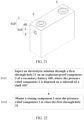
- an electrolyte injection method of a battery cell including:
- the closing component includes: a sealing element and a cover body.
- the sealing element is configured to seal the first through-hole.
- the cover body is configured to cover at least a part of the sealing element.
- the mounting a closing component onto the pressure relief component to close the first through-hole includes:
- This embodiment not only avoids the welding step, but also avoids a plurality of subsequent steps such as cleaning up the weld-induced welding spatters and drying the liquid that remains after the cleaning. Therefore, this application can improve the production efficiency of the battery cell.
- the closing component is mounted on the pressure relief component to close the first through-hole, and the electrolyte injection member is integrated with the pressure relief component to achieve space efficiency and facilitate electrolyte refilling operations.
- the electrolyte injection method of a battery cell further includes:
- This embodiment can implement flexible and convenient detachment of the cover body. Therefore, when the electrolytic solution is deficient or deteriorated, the closing component is conveniently detachable for electrolyte refilling or degassing in the battery cell.
- the electrolyte injection method of a battery cell further includes: assisting, during closing of the first through-hole, in positioning the pressure relief component through a positioning hole located on an outer surface of the pressure relief component.
- tooling may be inserted into the positioning hole to provide a clamping force for the pressure relief component, so as to reduce the external force received by the pressure relief component along the thickness or circumference of the pressure relief component, prevent the pressure relief component from being stressed at the actuation mechanism or fragile structure, and improve the structural stability of the pressure relief component.
- an electrolyte injection device applicable to a battery cell and including:
- the first through-hole configured to inject the electrolytic solution is made on the pressure relief component, and the first through-hole is closed by the closing component.
- the closing component is detachably disposed on the pressure relief component so as to implement detachment between the closing component and the pressure relief component to enable electrolyte refilling.
- this application effectively alleviates capacity fading of the battery cell and improves the service life of the battery cell.
- the first through-hole located on the pressure relief component can reduce the area occupied by the components on the end cap body, implement functions of both electrolyte refilling and release of the internal pressure of the battery cell, and vacate more space for battery cell assembling and circuit layout.
- the element when one element is referred to as being “on” another element, the element may be directly on the other element, or may be indirectly on the other element with one or more intermediate elements in between. In addition, when one element is referred to as being “connected to” another element, the element may be directly connected to the other element, or may be indirectly connected to the other element with one or more intermediate elements in between. In the description hereinafter, elements are the same as long as they are denoted by the same reference numeral.
- a plurality of' referred to in this application means two or more (including two).
- a plurality of groups means two or more groups (including two groups).
- a coordinate system shown in FIG. 1-D defines each direction of a battery cell 400, where "x" represents a length direction of the battery cell 400, a "y” direction is perpendicular to the x direction in a horizontal plane, and represents a width direction of the battery cell 400, and a "z” direction is perpendicular to a plane formed by the x direction and the y direction, and represents a height direction of the battery cell 400.
- the inventor has found, through numerous tests and verifications, that one of the factors affecting the service life of a battery is that the battery undergoes a plurality of charge-and-discharge cycles during use, and an electrolytic solution inside the battery cell unavoidably incurs irreversible reaction consumption so that an available capacity of the battery cell fades accordingly. Therefore, the inventor finds that, if the electrolytic solution inside the battery cell is supplemented during the use of the battery cell, the capacity fading of the battery cell can be effectively alleviated, and the service life of the battery cell can be improved.
- a lithium-ion battery cell includes four main parts: a positive electrode material, a negative electrode material, an electrolytic solution, and a separator.
- the electrolytic solution is an ionic conductor that conducts between a positive electrode and a negative electrode of the battery cell, and generally includes two parts: electrolyte lithium salt and an organic solvent.
- High requirements are imposed on structural airtightness of the battery cell in order to prevent the electrolytic solution from seeping and polluting surrounding air and environment during use, or prevent moisture or metal particles from entering the interior of the battery cell to cause a short circuit between the positive electrode and the negative electrode.
- electrolyte injection for the battery cell is usually carried out in a production stage. After completion of the electrolyte injection, an injection hole is usually closed off by laser welding in order to ensure airtightness of the battery cell.
- Such a battery cell is difficult to be refilled with the electrolytic solution during use.
- a laser weld structure has to be destroyed, and can be difficult to re-seal.
- this causes irreversible damage to the structure of the battery cell, and affects the performance of the battery cell in use.
- this application aims to provide a battery cell with a detachable closing component for electrolyte refilling, so as to facilitate detachment of the closing component for a refill and close off the injection hole reliably after completion of the refill.
- a detachable closing component for electrolyte refilling, so as to facilitate detachment of the closing component for a refill and close off the injection hole reliably after completion of the refill.
- the detachable closing component 3 occupies a larger area on an end cap body 1 than a laser welding manner, and is more prone to protrude from the end cap body 1 by a greater height.
- a pressure relief component 2 needs to be disposed on the end cap body 1. Therefore, the closing component and the pressure relief component 2 need to occupy a relatively large area on the end cap body 1.
- a hole or slot needs to be made in a position on the wiring harness fender to avoid interference, where the position corresponds to the pressure relief component 2 and the closing component 3.
- Such a structure results in complicated structures of the wiring harness fender and the assembling tool in the battery module 300.
- the pressure relief component 2 is designed in such a way that, the larger the area of the pressure relief component 2, the greater the pressure on the pressure relief component 2 on condition that the internal air pressure of the battery cell 400 remains constant. In this way, when the battery cell 400 is thermally runaway, the gas in the battery cell 400 can be quickly expelled to avoid the problem that the battery cell 400 still explodes due to a degassing amount smaller than a gassing amount. Therefore, the area of the pressure relief component 2 needs to be increased as much as practicable to improve safety of the battery cell 400 in use. Restricted by the total area of the end cap body 1, the increased area makes the arrangement space of the components on the end cap body 1 tighter. If the pressure relief component 2 is disposed on the closing component 3 instead so that the entire closing component 3 is detachable to implement electrolyte refilling, the size of the closing component 3 will be increased correspondingly, and the energy density of the battery cell 400 will be reduced.
- the design of the battery cell 400 still can hardly meet various performance requirements such as a small size, a high energy density, ease of maintenance, reliability, safety, and a long service life.
- an electrolyte injection member is disposed on the pressure relief component 2 to implement electrolyte refilling and release of internal pressure of the battery cell 400 conveniently.
- electrolyte injection is a process by which an electrolytic solution is injected into the battery cell in a required amount through a reserved injection hole, and is divided into initial electrolyte injection and electrolyte refilling.
- Electrolyte refilling may also be referred to as supplementary electrolyte injection, subsequent electrolyte injection, and the like.
- the electrolyte refilling means a process of supplementing or replacing the electrolytic solution for a battery cell, or adding or supplementing any solid, liquid, or gas into the battery cell.
- the pressure relief component 2 means an element or component that is actuated to relieve an internal pressure or temperature when the internal pressure or temperature of the battery cell 400 reaches a preset threshold.
- the threshold may vary depending on design requirements. The threshold may depend on the material of one or more of the positive electrode plate, the negative electrode plate, the electrolytic solution, or the separator in the battery cell 400.
- the pressure relief component 2 may be in the form of an explosion-proof valve, a gas valve, a pressure relief valve, a safety valve, or the like, and may specifically adopt a pressure-sensitive or temperature-sensitive element or structure. To be specific, when the internal pressure or temperature of the battery cell 400 reaches the preset threshold, the pressure relief component 2 is actuated or a fragile structure disposed in the pressure relief component 2 is damaged to form a vent or passageway for relieving the internal pressure or temperature.
- actuated means that the pressure relief component 2 performs an action or is activated to a given state so that the internal pressure and temperature of the battery cell 400 is relieved.
- the actions performed by the pressure relief component 2 may include, but are not limited to, rupturing, shattering, tearing, or opening at least a part of the pressure relief component 2, or the like.
- An electrical device includes a battery cell 400 configured to provide electrical energy for the device.
- the device may be a mobile phone, a portable device, a notebook computer, an electric power cart, an electric vehicle, a ship, a spacecraft, an electric toy, an electric tool.
- the spacecraft includes an airplane, a rocket, a space shuttle, a spaceship, and the like.
- the electric toy includes a fixed or mobile electric toy, such as a game console, an electric car toy, an electric ship toy, an electric airplane toy, and the like.
- the electric tool includes an electric tool for metal cutting, an electric grinding tool, an electric assembly tool, an electric tool for railways, such as an electric drill, an electric grinder, an electric wrench, an electric screwdriver, an electric hammer, an electric impact drill, a concrete vibrator, and an electric planer.
- the electrical device may be a vehicle 100 such as a new energy vehicle.
- the new energy vehicle may be a battery electric vehicle, a hybrid electric vehicle, a range-extended electric vehicle, or the like.
- the electrical device may be an unmanned aerial vehicle, a ship, or the like.
- the vehicle 100 may include an axle 101, wheels 102 connected to the axle 101, a motor 103, a controller 104, and a battery 200.
- the motor 103 is configured to drive the axle 101 to rotate.
- the controller 104 is configured to control the motor 103 to operate.
- the battery 200 includes a plurality of battery cells 400 configured to provide electrical energy for the operation of the motor 103 and other components in the vehicle.
- the battery cell 400 refillable with an electrolytic solution can reduce the frequency of replacing the battery cell for the device, save cost, and improve reliability and dynamic performance of the device in use.
- a battery 200 may be disposed in the electrical device.
- the battery 200 includes a first housing 201 and a second housing 202 that are snap-fitted to each other.
- a plurality of battery cells 400 may be disposed in a space enclosed by the first housing 201 and the second housing 202, or the plurality of battery cells 400 may be grouped to form different battery modules 300, or both the battery cells are disposed and the battery modules are formed.
- the battery module 300 includes a plurality of battery cells 400.
- the plurality of battery cells 400 may be connected in series, parallel, or series-and-parallel pattern to achieve a relatively high capacity or power.
- the battery cells 400 may be placed vertically, with a height direction of the battery cell 400 being consistent with a vertical direction; and a plurality of battery cells 400 are disposed side by side along a width direction.
- the battery cells 400 may be placed flat, with the width direction of the battery cells 400 being consistent with the vertical direction; and the plurality of battery cells 400 may be stacked in at least one layer along the width direction. Each layer includes a plurality of battery cells 400 spaced out along the length direction.
- the battery cell 400 includes a housing 40, an electrode assembly 30, and an end cap assembly 10.
- the end cap assembly 10 includes a pressure relief component 2.
- the end cap assembly 10 is connected to the housing 40 to form a shell of the battery cell 400.
- the electrode assembly 30 is disposed in the housing 40, and the housing 40 is filled with an electrolytic solution.
- the battery cell 400 may be prismatic, cylindrical, or in other shapes.
- One or more electrode assemblies 30 may be disposed depending on actual use requirements. As shown in FIG. 1-D , at least two independently wound electrode assemblies 30 may be disposed in the battery cell instead.
- a body part of the electrode assembly 30 may be formed by winding or stacking together a first electrode plate, a second electrode plate, and a separator located between the first electrode plate and the second electrode plate.
- the separator is an insulator located between the first electrode plate and the second electrode plate.
- the body part includes two opposite end faces. This embodiment is described by using an example in which the first electrode plate is a positive electrode plate and the second electrode plate is a negative electrode plate.
- a coated region of the positive electrode plate is coated with a positive active material
- a coated region of the negative electrode plate is coated with a negative active material.
- the electrode assembly includes two tabs 301, that is, a positive tab and a negative tab.
- the positive tab is an extension from the coated region of the positive electrode plate
- the negative tab is an extension from the coated region of the negative electrode plate.
- the end cap assembly 10 is disposed on the top of the electrode assembly 30. As shown in FIG. 1-D , the end cap assembly 10 includes an end cap body 1 and two terminals 5. The two terminals 5 are a positive terminal and a negative terminal respectively. An adapter 20 is disposed corresponding to each terminal 5. The adapter 20 is located between the end cap body 1 and the electrode assembly 30. For example, a tab 301 of the electrode assembly 30 in FIG. 1-D is located at the top, the positive tab is connected to the positive terminal by one adapter 20, and the negative tab is connected to the negative terminal by another adapter 20.
- the battery cell 400 may include two end cap assemblies 10 disposed at two ends of the housing 40 respectively. A terminal 5 is disposed on each end cap assembly 10.
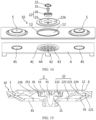
- an end cap assembly 10 applicable to a battery cell 400 includes: an end cap body 1, a pressure relief component 2, and a closing component 3.
- the end cap body 1 may be in a rectangular plate-like structure.
- the pressure relief component 2 is connected to the end cap body 1.
- the pressure relief component 2 is configured to be actuated when an internal pressure of the battery cell 400 reaches a threshold, so as to release the internal pressure of the battery cell 400.
- the pressure relief component 2 may be disposed at any position between two terminals 5, for example, between the two terminals 5 and at a middle position of the end cap body 1 along a length direction.
- a first through-hole 21 configured to inject an electrolytic solution is disposed on the pressure relief component 2.
- the first through-hole 21 may be a circular, elliptical, or polygonal hole or a hole in other shapes.
- the first through-hole 21 may be disposed along a height direction of the battery cell 400, that is, along a thickness direction of the end cap body 1; or may be disposed obliquely.
- a sidewall of the first through-hole 21 may be located within an outer contour of the pressure relief component 2.
- the closing component 3 is detachably disposed on the pressure relief component 2.
- the closing component 3 is configured to close the first through-hole 21 when being mounted on the pressure relief component 2, and expose the first through-hole 21 when detaching from the pressure relief component 2 so that an electrolytic solution can be injected in this state.
- electrolyte refilling can be implemented by detaching the closing component 3 from a pressure relief body 25.
- this application effectively alleviates capacity fading of the battery cell 400 and improves the service life of the battery cell 400.
- the first through-hole 21 communicates the interior of the housing 40 with external atmosphere after the closing component 3 is detached, thereby expelling the gas out of the housing 40 or air bubbles between electrode plates. By expelling the air bubbles between the electrode plates, a clearance between the electrode plates is shortened, thereby improving cycle performance of the battery cell 400, and further, improving the service life of the battery cell 400.
- this application can also release pressure in the housing 40, thereby reducing a continuous force exerted by the gas in the housing 40 on the pressure relief component 2, reducing risks of shortening the battery life due to electrolyte leakage out of or moisture entry into the battery cell 400 in a case of a creep or rupture of the pressure relief component 2, and in turn, improving the service life of the battery cell.
- This application forms a detachable structure between the closing component 3 and the pressure relief component 2, and prevents the electrolyte injection structure from being damaged during opening of the opening component 3.
- the first through-hole 21 can be reliably closed after completion of electrolyte refilling, thereby ensuring reliability of the battery cell in use after the electrolyte refilling. Therefore, the appearance of the battery cell 400 remains the same as before the electrolyte refilling, without affecting the use of the battery cell after the electrolyte refilling.
- the sealing of the first through-hole 21 is implemented without laser welding, thereby saving a step of cleaning the first through-hole 21 before the laser welding, and improving the production efficiency of the battery cell.
- the first through-hole 21 configured to inject an electrolytic solution is disposed on the pressure relief component 2, and the first through-hole 21 is closed by the closing component 3.
- This is equivalent to integrating the closing component 3 with the pressure relief component 2, thereby not only reducing the area occupied by the closing component 3 and the pressure relief component 2 on the end cap body 1, but also reducing the number of avoidance holes or slots required on a press-fitting tool when a plurality of battery cells 400 are press-fitted to form a battery module 300.
- a wiring harness fender is disposed on the top of the plurality of battery cells 400, thereby reducing the number of avoidance holes or slots required on the wiring harness fender.
- the number of avoidance holes or slots required on the tooling and the wiring harness fender can be halved.
- the end cap assembly 10 according to this application can greatly reduce the structural complexity of the wiring harness fender and the assembling tool in the battery module 300.
- the area of the pressure relief component 2 needs to be increased as much as practicable during designing of the pressure relief component 2.
- the closing component 3 is integrated with the pressure relief component 2, thereby reducing the space occupied by the closing component 3 and the pressure relief component 2 on the end cap body 1 of the end cap assembly 10. Therefore, such an arrangement helps increase the area of the pressure relief component 2 on condition that the area of the end cap body 1 remains constant, and helps increase the pressure on the pressure relief component 2 on condition that the internal air pressure of the battery cell 400 remains constant.
- the gas in the battery cell 400 can be quickly expelled to avoid the problem that the battery cell 400 explodes due to a degassing amount smaller than a gassing amount, thereby improving safety of the battery cell 400 in use.
- the first through-hole 21 is made on the pressure relief component 2 instead of removing the entire pressure relief component 2 for a purpose of electrolyte injection.
- the area of the first through-hole 21 is smaller than that of the pressure relief component 2, thereby reducing the size of the closing component 3 on the basis of increasing the area of the pressure relief component 2, and in turn, increasing the energy density of the battery cell 400.
- the end cap assembly 10 further includes an insulation piece 4.
- the insulation piece 4 is an insulation plate made of an insulation material such as plastic.
- the insulation piece 4 may be a rectangular plate-like structure that fits the shape and size of the end cap body 1.
- two mounting holes 11 are made on the end cap body 1.
- two communicating holes 45 are made on the insulation piece 4.
- a terminal 5 is connected to an adapter 20 on a tab 301 through a communicating hole 45.
- a positive tab of the electrode assembly 30 is connected to a positive terminal by the adapter 20 through the communicating hole 45.
- a negative tab of the electrode assembly 30 is connected to a negative terminal by the adapter 20 through the communicating hole 45.
- a groove 44 is made on a side of the insulation piece 4 that is away from the end cap body 1.
- two grooves 44 may be spaced out along a length direction of the insulation piece 4 to form three ribs on the side of the insulation piece 4 that is away from the end cap body 1, so as to hold down the electrode assembly 30.
- such arrangement can prevent the electrode assembly 30 from pulling the tabs due to vibration during movement of the vehicle, where the pulling is prone to result in breakage at an electrical joint.
- the insulation piece 4 is disposed on a side of the end cap body 1 that is close to the interior of the battery cell 400, and abuts on the pressure relief component 2 to support the pressure relief component 2.
- the insulation piece 4 abuts on an opposite surface of the end cap body 1.
- the entire pressure relief component 2 may abut on the insulation piece 4, so as to provide a stable and reliable supporting force for the pressure relief component 2; or, a partial region of the pressure relief component 2 abuts on the insulation piece 4.
- the abutting may be a plane-to-plane contact, a plane-to-curve contact, or a concave-convex-fitted structure, or the like.
- an external force is inevitably exerted on the pressure relief component 2.
- a downward pressure, an upward pulling force, or a circumferential rotational force is exerted on the pressure relief component 2.
- an actuation mechanism or a fragile structure is disposed on the pressure relief component 2, and is actuated when the internal pressure of the battery cell 400 reaches a preset threshold, so as to release the internal pressure of the battery cell 400.
- the external force so exerted on the pressure relief component 2 may cause deformation or damage to the actuation mechanism or fragile structure, and affect normal pressure relief.
- the end cap assembly 10 abuts on the pressure relief component 2 through the insulation piece 4, so as to support the pressure relief component 2 and equalize the external force received by the pressure relief component 2.
- the support by the insulation piece 4 can prevent the pressure relief component 2 from being deformed or damaged, so as to ensure fulfillment of the expected pressure relief effect and improve safety of the battery cell 400 in use.
- the battery cell 400 is mounted in a vehicle 100, the vehicle 100 is subjected to vibration or external impact during movement, and the support by the insulation piece 4 can prevent the pressure relief component 2 from deforming under the action of vibration or impact.
- a snap-fit structure is disposed between the pressure relief component 2 and the insulation piece 4.
- the snap-fit structure is configured to limit torsional deformation of the pressure relief component 2 with respect to the end cap body 1 along a circumference of the pressure relief component 2.
- the closing component 3 includes a sealing element 31 and a cover body 32.
- the sealing element 31 is configured to seal the first through-hole 21.
- the cover body 32 is configured to cover at least a part of the sealing element 31, and is detachable by rotating.
- a circumferential force is transmitted to the pressure relief component 2 through the cover body 32.
- the snap-fit structure is disposed between the insulation piece 4 and the pressure relief component 2 to equalize the circumferential external force received by the pressure relief component 2. This prevents the pressure relief component 2 from being damaged during detachment and attachment of the cover body 32, improves reliability of the battery cell 400 during electrolyte refilling, and increases the service life of the battery cell 400.
- the snap-fit structure includes a first protruding portion 225 and a recessed portion 42 that fit each other.
- the first protruding portion 225 may be disposed on a surface of the pressure relief component 2 that is oriented toward the insulation piece 4.
- the first protruding portion 225 may be formed by machining or stamping.
- the recessed portion 42 is disposed on a surface of the insulation piece 4 that is oriented toward the pressure relief component 2.
- the first protruding portion 225 and the recessed portion 42 may be dot-like, strip-like, block-like structures. With respect to the position, the first protruding portion 225 and the recessed portion 42 may be disposed on a plane on which the pressure relief component 2 abuts on the insulation piece 4. Alternatively, a circumferential fitting structure may be disposed between the pressure relief component 2 and the insulation piece 4, and the snap-fit structure is disposed on the circumferential fitting structure. With respect to the number of the snap-fit structures, one or more snap-fit structures may be disposed. The position of the first protruding portion 225 is interchangeable with the position the recessed portion 42. The first protruding portion 225 is disposed on the insulation piece 4, and the recessed portion 42 is disposed on the pressure relief component 2. Any structure that can limit the torsional deformation of the pressure relief component 2 along the circumference falls within the protection scope of this application.
- the snap-fit structure with the first protruding portion 225 fitted with the recessed portion 42 enables the insulation piece 4 to exert a reliable circumferential restraint effect on the pressure relief component 2, and prevents torsional deformation of the pressure relief component 2 along the circumference of the pressure relief component 2 with respect to the end cap body 1, so as to reduce the force received at the actuation mechanism or fragile structure of the pressure relief component 2, and improve structural stability of the pressure relief component 2.
- the first protruding portion 225 disposed on the pressure relief component 2 can increase structural strength to ensure normal pressure relief performance.
- the first protruding portion 225 may be in transition fit or interference fit with the recessed portion 42 to ensure a circumferential restraint effect exerted by the insulation piece 4 on the pressure relief component 2.
- a plurality of snap-fit structures are disposed.
- the plurality of snap-fit structures are evenly distributed circumferentially around an axis of the pressure relief component 2.
- a plurality of first protruding portions 225 are radially disposed around the axis of the pressure relief component 2 on a surface of the pressure relief component 2 that is oriented toward the insulation piece 4; and a plurality of recessed portions 42 are radially disposed around the axis of the pressure relief component 2 on a surface of the insulation piece 4 that is oriented toward the pressure relief component 2.
- the plurality of first protruding portions 225 are in one-to-one correspondence with the plurality of recessed portions 42.
- the plurality of first protruding portions 225 form a cross boss, and the plurality of recessed portions 42 form a cross recess.
- the first protruding portion 225 and the recessed portion 42 may be disposed at an angle such as 90° to a radial direction of the pressure relief component 2.
- a plurality of snap-fit structures are evenly distributed circumferentially around the axis of the pressure relief component 2.
- a circumferential supporting force exerted by the insulation piece 4 on the pressure relief component 2 is more equalized during electrolyte refilling after the cover body 32 is unscrewed, and the circumferential external force received by the pressure relief component 2 is equalized along the entire circumferential direction.
- a positioning hole 226 is made on an outer surface of the pressure relief component 2.
- the positioning hole 226 is configured to assist in positioning the pressure relief component 2 when the closing component 3 closes the first through-hole 21.
- a plurality of positioning holes 226, such as two, three, or four positioning holes, are circumferentially spaced out on the outer surface of the pressure relief component 2.
- tooling may be inserted into the positioning holes 226 to provide a clamping force for the pressure relief component 2, so as to reduce the external force received by the pressure relief component 2 along the thickness or circumference of the pressure relief component, prevent the pressure relief component 2 from being stressed at the actuation mechanism or fragile structure, and improve the structural stability of the pressure relief component 2.
- the first through-hole 21 is located at a center position of the pressure relief component 2.
- This embodiment equalizes a radial width of the pressure relief component 2 at a part outside the first through-hole 21, so as to equalize strength of the pressure relief component 2 along the entire circumferential direction, prevent the pressure relief component from being actuated when the internal pressure of the battery cell 400 does not reach the threshold, and improve safety of the battery cell 400 in use. Moreover, this prevents an unequal force from being exerted on the entire circumferential direction of the pressure relief component 2 during detachment and attachment of the closing component 3, and improves structural stability of the pressure relief component 2 during detachment and attachment of the closing component 3.
- the first through-hole 21 may instead be located in a region on the pressure relief component 2 other than the center position.
- the pressure relief component 2 includes an explosion-proof valve 22.
- the first through-hole 21 is disposed on the explosion-proof valve 22.
- one explosion-proof valve 22 is disposed, and the first through-hole 21 is made at a center position of the explosion-proof valve 22.
- This structure reduces the processing difficulty of the explosion-proof valve 22, helps increase the area of the explosion-proof valve 22, and increases the pressure on the pressure relief component 2 on condition that the internal air pressure of the battery cell 400 remains constant. In this way, in a case that the battery cell 400 is thermally runaway, gas in the battery cell 400 can be quickly expelled to avoid the problem that the battery cell 400 explodes due to a degassing amount smaller than a gassing amount, thereby improving safety of the battery cell 400 in use.
- a plurality of explosion-proof valves 22 are disposed, and the first through-hole 21 is made on one of the explosion-proof valves 22, or the first through-hole 21 is made on at least a part of the explosion-proof valves 22.
- the explosion-proof valve 22 includes a first portion 221 and a second portion 222.
- the first portion 221 takes the shape of an annular structure.
- the first portion 221 includes a fragile region 224.
- the fragile region 224 is located outside the first through-hole 21, and extends along a circumference of the explosion-proof valve 22.
- the fragile region 224 is configured to be actuated to break when the internal pressure of the battery cell 400 reaches the threshold, so as to release the internal pressure of the battery cell 400.
- An outer edge of the first portion 221 may be located at an outer rim of the fragile region 224, or may be located at a position that is offset outward from the outer rim of the fragile region 224 by a given distance.
- the fragile region 224 extends along the entire circumferential direction of the explosion-proof valve 22; or extends along a part of the circumference of the explosion-proof valve 22.
- the fragile region 224 may extend continuously (for example, along 3/4 of the circumference) or a plurality of sections of the fragile region may be disposed at intervals. In this way, after the fragile region 224 is actuated to break, the explosion-proof valve 22 is still connected to the end cap body 1, and is prevented from flying into other components and affecting the normal operation of the devices such as the vehicle 100, thereby improving safety of the devices in use.
- the fragile region 224 is a thinned portion.
- a nick is disposed on an outer surface or inner surface of the explosion-proof valve 22 to reduce a local thickness of the explosion-proof valve 22 and form a thinned portion.
- a cross section of the nick may be triangular, trapezoidal, or the like.
- a side of the first portion 221 that is away from the nick may be recessed inward.
- the explosion-proof valve 22 is defined as a valve plate structure formed after the nick and the recessed structure are disposed.
- a melting point of the fragile region 224 is lower than a melting point of other regions on the explosion-proof valve 22.
- the second portion 222 is disposed inside the first portion 221 along a radius of the explosion-proof valve 22.
- a thickness of the second portion 222 is greater than a thickness of the first portion 221.
- the first through-hole 21 is located at the center position of the explosion-proof valve 22.
- the second portion 222 is also located at the center position of the explosion-proof valve 22, and the first through-hole 21 is made in the second portion 222.
- the explosion-proof valve 22 adopts a thickness-varying structure, thereby making it convenient to not only dispose the fragile region 224 on the explosion-proof valve 22, but also partially thicken a region in which the first through-hole 21 is located, so as to facilitate design of a connection structure between the closing component 3 and the explosion-proof valve 22 and increase the connection strength between the closing component 3 and the explosion-proof valve 22, and in turn, improve reliability of design of integrating the closing component 3 with the pressure relief component 2.
- the explosion-proof valve 22 further includes a transition portion 223.
- the transition portion 223 takes the shape of an annular structure, and is connected between the first portion 221 and the second portion 222 along the radius of the explosion-proof valve 22.
- the thickness of the transition portion 223 varies gradually along the radial direction.
- an outer surface of the transition portion 223 may be flush with an outer surface of the first portion 221, and an inner surface of the transition portion forms a beveled face; or the inner surface of the transition portion 223 may be a terraced or curved transition.
- the transition component 223 is disposed between the first portion 221 and the second portion 222, thereby implementing smooth transition between the first portion 221 and the second portion 222, reducing the probability of stress concentration in the thickness-varying region, and in turn, improving the overall strength of the explosion-proof valve 22, and reducing the probability of deforming or damaging the explosion-proof valve 22 during detachment and attachment of the closing component 3.
- the first portion 221 may be directly connected to the second portion 222 instead.
- the end cap assembly 10 further includes an insulation piece 4.
- the insulation piece 4 is disposed on a side of the end cap body 1 that is close to an interior of the battery cell 400.
- a second through-hole 43 is made on the insulation piece 4, and the second through-hole 43 is configured to implement communication between the interior of the battery cell 400 and the fragile region 224.
- One or more second through-holes 43 may be made.
- the second through-hole 43 is made on the insulation piece 4 to form a passageway available for the gas inside the battery cell 400 to reach the fragile region 224. In this way, when the internal pressure of the battery cell 400 exceeds the threshold, the internal pressure or heat can be smoothly released through the explosion-proof valve 22, thereby improving safety of battery cell 400 in use.
- a first groove 41 is made on a surface of the insulation piece 4 that is oriented toward the end cap body 1.
- the second portion 222 extends into the first groove 41.
- the second portion 222 is thickened.
- the second portion 222 extends into the first groove 41, thereby maximally avoiding increase of the overall thickness of the end cap assembly 10 on the basis of increasing the strength of the explosion-proof valve 22, thereby increasing the energy density without changing the size of the battery cell 400.
- the second portion 222 may abut on a bottom face of the first groove 41 to provide a supporting force for the explosion-proof valve 22, stabilize the structure of the explosion-proof valve 22, and prevent the explosion-proof valve 22 from deforming during detachment and attachment of the closing component 3.
- the second through-hole 43 is made on the bottom face of the first groove 41 or on a sidewall of the first groove 41.
- the sidewall of the first groove 41 is beveled, so as to reduce stress concentration and implement communication between the interior of the battery cell 400 and the fragile region 224 while reducing a radial dimension of the first groove 41.
- the second portion 222 extends into the first groove 41, and the second portion 222 is at a preset distance from the bottom face of the first groove 41.
- the pressure relief component 2 includes a plurality of explosion-proof valves 22.
- the plurality of explosion-proof valves 22 are disposed independently at intervals along the periphery of the first through-hole 21.
- the pressure relief component 2 is defined as a part enclosed by the outer rims of a plurality of explosion-proof valves 22.
- a plurality of explosion-proof valves 22 are distributed at equal intervals, so that the pressure relief component 2 is equally stressed at all positions on the circumference.
- the number of explosion-proof valves 22 may be two, three, four, or more, and each explosion-proof valve 22 may be an arc-shaped groove.
- the first through-hole 21 and the explosion-proof valve 22 are disposed independently. Therefore, the thickness of a joint between the first through-hole 21 and the explosion-proof valve 22 is consistent with the thickness of the end cap body 1, thereby ensuring sufficient structural strength of the joint.
- the fragile region 224 of the explosion-proof valve 22 is independent of the electrolyte injection mechanism, so that the external force generated during detachment and attachment of the closing component 3 is prevented from directly acting on the explosion-proof valve 22 during the assembling of the end cap assembly 10 or the electrolyte refilling, and the fragile region 224 of the explosion-proof valve 22 is prevented from being deformed or damaged.
- a plurality of second grooves 24 are made on the pressure relief component 2.
- the second groove 24 may be disposed on a surface of the pressure relief component 2 that is away from the interior of the battery cell 400.
- the explosion-proof valve 22 includes a fragile region 224.
- the fragile region 224 is configured to be actuated when the internal pressure of the battery cell 400 reaches the threshold, so as to release the internal pressure of the battery cell 400.
- the fragile region 224 may be a thinned portion or a lower-melting-point region.
- the fragile region 224 is disposed on each explosion-proof valve 22.
- a nick extending along at least a part of the circumference of the explosion-proof valve 22 may be made on the bottom face of the second groove 24, or a nick may be made in a region located on an inner side of the pressure relief component 2 and corresponding to the second groove 24, to form the fragile region 224.
- the plurality of second grooves 24 are made to form a plurality of independent explosion-proof valves 22 to facilitate arrangement of the fragile region 224.
- the fragile region 224 of the explosion-proof valves 22 is independent of the closing component 3, so that the external force generated during detachment and attachment of the closing component 3 is prevented from directly acting on the explosion-proof valves 22 during the assembling of the end cap assembly 10 or the electrolyte refilling, and the fragile region 224 of the explosion-proof valves 22 is prevented from being deformed or damaged.
- the pressure relief component 2 is integrated with the end cap body 1.
- a thinned portion of the pressure relief component 2, which serves as the fragile region 224, may be formed directly by stamping locally.
- the pressure relief component 2 is integrated with the end cap body 1, thereby increasing the connection strength between the pressure relief component 2 and the end cap body 1, and saving a step of fixing the pressure relief component 2 onto the end cap body 1. This reduces the manufacturing difficulty and cost of the end cap assembly 10, and prevents an actuating pressure on the explosion-proof valve 22 from being affected by a welding stress generated when the fixing manner is welding or the like.
- a third through-hole 12 is made on the end cap body 1.
- the pressure relief component 2 is fixed inside the third through-hole 12.
- the pressure relief component 2 may be fixed inside the third through-hole 12 by welding.
- an annular boss 13 may be disposed on the periphery of the third through-hole 12 to increase the height of the third through-hole 12.
- an independent pressure relief component 2 is fixed to the end cap body 1, thereby reducing the manufacturing difficulty.
- the pressure relief component 2 can be formed by stamping in advance and then fixed to the end cap body 1. In this way, poorly stamped parts in the pressure relief component 2 can be eliminated, thereby reducing the reject rate of assembled finished products and reducing the production cost of products.
- a locking base 121 is disposed on a hole wall of the third through-hole 12.
- the locking base 121 is disposed on a side of the end cap body 1 that is close to an interior of the battery cell 400.
- the pressure relief component 2 abuts against the locking base 121 to connect to the end cap body 1.
- the air pressure inside the battery cell 400 acts from inside to outside. Therefore, in this embodiment, the pressure relief component 2 abuts against the locking base 121 from inside.
- the locking base 121 may serve as a main body for bearing the air pressure, thereby reducing the force on the joint between the pressure relief component 2 and the end cap body 1, reducing the probability of seal failure caused by a creep of the joint between the pressure relief component 2 and the end cap body 1 after long-term use of the battery cell 400, and increasing the service life of the battery cell 400.
- the locking base 121 is disposed on a side of the end cap body 1 that is close to the interior of the battery cell 400.
- the pressure relief component 2 abuts against the locking base 121 to connect to the end cap body 1. In this structure, the pressure relief component 2 is disposed close to the outer side of the end cap assembly 10, thereby increasing the energy density of the battery cell 400.
- the end cap assembly 10 further includes a protection sheet 6.
- the protection sheet 6 is affixed to a surface of the pressure relief component 2 that is away from the interior of the battery cell 400. This embodiment prevents external impurities or moisture from entering the battery cell 400 through the closing component 3, and improves airtightness of the end cap assembly 10.
- the closing component 3 includes a sealing element 31 and a cover body 32.
- the sealing element 31 is configured to seal the first through-hole 21.
- the cover body 32 is configured to cover at least a part of the sealing element 31, and the cover body 32 is configured to be detachable by rotating.
- the cover body is rotatable in a plane perpendicular to the height direction, and a rotation axis may be an axis of the first through-hole 21.
- the sealing element 31 and the cover body 32 may be an integrated structure, or may be discrete structures.
- the cover body 32 may hold down the sealing element 31 so that the sealing element 31 is deformed to improve the sealing effect, or may just contact the sealing element 31 to limit the degree of freedom of the sealing element along the height direction.
- the cover body 32 may be spaced apart from the sealing element 31 in the height direction.
- the cover body 32 may fully cover the sealing element 31 to exert a pressure on the sealing element 31 to limit the position or prevent external impurities from entering the battery.
- the cover body 32 may partly cover the sealing element 31.
- the first through-hole 21 is opened and closed by rotating the cover body 32, so as to form a detachable structure between the cover body 32 and the pressure relief component 2, and prevent the electrolyte injection structure from being damaged during opening of the cover body 32. Further, the first through-hole 21 can be reliably closed after completion of electrolyte refilling, thereby ensuring reliability of the battery cell 400 in use after the electrolyte refilling. Therefore, the appearance of the secondary battery cell 400 remains the same as before the electrolyte refilling, without affecting the use of the battery cell after the electrolyte refilling.
- the first through-hole 21 is closed by directly rotating the cover body 32, the sealing of the first through-hole 21 is implemented without laser welding, thereby saving a step of cleaning the first through-hole 21 before the laser welding, and improving the production efficiency of the battery cell 400.
- the first through-hole 21 is opened and closed by rotating the cover body 32, thereby reducing the large external force exerted on the pressure relief component 2 along the thickness during detachment and attachment of the cover body 32, and preventing the pressure relief component 2 from deforming inward or outward.
- an accommodation portion 23 is further disposed on the pressure relief component 2.
- the accommodation portion 23 is disposed on the pressure relief component 2 and disposed along a circumference of the first through-hole 21.
- the cover body 32 includes a limiting portion 322.
- a snap-fit structure is formed between the limiting portion 322 and the accommodation portion 23.
- the limiting portion 322 is located in the accommodation portion 23 to restrict the cover body 32 from detaching from the pressure relief component 2.
- the cover body 32 rotates to a second position
- the limiting portion 322 is staggered from the accommodation portion 23 along the circumference of the first through-hole 21 to implement detachment between the cover body 32 and the pressure relief component 2.
- the cover body 32 may be detachably connected to the pressure relief component 2 by means such as screwing, snap-fastening, or the like instead.
- an extension length of the limiting portion 322 along the circumference of the first through-hole 21 and an extension width along the radius of the first through-hole 21 ensure sufficient strength of the snap-fit structure.
- the strength is enough to prevent the snap-fit structure from being damaged even if the structure has been detached and attached for many times, so as to ensure reliability and a relatively long service life of the battery cell 400 in use.
- the limiting portion 322 fits with or detaches from the accommodation portion 23 by rotating the cover body 32. Therefore, the structure is simple, the requirement on the fitting precision is relatively low, and the cover body is reusable. With respect to assembling and maintenance, the cover body 32 is easy to detach and attach, thereby improving the assembling efficiency of the battery cell 400 during production, and shortening the maintenance time during electrolyte refilling.
- the accommodation portion 23 is located on a side of the pressure relief component 2 that is away from the housing 40, and is disposed along the circumference of the first through-hole 21.
- the accommodation portion 23 may be a cavity extending along a part of the circumference of the first through-hole 21.
- the accommodation portion 23 is at a preset distance from a surface of the pressure relief component 2 that is close to the interior of the battery cell 400. The preset distance is not limited.
- the accommodation portion 23 may be disposed in an upper region, a central region, or a lower region of the pressure relief component 2, so that at least a part of the pressure relief component 2 is located between the accommodation portion 23 and the electrode assembly 30.
- the cover body 32 is restricted from approaching, or detached from, the accommodation portion 23 by rotating.
- the limiting portion 322 may rub against an inner wall of the accommodation portion 23 to generate metal particles.
- the accommodation portion 23 is located on the side of the pressure relief component 2 that is away from the interior of the battery cell 400. Therefore, the metal particles generated during the rotation is prevented from directly falling into the housing 40 to cause a short circuit of the battery cell 400, thereby further improving safety of the battery cell 400.
- the accommodation portion 23 may be directly disposed on a bottom face of the pressure relief component 2 instead.
- the cover body 32 further includes a body portion 321.
- the body portion 321 is configured to cover at least a part of the sealing element 31.
- the limiting portion 322 is connected to the body portion 321 and extends along a radius of the first through-hole 21.
- the cover body 32 further includes a body portion 321 configured to cover at least a part of the sealing element 31.
- the body portion 321 may take the shape of a disc-like or annular structure, or the like.
- the limiting portion 322 is connected to the body portion 321, and extends along the radius of the first through-hole 21.
- the limiting portion 322 may extend radially inward or outward depending on the form of fit between the cover body 32 and the pressure relief component 2.
- the limiting portion 322 may be a boss extending along the circumference of the body portion 321. The shape of a cross section of the boss fits the accommodation portion 23.
- a plurality of limiting portions 322 are disposed.
- the plurality of limiting portions 322 are spaced out along the circumference of the body portion 321.
- a plurality of accommodation portions 23 are disposed, and the plurality of limiting portions 322 are in one-to-one correspondence with the plurality of accommodation portions 23.
- two limiting portions 322 are shown.
- the two limiting portions 322 are disposed opposite to each other with respect to the center of the body portion 321.
- the pressure relief component 2 further includes a guide portion 27.
- the guide portion 27 communicates with the accommodation portion 23.
- the limiting portion 322 is configured to enter the accommodation portion 23 through the guide portion 27, or detach from the pressure relief component 2 through the guide portion 27.
- a plurality of accommodation portions 23 are disposed circumferentially, and the guide portion 27 is an opening region formed between adjacent accommodation portions 23.
- the limiting portion 322 is staggered from the accommodation portion 23 circumferentially, and located inside the guide portion 27.
- just one accommodation portion 23 is disposed circumferentially, and the guide portion 27 is an opening region other than the accommodation portion 23 on the circumference.
- the accommodation portion 23 includes a first limiting wall 23A, a second limiting wall 23B opposite to the first limiting wall 23A, and a sidewall 23C configured to connect the first limiting wall 23A and the second limiting wall 23B.
- the first limiting wall 23A is a top wall, and can limit freedom of upward movement of the cover body 32 along the height direction, so as to restrict the cover body 32 from detaching from the pressure relief component 2.
- the second limiting wall 23B is a bottom wall.
- the second limiting wall 23B is at a preset distance from a surface of the pressure relief component 2 that is close to the interior of the battery cell 400.
- a clearance may exist between the second limiting wall 23B and the limiting portion 322.
- the second limiting wall 23B may also abut against the limiting portion 322.
- a clearance may also exist between the sidewall 23C and the limiting portion 322.
- the sidewall 23C may be in contact with the limiting portion 322.
- the cover body 32 When the cover body 32 needs to be mounted, a downward force is exerted on the cover body 32. A clearance is generated between the limiting portion 322 and the first limiting wall 23A through deformation of the sealing element 31. In this case, the cover body 32 is rotated to make the limiting portion 322 enter the accommodation portion 23 smoothly. After reaching the first position, the cover body 32 is released. The cover body 32 moves upward under an elastic action of the sealing element 31 until a top face of the limiting portion 322 abuts against the first limiting wall 23A. In this case, a clearance may appear between the bottom face of the limiting portion 322 and the second limiting wall 23B.
- the cover body 32 When the cover body 32 needs to be detached, a downward force is exerted on the cover body 32. A clearance is generated between the limiting portion 322 and the first limiting wall 23A through deformation of the sealing element 31. In this case, the cover body 32 is rotated so that the limiting portion 322 is smoothly staggered from the accommodation portion 23 circumferentially and integrally located inside the guide portion 27. In this case, the cover body 32 reaches the second position, and is removed for electrolyte injection.
- a stop portion 231 is disposed inside the accommodation portion 23, and is configured to limit a maximum rotational stroke of the limiting portion 322.
- One stop portion 231 may be disposed on each accommodation portion 23. The stop portion 231 can block the rotation of the limiting portion 322 to prevent the limiting portion 322 from directly spinning out of the accommodation portion 23.
- a side of the limiting portion 322 along the circumference fits the stop portion 231 exactly.
- two limiting portions 322 are disposed evenly along the circumference of the body portion 321. Both sides of the limiting portion 322 along the circumference are parallel to a center plane of the cover body 32.
- the stop portions 231 of the two accommodation portions 23 are centrosymmetric about a center plane of the first through-hole 21.
- the two stop portions 231 are parallel to each other.
- the side of the limiting portion 322 along the circumference may partially abut against the stop portion 231 instead.
- a limiting structure is disposed between the limiting portion 322 and the accommodation portion 23, and is configured to restrict the cover body 32 from being staggered and detached from the accommodation portion 23 when the cover body is in the first position. If the device that uses the battery cell 400 generates a large vibration or impact during operation, the limiting structure can implement a reliable snap-fit between the limiting portion 322 and the accommodation portion 23 when the cover body is in the first position, thereby preventing the limiting portion 322 from detaching from the accommodation portion 23 due to circumferential rotation, making the connection between the cover body 32 and the pressure relief component 2 more reliable, improving airtightness of the electrolytic solution, and in turn, ensuring reliability of the battery in use.
- the limiting structure includes: a limiting opening 3222 and a second protruding portion 232.
- the limiting opening 3222 is disposed on one of the limiting portion 322 or the accommodation portion 23.
- the limiting opening 3222 may be a hole or slot, or the like.
- the second protruding portion 232 is snap-fitted to the limiting opening 3222, and is disposed on the other of the limiting portion 322 or the accommodation portion 23.
- the cover body 32 When the cover body 32 is in the first position, under the elastic action of the sealing element 31, the limiting opening 3222 is snap-fitted to the second protruding portion 232 tightly to prevent the limiting portion 322 from detaching from the accommodation portion 23 due to rotation caused by an external force such as vibration or impact; or, the cover body 32 implements tight fastening through an interference-fit between the limiting opening 3222 and the second protruding portion 232.
- the second protruding portion 232 is disposed on the first limiting wall 23A of the accommodation portion 23, and the second protruding portion 232 is a cylinder.
- a limiting opening 3222 is disposed on a top face of the limiting portion 322.
- the limiting opening 3222 is a circular hole or an arc-shaped oblong hole.
- a maximum diameter of the sealing element 31 is greater than a minimum diameter of the first through-hole 21.
- This structure can prevent the sealing element 31 from entering the housing 40 through the first through-hole 21 during assembling or electrolyte refilling.
- the sealing element 31 may be a sealing strip, a sealing pin, a sealing ring, or the like.
- the sealing element 31 includes a sealing rod 312 and a locking portion 311 connected to one end of the sealing rod 312.
- the sealing rod 312 is inserted into the first through-hole 21.
- the sealing rod 312 is in tight fit with the first through-hole 21 to improve the sealing effect for the electrolytic solution.
- the locking portion 311 is radially disposed and abuts against the pressure relief component 2.
- a guide portion 313 is disposed at an end of the sealing rod 312 that is away from the locking portion 311.
- Such a sealing element 31 alone can seal the first through-hole 21.
- the first through-hole 21 is still closed by the sealing element 31 after the cover body 32 is detached, and finally, the electrolytic solution can be injected by just detaching the sealing element 31.
- the first through-hole 21 is closed by the sealing element 31 first, and then the cover body 32 is mounted.
- the first through-hole 21 is in a closed state, thereby further preventing a positive electrode and a negative electrode of the electrode assembly 30 from being short-circuited by metal chips that fall into the housing 40, where the metal chips are generated by friction between the cover body 32 and the accommodation portion 23 during rotation of the cover body. Therefore, relatively high working performance of the battery cell 400 is ensured.
- a clamping portion 3211 is disposed on the body portion 321 of the cover body 32, and is configured to receive an external operation to drive the cover body 32 to rotate.
- the tooling can coordinate with the clamping portion 3211 to rotate the cover body 32 conveniently, an external force can be applied conveniently to detach and attach the cover body 32, and a rotation angle of the cover body 32 is easily controllable.
- the clamping portion 3211 includes a cross recess.
- the clamping portion 3211 includes a plurality of holes made on the body portion 321.
- the pressure relief component 2 includes a pressure relief body 25 and a mounting component 26.
- the mounting component 26 is disposed on a surface of the pressure relief body 25 and disposed around the first through-hole 21.
- the mounting component 26 may be disposed a surface of the pressure relief body 25 that is away from the housing 40.
- the accommodation portion 23 is disposed in the mounting component 26, or the accommodation portion 23 is formed by being enclosed with the mounting component 26 and the pressure relief body 25.
- the pressure relief component 2 is designed as a discrete structure.
- the pressure relief component 2 is in a thin plate-like structure on which a complex structure is difficult to process. Therefore, the mounting component 26 disposed facilitates formation of the accommodation portion 23, and reduces the processing difficulty of the pressure relief component 2.
- the accommodation portion 23 is formed by being enclosed with the mounting component 26 and the pressure relief body 25.
- the mounting component 26 includes a mounting ring 261 and a limiting base 262.
- the limiting base 262 is connected to an inner wall of the mounting ring 261 and extends radially inward.
- the mounting ring 261 is fixed onto the pressure relief body 25.
- An accommodation portion 23 is formed between the limiting base 262 and the pressure relief body 25.
- a bottom face of the limiting base 262 serves as a first limiting wall 23A.
- a third groove 251 is disposed on a surface of the pressure relief body 25 that is away from the housing 40.
- the mounting component 26 is fixed in the third groove 251.
- the first through-hole 21 is made on a bottom wall of the third groove 251.
- the accommodation portion 23 is formed on an inner sidewall of the mounting component 26.
- Such a structure can reduce the height of the mounting component 26 relative to the pressure relief body 25, so as to reduce the height by which the closing component 3 protrudes from the pressure relief body 25, and in turn, reduce the overall height of the battery. In addition, this can reduce the probability of collision between the closing component 3 and other components during mounting or use of the battery cell 400.
- the mounting component 26 may be fixed in the third groove 251 in various ways such as tight fit, bonding, fastener, or welding.
- the accommodation portion 23 is formed on an inner sidewall of the mounting component 26.
- the cover body 32 further includes a body portion 321 configured to cover at least a part of the sealing element 31.
- the body portion 321 is located in an opening 263 that is formed by enclosing the first through-hole 21 with the mounting component 26.
- the opening 263 communicates with the accommodation portion 23.
- the limiting portion 322 is connected to an outer sidewall of the body portion 321 and extends along a radius of the first through-hole 21.
- the cover body 32 is disposed in the opening 263, thereby helping reduce the height by which the closing component 3 protrudes from the pressure relief body 25. This not only reduces the probability of collision between the closing component 3 and other components during the mounting or use of the battery cell 400, but also facilitates mounting of other members above the end cap assembly 10, such as a detection circuit configured to obtain a signal of the battery cell 400, in a case that the battery cell 400 is applied to a battery 200.
- the mounting component 26 includes a mounting ring 261 and a limiting base 262.
- the limiting base 262 is connected to an inner wall of the mounting ring 261.
- the limiting base 262 may be disposed at an end of the mounting ring 261 that is away from the first through-hole 21, so as to leave a space for forming the accommodation portion 23 in the height direction.
- the limiting base 262 is flush with a surface of the mounting ring 261 that is away from the first through-hole 21, so as to maximally increase the height of the accommodation portion 23, and correspondingly, increase the thickness of the limiting portion 322, and in turn, increase snap-fit strength between the limiting portion 322 and the accommodation portion 23.
- An opening 263 is formed in an internal region that is formed by being enclosed with a plurality of limiting bases 262 in the mounting component 26.
- the body portion 321 is located in the opening 263.
- the opening 263 communicates with the accommodation portion 23.
- the mounting component 26 is disposed in a third groove 251, and the accommodation portion 23 is formed by being enclosed with a bottom wall of the limiting base 262, a sidewall of the mounting ring 261, and a bottom wall of the third groove 251. Therefore, the bottom wall of the limiting base 262 serves as a first limiting wall 23A, the bottom wall of the third groove 251 serves as a second limiting wall 12B, and the sidewall of the mounting ring 261 serves as a sidewall 12C.
- the limiting base 262 may extend radially inward from an inner sidewall of the mounting ring 261, and the limiting base 262 extends circumferentially.
- a plurality of limiting bases 262 are disposed circumferentially at intervals on the mounting ring 261.
- the plurality of limiting bases 262 may be evenly distributed.
- a guide portion 27 is formed between adjacent limiting bases 262.
- the guide portion 27 communicates with the accommodation portion 23.
- a beveled face 3221 is disposed on at least one of the limiting base 262, the first limiting wall 23A, or the second limiting wall 23B, and is configured to guide the limiting base 262 into the accommodation portion 23.
- the beveled face 3221 disposed enables the limiting base 262 to smoothly enter the accommodation portion 23, without a need to align and adjust the limiting base 262 to a specified height. This can improve the assembling efficiency and prevent collision between the limiting base 262 and an entrance of the accommodation portion 23, thereby increasing the service life of the closing component 3 and reducing metal chips generated.
- the beveled face 3221 may be a flat face or an arc face, or the like.
- a beveled face 3221 is disposed on the limiting base 262, and is configured to guide the limiting base 262 into the accommodation portion 23.
- the beveled face 3221 disposed on the limiting base 262 facilitates processing.
- a fourth groove 323 is made on a surface of the cover body 32 that is oriented toward the interior of the battery cell 400.
- the locking portion 311 of the sealing element 31 is located in the fourth groove 323.
- a downward force may be exerted on the cover body 32 to reduce the height of the limiting base 262 and facilitate smooth entry into the accommodation portion 23.
- the force may crush the sealing element 31.
- the bottom face of the cover body 32 abuts against the pressure relief body 25 when the downward force is excessive.
- a maximum amount of compression of the sealing element 31 is the height of the fourth groove 323, thereby preventing deteriorated sealing effects of the sealing element 31 crushed by the amount of compression of the sealing element 31 in excess of the bearing capacity under an excessive force.
- a top face of the mounting component 26 does not exceed a top face of the pressure relief body 25.
- the two top faces are flush.
- at least a part of the sealing element 31 is disposed in the fourth groove 323, so that the top face of the cover body 32 does not exceed the top face of the mounting component 26. In this way, the closing component 3 is prevented from being higher than the top face of the pressure relief body 25 and the top face of the end cap body 1.
- Such a structure can reduce the overall height of the battery cell 400, increase the energy density, and reduce the probability of collision between the closing component 3 and other components during mounting or use of the battery cell 400.
- the height of the accommodation portion 23 is greater than that of the limiting base 262.
- the top face of the limiting base 262 is brought into contact with the first limiting wall 23A under the elastic force of the sealing element 31, but the bottom face of the limiting base 262 is spaced from the second limiting wall 23B by a clearance. Therefore, in order to prevent the top face of the cover body 32 from exceeding the top face of the mounting component 26, the height of the cover body 32 is less than the height of the mounting component 26.
- Such a structure not only enables the cover body 32 to rotate smoothly, but also leaves a space for the mounting of the sealing element 31 on the basis of reducing the overall height of the battery.
- FIG. 2 to FIG. 12 are schematic structural diagrams of an end cap assembly 10 according to a first embodiment of this application.
- a pressure relief component 2 is integrated with an end cap body 1, and is located between two terminals 5.
- the pressure relief component 2 includes a single explosion-proof valve 22.
- a first through-hole 21 configured to injecting an electrolytic solution is disposed at a center position of the explosion-proof valve 22.
- the first through-hole 21 is closed by a detachable closing component 3.
- a fragile region 224 is disposed on the pressure relief component 2.
- the fragile region 224 includes a thinned portion.
- the thinned portion includes a nick that is disposed around, and coaxial with, the first through-hole 21.
- the nick is disposed on a surface of the pressure relief component 2 that is away from the interior of the battery cell 400.
- the nick may be formed by stamping.
- the explosion-proof valve 22 includes a first portion 221 and a second portion 222.
- the first portion 221 is an annular structure.
- the fragile region 224 is disposed in the first portion 221.
- the second portion 222 is disposed inside the first portion 221 along a radius of the explosion-proof valve 22.
- a thickness of the second portion 222 is greater than a thickness of the first portion 221.
- the first through-hole 21 is located at the center position of the explosion-proof valve 22.
- the second portion 222 is also located at the center position of the explosion-proof valve 22, and the first through-hole 21 is made in the second portion 222.
- the explosion-proof valve 22 may further include a transition portion 223.
- the transition portion 223 takes the shape of an annular structure, and is connected between the first portion 221 and the second portion 222 along the radius of the explosion-proof valve 22.
- the closing component 3 includes a sealing element 31 and a cover body 32.
- the sealing element 31 is configured to seal the first through-hole 21.
- the cover body 32 covers the sealing element 31, and the cover body 32 is configured to be detachable by rotating.
- an external force is inevitably exerted on the pressure relief component 2.
- a downward pressure, an upward pulling force, or a circumferential rotational force is exerted on the pressure relief component 2.
- the external force so exerted on the pressure relief component 2 may damage the fragile region 224.
- the end cap assembly 10 further includes an insulation piece 4.
- the insulation piece 4 is disposed on a side of the end cap body 1 that is close to the interior of the battery cell 400, and abuts on the pressure relief component 2 to support the pressure relief component 2.
- a first groove 41 is made on a surface of the insulation piece 4 that is oriented toward the end cap body 1.
- the second portion 222 extends into the first groove 41 to reduce the thickness of the end cap assembly 10.
- the second portion 222 abuts on a bottom face of the first groove 41.
- a plurality of second through-holes 43 are made on the bottom face of the first groove 41 to form a passageway available for the gas inside the battery cell 400 to reach the fragile region 224. In this way, when the internal pressure of the battery cell 400 exceeds the threshold, the internal pressure or heat can be smoothly released through the explosion-proof valve 22, thereby improving safety of battery cell 400 in use.
- a snap-fit structure is disposed between the pressure relief component 2 and the insulation piece 4.
- the snap-fit structure is configured to limit torsional deformation of the pressure relief component 2 with respect to the end cap body 1 along a circumference of the pressure relief component 2.
- the snap-fit structure includes a first protruding portion 225 and a recessed portion 42 that are in fit with each other, for example, in transition fit or tight fit with each other.
- the first protruding portion 225 is disposed on a surface of the pressure relief component 2 that is oriented toward the insulation piece 4.
- the recessed portion 42 is disposed on a bottom face of the first groove 41.
- an accommodation portion 23 is further disposed on the pressure relief component 2.
- the accommodation portion 23 is disposed on the pressure relief component 2 and disposed along a circumference of the first through-hole 21.
- the cover body 32 includes a limiting portion 322.
- a snap-fit structure is formed between the limiting portion 322 and the accommodation portion 23.
- the accommodation portion 23 is located on a side of the pressure relief component 2 that is away from the housing 40, and is disposed along the circumference of the first through-hole 21.
- the accommodation portion 23 may be a cavity extending along a part of the circumference of the first through-hole 21.
- the accommodation portion 23 includes a first limiting wall 23A, a second limiting wall 23B opposite to the first limiting wall 23A, and a sidewall 23C configured to connect the first limiting wall 23A and the second limiting wall 23B.
- the pressure relief component 2 includes a pressure relief body 25 and a mounting component 26.
- the mounting component 26 is disposed on a surface of the pressure relief body 25 and disposed around the first through-hole 21.
- a third groove 251 is disposed on a surface of the pressure relief body 25.
- the mounting component 26 is fixed in the third groove 251.
- the first through-hole 21 is made on a bottom wall of the third groove 251.
- the accommodation portion 23 is formed on an inner sidewall of the mounting component 26.
- the cover body 32 includes a body portion 321 and a limiting portion 322 connected to an outer sidewall of the body portion 321.
- the body portion 321 is configured to cover the sealing element 31.
- the limiting portion 322 is connected to the outer sidewall of the body portion 321 and extends along the radius of the first through-hole 21. The limiting portion 322 is in fit with the accommodation portion 23.
- a process of assembling the end cap assembly 10 according to a first embodiment is as follows: first, placing a mounting component 26 into a third groove 251, and welding; next, injecting an electrolytic solution from a first through-hole 21, and mounting a sealing element 31 upon completion of injection; subsequently, placing a cover body 32 onto a pressure relief component 2, where the cover body 32 covers at least a part of the sealing element 31, and the cover body 32 is placed in a second position where the limiting portion 322 is circumferentially staggered from the accommodation portion 23; finally, engaging a cross-recess-shaped clamping portion 3211 by using a special tool, applying a downward force to generate a clearance between the limiting portion 322 and the first limiting wall 23A, and rotating 90° to move the cover body 32 from the second position to a first position and cause the limiting portion 322 to enter the accommodation portion 23, so as to restrict the cover body 32 from detaching from the pressure relief component 2. After rotating in place, releasing the cover body 32, so that the cover body 32 abuts
- An electrolyte refilling process for the battery cell 400 is: engaging the cross-recess-shaped clamping portion 3211 by using a special tool, reversely rotating the cover body 32 until the cover body moves from the first position to the second position, removing the cover body 32, removing the sealing element 31, and, after the electrolytic solution e is injected, repeating the assembling process to finish maintenance for the battery cell 400.
- FIG. 13 to FIG. 16B are schematic structural diagrams of an end cap assembly 10 according to a second embodiment of this application. Differences from the first embodiment are: as shown in FIG. 14 , a third through-hole 12 is made on the end cap body 1, and the pressure relief component 2 is fixed inside the third through-hole 12.
- the pressure relief component 2 may be fixed inside the third through-hole 12 by welding.
- the pressure relief component 2 may be formed by stamping.
- an annular boss 13 may be disposed on the periphery of the third through-hole 12 to increase the height of the third through-hole 12.
- an outer rim of the pressure relief component 2 is connected to the end cap body 1.
- an external force is applied to a joint.
- a plurality of positioning holes 226 are made circumferentially at intervals on an outer surface of the pressure relief component 2. The positioning holes 226 are configured to assist in positioning the pressure relief component 2 when the closing component 3 closes the first through-hole 21.
- tooling may be inserted into a positioning hole 226 to provide a clamping force for the pressure relief component 2, so as to reduce the external force received by the pressure relief component 2 along the thickness or circumference of the pressure relief component 2, prevent the pressure relief component 2 from being stressed at the actuation mechanism or fragile structure, and improve the structural stability of the pressure relief component 2.
- a locking base 121 is disposed on a hole wall of the third through-hole 12.
- the locking base 121 is disposed on a side of the end cap body 1 that is close to an interior of the battery cell 400.
- the pressure relief component 2 abuts against the locking base 121 to connect to the end cap body 1.
- the air pressure inside the battery cell 400 acts from inside to outside. Therefore, in this embodiment, the pressure relief component 2 abuts against the locking base 121 from inside.
- the locking base 121 may serve as a main body for bearing the air pressure, thereby reducing the force on the joint between the pressure relief component 2 and the end cap body 1, reducing the probability of seal failure caused by a creep of the joint between the pressure relief component 2 and the end cap body 1 after long-term use of the battery cell 400, and increasing the service life of the battery cell 400.
- the end cap assembly 10 further includes a protection sheet 6.
- the protection sheet 6 is affixed to a surface of the pressure relief component 2 that is away from the interior of the battery cell 400, so as to prevent external impurities or moisture from entering the battery cell 400 through the closing component 3, thereby improving airtightness of the end cap assembly 10.
- FIG. 17 is a variation of the second embodiment. Differences from the second embodiment are: the locking base 121 is disposed on a side of the end cap body 1 that is away from the interior of the battery cell 400, and the pressure relief component 2 abuts against the locking base 121 to connect to the end cap body 1.
- the second portion 222 is at a preset distance from the bottom face of the first groove 41.
- the pressure relief component 2 can be disposed close to the outer side of the end cap assembly 10, thereby increasing the energy density of the battery cell 400.
- FIG. 18 to FIG. 20 are schematic structural diagrams of an end cap assembly 10 according to a third embodiment of this application. Differences from the first embodiment and the second embodiment are: as shown in FIG. 18 , the pressure relief component 2 includes a plurality of explosion-proof valves 22, and the plurality of explosion-proof valves 22 are disposed independently at intervals along the periphery of the first through-hole 21.
- the pressure relief component 2 is defined as a part enclosed by the outer rims of a plurality of explosion-proof valves 22.
- a plurality of explosion-proof valves 22 are distributed at equal intervals, so that the pressure relief component 2 is equally stressed at all positions on the circumference.
- the number of explosion-proof valves 22 may be two, three, four, or more, and each explosion-proof valve 22 may be an arc-shaped groove.
- the first through-hole 21 and the explosion-proof valve 22 are disposed independently. Therefore, the thickness of a joint between the first through-hole 21 and the explosion-proof valve 22 is consistent with the thickness of the end cap body 1, thereby ensuring sufficient structural strength of the joint.
- the fragile region 224 of the explosion-proof valve 22 is independent of the electrolyte injection mechanism, so that the external force generated during detachment and attachment of the closing component 3 is prevented from directly acting on the explosion-proof valve 22 during the assembling of the end cap assembly 10 or the electrolyte refilling, and the fragile region 224 of the explosion-proof valve 22 is prevented from being deformed or damaged.
- a plurality of second grooves 24 are made on the pressure relief component 2.
- the second groove 24 may be disposed on a surface of the pressure relief component 2 that is away from the interior of the battery cell 400.
- the explosion-proof valve 22 includes a fragile region 224.
- the fragile region 224 includes a thinned portion.
- the thinned portion includes a nick extending along at least a part of the circumference of the explosion-proof valve 22.
- the nick is made on the bottom face of the second groove 24, or the nick is made in a region located on an inner side of the pressure relief component 2 and corresponding to the second groove 24.
- the housing assembly 410 includes: a housing 40, a pressure relief component 2, and a closing component 3.
- the pressure relief component 2 is connected to a sidewall of the housing 40.
- a first through-hole 21 configured to inject an electrolytic solution is made on the pressure relief component 2.
- the pressure relief component 2 is configured to be actuated when an internal pressure of the battery cell 400 reaches a threshold, so as to release the internal pressure of the battery cell 400.
- the closing component 3 is detachably disposed on the housing 40. The closing component 3 is configured to close the first through-hole 21.
- the first through-hole 21 may be disposed on any wall face of the housing 40, so that the first through-hole 21 can be located more flexibly.
- a lithium battery is relatively small in size, and a terminal 5 is disposed on the end cap body 1, or an end cap temperature acquisition structure is disposed in other structures. Therefore, the remaining area on the end cap body 1 is relatively small. If the first through-hole 21 is made on one of surfaces of the housing 40, the area of the pressure relief component 2 is allowed to be increased. On condition that the internal air pressure of the battery cell 400 remains constant, the larger the area of the pressure relief component, the greater the pressure on the pressure relief component 2.
- such a design facilitates disposition of a detachable connection structure between the closing component 3 and the pressure relief component 2, improves the structural strength of the connection between the closing component 3 and the pressure relief component 2, and improves reliability of sealing the electrolytic solution in a vibration working environment.
- a relatively large operating space is made available during detachment and attachment of the closing component 3.
- the first through-hole 21 is disposed on a wall face of the housing 40 that is adjacent to the end cap body 1, so that the battery cell 400 can be placed steadily with the end cap body 1 facing upward.
- the first through-hole 21 is disposed on a wall face of the housing 40 that is adjacent to a largest lateral face.
- adjacent battery cells 400 can still be arranged in such a way that the largest lateral faces of adjacent battery cells 400 keep in contact with each other. Therefore, the battery module 300 is steadier in structure and smaller in size. Descriptions of the pressure relief component 2 and the closing component 3 in FIG. 21 may be obtained by referring to any one of the embodiments described in the section about the end cap assembly 10.
- the housing assembly 410 enables repeated detachment and attachment of the closing component 3 flexibly and conveniently.
- the closing component 3 is conveniently detachable for electrolyte refilling and degassing in the battery cell 400.
- the first through-hole 21 for electrolyte refilling can be closed reliably, thereby ensuring reliability of the battery cell 400 in use after the electrolyte refilling, and the appearance of the battery keeps the same as before the electrolyte refilling.
- the first through-hole 21 configured to inject an electrolytic solution is disposed on the pressure relief component 2.
- This is equivalent to integrating the closing component 3 with the pressure relief component 2, thereby not only reducing the area occupied by the closing component 3 and the pressure relief component 2 on the end cap body 1, but also reducing the number of avoidance holes or slots required on tooling and a wiring harness fender during formation of a battery module 300, and in turn, reducing structural complexity of the wiring harness fender and the assembling tool for the battery module 300.
- the closing component 3 is integrated with the pressure relief component 2, thereby reducing the space occupied by the closing component 3 and the pressure relief component 2 on the end cap body 1 of the end cap assembly 10. Therefore, such an arrangement helps increase the area of the pressure relief component 2 on condition that the area of the end cap body 1 remains constant, and helps increase the pressure on the pressure relief component 2 on condition that the internal air pressure of the battery cell 400 remains constant. In this way, when the battery cell 400 is thermally runaway, the gas in the battery cell 400 can be quickly expelled to avoid the problem that the battery cell 400 explodes due to a degassing amount smaller than a gassing amount, thereby improving safety of the battery cell 400 in use.
- the first through-hole 21 is made on the pressure relief component 2 instead of making an injection hole by detaching the entire pressure relief component 2.
- the radial dimension of the first through-hole 21 is smaller than that of the pressure relief component 2, thereby reducing the size of the closing component 3 on the basis of increasing the area of the pressure relief component 2, and in turn, increasing the energy density of the battery cell 400.
- the battery cell 400 includes: an electrode assembly 30 and a shell 410' configured to accommodate the electrode assembly 30.
- the shell 410' includes a housing 40 and the end cap assembly 10 according to the foregoing embodiments.
- the housing 40 includes an end opening.
- the end cap assembly 10 covers the end opening of the housing 40.
- the battery cell 400 includes an electrode assembly 30 and a shell 410' configured to accommodate the electrode assembly 30.
- the shell 410' includes an end cap body 1 and the housing assembly 410 according to the foregoing embodiment.
- the housing 40 includes an end opening, and the end cap body 1 covers the end opening of the housing 40.
- an electrolyte injection method of a battery cell 400 including:
- the closing component 3 includes: a sealing element 31 and a cover body 32.
- the sealing element 31 is configured to seal the first through-hole 21.
- the cover body 32 is configured to cover at least a part of the sealing element 31.
- the mounting a closing component 3 onto the pressure relief component 2 to close the first through-hole 21 in step S 102 includes:
- the electrolyte injection method according to this application further includes:
- the conventional method of closing the injection hole by laser welding does not allow electrolyte refilling for the battery.
- this application can implement flexible and convenient detachment of the cover body 32. Therefore, when the electrolytic solution is deficient or deteriorated, the closing component 3 is conveniently detachable for electrolyte refilling or degassing in the battery cell 400.
- the cover body 32 is mounted through steps S102A and S102B, so as to close the first through-hole 21. Through the electrolyte refilling, this application improves the service life of the battery cell 400.
- the electrolyte injection method can flexibly and conveniently implement repeated detachment and attachment of the closing component 3, and can reliably close the first through-hole 21 after completion of the electrolyte refilling, thereby ensuring reliability of the battery cell 400 in use after the electrolyte refilling, and keeping the appearance of the battery cell 400 the same as before the electrolyte refilling.
- the maintenance time can be shortened during the electrolyte refilling, and the battery cell 400 can be refilled with the electrolytic solution in time in the case of performance deterioration, so as to ensure relatively high working performance of the battery cell 400.
- the electrolyte injection method according to this application further includes: assisting, during closing of the first through-hole 21, in positioning the pressure relief component 2 through a positioning hole 226 located on an outer surface of the pressure relief component 2.
- tooling may be inserted into the positioning hole 226 to provide a clamping force for the pressure relief component 2, so as to reduce the external force received by the pressure relief component 2 along the thickness or circumference of the pressure relief component 2, prevent the pressure relief component 2 from being stressed at the actuation mechanism or fragile structure, and improve the structural stability of the pressure relief component 2.
- the electrolyte injection device 500 includes: an electrolyte injection mechanism 501 and a sealing-unsealing mechanism 502.
- the electrolyte injection mechanism 501 is configured to inject an electrolytic solution through a first through-hole 21 located on a pressure relief component 2 of the battery cell 400.
- the pressure relief component 2 is disposed on a sidewall of a shell 410'.
- the pressure relief component 2 is configured to be actuated when an internal pressure of the battery cell 400 reaches a threshold, so as to release the internal pressure of the battery cell 400.
- the sealing-unsealing mechanism 502 is configured to mount a closing component 3 onto the pressure relief component 2 to close the first through-hole 21.
- this application not only avoids the welding step, but also avoids a plurality of steps such as cleaning up the weld-induced welding spatters and drying the liquid that remains after the cleaning.
- the battery cell 400 can be manufactured simply and efficiently, thereby improving the assembling efficiency of the battery cell 400.
Landscapes
- Chemical & Material Sciences (AREA)
- Chemical Kinetics & Catalysis (AREA)
- Electrochemistry (AREA)
- General Chemical & Material Sciences (AREA)
- Engineering & Computer Science (AREA)
- Materials Engineering (AREA)
- Manufacturing & Machinery (AREA)
- Filling, Topping-Up Batteries (AREA)
- Gas Exhaust Devices For Batteries (AREA)
- Sealing Battery Cases Or Jackets (AREA)
- Connection Of Batteries Or Terminals (AREA)
Description
- This application relates to the technical field of batteries, and in particular, to an end cap assembly, a housing assembly, a battery cell, a battery, and an electrical device.
- Due to advantages such as a high energy density, a high power density, reusability for many cycles, a long shelf life, batteries such as lithium-ion batteries have been widely used in electric vehicles.
- However, increasing the battery life of electric vehicles has always been a tricky problem in the industry.
-
CN205790148U relates to a battery cover including an explosion-proof safety valve, the battery cover is provided with an explosion-proof safety valve mounting hole, the explosion-proof safety valve includes an electrolyte inlet. The top of the explosion-proof safety valve is a support end. Below the support end is a pressing end. Below the pressing end is a transition pipe section. A protruding clamp is provided below the transition pipe section. position ring, the ring surface of the clamping ring is evenly distributed with adjustment slits, the cross section of the explosion-proof safety valve installation hole from top to bottom is set as a supporting end face, a transition section, an inner convex positioning ring, and a positioning inner wall. The support The end face is located at the uppermost end of the installation hole of the explosion-proof safety valve, the support end is supported on the support end face, the transition pipe section is equipped with a sealing gasket, and the outer wall of the sealing gasket is close to the inner wall of the transition section. The outer wall of the locking ring is close to the inner ring surface of the positioning inner wall. -
CN210403786U relates to a pole plate type lithium battery cover plate comprising a cover plate body provided with a pressure relief explosion-proof hole. The pressure relief explosion-proof mechanism is arranged on one side, back to the lithium battery shell, of the cover plate body; the positive plate and the negative plate are arranged above the left end and the right end of the cover plate body; the positive and negative plate electrode lead sheets are arranged below the left and right ends of the insulating base plate mechanism; the insulating base plate mechanism comprises an insulating supporting plate and positive and negative plate lead sheet reinforcing and fixing plates; a positive plate insulating spacer bush and a negative plate insulating spacer bush are arranged between the positive plate and the cover plate body; the cover plate is characterized in that the positive plate electrode lead sheet, the positive plate lead sheet reinforcing and fixing plate, the insulating supporting plate, the cover plate body, the positive plate insulating spacer bush and the positive plate, and the negative plate electrode lead sheet, the negative plate lead sheet reinforcing and fixing plate, the insulating supporting plate, the cover plate body, the negative plate insulating spacer bush and the negative plate are respectively connected and fixed through rivets; and positive and negative plate threaded holes are formed in the positive and negative plates. -
US2005/0221174A1 relates to a secondary battery comprising a bare cell including an electrode assembly composed of positive and negative electrodes and a separator, a can acting as a container for containing the electrode assembly and an electrolyte, and a cap assembly having a cap plate for covering the open upper end of the can and a lead plate coupled to a part of the cap plate, wherein an electrolyte injection hole is positioned on a side of the cap plate. The lead plate has a bottom portion which covers the electrolyte injection hole and at least a part of which is coupled to a surface of the cap plate. Additionally, a part of the lead plate, which corresponds to the electrolyte injection hole of the bottom portion, is removed to form a hole so that a cap which seals the electrolyte injection hole is exposed. - An objective of this application is to improve performance of lithium-ion batteries.
- According to a first aspect of this application, an end cap assembly is provided, including:
- an end cap body;
- a pressure relief component, connected to the end cap body, where a first through-hole configured to inject an electrolytic solution is made on the pressure relief component, and the pressure relief component is configured to be actuated when an internal pressure of the battery cell reaches a threshold, so as to release the internal pressure of the battery cell; and
- a closing component, detachably disposed on the pressure relief component, where the closing component is configured to close the first through-hole.
- In the end cap assembly according to this embodiment, the first through-hole configured to inject the electrolytic solution is made on the pressure relief component, and the first through-hole is closed by the closing component. The closing component is detachably disposed on the pressure relief component so as to implement detachment between the closing component and the pressure relief component to enable electrolyte refilling, thereby effectively alleviating capacity fading of the battery cell and improving the service life of the battery cell. Moreover, the first through-hole located on the pressure relief component can implement functions of both electrolyte refilling and release of the internal pressure of the battery cell, reduce the area occupied by the components on the end cap body, and vacate more space for battery assembling and circuit layout.
- In some embodiments, the end cap assembly further includes: an insulation piece, disposed on a side of the end cap body that is close to an interior of the battery cell, where the insulation piece abuts on the pressure relief component to support the pressure relief component.
- The end cap assembly according to this embodiment abuts on the pressure relief component through the insulation piece, so as to support the pressure relief component and equalize an external force received by the pressure relief component. This prevents the pressure relief component from being damaged during detachment and attachment of the closing component, improves reliability of the battery cell during electrolyte refilling, and increases the service life of the battery cell.
- In some embodiments, a snap-fit structure is disposed between the pressure relief component and the insulation piece. The snap-fit structure is configured to limit torsional deformation of the pressure relief component with respect to the end cap body along a circumference of the pressure relief component.
- In the end cap assembly according to this embodiment, the snap-fit structure is disposed between the insulation piece and the pressure relief component to equalize a circumferential external force received by the pressure relief component. This prevents the pressure relief component from being damaged during detachment and attachment of the cover body, improves reliability of the battery cell during electrolyte refilling, and increases the service life of the battery cell.
- In some embodiments, the snap-fit structure includes a first protruding portion and a recessed portion that fit with each other. The first protruding portion is disposed on a surface of the pressure relief component that is oriented toward the insulation piece. The recessed portion is disposed on a surface of the insulation piece that is oriented toward the pressure relief component.
- In this embodiment, the snap-fit structure with the protruding portion fitted with the recessed portion enables the insulation piece to exert a reliable circumferential restraint effect on the pressure relief component, and prevents torsional deformation of the pressure relief component along the circumference of the pressure relief component with respect to the end cap body, so as to reduce the force received at an actuation mechanism or a fragile structure of the pressure relief component, and improve structural stability of the pressure relief component.
- In some embodiments, a plurality of snap-fit structures are disposed. The plurality of snap-fit structures are evenly distributed circumferentially around an axis of the pressure relief component.
- In this embodiment, a plurality of snap-fit structures are evenly distributed circumferentially around the axis of the pressure relief component. In this way, a circumferential supporting force exerted by the insulation piece on the pressure relief component is more equalized during electrolyte refilling after the cover body is unscrewed, and the circumferential external force received by the pressure relief component is equalized along the entire circumferential direction. This improves the effect of protecting the pressure relief component during detachment and attachment of the cover body, prevents the pressure relief component from being damaged during detachment and attachment of the cover body, improves reliability of the battery cell during electrolyte refilling, and increases the service life of the battery cell.
- In some embodiments, a positioning hole is made on an outer surface of the pressure relief component. The positioning hole is configured to assist in positioning the pressure relief component during closing of the first through-hole.
- In this embodiment, during assembling of the end cap assembly or electrolyte refilling, tooling may be inserted into the positioning hole to provide a clamping force for the pressure relief component, so as to reduce the external force received by the pressure relief component along the thickness or circumference of the pressure relief component, prevent the pressure relief component from being stressed at the actuation mechanism or fragile structure, and improve the structural stability of the pressure relief component.
- In some embodiments, the first through-hole is located at a center position of the pressure relief component.
- This embodiment equalizes a radial width of the pressure relief component at a part outside the first through-hole, so as to equalize strength of the pressure relief component along the entire circumferential direction, prevent the pressure relief component from being actuated when the internal pressure of the battery cell does not reach the threshold, and improve safety of the battery cell in use. Moreover, this prevents an unequal force from being exerted on the entire circumferential direction of the pressure relief component during detachment and attachment of the closing component, and improves structural stability of the pressure relief component during detachment and attachment of the closing component.
- In some embodiments, the pressure relief component includes an explosion-proof valve. The first through-hole is made on the explosion-proof valve.
- This embodiment reduces difficulty of processing the explosion-proof valve, helps increase the area of the explosion-proof valve, and increases the pressure on the pressure relief component on condition that the internal air pressure of the battery cell remains constant. In this way, in a case that the battery cell is thermally runaway, gas in the battery cell can be quickly expelled, thereby improving safety of the battery cell in use.
- In some embodiments, the explosion-proof valve includes:
- a first portion, taking a shape of an annular structure, where the first portion includes a fragile region, the fragile region extends along a circumference of the explosion-proof valve, and the fragile region is configured to be actuated when the internal pressure of the battery cell reaches the threshold, so as to release the internal pressure of the battery cell; and
- a second portion, disposed inside the first portion along a radius of the explosion-proof valve, where a thickness of the second portion is greater than a thickness of the first portion.
- The explosion-proof valve according to this embodiment adopts a thickness-varying structure, thereby making it convenient to not only dispose the fragile region on the explosion-proof valve, but also partially thicken a region in which the first through-hole is located, so as to design a connection structure between the closing component and the explosion-proof valve and increase the connection strength between the closing component and the explosion-proof valve, and in turn, improve reliability of design of integrating an electrolyte injection member with the pressure relief component.
- In some embodiments, the explosion-proof valve further includes: a transition portion, connected between the first portion and the second portion along the radius of the explosion-proof valve.
- In the explosion-proof valve according to this embodiment, the transition component is disposed between the first portion and the second portion, thereby implementing smooth transition between the first portion and the second portion, reducing the probability of stress concentration in the thickness-varying region, and in turn, improving the overall strength of the explosion-proof valve, and reducing the probability of deforming or damaging the explosion-proof valve during detachment and attachment of the closing component.
- In some embodiments, the end cap assembly further includes: an insulation piece, disposed on a side of the end cap body that is close to an interior of the battery cell, where a second through-hole is made on the insulation piece, and the second through-hole is configured to implement communication between the interior of the battery cell and the fragile region.
- In this embodiment, the second through-hole is made on the insulation piece to form a passageway available for the gas inside the battery cell to reach the fragile region. In this way, when the internal pressure of the battery cell exceeds the threshold, the internal pressure or heat can be smoothly released through the explosion-proof valve, thereby improving safety of battery cell in use.
- In some embodiments, a first groove is made on a surface of the insulation piece that is oriented toward the end cap body. The second portion extends into the first groove.
- In this embodiment, the second portion extends into the first groove, thereby maximally avoiding increase of the overall thickness of the end cap assembly on the basis of increasing the strength of the explosion-proof valve, thereby increasing the energy density without changing the size of the battery cell.
- In some embodiments, the pressure relief component includes a plurality of explosion-proof valves. The plurality of explosion-proof valves are disposed independently at intervals along a periphery of the first through-hole.
- In this embodiment, the first through-hole and the explosion-proof valve are disposed independently. Therefore, the thickness of a joint between the first through-hole and the explosion-proof valve is consistent with the thickness of the end cap body, thereby ensuring sufficient structural strength of the joint. In addition, the fragile region of the explosion-proof valve is independent of the electrolyte injection mechanism, so that the external force generated during detachment and attachment of the closing component is prevented from directly acting on the explosion-proof valve during the assembling of the end cap assembly or the electrolyte refilling, and the fragile region of the explosion-proof valve is prevented from being deformed or damaged.
- In some embodiments, a plurality of second grooves are disposed on the pressure relief component. The second grooves form the explosion-proof valves. The explosion-proof valves include a fragile region. The fragile region is configured to be actuated when the internal pressure of the battery cell reaches the threshold, so as to release the internal pressure of the battery cell.
- In this embodiment, the plurality of second grooves are disposed to form a plurality of independent explosion-proof valves to facilitate arrangement of the fragile region. In addition, the fragile region of the explosion-proof valves is independent of the electrolyte injection mechanism, so that the external force generated during detachment and attachment of the closing component is prevented from directly acting on the explosion-proof valves during the assembling of the end cap assembly or the electrolyte refilling, and the fragile region of the explosion-proof valves is prevented from being deformed or damaged.
- In some embodiments, the pressure relief component is integrated with the end cap body.
- In the structure provided in this embodiment, the pressure relief component is integrated with the end cap body, thereby increasing the connection strength between the pressure relief component and the end cap body, and saving a step of fixing the pressure relief component onto the end cap body. This reduces the manufacturing difficulty and cost of the end cap assembly, and prevents an actuating pressure on the explosion-proof valve from being affected by a welding stress generated when the fixing manner is welding or the like.
- In some embodiments, a third through-hole is made on the end cap body. The pressure relief component is fixed inside the third through-hole.
- In this embodiment, an independent pressure relief component is fixed to the end cap body, thereby reducing the manufacturing difficulty. The pressure relief component can be formed by stamping in advance and then fixed to the end cap body. In this way, poorly stamped parts in the pressure relief component can be eliminated, thereby reducing the reject rate of assembled finished products and reducing the production cost of products.
- In some embodiments, a locking base is disposed on a hole wall of the third through-hole. The locking base is disposed on a side of the end cap body that is close to an interior of the battery cell. The pressure relief component abuts against the locking base to connect to the end cap body.
- In this embodiment, the pressure relief component abuts against the locking base from inside. The locking base may serve as a main body for bearing the air pressure, thereby reducing the force on the joint between the pressure relief component and the end cap body, reducing the probability of seal failure caused by a creep of the joint between the pressure relief component and the end cap body after long-term use of the battery cell, and increasing the service life of the battery cell.
- In some embodiments, the end cap assembly further includes a protection sheet. The protection sheet is affixed to a surface of the pressure relief component that is away from the interior of the battery cell.
- This embodiment prevents external impurities or moisture from entering the battery cell through the closing component, and improves airtightness of the end cap assembly.
- In some embodiments, the closing component includes:
- a sealing element, configured to seal the first through-hole; and
- a cover body, configured to cover at least a part of the sealing element, where the cover body is configured to be detachable by rotating.
- In some embodiments, an accommodation portion is further disposed on the pressure relief component. The accommodation portion is disposed on the pressure relief component and disposed along a circumference of the first through-hole. The cover body includes a limiting portion.
- When the cover body rotates to a first position, the limiting portion is located in the accommodation portion to restrict the cover body from detaching from the pressure relief component. When the cover body rotates to a second position, the limiting portion is staggered from the accommodation portion along the circumference of the first through-hole to implement detachment between the cover body and the pressure relief component.
- In this embodiment, the first through-hole is opened and closed by rotating the cover body, so as to form a detachable structure between the cover body and the pressure relief component, and prevent the electrolyte injection structure from being damaged during opening of the cover body. Further, the first through-hole can be reliably closed after completion of electrolyte refilling, thereby ensuring reliability of the battery cell in use after the electrolyte refilling. Therefore, the appearance of the secondary battery cell remains the same as before the electrolyte refilling, without affecting the use of the battery cell after the electrolyte refilling. Moreover, because the first through-hole is closed by directly rotating the cover body, the sealing of the first through-hole is implemented without laser welding, thereby saving a step of cleaning the first through-hole before the laser welding, and improving the production efficiency of the battery cell. In addition, the first through-hole is opened and closed by rotating the cover body, thereby reducing the large external force exerted on the pressure relief component along the thickness during detachment and attachment of the cover body, and preventing the pressure relief component from deforming inward or outward.
- In some embodiments, the cover body further includes a body portion. The body portion is configured to cover at least a part of the sealing element. The limiting portion is connected to the body portion and extends along a radius of the first through-hole.
- In some embodiments, the pressure relief component further includes a guide portion. The guide portion communicates with the accommodation portion. The limiting portion is configured to enter the accommodation portion through the guide portion, or detach from the pressure relief component through the guide portion.
- In some embodiments, the pressure relief component includes a pressure relief body and a mounting component. The mounting component is disposed on a surface of the pressure relief body and disposed around the first through-hole. The accommodation portion is disposed in the mounting component, or the accommodation portion is formed by being enclosed with the mounting component and the pressure relief body.
- In this embodiment, the pressure relief component is designed as a discrete structure. The pressure relief component is in a thin plate-like structure on which a complex structure is difficult to process. Therefore, the mounting component disposed facilitates formation of the accommodation portion, and reduces the processing difficulty of the pressure relief component.
- According to a second aspect of this application, a housing assembly is provided, applicable to a battery cell and including:
- a housing;
- a pressure relief component, connected to a sidewall of the housing, where a first through-hole configured to inject an electrolytic solution is made on the pressure relief component, and the pressure relief component is configured to be actuated when an internal pressure of the battery cell reaches a threshold, so as to release the internal pressure of the battery cell; and
- a closing component, detachably disposed on the housing, where the closing component is configured to close the first through-hole.
- According to a third aspect of this application, a battery cell is provided, including:
- an electrode assembly and a shell configured to accommodate the electrode assembly, where the shell includes a housing and, in some embodiments, the housing includes an end opening, and the end cap assembly covers the end opening of the housing; or
- an electrode assembly and a shell configured to accommodate the electrode assembly, where the shell includes an end cap body and, in some embodiments, the housing includes an end opening, and the end cap body covers the end opening of the housing.
- According to a fourth aspect of this application, a battery is provided, including the battery cell according to the foregoing embodiments.
- According to a fifth aspect of this application, an electrical device is provided, including the battery cell according to the foregoing embodiment, where the battery cell is configured to provide electrical energy.
- According to a sixth aspect of this application, an electrolyte injection method of a battery cell is provided, including:
- injecting an electrolytic solution through a first through-hole on a pressure relief component of the battery cell, where the pressure relief component is disposed on a sidewall of a shell, and the pressure relief component is configured to be actuated when an internal pressure of the battery cell reaches a threshold, so as to release the internal pressure of the battery cell; and
- mounting a closing component onto the pressure relief component to close the first through-hole.
- In some embodiments, the closing component includes: a sealing element and a cover body. The sealing element is configured to seal the first through-hole. The cover body is configured to cover at least a part of the sealing element. The mounting a closing component onto the pressure relief component to close the first through-hole includes:
- placing the cover body on the pressure relief component, where the cover body covers at least a part of the sealing element, the cover body is placed in a second position, and a limiting portion of the cover body is staggered, along a circumference of the first through-hole, from an accommodation portion located on a side of the shell that is away from an interior of the shell; and
- rotating the cover body from the second position to a first position, so that the limiting portion enters the accommodation portion to restrict the cover body from detaching from the pressure relief component.
- This embodiment not only avoids the welding step, but also avoids a plurality of subsequent steps such as cleaning up the weld-induced welding spatters and drying the liquid that remains after the cleaning. Therefore, this application can improve the production efficiency of the battery cell. In this application, the closing component is mounted on the pressure relief component to close the first through-hole, and the electrolyte injection member is integrated with the pressure relief component to achieve space efficiency and facilitate electrolyte refilling operations.
- In some embodiments, the electrolyte injection method of a battery cell further includes:
- rotating the cover body from the first position to the second position, so that the limiting portion is staggered from the accommodation portion along the circumference of the first through-hole; and
- detaching the cover body from the pressure relief component.
- This embodiment can implement flexible and convenient detachment of the cover body. Therefore, when the electrolytic solution is deficient or deteriorated, the closing component is conveniently detachable for electrolyte refilling or degassing in the battery cell.
- In some embodiments, the electrolyte injection method of a battery cell further includes: assisting, during closing of the first through-hole, in positioning the pressure relief component through a positioning hole located on an outer surface of the pressure relief component.
- In this embodiment, during assembling of the battery cell or electrolyte refilling, tooling may be inserted into the positioning hole to provide a clamping force for the pressure relief component, so as to reduce the external force received by the pressure relief component along the thickness or circumference of the pressure relief component, prevent the pressure relief component from being stressed at the actuation mechanism or fragile structure, and improve the structural stability of the pressure relief component.
- According to a seventh aspect of this application, an electrolyte injection device is provided, applicable to a battery cell and including:
- an electrolyte injection mechanism, configured to inject an electrolytic solution through a first through-hole located on a pressure relief component of the battery cell, where the pressure relief component is disposed on a sidewall of a shell, and the pressure relief component is configured to be actuated when an internal pressure of the battery cell reaches a threshold, so as to release the internal pressure of the battery cell; and
- a sealing-unsealing mechanism, configured to mount a closing component onto the pressure relief component to close the first through-hole.
- In the end cap assembly according to embodiments of this application, the first through-hole configured to inject the electrolytic solution is made on the pressure relief component, and the first through-hole is closed by the closing component. The closing component is detachably disposed on the pressure relief component so as to implement detachment between the closing component and the pressure relief component to enable electrolyte refilling. Through the convenient electrolyte refilling, this application effectively alleviates capacity fading of the battery cell and improves the service life of the battery cell. Moreover, the first through-hole located on the pressure relief component can reduce the area occupied by the components on the end cap body, implement functions of both electrolyte refilling and release of the internal pressure of the battery cell, and vacate more space for battery cell assembling and circuit layout.
- The drawings described herein are intended to enable a further understanding of this application, and constitute a part of this application. The exemplary embodiments of this application and the description thereof are intended to explain this application but not to constitute any undue limitation on this application.
-
FIG. 1-A is a schematic structural diagram of a battery cell mounted in a vehicle according to some embodiments of this application; -
FIG. 1-B is a schematic structural diagram of a battery according to some embodiments of this application; -
FIG. 1-C is a schematic structural diagram of a battery module according to some embodiments of this application; -
FIG. 1-D is an exploded view of a battery cell according to some embodiments of this application; -
FIG. 2 is a schematic structural diagram of an end cap assembly in a battery cell according to a first embodiment of this application; -
FIG. 3 is an exploded view of an end cap assembly according to a first embodiment of this application; -
FIG. 4 andFIG. 5 are partial sectional views of an end cap assembly according to a first embodiment; -
FIG. 6 is a schematic structural diagram of a pressure relief component integrated with an end cap body according to a first embodiment; -
FIG. 7 is a schematic structural diagram of a side that is of an end cap body that is oriented toward an insulation piece according to a first embodiment; -
FIG. 8 is a schematic structural diagram of a side that is of an insulation piece that is oriented toward an end cap body according to a first embodiment; -
FIG. 9 is a schematic structural diagram of a side that is of an insulation piece that is oriented toward an interior of a battery cell according to a first embodiment; -
FIG. 10A and FIG. 10B are schematic structural diagrams of a front side and a front side, respectively, of a mounting component according to a first embodiment; -
FIG. 11 is a schematic structural diagram of a cover body according to a first embodiment; -
FIG. 12 is a schematic structural diagram of a sealing element according to a first embodiment; -
FIG. 13 is a schematic structural diagram of an end cap assembly in a battery cell according to a second embodiment of this application; -
FIG. 14 is an exploded view of an end cap assembly according to a second embodiment of this application; -
FIG. 15 is a partial sectional view of an end cap assembly according to a second embodiment; -
FIG. 16A and FIG. 16B are schematic structural diagrams of a front side and a back side, respectively, of a pressure relief component according to a second embodiment; -
FIG. 17 is a schematic structural diagram of some variations of connection between a pressure relief component and an end cap body according to a second embodiment; -
FIG. 18 is a schematic structural diagram of an end cap assembly in a battery cell according to a third embodiment of this application; -
FIG. 19 is an exploded view of an end cap assembly according to a third embodiment of this application; -
FIG. 20 is a sectional view of a single explosion-proof valve according to a third embodiment; -
FIG. 21 is a schematic structural diagram of a shell of a battery cell according to some embodiments of this application; -
FIG. 22 is a schematic flowchart of an electrolyte injection method of a battery cell according to some embodiments of this application; -
FIG. 23 is a schematic flowchart of an electrolyte injection method of a battery cell according to other embodiments of this application; and -
FIG. 24 is a schematic diagram of composition of an electrolyte injection device according to some embodiments of this application. - The following describes this application in detail. In the following paragraphs, different aspects of the embodiments are defined in more detail. Unless otherwise expressly specified, the aspects so defined can be combined with any other aspect or aspects. In particular, any feature considered to be preferred or advantageous may be combined with one or more other features considered to be preferred or advantageous.
- The terms "first", "second", and the like used in this application are merely intended for ease of description, and are used to distinguish different components with the same name, but do not indicate a chronological order or priority order.
- In addition, when one element is referred to as being "on" another element, the element may be directly on the other element, or may be indirectly on the other element with one or more intermediate elements in between. In addition, when one element is referred to as being "connected to" another element, the element may be directly connected to the other element, or may be indirectly connected to the other element with one or more intermediate elements in between. In the description hereinafter, elements are the same as long as they are denoted by the same reference numeral.
- "A plurality of' referred to in this application means two or more (including two). Similarly, "a plurality of groups" means two or more groups (including two groups).
- In order to clearly describe the directions and positions in the following embodiments, a coordinate system shown in
FIG. 1-D , for example, defines each direction of abattery cell 400, where "x" represents a length direction of thebattery cell 400, a "y" direction is perpendicular to the x direction in a horizontal plane, and represents a width direction of thebattery cell 400, and a "z" direction is perpendicular to a plane formed by the x direction and the y direction, and represents a height direction of thebattery cell 400. Based on the direction definitions above, a direction or a positional relationship described by using the terms such as "up", "down", "top", "bottom", "front", "back", "in", or "out" is merely intended for ease of describing this application, but does not indicate or imply that the described device is necessarily located in the specified direction or constructed or operated in the specified direction, and therefore, is not to be understood as a limitation on the protection scope of this application. - There are many problems affecting the service life of a lithium-ion battery cell. Over the years, those skilled in the art have tried solving such problems from many different angles, but desired results have not been achieved yet.
- In the invention and creation process of this application, the inventor has found, through numerous tests and verifications, that one of the factors affecting the service life of a battery is that the battery undergoes a plurality of charge-and-discharge cycles during use, and an electrolytic solution inside the battery cell unavoidably incurs irreversible reaction consumption so that an available capacity of the battery cell fades accordingly. Therefore, the inventor finds that, if the electrolytic solution inside the battery cell is supplemented during the use of the battery cell, the capacity fading of the battery cell can be effectively alleviated, and the service life of the battery cell can be improved.
- A lithium-ion battery cell includes four main parts: a positive electrode material, a negative electrode material, an electrolytic solution, and a separator. The electrolytic solution is an ionic conductor that conducts between a positive electrode and a negative electrode of the battery cell, and generally includes two parts: electrolyte lithium salt and an organic solvent. High requirements are imposed on structural airtightness of the battery cell in order to prevent the electrolytic solution from seeping and polluting surrounding air and environment during use, or prevent moisture or metal particles from entering the interior of the battery cell to cause a short circuit between the positive electrode and the negative electrode. In the related art known to the inventor, electrolyte injection for the battery cell is usually carried out in a production stage. After completion of the electrolyte injection, an injection hole is usually closed off by laser welding in order to ensure airtightness of the battery cell.
- Such a battery cell is difficult to be refilled with the electrolytic solution during use. To refill with the electrolytic solution anyway, a laser weld structure has to be destroyed, and can be difficult to re-seal. In addition, this causes irreversible damage to the structure of the battery cell, and affects the performance of the battery cell in use.
- In view of this, this application aims to provide a battery cell with a detachable closing component for electrolyte refilling, so as to facilitate detachment of the closing component for a refill and close off the injection hole reliably after completion of the refill. However, with reference to structural characteristics and performance requirements of a lithium battery cell, many problems still need to be solved to design such a battery cell with a detachable closing component.
- First, as shown in
FIG. 1-D , thedetachable closing component 3 occupies a larger area on anend cap body 1 than a laser welding manner, and is more prone to protrude from theend cap body 1 by a greater height. In addition, in order to improve safety of thebattery cell 400 in use, apressure relief component 2 needs to be disposed on theend cap body 1. Therefore, the closing component and thepressure relief component 2 need to occupy a relatively large area on theend cap body 1. When a plurality ofbattery cells 400 are press-fitted to form abattery module 300, a hole or slot needs to be made in a position on a press-fitting tool to avoid interference during the press-fitting, where the position corresponds to thepressure relief component 2 and theclosing component 3. Similarly, when a wiring harness fender is disposed on the top of thebattery module 300, a hole or slot needs to be made in a position on the wiring harness fender to avoid interference, where the position corresponds to thepressure relief component 2 and theclosing component 3. Such a structure results in complicated structures of the wiring harness fender and the assembling tool in thebattery module 300. - Secondly, the
pressure relief component 2 is designed in such a way that, the larger the area of thepressure relief component 2, the greater the pressure on thepressure relief component 2 on condition that the internal air pressure of thebattery cell 400 remains constant. In this way, when thebattery cell 400 is thermally runaway, the gas in thebattery cell 400 can be quickly expelled to avoid the problem that thebattery cell 400 still explodes due to a degassing amount smaller than a gassing amount. Therefore, the area of thepressure relief component 2 needs to be increased as much as practicable to improve safety of thebattery cell 400 in use. Restricted by the total area of theend cap body 1, the increased area makes the arrangement space of the components on theend cap body 1 tighter. If thepressure relief component 2 is disposed on theclosing component 3 instead so that theentire closing component 3 is detachable to implement electrolyte refilling, the size of theclosing component 3 will be increased correspondingly, and the energy density of thebattery cell 400 will be reduced. - Therefore, the design of the
battery cell 400 still can hardly meet various performance requirements such as a small size, a high energy density, ease of maintenance, reliability, safety, and a long service life. - On the basis of comprehensively considering the foregoing technical problems, in this application, an electrolyte injection member is disposed on the
pressure relief component 2 to implement electrolyte refilling and release of internal pressure of thebattery cell 400 conveniently. - Specifically, electrolyte injection is a process by which an electrolytic solution is injected into the battery cell in a required amount through a reserved injection hole, and is divided into initial electrolyte injection and electrolyte refilling. Electrolyte refilling may also be referred to as supplementary electrolyte injection, subsequent electrolyte injection, and the like. The electrolyte refilling means a process of supplementing or replacing the electrolytic solution for a battery cell, or adding or supplementing any solid, liquid, or gas into the battery cell. Through the convenient electrolyte refilling, this application effectively alleviates capacity fading of the battery cell and improves the service life of the
battery cell 400. - Specifically, the
pressure relief component 2 means an element or component that is actuated to relieve an internal pressure or temperature when the internal pressure or temperature of thebattery cell 400 reaches a preset threshold. The threshold may vary depending on design requirements. The threshold may depend on the material of one or more of the positive electrode plate, the negative electrode plate, the electrolytic solution, or the separator in thebattery cell 400. Thepressure relief component 2 may be in the form of an explosion-proof valve, a gas valve, a pressure relief valve, a safety valve, or the like, and may specifically adopt a pressure-sensitive or temperature-sensitive element or structure. To be specific, when the internal pressure or temperature of thebattery cell 400 reaches the preset threshold, thepressure relief component 2 is actuated or a fragile structure disposed in thepressure relief component 2 is damaged to form a vent or passageway for relieving the internal pressure or temperature. - The term "actuated" mentioned in this application means that the
pressure relief component 2 performs an action or is activated to a given state so that the internal pressure and temperature of thebattery cell 400 is relieved. The actions performed by thepressure relief component 2 may include, but are not limited to, rupturing, shattering, tearing, or opening at least a part of thepressure relief component 2, or the like. When thepressure relief component 2 is actuated, high-temperature and high-pressure substances inside thebattery cell 400 are expelled as emissions out of the actuated position. In this way, the pressure and temperature of thebattery cell 400 are relieved under a circumstance of a controllable pressure or temperature to avoid potential severer accidents. - An electrical device includes a
battery cell 400 configured to provide electrical energy for the device. The device may be a mobile phone, a portable device, a notebook computer, an electric power cart, an electric vehicle, a ship, a spacecraft, an electric toy, an electric tool. For example, the spacecraft includes an airplane, a rocket, a space shuttle, a spaceship, and the like. The electric toy includes a fixed or mobile electric toy, such as a game console, an electric car toy, an electric ship toy, an electric airplane toy, and the like. The electric tool includes an electric tool for metal cutting, an electric grinding tool, an electric assembly tool, an electric tool for railways, such as an electric drill, an electric grinder, an electric wrench, an electric screwdriver, an electric hammer, an electric impact drill, a concrete vibrator, and an electric planer. - As shown in
FIG. 1-A , the electrical device may be avehicle 100 such as a new energy vehicle. The new energy vehicle may be a battery electric vehicle, a hybrid electric vehicle, a range-extended electric vehicle, or the like. Alternatively, the electrical device may be an unmanned aerial vehicle, a ship, or the like. Specifically, thevehicle 100 may include anaxle 101,wheels 102 connected to theaxle 101, amotor 103, acontroller 104, and abattery 200. Themotor 103 is configured to drive theaxle 101 to rotate. Thecontroller 104 is configured to control themotor 103 to operate. Thebattery 200 includes a plurality ofbattery cells 400 configured to provide electrical energy for the operation of themotor 103 and other components in the vehicle. Thebattery cell 400 refillable with an electrolytic solution can reduce the frequency of replacing the battery cell for the device, save cost, and improve reliability and dynamic performance of the device in use. - In order to achieve a higher power of the
battery cell 400 to meet practical requirements, as shown inFIG. 1-B , abattery 200 may be disposed in the electrical device. In some embodiments, thebattery 200 includes afirst housing 201 and asecond housing 202 that are snap-fitted to each other. A plurality ofbattery cells 400 may be disposed in a space enclosed by thefirst housing 201 and thesecond housing 202, or the plurality ofbattery cells 400 may be grouped to formdifferent battery modules 300, or both the battery cells are disposed and the battery modules are formed. - As shown in
FIG. 1-C , thebattery module 300 includes a plurality ofbattery cells 400. The plurality ofbattery cells 400 may be connected in series, parallel, or series-and-parallel pattern to achieve a relatively high capacity or power. For example, as shown inFIG. 1-C , thebattery cells 400 may be placed vertically, with a height direction of thebattery cell 400 being consistent with a vertical direction; and a plurality ofbattery cells 400 are disposed side by side along a width direction. Alternatively, thebattery cells 400 may be placed flat, with the width direction of thebattery cells 400 being consistent with the vertical direction; and the plurality ofbattery cells 400 may be stacked in at least one layer along the width direction. Each layer includes a plurality ofbattery cells 400 spaced out along the length direction. - In order for a person skilled in the art to clearly understand the improvements made by this application, an overall structure of the
battery cell 400 is described first. - As shown in
FIG. 1-D , thebattery cell 400 includes ahousing 40, anelectrode assembly 30, and anend cap assembly 10. Theend cap assembly 10 includes apressure relief component 2. Theend cap assembly 10 is connected to thehousing 40 to form a shell of thebattery cell 400. Theelectrode assembly 30 is disposed in thehousing 40, and thehousing 40 is filled with an electrolytic solution. Thebattery cell 400 may be prismatic, cylindrical, or in other shapes. - One or
more electrode assemblies 30 may be disposed depending on actual use requirements. As shown inFIG. 1-D , at least two independently woundelectrode assemblies 30 may be disposed in the battery cell instead. A body part of theelectrode assembly 30 may be formed by winding or stacking together a first electrode plate, a second electrode plate, and a separator located between the first electrode plate and the second electrode plate. The separator is an insulator located between the first electrode plate and the second electrode plate. The body part includes two opposite end faces. This embodiment is described by using an example in which the first electrode plate is a positive electrode plate and the second electrode plate is a negative electrode plate. A coated region of the positive electrode plate is coated with a positive active material, and a coated region of the negative electrode plate is coated with a negative active material. A plurality of uncoated regions extending from the coated region of the body part are stacked as a tab. The electrode assembly includes twotabs 301, that is, a positive tab and a negative tab. The positive tab is an extension from the coated region of the positive electrode plate, and the negative tab is an extension from the coated region of the negative electrode plate. - The
end cap assembly 10 is disposed on the top of theelectrode assembly 30. As shown inFIG. 1-D , theend cap assembly 10 includes anend cap body 1 and twoterminals 5. The twoterminals 5 are a positive terminal and a negative terminal respectively. Anadapter 20 is disposed corresponding to eachterminal 5. Theadapter 20 is located between theend cap body 1 and theelectrode assembly 30. For example, atab 301 of theelectrode assembly 30 inFIG. 1-D is located at the top, the positive tab is connected to the positive terminal by oneadapter 20, and the negative tab is connected to the negative terminal by anotheradapter 20. Optionally, thebattery cell 400 may include twoend cap assemblies 10 disposed at two ends of thehousing 40 respectively. Aterminal 5 is disposed on eachend cap assembly 10. - After the overall structure and application of the
battery cell 400 are described, the improvements made by this application will be described in detail below. First, an example is described in which both aclosing component 3 and apressure relief component 2 are disposed in anend cap assembly 10. A plurality of embodiments of this application are described based on this structure. - In some embodiments, as shown in
FIG. 2 , anend cap assembly 10 applicable to abattery cell 400 includes: anend cap body 1, apressure relief component 2, and aclosing component 3. - The
end cap body 1 may be in a rectangular plate-like structure. Thepressure relief component 2 is connected to theend cap body 1. Thepressure relief component 2 is configured to be actuated when an internal pressure of thebattery cell 400 reaches a threshold, so as to release the internal pressure of thebattery cell 400. Thepressure relief component 2 may be disposed at any position between twoterminals 5, for example, between the twoterminals 5 and at a middle position of theend cap body 1 along a length direction. A first through-hole 21 configured to inject an electrolytic solution is disposed on thepressure relief component 2. The first through-hole 21 may be a circular, elliptical, or polygonal hole or a hole in other shapes. Benchmarked against thebattery cell 400, the first through-hole 21 may be disposed along a height direction of thebattery cell 400, that is, along a thickness direction of theend cap body 1; or may be disposed obliquely. A sidewall of the first through-hole 21 may be located within an outer contour of thepressure relief component 2. - The
closing component 3 is detachably disposed on thepressure relief component 2. Theclosing component 3 is configured to close the first through-hole 21 when being mounted on thepressure relief component 2, and expose the first through-hole 21 when detaching from thepressure relief component 2 so that an electrolytic solution can be injected in this state. - In this application, electrolyte refilling can be implemented by detaching the
closing component 3 from apressure relief body 25. Through the convenient electrolyte refilling, this application effectively alleviates capacity fading of thebattery cell 400 and improves the service life of thebattery cell 400. Further, the first through-hole 21 communicates the interior of thehousing 40 with external atmosphere after theclosing component 3 is detached, thereby expelling the gas out of thehousing 40 or air bubbles between electrode plates. By expelling the air bubbles between the electrode plates, a clearance between the electrode plates is shortened, thereby improving cycle performance of thebattery cell 400, and further, improving the service life of thebattery cell 400. By expelling the gas out of the housing of thebattery cell 400, this application can also release pressure in thehousing 40, thereby reducing a continuous force exerted by the gas in thehousing 40 on thepressure relief component 2, reducing risks of shortening the battery life due to electrolyte leakage out of or moisture entry into thebattery cell 400 in a case of a creep or rupture of thepressure relief component 2, and in turn, improving the service life of the battery cell. - This application forms a detachable structure between the closing
component 3 and thepressure relief component 2, and prevents the electrolyte injection structure from being damaged during opening of theopening component 3. Further, the first through-hole 21 can be reliably closed after completion of electrolyte refilling, thereby ensuring reliability of the battery cell in use after the electrolyte refilling. Therefore, the appearance of thebattery cell 400 remains the same as before the electrolyte refilling, without affecting the use of the battery cell after the electrolyte refilling. Further, because the first through-hole 21 is closed by directly using thedetachable closing component 3, the sealing of the first through-hole 21 is implemented without laser welding, thereby saving a step of cleaning the first through-hole 21 before the laser welding, and improving the production efficiency of the battery cell. - In this application, the first through-
hole 21 configured to inject an electrolytic solution is disposed on thepressure relief component 2, and the first through-hole 21 is closed by theclosing component 3. This is equivalent to integrating theclosing component 3 with thepressure relief component 2, thereby not only reducing the area occupied by theclosing component 3 and thepressure relief component 2 on theend cap body 1, but also reducing the number of avoidance holes or slots required on a press-fitting tool when a plurality ofbattery cells 400 are press-fitted to form abattery module 300. Similarly, a wiring harness fender is disposed on the top of the plurality ofbattery cells 400, thereby reducing the number of avoidance holes or slots required on the wiring harness fender. Moreover, the number of avoidance holes or slots required on the tooling and the wiring harness fender can be halved. In this way, theend cap assembly 10 according to this application can greatly reduce the structural complexity of the wiring harness fender and the assembling tool in thebattery module 300. - Secondly, during designing of the
pressure relief component 2, in order to improve the degassing safety of thebattery cell 400, the area of thepressure relief component 2 needs to be increased as much as practicable during designing of thepressure relief component 2. In theend cap assembly 10 according to this application, theclosing component 3 is integrated with thepressure relief component 2, thereby reducing the space occupied by theclosing component 3 and thepressure relief component 2 on theend cap body 1 of theend cap assembly 10. Therefore, such an arrangement helps increase the area of thepressure relief component 2 on condition that the area of theend cap body 1 remains constant, and helps increase the pressure on thepressure relief component 2 on condition that the internal air pressure of thebattery cell 400 remains constant. In this way, when thebattery cell 400 is thermally runaway, the gas in thebattery cell 400 can be quickly expelled to avoid the problem that thebattery cell 400 explodes due to a degassing amount smaller than a gassing amount, thereby improving safety of thebattery cell 400 in use. - In the
end cap assembly 10 according to this application, the first through-hole 21 is made on thepressure relief component 2 instead of removing the entirepressure relief component 2 for a purpose of electrolyte injection. In this way, the area of the first through-hole 21 is smaller than that of thepressure relief component 2, thereby reducing the size of theclosing component 3 on the basis of increasing the area of thepressure relief component 2, and in turn, increasing the energy density of thebattery cell 400. - In some embodiments, as shown in
FIG. 2 andFIG. 3 , theend cap assembly 10 according to this application further includes aninsulation piece 4. For example, theinsulation piece 4 is an insulation plate made of an insulation material such as plastic. Theinsulation piece 4 may be a rectangular plate-like structure that fits the shape and size of theend cap body 1. As shown inFIG. 7 , two mountingholes 11 are made on theend cap body 1. As shown inFIG. 8 , two communicatingholes 45 are made on theinsulation piece 4. Aterminal 5 is connected to anadapter 20 on atab 301 through a communicatinghole 45. A positive tab of theelectrode assembly 30 is connected to a positive terminal by theadapter 20 through the communicatinghole 45. A negative tab of theelectrode assembly 30 is connected to a negative terminal by theadapter 20 through the communicatinghole 45. Agroove 44 is made on a side of theinsulation piece 4 that is away from theend cap body 1. For example, twogrooves 44 may be spaced out along a length direction of theinsulation piece 4 to form three ribs on the side of theinsulation piece 4 that is away from theend cap body 1, so as to hold down theelectrode assembly 30. For example, when applied to avehicle 100, such arrangement can prevent theelectrode assembly 30 from pulling the tabs due to vibration during movement of the vehicle, where the pulling is prone to result in breakage at an electrical joint. - As shown in
FIG. 4 , theinsulation piece 4 is disposed on a side of theend cap body 1 that is close to the interior of thebattery cell 400, and abuts on thepressure relief component 2 to support thepressure relief component 2. Theinsulation piece 4 abuts on an opposite surface of theend cap body 1. For example, the entirepressure relief component 2 may abut on theinsulation piece 4, so as to provide a stable and reliable supporting force for thepressure relief component 2; or, a partial region of thepressure relief component 2 abuts on theinsulation piece 4. The abutting may be a plane-to-plane contact, a plane-to-curve contact, or a concave-convex-fitted structure, or the like. - During detachment and attachment of the
closing component 3, an external force is inevitably exerted on thepressure relief component 2. For example, a downward pressure, an upward pulling force, or a circumferential rotational force is exerted on thepressure relief component 2. Generally, an actuation mechanism or a fragile structure is disposed on thepressure relief component 2, and is actuated when the internal pressure of thebattery cell 400 reaches a preset threshold, so as to release the internal pressure of thebattery cell 400. The external force so exerted on thepressure relief component 2 may cause deformation or damage to the actuation mechanism or fragile structure, and affect normal pressure relief. - The
end cap assembly 10 according to this application abuts on thepressure relief component 2 through theinsulation piece 4, so as to support thepressure relief component 2 and equalize the external force received by thepressure relief component 2. This prevents thepressure relief component 2 from being damaged during detachment and attachment of theclosing component 3, improves reliability of thebattery cell 400 during electrolyte refilling, and increases the service life of thebattery cell 400. Moreover, when theend cap assembly 10 is subjected to the external force, the support by theinsulation piece 4 can prevent thepressure relief component 2 from being deformed or damaged, so as to ensure fulfillment of the expected pressure relief effect and improve safety of thebattery cell 400 in use. For example, when thebattery cell 400 is mounted in avehicle 100, thevehicle 100 is subjected to vibration or external impact during movement, and the support by theinsulation piece 4 can prevent thepressure relief component 2 from deforming under the action of vibration or impact. - In some embodiments, as shown in
FIG. 4 , a snap-fit structure is disposed between thepressure relief component 2 and theinsulation piece 4. The snap-fit structure is configured to limit torsional deformation of thepressure relief component 2 with respect to theend cap body 1 along a circumference of thepressure relief component 2. - As shown in
FIG. 4 , theclosing component 3 includes a sealingelement 31 and acover body 32. The sealingelement 31 is configured to seal the first through-hole 21. Thecover body 32 is configured to cover at least a part of the sealingelement 31, and is detachable by rotating. For thecover body 32 that is detachable by rotating, in a process of electrolyte refilling implemented by unscrewing thecover body 32, a circumferential force is transmitted to thepressure relief component 2 through thecover body 32. In theend cap assembly 10 according to this application, the snap-fit structure is disposed between theinsulation piece 4 and thepressure relief component 2 to equalize the circumferential external force received by thepressure relief component 2. This prevents thepressure relief component 2 from being damaged during detachment and attachment of thecover body 32, improves reliability of thebattery cell 400 during electrolyte refilling, and increases the service life of thebattery cell 400. - In some embodiments, as shown in
FIG. 5, FIG. 7 , andFIG. 8 , the snap-fit structure includes a first protrudingportion 225 and a recessedportion 42 that fit each other. The first protrudingportion 225 may be disposed on a surface of thepressure relief component 2 that is oriented toward theinsulation piece 4. The first protrudingportion 225 may be formed by machining or stamping. The recessedportion 42 is disposed on a surface of theinsulation piece 4 that is oriented toward thepressure relief component 2. - For example, with respect to the shape, the first protruding
portion 225 and the recessedportion 42 may be dot-like, strip-like, block-like structures. With respect to the position, the first protrudingportion 225 and the recessedportion 42 may be disposed on a plane on which thepressure relief component 2 abuts on theinsulation piece 4. Alternatively, a circumferential fitting structure may be disposed between thepressure relief component 2 and theinsulation piece 4, and the snap-fit structure is disposed on the circumferential fitting structure. With respect to the number of the snap-fit structures, one or more snap-fit structures may be disposed. The position of the first protrudingportion 225 is interchangeable with the position the recessedportion 42. The first protrudingportion 225 is disposed on theinsulation piece 4, and the recessedportion 42 is disposed on thepressure relief component 2. Any structure that can limit the torsional deformation of thepressure relief component 2 along the circumference falls within the protection scope of this application. - In this embodiment, the snap-fit structure with the first protruding
portion 225 fitted with the recessedportion 42 enables theinsulation piece 4 to exert a reliable circumferential restraint effect on thepressure relief component 2, and prevents torsional deformation of thepressure relief component 2 along the circumference of thepressure relief component 2 with respect to theend cap body 1, so as to reduce the force received at the actuation mechanism or fragile structure of thepressure relief component 2, and improve structural stability of thepressure relief component 2. Moreover, because thepressure relief component 2 is of lesser thickness and lesser strength, the first protrudingportion 225 disposed on thepressure relief component 2 can increase structural strength to ensure normal pressure relief performance. - Optionally, the first protruding
portion 225 may be in transition fit or interference fit with the recessedportion 42 to ensure a circumferential restraint effect exerted by theinsulation piece 4 on thepressure relief component 2. - In some embodiments, a plurality of snap-fit structures are disposed. The plurality of snap-fit structures are evenly distributed circumferentially around an axis of the
pressure relief component 2. - As shown in
FIG. 7 andFIG. 8 , a plurality of first protrudingportions 225 are radially disposed around the axis of thepressure relief component 2 on a surface of thepressure relief component 2 that is oriented toward theinsulation piece 4; and a plurality of recessedportions 42 are radially disposed around the axis of thepressure relief component 2 on a surface of theinsulation piece 4 that is oriented toward thepressure relief component 2. The plurality of first protrudingportions 225 are in one-to-one correspondence with the plurality of recessedportions 42. For example, the plurality of first protrudingportions 225 form a cross boss, and the plurality of recessedportions 42 form a cross recess. - Alternatively, on the basis of
FIG. 7 andFIG. 8 , the first protrudingportion 225 and the recessedportion 42 may be disposed at an angle such as 90° to a radial direction of thepressure relief component 2. - In this embodiment, a plurality of snap-fit structures are evenly distributed circumferentially around the axis of the
pressure relief component 2. In this way, a circumferential supporting force exerted by theinsulation piece 4 on thepressure relief component 2 is more equalized during electrolyte refilling after thecover body 32 is unscrewed, and the circumferential external force received by thepressure relief component 2 is equalized along the entire circumferential direction. This improves the effect of protecting thepressure relief component 2 during detachment and attachment of thecover body 32, prevents thepressure relief component 2 from being damaged during detachment and attachment of thecover body 32, improves reliability of thebattery cell 400 during electrolyte refilling, and increases the service life of thebattery cell 400. - In some embodiments, as shown in
FIG. 13 , apositioning hole 226 is made on an outer surface of thepressure relief component 2. Thepositioning hole 226 is configured to assist in positioning thepressure relief component 2 when theclosing component 3 closes the first through-hole 21. For example, a plurality ofpositioning holes 226, such as two, three, or four positioning holes, are circumferentially spaced out on the outer surface of thepressure relief component 2. During assembling of theend cap assembly 10 or electrolyte refilling, tooling may be inserted into the positioning holes 226 to provide a clamping force for thepressure relief component 2, so as to reduce the external force received by thepressure relief component 2 along the thickness or circumference of the pressure relief component, prevent thepressure relief component 2 from being stressed at the actuation mechanism or fragile structure, and improve the structural stability of thepressure relief component 2. - In some embodiments, as shown in
FIG. 2 , the first through-hole 21 is located at a center position of thepressure relief component 2. - This embodiment equalizes a radial width of the
pressure relief component 2 at a part outside the first through-hole 21, so as to equalize strength of thepressure relief component 2 along the entire circumferential direction, prevent the pressure relief component from being actuated when the internal pressure of thebattery cell 400 does not reach the threshold, and improve safety of thebattery cell 400 in use. Moreover, this prevents an unequal force from being exerted on the entire circumferential direction of thepressure relief component 2 during detachment and attachment of theclosing component 3, and improves structural stability of thepressure relief component 2 during detachment and attachment of theclosing component 3. Optionally, the first through-hole 21 may instead be located in a region on thepressure relief component 2 other than the center position. - In some embodiments, as shown in
FIG. 3 , thepressure relief component 2 includes an explosion-proof valve 22. The first through-hole 21 is disposed on the explosion-proof valve 22. - For example, one explosion-
proof valve 22 is disposed, and the first through-hole 21 is made at a center position of the explosion-proof valve 22. This structure reduces the processing difficulty of the explosion-proof valve 22, helps increase the area of the explosion-proof valve 22, and increases the pressure on thepressure relief component 2 on condition that the internal air pressure of thebattery cell 400 remains constant. In this way, in a case that thebattery cell 400 is thermally runaway, gas in thebattery cell 400 can be quickly expelled to avoid the problem that thebattery cell 400 explodes due to a degassing amount smaller than a gassing amount, thereby improving safety of thebattery cell 400 in use. Alternatively, a plurality of explosion-proof valves 22 are disposed, and the first through-hole 21 is made on one of the explosion-proof valves 22, or the first through-hole 21 is made on at least a part of the explosion-proof valves 22. - In some embodiments, as shown in
FIG. 3 and FIG. 4 , the explosion-proof valve 22 includes afirst portion 221 and asecond portion 222. - The
first portion 221 takes the shape of an annular structure. Thefirst portion 221 includes afragile region 224. Thefragile region 224 is located outside the first through-hole 21, and extends along a circumference of the explosion-proof valve 22. Thefragile region 224 is configured to be actuated to break when the internal pressure of thebattery cell 400 reaches the threshold, so as to release the internal pressure of thebattery cell 400. An outer edge of thefirst portion 221 may be located at an outer rim of thefragile region 224, or may be located at a position that is offset outward from the outer rim of thefragile region 224 by a given distance. - For example, the
fragile region 224 extends along the entire circumferential direction of the explosion-proof valve 22; or extends along a part of the circumference of the explosion-proof valve 22. Thefragile region 224 may extend continuously (for example, along 3/4 of the circumference) or a plurality of sections of the fragile region may be disposed at intervals. In this way, after thefragile region 224 is actuated to break, the explosion-proof valve 22 is still connected to theend cap body 1, and is prevented from flying into other components and affecting the normal operation of the devices such as thevehicle 100, thereby improving safety of the devices in use. - As shown in
FIG. 4 , thefragile region 224 is a thinned portion. A nick is disposed on an outer surface or inner surface of the explosion-proof valve 22 to reduce a local thickness of the explosion-proof valve 22 and form a thinned portion. A cross section of the nick may be triangular, trapezoidal, or the like. To facilitate disposition of thefragile region 224, a side of thefirst portion 221 that is away from the nick may be recessed inward. For such a structure, the explosion-proof valve 22 is defined as a valve plate structure formed after the nick and the recessed structure are disposed. - Optionally, a melting point of the
fragile region 224 is lower than a melting point of other regions on the explosion-proof valve 22. - As shown in
FIG. 4 , thesecond portion 222 is disposed inside thefirst portion 221 along a radius of the explosion-proof valve 22. A thickness of thesecond portion 222 is greater than a thickness of thefirst portion 221. The first through-hole 21 is located at the center position of the explosion-proof valve 22. Correspondingly, thesecond portion 222 is also located at the center position of the explosion-proof valve 22, and the first through-hole 21 is made in thesecond portion 222. - The explosion-
proof valve 22 according to this embodiment adopts a thickness-varying structure, thereby making it convenient to not only dispose thefragile region 224 on the explosion-proof valve 22, but also partially thicken a region in which the first through-hole 21 is located, so as to facilitate design of a connection structure between the closingcomponent 3 and the explosion-proof valve 22 and increase the connection strength between the closingcomponent 3 and the explosion-proof valve 22, and in turn, improve reliability of design of integrating theclosing component 3 with thepressure relief component 2. - In some embodiments, as shown in
FIG. 4 , the explosion-proof valve 22 further includes atransition portion 223. Thetransition portion 223 takes the shape of an annular structure, and is connected between thefirst portion 221 and thesecond portion 222 along the radius of the explosion-proof valve 22. For example, the thickness of thetransition portion 223 varies gradually along the radial direction. Specifically, an outer surface of thetransition portion 223 may be flush with an outer surface of thefirst portion 221, and an inner surface of the transition portion forms a beveled face; or the inner surface of thetransition portion 223 may be a terraced or curved transition. - In the explosion-
proof valve 22 according to this embodiment, thetransition component 223 is disposed between thefirst portion 221 and thesecond portion 222, thereby implementing smooth transition between thefirst portion 221 and thesecond portion 222, reducing the probability of stress concentration in the thickness-varying region, and in turn, improving the overall strength of the explosion-proof valve 22, and reducing the probability of deforming or damaging the explosion-proof valve 22 during detachment and attachment of theclosing component 3. Optionally, thefirst portion 221 may be directly connected to thesecond portion 222 instead. - In some embodiments, as shown in
FIG. 8 , theend cap assembly 10 further includes aninsulation piece 4. Theinsulation piece 4 is disposed on a side of theend cap body 1 that is close to an interior of thebattery cell 400. A second through-hole 43 is made on theinsulation piece 4, and the second through-hole 43 is configured to implement communication between the interior of thebattery cell 400 and thefragile region 224. One or more second through-holes 43 may be made. - In this embodiment, the second through-
hole 43 is made on theinsulation piece 4 to form a passageway available for the gas inside thebattery cell 400 to reach thefragile region 224. In this way, when the internal pressure of thebattery cell 400 exceeds the threshold, the internal pressure or heat can be smoothly released through the explosion-proof valve 22, thereby improving safety ofbattery cell 400 in use. - In some embodiments, as shown in
FIG. 4 , afirst groove 41 is made on a surface of theinsulation piece 4 that is oriented toward theend cap body 1. Thesecond portion 222 extends into thefirst groove 41. - In order to increase the strength of the explosion-
proof valve 22, thesecond portion 222 is thickened. In this embodiment, thesecond portion 222 extends into thefirst groove 41, thereby maximally avoiding increase of the overall thickness of theend cap assembly 10 on the basis of increasing the strength of the explosion-proof valve 22, thereby increasing the energy density without changing the size of thebattery cell 400. - On this basis, as shown in
FIG. 4 , thesecond portion 222 may abut on a bottom face of thefirst groove 41 to provide a supporting force for the explosion-proof valve 22, stabilize the structure of the explosion-proof valve 22, and prevent the explosion-proof valve 22 from deforming during detachment and attachment of theclosing component 3. Correspondingly, the second through-hole 43 is made on the bottom face of thefirst groove 41 or on a sidewall of thefirst groove 41. As shown inFIG. 8 , the sidewall of thefirst groove 41 is beveled, so as to reduce stress concentration and implement communication between the interior of thebattery cell 400 and thefragile region 224 while reducing a radial dimension of thefirst groove 41. - Optionally, as shown in
FIG. 17 , thesecond portion 222 extends into thefirst groove 41, and thesecond portion 222 is at a preset distance from the bottom face of thefirst groove 41. - In some embodiments, as shown in
FIG. 18 , thepressure relief component 2 includes a plurality of explosion-proof valves 22. The plurality of explosion-proof valves 22 are disposed independently at intervals along the periphery of the first through-hole 21. Thepressure relief component 2 is defined as a part enclosed by the outer rims of a plurality of explosion-proof valves 22. For example, a plurality of explosion-proof valves 22 are distributed at equal intervals, so that thepressure relief component 2 is equally stressed at all positions on the circumference. The number of explosion-proof valves 22 may be two, three, four, or more, and each explosion-proof valve 22 may be an arc-shaped groove. - In this embodiment, the first through-
hole 21 and the explosion-proof valve 22 are disposed independently. Therefore, the thickness of a joint between the first through-hole 21 and the explosion-proof valve 22 is consistent with the thickness of theend cap body 1, thereby ensuring sufficient structural strength of the joint. In addition, thefragile region 224 of the explosion-proof valve 22 is independent of the electrolyte injection mechanism, so that the external force generated during detachment and attachment of theclosing component 3 is prevented from directly acting on the explosion-proof valve 22 during the assembling of theend cap assembly 10 or the electrolyte refilling, and thefragile region 224 of the explosion-proof valve 22 is prevented from being deformed or damaged. - In some embodiments, as shown in
FIG. 18 andFIG. 19 , a plurality ofsecond grooves 24 are made on thepressure relief component 2. A part of thepressure relief component 2 in the thickness direction, which is other than thesecond groove 24, forms the explosion-proof valve 22. Thesecond groove 24 may be disposed on a surface of thepressure relief component 2 that is away from the interior of thebattery cell 400. As shown inFIG. 20 , the explosion-proof valve 22 includes afragile region 224. Thefragile region 224 is configured to be actuated when the internal pressure of thebattery cell 400 reaches the threshold, so as to release the internal pressure of thebattery cell 400. Thefragile region 224 may be a thinned portion or a lower-melting-point region. For example, thefragile region 224 is disposed on each explosion-proof valve 22. A nick extending along at least a part of the circumference of the explosion-proof valve 22 may be made on the bottom face of thesecond groove 24, or a nick may be made in a region located on an inner side of thepressure relief component 2 and corresponding to thesecond groove 24, to form thefragile region 224. - In this embodiment, the plurality of
second grooves 24 are made to form a plurality of independent explosion-proof valves 22 to facilitate arrangement of thefragile region 224. In addition, thefragile region 224 of the explosion-proof valves 22 is independent of theclosing component 3, so that the external force generated during detachment and attachment of theclosing component 3 is prevented from directly acting on the explosion-proof valves 22 during the assembling of theend cap assembly 10 or the electrolyte refilling, and thefragile region 224 of the explosion-proof valves 22 is prevented from being deformed or damaged. - In some embodiments, as shown in
FIG. 2 to FIG. 7 , thepressure relief component 2 is integrated with theend cap body 1. A thinned portion of thepressure relief component 2, which serves as thefragile region 224, may be formed directly by stamping locally. - In the structure provided in this embodiment, the
pressure relief component 2 is integrated with theend cap body 1, thereby increasing the connection strength between thepressure relief component 2 and theend cap body 1, and saving a step of fixing thepressure relief component 2 onto theend cap body 1. This reduces the manufacturing difficulty and cost of theend cap assembly 10, and prevents an actuating pressure on the explosion-proof valve 22 from being affected by a welding stress generated when the fixing manner is welding or the like. - In some embodiments, as shown in
FIG. 13 andFIG. 14 , a third through-hole 12 is made on theend cap body 1. Thepressure relief component 2 is fixed inside the third through-hole 12. For example, thepressure relief component 2 may be fixed inside the third through-hole 12 by welding. In order to improve the connection strength between thepressure relief component 2 and theend cap body 1, anannular boss 13 may be disposed on the periphery of the third through-hole 12 to increase the height of the third through-hole 12. - In this embodiment, an independent
pressure relief component 2 is fixed to theend cap body 1, thereby reducing the manufacturing difficulty. Thepressure relief component 2 can be formed by stamping in advance and then fixed to theend cap body 1. In this way, poorly stamped parts in thepressure relief component 2 can be eliminated, thereby reducing the reject rate of assembled finished products and reducing the production cost of products. - In some embodiments, as shown in
FIG. 15 , alocking base 121 is disposed on a hole wall of the third through-hole 12. The lockingbase 121 is disposed on a side of theend cap body 1 that is close to an interior of thebattery cell 400. Thepressure relief component 2 abuts against the lockingbase 121 to connect to theend cap body 1. - The air pressure inside the
battery cell 400 acts from inside to outside. Therefore, in this embodiment, thepressure relief component 2 abuts against the lockingbase 121 from inside. The lockingbase 121 may serve as a main body for bearing the air pressure, thereby reducing the force on the joint between thepressure relief component 2 and theend cap body 1, reducing the probability of seal failure caused by a creep of the joint between thepressure relief component 2 and theend cap body 1 after long-term use of thebattery cell 400, and increasing the service life of thebattery cell 400. Optionally, as shown inFIG. 17 , the lockingbase 121 is disposed on a side of theend cap body 1 that is close to the interior of thebattery cell 400. Thepressure relief component 2 abuts against the lockingbase 121 to connect to theend cap body 1. In this structure, thepressure relief component 2 is disposed close to the outer side of theend cap assembly 10, thereby increasing the energy density of thebattery cell 400. - In some embodiments, as shown in
FIG. 15 , theend cap assembly 10 further includes aprotection sheet 6. Theprotection sheet 6 is affixed to a surface of thepressure relief component 2 that is away from the interior of thebattery cell 400. This embodiment prevents external impurities or moisture from entering thebattery cell 400 through theclosing component 3, and improves airtightness of theend cap assembly 10. - In some embodiments, as shown in
FIG. 2 to FIG. 5 ,FIG. 13 to FIG. 15 , andFIG. 18 to FIG. 19 , theclosing component 3 includes a sealingelement 31 and acover body 32. The sealingelement 31 is configured to seal the first through-hole 21. Thecover body 32 is configured to cover at least a part of the sealingelement 31, and thecover body 32 is configured to be detachable by rotating. For example, the cover body is rotatable in a plane perpendicular to the height direction, and a rotation axis may be an axis of the first through-hole 21. The sealingelement 31 and thecover body 32 may be an integrated structure, or may be discrete structures. - The
cover body 32 may hold down the sealingelement 31 so that the sealingelement 31 is deformed to improve the sealing effect, or may just contact the sealingelement 31 to limit the degree of freedom of the sealing element along the height direction. In a case that the sealingelement 31 is in tight fit with the first through-hole 21 and capable of independently closing the first through-hole 21, thecover body 32 may be spaced apart from the sealingelement 31 in the height direction. Thecover body 32 may fully cover the sealingelement 31 to exert a pressure on the sealingelement 31 to limit the position or prevent external impurities from entering the battery. In a case that the sealingelement 31 is in tight fit with the first through-hole 21 and capable of independently closing the first through-hole 21, thecover body 32 may partly cover the sealingelement 31. - In this embodiment, the first through-
hole 21 is opened and closed by rotating thecover body 32, so as to form a detachable structure between thecover body 32 and thepressure relief component 2, and prevent the electrolyte injection structure from being damaged during opening of thecover body 32. Further, the first through-hole 21 can be reliably closed after completion of electrolyte refilling, thereby ensuring reliability of thebattery cell 400 in use after the electrolyte refilling. Therefore, the appearance of thesecondary battery cell 400 remains the same as before the electrolyte refilling, without affecting the use of the battery cell after the electrolyte refilling. Moreover, because the first through-hole 21 is closed by directly rotating thecover body 32, the sealing of the first through-hole 21 is implemented without laser welding, thereby saving a step of cleaning the first through-hole 21 before the laser welding, and improving the production efficiency of thebattery cell 400. In addition, the first through-hole 21 is opened and closed by rotating thecover body 32, thereby reducing the large external force exerted on thepressure relief component 2 along the thickness during detachment and attachment of thecover body 32, and preventing thepressure relief component 2 from deforming inward or outward. - In some embodiments, an
accommodation portion 23 is further disposed on thepressure relief component 2. Theaccommodation portion 23 is disposed on thepressure relief component 2 and disposed along a circumference of the first through-hole 21. Thecover body 32 includes a limitingportion 322. A snap-fit structure is formed between the limitingportion 322 and theaccommodation portion 23. When thecover body 32 rotates to a first position, the limitingportion 322 is located in theaccommodation portion 23 to restrict thecover body 32 from detaching from thepressure relief component 2. When thecover body 32 rotates to a second position, the limitingportion 322 is staggered from theaccommodation portion 23 along the circumference of the first through-hole 21 to implement detachment between thecover body 32 and thepressure relief component 2. Optionally, thecover body 32 may be detachably connected to thepressure relief component 2 by means such as screwing, snap-fastening, or the like instead. - In this embodiment, an extension length of the limiting
portion 322 along the circumference of the first through-hole 21 and an extension width along the radius of the first through-hole 21 ensure sufficient strength of the snap-fit structure. The strength is enough to prevent the snap-fit structure from being damaged even if the structure has been detached and attached for many times, so as to ensure reliability and a relatively long service life of thebattery cell 400 in use. - Moreover, the limiting
portion 322 fits with or detaches from theaccommodation portion 23 by rotating thecover body 32. Therefore, the structure is simple, the requirement on the fitting precision is relatively low, and the cover body is reusable. With respect to assembling and maintenance, thecover body 32 is easy to detach and attach, thereby improving the assembling efficiency of thebattery cell 400 during production, and shortening the maintenance time during electrolyte refilling. - Further, as shown in
FIG. 4 , theaccommodation portion 23 is located on a side of thepressure relief component 2 that is away from thehousing 40, and is disposed along the circumference of the first through-hole 21. Theaccommodation portion 23 may be a cavity extending along a part of the circumference of the first through-hole 21. Theaccommodation portion 23 is at a preset distance from a surface of thepressure relief component 2 that is close to the interior of thebattery cell 400. The preset distance is not limited. For example, theaccommodation portion 23 may be disposed in an upper region, a central region, or a lower region of thepressure relief component 2, so that at least a part of thepressure relief component 2 is located between theaccommodation portion 23 and theelectrode assembly 30. - The
cover body 32 is restricted from approaching, or detached from, theaccommodation portion 23 by rotating. During the rotation, the limitingportion 322 may rub against an inner wall of theaccommodation portion 23 to generate metal particles. In this application, theaccommodation portion 23 is located on the side of thepressure relief component 2 that is away from the interior of thebattery cell 400. Therefore, the metal particles generated during the rotation is prevented from directly falling into thehousing 40 to cause a short circuit of thebattery cell 400, thereby further improving safety of thebattery cell 400. Optionally, theaccommodation portion 23 may be directly disposed on a bottom face of thepressure relief component 2 instead. - In some embodiments, the
cover body 32 further includes abody portion 321. Thebody portion 321 is configured to cover at least a part of the sealingelement 31. The limitingportion 322 is connected to thebody portion 321 and extends along a radius of the first through-hole 21. - In some embodiments, as shown in
FIG. 5 andFIG. 11 , thecover body 32 further includes abody portion 321 configured to cover at least a part of the sealingelement 31. For example, thebody portion 321 may take the shape of a disc-like or annular structure, or the like. The limitingportion 322 is connected to thebody portion 321, and extends along the radius of the first through-hole 21. The limitingportion 322 may extend radially inward or outward depending on the form of fit between thecover body 32 and thepressure relief component 2. For example, the limitingportion 322 may be a boss extending along the circumference of thebody portion 321. The shape of a cross section of the boss fits theaccommodation portion 23. - As shown in
FIG. 11 , a plurality of limitingportions 322 are disposed. The plurality of limitingportions 322 are spaced out along the circumference of thebody portion 321. Correspondingly, a plurality ofaccommodation portions 23 are disposed, and the plurality of limitingportions 322 are in one-to-one correspondence with the plurality ofaccommodation portions 23. InFIG. 11 , two limitingportions 322 are shown. The two limitingportions 322 are disposed opposite to each other with respect to the center of thebody portion 321. - In some embodiments, as shown in
FIG. 10A and FIG. 10B , thepressure relief component 2 further includes aguide portion 27. Theguide portion 27 communicates with theaccommodation portion 23. The limitingportion 322 is configured to enter theaccommodation portion 23 through theguide portion 27, or detach from thepressure relief component 2 through theguide portion 27. For example, a plurality ofaccommodation portions 23 are disposed circumferentially, and theguide portion 27 is an opening region formed betweenadjacent accommodation portions 23. When thecover body 32 is in the second position, the limitingportion 322 is staggered from theaccommodation portion 23 circumferentially, and located inside theguide portion 27. Alternatively, just oneaccommodation portion 23 is disposed circumferentially, and theguide portion 27 is an opening region other than theaccommodation portion 23 on the circumference. - In some embodiments, as shown in
FIG. 5 , theaccommodation portion 23 includes a first limitingwall 23A, a second limitingwall 23B opposite to the first limitingwall 23A, and asidewall 23C configured to connect the first limitingwall 23A and the second limitingwall 23B. - As shown in
FIG. 5 , when thecover body 32 rotates to the first position, the first limitingwall 23A abuts against the limitingportion 322. The first limitingwall 23A is a top wall, and can limit freedom of upward movement of thecover body 32 along the height direction, so as to restrict thecover body 32 from detaching from thepressure relief component 2. The second limitingwall 23B is a bottom wall. The second limitingwall 23B is at a preset distance from a surface of thepressure relief component 2 that is close to the interior of thebattery cell 400. To reduce a resistance of rotating thecover body 32, a clearance may exist between the second limitingwall 23B and the limitingportion 322. Optionally, the second limitingwall 23B may also abut against the limitingportion 322. Similarly, to reduce the resistance of rotating thecover body 32, a clearance may also exist between thesidewall 23C and the limitingportion 322. Optionally, thesidewall 23C may be in contact with the limitingportion 322. - When the
cover body 32 needs to be mounted, a downward force is exerted on thecover body 32. A clearance is generated between the limitingportion 322 and the first limitingwall 23A through deformation of the sealingelement 31. In this case, thecover body 32 is rotated to make the limitingportion 322 enter theaccommodation portion 23 smoothly. After reaching the first position, thecover body 32 is released. Thecover body 32 moves upward under an elastic action of the sealingelement 31 until a top face of the limitingportion 322 abuts against the first limitingwall 23A. In this case, a clearance may appear between the bottom face of the limitingportion 322 and the second limitingwall 23B. - When the
cover body 32 needs to be detached, a downward force is exerted on thecover body 32. A clearance is generated between the limitingportion 322 and the first limitingwall 23A through deformation of the sealingelement 31. In this case, thecover body 32 is rotated so that the limitingportion 322 is smoothly staggered from theaccommodation portion 23 circumferentially and integrally located inside theguide portion 27. In this case, thecover body 32 reaches the second position, and is removed for electrolyte injection. - In some embodiments, a
stop portion 231 is disposed inside theaccommodation portion 23, and is configured to limit a maximum rotational stroke of the limitingportion 322. Onestop portion 231 may be disposed on eachaccommodation portion 23. Thestop portion 231 can block the rotation of the limitingportion 322 to prevent the limitingportion 322 from directly spinning out of theaccommodation portion 23. - When the maximum rotational stroke is reached, a side of the limiting
portion 322 along the circumference fits thestop portion 231 exactly. For example, two limitingportions 322 are disposed evenly along the circumference of thebody portion 321. Both sides of the limitingportion 322 along the circumference are parallel to a center plane of thecover body 32. Correspondingly, thestop portions 231 of the twoaccommodation portions 23 are centrosymmetric about a center plane of the first through-hole 21. The twostop portions 231 are parallel to each other. Optionally, the side of the limitingportion 322 along the circumference may partially abut against thestop portion 231 instead. - In some embodiments, a limiting structure is disposed between the limiting
portion 322 and theaccommodation portion 23, and is configured to restrict thecover body 32 from being staggered and detached from theaccommodation portion 23 when the cover body is in the first position. If the device that uses thebattery cell 400 generates a large vibration or impact during operation, the limiting structure can implement a reliable snap-fit between the limitingportion 322 and theaccommodation portion 23 when the cover body is in the first position, thereby preventing the limitingportion 322 from detaching from theaccommodation portion 23 due to circumferential rotation, making the connection between thecover body 32 and thepressure relief component 2 more reliable, improving airtightness of the electrolytic solution, and in turn, ensuring reliability of the battery in use. - As shown in
FIG. 10B and FIG. 11 , the limiting structure includes: a limitingopening 3222 and a second protrudingportion 232. The limitingopening 3222 is disposed on one of the limitingportion 322 or theaccommodation portion 23. For example, the limitingopening 3222 may be a hole or slot, or the like. The second protrudingportion 232 is snap-fitted to the limitingopening 3222, and is disposed on the other of the limitingportion 322 or theaccommodation portion 23. When thecover body 32 is in the first position, under the elastic action of the sealingelement 31, the limitingopening 3222 is snap-fitted to the second protrudingportion 232 tightly to prevent the limitingportion 322 from detaching from theaccommodation portion 23 due to rotation caused by an external force such as vibration or impact; or, thecover body 32 implements tight fastening through an interference-fit between the limitingopening 3222 and the second protrudingportion 232. - As shown in
FIG. 10B , the second protrudingportion 232 is disposed on the first limitingwall 23A of theaccommodation portion 23, and the second protrudingportion 232 is a cylinder. As shown inFIG. 11 , a limitingopening 3222 is disposed on a top face of the limitingportion 322. The limitingopening 3222 is a circular hole or an arc-shaped oblong hole. When thecover body 32 is in the first position, the cylinder is embedded into the circular hole or the arc-shaped oblong hole to limit the rotation of thecover body 32. - As shown in
FIG. 4 , along an axial projection of the first through-hole 21, a maximum diameter of the sealingelement 31 is greater than a minimum diameter of the first through-hole 21. This structure can prevent the sealingelement 31 from entering thehousing 40 through the first through-hole 21 during assembling or electrolyte refilling. The sealingelement 31 may be a sealing strip, a sealing pin, a sealing ring, or the like. - As shown in
FIG. 4 andFIG. 12 , the sealingelement 31 includes a sealingrod 312 and a lockingportion 311 connected to one end of the sealingrod 312. The sealingrod 312 is inserted into the first through-hole 21. For example, the sealingrod 312 is in tight fit with the first through-hole 21 to improve the sealing effect for the electrolytic solution. The lockingportion 311 is radially disposed and abuts against thepressure relief component 2. To insert the sealingrod 312 into the first through-hole 21, aguide portion 313 is disposed at an end of the sealingrod 312 that is away from the lockingportion 311. - Such a sealing
element 31 alone can seal the first through-hole 21. In a case of electrolyte refilling, the first through-hole 21 is still closed by the sealingelement 31 after thecover body 32 is detached, and finally, the electrolytic solution can be injected by just detaching the sealingelement 31. In a case of mounting thecover body 32, the first through-hole 21 is closed by the sealingelement 31 first, and then thecover body 32 is mounted. In this way, during both detachment and attachment of thecover body 32, the first through-hole 21 is in a closed state, thereby further preventing a positive electrode and a negative electrode of theelectrode assembly 30 from being short-circuited by metal chips that fall into thehousing 40, where the metal chips are generated by friction between thecover body 32 and theaccommodation portion 23 during rotation of the cover body. Therefore, relatively high working performance of thebattery cell 400 is ensured. - To facilitate rotation of the
cover body 32, a clampingportion 3211 is disposed on thebody portion 321 of thecover body 32, and is configured to receive an external operation to drive thecover body 32 to rotate. By virtue of the clampingportion 3211 disposed, the tooling can coordinate with the clampingportion 3211 to rotate thecover body 32 conveniently, an external force can be applied conveniently to detach and attach thecover body 32, and a rotation angle of thecover body 32 is easily controllable. As shown inFIG. 11 , the clampingportion 3211 includes a cross recess. Alternatively, the clampingportion 3211 includes a plurality of holes made on thebody portion 321. - In some embodiments, as shown in
FIG. 3 to FIG. 5 , thepressure relief component 2 includes apressure relief body 25 and a mountingcomponent 26. The mountingcomponent 26 is disposed on a surface of thepressure relief body 25 and disposed around the first through-hole 21. For example, the mountingcomponent 26 may be disposed a surface of thepressure relief body 25 that is away from thehousing 40. Theaccommodation portion 23 is disposed in the mountingcomponent 26, or theaccommodation portion 23 is formed by being enclosed with the mountingcomponent 26 and thepressure relief body 25. - In this embodiment, the
pressure relief component 2 is designed as a discrete structure. Thepressure relief component 2 is in a thin plate-like structure on which a complex structure is difficult to process. Therefore, the mountingcomponent 26 disposed facilitates formation of theaccommodation portion 23, and reduces the processing difficulty of thepressure relief component 2. - As shown in
FIG. 5 , theaccommodation portion 23 is formed by being enclosed with the mountingcomponent 26 and thepressure relief body 25. As shown inFIG. 10A , the mountingcomponent 26 includes a mountingring 261 and a limitingbase 262. The limitingbase 262 is connected to an inner wall of the mountingring 261 and extends radially inward. The mountingring 261 is fixed onto thepressure relief body 25. Anaccommodation portion 23 is formed between the limitingbase 262 and thepressure relief body 25. A bottom face of the limitingbase 262 serves as a first limitingwall 23A. - As shown in
FIG. 5 , athird groove 251 is disposed on a surface of thepressure relief body 25 that is away from thehousing 40. The mountingcomponent 26 is fixed in thethird groove 251. The first through-hole 21 is made on a bottom wall of thethird groove 251. Theaccommodation portion 23 is formed on an inner sidewall of the mountingcomponent 26. - Such a structure can reduce the height of the mounting
component 26 relative to thepressure relief body 25, so as to reduce the height by which theclosing component 3 protrudes from thepressure relief body 25, and in turn, reduce the overall height of the battery. In addition, this can reduce the probability of collision between the closingcomponent 3 and other components during mounting or use of thebattery cell 400. - Specifically, the mounting
component 26 may be fixed in thethird groove 251 in various ways such as tight fit, bonding, fastener, or welding. As shown inFIG. 5 , theaccommodation portion 23 is formed on an inner sidewall of the mountingcomponent 26. Thecover body 32 further includes abody portion 321 configured to cover at least a part of the sealingelement 31. Thebody portion 321 is located in anopening 263 that is formed by enclosing the first through-hole 21 with the mountingcomponent 26. Theopening 263 communicates with theaccommodation portion 23. The limitingportion 322 is connected to an outer sidewall of thebody portion 321 and extends along a radius of the first through-hole 21. - In this embodiment, the
cover body 32 is disposed in theopening 263, thereby helping reduce the height by which theclosing component 3 protrudes from thepressure relief body 25. This not only reduces the probability of collision between the closingcomponent 3 and other components during the mounting or use of thebattery cell 400, but also facilitates mounting of other members above theend cap assembly 10, such as a detection circuit configured to obtain a signal of thebattery cell 400, in a case that thebattery cell 400 is applied to abattery 200. - Specifically, as shown in
FIG. 10A and FIG. 10B , the mountingcomponent 26 includes a mountingring 261 and a limitingbase 262. The limitingbase 262 is connected to an inner wall of the mountingring 261. The limitingbase 262 may be disposed at an end of the mountingring 261 that is away from the first through-hole 21, so as to leave a space for forming theaccommodation portion 23 in the height direction. The limitingbase 262 is flush with a surface of the mountingring 261 that is away from the first through-hole 21, so as to maximally increase the height of theaccommodation portion 23, and correspondingly, increase the thickness of the limitingportion 322, and in turn, increase snap-fit strength between the limitingportion 322 and theaccommodation portion 23. Anopening 263 is formed in an internal region that is formed by being enclosed with a plurality of limitingbases 262 in the mountingcomponent 26. Thebody portion 321 is located in theopening 263. Theopening 263 communicates with theaccommodation portion 23. - The mounting
component 26 is disposed in athird groove 251, and theaccommodation portion 23 is formed by being enclosed with a bottom wall of the limitingbase 262, a sidewall of the mountingring 261, and a bottom wall of thethird groove 251. Therefore, the bottom wall of the limitingbase 262 serves as a first limitingwall 23A, the bottom wall of thethird groove 251 serves as a second limiting wall 12B, and the sidewall of the mountingring 261 serves as a sidewall 12C. - The limiting
base 262 may extend radially inward from an inner sidewall of the mountingring 261, and the limitingbase 262 extends circumferentially. For example, a plurality of limitingbases 262 are disposed circumferentially at intervals on the mountingring 261. The plurality of limitingbases 262 may be evenly distributed. Aguide portion 27 is formed between adjacent limitingbases 262. Theguide portion 27 communicates with theaccommodation portion 23. In some embodiments, as shown inFIG. 10B , abeveled face 3221 is disposed on at least one of the limitingbase 262, the first limitingwall 23A, or the second limitingwall 23B, and is configured to guide the limitingbase 262 into theaccommodation portion 23. In this structure, thebeveled face 3221 disposed enables the limitingbase 262 to smoothly enter theaccommodation portion 23, without a need to align and adjust the limitingbase 262 to a specified height. This can improve the assembling efficiency and prevent collision between the limitingbase 262 and an entrance of theaccommodation portion 23, thereby increasing the service life of theclosing component 3 and reducing metal chips generated. Thebeveled face 3221 may be a flat face or an arc face, or the like. - Specifically, as shown in
FIG. 10B , abeveled face 3221 is disposed on the limitingbase 262, and is configured to guide the limitingbase 262 into theaccommodation portion 23. Thebeveled face 3221 disposed on the limitingbase 262 facilitates processing. - As shown in
FIG. 5 , afourth groove 323 is made on a surface of thecover body 32 that is oriented toward the interior of thebattery cell 400. The lockingportion 311 of the sealingelement 31 is located in thefourth groove 323. - As shown in
FIG. 5 , during rotation of thecover body 32, in order to reduce collision between the limitingbase 262 and theaccommodation portion 23, a downward force may be exerted on thecover body 32 to reduce the height of the limitingbase 262 and facilitate smooth entry into theaccommodation portion 23. However, if excessive, the force may crush the sealingelement 31. With thefourth groove 323, the bottom face of thecover body 32 abuts against thepressure relief body 25 when the downward force is excessive. A maximum amount of compression of the sealingelement 31 is the height of thefourth groove 323, thereby preventing deteriorated sealing effects of the sealingelement 31 crushed by the amount of compression of the sealingelement 31 in excess of the bearing capacity under an excessive force. - As shown in
FIG. 5 , a top face of the mountingcomponent 26 does not exceed a top face of thepressure relief body 25. For example, the two top faces are flush. Moreover, at least a part of the sealingelement 31 is disposed in thefourth groove 323, so that the top face of thecover body 32 does not exceed the top face of the mountingcomponent 26. In this way, theclosing component 3 is prevented from being higher than the top face of thepressure relief body 25 and the top face of theend cap body 1. - Such a structure can reduce the overall height of the
battery cell 400, increase the energy density, and reduce the probability of collision between the closingcomponent 3 and other components during mounting or use of thebattery cell 400. - To facilitate the limiting
base 262 to enter theaccommodation portion 23 by rotating, the height of theaccommodation portion 23 is greater than that of the limitingbase 262. After the limitingbase 262 enters theaccommodation portion 23, the top face of the limitingbase 262 is brought into contact with the first limitingwall 23A under the elastic force of the sealingelement 31, but the bottom face of the limitingbase 262 is spaced from the second limitingwall 23B by a clearance. Therefore, in order to prevent the top face of thecover body 32 from exceeding the top face of the mountingcomponent 26, the height of thecover body 32 is less than the height of the mountingcomponent 26. Such a structure not only enables thecover body 32 to rotate smoothly, but also leaves a space for the mounting of the sealingelement 31 on the basis of reducing the overall height of the battery. - The specific structure of each embodiment is described in detail below.
-
FIG. 2 to FIG. 12 are schematic structural diagrams of anend cap assembly 10 according to a first embodiment of this application. As shown inFIG. 2 , apressure relief component 2 is integrated with anend cap body 1, and is located between twoterminals 5. Thepressure relief component 2 includes a single explosion-proof valve 22. A first through-hole 21 configured to injecting an electrolytic solution is disposed at a center position of the explosion-proof valve 22. The first through-hole 21 is closed by adetachable closing component 3. Afragile region 224 is disposed on thepressure relief component 2. Thefragile region 224 includes a thinned portion. The thinned portion includes a nick that is disposed around, and coaxial with, the first through-hole 21. The nick is disposed on a surface of thepressure relief component 2 that is away from the interior of thebattery cell 400. For example, the nick may be formed by stamping. - In order for the
pressure relief component 2 to both facilitate arrangement of the thinned portion and ensure sufficient strength of connection to theclosing component 3, as shown inFIG. 4 , the explosion-proof valve 22 includes afirst portion 221 and asecond portion 222. Thefirst portion 221 is an annular structure. Thefragile region 224 is disposed in thefirst portion 221. Thesecond portion 222 is disposed inside thefirst portion 221 along a radius of the explosion-proof valve 22. A thickness of thesecond portion 222 is greater than a thickness of thefirst portion 221. The first through-hole 21 is located at the center position of the explosion-proof valve 22. Correspondingly, thesecond portion 222 is also located at the center position of the explosion-proof valve 22, and the first through-hole 21 is made in thesecond portion 222. The explosion-proof valve 22 may further include atransition portion 223. Thetransition portion 223 takes the shape of an annular structure, and is connected between thefirst portion 221 and thesecond portion 222 along the radius of the explosion-proof valve 22. - As shown in
FIG. 3 , theclosing component 3 includes a sealingelement 31 and acover body 32. The sealingelement 31 is configured to seal the first through-hole 21. Thecover body 32 covers the sealingelement 31, and thecover body 32 is configured to be detachable by rotating. During detachment and attachment of thecover body 32, an external force is inevitably exerted on thepressure relief component 2. For example, a downward pressure, an upward pulling force, or a circumferential rotational force is exerted on thepressure relief component 2. The external force so exerted on thepressure relief component 2 may damage thefragile region 224. - To solve such a problem, as shown in
FIG. 3 , theend cap assembly 10 further includes aninsulation piece 4. Theinsulation piece 4 is disposed on a side of theend cap body 1 that is close to the interior of thebattery cell 400, and abuts on thepressure relief component 2 to support thepressure relief component 2. Specifically, afirst groove 41 is made on a surface of theinsulation piece 4 that is oriented toward theend cap body 1. Thesecond portion 222 extends into thefirst groove 41 to reduce the thickness of theend cap assembly 10. Thesecond portion 222 abuts on a bottom face of thefirst groove 41. A plurality of second through-holes 43 are made on the bottom face of thefirst groove 41 to form a passageway available for the gas inside thebattery cell 400 to reach thefragile region 224. In this way, when the internal pressure of thebattery cell 400 exceeds the threshold, the internal pressure or heat can be smoothly released through the explosion-proof valve 22, thereby improving safety ofbattery cell 400 in use. - Further, as shown in
FIG. 7 andFIG. 8 , a snap-fit structure is disposed between thepressure relief component 2 and theinsulation piece 4. The snap-fit structure is configured to limit torsional deformation of thepressure relief component 2 with respect to theend cap body 1 along a circumference of thepressure relief component 2. Specifically, the snap-fit structure includes a first protrudingportion 225 and a recessedportion 42 that are in fit with each other, for example, in transition fit or tight fit with each other. The first protrudingportion 225 is disposed on a surface of thepressure relief component 2 that is oriented toward theinsulation piece 4. The recessedportion 42 is disposed on a bottom face of thefirst groove 41. - As shown in
FIG. 3 to FIG. 5 , anaccommodation portion 23 is further disposed on thepressure relief component 2. Theaccommodation portion 23 is disposed on thepressure relief component 2 and disposed along a circumference of the first through-hole 21. Thecover body 32 includes a limitingportion 322. A snap-fit structure is formed between the limitingportion 322 and theaccommodation portion 23. When thecover body 32 rotates to a first position, the limitingportion 322 is located in theaccommodation portion 23 to restrict thecover body 32 from detaching from thepressure relief component 2. When thecover body 32 rotates to a second position, the limitingportion 322 is staggered from theaccommodation portion 23 along the circumference of the first through-hole 21 to implement detachment between thecover body 32 and thepressure relief component 2. - The
accommodation portion 23 is located on a side of thepressure relief component 2 that is away from thehousing 40, and is disposed along the circumference of the first through-hole 21. Theaccommodation portion 23 may be a cavity extending along a part of the circumference of the first through-hole 21. As shown inFIG. 5 , theaccommodation portion 23 includes a first limitingwall 23A, a second limitingwall 23B opposite to the first limitingwall 23A, and asidewall 23C configured to connect the first limitingwall 23A and the second limitingwall 23B. - As shown in
FIG. 3 to FIG. 5 , thepressure relief component 2 includes apressure relief body 25 and a mountingcomponent 26. The mountingcomponent 26 is disposed on a surface of thepressure relief body 25 and disposed around the first through-hole 21. As shown inFIG. 6 , athird groove 251 is disposed on a surface of thepressure relief body 25. The mountingcomponent 26 is fixed in thethird groove 251. The first through-hole 21 is made on a bottom wall of thethird groove 251. Theaccommodation portion 23 is formed on an inner sidewall of the mountingcomponent 26. - As shown in
FIG. 11 , thecover body 32 includes abody portion 321 and a limitingportion 322 connected to an outer sidewall of thebody portion 321. Thebody portion 321 is configured to cover the sealingelement 31. The limitingportion 322 is connected to the outer sidewall of thebody portion 321 and extends along the radius of the first through-hole 21. The limitingportion 322 is in fit with theaccommodation portion 23. - A process of assembling the
end cap assembly 10 according to a first embodiment is as follows: first, placing a mountingcomponent 26 into athird groove 251, and welding; next, injecting an electrolytic solution from a first through-hole 21, and mounting a sealingelement 31 upon completion of injection; subsequently, placing acover body 32 onto apressure relief component 2, where thecover body 32 covers at least a part of the sealingelement 31, and thecover body 32 is placed in a second position where the limitingportion 322 is circumferentially staggered from theaccommodation portion 23; finally, engaging a cross-recess-shapedclamping portion 3211 by using a special tool, applying a downward force to generate a clearance between the limitingportion 322 and the first limitingwall 23A, and rotating 90° to move thecover body 32 from the second position to a first position and cause the limitingportion 322 to enter theaccommodation portion 23, so as to restrict thecover body 32 from detaching from thepressure relief component 2. After rotating in place, releasing thecover body 32, so that thecover body 32 abuts on the first limitingwall 23A after thecover body 32 receives an elastic force of the sealingelement 31. - An electrolyte refilling process for the
battery cell 400 is: engaging the cross-recess-shapedclamping portion 3211 by using a special tool, reversely rotating thecover body 32 until the cover body moves from the first position to the second position, removing thecover body 32, removing the sealingelement 31, and, after the electrolytic solution e is injected, repeating the assembling process to finish maintenance for thebattery cell 400. -
FIG. 13 to FIG. 16B are schematic structural diagrams of anend cap assembly 10 according to a second embodiment of this application. Differences from the first embodiment are: as shown inFIG. 14 , a third through-hole 12 is made on theend cap body 1, and thepressure relief component 2 is fixed inside the third through-hole 12. For example, thepressure relief component 2 may be fixed inside the third through-hole 12 by welding. Thepressure relief component 2 may be formed by stamping. In order to improve the connection strength between thepressure relief component 2 and theend cap body 1, anannular boss 13 may be disposed on the periphery of the third through-hole 12 to increase the height of the third through-hole 12. - As shown in
FIG. 14 , an outer rim of thepressure relief component 2 is connected to theend cap body 1. When a screwing force is applied to thecover body 32 for detachment and attachment, an external force is applied to a joint. In addition, after thebattery cell 400 has been in use for a long period, the strength of the joint between thepressure relief component 2 and theend cap body 1 decreases. Therefore, a plurality ofpositioning holes 226 are made circumferentially at intervals on an outer surface of thepressure relief component 2. The positioning holes 226 are configured to assist in positioning thepressure relief component 2 when theclosing component 3 closes the first through-hole 21. During assembling of theend cap assembly 10 or electrolyte refilling, tooling may be inserted into apositioning hole 226 to provide a clamping force for thepressure relief component 2, so as to reduce the external force received by thepressure relief component 2 along the thickness or circumference of thepressure relief component 2, prevent thepressure relief component 2 from being stressed at the actuation mechanism or fragile structure, and improve the structural stability of thepressure relief component 2. - As shown in
FIG. 15 , alocking base 121 is disposed on a hole wall of the third through-hole 12. The lockingbase 121 is disposed on a side of theend cap body 1 that is close to an interior of thebattery cell 400. Thepressure relief component 2 abuts against the lockingbase 121 to connect to theend cap body 1. The air pressure inside thebattery cell 400 acts from inside to outside. Therefore, in this embodiment, thepressure relief component 2 abuts against the lockingbase 121 from inside. The lockingbase 121 may serve as a main body for bearing the air pressure, thereby reducing the force on the joint between thepressure relief component 2 and theend cap body 1, reducing the probability of seal failure caused by a creep of the joint between thepressure relief component 2 and theend cap body 1 after long-term use of thebattery cell 400, and increasing the service life of thebattery cell 400. - As shown in
FIG. 15 , theend cap assembly 10 further includes aprotection sheet 6. Theprotection sheet 6 is affixed to a surface of thepressure relief component 2 that is away from the interior of thebattery cell 400, so as to prevent external impurities or moisture from entering thebattery cell 400 through theclosing component 3, thereby improving airtightness of theend cap assembly 10. -
FIG. 17 is a variation of the second embodiment. Differences from the second embodiment are: the lockingbase 121 is disposed on a side of theend cap body 1 that is away from the interior of thebattery cell 400, and thepressure relief component 2 abuts against the lockingbase 121 to connect to theend cap body 1. Thesecond portion 222 is at a preset distance from the bottom face of thefirst groove 41. In this embodiment, thepressure relief component 2 can be disposed close to the outer side of theend cap assembly 10, thereby increasing the energy density of thebattery cell 400. -
FIG. 18 to FIG. 20 are schematic structural diagrams of anend cap assembly 10 according to a third embodiment of this application. Differences from the first embodiment and the second embodiment are: as shown inFIG. 18 , thepressure relief component 2 includes a plurality of explosion-proof valves 22, and the plurality of explosion-proof valves 22 are disposed independently at intervals along the periphery of the first through-hole 21. Thepressure relief component 2 is defined as a part enclosed by the outer rims of a plurality of explosion-proof valves 22. For example, a plurality of explosion-proof valves 22 are distributed at equal intervals, so that thepressure relief component 2 is equally stressed at all positions on the circumference. The number of explosion-proof valves 22 may be two, three, four, or more, and each explosion-proof valve 22 may be an arc-shaped groove. - The first through-
hole 21 and the explosion-proof valve 22 are disposed independently. Therefore, the thickness of a joint between the first through-hole 21 and the explosion-proof valve 22 is consistent with the thickness of theend cap body 1, thereby ensuring sufficient structural strength of the joint. In addition, thefragile region 224 of the explosion-proof valve 22 is independent of the electrolyte injection mechanism, so that the external force generated during detachment and attachment of theclosing component 3 is prevented from directly acting on the explosion-proof valve 22 during the assembling of theend cap assembly 10 or the electrolyte refilling, and thefragile region 224 of the explosion-proof valve 22 is prevented from being deformed or damaged. - In some embodiments, as shown in
FIG. 18 andFIG. 19 , a plurality ofsecond grooves 24 are made on thepressure relief component 2. A part of thepressure relief component 2 in the thickness direction, which is other than thesecond groove 24, forms the explosion-proof valve 22. Thesecond groove 24 may be disposed on a surface of thepressure relief component 2 that is away from the interior of thebattery cell 400. As shown inFIG. 20 , the explosion-proof valve 22 includes afragile region 224. Thefragile region 224 includes a thinned portion. For example, the thinned portion includes a nick extending along at least a part of the circumference of the explosion-proof valve 22. The nick is made on the bottom face of thesecond groove 24, or the nick is made in a region located on an inner side of thepressure relief component 2 and corresponding to thesecond groove 24. - Based on the improvements made by the foregoing embodiments on the
end cap assembly 10, another aspect of this application further provides ahousing assembly 410 applicable to abattery cell 400. In some embodiments, as shown inFIG. 21 , thehousing assembly 410 includes: ahousing 40, apressure relief component 2, and aclosing component 3. Thepressure relief component 2 is connected to a sidewall of thehousing 40. A first through-hole 21 configured to inject an electrolytic solution is made on thepressure relief component 2. Thepressure relief component 2 is configured to be actuated when an internal pressure of thebattery cell 400 reaches a threshold, so as to release the internal pressure of thebattery cell 400. Theclosing component 3 is detachably disposed on thehousing 40. Theclosing component 3 is configured to close the first through-hole 21. - In this embodiment, the first through-
hole 21 may be disposed on any wall face of thehousing 40, so that the first through-hole 21 can be located more flexibly. As shown inFIG. 1-D , a lithium battery is relatively small in size, and aterminal 5 is disposed on theend cap body 1, or an end cap temperature acquisition structure is disposed in other structures. Therefore, the remaining area on theend cap body 1 is relatively small. If the first through-hole 21 is made on one of surfaces of thehousing 40, the area of thepressure relief component 2 is allowed to be increased. On condition that the internal air pressure of thebattery cell 400 remains constant, the larger the area of the pressure relief component, the greater the pressure on thepressure relief component 2. In this way, when thebattery cell 400 is thermally runaway, the gas in thebattery cell 400 can be quickly expelled, thereby improving safety of thebattery cell 400 in use. Moreover, such a design facilitates disposition of a detachable connection structure between the closingcomponent 3 and thepressure relief component 2, improves the structural strength of the connection between the closingcomponent 3 and thepressure relief component 2, and improves reliability of sealing the electrolytic solution in a vibration working environment. In addition, a relatively large operating space is made available during detachment and attachment of theclosing component 3. - As shown in
FIG. 21 , the first through-hole 21 is disposed on a wall face of thehousing 40 that is adjacent to theend cap body 1, so that thebattery cell 400 can be placed steadily with theend cap body 1 facing upward. For example, the first through-hole 21 is disposed on a wall face of thehousing 40 that is adjacent to a largest lateral face. In this way, when a plurality ofbattery cells 400 are stacked flat or vertically to form abattery module 300,adjacent battery cells 400 can still be arranged in such a way that the largest lateral faces ofadjacent battery cells 400 keep in contact with each other. Therefore, thebattery module 300 is steadier in structure and smaller in size. Descriptions of thepressure relief component 2 and theclosing component 3 inFIG. 21 may be obtained by referring to any one of the embodiments described in the section about theend cap assembly 10. - The
housing assembly 410 according to this embodiment enables repeated detachment and attachment of theclosing component 3 flexibly and conveniently. In a case that the electrolytic solution is deficient or deteriorated, theclosing component 3 is conveniently detachable for electrolyte refilling and degassing in thebattery cell 400. After completion of the electrolyte refilling, the first through-hole 21 for electrolyte refilling can be closed reliably, thereby ensuring reliability of thebattery cell 400 in use after the electrolyte refilling, and the appearance of the battery keeps the same as before the electrolyte refilling. - Moreover, the first through-
hole 21 configured to inject an electrolytic solution is disposed on thepressure relief component 2. This is equivalent to integrating theclosing component 3 with thepressure relief component 2, thereby not only reducing the area occupied by theclosing component 3 and thepressure relief component 2 on theend cap body 1, but also reducing the number of avoidance holes or slots required on tooling and a wiring harness fender during formation of abattery module 300, and in turn, reducing structural complexity of the wiring harness fender and the assembling tool for thebattery module 300. - In addition, in the
end cap assembly 10 according to this application, theclosing component 3 is integrated with thepressure relief component 2, thereby reducing the space occupied by theclosing component 3 and thepressure relief component 2 on theend cap body 1 of theend cap assembly 10. Therefore, such an arrangement helps increase the area of thepressure relief component 2 on condition that the area of theend cap body 1 remains constant, and helps increase the pressure on thepressure relief component 2 on condition that the internal air pressure of thebattery cell 400 remains constant. In this way, when thebattery cell 400 is thermally runaway, the gas in thebattery cell 400 can be quickly expelled to avoid the problem that thebattery cell 400 explodes due to a degassing amount smaller than a gassing amount, thereby improving safety of thebattery cell 400 in use. - In addition, in the
end cap assembly 10 according to this application, the first through-hole 21 is made on thepressure relief component 2 instead of making an injection hole by detaching the entirepressure relief component 2. In this way, the radial dimension of the first through-hole 21 is smaller than that of thepressure relief component 2, thereby reducing the size of theclosing component 3 on the basis of increasing the area of thepressure relief component 2, and in turn, increasing the energy density of thebattery cell 400. - For the embodiments of disposing the
pressure relief component 2 and theclosing component 3 on other surfaces of thehousing 40, refer to the foregoing embodiments of disposing thepressure relief component 2 and theclosing component 3 on theend cap body 1, details of which are omitted here. - As shown in
FIG. 1-D , another aspect of this application further provides abattery cell 400. In some embodiments, thebattery cell 400 includes: anelectrode assembly 30 and a shell 410' configured to accommodate theelectrode assembly 30. The shell 410' includes ahousing 40 and theend cap assembly 10 according to the foregoing embodiments. Thehousing 40 includes an end opening. Theend cap assembly 10 covers the end opening of thehousing 40. - Alternatively, as shown in
FIG. 21 , thebattery cell 400 includes anelectrode assembly 30 and a shell 410' configured to accommodate theelectrode assembly 30. The shell 410' includes anend cap body 1 and thehousing assembly 410 according to the foregoing embodiment. Thehousing 40 includes an end opening, and theend cap body 1 covers the end opening of thehousing 40. - As shown in
FIG. 22 , another aspect of this application provides an electrolyte injection method of abattery cell 400, including: - Step S101: Injecting an electrolytic solution through a first through-
hole 21 on apressure relief component 2 of thebattery cell 400, where thepressure relief component 2 is disposed on a sidewall of a shell 410', and thepressure relief component 2 is configured to be actuated when an internal pressure of thebattery cell 400 reaches a threshold, so as to release the internal pressure of thebattery cell 400; and - Step S102: Mounting a
closing component 3 onto thepressure relief component 2 to close the first through-hole 21. - Step S102 is performed after step S101. Compared with the conventional method of closing the injection hole by laser welding, this application not only avoids the welding step, but also avoids a plurality of subsequent steps such as cleaning up the weld-induced welding spatters and drying the liquid that remains after the cleaning. Therefore, this application can improve the production efficiency of the battery cell. In this application, the
closing component 3 is mounted on thepressure relief component 2 to close the first through-hole 21, and theclosing component 3 is integrated with thepressure relief component 2 to achieve space efficiency and facilitate electrolyte refilling operations. - In some embodiments, the
closing component 3 includes: a sealingelement 31 and acover body 32. The sealingelement 31 is configured to seal the first through-hole 21. Thecover body 32 is configured to cover at least a part of the sealingelement 31. The mounting aclosing component 3 onto thepressure relief component 2 to close the first through-hole 21 instep S 102 includes: - Step S102A: Placing the
cover body 32 on thepressure relief component 2, where thecover body 32 covers at least a part of the sealingelement 31, thecover body 32 is placed in a second position, and a limitingportion 322 of thecover body 32 is staggered, along a circumference of the first through-hole 21, from anaccommodation portion 23 located on a side of the shell 410' that is away from an interior of the shell 410'; and - Step S102B: Rotating the
cover body 32 from the second position to a first position, so that the limitingportion 322 enters theaccommodation portion 23 to restrict thecover body 32 from detaching from thepressure relief component 2. - Step S102B is performed after S102A, and these two steps are not shown in the drawing. In this embodiment, the limiting
portion 322 is in fit with theaccommodation portion 23 through rotation of thecover body 32, which is simple and quick. This can improve the assembling efficiency of theclosing component 3 during assembling of thebattery cell 400, and in turn, improve production efficiency of thebattery cell 400. - In some embodiments, as shown in
FIG. 23 , the electrolyte injection method according to this application further includes: - Step S103: Rotating the
cover body 32 from the first position to the second position, so that the limitingportion 322 is staggered from theaccommodation portion 23 along the circumference of the first through-hole 21; and - Step S104: Detaching the
cover body 32 from thepressure relief component 2. - The conventional method of closing the injection hole by laser welding does not allow electrolyte refilling for the battery. Through steps S103 and S104, this application can implement flexible and convenient detachment of the
cover body 32. Therefore, when the electrolytic solution is deficient or deteriorated, theclosing component 3 is conveniently detachable for electrolyte refilling or degassing in thebattery cell 400. After completion of the injection, thecover body 32 is mounted through steps S102A and S102B, so as to close the first through-hole 21. Through the electrolyte refilling, this application improves the service life of thebattery cell 400. - The electrolyte injection method can flexibly and conveniently implement repeated detachment and attachment of the
closing component 3, and can reliably close the first through-hole 21 after completion of the electrolyte refilling, thereby ensuring reliability of thebattery cell 400 in use after the electrolyte refilling, and keeping the appearance of thebattery cell 400 the same as before the electrolyte refilling. In addition, the maintenance time can be shortened during the electrolyte refilling, and thebattery cell 400 can be refilled with the electrolytic solution in time in the case of performance deterioration, so as to ensure relatively high working performance of thebattery cell 400. - In some embodiments, the electrolyte injection method according to this application further includes:
assisting, during closing of the first through-hole 21, in positioning thepressure relief component 2 through apositioning hole 226 located on an outer surface of thepressure relief component 2. - In this embodiment, during assembling of the
battery cell 400 or electrolyte refilling, tooling may be inserted into thepositioning hole 226 to provide a clamping force for thepressure relief component 2, so as to reduce the external force received by thepressure relief component 2 along the thickness or circumference of thepressure relief component 2, prevent thepressure relief component 2 from being stressed at the actuation mechanism or fragile structure, and improve the structural stability of thepressure relief component 2. - As shown in
FIG. 24 , another aspect of this application further provides anelectrolyte injection device 500, applicable to abattery cell 400. In some embodiments, theelectrolyte injection device 500 includes: anelectrolyte injection mechanism 501 and a sealing-unsealingmechanism 502. Theelectrolyte injection mechanism 501 is configured to inject an electrolytic solution through a first through-hole 21 located on apressure relief component 2 of thebattery cell 400. Thepressure relief component 2 is disposed on a sidewall of a shell 410'. Thepressure relief component 2 is configured to be actuated when an internal pressure of thebattery cell 400 reaches a threshold, so as to release the internal pressure of thebattery cell 400. The sealing-unsealingmechanism 502 is configured to mount aclosing component 3 onto thepressure relief component 2 to close the first through-hole 21. - Compared with the conventional method of closing the injection hole by laser welding, this application not only avoids the welding step, but also avoids a plurality of steps such as cleaning up the weld-induced welding spatters and drying the liquid that remains after the cleaning. With this device, the
battery cell 400 can be manufactured simply and efficiently, thereby improving the assembling efficiency of thebattery cell 400. - The patentable subject-matters of this application and features in different embodiments can make reference to each other. To the extent that no structural conflict occurs, a person skilled in the art may combine the technical features in different embodiments flexibly to form more embodiments.
- The battery cell end cap assembly, the battery cell, and the electrical device according to this application have been described in detail above. The principles and implementations of this application have been described herein by using specific embodiments. The description of the embodiments is merely intended to help understand the methods and core ideas of this application. It is hereby noted that various improvements and refinements, which may be made by a person of ordinary skill in the art without departing from the principles of this application, fall within the protection scope of the claims of this application.
Claims (15)
- An end cap assembly (10), applicable to a battery cell (400), wherein the end cap assembly (10) comprises:an end cap body (1);a pressure relief component (2), connected to the end cap body (1), wherein a first through-hole (21) configured to inject an electrolytic solution is made on the pressure relief component (2), and the pressure relief component (2) is configured to be actuated when an internal pressure of the battery cell (400) reaches a threshold, so as to release the internal pressure of the battery cell (400); anda closing component (3), detachably disposed on the pressure relief component (2), wherein the closing component (3) is configured to close the first through-hole (21).
- The end cap assembly (10) according to claim 1, further comprising:
an insulation piece (4), disposed on a side of the end cap body (1) that is close to an interior of the battery cell (400), wherein the insulation piece (4) abuts on the pressure relief component (2) to support the pressure relief component (2), and optionally wherein a snap-fit structure is disposed between the pressure relief component (2) and the insulation piece (4), the snap-fit structure is configured to limit torsional deformation of the pressure relief component (2) with respect to the end cap body (1) along a circumference of the pressure relief component (2). - The end cap assembly (10) according to claim 2, wherein a snap-fit structure is disposed between the pressure relief component (2) and the insulation piece (4), the snap-fit structure is configured to limit torsional deformation of the pressure relief component (2) with respect to the end cap body (1) along a circumference of the pressure relief component (2) and wherein the snap-fit structure comprises a first protruding portion (225) and a recessed portion (42) that fit with each other, the first protruding portion (225) is disposed on a surface of the pressure relief component (2) that is oriented toward the insulation piece (4), and the recessed portion (42) is disposed on a surface of the insulation piece (4) that is oriented toward the pressure relief component (2, and/or
wherein a plurality of snap-fit structures are disposed, and the plurality of snap-fit structures are evenly distributed circumferentially around an axis of the pressure relief component (2). - The end cap assembly (10) according to any one of claims 1 to 3, wherein a positioning hole (226) is made on an outer surface of the pressure relief component (2), and the positioning hole (226) is configured to assist in positioning the pressure relief component (2) during closing of the first through-hole (21), and/orwherein the first through-hole (21) is located at a center position of the pressure relief component (2), and/orwherein the pressure relief component (2) comprises an explosion-proof valve (22), and the first through-hole (21) is disposed on the explosion-proof valve (22).
- The end cap assembly (10) according to any one of claims 1 to 4, wherein the pressure relief component (2) comprises a plurality of explosion-proof valves (22), and the plurality of explosion-proof valves (22) are disposed independently at intervals along a periphery of the first through-hole (21), and wherein a plurality of second grooves (24) are disposed on the pressure relief component (2), the second grooves (24) form the explosion-proof valves (22), the explosion-proof valves (22) comprise a fragile region (224), and the fragile region (224) is configured to be actuated when the internal pressure of the battery cell (400) reaches the threshold, so as to release the internal pressure of the battery cell (400), or
wherein the pressure relief component (2) comprises an explosion-proof valve (22), and the first through-hole (21) is disposed on the explosion-proof valve (22) and wherein the explosion-proof valve (22) comprises:a first portion (221), taking a shape of an annular structure, wherein the first portion (221) comprises a fragile region (224), the fragile region (224) extends along a circumference of the explosion-proof valve (22), and the fragile region (224) is configured to be actuated when the internal pressure of the battery cell (400) reaches the threshold, so as to release the internal pressure of the battery cell (400); anda second portion (222), disposed inside the first portion (221) along a radius of the explosion-proof valve (22), wherein a thickness of the second portion (222) is greater than a thickness of the first portion (221), and optionally wherein the explosion-proof valve (22) further comprises a transition portion (223), connected between the first portion (221) and the second portion (222) along the radius of the explosion-proof valve (22). - The end cap assembly (10) according to claim 5, further comprising:
an insulation piece (4), disposed on a side of the end cap body (1) that is close to an interior of the battery cell (400), wherein a second through-hole (43) is made on the insulation piece (4), and the second through-hole (43) is configured to implement communication between the interior of the battery cell (400) and the fragile region (224), and optionally wherein a first groove (41) is made on a surface of the insulation piece (4) that is oriented toward the end cap body (1), and the second portion (222) extends into the first groove (41). - The end cap assembly (10) according to any one of claims 1 to 6, wherein the pressure relief component (2) is integrated with the end cap body (1), or
wherein a third through-hole (12) is disposed on the end cap body (1), and the pressure relief component (2) is fixed inside the third through-hole (12), and optionally wherein a locking base (121) is disposed on a hole wall of the third through-hole (12), the locking base (121) is disposed on a side of the end cap body (1) that is close to an interior of the battery cell (400), and the pressure relief component (2) abuts against the locking base (121) to connect to the end cap body (1). - The end cap assembly (10) according to any one of claims 1 to 7, further comprising: a protection sheet (6), wherein the protection sheet (6) is affixed to a surface of the pressure relief component (2) that is away from the interior of the battery cell (400), and/or
wherein the closing component (3) comprises:a sealing element (31), configured to seal the first through-hole (21); anda cover body (32), configured to cover at least a part of the sealing element (31), wherein the cover body (32) is configured to be detachable by rotating. - The end cap assembly (10) according to any one of claims 1-7, wherein the closing component (3) comprises:a sealing element (31), configured to seal the first through-hole (21); anda cover body (32), configured to cover at least a part of the sealing element (31), wherein the cover body (32) is configured to be detachable by rotating, andwherein an accommodation portion (23) is further disposed on the pressure relief component (2), the accommodation portion (23) is disposed on the pressure relief component (2) and disposed along a circumference of the first through-hole (21), and the cover body (32) comprises a limiting portion (322); andwhen the cover body (32) rotates to a first position, the limiting portion (322) is located in the accommodation portion (23) to restrict the cover body (32) from detaching from the pressure relief component (2); and, when the cover body (32) rotates to a second position, the limiting portion (322) is staggered from the accommodation portion (23) along the circumference of the first through-hole (21) to implement detachment between the cover body (32) and the pressure relief component (2), and optionallywherein the end cap assembly further comprises a protection sheet (6), wherein the protection sheet (6) is affixed to a surface of the pressure relief component (2) that is away from the interior of the battery cell (400), and optionallywherein the cover body (32) further comprises:a body portion (321), the body portion (321) is configured to cover at least a part of the sealing element (31), and the limiting portion (322) is connected to the body portion (321) and extends along a radius of the first through-hole (21), and/orthe pressure relief component (2) further comprises a guide portion (27), the guide portion (27) communicates with the accommodation portion (23), and the limiting portion (322) is configured to enter the accommodation portion (23) through the guide portion (27), or detach from the pressure relief component (2) through the guide portion (27), and/orthe pressure relief component (2) comprises a pressure relief body (25) and a mounting component (26), the mounting component (26) is disposed on a surface of the pressure relief body (25) and disposed around the first through-hole (21), and the accommodation portion (23) is disposed in the mounting component (26), or the accommodation portion (23) is formed by being enclosed with the mounting component (26) and the pressure relief body (25).
- A housing assembly (410), applicable to a battery cell (400) and comprising:a housing (40);a pressure relief component (2), connected to a sidewall of the housing (40), wherein a first through-hole (21) configured to inject an electrolytic solution is made on the pressure relief component (2), and the pressure relief component (2) is configured to be actuated when an internal pressure of the battery cell (400) reaches a threshold, so as to release the internal pressure of the battery cell (400); anda closing component (3), detachably disposed on the housing (40), wherein the closing component (3) is configured to close the first through-hole (21).
- A battery cell (400), comprising:an electrode assembly (30) and a shell (410') configured to accommodate the electrode assembly (30), wherein the shell (410') comprises a housing (40) and the end cap assembly (10) according to any one of claims 1 to 23, the housing (40) comprises an end opening, and the end cap assembly (10) covers the end opening of the housing (40); oran electrode assembly (30) and a shell (410') configured to accommodate the electrode assembly (30), wherein the shell (410') comprises an end cap body (1) and the housing assembly (410) according to claim 10, the housing (40) comprises an end opening, and the end cap body (1) covers the end opening of the housing (40).
- A battery (200), comprising a plurality of battery cells (400) according to claim 11.
- An electrical device, comprising the battery cell (400) according to claim 11, wherein the battery cell (400) is configured to provide electrical energy.
- An electrolyte injection method of a battery cell (400), comprising:injecting an electrolytic solution through a first through-hole (21) on a pressure relief component (2) of the battery cell (400), wherein the pressure relief component (2) is disposed on a sidewall of a shell (410'), and the pressure relief component (2) is configured to be actuated when an internal pressure of the battery cell (400) reaches a threshold, so as to release the internal pressure of the battery cell (400); andmounting a closing component (3) onto the pressure relief component (2) to close the first through-hole (21).
- The electrolyte injection method according to claim 14, wherein the closing component (3) comprises: a sealing element (31) and a cover body (32), the sealing element (31) is configured to seal the first through-hole (21), and the cover body (32) is configured to cover at least a part of the sealing element (31); and the mounting a closing component (3) onto the pressure relief component (2) to close the first through-hole (21) comprises:placing the cover body (32) on the pressure relief component (2), wherein the cover body (32) covers at least a part of the sealing element (31), the cover body (32) is placed in a second position, and a limiting portion (322) of the cover body (32) is staggered, along a circumference of the first through-hole (21), from an accommodation portion (23) located on a side of the shell (410') that is away from an interior of the shell (410'); androtating the cover body (32) from the second position to a first position, so that the limiting portion (322) enters the accommodation portion (23) to restrict the cover body (32) from detaching from the pressure relief component (2), and optionally further comprising:rotating the cover body (32) from the first position to the second position, so that the limiting portion (322) is staggered from the accommodation portion (23) along the circumference of the first through-hole (21); anddetaching the cover body (32) from the pressure relief component (2), and/or further comprising assisting, during closing of the first through-hole (21), in positioning the pressure relief component (2) through a positioning hole (226) located on an outer surface of the pressure relief component (2).
Applications Claiming Priority (2)
| Application Number | Priority Date | Filing Date | Title |
|---|---|---|---|
| CN202010991769.XA CN111933833B (en) | 2020-09-21 | 2020-09-21 | End cover assembly, battery monomer, battery and power consumption device |
| PCT/CN2021/112790 WO2022057544A1 (en) | 2020-09-21 | 2021-08-16 | End cover assembly, battery cell, battery and electric device |
Publications (3)
| Publication Number | Publication Date |
|---|---|
| EP4109656A1 EP4109656A1 (en) | 2022-12-28 |
| EP4109656A4 EP4109656A4 (en) | 2023-11-08 |
| EP4109656B1 true EP4109656B1 (en) | 2025-02-12 |
Family
ID=73334724
Family Applications (1)
| Application Number | Title | Priority Date | Filing Date |
|---|---|---|---|
| EP21868372.0A Active EP4109656B1 (en) | 2020-09-21 | 2021-08-16 | End cover assembly, battery cell, battery and electric device |
Country Status (7)
| Country | Link |
|---|---|
| US (1) | US20230125313A1 (en) |
| EP (1) | EP4109656B1 (en) |
| JP (1) | JP7514317B2 (en) |
| KR (1) | KR102847697B1 (en) |
| CN (1) | CN111933833B (en) |
| HU (1) | HUE071271T2 (en) |
| WO (1) | WO2022057544A1 (en) |
Families Citing this family (46)
| Publication number | Priority date | Publication date | Assignee | Title |
|---|---|---|---|---|
| CN111933833B (en) * | 2020-09-21 | 2021-01-01 | 江苏时代新能源科技有限公司 | End cover assembly, battery monomer, battery and power consumption device |
| EP4050712A4 (en) * | 2020-12-30 | 2023-01-25 | Contemporary Amperex Technology Co., Limited | End cover assembly, battery cell and liquid injection method therefor, battery, and power-consuming device |
| CN114914641B (en) * | 2021-02-07 | 2023-06-23 | 宁德时代新能源科技股份有限公司 | Battery, power utilization device, method for manufacturing battery, and apparatus therefor |
| WO2022170487A1 (en) * | 2021-02-09 | 2022-08-18 | 宁德时代新能源科技股份有限公司 | Battery cell, battery, electrical device, and method for manufacturing battery cell |
| JP7656713B2 (en) * | 2021-02-23 | 2025-04-03 | 香港時代新能源科技有限公司 | Battery cells, batteries, power consuming devices, and methods and apparatus for manufacturing battery cells |
| JP7515615B2 (en) * | 2021-05-28 | 2024-07-12 | 寧徳時代新能源科技股▲分▼有限公司 | End cap assembly, battery unit, battery and power-using device |
| KR102594105B1 (en) * | 2021-05-28 | 2023-10-24 | 컨템포러리 엠퍼렉스 테크놀로지 씨오., 리미티드 | Gas adsorption devices, end cap assemblies, battery cells, batteries and electrical devices |
| EP4156398B1 (en) * | 2021-06-23 | 2024-11-20 | Contemporary Amperex Technology (Hong Kong) Limited | Battery cell and manufacturing method therefor, battery, and electric device |
| JP7488909B2 (en) * | 2021-07-30 | 2024-05-22 | 寧徳時代新能源科技股▲分▼有限公司 | Battery cell, battery, electrical equipment, and battery cell manufacturing method and manufacturing equipment |
| CN113745769B (en) * | 2021-08-19 | 2024-07-19 | 新余赣锋电子有限公司 | High-safety battery |
| CN215988966U (en) * | 2021-09-28 | 2022-03-08 | 宁德时代新能源科技股份有限公司 | End cover assembly, battery monomer, battery and power consumption device |
| CN216251003U (en) * | 2021-11-19 | 2022-04-08 | 宁德时代新能源科技股份有限公司 | An explosion-proof valve, battery and electric device |
| EP4254591B1 (en) * | 2021-11-30 | 2025-12-17 | Contemporary Amperex Technology (Hong Kong) Limited | Battery, electrical apparatus, and method and apparatus for manufacturing battery |
| CN217589375U (en) * | 2021-12-07 | 2022-10-14 | 湖北亿纬动力有限公司 | Battery top cover plate and battery |
| CN114300819A (en) * | 2021-12-29 | 2022-04-08 | 宁德新能源科技有限公司 | Electrochemical device, battery module and electric equipment |
| WO2023130228A1 (en) * | 2022-01-04 | 2023-07-13 | 宁德时代新能源科技股份有限公司 | Battery cell, battery, electric device, and method and device for manufacturing battery cell |
| CN117083758A (en) * | 2022-01-13 | 2023-11-17 | 宁德时代新能源科技股份有限公司 | Pressure relief mechanism, battery, device, battery manufacturing method and equipment |
| CN216720178U (en) * | 2022-01-24 | 2022-06-10 | 宁德时代新能源科技股份有限公司 | Battery cells, batteries and electrical equipment |
| WO2023141902A1 (en) * | 2022-01-27 | 2023-08-03 | 宁德时代新能源科技股份有限公司 | End cap assembly, battery cell, battery and power consuming device |
| EP4254632A4 (en) * | 2022-02-10 | 2024-10-16 | Eve Power Co., Ltd. | BATTERY COVER PLATE ASSEMBLY, CYLINDRICAL BATTERY AND BATTERY PACK |
| CN217182356U (en) * | 2022-03-03 | 2022-08-12 | 宁德时代新能源科技股份有限公司 | End cover assembly, battery monomer, battery and power consumption device |
| CN115366052B (en) * | 2022-04-21 | 2024-12-31 | 杭州科纳特种装备有限公司 | Amphibious handheld power tool |
| EP4425653A4 (en) * | 2022-06-21 | 2025-07-23 | Contemporary Amperex Technology Hong Kong Ltd | BATTERY CELL, BATTERY AND ELECTRICAL DEVICE |
| DE102022121989A1 (en) * | 2022-08-31 | 2024-02-29 | Bayerische Motoren Werke Aktiengesellschaft | COVER ASSEMBLY, ENERGY STORAGE CELL, BATTERY MODULE AND METHOD FOR MAKING A COVER ASSEMBLY |
| CN115275502A (en) * | 2022-08-31 | 2022-11-01 | 宁德新能源科技有限公司 | Electrochemical device and electric equipment |
| CN115602981B (en) * | 2022-10-20 | 2025-07-01 | 欣旺达动力科技股份有限公司 | Sealing structure and single cell battery |
| CN115693052B (en) * | 2022-11-04 | 2024-02-23 | 厦门海辰储能科技股份有限公司 | Battery top cover assembly, battery pack and electric equipment |
| CN118676508A (en) * | 2023-03-17 | 2024-09-20 | 宁德时代新能源科技股份有限公司 | Battery cells, batteries and electrical equipment |
| CN220984777U (en) | 2023-05-09 | 2024-05-17 | 宁德时代新能源科技股份有限公司 | Battery cells, batteries and electrical equipment |
| CN116231221B (en) * | 2023-05-09 | 2023-07-25 | 宁德时代新能源科技股份有限公司 | Battery monomer, battery and electric equipment |
| WO2024243942A1 (en) * | 2023-05-31 | 2024-12-05 | 深圳海辰储能控制技术有限公司 | End cap assembly, energy storage device and electric apparatus |
| CN219779174U (en) * | 2023-05-31 | 2023-09-29 | 厦门海辰储能科技股份有限公司 | Cover plate assembly and energy storage device with same |
| CN119069896A (en) | 2023-05-31 | 2024-12-03 | 宁德时代新能源科技股份有限公司 | Battery cells, batteries and electrical equipment |
| CN116505185B (en) * | 2023-06-27 | 2023-10-03 | 楚能新能源股份有限公司 | Immersion valve assembly and immersion type secondary battery device with same |
| CN116706416B (en) * | 2023-08-07 | 2023-10-13 | 蜂巢能源科技股份有限公司 | Power battery and battery pack |
| CN116864909B (en) * | 2023-09-01 | 2024-01-26 | 宁德时代新能源科技股份有限公司 | Battery cells, batteries and electrical equipment |
| CN117199734A (en) * | 2023-09-11 | 2023-12-08 | 厦门海辰储能科技股份有限公司 | Lower plastic, cover assembly, energy storage device and electrical device |
| TW202522773A (en) * | 2023-09-13 | 2025-06-01 | 日商松下知識產權經營股份有限公司 | Power supply |
| CN116937036B (en) * | 2023-09-14 | 2023-12-29 | 厦门海辰储能科技股份有限公司 | Seals, End Cap Assemblies and Batteries |
| DE102023125363A1 (en) * | 2023-09-19 | 2025-03-20 | Bayerische Motoren Werke Aktiengesellschaft | COVER ASSEMBLY, ENERGY STORAGE CELL, BATTERY MODULE AND METHOD FOR FILLING AN ENERGY STORAGE CELL |
| CN220510198U (en) * | 2023-11-14 | 2024-02-20 | 宁德时代新能源科技股份有限公司 | Battery monomer, battery and power consumption device |
| FR3156073B1 (en) * | 2023-12-01 | 2025-10-17 | Stellantis Auto Sas | MOUNTING ASSEMBLY FOR A VENTILATION CAP ON A MOTOR VEHICLE BATTERY BOX COVER |
| CN117810641A (en) * | 2024-02-28 | 2024-04-02 | 宁德新能源科技有限公司 | Batteries and electrical devices |
| CN118693484B (en) * | 2024-08-26 | 2024-11-12 | 蜂巢能源科技股份有限公司 | Battery cover and battery |
| KR102824427B1 (en) * | 2024-09-06 | 2025-06-23 | 삼성에스디아이 주식회사 | Vent plate, method for manufacturing the same, and secondary battery including the same |
| CN120453598B (en) * | 2025-07-08 | 2025-10-17 | 宁德时代新能源科技股份有限公司 | Battery device and electricity utilization device |
Family Cites Families (16)
| Publication number | Priority date | Publication date | Assignee | Title |
|---|---|---|---|---|
| KR100537539B1 (en) * | 2004-03-30 | 2005-12-16 | 삼성에스디아이 주식회사 | Prismatic type secondary battery having lead plate |
| JP2010086776A (en) * | 2008-09-30 | 2010-04-15 | Toshiba Corp | Sealed type secondary battery, and method of manufacturing the same |
| JP6142532B2 (en) * | 2010-06-30 | 2017-06-07 | 株式会社Gsユアサ | Secondary battery manufacturing method, secondary battery and assembled battery |
| CN201796967U (en) * | 2010-08-19 | 2011-04-13 | 黄泓雯 | Lithium iron battery end cap group |
| JP2013254660A (en) | 2012-06-07 | 2013-12-19 | Toyota Industries Corp | Power storage device |
| JP2014075280A (en) * | 2012-10-04 | 2014-04-24 | Toyota Industries Corp | Power storage device |
| JP2014075279A (en) * | 2012-10-04 | 2014-04-24 | Toyota Industries Corp | Power storage device |
| JP2014107147A (en) | 2012-11-28 | 2014-06-09 | Toyota Industries Corp | Electricity storage device |
| JP6299384B2 (en) | 2014-04-24 | 2018-03-28 | 株式会社豊田自動織機 | Power storage device |
| JP6577328B2 (en) | 2015-03-13 | 2019-09-18 | 古河電池株式会社 | Sealed structure of liquid injection part for lithium ion battery |
| CN205790148U (en) * | 2016-07-13 | 2016-12-07 | 苏州凯虹高分子科技有限公司 | A kind of lithium battery fluid injection explosion relief valve |
| CN205921001U (en) * | 2016-08-12 | 2017-02-01 | 苏州三众新能源科技有限公司 | Utmost point column type lithium - ion battery cover plate |
| CN210136896U (en) * | 2019-07-04 | 2020-03-10 | 湖北金泉新材料有限责任公司 | Top cover explosion-proof structure and battery comprising same |
| CN210403786U (en) * | 2019-10-25 | 2020-04-24 | 苏州三众新能源科技有限公司 | Polar plate type lithium battery cover plate with improved structure |
| CN211350706U (en) * | 2019-12-31 | 2020-08-25 | 成都市银隆新能源有限公司 | A new type of battery cover assembly |
| CN111933833B (en) * | 2020-09-21 | 2021-01-01 | 江苏时代新能源科技有限公司 | End cover assembly, battery monomer, battery and power consumption device |
-
2020
- 2020-09-21 CN CN202010991769.XA patent/CN111933833B/en active Active
-
2021
- 2021-08-16 JP JP2022561636A patent/JP7514317B2/en active Active
- 2021-08-16 HU HUE21868372A patent/HUE071271T2/en unknown
- 2021-08-16 KR KR1020227033900A patent/KR102847697B1/en active Active
- 2021-08-16 WO PCT/CN2021/112790 patent/WO2022057544A1/en not_active Ceased
- 2021-08-16 EP EP21868372.0A patent/EP4109656B1/en active Active
-
2022
- 2022-12-21 US US18/069,237 patent/US20230125313A1/en active Pending
Also Published As
| Publication number | Publication date |
|---|---|
| JP2023521793A (en) | 2023-05-25 |
| CN111933833B (en) | 2021-01-01 |
| KR102847697B1 (en) | 2025-08-18 |
| HUE071271T2 (en) | 2025-08-28 |
| KR20220145398A (en) | 2022-10-28 |
| JP7514317B2 (en) | 2024-07-10 |
| US20230125313A1 (en) | 2023-04-27 |
| CN111933833A (en) | 2020-11-13 |
| EP4109656A1 (en) | 2022-12-28 |
| WO2022057544A1 (en) | 2022-03-24 |
| EP4109656A4 (en) | 2023-11-08 |
Similar Documents
| Publication | Publication Date | Title |
|---|---|---|
| EP4109656B1 (en) | End cover assembly, battery cell, battery and electric device | |
| JP7507249B2 (en) | End cover assembly, battery cell, battery, power consuming device and liquid injection method | |
| JP7695358B2 (en) | Battery cells, batteries and power consuming devices | |
| EP3934012B1 (en) | End cap assembly, secondary battery, battery pack, and device using battery | |
| US12294121B2 (en) | End cover assembly, housing assembly, battery cell, battery, and electric equipment | |
| CN112820987B (en) | Battery cell, manufacturing method and manufacturing system thereof, battery and electric device | |
| US20230207992A1 (en) | Battery cell, method and system for manufacturing same, battery, and electrical device | |
| JP7594658B2 (en) | Battery unit, its manufacturing method and manufacturing system, battery and power-using device | |
| KR102736761B1 (en) | End cap assembly, battery cell, battery, manufacturing apparatus and method for battery cell | |
| US11984608B2 (en) | Battery cell, battery, power consumption apparatus, method and apparatus for producing battery cell | |
| JP2026041830A (en) | Batteries, power consumption devices, battery manufacturing methods and devices | |
| CN221239758U (en) | Cylindrical battery, battery pack and electronic equipment | |
| US20230059831A1 (en) | Battery cell, battery, electrical device, method and equipment for manufacturing battery cells | |
| WO2025026035A1 (en) | Battery cell, battery, and electrical apparatus | |
| EP4092819B1 (en) | Case for battery, battery and electric device | |
| CN117044015A (en) | Batteries, electrical equipment and battery preparation methods and preparation devices | |
| JP7579436B2 (en) | Battery cell, battery, power consumption device, and battery cell manufacturing device and method | |
| CN220963654U (en) | End cover assembly, battery monomer, battery and electric equipment | |
| CN220065865U (en) | Top cover assembly, battery cell, battery and electricity utilization device | |
| CN223986660U (en) | Battery and electricity utilization device | |
| CN220984772U (en) | End cover assembly, battery monomer, battery and electric equipment |
Legal Events
| Date | Code | Title | Description |
|---|---|---|---|
| STAA | Information on the status of an ep patent application or granted ep patent |
Free format text: STATUS: THE INTERNATIONAL PUBLICATION HAS BEEN MADE |
|
| PUAI | Public reference made under article 153(3) epc to a published international application that has entered the european phase |
Free format text: ORIGINAL CODE: 0009012 |
|
| STAA | Information on the status of an ep patent application or granted ep patent |
Free format text: STATUS: REQUEST FOR EXAMINATION WAS MADE |
|
| 17P | Request for examination filed |
Effective date: 20220923 |
|
| AK | Designated contracting states |
Kind code of ref document: A1 Designated state(s): AL AT BE BG CH CY CZ DE DK EE ES FI FR GB GR HR HU IE IS IT LI LT LU LV MC MK MT NL NO PL PT RO RS SE SI SK SM TR |
|
| RIN1 | Information on inventor provided before grant (corrected) |
Inventor name: LI, WEI Inventor name: WANG, PENG Inventor name: ZHENG, YULIAN Inventor name: CHEN, XINXIANG Inventor name: HUANG, SHOUJUN Inventor name: LIANG, CHENGDU |
|
| A4 | Supplementary search report drawn up and despatched |
Effective date: 20231010 |
|
| RIC1 | Information provided on ipc code assigned before grant |
Ipc: H01M 50/60 20210101ALI20231004BHEP Ipc: H01M 50/655 20210101ALI20231004BHEP Ipc: H01M 50/618 20210101ALI20231004BHEP Ipc: H01M 50/15 20210101ALI20231004BHEP Ipc: H01M 50/147 20210101ALI20231004BHEP Ipc: H01M 50/103 20210101ALI20231004BHEP Ipc: H01M 50/325 20210101ALI20231004BHEP Ipc: H01M 50/627 20210101ALI20231004BHEP Ipc: H01M 50/645 20210101ALI20231004BHEP Ipc: H01M 50/166 20210101ALI20231004BHEP Ipc: H01M 50/30 20210101AFI20231004BHEP |
|
| RIN1 | Information on inventor provided before grant (corrected) |
Inventor name: LI, WEI Inventor name: WANG, PENG Inventor name: ZHENG, YULIAN Inventor name: CHEN, XINXIANG Inventor name: HUANG, SHOUJUN Inventor name: LIANG, CHENGDU |
|
| DAV | Request for validation of the european patent (deleted) | ||
| DAX | Request for extension of the european patent (deleted) | ||
| GRAP | Despatch of communication of intention to grant a patent |
Free format text: ORIGINAL CODE: EPIDOSNIGR1 |
|
| STAA | Information on the status of an ep patent application or granted ep patent |
Free format text: STATUS: GRANT OF PATENT IS INTENDED |
|
| INTG | Intention to grant announced |
Effective date: 20240904 |
|
| GRAS | Grant fee paid |
Free format text: ORIGINAL CODE: EPIDOSNIGR3 |
|
| GRAA | (expected) grant |
Free format text: ORIGINAL CODE: 0009210 |
|
| STAA | Information on the status of an ep patent application or granted ep patent |
Free format text: STATUS: THE PATENT HAS BEEN GRANTED |
|
| AK | Designated contracting states |
Kind code of ref document: B1 Designated state(s): AL AT BE BG CH CY CZ DE DK EE ES FI FR GB GR HR HU IE IS IT LI LT LU LV MC MK MT NL NO PL PT RO RS SE SI SK SM TR |
|
| REG | Reference to a national code |
Ref country code: GB Ref legal event code: FG4D |
|
| REG | Reference to a national code |
Ref country code: CH Ref legal event code: EP |
|
| P01 | Opt-out of the competence of the unified patent court (upc) registered |
Free format text: CASE NUMBER: APP_1232/2025 Effective date: 20250109 |
|
| REG | Reference to a national code |
Ref country code: DE Ref legal event code: R096 Ref document number: 602021026171 Country of ref document: DE |
|
| REG | Reference to a national code |
Ref country code: IE Ref legal event code: FG4D |
|
| REG | Reference to a national code |
Ref country code: NL Ref legal event code: MP Effective date: 20250212 |
|
| PG25 | Lapsed in a contracting state [announced via postgrant information from national office to epo] |
Ref country code: RS Free format text: LAPSE BECAUSE OF FAILURE TO SUBMIT A TRANSLATION OF THE DESCRIPTION OR TO PAY THE FEE WITHIN THE PRESCRIBED TIME-LIMIT Effective date: 20250512 |
|
| PG25 | Lapsed in a contracting state [announced via postgrant information from national office to epo] |
Ref country code: FI Free format text: LAPSE BECAUSE OF FAILURE TO SUBMIT A TRANSLATION OF THE DESCRIPTION OR TO PAY THE FEE WITHIN THE PRESCRIBED TIME-LIMIT Effective date: 20250212 |
|
| PG25 | Lapsed in a contracting state [announced via postgrant information from national office to epo] |
Ref country code: PL Free format text: LAPSE BECAUSE OF FAILURE TO SUBMIT A TRANSLATION OF THE DESCRIPTION OR TO PAY THE FEE WITHIN THE PRESCRIBED TIME-LIMIT Effective date: 20250212 |
|
| PG25 | Lapsed in a contracting state [announced via postgrant information from national office to epo] |
Ref country code: ES Free format text: LAPSE BECAUSE OF FAILURE TO SUBMIT A TRANSLATION OF THE DESCRIPTION OR TO PAY THE FEE WITHIN THE PRESCRIBED TIME-LIMIT Effective date: 20250212 |
|
| REG | Reference to a national code |
Ref country code: LT Ref legal event code: MG9D |
|
| PG25 | Lapsed in a contracting state [announced via postgrant information from national office to epo] |
Ref country code: NO Free format text: LAPSE BECAUSE OF FAILURE TO SUBMIT A TRANSLATION OF THE DESCRIPTION OR TO PAY THE FEE WITHIN THE PRESCRIBED TIME-LIMIT Effective date: 20250512 Ref country code: IS Free format text: LAPSE BECAUSE OF FAILURE TO SUBMIT A TRANSLATION OF THE DESCRIPTION OR TO PAY THE FEE WITHIN THE PRESCRIBED TIME-LIMIT Effective date: 20250612 |
|
| PG25 | Lapsed in a contracting state [announced via postgrant information from national office to epo] |
Ref country code: NL Free format text: LAPSE BECAUSE OF FAILURE TO SUBMIT A TRANSLATION OF THE DESCRIPTION OR TO PAY THE FEE WITHIN THE PRESCRIBED TIME-LIMIT Effective date: 20250212 |
|
| PG25 | Lapsed in a contracting state [announced via postgrant information from national office to epo] |
Ref country code: HR Free format text: LAPSE BECAUSE OF FAILURE TO SUBMIT A TRANSLATION OF THE DESCRIPTION OR TO PAY THE FEE WITHIN THE PRESCRIBED TIME-LIMIT Effective date: 20250212 |
|
| PG25 | Lapsed in a contracting state [announced via postgrant information from national office to epo] |
Ref country code: LV Free format text: LAPSE BECAUSE OF FAILURE TO SUBMIT A TRANSLATION OF THE DESCRIPTION OR TO PAY THE FEE WITHIN THE PRESCRIBED TIME-LIMIT Effective date: 20250212 Ref country code: PT Free format text: LAPSE BECAUSE OF FAILURE TO SUBMIT A TRANSLATION OF THE DESCRIPTION OR TO PAY THE FEE WITHIN THE PRESCRIBED TIME-LIMIT Effective date: 20250612 |
|
| PG25 | Lapsed in a contracting state [announced via postgrant information from national office to epo] |
Ref country code: BG Free format text: LAPSE BECAUSE OF FAILURE TO SUBMIT A TRANSLATION OF THE DESCRIPTION OR TO PAY THE FEE WITHIN THE PRESCRIBED TIME-LIMIT Effective date: 20250212 Ref country code: GR Free format text: LAPSE BECAUSE OF FAILURE TO SUBMIT A TRANSLATION OF THE DESCRIPTION OR TO PAY THE FEE WITHIN THE PRESCRIBED TIME-LIMIT Effective date: 20250513 |
|
| REG | Reference to a national code |
Ref country code: AT Ref legal event code: MK05 Ref document number: 1767004 Country of ref document: AT Kind code of ref document: T Effective date: 20250212 |
|
| REG | Reference to a national code |
Ref country code: HU Ref legal event code: AG4A Ref document number: E071271 Country of ref document: HU |
|
| PG25 | Lapsed in a contracting state [announced via postgrant information from national office to epo] |
Ref country code: SE Free format text: LAPSE BECAUSE OF FAILURE TO SUBMIT A TRANSLATION OF THE DESCRIPTION OR TO PAY THE FEE WITHIN THE PRESCRIBED TIME-LIMIT Effective date: 20250212 |
|
| PGFP | Annual fee paid to national office [announced via postgrant information from national office to epo] |
Ref country code: HU Payment date: 20250807 Year of fee payment: 5 |
|
| PG25 | Lapsed in a contracting state [announced via postgrant information from national office to epo] |
Ref country code: SM Free format text: LAPSE BECAUSE OF FAILURE TO SUBMIT A TRANSLATION OF THE DESCRIPTION OR TO PAY THE FEE WITHIN THE PRESCRIBED TIME-LIMIT Effective date: 20250212 |
|
| PG25 | Lapsed in a contracting state [announced via postgrant information from national office to epo] |
Ref country code: DK Free format text: LAPSE BECAUSE OF FAILURE TO SUBMIT A TRANSLATION OF THE DESCRIPTION OR TO PAY THE FEE WITHIN THE PRESCRIBED TIME-LIMIT Effective date: 20250212 |
|
| PGFP | Annual fee paid to national office [announced via postgrant information from national office to epo] |
Ref country code: DE Payment date: 20250827 Year of fee payment: 5 |
|
| PG25 | Lapsed in a contracting state [announced via postgrant information from national office to epo] |
Ref country code: IT Free format text: LAPSE BECAUSE OF FAILURE TO SUBMIT A TRANSLATION OF THE DESCRIPTION OR TO PAY THE FEE WITHIN THE PRESCRIBED TIME-LIMIT Effective date: 20250212 |
|
| PGFP | Annual fee paid to national office [announced via postgrant information from national office to epo] |
Ref country code: GB Payment date: 20250826 Year of fee payment: 5 |
|
| PG25 | Lapsed in a contracting state [announced via postgrant information from national office to epo] |
Ref country code: AT Free format text: LAPSE BECAUSE OF FAILURE TO SUBMIT A TRANSLATION OF THE DESCRIPTION OR TO PAY THE FEE WITHIN THE PRESCRIBED TIME-LIMIT Effective date: 20250212 |
|
| PGFP | Annual fee paid to national office [announced via postgrant information from national office to epo] |
Ref country code: FR Payment date: 20250826 Year of fee payment: 5 |
|
| PG25 | Lapsed in a contracting state [announced via postgrant information from national office to epo] |
Ref country code: EE Free format text: LAPSE BECAUSE OF FAILURE TO SUBMIT A TRANSLATION OF THE DESCRIPTION OR TO PAY THE FEE WITHIN THE PRESCRIBED TIME-LIMIT Effective date: 20250212 Ref country code: CZ Free format text: LAPSE BECAUSE OF FAILURE TO SUBMIT A TRANSLATION OF THE DESCRIPTION OR TO PAY THE FEE WITHIN THE PRESCRIBED TIME-LIMIT Effective date: 20250212 |
|
| PG25 | Lapsed in a contracting state [announced via postgrant information from national office to epo] |
Ref country code: RO Free format text: LAPSE BECAUSE OF FAILURE TO SUBMIT A TRANSLATION OF THE DESCRIPTION OR TO PAY THE FEE WITHIN THE PRESCRIBED TIME-LIMIT Effective date: 20250212 |
|
| PG25 | Lapsed in a contracting state [announced via postgrant information from national office to epo] |
Ref country code: SK Free format text: LAPSE BECAUSE OF FAILURE TO SUBMIT A TRANSLATION OF THE DESCRIPTION OR TO PAY THE FEE WITHIN THE PRESCRIBED TIME-LIMIT Effective date: 20250212 |
|
| REG | Reference to a national code |
Ref country code: DE Ref legal event code: R097 Ref document number: 602021026171 Country of ref document: DE |
|
| PLBE | No opposition filed within time limit |
Free format text: ORIGINAL CODE: 0009261 |
|
| STAA | Information on the status of an ep patent application or granted ep patent |
Free format text: STATUS: NO OPPOSITION FILED WITHIN TIME LIMIT |
|
| REG | Reference to a national code |
Ref country code: CH Ref legal event code: L10 Free format text: ST27 STATUS EVENT CODE: U-0-0-L10-L00 (AS PROVIDED BY THE NATIONAL OFFICE) Effective date: 20251224 |
|
| 26N | No opposition filed |
Effective date: 20251113 |
|
| REG | Reference to a national code |
Ref country code: CH Ref legal event code: H13 Free format text: ST27 STATUS EVENT CODE: U-0-0-H10-H13 (AS PROVIDED BY THE NATIONAL OFFICE) Effective date: 20260324 |
|
| PG25 | Lapsed in a contracting state [announced via postgrant information from national office to epo] |
Ref country code: MC Free format text: LAPSE BECAUSE OF FAILURE TO SUBMIT A TRANSLATION OF THE DESCRIPTION OR TO PAY THE FEE WITHIN THE PRESCRIBED TIME-LIMIT Effective date: 20250212 |
|
| PG25 | Lapsed in a contracting state [announced via postgrant information from national office to epo] |
Ref country code: LU Free format text: LAPSE BECAUSE OF NON-PAYMENT OF DUE FEES Effective date: 20250816 |
|
| PG25 | Lapsed in a contracting state [announced via postgrant information from national office to epo] |
Ref country code: CH Free format text: LAPSE BECAUSE OF NON-PAYMENT OF DUE FEES Effective date: 20250831 |