EP4108646B1 - Low-temperature co-fired substrate composition - Google Patents
Low-temperature co-fired substrate composition Download PDFInfo
- Publication number
- EP4108646B1 EP4108646B1 EP21866298.9A EP21866298A EP4108646B1 EP 4108646 B1 EP4108646 B1 EP 4108646B1 EP 21866298 A EP21866298 A EP 21866298A EP 4108646 B1 EP4108646 B1 EP 4108646B1
- Authority
- EP
- European Patent Office
- Prior art keywords
- powder
- particle diameter
- sioz
- glass
- wollastonite
- Prior art date
- Legal status (The legal status is an assumption and is not a legal conclusion. Google has not performed a legal analysis and makes no representation as to the accuracy of the status listed.)
- Active
Links
Images


Classifications
-
- C—CHEMISTRY; METALLURGY
- C03—GLASS; MINERAL OR SLAG WOOL
- C03C—CHEMICAL COMPOSITION OF GLASSES, GLAZES OR VITREOUS ENAMELS; SURFACE TREATMENT OF GLASS; SURFACE TREATMENT OF FIBRES OR FILAMENTS MADE FROM GLASS, MINERALS OR SLAGS; JOINING GLASS TO GLASS OR OTHER MATERIALS
- C03C10/00—Devitrified glass ceramics, i.e. glass ceramics having a crystalline phase dispersed in a glassy phase and constituting at least 50% by weight of the total composition
- C03C10/0054—Devitrified glass ceramics, i.e. glass ceramics having a crystalline phase dispersed in a glassy phase and constituting at least 50% by weight of the total composition containing PbO, SnO2, B2O3
-
- C—CHEMISTRY; METALLURGY
- C04—CEMENTS; CONCRETE; ARTIFICIAL STONE; CERAMICS; REFRACTORIES
- C04B—LIME, MAGNESIA; SLAG; CEMENTS; COMPOSITIONS THEREOF, e.g. MORTARS, CONCRETE OR LIKE BUILDING MATERIALS; ARTIFICIAL STONE; CERAMICS; REFRACTORIES; TREATMENT OF NATURAL STONE
- C04B35/00—Shaped ceramic products characterised by their composition; Ceramics compositions; Processing powders of inorganic compounds preparatory to the manufacturing of ceramic products
- C04B35/01—Shaped ceramic products characterised by their composition; Ceramics compositions; Processing powders of inorganic compounds preparatory to the manufacturing of ceramic products based on oxide ceramics
- C04B35/16—Shaped ceramic products characterised by their composition; Ceramics compositions; Processing powders of inorganic compounds preparatory to the manufacturing of ceramic products based on oxide ceramics based on silicates other than clay
- C04B35/18—Shaped ceramic products characterised by their composition; Ceramics compositions; Processing powders of inorganic compounds preparatory to the manufacturing of ceramic products based on oxide ceramics based on silicates other than clay rich in aluminium oxide
- C04B35/195—Alkaline earth aluminosilicates, e.g. cordierite or anorthite
-
- B—PERFORMING OPERATIONS; TRANSPORTING
- B32—LAYERED PRODUCTS
- B32B—LAYERED PRODUCTS, i.e. PRODUCTS BUILT-UP OF STRATA OF FLAT OR NON-FLAT, e.g. CELLULAR OR HONEYCOMB, FORM
- B32B17/00—Layered products essentially comprising sheet glass, or glass, slag, or like fibres
-
- C—CHEMISTRY; METALLURGY
- C03—GLASS; MINERAL OR SLAG WOOL
- C03C—CHEMICAL COMPOSITION OF GLASSES, GLAZES OR VITREOUS ENAMELS; SURFACE TREATMENT OF GLASS; SURFACE TREATMENT OF FIBRES OR FILAMENTS MADE FROM GLASS, MINERALS OR SLAGS; JOINING GLASS TO GLASS OR OTHER MATERIALS
- C03C1/00—Ingredients generally applicable to manufacture of glasses, glazes, or vitreous enamels
-
- C—CHEMISTRY; METALLURGY
- C03—GLASS; MINERAL OR SLAG WOOL
- C03C—CHEMICAL COMPOSITION OF GLASSES, GLAZES OR VITREOUS ENAMELS; SURFACE TREATMENT OF GLASS; SURFACE TREATMENT OF FIBRES OR FILAMENTS MADE FROM GLASS, MINERALS OR SLAGS; JOINING GLASS TO GLASS OR OTHER MATERIALS
- C03C12/00—Powdered glass; Bead compositions
-
- C—CHEMISTRY; METALLURGY
- C03—GLASS; MINERAL OR SLAG WOOL
- C03C—CHEMICAL COMPOSITION OF GLASSES, GLAZES OR VITREOUS ENAMELS; SURFACE TREATMENT OF GLASS; SURFACE TREATMENT OF FIBRES OR FILAMENTS MADE FROM GLASS, MINERALS OR SLAGS; JOINING GLASS TO GLASS OR OTHER MATERIALS
- C03C14/00—Glass compositions containing a non-glass component, e.g. compositions containing fibres, filaments, whiskers, platelets, or the like, dispersed in a glass matrix
- C03C14/004—Glass compositions containing a non-glass component, e.g. compositions containing fibres, filaments, whiskers, platelets, or the like, dispersed in a glass matrix the non-glass component being in the form of particles or flakes
-
- C—CHEMISTRY; METALLURGY
- C03—GLASS; MINERAL OR SLAG WOOL
- C03C—CHEMICAL COMPOSITION OF GLASSES, GLAZES OR VITREOUS ENAMELS; SURFACE TREATMENT OF GLASS; SURFACE TREATMENT OF FIBRES OR FILAMENTS MADE FROM GLASS, MINERALS OR SLAGS; JOINING GLASS TO GLASS OR OTHER MATERIALS
- C03C14/00—Glass compositions containing a non-glass component, e.g. compositions containing fibres, filaments, whiskers, platelets, or the like, dispersed in a glass matrix
- C03C14/006—Glass compositions containing a non-glass component, e.g. compositions containing fibres, filaments, whiskers, platelets, or the like, dispersed in a glass matrix the non-glass component being in the form of microcrystallites, e.g. of optically or electrically active material
-
- C—CHEMISTRY; METALLURGY
- C03—GLASS; MINERAL OR SLAG WOOL
- C03C—CHEMICAL COMPOSITION OF GLASSES, GLAZES OR VITREOUS ENAMELS; SURFACE TREATMENT OF GLASS; SURFACE TREATMENT OF FIBRES OR FILAMENTS MADE FROM GLASS, MINERALS OR SLAGS; JOINING GLASS TO GLASS OR OTHER MATERIALS
- C03C17/00—Surface treatment of glass, not in the form of fibres or filaments, by coating
- C03C17/06—Surface treatment of glass, not in the form of fibres or filaments, by coating with metals
-
- C—CHEMISTRY; METALLURGY
- C03—GLASS; MINERAL OR SLAG WOOL
- C03C—CHEMICAL COMPOSITION OF GLASSES, GLAZES OR VITREOUS ENAMELS; SURFACE TREATMENT OF GLASS; SURFACE TREATMENT OF FIBRES OR FILAMENTS MADE FROM GLASS, MINERALS OR SLAGS; JOINING GLASS TO GLASS OR OTHER MATERIALS
- C03C27/00—Joining pieces of glass to pieces of other inorganic material; Joining glass to glass other than by fusing
- C03C27/06—Joining glass to glass by processes other than fusing
- C03C27/08—Joining glass to glass by processes other than fusing with the aid of intervening metal
-
- C—CHEMISTRY; METALLURGY
- C03—GLASS; MINERAL OR SLAG WOOL
- C03C—CHEMICAL COMPOSITION OF GLASSES, GLAZES OR VITREOUS ENAMELS; SURFACE TREATMENT OF GLASS; SURFACE TREATMENT OF FIBRES OR FILAMENTS MADE FROM GLASS, MINERALS OR SLAGS; JOINING GLASS TO GLASS OR OTHER MATERIALS
- C03C3/00—Glass compositions
- C03C3/04—Glass compositions containing silica
- C03C3/06—Glass compositions containing silica with more than 90% silica by weight, e.g. quartz
-
- C—CHEMISTRY; METALLURGY
- C03—GLASS; MINERAL OR SLAG WOOL
- C03C—CHEMICAL COMPOSITION OF GLASSES, GLAZES OR VITREOUS ENAMELS; SURFACE TREATMENT OF GLASS; SURFACE TREATMENT OF FIBRES OR FILAMENTS MADE FROM GLASS, MINERALS OR SLAGS; JOINING GLASS TO GLASS OR OTHER MATERIALS
- C03C3/00—Glass compositions
- C03C3/04—Glass compositions containing silica
- C03C3/062—Glass compositions containing silica with less than 40% silica by weight
- C03C3/064—Glass compositions containing silica with less than 40% silica by weight containing boron
-
- C—CHEMISTRY; METALLURGY
- C03—GLASS; MINERAL OR SLAG WOOL
- C03C—CHEMICAL COMPOSITION OF GLASSES, GLAZES OR VITREOUS ENAMELS; SURFACE TREATMENT OF GLASS; SURFACE TREATMENT OF FIBRES OR FILAMENTS MADE FROM GLASS, MINERALS OR SLAGS; JOINING GLASS TO GLASS OR OTHER MATERIALS
- C03C3/00—Glass compositions
- C03C3/04—Glass compositions containing silica
- C03C3/076—Glass compositions containing silica with 40% to 90% silica, by weight
- C03C3/089—Glass compositions containing silica with 40% to 90% silica, by weight containing boron
-
- C—CHEMISTRY; METALLURGY
- C03—GLASS; MINERAL OR SLAG WOOL
- C03C—CHEMICAL COMPOSITION OF GLASSES, GLAZES OR VITREOUS ENAMELS; SURFACE TREATMENT OF GLASS; SURFACE TREATMENT OF FIBRES OR FILAMENTS MADE FROM GLASS, MINERALS OR SLAGS; JOINING GLASS TO GLASS OR OTHER MATERIALS
- C03C3/00—Glass compositions
- C03C3/04—Glass compositions containing silica
- C03C3/076—Glass compositions containing silica with 40% to 90% silica, by weight
- C03C3/089—Glass compositions containing silica with 40% to 90% silica, by weight containing boron
- C03C3/091—Glass compositions containing silica with 40% to 90% silica, by weight containing boron containing aluminium
-
- C—CHEMISTRY; METALLURGY
- C03—GLASS; MINERAL OR SLAG WOOL
- C03C—CHEMICAL COMPOSITION OF GLASSES, GLAZES OR VITREOUS ENAMELS; SURFACE TREATMENT OF GLASS; SURFACE TREATMENT OF FIBRES OR FILAMENTS MADE FROM GLASS, MINERALS OR SLAGS; JOINING GLASS TO GLASS OR OTHER MATERIALS
- C03C3/00—Glass compositions
- C03C3/04—Glass compositions containing silica
- C03C3/076—Glass compositions containing silica with 40% to 90% silica, by weight
- C03C3/089—Glass compositions containing silica with 40% to 90% silica, by weight containing boron
- C03C3/091—Glass compositions containing silica with 40% to 90% silica, by weight containing boron containing aluminium
- C03C3/093—Glass compositions containing silica with 40% to 90% silica, by weight containing boron containing aluminium containing zinc or zirconium
-
- C—CHEMISTRY; METALLURGY
- C03—GLASS; MINERAL OR SLAG WOOL
- C03C—CHEMICAL COMPOSITION OF GLASSES, GLAZES OR VITREOUS ENAMELS; SURFACE TREATMENT OF GLASS; SURFACE TREATMENT OF FIBRES OR FILAMENTS MADE FROM GLASS, MINERALS OR SLAGS; JOINING GLASS TO GLASS OR OTHER MATERIALS
- C03C4/00—Compositions for glass with special properties
- C03C4/16—Compositions for glass with special properties for dielectric glass
-
- C—CHEMISTRY; METALLURGY
- C03—GLASS; MINERAL OR SLAG WOOL
- C03C—CHEMICAL COMPOSITION OF GLASSES, GLAZES OR VITREOUS ENAMELS; SURFACE TREATMENT OF GLASS; SURFACE TREATMENT OF FIBRES OR FILAMENTS MADE FROM GLASS, MINERALS OR SLAGS; JOINING GLASS TO GLASS OR OTHER MATERIALS
- C03C8/00—Enamels; Glazes; Fusion seal compositions being frit compositions having non-frit additions
- C03C8/02—Frit compositions, i.e. in a powdered or comminuted form
-
- C—CHEMISTRY; METALLURGY
- C03—GLASS; MINERAL OR SLAG WOOL
- C03C—CHEMICAL COMPOSITION OF GLASSES, GLAZES OR VITREOUS ENAMELS; SURFACE TREATMENT OF GLASS; SURFACE TREATMENT OF FIBRES OR FILAMENTS MADE FROM GLASS, MINERALS OR SLAGS; JOINING GLASS TO GLASS OR OTHER MATERIALS
- C03C8/00—Enamels; Glazes; Fusion seal compositions being frit compositions having non-frit additions
- C03C8/14—Glass frit mixtures having non-frit additions, e.g. opacifiers, colorants, mill-additions
- C03C8/16—Glass frit mixtures having non-frit additions, e.g. opacifiers, colorants, mill-additions with vehicle or suspending agents, e.g. slip
-
- C—CHEMISTRY; METALLURGY
- C03—GLASS; MINERAL OR SLAG WOOL
- C03C—CHEMICAL COMPOSITION OF GLASSES, GLAZES OR VITREOUS ENAMELS; SURFACE TREATMENT OF GLASS; SURFACE TREATMENT OF FIBRES OR FILAMENTS MADE FROM GLASS, MINERALS OR SLAGS; JOINING GLASS TO GLASS OR OTHER MATERIALS
- C03C8/00—Enamels; Glazes; Fusion seal compositions being frit compositions having non-frit additions
- C03C8/22—Enamels; Glazes; Fusion seal compositions being frit compositions having non-frit additions containing two or more distinct frits having different compositions
-
- C—CHEMISTRY; METALLURGY
- C04—CEMENTS; CONCRETE; ARTIFICIAL STONE; CERAMICS; REFRACTORIES
- C04B—LIME, MAGNESIA; SLAG; CEMENTS; COMPOSITIONS THEREOF, e.g. MORTARS, CONCRETE OR LIKE BUILDING MATERIALS; ARTIFICIAL STONE; CERAMICS; REFRACTORIES; TREATMENT OF NATURAL STONE
- C04B35/00—Shaped ceramic products characterised by their composition; Ceramics compositions; Processing powders of inorganic compounds preparatory to the manufacturing of ceramic products
- C04B35/622—Forming processes; Processing powders of inorganic compounds preparatory to the manufacturing of ceramic products
- C04B35/626—Preparing or treating the powders individually or as batches ; preparing or treating macroscopic reinforcing agents for ceramic products, e.g. fibres; mechanical aspects section B
- C04B35/62605—Treating the starting powders individually or as mixtures
- C04B35/6261—Milling
-
- C—CHEMISTRY; METALLURGY
- C04—CEMENTS; CONCRETE; ARTIFICIAL STONE; CERAMICS; REFRACTORIES
- C04B—LIME, MAGNESIA; SLAG; CEMENTS; COMPOSITIONS THEREOF, e.g. MORTARS, CONCRETE OR LIKE BUILDING MATERIALS; ARTIFICIAL STONE; CERAMICS; REFRACTORIES; TREATMENT OF NATURAL STONE
- C04B35/00—Shaped ceramic products characterised by their composition; Ceramics compositions; Processing powders of inorganic compounds preparatory to the manufacturing of ceramic products
- C04B35/622—Forming processes; Processing powders of inorganic compounds preparatory to the manufacturing of ceramic products
- C04B35/626—Preparing or treating the powders individually or as batches ; preparing or treating macroscopic reinforcing agents for ceramic products, e.g. fibres; mechanical aspects section B
- C04B35/62605—Treating the starting powders individually or as mixtures
- C04B35/62645—Thermal treatment of powders or mixtures thereof other than sintering
- C04B35/62655—Drying, e.g. freeze-drying, spray-drying, microwave or supercritical drying
-
- C—CHEMISTRY; METALLURGY
- C04—CEMENTS; CONCRETE; ARTIFICIAL STONE; CERAMICS; REFRACTORIES
- C04B—LIME, MAGNESIA; SLAG; CEMENTS; COMPOSITIONS THEREOF, e.g. MORTARS, CONCRETE OR LIKE BUILDING MATERIALS; ARTIFICIAL STONE; CERAMICS; REFRACTORIES; TREATMENT OF NATURAL STONE
- C04B35/00—Shaped ceramic products characterised by their composition; Ceramics compositions; Processing powders of inorganic compounds preparatory to the manufacturing of ceramic products
- C04B35/622—Forming processes; Processing powders of inorganic compounds preparatory to the manufacturing of ceramic products
- C04B35/626—Preparing or treating the powders individually or as batches ; preparing or treating macroscopic reinforcing agents for ceramic products, e.g. fibres; mechanical aspects section B
- C04B35/62605—Treating the starting powders individually or as mixtures
- C04B35/62645—Thermal treatment of powders or mixtures thereof other than sintering
- C04B35/62665—Flame, plasma or melting treatment
-
- C—CHEMISTRY; METALLURGY
- C04—CEMENTS; CONCRETE; ARTIFICIAL STONE; CERAMICS; REFRACTORIES
- C04B—LIME, MAGNESIA; SLAG; CEMENTS; COMPOSITIONS THEREOF, e.g. MORTARS, CONCRETE OR LIKE BUILDING MATERIALS; ARTIFICIAL STONE; CERAMICS; REFRACTORIES; TREATMENT OF NATURAL STONE
- C04B35/00—Shaped ceramic products characterised by their composition; Ceramics compositions; Processing powders of inorganic compounds preparatory to the manufacturing of ceramic products
- C04B35/622—Forming processes; Processing powders of inorganic compounds preparatory to the manufacturing of ceramic products
- C04B35/626—Preparing or treating the powders individually or as batches ; preparing or treating macroscopic reinforcing agents for ceramic products, e.g. fibres; mechanical aspects section B
- C04B35/62605—Treating the starting powders individually or as mixtures
- C04B35/62645—Thermal treatment of powders or mixtures thereof other than sintering
- C04B35/62675—Thermal treatment of powders or mixtures thereof other than sintering characterised by the treatment temperature
-
- C—CHEMISTRY; METALLURGY
- C04—CEMENTS; CONCRETE; ARTIFICIAL STONE; CERAMICS; REFRACTORIES
- C04B—LIME, MAGNESIA; SLAG; CEMENTS; COMPOSITIONS THEREOF, e.g. MORTARS, CONCRETE OR LIKE BUILDING MATERIALS; ARTIFICIAL STONE; CERAMICS; REFRACTORIES; TREATMENT OF NATURAL STONE
- C04B35/00—Shaped ceramic products characterised by their composition; Ceramics compositions; Processing powders of inorganic compounds preparatory to the manufacturing of ceramic products
- C04B35/622—Forming processes; Processing powders of inorganic compounds preparatory to the manufacturing of ceramic products
- C04B35/626—Preparing or treating the powders individually or as batches ; preparing or treating macroscopic reinforcing agents for ceramic products, e.g. fibres; mechanical aspects section B
- C04B35/63—Preparing or treating the powders individually or as batches ; preparing or treating macroscopic reinforcing agents for ceramic products, e.g. fibres; mechanical aspects section B using additives specially adapted for forming the products, e.g.. binder binders
- C04B35/632—Organic additives
- C04B35/634—Polymers
- C04B35/63404—Polymers obtained by reactions only involving carbon-to-carbon unsaturated bonds
- C04B35/6342—Polyvinylacetals, e.g. polyvinylbutyral [PVB]
-
- C—CHEMISTRY; METALLURGY
- C04—CEMENTS; CONCRETE; ARTIFICIAL STONE; CERAMICS; REFRACTORIES
- C04B—LIME, MAGNESIA; SLAG; CEMENTS; COMPOSITIONS THEREOF, e.g. MORTARS, CONCRETE OR LIKE BUILDING MATERIALS; ARTIFICIAL STONE; CERAMICS; REFRACTORIES; TREATMENT OF NATURAL STONE
- C04B35/00—Shaped ceramic products characterised by their composition; Ceramics compositions; Processing powders of inorganic compounds preparatory to the manufacturing of ceramic products
- C04B35/622—Forming processes; Processing powders of inorganic compounds preparatory to the manufacturing of ceramic products
- C04B35/626—Preparing or treating the powders individually or as batches ; preparing or treating macroscopic reinforcing agents for ceramic products, e.g. fibres; mechanical aspects section B
- C04B35/63—Preparing or treating the powders individually or as batches ; preparing or treating macroscopic reinforcing agents for ceramic products, e.g. fibres; mechanical aspects section B using additives specially adapted for forming the products, e.g.. binder binders
- C04B35/638—Removal thereof
-
- C—CHEMISTRY; METALLURGY
- C04—CEMENTS; CONCRETE; ARTIFICIAL STONE; CERAMICS; REFRACTORIES
- C04B—LIME, MAGNESIA; SLAG; CEMENTS; COMPOSITIONS THEREOF, e.g. MORTARS, CONCRETE OR LIKE BUILDING MATERIALS; ARTIFICIAL STONE; CERAMICS; REFRACTORIES; TREATMENT OF NATURAL STONE
- C04B35/00—Shaped ceramic products characterised by their composition; Ceramics compositions; Processing powders of inorganic compounds preparatory to the manufacturing of ceramic products
- C04B35/622—Forming processes; Processing powders of inorganic compounds preparatory to the manufacturing of ceramic products
- C04B35/653—Processes involving a melting step
-
- C—CHEMISTRY; METALLURGY
- C08—ORGANIC MACROMOLECULAR COMPOUNDS; THEIR PREPARATION OR CHEMICAL WORKING-UP; COMPOSITIONS BASED THEREON
- C08J—WORKING-UP; GENERAL PROCESSES OF COMPOUNDING; AFTER-TREATMENT NOT COVERED BY SUBCLASSES C08B, C08C, C08F, C08G or C08H
- C08J5/00—Manufacture of articles or shaped materials containing macromolecular substances
- C08J5/18—Manufacture of films or sheets
-
- C—CHEMISTRY; METALLURGY
- C03—GLASS; MINERAL OR SLAG WOOL
- C03C—CHEMICAL COMPOSITION OF GLASSES, GLAZES OR VITREOUS ENAMELS; SURFACE TREATMENT OF GLASS; SURFACE TREATMENT OF FIBRES OR FILAMENTS MADE FROM GLASS, MINERALS OR SLAGS; JOINING GLASS TO GLASS OR OTHER MATERIALS
- C03C2201/00—Glass compositions
- C03C2201/02—Pure silica glass, e.g. pure fused quartz
-
- C—CHEMISTRY; METALLURGY
- C03—GLASS; MINERAL OR SLAG WOOL
- C03C—CHEMICAL COMPOSITION OF GLASSES, GLAZES OR VITREOUS ENAMELS; SURFACE TREATMENT OF GLASS; SURFACE TREATMENT OF FIBRES OR FILAMENTS MADE FROM GLASS, MINERALS OR SLAGS; JOINING GLASS TO GLASS OR OTHER MATERIALS
- C03C2214/00—Nature of the non-vitreous component
- C03C2214/04—Particles; Flakes
-
- C—CHEMISTRY; METALLURGY
- C03—GLASS; MINERAL OR SLAG WOOL
- C03C—CHEMICAL COMPOSITION OF GLASSES, GLAZES OR VITREOUS ENAMELS; SURFACE TREATMENT OF GLASS; SURFACE TREATMENT OF FIBRES OR FILAMENTS MADE FROM GLASS, MINERALS OR SLAGS; JOINING GLASS TO GLASS OR OTHER MATERIALS
- C03C2214/00—Nature of the non-vitreous component
- C03C2214/16—Microcrystallites, e.g. of optically or electrically active material
-
- C—CHEMISTRY; METALLURGY
- C03—GLASS; MINERAL OR SLAG WOOL
- C03C—CHEMICAL COMPOSITION OF GLASSES, GLAZES OR VITREOUS ENAMELS; SURFACE TREATMENT OF GLASS; SURFACE TREATMENT OF FIBRES OR FILAMENTS MADE FROM GLASS, MINERALS OR SLAGS; JOINING GLASS TO GLASS OR OTHER MATERIALS
- C03C2214/00—Nature of the non-vitreous component
- C03C2214/20—Glass-ceramics matrix
-
- C—CHEMISTRY; METALLURGY
- C03—GLASS; MINERAL OR SLAG WOOL
- C03C—CHEMICAL COMPOSITION OF GLASSES, GLAZES OR VITREOUS ENAMELS; SURFACE TREATMENT OF GLASS; SURFACE TREATMENT OF FIBRES OR FILAMENTS MADE FROM GLASS, MINERALS OR SLAGS; JOINING GLASS TO GLASS OR OTHER MATERIALS
- C03C2217/00—Coatings on glass
- C03C2217/20—Materials for coating a single layer on glass
- C03C2217/25—Metals
- C03C2217/251—Al, Cu, Mg or noble metals
- C03C2217/254—Noble metals
- C03C2217/256—Ag
-
- C—CHEMISTRY; METALLURGY
- C04—CEMENTS; CONCRETE; ARTIFICIAL STONE; CERAMICS; REFRACTORIES
- C04B—LIME, MAGNESIA; SLAG; CEMENTS; COMPOSITIONS THEREOF, e.g. MORTARS, CONCRETE OR LIKE BUILDING MATERIALS; ARTIFICIAL STONE; CERAMICS; REFRACTORIES; TREATMENT OF NATURAL STONE
- C04B2235/00—Aspects relating to ceramic starting mixtures or sintered ceramic products
- C04B2235/02—Composition of constituents of the starting material or of secondary phases of the final product
- C04B2235/30—Constituents and secondary phases not being of a fibrous nature
- C04B2235/34—Non-metal oxides, non-metal mixed oxides, or salts thereof that form the non-metal oxides upon heating, e.g. carbonates, nitrates, (oxy)hydroxides, chlorides
- C04B2235/3418—Silicon oxide, silicic acids or oxide forming salts thereof, e.g. silica sol, fused silica, silica fume, cristobalite, quartz or flint
-
- C—CHEMISTRY; METALLURGY
- C04—CEMENTS; CONCRETE; ARTIFICIAL STONE; CERAMICS; REFRACTORIES
- C04B—LIME, MAGNESIA; SLAG; CEMENTS; COMPOSITIONS THEREOF, e.g. MORTARS, CONCRETE OR LIKE BUILDING MATERIALS; ARTIFICIAL STONE; CERAMICS; REFRACTORIES; TREATMENT OF NATURAL STONE
- C04B2235/00—Aspects relating to ceramic starting mixtures or sintered ceramic products
- C04B2235/02—Composition of constituents of the starting material or of secondary phases of the final product
- C04B2235/30—Constituents and secondary phases not being of a fibrous nature
- C04B2235/34—Non-metal oxides, non-metal mixed oxides, or salts thereof that form the non-metal oxides upon heating, e.g. carbonates, nitrates, (oxy)hydroxides, chlorides
- C04B2235/3427—Silicates other than clay, e.g. water glass
- C04B2235/3436—Alkaline earth metal silicates, e.g. barium silicate
- C04B2235/3454—Calcium silicates, e.g. wollastonite
-
- C—CHEMISTRY; METALLURGY
- C04—CEMENTS; CONCRETE; ARTIFICIAL STONE; CERAMICS; REFRACTORIES
- C04B—LIME, MAGNESIA; SLAG; CEMENTS; COMPOSITIONS THEREOF, e.g. MORTARS, CONCRETE OR LIKE BUILDING MATERIALS; ARTIFICIAL STONE; CERAMICS; REFRACTORIES; TREATMENT OF NATURAL STONE
- C04B2235/00—Aspects relating to ceramic starting mixtures or sintered ceramic products
- C04B2235/02—Composition of constituents of the starting material or of secondary phases of the final product
- C04B2235/30—Constituents and secondary phases not being of a fibrous nature
- C04B2235/36—Glass starting materials for making ceramics, e.g. silica glass
-
- C—CHEMISTRY; METALLURGY
- C04—CEMENTS; CONCRETE; ARTIFICIAL STONE; CERAMICS; REFRACTORIES
- C04B—LIME, MAGNESIA; SLAG; CEMENTS; COMPOSITIONS THEREOF, e.g. MORTARS, CONCRETE OR LIKE BUILDING MATERIALS; ARTIFICIAL STONE; CERAMICS; REFRACTORIES; TREATMENT OF NATURAL STONE
- C04B2235/00—Aspects relating to ceramic starting mixtures or sintered ceramic products
- C04B2235/02—Composition of constituents of the starting material or of secondary phases of the final product
- C04B2235/50—Constituents or additives of the starting mixture chosen for their shape or used because of their shape or their physical appearance
- C04B2235/54—Particle size related information
- C04B2235/5418—Particle size related information expressed by the size of the particles or aggregates thereof
- C04B2235/5436—Particle size related information expressed by the size of the particles or aggregates thereof micrometer sized, i.e. from 1 to 100 micron
-
- C—CHEMISTRY; METALLURGY
- C04—CEMENTS; CONCRETE; ARTIFICIAL STONE; CERAMICS; REFRACTORIES
- C04B—LIME, MAGNESIA; SLAG; CEMENTS; COMPOSITIONS THEREOF, e.g. MORTARS, CONCRETE OR LIKE BUILDING MATERIALS; ARTIFICIAL STONE; CERAMICS; REFRACTORIES; TREATMENT OF NATURAL STONE
- C04B2235/00—Aspects relating to ceramic starting mixtures or sintered ceramic products
- C04B2235/02—Composition of constituents of the starting material or of secondary phases of the final product
- C04B2235/50—Constituents or additives of the starting mixture chosen for their shape or used because of their shape or their physical appearance
- C04B2235/54—Particle size related information
- C04B2235/5418—Particle size related information expressed by the size of the particles or aggregates thereof
- C04B2235/5445—Particle size related information expressed by the size of the particles or aggregates thereof submicron sized, i.e. from 0,1 to 1 micron
-
- C—CHEMISTRY; METALLURGY
- C04—CEMENTS; CONCRETE; ARTIFICIAL STONE; CERAMICS; REFRACTORIES
- C04B—LIME, MAGNESIA; SLAG; CEMENTS; COMPOSITIONS THEREOF, e.g. MORTARS, CONCRETE OR LIKE BUILDING MATERIALS; ARTIFICIAL STONE; CERAMICS; REFRACTORIES; TREATMENT OF NATURAL STONE
- C04B2235/00—Aspects relating to ceramic starting mixtures or sintered ceramic products
- C04B2235/02—Composition of constituents of the starting material or of secondary phases of the final product
- C04B2235/50—Constituents or additives of the starting mixture chosen for their shape or used because of their shape or their physical appearance
- C04B2235/54—Particle size related information
- C04B2235/5418—Particle size related information expressed by the size of the particles or aggregates thereof
- C04B2235/5454—Particle size related information expressed by the size of the particles or aggregates thereof nanometer sized, i.e. below 100 nm
-
- C—CHEMISTRY; METALLURGY
- C04—CEMENTS; CONCRETE; ARTIFICIAL STONE; CERAMICS; REFRACTORIES
- C04B—LIME, MAGNESIA; SLAG; CEMENTS; COMPOSITIONS THEREOF, e.g. MORTARS, CONCRETE OR LIKE BUILDING MATERIALS; ARTIFICIAL STONE; CERAMICS; REFRACTORIES; TREATMENT OF NATURAL STONE
- C04B2235/00—Aspects relating to ceramic starting mixtures or sintered ceramic products
- C04B2235/02—Composition of constituents of the starting material or of secondary phases of the final product
- C04B2235/50—Constituents or additives of the starting mixture chosen for their shape or used because of their shape or their physical appearance
- C04B2235/54—Particle size related information
- C04B2235/5463—Particle size distributions
- C04B2235/5472—Bimodal, multi-modal or multi-fraction
-
- C—CHEMISTRY; METALLURGY
- C04—CEMENTS; CONCRETE; ARTIFICIAL STONE; CERAMICS; REFRACTORIES
- C04B—LIME, MAGNESIA; SLAG; CEMENTS; COMPOSITIONS THEREOF, e.g. MORTARS, CONCRETE OR LIKE BUILDING MATERIALS; ARTIFICIAL STONE; CERAMICS; REFRACTORIES; TREATMENT OF NATURAL STONE
- C04B2235/00—Aspects relating to ceramic starting mixtures or sintered ceramic products
- C04B2235/65—Aspects relating to heat treatments of ceramic bodies such as green ceramics or pre-sintered ceramics, e.g. burning, sintering or melting processes
- C04B2235/66—Specific sintering techniques, e.g. centrifugal sintering
-
- C—CHEMISTRY; METALLURGY
- C08—ORGANIC MACROMOLECULAR COMPOUNDS; THEIR PREPARATION OR CHEMICAL WORKING-UP; COMPOSITIONS BASED THEREON
- C08J—WORKING-UP; GENERAL PROCESSES OF COMPOUNDING; AFTER-TREATMENT NOT COVERED BY SUBCLASSES C08B, C08C, C08F, C08G or C08H
- C08J2329/00—Characterised by the use of homopolymers or copolymers of compounds having one or more unsaturated aliphatic radicals, each having only one carbon-to-carbon double bond, and at least one being terminated by an alcohol, ether, aldehydo, ketonic, acetal, or ketal radical; Hydrolysed polymers of esters of unsaturated alcohols with saturated carboxylic acids; Derivatives of such polymer
- C08J2329/14—Homopolymers or copolymers of acetals or ketals obtained by polymerisation of unsaturated acetals or ketals or by after-treatment of polymers of unsaturated alcohols
-
- H—ELECTRICITY
- H10—SEMICONDUCTOR DEVICES; ELECTRIC SOLID-STATE DEVICES NOT OTHERWISE PROVIDED FOR
- H10W—GENERIC PACKAGES, INTERCONNECTIONS, CONNECTORS OR OTHER CONSTRUCTIONAL DETAILS OF DEVICES COVERED BY CLASS H10
- H10W70/00—Package substrates; Interposers; Redistribution layers [RDL]
- H10W70/60—Insulating or insulated package substrates; Interposers; Redistribution layers
- H10W70/67—Insulating or insulated package substrates; Interposers; Redistribution layers characterised by their insulating layers or insulating parts
- H10W70/69—Insulating materials thereof
- H10W70/692—Ceramics or glasses
Definitions
- the present invention relates to a low temperature co-fired (simultaneously fired) ceramic (LTCC) substrate composition mainly used for a small size integrated module for wireless communication.
- LTCC low temperature co-fired (simultaneously fired) ceramic
- Tablet terminals including a mobile phone and a smartphone have spread rapidly.
- a lot of circuit chips are integrated into the above described terminals.
- low temperature co-fired (simultaneously fired) ceramic (LTCC: Low Temperature Co-fired Ceramics) substrates are widely used for front-end modules.
- the front-end means an element directly communicates with the outside for displaying the information for the user, receiving an instruction and inputting/outputting the information with the other systems, for example.
- the front-end module means a very small size integrated module integrated with various functional components used for wireless front-end circuit such as LTE which is one of communication standards of the mobile phone, Wi-Fi and GPS.
- the LTCC substrate is a kind of ceramics used for electronic materials.
- This substrate is called as the LTCC because it is formed by simultaneously burning a ceramic carrier structure, a conductive resistor and a dielectric material in a furnace of less than 1000°C.
- the LTCC substrate is used as an electronic circuit substrate by integrating a capacitor, a resistor and the like on one layer and combining a plurality of layers.
- a millimeter wave In recent years, devices such as a high speed wireless device, a vehicle collision avoidance radar, a dangerous substance detection device and the like have been developed actively in the range of 30 to 300 GHz called a millimeter wave.
- the demand for the LTCC substrate used for the above described high frequency communication has been increased. It is known that the millimeter wave has extremely high straight advancing properties and large information transmission amount.
- the material characteristic of the LTCC substrate capable of utilizing above described properties, it is required to minimize the signal attenuation and to propagate the signal at high speed. From the above described background, the demand for the characteristics required for the substrate material used for the LTCC substrate have been increased.
- the signal attenuation in the high frequency region is a sum of conductor loss and dielectric loss.
- the signal attenuation caused by the dielectric loss of the LTCC substrate is dominant.
- the dielectric loss of the dielectric body is represented by dielectric tangent (dielectric loss tangent) tan ⁇ .
- V ⁇ (k -1/2 ) is satisfied when a propagation speed of the signal is V and a dielectric constant is k. Accordingly, in order to maximally utilize the characteristics of the millimeter wave communication (transmit signals at high speed), the material having high Q value (High Q) and low dielectric constant (Low k) is required.
- the dielectric loss mechanism of the glass material i.e., LTCC substrate
- a large part is occupied by deformation loss caused when mesh structure forming the glass is deformed by an electric field to cause dipolar orientation and vibration loss caused when synchronized with the applied frequency.
- the above described losses generally increase in proportion to the frequency. It is known that the deformation and the vibration loss are smaller in a crystal material compared to the glass which is an amorphous material since the crystal material has a stronger structure capable of reducing the deformation and the vibration.
- the method of adding a high purity filler to the glass composition such as borosilicate glass having High Q and the method of synthesizing a crystal material having High Q by a crystallized glass method can be listed.
- Patent Document 1 discloses a powder of alkali borosilicate glass having a low relative permittivity and a low dielectric loss containing LizO, NazO and K 2 O in a predetermined molar ratio, discloses a glass-ceramic dielectric material formed of the above described powder and 20 to 50 wt.% of ceramic filler powder and discloses a sintered body formed by sintering the glass ceramic dielectric material.
- an amorphous glass not depositing crystal is preferably used for the alkali borosilicate glass since the amorphous glass has good softening fluidity when it is sintered and a dense sintered body can be obtained easily.
- Patent Document 2 describes to provide a noncrystal glass/glass ceramic containing a crystallized glass formed from CaO-B 2 O 3 -SiO 2 base having the composition of approximately 18 to 32 wt.% of B 2 O 3 approximately 42 to 47 wt.% of CaO and approximately 28 to 40 wt.% of SiOz and a noncrystal glass having the composition of at least approximately 60 wt.% of SiO 2 , approximately 10 to 35 wt.% of B 2 O 3 and up to approximately 6 wt.% of alkali metal oxide.
- Patent Document 3 discloses a sintered dielectric material containing a solid part containing a silica powder and a multicomponent amorphous glass before sintering and discloses the sintered dielectric material further containing a crystalline compound selected from the group consisting of a wollastonite, a calcium borate and the like.
- Patent Document 4 describes a composition for a low-temperature co-fired substrate.
- the purpose of the inventions of the above described cited references is to provide a co-fired substrate composition capable of being fired at a low temperature of 1100°C, 1000°C or less and having a low relative permittivity k and a high Q value (low dielectric tangent tan ⁇ ) at a high frequency region exceeding 1 GHz.
- the LTCC substrate composition having a low relative permittivity k and a high Q value has been pursued.
- Patent Document 3 describes that high Q value and low relative permittivity k can be shown when only the glass component is fired without adding the silica powder but also describes that it is considered that the problems may occur when co-fired with a silver conductor for the purpose of the LTCC since the silver moves largely.
- Patent Document 3 describes that the addition of the silica powder to the glass component may cause the ability of adjusting the contraction of the dielectric material and the ability of control the movement of the silver in the dielectric material during the firing.
- the configuration and the effect are not revealed in Patent Document 3.
- the present invention provides a low temperature co-fired substrate composition before a co-firing process, comprising:
- the low temperature co-fired substrate composition before the co-firing process contains (A) 83 to 91 wt.% of glass powder containing CaO-B 2 O 3 -SiO 2 as a basic composition; (B) 7.5 to 14 wt.% of SiOz powder; and (C) 1.5 to 3 wt.% of ⁇ -wollastonite (CaSiO 3 ) powder as necessary compositions, it can also contain less than 3 wt.% of an oxide such as ZrOz having high chemical stability as other compositions.
- the concentration of the glass powder is necessarily 83 to 91 wt.%.
- the concentration exceeds 91 wt.%, the relative permittivity k is too large exceeding 6.0.
- the concentration is less than 83 wt.%, the adding amount of the SiOz powder is too large and the sinterability of the co-firing is deteriorated.
- the dielectric tangent tan ⁇ is too large and the Q value is lower than 500.
- the glass powder (A) contains 40.0 to 45.0 wt.% of CaO, 9.0 to 20.0 wt.% of B 2 O 3 and 40.0 to 46.0 wt.% of SiOz as the composition, the glass powder (A) can also contain less than 2 wt.% of an oxide such as Al 2 O 3 , ZrOz and MgO having high chemical stability.
- the particle diameter D 50 of the glass powder is 2.0 to 3.0 ⁇ m.
- the sheet thickness (film thickness) of the LTCC substrate becomes thinner to 50 ⁇ m or less.
- the film thickness of the conductive paste to be co-fired is mainly 10 ⁇ m or less.
- the particle diameter D 50 of the glass powder When the particle diameter D 50 of the glass powder is larger than 2.0 to 3.0 ⁇ m, roughness of the LTCC substrate after the co-firing process is increased and the electrode to be co-fired is badly affected. On the other hand, when the particle diameter D 50 of the glass powder is less than 2.0 to 3.0 ⁇ m, the specific surface area is increased. Thus, in order to uniformly disperse the glass powder, the amount of the organic binder should be increased. This causes the problem that malfunction increases in the layered structure due to degreasing defects.
- compositions shown as (a), (b), (c) and (d) in the field of the glass composition code are the glass compositions within the range of the claim of the present invention.
- the above described compositions have low relative permittivity k, low dielectric tangent (high Q) and not so high crystallization temperature Tc. Since there is a certain temperature difference between the crystallization temperature Tc and the glass transition temperature Tg, workability is good.
- the glass code number OG302 and OG303 do not satisfy the target values of the present invention since the concentration of SiOz is lower than 40.0 wt.%, the concentration of B 2 O 3 is higher than 20.0 wt.% and the dielectric tangent (tan ⁇ ) is not 0.002 or less (Q valued is 500 or more).
- the concentration of CaO is slightly lower than 40 wt.% and problems are that tan ⁇ is near the allowable limit and the crystallization temperature Tc is slightly high (890°C).
- the deviation from the contraction behavior of the silver electrode becomes large and a large warpage is generated on the LTCC substrate.
- the relative permittivity is 4.5 which is a small value.
- the relative permittivity becomes low even though the ⁇ -wollastonite is not deposited because the sinterability is not good (a lot of pores exist). This point is also confirmed by an electron microscope photograph.
- the concentration of SiOz is higher than 46.0 wt.% and the concentration of B 2 O 3 is lower than 9.0 wt.%, the remaining glass phase is small and the contraction caused by crystallization is large. Thus, a warpage is generated.
- glass composition code (a) (b) (c) (d) glass code number OG301 OG325 OG323 OG326 OG302 OG303 OG305 composition [wt%] SiOz 45.65 43.47 40.12 43.74 39.81 34.17 42.70 CaO 42.60 43.47 40.12 43.74 37.14 31.89 39.84 B 2 O 3 11.75 11.61 18.42 11.67 23.05 33.94 17.46 Al 2 O 3 0.00 0.61 0.57 0.00 0.00 0.00 0.00 ZrOz 0.00 0.64 0.59 0.65 0.00 0.00 0.00 MgO 0.00 0.20 0.18 0.20 0.00 0.00 0.00 DTA [°C] glass transition temperature Tg 680 675 660 670 670 660 670 soft
- the ⁇ -wollastonite crystal is deposited as a main crystal phase from CaO-B 2 O 3 -SiO 2 based glass having the composition of (a), (b), (c) and (d) selected in the previous paragraph by using ⁇ -wollastonite powder which is the filler is used as a crystallization agent.
- CaB 2 O 4 crystal may be partly deposited as an auxiliary crystal phase in some cases.
- ⁇ -wollastonite is more preferable than ⁇ -wollastonite because the relative permittivity k is lower.
- the particle diameter D 50 of the ⁇ -wollastonite powder is suitably 2.0 to 3.0 ⁇ m which is approximately same as the particle diameter D 50 of the glass powder A.
- the SiOz powder which is the filler is used for reducing the relative permittivity k. Furthermore, a part of the SiOz powder is taken in a B 2 O 3 -rich glass phase remained after the crystal is deposited. A part of the SiOz powder surrounds the B 2 O 3 -rich remaining glass phase. Thus, the interaction with the silver electrode can be suppressed and the deterioration of the electrode caused by the migration of the silver can be suppressed. In order to exhibit the above described function of the SiOz powder, the inventor found that two or more kinds of nanometer-sized SiOz powders having different ranges of particle diameter should be used.
- the amount of the SiO 2 powder to be added it is necessary to add 7.5 to 14 wt.% of the SiOz powder. If the amount is below 7.5 wt.%, the relative permittivity k exceeds 6.0, the later described yellowing of the silver electrode is remarkable and R 420 /R 800 is below 85%. On the other hand, if the amount exceeds 14 wt.%, the sinterability in the co-firing process is deteriorated and tan ⁇ is increased (Q value is below 500).
- the SiOz powder is formed of 10 to 30 wt.% of the SiOz powder having the particle diameter D 50 of 10 to 100 nm and 70 to 90 wt.% of the SiOz powder having the particle diameter D 50 of 400 to 3000 nm.
- the SiO 2 powder is formed of 60 wt.% or more of the SiOz powder having the particle diameter D 50 of 100 to 400 nm and less than 40 wt.% of the SiOz powder having the particle diameter D 50 of 400 to 3000 nm.
- the SiOz powder is formed of 4 to 20 wt.% of the SiOz powder having the particle diameter D 50 of 10 to 100 nm, 60 to 95 wt.% of the SiOz powder having the particle diameter D 50 of 100 to 400 nm and 0 to 36 wt.% of the SiOz powder having the particle diameter D 50 of 400 to 3000 nm.
- the composition is not within the above described range, it is difficult to suppress the interaction with the silver electrode and suppress the deterioration of the electrode caused by the migration of the silver while keeping low k value and high Q value.
- the interaction between the silver electrode and the remaining glass phase and the migration of the silver to the remaining glass phase can be evaluated by measuring the reflectance of the LTCC substrate after the co-firing process. This is because the silver atoms transferred to the remaining glass phase are colloidal particles and a selective absorption peculiar to the silver colloid occurs near the wavelength of 420 nm and the colloidal particles are observed as the yellowing. Accordingly, the moving amount of the silver atoms to the remaining glass phase can be relatively evaluated from the degree of the yellowing by measuring a ratio R 420 /R 800 between a reflectance R 800 in the wavelength of 800 nm not affected by the silver colloidal particles and a reflectance R 420 where the reflectance is lowered by the absorption of the silver colloidal particles.
- the low temperature co-fired substrate after the co-firing process can have the following properties: a relative permittivity k is 6.0 or less at 2.5 GHz; a Q value which is a reciprocal (1/tan ⁇ ) of dielectric tangent is 500 or more at 2.5 GHz; and a ratio R 420 /R 800 (in percent) of a reflectance R 420 in a wavelength of 420 nm with respect to a reflectance R 800 in the wavelength of 800 nm is 85% or more.
- the ⁇ -wollastonite powder accelerates the deposition of the ⁇ -wollastonite crystal in the CaO-B 2 O 3 -SiO 2 glass, the SiOz powder is taken in the B 2 O 3 -rich glass phase remained after the deposition and the SiOz powder surrounds around the remaining glass phase.
- the interaction between the B 2 O 3 -rich remaining glass phase and the silver electrode and the migration of the silver to the B 2 O 3 -rich remaining glass phase can be suppressed. Consequently, the LTCC substrate can be obtained without causing yellowing of the silver electrode (deterioration of silver electrode) while maintaining low k value and high Q value.
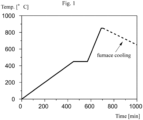
- a green sheet was manufactured from the glass powder by the method shown below (without adding the SiOz powder and the ⁇ -wollastonite) and the green sheet was fired by the temperature profile shown in Fig. 1 .
- the substrate after the firing process was obtained.
- the relative permittivity k and tan ⁇ (Q value) of the substrate after the firing process were measured. The result is shown in Table 1.
- the glass composition codes (a), (b), (c) and (d) were selected as the glass powder A for the reasons described in the paragraph [0017].
- a raw material batch formed by mixing SiO 2 , CaCO 3 , B 2 O 3 or H 3 BO 3 , Al(OH) 3 or Al 2 O 3 , ZrO 2 and MgCO 3 to have an oxide ratio (wt.%) shown in (a), (b), (c) or (d) of Table 1 was filled in a platinum crucible, the mixture was melted in an electric furnace in conditions of 1450°C to 1500°C and 60 to 180 minutes, and the molten material was entered into water to cool and dry the molten material.
- the glass having the compositions shown in (a), (b), (c) or (d) were obtained.
- the obtained glass was classified using a sieve having a mesh size of 4 mm.
- the glass passed through the sieve was crushed and classified using an ultrafine grinder incorporating a medium stirring type classifier where the crushing condition was adjusted so that the particle diameter D 50 was 2.0 to 3.0 ⁇ m.
- the particle diameter D 50 was measured by a laser diffraction method using a particle-size-distribution measurement device LA-950V2 manufactured by HORIBA, Ltd.. The measurement result is shown in Table 3.
- SiO 2 powder B AEROSIL (registered trademark) R805 manufactured by NIPPON AEROSIL CO., LTD. was used as the powder of 10 to 100 nm, SO-C1 manufactured by Admatechs Company Limited was used as the powder of 100 to 400 nm, and SO-C2 manufactured by Admatechs Company Limited or Fuselex/X manufactured by TATSUMORI LTD. was used as the powder of 400 to 3000 nm.
- the compounding ratio of each particle diameter of SiO 2 powder is shown in Table 3.
- composition materials A, B and C were weighed so that the ratio (wt.%) shown in Table 3 was satisfied and they are mixed together with an organic binder having the composition (wt.%) shown in Table 2 in a resin-made pot having alumina balls for 16 to 24 hours.
- a green sheet precursor slurry was obtained.
- the amount of the organic binder contained in the slurry was 46 to 49 wt.%.
- the obtained slurry was deaerated in a vacuum by a rotary pump, a film having a gap of approximately 0.35 mm was formed by a comma direct method and the film was passed through drying zones set to 60°C, 95°C and 100°C for three minutes each.
- a green sheet having a thickness of approximately 0.12 mm was obtained.
- the firing process was performed by using a muffle furnace manufactured by MOTOYAMA CO.,LTD while introducing approximately 100L/min of air.
- the obtained low temperature fired substrate was processed to have a shape of approximately 3 ⁇ 4 ⁇ 30 mm.
- the relative permittivity k and dielectric tangent (tan ⁇ ) were measured by a perturbation type cavity resonator method.
- dielectric characteristics were measured by using a relative permittivity/dielectric tangent measurement system TMR-2A manufactured by KEYCOM Corporation. The measurement result is shown in Table 3.
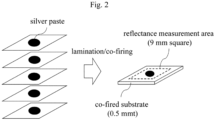
- the obtained green sheet was cut into 22 ⁇ 22 mm and a silver paste having a dimeter of 8 mm was applied on the center of the green sheet by screen printing. Five layers of green sheets were laminated so that the applied silver pastes were overlapped with each other and the green sheets were co-fired. Thus, a measuring specimen was obtained ( Fig. 2 ). The reflectance was measured on the silver electrode of the obtained specimen by using a spectrophotometer/V-750 manufactured by JASCO Corporation within the range of 200 to 800 nm. Then, R 420 /R 800 was calculated from the values of the reflectance of 420 nm and 800 nm ( Fig. 3 ). The calculation result is shown in Table 3. As understood from Fig.
- the low temperature fired substrate after the firing process was crushed by an alumina magnetic mortar and the measurement was performed within the range of 15 to 35 degrees by using an X-ray diffraction device/X'Pert PRO manufactured by Malvern Panalytical Ltd..
- the deposited crystal phase was identified from the peak positions.
- An example (Example 12) of the identification result is shown in Fig. 4 . From the identification result, ⁇ -wollastonite was detected as the main crystal phase and CaB 2 O 4 phase was detected as the auxiliary crystal phase.
- Comparative examples are shown in Table 4.
- the densities of the glass powder A, the SiOz powder B and the ⁇ -wollastonite powder C are out of the range of the claim.
- the range of the particle diameter of the SiOz powder B and the content amount of the SiOz powder of that range of the particle diameter are out of the range of the claim.
- the Q value does not reach 500 which is the target value.
- R 420 /R 800 is below 85% and remarkable yellowing occurs.
- the SiOz powder having a small particle diameter has a large specific surface area and attracts large amount of the B 2 O 3 -rich remaining glass phase. As a result, the migration of the silver to the B 2 O 3 -rich glass phase is suppressed.
- the SiOz powder having a small particle diameter is too much, the structure after the firing process is sparse and tan ⁇ is large although R 420 /R 800 is large (Comparative example 9).
- the SiOz powder having a large particle diameter is used, the structure after the firing process is relatively large and tan ⁇ can be kept low.
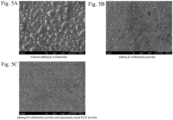
- Example 14 where two or more kinds of nanometer-sized SiOz powders having different ranges of particle diameter are added in addition to the ⁇ -wollastonite, it was confirmed that the floating of the B 2 O 3 -rich glass phase completely disappeared and the surface was fine and smooth.
Landscapes
- Chemical & Material Sciences (AREA)
- Engineering & Computer Science (AREA)
- Organic Chemistry (AREA)
- Materials Engineering (AREA)
- Chemical Kinetics & Catalysis (AREA)
- Ceramic Engineering (AREA)
- Life Sciences & Earth Sciences (AREA)
- Geochemistry & Mineralogy (AREA)
- General Chemical & Material Sciences (AREA)
- Manufacturing & Machinery (AREA)
- Structural Engineering (AREA)
- Inorganic Chemistry (AREA)
- Dispersion Chemistry (AREA)
- Physics & Mathematics (AREA)
- Thermal Sciences (AREA)
- Crystallography & Structural Chemistry (AREA)
- Health & Medical Sciences (AREA)
- Medicinal Chemistry (AREA)
- Polymers & Plastics (AREA)
- Plasma & Fusion (AREA)
- Compositions Of Oxide Ceramics (AREA)
- Inorganic Insulating Materials (AREA)
- Glass Compositions (AREA)
Description
- The present invention relates to a low temperature co-fired (simultaneously fired) ceramic (LTCC) substrate composition mainly used for a small size integrated module for wireless communication.
- Tablet terminals including a mobile phone and a smartphone have spread rapidly. A lot of circuit chips are integrated into the above described terminals. In particular, low temperature co-fired (simultaneously fired) ceramic (LTCC: Low Temperature Co-fired Ceramics) substrates are widely used for front-end modules. The front-end means an element directly communicates with the outside for displaying the information for the user, receiving an instruction and inputting/outputting the information with the other systems, for example. The front-end module means a very small size integrated module integrated with various functional components used for wireless front-end circuit such as LTE which is one of communication standards of the mobile phone, Wi-Fi and GPS. The LTCC substrate is a kind of ceramics used for electronic materials. This substrate is called as the LTCC because it is formed by simultaneously burning a ceramic carrier structure, a conductive resistor and a dielectric material in a furnace of less than 1000°C. The LTCC substrate is used as an electronic circuit substrate by integrating a capacitor, a resistor and the like on one layer and combining a plurality of layers.
- In recent years, devices such as a high speed wireless device, a vehicle collision avoidance radar, a dangerous substance detection device and the like have been developed actively in the range of 30 to 300 GHz called a millimeter wave. The demand for the LTCC substrate used for the above described high frequency communication has been increased. It is known that the millimeter wave has extremely high straight advancing properties and large information transmission amount. As for the material characteristic of the LTCC substrate capable of utilizing above described properties, it is required to minimize the signal attenuation and to propagate the signal at high speed. From the above described background, the demand for the characteristics required for the substrate material used for the LTCC substrate have been increased.
- Here, the signal attenuation in the high frequency region is a sum of conductor loss and dielectric loss. In the region exceeding 1 GHz, the signal attenuation caused by the dielectric loss of the LTCC substrate is dominant. In general, the dielectric loss of the dielectric body is represented by dielectric tangent (dielectric loss tangent) tan δ. However, the dielectric loss is also represented by a Q value (= 1/tan δ) instead of the dielectric tangent in many cases. In addition, it is known that the relation V~(k-1/2) is satisfied when a propagation speed of the signal is V and a dielectric constant is k. Accordingly, in order to maximally utilize the characteristics of the millimeter wave communication (transmit signals at high speed), the material having high Q value (High Q) and low dielectric constant (Low k) is required.
- As the dielectric loss mechanism of the glass material (i.e., LTCC substrate) in the high frequency region such as the millimeter wave, a large part is occupied by deformation loss caused when mesh structure forming the glass is deformed by an electric field to cause dipolar orientation and vibration loss caused when synchronized with the applied frequency. The above described losses generally increase in proportion to the frequency. It is known that the deformation and the vibration loss are smaller in a crystal material compared to the glass which is an amorphous material since the crystal material has a stronger structure capable of reducing the deformation and the vibration. In order to reduce the above described two losses as much as possible, the method of adding a high purity filler to the glass composition such as borosilicate glass having High Q and the method of synthesizing a crystal material having High Q by a crystallized glass method can be listed.
- The former method is disclosed in Patent Document 1, for example. Patent Document 1 discloses a powder of alkali borosilicate glass having a low relative permittivity and a low dielectric loss containing LizO, NazO and K2O in a predetermined molar ratio, discloses a glass-ceramic dielectric material formed of the above described powder and 20 to 50 wt.% of ceramic filler powder and discloses a sintered body formed by sintering the glass ceramic dielectric material. In Patent Document 1, an amorphous glass not depositing crystal is preferably used for the alkali borosilicate glass since the amorphous glass has good softening fluidity when it is sintered and a dense sintered body can be obtained easily.
- The latter method seems to be disclosed in Patent Document 2. Patent Document 2 describes to provide a noncrystal glass/glass ceramic containing a crystallized glass formed from CaO-B2O3-SiO2 base having the composition of approximately 18 to 32 wt.% of B2O3 approximately 42 to 47 wt.% of CaO and approximately 28 to 40 wt.% of SiOz and a noncrystal glass having the composition of at least approximately 60 wt.% of SiO2, approximately 10 to 35 wt.% of B2O3 and up to approximately 6 wt.% of alkali metal oxide.
- Patent Document 3 discloses a sintered dielectric material containing a solid part containing a silica powder and a multicomponent amorphous glass before sintering and discloses the sintered dielectric material further containing a crystalline compound selected from the group consisting of a wollastonite, a calcium borate and the like. Patent Document 4 describes a composition for a low-temperature co-fired substrate.
- The purpose of the inventions of the above described cited references is to provide a co-fired substrate composition capable of being fired at a low temperature of 1100°C, 1000°C or less and having a low relative permittivity k and a high Q value (low dielectric tangent tan δ) at a high frequency region exceeding 1 GHz.
-
- Patent Document 1:
Japanese Unexamined Patent Application Publication No. 2004-269289 - Patent Document 2:
Japanese Unexamined Patent Application Publication No. H5-238813 - Patent Document 3:
Japanese Unexamined Patent Application Publication No. 2019-108263 - Patent Document 4:
United States Patent Application No. 2018/0016192 A1 . - As described in the background art, the LTCC substrate composition having a low relative permittivity k and a high Q value has been pursued. However, as another important characteristic of the LTCC substrate, it is required not to have reactivity with the silver (Ag) which is an electrode material during a co-firing operation at a low temperature, not to cause the migration of silver and not to generate warpage in the LTCC substrate.
- Patent Document 3 describes that high Q value and low relative permittivity k can be shown when only the glass component is fired without adding the silica powder but also describes that it is considered that the problems may occur when co-fired with a silver conductor for the purpose of the LTCC since the silver moves largely. In addition, Patent Document 3 describes that the addition of the silica powder to the glass component may cause the ability of adjusting the contraction of the dielectric material and the ability of control the movement of the silver in the dielectric material during the firing. However, the configuration and the effect are not revealed in Patent Document 3.
- In order to solve the above described conventional problems, the present invention provides a low temperature co-fired substrate composition before a co-firing process, comprising:
- (A) 83 to 91 wt.% of glass powder containing CaO-B2O3-SiO2 as a basic composition;
- (B) 7.5 to 14 wt.% of SiOz powder; and
- (C) 1.5 to 3 wt.% of β-wollastonite (CaSiO3) powder, wherein
- a particle diameter D50 of the glass powder (A) is 2.0 to 3.0 µm,
- the glass powder (A) contains 40.0 to 45.0 wt.% of CaO, 9.0 to 20.0 wt.% of B2O3 and 40.0 to 46.0 wt.% of SiOz as a composition,
- the SiO2 powder (B) is a filler selected from the group consisting of (1), (2) and (3):
- (1) 10 to 30 wt.% of the SiOz powder having the particle diameter D50 of 10 to 100 nm and 70 to 90 wt.% of the SiOz powder having the particle diameter D50 of 400 to 3000 nm;
- (2) 60 wt.% or more of the SiOz powder having the particle diameter D50 of 100 to 400 nm and less than 40 wt.% of the SiOz powder having the particle diameter D50 of 400 to 3000 nm; and
- (3) 4 to 20 wt.% of the SiOz powder having the particle diameter D50 of 10 to 100 nm, 60 to 95 wt.% of the SiOz powder having the particle diameter D50 of 100 to 400 nm and 0 to 36 wt.% of the SiOz powder having the particle diameter D50 of 400 to 3000 nm,
- the β-wollastonite (CaSiO3) powder (C) is another filler having the particle diameter D50 of 2.0 to 3.0 µm,
- when a silver paste, which functions as an electrode, is applied on a surface of a green sheet comprised of the low temperature co-fired substrate before the co-firing process and an organic binder and the co-firing process is performed, the low temperature co-fired substrate after the co-firing process has the following properties:
- a relative permittivity k is 6.0 or less at 2.5 GHz;
- a Q value which is a reciprocal of dielectric tangent is 500 or more at 2.5 GHz; and
- a ratio R420/R800 of a reflectance R420 in a wavelength of 420 nm with respect to a reflectance R800 in the wavelength of 800 nm is 85% or more.
- Although the low temperature co-fired substrate composition before the co-firing process contains (A) 83 to 91 wt.% of glass powder containing CaO-B2O3-SiO2 as a basic composition; (B) 7.5 to 14 wt.% of SiOz powder; and (C) 1.5 to 3 wt.% of β-wollastonite (CaSiO3) powder as necessary compositions, it can also contain less than 3 wt.% of an oxide such as ZrOz having high chemical stability as other compositions.
- In the present invention, the concentration of the glass powder is necessarily 83 to 91 wt.%. When the concentration exceeds 91 wt.%, the relative permittivity k is too large exceeding 6.0. On the other hand, when the concentration is less than 83 wt.%, the adding amount of the SiOz powder is too large and the sinterability of the co-firing is deteriorated. As a result, the dielectric tangent tan δ is too large and the Q value is lower than 500.
- Although the glass powder (A) contains 40.0 to 45.0 wt.% of CaO, 9.0 to 20.0 wt.% of B2O3 and 40.0 to 46.0 wt.% of SiOz as the composition, the glass powder (A) can also contain less than 2 wt.% of an oxide such as Al2O3, ZrOz and MgO having high chemical stability. The particle diameter D50 of the glass powder is 2.0 to 3.0 µm. In accordance with the downsizing of the ceramic chip component, the sheet thickness (film thickness) of the LTCC substrate becomes thinner to 50 µm or less. The film thickness of the conductive paste to be co-fired is mainly 10 µm or less. When the particle diameter D50 of the glass powder is larger than 2.0 to 3.0 µm, roughness of the LTCC substrate after the co-firing process is increased and the electrode to be co-fired is badly affected. On the other hand, when the particle diameter D50 of the glass powder is less than 2.0 to 3.0 µm, the specific surface area is increased. Thus, in order to uniformly disperse the glass powder, the amount of the organic binder should be increased. This causes the problem that malfunction increases in the layered structure due to degreasing defects.
- The basis for choosing the above described composition of the glass powder will be explained using Table 1.
The compositions shown as (a), (b), (c) and (d) in the field of the glass composition code are the glass compositions within the range of the claim of the present invention. The above described compositions have low relative permittivity k, low dielectric tangent (high Q) and not so high crystallization temperature Tc. Since there is a certain temperature difference between the crystallization temperature Tc and the glass transition temperature Tg, workability is good. On the other hand, the glass code number OG302 and OG303 do not satisfy the target values of the present invention since the concentration of SiOz is lower than 40.0 wt.%, the concentration of B2O3 is higher than 20.0 wt.% and the dielectric tangent (tan δ) is not 0.002 or less (Q valued is 500 or more). In the glass code number OG305, the concentration of CaO is slightly lower than 40 wt.% and problems are that tan δ is near the allowable limit and the crystallization temperature Tc is slightly high (890°C). On the contrary, in OG307 where the concentration of SiOz is lower than 40 wt.% and the concentration of CaO is higher than 45 wt.%, there is no problem on tan δ and the crystallization temperature. However, there are the problems in the manufacturing process. For example, a glass layer is formed on the surface during the co-firing operation and a fusion to a firing setter (shelf board-shaped or floor board-shaped ceramic refractory used for firing) is caused. In OG310, OG311, OG315 and OG320 where the concentration of B2O3 is lower than 9.0 wt.%, the crystallinity is high, the contraction caused by crystallization is large and the remaining glass phase is small. Thus, the deviation from the contraction behavior of the silver electrode becomes large and a large warpage is generated on the LTCC substrate. In OG322 where the concentration of CaO is lower than 40 wt.%, the relative permittivity is 4.5 which is a small value. The relative permittivity becomes low even though the β-wollastonite is not deposited because the sinterability is not good (a lot of pores exist). This point is also confirmed by an electron microscope photograph. In OG315 and OG320 where the concentration of SiOz is higher than 46.0 wt.% and the concentration of B2O3 is lower than 9.0 wt.%, the remaining glass phase is small and the contraction caused by crystallization is large. Thus, a warpage is generated. In addition, when the concentration of SiOz is higher than 46.0 wt.% and the concentration of CaO is lower than 40.0 wt.%, the obtained glass is devitrified. Thus, this composition is not listed in Table 1.[Table 1] glass composition code (a) (b) (c) (d) glass code number OG301 OG325 OG323 OG326 OG302 OG303 OG305 composition [wt%] SiOz 45.65 43.47 40.12 43.74 39.81 34.17 42.70 CaO 42.60 43.47 40.12 43.74 37.14 31.89 39.84 B2O3 11.75 11.61 18.42 11.67 23.05 33.94 17.46 Al2O3 0.00 0.61 0.57 0.00 0.00 0.00 0.00 ZrOz 0.00 0.64 0.59 0.65 0.00 0.00 0.00 MgO 0.00 0.20 0.18 0.20 0.00 0.00 0.00 DTA [°C] glass transition temperature Tg 680 675 660 670 670 660 670 softening point Ts 780 770 755 770 - 865 785 crystallization temperature Tc 850 830 855 815 890 925 890 relative permittivity k 6.2 6.4 6.7 6.5 3.9 6.7 6.4 dielectric tangent (tan δ) 0.0003 0.0011 0.0018 0.0006 0.0330 0.0260 0.0019 glass composition code glass code number OG307 OG310 OG311 OG315 OG320 OG322 composition [wt%] SiO2 35.33 46.18 45.03 48.66 48.17 42.94 CaO 47.12 47.87 42.03 45.40 44.96 37.30 B2O3 17.55 5.95 8.70 5.94 5.88 18.42 Al2O3 0.00 0.00 4.24 0.00 0.98 0.57 ZrO2 0.00 0.00 0.00 0.00 0.00 0.59 MgO 0.00 0.00 0.00 0.00 0.00 0.18 DTA [°C] glass transition temperature Tg 660 705 685 690 700 660 softening point Ts 760 820 810 795 810 865 crystallization temperature Tc 800 840 875 820 850 925 relative permittivity k 6.6 6.5 7.6 6.4 6.4 4.5 dielectric tangent (tan δ) 0.0008 0.0003 0.0031 0.0004 0.0008 0.0014 - In the present invention, the β-wollastonite crystal is deposited as a main crystal phase from CaO-B2O3-SiO2 based glass having the composition of (a), (b), (c) and (d) selected in the previous paragraph by using β-wollastonite powder which is the filler is used as a crystallization agent. Note that CaB2O4 crystal may be partly deposited as an auxiliary crystal phase in some cases. β-wollastonite is more preferable than α-wollastonite because the relative permittivity k is lower. It is enough to add 1.5 to 3.0 wt.% of the β-wollastonite powder for making the β-wollastonite powder function as a crystal nucleus. If the amount of the β-wollastonite powder is smaller than the above described range, the crystallization effect is reduced. If the amount of the β-wollastonite powder is larger than the above described range, the effect is not changed. In addition, the particle diameter D50 of the β-wollastonite powder is suitably 2.0 to 3.0 µm which is approximately same as the particle diameter D50 of the glass powder A.
- In the present invention, the SiOz powder which is the filler is used for reducing the relative permittivity k. Furthermore, a part of the SiOz powder is taken in a B2O3-rich glass phase remained after the crystal is deposited. A part of the SiOz powder surrounds the B2O3-rich remaining glass phase. Thus, the interaction with the silver electrode can be suppressed and the deterioration of the electrode caused by the migration of the silver can be suppressed. In order to exhibit the above described function of the SiOz powder, the inventor found that two or more kinds of nanometer-sized SiOz powders having different ranges of particle diameter should be used.
- As for the amount of the SiO2 powder to be added, it is necessary to add 7.5 to 14 wt.% of the SiOz powder. If the amount is below 7.5 wt.%, the relative permittivity k exceeds 6.0, the later described yellowing of the silver electrode is remarkable and R420/R800 is below 85%. On the other hand, if the amount exceeds 14 wt.%, the sinterability in the co-firing process is deteriorated and tan δ is increased (Q value is below 500).
- In one embodiment, it is preferable that the SiOz powder is formed of 10 to 30 wt.% of the SiOz powder having the particle diameter D50 of 10 to 100 nm and 70 to 90 wt.% of the SiOz powder having the particle diameter D50 of 400 to 3000 nm. In another embodiment, it is preferable that the SiO2 powder is formed of 60 wt.% or more of the SiOz powder having the particle diameter D50 of 100 to 400 nm and less than 40 wt.% of the SiOz powder having the particle diameter D50 of 400 to 3000 nm. In a further embodiment, it is preferable that the SiOz powder is formed of 4 to 20 wt.% of the SiOz powder having the particle diameter D50 of 10 to 100 nm, 60 to 95 wt.% of the SiOz powder having the particle diameter D50 of 100 to 400 nm and 0 to 36 wt.% of the SiOz powder having the particle diameter D50 of 400 to 3000 nm. When the composition is not within the above described range, it is difficult to suppress the interaction with the silver electrode and suppress the deterioration of the electrode caused by the migration of the silver while keeping low k value and high Q value.
- The interaction between the silver electrode and the remaining glass phase and the migration of the silver to the remaining glass phase can be evaluated by measuring the reflectance of the LTCC substrate after the co-firing process. This is because the silver atoms transferred to the remaining glass phase are colloidal particles and a selective absorption peculiar to the silver colloid occurs near the wavelength of 420 nm and the colloidal particles are observed as the yellowing. Accordingly, the moving amount of the silver atoms to the remaining glass phase can be relatively evaluated from the degree of the yellowing by measuring a ratio R420/R800 between a reflectance R800 in the wavelength of 800 nm not affected by the silver colloidal particles and a reflectance R420 where the reflectance is lowered by the absorption of the silver colloidal particles.
- By adopting the composition of the present invention, when a silver paste, which functions as an electrode, is applied on a surface of a green sheet comprised of the low temperature co-fired substrate before the co-firing process and an organic binder and the co-firing process is performed, the low temperature co-fired substrate after the co-firing process can have the following properties: a relative permittivity k is 6.0 or less at 2.5 GHz; a Q value which is a reciprocal (1/tan δ) of dielectric tangent is 500 or more at 2.5 GHz; and a ratio R420/R800 (in percent) of a reflectance R420 in a wavelength of 420 nm with respect to a reflectance R800 in the wavelength of 800 nm is 85% or more.
- In the low temperature co-fired substrate composition of the present invention, the β-wollastonite powder accelerates the deposition of the β-wollastonite crystal in the CaO-B2O3-SiO2 glass, the SiOz powder is taken in the B2O3-rich glass phase remained after the deposition and the SiOz powder surrounds around the remaining glass phase. Thus, the interaction between the B2O3-rich remaining glass phase and the silver electrode and the migration of the silver to the B2O3-rich remaining glass phase can be suppressed. Consequently, the LTCC substrate can be obtained without causing yellowing of the silver electrode (deterioration of silver electrode) while maintaining low k value and high Q value.
-
-
Fig. 1 shows a temperature profile when firing a low temperature co-fired substrate composition of the present invention. -
Fig. 2 is a schematic diagram showing a test body and a measurement position for measuring R420/R800. -
Fig. 3 shows a reflectance profile for calculating R420/R800 of Example 12 of the present invention and Comparative example 19. -
Fig. 4 is an example (Example 12) of X-ray diffraction profile of the low temperature co-fired substrate composition of the present invention after the firing process. -
Figs. 5A to 5C are electron microscope photographs showing a surface state (effect of adding the β-wollastonite powder and effect of adding two kinds or more nanometer-sized SiOz powder) after the co-firing process. - Before exploiting the present invention, screening of glass composition was performed for determining the glass composition suitable for being used for the present invention. First, a green sheet was manufactured from the glass powder by the method shown below (without adding the SiOz powder and the β-wollastonite) and the green sheet was fired by the temperature profile shown in
Fig. 1 . Thus, the substrate after the firing process was obtained. The relative permittivity k and tan δ (Q value) of the substrate after the firing process were measured. The result is shown in Table 1. The glass composition codes (a), (b), (c) and (d) were selected as the glass powder A for the reasons described in the paragraph [0017]. - As a raw material, a raw material batch formed by mixing SiO2, CaCO3, B2O3 or H3BO3, Al(OH)3 or Al2O3, ZrO2 and MgCO3 to have an oxide ratio (wt.%) shown in (a), (b), (c) or (d) of Table 1 was filled in a platinum crucible, the mixture was melted in an electric furnace in conditions of 1450°C to 1500°C and 60 to 180 minutes, and the molten material was entered into water to cool and dry the molten material. Thus, the glass having the compositions shown in (a), (b), (c) or (d) were obtained. The obtained glass was classified using a sieve having a mesh size of 4 mm. The glass passed through the sieve was crushed and classified using an ultrafine grinder incorporating a medium stirring type classifier where the crushing condition was adjusted so that the particle diameter D50 was 2.0 to 3.0 µm. Thus, the glass powder A having the particle diameter D50 shown in
Fig. 3 was obtained. The particle diameter D50 was measured by a laser diffraction method using a particle-size-distribution measurement device LA-950V2 manufactured by HORIBA, Ltd.. The measurement result is shown in Table 3. - Regarding the SiO2 powder B, AEROSIL (registered trademark) R805 manufactured by NIPPON AEROSIL CO., LTD. was used as the powder of 10 to 100 nm, SO-C1 manufactured by Admatechs Company Limited was used as the powder of 100 to 400 nm, and SO-C2 manufactured by Admatechs Company Limited or Fuselex/X manufactured by TATSUMORI LTD. was used as the powder of 400 to 3000 nm. The compounding ratio of each particle diameter of SiO2 powder is shown in Table 3.
- Commercially available crystal powder of β-wollastonite was crushed using a dry ball mill while adjusting the crushing time so that the particle diameter D50 was 2.0 to 3.0 µm and classified using a sieve having a mesh size of 100 µm. Thus, the β-wollastonite powder having the particle diameter D50 of 2.4 µm was obtained.
- Each of composition materials A, B and C was weighed so that the ratio (wt.%) shown in Table 3 was satisfied and they are mixed together with an organic binder having the composition (wt.%) shown in Table 2 in a resin-made pot having alumina balls for 16 to 24 hours. Thus, a green sheet precursor slurry was obtained. The amount of the organic binder contained in the slurry was 46 to 49 wt.%. The obtained slurry was deaerated in a vacuum by a rotary pump, a film having a gap of approximately 0.35 mm was formed by a comma direct method and the film was passed through drying zones set to 60°C, 95°C and 100°C for three minutes each. Thus, a green sheet having a thickness of approximately 0.12 mm was obtained.
[Table 2] composition concentration (wt.%) cyclohexanone 48.61 ethanol 32.41 plasticizer 6.4 dispersant 0.85 polyvinyl butyral 11.73 - Forty layers of the obtained green sheets were laminated by applying a hydrostatic pressure using a hot water laminator/WL28-45-200 manufactured by NIKKISO CO., LTD. in condition that the water temperature of 70°C, the pressure of 20.7 MPa and 10 minutes, and then the green sheets were fired in accordance with the temperature program shown in
Fig. 1 . Thus, a low temperature fired substrate was obtained. Here, the temperature rising speed was 1°C/min until 450°C and the temperature was kept at 450°C for 2 hours to perform a debinder treatment. After that the temperature was raised to 850°C in 2 hours and the temperature was kept at 850°C for 15 minutes to perform a crystallization treatment. Note that the firing process was performed by using a muffle furnace manufactured by MOTOYAMA CO.,LTD while introducing approximately 100L/min of air. The obtained low temperature fired substrate was processed to have a shape of approximately 3×4×30 mm. Then, the relative permittivity k and dielectric tangent (tan δ) were measured by a perturbation type cavity resonator method. The Q value was calculated in condition that Q = 1/tan δ. Note that dielectric characteristics were measured by using a relative permittivity/dielectric tangent measurement system TMR-2A manufactured by KEYCOM Corporation. The measurement result is shown in Table 3. - The obtained green sheet was cut into 22×22 mm and a silver paste having a dimeter of 8 mm was applied on the center of the green sheet by screen printing. Five layers of green sheets were laminated so that the applied silver pastes were overlapped with each other and the green sheets were co-fired. Thus, a measuring specimen was obtained (
Fig. 2 ). The reflectance was measured on the silver electrode of the obtained specimen by using a spectrophotometer/V-750 manufactured by JASCO Corporation within the range of 200 to 800 nm. Then, R420/R800 was calculated from the values of the reflectance of 420 nm and 800 nm (Fig. 3 ). The calculation result is shown in Table 3. As understood fromFig. 3 , the deterioration of the reflectance was not observed in 420 nm and R420/R800 was 88.6% in Example 12, while the deterioration of the reflectance due to the silver colloid was observed in 420 nm and R420/R800 was deteriorated to 75.2% in Comparative example 19. As the silver paste to be applied, the silver paste manufactured by NORITAKE CO., LIMITED was used. - The low temperature fired substrate after the firing process was crushed by an alumina magnetic mortar and the measurement was performed within the range of 15 to 35 degrees by using an X-ray diffraction device/X'Pert PRO manufactured by Malvern Panalytical Ltd.. Thus, the deposited crystal phase was identified from the peak positions. An example (Example 12) of the identification result is shown in
Fig. 4 . From the identification result, β-wollastonite was detected as the main crystal phase and CaB2O4 phase was detected as the auxiliary crystal phase. - The summary of the measurement result of the above described examples is shown in Table 3. When at least two of three kinds of nanometer-sized SiOz powder were added at the ratio described in the claim, the interaction between the B2O3-rich remaining glass phase and the silver electrode and the migration of the silver to the B2O3-rich remaining glass phase could be suppressed (R420/R800 could be 85.0% or more) while keeping low k value and high Q value.
[Table 3] Examples 1 2 3 4 5 6 7 glass powder A wt.% 87.30 87.22 87.22 85.48 84.60 87.22 87.22 SiOz powder B 9.70 10.78 10.78 12.56 13.46 10.78 10.78 β-wollastonite powder C 3.00 2.00 2.00 1.96 1.94 2.00 2.00 other additives 0.00 0.00 0.00 0.00 0.00 0.00 0.00 particle diameter D50 of glass powder A µm 2.0 2.2 2.2 2.2 2.2 2.2 2.2 glass composition of glass powder A code (a) (b) (b) (b) (b) (b) (b) SiO2 powder B (particle diameter 1) 10-100 nm 25.00 18.18 27.27 15.92 22.29 0.00 0.00 SiO2 powder B (particle diameter 2) 100-400 nm 0.00 0.00 0.00 0.00 0.00 63.64 81.82 SiO2 powder B (particle diameter 3) 400-3000 nm 75.00 81.82 72.73 84.08 77.71 36.36 18.18 particle diameter D50 of β-wollastonite powder C µm 2.4 2.4 2.4 2.4 2.4 2.4 2.4 main crystal phase (wollastonite) α or β β β β β β β β relative permittivity k at 2.5 GHz 5.72 5.93 5.82 5.81 5.59 5.88 5.90 tan δ 0.0008 0.0009 0.0011 0.0012 0.0015 0.0009 0.0012 Q value (1/tan ) 1250 1111 909 833 667 1111 833 R420/R800 (%) 88.3 86.4 85.6 87.4 87.6 85.6 89.3 Example 8 9 10 11 12 13 14 15 glass powder A wt.% 87.22 87.22 87.22 86.55 90.16 90.16 90.16 88.20 SiO2 powder B 10.78 10.78 10.78 8.56 7.84 7.84 7.84 9.80 β-wollastonite powder C 2.00 2.00 2.00 1.98 2.00 2.00 2.00 2.00 Other additive (ZrO2) 0.00 0.00 0.00 2.91 0.00 0.00 0.00 0.00 particle diameter D50 of glass powder A µm 2.2 2.2 2.2 2.3 2.3 2.3 2.3 2.2 glass composition of glass powder A symbol (b) (b) (b) (c) (c) (c) (c) (d) SiO2 powder B (particle diameter 1) 10-100 nm 4.55 9.09 13.64 11.68 6.25 12.50 18.75 30.00 SiO2 powder B (particle diameter 2) 100-400 nm 63.64 63.64 63.64 0.00 93.75 87.50 81.25 0.00 SiO2 powder B (particle diameter 3) 400-3000 nm 31.82 27.27 22.73 88.32 0.00 0.00 0.00 70.00 particle diameter D50 of β-wollastonite powder C µm 2.4 2.4 2.4 2.4 2.4 2.4 2.4 2.4 main crystal phase (wollastonite) α or β β β β β β β β β relative permittivity k at 2.5 GHz 5.87 5.85 5.73 5.88 5.89 5.72 5.54 5.59 tan δ 0.0010 0.0013 0.0017 0.0009 0.0010 0.0011 0.0015 0.0009 Q value (1/tan δ) 1000 769 588 1111 1000 909 667 1111 R420/R800 (%) 85.2 89.6 89.1 87.1 88.6 88.2 90.6 86.9 - Comparative examples are shown in Table 4. In Comparative examples 1, 6 and 18, the densities of the glass powder A, the SiOz powder B and the β-wollastonite powder C are out of the range of the claim. In other Comparative examples, the range of the particle diameter of the SiOz powder B and the content amount of the SiOz powder of that range of the particle diameter are out of the range of the claim. In Comparative example 9 and Comparative example 18, the Q value does not reach 500 which is the target value. In other Comparative examples, R420/R800 is below 85% and remarkable yellowing occurs.
- From the result of the Examples and Comparative examples, the SiOz powder having a small particle diameter has a large specific surface area and attracts large amount of the B2O3-rich remaining glass phase. As a result, the migration of the silver to the B2O3-rich glass phase is suppressed. When the SiOz powder having a small particle diameter is too much, the structure after the firing process is sparse and tan δ is large although R420/R800 is large (Comparative example 9). On the contrary, when the SiOz powder having a large particle diameter is used, the structure after the firing process is relatively large and tan δ can be kept low. However, when the SiOz powder having a large particle diameter is increased, the effect of suppressing the migration of the silver to the B2O3-rich glass phase is poor and R420/R800 is small (Comparative examples 7 and 14). As a result, only when at least two of three kinds of nanometer-sized SiOz powder were added at the ratio described in the claim, the interaction between the B2O3-rich remaining glass phase and the silver electrode and the migration of the silver to the B2O3-rich remaining glass phase could be suppressed while keeping the k value of 6.0 or less and the tan δ of 0.002 or less (Q value of 500 or more).
[Table 4] Comparative example 1 2 3 4 5 6 7 8 9 10 glass powder A wt.% 100.00 90.16 8820 8722 8624 82.32 8722 8722 8722 86.35 SiO2 powder B 0.00 7.84 9.80 10.78 11.76 15.68 10.78 10.78 10.78 11.67 β-wollastonite powder C 0.00 2.00 2.00 2.00 2.00 2.00 2.00 2.00 2.00 1.98 Other additive 0.00 0.00 0.00 0.00 0.00 0.00 0.00 0.00 0.00 0.00 particle diameter D50 of glass powder A µm 2.2 2.2 2.2 2.2 2.2 2.2 2.2 2.2 2.2 2.2 glass composition of glass powder A symbol (b) (b) (b) (b) (b) (b) (b) (b) (b) (b) SiO2 powder B (particle diameter 1) 10-100 nm 0.00 0.00 0.00 0.00 0.00 0.00 4.55 9.09 63.64 8.57 SiO2 powder B (particle diameter 2) 100-400 nm 0.00 0.00 0.00 0.00 0.00 0.00 0.00 0.00 0.00 0.00 SiO2 powder B (particle diameter 3) 400-3000 nm 0.00 100.00 100.00 100.00 100.00 100.00 95.45 90.91 36.36 91.43 particle diameter D50 of β-wollastonite powder C µm - 2.4 2.4 2.4 2.4 2.4 2.4 2.4 2.4 2.4 main crystal phase (wollastonite ) α or β α β β β β β β β β β relative permittivity k at 2.5 GHz 6.40 6.18 5.96 5.93 5.84 5.60 5.92 5.90 524 5.95 tan δ 0.0011 0.0008 0.0009 0.0008 0.0008 0.0008 0.0008 0.0008 0.0023 0.0009 Q value (1/tan δ) 909 1250 1111 1250 1250 1250 1250 1250 435 1111 R420/R800 (%) 76.8 77.9 78.9 79.3 82.6 84.5 80.4 84.1 87.4 81.5 Comparative example 11 12 13 14 15 16 17 18 19 20 21 glass powder A wt.% 8722 8722 8722 86.35 85.48 87.42 86.98 81.30 90.16 90.16 8820 SiO2 powder B 10.78 10.78 10.78 11.67 12.56 7.64 8.10 14.11 7.84 7.84 9.80 β-wollastonite powder C 2.00 2.00 2.00 1.98 1.96 2.00 1.99 1.86 2.00 2.00 2.00 Other additive (ZrO2) 0.00 0.00 0.00 0.00 0.00 2.94 2.93 2.73 0.00 0.00 0.00 particle diameter D50 of glass powder A µm 2.2 2.2 2.2 2.2 2.2 2.2 2.3 2.3 2.2 2.3 2.2 glass composition of glass powder A symbol (b) (b) (b) (b) (b) (c) (c) (c) (c) (c) (d) SiO2 powder B (particle diameter 1) 10~100 nm 0.00 0.00 0.00 0.00 0.00 0.00 6.17 49.61 0.00 0.00 0.00 SiO2 powder B (particle diameter 2) 100-400 nm 18.18 36.36 54.55 8.57 15.92 0.00 0.00 0.00 0.00 50.00 0.00 SiO2 powder B (particle diameter 3) 400-3000 nm 81.82 63.64 45.45 91.43 84.08 100.00 93.83 50.39 100.00 50.00 100.00 particle diameter D50 of β-wollastonite powder C µm 2.4 2.4 2.4 2.4 2.4 2.4 2.4 2.4 2.4 2.4 2.4 main crystal phase (wollastonite) α or β β β β β β β β β β β β relative permittivity k at 2.5 GHz 5.95 5.99 5.88 5.94 5.84 5.93 5.91 4.19 5.96 5.79 5.94 tan δ 0.0008 0.0008 0.0009 0.0008 0.0008 0.0008 0.0009 0.0028 0.0007 0.0008 0.0005 Q value (1/tan δ) 1250 1250 1111 1250 1250 1250 1111 357 1429 1250 2000 R420/R800 (%) 80.8 82.3 82.7 78.4 82.7 79.5 81.6 91.3 752 802 82.6 - Finally, the effect of the present invention was confirmed based on the result of observing a surface state of the LTCC substrate after the co-firing process by an electron microscope photograph (
Figs. 5A to 5C ). When Comparative example 1 containing only the glass powder without containing the SiOz powder and the β-wollastonite powder was co-fired, it was confirmed that the floating of the B2O3-rich glass phase densely existed on the surface in a grained state. In such a case, the migration of the silver to the B2O3-rich glass phase was remarkable. Thus, R420/R800 was deteriorated and disconnection or short circuiting of the electrode may occur. In the example where the β-wollastonite powder is added to Comparative example 1, although the floating of the B2O3-rich glass was reduced but did not completely disappear. In Example 14 where two or more kinds of nanometer-sized SiOz powders having different ranges of particle diameter are added in addition to the β-wollastonite, it was confirmed that the floating of the B2O3-rich glass phase completely disappeared and the surface was fine and smooth.
Claims (1)
- A low temperature co-fired substrate composition before a co-firing process, comprising:(A) 83 to 91 wt.% of glass powder containing CaO-B2O3-SiO2 as a basic composition;(B) 7.5 to 14 wt.% of SiO2 powder; and(C) 1.5 to 3 wt.% of β-wollastonite (CaSiO3) powder, whereina particle diameter D50 of the glass powder (A) is 2.0 to 3.0 µm,the glass powder (A) contains 40.0 to 45.0 wt.% of CaO, 9.0 to 20.0 wt.% of B2O3 and 40.0 to 46.0 wt.% of SiOz as a composition,the SiO2 powder (B) is a filler selected from the group consisting of (1), (2) and (3):(1) 10 to 30 wt.% of the SiOz powder having the particle diameter D50 of 10 to 100 nm and 70 to 90 wt.% of the SiOz powder having the particle diameter D50 of 400 to 3000 nm;(2) 60 wt.% or more of the SiOz powder having the particle diameter D50 of 100 to 400 nm and less than 40 wt.% of the SiOz powder having the particle diameter D50 of 400 to 3000 nm; and(3) 4 to 20 wt.% of the SiOz powder having the particle diameter D50 of 10 to 100 nm, 60 to 95 wt.% of the SiOz powder having the particle diameter D50 of 100 to 400 nm and 0 to 36 wt.% of the SiOz powder having the particle diameter D50 of 400 to 3000 nm,the β-wollastonite (CaSiO3) powder (C) is another filler having the particle diameter D50 of 2.0 to 3.0 µm,when a silver paste, which functions as an electrode, is applied on a surface of a green sheet comprised of the low temperature co-fired substrate before the co-firing process and an organic binder and the co-firing process is performed, the low temperature co-fired substrate after the co-firing process has the following properties:a relative permittivity k is 6.0 or less at 2.5 GHz;a Q value which is a reciprocal of dielectric tangent is 500 or more at 2.5 GHz; anda ratio R420/R800 of a reflectance R420 in a wavelength of 420 nm with respect to a reflectance R800 in the wavelength of 800 nm is 85% or more.
Applications Claiming Priority (2)
| Application Number | Priority Date | Filing Date | Title |
|---|---|---|---|
| JP2020153478 | 2020-09-14 | ||
| PCT/JP2021/018539 WO2022054337A1 (en) | 2020-09-14 | 2021-05-17 | Low-temperature co-fired substrate composition |
Publications (3)
| Publication Number | Publication Date |
|---|---|
| EP4108646A1 EP4108646A1 (en) | 2022-12-28 |
| EP4108646A4 EP4108646A4 (en) | 2024-01-24 |
| EP4108646B1 true EP4108646B1 (en) | 2024-08-28 |
Family
ID=80631469
Family Applications (1)
| Application Number | Title | Priority Date | Filing Date |
|---|---|---|---|
| EP21866298.9A Active EP4108646B1 (en) | 2020-09-14 | 2021-05-17 | Low-temperature co-fired substrate composition |
Country Status (7)
| Country | Link |
|---|---|
| US (1) | US12466761B2 (en) |
| EP (1) | EP4108646B1 (en) |
| JP (1) | JP7323879B2 (en) |
| KR (1) | KR102633693B1 (en) |
| CN (1) | CN115210195B (en) |
| TW (1) | TWI838636B (en) |
| WO (1) | WO2022054337A1 (en) |
Families Citing this family (1)
| Publication number | Priority date | Publication date | Assignee | Title |
|---|---|---|---|---|
| WO2024195810A1 (en) * | 2023-03-23 | 2024-09-26 | 日本山村硝子株式会社 | Material for high-frequency dielectric ceramic production |
Family Cites Families (21)
| Publication number | Priority date | Publication date | Assignee | Title |
|---|---|---|---|---|
| JPH05238813A (en) | 1992-01-30 | 1993-09-17 | Ferro Corp | Low permittivity and low-temperature burned glass ceramic |
| JP3361573B2 (en) * | 1993-08-04 | 2003-01-07 | 日本山村硝子株式会社 | Low temperature fired substrate composition and low temperature fired substrate obtained therefrom |
| JP3375181B2 (en) * | 1992-11-21 | 2003-02-10 | 日本山村硝子株式会社 | Glass composition for low-temperature fired substrate and low-temperature fired substrate obtained therefrom |
| JP4756254B2 (en) | 2001-04-10 | 2011-08-24 | 昌利 佐藤 | Wollastonite low-temperature fired glass ceramics and method for producing the same |
| JP4228344B2 (en) | 2003-03-05 | 2009-02-25 | 日本電気硝子株式会社 | Glass powder, glass ceramic dielectric material, sintered body, and circuit member for high frequency |
| JP2004269289A (en) | 2003-03-06 | 2004-09-30 | Sumitomo Metal Mining Co Ltd | Method for producing inorganic solidified body |
| JP5263112B2 (en) * | 2009-10-07 | 2013-08-14 | 旭硝子株式会社 | Ceramic raw material composition |
| KR101159063B1 (en) * | 2011-02-08 | 2012-06-22 | 한국과학기술연구원 | Low temperature co-fired ceramics with low dielectric loss for millimeter-wave application |
| CN102173587A (en) * | 2011-03-03 | 2011-09-07 | 电子科技大学 | Microcrystalline glass material for electronic substrate and preparation method thereof |
| CN103553559B (en) * | 2013-10-17 | 2016-05-04 | 天津大学 | CaO-B2O3-SiO2The composite of glass+aluminium nitride ceramics and preparation method |
| CN105271781A (en) * | 2015-10-19 | 2016-01-27 | 昆明贵金属研究所 | Glass powder for low-temperature co-fired conductive silver paste and preparation method of glass powder |
| US10160689B2 (en) | 2016-07-12 | 2018-12-25 | Shenzhen Sunlord Electronics Co., Ltd. | CBS-based LTCC material and preparation method thereof |
| CN106187141B (en) * | 2016-07-12 | 2019-06-28 | 深圳顺络电子股份有限公司 | A kind of CBS system LTCC material and preparation method thereof |
| US10179749B2 (en) * | 2016-08-30 | 2019-01-15 | Shenzhen Sunlord Electronics Co., Ltd. | Low-temperature co-fired ceramic material and preparation method thereof |
| CN106396414B (en) * | 2016-08-30 | 2019-03-08 | 深圳顺络电子股份有限公司 | A kind of low-temperature co-burning ceramic material and preparation method thereof |
| CN107473717B (en) * | 2017-07-26 | 2019-12-20 | 广东风华高新科技股份有限公司 | Boron aluminum silicate mineral material, low-temperature co-fired ceramic composite material, low-temperature co-fired ceramic, composite substrate and preparation method thereof |
| RU2701611C1 (en) | 2017-11-07 | 2019-09-30 | Ферро Корпорэйшн | Dielectric composition with low k for applications at high frequencies |
| KR20190108263A (en) | 2018-03-14 | 2019-09-24 | 에이치닥 테크놀로지 아게 | Hybrid block chain system and method for transferring of a control transaction using the system |
| CN109608050B (en) * | 2018-12-25 | 2021-11-12 | 中国人民解放军国防科技大学 | High-frequency low-dielectric low-loss microcrystalline glass/ceramic LTCC substrate material and preparation method thereof |
| CN110171928B (en) * | 2019-01-04 | 2022-06-03 | 南京汇聚新材料科技有限公司 | Low-temperature co-fired ceramic glass powder |
| CN110171963B (en) * | 2019-01-04 | 2021-11-30 | 南京汇聚新材料科技有限公司 | Low-temperature co-fired ceramic microwave and millimeter wave dielectric powder |
-
2021
- 2021-05-17 KR KR1020227034349A patent/KR102633693B1/en active Active
- 2021-05-17 US US17/802,528 patent/US12466761B2/en active Active
- 2021-05-17 CN CN202180018640.3A patent/CN115210195B/en active Active
- 2021-05-17 EP EP21866298.9A patent/EP4108646B1/en active Active
- 2021-05-17 JP JP2022547393A patent/JP7323879B2/en active Active
- 2021-05-17 WO PCT/JP2021/018539 patent/WO2022054337A1/en not_active Ceased
- 2021-07-30 TW TW110128159A patent/TWI838636B/en active
Also Published As
| Publication number | Publication date |
|---|---|
| EP4108646A4 (en) | 2024-01-24 |
| EP4108646A1 (en) | 2022-12-28 |
| CN115210195A (en) | 2022-10-18 |
| TWI838636B (en) | 2024-04-11 |
| TW202210435A (en) | 2022-03-16 |
| US20230096796A1 (en) | 2023-03-30 |
| KR20220149598A (en) | 2022-11-08 |
| CN115210195B (en) | 2023-03-21 |
| JPWO2022054337A1 (en) | 2022-03-17 |
| WO2022054337A1 (en) | 2022-03-17 |
| JP7323879B2 (en) | 2023-08-09 |
| KR102633693B1 (en) | 2024-02-05 |
| US12466761B2 (en) | 2025-11-11 |
Similar Documents
| Publication | Publication Date | Title |
|---|---|---|
| Sebastian et al. | Low loss dielectric materials for LTCC applications: a review | |
| US7544629B2 (en) | Non-lead glass for forming dielectric, glass ceramic composition for forming dielectric, dielectric, and process for producing laminated dielectric | |
| EP2194766B1 (en) | Ceramic multilayer substrate | |
| EP2386528B1 (en) | Ceramic material for low-temperature sintering, and ceramic substrate | |
| Lv et al. | Influence of CaO–B2O3–SiO2 crystallizable glass on microstructure and microwave dielectric of LiMg0. 9Zn0. 1PO4 ceramics for LTCC substrate applications | |
| US6455453B1 (en) | Low-temperature sinterable ceramic composition and multilayer ceramic substrate | |
| IE64626B1 (en) | Ceramic composition of matter and its use | |
| CN116133997A (en) | Glass, glass-ceramic and laminated ceramic electronic components | |
| US7722732B2 (en) | Thick film paste via fill composition for use in LTCC applications | |
| US12466761B2 (en) | Low temperature co-fired substrate composition | |
| JP4613826B2 (en) | Ceramic substrate composition, ceramic substrate, method for producing ceramic substrate, and glass composition | |
| JP3033568B1 (en) | Low temperature firing glass ceramics | |
| US8652982B2 (en) | Ceramic sintered body and method for producing ceramic sintered body | |
| JP2004339049A (en) | Lead-free glass for dielectric formation, glass-ceramic composition for dielectric formation, dielectric, and laminated dielectric manufacturing method | |
| EP1645551B1 (en) | Dielectric ceramic composition, process for producing the same, dielectric ceramic employing it and multilayer ceramic component | |
| US11939268B2 (en) | Low-k material and method for manufacturing the same | |
| JP7206156B2 (en) | Alumina sintered body and wiring board | |
| KR102742454B1 (en) | Dielectric ceramics composition for high frequency device, manufacturing method of the same and ltcc substrate thereby | |
| CN100378030C (en) | Dielectric ceramic composition, method for producing same, dielectric ceramic and laminated ceramic part using same | |
| JPH068189B2 (en) | Oxide dielectric material | |
| KR102859412B1 (en) | composition for Low temperature co-fired ceramic and manufacturing method the same | |
| JP2004026543A (en) | Dielectric ceramic composition and multilayer ceramic component using the same | |
| KR20030061521A (en) | Dielectric ceramic compositions for low temperature co-fired ceramic substrate and method for preparation thereof | |
| JP4442077B2 (en) | Porcelain composition for high frequency components | |
| JP4998833B2 (en) | Manufacturing method of glass ceramic substrate and glass ceramic substrate |
Legal Events
| Date | Code | Title | Description |
|---|---|---|---|
| STAA | Information on the status of an ep patent application or granted ep patent |
Free format text: STATUS: THE INTERNATIONAL PUBLICATION HAS BEEN MADE |
|
| PUAI | Public reference made under article 153(3) epc to a published international application that has entered the european phase |
Free format text: ORIGINAL CODE: 0009012 |
|
| STAA | Information on the status of an ep patent application or granted ep patent |
Free format text: STATUS: REQUEST FOR EXAMINATION WAS MADE |
|
| 17P | Request for examination filed |
Effective date: 20220916 |
|
| AK | Designated contracting states |
Kind code of ref document: A1 Designated state(s): AL AT BE BG CH CY CZ DE DK EE ES FI FR GB GR HR HU IE IS IT LI LT LU LV MC MK MT NL NO PL PT RO RS SE SI SK SM TR |
|
| DAV | Request for validation of the european patent (deleted) | ||
| DAX | Request for extension of the european patent (deleted) | ||
| A4 | Supplementary search report drawn up and despatched |
Effective date: 20240102 |
|
| RIC1 | Information provided on ipc code assigned before grant |
Ipc: H01L 23/15 20060101ALI20231219BHEP Ipc: C03C 3/093 20060101ALI20231219BHEP Ipc: C04B 35/653 20060101ALI20231219BHEP Ipc: C08J 5/18 20060101ALI20231219BHEP Ipc: C04B 35/634 20060101ALI20231219BHEP Ipc: C04B 35/638 20060101ALI20231219BHEP Ipc: C03C 3/089 20060101ALI20231219BHEP Ipc: C03C 3/06 20060101ALI20231219BHEP Ipc: C04B 35/626 20060101ALI20231219BHEP Ipc: C04B 35/195 20060101ALI20231219BHEP Ipc: C03C 27/08 20060101ALI20231219BHEP Ipc: C03C 8/22 20060101ALI20231219BHEP Ipc: C03C 8/02 20060101ALI20231219BHEP Ipc: C03C 3/091 20060101ALI20231219BHEP Ipc: C03C 3/064 20060101ALI20231219BHEP Ipc: B32B 17/00 20060101ALI20231219BHEP Ipc: C03C 8/16 20060101ALI20231219BHEP Ipc: C03C 14/00 20060101ALI20231219BHEP Ipc: C03C 1/00 20060101ALI20231219BHEP Ipc: C04B 41/88 20060101ALI20231219BHEP Ipc: C04B 35/14 20060101AFI20231219BHEP |
|
| GRAP | Despatch of communication of intention to grant a patent |
Free format text: ORIGINAL CODE: EPIDOSNIGR1 |
|
| STAA | Information on the status of an ep patent application or granted ep patent |
Free format text: STATUS: GRANT OF PATENT IS INTENDED |
|
| RIC1 | Information provided on ipc code assigned before grant |
Ipc: H01L 23/15 20060101ALI20240527BHEP Ipc: C03C 3/093 20060101ALI20240527BHEP Ipc: C04B 35/653 20060101ALI20240527BHEP Ipc: C08J 5/18 20060101ALI20240527BHEP Ipc: C04B 35/634 20060101ALI20240527BHEP Ipc: C04B 35/638 20060101ALI20240527BHEP Ipc: C03C 3/089 20060101ALI20240527BHEP Ipc: C03C 3/06 20060101ALI20240527BHEP Ipc: C04B 35/626 20060101ALI20240527BHEP Ipc: C04B 35/195 20060101ALI20240527BHEP Ipc: C03C 27/08 20060101ALI20240527BHEP Ipc: C03C 8/22 20060101ALI20240527BHEP Ipc: C03C 8/02 20060101ALI20240527BHEP Ipc: C03C 3/091 20060101ALI20240527BHEP Ipc: C03C 3/064 20060101ALI20240527BHEP Ipc: B32B 17/00 20060101ALI20240527BHEP Ipc: C03C 8/16 20060101ALI20240527BHEP Ipc: C03C 14/00 20060101ALI20240527BHEP Ipc: C03C 1/00 20060101ALI20240527BHEP Ipc: C04B 41/88 20060101ALI20240527BHEP Ipc: C04B 35/14 20060101AFI20240527BHEP |
|
| GRAS | Grant fee paid |
Free format text: ORIGINAL CODE: EPIDOSNIGR3 |
|
| INTG | Intention to grant announced |
Effective date: 20240628 |
|
| GRAA | (expected) grant |
Free format text: ORIGINAL CODE: 0009210 |
|
| STAA | Information on the status of an ep patent application or granted ep patent |
Free format text: STATUS: THE PATENT HAS BEEN GRANTED |
|
| AK | Designated contracting states |
Kind code of ref document: B1 Designated state(s): AL AT BE BG CH CY CZ DE DK EE ES FI FR GB GR HR HU IE IS IT LI LT LU LV MC MK MT NL NO PL PT RO RS SE SI SK SM TR |
|
| REG | Reference to a national code |
Ref country code: CH Ref legal event code: EP |
|
| REG | Reference to a national code |
Ref country code: DE Ref legal event code: R096 Ref document number: 602021018105 Country of ref document: DE |
|
| REG | Reference to a national code |
Ref country code: IE Ref legal event code: FG4D |
|
| REG | Reference to a national code |
Ref country code: LT Ref legal event code: MG9D |
|
| PG25 | Lapsed in a contracting state [announced via postgrant information from national office to epo] |
Ref country code: NO Free format text: LAPSE BECAUSE OF FAILURE TO SUBMIT A TRANSLATION OF THE DESCRIPTION OR TO PAY THE FEE WITHIN THE PRESCRIBED TIME-LIMIT Effective date: 20241128 |
|
| REG | Reference to a national code |
Ref country code: AT Ref legal event code: MK05 Ref document number: 1717832 Country of ref document: AT Kind code of ref document: T Effective date: 20240828 |
|
| PG25 | Lapsed in a contracting state [announced via postgrant information from national office to epo] |
Ref country code: PT Free format text: LAPSE BECAUSE OF FAILURE TO SUBMIT A TRANSLATION OF THE DESCRIPTION OR TO PAY THE FEE WITHIN THE PRESCRIBED TIME-LIMIT Effective date: 20241230 Ref country code: FI Free format text: LAPSE BECAUSE OF FAILURE TO SUBMIT A TRANSLATION OF THE DESCRIPTION OR TO PAY THE FEE WITHIN THE PRESCRIBED TIME-LIMIT Effective date: 20240828 Ref country code: NL Free format text: LAPSE BECAUSE OF FAILURE TO SUBMIT A TRANSLATION OF THE DESCRIPTION OR TO PAY THE FEE WITHIN THE PRESCRIBED TIME-LIMIT Effective date: 20240828 Ref country code: PL Free format text: LAPSE BECAUSE OF FAILURE TO SUBMIT A TRANSLATION OF THE DESCRIPTION OR TO PAY THE FEE WITHIN THE PRESCRIBED TIME-LIMIT Effective date: 20240828 Ref country code: GR Free format text: LAPSE BECAUSE OF FAILURE TO SUBMIT A TRANSLATION OF THE DESCRIPTION OR TO PAY THE FEE WITHIN THE PRESCRIBED TIME-LIMIT Effective date: 20241129 |
|
| PG25 | Lapsed in a contracting state [announced via postgrant information from national office to epo] |
Ref country code: BG Free format text: LAPSE BECAUSE OF FAILURE TO SUBMIT A TRANSLATION OF THE DESCRIPTION OR TO PAY THE FEE WITHIN THE PRESCRIBED TIME-LIMIT Effective date: 20240828 |
|
| PG25 | Lapsed in a contracting state [announced via postgrant information from national office to epo] |
Ref country code: LV Free format text: LAPSE BECAUSE OF FAILURE TO SUBMIT A TRANSLATION OF THE DESCRIPTION OR TO PAY THE FEE WITHIN THE PRESCRIBED TIME-LIMIT Effective date: 20240828 |
|
| REG | Reference to a national code |
Ref country code: NL Ref legal event code: MP Effective date: 20240828 |
|
| PG25 | Lapsed in a contracting state [announced via postgrant information from national office to epo] |
Ref country code: AT Free format text: LAPSE BECAUSE OF FAILURE TO SUBMIT A TRANSLATION OF THE DESCRIPTION OR TO PAY THE FEE WITHIN THE PRESCRIBED TIME-LIMIT Effective date: 20240828 Ref country code: IS Free format text: LAPSE BECAUSE OF FAILURE TO SUBMIT A TRANSLATION OF THE DESCRIPTION OR TO PAY THE FEE WITHIN THE PRESCRIBED TIME-LIMIT Effective date: 20241228 |
|
| PG25 | Lapsed in a contracting state [announced via postgrant information from national office to epo] |
Ref country code: HR Free format text: LAPSE BECAUSE OF FAILURE TO SUBMIT A TRANSLATION OF THE DESCRIPTION OR TO PAY THE FEE WITHIN THE PRESCRIBED TIME-LIMIT Effective date: 20240828 |
|
| PG25 | Lapsed in a contracting state [announced via postgrant information from national office to epo] |
Ref country code: ES Free format text: LAPSE BECAUSE OF FAILURE TO SUBMIT A TRANSLATION OF THE DESCRIPTION OR TO PAY THE FEE WITHIN THE PRESCRIBED TIME-LIMIT Effective date: 20240828 Ref country code: RS Free format text: LAPSE BECAUSE OF FAILURE TO SUBMIT A TRANSLATION OF THE DESCRIPTION OR TO PAY THE FEE WITHIN THE PRESCRIBED TIME-LIMIT Effective date: 20241128 |
|
| PG25 | Lapsed in a contracting state [announced via postgrant information from national office to epo] |
Ref country code: RS Free format text: LAPSE BECAUSE OF FAILURE TO SUBMIT A TRANSLATION OF THE DESCRIPTION OR TO PAY THE FEE WITHIN THE PRESCRIBED TIME-LIMIT Effective date: 20241128 Ref country code: PT Free format text: LAPSE BECAUSE OF FAILURE TO SUBMIT A TRANSLATION OF THE DESCRIPTION OR TO PAY THE FEE WITHIN THE PRESCRIBED TIME-LIMIT Effective date: 20241230 Ref country code: PL Free format text: LAPSE BECAUSE OF FAILURE TO SUBMIT A TRANSLATION OF THE DESCRIPTION OR TO PAY THE FEE WITHIN THE PRESCRIBED TIME-LIMIT Effective date: 20240828 Ref country code: NO Free format text: LAPSE BECAUSE OF FAILURE TO SUBMIT A TRANSLATION OF THE DESCRIPTION OR TO PAY THE FEE WITHIN THE PRESCRIBED TIME-LIMIT Effective date: 20241128 Ref country code: NL Free format text: LAPSE BECAUSE OF FAILURE TO SUBMIT A TRANSLATION OF THE DESCRIPTION OR TO PAY THE FEE WITHIN THE PRESCRIBED TIME-LIMIT Effective date: 20240828 Ref country code: LV Free format text: LAPSE BECAUSE OF FAILURE TO SUBMIT A TRANSLATION OF THE DESCRIPTION OR TO PAY THE FEE WITHIN THE PRESCRIBED TIME-LIMIT Effective date: 20240828 Ref country code: IS Free format text: LAPSE BECAUSE OF FAILURE TO SUBMIT A TRANSLATION OF THE DESCRIPTION OR TO PAY THE FEE WITHIN THE PRESCRIBED TIME-LIMIT Effective date: 20241228 Ref country code: HR Free format text: LAPSE BECAUSE OF FAILURE TO SUBMIT A TRANSLATION OF THE DESCRIPTION OR TO PAY THE FEE WITHIN THE PRESCRIBED TIME-LIMIT Effective date: 20240828 Ref country code: GR Free format text: LAPSE BECAUSE OF FAILURE TO SUBMIT A TRANSLATION OF THE DESCRIPTION OR TO PAY THE FEE WITHIN THE PRESCRIBED TIME-LIMIT Effective date: 20241129 Ref country code: FI Free format text: LAPSE BECAUSE OF FAILURE TO SUBMIT A TRANSLATION OF THE DESCRIPTION OR TO PAY THE FEE WITHIN THE PRESCRIBED TIME-LIMIT Effective date: 20240828 Ref country code: ES Free format text: LAPSE BECAUSE OF FAILURE TO SUBMIT A TRANSLATION OF THE DESCRIPTION OR TO PAY THE FEE WITHIN THE PRESCRIBED TIME-LIMIT Effective date: 20240828 Ref country code: BG Free format text: LAPSE BECAUSE OF FAILURE TO SUBMIT A TRANSLATION OF THE DESCRIPTION OR TO PAY THE FEE WITHIN THE PRESCRIBED TIME-LIMIT Effective date: 20240828 Ref country code: AT Free format text: LAPSE BECAUSE OF FAILURE TO SUBMIT A TRANSLATION OF THE DESCRIPTION OR TO PAY THE FEE WITHIN THE PRESCRIBED TIME-LIMIT Effective date: 20240828 |
|
| PG25 | Lapsed in a contracting state [announced via postgrant information from national office to epo] |
Ref country code: RO Free format text: LAPSE BECAUSE OF FAILURE TO SUBMIT A TRANSLATION OF THE DESCRIPTION OR TO PAY THE FEE WITHIN THE PRESCRIBED TIME-LIMIT Effective date: 20240828 Ref country code: SM Free format text: LAPSE BECAUSE OF FAILURE TO SUBMIT A TRANSLATION OF THE DESCRIPTION OR TO PAY THE FEE WITHIN THE PRESCRIBED TIME-LIMIT Effective date: 20240828 Ref country code: DK Free format text: LAPSE BECAUSE OF FAILURE TO SUBMIT A TRANSLATION OF THE DESCRIPTION OR TO PAY THE FEE WITHIN THE PRESCRIBED TIME-LIMIT Effective date: 20240828 |
|
| PG25 | Lapsed in a contracting state [announced via postgrant information from national office to epo] |
Ref country code: EE Free format text: LAPSE BECAUSE OF FAILURE TO SUBMIT A TRANSLATION OF THE DESCRIPTION OR TO PAY THE FEE WITHIN THE PRESCRIBED TIME-LIMIT Effective date: 20240828 |
|
| PG25 | Lapsed in a contracting state [announced via postgrant information from national office to epo] |
Ref country code: CZ Free format text: LAPSE BECAUSE OF FAILURE TO SUBMIT A TRANSLATION OF THE DESCRIPTION OR TO PAY THE FEE WITHIN THE PRESCRIBED TIME-LIMIT Effective date: 20240828 |
|
| PG25 | Lapsed in a contracting state [announced via postgrant information from national office to epo] |
Ref country code: SK Free format text: LAPSE BECAUSE OF FAILURE TO SUBMIT A TRANSLATION OF THE DESCRIPTION OR TO PAY THE FEE WITHIN THE PRESCRIBED TIME-LIMIT Effective date: 20240828 Ref country code: IT Free format text: LAPSE BECAUSE OF FAILURE TO SUBMIT A TRANSLATION OF THE DESCRIPTION OR TO PAY THE FEE WITHIN THE PRESCRIBED TIME-LIMIT Effective date: 20240828 |
|
| REG | Reference to a national code |
Ref country code: DE Ref legal event code: R097 Ref document number: 602021018105 Country of ref document: DE |
|
| PLBE | No opposition filed within time limit |
Free format text: ORIGINAL CODE: 0009261 |
|
| STAA | Information on the status of an ep patent application or granted ep patent |
Free format text: STATUS: NO OPPOSITION FILED WITHIN TIME LIMIT |
|
| PGFP | Annual fee paid to national office [announced via postgrant information from national office to epo] |
Ref country code: DE Payment date: 20250404 Year of fee payment: 5 |
|
| PGFP | Annual fee paid to national office [announced via postgrant information from national office to epo] |
Ref country code: GB Payment date: 20250404 Year of fee payment: 5 |
|
| PGFP | Annual fee paid to national office [announced via postgrant information from national office to epo] |
Ref country code: FR Payment date: 20250404 Year of fee payment: 5 |
|
| 26N | No opposition filed |
Effective date: 20250530 |
|
| PG25 | Lapsed in a contracting state [announced via postgrant information from national office to epo] |
Ref country code: SE Free format text: LAPSE BECAUSE OF FAILURE TO SUBMIT A TRANSLATION OF THE DESCRIPTION OR TO PAY THE FEE WITHIN THE PRESCRIBED TIME-LIMIT Effective date: 20240828 |
|
| REG | Reference to a national code |
Ref country code: CH Ref legal event code: H13 Free format text: ST27 STATUS EVENT CODE: U-0-0-H10-H13 (AS PROVIDED BY THE NATIONAL OFFICE) Effective date: 20251223 |
|
| PG25 | Lapsed in a contracting state [announced via postgrant information from national office to epo] |
Ref country code: LU Free format text: LAPSE BECAUSE OF NON-PAYMENT OF DUE FEES Effective date: 20250517 |
|
| PG25 | Lapsed in a contracting state [announced via postgrant information from national office to epo] |
Ref country code: CH Free format text: LAPSE BECAUSE OF NON-PAYMENT OF DUE FEES Effective date: 20250531 |
|
| REG | Reference to a national code |
Ref country code: BE Ref legal event code: MM Effective date: 20250531 |
|
| PG25 | Lapsed in a contracting state [announced via postgrant information from national office to epo] |
Ref country code: MC Free format text: LAPSE BECAUSE OF FAILURE TO SUBMIT A TRANSLATION OF THE DESCRIPTION OR TO PAY THE FEE WITHIN THE PRESCRIBED TIME-LIMIT Effective date: 20240828 |
|
| PG25 | Lapsed in a contracting state [announced via postgrant information from national office to epo] |
Ref country code: IE Free format text: LAPSE BECAUSE OF NON-PAYMENT OF DUE FEES Effective date: 20250517 |
|
| PG25 | Lapsed in a contracting state [announced via postgrant information from national office to epo] |
Ref country code: BE Free format text: LAPSE BECAUSE OF NON-PAYMENT OF DUE FEES Effective date: 20250531 |