EP4104913A1 - Method for purifying an extraction liquid - Google Patents
Method for purifying an extraction liquid Download PDFInfo
- Publication number
- EP4104913A1 EP4104913A1 EP21180315.0A EP21180315A EP4104913A1 EP 4104913 A1 EP4104913 A1 EP 4104913A1 EP 21180315 A EP21180315 A EP 21180315A EP 4104913 A1 EP4104913 A1 EP 4104913A1
- Authority
- EP
- European Patent Office
- Prior art keywords
- liquid
- extraction
- distillation
- phase
- stage
- Prior art date
- Legal status (The legal status is an assumption and is not a legal conclusion. Google has not performed a legal analysis and makes no representation as to the accuracy of the status listed.)
- Withdrawn
Links
- 239000007788 liquid Substances 0.000 title claims abstract description 85
- 238000000605 extraction Methods 0.000 title claims abstract description 84
- 238000000034 method Methods 0.000 title claims abstract description 41
- 150000001412 amines Chemical class 0.000 claims abstract description 51
- 239000012071 phase Substances 0.000 claims abstract description 30
- 239000008346 aqueous phase Substances 0.000 claims abstract description 18
- 238000000622 liquid--liquid extraction Methods 0.000 claims abstract description 18
- 238000004519 manufacturing process Methods 0.000 claims abstract description 18
- 238000000638 solvent extraction Methods 0.000 claims abstract description 18
- 238000005191 phase separation Methods 0.000 claims abstract description 16
- 238000005406 washing Methods 0.000 claims abstract description 14
- 238000000746 purification Methods 0.000 claims abstract description 10
- 239000007791 liquid phase Substances 0.000 claims abstract description 9
- 238000004064 recycling Methods 0.000 claims abstract description 6
- 238000002156 mixing Methods 0.000 claims abstract description 4
- 238000004821 distillation Methods 0.000 claims description 57
- UEEJHVSXFDXPFK-UHFFFAOYSA-N N-dimethylaminoethanol Chemical compound CN(C)CCO UEEJHVSXFDXPFK-UHFFFAOYSA-N 0.000 claims description 27
- 239000002245 particle Substances 0.000 claims description 16
- 239000002023 wood Substances 0.000 claims description 12
- 239000006227 byproduct Substances 0.000 claims description 9
- 239000002253 acid Substances 0.000 claims description 7
- 238000011084 recovery Methods 0.000 claims description 5
- 239000012620 biological material Substances 0.000 claims description 4
- AXCZMVOFGPJBDE-UHFFFAOYSA-L calcium dihydroxide Chemical compound [OH-].[OH-].[Ca+2] AXCZMVOFGPJBDE-UHFFFAOYSA-L 0.000 claims description 3
- 239000000920 calcium hydroxide Substances 0.000 claims description 3
- 229910001861 calcium hydroxide Inorganic materials 0.000 claims description 3
- 235000014113 dietary fatty acids Nutrition 0.000 claims description 3
- 239000000194 fatty acid Substances 0.000 claims description 3
- 229930195729 fatty acid Natural products 0.000 claims description 3
- 239000002663 humin Substances 0.000 claims description 3
- 229910052783 alkali metal Inorganic materials 0.000 claims description 2
- 150000001340 alkali metals Chemical class 0.000 claims description 2
- 150000004665 fatty acids Chemical class 0.000 claims description 2
- CRVGTESFCCXCTH-UHFFFAOYSA-N methyl diethanolamine Chemical compound OCCN(C)CCO CRVGTESFCCXCTH-UHFFFAOYSA-N 0.000 claims description 2
- 150000003839 salts Chemical class 0.000 claims description 2
- QTBSBXVTEAMEQO-UHFFFAOYSA-N Acetic acid Chemical compound CC(O)=O QTBSBXVTEAMEQO-UHFFFAOYSA-N 0.000 description 33
- IPCSVZSSVZVIGE-UHFFFAOYSA-N hexadecanoic acid Chemical compound CCCCCCCCCCCCCCCC(O)=O IPCSVZSSVZVIGE-UHFFFAOYSA-N 0.000 description 30
- 235000021314 Palmitic acid Nutrition 0.000 description 15
- WQEPLUUGTLDZJY-UHFFFAOYSA-N n-Pentadecanoic acid Natural products CCCCCCCCCCCCCCC(O)=O WQEPLUUGTLDZJY-UHFFFAOYSA-N 0.000 description 15
- 239000007864 aqueous solution Substances 0.000 description 12
- 239000007787 solid Substances 0.000 description 12
- 239000002904 solvent Substances 0.000 description 12
- 239000012074 organic phase Substances 0.000 description 11
- HYBBIBNJHNGZAN-UHFFFAOYSA-N furfural Chemical compound O=CC1=CC=CO1 HYBBIBNJHNGZAN-UHFFFAOYSA-N 0.000 description 10
- 239000011521 glass Substances 0.000 description 10
- 239000000243 solution Substances 0.000 description 10
- 238000003756 stirring Methods 0.000 description 10
- 238000009826 distribution Methods 0.000 description 9
- RSJKGSCJYJTIGS-UHFFFAOYSA-N undecane Chemical compound CCCCCCCCCCC RSJKGSCJYJTIGS-UHFFFAOYSA-N 0.000 description 9
- XLYOFNOQVPJJNP-UHFFFAOYSA-N water Substances O XLYOFNOQVPJJNP-UHFFFAOYSA-N 0.000 description 9
- 230000002378 acidificating effect Effects 0.000 description 7
- 239000012535 impurity Substances 0.000 description 7
- QAOWNCQODCNURD-UHFFFAOYSA-N Sulfuric acid Chemical compound OS(O)(=O)=O QAOWNCQODCNURD-UHFFFAOYSA-N 0.000 description 5
- 239000000839 emulsion Substances 0.000 description 5
- ZMBHCYHQLYEYDV-UHFFFAOYSA-N trioctylphosphine oxide Chemical compound CCCCCCCCP(=O)(CCCCCCCC)CCCCCCCC ZMBHCYHQLYEYDV-UHFFFAOYSA-N 0.000 description 5
- 238000001704 evaporation Methods 0.000 description 4
- 230000008020 evaporation Effects 0.000 description 4
- 238000000892 gravimetry Methods 0.000 description 4
- 238000001556 precipitation Methods 0.000 description 4
- KWYUFKZDYYNOTN-UHFFFAOYSA-M Potassium hydroxide Chemical compound [OH-].[K+] KWYUFKZDYYNOTN-UHFFFAOYSA-M 0.000 description 3
- HEMHJVSKTPXQMS-UHFFFAOYSA-M Sodium hydroxide Chemical compound [OH-].[Na+] HEMHJVSKTPXQMS-UHFFFAOYSA-M 0.000 description 3
- 230000015572 biosynthetic process Effects 0.000 description 3
- 238000004140 cleaning Methods 0.000 description 3
- 238000001914 filtration Methods 0.000 description 3
- 239000013505 freshwater Substances 0.000 description 3
- 239000000203 mixture Substances 0.000 description 3
- QWNZUQFXUDGXAW-UHFFFAOYSA-N 2-(dimethylamino)ethanol;hexadecanoic acid Chemical compound CN(C)CCO.CCCCCCCCCCCCCCCC(O)=O QWNZUQFXUDGXAW-UHFFFAOYSA-N 0.000 description 2
- 235000008733 Citrus aurantifolia Nutrition 0.000 description 2
- 235000011941 Tilia x europaea Nutrition 0.000 description 2
- 150000007513 acids Chemical class 0.000 description 2
- OSGAYBCDTDRGGQ-UHFFFAOYSA-L calcium sulfate Chemical compound [Ca+2].[O-]S([O-])(=O)=O OSGAYBCDTDRGGQ-UHFFFAOYSA-L 0.000 description 2
- 238000005119 centrifugation Methods 0.000 description 2
- 150000001875 compounds Chemical class 0.000 description 2
- 238000010411 cooking Methods 0.000 description 2
- 230000000694 effects Effects 0.000 description 2
- 230000007062 hydrolysis Effects 0.000 description 2
- 238000006460 hydrolysis reaction Methods 0.000 description 2
- 239000004571 lime Substances 0.000 description 2
- 150000002634 lipophilic molecules Chemical class 0.000 description 2
- VTHJTEIRLNZDEV-UHFFFAOYSA-L magnesium dihydroxide Chemical compound [OH-].[OH-].[Mg+2] VTHJTEIRLNZDEV-UHFFFAOYSA-L 0.000 description 2
- 239000000347 magnesium hydroxide Substances 0.000 description 2
- 229910001862 magnesium hydroxide Inorganic materials 0.000 description 2
- BDAGIHXWWSANSR-UHFFFAOYSA-N methanoic acid Natural products OC=O BDAGIHXWWSANSR-UHFFFAOYSA-N 0.000 description 2
- 238000000926 separation method Methods 0.000 description 2
- 229920002545 silicone oil Polymers 0.000 description 2
- 239000002910 solid waste Substances 0.000 description 2
- 239000002699 waste material Substances 0.000 description 2
- 238000004065 wastewater treatment Methods 0.000 description 2
- OSWFIVFLDKOXQC-UHFFFAOYSA-N 4-(3-methoxyphenyl)aniline Chemical compound COC1=CC=CC(C=2C=CC(N)=CC=2)=C1 OSWFIVFLDKOXQC-UHFFFAOYSA-N 0.000 description 1
- 229920000862 Arboform Polymers 0.000 description 1
- OKTJSMMVPCPJKN-UHFFFAOYSA-N Carbon Chemical compound [C] OKTJSMMVPCPJKN-UHFFFAOYSA-N 0.000 description 1
- 229920001131 Pulp (paper) Polymers 0.000 description 1
- 229930182558 Sterol Natural products 0.000 description 1
- 239000003513 alkali Substances 0.000 description 1
- BRPQOXSCLDDYGP-UHFFFAOYSA-N calcium oxide Chemical compound [O-2].[Ca+2] BRPQOXSCLDDYGP-UHFFFAOYSA-N 0.000 description 1
- 229910052799 carbon Inorganic materials 0.000 description 1
- 238000001311 chemical methods and process Methods 0.000 description 1
- 150000003841 chloride salts Chemical class 0.000 description 1
- 230000001112 coagulating effect Effects 0.000 description 1
- 238000005345 coagulation Methods 0.000 description 1
- 230000015271 coagulation Effects 0.000 description 1
- 239000007859 condensation product Substances 0.000 description 1
- 238000010924 continuous production Methods 0.000 description 1
- 238000001816 cooling Methods 0.000 description 1
- 230000003247 decreasing effect Effects 0.000 description 1
- 238000000151 deposition Methods 0.000 description 1
- 230000005595 deprotonation Effects 0.000 description 1
- 238000010537 deprotonation reaction Methods 0.000 description 1
- 238000002338 electrophoretic light scattering Methods 0.000 description 1
- 230000005496 eutectics Effects 0.000 description 1
- -1 fatty acid salts Chemical class 0.000 description 1
- 239000000835 fiber Substances 0.000 description 1
- 238000005188 flotation Methods 0.000 description 1
- 235000019253 formic acid Nutrition 0.000 description 1
- 150000002240 furans Chemical class 0.000 description 1
- 230000002209 hydrophobic effect Effects 0.000 description 1
- 150000004679 hydroxides Chemical class 0.000 description 1
- 238000011065 in-situ storage Methods 0.000 description 1
- 239000002608 ionic liquid Substances 0.000 description 1
- 229930013686 lignan Natural products 0.000 description 1
- 150000005692 lignans Chemical class 0.000 description 1
- 235000009408 lignans Nutrition 0.000 description 1
- 150000004668 long chain fatty acids Chemical class 0.000 description 1
- 235000013336 milk Nutrition 0.000 description 1
- 239000008267 milk Substances 0.000 description 1
- 210000004080 milk Anatomy 0.000 description 1
- XTAZYLNFDRKIHJ-UHFFFAOYSA-N n,n-dioctyloctan-1-amine Chemical compound CCCCCCCCN(CCCCCCCC)CCCCCCCC XTAZYLNFDRKIHJ-UHFFFAOYSA-N 0.000 description 1
- 238000006386 neutralization reaction Methods 0.000 description 1
- 239000002244 precipitate Substances 0.000 description 1
- 239000000047 product Substances 0.000 description 1
- 239000011347 resin Chemical class 0.000 description 1
- 229920005989 resin Chemical class 0.000 description 1
- 150000003432 sterols Chemical class 0.000 description 1
- 235000003702 sterols Nutrition 0.000 description 1
- 239000004094 surface-active agent Substances 0.000 description 1
- 239000010409 thin film Substances 0.000 description 1
Images




Classifications
-
- B—PERFORMING OPERATIONS; TRANSPORTING
- B01—PHYSICAL OR CHEMICAL PROCESSES OR APPARATUS IN GENERAL
- B01D—SEPARATION
- B01D11/00—Solvent extraction
- B01D11/04—Solvent extraction of solutions which are liquid
- B01D11/0492—Applications, solvents used
-
- B—PERFORMING OPERATIONS; TRANSPORTING
- B01—PHYSICAL OR CHEMICAL PROCESSES OR APPARATUS IN GENERAL
- B01D—SEPARATION
- B01D11/00—Solvent extraction
- B01D11/04—Solvent extraction of solutions which are liquid
- B01D11/0488—Flow sheets
Definitions
- This invention relates to a method for the purification of a depleted organic extraction liquid from a production process, said method comprising the following steps in the given sequence: a. intensive mixing the depleted organic extraction liquid with an amine-containing liquid in a first liquid-liquid extraction step, b. phase separation of the two liquids of step a., c. washing of the organic extraction liquid phase of step b. with an aqueous liquid in a second liquid-liquid extraction step, d. phase separation of the two liquids of step c., and e. recycling of the purified organic extraction liquid into the production process, wherein the enriched amine-containing phase of step b. and the enriched aqueous phase of step d. are purified and recycled into steps a. resp. step c..
- Extraction is a well-known separation operation for many applications, in particular in the chemical process engineering, pharmaceutical industry etc..
- Commonly used devices for extraction are among others batch wise single stage extractions and multistage countercurrent continuous processes, e.g. continuous batteries of mixer-settlers, packed columns, stirred columns or centrifugal extractors.
- EP 36406 A1 discloses a method for extracting solutes like acetic acid, formic acid, optionally furfural and the like from an aqueous solution of hydrolysis products of biomasses, e.g. from the hydrolysis of comminuted wood in a pulp cooking process. Such aqueous solutions may be the condensates of waste liquors formed during the cooking process. The acetic acid, furfural and the like may be interesting by-products of the pulp production in a biorefinery.
- the extraction according to EP 36406 A1 uses as a solvent a mixture of Trioctylphosphine oxide (preferably between 30 and 40 weight-%) and n-Undecan (preferably between 60 and 70 weight-%). According to EP 36406 A1 after removing of the solutes (e.g. by stripping) the depleted extraction solvent can be re-used in the extraction without further purification.
- the depleted extraction solvent still contains some residues, in particular lipophilic compounds with low vapor pressure, like long-chain fatty acids, resin acids, sterols, lignans, etc.) and condensation products of furan derivatives, so called humins, which would be accumulated during repeated recycling cycles. Due to the long residence time, they may form solid particles that can cause significant fouling in the pipes, heat exchangers and other parts of the plant. This requires frequent cleaning or exchange of such parts and causes high operating costs.
- a further disadvantage of these unwanted residues is that they may act similar to surfactants and thereby may have a negative effect on the phase separation. In a worst case, they may lead to the formation of emulsions, making phase separation impossible.
- the problem to be solved consisted in preventing fouling of extraction process equipment caused by residues in the depleted extraction solvent, and in particular in removing the unwanted residues from the depleted extraction solvent and the extraction plant itself in an economic way without creating too much waste material in order to keep cost for disposal as low as possible.
- a further problem to be solved consisted in improving the economy of the process.
- the amine-containing liquid favourably is not miscible with the organic extraction liquid.
- the aqueous liquid may be either recovered water from a distillation or fresh water. In a preferred embodiment of the invention it may be an aqueous phase coming from an evaporation plant as the vapour condensate and contains a small amount of acetic acid, i.e. being slightly acidic. The acidic pH may improve the extraction of the amine.
- the purification of the enriched amine-containing phase 5 of step b. and the enriched aqueous phase 6 of step d. is done by combining both phases and subjecting them to a fractionated distillation 7 and the residue 8 of the fractionated distillation is removed separately.
- Some amine may get lost during operation of the process of the invention and has to be replaced by fresh amine.
- the fresh amine can be introduced at a suitable location within the process; one possible location is an inlet into the pipeline of stream 9.
- the fractionated distillation is a 2-stage distillation consisting of a conventional distillation column 7 for the first stage and an evaporator 12 for the second stage, wherein the sump 11 of the first stage is further distilled in order to increase the amine recovery rate.
- a distillation column in the second stage.
- there may be higher efforts needed for cleaning the devices as the evaporator has to be operated at higher temperatures than the distillation column and therefore more residues will occur there.
- the evaporator has to be bigger than in the second stage, hence needs more cleaning efforts.
- the distillation 7 in the first stage is controlled in a way to recover as much amine as possible, but to prevent the residues from coagulation and depositing in the first distillation column 7.
- the concentrated sump 11 is forwarded to a second distillation stage consisting of a kind of evaporator 12 that is designed to process high-viscosity media and that is easier to clean, i.e. to remove the coagulated residues.
- a thin film evaporator is suitable.
- the separated residues 8 finally are disposed of, e.g. by incineration.
- the distillation is a 1-stage distillation consisting of a conventional distillation column.
- the sump of the distillation stage is removed, the residues in the sump are coagulated by adding an acid and subsequently separated mechanically and the remaining liquid is deprotonated, in particular by adding calcium hydroxide, and recycled into the extraction process.
- the acid is sulfuric acid.
- the calcium sulfate formed during neutralization can be separated mechanically, e.g. by filtration, centrifugation or other suitable operations.
- this whole distillation step may be replaced by simply coagulating the residues by an acid, however this would require more acid, sufficient to neutralize the whole quantity of amine, as well as more calcium hydroxide for deprotonation.
- the separated residues finally are disposed of, e.g. by incineration.
- the distillation is a 1-stage distillation consisting of a conventional distillation column and the sump of the distillation stage is treated with salts of earth alkali metals (oxides, hydroxides, chlorides, etc.) to precipitate fatty acids and humin particles.
- the precipitate may be removed separately, e.g. by filtration, flotation or the like.
- the amine-containing liquid contains one or more alkanolamines of the group containing 2-(Dimethylamino)ethan-1-ol (DMAE) and N-Methyldiethanolamine.
- liquid-liquid extraction steps of step a. (2) and/or step c. (3) are continuous extraction steps.
- Batch extraction steps are in principle possible as well.
- continuous extraction is generally preferred. Typical devices for such continuous extraction are packed columns, rotating disc contactors, mixer-settler arrangements, etc..
- the steps a. to e., and, as the case may be, all steps in between are performed at a temperature of between 50 and 100°C, more preferably between 55 and 90°C.
- the production process may be a process for obtaining by-products from a biomaterial.
- the biomaterial is wood.
- the by-products may be acetic acid, furfural and/or other by-products obtainable from a wood pulp manufacturing process, for example in a so-called "biorefinery".
- the invention may be applicable also for other production processes wherein biomasses and hydrophobic solvents with low vapor pressure occur, such as, but not limited to reactive extractions with trioctylamine, deep eutectic solvents or recycling of ionic liquids, e.g. in the manufacture of man-made cellulosic fibers.
- the production process contains a vapor condensate extraction stage and the organic extraction liquid was used to extract the by-products acetic acid and furfural from the vapor condensate and was subjected to a stripping step to deplete the by-products before being subjected to the purification method according to the invention.
- the quantity of this partial flow may depend on the content of impurities in the organic extraction liquid and may be smaller if less impurities are contained in the liquid. It may be between 0.1 and 100% (weight/weight) of the total organic extraction liquid coming from the vapour condensate extraction stage. In case of a smaller content of impurities the partial flow may be only between 0.1 and 50% (weight/weight), preferably between 0.1 and 20% (weight/weight) or even more preferred between 0.1 and 5% (weight/weight) in case of a very small impurity content.
- a second washing of the organic extraction liquid phase of step d. with an aqueous liquid 15 in a third liquid-liquid extraction step 14 and subsequently a phase separation of the two liquids of this second washing step are performed.
- the aqueous liquid 15 may be either recovered water from a distillation or fresh water.
- the aqueous liquid 15 may be an aqueous phase coming from an evaporation plant as the vapour condensate and contains a small amount of acetic acid, i.e. being slightly acidic. The acidic pH may improve the extraction of the amine.
- the enriched aqueous phase 16 of this second washing step may be either combined with the enriched aqueous phase 6 of step d. before distillation 7 or forwarded to a wastewater treatment plant with a treatment stage able to remove the amine.
- a second washing of the organic extraction liquid phase of step d. with an aqueous liquid 15 in a third liquid-liquid extraction step 14 and subsequently a phase separation of the two liquids of this second washing step are performed.
- the aqueous liquid 16 may be either recovered water from a distillation or fresh water.
- the aqueous liquid 15 may be an aqueous phase coming from an evaporation plant as the vapour condensate and contains a small amount of acetic acid, i.e. being slightly acidic.
- the acidic pH may improve the extraction of the amine.
- the enriched aqueous phase 16 of this second washing step may be either combined with the enriched aqueous phase 6 of step d. before distillation 7 or forwarded to a wastewater treatment plant with a treatment stage able to remove the amine.
- the fractionated distillation is a 2-stage distillation consisting of a conventional distillation column 7 for the first stage and an evaporator 12 for the second stage, wherein the sump 11 of the first stage is further distilled in order to increase the amine recovery rate.
- another possible location for the introduction of fresh amine is the container 13.
- a depleted organic extraction liquid obtained from a commercial biorefinery containing 52.6%w/w undecane and 32.4%w/w trioctylphosphine oxide was analyzed for palmitic acid (by GC) and solid particles (by gravimetry) and found to contain 22.2 g L -1 palmitic acid and 0.49%w/w solid particles.
- the liquid further contains other extractives, water, acetic acid and other residues.
- a zeta potential of - 44.0 mV for the solid particles was determined using electrophoretic light scattering (20 °C, 1 mg mL -1 in H 2 O).
- Example 1 demonstrates (see also Fig. 5 ) that increasing the amine concentration and/or increasing the temperature may improve the removal of the unwanted residues like palmitic acid from a depleted organic liquid as e.g. coming from a vapor condensate extraction.
- a) 150 mL of the depleted organic extraction solvent described in example 1 was mixed with 150 mL of an aqueous solution of 357 g L -1 2-(dimethylamino)ethan-1-01 at 60 °C and 200 rpm in a double walled glass apparatus. After 15 minutes the stirring was stopped and the phases were allowed to separate. 5 mL sample were withdrawn from the organic phase and analyzed for 2-(dimethylamino)ethan-1-ol.
- 51 g of the extracted organic phase obtained in step a) was stirred with an equal mass of demineralized water at 60 °C and 200 rpm in a double walled glass apparatus. After 15 minutes the stirring was stopped and the phases were allowed to separate.
- Example 2 demonstrates (see also Fig. 6 ) that a slightly acidic washing water may improve the amine removal.
- Example 3 Purification of a depleted organic extraction liquid
- a depleted organic extraction liquid obtained from a commercial biorefinery consisting of 52.6%w/w undecane and 32.4%w/w trioctylphosphine oxide was analyzed for solid particles (by gravimetry) and wood extractives (by GC) and found to contain 0.49%w/w solid particles and 52.6 g L -1 wood extractives.
- b) 100 mL of this liquid were stirred with 100 mL of an aqueous solution of 351 g L -1 2-(dimethylamino)ethan-1-ol at 60 °C and 200 rpm in a double walled glass apparatus. After 15 minutes the stirring was stopped and the phases were allowed to separate.
- aqueous phase was discarded and the process was repeated 4 times with the same organic liquid and an equal quantity of fresh aqueous amine solution.
- Fig. 7 shows gas chromatograms of the solutions of example 3.
- Example 3 demonstrates that most of the wood extractives and by the additional washing step nearly all of the amine is removed from the organic extraction liquid.
- Example 4 Distillation of a 2-(dimethylamino)ethan-1-ol solution loaded with palmitic acid
- Example 4 shows that by the distillation in principle palmitic acid successfully can be removed from the amine in a model system.
- a depleted organic extraction liquid obtained from a commercial biorefinery consisting of 52.6%w/w undecane and 32.4%w/w trioctylphosphine oxide was analyzed for solid particles (by gravimetry) and wood extractives (by GC) and found to contain 0.49%w/w solid particles and 52.6 g L -1 wood extractives.
- 101 g of this liquid were stirred with 101 g of an aqueous solution of 357 g L -1 2-(dimethylamino)ethan-1-ol at 60 °C and 200 rpm in a double walled glass apparatus. After 15 minutes the stirring was stopped and the phases were allowed to separate.
- the organic phase was discarded and 105 g of the loaded amine phase were charged to a 250 mL round bottom flask.
- the flask was connected to a condenser equipped with a thermometer and a receiving flask and was heated with a hotplate via a silicone oil bath.
- the distillation was done under reduced pressure and several distillate fractions were collected and analyzed for 2-(dimethylamino)ethan-1-ol and palmitic acid. Finally the pressure was reduced down to 25mbar.
- the distillation sump remained liquid throughout the whole distillation and 76%w/w of 2-(dimethylamino)ethan-1-ol were recovered in the distillate.
- Example 5 demonstrates that by the distillation the unwanted residues in a commercially relevant solution successfully can be removed from the amine.
- Example 6 Precipitation of impurities from the loaded amine phase using H 2 SO 4
- a depleted organic extraction liquid obtained from a commercial biorefinery consisting of 52.6%w/w undecane and 32.4%w/w trioctylphosphine oxide was analyzed for solid particles (by gravimetry) and wood extractives (by GC) and found to contain 0.49%w/w solid particles and 52.6 g L -1 wood extractives.
- b) 100 g of this liquid were stirred with 100 g of an aqueous solution of 357 g L -1 2-(dimethylamino)ethan-1-ol at 60 °C and 200 rpm in a double walled glass apparatus. After 15 minutes, the stirring was stopped and the phases were allowed to separate.
- Example 6 demonstrates that by adding acid the wood extractives can be removed by precipitation. At pH 2.0 other, presently unidentified compounds precipitated, too.
Landscapes
- Chemical & Material Sciences (AREA)
- Chemical Kinetics & Catalysis (AREA)
- Organic Low-Molecular-Weight Compounds And Preparation Thereof (AREA)
- Extraction Or Liquid Replacement (AREA)
Abstract
This invention relates to a method for the purification of a depleted organic extraction liquid from a production process, said method comprising the following steps in the given sequence: a. intensive mixing the depleted organic extraction liquid with an amine-containing liquid in a first liquid-liquid extraction step, b. phase separation of the two liquids of step a., c. washing of the organic extraction liquid phase of step b. with an aqueous liquid in a second liquid-liquid extraction step, d. phase separation of the two liquids of step c., and e. recycling of the purified organic extraction liquid into the production process, wherein the enriched amine-containing phase of step b. and the enriched aqueous phase of step d. are purified and recycled into steps a. resp. step c..
Description
- This invention relates to a method for the purification of a depleted organic extraction liquid from a production process, said method comprising the following steps in the given sequence: a. intensive mixing the depleted organic extraction liquid with an amine-containing liquid in a first liquid-liquid extraction step, b. phase separation of the two liquids of step a., c. washing of the organic extraction liquid phase of step b. with an aqueous liquid in a second liquid-liquid extraction step, d. phase separation of the two liquids of step c., and e. recycling of the purified organic extraction liquid into the production process, wherein the enriched amine-containing phase of step b. and the enriched aqueous phase of step d. are purified and recycled into steps a. resp. step c..
- Extraction is a well-known separation operation for many applications, in particular in the chemical process engineering, pharmaceutical industry etc.. Commonly used devices for extraction are among others batch wise single stage extractions and multistage countercurrent continuous processes, e.g. continuous batteries of mixer-settlers, packed columns, stirred columns or centrifugal extractors.
-
EP 36406 A1 EP 36406 A1 EP 36406 A1 - However, it was found that during the commercial-scale operation of such a process, the depleted extraction solvent still contains some residues, in particular lipophilic compounds with low vapor pressure, like long-chain fatty acids, resin acids, sterols, lignans, etc.) and condensation products of furan derivatives, so called humins, which would be accumulated during repeated recycling cycles. Due to the long residence time, they may form solid particles that can cause significant fouling in the pipes, heat exchangers and other parts of the plant. This requires frequent cleaning or exchange of such parts and causes high operating costs.
- The presence of these unwanted residues furthermore reduces the capacity of the extraction solvent for the valuable compounds, i.e. acetic acid and furfural. Additionally, the residues remaining in the cycles would have to be heated up together with the extraction solvent and therefore consume additional energy, without contributing to the extraction itself. Both effects reduce the efficiency of the whole process.
- A further disadvantage of these unwanted residues is that they may act similar to surfactants and thereby may have a negative effect on the phase separation. In a worst case, they may lead to the formation of emulsions, making phase separation impossible.
- Therefore, it appeared to be necessary to remove these lipophilic compounds continuously, before they accumulate and cause the aforementioned problems. Mechanical separation methods like filtration or centrifugation are not applicable as they work only for solid impurities. One possible approach is called "overliming" and applies lime milk or magnesium hydroxide to the depleted extraction solvent, to remove acidic compounds in situ by precipitation. However, this creates significant amounts of solid waste inside the plant, which aggravates the fouling, only partly consists of the unwanted residues, but contains much lime or magnesium hydroxide that could better be used otherwise, instead. Alternatively, active carbon may be used to adsorb the unwanted residues. However this creates significant amounts of solid waste, as well, and furthermore consumes a significant amount of the extraction solvent. Extraction with aqueous inorganic alkali (like sodium hydroxide or potassium hydroxide) does not work well, due to unfavorable distribution ratios and poor solubility of the resulting fatty acid salts. Furthermore stable emulsions are formed, which are hard to break.
- In view of this prior art the problem to be solved consisted in preventing fouling of extraction process equipment caused by residues in the depleted extraction solvent, and in particular in removing the unwanted residues from the depleted extraction solvent and the extraction plant itself in an economic way without creating too much waste material in order to keep cost for disposal as low as possible. A further problem to be solved consisted in improving the economy of the process.
- It is an object of the present invention to provide a method for the purification of a depleted
organic extraction liquid 1 coming from a production process, said method comprising the following steps in the given sequence: - a) Intensively mixing the depleted
organic extraction liquid 1 with an amine-containingliquid 9 in a first liquid-liquid extraction step 2, - b) Phase separation of the two liquids of step a., thereby forming an enriched amine-containing
phase 5 and an organic extraction liquid phase, - c) Washing of the organic extraction liquid phase of step b in order to recover the amine with an aqueous liquid in a second liquid-
liquid extraction step 3, - d) Phase separation of the two liquids of step c., thereby forming an enriched
aqueous phase 6 and a purifiedorganic extraction liquid 4 - e) Recycling of the purified
organic extraction liquid 4 into the production process, - The amine-containing liquid favourably is not miscible with the organic extraction liquid. The aqueous liquid may be either recovered water from a distillation or fresh water. In a preferred embodiment of the invention it may be an aqueous phase coming from an evaporation plant as the vapour condensate and contains a small amount of acetic acid, i.e. being slightly acidic. The acidic pH may improve the extraction of the amine.
- According to a preferred embodiment of the invention, as shown in
Fig. 1 , the purification of the enriched amine-containingphase 5 of step b. and the enrichedaqueous phase 6 of step d. is done by combining both phases and subjecting them to a fractionateddistillation 7 and theresidue 8 of the fractionated distillation is removed separately. Some amine may get lost during operation of the process of the invention and has to be replaced by fresh amine. The fresh amine can be introduced at a suitable location within the process; one possible location is an inlet into the pipeline ofstream 9. - According to a preferred embodiment of the invention, as shown in
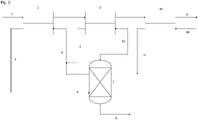
Fig. 2 , the fractionated distillation is a 2-stage distillation consisting of aconventional distillation column 7 for the first stage and anevaporator 12 for the second stage, wherein thesump 11 of the first stage is further distilled in order to increase the amine recovery rate. In principle it is also possible to use an evaporator in the first stage and a distillation column in the second stage. However in that embodiment there may be higher efforts needed for cleaning the devices as the evaporator has to be operated at higher temperatures than the distillation column and therefore more residues will occur there. In the first stage the evaporator has to be bigger than in the second stage, hence needs more cleaning efforts. - The
distillation 7 in the first stage is controlled in a way to recover as much amine as possible, but to prevent the residues from coagulation and depositing in thefirst distillation column 7. The concentratedsump 11 is forwarded to a second distillation stage consisting of a kind ofevaporator 12 that is designed to process high-viscosity media and that is easier to clean, i.e. to remove the coagulated residues. For this purpose among others, a thin film evaporator is suitable. Theseparated residues 8 finally are disposed of, e.g. by incineration. - According to another preferred embodiment of the invention the distillation is a 1-stage distillation consisting of a conventional distillation column. The sump of the distillation stage is removed, the residues in the sump are coagulated by adding an acid and subsequently separated mechanically and the remaining liquid is deprotonated, in particular by adding calcium hydroxide, and recycled into the extraction process. Preferably, the acid is sulfuric acid. The calcium sulfate formed during neutralization can be separated mechanically, e.g. by filtration, centrifugation or other suitable operations. Alternatively, this whole distillation step may be replaced by simply coagulating the residues by an acid, however this would require more acid, sufficient to neutralize the whole quantity of amine, as well as more calcium hydroxide for deprotonation. The separated residues finally are disposed of, e.g. by incineration.
- According to yet another preferred embodiment of the invention the distillation is a 1-stage distillation consisting of a conventional distillation column and the sump of the distillation stage is treated with salts of earth alkali metals (oxides, hydroxides, chlorides, etc.) to precipitate fatty acids and humin particles. The precipitate may be removed separately, e.g. by filtration, flotation or the like.
- According to a preferred embodiment of the invention the amine-containing liquid contains one or more alkanolamines of the group containing 2-(Dimethylamino)ethan-1-ol (DMAE) and N-Methyldiethanolamine.
- Preferably the liquid-liquid extraction steps of step a. (2) and/or step c. (3) are continuous extraction steps. Batch extraction steps are in principle possible as well. However, in a commercial scale plant, continuous extraction is generally preferred. Typical devices for such continuous extraction are packed columns, rotating disc contactors, mixer-settler arrangements, etc..
- Preferably the steps a. to e., and, as the case may be, all steps in between, are performed at a temperature of between 50 and 100°C, more preferably between 55 and 90°C.
- In the method according to the invention the production process may be a process for obtaining by-products from a biomaterial. Preferably, the biomaterial is wood. The by-products may be acetic acid, furfural and/or other by-products obtainable from a wood pulp manufacturing process, for example in a so-called "biorefinery". However, the invention may be applicable also for other production processes wherein biomasses and hydrophobic solvents with low vapor pressure occur, such as, but not limited to reactive extractions with trioctylamine, deep eutectic solvents or recycling of ionic liquids, e.g. in the manufacture of man-made cellulosic fibers.
- According to a preferred embodiment of the invention, the production process contains a vapor condensate extraction stage and the organic extraction liquid was used to extract the by-products acetic acid and furfural from the vapor condensate and was subjected to a stripping step to deplete the by-products before being subjected to the purification method according to the invention.
- According to a preferred embodiment of the invention, only a part of the organic extraction liquid coming from the vapour condensate extraction stage is purified according to the invention. The quantity of this partial flow may depend on the content of impurities in the organic extraction liquid and may be smaller if less impurities are contained in the liquid. It may be between 0.1 and 100% (weight/weight) of the total organic extraction liquid coming from the vapour condensate extraction stage. In case of a smaller content of impurities the partial flow may be only between 0.1 and 50% (weight/weight), preferably between 0.1 and 20% (weight/weight) or even more preferred between 0.1 and 5% (weight/weight) in case of a very small impurity content.
- According to another preferred embodiment of the invention, shown in
Fig. 3 , between step d. and step e. a second washing of the organic extraction liquid phase of step d. with anaqueous liquid 15 in a third liquid-liquid extraction step 14 and subsequently a phase separation of the two liquids of this second washing step are performed. Theaqueous liquid 15 may be either recovered water from a distillation or fresh water. In a particularly preferred embodiment of the invention, theaqueous liquid 15 may be an aqueous phase coming from an evaporation plant as the vapour condensate and contains a small amount of acetic acid, i.e. being slightly acidic. The acidic pH may improve the extraction of the amine. The enrichedaqueous phase 16 of this second washing step may be either combined with the enrichedaqueous phase 6 of step d. beforedistillation 7 or forwarded to a wastewater treatment plant with a treatment stage able to remove the amine. - According to yet another preferred embodiment of the invention, shown in
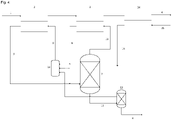
Fig. 4 , the features of the two embodiments shown inFig. 2 and inFig. 3 are combined. Between step d. and step e. a second washing of the organic extraction liquid phase of step d. with anaqueous liquid 15 in a third liquid-liquid extraction step 14 and subsequently a phase separation of the two liquids of this second washing step are performed. Theaqueous liquid 16 may be either recovered water from a distillation or fresh water. In a particularly preferred embodiment of the invention theaqueous liquid 15 may be an aqueous phase coming from an evaporation plant as the vapour condensate and contains a small amount of acetic acid, i.e. being slightly acidic. The acidic pH may improve the extraction of the amine. The enrichedaqueous phase 16 of this second washing step may be either combined with the enrichedaqueous phase 6 of step d. beforedistillation 7 or forwarded to a wastewater treatment plant with a treatment stage able to remove the amine. Furthermore, in this preferred embodiment the fractionated distillation is a 2-stage distillation consisting of aconventional distillation column 7 for the first stage and anevaporator 12 for the second stage, wherein thesump 11 of the first stage is further distilled in order to increase the amine recovery rate. In this embodiment another possible location for the introduction of fresh amine is thecontainer 13. - In the figures the reference numbers have the following meaning:
- 1 depleted organic extraction liquid coming from a production process
- 2 first liquid-liquid extraction step, including phase separation
- 3 second liquid-liquid extraction step, including phase separation
- 4 purified organic extraction liquid going back into the production process
- 5 enriched amine-containing phase of step b.
- 6 enriched aqueous phase of step d.
- 7 fractionated distillation
- 8 residue (sump) of the distillation, going to disposal
- 9 recovered aqueous amine solution, coming from recovery unit (distillation + evaporation)
- 10 depleted aqueous liquid, coming from
distillation 7 - 11 sump coming from the
distillation stage 7 - 12 evaporator for the second recovery stage
- 13 container for purified amine coming from
second distillation stage 12 - 14 third liquid-liquid extraction step, including phase separation
- 15 aqueous liquid, going to the third liquid-
liquid extraction step 15 - 16 enriched aqueous liquid phase of third liquid-
liquid extraction step 15 - The invention will now be illustrated by examples. These examples are not limiting the scope of the invention in any way. The invention includes also any other embodiments which are based on the same inventive concept.
- a) A depleted organic extraction liquid obtained from a commercial biorefinery containing 52.6%w/w undecane and 32.4%w/w trioctylphosphine oxide was analyzed for palmitic acid (by GC) and solid particles (by gravimetry) and found to contain 22.2 g L-1 palmitic acid and 0.49%w/w solid particles. The liquid further contains other extractives, water, acetic acid and other residues. A zeta potential of - 44.0 mV for the solid particles was determined using electrophoretic light scattering (20 °C, 1 mg mL-1 in H2O).
b) 100 mL of this liquid were stirred with 100 mL of an aqueous solution of 175 g L-1 2-(dimethylamino)ethan-1-ol (Aldrich, 99.5%) at 60 °C and 200 rpm in a double walled glass apparatus. After 15 minutes, the stirring was stopped and the phases were allowed to separate. 5 mL samples were withdrawn from each phase and the process was repeated 4 times with the same organic liquid and an equal quantity of fresh aqueous amine solution. In all extraction steps, it was observed that some of the aqueous phase was emulsified in the organic phase. The samples from the organic phases after each extraction step were analyzed for palmitic acid and 2-(dimethylamino)ethan-1-ol (by CE) and the following results were found (Table 1.a). In the 5th step the amine content again decreased due to forming of an emulsion.Table 1.a: Feed 1st step 2nd step 3rd step 4th step 5th step palmitic acid 22.2 7.9 4.7 3.5 3.3 2.5 [g L-1] distribution coefficient K = 3,61 2-(dimethylamino)ethan-1- ol 0 35.0 40.0 49.5 58.0 44.0 [g L-1] distribution coefficient K = 0,28 Table 1.b: Feed 1st step 2nd step 3rd step 4th step 5th step palmitic acid 22.2 3.8 2.0 1.0 0.5 0.20 [g L-1] distribution coefficient K = 0,71 particles 0.49 0.01 0 0 0 0 [%w/w] 2-(dimethylamino)ethan-1- ol 0 36.0 38.5 38.0 39.5 37.0 [g L-1] distribution coefficient K = 0,12 Table 1.c: Feed 1st step 2nd step 3rd step 4th step 5th step palmitic acid 20.8 4.9 2.5 1.2 0.6 0.4 [g L-1] distribution coefficient K = 0,60 2-(dimethylamino)ethan-1- ol 0 36.7 42.4 43.3 44.3 44.7 [g L-1] distribution coefficient K = 0,12 - Example 1 demonstrates (see also
Fig. 5 ) that increasing the amine concentration and/or increasing the temperature may improve the removal of the unwanted residues like palmitic acid from a depleted organic liquid as e.g. coming from a vapor condensate extraction. - a) 150 mL of the depleted organic extraction solvent described in example 1 was mixed with 150 mL of an aqueous solution of 357 g L-1 2-(dimethylamino)ethan-1-01 at 60 °C and 200 rpm in a double walled glass apparatus. After 15 minutes the stirring was stopped and the phases were allowed to separate. 5 mL sample were withdrawn from the organic phase and analyzed for 2-(dimethylamino)ethan-1-ol.
b) 51 g of the extracted organic phase obtained in step a) was stirred with an equal mass of demineralized water at 60 °C and 200 rpm in a double walled glass apparatus. After 15 minutes the stirring was stopped and the phases were allowed to separate. 5 mL samples were withdrawn from each phase and the process was repeated two times with the same organic liquid and an equal quantity of fresh demineralized water. The samples from the organic phases after each extraction step were analyzed for 2-(dimethylamino)ethan-1-ol and the following results were found (Table 2.a).Table 2.a: Feed 1st step 2nd step 3rd step 2-(dimethylamino)ethan-1-ol 36.50 3.64 0.48 0.04 [g L-1] distribution coefficient K = 0,10 Table 2.b: Feed 1st step 2nd step 3rd step 2-(dimethylamino)ethan-1-ol 36.50 0.96 0.08 0.05 [g L-1] distribution coefficient K = 0,05 - Example 2 demonstrates (see also
Fig. 6 ) that a slightly acidic washing water may improve the amine removal. - a) A depleted organic extraction liquid obtained from a commercial biorefinery consisting of 52.6%w/w undecane and 32.4%w/w trioctylphosphine oxide was analyzed for solid particles (by gravimetry) and wood extractives (by GC) and found to contain 0.49%w/w solid particles and 52.6 g L-1 wood extractives.
b) 100 mL of this liquid were stirred with 100 mL of an aqueous solution of 351 g L-1 2-(dimethylamino)ethan-1-ol at 60 °C and 200 rpm in a double walled glass apparatus. After 15 minutes the stirring was stopped and the phases were allowed to separate. The aqueous phase was discarded and the process was repeated 4 times with the same organic liquid and an equal quantity of fresh aqueous amine solution.
c) To remove the amine from the purified organic phase resulting from b) above it was stirred with an equal mass of demineralized water at 60 °C and 200 rpm in a double walled glass apparatus. After 15 minutes the stirring was stopped and the phases were allowed to separate. The aqueous phase was discharged and the process was repeated 2 times with the same organic liquid and an equal quantity of fresh demineralized water. The obtained washed organic extraction liquid was analyzed for wood extractives, particles and 2-(dimethylamino)ethan-1-01 and the following results were found (Table 3):Table 3: organic extraction liquid purified organic extraction liquid Washed organic extraction liquid wood extractives [g L-1] 52.6 5.6 5.6 particles [%w/w] 0.49 0 0 2-(dimethylamino)ethan-1-ol [mg L-1] 0 35,000 23.0 -
Fig. 7 shows gas chromatograms of the solutions of example 3. - Example 3 demonstrates that most of the wood extractives and by the additional washing step nearly all of the amine is removed from the organic extraction liquid.
- a) To 99.8 g of a 357 g L-1 aqueous solution of 2-(dimethylamino)ethan-1-ol were added 3.0 g of palmitic acid. The resulting solution was charged to a 250 mL round bottom flask connected to a condenser equipped with a thermometer and a receiving flask. The loaded amine solution was heated with a hotplate via a silicone oil bath and the distillation was done under reduced pressure. Several distillate fractions were collected and analyzed for 2-(dimethylamino)ethan-1-ol and palmitic acid. The distillation sump remained liquid throughout the whole distillation but solidified upon cooling. Only 0.3%w/w of 2-(dimethylamino)ethan-1-ol remained in the distillation residue. The following compositions of the different fractions were found (Table 4):
Table 4: Fraction T(oilbath) P distillate 2-(dimethylamino) ethan-1-ol palmitic acid [°C] [mbar] [g] [g L-1] [mg L-1] 1 0-115 800 14.8 184 0 2 115 800 7.3 186 0 3 120 800 13.9 202 0 4 120 800 12.9 219 0 5 120 800 14.8 228 0 6 120 800 9.6 255 0 7 120-140 800 7.0 270 0 8 140-170 800 16.5 857 0 9 170 800-73 1.1 851 0 residue 3.7 10.8%w/w 81.1%w/w - Example 4 shows that by the distillation in principle palmitic acid successfully can be removed from the amine in a model system.
- a) A depleted organic extraction liquid obtained from a commercial biorefinery consisting of 52.6%w/w undecane and 32.4%w/w trioctylphosphine oxide was analyzed for solid particles (by gravimetry) and wood extractives (by GC) and found to contain 0.49%w/w solid particles and 52.6 g L-1 wood extractives.
b) 101 g of this liquid were stirred with 101 g of an aqueous solution of 357 g L-1 2-(dimethylamino)ethan-1-ol at 60 °C and 200 rpm in a double walled glass apparatus. After 15 minutes the stirring was stopped and the phases were allowed to separate. The organic phase was discarded and 105 g of the loaded amine phase were charged to a 250 mL round bottom flask.
c) The flask was connected to a condenser equipped with a thermometer and a receiving flask and was heated with a hotplate via a silicone oil bath. The distillation was done under reduced pressure and several distillate fractions were collected and analyzed for 2-(dimethylamino)ethan-1-ol and palmitic acid. Finally the pressure was reduced down to 25mbar. The distillation sump remained liquid throughout the whole distillation and 76%w/w of 2-(dimethylamino)ethan-1-ol were recovered in the distillate. The following compositions of the different fractions were found (Table 5):Table 5: Fraction T(oilbath) P distillate 2-(dimethylamino) ethan-1-ol palmitic acid [°C] [mbar] [g] [g L-1] [g L-1] 1 0-110 800 7.6 180 0 2 110 800 10.6 183 0 3 110 800 13.3 189 0 4 110 800 11.6 204 0 5 110 800 10.8 241 0 6 110 800 15.8 252 0 7 110-150 800 11.4 620 0 8 150-170 25-700 6.6 828 0 residue 13.3 161 214 - Example 5 demonstrates that by the distillation the unwanted residues in a commercially relevant solution successfully can be removed from the amine.
- a) A depleted organic extraction liquid obtained from a commercial biorefinery consisting of 52.6%w/w undecane and 32.4%w/w trioctylphosphine oxide was analyzed for solid particles (by gravimetry) and wood extractives (by GC) and found to contain 0.49%w/w solid particles and 52.6 g L-1 wood extractives.
b) 100 g of this liquid were stirred with 100 g of an aqueous solution of 357 g L-1 2-(dimethylamino)ethan-1-ol at 60 °C and 200 rpm in a double walled glass apparatus. After 15 minutes, the stirring was stopped and the phases were allowed to separate.
c) Certain amounts of the loaded amine phase were titrated with 0.25 M sulfuric acid to reach a certain pH value. The formed solids were filtered, dried at 40 °C and 200 mbar and weighted. The results of the precipitations are given in the following table (Table 6):Table 6: Loaded amine phase [mL] 0.25 M H2SO4 [mL] pH Precipitated impurities [g L-1] 10 7.59 10.0 5.3 5 24.16 9.0 9.6 5 29.25 8.0 7.9 4 25.44 7.0 18.8 4 25.94 4.0 50.8 4 29.47 2.0 65.4 - Example 6 demonstrates that by adding acid the wood extractives can be removed by precipitation. At pH 2.0 other, presently unidentified compounds precipitated, too.
Claims (12)
- A method for the purification of a depleted organic extraction liquid from a production process, said method comprising the following steps in the given sequence:a. Intensively mixing the depleted organic extraction liquid with an amine-containing liquid in a first liquid-liquid extraction step,b. Phase separation of the two liquids of step a.,c. Washing of the organic extraction liquid phase of step b. with an aqueous liquid in a second liquid-liquid extraction step,d. Phase separation of the two liquids of step c.,e. Recycling of the purified organic extraction liquid into the production process,wherein the enriched amine-containing phase of step b. and the enriched aqueous phase of step d. are purified and recycled into steps a. resp. step c..
- A method according to claim 1, wherein the purification of the enriched amine-containing phase of step b. and the enriched aqueous phase of step d. is done by combining both phases and subjecting them to a fractionated distillation and the residue of the fractionated distillation is removed separately.
- A method according to claim 2, wherein the distillation is a 2-stage distillation consisting of a conventional distillation column for the first stage and an evaporator for the second stage, wherein the sump of the first stage is further distilled in order to increase the amine recovery.
- A method according to claim 2, wherein the distillation is a 1-stage distillation consisting of a conventional distillation column and the sump of the distillation stage is removed, the residues in the sump are coagulated by adding an acid and separated mechanically and the remaining liquid is deprotonated, in particular by adding calcium hydroxide, and recycled into the extraction process.
- A method according to claim 2, wherein the distillation is a 1-stage distillation consisting of a conventional distillation column and the sump of the distillation stage is treated with salts of earth alkali metals to precipitate fatty acids and humin particles.
- A method according to claim 1, wherein the amine-containing liquid contains one or more alkanolamines of the group containing 2-(Dimethylamino)ethan-1-ol [DMAE] and N-Methyldiethanolamine.
- A method according to claim 1, wherein the liquid-liquid extraction steps of step a. and/or step c. are continuous extraction steps.
- A method according to claim 1, wherein the steps a. to e. are performed at a temperature of between 50 and 100°C, preferably between 55 and 90°C.
- A method according to claim 1, wherein the production process is a process for obtaining by-products from a biomaterial.
- A method according to claim 9, wherein the biomaterial is wood.
- A method according to claim 9, wherein the production process contains a vapor condensate extraction stage and the organic extraction liquid was used to extract the by-products from the vapor condensate and was subjected to a stripping step to deplete the by-products before being subjected to the purification method.
- A method according to claim 1, wherein between step d. and step e. a second washing of the organic extraction liquid phase of step d. with an aqueous liquid in a third liquid-liquid extraction step and subsequently a phase separation of the two liquids of this second washing step are performed.
Priority Applications (3)
| Application Number | Priority Date | Filing Date | Title |
|---|---|---|---|
| EP21180315.0A EP4104913A1 (en) | 2021-06-18 | 2021-06-18 | Method for purifying an extraction liquid |
| PCT/EP2022/066278 WO2022175564A2 (en) | 2021-06-18 | 2022-06-15 | Method for purifying an extraction liquid |
| EP22735109.5A EP4355452A2 (en) | 2021-06-18 | 2022-06-15 | Method for purifying an extraction liquid |
Applications Claiming Priority (1)
| Application Number | Priority Date | Filing Date | Title |
|---|---|---|---|
| EP21180315.0A EP4104913A1 (en) | 2021-06-18 | 2021-06-18 | Method for purifying an extraction liquid |
Publications (1)
| Publication Number | Publication Date |
|---|---|
| EP4104913A1 true EP4104913A1 (en) | 2022-12-21 |
Family
ID=76532051
Family Applications (2)
| Application Number | Title | Priority Date | Filing Date |
|---|---|---|---|
| EP21180315.0A Withdrawn EP4104913A1 (en) | 2021-06-18 | 2021-06-18 | Method for purifying an extraction liquid |
| EP22735109.5A Pending EP4355452A2 (en) | 2021-06-18 | 2022-06-15 | Method for purifying an extraction liquid |
Family Applications After (1)
| Application Number | Title | Priority Date | Filing Date |
|---|---|---|---|
| EP22735109.5A Pending EP4355452A2 (en) | 2021-06-18 | 2022-06-15 | Method for purifying an extraction liquid |
Country Status (2)
| Country | Link |
|---|---|
| EP (2) | EP4104913A1 (en) |
| WO (1) | WO2022175564A2 (en) |
Families Citing this family (1)
| Publication number | Priority date | Publication date | Assignee | Title |
|---|---|---|---|---|
| CN118454284A (en) * | 2024-04-30 | 2024-08-09 | 云南云蛭康生物科技有限公司 | Efficient liquid film extraction method of Poecilobdella manillensis extract |
Citations (5)
| Publication number | Priority date | Publication date | Assignee | Title |
|---|---|---|---|---|
| EP0036406A1 (en) | 1980-03-14 | 1981-09-23 | SCHOELLER-BLECKMANN Gesellschaft m.b.H. | Process for the extraction of acetic acid, of formic acid and possibly of furfurol |
| KR100738507B1 (en) * | 2006-01-24 | 2007-07-11 | 대일개발 주식회사 | A method for separating and recovering each acid from the mixed waste acid solution in the electronic industry etching process |
| WO2009117317A1 (en) * | 2008-03-20 | 2009-09-24 | Tate & Lyle Technology Ltd | Removal of acids from tertiary amide solvents |
| WO2011139830A2 (en) * | 2010-04-29 | 2011-11-10 | University Of Maine System Board Of Trustees | Removal of contaminants from liquid-liquid extraction solvent |
| US9073847B2 (en) * | 2011-11-04 | 2015-07-07 | Taminco Finland | Method and an arrangement for separating at least one carboxylic acid and furfural from a dilute aqueous mixture thereof |
-
2021
- 2021-06-18 EP EP21180315.0A patent/EP4104913A1/en not_active Withdrawn
-
2022
- 2022-06-15 EP EP22735109.5A patent/EP4355452A2/en active Pending
- 2022-06-15 WO PCT/EP2022/066278 patent/WO2022175564A2/en not_active Ceased
Patent Citations (5)
| Publication number | Priority date | Publication date | Assignee | Title |
|---|---|---|---|---|
| EP0036406A1 (en) | 1980-03-14 | 1981-09-23 | SCHOELLER-BLECKMANN Gesellschaft m.b.H. | Process for the extraction of acetic acid, of formic acid and possibly of furfurol |
| KR100738507B1 (en) * | 2006-01-24 | 2007-07-11 | 대일개발 주식회사 | A method for separating and recovering each acid from the mixed waste acid solution in the electronic industry etching process |
| WO2009117317A1 (en) * | 2008-03-20 | 2009-09-24 | Tate & Lyle Technology Ltd | Removal of acids from tertiary amide solvents |
| WO2011139830A2 (en) * | 2010-04-29 | 2011-11-10 | University Of Maine System Board Of Trustees | Removal of contaminants from liquid-liquid extraction solvent |
| US9073847B2 (en) * | 2011-11-04 | 2015-07-07 | Taminco Finland | Method and an arrangement for separating at least one carboxylic acid and furfural from a dilute aqueous mixture thereof |
Non-Patent Citations (1)
| Title |
|---|
| ABDULRAHMAN AYMN ET AL: "Acetic Acid Removal from Pre-Pulping Wood Extract with Recovery and Recycling of Extraction Solvents", APPLIED BIOCHEMISTRY AND BIOTECHNOLOGY, HUMANA PRESS INC, NEW YORK, vol. 187, no. 1, 2 July 2018 (2018-07-02), pages 378 - 395, XP036672135, ISSN: 0273-2289, [retrieved on 20180702], DOI: 10.1007/S12010-018-2826-Z * |
Also Published As
| Publication number | Publication date |
|---|---|
| WO2022175564A2 (en) | 2022-08-25 |
| WO2022175564A3 (en) | 2022-10-20 |
| EP4355452A2 (en) | 2024-04-24 |
Similar Documents
| Publication | Publication Date | Title |
|---|---|---|
| EP1620362B1 (en) | Process for producing 1, 3-propanediol | |
| JP4233121B2 (en) | Recovery of fermented salts from dilute aqueous solutions. | |
| CN102659204B (en) | Method for treating waste water in coal chemical industry | |
| US5399751A (en) | Method for recovering carboxylic acids from aqueous solutions | |
| US4374283A (en) | Purification of aqueous effluent streams containing BPA and phenol | |
| EP4104913A1 (en) | Method for purifying an extraction liquid | |
| CN113912236A (en) | Method for recovering glycolic acid from CMC wastewater | |
| US2446868A (en) | Process for purifying aqueous alkali metal hydroxides | |
| JP3902069B2 (en) | Method for treating wastewater containing N, N-dimethylformamide | |
| KR100367356B1 (en) | Method for Purifying Liquid Medium by Extraction | |
| EA003752B1 (en) | Method for separating hydroxymethylthiobutyric acid | |
| CN85100116B (en) | Centrifugal Extraction Process for Recovering Lanolin from Wool Washing Wastewater | |
| KR101382646B1 (en) | Method for recovering acid from mixed waste acid by using solvent extraction method and vacuum evaporation | |
| EP0732320B1 (en) | Method for recovering carboxylic acids from aqueous solutions | |
| CN113582835A (en) | Method for extracting shikimic acid from ginkgo leaf waste residue and application | |
| CN1039434C (en) | A method for extracting glycerin by dissolution from fermentation broth | |
| Anneken | Manufacture of glycerine from natural fats and oils | |
| KR100377034B1 (en) | How to recover carboxylic acid from aqueous solution | |
| CN118529890A (en) | A method and system for treating phenol-containing wastewater | |
| CN112481490A (en) | Method for continuously removing impurities and purifying ferrous chloride solution | |
| JPH08283191A (en) | Method for recovering carboxylic acid from aqueous solution | |
| CN114437001A (en) | Method for recovering tetrahydrofuran in wastewater | |
| CN120714254A (en) | A treatment method and application of vacuum pump waste oil | |
| JPS595139A (en) | Recovery of acetic acid | |
| JPS5941476B2 (en) | How to treat oil-impregnated sludge |
Legal Events
| Date | Code | Title | Description |
|---|---|---|---|
| PUAI | Public reference made under article 153(3) epc to a published international application that has entered the european phase |
Free format text: ORIGINAL CODE: 0009012 |
|
| STAA | Information on the status of an ep patent application or granted ep patent |
Free format text: STATUS: THE APPLICATION HAS BEEN PUBLISHED |
|
| AK | Designated contracting states |
Kind code of ref document: A1 Designated state(s): AL AT BE BG CH CY CZ DE DK EE ES FI FR GB GR HR HU IE IS IT LI LT LU LV MC MK MT NL NO PL PT RO RS SE SI SK SM TR |
|
| STAA | Information on the status of an ep patent application or granted ep patent |
Free format text: STATUS: THE APPLICATION IS DEEMED TO BE WITHDRAWN |
|
| 18D | Application deemed to be withdrawn |
Effective date: 20230622 |