EP4102850B1 - Image data encapsulation - Google Patents
Image data encapsulation Download PDFInfo
- Publication number
- EP4102850B1 EP4102850B1 EP22187970.3A EP22187970A EP4102850B1 EP 4102850 B1 EP4102850 B1 EP 4102850B1 EP 22187970 A EP22187970 A EP 22187970A EP 4102850 B1 EP4102850 B1 EP 4102850B1
- Authority
- EP
- European Patent Office
- Prior art keywords
- image
- item
- box
- images
- type
- Prior art date
- Legal status (The legal status is an assumption and is not a legal conclusion. Google has not performed a legal analysis and makes no representation as to the accuracy of the status listed.)
- Active
Links
Images



Classifications
-
- H—ELECTRICITY
- H04—ELECTRIC COMMUNICATION TECHNIQUE
- H04N—PICTORIAL COMMUNICATION, e.g. TELEVISION
- H04N21/00—Selective content distribution, e.g. interactive television or video on demand [VOD]
- H04N21/20—Servers specifically adapted for the distribution of content, e.g. VOD servers; Operations thereof
- H04N21/23—Processing of content or additional data; Elementary server operations; Server middleware
- H04N21/236—Assembling of a multiplex stream, e.g. transport stream, by combining a video stream with other content or additional data, e.g. inserting a URL [Uniform Resource Locator] into a video stream, multiplexing software data into a video stream; Remultiplexing of multiplex streams; Insertion of stuffing bits into the multiplex stream, e.g. to obtain a constant bit-rate; Assembling of a packetised elementary stream
- H04N21/23605—Creation or processing of packetized elementary streams [PES]
-
- H—ELECTRICITY
- H04—ELECTRIC COMMUNICATION TECHNIQUE
- H04L—TRANSMISSION OF DIGITAL INFORMATION, e.g. TELEGRAPHIC COMMUNICATION
- H04L65/00—Network arrangements, protocols or services for supporting real-time applications in data packet communication
- H04L65/60—Network streaming of media packets
- H04L65/70—Media network packetisation
-
- H—ELECTRICITY
- H04—ELECTRIC COMMUNICATION TECHNIQUE
- H04N—PICTORIAL COMMUNICATION, e.g. TELEVISION
- H04N19/00—Methods or arrangements for coding, decoding, compressing or decompressing digital video signals
- H04N19/10—Methods or arrangements for coding, decoding, compressing or decompressing digital video signals using adaptive coding
- H04N19/169—Methods or arrangements for coding, decoding, compressing or decompressing digital video signals using adaptive coding characterised by the coding unit, i.e. the structural portion or semantic portion of the video signal being the object or the subject of the adaptive coding
- H04N19/17—Methods or arrangements for coding, decoding, compressing or decompressing digital video signals using adaptive coding characterised by the coding unit, i.e. the structural portion or semantic portion of the video signal being the object or the subject of the adaptive coding the unit being an image region, e.g. an object
- H04N19/174—Methods or arrangements for coding, decoding, compressing or decompressing digital video signals using adaptive coding characterised by the coding unit, i.e. the structural portion or semantic portion of the video signal being the object or the subject of the adaptive coding the unit being an image region, e.g. an object the region being a slice, e.g. a line of blocks or a group of blocks
-
- H—ELECTRICITY
- H04—ELECTRIC COMMUNICATION TECHNIQUE
- H04N—PICTORIAL COMMUNICATION, e.g. TELEVISION
- H04N19/00—Methods or arrangements for coding, decoding, compressing or decompressing digital video signals
- H04N19/10—Methods or arrangements for coding, decoding, compressing or decompressing digital video signals using adaptive coding
- H04N19/169—Methods or arrangements for coding, decoding, compressing or decompressing digital video signals using adaptive coding characterised by the coding unit, i.e. the structural portion or semantic portion of the video signal being the object or the subject of the adaptive coding
- H04N19/17—Methods or arrangements for coding, decoding, compressing or decompressing digital video signals using adaptive coding characterised by the coding unit, i.e. the structural portion or semantic portion of the video signal being the object or the subject of the adaptive coding the unit being an image region, e.g. an object
- H04N19/176—Methods or arrangements for coding, decoding, compressing or decompressing digital video signals using adaptive coding characterised by the coding unit, i.e. the structural portion or semantic portion of the video signal being the object or the subject of the adaptive coding the unit being an image region, e.g. an object the region being a block, e.g. a macroblock
-
- H—ELECTRICITY
- H04—ELECTRIC COMMUNICATION TECHNIQUE
- H04N—PICTORIAL COMMUNICATION, e.g. TELEVISION
- H04N19/00—Methods or arrangements for coding, decoding, compressing or decompressing digital video signals
- H04N19/46—Embedding additional information in the video signal during the compression process
-
- H—ELECTRICITY
- H04—ELECTRIC COMMUNICATION TECHNIQUE
- H04N—PICTORIAL COMMUNICATION, e.g. TELEVISION
- H04N19/00—Methods or arrangements for coding, decoding, compressing or decompressing digital video signals
- H04N19/70—Methods or arrangements for coding, decoding, compressing or decompressing digital video signals characterised by syntax aspects related to video coding, e.g. related to compression standards
-
- H—ELECTRICITY
- H04—ELECTRIC COMMUNICATION TECHNIQUE
- H04N—PICTORIAL COMMUNICATION, e.g. TELEVISION
- H04N21/00—Selective content distribution, e.g. interactive television or video on demand [VOD]
- H04N21/20—Servers specifically adapted for the distribution of content, e.g. VOD servers; Operations thereof
- H04N21/23—Processing of content or additional data; Elementary server operations; Server middleware
- H04N21/235—Processing of additional data, e.g. scrambling of additional data or processing content descriptors
- H04N21/2353—Processing of additional data, e.g. scrambling of additional data or processing content descriptors specifically adapted to content descriptors, e.g. coding, compressing or processing of metadata
-
- H—ELECTRICITY
- H04—ELECTRIC COMMUNICATION TECHNIQUE
- H04N—PICTORIAL COMMUNICATION, e.g. TELEVISION
- H04N21/00—Selective content distribution, e.g. interactive television or video on demand [VOD]
- H04N21/40—Client devices specifically adapted for the reception of or interaction with content, e.g. set-top-box [STB]; Operations thereof
- H04N21/47—End-user applications
- H04N21/472—End-user interface for requesting content, additional data or services; End-user interface for interacting with content, e.g. for content reservation or setting reminders, for requesting event notification, for manipulating displayed content
- H04N21/4728—End-user interface for requesting content, additional data or services; End-user interface for interacting with content, e.g. for content reservation or setting reminders, for requesting event notification, for manipulating displayed content for selecting a Region Of Interest [ROI], e.g. for requesting a higher resolution version of a selected region
-
- H—ELECTRICITY
- H04—ELECTRIC COMMUNICATION TECHNIQUE
- H04N—PICTORIAL COMMUNICATION, e.g. TELEVISION
- H04N21/00—Selective content distribution, e.g. interactive television or video on demand [VOD]
- H04N21/80—Generation or processing of content or additional data by content creator independently of the distribution process; Content per se
- H04N21/83—Generation or processing of protective or descriptive data associated with content; Content structuring
- H04N21/84—Generation or processing of descriptive data, e.g. content descriptors
-
- H—ELECTRICITY
- H04—ELECTRIC COMMUNICATION TECHNIQUE
- H04N—PICTORIAL COMMUNICATION, e.g. TELEVISION
- H04N21/00—Selective content distribution, e.g. interactive television or video on demand [VOD]
- H04N21/80—Generation or processing of content or additional data by content creator independently of the distribution process; Content per se
- H04N21/85—Assembly of content; Generation of multimedia applications
- H04N21/854—Content authoring
- H04N21/85406—Content authoring involving a specific file format, e.g. MP4 format
Definitions
- the present invention relates to the storage of image data, such as still images, bursts of still images or video data in a media container with descriptive metadata.
- image data such as still images, bursts of still images or video data
- metadata generally provides easy access to the image data and portions of the image data.
- the HEVC standard defines a profile for the encoding of still images and describes specific tools for compressing single still images or bursts of still images.
- An extension of the ISO Base Media File Format (ISOBMFF) used for such kind of image data has been proposed for inclusion into the ISO/IEC 23009 standard, in Part 12, under the name: "Image File Format”.
- ISOBMFF ISO Base Media File Format
- the standard covers two forms of storage corresponding to different use cases:
- the encapsulation is close to the encapsulation of the video tracks in the ISO Base Media File Format (see document « Information technology - Coding of audio-visual objects - Part 12: ISO base media file format», ISO/IEC 14496-12:2008, Third edition, October 2008), and the same tools and concepts are used, such as the 'trak' boxes and the sample grouping for description.
- the 'trak' box is a file format box that contains sub boxes for describing a track, that is to say, a timed sequence of related samples.
- the image file format can be used for locally displaying multimedia files or for streaming multimedia presentations.
- HEVC Still Images have many applications which raise many issues.
- Image bursts are one application.
- Image bursts are sequences of still pictures captured by a camera and stored as a single representation (many picture items referencing a block of data). Users may want to perform several types of actions on these pictures: select one as thumbnail or cover, apply effects on these pictures or the like.
- Computational photography is another application.
- users have access to different resolutions of the same picture (different exposures, different focuses etc.). These different resolutions have to be stored as metadata so that one can be selected and the corresponding piece of data can be located and extracted for processing (rendering, editing, transmitting or the like).
- Another kind of applications is the access to specific pictures from a video sequence, for instance for video summarization, proof images in video surveillance data or the like.
- the ISO/IEC 23009 standard covers two ways for encapsulating still images into the file format that have been recently discussed.
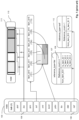
- Figure 1 illustrates the description of a still image encoded with tiles in the 'meta' box (100) of ISO Base Media File Format, as disclosed in MPEG contribution m32254.
- An information item is defined for the full picture 101 in addition to respective information items for each tile picture (102, 103, 104 and 105). Those information items are stored in a box called 'ItemInfoBox' (iinf).
- the box (106), called 'Item Reference Box', from the ISO BMFF standard is used for indicating that a 'tile' relationship (107) exists between the information item of the full picture and the four information items corresponding to the tile pictures (108).
- Identifiers of each information item are used so that a box (109), called 'ItemLocationBox', provides the byte range(s) in the encoded data (110) that represent each information item.
- Another box "ItemReferenceBox′′′ (112) is used for associating EXIF metadata (111) with the information item for the full picture (101) and a corresponding data block (111) is created in the media data box (110). Also, an additional information item (113) is created for identifying the EXIF metadata.
- FIG. 2 shows a video (200) having consecutive temporal frames.
- Each frame (201) is divided into 8 portions (here rectangular portions) referred to as "tiles" T1 to T8.
- the number and the shape of the tiles can be different. In what follows, it is considered that the tiling is the same whatever the index of the video frame.
- Each independent sub-video can be encoded as an independent bitstream, according to the AVC or HEVC standards for example.
- the sub-video can also be part of one single video bitstream, like for example tiles of the HEVC standard or slices of the AVC standard.
- the HEVC standard defines different spatial subdivision of pictures: tiles, slices and slice segments. These different subdivisions (or partitions) have been introduced for different purposes: the slices are related to streaming issues while the tiles and the slice segments have been defined for parallel processing.
- a tile defines a rectangular region of a picture that contains an integer number of Coding Tree Units (CTU).
- Figure 3 shows the tiling of an image (300) defined by row and column boundaries (301, 302). This makes the tiles good candidates for regions of interest description in terms of position and size.
- the HEVC standard bitstream organization in terms of syntax and its encapsulation into Network Abstract Layer (NAL) units is rather based on slices (as in AVC standard).
- a slice is a set of slice segments, with at least the first slice segment being an independent slice segment, the others, if any, being dependent slice segments.
- a slice segment contains an integer number of consecutive CTUs (in the raster scan order). It has not necessarily a rectangular shape (thus less appropriate than tiles for region of interest representation).
- a slice segment is encoded in the HEVC bitstream as a header called "slice_segment_header" followed by data called “slice_segment_data”.
- independent slice segments and dependent slice segments differ by their header: dependent slice segments have a shorter header because they reuse information from the independent slice segment's header. Both independent and dependent slice segments contain a list of entry points in the bitstream: either to tiles or to entropy decoding synchronization points.
- Figure 3 shows different configurations of images 310 and 320 of slice, slice segments and tiles. These configurations differ from the configuration of image 300 in which one tile has one slice (containing only one independent slice segment).
- Image 310 is partitioned into two vertical tiles (311, 312) and one slice (with 5 slice segments).
- Image 320 is split into two tiles (321, 322), the left tile 321 having two slices (each with two slice segments), the right tile 322 having one slice (with two slice segments).
- the HEVC standard defines organization rules between tiles and slice segments that can be summarized as follows (one or both conditions have to be met):
- the configuration 300 wherein one tile contains one slice with one independent segment, is preferred.
- the encapsulation solution would work with the other configurations 310 or 320.
- the slice segment is the entity that will be actually put into NAL units for transport on the network and aggregated to form an access unit (coded picture or sample at file format level).
- the type of NAL unit is specified in a NAL unit header.
- the slice_segment_header indicates via the "slice_segment_address" syntax element the address of the first coding tree block in the slice segment.
- the tiling information is provided in a PPS (Picture Parameter Set) NAL unit. The relation between a slice segment and a tile can then be deduced from these parameters.
- a video sequence When a video sequence is encoded as a set of independent tiles, it may be decoded using a tile-based decoding from one frame to another without risking missing reference data or propagation of reconstruction errors. This configuration makes it possible to reconstruct only a spatial part of the original video that corresponds, for example, to a region of interest.
- each tile is encapsulated into a dedicated track.
- the setup and initialization information common to all tiles is encapsulated into a specific track, called for example the "tile base track”.
- the full video is thus encapsulated as a composition of all these tracks, namely the tile base track and the set of tile tracks.
- Figure 4 illustrates an exemplary encapsulation.
- One way to encapsulate tiled video according to the ISOBMFF standard is to split each tile into a dedicated track, to encapsulate the setup and initialization information common to all tiles in a specific track, called for example the "tile base track” and to encapsulate the full video as a composition of all these tracks: tile base track plus a set of tile tracks.
- the encapsulation is thus referred to as "multi-track tile encapsulation”.
- An example of multi-track tile encapsulation is provided in Figure 4 .
- Box 401 represents the main ISOBMFF box 'moov' and contains the full list of tracks with their identifiers.
- boxes 411 to 414 represent tile tracks (four tiles in the present example) and box 420 represents the tile base track. Additional tracks such as audio or text tracks may be used and encapsulated in the same file. However, for the sake of conciseness such additional tracks are not discussed here.
- the tile data is split into independent and addressable tracks so that any combination of tile track(s) can easily be reconstructed from the tile base track referencing the tile tracks for decoding and display.
- the tile base track may also be referred to as the "composite track” or “reference track” since it is designed to allow combination of any tiles: one, many or all tiles.
- the tile base track 420 contains common information to all the tile tracks and a list of samples 450 (only the first one is represented in Figure 4 ) in a "mdat" box. Each sample 450 of the tile base track 420 is built by reference to each tile track through the use of extractors (451 to 454 each one representing one extractor to each tile).
- Each tile track 411 to 414 represents a spatial part of the whole, or full-frame, video.
- the tile description (position, size, bandwidth etc.) is stored in the track header boxes (not represented) of each tile track 411 to 414.
- the tile base track and each tile track are cross-referenced (405) using a box "TrackReferenceBox" in each track.
- Each tile track 411 to 414 refers to the tile base track 420 as the 'tbas' track ('tbas' is a specific code indicating a coding dependency from each tile track to the tile base track, in particular where to find the parameter "HEVCDecoderConfigurationRecord" that makes it possible to setup the video decoder that will process the elementary stream resulting from the file format parsing).
- the tile base track 420 indicates a dependency of type 'scal' to each tile track (405). This is to indicate the coding dependency and to reflect the sample 450 definition of the tile base track as extractors to the tile tracks data. These extractors are specific extractors that, at parsing time, can support the absence of data.
- each track is decomposed into media segments (431 to 434 for the tile tracks and 460 for the tile base track). Each media segment comprises one or more movie fragments, indicated by the ⁇ moof' box plus data.
- the data part corresponds to a spatial sub-part of the video while for the tile base track, it contains the parameter sets, SEI messages when present and the list of extractors.
- the "moov" box 401 in case of streaming application would fit in an initialization segment.
- Figure 4 illustrates only one segment but the tracks can be decomposed into any number of segments, the constraint being that segments for tile tracks and for tile base track follow the same temporal decomposition (i.e. they are temporally aligned), this is to make switching possible from full-video to a tile or a set of tiles.
- the granularity of this temporal decomposition is not described here, for the sake of conciseness.
- the file format has descriptive metadata (such as "VisualSampleGroupEntries” for instance, or track reference types in 'tref' boxes) that describe the relationships between the tracks so that the data corresponding to one tile, a combination of tiles or all the tiles can easily be identified by parsing descriptive metadata.
- descriptive metadata such as "VisualSampleGroupEntries” for instance, or track reference types in 'tref' boxes
- the pictures with the related information are described as information items.
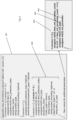
- the information items are listed in a dedicated sub-box "ItemInfoBox" 500 of the 'meta' box.
- This sub-box provides the number of information items present in the file.
- the sub-box also provides for each item, descriptive metadata represented as "Item lnfoentry" 501.
- Several versions 502 (0, 1, 2) of this box exist according to the ISO BMFF standard evolution.
- Metal items may not be stored contiguously in a file. Also, there is no particular restriction concerning the interleaving of the item data. Thus, two items in a same file may share one or several blocks of data. This is particularly useful for HEVC tiles (tiles can be stored contiguously or not), since it can make it straightforward to have one item per independently decodable tile. This item indicates the data offset in the main HEVC picture and length of the slice(s) used for the tile through an ItemLocationBox.
- a new item type for describing a tile picture may be added, named for example: "hvct” or 'tile' or reused from ISO/IEC 14496-15: ⁇ hvt1'.
- Each item representing the tile picture (whatever the four character code chosen) may have a reference of type “tbas” to the 'hvc1' item from which it is extracted.
- Each item has an identifier "item_ID” 503 and is further described in a box “Item Location Box” in terms of byte position and size in the media data box containing the compressed data for the pictures.
- Such syntax makes it possible for a file format reader (or "parser"), to determine, via the list of information items, how many information items are available with information concerning their type 504, for example 'tile' to indicate an information item is a tile picture of a full picture.
- the dependency shall be indicated by an item reference of type 'dpnd' (or any specific four character code that indicates coding dependencies) as described in document w14123, WD of ISO/IEC 14496-15:2013 AMD 1, "Enhanced carriage of HEVC and support of MVC with depth information", MPEG 107 San Jose January 2014.
- a tile description item is defined per tile and the tile is linked to its description using a modified version of the "ItemReferenceBox" box as explained below.
- only one tiling description is provided, preferably in a generic way.
- the item list does not get too long.
- the design may be as follows:
- the sample grouping mechanism is based on two main boxes having a "grouping_type” parameter as follows:
- the "grouping_type” parameter links a list of sample groups to a list of properties, the mapping of a sample group to one property in the list being specified in the box "SampleToGroupBox".
- a new version making linking a tile picture to its description may be as follows:
- the definition of the box “ItemInformationBox” with four character code 'iinf' is changed as follows, for example by introducing a new version of this box: the current version:
- the related information items have an index called for example "property_index”.
- This "property_index” parameter associated with the "grouping_type” parameter enables a file format parser (or “reader") to identify either a reference to descriptive metadata or the descriptive metadata itself.
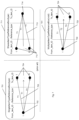
- Figure 7 illustrates two exemplary embodiments.
- the encapsulation module (during encoding) and the parsing module (during decoding) can run a respective counter (as the "g" variable in the box “ItemInformationBox) on the list of information item groups as they are created or read.
- the parser may be informed, using the flag "group_used flag", whether to maintain or not the group identification counter.
- one group may contain four entries and the reference 700 "SingleItemTypeReference" may indicate the list of information items 704 on which the four tile picture information items depend, and so for a particular reference type 703.
- the information item is used in a new kind of box "ItemReferenceBox", as described hereinafter, that makes it possible, from one item 722, to list multiple reference types 723 to various other information items 724.
- the list of item entries is described, but this time with a different order depending on the grouping. In the tile example, this may lead to a first group of four information items corresponding to the tile pictures gathered in a group with a parameter that may be named 'tile' followed by non-grouped information items for the configuration information, for the full picture information item and optionally for the EXIF metadata.
- the box "ItemReferenceBox” may also be extended by distinguishing between the various kinds of ItemReferenceBox by using the flag parameters in the box "FullBox" which is part of the Item Reference Box as follows:
- Description support 711 for a list of items 712 referencing a same item 714 with a given type 713 may be as follows:
- an information item can be associated with tiling information.
- a description of this tiling information has now to be provided.
- each tile may be described using a tile descriptor, such as the "iref_parameter" 605 of the extended "ItemInfoEntry” 601.
- a specific descriptor may be as follows:
- a descriptor may be used for the grid of tiles to apply to the one or more pictures to be stored.
- TiJInfoDataItem allows describing a tiling grid (regular or irregular).
- the grid is described rows by rows starting from top-left.
- the descriptor shall be stored as an item of type 'tile'. When another item refers to this item, it shall use a reference of type "tile" to this description and it shall have a parameter "iref_parameter” specified, whose value is the 0-based index of the cell in the grid defined by the descriptor, where 0 is the top-left item, 1 is the cell immediately to the right of cell 0 and so on.
- the tiling configuration can be put in the media data box or in a dedicated box shared (by reference) among the tile information items.
- the above descriptors are pure spatial descriptors in the sense that they only provide spatial locations and sizes for sub-image(s) in a greater image. In some use cases, for example with image collections or image composition, a spatial location is not enough to describe the image, typically when images overlap. This is one limitation of the TileInfoDataBlock descriptor above.
- TileInfoDataBlock descriptor In order to allow image composition, whatever the image i.e. a tile or an independent/complete image, it may be useful to define a descriptor that contains on the one hand the positions and sizes of the image (spatial relations) and on the other hand display information (color, cropping...) for that picture. For example, color information can be provided to transform a sub-image from a color space to another one for display.
- This kind of information can be conveyed in the ColorlnformationBox 'colr' of the ISOBMFF. It can be useful, for compacity, to have the same data prepared for different kinds of display just by providing the transformation parameters to apply rather than conveying the two different so-transformed pictures.
- the pixel aspect ratio like PixelAspectRatio box 'pasp' defined in the ISOBMFF Part-12 can be put in this descriptor to redefine a width and height that can be different than the encoded width and height of each picture. This would indicate the scale ratio to apply by the display after the decoding of an image. We would then have the coded sizes stored in the video sample entries ('stsd' box for example) and the display sizes deduced from the 'pasp' box.
- the clean aperture information box 'clap' also defined in ISOBMFF.
- the clean aperture defines an area within which picture information is subjectively uncontaminated by all edge transient distortions (possible ringing effects at the borders of images after analog to digital conversions).
- This list of parameters useful for display is not limitative and we could put as optional components in the sub-image descriptor any other descriptive metadata box. These ones can be explicitly mentioned because they are already part of the standard and they provide generic tools to indicate image cropping, sample aspect ratio modification and color adjustments. Unfortunately their use was only possible for media tracks, not for image file format relying on 'meta' boxes.
- ImageSpatialRelationBox is an extension of the TileInfoDataBlock as described in the following.
- Another useful parameter to consider is the possibility to compose images as layers. We then suggest inserting a parameter to indicate the level associated to an image in this layered composition. This is typically useful when images overlap. This can be called 'layer' for example with layer information indication.
- An example syntax for such descriptor is provided:
- This new 'isre' box type gives the ability to describe the relative position of an image with other images in an image collection. It provides a subset of the functionalities of the transformation matrix usually found in the movie or track header box of a media file. Coordinates in the ImageSpatialRelationBox are expressed on a square grid giving the author's intended display size of the collection; these units may or may not match the coded size of the image.
- the intended display size is defined by:
- the ImageSpatialRelationBox indicates the relative spatial position of images after any cropping or sample aspect ratio has been applied to the images. This means, when 'isre' is combined with 'pasp', etc in a SimplelmageMetaData, the image is decoded, the 'pasp', 'clap', 'colr' are applied if present and then the image is moved and scaled to the offset and size declared in the 'isre' box.
- This new descriptor can be used as description of an image (tile or single image) by defining an association between the item information representing the image and the item information representing the descriptor (let's give the type 'simd' for SimplelmageMetadata Definition, any reserved 4 character code would be acceptable for a mp4 parser to easily identify the kind of metadata it is currently processing).
- This association is done with an ItemRefererenceBox and with a new reference type; 'simr' to indicate "spatial image relation".
- the example description below illustrates the case of a composition of 4 images where the composition itself has no associated item.
- Each image item is associated to a SimplelmageMetaData item through an item reference of type 'simr' and shares the DecoderConfigurationRecord information in a dedicated ⁇ hvcC' item.
- image and metadata could be interlaced in the media data box for example to have an image plus its metadata addressable as a single byte range.
- a parser is informed, by parsing the informations in the 'simd' items whether a sub-image is cropped from a full picture, or conversely if a full picture is a composition from sub-images.
- the full picture item and the cropped image would share the same data range as in example below and the same decoder configuration information.
- the sub-image would then then be associated to a 'simd' item having only 'clap' information and no positioning, then no 'isre'.
- the full picture item is associated to a 'simd' item that only contains 'isre' information and the sub-image would be associated to a 'simd' item reflecting its position in the full image.
- the iref_parameter is a four bytes code that is useful in case of a tile index to refer to a cell in a tiling grid. But in order to have richer description and to be able to embed linked description inside the item info entry itself rather than with the data (in mdat box), the following extension can be useful:
- the tile pictures were listed as information items without any corresponding description provided as show herein below. Moreover, the setup information denoted 'hvcC' type was not described as an item. This makes it possible to factorize the common data related to HEVC parameter sets and SEI messages that apply to all tile pictures and to the full picture.
- Figure 8 illustrates a context of implementation of embodiments of the invention.
- First different media are recorded: for example audio during step 800a, video during step 800b and one or more pictures during step 800c. Each medium is compressed during respective steps 801a, 801b and 801c. During these compression steps elementary streams 802a, 802b and 802c are generated.
- an encapsulation mode is selected in order to determine whether or not all these elementary streams should be merged or not.
- the "merge" mode is activated (test 803, "yes"), data for audio, video and still images are encapsulated in the same file during step 806c as described hereinabove.
- step 806a If the "merge" mode is not activated (test 803, "no"), then two encapsulated files are generated during steps 806a and 806b consecutively or in parallel thereby respectively leading to the creation of one file for synchronized time media data during step 807a and an additional file with only the still images 907b.
- step 806a audio and video elementary streams are encapsulated according to the ISOBMFF standard and the still pictures are encapsulated during step 806b as described herein above in order to provide tile description and region of interest features.
- a media presentation 807 is obtained and can be provided to a DASH generator to prepare it for streaming (step 820a) or stored into a memory (step 820b) or rendered on a display unit (step 820c) or transmitted (step 820d) to a remote entity either entirely or after some parts (such as tiles), have been extracted by parsing the descriptive metadata.
- concise meta-data such as for example SimplelmageMetadata ( ⁇ simd') box (also called ISOBMFFMetaData in the last version of the Still Image File Format specification) are described as full-blown items. Additional descriptive or prescriptive meta-data are also defined by the Still Image File Format specification as described in document w14878, committee draft study of ISO/IEC 23008-12:2013 1 st edition, "Information technology - MPEG systems technologies - Part 12: Image File Format", MPEG 110 France October 2014.
- Examples of descriptive or prescriptive meta-data are CleanApertureBox ('clap'), ImageRotation ('irot'), ExifDataBlock ('exif'), or ImageOverlay ('iovl'). More generally descriptive meta-data are meta-data that provides additional information or description for an item like an image or a sub-image (e.g. Exif metadata), and prescriptive meta-data are operations or transformation to be applied to an item (e.g. a rotation, a crop or a combination of several items forming the transformation operators).
- an entry in itemlnfoBox requires the use of a full box with a least a 12-bytes header, in addition an item_protection_index (16 bits) plus an empty item_name (8 bit) must be defined for a total of 15 bytes of extra cost per entry in itemlnfoBox (iinf).
- this metadata is usually small and enables efficient reading of the other items. Having them stored as dedicated items may complicate file parsing, especially partial fetching of a file (multiplication of HTTP requests for example).
- all descriptive and prescriptive meta-data can be defined as embedded items which can be stored in the meta box (100) as part of other boxes rather than in mdat box (110) and thus which can avoid the extra cost of defining itemInfoBox and itemLocationBox entries.
- a virtual item box called 'VirtualItemBox' is defined. According to embodiment of the claimed invention, all descriptive and prescriptive meta-data box are inherited from this virtual item class.
- a virtual item has an item_ID and item_type assigned to it, along with a set of boxes.
- Virtual items are additional data typically used to describe metadata to be associated with other items.
- the Virtual item allows associating an entry of the itemlnfoBox identifying an item (image or sub-image) and the operation or the transformation to be applied to this item. Typically, this association can be described by defining an entry of type 'simr' in the itemReferenceBox from the item_ID of the image to the item_ID of the meta-data operation or transformation description box.
- Virtual items may only be referenced in item reference boxes and primary item boxes, and shall not be declared or referenced in any other box (e.g. itemLocationBox (iloc), itemlnfoBox (iinf), item Protection Box (ipro)).
- the 'VirtualItemBox' is defined as follows: with following semantics for its parameters:
- the 'VirtualItemBox' can also include an additional parameter called "descriptor_family".
- the Descriptor family indicates whether the meta-data box is a descriptive or a prescriptive meta-data.
- descriptor family indicates the type of meta-data box from a list of predefined values. For example: transfo_operator, composed_image, descriptive_metadata...
- ImageOverlay (iovl) meta-data box is redesigned as follows so that it is no more dependent on reference order.
- An explicit item_id is added for each entry in the loop to explicitly identifiy the item that is composed.
- all boxes included into SimplelmageMetadata are defined as independent meta-data boxes that inherited from the Virtual Item box.
- simple image rotation can be declared by integrating the rotation operation directly in the image metadata descriptor SimplelmageMetadata ( ⁇ simd') box (also called ISOBMFFMetaData in the last version of the Still Image File Format specification) as follows:
- the generic derived item, 'dimg' (described above), can be used to reference both the image item and the metadata description. Such an item could then be listed as a primary item in Primary Item Box ('pitm').
- a new single derived item is defined with item type ⁇ dimg'.
- This single derived item is concretely represented by:
- nb_effects represents the number of effects to be applied to a source image in order to compose the derived image and effect_id is a unique identifier in the encapsulated file of the effect to apply. Effects are applied in the reverse order of their appearance in the list of effects.
- the derived image or transformed item named "Derivedlmage” defines an image as a set of effects to be applied to a source image before presenting it to a user or a display screen for example.
- the source image is identified by an item reference of type 'dimg' (or any reserved reference type) from the derived item to the source image.
- the source image may itself be any image item (images or portions of images, image overlay, derived image) defined in the ISO Still Image File Format specification. There shall not be more than one ⁇ dimg' item reference from the same item (but there can be multiple on the same item, if this item is reused several times for various compositions).
- the derived image is stored in the data part of the file.
- the effects can be applied to images, portion of images, composed image or derived image through Derivedlmage items. Each effect is described by a box deriving from a BaseEffectBox structure illustrated below.
- Effects may be declared in an optional EffectDeclarationBox, contained in the 'meta' box:
- angle * 90 it specifies the angle (in anti-clockwise direction) in units of degrees
- Effects in an Effect Collection are applied in the same order as effects in the Derivedimaged item; e.g. each effect shall be applied to the input in the reverse order of their appearance in the list of effects.
- the OverlayEffectBox declares a composition of images as an overlay. For this specific effect, the resulting derived image has no reference to any source image since this effect declares the list of source images that are part of the composition.
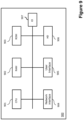
- FIG. 9 is a schematic block diagram of a computing device 900 for implementation of one or more embodiments of the invention.
- the computing device 900 may be a device such as a micro-computer, a workstation or a light portable device.
- the computing device 900 comprises a communication bus connected to:
- the executable code may be stored either in read only memory 903, on the hard disk 906 or on a removable digital medium such as for example a disk.
- the executable code of the programs can be received by means of a communication network, via the network interface 904, in order to be stored in one of the storage means of the communication device 900, such as the hard disk 906, before being executed.
- the central processing unit 901 is adapted to control and direct the execution of the instructions or portions of software code of the program or programs according to embodiments of the invention, which instructions are stored in one of the aforementioned storage means. After powering on, the CPU 901 is capable of executing instructions from main RAM memory 902 relating to a software application after those instructions have been loaded from the program ROM 903 or the hard-disc (HD) 906 for example. Such a software application, when executed by the CPU 901, causes the steps of a method according to embodiments to be performed.
- the present invention may be implemented in hardware (for example, in the form of an Application Specific Integrated Circuit or ASIC).
- ASIC Application Specific Integrated Circuit
- the present invention may be embedded in a device like a camera, a smartphone or a tablet that acts as a remote controller for a TV, for example to zoom in onto a particular region of interest. It can also be used from the same devices to have personalized browsing experience of the TV program by selecting specific areas of interest. Another usage from these devices by a user is to share with other connected devices some selected sub-parts of his preferred videos. It can also be used in smartphone or tablet to monitor what happened in a specific area of a building put under surveillance provided that the surveillance camera supports the generation part of this invention.
Landscapes
- Engineering & Computer Science (AREA)
- Multimedia (AREA)
- Signal Processing (AREA)
- Databases & Information Systems (AREA)
- Human Computer Interaction (AREA)
- Computer Security & Cryptography (AREA)
- Computer Networks & Wireless Communication (AREA)
- Library & Information Science (AREA)
- Two-Way Televisions, Distribution Of Moving Picture Or The Like (AREA)
- Compression Or Coding Systems Of Tv Signals (AREA)
- Television Signal Processing For Recording (AREA)
Priority Applications (1)
| Application Number | Priority Date | Filing Date | Title |
|---|---|---|---|
| EP24214460.8A EP4489414B1 (en) | 2015-02-10 | 2016-02-09 | Image data encapsulation |
Applications Claiming Priority (4)
| Application Number | Priority Date | Filing Date | Title |
|---|---|---|---|
| GBGB1502205.6A GB201502205D0 (en) | 2015-02-10 | 2015-02-10 | Image data encapsulation |
| GBGB1502666.9A GB201502666D0 (en) | 2015-02-10 | 2015-02-17 | Image data encapsulation |
| EP16704820.6A EP3257260A1 (en) | 2015-02-10 | 2016-02-09 | Image data encapsulation |
| PCT/EP2016/052752 WO2016128419A1 (en) | 2015-02-10 | 2016-02-09 | Image data encapsulation |
Related Parent Applications (1)
| Application Number | Title | Priority Date | Filing Date |
|---|---|---|---|
| EP16704820.6A Division EP3257260A1 (en) | 2015-02-10 | 2016-02-09 | Image data encapsulation |
Related Child Applications (2)
| Application Number | Title | Priority Date | Filing Date |
|---|---|---|---|
| EP24214460.8A Division EP4489414B1 (en) | 2015-02-10 | 2016-02-09 | Image data encapsulation |
| EP24214460.8A Division-Into EP4489414B1 (en) | 2015-02-10 | 2016-02-09 | Image data encapsulation |
Publications (3)
| Publication Number | Publication Date |
|---|---|
| EP4102850A2 EP4102850A2 (en) | 2022-12-14 |
| EP4102850A3 EP4102850A3 (en) | 2022-12-21 |
| EP4102850B1 true EP4102850B1 (en) | 2024-12-25 |
Family
ID=52746416
Family Applications (3)
| Application Number | Title | Priority Date | Filing Date |
|---|---|---|---|
| EP22187970.3A Active EP4102850B1 (en) | 2015-02-10 | 2016-02-09 | Image data encapsulation |
| EP16704820.6A Withdrawn EP3257260A1 (en) | 2015-02-10 | 2016-02-09 | Image data encapsulation |
| EP24214460.8A Active EP4489414B1 (en) | 2015-02-10 | 2016-02-09 | Image data encapsulation |
Family Applications After (2)
| Application Number | Title | Priority Date | Filing Date |
|---|---|---|---|
| EP16704820.6A Withdrawn EP3257260A1 (en) | 2015-02-10 | 2016-02-09 | Image data encapsulation |
| EP24214460.8A Active EP4489414B1 (en) | 2015-02-10 | 2016-02-09 | Image data encapsulation |
Country Status (6)
| Country | Link |
|---|---|
| US (1) | US10595062B2 (cg-RX-API-DMAC7.html) |
| EP (3) | EP4102850B1 (cg-RX-API-DMAC7.html) |
| JP (5) | JP6708649B2 (cg-RX-API-DMAC7.html) |
| ES (1) | ES3001562T3 (cg-RX-API-DMAC7.html) |
| GB (2) | GB201502205D0 (cg-RX-API-DMAC7.html) |
| WO (1) | WO2016128419A1 (cg-RX-API-DMAC7.html) |
Families Citing this family (20)
| Publication number | Priority date | Publication date | Assignee | Title |
|---|---|---|---|---|
| GB2524726B (en) * | 2014-03-25 | 2018-05-23 | Canon Kk | Image data encapsulation with tile support |
| US10631025B2 (en) | 2014-10-10 | 2020-04-21 | Sony Corporation | Encoding device and method, reproduction device and method, and program |
| GB2539461B (en) * | 2015-06-16 | 2020-01-08 | Canon Kk | Image data encapsulation |
| EP3293981A1 (en) * | 2016-09-08 | 2018-03-14 | Koninklijke KPN N.V. | Partial video decoding method, device and system |
| JP6969572B2 (ja) * | 2016-10-25 | 2021-11-24 | ソニーグループ株式会社 | 送信装置、送信方法、受信装置および受信方法 |
| GB2560921B (en) * | 2017-03-27 | 2020-04-08 | Canon Kk | Method and apparatus for encoding media data comprising generated content |
| US11711526B2 (en) | 2018-04-05 | 2023-07-25 | Canon Kabushiki Kaisha | Method and apparatus for encapsulating images or sequences of images with proprietary information in a file |
| JP7303625B2 (ja) * | 2018-12-18 | 2023-07-05 | キヤノン株式会社 | 画像ファイル生成装置、画像ファイル生成方法、及びプログラム |
| US11172248B2 (en) | 2019-01-22 | 2021-11-09 | Tempus Ex Machina, Inc. | Systems and methods for customizing and compositing a video feed at a client device |
| EP3977750A4 (en) * | 2019-05-29 | 2023-06-21 | Nokia Technologies Oy | DEVICE, METHOD AND COMPUTER PROGRAM FOR VIDEO ENCODING AND DECODING |
| GB2585052B (en) * | 2019-06-26 | 2023-07-26 | Canon Kk | Method and apparatus for encapsulating panorama images in a file |
| WO2022039513A1 (ko) * | 2020-08-19 | 2022-02-24 | 엘지전자 주식회사 | Cpi sei 메시지에 기반한 영상 부호화/복호화 방법, 장치 및 비트스트림을 저장한 기록 매체 |
| GB2602101A (en) * | 2020-12-17 | 2022-06-22 | Canon Kk | Method and apparatus for encapsulating image data in a file for progressive rendering |
| WO2022129235A1 (en) * | 2020-12-17 | 2022-06-23 | Canon Kabushiki Kaisha | Method and apparatus for encapsulating image data in a file for progressive rendering |
| GB2617913B (en) * | 2020-12-17 | 2024-02-14 | Canon Kk | Method and apparatus for encapsulating image data in a file for progressive rendering |
| GB2602642A (en) * | 2021-01-06 | 2022-07-13 | Canon Kk | Method and apparatus for encapsulating uncompressed video data into a file |
| US11587266B2 (en) * | 2021-07-21 | 2023-02-21 | Tempus Ex Machina, Inc. | Adding augmented reality to a sub-view of a high resolution central video feed |
| WO2024004449A1 (ja) | 2022-06-29 | 2024-01-04 | キヤノン株式会社 | 情報処理装置、情報処理方法、コンピュータプログラム |
| US20250317612A1 (en) * | 2022-07-11 | 2025-10-09 | Canon Kabushiki Kaisha | Method, device, and computer program for optimizing dynamic encapsulation and parsing of content data |
| JP2024044783A (ja) | 2022-09-21 | 2024-04-02 | キヤノン株式会社 | 画像処理装置、画像処理方法 |
Family Cites Families (13)
| Publication number | Priority date | Publication date | Assignee | Title |
|---|---|---|---|---|
| CA2730543C (en) * | 2008-07-16 | 2014-04-22 | Nokia Corporation | Method and apparatus for track and track subset grouping |
| JP5361429B2 (ja) * | 2009-02-10 | 2013-12-04 | キヤノン株式会社 | 映像再生装置及びその制御方法 |
| US8891934B2 (en) * | 2010-02-22 | 2014-11-18 | Dolby Laboratories Licensing Corporation | Video display control using embedded metadata |
| US10129556B2 (en) * | 2014-05-16 | 2018-11-13 | Bevara Technologies, Llc | Systems and methods for accessing digital data |
| US9648317B2 (en) * | 2012-01-30 | 2017-05-09 | Qualcomm Incorporated | Method of coding video and storing video content |
| WO2014084666A1 (en) * | 2012-11-30 | 2014-06-05 | Samsung Electronics Co., Ltd. | Information storage medium storing content, content providing method, content reproducing method and apparatus therefor |
| US9584792B2 (en) * | 2013-01-04 | 2017-02-28 | Qualcomm Incorporated | Indication of current view dependency on reference view in multiview coding file format |
| EP2946566B1 (en) * | 2013-01-18 | 2021-09-01 | Canon Kabushiki Kaisha | Method, device, and computer program for encapsulating partitioned timed media data |
| GB2513140B (en) * | 2013-04-16 | 2016-05-04 | Canon Kk | Methods, devices, and computer programs for streaming partitioned timed media data |
| EP3092772B1 (en) * | 2014-01-07 | 2019-07-31 | Nokia Technologies Oy | Media encapsulating and decapsulating |
| EP3092806A4 (en) * | 2014-01-07 | 2017-08-23 | Nokia Technologies Oy | Method and apparatus for video coding and decoding |
| GB2524726B (en) * | 2014-03-25 | 2018-05-23 | Canon Kk | Image data encapsulation with tile support |
| GB2564731B (en) * | 2014-10-14 | 2019-05-29 | Canon Kk | Description of image composition with HEVC still image file format |
-
2015
- 2015-02-10 GB GBGB1502205.6A patent/GB201502205D0/en not_active Ceased
- 2015-02-17 GB GBGB1502666.9A patent/GB201502666D0/en not_active Ceased
-
2016
- 2016-02-09 EP EP22187970.3A patent/EP4102850B1/en active Active
- 2016-02-09 ES ES22187970T patent/ES3001562T3/es active Active
- 2016-02-09 US US15/546,962 patent/US10595062B2/en active Active
- 2016-02-09 EP EP16704820.6A patent/EP3257260A1/en not_active Withdrawn
- 2016-02-09 JP JP2017537355A patent/JP6708649B2/ja active Active
- 2016-02-09 EP EP24214460.8A patent/EP4489414B1/en active Active
- 2016-02-09 WO PCT/EP2016/052752 patent/WO2016128419A1/en not_active Ceased
-
2020
- 2020-05-15 JP JP2020086079A patent/JP6992119B2/ja active Active
-
2021
- 2021-05-10 JP JP2021079930A patent/JP7098786B2/ja active Active
-
2022
- 2022-06-28 JP JP2022104052A patent/JP7367130B2/ja active Active
-
2023
- 2023-10-11 JP JP2023175931A patent/JP7725538B2/ja active Active
Also Published As
| Publication number | Publication date |
|---|---|
| JP2021119713A (ja) | 2021-08-12 |
| US20180007407A1 (en) | 2018-01-04 |
| JP6992119B2 (ja) | 2022-01-13 |
| GB201502666D0 (en) | 2015-04-01 |
| EP4102850A2 (en) | 2022-12-14 |
| WO2016128419A1 (en) | 2016-08-18 |
| EP3257260A1 (en) | 2017-12-20 |
| JP7367130B2 (ja) | 2023-10-23 |
| EP4489414B1 (en) | 2026-03-04 |
| JP7725538B2 (ja) | 2025-08-19 |
| JP2023179659A (ja) | 2023-12-19 |
| JP2022130586A (ja) | 2022-09-06 |
| US10595062B2 (en) | 2020-03-17 |
| JP2020127244A (ja) | 2020-08-20 |
| GB201502205D0 (en) | 2015-03-25 |
| EP4489414A3 (en) | 2025-02-26 |
| EP4102850A3 (en) | 2022-12-21 |
| JP6708649B2 (ja) | 2020-06-10 |
| EP4489414A2 (en) | 2025-01-08 |
| JP2018509029A (ja) | 2018-03-29 |
| JP7098786B2 (ja) | 2022-07-11 |
| ES3001562T3 (en) | 2025-03-05 |
Similar Documents
| Publication | Publication Date | Title |
|---|---|---|
| US12425568B2 (en) | Image data encapsulation | |
| US11962809B2 (en) | Image data encapsulation with referenced description information | |
| JP7725538B2 (ja) | ファイルを生成する方法およびそのデバイス、ファイルを処理する方法およびそのデバイス | |
| US20230421794A1 (en) | Description of image composition with hevc still image file format | |
| GB2561491A (en) | Image data encapsulation with tile support | |
| GB2573939A (en) | Image data encapsulation | |
| GB2560649A (en) | Image data encapsulation with tile support |
Legal Events
| Date | Code | Title | Description |
|---|---|---|---|
| PUAI | Public reference made under article 153(3) epc to a published international application that has entered the european phase |
Free format text: ORIGINAL CODE: 0009012 |
|
| STAA | Information on the status of an ep patent application or granted ep patent |
Free format text: STATUS: THE APPLICATION HAS BEEN PUBLISHED |
|
| PUAL | Search report despatched |
Free format text: ORIGINAL CODE: 0009013 |
|
| AC | Divisional application: reference to earlier application |
Ref document number: 3257260 Country of ref document: EP Kind code of ref document: P |
|
| AK | Designated contracting states |
Kind code of ref document: A2 Designated state(s): AL AT BE BG CH CY CZ DE DK EE ES FI FR GB GR HR HU IE IS IT LI LT LU LV MC MK MT NL NO PL PT RO RS SE SI SK SM TR |
|
| AK | Designated contracting states |
Kind code of ref document: A3 Designated state(s): AL AT BE BG CH CY CZ DE DK EE ES FI FR GB GR HR HU IE IS IT LI LT LU LV MC MK MT NL NO PL PT RO RS SE SI SK SM TR |
|
| RIC1 | Information provided on ipc code assigned before grant |
Ipc: H04N 21/854 20110101ALI20221117BHEP Ipc: H04N 21/84 20110101ALI20221117BHEP Ipc: H04N 21/4728 20110101AFI20221117BHEP |
|
| STAA | Information on the status of an ep patent application or granted ep patent |
Free format text: STATUS: REQUEST FOR EXAMINATION WAS MADE |
|
| 17P | Request for examination filed |
Effective date: 20230616 |
|
| RBV | Designated contracting states (corrected) |
Designated state(s): AL AT BE BG CH CY CZ DE DK EE ES FI FR GB GR HR HU IE IS IT LI LT LU LV MC MK MT NL NO PL PT RO RS SE SI SK SM TR |
|
| STAA | Information on the status of an ep patent application or granted ep patent |
Free format text: STATUS: EXAMINATION IS IN PROGRESS |
|
| 17Q | First examination report despatched |
Effective date: 20240130 |
|
| GRAP | Despatch of communication of intention to grant a patent |
Free format text: ORIGINAL CODE: EPIDOSNIGR1 |
|
| STAA | Information on the status of an ep patent application or granted ep patent |
Free format text: STATUS: GRANT OF PATENT IS INTENDED |
|
| INTG | Intention to grant announced |
Effective date: 20240722 |
|
| GRAS | Grant fee paid |
Free format text: ORIGINAL CODE: EPIDOSNIGR3 |
|
| GRAA | (expected) grant |
Free format text: ORIGINAL CODE: 0009210 |
|
| STAA | Information on the status of an ep patent application or granted ep patent |
Free format text: STATUS: THE PATENT HAS BEEN GRANTED |
|
| AC | Divisional application: reference to earlier application |
Ref document number: 3257260 Country of ref document: EP Kind code of ref document: P |
|
| AK | Designated contracting states |
Kind code of ref document: B1 Designated state(s): AL AT BE BG CH CY CZ DE DK EE ES FI FR GB GR HR HU IE IS IT LI LT LU LV MC MK MT NL NO PL PT RO RS SE SI SK SM TR |
|
| P01 | Opt-out of the competence of the unified patent court (upc) registered |
Free format text: CASE NUMBER: APP_61145/2024 Effective date: 20241114 |
|
| REG | Reference to a national code |
Ref country code: GB Ref legal event code: FG4D |
|
| REG | Reference to a national code |
Ref country code: CH Ref legal event code: EP |
|
| REG | Reference to a national code |
Ref country code: DE Ref legal event code: R096 Ref document number: 602016090779 Country of ref document: DE |
|
| REG | Reference to a national code |
Ref country code: IE Ref legal event code: FG4D |
|
| REG | Reference to a national code |
Ref country code: LT Ref legal event code: MG9D |
|
| PG25 | Lapsed in a contracting state [announced via postgrant information from national office to epo] |
Ref country code: HR Free format text: LAPSE BECAUSE OF FAILURE TO SUBMIT A TRANSLATION OF THE DESCRIPTION OR TO PAY THE FEE WITHIN THE PRESCRIBED TIME-LIMIT Effective date: 20241225 |
|
| PG25 | Lapsed in a contracting state [announced via postgrant information from national office to epo] |
Ref country code: FI Free format text: LAPSE BECAUSE OF FAILURE TO SUBMIT A TRANSLATION OF THE DESCRIPTION OR TO PAY THE FEE WITHIN THE PRESCRIBED TIME-LIMIT Effective date: 20241225 |
|
| PG25 | Lapsed in a contracting state [announced via postgrant information from national office to epo] |
Ref country code: BG Free format text: LAPSE BECAUSE OF FAILURE TO SUBMIT A TRANSLATION OF THE DESCRIPTION OR TO PAY THE FEE WITHIN THE PRESCRIBED TIME-LIMIT Effective date: 20241225 |
|
| PG25 | Lapsed in a contracting state [announced via postgrant information from national office to epo] |
Ref country code: NO Free format text: LAPSE BECAUSE OF FAILURE TO SUBMIT A TRANSLATION OF THE DESCRIPTION OR TO PAY THE FEE WITHIN THE PRESCRIBED TIME-LIMIT Effective date: 20250325 |
|
| PG25 | Lapsed in a contracting state [announced via postgrant information from national office to epo] |
Ref country code: LV Free format text: LAPSE BECAUSE OF FAILURE TO SUBMIT A TRANSLATION OF THE DESCRIPTION OR TO PAY THE FEE WITHIN THE PRESCRIBED TIME-LIMIT Effective date: 20241225 Ref country code: GR Free format text: LAPSE BECAUSE OF FAILURE TO SUBMIT A TRANSLATION OF THE DESCRIPTION OR TO PAY THE FEE WITHIN THE PRESCRIBED TIME-LIMIT Effective date: 20250326 |
|
| PG25 | Lapsed in a contracting state [announced via postgrant information from national office to epo] |
Ref country code: RS Free format text: LAPSE BECAUSE OF FAILURE TO SUBMIT A TRANSLATION OF THE DESCRIPTION OR TO PAY THE FEE WITHIN THE PRESCRIBED TIME-LIMIT Effective date: 20250325 |
|
| REG | Reference to a national code |
Ref country code: NL Ref legal event code: MP Effective date: 20241225 |
|
| PG25 | Lapsed in a contracting state [announced via postgrant information from national office to epo] |
Ref country code: NL Free format text: LAPSE BECAUSE OF FAILURE TO SUBMIT A TRANSLATION OF THE DESCRIPTION OR TO PAY THE FEE WITHIN THE PRESCRIBED TIME-LIMIT Effective date: 20241225 |
|
| REG | Reference to a national code |
Ref country code: AT Ref legal event code: MK05 Ref document number: 1755151 Country of ref document: AT Kind code of ref document: T Effective date: 20241225 |
|
| PG25 | Lapsed in a contracting state [announced via postgrant information from national office to epo] |
Ref country code: SM Free format text: LAPSE BECAUSE OF FAILURE TO SUBMIT A TRANSLATION OF THE DESCRIPTION OR TO PAY THE FEE WITHIN THE PRESCRIBED TIME-LIMIT Effective date: 20241225 |
|
| PG25 | Lapsed in a contracting state [announced via postgrant information from national office to epo] |
Ref country code: PL Free format text: LAPSE BECAUSE OF FAILURE TO SUBMIT A TRANSLATION OF THE DESCRIPTION OR TO PAY THE FEE WITHIN THE PRESCRIBED TIME-LIMIT Effective date: 20241225 |
|
| PG25 | Lapsed in a contracting state [announced via postgrant information from national office to epo] |
Ref country code: IS Free format text: LAPSE BECAUSE OF FAILURE TO SUBMIT A TRANSLATION OF THE DESCRIPTION OR TO PAY THE FEE WITHIN THE PRESCRIBED TIME-LIMIT Effective date: 20250425 |
|
| PG25 | Lapsed in a contracting state [announced via postgrant information from national office to epo] |
Ref country code: PT Free format text: LAPSE BECAUSE OF FAILURE TO SUBMIT A TRANSLATION OF THE DESCRIPTION OR TO PAY THE FEE WITHIN THE PRESCRIBED TIME-LIMIT Effective date: 20250428 |
|
| PG25 | Lapsed in a contracting state [announced via postgrant information from national office to epo] |
Ref country code: EE Free format text: LAPSE BECAUSE OF FAILURE TO SUBMIT A TRANSLATION OF THE DESCRIPTION OR TO PAY THE FEE WITHIN THE PRESCRIBED TIME-LIMIT Effective date: 20241225 |
|
| PG25 | Lapsed in a contracting state [announced via postgrant information from national office to epo] |
Ref country code: AT Free format text: LAPSE BECAUSE OF FAILURE TO SUBMIT A TRANSLATION OF THE DESCRIPTION OR TO PAY THE FEE WITHIN THE PRESCRIBED TIME-LIMIT Effective date: 20241225 Ref country code: RO Free format text: LAPSE BECAUSE OF FAILURE TO SUBMIT A TRANSLATION OF THE DESCRIPTION OR TO PAY THE FEE WITHIN THE PRESCRIBED TIME-LIMIT Effective date: 20241225 |
|
| PG25 | Lapsed in a contracting state [announced via postgrant information from national office to epo] |
Ref country code: SK Free format text: LAPSE BECAUSE OF FAILURE TO SUBMIT A TRANSLATION OF THE DESCRIPTION OR TO PAY THE FEE WITHIN THE PRESCRIBED TIME-LIMIT Effective date: 20241225 |
|
| PG25 | Lapsed in a contracting state [announced via postgrant information from national office to epo] |
Ref country code: CZ Free format text: LAPSE BECAUSE OF FAILURE TO SUBMIT A TRANSLATION OF THE DESCRIPTION OR TO PAY THE FEE WITHIN THE PRESCRIBED TIME-LIMIT Effective date: 20241225 |
|
| PG25 | Lapsed in a contracting state [announced via postgrant information from national office to epo] |
Ref country code: SE Free format text: LAPSE BECAUSE OF FAILURE TO SUBMIT A TRANSLATION OF THE DESCRIPTION OR TO PAY THE FEE WITHIN THE PRESCRIBED TIME-LIMIT Effective date: 20241225 |
|
| PG25 | Lapsed in a contracting state [announced via postgrant information from national office to epo] |
Ref country code: MC Free format text: LAPSE BECAUSE OF FAILURE TO SUBMIT A TRANSLATION OF THE DESCRIPTION OR TO PAY THE FEE WITHIN THE PRESCRIBED TIME-LIMIT Effective date: 20241225 |
|
| REG | Reference to a national code |
Ref country code: DE Ref legal event code: R097 Ref document number: 602016090779 Country of ref document: DE |
|
| REG | Reference to a national code |
Ref country code: CH Ref legal event code: PL |
|
| PG25 | Lapsed in a contracting state [announced via postgrant information from national office to epo] |
Ref country code: DK Free format text: LAPSE BECAUSE OF FAILURE TO SUBMIT A TRANSLATION OF THE DESCRIPTION OR TO PAY THE FEE WITHIN THE PRESCRIBED TIME-LIMIT Effective date: 20241225 |
|
| PG25 | Lapsed in a contracting state [announced via postgrant information from national office to epo] |
Ref country code: LU Free format text: LAPSE BECAUSE OF NON-PAYMENT OF DUE FEES Effective date: 20250209 |
|
| PG25 | Lapsed in a contracting state [announced via postgrant information from national office to epo] |
Ref country code: CH Free format text: LAPSE BECAUSE OF NON-PAYMENT OF DUE FEES Effective date: 20250228 |
|
| PLBE | No opposition filed within time limit |
Free format text: ORIGINAL CODE: 0009261 |
|
| STAA | Information on the status of an ep patent application or granted ep patent |
Free format text: STATUS: NO OPPOSITION FILED WITHIN TIME LIMIT |
|
| 26N | No opposition filed |
Effective date: 20250926 |
|
| REG | Reference to a national code |
Ref country code: BE Ref legal event code: MM Effective date: 20250228 |
|
| PG25 | Lapsed in a contracting state [announced via postgrant information from national office to epo] |
Ref country code: BE Free format text: LAPSE BECAUSE OF NON-PAYMENT OF DUE FEES Effective date: 20250228 |
|
| PG25 | Lapsed in a contracting state [announced via postgrant information from national office to epo] |
Ref country code: IE Free format text: LAPSE BECAUSE OF NON-PAYMENT OF DUE FEES Effective date: 20250209 |
|
| PGFP | Annual fee paid to national office [announced via postgrant information from national office to epo] |
Ref country code: GB Payment date: 20260121 Year of fee payment: 11 |
|
| PGFP | Annual fee paid to national office [announced via postgrant information from national office to epo] |
Ref country code: ES Payment date: 20260302 Year of fee payment: 11 |
|
| PGFP | Annual fee paid to national office [announced via postgrant information from national office to epo] |
Ref country code: DE Payment date: 20260121 Year of fee payment: 11 |
|
| PGFP | Annual fee paid to national office [announced via postgrant information from national office to epo] |
Ref country code: IT Payment date: 20260121 Year of fee payment: 11 |
|
| PGFP | Annual fee paid to national office [announced via postgrant information from national office to epo] |
Ref country code: FR Payment date: 20260121 Year of fee payment: 11 |