EP4100857B1 - Verwaltung von least-privilege-betriebsmittelerlaubnis - Google Patents
Verwaltung von least-privilege-betriebsmittelerlaubnis Download PDFInfo
- Publication number
- EP4100857B1 EP4100857B1 EP21707046.5A EP21707046A EP4100857B1 EP 4100857 B1 EP4100857 B1 EP 4100857B1 EP 21707046 A EP21707046 A EP 21707046A EP 4100857 B1 EP4100857 B1 EP 4100857B1
- Authority
- EP
- European Patent Office
- Prior art keywords
- identity
- resource
- node
- permission
- permissions
- Prior art date
- Legal status (The legal status is an assumption and is not a legal conclusion. Google has not performed a legal analysis and makes no representation as to the accuracy of the status listed.)
- Active
Links
Images


Classifications
-
- G—PHYSICS
- G06—COMPUTING OR CALCULATING; COUNTING
- G06F—ELECTRIC DIGITAL DATA PROCESSING
- G06F21/00—Security arrangements for protecting computers, components thereof, programs or data against unauthorised activity
- G06F21/60—Protecting data
- G06F21/62—Protecting access to data via a platform, e.g. using keys or access control rules
- G06F21/6218—Protecting access to data via a platform, e.g. using keys or access control rules to a system of files or objects, e.g. local or distributed file system or database
-
- G—PHYSICS
- G06—COMPUTING OR CALCULATING; COUNTING
- G06F—ELECTRIC DIGITAL DATA PROCESSING
- G06F16/00—Information retrieval; Database structures therefor; File system structures therefor
- G06F16/90—Details of database functions independent of the retrieved data types
- G06F16/901—Indexing; Data structures therefor; Storage structures
- G06F16/9024—Graphs; Linked lists
-
- G—PHYSICS
- G06—COMPUTING OR CALCULATING; COUNTING
- G06F—ELECTRIC DIGITAL DATA PROCESSING
- G06F21/00—Security arrangements for protecting computers, components thereof, programs or data against unauthorised activity
- G06F21/10—Protecting distributed programs or content, e.g. vending or licensing of copyrighted material ; Digital rights management [DRM]
- G06F21/101—Protecting distributed programs or content, e.g. vending or licensing of copyrighted material ; Digital rights management [DRM] by binding digital rights to specific entities
- G06F21/1015—Protecting distributed programs or content, e.g. vending or licensing of copyrighted material ; Digital rights management [DRM] by binding digital rights to specific entities to users
-
- G—PHYSICS
- G06—COMPUTING OR CALCULATING; COUNTING
- G06F—ELECTRIC DIGITAL DATA PROCESSING
- G06F21/00—Security arrangements for protecting computers, components thereof, programs or data against unauthorised activity
- G06F21/60—Protecting data
- G06F21/604—Tools and structures for managing or administering access control systems
-
- G—PHYSICS
- G06—COMPUTING OR CALCULATING; COUNTING
- G06N—COMPUTING ARRANGEMENTS BASED ON SPECIFIC COMPUTATIONAL MODELS
- G06N3/00—Computing arrangements based on biological models
- G06N3/02—Neural networks
- G06N3/04—Architecture, e.g. interconnection topology
- G06N3/0464—Convolutional networks [CNN, ConvNet]
-
- G—PHYSICS
- G06—COMPUTING OR CALCULATING; COUNTING
- G06N—COMPUTING ARRANGEMENTS BASED ON SPECIFIC COMPUTATIONAL MODELS
- G06N3/00—Computing arrangements based on biological models
- G06N3/02—Neural networks
- G06N3/08—Learning methods
-
- H—ELECTRICITY
- H04—ELECTRIC COMMUNICATION TECHNIQUE
- H04L—TRANSMISSION OF DIGITAL INFORMATION, e.g. TELEGRAPHIC COMMUNICATION
- H04L41/00—Arrangements for maintenance, administration or management of data switching networks, e.g. of packet switching networks
- H04L41/14—Network analysis or design
- H04L41/145—Network analysis or design involving simulating, designing, planning or modelling of a network
-
- H—ELECTRICITY
- H04—ELECTRIC COMMUNICATION TECHNIQUE
- H04L—TRANSMISSION OF DIGITAL INFORMATION, e.g. TELEGRAPHIC COMMUNICATION
- H04L41/00—Arrangements for maintenance, administration or management of data switching networks, e.g. of packet switching networks
- H04L41/14—Network analysis or design
- H04L41/147—Network analysis or design for predicting network behaviour
-
- H—ELECTRICITY
- H04—ELECTRIC COMMUNICATION TECHNIQUE
- H04L—TRANSMISSION OF DIGITAL INFORMATION, e.g. TELEGRAPHIC COMMUNICATION
- H04L63/00—Network architectures or network communication protocols for network security
- H04L63/10—Network architectures or network communication protocols for network security for controlling access to devices or network resources
-
- H—ELECTRICITY
- H04—ELECTRIC COMMUNICATION TECHNIQUE
- H04L—TRANSMISSION OF DIGITAL INFORMATION, e.g. TELEGRAPHIC COMMUNICATION
- H04L63/00—Network architectures or network communication protocols for network security
- H04L63/10—Network architectures or network communication protocols for network security for controlling access to devices or network resources
- H04L63/102—Entity profiles
Definitions
- IT Information Technology
- cloud service provides increased productivity to the workplace, the complexity of the cloud service presents various kinds of security vulnerabilities that need to be overcome in order to protect the network resources.
- One such security vulnerability is created when broad permissions are granted to a user account, application or process that exceeds the permissions needed to perform legitimate, intended tasks. The assignment of broad permissions may lead to unintentional and malicious changes and data leaks.
- EP 3 567 506 A1 describes techniques which include identifying permission polices corresponding to a plurality of identities in a network environment, the permission polices specifying what types of actions the plurality of identities are permitted to take with respect to particular network resources; analyzing information describing activity associated with a first identity from the plurality of identities in the network environment; and automatically developing, based on the analysis of the information, a least-privilege profile for the first identity, the least-privilege profile including permissions corresponding to the particular actions with respect to the particular network resources and excluding permissions that do not correspond to the particular actions with respect to the particular network resources.
- Anonymous "This Talk 1) Node embeddings Map nodes to low-dimensional embeddings.
- US 2014/0359692 A1 describes a method for managing a security policy having multiple policy items, the method including the steps of: (a) mapping permissions to the policy items which apply to usage of the permissions so as to determine which of the permissions are granted to groups of users by each of the policy items; (b) identifying at least one of the policy items mapped in step (a) that is in violation of least privilege based on a comparison of an actual permission usage with the security policy; (c) identifying at least one of the policy items mapped in step (a) that increases operational risk; (d) verifying that policy constructs in the security policy are consistent with policy constructs inferred from the actual permission usage; and (e) identifying optimizations of the security policy based on output from one or more of steps (a)-(d).
- the least-privilege permission needed for an identity is determined from a prediction of the future resource usage of the identity.
- the predicted future resource usage is based on a resource usage history of the identity, a resource usage history of similar identities and a resource usage history of the identity's peers.
- the permissions needed for the identity to perform the predicted future resource usage is then compared with the current permissions assigned to the identity to determine the bare minimum permission that the identity needs for its ongoing workflow.
- the resource usage of similar identities is a good predictor of the future activities that may be performed by an identity on a resource.
- a graph is generated that represents the permission assignments of the identities to the resources of a tenant of a cloud service.
- the graph includes nodes that represent an identity, a permission or a resource and edges that identify the assigned permissions to a resource and the usage activity of a resource by an identity. Random walks are used to generate paths representing unsupervised samples that train a deep learning based model to compute node embeddings that capture the contextual and semantic similarity of the data represented in the graph.
- the differences in the node embeddings is used to identify similar identities having similar resource usage.
- the resource usage history of the similar identities is a good predictor of the future activities that an identity may need for its ongoing workflow.
- the permissions needed to perform the predicted future activities is used to determine the bare minimum permission.
- aspects of the present invention address the identification of the bare minimum permission needed for an identity (e.g., user account, process, user group, and application) to accomplish a legitimate task in a computing environment.
- a least-privilege permission ensures that resources hosted in a computing environment are accessed with the minimum set of permissions needed to perform intended actions on a resource. In this manner, the resource is protected from security risks, such as data leakage and data loss.
- the computing environment is a cloud service that hosts the resources of multiple tenants.
- a tenant is a directory that is associated with an enterprise, organization, group, user account or entity that subscribes to the cloud service.
- a subscription is a logical entity that provides entitlement to access resources.
- a tenant contains resources, such as virtual machines, applications, application programming interfaces (APIs), storage accounts, services, etc. that are grouped into a subscription.
- An identity is a user account, user group, application, or process that has been given one or more permissions to access a resource.
- the cloud service hosts the tenant's resources and controls access to the resources.
- Examples of a cloud service include without limitation, Microsoft Azure ® , Google Cloud Platform TM service, iCloud ® , and the like.
- a resource is an entity that is managed by the cloud service, such as a virtual machine, virtual network, storage account, database, web-accessible application, and services. Resources may belong to a resource group or subscription.
- a resource group is a logical grouping of the resources so that they can be managed as a single entity.
- Access to a resource is controlled through the assignment of a role.
- Each identity is assigned a role which includes a set of permissions.
- a set of permissions may include zero or more permissions.
- a role is assigned at a scope level.
- a scope may include a single resource or a grouping of resources, such as resource groups or subscriptions. For example, an Owner role has all the permissions associated with a resource and the right to delegate these permissions to others.
- a Contributor role has the permissions needed to create and manage a resource but not to grant access to the resource to others.
- a Reader role has the permission that allows a resource to be read.
- a default set of permissions may be assigned to an identity if a role is not assigned to an identity.
- the default set of permissions may include rights that are not needed for an identity to perform its tasks.
- a security risk may be created by granting a role with broad permissions that exceed the permissions needed for the identity to perform its tasks.
- the techniques described herein reduce the set of permissions granted to an identity based on the resource usage history of the identity, the resource usage history of other identities that access similar resources, and the resource usage history of its peers so that an appropriate set of permissions is identified that do not disrupt the workflow of the identity.
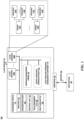
- Fig. 1 illustrates a block diagram of an exemplary system 100 in which various aspects of the invention may be practiced.
- the system 100 may be configured with a cloud service 102 that operates within a multi-tenant environment that serves multiple customers of a tenant.
- a cloud service 102 is a service available on demand for users through a publicly-accessible network, such as the Internet.
- a datacenter may be an on-premises, private system that provides services to a single enterprise user or may be a publicly (or semi-publicly) accessible distributed system that provides services to multiple, possibly unrelated customers and tenants, or may be a combination of both. Further, a datacenter maybe contained within a single geographic location or may be distributed to multiple locations across the globe and provide redundancy and disaster recovery capabilities. For example, the datacenter may designate one virtual machine on a server as the primary location for a tenant's application and may activate another virtual machine on the same or another server as the secondary or back-up in case the first virtual machine or server fails.
- a tenant 116 may communicate with other devices, including each other or with devices located outside the cloud service 102 via a network 104, such as the Internet.
- a tenant 116 may communicate with other devices via assigned network addresses, such as an assigned internet protocol (IP) address.
- IP internet protocol
- a user of a device 106 can log in to a tenant 116 and access resources 114A-114N ("114").
- the resources 114 are available to authorized users, and the user may have further restrictions via permissions from a set of permission levels to each authorized user for each resource in the cloud service 102.
- a management service 112 helps users log onto and access the resources 114 of a tenant 116 including external resources such as software as a service applications and applications on the tenant's network and intranet such as with a single sign on (SSO).
- the management service 112 provides similar features as a domain directory service such as the configuration of user groups, authentication and authorization. However, the management service 112 differs from domain directory services since the domain directory services are unable to manage web-based services.
- the management service 112 is configured to support web-based services that apply REST (REpresentational State Transfer) API (Application Programming Interface) interfaces for many software as a service applications.
- the management service 112 applies different protocols than the domain directory service.
- the management service 112 applies protocols that can work with web-based services such as authentication protocols including Security Assertion Markup Language (SAML), Open Authorization (OAuth), an identity layer on top of OAuth protocol such as OpenID Connect, and Web Services Federation (WS-Federation).
- SAML Security Assertion Markup Language
- OAuth Open Authorization
- an identity layer on top of OAuth protocol such as OpenID Connect
- WS-Federation Web Services Federation
- each tenant may apply an instance of management service, such as a directory 118 for the tenant.
- the directory 118 may be configured to include the tenant's users, groups, and applications and may perform identify and access management functions for the tenant's resources.
- a user device 106 communicates with the cloud service through REST APIs.
- a REST API is used to request information or access to a resource from the cloud service 102 using an HyperText Transfer Protocol (HTTP) method.
- HTTP HyperText Transfer Protocol
- the cloud service 102 responds by returning an HTTP response.
- the REST APIs are transmitted to an endpoint 120 of the cloud service 102.
- An endpoint 120 is a port that connects a device to a service hosted by the cloud service 102.
- the endpoint 120 is addressed by a uniform resource locator (URL) that the user device 106 uses to access a resource or service hosted by the cloud service 102.
- the cloud service 102 may have multiple endpoints 120.
- the endpoints 120 are API endpoints, each of which are configured to receive requests through a designated REST API.
- the management service 112 enables a customer of the cloud service (i.e., organization, entity, tenant, etc.) to deploy, manage, and monitor its resources as a group and to control access to these resources.
- the management service 112 manages the resources through an assignment of a role.
- a role is a set of permissions that identify actions or operations that may be performed on a resource.
- a role is assigned at a scope level.
- a role may be assigned to all the resources of a subscription, to a single resource, or to all the resources of a resource group.
- the role assignments file 126 includes the role assignments that have been made in each subscription to each identity.
- the built-in roles file 128 includes a list of the roles available within the cloud service 102 and the permissions contained within each role.
- the built-in roles file 128 includes a list of the roles available within the cloud service 102 and the permissions contained within each role.
- the role of an Owner has permissions that allow full access to all resources and the ability to grant access to others. There are no non-allowed actions.
- the role of Contributor has permissions that allow the security principal to create and manage all types of resources without the ability to grant access to resources to others.
- the role of a Reader has permissions to only read a resource.
- the role of a User Access Admin has permissions to manage user access to resources.
- Classic Virtual Machine Contributor which allows for the management of classic virtual machines without access to them or to the virtual network or storage account they are connected to
- SQL Server Contributor allows for the management of SQL servers and databases without access to them or their security-related polices
- Data Purger allows for purging of analytic data.
- a resource log 124 contains all the actions performed on a resource 114 by an identity.
- a resource 114 writes an entry in the resource log 124 each time an access and use is made to the resource 114.
- An entry in a resource log 124 may identify the identity accessing the resource, the actions performed by the identity on the resource, and the time at which the access was made. The entries in the resource log 124 are used to obtain the resource usage history of an identity.
- An organization chart 122 identifies the peers of a user or user account within an entity or organization that utilize the resources of the cloud service 102.
- the organization chart 122 may be a listing of related groups of users working on a same project.
- the cloud service 102 may include a least-privilege permission management component 130 that identifies an appropriate set of permissions for an identity.
- the least-privilege permission management component 130 may include a permission management engine 132 and an identity-resource-permission graph 134.
- the permission management engine 132 identifies an appropriate set of permissions for an identity based on a predicted future resource usage.
- the identity-resource-permission graph identifies the permissions granted to each resource and identity and the usage activity of each resource by an identity.
- Fig. 1 shows components of the system in one aspect of an environment in which various aspects of the invention may be practiced.
- the exact configuration of the components shown in Fig. 1 may not be required to practice the various aspects and variations in the configuration shown in Fig. 1 and the type of components may be made without departing from the scope of the invention.
- this disclosure is not limited to a cloud service and the techniques described herein may be practiced with other systems using permissions to control access to shared resources.
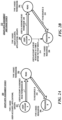
- FIGs. 2A - 2B illustrate exemplary identity-resource-permission graphs.
- An identity-resource-permission graph is a directed acyclic graph having nodes connected to edges.
- a first node type (type 1) represents an identity which may be a user account, an application, process, or a user group.
- a second node type (type 2) represents one or more permissions and the third node type (type 3) represents a resource.
- the first edge type represents the assignment relationship between the two connected nodes.
- the second edge type represents the usage activity associated with the two connected nodes.
- graph 200 has nodes 202, 204, 206 and edges 208, 210.
- Node 202 is a type 1 node that represents a user account, an application, or user group.
- Node 204 is a type 2 node which represents one or more permissions and node 206 is a type 3 node which represents resources.
- Edges 208, 210 are assignment edges. Edge 208 represents that user account A is assigned a read permission and edge 210 represents that the read permission is to resource B.
- Fig. 2B shows graph 212 with assignment and usage edges.
- Graph 212 has the same nodes and assignment edges shown in Fig. 2A with the addition of usage edge 214.
- a usage edge 214 connects an identity with a resource and indicates the usage activity of the identity node to the resource.
- usage edge 214 indicates that user account A has read resource B five times in the past week.
- the usage edge 214 may indicate the permission used (e.g., read, write, read/write, all), the frequency of the access (e.g., 5 times, twice a day, thrice weekly), and the time span of the usage activity (e.g., within the past week, past 2 days).
- Fig. 3 illustrates an exemplary method 300 to determine the least-privilege permissions for an identity.
- the permission management engine 132 generates an identity-resource-permission graph 134 for each tenant (block 302).
- the identity-resource-permission graph 134 contains nodes representing user accounts, applications, processes, and user groups and edges representing the permission assignments for a resource.
- the permission management engine 132 obtains the user accounts, applications, processes, and user groups that are configured with a permission to access a resource in a particular tenant.
- the permission management engine 132 may obtain the identities associated with a tenant from the directory 118 and the permission assignments from the role assignment file 126.
- a cloud service may include a role-based access control system (RBAC) and/or an identity and access management (IAM) system (not shown).
- RBAC role-based access control system
- IAM identity and access management
- the RBAC system contains the user accounts, applications, processes and user groups having access to the resources and the permissions granted to each identity through their assigned roles.
- the identities may be obtained from an identity and access management system (IAM) system associated with the cloud service which facilitates the management of digital identities.
- IAM identity and access management system
- the permission management engine 132 overlays the usage activity for each resource into the identity-resource-permission graph 134 by adding a usage edge between the identity and the resource (block 304).
- the usage edge indicates the permissions used to access the resource, the frequency of access, and the time period in which the access occurred.
- the usage activity may be obtained from the resource logs 124 in the management service 112. Alternatively, the usage activity may be obtained from the tenant tracks the usage activity.
- the permission management engine 132 identifies similar identifies for each identity (block 306).
- the permission management engine 132 then derives a similarity score for each identity.
- the similarity score is used to identify the identities that have similar resource usage. Identities that access similar resources will have a high score and identities that use different resources will have a low score.
- a similarity score is generated for each identity node in the graph. The difference in the similarity score for an identity node is then used to identify those identities that have similar resource usage behavior.
- Fig. 4 illustrates an exemplary method 400 for generating a similarity score for each identity.
- the permission management engine 132 generates a node embedding for each identity in the identity-resource-permission graph (block 402).
- a graph is a natural representation of a collection of entities and the relationships between them.
- Representation learning is a technique for incorporating the information from the graph into a deep learning based machine learning model, such as a node embedding for each identity node of the identity-permission-resource graph.
- a node embedding is a low-dimensional representation of the discrete data found in the graph as a continuous vector of real numbers. Similar nodes will have similar node embeddings. The node embeddings are then used to identify similar nodes based on the distances between their respective vector representation.
- the computation of the node embeddings in a graph may be represented mathematically as a maximum likelihood optimization problem.
- G (V, E ) be the identity-resource-permission, G , having vertices or nodes, V , and edges E .
- Ns (u) For every node u ⁇ V, the network neighborhood, Ns (u), of node u is generated through a neighborhood sampling strategy S , such as a normalized random walk.
- the following objective function is optimized using scalar gradient descent by maximizing the log-probability of observing network neighborhood Ns(u) for a node u conditioned on its feature representation given by f : max f ⁇ u ⁇ V log P N S u f u .
- Random walks are used to represent the structure and relationships inherent in the identity-resource-permission graph.
- a random walk starts at a randomly selected node and moves to a random neighbor for a predefined number of steps.
- the random walk generates paths through the graph of a given length thereby generating samples used to learn a feature representation of a node.
- the samples capture the contextual and semantic relationships between the nodes, such as the permissions assigned to perform actions on a resource by an identity and the usage activity of a resource by each identity.
- a random walk W from a source node r ⁇ V with a given length l may be represented as W.
- Let w j be the j-th node in a walk, W, where w 0 r is the first node in W.
- Node w j can be generated by the normalized probability P(w j
- the encoder is the Word2Vec model.
- a Word2Vec model is a convolutional neural network that uses an embedding learning algorithm to generate node embeddings.
- a continuous bag-of-word (CBOW) algorithm is used.
- CBOW is a predictive deep learning based encoder that computes continuous dense vector representations of words that capture contextual and semantic similarity.
- the techniques described herein are not limited to a particular encoder and that other encoders may be utilized as well, such as node2vec, doc2vec, and FastText.
- a similarity score is computed as the inverse of the difference between two node embeddings.
- the similarity score may be represented as 1 / (Ni - Nj), where Ni is a node embedding for node i and Nj is a node embedding for node j .
- the difference, (Ni - Nj) may be computed as the cosine similarity, the L1 norm, or L2 distance.
- the similarity score is used to identify similar identifies having similar resource usage (block 406). Identities having a high similarity score are considered similar and identities having a low similarity score are not considered similar.
- the permission management engine 132 determines the predicted future usage of an identity based on the resource usage history of the similar identities, the resource usage history of the identity, and the resource usage history of its peers (block 308).
- Figs. 1 and 5 there is shown a method 500 for computing the predicted future usage of an identity.
- the permission management engine 132 finds the resource usage history for each similar identity, the resource usage history for each of its peers, and its resource usage history (block 502).
- the resource usage history may be obtained from the resource logs 124 in the management service 112 or from the tenant 116.
- the resource usage history indicates the resource accessed, the permissions used to access the resource, the frequency of access, and the time period in which the access was made.
- the permission management engine 132 finds the peers of an identity from an organization chart 122.
- An identity may be associated with an organization, such as an enterprise, group, or the like that accesses resources with a consistent set of permissions.
- the organization chart 122 may indicate the other identities associated with a target identity. In one aspect, the organization chart 122 may pertain to the members of an organization, entity, project, or group. However, in other aspects, the organization chart 122 may represent an association or grouping of identities that are related in some manner.
- the permission management engine 132 obtains the resource usage history of each peer associated with a target identity. The resource usage history of a peer indicates each resource accessed, the permissions used to access the resource, the frequency in which the accesses are made, and the time period. (Collectively, block 502).
- the set of least-privilege permissions is computed. For example, if a resource was only read and not altered and the identity had a permission that permitted changes, then the least-privilege permission for the resource would be changed to a read permission.
- the permission management engine 132 compares the permissions granted to an identity with the permissions of the predicted future usage, to determine the bare minimum permission that is needed for the identity to perform its tasks. (Collectively, block 310).
- Networks 604, 622 may be configured as an ad hoc network, an intranet, an extranet, a virtual private network (VPN), a local area network (LAN), a wireless LAN (WLAN), a wide area network (WAN), a wireless WAN (WWAN), a metropolitan network (MAN), the Internet, a portions of the Public Switched Telephone Network (PSTN), plain old telephone service (POTS) network, a wireless network, a WiFi ® network, or any other type of network or combination of networks.
- VPN virtual private network
- LAN local area network
- WLAN wireless LAN
- WAN wide area network
- WWAN wireless WAN
- MAN metropolitan network
- PSTN Public Switched Telephone Network
- POTS plain old telephone service
- the method further comprises determining a first similar identity to the first identity based on an inverse of a difference between a node embedding of the first similar identity and a node embedding of the first identity.
- the least-privilege permission for the first identity is based further on permissions used in a resource usage history of the first identity and on permissions used in a resource usage history of peers of the first identity.
- the node embeddings are derived using a convolutional neural network.
- the node embeddings are trained from random walk generated paths of the graph.
- the convolutional neural network uses a continuous bag of words technique to derive the node embeddings.
- An identity represents a user account, user group, application or process.
Landscapes
- Engineering & Computer Science (AREA)
- Theoretical Computer Science (AREA)
- General Engineering & Computer Science (AREA)
- Physics & Mathematics (AREA)
- Software Systems (AREA)
- General Physics & Mathematics (AREA)
- Computer Hardware Design (AREA)
- Computer Security & Cryptography (AREA)
- General Health & Medical Sciences (AREA)
- Health & Medical Sciences (AREA)
- Signal Processing (AREA)
- Computer Networks & Wireless Communication (AREA)
- Computing Systems (AREA)
- Databases & Information Systems (AREA)
- Bioethics (AREA)
- Data Mining & Analysis (AREA)
- Life Sciences & Earth Sciences (AREA)
- Biophysics (AREA)
- Computational Linguistics (AREA)
- Evolutionary Computation (AREA)
- Biomedical Technology (AREA)
- Molecular Biology (AREA)
- Mathematical Physics (AREA)
- Artificial Intelligence (AREA)
- Automation & Control Theory (AREA)
- Multimedia (AREA)
- Technology Law (AREA)
- Management, Administration, Business Operations System, And Electronic Commerce (AREA)
- Storage Device Security (AREA)
Claims (15)
- System, umfassend:einen oder mehrere Prozessoren (626), die mit einem Speicher (634) gekoppelt sind; undein oder mehrere Programme (640), wobei das eine oder die mehreren Programme in dem Speicher gespeichert und so konfiguriert sind, dass sie von dem einen oder den mehreren Prozessoren ausgeführt werden, wobei das eine oder die mehreren Programme Anweisungen einschließen zum:Darstellen von Zuweisungen von Erlaubnissen für eine Vielzahl von Identitäten zum Durchführen von Aktionen auf Betriebsmitteln eines Mandanten eines Cloud-Dienstes in einem Diagramm, wobei das Diagramm Knoten und Kanten aufweist, wobei ein Knoten eine Identität, eine Erlaubnis oder ein Betriebsmittel darstellt, wobei eine Kante eine Zuweisung einer Erlaubnis oder einer Nutzungsaktivität einer Identität mit einem Betriebsmittel darstellt (302);Berechnen einer Knoteneinbettung für jeden Knoten, der eine Identität (402) darstellt;Finden einer oder mehrerer ähnlicher Identitäten zu einer ersten Identität, indem die Knoteneinbettungen jeder Identität in dem Diagramm (306) verwendet werden;Vorhersagen der zukünftigen Betriebsmittelnutzung der ersten Identität basierend auf der Nutzungsaktivität der einen oder mehreren ähnlichen Identitäten (308); undAbleiten einer Least-Privilege-Erlaubnis für die erste Identität basierend auf der vorhergesagten Betriebsmittelnutzung (310).
- System nach Anspruch 1, wobei das eine oder die mehreren Programme ferner Anweisungen einschließen, die einen Codierer verwenden, um die Knoteneinbettungen zu erzeugen, wobei der Codierer auf einer Vielzahl von durch Zufallsbewegungen erzeugten Pfaden (402) trainiert ist.
- System nach Anspruch 1, wobei das eine oder die mehreren Programme ferner Anweisungen einschließen zum:
Bestimmen, dass die erste Identität und eine zweite Identität ähnlich sind, basierend auf einem Unterschied zwischen einer Knoteneinbettung der ersten Identität und einer Knoteneinbettung der zweiten Identität (404). - System nach Anspruch 1, wobei das eine oder die mehreren Programme ferner Anweisungen einschließen zum:Vergleichen der der ersten Identität zugewiesenen Erlaubnisse mit Erlaubnissen, die der vorhergesagten zukünftigen Betriebsmittelnutzung zugeordnet sind (310); undKonfigurieren der Least-Privilege-Erlaubnis, um die vorausgesagte zukünftige Betriebsmittelnutzung (310) zu erleichtern.
- System nach Anspruch 1, wobei eine Identität ein Benutzerkonto, eine Benutzergruppe, eine Anwendung oder ein Verfahren (202) darstellt.
- System nach Anspruch 1, wobei das eine oder die mehreren Programme ferner Anweisungen einschließen, die die zukünftige Betriebsmittelnutzung der ersten Identität basierend auf dem bisherigen Verlauf der Betriebsmittelnutzung der ersten Identität (504) vorhersagen.
- System nach Anspruch 1, wobei das eine oder die mehreren Programme ferner Anweisungen einschließen, die die zukünftige Betriebsmittelnutzung der ersten Identität basierend auf dem bisherigen Peer-Verlauf der Betriebsmittelnutzung der ersten Identität (504) vorhersagen.
- Verfahren, umfassend:Erzeugen eines Diagramms, das Zuweisungen von Erlaubnissen zu Betriebsmitteln eines Mandanten eines Cloud-Dienstes darstellt, wobei das Diagramm Knoten und Kanten aufweist, wobei ein Knoten eine Identität, eine Erlaubnis oder ein Betriebsmittel darstellt, wobei eine Kante eine Zuweisung einer Identität mit einer Erlaubnis zu einem Betriebsmittel oder einer Nutzungsaktivität eines Betriebsmittels darstellt (302, 304);Berechnen einer Knoteneinbettung für jeden Knoten, der eine Identität (402) darstellt;Verwenden der Knoteneinbettungen, um eine oder mehrere ähnliche Identitäten zu einer ersten Identität zu identifizieren (306);Vorhersagen der zukünftigen Betriebsmittelnutzung der ersten Identität basierend auf der Nutzungsaktivität der einen oder mehreren ähnlichen Identitäten (308); undAbleiten einer Least-Privilege-Erlaubnis für die erste Identität basierend auf der vorhergesagten Betriebsmittelnutzung (310).
- Verfahren nach Anspruch 8, ferner umfassend:
Bestimmen einer ersten ähnlichen Identität zu der ersten Identität basierend auf einer Umkehrung einer Differenz zwischen einer Knoteneinbettung der ersten ähnlichen Identität und einer Knoteneinbettung der ersten Identität (404). - Verfahren nach Anspruch 8, wobei die Least-Privilege-Erlaubnis für die erste Identität ferner auf Erlaubnissen basiert, die in einem bisherigen Verlauf der Betriebsmittelnutzung der ersten Identität (504) verwendet wurden.
- Verfahren nach Anspruch 8, wobei die Least-Privilege-Erlaubnis für die erste Identität ferner auf Erlaubnissen basiert, die in einem bisherigen Peer-Verlauf der Betriebsmittelnutzung der ersten Identität (504) verwendet wurden.
- Verfahren nach Anspruch 8, wobei die Knoteneinbettungen unter Verwendung eines neuronalen Faltungsnetzwerks (402) abgeleitet werden.
- Verfahren nach Anspruch 8, wobei die Knoteneinbettungen anhand von durch Zufallsbewegungen erzeugten Pfaden des Diagramms (402) trainiert werden.
- Verfahren nach Anspruch 12, wobei das neuronale Faltungsnetzwerk eine kontinuierliche Bag-of-Words-Technik verwendet, um die Knoteneinbettungen (402) abzuleiten.
- Verfahren nach Anspruch 8, wobei eine Identität ein Benutzerkonto, eine Benutzergruppe, eine Anwendung oder ein Verfahren (202) darstellt.
Applications Claiming Priority (2)
| Application Number | Priority Date | Filing Date | Title |
|---|---|---|---|
| US16/779,939 US11388163B2 (en) | 2020-02-03 | 2020-02-03 | Least-privilege resource permission management |
| PCT/US2021/014237 WO2021158368A1 (en) | 2020-02-03 | 2021-01-20 | Least-privilege resource permission management |
Publications (2)
| Publication Number | Publication Date |
|---|---|
| EP4100857A1 EP4100857A1 (de) | 2022-12-14 |
| EP4100857B1 true EP4100857B1 (de) | 2025-02-26 |
Family
ID=74672396
Family Applications (1)
| Application Number | Title | Priority Date | Filing Date |
|---|---|---|---|
| EP21707046.5A Active EP4100857B1 (de) | 2020-02-03 | 2021-01-20 | Verwaltung von least-privilege-betriebsmittelerlaubnis |
Country Status (4)
| Country | Link |
|---|---|
| US (1) | US11388163B2 (de) |
| EP (1) | EP4100857B1 (de) |
| CN (1) | CN115104098B (de) |
| WO (1) | WO2021158368A1 (de) |
Families Citing this family (22)
| Publication number | Priority date | Publication date | Assignee | Title |
|---|---|---|---|---|
| US11451554B2 (en) * | 2019-05-07 | 2022-09-20 | Bank Of America Corporation | Role discovery for identity and access management in a computing system |
| US11856013B2 (en) * | 2020-02-04 | 2023-12-26 | The George Washington University | Method and system for detecting lateral movement in enterprise computer networks |
| US11868499B2 (en) * | 2020-08-31 | 2024-01-09 | Winter International, LLC | Permissions—enforced graph database |
| US20220067194A1 (en) * | 2020-09-02 | 2022-03-03 | Cookie.AI, Inc. | Generation of a privilege graph to represent data access authorizations |
| US11818174B1 (en) | 2020-11-25 | 2023-11-14 | Amazon Technologies, Inc. | Contextual policy weighting for permissions searching |
| US11777991B2 (en) * | 2020-11-30 | 2023-10-03 | Amazon Technologies, Inc. | Forecast-based permissions recommendations |
| US20220269809A1 (en) * | 2021-02-24 | 2022-08-25 | EMC IP Holding Company LLC | Leveraging access controls to secure backup data stored on a cloud-based object storage |
| US11783325B1 (en) | 2021-03-26 | 2023-10-10 | Amazon Technologies, Inc. | Removal probability-based weighting for resource access |
| US11803621B1 (en) | 2021-03-31 | 2023-10-31 | Amazon Technologies, Inc. | Permissions searching by scenario |
| US12242600B2 (en) * | 2021-05-13 | 2025-03-04 | Microsoft Technology Licensing, Llc | Abnormally permissive role definition detection systems |
| US11627155B1 (en) | 2021-09-20 | 2023-04-11 | Normalyze, Inc. | Cloud infrastructure detection with resource path tracing |
| US12333010B1 (en) * | 2021-11-11 | 2025-06-17 | Wiz, Inc. | System and method for generating a partitioned view of a security graph in a cloud computing environment |
| US12340248B2 (en) * | 2022-04-29 | 2025-06-24 | Microsoft Technology Licensing, Llc | Intelligent dynamic scaling based on internal and external indicators |
| CN114882974B (zh) * | 2022-05-27 | 2023-04-18 | 江苏智慧智能软件科技有限公司 | 一种心理诊断数据库访问人工智能验证系统及方法 |
| US12462050B2 (en) * | 2022-11-02 | 2025-11-04 | Sap Se | Role management system based on an integrated role recommendation engine |
| WO2024118666A1 (en) * | 2022-11-28 | 2024-06-06 | Perception Systems, LLC | Systems and methods of image to palette representations |
| WO2024118680A1 (en) * | 2022-11-28 | 2024-06-06 | Perception Systems, LLC | Systems and methods of representing phrases with palettes |
| US12438872B2 (en) * | 2022-11-28 | 2025-10-07 | Amazon Technologies, Inc. | Role-based permission delegation in a provider network |
| US12519791B2 (en) * | 2023-09-18 | 2026-01-06 | Tenable, Inc. | Assignment of resource criticality scores to cloud resources based on cloud resource class |
| US20250225264A1 (en) * | 2024-01-09 | 2025-07-10 | Oleria Corporation | Event integrated access graph data management |
| US12574382B2 (en) | 2024-02-05 | 2026-03-10 | International Business Machines Corporation | Providing security with dynamic privilege level assignment in a hybrid-cloud stack |
| US20260059015A1 (en) * | 2024-08-22 | 2026-02-26 | Microsoft Technology Licensing, Llc | Workload elasticity |
Family Cites Families (10)
| Publication number | Priority date | Publication date | Assignee | Title |
|---|---|---|---|---|
| US7107610B2 (en) * | 2001-05-11 | 2006-09-12 | Intel Corporation | Resource authorization |
| US8321837B2 (en) * | 2006-01-23 | 2012-11-27 | Microsoft Corporation | Techniques for minimum permissions detection and verification |
| TW201410052A (zh) * | 2012-05-09 | 2014-03-01 | Interdigital Patent Holdings | 彈性網路共享 |
| US10574748B2 (en) * | 2013-03-21 | 2020-02-25 | Infosys Limited | Systems and methods for allocating one or more resources in a composite cloud environment |
| US9246945B2 (en) * | 2013-05-29 | 2016-01-26 | International Business Machines Corporation | Techniques for reconciling permission usage with security policy for policy optimization and monitoring continuous compliance |
| US10031785B2 (en) * | 2015-04-10 | 2018-07-24 | International Business Machines Corporation | Predictive computing resource allocation for distributed environments |
| WO2019204778A1 (en) * | 2018-04-20 | 2019-10-24 | Orkus, Inc. | Automated access control management for computing systems |
| US10148701B1 (en) | 2018-05-08 | 2018-12-04 | Cyberark Software Ltd. | Automatic development and enforcement of least-privilege security policies |
| US11451554B2 (en) * | 2019-05-07 | 2022-09-20 | Bank Of America Corporation | Role discovery for identity and access management in a computing system |
| US11868499B2 (en) * | 2020-08-31 | 2024-01-09 | Winter International, LLC | Permissions—enforced graph database |
-
2020
- 2020-02-03 US US16/779,939 patent/US11388163B2/en active Active
-
2021
- 2021-01-20 WO PCT/US2021/014237 patent/WO2021158368A1/en not_active Ceased
- 2021-01-20 EP EP21707046.5A patent/EP4100857B1/de active Active
- 2021-01-20 CN CN202180013214.0A patent/CN115104098B/zh active Active
Also Published As
| Publication number | Publication date |
|---|---|
| US20210243190A1 (en) | 2021-08-05 |
| CN115104098B (zh) | 2026-03-03 |
| CN115104098A (zh) | 2022-09-23 |
| WO2021158368A1 (en) | 2021-08-12 |
| US11388163B2 (en) | 2022-07-12 |
| EP4100857A1 (de) | 2022-12-14 |
Similar Documents
| Publication | Publication Date | Title |
|---|---|---|
| EP4100857B1 (de) | Verwaltung von least-privilege-betriebsmittelerlaubnis | |
| US20210203684A1 (en) | Real-time detection of risky edge in lateral movement path | |
| US11102232B2 (en) | Blockchain web browser interface | |
| US9432375B2 (en) | Trust/value/risk-based access control policy | |
| EP4111725B1 (de) | Validierung von sicherheitstoken mittels partieller richtlinienvalidierung | |
| US12488060B2 (en) | Virtual browser application systems and methods | |
| US8819768B1 (en) | Split password vault | |
| US8443452B2 (en) | URL filtering based on user browser history | |
| JP2023098897A (ja) | コンテンツの擬似パーソナライゼーションのための低エントロピーのブラウジング履歴 | |
| US20080005264A1 (en) | Anonymous and secure network-based interaction | |
| WO2021029950A1 (en) | Automatic reduction of privilege role assignments | |
| Beg et al. | Data usage-based privacy and security issues in mobile app recommendation (MAR): a systematic literature review | |
| Jayapandian | Cloud dynamic scheduling for multimedia data encryption using tabu search algorithm | |
| US11283837B2 (en) | Domain-application attribution | |
| Guo et al. | Location Privacy‐Preserving Method Based on Historical Proximity Location | |
| US10049222B1 (en) | Establishing application trust levels using taint propagation | |
| US20260100837A1 (en) | Systems and methods for improving security in network environments | |
| JP7702204B2 (ja) | 可変分布保存を用いて機密データを変換するための学習 | |
| US12174899B2 (en) | Geofencing queries based on query intent and result semantics | |
| US20240388505A1 (en) | Intelligent auto-detection of anomalous web-based access requests | |
| Kaur et al. | Smart data agent for preserving location privacy | |
| Manjushree et al. | Mitigating data leaks and optimizing task scheduling in cloud computing using EfficientNetV2 with federated learning and blockchain | |
| Sukmana et al. | A brokerage approach for secure multi-cloud storage resource management | |
| Behare et al. | Securing Sign-Up and Sign-In in the Indian Market: Fraud Prevention in CIAM for CRM-A Comprehensive Review and Future Directions | |
| US10579828B2 (en) | Method and system to prevent inference of personal information using pattern neutralization techniques |
Legal Events
| Date | Code | Title | Description |
|---|---|---|---|
| STAA | Information on the status of an ep patent application or granted ep patent |
Free format text: STATUS: UNKNOWN |
|
| STAA | Information on the status of an ep patent application or granted ep patent |
Free format text: STATUS: THE INTERNATIONAL PUBLICATION HAS BEEN MADE |
|
| PUAI | Public reference made under article 153(3) epc to a published international application that has entered the european phase |
Free format text: ORIGINAL CODE: 0009012 |
|
| STAA | Information on the status of an ep patent application or granted ep patent |
Free format text: STATUS: REQUEST FOR EXAMINATION WAS MADE |
|
| 17P | Request for examination filed |
Effective date: 20220705 |
|
| AK | Designated contracting states |
Kind code of ref document: A1 Designated state(s): AL AT BE BG CH CY CZ DE DK EE ES FI FR GB GR HR HU IE IS IT LI LT LU LV MC MK MT NL NO PL PT RO RS SE SI SK SM TR |
|
| DAV | Request for validation of the european patent (deleted) | ||
| DAX | Request for extension of the european patent (deleted) | ||
| GRAP | Despatch of communication of intention to grant a patent |
Free format text: ORIGINAL CODE: EPIDOSNIGR1 |
|
| STAA | Information on the status of an ep patent application or granted ep patent |
Free format text: STATUS: GRANT OF PATENT IS INTENDED |
|
| RIC1 | Information provided on ipc code assigned before grant |
Ipc: H04L 41/147 20220101ALI20240926BHEP Ipc: G06F 21/10 20130101ALI20240926BHEP Ipc: G06F 21/60 20130101ALI20240926BHEP Ipc: H04L 9/40 20220101ALI20240926BHEP Ipc: G06F 21/62 20130101AFI20240926BHEP |
|
| INTG | Intention to grant announced |
Effective date: 20241016 |
|
| GRAS | Grant fee paid |
Free format text: ORIGINAL CODE: EPIDOSNIGR3 |
|
| P01 | Opt-out of the competence of the unified patent court (upc) registered |
Free format text: CASE NUMBER: APP_64165/2024 Effective date: 20241203 |
|
| GRAA | (expected) grant |
Free format text: ORIGINAL CODE: 0009210 |
|
| STAA | Information on the status of an ep patent application or granted ep patent |
Free format text: STATUS: THE PATENT HAS BEEN GRANTED |
|
| AK | Designated contracting states |
Kind code of ref document: B1 Designated state(s): AL AT BE BG CH CY CZ DE DK EE ES FI FR GB GR HR HU IE IS IT LI LT LU LV MC MK MT NL NO PL PT RO RS SE SI SK SM TR |
|
| REG | Reference to a national code |
Ref country code: GB Ref legal event code: FG4D |
|
| REG | Reference to a national code |
Ref country code: CH Ref legal event code: EP |
|
| REG | Reference to a national code |
Ref country code: DE Ref legal event code: R096 Ref document number: 602021026747 Country of ref document: DE |
|
| REG | Reference to a national code |
Ref country code: IE Ref legal event code: FG4D |
|
| REG | Reference to a national code |
Ref country code: NL Ref legal event code: MP Effective date: 20250226 |
|
| PG25 | Lapsed in a contracting state [announced via postgrant information from national office to epo] |
Ref country code: RS Free format text: LAPSE BECAUSE OF FAILURE TO SUBMIT A TRANSLATION OF THE DESCRIPTION OR TO PAY THE FEE WITHIN THE PRESCRIBED TIME-LIMIT Effective date: 20250526 |
|
| PG25 | Lapsed in a contracting state [announced via postgrant information from national office to epo] |
Ref country code: FI Free format text: LAPSE BECAUSE OF FAILURE TO SUBMIT A TRANSLATION OF THE DESCRIPTION OR TO PAY THE FEE WITHIN THE PRESCRIBED TIME-LIMIT Effective date: 20250226 |
|
| PG25 | Lapsed in a contracting state [announced via postgrant information from national office to epo] |
Ref country code: PL Free format text: LAPSE BECAUSE OF FAILURE TO SUBMIT A TRANSLATION OF THE DESCRIPTION OR TO PAY THE FEE WITHIN THE PRESCRIBED TIME-LIMIT Effective date: 20250226 |
|
| PG25 | Lapsed in a contracting state [announced via postgrant information from national office to epo] |
Ref country code: ES Free format text: LAPSE BECAUSE OF FAILURE TO SUBMIT A TRANSLATION OF THE DESCRIPTION OR TO PAY THE FEE WITHIN THE PRESCRIBED TIME-LIMIT Effective date: 20250226 |
|
| REG | Reference to a national code |
Ref country code: LT Ref legal event code: MG9D |
|
| PG25 | Lapsed in a contracting state [announced via postgrant information from national office to epo] |
Ref country code: NO Free format text: LAPSE BECAUSE OF FAILURE TO SUBMIT A TRANSLATION OF THE DESCRIPTION OR TO PAY THE FEE WITHIN THE PRESCRIBED TIME-LIMIT Effective date: 20250526 Ref country code: IS Free format text: LAPSE BECAUSE OF FAILURE TO SUBMIT A TRANSLATION OF THE DESCRIPTION OR TO PAY THE FEE WITHIN THE PRESCRIBED TIME-LIMIT Effective date: 20250626 |
|
| PG25 | Lapsed in a contracting state [announced via postgrant information from national office to epo] |
Ref country code: NL Free format text: LAPSE BECAUSE OF FAILURE TO SUBMIT A TRANSLATION OF THE DESCRIPTION OR TO PAY THE FEE WITHIN THE PRESCRIBED TIME-LIMIT Effective date: 20250226 |
|
| PG25 | Lapsed in a contracting state [announced via postgrant information from national office to epo] |
Ref country code: HR Free format text: LAPSE BECAUSE OF FAILURE TO SUBMIT A TRANSLATION OF THE DESCRIPTION OR TO PAY THE FEE WITHIN THE PRESCRIBED TIME-LIMIT Effective date: 20250226 |
|
| PG25 | Lapsed in a contracting state [announced via postgrant information from national office to epo] |
Ref country code: LV Free format text: LAPSE BECAUSE OF FAILURE TO SUBMIT A TRANSLATION OF THE DESCRIPTION OR TO PAY THE FEE WITHIN THE PRESCRIBED TIME-LIMIT Effective date: 20250226 Ref country code: PT Free format text: LAPSE BECAUSE OF FAILURE TO SUBMIT A TRANSLATION OF THE DESCRIPTION OR TO PAY THE FEE WITHIN THE PRESCRIBED TIME-LIMIT Effective date: 20250626 |
|
| PG25 | Lapsed in a contracting state [announced via postgrant information from national office to epo] |
Ref country code: GR Free format text: LAPSE BECAUSE OF FAILURE TO SUBMIT A TRANSLATION OF THE DESCRIPTION OR TO PAY THE FEE WITHIN THE PRESCRIBED TIME-LIMIT Effective date: 20250527 Ref country code: BG Free format text: LAPSE BECAUSE OF FAILURE TO SUBMIT A TRANSLATION OF THE DESCRIPTION OR TO PAY THE FEE WITHIN THE PRESCRIBED TIME-LIMIT Effective date: 20250226 |
|
| REG | Reference to a national code |
Ref country code: AT Ref legal event code: MK05 Ref document number: 1771375 Country of ref document: AT Kind code of ref document: T Effective date: 20250226 |
|
| PG25 | Lapsed in a contracting state [announced via postgrant information from national office to epo] |
Ref country code: SE Free format text: LAPSE BECAUSE OF FAILURE TO SUBMIT A TRANSLATION OF THE DESCRIPTION OR TO PAY THE FEE WITHIN THE PRESCRIBED TIME-LIMIT Effective date: 20250226 |
|
| PG25 | Lapsed in a contracting state [announced via postgrant information from national office to epo] |
Ref country code: SM Free format text: LAPSE BECAUSE OF FAILURE TO SUBMIT A TRANSLATION OF THE DESCRIPTION OR TO PAY THE FEE WITHIN THE PRESCRIBED TIME-LIMIT Effective date: 20250226 |
|
| PG25 | Lapsed in a contracting state [announced via postgrant information from national office to epo] |
Ref country code: DK Free format text: LAPSE BECAUSE OF FAILURE TO SUBMIT A TRANSLATION OF THE DESCRIPTION OR TO PAY THE FEE WITHIN THE PRESCRIBED TIME-LIMIT Effective date: 20250226 |
|
| PG25 | Lapsed in a contracting state [announced via postgrant information from national office to epo] |
Ref country code: IT Free format text: LAPSE BECAUSE OF FAILURE TO SUBMIT A TRANSLATION OF THE DESCRIPTION OR TO PAY THE FEE WITHIN THE PRESCRIBED TIME-LIMIT Effective date: 20250226 |
|
| PG25 | Lapsed in a contracting state [announced via postgrant information from national office to epo] |
Ref country code: AT Free format text: LAPSE BECAUSE OF FAILURE TO SUBMIT A TRANSLATION OF THE DESCRIPTION OR TO PAY THE FEE WITHIN THE PRESCRIBED TIME-LIMIT Effective date: 20250226 |
|
| PG25 | Lapsed in a contracting state [announced via postgrant information from national office to epo] |
Ref country code: CZ Free format text: LAPSE BECAUSE OF FAILURE TO SUBMIT A TRANSLATION OF THE DESCRIPTION OR TO PAY THE FEE WITHIN THE PRESCRIBED TIME-LIMIT Effective date: 20250226 Ref country code: EE Free format text: LAPSE BECAUSE OF FAILURE TO SUBMIT A TRANSLATION OF THE DESCRIPTION OR TO PAY THE FEE WITHIN THE PRESCRIBED TIME-LIMIT Effective date: 20250226 |
|
| PG25 | Lapsed in a contracting state [announced via postgrant information from national office to epo] |
Ref country code: RO Free format text: LAPSE BECAUSE OF FAILURE TO SUBMIT A TRANSLATION OF THE DESCRIPTION OR TO PAY THE FEE WITHIN THE PRESCRIBED TIME-LIMIT Effective date: 20250226 |
|
| PG25 | Lapsed in a contracting state [announced via postgrant information from national office to epo] |
Ref country code: SK Free format text: LAPSE BECAUSE OF FAILURE TO SUBMIT A TRANSLATION OF THE DESCRIPTION OR TO PAY THE FEE WITHIN THE PRESCRIBED TIME-LIMIT Effective date: 20250226 |
|
| REG | Reference to a national code |
Ref country code: DE Ref legal event code: R097 Ref document number: 602021026747 Country of ref document: DE |
|
| PLBE | No opposition filed within time limit |
Free format text: ORIGINAL CODE: 0009261 |
|
| STAA | Information on the status of an ep patent application or granted ep patent |
Free format text: STATUS: NO OPPOSITION FILED WITHIN TIME LIMIT |
|
| PGFP | Annual fee paid to national office [announced via postgrant information from national office to epo] |
Ref country code: GB Payment date: 20251217 Year of fee payment: 6 |
|
| 26N | No opposition filed |
Effective date: 20251127 |
|
| PGFP | Annual fee paid to national office [announced via postgrant information from national office to epo] |
Ref country code: DE Payment date: 20251217 Year of fee payment: 6 |