EP4100628B1 - Strebenabdeckung für eine turbine - Google Patents
Strebenabdeckung für eine turbine Download PDFInfo
- Publication number
- EP4100628B1 EP4100628B1 EP20720180.7A EP20720180A EP4100628B1 EP 4100628 B1 EP4100628 B1 EP 4100628B1 EP 20720180 A EP20720180 A EP 20720180A EP 4100628 B1 EP4100628 B1 EP 4100628B1
- Authority
- EP
- European Patent Office
- Prior art keywords
- strut
- turbine
- leading
- edge
- flow
- Prior art date
- Legal status (The legal status is an assumption and is not a legal conclusion. Google has not performed a legal analysis and makes no representation as to the accuracy of the status listed.)
- Active
Links
Images




Classifications
-
- F—MECHANICAL ENGINEERING; LIGHTING; HEATING; WEAPONS; BLASTING
- F01—MACHINES OR ENGINES IN GENERAL; ENGINE PLANTS IN GENERAL; STEAM ENGINES
- F01D—NON-POSITIVE DISPLACEMENT MACHINES OR ENGINES, e.g. STEAM TURBINES
- F01D25/00—Component parts, details, or accessories, not provided for in, or of interest apart from, other groups
- F01D25/16—Arrangement of bearings; Supporting or mounting bearings in casings
- F01D25/162—Bearing supports
-
- F—MECHANICAL ENGINEERING; LIGHTING; HEATING; WEAPONS; BLASTING
- F01—MACHINES OR ENGINES IN GENERAL; ENGINE PLANTS IN GENERAL; STEAM ENGINES
- F01D—NON-POSITIVE DISPLACEMENT MACHINES OR ENGINES, e.g. STEAM TURBINES
- F01D5/00—Blades; Blade-carrying members; Heating, heat-insulating, cooling or antivibration means on the blades or the members
- F01D5/12—Blades
- F01D5/14—Form or construction
- F01D5/141—Shape, i.e. outer, aerodynamic form
-
- F—MECHANICAL ENGINEERING; LIGHTING; HEATING; WEAPONS; BLASTING
- F01—MACHINES OR ENGINES IN GENERAL; ENGINE PLANTS IN GENERAL; STEAM ENGINES
- F01D—NON-POSITIVE DISPLACEMENT MACHINES OR ENGINES, e.g. STEAM TURBINES
- F01D9/00—Stators
- F01D9/02—Nozzles; Nozzle boxes; Stator blades; Guide conduits, e.g. individual nozzles
- F01D9/04—Nozzles; Nozzle boxes; Stator blades; Guide conduits, e.g. individual nozzles forming ring or sector
-
- F—MECHANICAL ENGINEERING; LIGHTING; HEATING; WEAPONS; BLASTING
- F01—MACHINES OR ENGINES IN GENERAL; ENGINE PLANTS IN GENERAL; STEAM ENGINES
- F01D—NON-POSITIVE DISPLACEMENT MACHINES OR ENGINES, e.g. STEAM TURBINES
- F01D9/00—Stators
- F01D9/02—Nozzles; Nozzle boxes; Stator blades; Guide conduits, e.g. individual nozzles
- F01D9/04—Nozzles; Nozzle boxes; Stator blades; Guide conduits, e.g. individual nozzles forming ring or sector
- F01D9/041—Nozzles; Nozzle boxes; Stator blades; Guide conduits, e.g. individual nozzles forming ring or sector using blades
-
- F—MECHANICAL ENGINEERING; LIGHTING; HEATING; WEAPONS; BLASTING
- F05—INDEXING SCHEMES RELATING TO ENGINES OR PUMPS IN VARIOUS SUBCLASSES OF CLASSES F01-F04
- F05D—INDEXING SCHEME FOR ASPECTS RELATING TO NON-POSITIVE-DISPLACEMENT MACHINES OR ENGINES, GAS-TURBINES OR JET-PROPULSION PLANTS
- F05D2220/00—Application
- F05D2220/30—Application in turbines
- F05D2220/32—Application in turbines in gas turbines
-
- F—MECHANICAL ENGINEERING; LIGHTING; HEATING; WEAPONS; BLASTING
- F05—INDEXING SCHEMES RELATING TO ENGINES OR PUMPS IN VARIOUS SUBCLASSES OF CLASSES F01-F04
- F05D—INDEXING SCHEME FOR ASPECTS RELATING TO NON-POSITIVE-DISPLACEMENT MACHINES OR ENGINES, GAS-TURBINES OR JET-PROPULSION PLANTS
- F05D2240/00—Components
- F05D2240/10—Stators
- F05D2240/12—Fluid guiding means, e.g. vanes
- F05D2240/121—Fluid guiding means, e.g. vanes related to the leading edge of a stator vane
-
- F—MECHANICAL ENGINEERING; LIGHTING; HEATING; WEAPONS; BLASTING
- F05—INDEXING SCHEMES RELATING TO ENGINES OR PUMPS IN VARIOUS SUBCLASSES OF CLASSES F01-F04
- F05D—INDEXING SCHEME FOR ASPECTS RELATING TO NON-POSITIVE-DISPLACEMENT MACHINES OR ENGINES, GAS-TURBINES OR JET-PROPULSION PLANTS
- F05D2240/00—Components
- F05D2240/10—Stators
- F05D2240/12—Fluid guiding means, e.g. vanes
- F05D2240/122—Fluid guiding means, e.g. vanes related to the trailing edge of a stator vane
-
- F—MECHANICAL ENGINEERING; LIGHTING; HEATING; WEAPONS; BLASTING
- F05—INDEXING SCHEMES RELATING TO ENGINES OR PUMPS IN VARIOUS SUBCLASSES OF CLASSES F01-F04
- F05D—INDEXING SCHEME FOR ASPECTS RELATING TO NON-POSITIVE-DISPLACEMENT MACHINES OR ENGINES, GAS-TURBINES OR JET-PROPULSION PLANTS
- F05D2240/00—Components
- F05D2240/50—Bearings
-
- F—MECHANICAL ENGINEERING; LIGHTING; HEATING; WEAPONS; BLASTING
- F05—INDEXING SCHEMES RELATING TO ENGINES OR PUMPS IN VARIOUS SUBCLASSES OF CLASSES F01-F04
- F05D—INDEXING SCHEME FOR ASPECTS RELATING TO NON-POSITIVE-DISPLACEMENT MACHINES OR ENGINES, GAS-TURBINES OR JET-PROPULSION PLANTS
- F05D2250/00—Geometry
- F05D2250/70—Shape
- F05D2250/71—Shape curved
-
- F—MECHANICAL ENGINEERING; LIGHTING; HEATING; WEAPONS; BLASTING
- F05—INDEXING SCHEMES RELATING TO ENGINES OR PUMPS IN VARIOUS SUBCLASSES OF CLASSES F01-F04
- F05D—INDEXING SCHEME FOR ASPECTS RELATING TO NON-POSITIVE-DISPLACEMENT MACHINES OR ENGINES, GAS-TURBINES OR JET-PROPULSION PLANTS
- F05D2250/00—Geometry
- F05D2250/70—Shape
- F05D2250/72—Shape symmetric
Definitions
- Turbine engines including gas turbines and steam turbines include an exhaust section in which a working fluid is exhausted from the turbine.
- the working fluid is a flow of combustion gas while a steam turbine exhausts a flow of steam and/or water vapor.
- struts are placed in this exhaust flow to support components such as bearings that are positioned in the flow. These struts can interfere with the flow and create an increased backpressure that reduces the efficiency of the turbine.
- US 10 502 084 B2 describes a module for a gas turbine which comprises a component for guiding hot gas.
- EP 1 482 130 A2 describes a turbomachine frame structure with a frame member including an annular inner hub and a concentric annular outer casing.
- EP 2 559 850 A1 describes an exhaust diffuser for a torque-generating turbine.
- US 9 644 497 B2 describes an industrial gas turbine exhaust system with splined profile tail cone.
- EP 3 241 989 A1 describes a gas turbine section for an annular gas path with a gas turbine section, which includes an inner and an outer gas path wall.
- the present invention relates to a turbine for a gas turbine or a steam turbine, operable to exhaust a flow of exhaust gas along a central axis according to claim 1.
- phrases "associated with” and “associated therewith,” as well as derivatives thereof, may mean to include, be included within, interconnect with, contain, be contained within, connect to or with, couple to or with, be communicable with, cooperate with, interleave, juxtapose, be proximate to, be bound to or with, have, have a property of, or the like.
- any features, methods, steps, components, etc. described with regard to one embodiment are equally applicable to other embodiments absent a specific statement to the contrary.
- first, second, third and so forth may be used herein to refer to various elements, information, functions, or acts, these elements, information, functions, or acts should not be limited by these terms. Rather these numeral adjectives are used to distinguish different elements, information, functions or acts from each other. For example, a first element, information, function, or act could be termed a second element, information, function, or act, and, similarly, a second element, information, function, or act could be termed a first element, information, function, or act, without departing from the scope of the present disclosure.
- adjacent to may mean: that an element is relatively near to but not in contact with a further element; or that the element is in contact with the further portion, unless the context clearly indicates otherwise.
- phrase “based on” is intended to mean “based, at least in part, on” unless explicitly stated otherwise. Terms “about” or “substantially” or like terms are intended to cover variations in a value that are within normal industry manufacturing tolerances for that dimension. If no industry standard is available, a variation of twenty percent would fall within the meaning of these terms unless otherwise stated.
- FIG. 1 illustrates an example of a gas turbine engine 100 including a compressor section 102, a combustion section 106, and a turbine section 110 arranged along a central axis 114.
- the compressor section 102 includes a plurality of compressor stages 116 with each compressor stage 116 including a set of rotating blades 118 and a set of stationary vanes 120 or adjustable guide vanes.
- a rotor 122 supports the rotating blades 118 for rotation about the central axis 114 during operation.
- a single one-piece rotor 122 extends the length of the gas turbine engine 100 and is supported for rotation by a bearing at either end.
- the rotor 122 is assembled from several separate spools that are attached to one another or may include multiple disk sections that are attached via a bolt or plurality of bolts.
- the compressor section 102 is in fluid communication with an inlet section 124 to allow the gas turbine engine 100 to draw atmospheric air into the compressor section 102. During operation of the gas turbine engine 100, the compressor section 102 draws in atmospheric air and compresses that air for delivery to the combustion section 106.
- the illustrated compressor section 102 is an example of one compressor section 102 with other arrangements and designs being possible.
- the combustion section 106 includes a plurality of separate combustors 126 that each operate to mix a flow of fuel with the compressed air from the compressor section 102 and to combust that air-fuel mixture to produce a flow of high temperature, high pressure combustion gases or exhaust gas 128.
- combustors 126 that each operate to mix a flow of fuel with the compressed air from the compressor section 102 and to combust that air-fuel mixture to produce a flow of high temperature, high pressure combustion gases or exhaust gas 128.
- many other arrangements of the combustion section 106 are possible.
- the turbine section 110 includes a plurality of turbine stages 130 with each turbine stage 130 including a number of rotating turbine blades 104 and a number of stationary turbine vanes 108.
- the turbine stages 130 are arranged to receive the exhaust gas 128 from the combustion section 106 at a turbine inlet 132 and expand that gas to convert thermal and pressure energy into rotating or mechanical work.
- the turbine section 110 is connected to the compressor section 102 to drive the compressor section 102.
- the turbine section 110 is also connected to a generator, pump, or other device to be driven.
- the compressor section 102 other designs and arrangements of the turbine section 110 are possible.
- An exhaust portion 112 is positioned downstream of the turbine section 110 and is arranged to receive the expanded flow of exhaust gas 128 from the final turbine stage 130 in the turbine section 110.
- the exhaust portion 112 is arranged to efficiently direct the exhaust gas 128 away from the turbine section 110 to assure efficient operation of the turbine section 110.
- the exhaust portion 112 also includes one or more strut assemblies 200 that will be discussed in greater detail with regard to FIG. 2 . Many variations and design differences are possible in the exhaust portion 112. As such, the illustrated exhaust portion 112 is but one example of those variations.
- a control system 134 is coupled to the gas turbine engine 100 and operates to monitor various operating parameters and to control various operations of the gas turbine engine 100.
- the control system 134 is typically micro-processor based and includes memory devices and data storage devices for collecting, analyzing, and storing data.
- the control system 134 provides output data to various devices including monitors, printers, indicators, and the like that allow users to interface with the control system 134 to provide inputs or adjustments.
- a user may input a power output set point and the control system 134 may adjust the various control inputs to achieve that power output in an efficient manner.
- the control system 134 can control various operating parameters including, but not limited to variable inlet guide vane positions, fuel flow rates and pressures, engine speed, valve positions, generator load, and generator excitation. Of course, other applications may have fewer or more controllable devices.
- the control system 134 also monitors various parameters to assure that the gas turbine engine 100 is operating properly. Some parameters that are monitored may include inlet air temperature, compressor outlet temperature and pressure, combustor outlet temperature, fuel flow rate, generator power output, bearing temperature, and the like. Many of these measurements are displayed for the user and are logged for later review should such a review be necessary.
- FIG. 2 is an enlarged cross-sectional view of a strut assembly 200.
- most gas turbine engines 100 include several strut assemblies 200 that are similar to or identical to the one illustrated in FIG. 2 .
- the strut assemblies 200 are positioned at a common axial location and distributed equally around the central axis 114 of the gas turbine engine 100 (e.g., four strut assemblies 200 would be ninety degrees apart).
- other arrangements and spacing are possible including unequal spacings, axially varying spacing, and even varying alignments of the different strut assemblies 200.
- Each strut assembly 200 includes a strut 210 and a strut cover 500 arranged to cover the strut 210.
- the strut 210 includes a first end that is fixedly attached to an outer casing 202 and a second end that is fixedly attached to a bearing casing 206 for a bearing (not shown).
- a flow portion 216 of the strut 210 extends between an inner flow liner 208 and an outer flow liner 204 where it is potentially exposed to the exhaust gas 128.
- each end could be attached to a different component as may be required by the design of the gas turbine engine 100.
- the strut 210 serves to rigidly attach the outer casing 202 and the bearing casing 206, thereby providing the necessary support for the bearing casing 206 and the rotor 122 which is supported by the bearing.
- the strut 210 passes through the outer flow liner 204 and the inner flow liner 208 and may or may not be attached to one or both of the outer flow liner 204 and the inner flow liner 208.
- the outer flow liner 204 and the inner flow liner 208 cooperate to define an annular flow space 218 through which the exhaust gas flows in a flow direction 222.
- one or more of the struts 210 are hollow to provide a passage between the interior of the gas turbine engine 100 and the exterior.
- the passage is often used to direct instrument wires, air lines, lubricant lines and the like.
- one of the struts 210 would include lubricant lines that direct lubricant fluid to and from the bearing.
- vibration sensors within the bearing often require wires to pass the signals from the sensors to the exterior of the gas turbine engine 100 where they can be routed to the control system 134.
- cross-strut assemblies are provided between some or all the adjacent pairs of strut assemblies 200.
- the cross-strut assemblies provide additional support and stability if needed.
- Each cross-strut assembly includes a cross-strut (often referred to as a gusset) and may include a cross-strut cover if the cross-strut is in the exhaust flow.
- the cross-strut provides the desired structural support and can be any shape, cross-section, or configuration desired. For example, box beams, I-beams, or solid beams could be employed as cross-struts.
- the cross-strut cover surrounds or at least partially surrounds the cross-strut and is aerodynamically shaped to reduce any backpressure increase that might be caused by the cross-strut if it were in the flow of exhaust gas exiting the turbine.
- the cross-strut cover does not necessarily provide any structural support and can therefore be made from a thin sheet material. However, some constructions may use a more rigid or thicker material for the cross-strut cover such that it does provide s0me structural support. It should be noted that many gas turbine engine 100 constructions do not include or require cross-strut assemblies.
- each strut 210 is welded to the outer casing 202 and the bearing casing 206. However, some constructions may use other attachment means such as fasteners. Similarly, each cross-strut is preferably welded to the struts 210 between which the cross-strut extends.
- the strut cover 500 extends from the outer flow liner 204 to the inner flow liner 208 and covers the strut 210. As illustrated in FIG. 2 , each strut cover 500 cooperates with the outer flow liner 204 and the inner flow liner 208 to define two wall fillets 220. Of course, other constructions could omit one or both of the wall fillets 220.
- Each strut cover 500 is aerodynamically shaped and covers one of the struts 210 so that the shape of the strut 210 can be selected for strength and stiffness without concern for aerodynamics.
- each strut 210 could be formed from a box beam, I-beam, solid beam, channel beam, or any other shape or combination of shapes desired.
- the aerodynamic shape of the strut cover 500 includes a curved or elliptical leading-edge portion 504 and a narrower curved or elliptical trailing-edge portion 620. Tapered surfaces extend between the leading-edge portion 504 and the trailing-edge portion 620 to define a mid-chord portion 622 (illustrated in FIG. 6 ) to complete the shape.
- the leading-edge portion 504 extends along the length of the strut cover 500 and maintains a uniform axial position.
- the leading-edge portion 504 is substantially normal to the central axis 114.
- the trailing-edge portion 620 is arranged normal to the central axis 114.
- one or both of the leading-edge portion 504 and the trailing-edge portion 620 may have a taper or lean such that the leading-edge portion 504 and/or the trailing-edge portion 620 defines an oblique angle with respect to the central axis 114.
- the strut cover 500 illustrated in FIG. 6 and FIG. 7 includes a tapered or leaning trailing-edge portion 620.
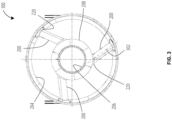
- FIG. 3 illustrates a first arrangement of a plurality of strut assemblies 300 which includes three separate strut assemblies 200 arranged about 120 degrees apart (circumferentially) from one another (i.e., within typical manufacturing tolerances).
- each of the strut assemblies 200 extends along an axis that is oblique to a radial axis of the gas turbine engine 100.
- each strut assembly 200 extends from the inner flow liner 208 to the outer flow liner 204 along a line or axis that is tangent to the bearing casing 206.
- the master chord plane 302 of each strut assembly 200 is arranged to be tangent to the bearing casing 206.
- FIG. 4 illustrates a second arrangement of a plurality of strut assemblies 400 that includes six strut assemblies 200 arranged around the circumference of the bearing casing 206.
- the arrangement includes a top-dead-center strut assembly 200 and a bottom-dead-center strut assembly 200 arranged along master chord planes 302 that are coincident with a radial plane that intersects the central axis 114.
- Two additional strut assemblies 200 are arranged along master chord planes 302 that are coincident with radial planes in the upper portion of the gas turbine engine 100.
- the final two strut assemblies 200 are arranged along non-radial master chord planes 302 in the lower portion of the gas turbine engine 100.
- FIG. 5 is an axial view of one of the strut covers 500 looking in the flow direction 222 of the exhaust gas 128.
- a master chord plane 302 (sometimes referred to as a skeleton plane or a center plane) is illustrated as a plane that passes through the full length of the strut cover 500 and substantially bisects the strut cover 500.
- a leading-edge nose 502 is defined as the locus of the furthest upstream points (i.e., the leading-edge center 604) of the leading-edge portion 504 of the various cross-sections taken parallel to the flow direction of the strut cover 500. As illustrated in FIG. 5 , the leading-edge nose 502 defines a curve that does not reside on or coincide with the master chord plane 302 but rather is offset from and, in this construction crosses the master chord plane 302 at no more than one location.
- some constructions could include a leading-edge nose 502 that defines a curve that never crosses the master chord plane 302 with preferred constructions including a single crossing. In some constructions, multiple crossings could occur with the leading-edge nose 502 resembling a parabola, a hyperbola, or a higher order curve.
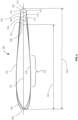
- FIG. 6 better illustrates the aerodynamic shape of one possible arrangement of the strut cover 500. Specifically, FIG. 6 illustrates five cross-sections each taken at a different distance from the inner flow liner 208 to better illustrate the variation in the shape of the strut cover 500 over the length of the strut cover 500.
- FIG. 6 illustrates a master chord plane 302 that substantially bisects the various cross-sections (i.e., with the exception of the leading-edge portion 504 which is not necessarily bisected).
- the master chord plane 302 is parallel to the general direction of flow and provides a reference for the various cross-sections.
- the master chord plane 302 defines a camber line for each cross-section having a leading-edge center 604 and a trailing-edge center 614 on the master chord plane 302.
- a camber line is defined as the locus of points halfway between a first curved edge 616 and a second curved edge 618 that define the complete strut cover 500.
- the camber line is located on the master chord plane 302.
- camber lines of the other cross-sections are generally coincident with the master chord plane 302 from the trailing-edge center 614 to a point near the leading-edge portion 504 where the camber line will diverge slightly to match the twist of the leading-edge portion 504 for each cross-section.
- a first cross-section 602 is taken along line 1-1 of FIG. 5 at a point near the intersection of the strut cover 500 and the inner flow liner 208.
- the first cross-section 602 defines a trailing-edge center 614 that intersects the master chord plane 302 and a leading-edge nose 502 that is offset from the master chord plane 302.
- the distance between the trailing-edge center 614 and the leading-edge center 604 of the first cross-section 602 defines a first length 624 of the strut cover 500.
- a second cross-section 606 of the strut cover 500 is taken along line 2-2 of FIG. 5 at a point near the intersection of the strut cover 500 and the outer flow liner 204.
- the second cross-section 606 also defines a trailing-edge center 614 that falls on the master chord plane 302 and a leading-edge center 604 that is offset from the master chord plane 302.
- the distance between the trailing-edge center 614 and the leading-edge center 604 of the second cross-section 606 defines a second length of the strut cover 500.
- the second length 626 is shorter than the first length 624 as the strut cover 500 includes a tapered or leaning trailing-edge portion 620.
- a third cross-section 608 of the strut cover 500 is taken along line 3-3 of FIG. 5 at about the midpoint of the strut cover 500.
- the third cross-section 608 also defines a trailing-edge center 614 that falls on the master chord plane 302 and a leading-edge center 604 that is offset from the master chord plane 302.
- the distance between the trailing-edge center 614 and the leading-edge center 604 of the third cross-section 608 defines a third length of the strut cover 500.
- the third length is between the first length 624 and the second length 626.
- a fourth cross-section 610 of the strut cover 500 is taken along line 4-4 of FIG. 5 at a point between the first cross-section 602 and the third cross-section 608 of the strut cover 500.
- the fourth cross-section 610 also defines a trailing-edge center 614 that falls on the master chord plane 302 and a leading-edge center 604 that is offset from the master chord plane 302.
- the distance between the trailing-edge center 614 and the leading-edge center 604 of the fourth cross-section 610 defines a fourth length of the strut cover 500.
- the fourth length is between the first length 624 and the third length.
- a fifth cross-section 612 of the strut cover 500 is taken along line 5-5 of FIG. 5 at a point between the second cross-section 606 and the third cross-section 608 of the strut cover 500.
- the fifth cross-section 612 also defines a trailing-edge center 614 that falls on the master chord plane 302 and a leading-edge center 604 that is offset from the master chord plane 302.
- the distance between the trailing-edge center 614 and the leading-edge center 604 of the fifth cross-section 612 defines a fifth length of the strut cover 500.
- the fifth length is between the second length 626 and the third length.
- the leading-edge nose 502 crosses the master chord plane 302 at some point between the first cross-section 602 and the fourth cross-section 610 near the fourth cross-section 610.
- other constructions could include a different arrangement that results in the leading-edge nose 502 crossing the master chord plane 302 at a different point.
- different twists including larger twists, smaller twists, and twists in different directions are contemplated, including arrangements in which the leading-edge nose 502 does not cross the master chord plane 302.
- the leading-edge portion 504 of each of the cross-sections is arranged such that regardless of the location of the leading-edge center 604, the leading-edge portion 504 blends into the first curved edge 616 and the second curved edge 618 that are aligned in the length direction of the strut cover 500 for all the cross-sections.
- the first curved edges 616 of all the cross-sections overlay one another and appear coincident.
- the second curved edges 618 of all the cross-sections overlay one another and appear coincident.
- each of the first curved edges 616 blends into its respective trailing-edge portion 620 such that as the first curved edges 616 approach their respective trailing-edge portion 620 they diverge from one another.
- each of the second curved edges 618 blends into its respective trailing-edge portion 620 such that as the second curved edges 618 approach the trailing-edge portion 620 they diverge from one another.
- trailing-edge portion 620 In constructions in which the trailing-edge portion 620 does not have a lean or a slant, the trailing-edge portions 620 of each of the various cross-sections will overlay one another and appear to be coincident when viewed in the length direction such as that illustrated in FIG. 6 .
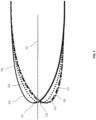
- FIG. 7 is an enlarged view of the leading-edge portion 504 of the strut cover 500 that better illustrates the offsets of the leading-edge portions 504 of the various cross-sections.
- the first cross-section 602 defines a first leading edge center 702 that is illustrated as being above the master chord plane 302. This would correspond with a twist to the left of the master chord plane 302 or counterclockwise when looking in the direction of flow (i.e., in FIG. 5 ).
- the fourth cross-section 610 defines a fourth leading edge center 704 that is illustrated as falling slightly below the master chord plane 302.
- the leading-edge nose 502 crosses the master chord plane 302 at some point between the first cross-section 602 and the fourth cross-section 610.
- the strut cover 500 illustrated in FIG. 6 and FIG. 7 has an aerodynamic shape that includes a twist of the leading-edge portion 212 with respect to the master chord plane 302 but that also includes a mid-chord portion 622 and a trailing-edge portion 214 that are symmetric with respect to the master chord plane 302.
- a plurality of struts 210 are attached to the outer casing 202 and the bearing casing 206 or other internal component to support the bearing casing 206 (or any other internal component) in the desired position.
- the size, shape, and quantity of struts 210 are selected to provide the desired support and stiffness for the bearing casing 206 or other internal components.
- the bearing casing 206 at least partially supports the rotor 122 and must provide the necessary strength for that support as well as a sufficient rigidity to minimize unwanted vibrations.
- Strut covers 500 extend between the inner flow liner 208 and the outer flow liner 204 and cover the strut 210 to protect the interior components from direct contact with the exhaust gas 128 and to provide an aerodynamic shape that reduces losses that could arise in response to flow interruptions caused by the struts 210.
- the strut covers 500 include a leading-edge portion 504 that defines a leading-edge nose 502 that is preferably positioned such that a tangent to the leading-edge nose 502 is normal to the flow direction.
- the flow exiting the turbine section 110 may have some swirl or spin.
- the strut covers 500 are similarly twisted to align the leading-edge nose 502 normal to the flow at all locations. At some point along the length of the strut covers 500 the flow exiting the turbine section 110 is flowing parallel to the central axis 114 and at this point the leading-edge nose 502 is aligned with the master chord plane 302 that divides each strut cover 500. Between this point and the inner flow liner 208, the leading-edge nose 502 may be twisted in a first direction and between this point and the outer flow liner 204, the leading-edge nose 502 may be twisted in the opposite direction.
Landscapes
- Engineering & Computer Science (AREA)
- Mechanical Engineering (AREA)
- General Engineering & Computer Science (AREA)
- Physics & Mathematics (AREA)
- Fluid Mechanics (AREA)
- Structures Of Non-Positive Displacement Pumps (AREA)
- Turbine Rotor Nozzle Sealing (AREA)
Claims (8)
- Turbine (100) für eine Gasturbine oder eine Dampfturbine, betreibbar zum Ausstoßen eines Stroms von Abgas (128) entlang einer zentralen Achse (114), wobei die Turbine Folgendes umfasst:eine Strebe (210) mit einem Strömungsabschnitt (216), positioniert innerhalb des Stroms von Abgas (128); undeine Strebenabdeckung (500), die eine Länge aufweist und positioniert ist, um den Strömungsabschnitt (216) der Strebe (210) zu umgeben, wobei die Strebenabdeckung (500) einen Vorderkantenabschnitt (504), einen Mittelsehnenabschnitt (622) und einen Hinterkantenabschnitt (620) umfasst, wobei der Mittelsehnenabschnitt (622) einen gleichförmigen Querschnitt aufweist, und wobei der Hinterkantenabschnitt (620) eine Hinterkantenmitte (614) aufweist, die so positioniert ist, dass der Mittelsehnenabschnitt (622) und der Hinterkantenabschnitt (620) symmetrisch um eine Hauptsehnenebene (302) sind, wobei die Hauptsehnenebene (302) als eine mittlere Ebene ausgelegt ist, die die Strebenabdeckung (500) im Wesentlichen zweiteilt, wobei der Vorderkantenabschnitt (504) eine Vorderkantennase (502) definiert, dadurch gekennzeichnet, dass der Vorderkantenabschnitt (504) bezüglich der Hauptsehnenebene (302) verdreht ist, und wobei die Vorderkantennase (502) entlang der Länge eine Kurve definiert, die nicht mit der Hauptsehnenebene (302) zusammenfällt.
- Turbine nach Anspruch 1, ferner umfassend einen Auslassabschnitt, umfassend eine innere Strömungsauskleidung (208) und eine äußere Strömungsauskleidung (204), die zusammenwirken, um einen ringförmigen Strömungsraum (218) zu definieren, und wobei das Abgas (128) in einer Strömungsrichtung (222) in den ringförmigen Strömungsraum (218) strömt.
- Turbine nach Anspruch 2, wobei sich die Strebenabdeckung (500) von der inneren Strömungsauskleidung (208) zur äußeren Strömungsauskleidung (204) erstreckt und die Strebe (210) abdeckt.
- Turbine nach Anspruch 3, ferner umfassend eine erste Wandauskehlung (220), definiert durch das Zusammenwirken der inneren Strömungsauskleidung (208) und der Strebenabdeckung (500) und eine zweite Wandauskehlung (220), definiert durch das Zusammenwirken der äußeren Strömungsauskleidung (204) und der Strebenabdeckung (500).
- Turbine nach Anspruch 1, wobei die Strebe (210) und die Strebenabdeckung (500) eine Strebenanordnung (200) bilden und wobei die Turbine mehrere Strebenanordnungen (200, 300) umfasst, die an einem gemeinsamen axialen Ort positioniert und gleichmäßig um die mittlere Achse (114) der Turbine verteilt sind.
- Turbine nach Anspruch 5, wobei sich jede der Strebenanordnungen (200, 300) entlang einer Achse erstreckt, die schräg zu einer radialen Achse der Turbine ist.
- Turbine nach Anspruch 1, wobei die Vorderkantennase (502) eine Kurve definiert, die nicht mit der Hauptsehnenebene (302) zusammenfällt, sodass sie gegenüber der Vorderkantennase (502) versetzt ist und die Hauptsehnenebene (302) an nicht mehr als einem Ort kreuzt.
- Turbine nach Anspruch 7, wobei die Vorderkantennase (502) eine Kurve definiert, die die Hauptsehnenebene (302) in einer einzelnen Kreuzung kreuzt.
Applications Claiming Priority (1)
| Application Number | Priority Date | Filing Date | Title |
|---|---|---|---|
| PCT/US2020/023838 WO2021188114A1 (en) | 2020-03-20 | 2020-03-20 | Strut cover for a turbine |
Publications (2)
| Publication Number | Publication Date |
|---|---|
| EP4100628A1 EP4100628A1 (de) | 2022-12-14 |
| EP4100628B1 true EP4100628B1 (de) | 2024-06-12 |
Family
ID=70296042
Family Applications (1)
| Application Number | Title | Priority Date | Filing Date |
|---|---|---|---|
| EP20720180.7A Active EP4100628B1 (de) | 2020-03-20 | 2020-03-20 | Strebenabdeckung für eine turbine |
Country Status (5)
| Country | Link |
|---|---|
| US (1) | US11739658B2 (de) |
| EP (1) | EP4100628B1 (de) |
| JP (1) | JP7398574B2 (de) |
| CN (1) | CN115335588B (de) |
| WO (1) | WO2021188114A1 (de) |
Families Citing this family (1)
| Publication number | Priority date | Publication date | Assignee | Title |
|---|---|---|---|---|
| CN115335588B (zh) * | 2020-03-20 | 2025-07-29 | 西门子能源国际公司 | 用于涡轮机的支柱罩 |
Family Cites Families (12)
| Publication number | Priority date | Publication date | Assignee | Title |
|---|---|---|---|---|
| US20040109756A1 (en) * | 2002-12-09 | 2004-06-10 | Mitsubishi Heavy Industries Ltd. | Gas turbine |
| US6860716B2 (en) * | 2003-05-29 | 2005-03-01 | General Electric Company | Turbomachine frame structure |
| DE102010022158B4 (de) * | 2010-05-20 | 2023-03-23 | Volkswagen Ag | Vorderwagenstruktur einer Fahrzeugkarosserie |
| EP2559850A1 (de) * | 2011-08-19 | 2013-02-20 | Siemens Aktiengesellschaft | Abgasdiffusor und Herstellungsverfahren für Abgasdiffusor |
| JP5222384B2 (ja) * | 2011-09-09 | 2013-06-26 | 三菱重工業株式会社 | ガスタービン |
| US9540956B2 (en) * | 2013-11-22 | 2017-01-10 | Siemens Energy, Inc. | Industrial gas turbine exhaust system with modular struts and collars |
| US9644497B2 (en) * | 2013-11-22 | 2017-05-09 | Siemens Energy, Inc. | Industrial gas turbine exhaust system with splined profile tail cone |
| ES2774176T3 (es) * | 2015-10-20 | 2020-07-17 | MTU Aero Engines AG | Carcasa intermedia para una turbina de gas |
| EP3241989A1 (de) * | 2016-05-04 | 2017-11-08 | Siemens Aktiengesellschaft | Gasturbinenabschnitt mit verbesserter stützenkonstruktion |
| KR101882104B1 (ko) * | 2016-12-20 | 2018-07-25 | 두산중공업 주식회사 | 가스터빈 |
| DE102017118583B4 (de) * | 2017-08-15 | 2021-01-21 | Deutsches Zentrum für Luft- und Raumfahrt e.V. | Anordnung von Stützstreben in einem abstromseitigen Ringraum einer Gasturbine |
| CN115335588B (zh) * | 2020-03-20 | 2025-07-29 | 西门子能源国际公司 | 用于涡轮机的支柱罩 |
-
2020
- 2020-03-20 CN CN202080098571.7A patent/CN115335588B/zh active Active
- 2020-03-20 EP EP20720180.7A patent/EP4100628B1/de active Active
- 2020-03-20 US US17/906,357 patent/US11739658B2/en active Active
- 2020-03-20 JP JP2022554262A patent/JP7398574B2/ja active Active
- 2020-03-20 WO PCT/US2020/023838 patent/WO2021188114A1/en not_active Ceased
Also Published As
| Publication number | Publication date |
|---|---|
| JP2023525626A (ja) | 2023-06-19 |
| CN115335588B (zh) | 2025-07-29 |
| US20230036034A1 (en) | 2023-02-02 |
| JP7398574B2 (ja) | 2023-12-14 |
| WO2021188114A1 (en) | 2021-09-23 |
| US11739658B2 (en) | 2023-08-29 |
| CN115335588A (zh) | 2022-11-11 |
| EP4100628A1 (de) | 2022-12-14 |
Similar Documents
| Publication | Publication Date | Title |
|---|---|---|
| US12320305B2 (en) | Aircraft turbomachine | |
| US9003812B2 (en) | Supporting structure for a gas turbine engine | |
| CN108930594B (zh) | 交叉涡轮发动机的空气轴承和热管理喷嘴布置 | |
| US11085309B2 (en) | Outer drum rotor assembly | |
| US8757965B2 (en) | Gas turbine compression system and compressor structure | |
| US20120272663A1 (en) | Centrifugal compressor assembly with stator vane row | |
| US20100080697A1 (en) | Integrated guide vane assembly | |
| US20100158684A1 (en) | Vane assembly configured for turning a flow in a gas turbine engine, a stator component comprising the vane assembly, a gas turbine and an aircraft jet engine | |
| JP5124276B2 (ja) | ガスタービン中間構造および該中間構造を含むガスタービンエンジン | |
| US11767768B2 (en) | Unison member for variable guide vane | |
| US20090123275A1 (en) | Apparatus for eliminating compressor stator vibration induced by TIP leakage vortex bursting | |
| EP1756406A1 (de) | Gasturbinen-kompressionssystem und verdichterstruktur | |
| US20140174052A1 (en) | Exhaust diffuser and method for manufacturing an exhaust diffuser | |
| EP3208421B1 (de) | Schwerpunktschaltverfahren einer turbinenschaufel und system | |
| EP4311914B1 (de) | Turbinenlaufschaufel | |
| US20160102565A1 (en) | Tip-controlled integrally bladed rotor for gas turbine engine | |
| US11739658B2 (en) | Strut cover for a turbine | |
| WO2010002294A1 (en) | A vane for a gas turbine component, a gas turbine component and a gas turbine engine | |
| US12140041B2 (en) | Stator vane for a turbomachine | |
| EP3828386B1 (de) | Turbomaschinenrotorschaufel mit variabler elliptischer hinterkante | |
| US20210301667A1 (en) | Turbomachine rotor blade with a cooling circuit having an offset rib | |
| US12618342B1 (en) | Turbine exhaust case with stiffening brace | |
| US20250305447A1 (en) | Compact core arrangement for high bypass ratio gas turbine engine architecture | |
| WO2022051760A1 (en) | Guide vane in gas turbine engine | |
| CN120720263A (zh) | 具有减小的跨度的燃气涡轮核心拉杆 |
Legal Events
| Date | Code | Title | Description |
|---|---|---|---|
| STAA | Information on the status of an ep patent application or granted ep patent |
Free format text: STATUS: UNKNOWN |
|
| STAA | Information on the status of an ep patent application or granted ep patent |
Free format text: STATUS: THE INTERNATIONAL PUBLICATION HAS BEEN MADE |
|
| PUAI | Public reference made under article 153(3) epc to a published international application that has entered the european phase |
Free format text: ORIGINAL CODE: 0009012 |
|
| STAA | Information on the status of an ep patent application or granted ep patent |
Free format text: STATUS: REQUEST FOR EXAMINATION WAS MADE |
|
| 17P | Request for examination filed |
Effective date: 20220908 |
|
| AK | Designated contracting states |
Kind code of ref document: A1 Designated state(s): AL AT BE BG CH CY CZ DE DK EE ES FI FR GB GR HR HU IE IS IT LI LT LU LV MC MK MT NL NO PL PT RO RS SE SI SK SM TR |
|
| RAP3 | Party data changed (applicant data changed or rights of an application transferred) |
Owner name: SIEMENS ENERGY GLOBAL GMBH & CO. KG |
|
| DAV | Request for validation of the european patent (deleted) | ||
| DAX | Request for extension of the european patent (deleted) | ||
| GRAP | Despatch of communication of intention to grant a patent |
Free format text: ORIGINAL CODE: EPIDOSNIGR1 |
|
| STAA | Information on the status of an ep patent application or granted ep patent |
Free format text: STATUS: GRANT OF PATENT IS INTENDED |
|
| INTG | Intention to grant announced |
Effective date: 20240111 |
|
| GRAS | Grant fee paid |
Free format text: ORIGINAL CODE: EPIDOSNIGR3 |
|
| GRAA | (expected) grant |
Free format text: ORIGINAL CODE: 0009210 |
|
| STAA | Information on the status of an ep patent application or granted ep patent |
Free format text: STATUS: THE PATENT HAS BEEN GRANTED |
|
| AK | Designated contracting states |
Kind code of ref document: B1 Designated state(s): AL AT BE BG CH CY CZ DE DK EE ES FI FR GB GR HR HU IE IS IT LI LT LU LV MC MK MT NL NO PL PT RO RS SE SI SK SM TR |
|
| REG | Reference to a national code |
Ref country code: GB Ref legal event code: FG4D |
|
| REG | Reference to a national code |
Ref country code: CH Ref legal event code: EP |
|
| REG | Reference to a national code |
Ref country code: DE Ref legal event code: R096 Ref document number: 602020032291 Country of ref document: DE |
|
| REG | Reference to a national code |
Ref country code: IE Ref legal event code: FG4D |
|
| PG25 | Lapsed in a contracting state [announced via postgrant information from national office to epo] |
Ref country code: BG Free format text: LAPSE BECAUSE OF FAILURE TO SUBMIT A TRANSLATION OF THE DESCRIPTION OR TO PAY THE FEE WITHIN THE PRESCRIBED TIME-LIMIT Effective date: 20240612 |
|
| PG25 | Lapsed in a contracting state [announced via postgrant information from national office to epo] |
Ref country code: FI Free format text: LAPSE BECAUSE OF FAILURE TO SUBMIT A TRANSLATION OF THE DESCRIPTION OR TO PAY THE FEE WITHIN THE PRESCRIBED TIME-LIMIT Effective date: 20240612 Ref country code: HR Free format text: LAPSE BECAUSE OF FAILURE TO SUBMIT A TRANSLATION OF THE DESCRIPTION OR TO PAY THE FEE WITHIN THE PRESCRIBED TIME-LIMIT Effective date: 20240612 |
|
| REG | Reference to a national code |
Ref country code: LT Ref legal event code: MG9D |
|
| PG25 | Lapsed in a contracting state [announced via postgrant information from national office to epo] |
Ref country code: GR Free format text: LAPSE BECAUSE OF FAILURE TO SUBMIT A TRANSLATION OF THE DESCRIPTION OR TO PAY THE FEE WITHIN THE PRESCRIBED TIME-LIMIT Effective date: 20240913 |
|
| REG | Reference to a national code |
Ref country code: NL Ref legal event code: MP Effective date: 20240612 |
|
| PG25 | Lapsed in a contracting state [announced via postgrant information from national office to epo] |
Ref country code: ES Free format text: LAPSE BECAUSE OF FAILURE TO SUBMIT A TRANSLATION OF THE DESCRIPTION OR TO PAY THE FEE WITHIN THE PRESCRIBED TIME-LIMIT Effective date: 20240612 |
|
| PG25 | Lapsed in a contracting state [announced via postgrant information from national office to epo] |
Ref country code: LV Free format text: LAPSE BECAUSE OF FAILURE TO SUBMIT A TRANSLATION OF THE DESCRIPTION OR TO PAY THE FEE WITHIN THE PRESCRIBED TIME-LIMIT Effective date: 20240612 |
|
| PG25 | Lapsed in a contracting state [announced via postgrant information from national office to epo] |
Ref country code: NO Free format text: LAPSE BECAUSE OF FAILURE TO SUBMIT A TRANSLATION OF THE DESCRIPTION OR TO PAY THE FEE WITHIN THE PRESCRIBED TIME-LIMIT Effective date: 20240912 Ref country code: LV Free format text: LAPSE BECAUSE OF FAILURE TO SUBMIT A TRANSLATION OF THE DESCRIPTION OR TO PAY THE FEE WITHIN THE PRESCRIBED TIME-LIMIT Effective date: 20240612 Ref country code: HR Free format text: LAPSE BECAUSE OF FAILURE TO SUBMIT A TRANSLATION OF THE DESCRIPTION OR TO PAY THE FEE WITHIN THE PRESCRIBED TIME-LIMIT Effective date: 20240612 Ref country code: GR Free format text: LAPSE BECAUSE OF FAILURE TO SUBMIT A TRANSLATION OF THE DESCRIPTION OR TO PAY THE FEE WITHIN THE PRESCRIBED TIME-LIMIT Effective date: 20240913 Ref country code: FI Free format text: LAPSE BECAUSE OF FAILURE TO SUBMIT A TRANSLATION OF THE DESCRIPTION OR TO PAY THE FEE WITHIN THE PRESCRIBED TIME-LIMIT Effective date: 20240612 Ref country code: ES Free format text: LAPSE BECAUSE OF FAILURE TO SUBMIT A TRANSLATION OF THE DESCRIPTION OR TO PAY THE FEE WITHIN THE PRESCRIBED TIME-LIMIT Effective date: 20240612 Ref country code: BG Free format text: LAPSE BECAUSE OF FAILURE TO SUBMIT A TRANSLATION OF THE DESCRIPTION OR TO PAY THE FEE WITHIN THE PRESCRIBED TIME-LIMIT Effective date: 20240612 Ref country code: RS Free format text: LAPSE BECAUSE OF FAILURE TO SUBMIT A TRANSLATION OF THE DESCRIPTION OR TO PAY THE FEE WITHIN THE PRESCRIBED TIME-LIMIT Effective date: 20240912 |
|
| PG25 | Lapsed in a contracting state [announced via postgrant information from national office to epo] |
Ref country code: NL Free format text: LAPSE BECAUSE OF FAILURE TO SUBMIT A TRANSLATION OF THE DESCRIPTION OR TO PAY THE FEE WITHIN THE PRESCRIBED TIME-LIMIT Effective date: 20240612 |
|
| REG | Reference to a national code |
Ref country code: AT Ref legal event code: MK05 Ref document number: 1694426 Country of ref document: AT Kind code of ref document: T Effective date: 20240612 |
|
| PG25 | Lapsed in a contracting state [announced via postgrant information from national office to epo] |
Ref country code: NL Free format text: LAPSE BECAUSE OF FAILURE TO SUBMIT A TRANSLATION OF THE DESCRIPTION OR TO PAY THE FEE WITHIN THE PRESCRIBED TIME-LIMIT Effective date: 20240612 |
|
| PG25 | Lapsed in a contracting state [announced via postgrant information from national office to epo] |
Ref country code: PT Free format text: LAPSE BECAUSE OF FAILURE TO SUBMIT A TRANSLATION OF THE DESCRIPTION OR TO PAY THE FEE WITHIN THE PRESCRIBED TIME-LIMIT Effective date: 20241014 |
|
| PG25 | Lapsed in a contracting state [announced via postgrant information from national office to epo] |
Ref country code: PT Free format text: LAPSE BECAUSE OF FAILURE TO SUBMIT A TRANSLATION OF THE DESCRIPTION OR TO PAY THE FEE WITHIN THE PRESCRIBED TIME-LIMIT Effective date: 20241014 |
|
| PG25 | Lapsed in a contracting state [announced via postgrant information from national office to epo] |
Ref country code: PL Free format text: LAPSE BECAUSE OF FAILURE TO SUBMIT A TRANSLATION OF THE DESCRIPTION OR TO PAY THE FEE WITHIN THE PRESCRIBED TIME-LIMIT Effective date: 20240612 |
|
| PG25 | Lapsed in a contracting state [announced via postgrant information from national office to epo] |
Ref country code: EE Free format text: LAPSE BECAUSE OF FAILURE TO SUBMIT A TRANSLATION OF THE DESCRIPTION OR TO PAY THE FEE WITHIN THE PRESCRIBED TIME-LIMIT Effective date: 20240612 |
|
| PG25 | Lapsed in a contracting state [announced via postgrant information from national office to epo] |
Ref country code: AT Free format text: LAPSE BECAUSE OF FAILURE TO SUBMIT A TRANSLATION OF THE DESCRIPTION OR TO PAY THE FEE WITHIN THE PRESCRIBED TIME-LIMIT Effective date: 20240612 Ref country code: IS Free format text: LAPSE BECAUSE OF FAILURE TO SUBMIT A TRANSLATION OF THE DESCRIPTION OR TO PAY THE FEE WITHIN THE PRESCRIBED TIME-LIMIT Effective date: 20241012 |
|
| PG25 | Lapsed in a contracting state [announced via postgrant information from national office to epo] |
Ref country code: CZ Free format text: LAPSE BECAUSE OF FAILURE TO SUBMIT A TRANSLATION OF THE DESCRIPTION OR TO PAY THE FEE WITHIN THE PRESCRIBED TIME-LIMIT Effective date: 20240612 |
|
| PG25 | Lapsed in a contracting state [announced via postgrant information from national office to epo] |
Ref country code: RO Free format text: LAPSE BECAUSE OF FAILURE TO SUBMIT A TRANSLATION OF THE DESCRIPTION OR TO PAY THE FEE WITHIN THE PRESCRIBED TIME-LIMIT Effective date: 20240612 Ref country code: SK Free format text: LAPSE BECAUSE OF FAILURE TO SUBMIT A TRANSLATION OF THE DESCRIPTION OR TO PAY THE FEE WITHIN THE PRESCRIBED TIME-LIMIT Effective date: 20240612 |
|
| PG25 | Lapsed in a contracting state [announced via postgrant information from national office to epo] |
Ref country code: SM Free format text: LAPSE BECAUSE OF FAILURE TO SUBMIT A TRANSLATION OF THE DESCRIPTION OR TO PAY THE FEE WITHIN THE PRESCRIBED TIME-LIMIT Effective date: 20240612 |
|
| PG25 | Lapsed in a contracting state [announced via postgrant information from national office to epo] |
Ref country code: SM Free format text: LAPSE BECAUSE OF FAILURE TO SUBMIT A TRANSLATION OF THE DESCRIPTION OR TO PAY THE FEE WITHIN THE PRESCRIBED TIME-LIMIT Effective date: 20240612 Ref country code: SK Free format text: LAPSE BECAUSE OF FAILURE TO SUBMIT A TRANSLATION OF THE DESCRIPTION OR TO PAY THE FEE WITHIN THE PRESCRIBED TIME-LIMIT Effective date: 20240612 Ref country code: RO Free format text: LAPSE BECAUSE OF FAILURE TO SUBMIT A TRANSLATION OF THE DESCRIPTION OR TO PAY THE FEE WITHIN THE PRESCRIBED TIME-LIMIT Effective date: 20240612 Ref country code: PL Free format text: LAPSE BECAUSE OF FAILURE TO SUBMIT A TRANSLATION OF THE DESCRIPTION OR TO PAY THE FEE WITHIN THE PRESCRIBED TIME-LIMIT Effective date: 20240612 Ref country code: IS Free format text: LAPSE BECAUSE OF FAILURE TO SUBMIT A TRANSLATION OF THE DESCRIPTION OR TO PAY THE FEE WITHIN THE PRESCRIBED TIME-LIMIT Effective date: 20241012 Ref country code: EE Free format text: LAPSE BECAUSE OF FAILURE TO SUBMIT A TRANSLATION OF THE DESCRIPTION OR TO PAY THE FEE WITHIN THE PRESCRIBED TIME-LIMIT Effective date: 20240612 Ref country code: CZ Free format text: LAPSE BECAUSE OF FAILURE TO SUBMIT A TRANSLATION OF THE DESCRIPTION OR TO PAY THE FEE WITHIN THE PRESCRIBED TIME-LIMIT Effective date: 20240612 Ref country code: AT Free format text: LAPSE BECAUSE OF FAILURE TO SUBMIT A TRANSLATION OF THE DESCRIPTION OR TO PAY THE FEE WITHIN THE PRESCRIBED TIME-LIMIT Effective date: 20240612 |
|
| REG | Reference to a national code |
Ref country code: DE Ref legal event code: R097 Ref document number: 602020032291 Country of ref document: DE |
|
| PG25 | Lapsed in a contracting state [announced via postgrant information from national office to epo] |
Ref country code: DK Free format text: LAPSE BECAUSE OF FAILURE TO SUBMIT A TRANSLATION OF THE DESCRIPTION OR TO PAY THE FEE WITHIN THE PRESCRIBED TIME-LIMIT Effective date: 20240612 |
|
| PLBE | No opposition filed within time limit |
Free format text: ORIGINAL CODE: 0009261 |
|
| STAA | Information on the status of an ep patent application or granted ep patent |
Free format text: STATUS: NO OPPOSITION FILED WITHIN TIME LIMIT |
|
| 26N | No opposition filed |
Effective date: 20250313 |
|
| PG25 | Lapsed in a contracting state [announced via postgrant information from national office to epo] |
Ref country code: SE Free format text: LAPSE BECAUSE OF FAILURE TO SUBMIT A TRANSLATION OF THE DESCRIPTION OR TO PAY THE FEE WITHIN THE PRESCRIBED TIME-LIMIT Effective date: 20240612 |
|
| PG25 | Lapsed in a contracting state [announced via postgrant information from national office to epo] |
Ref country code: MC Free format text: LAPSE BECAUSE OF FAILURE TO SUBMIT A TRANSLATION OF THE DESCRIPTION OR TO PAY THE FEE WITHIN THE PRESCRIBED TIME-LIMIT Effective date: 20240612 |
|
| PG25 | Lapsed in a contracting state [announced via postgrant information from national office to epo] |
Ref country code: LU Free format text: LAPSE BECAUSE OF NON-PAYMENT OF DUE FEES Effective date: 20250320 |
|
| REG | Reference to a national code |
Ref country code: BE Ref legal event code: MM Effective date: 20250331 |
|
| PG25 | Lapsed in a contracting state [announced via postgrant information from national office to epo] |
Ref country code: BE Free format text: LAPSE BECAUSE OF NON-PAYMENT OF DUE FEES Effective date: 20250331 |
|
| PG25 | Lapsed in a contracting state [announced via postgrant information from national office to epo] |
Ref country code: IE Free format text: LAPSE BECAUSE OF NON-PAYMENT OF DUE FEES Effective date: 20250320 |
|
| REG | Reference to a national code |
Ref country code: CH Ref legal event code: U11 Free format text: ST27 STATUS EVENT CODE: U-0-0-U10-U11 (AS PROVIDED BY THE NATIONAL OFFICE) Effective date: 20260401 |
|
| PGFP | Annual fee paid to national office [announced via postgrant information from national office to epo] |
Ref country code: GB Payment date: 20260323 Year of fee payment: 7 |
|
| PGFP | Annual fee paid to national office [announced via postgrant information from national office to epo] |
Ref country code: DE Payment date: 20260320 Year of fee payment: 7 |
|
| PGFP | Annual fee paid to national office [announced via postgrant information from national office to epo] |
Ref country code: IT Payment date: 20260320 Year of fee payment: 7 |
|
| PGFP | Annual fee paid to national office [announced via postgrant information from national office to epo] |
Ref country code: FR Payment date: 20260323 Year of fee payment: 7 |
|
| PG25 | Lapsed in a contracting state [announced via postgrant information from national office to epo] |
Ref country code: CY Free format text: LAPSE BECAUSE OF FAILURE TO SUBMIT A TRANSLATION OF THE DESCRIPTION OR TO PAY THE FEE WITHIN THE PRESCRIBED TIME-LIMIT Effective date: 20240612 |
|
| PG25 | Lapsed in a contracting state [announced via postgrant information from national office to epo] |
Ref country code: LT Free format text: LAPSE BECAUSE OF FAILURE TO SUBMIT A TRANSLATION OF THE DESCRIPTION OR TO PAY THE FEE WITHIN THE PRESCRIBED TIME-LIMIT Effective date: 20240612 |
|
| PG25 | Lapsed in a contracting state [announced via postgrant information from national office to epo] |
Ref country code: TR Free format text: LAPSE BECAUSE OF FAILURE TO SUBMIT A TRANSLATION OF THE DESCRIPTION OR TO PAY THE FEE WITHIN THE PRESCRIBED TIME-LIMIT Effective date: 20240612 |
|
| PGFP | Annual fee paid to national office [announced via postgrant information from national office to epo] |
Ref country code: CH Payment date: 20260401 Year of fee payment: 7 |