EP4100286B1 - Système de nettoyage de capteur pour un véhicule et procédé de nettoyage d'un capteur - Google Patents
Système de nettoyage de capteur pour un véhicule et procédé de nettoyage d'un capteur Download PDFInfo
- Publication number
- EP4100286B1 EP4100286B1 EP20703999.1A EP20703999A EP4100286B1 EP 4100286 B1 EP4100286 B1 EP 4100286B1 EP 20703999 A EP20703999 A EP 20703999A EP 4100286 B1 EP4100286 B1 EP 4100286B1
- Authority
- EP
- European Patent Office
- Prior art keywords
- gas
- cleaning fluid
- cleaning
- accumulator
- sensor
- Prior art date
- Legal status (The legal status is an assumption and is not a legal conclusion. Google has not performed a legal analysis and makes no representation as to the accuracy of the status listed.)
- Active
Links
Images

Classifications
-
- B—PERFORMING OPERATIONS; TRANSPORTING
- B60—VEHICLES IN GENERAL
- B60S—SERVICING, CLEANING, REPAIRING, SUPPORTING, LIFTING, OR MANOEUVRING OF VEHICLES, NOT OTHERWISE PROVIDED FOR
- B60S1/00—Cleaning of vehicles
- B60S1/02—Cleaning windscreens, windows or optical devices
- B60S1/46—Cleaning windscreens, windows or optical devices using liquid; Windscreen washers
- B60S1/48—Liquid supply therefor
- B60S1/52—Arrangement of nozzles; Liquid spreading means
-
- B—PERFORMING OPERATIONS; TRANSPORTING
- B60—VEHICLES IN GENERAL
- B60S—SERVICING, CLEANING, REPAIRING, SUPPORTING, LIFTING, OR MANOEUVRING OF VEHICLES, NOT OTHERWISE PROVIDED FOR
- B60S1/00—Cleaning of vehicles
- B60S1/02—Cleaning windscreens, windows or optical devices
- B60S1/56—Cleaning windscreens, windows or optical devices specially adapted for cleaning other parts or devices than front windows or windscreens
-
- B—PERFORMING OPERATIONS; TRANSPORTING
- B08—CLEANING
- B08B—CLEANING IN GENERAL; PREVENTION OF FOULING IN GENERAL
- B08B5/00—Cleaning by methods involving the use of air flow or gas flow
- B08B5/02—Cleaning by the force of jets, e.g. blowing-out cavities
-
- B—PERFORMING OPERATIONS; TRANSPORTING
- B60—VEHICLES IN GENERAL
- B60S—SERVICING, CLEANING, REPAIRING, SUPPORTING, LIFTING, OR MANOEUVRING OF VEHICLES, NOT OTHERWISE PROVIDED FOR
- B60S1/00—Cleaning of vehicles
- B60S1/02—Cleaning windscreens, windows or optical devices
- B60S1/46—Cleaning windscreens, windows or optical devices using liquid; Windscreen washers
- B60S1/48—Liquid supply therefor
- B60S1/481—Liquid supply therefor the operation of at least part of the liquid supply being controlled by electric means
-
- B—PERFORMING OPERATIONS; TRANSPORTING
- B60—VEHICLES IN GENERAL
- B60S—SERVICING, CLEANING, REPAIRING, SUPPORTING, LIFTING, OR MANOEUVRING OF VEHICLES, NOT OTHERWISE PROVIDED FOR
- B60S1/00—Cleaning of vehicles
- B60S1/02—Cleaning windscreens, windows or optical devices
- B60S1/54—Cleaning windscreens, windows or optical devices using gas, e.g. hot air
-
- B—PERFORMING OPERATIONS; TRANSPORTING
- B60—VEHICLES IN GENERAL
- B60S—SERVICING, CLEANING, REPAIRING, SUPPORTING, LIFTING, OR MANOEUVRING OF VEHICLES, NOT OTHERWISE PROVIDED FOR
- B60S1/00—Cleaning of vehicles
- B60S1/02—Cleaning windscreens, windows or optical devices
- B60S1/46—Cleaning windscreens, windows or optical devices using liquid; Windscreen washers
- B60S1/48—Liquid supply therefor
- B60S1/50—Arrangement of reservoir
Definitions
- the invention relates to a sensor cleaning system for a vehicle.
- the invention further relates to a method for cleaning a sensor thanks to this cleaning system.
- the invention can be applied in vehicles including heavy-duty vehicles, such as trucks, buses and construction equipment, in particular in automated vehicles.
- vehicles including heavy-duty vehicles, such as trucks, buses and construction equipment, in particular in automated vehicles.
- the invention will be described with respect to an automated vehicle, the invention is not restricted to this particular vehicle, but may also be used in other vehicles including sensors.
- the invention is directed to a vehicle including a sensor such as a light detection and ranging (LIDAR), a camera, a RADAR, a SONAR, an infrared system...
- a sensor such as a light detection and ranging (LIDAR), a camera, a RADAR, a SONAR, an infrared system...
- Vehicles in particular autonomous vehicles, require sensors in order to capture data of a surrounding vehicle environment.
- sensors may become soiled and therefore may capture partial or incorrect data. This may lead to reduced safety outcome.
- the vehicle may need to switch to a safe mode which may include for instance coming to a halt and/or activating hazard lights.
- An object of the invention is to provide a very reactive system for cleaning a sensor, that solve at least the previous problem of the prior art.
- the invention relates to a cleaning system for cleaning a vehicle sensor, comprising:
- the cleaning device avoids having a cleaning fluid tank kept under constant pressure, and therefore avoids the risks of leakage of fluid.
- the cleaning system will require less power, as no pump need to work all times to spray cleaning fluid to a sensor to be cleaned.
- the cleaning fluid and gas pressure applied to the sensor to be cleaned can be adapted thanks to the accumulator, for instance by managing the opening of the cleaning fluid outlet and/or the gas outlet.
- the accumulator is easily rechargeable via the cleaning fluid inlet and the gas inlet. Therefore, the cleaning system can be assigned to sensors of a vehicle, which are located at different areas of the vehicle.
- the accumulator of the cleaning system can be placed nearby a sensor to be cleaned in order to have a very reactive cleaning system.
- the cleaning system comprises:
- the tensioning elements are arranged to be operated when the valves are opened to spray cleaning fluid and gas from the accumulator to the sensor to be cleaned.
- the cleaning system comprises a control unit connected to the outlet cleaning fluid valve and the outlet gas valve.
- the control unit is configured to operate the valves in order to supply cleaning fluid and gas to the sensor to be cleaned.
- the outlet valves are preferably electrovalves.
- the cleaning system further comprises:
- the gas tank is a pressurized tank.
- the cleaning system further comprises an inlet gas valve between the gas tank and the accumulator, for controlling the flow of gas supplied to the accumulator.
- the inlet gas valve is advantageously connected to the control unit. Therefore, the control unit is configured to operate the inlet gas valve in order to control the flow of gas supplied to the accumulator.
- the inlet gas valve is preferably an electrovalve.
- the gas tank is not a pressurized tank and the cleaning system comprises a gas pump arranged in communication with the gas tank and the gas inlet of the accumulator.
- the gas pump allows to refill the accumulator with gas. As the gas is not pressurized in the accumulator, this pump is with low flow capacity. Therefore, this pump does not involve many costs.
- the gas pump is advantageously connected to the control unit. Therefore, the control unit is configured to operate the gas pump in order to supply gas to the accumulator.
- the cleaning fluid tank is a pressurized tank.
- the cleaning system further comprises an inlet cleaning fluid valve between the cleaning fluid tank and the accumulator, for controlling the flow of cleaning fluid supplied to the accumulator.
- the inlet cleaning fluid valve is advantageously connected to the control unit. Therefore, the control unit is configured to operate the inlet cleaning fluid valve in order to control the flow of cleaning fluid supplied to the accumulator.
- the inlet cleaning fluid valve is preferably an electrovalve.
- the cleaning fluid tank is not a pressurized tank and the cleaning system comprises a cleaning fluid pump arranged in communication with the cleaning fluid tank and the cleaning fluid inlet of the accumulator.
- the cleaning fluid pump allows to refill the accumulator with cleaning fluid. As the cleaning fluid is not pressurized in the accumulator, this pump is with low flow capacity. Therefore, this pump do not involve many costs.
- the cleaning fluid pump is advantageously connected to the control unit. Therefore, the control unit is configured to operate the cleaning fluid pump in order to supply cleaning fluid to the accumulator.
- the cleaning system can comprise level sensors arranged to provide a signal representing the level of cleaning fluid and gas in the accumulator. In this way, the accumulator can be refilled when needed.
- the level sensors are advantageously connected to the control unit. Therefore, the control unit is configured to receive the signal and to operate the pumps and/or inlet valves based on the signal.
- the control unit is configured such that a signal indicating a level below a predetermined value operates the cleaning fluid pump or inlet cleaning fluid valve, and/or the gas pump or inlet gas valve to supply cleaning fluid and/or gas from the cleaning fluid container and/or the gas container to the accumulator and increase the level of cleaning fluid and/or gas in the accumulator.
- the cleaning system comprises a soil sensor arranged to provide a signal when the sensor to be cleaned is soiled.
- control unit is also connected to the soil sensor for measuring when the sensor to be cleaned is soiled. Therefore, the control unit is configured to operate the outlet valves based on the signal.
- the control unit is configured such that when a signal indicates that a sensor is soiled, the control unit operates the outlet cleaning fluid valve and/or the outlet gas valve to supply cleaning fluid and/or gas to the sensor to be cleaned.
- the control unit is preferably an electronic control unit (ECU).
- ECU electronice control unit
- the tensioning elements are for example springs with membrane.
- the cleaning fluid can be water.
- the gas can be air.
- the cleaning fluid compartment is concentrically arranged around the gas compartment. This arrangement proves to be advantageous as it makes the accumulator very compact.
- a vehicle comprising a vehicle sensor associated with a cleaning system previously described.
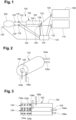
- Figure 1 shows a cleaning system 100 intended to clean a vehicle sensor 200 such as a light detection and ranging (Lidar) sensor.
- vehicle sensor 200 such as a light detection and ranging (Lidar) sensor.
- the cleaning system 100 comprises an accumulator 102 arranged for storing water and air that will be used for cleaning the sensor 200.
- the accumulator 102 comprises a water compartment 104 and an air compartment 106.
- the accumulator 102 will be more specifically described with regards to figures 2 and 3 .
- the cleaning system 100 comprises an outlet water electrovalve 116 and an outlet air electrovalve 118, for controlling the flow of water and air applied to the sensor 200.
- the outlet water electrovalve 116 is arranged in fluid communication with the water compartment 104 of the accumulator 102 and the outlet air electrovalve 118 is arranged in air communication with the air compartment 106 of the accumulator 102.
- Spray devices 120, 120' which are respectively in fluid communication with the outlet water electrovalve 116 and in air communication with the outlet air electrovalve 118.
- the cleaning system 100 comprises a water tank 108 and an air tank 110.
- the water tank 108 and the air tank 110 are pressurized.
- the cleaning system 100 comprises an inlet water valve 130 positioned between the water tank 108 and the water compartment 104 of the accumulator 102.
- the cleaning system 100 comprises an inlet air valve 132 positioned between the air tank 110 and the air compartment 106 of the accumulator 102.
- the inlet water valve 130 enables to control the flow of water supplied to the accumulator 102.
- the inlet air valve 132 enables to control the flow of air supplied to the accumulator 102.
- the fluid and air communications are preferably effected through pipes 122.
- a control unit 124 such as an electronic control unit (ECU) enables to control the supplying of water and air to the sensor 200 from the accumulator 102To this end, the control unit 124 is connected to a soil sensor 126 arranged to provide a signal to the control unit 124, when the sensor 200 is soiled, and the control unit 124 is connected to the outlet water electrovalve 116 and the outlet air electrovalve 118, in order to operate the electrovalves 116, 118 to supply water and air to the sensor 200 when the signal is received by the control unit 124.
- ECU electronice control unit
- the water compartment 104 and the air compartment 106 comprise a sensor 128 arranged to provide a signal representing the level of water and air in the accumulator.
- the control unit 124 enables to control the supplying of water and air to the accumulator 102. To this end, the control unit 124 is connected to the level sensors 128 positioned in the accumulator. Moreover, in the example of figure 1 , where the water and air tanks are pressurized, the inlet water valve 130 and the inlet air valve 132 are connected to the control unit 124. In this way, the control unit 124 operates the inlet water valve 130 and the inlet air valve 132 when a signal is received from the level sensors 128.
- the water tank 108 is arranged in fluid communication with a water pump 112, which is arranged in fluid communication with the water compartment 104 of the accumulator 102 and/or the air tank 110 is arranged in air communication with an air pump 114, which is arranged in air communication with the air compartment 106 of the accumulator 102.
- control unit 124 is connected to the water pump 112 and the air pump 114, in order to operate the pumps 112, 114 to refill the accumulator 102 when the signal is received by the control unit 124. More particularly, the control unit 124 is connected to two level sensors 128, one in the water compartment 104 and one in the air compartment.
- the accumulator 102 is cylindrical and the water compartment 104 can be concentrically arranged around the air compartment 106. This arrangement proves to be advantageous as it makes the accumulator very compact.
- the water compartment 104 comprises a water inlet 104a which is in fluidic communication through pipes 122 with the water tank 108 ( figure 1 ). Furthermore, the water compartment 104 comprises a water outlet 104b from where the water may exit to be able to spray upon the sensor 200 ( figure 1 ).
- the air compartment 106 comprises an air inlet 106a which is in air communication through pipes 122 with the air tank 110 ( figure 1 ), and the air compartment 106 comprises an air outlet 106b from where the air may exit to be able to spray upon the sensor 200 ( figure 1 ).
- the accumulator 102 comprises tensioning elements 134 in the water compartment 104 and in the air compartment 106.
- the tensioning elements 134 are of the mechanical type and are spring loaded.
- Each tensioning element 134 is comprised of, for example, a spring 134a with a membrane 134b.
- the tensioning elements 134 are arranged to mechanically store energy in order to supply energy to release water and/or air to the spray devices when the outlet water electrovalve 116 and/or the outlet air electrovalve 118 are operated by the control unit 124.
- Figures 4 to 6 illustrates a truck 300 with a vehicle sensor 200 and a cleaning system 100 to clean the vehicle sensor 200.
- the sensor 200 can be a Lidar sensor comprising a shell 202 and a screen 204.
- the cleaning system 100 comprises an accumulator 102 with a water compartment 104 and an air compartment 106 ( figures 1 to 3 ) which are connected to spray devices ( figure 1 ) via pipes 122, in order to spray water and/or air to the sensor 200 when outlet water electrovalve 116 and/or outlet air electrovalve 118 are operated by a control unit ( figure 1 ).
- the sensor 200 represented in figures 4 to 6 is a Lidar sensor disposed on a corner of the truck 300.
Landscapes
- Engineering & Computer Science (AREA)
- Mechanical Engineering (AREA)
- Water Supply & Treatment (AREA)
- Cleaning By Liquid Or Steam (AREA)
Claims (15)
- Système de nettoyage (100) pour nettoyer un capteur de véhicule (200), comprenant :- un accumulateur (102) comprenant :∘ au moins un compartiment de fluide de nettoyage (104) muni :▪ d'au moins un élément de tension (134),▪ d'une entrée de fluide de nettoyage (104a) pour recevoir un fluide de nettoyage, et▪ d'une sortie de fluide de nettoyage (104b) pour fournir un fluide de nettoyage sous la forme d'un jet de fluide de nettoyage,∘ au moins un compartiment de gaz (106) muni :▪ d'au moins un élément de tension (134),▪ d'une entrée de gaz (106a) pour recevoir du gaz, et▪ d'une sortie de gaz (106b) pour fournir du gaz sous la forme d'un jet de gaz,- un dispositif de pulvérisation de fluide de nettoyage (120) configuré pour pulvériser un fluide de nettoyage sur le capteur de véhicule (200),- un dispositif de pulvérisation de gaz (120') configuré pour pulvériser du gaz sur le capteur de véhicule (200).
- Système de nettoyage selon la revendication 1, caractérisé en ce qu'il comprend :- une soupape de fluide de nettoyage de sortie (116) pour commander le flux de fluide de nettoyage appliqué au capteur de véhicule, et- une soupape de gaz de sortie (118) pour commander le flux de gaz appliqué au capteur de véhicule,dans lequel la soupape de nettoyage de sortie (116) et la soupape de gaz de sortie (118) sont de préférence des électrovannes.
- Système de nettoyage selon la revendication 2, caractérisé en ce qu'il comprend une unité de commande (124) reliée à la soupape de fluide de nettoyage de sortie (116) et à la soupape de gaz de sortie (118).
- Système de nettoyage selon l'une quelconque des revendications 1 à 3, caractérisé en ce qu'il comprend :- un réservoir de fluide de nettoyage (108),- un réservoir de gaz (110),- une pompe à fluide de nettoyage (112) reliée au réservoir de fluide de nettoyage (108) et à l'entrée de fluide de nettoyage (104a) de l'accumulateur (102), et- une pompe à gaz (114) reliée au réservoir de gaz (110) et à l'entrée de gaz (106a) de l'accumulateur (102).
- Système de nettoyage selon la revendication 4 en combinaison avec la revendication 3, caractérisé en ce que les pompes (112, 114) sont reliées à l'unité de commande (124).
- Système de nettoyage selon l'une quelconque des revendications 1 à 5, caractérisé en ce qu'il comprend des capteurs de niveau (128) agencés pour fournir un signal représentant le niveau de fluide de nettoyage et de gaz dans l'accumulateur (102).
- Système de nettoyage selon la revendication 6 en combinaison avec la revendication 3, caractérisé en ce que les capteurs de niveau (128) sont reliés à l'unité de commande (124).
- Système de nettoyage selon l'une quelconque des revendications 4 à 7, caractérisé en ce qu'il comprend :- une soupape de fluide de nettoyage d'entrée (130) entre le réservoir de fluide de nettoyage (108) et la pompe à fluide de nettoyage (112), pour commander le flux de fluide de nettoyage à travers la pompe à fluide de nettoyage (112), et- une soupape de gaz d'entrée (132) entre le réservoir de gaz (110) et la pompe à gaz (114), pour commander le flux de gaz à travers la pompe à gaz (114),dans lequel la soupape de nettoyage d'entrée (130) et la soupape de gaz d'entrée (132) sont de préférence des électrovannes.
- Système de nettoyage selon la revendication 8 en combinaison avec la revendication 3, caractérisé en ce que les soupapes d'entrée (130, 132) sont reliées à l'unité de commande (124).
- Système de nettoyage selon l'une quelconque des revendications 1 à 9, caractérisé en ce qu'il comprend un capteur de salissure (126) agencé pour fournir une alerte lorsque le capteur (200) est sali.
- Système de nettoyage selon la revendication 10 en combinaison avec la revendication 3, caractérisé en ce que l'unité de commande (124) est également reliée au capteur de salissure (126) pour mesurer le moment où le capteur (200) est sali.
- Système de nettoyage selon l'une quelconque des revendications 1 à 11, caractérisé en ce que les éléments de tension (134) sont des ressorts (134a) avec membrane (134b).
- Système de nettoyage selon l'une quelconque des revendications 1 à 12, caractérisé en ce que le compartiment de fluide de nettoyage (104) est agencé de manière concentrique autour du compartiment de gaz (106).
- Procédé de nettoyage d'un capteur de véhicule (200) utilisant un système de nettoyage selon l'une quelconque des revendications 1 à 13, le procédé comprenant :- la mesure du niveau de fluide de nettoyage et de gaz dans les compartiments de fluide de nettoyage et de gaz de l'accumulateur ;- le remplissage des compartiments de fluide de nettoyage et de gaz de l'accumulateur respectivement avec du fluide de nettoyage et du gaz pour stocker de l'énergie dans l'accumulateur,- la pulvérisation du fluide de nettoyage et du gaz afin de fournir du fluide de nettoyage et du gaz sur le capteur de véhicule.
- Véhicule (300) comprenant un capteur de véhicule (200) associé à un système de nettoyage (100) selon l'une quelconque des revendications 1 à 13.
Applications Claiming Priority (1)
| Application Number | Priority Date | Filing Date | Title |
|---|---|---|---|
| PCT/EP2020/052988 WO2021155931A1 (fr) | 2020-02-06 | 2020-02-06 | Système de nettoyage de capteur pour un véhicule et procédé de nettoyage d'un capteur |
Publications (3)
| Publication Number | Publication Date |
|---|---|
| EP4100286A1 EP4100286A1 (fr) | 2022-12-14 |
| EP4100286C0 EP4100286C0 (fr) | 2024-04-10 |
| EP4100286B1 true EP4100286B1 (fr) | 2024-04-10 |
Family
ID=69500749
Family Applications (1)
| Application Number | Title | Priority Date | Filing Date |
|---|---|---|---|
| EP20703999.1A Active EP4100286B1 (fr) | 2020-02-06 | 2020-02-06 | Système de nettoyage de capteur pour un véhicule et procédé de nettoyage d'un capteur |
Country Status (4)
| Country | Link |
|---|---|
| US (1) | US12269438B2 (fr) |
| EP (1) | EP4100286B1 (fr) |
| CN (1) | CN115023375A (fr) |
| WO (1) | WO2021155931A1 (fr) |
Families Citing this family (1)
| Publication number | Priority date | Publication date | Assignee | Title |
|---|---|---|---|---|
| CN114321026B (zh) * | 2022-03-11 | 2022-06-14 | 亿昇(天津)科技有限公司 | 一种清洗装置 |
Family Cites Families (25)
| Publication number | Priority date | Publication date | Assignee | Title |
|---|---|---|---|---|
| DE3526430A1 (de) * | 1985-07-24 | 1987-02-05 | Swf Auto Electric Gmbh | Scheibenreinigungsanlage |
| JP3857563B2 (ja) * | 2001-08-24 | 2006-12-13 | アスモ株式会社 | 車両用ウォッシャシステム |
| AU2004244652B2 (en) * | 2004-01-06 | 2011-09-29 | Eaton Corporation | Trapped gas removal in liquid-gas accumulator |
| US20110155192A1 (en) * | 2008-02-27 | 2011-06-30 | Nadeem Ahmad | System and apparatus for automatic built-in vehicle washing and other operations |
| US8739950B2 (en) * | 2008-09-25 | 2014-06-03 | Gm Global Technology Operations, Llc | Auxiliary pump system for hybrid powertrains |
| US8568262B2 (en) * | 2009-11-13 | 2013-10-29 | GM Global Technology Operations LLC | Transmission hydraulic control system having a main line feed accumulator |
| US8887498B2 (en) * | 2009-12-18 | 2014-11-18 | Gm Global Technology Operations, Llc | Transmission hydraulic control system having an accumulator bypass valve assembly |
| US8996257B2 (en) * | 2013-02-01 | 2015-03-31 | GM Global Technology Operations LLC | Vehicle anti-icing and de-icing systems and corresponding methods of operation |
| EP2815936B1 (fr) * | 2013-06-18 | 2017-03-29 | Volvo Car Corporation | Lave-glace |
| WO2015120866A1 (fr) * | 2014-02-14 | 2015-08-20 | Kautex Textron Gmbh & Co. Kg | Système de nettoyage à air et à fluide et procédé pour nettoyer des dispositifs de vision de véhicule |
| WO2017080614A1 (fr) | 2015-11-13 | 2017-05-18 | Fico Transpar, S.A. | Système de nettoyage d'un capteur monté sur un véhicule |
| GB2538306B (en) * | 2015-05-15 | 2017-09-20 | Dyson Technology Ltd | Cleaning appliance |
| FR3050421B1 (fr) * | 2016-04-21 | 2018-04-27 | Valeo Systemes D'essuyage | Dispositif de nettoyage d’un capteur d’un systeme de detection optique de vehicule automobile |
| KR101813133B1 (ko) * | 2016-06-03 | 2018-01-05 | 에이에스티 주식회사 | 자동차용 카메라 렌즈 세척장치 |
| US10220817B2 (en) * | 2016-07-18 | 2019-03-05 | Uber Technologies, Inc. | Sensor cleaning system for vehicles |
| US20180201231A1 (en) * | 2017-01-18 | 2018-07-19 | Denso Ten Limited | Foreign substance removal control device |
| WO2018187089A1 (fr) | 2017-04-07 | 2018-10-11 | Uber Technologies, Inc. | Système de nettoyage de capteur de véhicule autonome |
| US10857980B2 (en) * | 2017-04-07 | 2020-12-08 | Uatc, Llc | Autonomous vehicle sensor cleaning system |
| RU2662787C1 (ru) * | 2017-06-08 | 2018-07-30 | Федеральное государственное бюджетное образовательное учреждение высшего образования "Казанский государственный энергетический университет" (ФГБОУ ВО "КГЭУ") | Ветрогидроаккумулирующая электроустановка |
| US10189429B2 (en) | 2017-06-26 | 2019-01-29 | Ford Global Technologies, Llc | Vehicle sensor cleaning based on a vehicle occupancy status |
| WO2019012882A1 (fr) | 2017-07-11 | 2019-01-17 | 株式会社デンソー | Dispositif de nettoyage de capteur embarqué |
| EP3686067B1 (fr) * | 2017-09-19 | 2021-10-27 | Koito Manufacturing Co., Ltd. | Dispositif de lavage pour véhicules |
| JP7077097B2 (ja) * | 2018-03-28 | 2022-05-30 | 日立Astemo株式会社 | エアサスペンションシステム、および、カメラ洗浄システム |
| WO2020006320A1 (fr) * | 2018-06-27 | 2020-01-02 | Deane Geoffrey F | Systèmes et procédés de nettoyage, de séchage et/ou de gestion thermique d'une surface de perception |
| CN209406949U (zh) * | 2018-12-29 | 2019-09-20 | 苏州小科清洁科技有限公司 | 一种设有蓄能器的清洗机 |
-
2020
- 2020-02-06 CN CN202080094957.0A patent/CN115023375A/zh active Pending
- 2020-02-06 EP EP20703999.1A patent/EP4100286B1/fr active Active
- 2020-02-06 WO PCT/EP2020/052988 patent/WO2021155931A1/fr not_active Ceased
- 2020-02-06 US US17/795,443 patent/US12269438B2/en active Active
Also Published As
| Publication number | Publication date |
|---|---|
| WO2021155931A1 (fr) | 2021-08-12 |
| EP4100286C0 (fr) | 2024-04-10 |
| US20230060169A1 (en) | 2023-03-02 |
| CN115023375A (zh) | 2022-09-06 |
| US12269438B2 (en) | 2025-04-08 |
| EP4100286A1 (fr) | 2022-12-14 |
Similar Documents
| Publication | Publication Date | Title |
|---|---|---|
| US20220017047A1 (en) | Sensor Cleaning System for Vehicles | |
| US10189450B2 (en) | Sensor cleaning system for vehicles | |
| US20180015908A1 (en) | Sensor cleaning system for vehicles | |
| US4057364A (en) | Fluid transfer systems and valves therefor | |
| US8291928B2 (en) | Vacuum-actuated shear valve device, system, and method, particularly for use in service station environments | |
| EP2815936B1 (fr) | Lave-glace | |
| KR20190133241A (ko) | 자동차용 자율 세정 시스템 | |
| US20250162543A1 (en) | Automated fluid dispensing systems for cleaning vision-based surfaces | |
| WO1998030394A1 (fr) | Systeme d'alimentation en encre pour tete d'impression a jet d'encre | |
| EP4194283B1 (fr) | Système de distribution de fluide pour nettoyer des surfaces de véhicule | |
| EP4100286B1 (fr) | Système de nettoyage de capteur pour un véhicule et procédé de nettoyage d'un capteur | |
| US20230166694A1 (en) | Assisted sensor cleaning system | |
| US5711456A (en) | Above ground fuel transfer module | |
| US7575015B2 (en) | Secondarily contained in-dispenser sump/pan system and method for capturing and monitoring leaks | |
| CN215907975U (zh) | 一种船用管线液氨回收系统 | |
| US10830031B2 (en) | Mobile distribution station having satellite dish | |
| EP4247672B1 (fr) | Dispositif de nettoyage, un véhicule et procédés correspondants | |
| US20240101072A1 (en) | Systems, methods, and technologies for cleaning and maintaining operability of vehicle sensors | |
| CN114641645A (zh) | 用于燃料电池罐的温度压力卸载的罐设备 | |
| KR102882172B1 (ko) | 탱크로리 원격제어 및 모니터링 시스템 | |
| US6119735A (en) | Filling of tanks with volatile liquids | |
| JP2519276Y2 (ja) | ガス供給用スタンド | |
| US5944091A (en) | Tank container cooling system | |
| WO2024072767A1 (fr) | Systèmes, procédés et technologies de nettoyage et de maintien de l'exploitabilité de capteurs de véhicule | |
| WO2018135989A1 (fr) | Système d'alimentation en carburant et véhicule terrestre |
Legal Events
| Date | Code | Title | Description |
|---|---|---|---|
| STAA | Information on the status of an ep patent application or granted ep patent |
Free format text: STATUS: UNKNOWN |
|
| STAA | Information on the status of an ep patent application or granted ep patent |
Free format text: STATUS: THE INTERNATIONAL PUBLICATION HAS BEEN MADE |
|
| PUAI | Public reference made under article 153(3) epc to a published international application that has entered the european phase |
Free format text: ORIGINAL CODE: 0009012 |
|
| STAA | Information on the status of an ep patent application or granted ep patent |
Free format text: STATUS: REQUEST FOR EXAMINATION WAS MADE |
|
| 17P | Request for examination filed |
Effective date: 20220705 |
|
| AK | Designated contracting states |
Kind code of ref document: A1 Designated state(s): AL AT BE BG CH CY CZ DE DK EE ES FI FR GB GR HR HU IE IS IT LI LT LU LV MC MK MT NL NO PL PT RO RS SE SI SK SM TR |
|
| DAV | Request for validation of the european patent (deleted) | ||
| DAX | Request for extension of the european patent (deleted) | ||
| GRAP | Despatch of communication of intention to grant a patent |
Free format text: ORIGINAL CODE: EPIDOSNIGR1 |
|
| STAA | Information on the status of an ep patent application or granted ep patent |
Free format text: STATUS: GRANT OF PATENT IS INTENDED |
|
| INTG | Intention to grant announced |
Effective date: 20231009 |
|
| GRAS | Grant fee paid |
Free format text: ORIGINAL CODE: EPIDOSNIGR3 |
|
| GRAA | (expected) grant |
Free format text: ORIGINAL CODE: 0009210 |
|
| STAA | Information on the status of an ep patent application or granted ep patent |
Free format text: STATUS: THE PATENT HAS BEEN GRANTED |
|
| AK | Designated contracting states |
Kind code of ref document: B1 Designated state(s): AL AT BE BG CH CY CZ DE DK EE ES FI FR GB GR HR HU IE IS IT LI LT LU LV MC MK MT NL NO PL PT RO RS SE SI SK SM TR |
|
| REG | Reference to a national code |
Ref country code: GB Ref legal event code: FG4D |
|
| REG | Reference to a national code |
Ref country code: CH Ref legal event code: EP |
|
| REG | Reference to a national code |
Ref country code: DE Ref legal event code: R096 Ref document number: 602020028713 Country of ref document: DE |
|
| REG | Reference to a national code |
Ref country code: IE Ref legal event code: FG4D |
|
| U01 | Request for unitary effect filed |
Effective date: 20240507 |
|
| U07 | Unitary effect registered |
Designated state(s): AT BE BG DE DK EE FI FR IT LT LU LV MT NL PT SE SI Effective date: 20240516 |
|
| PG25 | Lapsed in a contracting state [announced via postgrant information from national office to epo] |
Ref country code: IS Free format text: LAPSE BECAUSE OF FAILURE TO SUBMIT A TRANSLATION OF THE DESCRIPTION OR TO PAY THE FEE WITHIN THE PRESCRIBED TIME-LIMIT Effective date: 20240810 |
|
| PG25 | Lapsed in a contracting state [announced via postgrant information from national office to epo] |
Ref country code: HR Free format text: LAPSE BECAUSE OF FAILURE TO SUBMIT A TRANSLATION OF THE DESCRIPTION OR TO PAY THE FEE WITHIN THE PRESCRIBED TIME-LIMIT Effective date: 20240410 |
|
| PG25 | Lapsed in a contracting state [announced via postgrant information from national office to epo] |
Ref country code: GR Free format text: LAPSE BECAUSE OF FAILURE TO SUBMIT A TRANSLATION OF THE DESCRIPTION OR TO PAY THE FEE WITHIN THE PRESCRIBED TIME-LIMIT Effective date: 20240711 |
|
| PG25 | Lapsed in a contracting state [announced via postgrant information from national office to epo] |
Ref country code: ES Free format text: LAPSE BECAUSE OF FAILURE TO SUBMIT A TRANSLATION OF THE DESCRIPTION OR TO PAY THE FEE WITHIN THE PRESCRIBED TIME-LIMIT Effective date: 20240410 |
|
| PG25 | Lapsed in a contracting state [announced via postgrant information from national office to epo] |
Ref country code: PL Free format text: LAPSE BECAUSE OF FAILURE TO SUBMIT A TRANSLATION OF THE DESCRIPTION OR TO PAY THE FEE WITHIN THE PRESCRIBED TIME-LIMIT Effective date: 20240410 |
|
| PG25 | Lapsed in a contracting state [announced via postgrant information from national office to epo] |
Ref country code: PL Free format text: LAPSE BECAUSE OF FAILURE TO SUBMIT A TRANSLATION OF THE DESCRIPTION OR TO PAY THE FEE WITHIN THE PRESCRIBED TIME-LIMIT Effective date: 20240410 Ref country code: NO Free format text: LAPSE BECAUSE OF FAILURE TO SUBMIT A TRANSLATION OF THE DESCRIPTION OR TO PAY THE FEE WITHIN THE PRESCRIBED TIME-LIMIT Effective date: 20240710 Ref country code: IS Free format text: LAPSE BECAUSE OF FAILURE TO SUBMIT A TRANSLATION OF THE DESCRIPTION OR TO PAY THE FEE WITHIN THE PRESCRIBED TIME-LIMIT Effective date: 20240810 Ref country code: HR Free format text: LAPSE BECAUSE OF FAILURE TO SUBMIT A TRANSLATION OF THE DESCRIPTION OR TO PAY THE FEE WITHIN THE PRESCRIBED TIME-LIMIT Effective date: 20240410 Ref country code: GR Free format text: LAPSE BECAUSE OF FAILURE TO SUBMIT A TRANSLATION OF THE DESCRIPTION OR TO PAY THE FEE WITHIN THE PRESCRIBED TIME-LIMIT Effective date: 20240711 Ref country code: ES Free format text: LAPSE BECAUSE OF FAILURE TO SUBMIT A TRANSLATION OF THE DESCRIPTION OR TO PAY THE FEE WITHIN THE PRESCRIBED TIME-LIMIT Effective date: 20240410 Ref country code: RS Free format text: LAPSE BECAUSE OF FAILURE TO SUBMIT A TRANSLATION OF THE DESCRIPTION OR TO PAY THE FEE WITHIN THE PRESCRIBED TIME-LIMIT Effective date: 20240710 |
|
| REG | Reference to a national code |
Ref country code: DE Ref legal event code: R097 Ref document number: 602020028713 Country of ref document: DE |
|
| PG25 | Lapsed in a contracting state [announced via postgrant information from national office to epo] |
Ref country code: CZ Free format text: LAPSE BECAUSE OF FAILURE TO SUBMIT A TRANSLATION OF THE DESCRIPTION OR TO PAY THE FEE WITHIN THE PRESCRIBED TIME-LIMIT Effective date: 20240410 |
|
| PG25 | Lapsed in a contracting state [announced via postgrant information from national office to epo] |
Ref country code: RO Free format text: LAPSE BECAUSE OF FAILURE TO SUBMIT A TRANSLATION OF THE DESCRIPTION OR TO PAY THE FEE WITHIN THE PRESCRIBED TIME-LIMIT Effective date: 20240410 Ref country code: SK Free format text: LAPSE BECAUSE OF FAILURE TO SUBMIT A TRANSLATION OF THE DESCRIPTION OR TO PAY THE FEE WITHIN THE PRESCRIBED TIME-LIMIT Effective date: 20240410 |
|
| PG25 | Lapsed in a contracting state [announced via postgrant information from national office to epo] |
Ref country code: SM Free format text: LAPSE BECAUSE OF FAILURE TO SUBMIT A TRANSLATION OF THE DESCRIPTION OR TO PAY THE FEE WITHIN THE PRESCRIBED TIME-LIMIT Effective date: 20240410 |
|
| PG25 | Lapsed in a contracting state [announced via postgrant information from national office to epo] |
Ref country code: SM Free format text: LAPSE BECAUSE OF FAILURE TO SUBMIT A TRANSLATION OF THE DESCRIPTION OR TO PAY THE FEE WITHIN THE PRESCRIBED TIME-LIMIT Effective date: 20240410 Ref country code: SK Free format text: LAPSE BECAUSE OF FAILURE TO SUBMIT A TRANSLATION OF THE DESCRIPTION OR TO PAY THE FEE WITHIN THE PRESCRIBED TIME-LIMIT Effective date: 20240410 Ref country code: RO Free format text: LAPSE BECAUSE OF FAILURE TO SUBMIT A TRANSLATION OF THE DESCRIPTION OR TO PAY THE FEE WITHIN THE PRESCRIBED TIME-LIMIT Effective date: 20240410 Ref country code: CZ Free format text: LAPSE BECAUSE OF FAILURE TO SUBMIT A TRANSLATION OF THE DESCRIPTION OR TO PAY THE FEE WITHIN THE PRESCRIBED TIME-LIMIT Effective date: 20240410 |
|
| PLBE | No opposition filed within time limit |
Free format text: ORIGINAL CODE: 0009261 |
|
| STAA | Information on the status of an ep patent application or granted ep patent |
Free format text: STATUS: NO OPPOSITION FILED WITHIN TIME LIMIT |
|
| 26N | No opposition filed |
Effective date: 20250113 |
|
| U20 | Renewal fee for the european patent with unitary effect paid |
Year of fee payment: 6 Effective date: 20250224 |
|
| PG25 | Lapsed in a contracting state [announced via postgrant information from national office to epo] |
Ref country code: MC Free format text: LAPSE BECAUSE OF FAILURE TO SUBMIT A TRANSLATION OF THE DESCRIPTION OR TO PAY THE FEE WITHIN THE PRESCRIBED TIME-LIMIT Effective date: 20240410 |
|
| REG | Reference to a national code |
Ref country code: CH Ref legal event code: PL |
|
| PG25 | Lapsed in a contracting state [announced via postgrant information from national office to epo] |
Ref country code: CH Free format text: LAPSE BECAUSE OF NON-PAYMENT OF DUE FEES Effective date: 20250228 |
|
| GBPC | Gb: european patent ceased through non-payment of renewal fee |
Effective date: 20250206 |