EP4100253B1 - Ballistic-resistant composite with maleic anhydride-grafted polypropylene - Google Patents
Ballistic-resistant composite with maleic anhydride-grafted polypropylene Download PDFInfo
- Publication number
- EP4100253B1 EP4100253B1 EP21799950.7A EP21799950A EP4100253B1 EP 4100253 B1 EP4100253 B1 EP 4100253B1 EP 21799950 A EP21799950 A EP 21799950A EP 4100253 B1 EP4100253 B1 EP 4100253B1
- Authority
- EP
- European Patent Office
- Prior art keywords
- ballistic
- fibers
- resin
- resin matrix
- maleic anhydride
- Prior art date
- Legal status (The legal status is an assumption and is not a legal conclusion. Google has not performed a legal analysis and makes no representation as to the accuracy of the status listed.)
- Active
Links
Images


Classifications
-
- F—MECHANICAL ENGINEERING; LIGHTING; HEATING; WEAPONS; BLASTING
- F41—WEAPONS
- F41H—ARMOUR; ARMOURED TURRETS; ARMOURED OR ARMED VEHICLES; MEANS OF ATTACK OR DEFENCE, e.g. CAMOUFLAGE, IN GENERAL
- F41H5/00—Armour; Armour plates
- F41H5/02—Plate construction
- F41H5/04—Plate construction composed of more than one layer
- F41H5/0471—Layered armour containing fibre- or fabric-reinforced layers
- F41H5/0485—Layered armour containing fibre- or fabric-reinforced layers all the layers being only fibre- or fabric-reinforced layers
-
- B—PERFORMING OPERATIONS; TRANSPORTING
- B32—LAYERED PRODUCTS
- B32B—LAYERED PRODUCTS, i.e. PRODUCTS BUILT-UP OF STRATA OF FLAT OR NON-FLAT, e.g. CELLULAR OR HONEYCOMB, FORM
- B32B27/00—Layered products comprising a layer of synthetic resin
- B32B27/32—Layered products comprising a layer of synthetic resin comprising polyolefins
-
- B—PERFORMING OPERATIONS; TRANSPORTING
- B32—LAYERED PRODUCTS
- B32B—LAYERED PRODUCTS, i.e. PRODUCTS BUILT-UP OF STRATA OF FLAT OR NON-FLAT, e.g. CELLULAR OR HONEYCOMB, FORM
- B32B27/00—Layered products comprising a layer of synthetic resin
- B32B27/40—Layered products comprising a layer of synthetic resin comprising polyurethanes
-
- B—PERFORMING OPERATIONS; TRANSPORTING
- B32—LAYERED PRODUCTS
- B32B—LAYERED PRODUCTS, i.e. PRODUCTS BUILT-UP OF STRATA OF FLAT OR NON-FLAT, e.g. CELLULAR OR HONEYCOMB, FORM
- B32B5/00—Layered products characterised by the non- homogeneity or physical structure, i.e. comprising a fibrous, filamentary, particulate or foam layer; Layered products characterised by having a layer differing constitutionally or physically in different parts
- B32B5/02—Layered products characterised by the non- homogeneity or physical structure, i.e. comprising a fibrous, filamentary, particulate or foam layer; Layered products characterised by having a layer differing constitutionally or physically in different parts characterised by structural features of a fibrous or filamentary layer
-
- B—PERFORMING OPERATIONS; TRANSPORTING
- B32—LAYERED PRODUCTS
- B32B—LAYERED PRODUCTS, i.e. PRODUCTS BUILT-UP OF STRATA OF FLAT OR NON-FLAT, e.g. CELLULAR OR HONEYCOMB, FORM
- B32B2260/00—Layered product comprising an impregnated, embedded, or bonded layer wherein the layer comprises an impregnation, embedding, or binder material
- B32B2260/02—Composition of the impregnated, bonded or embedded layer
- B32B2260/021—Fibrous or filamentary layer
-
- B—PERFORMING OPERATIONS; TRANSPORTING
- B32—LAYERED PRODUCTS
- B32B—LAYERED PRODUCTS, i.e. PRODUCTS BUILT-UP OF STRATA OF FLAT OR NON-FLAT, e.g. CELLULAR OR HONEYCOMB, FORM
- B32B2260/00—Layered product comprising an impregnated, embedded, or bonded layer wherein the layer comprises an impregnation, embedding, or binder material
- B32B2260/04—Impregnation, embedding, or binder material
- B32B2260/046—Synthetic resin
-
- B—PERFORMING OPERATIONS; TRANSPORTING
- B32—LAYERED PRODUCTS
- B32B—LAYERED PRODUCTS, i.e. PRODUCTS BUILT-UP OF STRATA OF FLAT OR NON-FLAT, e.g. CELLULAR OR HONEYCOMB, FORM
- B32B2262/00—Composition or structural features of fibres which form a fibrous or filamentary layer or are present as additives
- B32B2262/02—Synthetic macromolecular fibres
- B32B2262/0253—Polyolefin fibres
-
- B—PERFORMING OPERATIONS; TRANSPORTING
- B32—LAYERED PRODUCTS
- B32B—LAYERED PRODUCTS, i.e. PRODUCTS BUILT-UP OF STRATA OF FLAT OR NON-FLAT, e.g. CELLULAR OR HONEYCOMB, FORM
- B32B2571/00—Protective equipment
- B32B2571/02—Protective equipment defensive, e.g. armour plates or anti-ballistic clothing
Definitions
- Ballistic-resistant composites are used in various types of soft and hard armors.
- Hard armor is used in such articles as helmets, vehicles, riot shields, helicopters, cargo planes, and personal protective inserts.
- Soft armor is used in military vests, police vests, blast-blankets or ballistic curtains or in applications where rigid armor is not practical.
- Ballistic-resistant composites can include layers that have high performance fibers in a resin matrix.
- Rigid resin matrices are often formed from thermosetting resins, while semi-rigid or flexible resin matrices may be formed from thermoplastic resins or elastomers and/or low resin content thermosetting resins.
- Fabrication of some armors involves stacking multiple layers of ballistic-resistant composites and compressing the stack under heat to produce a laminate sheet. For some hard armors laminate sheets may be further processed with heat and pressure for incorporation into an end use product.
- US 2016/108194 discloses an energy absorbing member comprising a polymeric material which is formed from a thermoplastic composition containing a continuous phase including a matrix polymer.
- US 2010/297388 discloses a composite panel comprising a single composite layer which includes a thermoplastic resin matrix, reinforcing fiber and nano-filler particles.
- K. Rajat et al. discloses high strain compression responses of woven Kevlar reinforced polypropylene composites.
- a ballistic-resistant composite accordingly to the invention includes at least one layer that has a network of ballistic fibers and a resin matrix.
- the resin matrix includes maleic anhydride-grafted polypropylene (MA-g-PP).
- the resin matrix additionally includes polyurethane.
- the resin matrix includes, by weight, 25% to 50% of the MA-g-PP, the MA-g-PP has, by weight, 0.5% to 5% of maleic anhydride, the MA-g-PP has a molecular weight of 30,000 to 80,000, and the at least one layer has a single layer that has an areal density of 20 grams per square meter to 500 grams per square meter.
- the maleic anhydride-grafted polypropylene is maleic anhydride-grafted polypropylene block copolymer.
- the polyurethane includes a blocked isocyanate composed of isocyanate bonded with a blocking agent selected from the group consisting of wherein the blocking agent is selected from the group consisting of phenol, nonyl phenol, ⁇ -dicarbonyl compounds, methylethylketoxime, alcohols, ⁇ -caprolactam, amides, imidazoles, pyrazoles, and combinations thereof.
- a blocking agent selected from the group consisting of wherein the blocking agent is selected from the group consisting of phenol, nonyl phenol, ⁇ -dicarbonyl compounds, methylethylketoxime, alcohols, ⁇ -caprolactam, amides, imidazoles, pyrazoles, and combinations thereof.
- the at least one layer includes, by weight, from 5% to 40% of the resin matrix.
- the network of ballistic fibers includes polyethylene fibers.
- the network of ballistic fibers includes ultra-high molecular weight polyethylene fibers.
- the at least one layer includes two of the layers laminated together.
- the MA-g-PP has, by weight, 1% to 4% of maleic anhydride.
- Figure 1 schematically illustrates a representative portion of a ballistic-resistant composite 20 in the form of a layer 22.
- the layer 22 may be fabricated to desired sizes but typically will be produced as a thin sheet that can be divided into ply pieces.
- the layer 22 includes a network of ballistic fibers 24 and a resin matrix 26.
- the resin matrix 26 includes maleic anhydride-grafted polypropylene (MA-g-PP), represented at 28.
- MA-g-PP maleic anhydride-grafted polypropylene
- a “fiber” as used herein is an elongated body that is significantly longer than it is wide.
- the form of the "fiber” or “fibers” is not particularly limited and may be a monofilament, multifilament, ribbon, strip, yarn, or tape, and may be continuous or discontinuous, with a regular or irregular cross-section.
- a “ballistic fiber” refers to a high-performance fiber that is engineered for ballistic resistance.
- a ballistic fiber may also be considered to be a "high tenacity fiber” that has a tenacity of about 7 g/d (grams per denier) or more. Even higher tenacities may facilitate performance enhancement, such as greater than 10 g/d, greater than 16 g/d, greater than 22 g/d, greater than 28 g/d, or greater than 50 g/d.
- a ballistic fiber may further have a tensile modulus of about 150 g/d or more (ASTM 2256), and in some examples a modulus of 2000 g/d or more, and an energy-to-break of about 8 J/g (Joules per gram) or more (ASTM D2256).
- the network of ballistic fibers 24 are ultra-high molecular weight polyethylene (UHMWPE) ballistic fibers. Although UHMWPE ballistic fibers are useful for high performance ballistic resistance, it is to be understood that the network of ballistic fibers 24 is not limited thereto.
- UHMWPE ultra-high molecular weight polyethylene
- network of ballistic fibers 24 include, but are not limited to, highly oriented high molecular weight polyolefin fibers, high modulus or high tenacity polyethylene fibers and polypropylene fibers, aramid fibers, aromatic heterocyclic co-polyamide fibers, terpolyaramide fibre, polybenzazole fibers, polyvinyl alcohol fibers, polyacrylonitrile fibers, liquid crystal copolyester fibers, polyamide fibers, polyester fibers, glass fibers, graphite fibers, carbon fibers, basalt or other mineral fibers, rigid rod polymer fibers, and mixtures and blends thereof.
- the polymers forming the network of ballistic fibers 24 may be high-strength, high tensile modulus fibers.
- examples include polyolefin fibers, including high density and low density polyethylene, extended chain polyolefin fibers, such as highly oriented, high molecular weight polyethylene fibers, such as ultra-high molecular weight polyethylene fibers, and polypropylene fibers, such as ultra-high molecular weight polypropylene fibers.
- Additional examples include para-aramid fibers, polyamide fibers, polyethylene terephthalate fibers, heterocyclic co-polyamide fibers, terpolyaramide fibre, polyethylene naphthalate fibers, extended chain polyvinyl alcohol fibers, extended chain polyacrylonitrile fibers, polybenzazole fibers, such as polybenzoxazole (PBO) and polybenzothiazole (PBT) fibers, liquid crystal copolyester fibers and other rigid rod fibers such as pyridobisimidazole-2, 6-diyl (2,5-dihydroxy-p-phenylene) (e.g.,M5(R) fibers by Magellan Systems International of Richmond, Va. or as disclosed in U.S. Pat. Nos.
- PBO polybenzoxazole
- PBT polybenzothiazole
- liquid crystal copolyester fibers such as pyridobisimidazole-2, 6-diyl (2,5-dihydroxy-p-pheny
- Example polyethylenes are extended chain polyethylenes having molecular weights of at least 500,000, at least one million, or between two million and five million.
- the fibers are high-performance fibers such as extended chain polyethylene fibers, poly-para-phenylene terephthalamide fibers, which may also be referred to as aramid fibers (e.g., by DuPont (Kevlar ® ), Teijin (Twaron ® ), Kolon (Heracron ® ), or Hyosung Aramid), aromatic heterocyclic co-polyamides, which may also be referred to as modified para-aramids (e.g., Rusar ® , Autex ® ), ultra-high molecular weight polyethylene (UHMWPE)(e.g., by Honeywell, DSM, and Mitsui under the trade names Spectra ® , Dyneema ® , and Tekmilon ® , respectively, as well as Pegasus ® yarn), poly(p-phenylene-2,6-benzobisoxazole) (PBO) (e.g., by Toyobo under
- the resin matrix 26 is continuous in the illustrated example and fully or substantially fully embeds the network of ballistic fibers 24.
- the form, however, of the resin matrix 26 is not limited but the resin matrix 26 is at least in contact with the network of ballistic fibers 24.
- the resin matrix 26 may be a continuous or discontinuous layer on the network of fibers 24, which as above may in the form of monofilaments, multifilaments, ribbons, strips, yarns, or tapes.
- the resin matrix 26 is a continuous layer on the network of fibers 24.
- the resin matrix 26 may be applied to the network of fibers 24 by any suitable technique, including but not limited to, spraying, dipping, roller coating, hot-melt coating, powder scatter coating, or as a cast thin film that is laminated to the network of ballistic fibers 24.
- the ballistic-resistant composite 20 is comprised of, by weight percent based on the total weight of the composite 20, about 1% to about 98% of the resin matrix 26. More typically, the ballistic-resistant composite 20 will be comprised of about 5% to about 40% of the resin matrix 26, or about 10% to about 25% of the resin matrix 26.
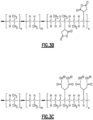
- the resin matrix 26 includes MA-g-PP, of which a proposed example chemical structure is shown in Figure 3A .
- the Ma-g-PP is of a homopolymer variety in that polypropylene is the only polymer of the backbone polymer chain.
- the backbone includes polypropylene that has no grafted maleic anhydride and polypropylene that has grafted maleic anhydride.
- the maleic anhydride is atactic, although the stereochemistry will change, as discussed later in this disclosure.
- the MA-g-PP is a block copolymer, as shown for example in Figure 3B .
- the backbone again includes polypropylene that has no grafted maleic anhydride and polypropylene that has grafted maleic anhydride.
- the backbone additionally includes blocks of isobutylene.
- the chemical structure may vary in accordance with the number average molecular weights "m,” “n,” and “x.” As non-limiting examples, “m” may be 120 to 10,000, “n” may be 60 to 5,000, and “x” may be 3 to 435.
- the term “the MA-g-PP” thus may refer herein to either the homopolymer or the block copolymer.
- the molecular weight of the MA-g-PP is 30,000 to 80,000.
- the MA-g-PP has, by weight, 0.5% to 5% of maleic anhydride.
- the MA-g-PP has 1% to 4% maleic anhydride.
- the MA-g-PP is used in mixture with polyurethane.
- the resin matrix 26 includes, by weight, 25% to 50% of the MA-g-PP, and the remainder is the polyurethane.
- the polyurethane includes a blocked isocyanate that is composed of isocyanate bonded with a blocking agent.
- the blocking agent is selected from phenol, nonyl phenol, ⁇ -dicarbonyl compounds, methylethylketoxime, alcohols, ⁇ -caprolactam, amides, imidazoles, pyrazoles, and combinations thereof.
- the bonding between the isocyanate and the blocking agent is reversible in dependence on temperature.
- the isocyanate is blocked (i.e., the blocking agent is bonded with the isocyanate) at relatively low temperatures, deblocked (i.e., the blocking agent is not bonded to the isocyanate) at relatively high temperatures, and can be cycled between the blocked and deblocked states by adjusting the temperature.
- the blocking agent is bonded with the isocyanate the blocking agent prevents the isocyanate from reacting (i.e., the blocked isocyanate is inert in the resin matrix 26), and when the blocking agent is not bonded to the isocyanate the isocyanate is reactive (i.e., the isocyanate is reactive in the resin matrix 26).
- the temperature at which initial deblocking is observed from the blocked state is called the deblocking temperature.
- Deblocking temperatures can be found in general literature and used as guidance in selecting useful blocked isocyanates for a particular implementation. Additionally, or alternatively, deblocking temperatures can be readily experimentally determined through a known measurement technique. Deblocking temperatures may be given in the literature as temperature ranges in order to encompass variations. Such ranges or variations do not hinder the understanding or practice of this disclosure, at least because ranges or variations in combination with the teachings of this disclosure will permit selection of one or more blocked isocyanates for a given implementation.
- the resin matrix 26 may be cross-linkable by heating to a temperature that causes the isocyanate to liberate from the blocking agent and the liberated isocyanate to reactively cause cross-linking of the resin matrix 26.
- a temperature is equal to or above the deblocking temperature of the selected blocked isocyanate but will not be so high as to damage the network of fibers 24 or other constituents in the ballistic resistant composite 20, if present.
- the temperature will be below a temperature at which the network of fibers 24 degrades in the implemented process conditions (time, temperature, pressure, etc.).
- the network of fibers 24 is initially coated with the resin matrix 26.
- the coating can be applied using known techniques, such as impregnation, lamination, or powder coating.
- the resin matrix 26 is applied as an aqueous medium, as a solvent-based medium, as a cast film-form, or as hot-melt granules.
- An example aqueous medium may include fillers, viscosity modifiers, and the like and have a solids content from about 10% to about 80% by weight, with the remaining weight being water.
- a single one of the layers 22 has an areal density of 20 grams per square meter to 500 grams per square meter.
- Multiple layers 22 may be laminated together under heat and pressure to produce a laminate.
- the layers 22 may be cross-plied in the lamination step, such as a 0°/90° configuration.
- the total number of layers 22 that are laminated together may depend on the end use article to be produced, but will typically be from two to 1000 of the layers 22, such as only two layers 22, up to 10 layers 22, up to 100 layers 22, or up to 250 layers 22.
- the thickness of the layers 22 will typically be from 25 micrometers to 0.001 meters.
- Two or more laminates are consolidated under heat and pressure to form a laminate armor. Except for the resin matrix 26, this process is otherwise known and those skilled in the art will thus recognize appropriate process conditions in view of this disclosure.
- aspects of the present disclosure are based on the concept that ballistic improvement in fiber-reinforced composite armor is achievable by modifying the sonic velocity of the ballistic panel "as a whole.”
- Work relating to improving composite ballistic armor performance has focused not on this, but rather on optimizing the theoretical ballistic potential of the high-performance yarns within the composite, by optimizing the composite construction - i.e., via yarn spreading or via lower resin content construction and by via optimizing the surface interaction or the yarn with resin matrix.
- the ballistic performance of a yarn is a function of both its own elastic modulus and density and the sonic modulus and density of the resin matrix itself. This makes sense as the speed of sound through an anisotropic composite material will be some average of both the sound speed in the yarn and the sound speed in the resin.
- van Heerden shows that resin matrix typically has a negative impact on the theoretical ballistic performance of the "constrained" yarn that the "negative impact" of the resin matrix can be minimized by:
- the increase in sonic velocity facilitates improved ballistic performance for the ballistic resistant composite armor by increasing the speed at which longitudinal strain waves travel along the ballistic yarns thereby increasing the armor's ability to absorb and dissipate the kinetic energy of a ballistic projectile.
- aspects of the present disclosure are also based on the concept that ballistic improvement in fiber-reinforced composite armor is achievable by selectively increasing the level of adhesion between a resin matrix and ballistic fibers.
- This is counter-intuitive to ballistic composite design in that the paradigm is to have relatively low matrix-fiber adhesion.
- simply maximizing matrix-fiber adhesion is unlikely to yield better ballistic performance.
- effectively increasing matrix-fiber adhesion for improved ballistic performance is challenging, especially for non-polar, low surface energy fibers, such as UHMWPE.
- MA-g-PP which serves as a coupling agent to the ballistic fibers, while at the same time bonding effectively to the polyurethane.
- the mechanism of adhesion varies depending on the chemistry of the ballistic fiber.
- the maleic anhydride on the MA-g-PP modifies the chemical nature of different melt point/molecular weight (MP/MW) polypropylenes and/or polypropylene-block copolymers to increase their polarity.
- the theory is that by grafting polypropylene with maleic anhydride, the non-polar (somewhat amorphous) polypropylene molecule becomes more polar and more crystalline.
- the nonpolar portion of the polymer can orient towards, and bond with, a nonpolar, low energy surface of a ballistic fiber.
- the polar groups can orient away from the ballistic fiber and may serve to bond with polar groups of polyurethane.
- the MA-g-PP in essence serves as a coupling agent to bond the polyurethane to the ballistic fibers where previously there was no chemical bonds.
- free hydrogen and double bonded oxygen groups on the fiber surfaces form hydrogen bonds with the maleic anhydride, thus coupling the polypropylene of the MA-g-PP to the fibers.
- FIG. 3C shows the MA-g-PP of Figure 3B after it has undergone hydrolysis.
- the maleic anhydride is maleic acid and is functional for chemical bonding.
- the maleic acid groups also re-orient into an isotactic stereochemistry via rotation about the carbon-carbon bonds.
- This structural change makes the MA-g-PP polar, with the negatively charged maleic acid groups orientating to one side of the molecule and more crystalline (isotactic) in nature with all the of uncharged methyl groups of the polypropylene molecules orientating to the other side of the molecule.
- Figure 4 shows how MA-g-PP block copolymer serves to form strong bonds with the polar reactive polyurethane and how the hydrocarbons of the MA-g-PP orient toward the non-polar hydrocarbons of the ballistic fiber.
- Van Der Waals forces are generally relatively weak, at high molecular weights, such as over 100,000 MW of the non-polar hydrocarbon ballistic fiber, there is a relatively high number of Van Der Waals bonds.
- Figure 4 only hydrogen bonding of the maleic anhydride is shown, but ester linkages may also be present via functional alcohol groups (e.g., on polyurethane).
- the Van Der Waals strength effect is similar to the effect that is responsible for high strength in UHMWPE.
- UHMWPE derives strength from the length of its individual molecules and the relatively weak Van Der Waals bonds between the molecules. This occurs because it is made up of extremely long chains of polyethylene that align such that each chain is bonded to the adjacent chains with so many Van Der Waals bonds that the whole system can support great tensile loads.
- the maleic anhydride components of the MA-g-PP may also react with the aforementioned blocked isocyanates to crosslink and form chemical bonds. Such partial crosslinking further increases sonic modulus and tensile strength and thereby increases ballistic performance. Cross-linking also results in ballistic armor panels that are stiffer and more environmentally stable.
- a two-ply non-woven composite was formed from layers of unidirectionally oriented 780dtex (700den) high tenacity UHMWPE yarn with a tenacity of 36g/den (3.11GPa) and a modulus of 1250g/den (108.5GPa).
- Unitapes were prepared by passing the fibers from a creel and through a combing station to form a unidirectional network. The fiber network was then placed on a carrier web and the fibers were coated separately with five different water-based resins:
- the coated fiber network was then passed through an oven to evaporate the water in the composition and was wound onto a roller, with a carrier web.
- the resulting structure contained about 18% by weight of the resin matrix, based on the total weight of the composite.
- Two continuous rolls of unidirectional fiber prepregs, of each resin chemistry, A, B, C, D and E were prepared in this manner, and the corresponding unitapes were cross plied, along with the removal of the carrier webs to form 0°/90° consolidated UD orthogonal fabric rolls at a target areal density of 82gsm.
- Panels of these five materials measuring 40 cm x 40 cm (15.75"x15.75”) were stacked into 119-layer panels and pressed at 130°C (265°F), at 214bar (3000psi) for 40 min respectively to form rigid consolidated hard armor ballistic composite panels. These flat panels were also cooled to room temperature under pressure prior to removal from the press.
- the resulting 119-layer panels had an approx. areal density of 9.765 kg/m 2 (2.0psf) and were tested, clamped in a frame, air-backed, against 44gn (30cal) fragment simulating projectiles (FSPs) according to Mil-STD-662F.
- the ballistic results were then normalized to an areal density of 9.765 kg/m 2 (2.0psf) and were as follows:
- the three resin systems tested were Resin B, Resin C, and Resin E from Example 1.
- Each of these UD orthogonal fabrics was cut into 40 cm x 40 cm (15.75"x15.75") sheets, stacked into 90-layer panels and pressed at 130°C (265°F), at both 28.6bar (400psi) and 214bar (3000psi) for 35 min respectively to form rigid consolidated hard armor ballistic composite panels.
- These flat panels were also cooled to room temperature under pressure prior to removal from the press.
- the resulting 90-layer panels had an approx.
- Resin E which combined MA-g-PP block copolymer with the base TPU resin, therefore had the best V50 ballistic performance, 9.7% better than TPU without M MAg-PP block copolymer added, and exhibited the biggest V 50 performance improvement of 19.5% when comparing the V 50 performance of panels pressed at relatively low (400 psi) pressure, and identical panels pressed at relatively high pressures (i.e. 3000 psi). This testing also seems to indicate that resin matrices with blocked isocyanate crosslinker perform better than those without when pressed at lower pressures ⁇ 400psi.
- a 4-ply non-woven composite was formed from layers of unidirectionally oriented 1650dtex (1485den) high tenacity UHMWPE yarn with a tenacity of 40g/den (3.43GPa) a modulus of 1300g/den (111.3GPa) and a % elongation of 3%.
- Unitapes were prepared by passing the fibers from a creel and through a combing station to form a unidirectional network. The fiber network was then placed on a carrier web and the fibers were coated separately with 2 different water-based resins:
- the coated fiber network was then passed through an oven to evaporate the water in the composition and was wound onto a roller, with a carrier web.
- the resulting structure contained about 16% by weight of the resin matrix, based on the total weight of the composite.
- Two continuous rolls of unidirectional fiber prepregs, of each resin chemistry, E and F were prepared in this manner, and the corresponding unitapes were cross-plied, along with the removal of the carrier webs to form 2-layer 0°/90° UD orthogonal fabrics, which were then laminated to themselves to form 4-layer 0°/90°/0°/90° consolidated UD orthogonal fabric rolls at a target areal density of 160gsm.
- Panels of these two materials measuring 40 cm x 40 cm (15.75"x15.75”) were stacked into both 46-layer panels and 105-layer panels. These panels were then pressed at 130°C (265°F), at 214bar (3000psi) for 35 min and 55min respectively to form rigid consolidated hard armor ballistic composite panels. These flat panels were also cooled to room temperature under pressure prior to removal from the press.
- the resulting 46-layer panels had an approx. areal density of 7.32 kg/m 2 (1.50psf) and were tested, clamped in a frame, air-backed, against 17gn (22cal) fragment simulating projectiles (FSPs) according to Mil-STD-662F.
- the resulting 105-layer panels had an approx.
- a 4-ply non-woven composite was formed from layers of unidirectionally oriented 1650dtex (1485den) high tenacity UHMWPE yarn with a tenacity of 40g/den (3.43GPa) a modulus of 1300g/den (111.3GPa) and a % elongation of 3%.
- Unitapes were prepared by passing the fibers from a creel and through a combing station to form a unidirectional network. The fiber network was then placed on a carrier web and the fibers were coated separately with 2 different water-based resins:
- the lower molecular weight MA-g-PP block copolymer resin (Resin G) exhibited much better ballistic performance vs.
- the higher molecular weight MA-g-PP block copolymer formulation (Resin H) when tested against high-energy ( ⁇ 2595 Joule) rifle rounds that require the composite armor panels to deform significantly (due to tensile strain and cone formation) as part of its energy absorption/energy dissipation mechanism. No significant difference however was noted between the two resin systems, G and H, when tested against relatively low energy 0.22 caliber ( ⁇ 334 Joule) FSP's.
- a 4-ply non-woven composite was formed from layers of unidirectionally oriented 1650dtex (1485den) high tenacity UHMWPE yarn with a tenacity of 40g/den (3.43GPa) a modulus of 1300g/den (111.3GPa) and a % elongation of 3%.
- Unitapes were prepared by passing the fibers from a creel and through a combing station to form a unidirectional network. The fiber network was then placed on a carrier web and the fibers were coated separately with 3 different water-based resins:
Landscapes
- Engineering & Computer Science (AREA)
- Ceramic Engineering (AREA)
- General Engineering & Computer Science (AREA)
- Aiming, Guidance, Guns With A Light Source, Armor, Camouflage, And Targets (AREA)
- Laminated Bodies (AREA)
- Reinforced Plastic Materials (AREA)
- Graft Or Block Polymers (AREA)
Applications Claiming Priority (2)
| Application Number | Priority Date | Filing Date | Title |
|---|---|---|---|
| US202062970837P | 2020-02-06 | 2020-02-06 | |
| PCT/US2021/017085 WO2021225658A2 (en) | 2020-02-06 | 2021-02-08 | Ballistic-resistant composite with maleic anhydride-grafted polypropylene |
Publications (3)
| Publication Number | Publication Date |
|---|---|
| EP4100253A2 EP4100253A2 (en) | 2022-12-14 |
| EP4100253A4 EP4100253A4 (en) | 2024-02-21 |
| EP4100253B1 true EP4100253B1 (en) | 2025-05-28 |
Family
ID=78468745
Family Applications (1)
| Application Number | Title | Priority Date | Filing Date |
|---|---|---|---|
| EP21799950.7A Active EP4100253B1 (en) | 2020-02-06 | 2021-02-08 | Ballistic-resistant composite with maleic anhydride-grafted polypropylene |
Country Status (5)
| Country | Link |
|---|---|
| US (1) | US12379190B2 (pl) |
| EP (1) | EP4100253B1 (pl) |
| IL (1) | IL295028A (pl) |
| PL (1) | PL4100253T3 (pl) |
| WO (1) | WO2021225658A2 (pl) |
Family Cites Families (16)
| Publication number | Priority date | Publication date | Assignee | Title |
|---|---|---|---|---|
| KR100306676B1 (ko) | 1993-04-28 | 2001-11-30 | 샬크비즈크 피이터 코르넬리스; 페트귄터 | 피리도비스이미다졸성분의강성막대형중합체 |
| NL1000360C2 (nl) | 1995-05-15 | 1996-11-18 | Akzo Nobel Nv | Werkwijze ter bereiding van pyridine-2, 6-diamines |
| US5945537A (en) | 1995-09-19 | 1999-08-31 | Akzo Nobel N.V. | Nitration of pyridine-2, 6-diamines |
| NL1001628C2 (nl) | 1995-11-10 | 1997-05-13 | Akzo Nobel Nv | Werkwijze voor de tweevoudige carboxylering van dihydrische fenolen en meer in het bijzonder ter bereiding van 2,5-dihydroxytereftaalzuur. |
| KR100221361B1 (ko) * | 1997-07-14 | 1999-09-15 | 이정국 | 섬유의 연속코팅 방법 및 장치 |
| JPH11181181A (ja) * | 1997-12-25 | 1999-07-06 | Sumitomo Bakelite Co Ltd | 樹脂組成物 |
| US20100297388A1 (en) * | 2006-02-03 | 2010-11-25 | The University Of Maine System Board Of Trustees | Composite panel for blast and ballistic protection |
| US8871658B2 (en) * | 2009-04-20 | 2014-10-28 | Barrday Inc. | Rigid ballistic composites made from poly-para-phenylene terephthalamide fibers having large denier per filament |
| BR112015030878B1 (pt) * | 2013-06-12 | 2020-12-15 | Kimberly-Clark Worldwide, Inc. | Membro de absorção de energia, e, equipamento de proteção |
| KR101614854B1 (ko) * | 2014-07-29 | 2016-04-22 | 롯데케미칼 주식회사 | 연속 섬유 복합체 및 연속 섬유 복합체의 제조 방법 |
| KR20170123104A (ko) * | 2016-04-28 | 2017-11-07 | 롯데케미칼 주식회사 | 섬유 강화 폴리올레핀 복합체 및 그 제조방법 |
| CN110177679A (zh) * | 2016-09-06 | 2019-08-27 | 加固纤维热塑性塑料私人有限公司 | 纤维增强复合材料、包括其的层合体、以及制造这种层合体的系统和方法 |
| EP3574040A1 (en) * | 2017-01-25 | 2019-12-04 | SABIC Global Technologies B.V. | Carbon-fiber reinforced polypropylene composition |
| US11073360B2 (en) * | 2017-02-16 | 2021-07-27 | Barrday Inc. | Ballistic resistant article with thermoset polyurethane matrix |
| CN107903508B (zh) * | 2017-12-15 | 2021-02-26 | 会通新材料股份有限公司 | 一种芳纶纤维增强聚丙烯微发泡复合材料及其制备方法 |
| CN109897282B (zh) * | 2019-03-22 | 2021-11-19 | 金旸(厦门)新材料科技有限公司 | 一种聚丙烯复合材料及其制备方法和应用 |
-
2021
- 2021-02-08 EP EP21799950.7A patent/EP4100253B1/en active Active
- 2021-02-08 IL IL295028A patent/IL295028A/en unknown
- 2021-02-08 US US17/797,529 patent/US12379190B2/en active Active
- 2021-02-08 PL PL21799950.7T patent/PL4100253T3/pl unknown
- 2021-02-08 WO PCT/US2021/017085 patent/WO2021225658A2/en not_active Ceased
Also Published As
| Publication number | Publication date |
|---|---|
| WO2021225658A2 (en) | 2021-11-11 |
| PL4100253T3 (pl) | 2025-08-04 |
| US20230058501A1 (en) | 2023-02-23 |
| EP4100253A4 (en) | 2024-02-21 |
| US12379190B2 (en) | 2025-08-05 |
| EP4100253A2 (en) | 2022-12-14 |
| WO2021225658A3 (en) | 2021-12-16 |
| IL295028A (en) | 2022-09-01 |
Similar Documents
| Publication | Publication Date | Title |
|---|---|---|
| TWI406769B (zh) | 水滲進衝擊材料之抑制作用 | |
| US7288307B2 (en) | Hybrid laminated fiber sheets | |
| EP2087307B1 (en) | Spaced lightweight composite armor | |
| EP2529176B1 (en) | Use of machine direction oriented films in ballistic articles | |
| TWI359935B (en) | Frag shield | |
| EP2250309B1 (en) | Low weight and high durability soft body armor composite using topical wax coatings | |
| TWI409172B (zh) | 經雜化作用之改良液體浸沒彈道性能 | |
| US7964261B2 (en) | Advanced antiballistic materials | |
| EP2422159B1 (en) | Improved ballistic composites having large denier per filament high performance yarns | |
| EP2234804B1 (en) | Low weight and high durability soft body armor composite using silicone-based topical treatments | |
| EP3105528B1 (en) | Ballistic resistant articles comprising tapes | |
| EP2066995A2 (en) | Polyolefin fiber reinforced rubber | |
| US12379190B2 (en) | Ballistic-resistant composite with maleic anhydride-grafted polypropylene | |
| CA2693638C (en) | Use of machine direction oriented films in ballistic articles | |
| EP3921589A2 (en) | Ballistic-resistant composite with blocked isocyanate | |
| EP3329205B1 (en) | Ballistic resistant panel |
Legal Events
| Date | Code | Title | Description |
|---|---|---|---|
| STAA | Information on the status of an ep patent application or granted ep patent |
Free format text: STATUS: THE INTERNATIONAL PUBLICATION HAS BEEN MADE |
|
| PUAI | Public reference made under article 153(3) epc to a published international application that has entered the european phase |
Free format text: ORIGINAL CODE: 0009012 |
|
| STAA | Information on the status of an ep patent application or granted ep patent |
Free format text: STATUS: REQUEST FOR EXAMINATION WAS MADE |
|
| 17P | Request for examination filed |
Effective date: 20220903 |
|
| AK | Designated contracting states |
Kind code of ref document: A2 Designated state(s): AL AT BE BG CH CY CZ DE DK EE ES FI FR GB GR HR HU IE IS IT LI LT LU LV MC MK MT NL NO PL PT RO RS SE SI SK SM TR |
|
| DAV | Request for validation of the european patent (deleted) | ||
| DAX | Request for extension of the european patent (deleted) | ||
| A4 | Supplementary search report drawn up and despatched |
Effective date: 20240124 |
|
| RIC1 | Information provided on ipc code assigned before grant |
Ipc: F41H 5/04 20060101ALI20240118BHEP Ipc: D03D 15/283 20210101ALI20240118BHEP Ipc: B32B 27/40 20060101ALI20240118BHEP Ipc: B32B 27/32 20060101ALI20240118BHEP Ipc: B32B 27/12 20060101AFI20240118BHEP |
|
| GRAP | Despatch of communication of intention to grant a patent |
Free format text: ORIGINAL CODE: EPIDOSNIGR1 |
|
| STAA | Information on the status of an ep patent application or granted ep patent |
Free format text: STATUS: GRANT OF PATENT IS INTENDED |
|
| INTG | Intention to grant announced |
Effective date: 20250113 |
|
| GRAS | Grant fee paid |
Free format text: ORIGINAL CODE: EPIDOSNIGR3 |
|
| GRAA | (expected) grant |
Free format text: ORIGINAL CODE: 0009210 |
|
| STAA | Information on the status of an ep patent application or granted ep patent |
Free format text: STATUS: THE PATENT HAS BEEN GRANTED |
|
| AK | Designated contracting states |
Kind code of ref document: B1 Designated state(s): AL AT BE BG CH CY CZ DE DK EE ES FI FR GB GR HR HU IE IS IT LI LT LU LV MC MK MT NL NO PL PT RO RS SE SI SK SM TR |
|
| REG | Reference to a national code |
Ref country code: GB Ref legal event code: FG4D |
|
| REG | Reference to a national code |
Ref country code: CH Ref legal event code: EP |
|
| REG | Reference to a national code |
Ref country code: IE Ref legal event code: FG4D Ref country code: DE Ref legal event code: R096 Ref document number: 602021031486 Country of ref document: DE |
|
| REG | Reference to a national code |
Ref country code: NL Ref legal event code: MP Effective date: 20250528 |
|
| PG25 | Lapsed in a contracting state [announced via postgrant information from national office to epo] |
Ref country code: ES Free format text: LAPSE BECAUSE OF FAILURE TO SUBMIT A TRANSLATION OF THE DESCRIPTION OR TO PAY THE FEE WITHIN THE PRESCRIBED TIME-LIMIT Effective date: 20250528 Ref country code: FI Free format text: LAPSE BECAUSE OF FAILURE TO SUBMIT A TRANSLATION OF THE DESCRIPTION OR TO PAY THE FEE WITHIN THE PRESCRIBED TIME-LIMIT Effective date: 20250528 |
|
| REG | Reference to a national code |
Ref country code: LT Ref legal event code: MG9D |
|
| PG25 | Lapsed in a contracting state [announced via postgrant information from national office to epo] |
Ref country code: NO Free format text: LAPSE BECAUSE OF FAILURE TO SUBMIT A TRANSLATION OF THE DESCRIPTION OR TO PAY THE FEE WITHIN THE PRESCRIBED TIME-LIMIT Effective date: 20250828 Ref country code: GR Free format text: LAPSE BECAUSE OF FAILURE TO SUBMIT A TRANSLATION OF THE DESCRIPTION OR TO PAY THE FEE WITHIN THE PRESCRIBED TIME-LIMIT Effective date: 20250829 |
|
| PG25 | Lapsed in a contracting state [announced via postgrant information from national office to epo] |
Ref country code: NL Free format text: LAPSE BECAUSE OF FAILURE TO SUBMIT A TRANSLATION OF THE DESCRIPTION OR TO PAY THE FEE WITHIN THE PRESCRIBED TIME-LIMIT Effective date: 20250528 |
|
| PG25 | Lapsed in a contracting state [announced via postgrant information from national office to epo] |
Ref country code: BG Free format text: LAPSE BECAUSE OF FAILURE TO SUBMIT A TRANSLATION OF THE DESCRIPTION OR TO PAY THE FEE WITHIN THE PRESCRIBED TIME-LIMIT Effective date: 20250528 |
|
| PG25 | Lapsed in a contracting state [announced via postgrant information from national office to epo] |
Ref country code: HR Free format text: LAPSE BECAUSE OF FAILURE TO SUBMIT A TRANSLATION OF THE DESCRIPTION OR TO PAY THE FEE WITHIN THE PRESCRIBED TIME-LIMIT Effective date: 20250528 |
|
| PG25 | Lapsed in a contracting state [announced via postgrant information from national office to epo] |
Ref country code: RS Free format text: LAPSE BECAUSE OF FAILURE TO SUBMIT A TRANSLATION OF THE DESCRIPTION OR TO PAY THE FEE WITHIN THE PRESCRIBED TIME-LIMIT Effective date: 20250828 |
|
| PG25 | Lapsed in a contracting state [announced via postgrant information from national office to epo] |
Ref country code: IS Free format text: LAPSE BECAUSE OF FAILURE TO SUBMIT A TRANSLATION OF THE DESCRIPTION OR TO PAY THE FEE WITHIN THE PRESCRIBED TIME-LIMIT Effective date: 20250928 |
|
| PG25 | Lapsed in a contracting state [announced via postgrant information from national office to epo] |
Ref country code: LV Free format text: LAPSE BECAUSE OF FAILURE TO SUBMIT A TRANSLATION OF THE DESCRIPTION OR TO PAY THE FEE WITHIN THE PRESCRIBED TIME-LIMIT Effective date: 20250528 |
|
| REG | Reference to a national code |
Ref country code: AT Ref legal event code: MK05 Ref document number: 1798421 Country of ref document: AT Kind code of ref document: T Effective date: 20250528 |
|
| PG25 | Lapsed in a contracting state [announced via postgrant information from national office to epo] |
Ref country code: SM Free format text: LAPSE BECAUSE OF FAILURE TO SUBMIT A TRANSLATION OF THE DESCRIPTION OR TO PAY THE FEE WITHIN THE PRESCRIBED TIME-LIMIT Effective date: 20250528 Ref country code: AT Free format text: LAPSE BECAUSE OF FAILURE TO SUBMIT A TRANSLATION OF THE DESCRIPTION OR TO PAY THE FEE WITHIN THE PRESCRIBED TIME-LIMIT Effective date: 20250528 Ref country code: DK Free format text: LAPSE BECAUSE OF FAILURE TO SUBMIT A TRANSLATION OF THE DESCRIPTION OR TO PAY THE FEE WITHIN THE PRESCRIBED TIME-LIMIT Effective date: 20250528 |
|
| PGFP | Annual fee paid to national office [announced via postgrant information from national office to epo] |
Ref country code: FR Payment date: 20251222 Year of fee payment: 6 |
|
| PG25 | Lapsed in a contracting state [announced via postgrant information from national office to epo] |
Ref country code: CZ Free format text: LAPSE BECAUSE OF FAILURE TO SUBMIT A TRANSLATION OF THE DESCRIPTION OR TO PAY THE FEE WITHIN THE PRESCRIBED TIME-LIMIT Effective date: 20250528 |
|
| PG25 | Lapsed in a contracting state [announced via postgrant information from national office to epo] |
Ref country code: EE Free format text: LAPSE BECAUSE OF FAILURE TO SUBMIT A TRANSLATION OF THE DESCRIPTION OR TO PAY THE FEE WITHIN THE PRESCRIBED TIME-LIMIT Effective date: 20250528 |
|
| PG25 | Lapsed in a contracting state [announced via postgrant information from national office to epo] |
Ref country code: SK Free format text: LAPSE BECAUSE OF FAILURE TO SUBMIT A TRANSLATION OF THE DESCRIPTION OR TO PAY THE FEE WITHIN THE PRESCRIBED TIME-LIMIT Effective date: 20250528 |
|
| REG | Reference to a national code |
Ref country code: DE Ref legal event code: R097 Ref document number: 602021031486 Country of ref document: DE |
|
| PLBE | No opposition filed within time limit |
Free format text: ORIGINAL CODE: 0009261 |
|
| STAA | Information on the status of an ep patent application or granted ep patent |
Free format text: STATUS: NO OPPOSITION FILED WITHIN TIME LIMIT |
|
| PGFP | Annual fee paid to national office [announced via postgrant information from national office to epo] |
Ref country code: GB Payment date: 20260106 Year of fee payment: 6 |
|
| REG | Reference to a national code |
Ref country code: CH Ref legal event code: L10 Free format text: ST27 STATUS EVENT CODE: U-0-0-L10-L00 (AS PROVIDED BY THE NATIONAL OFFICE) Effective date: 20260409 |
|
| PGFP | Annual fee paid to national office [announced via postgrant information from national office to epo] |
Ref country code: DE Payment date: 20251224 Year of fee payment: 6 |
|
| PGFP | Annual fee paid to national office [announced via postgrant information from national office to epo] |
Ref country code: IT Payment date: 20260122 Year of fee payment: 6 |
|
| PGFP | Annual fee paid to national office [announced via postgrant information from national office to epo] |
Ref country code: PL Payment date: 20260102 Year of fee payment: 6 |
|
| 26N | No opposition filed |
Effective date: 20260303 |