EP4099282B1 - Schliesssystem und verfahren zur freigabe einer verbindung zwischen einer mobileinheit und einem hauptschlüssel - Google Patents
Schliesssystem und verfahren zur freigabe einer verbindung zwischen einer mobileinheit und einem hauptschlüssel Download PDFInfo
- Publication number
- EP4099282B1 EP4099282B1 EP21177176.1A EP21177176A EP4099282B1 EP 4099282 B1 EP4099282 B1 EP 4099282B1 EP 21177176 A EP21177176 A EP 21177176A EP 4099282 B1 EP4099282 B1 EP 4099282B1
- Authority
- EP
- European Patent Office
- Prior art keywords
- master key
- mobile unit
- acoustic
- locking system
- connection
- Prior art date
- Legal status (The legal status is an assumption and is not a legal conclusion. Google has not performed a legal analysis and makes no representation as to the accuracy of the status listed.)
- Active
Links
Images

Classifications
-
- G—PHYSICS
- G07—CHECKING-DEVICES
- G07C—TIME OR ATTENDANCE REGISTERS; REGISTERING OR INDICATING THE WORKING OF MACHINES; GENERATING RANDOM NUMBERS; VOTING OR LOTTERY APPARATUS; ARRANGEMENTS, SYSTEMS OR APPARATUS FOR CHECKING NOT PROVIDED FOR ELSEWHERE
- G07C9/00—Individual registration on entry or exit
- G07C9/00174—Electronically operated locks; Circuits therefor; Nonmechanical keys therefor, e.g. passive or active electrical keys or other data carriers without mechanical keys
- G07C9/00309—Electronically operated locks; Circuits therefor; Nonmechanical keys therefor, e.g. passive or active electrical keys or other data carriers without mechanical keys operated with bidirectional data transmission between data carrier and locks
-
- G—PHYSICS
- G07—CHECKING-DEVICES
- G07C—TIME OR ATTENDANCE REGISTERS; REGISTERING OR INDICATING THE WORKING OF MACHINES; GENERATING RANDOM NUMBERS; VOTING OR LOTTERY APPARATUS; ARRANGEMENTS, SYSTEMS OR APPARATUS FOR CHECKING NOT PROVIDED FOR ELSEWHERE
- G07C9/00—Individual registration on entry or exit
- G07C9/00174—Electronically operated locks; Circuits therefor; Nonmechanical keys therefor, e.g. passive or active electrical keys or other data carriers without mechanical keys
- G07C9/00309—Electronically operated locks; Circuits therefor; Nonmechanical keys therefor, e.g. passive or active electrical keys or other data carriers without mechanical keys operated with bidirectional data transmission between data carrier and locks
- G07C2009/00555—Electronically operated locks; Circuits therefor; Nonmechanical keys therefor, e.g. passive or active electrical keys or other data carriers without mechanical keys operated with bidirectional data transmission between data carrier and locks comprising means to detect or avoid relay attacks
-
- G—PHYSICS
- G07—CHECKING-DEVICES
- G07C—TIME OR ATTENDANCE REGISTERS; REGISTERING OR INDICATING THE WORKING OF MACHINES; GENERATING RANDOM NUMBERS; VOTING OR LOTTERY APPARATUS; ARRANGEMENTS, SYSTEMS OR APPARATUS FOR CHECKING NOT PROVIDED FOR ELSEWHERE
- G07C9/00—Individual registration on entry or exit
- G07C9/00174—Electronically operated locks; Circuits therefor; Nonmechanical keys therefor, e.g. passive or active electrical keys or other data carriers without mechanical keys
- G07C2009/00753—Electronically operated locks; Circuits therefor; Nonmechanical keys therefor, e.g. passive or active electrical keys or other data carriers without mechanical keys operated by active electrical keys
- G07C2009/00769—Electronically operated locks; Circuits therefor; Nonmechanical keys therefor, e.g. passive or active electrical keys or other data carriers without mechanical keys operated by active electrical keys with data transmission performed by wireless means
- G07C2009/00793—Electronically operated locks; Circuits therefor; Nonmechanical keys therefor, e.g. passive or active electrical keys or other data carriers without mechanical keys operated by active electrical keys with data transmission performed by wireless means by Hertzian waves
-
- G—PHYSICS
- G07—CHECKING-DEVICES
- G07C—TIME OR ATTENDANCE REGISTERS; REGISTERING OR INDICATING THE WORKING OF MACHINES; GENERATING RANDOM NUMBERS; VOTING OR LOTTERY APPARATUS; ARRANGEMENTS, SYSTEMS OR APPARATUS FOR CHECKING NOT PROVIDED FOR ELSEWHERE
- G07C9/00—Individual registration on entry or exit
- G07C9/00174—Electronically operated locks; Circuits therefor; Nonmechanical keys therefor, e.g. passive or active electrical keys or other data carriers without mechanical keys
- G07C2009/00753—Electronically operated locks; Circuits therefor; Nonmechanical keys therefor, e.g. passive or active electrical keys or other data carriers without mechanical keys operated by active electrical keys
- G07C2009/00769—Electronically operated locks; Circuits therefor; Nonmechanical keys therefor, e.g. passive or active electrical keys or other data carriers without mechanical keys operated by active electrical keys with data transmission performed by wireless means
- G07C2009/00801—Electronically operated locks; Circuits therefor; Nonmechanical keys therefor, e.g. passive or active electrical keys or other data carriers without mechanical keys operated by active electrical keys with data transmission performed by wireless means by acoustic waves
-
- G—PHYSICS
- G07—CHECKING-DEVICES
- G07C—TIME OR ATTENDANCE REGISTERS; REGISTERING OR INDICATING THE WORKING OF MACHINES; GENERATING RANDOM NUMBERS; VOTING OR LOTTERY APPARATUS; ARRANGEMENTS, SYSTEMS OR APPARATUS FOR CHECKING NOT PROVIDED FOR ELSEWHERE
- G07C9/00—Individual registration on entry or exit
- G07C9/00174—Electronically operated locks; Circuits therefor; Nonmechanical keys therefor, e.g. passive or active electrical keys or other data carriers without mechanical keys
- G07C9/00857—Electronically operated locks; Circuits therefor; Nonmechanical keys therefor, e.g. passive or active electrical keys or other data carriers without mechanical keys where the code of the data carrier can be programmed
- G07C2009/00865—Electronically operated locks; Circuits therefor; Nonmechanical keys therefor, e.g. passive or active electrical keys or other data carriers without mechanical keys where the code of the data carrier can be programmed remotely by wireless communication
Definitions
- the invention relates to a locking system, with a master key for programming and actuating a locking device, with a mobile unit for programming the master key, with a data transmission device for data transmission between the mobile unit and the master key in the course of programming, according to US 2021/037099 A1 .
- Locking systems of the type mentioned above enable convenient programming of a master key using a mobile unit.
- the master key in turn is used to program a locking device of the locking system, for example data Access authorizations for additional keys of the locking system are transmitted to a locking device.
- the use of a data transmission device between the mobile unit and the master key enables convenient transmission of data, which can in particular be carried out without contact.
- this contactless data transmission is accompanied by the risk that communication between an (authorized) mobile unit and the master key can potentially be intercepted, and that an (unauthorized) mobile unit could then be used to reprogram the master key.
- a master key usually has no controls, i.e. no acknowledgment button or similar. Accordingly, (unauthorized) programming of the master key could also take place from a further distance, for example from a neighboring room.
- the present invention is based on the object of providing a locking system that has a higher level of protection against manipulation.
- an additional communication path is provided, namely in the form of an acoustic communication path starting from the master key in the direction of the mobile unit.
- the master key therefore has an acoustic transmitter for transmitting an acoustic signal that the mobile unit receives.
- the mobile unit is taken into account this acoustic signal during its authentication against the master key.
- the acoustic transmitter is preferably a piezoceramic loudspeaker that is particularly compact and can still generate an acoustic signal that can be modulated.
- a loudspeaker can easily be converted into one Master key can be integrated.
- the master key is, for example, card-shaped or has a lock bit.
- the mobile unit is preferably formed by a smartphone, with the acoustic receiver of the acoustic additional device being formed by a microphone of the smartphone. In this way, part of the additional acoustic device can be kept available using a standard smartphone.
- the acoustic transmitter, the acoustic signal and the acoustic receiver are coordinated with one another in such a way that reception of the acoustic signal is only possible if the acoustic transmitter and the acoustic receiver are at most 1 m, preferably at most 0.5 m , in particular a maximum of 0.2 m, are spaced apart from one another. This means that a user of the mobile unit must at least position the mobile unit itself in close proximity to the master key so that the mobile unit can even receive an acoustic signal generated by the master key. In this way, protection against manipulation is further improved.
- the acoustic signal - measured at a distance of 10 cm perpendicular to a sound radiation surface of the acoustic transmitter - has a maximum sound pressure level of 30 dB, preferably a maximum of 20 dB, in particular a maximum of 10 dB.
- the use of such low sound pressure levels has the Advantage that reception of the acoustic signal by the mobile unit is only possible if the mobile unit is arranged in the immediate vicinity of the master key.
- the low sound pressure levels mentioned mean that reception of the acoustic signal from the master key is only possible in a noise-free or at least low-noise environment.
- a user of the mobile unit must have direct access to the master key in order to be able to position it and the mobile unit in an acoustically suitable environment. This access protection also increases the security of the locking system against manipulation.
- the data transmission device is advantageously a Bluetooth device.
- This has the advantage of a comparatively low range of, for example, a maximum of 10 m, so that a spatial proximity between the mobile unit and the master key must be maintained even while using the released data transmission system. This achieves a further improvement in security against manipulation.
- connection for data transmission between the mobile unit and the master key via the data transmission device is only released if the authentication response of the mobile unit is identical to the authentication request of the master key.
- the authentication request is sent as an audible signal from the master key to the mobile unit.
- the authentication request to contain a time stamp.
- a response identical to such a request must then be generated by the mobile unit within a short period of time, whereby a Manipulation is made even more difficult by picking up the acoustic signal and “guessing” an answer.
- the authentication request is preferably an acoustically coded random data, in particular a random number.
- a random date or number can be modulated as a tone sequence. It is possible that only one audio frequency is used, which is sent in several sections and with intermediate interruptions. Additionally or alternatively, the use of different tone frequencies within an authentication request is possible.
- the authentication response advantageously corresponds to the random date, in particular the additional number.
- the authentication response may also contain additional data, for example regarding the identity of the mobile unit or an additional password, which is also stored in the master key.
- a locking system is designated overall by reference number 10 in the drawing.
- the locking system includes a master key 12 and a mobile unit 14, in particular in the form of a smartphone 16.
- the mobile unit 14 has a device 18 for receiving and sending data.
- the master key 12 has a corresponding device 20 for receiving and sending data.
- the devices 18 and 20 together form a data transmission device 22. This is designed in particular as a Bluetooth device.
- the master key 12 can also be referred to as an “active transponder” due to its ability to send data using the device 20.
- the master key 12 preferably has an energy storage device, in particular a battery.
- the master key 12 has a programming unit 24, which is used in a manner known per se to program a data memory 26 of a locking device 28.
- the locking device 28 can be a locking cylinder 30, for example.
- the master key 12 is used for programming and actuation of a plurality of locking devices 28, 32, 34.
- the master key 12 is programmed using the mobile unit 14, using the data transmission device 22.
- the locking system 10 includes an additional acoustic device designated overall by the reference number 36. This includes an acoustic transmitter 38 arranged on the master key 12 and an acoustic receiver 40 arranged on the mobile unit 14.
- the acoustic transmitter is preferably in the form of a piezoceramic loudspeaker 42.
- the acoustic receiver 40 is in particular a microphone 44 of the smartphone 16.
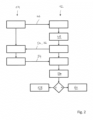
- Method steps associated with the mobile unit 14 are shown in the diagram Figure 2 shown on the left hand; Method steps that are assigned to the master key 12 are shown in the diagram Figure 2 shown on the right hand.
- a timeline of the process corresponds to a reading direction from top to bottom as shown Figure 2 .
- the mobile unit 14 In a first step of the method, the mobile unit 14 generates a connection request 46 and sends it to the device 20 of the master key 12 using the device 18.
- the master key 12 receives the connection request 46 and then generates a random data 48 and converts this into an acoustic signal 50 , which the acoustic transmitter 38 emits into the immediate vicinity of the master key 12 and which is received by the acoustic receiver 40 of the mobile unit 14.
- the acoustic signal 50 embodies an authentication request 52 of the master key 12 to the mobile unit 14.
- the mobile unit 14 processes the acoustic signal 50 / the authentication request 52 and generates (depending on a "secret” stored in the mobile unit 14) an authentication response 54 and sends it to the master key 12.
- the data transmission device 22 is used to transmit the authentication response 54.
- the master key 12 receives the authentication response 54 and carries out a check 56 for the identity of the authentication response 54 to the authentication request 52.
- a step 58 the connection for data transmission between the mobile unit 14 and the master key 12 is released using the data transmission device 22 and for the purpose of programming the master key 12.
- Step 60 can be accompanied by further measures, for example with a fundamental blocking of the programming option of the master key 12 for a certain period of time.
Landscapes
- Engineering & Computer Science (AREA)
- Computer Networks & Wireless Communication (AREA)
- Physics & Mathematics (AREA)
- General Physics & Mathematics (AREA)
- Lock And Its Accessories (AREA)
Description
- Die Erfindung betrifft ein Schließsystem, mit einem Hauptschlüssel zur Programmierung und Betätigung einer Schließeinrichtung, mit einer Mobileinheit zur Programmierung des Hauptschlüssels, mit einer Datenübertragungseinrichtung zur Datenübertragung zwischen der Mobileinheit und dem Hauptschlüssel im Zuge der Programmierung, gemäß
US 2021/037099 A1 . - Schließsysteme der vorstehend genannten Art ermöglichen eine komfortable Programmierung eines Hauptschlüssels unter Verwendung einer Mobileinheit. Der Hauptschlüssel wiederum dient dazu, eine Schließeinrichtung des Schließsystems zu programmieren, wobei beispielsweise Daten zu Zutrittsberechtigungen weiterer Schlüssel des Schließsystems an eine Schließeinrichtung übermittelt werden.
- Die Verwendung einer Datenübertragungseinrichtung zwischen der Mobileinheit und dem Hauptschlüssel ermöglicht eine komfortable Übertragung von Daten, welche insbesondere berührungslos erfolgen kann.
- Diese berührungslose Datenübertragung geht aber mit dem Risiko einher, dass eine Kommunikation zwischen einer (berechtigten) Mobileinheit und dem Hauptschlüssel potentiell abgehört werden kann, und dass anschließend eine (unberechtigte) Mobileinheit zur Umprogrammierung des Hauptschlüssels verwendet werden könnte.
- Ein Hauptschlüssel weist üblicherweise keine Bedienelemente, also keine Quittierungstaste oder Ähnliches auf. Demnach könnte eine (unberechtigte) Programmierung des Hauptschlüssels auch aus weiterer Entfernung, beispielsweise aus einem Nachbarraum heraus, erfolgen.
- Aus der
DE 10 2015 009 199 A1 ist es bekannt, eine Bluetooth-Kommunikation zwischen einer Mobileinheit und einem Schließsystem dadurch zu sichern, dass ein von einem Benutzer der Mobileinheit generiertes akustisches Signal (Stimme, Sprachcode) von dem Schließsystem oder der Mobileinheit empfangen und auf eine Berechtigung dieses Benutzers hin analysiert wird. - Hiervon ausgehend liegt der vorliegenden Erfindung die Aufgabe zugrunde, ein Schließsystem bereitzustellen, dass einen höheren Manipulationsschutz aufweist.
- Diese Aufgabe wird durch ein Schließsystem mit den Merkmalen des Patentanspruchs 1 gelöst.
- Bei dem erfindungsgemäßen Schließsystem ist zusätzlich zu einer Zweiwegekommunikation zwischen der Mobileinheit und dem Hauptschlüssel über die Datenübertragungseinrichtung ein zusätzlicher Kommunikationsweg bereitgestellt, und zwar in Form eines akustischen Kommunikationswegs von dem Hauptschlüssel ausgehend in Richtung auf die Mobileinheit.
- Der Hauptschlüssel weist also einen akustischen Sender zur Übermittlung eines akustischen Signals auf, das die Mobileinheit empfängt. Die Mobileinheit berücksichtigt dieses akustische Signal bei seiner Authentifizierung gegenüber dem Hauptschlüssel.
- Der akustische Sender ist vorzugsweise ein piezokeramischer Lautsprecher, der besonders kompakt baut und dennoch ein modulationsfähiges akustisches Signal erzeugen kann. Ein solcher Lautsprecher kann in einfacher Weise in einen Hauptschlüssel integriert werden. Der Hauptschlüssel ist beispielsweise kartenförmig oder weist einen Schließbart auf.
- Die Mobileinheit ist vorzugweise durch ein Smartphone gebildet, wobei der akustische Empfänger der akustischen Zusatzeinrichtung durch ein Mikrophon des Smartphones gebildet ist. Auf diese Weise kann ein Teil der akustischen Zusatzeinrichtung durch ein handelsübliches Smartphone bereitgehalten werden.
- Besonders bevorzugt ist es, wenn der akustische Sender, das akustische Signal und der akustische Empfänger derart aufeinander abgestimmt sind, dass ein Empfang des akustischen Signals nur möglich ist, wenn der akustische Sender und der akustische Empfänger maximal 1 m, vorzugsweise maximal 0,5 m, insbesondere maximal 0,2 m, zueinander beabstandet sind. Dies bedeutet, dass ein Nutzer der Mobileinheit zumindest die Mobileinheit selbst in unmittelbarer Nähe zu dem Hauptschlüssel positionieren muss, damit die Mobileinheit ein von dem Hauptschlüssel erzeugtes akustisches Signal überhaupt empfangen kann. Auf diese Weise wird der Manipulationsschutz weiter verbessert.
- Insbesondere wird vorgeschlagen, dass das akustische Signal - gemessen in einem zu einer Schallabstrahlfläche des akustischen Senders senkrechten Abstand von 10 cm - einen maximalen Schalldruckpegel von 30 dB, vorzugsweise von maximal 20 dB, insbesondere von maximal 10 dB, aufweist. Die Verwendung solch niedriger Schalldruckpegel hat den Vorteil, dass ein Empfang des akustischen Signals durch die Mobileinheit nur dann möglich ist, wenn die Mobileinheit in unmittelbarer Nähe des Hauptschlüssels angeordnet wird. Zusätzlich bewirken die genannten niedrigen Schalldruckpegel, dass ein Empfang des akustischen Signals des Hauptschlüssels nur in einer geräuschfreien oder zumindest geräuscharmen Umgebung möglich ist. Zu diesem Zweck muss ein Nutzer der Mobileinheit unmittelbaren Zugriff zu dem Hauptschlüssel haben, um diesen und die Mobileinheit in einer akustisch geeigneten Umgebung positionieren zu können. Auch dieser Zugriffsschutz erhöht die Manipulationssicherheit des Schließsystems.
- Bei der Datenübertragungseinrichtung handelt es sich in vorteilhafter Weise um eine Bluetooth-Einrichtung. Diese hat den Vorteil einer vergleichsweise niedrigen Reichweite von beispielsweise maximal 10 m, sodass auch während der Nutzung des freigegebenen Datenübertragungssystems eine räumliche Nähe zwischen der Mobileinheit und dem Hauptschlüssel beibehalten werden muss. Hierdurch wird eine weitere Verbesserung der Manipulationssicherheit erzielt.
- Die eingangs genannte Aufgabe wird auch gelöst durch ein Verfahren zur Freigabe einer Verbindung zwischen einer Mobileinheit und einem Hauptschlüssel, wobei die Verbindung zur Datenübertragung zwischen der Mobileinheit und dem Hauptschlüssel dient, unter Verwendung eines vorstehend beschriebenen Schließsystems. Das Verfahren umfasst:
- Senden einer Verbindungsanfrage von der Mobileinheit an den Hauptschlüssel,
- Empfangen der Verbindungsanfrage durch den Hauptschlüssel, Erzeugen einer Authentifizierungsaufforderung und Übersenden der Authentifizierungsaufforderung an die Mobileinheit unter Verwendung der akustischen Zusatzeinrichtung,
- Empfangen der Authentifizierungsaufforderung durch die Mobileinheit, Erzeugen einer Authentifizierungsantwort und Übersenden an den Hauptschlüssel,
- Empfangen der Authentifizierungsantwort durch den Hauptschlüssel, Prüfen der Authentifizierungsantwort auf Identität mit der Authentifizierungsaufforderung, und im Falle der Identität: Freigeben der Verbindung zwischen Mobileinheit und Hauptschlüssel.
- Die Freigabe der Verbindung zur Datenübertragung zwischen der Mobileinheit und dem Hauptschlüssel über die Datenübertragungseinrichtung erfolgt also nur dann, wenn die Authentifizierungsantwort der Mobileinheit zu der Authentifizierungsaufforderung des Hauptschlüssels identisch ist. Die Authentifizierungsaufforderung wird als akustisches Signal von dem Hauptschlüssel an die Mobileinheit gesendet.
- Zur weiteren Erhöhung der Manipulationssicherheit ist es möglich, dass die Authentifizierungsaufforderung einen Zeitstempel enthält. Eine zu einer solchen Aufforderung identische Antwort muss dann innerhalb einer kurzen Zeitdauer von der Mobileinheit erzeugt werden, wodurch eine Manipulation durch Auffangen des akustischen Signals und "Raten" einer Antwort weiter erschwert wird.
- Die Authentifizierungsaufforderung ist vorzugsweise ein akustisch kodiertes Zufallsdatum, insbesondere eine Zufallszahl. Ein solches Zufallsdatum oder eine solche Zufallszahl kann als Tonfolge moduliert werden. Hierbei ist es möglich, dass nur eine Tonfrequenz verwendet wird, welche in mehreren Abschnitten und zwischenzeitlichen Unterbrechungen gesendet wird. Zusätzlich oder alternativ hierzu ist die Verwendung unterschiedlicher Tonfrequenzen innerhalb einer Authentifizierungsaufforderung möglich.
- Die Authentifizierungsantwort entspricht in vorteilhafter Weise dem Zufallsdatum, insbesondere der Zusatzzahl. Es ist aber auch möglich, dass die Authentifizierungsantwort weitere Daten enthält, beispielsweise zu der Identität der Mobileinheit oder auch ein zusätzliches Passwort, das auch in dem Hauptschlüssel abgelegt ist.
- Weitere Merkmale und Vorteile der Erfindung sind Gegenstand der nachfolgenden Beschreibung und der zeichnerischen Darstellung bevorzugter Ausführungsbeispiele.
- In der Zeichnung zeigt:
- Fig. 1
- eine schematische Darstellung eines Ausführungsbeispiels eines Schließsystems; und
- Fig. 2
- eine Darstellung des Ablaufs eines Verfahrens zur Freigabe einer Verbindung zwischen einer Mobileinheit und einem Hauptschlüssel bei einem Schließsystem gemäß
Fig. 1 . - Ein Schließsystem ist in der Zeichnung insgesamt mit dem Bezugszeichen 10 bezeichnet. Das Schließsystem umfasst einen Hauptschlüssel 12 und eine Mobileinheit 14, insbesondere in Form eines Smartphones 16.
- Die Mobileinheit 14 weist eine Einrichtung 18 zum Empfangen und Senden von Daten auf. Der Hauptschlüssel 12 weist eine entsprechende Einrichtung 20 zum Empfangen und Senden von Daten auf. Die Einrichtungen 18 und 20 bilden gemeinsam eine Datenübertragungseinrichtung 22. Dies ist insbesondere als Bluetooth-Einrichtung ausgebildet.
- Der Hauptschlüssel 12 kann - aufgrund seiner Fähigkeit, mittels der Einrichtung 20 Daten senden zu können - auch als "aktiver Transponder" bezeichnet werden. Der Hauptschlüssel 12 weist vorzugsweise einen Energiespeicher, insbesondere eine Batterie, auf.
- Der Hauptschlüssel 12 weist eine Programmiereinheit 24 auf, welche in an sich bekannter Weise dazu dient, einen Datenspeicher 26 einer Schließeinrichtung 28 zu programmieren. Bei der Schließeinrichtung 28 kann es sich beispielsweise um einen Schließzylinder 30 handeln. Idealerweise dient der Hauptschlüssel 12 zur Programmierung und Betätigung einer Mehrzahl von Schließeinrichtungen 28, 32, 34.
- Die Programmierung des Hauptschlüssels 12 erfolgt mittels der Mobileinheit 14, und zwar unter Verwendung der Datenübertragungseinrichtung 22. Zur Freigabe einer Kommunikation über die Datenübertragungseinrichtung 22 umfasst das Schließsystem 10 eine insgesamt mit dem Bezugszeichen 36 bezeichnete akustische Zusatzeinrichtung. Diese umfasst einen an dem Hauptschlüssel 12 angeordneten akustischen Sender 38 und einen an der Mobileinheit 14 angeordneten akustischen Empfänger 40.
- Der akustische Sender ist vorzugsweise in Form eines piezokeramischen Lautsprechers 42 ausgebildet.
- Bei dem akustischen Empfänger 40 handelt es sich insbesondere um ein Mikrophon 44 des Smartphones 16.
- Zur Freigabe einer Verbindung über die Datenübertragungseinrichtung 22 zwischen der Mobileinheit 14 und dem Hauptschlüssel 12 wird ein nachfolgend unter Bezugnahme auf
Figur 2 beschriebenes Authentifizierungsverfahren durchgeführt. - Verfahrensschritte, die der Mobileinheit 14 zugeordnet sind, sind in dem Diagramm gemäß
Figur 2 linker Hand dargestellt; Verfahrensschritte, die dem Hauptschlüssel 12 zugeordnet sind, sind in dem Diagramm gemäßFigur 2 rechter Hand dargestellt. Ein zeitlicher Ablauf des Verfahrens korrespondiert mit einer Leserichtung von oben nach unten der Darstellung gemäßFigur 2 . - In einem ersten Schritt des Verfahrens erzeugt die Mobileinheit 14 eine Verbindungsanfrage 46 und übersendet diese mittels der Einrichtung 18 an die Einrichtung 20 des Hauptschlüssels 12. Der Hauptschlüssel 12 empfängt die Verbindungsanfrage 46 und erzeugt daraufhin ein Zufallsdatum 48 und wandelt dieses in ein akustisches Signal 50 um, das der akustische Sender 38 in die unmittelbare Umgebung des Hauptschlüssels 12 abstrahlt und das von dem akustischen Empfänger 40 der Mobileinheit 14 empfangen wird. Das akustische Signal 50 verkörpert eine Authentifizierungsaufforderung 52 des Hauptschlüssels 12 an die Mobileinheit 14.
- Die Mobileinheit 14 verarbeitet das akustische Signal 50 / die Authentifizierungsaufforderung 52 und erzeugt (in Abhängigkeit eines in der Mobileinheit 14 abgelegten "Geheimnisses") eine Authentifizierungsantwort 54 und sendet diese an den Hauptschlüssel 12. Für die Übermittlung der Authentifizierungsantwort 54 wird die Datenübertragungseinrichtung 22 verwendet.
- Der Hauptschlüssel 12 empfängt die Authentifizierungsantwort 54 und führt eine Prüfung 56 auf Identität der Authentifizierungsantwort 54 zu der Authentifizierungsaufforderung 52 durch.
- Im Falle einer Identität (in
Figur 2 durch "y" = englisch "yes" verbildlicht), erfolgt in einem Schritt 58 eine Freigabe der Verbindung zur Datenübertragung zwischen der Mobileinheit 14 und dem Hauptschlüssel 12 unter Verwendung der Datenübertragungseinrichtung 22 und zwecks Programmierung des Hauptschlüssels 12. - Im Falle der Nichtidentität (in
Figur 2 durch "n" = englisch "no" verbildlicht) wird in einem Schritt 60 die Freigabe einer Verbindung zwischen den Einrichtungen 18 und 20 der Datenübertragungseinrichtung 22 verweigert. Der Schritt 60 kann mit weiteren Maßnahmen einhergehen, beispielsweise mit einer grundsätzlichen Sperrung der Programmiermöglichkeit des Hauptschlüssels 12 für einen bestimmten Zeitraum.
Claims (10)
- Schließsystem (10), mit einem Hauptschlüssel (12) zur Programmierung und Betätigung einer Schließeinrichtung (28), mit einer Mobileinheit (14) zur Programmierung des Hauptschlüssels (12), mit einer Datenübertragungseinrichtung (22) zur Datenübertragung zwischen der Mobileinheit (14) und dem Hauptschlüssel (12) im Zuge der Programmierung, gekennzeichnet durch eine akustische Zusatzeinrichtung (36), umfassend einen an dem Hauptschlüssel (12) angeordneten akustischen Sender (38) zur Übersendung eines akustischen Signals (50) an einen der Mobileinheit (14) zugeordneten akustischen Empfänger (40), wobei der Hauptschlüssel (12) und die Mobileinheit (14) dazu eingerichtet sind, eine Verbindung über die Datenübertragungseinrichtung (22) zwischen Mobileinheit (14) und Hauptschlüssel (12) nur unter der Bedingung freizugeben, dass sich die Mobileinheit (14) unter Berücksichtigung des von dem Hauptschlüssel (12) übersandten akustischen Signals (50) gegenüber dem Hauptschlüssel (12) authentifiziert.
- Schließsystem (10) nach Anspruch 1, dadurch gekennzeichnet, dass der akustische Sender (38) ein piezokeramischer Lautsprecher (42) ist.
- Schließsystem (10) nach einem der vorstehenden Ansprüche, dadurch gekennzeichnet, dass die Mobileinheit (14) durch ein Smartphone (16) gebildet ist und dass der akustische Empfänger (40) durch ein Mikrophon (44) des Smartphones (16) gebildet ist.
- Schließsystem (10) nach einem der vorstehenden Ansprüche, dadurch gekennzeichnet, dass der akustische Sender (38), das akustische Signal (50) und der akustische Empfänger (42) derart auf einander abgestimmt sind, dass ein Empfang des akustischen Signals (50) nur möglich ist, wenn der akustische Sender (38) und der akustische Empfänger (42) maximal 1 m, vorzugsweise maximal 0,5 m, insbesondere maximal 0,2 m, zueinander beabstandet sind.
- Schließsystem (10) nach einem der vorstehenden Ansprüche, dadurch gekennzeichnet, dass das akustische Signal (50) - gemessen in einem zu einer Schallabstrahlfläche des akustischen Senders (38) senkrechten Abstand von 10 cm - einen maximalen Schalldruckpegel von 30 dB, vorzugsweise von maximal 20 dB, insbesondere von maximal 10 dB, aufweist.
- Schließsystem (10) nach einem der vorstehenden Ansprüche, dadurch gekennzeichnet, dass die Datenübertragungseinrichtung (22) eine Bluetooth-Einrichtung ist.
- Verfahren zur Freigabe einer Verbindung zwischen einer Mobileinheit (14) und einem Hauptschlüssel (12), wobei die Verbindung zur Datenübertragung zwischen der Mobileinheit (14) und dem Hauptschlüssel (12) dient, unter Verwendung eines Schließsystems (10) nach Anspruch 1, gekennzeichnet durch:- Senden einer Verbindungsanfrage (46) von der Mobileinheit (14) an den Hauptschlüssel (12),- Empfangen der Verbindungsanfrage (46) durch den Hauptschlüssel (12), Erzeugen einer Authentifizierungsaufforderung (52) und Übersenden der Authentifizierungsaufforderung (52) an die Mobileinheit (14) unter Verwendung der akustischen Zusatzeinrichtung (36),- Empfangen der Authentifizierungsaufforderung (52) durch die Mobileinheit (14), Erzeugen einer Authentifizierungsantwort (54) und Übersenden an den Hauptschlüssel (12),- Empfangen der Authentifizierungsantwort (54) durch den Hauptschlüssel (12), Prüfen der Authentifizierungsantwort (54) auf Identität mit der Authentifizierungsaufforderung (52), und im Falle der Identität: Freigeben der Verbindung zwischen Mobileinheit (14) und Hauptschlüssel (12).
- Verfahren nach Anspruch 7, dadurch gekennzeichnet, dass die Authentifizierungsaufforderung (52) einen Zeitstempel enthält.
- Verfahren nach Anspruch 7 oder 8, dadurch gekennzeichnet, dass die Authentifizierungsaufforderung (52) ein akustisch kodiertes Zufallsdatum, insbesondere eine Zufallszahl, ist.
- Verfahren nach Anspruch 9, dadurch gekennzeichnet, dass die Authentifizierungsantwort (54) dem Zufallsdatum, insbesondere der Zufallszahl, entspricht.
Priority Applications (1)
| Application Number | Priority Date | Filing Date | Title |
|---|---|---|---|
| EP21177176.1A EP4099282B1 (de) | 2021-06-01 | 2021-06-01 | Schliesssystem und verfahren zur freigabe einer verbindung zwischen einer mobileinheit und einem hauptschlüssel |
Applications Claiming Priority (1)
| Application Number | Priority Date | Filing Date | Title |
|---|---|---|---|
| EP21177176.1A EP4099282B1 (de) | 2021-06-01 | 2021-06-01 | Schliesssystem und verfahren zur freigabe einer verbindung zwischen einer mobileinheit und einem hauptschlüssel |
Publications (2)
| Publication Number | Publication Date |
|---|---|
| EP4099282A1 EP4099282A1 (de) | 2022-12-07 |
| EP4099282B1 true EP4099282B1 (de) | 2024-01-17 |
Family
ID=76250099
Family Applications (1)
| Application Number | Title | Priority Date | Filing Date |
|---|---|---|---|
| EP21177176.1A Active EP4099282B1 (de) | 2021-06-01 | 2021-06-01 | Schliesssystem und verfahren zur freigabe einer verbindung zwischen einer mobileinheit und einem hauptschlüssel |
Country Status (1)
| Country | Link |
|---|---|
| EP (1) | EP4099282B1 (de) |
Family Cites Families (3)
| Publication number | Priority date | Publication date | Assignee | Title |
|---|---|---|---|---|
| DE102015009199A1 (de) * | 2015-07-15 | 2017-01-19 | Jörgen Betz | Personenselektives Verfahren der Zutrittskontrolle |
| US11316927B2 (en) * | 2018-07-16 | 2022-04-26 | Novo Blue Technologies, LLC | Smart platform for programming remote keyless devices |
| DE102019008962A1 (de) * | 2018-12-28 | 2020-07-02 | Marquardt Gmbh | Schließsystem, insbesondere für ein Kraftfahrzeug |
-
2021
- 2021-06-01 EP EP21177176.1A patent/EP4099282B1/de active Active
Also Published As
| Publication number | Publication date |
|---|---|
| EP4099282A1 (de) | 2022-12-07 |
Similar Documents
| Publication | Publication Date | Title |
|---|---|---|
| EP3416140B1 (de) | Verfahren und vorrichtung zum authentisieren eines nutzers an einem fahrzeug | |
| DE69601349T2 (de) | Überprüfung der persönlichen Identifizierungsnummer eines mobilen Teilnehmers | |
| DE69735166T2 (de) | Verfahren und einrichtung zur sicherung der ferndienstleistungen der finanzinstitute | |
| DE102013209612A1 (de) | Verfahren zum Durchführen eines automatischen Öffnens eines Fahrzeugs oder eines Bezahl-Vorgangs sowie zugehörige Vorrichtung | |
| WO2013068074A1 (de) | Verfahren und system zur freigabe einer technischen vorrichtung | |
| AT513461B1 (de) | Verfahren zur Zutrittskontrolle | |
| EP2624223B1 (de) | Verfahren und Vorrichtung zur Zutrittskontrolle | |
| EP4099282B1 (de) | Schliesssystem und verfahren zur freigabe einer verbindung zwischen einer mobileinheit und einem hauptschlüssel | |
| EP1020335A2 (de) | Verfahren zum Authentisieren eines Ersatzschlüssels zum Benutzen eines Fahrzeugs | |
| EP3777282B1 (de) | Erkennung von angriffen auf funkautorisierungssysteme | |
| DE102017216029A1 (de) | Zugangs- und Startsystem und Verfahren zur Zugangs- und Startverifizierung | |
| EP1287221B1 (de) | Verfahren und vorrichtung zur zugangskontrolle zu einem gesicherten ort, insbesondere einem kraftfahrzeug | |
| DE10202321B4 (de) | System und Methode zur elektronischen Authentifizierung | |
| DE102020205933A1 (de) | Verfahren zur Kopplung eines Authentifizierungsmittels mit einem Fahrzeug | |
| DE102020123756B3 (de) | Verfahren zur Nutzungsfreigabe sowie Funktionsfreigabeeinrichtung hierzu | |
| CH714569A2 (de) | Sichere bidirektionale Nahfeld-Datenübertragung zwischen einem Terminal und einem mobilen Gerät ohne bidirektionale Nahfeld-Schnittstelle. | |
| EP3441948A1 (de) | Schliesssystem, elektronisches schloss für ein schliesssystem und verfahren zum betrieb eines schliesssystems | |
| DE102011110898A1 (de) | Verfahren zur Authentifizierung eines Benutzers zum Gewähren eines Zugangs zu Diensten eines Computersystems, sowie zugehöriges Computersystem, Authentifizierungsserver und Kommunikationsgerät mit Authentifizierungsapplikation | |
| DE102023204984A1 (de) | Zugangskontrollverfahren für einen zugangsbeschränkten Bereich unter Nutzung einer Hörvorrichtung | |
| DE102021005350A1 (de) | Autorisieren einer Anwendung auf einem Sicherheitselement | |
| EP3489916B1 (de) | Zugangskontrollvorrichtung, zugangskontrollsystem und verfahren | |
| EP1163559A1 (de) | Verfahren zur sicherung des zugangs zu einer datenverarbeitungseinrichtung und entsprechende vorrichtung | |
| DE102016217193B4 (de) | Verfahren und Servereinrichtung zum Weitergeben einer Zugangs- und Startberechtigung zu einem Kraftfahrzeug | |
| DE102016204807A1 (de) | Schlüsselloses Zugangssystem, insbesondere für ein Kraftfahrzeug | |
| EP4468745A1 (de) | Verfahren zum betrieb eines smarten mobilgeräts, hörvorrichtung und hörsystem |
Legal Events
| Date | Code | Title | Description |
|---|---|---|---|
| PUAI | Public reference made under article 153(3) epc to a published international application that has entered the european phase |
Free format text: ORIGINAL CODE: 0009012 |
|
| STAA | Information on the status of an ep patent application or granted ep patent |
Free format text: STATUS: THE APPLICATION HAS BEEN PUBLISHED |
|
| AK | Designated contracting states |
Kind code of ref document: A1 Designated state(s): AL AT BE BG CH CY CZ DE DK EE ES FI FR GB GR HR HU IE IS IT LI LT LU LV MC MK MT NL NO PL PT RO RS SE SI SK SM TR |
|
| STAA | Information on the status of an ep patent application or granted ep patent |
Free format text: STATUS: REQUEST FOR EXAMINATION WAS MADE |
|
| 17P | Request for examination filed |
Effective date: 20230424 |
|
| RBV | Designated contracting states (corrected) |
Designated state(s): AL AT BE BG CH CY CZ DE DK EE ES FI FR GB GR HR HU IE IS IT LI LT LU LV MC MK MT NL NO PL PT RO RS SE SI SK SM TR |
|
| GRAP | Despatch of communication of intention to grant a patent |
Free format text: ORIGINAL CODE: EPIDOSNIGR1 |
|
| STAA | Information on the status of an ep patent application or granted ep patent |
Free format text: STATUS: GRANT OF PATENT IS INTENDED |
|
| INTG | Intention to grant announced |
Effective date: 20230804 |
|
| GRAS | Grant fee paid |
Free format text: ORIGINAL CODE: EPIDOSNIGR3 |
|
| GRAA | (expected) grant |
Free format text: ORIGINAL CODE: 0009210 |
|
| STAA | Information on the status of an ep patent application or granted ep patent |
Free format text: STATUS: THE PATENT HAS BEEN GRANTED |
|
| AK | Designated contracting states |
Kind code of ref document: B1 Designated state(s): AL AT BE BG CH CY CZ DE DK EE ES FI FR GB GR HR HU IE IS IT LI LT LU LV MC MK MT NL NO PL PT RO RS SE SI SK SM TR |
|
| P01 | Opt-out of the competence of the unified patent court (upc) registered |
Effective date: 20231213 |
|
| REG | Reference to a national code |
Ref country code: GB Ref legal event code: FG4D Free format text: NOT ENGLISH |
|
| REG | Reference to a national code |
Ref country code: DE Ref legal event code: R096 Ref document number: 502021002469 Country of ref document: DE |
|
| REG | Reference to a national code |
Ref country code: CH Ref legal event code: EP |
|
| REG | Reference to a national code |
Ref country code: IE Ref legal event code: FG4D Free format text: LANGUAGE OF EP DOCUMENT: GERMAN |
|
| REG | Reference to a national code |
Ref country code: LT Ref legal event code: MG9D |
|
| REG | Reference to a national code |
Ref country code: NL Ref legal event code: MP Effective date: 20240117 |
|
| PG25 | Lapsed in a contracting state [announced via postgrant information from national office to epo] |
Ref country code: NL Free format text: LAPSE BECAUSE OF FAILURE TO SUBMIT A TRANSLATION OF THE DESCRIPTION OR TO PAY THE FEE WITHIN THE PRESCRIBED TIME-LIMIT Effective date: 20240117 |
|
| PG25 | Lapsed in a contracting state [announced via postgrant information from national office to epo] |
Ref country code: NL Free format text: LAPSE BECAUSE OF FAILURE TO SUBMIT A TRANSLATION OF THE DESCRIPTION OR TO PAY THE FEE WITHIN THE PRESCRIBED TIME-LIMIT Effective date: 20240117 |
|
| PG25 | Lapsed in a contracting state [announced via postgrant information from national office to epo] |
Ref country code: IS Free format text: LAPSE BECAUSE OF FAILURE TO SUBMIT A TRANSLATION OF THE DESCRIPTION OR TO PAY THE FEE WITHIN THE PRESCRIBED TIME-LIMIT Effective date: 20240517 |
|
| PG25 | Lapsed in a contracting state [announced via postgrant information from national office to epo] |
Ref country code: LT Free format text: LAPSE BECAUSE OF FAILURE TO SUBMIT A TRANSLATION OF THE DESCRIPTION OR TO PAY THE FEE WITHIN THE PRESCRIBED TIME-LIMIT Effective date: 20240117 |
|
| PG25 | Lapsed in a contracting state [announced via postgrant information from national office to epo] |
Ref country code: GR Free format text: LAPSE BECAUSE OF FAILURE TO SUBMIT A TRANSLATION OF THE DESCRIPTION OR TO PAY THE FEE WITHIN THE PRESCRIBED TIME-LIMIT Effective date: 20240418 |
|
| PG25 | Lapsed in a contracting state [announced via postgrant information from national office to epo] |
Ref country code: HR Free format text: LAPSE BECAUSE OF FAILURE TO SUBMIT A TRANSLATION OF THE DESCRIPTION OR TO PAY THE FEE WITHIN THE PRESCRIBED TIME-LIMIT Effective date: 20240117 Ref country code: RS Free format text: LAPSE BECAUSE OF FAILURE TO SUBMIT A TRANSLATION OF THE DESCRIPTION OR TO PAY THE FEE WITHIN THE PRESCRIBED TIME-LIMIT Effective date: 20240417 |
|
| PG25 | Lapsed in a contracting state [announced via postgrant information from national office to epo] |
Ref country code: ES Free format text: LAPSE BECAUSE OF FAILURE TO SUBMIT A TRANSLATION OF THE DESCRIPTION OR TO PAY THE FEE WITHIN THE PRESCRIBED TIME-LIMIT Effective date: 20240117 |
|
| PG25 | Lapsed in a contracting state [announced via postgrant information from national office to epo] |
Ref country code: RS Free format text: LAPSE BECAUSE OF FAILURE TO SUBMIT A TRANSLATION OF THE DESCRIPTION OR TO PAY THE FEE WITHIN THE PRESCRIBED TIME-LIMIT Effective date: 20240417 Ref country code: NO Free format text: LAPSE BECAUSE OF FAILURE TO SUBMIT A TRANSLATION OF THE DESCRIPTION OR TO PAY THE FEE WITHIN THE PRESCRIBED TIME-LIMIT Effective date: 20240417 Ref country code: LT Free format text: LAPSE BECAUSE OF FAILURE TO SUBMIT A TRANSLATION OF THE DESCRIPTION OR TO PAY THE FEE WITHIN THE PRESCRIBED TIME-LIMIT Effective date: 20240117 Ref country code: IS Free format text: LAPSE BECAUSE OF FAILURE TO SUBMIT A TRANSLATION OF THE DESCRIPTION OR TO PAY THE FEE WITHIN THE PRESCRIBED TIME-LIMIT Effective date: 20240517 Ref country code: HR Free format text: LAPSE BECAUSE OF FAILURE TO SUBMIT A TRANSLATION OF THE DESCRIPTION OR TO PAY THE FEE WITHIN THE PRESCRIBED TIME-LIMIT Effective date: 20240117 Ref country code: GR Free format text: LAPSE BECAUSE OF FAILURE TO SUBMIT A TRANSLATION OF THE DESCRIPTION OR TO PAY THE FEE WITHIN THE PRESCRIBED TIME-LIMIT Effective date: 20240418 Ref country code: FI Free format text: LAPSE BECAUSE OF FAILURE TO SUBMIT A TRANSLATION OF THE DESCRIPTION OR TO PAY THE FEE WITHIN THE PRESCRIBED TIME-LIMIT Effective date: 20240117 Ref country code: ES Free format text: LAPSE BECAUSE OF FAILURE TO SUBMIT A TRANSLATION OF THE DESCRIPTION OR TO PAY THE FEE WITHIN THE PRESCRIBED TIME-LIMIT Effective date: 20240117 Ref country code: BG Free format text: LAPSE BECAUSE OF FAILURE TO SUBMIT A TRANSLATION OF THE DESCRIPTION OR TO PAY THE FEE WITHIN THE PRESCRIBED TIME-LIMIT Effective date: 20240117 |
|
| PG25 | Lapsed in a contracting state [announced via postgrant information from national office to epo] |
Ref country code: PL Free format text: LAPSE BECAUSE OF FAILURE TO SUBMIT A TRANSLATION OF THE DESCRIPTION OR TO PAY THE FEE WITHIN THE PRESCRIBED TIME-LIMIT Effective date: 20240117 Ref country code: PT Free format text: LAPSE BECAUSE OF FAILURE TO SUBMIT A TRANSLATION OF THE DESCRIPTION OR TO PAY THE FEE WITHIN THE PRESCRIBED TIME-LIMIT Effective date: 20240517 |
|
| PG25 | Lapsed in a contracting state [announced via postgrant information from national office to epo] |
Ref country code: SE Free format text: LAPSE BECAUSE OF FAILURE TO SUBMIT A TRANSLATION OF THE DESCRIPTION OR TO PAY THE FEE WITHIN THE PRESCRIBED TIME-LIMIT Effective date: 20240117 Ref country code: PT Free format text: LAPSE BECAUSE OF FAILURE TO SUBMIT A TRANSLATION OF THE DESCRIPTION OR TO PAY THE FEE WITHIN THE PRESCRIBED TIME-LIMIT Effective date: 20240517 Ref country code: PL Free format text: LAPSE BECAUSE OF FAILURE TO SUBMIT A TRANSLATION OF THE DESCRIPTION OR TO PAY THE FEE WITHIN THE PRESCRIBED TIME-LIMIT Effective date: 20240117 Ref country code: LV Free format text: LAPSE BECAUSE OF FAILURE TO SUBMIT A TRANSLATION OF THE DESCRIPTION OR TO PAY THE FEE WITHIN THE PRESCRIBED TIME-LIMIT Effective date: 20240117 |
|
| PG25 | Lapsed in a contracting state [announced via postgrant information from national office to epo] |
Ref country code: DK Free format text: LAPSE BECAUSE OF FAILURE TO SUBMIT A TRANSLATION OF THE DESCRIPTION OR TO PAY THE FEE WITHIN THE PRESCRIBED TIME-LIMIT Effective date: 20240117 |
|
| PG25 | Lapsed in a contracting state [announced via postgrant information from national office to epo] |
Ref country code: SM Free format text: LAPSE BECAUSE OF FAILURE TO SUBMIT A TRANSLATION OF THE DESCRIPTION OR TO PAY THE FEE WITHIN THE PRESCRIBED TIME-LIMIT Effective date: 20240117 |
|
| REG | Reference to a national code |
Ref country code: DE Ref legal event code: R097 Ref document number: 502021002469 Country of ref document: DE |
|
| PG25 | Lapsed in a contracting state [announced via postgrant information from national office to epo] |
Ref country code: EE Free format text: LAPSE BECAUSE OF FAILURE TO SUBMIT A TRANSLATION OF THE DESCRIPTION OR TO PAY THE FEE WITHIN THE PRESCRIBED TIME-LIMIT Effective date: 20240117 Ref country code: CZ Free format text: LAPSE BECAUSE OF FAILURE TO SUBMIT A TRANSLATION OF THE DESCRIPTION OR TO PAY THE FEE WITHIN THE PRESCRIBED TIME-LIMIT Effective date: 20240117 |
|
| PG25 | Lapsed in a contracting state [announced via postgrant information from national office to epo] |
Ref country code: SK Free format text: LAPSE BECAUSE OF FAILURE TO SUBMIT A TRANSLATION OF THE DESCRIPTION OR TO PAY THE FEE WITHIN THE PRESCRIBED TIME-LIMIT Effective date: 20240117 |
|
| PG25 | Lapsed in a contracting state [announced via postgrant information from national office to epo] |
Ref country code: SM Free format text: LAPSE BECAUSE OF FAILURE TO SUBMIT A TRANSLATION OF THE DESCRIPTION OR TO PAY THE FEE WITHIN THE PRESCRIBED TIME-LIMIT Effective date: 20240117 Ref country code: SK Free format text: LAPSE BECAUSE OF FAILURE TO SUBMIT A TRANSLATION OF THE DESCRIPTION OR TO PAY THE FEE WITHIN THE PRESCRIBED TIME-LIMIT Effective date: 20240117 Ref country code: RO Free format text: LAPSE BECAUSE OF FAILURE TO SUBMIT A TRANSLATION OF THE DESCRIPTION OR TO PAY THE FEE WITHIN THE PRESCRIBED TIME-LIMIT Effective date: 20240117 Ref country code: EE Free format text: LAPSE BECAUSE OF FAILURE TO SUBMIT A TRANSLATION OF THE DESCRIPTION OR TO PAY THE FEE WITHIN THE PRESCRIBED TIME-LIMIT Effective date: 20240117 Ref country code: DK Free format text: LAPSE BECAUSE OF FAILURE TO SUBMIT A TRANSLATION OF THE DESCRIPTION OR TO PAY THE FEE WITHIN THE PRESCRIBED TIME-LIMIT Effective date: 20240117 Ref country code: CZ Free format text: LAPSE BECAUSE OF FAILURE TO SUBMIT A TRANSLATION OF THE DESCRIPTION OR TO PAY THE FEE WITHIN THE PRESCRIBED TIME-LIMIT Effective date: 20240117 |
|
| PLBE | No opposition filed within time limit |
Free format text: ORIGINAL CODE: 0009261 |
|
| STAA | Information on the status of an ep patent application or granted ep patent |
Free format text: STATUS: NO OPPOSITION FILED WITHIN TIME LIMIT |
|
| PG25 | Lapsed in a contracting state [announced via postgrant information from national office to epo] |
Ref country code: IT Free format text: LAPSE BECAUSE OF FAILURE TO SUBMIT A TRANSLATION OF THE DESCRIPTION OR TO PAY THE FEE WITHIN THE PRESCRIBED TIME-LIMIT Effective date: 20240117 |
|
| 26N | No opposition filed |
Effective date: 20241018 |
|
| PG25 | Lapsed in a contracting state [announced via postgrant information from national office to epo] |
Ref country code: IT Free format text: LAPSE BECAUSE OF FAILURE TO SUBMIT A TRANSLATION OF THE DESCRIPTION OR TO PAY THE FEE WITHIN THE PRESCRIBED TIME-LIMIT Effective date: 20240117 |
|
| REG | Reference to a national code |
Ref country code: DE Ref legal event code: R082 Ref document number: 502021002469 Country of ref document: DE |
|
| PG25 | Lapsed in a contracting state [announced via postgrant information from national office to epo] |
Ref country code: MC Free format text: LAPSE BECAUSE OF FAILURE TO SUBMIT A TRANSLATION OF THE DESCRIPTION OR TO PAY THE FEE WITHIN THE PRESCRIBED TIME-LIMIT Effective date: 20240117 |
|
| REG | Reference to a national code |
Ref country code: CH Ref legal event code: PL |
|
| PG25 | Lapsed in a contracting state [announced via postgrant information from national office to epo] |
Ref country code: LU Free format text: LAPSE BECAUSE OF NON-PAYMENT OF DUE FEES Effective date: 20240601 |
|
| PG25 | Lapsed in a contracting state [announced via postgrant information from national office to epo] |
Ref country code: IE Free format text: LAPSE BECAUSE OF NON-PAYMENT OF DUE FEES Effective date: 20240601 |
|
| PG25 | Lapsed in a contracting state [announced via postgrant information from national office to epo] |
Ref country code: SI Free format text: LAPSE BECAUSE OF FAILURE TO SUBMIT A TRANSLATION OF THE DESCRIPTION OR TO PAY THE FEE WITHIN THE PRESCRIBED TIME-LIMIT Effective date: 20240117 Ref country code: CH Free format text: LAPSE BECAUSE OF NON-PAYMENT OF DUE FEES Effective date: 20240630 Ref country code: BE Free format text: LAPSE BECAUSE OF NON-PAYMENT OF DUE FEES Effective date: 20240630 |
|
| PG25 | Lapsed in a contracting state [announced via postgrant information from national office to epo] |
Ref country code: FR Free format text: LAPSE BECAUSE OF NON-PAYMENT OF DUE FEES Effective date: 20240630 |
|
| REG | Reference to a national code |
Ref country code: BE Ref legal event code: MM Effective date: 20240630 |
|
| PGFP | Annual fee paid to national office [announced via postgrant information from national office to epo] |
Ref country code: DE Payment date: 20250618 Year of fee payment: 5 |
|
| PGFP | Annual fee paid to national office [announced via postgrant information from national office to epo] |
Ref country code: AT Payment date: 20250721 Year of fee payment: 5 |
|
| PG25 | Lapsed in a contracting state [announced via postgrant information from national office to epo] |
Ref country code: CY Free format text: LAPSE BECAUSE OF FAILURE TO SUBMIT A TRANSLATION OF THE DESCRIPTION OR TO PAY THE FEE WITHIN THE PRESCRIBED TIME-LIMIT; INVALID AB INITIO Effective date: 20210601 |
|
| GBPC | Gb: european patent ceased through non-payment of renewal fee |
Effective date: 20250601 |
|
| PG25 | Lapsed in a contracting state [announced via postgrant information from national office to epo] |
Ref country code: HU Free format text: LAPSE BECAUSE OF FAILURE TO SUBMIT A TRANSLATION OF THE DESCRIPTION OR TO PAY THE FEE WITHIN THE PRESCRIBED TIME-LIMIT; INVALID AB INITIO Effective date: 20210601 |
|
| PG25 | Lapsed in a contracting state [announced via postgrant information from national office to epo] |
Ref country code: GB Free format text: LAPSE BECAUSE OF NON-PAYMENT OF DUE FEES Effective date: 20250601 |