EP4098707A1 - Ink composition for water-based ballpoint pen - Google Patents
Ink composition for water-based ballpoint pen Download PDFInfo
- Publication number
- EP4098707A1 EP4098707A1 EP20917032.3A EP20917032A EP4098707A1 EP 4098707 A1 EP4098707 A1 EP 4098707A1 EP 20917032 A EP20917032 A EP 20917032A EP 4098707 A1 EP4098707 A1 EP 4098707A1
- Authority
- EP
- European Patent Office
- Prior art keywords
- water
- ballpoint pen
- particles
- based ballpoint
- ink
- Prior art date
- Legal status (The legal status is an assumption and is not a legal conclusion. Google has not performed a legal analysis and makes no representation as to the accuracy of the status listed.)
- Pending
Links
- XLYOFNOQVPJJNP-UHFFFAOYSA-N water Substances O XLYOFNOQVPJJNP-UHFFFAOYSA-N 0.000 title claims abstract description 109
- 239000000203 mixture Substances 0.000 title claims abstract description 60
- 239000002245 particle Substances 0.000 claims abstract description 146
- JOYRKODLDBILNP-UHFFFAOYSA-N Ethyl urethane Chemical compound CCOC(N)=O JOYRKODLDBILNP-UHFFFAOYSA-N 0.000 claims abstract description 72
- 239000000049 pigment Substances 0.000 claims abstract description 69
- XAGFODPZIPBFFR-UHFFFAOYSA-N aluminium Chemical compound [Al] XAGFODPZIPBFFR-UHFFFAOYSA-N 0.000 claims abstract description 36
- 229910052782 aluminium Inorganic materials 0.000 claims abstract description 31
- 239000007787 solid Substances 0.000 claims abstract description 15
- 239000002932 luster Substances 0.000 abstract description 15
- 239000000975 dye Substances 0.000 description 23
- 239000003921 oil Substances 0.000 description 21
- 239000012948 isocyanate Substances 0.000 description 18
- 150000002513 isocyanates Chemical class 0.000 description 18
- 238000011156 evaluation Methods 0.000 description 16
- 239000012071 phase Substances 0.000 description 16
- 238000004519 manufacturing process Methods 0.000 description 15
- 239000003960 organic solvent Substances 0.000 description 15
- 239000000126 substance Substances 0.000 description 15
- 230000014759 maintenance of location Effects 0.000 description 13
- XEKOWRVHYACXOJ-UHFFFAOYSA-N Ethyl acetate Chemical compound CCOC(C)=O XEKOWRVHYACXOJ-UHFFFAOYSA-N 0.000 description 12
- 238000004040 coloring Methods 0.000 description 12
- 239000000463 material Substances 0.000 description 12
- -1 phenyl ester Chemical class 0.000 description 10
- 238000006116 polymerization reaction Methods 0.000 description 10
- VYPSYNLAJGMNEJ-UHFFFAOYSA-N Silicium dioxide Chemical compound O=[Si]=O VYPSYNLAJGMNEJ-UHFFFAOYSA-N 0.000 description 9
- 238000002156 mixing Methods 0.000 description 9
- 239000000178 monomer Substances 0.000 description 9
- 230000000694 effects Effects 0.000 description 8
- 238000000034 method Methods 0.000 description 8
- 239000005057 Hexamethylene diisocyanate Substances 0.000 description 7
- 229920000877 Melamine resin Polymers 0.000 description 7
- 230000000052 comparative effect Effects 0.000 description 7
- RRAMGCGOFNQTLD-UHFFFAOYSA-N hexamethylene diisocyanate Chemical compound O=C=NCCCCCCN=C=O RRAMGCGOFNQTLD-UHFFFAOYSA-N 0.000 description 7
- JDSHMPZPIAZGSV-UHFFFAOYSA-N melamine Chemical compound NC1=NC(N)=NC(N)=N1 JDSHMPZPIAZGSV-UHFFFAOYSA-N 0.000 description 7
- 238000003756 stirring Methods 0.000 description 6
- 239000003795 chemical substances by application Substances 0.000 description 5
- 239000000084 colloidal system Substances 0.000 description 5
- 239000002270 dispersing agent Substances 0.000 description 5
- 229910052751 metal Inorganic materials 0.000 description 5
- 239000002184 metal Substances 0.000 description 5
- 239000003094 microcapsule Substances 0.000 description 5
- 238000002360 preparation method Methods 0.000 description 5
- 230000001681 protective effect Effects 0.000 description 5
- CUZKCNWZBXLAJX-UHFFFAOYSA-N 2-phenylmethoxyethanol Chemical compound OCCOCC1=CC=CC=C1 CUZKCNWZBXLAJX-UHFFFAOYSA-N 0.000 description 4
- UPMLOUAZCHDJJD-UHFFFAOYSA-N 4,4'-Diphenylmethane Diisocyanate Chemical compound C1=CC(N=C=O)=CC=C1CC1=CC=C(N=C=O)C=C1 UPMLOUAZCHDJJD-UHFFFAOYSA-N 0.000 description 4
- PEDCQBHIVMGVHV-UHFFFAOYSA-N Glycerine Chemical compound OCC(O)CO PEDCQBHIVMGVHV-UHFFFAOYSA-N 0.000 description 4
- UQSXHKLRYXJYBZ-UHFFFAOYSA-N Iron oxide Chemical compound [Fe]=O UQSXHKLRYXJYBZ-UHFFFAOYSA-N 0.000 description 4
- 239000003086 colorant Substances 0.000 description 4
- 229920001577 copolymer Polymers 0.000 description 4
- 230000007797 corrosion Effects 0.000 description 4
- 238000005260 corrosion Methods 0.000 description 4
- 230000007423 decrease Effects 0.000 description 4
- 235000014113 dietary fatty acids Nutrition 0.000 description 4
- 239000006185 dispersion Substances 0.000 description 4
- 239000012153 distilled water Substances 0.000 description 4
- 238000004945 emulsification Methods 0.000 description 4
- 239000000194 fatty acid Substances 0.000 description 4
- 229930195729 fatty acid Natural products 0.000 description 4
- 238000010438 heat treatment Methods 0.000 description 4
- 239000000377 silicon dioxide Substances 0.000 description 4
- WVDDGKGOMKODPV-UHFFFAOYSA-N Benzyl alcohol Chemical compound OCC1=CC=CC=C1 WVDDGKGOMKODPV-UHFFFAOYSA-N 0.000 description 3
- LYCAIKOWRPUZTN-UHFFFAOYSA-N Ethylene glycol Chemical compound OCCO LYCAIKOWRPUZTN-UHFFFAOYSA-N 0.000 description 3
- WMFOQBRAJBCJND-UHFFFAOYSA-M Lithium hydroxide Chemical compound [Li+].[OH-] WMFOQBRAJBCJND-UHFFFAOYSA-M 0.000 description 3
- 239000004372 Polyvinyl alcohol Substances 0.000 description 3
- KWYUFKZDYYNOTN-UHFFFAOYSA-M Potassium hydroxide Chemical compound [OH-].[K+] KWYUFKZDYYNOTN-UHFFFAOYSA-M 0.000 description 3
- DNIAPMSPPWPWGF-UHFFFAOYSA-N Propylene glycol Chemical compound CC(O)CO DNIAPMSPPWPWGF-UHFFFAOYSA-N 0.000 description 3
- HEMHJVSKTPXQMS-UHFFFAOYSA-M Sodium hydroxide Chemical compound [OH-].[Na+] HEMHJVSKTPXQMS-UHFFFAOYSA-M 0.000 description 3
- ZMANZCXQSJIPKH-UHFFFAOYSA-N Triethylamine Chemical compound CCN(CC)CC ZMANZCXQSJIPKH-UHFFFAOYSA-N 0.000 description 3
- ZJCCRDAZUWHFQH-UHFFFAOYSA-N Trimethylolpropane Chemical compound CCC(CO)(CO)CO ZJCCRDAZUWHFQH-UHFFFAOYSA-N 0.000 description 3
- 239000004411 aluminium Substances 0.000 description 3
- 239000008346 aqueous phase Substances 0.000 description 3
- TZCXTZWJZNENPQ-UHFFFAOYSA-L barium sulfate Chemical compound [Ba+2].[O-]S([O-])(=O)=O TZCXTZWJZNENPQ-UHFFFAOYSA-L 0.000 description 3
- 239000011248 coating agent Substances 0.000 description 3
- 238000000576 coating method Methods 0.000 description 3
- 238000012669 compression test Methods 0.000 description 3
- 238000011161 development Methods 0.000 description 3
- MTHSVFCYNBDYFN-UHFFFAOYSA-N diethylene glycol Chemical compound OCCOCCO MTHSVFCYNBDYFN-UHFFFAOYSA-N 0.000 description 3
- 238000000227 grinding Methods 0.000 description 3
- 239000003112 inhibitor Substances 0.000 description 3
- 239000007788 liquid Substances 0.000 description 3
- 239000000314 lubricant Substances 0.000 description 3
- 239000012860 organic pigment Substances 0.000 description 3
- 239000003002 pH adjusting agent Substances 0.000 description 3
- WVDDGKGOMKODPV-ZQBYOMGUSA-N phenyl(114C)methanol Chemical compound O[14CH2]C1=CC=CC=C1 WVDDGKGOMKODPV-ZQBYOMGUSA-N 0.000 description 3
- 230000000379 polymerizing effect Effects 0.000 description 3
- 229920002451 polyvinyl alcohol Polymers 0.000 description 3
- 229920005989 resin Polymers 0.000 description 3
- 239000011347 resin Substances 0.000 description 3
- 150000003839 salts Chemical class 0.000 description 3
- 239000002904 solvent Substances 0.000 description 3
- 239000002562 thickening agent Substances 0.000 description 3
- NXQMCAOPTPLPRL-UHFFFAOYSA-N 2-(2-benzoyloxyethoxy)ethyl benzoate Chemical compound C=1C=CC=CC=1C(=O)OCCOCCOC(=O)C1=CC=CC=C1 NXQMCAOPTPLPRL-UHFFFAOYSA-N 0.000 description 2
- QCDWFXQBSFUVSP-UHFFFAOYSA-N 2-phenoxyethanol Chemical compound OCCOC1=CC=CC=C1 QCDWFXQBSFUVSP-UHFFFAOYSA-N 0.000 description 2
- QGZKDVFQNNGYKY-UHFFFAOYSA-N Ammonia Chemical compound N QGZKDVFQNNGYKY-UHFFFAOYSA-N 0.000 description 2
- 229910001369 Brass Inorganic materials 0.000 description 2
- VTYYLEPIZMXCLO-UHFFFAOYSA-L Calcium carbonate Chemical compound [Ca+2].[O-]C([O-])=O VTYYLEPIZMXCLO-UHFFFAOYSA-L 0.000 description 2
- AEMRFAOFKBGASW-UHFFFAOYSA-N Glycolic acid Chemical compound OCC(O)=O AEMRFAOFKBGASW-UHFFFAOYSA-N 0.000 description 2
- YNAVUWVOSKDBBP-UHFFFAOYSA-N Morpholine Chemical compound C1COCCN1 YNAVUWVOSKDBBP-UHFFFAOYSA-N 0.000 description 2
- 229910019142 PO4 Inorganic materials 0.000 description 2
- 239000004721 Polyphenylene oxide Substances 0.000 description 2
- PPBRXRYQALVLMV-UHFFFAOYSA-N Styrene Chemical compound C=CC1=CC=CC=C1 PPBRXRYQALVLMV-UHFFFAOYSA-N 0.000 description 2
- GWEVSGVZZGPLCZ-UHFFFAOYSA-N Titan oxide Chemical compound O=[Ti]=O GWEVSGVZZGPLCZ-UHFFFAOYSA-N 0.000 description 2
- GSEJCLTVZPLZKY-UHFFFAOYSA-N Triethanolamine Chemical compound OCCN(CCO)CCO GSEJCLTVZPLZKY-UHFFFAOYSA-N 0.000 description 2
- XLOMVQKBTHCTTD-UHFFFAOYSA-N Zinc monoxide Chemical compound [Zn]=O XLOMVQKBTHCTTD-UHFFFAOYSA-N 0.000 description 2
- MBHRHUJRKGNOKX-UHFFFAOYSA-N [(4,6-diamino-1,3,5-triazin-2-yl)amino]methanol Chemical compound NC1=NC(N)=NC(NCO)=N1 MBHRHUJRKGNOKX-UHFFFAOYSA-N 0.000 description 2
- 239000002253 acid Substances 0.000 description 2
- NIXOWILDQLNWCW-UHFFFAOYSA-N acrylic acid group Chemical group C(C=C)(=O)O NIXOWILDQLNWCW-UHFFFAOYSA-N 0.000 description 2
- 238000004220 aggregation Methods 0.000 description 2
- 230000002776 aggregation Effects 0.000 description 2
- QRUDEWIWKLJBPS-UHFFFAOYSA-N benzotriazole Chemical compound C1=CC=C2N[N][N]C2=C1 QRUDEWIWKLJBPS-UHFFFAOYSA-N 0.000 description 2
- 239000010951 brass Substances 0.000 description 2
- 238000005119 centrifugation Methods 0.000 description 2
- 230000003247 decreasing effect Effects 0.000 description 2
- 230000006866 deterioration Effects 0.000 description 2
- 239000000986 disperse dye Substances 0.000 description 2
- 238000009826 distribution Methods 0.000 description 2
- 238000007720 emulsion polymerization reaction Methods 0.000 description 2
- 235000011187 glycerol Nutrition 0.000 description 2
- 239000001023 inorganic pigment Substances 0.000 description 2
- 238000007561 laser diffraction method Methods 0.000 description 2
- 239000002480 mineral oil Substances 0.000 description 2
- 235000010446 mineral oil Nutrition 0.000 description 2
- 239000005022 packaging material Substances 0.000 description 2
- 238000005191 phase separation Methods 0.000 description 2
- 235000021317 phosphate Nutrition 0.000 description 2
- IEQIEDJGQAUEQZ-UHFFFAOYSA-N phthalocyanine Chemical group N1C(N=C2C3=CC=CC=C3C(N=C3C4=CC=CC=C4C(=N4)N3)=N2)=C(C=CC=C2)C2=C1N=C1C2=CC=CC=C2C4=N1 IEQIEDJGQAUEQZ-UHFFFAOYSA-N 0.000 description 2
- 229920001083 polybutene Polymers 0.000 description 2
- 229920000570 polyether Polymers 0.000 description 2
- 229920000642 polymer Polymers 0.000 description 2
- 229920000036 polyvinylpyrrolidone Polymers 0.000 description 2
- 239000001267 polyvinylpyrrolidone Substances 0.000 description 2
- 235000013855 polyvinylpyrrolidone Nutrition 0.000 description 2
- 239000000843 powder Substances 0.000 description 2
- 239000003755 preservative agent Substances 0.000 description 2
- 230000002335 preservative effect Effects 0.000 description 2
- 230000002265 prevention Effects 0.000 description 2
- 229920003002 synthetic resin Polymers 0.000 description 2
- 239000000057 synthetic resin Substances 0.000 description 2
- OGIDPMRJRNCKJF-UHFFFAOYSA-N titanium oxide Inorganic materials [Ti]=O OGIDPMRJRNCKJF-UHFFFAOYSA-N 0.000 description 2
- 239000013638 trimer Substances 0.000 description 2
- 239000011800 void material Substances 0.000 description 2
- 229920001285 xanthan gum Polymers 0.000 description 2
- 235000010493 xanthan gum Nutrition 0.000 description 2
- 239000000230 xanthan gum Substances 0.000 description 2
- 229940082509 xanthan gum Drugs 0.000 description 2
- LNAZSHAWQACDHT-XIYTZBAFSA-N (2r,3r,4s,5r,6s)-4,5-dimethoxy-2-(methoxymethyl)-3-[(2s,3r,4s,5r,6r)-3,4,5-trimethoxy-6-(methoxymethyl)oxan-2-yl]oxy-6-[(2r,3r,4s,5r,6r)-4,5,6-trimethoxy-2-(methoxymethyl)oxan-3-yl]oxyoxane Chemical compound CO[C@@H]1[C@@H](OC)[C@H](OC)[C@@H](COC)O[C@H]1O[C@H]1[C@H](OC)[C@@H](OC)[C@H](O[C@H]2[C@@H]([C@@H](OC)[C@H](OC)O[C@@H]2COC)OC)O[C@@H]1COC LNAZSHAWQACDHT-XIYTZBAFSA-N 0.000 description 1
- CSNIZNHTOVFARY-UHFFFAOYSA-N 1,2-benzothiazole Chemical compound C1=CC=C2C=NSC2=C1 CSNIZNHTOVFARY-UHFFFAOYSA-N 0.000 description 1
- FKTHNVSLHLHISI-UHFFFAOYSA-N 1,2-bis(isocyanatomethyl)benzene Chemical compound O=C=NCC1=CC=CC=C1CN=C=O FKTHNVSLHLHISI-UHFFFAOYSA-N 0.000 description 1
- SBASXUCJHJRPEV-UHFFFAOYSA-N 2-(2-methoxyethoxy)ethanol Chemical compound COCCOCCO SBASXUCJHJRPEV-UHFFFAOYSA-N 0.000 description 1
- HZAXFHJVJLSVMW-UHFFFAOYSA-N 2-Aminoethan-1-ol Chemical compound NCCO HZAXFHJVJLSVMW-UHFFFAOYSA-N 0.000 description 1
- XNWFRZJHXBZDAG-UHFFFAOYSA-N 2-METHOXYETHANOL Chemical compound COCCO XNWFRZJHXBZDAG-UHFFFAOYSA-N 0.000 description 1
- VGKYEIFFSOPYEW-UHFFFAOYSA-N 2-methyl-4-[(4-phenyldiazenylphenyl)diazenyl]phenol Chemical compound Cc1cc(ccc1O)N=Nc1ccc(cc1)N=Nc1ccccc1 VGKYEIFFSOPYEW-UHFFFAOYSA-N 0.000 description 1
- BKMAEERFCKIKJR-UHFFFAOYSA-N 2-tridecoxycarbonylbenzoic acid Chemical compound CCCCCCCCCCCCCOC(=O)C1=CC=CC=C1C(O)=O BKMAEERFCKIKJR-UHFFFAOYSA-N 0.000 description 1
- WBCXRDHKXHADQF-UHFFFAOYSA-N 4,11-diamino-2-(3-methoxypropyl)naphtho[2,3-f]isoindole-1,3,5,10-tetrone Chemical compound O=C1C2=CC=CC=C2C(=O)C2=C1C(N)=C(C(N(CCCOC)C1=O)=O)C1=C2N WBCXRDHKXHADQF-UHFFFAOYSA-N 0.000 description 1
- ALXCWDABTQQKAH-UHFFFAOYSA-N 4-(1-amino-4-hydroxy-9,10-dioxoanthracen-2-yl)oxy-n-(3-ethoxypropyl)benzenesulfonamide Chemical compound C1=CC(S(=O)(=O)NCCCOCC)=CC=C1OC1=CC(O)=C(C(=O)C=2C(=CC=CC=2)C2=O)C2=C1N ALXCWDABTQQKAH-UHFFFAOYSA-N 0.000 description 1
- FWTBRYBHCBCJEQ-UHFFFAOYSA-N 4-[(4-phenyldiazenylnaphthalen-1-yl)diazenyl]phenol Chemical compound C1=CC(O)=CC=C1N=NC(C1=CC=CC=C11)=CC=C1N=NC1=CC=CC=C1 FWTBRYBHCBCJEQ-UHFFFAOYSA-N 0.000 description 1
- BBFRYSKTTHYWQZ-UHFFFAOYSA-N 4-anilino-3-nitro-n-phenylbenzenesulfonamide Chemical compound [O-][N+](=O)C1=CC(S(=O)(=O)NC=2C=CC=CC=2)=CC=C1NC1=CC=CC=C1 BBFRYSKTTHYWQZ-UHFFFAOYSA-N 0.000 description 1
- CMGDVUCDZOBDNL-UHFFFAOYSA-N 4-methyl-2h-benzotriazole Chemical compound CC1=CC=CC2=NNN=C12 CMGDVUCDZOBDNL-UHFFFAOYSA-N 0.000 description 1
- RZVHIXYEVGDQDX-UHFFFAOYSA-N 9,10-anthraquinone Chemical group C1=CC=C2C(=O)C3=CC=CC=C3C(=O)C2=C1 RZVHIXYEVGDQDX-UHFFFAOYSA-N 0.000 description 1
- 239000004925 Acrylic resin Substances 0.000 description 1
- 229920000178 Acrylic resin Polymers 0.000 description 1
- LISQPVFOWSYUMT-UHFFFAOYSA-N BOOB Chemical compound BOOB LISQPVFOWSYUMT-UHFFFAOYSA-N 0.000 description 1
- 229920002134 Carboxymethyl cellulose Polymers 0.000 description 1
- 229920002307 Dextran Polymers 0.000 description 1
- JSFUMBWFPQSADC-UHFFFAOYSA-N Disperse Blue 1 Chemical compound O=C1C2=C(N)C=CC(N)=C2C(=O)C2=C1C(N)=CC=C2N JSFUMBWFPQSADC-UHFFFAOYSA-N 0.000 description 1
- 239000001856 Ethyl cellulose Substances 0.000 description 1
- ZZSNKZQZMQGXPY-UHFFFAOYSA-N Ethyl cellulose Chemical compound CCOCC1OC(OC)C(OCC)C(OCC)C1OC1C(O)C(O)C(OC)C(CO)O1 ZZSNKZQZMQGXPY-UHFFFAOYSA-N 0.000 description 1
- 108010010803 Gelatin Proteins 0.000 description 1
- 229920002907 Guar gum Polymers 0.000 description 1
- 239000004354 Hydroxyethyl cellulose Substances 0.000 description 1
- 229920000663 Hydroxyethyl cellulose Polymers 0.000 description 1
- 239000005058 Isophorone diisocyanate Substances 0.000 description 1
- 229920000161 Locust bean gum Polymers 0.000 description 1
- UEEJHVSXFDXPFK-UHFFFAOYSA-N N-dimethylaminoethanol Chemical compound CN(C)CCO UEEJHVSXFDXPFK-UHFFFAOYSA-N 0.000 description 1
- CTQNGGLPUBDAKN-UHFFFAOYSA-N O-Xylene Chemical compound CC1=CC=CC=C1C CTQNGGLPUBDAKN-UHFFFAOYSA-N 0.000 description 1
- ISWSIDIOOBJBQZ-UHFFFAOYSA-N Phenol Chemical compound OC1=CC=CC=C1 ISWSIDIOOBJBQZ-UHFFFAOYSA-N 0.000 description 1
- 229920003171 Poly (ethylene oxide) Polymers 0.000 description 1
- 239000002202 Polyethylene glycol Substances 0.000 description 1
- 239000004743 Polypropylene Substances 0.000 description 1
- MZZSDCJQCLYLLL-UHFFFAOYSA-N Secalonsaeure A Natural products COC(=O)C12OC3C(CC1=C(O)CC(C)C2O)C(=CC=C3c4ccc(O)c5C(=O)C6=C(O)CC(C)C(O)C6(Oc45)C(=O)OC)O MZZSDCJQCLYLLL-UHFFFAOYSA-N 0.000 description 1
- BQCADISMDOOEFD-UHFFFAOYSA-N Silver Chemical compound [Ag] BQCADISMDOOEFD-UHFFFAOYSA-N 0.000 description 1
- 229920002125 Sokalan® Polymers 0.000 description 1
- 229920002472 Starch Polymers 0.000 description 1
- RTAQQCXQSZGOHL-UHFFFAOYSA-N Titanium Chemical compound [Ti] RTAQQCXQSZGOHL-UHFFFAOYSA-N 0.000 description 1
- 229920001615 Tragacanth Polymers 0.000 description 1
- XSTXAVWGXDQKEL-UHFFFAOYSA-N Trichloroethylene Chemical compound ClC=C(Cl)Cl XSTXAVWGXDQKEL-UHFFFAOYSA-N 0.000 description 1
- WGLPBDUCMAPZCE-UHFFFAOYSA-N Trioxochromium Chemical compound O=[Cr](=O)=O WGLPBDUCMAPZCE-UHFFFAOYSA-N 0.000 description 1
- XTXRWKRVRITETP-UHFFFAOYSA-N Vinyl acetate Chemical compound CC(=O)OC=C XTXRWKRVRITETP-UHFFFAOYSA-N 0.000 description 1
- 229920002310 Welan gum Polymers 0.000 description 1
- 229910000004 White lead Inorganic materials 0.000 description 1
- 239000005083 Zinc sulfide Substances 0.000 description 1
- AUNAPVYQLLNFOI-UHFFFAOYSA-L [Pb++].[Pb++].[Pb++].[O-]S([O-])(=O)=O.[O-][Cr]([O-])(=O)=O.[O-][Mo]([O-])(=O)=O Chemical compound [Pb++].[Pb++].[Pb++].[O-]S([O-])(=O)=O.[O-][Cr]([O-])(=O)=O.[O-][Mo]([O-])(=O)=O AUNAPVYQLLNFOI-UHFFFAOYSA-L 0.000 description 1
- 235000010489 acacia gum Nutrition 0.000 description 1
- 239000001785 acacia senegal l. willd gum Substances 0.000 description 1
- 239000000980 acid dye Substances 0.000 description 1
- GTZCVFVGUGFEME-UHFFFAOYSA-N aconitic acid Chemical compound OC(=O)CC(C(O)=O)=CC(O)=O GTZCVFVGUGFEME-UHFFFAOYSA-N 0.000 description 1
- 229920006243 acrylic copolymer Polymers 0.000 description 1
- 230000002411 adverse Effects 0.000 description 1
- 235000010443 alginic acid Nutrition 0.000 description 1
- 239000000783 alginic acid Substances 0.000 description 1
- 229920000615 alginic acid Polymers 0.000 description 1
- 229960001126 alginic acid Drugs 0.000 description 1
- 150000004781 alginic acids Chemical class 0.000 description 1
- 229910052783 alkali metal Inorganic materials 0.000 description 1
- 150000001340 alkali metals Chemical class 0.000 description 1
- 150000001336 alkenes Chemical class 0.000 description 1
- 229940045714 alkyl sulfonate alkylating agent Drugs 0.000 description 1
- 150000008052 alkyl sulfonates Chemical class 0.000 description 1
- 229910021529 ammonia Inorganic materials 0.000 description 1
- 125000000129 anionic group Chemical group 0.000 description 1
- 239000003242 anti bacterial agent Substances 0.000 description 1
- 239000003429 antifungal agent Substances 0.000 description 1
- 229940121375 antifungal agent Drugs 0.000 description 1
- 239000000305 astragalus gummifer gum Substances 0.000 description 1
- UHHXUPJJDHEMGX-UHFFFAOYSA-K azanium;manganese(3+);phosphonato phosphate Chemical compound [NH4+].[Mn+3].[O-]P([O-])(=O)OP([O-])([O-])=O UHHXUPJJDHEMGX-UHFFFAOYSA-K 0.000 description 1
- IRERQBUNZFJFGC-UHFFFAOYSA-L azure blue Chemical compound [Na+].[Na+].[Na+].[Na+].[Na+].[Na+].[Na+].[Na+].[Al+3].[Al+3].[Al+3].[Al+3].[Al+3].[Al+3].[S-]S[S-].[O-][Si]([O-])([O-])[O-].[O-][Si]([O-])([O-])[O-].[O-][Si]([O-])([O-])[O-].[O-][Si]([O-])([O-])[O-].[O-][Si]([O-])([O-])[O-].[O-][Si]([O-])([O-])[O-] IRERQBUNZFJFGC-UHFFFAOYSA-L 0.000 description 1
- 239000002585 base Substances 0.000 description 1
- 239000000981 basic dye Substances 0.000 description 1
- 125000003785 benzimidazolyl group Chemical class N1=C(NC2=C1C=CC=C2)* 0.000 description 1
- 235000019445 benzyl alcohol Nutrition 0.000 description 1
- BJQHLKABXJIVAM-UHFFFAOYSA-N bis(2-ethylhexyl) phthalate Chemical compound CCCCC(CC)COC(=O)C1=CC=CC=C1C(=O)OCC(CC)CCCC BJQHLKABXJIVAM-UHFFFAOYSA-N 0.000 description 1
- 229910052793 cadmium Inorganic materials 0.000 description 1
- BDOSMKKIYDKNTQ-UHFFFAOYSA-N cadmium atom Chemical compound [Cd] BDOSMKKIYDKNTQ-UHFFFAOYSA-N 0.000 description 1
- CJOBVZJTOIVNNF-UHFFFAOYSA-N cadmium sulfide Chemical compound [Cd]=S CJOBVZJTOIVNNF-UHFFFAOYSA-N 0.000 description 1
- 229910000019 calcium carbonate Inorganic materials 0.000 description 1
- 238000004364 calculation method Methods 0.000 description 1
- 150000001720 carbohydrates Chemical class 0.000 description 1
- 239000006229 carbon black Substances 0.000 description 1
- 239000001768 carboxy methyl cellulose Substances 0.000 description 1
- 235000010948 carboxy methyl cellulose Nutrition 0.000 description 1
- 239000008112 carboxymethyl-cellulose Substances 0.000 description 1
- 235000010418 carrageenan Nutrition 0.000 description 1
- 239000000679 carrageenan Substances 0.000 description 1
- 229920001525 carrageenan Polymers 0.000 description 1
- 229940113118 carrageenan Drugs 0.000 description 1
- 239000001913 cellulose Substances 0.000 description 1
- 229920002678 cellulose Polymers 0.000 description 1
- 239000000919 ceramic Substances 0.000 description 1
- 239000013522 chelant Substances 0.000 description 1
- 229910000423 chromium oxide Inorganic materials 0.000 description 1
- 239000004927 clay Substances 0.000 description 1
- 229910052570 clay Inorganic materials 0.000 description 1
- 239000011362 coarse particle Substances 0.000 description 1
- 239000010941 cobalt Substances 0.000 description 1
- 229910017052 cobalt Inorganic materials 0.000 description 1
- GUTLYIVDDKVIGB-UHFFFAOYSA-N cobalt atom Chemical compound [Co] GUTLYIVDDKVIGB-UHFFFAOYSA-N 0.000 description 1
- 230000000295 complement effect Effects 0.000 description 1
- 238000013329 compounding Methods 0.000 description 1
- 150000001875 compounds Chemical class 0.000 description 1
- XCJYREBRNVKWGJ-UHFFFAOYSA-N copper(II) phthalocyanine Chemical compound [Cu+2].C12=CC=CC=C2C(N=C2[N-]C(C3=CC=CC=C32)=N2)=NC1=NC([C]1C=CC=CC1=1)=NC=1N=C1[C]3C=CC=CC3=C2[N-]1 XCJYREBRNVKWGJ-UHFFFAOYSA-N 0.000 description 1
- ZXJXZNDDNMQXFV-UHFFFAOYSA-M crystal violet Chemical compound [Cl-].C1=CC(N(C)C)=CC=C1[C+](C=1C=CC(=CC=1)N(C)C)C1=CC=C(N(C)C)C=C1 ZXJXZNDDNMQXFV-UHFFFAOYSA-M 0.000 description 1
- 229960002887 deanol Drugs 0.000 description 1
- 230000001419 dependent effect Effects 0.000 description 1
- ZBCBWPMODOFKDW-UHFFFAOYSA-N diethanolamine Chemical compound OCCNCCO ZBCBWPMODOFKDW-UHFFFAOYSA-N 0.000 description 1
- 125000005442 diisocyanate group Chemical group 0.000 description 1
- 239000000539 dimer Substances 0.000 description 1
- 239000012972 dimethylethanolamine Substances 0.000 description 1
- 150000002009 diols Chemical class 0.000 description 1
- 239000000982 direct dye Substances 0.000 description 1
- DHQJMKJYFOHOSY-UHFFFAOYSA-L disodium 4-amino-3-[[4-[4-[(2,4-diaminophenyl)diazenyl]-3-methylphenyl]-2-methylphenyl]diazenyl]-5-oxido-6-phenyldiazenyl-7-sulfonaphthalene-2-sulfonate Chemical compound [Na+].[Na+].Cc1cc(ccc1N=Nc1ccc(N)cc1N)-c1ccc(N=Nc2c(N)c3c(O)c(N=Nc4ccccc4)c(cc3cc2S([O-])(=O)=O)S([O-])(=O)=O)c(C)c1 DHQJMKJYFOHOSY-UHFFFAOYSA-L 0.000 description 1
- OOYIOIOOWUGAHD-UHFFFAOYSA-L disodium;2',4',5',7'-tetrabromo-4,5,6,7-tetrachloro-3-oxospiro[2-benzofuran-1,9'-xanthene]-3',6'-diolate Chemical compound [Na+].[Na+].O1C(=O)C(C(=C(Cl)C(Cl)=C2Cl)Cl)=C2C21C1=CC(Br)=C([O-])C(Br)=C1OC1=C(Br)C([O-])=C(Br)C=C21 OOYIOIOOWUGAHD-UHFFFAOYSA-L 0.000 description 1
- 238000006073 displacement reaction Methods 0.000 description 1
- 229920001971 elastomer Polymers 0.000 description 1
- 239000000806 elastomer Substances 0.000 description 1
- 230000001804 emulsifying effect Effects 0.000 description 1
- 238000005516 engineering process Methods 0.000 description 1
- YQGOJNYOYNNSMM-UHFFFAOYSA-N eosin Chemical compound [Na+].OC(=O)C1=CC=CC=C1C1=C2C=C(Br)C(=O)C(Br)=C2OC2=C(Br)C(O)=C(Br)C=C21 YQGOJNYOYNNSMM-UHFFFAOYSA-N 0.000 description 1
- OYQYHJRSHHYEIG-UHFFFAOYSA-N ethyl carbamate;urea Chemical compound NC(N)=O.CCOC(N)=O OYQYHJRSHHYEIG-UHFFFAOYSA-N 0.000 description 1
- 235000019325 ethyl cellulose Nutrition 0.000 description 1
- 229920001249 ethyl cellulose Polymers 0.000 description 1
- 150000004665 fatty acids Chemical class 0.000 description 1
- 238000009501 film coating Methods 0.000 description 1
- 238000001914 filtration Methods 0.000 description 1
- 229920000159 gelatin Polymers 0.000 description 1
- 239000008273 gelatin Substances 0.000 description 1
- 229940014259 gelatin Drugs 0.000 description 1
- 235000019322 gelatine Nutrition 0.000 description 1
- 235000011852 gelatine desserts Nutrition 0.000 description 1
- 150000002334 glycols Chemical class 0.000 description 1
- 230000005484 gravity Effects 0.000 description 1
- 235000010417 guar gum Nutrition 0.000 description 1
- 239000000665 guar gum Substances 0.000 description 1
- 229960002154 guar gum Drugs 0.000 description 1
- 229920000591 gum Polymers 0.000 description 1
- BHEPBYXIRTUNPN-UHFFFAOYSA-N hydridophosphorus(.) (triplet) Chemical compound [PH] BHEPBYXIRTUNPN-UHFFFAOYSA-N 0.000 description 1
- 150000004679 hydroxides Chemical class 0.000 description 1
- UCNNJGDEJXIUCC-UHFFFAOYSA-L hydroxy(oxo)iron;iron Chemical compound [Fe].O[Fe]=O.O[Fe]=O UCNNJGDEJXIUCC-UHFFFAOYSA-L 0.000 description 1
- 235000019447 hydroxyethyl cellulose Nutrition 0.000 description 1
- 230000001771 impaired effect Effects 0.000 description 1
- DCYOBGZUOMKFPA-UHFFFAOYSA-N iron(2+);iron(3+);octadecacyanide Chemical compound [Fe+2].[Fe+2].[Fe+2].[Fe+3].[Fe+3].[Fe+3].[Fe+3].N#[C-].N#[C-].N#[C-].N#[C-].N#[C-].N#[C-].N#[C-].N#[C-].N#[C-].N#[C-].N#[C-].N#[C-].N#[C-].N#[C-].N#[C-].N#[C-].N#[C-].N#[C-] DCYOBGZUOMKFPA-UHFFFAOYSA-N 0.000 description 1
- JEIPFZHSYJVQDO-UHFFFAOYSA-N iron(III) oxide Inorganic materials O=[Fe]O[Fe]=O JEIPFZHSYJVQDO-UHFFFAOYSA-N 0.000 description 1
- ZFSLODLOARCGLH-UHFFFAOYSA-N isocyanuric acid Chemical compound OC1=NC(O)=NC(O)=N1 ZFSLODLOARCGLH-UHFFFAOYSA-N 0.000 description 1
- FZWBNHMXJMCXLU-BLAUPYHCSA-N isomaltotriose Chemical compound O[C@@H]1[C@@H](O)[C@H](O)[C@@H](CO)O[C@@H]1OC[C@@H]1[C@@H](O)[C@H](O)[C@@H](O)[C@@H](OC[C@@H](O)[C@@H](O)[C@H](O)[C@@H](O)C=O)O1 FZWBNHMXJMCXLU-BLAUPYHCSA-N 0.000 description 1
- NIMLQBUJDJZYEJ-UHFFFAOYSA-N isophorone diisocyanate Chemical compound CC1(C)CC(N=C=O)CC(C)(CN=C=O)C1 NIMLQBUJDJZYEJ-UHFFFAOYSA-N 0.000 description 1
- MOUPNEIJQCETIW-UHFFFAOYSA-N lead chromate Chemical compound [Pb+2].[O-][Cr]([O-])(=O)=O MOUPNEIJQCETIW-UHFFFAOYSA-N 0.000 description 1
- 235000010187 litholrubine BK Nutrition 0.000 description 1
- 235000010420 locust bean gum Nutrition 0.000 description 1
- 239000000711 locust bean gum Substances 0.000 description 1
- 238000005259 measurement Methods 0.000 description 1
- 239000002923 metal particle Substances 0.000 description 1
- 229920000609 methyl cellulose Polymers 0.000 description 1
- 239000001923 methylcellulose Substances 0.000 description 1
- 235000010981 methylcellulose Nutrition 0.000 description 1
- 239000010445 mica Substances 0.000 description 1
- 229910052618 mica group Inorganic materials 0.000 description 1
- 238000003801 milling Methods 0.000 description 1
- 239000005078 molybdenum compound Substances 0.000 description 1
- 150000002752 molybdenum compounds Chemical class 0.000 description 1
- MOFOBJHOKRNACT-UHFFFAOYSA-N nickel silver Chemical compound [Ni].[Ag] MOFOBJHOKRNACT-UHFFFAOYSA-N 0.000 description 1
- 239000010956 nickel silver Substances 0.000 description 1
- 125000000018 nitroso group Chemical group N(=O)* 0.000 description 1
- JRZJOMJEPLMPRA-UHFFFAOYSA-N olefin Natural products CCCCCCCC=C JRZJOMJEPLMPRA-UHFFFAOYSA-N 0.000 description 1
- DGBWPZSGHAXYGK-UHFFFAOYSA-N perinone Chemical compound C12=NC3=CC=CC=C3N2C(=O)C2=CC=C3C4=C2C1=CC=C4C(=O)N1C2=CC=CC=C2N=C13 DGBWPZSGHAXYGK-UHFFFAOYSA-N 0.000 description 1
- 125000002080 perylenyl group Chemical group C1(=CC=C2C=CC=C3C4=CC=CC5=CC=CC(C1=C23)=C45)* 0.000 description 1
- CSHWQDPOILHKBI-UHFFFAOYSA-N peryrene Natural products C1=CC(C2=CC=CC=3C2=C2C=CC=3)=C3C2=CC=CC3=C1 CSHWQDPOILHKBI-UHFFFAOYSA-N 0.000 description 1
- GVKCHTBDSMQENH-UHFFFAOYSA-L phloxine B Chemical compound [Na+].[Na+].[O-]C(=O)C1=C(Cl)C(Cl)=C(Cl)C(Cl)=C1C1=C2C=C(Br)C(=O)C(Br)=C2OC2=C(Br)C([O-])=C(Br)C=C21 GVKCHTBDSMQENH-UHFFFAOYSA-L 0.000 description 1
- NBIIXXVUZAFLBC-UHFFFAOYSA-K phosphate Chemical compound [O-]P([O-])([O-])=O NBIIXXVUZAFLBC-UHFFFAOYSA-K 0.000 description 1
- 239000010452 phosphate Substances 0.000 description 1
- 150000003013 phosphoric acid derivatives Chemical class 0.000 description 1
- 230000000704 physical effect Effects 0.000 description 1
- 229940099800 pigment red 48 Drugs 0.000 description 1
- 229940104573 pigment red 5 Drugs 0.000 description 1
- 229920003229 poly(methyl methacrylate) Polymers 0.000 description 1
- 229920002432 poly(vinyl methyl ether) polymer Polymers 0.000 description 1
- 239000004584 polyacrylic acid Substances 0.000 description 1
- 229920001515 polyalkylene glycol Polymers 0.000 description 1
- 229920001692 polycarbonate urethane Polymers 0.000 description 1
- 229920000728 polyester Polymers 0.000 description 1
- 229920001223 polyethylene glycol Polymers 0.000 description 1
- 239000004926 polymethyl methacrylate Substances 0.000 description 1
- 229920005862 polyol Polymers 0.000 description 1
- 229920000098 polyolefin Polymers 0.000 description 1
- 150000003077 polyols Chemical class 0.000 description 1
- 229920001155 polypropylene Polymers 0.000 description 1
- 229920001282 polysaccharide Polymers 0.000 description 1
- 239000005017 polysaccharide Substances 0.000 description 1
- 150000004804 polysaccharides Chemical class 0.000 description 1
- 229920001296 polysiloxane Polymers 0.000 description 1
- 229960003351 prussian blue Drugs 0.000 description 1
- 239000013225 prussian blue Substances 0.000 description 1
- 239000008213 purified water Substances 0.000 description 1
- 230000002829 reductive effect Effects 0.000 description 1
- 238000011160 research Methods 0.000 description 1
- 230000000717 retained effect Effects 0.000 description 1
- PYWVYCXTNDRMGF-UHFFFAOYSA-N rhodamine B Chemical compound [Cl-].C=12C=CC(=[N+](CC)CC)C=C2OC2=CC(N(CC)CC)=CC=C2C=1C1=CC=CC=C1C(O)=O PYWVYCXTNDRMGF-UHFFFAOYSA-N 0.000 description 1
- 229930182490 saponin Natural products 0.000 description 1
- 150000007949 saponins Chemical class 0.000 description 1
- 235000017709 saponins Nutrition 0.000 description 1
- 229920002545 silicone oil Polymers 0.000 description 1
- 229910052709 silver Inorganic materials 0.000 description 1
- 239000004332 silver Substances 0.000 description 1
- WXMKPNITSTVMEF-UHFFFAOYSA-M sodium benzoate Chemical compound [Na+].[O-]C(=O)C1=CC=CC=C1 WXMKPNITSTVMEF-UHFFFAOYSA-M 0.000 description 1
- 235000010234 sodium benzoate Nutrition 0.000 description 1
- 239000004299 sodium benzoate Substances 0.000 description 1
- XNRNJIIJLOFJEK-UHFFFAOYSA-N sodium;1-oxidopyridine-2-thione Chemical compound [Na+].[O-]N1C=CC=CC1=S XNRNJIIJLOFJEK-UHFFFAOYSA-N 0.000 description 1
- 230000006641 stabilisation Effects 0.000 description 1
- 238000011105 stabilization Methods 0.000 description 1
- 239000010935 stainless steel Substances 0.000 description 1
- 229910001220 stainless steel Inorganic materials 0.000 description 1
- 239000008107 starch Substances 0.000 description 1
- 235000019698 starch Nutrition 0.000 description 1
- NVKTUNLPFJHLCG-UHFFFAOYSA-N strontium chromate Chemical compound [Sr+2].[O-][Cr]([O-])(=O)=O NVKTUNLPFJHLCG-UHFFFAOYSA-N 0.000 description 1
- 150000005846 sugar alcohols Polymers 0.000 description 1
- 239000002344 surface layer Substances 0.000 description 1
- 239000012756 surface treatment agent Substances 0.000 description 1
- 239000004094 surface-active agent Substances 0.000 description 1
- 229920001059 synthetic polymer Polymers 0.000 description 1
- 239000000454 talc Substances 0.000 description 1
- 229910052623 talc Inorganic materials 0.000 description 1
- 239000008399 tap water Substances 0.000 description 1
- 235000020679 tap water Nutrition 0.000 description 1
- PZTAGFCBNDBBFZ-UHFFFAOYSA-N tert-butyl 2-(hydroxymethyl)piperidine-1-carboxylate Chemical compound CC(C)(C)OC(=O)N1CCCCC1CO PZTAGFCBNDBBFZ-UHFFFAOYSA-N 0.000 description 1
- 238000012360 testing method Methods 0.000 description 1
- OLSOUGWNONTDCK-UHFFFAOYSA-J tetrasodium 5-amino-3-[[4-[4-[(8-amino-1-hydroxy-3,6-disulfonatonaphthalen-2-yl)diazenyl]-3-methoxyphenyl]-2-methoxyphenyl]diazenyl]-4-hydroxynaphthalene-2,7-disulfonate Chemical compound [Na+].[Na+].[Na+].[Na+].C1=C(S([O-])(=O)=O)C=C2C=C(S([O-])(=O)=O)C(N=NC3=CC=C(C=C3OC)C=3C=C(C(=CC=3)N=NC=3C(=CC4=CC(=CC(N)=C4C=3O)S([O-])(=O)=O)S([O-])(=O)=O)OC)=C(O)C2=C1N OLSOUGWNONTDCK-UHFFFAOYSA-J 0.000 description 1
- 239000010409 thin film Substances 0.000 description 1
- YODZTKMDCQEPHD-UHFFFAOYSA-N thiodiglycol Chemical compound OCCSCCO YODZTKMDCQEPHD-UHFFFAOYSA-N 0.000 description 1
- 239000010936 titanium Substances 0.000 description 1
- 229910052719 titanium Inorganic materials 0.000 description 1
- DVKJHBMWWAPEIU-UHFFFAOYSA-N toluene 2,4-diisocyanate Chemical compound CC1=CC=C(N=C=O)C=C1N=C=O DVKJHBMWWAPEIU-UHFFFAOYSA-N 0.000 description 1
- ZIBGPFATKBEMQZ-UHFFFAOYSA-N triethylene glycol Chemical compound OCCOCCOCCO ZIBGPFATKBEMQZ-UHFFFAOYSA-N 0.000 description 1
- 235000013799 ultramarine blue Nutrition 0.000 description 1
- AVWRKZWQTYIKIY-UHFFFAOYSA-N urea-1-carboxylic acid Chemical compound NC(=O)NC(O)=O AVWRKZWQTYIKIY-UHFFFAOYSA-N 0.000 description 1
- XOSXWYQMOYSSKB-LDKJGXKFSA-L water blue Chemical compound CC1=CC(/C(\C(C=C2)=CC=C2NC(C=C2)=CC=C2S([O-])(=O)=O)=C(\C=C2)/C=C/C\2=N\C(C=C2)=CC=C2S([O-])(=O)=O)=CC(S(O)(=O)=O)=C1N.[Na+].[Na+] XOSXWYQMOYSSKB-LDKJGXKFSA-L 0.000 description 1
- 239000008096 xylene Substances 0.000 description 1
- 239000011787 zinc oxide Substances 0.000 description 1
- 229910052984 zinc sulfide Inorganic materials 0.000 description 1
- UHVMMEOXYDMDKI-JKYCWFKZSA-L zinc;1-(5-cyanopyridin-2-yl)-3-[(1s,2s)-2-(6-fluoro-2-hydroxy-3-propanoylphenyl)cyclopropyl]urea;diacetate Chemical compound [Zn+2].CC([O-])=O.CC([O-])=O.CCC(=O)C1=CC=C(F)C([C@H]2[C@H](C2)NC(=O)NC=2N=CC(=CC=2)C#N)=C1O UHVMMEOXYDMDKI-JKYCWFKZSA-L 0.000 description 1
- NDKWCCLKSWNDBG-UHFFFAOYSA-N zinc;dioxido(dioxo)chromium Chemical compound [Zn+2].[O-][Cr]([O-])(=O)=O NDKWCCLKSWNDBG-UHFFFAOYSA-N 0.000 description 1
- DRDVZXDWVBGGMH-UHFFFAOYSA-N zinc;sulfide Chemical compound [S-2].[Zn+2] DRDVZXDWVBGGMH-UHFFFAOYSA-N 0.000 description 1
Images


Classifications
-
- C—CHEMISTRY; METALLURGY
- C09—DYES; PAINTS; POLISHES; NATURAL RESINS; ADHESIVES; COMPOSITIONS NOT OTHERWISE PROVIDED FOR; APPLICATIONS OF MATERIALS NOT OTHERWISE PROVIDED FOR
- C09D—COATING COMPOSITIONS, e.g. PAINTS, VARNISHES OR LACQUERS; FILLING PASTES; CHEMICAL PAINT OR INK REMOVERS; INKS; CORRECTING FLUIDS; WOODSTAINS; PASTES OR SOLIDS FOR COLOURING OR PRINTING; USE OF MATERIALS THEREFOR
- C09D11/00—Inks
- C09D11/16—Writing inks
- C09D11/18—Writing inks specially adapted for ball-point writing instruments
-
- B—PERFORMING OPERATIONS; TRANSPORTING
- B43—WRITING OR DRAWING IMPLEMENTS; BUREAU ACCESSORIES
- B43K—IMPLEMENTS FOR WRITING OR DRAWING
- B43K1/00—Nibs; Writing-points
- B43K1/08—Nibs; Writing-points with ball points; Balls or ball beds
- B43K1/086—Nibs; Writing-points with ball points; Balls or ball beds with resilient supporting means for the ball, e.g. springs
-
- B—PERFORMING OPERATIONS; TRANSPORTING
- B43—WRITING OR DRAWING IMPLEMENTS; BUREAU ACCESSORIES
- B43K—IMPLEMENTS FOR WRITING OR DRAWING
- B43K7/00—Ball-point pens
- B43K7/02—Ink reservoirs; Ink cartridges
-
- C—CHEMISTRY; METALLURGY
- C09—DYES; PAINTS; POLISHES; NATURAL RESINS; ADHESIVES; COMPOSITIONS NOT OTHERWISE PROVIDED FOR; APPLICATIONS OF MATERIALS NOT OTHERWISE PROVIDED FOR
- C09D—COATING COMPOSITIONS, e.g. PAINTS, VARNISHES OR LACQUERS; FILLING PASTES; CHEMICAL PAINT OR INK REMOVERS; INKS; CORRECTING FLUIDS; WOODSTAINS; PASTES OR SOLIDS FOR COLOURING OR PRINTING; USE OF MATERIALS THEREFOR
- C09D11/00—Inks
- C09D11/16—Writing inks
- C09D11/17—Writing inks characterised by colouring agents
Definitions
- the present invention relates to an ink composition for a water-based ballpoint pen containing an aluminum pigment.
- a water-based ballpoint pen using aluminum powder as a pigment provides drawn lines having a luster, but the performance of the water-based ballpoint pen is dependent on the size of the aluminum powder.
- a writing instrument such as ballpoint pens obtained by blending spherical resin particles such as an acrylic resin, a styrene/acrylic copolymer, and polyolefin to suppress aggregation of metal particles, for an example of which, refer to Patent Document 1
- a brilliant ink composition for a ballpoint pen obtained by blending microcapsule particles and the like to prevent bearings from wearing, and a ballpoint pen containing the same, for an example of which, refer to Patent Documents 2 and 3, and 3) a ballpoint pen that has a clearance within a predetermined range such that a ball of a ballpoint pen tip can move and rotate, for an example of which, refer to Patent Document 4.
- Patent Documents 1 to 4 Even if the technical contents (inventions) of Patent Documents 1 to 4 are known, in the case of a so-called fine ballpoint pen having a ball diameter of ⁇ 0.5 mm or less, a sufficient effect has not yet been obtained. In addition, a ball retention force is smaller than that of a ballpoint pen having a ball diameter of more than ⁇ 0.5 mm, and the ball tends to fall off depending on usage conditions. Although it is possible to make up for it with designing the ballpoint pen tip, there may be adverse effects such as deterioration of writing quality and deterioration of ink flowability.
- the retention of the ball is provided by caulking an end of a holder in which the ball is stored.
- a retention force decreases due to the wear of a caulked part due to writing or a local stress strain caused by a solid matter getting stuck between an inner surface of the caulked part and the ball, and thereby the ball may fall off due to an impact, making it impossible to write.
- an object of the present invention is to solve this, and an object of the present invention is to provide an ink composition for a water-based ballpoint pen and a water-based ballpoint pen, which have stable ink flowability even in a so-called fine ballpoint pen, have excellent luster of drawn lines, and do not cause a ball to fall off.
- the intended ink composition for water-based ballpoint pens can be obtained by including at least a specific amount of an aluminum pigment and particles having specific physical properties with an average particle size in a predetermined range, and thus completed the present invention.
- the ink composition for a water-based ballpoint pen according to the present invention includes at least an aluminum pigment and 8 to 25 mass% of solid urethane particles with an average particle size of 0.3 to 10 ⁇ m.
- a water-based ballpoint pen according to the present invention is provided with the ink composition for a water-based ballpoint pen that has the above composition.
- a numerical range of the lower limit xx to the upper limit zz includes xx and zz.
- an ink composition for a water-based ballpoint pen and a water-based ballpoint pen which have stable ink flowability even in a so-called fine ballpoint pen, have excellent luster of drawn lines, and do not cause a ball to fall off.
- the ink composition for a water-based ballpoint pen according to the present invention contains at least an aluminum pigment and 8 to 25 mass% of solid urethane particles with an average particle size of 0.3 to 10 ⁇ m.
- Aluminum pigments that can be used in the present invention are generally produced by grinding or milling aluminum in a ball mill or an attritor mill in the presence of a grinding liquid medium using a grinding aid.
- the manufacturing method, condition (powder form, paste form, and the like), particle size (average particle size, thickness), and the like are not particularly limited, and, for example, a commercially available product for water-based ink can be used.
- particles having an average particle size of 20 ⁇ m or less are preferable, and particles having the average particle size of 5 to 16 ⁇ m are more preferable.
- Examples of aluminum pigments that can be used include commercially available products such as WXM series in which an aluminum surface has been rust-proofed with a phosphorous-based compound, WL series in which an aluminum surface is rust-proofed with a molybdenum compound, EMR series in which an aluminum flake surface is coated with dense silica (all available from Toyo Aluminium K.K.), and SW-120 PM (available from Asahi Kasei Chemicals Corporation) . These pigments may be used alone or as a mixture of two or more.
- the content of these aluminum pigments is preferably 0.1 to 20 mass% (hereinafter, “mass%” is simply referred to as “%”), and more preferably 2 to 10%, relative to a total amount of the water-based ink composition for a writing instrument (hereinafter simply referred to as “ink composition total amount”).
- the content of aluminum pigments is less than 0.1%, a luster cannot be obtained, whereas if the content exceeds 20%, writing feeling is impaired, and stability of the ink may be decreased.
- the urethane particles used in the present invention are solid particles and have an average particle size of 0.3 ⁇ m to 10 ⁇ m.
- the term "solid” means not particles having voids (including single-void, multi-void, and porous) in particles such as hollow particles and microcapsule particles, but particles filled thoroughly without voids.
- the average particle size of the urethane particles used is preferably 0.3 ⁇ m to 10 ⁇ m.
- the lower limit is preferably 0.5 ⁇ m or greater, more preferably 0.9 ⁇ m or greater, and particularly preferable 1.0 ⁇ m or greater.
- the upper limit is preferably 8 ⁇ m or smaller and more preferably 6 ⁇ m or smaller.
- the average particle size is less than 0.3 ⁇ m, the particles cover the surface of the aluminum pigment in the drawn line, which may impair the luster; and when the average particle size exceeds 10 ⁇ m, it is not preferable because stabilization of the dispersion of particles becomes difficult, and the inside of a tip tends to be clogged.
- average particle size refers to the value of D50 calculated based on the volume in a laser diffraction method.
- the measurement of average particle size by a laser diffraction method can be performed using, for example, a particle size distribution analyzer HRA 9320-X100 which is available from Nikkiso Co., Ltd.
- the urethane particles to be used have a certain size (range of the average particle size) and are solid particles.
- the use of solid particles makes it easier to control the strength of particles as compared with particles such as microcapsules.
- the urethane particles to be used preferably have a 10% strength of 30 MPa or less as measured by a micro compression test.
- the urethane particles can be soft particles even if the particles are solid, and thus they do not cause the ball to fall off when the particles are stuck between a caulking and a ball.
- 10% strength is 5 MPa or more, the ink can be more stably flowed out.
- any urethane particles may be used as long as the urethane particles are solid particles having the aforementioned average particle size. Furthermore, the urethane particles are particularly preferable as long as the 10% strength measured by the micro compression test has the above characteristics. They may be commercially available products or matters produced by a production method described below. Also, the urethane particles may be colored as long as the urethane particles have the characteristics described above.
- the urethane particles of the present invention are colored and used as a coloring material (colorant), the color development is higher than that of the microcapsule particles, and thus the amount of addition can be reduced.
- the microcapsule particles have a problem that the amount of coloring material that can be included is limited, and the shell inhibits color development.
- the urethane particles that are colored function as a colorant to improve the degree of freedom of ink blending.
- the hue of the ink composition becomes an aluminum pigment plus a non-colored urethane particle to give silver color (aluminum pigment + non-colored urethane particle).
- the urethane particles used are polymers or copolymers having a urethane bond, and are obtained by reacting an isocyanate component (including a diisocyanate component) with a polyol component (including a diol component).
- examples of the urethane particles used include at least one of urethane particles (such as polyester urethane particles, polycarbonate urethane particles, and polyether urethane particles) and urethane-urea particles.
- the urethane particles used are obtained by the following production method.
- the production of the urethane particles can be carried out by 1) preparing an oil phase containing an organic solvent, an isocyanate monomer or an isocyanate prepolymer, and, when coloring the urethane particles, a water-insoluble dye; 2) preparing an aqueous phase by mixing water and a dispersant; and 3) mixing the oil phase and the aqueous phase to emulsify components of the oil phase and then polymerizing.
- the oil phase contains an organic solvent, an isocyanate monomer or an isocyanate prepolymer, and, when coloring the urethane particles, a water-insoluble dye.
- a plurality of the organic solvents may be included.
- the oil phase can be prepared by: heating an organic solvent to a predetermined temperature while stirring and, when coloring the urethane particles, adding a water-insoluble dye; then, adding the aforementioned monomer or prepolymer and, optionally, another organic solvent.
- organic solvent examples include phenyl glycol, benzyl alcohol, ethylene glycol monobenzyl ether, and ethyl acetate. Additional examples include alkylsulfonic acid phenyl ester, ethylhexyl phthalate, tridecyl phthalate, ethylhexyl trimellitate, diethylene glycol dibenzoate, dipropylene glycol dibenzoate, and a liquid xylene resin.
- isocyanate monomer or prepolymer examples include hexamethylene diisocyanate, tolylene diisocyanate, diphenylmethane diisocyanate, xylylene diisocyanate, isophorone diisocyanate, and an isocyanate prepolymer.
- the isocyanate prepolymer is preferably a trimer such as a triol adduct or an isocyanurate-modified product of the isocyanate described above.
- a dimer such as an allophanate-modified product of the isocyanate described above can be used as an auxiliary prepolymer.
- the adjustment of the 10% of strength can be performed by, for example, the selection of the isocyanate component (a monomer or a prepolymer, an auxiliary monomer, an auxiliary prepolymer) and adjusting the content of the isocyanate component used.
- the average particle size of the urethane particles can be adjusted by controlling a stirring condition during the polymerization.
- the water-insoluble dyes used in a case of coloring include dyes insoluble in water at room temperature, and the specific examples include a salt-forming dye, a disperse dye, or an oil-soluble dye. From the perspective of color development, the use of a salt-forming dye is preferable.
- the salt-forming dye examples include a dye having an azo structure, a metal complex salt azo structure, an anthraquinone structure, or a metal phthalocyanine structure, such as Valifast (trade name) Black 1807, Valifast (trade name) Blue 2620, Valifast (trade name) Brown 2402, Valifast (trade name) Green 1501, Valifast (trade name) Orange 2210, Valifast (trade name) Pink 2310, Valifast (trade name) Red 1355, Valifast (trade name) VIOLET 1701, and Valifast (trade name) Yellow 1101, all available from Orient Chemical Industries Co., Ltd.
- a dye having an azo structure such as Valifast (trade name) Black 1807, Valifast (trade name) Blue 2620, Valifast (trade name) Brown 2402, Valifast (trade name) Green 1501, Valifast (trade name) Orange 2210, Valifast (trade name) Pink 2310, Valifast (trade name) Red 1355, Valifast (trade name
- At least one dye selected from the following examples can be used as the disperse dye: C. I. Disperse Yellow 198, C. I. Disperse Yellow 42, C. I. Disperse Red 92, C. I. Disperse Violet 26, C. I. Disperse Violet 35, C. I. Disperse Blue 60, and C. I. Disperse Blue 87.
- the oil-soluble dye include Oil Black 860, Oil Blue 613, Oil Brown BB, Oil Green 530, Oil Orange 201, Oil Pink 312, Oil Red 5B, Oil Scarlet 318, and Oil Yellow 105, all available from Orient Chemical Industries Co., Ltd.
- the water phase can be prepared by mixing water and a dispersant.
- the dispersant include, but not limited to, polyvinyl alcohol.
- the emulsification and polymerization step that is, emulsifying the components of the oil phase and then polymerizing, can be performed by introducing the oil phase into the aqueous phase and subjecting the mixture to emulsification mixing using a homogenizer or the like under heating to a predetermined temperature; this results in colored urethane particles or uncolored urethane particles.
- the urethane particles may be produced by a phase separation method.
- the phase separation method includes: preparing a dye-containing solution when coloring the urethane particles, preparing a solution containing a protective colloid agent, and polymerizing an isocyanate monomer or isocyanate.
- the dye-containing solution can be prepared by dissolving a water-insoluble dye in an organic solvent under heating.
- An organic solvent used in the emulsification and polymerization described above can be used as the water-insoluble dye and the organic solvent.
- the protective colloid agent-containing solution can be prepared by dissolving a protective colloid agent in water.
- the protective colloid agent include a methyl vinyl ether-maleic anhydride copolymer.
- Polymerization of the isocyanate monomer or isocyanate prepolymer can be performed by, when coloring the urethane particles, dispersing a dye-containing solution in the form of oil droplets in a protective colloid agent-containing solution that has been heated to a predetermined temperature, adding the aforementioned isocyanate monomer or isocyanate prepolymer to the dispersion, and stirring while maintaining the temperature.
- These solid urethane particles can be used alone or as a mixture of two or more types.
- the content of such urethane particles is 8 to 25% and preferably 10 to 18%, based on the total amount of the ink composition.
- the ink composition for a water-based ballpoint pen according to the present invention contains at least the aluminum pigment and 8 to 25 mass% of solid urethane particles having an average particle size of 0.3 to 10 ⁇ m.
- the ink composition for a water-based ballpoint pen according to the present invention may further contain, for example, an another coloring material such as pigment or dye, a water-soluble organic solvent, and, as a balance, water (such as tap water, purified water, distilled water, ion-exchanged water, or pure water) which is a solvent, and furthermore, optionally, various components which are commonly used in a water-based ink composition for a writing instrument, such as a thickener, a lubricant, a corrosion inhibitor, a preservative or antibacterial agent, or a pH modifier, in an appropriate amount within a range that does not impair the effect of the present invention.
- an another coloring material such as pigment or dye, a water-soluble organic solvent
- water such as tap water, purified water, distilled
- an another coloring material such as pigment or dye can be used as a complementary color component, if necessary.
- Examples of the coloring material that can be used, in an appropriate amount within a range that does not impair the effect of the present invention, include a dye that is dissolved or dispersed in water, a known inorganic pigment such as titanium oxide and an organic pigment, a pigment in which a base material, such as silica or mica, is coated on the surface layer with iron oxide, titanium oxide or the like in multiple layers.
- the dye examples include an acid dye such as Eosin, Phloxine, Water Yellow #6-C, Acid Red, Water Blue #105, Brilliant Blue FCF, Nigrosine NB; a direct dye such as Direct Black 154, Direct Sky Blue 5B, Violet BOOB; and a basic dye such as rhodamine and methyl violet.
- an acid dye such as Eosin, Phloxine, Water Yellow #6-C, Acid Red, Water Blue #105, Brilliant Blue FCF, Nigrosine NB
- a direct dye such as Direct Black 154, Direct Sky Blue 5B, Violet BOOB
- a basic dye such as rhodamine and methyl violet.
- organic pigment examples include azo lake, an insoluble azo pigment, a chelate azo pigment, a phthalocyanine pigment, a perylene and perinone pigment, and a nitroso pigment.
- organic pigments such as carbon black, titanium black, zinc oxide, colcothar, chromium oxide, iron black, cobalt blue, iron oxide yellow, viridian, zinc sulfide, lithopone, cadmium yellow, vermilion, cadmium red, chrome yellow, molybdate orange, zinc chromate, strontium chromate, white carbon, clay, talc, ultramarine blue, precipitated barium sulfate, barite powder, calcium carbonate, white lead, dark blue, prussian blue, manganese violet, and brass powder; and organic pigments, such as C.
- coloring materials may be used alone or in a combination of two or more.
- water-soluble organic solvent examples include: glycols such as ethylene glycol, diethylene glycol, triethylene glycol, propylene glycol, polyethylene glycol, 3-butylene glycol, thiodiethylene glycol, and glycerin; ethylene glycol monomethyl ether; and diethylene glycol monomethyl ether. These water-soluble organic solvents may be used alone or as a mixture of two or more.
- the content of these water-soluble organic solvents is adjusted as appropriate depending on the application of the water-based ink composition for a writing instrument and is in a range of 1% to 30% relative to the total amount of the ink composition.
- the thickener that can be used, for example, at least one selected from the group consisting of synthetic polymers, cellulose, and polysaccharides is preferred. Specific examples thereof include arabic gum, tragacanth gum, guar gum, locust bean gum, alginic acid, carrageenan, gelatin, xanthan gum, welan gum, succinoglycan, diutan gum, dextran, methyl cellulose, ethyl cellulose, hydroxyethyl cellulose, carboxymethyl cellulose, starch glycolic acid and salts thereof, polyvinylpyrrolidone, polyvinyl methyl ether, polyacrylic acid and salts thereof, polyethylene oxide, copolymers of vinyl acetate and polyvinylpyrrolidone, and styrene-acrylic acid copolymers and salts thereof.
- the lubricant examples include non-ionic types such as fatty acid esters of polyhydric alcohols, higher fatty acid esters of saccharides, and polyoxyalkylene higher fatty acid esters, anionic types such as phosphates, alkyl sulfonates of higher fatty acid amides, and alkyl allyl sulfonates, derivatives of polyalkylene glycols, fluorochemical surfactants, and polyether modified silicones; these can also be used as surface treatment agents for pigments.
- non-ionic types such as fatty acid esters of polyhydric alcohols, higher fatty acid esters of saccharides, and polyoxyalkylene higher fatty acid esters
- anionic types such as phosphates, alkyl sulfonates of higher fatty acid amides, and alkyl allyl sulfonates, derivatives of polyalkylene glycols, fluorochemical surfactants, and polyether modified silicones; these can also be used as surface treatment agents
- corrosion inhibitor examples include benzotriazol, tolyltriazole, dicycloheptaerythrityl, and saponins.
- preservative or antifungal agent examples include and phenol, omadine sodium, sodium benzoate, benzoisothiazolin, and benzimidazole compounds.
- pH modifier examples include hydroxides of alkali metals such as sodium hydroxide, potassium hydroxide, and lithium hydroxide; amine compounds such as triethanolamine, diethanolamine, monoethanolamine, dimethylethanolamine, morpholine, and triethylamine; and ammonia.
- alkali metals such as sodium hydroxide, potassium hydroxide, and lithium hydroxide
- amine compounds such as triethanolamine, diethanolamine, monoethanolamine, dimethylethanolamine, morpholine, and triethylamine
- ammonia examples include ammonia.
- the ink composition for a water-based ballpoint pen according to the present invention can be prepared by combining at least an aluminum pigment and 8 to 25 mass% of solid urethane particles with an average particle size of 0.3 to 10 ⁇ m with another component as appropriate depending on, for example, the ballpoint pen structure, stirring and mixing using a stirrer such as a homomixer, a homogenizer, or a disperser, and optionally, filtering or centrifuging the mixture to remove coarse particles in the ink composition.
- a stirrer such as a homomixer, a homogenizer, or a disperser
- the resulting ink composition for a water-based ballpoint pen according to the present invention is used in a ballpoint pen provided with a ballpoint pen tip.
- the ink composition for a water-based ballpoint pen of the present invention configured as described above corresponds to an ink composition for a water-based ballpoint pen, which has stable ink flowability even if it is a so-called fine ballpoint pen having a ball diameter of ⁇ 0.5 mm or less, and has an excellent luster of drawn lines and does not cause the ball to fall off, is presumed as follows.
- the ink composition for a water-based ballpoint pen of the present invention includes at least an aluminum pigment and 8 to 25% of urethane particles having an average particle size of 0.3 to 10 ⁇ m. By containing 8 to 25% of these urethane particles, it is presumed that it suppresses the aggregation of aluminum pigments, and even if urethane particles get stuck between the inner surface of the caulked part and the ball, local stress strain does not occur and the ball retention force does not decrease. Thereby, it is possible to obtain an ink composition for a water-based ballpoint pen, which has stable ink flowability, excellent luster of drawn lines, and does not cause the ball to fall off.
- a water-based ballpoint pen includes, for example, an instrument where an ink composition for a water-based ballpoint pen having the aforementioned composition is accommodated in an ink container (refill) for a ballpoint pen, and where a material is accommodated as an ink follower, the material being not compatible with the water-based ink composition accommodated in the ink container while having a small specific gravity with respect to the water-based ink composition, such as at least one among polybutene, silicone oil, and mineral oil.
- the structure of the ballpoint pen is not limited, and the water-based ballpoint pen may be, for example, a direct liquid type ballpoint pen provided with a collector structure (ink retention mechanism) using a barrel itself as an ink container in which the barrel is filled with the ink composition for water-based ballpoint pens having the composition described above.
- a collector structure ink retention mechanism
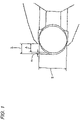
- the value of X represented by Equation (I) below is preferably 27 to 37, and more preferably 28 to 36.
- X L / D ⁇ 100
- D Ball diameter
- L Maximum ball exposure
- L (ball exposure 1 + clearance m)
- a specific form of a water-based ballpoint pen including a ballpoint pen tip of the above characteristics includes the water-based ballpoint pen of FIGS. 2 to 6 .
- FIG. 2 illustrates an example of a ballpoint pen tip having a ball having a ball diameter ( ⁇ ) of 0.5 mm or less, more preferably 0.3 mm or less, and particularly preferably 0.29 mm or less
- FIG. 3 illustrates another example of the ballpoint pen tip of FIG. 2
- FIG. 4 is a drawing illustrating a state in which the ballpoint pen tip of FIG. 2 is attached to an ink housing tube (refill)
- FIG. 5 is a drawing illustrating a state in which an ink housing tube (refill) having the ballpoint pen tip of FIG. 4 is attached to a shaft body to form a water-based ballpoint pen
- FIG. 6 is a drawing illustrating another example (knock-type water-based ballpoint pen body) of the water-based ballpoint pen of FIG. 5 .
- FIG. 2 is a tapered ballpoint pen tip A provided with a hollow holder 11 having a tapered tip end side and rotatably retention a ball 10 having a ball diameter of, for example, 0.29 mm or less at the tip end portion.
- a water-based ballpoint pen C having this ballpoint pen tip A is obtained by connecting the rear end side of the ballpoint pen tip A to the ink housing tube 25 (directly or) via a joint member 20 having a backflow prevention mechanism to form a refill 30, for example, as illustrated in FIG. 4 , and housing the refill 30 in a shaft body 33 having a slip-resistant member 32, as illustrated in FIG. 5 , for example.
- a mouthpiece 31 is fixed to the tip end of the shaft body 33.
- reference numeral 26 illustrated in FIG. 4 is the ink composition for a water-based ballpoint pen of the present invention described above
- reference numeral 27 is the ink follower
- reference numeral 35 illustrated in FIG. 5 is a cap.
- the ink composition 26 for a water-based ballpoint pen of the present invention filled in the ink housing tube 25 is supplied to the ball 10 via an ink flow path 12 that is sequentially tapered.
- FIG. 3 is a needle-type ball tip B in which the tip end of a thin tube 15 made of metal or the like is caulked inward to rotatably hold a ball 16 having a diameter (ball diameter) of 0.29 mm or less.
- the ballpoint pen tip B also includes a water-based ballpoint pen that is connected to an ink housing tube and a shaft body (not shown), similarly to the above.
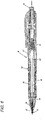
- FIG. 6 is a vertical cross-sectional view illustrating an example of a knock-type water-based ballpoint pen body in which an ink housing tube (refill) having the ballpoint pen tip of FIG. 2 is attached to a knock-type shaft body.
- This knock-type water-based ballpoint pen body E includes the ballpoint pen tip 40 of FIG. 2 , and the tip 40 is housed in a knock-type shaft body 50 including a slip-resistant member 48 with a refill 47 connected to the ink housing tube 46 via a joint member 45 having a backflow prevention mechanism.
- reference numeral 41 illustrated in the drawing is a coil spring member housed in a tip and having a fine wire-shaped tip end, and the tip end portion urges the ball outward by the elastic force of the coil spring.
- Reference numeral 42 illustrated in the drawing is an ink composition for a water-based ballpoint pen of the present invention
- reference numeral 43 is an ink follower having the above characteristics
- reference numeral 51 is a knock portion
- reference numeral 52 is a coating member that protects a tip end portion.
- the ball material is not particularly limited as long as the ball has a ball diameter ( ⁇ ) of 0.5 mm or less, more preferably 0.3 mm or less, and particularly preferably 0.29 mm or less.
- ⁇ ball diameter
- examples thereof include those made of metal members such as cemented carbide, those made of ceramic members, and those having a thin film coating member on the surface thereof to improve durability and corrosion resistance.
- the lower limit of the ball diameter is about 0.1 mm from the viewpoint of producing technology and the like.
- the holder material include nickel silver, brass, stainless metal, and a synthetic resin.
- the ink housing tube may be made of a transparent or translucent synthetic resin capable of checking the remaining amount of ink, or may be made of metal.
- the water-based ballpoint pen of the present invention is not limited to the structure of the ballpoint pen tip of FIGS. 2 and 3 , and the structure of the water-based ballpoint pen body including the ballpoint pen tip is not particularly limited as long as a ballpoint pen tip having a ball with a ball diameter ( ⁇ ) of 0.5 mm or less, more preferably 0.3 mm or less, and particularly preferably 0.29 mm or less is used, and can be applied to, for example, water-based ballpoint pens having various structures including a knock-type.
- ⁇ ball diameter
- the material, size (inner diameter, length), and the like of a ball holder, an ink housing tube, a joint member (front barrel), and the like are set as appropriate depending on the tip structure, the ball diameter, the ink follower, and the like.
- the water-based ballpoint pen of the present invention configured as described above, even in a water-based ballpoint pen equipped with a ballpoint pen tip having a ball with a ball diameter ( ⁇ ) of 0.5 mm or less, more preferably 0.3 mm or less, and particularly preferably 0.29 mm or less, by using the ink composition for a water-based ballpoint pen of the present invention, the water-based ballpoint pen has stable ink flowability, an excellent luster of drawn lines, and does not cause the ball to fall off.
- ⁇ ball diameter
- the water-based ballpoint pen of the present invention when the ball diameter of the water-based ballpoint pen is set as D and the maximum ball ejection dimension is set as L, by using a ballpoint pen tip having a value of X represented by the above Equation (I) of 27 to 37, it is possible to obtain a water-based ballpoint pen that has stable ink flowability, an excellent luster of drawn lines, and does not cause the ball to fall off, and that exhibits ball jumping-out resistance and further excellent writing feeling in combination with in combination with the ink composition for a water-based ballpoint pen of the present invention.
- Urethane particles A to F and melamine particles G were prepared by the compounding composition shown in Table 1 below, and the following methods.
- the oil phase solution was added to the water phase solution at 60°C, and stirred with a homogenizer for 6 hours for emulsion polymerization, thus completing polymerization.
- urethane particles (red particles) B were obtained.
- Urethane particles (blue particles) were obtained in the same manner as the urethane particles B except that 2.8 parts by mass of water-insoluble dye (Valifast Red 1355, available from Orient Chemical Industries Co., Ltd) was changed to 2.4 parts by mass of water-insoluble dye (Valifast Blue 2620, available from Orient Chemical Industries Co., Ltd), 11.5 parts by mass of ethylene glycol monobenzyl ether was changed to 9.6 parts by mass of benzyl alcohol, and 7.2 parts by mass of trimethylolpropane (1 mol) adduct (D-109, available from Mitsui Chemicals, Inc.) of diphenylmethane diisocyanate (3 mol) was changed to 7 parts by mass of an allophanate modified product of hexamethylene diisocyanate (D-178NL, available from Mitsui Chemicals, Inc.).
- Urethane particles (not colored) D were obtained in the same manner as the urethane particles A except that 8 parts by mass of an isocyanurate-modified product of hexamethylene diisocyanate as a prepolymer (TLA-100, available from Asahi Kasei Chemicals Corporation) was changed to 15 parts by mass.
- TLA-100 an isocyanurate-modified product of hexamethylene diisocyanate as a prepolymer
- urethane particles (red particles) E having different average particle sizes were obtained by changing the stirring conditions during polymerization.
- urethane particles (blue particles) F having different average particle sizes were obtained by changing the stirring conditions during polymerization.
- Melamine particles (not colored) G were obtained in the same manner as the urethane particles A except that 12.5 parts by mass of ethyl acetate was changed to 20 parts by mass of benzyl alcohol, 8 parts by mass of an isocyanurate-modified product of hexamethylene diisocyanate as a prepolymer (TLA-100, available from Asahi Kasei Chemicals Corporation) was changed to 7 parts by mass of methylol melamine.
- TLA-100 isocyanurate-modified product of hexamethylene diisocyanate as a prepolymer
- the average particle size was measured using a particle size distribution analyzer HRA 9320-X100 available from Nikkiso Co., Ltd.
- An ink composition for a water-based ballpoint pen was prepared by a known method according to the blending composition (total amount: 100 mass%) shown in the following Table 2.
- the obtained water-based ink compositions for a writing instrument (total 100 mass%) were evaluated for ink flowability (drawn line evaluation, ink flow rate), and ball retention using a water-based ballpoint pen having the following composition according to the following evaluation method.
- Each of the ink compositions for a water-based ballpoint pen of Examples 1 to 8 and Comparative Examples 1 to 3 was filled into a refill made of a polypropylene ink housing tube (having an inner diameter of 4 mm and a length of 113 mm), a stainless steel tip (having a cemented carbide ball with a ball diameter of 0.38 mm) according to FIGS. 1 and 2 , and a joint connecting the containing tube and the tip.
- the rear end of the ink was then loaded with an ink follower made of mineral oil, polybutene, and an olefin elastomer.
- Each of the refills was incorporated in a barrel of a ballpoint pen (UM-151, available from Mitsubishi Pencil Co., Ltd.) to prepare a water-based ballpoint pen.
- Examples 2, 3, 7, and 8 using colored urethane particles (Blue, Red) together with the aluminum pigments were also excellent in ink flowability (drawn line evaluation, ink flow rate), and ball retention as well as excellent color developability.
Landscapes
- Chemical & Material Sciences (AREA)
- Life Sciences & Earth Sciences (AREA)
- Engineering & Computer Science (AREA)
- Materials Engineering (AREA)
- Wood Science & Technology (AREA)
- Organic Chemistry (AREA)
- Inks, Pencil-Leads, Or Crayons (AREA)
- Pens And Brushes (AREA)
Abstract
Description
- The present invention relates to an ink composition for a water-based ballpoint pen containing an aluminum pigment.
- In the related art, a water-based ballpoint pen using aluminum powder as a pigment provides drawn lines having a luster, but the performance of the water-based ballpoint pen is dependent on the size of the aluminum powder.
- Large aluminum pigments produce a strong luster, but tends to make block in a gap in a chip.
- In particular, in a case of a so-called fine ballpoint pen having a ball diameter of ϕ 0.5 mm or less, since the gap becomes smaller, such an impasse is more likely to occur. Further, since the fine ballpoint pen has a small amount of ink flowed, there is an issue that it is difficult to obtain a luster.
- Then, as an invention of a water-based ballpoint pen or the like to solve such issues, some instruments are known. For example, 1) a writing instrument such as ballpoint pens obtained by blending spherical resin particles such as an acrylic resin, a styrene/acrylic copolymer, and polyolefin to suppress aggregation of metal particles, for an example of which, refer to Patent Document 1, 2) a brilliant ink composition for a ballpoint pen obtained by blending microcapsule particles and the like to prevent bearings from wearing, and a ballpoint pen containing the same, for an example of which, refer to Patent Documents 2 and 3, and 3) a ballpoint pen that has a clearance within a predetermined range such that a ball of a ballpoint pen tip can move and rotate, for an example of which, refer to Patent Document 4.
- However, even if the technical contents (inventions) of Patent Documents 1 to 4 are known, in the case of a so-called fine ballpoint pen having a ball diameter of ϕ0.5 mm or less, a sufficient effect has not yet been obtained. In addition, a ball retention force is smaller than that of a ballpoint pen having a ball diameter of more than ϕ0.5 mm, and the ball tends to fall off depending on usage conditions. Although it is possible to make up for it with designing the ballpoint pen tip, there may be adverse effects such as deterioration of writing quality and deterioration of ink flowability.
- Furthermore, the retention of the ball is provided by caulking an end of a holder in which the ball is stored. However, a retention force decreases due to the wear of a caulked part due to writing or a local stress strain caused by a solid matter getting stuck between an inner surface of the caulked part and the ball, and thereby the ball may fall off due to an impact, making it impossible to write.
-
- Patent Document 1:
JP 2010-125841 A - Patent Document 2:
JP 2014-129440 A - Patent Document 3:
JP 2017-119862 A - Patent Document 4:
JP 11-28887 A FIG. 1 , and the like) - In light of the above-described issues of the related art and the like, an object of the present invention is to solve this, and an object of the present invention is to provide an ink composition for a water-based ballpoint pen and a water-based ballpoint pen, which have stable ink flowability even in a so-called fine ballpoint pen, have excellent luster of drawn lines, and do not cause a ball to fall off.
- As a result of dedicated research in light of the issues of the prior art described above, the present inventors have found that the intended ink composition for water-based ballpoint pens can be obtained by including at least a specific amount of an aluminum pigment and particles having specific physical properties with an average particle size in a predetermined range, and thus completed the present invention.
- That is, the ink composition for a water-based ballpoint pen according to the present invention includes at least an aluminum pigment and 8 to 25 mass% of solid urethane particles with an average particle size of 0.3 to 10 µm.
- In addition, a water-based ballpoint pen according to the present invention is provided with the ink composition for a water-based ballpoint pen that has the above composition.
- In the present invention, a numerical range of the lower limit xx to the upper limit zz includes xx and zz.
- According to the present invention, there is provided an ink composition for a water-based ballpoint pen and a water-based ballpoint pen, which have stable ink flowability even in a so-called fine ballpoint pen, have excellent luster of drawn lines, and do not cause a ball to fall off.
-
-
FIG. 1 is an enlarged vertical cross-sectional view of an example of a ballpoint pen tip of a water-based ballpoint pen on which an ink composition for a water-based ballpoint pen according to an embodiment of the present invention is mounted. -
FIG. 2 is a longitudinal cross-sectional view illustrating the ballpoint pen tip ofFIG. 1 . -
FIG. 3 is a vertical cross-sectional view illustrating another example of a ballpoint pen tip. -
FIG. 4 is a vertical cross-sectional view illustrating a state in which the ballpoint pen tip ofFIG. 2 is attached to an ink housing tube (refill). -
FIG. 5 illustrates an example of an embodiment of the water-based ballpoint pen of the present invention, and is a vertical cross-sectional view illustrating a state in which the ink housing tube (refill) ofFIG. 4 is attached to a shaft body to form a water-based ballpoint pen. -
FIG. 6 illustrates another example of the embodiment of the water-based ballpoint pen of the present invention, and is a vertical cross-sectional view illustrating a knock-type water-based ballpoint pen in which the ink housing tube (refill) ofFIG. 4 is attached to a knock-type shaft body. - An embodiment of the present invention is described below in detail. The ink composition for a water-based ballpoint pen according to the present invention contains at least an aluminum pigment and 8 to 25 mass% of solid urethane particles with an average particle size of 0.3 to 10 µm.
- Aluminum pigments that can be used in the present invention are generally produced by grinding or milling aluminum in a ball mill or an attritor mill in the presence of a grinding liquid medium using a grinding aid. As long as the aluminum pigments are used as pigments for water-based ink and the like, the manufacturing method, condition (powder form, paste form, and the like), particle size (average particle size, thickness), and the like are not particularly limited, and, for example, a commercially available product for water-based ink can be used.
- Preferably, from the viewpoint of exerting better the effects of the present invention, particles having an average particle size of 20 µm or less are preferable, and particles having the average particle size of 5 to 16 µm are more preferable.
- Examples of aluminum pigments that can be used include commercially available products such as WXM series in which an aluminum surface has been rust-proofed with a phosphorous-based compound, WL series in which an aluminum surface is rust-proofed with a molybdenum compound, EMR series in which an aluminum flake surface is coated with dense silica (all available from Toyo Aluminium K.K.), and SW-120 PM (available from Asahi Kasei Chemicals Corporation) . These pigments may be used alone or as a mixture of two or more.
- The content of these aluminum pigments is preferably 0.1 to 20 mass% (hereinafter, "mass%" is simply referred to as "%"), and more preferably 2 to 10%, relative to a total amount of the water-based ink composition for a writing instrument (hereinafter simply referred to as "ink composition total amount").
- If the content of aluminum pigments is less than 0.1%, a luster cannot be obtained, whereas if the content exceeds 20%, writing feeling is impaired, and stability of the ink may be decreased.
- The urethane particles used in the present invention are solid particles and have an average particle size of 0.3 µm to 10 µm. In the present invention, the term "solid" means not particles having voids (including single-void, multi-void, and porous) in particles such as hollow particles and microcapsule particles, but particles filled thoroughly without voids.
- The average particle size of the urethane particles used is preferably 0.3 µm to 10 µm. The lower limit is preferably 0.5 µm or greater, more preferably 0.9 µm or greater, and particularly preferable 1.0 µm or greater. The upper limit is preferably 8 µm or smaller and more preferably 6 µm or smaller.
- When the average particle size is less than 0.3 µm, the particles cover the surface of the aluminum pigment in the drawn line, which may impair the luster; and when the average particle size exceeds 10 µm, it is not preferable because stabilization of the dispersion of particles becomes difficult, and the inside of a tip tends to be clogged.
- In the present invention, "average particle size" refers to the value of D50 calculated based on the volume in a laser diffraction method. Here, the measurement of average particle size by a laser diffraction method can be performed using, for example, a particle size distribution analyzer HRA 9320-X100 which is available from Nikkiso Co., Ltd.
- In the present invention, as described above, it is important that the urethane particles to be used have a certain size (range of the average particle size) and are solid particles. In the present invention, the use of solid particles makes it easier to control the strength of particles as compared with particles such as microcapsules.
- The urethane particles to be used preferably have a 10% strength of 30 MPa or less as measured by a micro compression test. As a result, the urethane particles can be soft particles even if the particles are solid, and thus they do not cause the ball to fall off when the particles are stuck between a caulking and a ball. Also, when 10% strength is 5 MPa or more, the ink can be more stably flowed out. Thus, by setting the 10% strength to 5 to 30 MPa, it is possible to highly achieve both good ink outflow stability and the characteristic of not causing the ball to fall off. In the present invention, "micro compression test" can be performed using, for example, MCT-510, available from Shimadzu Corporation. In this case, it can be the average value of five particles. This 10% strength can be calculated by the following equation:

- C (x):10% strength/MPa
- P: Test force at 10% displacement of particle size/N
- d: Particle size/mm
- Any urethane particles may be used as long as the urethane particles are solid particles having the aforementioned average particle size. Furthermore, the urethane particles are particularly preferable as long as the 10% strength measured by the micro compression test has the above characteristics. They may be commercially available products or matters produced by a production method described below. Also, the urethane particles may be colored as long as the urethane particles have the characteristics described above.
- When the urethane particles of the present invention are colored and used as a coloring material (colorant), the color development is higher than that of the microcapsule particles, and thus the amount of addition can be reduced. The microcapsule particles have a problem that the amount of coloring material that can be included is limited, and the shell inhibits color development.
- In the present invention, the urethane particles that are colored function as a colorant to improve the degree of freedom of ink blending.
- In addition, in the present invention, when the urethane particles are not colored, and other colorants are not contained in the ink composition, the hue of the ink composition becomes an aluminum pigment plus a non-colored urethane particle to give silver color (aluminum pigment + non-colored urethane particle).
- The urethane particles used are polymers or copolymers having a urethane bond, and are obtained by reacting an isocyanate component (including a diisocyanate component) with a polyol component (including a diol component). Examples of the urethane particles used include at least one of urethane particles (such as polyester urethane particles, polycarbonate urethane particles, and polyether urethane particles) and urethane-urea particles.
- Preferably, the urethane particles used are obtained by the following production method.
- The production of the urethane particles can be carried out by 1) preparing an oil phase containing an organic solvent, an isocyanate monomer or an isocyanate prepolymer, and, when coloring the urethane particles, a water-insoluble dye; 2) preparing an aqueous phase by mixing water and a dispersant; and 3) mixing the oil phase and the aqueous phase to emulsify components of the oil phase and then polymerizing.
- The oil phase contains an organic solvent, an isocyanate monomer or an isocyanate prepolymer, and, when coloring the urethane particles, a water-insoluble dye. A plurality of the organic solvents may be included.
- The oil phase can be prepared by: heating an organic solvent to a predetermined temperature while stirring and, when coloring the urethane particles, adding a water-insoluble dye; then, adding the aforementioned monomer or prepolymer and, optionally, another organic solvent.
- Examples of the organic solvent include phenyl glycol, benzyl alcohol, ethylene glycol monobenzyl ether, and ethyl acetate. Additional examples include alkylsulfonic acid phenyl ester, ethylhexyl phthalate, tridecyl phthalate, ethylhexyl trimellitate, diethylene glycol dibenzoate, dipropylene glycol dibenzoate, and a liquid xylene resin.
- Examples of the isocyanate monomer or prepolymer include hexamethylene diisocyanate, tolylene diisocyanate, diphenylmethane diisocyanate, xylylene diisocyanate, isophorone diisocyanate, and an isocyanate prepolymer.
- From the perspective of curing favorably by polymerization, the isocyanate prepolymer is preferably a trimer such as a triol adduct or an isocyanurate-modified product of the isocyanate described above. In addition to the trimer described above, a dimer such as an allophanate-modified product of the isocyanate described above can be used as an auxiliary prepolymer.
- In this method, the adjustment of the 10% of strength can be performed by, for example, the selection of the isocyanate component (a monomer or a prepolymer, an auxiliary monomer, an auxiliary prepolymer) and adjusting the content of the isocyanate component used. In addition, the average particle size of the urethane particles can be adjusted by controlling a stirring condition during the polymerization.
- The water-insoluble dyes used in a case of coloring include dyes insoluble in water at room temperature, and the specific examples include a salt-forming dye, a disperse dye, or an oil-soluble dye. From the perspective of color development, the use of a salt-forming dye is preferable.
- Examples of the salt-forming dye include a dye having an azo structure, a metal complex salt azo structure, an anthraquinone structure, or a metal phthalocyanine structure, such as Valifast (trade name) Black 1807, Valifast (trade name) Blue 2620, Valifast (trade name) Brown 2402, Valifast (trade name) Green 1501, Valifast (trade name) Orange 2210, Valifast (trade name) Pink 2310, Valifast (trade name) Red 1355, Valifast (trade name) VIOLET 1701, and Valifast (trade name) Yellow 1101, all available from Orient Chemical Industries Co., Ltd.
- At least one dye selected from the following examples can be used as the disperse dye: C. I. Disperse Yellow 198, C. I. Disperse Yellow 42, C. I. Disperse Red 92, C. I. Disperse
Violet 26, C. I. DisperseViolet 35, C. I. Disperse Blue 60, and C. I. Disperse Blue 87. Examples of the oil-soluble dye include Oil Black 860, Oil Blue 613, Oil Brown BB, Oil Green 530, Oil Orange 201, Oil Pink 312, Oil Red 5B, Oil Scarlet 318, and Oil Yellow 105, all available from Orient Chemical Industries Co., Ltd. - The water phase can be prepared by mixing water and a dispersant. Examples of the dispersant include, but not limited to, polyvinyl alcohol.
- The emulsification and polymerization step, that is, emulsifying the components of the oil phase and then polymerizing, can be performed by introducing the oil phase into the aqueous phase and subjecting the mixture to emulsification mixing using a homogenizer or the like under heating to a predetermined temperature; this results in colored urethane particles or uncolored urethane particles.
- Furthermore, in addition to the emulsification and polymerization described above, the urethane particles may be produced by a phase separation method. The phase separation method includes: preparing a dye-containing solution when coloring the urethane particles, preparing a solution containing a protective colloid agent, and polymerizing an isocyanate monomer or isocyanate.
- The dye-containing solution can be prepared by dissolving a water-insoluble dye in an organic solvent under heating. An organic solvent used in the emulsification and polymerization described above can be used as the water-insoluble dye and the organic solvent.
- The protective colloid agent-containing solution can be prepared by dissolving a protective colloid agent in water. Examples of the protective colloid agent include a methyl vinyl ether-maleic anhydride copolymer.
- Polymerization of the isocyanate monomer or isocyanate prepolymer can be performed by, when coloring the urethane particles, dispersing a dye-containing solution in the form of oil droplets in a protective colloid agent-containing solution that has been heated to a predetermined temperature, adding the aforementioned isocyanate monomer or isocyanate prepolymer to the dispersion, and stirring while maintaining the temperature.
- These solid urethane particles can be used alone or as a mixture of two or more types. The content of such urethane particles is 8 to 25% and preferably 10 to 18%, based on the total amount of the ink composition.
- When the content of solid urethane particles is less than 8%, the effect of the present invention cannot be exhibited; and, when the content of urethane particles having this characteristic is more than 25%, stability of the ink decreases. Thus, both cases are not preferable.
- The ink composition for a water-based ballpoint pen according to the present invention contains at least the aluminum pigment and 8 to 25 mass% of solid urethane particles having an average particle size of 0.3 to 10 µm. In addition to these components, the ink composition for a water-based ballpoint pen according to the present invention may further contain, for example, an another coloring material such as pigment or dye, a water-soluble organic solvent, and, as a balance, water (such as tap water, purified water, distilled water, ion-exchanged water, or pure water) which is a solvent, and furthermore, optionally, various components which are commonly used in a water-based ink composition for a writing instrument, such as a thickener, a lubricant, a corrosion inhibitor, a preservative or antibacterial agent, or a pH modifier, in an appropriate amount within a range that does not impair the effect of the present invention.
- In the present invention, in addition to the aluminum pigments and urethane particles when colored, an another coloring material (colorant) such as pigment or dye can be used as a complementary color component, if necessary.
- Examples of the coloring material that can be used, in an appropriate amount within a range that does not impair the effect of the present invention, include a dye that is dissolved or dispersed in water, a known inorganic pigment such as titanium oxide and an organic pigment, a pigment in which a base material, such as silica or mica, is coated on the surface layer with iron oxide, titanium oxide or the like in multiple layers.
- Examples of the dye include an acid dye such as Eosin, Phloxine, Water Yellow #6-C, Acid Red, Water Blue #105, Brilliant Blue FCF, Nigrosine NB; a direct dye such as Direct Black 154, Direct Sky Blue 5B, Violet BOOB; and a basic dye such as rhodamine and methyl violet.
- Examples of the organic pigment include azo lake, an insoluble azo pigment, a chelate azo pigment, a phthalocyanine pigment, a perylene and perinone pigment, and a nitroso pigment. Specific examples include: inorganic pigments, such as carbon black, titanium black, zinc oxide, colcothar, chromium oxide, iron black, cobalt blue, iron oxide yellow, viridian, zinc sulfide, lithopone, cadmium yellow, vermilion, cadmium red, chrome yellow, molybdate orange, zinc chromate, strontium chromate, white carbon, clay, talc, ultramarine blue, precipitated barium sulfate, barite powder, calcium carbonate, white lead, dark blue, prussian blue, manganese violet, and brass powder; and organic pigments, such as C. I.
Pigment Blue 15, C. I. Pigment Blue 17, C. I.Pigment Blue 27, C. I. Pigment Red 5, C. I. Pigment Red 22, C. I. Pigment Red 38, C. I.Pigment Red 48, C. I. Pigment Red 49, C. I. Pigment Red 53, C. I. Pigment Red 57, C. I. Pigment Red 81, C. I. Pigment Red 104, C. I. Pigment Red 146, C. I. Pigment Red 245, C. I. Pigment Yellow 1, C. I. Pigment Yellow 3, C. I. Pigment Yellow 12, C. I. Pigment Yellow 13, C. I. Pigment Yellow 14, C. I. Pigment Yellow 17, C. I. Pigment Yellow 34, C. I. Pigment Yellow 55, C. I. Pigment Yellow 74, C. I. Pigment Yellow 95, C. I. Pigment Yellow 166, C. I. Pigment Yellow 167, C. I. Pigment Orange 5, C. I. Pigment Orange 13, C. I.Pigment Orange 16, C. I. Pigment Violet 1, C. I. Pigment Violet 3, C. I. Pigment Violet 19, C. I. Pigment Violet 23, C. I.Pigment Violet 50, and C. I. Pigment Green 7. - These coloring materials may be used alone or in a combination of two or more.
- Examples of the water-soluble organic solvent that can be used include: glycols such as ethylene glycol, diethylene glycol, triethylene glycol, propylene glycol, polyethylene glycol, 3-butylene glycol, thiodiethylene glycol, and glycerin; ethylene glycol monomethyl ether; and diethylene glycol monomethyl ether. These water-soluble organic solvents may be used alone or as a mixture of two or more.
- The content of these water-soluble organic solvents is adjusted as appropriate depending on the application of the water-based ink composition for a writing instrument and is in a range of 1% to 30% relative to the total amount of the ink composition.
- As the thickener that can be used, for example, at least one selected from the group consisting of synthetic polymers, cellulose, and polysaccharides is preferred. Specific examples thereof include arabic gum, tragacanth gum, guar gum, locust bean gum, alginic acid, carrageenan, gelatin, xanthan gum, welan gum, succinoglycan, diutan gum, dextran, methyl cellulose, ethyl cellulose, hydroxyethyl cellulose, carboxymethyl cellulose, starch glycolic acid and salts thereof, polyvinylpyrrolidone, polyvinyl methyl ether, polyacrylic acid and salts thereof, polyethylene oxide, copolymers of vinyl acetate and polyvinylpyrrolidone, and styrene-acrylic acid copolymers and salts thereof.
- Examples of the lubricant include non-ionic types such as fatty acid esters of polyhydric alcohols, higher fatty acid esters of saccharides, and polyoxyalkylene higher fatty acid esters, anionic types such as phosphates, alkyl sulfonates of higher fatty acid amides, and alkyl allyl sulfonates, derivatives of polyalkylene glycols, fluorochemical surfactants, and polyether modified silicones; these can also be used as surface treatment agents for pigments.
- Examples of the corrosion inhibitor include benzotriazol, tolyltriazole, dicycloheptaerythrityl, and saponins. Examples of the preservative or antifungal agent include and phenol, omadine sodium, sodium benzoate, benzoisothiazolin, and benzimidazole compounds.
- Examples of the pH modifier include hydroxides of alkali metals such as sodium hydroxide, potassium hydroxide, and lithium hydroxide; amine compounds such as triethanolamine, diethanolamine, monoethanolamine, dimethylethanolamine, morpholine, and triethylamine; and ammonia.
- The ink composition for a water-based ballpoint pen according to the present invention can be prepared by combining at least an aluminum pigment and 8 to 25 mass% of solid urethane particles with an average particle size of 0.3 to 10 µm with another component as appropriate depending on, for example, the ballpoint pen structure, stirring and mixing using a stirrer such as a homomixer, a homogenizer, or a disperser, and optionally, filtering or centrifuging the mixture to remove coarse particles in the ink composition.
- The resulting ink composition for a water-based ballpoint pen according to the present invention is used in a ballpoint pen provided with a ballpoint pen tip.
- The reason for that the ink composition for a water-based ballpoint pen of the present invention configured as described above corresponds to an ink composition for a water-based ballpoint pen, which has stable ink flowability even if it is a so-called fine ballpoint pen having a ball diameter of ϕ0.5 mm or less, and has an excellent luster of drawn lines and does not cause the ball to fall off, is presumed as follows.
- The ink composition for a water-based ballpoint pen of the present invention includes at least an aluminum pigment and 8 to 25% of urethane particles having an average particle size of 0.3 to 10 µm. By containing 8 to 25% of these urethane particles, it is presumed that it suppresses the aggregation of aluminum pigments, and even if urethane particles get stuck between the inner surface of the caulked part and the ball, local stress strain does not occur and the ball retention force does not decrease. Thereby, it is possible to obtain an ink composition for a water-based ballpoint pen, which has stable ink flowability, excellent luster of drawn lines, and does not cause the ball to fall off.
- A water-based ballpoint pen according to the present invention includes, for example, an instrument where an ink composition for a water-based ballpoint pen having the aforementioned composition is accommodated in an ink container (refill) for a ballpoint pen, and where a material is accommodated as an ink follower, the material being not compatible with the water-based ink composition accommodated in the ink container while having a small specific gravity with respect to the water-based ink composition, such as at least one among polybutene, silicone oil, and mineral oil. The structure of the ballpoint pen is not limited, and the water-based ballpoint pen may be, for example, a direct liquid type ballpoint pen provided with a collector structure (ink retention mechanism) using a barrel itself as an ink container in which the barrel is filled with the ink composition for water-based ballpoint pens having the composition described above.
- In the water-based ballpoint pen of the present invention, preferably, when the ball diameter in the water-based ballpoint pen is set as D and the maximum ball exposure is set as L, as illustrated in
FIG. 1 , the value of X represented by Equation (I) below is preferably 27 to 37, and more preferably 28 to 36.
- More preferably, it is desirable to have a ball having a value of X represented by the above Equation (I) and having a ball diameter (ϕ) of 0.5 mm or less, more preferably 0.3 mm or less, and particularly preferably 0.29 mm or less.
- By providing the water-based ballpoint pen having this structure, it is possible to obtain a water-based ballpoint pen that exhibits further ball jumping-out resistance and further excellent writing feeling in combination with the ink composition for a water-based ballpoint pen having the above characteristics.
- In the water-based ballpoint pen of the present invention, a specific form of a water-based ballpoint pen including a ballpoint pen tip of the above characteristics includes the water-based ballpoint pen of
FIGS. 2 to 6 . -
FIG. 2 illustrates an example of a ballpoint pen tip having a ball having a ball diameter (ϕ) of 0.5 mm or less, more preferably 0.3 mm or less, and particularly preferably 0.29 mm or less,FIG. 3 illustrates another example of the ballpoint pen tip ofFIG. 2 ,FIG. 4 is a drawing illustrating a state in which the ballpoint pen tip ofFIG. 2 is attached to an ink housing tube (refill),FIG. 5 is a drawing illustrating a state in which an ink housing tube (refill) having the ballpoint pen tip ofFIG. 4 is attached to a shaft body to form a water-based ballpoint pen, andFIG. 6 is a drawing illustrating another example (knock-type water-based ballpoint pen body) of the water-based ballpoint pen ofFIG. 5 . -
FIG. 2 is a tapered ballpoint pen tip A provided with ahollow holder 11 having a tapered tip end side and rotatably retention aball 10 having a ball diameter of, for example, 0.29 mm or less at the tip end portion. A water-based ballpoint pen C having this ballpoint pen tip A is obtained by connecting the rear end side of the ballpoint pen tip A to the ink housing tube 25 (directly or) via ajoint member 20 having a backflow prevention mechanism to form arefill 30, for example, as illustrated inFIG. 4 , and housing therefill 30 in ashaft body 33 having a slip-resistant member 32, as illustrated inFIG. 5 , for example. Note that amouthpiece 31 is fixed to the tip end of theshaft body 33. In addition,reference numeral 26 illustrated inFIG. 4 is the ink composition for a water-based ballpoint pen of the present invention described above,reference numeral 27 is the ink follower, andreference numeral 35 illustrated inFIG. 5 is a cap. - In the water-based ballpoint pen C, the
ink composition 26 for a water-based ballpoint pen of the present invention filled in theink housing tube 25 is supplied to theball 10 via anink flow path 12 that is sequentially tapered. -
FIG. 3 is a needle-type ball tip B in which the tip end of athin tube 15 made of metal or the like is caulked inward to rotatably hold aball 16 having a diameter (ball diameter) of 0.29 mm or less. The ballpoint pen tip B also includes a water-based ballpoint pen that is connected to an ink housing tube and a shaft body (not shown), similarly to the above. -
FIG. 6 is a vertical cross-sectional view illustrating an example of a knock-type water-based ballpoint pen body in which an ink housing tube (refill) having the ballpoint pen tip ofFIG. 2 is attached to a knock-type shaft body. - This knock-type water-based ballpoint pen body E includes the
ballpoint pen tip 40 ofFIG. 2 , and thetip 40 is housed in a knock-type shaft body 50 including a slip-resistant member 48 with arefill 47 connected to theink housing tube 46 via ajoint member 45 having a backflow prevention mechanism. Note thatreference numeral 41 illustrated in the drawing is a coil spring member housed in a tip and having a fine wire-shaped tip end, and the tip end portion urges the ball outward by the elastic force of the coil spring.Reference numeral 42 illustrated in the drawing is an ink composition for a water-based ballpoint pen of the present invention,reference numeral 43 is an ink follower having the above characteristics,reference numeral 51 is a knock portion, andreference numeral 52 is a coating member that protects a tip end portion. - The ball material is not particularly limited as long as the ball has a ball diameter (ϕ) of 0.5 mm or less, more preferably 0.3 mm or less, and particularly preferably 0.29 mm or less. Examples thereof include those made of metal members such as cemented carbide, those made of ceramic members, and those having a thin film coating member on the surface thereof to improve durability and corrosion resistance. The lower limit of the ball diameter is about 0.1 mm from the viewpoint of producing technology and the like. Examples of the holder material include nickel silver, brass, stainless metal, and a synthetic resin.
- The ink housing tube may be made of a transparent or translucent synthetic resin capable of checking the remaining amount of ink, or may be made of metal.
- Incidentally, the water-based ballpoint pen of the present invention is not limited to the structure of the ballpoint pen tip of
FIGS. 2 and3 , and the structure of the water-based ballpoint pen body including the ballpoint pen tip is not particularly limited as long as a ballpoint pen tip having a ball with a ball diameter (ϕ) of 0.5 mm or less, more preferably 0.3 mm or less, and particularly preferably 0.29 mm or less is used, and can be applied to, for example, water-based ballpoint pens having various structures including a knock-type. Furthermore, the material, size (inner diameter, length), and the like of a ball holder, an ink housing tube, a joint member (front barrel), and the like are set as appropriate depending on the tip structure, the ball diameter, the ink follower, and the like. - In the water-based ballpoint pen of the present invention configured as described above, even in a water-based ballpoint pen equipped with a ballpoint pen tip having a ball with a ball diameter (ϕ) of 0.5 mm or less, more preferably 0.3 mm or less, and particularly preferably 0.29 mm or less, by using the ink composition for a water-based ballpoint pen of the present invention, the water-based ballpoint pen has stable ink flowability, an excellent luster of drawn lines, and does not cause the ball to fall off.
- In particular, in the water-based ballpoint pen of the present invention, as illustrated in
FIG. 1 , when the ball diameter of the water-based ballpoint pen is set as D and the maximum ball ejection dimension is set as L, by using a ballpoint pen tip having a value of X represented by the above Equation (I) of 27 to 37, it is possible to obtain a water-based ballpoint pen that has stable ink flowability, an excellent luster of drawn lines, and does not cause the ball to fall off, and that exhibits ball jumping-out resistance and further excellent writing feeling in combination with in combination with the ink composition for a water-based ballpoint pen of the present invention. In this water-based ballpoint pen, the smaller the ball diameter (ϕ), the more the effect of the present invention can be exhibited, and it can be suitably used for a water-based ballpoint pen having a ball with a ball diameter of 0.5 mm or less, more preferably 0.3 mm or less, and particularly preferably 0.29 mm or less. - Next, the present invention will be described in more detail with respect to Production Example (preparation of urethane particles or the like), Examples and Comparative Examples (preparation of ink composition for water-based ballpoint pen), but the present invention is not limited to the following Examples.
- Urethane particles A to F and melamine particles G were prepared by the compounding composition shown in Table 1 below, and the following methods.
- While heating 12.5 parts by mass of ethyl acetate as an organic solvent to 60°C, 8 parts by mass of an isocyanurate-modified product of hexamethylene diisocyanate as a prepolymer (TLA-100, available from Asahi Kasei Chemicals Corporation) was added thereto to prepare an oil phase solution. While 200 parts by mass of distilled water was heated to 60°C, 15 parts by mass of polyvinyl alcohol (PVA-205, available from Kuraray Co., Ltd.) as a dispersing agent was dissolved therein, and a water-based phase solution was prepared. Then, the oil phase solution was added to the water phase solution at 60°C, and stirred with a homogenizer for 6 hours for emulsion polymerization, thus completing polymerization. By subjecting the obtained dispersion to centrifugation, urethane particles (uncolored) A were obtained.
- While 11.5 parts by mass of ethylene glycol monobenzyl ether as an organic solvent were heated to 60°C, 7.2 parts by mass of trimethylolpropane (1 mol) adduct of diphenylmethane diisocyanate (3 mol) (D-109, available from Mitsui Chemicals, Inc.) as a prepolymer was added thereto, and an oil phase solution was prepared. While 200 parts by mass of distilled water was heated to 60°C, 15 parts by mass of polyvinyl alcohol (PVA-205, available from Kuraray Co., Ltd.) as a dispersing agent was dissolved therein, and a water-based phase solution was prepared. The oil phase solution was added to the water phase solution at 60°C, and stirred with a homogenizer for 6 hours for emulsion polymerization, thus completing polymerization. By subjecting the obtained dispersion to centrifugation, urethane particles (red particles) B were obtained.
- Urethane particles (blue particles) were obtained in the same manner as the urethane particles B except that 2.8 parts by mass of water-insoluble dye (Valifast Red 1355, available from Orient Chemical Industries Co., Ltd) was changed to 2.4 parts by mass of water-insoluble dye (Valifast Blue 2620, available from Orient Chemical Industries Co., Ltd), 11.5 parts by mass of ethylene glycol monobenzyl ether was changed to 9.6 parts by mass of benzyl alcohol, and 7.2 parts by mass of trimethylolpropane (1 mol) adduct (D-109, available from Mitsui Chemicals, Inc.) of diphenylmethane diisocyanate (3 mol) was changed to 7 parts by mass of an allophanate modified product of hexamethylene diisocyanate (D-178NL, available from Mitsui Chemicals, Inc.).
- Urethane particles (not colored) D were obtained in the same manner as the urethane particles A except that 8 parts by mass of an isocyanurate-modified product of hexamethylene diisocyanate as a prepolymer (TLA-100, available from Asahi Kasei Chemicals Corporation) was changed to 15 parts by mass.
- In Production Example 2, urethane particles (red particles) E having different average particle sizes were obtained by changing the stirring conditions during polymerization.
- In Production Example 3, urethane particles (blue particles) F having different average particle sizes were obtained by changing the stirring conditions during polymerization.
- Melamine particles (not colored) G were obtained in the same manner as the urethane particles A except that 12.5 parts by mass of ethyl acetate was changed to 20 parts by mass of benzyl alcohol, 8 parts by mass of an isocyanurate-modified product of hexamethylene diisocyanate as a prepolymer (TLA-100, available from Asahi Kasei Chemicals Corporation) was changed to 7 parts by mass of methylol melamine.
- The 10% strength (MPa) and the average particle size (µm) of the obtained urethane particles A to F and melamine particles G were measured by the following methods. These results are shown in Table 1 below.
- Calculation was performed according to the above equation using MCT-510 available from Shimadzu Corporation.
- The average particle size was measured using a particle size distribution analyzer HRA 9320-X100 available from Nikkiso Co., Ltd.
- An ink composition for a water-based ballpoint pen was prepared by a known method according to the blending composition (total amount: 100 mass%) shown in the following Table 2.
- The obtained water-based ink compositions for a writing instrument (total 100 mass%) were evaluated for ink flowability (drawn line evaluation, ink flow rate), and ball retention using a water-based ballpoint pen having the following composition according to the following evaluation method.
- These results are indicated in Table 2 below.
- Each of the ink compositions for a water-based ballpoint pen of Examples 1 to 8 and Comparative Examples 1 to 3 was filled into a refill made of a polypropylene ink housing tube (having an inner diameter of 4 mm and a length of 113 mm), a stainless steel tip (having a cemented carbide ball with a ball diameter of 0.38 mm) according to
FIGS. 1 and2 , and a joint connecting the containing tube and the tip. The rear end of the ink was then loaded with an ink follower made of mineral oil, polybutene, and an olefin elastomer. Each of the refills was incorporated in a barrel of a ballpoint pen (UM-151, available from Mitsubishi Pencil Co., Ltd.) to prepare a water-based ballpoint pen. - When the ball diameter D (0.38 mm) and the maximum ball output dimension L of the water-based ballpoint pen used in the examples and comparative examples were taken, the value of X represented by the above Equation (I) was in the range of 27 to 37.
- Writing was performed with a ϕ0.38 mm ballpoint pen until all the ink was consumed (in accordance with JIS S6061), and the drawn line evaluation and the state of the ink flow rate at every 100 m were evaluated according to the following evaluation criteria (A to C) .
-
- A: Luster is sufficient
- B: Luster is slightly weak
- C: Luster is insufficient
-
- A: Constant flow rate was maintained until end
- B: Flow rate decreased slightly in latter half
- C: Writing was impossible or an extreme decrease in flow rate occurred on the way
- After writing up to 200 m with the same ballpoint pen as described above, the pen was dropped from a height of 1.8 m with the pen tip facing upward, and evaluation was performed according to the following evaluation criteria (A, C). n = 50
-
- A: All the ballpoint pens retained balls.
- C: Some ballpoint pens let balls fall off.
-
Table 1 Table 1 Production Examples 1 to 7 A B C D E F G Dye (parts by mass) Blue: ValifastBlue 2620 (Orient Chemical Industries Co., Ltd.) 2.4 2.4 Red: ValidastRed 1355 (Orient Chemical Industries Co., Ltd.) 2.8 2.8 Solvent (parts by mass) Ethyl acetate 12.5 12.5 Benzyl alcohol 9.6 9.6 20 Ethylene glycol monobenzyl ether 11.5 11.5 Phenyl glycol Polymer component (parts by mass) Hexamethylene diisocyanate isocyanurate modified product 8 15 Trimethylolpropane (1 mol) adduct of diphenylmethane diisocyanate (3 mol) 7.2 7.2 Hexamethylene diisocyanate allophanate-modified product 7 7 Methylol melamine 7 10% strength (MPa) 12.8 18.4 9.4 32.1 22.2 6.2 12.8 Average particle size (µm) 1.2 2.1 1.4 1.3 0.3 8.8 1.1 [Table 2] Table 2 (Total amount: 100 mass%) Examples Comparative Examples 1 2 3 4 5 6 7 8 1 2 3 Resin particles (Table 1 and the other) Urethane Particles A 14 8 25 Urethane Particles B 12 Urethane Particles C 15 Urethane Particles D 14 Urethane Particles E 12 Urethane Particles F 15 Melamine particles G 14 Acrylic particles 1 14 Aluminum powder pigment Aluminum powder pigment A 2 8 10 8 8 8 10 8 8 Aluminum powder pigment B 3 6 6 8 Corrosion inhibitor Benzotriazol 0.3 0.3 0.3 0.3 0.3 0.3 0.3 0.3 0.3 0.3 0.3 pH modifier Triethanolamine 0.5 0.5 0.5 0.5 0.5 0.5 0.5 0.5 0.5 0.5 0.5 Lubricant Phosphate 4 0.4 0.4 0.4 0.4 0.4 0.4 0.4 0.4 0.4 0.4 0.4 Thickener Xanthan gum 5 0.28 0.28 0.28 0.28 0.28 0.28 0.28 0.28 0.28 0.28 0.28 Solvent Glycerin 6 6 6 6 6 6 6 6 6 6 6 Water Distilled water 70.52 74.52 67.52 76.52 59.52 70.52 74.52 67.52 84.52 70.52 70.52 Ink flowability evaluation Drawn line evaluation A A A A B A A B B B B Ink flow rate A A A B A B B B c B B Ball retention A A A A A A A A c c c - Annotations 1 to 5 in Table 2 above are as follows:
- 1: J-4 PM, average particle size 2.4 µm, 10
% strength 33 MPa, PMMA, available from Negami Chemical Industrial Co., Ltd. - 2: EMERAL EMR-D7675,
average particle size 16 µm, silica coating, available from Toyo Aluminium K.K. - 3: EMERAL EMR-D5680, average particle size of 8 µm, silica coating, available from Toyo Aluminium K.K.
- 4: RD-510Y, available from Toho Chemical Industry Co., Ltd.
- 5: KELSAN AR, available from Sansho Co., Ltd.
- To discuss the results shown in Tables 1 and 2 above, it was found that the ink flowability (drawn line evaluation, ink flow rate), and ball retention in Examples 1 to 8 falling in the scope of the present invention were superior to those in Comparative Examples 1 to 3 outside the scope of the present invention. Specifically, in Examples 1 and 4 to 6, uncolored urethane particles were used together with the aluminum pigment, and it was checked that they were superior in ink flowability (drawn line evaluation, ink flow rate), and ball retention, as compared with Comparative Examples 1 to 3 conprising aluminum pigments only, aluminum pigment plus melamine particles or acrylic particles.
- In addition, it was checked that Examples 2, 3, 7, and 8 using colored urethane particles (Blue, Red) together with the aluminum pigments were also excellent in ink flowability (drawn line evaluation, ink flow rate), and ball retention as well as excellent color developability.
- An ink composition for a water-based ballpoint pen suitable for ballpoint pens is obtained.
-
- A
- Ballpoint pen tip
- C
- Ballpoint pen
- 10
- Ball
- 30
- Refill
Claims (2)
- An ink composition for a water-based ballpoint pen comprising, at least:an aluminum pigment; and8 to 25 mass% of solid urethane particles with an average particle size of 0.3 to 10 µm.
- A water-based ballpoint pen provided with the ink composition for a water-based ballpoint pen described in claim 1.
Applications Claiming Priority (1)
| Application Number | Priority Date | Filing Date | Title |
|---|---|---|---|
| PCT/JP2020/003464 WO2021152779A1 (en) | 2020-01-30 | 2020-01-30 | Ink composition for water-based ballpoint pen |
Publications (2)
| Publication Number | Publication Date |
|---|---|
| EP4098707A1 true EP4098707A1 (en) | 2022-12-07 |
| EP4098707A4 EP4098707A4 (en) | 2023-09-27 |
Family
ID=77078780
Family Applications (1)
| Application Number | Title | Priority Date | Filing Date |
|---|---|---|---|
| EP20917032.3A Pending EP4098707A4 (en) | 2020-01-30 | 2020-01-30 | Ink composition for water-based ballpoint pen |
Country Status (5)
| Country | Link |
|---|---|
| US (1) | US12441899B2 (en) |
| EP (1) | EP4098707A4 (en) |
| KR (1) | KR102832374B1 (en) |
| CN (1) | CN115023473A (en) |
| WO (1) | WO2021152779A1 (en) |
Family Cites Families (22)
| Publication number | Priority date | Publication date | Assignee | Title |
|---|---|---|---|---|
| JP3221846B2 (en) | 1997-07-09 | 2001-10-22 | 株式会社パイロット | Ballpoint pen |
| US6666913B2 (en) * | 2000-09-05 | 2003-12-23 | Sakura Color Products Corporation | Aqueous ink composition |
| JP3934480B2 (en) | 2001-05-17 | 2007-06-20 | 株式会社サクラクレパス | Erasable ink composition and writing instrument using the same |
| US6797748B2 (en) * | 2001-06-08 | 2004-09-28 | Bic Corporation | Polyurethane based inks for writing instruments |
| DE60215508T2 (en) * | 2001-07-03 | 2007-06-28 | Sakura Color Products Corp. | Aqueous pigment-containing ink for center-markers |
| US6644326B2 (en) * | 2001-09-05 | 2003-11-11 | Michael R. Dorton | Process for cleaning polymeric fouling from equipment |
| AU2003211212A1 (en) * | 2002-02-18 | 2003-09-04 | Enjoji, Isao | Erasable ink composition |
| JP2003268285A (en) | 2002-03-13 | 2003-09-25 | Mitsubishi Pencil Co Ltd | Erasable ink composition for water-based felt-tip pens and water-based felt-tip pens incorporating the same |
| JP4191435B2 (en) * | 2002-06-24 | 2008-12-03 | パイロットインキ株式会社 | Water-based ink composition for writing instruments |
| JP4402895B2 (en) * | 2003-03-26 | 2010-01-20 | 株式会社パイロットコーポレーション | Water-based ballpoint pen ink and water-based ballpoint pen using the same |
| US20060069183A1 (en) * | 2004-09-30 | 2006-03-30 | Sakura Color Products Corporation | Erasable aqueous color material composition |
| JP2008297544A (en) * | 2007-04-30 | 2008-12-11 | Pilot Ink Co Ltd | Water-based ink composition for a retractable ballpoint pen and a retractable ballpoint pen containing the same |
| JP2010125841A (en) | 2008-12-01 | 2010-06-10 | Zebra Pen Corp | Writing utensil |
| JP2014139295A (en) * | 2012-12-20 | 2014-07-31 | Pilot Corporation | Water-based ink composition for writing instrument and writing instrument using the same |
| US9624391B2 (en) * | 2012-12-27 | 2017-04-18 | Zebra Co., Ltd. | Water-based ink composition and water-based ballpoint pen |
| JP6116897B2 (en) | 2012-12-28 | 2017-04-19 | 株式会社パイロットコーポレーション | Glossy ink composition for ballpoint pen and ballpoint pen incorporating the same |
| KR101863328B1 (en) | 2013-04-29 | 2018-06-04 | 코오롱제약주식회사 | Food composition for enhancing exercise performance to acute and endurance exercise |
| JP6903429B2 (en) | 2015-12-25 | 2021-07-14 | 株式会社パイロットコーポレーション | Bright ink composition for ballpoint pens and ballpoint pens containing them |
| JP6626369B2 (en) * | 2016-02-29 | 2019-12-25 | 三菱鉛筆株式会社 | Aqueous ink composition for writing implements |
| JP6718259B2 (en) | 2016-03-03 | 2020-07-08 | 三菱鉛筆株式会社 | Aqueous ink composition for ballpoint pen |
| CN106752368B (en) | 2017-02-08 | 2020-06-05 | 刘梦涵 | High-viscosity dye type black neutral ink |
| JP7242213B2 (en) | 2018-08-07 | 2023-03-20 | 三菱鉛筆株式会社 | Ink composition for water-based ballpoint pen |
-
2020
- 2020-01-30 WO PCT/JP2020/003464 patent/WO2021152779A1/en not_active Ceased
- 2020-01-30 US US17/759,825 patent/US12441899B2/en active Active
- 2020-01-30 EP EP20917032.3A patent/EP4098707A4/en active Pending
- 2020-01-30 CN CN202080094775.3A patent/CN115023473A/en active Pending
- 2020-01-30 KR KR1020227029876A patent/KR102832374B1/en active Active
Also Published As
| Publication number | Publication date |
|---|---|
| US12441899B2 (en) | 2025-10-14 |
| EP4098707A4 (en) | 2023-09-27 |
| US20230073595A1 (en) | 2023-03-09 |
| KR102832374B1 (en) | 2025-07-10 |
| KR20220130794A (en) | 2022-09-27 |
| WO2021152779A1 (en) | 2021-08-05 |
| CN115023473A (en) | 2022-09-06 |
Similar Documents
| Publication | Publication Date | Title |
|---|---|---|
| EP2511353B1 (en) | Ink composition for a water-based ballpoint pen, and water-based ballpoint pen | |
| EP3211046B1 (en) | Aqueous ink composition for writing instruments | |
| EP1580242B1 (en) | Water-based ink composition for ballpoint pen and water-based ballpoint pen | |
| EP2281021B1 (en) | Water-based ballpoint pen | |
| JP2025065259A (en) | Water-based ballpoint pen ink composition | |
| EP4382579A1 (en) | Aqueous ink composition for writing instruments | |
| KR20220087521A (en) | Ink composition for water-based ballpoint pen | |
| US12441899B2 (en) | Ink composition for water-based ballpoint pen | |
| EP3467055B1 (en) | Aqueous ink composition for writing instrument | |
| JP7270973B2 (en) | Aqueous ink composition | |
| JP2017155161A (en) | Water-based ink composition for writing instruments | |
| JP6851157B2 (en) | Water-based ink composition for stationery | |
| JP7341479B2 (en) | Ink composition for water-based ballpoint pens, water-based ballpoint pen refills, and water-based ballpoint pens | |
| TW202130752A (en) | Ink composition for aqueous ballpoint pen being characterized by at least containing an aluminum pigment and 8 mass% to 25 mass% of dense urethane-based particles with the average particle size of 0.3[mu]m to 10[mu]m | |
| US12202990B2 (en) | Aqueous ink composition for ballpoint pen | |
| JP4806919B2 (en) | Oil-based ink composition for ballpoint pens | |
| JPH02199182A (en) | Pigment ink for ballpoint pen | |
| JP2003012810A (en) | Colorant, ink containing the colorant, and method for producing the same | |
| EP3940034A1 (en) | Water-based ink composition for ballpoint pen |
Legal Events
| Date | Code | Title | Description |
|---|---|---|---|
| STAA | Information on the status of an ep patent application or granted ep patent |
Free format text: STATUS: THE INTERNATIONAL PUBLICATION HAS BEEN MADE |
|
| PUAI | Public reference made under article 153(3) epc to a published international application that has entered the european phase |
Free format text: ORIGINAL CODE: 0009012 |
|
| STAA | Information on the status of an ep patent application or granted ep patent |
Free format text: STATUS: REQUEST FOR EXAMINATION WAS MADE |
|
| 17P | Request for examination filed |
Effective date: 20220825 |
|
| AK | Designated contracting states |
Kind code of ref document: A1 Designated state(s): AL AT BE BG CH CY CZ DE DK EE ES FI FR GB GR HR HU IE IS IT LI LT LU LV MC MK MT NL NO PL PT RO RS SE SI SK SM TR |
|
| DAV | Request for validation of the european patent (deleted) | ||
| DAX | Request for extension of the european patent (deleted) | ||
| A4 | Supplementary search report drawn up and despatched |
Effective date: 20230829 |
|
| RIC1 | Information provided on ipc code assigned before grant |
Ipc: B43K 1/08 20060101ALI20230823BHEP Ipc: B43K 7/02 20060101ALI20230823BHEP Ipc: C09D 11/18 20060101AFI20230823BHEP |
|
| RAP3 | Party data changed (applicant data changed or rights of an application transferred) |
Owner name: MITSUBISHI PENCIL COMPANY, LIMITED |