EP4095941A1 - Electrochemical device and electronic device - Google Patents
Electrochemical device and electronic device Download PDFInfo
- Publication number
- EP4095941A1 EP4095941A1 EP21815094.4A EP21815094A EP4095941A1 EP 4095941 A1 EP4095941 A1 EP 4095941A1 EP 21815094 A EP21815094 A EP 21815094A EP 4095941 A1 EP4095941 A1 EP 4095941A1
- Authority
- EP
- European Patent Office
- Prior art keywords
- negative electrode
- lithium
- electrochemical apparatus
- ppm
- active substance
- Prior art date
- Legal status (The legal status is an assumption and is not a legal conclusion. Google has not performed a legal analysis and makes no representation as to the accuracy of the status listed.)
- Pending
Links
Images

Classifications
-
- H—ELECTRICITY
- H01—ELECTRIC ELEMENTS
- H01M—PROCESSES OR MEANS, e.g. BATTERIES, FOR THE DIRECT CONVERSION OF CHEMICAL ENERGY INTO ELECTRICAL ENERGY
- H01M4/00—Electrodes
- H01M4/02—Electrodes composed of, or comprising, active material
- H01M4/13—Electrodes for accumulators with non-aqueous electrolyte, e.g. for lithium-accumulators; Processes of manufacture thereof
- H01M4/131—Electrodes based on mixed oxides or hydroxides, or on mixtures of oxides or hydroxides, e.g. LiCoOx
-
- H—ELECTRICITY
- H01—ELECTRIC ELEMENTS
- H01M—PROCESSES OR MEANS, e.g. BATTERIES, FOR THE DIRECT CONVERSION OF CHEMICAL ENERGY INTO ELECTRICAL ENERGY
- H01M10/00—Secondary cells; Manufacture thereof
- H01M10/05—Accumulators with non-aqueous electrolyte
- H01M10/052—Li-accumulators
- H01M10/0525—Rocking-chair batteries, i.e. batteries with lithium insertion or intercalation in both electrodes; Lithium-ion batteries
-
- H—ELECTRICITY
- H01—ELECTRIC ELEMENTS
- H01M—PROCESSES OR MEANS, e.g. BATTERIES, FOR THE DIRECT CONVERSION OF CHEMICAL ENERGY INTO ELECTRICAL ENERGY
- H01M10/00—Secondary cells; Manufacture thereof
- H01M10/05—Accumulators with non-aqueous electrolyte
- H01M10/056—Accumulators with non-aqueous electrolyte characterised by the materials used as electrolytes, e.g. mixed inorganic/organic electrolytes
- H01M10/0564—Accumulators with non-aqueous electrolyte characterised by the materials used as electrolytes, e.g. mixed inorganic/organic electrolytes the electrolyte being constituted of organic materials only
- H01M10/0566—Liquid materials
- H01M10/0568—Liquid materials characterised by the solutes
-
- H—ELECTRICITY
- H01—ELECTRIC ELEMENTS
- H01M—PROCESSES OR MEANS, e.g. BATTERIES, FOR THE DIRECT CONVERSION OF CHEMICAL ENERGY INTO ELECTRICAL ENERGY
- H01M10/00—Secondary cells; Manufacture thereof
- H01M10/05—Accumulators with non-aqueous electrolyte
- H01M10/056—Accumulators with non-aqueous electrolyte characterised by the materials used as electrolytes, e.g. mixed inorganic/organic electrolytes
- H01M10/0564—Accumulators with non-aqueous electrolyte characterised by the materials used as electrolytes, e.g. mixed inorganic/organic electrolytes the electrolyte being constituted of organic materials only
- H01M10/0566—Liquid materials
- H01M10/0569—Liquid materials characterised by the solvents
-
- H—ELECTRICITY
- H01—ELECTRIC ELEMENTS
- H01M—PROCESSES OR MEANS, e.g. BATTERIES, FOR THE DIRECT CONVERSION OF CHEMICAL ENERGY INTO ELECTRICAL ENERGY
- H01M4/00—Electrodes
- H01M4/02—Electrodes composed of, or comprising, active material
- H01M4/13—Electrodes for accumulators with non-aqueous electrolyte, e.g. for lithium-accumulators; Processes of manufacture thereof
- H01M4/133—Electrodes based on carbonaceous material, e.g. graphite-intercalation compounds or CFx
-
- H—ELECTRICITY
- H01—ELECTRIC ELEMENTS
- H01M—PROCESSES OR MEANS, e.g. BATTERIES, FOR THE DIRECT CONVERSION OF CHEMICAL ENERGY INTO ELECTRICAL ENERGY
- H01M4/00—Electrodes
- H01M4/02—Electrodes composed of, or comprising, active material
- H01M4/13—Electrodes for accumulators with non-aqueous electrolyte, e.g. for lithium-accumulators; Processes of manufacture thereof
- H01M4/134—Electrodes based on metals, Si or alloys
-
- H—ELECTRICITY
- H01—ELECTRIC ELEMENTS
- H01M—PROCESSES OR MEANS, e.g. BATTERIES, FOR THE DIRECT CONVERSION OF CHEMICAL ENERGY INTO ELECTRICAL ENERGY
- H01M4/00—Electrodes
- H01M4/02—Electrodes composed of, or comprising, active material
- H01M4/36—Selection of substances as active materials, active masses, active liquids
- H01M4/362—Composites
- H01M4/364—Composites as mixtures
-
- H—ELECTRICITY
- H01—ELECTRIC ELEMENTS
- H01M—PROCESSES OR MEANS, e.g. BATTERIES, FOR THE DIRECT CONVERSION OF CHEMICAL ENERGY INTO ELECTRICAL ENERGY
- H01M4/00—Electrodes
- H01M4/02—Electrodes composed of, or comprising, active material
- H01M4/36—Selection of substances as active materials, active masses, active liquids
- H01M4/362—Composites
- H01M4/366—Composites as layered products
-
- H—ELECTRICITY
- H01—ELECTRIC ELEMENTS
- H01M—PROCESSES OR MEANS, e.g. BATTERIES, FOR THE DIRECT CONVERSION OF CHEMICAL ENERGY INTO ELECTRICAL ENERGY
- H01M4/00—Electrodes
- H01M4/02—Electrodes composed of, or comprising, active material
- H01M4/36—Selection of substances as active materials, active masses, active liquids
- H01M4/38—Selection of substances as active materials, active masses, active liquids of elements or alloys
- H01M4/381—Alkaline or alkaline earth metals elements
- H01M4/382—Lithium
-
- H—ELECTRICITY
- H01—ELECTRIC ELEMENTS
- H01M—PROCESSES OR MEANS, e.g. BATTERIES, FOR THE DIRECT CONVERSION OF CHEMICAL ENERGY INTO ELECTRICAL ENERGY
- H01M4/00—Electrodes
- H01M4/02—Electrodes composed of, or comprising, active material
- H01M4/36—Selection of substances as active materials, active masses, active liquids
- H01M4/38—Selection of substances as active materials, active masses, active liquids of elements or alloys
- H01M4/40—Alloys based on alkali metals
- H01M4/405—Alloys based on lithium
-
- H—ELECTRICITY
- H01—ELECTRIC ELEMENTS
- H01M—PROCESSES OR MEANS, e.g. BATTERIES, FOR THE DIRECT CONVERSION OF CHEMICAL ENERGY INTO ELECTRICAL ENERGY
- H01M4/00—Electrodes
- H01M4/02—Electrodes composed of, or comprising, active material
- H01M4/36—Selection of substances as active materials, active masses, active liquids
- H01M4/48—Selection of substances as active materials, active masses, active liquids of inorganic oxides or hydroxides
-
- H—ELECTRICITY
- H01—ELECTRIC ELEMENTS
- H01M—PROCESSES OR MEANS, e.g. BATTERIES, FOR THE DIRECT CONVERSION OF CHEMICAL ENERGY INTO ELECTRICAL ENERGY
- H01M4/00—Electrodes
- H01M4/02—Electrodes composed of, or comprising, active material
- H01M4/36—Selection of substances as active materials, active masses, active liquids
- H01M4/48—Selection of substances as active materials, active masses, active liquids of inorganic oxides or hydroxides
- H01M4/483—Selection of substances as active materials, active masses, active liquids of inorganic oxides or hydroxides for non-aqueous cells
-
- H—ELECTRICITY
- H01—ELECTRIC ELEMENTS
- H01M—PROCESSES OR MEANS, e.g. BATTERIES, FOR THE DIRECT CONVERSION OF CHEMICAL ENERGY INTO ELECTRICAL ENERGY
- H01M4/00—Electrodes
- H01M4/02—Electrodes composed of, or comprising, active material
- H01M4/36—Selection of substances as active materials, active masses, active liquids
- H01M4/58—Selection of substances as active materials, active masses, active liquids of inorganic compounds other than oxides or hydroxides, e.g. sulfides, selenides, tellurides, halogenides or LiCoFy; of polyanionic structures, e.g. phosphates, silicates or borates
- H01M4/5825—Oxygenated metallic salts or polyanionic structures, e.g. borates, phosphates, silicates, olivines
-
- H—ELECTRICITY
- H01—ELECTRIC ELEMENTS
- H01M—PROCESSES OR MEANS, e.g. BATTERIES, FOR THE DIRECT CONVERSION OF CHEMICAL ENERGY INTO ELECTRICAL ENERGY
- H01M4/00—Electrodes
- H01M4/02—Electrodes composed of, or comprising, active material
- H01M4/36—Selection of substances as active materials, active masses, active liquids
- H01M4/58—Selection of substances as active materials, active masses, active liquids of inorganic compounds other than oxides or hydroxides, e.g. sulfides, selenides, tellurides, halogenides or LiCoFy; of polyanionic structures, e.g. phosphates, silicates or borates
- H01M4/583—Carbonaceous material, e.g. graphite-intercalation compounds or CFx
- H01M4/587—Carbonaceous material, e.g. graphite-intercalation compounds or CFx for inserting or intercalating light metals
-
- H—ELECTRICITY
- H01—ELECTRIC ELEMENTS
- H01M—PROCESSES OR MEANS, e.g. BATTERIES, FOR THE DIRECT CONVERSION OF CHEMICAL ENERGY INTO ELECTRICAL ENERGY
- H01M4/00—Electrodes
- H01M4/02—Electrodes composed of, or comprising, active material
- H01M2004/021—Physical characteristics, e.g. porosity, surface area
-
- H—ELECTRICITY
- H01—ELECTRIC ELEMENTS
- H01M—PROCESSES OR MEANS, e.g. BATTERIES, FOR THE DIRECT CONVERSION OF CHEMICAL ENERGY INTO ELECTRICAL ENERGY
- H01M4/00—Electrodes
- H01M4/02—Electrodes composed of, or comprising, active material
- H01M2004/026—Electrodes composed of, or comprising, active material characterised by the polarity
- H01M2004/027—Negative electrodes
-
- H—ELECTRICITY
- H01—ELECTRIC ELEMENTS
- H01M—PROCESSES OR MEANS, e.g. BATTERIES, FOR THE DIRECT CONVERSION OF CHEMICAL ENERGY INTO ELECTRICAL ENERGY
- H01M2300/00—Electrolytes
- H01M2300/0017—Non-aqueous electrolytes
- H01M2300/0025—Organic electrolyte
- H01M2300/0028—Organic electrolyte characterised by the solvent
-
- Y—GENERAL TAGGING OF NEW TECHNOLOGICAL DEVELOPMENTS; GENERAL TAGGING OF CROSS-SECTIONAL TECHNOLOGIES SPANNING OVER SEVERAL SECTIONS OF THE IPC; TECHNICAL SUBJECTS COVERED BY FORMER USPC CROSS-REFERENCE ART COLLECTIONS [XRACs] AND DIGESTS
- Y02—TECHNOLOGIES OR APPLICATIONS FOR MITIGATION OR ADAPTATION AGAINST CLIMATE CHANGE
- Y02E—REDUCTION OF GREENHOUSE GAS [GHG] EMISSIONS, RELATED TO ENERGY GENERATION, TRANSMISSION OR DISTRIBUTION
- Y02E60/00—Enabling technologies; Technologies with a potential or indirect contribution to GHG emissions mitigation
- Y02E60/10—Energy storage using batteries
Definitions
- This application relates to the field of energy storage technologies, and specifically, to an electrochemical apparatus and an electronic apparatus.
- silicon-based negative electrode materials with high gram capacity are considered as the most promising next-generation lithium-ion negative electrode materials.
- silicon has low conductivity (> 10 8 Q.cm), and during charging/discharging, has a volume swelling of about 300% and profuces an unstable solid electrolyte interphase (SEI) film.
- SEI solid electrolyte interphase
- the silicon negative electrode material is pulverized and falls off a current collector during charging/discharging, such that electrical contact is lost between an active material and the current collector, leading to degraded electrochemical performance, capacity fading, and poorer cycling stability, which to some extent hinders further application of the silicon-based negative electrode material.
- a method of improving electrochemical performance of the silicon materials is combining silicon and carbon materials.
- the SiOC material has attracted attention from the market due to its smallest volume swelling.
- the SiOC material achieves lithium storage by breaking the Si-O bond, which creates an irreversible compound, LiSiO 4 , such that the first-cycle coulombic efficiency of the SiOC material is low, and the energy density of the electrochemical apparatus is reduced.
- this application provides an electrochemical apparatus and an electronic apparatus, which can improve the first-cycle coulombic efficiency and energy density of the electrochemical apparatus.
- this application provides an electrochemical apparatus, including a positive electrode plate and a negative electrode plate, where the negative electrode plate includes a negative electrode current collector and a negative electrode active substance layer disposed on a surface of the negative electrode current collector; the negative electrode active substance layer includes an active material layer and a lithium-containing layer provided on a surface of the active material layer; and the active material layer includes a SiOC material and graphite.
- the lithium-containing layer includes stabilized lithium metal powder.
- the electrochemical apparatus satisfies at least one of the following characteristics (1) to (4):
- the electrochemical apparatus satisfies at least one of the following characteristics (5) to (9):
- the electrochemical apparatus satisfies at least one of the following characteristics (10) to (11):
- the electrochemical apparatus satisfies at least one of the following characteristics (12) to (14):
- the electrochemical apparatus satisfies at least one of the following characteristics (15) and (16):
- the negative electrode active substance layer further includes a binder; and the binder includes at least one of polyacrylate, polyimide, polyamide, polyamideimide, polyfluoroethylene, styrene butadiene rubber, sodium alginate, polyvinyl alcohol, polytetrafluoroethylene, polyacrylonitrile, sodium carboxymethyl cellulose, potassium carboxymethyl cellulose, sodium hydroxymethyl cellulose, or potassium hydroxymethyl cellulose.
- the binder includes at least one of polyacrylate, polyimide, polyamide, polyamideimide, polyfluoroethylene, styrene butadiene rubber, sodium alginate, polyvinyl alcohol, polytetrafluoroethylene, polyacrylonitrile, sodium carboxymethyl cellulose, potassium carboxymethyl cellulose, sodium hydroxymethyl cellulose, or potassium hydroxymethyl cellulose.
- the electrochemical apparatus further includes an electrolyte, and the electrolyte includes an organic solvent and a lithium salt;
- this application further provides an electronic apparatus, where the electronic apparatus includes the electrochemical apparatus according to the first aspect.
- the SiOC material in the active material layer and the stabilized lithium metal powder in the lithium-containing layer can be activated by contact with the electrolyte, to provide more active lithium ions for the electrochemical apparatus to make up for the active lithium ions consumed after the irreversible lithium storage in the SiOC material, thereby improving the first-cycle coulombic efficiency of the negative electrode material and increasing the energy density of the battery.
- any lower limit may be combined with any upper limit to form an unspecified range
- any lower limit may be combined with another lower limit to form an unspecified range
- any upper limit may be combined with any other upper limit to form an unspecified range.
- each point or a single numerical value between end points of a range is included in the range. Therefore, each point or a single numerical value may serve as its own lower limit or upper limit and be combined with any other point or single numerical value or another lower limit or upper limit to form an unspecified range.
- this application provides an electrochemical apparatus, including a positive electrode plate and a negative electrode plate, where the positive electrode plate includes a positive electrode current collector and a positive electrode active substance layer disposed on a surface of the positive electrode current collector; and the negative electrode plate includes a negative electrode current collector and a negative electrode active substance layer disposed on a surface of the negative electrode current collector; and the negative electrode active substance layer includes an active material layer and a lithium-containing layer provided on a surface of the active material layer; and the active material includes a SiOC material and graphite.
- the SiOC material in the active material layer and the stabilized lithium metal powder in the lithium-containing layer can be activated by contact with the electrolyte, to provide more active lithium ions for the electrochemical apparatus to make up for the active lithium ions consumed after the irreversible lithium storage in the SiOC material, thereby improving the first-cycle coulombic efficiency of the negative electrode material and increasing the energy density of the battery.
- the SiOC material and graphite are mixed well to form the active material.
- the SiOC material mainly includes a Si-O-C framework and free carbons, where the Si-O-C framework is connected to the free carbons by C-Si bonds.
- the Si-O-C framework can be regarded as SiO 4 tetrahedron with O substituted by C.
- the SiOC material may be present in four forms: SiO 2 C 2 , SiO 3 C, SiOC 3 , and SiO 4 , where SiO 2 C 2 , and SiO 3 C are forms for completely reversible lithium storage, SiOC3 is a form for irreversible lithium storage, SiOC3 is changed to SiC4 after lithium storage; and SiO 4 is a form for partially reversible lithium storage, and SiO 4 is changed to reversible Li 2 SiO 5 and irreversible LiSiO 4 after lithium storage.
- the irreversible LiSiO 4 consumes some active lithium ions in the electrochemical apparatus.
- the SiOC material has excellent resistance to damage by external force, and can produce a rich nanoporous structure during pyrolysis to improve the toughness of the material.
- the SiOC material includes, but is not limited to: crystalline carbon, amorphous carbon, and combinations thereof.
- the forms of the crystalline SiOC material may be amorphous, lamellar, flaky, spherical, square, nanoparticle, or fibrous.
- a mass ratio of the SiOC material to the graphite ranges from 5:95 to 45:55, specifically may be 5:95, 10:90, 15:85, 45:55, or the like, and certainly may be another value within the foregoing range, which is not limited herein.
- the graphite may include at least one of natural graphite, artificial graphite, or meso-carbon microbeads, and it is only required to mix the graphite and the SiOC material well.
- a mass ratio of the active material to the stabilized lithium metal powder ranges from 1.99 to 9, specifically may be 1.99, 2.5, 3.0, 4.5, 5.0, 5.8, 6.7, 8.0, 9, or the like, and certainly, may be another value within the foregoing range, which is not limited herein.
- an active material layer 11 is provided on a surface of a negative electrode current collector 10
- a lithium-containing layer 12 is provided on a surface of the active material layer 11, and the lithium-containing layer 12 includes stabilized lithium metal powder.
- the negative electrode current collector includes, but is not limited to: copper foil, nickel foil, stainless steel foil, titanium foil, foamed nickel, foamed copper, or a polymer base coated with conductive metal.
- the negative electrode current collector is copper foil.
- a thickness of the active material layer 11 is D 1 um, and a value of D 1 ranges from 40 to 150; and specifically, the thickness of the active material layer 11 may be 40 um, 50 um, 60 um, 80 um, 100 um, 120 um, 150 um, or the like, and certainly may be another value within the foregoing range, which is not limited herein.
- a thickness of the lithium-containing layer 12 is D 2 um, and a value of D 2 ranges from 2 to 20; and specifically, the thickness of the lithium-containing layer 12 may be 2 um, 4 um, 5 um, 6 um, 8 um, 10 um, 12 um, 15 um, 18 um, 20 um, or the like, and certainly may be another value within the foregoing range, which is not limited herein.
- a ratio of the thickness D 1 of the active material layer 11 to the thickness D2 of the lithium-containing layer satisfies: 2 ⁇ D 1 /D 2 ⁇ 20.
- a value of D 1 /D 2 may specifically be 2, 4, 5, 8, 10, 12, 15, 18, 20, or the like, and certainly may be another value within the foregoing range, which is not limited herein.
- the stabilized lithium metal powder may be stabilized metal lithium powder and/or stabilized metal lithium compound, and specifically, the stabilized lithium metal powder includes element Li, element Ge, element Sn, or the like.
- the negative electrode active substance layer is analyzed according to an X-ray diffraction method, and the negative electrode active substance layer has at least one of a Li 22 Si diffraction peak, a Li 22 Ge diffraction peak, a Li 22 Sn diffraction peak, a Li 2 O diffraction peak, a Li 2 SiO 3 diffraction peak, or a Li 2 Si 2 O 5 diffraction peak.
- a median particle size of the active material is R 1 um, and a value of R 1 ranges from 0.01 to 50; and specifically, the median particle size of the active material may be 0.01 um, 0.05 um, 0.1 um, 0.5 um, 1 um, 5 um, 10 um, 20 um, 30 um, 40 um, 50 um, or the like, and certainly may be another value within the foregoing range, which is not limited herein.
- a median particle size of the stabilized lithium metal powder is R2 um, and a value of R2 ranges from 0.1 to 20; and specifically, the median particle size of the active material may be 0.1 um, 0.5 um, 1 um, 3 um, 5 um, 8 um, 10 um, 15 um, 18 um, 20 um, or the like, and certainly may be another value within the foregoing range, which is not limited herein.
- a ratio of the median particle size R2 of the stabilized lithium metal powder to the median particle size R 1 of the active material satisfies: 0.01 ⁇ R 2 /R 1 ⁇ 1; and a value of R 2 /R 1 may specifically be 0.01, 0.02, 0.03, 0.05, 0.1, 0.3, 0.5, 0.7, 0.8, 1, or the like, and certainly may be another value within the foregoing range, which is not limited herein.
- a binding energy peak of Si2p includes at least one of 101.4 eV ⁇ 0.3 eV, 102.2 eV ⁇ 0.3 eV, 103.1 eV ⁇ 0.3 eV, or 104.40 eV ⁇ 0.3 eV, which means that each binding energy peak corresponds to one existence form of Si.
- a binding energy peak of Li obtained by analyzing the negative electrode active substance layer according to the X-ray diffraction method is 55.6 eV ⁇ 0.3 eV.
- chemical shift values of Si are obtained by analyzing the negative electrode active substance layer according to a solid-state nuclear magnetic resonance technology.
- the chemical shift values of Si include -5 ppm ⁇ 1 ppm, -35 ppm ⁇ 1 ppm, -75 ppm ⁇ 1 ppm, and -100 ppm ⁇ 1 ppm, and a peak width K at half height of the chemical shift peak of Si at -5 ppm ⁇ 1 ppm satisfies the following relationship: 7 ppm ⁇ K ⁇ 28 ppm.
- the negative electrode active substance layer when the electrochemical apparatus is in a fully charged state, has a diffraction peak of Li 15 Si 4 according to the X-ray diffraction method.
- an interplanar spacing of a Li 15 Si 4 crystalline grain is approximately 0.2 nm
- an interplanar spacing of a Li 2 SiO 3 crystalline grain is approximately 0.27 nm
- an interplanar spacing of a Li 2 Si 2 O 5 crystalline grain is approximately 0.196 nm.
- the negative electrode active substance layer includes a binder, and the binder can enhance binding between particles of the negative electrode active material, and binding between the negative electrode active material and the negative electrode current collector.
- the binder includes at least one of polyacrylate, polyimide, polyamide, polyamideimide, polyfluoroethylene, styrene butadiene rubber, sodium alginate, polyvinyl alcohol, polytetrafluoroethylene, polyacrylonitrile, sodium carboxymethyl cellulose, potassium carboxymethyl cellulose, sodium hydroxymethyl cellulose, or potassium hydroxymethyl cellulose, which is not limited herein.
- the negative electrode active substance layer further includes a conductive material
- the conductive material includes natural graphite, artificial graphite, carbon black, acetylene black, Ketjen black, carbon fiber, metal powder, metal fiber, copper, nickel, aluminum, silver, polyphenylene derivatives, or the like, which is not limited herein.
- a value of a resistance of the negative electrode active substance layer ranges from 0.2 ⁇ to 1.0 ⁇ , specifically may be 0.2 ⁇ , 0.3 ⁇ , 0.5 ⁇ , 0.6 ⁇ , 0.8 ⁇ , 0.9 ⁇ , 1 ⁇ , or the like, and certainly may be another value within the foregoing range.
- a powder electrical conductivity of the negative electrode active substance layer ranges from 2.0 S/cm to 30.0 S/cm, specifically may be 2.0 S/cm, 5.0 S/cm, 8.0 S/cm, 10 S/cm, 12 S/cm, 15 S/cm, 18 S/cm, 20 S/cm, 25 S/cm, 30 S/cm, or the like, and certainly may be another value within the foregoing range.
- the electrochemical apparatus further includes a positive electrode plate, where the positive electrode plate includes a positive electrode current collector and a positive electrode active substance layer disposed on the positive electrode current collector.
- the positive electrode active material includes at least one of lithium cobaltate (LiCoO 2 ), a lithium-nickel-cobalt-manganese ternary material, lithium iron phosphate, lithium iron manganese phosphate, or lithium manganate.
- LiCoO 2 lithium cobaltate
- a lithium-nickel-cobalt-manganese ternary material lithium iron phosphate, lithium iron manganese phosphate, or lithium manganate.
- the positive electrode active substance layer further includes a binder and a conductive material. It may be understood that the binder enhances binding between particles of the positive electrode active material, and binding between the positive electrode active material and the current collector.
- the binder includes at least one of polyvinyl alcohol, hydroxypropyl cellulose, diacetyl cellulose, polyvinyl chloride, carboxylated polyvinyl chloride, polyvinyl fluoride, a polymer containing ethylene oxide, polyvinylpyrrolidone, polyurethane, polytetrafluoroethylene, polyvinylidene fluoride, polyethylene, polypropylene, styrene-butadiene rubber, acrylic styrene-butadiene rubber, epoxy resin, or nylon.
- the conductive material includes a carbon-based material, a metal-based material, a conductive polymer, and a mixture thereof.
- the carbon-based material is selected from natural graphite, artificial graphite, carbon black, acetylene black, Ketjen black, carbon fiber, or any combination thereof.
- the metal-based material is selected from metal powder, metal fiber, copper, nickel, aluminum, or silver.
- the conductive polymer is a polyphenylene derivative.
- the positive electrode current collector includes, but is not limited to, aluminum foil.
- the electrochemical apparatus further includes an electrolyte, and the electrolyte includes an organic solvent, a lithium salt, and an additive.
- the organic solvent of the electrolyte according to this application may be any organic solvent that is known in the prior art and that may be used as a solvent of the electrolyte.
- An electrolyte salt used in the electrolyte according to this application is not limited, and may be any electrolyte salt known in the prior art.
- the additive of the electrolyte according to this application may be any additive that is known in the prior art and that may be used as an additive of the electrolyte.
- the organic solvent includes, but is not limited to: ethylene carbonate (EC), propylene carbonate (PC), diethyl carbonate (DEC), ethyl methyl carbonate (EMC), dimethyl carbonate (DMC), propylene carbonate, propyl propionate, or ethyl propionate.
- the lithium salt includes at least one of an organic lithium salt or an inorganic lithium salt.
- the lithium salt includes, but is not limited to: lithium hexafluorophosphate (LiPF 6 ), lithium tetrafluoroborate (LiBF4), lithium difluorophosphate (LiPO 2 F 2 ), lithium bistrifluoromethanesulfonimide LiN(CF 3 SO 2 ) 2 (LiTFSI), lithium bis(fluorosulfonyl)imide Li(N(SO 2 F) 2 )(LiFSI), lithium bis(oxalate) borate LiB(C 2 O 4 ) 2 (LiBOB) or lithium difluoro(oxalato)borate LiBF 2 (C 2 O 4 )(LiDFOB).
- LiPF 6 lithium hexafluorophosphate
- LiBF4 lithium tetrafluoroborate
- LiPO 2 F 2 lithium bistrifluoromethanesulfonimide LiN(CF 3 SO 2 ) 2
- LiTFSI lithium bis(fluorosulfony
- a concentration of the lithium salt in the electrolyte may range from 0.5 mol/L to 3 mol/L.
- the electrochemical apparatus of this application includes, but is not limited to: all kinds of primary batteries, secondary batteries, fuel cells, solar cells or capacitors.
- the electrochemical apparatus is a lithium secondary battery, where the lithium secondary battery includes, but is not limited to: a lithium metal secondary battery, a lithium-ion battery, a lithium polymer secondary battery or a lithium-ion polymer secondary battery.
- an embodiment of this application further provides an electronic apparatus, where the electronic apparatus includes the electrochemical apparatuses according to the foregoing fourth aspect.
- the electronic apparatus includes, but is not limited to: a notebook computer, a pen-input computer, a mobile computer, an electronic book player, a portable telephone, a portable fax machine, a portable copier, a portable printer, a stereo headset, a video recorder, a liquid crystal television, a portable cleaner, a portable CD player, a mini-disc, a transceiver, an electronic notebook, a calculator, a memory card, a portable recorder, a radio, a standby power source, a motor, an automobile, a motorcycle, a motor bicycle, a bicycle, a lighting appliance, a toy, a game console, a clock, an electric tool, a flash lamp, a camera, a large household battery, a lithium-ion capacitor, or the like.
- a SiOC material and graphite was mixed at a specified ratio (a mass ratio is between 5:95 and 45:55) and stirred, and the mixed powder, a conductive agent acetylene black, and lithium polyacrylate were mixed at a ratio of 95:1.2:3.8 in a deionized water solvent system and stirred for 4 hours to 36 hours, to obtain a well-mixed slurry.
- the slurry was applied on copper foil and dried under vacuum at 130°C, to obtain an initial electrode plate.
- Stabilized metal lithium powder was dissolved and dispersed uniformly in toluene, where a mass ratio of the stabilized metal lithium powder to the active material (SiOC+graphite) ranged from 1.99 to 9; under the protection of argon gas, the uniformly mixed toluene solution of the stabilized metal lithium powder was sprayed by an air spray gun onto a surface of the initial electrode plate, and the electrode plate was left standing for 4 hours to 36 hours; and then the electrode plate was cold-pressed.
- a positive electrode active material, conductive carbon black, and a binder polyvinylidene fluoride were mixed at a weight ratio of 95:2.5:2.5, N-methylpyrrolidone (NMP) was added, and the mixture was stirred well under the action of a vacuum mixer to obtain a positive electrode slurry.
- NMP N-methylpyrrolidone
- the positive electrode slurry was uniformly applied on the positive electrode current collector aluminum foil, and a positive electrode plate was obtained after processes such as drying, cold-pressing, cutting, slitting, and tab welding were performed.
- LiPF 6 was added into and mixed uniformly with a solvent obtained by mixing propylene carbonate (PC) and ethylene carbonate (EC) (at a weight ratio of 1:1), to obtain an electrolyte, where a concentration of LiPF 6 was 1 mol/L.
- PC propylene carbonate
- EC ethylene carbonate
- a porous polyethylene polymeric film was used as a separator.
- the positive electrode plate, the separator, and the negative electrode plate were stacked in order, so that the separator was located between the positive electrode plate and the negative electrode plate for separation, and then the stack was wound to obtain a bare cell; after tabs were welded, the bare cell was placed in an outer packaging aluminum foil plastic film; and the prepared electrolyte was injected into the dried bare cell, and a lithium-ion battery was obtained after processes such as vacuum packaging, standing, formation, shaping, and capacity testing were performed.
- the XPS test device was ESCLAB 250Xi from Thermo Fisher Scientific, with an Al target as an excitation source, a power of 250 W, and a vacuum degree of more than 10 -9 Pa.
- a binding energy peak of Si2p and a binding energy peak of Li were determined through the XPS test.
- Transmission electron microscope characterization was tested on a JEOL JEM-2010 transmission electron microscope, under a working voltage of 200 kV.
- 29 Si SNMR spectra were measured on an AVANCE III 400 WB wide-bore solid-state nuclear magnetic resonance spectrometer, with a spinning rate of 8 kHz corresponding to 29 Si.
- the resistance of the negative electrode active substance layer was measured by using a four-probe method.
- the instrument used for the four-probe method was a precision direct current voltage and current source (SB 118).
- SB 118 precision direct current voltage and current source
- a distance between the two copper plates in the middle is L (1 cm to 2 cm), and the base material for fixing the copper plates was an insulating material.
- An initial thickness of a lithium-ion battery was measured by a micrometer and recorded as H0.
- the lithium-ion battery was charged to the charge cut-off voltage at 25°C at a rate of 0.5C, then charged to 0.025C at a constant voltage, and then discharged to the discharge cut-off voltage at a rate of 0.5C, so as to get a first-cycle charge capacity and a first-cycle discharge capacity.
- First-cycle coulombic efficiency first-cycle discharge capacity/first-cycle charge capacity.
- the cycling capacity retention rate is the discharge capacity after the 400 th cycle divided by the first-cycle discharge capacity.
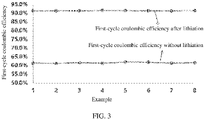
- the first-cycle coulombic efficiencies of the negative electrode plates of Examples 1 to 8 before and after a lithium-containing layer was applied were significantly improved.
- the lithium-containing layer could be applied on a surface of the active material layer to improve the first-cycle coulombic efficiency of the battery.
- Comparisons of test data of Examples 1 to 4 show the influence of ratios of different SiOC materials to graphite on performance of the materials and cells.
- the same amount of stabilized lithium metal powder, and the same thickness of the electrode plates, as the SiOC material in the active material increases, the gram capacity of the negative electrode plate increased, but the increase of the SiOC material consumed more active lithium ions, so that the first-cycle coulombic efficiency of the negative electrode plate decreased.
- Comparisons of test data of Examples 3, and 5 to 7 show the influence of different stirring durations during preparation of negative electrode plates on the performance of the materials and cells. In the case that other influencing factors remained unchanged, the stirring duration controlled to be within 4 hours to 36 hours allowed the materials in the negative electrode slurry to be mixed well. Therefore, different stirring durations had little influence on the performance of the negative electrode plates and cells.
- Comparisons of test data of Examples 3, and 8 to 10 show the influence of different standing durations during preparation of negative electrode plates on the performance of the materials and cells.
- the standing duration controlled to be within 4 hours to 36 hours allowed the stabilized metal lithium powder to be stably on the active material layer. Therefore, different standing durations had little influence on the performance of the negative electrode plates and cells.
- Comparisons of test data of Examples 3, and 11 to 13 show the influence of times of spraying toluene solution of the stabilized metal lithium powder during preparation of negative electrode plates on the performance of the materials and cells.
- the number of times of spraying the toluene solution of the stabilized metal lithium powder was controlled to be 1 to 7.
- the number of spraying operations increases, the amount of the stabilized lithium metal powder on the surface of the active material layer increased, and the thickness of the electrode plate also increased, so that the stabilized lithium metal powder could produce more active lithium ions during contact with the electrolyte. Therefore, the first-cycle coulombic efficiency of the electrode plate had also been improved, and both the first-cycle coulombic efficiency and the cycling retention rate of the battery had been improved.
- Comparisons of test data of Examples 3, and 14 to 16 show the influence of a ratio of the median particle size of the stabilized metal lithium powder to the median particle size of the active material during preparation of negative electrode plates on the performance of the materials and cells.
- a larger ratio of the median particle size of the stabilized metal lithium powder to the median particle size of the active material meant a smaller median particle size of the active material, and the swelling rate of the active material during cycling was reduced; and a smaller ratio of the median particle size of the stabilized metal lithium powder to the median particle size of the active material meant a larger median particle size of the active material, and the swelling rate of the active material during cycling was increased. Therefore, the ratio of the median particle size of the stabilized metal lithium powder to the median particle size of the active material needs to be controlled to improve cycling stability of the battery.
Landscapes
- Chemical & Material Sciences (AREA)
- Electrochemistry (AREA)
- General Chemical & Material Sciences (AREA)
- Chemical Kinetics & Catalysis (AREA)
- Engineering & Computer Science (AREA)
- Materials Engineering (AREA)
- Composite Materials (AREA)
- Inorganic Chemistry (AREA)
- Manufacturing & Machinery (AREA)
- Physics & Mathematics (AREA)
- Condensed Matter Physics & Semiconductors (AREA)
- General Physics & Mathematics (AREA)
- Crystallography & Structural Chemistry (AREA)
- Battery Electrode And Active Subsutance (AREA)
- Secondary Cells (AREA)
Abstract
This application provides an electrochemical apparatus and an electronic apparatus, where the electrochemical apparatus includes a positive electrode plate and a negative electrode plate, the negative electrode plate includes a negative electrode current collector and a negative electrode active substance layer disposed on a surface of the negative electrode current collector; the negative electrode active substance layer includes an active material layer and a lithium-containing layer provided on a surface of the active material layer; and the active material layer includes a SiOC material and graphite. The negative electrode material provided in this application can improve the first-cycle coulombic efficiency and energy density of the electrochemical apparatus.
Description
- This application relates to the field of energy storage technologies, and specifically, to an electrochemical apparatus and an electronic apparatus.
- Currently, silicon-based negative electrode materials with high gram capacity are considered as the most promising next-generation lithium-ion negative electrode materials. However, silicon has low conductivity (> 108 Q.cm), and during charging/discharging, has a volume swelling of about 300% and profuces an unstable solid electrolyte interphase (SEI) film. The silicon negative electrode material is pulverized and falls off a current collector during charging/discharging, such that electrical contact is lost between an active material and the current collector, leading to degraded electrochemical performance, capacity fading, and poorer cycling stability, which to some extent hinders further application of the silicon-based negative electrode material. Currently, a method of improving electrochemical performance of the silicon materials is combining silicon and carbon materials. The SiOC material has attracted attention from the market due to its smallest volume swelling. However, the SiOC material achieves lithium storage by breaking the Si-O bond, which creates an irreversible compound, LiSiO4, such that the first-cycle coulombic efficiency of the SiOC material is low, and the energy density of the electrochemical apparatus is reduced.
- In view of this, this application provides an electrochemical apparatus and an electronic apparatus, which can improve the first-cycle coulombic efficiency and energy density of the electrochemical apparatus.
- According to a first aspect, this application provides an electrochemical apparatus, including a positive electrode plate and a negative electrode plate, where the negative electrode plate includes a negative electrode current collector and a negative electrode active substance layer disposed on a surface of the negative electrode current collector; the negative electrode active substance layer includes an active material layer and a lithium-containing layer provided on a surface of the active material layer; and the active material layer includes a SiOC material and graphite.
- In some feasible implementations, the lithium-containing layer includes stabilized lithium metal powder.
- In some feasible implementations, the electrochemical apparatus satisfies at least one of the following characteristics (1) to (4):
- (1) in Si2p spectrum obtained by analyzing the negative electrode active substance layer according to an X-ray diffraction method, a binding energy peak of Si2p includes at least one of 101.4 eV±0.3 eV, 102.2 eV±0.3 eV, 103.1 eV±0.3 eV, or 104.40 eV±0.3 eV;
- (2) a binding energy peak of Li obtained by analyzing the negative electrode active substance layer according to the X-ray diffraction method is 55.6 eV±0.3 eV;
- (3) by analyzing the negative electrode active substance layer according to the X-ray diffraction method, the negative electrode active substance layer has at least one of a Li22Si diffraction peak, a Li22Ge diffraction peak, a Li22Sn diffraction peak, a Li2O diffraction peak, a Li2SiO3 diffraction peak, or a Li2Si2O5 diffraction peak; or
- (4) chemical shift values of Si obtained by analyzing the negative electrode active substance layer according to a solid-state nuclear magnetic resonance technology include -5 ppm±1 ppm, -35 ppm±1 ppm, -75 ppm±1 ppm, and -100 ppm±1 ppm, and a peak width K at half height of the chemical shift peak of Si at -5 ppm±1 ppm satisfies the following relationship: 7 ppm<K<28 ppm.
- In some feasible implementations, the electrochemical apparatus satisfies at least one of the following characteristics (5) to (9):
- (5) a median particle size of the mixed powder of the SiOC material and graphite is R1 um, and an R1 value ranges from 0.01 to 50;
- (6) a median particle size of the stabilized lithium metal powder is R2 um, and an R2 value ranges from 0.1 to 20;
- (7) a thickness of the active material layer is D1 um, and a D1 value ranges from 40 to 150;
- (8) a thickness of the lithium-containing layer is D2 um, and a D2 value ranges from 2 to 20; or
- (9) when the electrochemical apparatus is in a fully charged state, the negative electrode active substance layer has a diffraction peak of Li15Si4 according to the X-ray diffraction method.
- In some feasible implementations, the electrochemical apparatus satisfies at least one of the following characteristics (10) to (11):
- (10) a ratio of a median particle size R2 of the stabilized lithium metal powder to a median particle size R1 of the mixed powder satisfies: 0.01≤R2/R1≤1; or
- (11) a ratio of a thickness D1 of the active material layer to a thickness D2 of the lithium-containing layer satisfies: 2≤D1/D2≤20.
- In some feasible implementations, the electrochemical apparatus satisfies at least one of the following characteristics (12) to (14):
- (12) a mass ratio of the SiOC material to the graphite ranges from 5:95 to 45:55;
- (13) a mass ratio of total mass of the SiOC material and the graphite to mass of the stabilized lithium metal powder ranges from 1.99 to 9; or
- (14) the graphite includes at least one of natural graphite, artificial graphite, or meso-carbon microbeads.
- In some feasible implementations, the electrochemical apparatus satisfies at least one of the following characteristics (15) and (16):
- (15) a powder electrical conductivity of the negative electrode active substance layer ranges from 2.0 S/cm to 30.0 S/cm; or
- (16) a resistance of the negative electrode active substance layer ranges from 0.2 Ω to 1.0 Ω.
- In some feasible implementations, the negative electrode active substance layer further includes a binder; and the binder includes at least one of polyacrylate, polyimide, polyamide, polyamideimide, polyfluoroethylene, styrene butadiene rubber, sodium alginate, polyvinyl alcohol, polytetrafluoroethylene, polyacrylonitrile, sodium carboxymethyl cellulose, potassium carboxymethyl cellulose, sodium hydroxymethyl cellulose, or potassium hydroxymethyl cellulose.
- In some feasible implementations, the electrochemical apparatus further includes an electrolyte, and the electrolyte includes an organic solvent and a lithium salt;
- the organic solvent includes at least one of ethylene carbonate, propylene carbonate, diethyl carbonate, ethyl methyl carbonate, dimethyl carbonate, propylene carbonate, propyl propionate, or ethyl propionate; and/or
- the lithium salt includes at least one of lithium hexafluorophosphate, lithium tetrafluoroborate, lithium difluorophosphate, lithium bistrifluoromethanesulfonimide, lithium bis(fluorosulfonyl)imide, lithium bis(oxalate) borate, or lithium difluorooxalate.
- According to a second aspect, this application further provides an electronic apparatus, where the electronic apparatus includes the electrochemical apparatus according to the first aspect.
- Compared with the prior art, this application has at least the following beneficial effects:
- In the electrochemical apparatus provided in this application, the SiOC material in the active material layer and the stabilized lithium metal powder in the lithium-containing layer can be activated by contact with the electrolyte, to provide more active lithium ions for the electrochemical apparatus to make up for the active lithium ions consumed after the irreversible lithium storage in the SiOC material, thereby improving the first-cycle coulombic efficiency of the negative electrode material and increasing the energy density of the battery.
-
-
FIG. 1 is a schematic structural diagram of a negative electrode plate according to an embodiment of this application; -
FIG. 2 is a solid-state nuclear magnetic spectroscopy of a negative electrode plate in an electrochemical apparatus according to an embodiment of this application; and -
FIG. 3 is a comparison diagram of first-cycle coulombic efficiencies before and after a lithium-containing layer is added to a negative electrode plate according to an embodiment of this application. - The following descriptions are preferred implementations of the embodiments of this application. It should be noted that a person of ordinary skill in the art may make several improvements or modifications without departing from the principle of the embodiments of this application, and the improvements or modifications shall fall within the protection scope of the embodiments of this application.
- For simplicity, only some numerical ranges are explicitly disclosed in this specification. However, any lower limit may be combined with any upper limit to form an unspecified range, any lower limit may be combined with another lower limit to form an unspecified range, and similarly, any upper limit may be combined with any other upper limit to form an unspecified range. In addition, although not explicitly stated, each point or a single numerical value between end points of a range is included in the range. Therefore, each point or a single numerical value may serve as its own lower limit or upper limit and be combined with any other point or single numerical value or another lower limit or upper limit to form an unspecified range.
- In the description of this specification, it should be noted that, unless otherwise stated, "more than" and "less than" a number means inclusion of the number itself, and "more" in "one or more" means at least two.
- The foregoing summary of this application is not intended to describe each disclosed embodiment or each implementation of this application. The following descriptions illustrate example embodiments more specifically by using examples. In many places throughout this application, guidance is provided through a series of embodiments. These embodiments may be used in various combinations. In each embodiment, enumeration is only representative but should not be interpreted as exhaustive.
- According to a first aspect, this application provides an electrochemical apparatus, including a positive electrode plate and a negative electrode plate, where the positive electrode plate includes a positive electrode current collector and a positive electrode active substance layer disposed on a surface of the positive electrode current collector; and the negative electrode plate includes a negative electrode current collector and a negative electrode active substance layer disposed on a surface of the negative electrode current collector; and
the negative electrode active substance layer includes an active material layer and a lithium-containing layer provided on a surface of the active material layer; and the active material includes a SiOC material and graphite. - In this application, the SiOC material in the active material layer and the stabilized lithium metal powder in the lithium-containing layer can be activated by contact with the electrolyte, to provide more active lithium ions for the electrochemical apparatus to make up for the active lithium ions consumed after the irreversible lithium storage in the SiOC material, thereby improving the first-cycle coulombic efficiency of the negative electrode material and increasing the energy density of the battery.
- In an optional technical solution of this application, the SiOC material and graphite are mixed well to form the active material.
- The SiOC material mainly includes a Si-O-C framework and free carbons, where the Si-O-C framework is connected to the free carbons by C-Si bonds. The Si-O-C framework can be regarded as SiO4 tetrahedron with O substituted by C. Therefore, the SiOC material may be present in four forms: SiO2C2, SiO3C, SiOC3, and SiO4, where SiO2C2, and SiO3C are forms for completely reversible lithium storage, SiOC3 is a form for irreversible lithium storage, SiOC3 is changed to SiC4 after lithium storage; and SiO4 is a form for partially reversible lithium storage, and SiO4 is changed to reversible Li2SiO5 and irreversible LiSiO4 after lithium storage. The irreversible LiSiO4 consumes some active lithium ions in the electrochemical apparatus. However, the SiOC material has excellent resistance to damage by external force, and can produce a rich nanoporous structure during pyrolysis to improve the toughness of the material.
- In an optional technical solution of this application, the SiOC material includes, but is not limited to: crystalline carbon, amorphous carbon, and combinations thereof. The forms of the crystalline SiOC material may be amorphous, lamellar, flaky, spherical, square, nanoparticle, or fibrous.
- In an optional technical solution of this application, a mass ratio of the SiOC material to the graphite ranges from 5:95 to 45:55, specifically may be 5:95, 10:90, 15:85, 45:55, or the like, and certainly may be another value within the foregoing range, which is not limited herein. In this application, the graphite may include at least one of natural graphite, artificial graphite, or meso-carbon microbeads, and it is only required to mix the graphite and the SiOC material well.
- In an optional technical solution of this application, a mass ratio of the active material to the stabilized lithium metal powder ranges from 1.99 to 9, specifically may be 1.99, 2.5, 3.0, 4.5, 5.0, 5.8, 6.7, 8.0, 9, or the like, and certainly, may be another value within the foregoing range, which is not limited herein.
- As shown in
FIG. 1 , anactive material layer 11 is provided on a surface of a negative electrodecurrent collector 10, a lithium-containinglayer 12 is provided on a surface of theactive material layer 11, and the lithium-containinglayer 12 includes stabilized lithium metal powder. - In an optional technical solution of this application, the negative electrode current collector includes, but is not limited to: copper foil, nickel foil, stainless steel foil, titanium foil, foamed nickel, foamed copper, or a polymer base coated with conductive metal. Preferably, the negative electrode current collector is copper foil.
- A thickness of the
active material layer 11 is D1 um, and a value of D1 ranges from 40 to 150; and specifically, the thickness of theactive material layer 11 may be 40 um, 50 um, 60 um, 80 um, 100 um, 120 um, 150 um, or the like, and certainly may be another value within the foregoing range, which is not limited herein. - A thickness of the lithium-containing
layer 12 is D2 um, and a value of D2 ranges from 2 to 20; and specifically, the thickness of the lithium-containinglayer 12 may be 2 um, 4 um, 5 um, 6 um, 8 um, 10 um, 12 um, 15 um, 18 um, 20 um, or the like, and certainly may be another value within the foregoing range, which is not limited herein. - A ratio of the thickness D1 of the
active material layer 11 to the thickness D2 of the lithium-containing layer satisfies: 2≤D1/D2≤20. A value of D1/D2 may specifically be 2, 4, 5, 8, 10, 12, 15, 18, 20, or the like, and certainly may be another value within the foregoing range, which is not limited herein. - In an optional technical solution of this application, the stabilized lithium metal powder may be stabilized metal lithium powder and/or stabilized metal lithium compound, and specifically, the stabilized lithium metal powder includes element Li, element Ge, element Sn, or the like.
- In an optional technical solution of this application, the negative electrode active substance layer is analyzed according to an X-ray diffraction method, and the negative electrode active substance layer has at least one of a Li22Si diffraction peak, a Li22Ge diffraction peak, a Li22Sn diffraction peak, a Li2O diffraction peak, a Li2SiO3 diffraction peak, or a Li2Si2O5 diffraction peak.
- In an optional technical solution of this application, a median particle size of the active material is R1 um, and a value of R1 ranges from 0.01 to 50; and specifically, the median particle size of the active material may be 0.01 um, 0.05 um, 0.1 um, 0.5 um, 1 um, 5 um, 10 um, 20 um, 30 um, 40 um, 50 um, or the like, and certainly may be another value within the foregoing range, which is not limited herein.
- In an optional technical solution of this application, a median particle size of the stabilized lithium metal powder is R2 um, and a value of R2 ranges from 0.1 to 20; and specifically, the median particle size of the active material may be 0.1 um, 0.5 um, 1 um, 3 um, 5 um, 8 um, 10 um, 15 um, 18 um, 20 um, or the like, and certainly may be another value within the foregoing range, which is not limited herein.
- In an optional technical solution of this application, a ratio of the median particle size R2 of the stabilized lithium metal powder to the median particle size R1 of the active material satisfies: 0.01≤R2/R1≤1; and a value of R2/R1 may specifically be 0.01, 0.02, 0.03, 0.05, 0.1, 0.3, 0.5, 0.7, 0.8, 1, or the like, and certainly may be another value within the foregoing range, which is not limited herein.
- In an optional technical solution of this application, in Si2p spectrum obtained by analyzing the negative electrode active substance layer according to an X-ray diffraction method, a binding energy peak of Si2p includes at least one of 101.4 eV±0.3 eV, 102.2 eV±0.3 eV, 103.1 eV±0.3 eV, or 104.40 eV±0.3 eV, which means that each binding energy peak corresponds to one existence form of Si.
- In an optional technical solution of this application, a binding energy peak of Li obtained by analyzing the negative electrode active substance layer according to the X-ray diffraction method is 55.6 eV±0.3 eV.
- In an optional technical solution of this application, as shown in
FIG. 2 , chemical shift values of Si are obtained by analyzing the negative electrode active substance layer according to a solid-state nuclear magnetic resonance technology. The chemical shift values of Si include -5 ppm±1 ppm, -35 ppm±1 ppm, -75 ppm±1 ppm, and -100 ppm±1 ppm, and a peak width K at half height of the chemical shift peak of Si at -5 ppm±1 ppm satisfies the following relationship: 7 ppm<K<28 ppm. - In an optional technical solution of this application, when the electrochemical apparatus is in a fully charged state, the negative electrode active substance layer has a diffraction peak of Li15Si4 according to the X-ray diffraction method.
- In an optional technical solution of this application, in a transmission electron microscope (Transmission Electron Microscope, TEM) high-definition image, Li15Si4 crystalline grains, Li2SiO3 crystalline grains, and Li2Si2O5 crystalline grains can be seen, an interplanar spacing of a Li15Si4 crystalline grain is approximately 0.2 nm, an interplanar spacing of a Li2SiO3 crystalline grain is approximately 0.27 nm, and an interplanar spacing of a Li2Si2O5 crystalline grain is approximately 0.196 nm.
- In an optional technical solution of this application, the negative electrode active substance layer includes a binder, and the binder can enhance binding between particles of the negative electrode active material, and binding between the negative electrode active material and the negative electrode current collector. The binder includes at least one of polyacrylate, polyimide, polyamide, polyamideimide, polyfluoroethylene, styrene butadiene rubber, sodium alginate, polyvinyl alcohol, polytetrafluoroethylene, polyacrylonitrile, sodium carboxymethyl cellulose, potassium carboxymethyl cellulose, sodium hydroxymethyl cellulose, or potassium hydroxymethyl cellulose, which is not limited herein.
- In an optional technical solution of this application, the negative electrode active substance layer further includes a conductive material, and the conductive material includes natural graphite, artificial graphite, carbon black, acetylene black, Ketjen black, carbon fiber, metal powder, metal fiber, copper, nickel, aluminum, silver, polyphenylene derivatives, or the like, which is not limited herein.
- In an optional technical solution of this application, a value of a resistance of the negative electrode active substance layer ranges from 0.2 Ω to 1.0 Ω, specifically may be 0.2 Ω, 0.3 Ω, 0.5 Ω, 0.6 Ω, 0.8 Ω, 0.9 Ω, 1 Ω, or the like, and certainly may be another value within the foregoing range.
- In an optional technical solution of this application, a powder electrical conductivity of the negative electrode active substance layer ranges from 2.0 S/cm to 30.0 S/cm, specifically may be 2.0 S/cm, 5.0 S/cm, 8.0 S/cm, 10 S/cm, 12 S/cm, 15 S/cm, 18 S/cm, 20 S/cm, 25 S/cm, 30 S/cm, or the like, and certainly may be another value within the foregoing range.
- In an optional technical solution of this application, the electrochemical apparatus further includes a positive electrode plate, where the positive electrode plate includes a positive electrode current collector and a positive electrode active substance layer disposed on the positive electrode current collector.
- In an optional technical solution of this application, the positive electrode active material includes at least one of lithium cobaltate (LiCoO2), a lithium-nickel-cobalt-manganese ternary material, lithium iron phosphate, lithium iron manganese phosphate, or lithium manganate.
- In an optional technical solution of this application, the positive electrode active substance layer further includes a binder and a conductive material. It may be understood that the binder enhances binding between particles of the positive electrode active material, and binding between the positive electrode active material and the current collector.
- Specifically, the binder includes at least one of polyvinyl alcohol, hydroxypropyl cellulose, diacetyl cellulose, polyvinyl chloride, carboxylated polyvinyl chloride, polyvinyl fluoride, a polymer containing ethylene oxide, polyvinylpyrrolidone, polyurethane, polytetrafluoroethylene, polyvinylidene fluoride, polyethylene, polypropylene, styrene-butadiene rubber, acrylic styrene-butadiene rubber, epoxy resin, or nylon.
- Specifically, the conductive material includes a carbon-based material, a metal-based material, a conductive polymer, and a mixture thereof. In some embodiments, the carbon-based material is selected from natural graphite, artificial graphite, carbon black, acetylene black, Ketjen black, carbon fiber, or any combination thereof. In some embodiments, the metal-based material is selected from metal powder, metal fiber, copper, nickel, aluminum, or silver. In some embodiments, the conductive polymer is a polyphenylene derivative.
- In an optional technical solution of this application, the positive electrode current collector includes, but is not limited to, aluminum foil.
- In an optional technical solution of this application, the electrochemical apparatus further includes an electrolyte, and the electrolyte includes an organic solvent, a lithium salt, and an additive.
- The organic solvent of the electrolyte according to this application may be any organic solvent that is known in the prior art and that may be used as a solvent of the electrolyte. An electrolyte salt used in the electrolyte according to this application is not limited, and may be any electrolyte salt known in the prior art. The additive of the electrolyte according to this application may be any additive that is known in the prior art and that may be used as an additive of the electrolyte.
- In a specific embodiment, the organic solvent includes, but is not limited to: ethylene carbonate (EC), propylene carbonate (PC), diethyl carbonate (DEC), ethyl methyl carbonate (EMC), dimethyl carbonate (DMC), propylene carbonate, propyl propionate, or ethyl propionate.
- In a specific embodiment, the lithium salt includes at least one of an organic lithium salt or an inorganic lithium salt.
- In a specific embodiment, the lithium salt includes, but is not limited to: lithium hexafluorophosphate (LiPF6), lithium tetrafluoroborate (LiBF4), lithium difluorophosphate (LiPO2F2), lithium bistrifluoromethanesulfonimide LiN(CF3SO2)2(LiTFSI), lithium bis(fluorosulfonyl)imide Li(N(SO2F)2)(LiFSI), lithium bis(oxalate) borate LiB(C2O4)2(LiBOB) or lithium difluoro(oxalato)borate LiBF2(C2O4)(LiDFOB).
- In a specific embodiment, a concentration of the lithium salt in the electrolyte may range from 0.5 mol/L to 3 mol/L.
- In an optional technical solution of this application, the electrochemical apparatus of this application includes, but is not limited to: all kinds of primary batteries, secondary batteries, fuel cells, solar cells or capacitors.
- In a specific embodiment, the electrochemical apparatus is a lithium secondary battery, where the lithium secondary battery includes, but is not limited to: a lithium metal secondary battery, a lithium-ion battery, a lithium polymer secondary battery or a lithium-ion polymer secondary battery.
- According to a second aspect, an embodiment of this application further provides an electronic apparatus, where the electronic apparatus includes the electrochemical apparatuses according to the foregoing fourth aspect.
- In an optional technical solution of this application, the electronic apparatus includes, but is not limited to: a notebook computer, a pen-input computer, a mobile computer, an electronic book player, a portable telephone, a portable fax machine, a portable copier, a portable printer, a stereo headset, a video recorder, a liquid crystal television, a portable cleaner, a portable CD player, a mini-disc, a transceiver, an electronic notebook, a calculator, a memory card, a portable recorder, a radio, a standby power source, a motor, an automobile, a motorcycle, a motor bicycle, a bicycle, a lighting appliance, a toy, a game console, a clock, an electric tool, a flash lamp, a camera, a large household battery, a lithium-ion capacitor, or the like.
- The following uses a lithium-ion battery as an example and describes preparation of a lithium-ion battery with reference to specific embodiments. A person skilled in the art may understand that a preparation method described in this application is only an example, and that all other suitable preparation methods shall fall within the scope of this application.
- (1) Preparation of a negative electrode plate
- A SiOC material and graphite was mixed at a specified ratio (a mass ratio is between 5:95 and 45:55) and stirred, and the mixed powder, a conductive agent acetylene black, and lithium polyacrylate were mixed at a ratio of 95:1.2:3.8 in a deionized water solvent system and stirred for 4 hours to 36 hours, to obtain a well-mixed slurry.
- The slurry was applied on copper foil and dried under vacuum at 130°C, to obtain an initial electrode plate.
- Stabilized metal lithium powder was dissolved and dispersed uniformly in toluene, where a mass ratio of the stabilized metal lithium powder to the active material (SiOC+graphite) ranged from 1.99 to 9; under the protection of argon gas, the uniformly mixed toluene solution of the stabilized metal lithium powder was sprayed by an air spray gun onto a surface of the initial electrode plate, and the electrode plate was left standing for 4 hours to 36 hours; and then the electrode plate was cold-pressed.
- The operations of spraying the toluene solution of the stabilized metal lithium powder and the cold pressing were repeated 1 to 7 times to obtain a SiOC/stabilized metal lithium powder negative electrode plate.
- In Examples 1 to 16 and Comparative Examples 1 to 6, the preparation was performed according to the foregoing method. For parameters, refer to Table 1.
- (2) Preparation of a positive electrode plate
- A positive electrode active material, conductive carbon black, and a binder polyvinylidene fluoride were mixed at a weight ratio of 95:2.5:2.5, N-methylpyrrolidone (NMP) was added, and the mixture was stirred well under the action of a vacuum mixer to obtain a positive electrode slurry. The positive electrode slurry was uniformly applied on the positive electrode current collector aluminum foil, and a positive electrode plate was obtained after processes such as drying, cold-pressing, cutting, slitting, and tab welding were performed.
- In a glove box under a dry argon atmosphere, LiPF6 was added into and mixed uniformly with a solvent obtained by mixing propylene carbonate (PC) and ethylene carbonate (EC) (at a weight ratio of 1:1), to obtain an electrolyte, where a concentration of LiPF6 was 1 mol/L.
- A porous polyethylene polymeric film was used as a separator.
- The positive electrode plate, the separator, and the negative electrode plate were stacked in order, so that the separator was located between the positive electrode plate and the negative electrode plate for separation, and then the stack was wound to obtain a bare cell; after tabs were welded, the bare cell was placed in an outer packaging aluminum foil plastic film; and the prepared electrolyte was injected into the dried bare cell, and a lithium-ion battery was obtained after processes such as vacuum packaging, standing, formation, shaping, and capacity testing were performed.
- The XPS test device was ESCLAB 250Xi from Thermo Fisher Scientific, with an Al target as an excitation source, a power of 250 W, and a vacuum degree of more than 10-9 Pa. A binding energy peak of Si2p and a binding energy peak of Li were determined through the XPS test.
- Transmission electron microscope characterization was tested on a JEOL JEM-2010 transmission electron microscope, under a working voltage of 200 kV.
- 29Si SNMR spectra were measured on an AVANCE III 400 WB wide-bore solid-state nuclear magnetic resonance spectrometer, with a spinning rate of 8 kHz corresponding to 29Si.
- About 0.02 g of powder sample was added into a 50 ml clean beaker, about 20 ml deionized water was added, a few drops of a 1% surfactant were added to make the powder fully dispersed in the water, the powder was subjected to ultrasound for 5 min in a 120 W ultrasonic cleaning machine, and a MasterSizer 2000 was used to test the particle size distribution.
- The resistance of the negative electrode active substance layer was measured by using a four-probe method. The instrument used for the four-probe method was a precision direct current voltage and current source (SB 118). Four copper plates with dimensions of 1.5 cm (length) ∗ 1 cm (width) ∗ 2 mm (thickness) were fixed in a line at equal distances. A distance between the two copper plates in the middle is L (1 cm to 2 cm), and the base material for fixing the copper plates was an insulating material. During the test, lower end faces of the four copper plates were pressed on a to-be-measured negative electrode (the pressure was 3000 Kg) for 60 seconds, a direct current I is connected to the copper plates at two ends, a voltage V on the two copper plates in the middle was measured, I and V were read three times, and an average value of I and an average value of V were calculated and recorded as Ia and Va respectively, and then a value of Va/Ia was the resistance of the negative electrode active substance layer at the test site. Twelve points were selected in each negative electrode plate for test, and an average value therefrom was obtained.
- A resistivity tester (ST-2255A from Suzhou Jingge Electronics Co., Ltd.) was used. 5 g of powder sample was taken and pressed by using an electronic press at a constant pressure of 5000±2 kg for 15 to 25 seconds, then the sample was placed between electrodes of the tester. Given a height h (cm) of the sample, a voltage U across two ends, a current I, a resistance R (KΩ), and an area S=3.14 cm2 of the pressed powder, the powder electronic conductivity was calculated according to the formula δ=h/(S∗R)/1000 in S/m.
- An initial thickness of a lithium-ion battery was measured by a micrometer and recorded as H0. The lithium-ion battery was charged to the charge cut-off voltage at 25°C at a rate of 0.5C, then charged to 0.025C at a constant voltage, and then discharged to the discharge cut-off voltage at a rate of 0.5C, so as to get a first-cycle charge capacity and a first-cycle discharge capacity. First-cycle coulombic efficiency=first-cycle discharge capacity/first-cycle charge capacity.
- The foregoing charge and discharge were repeated for 400 cycles, and a thickness of the lithium-ion battery in this case was measured by the micrometer and recorded as H1. Swelling rate after 400 cycles=(H1-H0)/H0×100%.
- The cycling capacity retention rate is the discharge capacity after the 400th cycle divided by the first-cycle discharge capacity.
- For preparation process parameters of the negative electrode plates of Examples 1 to 16 and the negative electrode plates of Comparative Examples 1 to 6 that are prepared according to the foregoing method, refer to Table 1. For performance parameters of the prepared negative electrode plates, refer to Table 2. For performance test results of lithium batteries prepared by using the negative electrode plates, refer to Table 3.
Table 1. Preparation process parameters of negative electrode plates Sample Mass of SiOC material (g) Type of graphite Mass of graphite (g) Stirring duration (h) Standing duration (h) Number of repetitions Mass of stabilized lithium metal powder (mg) Thickness of electrode plate (um) D1 (um) D1/D2 Example 1 50 Artificial graphite 950 12 12 5 348 110.2 100 10 Example 2 100 Artificial graphite 900 12 12 5 348 110.2 100 10 Example 3 150 Artificial graphite 850 12 12 5 348 110.2 100 10 Example 4 450 Artificial graphite 550 12 12 5 348 110.2 100 10 Example 5 150 Artificial graphite 850 4 12 5 348 110.2 100 10 Example 6 150 Artificial graphite 850 24 12 5 348 110.2 100 10 Example 7 150 Artificial graphite 850 36 12 5 348 110.2 100 10 Example 8 150 Artificial graphite 850 12 4 5 348 110.2 100 10 Example 9 150 Artificial graphite 850 12 24 5 348 110.2 100 10 Example 10 150 Artificial graphite 850 12 36 5 348 110.2 100 10 Example 11 150 Artificial graphite 850 12 12 1 72 90.1 88 2 Example 12 150 Artificial graphite 850 12 12 3 221 100.3 95 5 Example 13 150 Artificial graphite 850 12 12 7 459 120.6 100 20 Example 14 150 Artificial graphite 850 12 12 5 348 110.2 100 10 Example 15 150 Artificial graphite 850 12 12 5 348 110.2 100 10 Example 16 150 Artificial graphite 850 12 12 5 348 110.2 100 10 Comparative Example 1 150 Artificial graphite 850 12 12 0 0 80.2 80.2 / Comparative Example 2 150 Artificial graphite 850 4 12 0 0 80.2 80.2 / Comparative Example 3 150 Artificial graphite 850 24 12 0 0 80.2 80.2 / Comparative Example 4 150 Artificial graphite 850 36 12 0 0 80.2 80.2 / Comparative Example 5 50 Artificial graphite 950 12 12 0 0 80.2 80.2 / Comparative Example 6 450 Artificial graphite 550 12 12 0 0 80.2 80.2 / Table 2 Performance parameters of negative electrode plates Sample Peak width at half height at -5 ppm in SNMR (ppm) Median particle size of powder (SiOC+graphite) R1 (um) R2/R1 Powder electrical conductivity (S/cm) Resistance (Q) Gram capacity of electrode plate (mAh/g) First-cycle coulombic efficiency of electrode plate (%) Example 1 50 12 0.2 10 0.63 400 99.7 Example 2 100 12 0.2 10 0.62 448 95.2 Example 3 150 12 0.2 10 0.63 500 93.2 Example 4 450 12 0.2 10 0.58 680 89.2 Example 5 150 12 0.2 10 0.53 500 99.7 Example 6 150 12 0.2 10 0.5 500 99.7 Example 7 150 12 0.2 10 0.47 500 99.7 Example 8 150 12 0.2 10 0.44 500 99.7 Example 9 150 12 0.2 10 0.40 500 99.7 Example 10 150 12 0.2 10 0.25 500 99.7 Example 11 150 12 0.2 10 0.48 500 90.7 Example 12 150 12 0.2 10 0.47 500 92.7 Example 13 150 12 0.2 10 0.47 500 93.2 Example 14 150 0.6 0.01 10 0.52 500 92.4 Example 15 150 2.9 0.5 10 0.49 500 93.6 Example 16 150 5.9 1 10 0.50 500 92.5 Comparative Example 1 150 12 0.2 10 1.32 500 70.8 Comparative Example 2 150 12 0.2 10 0.46 500 70.8 Comparative Example 3 150 12 0.2 10 0.46 500 70.8 Comparative Example 4 150 12 0.2 10 0.91 500 70.8 Comparative Example 5 50 12 0.2 10 0.52 400 89.2 Comparative Example 6 450 12 0.2 10 0.15 680 60.5 Table 3 Performance parameters of lithium batteries Sample First-cycle coulombic efficiency of full battery (%) Capacity retention rate after 400 cycles at 25°C (%) Cell swelling Rate after 400 cycles at 25°C (%) Example 1 92.8 90.1 7.4 Example 2 92.7 87.9 7.8 Example 3 92.9 93.3 4.5 Example 4 92 82.3 6.8 Example 5 92.8 88.3 7.3 Example 6 92.1 88.7 8.5 Example 7 92.9 89.2 7.0 Example 8 92 88.3 7.4 Example 9 92.9 88.7 7.8 Example 10 92.8 88.9 8.0 Example 11 70 65.6 8.2 Example 12 85 66 8.5 Example 13 92.9 85 8.6 Example 14 89.9 86.7 8.2 Example 15 90.3 88.5 6.8 Example 16 89.6 87.1 6.4 Comparative Example 1 73 65.2 5.8 Comparative Example 2 72.6 65.2 9.8 Comparative Example 3 73.1 65.2 8.5 Comparative Example 4 72.9 65.2 8.6 Comparative Example 5 63 54.4 5.8 Comparative Example 6 52 48.8 9.8 - As shown in
FIG. 3 , the first-cycle coulombic efficiencies of the negative electrode plates of Examples 1 to 8 before and after a lithium-containing layer was applied were significantly improved. The lithium-containing layer could be applied on a surface of the active material layer to improve the first-cycle coulombic efficiency of the battery. - Comparisons of test data of Examples 1 to 4 show the influence of ratios of different SiOC materials to graphite on performance of the materials and cells. In the case of the same preparation process, the same amount of stabilized lithium metal powder, and the same thickness of the electrode plates, as the SiOC material in the active material increases, the gram capacity of the negative electrode plate increased, but the increase of the SiOC material consumed more active lithium ions, so that the first-cycle coulombic efficiency of the negative electrode plate decreased.
- Comparisons of test data of Examples 3, and 5 to 7 show the influence of different stirring durations during preparation of negative electrode plates on the performance of the materials and cells. In the case that other influencing factors remained unchanged, the stirring duration controlled to be within 4 hours to 36 hours allowed the materials in the negative electrode slurry to be mixed well. Therefore, different stirring durations had little influence on the performance of the negative electrode plates and cells.
- Comparisons of test data of Examples 3, and 8 to 10 show the influence of different standing durations during preparation of negative electrode plates on the performance of the materials and cells. In the case that other influencing factors remained unchanged, the standing duration controlled to be within 4 hours to 36 hours allowed the stabilized metal lithium powder to be stably on the active material layer. Therefore, different standing durations had little influence on the performance of the negative electrode plates and cells.
- Comparisons of test data of Examples 3, and 11 to 13 show the influence of times of spraying toluene solution of the stabilized metal lithium powder during preparation of negative electrode plates on the performance of the materials and cells. In the case that other influencing factors remained unchanged, the number of times of spraying the toluene solution of the stabilized metal lithium powder was controlled to be 1 to 7. As the number of spraying operations increases, the amount of the stabilized lithium metal powder on the surface of the active material layer increased, and the thickness of the electrode plate also increased, so that the stabilized lithium metal powder could produce more active lithium ions during contact with the electrolyte. Therefore, the first-cycle coulombic efficiency of the electrode plate had also been improved, and both the first-cycle coulombic efficiency and the cycling retention rate of the battery had been improved.
- Comparisons of test data of Examples 3, and 14 to 16 show the influence of a ratio of the median particle size of the stabilized metal lithium powder to the median particle size of the active material during preparation of negative electrode plates on the performance of the materials and cells. In the case that other influencing factors remained unchanged, a larger ratio of the median particle size of the stabilized metal lithium powder to the median particle size of the active material meant a smaller median particle size of the active material, and the swelling rate of the active material during cycling was reduced; and a smaller ratio of the median particle size of the stabilized metal lithium powder to the median particle size of the active material meant a larger median particle size of the active material, and the swelling rate of the active material during cycling was increased. Therefore, the ratio of the median particle size of the stabilized metal lithium powder to the median particle size of the active material needs to be controlled to improve cycling stability of the battery.
- Although this application is disclosed above with preferred embodiments, they are not intended to limit the claims. Any person skilled in the art can make several possible changes and modifications without departing from the concept of this application. Therefore, the protection scope of this application shall be subject to the scope demarcated by the claims of this application.
Claims (10)
- An electrochemical apparatus, comprising a positive electrode plate and a negative electrode plate, wherein the negative electrode plate comprises a negative electrode current collector and a negative electrode active substance layer disposed on a surface of the negative electrode current collector, characterized in that
the negative electrode active substance layer comprises an active material layer and a lithium-containing layer provided on a surface of the active material layer; and the active material layer comprises a SiOC material and graphite. - The electrochemical apparatus according to claim 1, characterized in that the lithium-containing layer comprises stabilized lithium metal powder.
- The electrochemical apparatus according to claim 1, characterized in that the electrochemical apparatus satisfies at least one of the following characteristics (1) to (4):(1) in Si2p spectrum obtained by analyzing the negative electrode active substance layer according to an X-ray diffraction method, a binding energy peak of Si2p comprises at least one of 101.4 eV±0.3 eV, 102.2 eV±0.3 eV, 103.1 eV±0.3 eV, or 104.40 eV±0.3 eV;(2) a binding energy peak of Li obtained by analyzing the negative electrode active substance layer according to the X-ray diffraction method is 55.6 eV±0.3 eV;(3) by analyzing the negative electrode active substance layer according to the X-ray diffraction method, the negative electrode active substance layer has at least one of a Li22Si diffraction peak, a Li22Ge diffraction peak, a Li22Sn diffraction peak, a Li2O diffraction peak, a Li2SiO3 diffraction peak, or a Li2Si2O5 diffraction peak; or(4) chemical shift values of Si obtained by analyzing the negative electrode active substance layer according to a solid-state nuclear magnetic resonance technology comprise -5 ppm±1 ppm, -35 ppm±1 ppm, -75 ppm±1 ppm, and -100 ppm±1 ppm, and a peak width K at half height of the chemical shift peak of Si at -5 ppm±1 ppm satisfies the following relationship: 7 ppm<K<28 ppm.
- The electrochemical apparatus according to claim 2, characterized in that the electrochemical apparatus satisfies at least one of the following characteristics (5) to (9):(5) a median particle size of the mixed powder of the SiOC material and graphite is R1 um, and an R1 value ranges from 0.01 to 50;(6) a median particle size of the stabilized lithium metal powder is R2 um, and an R2 value ranges from 0.1 to 20;(7) a thickness of the active material layer is D1 um, and a D1 value ranges from 40 to 150;(8) a thickness of the lithium-containing layer is D2 um, and a D2 value ranges from 2 to 20; or(9) when the electrochemical apparatus is in a fully charged state, the negative electrode active substance layer has a diffraction peak of Li15Si4 according to the X-ray diffraction method.
- The electrochemical apparatus according to claim 2, characterized in that the electrochemical apparatus satisfies at least one of the following characteristics (10) to (11):(10) a ratio of a median particle size R2 of the stabilized lithium metal powder to a median particle size R1 of the mixed powder satisfies: 0.01≤R2/R1≤1; or(11) a ratio of a thickness D1 of the active material layer to a thickness D2 of the lithium-containing layer satisfies: 2≤D1/D2≤20.
- The electrochemical apparatus according to claim 2, characterized in that the electrochemical apparatus satisfies at least one of the following characteristics (12) to (14):(12) a mass ratio of the SiOC material to the graphite ranges from 5:95 to 45:55;(13) a mass ratio of total mass of the SiOC material and the graphite to mass of the stabilized lithium metal powder ranges from 1.99 to 9; or(14) the graphite comprises at least one of natural graphite, artificial graphite, or meso-carbon microbeads.
- The electrochemical apparatus according to claim 1, characterized in that the electrochemical apparatus satisfies at least one of the following characteristics (15) to (16):(15) a powder electrical conductivity of the negative electrode active substance layer ranges from 2.0 S/cm to 30.0 S/cm; or(16) a resistance of the negative electrode active substance layer ranges from 0.2 Ω to 1.0 Ω.
- The electrochemical apparatus according to claim 1, characterized in that the negative electrode active substance layer further comprises a binder; and the binder comprises at least one of polyacrylate, polyimide, polyamide, polyamideimide, polyfluoroethylene, styrene butadiene rubber, sodium alginate, polyvinyl alcohol, polytetrafluoroethylene, polyacrylonitrile, sodium carboxymethyl cellulose, potassium carboxymethyl cellulose, sodium hydroxymethyl cellulose, or potassium hydroxymethyl cellulose.
- The electrochemical apparatus according to claim 1, characterized in that the electrochemical apparatus further comprises an electrolyte, and the electrolyte comprises an organic solvent and a lithium salt;the organic solvent comprises at least one of ethylene carbonate, propylene carbonate, diethyl carbonate, ethyl methyl carbonate, dimethyl carbonate, propylene carbonate, propyl propionate, or ethyl propionate; and/orthe lithium salt comprises at least one of lithium hexafluorophosphate, lithium tetrafluoroborate, lithium difluorophosphate, lithium bistrifluoromethanesulfonimide, lithium bis(fluorosulfonyl)imide, lithium bis(oxalate) borate, or lithium difluorooxalate.
- An electronic apparatus, characterized in that the electronic apparatus comprises the electrochemical apparatus according to any one of claims 1 to 9.
Applications Claiming Priority (1)
| Application Number | Priority Date | Filing Date | Title |
|---|---|---|---|
| PCT/CN2021/084082 WO2022204974A1 (en) | 2021-03-30 | 2021-03-30 | Electrochemical device and electronic device |
Publications (2)
| Publication Number | Publication Date |
|---|---|
| EP4095941A4 EP4095941A4 (en) | 2022-11-30 |
| EP4095941A1 true EP4095941A1 (en) | 2022-11-30 |
Family
ID=77719506
Family Applications (1)
| Application Number | Title | Priority Date | Filing Date |
|---|---|---|---|
| EP21815094.4A Pending EP4095941A1 (en) | 2021-03-30 | 2021-03-30 | Electrochemical device and electronic device |
Country Status (5)
| Country | Link |
|---|---|
| US (1) | US12562378B2 (en) |
| EP (1) | EP4095941A1 (en) |
| JP (1) | JP7499771B2 (en) |
| CN (1) | CN113424336A (en) |
| WO (1) | WO2022204974A1 (en) |
Families Citing this family (3)
| Publication number | Priority date | Publication date | Assignee | Title |
|---|---|---|---|---|
| CN114122376B (en) * | 2021-11-12 | 2024-05-14 | 宁德新能源科技有限公司 | Electrochemical device and electronic device comprising same |
| CN118281178A (en) * | 2022-12-29 | 2024-07-02 | 贝特瑞新材料集团股份有限公司 | Negative electrode material and preparation method thereof, lithium ion battery |
| CN117117111A (en) * | 2023-02-20 | 2023-11-24 | 荣耀终端有限公司 | Electrochemical devices and electronic devices |
Family Cites Families (17)
| Publication number | Priority date | Publication date | Assignee | Title |
|---|---|---|---|---|
| JP2005063805A (en) * | 2003-08-12 | 2005-03-10 | Matsushita Electric Ind Co Ltd | Negative electrode and lithium secondary battery using the same |
| JP4998662B2 (en) * | 2004-07-30 | 2012-08-15 | 信越化学工業株式会社 | Si-C-O-based composite, production method thereof, and negative electrode material for non-aqueous electrolyte secondary battery |
| JP5003877B2 (en) * | 2006-03-27 | 2012-08-15 | 信越化学工業株式会社 | Method for producing SiCO-Li composite |
| US20070224509A1 (en) * | 2006-03-27 | 2007-09-27 | Shin-Etsu Chemical Co., Ltd. | SiCO-Li COMPOSITE, MAKING METHOD, AND NON-AQUEOUS ELECTROLYTE SECONDARY CELL NEGATIVE ELECTRODE MATERIAL |
| JP5196118B2 (en) * | 2006-09-14 | 2013-05-15 | 信越化学工業株式会社 | Non-aqueous electrolyte secondary battery and manufacturing method thereof |
| US8563173B2 (en) * | 2009-05-08 | 2013-10-22 | Robert Bosch Gmbh | Li-ion battery with anode current collector coating |
| KR20120128125A (en) * | 2009-11-03 | 2012-11-26 | 엔비아 시스템즈 인코포레이티드 | High capacity anode materials for lithium ion batteries |
| CN102299338B (en) | 2011-07-27 | 2014-06-11 | 中国人民解放军国防科学技术大学 | SiOC ceramic material used for preparing cathode of lithium ion battery, preparation method thereof and lithium ion battery |
| BR112014017192B1 (en) * | 2012-01-13 | 2019-07-09 | Rockwood Lithium GmbH | Process for producing a lithium metal in stable particles |
| US11081699B2 (en) * | 2014-05-20 | 2021-08-03 | Zeon Corporation | Method for manufacturing electrochemical device electrode |
| EP3018099A1 (en) | 2014-11-06 | 2016-05-11 | Commissariat A L'energie Atomique Et Aux Energies Alternatives | SiOC composite electrode material |
| CN105742613B (en) * | 2016-04-18 | 2018-09-18 | 宁德新能源科技有限公司 | A kind of cathode pole piece and lithium ion battery |
| CN110088945A (en) * | 2017-06-08 | 2019-08-02 | 株式会社Lg化学 | Negative electrode, secondary battery comprising the same, and method for preparing the same |
| CN111406334A (en) * | 2017-12-01 | 2020-07-10 | Dic株式会社 | Negative electrode active material and method for producing the same |
| US11094925B2 (en) * | 2017-12-22 | 2021-08-17 | Zenlabs Energy, Inc. | Electrodes with silicon oxide active materials for lithium ion cells achieving high capacity, high energy density and long cycle life performance |
| JP2020191188A (en) * | 2019-05-20 | 2020-11-26 | 株式会社豊田自動織機 | Manufacturing method of SiOC negative electrode material |
| CN110416523B (en) * | 2019-08-05 | 2024-06-11 | 北方奥钛纳米技术有限公司 | Si-O-C composite material, preparation method thereof and silicon-carbon composite material |
-
2021
- 2021-03-30 EP EP21815094.4A patent/EP4095941A1/en active Pending
- 2021-03-30 WO PCT/CN2021/084082 patent/WO2022204974A1/en not_active Ceased
- 2021-03-30 CN CN202180001361.6A patent/CN113424336A/en active Pending
- 2021-03-30 JP JP2021539131A patent/JP7499771B2/en active Active
-
2022
- 2022-03-30 US US17/708,375 patent/US12562378B2/en active Active
Also Published As
| Publication number | Publication date |
|---|---|
| CN113424336A (en) | 2021-09-21 |
| JP7499771B2 (en) | 2024-06-14 |
| WO2022204974A1 (en) | 2022-10-06 |
| US12562378B2 (en) | 2026-02-24 |
| JP2023523659A (en) | 2023-06-07 |
| EP4095941A4 (en) | 2022-11-30 |
| US20220320501A1 (en) | 2022-10-06 |
Similar Documents
| Publication | Publication Date | Title |
|---|---|---|
| US20230282836A1 (en) | Lithium metal negative electrode plate, electrochemical apparatus, and electronic device | |
| EP4220759A1 (en) | Lithium metal negative electrode plate, electrochemical apparatus, and electronic device | |
| JP5882516B2 (en) | Lithium secondary battery | |
| EP4089762B1 (en) | Positive electrode plate, and electrochemical device and electronic device containing positive electrode plate | |
| JP2001325988A (en) | Non-aqueous electrolyte secondary battery charging method | |
| EP4050676A1 (en) | Negative electrode sheet, electrochemical device comprising negative electrode sheet, and electronic device | |
| US12562378B2 (en) | Electrochemical apparatus and electronic apparatus | |
| CN116799194A (en) | Silicon carbon anode material and its preparation method and application | |
| WO2024016940A1 (en) | Positive electrode plate, secondary battery, battery module, battery pack and electric device | |
| CN114097108A (en) | Cathode material, preparation method thereof, electrochemical device and electronic device | |
| CN114335690B (en) | Electrochemical devices and electronic devices | |
| JP7783325B2 (en) | Secondary battery and electronic device | |
| US20220223850A1 (en) | Negative electrode, electrochemical device containing same, and electronic device | |
| CN120727742A (en) | Negative electrode sheet, method for preparing negative electrode sheet, battery and electrical equipment | |
| JP2025534071A (en) | Anode strips, electrochemical and electronic devices | |
| WO2022193283A1 (en) | Electrochemical device and electronic device | |
| US12308437B2 (en) | Positive electrode and electrochemical apparatus and electronic apparatus containing same | |
| US20220231273A1 (en) | Negative electrode material, electrode plate containing same, electrochemical device, and electronic device | |
| WO2026066307A1 (en) | Cylindrical secondary battery and electronic device | |
| US20240405218A1 (en) | Secondary battery and electronic apparatus | |
| EP4336594A1 (en) | Positive electrode slurry and preparation method thereof, positive pole piece, secondary battery, battery module, battery pack and electrical apparatus | |
| EP4539185A1 (en) | Secondary battery, manufacturing method therefor, and electrical apparatus | |
| US20220223854A1 (en) | Negative electrode material and electrochemical apparatus and electronic apparatus containing same | |
| CN114122376B (en) | Electrochemical device and electronic device comprising same | |
| CN114530603B (en) | Negative electrode, electrochemical device and electronic device |
Legal Events
| Date | Code | Title | Description |
|---|---|---|---|
| STAA | Information on the status of an ep patent application or granted ep patent |
Free format text: STATUS: UNKNOWN |
|
| STAA | Information on the status of an ep patent application or granted ep patent |
Free format text: STATUS: THE INTERNATIONAL PUBLICATION HAS BEEN MADE |
|
| PUAI | Public reference made under article 153(3) epc to a published international application that has entered the european phase |
Free format text: ORIGINAL CODE: 0009012 |
|
| STAA | Information on the status of an ep patent application or granted ep patent |
Free format text: STATUS: REQUEST FOR EXAMINATION WAS MADE |
|
| 17P | Request for examination filed |
Effective date: 20211207 |
|
| A4 | Supplementary search report drawn up and despatched |
Effective date: 20220812 |
|
| AK | Designated contracting states |
Kind code of ref document: A1 Designated state(s): AL AT BE BG CH CY CZ DE DK EE ES FI FR GB GR HR HU IE IS IT LI LT LU LV MC MK MT NL NO PL PT RO RS SE SI SK SM TR |
|
| DAV | Request for validation of the european patent (deleted) | ||
| DAX | Request for extension of the european patent (deleted) |