EP4095832B1 - Secure computation device, secure computation method, and program - Google Patents
Secure computation device, secure computation method, and program Download PDFInfo
- Publication number
- EP4095832B1 EP4095832B1 EP20915962.3A EP20915962A EP4095832B1 EP 4095832 B1 EP4095832 B1 EP 4095832B1 EP 20915962 A EP20915962 A EP 20915962A EP 4095832 B1 EP4095832 B1 EP 4095832B1
- Authority
- EP
- European Patent Office
- Prior art keywords
- secure computation
- secret share
- share value
- value
- func
- Prior art date
- Legal status (The legal status is an assumption and is not a legal conclusion. Google has not performed a legal analysis and makes no representation as to the accuracy of the status listed.)
- Active
Links
Images




Classifications
-
- H—ELECTRICITY
- H04—ELECTRIC COMMUNICATION TECHNIQUE
- H04L—TRANSMISSION OF DIGITAL INFORMATION, e.g. TELEGRAPHIC COMMUNICATION
- H04L9/00—Cryptographic mechanisms or cryptographic arrangements for secret or secure communications; Network security protocols
- H04L9/08—Key distribution or management, e.g. generation, sharing or updating, of cryptographic keys or passwords
- H04L9/0816—Key establishment, i.e. cryptographic processes or cryptographic protocols whereby a shared secret becomes available to two or more parties, for subsequent use
- H04L9/085—Secret sharing or secret splitting, e.g. threshold schemes
-
- G—PHYSICS
- G09—EDUCATION; CRYPTOGRAPHY; DISPLAY; ADVERTISING; SEALS
- G09C—CIPHERING OR DECIPHERING APPARATUS FOR CRYPTOGRAPHIC OR OTHER PURPOSES INVOLVING THE NEED FOR SECRECY
- G09C1/00—Apparatus or methods whereby a given sequence of signs, e.g. an intelligible text, is transformed into an unintelligible sequence of signs by transposing the signs or groups of signs or by replacing them by others according to a predetermined system
-
- H—ELECTRICITY
- H04—ELECTRIC COMMUNICATION TECHNIQUE
- H04L—TRANSMISSION OF DIGITAL INFORMATION, e.g. TELEGRAPHIC COMMUNICATION
- H04L9/00—Cryptographic mechanisms or cryptographic arrangements for secret or secure communications; Network security protocols
- H04L9/14—Cryptographic mechanisms or cryptographic arrangements for secret or secure communications; Network security protocols using a plurality of keys or algorithms
- H04L9/16—Cryptographic mechanisms or cryptographic arrangements for secret or secure communications; Network security protocols using a plurality of keys or algorithms the keys or algorithms being changed during operation
Definitions
- the present disclosure relates to a technology for approximating an elementary function of a real number in secure computation.
- NPL 1 discloses a method of calculating an elementary function such as a reciprocal, a square root and a reciprocal thereof, and an exponential function in secure computation.
- NPL 2 discloses a new hybrid model of floating point numbers suitable for operations in secure multi-party computations. The basic idea is to consider the significand of the floating point number as a fixed point number and implement elementary function applications separately of the significand.
- NPL 3 examines the efficiency of protocols for secure evaluation of basic mathematical functions (sqrt, sin, arcsin, amongst others), essential to various application domains. e.g., Artificial Intelligence.
- NPL 4 discloses develop efficient solutions for computation with real numbers in floating point representation, as well as more complex operations such as square root, logarithm, and exponentiation.
- PL 1 relates to a technique for performing approximate calculation of a function by secret calculation.
- PL 1 WO 2019/225531 .
- the present disclosure has been made in view of such a point, and an object of the present disclosure is to provide a secure computation technology capable of supporting many elementary functions for general purpose only by changing parameters.
- x, y, and z are real numbers
- a, b, c, ⁇ , and ⁇ are real number coefficients
- a secret share value of ⁇ is [ ⁇ ].
- a first embodiment will be described.
- elementary functions are approximated by a polynomial and secure computation is performed.
- many elementary functions can be subjected to secure computation for general purposes only by changing parameters.
- the elementary functions handled in the present embodiment are not limited, but when exponential functions or logarithmic functions are approximated by a polynomial, higher-order coefficients become very small. In such a case, when the approximation is performed using only one polynomial, approximation precision of coefficients is degraded.
- a plurality of polynomials are used to gradually decrease a higher order.
- An elementary function is a one-variable function of a real number or a complex number, and is a function obtained by repeating creation of an algebraic function, an exponential function, a logarithmic function, a triangular function, an inverse triangular function, and a composite function thereof a finite number of times.
- Examples of the elementary function are a reciprocal function, a square root function, an exponential function, and a logarithmic function.
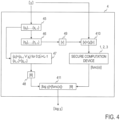
- a secure computation device 1 of the first embodiment includes secure computation units 11 and 12 and a control unit 19.
- the secure computation device 1 executes each processing under the control of the control unit 19.
- x, y, and z are real numbers
- a, b, c, ⁇ , and ⁇ are real number coefficients.
- the real number coefficients a, b, c, ⁇ , and ⁇ are set according to a desired elementary function.
- a secret share value of ⁇ is [ ⁇ ].
- a secret sharing scheme is not limited, and examples thereof include an additive secret sharing scheme and a Shamir's secret sharing scheme.
- An example of [ ⁇ ] is a secret share value obtained by performing linear secret sharing on an element ⁇ on a quotient ring.
- a public decimal point position is defined for an integer on the ring so that this can be regarded as a fixed-point real number. In the embodiment, the fixed-point real number indicated on the ring in this way is simply expressed as a real number.
- a secret share value [x] of a real number x is input to the secure computation device 1 (step S10).
- the secret share value [x] is input to the secure computation unit 11.
- the secret share values [x] and [y] are input to the secure computation unit 12.
- the secure computation unit 11 outputs the secret share value [func(x)] (step S13).
- the elementary function is approximated by a fourth-order polynomial
- the elementary function is approximated by an eighth-order polynomial.
- a secure computation device 2 of the second embodiment includes secure computation units 11, 22, and 23 and a control unit 19.
- the secure computation device 2 executes each processing under the control of the control unit 19.
- x, y, z, and w are real numbers
- a, b, c, d, f, g, ⁇ , ⁇ , ⁇ , ⁇ , and ⁇ are real number coefficients.
- the real number coefficients a, b, c, d, f, g, ⁇ , ⁇ , ⁇ , ⁇ , and ⁇ are set according to a desired elementary function.
- a secret share value [x] of a real number x is input to the secure computation device 2 (step S10).
- the secret share value [x] is input to the secure computation unit 11.
- the secret share values [x] and [y] are input to the secure computation unit 22.
- the secret share values [x], [y], and [z] are input to the secure computation unit 23.
- an elementary function is approximated by a fourth-order polynomial, as in the first embodiment, but the third embodiment differs from the first embodiment in that a highest-order coefficient can be set.
- the secure computation device 3 of the third embodiment includes secure computation units 11 and 32 and a control unit 19.
- the secure computation device 3 executes each processing under the control of the control unit 19.
- x, y, and z are real numbers
- a, b, c, ⁇ , ⁇ , and ⁇ are real number coefficients.
- the real number coefficients a, b, c, ⁇ , ⁇ , and ⁇ are set according to a desired elementary function.
- the secret share value [x] of the real number x is input to the secure computation device 3 (step S10).
- the secret share value [x] is input to the secure computation unit 11.
- the secret share values [x] and [y] are input to the secure computation unit 32.
- the secure computation unit 31 outputs the secret share value [func(x)] (step S13).
- x is a real number
- [ ⁇ ] is a secret share value of ⁇
- n is an integer equal to or greater than 1 (for example, n is an integer equal to or greater than 2)
- f t (x) is a function of a real number x
- f' t (x) is an approximation function of the function f t (x)
- a secret sharing scheme is not limited, and examples thereof include an additive secret sharing scheme and a Shamir's secret sharing scheme.
- the overflow is a problem based on performance of a processor in which the secure computation is implemented, and the present scheme provides a scheme for solving a problem based on constraints on this hardware.
- the present scheme does not solve pure mathematics problems, but solves hardware implementation problems, and therefore has technical characteristics. For example, technical characteristics of the processor that overflows when the secret share value [f t (x)] is calculated but does not overflow when the secret share value [f t (x) - f' t (x)] is calculated are remarkable.
- modification examples of the first to third embodiments will be specifically shown.
- f' 0 (x) ix + j
- f' 1 (x) ky + sx + m
- f' 2 (x) nz + oy + px + q.
- a logarithmic function is approximated as an elementary function.
- a secure computation device 4 of the fourth embodiment includes secure computation units 45, 46, 47, 48, 49, 410, and 411, and any one of the secure computation devices 1 to 3 or the secure computation device of the modification example described above.
- ⁇ is a real number
- p is a positive integer
- L is an integer equal to or greater than 2
- [ ⁇ ] is a secret share value obtained by performing linear secret sharing on an element ⁇ on a quotient ring modulo p
- ⁇ is a secret share value obtained by performing linear secret sharing on an element ⁇ on a quotient ring modulo 2.
- a secret share value [ ⁇ ] of a real number ⁇ is input to the secure computation device 4 (step S40).
- the secret share value [ ⁇ ] is input to the secure computation unit 45.
- the secure computation unit 45 obtains and outputs secret share values ⁇ 0 ⁇ , ..., ⁇ L - 1 ⁇ of an L-bit representation ⁇ 0 ... ⁇ L - 1 of the real number ⁇ through secure computation using the secret share value [ ⁇ ] (step S45).
- ⁇ 0 , ..., ⁇ L - 1 are integers.
- the secret share values ⁇ 0 ⁇ , ..., ⁇ L - 1 ⁇ are input to the secure computation unit 46.
- the secure computation unit 46 obtains and outputs secret share values ⁇ 0 ⁇ , ..., ⁇ L - 1 ⁇ of the msb flag sequence ⁇ 0 , ..., ⁇ L - 1 in which a bit ⁇ msb corresponding to a most significant bit (msb) ⁇ msb of a bit sequence ⁇ 0 ... ⁇ L - 1 is 1 and bits ⁇ ⁇ ( ⁇ ⁇ ⁇ 0, ..., L - 1 ⁇ ) other than the bit ⁇ msb are 0, through secure computation using the secret share values ⁇ 0 ⁇ , ..., ⁇ L - 1 ⁇ (step S46). Details of step S46 will be described below.
- the secret share values ⁇ 0 ⁇ , ..., ⁇ L - 1 ⁇ are input to the secure computation unit 47.
- the secret share values ⁇ 0 ⁇ , ..., ⁇ L - 1 ⁇ are input to the secure computation unit 48.
- the secure computation unit 48 obtains and outputs a secret share value [ ⁇ ] of a count value ⁇ indicating the number of elements that are 1 among ⁇ 0 , ..., ⁇ L - 1 through secure computation using the secret share values ⁇ 0 ⁇ , ..., ⁇ L - 1 ⁇ (step S48).
- the secret share values ⁇ 0 ⁇ , ..., ⁇ L - 1 ⁇ are input to the secure computation unit 49.
- the secret share values [ ⁇ ] and [ ⁇ ] are input to the secure computation unit 410.
- the secret share value [x] is input to any one of the secure computation devices 1 to 3. Any one of the secure computation devices 1 to 3 or the secure computation device of the modification examples thereof to which the secret share value [x] has been input obtains and outputs a secret share value [func(x)] through processing of the first to third embodiments or the modification examples thereof (step S420).
- the secret share values [func(x)] and [ ⁇ ] are input to the secure computation unit 411.
- the secure computation device 4 outputs a secret share value [log ⁇ ] (step S412).
- Example 1 Example of Reciprocal Function
- Example 1 a secret share value of a reciprocal function value 1/ ⁇ of the real number ⁇ is calculated.
- a positive integer indicating a difference between a decimal point position of a bit sequence of 0.5 when the input real number ⁇ is expressed in binary and a most significant bit (msb) of ⁇ is e, and the following modification is performed on the real number ⁇ .
- 1 ⁇ 2 e 1 2 e ⁇
- processing of multiplying by 2 e to normalize to a section [0.5, 1), obtaining a reciprocal 1 2 e ⁇ , and then multiplying by 2 e is performed in secure computation.
- a precision is about 21 bits in an eighth-order polynomial approximation. Because 23-bit precision is required in single precision typically, it is necessary to introduce a technique for further improving the precision.
- a leftmost bit is moved to normalize to [0.5, 1) normally, after that, when one bit below a leftmost bit is 0 (that is, when a value is [0.5, 0.75)), an operation of multiplication by 1.5 is performed.
- the secure computation unit executes processing of step S232 as follows (steps S232a to S232c).
- the secure computation unit executes processing of step S323' as follows (steps S323a' to S323c').
- Step S23 Processing content of steps S23"and S32" is illustrated hereinafter.
- the secure computation unit executes steps S10, S11, and S22 of the second embodiment described above for the secret share value [x] of the value x normalized to [1, 2) as described above. Thereafter, the secure computation unit executes processing of step S234 below instead of step S23.
- Step S23 The secure computation unit executes steps S10, S11, and S22 of the modification example of the second embodiment described above for the secret share value [x] of the value x normalized to [1, 2) as described above. Thereafter, the secure computation unit executes processing of step S234' below instead of step S23.
- the secure computation unit executes, for example, processing of step S234' as follows (steps S234a' to S234e').
- the secure computation device performs secure computations [w'/ ⁇ ]/(2 ⁇ 0 / ⁇ m 0 ) and [w'/ ⁇ ]/(2 ⁇ 1 / ⁇ m 1 ) of public value division using the secret share value [w'/y] and the public values 2 ⁇ 0 /m 0 and 2 ⁇ 1 /m 1 obtained in step S234b' to obtain and output a secret share value [m 0 w'] r of a value obtained by right-shifting m 0 w' by ⁇ 0 bits and a secret share value [m 1 w'] r of a value obtained by right-shifting m 1 w' by ⁇ 1 bits (step S234c').
- Step S32 The secure computation unit executes steps S10 and S11 of the third embodiment described above for the secret share value [x] of the value x normalized to [1, 2) as described above. Thereafter, the secure computation unit executes processing of step S325 below instead of step S32.
- the secure computation unit executes processing of step S325 as follows (steps S325a to S325c).
- the secure computation device performs secure computations [ ⁇ (y( ⁇ y + b) + cx)]/(2 ⁇ 0 /m 0 ) and [ ⁇ (y( ⁇ y + b) + cx)]/(2 ⁇ 1 /m 1 ) of public value division using the secret share values [x] and [y] and the public values 2 ⁇ 0 /m 0 and 2 ⁇ 1 /m 1 obtained in step S325a, to obtain and output a secret share value [m 0 ⁇ (y( ⁇ y + b) + cx)] r of a value obtained by right-shifting m 0 ⁇ (y( ⁇ y + b) + cx) by ⁇ 0 bits and a secret share value [m 1 ⁇ (y( ⁇ y + b) + cx)] r of a value obtained by right-shifting m 1 ⁇ (y( ⁇ y + b) + cx) by ⁇ 1 bits (step S325b).
- the secure computation device obtains and outputs a secret share value [ ⁇ ?m 0 ⁇ (y( ⁇ y + b) + cx):m 1 ⁇ (y( ⁇ y + b) + cx)] of m ⁇ ⁇ (y( ⁇ y + b) + cx) through secure computation using the secret share values [ ⁇ ], [m 0 ⁇ (y( ⁇ y + b) + cx)] r , and [m 1 ⁇ (y( ⁇ y + b) + cx)] r .
- Step S32 The secure computation unit executes steps S10 and S11 of the modification example of the third embodiment described above for the secret share value [x] of the value x normalized to [1, 2) as described above. Thereafter, the secure computation unit executes processing of step S325' below instead of step S32.
- the secure computation unit executes processing of step S325' as follows (steps S325a' to S325c').
- the secure computation unit performs secure computations [w'/ ⁇ ]/(2 ⁇ 0 / ⁇ m 0 ) and [w'/ ⁇ ]/(2 ⁇ 1 / ⁇ m 1 ) of public value division using the secret share value [w'/ ⁇ ] and the public values 2 ⁇ 0 /m 0 and 2 ⁇ 1 /m 1 obtained in step S325b' to obtain and output a secret share value [m 0 w'] r of a value obtained by right-shifting m 0 w' by ⁇ 0 bits and a secret share value [m 1 w'] r of a value obtained by right-shifting m 1 w' by ⁇ 1 bits (step S325c').
- Example 4 a secret share value of an exponential function value exp(x) of a real number x is calculated. Because the exponential function has additivity to an input, the input is decomposed into the following three parts.
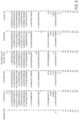
- Fig. 6 illustrates calculated parameters in a case in which an elementary function is a reciprocal function, a square root function, a reciprocal function of a square root, an exponential function, and a logarithmic function.
- ex, ey, and ez indicate decimal point positions of x, y, and z, respectively.
- e'x, e'y, and e'z indicate decimal point positions of x', y', and z' before right shift, respectively.
- These decimal point positions indicate bit positions of the decimal point positions counted from the lower bits. A value indicating this bit position starts from 0, and when an e1-st bit counted from a lower bit indicates 1, a decimal point position is represented as e1.
- the secure computation devices 1 to 4 in the respective embodiments and the secure computation devices in the respective examples are, for example, devices configured by a general-purpose or dedicated computer including a processor (a hardware processor) such as a central processing unit (CPU), a memory such as a random access memory (RAM) and a read only memory (ROM), and the like executing a predetermined program.
- This computer may include one processor and memory or may include a plurality of processors and memories.
- This program may be installed in a computer or may be recorded in a ROM or the like in advance.
- a part or all of processing units may be configured by using an electronic circuit that implements a processing function alone, instead of an electronic circuit (circuitry) that implements a functional configuration by a program being read, like a CPU.
- an electronic circuit constituting one device may include a plurality of CPUs.
- Fig. 5 is a block diagram illustrating hardware configurations of the secure computation devices 1 to 4 in the respective embodiments and the secure computation devices in the respective examples.
- the secure computation devices 1 to 4 of this example include a central processing unit (CPU) 10a, an input unit 10b, an output unit 10c, a random access memory (RAM) 10d, and a read only memory (ROM) 10e, an auxiliary storage device 10f, and a bus 10g.
- the CPU 10a of this example includes a control unit 10aa, an operation unit 10ab, and a register 10ac, and executes various pieces of operation processing according to various programs read into the register 10ac.
- the output unit 10c is an output terminal, a display, or the like on which data is output. Further, the output unit 10c is a LAN card or the like controlled by the CPU 10a that has read a predetermined program. Further, the RAM 10d is a static random access memory (SRAM), a dynamic random access memory (DRAM), or the like, and has a program area 10da in which a predetermined program is stored and a data area 10db in which various types of data is stored.
- SRAM static random access memory
- DRAM dynamic random access memory
- the auxiliary storage device 10f is, for example, a hard disk, a magneto-optical disc (MO), a semiconductor memory, or the like, and has a program area 10fa in which a predetermined program is stored and a data area 10fb in which various types of data is stored.
- the bus 10g connects the CPU 10a, the input unit 10b, the output unit 10c, the RAM 10d, the ROM 10e, and the auxiliary storage device 10f so that information can be exchanged.
- the CPU 10a writes the program stored in the program area 10fa of the auxiliary storage device 10f to the program area 10da of the RAM 10d according to a read operating system (OS) program.
- OS read operating system
- the CPU 10a writes various types of data stored in the data area 10fb of the auxiliary storage device 10f to the data area 10db of the RAM 10d.
- An address on the RAM 10d in which this program or data is written is stored in the register 10ac of the CPU 10a.
- the control unit 10ab of the CPU 10a sequentially reads out these addresses stored in the register 10ac, reads a program or data from the area on the RAM 10d indicated by the read address, causes the operation unit 10ab to sequentially execute operations indicated by the program, and stores operation results in the register 10ac.
- the above-described program can be recorded on a computer-readable recording medium.
- An example of the computer-readable recording medium is a non-transitory recording medium. Examples of such a recording medium are a magnetic recording device, an optical disc, a photomagnetic recording medium, and a semiconductor memory.
- Distribution of this program is performed, for example, by selling, transferring, or renting a portable recording medium such as a DVD or CD-ROM on which the program has been recorded. Further, this program may be distributed by being stored in a storage device of a server computer and transferred from the server computer to another computer via a network. As described above, the computer that executes such a program first temporarily stores, for example, the program recorded on the portable recording medium or the program transferred from the server computer in a storage device of the computer. When the computer executes the processing, the computer reads the program stored in the storage device of the computer and executes processing according to the read program.
- the computer may directly read the program from the portable recording medium and execute the processing according to the program, and further, the processing according to the received program may be sequentially executed each time the program is transferred from the server computer to the computer.
- a configuration in which the above-described processing may be executed by a so-called application service provider (ASP) type service that implements a processing function only by an execution instruction and result acquisition without transferring the program from the server computer to the computer.
- ASP application service provider
- the program in the present embodiment includes information provided for processing of an electronic calculator and being pursuant to the program (such as data that is not a direct command to the computer, but has properties defining processing of the computer).
- the present device is configured by a predetermined program being executed on the computer, at least a part of processing content of thereof may be implemented by hardware.
- the present disclosure is not limited to the above-described embodiments.
- the present disclosure may be used in a case in which secure computation is performed on elementary functions other than those shown in the specific examples.
- various types of processing described above may be not only executed in chronological order according to the description but may also be executed in parallel or individually according to a processing capacity of a device that executes the processing or as necessary..
- the present disclosure can be used, for example, for calculation of an elementary function such as a reciprocal function, a square root function, an exponential function, and a logarithmic function in machine learning and data mining performed in secure computation while concealing data.
- an elementary function such as a reciprocal function, a square root function, an exponential function, and a logarithmic function in machine learning and data mining performed in secure computation while concealing data.
Landscapes
- Engineering & Computer Science (AREA)
- Computer Security & Cryptography (AREA)
- Computer Networks & Wireless Communication (AREA)
- Signal Processing (AREA)
- Physics & Mathematics (AREA)
- General Physics & Mathematics (AREA)
- Theoretical Computer Science (AREA)
- Complex Calculations (AREA)
- Hardware Redundancy (AREA)
- Devices For Executing Special Programs (AREA)
- Pharmaceuticals Containing Other Organic And Inorganic Compounds (AREA)
Applications Claiming Priority (1)
| Application Number | Priority Date | Filing Date | Title |
|---|---|---|---|
| PCT/JP2020/001681 WO2021149104A1 (ja) | 2020-01-20 | 2020-01-20 | 秘密計算装置、秘密計算方法、およびプログラム |
Publications (3)
| Publication Number | Publication Date |
|---|---|
| EP4095832A1 EP4095832A1 (en) | 2022-11-30 |
| EP4095832A4 EP4095832A4 (en) | 2023-10-18 |
| EP4095832B1 true EP4095832B1 (en) | 2025-03-12 |
Family
ID=76992096
Family Applications (1)
| Application Number | Title | Priority Date | Filing Date |
|---|---|---|---|
| EP20915962.3A Active EP4095832B1 (en) | 2020-01-20 | 2020-01-20 | Secure computation device, secure computation method, and program |
Country Status (6)
| Country | Link |
|---|---|
| US (1) | US12452042B2 (https=) |
| EP (1) | EP4095832B1 (https=) |
| JP (1) | JP7290177B2 (https=) |
| CN (1) | CN114981861B (https=) |
| AU (1) | AU2020425196B2 (https=) |
| WO (1) | WO2021149104A1 (https=) |
Families Citing this family (2)
| Publication number | Priority date | Publication date | Assignee | Title |
|---|---|---|---|---|
| JP2024160649A (ja) * | 2023-05-01 | 2024-11-14 | エヌ・ティ・ティ・コミュニケーションズ株式会社 | 分析装置、分析方法及び分析プログラム |
| WO2024241366A1 (ja) * | 2023-05-19 | 2024-11-28 | 日本電信電話株式会社 | 秘密計算装置、秘密計算方法、プログラム |
Family Cites Families (13)
| Publication number | Priority date | Publication date | Assignee | Title |
|---|---|---|---|---|
| US8964988B2 (en) * | 2010-07-23 | 2015-02-24 | Nippon Telegraph And Telephone Corporation | Secret sharing system, sharing apparatus, share management apparatus, acquisition apparatus, secret sharing method, program and recording medium |
| WO2015107951A1 (ja) * | 2014-01-17 | 2015-07-23 | 日本電信電話株式会社 | 秘密計算方法、秘密計算システム、ソート装置及びプログラム |
| WO2015114947A1 (ja) * | 2014-01-28 | 2015-08-06 | 日本電信電話株式会社 | 秘密計算方法、秘密計算システム、秘密計算サーバ、登録者端末、利用者端末及びプログラム |
| WO2016104476A1 (ja) * | 2014-12-26 | 2016-06-30 | 日本電信電話株式会社 | 秘密改ざん検知システム、秘密計算装置、秘密改ざん検知方法、およびプログラム |
| US10467389B2 (en) * | 2015-01-15 | 2019-11-05 | Secretskydbltd | Secret shared random access machine |
| JP5957126B1 (ja) * | 2015-06-24 | 2016-07-27 | 日本電信電話株式会社 | 秘密計算装置、秘密計算方法、およびプログラム |
| JP6006842B1 (ja) * | 2015-07-22 | 2016-10-12 | 日本電信電話株式会社 | 秘密計算装置、その方法、およびプログラム |
| JP6034927B1 (ja) * | 2015-07-27 | 2016-11-30 | 日本電信電話株式会社 | 秘密計算システム、秘密計算装置、およびプログラム |
| WO2018135566A1 (ja) * | 2017-01-20 | 2018-07-26 | 日本電信電話株式会社 | 秘密計算システム、秘密計算装置、秘密計算方法、プログラム |
| WO2019005946A2 (en) * | 2017-06-27 | 2019-01-03 | Leighton Bonnie Berger | OPEN GENOME OUTSOURCING FOR LARGE SCALE ASSOCIATION STUDIES |
| US11818254B2 (en) * | 2017-08-22 | 2023-11-14 | Nippon Telegraph And Telephone Corporation | Share generating device, reconstructing device, secure computation system, share generation method, reconstruction method, program, and recording medium |
| US10460234B2 (en) * | 2018-01-19 | 2019-10-29 | Microsoft Technology Licensing, Llc | Private deep neural network training |
| WO2019225531A1 (ja) * | 2018-05-25 | 2019-11-28 | 日本電信電話株式会社 | 秘密一括近似システム、秘密計算装置、秘密一括近似方法、およびプログラム |
-
2020
- 2020-01-20 JP JP2021572126A patent/JP7290177B2/ja active Active
- 2020-01-20 US US17/791,907 patent/US12452042B2/en active Active
- 2020-01-20 CN CN202080093455.6A patent/CN114981861B/zh active Active
- 2020-01-20 EP EP20915962.3A patent/EP4095832B1/en active Active
- 2020-01-20 AU AU2020425196A patent/AU2020425196B2/en active Active
- 2020-01-20 WO PCT/JP2020/001681 patent/WO2021149104A1/ja not_active Ceased
Also Published As
| Publication number | Publication date |
|---|---|
| US20220407682A1 (en) | 2022-12-22 |
| CN114981861B (zh) | 2025-06-13 |
| JP7290177B2 (ja) | 2023-06-13 |
| CN114981861A (zh) | 2022-08-30 |
| AU2020425196B2 (en) | 2023-06-08 |
| EP4095832A4 (en) | 2023-10-18 |
| JPWO2021149104A1 (https=) | 2021-07-29 |
| US12452042B2 (en) | 2025-10-21 |
| EP4095832A1 (en) | 2022-11-30 |
| AU2020425196A1 (en) | 2022-07-14 |
| WO2021149104A1 (ja) | 2021-07-29 |
Similar Documents
| Publication | Publication Date | Title |
|---|---|---|
| EP4095832B1 (en) | Secure computation device, secure computation method, and program | |
| Barik et al. | Time efficient signed Vedic multiplier using redundant binary representation | |
| JP4477959B2 (ja) | ブロードキャスト型並列処理のための演算処理装置 | |
| EP4210029A1 (en) | Confidential msb normalization system, distributed processing device, confidential msb normalization method, and program | |
| CN117908835B (zh) | 一种基于浮点数计算能力加速sm2国密算法的方法 | |
| CN113608718B (zh) | 一种实现素数域大整数模乘计算加速的方法 | |
| CN114981858B (zh) | 秘密计算装置、秘密计算方法以及计算机程序产品 | |
| EP4095830B1 (en) | Secure computation device, secure computation method, and program | |
| Prema et al. | Enhanced high speed modular multiplier using Karatsuba algorithm | |
| JP7205623B2 (ja) | 秘密共役勾配法計算システム、秘密計算装置、共役勾配法計算装置、秘密共役勾配法計算方法、共役勾配法計算方法、およびプログラム | |
| Beuchat et al. | Multiplication algorithms for radix-2 RN-codings and two's complement numbers | |
| JP7318743B2 (ja) | 秘密計算装置、秘密計算方法、およびプログラム | |
| Thorat et al. | GROOT: Graph edge re-growth and partitioning for the verification of large designs in logic synthesis | |
| CN114981865B (zh) | 秘密平方根计算系统、秘密归一化系统、它们的方法、秘密计算装置以及程序 | |
| CN119026699B (zh) | 一种组合优化问题的处理方法及装置 | |
| Gupta et al. | GPU-accelerated scalable solver for large linear systems over finite fields | |
| Dodonova et al. | Some Applications of Binary Lunar Arithmetic | |
| WO2021149099A1 (ja) | 秘密平方根逆数計算システム、秘密正規化システム、それらの方法、秘密計算装置、およびプログラム | |
| CN121396642A (zh) | 一种数据处理方法、装置及计算机设备 |
Legal Events
| Date | Code | Title | Description |
|---|---|---|---|
| STAA | Information on the status of an ep patent application or granted ep patent |
Free format text: STATUS: THE INTERNATIONAL PUBLICATION HAS BEEN MADE |
|
| PUAI | Public reference made under article 153(3) epc to a published international application that has entered the european phase |
Free format text: ORIGINAL CODE: 0009012 |
|
| STAA | Information on the status of an ep patent application or granted ep patent |
Free format text: STATUS: REQUEST FOR EXAMINATION WAS MADE |
|
| 17P | Request for examination filed |
Effective date: 20220822 |
|
| AK | Designated contracting states |
Kind code of ref document: A1 Designated state(s): AL AT BE BG CH CY CZ DE DK EE ES FI FR GB GR HR HU IE IS IT LI LT LU LV MC MK MT NL NO PL PT RO RS SE SI SK SM TR |
|
| DAV | Request for validation of the european patent (deleted) | ||
| DAX | Request for extension of the european patent (deleted) | ||
| A4 | Supplementary search report drawn up and despatched |
Effective date: 20230920 |
|
| RIC1 | Information provided on ipc code assigned before grant |
Ipc: G09C 1/00 20060101AFI20230914BHEP |
|
| REG | Reference to a national code |
Ref country code: DE Ref legal event code: R079 Free format text: PREVIOUS MAIN CLASS: G09C0001000000 Ipc: H04L0009080000 Ref country code: DE Ref legal event code: R079 Ref document number: 602020047767 Country of ref document: DE Free format text: PREVIOUS MAIN CLASS: G09C0001000000 Ipc: H04L0009080000 |
|
| RIC1 | Information provided on ipc code assigned before grant |
Ipc: H04L 9/16 20060101ALI20240717BHEP Ipc: H04L 9/08 20060101AFI20240717BHEP |
|
| GRAP | Despatch of communication of intention to grant a patent |
Free format text: ORIGINAL CODE: EPIDOSNIGR1 |
|
| STAA | Information on the status of an ep patent application or granted ep patent |
Free format text: STATUS: GRANT OF PATENT IS INTENDED |
|
| INTG | Intention to grant announced |
Effective date: 20240823 |
|
| GRAJ | Information related to disapproval of communication of intention to grant by the applicant or resumption of examination proceedings by the epo deleted |
Free format text: ORIGINAL CODE: EPIDOSDIGR1 |
|
| STAA | Information on the status of an ep patent application or granted ep patent |
Free format text: STATUS: REQUEST FOR EXAMINATION WAS MADE |
|
| GRAP | Despatch of communication of intention to grant a patent |
Free format text: ORIGINAL CODE: EPIDOSNIGR1 |
|
| STAA | Information on the status of an ep patent application or granted ep patent |
Free format text: STATUS: GRANT OF PATENT IS INTENDED |
|
| INTC | Intention to grant announced (deleted) | ||
| INTG | Intention to grant announced |
Effective date: 20241108 |
|
| GRAS | Grant fee paid |
Free format text: ORIGINAL CODE: EPIDOSNIGR3 |
|
| GRAA | (expected) grant |
Free format text: ORIGINAL CODE: 0009210 |
|
| STAA | Information on the status of an ep patent application or granted ep patent |
Free format text: STATUS: THE PATENT HAS BEEN GRANTED |
|
| AK | Designated contracting states |
Kind code of ref document: B1 Designated state(s): AL AT BE BG CH CY CZ DE DK EE ES FI FR GB GR HR HU IE IS IT LI LT LU LV MC MK MT NL NO PL PT RO RS SE SI SK SM TR |
|
| REG | Reference to a national code |
Ref country code: GB Ref legal event code: FG4D |
|
| REG | Reference to a national code |
Ref country code: CH Ref legal event code: EP |
|
| REG | Reference to a national code |
Ref country code: DE Ref legal event code: R096 Ref document number: 602020047767 Country of ref document: DE |
|
| REG | Reference to a national code |
Ref country code: IE Ref legal event code: FG4D |
|
| PG25 | Lapsed in a contracting state [announced via postgrant information from national office to epo] |
Ref country code: RS Free format text: LAPSE BECAUSE OF FAILURE TO SUBMIT A TRANSLATION OF THE DESCRIPTION OR TO PAY THE FEE WITHIN THE PRESCRIBED TIME-LIMIT Effective date: 20250612 |
|
| PG25 | Lapsed in a contracting state [announced via postgrant information from national office to epo] |
Ref country code: FI Free format text: LAPSE BECAUSE OF FAILURE TO SUBMIT A TRANSLATION OF THE DESCRIPTION OR TO PAY THE FEE WITHIN THE PRESCRIBED TIME-LIMIT Effective date: 20250312 |
|
| PG25 | Lapsed in a contracting state [announced via postgrant information from national office to epo] |
Ref country code: ES Free format text: LAPSE BECAUSE OF FAILURE TO SUBMIT A TRANSLATION OF THE DESCRIPTION OR TO PAY THE FEE WITHIN THE PRESCRIBED TIME-LIMIT Effective date: 20250312 |
|
| REG | Reference to a national code |
Ref country code: LT Ref legal event code: MG9D |
|
| PG25 | Lapsed in a contracting state [announced via postgrant information from national office to epo] |
Ref country code: NO Free format text: LAPSE BECAUSE OF FAILURE TO SUBMIT A TRANSLATION OF THE DESCRIPTION OR TO PAY THE FEE WITHIN THE PRESCRIBED TIME-LIMIT Effective date: 20250612 |
|
| PG25 | Lapsed in a contracting state [announced via postgrant information from national office to epo] |
Ref country code: HR Free format text: LAPSE BECAUSE OF FAILURE TO SUBMIT A TRANSLATION OF THE DESCRIPTION OR TO PAY THE FEE WITHIN THE PRESCRIBED TIME-LIMIT Effective date: 20250312 |
|
| REG | Reference to a national code |
Ref country code: NL Ref legal event code: MP Effective date: 20250312 |
|
| PG25 | Lapsed in a contracting state [announced via postgrant information from national office to epo] |
Ref country code: LV Free format text: LAPSE BECAUSE OF FAILURE TO SUBMIT A TRANSLATION OF THE DESCRIPTION OR TO PAY THE FEE WITHIN THE PRESCRIBED TIME-LIMIT Effective date: 20250312 |
|
| PG25 | Lapsed in a contracting state [announced via postgrant information from national office to epo] |
Ref country code: GR Free format text: LAPSE BECAUSE OF FAILURE TO SUBMIT A TRANSLATION OF THE DESCRIPTION OR TO PAY THE FEE WITHIN THE PRESCRIBED TIME-LIMIT Effective date: 20250613 Ref country code: BG Free format text: LAPSE BECAUSE OF FAILURE TO SUBMIT A TRANSLATION OF THE DESCRIPTION OR TO PAY THE FEE WITHIN THE PRESCRIBED TIME-LIMIT Effective date: 20250312 |
|
| REG | Reference to a national code |
Ref country code: AT Ref legal event code: MK05 Ref document number: 1775948 Country of ref document: AT Kind code of ref document: T Effective date: 20250312 |
|
| PG25 | Lapsed in a contracting state [announced via postgrant information from national office to epo] |
Ref country code: NL Free format text: LAPSE BECAUSE OF FAILURE TO SUBMIT A TRANSLATION OF THE DESCRIPTION OR TO PAY THE FEE WITHIN THE PRESCRIBED TIME-LIMIT Effective date: 20250312 |
|
| PG25 | Lapsed in a contracting state [announced via postgrant information from national office to epo] |
Ref country code: SE Free format text: LAPSE BECAUSE OF FAILURE TO SUBMIT A TRANSLATION OF THE DESCRIPTION OR TO PAY THE FEE WITHIN THE PRESCRIBED TIME-LIMIT Effective date: 20250312 |
|
| RAP4 | Party data changed (patent owner data changed or rights of a patent transferred) |
Owner name: NTT, INC. |
|
| PG25 | Lapsed in a contracting state [announced via postgrant information from national office to epo] |
Ref country code: SM Free format text: LAPSE BECAUSE OF FAILURE TO SUBMIT A TRANSLATION OF THE DESCRIPTION OR TO PAY THE FEE WITHIN THE PRESCRIBED TIME-LIMIT Effective date: 20250312 |
|
| PG25 | Lapsed in a contracting state [announced via postgrant information from national office to epo] |
Ref country code: PT Free format text: LAPSE BECAUSE OF FAILURE TO SUBMIT A TRANSLATION OF THE DESCRIPTION OR TO PAY THE FEE WITHIN THE PRESCRIBED TIME-LIMIT Effective date: 20250714 |
|
| PG25 | Lapsed in a contracting state [announced via postgrant information from national office to epo] |
Ref country code: PL Free format text: LAPSE BECAUSE OF FAILURE TO SUBMIT A TRANSLATION OF THE DESCRIPTION OR TO PAY THE FEE WITHIN THE PRESCRIBED TIME-LIMIT Effective date: 20250312 |
|
| PG25 | Lapsed in a contracting state [announced via postgrant information from national office to epo] |
Ref country code: AT Free format text: LAPSE BECAUSE OF FAILURE TO SUBMIT A TRANSLATION OF THE DESCRIPTION OR TO PAY THE FEE WITHIN THE PRESCRIBED TIME-LIMIT Effective date: 20250312 |
|
| PG25 | Lapsed in a contracting state [announced via postgrant information from national office to epo] |
Ref country code: EE Free format text: LAPSE BECAUSE OF FAILURE TO SUBMIT A TRANSLATION OF THE DESCRIPTION OR TO PAY THE FEE WITHIN THE PRESCRIBED TIME-LIMIT Effective date: 20250312 Ref country code: CZ Free format text: LAPSE BECAUSE OF FAILURE TO SUBMIT A TRANSLATION OF THE DESCRIPTION OR TO PAY THE FEE WITHIN THE PRESCRIBED TIME-LIMIT Effective date: 20250312 |
|
| PG25 | Lapsed in a contracting state [announced via postgrant information from national office to epo] |
Ref country code: RO Free format text: LAPSE BECAUSE OF FAILURE TO SUBMIT A TRANSLATION OF THE DESCRIPTION OR TO PAY THE FEE WITHIN THE PRESCRIBED TIME-LIMIT Effective date: 20250312 |
|
| PG25 | Lapsed in a contracting state [announced via postgrant information from national office to epo] |
Ref country code: SK Free format text: LAPSE BECAUSE OF FAILURE TO SUBMIT A TRANSLATION OF THE DESCRIPTION OR TO PAY THE FEE WITHIN THE PRESCRIBED TIME-LIMIT Effective date: 20250312 |
|
| PG25 | Lapsed in a contracting state [announced via postgrant information from national office to epo] |
Ref country code: IS Free format text: LAPSE BECAUSE OF FAILURE TO SUBMIT A TRANSLATION OF THE DESCRIPTION OR TO PAY THE FEE WITHIN THE PRESCRIBED TIME-LIMIT Effective date: 20250712 |
|
| REG | Reference to a national code |
Ref country code: DE Ref legal event code: R097 Ref document number: 602020047767 Country of ref document: DE |
|
| PG25 | Lapsed in a contracting state [announced via postgrant information from national office to epo] |
Ref country code: DK Free format text: LAPSE BECAUSE OF FAILURE TO SUBMIT A TRANSLATION OF THE DESCRIPTION OR TO PAY THE FEE WITHIN THE PRESCRIBED TIME-LIMIT Effective date: 20250312 |
|
| PLBE | No opposition filed within time limit |
Free format text: ORIGINAL CODE: 0009261 |
|
| STAA | Information on the status of an ep patent application or granted ep patent |
Free format text: STATUS: NO OPPOSITION FILED WITHIN TIME LIMIT |
|
| REG | Reference to a national code |
Ref country code: CH Ref legal event code: L10 Free format text: ST27 STATUS EVENT CODE: U-0-0-L10-L00 (AS PROVIDED BY THE NATIONAL OFFICE) Effective date: 20260121 |
|
| 26N | No opposition filed |
Effective date: 20251215 |
|
| REG | Reference to a national code |
Ref country code: DE Ref legal event code: R081 Ref document number: 602020047767 Country of ref document: DE Owner name: NTT, INC., JP Free format text: FORMER OWNER: NIPPON TELEGRAPH AND TELEPHONE CORPORATION, TOKYO, JP Ref country code: DE Ref legal event code: R082 Ref document number: 602020047767 Country of ref document: DE Representative=s name: DENNEMEYER & ASSOCIATES RECHTSANWALTSGESELLSCH, DE |
|
| PGFP | Annual fee paid to national office [announced via postgrant information from national office to epo] |
Ref country code: GB Payment date: 20260123 Year of fee payment: 7 |
|
| PGFP | Annual fee paid to national office [announced via postgrant information from national office to epo] |
Ref country code: DE Payment date: 20260121 Year of fee payment: 7 |
|
| PGFP | Annual fee paid to national office [announced via postgrant information from national office to epo] |
Ref country code: IT Payment date: 20260126 Year of fee payment: 7 |
|
| PGFP | Annual fee paid to national office [announced via postgrant information from national office to epo] |
Ref country code: FR Payment date: 20260123 Year of fee payment: 7 |