EP4095828B1 - Sicheres exponentielles funktionsberechnungssystem, sicheres exponentielles funktionsberechnungsverfahren, sichere berechnungsvorrichtung und programm - Google Patents
Sicheres exponentielles funktionsberechnungssystem, sicheres exponentielles funktionsberechnungsverfahren, sichere berechnungsvorrichtung und programm Download PDFInfo
- Publication number
- EP4095828B1 EP4095828B1 EP20915352.7A EP20915352A EP4095828B1 EP 4095828 B1 EP4095828 B1 EP 4095828B1 EP 20915352 A EP20915352 A EP 20915352A EP 4095828 B1 EP4095828 B1 EP 4095828B1
- Authority
- EP
- European Patent Office
- Prior art keywords
- value
- unit
- secure
- exponential function
- share
- Prior art date
- Legal status (The legal status is an assumption and is not a legal conclusion. Google has not performed a legal analysis and makes no representation as to the accuracy of the status listed.)
- Active
Links
Images




Classifications
-
- H—ELECTRICITY
- H04—ELECTRIC COMMUNICATION TECHNIQUE
- H04L—TRANSMISSION OF DIGITAL INFORMATION, e.g. TELEGRAPHIC COMMUNICATION
- H04L9/00—Cryptographic mechanisms or cryptographic arrangements for secret or secure communications; Network security protocols
- H04L9/14—Cryptographic mechanisms or cryptographic arrangements for secret or secure communications; Network security protocols using a plurality of keys or algorithms
- H04L9/16—Cryptographic mechanisms or cryptographic arrangements for secret or secure communications; Network security protocols using a plurality of keys or algorithms the keys or algorithms being changed during operation
-
- G—PHYSICS
- G06—COMPUTING OR CALCULATING; COUNTING
- G06F—ELECTRIC DIGITAL DATA PROCESSING
- G06F21/00—Security arrangements for protecting computers, components thereof, programs or data against unauthorised activity
- G06F21/60—Protecting data
- G06F21/62—Protecting access to data via a platform, e.g. using keys or access control rules
- G06F21/6218—Protecting access to data via a platform, e.g. using keys or access control rules to a system of files or objects, e.g. local or distributed file system or database
-
- H—ELECTRICITY
- H04—ELECTRIC COMMUNICATION TECHNIQUE
- H04L—TRANSMISSION OF DIGITAL INFORMATION, e.g. TELEGRAPHIC COMMUNICATION
- H04L9/00—Cryptographic mechanisms or cryptographic arrangements for secret or secure communications; Network security protocols
- H04L9/08—Key distribution or management, e.g. generation, sharing or updating, of cryptographic keys or passwords
- H04L9/0816—Key establishment, i.e. cryptographic processes or cryptographic protocols whereby a shared secret becomes available to two or more parties, for subsequent use
- H04L9/085—Secret sharing or secret splitting, e.g. threshold schemes
Definitions
- the present invention relates to a technology for computing an exponential function in secure computation.
- Secure computation is a cryptographic technology for calculating any function while hiding data.
- a data utilization form is expected to be developed taking advantage of this feature so that data does not leak to either a system operator or a data user.
- schemes for secure computation and among them, the schemes including secret sharing as a component are known to have a small data processing unit and be able to perform high-speed processing.
- Secret sharing is a method of converting secret information into several fragments called shares. For example, there is secret sharing called a (k, n) threshold method in which n shares are generated from the secret information and secrets can be restored from k or more shares, and thus, secret information is not leaked as long as the number of shares to restore the secret information is smaller than k.
- Shamir secret sharing, duplicate secret sharing, and the like are known as specific methods for configuring secret sharing.
- one fragment of a value shared by secret sharing is referred to as "share”. Further, an entire set of all shares is called a "share value".
- NPL 1 discloses a method of calculating an exponential function in secure computation.
- NPL 2 discloses fast right shift/public divisor division, reciprocal, private divisor division, square root and its reciprocal and exponential function for realizing numerical computations such as machine learning.
- NPL 3 examines the efficiency of protocols for secure evaluation of basic mathematical functions (sqrt, sin, arcsin, amongst others), essential to various application domains. e.g., Artificial Intelligence.
- NPL 1 a method disclosed in NPL 1 is computationally expensive.
- An object of the present invention is to provide a secure computation technology capable of calculating an exponential function at high speed in view of the technical difficulty described above.
- a secure exponential function computation system of one example not encompassed by the claims but useful for understanding the present invention is a secure exponential function computation system for receiving a share value [a] of a value a as an input, and calculating a share value [exp (a)] of an output of an exponential function of the value a.
- the secure exponential function computation system includes a plurality of secure computation apparatuses. ⁇ is an acquirable minimum value of the value a, t is a predetermined integer, and u is the number of bits more than t bits after a decimal point of the value a.
- [ ⁇ ] is data in which a numerical value ⁇ is hidden.
- share values of Shamir secret sharing, duplicate secret sharing, or the like can be used.
- Symbols described above indicate a logical negation (NOT), a logical product (AND), a logical sum (OR), and an exclusive OR (XOR), respectively.
- An integer in a ring can be regarded as a fixed-point real number by setting a public decimal point position for the integer.
- the fixed-point real number represented in the ring in this way is simply referred to as a real number.
- the "_" (underscore) in the subscript indicates that a character on the left is subscripted with a character on the right. For example, "a b_c " indicates that a is superscripted with b c .
- Embodiment Secure Exponential Function Computation System
- An embodiment of the present invention is a secure exponential function computation system and method in which a share value [a] of a value a is an input and a share value [exp (a)] of an output of an exponential function of the value a is calculated with the value a hidden.
- a share value [a] of a value a is an input
- a share value [exp (a)] of an output of an exponential function of the value a is calculated with the value a hidden.
- the present invention enables an exponential function to be efficiently calculated using an algorithm that can efficiently and uniformly approximate the group of elementary functions in secure computation.
- this approximation scheme it is possible to approximate a major elementary function including an exponential function with a single scheme simply by changing parameters. Further, this approximation scheme is an amount of communication/the number of rounds for three real number multiplications in single precision (23 bits), which is a theoretically optimized efficiency.
- the exponential function is an important function that is used as a component of a sigmoid function, a softmax function, or the like in various machine learning schemes such as logistic regression and deep learning, and also used in Fisher's exact test in statistics. Because the exponential function rapidly converges in the Taylor expansion, the exponential function is suitable to be calculated by the Taylor expansion.
- exp ⁇ is a public value.
- exp 2 -t x 0 , ..., exp 2 u - t - 1 x u - 1 are calculated from a binary table.
- exp x ⁇ is a part to be calculated by approximation, and is normalized to [0, 2 -t ) for efficient calculation.
- a value of t differs depending on a processing system, but because a processing cost of secure computation is high when a large table is referred to, the value should be set as small as possible.
- exp x ⁇ can also be calculated by polynomial interpolation.
- the lowering of the decimal point position executed in steps 1 and 3 of algorithm 1 can be efficiently performed by using, for example, a public divisor division disclosed in NPL 1.
- Simultaneous execution of the public value multiplication and lowering of the decimal point executed in step 5 of algorithm 1 can be efficiently performed by using, for example, the following algorithm.
- x 2 ⁇ m mx
- Parameters L, R, A, b, c, d, f, g, H, i, j, k, l, m, n, o, p, q, ⁇ , ⁇ , ⁇ , ⁇ , and ⁇ used in algorithm 1 are set according to the approximate function func.
- the respective parameters may be set as shown in the following table, for example.
- e x , e y , e z , and e w are decimal point positions of x, y, z, and w
- e' y , e' z , and e' w are decimal point positions of y', z', and w'.
- the exponentiation by referring to the binary public table executed in step 4 of algorithm 3 is processing of performing a plurality of operations for referencing and selecting a value from a binary table consisting of public values using a secret truth value, and multiplying respective reference results.
- the exponentiation by referring to the binary public table can be efficiently performed, for example, by using the following algorithm.
- Selective public multiplication executed in step 7 of algorithm 4 can be efficiently performed by using, for example, the following algorithm.
- the public value multiplication executed in step 1 of algorithm 5 can be efficiently performed, for example, by combining algorithm 2 with the following algorithm.
- the quotient obtained in step 1 of algorithm 6 can be efficiently obtained through quotient transfer (see Reference 1).
- the secure exponential function computation system 100 of the embodiment is an information processing system that executes the above exponential function protocol. As illustrated in Fig. 1 , the secure exponential function computation system 100 includes N ( ⁇ 3) secure computation apparatuses 1 1 , ..., 1 N . In this embodiment, the secure computation apparatuses 1 1 , ..., 1 N are connected to a communication network 9.
- the communication network 9 is a circuit-switched or packet-switched communication network configured so that respective connected apparatuses can communicate with each other and, for example, the Internet, a local area network (LAN), a wide area network (WAN), or the like can be used. It is not necessary for each apparatus to be able to communicate online via the communication network 9.
- a secure computation apparatus 1 n 1, ..., N
- a portable recording medium such as a magnetic tape or a USB memory
- the secure computation apparatus 1 n included in the secure exponential function computation system 100 of the embodiment includes, for example, a minimum value subtraction unit 11, a bit decomposition unit 12, a selective product unit 13, an upper bit calculation unit 14, and a lower bit calculation unit 15, an exponential function calculation unit 16, and a result calculation unit 17, as illustrated in Fig. 2 .
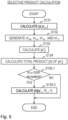
- the selective product unit 13 includes, for example, a condition integration unit 131, a table conversion unit 132, a public value multiplication unit 133, a real number multiplication unit 134, and a selection multiplication unit 135, as illustrated in Fig. 3 .
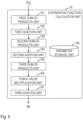
- the exponential function calculation unit 16 includes, for example, a parameter storage unit 160, a first sum-of-products unit 161, a first addition unit 162, a second sum-of-products unit 163, a second addition unit 164, a third sum-of-products unit 165, a public value multiplication unit 166, and a third addition unit 167, as illustrated in Fig. 4 .
- the secure computation apparatus 1 n is a special apparatus configured by loading a special program into a publicly known or dedicated computer including, for example, a central processing unit (CPU), a main storage device (RAM: Random Access Memory), and the like.
- the secure computation apparatus 1 n executes each process under the control of the central processing unit, for example.
- Data input to the secure computation apparatus 1 n or data obtained by each processing is stored in, for example, the main storage device, and the data stored in the main storage device is read to the central processing unit as needed, and used for other processing.
- At least a part of each processing unit of the secure computation apparatus 1 n may be configured by hardware such as an integrated circuit.
- Each storage unit included in the secure computation apparatus 1 n can be configured of, for example, a main storage device such as a random access memory (RAM), an auxiliary storage device configured of a hard disk, an optical disc, or a semiconductor memory element such as a flash memory, or middleware such as a relational database or a key value store.
- a main storage device such as a random access memory (RAM)
- an auxiliary storage device configured of a hard disk, an optical disc, or a semiconductor memory element such as a flash memory
- middleware such as a relational database or a key value store.
- the minimum value subtraction unit 11 outputs the share value [a'] to the bit decomposition unit 12 and the lower bit calculation unit 15.
- step S12-1 the bit decomposition unit 12 of each secure computation apparatus 1 n bit-decomposes bits more than t bits after the decimal point of the share value [a'] of the value a' to obtain a sequence of share values ⁇ a' 0 ⁇ , ..., ⁇ a' u - 1 ⁇ of a bit representation a' 0 , ..., a' u-1 of u upper bits of a'.
- the bit decomposition unit 12 performs mod p conversion on each of the share values ⁇ a' 0 ⁇ , ..., ⁇ a' u - 1 ⁇ to obtain a sequence of share values [a' 0 ], ..., [a' u-1 ].
- the bit decomposition unit 12 outputs the sequence of the share values [a' 0 ], ..., [a' u - 1 ] to the selective product unit 13 and the upper bit calculation unit 14. Further, in step S12-2, the bit decomposition unit 12 sets f i and ⁇ i as a mantissa part and an exponential part of exp (2 i - t ) for each integer i equal to or greater than 0 and smaller than u.
- the selective product unit 13 outputs the share value [f'] to the result calculation unit 17.
- the upper bit calculation unit 14 outputs the share value [ ⁇ '] to the result calculation unit 17.
- step S15 the lower bit calculation unit 15 of each secure computation apparatus 1 n calculates a share value [a' ⁇ ] of a value a' ⁇ obtained by subtracting a sum of values obtained by multiplying 2 i - t by [a' i ] from the share value [a'] of the value a' for each integer i equal to or greater than 0 and smaller than u. That is, the following equation is calculated.
- the lower bit calculation unit 15 outputs the share value [a' ⁇ ] to the result calculation unit 17.
- a ′ ⁇ : a ′ ⁇ ⁇ i ⁇ u 2 i ⁇ t a ′ i
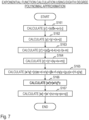
- step S16 the exponential function calculation unit 16 of each secure computation apparatus 1 n uses parameters for approximating an exponential function with an eighth degree polynomial to execute algorithm 1, so that the exponential function is calculated for the share value [a' ⁇ ] of the value a' ⁇ , and generates a share value [w] of a calculation result w.
- the exponential function calculation unit 16 outputs the share value [w] to the result calculation unit 17.
- step S17 the result calculation unit 17 of each secure computation apparatus 1 n multiplies the share value [w] of the calculation result w, the share value [f'] of the value f', the share value [ ⁇ '] of the value ⁇ ', and exp ( ⁇ ), and outputs a share value [exp (a)] of an output of the exponential function of the value a.
- n 2 is a maximum even number equal to or smaller than u. For each even number j equal to or greater than 0 and equal to or smaller than n 2 - 2, the following steps S131 to S133 are performed.
- step S131 the condition integration unit 131 of the selective product unit 13 calculates a share value [a' j a' j + 1 ] of a value a' j a' j + 1 obtained by multiplying a share value [a' j ] of a value a' j by a share value [a' j + 1 ] of a value a' j + 1 .
- the condition integration unit 131 outputs the share value [a' j a' j + 1 ] to the public value multiplication unit 133.
- the table conversion unit 132 outputs the four-value table including m' 00 , m' 01 , m' 10 , and m' 11 to the public value multiplication unit 133.
- step S133 the public value multiplication unit 133 of the selective product unit 13 calculates [a' j a' j + 1 ](m 00 + m 11 - m 01 - m 10 ) + [a' j + 1 ](f j - 1) + 1.
- the public value multiplication unit 133 outputs the share value [a" j ] to the real number multiplication unit 134.
- step S134 the real number multiplication unit 134 of the selective product unit 13 calculates a share value [A] of a value A multiplied by all the share values [a" j ]. That is, the following equation is calculated. Because multiplication is real number multiplication, it is necessary for right shifting to be performed lastly, but when u is an odd number, the right shift is not performed herein.
- a : ⁇ j ⁇ 0 , 2 , ⁇ , n 2 ⁇ 2 a " j
- Parameters A, b, c, d, f, g, H, i, j, k, l, m, n, o, p, q, ⁇ , ⁇ , ⁇ , ⁇ , and ⁇ for approximating the exponential function with an eighth degree polynomial are stored in the parameter storage unit 160.
- Each parameter is determined in advance according to a function to be approximated, and when the exponential function is approximated, values shown in Table 1 may be set.
- the first sum-of-products unit 161 outputs [y'] to the first addition unit 162.
- the first addition unit 162 outputs [y] to the second sum-of-products unit 163.
- the second sum-of-products unit 163 outputs [z'] to the second addition unit 164.
- the second addition unit 164 outputs [z] to the third sum-of-products unit 165.
- the third sum-of-products unit 165 outputs [w '/ ⁇ ] to the public value multiplication unit 166.
- the public value multiplication unit 166 outputs [w'] to the third addition unit 167.
- a program in which processing content thereof has been described can be recorded on a computer-readable recording medium.
- the computer-readable recording medium may be, for example, a magnetic recording device, an optical disc, a magneto-optical recording medium, or a semiconductor memory.
- distribution of this program is performed, for example, by selling, transferring, or renting a portable recording medium such as a DVD or CD-ROM on which the program has been recorded.
- the program may be distributed by being stored in a storage device of a server computer and transferred from the server computer to another computer via a network.
- the computer that executes such a program first temporarily stores, for example, the program recorded on the portable recording medium or the program transferred from the server computer in a storage device of the computer.
- the computer reads the program stored in the recording medium of the computer and executes processing according to the read program.
- the computer may directly read the program from the portable recording medium and execute the processing according to the program, and further, processing according to a received program may be sequentially executed each time the program is transferred from the server computer to the computer.
- a configuration may be adopted in which the above-described processing is executed by a so-called application service provider (ASP) type service for realizing a processing function according to only an execution instruction and result acquisition without transferring the program from the server computer to the computer.
- ASP application service provider
- the program in the present embodiment includes information provided for processing of an electronic calculator and being pursuant to the program (such as data that is not a direct command to the computer, but has properties defining processing of the computer).
- the present apparatus is configured by a predetermined program being executed on the computer, at least a part of processing content of thereof may be realized by hardware.
Landscapes
- Engineering & Computer Science (AREA)
- Computer Security & Cryptography (AREA)
- Theoretical Computer Science (AREA)
- Signal Processing (AREA)
- Computer Networks & Wireless Communication (AREA)
- General Health & Medical Sciences (AREA)
- Computer Hardware Design (AREA)
- Software Systems (AREA)
- Physics & Mathematics (AREA)
- General Engineering & Computer Science (AREA)
- General Physics & Mathematics (AREA)
- Bioethics (AREA)
- Health & Medical Sciences (AREA)
- Databases & Information Systems (AREA)
- Complex Calculations (AREA)
- Stored Programmes (AREA)
- Devices For Executing Special Programs (AREA)
Claims (4)
- Sicheres Exponentialfunktionsberechnungssystem (100) zum Berechnen eines heimlich geteilten Werts der Ausgabe einer Exponentialfunktion eines Eingabewerts a aus einem heimlich geteilten Wert des Eingabewerts a, wobei das sichere Exponentialfunktionsberechnungssystem Folgendes aufweist:eine Vielzahl von sicheren Berechnungsvorrichtungen (11, ..., 1N),wobei µ ein erfassbarer Minimalwert des Werts a ist, t eine vorbestimmte ganze Zahl ist und u die Anzahl von Bits ist, die mehr als t Bits nach einem Dezimalpunkt des Werts a ist, undjede der Vielzahl von sicheren Berechnungsvorrichtungen Folgendes aufweist:eine Minimalwertsubtraktionseinheit (11), die dazu geeignet ist, einen Teilungswert [a'] eines Werts a' zu erhalten, der gleich der Subtraktion des Minimalwerts µ von dem Eingabewert a ist;eine Bitzerlegungseinheit (12), die dazu geeignet ist, eine Sequenz von Teilungswerten [a'0], ..., [a'u - 1] einer Bitdarstellung a'0, ..., a'u - 1 von u oberen Bits des Werts a' aus dem Teilungswert [a'] zu erzeugen;eine Selektivprodukteinheit (13), die dazu geeignet ist, fi als einen Mantissenteil von exp (2i - t) einzustellen und einen Teilungswert [f'] eines Werts f zu berechnen, der gleich der Multiplikation aller Werte ist, die fi werden, wenn a'i = 1 und 1, wenn a'i = 0, wobei i eine ganze Zahl ist, die gleich oder größer als 0 und kleiner als u ist;eine Oberbitberechnungseinheit (14), die dazu geeignet ist, εi als einen Exponentialteil von exp (2i - t) einzustellen und einen Teilungswert [ε'] eines Werts ε' zu berechnen, der gleich der Multiplikation aller Werte ist, die 2ε_i werden, wenn a'i = 1 und 1, wenn a'i = 0, wobei i eine ganze Zahl ist, die gleich oder größer als 0 und kleiner als u ist;eine Unterbitberechnungseinheit (15), die dazu geeignet ist, einen Teilungswert [a'ρ] eines Werts a'ρ zu berechnen, der gleich der Subtraktion einer Summe von Werten ist, die durch Multiplizieren von 2i-t mit dem Wert a'i von dem Wert a erhalten werden, wobei i eine ganze Zahl ist, die gleich oder größer als 0 und kleiner als u ist;eine Exponentialfunktionsberechnungseinheit (16), die dazu geeignet ist, den Teilungswert [a'ρ] dazu zu verwenden, einen Teilungswert [w] eines Werts w zu erhalten, der exp (a'ρ) approximiert; undeine Ergebnisberechnungseinheit (17), die dazu geeignet ist, den Teilungswert [exp (a)] zu berechnen, der gleich der Multiplikation der Werte w, f' ε' und exp (µ) ist,wobei A, b, c, d, f, g, H, i, j, k, l, m, n, o, p, q, α, β, γ, δ und ζ Parameter zum Approximieren einer Exponentialfunktion mit einem Polynom achten Grades sind, und [x]: = [a'ρ] angenommen wird, unddie Exponentialfunktionsberechnungseinheit (16) Folgendes aufweist:eine erste Produktsummeneinheit (161), die dazu geeignet ist, [y']: = [x(δx + A - i) - j] zu berechnen,eine erste Additionseinheit (162), die dazu geeignet ist, [y]: = [y' + (ix + j)] zu berechnen,eine zweite Produktsummeneinheit (163), die dazu geeignet ist, [z']: = [y(ζy + b - k) + (c - l) x - m] zu berechnen,eine zweite Additionseinheit (164), die dazu geeignet ist, [z]: = [z' + (ky + lx + m)] zu berechnen,eine dritte Produktsummeneinheit (165), die dazu geeignet ist, [w'/y]: = [z(αz + d - n/y) + (βx + f - o/y)y + (g - p) x + (H - q)/y] zu berechnen,eine Öffentlicher-Schlüssel-Multiplikationseinheit (166), die dazu geeignet ist, [w']: = [w'/y] * γ zu berechnen; undeine dritte Additionseinheit (167), die dazu geeignet ist, [w]: = [w' + (nz+op+px+q)] zu berechnen.
- Sicheres Exponentialfunktionsberechnungsverfahren, das durch ein sicheres Exponentialfunktionsberechnungssystem (100) ausgeführt wird, das eine Vielzahl von sicheren Berechnungsvorrichtungen (11, ..., 1N) aufweist, wobei das sichere Exponentialfunktionsberechnungsverfahren zum Berechnen eines heimlich geteilten Werts der Ausgabe einer Exponentialfunktion eines Eingabewerts a aus einem heimlich geteilten Wert des Eingabewerts a dient,wobei µ ein erfassbarer Minimalwert des Werts a ist, t eine vorbestimmte ganze Zahl ist und u die Anzahl von Bits ist, die mehr als t Bits nach einem Dezimalpunkt des Eingabewerts a ist,wobei das sichere Exponentialfunktionsberechnungsverfahren durch jede der Vielzahl von sicheren Berechnungsvorrichtungen Folgendes aufweist:Erhalten eines Teilungswerts [a'] eines Werts a', der gleich der Subtraktion des Minimalwerts µ von dem Eingabewert a ist, durch eine Minimalwertsubtraktionseinheit (11);Erzeugen einer Sequenz von Teilungswerten [a'0], ..., [a'u-1] einer Bitdarstellung a'0, ..., a'u-1 von u oberen Bits des Werts a' aus dem Teilungswert [a'] durch eine Bitzerlegungseinheit (12);Einstellen von fi als einen Mantissenteil von exp(2i-t) durch eine Selektivprodukteinheit (13);Berechnen eines Teilungswerts [f] eines Werts f, der gleich der Multiplikation aller Werte ist, die fi werden, wenn a'i = 1 und 1, wenn a'i = 0, wobei i eine ganze Zahl ist, die gleich oder größer als 0 und kleiner als u ist, durch die Selektivprodukteinheit (13);Einstellen von εi als einen Exponentialteil von exp(2i-t) durch eine Oberbitberechnungseinheit (14); Berechnen eines Teilungswerts [ε'] eines Werts ε', der gleich der Multiplikation aller Werte ist, die 2ε_i werden, wenn a'i = 1 und 1, wenn a'i = 0, durch die Oberbitberechnungseinheit (14), wobei i eine ganze Zahl ist, die gleich oder größer als 0 und kleiner als u ist;Berechnen eines Teilungswerts [a'ρ] eines Werts a'ρ, der gleich der Subtraktion einer Summe von Werten ist, die durch Multiplizieren von 2i-t mit dem Wert a'i erhalten werden, von dem Wert a' durch eine Unterbitberechnungseinheit (15), wobei i eine ganze Zahl ist, die gleich oder größer als 0 und kleiner als u ist;Verwenden des Teilungswerts [a'ρ] durch eine Exponentialfunktionsberechnungseinheit (16) dazu, einen Teilungswert [w] eines Werts w zu erhalten, der exp(a'ρ) approximiert; undBerechnen des Teilungswerts [exp(a)] eines Werts, der gleich der Multiplikation der Werte f, ε' und exp(µ) ist, durch eine Ergebnisberechnungseinheit (17),wobei A, b, c, d, f, g, H, i, j, k, l, m, n, o, p, q, α, β, γ, δ und ζ Parameter zum Approximieren einer Exponentialfunktion mit einem Polynom achten Grades sind, und [x]: = [a'ρ] angenommen wird, und die Exponentialfunktionsberechnungseinheit (16) Folgendes aufweist:Berechnen von [y']: = [x(δx + A - i) - j] durch eine erste Produktsummeneinheit (161),Berechnen von [y]: = [y' + (ix + j)] durch eine erste Additionseinheit (162),Berechnen von [z']: = [y(ζy + b - k) + (c - l) x - m] durch eine zweite Produktsummeneinheit (163),Berechnen von [z]: = [z' + (ky + lx + m)] durch eine zweite Additionseinheit (164),Berechnen von [w'/γ]: = [z(αz + d - n/ γ) + (βx + f - o/y)y + (g - p) x + (H-q)/γ] durch eine dritte Produktsummeneinheit (165),Berechnen von [w']: = [w'/y] * γ durch eine Öffentlicher-Schlüssel-Multiplikationseinheit (166); und Berechnen von [w]: = [w' + (nz+op+px+q)] durch eine dritte Additionseinheit (167).
- Sichere Berechnungsvorrichtung (1n) der Vielzahl von sicheren Berechnungsvorrichtungen, die in dem sicheren Exponentialfunktionsberechnungssystem nach Anspruch 1 enthalten sind.
- Programm, das Anweisungen aufweist, die, wenn sie von einem Computer ausgeführt werden, den Computer veranlassen, als eine der sicheren Berechnungsvorrichtungen der Vielzahl von sicheren Berechnungsvorrichtungen das Verfahren nach Anspruch 2 durchzuführen.
Applications Claiming Priority (1)
| Application Number | Priority Date | Filing Date | Title |
|---|---|---|---|
| PCT/JP2020/001676 WO2021149100A1 (ja) | 2020-01-20 | 2020-01-20 | 秘密指数関数計算システム、秘密指数関数計算方法、秘密計算装置、およびプログラム |
Publications (3)
| Publication Number | Publication Date |
|---|---|
| EP4095828A1 EP4095828A1 (de) | 2022-11-30 |
| EP4095828A4 EP4095828A4 (de) | 2023-10-18 |
| EP4095828B1 true EP4095828B1 (de) | 2025-05-07 |
Family
ID=76992091
Family Applications (1)
| Application Number | Title | Priority Date | Filing Date |
|---|---|---|---|
| EP20915352.7A Active EP4095828B1 (de) | 2020-01-20 | 2020-01-20 | Sicheres exponentielles funktionsberechnungssystem, sicheres exponentielles funktionsberechnungsverfahren, sichere berechnungsvorrichtung und programm |
Country Status (6)
| Country | Link |
|---|---|
| US (1) | US20230069892A1 (de) |
| EP (1) | EP4095828B1 (de) |
| JP (1) | JP7351353B2 (de) |
| CN (1) | CN114981862B (de) |
| AU (1) | AU2020424992B2 (de) |
| WO (1) | WO2021149100A1 (de) |
Family Cites Families (18)
| Publication number | Priority date | Publication date | Assignee | Title |
|---|---|---|---|---|
| US6754678B2 (en) * | 1999-12-20 | 2004-06-22 | California Institute Of Technology | Securely and autonomously synchronizing data in a distributed computing environment |
| US6981203B2 (en) * | 2002-04-29 | 2005-12-27 | Bae Systems Information And Electronic Systems Integration Inc. | Method and apparatus for random shuffled turbo multiuser detector |
| US20080263363A1 (en) * | 2007-01-22 | 2008-10-23 | Spyrus, Inc. | Portable Data Encryption Device with Configurable Security Functionality and Method for File Encryption |
| KR20090065795A (ko) * | 2007-12-18 | 2009-06-23 | 숭실대학교산학협력단 | 보안 기능이 강화되고 이동 단말에 적합한 에프엠아이피버전 6 핸드오버 인증 방법 |
| FR2956541B1 (fr) * | 2010-02-18 | 2012-03-23 | Centre Nat Rech Scient | Procede cryptographique de communication d'une information confidentielle. |
| JP6095584B2 (ja) * | 2014-01-15 | 2017-03-15 | 日本電信電話株式会社 | マルチパーティ計算システム、秘匿計算装置、マルチパーティ計算方法及びプログラム |
| US9946970B2 (en) * | 2014-11-07 | 2018-04-17 | Microsoft Technology Licensing, Llc | Neural networks for encrypted data |
| WO2016104476A1 (ja) * | 2014-12-26 | 2016-06-30 | 日本電信電話株式会社 | 秘密改ざん検知システム、秘密計算装置、秘密改ざん検知方法、およびプログラム |
| US10467389B2 (en) * | 2015-01-15 | 2019-11-05 | Secretskydbltd | Secret shared random access machine |
| JP5957120B1 (ja) * | 2015-05-12 | 2016-07-27 | 日本電信電話株式会社 | 秘密分散方法、秘密分散システム、分散装置、およびプログラム |
| JP6766182B2 (ja) * | 2017-01-20 | 2020-10-07 | 日本電信電話株式会社 | 秘密計算システム、秘密計算装置、秘密計算方法、プログラム |
| EP3373505A1 (de) * | 2017-03-06 | 2018-09-12 | Koninklijke Philips N.V. | Vorrichtung und verfahren zum teilen einer matrix zur verwendung in einem kryptografischen protokoll |
| WO2018211675A1 (en) * | 2017-05-18 | 2018-11-22 | Nec Corporation | Bit decomposition secure computation apparatus, bit combining secure computation apparatus, method and program |
| CN109088741B (zh) * | 2017-06-14 | 2021-01-01 | 北京航空航天大学 | 一种区块链系统形式化建模与验证方法 |
| US11436471B2 (en) * | 2017-10-13 | 2022-09-06 | Panasonic Intellectual Property Corporation Of America | Prediction model sharing method and prediction model sharing system |
| US11381390B2 (en) * | 2017-10-31 | 2022-07-05 | Nec Corporation | Secure computation apparatus, system, method and program |
| WO2020152831A1 (ja) * | 2019-01-24 | 2020-07-30 | 日本電気株式会社 | 情報処理装置、秘密計算方法及びプログラム |
| US11861038B2 (en) * | 2019-12-02 | 2024-01-02 | Sap Se | Secure multiparty differentially private median computation |
-
2020
- 2020-01-20 JP JP2021572122A patent/JP7351353B2/ja active Active
- 2020-01-20 US US17/790,534 patent/US20230069892A1/en not_active Abandoned
- 2020-01-20 CN CN202080093539.XA patent/CN114981862B/zh active Active
- 2020-01-20 AU AU2020424992A patent/AU2020424992B2/en active Active
- 2020-01-20 EP EP20915352.7A patent/EP4095828B1/de active Active
- 2020-01-20 WO PCT/JP2020/001676 patent/WO2021149100A1/ja not_active Ceased
Also Published As
| Publication number | Publication date |
|---|---|
| AU2020424992B2 (en) | 2023-04-06 |
| JPWO2021149100A1 (de) | 2021-07-29 |
| EP4095828A1 (de) | 2022-11-30 |
| WO2021149100A1 (ja) | 2021-07-29 |
| CN114981862A (zh) | 2022-08-30 |
| US20230069892A1 (en) | 2023-03-09 |
| CN114981862B (zh) | 2025-02-25 |
| EP4095828A4 (de) | 2023-10-18 |
| JP7351353B2 (ja) | 2023-09-27 |
| AU2020424992A1 (en) | 2022-07-14 |
Similar Documents
| Publication | Publication Date | Title |
|---|---|---|
| CN112988237B (zh) | 一种Paillier解密系统、芯片和方法 | |
| EP3573039B1 (de) | Sicheres computersystem, sichere computervorrichtung, sicheres computerverfahren und programm | |
| CN110199338B (zh) | 秘密计算系统、秘密计算装置、秘密计算方法、记录介质 | |
| CN113467752B (zh) | 用于隐私计算的除法运算装置、数据处理系统及方法 | |
| JP7540501B2 (ja) | 秘匿msb正規化システム、分散処理装置、秘匿msb正規化方法、およびプログラム | |
| EP4095828A1 (de) | Sicheres exponentielles funktionsberechnungssystem, sicheres exponentielles funktionsberechnungsverfahren, sichere berechnungsvorrichtung und programm | |
| EP4095834B1 (de) | Sicheres selektives produktberechnungssystem, sicheres selektives produktberechnungsverfahren, sichere berechnungsvorrichtung und programm | |
| EP4095827B1 (de) | Sicheres quadratwurzelberechnungssystem, sicheres normierungssystem, verfahren dafür, sichere rechnervorrichtung und programm | |
| EP4095833B1 (de) | Sicheres reziprokes quadratwurzelrechnersystem, sicheres normierungssystem, verfahren dafür, sichere rechnervorrichtung und programm | |
| EP4095831B1 (de) | Sicheres reziprokes rechnersystem, sicheres normierungssystem, verfahren dafür, sichere rechnervorrichtung und programm |
Legal Events
| Date | Code | Title | Description |
|---|---|---|---|
| STAA | Information on the status of an ep patent application or granted ep patent |
Free format text: STATUS: THE INTERNATIONAL PUBLICATION HAS BEEN MADE |
|
| PUAI | Public reference made under article 153(3) epc to a published international application that has entered the european phase |
Free format text: ORIGINAL CODE: 0009012 |
|
| STAA | Information on the status of an ep patent application or granted ep patent |
Free format text: STATUS: REQUEST FOR EXAMINATION WAS MADE |
|
| 17P | Request for examination filed |
Effective date: 20220822 |
|
| AK | Designated contracting states |
Kind code of ref document: A1 Designated state(s): AL AT BE BG CH CY CZ DE DK EE ES FI FR GB GR HR HU IE IS IT LI LT LU LV MC MK MT NL NO PL PT RO RS SE SI SK SM TR |
|
| DAV | Request for validation of the european patent (deleted) | ||
| DAX | Request for extension of the european patent (deleted) | ||
| A4 | Supplementary search report drawn up and despatched |
Effective date: 20230919 |
|
| RIC1 | Information provided on ipc code assigned before grant |
Ipc: H04L 9/10 20060101ALI20230913BHEP Ipc: G09C 1/00 20060101AFI20230913BHEP |
|
| STAA | Information on the status of an ep patent application or granted ep patent |
Free format text: STATUS: EXAMINATION IS IN PROGRESS |
|
| 17Q | First examination report despatched |
Effective date: 20240702 |
|
| GRAP | Despatch of communication of intention to grant a patent |
Free format text: ORIGINAL CODE: EPIDOSNIGR1 |
|
| STAA | Information on the status of an ep patent application or granted ep patent |
Free format text: STATUS: GRANT OF PATENT IS INTENDED |
|
| INTG | Intention to grant announced |
Effective date: 20241212 |
|
| GRAS | Grant fee paid |
Free format text: ORIGINAL CODE: EPIDOSNIGR3 |
|
| GRAA | (expected) grant |
Free format text: ORIGINAL CODE: 0009210 |
|
| STAA | Information on the status of an ep patent application or granted ep patent |
Free format text: STATUS: THE PATENT HAS BEEN GRANTED |
|
| AK | Designated contracting states |
Kind code of ref document: B1 Designated state(s): AL AT BE BG CH CY CZ DE DK EE ES FI FR GB GR HR HU IE IS IT LI LT LU LV MC MK MT NL NO PL PT RO RS SE SI SK SM TR |
|
| REG | Reference to a national code |
Ref country code: GB Ref legal event code: FG4D |
|
| REG | Reference to a national code |
Ref country code: CH Ref legal event code: EP |
|
| REG | Reference to a national code |
Ref country code: DE Ref legal event code: R096 Ref document number: 602020051098 Country of ref document: DE |
|
| REG | Reference to a national code |
Ref country code: IE Ref legal event code: FG4D |
|
| REG | Reference to a national code |
Ref country code: NL Ref legal event code: MP Effective date: 20250507 |
|
| RAP4 | Party data changed (patent owner data changed or rights of a patent transferred) |
Owner name: NTT, INC. |
|
| PG25 | Lapsed in a contracting state [announced via postgrant information from national office to epo] |
Ref country code: FI Free format text: LAPSE BECAUSE OF FAILURE TO SUBMIT A TRANSLATION OF THE DESCRIPTION OR TO PAY THE FEE WITHIN THE PRESCRIBED TIME-LIMIT Effective date: 20250507 Ref country code: PT Free format text: LAPSE BECAUSE OF FAILURE TO SUBMIT A TRANSLATION OF THE DESCRIPTION OR TO PAY THE FEE WITHIN THE PRESCRIBED TIME-LIMIT Effective date: 20250908 Ref country code: ES Free format text: LAPSE BECAUSE OF FAILURE TO SUBMIT A TRANSLATION OF THE DESCRIPTION OR TO PAY THE FEE WITHIN THE PRESCRIBED TIME-LIMIT Effective date: 20250507 |
|
| REG | Reference to a national code |
Ref country code: LT Ref legal event code: MG9D |
|
| PG25 | Lapsed in a contracting state [announced via postgrant information from national office to epo] |
Ref country code: NO Free format text: LAPSE BECAUSE OF FAILURE TO SUBMIT A TRANSLATION OF THE DESCRIPTION OR TO PAY THE FEE WITHIN THE PRESCRIBED TIME-LIMIT Effective date: 20250807 Ref country code: GR Free format text: LAPSE BECAUSE OF FAILURE TO SUBMIT A TRANSLATION OF THE DESCRIPTION OR TO PAY THE FEE WITHIN THE PRESCRIBED TIME-LIMIT Effective date: 20250808 |
|
| PG25 | Lapsed in a contracting state [announced via postgrant information from national office to epo] |
Ref country code: NL Free format text: LAPSE BECAUSE OF FAILURE TO SUBMIT A TRANSLATION OF THE DESCRIPTION OR TO PAY THE FEE WITHIN THE PRESCRIBED TIME-LIMIT Effective date: 20250507 Ref country code: PL Free format text: LAPSE BECAUSE OF FAILURE TO SUBMIT A TRANSLATION OF THE DESCRIPTION OR TO PAY THE FEE WITHIN THE PRESCRIBED TIME-LIMIT Effective date: 20250507 |
|
| REG | Reference to a national code |
Ref country code: AT Ref legal event code: MK05 Ref document number: 1793384 Country of ref document: AT Kind code of ref document: T Effective date: 20250507 |
|
| PG25 | Lapsed in a contracting state [announced via postgrant information from national office to epo] |
Ref country code: BG Free format text: LAPSE BECAUSE OF FAILURE TO SUBMIT A TRANSLATION OF THE DESCRIPTION OR TO PAY THE FEE WITHIN THE PRESCRIBED TIME-LIMIT Effective date: 20250507 |
|
| PG25 | Lapsed in a contracting state [announced via postgrant information from national office to epo] |
Ref country code: HR Free format text: LAPSE BECAUSE OF FAILURE TO SUBMIT A TRANSLATION OF THE DESCRIPTION OR TO PAY THE FEE WITHIN THE PRESCRIBED TIME-LIMIT Effective date: 20250507 |
|
| PG25 | Lapsed in a contracting state [announced via postgrant information from national office to epo] |
Ref country code: AT Free format text: LAPSE BECAUSE OF FAILURE TO SUBMIT A TRANSLATION OF THE DESCRIPTION OR TO PAY THE FEE WITHIN THE PRESCRIBED TIME-LIMIT Effective date: 20250507 |
|
| PG25 | Lapsed in a contracting state [announced via postgrant information from national office to epo] |
Ref country code: RS Free format text: LAPSE BECAUSE OF FAILURE TO SUBMIT A TRANSLATION OF THE DESCRIPTION OR TO PAY THE FEE WITHIN THE PRESCRIBED TIME-LIMIT Effective date: 20250807 |
|
| PG25 | Lapsed in a contracting state [announced via postgrant information from national office to epo] |
Ref country code: IS Free format text: LAPSE BECAUSE OF FAILURE TO SUBMIT A TRANSLATION OF THE DESCRIPTION OR TO PAY THE FEE WITHIN THE PRESCRIBED TIME-LIMIT Effective date: 20250907 |
|
| PG25 | Lapsed in a contracting state [announced via postgrant information from national office to epo] |
Ref country code: LV Free format text: LAPSE BECAUSE OF FAILURE TO SUBMIT A TRANSLATION OF THE DESCRIPTION OR TO PAY THE FEE WITHIN THE PRESCRIBED TIME-LIMIT Effective date: 20250507 |
|
| PG25 | Lapsed in a contracting state [announced via postgrant information from national office to epo] |
Ref country code: SM Free format text: LAPSE BECAUSE OF FAILURE TO SUBMIT A TRANSLATION OF THE DESCRIPTION OR TO PAY THE FEE WITHIN THE PRESCRIBED TIME-LIMIT Effective date: 20250507 Ref country code: DK Free format text: LAPSE BECAUSE OF FAILURE TO SUBMIT A TRANSLATION OF THE DESCRIPTION OR TO PAY THE FEE WITHIN THE PRESCRIBED TIME-LIMIT Effective date: 20250507 |
|
| PG25 | Lapsed in a contracting state [announced via postgrant information from national office to epo] |
Ref country code: CZ Free format text: LAPSE BECAUSE OF FAILURE TO SUBMIT A TRANSLATION OF THE DESCRIPTION OR TO PAY THE FEE WITHIN THE PRESCRIBED TIME-LIMIT Effective date: 20250507 |
|
| PG25 | Lapsed in a contracting state [announced via postgrant information from national office to epo] |
Ref country code: EE Free format text: LAPSE BECAUSE OF FAILURE TO SUBMIT A TRANSLATION OF THE DESCRIPTION OR TO PAY THE FEE WITHIN THE PRESCRIBED TIME-LIMIT Effective date: 20250507 |
|
| PG25 | Lapsed in a contracting state [announced via postgrant information from national office to epo] |
Ref country code: SK Free format text: LAPSE BECAUSE OF FAILURE TO SUBMIT A TRANSLATION OF THE DESCRIPTION OR TO PAY THE FEE WITHIN THE PRESCRIBED TIME-LIMIT Effective date: 20250507 |
|
| REG | Reference to a national code |
Ref country code: DE Ref legal event code: R097 Ref document number: 602020051098 Country of ref document: DE |
|
| REG | Reference to a national code |
Ref country code: DE Ref legal event code: R081 Ref document number: 602020051098 Country of ref document: DE Owner name: NTT, INC., JP Free format text: FORMER OWNER: NIPPON TELEGRAPH AND TELEPHONE CORPORATION, TOKYO, JP Ref country code: DE Ref legal event code: R082 Ref document number: 602020051098 Country of ref document: DE Representative=s name: DENNEMEYER & ASSOCIATES RECHTSANWALTSGESELLSCH, DE |
|
| PLBE | No opposition filed within time limit |
Free format text: ORIGINAL CODE: 0009261 |
|
| STAA | Information on the status of an ep patent application or granted ep patent |
Free format text: STATUS: NO OPPOSITION FILED WITHIN TIME LIMIT |
|
| REG | Reference to a national code |
Ref country code: CH Ref legal event code: L10 Free format text: ST27 STATUS EVENT CODE: U-0-0-L10-L00 (AS PROVIDED BY THE NATIONAL OFFICE) Effective date: 20260318 |
|
| PGFP | Annual fee paid to national office [announced via postgrant information from national office to epo] |
Ref country code: GB Payment date: 20260123 Year of fee payment: 7 |
|
| PGFP | Annual fee paid to national office [announced via postgrant information from national office to epo] |
Ref country code: DE Payment date: 20260121 Year of fee payment: 7 |
|
| 26N | No opposition filed |
Effective date: 20260210 |
|
| PGFP | Annual fee paid to national office [announced via postgrant information from national office to epo] |
Ref country code: IT Payment date: 20260126 Year of fee payment: 7 |
|
| PGFP | Annual fee paid to national office [announced via postgrant information from national office to epo] |
Ref country code: FR Payment date: 20260123 Year of fee payment: 7 |