EP4094063B1 - Ein leuchtstoffsensor für nano / mikroplastik - Google Patents
Ein leuchtstoffsensor für nano / mikroplastik Download PDFInfo
- Publication number
- EP4094063B1 EP4094063B1 EP21700930.7A EP21700930A EP4094063B1 EP 4094063 B1 EP4094063 B1 EP 4094063B1 EP 21700930 A EP21700930 A EP 21700930A EP 4094063 B1 EP4094063 B1 EP 4094063B1
- Authority
- EP
- European Patent Office
- Prior art keywords
- sample
- plastics
- luminescence
- micro
- nano
- Prior art date
- Legal status (The legal status is an assumption and is not a legal conclusion. Google has not performed a legal analysis and makes no representation as to the accuracy of the status listed.)
- Active
Links
Images


Classifications
-
- G—PHYSICS
- G01—MEASURING; TESTING
- G01N—INVESTIGATING OR ANALYSING MATERIALS BY DETERMINING THEIR CHEMICAL OR PHYSICAL PROPERTIES
- G01N15/00—Investigating characteristics of particles; Investigating permeability, pore-volume or surface-area of porous materials
- G01N15/06—Investigating concentration of particle suspensions
-
- G—PHYSICS
- G01—MEASURING; TESTING
- G01N—INVESTIGATING OR ANALYSING MATERIALS BY DETERMINING THEIR CHEMICAL OR PHYSICAL PROPERTIES
- G01N21/00—Investigating or analysing materials by the use of optical means, i.e. using sub-millimetre waves, infrared, visible or ultraviolet light
- G01N21/62—Systems in which the material investigated is excited whereby it emits light or causes a change in wavelength of the incident light
- G01N21/63—Systems in which the material investigated is excited whereby it emits light or causes a change in wavelength of the incident light optically excited
- G01N21/64—Fluorescence; Phosphorescence
- G01N21/6408—Fluorescence; Phosphorescence with measurement of decay time, time resolved fluorescence
-
- G—PHYSICS
- G01—MEASURING; TESTING
- G01N—INVESTIGATING OR ANALYSING MATERIALS BY DETERMINING THEIR CHEMICAL OR PHYSICAL PROPERTIES
- G01N21/00—Investigating or analysing materials by the use of optical means, i.e. using sub-millimetre waves, infrared, visible or ultraviolet light
- G01N21/62—Systems in which the material investigated is excited whereby it emits light or causes a change in wavelength of the incident light
- G01N21/63—Systems in which the material investigated is excited whereby it emits light or causes a change in wavelength of the incident light optically excited
- G01N21/64—Fluorescence; Phosphorescence
- G01N21/6428—Measuring fluorescence of fluorescent products of reactions or of fluorochrome labelled reactive substances, e.g. measuring quenching effects, using measuring "optrodes"
- G01N21/643—Measuring fluorescence of fluorescent products of reactions or of fluorochrome labelled reactive substances, e.g. measuring quenching effects, using measuring "optrodes" non-biological material
-
- G—PHYSICS
- G01—MEASURING; TESTING
- G01N—INVESTIGATING OR ANALYSING MATERIALS BY DETERMINING THEIR CHEMICAL OR PHYSICAL PROPERTIES
- G01N33/00—Investigating or analysing materials by specific methods not covered by groups G01N1/00 - G01N31/00
- G01N33/20—Metals
-
- G—PHYSICS
- G01—MEASURING; TESTING
- G01N—INVESTIGATING OR ANALYSING MATERIALS BY DETERMINING THEIR CHEMICAL OR PHYSICAL PROPERTIES
- G01N15/00—Investigating characteristics of particles; Investigating permeability, pore-volume or surface-area of porous materials
- G01N15/06—Investigating concentration of particle suspensions
- G01N15/075—Investigating concentration of particle suspensions by optical means
-
- G—PHYSICS
- G01—MEASURING; TESTING
- G01N—INVESTIGATING OR ANALYSING MATERIALS BY DETERMINING THEIR CHEMICAL OR PHYSICAL PROPERTIES
- G01N15/00—Investigating characteristics of particles; Investigating permeability, pore-volume or surface-area of porous materials
- G01N2015/0038—Investigating nanoparticles
-
- G—PHYSICS
- G01—MEASURING; TESTING
- G01N—INVESTIGATING OR ANALYSING MATERIALS BY DETERMINING THEIR CHEMICAL OR PHYSICAL PROPERTIES
- G01N31/00—Investigating or analysing non-biological materials by the use of the chemical methods specified in the subgroup; Apparatus specially adapted for such methods
- G01N31/22—Investigating or analysing non-biological materials by the use of the chemical methods specified in the subgroup; Apparatus specially adapted for such methods using chemical indicators
Definitions
- the present invention relates to the field of environmental pollutant detection, in particular to a method for detecting the presence of nano- and micro-plastics in aqueous samples - such as seawater - and biological samples.
- CN108587102 describes environmental micro-plastics labeled by a metal organic fluorescent complex and the preparation method thereof.
- the fluorescently labeled micro-plastic is used to analyze the distribution, migration, metabolism, and enrichment of micro-plastic pollutants in complex environmental media and organism. Accordingly, the disclosed method does not allow the analysis of an unknown sample.
- CN105675566 discloses a method for quantitatively analyzing the enrichment and distribution of micro-plastics in mammals. However, the method requires synthesizing microplastics with fluorescent markers. Similarly to the method of CN108587102 , the disclosed method does not allow the analysis of an unknown sample.
- CN106645049B describes a method for detecting the plastics content of marine organisms, wherein sample is treated by digestion in a strongly alkaline environment, then separated by centrifugation and finally observed with fluorescence and FTIR microscopy.
- sample is treated by digestion in a strongly alkaline environment, then separated by centrifugation and finally observed with fluorescence and FTIR microscopy.
- fluorescence and FTIR microscopy the expected sensitivity is low.
- none of them discloses the use of an aqueous solution of hyaluronic acid functionalized with a luminescent dye as the sensing probe.
- the present invention provides a method of detecting micro- and nano-plastics (MNPs) in an aqueous sample suspected of being polluted with MNPs, which comprises the following steps:
- microplastics encompasses very small pieces of plastic that pollute the environment. Microplastics are not a specific kind of plastic, but rather any type of plastic fragment that is less than 5 mm in length according to the U.S. National Oceanic and Atmospheric Administration (NOAA).
- NOAA National Oceanic and Atmospheric Administration
- nanoplastics defines smaller pieces of plastics characterized by size in the submicrometer scale.
- the term “nanoplastics” is still under debate, and different studies have set the upper size limit at either 1000 nm or 100 nm.
- the method of the invention is based on the finding that hyaluronic acids functionalized with luminescent dyes strongly interact with MNPs, triggering dramatic changes in their fluorescence intensity and excited state lifetime, allowing to visualize MNPs at low concentration.
- the method of the invention makes use of hyaluronic acid molecules functionalized with luminescent dyes as the probe.
- the molecular weight range of hyaluronic acid is preferably comprised between 8 and 1500 KDa, more preferably between 150 and 500 KDa, even more preferably between 190 and 195 KDa.
- the hyaluronic acid concentration in the aqueous solution used as the sensing probe is preferably of at least 100 nM, more preferably within the range of from 100 nM to 800 nM, such as 296 nM, 428 nM, or 774 nM.
- Preferred luminescent dyes are fluorescent rhodamines (particularly Rhodamine B) and the metallorganic complex Ru(bpy) 3 2+ .
- Other luminescent dyes suitable for use in the method of the invention are e.g. xantenes, bodipys, coumarins, perylenes and cyanines.
- the method of the invention is suitable for use in applications related to the analysis and imaging of MNPs both in the water environment and in biological samples, offering a high sensitivity and the possibility to distinguish among different types of materials with simple and inexpensive methodologies.
- the method of the invention is particularly suited for environmental and toxicological analyses.
- results obtained by wide field fluorescence imaging microscopy show that bare microplastics and HA-RB alone yielded negligible fluorescence, when compared to the fluorescence signal observed in samples containing both micro-plastics and HA-RB, in particular for concentration of HA-RB higher than 100 nM.
- the signal from microplastics is more intense and clearer for larger micro-plastics (tens of microns) but also fragments smaller than one micron are visible with the method of the invention.
- Figure 1 shows the wide-field fluorescence micrographs (with the same acquisition and brightness&contrast showing parameters) relative to different microplastics (horizontal lines) and increasing HA-RB probe concentration (vertical columns).
- the first line from the top shows the typical fluorescence signal of the HA-RB probe, while the first column shows the negligible fluorescence signal observed from the microplastics in the absence of the fluorescent probe HA-RB.
- Micrographs measure 820 microns in side.
- Figure 2A is an image of PMMA microplastics in the presence of the fluorescent probe HA-RB employed at a concentration of 100 nM. Confocal microscope, excitation 561 nm and emission 590/30 nm.)
- Figure 2B is an enlarged view of a detail of Figure 2A , showing a small PMMA microplastic fragment of about 1 micron in diameter.
- bare micro-plastics yielded a negligible intensity compared to the fluorescence signal observed in the presence of both micro-plastics and HA-RB probe, confirming the previous observation of wide-field fluorescence microscopy, i.e. that the analyzed signal is exclusively provided by the interaction of the HA-RB probe with the micro-plastics with no interferences from the bare micro-plastics samples.
- the signal from water samples containing only HA-RB without micro-plastics was very low, matching the background of the reported FLIM images in Figure 3 .
- the average lifetime (about 1.6 ns in the background, thus from sparse HA-RB probe) increases to 2.1 ( ⁇ av , int ) on PMMA fragments (with longest lifetime component of 2.7 ns), and decreases to 1.2 and 1.4 ( ⁇ av , int ) on PS and PP fragments respectively, (with shortest lifetime components of 0.7 and 0.9 ns).
- HA-RB allows distinguishing, via its fluorescence lifetime, the type (chemical nature) of plastics on which it is adsorbing.
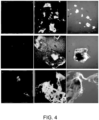
- HA-RB probe To prove that the observed interaction is not merely characteristic of the HA-RB probe, the inventors tested HA covalently labeled with another luminescent dye, namely the metallorganic complex Ru(bpy) 3 2+ . As shown in Figure 4 , also this HA derivative shows a good affinity for a variety of micro-plastics and is able to highlight their presence by means of luminescence under a fluorescence microscope.
- another luminescent dye namely the metallorganic complex Ru(bpy) 3 2+ .
- this HA derivative shows a good affinity for a variety of micro-plastics and is able to highlight their presence by means of luminescence under a fluorescence microscope.
- Figure 4 is a table of the wide-field fluorescence micrographs of micro-plastics in water, in the absence (left) and in the presence of HA functionalized with Ru(bpy) 3 2+ at a concentration of 0.13 ⁇ M (center) and 0.66 ⁇ M (right).
- micro-plastics are polystyrene (PS), polymethylmethacrylate (PMMA) and polypropylene (PP), respectively.
- HA functionalized with various luminescent dyes is able to reveal the presence of micro-plastics by means of fluorescence.
- the affinity of the interaction and the ability to provide a useful luminescent signal that tightly depends on the characteristics of the dye of choice (e.g. luminescence quantum yield, self-quenching, and hydrophobicity). Therefore, while the inventors have proven that the principle works with two HA derivatives (HA-RB and HA-Ru(bpy) 3 2+ ) it is expected that many other HA derivatives (for example, various dyes belonging to families of xantenes, bodipys, coumarin, perylenes, cyanines etc.) are able to interact with micro-plastic fragments and highlight their presence by luminescence.
- HA-RB nanogels are obtained via reaction of hyaluronic acid (193 ⁇ 2 KDa) with Rhodamine B isothiocyanate in DMSO, which proceeds through nucleophilic attack of the methyl-hydroxyl group of the polysaccharide to the reactive isothiocyanate groups, as reported previously for similar polymers ( Eyley S, Thielemans W (2014) Surface modification of cellulose nanocrystals. Nanoscale 6(14):7764-7779 ).
- hyaluronic acid 193 ⁇ 2 KDa (0.26 ⁇ mol) were dispersed in 12 ml of DMSO in a scintillation vial and 9 mg of Rhodamine B isothiocyanate (16.8 ⁇ mol) were successively added under magnetic stirring.
- the initially insoluble HA is progressively dispersed during the reaction in the DMSO solvent and a homogeneous transparent dispersion is obtained after a few hours.
- the reaction proceeds for 24 h at room temperature and the resulting dispersion is dialyzed against water, to obtain a non-turbid, concentrated, aqueous dispersion of HA-RB nanogels.
- the effective dye doping degree was evaluated by UV-vis analysis measuring the absorbance of Rhodamine B, while the weight of the product matched with the starting amount of HA, indicating that no significant loss of materials occurred during synthesis and work-up, except for the unreacted RB.
- Effective derivatization degree amounted to 1 fluorophore each 25 HA repeat units, i.e., about 19 dyes per polymer chain.
- the effective dye doping degree was evaluated by UV-vis analysis measuring the absorbance of Rhodamine B, at known concentration of HA-RB, in ethanol, where the absorption spectrum features similar properties as the free dye, allowing us to use with a reasonable assumption the molar extinction coefficient of the free Rhodamine B dye in ethanol (106000 M -1 cm -1 ).
- Example 3 Preparation of the sensing probe solution and of the microplastics samples for the MNPs detection method
- Hyaluronic acid functionalized with rhodamine B was taken from a stock solution where it was stored at 4°C and at a concentration of 4 ⁇ M (concentration of polymer chains). Due to the presence of some naturally occurring aggregates of HA-RhoB during time, the stock solution was centrifuged at 5000 rpm for 10 minutes to precipitate larger aggregates, and the clear pink supernatant was carefully collected in a smaller vial.
- Micro-plastic samples polystyrene (PS); polymethylmethacrylate (PMMA); polypropylene (PP). These plastic samples were obtained by grinding and milling plastic cuvettes (PS and PMMA) and a commercially available plastic box (PP). Due to their hydrophobicity, each of the micro-plastics was vigorously agitated in a vial with bidistilled water in order to have a fragments suspension.
- PS polystyrene
- PMMA polymethylmethacrylate
- PP polypropylene
- the optical parameter was not changed during all the acquisitions.
- the FLIM experiment were performed in a similar fashion as wide-field fluorescence measurements.
- FLIM images for each sample of micro-plastics were acquired in the absence and in the presence of HA-RB sensor.
- images of HA-RB in the absence of micro-plastics were taken under the same experimental conditions.
Landscapes
- Health & Medical Sciences (AREA)
- Life Sciences & Earth Sciences (AREA)
- Chemical & Material Sciences (AREA)
- Immunology (AREA)
- Physics & Mathematics (AREA)
- Pathology (AREA)
- Biochemistry (AREA)
- General Health & Medical Sciences (AREA)
- General Physics & Mathematics (AREA)
- Analytical Chemistry (AREA)
- Molecular Biology (AREA)
- Dispersion Chemistry (AREA)
- Nuclear Medicine, Radiotherapy & Molecular Imaging (AREA)
- Engineering & Computer Science (AREA)
- Food Science & Technology (AREA)
- Medicinal Chemistry (AREA)
- Biophysics (AREA)
- Chemical Kinetics & Catalysis (AREA)
- Optics & Photonics (AREA)
- Investigating, Analyzing Materials By Fluorescence Or Luminescence (AREA)
Claims (10)
- Verfahren zum Erkennen von Nano- und Mikroplastik in einer wässrigen Probe, bei der der Verdacht besteht, dass sie mit Nano- oder Mikroplastik verunreinigt ist, wobei das Verfahren die folgenden Schritte aufweist:- Inkontaktbringen der wässrigen Probe, bei der der Verdacht besteht, dass sie mit Nano- oder Mikroplastik verunreinigt ist, mit einer wässrigen Lösung aus Hyaluronsäure, die mit einem Lumineszenzfarbstoff als Messsonde funktionalisiert ist, wodurch eine Testprobe erhalten wird;- Beleuchten der Testprobe mit einer Lichtquelle, die zum Anregen des Lumineszenzfarbstoffs geeignet ist;- Messen eines Lumineszenzparameters, der nach Beleuchten aus der Testprobe erhalten wird, wobei der Lumineszenzparameter aus der Lumineszenzintensität und der Lumineszenzlebensdauer ausgewählt ist; und- Vergleichen des von der Testprobe erhaltenen Lumineszenzparameters mit demselben aus einer Referenzprobe erhaltenen Lumineszenzparameter, wobei die Referenzprobe die wässrige Probe - ohne die Messsonde - ist, bei der der Verdacht besteht, dass sie mit Nano- oder Mikroplastik verunreinigt ist,wobei eine Zunahme in der Lumineszenzintensität oder eine Variation in der Lumineszenzlebensdauer der Testprobe verglichen mit der Referenzprobe das Vorhandensein von Nano- oder Mikroplastik in der wässrigen Probe anzeigt.
- Verfahren nach Anspruch 1, wobei die wässrige Probe Meerwasser oder eine biologische Probe ist.
- Verfahren nach Anspruch 1 oder 2, wobei das Nano- oder Mikroplastik aus der Gruppe aufweisend Polystyrol (PS), Polymethylmethacrylat (PMMA), Polypropylen (PP) und jede Kombination davon ausgewählt ist.
- Verfahren nach einem der Ansprüche 1 bis 3, wobei die Hyaluronsäure ein Molekulargewicht aufweist, das innerhalb des Bereichs von 8 bis 1500 KDa variiert, bevorzugt innerhalb des Bereichs von 150 bis 500 KDa, weiter innerhalb des Bereichs von 150 bis 195 KDa.
- Verfahren nach einem der Ansprüche 1 bis 4, wobei der Lumineszenzfarbstoff aus der Gruppe aufweisend Rhodamin, lumineszierende metallorganische Komplexe, Xanten, Bodipy-Farbstoffe, Cumarin, Perylen und Cyanin ausgewählt ist.
- Verfahren nach Anspruch 5, wobei der Lumineszenzfarbstoff Rhodamin B oder Ru(bpy)3 2+ ist.
- Verfahren nach einem der Ansprüche 1 bis 6, wobei der Lumineszenzparameter durch bildgebende Mikroskopie gemessen wird.
- Verfahren nach Anspruch 7, wobei die bildgebende Mikroskopie eine Weitfeldmikroskopie oder eine konfokale Mikroskopie ist.
- Verfahren nach einem der Ansprüche 1 bis 8, wobei der Lumineszenzparameter die Lumineszenzlebensdauer ist und eine Zunahme an Lumineszenzlebensdauer in der Testprobe verglichen mit der Referenzprobe das Vorhandensein von Nano- oder Mikroplastik aus Polymethylmethacrylat (PMMA) in der wässrigen Probe anzeigt.
- Verfahren nach einem der Ansprüche 1 bis 8, wobei der Lumineszenzparameter die Lumineszenzlebensdauer ist und eine Abnahme an Lumineszenzlebensdauer in der Testprobe verglichen mit der Referenzprobe das Vorhandensein von Nano- oder Mikroplastik aus Polystyren (PS) oder Poylpropylen (PP) in der wässrigen Probe anzeigt.
Applications Claiming Priority (2)
| Application Number | Priority Date | Filing Date | Title |
|---|---|---|---|
| IT102020000001333A IT202000001333A1 (it) | 2020-01-23 | 2020-01-23 | Sensore luminescente per nano/microplastiche |
| PCT/EP2021/051008 WO2021148376A1 (en) | 2020-01-23 | 2021-01-19 | A luminescent sensor for nano/microplastics |
Publications (3)
| Publication Number | Publication Date |
|---|---|
| EP4094063A1 EP4094063A1 (de) | 2022-11-30 |
| EP4094063B1 true EP4094063B1 (de) | 2024-03-06 |
| EP4094063C0 EP4094063C0 (de) | 2024-03-06 |
Family
ID=70155218
Family Applications (1)
| Application Number | Title | Priority Date | Filing Date |
|---|---|---|---|
| EP21700930.7A Active EP4094063B1 (de) | 2020-01-23 | 2021-01-19 | Ein leuchtstoffsensor für nano / mikroplastik |
Country Status (4)
| Country | Link |
|---|---|
| US (1) | US12436077B2 (de) |
| EP (1) | EP4094063B1 (de) |
| IT (1) | IT202000001333A1 (de) |
| WO (1) | WO2021148376A1 (de) |
Families Citing this family (1)
| Publication number | Priority date | Publication date | Assignee | Title |
|---|---|---|---|---|
| CN115753723B (zh) * | 2022-12-20 | 2024-02-13 | 浙江大学 | 一种分析海洋刺胞生物中微塑料含量与分布的方法 |
Family Cites Families (3)
| Publication number | Priority date | Publication date | Assignee | Title |
|---|---|---|---|---|
| CN105675566B (zh) | 2016-01-25 | 2018-02-27 | 南京大学 | 定量分析微塑料在哺乳动物体内富集和分布的方法 |
| CN106645049B (zh) | 2016-09-30 | 2019-02-22 | 大连海洋大学 | 一种检测海洋生物体内塑料含量的方法 |
| CN108587102A (zh) | 2018-04-17 | 2018-09-28 | 暨南大学 | 一种金属有机荧光配合物标记的环境微塑料及制备方法与应用 |
-
2020
- 2020-01-23 IT IT102020000001333A patent/IT202000001333A1/it unknown
-
2021
- 2021-01-19 US US17/794,580 patent/US12436077B2/en active Active
- 2021-01-19 EP EP21700930.7A patent/EP4094063B1/de active Active
- 2021-01-19 WO PCT/EP2021/051008 patent/WO2021148376A1/en not_active Ceased
Also Published As
| Publication number | Publication date |
|---|---|
| EP4094063C0 (de) | 2024-03-06 |
| US12436077B2 (en) | 2025-10-07 |
| WO2021148376A1 (en) | 2021-07-29 |
| US20230122419A1 (en) | 2023-04-20 |
| EP4094063A1 (de) | 2022-11-30 |
| IT202000001333A1 (it) | 2021-07-23 |
Similar Documents
| Publication | Publication Date | Title |
|---|---|---|
| Borisov et al. | Precipitation as a simple and versatile method for preparation of optical nanochemosensors | |
| Yang et al. | Detection of trace tetracycline in fish via synchronous fluorescence quenching with carbon quantum dots coated with molecularly imprinted silica | |
| US6660379B1 (en) | Luminescence spectral properties of CdS nanoparticles | |
| Chen et al. | A facile strategy for the synthesis of water-soluble fluorescent nonconjugated polymer dots and their application in tetracycline detection | |
| Zhang et al. | Biomimetic ratiometric fluorescence sensor based on perovskite quantum dots and carbon dots for ultrasensitive ciprofloxacin detection | |
| CN105928914B (zh) | 硫化氢检测传感器及其制备方法、硫化氢的定量检测方法和细胞内硫化氢的定性检测方法 | |
| Yurova et al. | Functional electrospun nanofibers for multimodal sensitive detection of biogenic amines in food via a simple dipstick assay | |
| EP1281964A2 (de) | Anordnung und Verfahren zur Mehrfach-Fluoreszenzmessung | |
| Qu et al. | Magnolia denudata leaf-derived near-infrared carbon dots as fluorescent nanoprobes for palladium (Ⅱ) detection and cell imaging | |
| US20100069550A1 (en) | Nanoparticle assemblies and methods for their preparation | |
| Tang et al. | Dual emission N-doped carbon dots as a ratiometric fluorescent and colorimetric dual-signal probe for indigo carmine detection | |
| Ma et al. | A luminescent sensor based on in-situ formed copper nanocluster-loading terbium coordination polymer with multicolor response for identification of antibiotics | |
| Lulka et al. | Molecular imprinting of small molecules with organic silanes: fluorescence detection | |
| Wang et al. | based visualization of auramine O in food and drug samples with carbon dots-incorporated fluorescent microspheres as sensing element | |
| EP4094063B1 (de) | Ein leuchtstoffsensor für nano / mikroplastik | |
| Zhang et al. | Synthesis of eco-friendly multifunctional dextran microbeads for multiplexed assays | |
| Amin et al. | Ratiometric bioassay and visualization of dopamine β-hydroxylase in brain cells utilizing a nanohybrid fluorescence probe | |
| Hu et al. | Smartphone-assisted fluorimetric and colorimetric dual-recognition sensing platform based on nitrogen-doped carbon dots for visual monitoring of acid red 18 in food | |
| Pang et al. | An IFE-based molecularly imprinted nanosensor for highly sensitive and rapid ratiometric fluorescence-visualization detection of ciprofloxacin | |
| Cheng et al. | Facile Synthesis and Characterization of Fluorescent Polystyrene Nanospheres for Homogeneous Light-Initiated Chemiluminescence Immunoassay | |
| Chen et al. | Europium coordination polymers-based ratiometric ratiometric fluorescent probe for portable visual detection and discrimination of tetracyclines | |
| CN109324029B (zh) | 基于谷胱甘肽功能化的金纳米团簇探针检测三聚氰胺浓度的方法 | |
| Qu et al. | Detection of surface pH of paper using a chitosan-modified silica fluorescent nanosensor | |
| CN115924887B (zh) | 一种碳点材料的制备方法及其在全氟化合物检测中的应用 | |
| Li et al. | Synthesis and characterization of the fluorescent probes for the labeling of Microthrix parvicella |
Legal Events
| Date | Code | Title | Description |
|---|---|---|---|
| STAA | Information on the status of an ep patent application or granted ep patent |
Free format text: STATUS: UNKNOWN |
|
| STAA | Information on the status of an ep patent application or granted ep patent |
Free format text: STATUS: THE INTERNATIONAL PUBLICATION HAS BEEN MADE |
|
| PUAI | Public reference made under article 153(3) epc to a published international application that has entered the european phase |
Free format text: ORIGINAL CODE: 0009012 |
|
| STAA | Information on the status of an ep patent application or granted ep patent |
Free format text: STATUS: REQUEST FOR EXAMINATION WAS MADE |
|
| 17P | Request for examination filed |
Effective date: 20220817 |
|
| AK | Designated contracting states |
Kind code of ref document: A1 Designated state(s): AL AT BE BG CH CY CZ DE DK EE ES FI FR GB GR HR HU IE IS IT LI LT LU LV MC MK MT NL NO PL PT RO RS SE SI SK SM TR |
|
| DAV | Request for validation of the european patent (deleted) | ||
| DAX | Request for extension of the european patent (deleted) | ||
| GRAP | Despatch of communication of intention to grant a patent |
Free format text: ORIGINAL CODE: EPIDOSNIGR1 |
|
| STAA | Information on the status of an ep patent application or granted ep patent |
Free format text: STATUS: GRANT OF PATENT IS INTENDED |
|
| RIC1 | Information provided on ipc code assigned before grant |
Ipc: G01N 31/22 20060101ALI20230825BHEP Ipc: G01N 15/00 20060101ALI20230825BHEP Ipc: G01N 21/94 20060101ALI20230825BHEP Ipc: G01N 21/85 20060101ALI20230825BHEP Ipc: G01N 21/64 20060101ALI20230825BHEP Ipc: G01N 15/06 20060101ALI20230825BHEP Ipc: G01N 15/02 20060101AFI20230825BHEP |
|
| INTG | Intention to grant announced |
Effective date: 20230926 |
|
| GRAS | Grant fee paid |
Free format text: ORIGINAL CODE: EPIDOSNIGR3 |
|
| GRAA | (expected) grant |
Free format text: ORIGINAL CODE: 0009210 |
|
| STAA | Information on the status of an ep patent application or granted ep patent |
Free format text: STATUS: THE PATENT HAS BEEN GRANTED |
|
| AK | Designated contracting states |
Kind code of ref document: B1 Designated state(s): AL AT BE BG CH CY CZ DE DK EE ES FI FR GB GR HR HU IE IS IT LI LT LU LV MC MK MT NL NO PL PT RO RS SE SI SK SM TR |
|
| REG | Reference to a national code |
Ref country code: CH Ref legal event code: EP |
|
| REG | Reference to a national code |
Ref country code: DE Ref legal event code: R096 Ref document number: 602021010098 Country of ref document: DE |
|
| REG | Reference to a national code |
Ref country code: IE Ref legal event code: FG4D |
|
| U01 | Request for unitary effect filed |
Effective date: 20240306 |
|
| U07 | Unitary effect registered |
Designated state(s): AT BE BG DE DK EE FI FR IT LT LU LV MT NL PT SE SI Effective date: 20240313 |
|
| PG25 | Lapsed in a contracting state [announced via postgrant information from national office to epo] |
Ref country code: GR Free format text: LAPSE BECAUSE OF FAILURE TO SUBMIT A TRANSLATION OF THE DESCRIPTION OR TO PAY THE FEE WITHIN THE PRESCRIBED TIME-LIMIT Effective date: 20240607 |
|
| PG25 | Lapsed in a contracting state [announced via postgrant information from national office to epo] |
Ref country code: RS Free format text: LAPSE BECAUSE OF FAILURE TO SUBMIT A TRANSLATION OF THE DESCRIPTION OR TO PAY THE FEE WITHIN THE PRESCRIBED TIME-LIMIT Effective date: 20240606 Ref country code: HR Free format text: LAPSE BECAUSE OF FAILURE TO SUBMIT A TRANSLATION OF THE DESCRIPTION OR TO PAY THE FEE WITHIN THE PRESCRIBED TIME-LIMIT Effective date: 20240306 |
|
| PG25 | Lapsed in a contracting state [announced via postgrant information from national office to epo] |
Ref country code: ES Free format text: LAPSE BECAUSE OF FAILURE TO SUBMIT A TRANSLATION OF THE DESCRIPTION OR TO PAY THE FEE WITHIN THE PRESCRIBED TIME-LIMIT Effective date: 20240306 |
|
| PG25 | Lapsed in a contracting state [announced via postgrant information from national office to epo] |
Ref country code: RS Free format text: LAPSE BECAUSE OF FAILURE TO SUBMIT A TRANSLATION OF THE DESCRIPTION OR TO PAY THE FEE WITHIN THE PRESCRIBED TIME-LIMIT Effective date: 20240606 Ref country code: NO Free format text: LAPSE BECAUSE OF FAILURE TO SUBMIT A TRANSLATION OF THE DESCRIPTION OR TO PAY THE FEE WITHIN THE PRESCRIBED TIME-LIMIT Effective date: 20240606 Ref country code: HR Free format text: LAPSE BECAUSE OF FAILURE TO SUBMIT A TRANSLATION OF THE DESCRIPTION OR TO PAY THE FEE WITHIN THE PRESCRIBED TIME-LIMIT Effective date: 20240306 Ref country code: GR Free format text: LAPSE BECAUSE OF FAILURE TO SUBMIT A TRANSLATION OF THE DESCRIPTION OR TO PAY THE FEE WITHIN THE PRESCRIBED TIME-LIMIT Effective date: 20240607 Ref country code: ES Free format text: LAPSE BECAUSE OF FAILURE TO SUBMIT A TRANSLATION OF THE DESCRIPTION OR TO PAY THE FEE WITHIN THE PRESCRIBED TIME-LIMIT Effective date: 20240306 |
|
| PG25 | Lapsed in a contracting state [announced via postgrant information from national office to epo] |
Ref country code: IS Free format text: LAPSE BECAUSE OF FAILURE TO SUBMIT A TRANSLATION OF THE DESCRIPTION OR TO PAY THE FEE WITHIN THE PRESCRIBED TIME-LIMIT Effective date: 20240706 |
|
| PG25 | Lapsed in a contracting state [announced via postgrant information from national office to epo] |
Ref country code: SM Free format text: LAPSE BECAUSE OF FAILURE TO SUBMIT A TRANSLATION OF THE DESCRIPTION OR TO PAY THE FEE WITHIN THE PRESCRIBED TIME-LIMIT Effective date: 20240306 |
|
| PG25 | Lapsed in a contracting state [announced via postgrant information from national office to epo] |
Ref country code: CZ Free format text: LAPSE BECAUSE OF FAILURE TO SUBMIT A TRANSLATION OF THE DESCRIPTION OR TO PAY THE FEE WITHIN THE PRESCRIBED TIME-LIMIT Effective date: 20240306 |
|
| PG25 | Lapsed in a contracting state [announced via postgrant information from national office to epo] |
Ref country code: PL Free format text: LAPSE BECAUSE OF FAILURE TO SUBMIT A TRANSLATION OF THE DESCRIPTION OR TO PAY THE FEE WITHIN THE PRESCRIBED TIME-LIMIT Effective date: 20240306 |
|
| PG25 | Lapsed in a contracting state [announced via postgrant information from national office to epo] |
Ref country code: SK Free format text: LAPSE BECAUSE OF FAILURE TO SUBMIT A TRANSLATION OF THE DESCRIPTION OR TO PAY THE FEE WITHIN THE PRESCRIBED TIME-LIMIT Effective date: 20240306 |
|
| PG25 | Lapsed in a contracting state [announced via postgrant information from national office to epo] |
Ref country code: SM Free format text: LAPSE BECAUSE OF FAILURE TO SUBMIT A TRANSLATION OF THE DESCRIPTION OR TO PAY THE FEE WITHIN THE PRESCRIBED TIME-LIMIT Effective date: 20240306 Ref country code: SK Free format text: LAPSE BECAUSE OF FAILURE TO SUBMIT A TRANSLATION OF THE DESCRIPTION OR TO PAY THE FEE WITHIN THE PRESCRIBED TIME-LIMIT Effective date: 20240306 Ref country code: RO Free format text: LAPSE BECAUSE OF FAILURE TO SUBMIT A TRANSLATION OF THE DESCRIPTION OR TO PAY THE FEE WITHIN THE PRESCRIBED TIME-LIMIT Effective date: 20240306 Ref country code: PL Free format text: LAPSE BECAUSE OF FAILURE TO SUBMIT A TRANSLATION OF THE DESCRIPTION OR TO PAY THE FEE WITHIN THE PRESCRIBED TIME-LIMIT Effective date: 20240306 Ref country code: IS Free format text: LAPSE BECAUSE OF FAILURE TO SUBMIT A TRANSLATION OF THE DESCRIPTION OR TO PAY THE FEE WITHIN THE PRESCRIBED TIME-LIMIT Effective date: 20240706 Ref country code: CZ Free format text: LAPSE BECAUSE OF FAILURE TO SUBMIT A TRANSLATION OF THE DESCRIPTION OR TO PAY THE FEE WITHIN THE PRESCRIBED TIME-LIMIT Effective date: 20240306 |
|
| REG | Reference to a national code |
Ref country code: DE Ref legal event code: R097 Ref document number: 602021010098 Country of ref document: DE |
|
| PLBE | No opposition filed within time limit |
Free format text: ORIGINAL CODE: 0009261 |
|
| STAA | Information on the status of an ep patent application or granted ep patent |
Free format text: STATUS: NO OPPOSITION FILED WITHIN TIME LIMIT |
|
| U20 | Renewal fee for the european patent with unitary effect paid |
Year of fee payment: 5 Effective date: 20241223 |
|
| 26N | No opposition filed |
Effective date: 20241209 |
|
| REG | Reference to a national code |
Ref country code: CH Ref legal event code: PL |
|
| PG25 | Lapsed in a contracting state [announced via postgrant information from national office to epo] |
Ref country code: MC Free format text: LAPSE BECAUSE OF FAILURE TO SUBMIT A TRANSLATION OF THE DESCRIPTION OR TO PAY THE FEE WITHIN THE PRESCRIBED TIME-LIMIT Effective date: 20240306 |
|
| GBPC | Gb: european patent ceased through non-payment of renewal fee |
Effective date: 20250119 |
|
| PG25 | Lapsed in a contracting state [announced via postgrant information from national office to epo] |
Ref country code: GB Free format text: LAPSE BECAUSE OF NON-PAYMENT OF DUE FEES Effective date: 20250119 |
|
| PG25 | Lapsed in a contracting state [announced via postgrant information from national office to epo] |
Ref country code: CH Free format text: LAPSE BECAUSE OF NON-PAYMENT OF DUE FEES Effective date: 20250131 |
|
| PG25 | Lapsed in a contracting state [announced via postgrant information from national office to epo] |
Ref country code: IE Free format text: LAPSE BECAUSE OF NON-PAYMENT OF DUE FEES Effective date: 20250119 |
|
| U20 | Renewal fee for the european patent with unitary effect paid |
Year of fee payment: 6 Effective date: 20251230 |