EP4090953B1 - System und verfahren zur überwachung der gesundheit von kostengünstigen sensoren zur bodenfeuchtigkeitsmessung - Google Patents
System und verfahren zur überwachung der gesundheit von kostengünstigen sensoren zur bodenfeuchtigkeitsmessung Download PDFInfo
- Publication number
- EP4090953B1 EP4090953B1 EP20914013.6A EP20914013A EP4090953B1 EP 4090953 B1 EP4090953 B1 EP 4090953B1 EP 20914013 A EP20914013 A EP 20914013A EP 4090953 B1 EP4090953 B1 EP 4090953B1
- Authority
- EP
- European Patent Office
- Prior art keywords
- low
- cost sensor
- sensor
- cost
- soil moisture
- Prior art date
- Legal status (The legal status is an assumption and is not a legal conclusion. Google has not performed a legal analysis and makes no representation as to the accuracy of the status listed.)
- Active
Links
Images

Classifications
-
- G—PHYSICS
- G06—COMPUTING OR CALCULATING; COUNTING
- G06T—IMAGE DATA PROCESSING OR GENERATION, IN GENERAL
- G06T7/00—Image analysis
- G06T7/10—Segmentation; Edge detection
- G06T7/136—Segmentation; Edge detection involving thresholding
-
- A—HUMAN NECESSITIES
- A01—AGRICULTURE; FORESTRY; ANIMAL HUSBANDRY; HUNTING; TRAPPING; FISHING
- A01B—SOIL WORKING IN AGRICULTURE OR FORESTRY; PARTS, DETAILS, OR ACCESSORIES OF AGRICULTURAL MACHINES OR IMPLEMENTS, IN GENERAL
- A01B79/00—Methods for working soil
- A01B79/005—Precision agriculture
-
- G—PHYSICS
- G01—MEASURING; TESTING
- G01N—INVESTIGATING OR ANALYSING MATERIALS BY DETERMINING THEIR CHEMICAL OR PHYSICAL PROPERTIES
- G01N21/00—Investigating or analysing materials by the use of optical means, i.e. using sub-millimetre waves, infrared, visible or ultraviolet light
- G01N21/84—Systems specially adapted for particular applications
- G01N21/88—Investigating the presence of flaws or contamination
- G01N21/95—Investigating the presence of flaws or contamination characterised by the material or shape of the object to be examined
- G01N21/956—Inspecting patterns on the surface of objects
- G01N21/95684—Patterns showing highly reflecting parts, e.g. metallic elements
-
- G—PHYSICS
- G01—MEASURING; TESTING
- G01N—INVESTIGATING OR ANALYSING MATERIALS BY DETERMINING THEIR CHEMICAL OR PHYSICAL PROPERTIES
- G01N33/00—Investigating or analysing materials by specific methods not covered by groups G01N1/00 - G01N31/00
- G01N33/24—Earth materials
- G01N33/246—Earth materials for water content
-
- G—PHYSICS
- G06—COMPUTING OR CALCULATING; COUNTING
- G06Q—INFORMATION AND COMMUNICATION TECHNOLOGY [ICT] SPECIALLY ADAPTED FOR ADMINISTRATIVE, COMMERCIAL, FINANCIAL, MANAGERIAL OR SUPERVISORY PURPOSES; SYSTEMS OR METHODS SPECIALLY ADAPTED FOR ADMINISTRATIVE, COMMERCIAL, FINANCIAL, MANAGERIAL OR SUPERVISORY PURPOSES, NOT OTHERWISE PROVIDED FOR
- G06Q10/00—Administration; Management
- G06Q10/06—Resources, workflows, human or project management; Enterprise or organisation planning; Enterprise or organisation modelling
- G06Q10/063—Operations research, analysis or management
- G06Q10/0639—Performance analysis of employees; Performance analysis of enterprise or organisation operations
-
- G—PHYSICS
- G06—COMPUTING OR CALCULATING; COUNTING
- G06Q—INFORMATION AND COMMUNICATION TECHNOLOGY [ICT] SPECIALLY ADAPTED FOR ADMINISTRATIVE, COMMERCIAL, FINANCIAL, MANAGERIAL OR SUPERVISORY PURPOSES; SYSTEMS OR METHODS SPECIALLY ADAPTED FOR ADMINISTRATIVE, COMMERCIAL, FINANCIAL, MANAGERIAL OR SUPERVISORY PURPOSES, NOT OTHERWISE PROVIDED FOR
- G06Q10/00—Administration; Management
- G06Q10/20—Administration of product repair or maintenance
-
- G—PHYSICS
- G06—COMPUTING OR CALCULATING; COUNTING
- G06Q—INFORMATION AND COMMUNICATION TECHNOLOGY [ICT] SPECIALLY ADAPTED FOR ADMINISTRATIVE, COMMERCIAL, FINANCIAL, MANAGERIAL OR SUPERVISORY PURPOSES; SYSTEMS OR METHODS SPECIALLY ADAPTED FOR ADMINISTRATIVE, COMMERCIAL, FINANCIAL, MANAGERIAL OR SUPERVISORY PURPOSES, NOT OTHERWISE PROVIDED FOR
- G06Q50/00—Information and communication technology [ICT] specially adapted for implementation of business processes of specific business sectors, e.g. utilities or tourism
- G06Q50/02—Agriculture; Fishing; Forestry; Mining
-
- G—PHYSICS
- G06—COMPUTING OR CALCULATING; COUNTING
- G06T—IMAGE DATA PROCESSING OR GENERATION, IN GENERAL
- G06T7/00—Image analysis
- G06T7/0002—Inspection of images, e.g. flaw detection
- G06T7/0004—Industrial image inspection
-
- G—PHYSICS
- G06—COMPUTING OR CALCULATING; COUNTING
- G06T—IMAGE DATA PROCESSING OR GENERATION, IN GENERAL
- G06T7/00—Image analysis
- G06T7/10—Segmentation; Edge detection
- G06T7/12—Edge-based segmentation
-
- G—PHYSICS
- G06—COMPUTING OR CALCULATING; COUNTING
- G06V—IMAGE OR VIDEO RECOGNITION OR UNDERSTANDING
- G06V10/00—Arrangements for image or video recognition or understanding
- G06V10/20—Image preprocessing
- G06V10/30—Noise filtering
-
- G—PHYSICS
- G06—COMPUTING OR CALCULATING; COUNTING
- G06V—IMAGE OR VIDEO RECOGNITION OR UNDERSTANDING
- G06V10/00—Arrangements for image or video recognition or understanding
- G06V10/40—Extraction of image or video features
- G06V10/44—Local feature extraction by analysis of parts of the pattern, e.g. by detecting edges, contours, loops, corners, strokes or intersections; Connectivity analysis, e.g. of connected components
-
- G—PHYSICS
- G01—MEASURING; TESTING
- G01N—INVESTIGATING OR ANALYSING MATERIALS BY DETERMINING THEIR CHEMICAL OR PHYSICAL PROPERTIES
- G01N21/00—Investigating or analysing materials by the use of optical means, i.e. using sub-millimetre waves, infrared, visible or ultraviolet light
- G01N21/84—Systems specially adapted for particular applications
- G01N21/88—Investigating the presence of flaws or contamination
- G01N21/8851—Scan or image signal processing specially adapted therefor, e.g. for scan signal adjustment, for detecting different kinds of defects, for compensating for structures, markings, edges
- G01N2021/8887—Scan or image signal processing specially adapted therefor, e.g. for scan signal adjustment, for detecting different kinds of defects, for compensating for structures, markings, edges based on image processing techniques
-
- G—PHYSICS
- G06—COMPUTING OR CALCULATING; COUNTING
- G06T—IMAGE DATA PROCESSING OR GENERATION, IN GENERAL
- G06T2207/00—Indexing scheme for image analysis or image enhancement
- G06T2207/20—Special algorithmic details
- G06T2207/20024—Filtering details
- G06T2207/20028—Bilateral filtering
-
- G—PHYSICS
- G06—COMPUTING OR CALCULATING; COUNTING
- G06T—IMAGE DATA PROCESSING OR GENERATION, IN GENERAL
- G06T2207/00—Indexing scheme for image analysis or image enhancement
- G06T2207/20—Special algorithmic details
- G06T2207/20172—Image enhancement details
- G06T2207/20192—Edge enhancement; Edge preservation
Definitions
- the disclosure herein generally relates to a field of monitoring health of sensors used in soil moisture measurement and, more particularly, a system and method for monitoring health of low-cost sensors used in soil moisture measurement.
- a farmer irrigates the land with lot of water, until the entire farm is flooded as he is unaware about the actual amount of water required by the soil. Surplus water is wasted and sometimes plants are also destroyed.
- a soil moisture sensor is used. The soil moisture sensor provides insight and helps the farmer to know the precise amount of water required and in turn preserve water.
- Rugged soil moisture sensors with stable measurement profiles are usually expensive for a common farmer.
- the moisture readings for frugal, inexpensive, and often resistive sensors are usually jittery, where the sensor health tends to degrade over a period. Failing to catch the reduced reliability due to degraded sensor health would lead to imprecise irrigation decisions.
- Precision farming has an indispensable role to play in order to make this progress sustainable and its adoption at scale would require the deployments to be affordable.
- Low-cost resistive/capacitive based soil moisture sensors have also been used in the prior art.
- the low-cost sensors usually have shorter lifetime due to faster wear and tear of the sensing element. They often give out the raw measurements with no correlation to the characteristics of the medium under observation. Once the sensors are deployed in the farm, the wear and tear of the sensing element is not observed or most of the times goes unnoticed. This leads to logging of incorrect sensor values and therefore incorrect estimates.
- Embodiments of the present disclosure present technological improvements as solutions to one or more of the above-mentioned technical problems recognized by the inventors in conventional systems.
- the invention is set out in appended set of claims.
- the embodiments herein provide a method and a system to monitor performance of low-cost sensors used in soil moisture measurement.
- the low-cost sensors available in the market usually have shorter lifetimes due to faster wear and tear of the sensing element. They often give out the raw measurements that are a function of the both the medium and the quality of the sensing element in contact with the medium. Once the low-cost sensors are deployed in the field, wear and tear of the sensing element is not observed or most of the times goes unnoticed. This leads to logging of incorrect sensor values and it provides incorrect estimates. Therefore, a system to calibrate the low-cost sensors based on behavior of a rugged sensor as it is trained to recognize conditions ranging from dry to moist to extreme wet conditions. Further, the system is enabled to monitor performance of the low-cost sensors and recommend modifications within the existing sensors or replacement with a new sensor.
- FIG. 1 through FIG. 4 where similar reference characters denote corresponding features consistently throughout the figures, there are shown preferred embodiments and these embodiments are described in the context of the following exemplary system and/or method.
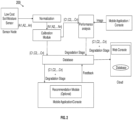
- FIG. 1 illustrates a system (100) to monitor performance of low-cost sensors used in soil moisture measurement.
- the system (100) comprises at least one low-cost sensor (102), which works on either principle of resistance or capacitance.
- the system comprises at least one memory (104) with a plurality of instructions and one or more hardware processors (106) which are communicably coupled with the at least one memory (104) to execute modules therein.
- the hardware processor (106) may be implemented as one or more microprocessors, microcomputers, microcontrollers, digital signal processors, central processing units, state machines, logic circuits, and/or any devices that manipulate signals based on operational instructions.
- the hardware processor (106) is configured to fetch and execute computer-readable instructions stored in the memory (104).
- the system comprises a calibration module (108), a multimedia component (110), an identification module (112), a determining module (114), an analyzing module (116), and a recommendation module (118).
- the at least one low-cost sensor (102) is configured to measure soil moisture of a field. It is to be appreciated that the at least one low-cost sensor works either on a principle of resistance or capacitance through its sensing element.
- the at least one low-cost sensor comprises one or more nodes integrated with a plurality of wireless sensors including temperature, humidity, soil moisture, leaf wetness, lux sensor, in portable and stationary configurations that cater to various scenarios and associated challenges in sensing the farm.
- the low-cost sensor is usually jittery where the performance of the sensor tends to degrade over a period.
- the low-cost sensor often gives out raw measurements that are a function of both a medium and a quality of the sensing element in contact with the medium. There are no derived parameters for irrigation as such.
- wear and tear of the sensing element is not observed or most of the times goes unnoticed. It is observed that the low-cost sensor does not give a steady output in a given medium, and at irregular intervals, the low-cost sensor provides abnormal outputs like sudden trough or crest. Variance between consecutive values is also high which makes it difficult to use them without some standardization.
- the calibration module (108) of the system (100) is configured to calibrate the at least one low-cost sensor based on predefined parameters to achieve a value of the soil moisture.
- the calibration includes normalization of the incoming values from the at least one low-cost sensor to remove bias across similar such devices.
- the normalization of the at least one low-cost sensor involves finding the two extreme measurements except measuring moisture content in the air and when completely immersed in water.
- a Support Vector Regression (SVR) model and a Random Forest (RF) based regression model are trained to calibrate the low-cost sensor in line with rugged sensors for soil moisture measurement.
- a predefined training dataset is used to train the SVR model to get optimum values of one or more parameters such as epsilon and cost.
- the cost is a regularization parameter that controls the trade-off between achieving a low training error and a low testing error. Values of epsilon defines a margin of tolerance where no penalty is given to errors.
- the one or more tuned parameter values are used to create a model, which would provide a least root mean square error (RMSE).
- RMSE least root mean square error
- the random forest-based regression model works by constructing a multitude of decision trees at training time and outputting the mean prediction (regression) of the individual trees. It is very important to select the number of trees that the regression model needs to grow. It is to be noted that the number should not be set to too small to ensure that every input row is predicted at least a few times.
- VWC volumetric water content
- the multimedia component (110) is configured to capture at least one image of the employed at least one low-cost sensor.
- the captured at least one image is pre-processed to remove noise and detect a binary edge-map of the at least one captured image.
- the pre-processing of the one or more image includes conversion of each of one or more images into a greyscale and blur the grey-scaled images using a bilateral filter.
- the identification module (112) of the system (100) is configured to identify a contour of a probe of the at least one low-cost sensor from the pre-processed at least one image based on a topological structural analysis on the binary edge-map of the image.
- the identified contour of the probe provides a silver metal pixel of each probe.
- the determining module (114) of the system (100) is configured to determine a percentage of the silver metal pixel and a connectivity of the silver metal pixel with a base of the at least one sensor.
- the analyzing module (116) of the system (100) is configured to analyze performance of the at least one low-cost sensor using the predefined range of values of the soil moisture, the determined percentage of the silver metal pixel and the connectivity of the silver metal pixel with the base.
- the performance analysis includes evaluation of degradation stages of the low-cost sensor. It is to be noted that the low-cost sensor does not have a high-quality sensing-element. Hence, the low-cost sensor undergoes quick wear and tear and experiences poor performance.
- an image of a low-cost sensor is captured and converted to a grayscale and blurred using a bilateral filter in order to remove noise and preserve sharp edges.
- a predefined Otsu thresholding is applied, and a binary image is obtained.
- the binary image is used to remove the background of the low-cost sensor image.
- the binary image is used as a mask in order to replace value of all the pixels that do not belong to the low-cost sensor by 0.
- the threshold value is used to perform canny edge detection over the low-cost sensor image. Erosion and dilation are performed on the edge-map in order to close gaps between the edges and avoid missing and closed contour.
- a contour detection is applied based on a topological structural analysis on the binary edge-map in order to obtain the outer boundary of the low-cost sensor.
- An ellipse fitting is applied where the contour points are approximated by ellipses using least squares optimization to obtain angle. Once the angle is obtained, a morphological operation of rotation is applied on the sensor pixels in order to get it vertically aligned in the image.
- An edge-detected image is used to find hierarchical contours in the image.
- the hierarchical contours are sorted in descending order of the area and converted to minimum area bounding rectangle. It helps to find common vertices and sides of probes and base, which in turn help to get the relative position and connectivity between them.
- HSV hue saturation value
- After getting the silver pixels calculate the percentage of pixels in each probe. Apart from metal pixels, the connectivity of the sensing element with the base of sensor is checked. From the first row on the side of probe connected to the base, if there are enough silver pixels connected to base (i.e. (1/9) *(width of probe) ⁇ 2), the sensing element is termed to be connected. Connectivity is also considered along with the quantity of metal pixels for image-based analysis of sensor health.
- the recommendation module (118) of the system (100) is configured to recommend one or more corrective measures for the at least one low-cost sensor based on the performance analysis.
- the one or more corrective measures include modification in the existing low-cost sensor and replacement of the existing low-cost sensor with a new low-cost sensor. It is to be noted that the performance analysis of the low-cost sensor is done for images of front and backsides of the low-cost sensor clubbed with a mean and median of the moisture values of the low-cost sensor. The percentage error in the moisture values of the sensor at a given moisture level has been used as reference to decide on different degradation levels in the sensor.
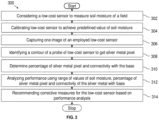
- a processor-implemented method (300) to monitor performance of low-cost sensors used in soil moisture measurement comprises one or more steps as follows.
- the low-cost sensor works on a principle of resistance or capacitance through one or more sensing elements.
- the next step (306) capturing at least one image of the employed at least one low-cost sensor using a multimedia component.
- the captured at least one image is pre-processed to remove noise and detect a binary edge-map of the at least one captured image.
- the pre-processing of the at least one image includes conversion of each of one or more images into a greyscale and blur the grey-scaled images using a bilateral filter.
- the identified contour of the probe provides a silver metal pixel of each probe.
- step (310) determine a percentage of the silver metal pixel and a connectivity of the silver metal pixel with a base of the at least one sensor.
- the performance analysis includes evaluation of degradation stages of the low-cost sensor.
- the one or more corrective measures include modification in the existing low-cost sensor and replacement of the existing low-cost sensor with a new low-cost sensor.
- the steps are being incorporated to monitor performance of the low-cost sensors and recommend modifications within the existing lo-cost sensors or replacement with a new low-cost sensor.
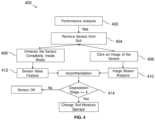
- the performance analysis of low-cost sensor is initiated.
- the sensor is removed from the soil, and at step (406) an image is clicked of the removed low-cost sensor.
- the low-cost sensor is immersed completely inside water and at step (410) the image is analyzed based on the sensor value features obtained at step (412). Further, to recommend corrective measure based on the performance of the sensor at step (414) based on the evaluation of degradation stages. It would be appreciated that if the degradation stage is greater and equal then 4 then the low-cost sensor is replaced with new low-cost sensor.
- the embodiments of present disclosure herein address unresolved problem associated with monitoring performance of a low-cost sensor used for soil moisture measurement.
- Low-cost sensors available in the market usually have shorter lifetimes due to faster wear and tear of the sensing element.
- the low-cost sensors often give out the raw measurements that are a function of the both the medium and the quality of the sensing element in contact with the medium. There is no derived parameter for irrigation as such.
- wear and tear of the sensing element is not observed or most of the times goes unnoticed. It leads to logging of incorrect sensor values and therefore incorrect estimates.
- the hardware device can be any kind of device, which can be programmed including e.g. any kind of computer like a server or a personal computer, or the like, or any combination thereof.
- the device may also include means which could be e.g. hardware means like e.g. an application-specific integrated circuit (ASIC), a field-programmable gate array (FPGA), or a combination of hardware and software means, e.g.
- ASIC application-specific integrated circuit
- FPGA field-programmable gate array
- the means can include both hardware means, and software means.
- the method embodiments described herein could be implemented in hardware and software.
- the device may also include software means.
- the embodiments may be implemented on different hardware devices, e.g. using a plurality of CPUs.
- the embodiments herein can comprise hardware and software elements.
- the embodiments that are implemented in software include but are not limited to, firmware, resident software, microcode, etc.
- the functions performed by various components described herein may be implemented in other components or combinations of other components.
- a computer-usable or computer readable medium can be any apparatus that can comprise, store, communicate, propagate, or transport the program for use by or in connection with the instruction execution system, apparatus, or device.
- a computer-readable storage medium refers to any type of physical memory on which information or data readable by a processor may be stored.
- a computer-readable storage medium may store instructions for execution by one or more processors, including instructions for causing the processor(s) to perform steps or stages consistent with the embodiments described herein.
- the term "computer-readable medium” should be understood to include tangible items and exclude carrier waves and transient signals, i.e., be non-transitory. Examples include random access memory (RAM), read-only memory (ROM), volatile memory, nonvolatile memory, hard drives, CD ROMs, DVDs, flash drives, disks, and any other known physical storage media. It is intended that the disclosure and examples be considered as exemplary only, with a true scope of disclosed embodiments being indicated by the following claims.
Landscapes
- Engineering & Computer Science (AREA)
- Physics & Mathematics (AREA)
- General Physics & Mathematics (AREA)
- Theoretical Computer Science (AREA)
- Business, Economics & Management (AREA)
- Life Sciences & Earth Sciences (AREA)
- Computer Vision & Pattern Recognition (AREA)
- Human Resources & Organizations (AREA)
- Health & Medical Sciences (AREA)
- Chemical & Material Sciences (AREA)
- General Health & Medical Sciences (AREA)
- Multimedia (AREA)
- Economics (AREA)
- Strategic Management (AREA)
- Analytical Chemistry (AREA)
- Biochemistry (AREA)
- Pathology (AREA)
- Immunology (AREA)
- Entrepreneurship & Innovation (AREA)
- General Business, Economics & Management (AREA)
- Quality & Reliability (AREA)
- Marketing (AREA)
- Tourism & Hospitality (AREA)
- Operations Research (AREA)
- Development Economics (AREA)
- Educational Administration (AREA)
- Medicinal Chemistry (AREA)
- Remote Sensing (AREA)
- Geology (AREA)
- Food Science & Technology (AREA)
- General Life Sciences & Earth Sciences (AREA)
- Environmental & Geological Engineering (AREA)
- Marine Sciences & Fisheries (AREA)
- Primary Health Care (AREA)
- Agronomy & Crop Science (AREA)
- Mining & Mineral Resources (AREA)
- Animal Husbandry (AREA)
- Environmental Sciences (AREA)
- Soil Sciences (AREA)
- Mechanical Engineering (AREA)
Claims (11)
- System (100), umfassend:mindestens einen Speicher (104), der eine Mehrzahl von Anweisungen speichert;einen oder mehrere Hardwareprozessoren (106), die kommunikativ mit dem mindestens einen Speicher (104) gekoppelt sind, wobei der eine oder die mehreren Hardwareprozessoren (106) konfiguriert sind, um ein oder mehrere Module auszuführen;mindestens einen kostengünstigen Sensor (102), der konfiguriert ist, um die Bodenfeuchtigkeit eines Feldes zu messen, wobei der kostengünstige Sensor auf einem Prinzip des Widerstands durch ein Sensorelement arbeitet;ein Kalibrierungsmodul (108), das konfiguriert ist, um den mindestens einen kostengünstigen Sensor basierend auf einem Satz von vordefinierten Parametern zu kalibrieren, um einen vordefinierten Wert der Bodenfeuchtigkeit zu erreichen, wobei der kalibrierte mindestens eine kostengünstige Sensor im Feld eingesetzt wird, um die Bodenfeuchtigkeit zu messen;eine Multimediakomponente (110), die konfiguriert ist, um mindestens ein Bild des mindestens einen kostengünstigen Sensors aufzunehmen, wobei das aufgenommene mindestens eine Bild vorverarbeitet wird, um Rauschen zu entfernen und eine binäre Kantenkarte des mindestens einen aufgenommenen Bildes zu erkennen;ein Identifikationsmodul (112), das konfiguriert ist, um eine Kontur einer Sonde des mindestens einen kostengünstigen Sensors aus dem vorverarbeiteten mindestens einen Bild basierend auf einer topologischen Strukturanalyse auf der binären Kantenkarte des Bildes zu identifizieren, wobei die identifizierte Kontur der Sonde ein Silbermetallpixel der Sonde bereitstellt und wobei Pixel, die den Farbtonsättigungswert-Schwellenwertbereich für alle Kanäle erfüllen, als Silberwerte betrachtet werden, wobei der Farbton ein beliebiger Grad ist, die Sättigung 0 bis 4 % und der Wert 60 bis 85 % beträgt;ein Bestimmungsmodul (114), das konfiguriert ist, um einen Prozentsatz des Silbermetallpixels und eine Konnektivität des Silbermetallpixels mit einer Basis des mindestens einen Sensors zu bestimmen;ein Analysemodul (116), das konfiguriert ist, um die Leistung des mindestens einen kostengünstigen Sensors unter Verwendung eines vordefinierten Bereichs von Werten der Bodenfeuchtigkeit, des bestimmten Prozentsatzes des Silbermetallpixels und der Konnektivität des Silbermetallpixels mit der Basis zu analysieren, wobei die Leistungsanalyse die Bewertung von Verschlechterungsstufen des kostengünstigen Sensors beinhaltet; undein Empfehlungsmodul (118), das konfiguriert ist, um eine oder mehrere Korrekturmaßnahmen für den mindestens einen kostengünstigen Sensor basierend auf der Leistungsanalyse zu empfehlen, wobei die eine oder mehreren Korrekturmaßnahmen die Modifikation im bestehenden kostengünstigen Sensor und den Ersatz des bestehenden kostengünstigen Sensors durch einen neuen kostengünstigen Sensor beinhalten.
- System (100) nach Anspruch 1, wobei die Vorverarbeitung des einen oder der mehreren Bilder die Umwandlung jedes des einen oder der mehreren Bilder in Graustufenbilder und das Verschmieren der Graustufenbilder unter Verwendung eines bilateralen Filters beinhaltet.
- System (100) nach Anspruch 1, wobei die Kalibrierung des mindestens einen kostengünstigen Sensors die Normalisierung von eingehenden Werten von dem mindestens einen kostengünstigen Sensor basierend auf vordefinierten Werten, die durch einen robusten Sensor bestimmt werden, beinhaltet.
- System (100) nach Anspruch 3, wobei die Normalisierung von eingehenden Werten das Finden eines Minimalwerts und eines Maximalwerts der Bodenfeuchtigkeit beinhaltet.
- System (100) nach Anspruch 3, wobei die Normalisierung ein Prozess der Zuordnung von Rohwerten ist, der sich sogar zwischen den Sensorelementen derselben Familie zu einem Prozentsatz basierend auf Luft- und Wassermessung ändert.
- Prozessorimplementiertes Verfahren (300), umfassend:Auswählen (302), über einen oder mehrere Hardwareprozessoren, eines kostengünstigen Sensors, um die Bodenfeuchtigkeit eines Feldes zu messen, wobei der kostengünstige Sensor auf einem Prinzip des Widerstands durch sein Sensorelement arbeitet;Kalibrieren (304), über den einen oder die mehreren Hardwareprozessoren, des mindestens einen kostengünstigen Sensors basierend auf vordefinierten Parametern, um einen vordefinierten Wert der Bodenfeuchtigkeit zu erreichen, wobei der kalibrierte mindestens eine kostengünstige Sensor im Feld eingesetzt wird, um die Bodenfeuchtigkeit zu messen;Aufnehmen (306), über den einen oder die mehreren Hardwareprozessoren, mindestens eines Bildes des eingesetzten mindestens einen kostengünstigen Sensors unter Verwendung einer Multimediakomponente, wobei das aufgenommene mindestens eine Bild vorverarbeitet wird, um Rauschen zu entfernen und eine binäre Kantenkarte des mindestens einen aufgenommenen Bildes zu erkennen;Identifizieren (308), über den einen oder die mehreren Hardwareprozessoren, einer Kontur einer Sonde des mindestens einen kostengünstigen Sensors aus dem vorverarbeiteten mindestens einen Bild basierend auf einer topologischen Strukturanalyse auf der binären Kantenkarte des Bildes, wobei die identifizierte Kontur der Sonde ein Silbermetallpixel jeder Sonde bereitstellt und wobei Pixel, die den Farbtonsättigungswert-Schwellenwertbereich für alle Kanäle erfüllen, als Silberwerte betrachtet werden, wobei der Farbton ein beliebiger Grad ist, die Sättigung 0 bis 4 % und der Wert 60 bis 85 % beträgt;Bestimmen (310), über den einen oder die mehreren Hardwareprozessoren, eines Prozentsatzes des Silbermetallpixels und einer Konnektivität des Silbermetallpixels mit einer Basis des mindestens einen Sensors;Analysieren (312), über den einen oder die mehreren Hardwareprozessoren, einer Leistung des mindestens einen kostengünstigen Sensors unter Verwendung des vordefinierten Bereichs von Werten der Bodenfeuchtigkeit, des bestimmten Prozentsatzes des Silbermetallpixels und der Konnektivität des Silbermetallpixels mit der Basis, wobei die Leistungsanalyse die Bewertung von Verschlechterungsstufen des kostengünstigen Sensors beinhaltet; undEmpfehlen (314), über den einen oder die mehreren Hardwareprozessoren, einer oder mehrerer Korrekturmaßnahmen für den mindestens einen kostengünstigen Sensor basierend auf der Leistungsanalyse, wobei die eine oder mehreren Korrekturmaßnahmen die Modifikation im bestehenden kostengünstigen Sensor und den Ersatz des bestehenden kostengünstigen Sensors durch einen neuen kostengünstigen Sensor beinhalten.
- Prozessorimplementiertes Verfahren (300) nach Anspruch 6, wobei die Vorverarbeitung des mindestens einen Bildes die Umwandlung jedes des einen oder der mehreren Bilder in eine Graustufe und das Verschmieren der Graustufenbilder unter Verwendung eines bilateralen Filters beinhaltet.
- Prozessorimplementiertes Verfahren (300) nach Anspruch 6, wobei die Kalibrierung des mindestens einen kostengünstigen Sensors die Normalisierung von eingehenden Werten von dem mindestens einen kostengünstigen Sensor basierend auf vordefinierten Werten, die durch einen robusten Sensor bestimmt werden, beinhaltet.
- Prozessorimplementiertes Verfahren (300) nach Anspruch 8, wobei die Normalisierung das Finden eines Minimalwerts und eines Maximalwerts der Bodenfeuchtigkeit beinhaltet.
- Prozessorimplementiertes Verfahren (300) nach Anspruch 6, wobei die Normalisierung ein Prozess der Zuordnung von Rohwerten ist, der sich sogar zwischen den Sensorelementen derselben Familie zu einem Prozentsatz basierend auf Luft- und Wassermessung ändert.
- Nichtflüchtiges computerlesbares Medium, das eine oder mehrere Anweisungen speichert, die, wenn sie von einem Prozessor auf einem System ausgeführt werden, den Prozessor veranlassen, ein Verfahren durchzuführen, umfassend:Auswählen, über einen oder mehrere Hardwareprozessoren, eines kostengünstigen Sensors, um die Bodenfeuchtigkeit eines Feldes zu messen, wobei der kostengünstige Sensor auf einem Prinzip des Widerstands durch sein Sensorelement arbeitet;Kalibrieren, über den einen oder die mehreren Hardwareprozessoren, des mindestens einen kostengünstigen Sensors basierend auf vordefinierten Parametern, um einen vordefinierten Wert der Bodenfeuchtigkeit zu erreichen, wobei der kalibrierte mindestens eine kostengünstige Sensor im Feld eingesetzt wird, um die Bodenfeuchtigkeit zu messen;Aufnehmen, über den einen oder die mehreren Hardwareprozessoren, mindestens eines Bildes des eingesetzten mindestens einen kostengünstigen Sensors unter Verwendung einer Multimediakomponente, wobei das aufgenommene mindestens eine Bild vorverarbeitet wird, um Rauschen zu entfernen und eine binäre Kantenkarte des mindestens einen aufgenommenen Bildes zu erkennen;Identifizieren, über den einen oder die mehreren Hardwareprozessoren, einer Kontur einer Sonde des mindestens einen kostengünstigen Sensors aus dem vorverarbeiteten mindestens einen Bild basierend auf einer topologischen Strukturanalyse auf der binären Kantenkarte des Bildes, wobei die identifizierte Kontur der Sonde ein Silbermetallpixel jeder Sonde bereitstellt und wobei Pixel, die den Farbtonsättigungswert-Schwellenwertbereich für alle Kanäle erfüllen, als Silberwerte betrachtet werden, wobei der Farbton ein beliebiger Grad ist, die Sättigung 0 bis 4 % und der Wert 60 bis 85 % beträgt;Bestimmen, über den einen oder die mehreren Hardwareprozessoren, eines Prozentsatzes des Silbermetallpixels und einer Konnektivität des Silbermetallpixels mit einer Basis des mindestens einen Sensors;Analysieren, über den einen oder die mehreren Hardwareprozessoren, einer Leistung des mindestens einen kostengünstigen Sensors unter Verwendung des vordefinierten Bereichs von Werten der Bodenfeuchtigkeit, des bestimmten Prozentsatzes des Silbermetallpixels und der Konnektivität des Silbermetallpixels mit der Basis, wobei die Leistungsanalyse die Bewertung von Verschlechterungsstufen des kostengünstigen Sensors beinhaltet; undEmpfehlen, über den einen oder die mehreren Hardwareprozessoren, einer oder mehrerer Korrekturmaßnahmen für den mindestens einen kostengünstigen Sensor basierend auf der Leistungsanalyse, wobei die eine oder mehreren Korrekturmaßnahmen die Modifikation im bestehenden kostengünstigen Sensor und den Ersatz des bestehenden kostengünstigen Sensors durch einen neuen kostengünstigen Sensor beinhalten.
Applications Claiming Priority (2)
| Application Number | Priority Date | Filing Date | Title |
|---|---|---|---|
| IN202021001465 | 2020-01-13 | ||
| PCT/IN2020/050971 WO2021144807A1 (en) | 2020-01-13 | 2020-11-19 | System and method for monitoring health of low-cost sensors used in soil moisture measurement |
Publications (4)
| Publication Number | Publication Date |
|---|---|
| EP4090953A1 EP4090953A1 (de) | 2022-11-23 |
| EP4090953A4 EP4090953A4 (de) | 2024-02-07 |
| EP4090953C0 EP4090953C0 (de) | 2024-10-09 |
| EP4090953B1 true EP4090953B1 (de) | 2024-10-09 |
Family
ID=76863941
Family Applications (1)
| Application Number | Title | Priority Date | Filing Date |
|---|---|---|---|
| EP20914013.6A Active EP4090953B1 (de) | 2020-01-13 | 2020-11-19 | System und verfahren zur überwachung der gesundheit von kostengünstigen sensoren zur bodenfeuchtigkeitsmessung |
Country Status (3)
| Country | Link |
|---|---|
| US (1) | US12175680B2 (de) |
| EP (1) | EP4090953B1 (de) |
| WO (1) | WO2021144807A1 (de) |
Family Cites Families (10)
| Publication number | Priority date | Publication date | Assignee | Title |
|---|---|---|---|---|
| US7170302B2 (en) | 2005-06-27 | 2007-01-30 | Fu Ching Lee | Capacitive soil moisture sensor |
| US9585307B2 (en) | 2007-07-03 | 2017-03-07 | Kyle H. Holland | Optical real-time soil sensor and auto-calibration methods |
| US8755589B2 (en) * | 2011-09-06 | 2014-06-17 | The Gates Corporation | Measurement of belt wear through edge detection of a raster image |
| US9251698B2 (en) * | 2012-09-19 | 2016-02-02 | The Boeing Company | Forest sensor deployment and monitoring system |
| EP3158302B1 (de) * | 2014-06-18 | 2021-12-29 | Innopix, Inc. | Spektralbildgebungssystem für fern- nichtinvasiven nachweis von zielsubstanzen mit spektralen filterarrays und bilderfassungsarrays |
| WO2016130804A1 (en) | 2015-02-13 | 2016-08-18 | University Of Massachusetts | Wireless roadway sub-surface sensing system |
| US10371637B1 (en) * | 2015-09-18 | 2019-08-06 | Kejr, Inc. | Soil imaging probe and method of processing soil image to detect hydrocarbon contamination |
| US20180284758A1 (en) | 2016-05-09 | 2018-10-04 | StrongForce IoT Portfolio 2016, LLC | Methods and systems for industrial internet of things data collection for equipment analysis in an upstream oil and gas environment |
| US10670763B2 (en) | 2017-02-17 | 2020-06-02 | Deere & Company | Sensor for determining soil moisture |
| US11520647B2 (en) * | 2017-12-11 | 2022-12-06 | The Texas A&M University System | Agricultural sensor placement and fault detection in wireless sensor networks |
-
2020
- 2020-11-19 EP EP20914013.6A patent/EP4090953B1/de active Active
- 2020-11-19 US US17/594,378 patent/US12175680B2/en active Active
- 2020-11-19 WO PCT/IN2020/050971 patent/WO2021144807A1/en not_active Ceased
Also Published As
| Publication number | Publication date |
|---|---|
| EP4090953A4 (de) | 2024-02-07 |
| WO2021144807A1 (en) | 2021-07-22 |
| US20220349838A1 (en) | 2022-11-03 |
| EP4090953C0 (de) | 2024-10-09 |
| BR112021023615A2 (pt) | 2022-08-02 |
| EP4090953A1 (de) | 2022-11-23 |
| US12175680B2 (en) | 2024-12-24 |
Similar Documents
| Publication | Publication Date | Title |
|---|---|---|
| CN110349145B (zh) | 缺陷检测方法、装置、电子设备以及存储介质 | |
| US11094040B2 (en) | Noise detection method for time-series vegetation index derived from remote sensing images | |
| Narmadha et al. | Detection and measurement of paddy leaf disease symptoms using image processing | |
| JP6121425B2 (ja) | ラスタ画像のエッジ検出によるベルト摩耗の測定 | |
| KR100598381B1 (ko) | 인-라인 타입의 자동 웨이퍼결함 분류장치 및 그 제어방법 | |
| CN111753692A (zh) | 目标对象提取方法、产品检测方法、装置、计算机和介质 | |
| WO2018104819A1 (en) | A method and system for evaluating quality of semen sample | |
| KR20210052461A (ko) | 화학적 딥 테스트의 디지털 평가 | |
| US10630951B2 (en) | Image analysis system and method | |
| JP2018143160A5 (de) | ||
| EP4125053A1 (de) | Verfahren und system zur identifizierung und klassifizierung von verschiedenen getreide- und verunreinigungsarten | |
| JP7575232B2 (ja) | 精子形成の自動評価のための方法およびシステム | |
| Chopin et al. | Land-based crop phenotyping by image analysis: consistent canopy characterization from inconsistent field illumination | |
| CN118134904A (zh) | 芯片焊点质量检测方法、装置、设备及存储介质 | |
| US12175680B2 (en) | System and method for monitoring health of low-cost sensors used in soil moisture measurement | |
| CN116342590B (zh) | 晶圆测试针痕的检测方法以及检测装置 | |
| CN120510106B (zh) | 一种甲状腺超声辅助扫描方法及系统 | |
| US11796481B2 (en) | Inspection device and inspection method | |
| CN115330799A (zh) | 一种仪表自动化故障诊断方法 | |
| KR20230102269A (ko) | 웨이퍼 제조 공정 장비의 이상 유무 탐지 방법 및 이를 위한 장치 | |
| Petrellis | Plant lesion characterization for disease recognition A Windows Phone application | |
| BR112021023615B1 (pt) | Sistema e método para monitorar a saúde de sensores de baixo custo usados em medição de umidade do solo | |
| Syazwan et al. | Categorization of watermelon maturity level based on rind features | |
| CN112286951B (zh) | 数据检测方法及装置 | |
| Sarkar et al. | On online counting of cigarette in packets—an image processing approach |
Legal Events
| Date | Code | Title | Description |
|---|---|---|---|
| STAA | Information on the status of an ep patent application or granted ep patent |
Free format text: STATUS: THE INTERNATIONAL PUBLICATION HAS BEEN MADE |
|
| PUAI | Public reference made under article 153(3) epc to a published international application that has entered the european phase |
Free format text: ORIGINAL CODE: 0009012 |
|
| STAA | Information on the status of an ep patent application or granted ep patent |
Free format text: STATUS: REQUEST FOR EXAMINATION WAS MADE |
|
| 17P | Request for examination filed |
Effective date: 20211011 |
|
| AK | Designated contracting states |
Kind code of ref document: A1 Designated state(s): AL AT BE BG CH CY CZ DE DK EE ES FI FR GB GR HR HU IE IS IT LI LT LU LV MC MK MT NL NO PL PT RO RS SE SI SK SM TR |
|
| DAV | Request for validation of the european patent (deleted) | ||
| DAX | Request for extension of the european patent (deleted) | ||
| REG | Reference to a national code |
Ref country code: DE Ref legal event code: R079 Free format text: PREVIOUS MAIN CLASS: G01N0021880000 Ipc: G06T0007000000 Ref country code: DE Ref legal event code: R079 Ref document number: 602020039362 Country of ref document: DE Free format text: PREVIOUS MAIN CLASS: G01N0021880000 Ipc: G06T0007000000 |
|
| A4 | Supplementary search report drawn up and despatched |
Effective date: 20240108 |
|
| RIC1 | Information provided on ipc code assigned before grant |
Ipc: G06V 10/44 20220101ALN20240102BHEP Ipc: G06V 10/30 20220101ALN20240102BHEP Ipc: G06Q 50/02 20120101ALN20240102BHEP Ipc: G06Q 10/20 20230101ALN20240102BHEP Ipc: G06Q 10/0639 20230101ALN20240102BHEP Ipc: G01N 21/88 20060101ALN20240102BHEP Ipc: G01N 21/956 20060101ALN20240102BHEP Ipc: A01B 79/00 20060101ALN20240102BHEP Ipc: G06T 7/136 20170101ALI20240102BHEP Ipc: G06T 7/12 20170101ALI20240102BHEP Ipc: G06T 7/00 20170101AFI20240102BHEP |
|
| GRAP | Despatch of communication of intention to grant a patent |
Free format text: ORIGINAL CODE: EPIDOSNIGR1 |
|
| STAA | Information on the status of an ep patent application or granted ep patent |
Free format text: STATUS: GRANT OF PATENT IS INTENDED |
|
| RIC1 | Information provided on ipc code assigned before grant |
Ipc: G06V 10/44 20220101ALN20240625BHEP Ipc: G06V 10/30 20220101ALN20240625BHEP Ipc: G06Q 50/02 20120101ALN20240625BHEP Ipc: G06Q 10/20 20230101ALN20240625BHEP Ipc: G06Q 10/0639 20230101ALN20240625BHEP Ipc: G01N 21/88 20060101ALN20240625BHEP Ipc: G01N 21/956 20060101ALN20240625BHEP Ipc: A01B 79/00 20060101ALN20240625BHEP Ipc: G06T 7/136 20170101ALI20240625BHEP Ipc: G06T 7/12 20170101ALI20240625BHEP Ipc: G06T 7/00 20170101AFI20240625BHEP |
|
| INTG | Intention to grant announced |
Effective date: 20240710 |
|
| GRAS | Grant fee paid |
Free format text: ORIGINAL CODE: EPIDOSNIGR3 |
|
| GRAA | (expected) grant |
Free format text: ORIGINAL CODE: 0009210 |
|
| STAA | Information on the status of an ep patent application or granted ep patent |
Free format text: STATUS: THE PATENT HAS BEEN GRANTED |
|
| AK | Designated contracting states |
Kind code of ref document: B1 Designated state(s): AL AT BE BG CH CY CZ DE DK EE ES FI FR GB GR HR HU IE IS IT LI LT LU LV MC MK MT NL NO PL PT RO RS SE SI SK SM TR |
|
| REG | Reference to a national code |
Ref country code: CH Ref legal event code: EP |
|
| REG | Reference to a national code |
Ref country code: DE Ref legal event code: R096 Ref document number: 602020039362 Country of ref document: DE |
|
| REG | Reference to a national code |
Ref country code: IE Ref legal event code: FG4D |
|
| U01 | Request for unitary effect filed |
Effective date: 20241009 |
|
| U07 | Unitary effect registered |
Designated state(s): AT BE BG DE DK EE FI FR IT LT LU LV MT NL PT RO SE SI Effective date: 20241024 |
|
| U20 | Renewal fee for the european patent with unitary effect paid |
Year of fee payment: 5 Effective date: 20241127 |
|
| PG25 | Lapsed in a contracting state [announced via postgrant information from national office to epo] |
Ref country code: IS Free format text: LAPSE BECAUSE OF FAILURE TO SUBMIT A TRANSLATION OF THE DESCRIPTION OR TO PAY THE FEE WITHIN THE PRESCRIBED TIME-LIMIT Effective date: 20250209 Ref country code: HR Free format text: LAPSE BECAUSE OF FAILURE TO SUBMIT A TRANSLATION OF THE DESCRIPTION OR TO PAY THE FEE WITHIN THE PRESCRIBED TIME-LIMIT Effective date: 20241009 |
|
| PG25 | Lapsed in a contracting state [announced via postgrant information from national office to epo] |
Ref country code: ES Free format text: LAPSE BECAUSE OF FAILURE TO SUBMIT A TRANSLATION OF THE DESCRIPTION OR TO PAY THE FEE WITHIN THE PRESCRIBED TIME-LIMIT Effective date: 20241009 |
|
| PG25 | Lapsed in a contracting state [announced via postgrant information from national office to epo] |
Ref country code: NO Free format text: LAPSE BECAUSE OF FAILURE TO SUBMIT A TRANSLATION OF THE DESCRIPTION OR TO PAY THE FEE WITHIN THE PRESCRIBED TIME-LIMIT Effective date: 20250109 |
|
| PG25 | Lapsed in a contracting state [announced via postgrant information from national office to epo] |
Ref country code: GR Free format text: LAPSE BECAUSE OF FAILURE TO SUBMIT A TRANSLATION OF THE DESCRIPTION OR TO PAY THE FEE WITHIN THE PRESCRIBED TIME-LIMIT Effective date: 20250110 |
|
| PG25 | Lapsed in a contracting state [announced via postgrant information from national office to epo] |
Ref country code: PL Free format text: LAPSE BECAUSE OF FAILURE TO SUBMIT A TRANSLATION OF THE DESCRIPTION OR TO PAY THE FEE WITHIN THE PRESCRIBED TIME-LIMIT Effective date: 20241009 |
|
| PG25 | Lapsed in a contracting state [announced via postgrant information from national office to epo] |
Ref country code: RS Free format text: LAPSE BECAUSE OF FAILURE TO SUBMIT A TRANSLATION OF THE DESCRIPTION OR TO PAY THE FEE WITHIN THE PRESCRIBED TIME-LIMIT Effective date: 20250109 |
|
| PG25 | Lapsed in a contracting state [announced via postgrant information from national office to epo] |
Ref country code: SM Free format text: LAPSE BECAUSE OF FAILURE TO SUBMIT A TRANSLATION OF THE DESCRIPTION OR TO PAY THE FEE WITHIN THE PRESCRIBED TIME-LIMIT Effective date: 20241009 |
|
| PG25 | Lapsed in a contracting state [announced via postgrant information from national office to epo] |
Ref country code: MC Free format text: LAPSE BECAUSE OF FAILURE TO SUBMIT A TRANSLATION OF THE DESCRIPTION OR TO PAY THE FEE WITHIN THE PRESCRIBED TIME-LIMIT Effective date: 20241009 |
|
| PG25 | Lapsed in a contracting state [announced via postgrant information from national office to epo] |
Ref country code: SK Free format text: LAPSE BECAUSE OF FAILURE TO SUBMIT A TRANSLATION OF THE DESCRIPTION OR TO PAY THE FEE WITHIN THE PRESCRIBED TIME-LIMIT Effective date: 20241009 |
|
| PG25 | Lapsed in a contracting state [announced via postgrant information from national office to epo] |
Ref country code: CZ Free format text: LAPSE BECAUSE OF FAILURE TO SUBMIT A TRANSLATION OF THE DESCRIPTION OR TO PAY THE FEE WITHIN THE PRESCRIBED TIME-LIMIT Effective date: 20241009 |
|
| PLBE | No opposition filed within time limit |
Free format text: ORIGINAL CODE: 0009261 |
|
| STAA | Information on the status of an ep patent application or granted ep patent |
Free format text: STATUS: NO OPPOSITION FILED WITHIN TIME LIMIT |
|
| 26N | No opposition filed |
Effective date: 20250710 |
|
| PG25 | Lapsed in a contracting state [announced via postgrant information from national office to epo] |
Ref country code: IE Free format text: LAPSE BECAUSE OF NON-PAYMENT OF DUE FEES Effective date: 20241119 |
|
| REG | Reference to a national code |
Ref country code: CH Ref legal event code: U11 Free format text: ST27 STATUS EVENT CODE: U-0-0-U10-U11 (AS PROVIDED BY THE NATIONAL OFFICE) Effective date: 20251201 |
|
| U20 | Renewal fee for the european patent with unitary effect paid |
Year of fee payment: 6 Effective date: 20251126 |
|
| PGFP | Annual fee paid to national office [announced via postgrant information from national office to epo] |
Ref country code: GB Payment date: 20251125 Year of fee payment: 6 |
|
| PGFP | Annual fee paid to national office [announced via postgrant information from national office to epo] |
Ref country code: CH Payment date: 20251201 Year of fee payment: 6 |
|
| PG25 | Lapsed in a contracting state [announced via postgrant information from national office to epo] |
Ref country code: HU Free format text: LAPSE BECAUSE OF FAILURE TO SUBMIT A TRANSLATION OF THE DESCRIPTION OR TO PAY THE FEE WITHIN THE PRESCRIBED TIME-LIMIT; INVALID AB INITIO Effective date: 20201119 |
|
| PG25 | Lapsed in a contracting state [announced via postgrant information from national office to epo] |
Ref country code: CY Free format text: LAPSE BECAUSE OF FAILURE TO SUBMIT A TRANSLATION OF THE DESCRIPTION OR TO PAY THE FEE WITHIN THE PRESCRIBED TIME-LIMIT; INVALID AB INITIO Effective date: 20201119 |