EP4087489B1 - Verfahren und rechnersystem zur verarbeitung von ultraschallbildern zur bestimmung der gesundheit von unterhautgewebe - Google Patents
Verfahren und rechnersystem zur verarbeitung von ultraschallbildern zur bestimmung der gesundheit von unterhautgewebe Download PDFInfo
- Publication number
- EP4087489B1 EP4087489B1 EP21738614.3A EP21738614A EP4087489B1 EP 4087489 B1 EP4087489 B1 EP 4087489B1 EP 21738614 A EP21738614 A EP 21738614A EP 4087489 B1 EP4087489 B1 EP 4087489B1
- Authority
- EP
- European Patent Office
- Prior art keywords
- tissue
- neural network
- ultrasound image
- pliability
- connective tissue
- Prior art date
- Legal status (The legal status is an assumption and is not a legal conclusion. Google has not performed a legal analysis and makes no representation as to the accuracy of the status listed.)
- Active
Links
Images











Classifications
-
- A—HUMAN NECESSITIES
- A61—MEDICAL OR VETERINARY SCIENCE; HYGIENE
- A61B—DIAGNOSIS; SURGERY; IDENTIFICATION
- A61B8/00—Diagnosis using ultrasonic, sonic or infrasonic waves
- A61B8/08—Clinical applications
- A61B8/0858—Clinical applications involving measuring tissue layers, e.g. skin, interfaces
-
- A—HUMAN NECESSITIES
- A61—MEDICAL OR VETERINARY SCIENCE; HYGIENE
- A61B—DIAGNOSIS; SURGERY; IDENTIFICATION
- A61B8/00—Diagnosis using ultrasonic, sonic or infrasonic waves
- A61B8/52—Devices using data or image processing specially adapted for diagnosis using ultrasonic, sonic or infrasonic waves
- A61B8/5215—Devices using data or image processing specially adapted for diagnosis using ultrasonic, sonic or infrasonic waves involving processing of medical diagnostic data
- A61B8/5223—Devices using data or image processing specially adapted for diagnosis using ultrasonic, sonic or infrasonic waves involving processing of medical diagnostic data for extracting a diagnostic or physiological parameter from medical diagnostic data
-
- A—HUMAN NECESSITIES
- A61—MEDICAL OR VETERINARY SCIENCE; HYGIENE
- A61B—DIAGNOSIS; SURGERY; IDENTIFICATION
- A61B90/00—Instruments, implements or accessories specially adapted for surgery or diagnosis and not covered by any of the groups A61B1/00 - A61B50/00, e.g. for luxation treatment or for protecting wound edges
-
- G—PHYSICS
- G16—INFORMATION AND COMMUNICATION TECHNOLOGY [ICT] SPECIALLY ADAPTED FOR SPECIFIC APPLICATION FIELDS
- G16H—HEALTHCARE INFORMATICS, i.e. INFORMATION AND COMMUNICATION TECHNOLOGY [ICT] SPECIALLY ADAPTED FOR THE HANDLING OR PROCESSING OF MEDICAL OR HEALTHCARE DATA
- G16H50/00—ICT specially adapted for medical diagnosis, medical simulation or medical data mining; ICT specially adapted for detecting, monitoring or modelling epidemics or pandemics
- G16H50/20—ICT specially adapted for medical diagnosis, medical simulation or medical data mining; ICT specially adapted for detecting, monitoring or modelling epidemics or pandemics for computer-aided diagnosis, e.g. based on medical expert systems
-
- G—PHYSICS
- G16—INFORMATION AND COMMUNICATION TECHNOLOGY [ICT] SPECIALLY ADAPTED FOR SPECIFIC APPLICATION FIELDS
- G16H—HEALTHCARE INFORMATICS, i.e. INFORMATION AND COMMUNICATION TECHNOLOGY [ICT] SPECIALLY ADAPTED FOR THE HANDLING OR PROCESSING OF MEDICAL OR HEALTHCARE DATA
- G16H30/00—ICT specially adapted for the handling or processing of medical images
- G16H30/40—ICT specially adapted for the handling or processing of medical images for processing medical images, e.g. editing
Definitions
- the present invention has application in image processing, machine learning, and sonography.
- the basic technical considerations for using high-resolution ultrasonography in peripheral nerve assessment, and some of the clinical applications are discussed by Koenig et al., Neurosurgical Focus, 26(2); 2009, E13 . Furthermore, Chang et al.
- JP 2010 148548 A discloses capturing an ultrasonic B-mode image of the face surface, and extracting a measured region from the captured image, determining the luminance distribution in the region, and setting a prescribed threshold to binarize the image. Next, the occupation rate, the area ratio (%) of the area having at least the prescribed threshold in the measured region is computed. The development and/or level of wrinkles on the face surface in future is predicted by measuring the luminance of the subcutaneous tissue.
- the present disclosure relates to a computing system and methods for processing ultrasound images.
- the computing system receives an ultrasound image that includes image data representing subdermal tissue, and apply a trained neural network to the ultrasound image to generate at least one of: a pliability parameter value which indicates pliability of the subdermal tissue, one or more regions of the ultrasound image that represents damaged tissue, or an indication of presence and/or location of an entrapped nerve.
- One aspect of the embodiments herein relates to a computing system for processing an ultrasound image using a trained neural network (or other form of machine learning) to assess health of connective tissue (or, more generally, mesoderm-derived tissue) captured or otherwise represented by the ultrasound image.
- the ultrasound image may be derived from performing ultrasound scanning to sense subdermal tissue that is, e.g., within 2-5 cm of the skin surface.
- the ultrasound image may represent at least a connective tissue layer within that depth, wherein the connective tissue layer may be located between the skin and muscle.
- the ultrasound image may represent the connective tissue layer as well as underlying layers (e.g., deeper layers), such as a muscle layer and/or a bone layer.
- the computing system receives an ultrasound image that represents subdermal tissue, and uses a trained neural network to assess overall health of tissue represented by the ultrasound image.
- the subdermal tissue may include, e.g., a layer of connective tissue.
- the neural network may be used to generate a value or range of values which indicate the health of the tissue represented by the ultrasound image.
- the computing system may use the trained neural network to generate a value of a pliability parameter that indicates pliability or mobility of tissue represented by the ultrasound image, wherein the value of the pliability parameter may be an inverse of a value of a stiffness parameter that indicates stiffness of the connective tissue layer.
- the pliability parameter may indicate how much mobility or pliability there is in the tissue represented by the ultrasound image, or indicate how little stiffness there is in the tissue.
- the value of the pliability parameter may be referred to as a pliability parameter value or a pliability score, and may be the inverse of a stiffness parameter value or stiffness score.
- the pliability score may indicate tissue fluidity. In such an example, a higher pliability score may indicate that more soft tissue and less hard tissue are found or represented in the ultrasound image, while a lower pliability score may indicate that more hard tissue and less soft tissue are found in or represented in the ultrasound image.
- one aspect of the embodiments herein relates to a computing system that is configured to use a trained neural network and an ultrasound image(s) to generate a metric which indicates health, or more specifically pliability, of connective tissue represented in the ultrasound image(s).
- This metric may be a pliability parameter value (also referred to as a pliability score), which may be used to measure pliability of connective tissue.
- the pliability score may indicate pliability or mobility specifically for a connective tissue layer in the ultrasound image.
- the pliability score may indicate, for example, whether a patient may experience a normal level of mobility from that connective tissue layer, or whether the patient may experience stiffness and lack of mobility from that connective tissue layer.
- the pliability score may indicate or may be affected by a ratio between an amount of damaged connective tissue and an amount of healthy connective tissue in the connective tissue layer. Damaged connective tissue may be identified based on, e.g., tissue density information.
- damage to connective tissue may refer to, e.g., calcification (e.g., as a result of scarring), fusion or blockage within the connective tissue layer, or any other type of damage.
- the computing system may use a trained neural network to convert an input ultrasound image, which captures at least connective tissue (e.g., connective tissue, muscle, and bone), into one or more pliability scores.
- connective tissue e.g., connective tissue, muscle, and bone
- the one or more pliability scores may include a first pliability score which indicates an overall health or mobility of all tissue represented in the ultrasound image (e.g., a combination that includes connective tissue, muscle tissue, but not bone), a second pliability score that indicates health or mobility specifically of connective tissue in the ultrasound image, and a third pliability score that indicates health or mobility specifically of any muscle tissue captured in the ultrasound image, or of some other tissue or body part represented in the ultrasound image.
- the neural network may be trained and used by the same computing system, or may be trained by a first computing system, and then used by another computing system.
- the neural network is used to generate a pliability score based on an ultrasound image
- the first computing system trains the neural network by providing training images, i.e. ultrasound images, and by providing pliability scores associated with the training images.
- the training images may include a first set of ultrasound images that represent connective tissue with a relatively low level of mobility (and a relatively high level of stiffness), and include a second set of ultrasound images that represent connective tissue with a relatively high level of mobility (and a relatively low level of stiffness).
- the first set of ultrasound images may be captured from patients who are experiencing stiffness or who have been diagnosed as having damaged connective tissue, and the second set of ultrasound images may be captured from the same patients after receiving treatment to successfully rehabilitate their connective tissue.
- the pliability scores used for training the neural network may be provided by a clinician or other doctor treating the patients.
- the pliability scores used for training may have been determined based on analyzing the ultrasound images.
- the pliability scores may be determined (e.g., manually) based on how much calcification or other scarring in the connective tissue is indicated by the ultrasound images.
- the pliability scores used for training may have been determined without relying on the ultrasound images.
- the pliability scores used for training may have been determined based on a combination of the examples discussed above.
- the neural network may be a convolutional neural network, a corner neural network, or some other neural network.
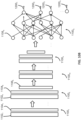
- the neural network may be a convolutional neural network having a sequence of convolutional layers.
- the sequence of convolutional layers may include a first convolutional layer that is configured to apply a convolutional filter on an input ultrasound image to generate an activation map, and include additional convolutional filters that are configured to apply respective convolutional filters on respective activation maps or other outputs of previous convolutional filters in the sequence.
- the sequence of convolutional layers may each include a respective activation layer and/or a maxpooling layer.
- the activation layer may, e.g., apply an activation function (e.g., a rectified linear unit (ReLU) function) to an output of a convolutional filter in the convolutional layer.
- the maxpooling layer may be configured to, e.g., consolidate multiple values from an output of the activation layer into a single value.
- the training of the neural network may involve the first computing system adjusting weights or other parameter values of the convolutional filters or other components of the convolutional layers, so as to cause the sequence of convolutional layers to convert the training images to output values which are equal to the pliability scores used for training, or which have a low amount of deviation from the pliability scores used for training.
- the computing system uses a trained neural network to identify, from an ultrasound image, one or more regions in the ultrasound image that represents one or more respective locations at which there is an entrapped subcutaneous nerve(s) (e.g., a subcutaneous nerve associated with a neurofascial abnormality).
- the trained neural network may be the same neural network configured to generate a pliability score(s) based on the ultrasound image, or may be a different neural network.
- the neural network has been trained (e.g., by the computing system) based on an ultrasound image for a body part of a patient, and based on information that indicates whether the patient is experiencing pain in that body part, and/or information that indicates a location of the pain.
- the ultrasound image may represent a connective tissue layer, a muscle layer covered by or otherwise adjacent to the connective tissue layer, and a bone adjacent to the muscle layer.
- training the neural network may involve inferring a location at which there is likely an entrapped nerve. The inference may be based on, e.g., an overlap between regions in the ultrasound image that represent damaged tissue or blockage of a fluid channel, and nerve location information that defines a path of a nerve (e.g., ulnar nerve) going through that body part. If, for instance, the nerve location information is overlaid on the ultrasound image, the location of an entrapped nerve may be where the known path of the nerve runs through one of the locations at which there is tissue damage or channel blockage.
- a nerve e.g., ulnar nerve
- This determination may be used to train the neural network to identify areas of interest in which there is likely an entrapped nerve.
- the trained neural network may be configured to output a location (e.g., a pixel location) in the ultrasound image at which there is a sufficient likelihood of an entrapped nerve.
- the computing system may use a trained neural network to identify one or more regions of an ultrasound image that represent damaged connective tissue within a connective tissue layer, or more generally to identify one or more regions of interest.
- the neural network may be the same neural network used to generate a pliability score and/or to identify an entrapped nerve, or may be a different neural network.
- the neural network may have been trained (e.g., by the computing system) to recognize features such as regions within the ultrasound image that represent a cluster of high density within the connective tissue layer, and/or a region that represents irregular structure in the connective tissue layer.
- the irregular structure may include, e.g., a cluster having a non-symmetric shape, or a location at which the connective tissue layer has a disorganized structure, such as a non-laminar structure.
- the above features may indicate calcification, adhesion, scarring, or other damage in a connective tissue layer.
- the neural network may be trained to recognize non-laminar structure in the connective tissue layer. More particularly, healthy connective tissue may tend to exhibit laminar structure.
- the ultrasound images for the healthy connective tissue may show distinct continuous lines that demarcate clear borders between various layers or structures within the connective tissue layer, such as a border between a fluid channel and surrounding tissue of the connective tissue layer.
- the neural network may be trained to recognize a laminar structure (e.g., by recognizing lower-level features such as broken or otherwise non-contiguous lines), and to recognize when a laminar structure is not present in a connective tissue layer.
- the lack of a laminar structure in the connective tissue layer may represent, e.g., of the fluid channel.
- blockage of the fluid channel may be correlated with damage to the connective tissue layer. More particularly, blockage of the fluid channel may lead to blockages of the connective tissue, lack of mobility, and stiffness.
- the computing system may perform image segmentation so as to identify the one or more regions of interest, or more specifically one or more regions that represent connective tissue which is likely to be damaged.
- the computing system may use the trained neural network to generate, from an ultrasound image, one or more locations (e.g., pixel locations) at which there is an image feature that corresponds to damaged connective tissue.
- the trained neural network may further generate, from the ultrasound image, a value(s) of a size or dimension of a respective region (e.g., a bounding box or bounding circle) surrounding each of the one or more locations.
- the size or dimensions of the region may correspond to a size or dimensions of an image feature at a location enclosed by the region.
- the trained neural network may be configured to recognize an image feature which corresponds to damaged connective tissue in an ultrasound image, and may be configured to identify a region which approximates an outline or contour of the image feature.
- the computing system may use a trained neural network to output tissue density information that indicates density of a connective tissue layer represented by the ultrasound image.
- the tissue density information may be determined by some other component (e.g., some other software module).
- the tissue density information may be based on, e.g., image intensity information, such as respective intensities of the pixels of the ultrasound image. For example, a higher intensity value for a pixel may indicate higher density at a location corresponding to the pixel, and a lower intensity value for the pixel may indicate lower density at the location.
- the tissue density information may indicate overall density of the connective tissue layer, which may be expressed as, e.g., a percentage of dense tissue to fluid tissue. In some cases, the tissue density may indicate how much of the connective tissue layer is occupied by one or more high-density clusters. Each of the one or more high-density clusters may be a cluster that has a density higher than that of a surrounding region, and which exceeds a defined threshold.
- higher density at a particular location of the connective tissue layer may reflect dehydration, inflammation, and even stress at that location.
- higher density at a particular location of the connective tissue layer may reflect calcification, which may increase an average amount of tissue density and decrease an average amount of tissue fluidity around that location.
- the calcification may be, e.g., a sign of scarring at that location, and thus may indicate damaged connective tissue at that location.
- each of the above factors may indicate potential connective tissue damage and/or health of the connective tissue layer.
- the computing system may use a trained neural network to classify the connective tissue layer as being normal/healthy versus being abnormal/stiff. Such a classification may be made based on, e.g., the tissue density information, such as tissue density values.
- the neural network may be trained to output such a classification based on an input ultrasound image.
- the neural network may have been trained based on ultrasound images of patients, and symptomology information for the patients.
- the symptomology information for the patients may involve, e.g., whether the patients reported experiencing pain, stiffness, and/or lack of mobility in an area being scanned by ultrasound.
- the neural network may be trained to associate tissue density information from the ultrasound images of those patients with their symptomology information.
- the neural network may be trained with such information so as to be able to distinguish between tissue density information (e.g., density values) that are considered to belong to normal/healthy connective tissue, versus tissue density information that are considered to belong to abnormal/stiff connective tissue.
- tissue density information e.g., density values
- the neural network may be trained to establish which density values are normal/healthy for a population of patients, and which density values are abnormal/indicative of low mobility for the population of patients.
- the trained neural network may be trained to remove (e.g., strip out) image information which represents any image portion that represents bone underlying the connective tissue.
- the trained neural network may be configured to convert an input ultrasound image to an updated ultrasound image that segments out (e.g., extracts) the connective tissue layer.
- the neural network may be trained to distinguish between image data that is attributable to the connective tissue layer and/or muscle layer versus image data that is attributable to the bone, and may be configured to generate an updated ultrasound image that removes the effect of the image data that is attributable to the bone.
- image data of the updated ultrasound image may represent tissue at only a certain range of depths, such as 2-5 cm.
- the health of the connective tissue layer may be determined using the updated ultrasound image that represents only the connective tissue layer, or only the connective tissue layer and the muscle layer.
- an ultrasound image represents muscle tissue
- the above techniques used for assessing health of connective tissue may also be used to assess health of muscle tissue.
- a neural network may be trained to recognize whether the muscle exhibits organized structure, or whether the muscle lacks organized structure, and to assess health of the muscle tissue based on those features.
- the combination may involve the use of one or more neural networks to extract an image portion from the ultrasound image that represents a connective tissue layer (e.g., by filtering out image data that represents the bone), to determine tissue density information (e.g., an overall density) of the connective tissue layer, to recognize various features in the extracted image portion, including presence of non-contiguous lines across the connective tissue layer, presence of fusion or calcification in the connective tissue layer, presence of a cluster having a depth-to-width ratio that exceeds a defined threshold (e.g., a threshold of 1), and to recognize a region of the extracted image portion that represents a location at which there is an entrapped nerve in the connective tissue layer or under the connective tissue layer.
- a defined threshold e.g., a threshold of 1
- Such a combination may use a single neural network, or may involve multiple neural networks.
- the clusters or regions that are discussed above may be marked as areas of interest in the ultrasound image.
- FIG. 1 depicts a system 100 for assessing the health of tissue captured or otherwise represented by an ultrasound image, or more specifically an ultrasound image which represents at least connective tissue.
- the system 100 includes a computing system 110 and an ultrasound sensing system 120.
- the ultrasound sensing system 120 may include a scanner (e.g., Clarius ultrasound scanner) that is configured to emit ultrasound waves at a part of a patient's body and to generate measurement data which describe reflection of the ultrasound waves.
- a scanner e.g., Clarius ultrasound scanner
- the ultrasound scanning system 120 may be configured to operate at frequency of about 4 Hz to 100 Hz, and may be configured to sense features that are within 10 cm (e.g., within 2.5 cm) from skin surface, wherein this depth range may correspond to musculoskeletal and/or nerve features (as opposed to internal organs).
- the ultrasound sensing system 120 may be configured to generate an ultrasound image or ultrasound images based on the measurement data, and communicate the ultrasound image or images to the computing system 110.
- the ultrasound images may be ultrasound scan frames that are part of a ultrasound video from a video feed, and each ultrasound image may be an individual frame of the video feed.
- the ultrasound scanning system 120 may communicate the measurement data directly to the computing system 110, which may be configured to generate the ultrasound image or images based on the measurement data.
- the ultrasound scanning system 120 may be configured to generate measurement data for mesoderm-derived tissue, which may refer to tissue that comes from the mesoderm, one of the three germinal layers present in embryonic development.
- Mesoderm-derived tissue may include one or more of connective tissue, muscle, fat, bone, nerve, tendon, and ligament.
- the ultrasound image generated based on the ultrasound scanning system may represent subepidermal tissue, including connective tissue.
- the connective tissue may refer to tissue that joins or is found between other tissues in the body.
- Connective tissue includes connective tissue proper, and special connective tissue.
- connective tissue may be found in structures such as tendons and ligaments, and may be characterized by collagen fibers arranged in an orderly parallel fashion.
- the computing system 110 may include at least one processing circuit 111, a non-transitory computer-readable medium 113, a display device 115, and a communication interface 117.
- the computing system 110 may be or may include a desktop computer, a server, a laptop computer, a tablet computer, a mobile device (e.g., phone), or some other computing system 110.
- the processing circuit 111 may include, e.g., one or more microprocessors or processing cores, an application-specific integrated circuit (ASIC), field programmable gate array (FPGA), or any other processing circuit.
- ASIC application-specific integrated circuit
- FPGA field programmable gate array
- the non-transitory computer-readable medium 113 may include a hard disk drive (HDD), a solid state drive (SSD) or other solid state memory, or any other non-transitory computer-readable medium.
- the display device 115 may be a separate component from the processing circuit 111 and non-transitory computer-readable medium 113, such as when the computing system 110 is a desktop computer, or these components may be integrated to form a single device, such as when the computing system 110 is a laptop computer or tablet computer.
- communication interface 117 may be a circuit or other component, such as a universal serial bus (USB) or Ethernet interface, that is configured to communicate with the ultrasound sensing system 120.
- USB universal serial bus
- Ethernet interface such as a universal serial bus (USB) or Ethernet interface
- the non-transitory computer-readable medium 113 may store ultrasound images 113c, and may include an image processing module 113a.
- the image processing module 113a may include instructions (e.g., a software library) that, when executed by the processing circuit 111, causes the processing circuit 111 to process the ultrasound images 113c.
- the image processing module 113a or more generally, the computing system 110, may be configured to assess health of connective tissue as part of the ScarMap ® software package or system.
- the image processing module 113a may include a neural network, or more specifically a neural network module 113b.
- the neural network module 113b may include parameter values for a trained neural network, such as weights in various layers of the neural network. If the neural network is a convolutional neural network, the weights may belong to convolutional filters in various convolutional layers of the convolutional neural network.
- the neural network module 113b may further include instructions that, when executed by the processing circuit 111, causes the processing circuit 111 to apply the trained neural network to the ultrasound images 113c to determine health of tissue associated with the ultrasound images 113c.
- the trained neural network of the neural network module 113b may be configured to output, based on an ultrasound image that includes a connective tissue layer, one or more values which indicate health of the connective tissue layer, output information which identifies regions of the ultrasound image that represents damaged connective tissue, and/or output information which identifies regions of the ultrasound image that represent a location at which there is an entrapped nerve(s) in the connective tissue layer.
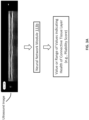
- FIG. 3A illustrates an embodiment in which the trained neural network of the neural network module 113b is configured to output, based on an ultrasound image that includes a connective tissue layer, a value or range of values indicating health of the connective tissue layer.
- the value or range of values may be a pliability parameter value, also referred to as a pliability score, which indicates mobility (or, inversely, stiffness) of the connective tissue layer.
- the pliability score may be, e.g., a score that is based on or affected by a ratio between how much healthy connective tissue is present in the connective tissue layer and how much damaged connective tissue is present in the connective tissue layer.
- the pliability score may be normalized to a particular scale, such as a scale which has a minimum value of zero and a maximum value of 100.
- Such a normalization may simplify interpretation of the pliability score, by facilitating an understanding of whether the pliability score for a particular patient is within some average or median range for a patient population, or whether the pliability score for that particular patient is abnormally high or abnormally low.
- the computing system 110 or more specifically the neural network module 113b, may output the pliability score based on an ultrasound image of a patient's connective tissue, and the pliability score may be used to determine whether the patient needs rehabilitation or other treatment for a particular connective tissue layer in the patient's body, or to determine how to administer that rehabilitation or treatment.
- the neural network used by the neural network module 113b may have also been trained by the computing system 110, or may be trained by a different computing system.
- the training may be performed with, e.g., training ultrasound images that represent healthy connective tissue that have a relatively high level of pliability or mobility, and training ultrasound images that represent damaged connective tissue that have a relatively low level of pliability or mobility.
- the training ultrasound images may be associated with training pliability scores, which may act as a metric that measures health of the connective tissue.
- the training pliability scores may be determined by clinicians, based on the training ultrasound images, and/or based on symptology of patients from whom the training ultrasound images are captured.
- the training of the neural network may involve adjusting the weights or other parameter values of the neural network so as to cause the neural network to compute, based on the training ultrasound images, output values which are the same or substantially similar to the training pliability scores. Training of neural networks is discussed in more detail below with respect to FIGS. 10 through 14 .
- the neural network may be configured to output multiple pliability scores based on a single ultrasound image.
- the pliability scores may be associated with different portions of the ultrasound image, or different regions of the body captured by the ultrasound image.
- FIG. 3F depicts an implementation in which the neural network module 113b may include or may be configured to access a trained neural network that is configured to process an ultrasound image which represents at least connective tissue and adjacent muscle tissue, or more specifically a connective tissue layer and a muscle tissue layer.
- the trained neural network may be configured to output, based on the ultrasound image, a first pliability score that represents overall pliability or mobility for all tissue represented in an entirety of the ultrasound image, a second pliability score that indicates pliability or mobility specifically for the connective tissue in the ultrasound image, and a third pliability score that indicates pliability or mobility specifically for the muscle tissue in the ultrasound image.
- the first pliability score may more specifically be based on a combination of connective tissue and muscle tissue in the entirety of the ultrasound image, and may in some cases ignore or be unaffected by any bone which appears in the ultrasound image.
- training the neural network in this embodiment may involve providing training ultrasound images which are each associated with a respective set of three training pliability scores.
- the set of three training pliability scores may include a first training pliability score that indicates pliability or mobility of all tissue in an entirety of the respective training ultrasound image, a second training pliability score that indicates pliability or mobility specifically of connective tissue in the training ultrasound image, and a third training pliability score that indicates pliability or mobility specifically of muscle tissue in the training ultrasound image.
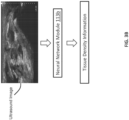
- FIG. 3B depicts an example in which the trained neural network of the neural network module 113b is configured to output, based on the ultrasound image(s), tissue density information for the connective tissue layer.
- the tissue density information may indicate how much of the connective tissue layer is composed of material other than fluid (e.g., other than water), locations in the connective tissue layer at which there are clusters of material having a density which exceeds a defined threshold, respective sizes of the clusters, or any other tissue density information.
- a high-density cluster at a particular location may be indicative of calcification at that location.
- the calcification may be a sign of scarring, and thus may indicate tissue damage in the connective tissue layer.
- the tissue density information may indicate or be used to determine health of the connective tissue layer.
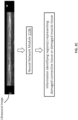
- FIG. 3C provides an example in which the trained neural network of the neural network module 113b is configured to output, based on an ultrasound image representing body tissue, information identifying one or more regions of interest.
- the regions of interest may more specifically be regions showing signs of damaged tissue, or more specifically damaged connective tissue or damaged muscle tissue.
- the neural network may have been trained to recognize a region as having damaged connective tissue based on density of the region, based on a shape of a cluster at the region (wherein the cluster has a density higher and distinct from that of a surrounding region), how symmetric is the shape of the cluster, a size of the cluster, and/or any other feature of the connective tissue layer.
- the neural network module 113b of FIG. 3C may be configured to perform image segmentation, which may involve identifying a location for a particular region of interest and a boundary for that region. For instance, if the region of interest corresponds to a particular image feature in the ultrasound image, such as a group of pixels representing a high density cluster in the connective tissue represented in the image, the trained neural network of the module 113b may be configured to output a location of the image feature, and to identify boundaries of a region (e.g., a bounding circle) that surrounds the location and has a size similar to that of the image feature. The region may thus indicate an approximate set of locations in the connective tissue in which there is a likelihood or sign of damage to the connective tissue.
- image segmentation may involve identifying a location for a particular region of interest and a boundary for that region. For instance, if the region of interest corresponds to a particular image feature in the ultrasound image, such as a group of pixels representing a high density cluster in the connective tissue represented in the image,
- FIG. 3D depicts an embodiment in which the trained neural network of the neural network module 113b is configured to output, based on an ultrasound image that includes at least a connective tissue layer, one or more regions of the ultrasound image (e.g., a group of pixels) that represent one or more respective locations of the connective tissue layer at which there is likely an entrapped nerve.
- the neural network in this embodiment may have been trained with ultrasound images of patients who were experiencing pain.
- the neural network may further have been trained with information indicating location of an entrapped nerve, wherein the information may have been determined based on location of the pain (which may have been indicated by the patient) and on known information indicating a path of a nerve within the connective tissue layer of the patient.
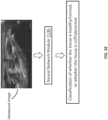
- FIG. 3E illustrates an embodiment in which the trained neural network of the neural network module 113b is configured to output, based on an ultrasound image that includes connective tissue layer, a classification of whether the tissue is healthy/normal versus whether the connective tissue is abnormal/stiff.
- the neural network may output such a classification based on tissue density information, such as density values for the connective tissue layer.
- tissue density information such as density values for the connective tissue layer.
- the neural network in this example may in some instances have been trained based on ultrasound images of patients and their symptomology. For instance, the symptomology may relate to information from the patients for whether they are experiencing stiffness or low level of mobility.
- the connective tissue for patients who reported no pain/stiffness/low mobility in a body part from which the ultrasound image is generated may be considered to have a classification of healthy/normal, and the connective tissue of patients who reported sufficient pain/stiffness/low mobility in the body part may be considered to have a classification of abnormal or stiff.
- the neural network may be trained further based on density values of the connective tissue, which may be an additional or alternative input to the neural network. As stated above, training the neural network in this manner may enable the neural network to establish or define which density values are normal, and which density values are abnormal.
- the trained neural network of the neural network module 113b may be configured to output multiple types of information, such as a combination of the types of information discussed above with respect to FIGS. 3A-3F .
- FIG. 3G illustrates an example in which the neural network module 113b may be configured to apply an ultrasound image to a trained neural network which is configured to output, based on the ultrasound image, one or more of the pliability scores discussed above with respect to FIGS. 3A and 3F , to output information that identifies presence and/or location of an entrapped nerve as discussed above with respect to FIG. 3D , and to output information that identifies regions of interest discussed above with respect to FIG. 3C , such as regions which include a sign of damaged connective tissue or damaged muscle tissue.
- the neural network in this embodiment may be trained with training ultrasound images which are each associated with a respective set of training output information assigned to the training ultrasound image.
- the set of output information may include one or more training pliability scores, training information which indicates presence and/or location of an entrapped nerve in the training ultrasound image, and training information which indicates one or more regions in the training ultrasound image that represent damaged tissue, such as damaged connective tissue or damaged muscle tissue.
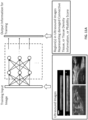
- FIGS. 3H and 3I illustrate additional examples in which a computing system (e.g., the computing system 110 executing the neural network module 113b) uses a trained neural network to output information which indicate health of tissue represented by an ultrasound image. More specifically, the trained neural network may output at least a pliability score which indicates pliability, or more specifically fluidity, of connective tissue and muscle tissue represented in the ultrasound image.
- the pliability score in FIG. 3H may be determined based on an ultrasound image captured from a patient, before the patient has been treated for damaged or stiff connective tissue.
- the pliability score in FIG. 3I may be determined based on another ultrasound image captured from the same patient, after the patient's connective tissue has been treated.
- the trained neural network may further indicate whether there is an entrapped nerve in the tissue represented by the ultrasound image, or more specifically whether there is a neurofascial abnormality in the tissue.
- the computing system may be configured to identify regions in the ultrasound image that include a sign of damaged tissue, and to identify regions in the ultrasound image which include a sign of healthy tissue. For instance, tissue which is harder or more dense in a particular region may have a greater correlation with damage to the tissue in that region, while tissue which is softer in a particular region may have greater correlation with being healthy in that region.
- the computing system may identify regions 302A-302F as regions in which the tissue is harder than in surrounding regions, while in the example of FIG.
- the computing system may identify regions 304A-304E as regions in which the tissue is harder than in surrounding regions. Further in the example of FIGS. 3H and 3I , the computing system may be configured to represent the regions 302A-302F or 304A-304E with one color (e.g., red), and to represent surrounding regions with another color (e.g., blue). More specifically, the computing system may convert a grayscale version of the ultrasound image to a color version of the ultrasound image. The color version of the ultrasound image may have multiple color components, or more specifically multiple color channels, such as a red channel and a blue channel.
- the red channel may represent tissue which is relatively hard, and may have intensity values that are based on a level of hardness, with intensity values increasing (or alternatively decreasing) with increasing levels of hardness.
- the blue channel may represent tissue which is relatively soft, and may have intensity values based on a level of softness, with intensity values increasing (or alternatively decreasing) with increasing levels of softness.
- the computing system may identify the regions 302A-302F or 304A-304D and/or generate the color version of the ultrasound image based on the neural network used to compute the pliability score. In some cases, the computing system may identify the regions 302A-302F or 304A-304D and/or generate the color version of the ultrasound image without relying on the neural network. In such cases, the computing system identify such regions and/or generate the color version of the ultrasound image based on pixel intensity values in the grayscale version of the ultrasound image which is received by the computing system.
- a trained neural network that is configured to output multiple types of information, such as in the example of FIG. 3G , may facilitate more efficient use of computing resources, and thus may provide a technical effect of improving computing efficiency and usage. For instance, training a single neural network to output the pliability scores, to output the information identifying entrapped nerves, and to output the information identifying regions of damaged tissue may reduce an overall amount of training that is needed, and may lead to a neural network that is more accurately trained. Thus, such an embodiment may provide an improvement in computing technology.
- the trained neural network may be configured to process an ultrasound image that represents not only a connective tissue layer, but also underlying muscle and bone.
- the trained neural network may be configured to isolate the connective tissue layer from a remainder of the image data of the ultrasound image.
- the trained neural network may be configured to recognize features which belong solely to the connective tissue layer.
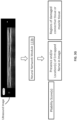
- FIG. 4 illustrates an example in which the trained neural network of the neural network module 113b may be configured to process an ultrasound image to remove (e.g., strip or filter out) image data representing any bone in the image and/or muscle, so as to generate an updated ultrasound image that represents only a connective tissue layer.
- remove e.g., strip or filter out
- the updated ultrasound image may be used to determine one or more of the pliability score, tissue density information, information identifying one or more regions of the updated ultrasound image that represent damaged connective tissue, and/or information identifying one or more regions of the ultrasound image that represent respective one or more locations having an entrapped nerve.
- the neural network used to output the updated ultrasound image may be a first neural network, and one or more additional neural networks may be used to output additional information based on the updated ultrasound image.
- the additional information may be, e.g., the pliability score, the tissue density information, and/or the information identifying region(s) of the updated ultrasound image that represent damaged connective tissue and/or a trapped nerve.
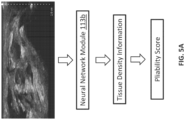
- FIG. 5A depicts an embodiment in which the pliability score discussed above is determined based on tissue density information. More particularly, as stated above with respect to FIG. 3A , the pliability score may be based on or may be affected by a ratio between how much healthy connective tissue is present in the connective tissue layer and how much damaged connective tissue is present in the connective tissue layer. In the example of FIG. 5A , the amount of healthy connective tissue and/or the amount of damaged connective tissue may be determined based on tissue density information, which may be outputted by the trained neural network of the neural network module 113b.
- the tissue density information may indicate how much of the connective tissue layer is occupied by one or more clusters of material which has density higher than a defined threshold. These clusters may be determined to represent tissue that likely has calcification and thus likely has damage. Further, portions of the connective tissue layer which has a density that does not exceed the defined threshold may be determined to likely be healthy connective tissue.
- the tissue density information in FIG. 5A may be determined via a first neural network, and the pliability score may be determined based on the tissue density information. The determination of the pliability score from the tissue density information may be based on a second neural network, or based on some other technique.
- the tissue density information may be determined based on information identifying damaged connective tissue in a connective tissue layer.
- FIGS. 5B and 5C illustrate embodiments in which the trained neural network of the neural network module 113b is configured to identify one or more regions of an ultrasound image that represent damaged connective tissue (or, more generally, to identify one or more regions of interest). These one or more regions may each have, e.g., a cluster with a density that exceeds a defined threshold.
- the tissue density information may indicate, e.g., how much of the connective tissue layer is occupied by the one or more regions, and/or an overall density of the connective tissue layer.
- the one or more regions of interest identified by the trained neural network may additionally or alternatively represent one or more respective locations of the connective tissue layer at which there is likely an entrapped nerve.
- the tissue density information may be used to determine a pliability score, as illustrated in FIG. 5B , or a classification of whether tissue density is normal or abnormal, as illustrated in FIG. 5C .
- the one or more regions may be identified via a first neural network, and a second neural network may use the identified one or more regions to determine the tissue density information.
- the tissue density information may be used to determine the pliability score or the classification via a third neural network.
- the neural network module 113b may be configured to use a first trained neural network to generate an updated ultrasound image which represents a connective tissue layer, and not a muscle layer nor bone adjacent to the connective tissue layer.
- the neural network module 113b may be configured to use the first trained neural network, or a second trained neural network to determine tissue density information from the updated ultrasound image, and/or areas of interest.
- the areas of interest may include regions of the updated ultrasound image which show irregularity, such as regions representing clusters with a density that exceed a defined threshold, clusters having a depth-to-width ratio that exceed 1, clusters having a non-symmetric shape, a value or range of values (e.g., pliability score) indicative of health of the connective tissue, a classification of whether the connective tissue is normal or abnormal, and/or regions showing non-contiguous lines.
- the neural network module may be configured to also output, based on the updated ultrasound image and another trained neural network (e.g., a third trained neural network), regions which represent locations at which there is likely an entrapped nerve.
- FIG. 6 illustrates example steps of a method 600 for assessing health of connective tissue in a connective tissue layer.
- the method 600 may be performed by a computing system, such as the computing system 110, or more specifically by its processing circuit 111.
- the method 600 may begin at step 602, in which the computing system 110 receives an ultrasound image that includes image data which represents subdermal tissue.
- the ultrasound image may be based on sensor data that senses tissue which is within 10 cm of skin surface, and which does not sense deeper tissue (e.g., does not sense internal organs such as lungs).
- the computing system may output an instruction (e.g., via a display device) to instruct a user to administer the ultrasound per body part (e.g., arm, leg, shoulder) with a uniform depth (e.g., 4 cm for the knee) and uniform administration (e.g., horizontal and always administering the ultrasound downwards away from the heart).
- an instruction e.g., via a display device
- a uniform depth e.g., 4 cm for the knee
- uniform administration e.g., horizontal and always administering the ultrasound downwards away from the heart.
- the ultrasound image may be received directly from an ultrasound scanning system (e.g., ultrasound scanning system 120) or may be received from a storage device, or more generally a non-transitory computer-readable medium (e.g., non-transitory computer-readable medium 113).
- the ultrasound image may be a standalone image (e.g., a still image), or may be a frame of a video feed.
- the ultrasound image may be a grayscale image which has a plurality of pixels, wherein each of the pixels has an image intensity value between a defined minimum value (e.g., zero) and a defined maximum value (e.g., 255). A higher image intensity value may cause the pixel to, e.g., appear more white, while a lower image intensity value may cause the pixel to, e.g., appear more dark.
- the computing system may identify, based on a neural network, one or more regions of the ultrasound image that represent damaged connective tissue within a connective tissue layer, wherein the connective tissue layer is located between a skin layer and a muscle layer of the subdermal tissue.
- the one or more regions may be identified by applying the image data as an input to the neural network.
- the neural network may have been trained with a training set of at least ultrasound images that represented damaged connective tissue, so as to be able to recognize damaged connective tissue from an ultrasound image.
- the neural network may have been trained to recognize clusters in the ultrasound image which have a high density and/or an irregular structure (e.g., a non-symmetric shape or non-laminar structure).
- the high density and/or irregular shape may, e.g., indicate locations of calcification that results from scarring of damaged connective tissue.
- the neural network may additionally or alternatively have been trained to recognize regions of the ultrasound image that represent respective locations at which there is an entrapped nerve or channel blockage.
- step 604 may be preceded by a step in which the computing system determines whether the ultrasound image is usable. For instance, the computing system may determine whether the ultrasound image is too dark (e.g., due to error by the person administering the ultrasound scan).
- the computing system 110 may use the trained neural network to process the ultrasound image in chunks, and stitch the result together. Processing the ultrasound image in this manner may reduce the number and/or size of filters needed in the neural network.
- the computing system may determine tissue density information that indicates density of the one or more regions identified by the neural network as representing damaged connective tissue.
- the tissue density information may indicate an overall density of the connective tissue layer, and/or may indicate how much of the connective tissue layer is occupied by one or more high-density clusters, wherein each of the high-density clusters is a cluster of the connective tissue layer having a density that is higher than a defined threshold.
- the computing system may determine, based on the tissue density information, a parameter value or range of parameter values that indicates health of the connective tissue layer represented by the ultrasound image.
- the parameter value or range of parameter values may be a pliability score that indicates mobility (or, inversely, stiffness) of the connective tissue layer represented by the ultrasound image.
- step 610 the computing system outputs, on a display device (e.g., display device 115), the parameter value or range of parameter values that indicate health of the connective tissue layer.
- a display device e.g., display device 115
- the neural network discussed above may be a convolutional neural network that identifies and segments out (e.g., extracts) the connective tissue layer in the ultrasound image, as illustrated by the block diagram of FIG. 4 .
- the neural network may be configured to output an updated ultrasound image that strips out the bone.
- tissue density information, the pliability score, and/or the areas of interest (including regions representing damaged connective tissue) may be determined from the updated ultrasound image.
- the convolutional neural network may have been trained from manually-labeled ultrasound images. Segmenting out the connective tissue layer may allow assessment of the ultrasound image to focus on the connective tissue layer, rather than all layers sensed by the ultrasound image.
- segmenting out the connective tissue layer may allow an effect of an underlying bone on the ultrasound image to be removed, so that the computing system 110 may focus on identifying damage specifically within the connective tissue layer.
- the depth of the connective tissue layer may be influenced by inflammation, dehydration, and other factors (e.g., calcifications, entrapped nerves, fusion with the dermis layer).
- the neural network may be a convolutional neural network, a corner classification neural network, a recurrent neural network, an autoencoder, a generative adversarial neural network (GAN). In some cases, the neural network may be used in combination with unary coding or any other coding.
- the computing system may output the tissue density information on the display device.
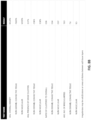
- FIG. 7A depicts an example in which a display device outputs tissue density information that indicates an average overall density of a patient's connective tissue layer, and an average presence of dense clusters.
- the average overall density of the tissue density layer may measure, e.g., a density of tissue material forming the connective tissue layer and/or how much of the connective tissue layer is not fluid.
- the average presence of dense clusters may be a spatial density that measures how much of the connective tissue layer is occupied by clusters which have a density that is higher than a defined threshold.
- these clusters may each be a cluster identified by the trained neural network as a region representing damaged connective tissue.
- the display device may further output an average number of irregularities.
- Each of the irregularities may refer to, e.g., a region of the ultrasound image identified by the trained neural network as representing damaged connective tissue, and the number of irregularities may refer to how many regions have been identified by the neural network as representing damaged connective tissue.
- FIG. 7B depicts another example of output by a display device based on information output by a trained neural network. More particularly, the display device may output an overall density of the connective tissue layer. This information may more specifically indicate how much of the connective tissue layer comprises tissue material and how much of the connective tissue layer is not fluid. The display device may further output an amount of high-density clustering in the connective tissue layer. This information may indicate how much of the connective tissue layer is occupied by dense clusters. Additionally, the output on the display device may further indicate how many irregularities have been identified by the neural network based on the ultrasound image. As stated above, the irregularities may refer to regions of the ultrasound image which have been identified by the neural network as representing damaged tissue.
- FIGS. 8A and 8B provide another example of the output that is generated by processing an ultrasound image using a neural network. Similar to FIG. 7B , the output illustrated in FIG. 8A may indicate an overall density and an amount of high-density clustering in the connective tissue layer, wherein the output may be generated based on an ultrasound image.
- the output in FIG. 7B may further include an updated ultrasound image that uses visual features (e.g., colors) to identify regions representing damaged connective tissue. For instance, these regions may correspond with clusters having a density that exceed a defined threshold.
- the output may include an updated ultrasound image that uses a first color to identify regions that represent such clusters, wherein the first color is different from all other color(s) used for remaining portions of the updated ultrasound image.
- the output may further identify information that indicate health of muscle tissue.
- the techniques discussed above for the connective tissue layer may also be used for the muscle layer.
- the output may indicate tissue density information (e.g., overall density, or average presence of dense clusters) for not only the connective tissue layer, but also for a layer of muscle beneath the connective tissue layer.
- the output may further indicate an average number of irregularities within the layer of muscle.
- the trained neural network in some embodiments of the present application may output information identifying one or more regions that represent damaged connective tissue.
- FIG. 9 illustrates a graphical example of such information. More particularly, the figure presents an ultrasound image added with visual features or visual identifiers (e.g., circles) that each indicates a region of interest.
- the region of interest may identify, e.g., presence of calcifications, adhesions or other scarred and damaged tissue which could lead to blockages of the connective tissue, lack of mobility, and stiffness.
- the region of interest may identify presence of an entrapped nerve(s), and/or indicate blockage of a fluid channel in the connective tissue layer.
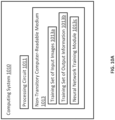
- FIG. 10A depicts a computing system 1010 that is configured to train a neural network to output the information discussed above.
- the computing system 1010 may include a processing circuit 1011 that is configured to execute a neural network training module 1013c.
- the neural network training module 1013c may be configured to train a neural network based on a training set of input ultrasound images 1013a and a training set of output information 1013b.
- the neural network training module 1013c may rely on, e.g., TensorFlow and/or Tensor RT to train the neural network.
- the training set of output information may include, e.g., one or more pliability scores, tissue density information, information identifying one or more regions representing damaged connective tissue, information identifying one or more regions representing respective one or more locations at which there is an entrapped nerve, and/or an updated ultrasound image that includes image data representing only connective tissue and/or muscle tissue (and not representing bone or other structure under the muscle tissue).
- the neural network may be trained on a large set of ultrasound images which reflect a broad range of ages, demographics, a range of connective tissue health (e.g., healthy connective tissue and unhealthy connective tissue), and clinical validation from a variety of trained ultrasound experts.
- FIG. 10B provides an example neural network which may be trained by the neural network training module 1013c.
- the neural network may include a sequence of layers, such as convolutional layers 1100 1 through 1100 n and one or more fully connected layers, such as layer 1100 q .
- each of the convolutional layers 1100 l through 1100 n may include a convolutional filter, such as convolutional filter 1102 l or 1102 k , and a rectification layer, such as rectification layer 1104 l or 1104 k .
- the convolutional filter 1102 l may be configured to perform a convolution on pixels of an ultrasound image, while convolutional filters in other layers may be configured to perform a convolution on output of a previous convolutional layer.
- the rectification layer in a convolutional layer may be configured to apply a rectification function to an output of a convolutional filter in that layer.
- the rectification function may, e.g., set a particular value to zero if the value is below a defined threshold. Examples of the rectification function include, e.g., a sigmoid function or a ReLU function.
- some of the convolutional layers may include a max-pooling layer, such as 1106 k .
- the max-pooling layer may be configured to consolidate a patch of pixels from the rectification layer into a single pixel, and may have an effect to facilitating an ability of subsequent layers to detect larger image features.
- the neural network may include a fully connected layer, such as layer 1100 q , which may include at least one layer of perceptrons that are configured to process an output from a previous layer of perceptrons.
- the neural network may have one or more outputs, such as outputs 1200 l through 1200 n .
- outputs 1200 l through 1200 3 may be a first pliability score, a second pliability score, and a third pliability score, respectively.
- the outputs may additionally or alternatively include values which identify a region of interest, such as a region showing a sign of damaged tissue, and/or values which indicate presence of an entrapped nerve.
- FIGS. 11A and 11B present graphical examples of a neural network, such as the neural network of FIG. 10B , being trained. More particularly, training the neural network may involve adjusting weights based on input ultrasound images and a desired output. The weights may belong to a weighted sum operation of a plurality of components, wherein the weighted sum operation may be represented by convolutional filters and perceptrons.
- the pliability scores used for training the neural network may be provided by a clinician or other doctor of patients seeking treatment for stiffness of limited mobility in their muscles and/or connective tissue. In some instances, the pliability scores used for training may have been determined based on analyzing the ultrasound images.
- the pliability scores may be determined (e.g., manually) based on how much calcification or other scarring in the connective tissue is indicated by the ultrasound images.
- the pliability scores used for training may have been determined without relying on the ultrasound images. For example, they may be determined based on information reported by a patient, such as a level of pliability or stiffness in connective tissue, pain being experienced by the patient in or around connective tissue, or the patient experiencing a lack of mobility or pliability in the connective tissue.
- the pliability scores used for training may have been determined based on a combination of the examples discussed above. In the above example, the ultrasound images used for training may be generated from the patients before and after treatment.
- the ultrasound images which are generated before treatment may be defined as representing damaged connective tissue (or other subdermal tissue), and may be assigned or otherwise associated with low pliability scores, and the ultrasound images which are generated after a successful treatment may be defined as representing healthy tissue, and may be assigned or otherwise associated with high pliability scores.
- the neural network may be trained to recognize one or more regions having a density associated with damaged tissue, such as a density which exceeds a defined threshold, as discussed above.
- the neural network may be trained to recognize a structure associated with damaged tissue. Such a structure may exhibit less organization than healthy connective tissue.
- FIG. 12A illustrates an ultrasound image representing healthy connective tissue. The image shows an organized, laminar structure in which the connective tissue forms clearly, distinguishable borders around a fluid channel. The fluid channel may be responsible for the diffusion and transport of nutrients through the body and elimination of debris.
- FIG. 12B depicts an ultrasound image representing damaged connective tissue. The ultrasound image in FIG. 12B lacks a clear distinguishable fluid channel. Thus, the figure may represent fluid blockage.
- FIG. 13A depicts an example of an ultrasound image that represents healthy muscle tissue
- FIG. 13B depicts an example of an ultrasound image that represents damaged muscle tissue (e.g., muscle tissue having fibrosis).
- the ultrasound image in FIG. 13A represents tissue which has relative low density, as indicated by the lower image intensity (i.e., lower level of brightness) of the ultrasound image.
- the ultrasound image in FIG. 13A further depicts a more laminar structure.
- the ultrasound image in FIG. 13B represents muscle tissue that is more disorganized.
- the figures in FIG. 13A and 13B may be used to train a neural network for identifying damage within the muscle tissue.
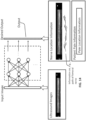
- FIG. 14 illustrates the training of a neural network to recognize a region of an ultrasound image that represents a location within a connective tissue layer at which there is an entrapped nerve.
- the neural network of FIG. 14 may be trained based on known nerve location information and patient pain information.
- the patient pain information may indicate, for example, whether a patient on whom an ultrasound scan is being performed is experiencing pain, and/or a location of the pain. In some cases, the pain may indicate the presence of an entrapped nerve.
- the location of the entrapped nerve may be inferred based on the location of the pain, and/or based on the nerve location information.
- the nerve location information may indicate a known path of a nerve (e.g., femoral nerve or ulnar nerve) through a body part represented by the ultrasound image.
- a location at which the nerve is entrapped may be a location at which there is damaged tissue or channel blockage (which may be identified manually, or may by identified the neural network after it has been trained to recognize tissue damage), and at which the known path of the nerve runs through that location. In some embodiments, this location may be determined manually and used to train the neural network.
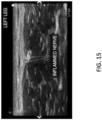
- FIG. 15 depicts information that may be used to train the neural network (such as the neural network of FIG. 14 ) to identify a region in an ultrasound image that represents an entrapped nerve. More specifically, the information may include an ultrasound image and an indication of whether there is an entrapped nerve, as well as a location of the entrapped nerve.
- an inflamed nerve may be identified as the entrapped nerve.
- a location of the inflamed nerve may have been inferred or otherwise determined (manually or automatically) based on known location information for a nerve. For instance, it may be known that the nerve travels in a particular plane of the connective tissue, and this information may be used to infer a location of the inflamed nerve. The location may be used to train the neural network.
- the neural network may be trained to identify a feature of an ultrasound image, such as one or more of: morphology, spiculation, depth-to-width ratio, elliptic-normalized circumference (ENC), shape, presence or absence of calcification, posterior shadow or posterior echo, echo characteristic, slope, and/or whether the tissue is contiguous in nature.
- the neural network may be trained to output an annotated version of the ultrasound image to present the identified feature.
- the morphologic feature may indicate a shape/pattern of the connective tissue layer.
- the spiculation feature may reflect a smoothness of the layer margin.
- the depth-to-width ratio may be an active feature for the classification of soft tissue lesions.
- the depth may refer to as a largest difference between the y -axis values of two points on the margin of the scar.
- the width may refer to a largest difference between the x-axis values of two points on the margin of the scar.
- a neural network may be trained to associate a cluster having a depth-to-width ratio (which may also be referred to as a height-to-width ratio) of greater than 1 with a high probability of the cluster having damaged connective tissue.
- the ENC feature may refer to a circumference ratio of the equivalent ellipse of the scar which is defined as the ratio of the circumference of the ellipse to its diameter.
- the shape feature may be a universal descriptor feature for classification of many soft tissue lesions.
- a regular shape like round and oval may be associated with healthy tissue, while an irregular shape may be associated with damaged tissue.
- the calcification feature may indicate whether there is calcification in the connective tissue layer. In an embodiment, this feature may be determined based on image intensity information of the ultrasound image (e.g., respective intensities of pixels of the image). For instance, a brighter pixel may indicate a higher likelihood of calcification at a location corresponding to the pixel.
- the neural network may be trained to distinguish between intensity caused by calcification caused by calcification in the connective tissue layer versus calcification forming the underlying bone, and to ignore the effect of the bone when determining the calcification in the connective tissue layer.
- the neural network may be configured to generate an updated ultrasound image that does not include an effect of calcium in the bone.
- the posterior shadow or posterior echo feature may reflect the characteristic of the posterior region of the tumor, where gray value is smaller than the region of the surrounding.
- the echo characteristics feature may reflect a model of echo in the ultrasound image, including hypoechoic, isoechoic, hyperechoic, and complex echo.
- the echo signal of different tissues shows different characteristic in the ultrasound image. For example, muscle and fat have considerably higher water content than bone, and thus may have lower average image intensity. For example, muscle and fat in an ultrasound image may appear black. Bone generally has considerably less water content than muscle and fat, and may have higher average image intensity. For instance, the bone may appear as a white cluster in the ultrasound image.
- the slope feature may describe a 2D vector path (e.g., neutral, negative, or positive) of the Basement Membrane of the Hypodermis. Negative indicates an adhesion to the layer(s) below. Positive indicates an adhesion to the dermal layer.
- the contiguous feature may indicate whether the tissue represented by the ultrasound image has an organized, contiguous structure rather than a disorganized structure. For instance, healthy tissue may be organized and laminar in nature. Non-contiguous lines may be representative of adhesion to the dermal layer or calcification.
Landscapes
- Health & Medical Sciences (AREA)
- Life Sciences & Earth Sciences (AREA)
- Engineering & Computer Science (AREA)
- Public Health (AREA)
- Medical Informatics (AREA)
- Biomedical Technology (AREA)
- General Health & Medical Sciences (AREA)
- Surgery (AREA)
- Nuclear Medicine, Radiotherapy & Molecular Imaging (AREA)
- Pathology (AREA)
- Veterinary Medicine (AREA)
- Heart & Thoracic Surgery (AREA)
- Radiology & Medical Imaging (AREA)
- Molecular Biology (AREA)
- Animal Behavior & Ethology (AREA)
- Biophysics (AREA)
- Physics & Mathematics (AREA)
- Computer Vision & Pattern Recognition (AREA)
- Physiology (AREA)
- Epidemiology (AREA)
- Primary Health Care (AREA)
- Oral & Maxillofacial Surgery (AREA)
- Data Mining & Analysis (AREA)
- Databases & Information Systems (AREA)
- Ultra Sonic Daignosis Equipment (AREA)
- Image Analysis (AREA)
Claims (12)
- Rechensystem (110, 1010) zur Verarbeitung von Ultraschallbildern, wobei das Rechensystem umfasst:eine Kommunikationsschnittstelle (117), die so konfiguriert ist, dass sie ein Ultraschallbild (113c) empfängt, das Bilddaten umfasst, die subdermales Gewebe darstellen;mindestens eine Verarbeitungsschaltung (111, 1011), die so konfiguriert ist, dass sie:ein trainiertes neuronales Netzwerk auf das Ultraschallbild anwendet, um mindestens einen Elastizitätsparameterwert zu erzeugen, der die Elastizität des subdermalen Gewebes anzeigt, wobei das trainierte neuronale Netzwerk mit Ultraschallbildern, die als gesundes subdermales Gewebe darstellend definiert wurden, und mit Ultraschallbildern, die als beschädigtes subdermales Gewebe darstellend definiert wurden, und durch Bereitstellen von mit den Ultraschallbildern verbundenen Elastizitätsbewertungen trainiert wurde;das trainierte neuronale Netzwerk auf das Ultraschallbild anwendet, um einen Hinweis darauf zu erzeugen, ob irgendein eingeschlossener Nerv in dem durch das Ultraschallbild dargestellten subdermalen Gewebe vorliegt, wobei das trainierte neuronale Netzwerk auf der Grundlage von Ultraschallbildern und von Informationen, die angeben, ob ein Patient an einer Stelle Schmerzen empfindet, trainiert wurde; undeine Anzeigevorrichtung, die so konfiguriert ist, dass sie den mindestens einen Elastizitätsparameterwert und den Hinweis, ob ein eingeschlossener Nerv in dem durch das Ultraschallbild dargestellten subdermalen Gewebe vorliegt, ausgibt.
- Rechensystem nach Anspruch 1, wobei die mindestens eine Verarbeitungsschaltung (111, 1011) ferner so konfiguriert ist, dass sie das trainierte neuronale Netzwerk auf das Ultraschallbild anwendet, um Informationen zu erzeugen, die einen oder mehrere Bereiche in dem Ultraschallbild anzeigen, die beschädigtes subdermales Gewebe darstellen.
- Rechensystem nach Anspruch 2, wobei das trainierte neuronale Netzwerk darauf trainiert ist, aus dem Ultraschallbild Gewebecluster zu erkennen, die dichter sind als das umgebende Gewebe und denen eine symmetrische Form oder eine laminare Struktur fehlt, und wobei der eine oder die mehreren Bereiche, die durch die von dem trainierten neuronalen Netzwerk erzeugten Informationen angezeigt werden, mindestens einen Cluster von subdermalem Gewebe darstellen, der dichter ist als das umgebende subdermale Gewebe in dem Ultraschallbild und dem eine symmetrische Form oder eine laminare Struktur fehlt.
- Rechensystem nach Anspruch 3, wobei das trainierte neuronale Netzwerk darauf trainiert ist, Cluster zu erkennen, denen eine laminare Struktur fehlt, indem es einen Mangel an deutlichen Schichten unterschiedlicher Dichte in dem das subdermale Gewebe darstellenden Ultraschallbild erkennt, oder indem es nicht zusammenhängende Linien in dem Ultraschallbild erkennt.
- Rechensystem nach Anspruch 2, wobei das in dem Ultraschallbild dargestellte subdermale Gewebe Bindegewebe und Muskelgewebe umfasst, und wobei der mindestens eine Elastizitätsparameterwert einen ersten Elastizitätsparameterwert umfasst, der die Elastizität des Bindegewebes anzeigt, und einen zweiten Elastizitätsparameterwert umfasst, der die Elastizität des Muskelgewebes anzeigt.
- Rechensystem nach Anspruch 5, wobei der mindestens eine Elastizitätsparameterwert einen dritten Elastizitätsparameterwert umfasst, der die Gesamtelastizität einer Kombination aus Bindegewebe und Muskelgewebe anzeigt.
- Rechensystem nach Anspruch 1, wobei die Elastizitätsbewertungen auf einem Verhältnis beruhen, wie viel des in den Ultraschallbildern dargestellten subdermalen Gewebes weniger dicht ist als ein definierter Dichteschwellenwert und wie viel des subdermalen Gewebes dichter ist als der definierte Dichteschwellenwert.
- Rechensystem nach Anspruch 1, wobei die mindestens eine Verarbeitungsschaltung (111, 1011) so konfiguriert ist, dass sie Gewebedichte-Informationen bestimmt, die anzeigen, wie viel des subdermalen Gewebes weniger dicht als ein definierter Dichteschwellenwert ist und wie viel des subdermalen Gewebes dichter als der definierte Dichteschwellenwert ist.
- Rechensystem nach Anspruch 8, wobei die mindestens eine Verarbeitungsschaltung (111, 1011) so konfiguriert ist, dass sie die Gewebedichte-Informationen bestimmt, indem sie einen Gewebedichtewert bestimmt, der eine Gesamtdichte einer Bindegewebsschicht des durch das Ultraschallbild dargestellten subdermalen Gewebes anzeigt.
- Rechensystem nach Anspruch 8, wobei die mindestens eine Verarbeitungsschaltung (111, 1011) so konfiguriert ist, dass sie die Gewebedichte-Information bestimmt, indem sie einen Wert der räumlichen Dichte bestimmt, der eine Raumgröße anzeigt, die von einem oder mehreren Bereichen eingenommen wird, die beschädigtes Bindegewebe innerhalb einer Bindegewebsschicht darstellen, wobei die mindestens eine Verarbeitungsschaltung ferner so konfiguriert ist, dass sie einen Gewebedichtewert und den Wert der räumlichen Dichte ausgibt.
- Verfahren, das von einem Rechensystem durchgeführt wird, wobei das Verfahren umfasst:Empfangen eines Ultraschallbildes, das Bilddaten umfasst, die subdermales Gewebe darstellen;Anwenden eines trainierten neuronalen Netzwerks auf das Ultraschallbild, um mindestens einen Elastizitätsparameterwert zu erzeugen, der die Elastizität des subdermalen Gewebes anzeigt, wobei das trainierte neuronale Netzwerk mit Ultraschallbildern, die als gesundes subdermales Gewebe darstellend definiert wurden, und mit Ultraschallbildern, die als beschädigtes subdermales Gewebe darstellend definiert wurden, und durch Bereitstellen von mit den Ultraschallbildern verbundenen Elastizitätsbewertungen trainiert wurde;Anwenden des trainierten neuronalen Netzwerks auf das Ultraschallbild, um einen Hinweis darauf zu erzeugen, ob irgendein eingeschlossener Nerv in dem durch das Ultraschallbild dargestellten subdermalen Gewebe vorliegt, wobei das trainierte neuronale Netzwerk auf der Grundlage von Ultraschallbildern und von Informationen, die angeben, ob ein Patient an einer Stelle Schmerzen empfindet, trainiert wurde; undAnzeigen des mindestens einen Elastizitätsparameterwerts und des Hinweises, ob ein eingeklemmter Nerv in dem durch das Ultraschallbild dargestellten subdermalen Gewebe vorliegt.
- Rechensystem zur Verarbeitung von Ultraschallbildern, wobei das Rechensystem umfasst:eine Kommunikationsschnittstelle (117), die so konfiguriert ist, dass sie ein Ultraschallbild (113c) empfängt, das Bilddaten umfasst, die subdermales Gewebe darstellen;mindestens eine Verarbeitungsschaltung (111, 1011), die so konfiguriert ist, dass sie ein trainiertes neuronales Netzwerk auf das Ultraschallbild anwendet, um mindestens einen Elastizitätsparameterwert zu erzeugen, der die Elastizität des subdermalen Gewebes anzeigt, wobei das trainierte neuronale Netzwerk mit Ultraschallbildern, die als gesundes subdermales Gewebe darstellend definiert wurden, und mit Ultraschallbildern, die als beschädigtes subdermales Gewebe darstellend definiert wurden, und durch Bereitstellen von mit den Ultraschallbildern verbundenen Elastizitätsbewertungen trainiert wurde; undeine Anzeigevorrichtung, die so konfiguriert ist, dass sie den mindestens einen Elastizitätsparameterwert ausgibt.
Applications Claiming Priority (2)
| Application Number | Priority Date | Filing Date | Title |
|---|---|---|---|
| US202062958430P | 2020-01-08 | 2020-01-08 | |
| PCT/US2021/012708 WO2021142267A1 (en) | 2020-01-08 | 2021-01-08 | Methods and computing system for processing ultrasound image to determine health of subdermal tissue |
Publications (4)
| Publication Number | Publication Date |
|---|---|
| EP4087489A1 EP4087489A1 (de) | 2022-11-16 |
| EP4087489A4 EP4087489A4 (de) | 2024-01-17 |
| EP4087489B1 true EP4087489B1 (de) | 2025-05-14 |
| EP4087489C0 EP4087489C0 (de) | 2025-05-14 |
Family
ID=76787589
Family Applications (1)
| Application Number | Title | Priority Date | Filing Date |
|---|---|---|---|
| EP21738614.3A Active EP4087489B1 (de) | 2020-01-08 | 2021-01-08 | Verfahren und rechnersystem zur verarbeitung von ultraschallbildern zur bestimmung der gesundheit von unterhautgewebe |
Country Status (3)
| Country | Link |
|---|---|
| US (2) | US11684338B2 (de) |
| EP (1) | EP4087489B1 (de) |
| WO (1) | WO2021142267A1 (de) |
Families Citing this family (6)
| Publication number | Priority date | Publication date | Assignee | Title |
|---|---|---|---|---|
| CN113648551B (zh) | 2013-03-08 | 2025-03-25 | 奥赛拉公司 | 用于多焦点超声治疗的装置和方法 |
| KR20220103096A (ko) * | 2019-10-03 | 2022-07-21 | 비트루비아 홀딩스 인코포레이티드 | 결합 조직 복원 방법 |
| US11657373B2 (en) * | 2020-08-21 | 2023-05-23 | Accenture Global Solutions Limited | System and method for identifying structural asset features and damage |
| US11890143B2 (en) * | 2021-04-30 | 2024-02-06 | GE Precision Healthcare LLC | Ultrasound imaging system and method for identifying connected regions |
| EP4391906A4 (de) * | 2021-08-27 | 2025-07-16 | Childrens Medical Center | Mrt-basierte rohrleitung zur beurteilung des risikos von bindegeweberejuration |
| WO2023138792A1 (en) * | 2022-01-24 | 2023-07-27 | Cytoo | Methods using trained classifier to distinguish between healthy and diseased myotubes |
Family Cites Families (15)
| Publication number | Priority date | Publication date | Assignee | Title |
|---|---|---|---|---|
| US5776063A (en) * | 1996-09-30 | 1998-07-07 | Molecular Biosystems, Inc. | Analysis of ultrasound images in the presence of contrast agent |
| US20070179367A1 (en) * | 2000-05-02 | 2007-08-02 | Ruchti Timothy L | Method and Apparatus for Noninvasively Estimating a Property of an Animal Body Analyte from Spectral Data |
| US20020186875A1 (en) * | 2001-04-09 | 2002-12-12 | Burmer Glenna C. | Computer methods for image pattern recognition in organic material |
| JP2010148548A (ja) * | 2008-12-24 | 2010-07-08 | Kao Corp | シワの予測方法 |
| WO2014031760A1 (en) * | 2012-08-21 | 2014-02-27 | Regents Of The University Of Minnesota | System for the treatment of collagen structural abnormalities |
| EP3842001B1 (de) * | 2013-03-15 | 2024-05-08 | Ace Vision Group, Inc. | Systeme zur beeinflussung der biomechanischen eigenschaften von gewebe |
| AU2015259369B2 (en) * | 2014-05-12 | 2019-05-09 | Sonograde Inc. | Method and system of assessing or analyzing muscle characteristics including strength and tenderness using ultrasound |
| US9462968B2 (en) * | 2014-10-17 | 2016-10-11 | General Electric Company | System and method for assessing bowel health |
| US10842379B2 (en) * | 2016-01-29 | 2020-11-24 | Siemens Healthcare Gmbh | Multi-modality image fusion for 3D printing of organ morphology and physiology |
| US20170281094A1 (en) * | 2016-04-05 | 2017-10-05 | The Board Of Trustees Of The University Of Illinois | Information Based Machine Learning Approach to Elasticity Imaging |
| WO2018005891A2 (en) * | 2016-06-29 | 2018-01-04 | Ace Vision Group, Inc. | System and methods using real-time predictive virtual 3d eye finite element modeling for simulation of ocular structure biomechanics |
| US11963729B2 (en) * | 2018-06-21 | 2024-04-23 | Procept Biorobotics Corporation | Artificial intelligence for robotic surgery |
| US11666304B2 (en) * | 2019-02-15 | 2023-06-06 | Medos International Sarl | Portable ultrasound based nerve imaging system |
| CA3156519A1 (en) * | 2019-10-01 | 2021-04-08 | Sirona Medical, Inc. | AI-ASSISTED MEDICAL IMAGE INTERPRETATION AND REPORT GENERATION |
| US12226315B2 (en) * | 2020-08-06 | 2025-02-18 | Carlsmed, Inc. | Kinematic data-based patient-specific artificial discs, implants and associated systems and methods |
-
2021
- 2021-01-08 EP EP21738614.3A patent/EP4087489B1/de active Active
- 2021-01-08 WO PCT/US2021/012708 patent/WO2021142267A1/en not_active Ceased
-
2022
- 2022-07-07 US US17/811,249 patent/US11684338B2/en active Active
-
2023
- 2023-05-11 US US18/315,852 patent/US12029609B2/en active Active
Also Published As
| Publication number | Publication date |
|---|---|
| US12029609B2 (en) | 2024-07-09 |
| WO2021142267A8 (en) | 2021-08-19 |
| US20240108309A1 (en) | 2024-04-04 |
| US20220338834A1 (en) | 2022-10-27 |
| US11684338B2 (en) | 2023-06-27 |
| EP4087489A4 (de) | 2024-01-17 |
| EP4087489C0 (de) | 2025-05-14 |
| WO2021142267A1 (en) | 2021-07-15 |
| EP4087489A1 (de) | 2022-11-16 |
Similar Documents
| Publication | Publication Date | Title |
|---|---|---|
| EP4087489B1 (de) | Verfahren und rechnersystem zur verarbeitung von ultraschallbildern zur bestimmung der gesundheit von unterhautgewebe | |
| CN110276356B (zh) | 基于r-cnn的眼底图像微动脉瘤识别方法 | |
| Welfer et al. | Fovea center detection based on the retina anatomy and mathematical morphology | |
| Giancardo et al. | Automatic retina exudates segmentation without a manually labelled training set | |
| US9959617B2 (en) | Medical image processing apparatus and breast image processing method thereof | |
| Kawathekar et al. | Severity analysis of Osteoarthritis of knee joint from X-ray images: A Literature review | |
| CN104011770B (zh) | 处理并显示乳房图像 | |
| Alharbi et al. | Deep learning based algorithm for automatic scoliosis angle measurement | |
| Rajathi et al. | Varicose ulcer (C6) wound image tissue classification using multidimensional convolutional neural networks | |
| CN116369953A (zh) | 基于肌电与肌氧复合阵列信息的腰背痛识别系统及方法 | |
| CN117710323A (zh) | 内镜甲状腺手术中甲状旁腺识别及血运判断方法及系统 | |
| CN103236062B (zh) | 基于人脑肿瘤核磁库的磁共振图像血管分割系统 | |
| CN111242930A (zh) | 肺结核识别模型的获取方法及装置、存储介质、处理器 | |
| CN109816665A (zh) | 一种光学相干断层扫描图像的快速分割方法及装置 | |
| KR20210060895A (ko) | AI기반 흉부 X-ray 자동판독기 | |
| KR102580749B1 (ko) | 의료영상의 화질평가 방법 및 장치 | |
| KR20210048010A (ko) | AI기반 흉부 X-ray 자동판독기 | |
| Paramitha et al. | Feature Extraction in Liver Cancer Based on Abdominal CT Scan Images using Contour Analysis and GLCM Method | |
| Liu et al. | Computer-aided cirrhosis diagnosis via automatic liver capsule extraction and combined geometry-texture features | |
| Nage et al. | A novel preprocessing unit for effective deep learning based classification and grading of diabetic retinopathy | |
| Chen et al. | Common carotid artery condition recognition technology using waveform features extracted from ultrasound spectrum images | |
| Mohabir | Knee cartilage segmentation of ultrasound images using convolutional neural networks and local phase enhancement | |
| Chakraborty | A lightweight, novel feature extraction and classification system for the early detection of diabetic retinopathy | |
| Audytra et al. | Application of dynamic segmentation in stroke detection software with ANN | |
| Ghorab et al. | Computer-Based Detection of Glaucoma Using Fundus Image Processing |
Legal Events
| Date | Code | Title | Description |
|---|---|---|---|
| STAA | Information on the status of an ep patent application or granted ep patent |
Free format text: STATUS: THE INTERNATIONAL PUBLICATION HAS BEEN MADE |
|
| PUAI | Public reference made under article 153(3) epc to a published international application that has entered the european phase |
Free format text: ORIGINAL CODE: 0009012 |
|
| STAA | Information on the status of an ep patent application or granted ep patent |
Free format text: STATUS: REQUEST FOR EXAMINATION WAS MADE |
|
| 17P | Request for examination filed |
Effective date: 20220706 |
|
| AK | Designated contracting states |
Kind code of ref document: A1 Designated state(s): AL AT BE BG CH CY CZ DE DK EE ES FI FR GB GR HR HU IE IS IT LI LT LU LV MC MK MT NL NO PL PT RO RS SE SI SK SM TR |
|
| DAV | Request for validation of the european patent (deleted) | ||
| DAX | Request for extension of the european patent (deleted) | ||
| P01 | Opt-out of the competence of the unified patent court (upc) registered |
Effective date: 20230526 |
|
| A4 | Supplementary search report drawn up and despatched |
Effective date: 20231215 |
|
| RIC1 | Information provided on ipc code assigned before grant |
Ipc: A61B 90/00 20160101ALI20231212BHEP Ipc: A61B 18/00 20060101ALI20231212BHEP Ipc: A61B 17/00 20060101ALI20231212BHEP Ipc: A61B 5/00 20060101ALI20231212BHEP Ipc: A61B 8/00 20060101AFI20231212BHEP |
|
| GRAP | Despatch of communication of intention to grant a patent |
Free format text: ORIGINAL CODE: EPIDOSNIGR1 |
|
| STAA | Information on the status of an ep patent application or granted ep patent |
Free format text: STATUS: GRANT OF PATENT IS INTENDED |
|
| INTG | Intention to grant announced |
Effective date: 20241113 |
|
| GRAS | Grant fee paid |
Free format text: ORIGINAL CODE: EPIDOSNIGR3 |
|
| GRAA | (expected) grant |
Free format text: ORIGINAL CODE: 0009210 |
|
| STAA | Information on the status of an ep patent application or granted ep patent |
Free format text: STATUS: THE PATENT HAS BEEN GRANTED |
|
| AK | Designated contracting states |
Kind code of ref document: B1 Designated state(s): AL AT BE BG CH CY CZ DE DK EE ES FI FR GB GR HR HU IE IS IT LI LT LU LV MC MK MT NL NO PL PT RO RS SE SI SK SM TR |
|
| REG | Reference to a national code |
Ref country code: GB Ref legal event code: FG4D |
|
| REG | Reference to a national code |
Ref country code: CH Ref legal event code: EP |
|
| REG | Reference to a national code |
Ref country code: IE Ref legal event code: FG4D |
|
| REG | Reference to a national code |
Ref country code: DE Ref legal event code: R096 Ref document number: 602021030786 Country of ref document: DE |
|
| U01 | Request for unitary effect filed |
Effective date: 20250605 |
|
| P04 | Withdrawal of opt-out of the competence of the unified patent court (upc) registered |
Free format text: CASE NUMBER: APP_27729/2025 Effective date: 20250610 |
|
| U07 | Unitary effect registered |
Designated state(s): AT BE BG DE DK EE FI FR IT LT LU LV MT NL PT RO SE SI Effective date: 20250613 |
|
| PG25 | Lapsed in a contracting state [announced via postgrant information from national office to epo] |
Ref country code: ES Free format text: LAPSE BECAUSE OF FAILURE TO SUBMIT A TRANSLATION OF THE DESCRIPTION OR TO PAY THE FEE WITHIN THE PRESCRIBED TIME-LIMIT Effective date: 20250514 |
|
| PG25 | Lapsed in a contracting state [announced via postgrant information from national office to epo] |
Ref country code: NO Free format text: LAPSE BECAUSE OF FAILURE TO SUBMIT A TRANSLATION OF THE DESCRIPTION OR TO PAY THE FEE WITHIN THE PRESCRIBED TIME-LIMIT Effective date: 20250814 Ref country code: GR Free format text: LAPSE BECAUSE OF FAILURE TO SUBMIT A TRANSLATION OF THE DESCRIPTION OR TO PAY THE FEE WITHIN THE PRESCRIBED TIME-LIMIT Effective date: 20250815 |
|
| PG25 | Lapsed in a contracting state [announced via postgrant information from national office to epo] |
Ref country code: PL Free format text: LAPSE BECAUSE OF FAILURE TO SUBMIT A TRANSLATION OF THE DESCRIPTION OR TO PAY THE FEE WITHIN THE PRESCRIBED TIME-LIMIT Effective date: 20250514 |
|
| PG25 | Lapsed in a contracting state [announced via postgrant information from national office to epo] |
Ref country code: HR Free format text: LAPSE BECAUSE OF FAILURE TO SUBMIT A TRANSLATION OF THE DESCRIPTION OR TO PAY THE FEE WITHIN THE PRESCRIBED TIME-LIMIT Effective date: 20250514 |
|
| PG25 | Lapsed in a contracting state [announced via postgrant information from national office to epo] |
Ref country code: RS Free format text: LAPSE BECAUSE OF FAILURE TO SUBMIT A TRANSLATION OF THE DESCRIPTION OR TO PAY THE FEE WITHIN THE PRESCRIBED TIME-LIMIT Effective date: 20250814 |
|
| PG25 | Lapsed in a contracting state [announced via postgrant information from national office to epo] |
Ref country code: IS Free format text: LAPSE BECAUSE OF FAILURE TO SUBMIT A TRANSLATION OF THE DESCRIPTION OR TO PAY THE FEE WITHIN THE PRESCRIBED TIME-LIMIT Effective date: 20250914 |