EP4087279B1 - Ladegerät eines hörgeräts - Google Patents
Ladegerät eines hörgeräts Download PDFInfo
- Publication number
- EP4087279B1 EP4087279B1 EP22163587.3A EP22163587A EP4087279B1 EP 4087279 B1 EP4087279 B1 EP 4087279B1 EP 22163587 A EP22163587 A EP 22163587A EP 4087279 B1 EP4087279 B1 EP 4087279B1
- Authority
- EP
- European Patent Office
- Prior art keywords
- contact
- magnet
- housing
- hearing aid
- charging
- Prior art date
- Legal status (The legal status is an assumption and is not a legal conclusion. Google has not performed a legal analysis and makes no representation as to the accuracy of the status listed.)
- Active
Links
Images




Classifications
-
- H—ELECTRICITY
- H04—ELECTRIC COMMUNICATION TECHNIQUE
- H04R—LOUDSPEAKERS, MICROPHONES, GRAMOPHONE PICK-UPS OR LIKE ACOUSTIC ELECTROMECHANICAL TRANSDUCERS; ELECTRIC HEARING AIDS; PUBLIC ADDRESS SYSTEMS
- H04R25/00—Electric hearing aids
- H04R25/55—Electric hearing aids using an external connection, either wireless or wired
- H04R25/556—External connectors, e.g. plugs or modules
-
- H—ELECTRICITY
- H02—GENERATION; CONVERSION OR DISTRIBUTION OF ELECTRIC POWER
- H02J—ELECTRIC POWER NETWORKS; CIRCUIT ARRANGEMENTS OR SYSTEMS FOR SUPPLYING OR DISTRIBUTING ELECTRIC POWER; SYSTEMS FOR STORING ELECTRIC ENERGY
- H02J7/00—Circuit arrangements for charging or discharging batteries or for supplying loads from batteries
- H02J7/70—Circuit arrangements for charging or discharging batteries or for supplying loads from batteries characterised by the mechanical construction
- H02J7/751—Circuit arrangements for charging or discharging batteries or for supplying loads from batteries characterised by the mechanical construction concerning the insertion or the connection of the batteries
-
- H—ELECTRICITY
- H04—ELECTRIC COMMUNICATION TECHNIQUE
- H04R—LOUDSPEAKERS, MICROPHONES, GRAMOPHONE PICK-UPS OR LIKE ACOUSTIC ELECTROMECHANICAL TRANSDUCERS; ELECTRIC HEARING AIDS; PUBLIC ADDRESS SYSTEMS
- H04R1/00—Details of transducers, loudspeakers or microphones
- H04R1/10—Earpieces; Attachments therefor ; Earphones; Monophonic headphones
- H04R1/1025—Accumulators specially adapted for earpieces; Arrangements specially adapted for charging thereof
-
- H—ELECTRICITY
- H04—ELECTRIC COMMUNICATION TECHNIQUE
- H04R—LOUDSPEAKERS, MICROPHONES, GRAMOPHONE PICK-UPS OR LIKE ACOUSTIC ELECTROMECHANICAL TRANSDUCERS; ELECTRIC HEARING AIDS; PUBLIC ADDRESS SYSTEMS
- H04R2225/00—Details of deaf aids covered by H04R25/00, not provided for in any of its subgroups
- H04R2225/31—Aspects of the use of accumulators in hearing aids, e.g. rechargeable batteries or fuel cells
-
- H—ELECTRICITY
- H04—ELECTRIC COMMUNICATION TECHNIQUE
- H04R—LOUDSPEAKERS, MICROPHONES, GRAMOPHONE PICK-UPS OR LIKE ACOUSTIC ELECTROMECHANICAL TRANSDUCERS; ELECTRIC HEARING AIDS; PUBLIC ADDRESS SYSTEMS
- H04R2420/00—Details of connection covered by H04R, not provided for in its groups
- H04R2420/09—Applications of special connectors, e.g. USB, XLR, in loudspeakers, microphones or headphones
-
- H—ELECTRICITY
- H04—ELECTRIC COMMUNICATION TECHNIQUE
- H04R—LOUDSPEAKERS, MICROPHONES, GRAMOPHONE PICK-UPS OR LIKE ACOUSTIC ELECTROMECHANICAL TRANSDUCERS; ELECTRIC HEARING AIDS; PUBLIC ADDRESS SYSTEMS
- H04R25/00—Electric hearing aids
- H04R25/60—Mounting or interconnection of hearing aid parts, e.g. inside tips, housings or to ossicles
- H04R25/609—Mounting or interconnection of hearing aid parts, e.g. inside tips, housings or to ossicles of circuitry
Definitions
- the invention relates to a charger for a hearing aid.
- the charger has a contact for detachable, direct electrical contact with a mating contact of the hearing aid.
- the invention also relates to a system with a charger and a hearing aid.
- Ambient sound is usually recorded using an electromechanical sound transducer.
- the electrical signals generated from the ambient sound are processed using an amplifier circuit and introduced into the person's ear canal using another electromechanical transducer in the form of a receiver.
- the recorded sound signals are also usually processed, for which a signal processor in the amplifier circuit is usually used.
- the amplification is adjusted to any hearing loss of the hearing aid wearer.
- Electrical energy is required to operate the converter and amplifier circuit.
- This is usually provided in the form of a battery that is located in a housing of the hearing aid. This allows freedom of movement for the person using the hearing aid, i.e. the hearing aid wearer. When the battery is empty, it must be replaced.
- the housing usually has a flap through which the battery can be accessed.
- the disadvantage here is that due to leaks, foreign particles or moisture can penetrate into the housing and thus the Components of the hearing aid, such as the amplifier circuit, can be damaged. As a result, a relatively extensive seal is required. Due to the relatively limited space available, design and manufacturing costs are also increased. Due to the relatively small dimensions of the flap, additional aids are usually required for operation, and incorrect operation by the person cannot be ruled out.
- One alternative is to use a rechargeable battery. If the battery is empty, all that is required to ensure continued functionality is to recharge it without having to remove it. As a result, it is possible to make the housing essentially airtight and operation is simplified.
- a charger is usually used for charging. In one embodiment, the battery is charged inductively. However, this requires the hearing aid to be positioned in a certain position relative to the charger so that the electrical energy can be transferred efficiently. This also requires additional circuitry within the hearing aid, which increases the size of the housing.
- the charger has contacts that are electrically connected directly to the corresponding mating contacts on the hearing aid.
- the contact and the mating contact are plugged into one another.
- the mating contact is usually designed as a flat metal plate and the charger contact is shaped like a pogo pin.
- the electrical contact is made by placing the mating contact on the contact.
- the pogo pins compensate for tolerances, so that even if the mating contact is not placed exactly on the contact, electrical energy can still be transferred. This makes handling easier.
- the pogo pin usually has a contact area that is spring loaded. When the counter contact is placed on the contact, the spring is at least partially compressed and tensioned so that the two contacts are in contact with each other in a force-locking manner.
- the contact area of the pogo pin if it is not electrically connected to the counter contact, also protrudes relatively far from the housing of the charger due to the spring force. If the charger is handled improperly, it cannot be ruled out that other objects will be moved against the non-flush pogo pin, which can damage it.
- DE 10 2007 042 324 A1 shows a hearing aid which has at least one contact means which can be lowered into the hearing aid housing. In an extended or unfolded position, the contact means contacts an external unit, for example a battery charger. The unit has a corresponding opening for receiving the contact means.
- US 2017/0093087 A1 discloses magnetically actuated electrical connectors.
- the electrical connectors include movable magnetic elements that move in response to an externally applied magnetic field.
- the electrical connectors have recessed contacts that move from a recessed position to an engaged position in response to an externally applied magnetic field associated with an electronic device to which the connector is to be connected.
- US 2018/0175643 A1 discloses an apparatus for charging a portable device.
- the apparatus includes a power receiver disposed in the portable device and configured to receive power and deliver the power to the portable device.
- There is a connector configured to include a first magnet and a magnetic element, the first magnet being electrically connected to the power receiver via the magnetic element, while the first magnet is attached to the power receiver by a first magnetic force.
- a charging device for hearing aids is known with a charging circuit for the contactless charging of a battery located in the hearing aid and with a housing that can be closed with at least one cover.
- One or two elongated receiving recesses with a length to width ratio of greater than 1 are provided in the housing, into which a behind-the-ear hearing aid or an in-the-ear hearing aid fits.
- the invention is based on the object of specifying a particularly suitable charger for a hearing aid and a particularly suitable system with a charger and a hearing aid, wherein in particular a susceptibility to repair and/or manufacturing costs are reduced.
- the charger is used to charge a hearing aid, i.e. to supply the hearing aid with electrical energy.
- the charger is suitable for this purpose, in particular intended and set up.
- electrical energy is transferred to the hearing aid by means of the charger, in particular to an energy storage device of the hearing aid.
- the charger of a hearing aid is understood to mean in particular a charger for a hearing aid, whereby the charger is not a component of the hearing aid.
- the hearing aid expediently has a counter-contact, which is, for example, incorporated into a hearing aid housing.
- the counter-contact is made of an electrically conductive material, in particular a metal.
- the counter-contact is made of a ferromagnetic material and, for example, magnetized.
- the counter-contact is expediently electrically contacted with the energy storage device.
- the charger has a charging device that includes a housing.
- a magnet is arranged inside the housing and is guided so that it can move in a longitudinal direction. In particular, it is possible to move the magnet in the longitudinal direction inside the housing. It is expediently only possible to move the magnet in the longitudinal direction, so that it can only be moved in one dimension.
- the magnet is preferably guided by means of the housing itself, suitably by means of any inner walls of the housing or at least parts of the inner walls of the housing. For this purpose, a clearance fit is preferably realized between the housing and the magnet.
- the housing also has a housing cover that delimits the housing on one side, in particular in the longitudinal direction.
- the housing cover is attached to other components of the housing or molded onto it, so that the housing is a single piece.
- the housing cover is attached to a pot-shaped remainder of the housing.
- the housing cover at least partially forms an end face of the housing and is arranged for this purpose in particular essentially perpendicular to the longitudinal direction.
- the magnet is preferably a permanent magnet.
- the magnet is made, for example, from a ferrite or from rare earths or at least comprises these.
- the magnet is suitably designed to be at least partially cylindrical, and the housing is at least partially hollow cylindrical, with the magnet being surrounded by the housing on the circumference.
- the cylinder axis of the magnet is preferably parallel to the longitudinal direction.
- a contact is connected to one longitudinal end of the magnet and is, for example, attached to it or at least supported by it.
- the contact is made of an electrically conductive material, for example brass, copper, magnetic steel or another metal.
- the contact is used for direct electrical contact with the mating contact of the hearing aid and is therefore suitable, in particular intended and set up. This makes it possible to electrically contact the mating contact of the hearing aid with the contact, for which they are in particular mechanically in contact with one another. By releasing it, the electrical contact is interrupted and thus the hearing aid is galvanically separated from the charger. In other words, the electrical connection between the mating contact and the contact is galvanically separable.
- the contact is electrically connected to a charging circuit by means of a line.
- the charging circuit is, for example, also connected to the magnet or separate from it.
- the charging circuit comprises, for example, at least one electrical and/or electronic component, and by means of this in particular an electrical voltage applied to the charger is transformed to charge the hearing aid.
- the charging circuit has, for example, a transformer or at least one converter.
- the charging circuit comprises a control by means of which the electrical potential applied to the contact can be adjusted. In particular, the control is operated accordingly.
- the charging circuit has a connection to a power grid, which is provided, for example, in the form of a cable. During operation, the charging circuit is used in particular to convert an electrical alternating voltage provided in the power grid into an electrical direct voltage.
- the housing cover has an opening within which the contact is inserted.
- a clearance fit is preferably implemented between the contact and the opening. Since the magnet is movable in the longitudinal direction, the contact is therefore also movable in the longitudinal direction.
- the contact is expediently completely surrounded by the housing cover and/or flush with it when the magnet is spaced apart from the housing cover in the longitudinal direction - and for example has the maximum possible distance from it - or is at least moved in this direction. If, on the other hand, the magnet is moved in the direction of the housing cover, the contact expediently projects through the entire housing cover and expediently projects over the housing cover.
- the contact in one of the positions of the magnet, is preferably offset inwards with respect to the housing cover or the housing. In this case, damage to the contact is avoided and it is at least partially protected by the housing cover. Due to the longitudinal mobility of the magnet and the contact, it is possible to move the contact away from the housing, so that electrical contact with the mating contact of the hearing aid is made easier. In particular, due to a magnetic interaction between the mating contact and the magnet, the magnet moves longitudinally towards the housing cover, so that the contact protrudes beyond the housing cover or is at least moved in the direction of the mating contact. This simplifies the establishment of the electrical contact. No comparatively delicate components are required, and it is possible to design the charging device to be comparatively robust.
- the mating contact comparatively deep within the hearing aid housing, i.e. to move it away from its surface into the interior so that it is protected.
- electrical contact between the contact and the mating contact is still possible.
- the contact is preferably at least partially or completely cylindrical, with the axis of the contact suitably being parallel to the longitudinal direction. In this way, installation in the openings and movement of the contact are simplified.
- the contact is suitably arranged at least partially within the housing and protrudes, for example, through the housing wall.
- the contact is surrounded on the magnet side by a sealing ring, by means of which the penetration of foreign particles through the opening into the housing is prevented.
- the sealing ring is made of rubber, for example, and suitably rests against the contact on the circumference.
- the charger comprises two such contacts
- the hearing aid comprises, for example, two corresponding counter contacts.
- the two contacts are connected to the same magnet
- the housing cover has two openings, each of the openings being assigned to one of the contacts.
- the charger comprises two charging devices, each of the charging devices being assigned to one of the contacts.
- the charging circuit preferably provides an electrical voltage that is applied to the two contacts so that an electrical potential difference exists between them. In this way, charging the hearing aid is simplified if it has the two mating contacts, one of which is electrically contacted with one of the contacts.
- the contact is attached to a first circuit board.
- the first circuit board is particularly rigid and preferably made of a glass fiber reinforced epoxy resin.
- the first circuit board is attached to the magnet, in particular by means of gluing.
- the first circuit board and the magnet are only supported, whereby the position of the first circuit board with respect to the magnet cannot be changed or can only be changed to a certain extent, preferably due to further structural conditions. It is thus possible to provide the first circuit board and the contact connected to it as a module that is mounted/attached to the magnet, which simplifies assembly.
- the contact is attached to the first circuit board using SMD technology, for example, and the contact is a surface-mountable component.
- the contact is expediently designed to be at least partially cylindrical and is suitably arranged perpendicular to the first circuit board. This is preferably arranged perpendicular to the longitudinal direction, so that the axis of the contact is suitably parallel to the longitudinal direction.
- the line is formed, for example, by means of a cable or, particularly preferably, by means of a flexible circuit board which is attached to the first circuit board.
- a flexible circuit board which is attached to the first circuit board.
- SMD technology is also used for this, or the flexible
- the circuit board is soldered to the first circuit board in another way.
- a connector is attached to the first circuit board, into which the flexible circuit board is plugged.
- the first circuit board and the flexible circuit board are one piece, so that the first circuit board is also designed to be flexible. Due to the flexible circuit board, electrical contact between the charging circuit and the contact is always ensured, regardless of the position of the contact and/or the magnet within the housing.
- the charger preferably comprises a second circuit board, by means of which the housing is surrounded on the circumference.
- the second circuit board is a component of the charging circuit and forms it, for example.
- the second circuit board comprises, for example, several electrical/electronic components or these are at least attached to the second circuit board.
- the charging circuit comprises further components or circuit boards, which are spaced apart from the second circuit board, for example.
- the second circuit board is preferably ring-shaped and in particular stabilized by means of the housing.
- the second circuit board is particularly preferably attached to the housing cover, so that the second circuit board is a comparatively small distance from the first circuit board. The length of the flexible circuit board and therefore the paths of the electrical contact are therefore comparatively short.
- the second circuit board is also designed to be flexible and, for example, in one piece with the flexible circuit board and/or the first circuit board.
- the second circuit board is particularly preferably rigid and, for example, made from a glass fiber reinforced epoxy resin. In this way, robustness is increased and production is simplified. Thanks to the second circuit board, a comparatively compact charger is provided and assembly of the individual components is simplified.
- the charging circuit is arranged separately from the housing, and the flexible circuit board is expediently guided along the circumference of the magnet along the longitudinal direction.
- the flexible circuit board electrical contacting of the contact with the counter-contact is not hindered, and the flexible circuit board is preferably at least partially between the magnet and the possible inner wall of the housing and thus protected by it.
- a longitudinal recess runs through the magnet, which is designed in particular in the manner of a bore.
- the line is arranged within the recess and is thus protected by the magnet. This also prevents damage to the line due to friction/movement of the magnet on/with respect to any inner wall.
- the line is suitably formed by means of a cable/strand, so that assembly is simplified.
- the recess is expediently closed on one side by means of the contact. As a result, the penetration of foreign particles into the recess is avoided, so that operational reliability is increased. The penetration of moisture is also prevented.
- relative movement of the line with respect to the contact which could lead to wear, is avoided.
- the contact is only placed on the surface of the magnet. However, it is particularly preferred for the contact to engage at least partially in the recess and thus be arranged partially within it.
- the contact suitably has a step that projects beyond the recess and/or partially surrounds the recess.
- the step limits the insertion of the contact into the recess. This simplifies assembly.
- the contact is also stabilized by the recess, which increases robustness.
- the cross-section of the contact in the longitudinal direction is thus suitably at least partially L-shaped or C-shaped.
- the housing cover is designed to be flexible and is particularly preferably made of rubber. This means that if the counter contact is set relatively far into the hearing aid housing, the housing cover is at least partially elastically curved in the direction of the counter contact by means of the magnet due to the magnetic force acting on it, so that the contact is electrically connected to the counter contact.
- the contact is attached to the housing cover so that robustness is increased.
- the housing cover is designed to be flexible, it is moved with the contact in the longitudinal direction when electrical contact is made with the mating contact.
- a fluid-tight connection is suitably created between the contact and the housing cover, for example by means of an adhesive. This prevents foreign particles from entering the charging device through the opening.
- the housing cover is attached to other components of the housing, which are made in particular from a plastic.
- the entire housing is made from rubber and is therefore flexible. This also makes it possible to insert the magnet into the housing, namely by deforming it in a flexible manner.
- the housing expediently has a slot that can be widened in a flexible manner.
- the mobility of the magnet in the longitudinal direction is particularly preferably limited, in particular to less than 1 cm, less than 5 mm, less than 3 mm or less than 2 mm. In this way, jamming of the contact and/or the magnet within the housing is avoided and functional reliability is thus increased. Such mobility is also sufficient to establish electrical contact with the counter-contact.
- the housing suitably has a stop for the magnet, by means of which the movement of the magnet is limited, at least in one direction.
- the stop is provided by means of the housing cover.
- the housing has the stop at the end facing away from the housing cover, which is provided, for example, by means of a plate arranged perpendicular to the longitudinal direction, for example a further cover.
- the stop is preferably shaped like a ring, so that the housing is not designed to be pressure-tight, which is why movement of the magnet within the housing between the stops is not hindered.
- the magnet is provided with a Bar connected.
- the bar is preferably attached to the magnet and, for example, glued to it.
- the bar is arranged transversely to the longitudinal direction and protrudes over the magnet.
- the bar thus protrudes laterally over the magnet, i.e. perpendicular to the longitudinal direction.
- the bar is guided within a slot in the housing that runs in the longitudinal direction. The bar thus prevents the magnet from twisting with respect to the housing, which could otherwise lead to the contact and the housing cover becoming jammed.
- the movement of the magnet within the housing is limited by the bar and the base of the slot, so that any stop is provided in particular by the bar and the slot.
- the end of the contact facing away from the magnet by means of which in particular the direct electrical contact with the counter-contact is made, and which in this case expediently lies mechanically directly against the counter-contact, is flat and, for example, perpendicular to the longitudinal direction.
- the end of the contact facing away from the magnet is particularly preferably curved.
- the top of the contact is thus curved and, for example, convex or concave in shape.
- the end and preferably the entire contact are rotationally symmetrical with respect to the axis of the contact.
- the counter-contact is suitably designed accordingly and has the corresponding curvature.
- the charging device is particularly preferably arranged in such a way that the longitudinal direction is vertical. At least the longitudinal direction is vertical when the charging device is in the intended state.
- the contact is expediently located above the magnet.
- the magnet moves vertically downwards due to the weight force acting on it and thus away from the housing wall.
- the weight force is at least partially compensated by the magnetic force and the magnet is lifted. As a result, the contact is moved in the direction of the counter contact, which simplifies the electrical contact.
- an additional component is provided by means of which the magnet is spaced away from the housing wall or at least moved in the direction away from the housing wall when there is no magnetic interaction with the counter contact.
- the additional component is, for example, a spring, in particular a metal spring, so that robustness is increased. It is also possible to use the charger in different positions and orientations.
- the charger particularly preferably has a charging cradle, which is made of plastic, for example.
- the charging cradle is lined with an insert, which serves in particular to stabilize the hearing aid during the charging process.
- the hearing aid rests, for example, at least partially in a form-fitting manner on the insert, which is thus shaped according to the hearing aid.
- the insert is particularly preferably designed to be flexible and is suitably made of rubber. In this way, tolerances are at least partially compensated for by means of the insert, and damage to the hearing aid is avoided when the hearing aid is inserted into the insert.
- the charging circuit is attached to the charging cradle and arranged, for example, between a wall of the charging cradle and the insert and is thus protected by it.
- the charging device is suitably attached to the insert so that when the hearing aid is positioned accordingly in the insert, the counter contact is always mechanically and therefore electrically contacted with the contact.
- the insert particularly preferably has a charging opening for this purpose, which is at least partially closed by the housing cover. The hearing aid is thus always securely positioned with respect to the contact.
- the charging device and/or the insert particularly preferably have a seal arranged between them so that the penetration of foreign particles between the insert and the charging device is avoided.
- the seal is particularly preferably attached to the housing cover and, for example, is molded onto it.
- the housing cover is preferably made of rubber and has the seal in the form of a bead projecting in the longitudinal direction, which is, for example, circular, and preferably surrounds the contact at a distance. At least the seal surrounds the charging opening and, for example, rests force-fittingly on the insert when assembled. This further increases tightness.
- the insert is firmly attached to the charging cradle.
- the insert is detachably attached to the charging cradle and also detachably attached to the charging device.
- This makes it possible to adapt the charging device to different hearing aids by exchanging the insert, whereby the same charging cradle and the same charging device can be used in each case.
- it is possible to manufacture the charging device for a number of different hearing aids, whereby only the insert is adapted in each case.
- This enables at least partial mass production, which means that manufacturing costs are reduced.
- the system has a hearing aid.
- the hearing aid is, for example, a headset or includes a headset.
- the hearing aid is particularly preferably a Hearing aid.
- the hearing aid is used to support a person suffering from a reduction in hearing.
- the hearing aid is a medical device that can be used to compensate for a partial hearing loss, for example.
- the hearing aid is, for example, a receiver-in-the-canal hearing aid (RIC), an in-the-ear hearing aid such as an in-the-ear hearing aid, an in-the-canal hearing aid (ITC) or a completely-in-canal hearing aid (CIC), hearing glasses, a pocket hearing aid, a bone conduction hearing aid or an implant.
- the hearing aid is a behind-the-ear hearing aid that is worn behind an auricle.
- the hearing aid is intended and configured to be worn on the human body.
- the hearing aid preferably comprises a holding device by means of which it can be attached to the human body.
- the hearing aid is suitably shaped.
- the hearing aid is intended and configured to be arranged, for example, behind the ear or within an ear canal.
- the hearing aid is wireless and intended and configured to be at least partially inserted into an ear canal.
- the hearing aid preferably has a hearing aid housing.
- all other components of the hearing aid are arranged in the hearing aid housing, at least preferably any electronics, such as an amplifier circuit.
- the hearing aid housing is made in one piece or, particularly preferably, from several components.
- the hearing aid housing is suitably made from a plastic, in particular using a plastic injection molding process. This means that there is comparatively great freedom of design. The weight of the hearing aid housing is also not excessively increased.
- a microphone in particular an electromechanical sound transducer, is arranged in the hearing aid housing.
- the microphone is used to record ambient sound and is suitable, in particular intended and set up for this purpose.
- the microphone is connected electrically and/or in terms of signal technology to any electronics, in particular the amplifier circuit, or other electrical/electronic components of the hearing aid. These are used to suitably process the signals recorded by the microphone.
- the hearing aid particularly preferably comprises a further electromechanical sound transducer, in particular a receiver, by means of which the signals processed by means of the amplifier circuit are emitted.
- the receiver is also arranged in the hearing aid housing or in another housing.
- a signal connection between the two housings is made by means of a line, in particular if the hearing aid is a RIC hearing aid.
- the hearing aid comprises an energy storage device, by means of which a power supply is provided.
- the energy storage device is expediently used to power any electronics/sound transducers.
- the energy storage device is suitably arranged within any hearing aid housing.
- the energy storage device is rechargeable, and expediently a rechargeable battery.
- the hearing aid comprises a counter contact, which is, for example, introduced into the hearing aid housing.
- the counter contact is thus accessible from outside the hearing aid housing.
- the hearing aid housing comprises a cover that can be detachably placed over the counter contact, for example folded.
- the counter contact is preferably electrically connected to the energy storage device, for example directly or via a charging circuit.
- the system also has a charger that is used to charge the hearing aid, namely the energy storage device.
- the charger is suitable for this purpose, in particular intended and set up.
- the charger and the hearing aid are separate units/components of the system that can be removed from one another. When charging, however, the charger and the hearing aid are electrically connected to one another.
- the charger comprises a charging device which has a housing comprising a housing cover and a magnet arranged therein which is guided so as to be movable in a longitudinal direction.
- a contact for detachable, direct electrical contact with the mating contact of the hearing aid is connected to the magnet at one longitudinal end, which is electrically connected to a charging circuit by means of a cable.
- the housing cover has an opening within which the contact is inserted.
- the contact of the charger is electrically contacted with the mating contact of the hearing aid, for which purpose they are expediently mechanically in direct contact with one another.
- the charger expediently has the insert by means of which the hearing aid is held and/or stabilized when the hearing aid is charged.
- the two devices i.e. the charger and hearing aid, are detached from each other or connected to each other, with the hearing aid expediently lying in the insert.
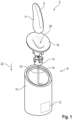
- a system 2 is shown in perspective in an exploded view, which comprises a hearing device 4 in the form of a hearing aid device.
- the hearing aid device 4 is a "behind-the-ear” (BTE) or “receiver-in-canal” (RIC) hearing aid device and comprises a hearing aid housing 6 made of a plastic.
- An energy storage device (not shown in detail) in the form of a rechargeable battery is arranged within the hearing aid housing 6.
- an amplifier circuit powered by the energy storage device and an electromechanical sound transducer in the form of a microphone are present in the hearing aid housing 6.
- the system 2 further comprises a charger 8, which has a cup-shaped charging cradle 10.
- the charging cradle 10 is made of plastic and is rigid.
- a charging circuit 12 (not shown in detail) is arranged within the charging cradle 10, which comprises a converter and/or transformer and by means of which an electrical direct voltage is provided during operation.
- the charging circuit 12 comprises a cable (not shown in detail) which is suitable for electrical connection to a power network (not shown in detail).
- the charger 8 has a charging device 14 which has two lines 16 In the assembled state, the two lines 16 are electrically contacted with the charging circuit 12, so that the charging device 14 is supplied with electrical energy via the lines 16 by means of the charging circuit 12.
- the charger 8 has an insert 18, by means of which the charging cradle 10 is partially lined.
- the insert 18 is made of rubber, and by means of which the opening of the cup-shaped charging cradle 12 is closed, for which the insert 18 is arranged there.
- the insert 18 has a receptacle 20 which is adapted to the shape of the hearing aid 4, so that at least part of the hearing aid 4 can be positively positioned within the receptacle 20 of the insert 18, and is held securely there.
- the insert 18 is detachably attached to the charging cradle 10, and the charging device 14 is detachably attached to the insert 18, wherein the charging device 14 is located in a longitudinal direction 22, which is perpendicular, i.e. vertical, below the insert 18 and below the receptacle 20.
- the charging device 14 is thus surrounded by the insert 18 and the charging cradle 20 and is therefore protected.
- the charging circuit 12 is also arranged there and is protected by the charging cradle 10 and the insert 18.
- the insert 18 is formed from a rigid plastic so that the fastening of the charging device 14 is simplified. Alternatively or in combination with this, more play is formed between the holder 20 and the hearing aid 4 so that a wide variety of devices can be accommodated using the holder 20.
- the insert 18 and the charging device 14 are shown in perspective.
- the insert 18 has a charging opening 24 which opens into the receptacle 20 and which forms the lower end of the receptacle 20 in the longitudinal direction 22.
- the charging opening 24 is closed in the assembled state by means of the charging device 14, which has several springs 26, each of which lies in corresponding grooves 28 of the insert 18 running in the longitudinal direction 22 in the assembled state. Due to the arrangement of the grooves 28 and the springs 26, it is possible to position the charging device 14 in different positions with respect to the insert 18, so that different hearing aids 4 can be used with the charging device 8.
- the charging device 14 is shown in perspective in an exploded view.
- the charging device 14 has a housing 30 with a pot-shaped rest (housing) 31, the axis of which is parallel to the longitudinal direction 22, i.e. vertical.
- the rest 31 has the springs 26, which are arranged rotationally symmetrically to one another.
- the rest 31 of the housing 30 is made of a plastic and is closed at the upper end in the longitudinal direction 22 by means of a housing cover 32 of the housing 30, which is designed to be flexible and made of a rubber.
- the housing cover 32 is attached to the rest 31 by means of an adhesive (not shown in detail).
- the housing cover 32 is arranged perpendicular to the longitudinal direction 20 and is round in shape and has four extensions 33 which are located in the region of the springs 26 of the remainder 31 and which are at least partially located in a correspondingly shaped recess 34 of the remainder 31, which also has an annularly shaped part within which an edge of the housing cover 32 lies.
- the housing cover 32 has two openings 35 running in the longitudinal direction 22, within each of which a contact 36 is inserted.
- the contacts 36 are cylindrical, with their axis also being parallel to the longitudinal direction 22.
- the contacts 36 are movable with respect to the housing cover 32, and a clearance fit is created between each opening 35 and the respective contact 36. In an alternative to this, a press fit is created between them, or the contacts 36 are glued to the housing cover 32.
- a magnet 38 is arranged within the housing 30, which is cylindrical and made of a ferrite.
- the magnet 38 is a permanent magnet.
- the axis of the magnet 38 is parallel to the longitudinal direction 22, and the magnet 38 has two recesses 40 running in the longitudinal direction 22, which are designed in the manner of a bore and are completely Magnets 38 protrude through.
- one of the lines 16, which are designed as a cable or stranded wire is inserted at the end, and one of the contacts 36 is directly attached to each of the ends of the lines 16 and thus electrically contacted with it.
- Each contact 36 is tapered at the lower end in the longitudinal direction 22 by means of a step 42 that projects beyond the recess 40.
- each contact 36 is arranged within the respective recess 40, which is thus closed by means of the respective contact 36.
- the two contacts 36 are connected to a longitudinal end 43 of the magnet 38, which are electrically connected to the charging circuit 12 by means of the respectively assigned line 16, the housing cover 32 having the two openings 35 within which the contacts 36 are inserted.
- the charging device 14 is arranged such that the longitudinal direction 22 is vertical, with the contacts 36 being located above the magnet 38.
- the housing 30 On the side opposite the housing cover 32, the housing 30 is recessed in the middle so that this end of the housing 30 is formed by means of an annular stop 44.
- the two flexible lines 16 are led out of the housing 30 through the further opening 46 formed in this way.
- the housing 30, namely the pot-shaped remainder 31 has a slot 48 running in the longitudinal direction, within which a strip 50 is arranged transversely to the longitudinal direction 22, which is glued to the magnet 28 on the side opposite the longitudinal end 43 in the longitudinal direction 22. It is possible to move the magnet 38 within the housing 30, the movement of the magnet 38 being limited by means of the stop 44 and the slot 48. In other words, the magnet 38 is guided so as to be movable in the longitudinal direction 22.
- the two contacts 36 move in the longitudinal direction 22. If the contacts 36 are movable with respect to the housing cover 32, the contacts 36 are at least partially pushed through the openings 35. If, however, the contacts 36 are attached to the housing cover 32, the housing cover 32 is at least partially bulged out. If no further forces act, the magnet 38 rests on the stop 44 due to the force of weight, and the contacts 36 are moved in the longitudinal direction 22 to the lowest possible position.
- two counter contacts 52 introduced into the hearing aid housing 6 approach the charging opening 24, as shown in Figure 5 shown in a sectional view along the longitudinal direction 22.
- the counter contacts 52 are made of a ferromagnetic metal and are electrically connected to the rechargeable battery by means of a further circuit board 54, which is arranged inside the hearing aid housing 6.
- Each counter contact 52 is arranged inside a respective blind hole 56 and offset inwards with respect to the surface of the hearing aid housing 6. Due to the shape of the receptacle 20, the counter contacts 20, which are also cylindrical, are aligned such that their axis is parallel to the longitudinal direction 22.
- the interaction of the counter contacts 52 with the magnet 38 increases, causing the magnet to move upwards in the longitudinal direction 22 within the housing 30.
- the contacts 36 are also moved upwards in the longitudinal direction 22 towards the hearing aid 4.
- the contacts 36 are not attached to the housing cover 32, the contacts 36 are moved through the housing cover 32. If the contacts 36 are attached to the housing cover 32, the housing cover 32 is bulged out in the direction of the hearing aid 4.
- the strip 50 prevents the magnet 38 and thus the contacts 36 from moving excessively towards the hearing aid 4.
- the contacts 36 partially penetrate into the blind holes 56 at the ends.
- the position of the blind holes 56 is adapted to the position of the openings 35.
- the contacts 36 are mechanically in direct contact with the respective associated counter-contacts 52 and are thus electrically contacted. Due to the direct mechanical contact between the contact 36 and the respectively assigned mating contact 52, an electrical contact is made between them, so that the contacts 36 serve for detachable, direct electrical contact with the mating contacts 52 of the hearing aid 4.
- the ends of the contacts 36 facing away from the magnet 38 are curved, i.e. the ends facing the mating contacts 52. These ends are convex in shape.
- the ends of the mating contacts 52 facing the contacts 36 are concavely curved, with the type of curvature corresponding, which is why there is direct flat contact between them. Due to the curvature, flat contact between the contacts 36 and the mating contacts 52 is possible even if the hearing aid 4 is not precisely aligned with the charging device 14.
- an electrical voltage is applied to the contacts 36 via the lines 16 by means of the charging circuit 12, so that an electrical current is passed via the contacts 36 and the counter contacts 52, by means of which the rechargeable battery of the hearing aid 4 is charged.
- the hearing aid 4 is moved upwards in the longitudinal direction 22 out of the holder 20, and the magnetic interaction between the counter contacts 52 and the magnet 38 is reduced.
- the magnet 38 is again moved downwards in the longitudinal direction 20 due to the continued force of gravity, and consequently also the contacts 36, so that they are at least partially surrounded by the housing 30, which is why damage is avoided. It is also not necessary for the counter contacts 52 to protrude beyond the hearing aid housing 6, which is why damage to these is also avoided.
- the loading opening 24 is closed by means of the housing cover 32, which protrudes laterally, i.e. perpendicular to the longitudinal direction 22 with respect to the loading opening 34.
- a seal 58 is formed on the housing cover 32 or a part thereof.
- the seal 58 is an annular bead that is arranged around the loading opening 24, so that the entry of foreign particles between the housing 30 and the insert 18 is prevented.
- FIG 6 a modification of the charging device 14 is shown in perspective in an exploded view.
- the housing cover 32 has not been changed.
- the remainder 31 of the housing 30 no longer has the springs 26, for example, but it is also possible that these are still present.
- the magnet 38 is now intact and therefore no longer has the recesses 40, which makes it easier to manufacture.
- the two contacts 36 are attached to a round first circuit board 60 arranged perpendicular to the longitudinal direction 22 using SMD technology.
- the first circuit board 60 is made of a glass fiber reinforced epoxy resin and attached to the longitudinal end 43 of the magnet 38.
- Each line 16 is formed by means of a respective flexible circuit board, each of which is attached at its end to the first circuit board 60.
- the two flexible circuit boards, i.e. the two lines 16 are guided along the circumference of the magnet 38 along the longitudinal direction 22 and thus run in the longitudinal direction between the magnet 38 and the rest of the housing 31. These also emerge from the housing 30 through the further opening 46 and are electrically connected to the charging circuit 12, which is not changed.
- FIG 7 a modification of the first circuit board 60 is shown, which is now rectangular in shape.
- Two sealing rings 62 have also been removed, which are made of rubber and are each assigned to one of the contacts 36.
- the sealing rings 62 rest on the first circuit board 60, just as in the previous embodiment, and are stabilized there in this way.
- the sealing ring 62 ensures that foreign particles do not enter the housing 30 through the opening 35.
- the circuit board 16 is a component of the hearing aid 4, and the contacts 36 shown form the counter contacts 52.
- the sealing rings 62 are not present.
- the sealing effect is realized by means of the cover 32 made of an elastic material.
- the cover 32 of the charging device 14 is therefore a guide, bearing and seal in one.
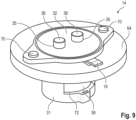
- FIG 8 is a further embodiment of the charging device 14 in an exploded view and in Figure 9 in an assembled state.
- the housing 30 is made in one piece from a flexible rubber, so that the housing cover 32 and the rest 31 are molded onto it.
- the housing cover 32 in turn has the two openings 35, within which the two contacts 36 lie in the assembled state.
- These are in turn attached to the first circuit board 60, which is designed as a flexible circuit board and is in one piece with the flexible circuit board providing the lines 16.
- the two lines 16 are formed by means of the common flexible circuit board.
- the flexible circuit board and thus the lines 16 are attached to and electrically contacted with a second circuit board 64, which is a component of the charging circuit 12 and comprises electrical and/or electronic components not shown in detail.
- the second circuit board 64 is arranged perpendicular to the longitudinal direction 22 and is ring-shaped.
- the second circuit board 64 surrounds the remainder 31 of the housing on the circumference and rests against two opposing tabs 66 of the housing cover 32, which protrude laterally beyond the seal 58.
- a holding opening 68 is made in each tab 66, into which corresponding pins 70 of the second circuit board 64 engage, so that the housing 30 is stabilized with respect to the second circuit board 64.
- the housing 30, at least the remainder 31, is thus surrounded on the circumference by the second circuit board 64 of the charging circuit 12, and the second circuit board 64 is fastened to the housing cover 32, namely the tabs 66.
- the magnet 38 is unchanged from the previous embodiment and is introduced into the housing 30 through a mounting opening 72 which is made in a peripheral side of the remainder 31.
- the mounting opening 72 is elastically widened.
- the slot 48 and the strip 50 of the previous embodiments, however, are not present.
- FIG 10 A modification of the hearing aid 4 is shown in a sectional view.
- a Hall sensor 74 is attached on the further circuit board 54, on the lower side in the longitudinal direction 22, i.e. on the side facing the charging device 14. This is used to detect the approach of the hearing aid 4 to the magnet 38. If the measurement data recorded by the Hall sensor 74 exceeds a certain value, it is ensured that the counter contacts 52 have fallen below a certain distance from the magnet 38, at which the counter contacts 52 are mechanically in direct contact with the contacts 36 due to the design conditions.
- the counter contacts 52 are also still arranged in the blind holes 56, the bottom of which is provided by the additional circuit board 54. In this variant, the counter contacts 52 are simply placed on the additional circuit board 54 without protruding through the additional circuit board 54.
- a further seal 76 is attached to the further circuit board 54, which is located on the side of the Hall sensor 74 and encloses it.
- the further seal 76 also surrounds the counter contacts 52 and serves to seal the interior of the hearing aid housing 6.
- the blind holes 56 are lined at the ends using the further seal 76, so that the penetration of foreign particles into the hearing aid housing 6 is prevented.
- the additional circuit board 54 is part of a main electronics system, and the magnetic and electrical counter contacts 52 are applied directly with SMD, either by means of a hole positioning or flat without a step with a positioning aid in the process.
- the additional seal 76 can be one-piece or, as shown, consist of two rings and seals off the housing 6 of the hearing aid 4.
- the Hall sensor 74 is not present and, for example, other electronics of the hearing aid 4 are arranged in this place, so that the hearing aid 4 is comparatively compact.
- the Hall sensor 74 if present, can also fulfill certain control tasks for the hearing aid 4 and is preferably arranged comparatively close to the magnet 38.
- FIG 11 a modification of the hearing aid 4 is shown in detail in accordance with the previous figure.
- the additional seal 76 is also present, but not shown, and again serves to seal the interior of the hearing aid housing 6.
- the additional seal 76 continues to surround the two mating contacts 52 and partially lines the holes 56.
- the additional seal 76 is also still attached to the additional circuit board 54.
- the two counter contacts 52 in turn protrude through the further circuit board 54, as in the Figure 5 shown variant.
- the Hall sensor 74 is arranged on the side opposite the openings of the blind holes 56, i.e. on the upper side of the further circuit board 54 in the longitudinal direction 22 when the hearing aid 4 is held within the receptacle 20.
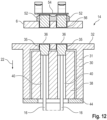
- FIG 12 and Figure 13 a final modification of the charging device 14 is shown in a sectional view along the longitudinal direction 22.
- all components of the housing 30 are made of a rigid plastic.
- the housing 30 also still has the remainder 31, but the housing cover 32 is molded onto it and is in one piece with it.
- the stop 44 which is also still formed by means of a rigid ring and which forms the lower end of the housing 30 in the longitudinal direction 22, is a separate component. In the assembled state, the stop 44 is attached to the other components of the remainder 31, for example by means of welding or gluing. If the stop 44 is not yet assembled, the magnet 38 is introduced into the housing 30 from this side, which is inserted in accordance with the Figures 3-5 shown variant. The magnet 38 again has the two recesses 40 running in the longitudinal direction 22.
- the lines 16 also correspond to the Figures 3-5
- the contacts 36 are again arranged in the openings 35 and, with the exception of the ends opposite the magnet 38, according to the previous However, in contrast to the previous embodiments, these ends are designed to be flat and smooth.
- a clearance fit is also formed between the contacts 36 and the respective recess 35, so that the contacts 36 can be moved in the longitudinal direction 22 through the housing cover 32 by means of the magnet 38.
- the counter contacts 52 are offset inwards with respect to the surface of the hearing aid housing 6, so that the counter contacts 52 do not protrude beyond the surface of the hearing aid housing 6.
- the two contacts 36 are moved upwards in the longitudinal direction 22 due to the magnetic interaction, as shown in Figure 13 shown, so that the electrical and mechanical contact of the contacts 36 with the two mating contacts 52 is again made. In this state, the contacts 36 protrude upwards in the longitudinal direction 22 over the housing cover 32 and dip into the blind holes 56 at the end, which in this embodiment have no bottom.
- the magnetic interaction cannot compensate for the weight force, so that the magnet 38 is moved downwards in the longitudinal direction 22 until it rests on the stop 44, as shown in Figure 12 shown.
- the contacts 36 are retracted into the openings 35 so that they do not protrude upwards over the housing cover 32 in the longitudinal direction 22.
- the contacts 36 are, for example, flush with the surface of the housing cover 32 or slightly offset further downwards in the longitudinal direction 22. This prevents damage to the contacts 36.
- the movement of the magnet 38 and thus of the contacts 36 in the longitudinal direction 22 is limited in this embodiment by means of the rigid housing cover 32 and the rigid stop 44.
- the counter contacts 52 and/or the contacts 36 are again curved.
- pins namely the two contacts 36 and the two counter contacts 52 of the hearing aid 4 are electrical and magnetic.
- the material is preferably magnetic steel.
- the field lines of the magnet 38 are bundled and aligned by the arrangement and shape of the pins (contacts 36 / counter contacts 52). In this way, an effective use of magnetic force is achieved due to the high number and the narrowness of the field lines between the pin pairs.
- the pins are magnetized by the magnet 38 and snap together due to the magnetic force acting when the distance is small enough.
Landscapes
- Engineering & Computer Science (AREA)
- Physics & Mathematics (AREA)
- Acoustics & Sound (AREA)
- Signal Processing (AREA)
- Computer Networks & Wireless Communication (AREA)
- Health & Medical Sciences (AREA)
- General Health & Medical Sciences (AREA)
- Neurosurgery (AREA)
- Otolaryngology (AREA)
- Power Engineering (AREA)
- Charge And Discharge Circuits For Batteries Or The Like (AREA)
Description
- Die Erfindung betrifft ein Ladegerät eines Hörgeräts. Das Ladegerät weist ein einen Kontakt zur lösbaren, direkten elektrischen Kontaktierung mit einem Gegenkontakt des Hörgeräts auf. Ferner betrifft die Erfindung ein System mit einem Ladegerät und einem Hörgerät.
- Personen, die unter einer Verminderung des Hörvermögens leiden, verwenden üblicherweise ein Hörhilfegerät. Hierbei wird meist mittels eines elektromechanischen Schallwandlers ein Umgebungsschall erfasst. Die anhand des Umgebungsschalls erstellten elektrischen Signale werden mittels einer Verstärkerschaltung bearbeitet und mittels eines weiteren elektromechanischen Wandlers in Form eines Hörers in den Gehörgang der Person eingeleitet. Meist erfolgt zudem eine Bearbeitung der erfassten Schallsignale, wofür üblicherweise ein Signalprozessor der Verstärkerschaltung verwendet wird. Hierbei ist die Verstärkung auf einen etwaigen Hörverlust des Hörhilfegeräteträgers abgestimmt.
- Für den Betrieb der Wandlers sowie der Verstärkerschaltung ist jeweils elektrische Energie erforderlich. Diese wird üblicherweise in Form einer Batterie bereitgestellt, die in einem Gehäuse des Hörhilfegeräts angeordnet ist. Somit ist eine Bewegungsfreiheit für die das Hörhilfegerät nutzende Person, also den Hörhilfegeräteträger, ermöglicht. Wenn die Batterie leer ist, ist erforderlich, diese auszutauschen. Hierfür weist das Gehäuse üblicherweise eine Klappe auf, durch die die Batterie zugänglich ist.
- Nachteilig hierbei ist, dass aufgrund von Undichtigkeiten Fremdpartikel oder Feuchtigkeit in das Gehäuse eindringen können und somit die dort angeordneten Komponenten des Hörhilfegeräts, wie die Verstärkerschaltung, beschädigen können. Infolgedessen ist eine vergleichsweise umfangreiche Dichtung erforderlich. Aufgrund des vergleichsweise geringen Platzangebots sind dabei zudem Konstruktionskosten und Herstellungskosten erhöht. Aufgrund der vergleichsweise geringen Maße des Klappe sind für die Bedienung meist weitere Hilfsmittel erforderlich, und eine Fehlbedienung durch die Person ist nicht ausgeschlossen.
- Eine Alternative sieht daher vor, eine wiederaufladbaren Batterie zu verwenden. Sofern die Batterie leer ist, ist es zur Bereitstellung der weiteren Funktionsfähigkeit somit lediglich erforderlich, diese erneut zu laden, ohne dass ein Ausbau erforderlich ist. Infolgedessen ist es möglich, das Gehäuse im Wesentlichen dicht auszugestalten, und eine Bedienung ist vereinfacht. Zum Laden wird üblicherweise ein Ladegerät verwendet. Bei einer Ausführungsform erfolgt das Laden der Batterie induktiv. Hierbei ist es jedoch erforderlich, dass das Hörhilfegerät in einer bestimmten Position bezüglich des Ladegeräts positioniert wird, damit ein effizientes Übertragen der elektrischen Energie erfolgen kann. Auch ist hierfür eine zusätzliche Schaltung innerhalb des Hörhilfegeräts erforderlich, sodass die Größe des Gehäuses erhöht ist.
- In einer Alternative hierzu weist das Ladegerät Kontakte auf, die elektrisch direkt mit entsprechenden Gegenkontakten des Hörhilfegeräts kontaktiert werden. Beispielsweise werden hierbei der Kontakt und der Gegenkontakt ineinandergesteckt. Aufgrund der vergleichsweise geringen Abmessungen ist dies jedoch lediglich vergleichsweise schwierig durchführbar. In einer Alternative hierzu ist der Gegenkontakt meist als flache Metallplatte ausgestaltet, und der Kontakt des Ladegerät ist nach Art eines Pogo-Pins geformt. Mittels Auflegen des Gegenkontakts auf den Kontakt wird die elektrische Kontaktierung erstellt. Aufgrund der Pogo-Pins erfolgt hierbei eine Toleranzausgleich, sodass auch bei einem nicht exakten Auflegen des Gegenkontakts auf den Kontakt ein elektrischer Übertrag von elektrischer Energie ermöglicht ist. Somit ist eine Handhabung vereinfacht.
- Der Pogo-Pins weist üblicherweise einen Kontaktbereich auf, der federbelastet ist. Wenn der Gegenkontakt auf den Kontakt aufgelegt wird, wird die Feder zumindest teilweise komprimiert und gespannt, sodass die beiden Kontakte kraftschlüssige aneinander anliegen. Aufgrund der vergleichsweise geringen Abmessungen ist jedoch eine Herstellung erschwert. Auch steht hierbei der Kontaktbereich des Pogo-Pins, wenn dieser nicht elektrisch mit der Gegenkontakt kontaktiert ist, vergleichsweise weit aufgrund der wirkenden Federkraft aus einem Gehäuse des Ladegeräts hervor. Bei einer unsachgemäßen Handhabung des Ladegerät ist es somit nicht ausgeschlossen, dass weitere Gegenstände gegen den nicht bündig angeordneten Pogo-Pin bewegt werden, was zu einer Beschädigung dessen führen kann.
-
DE 10 2007 042 324 A1 zeigt ein Hörgerät, welches mindestens ein in das Hörgerätegehäuse versenkbares Kontaktmittel aufweist. Das Kontaktmittel kontaktiert in einer ausgefahrenen oder ausgeklappten Position eine externe Einheit, beispielsweise ein Batterieladegerät. Die Einheit weist zur Aufnahme des Kontaktmittels eine korrespondierende Öffnung auf. -
US 2017/0093087 A1 offenbart magnetisch betätigte elektrische Steckverbinder. Die elektrischen Steckverbinder umfassen bewegliche magnetische Elemente, die sich als Reaktion auf ein von außen angelegtes Magnetfeld bewegen. Die elektrischen Steckverbinder besitzen vertiefte Kontakte, die sich als Reaktion auf ein von außen angelegtes Magnetfeld, das mit einem elektronischen Gerät verbunden ist, an das der Steckverbinder angeschlossen werden soll, von einer vertieften Position in eine Eingriffsposition bewegen. - In
US 2018/0175643 A1 ist eine Vorrichtung zum Aufladen eines tragbaren Geräts offenbart. Die Vorrichtung umfasst einen Leistungsempfänger umfassen, der in der tragbaren Vorrichtung angeordnet und so konfiguriert ist, dass er Leistung empfängt und die Leistung an die tragbare Vorrichtung liefert. Es ist ein Verbinder vorhanden, der so konfiguriert ist, dass er einen ersten Magneten und ein magnetisches Element umfasst, wobei der erste Magnet über das magnetische Element elektrisch mit dem Leistungsempfänger verbunden ist, während der erste Magnet durch eine erste Magnetkraft an dem Leistungsempfänger befestigt ist. - Aus
DE 297 18 104 U1 ist eine Ladevorrichtung für Hörgeräte mit einer Ladeschaltung für das kontaktlose Aufladen eines in dem Hörgerät befindlichen Akkumulators und mit einem Gehäuse bekannt, das über wenigstens einen Deckel verschließbar ist. In dem Gehäuse sind eine oder zwei längliche Aufnahmemulden mit einem Längen zu Breitenverhältnis von größer als 1 vorgesehen, in die ein Hinter-dem-Ohr-Hörgerät oder ein In-dem-Ohr-Hörgerät passt. - Der Erfindung liegt die Aufgabe zugrunde, ein besonders geeignetes Ladegerät eines Hörgeräts und ein besonders geeignetes System mit einem Ladegerät und einem Hörgerät anzugeben, wobei insbesondere eine Reparaturanfälligkeit und/oder Herstellungskosten verringert sind.
- Hinsichtlich des Ladegeräts wird diese Aufgabe durch die Merkmale des Anspruchs 1 und hinsichtlich des Systems durch die Merkmale des Anspruchs 11 erfindungsgemäß gelöst. Vorteilhafte Weiterbildungen und Ausgestaltungen sind Gegenstand der Unteransprüche.
- Das Ladegerät dient dem Laden eines Hörgeräts, also dem Versorgung des Hörgeräts mit elektrischer Energie. Hierfür ist das Ladegerät geeignet, insbesondere vorgesehen und eingerichtet. Insbesondere ist es möglich, das Hörgerät lösbar mit dem Ladegerät zu verbinden oder zumindest elektrisch mit diesem zu kontaktieren. Mittels des Ladegeräts wird dabei bei Betrieb elektrische Energie zu dem Hörgerät transferiert, insbesondere zu einem Energiespeicher des Hörgeräts. Zusammenfassend wird unter Ladegerät eines Hörgeräts insbesondere ein Ladegerät für ein Hörgerät verstanden, wobei das Ladegerät kein Bestandteil des Hörgeräts ist.
- Das Hörgerät weist hierfür zweckmäßigerweise einen Gegenkontakt auf, der beispielsweise in ein Hörgerätegehäuse eingebracht ist. Der Gegenkontakt ist aus einem elektrisch leitfähigen Material, insbesondere ein Metall, gefertigt. Beispielsweise ist der Gegenkontakt aus einem ferromagnetischen Material gefertigt und zum Beispiel magnetisiert. Der Gegenkontakt ist zweckmäßigerweise mit dem Energiespeicher elektrisch kontaktiert. Nachdem das Hörgerät, insbesondere der Energiespeicher, zumindest teilweise geladen wurde, ist es vorzugsweise möglich, das Hörgerät von dem Ladegerät zu entfernen, sodass das Hörgerät unabhängig von Ladegerät verwendet werden kann.
- Das Ladegerät weist eine Ladeeinrichtung auf, die ein Gehäuse umfasst. Innerhalb des Gehäuses ist ein Magnet angeordnet, der in einer Längsrichtung beweglich geführt ist. Insbesondere ist es möglich, den Magneten in Längsrichtung innerhalb des Gehäuses zu verschieben. Zweckmäßigerweise ist es lediglich möglich, den Magneten in Längsrichtung zu bewegen, sodass dieser lediglich in einer Dimension verbringbar ist. Vorzugsweise erfolgt die Führung des Magneten mittels des Gehäuses selbst, geeigneterweise mittels etwaiger Innenwände des Gehäuses oder zumindest Teilen von Innenwänden des Gehäuses. Hierfür ist bevorzugt zwischen dem Gehäuse und dem Magneten eine Spielpassung realisiert. Das Gehäuse weist ferner einen Gehäusedeckel auf, der das Gehäuse insbesondere in der Längsrichtung einseitig begrenzt. Beispielsweise ist der Gehäusedeckel an weiteren Bestandteilen des Gehäuses befestigt oder an dieses angeformt, sodass das Gehäuse insgesamt einstückig ist. Zum Beispiel ist der Gehäusedeckel an einem topfförmigen Rest des Gehäuses befestigt. Insbesondere bildet der Gehäusedeckel zumindest teilweise eine Stirnseite des Gehäuses und ist hierfür insbesondere im Wesentlichen senkrecht zur Längsrichtung angeordnet.
- Bevorzugt ist der Magnet ein Permanentmagnet. Der Magnet ist beispielsweise aus einem Ferrit oder aus seltenen Erden erstellt oder umfasst zumindest jeweils diese. Geeigneterweise ist der Magnet zumindest teilweise zylinderförmig ausgestaltet, und das Gehäuses zumindest abschnittsweise hohlzylindrisch, wobei der Magnet umfangsseitig von dem Gehäuse umgeben wird. Vorzugsweise ist dabei die Zylinderachse des Magneten parallel zu der Längsrichtung.
- An einem Längsende des Magneten ist ein Kontakt angebunden und beispielsweise an diesem befestigt oder zumindest an diesem abgestützt. Der Kontakt ist aus einem elektrisch leitfähigen Material erstellt, beispielsweise einem Messing, Kupfer, magnetischem Stahl oder einem sonstigen Metall. Der Kontakt dient der direkten elektrischen Kontaktierung mit dem Gegenkontakt des Hörgeräts und ist hierfür geeignet, insbesondere vorgesehen und eingerichtet. Somit ist es möglich, den Gegenkontakt des Hörgeräts mit dem Kontakt elektrisch zu kontaktieren, wofür diese insbesondere mechanisch aneinander anliegen. Mittels Lösen wird die elektrische Kontaktierung unterbrochen und somit das Hörgerät galvanisch von dem Ladegerät getrennt. Mit anderen Worten ist die elektrische Verbindung zwischen dem Gegenkontakt und dem Kontakt galvanisch trennbar.
- Der Kontakt ist mittels einer Leitung mit einer Ladeschaltung elektrisch verbunden. Die Ladeschaltung ist beispielsweise ebenfalls an dem Magneten angebunden oder separat von diesen. Die Ladeschaltung umfasst beispielsweise zumindest ein elektrisches und/oder elektronisches Bauteil, und mittels dieser wird insbesondere eine an das Ladegerät angelegte elektrische Spannung zum Laden des Hörgeräts transformiert. Hierfür weist die Ladeschaltung beispielsweise einen Transformator oder zumindest einen Umrichter auf. Alternativ oder in Kombination hierzu umfasst die Ladeschaltung eine Regelung, mittels derer das an dem Kontakt anliegende elektrische Potential eingestellt werden kann. Insbesondere ist die Regelung entsprechend betrieben. Beispielsweise weist die Ladeschaltung einen Anschluss an ein Stromnetz auf, der beispielsweise in Form eines Kabels bereitgestellt ist. Bei Betrieb erfolgt mittels der Ladeschaltung insbesondere ein Umwandeln von einer in dem Stromnetz bereitgestellten elektrischen Wechselspannung in eine elektrische Gleichspannung.
- Der Gehäusedeckel weist eine Öffnung auf, innerhalb derer der Kontakt eingelegt ist. Zwischen dem Kontakt und der Öffnung ist bevorzugt eine Spielpassung realisiert. Da der Magnet in Längsrichtung bewegbar ist, ist somit auch der Kontakt in Längsrichtung beweglich. Zweckmäßigerweise ist der Kontakt vollständig von dem Gehäusedeckel umgeben und/oder bündig mit diesem, wenn der Magnet von dem Gehäusedeckel in Längsrichtung beabstandet - und beispielsweise den maximal möglichen Abstand zu diesem aufweist - oder zumindest in diese Richtung bewegt ist. Falls dahingegen der Magnet in Richtung des Gehäusedeckels bewegt ist, ragt der Kontakt geeigneterweise durch den vollständige Gehäusedeckel hindurch steht zweckmäßigerweise über den Gehäusedeckel über.
- Mit anderen Worten ist bei einer der Stellungen des Magneten vorzugsweise der Kontakt bezüglich des Gehäusedeckels oder des Gehäuses nach innen versetzt. In diesem Fall ist eine Beschädigung des Kontakts vermieden, und dieser wird mittels des Gehäusedeckels zumindest teilweise geschützt. Aufgrund der Längsbeweglichkeit des Magneten und des Kontakts ist dabei möglich, den Kontakt von dem Gehäuse wegzubewegen, sodass eine elektrische Kontaktierung mit dem Gegenkontakt des Hörgeräts erleichtert ist. Hierbei erfolgt insbesondere aufgrund einer magnetischen Wechselwirkung des Gegenkontakt mit dem Magneten eine Bewegung des Magneten in Längsrichtung auf den Gehäusedeckel zu, sodass der Kontakt über den Gehäusedeckel übersteht oder zumindest in Richtung des Gegenkontakts bewegt wird. Somit ist es Herstellen der elektrischen Kontaktierung vereinfacht. Dabei sind keine vergleichsweise filigranen Bauteile erforderlich, und es ist möglich, die Ladeeinrichtung vergleichsweise robust auszugestalten. Somit sind eine Reparaturanfälligkeit und auch Herstellungskosten verringert. Auch ist es möglich, den Gegenkontakt vergleichsweise tief innerhalb des Hörgerätegehäuses anzuordnen, also von dessen Oberfläche weg in das Innere hinein zu versetzen, sodass dieser geschützt ist. Dabei ist dennoch eine elektrische Kontaktierung des Kontakts mit dem Gegenkontakt ermöglicht.
- Der Kontakt ist vorzugsweise zumindest teilweise oder vollständig zylindrisch ausgestaltet, wobei die Achse des Kontakts geeigneterweise parallel zur Längsrichtung ist. Auf diese Weise ist eine Montage in der Öffnungen sowie ein Bewegen des Kontakts vereinfacht. Der Kontakt ist geeigneterweise zumindest teilweise innerhalb des Gehäuses angeordnet und ragt beispielsweise durch die Gehäusewand hindurch. Vorzugsweise ist der Kontakt auf Seiten des Magneten mittels eines Dichtring umgeben, mittels dessen ein Eindringen von Fremdpartikeln durch die Öffnung in das Gehäuse vermieden ist. Der Dichtring ist beispielsweise aus einem Gummi erstellt und liegt zweckmäßigerweise an dem Kontakt umfangsseitig an.
- Besonders bevorzugt umfasst das Ladegeräts zwei derartige Kontakte, und das Hörgerät umfasst zum Beispiel zwei entsprechende Gegenkontakte. Beispielsweise sind hierbei die beiden Kontakte an dem gleichen Magneten angebunden, und der Gehäusedeckel weist zwei Öffnungen auf, wobei jeder der Öffnungen jeweils einer der Kontakte zugeordnet ist. Infolgedessen werden die beiden Kontakte mittels des gleichen Magneten bewegt. Alternativ hierzu umfasst das Ladegerät zwei Ladeeinrichtungen, wobei jeder der Ladeeinrichtungen jeweils einer der Kontakte zugeordnet ist. Mittels der Ladeschaltung wird bei Betrieb bevorzugt eine elektrische Spannung bereitgestellt, die an die beiden Kontakte angelegt wird, sodass zwischen diesen eine elektrische Potentialdifferenz besteht. Auf diese Weise ist ein Laden des Hörgeräts vereinfacht, wenn dieses die zwei Gegenkontakte aufweist, von den jeweils einer mit einem der Kontakte elektrisch kontaktiert wird.
- In einer Alternative ist der Kontakt an einer ersten Leiterplatte befestigt. Die erste Leiterplatte ist insbesondere starr ausgestaltet und vorzugsweise aus einem glasfaserverstärkten Epoxidharz gefertigt. Die erste Leiterplatte ist an dem Magneten befestigt, insbesondere mittels Klebens. Alternativ hierzu erfolgt lediglich ein Abstützen der erste Leiterplatte und dem Magneten, wobei vorzugsweise aufgrund von weiteren baulichen Gegebenheiten die Position der ersten Leiterplatte bezüglich des Magneten nicht oder lediglich in einem bestimmten Umfang verändert werden kann. Somit ist es möglich, die erste Leiterplatte und dem daran angebundenen Kontakt als Modul bereitzustellen, das an dem Magneten montiert/befestigt wird, was eine Montage vereinfacht.
- Der Kontakt ist beispielsweise mittels SMD-Technik an der ersten Leiterplatte befestigt, und der Kontakt ein oberflächenmontierbares Bauteil ist. Auf diese Weise ist eine automatisierte Erstellung des Moduls möglich, was eine Herstellung vereinfacht und beschleunigt. Der Kontakt ist hierfür zweckmäßigerweise zumindest teilweise zylindrisch ausgestaltet und geeigneterweise senkrecht zur ersten Leiterplatte angeordnet. Diese ist vorzugsweise senkrecht zur Längsrichtung angeordnet, sodass die Achse des Kontakts geeigneterweise parallel zur Längsrichtung ist.
- Die Leitung ist beispielsweise mittels eines Kabels gebildet oder besonders bevorzugt mittels einer flexiblen Leiterplatte, die an der ersten Leiterplatte befestigt ist. Zum Beispiel wird hierfür ebenfalls eine SMD-Technik verwendet, oder die flexible Leiterplatte wird anderweitig an der ersten Leiterplatte angelötet. Alternativ hierzu ist an der ersten Leiterplatte ein Stecker befestigt, in den die flexible Leiterplatte eingesteckt wird. In einer weiteren Alternative hierzu ist die erste Leiterplatte und die flexible Leiterplatte zueinander einstückig, sodass die erste Leiterplatte ebenfalls flexibel ausgestaltet ist. Aufgrund der flexiblen Leiterplatte ist eine elektrische Kontaktierung der Ladeschaltung mit dem Kontakt stets sichergestellt, unabhängig von der Position des Kontakts und/oder des Magneten innerhalb des Gehäuses.
- Bevorzugt umfasst das Ladegerät eine zweite Leiterplatte, mittels derer das Gehäuse umfangsseitig umgeben ist. Die zweite Leiterplatte ist hierbei ein Bestandteil der Ladeschaltung und bildet beispielsweise diese. Hierfür umfasst die zweite Leiterplatte beispielsweise mehrere elektrische/elektronische Bauteile oder diese sind zumindest an der zweiten Leiterplatte befestigt. Alternativ hierzu umfasst die Ladeschaltung noch weitere Bestandteile oder Leiterplatten, die beispielsweise von der zweiten Leiterplatte beabstandet sind. Die zweite Leiterplatte ist bevorzugt ringförmig ausgebildet, und insbesondere mittels des Gehäuses stabilisiert. Besonders bevorzugt ist die zweite Leiterplatte an dem Gehäusedeckel befestigt, sodass die zweite Leiterplatte einen vergleichsweise geringen Abstand zu der ersten Leiterplatte aufweist. Somit ist eine Länge der flexiblen Leiterplatte und daher die Wege der elektrischen Kontaktierung vergleichsweise kurz. Beispielsweise ist die zweite Leiterplatte ebenfalls flexibel ausgestaltet und zum Beispiel einstückig mit der flexiblen Leiterplatte und/oder der erste Leiterplatte. Besonders bevorzugt ist die zweite Leiterplatte starr ausgebildet und zum Beispiel aus einem glasfaserverstärkten Epoxidharz gefertigt. Auf diese Weise ist eine Robustheit erhöht und eine Fertigung vereinfacht. Aufgrund der zweite Leiterplatte ist somit ein vergleichsweise kompakter Ladegeräts bereitgestellt, und eine Montage der einzelnen Bauteile ist vereinfacht.
- In einer Alternative hierzu ist die Ladeschaltung separat von dem Gehäuse angeordnet, und die flexible Leiterplatte ist zweckmäßigerweise an dem Umfang des Magneten entlang der Längsrichtung geführt. Somit wird mittels der flexiblen Leiterplatte eine elektrische Kontaktierung des Kontakts mit dem Gegenkontakt nicht behindert, und die flexible Leiterplatte ist vorzugsweise zumindest teilweise zwischen dem Magneten und der etwaigen Innenwand des Gehäuses angeordnet und somit mittels dieser geschützt.
- In einer Alternative hierzu verläuft durch den Magneten eine in Längsrichtung verlaufende Aussparung, die insbesondere nach Art einer Bohrung ausgestaltet ist. Innerhalb der Aussparung ist die Leitung angeordnet, die somit mittels des Magneten geschützt wird. Auch ist auf diese Weise eine Beschädigung der Leitung aufgrund einer Reibung/Bewegung des Magneten an/bzgl. der etwaigen Innenwand vermieden. Die Leitung ist geeigneterweise mittels eines Kabels/Litze gebildet, sodass eine Montage vereinfacht ist. Die Aussparung ist zweckmäßigerweise mittels des Kontakts einseitig verschlossen. Infolgedessen ist ein Eindringen von Fremdpartikeln in die Aussparung vermieden, sodass eine Betriebssicherheit erhöht ist. Auch ist ein Eindringen von Feuchtigkeit verhindert. Zudem ist eine Relativbewegung der Leitung bezüglich des Kontakts vermieden, die zu einem Verschleiß führen könnte. Beispielsweise ist der Kontakt lediglich auf die Oberfläche des Magneten aufgesetzt. Besonders bevorzugt jedoch greift der Kontakt zumindest teilweise in die Aussparung ein und ist somit teilweise innerhalb dieser angeordnet.
- Geeigneterweise weist der Kontakt eine Stufe auf, die über die Aussparung übersteht und/oder die Aussparung teilweise umgreift. Mittels der Stufe wird ein Einführen des Kontakts in die Aussparung begrenzt. Somit ist eine Montage vereinfacht. Auch wird der Kontakt mittels der Aussparung stabilisiert, weswegen eine Robustheit erhöht ist. Geeigneterweise ist der Querschnitt des Kontakts in Längsrichtung somit zumindest teilweise L-förmig oder C-förmig.
- Der Gehäusedeckel ist biegeelastisch ausgestaltet und besonders bevorzugt aus einem Gummi erstellt. Somit wird, wenn der Gegenkontakt vergleichsweise weit in das Hörgerätegehäuse hineinversetzt ist, aufgrund der wirkenden magnetischen Kraft der Gehäusedeckel mittels des Magneten zumindest teilweise elastisch in Richtung des Gegenkontakt gewölbt, sodass eine elektrische Kontaktierung des Kontakts mit dem Gegenkontakt erfolgt.
- Beispielsweise ist hierbei der Kontakt an dem Gehäusedeckel befestigt, sodass eine Robustheit erhöht ist. Da der Gehäusedeckel biegeelastisch ausgestaltet ist, wird somit dieser mit dem Kontakt in Längsrichtung bewegt, wenn die elektrische Kontaktierung mit dem Gegenkontakt hergestellt wird. Geeigneterweise ist dabei zwischen dem Kontakt und dem Gehäusedeckel eine fluiddichte Verbindung erstellt, beispielsweise mittels eines Klebstoffs. Somit ist ein Eindringen von Fremdpartikeln in die Ladeeinrichtung durch die Öffnung vermieden. Beispielsweise ist der Gehäusedeckel an weiteren Bestandteilen des Gehäuses befestigt, die insbesondere aus einem Kunststoff erstellt sind. Alternativ hierzu ist das vollständige Gehäuse aus dem Gummi erstellt und somit biegeelastisch. Somit ist auch ein Einbringen des Magneten in das Gehäuse ermöglicht, nämlich in-dem dieses biegeelastisch verformt wird. Hierfür weist das Gehäuse zweckmäßigerweise einen Schlitz auf, der biegeelastisch aufgeweitet werden kann.
- Besonders bevorzugt ist die Beweglichkeit des Magneten in Längsrichtung begrenzt, insbesondere auf unter 1 cm, auf unter 5 mm, auf unter 3 mm oder auf unter 2 mm. Auf diese Weise ist ein Verkannten des Kontakts und/oder des Magneten innerhalb des Gehäuses vermieden und eine Funktionssicherheit somit erhöht. Auch ist eine derartige Beweglichkeit zur Herstellung der elektrischen Kontaktierung mit dem Gegenkontakt ausreichend. Geeigneterweise weist das Gehäuse einen Anschlag für den Magneten auf, mittels dessen die Bewegung des Magneten begrenzt ist, zumindest in eine Richtung. Insbesondere ist hierbei mittels des Gehäusedeckels der Anschlag bereitgestellt. Alternativ oder in Kombination hierzu weist das Gehäuse an dem dem Gehäusedeckel abgewandten Enden den Anschlag auf, der beispielsweise mittels einer senkrecht zur Längsrichtung angeordneten Platte, beispielsweise einem weiteren Deckel, bereitgestellt ist. Bevorzugt ist der Anschlag nach Art eines Rings geformt, sodass das Gehäuse nicht druckdicht ausgestaltet ist, weswegen eine Bewegung des Magneten innerhalb des Gehäuses zwischen den Anschlägen nicht behindert ist.
- Besonders bevorzugt ist an dem Magnete auf der dem Kontakt gegenüberliegenden Seiten, also auf der dem Gehäusedeckel gegenüberliegenden Seite, eine Leiste angebunden. Die Leiste ist vorzugsweise an dem Magneten befestigt und beispielsweise an diesem angeklebt. Die Leiste ist quer zur Längsrichtung angeordnet und steht über den Magneten über. Somit steht die Leiste seitlich über den Magneten über, also senkrecht zur Längsrichtung. Die Leiste ist innerhalb eines Schlitzes des Gehäuses geführt, der in Längsrichtung verläuft. Somit wird mittels der Leiste ein Verdrehen des Magneten bezüglich des Gehäuses vermieden, was anderweitig zu einem Verkannten des Kontakts und dem Gehäusedeckel führen könnte. Ferner wird mittels der Leiste und dem Boden des Schlitzes die Bewegung des Magneten innerhalb des Gehäuses begrenzt, sodass insbesondere mittels der Leiste und dem Schlitz der etwaige Anschlag bereitgestellt ist.
- Beispielsweise ist das dem Magneten abgewandte Ende des Kontakts, mittels dessen insbesondere die direkte elektrische Kontaktierung mit dem Gegenkontakt erfolgt, und das in diesem Fall zweckmäßigerweise mechanisch direkt an dem Gegenkontakt anliegt, eben und beispielsweise senkrecht zur Längsrichtung. Besonders bevorzugt jedoch ist das dem Magneten abgewandte Ende des Kontakts gewölbt. Somit ist die Oberseite des Kontakts gebogen und beispielsweise konvex oder konkav geformt. Zweckmäßigerweise ist dabei das Ende und vorzugsweise der vollständige Kontakt rotationssymmetrisch bezüglich der Achse des Kontakts. Geeigneterweise ist dabei der Gegenkontakt entsprechend ausgestaltet und weist die jeweils korrespondierende Wölbung auf. Aufgrund der Wölbung ist auch bei einem bezüglich des Ladegeräts nicht vollständig ausgerichteten Hörgerät, beispielsweise aufgrund einer fehlerhaften Anordnung des Hörgeräts oder aufgrund von Fertigungstoleranzen, dennoch ein flächiger mechanischer Kontakt zwischen dem Kontakt und dem Gegenkontakt ermöglicht, sodass ein Kontaktwiderstand der reduziert ist. Folglich ist ein Energiebedarf für das Laden verringert und eine Erwärmung im Bereich des Kontakts aufgrund des vergleichsweise geringen elektrischen Widerstands verringert.
- Besonders bevorzugt ist die Ladeeinrichtung derart angeordnet, dass die Längsrichtung lotrecht ist. Zumindest ist hierbei die Längsrichtung lotrecht, wenn sich das Ladegerät im bestimmungsgemäßen Zustand befindet. In diesem Fall befindet sich der Kontakt zweckmäßigerweise oberhalb des Magneten. Infolgedessen wird der Magnet aufgrund der wirkenden Gewichtskraft lotrecht, also vertikal, nach unten bewegt und somit von der Gehäusewand weg. Wenn dahingegen der Gegenkontakt von oben an die Ladeeinrichtung angenähert wird, wird mittels der Magnetkraft die Gewichtskraft zumindest teilweise kompensiert und der Magnet angehoben. Infolgedessen wird der Kontakt in Richtung des Gegenkontakt bewegt, was die elektrische Kontaktierung vereinfacht.
- Bei einem erneuten Beabstanden des Gegenkontakts und somit einem Verringern der magnetischen Wechselwirkung zwischen dem Magneten und dem Gegenkontakt wird der Magnet und somit der Kontakt erneut lotrecht nach unten bewegt. Somit wird der Kontakt in die Öffnung oder zumindest in Richtung des Gehäuses bewegt. Mit anderen Worten wird somit der Kontakt aufgrund der Gewichtskraft erneut in die gesicherte Position bewegt, in der eine Beschädigung des Kontakt verhindert ist.
- Alternativ oder in Kombination hierzu ist ein zusätzliches Bauteil vorhanden, mittels dessen der Magnet von der Gehäusewand beabstandet wird oder zumindest in die der Gehäusewand abgewandte Richtung bewegt wird, wenn keine magnetischen Wechselwirkung mit dem Gegenkontakt vorhanden ist. Das zusätzliche Bauteil ist beispielsweise eine Feder, insbesondere eine Metallfeder, sodass eine Robustheit erhöht ist. Auch ist es möglich, das Ladegerät in unterschiedlichen Positionen und Ausrichtungen zu verwenden.
- Besonders bevorzugt weist das Ladegerät eine Ladeschale auf, die beispielsweise aus einem Kunststoff erstellt ist. Die Ladeschale ist mit einer Einlage ausgekleidet, die insbesondere der Stabilisierung des Hörgeräts während des Ladevorgangs dient. Dafür liegt das Hörgerät beispielsweise zumindest teilweise formschlüssig an der Einlage an, die somit entsprechend des Hörgeräts geformt ist. Besonders bevorzugt ist die Einlage biegeelastisch ausgestaltet und geeigneterweise aus einem Gummi gefertigt. Auf diese Weise erfolgt mittels der Einlage zumindest teilweise ein Toleranzausgleich, und eine Beschädigung des Hörgeräts ist beim Einlegen des Hörgeräts in die Einlage vermieden. Insbesondere ist die Ladeschaltung an der Ladeschale befestigt und beispielsweise zwischen einer Wand der Ladeschale und der Einlage angeordnet und wird somit mittels dieser geschützt.
- Geeigneterweise ist die Ladeeinrichtung an der Einlage befestigt, sodass bei entsprechender Positionierung des Hörgeräts in der Einlage der Gegenkontakt stets mit dem Kontakt mechanisch und daher elektrisch kontaktiert wird. Besonders bevorzugt weist die Einlage hierfür eine Ladeöffnung auf, die zumindest teilweise mittels des Gehäusedeckels verschlossen ist. Somit wird das Hörgerät bezüglich des Kontakts stets sicher positioniert. Besonders bevorzugt weist die Ladeeinrichtung und/oder die Einlage eine Dichtung auf, die zwischen diesen angeordnet ist, sodass ein Eindringen von Fremdpartikeln zwischen der Einlage und der Ladeeinrichtung vermieden ist. Besonders bevorzugt ist die Dichtung an dem Gehäusedeckel befestigt und beispielsweise an diesem angeformt. Vorzugsweise ist hierbei der Gehäusedeckel aus einem Gummi gefertigt und weist die Dichtung in Form einer in Längsrichtung vorspringenden Wulst auf, die beispielsweise kreisrund ist, und den Kontakt vorzugsweise in einem Abstand umgibt. Zumindest umgibt die Dichtung die Ladeöffnung und liegt beispielsweise im Montagezustand kraftschlüssige an der Einlage an. Somit ist eine Dichtigkeit weiter erhöht.
- Beispielsweise ist die Einlage stoffschlüssig an der Ladeschale befestigt. Besonders bevorzugt jedoch ist die Einlage lösbar an der Ladeschale befestigt und zudem auch lösbar an der Ladeeinrichtung. Somit ist es möglich, mittels Austausch der Einlage das Ladegerät an unterschiedliche Hörgeräte anzupassen, wobei jeweils die gleiche Ladeschale und die gleiche Ladeeinrichtung verwendet werden können. Infolgedessen ist es möglich, die Ladegerät für eine Anzahl unterschiedlicher Hörgerät zu fertigen, wobei jeweils lediglich die Einlage angepasst wird. Somit ist zumindest teilweise eine Massenfertigung ermöglicht, weswegen Herstellungskosten reduziert sind. Besonders bevorzugt ist es zudem möglich, die Ladeeinrichtung in zumindest zwei unterschiedlichen oder mehreren Positionen an der Einlage zu befestigen, sodass eine Flexibilität weiter erhöht ist.
- Das System weist ein Hörgerät auf. Das Hörgerät ist beispielsweise ein Kopfhörer oder umfasst einen Kopfhörer. Besonders bevorzugt ist das Hörgerät jedoch ein Hörhilfegerät. Das Hörhilfegerät dient der Unterstützung einer unter einer Verminderung des Hörvermögens leidenden Person. Mit anderen Worten ist das Hörhilfegerät ein medizinisches Gerät, mittels dessen beispielsweise ein partieller Hörverlust ausgeglichen wird. Das Hörhilfegerät ist beispielsweise ein "Receiver-in-the-canal"-Hörhilfegerät (RIC; Ex-Hörer- Hörhilfegerät), ein Im-Ohr-Hörhilfegerät, wie ein "in-the-ear"-Hörhilfegerät, ein "in-the-canal"-Hörhilfegerät (ITC) oder ein "complete-in-canal"-Hörhilfegerät (CIC), eine Hörbrille, ein Taschenhörhilfegerät, ein Knochenleitungs-Hörhilfegerät oder ein Implantat. Alternativ ist das Hörhilfegerät ein Hinter-dem-Ohr-Hörhilfegerät ("Behind-the-Ear"-Hörhilfegerät), das hinter einer Ohrmuschel getragen wird.
- Das Hörgerät ist vorgesehen und eingerichtet, am menschlichen Körper getragen zu werden. Mit anderen Worten umfasst das Hörgerät bevorzugt eine Haltevorrichtung, mittels derer eine Befestigung am menschlichen Körper möglich ist. Alternativ oder in Kombination hierzu ist das Hörgerät geeignet geformt. Sofern es sich bei dem Hörgerät um ein Hörhilfegerät handelt, ist das Hörgerät vorgesehen und eingerichtet, beispielsweise hinter dem Ohr oder innerhalb eines Gehörgangs angeordnet zu werden. Insbesondere ist das Hörgerät kabellos und dafür vorgesehen und eingerichtet, zumindest teilweise in einen Gehörgang eingeführt zu werden.
- Das Hörgerät weist vorzugsweise ein Hörgerätegehäuse auf. Im Hörgerätegehäuse sind vorzugsweise im Wesentlichen sämtliche weiteren Komponenten des Hörgeräts angeordnet, zumindest vorzugsweise eine etwaige Elektronik, wie eine Verstärkerschaltung. Beispielsweise ist das Hörgerätegehäuse einstückig oder besonders bevorzugt aus mehreren Bestandteilen erstellt. Das Hörgerätegehäuse ist geeigneterweise aus einem Kunststoff gefertigt, insbesondere in einem Kunststoffspritzgussverfahren. Somit ist eine Gestaltungsfreiheit vergleichsweise groß. Auch ist ein Gewicht des Hörgerätegehäuse nicht übermäßig erhöht.
- In dem Hörgerätegehäuse ist z.B. ein Mikrofon angeordnet, also insbesondere ein elektromechanischer Schallwandler. Das Mikrofon dient dem Erfassen von Umgebungsschall und ist dafür geeignet, insbesondere vorgesehen und eingerichtet.
- Insbesondere ist das Mikrofon elektrisch und/oder signaltechnisch mit der etwaigen Elektronik, insbesondere der Verstärkerschaltung, oder sonstigen elektrischen/elektronischen Komponenten des Hörgeräts verbunden. Mittels dieser erfolgt geeigneterweise eine Bearbeitung der mittels des Mikrofons erfassten Signale.
- Besonders bevorzugt umfasst das Hörgerät einen weiteren elektromechanischen Schallwandler, insbesondere ein Hörer, mittels dessen eine Abgabe der mittels der etwaigen Verstärkerschaltung bearbeiteten Signale erfolgt. Beispielsweise ist der Hörer ebenfalls in dem Hörgerätegehäuse angeordnet oder in einem weiteren Gehäuse. Zum Beispiel erfolgt hierbei eine signaltechnische Verbindung der beiden Gehäuse mittels einer Leitung, insbesondere sofern es sich bei dem Hörgerät um ein RIC-Hörhilfegerät handelt.
- Das Hörgerät umfasst einen Energiespeicher, mittels dessen eine Energieversorgung bereitgestellt ist. Zweckmäßigerweise wird der Energiespeicher zum Bestromen der etwaigen Elektronik/Schallwandler verwendet. Der Energiespeicher ist geeigneterweise innerhalb des etwaigen Hörgerätegehäuses angeordnet. Der Energiespeicher ist wiederaufladbar, und zweckmäßigerweise eine wiederaufladbare Batterie. Das Hörgerät umfasst einen Gegenkontakt, der zum Beispiel in das Hörgerätegehäuse eingebracht ist. Somit ist der Gegenkontakt von außerhalb des Hörgerätegehäuses zugänglich. Beispielsweise umfasst das Hörgerätegehäuse eine Abdeckung, die lösbar über den Gegenkontakt verbracht werden kann, beispielsweise geklappt. Der Gegenkontakt ist vorzugsweise elektrisch mit dem Energiespeicher verbunden, beispielsweise direkt oder über eine Ladeschaltung.
- Das System weist ferner ein Ladegerät auf, das dem Laden des Hörgeräts, nämlich des Energiespeichers, dient. Hierfür ist es Ladegerät geeignet, insbesondere vorgesehen und eingerichtet. Dabei sind das Ladegerät und das Hörgerät zueinander separate Einheiten/Bestandteile des Systems, die voneinander entfernt werden können. Beim Laden hingegen sind das Ladegerät und das Hörgerät elektrisch miteinander kontaktiert.
- Das Ladegerät umfasst eine Ladeeinrichtung die ein ein Gehäusedeckel umfassendes Gehäuse und einen darin angeordneten, in einer Längsrichtung beweglich geführten Magneten aufweist. An dem Magneten ist an einem Längsende ein Kontakt zur lösbaren, direkten elektrischen Kontaktierung mit dem Gegenkontakt des Hörgeräts angebunden, welcher mittels einer Leitung mit einer Ladeschaltung elektrisch verbunden ist. Der Gehäusedeckel weist eine Öffnung aufweist, innerhalb derer der Kontakt eingelegt ist. Zum Laden ist der Kontakt des Ladegeräts elektrisch mit dem Gegenkontakt des Hörgeräts kontaktiert, wofür diese zweckmäßigerweise mechanisch direkt aneinander anliegen.
- Zur Herstellung der elektrischen Kontaktierung wird geeigneterweise aufgrund einer magnetischen Wechselwirkung zwischen dem Gegenkontakt und dem Magneten dieser in Längsrichtung bewegt, sodass der daran angebundene Kontakt in der Öffnung auf den Gegenkontakt zu bewegt wird bis diese aneinander anliegen. Zweckmäßigerweise weist das Ladegerät die Einlage auf, mittels derer das Hörgerät gehalten und/oder stabilisiert wird, wenn das Hörgerät geladen wird. Bei dem System sind dabei die beiden Geräte, also das Ladegerät und Hörgerät, voneinander losgelöst, oder miteinander verbunden, wobei das Hörgerät zweckmäßigerweise in dem etwaigen Einlage einliegt.
- Die im Zusammenhang mit dem Ladegerät erläuterten Weiterbildungen und Vorteile sind sinngemäß auch auf das System zu übertragen und umgekehrt.
- Nachfolgend werden Ausführungsbeispiele der Erfindung anhand einer Zeichnung näher erläutert. Darin zeigen:
- Fig. 1
- perspektivisch in einer Explosionsdarstellung ein System mit einem Hörgerät und einem Ladegerät,
- Fig. 2
- perspektivisch eine Einlage und eine Ladeeinrichtung des Ladegeräts,
- Fig. 3, 4
- perspektivisch in einer Schnitt- bzw. Explosionsdarstellung die Ladeeinrichtung,
- Fig. 5
- ausschnittsweise in einer Schnittdarstellung die Ladeeinrichtung und das damit elektrisch kontaktierte Hörgerät,
- Fig. 6
- perspektivisch in einer Explosionsdarstellung einer weitere Ausgestaltungsform der Ladeeinrichtung, und
- Fig. 7
- perspektivisch in einer Explosionsdarstellung eine ersten Leiterplatte und zwei Kontakte der Ladeeinrichtung,
- Fig. 8, 9
- perspektivisch eine weitere Ausgestaltungsform der Ladeeinrichtung in einer Explosionsdarstellung bzw. im zusammengebauten Zustand,
- Fig. 10, 11
- jeweils ausschnittsweise in einer Schnittdarstellung unterschiedliche Varianten des Hörgeräts, und
- Fig. 12, 13
- ausschnittsweise in einer Schnittdarstellung eine weitere Variante des Hörgeräts und der Ladeeinrichtung, die nicht unter den Schutzumfang der angehängten Ansprüche fallen.
- Einander entsprechende Teile sind in allen Figuren mit den gleichen Bezugszeichen versehen.
- In
Figur 1 ist perspektivisch in einer Explosionsdarstellung ein System 2 dargestellt, das ein Hörgerät 4 in Form eines Hörhilfegeräts umfasst. Das Hörhilfegerät 4 ist ein "Behind-the-ear"(BTE)- oder "Receiver-in-canal"(RIC)-Hörhilfegerät und umfasst ein Hörgerätegehäuse 6, das aus einem Kunststoff gefertigt ist. Innerhalb des Hörgerätegehäuses 6 ist ein nicht näher dargestellter Energiespeicher in Form einer wiederaufladbaren Batterie angeordnet. Zudem ist in dem Hörgerätegehäuse 6 eine mittels des Energiespeichers bestromte Verstärkerschaltung sowie ein elektromechanischer Schallwandler in Form eines Mikrofons vorhanden. - Das System 2 weist ferner ein Ladegerät 8 auf, das eine becherförmige Ladeschale 10 aufweist. Die Ladeschale 10 ist aus einem Kunststoff gefertigt und starr ausgebildet. Innerhalb der Ladeschale 10 ist eine nicht näher dargestellte Ladeschaltung 12 angeordnet, die einen Wandler und/oder Transformator umfasst, und mittels derer bei Betrieb eine elektrische Gleichspannung bereitgestellt wird. Hierfür umfasst die Ladeschaltung 12 ein nicht näher dargestelltes Kabel, das zur elektrischen Verbindung mit einem nicht näher dargestellten Stromnetz geeignet ist. Zudem weist das Ladegerät 8 eine Ladeeinrichtung 14 auf, die zwei Leitungen 16 umfasst. Im Montagezustand sind die beiden Leitungen 16 mit der Ladeschaltung 12 elektrisch kontaktiert, sodass die Ladeeinrichtung 14 über die Leitungen 16 mittels der Ladeschaltung 12 mit elektrischer Energie versorgt wird.
- Das Ladegerät 8 eine Einlage 18 auf, mittels derer die Ladeschale 10 teilweise ausgekleidet ist. Die Einlage 18 ist aus einem Gummi erstellt, und mittels derer wird die Öffnung der becherförmige Ladeschale 12 verschlossen, wofür die Einlage 18 dort angeordnet wird. Die Einlage 18 weist eine Aufnahme 20 auf, die an die Form des Hörgeräts 4 angepasst ist, sodass das zumindest ein Teil des Hörgeräts 4 formschlüssig innerhalb der Aufnahme 20 der Einlage 18 positioniert werden kann, und dort sicher gehalten wird. Die Einlage 18 ist lösbar an der Ladeschale 10 befestigt, und die Ladeeinrichtung 14 ist lösbar an der Einlage 18 befestigt, wobei sich die Ladeeinrichtung 14 in einer Längsrichtung 22, die lotrecht ist, also vertikal, unterhalb der Einlage 18 und unterhalb der Aufnahme 20 befindet. Somit wird die Ladeeinrichtung 14 mittels der Einlage 18 sowie der Ladeschale 20 umgeben und daher geschützt. Auch ist die Ladeschaltung 12 dort angeordnet und wird mittels der Ladeschale 10 und der Einlage 18 geschützt. In eine Abwandlung ist die Einlage 18 aus einem starren Kunststoff geformt, sodass die Befestigung der Ladeeinrichtung 14 vereinfacht ist. Alternativ oder in Kombination hierzu ist zwischen der Aufnahme 20 und dem Hörgerät 4 mehr Spiel gebildet, sodass unterschiedlichste Geräte mittels der Aufnahme 20 aufgenommen werden können.
- In
Figur 2 ist perspektivisch die Einlage 18 sowie die Ladeeinrichtung 14 dargestellt. Die Einlage 18 weist eine Ladeöffnung 24 auf, die in die Aufnahme 20 mündet, und die das in Längsrichtung 22 untere Ende der Aufnahme 20 bildet. Die Ladeöffnung 24 ist im Montagezustand mittels der Ladeeinrichtung 14 verschlossen, die mehrere Federn 26 aufweist, die jeweils in korrespondierenden und in Längsrichtung 22 verlaufenden Nuten 28 der Einlage 18 im Montagezustand einliegen. Aufgrund der Anordnung der Nuten 28 sowie der Federn 26 ist es möglich, die Ladeeinrichtung 14 in unterschiedlichen Positionen bezüglich der Einlage 18 zu positionieren, sodass unterschiedliche Hörgeräte 4 mit dem Ladegerät 8 verwendet werden können. Auch ist es aufgrund der lösbaren Befestigung der Ladeeinrichtung 14 und der Einlage 18 sowie der Ladeschale 10 möglich, die Einlage 18 durch eine andere Einlage zu ersetzen und somit auf ein anderes Hörgerät 4 anzupassen, bei der die Form der Aufnahme 20 entsprechend abgeändert ist. - In
Figur 3 ist in einer Schnittdarstellung und inFigur 4 in einer Explosionsdarstellung die Ladeeinrichtung 14 perspektivisch gezeigt. Die Ladeeinrichtung 14 weist ein Gehäuse 30 mit einem topfförmigen Rest(-gehäuse) 31 auf, dessen Achse parallel zu der Längsrichtung 22, also lotrecht, ist. Hierbei weist der Rest 31 die Federn 26 auf, die rotationssymmetrisch zueinander angeordnet sind. Der Rest 31 des Gehäuses 30 ist aus einem Kunststoff gefertigt, und an dem in Längsrichtung 22 oberen Ende mittels eines Gehäusedeckels 32 des Gehäuses 30 verschlossen, der biegeelastisch ausgestaltet und aus einem Gummi gefertigt ist. Der Gehäusedeckel 32 ist an dem Rest 31 mittels eines nicht näher dargestellten Klebers befestigt. Der Gehäusedeckel 32 ist senkrecht zur Längsrichtung 20 angeordnet sowie rund ausgestaltet und weist vier Fortsätze 33 auf, die sich im Bereich der Federn 26 des Rests 31 befinden, und die in einer entsprechend geformten Vertiefung 34 des Rests 31 zumindest teilweise einliegen, die auch einen ringförmig geformten Teil aufweist, innerhalb dessen eine Rand des Gehäusedeckels 32 einliegt. - Der Gehäusedeckel 32 weist zwei in Längsrichtung 22 verlaufende Öffnungen 35 auf, innerhalb derer jeweils ein Kontakt 36 eingelegt ist. Die Kontakte 36 sind zylinderförmig, wobei deren Achse ebenfalls parallel zur Längsrichtung 22 ist. Bei einer Ausführungsform sind die Kontakte 36 bezüglich des Gehäusedeckels 32 beweglich, und zwischen jeder Öffnung 35 und dem jeweiligen Kontakt 36 ist eine Spielpassung erstellt. In einer Alternative hierzu ist zwischen diesen eine Presspassung erstellt, oder die Kontakte 36 sind mit dem Gehäusedeckel 32 verklebt.
- Innerhalb des Gehäuses 30 ist ein Magnet 38 angeordnet, der zylindrisch ausgestaltet und aus einem Ferrit gefertigt ist. Mit anderen Worten ist der Magnet 38 ein Permanentmagnet. Die Achse des Magneten 38 ist parallel zur Längsrichtung 22, und der Magnet 38 weist zwei in Längsrichtung 22 verlaufende Aussparungen 40 auf, die nach Art einer Bohrung ausgestaltet sind und durch den vollständigen Magneten 38 hindurchragen. Innerhalb jeder Aussparungen 40 ist jeweils eine der Leitungen 16, die als Kabel oder Litze ausgestaltet sind, endseitig eingelegt, und an jedem der Enden der Leitungen 16 ist jeweils direkt einer der Kontakte 36 befestigt und somit elektrisch damit kontaktiert. Hierbei ist jeder Kontakt 36 an dem in Längsrichtung 22 unteren Ende mittels einer Stufe 42 verjüngt, die über die Aussparung 40 übersteht. Der untere Teil jedes Kontakts 36 ist innerhalb der jeweiligen Aussparung 40 angeordnet, die somit mittels des jeweiligen Kontakts 36 verschlossen ist. Zusammenfassend sind an einem Längsende 43 des Magneten 38 die beiden Kontakte 36 angebunden, die mittels der jeweils zugeordneten Leitung 16 mit der Ladeschaltung 12 elektrisch verbunden sind, wobei der Gehäusedeckel 32 die zwei Öffnungen 35 aufweist, innerhalb derer die Kontakte 36 eingelegt sind. Hierbei ist die Ladeeinrichtung 14 derart angeordnet, dass die Längsrichtung 22 lotrecht ist, wobei sich der Kontakte 36 oberhalb des Magneten 38 befinden.
- Auf der dem Gehäusedeckel 32 gegenüberliegenden Seite ist das Gehäuse 30 mittig ausgespart, sodass dieses Ende des Gehäuses 30 mittels eines ringförmige Anschlag 44 ausgebildet ist. Durch die auf diese Weise gebildeten weitere Öffnung 46 sind die beiden biegeschlaffen Leitungen 16 aus dem Gehäuse 30 herausgeführt.
- Ferner weist das Gehäuse 30, nämlich der topfförmigen Rest 31, einen in Längsrichtung verlaufenden Schlitz 48 auf, innerhalb dessen eine quer zur Längsrichtung 22 angeordnet Leiste 50 angeordnet ist, die auf der dem Längsende 43 in Längsrichtung 22 gegenüberliegenden Seite des Magneten 28 an diesem angeklebt ist. Dabei ist es möglich, den Magneten 38 innerhalb des Gehäuses 30 zu bewegen, wobei mittels des Anschlags 44 sowie des Schlitzes 48 die Bewegung des Magneten 38 begrenzt ist. Mit anderen Worten ist der Magnet 38 in der Längsrichtung 22 beweglich geführt.
- Bei einer Bewegung des Magneten 38 erfolgt ein Bewegen der beiden Kontakte 36 in Längsrichtung 22. Wenn die Kontakte 36 beweglich bezüglich des Gehäusedeckels 32 sind, werden dabei die Kontakte 36 zumindest teilweise durch die Öffnungen 35 hindurchbewegt. Falls dahingegen die Kontakte 36 an dem Gehäusedeckel 32 befestigt sind, wird der Gehäusedeckel 32 zumindest teilweise ausgewölbt. Wenn keine weiteren Kräfte wirken, liegt der Magnet 38 aufgrund der Gewichtskraft auf dem Anschlag 44 auf, und die Kontakte 36 sind in Längsrichtung 22 zum untersten möglichen Position bewegt.
- Wenn das Hörgerät 4 in Längsrichtung 22 von oben in die Aufnahme 20 eingelegt wird, nähern sich zwei in das Hörgerätegehäuse 6 eingebrachte Gegenkontakte 52 der Ladeöffnung 24 an, wie in
Figur 5 in einer Schnittdarstellung entlang der Längsrichtung 22 gezeigt. Die Gegenkontakte 52 sind aus einem ferromagnetischen Metall erstellt und elektrisch mittels einer weiteren Leiterplatte 54, die innerhalb des Hörgerätegehäuses 6 angeordnet ist, mit der wiederaufladbaren Batterie elektrisch verbunden. Jeder Gegenkontakt 52 ist innerhalb eines jeweiligen Sacklochs 56 angeordnet und bezüglich der Oberfläche des Hörgerätegehäuse 6 nach Innen versetzt. Aufgrund der Form der Aufnahme 20 werden die Gegenkontakte 20, die ebenfalls zylinderförmig sind, derart ausgerichtet, dass deren Achse parallel zur Längsrichtung 22 ist. - Mit zunehmender Annäherung verstärkt sich die Wechselwirkung der Gegenkontakte 52 mit dem Magneten 38, sodass dieser innerhalb des Gehäuses 30 in Längsrichtung 22 nach oben bewegt wird. Infolgedessen werden ebenfalls die Kontakte 36 in Längsrichtung 22 nach oben auf das Hörgerät 4 zu bewegt. Falls die Kontakte 36 nicht an dem Gehäusedeckels 32 befestigt sind, werden die Kontakte 36 durch den Gehäusedeckel 32 hindurchbewegt. Falls die Kontakte 36 an dem Gehäusedeckel 32 befestigt sind, wird der Gehäusedeckel 32 in Richtung des Hörgeräts 4 ausgewölbt. Aufgrund der Leiste 50 wird jeweils ein übermäßiges Bewegen des Magneten 38 und somit der Kontakte 36 auf das Hörgerät 4 zu vermieden. Wenn das Hörgerät 4 ausreichend an die Ladeeinrichtung 14 angenähert wurde, tauchen die Kontakte 36 endseitig teilweise in die Sacklöcher 56 ein. Hierfür ist die Position der Sacklöcher 56 auf die Position der Öffnungen 35 angepasst. Wenn das Hörgerät 4 sicher in der Aufnahme 20 einliegt, liegen die Kontakte 36 mechanisch direkt an dem jeweils zugeordneten Gegenkontakten 52 an und sind somit damit elektrisch kontaktiert. Aufgrund der direkten mechanischen Anlage zwischen dem Kontakt und 36 und den jeweils zugeordneten Gegenkontakt 52 erfolgt zwischen diesen eine elektrische Kontaktierung, sodass die Kontakte 36 der lösbaren, direkten elektrischen Kontaktierung mit den Gegenkontakten 52 des Hörgeräts 4 dienen. Die dem Magneten 38 abgewandten Enden der Kontakte 36 sind gewölbt ausgestaltet, also die den Gegenkontakten 52 zugewandten Enden. Hierbei sind diese Enden konvex geformt. Die den Kontakten 36 zugewandten Enden der Gegenkontakte 52 hingegen sind konkav gewölbt, wobei sich die Art der Wölbung entspricht, weswegen eine direkte flächige Anlage zwischen diesen erfolgt. Aufgrund der Wölbung ist auch bei einer nicht exakten Ausrichtung des Hörgeräts 4 bezüglich der Ladeeinrichtung 14 ein flächiger Kontakt zwischen den Kontakten 36 und den Gegenkontakten 52 ermöglicht.
- Bei Betrieb wird über die Leitungen 16 mittels der Ladeschaltung 12 eine elektrischen Spannung an die Kontakte 36 angelegt, sodass über die Kontakte 36 und die Gegenkontakte 52 ein elektrischer Strom geführt wird, mittels dessen die wiederaufladbare Batterie des Hörgeräts 4 aufgeladen wird. Wenn das Laden beendet ist, wird das Hörgerät 4 in Längsrichtung 22 nach oben aus der Aufnahme 20 bewegt, und die magnetischen Wechselwirkung zwischen den Gegenkontakten 52 und dem Magneten 38 verringert sich. Infolgedessen wird der Magnet 38 wegen der weiterhin wirkenden Gewichtskraft erneut in Längsrichtung 20 nach unten bewegt, und folglich auch die Kontakte 36, sodass diese mittels des Gehäuses 30 zumindest teilweise umgeben sind, weswegen eine Beschädigung vermieden ist. Auch ist es dabei nicht erforderlich, dass die Gegenkontakte 52 über das Hörgerätegehäuse 6 überstehen, weswegen eine Beschädigung dieser ebenfalls vermieden ist.
- Die Ladeöffnung 24 ist mittels des Gehäusedeckels 32 verschlossen, der seitlich, also senkrecht zur Längsrichtung 22 bezüglich der Ladeöffnung 34 übersteht. Auf der der Einlage 18 zugewandten Seite ist an dem Gehäusedeckel 32 eine Dichtung 58 angeformt oder ein Teil davon. Die Dichtung 58 ist eine ringförmige Wulst, die um die Ladeöffnung 24 herum angeordnet ist, sodass ein Eintritt von Fremdpartikeln zwischen dem Gehäuse 30 und der Einlage 18 vermieden ist.
- In
Figur 6 ist eine Abwandlung der Ladeeinrichtung 14 in einer Explosionsdarstellung perspektivisch gezeigt. Der Gehäusedeckel 32 hingegen ist nicht verändert. Der Rest 31 des Gehäuses 30 weist nunmehr beispielsweise nicht mehr die Federn 26 auf, jedoch ist es auch möglich, dass diese weiterhin vorhanden sind. Jedoch ist der Magnet 38 nunmehr unversehrt und weist folglich nicht mehr die Aussparungen 40 auf, weswegen eine Fertigung von diesem erleichtert ist. Die beiden Kontakte 36 sind an einer runden und senkrecht zur Längsrichtung 22 angeordneten ersten Leiterplatte 60 mittels SMD-Technik befestigt. Die erste Leiterplatte 60 ist aus einem glasfaserverstärkten Epoxidharz gefertigt und an dem Längsende 43 des Magneten 38 befestigt. - Jede Leitung 16 ist mittels einer jeweiligen flexiblen Leiterplatte gebildet, die jeweils endseitig an der ersten Leiterplatte 60 befestigt sind. Die beiden flexiblen Leiterplatten, also die beiden Leitungen 16 sind am Umfang des Magneten 38 entlang der Längsrichtung 22 geführt und verlaufen somit in Längsrichtung zwischen dem Magneten 38 und dem Rest des Gehäuses 31. Auch treten diese wiederum durch die weitere Öffnung 46 aus dem Gehäuse 30 auf und sind mit der Ladeschaltung 12 elektrisch verbunden, die nicht verändert ist.
- In
Figur 7 ist eine Abwandlung der ersten Leiterplatte 60 dargestellt, die nunmehr rechteckförmig ausgestaltet ist. Auch sind zwei Dichtringe 62 abgenommen, die aus einem Gummi gefertigt sind, und die jeweils einem der Kontakte 36 zugeordnet sind. Im Montagezustand liegen dabei die Dichtringe 62, ebenso wie bei der vorhergehenden Ausführungsform, auf der ersten Leiterplatte 60 auf und werden auf diese Weise dort stabilisiert. Mittels der Dichtring 62 wird sichergestellt, dass ein Eintritt von Fremdpartikeln durch die Öffnung 35 in das Gehäuse 30 unterbleibt. In einer Weiterbildung ist die Leiterplatte 16 ein Bestandteil des Hörgeräts 4, und die dargestellten Kontakte 36 bilden die Gegenkontakte 52. In einer weiteren Abwandlung sind die Dichtringe 62 nicht vorhanden. Die Dichtwirkung ist dabei mittels des aus einem elastischen Material gefertigten Deckels 32 realisiert. Der Deckel 32 der Ladeeinrichtung 14 ist somit Führung, Lagerung und Abdichtung in einem. - In
Figur 8 ist eine weitere Ausgestaltungsform der Ladeeinrichtung 14 in einer Explosionsdarstellung und inFigur 9 in eine montierten Zustand gezeigt. Das Gehäuse 30 ist einstückig aus einem biegeelastischen Gummi gefertigt, sodass der Gehäusedeckel 32 und dem Rest 31 angeformt ist. Der Gehäusedeckel 32 weist wiederum die beiden Öffnungen 35 auf, innerhalb derer im Montagezustand die beiden Kontakte 36 einliegen. Diese sind wiederum an der ersten Leiterplatte 60 befestigt, die als flexible Leiterplatte ausgestaltet und einstückig mit der die Leitungen 16 bereitstellenden flexiblen Leiterplatte ist. Mit anderen Worten werden die beiden Leitungen 16 mittels der gemeinsamen flexiblen Leiterplatte gebildet. - Die flexible Leiterplatte und somit die Leitungen 16 sind im Montagezustand an einer zweiten Leiterplatte 64 befestigt und elektrisch mit dieser kontaktiert, die ein Bestandteil der Ladeschaltung 12 ist und nicht näher dargestellte elektrische und/oder elektronische Bauteile umfasst. Die zweite Leiterplatte 64 ist senkrecht zur Längsrichtung 22 angeordnet sowie ringförmig ausgestaltet. Dabei umgibt die zweite Leiterplatte 64 umfangsseitig den Rest 31 des Gehäuses und liegt an zwei gegenüberliegenden Laschen 66 des Gehäusedeckels 32 an, die über die Dichtung 58 seitlich überstehen. In jede Laschen 66 ist eine Halteöffnungen 68 eingebracht, in die korrespondierende Zapfen 70 der zweiten Leiterplatte 64 eingreifen, sodass das Gehäuse 30 bezüglich der zweiten Leiterplatte 64 stabilisiert ist. Zusammenfassend wird somit das Gehäuse 30, zumindest der Rest 31, umfangsseitig von der zweiten Leiterplatte 64 der Ladeschaltung 12 umgeben, und die zweite Leiterplatte 64 ist an dem Gehäusedeckel 32, nämlich den Laschen 66, befestigt.
- Der Magnet 38 ist im Vergleich zur vorherigen Ausführungsform nicht verändert und wird durch einen Montageöffnung 72 in das Gehäuse 30 eingeführt, die in eine Umfangsseite des Rests 31 eingebracht ist. Hierfür wird die Montageöffnung 72 elastisch aufgeweitet. Der Schlitz 48 und die Leiste 50 der vorhergehenden Ausführungsformen hingegen sind nicht vorhanden.
- In
Figur 10 ist eine Abwandlung des Hörgeräts 4 in einer Schnittdarstellung ausschnittsweise gezeigt. An der weiteren Leiterplatte 54 ist auf der in Längsrichtung 22 unteren Seite, also auf der der Ladeeinrichtung 14 zugewandten Seite, ein Hall-Sensor 74 befestigt. Mittels dessen wird die Annäherung des Hörgeräts 4 an den Magneten 38 erfasst. Wenn die mittels des Hall-Sensors 74 erfassten Messdaten einen bestimmten Wert überschreiten, ist sichergestellt, dass die Gegenkontakte 52 einen bestimmten Abstand zu dem Magneten 38 unterschritten haben, bei dem die Gegenkontakte 52 aufgrund der konstruktiven Gegebenheiten mechanisch direkt an den Kontakten 36 anliegen. Die Gegenkontakte 52 sind auch weiterhin in den Sacklöchern 56 angeordnet, deren Boden jeweils mittels der weiteren Leiterplatte 54 bereitgestellt ist. Die Gegenkontakte 52 sind bei dieser Variante lediglich auf die weitere Leiterplatte 54 aufgesetzt, ohne dass diese durch die weitere Leiterplatte 54 hindurchragen. - Zudem ist an der weiteren Leiterplatte 54 eine weitere Dichtung 76 befestigt, die sich auf der Seite des Hall-Sensors 74 befindet und diesen umschließt. Auch umgibt die weitere Dichtung 76 die Gegenkontakte 52 und dient der Abdichtung des Inneren des Hörgerätegehäuses 6. Mit anderen Worten sind die Sacklöcher 56 mittels der weiteren Dichtung 76 endseitig ausgekleidet, sodass ein Eindringen von Fremdpartikeln in das Hörgerätegehäuse 6 vermieden ist.
- In einer Weiterbildung ist der Aufbau des Hörgeräts 4 weiter vereinfacht. Dabei ist die weitere Leiterplatte 54 ein Teil einer Hauptelektronik, und die magnetisch und elektrischen Gegenkontakte 52 sind direkt mit SMD aufgebracht, entweder durch eine Lochpositionierung oder flach ohne Absatz mit einer Positionierungshilfe im Prozess. Die weitere Dichtung 76 kann einteilig oder aber auch, wie gezeigt, aus zwei Ringen bestehen und dichtet zum Gehäuse 6 des Hörgerätes 4 ab.
- In einer weiteren Abwandlung ist der Hall-Sensor 74 nicht vorhanden, und an dieser Stelle ist beispielsweise eine andere Elektronik des Hörgeräts 4 angeordnet, sodass das Hörgerät 4 vergleichsweise kompakt ist. Der Hall-Sensor 74, sofern dieser vorhanden ist, kann zudem bestimme Steuerungsaufgaben für das Hörgerät 4 erfüllen und ist vorzugsweise vergleichsweise nahe an dem Magneten 38 angeordnet.
- In
Figur 11 ist eine Abwandlung des Hörgeräts 4 ausschnittsweise entsprechend der vorhergehenden Figur dargestellt. Die weitere Dichtung 76 ist ebenfalls vorhanden, jedoch nicht dargestellt, und dient wiederum der Abdichtung des Inneren des Hörgerätegehäuses 6. Hierfür umgibt die weitere Dichtung 76 weiterhin die beiden Gegenkontakte 52 und kleidet die Sachlöcher 56 teilweise aus. Auch ist die weitere Dichtung 76 weiterhin an der weiteren Leiterplatte 54 befestigt. - Die beiden Gegenkontakte 52 ragen wiederum durch die weitere Leiterplatte 54 hindurch, wie auch bei der in
Figur 5 gezeigten Variante. Der Hall-Sensor 74 ist auf der den Öffnungen der Sacklöcher 56 gegenüberliegenden Seite, also auf der in Längsrichtung 22 oberen Seite der weiteren Leiterplatte 54 angeordnet, wenn das Hörgerät 4 innerhalb der Aufnahme 20 gehalten ist. - Die zu
Figur 10 genannten Weiterbildungen können auch bei der inFigur 11 gezeigten Variante Verwendung finden. - In
Figur 12 undFigur 13 ist in einer Schnittdarstellung entlang der Längsrichtung 22 eine letzte Abwandlung der Ladeeinrichtung 14 gezeigt. Bei dieser nicht unter den Schutzumfang der Ansprüche fallenden Ausführung sind sämtliche Bestandteile des Gehäuses 30 aus einem starren Kunststoff gefertigt. Der Gehäuse 30 weist auch weiterhin den Rest 31 auf, an dem jedoch der Gehäusedeckel 32 angeformt und einstückig mit diesem ist. Als Abwandlung ist der Anschlag 44, der auch weiterhin mittels eines starren Rings gebildet ist, und der das in Längsrichtung 22 untere Ende des Gehäuses 30 bildet, separates Bauteil. Im Montagezustand ist der Anschlag 44 an den weiteren Bestandteilen des Rests 31 befestigt, beispielsweise mittels Schweißens oder Klebens. Wenn der Anschlag 44 noch nicht montiert ist, wird von dieser Seite der Magnet 38 in das Gehäuse 30 eingeführt, der entsprechend der in denFiguren 3-5 gezeigten Variante ausgestaltet ist. So weist der Magnet 38 wiederum die beiden in Längsrichtung 22 verlaufenden Aussparungen 40 auf. - Auch entsprechen die Leitungen 16 der in den
Figuren 3-5 gezeigten Variante. Die Kontakte 36 sind wiederum in den Öffnungen 35 angeordnet, und mit Ausnahme der den Magnet 38 gegenüberliegenden Enden entsprechend der vorhergehenden Ausgestaltungsform gefertigt. Diese Enden sind jedoch im Unterscheid zu den vorhergehenden Ausführungsformen eben und glatt ausgestaltet. Auch ist zwischen den Kontakten 36 und der jeweiligen Aussparung 35 eine Spielpassung gebildet, sodass die Kontakte 36 in Längsrichtung 22 durch den Gehäusedeckel 32 mittels des Magneten 38 bewegt werden können. - Die Gegenkontakte 52 sind bezüglich der Oberfläche des Hörgerätegehäuses 6 nach innen versetzt, sodass die Gegenkontakte 52 nicht über die Oberfläche des Hörgerätegehäuses 6 überstehen. Wenn die Gegenkontakte 52, die ebenfalls endseitig eben ausgestaltet und auch weiterhin an der weiteren Leiterplatte 54 befestigt sind, an die Ladeeinrichtung 14 angenähert werden, werden die beiden Kontakte 36 in Längsrichtung 22 aufgrund der magnetischen Wechselwirkung nach oben bewegt, wie in
Figur 13 dargestellt, sodass wiederum die elektrische und mechanische Kontaktierung der Kontakte 36 mit den beiden Gegenkontakten 52 erfolgt. In diesem Zustand stehen die Kontakte 36 in Längsrichtung 22 nach oben über den Gehäusedeckel 32 über und tauchen in die Sacklöcher 56 endseitig ein, die bei dieser Ausführungsform keinen Boden aufweisen. - Wenn das Hörgerät 4 von der Ladeeinrichtung 14 beabstandet wird, kann die magnetische Wechselwirkung die Gewichtskraft nicht kompensieren, sodass der Magnet 38 in Längsrichtung 22 nach unten bewegt wird, bis dieser auf dem Anschlag 44 ruht, wie in
Figur 12 dargestellt. In diesem Fall sind die Kontakte 36 in die Öffnungen 35 zurückgezogen, sodass diese nicht in Längsrichtung 22 nach oben über die Gehäusedeckel 32 überstehen. In diesem Zustand sind die Kontakte 36 zum Beispiel bündig mit der Oberfläche des Gehäusedeckels 32 oder in Längsrichtung 22 geringfügig weiter nach unten versetzt. Somit ist eine Beschädigung der Kontakte 36 verhindert. Die Bewegung des Magneten 38 und somit der Kontakte 36 in Längsrichtung 22 wird bei dieser Ausführungsform mittels des starren Gehäusedeckels 32 sowie des starren Anschlags 44 begrenzt. In einer Weiterbildung sind die Gegenkontakte 52 und/oder die Kontakte 36 wiederum gewölbt ausgestaltet. - Zusammenfassend sind bevorzugt alle Pins, nämlich die beiden Kontakte 36 und die beiden Gegenkontakte 52 des Hörgeräts 4, elektrisch und magnetisch. Das Material ist vorzugsweise magnetischer Stahl. Die Feldlinien des Magneten 38 werden durch die Anordnung und Form der Pins (Kontakte 36 / Gegenkontakte 52) gebündelt und ausgerichtet. Auf diese Weise entsteht eine effektive magnetische Kraftausnutzung aufgrund der hohen Anzahl und der Enge der Feldlinien zwischen den Pin-Paaren. Die Pins werden durch den Magneten 38 magnetisiert und schnappen durch die wirkende Magnetkraft bei genügend kleinem Abstand zusammen.
- Die Erfindung ist nicht auf die vorstehend beschriebenen Ausführungsbeispiele beschränkt. Vielmehr können auch andere Varianten der Erfindung von dem Fachmann hieraus abgeleitet werden, der Schutzumfang der Erfindung ist alleine durch die nachfolgenden Ansprüche definiert.
-
- 2
- System
- 4
- Hörgerät
- 6
- Hörgerätegehäuse
- 8
- Ladegerät
- 10
- Ladeschale
- 12
- Ladeschaltung
- 14
- Ladeeinrichtung
- 16
- Leitung
- 18
- Einlage
- 20
- Aufnahme
- 22
- Längsrichtung
- 24
- Ladeöffnung
- 26
- Feder
- 28
- Nut
- 30
- Gehäuse
- 31
- Rest
- 32
- Gehäusedeckel
- 33
- Fortsatz
- 34
- Vertiefung
- 35
- Öffnung
- 36
- Kontakt
- 38
- Magnet
- 40
- Aussparung
- 42
- Stufe
- 43
- Längsende
- 44
- Anschlag
- 46
- weitere Öffnung
- 48
- Schlitz
- 50
- Leiste
- 52
- Gegenkontakt
- 54
- weitere Leiterplatte
- 56
- Sackloch
- 58
- Dichtung
- 60
- erste Leiterplatte
- 62
- Dichtring
- 64
- zweite Leiterplatte
- 66
- Lasche
- 68
- Halteöffnung
- 70
- Zapfen
- 72
- Montageöffnung
- 74
- Hall-Sensor
- 76
- weitere Dichtung
Claims (11)
- Ladegerät (8) eines Hörgeräts (4), mit einer Ladeeinrichtung (14), die ein ein Gehäusedeckel (32) umfassendes Gehäuse (30) und einen darin angeordneten, in einer Längsrichtung (22) beweglich geführten Magneten (38) aufweist, an dem an einem Längsende (43) ein Kontakt (36) zur lösbaren, direkten elektrischen Kontaktierung mit einem Gegenkontakt (52) des Hörgeräts (4) angebunden ist, wobei der Kontakt (36) mittels einer Leitung (16) mit einer Ladeschaltung (12) elektrisch verbunden ist, wobei der Gehäusedeckel (32) eine Öffnung (35) aufweist, innerhalb derer der Kontakt (36) eingelegt ist, dadurch gekennzeichnet, dass der Gehäusedeckel (32) derart biegeelastisch ausgestaltet ist, dass aufgrund der wirkenden magnetischen Kraft zwischen dem Magneten und dem Gegenkontakt der Gehäusedeckel (32) mittels des Magneten (38) zumindest teilweise elastisch in Richtung des Gegenkontakts (52) gewölbt wird, sodass eine elektrische Kontaktierung des Kontakts (36) mit dem Gegenkontakt (52) erfolgt.
- Ladegerät (8) nach Anspruch 1,
dadurch gekennzeichnet,
dass der Kontakt (36) an einer ersten Leiterplatte (60) befestigt ist, die an dem Längsende (43) des Magneten (38) befestigt ist, und dass die Leitung (16) zumindest teilweise mittels einer flexiblen Leiterplatte gebildet ist, die an der ersten Leiterplatte (60) befestigt ist. - Ladegerät (8) nach Anspruch 2,
dadurch gekennzeichnet,
dass das Gehäuse (30) umfangsseitig von einer zweiten Leiterplatte (64) der Ladeschaltung (12) umgeben ist, die an dem Gehäusedeckel (32) befestigt ist. - Ladegerät (8) nach Anspruch 2,
dadurch gekennzeichnet,
dass die flexible Leiterplatte an dem Umfang des Magneten (38) entlang der Längsrichtung (22) geführt ist. - Ladegerät (8) nach Anspruch 1,
dadurch gekennzeichnet,
dass durch den Magneten (38) eine in Längsrichtung (22) verlaufende Aussparung (40) verläuft, innerhalb derer die Leitung (16) angeordnet ist, und die mittels des Kontakts (36) einseitig verschlossen ist. - Ladegerät (8) nach einem der Ansprüche 1 bis 5,
dadurch gekennzeichnet,
dass der Gehäusedeckel (32) aus einem Gummi erstellt ist. - Ladegerät (8) nach einem der Ansprüche 1 bis 6,
dadurch gekennzeichnet,
dass das Gehäuse (30) einen Anschlag (44) für den Magneten (38) aufweist, mittels dessen eine Bewegung des Magneten (38) begrenzt ist. - Ladegerät (8) nach einem der Ansprüche 1 bis 7,
dadurch gekennzeichnet,
dass an dem Magneten (38) auf der dem Kontakt (36) gegenüberliegenden Seite eine quer zur Längsrichtung (22) und über den Magneten (38) überstehende Leiste (50) angebunden ist, die in einem in Längsrichtung (22) verlaufenden Schlitz (48) des Gehäuses (30) geführt ist. - Ladegerät (8) nach einem der Ansprüche 1 bis 8,
dadurch gekennzeichnet,
dass das dem Magneten (38) abgewandte Ende des Kontakts (36) gewölbt ist. - Ladegerät (8) nach einem der Ansprüche 1 bis 9,
gekennzeichnet durch
eine Ladeschale (10), die mit einer lösbar daran befestigten Einlage (18) ausgekleidet ist, an der die Ladeeinrichtung (14) lösbar befestigt ist, wobei die Einlage (18) eine Ladeöffnung (24) aufweist, die zumindest teilweise mittels des Gehäusedeckels (32) verschlossen ist. - System (2) mit einem Hörgerät (4), das ein Hörgerätegehäuse (6) aufweist, in das ein Gegenkontakt (52) eingebracht ist, und mit einem Ladegerät (8) nach einem der Ansprüche 1 bis 10.
Applications Claiming Priority (1)
| Application Number | Priority Date | Filing Date | Title |
|---|---|---|---|
| DE102021204485.9A DE102021204485A1 (de) | 2021-05-04 | 2021-05-04 | Ladegerät eines Hörgeräts |
Publications (3)
| Publication Number | Publication Date |
|---|---|
| EP4087279A1 EP4087279A1 (de) | 2022-11-09 |
| EP4087279C0 EP4087279C0 (de) | 2024-11-20 |
| EP4087279B1 true EP4087279B1 (de) | 2024-11-20 |
Family
ID=80930076
Family Applications (1)
| Application Number | Title | Priority Date | Filing Date |
|---|---|---|---|
| EP22163587.3A Active EP4087279B1 (de) | 2021-05-04 | 2022-03-22 | Ladegerät eines hörgeräts |
Country Status (4)
| Country | Link |
|---|---|
| US (1) | US12022264B2 (de) |
| EP (1) | EP4087279B1 (de) |
| CN (1) | CN218160944U (de) |
| DE (1) | DE102021204485A1 (de) |
Families Citing this family (2)
| Publication number | Priority date | Publication date | Assignee | Title |
|---|---|---|---|---|
| EP4387272B1 (de) * | 2022-12-16 | 2026-03-25 | Sivantos Pte. Ltd. | Ladekontaktanschluss |
| USD1067180S1 (en) * | 2024-10-22 | 2025-03-18 | Jianjun YIN | Charging stand |
Family Cites Families (9)
| Publication number | Priority date | Publication date | Assignee | Title |
|---|---|---|---|---|
| DE29718104U1 (de) | 1997-10-14 | 1998-01-02 | Audia Akustik Gmbh | Ladevorrichtung für Hörgeräte |
| US6442027B2 (en) * | 2000-02-23 | 2002-08-27 | Denso Corporation | Electronic control unit having connector positioned between two circuit substrates |
| US20040114773A1 (en) * | 2002-12-17 | 2004-06-17 | Jensen James M. | Assembly for making an electrical connection between components |
| US8023686B2 (en) * | 2007-05-31 | 2011-09-20 | Cheng Uei Precision Industry Co., Ltd. | Loudspeaker |
| DE102007042324B4 (de) | 2007-09-06 | 2012-08-30 | Siemens Medical Instruments Pte. Ltd. | In-dem-Ohr-Hörgerät mit Kontaktmittel und zugehöriges Batterieladegerät |
| US9209559B2 (en) | 2011-05-13 | 2015-12-08 | Molex, Llc | Power connector |
| US9941627B2 (en) | 2015-09-30 | 2018-04-10 | Apple Inc. | Magnetic surface contacts |
| KR102680467B1 (ko) * | 2016-12-21 | 2024-07-03 | 삼성전자주식회사 | 웨어러블 기기의 충전 장치 |
| US10014607B1 (en) * | 2017-03-13 | 2018-07-03 | Bionsense Webster (Israel) Ltd. | PCB sub-connectors |
-
2021
- 2021-05-04 DE DE102021204485.9A patent/DE102021204485A1/de active Pending
-
2022
- 2022-03-22 EP EP22163587.3A patent/EP4087279B1/de active Active
- 2022-04-20 CN CN202220933077.4U patent/CN218160944U/zh active Active
- 2022-05-04 US US17/736,262 patent/US12022264B2/en active Active
Also Published As
| Publication number | Publication date |
|---|---|
| EP4087279C0 (de) | 2024-11-20 |
| US20220360915A1 (en) | 2022-11-10 |
| CN218160944U (zh) | 2022-12-27 |
| US12022264B2 (en) | 2024-06-25 |
| EP4087279A1 (de) | 2022-11-09 |
| DE102021204485A1 (de) | 2022-11-10 |
Similar Documents
| Publication | Publication Date | Title |
|---|---|---|
| EP4087279B1 (de) | Ladegerät eines hörgeräts | |
| DE102012214466B4 (de) | Wiederaufladbarer Batteriepack | |
| EP3413587B1 (de) | Hörgerät, insbesondere hinter-dem-ohr-hörhilfegerät | |
| EP1921894A2 (de) | Ladegerät für ein Hörgerät | |
| DE102007042324B4 (de) | In-dem-Ohr-Hörgerät mit Kontaktmittel und zugehöriges Batterieladegerät | |
| EP1707028B1 (de) | Kopfhörer | |
| DE60300294T2 (de) | Schalter zur Montage auf einer Schaltplatte | |
| EP1962553A2 (de) | Hörvorrichtung mit magnetisch befestigter Batteriehalteeinrichtung | |
| CH673551A5 (en) | Hearing aid with direct audio input connection - provided by audio plug fitted into battery compartment upon battery removal | |
| DE102010040930B4 (de) | Hörgerät mit einer Batterielade | |
| DE102018217468A1 (de) | Energieversorgungsmodul für eine Hörvorrichtung und Hörvorrichtung | |
| WO2016038166A1 (de) | Hörinstrument mit stromversorgungseinheit und stromversorgungseinheit für ein hörinstrument | |
| DE102022211218A1 (de) | System mit Magnetverbindung | |
| EP3771225A1 (de) | Ladekontaktanschluss für ein ladegerät, gegenkontaktanschluss, ladekontaktsystem und elektrisches gerät | |
| EP2672733B1 (de) | Wiederaufladbarer Batteriepack | |
| DE102009033751B4 (de) | Drahtlose Ankopplung eines elektronischen Geräts mit Funkverbindung, insbesondere eines Mobiltelefons, an Einrichtungen eines Kraftfahrzeugs | |
| DE102008024515B3 (de) | Hörhilfe und Anordnung | |
| CH669296A5 (en) | Electroacoustic hearing aid with contact for external equipment - has battery compartment adapted to accept plug connection from external broadcast receiver or voice communication appts. | |
| DE202021004428U1 (de) | Geschirmtes Steckverbindermodul | |
| EP4387272B1 (de) | Ladekontaktanschluss | |
| DE102017012195B4 (de) | Hörgerät, insbesondere Hinter-dem-Ohr-Hörhilfegerät | |
| DE602005000763T2 (de) | Elektrischer Verbinder | |
| EP3399775A1 (de) | Modul zum einbau in ein hörhilfegerät | |
| DE102017210448B3 (de) | Hörgerät | |
| CH720428B1 (de) | Ladegerät zum Aufladen eines Hörgeräts |
Legal Events
| Date | Code | Title | Description |
|---|---|---|---|
| PUAI | Public reference made under article 153(3) epc to a published international application that has entered the european phase |
Free format text: ORIGINAL CODE: 0009012 |
|
| STAA | Information on the status of an ep patent application or granted ep patent |
Free format text: STATUS: THE APPLICATION HAS BEEN PUBLISHED |
|
| AK | Designated contracting states |
Kind code of ref document: A1 Designated state(s): AL AT BE BG CH CY CZ DE DK EE ES FI FR GB GR HR HU IE IS IT LI LT LU LV MC MK MT NL NO PL PT RO RS SE SI SK SM TR |
|
| STAA | Information on the status of an ep patent application or granted ep patent |
Free format text: STATUS: REQUEST FOR EXAMINATION WAS MADE |
|
| 17P | Request for examination filed |
Effective date: 20230321 |
|
| RBV | Designated contracting states (corrected) |
Designated state(s): AL AT BE BG CH CY CZ DE DK EE ES FI FR GB GR HR HU IE IS IT LI LT LU LV MC MK MT NL NO PL PT RO RS SE SI SK SM TR |
|
| GRAP | Despatch of communication of intention to grant a patent |
Free format text: ORIGINAL CODE: EPIDOSNIGR1 |
|
| STAA | Information on the status of an ep patent application or granted ep patent |
Free format text: STATUS: GRANT OF PATENT IS INTENDED |
|
| INTG | Intention to grant announced |
Effective date: 20240710 |
|
| GRAS | Grant fee paid |
Free format text: ORIGINAL CODE: EPIDOSNIGR3 |
|
| GRAA | (expected) grant |
Free format text: ORIGINAL CODE: 0009210 |
|
| STAA | Information on the status of an ep patent application or granted ep patent |
Free format text: STATUS: THE PATENT HAS BEEN GRANTED |
|
| AK | Designated contracting states |
Kind code of ref document: B1 Designated state(s): AL AT BE BG CH CY CZ DE DK EE ES FI FR GB GR HR HU IE IS IT LI LT LU LV MC MK MT NL NO PL PT RO RS SE SI SK SM TR |
|
| REG | Reference to a national code |
Ref country code: GB Ref legal event code: FG4D Free format text: NOT ENGLISH |
|
| REG | Reference to a national code |
Ref country code: CH Ref legal event code: EP |
|
| REG | Reference to a national code |
Ref country code: DE Ref legal event code: R096 Ref document number: 502022002147 Country of ref document: DE |
|
| REG | Reference to a national code |
Ref country code: IE Ref legal event code: FG4D Free format text: LANGUAGE OF EP DOCUMENT: GERMAN |
|
| U01 | Request for unitary effect filed |
Effective date: 20241120 |
|
| U07 | Unitary effect registered |
Designated state(s): AT BE BG DE DK EE FI FR IT LT LU LV MT NL PT RO SE SI Effective date: 20241126 |
|
| U20 | Renewal fee for the european patent with unitary effect paid |
Year of fee payment: 4 Effective date: 20250210 |
|
| PG25 | Lapsed in a contracting state [announced via postgrant information from national office to epo] |
Ref country code: HR Free format text: LAPSE BECAUSE OF FAILURE TO SUBMIT A TRANSLATION OF THE DESCRIPTION OR TO PAY THE FEE WITHIN THE PRESCRIBED TIME-LIMIT Effective date: 20241120 Ref country code: IS Free format text: LAPSE BECAUSE OF FAILURE TO SUBMIT A TRANSLATION OF THE DESCRIPTION OR TO PAY THE FEE WITHIN THE PRESCRIBED TIME-LIMIT Effective date: 20250320 |
|
| PG25 | Lapsed in a contracting state [announced via postgrant information from national office to epo] |
Ref country code: ES Free format text: LAPSE BECAUSE OF FAILURE TO SUBMIT A TRANSLATION OF THE DESCRIPTION OR TO PAY THE FEE WITHIN THE PRESCRIBED TIME-LIMIT Effective date: 20241120 |
|
| PG25 | Lapsed in a contracting state [announced via postgrant information from national office to epo] |
Ref country code: NO Free format text: LAPSE BECAUSE OF FAILURE TO SUBMIT A TRANSLATION OF THE DESCRIPTION OR TO PAY THE FEE WITHIN THE PRESCRIBED TIME-LIMIT Effective date: 20250220 |
|
| PG25 | Lapsed in a contracting state [announced via postgrant information from national office to epo] |
Ref country code: GR Free format text: LAPSE BECAUSE OF FAILURE TO SUBMIT A TRANSLATION OF THE DESCRIPTION OR TO PAY THE FEE WITHIN THE PRESCRIBED TIME-LIMIT Effective date: 20250221 |
|
| PG25 | Lapsed in a contracting state [announced via postgrant information from national office to epo] |
Ref country code: PL Free format text: LAPSE BECAUSE OF FAILURE TO SUBMIT A TRANSLATION OF THE DESCRIPTION OR TO PAY THE FEE WITHIN THE PRESCRIBED TIME-LIMIT Effective date: 20241120 |
|
| PG25 | Lapsed in a contracting state [announced via postgrant information from national office to epo] |
Ref country code: RS Free format text: LAPSE BECAUSE OF FAILURE TO SUBMIT A TRANSLATION OF THE DESCRIPTION OR TO PAY THE FEE WITHIN THE PRESCRIBED TIME-LIMIT Effective date: 20250220 |
|
| PG25 | Lapsed in a contracting state [announced via postgrant information from national office to epo] |
Ref country code: SM Free format text: LAPSE BECAUSE OF FAILURE TO SUBMIT A TRANSLATION OF THE DESCRIPTION OR TO PAY THE FEE WITHIN THE PRESCRIBED TIME-LIMIT Effective date: 20241120 |
|
| PGFP | Annual fee paid to national office [announced via postgrant information from national office to epo] |
Ref country code: CH Payment date: 20250401 Year of fee payment: 4 |
|
| PG25 | Lapsed in a contracting state [announced via postgrant information from national office to epo] |
Ref country code: SK Free format text: LAPSE BECAUSE OF FAILURE TO SUBMIT A TRANSLATION OF THE DESCRIPTION OR TO PAY THE FEE WITHIN THE PRESCRIBED TIME-LIMIT Effective date: 20241120 |
|
| PG25 | Lapsed in a contracting state [announced via postgrant information from national office to epo] |
Ref country code: CZ Free format text: LAPSE BECAUSE OF FAILURE TO SUBMIT A TRANSLATION OF THE DESCRIPTION OR TO PAY THE FEE WITHIN THE PRESCRIBED TIME-LIMIT Effective date: 20241120 |
|
| PLBE | No opposition filed within time limit |
Free format text: ORIGINAL CODE: 0009261 |
|
| STAA | Information on the status of an ep patent application or granted ep patent |
Free format text: STATUS: NO OPPOSITION FILED WITHIN TIME LIMIT |
|
| PG25 | Lapsed in a contracting state [announced via postgrant information from national office to epo] |
Ref country code: MC Free format text: LAPSE BECAUSE OF FAILURE TO SUBMIT A TRANSLATION OF THE DESCRIPTION OR TO PAY THE FEE WITHIN THE PRESCRIBED TIME-LIMIT Effective date: 20241120 |
|
| 26N | No opposition filed |
Effective date: 20250821 |
|
| PG25 | Lapsed in a contracting state [announced via postgrant information from national office to epo] |
Ref country code: IE Free format text: LAPSE BECAUSE OF NON-PAYMENT OF DUE FEES Effective date: 20250322 |
|
| U20 | Renewal fee for the european patent with unitary effect paid |
Year of fee payment: 5 Effective date: 20260219 |
|
| REG | Reference to a national code |
Ref country code: CH Ref legal event code: U11 Free format text: ST27 STATUS EVENT CODE: U-0-0-U10-U11 (AS PROVIDED BY THE NATIONAL OFFICE) Effective date: 20260401 |
|
| PGFP | Annual fee paid to national office [announced via postgrant information from national office to epo] |
Ref country code: GB Payment date: 20260220 Year of fee payment: 5 |