EP4087047B1 - Battery module, battery pack comprising the same, and vehicle. - Google Patents
Battery module, battery pack comprising the same, and vehicle. Download PDFInfo
- Publication number
- EP4087047B1 EP4087047B1 EP21895049.1A EP21895049A EP4087047B1 EP 4087047 B1 EP4087047 B1 EP 4087047B1 EP 21895049 A EP21895049 A EP 21895049A EP 4087047 B1 EP4087047 B1 EP 4087047B1
- Authority
- EP
- European Patent Office
- Prior art keywords
- barrier unit
- battery module
- partition member
- barrier
- present disclosure
- Prior art date
- Legal status (The legal status is an assumption and is not a legal conclusion. Google has not performed a legal analysis and makes no representation as to the accuracy of the status listed.)
- Active
Links
Images




Classifications
-
- H—ELECTRICITY
- H01—ELECTRIC ELEMENTS
- H01M—PROCESSES OR MEANS, e.g. BATTERIES, FOR THE DIRECT CONVERSION OF CHEMICAL ENERGY INTO ELECTRICAL ENERGY
- H01M10/00—Secondary cells; Manufacture thereof
- H01M10/60—Heating or cooling; Temperature control
- H01M10/61—Types of temperature control
- H01M10/613—Cooling or keeping cold
-
- H—ELECTRICITY
- H01—ELECTRIC ELEMENTS
- H01M—PROCESSES OR MEANS, e.g. BATTERIES, FOR THE DIRECT CONVERSION OF CHEMICAL ENERGY INTO ELECTRICAL ENERGY
- H01M10/00—Secondary cells; Manufacture thereof
- H01M10/60—Heating or cooling; Temperature control
- H01M10/62—Heating or cooling; Temperature control specially adapted for specific applications
- H01M10/625—Vehicles
-
- H—ELECTRICITY
- H01—ELECTRIC ELEMENTS
- H01M—PROCESSES OR MEANS, e.g. BATTERIES, FOR THE DIRECT CONVERSION OF CHEMICAL ENERGY INTO ELECTRICAL ENERGY
- H01M10/00—Secondary cells; Manufacture thereof
- H01M10/60—Heating or cooling; Temperature control
- H01M10/64—Heating or cooling; Temperature control characterised by the shape of the cells
- H01M10/647—Prismatic or flat cells, e.g. pouch cells
-
- H—ELECTRICITY
- H01—ELECTRIC ELEMENTS
- H01M—PROCESSES OR MEANS, e.g. BATTERIES, FOR THE DIRECT CONVERSION OF CHEMICAL ENERGY INTO ELECTRICAL ENERGY
- H01M10/00—Secondary cells; Manufacture thereof
- H01M10/60—Heating or cooling; Temperature control
- H01M10/65—Means for temperature control structurally associated with the cells
- H01M10/658—Means for temperature control structurally associated with the cells by thermal insulation or shielding
-
- H—ELECTRICITY
- H01—ELECTRIC ELEMENTS
- H01M—PROCESSES OR MEANS, e.g. BATTERIES, FOR THE DIRECT CONVERSION OF CHEMICAL ENERGY INTO ELECTRICAL ENERGY
- H01M50/00—Constructional details or processes of manufacture of the non-active parts of electrochemical cells other than fuel cells, e.g. hybrid cells
- H01M50/20—Mountings; Secondary casings or frames; Racks, modules or packs; Suspension devices; Shock absorbers; Transport or carrying devices; Holders
-
- H—ELECTRICITY
- H01—ELECTRIC ELEMENTS
- H01M—PROCESSES OR MEANS, e.g. BATTERIES, FOR THE DIRECT CONVERSION OF CHEMICAL ENERGY INTO ELECTRICAL ENERGY
- H01M50/00—Constructional details or processes of manufacture of the non-active parts of electrochemical cells other than fuel cells, e.g. hybrid cells
- H01M50/20—Mountings; Secondary casings or frames; Racks, modules or packs; Suspension devices; Shock absorbers; Transport or carrying devices; Holders
- H01M50/204—Racks, modules or packs for multiple batteries or multiple cells
-
- H—ELECTRICITY
- H01—ELECTRIC ELEMENTS
- H01M—PROCESSES OR MEANS, e.g. BATTERIES, FOR THE DIRECT CONVERSION OF CHEMICAL ENERGY INTO ELECTRICAL ENERGY
- H01M50/00—Constructional details or processes of manufacture of the non-active parts of electrochemical cells other than fuel cells, e.g. hybrid cells
- H01M50/20—Mountings; Secondary casings or frames; Racks, modules or packs; Suspension devices; Shock absorbers; Transport or carrying devices; Holders
- H01M50/204—Racks, modules or packs for multiple batteries or multiple cells
- H01M50/207—Racks, modules or packs for multiple batteries or multiple cells characterised by their shape
- H01M50/209—Racks, modules or packs for multiple batteries or multiple cells characterised by their shape adapted for prismatic or rectangular cells
-
- H—ELECTRICITY
- H01—ELECTRIC ELEMENTS
- H01M—PROCESSES OR MEANS, e.g. BATTERIES, FOR THE DIRECT CONVERSION OF CHEMICAL ENERGY INTO ELECTRICAL ENERGY
- H01M50/00—Constructional details or processes of manufacture of the non-active parts of electrochemical cells other than fuel cells, e.g. hybrid cells
- H01M50/20—Mountings; Secondary casings or frames; Racks, modules or packs; Suspension devices; Shock absorbers; Transport or carrying devices; Holders
- H01M50/204—Racks, modules or packs for multiple batteries or multiple cells
- H01M50/207—Racks, modules or packs for multiple batteries or multiple cells characterised by their shape
- H01M50/211—Racks, modules or packs for multiple batteries or multiple cells characterised by their shape adapted for pouch cells
-
- H—ELECTRICITY
- H01—ELECTRIC ELEMENTS
- H01M—PROCESSES OR MEANS, e.g. BATTERIES, FOR THE DIRECT CONVERSION OF CHEMICAL ENERGY INTO ELECTRICAL ENERGY
- H01M50/00—Constructional details or processes of manufacture of the non-active parts of electrochemical cells other than fuel cells, e.g. hybrid cells
- H01M50/20—Mountings; Secondary casings or frames; Racks, modules or packs; Suspension devices; Shock absorbers; Transport or carrying devices; Holders
- H01M50/249—Mountings; Secondary casings or frames; Racks, modules or packs; Suspension devices; Shock absorbers; Transport or carrying devices; Holders specially adapted for aircraft or vehicles, e.g. cars or trains
-
- H—ELECTRICITY
- H01—ELECTRIC ELEMENTS
- H01M—PROCESSES OR MEANS, e.g. BATTERIES, FOR THE DIRECT CONVERSION OF CHEMICAL ENERGY INTO ELECTRICAL ENERGY
- H01M50/00—Constructional details or processes of manufacture of the non-active parts of electrochemical cells other than fuel cells, e.g. hybrid cells
- H01M50/20—Mountings; Secondary casings or frames; Racks, modules or packs; Suspension devices; Shock absorbers; Transport or carrying devices; Holders
- H01M50/262—Mountings; Secondary casings or frames; Racks, modules or packs; Suspension devices; Shock absorbers; Transport or carrying devices; Holders with fastening means, e.g. locks
-
- H—ELECTRICITY
- H01—ELECTRIC ELEMENTS
- H01M—PROCESSES OR MEANS, e.g. BATTERIES, FOR THE DIRECT CONVERSION OF CHEMICAL ENERGY INTO ELECTRICAL ENERGY
- H01M50/00—Constructional details or processes of manufacture of the non-active parts of electrochemical cells other than fuel cells, e.g. hybrid cells
- H01M50/20—Mountings; Secondary casings or frames; Racks, modules or packs; Suspension devices; Shock absorbers; Transport or carrying devices; Holders
- H01M50/262—Mountings; Secondary casings or frames; Racks, modules or packs; Suspension devices; Shock absorbers; Transport or carrying devices; Holders with fastening means, e.g. locks
- H01M50/264—Mountings; Secondary casings or frames; Racks, modules or packs; Suspension devices; Shock absorbers; Transport or carrying devices; Holders with fastening means, e.g. locks for cells or batteries, e.g. straps, tie rods or peripheral frames
-
- H—ELECTRICITY
- H01—ELECTRIC ELEMENTS
- H01M—PROCESSES OR MEANS, e.g. BATTERIES, FOR THE DIRECT CONVERSION OF CHEMICAL ENERGY INTO ELECTRICAL ENERGY
- H01M50/00—Constructional details or processes of manufacture of the non-active parts of electrochemical cells other than fuel cells, e.g. hybrid cells
- H01M50/20—Mountings; Secondary casings or frames; Racks, modules or packs; Suspension devices; Shock absorbers; Transport or carrying devices; Holders
- H01M50/271—Lids or covers for the racks or secondary casings
-
- H—ELECTRICITY
- H01—ELECTRIC ELEMENTS
- H01M—PROCESSES OR MEANS, e.g. BATTERIES, FOR THE DIRECT CONVERSION OF CHEMICAL ENERGY INTO ELECTRICAL ENERGY
- H01M50/00—Constructional details or processes of manufacture of the non-active parts of electrochemical cells other than fuel cells, e.g. hybrid cells
- H01M50/20—Mountings; Secondary casings or frames; Racks, modules or packs; Suspension devices; Shock absorbers; Transport or carrying devices; Holders
- H01M50/289—Mountings; Secondary casings or frames; Racks, modules or packs; Suspension devices; Shock absorbers; Transport or carrying devices; Holders characterised by spacing elements or positioning means within frames, racks or packs
- H01M50/291—Mountings; Secondary casings or frames; Racks, modules or packs; Suspension devices; Shock absorbers; Transport or carrying devices; Holders characterised by spacing elements or positioning means within frames, racks or packs characterised by their shape
-
- H—ELECTRICITY
- H01—ELECTRIC ELEMENTS
- H01M—PROCESSES OR MEANS, e.g. BATTERIES, FOR THE DIRECT CONVERSION OF CHEMICAL ENERGY INTO ELECTRICAL ENERGY
- H01M50/00—Constructional details or processes of manufacture of the non-active parts of electrochemical cells other than fuel cells, e.g. hybrid cells
- H01M50/30—Arrangements for facilitating escape of gases
- H01M50/342—Non-re-sealable arrangements
-
- H—ELECTRICITY
- H01—ELECTRIC ELEMENTS
- H01M—PROCESSES OR MEANS, e.g. BATTERIES, FOR THE DIRECT CONVERSION OF CHEMICAL ENERGY INTO ELECTRICAL ENERGY
- H01M50/00—Constructional details or processes of manufacture of the non-active parts of electrochemical cells other than fuel cells, e.g. hybrid cells
- H01M50/30—Arrangements for facilitating escape of gases
- H01M50/35—Gas exhaust passages comprising elongated, tortuous or labyrinth-shaped exhaust passages
-
- H—ELECTRICITY
- H01—ELECTRIC ELEMENTS
- H01M—PROCESSES OR MEANS, e.g. BATTERIES, FOR THE DIRECT CONVERSION OF CHEMICAL ENERGY INTO ELECTRICAL ENERGY
- H01M50/00—Constructional details or processes of manufacture of the non-active parts of electrochemical cells other than fuel cells, e.g. hybrid cells
- H01M50/30—Arrangements for facilitating escape of gases
- H01M50/35—Gas exhaust passages comprising elongated, tortuous or labyrinth-shaped exhaust passages
- H01M50/358—External gas exhaust passages located on the battery cover or case
-
- H—ELECTRICITY
- H01—ELECTRIC ELEMENTS
- H01M—PROCESSES OR MEANS, e.g. BATTERIES, FOR THE DIRECT CONVERSION OF CHEMICAL ENERGY INTO ELECTRICAL ENERGY
- H01M50/00—Constructional details or processes of manufacture of the non-active parts of electrochemical cells other than fuel cells, e.g. hybrid cells
- H01M50/30—Arrangements for facilitating escape of gases
- H01M50/394—Gas-pervious parts or elements
-
- H—ELECTRICITY
- H01—ELECTRIC ELEMENTS
- H01M—PROCESSES OR MEANS, e.g. BATTERIES, FOR THE DIRECT CONVERSION OF CHEMICAL ENERGY INTO ELECTRICAL ENERGY
- H01M2200/00—Safety devices for primary or secondary batteries
- H01M2200/20—Pressure-sensitive devices
-
- H—ELECTRICITY
- H01—ELECTRIC ELEMENTS
- H01M—PROCESSES OR MEANS, e.g. BATTERIES, FOR THE DIRECT CONVERSION OF CHEMICAL ENERGY INTO ELECTRICAL ENERGY
- H01M2220/00—Batteries for particular applications
- H01M2220/20—Batteries in motive systems, e.g. vehicle, ship, plane
-
- Y—GENERAL TAGGING OF NEW TECHNOLOGICAL DEVELOPMENTS; GENERAL TAGGING OF CROSS-SECTIONAL TECHNOLOGIES SPANNING OVER SEVERAL SECTIONS OF THE IPC; TECHNICAL SUBJECTS COVERED BY FORMER USPC CROSS-REFERENCE ART COLLECTIONS [XRACs] AND DIGESTS
- Y02—TECHNOLOGIES OR APPLICATIONS FOR MITIGATION OR ADAPTATION AGAINST CLIMATE CHANGE
- Y02E—REDUCTION OF GREENHOUSE GAS [GHG] EMISSIONS, RELATED TO ENERGY GENERATION, TRANSMISSION OR DISTRIBUTION
- Y02E60/00—Enabling technologies; Technologies with a potential or indirect contribution to GHG emissions mitigation
- Y02E60/10—Energy storage using batteries
Definitions
- the present disclosure relates to a battery module, a battery pack comprising the same and a vehicle, and more particularly, to a battery module with enhanced stability against fire and explosion.
- the lithium secondary battery mainly uses lithium-based oxide and carbon material as a positive electrode active material and a negative electrode active material, respectively.
- this lithium secondary battery includes an electrode assembly in which a positive electrode plate and a negative electrode plate respectively coated with the positive electrode active material and the negative electrode active material are disposed with a separator interposed therebetween, and an exterior, namely a battery case, for hermetically accommodating the electrode assembly together with an electrolyte.
- lithium secondary batteries may be classified into a can-type secondary battery in which the electrode assembly is included in a metal can and a pouch-type secondary battery in which the electrode assembly is included in a pouch made of an aluminum laminate sheet.
- the large-capacity battery module includes a plurality of secondary batteries, and thus, when a fire or explosion occurs in some of the plurality of secondary batteries, flames and high-temperature gas are discharged to propagate fire to other adjacent battery modules in the vehicle due to explosion, damage other neighboring instruments or passengers. Accordingly, there is a need for a method to increase the stability against fire or gas explosion of the battery module.
- Patent literature WO2018123573 and JP2015133266 are also directed to gas release design solutions in battery packs.
- the present disclosure is designed to solve the problems of the related art, and therefore the present disclosure is directed to providing a battery module with enhanced stability against fire and explosion.
- a battery module comprising:
- the partition member may include at least two barrier units configured to be disposed to overlap with each other or be partially separated from each other and extending in a horizontal direction, and ends of the at least two barrier units may be hinged with each other, and at least one of the at least two barrier units may have a coupling space formed to accommodate another barrier unit.
- the partition member may include:
- At least one of the upper cover and the upper case may have an insert groove configured so that the extended end of the barrier unit is inserted therein.
- the partition member may have a fixing protrusion protruding upward or downward, and at least one of the upper cover and the upper case may have a fixing groove configured so that the fixing protrusion is inserted therein.
- At least one of the upper cover and the upper case may have a mounting groove configured so that an upper portion or a lower portion of the barrier unit is inserted therein.
- the at least two barrier units may be configured to be exposed to the outside from the mounting groove by the same height.
- At least two partition members may be provided, and any one partition member among the at least two partition members may be disposed to be biased toward one side of the buffer space with respect to a center, and the remaining partition member may be disposed to be biased toward the other side of the buffer space.
- a battery pack comprising at least one battery module as above.
- a vehicle comprising at least one battery pack as above.
- the buffer space is formed inside by the upper cover and the upper case and also the partition member forms a moving passage in the buffer space
- the plurality of secondary batteries of the cell assembly of the battery module explodes or ignites
- the generated flame may be extinguished by itself while moving along the moving passage of the buffer space, and the gas pressure and gas temperature may drop significantly while the gas generated passes through the moving passage of the buffer space.
- the battery module may effectively reduce external damage caused by explosion or fire of the plurality of secondary batteries. Accordingly, the present disclosure may significantly increase the safety of the battery module.
- FIG. 1 is a perspective view schematically showing a battery module according to an embodiment of the present disclosure.
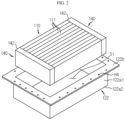
- FIG. 2 is an exploded perspective view schematically showing some components of the battery module according to an embodiment of the present disclosure.
- FIG. 3 is an exploded perspective view schematically showing some components of the battery module according to an embodiment of the present disclosure.
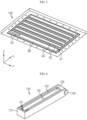
- FIG. 4 is a perspective view schematically showing some components of the battery module according to an embodiment of the present disclosure.
- front and rear directions are expressed in a negative direction and a positive direction of the Y axis
- left and right directions are expressed in a negative direction and a positive direction of the X axis
- upper and lower directions are expressed in a positive direction and a negative direction of the Z axis.
- a battery module 100 includes a cell assembly 110 having a plurality of secondary batteries 111, a lower case 122, an upper case 124, an upper cover 126, and at least one partition member 130.
- the secondary battery 111 may be, for example, a pouch-type secondary battery 111.
- the cell assembly 110 may include 21 pouch-type secondary batteries 111 stacked side by side in one direction (X-axis direction).
- the pouch-type secondary battery 111 may have electrode leads (not shown) provided at front and rear ends thereof, respectively.
- the pouch-type secondary battery 111 may include a positive electrode lead at the front end and a negative electrode lead at the rear end.
- the configuration of the secondary battery 111 is not limited to the pouch-type secondary battery 111 described above, and various types of secondary batteries known at the time of filing of this application may be employed.
- the bus bar assembly 140 may be provided to each of the front side and the rear side of the cell assembly 110.
- the bus bar assembly 140 may be configured to electrically connect the plurality of secondary batteries 111.
- the bus bar assembly 140 may include a bus bar (not shown) configured to contact the electrode leads of the plurality of secondary batteries 111, and a bus bar frame 141 configured to mount the bus bar.
- the bus bar for example, may be made of a metal such as aluminum, copper, nickel.
- the bus bar frame 141 may be made of an electrically insulating material, for example.
- the electrically insulating material may be, for example, polyvinyl chloride.
- the lower case 122 may have an accommodation space S1 in which the cell assembly 110 is accommodated. That is, the lower case 122 may have a rectangular box shape with an open top.
- the lower case 122 may include a sidewall 122a1 provided in a horizontal direction to form an accommodation space S1 of a size corresponding to the cell assembly 110, and a lower wall 122a2 coupled to a lower portion of the sidewall 122a1.
- the lower case 122 may include a flange portion 122b extending in the horizontal direction from an upper end of the sidewall 122a1.
- the flange portion 122b may have a plurality of second bolt holes H4 formed at predetermined intervals along the outer periphery.
- the flange portion 122b may be configured to be bolted to the upper case 124 through the second bolt hole H4 by using a fastening bolt.
- the upper case 124 may have a plate shape extending in the horizontal direction to cover the open top of the lower case 122.
- the upper case 124 may be configured to be coupled to the flange portion 122b of the lower case 122.
- the upper case 124 may have a plurality of first bolt holes H3 formed at the outer periphery in the horizontal direction.
- the upper case 124 may also be configured to be coupled to the upper cover 126.
- the upper case 124 may include a gasket 150 at an upper portion thereof.
- the gasket 150 may be configured to prevent gas from escaping to the outside through the coupling surface between the upper case 124 and the upper cover 126. That is, the gasket 150 may be interposed between the upper case 124 and the upper cover 126.
- the upper cover 126 may have a plate shape extending in the horizontal direction to cover the upper portion of the upper case 124.
- a plurality of third bolt holes H5 spaced apart from each other at a predetermined interval may be formed in the outer periphery of the upper cover 126 in the horizontal direction.
- the upper cover 126 may be coupled to the upper portion of the upper case 124, and the lower portion of the upper case 124 may be coupled to the flange portion 122b of the lower case 122.
- the plurality of bolts B may penetrate through the third bolt hole H5 of the upper cover 126, the first bolt hole H3 of the upper case 124, and the bolt holes H3, H4, and H5 of the lower case 122, respectively.
- the bolt B may be screwed into the bolt holes H3, H4, H5.
- the bolt B may be inserted into the bolt holes H3, H4, H5, and then fastened and fixed by inserting a nut into the lower portion thereof.
- FIG. 5 is a bottom perspective view schematically showing an upper cover of the battery module according to an embodiment of the present disclosure.
- the upper case 124 may have a connection hole H1 by perforating a part thereof to communicate with the accommodation space S 1.
- the lower case 122 may form a buffer space S2 spaced apart from the upper case 124.
- the buffer space S2 may be formed by inwardly recessing one surface of at least one of the upper case 124 and the upper cover 126 facing each other.
- a part of the lower surface of the upper cover 126 may have a recessed portion W2 recessed upward, and a part of the upper surface of the upper case 124 may have a recessed portion W2 recessed downward.
- the upper cover 126 may have a discharge hole H2 formed by perforating a part thereof so that the buffer space S2 communicates with the outside. That is, in the battery module 100 of the present disclosure, when thermal runaway or fire occurs in the cell assembly 110 to generate gas from the cell assembly 110, the generated gas may be introduced from the accommodation space S1 into the buffer space S2 through the connection hole H1 of the upper case 124. The gas introduced into the buffer space S2 may be discharged to the outside through the discharge hole H2 of the upper cover 126.
- the buffer space S2 may include at least one partition member 130.
- the partition member 130 may be configured to form a moving passage extending from the connection hole H1 to the discharge hole H2 in the buffer space S2. That is, the partition member 130 may be configured to partition the buffer space S2.
- the partition member 130 may have a shape extending in the horizontal direction in the buffer space S2. For example, as shown in FIG. 4 , five partition members 130 may have a shape extending in the front and rear directions. That is, the partition member 130 may be configured to prevent the gas from moving in the left and right directions (X-axis direction) and to induce the gas to move in the front and rear directions (Y-axis direction).
- the partition member 130 may be configured to adjust the extension length.
- the partition member 130 may adjust the extension length in the front and rear directions (Y-axis direction) according to the set length of the moving passage in the front and rear directions.
- the present disclosure since the buffer space S2 is formed inside by the upper cover 126 and the upper case 124 and also the partition member 130 forms a moving passage in the buffer space S2, when the plurality of secondary batteries 111 of the cell assembly 110 of the battery module 100 explodes or ignites, the generated flame may be extinguished by itself while moving along the moving passage of the buffer space S2, and the gas pressure and gas temperature may drop significantly while the gas generated passes through the moving passage of the buffer space S2. That is, in the present disclosure, without a partition member of the prior art, it is possible to reduce the damage to an external device or human life that may occur when a high-temperature gas or flame is directly discharged from the battery module. Ultimately, the battery module 100 may effectively reduce external damage caused by explosion or fire of the plurality of secondary batteries 111. Accordingly, the present disclosure may significantly increase the safety of the battery module 100.
- the partition member 130 may include at least two barrier units 131, 132, 133. Specifically, some barrier units 132, 133 of the at least two barrier units 131, 132, 133 may be coupled to overlap with each other. Alternatively, some barrier unit 131 of the at least two barrier units 131, 132, 133 may be disposed to be partially separated from other barrier units 132, 133. That is, when the moving passage is lengthened as necessary, the at least two barrier units 131, 132, 133 may be disposed in the buffer space S2 so that the overlapping parts of the at least two barrier units 131, 132, 133 are separated from each other. When the moving passage is shortened as necessary, the at least two barrier units 131, 132, 133 may be disposed in the buffer space S2 so that the at least two barrier units 131, 132, 133 are coupled to overlap with each other.
- ends of the at least two barrier units 131, 132, 133 may be hinged to each other.
- the partition member 130 may include three barrier units 131, 132, 133.
- Each of the three barrier units 131, 132, 133 may be configured to enable hinge rotation.
- One end or both ends of each of the three barrier units 131, 132, 133 may form a hinge-coupling structure 134 with another barrier unit.
- the hinge-coupling structure 134 may include a through hole formed in the barrier unit 131 and a pillar portion inserted into the through hole.
- At least one of the at least two barrier units 131, 132, 133 may have a coupling space S3 formed so that another barrier unit is accommodated therein. That is, in the coupling space S1 of at least one of the at least two barrier units 131, 132, 133, other barrier units may be inserted to overlap with each other. At this time, other barrier units 132 may be inserted into the coupling space S3 of the barrier unit 131 by hinge rotation.
- the partition member 130 since the partition member 130 is disposed so that barrier units 131, 132, 133 overlap with each other or partially separated from each other, when the battery module 100 explodes, the number of barrier units in the partition member 130 and the extended length of the partition member 130 may be adjusted depending on the gas pressure. That is, when the gas pressure of the explosion of the battery module 100 is relatively large, the at least two barrier units 131, 132, 133 of the partition member 130 may be arranged to overlap with each other, and a larger number of barrier units of the partition member 130 may be disposed in the buffer space S2.
- the at least two barrier units 131, 132, 133 of the partition member 130 may be arranged to be partially separated and arranged longer, and a smaller number of barrier units of the partition member 130 may be arranged in the buffer space S2.
- a moving passage along which gas or flame moves may be easily set in consideration of the capacity or explosion characteristics of the applied cell assembly 110, there is no need to manufacture a new battery module 100 whenever it is necessary to change the capacity of the cell assembly 110, which makes it possible to reduce the manufacturing cost and is easy to standardize the partition member 130.
- the partition member 130 may accommodate the plurality of barrier units 131, 132, 133 to overlap with each other, thereby effectively reducing the storage space.
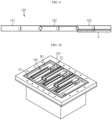
- FIG. 6 is a perspective view schematically showing a partition member of the battery module according to an embodiment of the present disclosure.
- FIG. 7 is a perspective view schematically showing another example of the partition member of the battery module according to an embodiment of the present disclosure.
- FIG. 8 is a perspective view schematically showing still another example of the partition member of the battery module according to an embodiment of the present disclosure.
- the partition member 130 may include a first barrier unit 131, a second barrier unit 132, and a third barrier unit 133.
- the first barrier unit 131 may have both side portions extending in the horizontal direction and spaced apart from each other by a predetermined distance.
- the first barrier unit 131 may have a shape in which extended ends of both side portions are connected to each other.
- the first barrier unit 131 may have a first coupling space S3 opened in upper and lower directions between both side portions.
- the first coupling space S3 may be a space in which the second barrier unit 132 is accommodated.
- the second barrier unit 132 may be moved based on the hinge and inserted into the first coupling space S3.
- an extended end of the second barrier unit 132 may be hinge-coupled to the end of the first barrier unit 131. That is, the second barrier unit 132 may form a hinge-coupling structure 134 with the first barrier unit 131.
- the second barrier unit 132 may be configured to be inserted into the first coupling space S3 formed between both side portions of the first barrier unit 131. That is, the second barrier unit 132 may be rotated based on the hinge and inserted into the first coupling space S3. Alternatively, the second barrier unit 132 may come out of the first coupling space S3 by rotating based on the hinge.
- the second barrier unit 132 may have a second coupling space S4 for accommodating another barrier unit 133.
- the second barrier unit 132 may have a second coupling space S4 for accommodating the third barrier unit 133 therein.
- an extended end of the third barrier unit 133 may be hinge-coupled to the end of the second barrier unit 132.
- the third barrier unit 133 may form a hinge-coupling structure 134 with the second barrier unit 132.
- the third barrier unit 133 may be configured to be inserted into the second coupling space S4 formed between both side portions of the second barrier unit 132.
- the third barrier unit 133 may be rotated based on the hinge and inserted into the second coupling space S4.
- the third barrier unit 133 may come out of the second coupling space S4 by rotating based on the hinge.
- an insert groove G1 may be formed in at least one of the upper cover 126 and the upper case 124 of the battery module 100 of the present disclosure.
- the insert groove G1 may be configured such that the extended end of the barrier unit 133 is inserted therein.
- the insert groove G1 recessed rearward or forward may be formed in a recessed portion W1 of the upper case 124.
- the extended end of the third barrier unit 133 may be inserted.
- an insert groove G1 recessed rearward or forward may be formed in the recessed portion W2 of the upper cover 126.
- the extended end of the first barrier unit 131 or the third barrier unit 133 may be inserted.
- the insert groove G1 is formed, it is possible to fix the end of the partition member 130 in the left and right directions. Accordingly, when the battery module 100 is internally exploded, it is possible to effectively prevent the partition member 130 from being separated from the original position due to the generated gas pressure.
- At least one of the upper cover 126 and the upper case 124 may have a mounting groove G2 configured so that an upper portion or a lower portion of the barrier unit 131 is inserted therein.
- a recessed portion forming the buffer space S2 is formed in the upper direction of the upper cover 126, and a mounting groove G2 recessed upward with a size corresponding to the upper portion of the barrier unit 131 is formed in the recessed portion.
- the mounting groove G2 may be elongated in the front and rear directions from the recessed portion forming the buffer space S2. Five mounting grooves G2 may be formed side by side in the left and right directions.
- the barrier unit 131 may set the position on the mounting groove G2 according to the moving passage to be set. For example, the upper portions of the first barrier unit 131, the second barrier unit 132 and the third barrier unit 133 may be inserted into the mounting grooves G2 of the upper cover 126.
- a recessed portion is provided to form the buffer space S2 in the lower direction of the upper case 124, and a mounting groove G2 recessed downward with a size corresponding to the lower portion of the barrier unit 131 may be formed in the recessed portion.
- the mounting groove G2 may have a shape elongated from the recessed portion in the front and rear directions. Five mounting grooves G2 may be formed side by side in the left and right directions.
- the barrier unit 131 may set the position on the mounting groove G2 according to the moving passage to be set. For example, the lower portions of the first barrier unit 131, the second barrier unit 132 and the third barrier unit 133 may be inserted into the mounting grooves G2 of the upper case 124.
- the end of the partition member 130 may be fixed in the left and right directions. Accordingly, when the battery module 100 is internally exploded, it is possible to effectively prevent the partition member 130 from being separated from the original position due to the generated gas pressure.
- the partition member 130 may have a fixing protrusion P protruding upward or downward.
- the fixing protrusion P may have a shape elongated in the front and rear directions on a plane.
- the fixing protrusion (not shown in FIG. 6 ) may be positioned to protrude downward further to the lower portion of the first barrier unit 131.
- FIG. 6 shows that as shown in FIG. 6
- the fixing protrusion P may be positioned to protrude upward further to the upper portion of the second barrier unit 132.
- the fixing protrusion P may be positioned to protrude downward from the third barrier unit 133.
- the fixing protrusion P may be formed on the third barrier unit 133.
- the upper cover 126 and the upper case 124 may have a fixing groove G3 configured so that the fixing protrusion P is inserted therein.
- the fixing groove G3 may have, for example, a shape elongated in the front and rear directions on a plane.
- the fixing groove G3 may be formed to be recessed upward or downward further to the inner surface of the mounting groove G2.
- a G3 fixing groove recessed upward further to the inner surface of the mounting groove G2 may be formed in the upper cover 126.
- a fixing groove G3 recessed downward further to the inner surface of the mounting groove G2 may be formed in the upper case 124.
- the fixing protrusion P may change the position in the front and rear directions on the fixing groove G3 according to the set moving passage.
- the fixing protrusion P is provided to the partition member 130 and the fixing groove G3 is formed in at least one of the upper cover 126 and the upper case 124, the upper portion or the lower portion of the partition member 130 may be fixed in the left and right directions. Accordingly, when the battery module 100 is internally exploded, it is possible to effectively prevent the partition member 130 from being separated from the original position due to the generated gas pressure.
- FIG. 9 is a side view schematically showing still another example of the partition member of the battery module according to an embodiment of the present disclosure.
- the partition member 130 of the battery module 100 may be exposed to the outside from the mounting groove G2 of each of the at least two barrier units 131, 132, 133 by the same height L. That is, the at least two barrier units 131, 132, 133 may be configured such that the remaining portions exposed from the mounting groove G2 of the partition member 130 have the same height L in a state where they are mounted in the mounting groove G2. For example, as shown in FIG. 9 , the partition member 130 may be configured such that the heights L of the first barrier unit 131, the second barrier unit 132 and the third barrier unit 133 exposed to the outside from the mounting groove G2 may be the same.
- the fixing protrusion P is inserted into the fixing groove G3 formed in the inner surface of the mounting groove G2, and thus the height L is exposed to the outside from the mounting groove G2 of the third barrier unit 133 may be the same as those of the first barrier unit 131 and the second barrier unit 132.
- the battery module 100 of the present disclosure since the at least two barrier units 131, 132, 133 are configured to be exposed to the outside from the mounting groove G2 by the same height L, when the battery module 100 is internally exploded, it is possible to guide the generated gas or flame to move along the set moving passage without leaking to the upper portion or the lower portion of the partition member 130. Accordingly, the battery module 100 of the present disclosure may effectively reduce the extent to which the generated gas or flame is ejected to the outside.
- the battery module 100 of the present disclosure may include five partition members 130.
- any one partition member 130 among the at least two partition members 130 may be disposed to be biased to one side of the buffer space S2 with respect to the center, and the remaining partition member 130 may be disposed to be biased to the other side of the buffer space S2.
- one partition member 130 may be disposed to be biased to one end of the buffer space S2 to form a passage through which flame or gas may pass to the other end of the buffer space S2, and another adjacent partition member 130 may be disposed to be biased toward the other end of the buffer space S2 to form a passage through which gas or flame may pass to one end of the buffer space S2.
- the partition member 130 disposed at the rightmost side may be disposed to be biased toward the front end of the recessed portion of the upper case 124 forming the buffer space S2
- the left partition member 130 adjacent to the partition member 130 disposed at the rightmost side may be disposed to be biased toward the rear end of the recessed portion of the upper case 124 forming the buffer space S2
- the partition member 130 disposed at the center in the left and right directions may be disposed to be biased toward the front end of the recessed portion of the upper case 124
- the left partition member 130 adjacent to the disposed partition member 130 disposed at the center may be disposed to be biased toward the rear end of the recessed portion of the upper case 124 forming the buffer space S2 conversely
- the partition member 130 disposed at the leftmost end may be disposed to be biased toward the front end of the recessed portion of the upper case 124.
- the moving passage since the moving passage is formed in a zig-zag shape in the front and rear directions using a plurality of partition members 130, the moving passage may be effectively formed long, so that while the generated gas or passes through the moving passage, the gas pressure may be reduced, and the intensity of the flame may also be effectively reduced. Accordingly, even if a fire or explosion occurs in the battery module 100 of the present disclosure, it is possible to effectively reduce damage caused by gas or flame discharged to the outside.
- FIG. 10 is a perspective view schematically showing some components of a battery module according to another embodiment of the present disclosure.
- the battery module 100 is applied in a case where it has a smaller size than the battery module 100 of FIG. 1 or where a high gas pressure is exerted during explosion, and the first barrier unit 131, the second barrier unit 132 and the third barrier unit 133 of the partition member 130 may be all disposed to overlap with each other.
- five partition members 130 may be mounted in the recessed portion W1 of the upper case 124 to form a moving passage having a zigzag shape in the front and rear directions.
- the five partition members 130 may be arranged such that their ends are alternately inserted into the insert grooves G1 formed at the front or the insert grooves G1 formed at the rear.
- FIG. 11 is a perspective view schematically showing some components of a battery module according to still another embodiment of the present disclosure.
- the battery module 100 according to another embodiment of the present disclosure is applied in a case where it has a smaller size than the battery module 100 of FIG. 1 but a larger size than the battery module 100 of FIG. 10 or where a lower gas pressure is exerted during explosion than compared to the case of the battery module 100 of FIG. 10 , and in the partition member 130, the second barrier unit 132 and the third barrier unit 133 may be disposed to overlap with each other, and the second barrier unit 132 and the third barrier unit 133 may be disposed to be partially separated from the first barrier unit 131.
- the five partition members 130 may be mounted in the recessed portion W1 of the upper case 124 to form a moving passage of a zigzag shape in the front and rear directions.
- the five partition members 130 may be arranged such that their ends are alternately inserted into the insert grooves G1 formed at the front or the insert grooves G1 formed at the rear.
- a battery pack includes at least one battery module 100 as above.
- the battery pack may further include various devices (not shown) for controlling charging and discharging of the battery module 100, such as a battery management system (BMS), a current sensor, a fuse, and the like.
- BMS battery management system
- an electronic device (not shown) according to an embodiment of the present disclosure includes at least one battery modules 100 as above.
- the electronic device may further include a device housing (not shown) having an accommodation space for accommodating the battery pack, and a display unit through which a user may check the state of charge of the battery pack.
- the battery pack according to an embodiment of the present disclosure may be included in a vehicle such as an electric vehicle or a hybrid electric vehicle. That is, the vehicle according to an embodiment of the present disclosure may have the battery pack according to an embodiment of the present disclosure described above inside a vehicle body.
- battery module 110 cell assembly 111: secondary battery 122: lower case 124: upper case 126: upper cover S1, S2: accommodation space, buffer space H1, H2, H3, H4, H5: connection hole, discharge hole, first bolt hole, second bolthole, third bolt hole B: bolt 130: partition member 131, 132, 133: first barrier unit, second barrier unit, third barrier unit 134: hinge-coupling structure S3, S4: first coupling space, second coupling space G1, G2, G3: insert groove, mounting groove, fixing groove, P: fixing protrusion L: height 140, 142: bus bar assembly, bus bar frame
Landscapes
- Chemical & Material Sciences (AREA)
- Chemical Kinetics & Catalysis (AREA)
- Electrochemistry (AREA)
- General Chemical & Material Sciences (AREA)
- Engineering & Computer Science (AREA)
- Manufacturing & Machinery (AREA)
- Aviation & Aerospace Engineering (AREA)
- Battery Mounting, Suspending (AREA)
- Gas Exhaust Devices For Batteries (AREA)
Description
- The present disclosure relates to a battery module, a battery pack comprising the same and a vehicle, and more particularly, to a battery module with enhanced stability against fire and explosion.
- The present application claims priority to
Korean Patent Application No. 10-2020-0158073 filed on November 23, 2020 - Recently, with the rapid increase in demand for portable electronic products such as laptop computers, video cameras and mobile phones and the extensive development of electric vehicles, accumulators for energy storage, robots and satellites, many studies are being made on high performance secondary batteries that can be repeatedly recharged.
- Currently, commercially available secondary batteries include nickel-cadmium batteries, nickel-hydrogen batteries, nickel-zinc batteries, lithium secondary batteries and the like, and among them, lithium secondary batteries have little or no memory effect, and thus they are gaining more attention than nickel-based secondary batteries for their advantages that recharging can be done whenever it is convenient, the self-discharge rate is very low and the energy density is high.
- The lithium secondary battery mainly uses lithium-based oxide and carbon material as a positive electrode active material and a negative electrode active material, respectively. In addition, this lithium secondary battery includes an electrode assembly in which a positive electrode plate and a negative electrode plate respectively coated with the positive electrode active material and the negative electrode active material are disposed with a separator interposed therebetween, and an exterior, namely a battery case, for hermetically accommodating the electrode assembly together with an electrolyte.
- In addition, depending on the shape of the exterior, lithium secondary batteries may be classified into a can-type secondary battery in which the electrode assembly is included in a metal can and a pouch-type secondary battery in which the electrode assembly is included in a pouch made of an aluminum laminate sheet.
- In particular, the demand for large-capacity battery modules applied to electric vehicles and the like is increasing recently. The large-capacity battery module includes a plurality of secondary batteries, and thus, when a fire or explosion occurs in some of the plurality of secondary batteries, flames and high-temperature gas are discharged to propagate fire to other adjacent battery modules in the vehicle due to explosion, damage other neighboring instruments or passengers. Accordingly, there is a need for a method to increase the stability against fire or gas explosion of the battery module.
- Patent literature
WO2018123573 andJP2015133266 - The present disclosure is designed to solve the problems of the related art, and therefore the present disclosure is directed to providing a battery module with enhanced stability against fire and explosion.
- These and other objects and advantages of the present disclosure may be understood from the following detailed description and will become more fully apparent from the exemplary embodiments of the present disclosure. Also, it will be easily understood that the objects and advantages of the present disclosure may be realized by the means shown in the appended claims and combinations thereof.
- In one aspect of the present disclosure, there is provided a battery module, comprising:
- a cell assembly having a plurality of secondary batteries;
- a lower case having an open top and having an accommodation space in which the cell assembly is accommodated;
- an upper case coupled to the lower case to cover the open top of the lower case and having a connection hole perforated to communicate with the accommodation space;
- an upper cover coupled to the upper case to cover an upper portion of the upper case and configured to form a buffer space spaced apart from the upper case, the upper cover having a discharge hole perforated so that the buffer space communicates with the outside; and
- at least one partition member extending in a horizontal direction inside the buffer space to form a moving passage extending from the connection hole to the discharge hole and configured to have an adjustable extension length.
- Also, the partition member may include at least two barrier units configured to be disposed to overlap with each other or be partially separated from each other and extending in a horizontal direction, and
ends of the at least two barrier units may be hinged with each other, and at least one of the at least two barrier units may have a coupling space formed to accommodate another barrier unit. - Moreover, the partition member may include:
- a first barrier unit having both side portions extending in the horizontal direction and spaced apart from each other by a predetermined distance so that extended ends of both side portions are connected with each other, and a first coupling space formed between both side portions and opened in upper and lower directions;
- a second barrier unit having an extended end hinged to an end of the first barrier unit and configured to be inserted into the first coupling space between both side portions of the first barrier unit by hinge rotation, the second barrier unit having a second coupling space formed to accommodate another barrier unit; and
- a third barrier unit having an extended end hinged to an end of the second barrier unit and configured to be inserted into the second coupling space between both side portions of the second barrier unit by hinge rotation.
- In addition, at least one of the upper cover and the upper case may have an insert groove configured so that the extended end of the barrier unit is inserted therein.
- Also, the partition member may have a fixing protrusion protruding upward or downward, and
at least one of the upper cover and the upper case may have a fixing groove configured so that the fixing protrusion is inserted therein. - Moreover, at least one of the upper cover and the upper case may have a mounting groove configured so that an upper portion or a lower portion of the barrier unit is inserted therein.
- In addition, the at least two barrier units may be configured to be exposed to the outside from the mounting groove by the same height.
- Also, at least two partition members may be provided, and
any one partition member among the at least two partition members may be disposed to be biased toward one side of the buffer space with respect to a center, and the remaining partition member may be disposed to be biased toward the other side of the buffer space. - Moreover, in another aspect of the present disclosure, there is also provided a battery pack, comprising at least one battery module as above.
- In addition, in another aspect of the present disclosure, there is also provided a vehicle, comprising at least one battery pack as above.
- According to an embodiment of the present disclosure, in the present disclosure, since the buffer space is formed inside by the upper cover and the upper case and also the partition member forms a moving passage in the buffer space, when the plurality of secondary batteries of the cell assembly of the battery module explodes or ignites, the generated flame may be extinguished by itself while moving along the moving passage of the buffer space, and the gas pressure and gas temperature may drop significantly while the gas generated passes through the moving passage of the buffer space. Ultimately, the battery module may effectively reduce external damage caused by explosion or fire of the plurality of secondary batteries. Accordingly, the present disclosure may significantly increase the safety of the battery module.
- The accompanying drawings illustrate a preferred embodiment of the present disclosure and together with the foregoing disclosure, serve to provide further understanding of the technical features of the present disclosure, and thus, the present disclosure is not construed as being limited to the drawing.
-
FIG. 1 is a perspective view schematically showing a battery module according to an embodiment of the present disclosure. -
FIG. 2 is an exploded perspective view schematically showing some components of the battery module according to an embodiment of the present disclosure. -
FIG. 3 is an exploded perspective view schematically showing some components of the battery module according to an embodiment of the present disclosure. -
FIG. 4 is a perspective view schematically showing some components of the battery module according to an embodiment of the present disclosure. -
FIG. 5 is a bottom perspective view schematically showing an upper cover of the battery module according to an embodiment of the present disclosure. -
FIG. 6 is a perspective view schematically showing a partition member of the battery module according to an embodiment of the present disclosure. -
FIG. 7 is a perspective view schematically showing another example of the partition member of the battery module according to an embodiment of the present disclosure. -
FIG. 8 is a perspective view schematically showing still another example of the partition member of the battery module according to an embodiment of the present disclosure. -
FIG. 9 is a side view schematically showing still another example of the partition member of the battery module according to an embodiment of the present disclosure. -
FIG. 10 is a perspective view schematically showing some components of a battery module according to another embodiment of the present disclosure. -
FIG. 11 is a perspective view schematically showing some components of a battery module according to still another embodiment of the present disclosure. - Hereinafter, preferred embodiments of the present disclosure will be described in detail with reference to the accompanying drawings. Prior to the description, it should be understood that the terms used in the specification and the appended claims should not be construed as limited to general and dictionary meanings, but interpreted based on the meanings and concepts corresponding to technical aspects of the present disclosure on the basis of the principle that the inventor is allowed to define terms appropriately for the best explanation.
-
FIG. 1 is a perspective view schematically showing a battery module according to an embodiment of the present disclosure.FIG. 2 is an exploded perspective view schematically showing some components of the battery module according to an embodiment of the present disclosure.FIG. 3 is an exploded perspective view schematically showing some components of the battery module according to an embodiment of the present disclosure. Also,FIG. 4 is a perspective view schematically showing some components of the battery module according to an embodiment of the present disclosure. InFIG. 1 , front and rear directions are expressed in a negative direction and a positive direction of the Y axis, left and right directions are expressed in a negative direction and a positive direction of the X axis, and upper and lower directions are expressed in a positive direction and a negative direction of the Z axis. - Referring to
FIGS. 1 to 4 , abattery module 100 according to an embodiment of the present disclosure includes acell assembly 110 having a plurality ofsecondary batteries 111, alower case 122, anupper case 124, anupper cover 126, and at least onepartition member 130. - Specifically, the
secondary battery 111 may be, for example, a pouch-typesecondary battery 111. For example, as shown inFIG. 3 , thecell assembly 110 may include 21 pouch-typesecondary batteries 111 stacked side by side in one direction (X-axis direction). For example, the pouch-typesecondary battery 111 may have electrode leads (not shown) provided at front and rear ends thereof, respectively. For example, the pouch-typesecondary battery 111 may include a positive electrode lead at the front end and a negative electrode lead at the rear end. - However, in the
battery module 100 according to the present disclosure, the configuration of thesecondary battery 111 is not limited to the pouch-typesecondary battery 111 described above, and various types of secondary batteries known at the time of filing of this application may be employed. - In addition, the
bus bar assembly 140 may be provided to each of the front side and the rear side of thecell assembly 110. Thebus bar assembly 140 may be configured to electrically connect the plurality ofsecondary batteries 111. For example, thebus bar assembly 140 may include a bus bar (not shown) configured to contact the electrode leads of the plurality ofsecondary batteries 111, and a bus bar frame 141 configured to mount the bus bar. The bus bar, for example, may be made of a metal such as aluminum, copper, nickel. The bus bar frame 141 may be made of an electrically insulating material, for example. The electrically insulating material may be, for example, polyvinyl chloride. - Moreover, the
lower case 122 may have an accommodation space S1 in which thecell assembly 110 is accommodated. That is, thelower case 122 may have a rectangular box shape with an open top. For example, as shown inFIG. 2 , thelower case 122 may include a sidewall 122a1 provided in a horizontal direction to form an accommodation space S1 of a size corresponding to thecell assembly 110, and a lower wall 122a2 coupled to a lower portion of the sidewall 122a1. Thelower case 122 may include aflange portion 122b extending in the horizontal direction from an upper end of the sidewall 122a1. Theflange portion 122b may have a plurality of second bolt holes H4 formed at predetermined intervals along the outer periphery. Theflange portion 122b may be configured to be bolted to theupper case 124 through the second bolt hole H4 by using a fastening bolt. - In addition, the
upper case 124 may have a plate shape extending in the horizontal direction to cover the open top of thelower case 122. Theupper case 124 may be configured to be coupled to theflange portion 122b of thelower case 122. To this end, theupper case 124 may have a plurality of first bolt holes H3 formed at the outer periphery in the horizontal direction. Theupper case 124 may also be configured to be coupled to theupper cover 126. Theupper case 124 may include agasket 150 at an upper portion thereof. Thegasket 150 may be configured to prevent gas from escaping to the outside through the coupling surface between theupper case 124 and theupper cover 126. That is, thegasket 150 may be interposed between theupper case 124 and theupper cover 126. - Further, the
upper cover 126 may have a plate shape extending in the horizontal direction to cover the upper portion of theupper case 124. A plurality of third bolt holes H5 spaced apart from each other at a predetermined interval may be formed in the outer periphery of theupper cover 126 in the horizontal direction. - For example, as shown in
FIG. 1 , theupper cover 126 may be coupled to the upper portion of theupper case 124, and the lower portion of theupper case 124 may be coupled to theflange portion 122b of thelower case 122. At this time, the plurality of bolts B may penetrate through the third bolt hole H5 of theupper cover 126, the first bolt hole H3 of theupper case 124, and the bolt holes H3, H4, and H5 of thelower case 122, respectively. The bolt B may be screwed into the bolt holes H3, H4, H5. Alternatively, the bolt B may be inserted into the bolt holes H3, H4, H5, and then fastened and fixed by inserting a nut into the lower portion thereof. -
FIG. 5 is a bottom perspective view schematically showing an upper cover of the battery module according to an embodiment of the present disclosure. - Referring to
FIG. 5 along withFIGS. 1 to 4 , theupper case 124 may have a connection hole H1 by perforating a part thereof to communicate with the accommodation space S 1. Thelower case 122 may form a buffer space S2 spaced apart from theupper case 124. For example, the buffer space S2 may be formed by inwardly recessing one surface of at least one of theupper case 124 and theupper cover 126 facing each other. For example, to form the buffer space S2, a part of the lower surface of theupper cover 126 may have a recessed portion W2 recessed upward, and a part of the upper surface of theupper case 124 may have a recessed portion W2 recessed downward. - In addition, the
upper cover 126 may have a discharge hole H2 formed by perforating a part thereof so that the buffer space S2 communicates with the outside. That is, in thebattery module 100 of the present disclosure, when thermal runaway or fire occurs in thecell assembly 110 to generate gas from thecell assembly 110, the generated gas may be introduced from the accommodation space S1 into the buffer space S2 through the connection hole H1 of theupper case 124. The gas introduced into the buffer space S2 may be discharged to the outside through the discharge hole H2 of theupper cover 126. - Moreover, the buffer space S2 may include at least one
partition member 130. Thepartition member 130 may be configured to form a moving passage extending from the connection hole H1 to the discharge hole H2 in the buffer space S2. That is, thepartition member 130 may be configured to partition the buffer space S2. Thepartition member 130 may have a shape extending in the horizontal direction in the buffer space S2. For example, as shown inFIG. 4 , fivepartition members 130 may have a shape extending in the front and rear directions. That is, thepartition member 130 may be configured to prevent the gas from moving in the left and right directions (X-axis direction) and to induce the gas to move in the front and rear directions (Y-axis direction). - In addition, the
partition member 130 may be configured to adjust the extension length. For example, thepartition member 130 may adjust the extension length in the front and rear directions (Y-axis direction) according to the set length of the moving passage in the front and rear directions. - Therefore, according to this configuration of the present disclosure, in the present disclosure, since the buffer space S2 is formed inside by the
upper cover 126 and theupper case 124 and also thepartition member 130 forms a moving passage in the buffer space S2, when the plurality ofsecondary batteries 111 of thecell assembly 110 of thebattery module 100 explodes or ignites, the generated flame may be extinguished by itself while moving along the moving passage of the buffer space S2, and the gas pressure and gas temperature may drop significantly while the gas generated passes through the moving passage of the buffer space S2. That is, in the present disclosure, without a partition member of the prior art, it is possible to reduce the damage to an external device or human life that may occur when a high-temperature gas or flame is directly discharged from the battery module. Ultimately, thebattery module 100 may effectively reduce external damage caused by explosion or fire of the plurality ofsecondary batteries 111. Accordingly, the present disclosure may significantly increase the safety of thebattery module 100. - Referring to
FIGS. 3 and 4 again, thepartition member 130 may include at least twobarrier units barrier units barrier units barrier unit 131 of the at least twobarrier units other barrier units barrier units barrier units barrier units barrier units - In addition, ends of the at least two
barrier units FIG. 4 , thepartition member 130 may include threebarrier units barrier units barrier units coupling structure 134 with another barrier unit. The hinge-coupling structure 134 may include a through hole formed in thebarrier unit 131 and a pillar portion inserted into the through hole. - Moreover, at least one of the at least two
barrier units barrier units other barrier units 132 may be inserted into the coupling space S3 of thebarrier unit 131 by hinge rotation. - Therefore, according to this configuration of the present disclosure, in the present disclosure, since the
partition member 130 is disposed so thatbarrier units battery module 100 explodes, the number of barrier units in thepartition member 130 and the extended length of thepartition member 130 may be adjusted depending on the gas pressure. That is, when the gas pressure of the explosion of thebattery module 100 is relatively large, the at least twobarrier units partition member 130 may be arranged to overlap with each other, and a larger number of barrier units of thepartition member 130 may be disposed in the buffer space S2. Conversely, when the gas pressure of the explosion of thebattery module 100 is relatively small, the at least twobarrier units partition member 130 may be arranged to be partially separated and arranged longer, and a smaller number of barrier units of thepartition member 130 may be arranged in the buffer space S2. - Accordingly, in the
battery module 100 of the present disclosure, a moving passage along which gas or flame moves may be easily set in consideration of the capacity or explosion characteristics of the appliedcell assembly 110, there is no need to manufacture anew battery module 100 whenever it is necessary to change the capacity of thecell assembly 110, which makes it possible to reduce the manufacturing cost and is easy to standardize thepartition member 130. Further, when it is required to store components before manufacturing thebattery module 100, thepartition member 130 may accommodate the plurality ofbarrier units -
FIG. 6 is a perspective view schematically showing a partition member of the battery module according to an embodiment of the present disclosure.FIG. 7 is a perspective view schematically showing another example of the partition member of the battery module according to an embodiment of the present disclosure. Also,FIG. 8 is a perspective view schematically showing still another example of the partition member of the battery module according to an embodiment of the present disclosure. - Referring to
FIGS. 6 to 8 , thepartition member 130 may include afirst barrier unit 131, asecond barrier unit 132, and athird barrier unit 133. Thefirst barrier unit 131 may have both side portions extending in the horizontal direction and spaced apart from each other by a predetermined distance. Thefirst barrier unit 131 may have a shape in which extended ends of both side portions are connected to each other. Thefirst barrier unit 131 may have a first coupling space S3 opened in upper and lower directions between both side portions. The first coupling space S3 may be a space in which thesecond barrier unit 132 is accommodated. Thesecond barrier unit 132 may be moved based on the hinge and inserted into the first coupling space S3. - Also, an extended end of the
second barrier unit 132 may be hinge-coupled to the end of thefirst barrier unit 131. That is, thesecond barrier unit 132 may form a hinge-coupling structure 134 with thefirst barrier unit 131. Thesecond barrier unit 132 may be configured to be inserted into the first coupling space S3 formed between both side portions of thefirst barrier unit 131. That is, thesecond barrier unit 132 may be rotated based on the hinge and inserted into the first coupling space S3. Alternatively, thesecond barrier unit 132 may come out of the first coupling space S3 by rotating based on the hinge. Thesecond barrier unit 132 may have a second coupling space S4 for accommodating anotherbarrier unit 133. For example, thesecond barrier unit 132 may have a second coupling space S4 for accommodating thethird barrier unit 133 therein. - Moreover, an extended end of the
third barrier unit 133 may be hinge-coupled to the end of thesecond barrier unit 132. Thethird barrier unit 133 may form a hinge-coupling structure 134 with thesecond barrier unit 132. Thethird barrier unit 133 may be configured to be inserted into the second coupling space S4 formed between both side portions of thesecond barrier unit 132. Thethird barrier unit 133 may be rotated based on the hinge and inserted into the second coupling space S4. Thethird barrier unit 133 may come out of the second coupling space S4 by rotating based on the hinge. - Referring to
FIGS. 3 to 5 again, an insert groove G1 may be formed in at least one of theupper cover 126 and theupper case 124 of thebattery module 100 of the present disclosure. The insert groove G1 may be configured such that the extended end of thebarrier unit 133 is inserted therein. For example, as shown inFIGS. 3 and 4 , the insert groove G1 recessed rearward or forward may be formed in a recessed portion W1 of theupper case 124. In the insert groove G1, the extended end of thethird barrier unit 133 may be inserted. - Also, for example, as shown in
FIG. 5 , an insert groove G1 recessed rearward or forward may be formed in the recessed portion W2 of theupper cover 126. In the insert groove G1, the extended end of thefirst barrier unit 131 or thethird barrier unit 133 may be inserted. - Therefore, according to this configuration of the present disclosure, in the present disclosure, since the insert groove G1 is formed, it is possible to fix the end of the
partition member 130 in the left and right directions. Accordingly, when thebattery module 100 is internally exploded, it is possible to effectively prevent thepartition member 130 from being separated from the original position due to the generated gas pressure. - Meanwhile, referring to
FIGS. 3 to 5 again, at least one of theupper cover 126 and theupper case 124 may have a mounting groove G2 configured so that an upper portion or a lower portion of thebarrier unit 131 is inserted therein. For example, as shown inFIG. 5 , a recessed portion forming the buffer space S2 is formed in the upper direction of theupper cover 126, and a mounting groove G2 recessed upward with a size corresponding to the upper portion of thebarrier unit 131 is formed in the recessed portion. The mounting groove G2 may be elongated in the front and rear directions from the recessed portion forming the buffer space S2. Five mounting grooves G2 may be formed side by side in the left and right directions. Thebarrier unit 131 may set the position on the mounting groove G2 according to the moving passage to be set. For example, the upper portions of thefirst barrier unit 131, thesecond barrier unit 132 and thethird barrier unit 133 may be inserted into the mounting grooves G2 of theupper cover 126. - Also, for example, as shown in
FIG. 3 , a recessed portion is provided to form the buffer space S2 in the lower direction of theupper case 124, and a mounting groove G2 recessed downward with a size corresponding to the lower portion of thebarrier unit 131 may be formed in the recessed portion. The mounting groove G2 may have a shape elongated from the recessed portion in the front and rear directions. Five mounting grooves G2 may be formed side by side in the left and right directions. Thebarrier unit 131 may set the position on the mounting groove G2 according to the moving passage to be set. For example, the lower portions of thefirst barrier unit 131, thesecond barrier unit 132 and thethird barrier unit 133 may be inserted into the mounting grooves G2 of theupper case 124. - Therefore, according to this configuration of the present disclosure, in the present disclosure, since the mounting groove G2 is formed, the end of the
partition member 130 may be fixed in the left and right directions. Accordingly, when thebattery module 100 is internally exploded, it is possible to effectively prevent thepartition member 130 from being separated from the original position due to the generated gas pressure. - Meanwhile, referring to
FIGS. 6 to 8 again, in the present disclosure, thepartition member 130 may have a fixing protrusion P protruding upward or downward. The fixing protrusion P may have a shape elongated in the front and rear directions on a plane. For example, as shown inFIG. 6 , when thefirst barrier unit 131, thesecond barrier unit 132 and thethird barrier unit 133 of thepartition member 130 are disposed to overlap with each other, the fixing protrusion (not shown inFIG. 6 ) may be positioned to protrude downward further to the lower portion of thefirst barrier unit 131. For example, as shown inFIG. 7 , when thesecond barrier unit 132 and thethird barrier unit 133 are separated from thefirst barrier unit 131 of thepartition member 130 and are overlapped with each other, the fixing protrusion P may be positioned to protrude upward further to the upper portion of thesecond barrier unit 132. For example, as shown inFIG. 8 , when thefirst barrier unit 131, thesecond barrier unit 132 and thethird barrier unit 133 of thepartition member 130 are partially separated from each other and disposed in an unfolded form, the fixing protrusion P may be positioned to protrude downward from thethird barrier unit 133. For example, the fixing protrusion P may be formed on thethird barrier unit 133. - Meanwhile, referring to
FIGS. 3 to 5 again, at least one of theupper cover 126 and theupper case 124 may have a fixing groove G3 configured so that the fixing protrusion P is inserted therein. The fixing groove G3 may have, for example, a shape elongated in the front and rear directions on a plane. The fixing groove G3 may be formed to be recessed upward or downward further to the inner surface of the mounting groove G2. For example, a G3 fixing groove recessed upward further to the inner surface of the mounting groove G2 may be formed in theupper cover 126. For example, a fixing groove G3 recessed downward further to the inner surface of the mounting groove G2 may be formed in theupper case 124. The fixing protrusion P may change the position in the front and rear directions on the fixing groove G3 according to the set moving passage. - Therefore, according to this configuration of the present disclosure, in the present disclosure, since the fixing protrusion P is provided to the
partition member 130 and the fixing groove G3 is formed in at least one of theupper cover 126 and theupper case 124, the upper portion or the lower portion of thepartition member 130 may be fixed in the left and right directions. Accordingly, when thebattery module 100 is internally exploded, it is possible to effectively prevent thepartition member 130 from being separated from the original position due to the generated gas pressure. -
FIG. 9 is a side view schematically showing still another example of the partition member of the battery module according to an embodiment of the present disclosure. - Referring to
FIG. 9 along withFIGS. 4 and8 , thepartition member 130 of thebattery module 100 according to an embodiment of the present disclosure may be exposed to the outside from the mounting groove G2 of each of the at least twobarrier units barrier units partition member 130 have the same height L in a state where they are mounted in the mounting groove G2. For example, as shown inFIG. 9 , thepartition member 130 may be configured such that the heights L of thefirst barrier unit 131, thesecond barrier unit 132 and thethird barrier unit 133 exposed to the outside from the mounting groove G2 may be the same. That is, even though thethird barrier unit 133 has the fixing protrusion P protruding downward, the fixing protrusion P is inserted into the fixing groove G3 formed in the inner surface of the mounting groove G2, and thus the height L is exposed to the outside from the mounting groove G2 of thethird barrier unit 133 may be the same as those of thefirst barrier unit 131 and thesecond barrier unit 132. - Therefore, according to this configuration of the present disclosure, in the present disclosure, since the at least two
barrier units battery module 100 is internally exploded, it is possible to guide the generated gas or flame to move along the set moving passage without leaking to the upper portion or the lower portion of thepartition member 130. Accordingly, thebattery module 100 of the present disclosure may effectively reduce the extent to which the generated gas or flame is ejected to the outside. - Meanwhile, referring to
FIG. 4 again, in the present disclosure, at least twopartition members 130 may be included. For example, as shown inFIG. 4 , thebattery module 100 of the present disclosure may include fivepartition members 130. In addition, any onepartition member 130 among the at least twopartition members 130 may be disposed to be biased to one side of the buffer space S2 with respect to the center, and the remainingpartition member 130 may be disposed to be biased to the other side of the buffer space S2. In other words, when the moving passage of the buffer space S2 is set in a zig-zag form, in thebattery module 100, onepartition member 130 may be disposed to be biased to one end of the buffer space S2 to form a passage through which flame or gas may pass to the other end of the buffer space S2, and anotheradjacent partition member 130 may be disposed to be biased toward the other end of the buffer space S2 to form a passage through which gas or flame may pass to one end of the buffer space S2. - For example, as shown in
FIG. 4 , among the fivepartition members 130, thepartition member 130 disposed at the rightmost side may be disposed to be biased toward the front end of the recessed portion of theupper case 124 forming the buffer space S2, theleft partition member 130 adjacent to thepartition member 130 disposed at the rightmost side may be disposed to be biased toward the rear end of the recessed portion of theupper case 124 forming the buffer space S2 conversely, thepartition member 130 disposed at the center in the left and right directions may be disposed to be biased toward the front end of the recessed portion of theupper case 124, theleft partition member 130 adjacent to the disposedpartition member 130 disposed at the center may be disposed to be biased toward the rear end of the recessed portion of theupper case 124 forming the buffer space S2 conversely, and thepartition member 130 disposed at the leftmost end may be disposed to be biased toward the front end of the recessed portion of theupper case 124. - Therefore, in the present disclosure, since the moving passage is formed in a zig-zag shape in the front and rear directions using a plurality of
partition members 130, the moving passage may be effectively formed long, so that while the generated gas or passes through the moving passage, the gas pressure may be reduced, and the intensity of the flame may also be effectively reduced. Accordingly, even if a fire or explosion occurs in thebattery module 100 of the present disclosure, it is possible to effectively reduce damage caused by gas or flame discharged to the outside. -
FIG. 10 is a perspective view schematically showing some components of a battery module according to another embodiment of the present disclosure. - Referring to
FIG. 10 along withFIG. 6 , thebattery module 100 according to another embodiment of the present disclosure is applied in a case where it has a smaller size than thebattery module 100 ofFIG. 1 or where a high gas pressure is exerted during explosion, and thefirst barrier unit 131, thesecond barrier unit 132 and thethird barrier unit 133 of thepartition member 130 may be all disposed to overlap with each other. For example, fivepartition members 130 may be mounted in the recessed portion W1 of theupper case 124 to form a moving passage having a zigzag shape in the front and rear directions. In this case, the fivepartition members 130 may be arranged such that their ends are alternately inserted into the insert grooves G1 formed at the front or the insert grooves G1 formed at the rear. -
FIG. 11 is a perspective view schematically showing some components of a battery module according to still another embodiment of the present disclosure. - Referring to
FIG. 11 along withFIG. 7 , thebattery module 100 according to another embodiment of the present disclosure is applied in a case where it has a smaller size than thebattery module 100 ofFIG. 1 but a larger size than thebattery module 100 ofFIG. 10 or where a lower gas pressure is exerted during explosion than compared to the case of thebattery module 100 ofFIG. 10 , and in thepartition member 130, thesecond barrier unit 132 and thethird barrier unit 133 may be disposed to overlap with each other, and thesecond barrier unit 132 and thethird barrier unit 133 may be disposed to be partially separated from thefirst barrier unit 131. For example, the fivepartition members 130 may be mounted in the recessed portion W1 of theupper case 124 to form a moving passage of a zigzag shape in the front and rear directions. In this case, the fivepartition members 130 may be arranged such that their ends are alternately inserted into the insert grooves G1 formed at the front or the insert grooves G1 formed at the rear. - Meanwhile, a battery pack according to an embodiment of the present disclosure includes at least one
battery module 100 as above. - In addition, the battery pack may further include various devices (not shown) for controlling charging and discharging of the
battery module 100, such as a battery management system (BMS), a current sensor, a fuse, and the like. - Meanwhile, an electronic device (not shown) according to an embodiment of the present disclosure includes at least one
battery modules 100 as above. The electronic device may further include a device housing (not shown) having an accommodation space for accommodating the battery pack, and a display unit through which a user may check the state of charge of the battery pack. - In addition, the battery pack according to an embodiment of the present disclosure may be included in a vehicle such as an electric vehicle or a hybrid electric vehicle. That is, the vehicle according to an embodiment of the present disclosure may have the battery pack according to an embodiment of the present disclosure described above inside a vehicle body.
- Meanwhile, the terms indicating directions as used herein such as upper, lower, left, right, front and rear are used for convenience of description only, and it is obvious to those skilled in the art that the term may change depending on the position of the stated element or an observer.
- The present disclosure has been described in detail. However, it should be understood that the detailed description and specific examples, while indicating preferred embodiments of the disclosure, are given by way of illustration only.
-
100: battery module 110: cell assembly 111: secondary battery 122: lower case 124: upper case 126: upper cover S1, S2: accommodation space, buffer space H1, H2, H3, H4, H5: connection hole, discharge hole, first bolt hole, second bolthole, third bolt hole B: bolt 130: partition member 131, 132, 133: first barrier unit, second barrier unit, third barrier unit 134: hinge-coupling structure S3, S4: first coupling space, second coupling space G1, G2, G3: insert groove, mounting groove, fixing groove, P: fixing protrusion L: height 140, 142: bus bar assembly, bus bar frame
Claims (10)
- A battery module (100), comprising:a cell assembly (110) having a plurality of secondary batteries (111);a lower case (122) having an open top and having an accommodation space (S1) in which the cell assembly (110) is accommodated;an upper case (124) coupled to the lower case (122) to cover the open top of the lower case (122) and having a connection hole perforated to communicate with the accommodation space (Sl);an upper cover coupled to the upper case (124) to cover an upper portion of the upper case (124) and configured to form a buffer space (S2) spaced apart from the upper case (124), the upper cover having a discharge hole (H2) perforated so that the buffer space (S2) communicates with the outside; andat least one partition member (130) extending in a horizontal direction inside the buffer space (S2) to form a moving passage extending from the connection hole to the discharge hole (H2) and configured to have an adjustable extension length.
- The battery module (100) according to claim 1,wherein the partition member (130) includes at least two barrier units (131, 132, 133) configured to be disposed to overlap with each other or be partially separated from each other and extending in a horizontal direction, andends of the at least two barrier units (131, 132, 133) are hinged with each other, and at least one of the at least two barrier units (131, 132, 133) has a coupling space (S3, S4) formed to accommodate another barrier unit.
- The battery module (100) according to claim 2,
wherein the partition member (130) includes:a first barrier unit (131) having both side portions extending in the horizontal direction and spaced apart from each other by a predetermined distance so that extended ends of both side portions are connected with each other, and a first coupling space (S3) formed between both side portions and opened in upper and lower directions;a second barrier unit (132) having an extended end hinged to an end of the first barrier unit (131) and configured to be inserted into the first coupling space (S3) between both side portions of the first barrier unit by hinge rotation, the second barrier unit having a second coupling space (S4) formed to accommodate another barrier unit; anda third barrier unit (133) having an extended end hinged to an end of the second barrier unit (132) and configured to be inserted into the second coupling space (S4) between both side portions of the second barrier unit (132) by hinge rotation. - The battery module (100) according to claim 2,
wherein at least one of the upper cover and the upper case has an insert groove (G1) configured so that the extended end of the barrier unit (131, 132, 133) is inserted therein. - The battery module (100) according to claim 2,wherein the partition member (130) has a fixing protrusion (P) protruding upward or downward, andat least one of the upper cover (126) and the upper case (124) has a fixing groove (G3) configured so that the fixing protrusion (P) is inserted therein.
- The battery module (100) according to claim 2,
Wherein at least one of the upper cover (126) and the upper case (124) has a mounting groove (G2) configured so that an upper portion or a lower portion of the barrier unit (131, 132, 133) is inserted therein. - The battery module (100) according to claim 6,
Wherein the at least two barrier units (131, 132, 133) are configured to be exposed to the outside from the mounting groove (G2) by the same height. - The battery module (100) according to claim 1,wherein at least two partition members (130) are provided, andany one partition member among the at least two partition members (130) is disposed to be biased toward one side of the buffer space (S2) with respect to a center, and the remaining partition member is disposed to be biased toward the other side of the buffer space (S2).
- A battery pack, comprising at least one battery module (100) according to any one of claims 1 to 8.
- A vehicle, comprising at least one battery pack according to claim 9.
Applications Claiming Priority (2)
| Application Number | Priority Date | Filing Date | Title |
|---|---|---|---|
| KR1020200158073A KR20220070959A (en) | 2020-11-23 | 2020-11-23 | Battery Module and Battery Pack Comprising the Same and Vehicle |
| PCT/KR2021/016677 WO2022108281A1 (en) | 2020-11-23 | 2021-11-15 | Battery module, battery pack including same, and automobile |
Publications (3)
| Publication Number | Publication Date |
|---|---|
| EP4087047A1 EP4087047A1 (en) | 2022-11-09 |
| EP4087047A4 EP4087047A4 (en) | 2023-08-30 |
| EP4087047B1 true EP4087047B1 (en) | 2025-01-01 |
Family
ID=81709376
Family Applications (1)
| Application Number | Title | Priority Date | Filing Date |
|---|---|---|---|
| EP21895049.1A Active EP4087047B1 (en) | 2020-11-23 | 2021-11-15 | Battery module, battery pack comprising the same, and vehicle. |
Country Status (8)
| Country | Link |
|---|---|
| US (1) | US20230045395A1 (en) |
| EP (1) | EP4087047B1 (en) |
| JP (1) | JP7387904B2 (en) |
| KR (1) | KR20220070959A (en) |
| CN (1) | CN114982056B (en) |
| ES (1) | ES3007648T3 (en) |
| HU (1) | HUE070219T2 (en) |
| WO (1) | WO2022108281A1 (en) |
Families Citing this family (5)
| Publication number | Priority date | Publication date | Assignee | Title |
|---|---|---|---|---|
| KR20220026928A (en) * | 2020-08-26 | 2022-03-07 | 주식회사 엘지에너지솔루션 | Battery module, battery pack and vehicle comprising the battery module |
| KR20230119551A (en) * | 2022-02-07 | 2023-08-16 | 주식회사 엘지에너지솔루션 | Battery module and battery pack including the same and vehicle including the same |
| KR20240097570A (en) * | 2022-12-20 | 2024-06-27 | 주식회사 엘지에너지솔루션 | Battery pack with improved safety |
| KR20240131180A (en) * | 2023-02-23 | 2024-08-30 | 주식회사 엘지에너지솔루션 | Battery module and battery pack including the same and vehicle including the same |
| CN120569846A (en) * | 2023-11-17 | 2025-08-29 | 株式会社Lg新能源 | Battery pack and vehicle including the same |
Family Cites Families (23)
| Publication number | Priority date | Publication date | Assignee | Title |
|---|---|---|---|---|
| US3789906A (en) * | 1972-04-14 | 1974-02-05 | Lignacord Gmbh | Folding wall or door |
| JP2604987Y2 (en) * | 1993-10-20 | 2000-06-12 | マツダ株式会社 | Battery support structure for electric vehicles |
| JP4953527B2 (en) * | 2001-07-27 | 2012-06-13 | パナソニック株式会社 | battery |
| US20070262602A1 (en) * | 2005-02-24 | 2007-11-15 | Nagle Rick A | Retractable tailgate barrier and accessory systems |
| JP5507173B2 (en) * | 2009-09-25 | 2014-05-28 | パナソニック株式会社 | Battery module and battery pack using the same |
| JP6064644B2 (en) * | 2013-02-08 | 2017-01-25 | 株式会社豊田自動織機 | Battery pack |
| JP6279834B2 (en) | 2013-02-20 | 2018-02-14 | ホーチキ株式会社 | Power storage device and moving body or facility using the same |
| JP6251972B2 (en) * | 2013-03-29 | 2017-12-27 | 株式会社Gsユアサ | Power storage device |
| JP2015133266A (en) * | 2014-01-14 | 2015-07-23 | トヨタ自動車株式会社 | Power storage device |
| JP6245478B2 (en) * | 2014-09-29 | 2017-12-13 | 豊田合成株式会社 | Bus bar |
| US9614210B2 (en) * | 2014-09-30 | 2017-04-04 | Johnson Controls Technology Company | Battery module vent system and method |
| US20160218336A1 (en) * | 2015-01-28 | 2016-07-28 | Motorola Solutions, Inc | Method and apparatus for assembling cells in a battery pack to control thermal release |
| JP6365884B2 (en) * | 2015-04-14 | 2018-08-01 | 豊田合成株式会社 | Assembled battery |
| KR102061872B1 (en) * | 2016-01-28 | 2020-01-02 | 주식회사 엘지화학 | Case for Secondary Battery Pack and Secondary Battery Pack including the same |
| CN206076341U (en) * | 2016-09-29 | 2017-04-05 | 宁德时代新能源科技股份有限公司 | Wire harness board component and battery modules |
| WO2018123573A1 (en) * | 2016-12-27 | 2018-07-05 | パナソニックIpマネジメント株式会社 | Battery module |
| KR101799238B1 (en) * | 2017-06-09 | 2017-11-17 | 김국현 | Battery cover assembly |
| KR102033101B1 (en) * | 2017-09-27 | 2019-10-16 | 주식회사 엘지화학 | Battery module, battery pack and vehicle comprising the same |
| JP2019133856A (en) * | 2018-01-31 | 2019-08-08 | 株式会社豊田自動織機 | Power storage device |
| KR101998224B1 (en) * | 2018-11-08 | 2019-07-09 | 정용규 | Energy storage system for reducing a damage |
| WO2020153018A1 (en) | 2019-01-25 | 2020-07-30 | 三洋電機株式会社 | Battery pack |
| CN110393875B (en) * | 2019-08-05 | 2024-10-25 | 清华大学 | Lithium-ion battery fire protection device |
| KR102844872B1 (en) * | 2020-04-17 | 2025-08-08 | 주식회사 엘지에너지솔루션 | A battery module having a flame discharge prevention structure, a battery pack, a vehicle and an energy storage system including the same |
-
2020
- 2020-11-23 KR KR1020200158073A patent/KR20220070959A/en active Pending
-
2021
- 2021-11-15 JP JP2022540563A patent/JP7387904B2/en active Active
- 2021-11-15 ES ES21895049T patent/ES3007648T3/en active Active
- 2021-11-15 WO PCT/KR2021/016677 patent/WO2022108281A1/en not_active Ceased
- 2021-11-15 HU HUE21895049A patent/HUE070219T2/en unknown
- 2021-11-15 EP EP21895049.1A patent/EP4087047B1/en active Active
- 2021-11-15 US US17/790,435 patent/US20230045395A1/en active Pending
- 2021-11-15 CN CN202180010098.7A patent/CN114982056B/en active Active
Also Published As
| Publication number | Publication date |
|---|---|
| CN114982056B (en) | 2024-07-09 |
| ES3007648T3 (en) | 2025-03-20 |
| EP4087047A4 (en) | 2023-08-30 |
| JP2023509933A (en) | 2023-03-10 |
| EP4087047A1 (en) | 2022-11-09 |
| JP7387904B2 (en) | 2023-11-28 |
| CN114982056A (en) | 2022-08-30 |
| HUE070219T2 (en) | 2025-05-28 |
| US20230045395A1 (en) | 2023-02-09 |
| KR20220070959A (en) | 2022-05-31 |
| WO2022108281A1 (en) | 2022-05-27 |
Similar Documents
| Publication | Publication Date | Title |
|---|---|---|
| EP4087047B1 (en) | Battery module, battery pack comprising the same, and vehicle. | |
| JP7527407B2 (en) | Battery module, battery pack, and automobile | |
| EP3926735A1 (en) | Battery pack, electronic device, and vehicle | |
| JP7846773B2 (en) | Battery packs and automobiles containing them | |
| US11552360B2 (en) | Cartridge and battery module comprising same | |
| US12525681B2 (en) | Battery module, battery pack, and vehicle | |
| KR20230152577A (en) | Battery module, battery pack and vehicle including same | |
| EP4131574B1 (en) | Battery module, battery pack, and electric vehicle | |
| US20240405360A1 (en) | Battery module, and battery pack and vehicle comprising the same | |
| EP4468466A1 (en) | Battery module with reinforced safety | |
| KR20230146306A (en) | Battery pack and vehicle including the same | |
| EP4576384A1 (en) | Battery pack | |
| EP4629423A1 (en) | Battery pack | |
| EP4730487A1 (en) | Battery module, and battery pack and vehicle including same | |
| KR20250049106A (en) | Battery cell | |
| KR20250038076A (en) | Battery pack | |
| KR20240074454A (en) | Battery module with reinforced safety |
Legal Events
| Date | Code | Title | Description |
|---|---|---|---|
| STAA | Information on the status of an ep patent application or granted ep patent |
Free format text: STATUS: THE INTERNATIONAL PUBLICATION HAS BEEN MADE |
|
| PUAI | Public reference made under article 153(3) epc to a published international application that has entered the european phase |
Free format text: ORIGINAL CODE: 0009012 |
|
| STAA | Information on the status of an ep patent application or granted ep patent |
Free format text: STATUS: REQUEST FOR EXAMINATION WAS MADE |
|
| 17P | Request for examination filed |
Effective date: 20220802 |
|
| AK | Designated contracting states |
Kind code of ref document: A1 Designated state(s): AL AT BE BG CH CY CZ DE DK EE ES FI FR GB GR HR HU IE IS IT LI LT LU LV MC MK MT NL NO PL PT RO RS SE SI SK SM TR |
|
| A4 | Supplementary search report drawn up and despatched |
Effective date: 20230728 |
|
| RIC1 | Information provided on ipc code assigned before grant |
Ipc: H01M 50/35 20210101ALI20230724BHEP Ipc: H01M 50/342 20210101ALI20230724BHEP Ipc: H01M 50/30 20210101ALI20230724BHEP Ipc: H01M 50/291 20210101ALI20230724BHEP Ipc: H01M 50/264 20210101ALI20230724BHEP Ipc: H01M 10/658 20140101ALI20230724BHEP Ipc: H01M 10/647 20140101ALI20230724BHEP Ipc: H01M 10/613 20140101ALI20230724BHEP Ipc: H01M 50/211 20210101ALI20230724BHEP Ipc: H01M 50/249 20210101ALI20230724BHEP Ipc: H01M 50/271 20210101ALI20230724BHEP Ipc: H01M 50/308 20210101ALI20230724BHEP Ipc: H01M 50/358 20210101AFI20230724BHEP |
|
| DAV | Request for validation of the european patent (deleted) | ||
| DAX | Request for extension of the european patent (deleted) | ||
| RIC1 | Information provided on ipc code assigned before grant |
Ipc: H01M 50/35 20210101ALI20240405BHEP Ipc: H01M 50/342 20210101ALI20240405BHEP Ipc: H01M 50/30 20210101ALI20240405BHEP Ipc: H01M 50/291 20210101ALI20240405BHEP Ipc: H01M 50/264 20210101ALI20240405BHEP Ipc: H01M 10/658 20140101ALI20240405BHEP Ipc: H01M 10/647 20140101ALI20240405BHEP Ipc: H01M 10/613 20140101ALI20240405BHEP Ipc: H01M 50/211 20210101ALI20240405BHEP Ipc: H01M 50/249 20210101ALI20240405BHEP Ipc: H01M 50/271 20210101ALI20240405BHEP Ipc: H01M 50/308 20210101ALI20240405BHEP Ipc: H01M 50/358 20210101AFI20240405BHEP |
|
| GRAP | Despatch of communication of intention to grant a patent |
Free format text: ORIGINAL CODE: EPIDOSNIGR1 |
|
| STAA | Information on the status of an ep patent application or granted ep patent |
Free format text: STATUS: GRANT OF PATENT IS INTENDED |
|
| INTG | Intention to grant announced |
Effective date: 20240524 |
|
| P01 | Opt-out of the competence of the unified patent court (upc) registered |
Free format text: CASE NUMBER: APP_33846/2024 Effective date: 20240606 |
|
| GRAS | Grant fee paid |
Free format text: ORIGINAL CODE: EPIDOSNIGR3 |
|
| GRAJ | Information related to disapproval of communication of intention to grant by the applicant or resumption of examination proceedings by the epo deleted |
Free format text: ORIGINAL CODE: EPIDOSDIGR1 |
|
| GRAL | Information related to payment of fee for publishing/printing deleted |
Free format text: ORIGINAL CODE: EPIDOSDIGR3 |
|
| STAA | Information on the status of an ep patent application or granted ep patent |
Free format text: STATUS: REQUEST FOR EXAMINATION WAS MADE |
|
| GRAP | Despatch of communication of intention to grant a patent |
Free format text: ORIGINAL CODE: EPIDOSNIGR1 |
|
| INTC | Intention to grant announced (deleted) | ||
| STAA | Information on the status of an ep patent application or granted ep patent |
Free format text: STATUS: GRANT OF PATENT IS INTENDED |
|
| GRAA | (expected) grant |
Free format text: ORIGINAL CODE: 0009210 |
|
| STAA | Information on the status of an ep patent application or granted ep patent |
Free format text: STATUS: THE PATENT HAS BEEN GRANTED |
|
| INTG | Intention to grant announced |
Effective date: 20241031 |
|
| AK | Designated contracting states |
Kind code of ref document: B1 Designated state(s): AL AT BE BG CH CY CZ DE DK EE ES FI FR GB GR HR HU IE IS IT LI LT LU LV MC MK MT NL NO PL PT RO RS SE SI SK SM TR |
|
| REG | Reference to a national code |
Ref country code: GB Ref legal event code: FG4D |
|
| REG | Reference to a national code |
Ref country code: DE Ref legal event code: R096 Ref document number: 602021024502 Country of ref document: DE |
|
| REG | Reference to a national code |
Ref country code: CH Ref legal event code: EP |
|
| REG | Reference to a national code |
Ref country code: IE Ref legal event code: FG4D |
|
| REG | Reference to a national code |
Ref country code: ES Ref legal event code: FG2A Ref document number: 3007648 Country of ref document: ES Kind code of ref document: T3 Effective date: 20250320 |
|
| REG | Reference to a national code |
Ref country code: LT Ref legal event code: MG9D |
|
| REG | Reference to a national code |
Ref country code: NL Ref legal event code: MP Effective date: 20250101 |
|
| REG | Reference to a national code |
Ref country code: HU Ref legal event code: AG4A Ref document number: E070219 Country of ref document: HU |
|
| REG | Reference to a national code |
Ref country code: AT Ref legal event code: MK05 Ref document number: 1757264 Country of ref document: AT Kind code of ref document: T Effective date: 20250101 |
|
| PG25 | Lapsed in a contracting state [announced via postgrant information from national office to epo] |
Ref country code: NL Free format text: LAPSE BECAUSE OF FAILURE TO SUBMIT A TRANSLATION OF THE DESCRIPTION OR TO PAY THE FEE WITHIN THE PRESCRIBED TIME-LIMIT Effective date: 20250101 |
|
| PG25 | Lapsed in a contracting state [announced via postgrant information from national office to epo] |
Ref country code: FI Free format text: LAPSE BECAUSE OF FAILURE TO SUBMIT A TRANSLATION OF THE DESCRIPTION OR TO PAY THE FEE WITHIN THE PRESCRIBED TIME-LIMIT Effective date: 20250101 |
|
| PG25 | Lapsed in a contracting state [announced via postgrant information from national office to epo] |
Ref country code: PL Free format text: LAPSE BECAUSE OF FAILURE TO SUBMIT A TRANSLATION OF THE DESCRIPTION OR TO PAY THE FEE WITHIN THE PRESCRIBED TIME-LIMIT Effective date: 20250101 |
|
| PG25 | Lapsed in a contracting state [announced via postgrant information from national office to epo] |
Ref country code: NO Free format text: LAPSE BECAUSE OF FAILURE TO SUBMIT A TRANSLATION OF THE DESCRIPTION OR TO PAY THE FEE WITHIN THE PRESCRIBED TIME-LIMIT Effective date: 20250401 Ref country code: IS Free format text: LAPSE BECAUSE OF FAILURE TO SUBMIT A TRANSLATION OF THE DESCRIPTION OR TO PAY THE FEE WITHIN THE PRESCRIBED TIME-LIMIT Effective date: 20250501 |
|
| PG25 | Lapsed in a contracting state [announced via postgrant information from national office to epo] |
Ref country code: HR Free format text: LAPSE BECAUSE OF FAILURE TO SUBMIT A TRANSLATION OF THE DESCRIPTION OR TO PAY THE FEE WITHIN THE PRESCRIBED TIME-LIMIT Effective date: 20250101 |
|
| PG25 | Lapsed in a contracting state [announced via postgrant information from national office to epo] |
Ref country code: LV Free format text: LAPSE BECAUSE OF FAILURE TO SUBMIT A TRANSLATION OF THE DESCRIPTION OR TO PAY THE FEE WITHIN THE PRESCRIBED TIME-LIMIT Effective date: 20250101 Ref country code: PT Free format text: LAPSE BECAUSE OF FAILURE TO SUBMIT A TRANSLATION OF THE DESCRIPTION OR TO PAY THE FEE WITHIN THE PRESCRIBED TIME-LIMIT Effective date: 20250502 |
|
| PG25 | Lapsed in a contracting state [announced via postgrant information from national office to epo] |
Ref country code: BG Free format text: LAPSE BECAUSE OF FAILURE TO SUBMIT A TRANSLATION OF THE DESCRIPTION OR TO PAY THE FEE WITHIN THE PRESCRIBED TIME-LIMIT Effective date: 20250101 Ref country code: GR Free format text: LAPSE BECAUSE OF FAILURE TO SUBMIT A TRANSLATION OF THE DESCRIPTION OR TO PAY THE FEE WITHIN THE PRESCRIBED TIME-LIMIT Effective date: 20250402 |
|
| PG25 | Lapsed in a contracting state [announced via postgrant information from national office to epo] |
Ref country code: AT Free format text: LAPSE BECAUSE OF FAILURE TO SUBMIT A TRANSLATION OF THE DESCRIPTION OR TO PAY THE FEE WITHIN THE PRESCRIBED TIME-LIMIT Effective date: 20250101 |
|
| PG25 | Lapsed in a contracting state [announced via postgrant information from national office to epo] |
Ref country code: CZ Free format text: LAPSE BECAUSE OF FAILURE TO SUBMIT A TRANSLATION OF THE DESCRIPTION OR TO PAY THE FEE WITHIN THE PRESCRIBED TIME-LIMIT Effective date: 20250101 |
|
| PG25 | Lapsed in a contracting state [announced via postgrant information from national office to epo] |
Ref country code: SE Free format text: LAPSE BECAUSE OF FAILURE TO SUBMIT A TRANSLATION OF THE DESCRIPTION OR TO PAY THE FEE WITHIN THE PRESCRIBED TIME-LIMIT Effective date: 20250101 |
|
| REG | Reference to a national code |
Ref country code: DE Ref legal event code: R097 Ref document number: 602021024502 Country of ref document: DE |
|
| PG25 | Lapsed in a contracting state [announced via postgrant information from national office to epo] |
Ref country code: SM Free format text: LAPSE BECAUSE OF FAILURE TO SUBMIT A TRANSLATION OF THE DESCRIPTION OR TO PAY THE FEE WITHIN THE PRESCRIBED TIME-LIMIT Effective date: 20250101 |
|
| PG25 | Lapsed in a contracting state [announced via postgrant information from national office to epo] |
Ref country code: DK Free format text: LAPSE BECAUSE OF FAILURE TO SUBMIT A TRANSLATION OF THE DESCRIPTION OR TO PAY THE FEE WITHIN THE PRESCRIBED TIME-LIMIT Effective date: 20250101 |
|
| PG25 | Lapsed in a contracting state [announced via postgrant information from national office to epo] |
Ref country code: IT Free format text: LAPSE BECAUSE OF FAILURE TO SUBMIT A TRANSLATION OF THE DESCRIPTION OR TO PAY THE FEE WITHIN THE PRESCRIBED TIME-LIMIT Effective date: 20250101 |
|
| PG25 | Lapsed in a contracting state [announced via postgrant information from national office to epo] |
Ref country code: EE Free format text: LAPSE BECAUSE OF FAILURE TO SUBMIT A TRANSLATION OF THE DESCRIPTION OR TO PAY THE FEE WITHIN THE PRESCRIBED TIME-LIMIT Effective date: 20250101 |
|
| PG25 | Lapsed in a contracting state [announced via postgrant information from national office to epo] |
Ref country code: RO Free format text: LAPSE BECAUSE OF FAILURE TO SUBMIT A TRANSLATION OF THE DESCRIPTION OR TO PAY THE FEE WITHIN THE PRESCRIBED TIME-LIMIT Effective date: 20250101 |
|
| PG25 | Lapsed in a contracting state [announced via postgrant information from national office to epo] |
Ref country code: SK Free format text: LAPSE BECAUSE OF FAILURE TO SUBMIT A TRANSLATION OF THE DESCRIPTION OR TO PAY THE FEE WITHIN THE PRESCRIBED TIME-LIMIT Effective date: 20250101 |
|
| PLBE | No opposition filed within time limit |
Free format text: ORIGINAL CODE: 0009261 |
|
| STAA | Information on the status of an ep patent application or granted ep patent |
Free format text: STATUS: NO OPPOSITION FILED WITHIN TIME LIMIT |
|
| 26N | No opposition filed |
Effective date: 20251002 |
|
| PGFP | Annual fee paid to national office [announced via postgrant information from national office to epo] |
Ref country code: HU Payment date: 20251127 Year of fee payment: 5 |
|
| PGFP | Annual fee paid to national office [announced via postgrant information from national office to epo] |
Ref country code: DE Payment date: 20251020 Year of fee payment: 5 |
|
| PGFP | Annual fee paid to national office [announced via postgrant information from national office to epo] |
Ref country code: GB Payment date: 20251023 Year of fee payment: 5 |
|
| PGFP | Annual fee paid to national office [announced via postgrant information from national office to epo] |
Ref country code: FR Payment date: 20251021 Year of fee payment: 5 |
|
| PGFP | Annual fee paid to national office [announced via postgrant information from national office to epo] |
Ref country code: BE Payment date: 20251020 Year of fee payment: 5 |
|
| PGFP | Annual fee paid to national office [announced via postgrant information from national office to epo] |
Ref country code: ES Payment date: 20251215 Year of fee payment: 5 |