EP4085692B1 - Slave- und mastervorrichtungen und verfahren - Google Patents
Slave- und mastervorrichtungen und verfahren Download PDFInfo
- Publication number
- EP4085692B1 EP4085692B1 EP20842732.8A EP20842732A EP4085692B1 EP 4085692 B1 EP4085692 B1 EP 4085692B1 EP 20842732 A EP20842732 A EP 20842732A EP 4085692 B1 EP4085692 B1 EP 4085692B1
- Authority
- EP
- European Patent Office
- Prior art keywords
- slave device
- slave
- frames
- frame
- wirelessly
- Prior art date
- Legal status (The legal status is an assumption and is not a legal conclusion. Google has not performed a legal analysis and makes no representation as to the accuracy of the status listed.)
- Active
Links
Images




Classifications
-
- H—ELECTRICITY
- H04—ELECTRIC COMMUNICATION TECHNIQUE
- H04W—WIRELESS COMMUNICATION NETWORKS
- H04W52/00—Power management, e.g. Transmission Power Control [TPC] or power classes
- H04W52/02—Power saving arrangements
- H04W52/0209—Power saving arrangements in terminal devices
- H04W52/0225—Power saving arrangements in terminal devices using monitoring of external events, e.g. the presence of a signal
- H04W52/0229—Power saving arrangements in terminal devices using monitoring of external events, e.g. the presence of a signal where the received signal is a wanted signal
-
- H—ELECTRICITY
- H04—ELECTRIC COMMUNICATION TECHNIQUE
- H04J—MULTIPLEX COMMUNICATION
- H04J3/00—Time-division multiplex systems
- H04J3/02—Details
- H04J3/06—Synchronising arrangements
- H04J3/0635—Clock or time synchronisation in a network
- H04J3/0638—Clock or time synchronisation among nodes; Internode synchronisation
- H04J3/0644—External master-clock
-
- H—ELECTRICITY
- H04—ELECTRIC COMMUNICATION TECHNIQUE
- H04W—WIRELESS COMMUNICATION NETWORKS
- H04W84/00—Network topologies
- H04W84/18—Self-organising networks, e.g. ad-hoc networks or sensor networks
- H04W84/20—Leader-follower arrangements
-
- Y—GENERAL TAGGING OF NEW TECHNOLOGICAL DEVELOPMENTS; GENERAL TAGGING OF CROSS-SECTIONAL TECHNOLOGIES SPANNING OVER SEVERAL SECTIONS OF THE IPC; TECHNICAL SUBJECTS COVERED BY FORMER USPC CROSS-REFERENCE ART COLLECTIONS [XRACs] AND DIGESTS
- Y02—TECHNOLOGIES OR APPLICATIONS FOR MITIGATION OR ADAPTATION AGAINST CLIMATE CHANGE
- Y02D—CLIMATE CHANGE MITIGATION TECHNOLOGIES IN INFORMATION AND COMMUNICATION TECHNOLOGIES [ICT], I.E. INFORMATION AND COMMUNICATION TECHNOLOGIES AIMING AT THE REDUCTION OF THEIR OWN ENERGY USE
- Y02D30/00—Reducing energy consumption in communication networks
- Y02D30/70—Reducing energy consumption in communication networks in wireless communication networks
Definitions
- the present invention relates generally to slave and master devices and methods, and more particularly to such devices and method in which frames are transmitted from the master device to one or more slave devices.
- Low power wireless communications can be used in many circumstances for communicating between devices in circumstances where power consumption needs to be kept low to enable battery powered devices to be used for long periods.
- the IEEE 802.15.4 standard protocol is an example of a Wireless Personal Area Network (WPAN) which could be used for low power consumption for devices that require a long battery life.
- WPAN Wireless Personal Area Network
- the 802.15.4 standard allows for devices to operate in a peer-to-peer network or in a star network in which one device is a full function device (a master device) and the others that connect to it are reduced function devices (slave devices).
- FIG. 1 is a schematic diagram of an example physical layer (PHY) frame structure that is consistent an Open Systems Interconnection (OSI) framework.
- the frame structure may be used as a beacon frame, for example to achieve beacon functionality as in the 802.15.4 standard.
- the depicted frame is an example of PHY Protocol Data Unit (PPDU) that is consistent with the OSI model. It includes a PHY Service Data Unit (PSDU) formed of a Data Link Layer Service unit and footer and a Data Link Layer Header (DLH).
- PSDU may also be referred to as a Mac Protocol Data Unit (MPDU).
- the DLH is formed of an address portion a pending portion and a portion for other data.
- the PPDU is also formed of a PHY header and a Synch Header.
- the Synch Header is formed of a Start Frame Delimiter (SFD) and a preamble.
- SFD Start Frame Delimiter
- FIG 2 is a schematic diagram of a timing diagram using beacon frames, for example those of Figure 1 , to maintain synchronization between the master and the slaves and inform the slaves about a needed communication, in accordance with the 802.15.4 standard.
- the beacon frames BFI to BF6 are transmitted regularly at transmission times T1 to T6 and carry resynchronization information from a full function device operating as a beacon device.
- "Synchronization information" as referred to herein may consist of or comprise the preamble (or at least a part thereof) in combination with the SFD. Based on the synchronization information, the slave device is able to identify when the MPDU starts.
- the frequency of the beacon frames is known (i.e.
- the slave operates a counter from the last synchronization event to estimate when the next beacon will be.
- the counter may count, for example, from the start of the SFD. In another example the count may be from an end of the beacon frame, wherein the end may be determined based on a length field in the frame or may be preprogramed based on a known fixed length of all beacon frames.
- the counter operates based on a slave clock, which can drift relative to the master clock and hence the need to reset the counter based on the last synchronization event.
- Beacon frames BFI, BF2, BF3, BF4, BF5 and BF6 are of frames lengths L1, L2, L3, L4, L5 and L6, which are the same.
- beacon frame BF3 is different to the others in that unlike the other beacon frames that have the DLH pending portion not set, the DLH pending portion is set indicating that there is a following data frame DF3 transmitted after BF3 but before BF4.
- the data frame DF3 is also a PPDU frame, but its MPDU has a different frame structure to the beacon frames.
- each of the beacon frames BF1-6 are transmitted with their preamble starting at the transmission times of T1-6.
- a reduced function device acting as a slave device operates in a low power mode and under the control of a local slave clock, the slave device moved to higher power mode at the transmission time T1 and T2 to detect the preamble of the beacon frames and then once the frame is detected it is processed. Once the frame is processed the slave device can exit the higher power mode and return to the low power mode. If the beacon frame identifies that a data frame follows, such as BF3 and DF3, the slave device can ensure it is in the higher power mode when the data frame DF3 arrives for the detection and processing of the data frame DF3, returning to the low power mode after processing the data frame.
- the beacon frames in this example can carry master clock resynchronization information for the master clock in the master device used for control of the timing of the transmission of the beacon frames BFI-6.
- each time the slave device enters the higher power mode to detect and read the beacon frame it can read the master clock resynchronization information and reset the counter at the slave device to ensure that the slave device 'wakes up' at the correct time for the next beacon frame.
- the fact that each frame causes the slave counter reset is indicated under each transmission time Tl-6 by the word SYNCH.
- US2015/079907 discloses method of wireless communication between a master device and a slave device in which the master device continually transmits request messages to the slave device, and the slave device transmits reply messages in reply only to some of the request messages; The slave device transmits a reply message in reply to a request message if a predetermined period has elapsed since it transmitted its last reply message, or the request message contains data.
- US2009/137206 discloses a method of achieving coexistence between a Bluetooth system and WLAN system collocated in the same communications device such as a mobile terminal, by monitoring the WLAN and Bluetooth system activity, determining the access priority of both WLAN and Bluetooth systems, predicting Bluetooth high priority packet transmission patterns, allocating bandwidth to both the Bluetooth and WLAN systems in accordance with the traffic patterns predicted, and switching the antenna and controlling the Bluetooth and WLAN power amplifiers when required.
- data store or memory is intended to encompass any computer readable storage medium and/or device (or collection of data storage mediums and/or devices).
- data stores include, but are not limited to, optical disks (e.g., CD-ROM, DVD-ROM, etc.), magnetic disks (e.g., hard disks, floppy disks, etc.), memory circuits (e.g., EEPROM, solid state drives, random-access memory (RAM), etc.), and/or the like.
- the functions or algorithms described herein are implemented in hardware, software or a combination of software and hardware in one embodiment.
- the software comprises computer executable instructions stored on computer readable carrier media such as memory or other type of storage devices. Further, described functions may correspond to modules, which may be software, hardware, firmware, or any combination thereof. Multiple functions are performed in one or more modules as desired, and the embodiments described are merely examples.
- the software is executed on a digital signal processor, ASIC, microprocessor, or other type of processor.
- Some embodiments implement the functions in two or more specific interconnected hardware modules or devices with related control and data signals communicated between and through the modules, or as portions of an application-specific integrated circuit.
- the exemplary process flow is applicable to software, firmware, and hardware implementations.
- the carrier medium can comprise a non-transient storage medium such as solid- state memory, a magnetic disk, optical disk etc., or a transient medium such as a signal transmitted over a computer network.
- One or more generalized embodiments of the invention provides a method and a slave device for wirelessly receiving frames transmitted from a master device.
- the frames are of a first and second type and have a common preamble.
- the frames of the second type have a preamble extension prior to the common preamble and the frames are wirelessly transmitted from the master device at a known periodicity and within a known time frame.
- the slave device is maintained in at least one low powered mode until it is activated to conserve power.
- the slave device is periodically set in a higher-powered mode to wirelessly receive and process frames of the second type wirelessly transmitted from the master device.
- the slave device is set in the higher-powered mode based on a slave clock in a period prior to an expected wireless transmission of the common preamble of each frame from the master device to detect a preamble extension of a frame of the second type in the period.
- the slave device is returned to the low powered mode when no preamble is detected in the period, and the slave device is controlled to wirelessly receive information from the master device and/or wirelessly transmit information to the master device when a preamble extension is detected in the period, and return the slave device to a low powered mode after the information has been wirelessly received and/or wirelessly transmitted.
- the "known time frame” may be analogous to a "super frame” in IEEE 802.15.4. Each occurrence of such a time frame contains one of said frames of the first or second type. However, each frame of the first or second type has a duration that is less than the corresponding known time frame in which it occurs, so that if needed frames other than those of the first or second type may also be included within the known time frame. Successive known time frames start at the earliest time that a preamble extension could commence (accounting for clock drift), if the frame is or were of the second type. The amount of time between respective starts of the common preambles of successive frames of the first type or second type is fixed, so that the starts of successive common preambles of the frames of the first or second time occur at a fixed periodicity which is known (assuming no clock drift).
- the controlling of the slave device to wirelessly receive information from the master device and/or wirelessly transmit information from the master device comprises receiving at least part of said frame of the second type.
- controlling of the slave device to wirelessly receive information from the master device and/or wirelessly transmit information from the master device further comprises, based on at least part of said frame, controlling the slave device to wirelessly receive and/or wirelessly transmit information after said part of said frame.
- the slave may be controlled to either wirelessly receive more information (for example, the frame having a MAC frame that is larger than the beacon MAC frame of the frame of the first type, and/or in a separate one or more PPDU frames) and/or to wirelessly transmit information (in one or more separate PPDU frames).
- more information for example, the frame having a MAC frame that is larger than the beacon MAC frame of the frame of the first type, and/or in a separate one or more PPDU frames
- wirelessly transmit information in one or more separate PPDU frames.
- a master device can modify a preamble by adding a preamble extension when information is to be received from and/or to transmitted to the slave device and the slave device need only ⁇ listen' for the short preamble extension period to be able to decide whether to stay in the higher powered mode to receive and/or transmit information to and/or from the master device.
- the slave device avoids the slave device having to be set in a high-power mode for each frame to receive the frame and process it to determine if the frame has information contents that are relevant to the slave device.
- the frames of the first type need not be detected and the slave device can remain in a low power mode while these are being transmitted by the master device.
- the information from the master device includes master clock synchronization information
- the master clock synchronization information is used to resynchronize the slave device.
- master clock information in addition to information being wirelessly received from and/or wirelessly transmitted to the master device, the inclusion of master clock information in the second frame enables the slave device to perform a synchronization. Synchronization of the slave device with the master device is desirable since the slave device needs to be able to 'wake up' into a higher powered mode at the right time to listen for the preamble extension in the period prior to the expected transmission of the common or normal preamble for the first type of frames.
- the slave device includes a counter controlled by the slave clock, and the processor is configured to set the slave device in the higher-powered mode based on the counter reaching a value and resynchronize the slave device by resetting the counter.
- the master device can include a counter controller by the master clock and the counter is used to control the wireless transmission of the frames. The master counter can be reset each time at the start of end of a frame to count up/down to the next frame transmission time.
- the synchronization of the slave device to the master device in one or more embodiments comprises synchronizing the slave and master counters that have come out of synchronization due to a drift between the slave and master clocks controlling them, by resetting the slave counter at a time when the master counter resets.
- the respective counters of the master and slave count time based on ticks of their respective clock crystals.
- the master and slave clocks may operate at different frequencies to each other, in which counting the same amount of time does not mean counting the same number of clock ticks.
- the slave clock is selectively based on one of two different crystals: a fast crystal in the order of tens of MHz when the slave is in a relatively high powered mode; and a slow crystal in the order of kHz when the slave is in a low powered mode.
- the slave may attribute something in the order of 1000 times more time for each tick in the low powered mode than in the high-powered mode.
- the frame of the second type includes the master clock synchronization information.
- the slave device can use the master clock resynchronization information in each of the frames of the second type that it interacts with.
- the slave device when a threshold time since a last resynchronization of the slave clock is reached, the slave device is set to receive and process one or more frames wirelessly transmitted from the master device, and resynchronize the slave device to the master device based on a frame of said one or more frames, the frame being of the first type or the second type.
- each of the first and second type of frames carry the master clock synchronization information, and the slave device can be set in a higher power mode to receive and process a first or second frame type when a threshold time elapses since it was last synchronized.
- the threshold time is determined based on an estimate of a drift between the master clock and the slave clock and a duration of the preamble extension.
- the slave device is set in a higher-powered mode to detect a preamble extension of a frame of the second type for a detection period, and the threshold time is determined based additionally on the detection period.
- the information contained in the second frame type can be intended to be wirelessly received by one or more slave devices and any slave device that detects the preamble extension can respond by wirelessly receiving and/or wirelessly transmitting information to and/or from the master device.
- the information is wirelessly received from the master device and/or wirelessly transmitted to the master device by wirelessly receiving and processing a field in the frame of the second type to determine whether the slave device is to wirelessly receive and/or whether the slave device is to wirelessly transmit one or more payloads, wherein the processor is configured to control the slave device to wirelessly receive and/or wirelessly transmit one or more payloads as part of the wireless receiving of the information from the master device and/or the wireless transmitting of the information to the master device.
- a slave device that detects the preamble extension reads all of the fields of the frame and only when an identifier of the slave device is contained is the field in present does the slave device go on to receive and/or transmit information to and/or from the master device.
- slave devices can be targeted with the frames of the second type using slave device identifiers.
- the one or more payloads are wirelessly received or wirelessly transmitted by wirelessly receiving and/or wirelessly transmitting one or more data frames that are separate to the frame of the second type and to any subsequent frames of the first or second type.
- the second frame type can simply indicate to the slave device that data will need to be wirelessly transmitted and/or wirelessly received to and/or from the master device in one or more following data frames.
- the slave device can be temporarily set to a low powered mode in a period between successive ones of said one or more separate frames and/or between a frame of said one or more separate frames and a frame of the second type.
- the slave device can be controlled for the wireless receiving of information from the master device and/or said wirelessly transmitting of information, during one, or over a plurality, of said known time frames.
- the slave device is controlled to wirelessly receive information from the master device a field of the frame of the second type that is absent from a frame of the first type. This provides for a combination of a synchronizing frame and a data frame.
- the preamble extension is detected by identifying a predefined sequence of symbols in the preamble extension.
- the predefined sequence of symbols in the preamble extension may be the same as a predefined sequence of symbols in the common preamble that is used to detect the common preamble.
- wirelessly receiving information from the master device and/or wirelessly transmitting information to the master device is by synchronous communication wherein the frames of at least the first type are usable by the slave device to maintain synchronization between the slave device and the master device for said synchronous communication. Additionally, the frames of the second type may also advantageously be usable to maintain the synchronization.
- the slave device is powered using a battery power supply.
- a master device is controlled to wirelessly transmit frames of a first and second type to at least one slave device.
- the frames of the first and second type have a common preamble and the frames of the second type have a preamble extension prior to the common preamble.
- the frames are wirelessly transmitted to the at least one slave device at a known periodicity within a known time frame based on a master clock.
- Information is wirelessly received from the at least one slave device and/or wirelessly transmitted to the at least one slave device based on a wireless transmission of a frame of the second type.
- the master device is for use with one or more slave devices as described above.
- the master device When information is to be wirelessly transmitted to and/or wirelessly received from one or more slave devices, the master device generates a second type of frame for wireless transmission to the one or more slave devices to indicate to the slave devices that information is to be wirelessly received and/or wirelessly transmitted.
- master clock synchronization information is wirelessly transmitted for use by at least one slave device to resynchronize the at least one slave device.
- the frames of the second type can include the master clock synchronization information and/or the frames of the first type can include the master clock synchronization information.
- the master clock synchronization information is included in both the first and second type of frames so that it is available to the or each slave device at each frame period.
- the frame of the second type includes a field defining whether a slave device is to wirelessly receive and/or whether the slave device is to wirelessly transmit one or more payloads, and to control the master device to wirelessly receive and/or wirelessly transmit one or more payloads as part of the wireless receiving of the information from the slave device and/or the wireless transmitting of the information to the slave device.
- the field can comprise a slave identifier field that defines whether a slave device is being addressed by the master device to select the slave device for the wireless receiving and/or wireless transmitting of the one or more payloads.
- the master device can select which one or more slave devices is to wirelessly receive information and/or wirelessly transmit information by identifying the slave device using a unique identifier in the slave identifier field of the second type of frame.
- the master device is controlled for wirelessly receiving of the one or more payloads from the slave device and/or said wireless transmitting of the one or more payloads over one or a plurality of said known time frames.
- more data may be wirelessly transmitted and/or wirelessly received than may be achieved during a single one of the time frames.
- the one or more payloads are wirelessly received and/or wirelessly transmitted by wirelessly receiving and/or wirelessly transmitting of one or more frames that are separate to the frame of the second type and to any subsequent frames of the first or second type.
- Such data frames can be wirelessly transmitted in between a frame of the first type that follow the frame of the second type and/or in between the frame of the second type and a frame of the first type.
- the master device is controlled to wirelessly transmit information to the at least one slave device in a field of the frame of the second type that is absent from a frame of the first type.
- the second frame can be modified to carry the data to be read by the one or more slave devices without requiring the slave devices to have to look for a separate data frame.
- the common preamble comprises a predefined sequence of symbols and a predefined sequence of symbols in the preamble extension is the same as the predefined sequence of symbols in the common preamble that is used to detect the common preamble.
- the master device is controlled to wirelessly receive information from the slave device and/or wirelessly transmit information to the slave device by synchronous communication wherein the frames of at least the first type are usable by the master device to maintain synchronization between a slave device and the master device for said synchronous communication. Additionally, the frames of the second type may also advantageously be usable to maintain the synchronization.
- the master device is controlled to wirelessly transmit frames of the first type only when no information is to be wirelessly received from the at least one slave device and/or wirelessly transmitted to the at least one slave device.
- the master device only wirelessly transmits frames of the second type when information is to be wirelessly received from and/or wirelessly transmitted to at least one slave device.
- the master device is for use in a security system and the or each slave device is a portable personal emergency device.
- a system comprises a master device as described above, and one or more slave devices as described above.
- the system can comprise a first slave device and a second slave device.
- the respective first and second slave device can be controlled to wirelessly receive master clock synchronization information from the master device to use the master clock synchronization information to resynchronize the first and second slave devices independently based on different frames wirelessly transmitted from the master device.
- the master device can independently communicate with each slave device and independently resynchronize each slave device.
- the system provides for synchronous communication between a master device and slave devices in which the master device wirelessly transmits beacon frames for the resynchronization of any drift by the slave devices.
- the master device wirelessly transmits a different type of beacon frame when the beacon frame needs to indicate that one or more of the one or more slave devices is to wirelessly receive information from the master device or wirelessly transmit information to the master device or both.
- the different type of beacon frame includes a preamble extension that is wirelessly transmitted in a period prior to the regular wireless transmission of the rest of the beacon frame of the different type and the other beacon frames.
- the system has the ability to dissociate the time at which beacon frames are sent to indicate that information is to be wirelessly transmitted to and/or wirelessly received from slave device(s) by the master device and the time at which the slave devices need to resynchronize by resetting their counters.
- Low-cost slave clocks can be used since in one or more embodiments, a greater drift can be compensated for by resynchronization periods that are shorter but still over many beacon periods e.g. every 100 beacons.
- when a plurality of slave devices is present they can perform their resynchronizations independently and at different times.
- the waking up of the slave device(s) to wirelessly receive and/or wirelessly transmit data is controlled by the master device using the beacon frame of the second type, whereas the waking up of the slave device for synchronization of the slave clock is controlled by the slave device(s).
- the low powered mode may be a mode in which no wireless communication takes place, i.e., the slave device does not send or receive wireless transmissions.
- the slave device in the low powered mode, does not send or receive wireless transmissions based on a communication protocol that uses the frames of the first and second type.
- the slave device in a low power mode, may listen in a low duty cycle for some other signal (i.e. a signal other than a frame of the first or second type), such as for the identification of a signal using some other communication protocol.
- a slave device can be a reduced functional device and the master device can be a personal area network controller, analogous to IEEE 802.15.4 standard in one or more embodiments of the invention.
- the frame of the first type, the frame of the second type, and the data frame can each be a PPDU (Physical Layer Convergence Procedure (PLCP) protocol data unit), and the frame of the first type and a data frame may be consistent with that standard in one or more embodiments of the invention.
- PLCP Physical Layer Convergence Procedure
- the present invention is suited to a modification of the 802.15.4 standard, but the invention is not limited to such a standard.
- FIG. 3 is a schematic diagram illustrating a system in accordance with embodiments.
- the system comprises a master device 200 wirelessly connected to one or more slave devices 100, 100A and 100B.
- three slave devices are illustrated. Any number can be used in wireless communication with the master device 200.
- the master device 200 comprises a communications unit 210 for wireless transmission of frames (such as beacon frames, and data frames and/or other information containing frames) to one or more slave devices 100, 100A, 100b and receipt of frames (such as data frames and/or other information containing frames) from one or more slave devices 100, 100A, 100B.
- the master device 200 includes master electronics 220 for performing various functions of the master device including the generation of the beacon frames and data frames for transmission to one or more slave devices 100, 100A, 100B and the processing of data frames received from one or more slave devices 100, 100A, 100B.
- a master clock 230 is provided in the master device 200 for controlling the timing and duration of the transmission of the frames from the master device 200 by controlling a master counter 240.
- the master counter 240 controls the timing of the transmission of the frames based on reaching a certain count.
- a slave device 100 comprises a communications unit 110 for wireless transmission of frames (such as data frames and/or other information containing frames) to the master devices 200 and receipt of frames (such as beacon frames, and data frames and/or other information containing frames) from the master device 200.
- the slave device 100 includes slave electronics 120 for performing various functions of the slave device including the generation of the data frames for transmission to the master device 200 and the processing of the beacon frames and data frames received from the master device 200.
- a slave clock 130 is provided in the slave device 100 for controlling the timing of the operation of the slave device 100.
- a slave counter 140 is provided for setting of the slave device 100 in a higher power mode for detection and processing of frames from the master device 200 when a count is reached, and the slave counter 140 is reset in response to received master clock resynchronization information.
- the slave counter 140 operates under the timing provided by the slave clock 130.
- the timing of the slave clock 130 can drift relative to the master clock 230 and hence a resetting of the slave counter 130 is required periodically in order for the slave counter 140 to synchronize to the master counter 240.
- beacon frames and acknowledgement frames communicable information may be transmitted in frame types other than a "data frame” type, for example a "command frame” type.
- data frame can more specifically refer to a particular type of non-beacon, non-ack frame, for example a data frame in accordance with IEEE 802.15.4.
- the master electronics 220 can be analogue or digital electronics or a combination of analogue and digital electronics.
- the digital electronics can be performed at least in part by a processor or microprocessor suitably programmed and/or otherwise configured.
- the slave devices 100, 100A and 100B may comprise the same general components.
- the slave electronics 120 may be the same or different in different slave devices that perform different functions to each other.
- the slave devices may be proximity sensor, a motion sensor, or a camera for example.
- Each of these devices include electronics for performing their required functions.
- the electronics 120 will however have components in common relating to the resetting of the slave counter 140 and the control of the detection and processing of received frames and the transmission of frames.
- the slave electronics 120 can be analogue or digital electronics or a combination of analogue and digital electronics.
- the digital electronics can be performed at least in part by a processor or microprocessor suitably programmed and/or otherwise configured.
- the slave device 100, 100A, 100B can operate in at least one low power mode and at least one higher power mode.
- a processor and or the slave electronics 120 in a low power mode, operates at a low power mode and in a higher power mode, the processor and or the slave electronics 120 operates at a high-power mode.
- Each of the lowered modes may be sleep modes.
- Each of the high-powered modes may be awake modes.
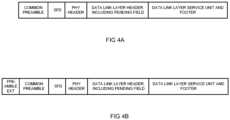
- Figure 4A illustrates a beacon frame structure which in this embodiment is a PPDU having a frame structure similar to a PPDU having a beacon MAC frame that is in accordance with the 802.15.4 standard.
- Figure 4A shows the frame structure of a beacon frame of a first type transmitted by the master device in accordance with one embodiment.
- the preamble has been labelled the common preamble. The reasons for this will become apparent when the structure of a beacon frame of the second type is described below.
- Figure 4B illustrates a beacon frame structure which in this embodiment is a frame structure the same as the PPDU frame structure of Figure 4A , with the exception of an additional preamble extension at the beginning of the frame.
- This is the frame structure of a beacon frame of a second type transmitted by the master device in accordance with one embodiment.
- the common preamble aligns with the common preamble of the first type of frame as shown in figure 4A .
- the preamble extension hence comprises an additional length of preamble at the beginning of the frame of the second type.
- the preamble extension is shown as a separate section of the frame in figure 4B , it can be formed from the same structure e.g. the same symbols as the common preamble and hence the boundary is purely notional. The boundary does however represent a point in time that the frame is transmitted.
- the start of the common preamble is transmitted at the same periodicity by the master device 200. This will become more apparent having regard to the discussion on figure 5 below.
- the common preamble and the preamble extension can be formed of a known pattern of symbols to enable recognition/detection by the slave device.
- the preamble extension may be of a preset number of bits.
- the common preamble and the preamble extension are each a series of symbols that toggle at a 50% duty cycle.
- the toggling symbols may respectively define 1's and 0's in a binary scheme, for example.
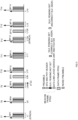
- FIG. 5 is a timing diagram from the perspective of a particular slave device 100.
- the times of reception of the respective starts of the common preambles of the beacon frames from the master device 200 are indicated by arrows at T7 to T14 along the timeline.
- personal wireless area networks are relatively short range.
- the time of flight delay between the master and the slave is therefore assumed to be negligible and that the time of transmission is therefore the same as the time of reception.
- the spacings of these are even, indicating a regular periodicity transmission of beacon signals by the master device.
- the common preambles of beacon frames BF7 to BF14 are received at times T7 to T14, respectively.
- FIG. 5 The key for the diagram of figure 5 indicates that the same beacon frame components are used as for the prior art structure of figure 2 .
- the preamble for second type beacon frames is longer than that of first type beacon frames as discussed with reference to figures 4A and 4B .
- Figure 5 also illustrates something that is not part of the beacon, but is instead a signal transmitted from another device. Nonetheless, it may be detected as a preamble extension by the slave device. It may therefore be referred to as noise preamble, and will be explained below in more detail.
- the setting of the slave device in a higher mode for the detection of the frame by the detection of the preamble and the preamble extension is indicated by the smaller arrows just before the transmission/reception timing arrows T7 to T14. These arrows show that the slave device is set in the higher power mode at a time slightly before each of the transmission times T7 to T14 of the master device to listen for a preamble or preamble extension of a frame.
- Each of the beacon frames BF7 to BF14 carry information for the slave devices to synchronize their perspective of time with that of the master device, for example by synchronizing respective counters on the master and slaves, the counter's counting of time based on ticks of their corresponding clocks.
- the slave device 100 has determined that it needs to synchronize, at time T7, its counting with that of the master device.
- a beacon frame of a first type is received with a common preamble starting at the time T7.
- the first type of beacon frame carries master clock synchronization information, and the slave 100 wakes itself to receive and synchronize to the beacon BF7, as indicated by the work SYNCH.
- the slave device has to be set into the higher power mode to catch at some predefined amount of the common preamble (e.g. at least 4 toggles of the preamble signal). For example, it could wake at time T7. However, in this example, the slave device awakes even earlier than that by waking for an initial period before the transmission time T7 and remaining awake for the length of the beacon frame: a total higher power period of L7. For the next transmission period T8, the slave device 100 is set in the higher power mode only for a short period of time indicated as L8 for the detection of a preamble extension.
- some predefined amount of the common preamble e.g. at least 4 toggles of the preamble signal
- the slave device can be returned to the low power mode since there is no information carried by the frame of first type BF8 that is for reception by the slave device and nor does the slave device 100 yet need to resynchronize.
- a frame BF9 of the second type illustrated in figure 4B is transmitted by the master device.
- Frame BF9 is transmitted with the start of the common preamble at the transmission period T9 and the preamble extension in the period prior to T9.
- the period of transmission of the preamble extension coincides with the listening of the slave device and hence the slave device detects the preamble extension and hence that there is therefore presumably a frame of the second type that requires the slave device to either receive and/or transmit information to and/or from the master device.
- the slave device therefore stays in the higher power mode to listen to the frame for the period L9a.
- the information in the MPDU of the beacon frame BF9 also indicates that there is data following in a data frame DF9 for the slave device.
- the slave device drops to a low power mode for the period between the end of the beacon frame to a transmission time either known by the slave device (e.g. a certain time after the beacon device) or at a transmission time (e.g. a designated time slot) indicated in the beacon frame and is then set to the higher power mode again to listen to the data frame DF9 for the period L9b.
- the information in the beacon frame may inform the slave of a time slot to transmit a data frame to the master.
- FIG 5 two possible end points for the awake period L9a of the slave device are shown and labelled e1 and e2.
- the listening by the slave device could be just up to e1 i.e. up to the end of the pending field.
- the end period is at e2, which is the end of the beacon.
- error checking data such as CRC is usually located at the end of the frame and it is preferable to perform error checking on the detected frame contents and that way the slave device has more assurance that the frame has not been corrupted.
- the listening period L is shown as being until the end of the frame, for example because the pending portion is not set to indicate pending data and or because there is pending data but that it is not indicated as being for that slave device.
- next transmission period T10 a frame of the first type is transmitted by the master devise and hence the slave device follows the same operation as for the transmission period T8 and only listens for a short period L10 before returning to the low power mode.
- a frame BF11 of the first type is transmitted by the master device but noise occurs at the point of the preamble extension just before the transmission time T11.
- the noise causes a false detection of a preamble by the slave device and hence it stays in the higher power mode for the period of the frame, L11 until it detects that there is no information for it in the frame.
- a frame of the second type is transmitted by the master device and hence the slave device follows the same operation as for the transmission period T9 to set the slave device in the higher power mode for the reading of the frame over period L12a and the reading of a following data frame DF12 for the period L12b.
- this frame includes master frame synchronization information and the slave device requires resetting of the slave counter at this point. Hence, a resetting of the slave counter takes place at this period.
- all of the frames of the first and second type include master clock resynchronization information so this it is available to the slave device whenever it is required by the slave device. It is up to the slave device to determine when to reset the slave counter. If the slave device has received a beacon frame of the second type recently, it can use the master clock synchronization information in it to reset the slave counter. However, if the transmitted beacon frames are only of the first type for a period of time, during that period of time, the slave device only wakes up to go to the higher power mode for a very short period at the point shortly before the transmission time of each beacon frame. The timing of the wake up is governed by the slave counter.
- the slave counter may drift out of synchronization with the master counter and there is a danger that the slave device will wake up at the wrong time and miss the detection of the preamble extension of a beacon frame of the second type or wake up potentially unnecessarily by detecting a normal preamble and mistake it to be a preamble extension.
- the slave device can determine a time since the last resynchronization by a slave counter reset, and if this is above a threshold, it can wake up to detect the whole of a next beacon frame even if it is a beacon frame of the first type. The details of the method for this will be described in more detail hereinafter.
- the type of synchronization is illustrated in figure 5 for the beacon frame BF7.
- beacon frame BF9 may optionally also be used for resynchronization since the slave device in any case wakes up to receive it since it is a beacon frame of the second type. In this way, even if there has not been a significant drift in the timing of the slave counter by the time BF9 is detected, the early resynchronization avoids a later earlier drift of the synchronization. This could therefore be considered as an unnecessary synchronization.
- any of the beacon frames of the first and second type can be used and the detection of the preamble extension is only used to identify that there is possibly a message for the slave device in the beacon frame (subject in one embodiment to a slave address carried in the beacon frame matching the slave address of the slave).
- a frame BF13 of the second type illustrated in figure 4B is transmitted by the master device.
- Frame BF13 is transmitted with the start of the common preamble at the transmission period T13 and the preamble extension in the period prior to T13.
- the period of transmission of the preamble extension coincides with the listening of the slave device and hence the slave device detects the preamble extension and hence that there is a frame of the second type that requires the slave device to either receive and/or transmit information to and/or from the master device.
- the slave device therefore stays in the higher power mode to listen to the frame for the period L13.
- the information in the MPDU of the beacon frame indicates that there is no data for that slave device. This is indicated in this example by DLH pending being set and but address for the slave device not being correct. Hence, the slave device returns to the low power mode after the period L13.
- the slave device is set in the higher power mode only for a short period of time indicated as L14 for the detection of a preamble extension. Since there is no preamble extension associated with this frame (it is a frame of first type as shown in figure 4A ), the slave device can be returned to the low power mode since there is no information carried by the frame of first type BF14 that is for reception by the slave device.
- the timeline of figure 5 illustrates a number of principles for the use by the slave device of the beacon frames of the first and second type generated by the master device.
- Two slave clock synchronization events are illustrated: one using a frame of a first type and one using a frame of a second type. It will be noted that there are multiple transmission periods between the synchronizations rather than synchronizing every frame as in the prior art method discussed with reference to figure 2 . This is a reduction in processing that saves power and is indicated by the fact that the time period that the slave device is at a higher power is much shorter than in the prior art method as indicated by the very short periods L8 and L10 for example.
- the beacon frames can signal to the slave device to not just receive information but instead to transmit information to the master device, or to perform both reception and transmission of information.
- the common preamble part of the beacon frames of the first and second types are transmitted at the same periodicity/regularity. It is only the preamble extension that is transmitted in a period prior to the regular transmission period.
- the length of the preamble extension is a factor in determining how often the slave device needs to wake up to resynchronize when it has not recently (i.e. within a threshold time) received a beacon frame.
- a longer preamble extension provides a greater degree of flexibility for the error in synchronization.
- the preamble extension consumes bandwidth which can be used for the transmission of information to and from the slave devices i.e. a data frame or number of data frames transmitted between two beacon frames may otherwise clash in time with a long preamble extension.
- the other factor that effects the preamble extension length is a predictable amount of drift of the slave clock(s), for example an expected worst-case drift.
- figure 5 illustrates a number of different types of beacon frames in one timeline.
- the invention is not limited to any particular pattern or order of the types of beacon frames or to the frames used for resynchronization by the slave device(s).
- the different beacon frames have been included in figure 5 simply to illustrate the different types of beacon frames that the master device can transmit and the ways in which slave devices can respond.
- the slave counter is reset at the periodicity of the beacon frame.
- the slave device does not read each beacon and hence the slave counter is not reset at each beacon frame.
- the counter is a cyclical counter that restarts when it reaches a certain or predetermined number associated with the expected periodicity of the beacon frame based on the control by the slave clock.
- the slave device instead of a reset at each beacon frame caused by the received beacon frame as in the prior art, the slave device restarts the slave counter after completing a complete count or cycle that the slave device assumes matches a beacon cycle. This is repeated for until an extended preamble in a beacon frame is detected or until a threshold time is reached and a resynchronization is forced due to an expected or likely threshold drift between the slave and master clocks.
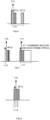
- Figure 6 is a schematic diagram of a timing diagram for a beacon frame of a second type, showing the master device transmission time T15 and the slave device listening start point indicated by the arrow just before the transmission time T15.
- a frame BF15 of the second type illustrated in figure 4B is transmitted by the master device.
- Frame BF15 is transmitted with the start of the common preamble at the transmission period T15 and the preamble extension in the period prior to T15.
- the period of transmission of the preamble extension coincides with the listening of the slave device and hence the slave device detects the preamble extension and hence that there is a frame of the second type that requires the slave device to either receive and/or transmit information to and/or from the master device.
- the slave device therefore stays in the higher power mode to listen to the frame.
- the information in the beacon frame indicates that there is data following in a data frame DF15 for the slave device. This is indicated in this example by DLH pending being set and the address for the slave device is correct. Hence, the slave device stays in the higher power mode to listen to the data frame DF15 for the period L15.
- the method illustrated in figure 6 differs from the method of processing the beacon frame BF9 and the associated data frame DF9 in figure 5 , in that in the period between the beacon frame and the data frame in this embodiment, the slave device stays in the higher power mode, wherein in the method of processing the beacon frame BF9 in figure 5 the slave device returns to the low power mode in the period between the beacon frame BF9 and the data frame DF9.
- Figure 7 is a schematic diagram of a timing diagram for a beacon frame BF17 of a second type after transmission of a beacon frame BF16 of a first type.
- the beacon frame of the first type BF16 does not include a preamble extension and hence, when the slave device is set in the higher power mode to listen, it does not detect a preamble extension and hence the slave device returns to the low power mode. This means that the slave device is only in a higher power mode for a short period L16.
- the master device transmits a PPDU frame F17 that is a combination of a beacon frame and data frame, wherein a beacon part precedes a data payload part.
- a beacon frame In the context of such a combined frame it will be understood that reference herein to a "data payload” or “data payload part” does not imply that it is the only “payload” in the frame. For example, it may be referring to information that does not relate to beacon functions, and which is therefore not includable in what is normally termed a "beacon payload", such as a "beacon payload" in a beacon frame of the first type and/or in accordance with IEEE 802.15.4.
- frame F17 is transmitted with the start of the common preamble at the transmission period T17 and the preamble extension in the period prior to T17.
- the period of transmission of the preamble extension coincides with the listening of the slave device and hence the slave device detects the preamble extension and hence that there is a frame of the second type that requires the slave device to either receive and/or transmit information to and/or from the master device.
- the slave device therefore stays in the higher power mode to listen to the frame.
- the information in the beacon part of the frame indicates that there is a data payload following in the frame and hence the slave device stays in the higher power mode for the whole of the PPDU frame (period L17) to receive the data payload frame within it.
- Figure 8 is a schematic diagram illustrating the various metrics relevant to one or more embodiments of the present invention.
- the figure shows a beacon frame BF19 of the second type, having a common preamble starting at T19.
- the end of the period of listening for the preamble extension should be earlier than the start of the common preamble, taking into account the amount of potential drift of the slave counter relative to the master counter, which can push the common preamble towards that listening period. This way the slave device will not get woken up by a beacon frame of the first type.
- the amount of time (assuming no drift) between the end of the listening period is marked as 'S' in Figure 8 .
- the drift could be in the other direction, such that if there is too much drift the listening period may start, and perhaps even finish, before the preamble extension, and therefore not detect a frame of the second type.
- the length of the preamble extension (marked ⁇ " in figure 8 ) therefore needs to be at least twice the duration of S, plus the minimum period needed for preamble detection.
- the minimum period needed for detection of a preamble is known in the art. It may, for example, be four bits if the preamble value toggles after every bit.
- the preamble extension cuts into time that may otherwise be allocated for other frame transmissions (e.g. data frames). This sets a practical upper limit on the maximum duration of the preamble extension is limited by such a consideration.
- the preamble extension may in some embodiments be less than 5% or in some embodiments, less than 2%, or in some embodiments less than 1%, of the time frame T that is the reciprocal of the periodicity of the beacon frames.
- the duration of the period of listening (marked ⁇ " in figure 8 ) may be the minimum period needed for preamble detection. Taking these factors into account, the amount of time before the common preamble at which commences the period of listening for the preamble extension is marked as ⁇ ' in figure 8 .
- the potential drift, D, away from master and slave synchronization is calculable by summing a known drift associated with the master clock and a known drift associated with the slave clock.
- the slave device can calculate how long it will be before the period of listening for the preamble extension has potential to arrive too earlier (e.g. before the preamble extension) or too late (e.g. during the common preamble). In this way the slave device can calculate the maximum time to allow between resynchronization events. Once such a time has elapsed since the last synchronization event the slave device wakes up to listen for the next beacon frame (regardless of whether or not is of the first or second type) and resynchronizes based on that beacon frame. Since the frequency of the beacon frames is known, the slave can determine the number of frames N that may pass before resynchronization is required.
- Figure 9 is a flow diagram illustrating a method of operation of a master device in accordance with one or more embodiments.
- step S10 the master device determines whether there is data/information to be transmitted to and/or received from one or more slave device. If there is no data/information to be transmitted to and/or received, in step S12 a beacon frame of a first type is transmitted at period T, i.e. with the preamble starting at T, and the process returns to step S11. Hence, this process is repeated every beacon period.
- step S13 it is determined whether a slave identifier is to be included in the beacon frame. If so in step S14 a slave identifier is added to the beacon frame and the process then determines whether the master device is to transmit data/information in step S15 or not. If a slave identifier is not to be included in the beacon frame, in step S13, the process jumps to step S15.
- step S16 If data/information is not to be transmitted (in other words data is expected to be received from one or more slave devices), in step S16 a preamble extension is transmitted at the beginning of the beacon frame of the second type at a period T Master - ⁇ .
- step S17 data/information is received from one or more slave devices and the process returns to step S11.
- the data/information can be received from one or more slave devices as one or more data frames, such as PPDU frames.
- the receipt of a plurality of frames from the one or more slave devices can extend over more than one beacon period and they can be sent in the periods between beacon frames.
- step S15 if it is determined that data/information is to be transmitted, in step S18 the process determined whether the data/information is to be transmitted in a beacon frame or as one or more separate data frames. If the data/information is to be transmitted in the beacon frame, in step S19 a preamble extension is transmitted at the beginning of the beacon frame of the second type at a period T Master - ⁇ with the data/information in the beacon frame and the process then returns to step S11.
- step S20 a preamble extension is transmitted at the beginning of the beacon frame of the second type at a period T Master - ⁇ with a field in the beacon frame set to indicate one or more following data frames and in step S21 one or more data frames are transmitted to the one or more slave devices. The process then returns to step S11.
- both transmission and reception of data between the one or more slave devices and the master device takes place. This can be achieved, for example, by the beacon allocating a time slot for receiving data and another time slot for transmitting data.
- the master device can select to transmit the data/information either in the beacon frame or in one or more data frames (Step S18).
- the master device is able to only transmit data/information in the beacon frame or in one or more data frames and not both selectively. For example, in some embodiments transmission of data payload information is always in one or more PPDU frames that are separate from the beacon frame.
- steps S13 and S14 may be omitted.
- Figure 10 is a flow diagram illustrating a method of operation of a slave device in accordance with one or more embodiments.
- step S30 the slave device is operating in a low power mode.
- step S31 the slave device switches to a higher power mode at a time T Slave - ⁇ ' to listen for a preamble extension in step S32.
- step S33 the slave device determines whether the preamble extension has been detected and if not, the process returns to step S30. If the preamble extension is detected in step S33, in step S34 the beacon frame of the second type is detected and in this embodiment the slave uses the beacon to resynchronization. Such a resynchronization may be unnecessary if the slave counter was only recently reset. However, an early resynchronization pushes the next time a resynchronization further away even if only for a short period. However, in an alternative embodiment, the resynchronization may not automatically take place when a beacon is received unless a threshold time has passed since the last synchronization in order to avoid unnecessary resynchronizations by resetting of the slave counter.
- step S36 the slave device determines whether the beacon frame identifies that the slave device is to transmit or receive data/information. If data/information is to be transmitted, in step S37 the slave device generates one or more data frames and transmits the one or more data frames to the master device. If data/information is to be received, in step S38 the slave device determines whether it is received in a common frame with the beacon or in one or more separate data frames. If the data/information is to be received in a common frame with the beacon frame, in step S39, the slave device listens for the data packet in the frame and then the process returns to step S30 to return the slave device to a low power mode.
- step S40 the slave device switches to low power mode to wait a period for a data frame that will arrive at a time slot defined in the beacon. At the end of that period, the slave device wakes up and switches to a higher power mode in steps S41 to listen for the data frame. The process returns to step S30 to return the slave device to a low power mode.
- both transmission and reception of data between the slave device and the master device takes place, for example having a transmission time slot and reception time slot for respective frames to be transmitted/received.
- the slave device receives the data/information either in the beacon frame or in one or more data frames.
- the slave device is able to only receive data/information in the beacon frame or in one or more data frames and not both selectively. For example, in some embodiments transmission of data payloads are always in one or more PPDU frames that are separate from the beacon frame.
- step S35 the step of determining whether a slave device identifier is included in the beacon frame.
- Figure 11 is a flow diagram illustrating a method of operation of a slave device for resynchronization by the resetting of the slave counter in accordance with one or more embodiments.
- the method of Figure 11 may in conjunction with the method figure 10 , for example be being executed between steps S30 and S31 of the method of figure 10 .
- step S50 the slave device is operating in a low power mode.
- step S51 the slave device determines whether a threshold time has passed.
- the threshold time is a threshold time since the slave device last performed a resynchronization using master clock information from the master device. If the threshold time has not passed, the process returns to step S50. If the threshold time has passed, in step S52 the slave device switches to a higher power mode to listen for a beacon frame of either the first or second type.
- the process then waits in step S53 to detect a master frame that functions at least as a beacon (which in the examples herein is a beacon frame of the first or second type).
- the slave device synchronizes to the master device based on based on that in step S54.
- the synchronizing may be achieved for example by resetting a counter that is based on the slave clock, wherein actions taken by the slave device are based on timing derived from the counter.
Landscapes
- Engineering & Computer Science (AREA)
- Computer Networks & Wireless Communication (AREA)
- Signal Processing (AREA)
- Mobile Radio Communication Systems (AREA)
- Electrotherapy Devices (AREA)
Claims (15)
- Eine Slave-Vorrichtung (100) zum Empfangen von Rahmen, die drahtlos von einer Master-Vorrichtung (200) übertragen werden, wobei die Rahmen von einem ersten und einem zweiten Typ sind und eine gemeinsame Präambel aufweisen, wobei die Rahmen des zweiten Typs eine Präambelerweiterung vor der gemeinsamen Präambel aufweisen, wobei die Rahmen drahtlos von der Master-Vorrichtung (200) mit einer bekannten Periodizität und innerhalb eines bekannten Zeitrahmens übertragen werden, wobei die Slave-Vorrichtung (100) Folgendes beinhaltet:einen Prozessor (120), der so konfiguriert ist, dass er die Slave-Vorrichtung (100) in mindestens einem Modus mit niedriger Leistung relativ zu mindestens einem Modus mit höherer Leistung aufrechterhält und die Slave-Vorrichtung (100) periodisch in einen Modus mit höherer Leistung versetzt, um die von der Master-Vorrichtung (200) drahtlos übertragenen Rahmen des ersten oder zweiten Typs zu empfangen und zu verarbeiten; undeinen Slave-Takt (130);wobei der Prozessor (120) für Folgendes konfiguriert ist:basierend auf dem Slave-Takt (130), Versetzen der Slave-Vorrichtung (100) in einen Modus mit höherer Leistung in einer Periode vor einer erwarteten drahtlosen Übertragung der gemeinsamen Präambel jedes Rahmens von der Master-Vorrichtung (200), um eine Präambelerweiterung eines Rahmens des zweiten Typs in der Periode zu detektieren;Zurückversetzen der Slave-Vorrichtung (100) in einen Modus mit niedriger Leistung, wenn in der Periode keine Präambelerweiterung detektiert wird; undSteuern der Slave-Vorrichtung (100), um drahtlos Informationen von der Master-Vorrichtung (200) zu empfangen und/oder drahtlos Informationen an die Master-Vorrichtung (200) zu übertragen, wenn eine Präambelerweiterung in der Periode detektiert wird, und Zurückversetzen der Slave-Vorrichtung (100) in einen Modus mit niedriger Leistung, nachdem die Informationen drahtlos empfangen und/oder drahtlos übertragen worden sind;wobei der Prozessor (120) so konfiguriert ist, dass er die Präambelerweiterung durch Identifizierung einer vordefinierten Folge von Symbolen in der Präambelerweiterung detektiert.
- Slave-Vorrichtung (100) gemäß Anspruch 1, wobei der Prozessor (120) für Folgendes konfiguriert ist:
wenn eine Schwellenzeit basierend auf dem Slave-Takt (130) seit einer letzten Resynchronisation der Slave-Vorrichtung (100) erreicht ist, Versetzen der Slave-Vorrichtung (100), sodass sie drahtlos einen oder mehrere von der Master-Vorrichtung (200) drahtlos übertragene Rahmen empfängt und verarbeitet, und Resynchronisieren der Slave-Vorrichtung (100) basierend auf einem Rahmen des einen oder der mehreren Rahmen mit der Master-Vorrichtung (200), wobei der Rahmen von dem ersten Typ oder dem zweiten Typ ist. - Slave-Vorrichtung (100) gemäß Anspruch 1 oder Anspruch 2, wobei das Steuern der Slave-Vorrichtung (100), um Informationen drahtlos von der Master-Vorrichtung (200) zu empfangen und/oder drahtlos an die Master-Vorrichtung (200) zu übertragen, das drahtlose Empfangen und Verarbeiten eines Feldes in dem Rahmen des zweiten Typs beinhaltet, um zu bestimmen, ob die Slave-Vorrichtung (100) drahtlos empfangen soll und/oder ob die Slave-Vorrichtung (100) drahtlos eine oder mehrere Nutzdaten übertragen soll, wobei der Prozessor so konfiguriert ist, dass er die Slave-Vorrichtung (100) so steuert, dass sie eine oder mehrere Nutzdaten als Teil des drahtlosen Empfangens der Informationen von der Master-Vorrichtung (200) und/oder des drahtlosen Übertragens der Informationen an die Master-Vorrichtung (200) drahtlos empfängt und/oder drahtlos überträgt, wobei das Feld ein Slave-Kennungsfeld beinhaltet, das definiert, ob die Slave-Vorrichtung (100) von der Master-Vorrichtung (200) adressiert wird, um die Slave-Vorrichtung (100) für das drahtlose Empfangen und/oder das drahtlose Übertragen der einen oder mehreren Nutzdaten auszuwählen.
- Slave-Vorrichtung (100) gemäß Anspruch 3, wobei der Prozessor (120) so konfiguriert ist, dass er die Slave-Vorrichtung (120) so steuert, dass sie die eine oder mehreren Nutzdaten drahtlos empfängt und/oder drahtlos überträgt, indem sie einen oder mehrere Rahmen drahtlos empfängt und/oder drahtlos überträgt, die von dem Rahmen des zweiten Typs und von allen nachfolgenden Rahmen des ersten oder zweiten Typs getrennt sind, wobei während des Schritts des drahtlosen Empfangens von Informationen von der Master-Vorrichtung (200) und/oder des drahtlosen Übertragens an die Master-Vorrichtung (200) der Prozessor (120) so konfiguriert ist, dass er die Slave-Vorrichtung (100) in einem Zeitraum zwischen aufeinanderfolgenden des einen oder der mehreren getrennten Rahmen und/oder zwischen einem Rahmen des einen oder der mehreren getrennten Rahmen und einem Rahmen des zweiten Typs vorübergehend in einen Modus mit niedriger Leistung versetzt.
- Slave-Vorrichtung (100) gemäß Anspruch 4, wobei der Prozessor (120) so konfiguriert ist, dass er die Slave-Vorrichtung (100) für das drahtlose Empfangen von Informationen von der Master-Vorrichtung (200) und/oder das Übertragen von Informationen über eine Vielzahl der bekannten Zeitrahmen steuert.
- Slave-Vorrichtung (100) gemäß einem der vorhergehenden Ansprüche, wobei die vordefinierte Folge von Symbolen in der Präambelerweiterung dieselbe ist wie eine vordefinierte Folge von Symbolen in der gemeinsamen Präambel, die verwendet wird, um die gemeinsame Präambel zu detektieren.
- Slave-Vorrichtung (100) gemäß einem der vorhergehenden Ansprüche, wobei die Slave-Vorrichtung (100) in dem Modus mit niedriger Leistung keine drahtlosen Übertragungen sendet oder empfängt.
- Slave-Vorrichtung (100) gemäß einem der vorhergehenden Ansprüche, wobei der Prozessor (120) so konfiguriert ist, dass er die Slave-Vorrichtung (100) so steuert, dass sie drahtlos Informationen von der Master-Vorrichtung (200) empfängt und/oder drahtlos Informationen an die Master-Vorrichtung (200) durch synchrone Kommunikation überträgt, wobei die Rahmen mindestens des ersten Typs von der Slave-Vorrichtung (100) verwendet werden können, um die Synchronisation zwischen dem Slave-Takt (130) und einem Master-Takt (230) der Master-Vorrichtung (200) für die synchrone Kommunikation aufrechtzuerhalten.
- Ein Verfahren an einer Slave-Vorrichtung (100) zum drahtlosen Empfangen von Rahmen, die drahtlos von einer Master-Vorrichtung (200) übertragen werden, wobei die Rahmen von einem ersten und einem zweiten Typ sind und eine gemeinsame Präambel aufweisen, wobei die Rahmen des zweiten Typs eine Präambelerweiterung vor der gemeinsamen Präambel aufweisen, wobei die Rahmen von der Master-Vorrichtung (200) mit einer bekannten Periodizität und innerhalb eines bekannten Zeitrahmens übertragen werden, wobei das Verfahren Folgendes beinhaltet:Aufrechterhalten der Slave-Vorrichtung (100) in mindestens einem Modus mit niedriger Leistung;periodisches Versetzten der Slave-Vorrichtung (100) in einen Modus mit höherer Leistung, um von der Master-Vorrichtung (200) drahtlos übertragene Rahmen des zweiten Typs zu empfangen und zu verarbeiten;wobei die Slave-Vorrichtung (100) in den Modus mit höherer Leistung basierend auf einem Slave-Takt (130) in einer Periode vor einer erwarteten drahtlosen Übertragung der gemeinsamen Präambel jedes Rahmens von der Master-Vorrichtung (200) versetzt wird, um eine Präambelerweiterung eines Rahmens des zweiten Typs in der Periode zu detektieren;die Slave-Vorrichtung (100) in den Modus mit niedriger Leistung zurückversetzt wird, wenn in der Periode keine Präambelerweiterung detektiert wird; unddie Slave-Vorrichtung (100) gesteuert wird, um drahtlos Informationen von der Master-Vorrichtung (200) zu empfangen und/oder drahtlos Informationen an die Master-Vorrichtung (200) zu übertragen, wenn eine Präambelerweiterung in der Periode detektiert wird, und die Slave-Vorrichtung (100) in einen Modus mit niedriger Leistung zurückzuversetzen, nachdem die Informationen drahtlos empfangen und/oder drahtlos übertragen worden sind,wobei die Präambelerweiterung durch Identifizierung einer vordefinierten Folge von Symbolen in der Präambelerweiterung detektiert wird.
- Eine Master-Vorrichtung (200) zur Verwendung mit der Slave-Vorrichtung (100) gemäß einem der Ansprüche 1 bis 8, wobei die Master-Vorrichtung (200) Folgendes beinhaltet:einen Prozessor (220), der so konfiguriert ist, dass er die Master-Vorrichtung (200) so steuert, dass sie drahtlos Rahmen eines ersten und eines zweiten Typs an mindestens eine Slave-Vorrichtung (100) überträgt, wobei die Rahmen des ersten und des zweiten Typs eine gemeinsame Präambel aufweisen und die Rahmen des zweiten Typs eine Präambelerweiterung vor der Präambel aufweisen, wobei der Prozessor (220) so konfiguriert ist, dass er die Rahmen drahtlos an die mindestens eine Slave-Vorrichtung (100) mit einer bekannten Periodizität und innerhalb eines bekannten Zeitrahmens überträgt; undeinen Master-Takt (230) zur Definition der bekannten Periodizität und des Zeitrahmens; wobei der Prozessor (220) so konfiguriert ist, dass er die Master-Vorrichtung (200) so steuert, dass sie drahtlos Informationen von der mindestens einen Slave-Vorrichtung (100) empfängt und/oder basierend auf einer drahtlosen Übertragung eines Rahmens des zweiten Typs drahtlos Informationen an die mindestens eine Slave-Vorrichtung (100) überträgt;wobei die Präambelerweiterung eine vordefinierte Folge von Symbolen beinhaltet, um es der Slave-Vorrichtung (100) zu ermöglichen, die Präambelerweiterung durch Identifizierung einer vordefinierten Folge von Symbolen in der Präambelerweiterung zu detektieren.
- Master-Vorrichtung (200) gemäß Anspruch 10, wobei der Prozessor (220) so konfiguriert ist, dass er die Master-Vorrichtung (200) so steuert, dass sie drahtlos Informationen von der Slave-Vorrichtung (100) empfängt und/oder drahtlos Informationen an die Slave-Vorrichtung (100) durch synchrone Kommunikation überträgt, wobei die Rahmen mindestens des ersten Typs von der Master-Vorrichtung (200) verwendet werden können, um die Synchronisation zwischen einem Slave-Takt (130) und dem Master-Takt (230) für die synchrone Kommunikation aufrechtzuerhalten.
- Master-Vorrichtung (200) gemäß Anspruch 10 oder Anspruch 11, wobei der Prozessor (220) so konfiguriert ist, dass er die Master-Vorrichtung (200) so steuert, dass sie Rahmen des ersten Typs nur dann drahtlos überträgt, wenn keine Informationen von der mindestens einen Slave-Vorrichtung (100) empfangen und/oder drahtlos an die mindestens eine Slave-Vorrichtung (100) übertragen werden sollen.
- Ein Verfahren an einer Master-Vorrichtung (200), die mit mindestens einer Slave-Vorrichtung (100) gemäß einem der Ansprüche 1 bis 8 in Betrieb ist, wobei das Verfahren Folgendes beinhaltet:Steuern der Master-Vorrichtung (200), um drahtlos Rahmen eines ersten und eines zweiten Typs an mindestens eine Slave-Vorrichtung (100) zu übertragen, wobei die Rahmen des ersten und des zweiten Typs eine gemeinsame Präambel aufweisen und die Rahmen des zweiten Typs eine Präambelerweiterung vor der gemeinsamen Präambel aufweisen;wobei die Rahmen drahtlos an die mindestens eine Slave-Vorrichtung (100) mit einer bekannten Periodizität und innerhalb eines bekannten Zeitrahmens basierend auf einem Master-Takt (230) der Master-Vorrichtung (200) übertragen werden; undInformationen drahtlos von der mindestens einen Slave-Vorrichtung (100) empfangen und/oder drahtlos an die mindestens eine Slave-Vorrichtung (100), basierend auf einer drahtlosen Übertragung eines Rahmens des zweiten Typs, übertragen werden;wobei die Präambelerweiterung eine vordefinierte Folge von Symbolen beinhaltet, um es der Slave-Vorrichtung (100) zu ermöglichen, die Präambelerweiterung durch Identifizierung einer vordefinierten Folge von Symbolen in der Präambelerweiterung zu detektieren.
- Ein Träger-Medium, das einen prozessorimplementierbaren Code trägt, der, wenn er von mindestens einem Prozessor einer Slave-Vorrichtung (100) ausgeführt wird, die Slave-Vorrichtung (100) veranlasst, das Verfahren gemäß Anspruch 9 zu implementieren, oder der, wenn er von mindestens einem Prozessor einer Master-Vorrichtung (200) ausgeführt wird, die Master-Vorrichtung (200) veranlasst, das Verfahren gemäß Anspruch 13 zu implementieren.
- Ein System, das die Master-Vorrichtung (200) gemäß einem der Ansprüche 10 bis 12 und mindestens eine Slave-Vorrichtung (100) gemäß einem der Ansprüche 1 bis 8 beinhaltet.
Applications Claiming Priority (2)
| Application Number | Priority Date | Filing Date | Title |
|---|---|---|---|
| GBGB1919424.0A GB201919424D0 (en) | 2019-12-30 | 2019-12-30 | Slave and master devices and methods |
| PCT/IL2020/051352 WO2021137226A1 (en) | 2019-12-30 | 2020-12-30 | Slave and master devices and methods |
Publications (2)
| Publication Number | Publication Date |
|---|---|
| EP4085692A1 EP4085692A1 (de) | 2022-11-09 |
| EP4085692B1 true EP4085692B1 (de) | 2024-07-31 |
Family
ID=69416472
Family Applications (1)
| Application Number | Title | Priority Date | Filing Date |
|---|---|---|---|
| EP20842732.8A Active EP4085692B1 (de) | 2019-12-30 | 2020-12-30 | Slave- und mastervorrichtungen und verfahren |
Country Status (6)
| Country | Link |
|---|---|
| US (1) | US12501364B2 (de) |
| EP (1) | EP4085692B1 (de) |
| AU (1) | AU2020418147A1 (de) |
| ES (1) | ES2986989T3 (de) |
| GB (1) | GB201919424D0 (de) |
| WO (1) | WO2021137226A1 (de) |
Families Citing this family (3)
| Publication number | Priority date | Publication date | Assignee | Title |
|---|---|---|---|---|
| GB201919424D0 (en) | 2019-12-30 | 2020-02-12 | Essence Security International Esi Ltd | Slave and master devices and methods |
| CN114826812B (zh) * | 2022-02-18 | 2024-05-03 | 浪潮工业互联网股份有限公司 | 一种rs485通信多主站的实现方法及系统 |
| US12287747B2 (en) * | 2022-08-19 | 2025-04-29 | Semiconductor Components Industries, Llc | Fast device reinitialization on DSI3 bus |
Family Cites Families (22)
| Publication number | Priority date | Publication date | Assignee | Title |
|---|---|---|---|---|
| US4649385A (en) | 1982-08-13 | 1987-03-10 | Teloc R & D Ltd. | Electronic locating system for persons receiving telephone calls |
| EP1119137B1 (de) | 2000-01-20 | 2006-08-16 | Lucent Technologies Inc. | Interoperabilität von Bluetooth und IEEE 802.11 |
| US7277417B2 (en) * | 2003-04-29 | 2007-10-02 | Broadcom Corporation | Low power protocol for wireless terminal peer-to-peer communications |
| US6934299B2 (en) * | 2003-06-06 | 2005-08-23 | Motorola, Inc. | Beacon packet having traffic indicator flag |
| US7639131B2 (en) | 2006-12-18 | 2009-12-29 | Motorola, Inc. | Tracking device that conserves power using a sleep mode when proximate to an anchor beacon |
| US8160045B1 (en) | 2007-01-15 | 2012-04-17 | Marvell International Ltd. | Beacon miss prevention in power save modes using timing synchronization function |
| US20080316022A1 (en) | 2007-03-26 | 2008-12-25 | Bi Incorporated | Beacon Based Tracking Devices and Methods for Using Such |
| US8045922B2 (en) | 2007-11-23 | 2011-10-25 | Texas Instruments Incorporated | Apparatus for and method of bluetooth and wireless local area network coexistence using a single antenna in a collocated device |
| US7502619B1 (en) | 2008-01-22 | 2009-03-10 | Katz Daniel A | Location determination of low power wireless devices over a wide area |
| WO2010029593A1 (ja) * | 2008-09-09 | 2010-03-18 | 独立行政法人情報通信研究機構 | 無線通信システム |
| US8391169B2 (en) | 2008-10-31 | 2013-03-05 | Symbol Technologies, Inc. | Methods and apparatus for locating a mobile device in a sleep mode |
| EP2227062B1 (de) | 2009-03-04 | 2015-02-18 | Fujitsu Limited | Verbesserungen an drahtlosen Netzen mit kurzer Reichweite |
| US9125152B2 (en) | 2011-08-16 | 2015-09-01 | Utc Fire & Security Corporation | Beacon synchronization in wifi based systems |
| GB201115791D0 (en) | 2011-09-13 | 2011-10-26 | Nordic Semiconductor Asa | Wireless data communication |
| WO2015094363A1 (en) * | 2013-12-20 | 2015-06-25 | Intel IP Corporation | Smart beacon processing |
| US9788288B2 (en) | 2014-01-13 | 2017-10-10 | Qualcomm Incorporated | Systems and methods for reducing power consumption in wireless communication |
| US10708859B2 (en) * | 2016-11-28 | 2020-07-07 | Texas Instruments Incorporated | Methods and apparatus for efficient wakeup of wireless device |
| US20180184377A1 (en) | 2016-12-23 | 2018-06-28 | Intel Corporation | Method for extending wur packet to multiple devices/technologies and enable wur packet aggregation |
| CN110574442A (zh) * | 2017-04-25 | 2019-12-13 | 马维尔国际贸易有限公司 | 无线网络中的低功率唤醒 |
| CN111226466B (zh) * | 2017-05-26 | 2023-05-05 | 马维尔亚洲私人有限公司 | 唤醒无线电(wur)前导设计 |
| US20190190765A1 (en) | 2017-12-15 | 2019-06-20 | Redpine Signals, Inc. | Controller for detection of Bluetooth Low Energy Packets |
| GB201919424D0 (en) | 2019-12-30 | 2020-02-12 | Essence Security International Esi Ltd | Slave and master devices and methods |
-
2019
- 2019-12-30 GB GBGB1919424.0A patent/GB201919424D0/en not_active Ceased
-
2020
- 2020-12-30 EP EP20842732.8A patent/EP4085692B1/de active Active
- 2020-12-30 AU AU2020418147A patent/AU2020418147A1/en not_active Abandoned
- 2020-12-30 US US17/789,724 patent/US12501364B2/en active Active
- 2020-12-30 ES ES20842732T patent/ES2986989T3/es active Active
- 2020-12-30 WO PCT/IL2020/051352 patent/WO2021137226A1/en not_active Ceased
Also Published As
| Publication number | Publication date |
|---|---|
| EP4085692A1 (de) | 2022-11-09 |
| WO2021137226A1 (en) | 2021-07-08 |
| ES2986989T3 (es) | 2024-11-13 |
| AU2020418147A1 (en) | 2022-08-04 |
| GB201919424D0 (en) | 2020-02-12 |
| US20240015646A1 (en) | 2024-01-11 |
| US12501364B2 (en) | 2025-12-16 |
Similar Documents
| Publication | Publication Date | Title |
|---|---|---|
| US6292508B1 (en) | Method and apparatus for managing power in a frequency hopping medium access control protocol | |
| JP4781940B2 (ja) | 無線通信システム及び通信制御方法並びに通信ノード | |
| US8976721B1 (en) | Beacon miss prevention in power save modes using timing synchronization function | |
| USRE47446E1 (en) | Wireless communication system, a wireless communication apparatus, a wireless communication method, and a computer program | |
| EP4085692B1 (de) | Slave- und mastervorrichtungen und verfahren | |
| US8503343B2 (en) | Wireless communication system, communication control method and communication node | |
| EP2880921B1 (de) | Hörintervall (li)-auswahl für wlan-client | |
| US8873520B2 (en) | TDMA-based wireless networks | |
| US20090103437A1 (en) | Method of transmitting/receiving data in sensor network for reducing overhearing of sensor nodes | |
| US7889777B2 (en) | System and method for data transfer in frequency hopping wireless networks | |
| WO2013151902A1 (en) | Devices and methods for communication in ad-hoc networks | |
| CN100484112C (zh) | 控制无线局域网上的站点的功耗的方法和装置 | |
| WO2018075130A1 (en) | Wake-up receiver scheduling | |
| US11777862B2 (en) | Method of receiver window widening and autodrift calculation using packet timestamping | |
| US10051663B2 (en) | Method and device for transmitting data using inter-pulse interval modulation technique | |
| CN110290579A (zh) | 一种窄带条件下的无线自组网络时间同步方法、节点及无线自组网络 | |
| CN114828168A (zh) | 监听无线链路的方法、装置、无线终端及存储介质 | |
| EP2074490B1 (de) | Verfahren, vorrichtung oder computerprogramm zum wechseln von zeitgeplanten zu nichtzeitgeplanten kommunikationsbetriebsarten | |
| JP5162691B2 (ja) | 無線通信システム及び通信制御方法並びに通信ノード | |
| CN109845346B (zh) | 一种唤醒无线设备的方法、发送设备及接收设备 | |
| US20240334328A1 (en) | Radio frequency communications | |
| US20250254728A1 (en) | METHOD FOR OPERATING A NETWORK OF AMBIENT (IoT) DEVICES | |
| Pramanik et al. | A Comparative Study on AS-MAC and Crankshaft: The MAC Layer Protocols for Wireless Sensor Network | |
| WO2008010700A1 (en) | Low power data transceiver chip and method of operating such a chip | |
| CN105338648A (zh) | 用于从已调度通信模式改变到未调度通信模式的方法和设备 |
Legal Events
| Date | Code | Title | Description |
|---|---|---|---|
| STAA | Information on the status of an ep patent application or granted ep patent |
Free format text: STATUS: UNKNOWN |
|
| STAA | Information on the status of an ep patent application or granted ep patent |
Free format text: STATUS: THE INTERNATIONAL PUBLICATION HAS BEEN MADE |
|
| PUAI | Public reference made under article 153(3) epc to a published international application that has entered the european phase |
Free format text: ORIGINAL CODE: 0009012 |
|
| STAA | Information on the status of an ep patent application or granted ep patent |
Free format text: STATUS: REQUEST FOR EXAMINATION WAS MADE |
|
| 17P | Request for examination filed |
Effective date: 20220627 |
|
| AK | Designated contracting states |
Kind code of ref document: A1 Designated state(s): AL AT BE BG CH CY CZ DE DK EE ES FI FR GB GR HR HU IE IS IT LI LT LU LV MC MK MT NL NO PL PT RO RS SE SI SK SM TR |
|
| DAV | Request for validation of the european patent (deleted) | ||
| DAX | Request for extension of the european patent (deleted) | ||
| RAP3 | Party data changed (applicant data changed or rights of an application transferred) |
Owner name: ESSENCE SECURITY INTERNATIONAL (E.S.I.) LTD. |
|
| P01 | Opt-out of the competence of the unified patent court (upc) registered |
Effective date: 20230530 |
|
| GRAP | Despatch of communication of intention to grant a patent |
Free format text: ORIGINAL CODE: EPIDOSNIGR1 |
|
| STAA | Information on the status of an ep patent application or granted ep patent |
Free format text: STATUS: GRANT OF PATENT IS INTENDED |
|
| RIC1 | Information provided on ipc code assigned before grant |
Ipc: H04W 84/20 20090101ALN20240207BHEP Ipc: H04W 52/02 20090101AFI20240207BHEP |
|
| RIC1 | Information provided on ipc code assigned before grant |
Ipc: H04W 84/20 20090101ALN20240215BHEP Ipc: H04W 52/02 20090101AFI20240215BHEP |
|
| INTG | Intention to grant announced |
Effective date: 20240229 |
|
| GRAS | Grant fee paid |
Free format text: ORIGINAL CODE: EPIDOSNIGR3 |
|
| GRAA | (expected) grant |
Free format text: ORIGINAL CODE: 0009210 |
|
| STAA | Information on the status of an ep patent application or granted ep patent |
Free format text: STATUS: THE PATENT HAS BEEN GRANTED |
|
| AK | Designated contracting states |
Kind code of ref document: B1 Designated state(s): AL AT BE BG CH CY CZ DE DK EE ES FI FR GB GR HR HU IE IS IT LI LT LU LV MC MK MT NL NO PL PT RO RS SE SI SK SM TR |
|
| REG | Reference to a national code |
Ref country code: CH Ref legal event code: EP Ref country code: GB Ref legal event code: FG4D |
|
| REG | Reference to a national code |
Ref country code: DE Ref legal event code: R096 Ref document number: 602020035019 Country of ref document: DE |
|
| REG | Reference to a national code |
Ref country code: IE Ref legal event code: FG4D |
|
| REG | Reference to a national code |
Ref country code: SE Ref legal event code: TRGR |
|
| REG | Reference to a national code |
Ref country code: ES Ref legal event code: FG2A Ref document number: 2986989 Country of ref document: ES Kind code of ref document: T3 Effective date: 20241113 |
|
| REG | Reference to a national code |
Ref country code: LT Ref legal event code: MG9D |
|
| REG | Reference to a national code |
Ref country code: NL Ref legal event code: MP Effective date: 20240731 |
|
| PG25 | Lapsed in a contracting state [announced via postgrant information from national office to epo] |
Ref country code: PT Free format text: LAPSE BECAUSE OF FAILURE TO SUBMIT A TRANSLATION OF THE DESCRIPTION OR TO PAY THE FEE WITHIN THE PRESCRIBED TIME-LIMIT Effective date: 20241202 |
|
| REG | Reference to a national code |
Ref country code: AT Ref legal event code: MK05 Ref document number: 1709741 Country of ref document: AT Kind code of ref document: T Effective date: 20240731 |
|
| PG25 | Lapsed in a contracting state [announced via postgrant information from national office to epo] |
Ref country code: PT Free format text: LAPSE BECAUSE OF FAILURE TO SUBMIT A TRANSLATION OF THE DESCRIPTION OR TO PAY THE FEE WITHIN THE PRESCRIBED TIME-LIMIT Effective date: 20241202 |
|
| PG25 | Lapsed in a contracting state [announced via postgrant information from national office to epo] |
Ref country code: NO Free format text: LAPSE BECAUSE OF FAILURE TO SUBMIT A TRANSLATION OF THE DESCRIPTION OR TO PAY THE FEE WITHIN THE PRESCRIBED TIME-LIMIT Effective date: 20241031 |
|
| PG25 | Lapsed in a contracting state [announced via postgrant information from national office to epo] |
Ref country code: GR Free format text: LAPSE BECAUSE OF FAILURE TO SUBMIT A TRANSLATION OF THE DESCRIPTION OR TO PAY THE FEE WITHIN THE PRESCRIBED TIME-LIMIT Effective date: 20241101 Ref country code: FI Free format text: LAPSE BECAUSE OF FAILURE TO SUBMIT A TRANSLATION OF THE DESCRIPTION OR TO PAY THE FEE WITHIN THE PRESCRIBED TIME-LIMIT Effective date: 20240731 Ref country code: NL Free format text: LAPSE BECAUSE OF FAILURE TO SUBMIT A TRANSLATION OF THE DESCRIPTION OR TO PAY THE FEE WITHIN THE PRESCRIBED TIME-LIMIT Effective date: 20240731 Ref country code: PL Free format text: LAPSE BECAUSE OF FAILURE TO SUBMIT A TRANSLATION OF THE DESCRIPTION OR TO PAY THE FEE WITHIN THE PRESCRIBED TIME-LIMIT Effective date: 20240731 |
|
| PG25 | Lapsed in a contracting state [announced via postgrant information from national office to epo] |
Ref country code: BG Free format text: LAPSE BECAUSE OF FAILURE TO SUBMIT A TRANSLATION OF THE DESCRIPTION OR TO PAY THE FEE WITHIN THE PRESCRIBED TIME-LIMIT Effective date: 20240731 |
|
| PG25 | Lapsed in a contracting state [announced via postgrant information from national office to epo] |
Ref country code: LV Free format text: LAPSE BECAUSE OF FAILURE TO SUBMIT A TRANSLATION OF THE DESCRIPTION OR TO PAY THE FEE WITHIN THE PRESCRIBED TIME-LIMIT Effective date: 20240731 |
|
| PG25 | Lapsed in a contracting state [announced via postgrant information from national office to epo] |
Ref country code: IS Free format text: LAPSE BECAUSE OF FAILURE TO SUBMIT A TRANSLATION OF THE DESCRIPTION OR TO PAY THE FEE WITHIN THE PRESCRIBED TIME-LIMIT Effective date: 20241130 Ref country code: AT Free format text: LAPSE BECAUSE OF FAILURE TO SUBMIT A TRANSLATION OF THE DESCRIPTION OR TO PAY THE FEE WITHIN THE PRESCRIBED TIME-LIMIT Effective date: 20240731 |
|
| PG25 | Lapsed in a contracting state [announced via postgrant information from national office to epo] |
Ref country code: HR Free format text: LAPSE BECAUSE OF FAILURE TO SUBMIT A TRANSLATION OF THE DESCRIPTION OR TO PAY THE FEE WITHIN THE PRESCRIBED TIME-LIMIT Effective date: 20240731 |
|
| PG25 | Lapsed in a contracting state [announced via postgrant information from national office to epo] |
Ref country code: RS Free format text: LAPSE BECAUSE OF FAILURE TO SUBMIT A TRANSLATION OF THE DESCRIPTION OR TO PAY THE FEE WITHIN THE PRESCRIBED TIME-LIMIT Effective date: 20241031 |
|
| PG25 | Lapsed in a contracting state [announced via postgrant information from national office to epo] |
Ref country code: RS Free format text: LAPSE BECAUSE OF FAILURE TO SUBMIT A TRANSLATION OF THE DESCRIPTION OR TO PAY THE FEE WITHIN THE PRESCRIBED TIME-LIMIT Effective date: 20241031 Ref country code: PL Free format text: LAPSE BECAUSE OF FAILURE TO SUBMIT A TRANSLATION OF THE DESCRIPTION OR TO PAY THE FEE WITHIN THE PRESCRIBED TIME-LIMIT Effective date: 20240731 Ref country code: NO Free format text: LAPSE BECAUSE OF FAILURE TO SUBMIT A TRANSLATION OF THE DESCRIPTION OR TO PAY THE FEE WITHIN THE PRESCRIBED TIME-LIMIT Effective date: 20241031 Ref country code: NL Free format text: LAPSE BECAUSE OF FAILURE TO SUBMIT A TRANSLATION OF THE DESCRIPTION OR TO PAY THE FEE WITHIN THE PRESCRIBED TIME-LIMIT Effective date: 20240731 Ref country code: LV Free format text: LAPSE BECAUSE OF FAILURE TO SUBMIT A TRANSLATION OF THE DESCRIPTION OR TO PAY THE FEE WITHIN THE PRESCRIBED TIME-LIMIT Effective date: 20240731 Ref country code: IS Free format text: LAPSE BECAUSE OF FAILURE TO SUBMIT A TRANSLATION OF THE DESCRIPTION OR TO PAY THE FEE WITHIN THE PRESCRIBED TIME-LIMIT Effective date: 20241130 Ref country code: HR Free format text: LAPSE BECAUSE OF FAILURE TO SUBMIT A TRANSLATION OF THE DESCRIPTION OR TO PAY THE FEE WITHIN THE PRESCRIBED TIME-LIMIT Effective date: 20240731 Ref country code: GR Free format text: LAPSE BECAUSE OF FAILURE TO SUBMIT A TRANSLATION OF THE DESCRIPTION OR TO PAY THE FEE WITHIN THE PRESCRIBED TIME-LIMIT Effective date: 20241101 Ref country code: FI Free format text: LAPSE BECAUSE OF FAILURE TO SUBMIT A TRANSLATION OF THE DESCRIPTION OR TO PAY THE FEE WITHIN THE PRESCRIBED TIME-LIMIT Effective date: 20240731 Ref country code: BG Free format text: LAPSE BECAUSE OF FAILURE TO SUBMIT A TRANSLATION OF THE DESCRIPTION OR TO PAY THE FEE WITHIN THE PRESCRIBED TIME-LIMIT Effective date: 20240731 Ref country code: AT Free format text: LAPSE BECAUSE OF FAILURE TO SUBMIT A TRANSLATION OF THE DESCRIPTION OR TO PAY THE FEE WITHIN THE PRESCRIBED TIME-LIMIT Effective date: 20240731 |
|
| PG25 | Lapsed in a contracting state [announced via postgrant information from national office to epo] |
Ref country code: SM Free format text: LAPSE BECAUSE OF FAILURE TO SUBMIT A TRANSLATION OF THE DESCRIPTION OR TO PAY THE FEE WITHIN THE PRESCRIBED TIME-LIMIT Effective date: 20240731 Ref country code: DK Free format text: LAPSE BECAUSE OF FAILURE TO SUBMIT A TRANSLATION OF THE DESCRIPTION OR TO PAY THE FEE WITHIN THE PRESCRIBED TIME-LIMIT Effective date: 20240731 Ref country code: RO Free format text: LAPSE BECAUSE OF FAILURE TO SUBMIT A TRANSLATION OF THE DESCRIPTION OR TO PAY THE FEE WITHIN THE PRESCRIBED TIME-LIMIT Effective date: 20240731 |
|
| PGFP | Annual fee paid to national office [announced via postgrant information from national office to epo] |
Ref country code: ES Payment date: 20250109 Year of fee payment: 5 |
|
| PG25 | Lapsed in a contracting state [announced via postgrant information from national office to epo] |
Ref country code: EE Free format text: LAPSE BECAUSE OF FAILURE TO SUBMIT A TRANSLATION OF THE DESCRIPTION OR TO PAY THE FEE WITHIN THE PRESCRIBED TIME-LIMIT Effective date: 20240731 |
|
| PGFP | Annual fee paid to national office [announced via postgrant information from national office to epo] |
Ref country code: CH Payment date: 20250101 Year of fee payment: 5 |
|
| PG25 | Lapsed in a contracting state [announced via postgrant information from national office to epo] |
Ref country code: CZ Free format text: LAPSE BECAUSE OF FAILURE TO SUBMIT A TRANSLATION OF THE DESCRIPTION OR TO PAY THE FEE WITHIN THE PRESCRIBED TIME-LIMIT Effective date: 20240731 |
|
| PG25 | Lapsed in a contracting state [announced via postgrant information from national office to epo] |
Ref country code: SK Free format text: LAPSE BECAUSE OF FAILURE TO SUBMIT A TRANSLATION OF THE DESCRIPTION OR TO PAY THE FEE WITHIN THE PRESCRIBED TIME-LIMIT Effective date: 20240731 Ref country code: IT Free format text: LAPSE BECAUSE OF FAILURE TO SUBMIT A TRANSLATION OF THE DESCRIPTION OR TO PAY THE FEE WITHIN THE PRESCRIBED TIME-LIMIT Effective date: 20240731 |
|
| REG | Reference to a national code |
Ref country code: DE Ref legal event code: R097 Ref document number: 602020035019 Country of ref document: DE |
|
| PLBE | No opposition filed within time limit |
Free format text: ORIGINAL CODE: 0009261 |
|
| STAA | Information on the status of an ep patent application or granted ep patent |
Free format text: STATUS: NO OPPOSITION FILED WITHIN TIME LIMIT |
|
| PG25 | Lapsed in a contracting state [announced via postgrant information from national office to epo] |
Ref country code: MC Free format text: LAPSE BECAUSE OF FAILURE TO SUBMIT A TRANSLATION OF THE DESCRIPTION OR TO PAY THE FEE WITHIN THE PRESCRIBED TIME-LIMIT Effective date: 20240731 |
|
| 26N | No opposition filed |
Effective date: 20250501 |
|
| PG25 | Lapsed in a contracting state [announced via postgrant information from national office to epo] |
Ref country code: LU Free format text: LAPSE BECAUSE OF NON-PAYMENT OF DUE FEES Effective date: 20241230 |
|
| REG | Reference to a national code |
Ref country code: BE Ref legal event code: MM Effective date: 20241231 |
|
| PG25 | Lapsed in a contracting state [announced via postgrant information from national office to epo] |
Ref country code: BE Free format text: LAPSE BECAUSE OF NON-PAYMENT OF DUE FEES Effective date: 20241231 |
|
| PG25 | Lapsed in a contracting state [announced via postgrant information from national office to epo] |
Ref country code: IE Free format text: LAPSE BECAUSE OF NON-PAYMENT OF DUE FEES Effective date: 20241230 |
|
| REG | Reference to a national code |
Ref country code: CH Ref legal event code: U11 Free format text: ST27 STATUS EVENT CODE: U-0-0-U10-U11 (AS PROVIDED BY THE NATIONAL OFFICE) Effective date: 20260101 |
|
| PGFP | Annual fee paid to national office [announced via postgrant information from national office to epo] |
Ref country code: DE Payment date: 20251211 Year of fee payment: 6 |
|
| PGFP | Annual fee paid to national office [announced via postgrant information from national office to epo] |
Ref country code: GB Payment date: 20251219 Year of fee payment: 6 |
|
| PGFP | Annual fee paid to national office [announced via postgrant information from national office to epo] |
Ref country code: FR Payment date: 20251229 Year of fee payment: 6 |
|
| PGFP | Annual fee paid to national office [announced via postgrant information from national office to epo] |
Ref country code: SE Payment date: 20251219 Year of fee payment: 6 |