EP4084342A1 - Elektromagnetische wellenvorrichtung in der luft sowie störschutzsystem, verfahren und vorrichtung - Google Patents
Elektromagnetische wellenvorrichtung in der luft sowie störschutzsystem, verfahren und vorrichtung Download PDFInfo
- Publication number
- EP4084342A1 EP4084342A1 EP20904779.4A EP20904779A EP4084342A1 EP 4084342 A1 EP4084342 A1 EP 4084342A1 EP 20904779 A EP20904779 A EP 20904779A EP 4084342 A1 EP4084342 A1 EP 4084342A1
- Authority
- EP
- European Patent Office
- Prior art keywords
- electromagnetic wave
- wave device
- interfered
- airborne electromagnetic
- band
- Prior art date
- Legal status (The legal status is an assumption and is not a legal conclusion. Google has not performed a legal analysis and makes no representation as to the accuracy of the status listed.)
- Pending
Links
- 238000000034 method Methods 0.000 title claims abstract description 34
- 230000005540 biological transmission Effects 0.000 claims abstract description 26
- 230000002452 interceptive effect Effects 0.000 claims description 32
- 238000012545 processing Methods 0.000 claims description 6
- 238000004364 calculation method Methods 0.000 claims description 5
- 238000001514 detection method Methods 0.000 claims description 5
- 230000004044 response Effects 0.000 claims description 4
- 230000007704 transition Effects 0.000 claims description 4
- 238000004891 communication Methods 0.000 abstract description 32
- 230000008054 signal transmission Effects 0.000 abstract description 6
- 230000001960 triggered effect Effects 0.000 abstract description 2
- 238000010586 diagram Methods 0.000 description 9
- 238000005516 engineering process Methods 0.000 description 4
- 238000011161 development Methods 0.000 description 3
- 238000002955 isolation Methods 0.000 description 1
- 238000004519 manufacturing process Methods 0.000 description 1
- 238000012986 modification Methods 0.000 description 1
- 230000004048 modification Effects 0.000 description 1
- 238000011045 prefiltration Methods 0.000 description 1
- 230000000750 progressive effect Effects 0.000 description 1
Images

Classifications
-
- H—ELECTRICITY
- H04—ELECTRIC COMMUNICATION TECHNIQUE
- H04B—TRANSMISSION
- H04B1/00—Details of transmission systems, not covered by a single one of groups H04B3/00 - H04B13/00; Details of transmission systems not characterised by the medium used for transmission
- H04B1/06—Receivers
- H04B1/10—Means associated with receiver for limiting or suppressing noise or interference
-
- H—ELECTRICITY
- H04—ELECTRIC COMMUNICATION TECHNIQUE
- H04B—TRANSMISSION
- H04B1/00—Details of transmission systems, not covered by a single one of groups H04B3/00 - H04B13/00; Details of transmission systems not characterised by the medium used for transmission
- H04B1/02—Transmitters
- H04B1/04—Circuits
- H04B1/0475—Circuits with means for limiting noise, interference or distortion
-
- H—ELECTRICITY
- H04—ELECTRIC COMMUNICATION TECHNIQUE
- H04B—TRANSMISSION
- H04B1/00—Details of transmission systems, not covered by a single one of groups H04B3/00 - H04B13/00; Details of transmission systems not characterised by the medium used for transmission
- H04B1/06—Receivers
- H04B1/10—Means associated with receiver for limiting or suppressing noise or interference
- H04B1/12—Neutralising, balancing, or compensation arrangements
-
- H—ELECTRICITY
- H04—ELECTRIC COMMUNICATION TECHNIQUE
- H04B—TRANSMISSION
- H04B1/00—Details of transmission systems, not covered by a single one of groups H04B3/00 - H04B13/00; Details of transmission systems not characterised by the medium used for transmission
- H04B1/06—Receivers
- H04B1/10—Means associated with receiver for limiting or suppressing noise or interference
- H04B1/1027—Means associated with receiver for limiting or suppressing noise or interference assessing signal quality or detecting noise/interference for the received signal
- H04B1/1036—Means associated with receiver for limiting or suppressing noise or interference assessing signal quality or detecting noise/interference for the received signal with automatic suppression of narrow band noise or interference, e.g. by using tuneable notch filters
Definitions
- the present disclosure relates to the technical field of communication anti-interference, and in particular to an airborne electromagnetic wave device, an anti-interference system, and a method and an apparatus for resisting interference.
- a fixed pre-filter is normally arranged in an airborne electromagnetic wave device, to provide a higher operating frequency band for an aeronautical satellite communication system, so as to improve the isolation from interference and avoid the communication interference of other aeronautical satellite communication systems.
- Different aeronautical satellite communication systems have different production standards, and the conventional technical solutions are limited for not applicable over a wide range of aeronautical satellite communication systems.
- An airborne electromagnetic wave device, an anti-interference system, and a method and an apparatus for resisting interference are provided according to the present disclosure, to solve the problem of communication interference of any one of aeronautical satellite communication systems due to communication service frequencies between the aeronautical satellite communication systems overlapped with each other.
- An anti-interference system includes a first airborne electromagnetic wave device, a second airborne electromagnetic wave device and a controller.
- the first airborne electromagnetic wave device and the second airborne electromagnetic wave device are connected to the controller.
- An operating frequency band of the first airborne electromagnetic wave device is overlapped with an operating frequency band of the second airborne electromagnetic wave device.
- a transmission channel of an interfered airborne electromagnetic wave device is provided with an electrically tunable filter.
- the controller is configured to: calculate, in a case that an interfering airborne electromagnetic wave device is powered-on, an interfered band based on an operating frequency and a bandwidth of the interfering airborne electromagnetic wave device; and trigger an operation that the interfered airborne electromagnetic wave device controls the electrically tunable filter to filter out signals within the interfered band.
- the interfered airborne electromagnetic wave device is the first airborne electromagnetic wave device, and the interfering airborne electromagnetic wave device is the second airborne electromagnetic wave device; or the interfered airborne electromagnetic wave device is the second airborne electromagnetic wave device, and the interfering airborne electromagnetic wave device is the first airborne electromagnetic wave device.
- the controller to calculate an interfered band based on an operating frequency and a bandwidth of the interfering airborne electromagnetic wave device includes: the controller being configured to: determine a sum of the operating frequency and a first bandwidth as an upper limit, and determine a difference between the operating frequency and the first bandwidth as a lower limit, to acquire the interfered band.
- the first bandwidth is a sum of the bandwidth and a preset transition protection bandwidth.
- the controller to trigger an operation that the interfered airborne electromagnetic wave device controls the electrically tunable filter to filter out signals within the interfered band includes: the controller being configured to transmit a control command to the interfered airborne electromagnetic wave device, where the control command includes the interfered band; where the interfered airborne electromagnetic wave device is configured to control, based on the control command, the electrically tunable filter to increase attenuation of the signals within the interfered band by a preset value.
- the electrically tunable filter includes a band stop filter
- the interfered airborne electromagnetic wave device to control, based on the control command, the electrically tunable filter to increase attenuation of the signals within the interfered band by a preset value includes: the interfered airborne electromagnetic wave device being configured to: control, through a DAC output voltage, a frequency of the band stop filter to be the operating frequency, and an operating bandwidth of the band stop filter to be the interfered band.
- the electrically tunable filter includes a band-pass filter
- the interfered airborne electromagnetic wave device to control, based on the control command, the electrically tunable filter to increase attenuation of the signals within the interfered band by a preset value includes the interfered airborne electromagnetic wave device being configured to: control, through a DAC output voltage, the band-pass filter to operate outside the interfered band.
- the transmission channel of an interfered airborne electromagnetic wave device being provided with an electrically tunable filter includes: at least one of a receiving channel and a transmitting channel of the interfered airborne electromagnetic wave device being provided with the electrically tunable filter.
- a method for resisting interference includes: detecting an interference source, and acquiring an operating frequency and a bandwidth of the interference source; calculating an interfered band at least based on the operating frequency and the bandwidth of the interference source; and controlling an electrically tunable filter arranged in a transmission channel of an airborne electromagnetic wave device to filter out signals within the interfered band.
- An apparatus for resisting interference applicable in an airborne electromagnetic wave device, includes: a detection module, configured to detect an interference source and acquire an operating frequency and a bandwidth of the interference source; a calculation module, configured to calculate an interfered band at least based on the operating frequency and the bandwidth of the interference source; and a baseband processing module, configured to control an electrically tunable filter arranged on at least one of a receiving channel and a transmitting channel to filter out signals within the interfered band.
- An airborne electromagnetic wave device includes a baseband processor and an electrically tunable filter connected to the baseband processor.
- the electrically tunable filter is arranged on a transmission channel of the airborne electromagnetic wave device.
- the baseband processor is configured to control, in response to receiving an interfered band, the electrically tunable filter to increase attenuation of signals within the interfered band by a preset value.
- the airborne electromagnetic wave device includes an airborne Beidou device.
- a transmission channel of the airborne Beidou device includes a transmitting channel and a receiving channel.
- the transmitting channel includes an amplifier and a fixed filter.
- the receiving channel includes the amplifier and the fixed filter.
- the anti-interference system includes a first airborne electromagnetic wave device, a second airborne electromagnetic wave device and a controller.
- An operating frequency band of the first airborne electromagnetic wave device is overlapped with an operating frequency band of the second airborne electromagnetic wave device, a transmission channel of an interfered airborne electromagnetic wave device is provided with an electrically tunable filter, and the controller is configured to: calculate, in a case that an interfering airborne electromagnetic wave device is powered-on, an interfered band based on an operating frequency and a bandwidth of the interfering airborne electromagnetic wave device; and trigger an operation that the interfered airborne electromagnetic wave device controls the electrically tunable filter to filter out signals within the interfered band.
- the interfered airborne electromagnetic wave device controls the electrically tunable filter to filter out the signals within the interfered band, and therefore the interfered airborne electromagnetic wave device can stop signal transmission within the interfered band, so as to eliminate interference in communication between different satellite communication systems.
- the scheme of providing the electrically tunable filter on the transmission channel of the interfered airborne electromagnetic wave device can be widely applied to various airborne electromagnetic wave devices and has wide applicability.
- FIG. 1 is a schematic diagram showing a framework of an anti-interference system according to an embodiment of the present disclosure.
- the anti-interference system includes a first airborne electromagnetic wave device 100, a second airborne electromagnetic wave device 200 and a controller 300.
- the first airborne electromagnetic wave device 100 and the second airborne electromagnetic wave device 200 are each connected to the controller 300.
- first airborne electromagnetic wave device 100 and the second airborne electromagnetic wave device 200 are devices for providing satellite communication services. Moreover, a type of the first airborne electromagnetic wave device 100 and a type of the second airborne electromagnetic wave device 200 may be determined by technicians according to the practical application.
- An operating frequency band of the first airborne electromagnetic wave device 100 is overlapped with an operating frequency band of the second airborne electromagnetic wave device 200.
- a transmission channel of an interfered airborne electromagnetic wave device is provided with an electrically tunable filter.
- the interfered airborne electromagnetic wave device may be the first airborne electromagnetic wave device 100, and an interfering airborne electromagnetic wave device may be the second airborne electromagnetic wave device 200.
- the interfered airborne electromagnetic wave device may be the second airborne electromagnetic wave device 200, and the interfering airborne electromagnetic wave device may be the first airborne electromagnetic wave device 100.
- the first airborne electromagnetic wave device 100 and the second airborne electromagnetic wave device 200 form a pair of interfered airborne electromagnetic wave device and interfering airborne electromagnetic wave device.
- the controller 300 calculates an interfered band based on an operating frequency and a bandwidth of the interfering airborne electromagnetic wave device, and triggers an operation that the interfered airborne electromagnetic wave device controls the electrically tunable filter to filter out signals within the interfered band.
- the process of the controller 300 calculating the interfered band based on the operating frequency and the bandwidth of the interfering airborne electromagnetic wave device includes: determining a sum of the operating frequency f of the interfering airborne electromagnetic wave device and a first bandwidth B 3 as an upper limit, and determining a difference between the operating frequency f of the interfering airborne electromagnetic wave device and the first bandwidth B 3 as a lower limit, to acquire the interfered band (f-B 3 , f+B3).
- transition protection bandwidth B 2 may be determined by technicians according to the practical application.
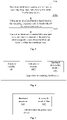
- a process of a controller controlling the interfered airborne electromagnetic wave device to resist interference includes the following steps S201 to S206, as shown in Figure 2 .
- step S201 the controller detects whether the interfering airborne electromagnetic wave device is powered-on. If the interfering airborne electromagnetic wave device is powered-on, step S202 is performed. If the interfering airborne electromagnetic wave device is not powered-on, step S201 is performed at a preset periodicity.
- step S202 the controller acquires an operating frequency and a bandwidth of interfering airborne electromagnetic wave device.
- the operating frequency and the bandwidth of the interfering airborne electromagnetic wave device may be pre-stored in a preset storage medium (such as a memory of the controller).
- step S203 the controller calculates the interfered band based on the operating frequency and the bandwidth.
- step S204 the controller generates a control command based on the interfered band.
- step S205 the controller transmits the control command to the interfered airborne electromagnetic wave device.
- the control command includes the interfered band.
- the interfered airborne electromagnetic wave device refers to the first airborne electromagnetic wave device or the second airborne electromagnetic wave device.
- step S206 the interfered airborne electromagnetic wave device controls, based on the control command, the electrically tunable filter to increase attenuation of the signals within the interfered band by a preset value.
- the process of controlling the electrically tunable filter to increase attenuation of the signals within the interfered band by a preset value is known in the art.
- the attenuation of the signals within the interfered band is increased by 50dB through controlling an output voltage of the electrically tunable filter by a digital-to-analog converter (DAC).
- DAC digital-to-analog converter
- the preset value may be determined by technicians according to the practical application, which is not described in details herein.
- the electrically tunable filter includes but is not limited to a band stop filter, a band-pass filter and other filters.
- the process of the interfered airborne electromagnetic wave device controlling the electrically tunable filter based on the control command to increase the attenuation of the signals within the interfered band by the preset value includes: controlling, by the interfered airborne electromagnetic wave device, a frequency of the band stop filter as the operating frequency, and an operating bandwidth of the band stop filter as the interfered band through a DAC output voltage.
- the process of the interfered airborne electromagnetic wave device controlling the electrically tunable filter based on the control command to increase the attenuation of the signals within the interfered band by the preset value includes: controlling, by the interfered airborne electromagnetic wave device, the band-pass filter to operate outside the interfered band through the DAC output voltage.
- the transmission channel of the interfered airborne electromagnetic wave device includes a receiving channel and a transmitting channel.
- the receiving channel or the transmitting channel of the interfered airborne electromagnetic wave device may be provided with an electrically tunable filter.
- both the receiving channel and the transmitting channel of the interfered airborne electromagnetic wave device are provided with electrically adjustable filters.
- a first airborne electromagnetic wave device and a second airborne electromagnetic wave device form a pair of interfered airborne electromagnetic wave device and interfering airborne electromagnetic wave device, an operating frequency band of the first airborne electromagnetic wave device is overlapped with an operating frequency band of the second airborne electromagnetic wave device, and a transmission channel of an interfered airborne electromagnetic wave device is provided with an electrically tunable filter.
- an interfered band is calculated based on an operating frequency and a bandwidth of the interfering airborne electromagnetic wave device, and an operation that the interfered airborne electromagnetic wave device controls the electrically tunable filter to filter out signals within the interfered band is triggered.
- the interfered airborne electromagnetic wave device controls the electrically tunable filter to filter out the signals within the interfered band, and therefore the interfered airborne electromagnetic wave device can stop signal transmission within the interfered band, so as to eliminate interference in communication between different satellite communication systems.
- the scheme of providing the electrically tunable filter on the transmission channel of the interfered airborne electromagnetic wave device can be widely applied to various airborne electromagnetic wave devices, and has wide applicability.
- a method for resisting interference is further provided according to an embodiment of the present disclosure.
- the method for resisting interference includes the following steps S301 to S303.
- step S301 an interference source is detected, and an operating frequency and a bandwidth of the interference source are acquired.
- Satellite communication systems may encounter communication interference if airborne electromagnetic wave devices in the systems have operating frequency bands overlapped with each other.
- an airborne electromagnetic wave device that causes interference to another airborne electromagnetic wave device is regarded as an interference source, and the airborne electromagnetic wave device that undergoes interference is regarded as an interfered source.
- the interference source may be detected by detecting whether the interfering airborne electromagnetic wave device is powered-on.
- the interference source may be detected in other conventional ways.
- the process of acquiring the operating frequency and the bandwidth of the interference source is known in the art, which is not described in details herein.
- step S302 an interfered band is calculated at least based on the operating frequency and the bandwidth of the interference source.
- step S302 are the same as the process and the principle of the controller calculating the interfered band based on the operating frequency and the bandwidth of the interfering airborne electromagnetic wave device described above, which are not repeated herein.
- step S303 an electrically tunable filter arranged in a transmission channel of an airborne electromagnetic wave device is controlled to filter out signals within the interfered band.
- step S303 are the same as the process and the principle of the controller triggering the case that the interfered airborne electromagnetic wave device controls the electrically tunable filter to filter out signals within the interfered band shown in Figure 2 , which are not repeated herein.
- an interference source is detected, an operating frequency and a bandwidth of the interference source are acquired, an interfered band is calculated at least based on the operating frequency and the bandwidth of the interference source, and the electrically tunable filter arranged on the transmission channel of the airborne electromagnetic wave device is controlled to filter out signals within the interfered band.
- the interfered airborne electromagnetic wave device controls the electrically tunable filter to filter out the signals within the interfered band, and therefore the interfered airborne electromagnetic wave device can stop signal transmission within the interfered band, so as to eliminate interference in communication between different satellite communication systems.
- the scheme of providing the electrically tunable filter on the transmission channel of the interfered airborne electromagnetic wave device can be widely applied to various airborne electromagnetic wave devices and has wide applicability.
- a device for resisting interference is further provided according to an embodiment of the present disclosure, which is applicable in an airborne electromagnetic wave device.
- the device for resisting interference includes a detection module 401, a calculation module 402 and a baseband processing module 403.
- the detection module 401 is configured to detect an interference source and acquire an operating frequency and a bandwidth of the interference source.
- the process and the principle for the detection module 401 to detect an interference source and acquire an operating frequency and a bandwidth of the interference source are the same as the process and the principle of the step S301 shown in Figure 3 , which are not repeated herein.
- the calculation module 402 is configured to calculate an interfered band at least based on the operating frequency and the bandwidth of the interference source.
- the process and the principle for the calculation module 402 to calculate an interfered band at least based on the operating frequency and the bandwidth of the interference source are the same as the process and the principle of the step S302 shown in Figure 3 , which are not repeated herein.
- the baseband processing module 403 is configured to control an electrically tunable filter arranged on at least one of a receiving channel and a transmitting channel to filter out signals within the interfered band.
- the process and the principle of the baseband processing module 403 controlling the electrically tunable filter arranged on the transmission channel of the airborne electromagnetic wave device to filter out signals within the interfered band are the same as the process and the principle of the step S303 shown in Figure 3 , which are not repeated herein.
- an interference source is detected, an operating frequency and a bandwidth of the interference source are acquired, an interfered band is calculated at least based on the operating frequency and the bandwidth of the interference source, and the electrically tunable filter arranged on the transmission channel of the airborne electromagnetic wave device is controlled to filter out signals within the interfered band.
- the interfered airborne electromagnetic wave device controls the electrically tunable filter to filter out the signals within the interfered band, and therefore the interfered airborne electromagnetic wave device can stop signal transmission within the interfered band, so as to eliminate interference in communication between different satellite communication systems.
- the scheme of providing the electrically tunable filter on the transmission channel of the interfered airborne electromagnetic wave device can be widely applied to various airborne electromagnetic wave devices and has wide applicability.
- FIG. 5 is a schematic structural diagram of an airborne electromagnetic wave device according to an embodiment of the present disclosure.
- the airborne electromagnetic wave device includes a baseband processor 501 and an electrically tunable filter 502.
- the electrically tunable filter 502 is connected to the baseband processor 501.
- the electrically tunable filter 502 is arranged on a transmission channel of the airborne electromagnetic wave device.
- the baseband processor 501 controls the electrically tunable filter 502 to increase attenuation of signals within the interfered band by a preset value.
- the process and the principle for the baseband processor 501 to control the electrically tunable filter 502 to increase attenuation of signals within the interfered band by a preset value are the same as the process and the principle of the steps S301 to S303 shown in Figure 3 , which are not repeated herein.
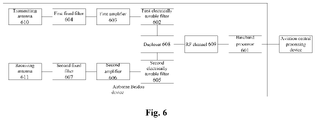
- FIG. 6 is a schematic structural diagram of an airborne Beidou device according to an embodiment of the present disclosure.
- the airborne Beidou device includes a baseband processor 601, a first electrically tunable filter 602, a first amplifier 603, a first fixed filter 604, a second electrically tunable filter 605, a second amplifier 606, a second fixed filter 607, a duplexer 608, a RF channel 609, a transmitting antenna 610 and a receiving antenna 611.
- the first electrically adjustable filter 602, the first amplifier 603 and the first fixed filter 604 are arranged on a transmitting channel of the airborne Beidou device.
- the second electrically adjustable filter 605, the second amplifier 606 and the second fixed filter 607 are arranged on a receiving channel of the airborne Beidou device.
- the baseband processor 601 is connected to an end of the RF channel 609, and another end of the RF channel 609 is connected to a first end of the duplexer 608.
- a second end of the duplexer 608 is connected to an end of the first electrically tunable filter 602, another end of the first electrically tunable filter 602 is connected to an end of the first amplifier 603, another end of the first amplifier 603 is connected to an end of the first fixed filter 604, and another end of the first fixed filter 604 is connected to the transmitting antenna 610.
- a third end of the duplexer 608 is connected to an end of the second electrically tunable filter 605, another end of the second electrically tunable filter 605 is connected to an end of the second amplifier 606, another end of the second amplifier 606 is connected to an end of the second fixed filter 607, and another end of the second fixed filter 607 is connected to the receiving antenna 611.
- the airborne Beidou device communicates with and connects to the controller in the anti-interference system through the baseband processor 601.
- an aviation central processing device (such as IMA) serves as the controller.
- the baseband processor in response to receiving information about an interfered band, controls the electrically tunable filter to increase attenuation of the signals within the interfered band by the preset value.
- the interfered airborne electromagnetic wave device controls the electrically tunable filter to filter out the signals within the interfered band, and therefore the interfered airborne electromagnetic wave device can stop signal transmission within the interfered band, so as to eliminate interference in communication between different satellite communication systems.
- the scheme of providing the electrically tunable filter on the transmission channel of the interfered airborne electromagnetic wave device can be widely applied to various airborne electromagnetic wave devices and has wide applicability.
Landscapes
- Engineering & Computer Science (AREA)
- Computer Networks & Wireless Communication (AREA)
- Signal Processing (AREA)
- Noise Elimination (AREA)
- Radio Relay Systems (AREA)
- Mobile Radio Communication Systems (AREA)
Applications Claiming Priority (2)
| Application Number | Priority Date | Filing Date | Title |
|---|---|---|---|
| CN201911360409.3A CN110971251A (zh) | 2019-12-25 | 2019-12-25 | 机载电磁波设备、及抗干扰系统、方法及装置 |
| PCT/CN2020/137053 WO2021129495A1 (zh) | 2019-12-25 | 2020-12-17 | 机载电磁波设备、及抗干扰系统、方法及装置 |
Publications (2)
| Publication Number | Publication Date |
|---|---|
| EP4084342A1 true EP4084342A1 (de) | 2022-11-02 |
| EP4084342A4 EP4084342A4 (de) | 2024-01-24 |
Family
ID=70036614
Family Applications (1)
| Application Number | Title | Priority Date | Filing Date |
|---|---|---|---|
| EP20904779.4A Pending EP4084342A4 (de) | 2019-12-25 | 2020-12-17 | Elektromagnetische wellenvorrichtung in der luft sowie störschutzsystem, verfahren und vorrichtung |
Country Status (4)
| Country | Link |
|---|---|
| US (1) | US11876546B2 (de) |
| EP (1) | EP4084342A4 (de) |
| CN (1) | CN110971251A (de) |
| WO (1) | WO2021129495A1 (de) |
Families Citing this family (2)
| Publication number | Priority date | Publication date | Assignee | Title |
|---|---|---|---|---|
| CN110971251A (zh) * | 2019-12-25 | 2020-04-07 | 中电科航空电子有限公司 | 机载电磁波设备、及抗干扰系统、方法及装置 |
| CN112737661B (zh) * | 2020-12-16 | 2022-04-22 | 中电科航空电子有限公司 | 一种机载北斗设备与他机铱星设备的干扰协调方法及系统 |
Family Cites Families (17)
| Publication number | Priority date | Publication date | Assignee | Title |
|---|---|---|---|---|
| KR20030058414A (ko) * | 2001-12-31 | 2003-07-07 | 삼성전자주식회사 | 가변 대역 통과 필터를 이용한 다중 주파수 대역 송수신장치 |
| US7142818B2 (en) * | 2003-02-13 | 2006-11-28 | Honeywell International, Inc. | Systems and methods for reducing radio receiver interference from an on-board avionics transmitter |
| US7764726B2 (en) | 2004-12-01 | 2010-07-27 | Qualomm Incorporated | Systems, methods, and apparatus for jammer rejection |
| WO2012157140A1 (ja) * | 2011-05-16 | 2012-11-22 | 古野電気株式会社 | 妨害波信号除去装置、gnss受信装置、移動端末、妨害波信号除去プログラム、および妨害波信号除去方法 |
| WO2014202121A1 (en) * | 2013-06-18 | 2014-12-24 | Telefonaktiebolaget L M Ericsson (Publ) | A duplex unit |
| US9100110B2 (en) * | 2013-08-29 | 2015-08-04 | Qualcomm Incorporated | Non-linear interference cancellation with multiple aggressors |
| US9692470B2 (en) * | 2015-08-25 | 2017-06-27 | Qualcomm Incorporated | Low noise amplifier and notch filter |
| US9800275B2 (en) * | 2015-12-16 | 2017-10-24 | Kumu Networks, Inc. | Systems and methods for out-of band-interference mitigation |
| CN106899316B (zh) * | 2015-12-17 | 2019-05-31 | 中国航天科工集团八五一一研究所 | 多天线天基ais接收机 |
| US10237004B2 (en) * | 2016-05-25 | 2019-03-19 | Avago Technologies International Sales Pte. Limited | Inter-radio communications for scheduling or allocating time-varying frequency resources |
| CN105933014A (zh) * | 2016-06-23 | 2016-09-07 | 珠海市魅族科技有限公司 | 一种用于终端设备的信号发射系统、方法和终端设备 |
| CN107390236B (zh) * | 2017-05-23 | 2023-03-31 | 青岛海信移动通信技术股份有限公司 | 卫星信号接收装置及其对接收的卫星信号进行处理的方法 |
| US10461421B1 (en) * | 2019-05-07 | 2019-10-29 | Bao Tran | Cellular system |
| CN110429952B (zh) * | 2019-06-04 | 2024-04-19 | 广东圣大电子有限公司 | 一种Ku波段综合射频收发系统 |
| CN110266621A (zh) * | 2019-06-24 | 2019-09-20 | 陕西飞机工业(集团)有限公司 | 一种机载超短波干扰抵消系统 |
| CN211018844U (zh) * | 2019-12-25 | 2020-07-14 | 中电科航空电子有限公司 | 抗干扰系统、机载电磁波设备和机载抗干扰系统 |
| CN110971251A (zh) | 2019-12-25 | 2020-04-07 | 中电科航空电子有限公司 | 机载电磁波设备、及抗干扰系统、方法及装置 |
-
2019
- 2019-12-25 CN CN201911360409.3A patent/CN110971251A/zh active Pending
-
2020
- 2020-12-17 WO PCT/CN2020/137053 patent/WO2021129495A1/zh not_active Ceased
- 2020-12-17 US US17/785,424 patent/US11876546B2/en active Active
- 2020-12-17 EP EP20904779.4A patent/EP4084342A4/de active Pending
Also Published As
| Publication number | Publication date |
|---|---|
| EP4084342A4 (de) | 2024-01-24 |
| US11876546B2 (en) | 2024-01-16 |
| CN110971251A (zh) | 2020-04-07 |
| WO2021129495A1 (zh) | 2021-07-01 |
| US20230024315A1 (en) | 2023-01-26 |
Similar Documents
| Publication | Publication Date | Title |
|---|---|---|
| EP3162132B1 (de) | Detektion von proximität mittels antennenrückkopplung | |
| CN105099585B (zh) | 无人机信号处理装置及信号处理方法 | |
| EP4084342A1 (de) | Elektromagnetische wellenvorrichtung in der luft sowie störschutzsystem, verfahren und vorrichtung | |
| CN108153321A (zh) | 无人机信息链路抗电磁辐射干扰方法及装置 | |
| CN112204892A (zh) | 毫米波(mmwave)系统和方法 | |
| US11855678B2 (en) | Method for amplifying radio signals between a terminal device and an antenna in a first frequency band and in a second frequency band | |
| CN106452464A (zh) | 信息处理装置及方法 | |
| CN108476221B (zh) | 一种无人机的信号处理方法、设备、监听设备 | |
| US20160285538A1 (en) | Base station signal matching device and relay device including the same | |
| CN113078973B (zh) | 一种反无人机系统与cdma基站的干扰分析方法及系统 | |
| WO2019062201A1 (zh) | 一种无人机宽频天线复用方法及装置 | |
| US9490917B2 (en) | Derived receive signal processing | |
| CN211018844U (zh) | 抗干扰系统、机载电磁波设备和机载抗干扰系统 | |
| EP2824855B1 (de) | System und verfahren zur kommunikation mit interferenzunterdrückung | |
| US12232095B2 (en) | Ultra-wideband radio system with detect-and-avoid capability | |
| EP2824856B1 (de) | System und Verfahren zur Kommunikation mit Interferenzunterdrückung | |
| US20180122249A1 (en) | Collision avoidance systems | |
| KR101372485B1 (ko) | 송신 시간차를 이용하여 주파수 간섭을 제거하기 위한 방법 | |
| CN107636438B (zh) | 信号处理装置、气压传感器组件和电子设备 | |
| KR102473459B1 (ko) | 신호발생기를 구비한 신호제어장치 | |
| EP4290268A1 (de) | Systeme und verfahren zur verringerung von telekommunikationssignalstörungen bei radarhöhenmessern | |
| CN106788515B (zh) | 一种中频信号切换系统及方法 | |
| KR102824079B1 (ko) | 무선통신 보호용 하이브리드 emp 필터 | |
| RU2609820C1 (ru) | Комбинированное свч устройство для метеорадиолокатора (варианты) | |
| US20240061096A1 (en) | A wireless sensing method |
Legal Events
| Date | Code | Title | Description |
|---|---|---|---|
| STAA | Information on the status of an ep patent application or granted ep patent |
Free format text: STATUS: THE INTERNATIONAL PUBLICATION HAS BEEN MADE |
|
| PUAI | Public reference made under article 153(3) epc to a published international application that has entered the european phase |
Free format text: ORIGINAL CODE: 0009012 |
|
| STAA | Information on the status of an ep patent application or granted ep patent |
Free format text: STATUS: REQUEST FOR EXAMINATION WAS MADE |
|
| 17P | Request for examination filed |
Effective date: 20220610 |
|
| AK | Designated contracting states |
Kind code of ref document: A1 Designated state(s): AL AT BE BG CH CY CZ DE DK EE ES FI FR GB GR HR HU IE IS IT LI LT LU LV MC MK MT NL NO PL PT RO RS SE SI SK SM TR |
|
| DAV | Request for validation of the european patent (deleted) | ||
| DAX | Request for extension of the european patent (deleted) | ||
| A4 | Supplementary search report drawn up and despatched |
Effective date: 20231221 |
|
| RIC1 | Information provided on ipc code assigned before grant |
Ipc: H04B 1/10 20060101AFI20231215BHEP |