EP4084169A1 - Polymer electrolyte membrane, membrane-electrode assembly including same, and method for measuring durability thereof - Google Patents
Polymer electrolyte membrane, membrane-electrode assembly including same, and method for measuring durability thereof Download PDFInfo
- Publication number
- EP4084169A1 EP4084169A1 EP20905487.3A EP20905487A EP4084169A1 EP 4084169 A1 EP4084169 A1 EP 4084169A1 EP 20905487 A EP20905487 A EP 20905487A EP 4084169 A1 EP4084169 A1 EP 4084169A1
- Authority
- EP
- European Patent Office
- Prior art keywords
- polymer electrolyte
- electrolyte membrane
- ionomer
- stab
- support
- Prior art date
- Legal status (The legal status is an assumption and is not a legal conclusion. Google has not performed a legal analysis and makes no representation as to the accuracy of the status listed.)
- Pending
Links
Images
Classifications
-
- H—ELECTRICITY
- H01—ELECTRIC ELEMENTS
- H01M—PROCESSES OR MEANS, e.g. BATTERIES, FOR THE DIRECT CONVERSION OF CHEMICAL ENERGY INTO ELECTRICAL ENERGY
- H01M8/00—Fuel cells; Manufacture thereof
- H01M8/04—Auxiliary arrangements, e.g. for control of pressure or for circulation of fluids
- H01M8/04298—Processes for controlling fuel cells or fuel cell systems
- H01M8/04313—Processes for controlling fuel cells or fuel cell systems characterised by the detection or assessment of variables; characterised by the detection or assessment of failure or abnormal function
-
- H—ELECTRICITY
- H01—ELECTRIC ELEMENTS
- H01M—PROCESSES OR MEANS, e.g. BATTERIES, FOR THE DIRECT CONVERSION OF CHEMICAL ENERGY INTO ELECTRICAL ENERGY
- H01M8/00—Fuel cells; Manufacture thereof
- H01M8/10—Fuel cells with solid electrolytes
- H01M8/1016—Fuel cells with solid electrolytes characterised by the electrolyte material
- H01M8/1018—Polymeric electrolyte materials
- H01M8/1067—Polymeric electrolyte materials characterised by their physical properties, e.g. porosity, ionic conductivity or thickness
-
- H—ELECTRICITY
- H01—ELECTRIC ELEMENTS
- H01M—PROCESSES OR MEANS, e.g. BATTERIES, FOR THE DIRECT CONVERSION OF CHEMICAL ENERGY INTO ELECTRICAL ENERGY
- H01M8/00—Fuel cells; Manufacture thereof
- H01M8/10—Fuel cells with solid electrolytes
- H01M8/1004—Fuel cells with solid electrolytes characterised by membrane-electrode assemblies [MEA]
-
- H—ELECTRICITY
- H01—ELECTRIC ELEMENTS
- H01M—PROCESSES OR MEANS, e.g. BATTERIES, FOR THE DIRECT CONVERSION OF CHEMICAL ENERGY INTO ELECTRICAL ENERGY
- H01M8/00—Fuel cells; Manufacture thereof
- H01M8/10—Fuel cells with solid electrolytes
- H01M8/1016—Fuel cells with solid electrolytes characterised by the electrolyte material
- H01M8/1018—Polymeric electrolyte materials
- H01M8/1041—Polymer electrolyte composites, mixtures or blends
- H01M8/1053—Polymer electrolyte composites, mixtures or blends consisting of layers of polymers with at least one layer being ionically conductive
-
- H—ELECTRICITY
- H01—ELECTRIC ELEMENTS
- H01M—PROCESSES OR MEANS, e.g. BATTERIES, FOR THE DIRECT CONVERSION OF CHEMICAL ENERGY INTO ELECTRICAL ENERGY
- H01M8/00—Fuel cells; Manufacture thereof
- H01M8/10—Fuel cells with solid electrolytes
- H01M8/1016—Fuel cells with solid electrolytes characterised by the electrolyte material
- H01M8/1018—Polymeric electrolyte materials
- H01M8/1058—Polymeric electrolyte materials characterised by a porous support having no ion-conducting properties
-
- H—ELECTRICITY
- H01—ELECTRIC ELEMENTS
- H01M—PROCESSES OR MEANS, e.g. BATTERIES, FOR THE DIRECT CONVERSION OF CHEMICAL ENERGY INTO ELECTRICAL ENERGY
- H01M8/00—Fuel cells; Manufacture thereof
- H01M8/10—Fuel cells with solid electrolytes
- H01M2008/1095—Fuel cells with polymeric electrolytes
-
- H—ELECTRICITY
- H01—ELECTRIC ELEMENTS
- H01M—PROCESSES OR MEANS, e.g. BATTERIES, FOR THE DIRECT CONVERSION OF CHEMICAL ENERGY INTO ELECTRICAL ENERGY
- H01M8/00—Fuel cells; Manufacture thereof
- H01M8/10—Fuel cells with solid electrolytes
- H01M8/1016—Fuel cells with solid electrolytes characterised by the electrolyte material
- H01M8/1018—Polymeric electrolyte materials
-
- Y—GENERAL TAGGING OF NEW TECHNOLOGICAL DEVELOPMENTS; GENERAL TAGGING OF CROSS-SECTIONAL TECHNOLOGIES SPANNING OVER SEVERAL SECTIONS OF THE IPC; TECHNICAL SUBJECTS COVERED BY FORMER USPC CROSS-REFERENCE ART COLLECTIONS [XRACs] AND DIGESTS
- Y02—TECHNOLOGIES OR APPLICATIONS FOR MITIGATION OR ADAPTATION AGAINST CLIMATE CHANGE
- Y02E—REDUCTION OF GREENHOUSE GAS [GHG] EMISSIONS, RELATED TO ENERGY GENERATION, TRANSMISSION OR DISTRIBUTION
- Y02E60/00—Enabling technologies; Technologies with a potential or indirect contribution to GHG emissions mitigation
- Y02E60/30—Hydrogen technology
- Y02E60/50—Fuel cells
Definitions
- the present disclosure relates to a polymer electrolyte membrane, a membrane-electrode assembly including the same, and a method of measuring durability thereof, and more particularly to a polymer electrolyte membrane having excellent mechanical properties without degradation in performance, such as ionic conductivity, whereby it is possible to guarantee manufacture of a membrane-electrode assembly having a high durability of 30,000 wet/dry cycles or more measured according to the NEDO protocol, a membrane-electrode assembly including the same, and a method of measuring durability thereof.
- a fuel cell which is a cell including a power generation system for directly converting chemical reaction energy into electrical energy through an oxidation/reduction reaction of hydrogen and oxygen contained in a hydrocarbon-based fuel material, such as methanol, ethanol, or natural gas, has attracted attention as a next-generation clean energy source that is capable of replacing fossil energy due to the environmentally friendly characteristics thereof, such as high energy efficiency and reduced discharge of contaminants.
- a hydrocarbon-based fuel material such as methanol, ethanol, or natural gas
- Such a fuel cell has an advantage in that unit cells are stacked to constitute a stack, whereby it is possible to provide various levels of power.
- the fuel cell has energy density 4 to 10 times that of a small-sized lithium battery, whereby the fuel cell has attracted attention as a small-sized power supply or a mobile power supply.
- the stack of the fuel cell which substantially generates electricity, has a structure in which several to several tens of unit cells, each of which includes a membrane-electrode assembly (MEA) and a separator (also referred to as a bipolar plate), are stacked, and the membrane-electrode assembly is generally configured to have a structure in which an anode (also referred to as a "fuel electrode”) and a cathode (also referred to as an "air electrode”) are formed at opposite sides of an electrolyte membrane in the state in which the electrolyte membrane is disposed therebetween.
- MEA membrane-electrode assembly
- separator also referred to as a bipolar plate
- the fuel cell may be classified as an alkaline electrolyte membrane fuel cell or a polymer electrolyte membrane fuel cell (PEMFC) depending on the state and kind of an electrolyte.
- the polymer electrolyte membrane fuel cell has attracted attention as a mobile power supply, a power supply for vehicles, and a power supply for home use due to a low operating temperature lower than 100°C, rapid starting and response characteristics, and excellent durability thereof.
- polymer electrolyte membrane fuel cell may include a proton exchange membrane fuel cell (PEMFC), which uses hydrogen gas as fuel, and a direct methanol fuel cell (DMFC), which uses liquid methanol as fuel.
- PEMFC proton exchange membrane fuel cell
- DMFC direct methanol fuel cell
- the polymer electrolyte membrane fuel cell there are many technical problems to be solved in order to realize commercial use of the polymer electrolyte membrane fuel cell, and it is essentially necessary to realize high performance, a long lifespan, and a reduction in the price of the polymer electrolyte membrane fuel cell.
- the element that exerts the greatest influence thereon is the membrane-electrode assembly, and the polymer electrolyte membrane is one of the core factors that exert the greatest influence on the performance and price of the membrane-electrode assembly.
- mechanical durability of the membrane-electrode assembly substantially depends on durability of the polymer electrolyte membrane that repeatedly expands and contracts during driving of the fuel cell.
- a polymer electrolyte membrane including a composite layer including a porous support having a plurality of pores and an ionomer with which the pores are filled, wherein the polymer electrolyte membrane has an MD tear strength of 150 N/mm or more, a TD tear strength of 150 N/mm or more, a stab initial strain of 8% or less, and a stab final strain of 10% or less.
- the polymer electrolyte membrane may have an in-plane ionic conductivity of 0.03 to 0.1 S/cm and a through-plane ionic conductivity of 0.03 to 0.1 S/cm under conditions of 80°C and 50% RH
- the polymer electrolyte membrane may have an MD tear strength of 170 to 320 N/mm, a TD tear strength of 160 to 320 N/mm, a stab initial strain of 1 to 6%, and a stab final strain of 2 to 8%.
- the composite layer may have a first surface and a second surface opposite the first surface
- the polymer electrolyte membrane may further include a first resin layer disposed on the first surface, the first resin layer including a first ionomer, and a second resin layer disposed on the second surface, the second resin layer including a second ionomer, and at least a portion of the ionomer in the composite layer may be an ionomer identical to at least one of the first ionomer and the second ionomer.
- the thickness of the polymer electrolyte membrane may be 10 to 50 ⁇ m, and the thickness of the composite layer may be 30 to 90% of the thickness of the polymer electrolyte membrane.
- the porous support may include a first porous sub-support having the first surface and a second porous sub-support having the second surface, the first porous sub-support may have first pores, the first pores being filled with an ionomer identical to the first ionomer, and the second porous sub-support may have second pores, some of the second pores adjacent to the first porous sub-support being filled with an ionomer identical to the first ionomer, the remainder of the second pores adjacent to the second resin layer being filled with an ionomer identical to the second ionomer.
- the first and second porous sub-supports may be in contact with each other.
- the porous support may include a first porous sub-support having the first surface, a second porous sub-support having the second surface, and at least one third porous sub-support disposed between the first and second porous sub-supports, and the first, second, and third porous sub-supports may be in contact with each other.
- the first ionomer may be identical to or different from the second ionomer.
- a membrane-electrode assembly including an anode, a cathode, and the polymer electrolyte membrane according to claim 1, the polymer electrolyte membrane being disposed between the anode and the cathode.
- a method of measuring durability of a polymer electrolyte membrane including taking a sample having a predetermined size and shape from the polymer electrolyte membrane, fixing the sample to a holder for puncture testing according to ASTM F1342, repeatedly stabbing the sample using a probe for puncture testing according to ASTM F1342 at a predetermined load and a predetermined speed, measuring displacement of the sample after each stab, and calculating stab strain using at least one of the measured displacements.
- the sample may have a square shape of 50 mm x 50 mm, the predetermined load may be 10 N, and the predetermined speed may be 100 mm/min.
- the method may be performed at a temperature of 23 ⁇ 2°C and a relative humidity of 50 ⁇ 5%.
- An initial load applied to the sample may be 0.2 N.
- the polymer electrolyte membrane according to the present disclosure has not only excellent electrical performance such as ionic conductivity but also high tear strength and stab resistance, thereby exhibiting improved mechanical durability.
- the polymer electrolyte membrane according to the present disclosure has tear strength and stab strain within the ranges as defined by the present disclosure, whereby it is possible to guarantee manufacture of a membrane-electrode assembly having a high durability of 30,000 wet/dry cycles or more as measured according to the NEDO protocol.
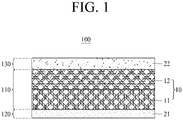
- FIG. 1 is a sectional view of a polymer electrolyte membrane according to an embodiment of the present disclosure.
- FIG. 1 is a sectional view of a polymer electrolyte membrane 100 according to an embodiment of the present disclosure.
- the polymer electrolyte membrane 100 includes a composite layer 110 including a porous support 10 having a plurality of pores and an ionomer 21/22 with which the pores are filled.
- the porous support 10 may be a nonwoven web made of a hydrocarbon-based polymer.
- the porous support 10 may be a nanoweb in which nanofibers having an average diameter of 40 to 5000 nm are randomly arranged.
- the hydrocarbon-based polymer may be a polymer that has excellent chemical resistance and that has no risk of deformation due to moisture in a high humidity environment, such as aliphatic polyamide, aromatic polyamide, polyimide, polyetherimide, polyacrylonitrile, polyaniline, polyethylene oxide, polyethylene naphthalate, polybutylene terephthalate, styrene butadiene rubber, polystyrene, polyvinyl chloride, polyvinyl alcohol, polyvinylidene fluoride, polyvinyl butylene, polyurethane, polybenzoxazole, polybenzimidazole, polyamide imide, polyethylene terephthalate, polyphenylene sulfide, polyethylene, polypropylene, a cop
- the porosity of the porous support 10 may be 45% or more, preferably 50% or more, more preferably 60 to 90%. If the porosity of the porous support 10 is less than 45%, the amount of the ionomer in the porous support 10 is too small, whereby ionic conductivity of the polymer electrolyte membrane 100 is lowered. If the porosity of the porous support 10 is greater than 90%, on the other hand, the intended reinforcement function of the porous support may be deteriorated, and dimensional stability of the porous support may be lowered, and therefore subsequent processes may not be smoothly performed.
- the ionomer 21/22 is a cationic conductor having a cation exchange group or an anionic conductor having an anion exchange group.
- the cationic conductor may be a fluorine-based polymer including at least one cation exchange group selected from the group consisting of a sulfonic acid group, a carboxyl group, a boronic acid group, a phosphate group, an imide group, a sulfonimide group, a sulfonamide group, a sulfonic acid fluoride group, and a derivative thereof.
- the cationic conductor may be, but is not limited to, poly(perfluorosulfonic acid), poly(perfluorocarboxylic acid), a copolymer of tetrafluoroethylene including a sulfonic acid group and fluorovinyl ether, defluorinated polyetherketone sulfide, or a mixture of two or more thereof.
- the cationic conductor may be a hydrocarbon-based polymer including at least one cation exchange group selected from the group consisting of a sulfonic acid group, a carboxyl group, a boronic acid group, a phosphate group, an imide group, a sulfonimide group, a sulfonamide group, a sulfonic acid fluoride group, and a derivative thereof.
- a hydrocarbon-based polymer including at least one cation exchange group selected from the group consisting of a sulfonic acid group, a carboxyl group, a boronic acid group, a phosphate group, an imide group, a sulfonimide group, a sulfonamide group, a sulfonic acid fluoride group, and a derivative thereof.
- the cationic conductor may be, but is not limited to, sulfonated polyimide (S-PI), sulfonated polyarylether sulfone (S-PAES), sulfonated polyetheretherketone (SPEEK), sulfonated polybenzimidazole (SPBI), sulfonated polysulfone (S-PSU), sulfonated polystyrene (S-PS), sulfonated polyphosphazene, sulfonated polyquinoxaline, sulfonated polyketone, sulfonated polyphenylene oxide, sulfonated polyether sulfone, sulfonated polyether ketone, sulfonated polyphenylene sulfone, sulfonated polyphenylene sulfide, sulfonated polyphenylene sulfide sulfone, sulfonated polyphenylene s
- the anionic conductor is a polymer capable of transferring anions, such as hydroxyl ions, carbonate, or bicarbonate.
- a polymer doped with metal hydroxide may generally be used as the anionic conductor.
- poly(ether sulfone), polystyrene, a vinyl-based polymer, poly(vinyl chloride), poly(vinylidene fluoride), poly(tetrafluoroethylene), poly(benzimidazole), or poly(ethylene glycol), which is doped with metal hydroxide may be used as the anionic conductor.
- the polymer electrolyte membrane 100 has an MD tear strength of 150 N/mm or more (e.g., 170 to 320 N/mm) and a TD tear strength of 150 N/mm or more (e.g., 160 to 320 N/mm).
- Machine direction and “traverse direction”, respectively.
- Machine direction is a direction in which the polymer electrolyte membrane 100 is moved when manufactured, and "traverse direction” is a direction perpendicular to “machine direction”.
- a sample of 50 mm x 50 mm is taken, and the maximum force applied to the sample until the sample is torn is measured under the following conditions according to ASTM D624 using a universal test machine (UTM) (Instron 5966).
- UTM universal test machine
- TS tear strength (N/mm) of the sample
- F indicates the maximum force (N) applied to the sample
- d indicates a median thickness (mm), which is the arithmetic mean of thicknesses of the sample measured at three points of the sample in a central portion thereof.
- tear strengths of five samples are respectively measured, and the arithmetic mean thereof is calculated, whereby tear strength of the polymer electrolyte membrane 100 is obtained.
- a membrane-electrode assembly manufactured using the polymer electrolyte membrane 100 according to a conventional method does not always satisfy high durability required by the industry (i.e., wet/dry cycles measured according to the NEDO protocol > 30,000 times).
- an MD tear strength of 150 N/mm or more and a TD tear strength of 150 N/mm or more are necessary conditions for satisfying 30,000 wet/dry cycles or more, rather than sufficient conditions therefor.
- the polymer electrolyte membrane 100 has an MD tear strength of 150 N/mm or more and a TD tear strength of 150 N/mm or more, therefore, it is required to actually manufacture a membrane-electrode assembly sample and to perform a durability test according to the NEDO protocol in order to check whether a membrane-electrode assembly manufactured using the polymer electrolyte membrane according to a conventional method has sufficient durability. This requires a lot of time and causes cost increase.
- a membrane-electrode assembly manufactured using the polymer electrolyte membrane according to a conventional method always satisfies 30,000 wet/dry cycles or more. According to the present disclosure, therefore, stab resistance of the polymer electrolyte membrane 100 as well as tear strength thereof are measured, whereby it is possible to check whether the membrane-electrode assembly would satisfy mechanical durability required by the industry without actual production thereof. As a result, it is possible to considerably reduce time and cost necessary for research and development of the membrane-electrode assembly and a fuel cell.
- a method of measuring durability of the polymer electrolyte membrane 100 includes a step of taking a sample having a predetermined size and shape from the polymer electrolyte membrane 100, a step of fixing the sample to a holder for puncture testing according to ASTM F1342, a step of repeatedly stabbing the sample using a probe for puncture testing according to ASTM F1342 at a predetermined load and a predetermined speed, a step of measuring displacement of the sample after each stab, and a step of calculating stab strain using at least one of the measured displacements.
- the stab strain calculating step may include a step of calculating stab initial strain and a step of calculating stab final strain.
- stab initial strain and “stab final strain” of the polymer electrolyte membrane 100 are measured as follows.
- a sample of 50 mm x 50 mm is taken, and stab resistance of the sample is measured using a universal test machine (UTM) (Instron 5966).
- UPM universal test machine
- a jig for puncture testing (sample holder and probe) according to ASTM F1342 provided by Instron Company is used as an accessory for repeated stabs.
- stabs load: 10 N
- stabs are repeatedly performed using the probe under the following conditions while the sample is fixed to the holder (the distance from a base level to the sample: 100 mm), and a decrease in the distance (i.e., "displacement") due to each stab is respectively measured.
- displacement when a load of 0.2 N is applied is regarded as a zero point.
- IS indicates stab initial strain
- FS indicates stab final strain
- D 1 indicates displacement (mm) due to a first stab
- D 2 indicates displacement (mm) due to a second stab
- D 20 indicates displacement (mm) due to a twentieth stab.
- the polymer electrolyte membrane 100 has the above-specified ranges of MD/TD tear strengths and stab initial/final strains, and thus would assure a highly durable membrane-electrode assembly having wet/dry cycles of 30,000 or more as measured according to the NEDO protocol.
- MD/TD tear strength and stab initial/final strain of the polymer electrolyte membrane 100 are directly related to wet/dry cycle according to the NEDO protocol, which is generally measured in order to evaluate mechanical durability of the membrane-electrode assembly. Therefore, mechanical durability of a membrane-electrode assembly to be manufactured using a polymer electrolyte membrane 100 can be easily predicted even before actual production thereof, by measuring tear strength and stab strain of the polymer electrolyte membrane 100 as it is prepared. As a result, it is possible to considerably reduce time and cost necessary for research and development of the membrane-electrode assembly and the fuel cell.
- the polymer electrolyte membrane 100 may have an in-plane ionic conductivity of 0.03 to 0.1 S/cm, e.g., 0.046 to 0.1 S/cm, and a through-plane ionic conductivity of 0.03 to 0.1 S/cm, e.g., 0.042 to 0.1 S/cm, under conditions of 80°C and 50% RH.
- the polymer electrolyte membrane 100 according to the present disclosure has high ionic conductivity while having excellent mechanical properties will be described later.
- the polymer electrolyte membrane 100 has excellent mechanical properties (i.e., an MD tear strength of 150 N/mm or more, a TD tear strength of 150 N/mm or more, a stab initial strain of 8% or less, and a stab final strain of 10% or less) without degradation in performance, such as ionic conductivity, whereby it is possible to guarantee manufacture of a membrane-electrode assembly having excellent electrical performance while having a high durability of 30,000 wet/dry cycles or more.
- mechanical properties i.e., an MD tear strength of 150 N/mm or more, a TD tear strength of 150 N/mm or more, a stab initial strain of 8% or less, and a stab final strain of 10% or less
- in-plane ionic conductivity and through-plane ionic conductivity are measured using the following methods.
- In-plane ionic conductivity of the polymer electrolyte membrane 100 is measured at 80°C and 50% RH using a magnetic suspension balance apparatus (Bell Japan Company).
- Through-plane ionic conductivity of the polymer electrolyte membrane 100 is measured using a through-plane membrane test system (Scribner Associates, MTS 740) according to a constant current four-terminal method. Specifically, an alternating current potential difference generated in a sample (10 mm x 30 mm) is measured while applying alternating current to opposite sides of the sample under conditions of 80°C and 50% RH to obtain membrane resistance R ( ⁇ ). Subsequently, through-plane ionic conductivity of the polymer electrolyte membrane 100 is calculated using Equation 4 below.
- ⁇ L/ R ⁇ A (wherein ⁇ indicates through-plane ionic conductivity (S/cm), L indicates the distance (cm) between electrodes, R indicates membrane resistance ( ⁇ ), and A indicates effective area (cm 2 ) of the membrane.)
- the composite layer 110 may have a first surface and a second surface opposite the first surface, and the polymer electrolyte membrane 100 may further include a first resin layer 120 disposed on the first surface and a second resin layer 130 disposed on the second surface.
- the first resin layer 120 may include the first ionomer 21, and the second resin layer 130 may include the second ionomer 22.
- At least a portion of the ionomer in the composite layer 110 may be an ionomer identical to at least one of the first ionomer 21 and the second ionomer 22.
- the thickness of the polymer electrolyte membrane 100 may be 10 to 50 ⁇ m, and the thickness of the composite layer 110 may be 30 to 90%, preferably 35 to 85%, more preferably 40 to 80%, of the thickness of the polymer electrolyte membrane 100. If the thickness percentage of the composite layer 110 is less than 30%, the effects of improving mechanical durability and dimensional stability of the polymer electrolyte membrane 100 due to use of the porous support 10 are insignificant. On the other hand, if the thickness percentage of the composite layer 110 is greater than 90%, the thicknesses of the first and second resin layers 120 and 130 are two small, and thus ionic conductivity of the polymer electrolyte membrane 100 is lowered.
- the porous support 10 includes a first porous sub-support 11 and a second porous sub-support 12.
- the first porous sub-support 11 has the first surface of the composite layer 110. That is, one surface of the first porous sub-support 11 constitutes the first surface of the composite layer 110.
- the second porous sub-support 12 has the second surface of the composite layer 110. That is, one surface of the second porous sub-support 12 constitutes the second surface of the composite layer 110.
- the first and second porous sub-supports 11 and 12 may be the same kind of supports or different kinds of supports.
- both the first and second porous sub-supports 11 and 12 may be e-PTFE films or nonwoven webs.
- the sub-supports may be stacked in such a way that expansion directions thereof are perpendicular to each other.
- the first and second porous sub-supports 11 and 12 may be in contact with each other. Since the first and second porous sub-supports 11 and 12 are in tight contact with each other, it may be impossible to visually check the interface therebetween, unless the sub-supports are different kinds of porous supports distinguishable from each other. That is, the porous support 19 may be an apparent single porous support.
- the polymer electrolyte membrane 100 according to the embodiment of the present disclosure having the first and second porous sub-supports 11 and 12 provides many advantages in several terms, compared to a polymer electrolyte membrane reinforced by an actual single porous support having the same thickness as the porous support 10 (i.e., an actual single porous support providing the same or similar mechanical properties as or to the porous support 10).
- the polymer electrolyte membrane 100 according to the embodiment of the present disclosure having the first and second porous sub-supports 11 and 12 may have excellent mechanical properties without degradation in performance, such as ionic conductivity.
- the first porous sub-support 11 may have a plurality of first pores, wherein the first pores may be filled with the same ionomer as the first ionomer 21 of the first resin layer 120.
- the second porous sub-support 12 may have a plurality of second pores, wherein some of the second pores adjacent to the first porous sub-support 11 may be filled with the same ionomer as the first ionomer 21 of the first resin layer 120, and the remainder of the second pores adjacent to the second resin layer 130 may be filled with the same ionomer as the second ionomer 22 of the second resin layer 130.
- the interface between the first and second ionomers 21 and 22 is present in the second porous sub-support 12 (i.e., since the first ionomer 21 present in the second porous sub-support 12 functions as an anchor), an adhesive force between the first and second porous sub-supports 11 and 12, which is as strong as that of a stack structure having porous supports bonded to each other by means of an adhesive and/or hot press, can be secured, and thus any deterioration of ion conductivity which might be caused due to the use of an adhesive and/or hot press for bonding the supports can be prevented. Consequently, the polymer electrolyte membrane 100 according to the embodiment of the present disclosure may have excellent mechanical properties without degradation in performance, such as ionic conductivity.
- the first ionomer 21 may be identical to or different from the second ionomer 22.
- the method according to the embodiment of the present disclosure includes (i) casting a first mixed liquid including a first ionomer 21, (ii) placing a first porous sub-support 11 in a dry state on the first mixed liquid such that the first porous sub-support 11 becomes entirely wet state, (iii) immediately after the first porous sub-support 11 becomes entirely wet state, adding a second porous sub-support 12 in a dry state on the first porous sub-support 11 such that the first and second porous sub-supports 11 and 12 are in contact with each other, (iv) applying a second mixed liquid including a second ionomer 22 to the second porous sub-support 12 such that the second porous sub-support 12 becomes entirely wet state, and (v) drying the first and second porous sub-supports 11 and 12 which are in the wet state.
- the second porous sub-support 12 may be added on the first porous sub-support 11 while the first porous sub-support is maintained in the entirely wet state by the first mixed liquid, whereby some of the second pores of the second porous sub-support 12 may be filled with the first mixed liquid.
- the first ionomer 21 present in some of the second pores of the second porous sub-support 12 functions as an anchor, whereby strong adhesive force between the first and second porous sub-supports 11 and 12 can be secured, and mechanical properties of the polymer electrolyte membrane 100 can be remarkably improved.
- the polymer electrolyte membrane 100 since such high adhesive force between the first and second porous sub-supports 11 and 12 is acquired without separately using an adhesive and/or a hot press process, any deterioration of ion conductivity which might be caused due to the use of an adhesive and/or hot press for bonding the supports can be prevented. Consequently, the polymer electrolyte membrane 100 according to the embodiment of the present disclosure may have excellent mechanical properties without degradation in performance, such as ionic conductivity.
- the polymer electrolyte membrane 100 according to the present disclosure is distinguished from a stacked type polymer electrolyte membrane manufactured by preparing two or more polymer electrolyte membranes and bonding them to each other by an adhesive and/or hot press, in that a resin layer formed only of an ionomer is not included between the first and second porous sub-supports 11 and 12.
- first and second porous sub-supports 11 and 12 may be the same kind of supports or different kinds of supports.
- both the first and second porous sub-supports 11 and 12 may be e-PTFE films or nonwoven webs.
- the e-PTFE film is an anisotropic film having a non-negligible difference between mechanical properties (e.g., tensile strength and elongation) thereof in an expansion direction and mechanical properties (e.g., tensile strength and elongation) thereof in a direction perpendicular to the expansion direction.
- mechanical properties e.g., tensile strength and elongation
- mechanical properties e.g., tensile strength and elongation
- the step of applying a second mixed liquid including a second ionomer 22 to the second porous sub-support 12 such that the second porous sub-support 12 becomes entirely wet state may include (i) a step of, when the first ionomer 21 and the second ionomer 22 are identical to each other, adding the second porous sub-support 12 on the first porous sub-support 11 and immersing the first and second porous sub-supports 11 and 12 in the second mixed liquid or (ii) a step of applying the second mixed liquid to an exposed surface of the second porous sub-support 12 using a method, such as bar coating, comma coating, slot-die coating, screen printing, spray coating, doctor blade coating, and so on.
- a method such as bar coating, comma coating, slot-die coating, screen printing, spray coating, doctor blade coating, and so on.
- Each of the first and second mixed liquids may be a solution or a dispersion in which the first ionomer 21 or the second ionomer 22 is dissolved or dispersed in water, a hydrophilic solvent, an organic solvent, or a mixed solvent of two or more thereof.
- the hydrophilic solvent may have at least one functional group selected from the group consisting of alcohol, isopropyl alcohol, ketone, aldehyde, carbonate, carboxylate, carboxylic acid, ether, and amide, each of which includes straight-chain or branched-chain saturated or unsaturated hydrocarbon having a carbon number ranging from 1 to 12 as the main chain thereof. Each thereof may include an aliphatic or aromatic cyclic compound as at least a portion of the main chain thereof.
- the organic solvent may be N-methylpyrrolidone, dimethyl sulfoxide, tetrahydrofuran, or a mixture of two or more thereof.
- first and second porous sub-supports 11 and 12 In order to completely fill the pores of the first and second porous sub-supports 11 and 12 with the first ionomer 21 or the second ionomer 22, various factors, such as temperature and time, may be appropriately adjusted. For example, at least one of thicknesses of the first and second porous sub-supports 11 and 12, concentrations of the first and second mixed liquids, and kind of the solvent/dispersion medium may be appropriately adjusted.
- the step of drying the jointed first and second porous sub-supports 11 and 12 may include a primary drying at 60°C to 150°C for 15 minutes to 1 hour and a secondary drying at 150°C to 190°C for 3 minutes to 1 hour. Specifically, the primary drying may be performed at 60°C to 120°C for 15 minutes to 1 hour, and the secondary drying may be performed at 170°C to 190°C for 3 minutes to 1 hour. If the primary drying temperature is lower than 60°C or the primary drying time is shorter than 15 minutes, the solvent/dispersion medium may not be primarily discharged, and it is not possible to obtain a highly dense membrane. If the secondary drying temperature is higher than 190°C or the secondary drying time is longer than 1 hour, the ion exchange group (e.g., the sulfonic acid group) may be decomposed and the performance of the membrane may be degraded.
- a primary drying at 60°C to 150°C for 15 minutes to 1 hour
- a secondary drying at 150°C to 190°C
- the polymer electrolyte membrane 100 according to the present disclosure may include more than two porous sub-supports in consideration of specific physical properties that are required, although the polymer electrolyte membrane 100 illustrated in FIG. 1 includes only two porous sub-supports 11 and 12.
- the polymer electrolyte membrane 100 may include a single porous support 10 instead of a plurality of porous sub-supports 11 and 12, and an ionomer dispersion with which pores of the single porous support 10 are to be filled may be prepared by adding an ionomer to a solvent and mixing the same using a resonant acoustic wave method.
- the ionomer dispersion thus obtained has high dispersion stability.
- High pressure may be applied to a mixture obtained using the resonant acoustic wave mixing, in order to further increase dispersion stability of the ionomer dispersion.
- the ionomer dispersion having high dispersion stability means an ionomer dispersion having a viscosity ratio defined by Equation 5 below of 1.7 or less and a shear stress ratio defined by Equation 6 below of 1.5 or less, wherein the viscosity and shear stress of the ionomer dispersion are measured using a rheometer while a shear rate is increased from 0.001 s -1 to 1000 s -1 and then decreased from 1000 s -1 to 0.001 s -1 .
- Viscoity ratio ⁇ 2/ ⁇ 1
- Shear stress ratio ⁇ 2/ ⁇ 1
- An ionomer dispersion having sufficiently high dispersion stability while containing high-content ionomer solids may optimize morphology of the ionomer in the polymer electrolyte membrane 100, whereby it is possible to improve both ionic conductivity and durability of the polymer electrolyte membrane 100.
- the polymer electrolyte membrane 100 may have excellent mechanical durability, such as an MD tear strength of 150 N/mm or more, a TD tear strength of 150 N/mm or more, a stab initial strain of 8% or less, and a stab final strain of 10% or less, and may have an in-plane ionic conductivity of 0.03 to 0.1 S/cm and a through-plane ionic conductivity of 0.03 to 0.1 S/cm under conditions of 80°C and 50% RH
- the ionomer dispersion having high dispersion stability has excellent impregnability and small and uniform particle size.
- a water channel which provides a moving path for hydrogen ions, is well formed in the through-plane direction as well as the in-plane direction, whereby it is possible to improve ionic conductivity of the polymer electrolyte membrane 100 in both the in-plane direction and the through-plane direction.
- the ionomer dispersion having high dispersion stability may also be applied to a polymer electrolyte membrane 100 having a plurality of porous sub-supports 11 and 12.
- the membrane-electrode assembly includes an anode, a cathode, and the polymer electrolyte membrane 100 disposed between the anode and the cathode.
- the membrane-electrode assembly is identical to a general membrane-electrode assembly for fuel cells except that the polymer electrolyte membrane 100 according to the present disclosure is used as a polymer electrolyte membrane, and therefore a detailed description thereof will be omitted from this specification.
- a first porous sub-support (e-PTFE, pore size: 0.10 ⁇ m to 0.15 ⁇ m, thickness: 6 ⁇ m, and ratio of MD tensile elongation to TD tensile elongation: 1.1) was wetted with a first ionomer dispersion ("resonant acoustic wave mixing + highpressure dispersion", viscosity ratio: 1.01, and shear stress ratio: 1.01) including 20 wt% of a highly fluorinated polymer having an equivalent weight (EW) of 800 g/eq.
- EW equivalent weight
- a second porous sub-support (e-PTFE, pore size: 0.10 ⁇ m to 0.15 ⁇ m, thickness: 6 ⁇ m, and ratio of MD tensile elongation to TD tensile elongation: 1.1) was added on the first porous sub-support support of wet state such that extension directions thereof intersected each other.
- a second ionomer dispersion (“resonant acoustic wave mixing + highpressure dispersion", viscosity ratio: 1.01, and shear stress ratio: 1.01) including 20 wt% of a highly fluorinated polymer having an equivalent weight (EW) of 800 g/eq was additionally applied to the second porous sub-support added on the first porous sub-support.
- EW equivalent weight
- first porous sub-support and the second porous sub-support were dried at 60°C for 1 hour and then dried at 150°C for 30 minutes to obtain a polymer electrolyte membrane.
- a first porous sub-support (e-PTFE, pore size: 0.10 ⁇ m to 0.15 ⁇ m, thickness: 6 ⁇ m, and ratio of MD tensile elongation to TD tensile elongation: 1.2) was wetted with a first ionomer dispersion (resonant acoustic wave mixing, viscosity ratio: 1.26, and shear stress ratio: 1.09) including 20 wt% of a highly fluorinated polymer having an equivalent weight (EW) of 800 g/eq.
- EW equivalent weight
- a second porous sub-support (e-PTFE, pore size: 0.10 ⁇ m to 0.15 ⁇ m, thickness: 6 ⁇ m, and ratio of MD tensile elongation to TD tensile elongation: 1.2) was added onto the first porous sub-support support of wet state such that extension directions thereof intersected each other.
- the first porous sub-support and the second porous sub-support were stacked such that the extension direction of the first porous sub-support and the extension direction of the second porous sub-support were perpendicular to each other.
- a second ionomer dispersion (resonant acoustic wave mixing, viscosity ratio: 1.26, and shear stress ratio: 1.09) including 20 wt% of a highly fluorinated polymer having an equivalent weight (EW) of 800 g/eq was additionally applied to the second porous sub-support added on the first porous sub-support.
- EW equivalent weight
- first porous sub-support and the second porous sub-support were dried at 60°C for 1 hour and then dried at 150°C for 30 minutes to manufacture a polymer electrolyte membrane.
- MD tear strength, TD tear strength, stab initial strain, stab final strain, in-plane ionic conductivity, and through-plane ionic conductivity of each of the polymer electrolyte membranes according to the above examples were measured using the following methods, and the results are shown in Table 1 below.
- TS MD/TD tear strength (N/mm) of the sample
- F indicates the maximum force (N) applied to the sample
- d indicates a median thickness (mm), which is the arithmetic mean of thicknesses of the sample measured at three points of the sample in a central portion thereof.
- a sample of 50 mm x 50 mm was taken, and stab resistance of the sample was measured using a universal test machine (UTM) (Instron 5966).
- UPM universal test machine
- a jig for puncture testing (sample holder and probe) according to ASTM F1342 provided by Instron Company was used as an accessory for repeated stabs.
- stabs load: 10 N
- stabs are repeatedly performed using the probe under the following conditions in the state in which the sample was fixed to the holder (the distance from a base level to the sample: 100 mm), and a decrease in the distance (i.e., "displacement") due to each stab was measured.
- displacement when a load of 0.2 N is applied was regarded as a zero point.
- IS indicates stab initial strain
- FS indicates stab final strain
- D 1 indicates displacement (mm) due to a first stab
- D 2 indicates displacement (mm) due to a second stab
- D 20 indicates displacement (mm) due to a twentieth stab.
- In-plane ionic conductivity of the polymer electrolyte membrane 100 was measured at 80°C and 50% RH using a magnetic suspension balance apparatus (Bell Japan Company).
- a membrane-electrode assembly was manufactured using the polymer electrolyte membrane, and wet/dry cycles of the membrane-electrode assembly were measured according to the NEDO protocol. Specifically, wet/dry cycles each constituted by humidification (150% RH, 2 minutes) and drying (0% RH, 2 minutes) were repeated while nitrogen gas was injected to an anode and a cathode at a flow rate of 800 NmL/min. Hydrogen crossover of the MEA was measured at every 1000 cycles using linear sweep voltammetry (LSV).
- LSV linear sweep voltammetry
- a 0.2-0.5 V section was swept at a scan rate of 0.5 mV/s to extract current density data of a 0.4-0.5 V section while hydrogen gas was injected to the anode at a flow rate of 200 NmL/min and nitrogen gas was injected to the cathode at a flow rate of 200 NmL/min at 80°C and 100% RH.
- Linear fitting of the data was performed to acquire a current density value of a section having a voltage of 0.
- Example 1 Example 2 MD tear strength (N/mm) 225 171 TD tear strength (N/mm) 250 160 Stab initial strain (%) 4.4 5.0 Stab final strain (%) 5.5 6.3 MEA wet/dry cycle (cycles) 40,000 or more 30,000 or more In-plane ionic conductivity (S/cm) 0.046 0.048 Through-plane ionic conductivity (S/cm) 0.042 0.038
Landscapes
- Chemical & Material Sciences (AREA)
- Life Sciences & Earth Sciences (AREA)
- Engineering & Computer Science (AREA)
- Manufacturing & Machinery (AREA)
- Sustainable Development (AREA)
- Sustainable Energy (AREA)
- Chemical Kinetics & Catalysis (AREA)
- Electrochemistry (AREA)
- General Chemical & Material Sciences (AREA)
- Composite Materials (AREA)
- Fuel Cell (AREA)
- Conductive Materials (AREA)
Abstract
Description
- The present disclosure relates to a polymer electrolyte membrane, a membrane-electrode assembly including the same, and a method of measuring durability thereof, and more particularly to a polymer electrolyte membrane having excellent mechanical properties without degradation in performance, such as ionic conductivity, whereby it is possible to guarantee manufacture of a membrane-electrode assembly having a high durability of 30,000 wet/dry cycles or more measured according to the NEDO protocol, a membrane-electrode assembly including the same, and a method of measuring durability thereof.
- A fuel cell, which is a cell including a power generation system for directly converting chemical reaction energy into electrical energy through an oxidation/reduction reaction of hydrogen and oxygen contained in a hydrocarbon-based fuel material, such as methanol, ethanol, or natural gas, has attracted attention as a next-generation clean energy source that is capable of replacing fossil energy due to the environmentally friendly characteristics thereof, such as high energy efficiency and reduced discharge of contaminants.
- Such a fuel cell has an advantage in that unit cells are stacked to constitute a stack, whereby it is possible to provide various levels of power. In addition, the fuel cell has energy density 4 to 10 times that of a small-sized lithium battery, whereby the fuel cell has attracted attention as a small-sized power supply or a mobile power supply.
- The stack of the fuel cell, which substantially generates electricity, has a structure in which several to several tens of unit cells, each of which includes a membrane-electrode assembly (MEA) and a separator (also referred to as a bipolar plate), are stacked, and the membrane-electrode assembly is generally configured to have a structure in which an anode (also referred to as a "fuel electrode") and a cathode (also referred to as an "air electrode") are formed at opposite sides of an electrolyte membrane in the state in which the electrolyte membrane is disposed therebetween.
- The fuel cell may be classified as an alkaline electrolyte membrane fuel cell or a polymer electrolyte membrane fuel cell (PEMFC) depending on the state and kind of an electrolyte. The polymer electrolyte membrane fuel cell has attracted attention as a mobile power supply, a power supply for vehicles, and a power supply for home use due to a low operating temperature lower than 100°C, rapid starting and response characteristics, and excellent durability thereof.
- Representative examples of the polymer electrolyte membrane fuel cell may include a proton exchange membrane fuel cell (PEMFC), which uses hydrogen gas as fuel, and a direct methanol fuel cell (DMFC), which uses liquid methanol as fuel.
- The reaction that occurs in the polymer electrolyte membrane fuel cell will be described in brief. First, when fuel such as hydrogen gas is supplied to the anode, hydrogen ions (H+) and electrons (e-) are generated at the anode as the result of the oxidation reaction of hydrogen. The generated hydrogen ions are transferred to the cathode via a polymer electrolyte membrane, and the generated electrons are transferred to the cathode via an external circuit. At the cathode, to which oxygen is supplied, oxygen is bonded with the hydrogen ions and the electrons, and water is generated as the result of the reduction reaction of the oxygen.
- Meanwhile, there are many technical problems to be solved in order to realize commercial use of the polymer electrolyte membrane fuel cell, and it is essentially necessary to realize high performance, a long lifespan, and a reduction in the price of the polymer electrolyte membrane fuel cell. The element that exerts the greatest influence thereon is the membrane-electrode assembly, and the polymer electrolyte membrane is one of the core factors that exert the greatest influence on the performance and price of the membrane-electrode assembly.
- In particular, for a membrane-electrode assembly applied to a fuel cell for transportation, it is most important to secure mechanical durability of the membrane-electrode assembly for long-term operation thereof. In general, mechanical durability of the membrane-electrode assembly substantially depends on durability of the polymer electrolyte membrane that repeatedly expands and contracts during driving of the fuel cell.
- In order to increase mechanical durability of the polymer electrolyte membrane, a reinforced composite membrane type polymer electrolyte membrane manufactured by impregnating a porous support with an ionomer dispersion has been proposed. As the thickness of the porous support is increased, however, electrical performance, such as ionic conductivity, of the polymer electrolyte membrane is lowered. For this reason, it is not possible to increase the thickness of the porous support without limit, and therefore there is a limitation in improving mechanical durability of the polymer electrolyte membrane through adjustment in thickness of the porous support.
- Meanwhile, mechanical durability of the membrane-electrode assembly is generally evaluated by measuring the number of wet/dry cycles according to the NEDO protocol. However, there is a problem that it takes a long time (50 days or more) for such evaluation. Furthermore, a membrane-electrode assembly sample must be actually manufactured in order to evaluate the durability of the membrane-electrode assembly, and therefore (i) it takes also a lot of time to manufacture the membrane-electrode assembly sample necessary for the durability evaluation, and (ii) it costs too much to manufacture the membrane-electrode assembly sample since a precious metal is used in order to form electrodes.
- It is an object of the present disclosure to provide a polymer electrolyte membrane having excellent mechanical properties without degradation in performance, such as ionic conductivity, whereby it is possible to guarantee manufacture of a membrane-electrode assembly having a high durability of 30,000 wet/dry cycles or more measured according to the NEDO protocol.
- It is another object of the present disclosure to provide a membrane-electrode assembly including a polymer electrolyte membrane having excellent mechanical properties without degradation in performance, such as ionic conductivity, thereby having a high durability of 30,000 wet/dry cycles or more measured according to the NEDO protocol.
- It is a further object of the present disclosure to provide a method of measuring durability of a polymer electrolyte membrane capable of checking mechanical durability of the polymer electrolyte membrane without actual manufacture of the membrane-electrode assembly, whereby it is possible to considerably reduce time and cost necessary for research and development of the membrane-electrode assembly and a fuel cell.
- In accordance with an aspect of the present disclosure, there is provided a polymer electrolyte membrane including a composite layer including a porous support having a plurality of pores and an ionomer with which the pores are filled, wherein the polymer electrolyte membrane has an MD tear strength of 150 N/mm or more, a TD tear strength of 150 N/mm or more, a stab initial strain of 8% or less, and a stab final strain of 10% or less.
- The polymer electrolyte membrane may have an in-plane ionic conductivity of 0.03 to 0.1 S/cm and a through-plane ionic conductivity of 0.03 to 0.1 S/cm under conditions of 80°C and 50% RH
- The polymer electrolyte membrane may have an MD tear strength of 170 to 320 N/mm, a TD tear strength of 160 to 320 N/mm, a stab initial strain of 1 to 6%, and a stab final strain of 2 to 8%.
- The composite layer may have a first surface and a second surface opposite the first surface, the polymer electrolyte membrane may further include a first resin layer disposed on the first surface, the first resin layer including a first ionomer, and a second resin layer disposed on the second surface, the second resin layer including a second ionomer, and at least a portion of the ionomer in the composite layer may be an ionomer identical to at least one of the first ionomer and the second ionomer.
- The thickness of the polymer electrolyte membrane may be 10 to 50 µm, and the thickness of the composite layer may be 30 to 90% of the thickness of the polymer electrolyte membrane.
- The porous support may include a first porous sub-support having the first surface and a second porous sub-support having the second surface, the first porous sub-support may have first pores, the first pores being filled with an ionomer identical to the first ionomer, and the second porous sub-support may have second pores, some of the second pores adjacent to the first porous sub-support being filled with an ionomer identical to the first ionomer, the remainder of the second pores adjacent to the second resin layer being filled with an ionomer identical to the second ionomer.
- The first and second porous sub-supports may be in contact with each other.
- The porous support may include a first porous sub-support having the first surface, a second porous sub-support having the second surface, and at least one third porous sub-support disposed between the first and second porous sub-supports, and the first, second, and third porous sub-supports may be in contact with each other.
- The first ionomer may be identical to or different from the second ionomer.
- In accordance with another aspect of the present disclosure, there is provided a membrane-electrode assembly including an anode, a cathode, and the polymer electrolyte membrane according to claim 1, the polymer electrolyte membrane being disposed between the anode and the cathode.
- In accordance with a further aspect of the present disclosure, there is provided a method of measuring durability of a polymer electrolyte membrane, the method including taking a sample having a predetermined size and shape from the polymer electrolyte membrane, fixing the sample to a holder for puncture testing according to ASTM F1342, repeatedly stabbing the sample using a probe for puncture testing according to ASTM F1342 at a predetermined load and a predetermined speed, measuring displacement of the sample after each stab, and calculating stab strain using at least one of the measured displacements.
- The calculating stab strain may include calculating stab initial strain according to Equation 1 below and calculating stab final strain according to Equation 2 below:


where IS indicates the stab initial strain, FS indicates the stab final strain, D1 indicates displacement (mm) caused by a first stab, D2 indicates displacement (mm) caused by a second stab, and D20 indicates displacement (mm) caused by a twentieth stab. - The sample may have a square shape of 50 mm x 50 mm, the predetermined load may be 10 N, and the predetermined speed may be 100 mm/min.
- The method may be performed at a temperature of 23±2°C and a relative humidity of 50±5%.
- An initial load applied to the sample may be 0.2 N.
- According to the present disclosure, it is possible to provide a polymer electrolyte membrane with improved impregnability of an ionomer in a porous support. Consequently, the polymer electrolyte membrane according to the present disclosure has not only excellent electrical performance such as ionic conductivity but also high tear strength and stab resistance, thereby exhibiting improved mechanical durability.
- In particular, the polymer electrolyte membrane according to the present disclosure has tear strength and stab strain within the ranges as defined by the present disclosure, whereby it is possible to guarantee manufacture of a membrane-electrode assembly having a high durability of 30,000 wet/dry cycles or more as measured according to the NEDO protocol.
- In addition, according to the present disclosure, it has been found that not only tear strength but also stab strain of the polymer electrolyte membrane is directly related to wet/dry cycle according to the NEDO protocol, which is generally measured in order to evaluate mechanical durability of the membrane-electrode assembly. Therefore, mechanical durability of a membrane-electrode assembly to be manufactured using a polymer electrolyte membrane can be easily predicted even before actual production thereof, by measuring tear strength and stab strain of the polymer electrolyte membrane as it is prepared. As a result, it is possible to considerably reduce time and cost necessary for research and development of the membrane-electrode assembly and a fuel cell.
-
FIG. 1 is a sectional view of a polymer electrolyte membrane according to an embodiment of the present disclosure. - Hereinafter, embodiments of the present disclosure will be described in detail with reference to the accompanying drawings.
-
FIG. 1 is a sectional view of apolymer electrolyte membrane 100 according to an embodiment of the present disclosure. - As illustrated in
FIG. 1 , thepolymer electrolyte membrane 100 according to the present disclosure includes acomposite layer 110 including aporous support 10 having a plurality of pores and anionomer 21/22 with which the pores are filled. - The
porous support 10 may include a perfluorinated polymer having high resistance to thermal and chemical decomposition (e.g., polytetrafluoroethylene (PTFE) or a copolymer of polytetrafluoroethylene and CF2=CFCnF2n+1 (n is a real number of 1 to 5) or CF2=CFO-(CF2CF(CF3)O)mCnF2n+1 (m is a real number of 0 to 15 and n is a real number of 1 to 15)). As a non-exclusive example, an expanded polytetrafluoroethylene film (e-PTFE film), which is commercially available, may be used as theporous support 10. - Alternatively, the
porous support 10 may be a nonwoven web made of a hydrocarbon-based polymer. For example, theporous support 10 may be a nanoweb in which nanofibers having an average diameter of 40 to 5000 nm are randomly arranged. The hydrocarbon-based polymer may be a polymer that has excellent chemical resistance and that has no risk of deformation due to moisture in a high humidity environment, such as aliphatic polyamide, aromatic polyamide, polyimide, polyetherimide, polyacrylonitrile, polyaniline, polyethylene oxide, polyethylene naphthalate, polybutylene terephthalate, styrene butadiene rubber, polystyrene, polyvinyl chloride, polyvinyl alcohol, polyvinylidene fluoride, polyvinyl butylene, polyurethane, polybenzoxazole, polybenzimidazole, polyamide imide, polyethylene terephthalate, polyphenylene sulfide, polyethylene, polypropylene, a copolymer of two or more thereof, or a mixture of two or more thereof. In particular, polyimide is one of preferred candidate materials for forming theporous support 10 in that it has excellent heat resistance, chemical resistance, and dimensional stability. - The porosity of the
porous support 10 may be 45% or more, preferably 50% or more, more preferably 60 to 90%. If the porosity of theporous support 10 is less than 45%, the amount of the ionomer in theporous support 10 is too small, whereby ionic conductivity of thepolymer electrolyte membrane 100 is lowered. If the porosity of theporous support 10 is greater than 90%, on the other hand, the intended reinforcement function of the porous support may be deteriorated, and dimensional stability of the porous support may be lowered, and therefore subsequent processes may not be smoothly performed. - The
ionomer 21/22 is a cationic conductor having a cation exchange group or an anionic conductor having an anion exchange group. - The cationic conductor may be a fluorine-based polymer including at least one cation exchange group selected from the group consisting of a sulfonic acid group, a carboxyl group, a boronic acid group, a phosphate group, an imide group, a sulfonimide group, a sulfonamide group, a sulfonic acid fluoride group, and a derivative thereof. For example, the cationic conductor may be, but is not limited to, poly(perfluorosulfonic acid), poly(perfluorocarboxylic acid), a copolymer of tetrafluoroethylene including a sulfonic acid group and fluorovinyl ether, defluorinated polyetherketone sulfide, or a mixture of two or more thereof.
- Alternatively, the cationic conductor may be a hydrocarbon-based polymer including at least one cation exchange group selected from the group consisting of a sulfonic acid group, a carboxyl group, a boronic acid group, a phosphate group, an imide group, a sulfonimide group, a sulfonamide group, a sulfonic acid fluoride group, and a derivative thereof. For example, the cationic conductor may be, but is not limited to, sulfonated polyimide (S-PI), sulfonated polyarylether sulfone (S-PAES), sulfonated polyetheretherketone (SPEEK), sulfonated polybenzimidazole (SPBI), sulfonated polysulfone (S-PSU), sulfonated polystyrene (S-PS), sulfonated polyphosphazene, sulfonated polyquinoxaline, sulfonated polyketone, sulfonated polyphenylene oxide, sulfonated polyether sulfone, sulfonated polyether ketone, sulfonated polyphenylene sulfone, sulfonated polyphenylene sulfide, sulfonated polyphenylene sulfide sulfone, sulfonated polyphenylene sulfide sulfone nitrile, sulfonated polyarylene ether, sulfonated polyarylene ether nitrile, sulfonated polyarylene ether ether nitrile, sulfonated polyarylene ether sulfone ketone, or a mixture of two or more thereof.
- The anionic conductor is a polymer capable of transferring anions, such as hydroxyl ions, carbonate, or bicarbonate. A polymer doped with metal hydroxide may generally be used as the anionic conductor. Specifically, poly(ether sulfone), polystyrene, a vinyl-based polymer, poly(vinyl chloride), poly(vinylidene fluoride), poly(tetrafluoroethylene), poly(benzimidazole), or poly(ethylene glycol), which is doped with metal hydroxide, may be used as the anionic conductor.
- The
polymer electrolyte membrane 100 according to the present disclosure has an MD tear strength of 150 N/mm or more (e.g., 170 to 320 N/mm) and a TD tear strength of 150 N/mm or more (e.g., 160 to 320 N/mm). - "MD" and "TD", which are terms used in this specification, mean "machine direction" and "traverse direction", respectively. "Machine direction" is a direction in which the
polymer electrolyte membrane 100 is moved when manufactured, and "traverse direction" is a direction perpendicular to "machine direction". - In the present disclosure, "tear strength" of the
polymer electrolyte membrane 100 is measured as follows. - A sample of 50 mm x 50 mm is taken, and the maximum force applied to the sample until the sample is torn is measured under the following conditions according to ASTM D624 using a universal test machine (UTM) (Instron 5966).
- Temperature: 23±2 °C
- Relative humidity: 50±5%
- Test speed: 500±50 mm/min
- Subsequently, tear strength of the sample is calculated using Equation 3 below.

- Where TS indicates tear strength (N/mm) of the sample, F indicates the maximum force (N) applied to the sample, and d indicates a median thickness (mm), which is the arithmetic mean of thicknesses of the sample measured at three points of the sample in a central portion thereof.
- According to the aforementioned manner, tear strengths of five samples are respectively measured, and the arithmetic mean thereof is calculated, whereby tear strength of the
polymer electrolyte membrane 100 is obtained. - Even though the
polymer electrolyte membrane 100 has the above-specified ranges of MD tear strength and TD tear strength, a membrane-electrode assembly manufactured using thepolymer electrolyte membrane 100 according to a conventional method does not always satisfy high durability required by the industry (i.e., wet/dry cycles measured according to the NEDO protocol > 30,000 times). In other words, an MD tear strength of 150 N/mm or more and a TD tear strength of 150 N/mm or more are necessary conditions for satisfying 30,000 wet/dry cycles or more, rather than sufficient conditions therefor. - Even though the
polymer electrolyte membrane 100 has an MD tear strength of 150 N/mm or more and a TD tear strength of 150 N/mm or more, therefore, it is required to actually manufacture a membrane-electrode assembly sample and to perform a durability test according to the NEDO protocol in order to check whether a membrane-electrode assembly manufactured using the polymer electrolyte membrane according to a conventional method has sufficient durability. This requires a lot of time and causes cost increase. - According to the present disclosure, it has been found that, when a
polymer electrolyte membrane 100 having an MD tear strength of 150 N/mm or more and a TD tear strength of 150 N/mm or more has a certain degree of stab resistance, a membrane-electrode assembly manufactured using the polymer electrolyte membrane according to a conventional method always satisfies 30,000 wet/dry cycles or more. According to the present disclosure, therefore, stab resistance of thepolymer electrolyte membrane 100 as well as tear strength thereof are measured, whereby it is possible to check whether the membrane-electrode assembly would satisfy mechanical durability required by the industry without actual production thereof. As a result, it is possible to considerably reduce time and cost necessary for research and development of the membrane-electrode assembly and a fuel cell. - A method of measuring durability of the
polymer electrolyte membrane 100 according to the present disclosure includes a step of taking a sample having a predetermined size and shape from thepolymer electrolyte membrane 100, a step of fixing the sample to a holder for puncture testing according to ASTM F1342, a step of repeatedly stabbing the sample using a probe for puncture testing according to ASTM F1342 at a predetermined load and a predetermined speed, a step of measuring displacement of the sample after each stab, and a step of calculating stab strain using at least one of the measured displacements. - In the embodiment of the present disclosure, the stab strain calculating step may include a step of calculating stab initial strain and a step of calculating stab final strain.
- More specifically, in the present disclosure, "stab initial strain" and "stab final strain" of the
polymer electrolyte membrane 100 are measured as follows. - A sample of 50 mm x 50 mm is taken, and stab resistance of the sample is measured using a universal test machine (UTM) (Instron 5966). A jig for puncture testing (sample holder and probe) according to ASTM F1342 provided by Instron Company is used as an accessory for repeated stabs. Specifically, stabs (load: 10 N) are repeatedly performed using the probe under the following conditions while the sample is fixed to the holder (the distance from a base level to the sample: 100 mm), and a decrease in the distance (i.e., "displacement") due to each stab is respectively measured. At this time, displacement when a load of 0.2 N is applied is regarded as a zero point.
- Temperature: 23±2 °C
- Relative humidity: 50±5%
- Mode: Compression mode
- Cycle period: 20 times
- Test speed: 100 mm/min
- Strain when stabs (load: 10 N) are repeatedly performed twice using the probe (i.e., "stab initial strain") and strain when stabs (load: 10 N) are repeatedly performed 20 times using the probe (i.e., "stab final strain") are calculated by Equations 1 and 2 below, respectively.


- Where IS indicates stab initial strain, FS indicates stab final strain, D1 indicates displacement (mm) due to a first stab, D2 indicates displacement (mm) due to a second stab, and D20 indicates displacement (mm) due to a twentieth stab.
- The
polymer electrolyte membrane 100 according to the present disclosure has the above-specified ranges of MD/TD tear strengths and stab initial/final strains, and thus would assure a highly durable membrane-electrode assembly having wet/dry cycles of 30,000 or more as measured according to the NEDO protocol. - That is, it has been found by the present disclosure that MD/TD tear strength and stab initial/final strain of the
polymer electrolyte membrane 100 are directly related to wet/dry cycle according to the NEDO protocol, which is generally measured in order to evaluate mechanical durability of the membrane-electrode assembly. Therefore, mechanical durability of a membrane-electrode assembly to be manufactured using apolymer electrolyte membrane 100 can be easily predicted even before actual production thereof, by measuring tear strength and stab strain of thepolymer electrolyte membrane 100 as it is prepared. As a result, it is possible to considerably reduce time and cost necessary for research and development of the membrane-electrode assembly and the fuel cell. - In the embodiment of the present disclosure, the
polymer electrolyte membrane 100 may have an in-plane ionic conductivity of 0.03 to 0.1 S/cm, e.g., 0.046 to 0.1 S/cm, and a through-plane ionic conductivity of 0.03 to 0.1 S/cm, e.g., 0.042 to 0.1 S/cm, under conditions of 80°C and 50% RH. Detailed reasons that thepolymer electrolyte membrane 100 according to the present disclosure has high ionic conductivity while having excellent mechanical properties will be described later. - That is, the
polymer electrolyte membrane 100 according to the embodiment of the present disclosure has excellent mechanical properties (i.e., an MD tear strength of 150 N/mm or more, a TD tear strength of 150 N/mm or more, a stab initial strain of 8% or less, and a stab final strain of 10% or less) without degradation in performance, such as ionic conductivity, whereby it is possible to guarantee manufacture of a membrane-electrode assembly having excellent electrical performance while having a high durability of 30,000 wet/dry cycles or more. - In the present disclosure, in-plane ionic conductivity and through-plane ionic conductivity are measured using the following methods.
- In-plane ionic conductivity of the
polymer electrolyte membrane 100 is measured at 80°C and 50% RH using a magnetic suspension balance apparatus (Bell Japan Company). - Through-plane ionic conductivity of the
polymer electrolyte membrane 100 is measured using a through-plane membrane test system (Scribner Associates, MTS 740) according to a constant current four-terminal method. Specifically, an alternating current potential difference generated in a sample (10 mm x 30 mm) is measured while applying alternating current to opposite sides of the sample under conditions of 80°C and 50% RH to obtain membrane resistance R (Ω). Subsequently, through-plane ionic conductivity of thepolymer electrolyte membrane 100 is calculated using Equation 4 below.

(wherein σ indicates through-plane ionic conductivity (S/cm), L indicates the distance (cm) between electrodes, R indicates membrane resistance (Ω), and A indicates effective area (cm2) of the membrane.) - As illustrated in
FIG. 1 , according to the embodiment of the present disclosure, thecomposite layer 110 may have a first surface and a second surface opposite the first surface, and thepolymer electrolyte membrane 100 may further include afirst resin layer 120 disposed on the first surface and asecond resin layer 130 disposed on the second surface. - The
first resin layer 120 may include thefirst ionomer 21, and thesecond resin layer 130 may include thesecond ionomer 22. - At least a portion of the ionomer in the
composite layer 110 may be an ionomer identical to at least one of thefirst ionomer 21 and thesecond ionomer 22. - The thickness of the
polymer electrolyte membrane 100 may be 10 to 50 µm, and the thickness of thecomposite layer 110 may be 30 to 90%, preferably 35 to 85%, more preferably 40 to 80%, of the thickness of thepolymer electrolyte membrane 100. If the thickness percentage of thecomposite layer 110 is less than 30%, the effects of improving mechanical durability and dimensional stability of thepolymer electrolyte membrane 100 due to use of theporous support 10 are insignificant. On the other hand, if the thickness percentage of thecomposite layer 110 is greater than 90%, the thicknesses of the first and second resin layers 120 and 130 are two small, and thus ionic conductivity of thepolymer electrolyte membrane 100 is lowered. - As illustrated in
FIG. 1 , theporous support 10 according to the embodiment of the present disclosure includes a firstporous sub-support 11 and a secondporous sub-support 12. - The first
porous sub-support 11 has the first surface of thecomposite layer 110. That is, one surface of the firstporous sub-support 11 constitutes the first surface of thecomposite layer 110. Similarly, the secondporous sub-support 12 has the second surface of thecomposite layer 110. That is, one surface of the secondporous sub-support 12 constitutes the second surface of thecomposite layer 110. - The first and second
porous sub-supports porous sub-supports porous sub-supports - As illustrated in
FIG. 1 , the first and secondporous sub-supports porous sub-supports - The
polymer electrolyte membrane 100 according to the embodiment of the present disclosure having the first and secondporous sub-supports porous support 10 is impregnated with an ionomer, (i) since, in an ionomer impregnation process, the surface area of theporous support 10 that directly contacts the ionomer is large, the wetting of theporous support 10 by an ionomer solution or dispersion is good, and thus it is possible to minimize the reduction of ionic conductivity of thepolymer electrolyte membrane 100 due to the use of the support (i.e., air in the pores of the support is better discharged and the empty spaces are filled with the ionomer, whereby remaining of microbubbles badly affecting ionic conductivity in the final polymer electrolyte membrane can be prevented, and therefore a water channel, which is a moving path for hydrogen ions, can be well formed in the through-plane direction of the support), and (ii) since the area capable of reducing deformation of the polymer electrolyte membrane is increased, the stab strain of the polymer electrolyte membrane can be further lowered (i.e., stab resistance may be improved). - As a result, the
polymer electrolyte membrane 100 according to the embodiment of the present disclosure having the first and secondporous sub-supports - The first
porous sub-support 11 may have a plurality of first pores, wherein the first pores may be filled with the same ionomer as thefirst ionomer 21 of thefirst resin layer 120. - The second
porous sub-support 12 may have a plurality of second pores, wherein some of the second pores adjacent to the firstporous sub-support 11 may be filled with the same ionomer as thefirst ionomer 21 of thefirst resin layer 120, and the remainder of the second pores adjacent to thesecond resin layer 130 may be filled with the same ionomer as thesecond ionomer 22 of thesecond resin layer 130. - That is, in the embodiment of the present disclosure, since the interface between the first and
second ionomers first ionomer 21 present in the second porous sub-support 12 functions as an anchor), an adhesive force between the first and secondporous sub-supports polymer electrolyte membrane 100 according to the embodiment of the present disclosure may have excellent mechanical properties without degradation in performance, such as ionic conductivity. - The
first ionomer 21 may be identical to or different from thesecond ionomer 22. - Hereinafter, a method of manufacturing the
polymer electrolyte membrane 100 according to the embodiment of the present disclosure illustrated inFIG. 1 will be described in detail. - The method according to the embodiment of the present disclosure includes (i) casting a first mixed liquid including a
first ionomer 21, (ii) placing a firstporous sub-support 11 in a dry state on the first mixed liquid such that the firstporous sub-support 11 becomes entirely wet state, (iii) immediately after the firstporous sub-support 11 becomes entirely wet state, adding a secondporous sub-support 12 in a dry state on the firstporous sub-support 11 such that the first and secondporous sub-supports second ionomer 22 to the secondporous sub-support 12 such that the secondporous sub-support 12 becomes entirely wet state, and (v) drying the first and secondporous sub-supports - The second
porous sub-support 12 may be added on the firstporous sub-support 11 while the first porous sub-support is maintained in the entirely wet state by the first mixed liquid, whereby some of the second pores of the secondporous sub-support 12 may be filled with the first mixed liquid. As previously described, therefore, thefirst ionomer 21 present in some of the second pores of the second porous sub-support 12 functions as an anchor, whereby strong adhesive force between the first and secondporous sub-supports polymer electrolyte membrane 100 can be remarkably improved. - Furthermore, according to the present disclosure, since such high adhesive force between the first and second
porous sub-supports polymer electrolyte membrane 100 according to the embodiment of the present disclosure may have excellent mechanical properties without degradation in performance, such as ionic conductivity. - That is, the
polymer electrolyte membrane 100 according to the present disclosure is distinguished from a stacked type polymer electrolyte membrane manufactured by preparing two or more polymer electrolyte membranes and bonding them to each other by an adhesive and/or hot press, in that a resin layer formed only of an ionomer is not included between the first and secondporous sub-supports - As previously described, the first and second
porous sub-supports porous sub-supports - In general, the e-PTFE film is an anisotropic film having a non-negligible difference between mechanical properties (e.g., tensile strength and elongation) thereof in an expansion direction and mechanical properties (e.g., tensile strength and elongation) thereof in a direction perpendicular to the expansion direction. For this reason, when both the first and second
porous sub-supports porous sub-support 12 may be added onto the firstporous sub-support 11 such that expansion directions thereof are perpendicular to each other, whereby it is possible to further improve mechanical properties of thepolymer electrolyte membrane 100. - The step of applying a second mixed liquid including a
second ionomer 22 to the secondporous sub-support 12 such that the secondporous sub-support 12 becomes entirely wet state may include (i) a step of, when thefirst ionomer 21 and thesecond ionomer 22 are identical to each other, adding the secondporous sub-support 12 on the firstporous sub-support 11 and immersing the first and secondporous sub-supports porous sub-support 12 using a method, such as bar coating, comma coating, slot-die coating, screen printing, spray coating, doctor blade coating, and so on. - Each of the first and second mixed liquids may be a solution or a dispersion in which the
first ionomer 21 or thesecond ionomer 22 is dissolved or dispersed in water, a hydrophilic solvent, an organic solvent, or a mixed solvent of two or more thereof. - The hydrophilic solvent may have at least one functional group selected from the group consisting of alcohol, isopropyl alcohol, ketone, aldehyde, carbonate, carboxylate, carboxylic acid, ether, and amide, each of which includes straight-chain or branched-chain saturated or unsaturated hydrocarbon having a carbon number ranging from 1 to 12 as the main chain thereof. Each thereof may include an aliphatic or aromatic cyclic compound as at least a portion of the main chain thereof.
- The organic solvent may be N-methylpyrrolidone, dimethyl sulfoxide, tetrahydrofuran, or a mixture of two or more thereof.
- In order to completely fill the pores of the first and second
porous sub-supports first ionomer 21 or thesecond ionomer 22, various factors, such as temperature and time, may be appropriately adjusted. For example, at least one of thicknesses of the first and secondporous sub-supports - The step of drying the jointed first and second
porous sub-supports - Optionally, the
polymer electrolyte membrane 100 according to the present disclosure may include more than two porous sub-supports in consideration of specific physical properties that are required, although thepolymer electrolyte membrane 100 illustrated inFIG. 1 includes only twoporous sub-supports - In another embodiment of the present disclosure, the
polymer electrolyte membrane 100 may include a singleporous support 10 instead of a plurality ofporous sub-supports porous support 10 are to be filled may be prepared by adding an ionomer to a solvent and mixing the same using a resonant acoustic wave method. The ionomer dispersion thus obtained has high dispersion stability. - High pressure may be applied to a mixture obtained using the resonant acoustic wave mixing, in order to further increase dispersion stability of the ionomer dispersion.
- In the present disclosure, the ionomer dispersion having high dispersion stability means an ionomer dispersion having a viscosity ratio defined by Equation 5 below of 1.7 or less and a shear stress ratio defined by Equation 6 below of 1.5 or less, wherein the viscosity and shear stress of the ionomer dispersion are measured using a rheometer while a shear rate is increased from 0.001 s-1 to 1000 s-1 and then decreased from 1000 s-1 to 0.001 s-1.

- (Where η1 indicates first viscosity of the ionomer dispersion at the shear rate of 1 s-1, measured while the shear rate is increased, and η2 indicates second viscosity of the ionomer dispersion at the shear rate of 1 s-1, measured while the shear rate is decreased.)

- (Where σ1 indicates first shear stress, which is shear stress at the shear rate is 1 s-1, measured while the shear rate is increased, and σ2 indicates second shear stress, which is shear stress at the shear rate is 1 s-1, measured while the shear rate is decreased.)
- An ionomer dispersion having sufficiently high dispersion stability while containing high-content ionomer solids may optimize morphology of the ionomer in the
polymer electrolyte membrane 100, whereby it is possible to improve both ionic conductivity and durability of thepolymer electrolyte membrane 100. That is, thepolymer electrolyte membrane 100 may have excellent mechanical durability, such as an MD tear strength of 150 N/mm or more, a TD tear strength of 150 N/mm or more, a stab initial strain of 8% or less, and a stab final strain of 10% or less, and may have an in-plane ionic conductivity of 0.03 to 0.1 S/cm and a through-plane ionic conductivity of 0.03 to 0.1 S/cm under conditions of 80°C and 50% RH - Specifically, the ionomer dispersion having high dispersion stability has excellent impregnability and small and uniform particle size. As such, when the
porous support 10 is impregnated or coated with the ionomer dispersion to form a reinforced composite membrane typepolymer electrolyte membrane 100, a water channel, which provides a moving path for hydrogen ions, is well formed in the through-plane direction as well as the in-plane direction, whereby it is possible to improve ionic conductivity of thepolymer electrolyte membrane 100 in both the in-plane direction and the through-plane direction. - Obviously, the ionomer dispersion having high dispersion stability may also be applied to a
polymer electrolyte membrane 100 having a plurality ofporous sub-supports - The membrane-electrode assembly according to the present disclosure includes an anode, a cathode, and the
polymer electrolyte membrane 100 disposed between the anode and the cathode. The membrane-electrode assembly is identical to a general membrane-electrode assembly for fuel cells except that thepolymer electrolyte membrane 100 according to the present disclosure is used as a polymer electrolyte membrane, and therefore a detailed description thereof will be omitted from this specification. - Hereinafter, examples of the present disclosure will be described in detail with reference to the accompanying drawings such that the examples of the present disclosure can be easily implemented by a person having ordinary skill in the art to which the present disclosure pertains. However, the present disclosure may be realized in various different forms, and is not limited to the examples described herein.
- A first porous sub-support (e-PTFE, pore size: 0.10 µm to 0.15 µm, thickness: 6 µm, and ratio of MD tensile elongation to TD tensile elongation: 1.1) was wetted with a first ionomer dispersion ("resonant acoustic wave mixing + highpressure dispersion", viscosity ratio: 1.01, and shear stress ratio: 1.01) including 20 wt% of a highly fluorinated polymer having an equivalent weight (EW) of 800 g/eq.
- A second porous sub-support (e-PTFE, pore size: 0.10 µm to 0.15 µm, thickness: 6 µm, and ratio of MD tensile elongation to TD tensile elongation: 1.1) was added on the first porous sub-support support of wet state such that extension directions thereof intersected each other.
- A second ionomer dispersion ("resonant acoustic wave mixing + highpressure dispersion", viscosity ratio: 1.01, and shear stress ratio: 1.01) including 20 wt% of a highly fluorinated polymer having an equivalent weight (EW) of 800 g/eq was additionally applied to the second porous sub-support added on the first porous sub-support.
- Subsequently, the first porous sub-support and the second porous sub-support were dried at 60°C for 1 hour and then dried at 150°C for 30 minutes to obtain a polymer electrolyte membrane.
- A first porous sub-support (e-PTFE, pore size: 0.10 µm to 0.15 µm, thickness: 6 µm, and ratio of MD tensile elongation to TD tensile elongation: 1.2) was wetted with a first ionomer dispersion (resonant acoustic wave mixing, viscosity ratio: 1.26, and shear stress ratio: 1.09) including 20 wt% of a highly fluorinated polymer having an equivalent weight (EW) of 800 g/eq.
- A second porous sub-support (e-PTFE, pore size: 0.10 µm to 0.15 µm, thickness: 6 µm, and ratio of MD tensile elongation to TD tensile elongation: 1.2) was added onto the first porous sub-support support of wet state such that extension directions thereof intersected each other. At this time, the first porous sub-support and the second porous sub-support were stacked such that the extension direction of the first porous sub-support and the extension direction of the second porous sub-support were perpendicular to each other.
- A second ionomer dispersion (resonant acoustic wave mixing, viscosity ratio: 1.26, and shear stress ratio: 1.09) including 20 wt% of a highly fluorinated polymer having an equivalent weight (EW) of 800 g/eq was additionally applied to the second porous sub-support added on the first porous sub-support.
- Subsequently, the first porous sub-support and the second porous sub-support were dried at 60°C for 1 hour and then dried at 150°C for 30 minutes to manufacture a polymer electrolyte membrane.
- MD tear strength, TD tear strength, stab initial strain, stab final strain, in-plane ionic conductivity, and through-plane ionic conductivity of each of the polymer electrolyte membranes according to the above examples were measured using the following methods, and the results are shown in Table 1 below.
- A sample of 50 mm x 50 mm was taken, and the maximum force applied to the sample in an MD/TD direction until the sample was torn was measured under the following conditions according to ASTM D624 using a universal test machine (UTM) (Instron 5966).
- Temperature: 23±2°C
- Relative humidity: 50±5%
- Test speed: 500±50 mm/min
- Subsequently, MD/TD tear strength of the sample was calculated using Equation 3 below.

- Where TS indicates MD/TD tear strength (N/mm) of the sample, F indicates the maximum force (N) applied to the sample, and d indicates a median thickness (mm), which is the arithmetic mean of thicknesses of the sample measured at three points of the sample in a central portion thereof.
- According to the aforementioned manner, MD/TD tear strengths of five samples were respectively measured, and the arithmetic mean thereof was calculated, whereby MD/TD tear strength of the polymer electrolyte membrane was obtained.
- A sample of 50 mm x 50 mm was taken, and stab resistance of the sample was measured using a universal test machine (UTM) (Instron 5966). A jig for puncture testing (sample holder and probe) according to ASTM F1342 provided by Instron Company was used as an accessory for repeated stabs. Specifically, stabs (load: 10 N) are repeatedly performed using the probe under the following conditions in the state in which the sample was fixed to the holder (the distance from a base level to the sample: 100 mm), and a decrease in the distance (i.e., "displacement") due to each stab was measured. At this time, displacement when a load of 0.2 N is applied was regarded as a zero point.
- Temperature: 23±2 °C
- Relative humidity: 50±5%
- Mode: Compression mode
- Cycle period: 20 times
- Test speed: 100 mm/min
- Strain when stabs (load: 10 N) were repeatedly performed twice using the probe (i.e., "stab initial strain") and strain when stabs (load: 10 N) were repeatedly performed 20 times using the probe (i.e., "stab final strain") were calculated by Equations 1 and 2 below, respectively.


- Where IS indicates stab initial strain, FS indicates stab final strain, D1 indicates displacement (mm) due to a first stab, D2 indicates displacement (mm) due to a second stab, and D20 indicates displacement (mm) due to a twentieth stab.
- In-plane ionic conductivity of the
polymer electrolyte membrane 100 was measured at 80°C and 50% RH using a magnetic suspension balance apparatus (Bell Japan Company). - Through-plane ionic conductivity of the
polymer electrolyte membrane 100 was measured using a through-plane membrane test system (Scribner Associates, MTS 740) according to a constant current four-terminal method. Specifically, an alternating current potential difference generated in a sample (10 mm x 30 mm) was measured while applying alternating current to opposite sides of the sample under conditions of 80°C and 50% RH to obtain membrane resistance R (Ω). Subsequently, through-plane ionic conductivity of thepolymer electrolyte membrane 100 was calculated using Equation 4 below.

- (Where σ indicates through-plane ionic conductivity (S/cm), L indicates the distance (cm) between electrodes, R indicates membrane resistance (Ω), and A indicates effective area (cm2) of the membrane.)
- A membrane-electrode assembly (MEA) was manufactured using the polymer electrolyte membrane, and wet/dry cycles of the membrane-electrode assembly were measured according to the NEDO protocol. Specifically, wet/dry cycles each constituted by humidification (150% RH, 2 minutes) and drying (0% RH, 2 minutes) were repeated while nitrogen gas was injected to an anode and a cathode at a flow rate of 800 NmL/min. Hydrogen crossover of the MEA was measured at every 1000 cycles using linear sweep voltammetry (LSV). Specifically, a 0.2-0.5 V section was swept at a scan rate of 0.5 mV/s to extract current density data of a 0.4-0.5 V section while hydrogen gas was injected to the anode at a flow rate of 200 NmL/min and nitrogen gas was injected to the cathode at a flow rate of 200 NmL/min at 80°C and 100% RH. Linear fitting of the data was performed to acquire a current density value of a section having a voltage of 0. When the measured hydrogen crossover was 10 or more times the initial hydrogen crossover, evaluation was finished, and the number of cycles performed until then was taken as wet/dry cycles of the MEA. For example, when the hydrogen crossover measured after a total of 15,000 cycles is completed is less than 10 times the initial hydrogen crossover but the hydrogen crossover measured after a total of 16,000 cycles is completed is 10 or more times the initial hydrogen crossover, the wet/dry cycles of the MEA is "15,000 cycles or more".
[Table 1] Example 1 Example 2 MD tear strength (N/mm) 225 171 TD tear strength (N/mm) 250 160 Stab initial strain (%) 4.4 5.0 Stab final strain (%) 5.5 6.3 MEA wet/dry cycle (cycles) 40,000 or more 30,000 or more In-plane ionic conductivity (S/cm) 0.046 0.048 Through-plane ionic conductivity (S/cm) 0.042 0.038
Claims (15)
- A polymer electrolyte membrane comprising a composite layer comprising a porous support having a plurality of pores and an ionomer with which the pores are filled, wherein
the polymer electrolyte membrane has an MD tear strength of 150 N/mm or more, a TD tear strength of 150 N/mm or more, a stab initial strain of 8% or less, and a stab final strain of 10% or less. - The polymer electrolyte membrane according to claim 1, wherein the polymer electrolyte membrane has an in-plane ionic conductivity of 0.03 to 0.1 S/cm and a through-plane ionic conductivity of 0.03 to 0.1 S/cm under conditions of 80°C and 50% RH
- The polymer electrolyte membrane according to claim 2, wherein the polymer electrolyte membrane has an MD tear strength of 170 to 320 N/mm, a TD tear strength of 160 to 320 N/mm, a stab initial strain of 1 to 6%, and a stab final strain of 2 to 8%.
- The polymer electrolyte membrane according to claim 1, whereinthe composite layer has a first surface and a second surface opposite the first surface,the polymer electrolyte membrane further comprises:a first resin layer disposed on the first surface, the first resin layer comprising a first ionomer; anda second resin layer disposed on the second surface, the second resin layer comprising a second ionomer, andat least a portion of the ionomer in the composite layer is an ionomer identical to at least one of the first ionomer and the second ionomer.
- The polymer electrolyte membrane according to claim 4, whereina thickness of the polymer electrolyte membrane is 10 to 50 µm, anda thickness of the composite layer is 30 to 90% of the thickness of the polymer electrolyte membrane.
- The polymer electrolyte membrane according to claim 4, whereinthe porous support comprises: a first porous sub-support having the first surface; and a second porous sub-support having the second surface,the first porous sub-support has first pores, the first pores being filled with an ionomer identical to the first ionomer, andthe second porous sub-support has second pores, some of the second pores adjacent to the first porous sub-support being filled with an ionomer identical to the first ionomer, a remainder of the second pores adjacent to the second resin layer being filled with an ionomer identical to the second ionomer.
- The polymer electrolyte membrane according to claim 6, wherein the first and second porous sub-supports are in contact with each other.
- The polymer electrolyte membrane according to claim 4, whereinthe porous support comprises: a first porous sub-support having the first surface; a second porous sub-support having the second surface; and at least one third porous sub-support disposed between the first and second porous sub-supports, andthe first, second, and third porous sub-supports are in contact with each other.
- The polymer electrolyte membrane according to claim 4, wherein the first ionomer is identical to or different from the second ionomer.
- A membrane-electrode assembly comprising:an anode;a cathode; andthe polymer electrolyte membrane according to claim 1, the polymer electrolyte membrane being disposed between the anode and the cathode.
- A method of measuring durability of a polymer electrolyte membrane, the method comprising:taking a sample having a predetermined size and shape from the polymer electrolyte membrane;fixing the sample to a holder for puncture testing according to ASTM F1342;repeatedly stabbing the sample using a probe for puncture testing according to ASTM F1342 at a predetermined load and a predetermined speed;measuring displacement of the sample after each stab; andcalculating stab strain using at least one of the measured displacements.
- The method according to claim 11, wherein the calculating stab strain comprises:calculating stab initial strain according to Equation 1 below; andcalculating stab final strain according to Equation 2 below:where IS indicates the stab initial strain, FS indicates the stab final strain, D1 indicates displacement (mm) caused by a first stab, D2 indicates displacement (mm) caused by a second stab, and D20 indicates displacement (mm) caused by a twentieth stab.


- The method according to claim 12, whereinthe sample has a square shape of 50 mm x 50 mm,the predetermined load is 10 N, andthe predetermined speed is 100 mm/min.
- The method according to claim 13, wherein the method is performed at a temperature of 23±2°C and a relative humidity of 50±5%.
- The method according to claim 14, wherein an initial load applied to the sample is 0.2 N.
Applications Claiming Priority (2)
| Application Number | Priority Date | Filing Date | Title |
|---|---|---|---|
| KR20190175274 | 2019-12-26 | ||
| PCT/KR2020/018954 WO2021133044A1 (en) | 2019-12-26 | 2020-12-23 | Polymer electrolyte membrane, membrane-electrode assembly including same, and method for measuring durability thereof |
Publications (2)
| Publication Number | Publication Date |
|---|---|
| EP4084169A1 true EP4084169A1 (en) | 2022-11-02 |
| EP4084169A4 EP4084169A4 (en) | 2025-05-28 |
Family
ID=76573199
Family Applications (1)
| Application Number | Title | Priority Date | Filing Date |
|---|---|---|---|
| EP20905487.3A Pending EP4084169A4 (en) | 2019-12-26 | 2020-12-23 | Polymer electrolyte membrane, membrane-electrode assembly including same, and method for measuring durability thereof |
Country Status (6)
| Country | Link |
|---|---|
| US (1) | US12166252B2 (en) |
| EP (1) | EP4084169A4 (en) |
| JP (1) | JP7331253B2 (en) |
| KR (1) | KR102780041B1 (en) |
| CN (1) | CN114730901B (en) |
| WO (1) | WO2021133044A1 (en) |
Cited By (1)
| Publication number | Priority date | Publication date | Assignee | Title |
|---|---|---|---|---|
| EP4156351A4 (en) * | 2020-12-30 | 2025-06-11 | Kolon Industries, Inc. | Polymer electrolyte membrane and membrane-electrode assembly comprising same |
Families Citing this family (1)
| Publication number | Priority date | Publication date | Assignee | Title |
|---|---|---|---|---|
| KR102862574B1 (en) * | 2021-11-30 | 2025-09-19 | 코오롱인더스트리 주식회사 | Reinforced composite membrnae and membrane-electrode assembly comprising the same and fuel cell |
Family Cites Families (19)
| Publication number | Priority date | Publication date | Assignee | Title |
|---|---|---|---|---|
| DE69725715D1 (en) * | 1996-04-30 | 2003-11-27 | Gore & Ass | INTEGRAL MULTILAYER COMPOSED ION EXCHANGE MEMBRANES |
| US6110333A (en) * | 1997-05-02 | 2000-08-29 | E. I. Du Pont De Nemours And Company | Composite membrane with highly crystalline porous support |
| JP2002313363A (en) | 2001-04-13 | 2002-10-25 | Mitsubishi Heavy Ind Ltd | Solid polymer electrolyte film and its manufacturing method |
| JP2003203648A (en) * | 2002-01-07 | 2003-07-18 | Hitachi Ltd | Solid polymer electrolyte composite membrane, membrane / electrode assembly, and polymer electrolyte fuel cell using the same |
| JP4672992B2 (en) | 2004-03-26 | 2011-04-20 | 株式会社日立製作所 | Solid polymer electrolyte composite membrane, solid electrolyte composite membrane / electrode assembly, and fuel cell using the same |
| US20070087245A1 (en) * | 2005-10-14 | 2007-04-19 | Fuller Timothy J | Multilayer polyelectrolyte membranes for fuel cells |
| EP2044144A1 (en) | 2006-07-20 | 2009-04-08 | DSMIP Assets B.V. | Electrolytic membrane |
| CN101563802B (en) * | 2006-12-14 | 2012-07-18 | 旭硝子株式会社 | Solid polymer electrolyte membrane for polymer electrolyte fuel cell and membrane electrode assembly |
| JP5488780B2 (en) | 2009-01-22 | 2014-05-14 | トヨタ自動車株式会社 | Composite electrolyte membrane for fuel cells |
| US11251455B2 (en) * | 2012-04-11 | 2022-02-15 | Ionic Materials, Inc. | Solid ionically conducting polymer material |
| JP5655878B2 (en) | 2013-02-21 | 2015-01-21 | 東レ株式会社 | Polymer electrolyte membrane, membrane electrode assembly, and polymer electrolyte fuel cell |
| KR101579001B1 (en) * | 2013-04-29 | 2015-12-18 | 주식회사 엘지화학 | Polymer electrolyte membrane, membrane electrode assembly comprising the polymer electrolyte membrane and fuel cell comprising the membrane electrode assembly |
| CN105849959B (en) * | 2013-11-26 | 2019-11-19 | 株式会社Lg化学 | Polymer electrolyte membrane, membrane electrode assembly including polymer electrolyte membrane, and fuel cell including membrane electrode assembly |
| KR101639536B1 (en) * | 2015-12-21 | 2016-07-13 | 한국에너지기술연구원 | Reinforced composite membranes and method for manufacturing the same |
| KR101877753B1 (en) | 2016-04-05 | 2018-07-13 | (주)상아프론테크 | Composite electrolyte membrane for fuel cell, membrane-electrode assembly including thereof, fuel cell including thereof, and manufacturing method thereof |
| KR101900772B1 (en) | 2017-04-27 | 2018-09-20 | 코오롱인더스트리 주식회사 | Ion exchanging membrane, method for manufacturing the same and energy storage system comprising the same |
| KR102246526B1 (en) * | 2017-09-29 | 2021-05-03 | 코오롱인더스트리 주식회사 | Polymer electrolyte membrane, method for manufacturing the same and membrane-electrode assembly comprising the same |
| KR102835541B1 (en) | 2018-05-10 | 2025-07-17 | 셀가드 엘엘씨 | Microlayer membranes, battery separators, batteries, and related methods |
| KR102118061B1 (en) * | 2018-05-17 | 2020-06-03 | (주)상아프론테크 | Complex electrolyte membrane for PEMFC, manufacturing method thereof and membrane electrode assembly containing the same |
-
2020
- 2020-12-23 US US17/769,740 patent/US12166252B2/en active Active
- 2020-12-23 WO PCT/KR2020/018954 patent/WO2021133044A1/en not_active Ceased
- 2020-12-23 JP JP2022519060A patent/JP7331253B2/en active Active
- 2020-12-23 EP EP20905487.3A patent/EP4084169A4/en active Pending
- 2020-12-23 KR KR1020200181495A patent/KR102780041B1/en active Active
- 2020-12-23 CN CN202080079510.6A patent/CN114730901B/en active Active
Cited By (1)
| Publication number | Priority date | Publication date | Assignee | Title |
|---|---|---|---|---|
| EP4156351A4 (en) * | 2020-12-30 | 2025-06-11 | Kolon Industries, Inc. | Polymer electrolyte membrane and membrane-electrode assembly comprising same |
Also Published As
| Publication number | Publication date |
|---|---|
| KR20210083195A (en) | 2021-07-06 |
| WO2021133044A1 (en) | 2021-07-01 |
| CN114730901A (en) | 2022-07-08 |
| US20220393214A1 (en) | 2022-12-08 |
| KR102780041B1 (en) | 2025-03-12 |
| EP4084169A4 (en) | 2025-05-28 |
| JP2022550526A (en) | 2022-12-02 |
| JP7331253B2 (en) | 2023-08-22 |
| US12166252B2 (en) | 2024-12-10 |
| CN114730901B (en) | 2024-10-15 |
Similar Documents
| Publication | Publication Date | Title |
|---|---|---|
| EP2960976B1 (en) | Polymer electrolyte membrane, membrane electrode assembly comprising polymer electrolyte membrane and fuel cell comprising membrane electrode assembly | |
| Zhao et al. | The importance of water transport on short-side chain perfluorosulfonic acid membrane fuel cells operating under low relative humidity | |
| JP5557430B2 (en) | PROTON CONDUCTIVE POLYMER ELECTROLYTE MEMBRANE, PROCESS FOR PRODUCING THE SAME, MEMBRANE-ELECTRODE ASSEMBLY USING THE SAME, AND POLYMER ELECTROLYTE FUEL CELL | |
| US11817608B2 (en) | Polymer electrolyte membrane, manufacturing method therefor, and electrochemical device comprising same | |
| Rodgers et al. | Effect of perfluorosulfonic acid membrane equivalent weight on degradation under accelerated stress conditions | |
| Yuk et al. | External reinforcement of hydrocarbon membranes by a three-dimensional interlocking interface for mechanically durable polymer electrolyte membrane fuel cells | |
| KR101312971B1 (en) | Hydrocarbon based polyelectrolyte separation membrane surface-treated with fluorinated ionomer, membrane electrode assembly, and fuel cell | |
| US12166252B2 (en) | Polymer electrolyte membrane, membrane-electrode assembly including same, and method for measuring durability thereof | |
| JP5189394B2 (en) | Polymer electrolyte membrane | |
| CN114730900B (en) | Polymer electrolyte membrane, membrane-electrode assembly including the polymer electrolyte membrane, and fuel cell | |
| EP4156351A1 (en) | Polymer electrolyte membrane and membrane-electrode assembly comprising same | |
| US20110127161A1 (en) | Novel proton exchange composite membrane with low resistance and preparation thereof | |
| US7722975B2 (en) | Fuel cell and membrane-electrode assembly thereof | |
| Sung et al. | Sulfonated polyimide membrane coated with crosslinkable layer for direct methanol fuel cell | |
| KR20190088723A (en) | Method of manufacturing membrane electrode assembly and laminate | |
| KR20190036809A (en) | Membrane electrode assembly, manufacturing method of membrane electrode assembly and fuel cell | |
| Kim et al. | 10.36-polymers in membrane electrode assemblies | |
| JP4323117B2 (en) | Electrode structure for polymer electrolyte fuel cell | |
| JP4271390B2 (en) | Method for producing electrode structure for polymer electrolyte fuel cell and polymer electrolyte fuel cell | |
| JP2007157453A (en) | Membrane catalyst layer assembly, membrane electrode assembly using the same, and polymer electrolyte fuel cell | |
| Liu et al. | Universal Fluorine‐Free Proton Exchange Polymers for High‐Performance and Durable Fuel Cells Operable Under Severe Conditions | |
| KR102083052B1 (en) | Membrane electrode assembly, fuel cell comprising the same and method for preparing thereof | |
| Agarwal | Preparation And Characterisation Of Stabilized Nafion/phosphotungstic Acid Composite Membranes For Proton Exchange Membrane Fuel Cell (pemfc) Automobile Engines |
Legal Events
| Date | Code | Title | Description |
|---|---|---|---|
| STAA | Information on the status of an ep patent application or granted ep patent |
Free format text: STATUS: THE INTERNATIONAL PUBLICATION HAS BEEN MADE |
|
| PUAI | Public reference made under article 153(3) epc to a published international application that has entered the european phase |
Free format text: ORIGINAL CODE: 0009012 |
|
| STAA | Information on the status of an ep patent application or granted ep patent |
Free format text: STATUS: REQUEST FOR EXAMINATION WAS MADE |
|
| 17P | Request for examination filed |
Effective date: 20220318 |
|
| AK | Designated contracting states |
Kind code of ref document: A1 Designated state(s): AL AT BE BG CH CY CZ DE DK EE ES FI FR GB GR HR HU IE IS IT LI LT LU LV MC MK MT NL NO PL PT RO RS SE SI SK SM TR |
|
| DAV | Request for validation of the european patent (deleted) | ||
| DAX | Request for extension of the european patent (deleted) | ||
| RIC1 | Information provided on ipc code assigned before grant |
Ipc: H01M 8/1018 20160101ALI20250203BHEP Ipc: H01M 8/1004 20160101ALI20250203BHEP Ipc: H01M 8/1058 20160101ALI20250203BHEP Ipc: H01M 8/1053 20160101ALI20250203BHEP Ipc: H01M 8/1067 20160101AFI20250203BHEP |
|
| A4 | Supplementary search report drawn up and despatched |
Effective date: 20250430 |
|
| RIC1 | Information provided on ipc code assigned before grant |
Ipc: H01M 8/1018 20160101ALI20250424BHEP Ipc: H01M 8/1004 20160101ALI20250424BHEP Ipc: H01M 8/1058 20160101ALI20250424BHEP Ipc: H01M 8/1053 20160101ALI20250424BHEP Ipc: H01M 8/1067 20160101AFI20250424BHEP |